LEVEL 1: Scope and Sequence 1
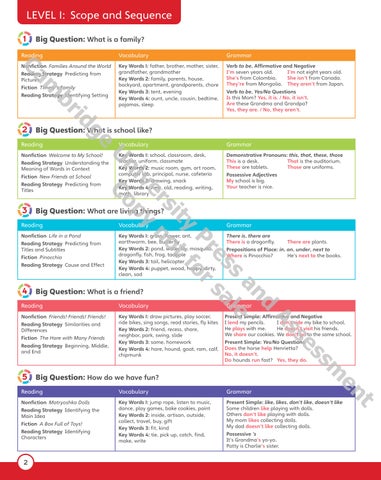
Big Question: What is a family? Vocabulary
Grammar
Nonfiction Families Around the World
Key Words 1: father, brother, mother, sister, grandfather, grandmother Key Words 2: family, parents, house, backyard, apartment, grandparents, chore Key Words 3: tent, evening Key Words 4: aunt, uncle, cousin, bedtime, pajamas, sleep
Verb to be, Affirmative and Negative I’m seven years old. I’m not eight years old. She’s from Colombia. She isn’t from Canada. They’re from Mongolia. They aren’t from Japan.
Ca
Reading Reading Strategy Predicting from Pictures
m
Fiction Timmy’s Family Reading Strategy Identifying Setting
id
br
Big Question: What is school like?
Reading
ge
2
Vocabulary
Grammar
Key Words 1: school, classroom, desk, teacher, uniform, classmate Key Words 2: music room, gym, art room, computer lab, principal, nurse, cafeteria Key Words 3: drawing, snack Key Words 4: new, old, reading, writing, math, library
Demonstrative Pronouns: this, that, these, those That is the auditorium. This is a desk. These are tablets. Those are uniforms.
Reading Strategy Understanding the Meaning of Words in Context Fiction New Friends at School
Big Question: What are living things?
Reading Nonfiction Life in a Pond Reading Strategy Predicting from Titles and Subtitles Fiction Pinocchio Reading Strategy Cause and Effect
4
Vocabulary
Grammar
Key Words 1: grass, flower, ant, earthworm, bee, butterfly Key Words 2: pond, water lily, mosquito, dragonfly, fish, frog, tadpole Key Words 3: tail, helicopter Key Words 4: puppet, wood, happy, dirty, clean, sad
There is, there are There is a dragonfly.
There are plants.
Prepositions of Place: in, on, under, next to Where is Pinocchio? He’s next to the books.
Big Question: What is a friend?
Reading Nonfiction Friends! Friends! Friends! Reading Strategy Similarities and Differences Reading Strategy Beginning, Middle, and End
Vocabulary
Grammar
Key Words 1: draw pictures, play soccer, ride bikes, sing songs, read stories, fly kites Key Words 2: friend, recess, share, neighbor, park, swing, slide Key Words 3: same, homework Key Words 4: hare, hound, goat, ram, calf, chipmunk
Present Simple: Affirmative and Negative I don’t ride my bike to school. I lend my pencils. He plays with me. He doesn’t visit his friends. We share our cookies. We don’t go to the same school.
ss se
Fiction The Hare with Many Friends
Present Simple: Yes/No Questions Does the horse help Henrietta? No, it doesn’t. Do hounds run fast? Yes, they do.
Big Question: How do we have fun?
en
m
5
Possessive Adjectives My school is big. Your teacher is nice.
Co
Reading Strategy Predicting from Titles
As d an s le es sa Pr r y fo it t rs no ve y ni p
U
Nonfiction Welcome to My School!
3
Verb to be, Yes/No Questions Is this Mom? Yes, it is. / No, it isn’t. Are these Grandma and Grandpa? Yes, they are. / No, they aren’t.
Vocabulary
Grammar
Nonfiction Matryoshka Dolls
Key Words 1: jump rope, listen to music, dance, play games, bake cookies, paint Key Words 2: inside, artisan, outside, collect, travel, buy, gift Key Words 3: fit, kind Key Words 4: tie, pick up, catch, find, make, write
Present Simple: like, likes, don’t like, doesn’t like Some children like playing with dolls. Others don’t like playing with dolls. My mom likes collecting dolls. My dad doesn’t like collecting dolls.
Reading Strategy Identifying the Main Idea Fiction A Box Full of Toys! Reading Strategy Identifying Characters
2
Possessive ’s It’s Grandma’s yo-yo. Patty is Charlie’s sister.
t
Reading