m
Ca
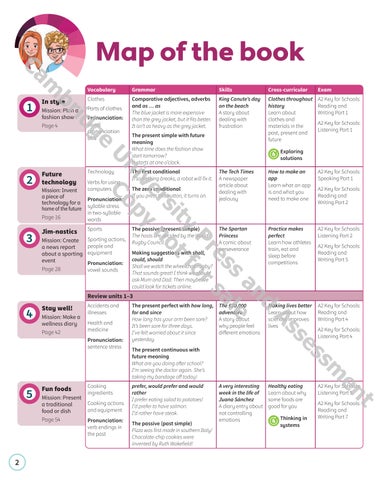
Map of the book Grammar
Skills
Cross-curricular
Exam
Clothes
Comparative adjectives, adverbs and as … as The blue jacket is more expensive than the grey jacket, but it fits better. It isn’t as heavy as the grey jacket.
King Canute’s day on the beach A story about dealing with frustration
Clothes throughout history Learn about clothes and materials in the past, present and future
A2 Key for Schools: Reading and Writing Part 1
br
1
In style
Vocabulary
Pronunciation: plural pronunciation of ‘s’
ge
id
Mission: Plan a fashion show Page 4
Parts of clothes
The present simple with future meaning What time does the fashion show start tomorrow? It starts at one o’clock.
Exploring solutions
Jim-nastics Mission: Create a news report about a sporting event Page 28
Technology
Verbs for using computers
The first conditional If something breaks, a robot will fix it. The zero conditional If you press this button, it turns on.
Co
3
Mission: Invent a piece of technology for a home of the future Page 16
As d an s le es sa Pr r y fo it t rs no ve y ni p
U
2
Future technology
Pronunciation: syllable stress in two-syllable words Sports
Sporting actions, people and equipment Pronunciation: vowel sounds
The passive (present simple) The hosts are decided by the World Rugby Council.
Making suggestions with shall, could, should Shall we watch the wheelchair rugby? That sounds great! I think we should ask Mum and Dad. Then maybe we could look for tickets online.
A2 Key for Schools: Listening Part 1
The Tech Times A newspaper article about dealing with jealousy
How to make an app Learn what an app is and what you need to make one
A2 Key for Schools: Speaking Part 1
The Spartan Princess A comic about perseverance
Practice makes perfect Learn how athletes train, eat and sleep before competitions
A2 Key for Schools: Listening Part 2
The £20,000 adventure A story about why people feel different emotions
Making lives better Learn about how sciences improves lives
A2 Key for Schools: Reading and Writing Part 4
A very interesting week in the life of Juana Sánchez A diary entry about not controlling emotions
Healthy eating Learn about why some foods are good for you
A2 Key for Schools: Reading and Writing Part 2
A2 Key for Schools: Reading and Writing Part 5
Review units 1–3
4
Stay well!
Health and medicine
Pronunciation: sentence stress
Pronunciation: verb endings in the past
The passive (past simple) Pizza was first made in southern Italy! Chocolate-chip cookies were invented by Ruth Wakefield!
Thinking in systems
A2 Key for Schools: Listening Part 5 A2 Key for Schools: Reading and Writing Part 7
t
Cooking actions and equipment
prefer, would prefer and would rather I prefer eating salad to potatoes! I’d prefer to have salmon. I’d rather have steak.
en
2
Mission: Present a traditional food or dish Page 54
Cooking ingredients
The present continuous with future meaning What are you doing after school? I’m seeing the doctor again. She’s taking my bandage off today!
A2 Key for Schools: Listening Part 4
m
5
Fun foods
The present perfect with how long, for and since How long has your arm been sore? It’s been sore for three days. I’ve felt worried about it since yesterday.
ss se
Mission: Make a wellness diary Page 42
Accidents and illnesses
6
Vocabulary
Grammar
Skills
Cross-curricular
Home
a few, a little, a lot of, lots of There are a lot of old clothes in this box. And there’s lots of wool in that one. We have a few toy cars here. Shall we have a little water?
The fall of a Mayan city A story about looking after the environment
Ecosystems A2 Key for Schools: Speaking Part 2 Learn about the animals that make A2 Key for Schools: their home in the city Reading and Writing Part 6 Thinking in
Environmentally friendly The environment Mission: Discover how schools could be more environmentally friendly Page 66
m
Ca
Pronunciation: schwa
ge
id
br
Question tags We could be more environmentally friendly, couldn’t we? We shouldn’t throw plastic into the wrong bin, should we?
Making positive change
Exam
systems
Review units 4–6
Wellbeing
have to, don’t have to, needn’t, must, mustn’t We have to wait. I really must study for the history test tomorrow. You needn’t worry - you’ve studied a lot. She doesn’t have to work tomorrow.
The cowboy who cried wolf A story about telling the truth
Emotional awareness Learn about empathy and how we show emotions
A2 Key for Schools: Reading and Writing Part 3
The case of the Butterfly Diamond A story about managing stress
Responsible tourism Learn how to look after places when you go on holiday
A2 Key for Schools: Reading and Writing Part 4
Lost in the Rainforest A film script about environmental issues
Special effects Learn how special effects are used in films
A2 Key for Schools: Reading and Writing Part 7
As d an s le es sa Pr r y fo it t rs no ve y ni p
Mission: Make a feelings chart Page 80
Feeling and emotions
U
7
Feeling it
Pronunciation: /b/ /v/ /w/
A2 Key for Schools: Listening Part 3
Co
so … that / such … that When I got on stage, I felt so scared that I wanted to go home! I took such a deep breath that everyone heard it!
8
9
Pretty cities
A tour of a city Visiting new places
Lights, camera, action!
TV and film genres Television
Pronunciation: word stress
used to / didn’t use to People didn’t use to have running water in their kitchens. They used to collect water from the well. have / get something done We’re having the costumes made.
The second conditional If I had €250 million, I’d give lots of it to charity.
A2 Key for Schools: Writing Part 6
Pronunciation page 118 Key Competencies Activity Bank page 128
t
page 120
en
Review units 7–9 Grammar reference
A2 Key for Schools: Reading Part 5
m
Mission: Plan and record an interview with a celebrity Page 104
Pronunciation: intonation in questions
ss se
Mission: Plan a city visit Page 92
Indirect questions Could you tell us what that big building is, please?
3
1
In style
Ca 1
ge
id
br
m
Look at the pictures. What are the people wearing? When do people wear these kinds of outfits?
Co
As d an s le es sa Pr r y fo it t rs no ve y ni p
U m
ss se en
mission Plan a fashion show
t
2 1.01
Watch the video. What clothes does Jim want to keep?
3
Which outfit do you like wearing the most? When do you wear it? at the weekend in cold weather in hot weather to a party
4
My Mission Diary Activity Book page 4
Vocabulary 1
1
1.02
Listen and point to the clothes. Then match the clothes (1–11) to the words in the box.
Ca
blouse handbag swimming costume
jewellery jumper raincoat suit tie tights tracksuit trainers
br
m
+ MaKE NEW OaRD
1
SEaRCH
2
3
I this. It’s warm and cosy!
Great for riding my bike in the park.
You can put your phone in this.
5
6
7
Something for my brother (if he ever gets married?!?).
This is beautiful – but more $ than some cars!
My geography teacher wears this! It’s awesome!!!!
9
10
11
This is perfect to wear in spring.
These are cute! And they look really comfortable.
This is more beautiful than a day at the beach.
ge
id
I love looking at clothes online, and here are some of my favourites. I’d love to get some of them one day ... and it’s my birthday soon!
1
Co
You’ll love this coat.
if you wear
8
My favourite tennis player wears these!
In pairs, read the sentences. Are they true for you?
m
2
ss se
As d an s le es sa Pr r y fo it t rs no ve y ni p
U
4
My teacher’s wearing jewellery.
There’s a raincoat in my bag.
I’ve got a handbag at home.
I’m wearing a jumper.
I’ve got a yellow blouse.
I’ve got a swimming costume.
My mum’s got a tracksuit.
There are trainers in my bag.
My teacher often wears a tie.
I’m wearing black tights.
My dad’s got a blue suit.
en
My teacher’s wearing jewellery.
No, she isn’t.
t
3 1.03 Pronunciation Listen and repeat. page 118 Clothes
5
Language in context
Read Jim’s blog and answer the questions.
1
1 What did Jim and Jenny want?
Ca
2 What was wrong with the things they bought? 3 What’s a ‘shopping fail’?
Did you know?
im’s
id
br
m
In the 1860s, some dresses were as wide as doors. Women often got stuck when they walked between rooms!
ge
Big Blog
U
Co
22nd March 12:25 p.m.
As d an s le es sa Pr r y fo it t rs no ve y ni p
Online Shopping Fails
Last week, I bought a T-shirt online to wear at my friend’s birthday party. I found a few websites where you can write on T-shirts. On one site, the T-shirts weren’t as expensive as on other sites, and they looked nicer too. My friend’s learning Spanish with me so I asked for ‘Happy Birthday’ in Spanish on the T-shirt.
The T-shirt arrived more slowly than I hoped. In fact, it arrived a few minutes before my friend’s party. I put it on as quickly as I could, then I left to go to the party. The T-shirt felt great. It wasn’t bigger or smaller than I wanted.
My feet are growing quickly so I needed a bigger pair of trainers for tennis club. I looked at two different websites. On the first site, the shoes were much more expensive, but on the second site I saw a pair of shoes I loved. They were bright red and they were very cheap. My mum ordered the trainers for me but when they arrived I was surprised. The box was very small. Then, when I opened the box, I was shocked. The trainers were a lot smaller than my feet. And they were smaller than my toes too! In fact, they were What a mistake! trainers for a doll! Now, I always check the size of the things I buy online.
I think Jenny says this.
2 ‘Wow! This is really comfortable.’ Integrate new vocabulary and grammar
3 ‘Great! I love the colour and they’re not expensive.’ 4 ‘I don’t understand. Why are you laughing?’ 5 ‘That’s strange. Why are they so small?’
t
Read the blog again. Who do you think says this – Jim or Jenny?
1 ‘My old ones are too small.’
6
Last month, I made an online shopping mistake that was as bad as Jim’s.
en
2
22nd March 12:45 p.m.
m
At first, I was disappointed, but my friend said that the T-shirt made him happy on his birthday. Then I felt a lot better.
FA I L
ss se
When I arrived, I showed the T-shirt to my friend and he started laughing. I was confused, but then he told me about the problem with my T-shirt. It didn’t say ‘Feliz cumpleaños’ on the back. It said, ‘Happy Birthday in Spanish’!
SHOP P I NG
Language practice 1
1
What kind of words are these? Find them in the text on page 6.
1 expensive
2 quickly
3 slowly
4 big
5 small
1
6 good
Ca
Watch the video. Complete the sentences.
2 1.05
m
Grammar look: comparative adjectives, adverbs and as … as Think and complete!
br
Look!
JIM:
ge
id
The blue jacket is much more expensive than the grey jacket, but it fits better.
1
2
The comparative adjectives are … and … .
3
The comparative adverbs are … and …. page 120
Look at the outfits in the photos (1–3) and match them to the descriptions (A–C). Complete the descriptions with the correct form of the words in brackets.
Co
3
The grey jacket is … than the blue jacket.
As d an s le es sa Pr r y fo it t rs no ve y ni p
U
JENNY: You put the blue jacket on more quickly. I think I prefer the blue jacket. And it isn’t as heavy as the grey jacket.
1
A
3
2
B
C
This outfit’s much (1) … (smart) than the others, but maybe it’s not (2) … (comfortable) as them. The suit’s black, and I really like the bow tie. My favourite outfit’s a lot (3) … (interesting) than the other outfits. The girl’s wearing a blouse and a waistcoat. Her gloves look (4) … (big) than her hands. And I love her red shoes!
mission 1 Plan a fashion show hers. My clothes aren’t as interesting as red tights. She’s wearing a red wool dress and glasses on. She’s got black boots and white sun n mine. Her clothes are more colourful tha
My Mission Diary Activity Book page 4
t
Look in fashion magazines or online. Choose an outfit. Write a description comparing it to what you’re wearing now.
en
m
ss se
I think I like this outfit the best, because it’s (5) … (casual) and relaxed than the others. I think she can get dressed (6) … (quickly) with this outfit too. She’s got a woollen hat, a big jumper and trainers.
Comparative adjectives, adverbs and as ... as
7
Vocabulary 2
1
1.06
Match the sentences (1–7) to the clothes (A–G). Then listen and check. It’s got gold buttons.
1 It’s got a blue collar,
Ca
s and it’s made of silk. It’ o. got gold buttons, to
m
2
4
It’s made of leather. It looks good for cold weather.
3
5
ze and a There’s a small si e them large size. You us ng. when you go walki
6
id
br
It’s got long sleeves. It costs £25.
The dress.
It’s got a chain. There’s a crocodile on it, too.
It’s made of cotton. It’s got a picture of the sun on it.
ge
7
U
It’s got a parrot pattern. You wear it round your neck.
As d an s le es sa Pr r y fo it t rs no ve y ni p
Co
A
C
D
B
E
F
2
8
Parts of clothes
Tuesday:
Airport bus leaves at: (1) 6:15
Flight:
10 a.m. – 9 p.m.
Wednesday:
go to the (2) …
Thursday morning:
museum visit
Afternoon:
(3) … at the hotel
Friday:
go (4) …
Saturday:
whale watching at (5) …
t
Write times as numbers (for example, 12:15) not words (for example, quarter past twelve).
SCHOOL TRIP TIMETABLE
en
Exam Tip!
Listen again. Copy and complete the timetable.
m
3 1.07 Listen to Safi and Rav packing. Do they need winter or summer clothes?
4 1.08
ss se
In pairs, talk about what you like wearing at the weekend.
G
Language practice 2
1
When do we use the present simple? Discuss with your partner.
2 1.09
1
Watch the video. Say the correct words.
Ca
Grammar look: the present simple with future meaning
m
Look!
What time does the fashion show start tomorrow?
br
JIM:
Think and choose!
And what time is the party?
ge
JIM:
id
JENNY: It starts at one o’clock. JENNY: The party is at 7 p.m.
They are talking about today / tomorrow.
2
They are using the present simple / present continuous.
3
We can use this when we are talking about a prediction / a timetable or schedule. page 120
School fashion show
As d an s le es sa Pr r y fo it t rs no ve y ni p
U
3
1
Look at Jim and Jenny’s schedule for the fashion show. Answer the questions using the present simple.
9:30 a.m.
Models arrive:
10:30 a.m.
1 What time do the children set up the catwalk and chairs?
Models do hair and make-up in classroom:
10:30–11 a.m.
2 When do the models arrive?
Practice:
11 a.m.–12 p.m.
3 Where do the models do their hair and make-up?
Lunch:
12–1 p.m.
Parents arrive:
12:45 p.m.
Fashion show starts:
1 p.m.
Fashion show finishes:
2:30 p.m.
After-show party:
7 p.m.
Co
Children set up the catwalk and chairs:
4 What happens at 12:45 p.m.? 5 What time does the fashion show start?
6 When is the after-show party?
Talk to a partner. Make plans and organise your fashion show.
t
We set up the catwalk at nine o’clock.
en
What time do we set up the catwalk?
m
ss se
mission 2 Plan a fashion show
My Mission Diary The present simple with future meaning Activity Book page 4
9
Reading skills
1
Look at the pictures. Work with a partner and say what you think happens in the story using the words in the box.
Ca
clothes
fish
king
sea
servants
throne
br
m
2 1.10 Listen and read. Why was the king annoyed?
ge
id
King Canute’s day on the beach As d an s le es sa Pr r y fo it t rs no ve y ni p
U
I am a servant to the great King Canute. He is a good and powerful king. People say he can climb as well as a spider and swim as fast as a dolphin.
Co
One morning, the king looked at the fish on his gold plate. ‘I just wanted fruit for breakfast today!’ he said sadly.
‘Yes, your majesty,’ I said. In a second, the fish was gone and a huge bowl of fruit appeared. ‘Whatever you want, our good and powerful king.’ ‘Thank you,’ the king said, but he looked annoyed. After breakfast, the king went to his bedroom. I took out his finest silk shirt, his most beautiful suit and his best leather shoes. ‘Oh no,’ the king said angrily. ‘I wanted to wear something more comfortable today.’ ‘Yes, your majesty,’ I said, getting the clothes he wanted. ‘Whatever you want, our good and powerful king.’
ss se
Again, he looked annoyed. ‘Why does everyone always, always say “yes” to me?’ ‘Because you’re our good and powerful king, your majesty,’ I replied, helping him with the buttons on his cotton shirt.
en
m
Suddenly, the king said, ‘I want to go to the beach, and I want everyone to come with me.’
t
Soon, everyone was at the beach. ‘So I’m a powerful king, am I?’ he said. ‘Yes, your majesty,’ we replied. ‘Everyone has to obey me, do they?’ ‘Yes, your majesty.’ ‘Does the sea have to obey me?’ he asked. ‘Of course, your majesty,’ we replied.
10
Speaking & writing skills
1
1
Read the story again and complete the sentences with one word.
Ca
1 King Canute felt … because his servants always said ‘yes’ to him.
m
2 The servants chose clothes for him, but he didn’t want to wear them because they weren’t … enough.
br
3 The king made his servants go to the … with him.
ge
id
4 The servants were sure that the sea would … the king. 5 The king didn’t want his servants to treat him like he was a … .
In pairs, discuss the questions.
Co
As d an s le es sa Pr r y fo it t rs no ve y ni p
U
2
The king sat on his throne at the edge of the water. He shouted to the sea, ‘I’m your king! You must obey me. Stop! Don’t get me wet!’
3
Imagine you’re King Canute’s servant. Continue the story for the next day.
•
What does the king have to do that day?
•
How does he feel about it?
•
What do you say to him?
te woke The next day, King Canu t do I up early and asked, ‘Wha need to do today?’…
4
In pairs, talk about the questions.
•
What makes you feel frustrated? Say three things.
•
What advice can you give your partner?
t
I feel frustrated when I don’t understand the homework.
en
I opened my mouth to say, ‘Yes, your majesty,’ but I stopped myself just in time!
3 Imagine you’re a servant. What would you say to the king after what happened at the beach?
m
When the sea was touching the king’s chin, he stood up and said, ‘You see! The sea doesn’t obey me. I’m a king not a superhuman, so stop always saying “yes” to me. It’s very boring!’
2 Why does the king feel frustrated? What does he do to solve the problem?
ss se
We all watched, excited to see the sea obey the king. But we couldn’t believe what happened next. The sea didn’t stop. It covered his boots and his trousers and continued rising until it was as high as his shoulders.
1 Do you think King Canute’s a good person or a bad person? Why?
You should ask your parents for help.
A story about dealing with frustration
11
Cross-curricular
Clothes throughout history Ca 1
ge
id
br
m
Look at the pictures and discuss the questions.
Co
As d an s le es sa Pr r y fo it t rs no ve y ni p
U
Today, we still use many natural materials for our clothes, like cotton, wool, silk and leather. We also use manmade textiles, like acrylic, polyester and nylon. People like them because they’re cheaper than natural textiles. They have different qualities too – swimwear’s made of manmade materials because they dry faster. Our clothes often have both natural and manmade materials. Check the label on your T-shirt!
2 What do you think the clothes are made of? 3 Which styles do you like the best?
2 1.11 Listen and read the text. What clothes can you find? Read the text again and say yes or no.
2 Cotton’s a manmade textile.
5 Smart textiles can change shape.
In the future, we’ll wear a lot more clothes made from recycled materials and sustainable organic products. We could also all be wearing smart textiles. These clothes have little sensors hidden inside and they catch energy from our body. They can change colour, light up and even grow. Smart textiles are important for sport. For example, a T-shirt could help keep a football player cool during a match. Smart textiles can also be fun. Imagine your friends’ faces when your T-shirt changes colour at a party!
1 What materials are your clothes made of? 2 How do you think we’ll use smart textiles in the future?
12
Sustainability: Exploring solutions | Clothes throughout history
Did you know? In Europe in the Middle Ages, they didn’t make shoes for the left and right feet.
t
In pairs, talk about the questions.
en
4 Microplastics are bad for the planet.
What will we wear in the future?
m
3 We can use old bottles to make synthetic fleece.
Synthetic fleece is a manmade fabric. It’s made from recycled plastic. You need 25 plastic bottles to make a synthetic fleece sweater or a blanket! Synthetic fleece fabric keeps us warm, it’s waterproof and it’s a good use of recycled plastic. However, when we wash synthetic fleece, it releases microplastics, which can pollute the natural environment.
ss se
1 Everyone could wear silk in the Middle Ages.
4
In the past, people used natural materials, like animal fur and skin, to make their clothes. They also used leaves and plants. In the Middle Ages, most people wore warm woollen clothes made from natural fleece which came from sheep. Shoes were very simple, and they were made of leather. Only very rich people could wear silk and colourful clothes, as dyed fabrics were expensive.
What we wear today
1 When did people wear these clothes?
3
Clothes in the past
A2 Key for Schools
1
Think about where you would see each message. What sort of words do you use in those places?
an advert a note a notice a short email
m
Ca A
Exam Tip!
Match the text types in the box to the examples (A–D).
ge
id
br
Clean clothes as fast as a car!
1
B
Lola, Don’t wash your clothes in the washing machine. It broke this morning. See you later, Mum
Two shirts for the price of one!
As d an s le es sa Pr r y fo it t rs no ve y ni p
U D
Co
C
IMPORTANT
PLEASE TAKE OFF YOUR SHOES BEFORE YOU ENTER SECURITY
2
Dear Nadia, We change your towels daily and clean your room ever y morning after breakfast. We hope you have a great time! George Mills (Manager)
Look at the texts again. Match the topics (1–4) to the texts (A–D).
1 hotel information D
3 airport information
2 a machine that doesn’t work
4 a special offer
Read the text and answer the questions.
1 What kind of text is it? 2 Who wrote the message?
Choose the correct answer.
A at dinner time
a nice birthday present after your lessons. He loves funny ties!
t
When should Lucas look for a present?
dinner tonight. Please buy him
en
4
Uncle Oliver will be here for
m
3 What does Lucas need to do?
Lucas,
ss se
3
Dad
B before school C after school Reading and Writing Part 1
13
A2 Key for Schools
1
Watch the video. Why are they putting clothes in a box?
1.12
Ca
A Because they’re cold. B Because there’s a clothes sale at school.
2
br
m
C Because they want to wear all their clothes.
id
Read the questions and look at the pictures. Which words might you hear?
A
ge
1 What’s the name of Jenny’s video diary?
B
C
want it!
As d an s le es sa Pr r y fo it t rs no ve y ni p
U Wear it,
Hear it!
Want it?
Say it!
Then wear it!
Co
2 What time does the clothes sale start? A
B
C
B
C
3 What size is Jenny’s blouse?
Age
Age
9
11
en
8
m
Age
ss se
A
t
3 1.13
14
Listening Part 1
Now listen and watch again. For each question, choose the correct picture.
Exam Tip! Look at all possible answers and predict the words you might hear.
Review
mission in action! Plan a fashion show.
1
Look in fashion magazines and online. Work with a partner to choose 3–4 outfits you like.
br
m
Ca
1
ge
id
I like this outfit because it looks more interesting than the others.
U
3
Make a schedule for your fashion show.
Co
As d an s le es sa Pr r y fo it t rs no ve y ni p
Make a poster for your fashion show with your partner.
Present your fashion show to your class.
Come to our fashion show. It’s called ‘Blue Moods’. You can see lots of interesting clothes. We really like this outfit because …
2
Autumnection Coll
Yes, and I like the waistcoat.
2
4
1
Blue Moods Fashion
Show
a.m. Set up catwalk: 9 30–10:30 Models arrive: 9: 11:30 Practice: 10:30– Lunch: 12–1 p.m.
Choose your favourite outfit from your classmates’ fashion shows. Write a description.
I think the materials are very beautiful. The blouse
Go to page 120 Remember the grammar from Unit 1
t
this outfit because it’s very simple and attractive.
en
is made of silk and her skirt’s made of cotton. I like
m
The girl’s wearing a black blouse with a yellow skirt.
ss se
My favourite outfit’s smart and interesting.
My Mission Diary Unit consolidation 15 Activity Book page 4
2
Future technology
Ca 1
ge
id
br
m
Look at the pictures. What technology can you see? Which do you use? Which would you like to use more?
Co
As d an s le es sa Pr r y fo it t rs no ve y ni p
U
16
Watch the video. What two things do Jim and Jenny make?
My Mission Diary Activity Book page 16
3
What technology would you like in your home in the future?
t
2 2.01
en
m
ss se mission Invent a piece of technology for a home of the future
Vocabulary 1
1
Listen, point and say the numbers.
2.02
This is my laptop. I use it …
Number 6.
2
2
ge
id
br
m
Ca 1
Co 4 tes
5
No
r
da
en
Cal
23
7
8
Match the words in the box to the numbers 1–9 in the picture. keyboard laptop mobile phone mouse printer screen tablet website
Website’s number 1.
en
t
Complete the sentences with words from Activity 2.
9
m
app
3
6
ss se
2
As d an s le es sa Pr r y fo it t rs no ve y ni p
U 3
1 I need to use the … , but there’s no paper in it. 2 The … of my mobile phone broke when I dropped it. 3 I’ve got an … on my phone for studying new vocabulary. 4 My … is very old and some of the letters don’t work well. Technology
17
Language in context
1
Ca
Look at the poster. What can you see? What would you like to look at?
br
m
Look! There’s a robot dog.
ge
id
2 2.03 Listen to Tom talking to a friend about a technology show. What’s the address of the show’s website?
As d an s le es sa Pr r y fo it t rs no ve y ni p
U 3 2.04
Listen again. Match the people (1–5) to the objects (A–H). 2
Co
1
Sarah
Dale
mobile phones
E
4
Brian
B
A
3
5
Courtney
D
C
laptop
keyboards
G
F
Scott
screen
H
tablet
Remember that there are three options that aren’t used.
4 2.05 Pronunciation Listen and repeat. page 118 18
Integrate new vocabulary and grammar
t
Exam Tip!
robot dog
en
mouse
m
ss se
3D printer
Language practice 1
1
Think and complete the following sentence with your own ideas.
2
If I don’t finish my homework, …
Ca
… my mum won’t let me use my tablet.
Watch the video. Say the correct words.
br
m
2 2.07
… my teacher will be unhappy!
Grammar look: the first conditional Look at this home of the future!
ge
JIM:
Think and choose!
id
Look!
3 What time is Jenny talking about? The past / The present / The future
That’s amazing!
page 120
Read and match the sentence halves.
Co
3
2 What’s the result if something breaks? A robot will break / clean / fix it.
As d an s le es sa Pr r y fo it t rs no ve y ni p
JIM:
U
JENNY: Wow! Look! If something breaks, a robot will fix it.
1 Will something in the house break? Yes / Maybe / No
A home of the future 1 If people want to travel, …
A … if there isn’t space on the ground.
2 If people want less light in the room, …
B … they’ll press a button, and the windows will get darker.
3 Houses will be in the air …
C … their robots will help them.
5 The house computer will make the temperature perfect …
D … they’ll use flying cars.
E … if people are too hot or cold.
6 If people have a problem, …
F … the power will come from the sun.
en
This is our home of the future. If you want to come and visit, the door will have a special program to open it for you automatically. If the house gets dirty, a robot will clean it. If you forget to do your homework, an app will remind you! My Mission Diary Activity Book page 16
t
Work with a partner to draw a home of the future. Then write a description.
m
mission 1 Invent a piece of technology for a home of the future
ss se
4 If we use electricity, …
The first conditional
19
Vocabulary 2
1
Read the school webpage. Who’s got a robot that gives food to cats?
Ca
S MySchoolSocial S
Wall
Find friends
Chat
Profile
2 2.08 Match the icons (1–9) to the words in bold on the webpage. Then listen and check.
m
1 is ‘chat’.
Hi friends,
1
2
3
4
5
6
id
br
How will computers be different in ten years’ time? How will they help us? I’m making a poster about the future of computers and need ideas!
Jim
Jim
ge
Thanks
U
As d an s le es sa Pr r y fo it t rs no ve y ni p
In ten years’ time, I think there’ll be lots of computers in our homes. In fact, I think that we’ll chat to computers all day.
Co
Before I leave the house, I’ll ask my cupboard, ‘What do I need to to take with me today?’ Or if I take photos, I’ll ask my phone to upload them to my blog. – Ibcat2
In ten years’ time, I think we’ll stop using mice. Instead, we’ll control our computers by using our bodies. When we want to click on something, we’ll close one eye. And when we want to download a game or a film, we’ll look down at the floor.
7
3
3 ‘It will be easier to fix computers in the future.’ 4 ‘In the future, we’ll be able to install programs by smiling.’ 5 ‘In ten years’ time, a computer will be able to make Jim’s poster for him.’
4
Say sentences with the words from Activity 2. I chat with my friends online on Saturdays.
t
Verbs for using computers
2 ‘Before I go outside, my cupboard will tell me if I need an umbrella.’
en
20
I think Jim says this.
m
In ten years’ time, the computers in robots will be able to do almost anything. They’ll help us by writing emails and doing our homework! – Jungles17
Read the webpage again. Who do you think says this?
ss se
My uncle’s got lots of robots. If the floor is dirty, a robot drives around and cleans it. Another robot feeds his cats if they’re hungry and texts his mobile phone when he needs to buy more cat food!
9
1 ‘My friends and my sister are helping me with a project.’
If we want to turn on a computer or turn it off, maybe we’ll jump in the air! – CoolJen
If a computer has a small problem, like a broken ‘enter’ key, people often throw it away. But in the future computers will be easier to repair. Maybe we’ll be able to install programs or borrow robots that repair our computers. And if our computers break, they’ll be easy to recycle. – SofySky
8
Language practice 2
1
Look at Jungles17’s blog entry on page 20. How do their uncle’s robots help at home?
2 2.09
2
Ca
Watch the video. Say the correct words.
Grammar look: the zero conditional
m
Look!
This computer isn’t working!
br
JIM:
Think and choose!
id
SARA: Look here. If you press this button, it turns on.
Sara’s talking about what usually or always happens / will happen in the future.
ge
3
page 120
As d an s le es sa Pr r y fo it t rs no ve y ni p
U
Read the instructions. Complete them with the correct forms of the verbs in brackets.
How to use the VacRobotek
2 The VacRobotek needs to move freely.
Co
Before you turn it on, it’s important to pick up everything from the floor. If you … (want) to clean more than one room, it … (be) important to open the doors between the rooms.
3 If you … (press) the pink ‘on’ button on the
top of the VacRobotek, it … (start) cleaning.
4 If you aren’t at home, you can still clean
your house! If you … (download) the app, you can … (turn) the robot on and off from your phone!
1 If you want to use the VacRobotek,
5 When your floor … (be) clean, the
you need to put it on its charger first. If the light is (be) yellow, it … (mean) the battery isn’t fully charged. When the battery’s full, the light turns green. It only takes three hours to charge the VacRobotek!
VacRobotek automatically … (return) to its charger.
ss se
6 If you … (have) any problems, please
… (visit) our website for advice.
m
t
Imagine a new electronic device. Write instructions for how to use it. Then tell a partner about it.
en
mission 2 Invent a piece of technology for a home of the future 1
If you want to turn it on, you need to
My Mission Diary Activity Book page 16
…
The zero conditional
21
Reading skills
1
Look at the headline and subheading of the article. What do you think the winning app does?
m
Ca
2 2.10 Listen and read. How does Burak feel in the end?
If it happens, we write about it!
ge
id
br
THE TECH TIMES Friday 28th May | techtimes.co.tr | No 134
U
As d an s le es sa Pr r y fo it t rs no ve y ni p
APP DESIGN COMPETITION HAS A WINNER Winning App ‘Timetabler’ makes life easier for students
Co
This Monday, there was a surprise winner of Dr Safak’s Designan-app Competition. Azra Guner, who only joined the Academy last month, won first prize for her brilliant Timetabler app, which helps students organise their time.
Dr Safak announced the competition at the beginning of May. She said, ‘The app must be easy to install and use on a mobile phone, and it must be useful for studying in some way.’ For the last month, this newspaper has followed the competition. We spoke to students about possible winners, and everyone said the same thing: ‘If Burak Gül enters, he’ll win it.’ ‘Burak’s parents are software designers, and he learned everything he knows from them,’ said Ahmet Terim. ‘He’ll be the best app developer in Türkiye one day,’ said Mira Balta.
m
ss se
Everyone was surprised when Dr Safak announced the winner of the competition because Azra Guner is new to the school and is very quiet. Nobody knew that she designed her first app when she was only seven years old. Now, she is the star of the Digital Projects class. We managed to talk to her briefly about her app.
en
‘You tell the app what exams you need to study for,’ Azra explained to us. ‘You also tell it when the exams are. Then you click ‘plan’ and the app makes a timetable for you. It basically tells you what to study and when. It means you don’t have to spend any time planning, and you can just focus on studying.’
22
t
Although Burak was unhappy when he lost the competition, he loves Azra’s app. Some students say that he and Azra are now going to design a new app for students together. If that happens, you’ll be able to read about it first in the Tech Times!
Speaking & writing skills
Are the sentences true or false?
1
2
1 People expected Azra to win the competition.
Ca
2 All the apps in the competition had to help students with their schoolwork. 3 Burak taught himself all about computers.
m
4 Azra has designed apps for years.
br
5 Azra’s app tells you when your exams are.
In pairs, role play a conversation. Imagine you are Azra and Burak.
ge
2
id
6 Azra and Burak are planning to work together on a new app.
You are Azra. You feel happy because you won the competition. You have lots of ideas for new apps. Ask Burak if he would like to help you design a new app.
STUDENT B
Co
I can’t believe I won!
3
You are Burak. You feel unhappy and a little jealous of Azra because you wanted to win the competition, but you know that her app was better than yours. Ask Azra about her app.
As d an s le es sa Pr r y fo it t rs no ve y ni p
U
STUDENT A
How does your app work Azra?
In pairs, imagine you make a new app together.
Our app should give students a mini quiz every day.
Make notes on these questions. What does the app do?
•
How do students use it?
•
Why is it useful?
Write a paragraph for the Tech Times about your app from Activity 3.
ents to remember Our new app helps stud ss. Every day it new information from cla tions … asks you different ques
t
4
en
m
ss se
•
Good idea! It would help them remember what they learned.
A newspaper article about dealing with jealousy
23
Cross-curricular
How to make an app Ca 1
Which apps do you use? What do they do?
br
m
2 2.11 Listen and read the text. What do these numbers mean? hundreds of thousands
400 million
ge
id < What’s an app? >
U
< How do you make an app? >
As d an s le es sa Pr r y fo it t rs no ve y ni p
What’s an app?
Co
< There are lots of apps that you can download to a smartphone or laptop. The most popular are games, news, weather and social media apps. If you have an app on your phone, you just have to click on it. This means you don’t need to search for a program or write the address of a website. One of the first apps was a game called ‘Snake’. Players had to make a line of dots move around the small screen. This might not sound very interesting, but 400 million people played this simple game. Now there are hundreds of thousands of new apps every year. >
< Companies spend a lot of money on developing apps but if you have a good idea, you can make an app and create it for free. There are a few things to do if you want to make an app: 1 Think about what your app is going to do, how it will be good for the people using it and how you will let people know about your app. Write your ideas on a piece of paper and draw pictures.
2 Go online and check if there are other apps like yours. If there are, how is yours better? 3 Wireframe your idea. A wireframe is like a storyboard. You draw your design idea so that you can see what your app does. There are lots of different wireframing websites to help you do this.
3
1 I’d like to play ‘Snake’. 2 I’d like to use a maths app.
24
How to make an app
3 I think making an app is easy. 4 I’d like to make my own app.
A mobile phone is more powerful than the computer that sent astronauts to the moon in 1969.
t
In pairs, talk about the sentences. Answer yes or no and say why.
Did you know?
en
m
ss se
4 Learn the language of app building. Lots of schools have coding clubs which teach you the languages you need to build apps. You need to choose a coding language and learn the rules. For example, when you are using HTML5, you need to use these symbols < > at the beginning and end of your codes. >
A2 Key for Schools
1 2
2.12
Listen to an example of Speaking Part 1.
Match the question words with the phrases. What information should the answer have? Who …?
A place
Where …?
A time
When …?
A person
What …?
A short description
Tell me about …
A thing
ge
id
br
m
Ca
U
Match the questions (1–6) to answers (A–F).
As d an s le es sa Pr r y fo it t rs no ve y ni p
3
2
1 What’s your family name?
A My family and I went to Corfu in Greece.
2 Where are you from?
4 Where did you go on holiday last year?
D I’m from Seville, but I live in Madrid.
5 Who usually cooks in your house?
C It’s Gonzalez.
E I love technology so when I finish my exams I’ll do a course on writing programs for computer games.
Co
3 What do you like about your school?
B My parents usually do the cooking, but my brother’s quite good at making curries and desserts!
6 Tell me something about a new hobby you would like to try.
4
F It’s got a big gym and a modern computer room.
Exam Tip!
In pairs, ask and answer the questions.
Try to speak clearly and remember to give as much information as you can!
Hello, I’m Sally and this is David. What’s your name?
When do you watch films?
ss se
Do you like clothes shopping? Why / Why not?
I’m …
Yes, I go with … I like to buy … because … On … I usually … with my friends.
I sometimes …, but I often …
What’s your favourite subject at school? Why? Tell me something about your family.
t
Where do you usually have lunch?
en
I go to the …
m
Where do you go at the weekend?
I like … and … Oh, and … Because … Well, I’ve got … Speaking Part 1
25
A2 Key for Schools
1
Watch the video. Who says it? Jim or Jenny?
2.13
Jenny
1 It’s Sunday here – but it’s raining, raining and raining so we can’t go out.
A
B
2 Maybe you want to play your favourite song to your friends, but they can’t hear it?
A
B
3 You don’t need to buy lots of expensive things or download programs.
A
B
ge
id
br
m
Ca
Jim
U
In the exam you read about three people talking about the same thing. You have to decide which person says something. What do you think is the best way to do this? Choose and put the sentences in order.
Co
As d an s le es sa Pr r y fo it t rs no ve y ni p
2
3
A read each text once
C choose a letter
B read the questions
D read the three texts again
Choose the correct answer.
1 Which person doesn’t chat online as much as before?
a Now I’m 16 and I don’t chat with my friends online very often.
Exam Tip!
Don’t worry if you see some words which you don’t know. You will still be able to answer the question.
b I always chat with my friends online as soon as I’ve finished my homework! 2 Which person often makes videos?
a I make videos with my friends all the time.
3 Which person was the youngest when they started chatting online?
a My phone’s old and slow! Sometimes I need to ask if I can use my mum’s. b When I don’t have Wi-Fi, I usually wait until I’m home to use the Internet.
26
Reading and Writing Part 2
t
4 Whose phone isn’t working well?
en
b I started messaging my friends when I was 11.
m
a I started chatting online when I was 13.
ss se
b I make videos from time to time, but I prefer watching them.
Review
mission in action! Invent a piece of technology for a home of the future.
1
Think of ideas for technology people will use in a home of the future.
Good idea! If you don’t like tidying clothes, this invention will save you time.
Draw and label your invention.
ge
id
2
I think homes of the future will have wardrobes that tidy our clothes.
br
m
Ca
1
2
Co
As d an s le es sa Pr r y fo it t rs no ve y ni p
U
3
How does it work? Write some instructions.
notepad
How to use the Clothes-sorter 9000 1
Before you use it, you need to charge it.
2
If you have lots of clean clothes, put them through the door at the side.
3
If you press ‘on’, the device tidies your clothes.
Present your invention to your class.
2
Which invention do you like best and why?
If you don’t like tidying clothes, this is the perfect device for you.
en
m
ss se
4
t
Go to page 120 Remember the grammar from Unit 2
My Mission Diary Unit consolidation 27 Activity Book page 16
3
Jim-nastics
Ca 1
ge
id
br
m
Look at the pictures. What sports can you see? Which do you do? Which would you like to try?
Co
As d an s le es sa Pr r y fo it t rs no ve y ni p
U en
m
ss se mission Create a news report about a sporting event
t
2 3.01
28
Watch the video. Which three sports do Jim and Jenny do at home?
My Mission Diary Activity Book page 28
3
What sporting events do you know? Write a list. The Olympics The UEFA European Championship
Vocabulary 1
1
3.02
Read the TV guide. Match the words in purple to the pictures (1–11). Then listen and check. Rugby is number 7.
3
Ca
Wednesday, 9th October
m
7:00
Sport 1
7:30
8:00
br
Rugby tonight: Wales vs. Australia
8:30 Deep-sea diving: Daniel swims with sharks
ge
id
Small white ball: Exciting golf from around the Cricket chat: A review of today’s cricket matches world Cycling: A woman, her US Ice-hockey special: See the skaters Surfing: Hawaii’s best surfers bike and America’s highest on the ice for Sweden vs. Canada surf the ocean’s biggest waves Adventure mountains Be fit boxing: Get Gymnastics at home: Gymnastics at home: Be fit boxing: Get your your gloves on and Jump, dance and stretch Jump, dance and FIT1 gloves on and get fit get fit with Paul stretch with Paul Sports stars of tomorrow: Watch athletics stars Snow idea: Snow skiers try water-skiing for the AllStars run, throw and jump to prepare for the Olympics first time on Lake Tahoe
Sport 2
Co
As d an s le es sa Pr r y fo it t rs no ve y ni p
U
1
2
7
2
3
8
4
9
10
6
11
Complete the sentences in your notebook. Sports I’ve tried:
•
Sports I haven’t tried but would like to try:
•
Sports I just want to watch on TV:
Do you like the sports in Activity 1? In pairs, say why or why not.
Exam Tip!
en
Help your partner by repeating what you say or asking them questions. For example: Why don’t you like …? What do you think about …? How about …?
t
I love cycling. I go every week with my dad and my brother. It’s a great way to see the countryside. Do you like cycling?
m
ss se
•
3
5
Sports
29
Language in context
Read Jim’s blog. How many dogs can stand on a surfboard?
1
Ca
If you think that sports like golf or gymnastics aren’t interesting
im’s
Big Blog
m
enough, you might want to try something a little stranger. I’ve found three really unusual sports to tell you about.
br
id
The world’s three strangest sports Dog surfing
The Mud Olympics are held every year in a small German town called Brunsbuettel. Around 50 teams from different countries meet and play football and other sports in deep mud. As you can see, the players get very dirty! Yuck! There are lots of prizes – and people love playing in the mud – but the main reason that the event is arranged is to get money to give to charities.
In this sport, the dog usually surfs with a person, but sometimes the dog surfs alone or two dogs surf on one board. Dog surfing competitions are organised by people all around the world. At one competition in the USA, someone took a photo of 18 dogs on a surfboard. What an amazing photo! Remember, some dogs don’t like surfing. If your dog seems scared to be on a surfboard, take it off!
ge
The Mud Olympics
As d an s le es sa Pr r y fo it t rs no ve y ni p
U
Co
Man vs. Horse
2
This athletics event is held in Llanwrtyd Wells in Wales. At the event, people race a horse for 35 kilometres. People often think that the horse will win easily – but the race is planned so that the horse and runners finish at nearly the same time. How’s that done? Well, there are lots of mountains near Llanwrtyd Wells and horses are very slow at going down hills!
Read the sentences and say the correct event.
The Mud Man vs. Dog Olympics Horse surfing
2 Groups do the event together.
A
3 The event happens in an area where there are lots of hills.
A
4 People collect money at the event.
A
B
5 Competitions happen in many different places.
A
B
6 The person or animal who finishes this event first is the winner.
A
B
B
C
B
C C
en
Integrate new vocabulary and grammar
C
m
Focus on the general meaning of the text and don’t worry if there are some words that you don’t know.
B
C C
t
A
Exam Tip!
30
ss se
1 Pets do this event on their own, in pairs, or with a person.
Language practice 1
1
Look at the words in the box. Are they verbs or nouns? arrange
Ca
2 3.03
ball
Games
hold
organise
play
players
rugby
3
sporting event winners
Watch the video. Say the correct words.
m
Grammar look: the passive (present simple) Think and choose!
br
Look!
What sporting event are you learning about?
id
JIM:
ge
JENNY: The Women’s and Men’s Rugby World Cups! They’re held every four years. The hosts are decided by the World Rugby Council. And there are more professional women players than ever before!
Co
As d an s le es sa Pr r y fo it t rs no ve y ni p
U
1 We know / don’t know who holds the Rugby World Cups, and it is / isn’t important in this sentence. 2 When we want to say who does something, we use by / about. 3 We use is or are + past participle. e.g. Rugby is / are played by 15 players in two teams. The winners is / are awarded the Webb Ellis Cup.
3
page 121
Look at the magazine article. Complete the sentences using the present simple passive of the verbs in brackets.
Paralympic Games: Facts 1
held (hold) The Paralympic Summer and Winter Games are every four years. The Paralympic Summer and Winter Games … … (hold) two years apart.
2 The Paralympic flame … … (light) before the start of the Games.
3 In wheelchair basketball, the hoop … … (place) at the same height as in the Olympics! 4 In blind football, the ball … … (fill) with bells, so the players can hear where it is. 6 Wheelchair rugby … … (play) by mixed teams of men and women.
en
m
ss se
5 In blind football, players’ eyes … … (cover) to make it equal.
Research a sporting event. Make notes.
t
mission 1 Create a news report about a sporting event nis tournament. The French Open is an important ten ry year. It’s held in Paris in May and June eve red tennis courts. Fun Fact! All the games are played on My Mission Diary Activity Book page 28
The passive (present simple)
31
Vocabulary 2
1
3.04
Listen. Match the sports commentaries (1–4) to the photos (A–D). B
A
D
C
ge
id
br
m
Ca 2 3.05 Match the definitions (A–K) to the words (1–11). Listen and check. B
to practise a sport, often to prepare for a competition
As d an s le es sa Pr r y fo it t rs no ve y ni p
to touch som ething quickly and h ard
Co
G
A
U
1 goal 2 coach 3 train 4 surfboard 5 net 6 hit 7 racket 8 court 9 cyclist 10 track 11 helmet
C
D
the place where you play sports like tennis
F
E
a person who cycles
H
you wear this to keep your head safe
the thing people stand on when they surf
I
the thing in the middle of a tennis cour t that people hit the ball over
a path used for races
K
en
someone who prepares a team to play sport
m
a point scored in a game like football
ss se
something used to hit the ball in sports like tennis
J
1 is J.
three minutes
2–1
35 minutes
$1 million
one point
4 3.07 Pronunciation Listen and repeat. page 118 32
Sporting actions, people and equipment
t
3 3.06 Listen again. Why are the numbers below important? two metres
ten
eight
Language practice 2
1
Read the sentences from page 32 and find the modal verbs. What other modal verbs do you know?
3
Ca
“Team City can’t stop him. Can Waldek shoot? Yes, he can!” “Shall we watch the goal again?”
m
“He may be this garden’s greatest ever tennis player!”
br
Watch the video. Complete the sentences.
id
2 3.09
Look!
What shall we go to first?
U
JIM:
ge
Grammar look: making suggestions with shall, could, should
3
That sounds great! I think we should ask Mum and Dad. Then maybe we could look for tickets online.
Co
JIM:
When we make suggestions, we give our ideas about something, often to make a plan.
As d an s le es sa Pr r y fo it t rs no ve y ni p
JENNY: Shall we go to the wheelchair rugby?
Think and complete!
1 We use … in questions. e.g. Shall we watch the wheelchair basketball? 2 We use … to give ideas. e.g. We could go there by train.
3 We use … when we think something is a good idea. e.g. I think we should get tickets for the para athletics. page 121
Read the dialogue. Say the best word.
JIM:
What 1 do / shall we do on Day 1?
JENNY: Well, I think we should 2 watch / watching the ceremony. That looks interesting. JIM:
Yes, let’s 3 did / do that! Then on Day 2 we 4 could / shall watch the wheelchair basketball.
JENNY: Hmm. There isn’t any basketball on Day 2. We 5 could / should watch blind football, the para athletics, or para cycling ... OK, we 6 may / could watch the para cycling. Is that OK?
mission 2 Create a news report about a sporting event
What shall we do on Day 1?
Para athletics
I think we should watch …
Opening ceremony Blind football
Day 1
Day 2
Day 3
Day 4
t
Sporting event
en
Find a schedule for a sporting event or make your own. Then decide what to watch with a partner.
m
ss se
JIM:
Para cycling Wheelchair basketball
My Mission Diary Activity Book page 28
Making suggestions with shall, could, should
33
Reading skills
1
Look at the pictures. What do you think happens in the story?
2 3.10 Listen and read. How did Cynisca win in the end?
Ca
br
m
The Spartan Princess In Ancient Greece, around 428 BCE …
ge
id
Cynisca is a young Greek princess. She’s a Spartan. Spartans are tough people. Boys practise fighting and athletics, and girls also have to be very fit. It isn’t different for Cynisca, even though she’s a princess.
Her dad, Archidamus, King of Sparta, has encouraged her to do all kinds of sports since she was very young. She does riding and running just like her brother Agesilaus. But her favourite sport’s chariot racing.
As d an s le es sa Pr r y fo it t rs no ve y ni p
U Wait for me!
One day I’m going to the Olympics and I’m going to win.
Co
Catch me if you can!
But girls can’t enter competitions, so how are you going to do that?
It’s so unfair. I’m ready for the games but they won’t let women into the stadium to compete.
These are the best horses in all of Sparta.
34
Well, you can’t be the rider of the chariot but if you find a charioteer, you can enter as an owner and trainer. There’s no law against that.
t
When Cynisca’s father dies, her brother becomes King and Cynisca is given a lot of her father’s money. She is now very wealthy and she really wants to compete in the Olympics, so she decides to buy the horses and the chariot she needs.
en
m
ss se
I want four of your best horses.
Cynisca trains the horses for the chariot races every day for a year.
Speaking & writing skills The summer of 396 BCE … Finally, the day of the Olympic Games arrives. The games are held in the amazing stadium of Zeus at Olympia every four years. The streets are crowded. People come to watch and take part in the games from all over the world, from as far away as Spain and Türkiye. Cynisca travels there with her brother and horses, but still she’s not allowed inside the stadium.
ge
id
br
m
Ca
Cynisca finally finds a charioteer. He’s perfect for the job. He’s fast and strong. She’s a demanding instructor.
She sits outside and listens to the delighted crowds shouting and screaming. The four-horse chariot race is always the most spectacular race at the Olympics.
Cynisca wasn’t able to take part in the Olympic Games herself, but she won the chariot race twice in 396 BCE and again in 392 BCE. Her statue says: ‘My family and I were kings and queens. I, Cynisca, who won with a fourhorse chariot, put up this statue. I am the only woman in Greece to win this prize.’
Co
As d an s le es sa Pr r y fo it t rs no ve y ni p
U
You’ve won! You’ve won!
1
Look at the words in purple in the story. Match them to the definitions.
2 wealthy
B very happy
3 demanding
C very strong
4 delighted
D amazing to watch
5 spectacular
E very rich
what happened
•
how you felt
e Today my horses won th … four-horse chariot race
t
1 How do you think Cynisca felt when she couldn’t go into the stadium?
•
en
In pairs, discuss the questions.
Imagine you are Cynisca. Write a diary entry about the day your horses won the race. Describe:
m
A wanting other people to work hard
3
ss se
1 tough
2
3
2 How did she feel when she heard that her horses won? 3 What kind of person was Cynisca? How did this help her enter and win the Olympic games? A comic about perseverance
35
Cross-curricular
Practice makes perfect Ca 1
id
br
m
Look at the pictures. How do they help you to prepare for a sports competition?
ge
2 3.11 Listen and read the text. How many hours a day does each athlete train?
Gymnasts
As d an s le es sa Pr r y fo it t rs no ve y ni p
U
Every four years the Olympics are shown on TV. It takes years of training and hard work to compete at the Olympic Games, and an athlete must think about many things before they run around the track, hit a ball or put on a helmet for that important race.
Divers
Co
At the age of 15, Tom Daley became the youngest ever British World Champion in any sport.
en
Read the text again and answer the questions.
t
36
forearms
m
3
triceps
ss se
Training: Gymnasts train for six hours a day. As well as this, they swim, cycle and run to make their legs stronger. It’s important that they stretch every part of their body before and after they practise, or they might get injured. Food: Gymnasts need to eat a lot of protein (beans, chicken and fish) and healthy snacks like bananas and strawberries. Simone Biles Rest: They have one rest day a has got the week and try to get a good night’s most medals of any American sleep too. It’s difficult to train if gymnast. you are tired.
Training: Divers also train for about six hours a day, but before they get into the pool, they have to practise in the gym. They lift weights and do handstands to make their forearms strong. After training in the pool, they often put ice on their triceps to help them recover. Food: Food is very important for divers. Cereal, which has a lot of iron, is good. It’s important in the evening to eat snacks with carbohydrates like toast with chocolate spread, as this helps with energy levels. Rest: After training all day, divers often have a massage, and they are in bed by 10:30 p.m.
1 How often are the Olympic games held?
4 Why shouldn’t athletes go to bed late?
2 What do athletes need to do before competing?
5 How do athletes look after their muscles?
3 Why should athletes stretch before and after training?
6 Write examples of each of the food groups:
How athletes prepare for sport
Protein: …
Iron: …
Carbohydrates: …
A2 Key for Schools
1
3.12
Listen. What will the children learn?
3
ge
id
br
m
Ca 1 stomach
As d an s le es sa Pr r y fo it t rs no ve y ni p
U
2 3.13 Match the words (1–5) to the correct type of information (A–G). There are two extra letters. Listen and check.
3 fruit
Co
2 V-A-N-Y-A.
4 45 minutes 5 Main Hall
3 3.14
B a place C an age D a price
E a time
F a name
G a body part
Listen again. Read and complete using the words from Activity 2.
When: Food:
Summer
(1) 50% water, … and vegetables
50% protein and sugars
(2) Main … after 6 p.m.
Use Gym:
(3) For … minutes a day
en
(5) your … might hurt
m
Name of gym coach: (4) Bob …
ss se
Help with meals:
First day:
A a food
t
Exam Tip! The answer could be a word or a number number. You may also need to spell a name. Listening Part 2
37
A2 Key for Schools
1
Read the email and answer the questions.
1 Who’s Kito?
Jenny’s friend
Ca
2 What sports does Jenny talk about?
To: Kito
From: Jenny
ge
id
br
m
3 What question does Jenny ask?
Co
As d an s le es sa Pr r y fo it t rs no ve y ni p
U
Hi Kito, How are you? I wanted to tell you about some sports Jim and (1) I tried at home. First, we tried to do athletics. We ran (2) with balloons between our legs. It was great fun! Next, we wanted to play cricket, but we (3) did not have enough players. We tried to play French cricket, but we lost (4) the ball. Lastly, we tried golf. We made our own equipment with an old hairdryer, a table tennis ball and (5) a bat. We enjoyed it! (6) Shall we try a new sport when you come to visit? Jenny
2
Look at the example answers in Activity 1. What type of words are they?
•
modal verb
•
indefinite article
•
definite article
3
•
preposition
•
pronoun
•
auxiliary verb
For each question, write the correct answer. Write ONE word for each gap.
From: Kito
Hi Jenny,
ss se
To: Jenny
en
m
Thanks (0) for your message. That sounds like a lot of fun! I think we (1) … try gymnastics. It looks like great fun and I think we’ll both enjoy it a lot.
Best, Kito
38
Reading and Writing Part 5
t
(2) … you like surfing? I really want to try that. I saw a surfing competition on TV once and it looked amazing. I’m going to go to (3) … beach with my family next month, and I’m (4) … to have a surfing lesson. I’m very excited! My brother also wants to try surfing but I think he’s too young (5) … it.
Review
mission in action! Create a news report about a sporting event.
1
Work with a partner to choose a sporting event.
m
Ca
1
OK, that sounds good. I think we should do that!
Hmm, I’m not sure. I don’t really like golf. We could research the French Open. It’s a big tennis tournament.
ge
id
br
Shall we research the Ryder Cup? It’s a golf tournament.
3
Research the sporting event and make notes.
As d an s le es sa Pr r y fo it t rs no ve y ni p
U
2
The French Open
Sport(s)
Tennis
Co
Name of sporting event
Where and when?
It’s held at the Stade Roland Garros in Paris. It’s held every May and June.
Interesting facts
The stadium is named after a famous French pilot. The games are played on red courts. The stadium is visited by about 600,000 spectators, and the games are watched by more than 7 million people online and on TV.
Create your news report.
4
Present your news report to your class. Here we are at the French Open.
This is a famous tennis tournament, and it’s held in Paris every year.
en
t
Which sporting event would you like to go to, and why?
m
2
ss se
3
I’d like to go to the Paralympics because there are lots of different sports to watch.
Go to page 121 Remember the grammar from Unit 3
My Mission Diary Unit consolidation 39 Activity Book page 28
Review
QUIZ
Units 1–3 Watch the video and do the quiz.
2
Complete the text with the words in the box.
m
Ca
1
as interesting as
as strong and flexible
big and strong as
dull as
exciting as
id
br
as boring
ge
Some people say that athletics isn’t (1) … other sports. They say that watching people run is (2) … as watching paint dry. But I don’t agree! The end of an athletics race is as (3) … scoring a goal in sports like football or ice hockey. Also, when you watch athletics, you see lots of different events. Some athletes have to be as (4) … rugby players or boxers. Other athletes have to be (5) … as gymnasts. I think the most boring sport is cricket. I don’t like golf either – I think that’s nearly as (6) … cricket.
Co
As d an s le es sa Pr r y fo it t rs no ve y ni p
U
3
Complete the sentences. Use the present simple with future meaning form of the words in brackets.
The new water-skiing instructor (1) … (start) work on 15th July. Ask at reception if you’d like information about lessons
Hi everyone – please arrive by 8 a.m. for tomorrow’s Runners vs. Cyclists race. Cyclists (2) … (start) at 8:45. Runners (3) … (start) at 8 a.m.
Our new surfboard shop (4) … (open) next Monday at 9 a.m. Come and see us at 15 Beach Road.
m
What are you going to do this weekend? Who will you spend time with? Write 25–35 words.
en
t
fitness for everyone
40
(1) … it’s sunny at the weekend, I (2) … go shopping with my friend, Sue. We’ll go to the town centre and look round the shops. There are holes in the sleeves of my jumper, so (3) … there’s a sale, I’ll buy a new one. (4) … get one with a cool pattern, (5) … I can find one I like. Sue wants to buy a new handbag – she thinks (6) … buy one if it’s not too expensive.
5
Would you like to join our new rugby team? We (5) … (have) our first training session after school on Friday and we play weekly. Call Francesca on 07700 900245 for more information.
For each question, write the correct answer. Write ONE word for each gap.
ss se
Do you need surfboards or a swimming costume?
4
Say six sentences.
1
+
If / When
+
my mum will wear her winter coat. they’ll look good with your trousers. I’ll get a new gold chain. I put them in the washing machine. you should try it on. I put it in the garden to dry.
id
br
m
Ca
you like the tracksuit you get brown leather shoes it snows later my clothes are dirty my swimming costume is wet the jewellery isn’t expensive
Find and correct the mistakes.
ge
2
4 The school discos are organised the teachers.
2 In my bedroom there’s a bed which made of wood.
5 The school play is choose by the drama teacher. 6 They eat special cakes which are make for the wedding.
As d an s le es sa Pr r y fo it t rs no ve y ni p
U
1 My best friend it is called Luisa.
3 My favourite song is call One Last Time.
Say the correct words to complete the sentences.
Co
3
1 I wouldn’t / don’t like to chat to my favourite singer. I’m too shy.
4 Could you texting / text Grandma and ask her what time she’s coming?
2 Can you download / downloading these pictures for me, please?
5 I may / May I turn on the TV, please?
3 He shall / might email me after dinner.
4
6 Shall I install / Install I shall this software for you?
Choose and complete two of the challenges.
Challenge 1
Challenge 3
Look at Unit 2 pages 17 and 20. What are five things your computer has got? What are five things your computer can do?
Think of a sports word that starts with each of the following letters:
ss se
B-I-R-D-W-A-T-C-H-E-R-S
en
m
Look at Unit 1. Find three: • things people wear when they exercise. • parts of a shirt. • things people wear over shirts. • things clothes are made of.
Challenge 2
t Consolidation of units 1–3
41
4
Stay well!
Ca 1
What health problems can you see? What can the people do to feel better?
ge
id
br
m Co
As d an s le es sa Pr r y fo it t rs no ve y ni p
U m
ss se en
mission Make a wellness diary
t
2 4.01
42
Watch the video. What’s wrong with Jim? How does Jenny try to make him feel better?
My Mission Diary Activity Book page 42
3
What do you do when you are ill or need help?
Vocabulary 1
1
Listen and say the correct answer.
4.02
4
ge
id
br
m
Ca Exam Tip!
Co
As d an s le es sa Pr r y fo it t rs no ve y ni p
U
Read the questions before listening.
1 The shark bit the man while he was … A looking for a golf ball.
B swimming.
C feeding it.
B someone cooking.
C a candle falling.
2 The fire started because of … A the monster.
3 The man with the sore hand hurt himself when he was … A using scissors.
2 4.03
B preparing food.
C playing in the park.
Complete the sentences. Use the words in the box. Then listen and check. accident ankle appointment break painful careful heart hospital injured
1 So, you’re in a hospital .
ss se
2 He … his hand when he was feeding a shark.
3 I’ve made an … for the man to meet the doctor so that the doctor can remove the shark. 4 What’s wrong with this patient? The man who’s having his … checked.
en
6 Did the monster … the woman’s … , too? 7 It looks very … . It must hurt a lot.
t
8 You need to be … when you’re using knives.
3
m
5 I think there was an … and one of her pet monsters made the fire.
In pairs, ask and answer about the picture in Activity 1. What’s wrong with this man?
He’s injured his hand. Accidents and illnesses
43
Language in context
1
Read the messages. What’s wrong with Jim, Alex’s rabbit and Julia? 1
3 JULIA, FAHAD I’ve injured my ankle! I was playing tennis when I slipped and broke it.
Hi Jim – how are you? I haven’t been well for a week.
id
br
m
Ca
LUCAS, JIM FRIENDLY
Oh no! How long has it been broken?
ge
Jenny told me. Did you get our card?
Since Tuesday. I’ve been at home since then.
U
Is it painful?
As d an s le es sa Pr r y fo it t rs no ve y ni p
Yes – thank you!
Co
2
No, but I haven’t left my house for days! What have you studied in chemistry since Tuesday? I’d like to look at it this week.
NADIA, ALEX
Pages 46 and 47.
Hi Alex – would you like to come to the park later?
I can’t – I need to take my to the vet. She rabbit hasn’t eaten anything since yesterday.
Thanks! That’d be great!
Exam Tip!
Oh, no! I hope she feels better soon.
After you’ve chosen A, B or C, read the text and the question again to check that your answer is correct.
Look at the messages again. Say the correct answer.
1 Why is Lucas writing to Jim?
m
B He wants to ask about Jenny.
C He wants Jim to write a card.
B She’s going to go to the vet with him.
C She wanted to go to the park with him.
en
A He’s worried about his friend.
ss se
2
Shall I visit this evening? We could study together.
A Her rabbit is unwell.
3 What do Julia and Fahad agree to do together? A play tennis
44
Integrate new vocabulary and grammar
B study chemistry
C walk the dog
t
2 Why did Nadia write to Alex?
Language practice 1
1
Look at these verbs from page 44. What is the form? 3 has
2 have
4 broken
Ca
1 been past participle
m
2 4.04
4
Watch the video. Say the correct words.
br
Grammar look: the present perfect with how long, for and since Think and choose!
id
Look!
1
Sara’s arm is / isn’t sore now.
SARA:
2
It started to be sore three days ago / now.
3
She started to feel worried about it yesterday / now.
ge
JENNY: How long has your arm been sore?
Did you know?
Co
3 4.05 Pronunciation Listen and page 118 repeat. 4
A long time ago, when people had sore throats, they tried to get better by putting dirty socks around their necks. Some people put fish on their feet too!
Write six sentences. Use these phrases or your own ideas. (not) have the flu … have a headache … be unwell …
page 122
As d an s le es sa Pr r y fo it t rs no ve y ni p
U
It’s been sore for three days . I’ve felt worried about it since yesterday.
have a temperature …
have a broken ankle …
for a year
feel worried …
for three days
have a sore throat …
since I was 7
(not) have an accident …
since yesterday
ss se
mission 1 Make a wellness diary What’s the matter?
What happened?
How long …?
en
m
Imagine you are unwell, injured or worried. Answer the questions. Then role play with a partner.
t
What’s the matter?
I have a sore throat.
My Mission Diary The present perfect with how long, for and since 45 Activity Book page 42
Vocabulary 2
1
Read the diary. What happened to Dizzy at the lake?
6th August
I’m excited because tomorrow I’m going to the hills with my aunt. I’m taking my dog, Dizzy, for a walk and then we’re going swimming in a lake. We’re having a picnic, so we will need to take our rubbish home. We’re not coming home until after dinner! My aunt’s meeting us tomorrow at 9 a.m. to drive us there – so I should go to sleep now.
The vet gave Dizzy some medicine, and she said that Dizzy needs to have a small operation.
ge
id
br
m
Ca
4th August
5th August
7th August I’ve got some great news. Dizzy’s operation was a success! Dizzy’s resting at the vet’s at the moment and the vet says she can come home tomorrow. Hooray!
Co
As d an s le es sa Pr r y fo it t rs no ve y ni p
U
Today something awful happened. We were having a lovely day in the hills – Dizzy was happy, and we had a lovely picnic. But when we went to the lake, things started to go wrong. We were swimming when Dizzy hurt her leg on a rock. She fell over and started crying. We put a bandage round her leg and carried her back to the car. It looks really painful so we’re taking her to the vet this evening.
2
Also, because of all the stress, now I’m not feeling well. My mum’s given me some medicine for my headache. She told me to go to bed and rest. But when I lie down, I can’t sleep because I’m so worried about Dizzy.
I’m feeling better too. So I’ll be able to look after Dizzy when she gets home.
Match the words in purple in the diary to the pictures below. Number 1 is a vet.
1
2
3
3
Add one sentence (A, B, C or D) to the end of each day’s diary entry.
A I wonder what she’ll say. B I can’t wait to see her again!
ss se
C I hope her operation is OK.
D I’m so excited about the trip.
6
7
8
en
5
m
4
t
46
Health and medicine
Language practice 2
1
4
Look at the diary entry from 4th August on page 46. What verb forms can you see?
2 4.07
Ca
Watch the video. Say the correct words.
m
Grammar look: the present continuous with future meaning Look!
What are you doing after school?
br
JIM:
Think and choose!
ge
id
SARA: I’m seeing the doctor again. I have an appointment at 5 p.m. She’s taking my bandage off today!
1
Sara is at school / at the doctor’s now.
2
Sara can see the doctor now / in the future.
3
This is definite because she has /doesn’t have an appointment.
page 122
U
3 today
As d an s le es sa Pr r y fo it t rs no ve y ni p
Look at Jenny’s wellness diary. Complete the sentences using the present continuous. Tuesday
Wednesday
Thursday
Friday
Saturday
Sunday
17
18
19
20
21
22
23
6:30 p.m. – Get a hair cut
4 p.m. – Meet Priya at the swimming pool
10 a.m. – Help pick up rubbish in the park
10 a.m. – play football with my team
Co
Monday
5 p.m. – Do Lunchtime Lunchtime – homework – Go to Go to yoga with Karl athletics club
1 At 5 p.m. today, Jenny’s doing …
2 … at lunchtime tomorrow.
3 On Wednesday, …
4 … on Thursday evening.
5 On Friday after school, …
6 At the weekend,
mission 2 Make a wellness diary
Monday
Tuesday
9 a.m. 10 a.m. 11 a.m.
Wednesday
Thursday
12 p.m.
Do yoga
2 p.m. 3 p.m. 4 p.m.
an Help cle k r a p up
nning Go to ru club
t
I’m doing yoga at lunchtime on Tuesday. Would you like to come?
Saturday
en
LUNCH
Friday
m
Now tell your partner what you’re doing next week. Can they go with you?
Sunday
ss se
Think of three healthy things you want to do next week. Put them in your diary.
5 p.m.
I’d love to, but I can’t. I’m playing football at lunchtime on Tuesday.
6 p.m.
My Mission Diary Activity Book page 42
The present continuous with future meaning
47
Reading skills
1
Look at the pictures. What do you think the story is about?
2 4.08 Listen and read. What happens to Joshua at the end?
Ca
m
The £20,000 Adventure ge
id
br
Joshua’s bored. He has the flu, and he’s had a fever for several days. But today he’s feeling a bit better. He and his sister, Chloe, are watching a programme about crocodiles.
As d an s le es sa Pr r y fo it t rs no ve y ni p
U
Eddie, their cousin, has come to see if Joshua’s feeling better. ‘How long have you been ill?’ he asks. ‘For four days,’ says Joshua. ‘I haven’t been to school since last Monday!’ ‘Lucky you!’ says Eddie.
Co
The crocodile programme’s finished. The local news programme’s starting. ‘There was a robbery at Whitton’s bank last night. Thieves stole about £20,000 in cash and escaped in a fast car,’ the newsreader says. ‘The thieves are dangerous criminals.’
‘I know that bank,’ Chloe says excitedly. Joshua’s feeling sleepy. His eyes are closing! ‘Come on, Joshua,’ says Eddie. ‘Let’s climb some trees. Outside in the garden the children have climbed a tree. ‘Look at those men!’ says Chloe, pointing at two men by the river. ‘What are they doing?’ ‘Shhhhhh!’ whispers Joshua. ‘They’ll hear you and they look dangerous!’
t
48
en
The three children watch in complete silence while the men finish hiding the cash and walk away. ‘Let’s get it!’ says Chloe, climbing down the tree fast. ‘Come on, Joshua,’ shouts Eddie. ‘What are you waiting for? They might come back.’ But Joshua isn’t feeling well. As he’s climbing down the tree he cuts his knee and cries out in pain.
m
The two men look up as if they’ve heard something. The children freeze – they are terrified.
ss se
One of the men is taking a huge pile of papers from a brown bag. ‘It’s the £20,000!’ whispers Chloe. ‘Look! They’re hiding it in the hole.’
Speaking & writing skills
Ca
Chloe and Eddie get the bag. They don’t see the men coming back! Suddenly, the men are standing right behind them and they look furious. ‘Hey! Drop that!’ they shout. ‘Run!’ shouts Eddie.
ge
id
br
m
Eddie and Chloe grab the money and run to the bridge as fast as they can. They cross over the river. But Joshua can’t run to the bridge. His knee’s bleeding. It’s too painful to run. ‘Hurry up, Joshua, they’re going to catch you,’ shouts Eddie from the other side of the river.
1
Read the story again and say true or false. Correct the false sentences in your notebook.
4
1 Joshua has been ill for a week. true / false 2 Joshua and Eddie are cousins. true / false 3 There was a robbery at Whitton’s Bank last night. true / false
Co
As d an s le es sa Pr r y fo it t rs no ve y ni p
U
4 Eddie cuts his knee while he’s climbing down a tree. true / false 5 Joshua’s going to have dinner with his mother at the end of the story. true / false
2
In pairs, discuss the meaning of the words in purple.
3
Read the story again. Who feels these emotions and why? bored excited furious terrified frightened
Who feels bored?
t
‘Oh, Mum. Yes, it was a strange dream!’ says Joshua.
It was a cold, rainy day, and I was walking home from school with my sister. We were …
en
‘Joshua, wake up! You’re dreaming,’ says his mother, coming into the room.
Choose one of the emotions in Activity 3. Write a story about when you felt that emotion.
m
Joshua’s trapped with the thieves behind him and crocodiles in front of him! What can he do? Then he sees a rope hanging from a tree. Can he swing across?
4
ss se
Joshua decides to swim to the other side. He sees crocodiles. He’s very frightened now. ‘Oh no, crocodiles - how strange!’ thinks Joshua for a moment. ‘Crocodiles don’t live here!’
I think Joshua feels bored because he’s been ill for four days.
‘Come on. Switch off the television. It’s dinner time,’ says his mum. A story about why people feel different emotions
49
Cross-curricular
Making livess better b Ca 1
Look at the pictures. Describe what you see.
m
2 4.09 Listen and read the text. Check your ideas.
br
ge
id
PROS THETICS When a person loses a limb, like a handsorlikefoot, walk
Co
As d an s le es sa Pr r y fo it t rs no ve y ni p
U
it becomes difficult to do everyday thing or pick something up. Prosthetic limbs help lots of people around the world. So, when did we start using prosthetics? The oldest prosthetic we know about is an Egyptian prosthetic toe. This means people have used prosthetics for more than 2,000 years! The toe was made of wood and leather, and researchers think the owner used it to look good, but they couldn’t move it.
Prosthetics have changed a lot since then. Now, they are made of lightweight materials like plastic, aluminum, and titanium. People can walk, work or study, run and do sports. Now scientists are working on prosthetics that can respond to the brain, so who knows what amazing things prosthetic limbs will do in the future!
PENICILLIN
GL ASSE S
When you get an infection, what
do you do? You can go to the doctors and get antibiotics. But before the 1940s, things were very different. People often died from infections.
Read again and complete the sentences.
3 Sir Alexander Fleming discovered penicillin in … . 4 Antibiotics have saved … of lives since the 1940s. 5 People have used glasses since … . 6 In the past, lenses were made of … , but now they are usually made of … .
50
Science improving lives
t
2 Old prosthetics were made of … , but now they are made of … .
en
1 People have used prosthetics for more than … .
m
3
the world wear glasses. But where did this amazing idea come from? Because we can see people wearing glasses in very old paintings, we know that people have used glasses since the 1200s! These old glasses didn’t have temples to keep them on people’s faces, so they had to hold them up to their eyes or rest them on their nose.
In the 1730s, people started using glasses with temples, which looked a lot like the glasses we use today. Before the 1980s, the lenses in glasses were always made of glass. These were heavy and broke easily. Since then, more lenses are made of light-weight plastic, so glasses are more comfortable. Glasses help millions of people see clearly every day!
ss se
In 1928, a Scottish scientist called Sir Alexander Fleming discovered penicillin, which kills the bacteria that causes a lot of infections. This helped to develop a group of medicines called antibiotics. Since then, antibiotics have saved millions of lives!
About 4 billion people around
A2 Key for Schools
1
Watch and listen. What’s wrong with Jim?
4.10
4
A He’s hurt his ankle.
Ca
B He’s got the flu. C He’s got a stomach ache.
m
Read Jenny’s video diary. What’s it about?
ge
id
br
2
Jenny’s video diary
As d an s le es sa Pr r y fo it t rs no ve y ni p
U
Jenny’s 1… about Jim because he’s been ill for three days. Jim’s lying down, and he’s 2… . Jenny wants to help him feel better, so she uses her laptop to find some 3… .
Co
Firstly, Jenny gives Jim some flowers. When she gives him the flowers, he starts coughing!
Next, Jenny gives Jim a glass of water, but he’s sleeping. Jenny wakes him up, 4… Jim feels a little annoyed. Jim was 5… , so it has helped a little.
Lastly, Jenny gives Jim a card. Their friends from their class have signed it. Jim hasn’t 6… his friends for days, so he really likes the card.
3 4
For each question, choose the correct answer.
2 A rest
B resting
C rested
3 A plans
B ideas
C uses
4 A because
B so
C why
5 A angry
B hungry
C thirsty
6 A watched
B seen
C looked
5 4.11
Read the text once to understand what it’s about. Read it again to choose the best answer. Then, read it again to check your answers.
t
C bored
en
B tired
Exam Tip!
m
1 A worried
ss se
Look at the options A, B and C in Activity 4. Discuss the differences between the words.
Watch again and check your answers. Reading and Writing Part 4
51
A2 Key for Schools
1
4.12
Listen to six recordings. Who’s talking?
1
Ca
two friends 2 …
3 …
m
4 …
br
5 … 6 …
ge
id 2 4.13 Read the instructions and the options A, B and C. Say the correct answer. Listen and check.
U
A a broken ankle
Co
B a king C a queen
3
As d an s le es sa Pr r y fo it t rs no ve y ni p
You hear a student talking about a film she watched on TV. What was the film about?
Read the questions. What are the key words?
1 Who did the girl watch the film with? A her mum
B her mum and her cousin
2 The film about a magic queen was … A a history film.
B a cartoon.
3 Which film did the girl want to see? A a film about a broken ankle
B a film about a king
4 Which film did they watch? A the cartoon
B the history film
ss se
4 4.14 Look again at the questions in Activity 3. Listen and choose the correct answer. Listen and choose the correct answer.
B a football C a scooter
52
Listening Part 4
Read the question and options carefully before you listen. Think about the situation the person is in and circle any key words. Then think about similar words you might hear.
t
A a wallet
en
You will hear a woman talking to a shop assistant. What does the woman buy for her grandson?
Exam Tip!
m
5 4.15
Review
mission in action! Make a wellness diary.
1
Make a mind map of healthy activities.
m
Ca
1
4
id
br
Do athletics
Read a book
Exercise
ge
Mindfulness
Healthy activities
As d an s le es sa Pr r y fo it t rs no ve y ni p
U
Look at nature in the park
On your mind map, tick the healthy activities you want to do next week. Think about when you want to do them.
3
Work with a partner to make a wellness diary.
4
Present your wellness diary to your class.
Co
2
This is our wellness diary. At lunchtime on Monday, we’re doing breathing exercises in the school gym.
2
Relaxing
Then we’re playing football at 4 p.m.
Imagine you have done some of the activities on your wellness diary for a few weeks. Review some of the activities. How do you feel?
en
t
Go to page 122 Remember the grammar from Unit 4
m
I’ve been to the park every Saturday morning since November. Sometimes I go with my family, and sometimes I meet a friend. When I look at the bugs, the birds and the plants, I feel relaxed, calm and interested in learning more about nature. I think it’s important to understand the natural world around us.
ss se
Nature in the park
My Mission Diary Unit consolidation 53 Activity Book page 42
5
Fun foods
Ca 1
Look at the pictures. What food can you see? Which would you like to eat, and why?
ge
id
br
m Co
As d an s le es sa Pr r y fo it t rs no ve y ni p
U
54
Watch the video. What game do Jim and Jenny play?
My Mission Diary Activity Book page 54
3
t
2 5.01
en
m
ss se
mission Present a traditional food or dish
Make a list of different foods you know and the countries they’re from.
Vocabulary 1
1
5
Match the shopping lists (A–C) to the correct baskets below. Then say the food that’s in each basket. B
broccoli salmon chillies
C
cabbage
garlic lamb herbs mushrooms
steak
onions
oil
ge
id
br
m
Ca
A
U
1
3
5
As d an s le es sa Pr r y fo it t rs no ve y ni p
2
9 8
6
Co 4
7
11
10
2 5.02 Listen, point and say the numbers. Broccoli
3
Number 5.
Have you got something green?
Yes, I have.
Play ‘I went to the supermarket and bought …’.
You’ve got broccoli!
en
4
Yes, it is.
m
Is it a vegetable?
ss se
Draw three foods from Activity 1 and hide your pictures. Then guess which food your partner has.
t
I went to the supermarket and bought an onion.
I went to the supermarket and bought an onion and some salmon.
I went to the supermarket and bought an onion, some salmon and ten mushrooms.
Cooking ingredients
55
Language in context
1
Look at the pictures in Activity 3. Answer the questions.
1 Which food can you see in the pictures?
2 What’s your favourite vegetable?
Ca
2 5.03 Listen to five conversations. How many times do you hear the word ‘broccoli’?
m 3 5.04
Listen again. Choose the correct picture. Say.
id
br
A
B
C
A
B
C
A
B
C
A
B
C
A
B
C
ge
1 What’s Claire’s favourite dinner?
As d an s le es sa Pr r y fo it t rs no ve y ni p
U Co
2 What would Mum like to have for dinner?
3 Which vegetable doesn’t Emma like?
4 Which carrots would Karen prefer?
56
Can you solve Claire’s problem? Think of a meal everyone at Claire’s party can eat and write a menu.
Integrate new vocabulary and grammar
Exam Tip!
Try to answer as many questions as you can the first time you listen. Check your answers and complete any that are missing when you listen the second time.
t
4
en
m
ss se
5 Which food can’t Tom eat?
Language practice 1
Which do you prefer? Ask and answer.
1
apples or bananas?
Ca
2 5.05
cake or ice cream?
Do you prefer …
5
potatoes or rice?
Watch the video. Say the correct words.
m
Grammar look: prefer, would prefer and would rather Think and choose!
br
Look!
I prefer eating salad to potatoes!
id
JIM:
JIM:
ge
JENNY: Would you like steak or salmon for dinner tonight? I’d prefer to have salmon.
3 Jim wants to have steak / salmon for dinner, but Jenny wants to have steak / salmon. 4 Jim and Jenny are talking about always / tonight. page 123
Look at the quiz. Answer the questions with a partner. Are you mostly A or mostly B?
Co
3
2 Jim’s talking about always / tonight.
As d an s le es sa Pr r y fo it t rs no ve y ni p
U
JENNY: Oh. I’d rather have steak.
1 Jim likes salad / potatoes more.
Are you an adventurous foodie?
Do you prefer eating the same things all the time? Or do you like food adventures? Take our quiz to find out. 1 For breakfast, do you prefer eating … A toast? B fried eggs with fried potatoes, sausage and spicy sauce?
2 You’re going on a picnic. Would you prefer to take … A a cheese sandwich? B a cheese sandwich with salad and chillies?
3 You’re going to a barbecue. Would you rather eat … A a burger? B lots of different seafood?
en
m
Make your own quiz using prefer, would prefer and would rather.
ss se
mission 1 Present a traditional food or dish
t
1 For dinner tonight, would you rather have … A vegetable lasagne? B pasta with seafood?
My Mission Diary Activity Book page 54
prefer, would prefer and would rather
57
Vocabulary 2
Read Jim’s blog quickly. Which ingredients do you need for each dish?
1
Ca
From roast chicken to boiled potatoes, Jenny and I love food
im’s
Big Blog
m
(maybe because our dad’s a chef). Last week, we asked three of our dad’s friends how to make some awesome dishes. Enjoy!
br
ge
id
How was it made?!? How was this egg made?
U
Well, I think everyone knows how to fry an egg. You just break it and put it into a hot frying pan with some oil. These eggs were fried like all others. But I used one little trick.
Co
This sandwich wasn’t made from bread! It was made from two cookies and some ice cream. The ice-cream sandwich was invented in the USA. It’s an awesome desert and easy to make. First, I got a round pot of ice cream and cut it into four pieces. Then I put each slice of ice cream onto a big cookie. Finally, I put another cookie on top. It was sooooooooooooo delicious!
How were these caterpillars made?
As d an s le es sa Pr r y fo it t rs no ve y ni p
How was this ice-cream sandwich made?
Before I put the eggs in the pan, I sliced a large onion with a knife. Then, I took the largest ring of the onion and added it to the frying pan. Next, I put the eggs into the onion ring to cook. That’s how the eggs were cooked in a circle. The last thing I did was make sure they looked happy! – CookEggcellent
Don’t worry, these aren’t real caterpillars! And they’re very easy to make too, so they’re perfect if you like healthy snacks. To make a caterpillar, first, put six grapes on a stick and add chocolate chip eyes with icing. Then, put the caterpillars in a dish in the fridge. I waited for about an hour (I put the kettle on and made myself a cup of tea) and the caterpillars were ready! I took the caterpillars to a party and my friends said they were delicious. In fact, they were so popular that they were finished before I tried one!
(If you REALLY love sugar, you can melt some chocolate in a bowl over a saucepan and pour it onto your finished sandwich!)
– LittleLolz
2
3 5.06
Number 1 is ‘cut’.
3
4
5
6
4
Choose one of the dishes from the blog. Draw pictures to show how it was made.
en
2
m
1
What are the answers to the riddles? Listen. Then write your own.
ss se
Match the pictures (1–9) to the words in purple in the blog.
– Pocco912
Cooking actions and equipment
8
9
t
58
7
Language practice 2
1
Look at Jim’s blog on page 58 and match. a a circle.
2 The caterpillars were …
b healthy and easy to make.
3 The eggs were …
c so delicious!
m
Ca
1 The ice-cream sandwich was …
2 5.07
5
br
Watch the video. Say the correct words.
id
Grammar look: the passive (past simple) Look!
Think and choose!
ge
SARA: Pizza was first made in southern Italy!
U
Co
As d an s le es sa Pr r y fo it t rs no ve y ni p
JENNY: Chocolate-chip cookies were invented by Ruth Wakefield!
1 We know / don’t know who made the first pizza. 2 The cookies are more / less important than the person who made them. 3 When we want to say who did something in a passive sentence, we use by / in. 4 To make the past passive, we use: was or were + past participle, e.g. Frozen yoghurt was / were originally invent / invented in the 1970s. Cronuts was / were first make / made by French pastry chef Dominique Ansel in 2013.
3
page 123
Read the magazine article. Put the verbs in brackets into the passive.
Paella: A history
Paella, a delicious Spanish rice dish, is enjoyed all over the world. But where does it come from?
Eating together outside
It all started hundreds of years ago in Valencia, Spain. Rice (1) was grown (grow) in the fields there, and farmers and workers needed to eat at lunchtime.
ss se
Originally, paella (2) … … (make) by farmers as a lunchtime meal. It (3) … … (cook) in a big pan over a wood fire. Ingredients like tomatoes, onions, snails and beans (4) … … (use), because these ingredients were in the fields around them. Sometimes, rabbit, duck or chicken (5) … … (add). It (6) … … (eat) from the pan, and everyone had their own wooden spoons. Over the years, paella recipes have changed, and families have their own special recipes.
en
m
4 5.08 Pronunciation Listen and repeat. page 119
t
mission 2 Present a traditional food or dish Think of a traditional dish. Do some research and make notes about its history. • Paella was made by farmers in Valencia. • It was cooked in a special pan on a wood fire.
• Ingredients from around the rice fields were used.
My Mission Diary Activity Book page 54
The passive (past simple)
59
Reading skills
1
What type of text is this? What information do people include in this type of text?
2 5.10 Listen and read. Do you think Juana should say sorry?
Ca
Tuesday
ge
id
br
m
A very interesting week in the life of Juana Sánchez
Co
As d an s le es sa Pr r y fo it t rs no ve y ni p
U
My brother films an online cooking show. My parents think it’s brilliant. ‘Oh, Juana,’ Mum said at breakfast. ‘Your brother’s going to be a star’. ‘Oh, Juana, your brother’s got 63,000 subscribers!’ Dad said at dinner. ‘Have you subscribed yet?’ I’d rather clean the kitchen floor with an old toothbrush. The show’s called ‘Carlos Cooks’. ‘I made chilli today,’ my brother said as I washed his dirty plate. ‘My fans loved it!’
Thursday
I asked Carlos to help me lay the table. ‘Well, Juana,’ he said, ‘I’m a celebrity chef now. I haven’t got time to lay the table. I’ve got my next show to think about.’ The only way I could get him to stop talking about it was to say, ‘Fine, I’ll watch it on Sunday.’
Saturday
t
60
en
I had to help Dad in the garden this afternoon. I hate gardening. Playing in the mud is for pigs, not humans! There are worms everywhere – long, thin worms. I don’t like worms, but they gave me an idea …
m
Carlos had a big smile on his face this morning. ‘I’m so happy you’re going to watch my show tomorrow,’ he said. ‘The last one was watched 1,000,000 times!’
ss se
I’m going to ask Mum if we can change him for a quiet little cat.
Speaking & writing skills
Sunday
Read the story and say true or false. Correct the false sentences in your notebook.
Ca
1
5
1 Juana has subscribed to ‘Carlos Cooks’. true / false
ge
id
br
m
‘Everything’s ready – the onions, the garlic, the herbs, the spaghetti. Now, time for my shower.’ Carlos always has a shower before his shows. ‘I must look my best for my fans!’ he says. When he was in the bathroom, I went into the kitchen, took the spaghetti out of the pot, and replaced it with something else …
U
3 Juana helped her dad with the gardening. true / false 4 Juana put worms in the pot. true / false 5 A lot of people liked the show on Sunday. true / false
Co
As d an s le es sa Pr r y fo it t rs no ve y ni p
‘Right, let’s go!’ said Carlos when he came back into the kitchen. ‘I usually turn the camera on, Juana, but I’ll let you do it today. Ready? OK. 3, 2, 1 … now. Good morning, friends! Today I’m going to show you how to make spaghetti bolognese. In this pot I’ve already put the … worms! Arghhhhhhhhhhhhh!’
2 Carlos helps Juana lay the table. true / false
OK, it wasn’t the nicest thing to do. But more people liked this show than any of his other ones! And I’m sure he’ll talk to me again – one day.
2
In pairs, role play a conversation. Imagine you’re Juana and Carlos.
STUDENT A
You’re Carlos. You’re very angry with Juana. You don’t understand why she played a trick on you. STUDENT B
You’re Juana. You know you did the wrong thing, and you want to say sorry to Carlos. But you also want to tell him he shouldn’t talk about himself all the time. I’m very angry with you, Juana. My videos are very important to me. Why did you put worms in my pot?
ss se
I’m very sorry, Carlos. But why do you talk about your show all the time?
m
Write an entry in Juana’s diary for the next day. Explain:
•
how you feel about what happened on Sunday
•
how your parents and Carlos feel about it
en
3
t
A diary entry about not controlling emotions
61
Cross-curricular
Healthy eating Ca
1
5.11
Listen and read. What food groups do the super foods belong to? Which nutrients do they give us? Use the words in the boxes.
m
cereals and potatoes dairy fats and oils fish fruits and vegetables grains meat nuts and beans
br
Food groups
Nutrients
ge
id
Superfoods?
Blueberries have got vitamins K and C in them as well as other nutrients. Some people think that blueberries can protect us from heart problems and improve our memory. Try adding them to your breakfast cereal or have them for a snack.
Blueberries
Co
As d an s le es sa Pr r y fo it t rs no ve y ni p
U
It’s important to eat a balanced diet, and different foods give us different nutrients. Proteins make our muscles strong. Calcium’s good for our teeth and bones, and carbohydrates give us energy to exercise and play in the day.
calcium carbohydrates fats proteins vitamins and minerals
Some foods have more nutrients than others, but does this make them superfoods? Most doctors think that we shouldn’t call them ‘superfoods’ but ‘super diets’ – this means we should eat a healthy, balanced diet with lots of fruit, vegetables and wholegrain foods.
Here are some foods that have lots of vitamins that are very good for you:
Broccoli
Broccoli’s got lots of vitamins, calcium and fibre in it! It’s a vegetable that you can eat in salads, soups and with meat and fish.
Chocolate
Some people think that dark chocolate’s good for us, but like any food, you shouldn’t eat lots of it. A little bit of dark chocolate is better than milk chocolate, but if you eat it too much, it’s an unhealthy choice.
Read the text again. Match the sentence halves.
2 Calcium’s good for
B has lots of fibre in it.
3 We should eat
C too much chocolate.
4 Blueberries have got
D vitamin K in them.
5 Oily fish
E a healthy balanced diet.
6 Broccoli
F your teeth and bones.
7 You shouldn’t eat
G your muscles.
Sustainability: Thinking in systems | Food groups
I’d rather eat cereal for breakfast than toast.
I prefer blueberries to strawberries.
t
A has got vitamin D in it.
In pairs, talk about food you prefer. Do you eat any ‘superfoods’?
en
1 Proteins are good for
3
m
62
Oily fish like salmon or sardines have got vitamin D, protein and some B vitamins. Oily fish has also got good fat in it. If you eat oily fish two or more times a week it keeps your eyes and your bones healthy.
ss se
2
Oily fish
A2 Key for Schools
1
Watch the video and listen. Match.
5.12
Jim
broccoli hands
mushrooms in their hair
mushrooms in their socks
br
m
Ca
a salmon’s head
5
Jenny
ge
id 2
Look at the picture. Think of some places Tim might have visited.
As d an s le es sa Pr r y fo it t rs no ve y ni p
U
The cooking tour with my dad was great!
• a restaurant
Co
3
5.13
Listen to the conversation. Write two places you hear for each day.
1 Tuesday 2 Wednesday 3 Thursday 4 Friday 5 Saturday
4 5.14
• a market
…
…
…
…
…
…
…
…
…
…
Listen again and choose the correct answer.
4 Friday 5 Saturday
C café D museum E TV studio F town hall G park H farm
Remember, sometimes you hear two options. Listen carefully for words that might mean that one option isn’t correct. For example: • no • didn’t • weren’t
t
3 Thursday
B train station
Exam Tip!
en
2 Wednesday
Places A apartment
m
Days 1 Tuesday
ss se
You will hear Tim talking to a friend about a cooking tour with his dad. What day did he visit the places?
Listening Part 5
63
A2 Key for Schools
1
Which phrases in the box are useful for telling a story?
Ca
Look at picture A and write a sentence to start a story. Use a phrase from the box in Activity 1.
A
Which of the sentences is the best first line for this story? Why?
id
3
Last week, Yesterday,
br
m
2
After that, Because of this, Dear Sally, Finally, In the end, Lots of love, Next, One day, Thanks for your email, Then,
ge
1 One day, a man drinks an orange juice. 2 Tony likes cooking.
4
Co
Look at the rest of the story. Choose a phrase and finish the sentences in your notebook.
B
Then/Next, …
5
As d an s le es sa Pr r y fo it t rs no ve y ni p
U
3 Last week, John went to have dinner at a restaurant.
C
Finally/In the end, …
Read two students’ answers. In pairs, talk about which story is better and why. In the second story, the people have names.
One day, John went to have dinner at Tony’s restaurant. He was waiting for someone, and he felt worried. Then his daughter Betty arrived with her mum. Betty opened her beautiful present, and Tony gave her a cake. It was a really fun evening.
en
m
A man goes to eat in restaurant. He’s looking at his phone. A girl enters. She is with a woman. The girl’s present is beautiful. The people are happy.
2
ss se
1
t
Exam Tip! Remember to write about all three pictures. Your story should have a beginning, a middle and an end.
64
Reading and Writing Part 7
Review
mission in action! Present a traditional food or dish.
1
Work with a partner. Think of a traditional food or dish.
m
Ca
1
5
br
I’d prefer to talk about Manchego.
ge
id 2
Good idea! What about Gorgonzola or Manchego?
I think we should talk about cheese. I love cheese.
Do some research. Make notes.
U
As d an s le es sa Pr r y fo it t rs no ve y ni p
Food or dish: Manchego
Ingredients
History
cheese Spanish
curds from sheep’s milk
thousands of years ago
Co
General information
3
Make a poster.
Manchego
Manchego, a delicious Spanish cheese, is enjoyed all over the world.
It was first made thousands of years ago in the region of la Mancha. It was made with milk from a special type of sheep.
4
Present your food or dish to your class.
t
Which food or dish would you prefer to try, and why?
en
2
m
We would like to talk about our favourite cheese.
ss se
The curds from the milk were pressed in grass baskets. Then they were left in the basket for many months, and this became Manchego.
I’d prefer to try the Portuguese custard tarts because they look delicious!
Go to page 123 Remember the grammar from Unit 5
My Mission Diary Activity Book page 54
Unit consolidation
65
6
Environmentally friendly
Ca 1
Look at the pictures. What can you see? Which objects were recycled?
ge
id
br
m Co
As d an s le es sa Pr r y fo it t rs no ve y ni p
U
66
Watch the video. What does Jenny make with her old jeans?
My Mission Diary Activity Book page 66
3
What does your school do to help the environment?
t
2 6.01
en
m
ss se mission Discover how schools could be more environmentally friendly
Vocabulary 1
1
6.02
Listen and point to the things in Ela’s house. Say the numbers. Above the stairs is a cool bulb.
Ca
12
m
11
Number 2!
1 2
ge
id
br 10
3
Co
8
As d an s le es sa Pr r y fo it t rs no ve y ni p
U
9
4
7
6
2
6
5
Ask your partner to name the objects (1–12) in the picture. air conditioning dustbin electricity
bulb candle curtain dishwasher heating rubbish sink socket tap
4
In pairs, share your diagrams. What are three differences?
Things I’ve used today …
en
t
I’ve used a dishwasher today, but Clara hasn’t.
Things in my kitchen …
m
Complete the diagram with the words from Activity 2.
A curtain.
ss se
3
What’s number 1?
Home
67
Language in context
My Amazing House! Ariadna, aged 10, Spain
Most people aren’t surprised that I don’t have a dishwasher. But when I say that fish clean my dishes for me, many people don’t believe me! In my garden there’s a small room, called the kabata. In the room, there’s a lot of water from our town’s river. My family use the water to clean vegetables and wash dishes. A little food falls off the bowls that we wash – but that’s OK because there are lots of fish living in the water, and the fish eat the food. The fish keep the water clean! After the water comes to my kabata, it goes into the river or onto farms. A kabata is a great way to save water!
There isn’t heating or air conditioning in my house. I live in a traditional cave house – a house that’s built inside a hill. The ground around the house keeps the house cool when the weather’s hot, and warm when the weather’s cold. My house is great because it doesn’t use much electricity. People think that I don’t have Wi-Fi, electricity or even water in my cave house – but I do!
ge
id
br
m
Ca
Riku, aged 9, Japan
Co
As d an s le es sa Pr r y fo it t rs no ve y ni p
U
Madison, aged 11, Canada
In my house there isn’t a dustbin. My family don’t need one because we don’t throw away much rubbish. In fact, we only throw away a few bags each year. How do we do it? Well, we’re careful when we go shopping – we take our own bags to put our food in. Some things are always wrapped in plastic, but we try not to buy them. Instead, we buy lots of fresh fruit and vegetables at the market. Finally, when we have a little rubbish, we try to use it. I’ve made a lot of cool things from plastic bottles!
Read the article for 60 seconds. Which item doesn’t each child have in their house?
2
Read the article again and say yes or no.
6 She can’t use the Internet in her house.
2 The kabata is used to do the washing up.
7 Madison’s family throw away less rubbish than most people.
3
9 She often recycles things by using them in a new way.
Why is each house better for the environment than normal houses? Which would you rather live in?
Integrate new vocabulary and grammar
In Riku’s house they save water. It’s bad for the environment to use too much water because …
t
5 Her house is on top of a hill.
8 Her family don’t buy things in plastic bottles.
en
4 Ariadna’s home was built a long time ago.
m
1 Riku’s kabata is in the kitchen of their home. 3 The water that’s in the kabata is dirty.
68
ss se
1
Language practice 1
1
Look at these nouns from the article on page 68. Are they countable (c) or uncountable (u)? 3 food …
5 vegetables …
2 water …
4 bags …
6 rubbish …
m
Ca
1 dishwasher c
6
Watch the video. Complete.
2 6.03
br
Grammar look: a few, a little, a lot of, lots of There are a lot of old clothes in that box.
ge
JIM:
Think and complete!
id
Look!
Quantity
U
JENNY: Great! And there’s lots of wool in that one.
…, …
As d an s le es sa Pr r y fo it t rs no ve y ni p
JIM:
We have a few toy cars here, too.
2 We use … before plural countable nouns.
Co
JENNY: Phew! I’m thirsty. Shall we have a little water? JIM:
1 We use these words before plural countable nouns and uncountable nouns.
3 We use … before uncountable nouns.
Oh, yes please!
page 124
3 6.04 Pronunciation Listen and repeat. page 119 4
Read, say the correct words and match.
1 At home, we use a lot of / a few electricity.
2 I turn off the tap when I’m brushing my teeth, 3 Lots of / Lot of my clothes come from charity shops
B Maybe I should give them to my baby cousin. C Maybe we should use energy-saving light bulbs.
D because it’s cheaper and better for the environment.
mission 1 Discover how schools could be more environmentally friendly Solutions People could collect rainwater. They could use this to water plants or wash their car.
Some people waste lots of food.
They could use a few leftover vegetables to make a healthy soup. My Mission Diary Activity Book page 66
t
Problems In summer, some areas only have a little water.
en
How can people be more environmentally friendly? Make a list of problems and solutions.
m
ss se
4 I have a few / a little old baby toys.
A so I only use a few / a little water.
a few, a little, a lot of, lots of
69
Vocabulary 2
1
6.06
Listen to the podcast. Who always uses recycled paper?
m
Ca
2 6.07 Match the words (1–10) to the pictures (A–J). Listen and check. A
br
1 area B
Grandma
Alex
B
C
E
F
I
J
3 litter
id
2 recycle
ge
4 traffic jams
5 public transport
U
6 petrol 8 pollution 10 rainforest
G
3 6.08
Co
9 gas
As d an s le es sa Pr r y fo it t rs no ve y ni p
D
7 path
H
Listen again. Which time was better for the sentences (1–6)? Say Now or When Grandma was young.
2 People make less rubbish.
5 People use less gas and electricity.
*one-hundred million
4 70
When do you think life was better for the environment? Discuss and vote.
The environment
t
6 People save gas and electricity.
en
4 The air’s cleaner.
We use more than 100,000,000* bottles every day. That’s the same weight as six Statues of Liberty. Many of these bottles aren’t recycled and cause problems for the environment.
m
3 People are better at throwing rubbish away.
ss se
1 People are better at recycling.
Did you know?
Language practice 2
1
What are modal verbs? Think of some examples.
2 6.09
modal verb People should think about the environment more. verb
6
Ca
Watch the video. Say the correct words.
m
Grammar look: question tags Think and choose!
br
Look!
JIM:
We could be more environmentally friendly, couldn’t we?
id
1 We can use question tags when we are speaking / writing.
JIM:
ge
SARA: Yes, definitely!
We shouldn’t throw plastic into the wrong bin, should we?
U
SARA: You’re right. And we use a lot of water, don’t we?
3 We use question tags to make conversation, and we usually expect the other person to disagree / agree.
As d an s le es sa Pr r y fo it t rs no ve y ni p
JIM:
2 We usually use question tags when we already know / don’t know the answer.
Yes, a lot! We don’t use public transport, do we?
SARA: True! We should take the bus.
Co
page 124
3 6.10 How can schools be more environmentally friendly? Read the dialogues and say the question tags. Then listen and check. 1
We could get solar panels for our school, …?
2
We should make a school garden, …?
3
We shouldn’t leave lights on, …?
4
Some people waste a lot of water, …?
Yes, and a few parts of the country don’t have enough water!
5
We don’t reuse enough rubbish, …?
Yes, you’re right. Maybe we could reuse bottles and boxes in art class.
Yes, definitely!
Yes, great idea! And we could grow our own vegetables!
True. We should turn them off.
t
We should recycle paper and plastic, shouldn’t we?
Now make a list.
en
Work with a partner. How could your school be more environmentally friendly? Discuss using question tags.
m
ss se
mission 2 Discover how schools could be more environmentally friendly • get solar panels • make a school garden • turn off lights
My Mission Diary Activity Book page 66
Question tags
71
Reading skills
1
Look at the pictures. Where do you think the story takes place? What animals can you see?
Ca
2 6.11 Listen and read. Why did the king not listen to the old man?
id
br
m
The fall of a Mayan city ge
The Mayan king looked down sadly at the city. He remembered the exotic gardens full of many jaguars, pumas and parrots and the buzzing street markets with lots of delicious food from all over his empire. Now, the city was silent and empty. ‘Why has this happened?’ he asked himself. Many years before, the king saw a big beautiful ceiba tree in the heart of the rainforest. ‘This is where I’ll build my city!’ he thought. But just then an old man appeared from behind the tree. ‘I warn you, King,’ he said, ‘don’t cut down the trees! Build your city somewhere else!’ And he disappeared back into the forest. But the king ignored him. ‘He’s just a crazy old man,’ he thought. And he started work on his city nearby.
Co
As d an s le es sa Pr r y fo it t rs no ve y ni p
U
en
m
ss se
The city grew and grew, and the people became richer and richer. The people cut down more and more trees because they needed a lot of space to keep their animals and grow their corn. Everything seemed perfect, until one day things started to change. First the rain stopped, then the rivers ran dry and finally the corn in the fields and the vegetables in the gardens died. The people started leaving the city. ‘I must talk to the old man,’ the king thought, and he went back to the great ceiba tree. The rainforest had disappeared and now the tree stood all alone surrounded by hard, dry desert. When he saw the old man, the king fell to his knees, ‘Please tell me – what should I do?’ he asked. ‘There is a solution, but it will take many, many years,’ the old man said. ‘I’ll do anything,’ the king said. ‘For every tree that was cut down, you must plant two new trees,’ he said. ‘This is the only way to bring back your city.’
t
72
Speaking & writing skills
1
6
Read the story and say true or false. Correct the false sentences in your notebook.
Ca m
1 The king remembered gardens where lots of animals lived. true / false
id
br
2 The king cut down the ceiba tree to build his city. true / false
ge
3 The people cut down trees because they needed wood. true / false
Co
As d an s le es sa Pr r y fo it t rs no ve y ni p
U
4 The rainforest turned into a desert. true / false
The king and his people started planting trees. As the years passed, they slowly grew. The dry desert turned to green rainforest, full of the songs of birds and the calls of monkeys. And little by little, the city filled with people again. From that time, the king didn’t allow the people to cut down even one tree.
5 The king asked the old man for a solution to his problem. true / false
2
In pairs, discuss the three sentences. Which is the main lesson of this story?
•
Old people are always right about the world.
•
We should protect our natural environment.
•
We should stop building cities.
3
Write a summary of the story. Include the words in the box.
t
A Mayan king decided to build his city in the rainforest …
en
m
ss se
city desert king old man rainforest
Sustainability: Making positive change | A story about looking after the environment
73
Cross-curricular
Ecosystems Ca 1
br
m
Look at the pictures. What living and non-living things can you see in them?
ge
id
2 6.12 Listen and read the text about urban ecosystems. Find the animals – do you know them all?
U
Where we live
Co
As d an s le es sa Pr r y fo it t rs no ve y ni p
An ecosystem is all of the living and non-living things that are in an area. Living things include all of the plants and animals and non-living things are the rocks, water, soil and sand. Examples of ecosystems are an ocean, a rainforest, a pond, a desert, a river, grassland or an urban ecosystem. As cities and towns get bigger, other ecosystems get smaller. This means that a lot of animals don’t have anywhere to live and so they start to come into cities and towns to look for food and somewhere to sleep. Usually these are small animals like mice, rats and foxes, but in some cities there are some very unusual animals:
Read the text again and answer the questions.
3 What problems do you think wild animals have when they live in a city? 4 What problems do you think people have when wild animals come into a city?
74
Sustainability: Thinking in systems | Ecosystems in the city
Birds sing louder in cities. This is so that they can be heard by other birds – they are talking!
t
2 Should the Mumbai leopards be moved to a different home?
Did you know?
en
1 How have humans changed natural ecosystems?
m
3
Peregrine falcons in New York Peregrine falcons usually live near the beach but when they started to die, people in New York decided to help them live in the city. Now New York has more peregrine falcons than any other city in the world. That’s amazing, isn’t it? They like living in the city because there are lots of high places to make their nests where they’re safe and there’s a lot of food to eat too. The people of New York and the birds live happily together.
ss se
Leopards in Mumbai Mumbai is a very big city and about 24 million people live there. It also has a big park called the Gandhi National Park and this is where leopards and other animals live. But as the city gets bigger, the leopards are losing their homes. So, the leopards often come into town to look for food. Some people are trying to find a different place for the leopards but the animals don’t like moving to different places. So for now, people and leopards have to try to live together.
A2 Key for Schools
1 2
6.13
Listen to an example of Speaking Part 2, Phase 1.
Read the question and two answers. Which answer is better? Why? Do you like these different homes? Say why or why not.
Yes, I like these homes. I like this castle. It’s very big and beautiful. I think it’s great fun to live in a castle.
br
m
Ca
Look at the pictures. Choose an adjective and make a question. Ask and answer the questions.
ge
id
3
6
Co
As d an s le es sa Pr r y fo it t rs no ve y ni p
U Do you think a beach house is …?
Do you think living in a castle is …? Do you think a tree house is …?
Do you think living in a flat is …? Do you think a houseboat is ...?
Do you think a beach house is fun?
4
Yes, I do. It’s fun because …
Look at the pictures in Activity 3 again. Ask and answer. Which of these homes do you like best? Why?
I like the beach houses best because …
Look at the questions. Choose an answer and finish the sentences with your own ideas. I think … because …
Practise giving your opinion to a partner. Remember to use full sentences.
en
I prefer … because …
Exam Tip!
m
Now, would you prefer to live in the town or the countryside? Why?
ss se
5
boring expensive fun interesting noisy
t
Which is more important? Having heating or having air conditioning?
It’s more important to … because …
Speaking Part 2
75
A2 Key for Schools
1
Read the two example exam questions below. What information do you need to include? 2 You recently joined a new afternoon club. Write a note to your English-speaking friend, Theo. In your note:
br
m
Ca
1 Read the email from Jenny. Write an email to Jenny and answer the questions.
• tell him what you do at the club
id
To:
• tell him where and when the club is
From: Jenny Friendly
• ask him if he wants to go with you.
ge
Hi,
Write 25 words or more.
U
I’m having a recycling party on Friday, but I need some help. Can you come? It starts at 4:30 p.m. What food can you bring? What old things can you bring to recycle?
As d an s le es sa Pr r y fo it t rs no ve y ni p
Co
Jenny
Write the note on your answer sheet.
Write 25 words or more. Write the email on your answer sheet.
2
Look at the answers below. What can Isa and Victoria do to improve their writing? Use the checklist.
1
Write 25 words or more.
76
Reading and Writing Part 6
To get a good mark, your writing must have all three things being asked for in the exam.
t
Write about the three things in the question.
Exam Tip!
en
Write to the person in the question.
Hi Sam, I go to a nature club. We make instruments from wood! The club meets in the community centre next to the park at 4 p.m. every Thursday. Do you want to come? Bye, Victoria
m
CHECKLIST
2
ss se
Dear Jenny, Thanks for your message. I’m fine, thanks. I know about your party, and I can come at 4:30 on Friday. I can make and bring some very good cookies. My dad makes excellent chocolate-chip cookies! See you soon, Isa
Review
mission in action! Discuss how schools could be more environmentally friendly.
1
Make a mind map of ways schools could be more environmentally friendly.
ride a bike
Transport
Nature
As d an s le es sa Pr r y fo it t rs no ve y ni p
Energy
Co
How could schools be more environmentally friendly? Discuss with a partner. Some students could ride a bike or walk to school, couldn’t they?
3
Rubbish
The environment
U
2
reuse plastic for art projects
recycling bins
ge
id
br
m
Ca
1
6
Make a poster with your ideas.
Good idea! Some schools use a lot of electricity. Everyone should turn off the lights when they don’t need them.
Greener schools
We think students and teachers should walk, ride a bike, or ride a scooter to school.
4
Present your ideas to your class.
2
Which ideas did you like best and why?
The school could plant lots of fruit and vegetables.
en
m
ss se
Students could give their old school uniforms to the school.
t
I liked the idea about the school uniforms. We grow quickly, so it’s a good idea to give our uniforms to the school when they are too small for us.
Go to page 124 Remember the grammar from Unit 6
My Mission Diary Unit consolidation 77 Activity Book page 66
Review
QUIZ
Units 4–6 Watch the video and do the quiz.
2
Complete the sentences using for or since.
m
Ca
1
1 The new path has been open … three weeks.
br
2 My family have recycled everything … we moved to our new house.
id
3 We haven’t moved … an hour because of the traffic jam!
ge
4 I’ve picked up the litter in the picnic area every day … a month. 5 I’ve been worried about the rainforest … I watched a TV programme about it.
Complete the sentences. Use the words in brackets and the present continuous.
As d an s le es sa Pr r y fo it t rs no ve y ni p
3
U
6 I’ve taken public transport to school … I started going there.
Co
Next Monday, I’m not going to school because it’ll be closed. At 9 a.m., (1) … (I / get up) and boiling myself an egg for breakfast. At 10 a.m., (2) … (we / go) to the mountains to go fishing. (3) … (I / take) my raincoat and umbrella. If it rains, I won’t get wet. After lunch, (4) … (I / not / play) video games because I’ll want to lie down and rest. Then, at 8 p.m., I’m going to the cinema with my mum. (5) … (We / see) Spiderman.
4
Write about what you’re doing tomorrow. Write 25–35 words.
5
Complete the sentences. Use the words in the box. drinking
prefers (x2)
turn on
would rather (x2)
1 Susan … number candles on her birthday cake. 2 Jane … get striped curtains than spotted ones.
3 My dad … use a dishwasher than wash up in the sink. 4 My sister … hotel rooms with air-conditioning.
ss se
5 Judy prefers … tap water to bottled water.
6 Joshua would rather … the air conditioning than take off his favourite jumper.
Listen. Write the sentences.
en
m
6 6.14
t
78
1
Find and correct the mistakes. 4 I have a little computer games at home.
2 In my town you can go to the museum, the beach and a lot other beautiful places.
5 I need to drink a few water because I’m thirsty.
3 I like it alot.
6 People spend lot of time in front of the TV.
2
br
m
Ca
1 I spend much money on clothes.
Read the situations and complete the question tags.
id
ge
1 You’re at a restaurant with your family. The salmon’s very expensive. What do you say? The salmon’s very expensive, isn’t it?
You haven’t …
As d an s le es sa Pr r y fo it t rs no ve y ni p
U
2 You haven’t got enough onions for your recipe. You want to know if your friend’s got a spare one. What do you say?
Co
3 Your friend’s coming to your house for dinner. You think she doesn’t like broccoli but you want to check. What do you say? You don’t like …
4 You think your Uncle Sam can eat mushrooms but you want to check with your mum. What do you say? My Uncle Sam can …
5 You think your friend goes to school by bus. What do you say? You travel …
3
Choose and complete two of the challenges.
Look at Unit 4. Find:
• seven things that can make you feel bad.
t
• a part of your body.
Look at the pictures of objects on pages 67. Write a list of three objects that you’ve got at home and three objects that you haven’t got.
en
• three things that can make you feel better.
Challenge 3
m
Say an ingredient, cooking verb or piece of cooking equipment that starts with each of the following letters: G–R–E–E–N S–A–L–A–D
Challenge 2
ss se
Challenge 1
Consolidation of units 4–6
79
7
Feeling it
Ca 1
ge
id
br
m
Look at the pictures. How do you think the people feel? When do you feel these emotions?
Co
As d an s le es sa Pr r y fo it t rs no ve y ni p
U en
m
ss se
2 7.01
80
Watch the video. What makes Jim annoyed?
My Mission Diary Activity Book page 80
t
mission Make a feelings chart 3
Make a list of different feelings and emotions. Compare them with a partner.
Vocabulary 1
1
Read the poster. Match the definitions (1–11) to the words in bold.
Ca
A
B
I feel relaxed …
m
I feel miserable …
br
cats. home with my • when I’m at friends. en I’m with my • at school wh
id C
I feel worried …
As d an s le es sa Pr r y fo it t rs no ve y ni p
I feel positive …
• because I don’t have a T-shirt for P.E. Can anyone lend me one? • about going to the dentist next week.
F
U
E
ks. watch firewor • when I go to inbows. • when I see ra
I feel amazed …
ge
I feel annoyed …
• when I’m ill . r days and days. • when it rains fo er! I like sunny weath
D
• with Sam for telling Marie my secret. • about the rain today. I want to ride my bike.
ason. • about my team this se gue!) (I think we’ll win the lea yo e u all! • about my friends. I lov
Co
G
I feel satisfied …
ject – I • about my pro rder. need to try ha answer a • when I can’t aths. question in m
I feel embarrassed …
school, h some work at is n fi I n he w • . e tried my best and I know I’v ! za ten a huge piz • after I’ve ea
K I feel bored …
• when I speak in front of other people. • when my phone rings in the library!!!!
J
I feel interested …
• when I read about dolphins. Did you know that some dolphins only have eight teeth, but others have 250?
• when my friends play computer games. • when I’m sitting in the car. But it’s great to arrive at the beach or my cousin’s house!
3 free of worries
7 very surprised
9 a bit angry 10 shy
en
11 wanting to know more about something
Complete five of the I feel … sentences from Activity 1 so that they are true for you.
t
4 pleased because you have what you wanted
6 unhappy and tired because something isn’t interesting
8 unhappy and thinking about your problems
m
2 full of hope
5 very unhappy
ss se
1 only thinking of the bad side of something
2
I feel negative …
I
H
7
I feel relaxed when I’m at home watching TV.
3 7.02 Pronunciation Listen and repeat. page 119 Feelings and emotions
81
Language in context
Read Jim’s blog quickly. What problems do the people have?
1
Ca im’s
This week we asked our friends if we could help
Big Blog
br
m
with any of their problems. Here’s what we wrote!
id
Helping our friends
ge
Hello, I love your blog! You always have interesting ideas to write about. How can I think of ideas for my blog? I often sit in my room thinking until I feel miserable. Please help! Thanks.
As d an s le es sa Pr r y fo it t rs no ve y ni p
U
Kyo_hearts
Co
We find it hard to think of ideas for our blog, too. We have to work really hard! The best way to have a few good ideas is to have lots of ideas. You should write a long list of things you’re interested in. You needn’t worry if some of your ideas aren’t very good, and you don’t have to spend more than five, or ten, minutes writing either. When you’ve finished the list, you can use the best ideas in your blog. Jim Hi Kyo_hearts, You should write about something you love. It doesn’t matter if your blog’s popular or not. If you’re blogging about what you love, then you’ll love blogging. Jenny
I think you should understand your parents. Why don’t they want you to have a snake? Maybe they’re worried about how much it costs? Or maybe they’re annoyed with you because you often ask them about it? You shouldn’t get a snake without telling your parents. You’ll be too worried about them finding it. Jim Hi Florenville2025, NO! NO! NO! You **MUSTN’T** get a snake without telling your parents. You should try to be satisfied with what you have. You should get a plant if you want something to love and look after. If your parents say you can’t have a snake, you must listen to them! Jenny
Read the blog again. Say which person ...
1 enjoyed reading Jim and Jenny’s blog.
A Kyo_hearts
2 thinks it is hard to have ideas to write about.
A Jim
ss se
2
Hi, I’d like a pet snake to love and look after, but my parents say that I can’t have one. I ask them but they always say I have to wait until I’m older. I’m so annoyed with them. Do you think I should get one without telling them? Florenville2025
3 feels a bit angry with his parents.
A Jim
B Florenville2025
4 thinks that Florenville2025 won’t feel relaxed if he gets a snake.
A Jim
B Jenny
Integrate new vocabulary and grammar
Who do you think gave the most useful advice? What advice would you give?
t
82
en
Make sure you know exactly which part of the text gives you the answer to the question. If it helps you, underline the sentences in the text which are useful.
3
B Jenny
m
Exam Tip!
B Florenville2025
Language practice 1
1
What modal verbs do you remember from Unit 3? What comes after a modal verb?
7
Watch the video. Complete.
2 7.04
Ca
Grammar look: have to, don’t have to, needn’t, must, mustn’t Think and complete!
m
Look!
JENNY: I’m so bored!
br
VERY IMPORTANT
JIM:
id
We have to wait – Mum’s working. And I’m nervous – I really must study for the history test tomorrow.
ge
1 It’s very important to do it: have to , …
JENNY: You needn’t worry – you’ve studied a lot. Let’s just go! No! We mustn’t go out without Mum’s permission. She’ll get worried about us!
U
JIM:
2 It’s very important NOT to do it: …
As d an s le es sa Pr r y fo it t rs no ve y ni p
3 It’s not important to do it: …,…
JENNY: You’re right. She doesn’t have to work tomorrow, so we can go out after the history test.
Co
NOT IMPORTANT
3
page 125
Read the social media post and say the correct words. Which responses give better advice? I’m worried about my friend Connor. He usually talks and jokes a lot, but this week he’s very quiet. I don’t want to make him feel embarrassed. I’m worried about him.
You (1) must / needn’t worry. I’m sure it’s nothing! I think you should hang out with other friends.
No, you (2) have to / mustn’t do that! That’s the worst thing to do!
lilmissr@y
kittenpaws99
ss se
4
dragonwing11
I think you (3) have to / don’t have to talk to Connor. You should say, ‘Are you OK? Do you want to talk?’
Now write your own response.
m
Negative feelings / emotions
How can you manage them?
embarrassed
You needn’t worry – everyone feels embarrassed sometimes. You have to sleep for ten hours every night.
tired
My Mission Diary Activity Book page 80
t
Think of negative feelings / emotions and how to manage them.
en
mission 1 Make a feelings chart
have to, don’t have to, needn’t, must, mustn’t
83
Vocabulary 2
1
7.05
Listen. Where did the boy fall asleep?
2 7.06 Listen again and point to pictures 1–6.
Ca
2
3
m
ge
id
br
5
As d an s le es sa Pr r y fo it t rs no ve y ni p
U Co
6
4
3 7.07
Complete the sentences using the words in the box. Listen and check. aching
breathe deeply diet do exercise go jogging goes to the gym keep fit look after her health recover reduce stress
1 My mum said she was feeling worried because we’re moving house, so she wanted a way to reduce stress . 2 We go to the sports centre together to relax and … .
3 You can … there, like running or swimming.
7 There’s a little pool that we go to when we’ve got tired, … legs. 8 There’s a garden on the roof. You can just sit, … and listen to the river. 9 They’ve only got healthy food. A good … is important – so they haven’t got cake or ice cream.
10
My mum always says she wants to … better.
2 What do you do to look after your health? 3 What do you think are the best ways to reduce stress?
84
Wellbeing
When you answer questions, use full sentences and try to say four things.
t
1 What kinds of exercise do you like doing?
Exam Tip!
en
In pairs, ask and answer the questions.
m
5 While my mum … to lift weights, there’s a big swimming pool where I go to swim with sharks.
6 After we exercise, there are lovely places to sit and … .
ss se
4 When we … we wear special glasses. It feels like we’re running away from a monster!
4
1
Language practice 2
1
Look at the words in the box. Are they adjectives, adverbs or noun phrases?
Ca
a deep breath a lot of people embarrassed quickly
m
2 7.08
an amazing film quietly sad
7
annoyed scared
Watch the video. Say the correct words.
Look!
Think and choose!
id
br
Grammar look: so … that / such … that 1 We use so … that and such … that to say something with less / more emphasis.
SARA:
ge
When I got on stage, I felt so scared that I wanted to go home!
JENNY: Oh, no!
Yes! My heart was beating so quickly!
U
SARA:
3
I took such a deep breath that everyone heard it! Then I felt better.
3 We use so / such with noun phrases (e.g. an interesting person, a great cook).
Co
SARA:
As d an s le es sa Pr r y fo it t rs no ve y ni p
JENNY: Oh, dear. There were such a lot of people. What did you do?
2 We use so / such with adjectives (e.g. good, bad, boring) and adverbs (e.g. quickly, tiny).
page 125
Read and complete with so or such. Then match the sentence halves.
1 I felt so embarrassed D
A that I couldn’t hear her!
2 They exercised for … a long time
B that she walked away.
3 She spoke … quietly
C that he didn’t want to talk to anyone.
4 He felt … sad
D that my face went red!
5 It was … an amazing film
E that I didn’t want it to end!
6 She felt … annoyed
F that their legs hurt!
ss se en
Feelings / emotions
What happens?
stressed
stomach hurts / hands sweat
happy
can’t speak / laugh / cry
t
Think about feelings / emotions, and how they can affect people. Make notes.
m
mission 2 Make a feelings chart
I sometimes feel so stressed that my stomach hurts! My Mission Diary Activity Book page 80
so … that / such … that
85
Reading skills
1
In pairs, talk about the questions.
1 What does a cowboy do?
2 Where do wolves live? What do they eat?
The cowboy who cried wolf
id
br
m
Ca
2 7.09 Listen and read. How do you think Buck feels in the end?
ge
Life on the ranch was quiet. Everyone worked so hard growing crops and looking after animals that they were exhausted and fell asleep when night came. But one night, a noise woke them all up. AHR-WOOOOO! They knew that noise! It was a wolf.
As d an s le es sa Pr r y fo it t rs no ve y ni p
U
Co
Early the next morning, Cody, one of the older cowboys, said to Buck, the youngest cowboy, ‘You have to stay here and look after the calves. If you see a wolf, shout “Wolf!” and everyone on the ranch will come running.’ Buck was always looking for excitement, so he was annoyed because he wanted to ride with the others! He had to do what Cody said, so he stayed with the calves. Buck was so bored! He looked for wolves so hard that his eyes hurt, but none came. Finally, he had an idea. ‘People will come and talk to me if a wolf comes,’ he thought. ‘Wolf!!!!’ he shouted. At once, men came running from the ranch. His little sister, Blossom, came too. ‘The wolf was there, but it ran away when I shouted,’ Buck explained. After a few minutes, everyone went back to work and Blossom asked, ‘Did you really see a wolf?’ ‘Of course,’ he said. Blossom gave him a strange look, but said nothing more. Buck felt embarrassed.
ss se
en
m
‘You must stay and look after the calves again,’ Cody said the next day. Day after day, he sat, watching the cows. By the fourth day he was so miserable and lonely that he shouted, ‘Wolf!’ again. ‘Where’s the wolf?’ the workers shouted. ‘It was over there,’ said Buck, ‘but it’s gone.’ They gave him strange looks and Buck could see they didn’t really believe him.
t
86
Speaking & writing skills
1
In pairs, discuss the questions.
7
1 Why didn’t Buck ride with the other cowboys?
Ca
2 Why did he say he saw a wolf?
m
3 Why did Blossom give him a strange look?
id
br
4 Why didn’t the workers come when Buck saw the wolves?
2
ge
Complete the sentences. Use the words in purple from the story.
1 A group of wolves is called a … . 3 A … is a place where cowboys keep animals.
As d an s le es sa Pr r y fo it t rs no ve y ni p
U
2 When someone’s … they’re very angry.
Co
Blossom was furious. ‘There was NO wolf,’ she said to Buck. ‘You mustn’t shout “wolf” again. Everyone has work to do. We don’t have time for this!’
The next day, Buck suddenly heard AHR-WOOOOOO! He jumped up. It wasn’t one wolf! It was 3 …, 4 …, 5 … a whole pack! ‘Wolves! Wolves!’ Buck screamed. But nobody came. They were bored of his game! Buck ran at the wolves, shouting. But it was too late.
4 When someone’s … they’re very tired. 5 … are plants that we grow to eat. 6 … are young cows.
3
In pairs, talk about the questions.
•
What’s the lesson of the story?
•
Do you think it’s ever OK to tell a lie?
4
Write a paragraph about the wolf attack from Buck’s perspective. Use the sentence starters to help you.
ss se en
m
s when … I was watching the calve t… I tried to call for help bu ’t believe The ranch workers didn me because … Now, I feel …
t A story about telling the truth
87
Cross-curricular
Emotional awareness Look at the pictures below. What different feelings / emotions can you see?
Ca
1
br
m
2 7.10 Listen and read the text. Why is it good to understand how other people feel?
ge
id
We can feel different things on different days. Sometimes we feel miserable because we had an argument with a friend, and sometimes we feel worried about something. It’s important to understand our feelings and learn how to talk about them so that we don’t make our friends, our family and ourselves sad. Babies and children show their emotions by laughing or crying because they can’t say what they feel and why. As we grow up, we learn how to understand how we’re feeling. This is called emotional awareness. It also helps us
Co
As d an s le es sa Pr r y fo it t rs no ve y ni p
U
have good relationships with other people. When we feel strong emotions or we’re stressed there are chemicals in our brains that can make us feel happy, annoyed or sad. This chemical is called cortisol. It can be good for us because it gives us energy. However, if we feel too stressed then we have too much cortisol in our brains and it’s difficult to sleep. When you see your friends, you might be able to work out what they’re feeling by their faces. How do you think these people feel?
It’s good to think about how other people are feeling too. For example, if your friend is sad that he didn’t get chosen for the football team and you’re sad with him, you’re sharing his sadness – this is called empathy. Have you ever seen that your dad is annoyed when he has to tidy your things? If you think about how your dad
Read the text again and say yes or no.
4 When you feel happy because your friend’s happy, that’s called empathy.
2 Cortisol helps us to sleep.
5 You should try to think about how other people feel in all situations.
Emotional awareness
t
In pairs, talk about things you can do when you’re feeling stressed or sad.
en
4
m
1 We need to understand our own feelings before we can understand other people’s. 3 We can sometimes understand how friends feel by looking at them.
88
ss se
3
feels and understand that he’s doing extra work and why he might feel annoyed … that’s also empathy. Empathy and emotional awareness are important for all relationships – at home, at school and at work when we’re older. Empathy helps you to understand more about the people and the world around you.
When I feel stressed, I try to go outside for a walk.
When I want to reduce stress, I play my guitar.
A2 Key for Schools
Look at the title and the picture. What emotions did Jim feel?
2
Read the text and check your ideas.
m
Ca
1
1
by Jim Friendly
id
br
An emotional day
ge
2 Yesterday was such a strange day that I don’t know where to start. I was bored – so bored that I didn’t want to do anything! It was raining, all my friends were on holiday, and I wasn’t interested in doing anything! So, Jenny decided to make her vlog about ways to make me feel better. I know she wanted to help me, but I didn’t want to be in her video. I just wanted to lie in bed all day and do nothing!
4 After that, Jenny took me jogging in the rain. She said it’s a good idea to exercise when we don’t feel good. Jenny loved it, but I felt so embarrassed because the neighbours saw us running with our umbrellas! I’m sure that we looked very strange. It was such a long run that I was very tired and annoyed when we got home. I went back to bed!
Co
As d an s le es sa Pr r y fo it t rs no ve y ni p
U
3 First, Jenny showed me a video of a little kitten. It was very cute, but I think Jenny liked it more than I did. I prefer dogs to cats! I still felt very bored.
3
7
5 Finally, Jenny made me a pizza with a happy face. It was delicious, and I ate all of it. It made me feel happy. Jenny’s wonderful! She’s the best sister in the world! Unfortunately, I didn’t leave her any pizza, so then she wasn’t happy. Now I need to think of ways to make her feel better!
Read the text again. Match the ideas (A–E) to the title and paragraphs (1–5).
A This tells me what the text is about. 1
D Jim’s bored.
B Jim feels better.
E Jenny shows Jim cute videos.
C They go jogging in the rain.
Find the sentences in the text that have the same meaning.
ss se
4
3 I was tired when we got home because we ran a lot!
2 I don’t like cats as much as dogs.
4 I ate all the pizza, so Jenny was annoyed.
What did Jenny say we should do when we feel bad?
A make animal videos
Exam Tip!
Practise reading texts quickly for main ideas and then more carefully to find details.
t
Read the question and choose the correct answer.
en
5
m
1 The weather was bad, my friends were away, and I didn’t want to do anything
B do exercise C make pizza Reading and Writing Part 3
89
A2 Key for Schools
1
In groups, talk about what you do to relax before a school exam or test.
Ca
I go to my friend’s house. I eat a snack with my sister. She’s so funny!
Read the start of the conversation and complete the instructions.
ge
id
2
br
m
I read my favourite book.
U
You will hear (1) … talking to her friend (2) … about (3) … .
YURI:
As d an s le es sa Pr r y fo it t rs no ve y ni p
SOPHIE: Hi Yuri, what’s the matter? Have you got a cold?
I’m very tired actually. I’m not sleeping enough at the moment.
YURI:
Co
SOPHIE: Are you worried about your science test?
Yes, I had a maths test yesterday and a history one today. If I don’t sleep well, I won’t get a good mark…
3 7.11 Listen and check. What advice could you give to Yuri? 4
Look at the example answer. Why is A the best answer?
Example: 0 What’s wrong with Yuri at the moment?
A He’s tired.
5
B He’s got a temperature.
C He’s got a cold.
Copy the chart. What are the questions about? Put them in the right group.
Facts
Opinions
Feelings
m
ss se
Who feels tired at the moment? Which test did Yuri do yesterday? What does Yuri do to stop feeling worried? Which two things shouldn’t he use late at night? Who believes that good sleep helps memory? Who feels better now?
Who feels tired at the moment?
Listening Part 3
Exam Tip!
Before you listen, look at the questions. Do they ask you for a fact, opinion or feeling? Think of phrases we use for these things. For example: In fact … I’m sure … I’m worried …
t
90
Listen to the conversation. Answer the questions from Activity 5.
en
6 7.12
Review
mission in action! Make a feelings chart
1
Think of different feelings / emotions. What colours could represent them? Copy and complete Column A with your own ideas.
2
What happens when people feel these emotions? Copy and complete Column B.
Sometimes I feel so angry that my face gets hot!
id
What can people do to feel better? Copy and complete Column C.
ge
3
br
m
Ca
1
7
A Feelings / emotions
B What happens?
C How can you feel better?
Co
As d an s le es sa Pr r y fo it t rs no ve y ni p
U
Feelings chart
shout face gets hot heart beats faster
You can count to 100. You mustn’t argue or fight – you should walk away. Maybe you should tell an adult.
angry, annoyed, impatient
worried
bored
Compare your chart with a partner.
2
Write about a time when you felt a strong emotion. What happened and what did you do to feel better?
t
Go to page 125 Remember the grammar from Unit 7
en
C APT
m
I really wanted to be captain of the basketball team, but the coach chose my friend. I felt so miserable that I didn’t want to eat! So I played football with my big brother. Then I talked to my mum about my feelings. After that, I felt better. Now I’m happy that I’m in the team and that my friend is the captain. IN
ss se
4
A
My Mission Diary Unit consolidation 91 Activity Book page 80
8
Pretty cities
Ca 1
Look at the pictures. Which places would you most like to visit. Why?
ge
id
br
m Co
As d an s le es sa Pr r y fo it t rs no ve y ni p
U m
ss se
92
Watch the video. What do Jim and Jenny see in London?
My Mission Diary Activity Book page 92
3
Make a list of some cities you’d like to travel to. What places of interest can you visit in each one? Bilbao, Spain – Guggenheim Museum Ankara, Türkiye – Ankara Castle
t
2 8.01
en
mission Plan a city visit
Vocabulary 1
1
8.02
Look at the adverts for city tours. Match the pictures (1–10) to the words in bold in the adverts. Then listen and check.
Ca
Boat tour of Torontor one-hour cruise.
id
ge
2
1
double-decker tour
Take a sightseeing bus tour of London’s most famous places. Look round Madame Tussauds and its amazing collection of sculptures of famous people. The tour goes past Buckingham Palace and finishes at London’s most famous department store.
3
As d an s le es sa Pr r y fo it t rs no ve y ni p
U
7
8
9
10
Co
Free art tour of New York Visit a
Call 020 794 6 0949 for mo re information
London
br
m
ter on ou See the city from the wa tory and monuments. Learn about Toronto’s his Canada’s most famous Take photos of some of buildings and towers.
8
gallery and see on e of the USA’s best ar t collections . See amazing scul ptures as we walk through New York ’s streets. The tour ends at a music festival in a park – so bring yo ur dance shoes!
4
5
Write sentences about which places your class would like to visit. We’d love …
We wouldn’t like …
A teacher’s going to take some students on one of the tours. In pairs, talk about the tours and say which the students would find most interesting.
Me too! And I think they wouldn’t mind going on a river cruise because they could take lots of amazing photos.
t
I think her class would love to visit a gallery and look at the sculptures.
en
m
3
We wouldn’t mind …
ss se
2
6
Exam Tip! To give opinions, say what would or wouldn’t be a good option and why.
A tour of a city
93
Language in context
ge
id
br
m
Ca Look at the pictures. What do you think? Say the correct words to complete the sentences.
As d an s le es sa Pr r y fo it t rs no ve y ni p
U
1
1 I think the building is probably in London / New York / Toronto.
Co
2 I think the building is probably a department store / monument / gallery.
2 8.03 Listen to a radio show called Charlies’ Challenge and check your answers to Activity 1. 3 8.04
Listen again and write the correct answers.
Exam Tip!
94
Integrate new vocabulary and grammar
4
In pairs, discuss the questions.
1 Is there a gallery like this where you live? 2 Would you like to go on a school trip to this gallery?
t
Make sure you read the notes and question before the audio starts. Can you think of any possible answers before you listen?
en
m
ss se
Charlies’ Challenge About Today, the Museum of Modern Art (MoMA) has around (1) … paintings. The MoMA is (2) … years old. Tickets are (3) … for children. It has amazing pictures, like Van Gogh’s (4) The … Night. Opening hours Monday – Friday, Sunday: 10:30 a.m. to 5:30 p.m. Saturday: 10:30 a.m. to (5) … p.m.
Language practice 1
1
Read these questions from page 94. Find and say the words that make the questions more polite.
8
Ca
Do you know how many paintings there are in the museum? Could you tell us what your favourite painting here is?
m 2 8.05
Watch the video. Say the correct words.
br
Grammar look: indirect questions
id
Look!
Think and choose!
1 Indirect questions are more / less polite than direct questions.
Direct question: What’s that big building?
2 The word order in indirect questions is the same as / different from direct questions.
ge
SARA: Could you tell us what that big building is, please?
As d an s le es sa Pr r y fo it t rs no ve y ni p
U
JIM: Do you know if it’s open?
3 In indirect questions with the answer yes or no, we use if / what.
Direct question: Is it open?
Co
page 126
3 8.06 Pronunciation Listen and repeat. page 119 4 8.08 What is that building? What can we do there? How much is it?
DANI: Could you tell me (1) what that building is , please? WOMAN: It’s Chapultepec Castle. DANI: Do you know (2) … ?
WOMAN: You can see a castle which is also the National Museum of History. DANI: Could you please tell me (3) … ?
WOMAN: It’s free for children! It’s 95 Mexican pesos for adults. DANI: Could you tell us (4) … ?
WOMAN: Yes, it is. It’s open between 9 a.m. and 5 p.m. Tuesday to Sunday. DANI: Thank you.
ss se
Is it open now?
Read the dialogue and make indirect questions. Listen and check.
Could you tell me where it is?
The Frida Kahlo Museum
Where is it? Mexico City What can you see? Lots of paintings by famous Mexican artists. How much is it? 320 Mexican pesos for adults, free for children. What are the opening times? 10 a.m. – 6 p.m.
t
Find out about different places. Use indirect questions.
en
Find out about a tourist attraction in your city. Make notes.
m
mission 1 Plan a city visit
Yes, it’s in Mexico City.
My Mission Diary Activity Book page 92
Indirect questions
95
Vocabulary 2
Read Jim’s blog. Do you think these places are boring or beautiful?
1
Ca
Last week, Jenny and I visited London. While Jenny took
im’s
Big Blog
m
photos of the famous places in London, I took photos of things that might look boring – but that I think are amazing.
br
ge
id
Boring or beautiful? My photos of London
Co
Jenny said, ‘That’s just a car park, Jim!’ This car park was built in 1928 – and, with 1,000 spaces, it used to be the biggest car park in the country! It used to have two different restaurants inside, too. When it was built, there was even a plan to put a golf course on the top of it. Today, the building’s still a car park but sometimes events like fashion or film shows are held there. Jenny said, ‘This is the ugliest place we’ve been all day!’ I think this station’s amazing. It opened in 1863 – that’s more than 150 years ago!
Jenny said, ‘Can’t we get a map and go?’ This is the tourist information centre in London. Jenny went there to get a map and find out the opening hours for a gallery. While Jenny was chatting and Mum was getting some money from a cash machine, I took this photo. I love this building because it’s very new but looks amazing next to the old buildings nearby. The building’s also good for the environment – its roof collects water to use in its toilets and for its gardens.
Match the definitions (A–I) to the words in purple in Jim’s blog.
F a train that travels under the streets
B somewhere that you get money
G somewhere where you can buy tickets
C the times that a place is open
H somewhere you can ask questions about a new city
I somewhere roads meet and that cars drive around
Look at the pictures in Jim’s blog. Which words in purple in the blog can you see? Which words can’t you see?
Visiting new places
t
3
en
E something next to a road that gives you information
m
A something that you walk on, next to a road
D somewhere people leave cars
96
Jenny said, ‘Really Jim? ANOTHER photo?!’ This signpost made me laugh a lot. It was on a normal pavement in London! There are lots of interesting street names in London, like Brick Lane and Pie Corner. Can you guess what they used to make on those streets?
ss se
2
In fact, London had the first underground stations in the world. Today the trains are electric, but they didn’t use to be. They used to make the air very dirty!
As d an s le es sa Pr r y fo it t rs no ve y ni p
U
Jenny said, ‘Oh Jim! You’re not taking a photo of that, are you?’ Some people say that this is London’s most beautiful roundabout! That’s because of the amazing glass building in the middle of it. In the building is the cinema with the largest screen in Britain and there’s also a booking office where you can buy tickets.
Language practice 2
1
Look at these sentences from page 96. How is the London Underground today different from how it was in the past?
8
Ca
London had the first underground stations in the world. Today the trains are electric, but they didn’t use to be. They used to make the air very dirty!
Watch the video. Say the correct words.
br
m
2 8.09
Grammar look: used to / didn’t use to Think and choose!
id
Look!
JIM:
ge
JENNY: Look at this old kitchen.
U
Wow! Did people use to cook food in here?
JIM:
No?
As d an s le es sa Pr r y fo it t rs no ve y ni p
JENNY: Yes, they did. But people didn’t use to have running water in their kitchens.
Co
JENNY: They used to collect water from the well.
3
1 We can use used to to talk about actions that happened many times / once in the past or for states that happened for a long / short time in the past.
2 We use used to for actions or states that still happen / don’t happen now.
3 After used to, we use a noun / verb. page 126
Read the fact file and write the verbs in brackets using used to.
Fascinating facts about London’s history
About 2,000 years ago, London, or Londinium, (1) used to be (be) a Roman town. The population of London (2) … (be) much smaller. In the early 1600s, about 225,000 people lived there. Now, it’s nearly 10 million! In the 1600s, London was very dirty and overcrowded. People (3) … (use) wood to build their houses, and most of them (4) … (not have) clean water or toilets. Until 1750, the people in London (5) … (have) only one bridge across the river Thames – London Bridge.
mission 2 Plan a city visit Fascinating facts about Málaga
Málaga was founded by the Phoenicians in 770BC and its name used to be Malaka. Málaga used to be part of the Roman Empire. Pablo Picasso used to live in Málaga and there’s a museum of his paintings there.
My Mission Diary Activity Book page 92
t
Research some interesting facts about a city’s history. Think about transport, buildings and famous people.
en
m
ss se
Horses (6) … (pull) the trams in London. Nowadays, people travel by using underground trains and buses.
used to / didn’t use to
97
Reading skills
1
What can you see in the pictures? What do you think the novel is about?
2 8.10 Listen and read. How do you think Johnny Ming felt when he saw the girls?
Ca
Chapter One
br
m
The case of the Butterfly Diamond
ge
id
He got the message at midnight. ‘Bad news. Arabella Von Thursday’s stolen the Butterfly Diamond. Can you help?’ Of course he could! He was the great Johnny Ming. Monday to Friday he was the manager of Ming’s Marvels, Old Shanghai’s biggest furniture store. But at the weekend, he lived a second life as China’s Number 1 Secret Detective.
Co
As d an s le es sa Pr r y fo it t rs no ve y ni p
U
‘We think she’s going to sell it here in England,’ Huxley said. ‘Do you know when the exhibition starts?’ Johnny Ming asked. ‘Next Tuesday,’ Huxley said, sounding worried. ‘You must get here right away!’ ‘Yes,’ Johnny Ming thought ‘and you must calm down.’ Later, as Johnny Ming was packing his suitcase, he thought about Huxley. Huxley used to be a relaxed and happy man, but that was before Arabella came into his life. She was a dangerous criminal who stole paintings, sculptures and now diamonds. Someone had to stop her before she emptied all the great palaces and galleries of the world.
en
m
ss se
Johnny Ming looked at himself one more time in the mirror. Even at such a dangerous moment, he could admire his spotless white suit and shiny leather shoes. Before locking his suitcase, he checked that he had everything – his red and white toothbrush, clothes for various climates, a wooden tennis racket, a big box of milk chocolates and enough apple juice for 72 hours. He blew out the long line of candles in the hall and said to the dark, ‘You won’t win this time, Arabella!’
98
t
Minutes later, Johnny Ming was flying alone in Blue Wonder, his beloved hot air balloon. He watched as the towers and monuments of the city disappeared under the clouds and smiled to himself. He loved to be alone. He loved the silence and the peace. It made him feel … wait, what was that? Something was moving near his feet. He wasn’t alone at all!
Speaking & writing skills
ge
id
br
m
Ca
Two pairs of eyes looked up at him. ‘Stand up immediately!’ he shouted. The girls were no more than 11 years old. He breathed in deeply. ‘Could you please tell me what you’re doing here?’ he asked as calmly as he could. ‘I’m Mia,’ said the girl with black hair. ‘I’m Sami,’ said the one with red hair. ‘We know where the Butterfly Diamond is.’ Johnny Ming’s mouth fell open. He was so amazed he couldn’t speak. ‘If you let us help you,’ Sami continued, ‘we won’t tell anyone who you really are.’ ‘Well,’ Mia said, crossing her arms. ‘What are you going to do, Mr Ming?’
1
Read the story again and say true or false. Correct the false sentences in your notebook.
8
1 Johnny Ming doesn’t work at the furniture shop at the weekend. true / false 2 Huxley’s always been a very worried person. true / false 3 Arabella Von Thursday steals things from palaces and galleries. true / false 4 Johnny Ming’s got a plane called Blue Wonder. true / false
Co
As d an s le es sa Pr r y fo it t rs no ve y ni p
U
5 Mia and Sami know who Johnny Ming is. true / false
2
In pairs, decide what happens next. Use your imagination and make notes.
•
Where did Arabella Von Thursday steal the Butterfly Diamond? Where’s it now? How do Johnny Ming, Sami and Mia find her?
• •
I think she stole it from a museum in France.
3
Or maybe she stole it from a palace in Spain.
Read the start of the final chapter of the novel. Write the dialogue between Johnny Ming and Arabella Von Thursday.
4
t
little help … JOHNNY MING: I had a AY: Oh, really? ARABELLA VON THURSD
en
m
ss se
‘Stop right there,’ Johnny Ming said. Arabella Von Thursday turned round with a look of surprise on her face. She was holding something in her right hand and Johnny could clearly see it was the Butterfly Diamond. Even at a distance, it was incredibly beautiful. ‘Johnny Ming,’ Arabella said, ‘I’m impressed. How did you find me?’
Practise and perform a role play using your dialogue from Activity 3. A story about managing stress
99
Cross-curricular
Responsible tourism Look at the pictures (A–D) and match them to the headings (1–4).
Ca
1
B
C
D
ge
id
br
m
A
3 Protect the environment
2 Respect local customs and traditions
4 Support local communities
U
1 Don’t feed the animals
As d an s le es sa Pr r y fo it t rs no ve y ni p
2 8.11 Listen and read the text. What ideas from Activity 1 are good for Uluru?
Co
When you visit another country, do you think about where you put your rubbish? Do you look at the signposts and do what they say? Do you learn about the people that live there and do the same things that they do? If the answer is yes to these questions, then you’re an ecotourist! A good example of ecotourism is in Australia. This is Uluru (Ayers Rock) in Australia.
Lots of tourists used to visit the rock and climb it. But they were damaging it, and they weren’t respecting local customs. Uluru used to belong to the Aboriginal people of Australia, and they didn’t use to climb it because it was an important place for them. So, in 1985 the Australian government gave it back to the Aboriginal people and now most tourists don’t climb it.
Did you know?
3 8.12
Listen and write the correct answers.
Choose a holiday destination in your country. Make a list of ways that people can be responsible tourists there.
Responsible tourism
t
100
en
4
m
Location: Lanzarote, the Canary Islands, Spain Size: (1) … Name of the mountains: (2) … Transport: (3) … Interesting activity: (4) … Type of food: (5) …
ss se
Timanfaya National Park
There are national parks all around the world. They cover about 6% of the Earth’s surface.
A2 Key for Schools
1
What are Jim and Jenny’s top five things to do in London? Make a list. Then watch and check.
8.13
8
Ca 2
id
br
m
Read the summary of Jim and Jenny’s trip to London. Can you guess the missing words?
BLOG
ge
London Trip
U
As d an s le es sa Pr r y fo it t rs no ve y ni p
Jim and Jenny have just come back from a week in London. They did lots of (1) … things there!
Co
Jenny wanted to go on a river cruise, but Jim wanted to go on a sightseeing bus. They didn’t agree about the type of (2) … to go on. Jim and Jenny’s mum found a boat that could (3) … out of the river onto the road. From the tour, they saw an art (4) … that used to be an electricity power station. Jenny liked the department (5) … in London because they sell almost everything there. She also loved the London Eye. Their favourite thing was spending the night at a museum (6) … they slept under a dinosaur!
The London Eye
B exciting
C surprised
2 A
holiday
B tour
C travel
3 A
drive
B ride
C take
4 A
gallery
B monument
C tower
5 A
markets
B shops
C stores
6 A
because
B so
C why
t
interested
Think about why the other options are incorrect.
en
1 A
Exam Tip!
m
Read the text in Activity 2 again. For each question, choose the correct answer.
ss se
3
Reading and Writing Part 4
101
A2 Key for Schools
1
Talk about the types of holidays you enjoy most.
Ca
I prefer to go to the city. My brother and I love shopping!
Read the email quickly. Why did Petra write it?
br
m
2
I like going to visit my family at the beach, because it’s sunny. What about you?
To: Alicia
ge
id
From: Petra
Co
As d an s le es sa Pr r y fo it t rs no ve y ni p
U
How (0) are you? I’m on holiday in Canada (1) … my family. We’re in the Rocky Mountains and we’re having (2) … fantastic time. When we go on holiday we usually stay in hotels, but (3) … time we’re camping, and it’s a lot of fun! I think staying in the countryside is much more fun (4) … staying in a city. My parents love sightseeing and visiting museums, but I think it’s really boring. However, we have got one problem you don’t get in hotels. (5) … are lots of bears here and it can be dangerous. We have (6) … keep our food in a special box on the campsite so they don’t come looking for it!
3
Read the email above. Look at the example. Why is it correct?
4
Look at the email below. What kinds of words are missing?
From: Emil To: George
en
m
ss se
Thanks very much (0) for your email. I found (1) very interesting to hear about your life in Manchester, and I’m so glad that we’re going to be penfriends. As you know, I’m Danish and I come from Copenhagen. Many people say it’s one of (2) most beautiful cities in Europe. (3) you ever come to visit me, you should come in December. We can take a night-time kayak trip along the river. I do this (4) year with my family, and it’s a great way to see the city. You pass by the city’s parks and gardens, as well (5) many famous buildings. (6) favourite part of the trip is having a delicious hot chocolate afterwards. Write again soon!
t
5
102 Reading Part 5
Read and complete the two emails in Activities 2 and 4 with the correct answer in each gap.
Exam Tip! Remember to think about the type of word you need in the gap.
Review
mission in action! Plan a city visit.
1
Choose a city you’d like to visit.
2
Research and make notes about things to do there. Include some interesting facts about those places.
ge
id
3
br
m
Ca
1
8
A city visit – London
U
As d an s le es sa Pr r y fo it t rs no ve y ni p
Things to do
Interesting facts
• 10 a.m. – 6 p.m.
You can see old trams and trolley buses. People used to use these to travel around the city.
Hyde Park
The park opened in 1637!
Co
London Transport Museum
• free for children, adults pay
• 5 a.m. – 12 a.m. • free
Find out about your classmates’ city visits.
en
Which places would you most like to visit? Why?
t
2
Could you tell me if there are any interesting facts about it?
m
Could you tell me how much the Transport Museum is?
ss se
4
I’d like to visit Hyde Park in London, because it looks like a beautiful place.
Go to page 126 Remember the grammar from Unit 8
My Mission Diary Unit consolidation 103 Activity Book page 92
9
Lights, camera, action!
Ca 1
Look at the pictures. What do you watch for entertainment?
ge
id
br
m Co
As d an s le es sa Pr r y fo it t rs no ve y ni p
U Watch the video. What types of film do Jim and Jenny make?
Mission Diary 104 My Activity Book page 104
3
Make a list of different types of films and TV programmes. Compare them with a partner.
t
2 9.01
Plan and record an interview with a celebrity
en
m
ss se
mission
Vocabulary 1
1
Look at the TV guide. Match the pictures (1–9) to the words in the box.
Ca
an action film a cartoon celebrity interviews a documentary a drama a horror film the news
What’s picture number 1?
9
a comedy a quiz show
It’s a cartoon film.
br
m Popular now
Watch it again
2
This week on TV …
ge
id
1
Recommended for you
3
Co
As d an s le es sa Pr r y fo it t rs no ve y ni p
U Nemo’s lost and his dad goes on a long journey to find him.
Join us for more lunchtime laughs!
Lost. Scared. Alone. And there’s something terrible in the forest ...
4
5
6
Evil men have taken Doug’s dog – but he’ll do anything to get it back.
Learn about the life of turtles near the beaches of Mexico.
8
9
Conversations with top stars.
7
The latest stories from around the world.
t
Clara tells Tony the truth about the broken table.
en
m
ss se
We ask families what they know. Let’s find out!
2 9.02 Listen and check. 3 9.03 Pronunciation Listen and repeat. page 119 TV and film genres
105
Language in context PHOTOS
BLOG
LINKS
CHATS
1
Ca
A
1
Read the posts quickly. Who will each child dress up as? Match the posts (A–D) to pictures (1–4). 2
ge
id
br
m As d an s le es sa Pr r y fo it t rs no ve y ni p
U
B
3
Co
4
C
2
Read the posts again. Say yes or no.
1 Eiffel_64’s birthday party is next Monday.
No!
ss se
2 Batman is CatGirl_22’s favourite superhero. 3 FriendlyJ’s favourite film is a documentary about a fish.
D
3
en
m
4 Sharky_McMarky’s favourite film is about a type of animal.
Catgirl_22 wants to dress up as Batman. No, she wants to dress up as Spiderman.
106
Integrate new vocabulary and grammar
t
Write two yes/no sentences about one of the posts. In pairs, say your sentences.
Language practice 1
1
Read and find the verbs in this sentence. Who’s making the cake? Find more examples like this on page 106.
9
Ca
Mum’s having a special superhero cake made for me.
2 9.05
m
Watch the video. Say the correct words. Think and choose!
How’s the planning for your next video going?
1 Who’s making the costumes? Jim and Jenny / someone else
Great! We’re having the costumes made.
2 Who’ll paint the set? Jim and Jenny / someone else
SARA: JIM:
ge
Look!
id
br
Grammar look: have / get something done
U
We use have / get + noun + past participle.
page 127
Co
3
As d an s le es sa Pr r y fo it t rs no ve y ni p
JENNY: Then we need to get the set painted.
3 We use have / get something done when we do something / another person does something for us.
Read the social media post. For each question, say the correct answer. Jenny
To-do list – the next video •
1 Make the costumes
•
2 Design and build the set
•
3 Make the props
•
4 Do the actors’ make-up
•
5 Edit the film
•
6 Add the sound effects
I’m Jenny, and I’m planning my next film. It’s a musical! I’m writing the script and Jim’s the cameraman, but there are lots of other things to do! We can’t do everything ourselves, so we’ve asked others to help. We’re having the costumes (1) … . I also want to (2) … the set designed and built. We’re (3) … the props made. On the day of filming, the actors are getting their make-up (4) … by a professional make-up artist. After filming, Jim wants to have the film (5) … . Lastly, we’re going to get the sound effects (6) … , too. 96
27 comments
B make
C making
4 A do
B does
C done
2 A gets
B get
C got
5 A edit
B edited
C editing
3 A have
B having
C had
6 A adding
B adds
C added
mission 1 Plan and record an interview with a celebrity
t
Imagine you’re making a scene from a film or television programme. Write a list of things you need others to do.
en
m
ss se
1 A made
• •
Get the costumes cleaned Have the props made
My Mission Diary
Activity Book page 104
have / get something done
107
Vocabulary 2
1
9.06
Look at the pictures. Listen to Mark’s podcast. Which idea is not in the pictures?
2 9.07 Listen again. Put the pictures in the order that you hear them.
Ca
B
A
C
ge
id
br
m pay famous actors
D
build old rooms in a studio
As d an s le es sa Pr r y fo it t rs no ve y ni p
U
travel to India
E
F
Co make adverts for the film
3 9.08
spend money on special effects
buy dance shoes
Complete the sentences from Mark’s podcast. Use the words in the box. Listen and check. adverts performance
celebrity channel heroine / hero programmes review scene
interviewing series studio
1 I’m interviewing my classmates to ask what they would do if they had £190 million to make a film. 3 The … is the most important person in most films. 4 I’d spend the money by building lots of old rooms in a … .
8 So I’d have one … with the heroine flying above a city. 9 We’re doing a dance … at the theatre next week. 10 Maybe Jenny can … it for her blog?
108 Television
t
7 That’d be great for the nature … .
en
6 I’d make a TV … about tigers. I’d make six … that are each 30 minutes long.
m
5 I’d pay for … . It’s really important for everyone to know about new films.
ss se
2 I’d love to work with a famous actor – someone who’s a big … .
Language practice 2
Look at the following sentences. Say possible or imaginary. Then find the verbs.
1
If I had €250 million, I’d buy a big house with a swimming pool for my family. possible / imaginary
m
Ca
If I work hard, I’ll do well in my exams. possible / imaginary
2 9.09
9
Watch the video. Say the correct words.
br
id
Grammar look: the second conditional Look!
Think and choose!
1 Sara and Jenny have / don’t have €250 million.
SARA:
3 We use the second conditional to talk about something imaginary / real.
ge
JENNY: Imagine! What would you do if you had €250 million?
Co
JENNY: Me too. And I would be friends with lots of celebrities if I were that rich.
3
2 Jenny is / isn’t friends with lots of celebrities.
As d an s le es sa Pr r y fo it t rs no ve y ni p
U
If I had €250 million, I’d give lots of it to charity.
4 The second conditional: If + present / past simple, will / would + infinitive page 127
Read and complete the questions using the second conditional. Then ask and answer with a partner.
An interview!
What would you do if …?
1 What would you do (you do) if you had (have) €250 million? 2 If you … (can go) anywhere in the world, where … (you go)?
3 If someone … (make) a film about your life, which actor … (play) you? 4 How … (you feel) if you … (be) on live TV?
5 If you … (have) your own TV series, what … (it be) about and what … (it be) called? 6 If you … (can interview) any celebrity in the world, who … (you interview)?
en
m
Interviewer: If someone made a film about your life, who would play you? Celebrity: Oh, good question! If someone made a film about my life, I think … would play me. Interviewer: Which country would you visit if you could go … My Mission Diary
Activity Book page 104
t
Write a dialogue between an interviewer and a celebrity. Use Activity 3 to help you.
ss se
mission 2 Plan and record an interview with a celebrity
The second conditional
109
Reading skills
1
Look at the text and the pictures. In pairs, discuss the questions.
1 What type of text is this?
Ca
2 Why is some of the text in CAPITAL LETTERS? 3 Why is some of the text in italics?
m
ge
id
br
2 9.10 Listen and read. What do you think caused the fire in the forest?
LOST IN THE RAINFOREST
As d an s le es sa Pr r y fo it t rs no ve y ni p
U SCENE 1:
Co
[Two red-eyed treefrogs sit on a leaf. They’re looking at a village in the distance.] LEAF
[frustrated] Dad, why can’t we go down to the ground? I want to see what the humans are doing in their village. DAD
[patient and calm] I told you, Leaf. It’s too dangerous down there. The ground’s for tigers and jaguars. It’s not safe for tree frogs like us. LEAF
If I were a tiger, I’d go to investigate the village. DAD
But the village isn’t safe for tigers either! Every animal has its place. The humans’ place is in the village and ours is up here in the trees! [A brightly coloured toucan lands on a nearby branch] [loud and friendly] Hi Leaf. Why are you sad? LEAF Hey Tuki. Dad says I can’t go to the village …
[frustrated] But aren’t you curious, Tuki? Don’t you want to know what the humans do there? What do you think they eat? ... Maybe they eat flies like we do. Maybe they have the most delicious flies in the jungle there!
110
t
LEAF
en
Well, if I were you, I’d listen to your dad. The village is a dangerous place for animals like us.
m
TUKI
ss se
TUKI
Speaking & writing skills
1
9
Read the text again and complete the sentences with one word.
Ca m
1 Leaf’s dad doesn’t want to go down to the ground because it’s … .
br
2 Leaf would like to be a tiger so she could … the village.
id
3 Leaf is … about what the humans do and what they eat.
TUKI
4 Leaf imagines that the humans eat … flies.
[Suddenly, a small cloud of smoke floats past the frogs]
5 Leaf and her dad start to get worried when they smell … .
ge
[laughing] Or maybe they eat tasty little treefrogs like you! Did you ever think about that?
As d an s le es sa Pr r y fo it t rs no ve y ni p
U
LEAF
[sniffing] Dad? What’s that smell?
Co
DAD
2
[worried] I don’t know Leaf, but it doesn’t smell good …
In groups, think about what will happen in the next scene. Make notes about:
Where in the forest the scene will happen
•
Which animals Leaf will meet
[A blue butterfly appears. It’s moving up and down very quickly, flapping its wings fast.]
•
What they will talk about
MARINA THE BUTTERFLY
3
Write the script for the next scene. Remember to include:
[afraid] But I don’t understand, Dad. Why is there a fire? Did the humans start it?
•
[Suddenly, there’s the sound of cracking as trees start to break. The tree that the frogs are on starts to fall. In the chaos, we see Leaf falling down towards the floor of the jungle into the black smoke. Tuki and Marina fly down after Leaf.]
the names of the characters that are speaking
•
notes about how the characters speak
•
notes about what’s happening in the scene
[flying quickly down] We have to get out of here. There’s a fire!!
[panicked] Fire! Fire! It’s not safe! You have to go! LEAF
LEAF
ss se
•
TUKI
or. [Leaf is on the forest flo She sees a big turtle.] rtle, LEAF: Excuse me, Mr Tu where am I?
m
[screaming] Dad! Dad! Help!
en
DAD [also screaming] Leaf! Oh, no! Leaf!!!! We’re coming for you, Leaf!!
t
TUKI [end of scene]
4
Practise and perform your scene for your classmates. A film script about environmental issues
111
Cross-curricular
Special effects Look at the pictures. How might they be relevant to films?
m
Ca
1
ge
id
br
2 9.11 Listen and read the text. How were special effects different in the past?
Co
As d an s le es sa Pr r y fo it t rs no ve y ni p
U
Special effects in the past
Special effects in film
Have you ever watched a film and thought, ‘How did the hero fly?’ or ‘How did they film that action on a burning ship?’ Filmmakers make these scenes by using special effects. These are artificial images that look like they’re real but are created by artists and technical experts.
You can make your own special effects using your mobile phone or objects at home. Try putting a pencil into a clear glass full of water and then look at the pencil through the glass – how does it look? There are lots of apps that you can use which put special effects on photos – you can be an animal or use filters to change the way you look.
Read the text again and answer the questions.
3 How did they make the tornado?
2 When was The Wizard of Oz made?
4 What effects can we use on our phones?
4
You’re a filmmaker and you haven’t got a computer. In pairs, talk about how to make the scenes below.
•
a landing on the moon
Special effects
•
a trip under the sea
•
a snowstorm
t
1 What does CGI mean?
en
112
Make your own special effects
m
3
The Wizard of Oz is one of the most famous films of all time. It was made in 1939, a long time before filmmakers started using CGI. There’s a famous scene when a tornado (a dangerous windstorm) hits a farm in Kansas, USA. The filmmakers created the tornado by using a stocking (a very long sock made of thin material) which they filled with sand. Then they blew it round and round with a powerful electric fan! There are lots of other basic special effects in the film which at the time were very exciting.
ss se
Quite often the action’s filmed on a green screen and then special effects are added on a computer. Sometimes the effects are so good that the experts win awards for their work.
Before the use of CGI (computer generated imagery) in cinema, it was difficult to make exciting special effects that looked real. Special effects artists used optical illusions and visual effects like painted sets, complicated make-up or models.
A2 Key for Schools
1
Look and read the story. Find these things. the beginning, middle and end
Ca 1
past tenses
interesting words
2
9
time word / phrases
3
ge
id
br
m Look at picture A showing the beginning of the story. Answer the questions.
Co
2
Jenny felt scared. She ran into the garden and climbed the wall.
In the end, Jenny and her brother Jim laughed. They made a good horror film!
As d an s le es sa Pr r y fo it t rs no ve y ni p
U
One night, Jenny was in the kitchen. Suddenly, she heard a voice. ‘Jenny.’ A lemon was talking!
A
1 Who are the characters? What are their names? 2 Where are they?
3 What are they doing?
3
Look at picture B showing the middle of the story. What type of film are they watching? Complete.
B
They sat down and the film started. It was a …
Look at picture C showing the end of the story. Tell a partner what happened. Use the words in the box or your own words.
en
Now write your own story. Last night, Lucas and his brother Mark went to the cinema. Lucas bought …
t
5
laughed was scared
m
the brave hero funny pointed special effects
C
ss se
4
Exam Tip! Try to write between 35 and 45 words. You will lose marks if you write less than 35 words. Reading and Writing Part 7
113
A2 Key for Schools
1
Read Tanya’s email. What are the friends going to do on Saturday?
Read the email from your English friend, Tanya.
m
Ca From: Tanya To:
br
Hello!
id
ge
I’m so excited about going to the TV studio with you and your family on Saturday. How are we going to get there? Which show are we going to see? What should I wear?
U
Co
From: Tanya To:
As d an s le es sa Pr r y fo it t rs no ve y ni p
Write an email to Tanya and answer the questions. Write 25 words or more.
Hi Tanya,
I’m excited too! My dad’s going to drive us there. We’ll be at your house at 5 pm. The show we’re going to see is a comedy called Family Lives. It’s got some really famous actors in it. You don’t need to wear anything special – jeans are fine. See you on Saturday, Katerina
3
Match the sentences in the reply from Katerina with Tanya’s questions.
Make sure you include an answer to all three questions in your email.
en
t
114 Writing Part 6
Exam Tip!
m
Write your own reply to Tanya’s email. Make some notes before you begin. Think of some ways of travelling, some different kinds of TV show and some clothes words you can use. Choose the ideas you like best and then write your email.
ss se
2
Review
mission in action! Plan and record an interview with a celebrity.
1
Create some background information about a celebrity.
br
m
Ca
1
Name: Sam Sparkles From: Canada Famous for: acting and singing
ge
id 2
9
Have some questions prepared
As d an s le es sa Pr r y fo it t rs no ve y ni p
U
What do you need help with for the interview? Make a to-do list.
Have the studio cleaned and set up
4
Co
3
Work with a partner to write some interesting questions to ask your celebrity.
If you could work with anyone, who would you most like to work with? What would you eat right now if you could have anything you wanted? Where do you get your hair done?
Role play and record your interview. Thank you for joining us today, Sam. So, we’d like to know … if you could go anywhere in the world, where would you go?
en
m
ss se Watch some of your classmates’ interviews. Which celebrity would you most like to meet? Why?
t
2
I’d like to meet Quinn, because his answers were very interesting.
Go to page 127 Remember the grammar from Unit 9
My Mission Diary
Activity Book page 104
Unit consolidation
115
Review
QUIZ
Units 7–9 1
Watch the video and do the quiz.
Ca 2
Say the correct words to complete the sentences.
m
br
Tips for visiting our town
id
1 You should / mustn’t ask about the opening hours at the tourist information centre.
ge
2 You have to / mustn’t have a picnic on the roundabout. 3 You should / shouldn’t drop litter on the pavement.
U
4 You mustn’t / have to bring a horse when you take the underground.
Complete the sentences. Use such … that / so … that.
Co
3
As d an s le es sa Pr r y fo it t rs no ve y ni p
5 You must / mustn’t buy your cinema tickets at the booking office.
1 It was … a funny comedy … I woke my cat up because I laughed so loudly. 2 The cartoon was … long … I fell asleep before it finished.
3 The action film was … exciting … I told my friends to see it too.
4 The questions on the quiz show were … easy … I only got one wrong. 5 It was … a terrifying horror film … I couldn’t sleep.
6 It was … an interesting documentary … I watched it twice.
4
Find and correct the mistakes.
1 When we were children we use to go on holiday together.
2 I used to buying postcards from every place I went to on holiday.
3 In the past people were poor and they used to living in small houses. 5 I used to cycling in the countryside every day.
A health expert’s coming to your school. Say the questions as indirect questions.
4 How much exercise do I need to do each week?
2 How often do I need to go jogging to be healthy?
5 What should I do to recover after I’ve exercised? 6 How do you like to keep fit?
t
1 Why is diet important for a healthy life?
3 How can I reduce stress?
116
en
Please could you tell me …? Do you know …? Would you mind explaining …?
m
5
ss se
4 The cinema is in town where we use to go every weekend.
In pairs, talk about what the town has had done.
1
Read and complete the texts.
A
ge
id
2
br
m
Ca
They’ve had the sculpture cleaned.
Co
3
C
If my rabbit could talk, I’d like to know what his favourite foods are. I think he likes carrots, but perhaps he prefers cake! (1) … also like to know (2) … he likes living with me, or if he’d prefer to live in the wild.
If I was a fruit, (1) … be a coconut because I’m very relaxed. I’d love to live somewhere warm – a beach would be great, too. I (2) … like it if people tried to eat me though!
As d an s le es sa Pr r y fo it t rs no ve y ni p
U
(1) … I won €250 million, I’d be amazed. First, I’d go shopping, then I’d get some presents for my family. I think my dad (2) … like a helicopter!
B
Read and complete the sentences (A–D).
A If I was three metres tall … B If I won €250 million … C If my pet could talk …
D If I could live anywhere in the world …
4
Choose and complete two of the challenges.
Look at Unit 9. Find: • two exciting kinds of TV programme. • two funny kinds of TV programme. • three kinds of TV programme where you learn new things.
t
Look at pages 93 and 96. What are two things that the place where you live has got? What are five things that the place where you live hasn’t got?
en
Think of a feeling or emotion that starts with each of the following letters: B-R-A-I-N M-A-P-S
Challenge 3
m
Challenge 2
ss se
Challenge 1
Consolidation of units 7–9
117
Pronunciation
Ca
Unit 1 Plural pronunciation of ‘s’ Listen and repeat. Then listen again and write the words.
br
m
3 1.04
/s/
ge
id
days
/s/
Listen and repeat. Then listen again and find the stress in each word.
1 laptop
As d an s le es sa Pr r y fo it t rs no ve y ni p
4 2.06
U
Unit 2 Syllable stress in two-syllable words 6 hardware
3 software 4 handbag 5 raincoat
Co
2 keyboard
7 printer
8 program
9 tracksuit
10 costume
Unit 3 Vowel sounds 4 3.08 /e/ net
Listen and repeat. Then listen again and write the words in the correct column. /ɪ/
Listen and repeat. Then listen again and find the stressed words.
2 I’ve been ill for a while. 4 I’ve had it since last week.
118
t
3 How long have you had a fever?
en
1 How long have you been ill?
m
3 4.06
ss se
Unit 4 Sentence stress
Unit 5 Verb endings in the past Listen and repeat. Then listen again and write the words in the correct column.
4 5.09
/t/
/d/
br
m
Ca /id/
cooked
rained
planted
id ge
1 dishwasher
Co
6 We’ve had the curtains for a long time.
positive
2 action 3 broccoli
4 amazed 6 gallery
7 soap opera 9 onion
10 accident
Listen and repeat. Then write the words in the correct column. /b/
/w/
en
m
ss se
/v/
1 cartoon
Listen again. Find the unstressed syllables.
Unit 7 /b/ /v/ /w/ 3 7.03
Listen and repeat. Then find the stressed syllables.
8 embarrassed
5 the curtains
3 6.05
Unit 9 Word stress
5 sightseeing
3 The dishwasher is in the kitchen. 4 curtains
Listen and repeat. Which questions are pronounced politely?
As d an s le es sa Pr r y fo it t rs no ve y ni p
U
Listen and repeat. Then find the words or phrases with unstressed syllables.
2 the dishwasher
3 8.07
3 9.04
Unit 6 Schwa 3 6.05
Unit 8 Intonation in questions
t 119
Grammar look! adverbs and as … as
m
Ca
Unit 1 Comparative adjectives,
ge
id
br
With short adjectives (one or two syllables long), we make comparisons with -er than. For short adjectives ending in a vowel + a consonant, double the last letter and add -er. big > bigger My raincoat is bigger than my jeans. For short adjectives ending in -e, add r. large > larger Canada is larger than India. For two syllable adjectives ending in -y, change the y to i and add -er. heavy > heavier Elephants are heavier than crocodiles. With long adjectives (three or more syllables long), we put more/less in front of the adjective. exciting > more/less exciting Swimming is more exciting than tennis. (not) as … as … We use as … as … to say something is the same or similar to something else. My brother is as tall as me. We use not as ... as to say something is different to (and usually less than) something else. My hair isn’t as long as my sister’s.
Co
Complete the sentences.
We use the present simple to talk about events that are part of a future plan or timetable. The train leaves at 8 a.m. The test is on Tuesday next week. What time do you land?
Practice 1
Complete the sentences. Use the correct form of the words in the box. meet
go
start
leave
1 Hurry up! The film … in ten minutes. 2 Our train … at 10:45 a.m. tomorrow. 3 She … to Spain on holiday next week. 4 We … our new teachers next week.
Unit 2 The zero and first conditional We use conditional sentences to talk about possible situations or actions and their results. They have two parts (or ‘clauses’): an if- clause and a result clause. We use the zero conditional to talk about things which are always true.
m
We use the first conditional to talk about things which we think will happen.
en
If clause
Result clause
Zero conditional:
If my laptop doesn’t work,
I ask my dad.
First conditional:
If we go by bus,
we’ll get there late.
t
1 My shoes are … … my brother’s! (big) 2 Maths is … … … science. (difficult) 3 The Statue of Liberty isn’t … … … the Empire State Building. (tall) 4 The heart of a blue whale is … … … a polar bear. (heavy) 5 This programme about dinosaurs is … … the one about penguins. (bad)
120
meaning
ss se
1
Unit 1 The present simple with future
As d an s le es sa Pr r y fo it t rs no ve y ni p
U
Practice
6 The bathroom is … to my bed … the kitchen. (close)
Practice 1
Unit 3 Making suggestions with shall,
Match the sentence halves.
Ca
1 If I get home soon, … 2 If my team wins the match, …
m
3 If you put money in the machine, …
br
4 If my sister forgets her homework again, …
id
5 If my dad’s computer goes wrong, …
ge
a you hear music.
b her teacher will be unhappy.
When we make suggestions, we give our ideas about something, often to make a plan. We can use the modal verbs shall, could, and should. Shall We use shall I and shall we + infinitive without to to make offers and suggestions. We usually use it in questions. It’s hot in here. Shall I open the window? What shall we do this evening? Could We use could + infinitive without to to give ideas and make suggestions. We could go to the cinema.
As d an s le es sa Pr r y fo it t rs no ve y ni p
d I’ll call you.
U
c I’ll have a party at my house!
could, should
e he sits with his head in his hands.
Co
Unit 3 The passive (present simple)
We use the passive when we don’t know who does something or when it isn’t important to know who does something. We form passive verbs with the correct tense of the verb be + past participle. Maths is taught in all schools. (They teach maths in all schools.)
Should
We use should + infinitive without to when we think something is a good idea. I think we should go to the park. It’s more fun.
Practice
To say who does something, we use the passive + by + the person or thing. Maths is taught by Mr Little.
1
Practice
1 make / cake / should / a / her / We …!
1
1 A lot of tea … in China. (grow)
4 order / Shall / pizza / we / a …? A I’m hungry.
5 Thousands of phones … every day. (lose)
B I’m bored.
6 The classroom … every evening. (clean)
C These bags are heavy.
t
4 My desk … out of wood. (make)
en
3 Loud music … every night. (play)
3 play / could / We / board game / a ….
m
2 Millions of bottles of water … every day. (sell)
2 help / I / you / Shall …?
ss se
Complete the sentences. Use the words in brackets and the present simple passive.
Put the words in order to make a reply and match them with the sentences (A–D).
D It’s mum’s birthday tomorrow.
121
Unit 4 The present perfect with how
Unit 4 The present continuous with
We use the present perfect to talk about something that started in the past and continues into the present.
The present continuous can be used to talk about the future. It shows that we have already decided something and usually that we have already made a plan or arrangement. I’m seeing Alice on Saturday. He’s not going to the match. We’re leaving in the morning.
long, for and since
m
Ca
br
With I, you, we and they we use have + past participle (e.g. made, done, eaten, etc.)
id
With he, she and it we use has + past participle.
ge
Use the present perfect with for to talk about a period of time I’ve studied English for six years. She’s lived in Berlin for three months.
U
Co
We use How long …? to ask about the duration of a state or activity. A How long have you been ill? B Since yesterday.
Practice 1
Copy and choose the correct words to complete the sentences.
1 I haven’t seen my sister for last weekend / two weeks.
Most verbs: add -ing to the infinitive (watching/ finding) Verbs ending in -e: take off -e and add -ing (liking/ writing)
3 I haven’t done any homework since last weekend / two weeks.
1 We’re seeing that new film tomorrow. I bought the tickets online. 2 He’s going on holiday on Tuesday. 3 I’m doing this project at the moment so I can’t chat. 4 She’s not listening to me.
5 They’re moving house next Thursday. 6 Are you watching this?
t
6 Juan has played the guitar since he was nine / seven years.
1 Read the sentences and say ‘future’ or ‘now’.
en
5 My father has worked as a doctor for 16 years ago / years.
Practice
m
4 I’ve had my bike since January / six months.
Verbs ending in one vowel and one consonant: repeat the last consonant and add -ing (putting/ running)
ss se
2 My parents have been married for 2010 / 14 years.
122
Spelling -ing forms
As d an s le es sa Pr r y fo it t rs no ve y ni p
Use the present perfect with since to talk about points in time or when something began. I’ve studied English since 2015. She’s lived in Berlin since June.
future meaning
Unit 5 prefer, would prefer and would rather
id
br
m
Ca
We use prefer to say we like one thing or activity more than another. We can use a prepositional phrase with to when we compare two things or actions. I prefer broccoli to cabbage. We prefer going by train to flying.
Unit 5 The passive (past simple) We form the passive in the past simple by using a form of the verb be followed by the past participle of the main verb. Our school was built in 2012. We use the passive …
• when we are more interested in who or what is affected by the action. My bike was made in France. (I am more interested in my bike than the people or the company that made it.) • if we don’t know who did the action. My bike was stolen yesterday. (I don’t know who stole it.)
We use would rather or ’d rather followed by the infinitive without to, to talk about preferring one thing to another. I’d rather stay at home tonight. Would you rather play rugby or football?
• when who or what did something is obvious, so doesn’t need saying. The bike thief was arrested. (We know that the police arrest people so we don’t need to say this.)
Practice
To say who or what did the action in a passive sentence we can add a by phrase (this thing or person is called the agent).
ge
We use would prefer or ’d prefer, followed by the infinitive with to or a noun, to talk about present and future preferences. I’d prefer to go swimming. Would you prefer chicken or lamb? She’d prefer not to drive at night.
Co
As d an s le es sa Pr r y fo it t rs no ve y ni p
U
1
Use one phrase from each box to make sentences.
1
Complete the sentences. Use the words in the brackets and the present or past passive.
1 Last year’s final … (play) in the new stadium and … (watch) by over two million people. 2 I … (give) a new watch for my birthday.
m
3 Our house … (build) twenty years ago.
en
watch a film or go for pizza? to go by car or by train? walking to school to cycling. salmon to steak. running to swimming.
Practice
ss se
I’d rather She’d prefer Would you prefer I prefer Would you rather He prefers
This opera was composed by Mozart. (Mozart is the agent.)
t
4 Our rubbish … (collect) once a week. Some of it … (recycle) but the rest … (take) to a special place outside the town.
123
Unit 6 a few, a little, a lot of, lots of
Ca
These words and phrases are quantifiers. They tell us how much or how little of something there is. For small quantities, use …
br
m
• a few with plural countable nouns. A few people in my class speak Chinese.
ge
id
• a little with uncountable nouns. I’d like a little advice about going to university, please. For large quantities, use …
1
Co
Practice
Correct the sentences.
1 We’ve only got a little carrots. We should go and buy some more. 2 I drink a few water as soon as I wake up. 3 There are a lot things we need to discuss. 4 Our teacher gave us lot of homework today. 5 I’ve only got little money. 6 Hurry up! We only have a few time before the bus leaves.
Main clause + He’s cooking dinner, + She plays hockey, ‒ You can’t sing, + They dance well, + We can stay here, + She’s been to Italy,
be, do, have, modal ‒ isn’t ‒ doesn’t + can ‒ don’t ‒ can’t ‒ hasn’t
Question tags consist of one of the auxiliary verbs be, do or have or a modal verb, plus a subject, which is usually a pronoun.
If we are a bit less sure, we say the question tag with a rising intonation. A: You like maths, don’t you? B: Not really. It’s a bit difficult.
Practice 1
1 2 3 4 5 6 7
Write the question tags. Then practise saying them.
The shops don’t open until 9:30, … ? You can ride a bike, … ?
Maria plays the guitar well, … ? You haven’t seen Mum, … ? She’s very clever, … ?
You can’t see my mobile phone, … ? They aren’t very quiet, … ?
t
When the first part of the sentence is negative, the question tag is usually positive.
A: You like maths, don’t you? B: Yes, I do! I love solving problems.
en
When the first part of the sentence is positive, the question tag is usually negative.
If we are sure or almost sure that the listener will agree with us, we say the question tag with a falling intonation.
m
Question tags are positive or negative questions at the end of statements. They’re often used to check that someone agrees with us.
Subject pronoun he? she? you? they? we? she?
ss se
Unit 6 Question tags
124
If the first part of the sentence doesn’t have an auxiliary or modal verb, we use do, does or did in the question tag.
As d an s le es sa Pr r y fo it t rs no ve y ni p
U
• a lot of or lots of with plural countable nouns or uncountable nouns. A lot/lots of students ride bikes to college. You can save a lot/lots of money if you cycle or walk.
If the first part of the sentence has an auxiliary or modal verb (e.g. be, have, can, should, etc.), you use the same verb in the question tag.
Unit 7 have to, don’t have to, needn’t, must, mustn’t
Ca
have to/don't have to
br
m
We use have/has to + infinitive to talk about things that we need to do. We have to go to school five days a week.
ge
id
We use don’t have/doesn’t have to + infinitive to talk about things that we do not need to do. We don’t have to go to school at the weekend. needn’t
Co
must/mustn’t
We use must/mustn’t + infinitive without to …
• to talk about rules. We must be at school by 8:30 every morning.
• to give strong advice. You must be careful when you cross the road. You mustn’t cross without looking. Must does not change its form.
We do not use must in questions. We use have to. Do you have to wear uniform for school?
There is no simple past form of must. We use had to. We had to be at school at 7:30 yesterday.
6 I … leave early because I wasn’t feeling well. 7 I have an exam next week so I … study.
Unit 7 so ... that / such ... that We use so and such to emphasise adjectives, adverbs, nouns and noun phrases and to show how one thing is the result of another. We connect the ideas with that. It was so dark that we could hardly see. We don’t use so before an adjective + a noun. We use such. She took such a lovely photo of my dog that I cried. Not She took so a lovely photo of my dog that I cried.
1 Match the sentence halves.
1 It was such a … 2 It was such … 3 I was so ill …
4 She was so embarrassed …
5 He’s such a good student …
A that I couldn’t go to school. B that I’m sure he’ll do well in his exams. C hot chilli that I couldn’t eat it. D a bad storm that the tree fell down. E that she hid her face.
en
m
t
Complete the sentences with the correct form of needn’t, (don’t/ doesn’t) have to or must(n’t). Sometimes more than one answer is possible.
Practice
ss se
Practice 1
5 You … switch your mobile off in class.
As d an s le es sa Pr r y fo it t rs no ve y ni p
U
We can use need in the negative form to say that there is no necessity to do something. We can form the negative by adding not after need. Need not can be contracted to needn’t. You needn’t take off your shoes.
4 It’s a holiday tomorrow so my mum … go to work.
1 I … do any homework tonight. 2 Students … be late to school. 3 We … hurry – there’s lots of time.
125
Unit 8 used to / didn’t use to
Indirect questions are a polite way of asking for information.
Affirmative / Negative forms
Ca
Unit 8 Indirect questions
br
m
Direct questions Are you busy later?
Indirect questions Could you tell me if you’re busy later?
I’d like to know where you work.
When did we last meet?
I can’t remember when we last met.
ge
Where do you work?
Co
If there is no question word (what, when, etc.), use if or whether. In indirect questions the tense does not change.
1
didn’t use to
enjoy watching football.
Did
I/you/he/she/it/ we/they
use to
play football?
We use used to + the infinitive to talk about …
• things that happened regularly in the past but don’t happen now. I used to eat cereal for breakfast, but now I always eat toast.
As d an s le es sa Pr r y fo it t rs no ve y ni p
U
The word order in indirect questions is the same as for sentences. We do not use auxiliary verbs do, does or did.
Practice
used to
Question forms
id
Do you know the time? I was wondering if you know the time.
I/you/he/she/it/ we/they
Rewrite the questions as indirect questions. Start with the phrase in brackets.
1 Where do you live? (Could you tell me …)
2 Are you doing anything at the weekend? (I was wondering …)
4 What did you think of the film? (I’d like to know …)
• past states or conditions that are not true now. I used to have long dark hair. (= In the past I had long hair, but now I have short hair.) I didn’t use to like maths. (= In the past I didn’t like maths, but now I like it.)
In the negative and question forms, the spelling is use not used. Used to only refers to the past. There is no present form.
Practice 1
ss se
3 What did we do last weekend? (I can’t remember …)
• actions that didn’t happen in the past, but happen now. I didn’t use to ride my bike to school, but now I ride it every day.
Rewrite the sentences. Use the correct form of used to.
m
1 I like hot weather now, but I didn’t in the past.
en
2 My brother played football regularly until he broke his leg. 4 Did you go on holiday with your parents when you were a child? 5 When I was younger, I didn’t get up late.
126
t
3 My hair was black once.
Unit 9 The second conditional
We use have something done to talk about things we ask other people to do for us – things that we do not want to, or cannot, do ourselves.
We use the second conditional to talk about unlikely or imagined situations/actions in the present or future.
Get something done has the same meaning but is more informal. I’m getting my hair cut tomorrow.
We can change the order of the two clauses if we want to. When we put the if clause first, we write a comma (,) after it. If we put the result clause first, there is no comma.
br
m
Ca
Unit 9 have / get something done
ge
id
The order of words is have/get + object + past participle. The incorrect word order changes the meaning. She has her hair cut. (Someone does it for her.) She has cut her hair. (She did it herself.)
U
Co
Practice 1
Put the words in order.
1 you / your / had / cut / hair Have … ?
2 bedroom / have / painted / might / my / blue
If we went by bike, If I were/was you,
Result clause: would + infinitive we’d get there very late. I’d look for a new hobby.
3 fixed / had / Michael / yet / bike / his Has … ?
Write second conditional sentences.
1 I take the bus to school because I don’t have a bike. If I had a bike, I wouldn’t take the bus to school. 2 She can’t get a job in Australia because she doesn’t speak English.
3 I haven’t got enough free time to learn to play a musical instrument.
4 I want to send Tom a message, but I don’t know his phone number. 5 My uncle’s too old to be a pilot.
6 I don’t go to the cinema very often because I don’t live in town. 7 I’d like to play for the school team, but I’m not good at tennis.
t
5 checked / your / computer / have / viruses / should / for
1
en
We … .
Practice
m
4 get / windows / every / our / months / cleaned / six
OR We’d get there very late if we went by bike. I’d look for a new hobby if I were you.
ss se
I….
If clause: If + past verb
As d an s le es sa Pr r y fo it t rs no ve y ni p
We can use have something done in any tense. I (don’t) have my hair cut every week. We’re (not) having our flat painted. We had (didn’t have) our computer repaired yesterday. We’ll (We won’t) have our car washed tomorrow. We should have our broken window mended. Have you had your jacket cleaned recently?
We can use were instead of was in second conditional if clauses.
You … .
127
Ca
I’m a great communicator Are labels impor tant? Choose an item of clothing or an accessory. Compare and contrast two or three of the same items from different brands. What are they made of? Is their quality similar? Which do you prefer and why? Create a class report with your findings.
ge
1
id
br
m
We communicate with words, actions, pictures, songs and movement. We are communicating all the time!
As d an s le es sa Pr r y fo it t rs no ve y ni p
U
2
Co
Plan an interview for a blog. Choose someone for the interview. Ask them: • What devices do you use? • How often do you use them? • Three more questions of your choice. How do their answers compare to how you use technology? After the interview, write the ideas in a short blog entry. Share your blog entry with your family.
3
t
128 C1 Competence in linguistic communication
en
Participate in a speed dialogue in your class to practise giving quick, good advice in emergency situations. Organise the clas sroom chairs into pairs facing each other. Half the class invent an eme rgency. They call emergency services for help. The rest of the class play the role of the emergency services. You have 60 seconds to listen to the problem and give advice. Swap roles. At the end of the activity, the callers decide who gave them the best advice.
m
ss se
4
Choose three sports. Imagine there is an important competition happening in each sport. Write three exciting headlines for newspaper articles. Try to use a modal verb in each one. Display the headlines around the classroom.
5
m
Ca
g Work with a partner to plan a sketch. One of you is the host of a cookin show and the other is a guest. The host shows everyone how to cook something. The guest asks questions and shares their preferences.
br
6
ge
id
Find out about an environmental group using the Internet. It could be a group in your local area or worldwide. With a partner, write a short email to ask how you can participate. Think about the following:
• How do we start an email to a stranger?
U
• What questions do you want to ask?
As d an s le es sa Pr r y fo it t rs no ve y ni p
• How do you think you can help this environmental group? • How do we finish an email?
Co 7
ss se
8
In English, many idioms use colours to describe a feeling. For example, to be yellow means to be cowardly. Find an idiom for each of these colours: red, green, blue, pink, black. How might a person feel in each of these cases? Divide a sheet of paper into six squares. Create a six-frame comic using six idioms of colour.
en
m
On small pieces of paper, write down as many places in your city or town that you can remember in two minutes. In small groups, take it in turns to choose a paper and describe the place to the rest of the group. If the group guesses correctly, you keep the card.
te English-speaking TV show or film. Wri Think of your favourite par t from an with a morise them and act out the scene down the lines in your notebook. Me film? the rest of the class guess the show or the Can . nds frie of up gro a or nd frie
t
9
C1 Competence in linguistic communication 129
I’m multilingual Ca
e Find a picture in a magazine, in a newspaper or online. What are the peopl clothing. wearing? In one column, write down ten words in English to describe the d secon How do you say these words in your language? Write them down in a any column. Find out how to say these words in another language. Circle similarities. What do you notice?
ge
1
id
br
m
We learn different languages to communicate with others and understand different cultures.
Draw a large cloud and write as many words as possible about techn ology in two minutes. Think about the words in English and in Spanish. What do you notice about the words? Are there any similarities? If so, why do you think that is?
Players on sports teams don’t always speak the same language. Can you think of any examples? To understand what is happening during the match, referees and players use symbols and gestures. Investigate.
t
130 C2 Multilingual competence
en
It is a good idea to know a few emergency sent ences in different languages and the emergency numbers in different countries . Make a visual travel guide about how to be prepared for emergencies in a few different countries. How can you explain the pronunciation of new words?
m
ss se
4
Co
3
As d an s le es sa Pr r y fo it t rs no ve y ni p
U
2
5
Draw two friends sitting on the beach. Above them, draw an airplane. Next to the friends, there is a rock with graffiti on it. On the ground, draw two empty bottles and a bag of crisps.
ge
A
id
6
br
m
Ca
Look through the food in your kitchen cupboard or fridge. Read the labels on the packages. Sometimes the information is in several languages. Write down any words you find in another language and translate them into your language.
B
Co
7
8
C
Imagine this beach is in Germany. Find out how you say these sentences in German. Are there any similarities between the words in English, German and Spanish?
As d an s le es sa Pr r y fo it t rs no ve y ni p
U
What are the friends saying? Write one sentence for each person.
sroom. Choose a feeling. Find out Make a multilingual feelings mural for the clas es. Design an A4 paper to display how to say the feeling in lots of different languag Look at all the words on the papers. this information. Put it on the classroom wall. do not understand a language, Can you guess the different languages? If you erent country is feeling? how can you tell how another person from a diff
show in a different language with Have you ever watched a film or TV l tching a show or a film in its origina subtitles? Think of the benefits of wa subtitles? version. Do you find it hard to read
t
9
en
m
ss se
When you travel to a new city in another country, a map is very impor tant. Maps use symbols to show us impor tant places to visit. Find examples of city maps from three cities around the world. Can you see any symbols? Find out how you say the impor tant landmarks in those cities.
C2 Multilingual competence 131
I’m a STEM expert Ca
spend. Look at your favourite clothes shop online. Imagine you have 100€ to ea What do you want to buy? Do you have any change? Imagine you receiv 15% discount. How much money do you save?
ge
1
id
br
m
We experiment and learn from our mistakes. We are inventive and full of questions!
As d an s le es sa Pr r y fo it t rs no ve y ni p
U
2
Co
Computers replace letters, symbols and instructions with a chain of zeros and ones. This is called ‘binary code’. Code your name into a necklace. Find an ASCII table for the letters of the alphabet. Write each letter of your name in your notebook with its ASCII code partner. Choose three bead colours. Each colour will represent 1, 0, or a space (called a delimiter). For each letter in your name, place the beads in the order of the binary code to make a necklace. Be sure to put a space between each letter.
3
en
t
132 C3 Mathematics, science and technology competence
m
Scientists use graduated cylinders to measure liquids. One example is a syringe. Using your ruler, draw a syringe that is 5 cm long and 2 cm wide. Write the centimetres and millimetres on the syringe. Colour the syringe with 1.8 cm of red liquid. Add 1 cm of blue liquid and 0.5 cm of pink liquid. How much liquid is in the syringe?
ss se
4
ps your heart makes Your heart rate is the number of pum your heart beats 7 times during a cer tain amount of time. If e in beats per minute? in 15 seconds, what is your heart rat en a person exercises, Compare your answers in groups. Wh might it change and does their heart rate change? How t this with your group. why? Think of an experiment to tes
5
br
m
Ca
You want to make muffins for a school baking competition. You want to make enough for all your class, but your recipe only makes ten muffins. Multiply the recipe to make sure you have enough for everyone.
id
Ingredients
ge
1 egg 60ml vegetable oil 125ml semi-skimmed milk 125g brown sugar 200g flour 3 teaspoons (tsp) baking powder 1/2 teaspoon (tsp) salt 100g chocolate chips
Co
As d an s le es sa Pr r y fo it t rs no ve y ni p
U
6
7
Make a stress ball. A balloon works well for the outer layer. Try different materials inside the balloon to find the best texture. Stress balls are good for relaxin g tired hands. Ask a family member to try out your invention.
ks and modelling clay, build a tower. Work in a small group. Using only toothpic to build the highest stable tower is the The group who uses the fewest toothpicks winner of the tower challenge.
t
Let’s create an animation! Take four sheets of paper. Cut each piece of paper into six smaller pieces. Choose a shape and trace it onto the bottom corner of each piece of paper. On each shape, draw a small difference that changes gradually. Put all the sheets together in order and flip through them quickly. Most animation runs at twenty four frames per second. How many pieces of paper do you need to make a two-minute film?
en
m
9
[LA_PB_L05_p133_ Ex5_1: a photo of some chocolate chip muffins]
ss se
8
k. Amazon rainforest tre an on go to g in ar ep pr You are and ms. What will you take ite n te ke ta ly on n ca You ur list to items, and compare yo why? Write down your is better prepared? a classmate’s list. Who
My Mission Diary C3 Mathematics, science and technology competence 133 Activity Book page 18
Ca
I’m a digital whizz kid
app A lot of clothing companies use logos. Design your own logo. Use a phone how or software application to make a digital copy of your logo. Think about logo? you can combine shapes to make different shapes. What colours is your logo? Investigate photo editing tools – what else can you do to your
ge
1
id
br
m
We are digital natives and we love learning with new tools. We live with technology and use it every day. We have to use it responsibly.
Co
3
As d an s le es sa Pr r y fo it t rs no ve y ni p
U
2
Find a definition of digital carbon footprint. In groups, investigate ways to manage our digital carbon footprint responsibly. Design a report with recommendations and share with family members. Can they follow any of your recommendations to manage their digital carbon footprint?
We need to use digital technologies responsibly. As a class, agree on some steps on how to be responsible digital users. Desi gn a poster for the school. Do all age groups need to do the same things to keep safe? What are the risks for older and younger children?
134 C4 Digital competence
t
4
en
m
ss se
List all the apps you and your family know for tracking your health and fitness. Do you know people who use any of these? If so, what is their favourite app and why?
s Find some recipe websites in English. Do they use filters to find recipe by food type? Make a list of the filters available. Use the filters to find a recipe you like. How can you share or download the recipe? What options does the website offer for sharing recipes?
Technology can be both useful and harmful for the environment. Choose a device or machine from your home, your school or your city. Create a pros and cons list to compare it. Repeat for two others.
ge
6
id
br
m
Ca
5
Co
As d an s le es sa Pr r y fo it t rs no ve y ni p
U
7
8
Do you know what targeted ads are? Investigate on the Internet. Hold a debate: Should companies be allowed to have targeted ads on websites for young people?
en
m
t
could do this in groups or with help Film an activity with a camera. You an app or software to add a filter, from a family member at home. Use er special effects are possible? music and other features. What oth
ss se
9
tages of As a class, think of the advantages and disadvan e you had any online communicating through video conferencing. Hav rience for you? classes using video? Was it a good or bad expe
C4 Digital competence 135
Ca
I’m a super study star
1
ge
id
br
m
We are organised, collaborative, creative and resilient pupils.
U
Choose one of the skills in the photos.
Co
As d an s le es sa Pr r y fo it t rs no ve y ni p
Ask a family member to teach you or watch a video online to learn the steps.
2
3
Sew on a button.
trousers. Iron a pair of
Think of five activities you did this week. For each activity, choose an emoji that represents how you felt at the end of each activity. For next week, will you do anything differently? Consider keeping these thoughts in a diary.
136 C5 Personal, social and learning to learn competence
t
What makes you feel scared? What do you do when you feel scared? Think of three sentences to describe this. Try to exchange some of the words to make a haiku or another type of simple poem.
en
4
m
ss se
have to h two columns. Label each column: Create a table in your notebook wit you ivities you have to do and activities act h wit le tab the te ple Com to. nt and wa want to do at the weekend. to do. ieve everything you need and want Make a weekend plan so that you ach ! Make sure you have time to relax, too
5
6
id
br
m
Ca
Draw a picture of what you learned in this unit. Drawing gives you a different point of view about what you have learned. Does anything surprise you about your drawing? Is there anything missing or that you don’t understand?
ge
Learning new vocabulary and grammar can be fun. Create a quiz game to help your classmates practise the new words and structures in this unit. How can you make the quiz fun and unique?
How would you improve your town or city? Think about this for one minute and write at least three ideas. Compare your lists with another pupil. Find three ideas that you agree on. Repeat the process in bigger groups, and as a class. Are there any actions you can take as a group or a school to help make these improvements?
t
e smaller pieces can help you manag Breaking down large information into book. lish Eng r Quickly reread a text from you information. It also helps you learn. arate sticky note. Looking at your sep a on aph agr par h eac for a ide Write the main text without looking at the book? sticky notes, can you summarise the
en
m
ss se
9
pictures in a magazine Create a mood board to show how you feel. Find book or on a piece of card. or newspaper, and make a collage in your note t? What can your mood What feelings does your mood board represen board tell you about yourself?
Co
8
As d an s le es sa Pr r y fo it t rs no ve y ni p
U
7
My social Mission C5 Personal, andDiary learning to learn competence 137 Activity Book page 18
I’m a model citizen Ca
id
br
m
We are respectful, caring and collaborative.
1
ge
What is fast fashion? Find out and write down three of its effects. How can we make our clothes more environmentally friendly? Brainstorm ideas.
As d an s le es sa Pr r y fo it t rs no ve y ni p
U
Co
Do you have clothing that does not fit or that you do not wear? With your classmates or a group of friends, hold a clothes swap with these items during school break or at the weekend. What can you do with the leftover clothes?
2
138 C6 Citizenship competence
t
With the help of your teacher or a family mem ber, think of a super citizen who has helped society. It could be som eone from the past. Design a simple poster of your person. Add it to a Hall of Fame space in your classroom.
en
m
4
r or a bad winner? Think of What does it mean to be a sore lose r a sore loser? What can examples of each phrase. Are you eve we do to be good sports?
ss se
3
What is cyberbullying? As a class, investigate what it is and what we can do to protect ourselves and other people. Prepare a class presentation to tell other pupils about your ideas.
Think about all the ways that food goes to waste. How can you help to reduce this food waste? Help to educate your community on food waste. Think of ways to reduce it. Create a social media post about reducing food waste. Include a picture.
6
ge
id
br
m
Ca
5
Co
7
As d an s le es sa Pr r y fo it t rs no ve y ni p
U
Use the Internet to find a carbon footprint calculator for kids. Take the quiz to calculate your carbon footprint. How can you make your footprint smaller?
about someone else’s point of view. Develop a deeper sense of empathy by thinking o game. Create an empathy map: Choose a character from a film, TV, book or vide , thinks, does and feels. write down three things that the character says s: How might this character feel in these situation
in an argument with a friend h c a e b e h t t a with friends t when they are hur at work/school
Make a special card for a person who isn’t feeling well at the moment. Include a nice message and pictures of things that will cheer them up.
film to explain school rules. Make In groups, write and act out a short r school a great place for everyone. suggestions about how to make you
t
9
en
m
ss se
8
C6 Citizenship competence 139
Ca
I’m a creative thinker
ted things into Upcycling, or creative reuse, is the process of transforming waste or unwan something new. For example, turn an old jumper into a pillow. accessory. Think Work in a small group. Choose an old or unwanted piece of clothing or design ideas. of new uses for it or ways to change it creatively. Write or draw a few
ge
id
1
br
m
We solve problems creatively and share new ideas.
As d an s le es sa Pr r y fo it t rs no ve y ni p
U
2
Co
Think about apps, websites and technology your teacher uses to help you learn English. In groups, invent a new language learning app. Design an adver tisement to explain its fantastic features.
3
You are a new Form a group with four other pupils. going to design sports team at school and you are r team’s: a uniform. As a group, decide on you • name
• logo
140 C7 Entrepreneurship competence
t
Write your plan down. Tell your plan to your pare nt. Do they agree with your plan? Can they give you any more advice?
en
Choose a group holiday activity. Plan how to safe ly do this activity by thinking about: • Where are you going? • Two more questions and their • What do you need to prepare? answers. • What problems might happen?
m
ss se
4
• colours
5
ge
6
id
br
m
Ca
quite Imagine you have a surprise visitor coming for dinner and the fridge is . paper of empty! As a class, write lots of different ingredients on small pieces ients Mix the papers up in a bag. Get into groups. Each group picks five ingred have. from the bag. Together, invent a creative recipe with the ingredients you You can add two more ingredients of your choice!
A
reduce the use of this item
As d an s le es sa Pr r y fo it t rs no ve y ni p
U
How could your class be more environmentally friendly? Find an item in your class that creates a lot of waste (for example, plastic bottles). In groups, think of ways to: B
reuse the item
C
recycle the item
Co
Present your group’s decisions to the class. Then put your ideas into action. For one week, each group is responsible to lead the action of their idea.
7
What new job or role is needed in your city? Invent a job title and write three responsibilities for this job.
t problem? has in a film. How did they solve tha Choose a problem that a character y to solve the same problem. With a friend, brainstorm another wa
t
9
en
m
ss se
8
different activities that make you and As a class, design a feel-good char ter. Think of . Agree a final list of ten activities with your classmates feel better when you are tired them in the classroom. Your teacher can your teacher. Help illustrate them and display as a class. use them on special days or when you feel tired
C7 Entrepreneurship competence 141
Ca
I’m a cultural ambassador
. What is Investigate different types of traditional clothing from around the world it? the name of the clothing in the local language? When do people where
ge
1
id
br
m
We learn from other cultures and reflect on our own culture.
As d an s le es sa Pr r y fo it t rs no ve y ni p
U
2
Co
Writing has been an impor tant form of communication for thousands for years. In groups, investigate writing through history. Draw a timeline and add examples.
3
en
t
142 C8 Competence in cultural awareness and expression
m
Create a culture of helping in your classroom. Make a poster that promotes positive thinking. For example, ‘Good Vibes Only ’. Then do a good deed (something nice) for someone else.
ss se
4
different par ts of the world. What Different sports are more popular in Are these sports popular in other sports are popular in your country? places in the world? nor thern and southern Choose one country from each of the are popular in these countries. hemispheres. Find out what sports se sports. Write three sentences to compare the
5
br
m
Ca
new foods Food can be very different in different cultures, so it is impor tant to try with an open mind. You never know what you are going to like! from the • Write down some foods you know from different cultures. Use books library to add to this list. How do you think the foods taste? how can
ge
id
• Role play pretending to taste the foods with a partner. In a polite way, you tell someone that you dislike the food?
6
Co
As d an s le es sa Pr r y fo it t rs no ve y ni p
U
People from many cultures have created art in the natural world. Are there any examples in your region? Investigate other examples around the world .
Using the Internet or library books, find Many artists express their feelings through art. continents. What emotions do you a sculpture created by an artist from each of the sculpture with modelling clay. Which think each sculpture represents? Make your own emotion does your sculpture represent? Why?
7
8
How do these places around the world compare to the places in your community? Write an idea for each photo on a separate sticky note. Share your sticky notes as a group.
t
a a different country or culture. Draw in ce pla es tak t tha w sho TV or film Choose a w. Find ed on what you see in the film or sho picture that represents this place bas e and the real images compare to your pictur real images of the place. How do the differences? film? What are the similarities and
en
m
ss se
9
C8 Competence in cultural awareness and expression 143
Acknowledgements The authors and publishers acknowledge the following sources of copyright material and are grateful for the permissions granted. While every effort has been made, it has not always been possible to identify the sources of all the material used, or to trace all copyright holders. If any omissions are brought to our notice, we will be happy to include the appropriate acknowledgements on reprinting and in the next update to the digital edition, as applicable.
Ca
Dedications We would like to thank all the people involved in this project. In particular, we wish to thank the team at Cambridge for pushing this new edition forward and for their hard work bringing it all together. For Lydia and Silvia, “my precious girls”, with much love. – CN For Javier, María José and Laura. It’s a privilege to have you as friends. – MT Key: EMT = End Matter; U = Unit.
ge
id
br
m
Photography The following photographs are sourced from Getty Images: U1: CasarsaGuru/E+; FGTradeLatin/E+; NickDavid/DigitalVision; SergiyN/iStock/GettyImagesPlus; Antagain/iStock/Getty Images Plus; Tarzhanova/iStock; avtk/iStock/ GettyImagesPlus; NAKphotos/iStock/GettyImagesPlus; Colors Hunter - Chasseur de Couleurs/Moment; ProArtWork/E+; LeszekCzerwonka/iStock/GettyImagesPlus; monkeybusinessimages/iStock/GettyImagesPlus; popovaphoto/iStock/GettyImagesPlus; Stockbyte; Dimitris66/DigitalVision Vectors; stevanovicigor/iStock/ GettyImagesPlus; olgalngs/iStock/GettyImagesPlus; moodboard/ConnectImages; Elenathewise/iStock/GettyImagesPlus; Westend61; EmilyStein/DigitalVision; Photodisc/Photodisc; PhamaiTechaphan/Moment; brusinski/E+; MarsBars/E+; MichaelGoldman/Photodisc; ChristophelFineArt/UniversalImagesGroup; Bettmann; DeAgostini/BibliotecaAmbrosiana/DeAgostiniPictureLibrary; Pavel_balanenko/iStock/GettyImagesPlus; Instants/iStock/GettyImagesPlus; perkmeup/iStock/ GettyImagesPlus; EmmaKim/ConnectImages; KlausVedfelt; AbhishekMehta/Moment; U2: Wavebreakmedia/iStock/GettyImagesPlus; Me3645Studio/Moment; TeeraKonakan/Moment; Ridofranz/iStock/GettyImagesPlus; HillStreetStudios/BlendImages; Flashpop/Taxi; JandJProductions/DigitalVision; Juanmonino/ iStockGettyImagesPlus; REBImages/BlendImages; Rost-9D/iStock/GettyImagesPlus; UmbertoPantalone/iStock/GettyImagesPlus; DanielDay/Photodisc; Joho/Cultura; LumiNola/E+; Fotosearch; daboost/iStock/GettyImagesPlus; PhonlamaiPhoto/iStock/GettyImagesPlus; gremlin/E+; EastnineInc./ZZVEIllustrations; Rasulovs/iStock/ GettyImagesPlus; Turnervisual/E+; JamesHager; kali9/E+; Juanmonino/E+; Maskot; kali9/E+; Drazen_/E+; U3: TonyAnderson/Stone; SollinaImages/Tetraimages; sot/ Photodisc; NickDavid/DigitalVision; ONOKY-BrookeAuchincloss/BrandXPictures; PATRICKLUX/AFP; mgstudyo/E+; Chuckee/iStock/GettyImagesPlus; SOPAImages/ LightRocket; BudaMendes/LatinContentWO; DKart/E+; LawrenceSawyer/E+; Syldavia/iStock/GettyImagesPlus; isitsharp/iStock/GettyImagesPlus; ljubaphoto/ E+; RichVintage/E+; Kivoart/E+; Wavebreakmedia/iStock/GettyImagesPlus; KidStock/BlendImages; ssj414/E+; JeanCatuffe/GettyImagesSport; microgen/iStock/ GettyImagesPlus; monkeybusinessimages/iStock/GettyImagesPlus; WarrenLittle/GettyImagesSport; rizossphotography/Moment; kouryangelo/RooM; Vostok/ Moment; LockieCurrie/E+; shock/iStock/GettyImagesPlus; Frazao Studio Latino/E+; SolStock/E+; U4: JoseLuisPelaez/Photodisc; Westend61; GoodLifeStudio/E+; PeterDazeley/TheImageBank; LWA/DannTardif/DigitalVision; SciencePhotoLibrary; electravk/E+; SolStock/E+; ARTURPLAWGO/SCIENCEPHOTOLIBRARY; WeAre/ DigitalVision; kali9/E+; MajaCoric/E+; kate_sept2004/E+; U5: XiuxiaHuang/Moment; twomeows/Moment; TinaWong/TheWanderingEater/MomentOpen; Photo by Rafa Elias/Moment; MarcRomanelli; Juanmonino/E+; KidStock/BlendImages; MelissaMedina/EyeEm; Flashpop/Iconica; ImageProfessionalsGmbH/Foodcollection; grandriver/E+; ZanaMunteanu/500px; bhofack2/iStock/GettyImagesPlus; 4FR/iStock/GettyImagesPlus; HAYKIRDI/iStock/GettyImagesPlus; filadendron/E+; schulzie/ iStock/GettyImagesPlus; GlasshouseImages/Corbis; 9parusnikov/iStock/GettyImagesPlus; YevgenRomanenko/Moment; MuseumofEastAsianArt/HeritageImages/ HultonArchive; SimonMurrell/OJOImages; YevgenRomanenko/Moment; CarboneroStock/Moment; MarioMarco/Moment; AngelPietro/Moment; Ulianna/iStock/ GettyImagesPlus; Westend61; kolesnikovserg/iStock/GettyImagesPlus; fcafotodigital/iStock/GettyImagesPlus; FrancescoCartaFotografo/Moment; Juanmonino/ E+; JavierGhersi/Moment; U6: AlistairBerg/DigitalVision; JustinPaget/DigitalVision; DougalWaters/DigitalVision; PeterDazeley/TheImageBank; travenian/ iStock/GettyImagesPlus; ivan101/iStock/GettyImagesPlus; AkikoAoki/MomentOpen; Nattawat-Nat/iStock/GettyImagesPlus; ErinLester/Cultura; imageBROKER/ FraukeScholz/imageBROKER; MarcoGovel/Westend61; ArtMarie/E+; CatherineFallsCommercial/Moment; PeopleImages/iStock/GettyImagesPlus; LaraBelova/ E+; BorutHaclar/EyeEm; JasonTodd/Photographer’sChoiceRF; TPopova/iStock/GettyImagesPlus; nightman1965/iStock/GettyImagesPlus; Stefan_Redel/iStock/ GettyImagesPlus; monkeybusinessimages/iStock/GettyImagesPlus; ArunRoisri/Moment; artpartner-images/Photographer’sChoice; chictype/E+; MongkolChuewong/ Moment; WhitcombeRD/iStock/GettyImagesPlus; MarcinBulinski/EyeEm; MarkusBeck/iStock/GettyImagesPlus; SRBHKARTHIK/iStock/GettyImagesPlus; Freder/E+; ArthurMorris/CorbisDocumentary; UCG/UniversalImagesGroupEditorial; BobKrist/CorbisDocumentary; simongurney/iStock/GettyImagesPlus; JohnPKelly/Stone; Terroa/iStock/GettyImagesPlus; JamesOsmond/TheImageBank; GeriLavrov/MomentOpen; U7: KlausVedfelt/DigitalVision; 10’000Hours/DigitalVision; Flashpop/Stone; Rubberball/MikeKemp/RubberballProductions; imtmphoto/iStock/GettyImagesPlus; STEEX/E+; Juanmonino/E+; Pixtum/iStock/Getty Images Plus; janulla/iStock/ GettyImagesPlus; master1305/iStock/GettyImagesPlus; TomWerner/DigitalVision; SamEdwards/Caiaimage/Riser; monkeybusinessimages/iStock/GettyImagesPlus; Westend61; ImageSource; BethanPhillips/Allimages/MomentOpen; JGI/JamieGrill/BlendImages; wundervisuals/E+; NoSystemimages/E+; U8: ©PascalBoegli/ Moment; MongkolChuewong/Moment; ThomasBarwick/DigitalVision; AlexanderSpatari/Moment; RobertoMachadoNoa/LightRocket; RobertoMachadoNoa/Moment; LukeAbrahams/iStock/GettyImagesPlus; KeithGetter/MomentOpen; AtlantidePhototravel/CorbisDocumentary; AndrewErrington/MomentMobile; SylvainSonnet/ Photolibrary; PaulPanayiotou/TheImageBankUnreleased; SolStock; SolStock; MANDELNGAN/AFP; VIEWpress/CorbisNews; SimonMcGill/Moment; OGULCANAKSOY/ iStockEditorial/GettyImagesPlus; Bloomberg; AlanMBarr/iStockEditorial/GettyImagesPlus; kenjonbro/Moment; JeanCuomo/iStockEditorial/GettyImagesPlus; ilbusca/ DigitalVisionVectors; JasonSwain/s0ulsurfing/Moment; kitchakron/iStock/GettyImagesPlus; SimonMcGill/Moment; MartinHarvey/CorbisDocumentary; Ivan/500px; GonzaloAzumendi/Photolibrary; RudySulgan/TheImageBank; AntonPetrus/Moment; K’Nub/Moment; U9: YakobchukOlena/iStock/GettyImagesPlus; kali9/E+; TheSydneyMorningHerald/FairfaxMedia; simonkr/E+; TomWilde/Stone; BaloOmStudios/Moment; simonkr/E+; OrbonAlija/E+; Tammy616/iStock/GettyImagesPlus; pixdeluxe/iStock/GettyImagesPlus; bluecinema/E+; bonciutoma/iStock/GettyImagesPlus; RichLegg/E+; EmmaDoyle/EyeEm; monkeybusinessimages/iStock/ GettyImagesPlus; wildestanimal/Moment; sdominick/iStock/GettyImagesPlus; KeithSzafranski/E+; BruceBlock/E+; annickvanderscheldenphotography/Moment; O2OCREATIVE/E+; Safique/Moment; JimSpellman/WireImage; burcintuncer/iStock/GettyImagesPlus; fotog; ConeylJay/TheImageBank; KarenAnderson/MomentOpen; lapandr/iStock/GettyImagesPlus; SciencePhotoLibrary; KingMatz1980/iStock/GettyImagesPlus; lisegagne/E+; ArturDebat/Moment; artpartner-images/TheImageBank; CaiaImage/CollectionMix:Subjects; izusek/iStock/GettyImagesPlus; EMT: AleksandarNakic/E+; Ridofranz/iStock/Getty Images Plus; Jeff Vinnick/Contributor/National Hockey League; Imgorthand/E+; Mike Kemp/Tetra images; Ashley L Duffus/Moment; Ignacio Palacios/Stone; martin-dm/E+; Suparat Malipoom/EyeEm; Westend61; RomanNerud/iStock/Getty Images Plus; Freder/E+; Dukas/Contributor/Universal Images Group; FRANCOIS GUILLOT/AFP; China News Service; NickNick_ko/iStock Editorial; Maki Nakamura/DigitalVision; drewhadley/iStock/Getty Images Plus; FotoDuets/iStock/Getty Images Plus; EyesWideOpen/Getty Images News; BEHROUZ MEHRI/AFP; Carolyn Cole/Los Angeles Times
Co
As d an s le es sa Pr r y fo it t rs no ve y ni p
U
m
ss se
The following photograph is sourced from other library: U7: Carboxylase/Shutterstock.
Commissioned photography: Blooberry Design
t
Cover design and illustrations: Fernando Cúneo; Tony Trimmer
en
Cover photography: Glasshouse Images/The Image Bank; khudoliy/iStock/Getty Images; Rungsan Stock/iStock/Getty Images; DrPAS/iStock/Getty Images; Raksha Shelare/Shutterstock; Anna Nahabed/Shutterstock; Alinute Silzeviciute/Shutterstock; Syda Productions/Shutterstock; Andres Garcia Martin/Shutterstock
Illustration: Alan Brown; Albina Horbaczewska; Amerigo Pinelli; Ana Djordjevic; Chuck Whelon; Collaborate Agency; Dan Widdowson; Darren Gate; David Stones; Diego Vaisberg; Eric Smith; Flávio Bezerra da Silva; Hannah Wood; Isabel Munoz; Jo Blake; Juan Oliver; Marcelo Badari; Michael Buxon; Michel Verdu; Norbert Sipos; Pedro Rodriguez; Randall Random; Rayanne Vieira; Sarah Hoyle; Seb Carmagajevac; Tom Dooley; William Alvarez Video: Video Production by Phaebus Limited, Creative Listening Audio: Audio recordings by Sonica Studios, Leon Chambers Typesetting: Typeset by The Content Station Additional writers: Julieta Hernández Rodríguez, Maggi Riach, Angela Llanas, Garan Holcombe, Kim Milne, Caroline Swettenham, Michael Smith, Melissa Owen, Catriona Brownlee, Sarah Hall