m
Ca
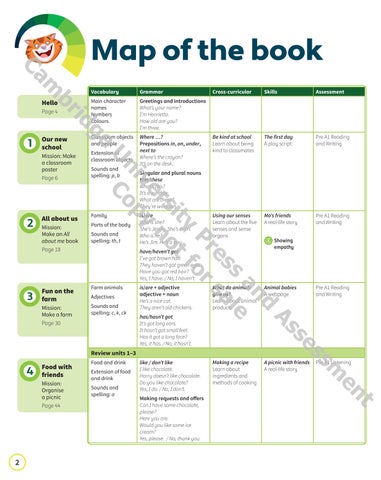
Map of the book
br
Hello
Page 4
Grammar
Main character names Numbers Colours
Greetings and introductions What’s your name? I’m Henrietta. How old are you? I’m three.
1
Our new school
ge
id
Vocabulary
Extension of classroom objects
Where …? Prepositions in, on, under, next to Where’s the crayon? It’s on the desk.
Skills
Assessment
Be kind at school Learn about being kind to classmates
The first day A play script
Pre A1 Reading and Writing
As d an s le es sa Pr r y fo it t rs no ve y ni p
U
Mission: Make a classroom poster Page 6
Classroom objects and people
Cross-curricular
Sounds and spelling: p, b
Co
Singular and plural nouns this/these What’s this? It’s a window. What are these? They’re windows.
2
3
All about us
Family
Mission: Make an All about me book Page 18
Parts of the body
Fun on the farm
Farm animals
Mission: Make a farm Page 30
Sounds and spelling: th, t
is/are Who is she? She’s Jenny. She’s a girl. Who is he? He’s Jim. He’s a boy.
Using our senses Learn about the five senses and sense organs
Mo’s friends A real-life story
What do animals give us? Learn about animal products
Animal babies A webpage
Making a recipe Learn about ingredients and methods of cooking
A picnic with friends A real-life story
have/haven’t got I’ve got brown hair. They haven’t got green eyes. Have you got red hair? Yes, I have. / No, I haven’t.
Adjectives
Sounds and spelling: c, k, ck
is/are + adjective adjective + noun He’s a nice cat. They aren’t old chickens.
Review units 1–3
Sounds and spelling: a
Making requests and offers Can I have some chocolate, please? Here you are. Would you like some ice cream? Yes, please. / No, thank you.
Pre A1 Listening
t
2
Extension of food and drink
like / don’t like I like chocolate. Harry doesn’t like chocolate. Do you like chocolate? Yes, I do. / No, I don’t.
en
Mission: Organise a picnic Page 44
Food and drink
Pre A1 Reading and Writing
m
4
Food with friends
Showing empathy
ss se
has/hasn’t got It’s got long ears. It hasn’t got small feet. Has it got a long face? Yes, it has. / No, it hasn’t.
Pre A1 Reading and Writing
Ca
Grammar
Toys
Shapes around us Whose …? Learn about shapes Possessive ’s Possessive adjectives my, your, his, her, our, their Whose bike is this? It’s Jim’s bike. His bike’s orange.
Extension of toys
Happy birthday!
m
5
Vocabulary
ge
id
br
Mission: Make a birthday present from recycled materials Page 56
Sounds and spelling: h
A day out
Zoo animals
Sounds and spelling: ai, a–e
Skills
Assessment
Nora and Flora can share A real-life story
Pre A1 Listening
When we go to the wildlife park A poem
Pre A1 Reading and Writing
want/wants Does she want a drum? Yes, she does. / No, she doesn’t. What does she want? She wants a game. there is/are There’s a car. There aren’t any shops. Are there any animals? Yes, there are. / No, there aren’t.
Animals in the wild Learn about animal habitats
As d an s le es sa Pr r y fo it t rs no ve y ni p
Mission: Plan a wildlife tour Page 68
U
6
Vehicles and places
Cross-curricular
Exploring perspectives
Co
let’s … Let’s play a game. That’s a good idea.
Review units 4–6
7
Let’s play! Mission: Plan a sports day Page 82
Present continuous What are you doing? I’m riding a horse. Sports verbs and extension of sports What’s she doing? She’s swimming. Sounds and Are they cleaning the car? spelling: s Yes, they are. / No, they’re not. Sports and hobbies
Look after your body! Learn about how we can keep our bodies strong
A good friend A real-life story
Pre A1 Listening
Houses around the world Learn about different kinds of houses around the world
The clock on the wall A poem
Pre A1 Listening
What can we see on holiday? Learn about features of natural landscapes
The monkey and the Pre A1 Reading shark and Writing A traditional story
can for permission Can we play tennis? Yes, you can, but you can’t play here.
8
At home
Extension of objects in the house Sounds and spelling: i Clothes Sounds and spelling: j, h
Imperatives Look at this T-shirt. Clean those shoes.
t
like/enjoy + gerund me too / so do I I like flying my kite. So do I. I enjoy taking photos. Me too.
Understanding agency
en
Mission: Plan a holiday Page 106
At the beach
Prepositions in front of, between, behind There’s a small rug in front of the armchair.
m
9
Happy holidays
can for ability I can swim. He can’t sing. Can you ride a horse? Yes, I can. / No, I can’t.
ss se
Mission: Invite a friend to your home Page 94
Rooms and objects in the house
Review units 7–9 Key Competencies Activity Bank page 121
3
Ca
Hello
m
1
0.02
Listen. How old are the children?
ge
id
br Co
As d an s le es sa Pr r y fo it t rs no ve y ni p
U orange
purple
red
The
Friendly Farm
0.03
Watch the video and say the chant. Then stick. pink
black
brown
en
m
yellow
ss se
2
blue
t
green
3 4
0.04
Listen and say the colour.
Numbers and colours
grey
white
Story
The Friendly Farm 1
Watch the video. How old is Cameron?
0.05
Ca 1
2
m
Look, Henrietta. Look, Rocky. This is your barn.
Hello, I’m Cameron. What’s your name?
ge
id
br
Hello, I’m Henrietta and this is Rocky.
U Co
As d an s le es sa Pr r y fo it t rs no ve y ni p
Hi, Cameron.
3
I’m two. How old are you, Cameron?
4
This is Harry.
Hello, Harry. How old are you?
I’m eight.
I’m three.
5
Hello. What’s your name?
en
m
I’m Rocky. I’m two. How old are you?
ss se
I’m Gracie.
6
2
0.06
t
Hello, I’m Shelly. What’s your name?
I’m … I don’t know.
Listen and correct. Greetings and introductions
5
1
Ca
Our new school Watch the video. Answer the questions.
m
1
1.01
ge
id
br Co
As d an s le es sa Pr r y fo it t rs no ve y ni p
U What can you see in your classroom? Look and say.
en
m
2
Make a classroom poster
ss se
mission
t
bag 6
My Mission Diary Activity Book page 6
pencil case
chair
Vocabulary 1
1
1.02
Listen and stick. Then listen and number.
1.03
1
m
Ca
This morning Jim and Jenny are at their new school.
classroom
1
id
br rubber
ge As d an s le es sa Pr r y fo it t rs no ve y ni p
U
pencil
Co
teacher
bag
chair
desk
crayon
book
pen
pencil case
en
m
ss se
t
2 1.04
Watch the video and say the chant.
3
Listen, point and say the colour.
1.05
Classroom objects and people
7
Story
1
The Friendly Farm Watch the video. Where’s Jenny’s bag?
1.06
Ca
Look at the bag! Yes, I’m the teacher!
1
2
ge
id
br
m
Now, this is my classroom. Rocky, where’s the pencil?
Now you, Shelly. Where’s the crayon?
4
Co
3
As d an s le es sa Pr r y fo it t rs no ve y ni p
U
It’s under the desk, teacher.
Now you, Harry. Where’s the bag?
It isn’t on the desk.
It’s on the desk.
5
No, it isn’t, Harry. It’s next to the desk!
Where’s my bag, Jim?
Oops!
en
m
Yes, Gracie! Where’s the book?
ss se
It’s in the barn.
6
Where’s the book? It isn’t in the bag.
t
Be quiet! It’s Jim and Jenny! 8
Where …? and prepositions on, in, under, next to in context
2
Is it important to look after classroom objects?
Language practice 1
1
Watch the video. Then listen and rap.
1.07
1
Ca
Gracie’s Grammar Rap Where’s the pen? It isn’t in the pencil case. It’s next to the bag. The pen’s next to the bag.
ge
id
br
m
Where’s the crayon? It isn’t on the desk. It’s under the chair. The crayon’s under the chair.
Listen and tick .
Co
1
As d an s le es sa Pr r y fo it t rs no ve y ni p
1.08
U
2
3
2
3
Look at Activity 2. Then read and write.
1
The bag’s under The pencils are The rub1b2er’s The b1o1o1k2’s
2 3 4
Make a classroom poster
It’s next to the rubber.
My Mission Diary Activity Book page 6
t
Where’s the pencil case?
en
Move classroom objects. Ask and answer.
m
ss se
mission 1
the chair. the pencil case. the b1o1o1k2. the desk.
Where …? and prepositions on, in, under, next to
9
Vocabulary 2 and song
1
1.09
Listen and colour. Then sing the song.
1.10
Jenny’s in the playground. The teacher’s next to the window. The red bag is on the grey wall and the board’s next to the door. Yes, it is.
ge
id
br
m
Ca
Jim is in the classroom. The yellow book is on the bookcase. The white paper’s in the cupboard and the ruler’s under the desk.
door
Co
board
As d an s le es sa Pr r y fo it t rs no ve y ni p
U
wall window
playground
bookcase
paper
cupboard
ruler
Look! Miss Kelly’s next to the window. Where’s your teacher?
ss se
2
Ask and answer.
en
m
t
Where’s the ruler? 10 Extension of classroom objects
It’s under the desk.
Language practice 2
1
Watch the video. Then listen and say.
1.11
1
Ca
Gracie’s Grammar It’s a window. They’re windows.
id
br
m
What’s this? What are these?
ge
What’s = What is
12
1
2
3
4
5
6
7
8
9
10
11
Co
As d an s le es sa Pr r y fo it t rs no ve y ni p
Listen and choose.
1.12
1
3
They’re = They are
U
2
It’s = It is
2
3
Read and write the number from Activity 2. They’re books.
mission 2
It’s a ruler.
It’s a bookcase.
Make a classroom poster
ss se
Learn new words. Draw and ask your teacher. Tell your partner.
en
m
What’s this?
My Mission Diary Activity Book page 6
t
It’s a computer.
Singular and plural nouns; this/these
11
Be kind at school Watch the video. Answer the questions.
Ca
1
1.13
m
Who’s kind? Look and tick .
id
br
2
2
ge
1
Co
As d an s le es sa Pr r y fo it t rs no ve y ni p
U 3
3
Listen and number. Then act it out.
Are you OK?
b
ss se
a
1.14
4
m
Here you are.
en
Yes, thank you.
t
Thank you.
12
Being kind at school
Cross-curricular
Look, read and write.
1
listen
share
w1o1r2k together
Be kind in our classroom
ge
id
br
m
Ca
help
1
Co
As d an s le es sa Pr r y fo it t rs no ve y ni p
U 1
Make a classroom poster
Think and write a new classroom rule.
en
m
mission 3
4
ss se
3
2
w1o1r2k together
t
Be kind to everyo1n2e My Mission Diary Activity Book page 6
Show what you know about being kind at school
13
Reading & listening skills
1
Ca
The first day
m
1.15
Look at the pictures. What classroom objects can you see?
id
br
Knock! Knock! It’s Lucy at the door.
ge
Max: Hello, Lucy.
Co
As d an s le es sa Pr r y fo it t rs no ve y ni p
U
Lucy: Hello, Max.
Lucy and Max are friends. Today’s the first day of school. Mum: It’s time to pack your bag. Max: My bag …
Mum: It’s in the cupboard.
Max: Where’s my pencil?
Lucy: It’s under the chair.
Max: Where’s my pen?
en
Max: Oh, yes. Take a pen to school – that’s the rule.
m
Lucy: It’s on the table.
ss se
Max: Oh, yes. Take a pencil to school – that’s the rule.
t
2
14
Find the classroom rules in the story. Has your class got the same rules?
A play script about getting ready for school
Speaking & writing skills
Max: And where’s my ruler? Lucy: It’s next to your pen.
Ca
br
m
Max: Oh, yes. Take a ruler to school – that’s the rule.
id
Max: Where are my books?
ge
Lucy: They’re on the bookcase.
The bag’s the cupb1oard. The pencil’s the chair. The pen’s the tab1l2e. The ruler’s the pen.
1 2 3 4
in
Co
As d an s le es sa Pr r y fo it t rs no ve y ni p
U
Max: Oh, yes. Take your books to school – that’s the rule.
Look and write.
1
Max: And my crayons?
Lucy: What are these? The crayons are on the floor, under the window.
o1n2
2
in
1
next to
under
Point to the pictures in the story. Ask and answer.
What are these?
They’re crayons.
Where’s the bag?
It’s in the cupboard.
Act out the story.
Where’s my pencil?
en
t
Mum: Hurry up. It’s time to go! Don’t be late for school – that’s the number one rule!
It’s under the chair.
m
ss se
3
15
Pre A1 exam preparation
Look at the pictures. Say the words.
1
b
c
d
e
2
ge
id
br
m
Ca
a
It’s paper.
Read and do. Put a cross
in the box.
As d an s le es sa Pr r y fo it t rs no ve y ni p
in the box.
Play the game. Point and say.
Co
3
U
Put a tick
No. Cross!
Look and read. Put a tick There are two examples.
4
ruler
This is a door.
Yes. Tick!
or a cross
in the box.
3
ss se
This is a rubber.
pens
1
2
en
m
bags
paper Look at the picture and read
Tip! the word. Do they match? 16
Preparation for Reading and Writing
t
chair
Review
mission
1
in action!
Ca
Make a classroom poster.
br
m
1
w1i2ndo1w2
ge
id
chair
desk
chair
As d an s le es sa Pr r y fo it t rs no ve y ni p
U
desk
Co
w1i2ndo1w2
2 Label your picture.
1 Draw your classroom.
3 Write a rule.
4 Display your poster.
Listen. Then talk about your poster.
2
1.16
1
Talk about your poster. Then answer your friends’ questions. Look. This is our computer.
Look at your friends’ posters and ask questions.
n co m o i s
lette
ep n
Mi s
Share your crayons!
m
What’s your classroom rule?
ss se
2
It’s next to the desk.
Where’s the computer?
!
My Mission Diary Activity Book page 6
Unit consolidation
17
2
m
Ca
All about us Watch the video. Answer the questions.
br
1
2.01
ge
id Co
As d an s le es sa Pr r y fo it t rs no ve y ni p
U Who’s in your family? Look and say.
en
m
2
Make an All about me book
ss se
mission
t
sister
18
My Mission Diary Activity Book page 18
grandma
dad
Vocabulary 1
1
2.02
Listen and stick. Then listen and number.
2.03
m
Ca
Today the Friendly family are playing a game at home.
2
family
id
br
grandfather grandpa
ge As d an s le es sa Pr r y fo it t rs no ve y ni p
U
father
dad
Co mum mother
grandma
1
grandmother
3
Listen, point and say the colour.
2.05
t
Watch the video and say the chant.
en
2 2.04
m
brother
ss se
sister
Family
19
Story
1
The Friendly Farm
Ca 1
Watch the video. What animals are Rocky’s family?
2.06
2 Is Shelly my sister?
ge
id
br
m
Mum, are these animals my family?
U
No, Rocky. She isn’t your sister. She’s your friend.
Co
As d an s le es sa Pr r y fo it t rs no ve y ni p
No, Rocky. They aren’t your family.
3 Look at Harry, Mum. Is he my brother?
No, Rocky. He isn’t your brother. He’s your friend.
I don’t understand! Who’s my brother? Who’s my sister? Who are my brothers and sisters?
6
Look! A girl! She’s my sister! And look! A boy! He’s my brother.
en
m
ss se
5
Rocky … This is your brother, and this is your sister.
4
t
2 20
How is Rocky different from his family?
Sustainability: Recognising relationships | Who ...? and he’s/she’s in context
Language practice 1
1
Watch the video. Then listen and rap.
2.07
2
Ca
Gracie’s Grammar Rap He’s Adam. He’s a boy. He’s my brother. She’s Hana. She’s a girl. She’s my sister.
2.08
2
3
Co
As d an s le es sa Pr r y fo it t rs no ve y ni p
U
1
Who is Nico? Listen and tick .
ge
2
id
br
m
Who is he? Who is she?
father
3
grandfather
brother
Look, read and write. Who is she?
1
She
Who is he?
He
Make an All about me book
Jim. a b1o1y.
ss se
mission 1
Jenny. a girl.
2
Make a Family page for your book. Ask and answer.
m en
Who’s Alex?
t
Alex Dev Lucy
She’s my grandma.
Hugo
My Mission Diary Activity Book page 18
Who ...? and he’s/she’s
21
Vocabulary 2 and song
1
2.09
Listen and do the actions. Then sing the song.
2.10
nose
m
Ca
Move your body, Jenny. Move your tail, Cameron. Move your legs and your feet. Put your arms up.
head ear
ge
id
br
arm
body
hand
foot
leg
Co
As d an s le es sa Pr r y fo it t rs no ve y ni p
U
Move your head. Touch your hair and your face. Touch your ears and your nose.
Close your eyes. Open your mouth and clap your hands.
face
hair eye mouth
tail
feet
Jim and Jenny have got brown hair. What colour hair have you got?
2
2.11
Listen and follow.
22 Parts of the body
t
1
en
m
ss se
2
Language practice 2
1
Watch the video. Then listen and say. Have you got red hair?
2.12
2
Ca
m
Gracie’s Grammar I haven’t got black hair. They haven’t got green eyes. Yes, I have. / No, I haven’t.
ge
id
br
I’ve got brown hair. They’ve got blue eyes. Have you got red hair?
Co
As d an s le es sa Pr r y fo it t rs no ve y ni p
Who’s talking? Listen and tick .
1
3
U
2 2.13
2
3
Read, draw and colour.
Omar and Nora are brother and sister. They’ve got blue eyes. They’ve got red hair. They haven’t got black hair. Make an All about me book
en
m
Make a This is me page for your book. Say.
ss se
mission 2
t
I’ve got black hair and brown eyes. Leo and Wendy have got brown hair. They’ve got blue eyes. My Mission Diary Activity Book page 18
have/haven’t got
23
Ca
Using our 1
m
2.14
senses
Watch the video. Answer the questions.
id
br
2 2.15 Listen and say. Look and match. 2
4
3
ge
1
5
Co
As d an s le es sa Pr r y fo it t rs no ve y ni p
U see
a
hear
smell
taste
touch
c
b
5
e
en
m
ss se
d
t
3 24
Play the senses game. Sustainability: Inclusion | The five senses and sense organs
Cross-curricular
1
Look, read and match.
2
m
Ca Some people can’t see. They’re blind.
br
id
Some people can’t hear. They’re deaf. 2
Co
As d an s le es sa Pr r y fo it t rs no ve y ni p
U
1
ge
See how Jess and Hugo use their senses.
Jess is blind. She reads books with her hands.
mission 3
Hugo is deaf. He speaks sign language with his hands.
Make an All about me book
t
My favourite thing to touch is my cat.
en
m
ss se
Make a My favourite things page for your book.
my cat My Mission Diary Activity Book page 18
Show what you know about the five senses
25
Reading & listening skills
Look at the pictures. Who’s sad in the story?
1
Mo’s friends
Ca 2.16
m
id
br
This is Grace. She’s happy. Today, her cousin Mo’s coming to play.
ge
Here’s Mo. Oh, dear. Mo isn’t happy. Grace wants to help Mo.
As d an s le es sa Pr r y fo it t rs no ve y ni p
U
‘Why are you sad?’ she asks.
Co
‘My friends aren’t here. They’re at home,’ says Mo.
‘Oh, dear,’ says Grace. ‘I know! Let’s draw a picture of your friends! I’ve got paper and crayons.’
‘Good idea!’ says Mo. ‘I like drawing!’ Grace gets her paper and her crayons. ‘You’ve got lots of crayons,’ says Mo.
ss se
‘Yes, I have,’ says Grace. ‘Let’s draw!’
en
m
‘Tell me about your friends,’ says Grace. ‘Have they got red hair?’
2 26
How does Grace help Mo in the story? Sustainability: Showing empathy | A story about helping
t
‘No, they haven’t. They’ve got black hair,’ says Mo.
Speaking & writing skills
Look and write.
1
Ca
1
b1l2ack
m
h
ge
id
br
2
i
a
y
e
e
t
u
m
green
s 3
r
a b1i2g
h
As d an s le es sa Pr r y fo it t rs no ve y ni p
U
‘And they’ve got green eyes and small pink noses.’
Co
‘They’ve got big mouths, and they’re happy.’ Grace and Mo draw and colour.
2
‘Er, no …!’ Mo says. ‘These are my friends. They’re my new cats. They’re babies! Thank you, Grace! I’m not sad now.’
o
Play Yes or no. red blue black two three
‘OK,’ says Grace. ‘This is my picture. Are these your friends?’
hair feet
I’ve got black hair.
eyes hands legs Yes!
I’ve got three feet.
3
2
No!
Think, draw and write.
en
m
ss se
t
These are my They’ve go1t2 and
. .
27
Pre A1 exam preparation
Read and number.
1
The blue crayon is next to the book.
2
The red crayon is on the book.
3
The blue crayon is on the book.
br
m
Ca
1
b
c
ge
id
a
Co
As d an s le es sa Pr r y fo it t rs no ve y ni p
U
2
Look and read. Circle the correct picture. There is one example. 1
How are you?
Where are you?
I’m at home.
Have you got your school bag?
Yes, I have. It’s under the table.
en
m
ss se
I’m good, thanks.
2
t Look at all the pictures
28
Preparation for Reading and Writing
Tip! before you choose.
Review
mission
2
in action!
Ca 1
Make an All about me book.
br
m ge
id
All ab1o1ut me
U
As d an s le es sa Pr r y fo it t rs no ve y ni p
Co
1 Find materials.
l2ack hair I’ve go1t2 b1 eyes. n2 and b1r2o1w3
2 Make a cover.
3 Add your pages.
4 Show your book.
Listen. Then learn about your class.
2
2.17
1
Look at your friends’ books. Ask questions. Who’s he?
He’s Santi. He’s my brother.
Show your All about me book. Ask and answer.
!
t
Activity Book page 18
le
te
My Mission Diary
co mp
en
s
n io
m
This is my dog.
s
They’re my favourite things.
ss se
What are these?
Mi
2
I’ve go1t2 b1l2ack hair and b1r2o1w3n2 eyes.
Unit consolidation
29
3
Ca
Fun on the farm Watch the video. Answer the questions.
m
1
3.01
ge
id
br Co
As d an s le es sa Pr r y fo it t rs no ve y ni p
U Which animals do you want on your farm? Look and say.
en
m
2
Make a farm
ss se
mission
t
cat 30
My Mission Diary Activity Book page 30
chicken
donkey
Vocabulary 1
1
3.02
Listen and stick. Then listen and number.
3.03
3
This afternoon Tom and Eva are on the farm with Jim and Jenny.
br
m
Ca
cow
donkey
ge
id As d an s le es sa Pr r y fo it t rs no ve y ni p
U
horse spider
Co
goat
sheep
1
cat
chicken
duck
en
m
ss se
dog
3.04
Watch the video and say the chant.
3
3.05
Listen, point and say the animal.
t
2
Farm animals
31
Story
1
The Friendly Farm Watch the video. Who’s Rocky’s new friend?
3.06
Ca 1
2
Harry, you’re big.
ge
id
br
m
Look at my new friend, Harry. He’s a spider. He’s small.
U
3
Look at me! I’m long, too.
Co
As d an s le es sa Pr r y fo it t rs no ve y ni p
Yes, he is, Rocky. He’s a small spider.
Yes, you are, Cameron. Now you’re a long cat, and you’re a nice cat.
5
Yes, but I’m a horse. Horses are big. And I’ve got a long tail.
What? Old? I’m not old!
4
Look at my brother and sister. They’re young.
Oh, yes, they’re young. Gracie isn’t young. She’s old.
6
Sorry, Cameron! Are you OK?
ss se
Gracie!
en
m
t
Yes, I am. I’m OK, Gracie. Now I’m not long. I’m short! You aren’t young, Gracie. 32
is/are + adjective, and adjective + noun in context
2
Which animals are small?
Language practice 1
1
Watch the video. Then listen and rap.
3.07
3
Ca
Gracie’s Grammar Rap
3.09
As d an s le es sa Pr r y fo it t rs no ve y ni p
3
Listen and tick .
Co
3.08
U
2
He’s a nice cat. It’s an old donkey. They’re big cows!
ge
id
br
m
He isn’t a small dog. It isn’t a young horse. They aren’t small chickens.
Listen again and write.
4 a
chickens. (n g y o u) sheep. (e c i n)
Make a farm
t
Choose an animal for your farm. Say.
en
m
mission 1
2 tw1o
ss se
At Friendly Farm, we’ve go1t2 ... 1 three b1i2g co1w3s2. (g i b) 3 an dog. (d l o)
It’s a big horse.
b1i2g ho1r2se
My Mission Diary Activity Book page 30
is/are + adjective, and adjective + noun 33
Vocabulary 2 and song
1
3.10
Listen and act out the animals. Then sing the song.
3.11
Ca
br
m
She’s a funny dog. He’s a sad dog.
id
I’ve got a happy dog. She’s a beautiful dog.
funny ugly
ge
He’s a tired dog. She’s an angry cat.
U As d an s le es sa Pr r y fo it t rs no ve y ni p
He’s a little dog. She’s an ugly spider.
tired
Co
sad
angry
happy
I love dogs! Have you got a pet?
en
m
Look at the picture and play the game. It’s a dog with a pink nose and a short tail.
34 Extension of adjectives
Is it the tired dog?
t
2
ss se
beautiful
little
Yes, it is!
Language practice 2
1
Watch the video. Then listen. Look and circ circle.
3.12
3
Ca
Gracie’s Grammar It hasn’t got small feet. Yes, it has. / No, it hasn’t.
3.13
Which duck is the man talking about? Listen and tick .
ge
2
id
br
m
It’s got long ears. Has it got a long face?
As d an s le es sa Pr r y fo it t rs no ve y ni p
U
1
2
3
Co
3
Listen again. Then read and choose.
1
The duck is / isn’t a young duck.
2
It’s got / It hasn’t got a big white body.
3
It’s got / It hasn’t got a long tail.
4
Has it got a short tail? Yes, it has. / No, it hasn’t.
ss se
Make a farm
Play a guessing game.
Yes, it has.
Is it beautiful?
Is it the donkey?
No, it isn’t.
Yes, it is.
t
Has it got long ears?
en
m
mission 2
My Mission Diary has/hasn’t got 35 Activity Book page 30
What do animals give us? Watch the video. Answer the questions.
Ca
1
3.14
m
Look and match. Then listen and check. 2
3
4
ge
id
1
3.15
br
2
a
chicken
b
wool
Tick
sheep
c
milk
bee
d
honey
the things that come from animals.
eggs
en
m
ss se
3
Co
cow
As d an s le es sa Pr r y fo it t rs no ve y ni p
U b1
t
36 Animal products
Cross-curricular
1
Read the article. Then read the sentences and write yes or no.
3
m
Ca br
Alpaca wool
ge
id
Do you know this animal? This is an alpaca. It’s got four legs and long hair. Alpacas live in the Andes Mountains in Peru.
Co
As d an s le es sa Pr r y fo it t rs no ve y ni p
U
The hair of an alpaca is like the hair of a sheep. It’s called wool. People cut the wool. Then people clean the wool. They use the wool to make clothes. They use lots of colours. How many colours can you see?
no
1
Alpacas have got two legs.
2
Alpacas have got short hair.
3
Alpacas live in Peru.
4
People make things from alpaca wool.
Make a farm
They give us eggs. Yes! My Mission Diary Activity Book page 30
t
My farm has go1t2 ten yo1ung chickens. The chickens give us eggs.
en
Think and write. What do your animals give us?
m
ss se
mission 3
Chickens!
Show what you know about animal products
37
Reading & listening skills
Look at the pictures. What farm animals can you see?
1
Ca
Animal babies
m
3.16
br
ge
id
Ducks and chickens are birds. The mother bird lays eggs.
Co
As d an s le es sa Pr r y fo it t rs no ve y ni p
U
Look at these ducklings. They can walk and they can swim. They can eat food and their mother helps them find it.
This is a duckling. A duckling is a baby duck. It’s very young, and it’s very small.
Cows and sheep are mammals. The mother doesn’t lay eggs. She has babies.
en
m
ss se
t 2 How are the animal babies the same as human babies?
How are they different?
38
A webpage about animals
Speaking & writing skills
1
Ca
1 2
m
3
br
4
id
These are lambs. Lambs are baby sheep. They’re very young, too. They’ve got long legs!
Look and write.
A duckling is a bab1y A lamb is a bab1y The ducklings can The lamb1s2 drink
ge
sw1i2m
duck
It’s small. It’s white. It’s got long legs.
Co
The lambs can walk and play. They can’t eat food. They drink milk from their mother.
duck
. . . .
milk
Look at the photos in the text. Play a guessing game.
As d an s le es sa Pr r y fo it t rs no ve y ni p
U
2
sheep
3
It’s a lamb!
Think, draw and write.
1
This is a bab1y It’s and It’s go1t2
3
. . .
t
2
en
m
ss se
3
39
Pre A1 exam preparation
Look and say. Which letter do the animals start with?
1
Ca br
m
It’s a cow.
ge
id
Letter C.
How many letters? Count and circle.
c o w 2 / 3 / 4 letters d u c k 3 / 4 / 5 letters
Co
1 3
As d an s le es sa Pr r y fo it t rs no ve y ni p
U
2
2 4
d o n k e y 4 / 5 / 6 letters s h e e p 5 / 6 / 7 letters
Look at the pictures. Look at the letters. Write the words. There is one example.
3
s heep
1
th
th
ch
ck
g
g
a
o
d
t
g
t
o
en
d
m
3
sh
ss se
2
icken
sp
You can only use the letters
40
Preparation for Reading and Writing
Tip! that you are given.
Review
mission
3
in action!!
Ca
Make a farm.
id
br
m
1
ge
This is o1ur farm. It has g o1 t2 co1 w3 s2, sheep and a d o1 n2 key.
Co
As d an s le es sa Pr r y fo it t rs no ve y ni p
U 1 Think and plan.
2 Draw the farm.
3 Add your animals.
Listen. Then show your farm.
2
3.17
1
Talk about your farm.
Our farm has got three cows.
Talk about the animals. Answer questions.
Yes, it has.
t
Activity Book page 30
te!
My Mission Diary
p
le
The sheep give us wool.
co m
en
The cows give us milk.
n o i s
m
Talk about what the animals give us.
ss se
Has the donkey got long ears?
3
And it’s got two sheep.
Mi s
2
4 Write.
Unit consolidation
41
Review
QUIZ
Units 1–3 Ca 1
3.18
Listen and tick .
ge
id
br
m 2
Watch the video. Then do the quiz.
1 This is my sister. b
c
a
b
c
Co
As d an s le es sa Pr r y fo it t rs no ve y ni p
U
a
2 This is my brother.
3 This is my cat. a
3
b
4 This is my horse.
c
a
b
c
Look at the picture. Then ask and answer. Where’s the red book?
It’s on the purple chair.
en
m
ss se
t
42
1
Listen and colour.
3.19
ge
id
br
m
Ca As d an s le es sa Pr r y fo it t rs no ve y ni p
U Draw you and your family or pets. Then write.
Co
2
go1 t2
.
.
t
go1 t2
en
.
m
This is my
.
ss se
This is me. I’ve go1 t2 This is my
. Consolidation of units 1–3
43
Food with friends
1
Watch the video. Answer the questions.
m
Ca
4
ge
id
br
4.01
Co
As d an s le es sa Pr r y fo it t rs no ve y ni p
U What’s your favourite food? Look and say.
en
m
2
Organise a picnic
ss se
mission
t
bread 44
My Mission Diary Activity Book page 44
banana
chocolate
Vocabulary 1
1
4.02
Listen and stick. Then listen and number.
4.03
4
ge
id
br
m
Ca
This afternoon the Friendly family are having lunch in the garden.
chocolate
Co
As d an s le es sa Pr r y fo it t rs no ve y ni p
U
cake
chicken
burger 1 banana
bread
water
lemonade
en
m
mango
ss se
salad
t
2
4.04
Watch the video and say the chant.
3
4.05
Listen and point. Then say yes or no. Food and drink
45
Story
1
The Friendly Farm Watch the video. Who’s got chocolate?
4.06
Ca 1
Gracie!
2
Do you like chocolate, Cameron?
m ge
id
br
I’m sorry, but I like chocolate.
U
As d an s le es sa Pr r y fo it t rs no ve y ni p
Co
3
Yes, I do.
4
I don’t like books.
I like books.
I like chocolate and I like cake, bananas, bread, books and socks!
5
But, Rocky, you read books. You don’t eat books!
6
What do you like, Shelly?
en
m
ss se
What do you like, Harry?
46 like / don’t like and Do you like …? in context
t
I don’t like books or chocolate. I like mangoes.
I like water. I can see my face in water.
2
Who asks and answers questions in the story?
Language practice 1
1
Watch the video. Then listen and rap.
4.07
4
Ca
Gracie’s Grammar Rap Yes, I do. / No, I don’t. She likes chocolate. No, I don’t. He doesn’t like mangoes.
ge
id
br
m
Do you like chocolate? I / We like chocolate. Do you like mangoes? I don’t like mangoes.
U
3
4.09
Listen and match.
As d an s le es sa Pr r y fo it t rs no ve y ni p
4.08
Co
2
Listen again and write.
Dad likes 4 Grandpa 2
Organise a picnic
Burgers: Marta ✓, Li ✗ Mangoes: To1m2as ✗ My Mission Diary Activity Book page 44
t
Yes, I do.
chicken.
en
What food does your class like? Make a list. Do you like burgers?
.
m
mission 1
b1urgers . like
ss se
Mum likes 3 Grandma lemo1n2ade. 1
like / don’t like and Do you like …?
47
Vocabulary 2 and song
1
4.10
Listen and draw. Then sing the song.
4.11
Ca
fruit
m
Do you like fruit? Yes, I do. Do you like juice? No, I don’t.
br
grapes
id
apple
ge
I like apples. I like oranges. I like grapes but I don’t like juice.
As d an s le es sa Pr r y fo it t rs no ve y ni p
U orange
Co
Do you like salad? Yes, I do. Do you like meat? No, I don’t.
I don’t like burgers. I don’t like sausages. I don’t like meatballs but I like beans.
salad
juice
meat
meatballs
beans
ss se
sausage
I like grapes. What fruit do you like?
… one thing you eat or drink for breakfast. … two things you eat or drink for lunch. … three things you eat or drink for dinner. 48 Extension of food and drink
t
Think of …
en
Read, think and say. Talk to your partner.
m
2
Language practice 2
1
Watch the video. Ask and answer.
4.12
4
Ca
Gracie’s Grammar
Which food does she buy? Listen and tick .
ge
2
id
br
m
Can I have some chocolate, please? Here you are. Would you like some ice cream? Yes, please. / No, thank you. 4.13
2
2
Co
As d an s le es sa Pr r y fo it t rs no ve y ni p
U
1
3
Read and tick ✓.
Can I have some apples, please? No, thank you.
Would you like some juice?
Organise a picnic
ss se
mission 2
I’m sorry, I haven’t got any apples. Would you like some oranges?
Do a supermarket role play. Buy food for your picnic.
en
Here you are.
m
Can I have some bananas, please?
t
My Mission Diary Activity Book page 44
Making requests and offers
49
Watch the video. Answer the questions.
4.14
2
m
1
br
Ca
Making a recipe Tick ✓ the ingredients. Then listen and check.
ge
id
4.15
pasta
onions
Co
As d an s le es sa Pr r y fo it t rs no ve y ni p
U
meat
potatoes
rice
cheese
carrots
Listen and number. c
d
en
b
m
a
4.16
ss se
3
tomatoes
t 1 50 Ingredients and methods of cooking
Cross-curricular
Read and circle the food words. Then number the pictures.
1
4
m
Ca id
br
an omelette!
ge
1 You need two eggs, some cheese, an onion and some tomatoes.
As d an s le es sa Pr r y fo it t rs no ve y ni p
U
2 Mix the eggs. Cut the onion and the tomatoes.
Co
3 Cook the eggs for four minutes.
4 Put the cheese, onion and tomato on the eggs. 5 Fold the omelette and cook it for one more minute. a
b
c
d
e
1
Organise a picnic
en
m
Write your recipe. Then share.
ss se
mission 3
My Mission Diary Activity Book page 44
t
My sandw1i2ch has go1t2 chicken, cheese, meat and salad. Yum!
Show what you know about ingredients and methods of cooking
51
Reading & listening skills
Look at the pictures. What food can you see?
1
A picnic with friends
Ca 4.17
m
br
Dilek and Sam want to have a picnic in the park.
id
‘Let’s make sandwiches,’ says Mum.
ge
‘I’m making egg sandwiches,’ says Dilek.
U
‘I’m making chicken sandwiches AND cheese sandwiches,’ says Sam.
Co
As d an s le es sa Pr r y fo it t rs no ve y ni p
‘Oh, that’s a lot of sandwiches,’ says Mum.
‘Let’s take fruit, too,’ says Mum. ‘Would you like a banana or a watermelon?’ ‘A banana, please,’ says Dilek.
‘A banana AND a watermelon, please,’ says Sam. ‘Oh, that’s a lot of fruit,’ says Mum.
‘What would you like to drink?’ asks Mum. ‘Lemonade, please,’ says Dilek.
‘Lemonade AND juice, please,’ says Sam. ‘And water, too.’ They go to the park.
en
m
They’ve got a very big picnic!
ss se
‘Oh, that’s a lot of drink,’ says Mum.
t
2
52
How do Sam and Dilek help in the story? How do you help at home?
A real-life story about sharing
Speaking & writing skills
Look and write.
1
4
ge
id
br
m
Ca
1
n n
b1 a
w n
e a
t r
l
m
o
e
e a
m e
l o
n d
2
As d an s le es sa Pr r y fo it t rs no ve y ni p
U ‘Look!’ says Dilek. ‘There’s Nick and Wendy.’
Co
‘Hello, Nick! Hello, Wendy!’ says Mum. ‘Are you hungry?’ ‘Yes, I am!’ says Nick.
a a
‘Me too!’ says Wendy.
‘You can share our picnic,’ says Sam.
3
‘Yes,’ says Mum. ‘We’ve got a very big picnic … !’
2
Ask and answer.
I’d like chicken sandwiches, please.
en
What would you like?
m
ss se
banana cheese chicken egg juice lemonade water watermelon
t OK. Here you are.
3
Act out the story. 53
Pre A1 exam preparation
Look at the pictures in Activity 2. What can you see?
1
Look and listen. Tick
Ca
2
4.18
m
Lucy
ge
id
br
Ivan
the correct picture.
U
Listen. Draw a line. There is one example.
4.19
Co
1
As d an s le es sa Pr r y fo it t rs no ve y ni p
3
en
m
ss se
2
t Think about what’s
54
Preparation for Listening
Tip! different in the pictures.
Review
mission
4
in action!
Ca 1
Organise a picnic.
ge
id
br
m Co
1 Choose your food.
As d an s le es sa Pr r y fo it t rs no ve y ni p
U
b1r2ead cheese salad
2 Make a list of ingredients.
3 Make or draw your food.
4 Have a picnic!
Listen. Then have a picnic.
2
4.20
1
Present your food to the class.
2
Have a picnic. Talk about the food.
le
t
te!
en
Can I have some water, please?
m
co m n o p si
Mi s
Yes, please. I like bananas!
ss se
Would you like a banana?
This is my sandwich. It’s got chicken and tomato.
Yes, here you are. My Mission Diary Activity Book page 44
Unit consolidation
55
Happy birthday!
m
Watch the video. Answer the questions.
Ca
5
5.01
ge
id
br
1
Co
As d an s le es sa Pr r y fo it t rs no ve y ni p
U What toys can you make? Look and say.
en
m
2
Make a birthday present from recycled materials
ss se
mission
t
robot 56
My Mission Diary Activity Book page 56
house
plane
Vocabulary 1
1
5.02
5
Listen and stick. Then listen and colour.
5.03
br
m
Ca
Today is Jim and Jenny’s birthday.
plane
id ge
kite
As d an s le es sa Pr r y fo it t rs no ve y ni p
U doll
Co
ball
house
car
robot
bike
en
m
ss se
t
2
5.04
Watch the video and say the chant.
3
5.05
Listen and point. Then say yes or no. Toys 57
Story
1
The Friendly Farm Watch the video. Whose birthday is it?
5.06
Ca
1 Mum! It’s Jim and
2
A red car! Cool! Whose car is that?
ge
id
br
m
Jenny’s birthday. Jim’s got a new kite.
What colour’s his kite?
U
It’s blue. It’s his favourite toy.
As d an s le es sa Pr r y fo it t rs no ve y ni p
Co
3 Can we make a birthday present for Jim and Jenny? Jenny likes dolls.
5
It’s Jenny’s new car. It’s her birthday present.
4
Jenny’s favourite toy is her car. Jim’s favourite toy is his kite.
Yes! What can we make for their present?
No, she doesn’t! And Jim doesn’t like dolls.
6
It’s a plane. Their present’s a plane.
2
Their present’s a plane? Oh, no! Not a plane!
m
ss se
Look at our birthday present for Jenny and Jim.
en
What is it?
t
58 Whose …?, possessive ’s and possessive adjectives in context
Why is giving important?
Language practice 1
1
Watch the video. Then listen and rap.
5.07
5
Ca
Gracie’s Grammar Rap It’s Shelly’s ball. Her ball is blue. It’s Harry’s doll. His doll is new. It’s Jim and Jenny’s plane. Their plane is grey.
2
5.08
ge
id
br
m
Whose ball is this? Whose doll is this? Whose plane is this?
2
3
Co
As d an s le es sa Pr r y fo it t rs no ve y ni p
U
1
Listen and choose.
3
Read and write the number from Activity 2. a It’s Jim and Jenny’s b It’s Jim’s bike. His house. Their house bike is orange. is yellow.
Make a birthday present from recycled materials
is this?
It’s my house.
en
Whose
m
Draw a toy. Ask and answer.
ss se
mission 1
c It’s Jenny’s car. Her car is red.
t
It’s Eva’s house. Her house is blue. My Mission Diary Activity Book page 56
Whose …?, possessive ’s and possessive adjectives in context
59
Vocabulary 2 and song
1
5.09
Listen and circle . Then sing the song.
5.10
Ca
The mouse is blue / orange. Her drum is old / new. His teddy’s blue / green. Our board game’s big / new.
ship
mouse
ge
id
br
m
box
As d an s le es sa Pr r y fo it t rs no ve y ni p
U
balloon
computer
keyboard
Co
drum
board game
video game
teddy
I love their board game! Which is your favourite toy from the song? 5.09
Listen again. Write the toys.
en
m
co1m2puter
ss se
2
t
60 Extension of toys
Language practice Practice 2 1
1
Watch the video. Which toy does she want? Listen and tick .
5.11
5
Ca
Gracie’s Grammar
m
b
c
Co
As d an s le es sa Pr r y fo it t rs no ve y ni p
U
a
ge
id
br
Does she want a drum? No, she doesn’t. She doesn’t want a drum. Does she want a game? Yes, she does. What does she want? She wants a game.
2
5.12
Which toy do they buy? Listen and tick .
1
3
2
Make a birthday present from recycled materials
ss se
mission 2
What present does your partner want? Play a guessing game. No, he doesn’t.
en
t
Does he want a ...?
m
Does he want a ...?
Yes, he does. He wants a …
My Mission Diary Activity Book page 56
want/wants
61
Shapes around us Ca 1
Watch the video. Answer the questions.
5.13
5.14
2
3
4
ge
id
1
Listen and say.
br
m 2
Co
As d an s le es sa Pr r y fo it t rs no ve y ni p
U circle
square
triangle
rectangle
Look at the toys. What shapes can you see?
3
I can see four triangles.
It’s the kite!
en
m
ss se
t
62
Shapes
Cross-curricular
Look, read and write.
1
rectangle
rectangles
red ro1b3o1t2 square
m
Ca
circles
5
ge
id
br
This is my to1y . ro1b3o1t2 It’s go1t2 tw1o green arms, tw1o green legs and tw1o feet. Its head is a green . Its eyes are red and yello1w2 Its mo1uth is a w1h2ite . Its b1ody is a green square w1i2th tw1o b1i2g grey .
Co
As d an s le es sa Pr r y fo it t rs no ve y ni p
U
.
mission 3
Make a birthday present from recycled materials
Make a card for your partner. Draw a toy with shapes. Write.
t
Activity Book page 56
en
My Mission Diary
m
Fro1m2, r o1m2, Lily
ss se
Happy b1i2rthday Dev1! De Dev1 v1 !
Show what you know about shapes
63
Reading & listening skills
Look at the pictures. What toys can you see?
1
Nora and Flora can share
Ca 5.15
m
ge
id
br
Nora’s favourite toy is a yellow robot called Max. Flora’s favourite toy is a red robot called Zak. Dad wants the sisters to share their toys. Dad: Whose robot is this?
U
Co
As d an s le es sa Pr r y fo it t rs no ve y ni p
Flora: It’s Nora’s robot, Max. Her robot’s yellow. Can I play with Max? His arm’s long! Nora: Here you are. And can I play with Zak, please? Flora: Yes, here you are.
At first Nora and Flora are happy. But soon Dad sees Nora crying. Dad: Nora feels sad.
Flora: What does she want? Does she want a yellow car?
ss se
Dad: No, she doesn’t. She wants her robot.
Flora: But Max is my robot now!
Read and match.
sad 3
t
64 A story about feelings
2
happy
en
1
angry
m
2
Speaking & writing skills
1
Read and choose.
5
br
m
Ca ge
id
Hi! How are you?
U
As d an s le es sa Pr r y fo it t rs no ve y ni p
I’m happy, thanks.
Co
Oh, no! Now Nora and Flora are angry. Nora: Can I have my robot, please?
Flora: OK, here’s your robot. I’m sorry. Nora: I’m sorry, too.
2
Ask and answer.
Nora and Flora are happy again.
1
What toys have Nora and Flora got?
2
Whose robot is this?
3
Who feels sad?
4
Who says ‘I’m sorry’?
3 4
Who1s2e ro1b3o1t2 is What does she She wants her
arm’s lo1n2g.
t
2
His
en
1
Find and write.
m
3
ss se
Dad: Nora and Flora can share.
? ? .
65
Pre A1 exam preparation
Practise with a friend. Say and spell.
1
Ca
Kite. That’s K-I-T-E.
Alex
m
18
9
apple
id
br
balloon
ge
kite
7
15 wall
20
11
Sam
As d an s le es sa Pr r y fo it t rs no ve y ni p
U
2
Circle the words in Activity 1 in blue, purple or red.
Co
names
3
5.16
numbers
things
Listen and write a name or a number. There is one example.
Name:
2
Surname:
3
Age:
4
Lives in:
5
House number:
Dev1
Street
l
a
m
e
C
l
S
r
ss se
1
a
D
15
7
P
5
t
v
en
m
e
I
Go to page 120. Practise the
66
Preparation for Listening
Tip! alphabet and numbers 1–20.
Review
mission
5
in action!
Ca
Make a birthday present from recycled materials.
ge
id
br
m
1
Co
As d an s le es sa Pr r y fo it t rs no ve y ni p
U
1 Think.
2 Find materials.
3 Make the present.
Listen. Then have a present-giving party.
2
5.17
1
Give the present and the card to your partner. Here you are, Carla.
Play a guessing game.
!
t
Activity Book page 56
te
My Mission Diary
le
en
It’s a kite. Thank you!
s
co mp
m
Open the present.
n io
s
No, it isn’t.
ss se
Is it a ship?
3
Thank you, Hugo. I can see two squares and seven circles on the card.
Mi
2
4 Wrap it.
Unit consolidation
67
A day out
m
Watch the video. Answer the questions.
Ca
6 6.01
ge
id
br
1
Co
As d an s le es sa Pr r y fo it t rs no ve y ni p
U Plan a wildlife tour
Choose the transport for your wildlife tour. Look and say.
en
m
2
ss se
mission
t
bus 68
My Mission Diary Activity Book page 68
train
car
Vocabulary Vocabulary11
1
6.02
Listen and stick. Then listen and draw. What does Mrs Friendly like?
6.03
6
Ca
Today Jim and Jenny are at Bellevue Park.
br
m
tree train
ge
id bus stop
bus
lorry
Co
As d an s le es sa Pr r y fo it t rs no ve y ni p
U
garden
shop
flower
car
park
Watch the video and say the chant.
3
6.05
Listen and point. Then say yes or no.
t
6.04
en
2
m
ss se
motorbike
Vehicles and places
69
Story
1
The Friendly Farm Watch the video. What’s in the lorry?
6.06
Ca
Jenny and Jim are at Bellevue Park with their mum and dad.
1
ge
id
br
m
Are there new animals?
I don’t know, but I don’t like it.
5
Is there? What’s in it?
I don’t know, but we can look.
As d an s le es sa Pr r y fo it t rs no ve y ni p
Co
3
2
There are old cars and motorbikes there.
U
And animals.
There’s a big lorry.
Cameron doesn’t like it! There’s a lorry and animals!
Animals! Are there new animals in the lorry?
6
We don’t know.
It’s OK, Henrietta. There aren’t any animals.
ss se
It’s OK everyone. There are young trees and flowers in the lorry. There aren’t any new animals.
4
en
m
There are flowers for Grandpa’s new garden. I like flowers.
t
They’re for Grandpa’s new garden. 70
2
How does Cameron feel about new animals?
Sustainability: Caring for oneself and others | There is / There are in context
Language practice 1
1
Watch the video. Then listen and rap.
6.07
Ca
Gracie’s Grammar Gracie’s Grammar Rap
ge
id
br
m
Is there a shop? There’s a bus. Are there any trees? There are some toys.
Yes, there is. / No, there isn’t. There isn’t a shop. Yes, there are. / No, there aren’t. There aren’t any trees.
U
Listen and number.
6.08
Co
As d an s le es sa Pr r y fo it t rs no ve y ni p
2
6
1
3 3
There are so1m2e cars. a b1us?
4
a van. any fl o1w2ers?
m
Plan a wildlife tour
There’s a motorbike. There’s a motorbike and there are two cars.
There’s a motorbike, there are two cars and there’s a shop! My Mission Diary Activity Book page 68
t
Play a memory game.
en
mission 1
2
ss se
1
Look at Activity 2. Then read and write.
There is / There are
71
Vocabulary 2 and song
1
6.09
Listen and act out the animals. Then sing the song.
6.10
Ca
m
We’re all at the zoo. Look at the animals ...
giraffe
hippo
panda
ge
id
br
Bear, there’s a bear. Snake, there’s a long snake. There’s a green crocodile.
U
Monkey, there’s a monkey. Tiger, there’s a tiger. There’s a grey elephant.
As d an s le es sa Pr r y fo it t rs no ve y ni p
bear
Co
Lizard, there’s a lizard. Giraffe, there’s a giraffe. There are two pandas.
Hippo, there’s a hippo. Zebra, there’s a zebra. There’s a green crocodile.
elephant
zebra
lizard
monkey
snake
72 Animals
No, there isn’t. There’s a black and white zebra.
t
No, there isn’t. There’s a big bear.
There’s a red and yellow zebra.
en
There’s a small bear in the zoo.
m
Play the game. Correct your partner.
tiger
ss se
There isn’t a zoo in my town. Is there a zoo in your town?
2
crocodile
Language practice 2
1
Watch the video. Listen and complete. Then say.
6.11
6
Ca
Gracie’s Grammar That’s a good idea. OK.
2
6.12
ge
id
br
m
Let’s play a game. make our game.
Which game do they choose? Listen and tick . 2
3
Co
As d an s le es sa Pr r y fo it t rs no ve y ni p
U
1
2
Read and write. Then act it out.
Let’s
1
Let’s
2 3
That’s
make o1ur game. a go1od idea. co1l2o1ur the elephants grey.
.
Plan a wildlife tour
t
Let’s see the elephants.
en
Choose animals to see on your wildlife tour.
m
mission 2
OK
ss se
4
Let’s
OK. Let’s see the zebras too.
My Mission Diary
Activity Book page 68
Let’s … 73
Animals in the wild Watch the video. Answer the questions.
Ca 1
6.13
m
Tick
1
the animals that live in the jungle.
id
br
2
2
3
ge Co
As d an s le es sa Pr r y fo it t rs no ve y ni p
U
4
3
5
6
Help the other animals get home.
a
1
b
74
c
Sustainability: Interdependence | Animal habitats
t
3
en
m
ss se
2
Cross-curricular
Read and write the animals.
1
Ca
This animal lives in Antarctica. It lives near the sea. It can swim and it can eat fish and drink sea water. It’s very cold in Antarctica. The animals stand together so they don’t get cold. What is it?
2
ge
id
br
m
1
.
This animal lives in the hot jungle. It hasn’t got any legs and it’s very long. It can’t walk, but it can move very fast. And it can climb trees. It eats birds, frogs and other small animals in the jungle. What is it?
It’s a
.
Co
As d an s le es sa Pr r y fo it t rs no ve y ni p
U
It’s a
6
rhino
frog
b1oa
penguin
Plan a wildlife tour
t
Make a map. Put the animals in their habitats.
en
m
ss se
mission 3
Let’s put the monkeys in the jungle. My Mission Diary Activity Book page 68
Show what you know about animal habitats
75
Reading & listening skills
Look at the pictures. What animals can you see? Which is your favourite animal?
1
Ca
When we go to the wildlife park
m
6.14
ge
id
br
When we go to the wildlife park, There are lots of things to see. Tall giraffes with long thin necks, Eating leaves from a tree.
Co
As d an s le es sa Pr r y fo it t rs no ve y ni p
U
Big grey elephants, swinging their trunks, Looking for something to do. But I really like the monkeys, How about you?
When we go to the wildlife park, We watch the animals play. Penguins jumping in the water, Eating fi sh all day.
en
m
ss se
Tigers sleeping, crocodiles swimming, And scary lions roaring too. But I really like the monkeys, How about you?
t
2 76
What animals does the speaker like? What animals do you like? Sustainability: Exploring perspectives | A poem about animals
Speaking & writing skills
Look and match.
1
6
a
1
br
m
Ca
When we go to the wildlife park, There are lots of things that are fun. Pink flamingos with long thin legs, Standing on only one.
ge
id
The monkeys are in the jungle!
2
b
As d an s le es sa Pr r y fo it t rs no ve y ni p
U Come and see the elephants!
Co
Black and white pandas rolling about, Eating sticks of bamboo. But I really love the monkeys, How about you?
3
c
Watch the penguins eating fish!
2
Point to the pictures in the poem. Ask and answer. They’re pandas.
m
Play a guessing game.
t
It’s black and white.
en
3
ss se
What are these?
Is it a penguin? No, it isn’t. It’s big. Oh, it’s a panda! 77
Pre A1 exam preparation
Read and write the names of the animals.
1
br
m
Ca snake
bird
ge
id
mouse
monkey
frog
frog
It’s green and it likes water.
2
It’s got a long body and it hasn’t got legs.
3
It lives in the trees and it’s got a long tail.
4
It’s small and it’s got a long tail.
5
It’s small and it can fly.
2
Look at the picture. Say three things about the animals.
3
Read. Choose and write the correct word next to numbers 1–3. There is one example.
Co
As d an s le es sa Pr r y fo it t rs no ve y ni p
U
1
Tigers are very big cats!
eyes
.
A tiger’s body and tail are orange and (1)
.
A tiger walks or runs on four (2) Tigers drink water and eat (3) meat
pencil
black
tablet
t
legs
.
en
eyes
m
.
ss se
Tigers see with their two
Tip! There are two extra words. 78
Preparation for Reading and Writing
Review
mission
6
in action!!
Ca
Plan a wildlife tour.
ge
id
br
m
1
Co
As d an s le es sa Pr r y fo it t rs no ve y ni p
U 1 Talk together.
2 Investigate.
3 Make notes.
4 Design your tour.
Listen. Then prepare and present your wildlife tour.
2
6.15
1
Plan what to say.
Let’s talk about the monkeys.
Yes. Let’s talk about their food.
Present your tour. Ask and answer questions.
Yes, there are.
s Mi
t
Activity Book page 68
!
My Mission Diary
le
te
Are there any penguins on your tour?
co mp
en
s
n io
m
Let’s start our wildlife tour. Let’s go to the jungle!
ss se
2
A tiger is a v1 ery b1 i2 g cat. It eats meat.
Unit consolidation
79
Review
QUIZ
Units 4–6 Listen and choose.
ge
1
6.16
id
2
Watch the video. Then do the quiz.
br
m
Ca
1
2
3
Co
As d an s le es sa Pr r y fo it t rs no ve y ni p
U
3
1
Talk to a partner. Find eight differences. In picture 1, there is an orange kite in the cupboard.
2
In picture 2, the kite is green.
en
m
ss se
t
80
1
What do the children like? Listen and circle .
6.17
Omar
Leo
Nora
ge
id
br
m
Ca
Hana
Co
As d an s le es sa Pr r y fo it t rs no ve y ni p
U
2
Write about you. Ask and answer.
What’s yo1ur name? Ho1 w2 o1l2d are yo1u?
What’s yo1ur teacher’s name?
t
What’s yo1ur fav1 o1urite fo1od?
en
Do yo1u like o1r2ange juice?
m
Have yo1u go1t2 a b1oard game?
ss se
Have yo1u go1t2 a b1i2ke?
What’s yo1ur fav1 o1urite to1y? Consolidation of units 4–6
81
7
Ca
Let’s play! Watch the video. Answer the questions.
m
1
ge
id
br
7.01
Co
As d an s le es sa Pr r y fo it t rs no ve y ni p
U What sports do you like? Look and say.
en
m
2
Plan a sports day
ss se
mission
t
play basketball 82
My Mission Diary Activity Book page 82
ride a bike
play football
Vocabulary 1
1
7.02
Listen and stick. Then listen and number.
7.03
play tennis
play football
ge
id
br
m
Ca
This morning the children are at the Community Centre.
7
ride a bike
As d an s le es sa Pr r y fo it t rs no ve y ni p
U play the guitar
Co
play the piano
swim
watch television
play basketball
en
m
ss se
7.04
Watch the video and say the chant.
3
7.05
Listen, point and say the activity.
t
2
Sports and hobbies
83
Story
1
The Friendly Farm Watch the video. What’s Gracie eating?
7.06
Ca
Look at me!
1
2
id
br
m
Look at my brother and sister, Gracie. They’re swimming.
ge
What are you doing, Cameron?
As d an s le es sa Pr r y fo it t rs no ve y ni p
Co
3
Yes, they are, and they’re singing.
U
I’m watching Tom. He’s riding Harry.
Hello, Gracie. What are you doing?
4
Look at Shelly! Is she cleaning her feet?
I’m eating.
No, she isn’t. She’s painting her feet.
What’s she eating? She’s eating a sock!
5
84
Present continuous in context
2
What are you doing, Henrietta?
t
No, I’m not. I’m playing the guitar.
I’m cleaning the barn.
en
m
ss se
Are you playing tennis, Rocky?
Mum! Look at me! I’m riding a horse.
6
Who cleans the barn? Why?
Language practice 1
1
7
Watch the video. Then listen and rap.
7.07
Ca
Gracie’s Grammar Rap
2
7.08
She’s eating a cake. Yes, they are. / No, they aren’t. I’m singing this song.
ge
id
br
m
What’s she doing? Are they riding a horse? What are you doing?
Listen and match.
Co
As d an s le es sa Pr r y fo it t rs no ve y ni p
U
3
Look at Activity 2. Then read and write.
1
Grandpa ’s listening to music . Mum .
3
4
Dad Grandma
Plan a sports day
en
t
No, I’m not.
m
Think of activities for a sports day. Mime and guess. What are you doing? Are you playing basketball?
. .
ss se
mission 1
2
I know. You’re swimming! My Mission Diary Activity Book page 82
Present continuous
85
Vocabulary 2 and song
1
7.09
Listen and number. Then sing the song.
7.10
Ca
They’re playing basketball.
br
m
He’s throwing. (1) She’s catching. (2)
ge
id
They’re playing baseball with a small white ball.
1
Co
As d an s le es sa Pr r y fo it t rs no ve y ni p
U
They’re playing tennis. He’s riding his skateboard. (3) He’s playing hockey. (4) He’s hitting a small ball. (5) She’s running in the park. (6) They’re playing football with a big football. Are they kicking? Yes, they’re kicking. (7)
We’re playing basketball. We are throwing. We are catching. We’re playing basketball.
en
m
ss se
2
7.11
Listen and say what they’re doing.
86 Sports verbs and extension of sports
t
I like horse riding. What sport do you like doing?
Language practice 2
1
Watch the video. Then listen and circle.
7.12
7
Ca
Gracie’s Grammar
id
br
m
Can we play tennis? Yes, you can / can’t, but you can / can’t play here. 7.13
Which sport can they play? Listen and tick .
ge
2
2
3
Co
As d an s le es sa Pr r y fo it t rs no ve y ni p
U
1
3
Read and number. Then act it out.
1
Mum! Can we play football?
2
Can we play in the garden?
3
Can we play football in the park?
1
Yes, you can.
Good idea. Let’s go to the park.
ss se
mission 2
No, you can’t play in the garden.
Plan a sports day
play ho1ckey
run
en
catch
m
Write three activities to do on your sports day. Ask and answer.
t
Can I play hockey with you? Yes, you can! My Mission Diary Activity Book page 82
can for permission 87
Look after your body! Watch the video. Answer the questions.
Ca
1
7.14
m
Look and complete the words.
br
2
stretch yo1ur arms
ge
stretch yo1ur b1ody
stretch yo1ur legs
c
b
Co
As d an s le es sa Pr r y fo it t rs no ve y ni p
U
a
run
id
jump
stretch yo1ur b1ody d
e
en
m
ss se 1
t
3
7.15
Listen and number the pictures. Then listen again and do the warm-up.
88 How to keep your body strong
Cross-curricular
What makes our bodies strong? Read and tick .
1
7
Ca
br
m
Body Power
ge
id
Exercise Children need to exercise every day. Running, playing football, riding a bike and dancing help make your bones and muscles strong.
As d an s le es sa Pr r y fo it t rs no ve y ni p
U
Play outside Vitamin D is important for your bones. Vitamin D comes from the sun. It’s good to play outside, but remember to use sun cream when you are in the sun!
Co
Drink water It’s important to drink a lot of water. Drink more water when you do exercise and when it’s hot.
1
3
4
5
ss se
Plan a sports day
Prepare a warm-up routine for your sports day.
en
m
mission 3
2
Are you looking after your bones and muscles?
t
Let’s stretch our legs.
Good idea. Now let’s stretch our arms. My Mission Diary Show what you know about keeping your body strong 89 Activity Book page 82
Reading & listening skills
Look at the pictures. What activities are they doing?
1
A good friend
Ca 7.16
At the park …
ge
id
br
m As d an s le es sa Pr r y fo it t rs no ve y ni p
U ‘Hello, Adam,’ says Ben. Adam isn’t listening. He’s skateboarding with the big boys. ‘Can I play with you, Adam?’ Ben asks. ‘No, you can’t. I’m skateboarding,’ says Adam. ‘And you haven’t got a skateboard!’
‘Adam! Ben wants to play with you,’ says Eva. ‘Ben’s little and he hasn’t got a skateboard!’ says Adam. ‘I’m skateboarding with the big boys. Wow! They’re jumping! I want to jump, too!’
t
90 A comic book story about being a good friend
en
Who’s a good friend in the story? How can you be a good friend?
m
2
ss se
Eva’s riding her bike. Adam’s skateboarding. He’s with two big boys. Adam likes skateboarding with the big boys. Adam’s friend Ben is in the park too. He’s little.
Co
Adam and Eva are going to the park with Mum. Adam’s taking his skateboard to the park, and Eva’s taking her bike.
Speaking & writing skills
Answer the questions about the story.
1
Where are Adam and Eva going today?
m
Ca
1
ge
id
br
to the
U
park
2
Who’s riding a bike?
3
Who’s little?
As d an s le es sa Pr r y fo it t rs no ve y ni p
Adam’s jumping, but it’s very difficult! Oh, no! He falls off his skateboard. ‘Are you OK?’ asks Eva. ‘Yes,’ says Adam. ‘But look at my skateboard. It’s moving very fast ...’ ‘It’s OK,’ says Eva. ‘Ben’s moving very fast too!’
7
Who’s moving very fast?
2
Write two sentences about the story. Say and guess.
Co
4
She’s riding a bike.
Ask and answer about you.
en
No, I don’t.
t
‘Here’s your skateboard,’ says Ben. ‘Thank you, Ben,’ says Adam. ‘Let’s play!’
m
Do you like skateboarding?
ss se
3
It’s Eva!
What’s your favourite hobby? It’s swimming.
91
Pre A1 exam preparation
1
Listen and look and tick . There is one example.
7.17
id
br
m
Ca ge
1
As d an s le es sa Pr r y fo it t rs no ve y ni p
U Co
2
Read and match. Then listen and check.
2
7.18
1
What’s your name?
a I like riding my bike.
2
How old are you?
b I’m seven.
3
What do you like doing?
c
3
7.19
My name’s Jess.
ss se
Listen and circle. There is one example.
1
a
b
c
2
a
b
c
3
a
b
c
t
c
en
b
m
a
Listen carefully to all the options.
Tip! Then choose the correct one. 92
Preparation for Listening
Review
mission
7
in action!
Ca
Plan a sports day.
br
m
1
ge
id
We can play fo1o1t2ball.
Co 2 Draw.
We can run.
3 Write.
4 Make your poster.
Listen. Then present your sports day.
2
7.20
1
Talk about your sports day. At our sports day, we can play football.
In this picture, Sam and Omar are playing football. Omar is kicking the ball.
Ask questions about your friends’ sports day.
s Mi
t
Activity Book page 82
le
!
My Mission Diary
co mp
te
s
n io
en
Yes, you can. You can throw and catch a ball.
m
Can we throw a ball at your sports day?
ss se
2
WE CAN . PLAY FOOTBALL
As d an s le es sa Pr r y fo it t rs no ve y ni p
U 1 Think and choose.
Y OUR SPORTS DA
Unit consolidation
93
At home
m
Watch the video. Answer the questions.
Ca
8 8.01
ge
id
br
1
Co
As d an s le es sa Pr r y fo it t rs no ve y ni p
U Which rooms can you show your friend? Look and say.
en
m
2
Invite a friend to your home
ss se
mission
t
kitchen 94
My Mission Diary Activity Book page 94
bathroom
bedroom
Vocabulary 1
1
8.02
Listen and stick. Then listen and number.
8.03
8
ge
id
br
m
Ca
Cameron is talking to Rocky. He is looking at the Friendly family’s house.
bath mirror
bathroom
Co
bedroom
As d an s le es sa Pr r y fo it t rs no ve y ni p
U
bed
1
living room
ss se
dining room
kitchen
m en
garden
t
2 8.04
Watch the video and say the chant.
3
Listen, point and say the room.
8.05
Rooms and objects in the home
95
Story
1
The Friendly Farm Watch the video. What can Rocky do?
8.06
Ca 1
Harry! My hair!
2
ge
id
br
m
Sorry, Shelly.
No, I can’t, but I can look at my face in the mirror and I can sing.
My brother and sister can swim. Look at them. Can you swim, Cameron?
Co
3
Listen to her!
No, she can’t.
As d an s le es sa Pr r y fo it t rs no ve y ni p
U
Look at me, Shelly! I can ride a horse. Can you ride a horse?
Can you swim, Harry?
4
I don’t know.
Swim? No, I can’t swim.
5
What can you do, Rocky?
I can’t dance, but I can eat socks. Can you eat socks, Rocky?
6
ss se
96
2
What can / can’t you do?
Sustainability: Understanding agency | can for ability in context
t
No, I can’t, and I can’t eat books.
en
m
Well, I can ride a horse and I can dance.
Look at him!
No, I can’t swim, but I can dance. Can you swim, Rocky?
Language practice 1
1
Watch the video. Then listen, rap and nd circle.
8.07
8
Ca
Gracie’s Grammar Rap
ge
id
br
m
Can you ride a horse? I can / can’t ride a horse. Can she play the piano? He can / can’t dance.
Yes, I can. / No, I can’t. Yes, she can. / No, she can’t. We can / can’t sing this song.
8.08
Listen and match.
3
8.09
Listen again and write.
Co
As d an s le es sa Pr r y fo it t rs no ve y ni p
U
2
1 3
sw1i2m. use a
2 4
Dad Mum
sing. ride a ho1r2se.
Invite a friend to your home
can’t
play fo1o1t2ball read a b1o1o1k2
play the piano sw1i2m
Can you play the piano at home?
t
can
en
What can you do at home? Write. Ask and answer.
m
mission 1
can’t
ss se
Grandpa Grandma co1m2puter.
No, I can’t. But I can play the guitar. My Mission Diary Activity Book page 94
can for ability
97
Vocabulary 2 and song
1
8.10
Listen and circle. Then sing the song.
8.11
clock
id
br
m
Ca
There’s a pink armchair / sofa in the living / dining room and a red sofa / lamp painting under the window.
ge
There’s a yellow lamp / rug in the living /dining room and an old clock / painting next to the phone.
hall rug
lamp
U
As d an s le es sa Pr r y fo it t rs no ve y ni p
sofa
phone
Co
In the hall, there’s a lamp / clock on the wall. There’s a rug on the floor / sofa next to the door.
floor
armchair
2 1
Ask and answer.
What’s in your living room?
2
m
ss se Is the phone under the lamp?
4
Is it picture 2? Yes, it is. 98 Extension of objects in the home
t
Yes, it is.
en
3
Language practice 2
1
Watch the video. Listen and say.
8.12
8
Ca
Gracie’s Grammar
8.13
Listen and match.
Lucy
As d an s le es sa Pr r y fo it t rs no ve y ni p
Sam
Co
Alice
U
2
ge
id
br
m
There’s a small rug in front of the armchair. There’s a lamp between the armchair and the sofa. There’s a clock on the wall behind the sofa.
Dad
Grandma
Look at Activity 2. Then read and write.
1 2 3
Grandpa is sitting Ben is sitting Alice is sitting
behind Sam. Grandma. Ben and Sam.
Invite a friend to your home
Describe your favourite room. Listen and draw.
en
m
ss se
3
mission 2
Ben
t
There’s a window behind the sofa. My Mission Diary Activity Book page 94
Prepositions in front of, between, behind
99
Houses around the world Ca 1
Watch the video. Answer the questions.
8.14
Listen and say. Which houses can you see in your town? Which house is your favourite?
br
m 2
8.15
ge
id a
b
c
Co
As d an s le es sa Pr r y fo it t rs no ve y ni p
U hut
d
stilt-house
e
f
ss se
houseboat
flats
en
t
3
m
1 ranch
detached house
8.16
Where do the children want to live? Listen and number. Home is the place where we live. House is the building.
100
Sustainability: Appreciating diversity | Learn about different houses
Cross-curricular
Read about David’s house and think about your house. What’s the same? What’s different?
1
8
m
Ca ge
id
br
Hi, I’m David. I live in a houseboat with my mum, dad and sister. It’s got five rooms – a living room, a kitchen, a bathroom and two bedrooms. It hasn’t got a garden. We can play board games in my house, but we can’t skateboard or play football! I like my house because at night I can hear the water and the ducks.
Co
As d an s le es sa Pr r y fo it t rs no ve y ni p
U
My house has got two bedrooms too.
2
I can’t hear ducks at my house. I can hear cars.
Write about your house.
.
,
.
Invite a friend to your home
Can you see people at home?
t
What can you see or hear at home? Ask and answer.
en
m
mission 3
.
.
.
ss se
Hi, I’m . w1i2th my I live in a ro1o1m2s: It’s go1t2 It hasn’t go1t2 In my ho1use, we can b1ut we can’t I like my ho1use because
Yes, I can. My home is in front of a school. I can see a lot of people. My Mission Diary Activity Book page 94
Show what you know about different houses 101
Reading & listening skills
Look at the pictures. Which rooms can you see?
1
The clock on the wall
Ca 8.17
m
ge
id
br
At Sue’s home today, Rob says, ‘Sue, can we play, In the bedroom, the garden, the kitchen, the hall, on the sofa and mat with this ugly old ball?’
Co
As d an s le es sa Pr r y fo it t rs no ve y ni p
U ‘Yes, we can,’ replies Sue. ‘That’s a nice thing to do. You can throw it to me, I can throw it to you. We can catch it and bounce it and kick it and run, then catch it, and kick it, and throw it for fun.’
I’m so sorry. 102
Don’t worry. It’s OK.
Sustainability: Understanding agency | A poem about empathy
t
Practise solving a problem like Sue and Rob.
en
m
ss se
2
Speaking & writing skills
2
m
3
Ca
In the bath, on the sofa, on the table and the chair, Rob throws the ball here, Sue runs for it there.
ge
id
br
But the ball hits the clock on the wall by the door, and down comes the clock, hits the mat on the floor.
Look and write.
1 1
4
8
Sue and Ro1b2 play w1i2th a ball . Ro1b2 the ball. The ball hits the . Ro1b2 says ‘I’m ’.
thro1w3s2
ball
so1r2ry
clo1ck
As d an s le es sa Pr r y fo it t rs no ve y ni p
U 2
Co
Point to the pictures in the poem. Ask and answer.
behind between
in
in front of
next to on under
And Rob says, ‘I’m sorry, so sorry for that.’ But Sue says, ‘Don’t worry,’ and looks at the mat.
She’s in front of the sofa.
3
ss se
She picks up the clock, and says, ‘Today’s a good day.’ And she points to the clock and says, ‘Rob, it’s OK!’
Where’s Sue in this picture?
Ask and answer about you.
en
m
Where do you play in your house?
t
In my bedroom and in the living room.
103
Pre A1 exam preparation
Look at the pictures in Activity 2. Read and find.
1
m
Ca
bookcase
8.18
clock
giraffe
jug
phone
table
teddy
Listen. Draw lines and colour. There are two examples.
ge
id
br
2
cake
Co
As d an s le es sa Pr r y fo it t rs no ve y ni p
U
12 11 1 2 10 3 9 4 8 5 7 6
en
m
ss se
t Tip! Practise the words for places and colours. 104 Preparation for Listening
8
mission
in action!
Ca 1
Invite a friend to your home.
br
m ge
id
Dear A lex, to my C an yo1 u co1 m2ure da h o1use o1n2 Sat k? y at 11 o’cl o1c the We can ride a b1i2e kecaninplay garden. And wes in the v1 i2deo gam . liv1 i2ng ro1 o1m2 Fro1 m2 Sam
Co
As d an s le es sa Pr r y fo it t rs no ve y ni p
U 1 Choose a day.
2 Draw your favourite room.
3 Write your invitation.
Listen. Then invite your friend to your home.
2
8.19
1
Talk about your home. Say what you can do there.
We can play video games in the living room.
t
s
Activity Book page 94
le
!
My Mission Diary
co mp
te
s
n io
en
No, we can’t. But we can ride a bike.
m
Can we ride a horse at your home?
ss se
Ask your friend questions.
Mi
This is my favourite room. It’s the living room. The sofa is next to the window. 2
4 Give your invitation.
Unit consolidation 105
Happy holidays
m
Watch the video. Answer the questions.
Ca
9 9.01
ge
id
br
1
Co
As d an s le es sa Pr r y fo it t rs no ve y ni p
U Plan a holiday
m
What clothes do you need for your holiday? Look and say.
en
2
ss se
mission
t
cap Mission Diary 106 My Activity Book page 106
coat
boots
Vocabulary 1
1
9.02
Listen and stick. Then listen and draw. What does Jenny like?
9.03
9
br
m
Ca
The children and their grandparents are shopping for their holiday.
hat
ge
id sunglasses
cap
Co
dress
As d an s le es sa Pr r y fo it t rs no ve y ni p
U
trousers
shirt
shorts
T-shirt
en
shoes
jeans
m
skirt
ss se
coat
boots
t
2
9.04
Watch the video and say the chant.
3
9.05
Listen, point and answer. Clothes 107
Story
1
The Friendly Farm Watch the video. Where’s Grandpa’s new hat?
9.06
Ca
I’ve got four oranges here. Nice!
1
2
ge
id
br
m
Let’s go and play in the barn.
U
Do you like the green hat or the red one?
As d an s le es sa Pr r y fo it t rs no ve y ni p
It’s Jim and Jenny.
Shelly! That’s Grandpa’s new hat!
Co
Gracie! Eat your
3 oranges … now!
Now clean the table, Gracie. It’s dirty.
OK.
4 And clean your face, please!
Shelly! Come here and pick up these clothes, please!
5
6
Look at the barn. It’s nice and clean.
en
m
ss se
Harry! Put that hat on the table, now! Rocky! Take those pencils and put them in the bag.
t
Look! Grandpa’s hat’s there on the table, in the barn!
OK, Mum.
2 108 Imperatives in context
How do you help at home?
Language practice 1
1
Watch the video. Then listen and rap.
9.07
9
Ca
Gracie’s Grammar Rap Pack your bags. Pick up these socks.
9.08
Listen and write. 2
3
4
Co
As d an s le es sa Pr r y fo it t rs no ve y ni p
U
1
ge
2
id
br
m
Find your clothes. Look at this T-shirt.
clean
s a s p ckpi pu
3
Read and choose.
1
Clean / Play those shoes, please.
2
Eat / Pass those glasses to me, please.
3
Put / Ride that T-shirt in the cupboard, please.
4
Pick up / Sit those shoes, please.
4
m
Plan a holiday
Pass me those shorts, please.
Here you are. Put them in your bag.
sho1r2ts T-shirt
t
Make a list of clothes to take on holiday. Help your partner.
en
mission 1
2
ss se
3
n l a e c t pu
1
cap shoes My Mission Diary
Activity Book page 106
Imperatives 109
Vocabulary 2 and song
1
9.09
Listen and write. Then sing the song.
9.10
sun fishing
jellyfish
br
m
Ca
We’re at the beach, next to the . I’ve got my camera here with me. I’m on the . I’m having fun. I’m taking photos in the .
fish
ge
id
sea
U
boat
Co
As d an s le es sa Pr r y fo it t rs no ve y ni p
Oh, we can play. We can play at the beach in the sun. In a on the sea, Dad’s fi shing, next to me. We’ve got two , and seven fi sh, And a purple jellyfi sh.
sand
camera
Grandpa’s taking photos. Do you like taking photos?
110 At the beach
t
Think of … … three things you can do at the beach. … four things you can wear at the beach. … five things you can see at the beach.
en
Read, think and say. Talk to your partner.
m
ss se
shell
2
beach
Language practice 2
1
Watch the video. Listen and complete. Then say.
9.11
9
Ca
Gracie’s Grammar I like fly I enjoy tak
id
br
m 9.12
What is the girl doing now? Listen and tick ✓.
ge
2
So do I. Me too.
my kite. photos.
2
3
Co
As d an s le es sa Pr r y fo it t rs no ve y ni p
U
1
3
Read and number. Then act it out.
1 What do you like doing at the beach? Me too.
I enjoy taking photos.
I like picking up shells.
Today I’m not picking up shells. I’ve got my camera and I’m taking photos.
ss se
mission 2
Plan a holiday
Do you like swimming?
So do I.
t
pick up shells take pho1t2o1s2 play o1n2 the sand
en
m
Write three activities. Ask and answer.
No, I don’t. I like picking up shells.
My Mission Diary
Activity Book page 106
like/enjoy + gerund; me too / so do I 111
What can we see on
Watch the video. Answer the questions.
Ca
1
holiday?
9.13
m
Where can we see these things? Look and say.
id
br
2
We can see shells at the beach.
ge
a
As d an s le es sa Pr r y fo it t rs no ve y ni p
Co
shells
e
2
U
1
We can see snow on a mountain.
b
waterfall
f
d
snow
forest
c
3
flowers
mountain
frog
g
4
rocks
h
beach
jellyfish
en
river
tree
m
ss se
d
t
3
9.14
Listen to the children talking about their holidays. Match the places with the things they see.
112 Natural landscapes
Cross-curricular
1
Read the postcard and say the missing words.
91
Ca
m
Dear Paula,
ge
id
br
the Canary I’m on holiday with my family in tel next to a Islands. We are staying in a ho ! It’s black because . The sand is There are lots there’s a volcano on the island. the on Tenerife. I of interesting on the beach. lizards. There are lots of
Co
Laura
As d an s le es sa Pr r y fo it t rs no ve y ni p
U
See you soon,
Ask and answer.
1
Where is Laura on holiday?
2
Where is the hotel?
3
Why is the sand black?
4
What animal does Laura like?
5
What can Laura see on the beach? Plan a holiday
Choose a holiday.
Me too! Let’s go to the beach!
t
So do I. And I like fishing.
I like swimming.
en
m
mission 3
ss se
2
OK! We can see shells.
My Mission Diary
Activity Book page 106
Show what you know about natural landscapes 113
Reading & listening skills
1
heart
king
monkey
shark
tree
m
Ca
Look at the pictures. Find these things. What do you think happens in the story?
The monkey and the shark
id
br
9.15
1
ge
On the beach there is a big coconut tree. Monkey loves eating coconuts. One day he sees a shark in the sea. ‘Hello, Monkey,’ Shark says. ‘I know where there is a tree with very big coconuts! Come with me. I can take you there.’
Co
As d an s le es sa Pr r y fo it t rs no ve y ni p
U
2
‘But I don’t like swimming and I don’t go in the sea,’ Monkey says. ‘No problem,’ Shark says. ‘Sit on my back. I can take you.’ 3
t
114 A story about stopping to think
en
What happens next? Think and draw.
m
2
ss se
‘Monkey sits on Shark’s back, and Shark swims. Then Shark says, ‘At home our king is very ill. You can help him. He needs a monkey’s heart to make him better.’ Monkey is scared. But he stops and thinks for a moment.
Speaking & writing skills
1
id
br
e
r
e
y
k
t
Co
As d an s le es sa Pr r y fo it t rs no ve y ni p
U Shark swims back to the beach. Monkey jumps off Shark’s back and climbs up the tree. ‘Come back!’ Shark says. ‘Give me your heart!’ ‘No!’ Monkey shouts. You can’t have my heart. Go away!’
n
m
o
o
c
c
n
u
o
h
r
a
s
k
3
t
4
2
ss se
5
e 2
ge
4
9
Look and write.
1
m
Ca
Then he says, ‘Oh, but my heart is very important. It isn’t here. I put it in the tree to keep it safe. What can we do?’ ‘I know,’ Shark says. ‘Let’s go back and get it!’ ‘Good idea!’ Monkey says.
Play a guessing game.
m
en
Monkey’s happy. Shark’s swimming.
3
Yes. Your turn.
t
Picture 2!
Act out the story. 115
Pre A1 exam preparation
Look and complete the questions. Then look at the first picture in Activity 2 and match.
1
Ca
How many
What
Where
Which
Who
m
are the sunglasses?
a the boy wearing a white T-shirt
2
colour is the ball?
b black and white
people are there?
d the girl with brown hair
child is taking photos?
e two
5
As d an s le es sa Pr r y fo it t rs no ve y ni p
U
4
Look and read the questions. Write one word for each answer. There is one example.
Co
2
is wearing green shorts? c on the sand
ge
id
3
Where
br
1
Where are the children? beach on the
The children are playing on the beach.
1
What’s the man doing?
2
What’s the man got? two
ss se
1
en
2
m
The man is fishing.
t
Tip! Check your spelling. 116
Preparation for Reading and Writing
Review
mission
9
in action!
Ca
Plan a holiday.
br
m
1
ge
id
ay my ho1l2id ch at the bea
As d an s le es sa Pr r y fo it t rs no ve y ni p
U Co
1 Draw where you want to go.
I like play in the san ing d.
2 Draw yourself. What clothes have you got?
3 4 Write what you like Make a poster doing there. with your holiday plan.
Listen. Then talk about your holiday.
2
9.16
1
Present your holiday to your group.
I want to go to the beach on my holiday.
le
te
s
co mp
en !
t
No, I don’t. But I like taking photos.
s
n io
m
Do you like fishing?
Mi
Ask questions about your group’s holidays.
ss se
2
Me too! My Mission Diary
Activity Book page 106
Unit consolidation 117
Review
Units 7–9 Listen and tick ✓.
ge
1
9.17
id
2
Watch the video. Then do the quiz.
br
m
Ca
1
QUIZ
2
3
Co
As d an s le es sa Pr r y fo it t rs no ve y ni p
U
3
Look at the picture and remember. Then ask and answer.
en
m
ss se
t
Can you see a fish? 118
Yes, I can.
1
Listen and number.
9.18
Ca
Wendy
Tina
Nick
ge
id
br
m
Sam
Ivan
Nora
Co
2
As d an s le es sa Pr r y fo it t rs no ve y ni p
U Lucy
Pat
Ben
Write about you. Ask and answer.
Can yo1u ride a b1i2ke?
Can yo1u play the guitar?
What instrument can yo1u play?
en
t
Do yo1u like go1i2 ng to the beach?
m
What are yo1u wearing?
ss se
Have yo1u go1t2 a skateb1 oard?
Do yo1u like fi shing? Consolidation of units 7–9 119
Review
Numbers and letters Ca 1
Say the chant.
10.1
m
2
4
3
5 6
8
7
9 10
ge
id
br
1
m
v
z
Co
2
As d an s le es sa Pr r y fo it t rs no ve y ni p
U
11 12 13 14 15 16 17 18 19 20 Ask and answer.
It’s orange.
What colour is balloon 5?
3
10.2
Say the chant.
a
b h
d
i
o
p
k
q
l
r
x
g
s
t
y
en
w
f
m
u
j
e
ss se
n
c
t
4
Say a colour. Your partner says the letters. Grey
120 Numbers 1–20 and the alphabet
a and j
Ca
I’m a great communicator r. Stand in two circles, one circle inside the other circle. Face each othe Say Hello, what’s your name? Your friend says I’m … . Reply Nice to meet you! Swap roles. Pupils in the outer circle move one person to face a new pupil. Repeat.
ge
1
id
br
m
We communicate with words, actions, pictures, songs and movement. We are communicating all the time!
Co
3
As d an s le es sa Pr r y fo it t rs no ve y ni p
U
2
Make a Happy families card game. In groups, each pupil chooses a colour. This is the name of the pupil’s family. For example, Sister Blue, Brother Blue, etc. Make cards of each family member. Mix and share out all the cards. Find families. Say Have you got Mother Red? Have you got Brother Yellow?
duck
dog
en
m
ss se
t
als Help the farmer organise the anim in the fields. Fold a piece of paper into nine the squares. Draw a duck and dog in s: squares. Now follow the instruction w The chicken is under the dog. The co xt is next to the chicken. The cat is ne to the duck. The horse is next to the . cow. The donkey is under the horse The sheep is next to the donkey. The goat is under the chicken.
C1 Competence in linguistic communication 121
Draw three types of food you like. Move around the classroom. Ask your classmates Do you like …? Say Yes, I do / No, I don’t. How many people like your food?
5
ge
id
br
m
Ca
4
7
8
Pupils stand in three lines in front of the board. Face the board. Your teacher touches the shoulder of the pupil at the end of the line and whispers an animal. Each pupil mimes the animal to the next pupil in line. The last pupil draws it on the board. Is the animal correct?
Co
6
As d an s le es sa Pr r y fo it t rs no ve y ni p
U
Draw a story about what toys do when we are sleeping. Share your pictures with your classmates.
t from your book. In pairs, play a word ball game. Choose a uni from the unit. Throw the ball to each other and say a word
en
m
ss se
Look at the photo. As a class, say what you can see. Imagine you are hiding in the bedroom (you can be very small!). In pairs, take turns to guess where your friend is hiding. For example, Are you behind the doll?
t
9
How fast can you say this tongue twister ten times? He/She’s got seashells on the beach.
122 C1 Competence in linguistic communication
I’m multilingual Ca
Look at the picture of a school desk in Portugal. What objects can you see? With the help of your teacher or a family member, find out the names of five classroom objects in Portuguese. Are the words similar or different in the languages you know?
ge
1
id
br
m
We learn different languages to communicate with others and understand different cultures.
Co
As d an s le es sa Pr r y fo it t rs no ve y ni p
U
2
3
Draw a family tree. Use this Italian-English dictionary and write the names of family members in Italian. How can we find out the pronunciation of new words? Do you prefer the family words in Spanish, English or Italian?
grandma grandpa mother father sister brother
t
Find out how to say ice cream in four different languages. Draw and colour an ice cream cone and write ice cream in the four different languages. As a class, make a classroom ice cream shop on the classroom wall.
en
4
m
ss se
e how different Choose an animal and investigat . Practise the noise and ise no al im an e th ke ma es ag gu lan n they guess the animal? Ca . es at ssm cla ur yo to it y sa en th you are speaking. Tell them which animal language
nonna nonno mamma papá sorella fratello
C2 Multilingual competence 123
Ca
5
6
id
br
m
As a class, learn how to sing Happy Birthday in different languages. Each month you can choose a new language!
ge
What can you see on this sign? What does it mean? Copy the sign and find out how to say school in different languages. Are any words similar? le words Write the English words for these sports. Circ the three that are different. Which sport is the same in languages? SPANISH ENGLISH FRENCH fútbol football tenis tennis baloncesto basketball béisbol baseball hockey hockey ping pong tennis de table
Co
8
As d an s le es sa Pr r y fo it t rs no ve y ni p
U
7
124 C2 Multilingual competence
t
these places? Look at the photos. Do you know t how to What countries are they in? Find ou language. say these monuments in the local numents Find more examples of famous mo language. and how to say them in the local
en
9
m
ss se
Do you know these words – tap, sofa, biscuits, rubbish bin and garden? Investigate how we say them in American English.
I’m a STEM expert Ca
Look at the classroom words. Add three more words. Then, order the words in alphabetical order.
ge
1
id
br
m
We experiment and learn from our mistakes. We are inventive and full of questions!
U
WINDOW
BOOKCASE
RULER
CUPBOARD
DESK
Co
2
3
Does our sense of smell help us taste food? Carry out a simple experiment at home with an adult. Wear a blindfold and pinch your nose as you taste different food. Can you guess the food? Did you guess any food by the texture?
lls and some Bring empty toilet rolls, kitchen ro recycled farm cardboard boxes to school. Make l animal. animals! In pairs, plan your mode can you put Which shapes do you need? How animals. the shapes together? Display the
m
ss se
Stick five food flashcards on the board. Your tea cher says, Do you like … apples? Stand up if you do. As a class, cou nt how many people like apples. Repeat for the other food. Write the number of people under the flashcards. With the help of your tea cher, investigate ways to show this information. Compare your ideas in class.
en
4
DOOR CHAIR
As d an s le es sa Pr r y fo it t rs no ve y ni p
PLAYGROUND
t
My Mission Diary C3 Mathematics, science and technology Who ...? and competence he’s/she’s 125 Activity Book page 18
Ca
5
6
ge
id
br
m
At home or in class, use building blocks, modelling clay, pipe cleaners or other materials to make things from a unit. Can your partner guess your object?
Co
As d an s le es sa Pr r y fo it t rs no ve y ni p
U
Put flashcards of animals around the classroom. Can you imagine mixing these animals up? What new animal can you make? Make your own animal. Give it a name and write a simple description. As a class , create a wildlife park for all your new animals on the classroom wall .
7
8
In pairs, build a house with playing cards. Which techniques work well? What other materials can we use to build a stronger house?
ss se
9
ups, choose Bring in some empty boxes from home. In gro you want it a box. But this isn’t a box! It can be anything as possible. to be. In your groups, think of as many ideas teboard, etc. For example, it can be a guitar, a piano, a ska
126 C3 Mathematics, science and technology competence
ll
ss
o1o
t
ee
en
m
s! You have ten minutes ter let le ub do of ry ste my e th te Investiga find words with these d an ok bo sh gli En ur yo h ug ro th to look mpare your words with Co . ble ta a in em th ite Wr s. ter let double is the most popular? another group. Which double letter
Ca
I’m a digital whizz kid
1
ge
id
br
m
We are digital natives, and we love learning with new tools. We live with technology and use it every day. We have to use it responsibly.
3
Co
2
As d an s le es sa Pr r y fo it t rs no ve y ni p
U
Go around the classroom or your home and find examples of technology. Place a sticker on the object. Are you surprised by the number of objects? What do the objects help us do? How can we do the same thing without technology? Look at the pictures. What technology can you see in these pictures? Is the technology helping someone learn? Can you do the same activity without technology?
t
With the help of an adult, find an online superm arket. Decide what you want to have for dinner. Put all the ingredients in the virtual shopping basket. How do you add thin gs? How do you increase the number of something? How do you finish your shop? Think of the good and bad things abo ut online shopping.
en
4
m
ss se
net to find the names in ter In e th e us , ult ad an of lp he e With th eep, cow, chicken and sh : als im an m far by ba e es th of English in your notebook or on e on ch ea t ou ab ce en nt se a ite duck. Wr p is a … . You can draw ee sh by ba A , ple am ex r Fo er. ut the comp net in your document. ter In e th m fro res tu pic ve sa or pictures
C4 Digital competence 127
Do you use tablets, computers or other devices to play at the weekend? Keep a screen time diary. Compare your results with your classmates. As a class, make a poster giving advice to how to reduce your screen time.
Ask family members what they use to plan journeys or get directions. Think about all types of transpor t you use as a family. As a family, talk about the good things and the bad things about the devices you use.
ge
6
id
br
m
Ca
5
Co
As d an s le es sa Pr r y fo it t rs no ve y ni p
U
7
8
are not using it, When a computer, tablet or phone is on but we ally a screensaver it goes to sleep. When this happens, there is usu mples of picture that appears. Can you think of any exa your teacher’s screensavers? Design some screensavers for using energy. phone. Remember: devices in sleep mode are not using them. It is a good idea to turn off devices if you are
128 C4 Digital competence
t
u can make Practise typing on a keyboard. Yo ve one. your own keyboard if you don’t ha and type Choose some words from the unit t quicker! them. Keep practising. You will ge
en
9
m
ss se
Think of ways we use a tablet. For example, play a game, watch a film. Design a simple icon for each activity. Make a poster that looks like a tablet and add the icons. Write the activities under the icons.
Ca
I’m a super study star Make a spelling practice book. Use it to write down words you find difficult from the unit. Take the book home at the weekend and find fun ways to practise spelling with your family.
ge
1
id
br
m
We are organised, collaborative, creative and resilient pupils.
ep it a secret. Think of an animal on the farm. Ke ce miming Move around the classroom in silen d other the movement of your animal. Fin al. Sit in a classmates miming the same anim ether. For group and describe your animal tog all ears. example, It’s got a long face and sm
en
m
t
Find or draw pictures of food to make a face. Think about the shapes. What food makes a good nose? Make a food face and stick it on a paper plate. Show your food face to the class and explain which types of food you used.
ss se
4
Pictures can help us remember vocabulary. Draw five pictures to represent the five senses in your notebook. Add adjectives that relate to the five senses, like nice, bad, etc. You can add more words as you learn more words.
Co
3
As d an s le es sa Pr r y fo it t rs no ve y ni p
U
2
My social Mission C5 Personal, andDiary learning Who to learn ...? and competence he’s/she’s 129 Activity Book page 18
Ca
5
6
ge
id
br
m
Play mystery toy! Bring in lots of small toys. In groups, add your toys to a bag or a box. Take turns to wear a blindfold. Take and touch a toy from the bag or box. Can you guess what it is? See how many toys your group can guess.
Co
As d an s le es sa Pr r y fo it t rs no ve y ni p
U
Cut out or draw lots of pictures of animals. Work in groups. Put all of your pictures together. Now put the animals into three groups: animals that usually live in houses, animals that usually live on farms and animals that usually live in the wild. Do you have any animals in more than one group? Putting words or ideas into groups helps us learn and remember new things.
7
8
Draw round your hands. Think of all the action rds verbs we can do with our hands. Add the wo inside the picture of your hands in a creative way. For example, throw, catch.
130 C5 Personal, social and learning to learn competence
t
ps, make a clothes Bring in pictures of clothes. In grou in different ways. You collage. You can group the clothes es together. You can can put all the same types of cloth r together. You can put put the clothes of the same colou esent it to the class. the clothes together by season. Pr
en
9
m
ss se
As a class, make a big house to fill with rooms, furniture and activities. You can make a physical house or you can design a big house mural. Label the words in English.
I’m a model citizen Ca
br
m
We are respectful, caring and collaborative.
id
1
Put up your hand.
Always wash your hand s. Listen to your friends.
Imagine a friend can’t see. How can you help them move around safely in the street? What things are there in the street to help people who can’t see?
any but we need to look after them mp co us ep ke d an ely lov e ar ts Pe e of your favourite pet. Draw or ap sh e th in r ste po a ke Ma y. erl prop look after this type of pet. ld ou sh we w ho of s ple am ex ite wr
en
m
t
Do you recycle at home? How do you help? Do an experiment for a weekend. Draw four bins in your notebook. A yellow bin for plastic , a green bin for paper, a blue bin for glass and a brown bin for food. Write in the correct bin s all the waste you produce in a weekend.
ss se
4
Walk quietly. No pushin g. Tidy up.
As d an s le es sa Pr r y fo it t rs no ve y ni p
3
Take care of books.
Co
2
Play together and shar e.
U
ge
Draw a simple plan of your school. Discuss in pairs where the following rules are important. Write the rules on pieces of paper and stick them in the correct school area.
C6 Citizenship competence 131
5
In groups, make a map of a wildlife park. What rules are important to follow in a wildlife park? Make some signs with the rules. Add them to your park.
ge
6
id
br
m
Ca
We can share our old toys. As a class, find out the name of a local charity or hospital you can donate toys to. Bring in a toy or book you and your parents are happy to donate. Show and talk about your toy. Take photos to create a display in the classroom. How does it make you feel to donate your toy or book?
Your teacher can teach Bring in some games to play in small groups. example, It’s my turn/ you how to say game instructions in English. For es good to play together? your turn. Well done! Roll the dice. Why are gam anything better? Did your group play well together? Can you do
Think about ways you help at home. Make a personal char ter to share with your family. Make two columns. One column for the things you do to help, and another column for things you would like to try. Plan a helping at home week with your family.
ss se
tastic holiday activity in your Imagine you have a photo of a fan and show your friends your hand. Walk around the classroom on holiday. For example, I like photo. Explain what you like doing find anyone who likes the same flying my kite on holiday. Can you find someone with an unusual holiday activity as you? Can you find out more information. holiday activity? Ask questions to
en
m
9
Co
8
As d an s le es sa Pr r y fo it t rs no ve y ni p
U
7
t
132 C6 Citizenship competence
Ca
I’m a creative thinker
br
m
We solve problems creatively and share new ideas. Find lots of different objects in the classroom and put them in a box. Your teacher chooses one. For example, a ruler. Brainstorm lots of ideas of what the ruler can be. It is a diving board! It is a bookmark! Your teacher writes the creative ideas on the board.
ge
id
1
Co
3
As d an s le es sa Pr r y fo it t rs no ve y ni p
U
2
Invent a code for the alphabet in groups. Write simple sentences in code about your family. Share them with another group. Use the code to solve the sentence! Which code do you like the most?
t
Make healthy snack boxes. Use empty boxes to make an open snack box. Add pictures of healthy sna cks or labels of real snacks you like. Display the snack box es in class. Are there some snacks you want to try?
en
4
m
ss se
want to add a new animal to You have a baby animal park. You Work in groups to decide on your farm to attract more visitors. . What weather does ns tio es qu e es th t ou ab ink Th al. the new anim need? Is the animal like? What food does it animals? the animal a danger to the other w animal Design a poster to present your ne st one! to the other groups. Vote for the be
C7 Entrepreneurship Who ...? and competence he’s/she’s 133
Make your own birthday wrapping paper. Investigate ways to print images on paper. What is the best technique? At home or in class, try the printing ideas and make your wrapping paper. Use some empty boxes to practise wrapping presents.
6
ge
id
br
m
Ca
5
Co
7
8
m o1r2 ning
afterno1 o1n2
evening
In groups, invent a new sport or a new r game. What things do you need to play you sport? What are the rules? Teach another group to play. Give very clear instructions.
t
134 C7 Entrepreneurship competence
en
journey with Imagine you are going on a long ities do your your family. What games and activ l games kit. family like to play? Design a trave
m
Find a small photo or picture of a park. Stick it on a piece of paper. Invent the rest of the park around the photo. What is special about your park? What can you do in your park? Are there houses near the park?
ss se
9
A fantastic day o1ut
As d an s le es sa Pr r y fo it t rs no ve y ni p
U
A friend is coming from another city to visit you. Draw your ideas to complete the table and plan your visit. How can you make your day interesting and fun? Compare ideas with your classmates. Now do a second plan with changes you would like to add.
Ca
I’m a cultural ambassador
1
id
br
m
We learn from other cultures and reflect on our own culture.
ge
What makes your country special? Make a class mind map with all the things you like about your country. In groups, choose another country and investigate special things about the culture. Think about food, art, clothes, music, nature, cities, people, schools … lots of things describe a country!
Co
As d an s le es sa Pr r y fo it t rs no ve y ni p
U
2
3
Find out in class if your friends have family from different parts of Spain or different countries. Write inter view questions to find out more about these interesting places!
4
t
Some countries are famous for special food or dish es. At home, look at some recipe books or recipe websites from different countries. Can you make any of the recipes with your family?
en
m
ss se
’s stories from around the There are lots of traditional children mber, investigate a popular world. With the help of a family me country. On A4 paper, draw story that comes from a different the story. Write the in pla ex to s rd wo d an res tu pic some simple e stories together th all t Pu m. fro s me co it try un co title and the story book. in class to make an international
C8 Competence in cultural awareness and expression 135
A calendar year is full of celebrations (including your birthday!). Find an international celebration for every month of the year and make a classroom celebrations calendar. Write all the celebrations you found, and of course, all your birthdays!
Bring different stories about animals to class. They can be in Spanish or English. Are there any animals that represent bad characters? Why do you think that is? What characteristics does the animal have? Draw a story where one of these bad characters turns into a good character.
ge
6
id
br
m
Ca
5
Co
As d an s le es sa Pr r y fo it t rs no ve y ni p
U
7
8
Find out where your favourite games come from. Which countries do they come from? Make a map of fantastic games from around the world.
Read the story of The Town Mouse and the Country Mouse. Why does Town Mouse not like the country, and why does Country Mouse not like the town?
136 C8 Competence in cultural awareness and expression
t
countries are Spain’s ich Wh . pe ro Eu of p ma a on ain Sp Find e near Spain? What can you ar es tri un co r he ot at Wh s? ur bo neigh a classroom map of Spain ke Ma ? es tri un co e es th t ou ab us tell facts about the countries. ng sti ere int d Ad s. ur bo igh ne its and guages they speak. Draw their flags and write the lan
en
m
9
ss se
What do you prefer? Why?
Your activation code for the eBook
The authors and publishers acknowledge the following sources of copyright material and are grateful for the permissions granted. While every effort has been made, it has not always been possible to identify the sources of all the material used, or to trace all copyright holders. If any omissions are brought to our notice, we will be happy to include the appropriate acknowledgements on reprinting and in the next update to the digital edition, as applicable.
Ca
Dedications
m
Important: the code can only be used once. Once activated, it is valid for 18 months.
Acknowledgements
br
We would like to thank all the people involved in this project. In particular, we wish to thank the team at Cambridge for pushing this new edition forward and for their hard work bringing it all together. For Lydia and Silvia, “my precious girls”, with much love. – CN For Javier, María José and Laura. It’s a privilege to have you as friends. – MT
The class teacher will explain how to join their class. In some schools they will set up your Cambridge One learner account for you, so check with your teacher before you sign up.
Photography
id
Learning in a class
Key: EMT = End Matter; STK = Stickers; U = Unit.
Write your username here to refer to later
Shaftesbury Road, Cambridge CB2 8EA, United Kingdom One Liberty Plaza, 20th Floor, New York, NY 10006, USA 314–321, 3rd Floor, Plot 3, Splendor Forum, Jasola District Centre, New Delhi – 110025, India 103 Penang Road, #05–06/07, Visioncrest Commercial, Singapore 238467
We share the University’s mission to contribute to society through the pursuit of education, learning and research at the highest international levels of excellence. www.cambridge.org Information on this title: www.cambridge.org/9788413228778 © Cambridge University Press & Assessment 2026
Legal deposit: M-13942-2025 ISBN 978-84-1322-877-8 Pupil’s Book with eBook Level 2 Cambridge University Press & Assessment has no responsibility for the persistence or accuracy of URLs for external or third-party internet websites referred to in this publication and does not guarantee that any content on such websites is, or will remain, accurate or appropriate. For EU product safety concerns, contact us at Calle de José Abascal, 56, 1°, 28003 Madrid, Spain, or email eugpsr@cambridge.org.
Cover photography: PinkPueblo/Shutterstock; venimo/Shutterstock; Jones M/Shutterstock; GraphicsRF/Shutterstock; eightonesix/Shutterstock. Cover design and illustrations: Fernando Cúneo; Tony Trimmer. Commissioned photography: Chris Warren (CWA Studios); Blooberry Design.
Illustration
Alejandro Herrerías; Andrew Painter; Ben Hooley; Beth Hughes; Cesar Samaniego; Collaborate Agency; David Rodriguez; Ed Myer; Fatemeh Haghnejad; Gaby Zermeno; Hannah Wood; Ilias Arahovitis; Janet Cheeseman; Laura Watson; Leandro Cunha; Nicola Anderson; Roberta Santi; Tony Trimmer.
Video Video production: Phaebus Limited Animation production: QBS Learning
Audio Audio recording by Sonica Studios, Ian Harker. Song and chant composition by Robert Lee.
Song and chant audio production by Sonica Studios, Creative Listening.
Typeset The Content Station
Additional writers Angela Llanas, Lucy Frino, Bill Parminter, Julieta Hernandez Rodriguez, Karen Elliot, Garan Holcombe, Simon Cupit, Marla Del Signore.
t
Cambridge University Press & Assessment is a department of the University of Cambridge.
Printed in Spain by Graphycems
U4: Timolina/Shutterstock; U5: Alef Gabriel Tetelboim/Shutterstock; U8: Jack Frog/Shutterstock.
en
Calle de José Abascal, 56, 1°, 28003 Madrid, Spain
First published 2020 Updated edition published 2022 Second edition 2026 20 19 18 17 16 15 14 13 12 11 10 9 8 7 6 5 4 3 2 1
The following photographs are sourced from other libraries:
m ss
477 Williamstown Road, Port Melbourne, VIC 3207, Australia
This publication is in copyright. Subject to statutory exception and to the provisions of relevant collective licensing agreements, no reproduction of any part may take place without the written permission of Cambridge University Press & Assessment.
se As d an s le es sa Pr r y fo it t rs no ve y ni p
3. Activate the code in this book to access the eBook.
Co
2. Log in and create a learner account for your child.
U0: YvanDube/iStock/Getty Images Plus; YvanDube/E+; U1: Hispanolistic/ E+; takoburito/iStock/Getty Images Plus; Aitor Diago/Moment; Peter Dazeley/The Image Bank; jaroon/E+; Kevin Peterson/Stockbyte; kadirkaba/ DigitalVision Vectors; pijama61/DigitalVision Vectors; shironosov/iStock/ Getty Images Plus; KidStock/Blend Images; Catherine Ledner/Stone; Lane Oatey/Blue Jean Images; MachineHeadz/iStock/Getty Images Plus; Peter Dazeley/Photographer’s Choice; monkeybusinessimages/iStock/Getty Images Plus; mediaphotos/iStock/Getty Images Plus; aabejon/E+; Mireya Acierto/ Photodisc; Jamie Grill/Tetra images; Tetra Images - Daniel Grill/Brand X Pictures; U2: kali9/E+; Photographs by Peter Thornton/Moment Open; Jose Luis Pelaez Inc/DigitalVision; MoMo Productions/DigitalVision; JohnnyGreig/ E+; FatCamera/E+; Camille Tokerud/Stone; Westend61; Jacob Wackerhausen/ iStock/Getty Images Plus; mira/Moment; Ash Lindsey Photography/Moment; Catherine Falls Commercial/Moment; Hanna Taniukevich/iStock/Getty Images Plus; salez/iStock/Getty Images Plus; Design Pics; bradleyhebdon/ iStock/Getty Images Plus; yaruta/iStock/Getty Images Plus; BRIAN MITCHELL/ Corbis Documentary; BRIAN MITCHELL/Corbis Documentary; Meowsington/ Moment; Isabel Pavia/Moment; Zolotaosen/iStock/Getty Images Plus; Westend61; Ariel Skelley/DigitalVision; U3: Papatsorn Khunsaard/E+; Irina Gutyryak/iStock/Getty Images Plus; cynoclub/iStock/Getty Images Plus; bazilfoto/iStock/Getty Images Plus; Elin Artois/fStop; EdeWolf/E+; Rainbohm/iStock/Getty Images Plus; Friedemeier/iStock/Getty Images Plus; imageBROKER/Kevin Sawford/imageBROKER; VLIET/E+; Michelle McMahon/ Moment; Echo/Juice Images; Albert Fertl/Moment; Dorling Kindersley; letty17/ E+; exopixel/iStock/Getty Images Plus; JamieB/RooM; malerapaso/E+; The Picture Pantry/Alloy; Bill Boch/Photodisc; David Franklin/Photographer’s Choice RF; Westend61; Susanne Hegbart/foap; KarenMassier/E+; littleyaibua/ iStock/Getty Images Plus; Digital Zoo/DigitalVision; Merche Portu/Moment; Jarana Creatives/Moment; Valokuva 24/500px; Marcel ter Bekke/Moment Open; Matthias Tunger/DigitalVision; Andrei310/iStock/Getty Images Plus; CHUYN/DigitalVision Vectors; U4: Jamie Grill/The Image Bank; Javier Zayas Photography/Moment; Peter Dazeley/The Image Bank; SvitlanaMartyn/ iStock/Getty Images Plus; Peter Dazeley/The Image Bank; Maria Toutoudaki/ Photodisc; Banar Fil Ardhi/EyeEm; byanikona/500px; Burazin/The Image Bank; JPM/Image Source; Jose Luis Pelaez Inc/DigitalVision; Westend61; Sonntag, Linda/Foodcollection; Westend61; kiboka/iStock/Getty Images Plus; fcafotodigital/iStock/Getty Images Plus; kaanates/E+; Optical_Lens/iStock/ Getty Images Plus; pioneer111/iStock/Getty Images Plus; bergamont/iStock/ Getty Images Plus; Maksym Narodenko/iStock/Getty Images Plus; Christian Teubner/StockFood Creative; StockFood; MIXA; appleuzr/DigitalVision Vectors; Westend61; SolStock/E+; U5: Jose Luis Pelaez Inc/DigitalVision; SEAN GLADWELL/Moment; Harrison Eastwood/The Image Bank; pinstock/E+; Esra Sen Kula/DigitalVision Vectors; mladn61/E+; Dorling Kindersley: Richard Leeney/Dorling Kindersley RF; windy55/iStock/Getty Images Plus; Creative Crop/Photodisc; aabejon/E+; ozgurdonmaz/E+; boschettophotography/ E+; Jackyenjoyphotography/Moment; © François Levalet/Moment Open; Constantine Johnny/Moment; jantarus/iStock/Getty Images Plus; imageBROKER/Wolfgang Weinhaeupl/imageBROKER; stevezmina1/ DigitalVision Vectors; katleho Seisa/E+; Image Source; Ariel Skelley/ DigitalVision; amanda vivan/Moment; JGI/Jamie Grill/Tetra images; aabejon/ E+; ozgurdonmaz/E+; Westend61; Image Source/Connect Images; U6: kali9/E+; mladn61/iStock/Getty Images Plus; aapsky/iStock/Getty Images Plus; 3dgoksu/ E+; gbs097/iStock/Getty Images Plus; goce/iStock/Getty Images Plus; Mireya Acierto/Photodisc; ozgurdonmaz/E+; Paul Souders/Stone; dlewis33/E+; by Kim Schandorff/Moment; Heidi Hbner/EyeEm; John Conrad/Corbis Documentary; James Gritz/Photographer’s Choice RF; James Gritz/Photographer’s Choice RF; Paul Souders/DigitalVision; Heidi Hbner/EyeEm; JurgaR/E+; cosmin4000/
U
1. Go to cambridgeone.org and sign up as a parent.
ge
Learning independently
The following photos are sourced from Getty Images:
iStock/Getty Images Plus; Stephen Studd/robertharding; AlonzoDesign/ DigitalVision Vectors; Moelyn Photos/Moment; James Johnstone/500px Prime; Joe McDonald/Corbis Documentary; Paul Souders/DigitalVision; Jose Luis Pelaez Inc/DigitalVision; Ondrej Prosicky/iStock/Getty Images Plus; Jasmin Merdan/Moment; designer29/DigitalVision Vectors; bounward/ DigitalVision Vectors; VladSt/DigitalVision Vectors; U7: PeopleImages/iStock/ Getty Images Plus; kickstand/iStock/Getty Images Plus; Jose Luis Pelaez Inc/ DigitalVision; Andersen Ross Photography Inc/DigitalVision/Getty Images Plus; RuslanDashinsky/E+; Jim Esposito Photography L.L.C./Photodisc; fstop123/iStock/Getty Images Plus; Thomas Northcut/Photodisc; cenkeratila/ iStock/Getty Images Plus; Volanthevist/Moment; JasonDoiy/E+; James Farley/ Moment; Imgorthand/E+; Hero Images; juffy/iStock/Getty Images Plus; Flashpop/Stone; kali9/E+; Andersen Ross Photography Inc/DigitalVision; Rakdee/DigitalVision Vectors; SchulteProductions/Photographer’s Choice RF; pixdeluxe/E+; bowdenimages/iStock/Getty Images Plus; U8: Tony Anderson/ DigitalVision; John Keeble/Moment; KatarzynaBialasiewicz/iStock/Getty Images Plus; bonniecaton/iStock/Getty Images Plus; Barry Kusuma/Photodisc; majana/iStock/Getty Images Plus; ImagineGolf/iStock/Getty Images Plus; f9photos/iStock/Getty Images Plus; Johner Images/Brand X Pictures; © Marco Bottigelli/Moment; pixelheadphoto/Stock/Getty Images Plus; Akabei/iStock/ Getty Images Plus; Weekend Images Inc./E+; Klaus Vedfelt/DigitalVision; Jose Luis Pelaez Inc/DigitalVision; kali9/E+; U9: Stockbyte; kaisphoto/E+; fotos-v/ iStock/Getty Images Plus; web2000ra/iStock/Getty Images Plus; David Ellis; Westend61; Priscilla Gragg/Blend Images; Jordan Siemens/DigitalVision; Jessica Page Photo/Moment; FerryZievinger/RooM; NadyaPhoto/iStock/ Getty Images Plus; Mandy Disher Photography/Moment; mariuskasteckas/ RooM; swkunst/iStock/Getty Images Plus; Liesel Bockl/fStop; Yehuda Bernstein/500px; Patrick J Endres - AlaskaPhotoGraphics/Corbis Documentary; Eerik/E+; Flavio Coelho/Moment; Instants/E+; Oleandra9/iStock/Getty Images Plus; Nayanba Jadeja/DigitalVision Vectors/Getty Images; JohnnyGreig/ E+; Michael H/DigitalVision; the_burtons/Moment; omgimages/iStock/ Getty Images Plus; Peter Dazeley/The Image Bank; PeopleImages/E+; EMT: Novan Adhi Putra/iStock/Getty Images Plus; AVD88/iStock/Getty Images Plus; ake1150sb/iStock/Getty Images Plus; OLI SCARFF/Contributor/AFP; krithnarong/ iStock/Getty Images Plus; Ian.CuiYi/Moment; Abby Kamagate/ EyeEm/ EyeEm; ozgurcankaya/iStock/Getty Images Plus; EwaPix/iStock/ Getty Images Plus; Yagi Studio/DigitalVision; Marko Geber/DigitalVision; pagadesign/E+; Issarawat Tattong/Moment; BiancaGrueneberg/iStock/Getty Images Plus; opreaistock/iStock/Getty Images Plus; Westend61/Westend61; ASIFE/iStock/Getty Images Plus; kate_sept2004/E+; Alan Tunnicliffe Photography/Moment; boumenjapet/iStock/Getty Images Plus; Jim Willis/ iStock/Getty Images Plus; JohnnyGreig/E+; Augustas Cetkauskas/iStock/Getty Images Plus; STK: YvanDube/iStock/Getty Images Plus; YvanDube/E+;