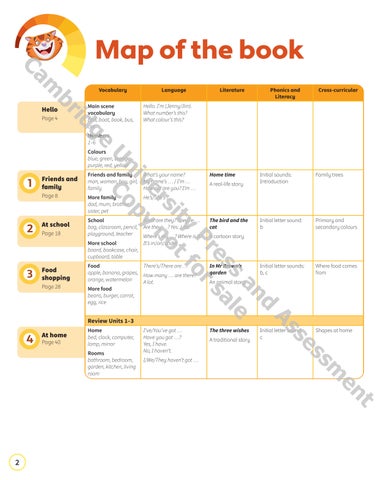
Vocabulary
Hello
Main scene vocabulary bird, boat, book, bus, cat
Page 4
Language
Literature
Phonics and Literacy
Cross-curricular
Hello. I’m (Jenny/Jim). What number’s this? What colour’s this?
ge
id
br
m
Ca
Map of the book Numbers 1–6
Page 8
2
At school
3
Food shopping
Page 18
Page 28
Friends and family man, woman, boy, girl, family
What’s your name? My name’s … / I’m … How old are you? I’m …
More family dad, mum, brother, sister, pet
He’s/She’s …
School bag, classroom, pencil, playground, teacher
What are they? They’re … Are they …? Yes. / No.
Co
1
Friends and family
As d an s le es sa Pr r y fo it t rs no ve y ni p
U
Colours blue, green, orange, purple, red, yellow
Home time
Family trees
A real-life story
Initial sounds: Introduction
The bird and the cat
Initial letter sound: b
Primary and secondary colours
Initial letter sounds: b, c
Where food comes from
Initial letter sound: c
Shapes at home
Where’s my …? Where is it? It’s in/on/under … More school board, bookcase, chair, cupboard, table
A cartoon story
There’s/There are … Food apple, banana, grapes, How many … are there? orange, watermelon A lot. More food beans, burger, carrot, egg, rice
In Mr Brown’s garden
An animal story
Review Units 1–3 Page 40
Home bed, clock, computer, lamp, mirror
I/We/They haven’t got …
The three wishes
A traditional story
en
m
Rooms bathroom, bedroom, garden, kitchen, living room
I’ve/You’ve got … Have you got …? Yes, I have. No, I haven’t.
ss se
4
At home
t
2
m
Ca Language
Literature
He’s/She’s got … Body ears, eyes, hair, mouth, Has he/she got …? Yes, he’s/she’s got … legs
My best friend
br
My body Page 50
id
5
Vocabulary
ge
Describing appearance big, small, long, short, beautiful Toys board game, camera, doll, teddy, train
Keeping clean
Materials
A real-life story
Initial letter sound: t
The queen of the river
Initial letter sounds: f, p
Emotions
Initial letter sounds: b, t, s
Weather
He/She hasn’t got …
Do you like …? I like/love …
My favourite toy
What’s your favourite …? I like/don’t like …
Co
More toys ball, balloon, bike, car, plane
Cross-curricular
Initial letter sounds: b, c, l
A real-life story
As d an s le es sa Pr r y fo it t rs no ve y ni p
Page 60
U
6
My toys
Phonics and Literacy
Review Units 4–6
7
Free time Page 72
Action verbs climb, jump, run, swim, walk Free time activities catch a ball, fly a plane, play basketball, play football, play the piano
8
More action verbs
Can you …? Yes, I can. No, I can’t. I can …
What are you doing? I’m …ing.
He’s/She’s …ing. He/She
We’re having clean, drink, eat, sleep, isn’t …ing. We’re/ They’re fun! …ing. We/They aren’t … take a photo Page 82
A traditional story
ing. Nature beach, flower, sea, sun, What’s he/she doing? What are they doing? tree
Clean the beach day A fantasy story
Sustainability
Farm animals dog, duck, goat, horse, sheep
I want/don’t want … Do you want (your) …? Yes, I do. No, I don’t.
An animal story
Initial letter sounds: Review
Caring for animals
t
Let’s … Yes, OK/great/please. No, thank you
Five good friends
en
Page 92
Clothes jacket, jeans, shoes, socks, T-shirt
m
9
Moving to the farm
ss se
Is he/she …ing? Yes, he/she is. No, he/she isn’t. Are they …ing? Yes, they are. No, they aren’t..
Review Units 7–9 Key Competencies Activity Bank page 104
3
Ca
Hello
m
1
Listen. Listen again and point.
ge
id
br
0.02
Co
As d an s le es sa Pr r y fo it t rs no ve y ni p
U en
m
ss se
t
4
Hello. I’m (Jenny/Jim).
Vocabulary 1
1
Listen and point.
0.03
ge
id
br
m
Ca Co
As d an s le es sa Pr r y fo it t rs no ve y ni p
U en
m
ss se
t
2
0.04
Listen. Listen again and chant. bird, boat, book, bus, cat
5
1
Listen and point. Say.
0.05
ge
id
br
m
Ca Co
As d an s le es sa Pr r y fo it t rs no ve y ni p
U
2
0.06
Listen. Listen again and chant. Match.
en
m
ss se
t
1 6
Numbers 1–6
2
3
4
5
6
1
Listen and point. Chant.
0.07
ge
id
br
m
Ca Co
As d an s le es sa Pr r y fo it t rs no ve y ni p
U
2
0.08
Listen and say yes or no.
4
en
m
ss se
t Colours What number’s this? What colour’s this?
7
1
Ca
Friends and family
1
Listen. Listen, point and say.
br
m
Vocabulary 1 1.01
1.02
ge
id Co
As d an s le es sa Pr r y fo it t rs no ve y ni p
U en
m
ss se
t
2 1.03 8
Listen. Listen again and chant.
Friends and family man, woman, boy, girl, family
Language practice 1 1.04
2
1.05
Watch the video. Listen and sing. Listen. Listen again and choose the number.
ge
id
br
m
Ca
1
1
Co
As d an s le es sa Pr r y fo it t rs no ve y ni p
U 2/4
3/5
4/6
5/6
en
m
ss se
t
3
1.06
Talk to Cameron. What’s your name? My name’s … / I’m … How old are you? I’m …
9
Vocabulary 2 and song
1
1.07
Listen and point. Sing.
1.08
ge
id
br
m
Ca Co
As d an s le es sa Pr r y fo it t rs no ve y ni p
U
1
4
2
3
5
en
m
ss se
t
2
Look and say.
10 More family dad, mum, brother, sister, pet
Language practice 2
1.09
2
1.10
Watch the video. Listen and sing. Listen, point and say the number.
Ca
1
1
2
3
4
ge
id
br
m
1
Listen. Listen again and write the number.
Co
1.11
As d an s le es sa Pr r y fo it t rs no ve y ni p
U
3
en
m
ss se
t
4 1.12 Look. Listen and say yes or no. He’s/She’s …
11
Literature
Look and point. Say the words.
1
Home time
Ca 1.13
ge
id
br
m
Co
As d an s le es sa Pr r y fo it t rs no ve y ni p
U en
m
ss se
t
12 Text type: A real-life story
1
ge
id
br
m
Ca Co
As d an s le es sa Pr r y fo it t rs no ve y ni p
U en
m
ss se
t
1
Who is happy
in the story? Point. Act the last picture. Acting out a role 13
Phonics and Literacy
1
1.14
1.15
Listen and point. Listen and repeat the sounds and words.
ge
id
br
m
Ca Co
As d an s le es sa Pr r y fo it t rs no ve y ni p
U
2
1.16
Listen and say. Match.
en
m
ss se
t
14 Initial sounds: Introduction
Cross-curricular
Family trees Ca
Watch the video.
1
Look and say. Listen and point.
br
m 2
1
1.17
ge
id Co
As d an s le es sa Pr r y fo it t rs no ve y ni p
U
3
Look and match.
en
m
ss se
t Learning about family trees
15
Story
The ly Friendy 1.18 Famil
Watch the video.
Ca
2
ge
id
br
m
1
Co
4
6
en
m
ss se
5
As d an s le es sa Pr r y fo it t rs no ve y ni p
U
3
t
16 Story: Vocabulary and language in context
Review
1
Listen and point. Listen again and stick.
sticker
1.19
1
ge
id
br
m
Ca Co
As d an s le es sa Pr r y fo it t rs no ve y ni p
U en
m
ss se
6
t
2 1.20 How old? Listen and write the number. Unit consolidation
17
2
Ca
At school
1
Listen. Listen, point and say.
br
m
Vocabulary 1 2.01
2.02
ge
id Co
As d an s le es sa Pr r y fo it t rs no ve y ni p
U en
m
ss se
t
2
2.03
Listen. Listen again and chant.
18 School bag, classroom, pencil, playground, teacher
Language practice 1
2.04
2
2.05
Watch the video. Listen and sing. Listen. Who says it, Matt or Jim? Listen again and match.
ge
id
br
m
Ca
1
2
Co
As d an s le es sa Pr r y fo it t rs no ve y ni p
U en
m
ss se
t
3
2.06
Talk to Cameron. What are they? They’re … Are they …? Yes. / No.
19
Vocabulary 2 and song
1
2.07
Listen and point. Sing.
2.08
br
m
Ca
1
2
ge
id
3
Co
As d an s le es sa Pr r y fo it t rs no ve y ni p
U 4
5
en
m
ss se
t
2
Look and say.
20 More school board, bookcase, chair, cupboard, table
Language practice 2
2.09
2
2.10
Watch the video. Listen and sing. Listen, point and say the number.
m
Ca
1
2
1
2
3
4
ge
id
br Co
2.11
As d an s le es sa Pr r y fo it t rs no ve y ni p
U
3
Listen. Listen again and do the actions.
en
m
ss se
t
4 2.12 Look. Listen and say yes or no. Where’s my …? Where is it? It’s in/on/under …
21
Literature
Look. Find and tick ✓.
1
Ca
✓
id
br
m
The bird and the cat ge
2.13
Co
As d an s le es sa Pr r y fo it t rs no ve y ni p
U en
m
ss se
t
22 Text type: A cartoon story
2
ge
id
br
m
Ca Co
As d an s le es sa Pr r y fo it t rs no ve y ni p
U Who is happy in the story? Tick ✓ or cross ✗. Act feeling happy .
en
m
ss se
1
t
✗ Making inferences from stories
23
Phonics and Literacy
1
Listen and say. Can you remember?
2.14
ge
id
br
m
Ca Co
As d an s le es sa Pr r y fo it t rs no ve y ni p
U 2 2.15 2.16 Listen and say. Choose the b words.
Listen and check.
en
m
ss se
t
24 Initial letter sound: b
Cross-curricular
Primary and secondary
2
Ca
c o lo u r s 2.17
Listen and point. Listen again and say.
ge
id
2
Watch the video.
br
m
1
Co
As d an s le es sa Pr r y fo it t rs no ve y ni p
U
3 1
2.18
Listen and point. Listen again, match and colour. 2
3
en
m
ss se
t Learning about primary and secondary colours 25
Story
The ly Friendy 2.19 Famil
Watch the video.
Ca
2
ge
id
br
m
1
Co
4
6
en
m
ss se
5
As d an s le es sa Pr r y fo it t rs no ve y ni p
U
3
t
26 Story: Vocabulary and language in context
Review
1
Listen and point. Listen again and stick.
sticker
2.20
2
ge
id
br
m
Ca Co
As d an s le es sa Pr r y fo it t rs no ve y ni p
U en
m
ss se
t
2 2.21 Listen and match. Unit consolidation
27
3
Ca
Food shopping
1
Listen. Listen, point and say.
br
m
Vocabulary 1 3.01
3.02
ge
id Co
As d an s le es sa Pr r y fo it t rs no ve y ni p
U en
m
ss se
t
2
3.03
Listen. Listen again and chant.
28 Food apple, banana, grapes, orange, watermelon
Language practice 1
3.04
2
3.05
Watch the video. Listen and sing. Listen. Listen again and write the number.
ge
id
br
m
Ca
1
3
Co
As d an s le es sa Pr r y fo it t rs no ve y ni p
U 6
en
m
ss se
3.06
Talk to Cameron.
t
3
There’s/There are …
29
Vocabulary 2 and song
1
3.07
Listen and point. Sing.
3.08
ge
id
br
m
Ca 2
3
4
5
Co
As d an s le es sa Pr r y fo it t rs no ve y ni p
U 1
en
m
ss se
t
2
Look and say.
30 More food beans, burger, carrot, egg, rice
Language practice 2
3.09
2
3.10
Watch the video. Listen and sing. Listen, point and say the number.
Ca
1
3
2
3
4
ge
id
br
m
1
Listen. Listen again and colour.
Co
3.11
As d an s le es sa Pr r y fo it t rs no ve y ni p
U
3
en
m
ss se
t
4 3.12 Look. Listen and answer. How many … are there? A lot.
31
Literature
Look. Point to the food. Say the words.
1
In Mr Brown’s garden
Ca 3.13
ge
id
br
m Co
As d an s le es sa Pr r y fo it t rs no ve y ni p
U en
m
ss se
t
32 Text type: An animal story
3
ge
id
br
m
Ca Co
As d an s le es sa Pr r y fo it t rs no ve y ni p
U en
m
ss se
t
1
Who is happy in the story? Who is angry in the story? Act feeling happy and angry
. Recognising emotions
33
Phonics and Literacy
1
3.14
3.15
Listen, point and say. Match. Listen and check.
ge
id
br
m
Ca Co
As d an s le es sa Pr r y fo it t rs no ve y ni p
U
2
en
m
ss se
Make beans, bananas and carrots from modelling clay. Make the letters b and c.
t
34 Initial letter sounds: b, c
Cross-curricular
Where food comes from Ca
Watch the video.
1
Listen and point. Listen again and say.
br
m 2
3
3.16
3.17
ge
id Co
As d an s le es sa Pr r y fo it t rs no ve y ni p
U
3
Look and colour. Say.
en
m
ss se
t Sustainability | Learning about where food comes from
35
Story
The ly Friendy 3.18 Famil
Watch the video.
Ca
2
ge
id
br
m
1
Co
4
6
en
m
ss se
5
As d an s le es sa Pr r y fo it t rs no ve y ni p
U
3
t
36 Story: Vocabulary and language in context
3 1
Listen and point. Listen again and stick.
sticker
3.19
ge
id
br
m
Ca Co
As d an s le es sa Pr r y fo it t rs no ve y ni p
U en
m
ss se 6
t
2
3.20
How many? Listen and write the number. Unit consolidation
37
Review Units 1–3
1
Listen and follow. Draw lines.
3.21
ge
id
br
m
Ca Co
As d an s le es sa Pr r y fo it t rs no ve y ni p
U 2 3.22 Listen and tick ✓. 1
2
4
en
3
m
ss se
✓
t
38 Consolidation of Units 1–3
Review
1
Look at the picture. Ask and answer.
3
ge
id
br
m
Ca As d an s le es sa Pr r y fo it t rs no ve y ni p
U Co
2 3.23 Draw a picture of you. Listen and write.
en
m
ss se
t
1 2 Consolidation of Units 1–3 39
4
Ca
At home
1
Listen. Listen, point and say.
br
m
Vocabulary 1 4.01
4.02
id ge
clock
Co
As d an s le es sa Pr r y fo it t rs no ve y ni p
U
mirror
lamp
computer
bed
en
m
ss se
t
2 40 Home
4.03
Listen. Listen again and chant.
Language practice 1
4.04
2
4.05
Watch the video. Listen and sing. Listen. Listen again and match.
ge
id
br
m
Ca
1
4
Co
As d an s le es sa Pr r y fo it t rs no ve y ni p
U en
m
ss se
t
3
4.06
Talk to Cameron. I’ve/You’ve got … Have you got …? Yes, I have. / No, I haven’t.
41
Vocabulary 2 and song
1
4.07
Listen and point. Sing.
4.08
ge
id
br
m
Ca 1
bathroom
2
bedroom
Co
As d an s le es sa Pr r y fo it t rs no ve y ni p
U 3
4
living room
kitchen
garden
en
m
ss se
5
t
2 42 Rooms
Look and say.
Language practice 2
4.09
2
4.10
Watch the video. Listen and sing. Listen, point and say the number.
m
Ca
1
4
1
2
3
4
ge
id
br Listen. Listen again and colour.
Co
4.11
As d an s le es sa Pr r y fo it t rs no ve y ni p
U
3
en
m
ss se
t 4 4.12 Look, listen and correct. Say No, they haven’t got … I/We/They haven’t got …
43
Literature
Listen and point to the correct picture.
1
The three wishes
Ca 4.13
ge
id
br
m a magic fish
Co
As d an s le es sa Pr r y fo it t rs no ve y ni p
U a big house
en
m
ss se
a lot of food
t
44 Text type: A traditional story
4
id
br
m
Ca ge
lamps, clocks and mirrors
Co
As d an s le es sa Pr r y fo it t rs no ve y ni p
U Goodbye!
king and queen
en
m
ss se
t
1
Who is angry in the story? Why? Point. Act the last two pictures. Acting out different emotions
45
Phonics and Literacy
1
4.14
4.15
Listen and write the numbers. Listen, point and say.
ge
id
br
m
Ca Co
As d an s le es sa Pr r y fo it t rs no ve y ni p
U
2
4.16
1
Write the letter c under the c words. Listen and check.
c
t
c
en
c
m
c
ss se
cc c
46 Initial letter sound: c
Cross-curricular
Shapes at home Ca
Watch the video.
1
Listen, point and say. Find the shapes.
br
m 2
4
4.17
ge
id rectangle
Listen and write the number. Say.
triangle
en
m
ss se
4.18
square
Co
3
As d an s le es sa Pr r y fo it t rs no ve y ni p
U circle
t 1 Learning about shapes at home
47
Story
The ly Friendy 4.19 Famil
Watch the video.
Ca
2
Come and see my house.
ge
id
br
m
1
As d an s le es sa Pr r y fo it t rs no ve y ni p
U Hello, Frida!
I haven’t got a bedroom.
I’ve got two eggs.
4
This is my bed.
6
What’s your name?
en
m
ss se
5
Co
3
t
48 Story: Vocabulary and language in context
Review
1
Listen and point. Listen again and stick.
sticker
4.20
4
ge
id
br
m
Ca Co
As d an s le es sa Pr r y fo it t rs no ve y ni p
U Listen. Choose the tick ✓ or cross ✗. 2
3
4
en
1
m
4.21
ss se
2
t
✓ ✗
✓ ✗
✓ ✗
✓ ✗ Unit consolidation
49
5
Ca
My body
1
Listen. Listen, point and say.
br
m
Vocabulary 1 5.01
5.02
ge
id hair
U
As d an s le es sa Pr r y fo it t rs no ve y ni p
ears
eyes
Co
mouth
en
m
ss se
legs
t
1 50 Body
5.03
Listen. Listen again and chant.
Language practice 1
5.04
2
5.05
Watch the video. Listen and sing. Listen. Listen again and choose the colour.
ge
id
br
m
Ca
1
5
Co
As d an s le es sa Pr r y fo it t rs no ve y ni p
U en
m
ss se
t
3
5.06
Talk to Cameron. He’s/She’s got … Has he/she got …? Yes, he’s/she’s got …
51
Vocabulary 2 and song
1
1
5.07
Listen and point. Sing.
5.08
m
Ca ge
id
br
long
5
Co
As d an s le es sa Pr r y fo it t rs no ve y ni p
U
short
3
big
ss se
4
2
Look and say the number.
52 Describing appearance
beautiful
t
2
en
m
small
Language practice 2
5.09
2
5.10
Watch the video. Listen and sing. Listen and point. Say the colour.
Ca
1
5
2
5.11
★
★
4
As d an s le es sa Pr r y fo it t rs no ve y ni p
3
Co
★
U
3
★
ge
★
id
br
m
1
★
★
★
Listen. Listen again and tick ✓ or cross ✗.
✓
en
m
ss se
t 4 5.12 Look, listen and correct. Say No, he/she hasn’t got … He/She hasn’t got …
53
Literature
Look at the story. Who has got these things?
1
short hair
ge
id
br
m
Ca long hair
blue eyes
brown eyes
a big mouth
a small mouth
As d an s le es sa Pr r y fo it t rs no ve y ni p
U My best friend
Co
5.13
It’s time for art.
Well done, Tom.
en
m
ss se
long brown hair
t
54 Text type: A real-life story
5
id
br
m
Ca ge
big brown eyes
U Co
As d an s le es sa Pr r y fo it t rs no ve y ni p
Lucy’s a dog!
a big mouth
1
How do they feel? Look and choose.
en
m
ss se
t
sad
excited
surprised
happy Describing emotions
55
Phonics and Literacy
1
5.14
5.15
Listen and say. Match. Listen and check.
Ca
12 9
3
m
6
ge
id
br
l
As d an s le es sa Pr r y fo it t rs no ve y ni p
c
Co
2
U
b
Look. These things have legs. Write the letter l to make legs.
en
m
ss se
l
t
56 Initial letter sounds: b, c, l
Cross-curricular
Keeping clean Ca
Watch the video.
1
Listen and point. Listen again and say.
br
m 2
5
5.16
ge
id Co
As d an s le es sa Pr r y fo it t rs no ve y ni p
U I wash my face.
3
5.17
I brush my teeth.
I wash my hands.
Listen. Listen again and point. When do you wash your hands? Choose and say.
en
m
ss se
t Learning about keeping clean
57
Story
The ly Friendy 5.18 Famil
Watch the video.
Ca
2
He’s got one big yellow eye.
ge
id
br
m
1
As d an s le es sa Pr r y fo it t rs no ve y ni p
U He’s Jim’s favourite.
Co
3
4
He hasn’t got long orange hair.
6
ss se
5
Come with me!
I’m one of the family!
en
m
There’s a picture of you.
t
58 Story: Vocabulary and language in context
Review
1
Listen and point. Listen again and stick.
sticker
5.19
5
ge
id
br
m
Ca Co
As d an s le es sa Pr r y fo it t rs no ve y ni p
U en
m
ss se
t
2
5.20
Listen. What have they got? Match. Unit consolidation
59
6
Ca
My toys
1
Listen. Listen, point and say. Colour.
br
m
Vocabulary 1 6.01
6.02
ge
id Co
As d an s le es sa Pr r y fo it t rs no ve y ni p
U
teddy
board game
doll
train
en
m
ss se camera
t
2 60 Toys
6.03
Listen. Listen again and chant.
Language practice 1
6.04
2
6.05
Watch the video. Listen and sing. Listen. Listen again and match.
ge
id
br
m
Ca
1
6
Co
As d an s le es sa Pr r y fo it t rs no ve y ni p
U
♥♥
♥♥
♥ en
m
ss se
♥
t
3
6.06
Talk to Cameron. Do you like …? I like/love … 61
Vocabulary 2 and song
1
6.07
Listen and point. Sing.
6.08
m
Ca ge
id
br
plane
As d an s le es sa Pr r y fo it t rs no ve y ni p
U
balloon
ball
Co
2
6.09
62 More toys
Listen. Point and say the toy.
t
car
en
m
ss se
bike
Language practice 2 6.10
2
6.11
Watch the video. Listen and sing. Listen, point and say the number.
Ca
1
6
2
3
4
ge
id
br
m
1
6.12
♥
♥
Listen. Listen again and choose.
Co
3
♥
As d an s le es sa Pr r y fo it t rs no ve y ni p
U
♥
♥ ♥ ♥ ♥
♥ ♥ ♥ ♥
en
m
ss se
t
4 6.13 Who says it? Listen and say Teddy or Doll. What’s your favourite …? I like/don’t like …
63
Literature
Look. Point to the toys. Say the words. How many toys are in the story?
1
Ca
My favourite toy id
br
m
6.14
Look at Teddy!
ge Co
As d an s le es sa Pr r y fo it t rs no ve y ni p
U a new bike
new toys
en
m
ss se
a new doll
[A/W PEC_PB_L0_ U6_064.1c] illo
t a new board game 64 Text type: A real-life story
6 Where’s Teddy?
Ca
Where’s Teddy?
ge
id
br
m Co
As d an s le es sa Pr r y fo it t rs no ve y ni p
U Poor Teddy!
Here’s Teddy.
I love Teddy.
en
m
ss se
t
1
Find a sad part of the story. Talk about it. In the end is the story happy or sad ? Why? Resolving issues
65
Phonics and Literacy
1
6.15
6.16
Listen and say. Do these words start with t? Look and tick ✓ or cross ✗. Listen and check.
ge
id
br
m
Ca Co
As d an s le es sa Pr r y fo it t rs no ve y ni p
U
2
Make a letter t and a teddy from modelling clay.
en
m
ss se
t
66 Initial letter sound: t
Cross-curricular
Materials Watch the video.
m
Ca
1
6.17
6.18
Listen and repeat. Listen and point.
br
2
6
ge
id
It’s made of …
Co
As d an s le es sa Pr r y fo it t rs no ve y ni p
U wood
fabric
paper
plastic
3
6.19
metal
Listen and choose. 2
ss se
1
4
paper / plastic
wood / plastic
en
m
3
t
paper / fabric
metal / wood
Learning about materials
67
Story
The ly Friendy 6.20 Famil
Do you like this doll?
2
I don’t like Jim’s monster.
ge
id
br
m
Ca 1
Watch the video.
You’re one of the family!
4
5
I love baby birds!
6
Come and see my family.
en
m
ss se
Co
As d an s le es sa Pr r y fo it t rs no ve y ni p
U
3
68 Story: Vocabulary and language in context
t
They’re my babies!
1
sticker
6.21
6
Listen and point. Listen again and stick.
ge
id
br
m
Ca Co
As d an s le es sa Pr r y fo it t rs no ve y ni p
U en
m
ss se
t
2
Circle your favourite toy. Unit consolidation
69
Review Units 4–6
1
Listen and follow. Draw lines.
6.22
ge
id
br
m
Ca Co
As d an s le es sa Pr r y fo it t rs no ve y ni p
U 12 9
3 6
2 6.23 Listen and tick ✓. 1
2
4
en
3
m
ss se
✓
t
70 Consolidation of Units 4–6
Review
1
What do you like? Look and tick ✓ or cross ✗. Ask and answer.
6
ge
id
br
m
Ca Me
Co
As d an s le es sa Pr r y fo it t rs no ve y ni p
U
My friend
2 6.24 Listen. Write, draw and colour.
en
m
ss se
t
1 2 Consolidation of Units 4–6
71
7
Ca
Free time
1
Listen. Listen, point and say.
br
m
Vocabulary 1 7.01
7.02
ge
id
run
jump
Co
As d an s le es sa Pr r y fo it t rs no ve y ni p
U climb
swim
en
m
ss se
walk
t
2
7.03
72 Action verbs
Listen. Listen again and chant. Do the actions.
Language practice 1
7.04
2
7.05
Watch the video. Listen and sing. What can Jim do? Listen. Listen again and tick ✓ or cross ✗.
ge
id
br
m
Ca
1
7
Co
As d an s le es sa Pr r y fo it t rs no ve y ni p
U en
m
ss se
✓
t
3
7.06
Talk to Cameron. Can you …? Yes, I can. / No, I can’t. I can …
73
Vocabulary 2 and song
1
7.07
3
Listen and point. Say the number. Sing.
7.08
Ca
2
m
1
ge
id
br
draw a fish
catch a ball
Co
As d an s le es sa Pr r y fo it t rs no ve y ni p
U
play football
4
play the piano 5
fly a plane
2
What can you do? Look and tick ✓ or cross ✗.
74 Free time activities
t
play basketball
en
m
ss se
6
Language practice 2
7.09
2
7.10
Watch the video. Listen and sing. Listen, point and say the number.
Ca
1
7
2
3
4
ge
id
br
m
1
Listen. Listen again and colour.
Co
7.11
As d an s le es sa Pr r y fo it t rs no ve y ni p
U
3
en
m
ss se
t
4 7.12 Look. Listen and say yes or no. What are you doing? I’m …ing.
75
Literature
Look. Point to the actions. Say the words.
1
The queen of the river
Ca 7.13
m
ge
id
br
Elephant is king of the animals.
Co
As d an s le es sa Pr r y fo it t rs no ve y ni p
U You don’t like water.
You can’t swim.
ss se
One, two, three, go!
I can swim!
en
m
t
I can sing! 76 Text type: A traditional story
7 I can jump!
br
m
Ca ge
id
I’m winning!
U
Co
As d an s le es sa Pr r y fo it t rs no ve y ni p
Look at me! I’m jumping!
Thank you, Frog.
You are the queen of the river.
en
m
ss se
t
1
When does Frog help Toad? Making positive choices 77
Phonics and Literacy
1
7.14
7.15
Listen and say. Match. Count and write the numbers. Listen and check.
m
Ca ge
id
br
p
Co
7.16
As d an s le es sa Pr r y fo it t rs no ve y ni p
U
2
f is for four and five. Count and write the numbers. Listen and repeat.
en
m
ss se
t
5 78 Initial letter sounds: f, p
Cross-curricular
Emotions Ca
Watch the video.
1
m 7.17
Listen and point. Listen again and say.
ge
id
br
2
7
happy
Co
3
As d an s le es sa Pr r y fo it t rs no ve y ni p
U angry
sad
scared
tired
Look and match. Say. I’m sad.
I’m happy.
I’m scared.
I’m surprised.
I’m excited.
ss se
I’m worried.
en
m
I’m angry.
I’m tired.
When do you feel these emotions? What do you do when you feel them?
t
4
Learning about emotions
79
Story
The ly Friendy 7.18 Famil
Watch the video.
Ca
2
What are you doing?
m
1
Can you jump?
ge
id
br
Yes, I can.
As d an s le es sa Pr r y fo it t rs no ve y ni p
U I’m climbing.
Co
3
I can walk, I can run and I can fly!
4
Can you fly?
No. I can’t fly.
Can you swim?
6
I can catch birds!
en
m
ss se
5
t
No. I can’t swim.
80 Story: Vocabulary and language in context
Review
1
sticker
7.19
Listen and point. Listen again and stick.
7
ge
id
br
m
Ca Co
As d an s le es sa Pr r y fo it t rs no ve y ni p
U en
m
ss se
t
2
Circle what you can do. Unit consolidation
81
8
Ca
We’re having fun!
1
Listen. Listen, point and say.
br
m
Vocabulary 1 8.01
8.02
ge
id Co
As d an s le es sa Pr r y fo it t rs no ve y ni p
U
eat
clean
take a photo
sleep
drink
en
m
ss se
t
2
8.03
82 More action verbs
Listen. Listen again and chant. Do the actions.
Language practice 1
8.04
2
8.05
Watch the video. Listen and sing. Listen. Listen again and colour.
ge
id
br
m
Ca
1
8
Co
As d an s le es sa Pr r y fo it t rs no ve y ni p
U en
m
ss se
t
3
8.06
Talk to Cameron. He’s/She’s/We’re/They’re …ing.; ... isn’t/aren’t …ing.
83
Vocabulary 2 and song
1
8.07
Listen and point. Say the number. Sing.
8.08
m
Ca br
2
1 sun
tree
ge
id Co
As d an s le es sa Pr r y fo it t rs no ve y ni p
U
3
sea
4
beach
m
ss se flower
en
5
t
2 84 Nature
What do you like? Draw a happy or sad face.
Language practice 2
8.09
2
8.10
Watch the video. Listen and sing. Listen, point and write the number.
ge
id
br
m
Ca
1
8
Listen and point. Listen again and match.
Co
8.11
As d an s le es sa Pr r y fo it t rs no ve y ni p
U
3
1
en
m
ss se
t
4 8.12 Look. Listen and answer the questions. Is he/she …ing? Yes, he/she is. No, he/she isn’t. Are they …ing? Yes, they are. No, they aren’t. 85
Literature
Find these people in the story.
1
br
m
Ca Clean the beach day
ge
id
8.13
As d an s le es sa Pr r y fo it t rs no ve y ni p
U Oh, no! Look at the beach!
Co Oh, no! Look at the plastic bags in the sea!
en
m
ss se
t Please help me.
86 Text type: A fantasy story
8
m
Ca ge
id
br
We want to clean the beach.
Let’s go and help! Here you are. For the rubbish!
Co
As d an s le es sa Pr r y fo it t rs no ve y ni p
U Thank you, everyone. Well done!
Are they happy, sad or excited? Why? Look and match.
en
m
ss se
1
t Sustainability | Understanding environmental responsibilities
87
Phonics and Literacy
1
8.14
8.15
Listen and write the numbers. Listen, point and say.
ge
id
br
m
Ca
1
Co
As d an s le es sa Pr r y fo it t rs no ve y ni p
U
2
8.16
Listen and say. Write the letter s.
en
m
ss se
s
t
88 Initial letter sounds: b, t, s
Cross-curricular
Weather
Watch the video.
m
Ca
1
8.17
Listen and point. Listen again and say.
ge
id
br
2
8
It’s
8.18
It’s rainy.
Co
3
As d an s le es sa Pr r y fo it t rs no ve y ni p
U It’s sunny.
It’s cloudy.
It’s windy.
It’s snowy.
What’s the weather like? Listen and answer. Number and write.
.
It’s
.
.
en
m
ss se
It’s rainy
t
1 .
. Learning about the weather
89
Story
The ly Friendy 8.19 Famil
Watch the video.
Ca
2
Is your mum closing the Friendly Café?
br
m
1
This is our new house.
Yes, she is.
ge
id Co
As d an s le es sa Pr r y fo it t rs no ve y ni p
U
3 Are they closing the café?
4
Can you come to Friendly Farm with us?
No, I can’t.
Yes, they are.
6
en
m
Goodbye, Cameron.
Goodbye, Frida.
ss se
5
t
My family is here.
90 Story: Vocabulary and language in context
Review
1
Listen and point. Listen again and stick.
sticker
8.20
8
ge
id
br
m
Ca Co
As d an s le es sa Pr r y fo it t rs no ve y ni p
U en
m
ss se
t
2
8.21
Listen again and colour. Unit consolidation
91
9
Ca
Moving to the farm
1
Listen. Listen, point and say.
br
m
Vocabulary 1 9.01
9.02
ge
id Co
As d an s le es sa Pr r y fo it t rs no ve y ni p
U socks
T-shirt
2 92 Clothes
9.03
Listen. Listen again and chant. Do the actions.
t
jacket
en
jeans
m
ss se
shoes
Language practice 1 9.04
2
9.05
Watch the video. Listen and sing. Listen. Listen again and tick ✓ or cross ✗.
ge
id
br
m
Ca
1
9
Co
As d an s le es sa Pr r y fo it t rs no ve y ni p
U en
m
ss se
t
3
9.06
Talk to Cameron. I want/don’t want … Do you want (your) …? Yes, I do. / No, I don’t.
93
Vocabulary 2 and song
1
9.07
Listen and point. Say the number. Sing.
9.08
m
Ca id
br
horse
ge
1
Co
As d an s le es sa Pr r y fo it t rs no ve y ni p
U goat
dog
2
3
sheep
en
m
4
5
ss se
duck
t
2
9.09
94 Farm animals
Listen again and colour.
Language practice 2
9.10
2
9.11
Watch the video. Listen and sing. Listen, point and write the number.
ge
id
br
m
Ca
1
9
9.12
Listen. Listen again and draw lines.
Co
3
As d an s le es sa Pr r y fo it t rs no ve y ni p
U
1
en
m
ss se
t
4 9.13 Look. Listen and say yes or no. Let’s … Yes, OK/great/please. / No, thank you.
95
Literature
Look. Find the animals in the story. Say the words.
1
Five good friends
Ca
Where’s Duck?
ge
id
br
m
9.14
I don’t know.
Co
As d an s le es sa Pr r y fo it t rs no ve y ni p
U It’s hot today. I’m hot!
Let’s find him.
I’m very hungry.
Is he in the forest?
en
m
ss se
t Let’s catch the duck.
96 Text type: An animal story
9 Come back, duck!
Now we’ve got the duck.
ge
id
br
m
Ca U Co
As d an s le es sa Pr r y fo it t rs no ve y ni p
Look! There’s Duck.
We can help him. Let’s go.
How do the animals feel? Act out the story.
en
1
m
ss se
Thank you very much!
t Participating in creative activities
97
Phonics and Literacy
1
9.15
9.16
Listen, point and say. Listen and repeat.
ge
id
br
m
Ca Co
As d an s le es sa Pr r y fo it t rs no ve y ni p
U
2
9.17
9.18
Listen and say. Write the letters c, t and s. Listen and check.
en
m
ss se
s
t
98 Initial letter sounds: Review
Cross-curricular
9
Caring for animals Ca
Watch the video.
1
Listen and point. Listen and say.
br
m 2
9.19
9.20
ge
id As d an s le es sa Pr r y fo it t rs no ve y ni p
U
3
Co
Animals need food.
Animals need water.
Animals need shelter.
Look and write. Say.
.
Animals need fo1od
.
en
m
ss se
Animals
t . Sustainability | Learning about caring for animals
99
Story
The ly Friendy 9.21 Famil
Watch the video.
Ca
Let’s look at the farm.
2 Good idea, Jim!
Do you want a photo of the animals?
ge
id
br
m
1
Co
Look at that big, brown horse.
It’s standing under a tree.
4
Look at that goat.
It’s eating a sock!
Where’s Cameron? What’s he doing?
6
ss se
5
As d an s le es sa Pr r y fo it t rs no ve y ni p
U
3
Hello. I’m Cameron. Let’s be friends.
100 Story: Vocabulary and language in context
t
He’s climbing the tree.
en
m You’ve got a lot of new friends here.
1
sticker
9.22
9
Listen and point. Listen again and stick.
ge
id
br
m
Ca Co
As d an s le es sa Pr r y fo it t rs no ve y ni p
U en
m
ss se
t
2
9.23
Listen again and colour. Unit consolidation 101
Review Units 7–9
1
Listen and follow. Draw lines.
9.24
ge
id
br
m
Ca Co
As d an s le es sa Pr r y fo it t rs no ve y ni p
U
2
9.25
Listen and tick ✓.
1
2
4
en
3
m
ss se
✓
t
102 Consolidation of Units 7–9
Review
1
What do you want? Choose the tick ✓ or cross ✗. Ask and answer.
9
✓
✓
✗
✓
✗
✓
✗
✓
✗
✓
✗
✓
✗
✓
✗
✓
✗
✓
✗
✓
✗
id
✗
ge
br
m
Ca Me
My friend
✓
✗
As d an s le es sa Pr r y fo it t rs no ve y ni p
U
2
Co
Point and say. What can you do? Draw a picture of you. Draw lines and write.
en
m
ss se
t
This is me. I can and I can
. Consolidation of Units 7–9 103
Ca
I’m a great communicator
1
ge
id
br
m
We communicate with words, actions, pictures, songs and movement. We are communicating all the time!
Co
2
As d an s le es sa Pr r y fo it t rs no ve y ni p
U
Invent a new name and age. Stand up. Introduce yourself to as many other pupils as you can and try to remember your friends’ new names and ages.
Movements and actions can help you remember words. Think of some movements to help you remember in, on and under. Share your ideas with your classmates.
t
104 C1 Competence in linguistic communication
en
Say two true sentences and one false sentence about your bedroom. Say them to a par tner. Can they guess the false sentence? For example, I’ve got a bed. I’ve got a clock. I’ve got four computers.
m
4
ss se
. At the front of the class, Play Snapshot – a flashcard game shcard. The pupils keep your teacher gives ten pupils a fla … they show you ree th o, tw e, On t! cre se a s rd ca sh their fla ember the pupils and rem u yo n Ca s! nd co se e fiv for s rd their ca their words?
3
Draw a silly monster but don’t show your partner. Describe your monster to your partner. They draw what they hear. Do the monsters look the same? For example, My monster has got six eyes. My monster has got three arms.
5
id
br
m
Ca
Do a class toy survey. Write down two toys you like. Ask your classmates if they like the toys. How many classmates like the same toys as you? For example, Do you like trains? Do you like board games?
ge
6
Co
8
As d an s le es sa Pr r y fo it t rs no ve y ni p
U
7
(a paper folded in four). Write four free time activities on a bingo card Do you play basketball? In groups, take turns to ask your classmates in the bingo square. Do you …? If they say yes, write their name each activity on your Shout Bingo! when you have got a name for bingo card.
s with words you know in rd ca t go s ha er ch tea ur Yo s. de Play Chara ss, choose a card and cla e th of nt fro in or ps ou gr all sm English. In es guess the word? at ssm cla ur yo n Ca . ce en sil in n do the actio
t
9
en
m
ss se
Spot the differences in the photos. Tell your partner. For example, In this picture, the girl is playing piano.
C1 Competence in linguistic communication 105
I’m multilingual Ca
id
br
m
We learn different languages to communicate with others and understand different cultures. s. Look at the words. They mean good morning in different language Which languages are they? Ohayo Bom Dia Buon giorno Bonjour Guten Morgen
ge
1
As d an s le es sa Pr r y fo it t rs no ve y ni p
U
Co
Listen to your teacher say good morning in the different languages. y Which one do you like? As a class, choose a different language ever week to say good morning. 2
3
Look around your classroom and find examples of technology in Spanish. Your teacher can help you translate them into English. Write them on the board. Are the words similar?
106 C2 Multilingual competence
t
In English, there are a lot of words for the bathroom: restroom, loo, ladies’ room, men’s room, the W.C. Are there many words for bathroom in your language? Symbols on doors help us ide ntify bathrooms. Can you think of more symbols we use?
en
4
m
ss se
Next time you eat in a restaurant with family and friends, ask if there is a menu in another language. Compare it with the Spanish menu. Write down some new words you learn in the other language and tell the class.
5
ge
id
br
m
Ca
Your teacher has got cards with words for parts of the body, both in English and Spanish. Each pupil has got a card with a word in either Spanish or English. Move around the classroom. Say your word quietly. Can you find a pupil with the same word in the different language? Are the words similar in Spanish and English?
6
Co
7
Play Simon says. Your teacher gives you an instruction to do. However, if they don’t say Simon says before the instruction, don’t do it! Listen carefully – the instructions can be in Spanish and English! 8
Ask a family member to help you find weather songs in Spanish and in other languages. Play the songs for the class. Can you recognise any of the weather words?
describe animal sounds. to s rd wo nt ere diff e us es ag gu Different lan English and Spanish to the Draw lines to match the sounds in sounds similar or different? animals that make them. Are the neigh tweet tweet w eo m of wo oo -d dle oo cock-a-d cat
cockerel
bird
horse
miau
ki-kiri-ki
pío pío
guau
jiiiiiiii
t
dog
en
m
ss se
9
As d an s le es sa Pr r y fo it t rs no ve y ni p
U
Ask family members what their favourite toy was when they were six years old. Find out how to say these toys in English.
C2 Multilingual competence 107 XX Xx
I’m a STEM expert Ca 1
ge
id
br
m
We experiment and learn from our mistakes. We are inventive and full of questions!
Co
As d an s le es sa Pr r y fo it t rs no ve y ni p
U
Make your family tree. Draw pictures of your family members and write their names.
2
3
a circle. One pupil Play a counting game. In small groups, sit in es with the next starts counting. The pupil to their left continu and not the number. number. Every five numbers, you say a food banana! 6, 7, 8, 9, egg! How high can you go? For example, 1, 2, 3, 4,
en
t
108 C3 Mathematics, science and technology competence
m
Learn how to measure things with your fingers, hands and feet. Practise together in the classroom. How many hands is the length of your table? At home, measure a lamp, a mirror, a bed and a room. Ask a family member to help you. Write down your results. For example, My mirror measures twen ty fingers.
ss se
4
Draw a map of the school. Use a ruler to make straight lines. Include at least three classrooms, the bathrooms, the playground and the canteen/dining room.
5
br
m
Ca
How many pupils in your class have got blue eyes or black hair? Make a char t of your classmates’ eye colour and hair colour. Are the results similar? Draw and design a toy. Ask a family member to help you. Tell the class about it. For example, It’s made of plastic. It’s a plane. It’s green and yellow.
ge
id
6
As d an s le es sa Pr r y fo it t rs no ve y ni p
U home. For example, In pairs, think of ten actions at school and at ak French, play football. play the piano, read a book, cook a meal, spe . Move around the Write them in a table. Do a classroom sur vey Display your results in classroom and ask other pupils Can you …? ll. a diagram. Display your diagrams on the wa
7
Co
8
en
m
t
t shoe? Who has the biggest and smalles oes In small groups, organise your sh Then in a line from smallest to biggest. ys. organise yourselves in different wa in For example, by bir thday months by order from January to December, house numbers, etc .
ss se
9
Ask a family member to show you the weather forecast online for different cities around the world. Draw a char t with the cities and weather symbols. Share your information with the class. For example, In Lisbon, it’s cloudy. In Tokyo, it’s sunny.
C3 Mathematics, science and technology competence 109
Ca
I’m a digital whizz kid ge
id
br
m
We are digital natives, and we love learning with new tools. We live with technology and use it every day. We have to use it responsibly. 1
Co
As d an s le es sa Pr r y fo it t rs no ve y ni p
U
Emojis are symbols we use in text messages and emails to replace a word or show a feeling. As a class, think of different emojis you know. Draw a few emojis that describe you. Show your partner.
2
The Internet is full of educational websites with games and activities to help you learn. As a class, share your favourite educational websites or apps. Ask your teacher which websites or apps they like to use to help you learn English. Make a classroom poster to show your favourite educational websites or apps. Try one with an adult at the weekend if you can. 3
110 C4 Digital competence
t
What technology do you and your family use at home? What rooms are they in? Make a list of the technology and rooms. Do you have rules at home about how much screen time you can have? Why is this a good idea?
en
4
m
ss se
At home with an adult, choose a food with a label. Use the information on the label to find out where the food came from. With the help of a family member, use maps on the Internet to see how far it travelled. Tell your class.
5
id
br
m
Ca
Imagine you can invent a new fun filter for taking pictures on a phone. Bring a photo of your face to class, or draw your face. Draw or stick pictures on your face to show your new filter. Put the photos and pictures on the classroom wall. Which is your favourite?
6
ge
Many board games or family games are online. Get help from an adult to find one you can play with your family, friends or classmate s.
Co
ot with shapes – Ask a family member to help you design a rob er. Print or send there are different ways to do this on a comput Tell the class what your design to your teacher to show in class. climb walls. it can do. For example, FlashX3 can swim and 8
You can visit lots of places virtually. What does this mean? Ask a family member to help you find a virtual museum and take a tour together. Tell the class about your visit. What is different when you visit a museum virtually? Do you like it?
ok at the pictures. Lo k. ea br n ca it d an ive ns pe ex is Technology hnology? What are some Who is taking good care of their tec technology? other good ideas for taking care of
en
m
ss se
9
As d an s le es sa Pr r y fo it t rs no ve y ni p
U
7
t C4 Digital competence 111 XX Xx
Ca
I’m a super study star Colours can help you learn. Choose a different colour for each family word. Write out the names of your family on a piece of paper using those colours. For example, if you choose blue to write mum, write your mum’s name in blue.
ge
1
id
br
m
We are organised, collaborative, creative and resilient pupils.
Co
As d an s le es sa Pr r y fo it t rs no ve y ni p
U
2
3
It is important to take care of your school materials and classroom things. Is your school bag tidy? Ask your teacher and classmates about ways they stay organised.
4
112 C5 Personal, social and learning to learn competence
t
Do you have a place to study at home? It is imp ortant to have a workspace. Ask for help from a family memb er. Plan your study place at home. What materials do you need? Is it tidy?
en
m
ss se
ke food word ar t. Ar t can help learn a language. Ma it with pictures of Write the food word and decorate e word. the food to help you remember th
In pairs, think about ways to use sounds, actions and pictures to learn the action and describing words from this unit. For example, you can say the word small in a little voice, or write the word big with big letters.
5
id
br
m
Ca
In class, look at different ideas to group similar words together. Which ones do you like? Make a char t, graph or diagram. Put it on the classroom wall for your classmates to see.
ge
6
U
doll
Co
camera board game teddy
7
8
Body
As d an s le es sa Pr r y fo it t rs no ve y ni p
Toys
ears
hair
eyes
legs
a Make a play! In small groups, plan and act out ces. short play using new English words and senten
s to test difficult As a class, think of different game play a game. spelling. In pairs or small groups,
t
9
en
m
ss se
Tell a partner what you do in the morning before school. What is important to help you have a good day at school?
C5 Personal, social and learning to learn competence 113
I’m a model citizen Ca 1
id
br
m
We are respectful, caring and collaborative.
ge
Make a new friend today! Introduce yourself to a new person. Invite them to play with you in the playground.
As d an s le es sa Pr r y fo it t rs no ve y ni p
U
2
Co
Be a good school citizen. School is for every child, and we should make it a nice place to be. Look at the pictures and see who is being a good school citizen and who can do better.
3
en
t
114 C6 Citizenship competence
m
Help at home. Look at the pictures. Do you do these chores? What other chores can you do? Talk to your family about how you can help. Make a chores chart to remind you to do your chores at home.
ss se
4
ve enough to eat. ha n’t do o wh rld wo e th in le op pe There are d. Help to organise foo ed ne o wh le op pe lp he s on cti Food colle e food to a food charity. a class food collection and give th
Keep healthy. Wash your hands carefully. Make a poster to remind other pupils how to wash their hands correctly. Display your poster.
5
id
br
m
Ca
6
ge
Share your toys. Do you share your toys? How do you feel when your friend doesn’t share their toys with you?
As d an s le es sa Pr r y fo it t rs no ve y ni p
U k of a game that everyone Good citizens let everyone play. In groups, thin y the game and make can play at breaktime. Think about how to pla your poster on the wall for a poster describing how to play the game. Put go and play! the class to see. Choose a game to play. Now,
7
Co
8
Is there a park or area near your school that needs some good citizens to help do a clean-up? With your teacher, investigate projects in your local area. Can your class do anything to help?
9
en
m
ss se
Look at the signs in re. tu na er aft k loo to nt rta po im s It’ an? What other signs me ey th do at Wh . rk pa al loc ur yo tryside? can you see in parks and the coun
t C6 Citizenship competence 115 XX Xx
Ca
I’m a creative thinker
br
m
We solve problems creatively and share new ideas. Look at some famous logos in class. Do you like them? What colours and shapes do they use? Design a logo for your family. Display the logos in the classroom. Explain in English or in Spanish what you see in your logo.
ge
id
1
Co
3
As d an s le es sa Pr r y fo it t rs no ve y ni p
U
2
Look at the photo of a classroom. How is it the same as your classroom? How is it different? How would you improve your classroom?
Draw and cut out two squares, two circles, two rectangles and two triangles. Arrange the shapes to create an obj ect, like a house or a car. How many objects can you make? Com bine your shapes with other pupils to make more objects!
t
116 C7 Entrepreneurship competence
en
4
m
ss se
e starter, one main course and In groups, create a menu with on pictures of the food. Present one dessert. Decorate it and draw the class likes the best. nu me ich wh e se d an ss cla e th your menu to
Ca 5
Make a toy website! Your teacher can show you some examples. In groups, draw pictures of toys for your website on a piece of paper. Write the names of some toys and the prices. Decorate your paper to look like a website and put it on the classroom wall for the class to see. The class vote on their favourite website. Remember – if your prices are cheaper, people will buy from your website!
ge
6
id
br
m
Taking care of your teeth is very important. Design and make a poster to help remind other pupils to clean their teeth. Make it fun.
Co
As d an s le es sa Pr r y fo it t rs no ve y ni p
U
7
8
Imagine you are a sports teacher. Think of a warm-up activity or game you can teach. In pairs, plan your activity. Think about safety. Practise. Take it in turns each day to teach the class a new warm-up activity.
en
m
ss se
Think of your perfect summer day. On separate pieces of paper, draw scenes to describe it. Where are you? What are you doing? What is the weather like? Create a space in the classroom called Summer day ideas. Every Friday, look at the picture ideas and choose one to do with your family that weekend.
ree outfit collages. th ke Ma . es zin ga ma m fro es th Cut out clo e for hot days and one for Make one outfit for cold days, on your favourite styles. for te vo d an res tu pic ur yo y pla Dis a party.
t
9
C7 Entrepreneurship competence 117
Ca
I’m a cultural ambassador
Names from other cultures can be difficult to say but important to pronounce correctly. Pick a country and use the internet to look up two popular names in that country and how to pronounce them. . Teach the class the names, where they are from and how to say them
ge
id
1
br
m
We learn from other cultures and reflect on our own culture.
In many English-speaking countries, pupils call their teachers by their surnames, with Mr for men and Ms for women. For example, Mr Brown or Ms Smith. Ask your teacher their surname and try it out for a day.
Have you tried food from different at countries or regions of Spain? Wh it was it? Did you like it? Do you think try is better to eat food from one coun or food from all over the world?
en
t
118 C8 Competence in cultural awareness and expression
m
Homes are different around the world. Use the Internet to look at homes around the world. What surprises you? How are they different from yours? How are they the same?
ss se
4
Co
3
As d an s le es sa Pr r y fo it t rs no ve y ni p
U
2
Ca 5
With help from an adult, investigate a game children play in another country. Learn the rules and teach the class how to play.
ge
6
id
br
m
Look at the children from all around the world. Describe them to a partner.
sports. Watch videos The Olympic Games celebrates cultures and what you can see. of some opening ceremonies and talk about Which is your favourite? Why?
en
m
Look at the pictures of celebrations around the world. Are they different from how you celebrate? What is the same? Would you like to join in on the celebration?
ss se
aw a special outfit you Dr . es th clo ial ec sp ve ha ns tio ra Special celeb know people wear for u yo t tfi ou an aw dr or n, tio ra leb wear for a ce e it with your classmates. ar mp Co . try un co nt ere diff a in n a celebratio
t
9
Co
8
As d an s le es sa Pr r y fo it t rs no ve y ni p
U
7
C8 Competence in cultural awareness and expression 119 XX Xx
Acknowledgements The authors and publishers acknowledge the following sources of copyright material and are grateful for the permissions granted. While every effort has been made, it has not always been possible to identify the sources of all the material used, or to trace all copyright holders. If any omissions are brought to our notice, we will be happy to include the appropriate acknowledgements on reprinting and in the next update to the digital edition, as applicable.
Ca
Dedications We would like to thank all of the people involved in this project. In particular, we wish to thank the team at Cambridge for pushing this new edition forward and for their hard work bringing it all together.
m
For my parents, Pauline and Eric Nixon for allowing me ‘supported self-determination’ during my formative years. – CN For Javier, María José and Laura. It’s a privilege to have you as friends. – MT
br
Key: Emt = End matter; U = Unit.
id
Photography The following photographs are sourced from Getty Images:
ge
Co
As d an s le es sa Pr r y fo it t rs no ve y ni p
U
U1: Rawpixel/istock; incomible/iStock; Hill Street Studios/DigitalVision; Ronnie Kaufman/DigitalVision; RDC_design/iStock/Getty Images Plus; U2: Vagengeym_ Elena/iStock; Watcharapol_Kun; c-photo/iStock; studiocasper/E+; ksana-gribakina/iStock/Getty Images Plus; U3: Tharakorn Arunothai/EyeEm; AlasdairJames/ iStock; MIXA; ALEAIMAGE/E+; Mariabo2015/iStock/Getty Images Plus; FatCamera/iStock; kobeza/iStock; Image Source/DigitalVision; riccardo bianchi2/iStock; Maren Caruso/DigitalVision; chengyuzheng/iStock; LiliGraphie/iStock; BURCU ATALAY TANKUT/Moment; VICTOR-/DigitalVision Vectors; izzetugutmen/iStock/ Getty Images Plus; U4: MILHRANDT YULIIA, 2018/iStock; Catherine Delahaye; YakobchukOlena; Terry Vine/DigitalVision; mmpile/E+; Juice Images/Cultura; Catherine Falls Commercial/Moment; Yevhenii Dubinko/iStock/Getty Images Plus; U5: Paul Bradbury/OJO Images; damircudic/E+; wilpunt/iStock; Ariel Skelley/ DigitalVision; Westend61; Destinations by DES - Desislava Panteva Photography/Moment; Inti St Clair/Photodisc; Robert Niedring; Jeff Greenough; Tatiana Mezhenina/iStock/Getty Images Plus; U6: Ls9907; BURCU ATALAY TANKUT/Moment; Silvia Elena Castañeda Puchetta/EyeEm; Westend61; Jorgeinthewater/iStock; Marco_Bonfanti/iStock; Andy Crawford; colematt/iStock; rath phl chiy thwil/EyeEm; Valerie Loiseleux/iStock; Cn0ra/iStock; 9george/iStock; IlexImage/E+; ONOKY - Fabrice LEROUGE/Brand X Pictures; sokoziurke/iStock; Amit Hasija; Rob Lewine; U7: Triangle Images; PeopleImages/E+; Clover No.7 Photography/Moment; HRAUN/E+; master1305/iStock; michellegibson/iStock; master1305/iStock; Pollyana Ventura/iStock; Brainsil/iStock; michellegibson/iStock; AnYudina/iStock/ Getty Images Plus; U8: LeManna/iStock; jacoblund/iStock; Hill Creek Pictures/UpperCut Images; Paul Burns/Corbis; Kinzie Riehm/Image Source; Sally Anscombe/ DigitalVision; Mayalis/iStock/Getty Images Plus; U9: Khrizmo/iStock; Ariel Skelley/DigitalVision; Lomiso/iStock; Merrimon/iStock; oneinchpunch/iStock; julian40/ iStock; Fuse/Corbis; thepurpledoor/Moment; PeopleImages/E+; Astrid860/iStock; rvika/iStock/Getty Images Plus; Ariel Skelley/DigitalVision; Tevarak/iStock/ Getty Images Plus Emt: Andersen Ross/The Image Bank; David Madison/Stone; HRAUN/E+; sturti/E+; Markus Gann/EyeEm; Sentavio/iStock/Getty Images Plus; Catherine Falls Commercial/Moment; Peter Dazeley/The Image Bank; calvindexter/DigitalVision vectors; “MoMo Productions/DigitalVision vectors; “FreshSplash/ E+; bijendrakumar Makwana//iStock/Getty Images Plus; zoranm/E+; samsonovs/iStock/Getty Images Plus; Daly and Newton/OJO Images; GlobalStock/iStock/ Getty Images Plus; Yobro10/iStock/Getty Images Plus; Alistair Berg/DigitalVision ; PeopleImages/E+; Looks Like Me/DigitalVision ; Suparat Malipoom/EyeEm; soponbiz/iStock/Getty Images Plus; tzahiV/iStock/Getty Images Plus; Morsa Images/E+; Halfpoint Images/Moment; Cavan Images; BURCU ATALAY TANKUT/ Moment; monkeybusinessimages/iStock/Getty Images Plus; Mayur Kakade/Moment; Jan Sochor/Getty Images News; Martin Steinthaler/Moment. The following photograph is sourced from other sources/libraries: U6: Alef Gabriel Tetelboim/Shutterstock
Commissioned photography by Blooberry Design
Cover photography: PinkPueblo/Shutterstock; venimo/Shutterstock Cover design and illustrations: Fernando Cúneo; Tony Trimmer
Illustration Antonio Cuesta; Beth Hughes; Cesar Samaniego; Collaborate Agency; Dean Gray; Gaby Zermeno; Gareth Conway; Genie Espinosa; Howarth from The Big Red Illustration Agency; James Hearne; Judy Brown; Kelly Kennedy; Lesley Danson; Marea Perera; Melanie Mitchell; Tony Trimme
t
Additional writers: Angela Llanas, Lucy Frino, Bill Parminter, Julieta Hernández Rodriguez, Karen Elliot, Garan Holcombe, Daniel Latimer
en
Typesetting Typeset by The Content Station
m
Audio Audio recording by Sonica Studios, Ian Harker Song and chant composition by Robert Lee Song and chant audio production by Sonica Studios, Ian Harker, Jake Carter
ss se
Video Video production by Phaebus Media Group Animation production by QBS Learning