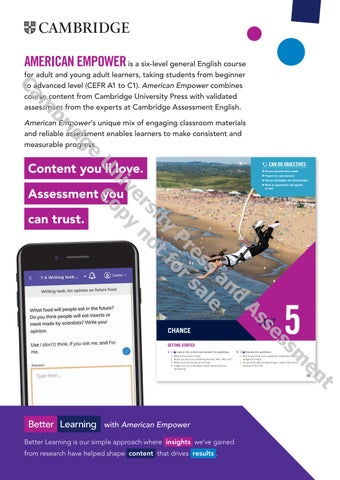
AMERICAN EMPOWER is a six-level general English course
m Ca
for adult and young adult learners, taking students from beginner to advanced level (CEFR A1 to C1). American Empower combines course content from Cambridge University Press with validated assessment from the experts at Cambridge Assessment English.
br
ge
id
American Empower’s unique mix of engaging classroom materials and reliable assessment enables learners to make consistent and measurable progress.
Content you’ll love.
U
CAN DO OBJECTIVES ■ Discuss possible future events
ss se As d an s le es sa Pr r y fo it t rs no ve y ni p ■ Prepare for a job interview
■ Discuss advantages and disadvantages ■ Write an argument for and against
Assessment you
Co
can trust.
an idea
UNIT
CHANCE
GETTING STARTED a
Look at the picture and answer the questions.
b
Discuss the questions.
1 Why do you think some people like doing extreme and dangerous things? 2 Do you think they do these things in spite of the risk or because of the risk?
en
What is the woman doing? Would you like to try something like that? Why / Why not? What could the woman be thinking? Imagine you’re on the beach below. What would you be thinking?
m
1 2 3 4
5
55 55
t
with American Empower Better Learning is our simple approach where insights we’ve gained from research have helped shape content that drives results .
Learner engagement Content that informs and motivates
1
Content
Results
Sustained motivation is key to successful language learning and skills development.
Clear learning goals, thoughtprovoking images, texts, and speaking activities, plus video content to arouse curiosity.
Content that surprises, entertains, and provokes an emotional response, helping teachers to deliver motivating and memorable lessons.
m Ca
Insights
br
id
1 SPEAKING
Are you an
Optimist
Pessimist
Decide what you think about the questions, then compare your answers.
I’ll probably fail.
2 Do you expect the coming week to be … ? exciting/great
boring/terrible
3 Imagine you left your bag on the bus. Do you expect to get it back? Yes
No
4 You start a new workout routine and you’re really tired the next day. Do you expect it to be easier the next time? Yes
d
No
Communication 5A Now go to p. 129. Based on your answers in 1b, decide who in your group … ? • is the most optimistic • is the most pessimistic • is the most realistic
e Write a question to find out if other students
are optimistic or pessimistic. Add a) and b) answer choices. Example: You want to buy a shirt you like, but the store is sold out. What do you think? a) I’m sure I can find it somewhere else. b) Why am I always so unlucky?
56
b Read the article again. Check (✓) the five points made in the article.
… we keep polluting the planet because we’re sure that we’ll find a way to clean it up some day …
1 2 3 4
Pessimists usually have fewer friends than optimists. Humans are naturally positive about their future. Reality is often worse than we imagine it to be. People who live in warmer countries are usually more optimistic. We often act (or don’t act) because we’re confident everything will work out. If we imagine a better future, we will take more risks. Optimists spend a lot of time daydreaming. Optimism about the future makes us feel better in the present.
WE’RE ALL ABOVE AVERAGE! • •
What kind of career will you have? How long do you think you’ll live?
Most people think they’ll be able to earn above-average salaries, but only some of the population can make that much. Most young men in Europe will say they expect to live well into their 80s, but the average life expectancy for European men is 75. Most people will give an answer that is unrealistic because nearly everyone believes they will be better than the average. Obviously, they can’t all be right. Most people are also optimistic about their own strengths and abilities. Ask people, “How well do you get along with other people?” or “How intelligent are the people in your family?” and they’ll usually say they’re above average. Again, they can’t all be right. We can’t all be better than everyone else, but that’s what we think.
LOOKING ON THE BRIGHT SIDE
There is a reason for this. Research has shown that, on the whole, we are optimistic by nature and have a positive view of ourselves. In fact, we are much more optimistic than realistic and frequently imagine things will turn out better than they actually do. Most people don’t expect their marriages to end in divorce, they don’t expect to lose their jobs, or to be diagnosed with a life-threatening disease. Furthermore, when things do go wrong, they are often quick to find something positive in all the gloom. Many people who fail exams, for example, are convinced they were just unlucky with the questions and they’ll do better next time. Or people who have had a serious illness often say that it was really positive because it made them appreciate life more. We really are very good at “looking on the bright side.”
5 6 7 8
THE OPTIMISM BIAS
This certainty that our future is bound to be better than our past and present is known as the “Optimism Bias,” and researchers have found that it is common to people all over the world and of all ages. Of course, the Optimism Bias can lead us to make some very bad decisions. Often, people don’t take out travel insurance because they’re sure everything will be all right, they don’t worry about saving up for old age because the future looks fine, or they smoke cigarettes in spite of the health warnings on the pack because they believe “It won’t happen to me.” Or on a global scale, we keep polluting the planet because we’re sure that we’ll find a way to clean it up some day in the future.
OPTIMISM IS GOOD FOR YOU
But researchers believe that the Optimism Bias is actually good for us. People who expect the best are generally likely to be ambitious and adventurous, whereas people who expect the worst are likely to be more cautious, so optimism actually helps to make us successful. Optimists are also healthier because they feel less stress – they can relax because they think that everything is going to be just fine. Not only that, but the Optimism Bias may also have played an important part in our evolution as human beings. Because we hoped for the best, we were prepared to take risks such as hunting down dangerous animals and traveling across the sea to find new places to live, and this is why we became so successful as a species. Even if our optimism is unrealistic and leads us to take risks, without it we might all still be living in caves, too afraid to go outside and explore the world in case we get eaten by wild animals.
c Discuss the questions.
• Look again at your answers in 1b. Do you think you have the “Optimism Bias”? • Do you agree that it’s better to be optimistic than realistic? Why / Why not? • How do you see yourself 20 years from now?
3 VOCABULARY
Adjectives describing attitude
a Find adjectives in “Why We Think We’re Going to Have a Long and Happy Life” that mean: 1 2 3 4 5 6
expecting the future to be good seeing things as they are not seeing things as they are prepared to take risks not prepared to take risks wanting to be successful.
b Which of these adjectives best describe you? c
Now go to Vocabulary Focus 5A on p. 158.
Many people who fail exams are convinced they were just unlucky with the questions …
Even if our optimism is unrealistic and leads us to take risks, without it we might all still be living in caves …
Insights
Results Personal responses make learning more memorable and inclusive, with all students participating in spontaneous spoken interaction.
Zenaide Brianez, Director of Studies, Instituto da Língua Inglesa, Brazil
t
Content Personalization tasks in every unit make the target language more meaningful to the individual learner.
There are so many adjectives to describe such a wonderful series, but in my opinion it’s very reliable, practical, and modern.
en
Language learners benefit from frequent opportunities to personalize their responses.
m ss
Personalized and relevant
57
se
2
A LONG AND HAPPY LIFE
Researchers have found that people all over the world share an important characteristic: optimism. Sue Reynolds explains what it’s all about.
1 If you take a test at the end of this class, how well will you do?
c
GOING TO HAVE
Try asking a 20-year-old these questions:
I’ll get a perfect score.
Most people are naturally optimistic / pessimistic, and this is generally an advantage / a disadvantage for the human race because it helps us to be realistic about the future / more successful.
WHY WE THINK WE’RE
Co
b
a Long and Happy Life” quickly. Choose the correct words to complete the summary.
As d an s le es sa Pr r y fo it t rs no ve y ni p
U
Are you an optimist or a pessimist? Mark your place on this scale, then compare with others in your group.
a Read the article “Why We Think We’re Going to Have
Family; Years and dates describing attitude VV Adjectives
IMIST OPT ? or a PESSIMIST
a
2 READING
G Future G Simpleprobability past: be
ge
5A
UNIT 5
Learn to talk about your family and familytohistory Learn discuss possible future events
YOU COULD LIVE TO BE A HUNDRED
Measurable progress 1
Assessment you can trust Content
Results
Tests developed and validated by Cambridge Assessment English, the world leaders in language assessment, to ensure they are accurate and meaningful.
End-of-unit tests, mid- and endof-course competency tests, and personalized CEFR test report forms provide reliable information on progress with language skills.
Teachers can see learners’ progress at a glance, and learners can see measurable progress, which leads to greater motivation.
m Ca
Insights
ge
id
br
Co
As d an s le es sa Pr r y fo it t rs no ve y ni p
U
Results of an impact study showing % improvement of Reading levels, based on global Empower students’ scores over one year.
We started using the tests provided with Empower and our students started showing better results from this point until now.
se
Evidence of impact
t
2
en
m ss
Kristina Ivanova, Director of Foreign Language Training Centre, ITMO University, Saint Petersburg, Russia
Insights
Content
Results
Schools and colleges need to show that they are evaluating the effectiveness of their language programs.
Empower (British English) impact studies have been carried out in various countries, including Russia, Brazil, Turkey, and the UK, to provide evidence of positive impact and progress.
Colleges and universities have demonstrated a significant improvement in language level between the mid- and end-of-course tests, as well as a high level of teacher satisfaction with Empower.
Manageable learning 1
Mobile friendly Content
Results
Learners expect online content to be mobile friendly but also flexible and easy to use on any digital device.
American Empower provides easy access to Digital Workbook content that works on any device and includes practice activities with audio.
Digital Workbook content is easy to access anywhere, and produces meaningful and actionable data so teachers can track their students’ progress and adapt their lesson accordingly.
m Ca
Insights
ge
id
br
U Co
ss se As d an s le es sa Pr r y fo it t rs no ve y ni p
I had been studying English for 10 years before university, and I didn’t succeed. But now with Empower I know my level of English has changed.
Nikita, Empower Student, ITMO University, Saint Petersburg, Russia
2
Corpus-informed Insights
Corpora can provide valuable information about the language items learners are able to learn successfully at each CEFR level.
m
Content
Results Learners are presented with the target language they are able to incorporate and use at the right point in their learning journey. They are not overwhelmed with unrealistic learning expectations.
t
en
Two powerful resources – Cambridge Corpus and English Profile – informed the development of the Empower course syllabus and the writing of the materials.
Rich in practice 1 Language in use
Content
Results
It is essential that learners are offered frequent and manageable opportunities to practice the language they have been focusing on.
Throughout the American Empower Student’s Book, learners are offered a wide variety of practice activities, plenty of controlled practice, and frequent opportunities for communicative spoken practice.
Meaningful practice makes new language more memorable and leads to more efficient progress in language acquisition.
m Ca
Insights
ge
id
br 5D
SKILLS FOR WRITING
We need to change the way we live
Discuss the questions.
c
Listen to the news reports and match them with photos a–d. What key words helped you decide? 05.19
05.19
What did the news reports say about
1 beekeepers – bees – pesticides – farmers – fruit trees 2 air pollution – smog – masks – coal – exhaust fumes 3 plastic – birds, sea animals, and fish – the sea – 2050 4 fires – rainforest – wildfires – clearing forest for land – soccer fields
Retell the reports. Listen again if necessary.
d
Discuss the questions. 1 Have you ever heard a news report like those in 1b about your own country or a country you know? What happened? 2 Which of these statements do you agree with the most and why? • We are responsible as individuals for protecting the environment. We can solve most environmental problems by behaving in a more responsible way. • The main responsibility for protecting the environment should lie with governments and large companies. There isn’t much that individuals can do to change things. 3 What actions do you think (a) governments, (b) large companies, and (c) individuals can take to protect the environment? a
Modern technology has many benefits – we can produce food cheaper and in greater quantities, we can manufacture the things we need more efficiently, and we can travel and communicate more easily. On the other hand, our activities can have negative Leon impacts on the environment. It is well known that we are polluting our oceans with plastic and chemicals, many species are dying out, and natural areas are disappearing as cities spread. Scientists agree that we need to take urgent action to protect the world we live in before it’s too late. But how can we 1
Co
these topics?
How can we help protect the environment?
b
c
64
c Notice how Leon uses expressions like these to
2 READING
report people’s opinions.
a Leon wrote an essay discussing the topic of
1 Which of these sentences best summarizes the essay? a Leon considers whether individuals or governments can do the most to protect the environment. b Leon describes different ways in which we are damaging the environment. 2 What is Leon’s conclusion? a It’s not clear how we can best protect the environment. b Both individuals and governments should act to protect
1 report what other people say or think (x3) 2 report how people feel (x1) 3 report what scientists say (x1) 4 report what Leon thinks himself (x1).
do this? 2 Most people accept that in order to protect the environment, we need to change the way we live. As individuals, we can help the environment by living simpler: we can buy fewer things and keep things we buy longer. We can also use public transportation and only use cars and planes when necessary; we can eat locally-produced food to cut down on transportation costs; and we can recycle more. People with their own houses and gardens can compost their food, grow organic vegetables, and invest in solar panels to provide energy. 3 However, not everyone agrees that the responsibility for protecting the environment lies with individuals. They point out that most environmental destruction is caused by companies, not individual people. For example, many people are worried that widespread use of fertilizers and pesticides threatens wildlife and pollutes soil and water, and that cutting down forests destroys the habitats of birds and animals. Also, pollution of the sea is often caused by waste from factories or by spills from oil tankers, and scientists warn that overfishing by large commercial fishing fleets could lead to fish disappearing from our oceans. Some people believe these things can only be changed by introducing new laws, not by asking individuals to change their lifestyle. 4 My own view is that both of these opinions are correct. We can do a lot as individuals to help the environment by behaving in a more responsible way, but that is not enough. We also need governments to take action to reduce pollution and improve the environment, and rich countries should lead the way in doing that.
the environment.
d Write sentences in response to these questions, using expressions from 3c.
Does recycling plastic really make much difference to the environment? Would eating less meat help protect the environment? Are pesticides causing bees to die out?
main points Leon makes.
3 WRITING SKILLS
Arguing for and against an idea
a Match four of the descriptions below to paragraphs 1–4 in the essay.
• Introduction – stating the problem • Introduction – giving Leon’s point of view • How individuals can help protect the environment • How large companies damage the environment • How large companies can help the environment • Conclusion – restating the problem • Conclusion – Leon’s point of view
4 WRITING
a Work in pairs. Choose one of the essay topics. Are extreme weather events a sign of climate change? Is building nuclear power stations the best way to provide “clean” energy? Should airfares be increased to discourage people from traveling by plane?
b
b Answer the questions.
1 Why does Leon ask a question in the first paragraph? 2 How does Leon make his arguments seem more objective (i.e., not just his own opinion)?
Discuss the topic you chose and take notes on possible arguments for and against. Then decide on your conclusion.
c Work on your own. Plan your essay using the structure in 3a.
d
Compare your notes with your partner and explain roughly what you plan to write.
e Write the essay in about 150–200 words, using expressions in 3c.
f Swap essays with another student. Does the essay … ?
1 have a clear structure 2 set out the arguments in a clear way 3 use suitable expressions for reporting opinions
Do you agree with the conclusion?
d
m ss
Insights
65
se
Progress with language learning often requires work outside of the classroom, and different teaching models require different approaches.
American Empower is available with a print workbook, online practice, documentary-style videos that expose learners to real-world English, plus additional resources with extra ideas and fun activities.
Results This choice of additional resources helps teachers to find the most effective ways to motivate their students both inside and outside the classroom.
t
Content
en
Elena Pro, Teacher, EOI de San Fernando de Henares, Spain
Find more expressions in the essay that:
b Read the essay again and make brief notes on the
2 Beyond the classroom There are plenty of opportunities for personalization.
It is well known that … Scienti sts agree that …
protecting the environment. Read the essay and answer the questions.
As d an s le es sa Pr r y fo it t rs no ve y ni p
1 What environmental problems are shown in photos a–d? 2 What environmental problems exist in your country or region? Which do you think are the most serious? 3 What action can people take to help solve them?
b
W Arguing for and against an idea
U
1 SPEAKING AND LISTENING a
UNIT 5 Learn to write an argument for and against an idea
Unit overview Unit Opener Getting started page – Clear learning objectives to give an immediate sense of purpose.
m Ca
Lessons A and B
Digital Workbook (online, mobile): Grammar and Vocabulary
id
br
Grammar and Vocabulary – Input and practice of core grammar and vocabulary, plus a mix of skills.
ge
Lesson C
Digital Workbook (online, mobile): Listening and Speaking
As d an s le es sa Pr r y fo it t rs no ve y ni p
U
Everyday English – Functional language in common, everyday situations.
Unit Progress Test
Co
Lesson D
Integrated Skills – Practice of all four skills, with a special emphasis on writing.
Digital Workbook (online, mobile): Reading and Writing
Review
Extra practice of grammar, vocabulary, and pronunciation. Also a “Review your progress” section for students to reflect on the unit.
Mid- / End-of-course test
Digital Workbook (online, mobile)
en
Workbook (printed)
m ss
Further practice is available for outside of the class with these components.
se
Additional practice
t
Components Resources – Available on cambridgeone.org • Audio • Video • Unit Progress Tests (Print) • Unit Progress Tests (Online)
• Mid- and end-of-course assessment (Print) • Mid- and end-of-course assessment (Online)
• Digital Workbook (Online) • Photocopiable Grammar, Vocabulary, and Pronunciation worksheets
CONTENTS Lesson and objective
Grammar
Unit 1 Outstanding people Getting started Discuss meeting famous people 1A Discuss people you admire Review of tenses
Discuss a challenge
1C
Explain what to do and check understanding
1D
Write an article
Questions
m Ca
1B
Pronunciation
Character adjectives
The letter e; Word stress
Everyday English
Trying and succeeding Rapid speech
br
Review and extension More practice
Cutting a conversation short; Explaining and checking understanding
WORDPOWER make
id
Unit 2 Survival
Vocabulary
ge
Getting started Discuss coping with natural disasters Discuss dangerous situations
Narrative tenses
Expressions with get
2B
Give advice on avoiding danger
Future time clauses and conditionals
Animals and the environment
2C
Give and respond to compliments
2D
Write guidelines in a leaflet
Unit 3 Talent
Intonation in question tags
Co
Review and extension More practice
had been
As d an s le es sa Pr r y fo it t rs no ve y ni p
U
2A
Agreeing using question tags; Giving compliments and responding
WORDPOWER face
Getting started Discuss what makes something a work of art 3A
Discuss ability and achievement
3B
Discuss sports activities and issues
3C
Make careful suggestions
3D
Write a description of data
Review and extension More practice Unit 4 Life lessons
Multi-word verbs
Ability and achievement
Present perfect and present perfect continuous
Words connected with sports
Word stress
Sound and spelling: Consonant sounds
Keeping to the topic of the conversation; Making careful suggestions
WORDPOWER up
Getting started Discuss childhood experiences
4B
Discuss and describe rules
4C
Describe photos
4D
Write an email to apply for work
used to and would
Cause and result
Obligation and permission
Talking about difficulty
Sound and spelling: u
Contrastive stress
Review and extension More practice
WORDPOWER as
Getting started Discuss attitudes to risk Discuss possible future events
Future probability
Adjectives describing attitude
5B
Prepare for a job interview
Future perfect and future continuous
The natural world
5C
Discuss advantages and disadvantages
5D
Write an argument for and against an idea
Review and extension More practice
2
Sound and spelling: th
Intonation groups
WORDPOWER side
t
5A
en
Unit 5 Chance
Describing photos; Expressing careful disagreement
m ss
Discuss events that changed your life
se
4A
Responding to an idea; Discussing advantages and disadvantages
Contents
Reading
Speaking
Conversation about Jocelyn Bell-Burnell
Articles: “Apple’s Design Genius” and “The Woman Who Reinvented Children’s TV”
Discussing inspiring people
Podcast: The 30-Day Challenge
Interviews: “30-Day Challenge”
Asking and answering questions about challenges
m Ca
Listening
Starting a new job
Cutting a conversation short; Explaining and checking understanding Article: “Tech Free!”
Discussing technology
Unit Progress Test Article Organizing an article
ge
id
br
Conversation about technology
Writing
Article: “Lost at Sea”
Telling a survival story
Interview: The Tiger
Leaflet: “How to Survive … an Animal Attack”
Giving advice; Asking questions
Cooking for a friend
Agreeing using question tags; Giving compliments and responding
Leaflet: “Be Wise and Survive!”
Discussing the natural environment
Text about learning: “Learning to Learn”
Talking about something you have put a lot of effort into
Article: “Born to Be the Best”; Three articles about athletes
Discussing sports and ways to improve performance
Co
Talking about getting lost
As d an s le es sa Pr r y fo it t rs no ve y ni p
U
Conversation about a survival situation
Conversation: learning experiences Radio show: The Sports Gene
Making party plans
Interviews about sports
Interview: Psychology of Money; Two monologues: Life-Changing Events
Article: “Fitness: Seattle Snapshot”
Talking about popular sports
Two texts about winning the lottery
Talking about how your life has changed
Article: “Training for the Emergency Front Line”
Discuss experiences of training and rules
Describing photos; Expressing careful disagreement Discussing living in a different country
Monologue: What Are Your Chances?
Quiz: “Are You an Optimist or a Pessimist?”; Article: “Why We Think We’re Going to Have a Long and Happy Life”
Discussing possible future events
Conversation: talking about work
Quiz: “The Unknown Continent”; Article: “Working in Antarctica”
Role play: a job interview
Money problems
News reports: environmental problems
Discussing advantages and disadvantages; Responding to an idea Essay about protecting the environment
Giving opinions on environmental problems
Unit Progress Test
Job application Giving a positive impression
t
Ad for being an international student “buddy”
Article describing data Describing data
en
Three monologues: living in different places
Unit Progress Test
m ss
Presenting photos
Guidelines Organizing guidelines in a leaflet
se
Two monologues: training for a job
Planning a party; Keeping to the topic of the conversation; Making careful suggestions
Unit Progress Test
Unit Progress Test For and against essay Arguing for and against an idea
3
Lesson and objective
Grammar
Vocabulary
Pronunciation
Consonant groups
Everyday English
Unit 6 Around the globe Getting started Discuss traveling 6A
Discuss choices
Gerunds and infinitives
Travel and tourism
6B
Discuss changes
The passive
Describing change
6C
Introduce requests and say you are grateful
Consonant sounds
m Ca 6D
Introducing requests; Showing you are grateful
Write a travel blog
Review and extension More practice
WORDPOWER out
br
Unit 7 City living
Getting started Discuss the design of new buildings Discuss living in cities
7B
Discuss changes to a home
7C
Imagine how things could be
7D
Write an email to complain
ge
id
7A
too / enough; so / such
Describing life in cities
Causative have / get
Movies and TV; Houses
Sound and spelling: o Stress in compound nouns
WORDPOWER down
Co
Unit 8 Dilemmas
As d an s le es sa Pr r y fo it t rs no ve y ni p
U Review and extension More practice
Imagining how things could be; Using vague language
Getting started Discuss attitudes to money 8A
Discuss personal finance
8B
Discuss moral dilemmas and crime
8C
How to be encouraging
8D
Write a review
Review and extension More practice Unit 9 Discoveries
Future real and present / future unreal conditionals
Money and finance
Past unreal conditional; should have + past participle
Crime
Stressed and unstressed words
Word groups
Being encouraging; Showing you have things in common
WORDPOWER take
Getting started Discuss the impact of new inventions
9B
Discuss people’s lives and achievements
9C
Express uncertainty
9D
Write an essay expressing a point of view
Relative clauses
Health
Reported speech; Reporting verbs
Verbs describing thought and knowledge
Sound and spelling: ui
Linking and intrusion
Review and extension More practice
WORDPOWER come
Unit 10 Possibilities Adjectives with prefixes
10B Discuss life achievements
Wishes and regrets
Verbs of effort
10C Describe how you felt
Word stress
t
Past modals of deduction
Consonant groups
10D Write a narrative Review and extension More practice Communication Plus p.127
4
WORDPOWER way Grammar Focus p.134
en
Getting started Discuss goals and expectations 10A Speculate about the past
Expressing uncertainty; Clarifying a misunderstanding
m ss
Discuss new inventions
se
9A
Vocabulary Focus p.154
Describing how you felt; Interrupting and announcing news
Contents Listening
Reading
Speaking
Two monologues about sightseeing tours
Website about three tourist destinations; Website: “Where to Go?”
Comparing different tourist destinations
Interview: disappearing languages
Article: “Danger! Dying Languages”
Agreeing and disagreeing
Asking for a favor
m Ca
Asking for a favor; Introducing requests; Showing you are grateful
Conversation: a trip to the Grand Canyon
br
Travel blog: “Around the Grand Canyon”
Discussing local tourist destinations
Article: “Quick – Slow Down!”
Discussing good and bad points about a city
ge
id
Interview: “Smart” Cities; Two monologues talking about “smart” cities
Two monologues: house renovations Apartment hunting
Writing
Article: “Who Put the ‘Real’ in Reality TV?”
Three monologues about honesty
Job hunting
Conversation about a TV show
Conversation about inventions Conversation about an email hoax
Designing and describing a new room; Imagining how things could be; Using vague language
Email of complaint Using formal language
Article: “Is It Time to Give Up on Cash?”
Giving opinions on financial matters
Newspaper article: “The Honesty Experiment”
Discussing moral dilemmas
Talking about hopes and worries; Being encouraging; Showing you have things in common
Review: “Crime with a Smile”
Discussing shows about crime
Article: “Too Good to Be True?”
Talking about inventions
Article: “The Rise and Fall of Barry Minkow”
Describing a hoax or a scam
Giving and receiving surprises; Expressing uncertainty; Clarifying a misunderstanding
Review Organizing a review
Unit Progress Test
Opinion essay Presenting a series of arguments
Story: “The Man Who Disappeared”; Blog: “The Wreck of the Titan”
Telling stories about coincidences
Two monologues: pursuing a dream
Article: “Dream to Help”
Describing and comparing brave or amazing people
t
Interview about Dan Cooper
en
Essay: “The Value of Alternative Medicine”
Celebrating good news
Unit Progress Test
m ss
Four monologues about alternative medicine
Conversation about goals
Unit Progress Test
se
A surprise/misunderstanding
Planning a home renovation
Email: complaining about an important issue
Co
Radio show: personal finance
Travel blog Using descriptive language
As d an s le es sa Pr r y fo it t rs no ve y ni p
U Interviews about a new shopping mall
Unit Progress Test
Telling an important piece of news; Describing how you felt; Interrupting and announcing news Story: “Rosa’s Diary: The Ultimate Goal”
Talking about performing
Unit Progress Test Story Making a story interesting
Phonemic symbols and Irregular verbs p.164
5
m Ca
ge id br
Co
t
en
m ss
se
As d an s le es sa Pr r y fo it t rs no ve y ni p U
This page is intentionally left blank.
6
CAN DO OBJECTIVES ■ Discuss people you admire ■ Discuss a challenge ■ Explain what to do and
check understanding ■ Write an article
m Ca ge
id
br Co
As d an s le es sa Pr r y fo it t rs no ve y ni p
U
1
GETTING STARTED a
Look at the picture and answer the questions. 1 Who do you think the people taking a selfie are? Where are they? 2 What are the people around them doing? 3 What do you think they have just said to each other? What’s going to happen next?
b
t
en
OUTSTANDING PEOPLE
m ss
se
UNIT Discuss the questions.
1 On what occasions do you normally take photos? 2 If you could take a selfie with a famous person, who would you choose and why? 3 What role do you think famous people play in society? Should they be good role models? Should they inspire other people?
77
1 A
SHE IS AN INSPIRING WOMAN
1 READING What kinds of people do you admire most? Why?
b
Look at photos a and b. What do you think these people have done to make other people admire them?
m Ca
a
br
id
c Read “Apple’s Design Genius” and “The
ge
Woman Who Reinvented Children’s TV” quickly and check your answers.
d Read the texts again and answer the
Co
Who … ? 1 had training in their area of work 2 carried out some research 3 set up their own company 4 was one of the first people in their role 5 initially found the work challenging 6 was interested in other people’s learning 7 believes the things we use should be beautiful 8 has won prizes for their work
e
Who do you think is more inspiring, Jony Ive or Joan Ganz Cooney? Why?
a
G Review of tenses V Character adjectives
Apple’s Design Genius I’ve always loved great design. Ever since I can remember, I’ve been fascinated by the shape and look of objects. In my opinion, Apple Inc. is the number one company in the world for product design. 1
In the time that you’re reading this article, around 750 iPhones and 300 iPads will be sold internationally. These iconic devices generate millions of dollars a day for Apple, and the man behind their iconic look is known as a “design genius.” Time magazine once listed him as one of the 100 most influential people in the world, but can you name him?
As d an s le es sa Pr r y fo it t rs no ve y ni p
U
questions. Write JI (Jony Ive), JGC (Joan Ganz Cooney), or B (both).
Learn to discuss people you admire
If you said Steve Jobs, you’d be wrong, although it was Jobs who first recognized this man’s talent. His name is Jony Ive.
Born in London, Jony Ive studied industrial design 2 in college. After graduating, he helped set up the London design agency Tangerine. In 1992, 3 while he was working at Tangerine, he accepted a job offer from Apple.
Jony Ive’s key contribution to Apple is recognized, and 6 he has received numerous awards for his designs. There is no doubt that Steve Jobs was a larger-than-life idea man and businessperson who created a hugely successful company. However, without Jony Ive’s design talent, Apple may not have become such a huge success.
8
So what have I learned from Jony Ive? That the best designs are often the simplest.
t
en
m ss
se
His first years in the job were tough, and the design work wasn’t very interesting. The company was also struggling to make money. However, when Steve Jobs returned to Apple in 1997 and saw the design work that Ive 4 had produced, he immediately recognized Ive’s ability and promoted him. Ive’s first success in his new role was the design of the original, colorful iMac in 1998, which was quickly followed by the first iPod in 2001. Thanks to Ive’s simple, elegant designs, Apple became one of the most successful companies in the world. From then, until his retirement in 2019, he was responsible for the iPhone, iPad, and Apple Watch. Ive’s designs involved not only the way 5 these products look but also the way they work. He believes devices have to be both beautiful and practical.
UNIT 1
THE WOMAN WHO REINVENTED
CHILDREN’S TV
2 GRAMMAR Review of tenses a Match the verbs 1–6 in bold in “Apple’s Design Genius” with the tenses below.
m Ca
I’ve always felt passionate about television’s ability to entertain and educate. I grew up watching what I consider to be a master class in how you can combine these two aspects of television: Sesame Street. This is the show that brought us Big Bird, Elmo, Cookie Monster, and more. These characters were brought to TV thanks to a woman I consider a genius: Joan Ganz Cooney.
b Complete the sentences with the tenses in 2a. We use the: 1 to refer to an event that takes place at a specific time in the past. 2 to refer to a temporary event in progress in the present. 3 to refer to a state or action that began in the past and has continued until now. 4 to refer to something that’s generally true. 5 to refer to an action that was in progress in the past when something else happened. 6 to refer to a past action that occurred before another past action.
br
In the mid-1960s, Ganz Cooney was working as a producer of television documentary shows in America. She realized television could play an important role in the education of preschool children. She researched this idea and, in 1967, she wrote an outline for Sesame Street.
simple present simple past present continuous past continuous present perfect past perfect
ge
id
Ganz Cooney presented her ideas to the TV network she was working for at the time. However, the network rejected her proposal, saying that they thought she didn’t have the right experience to produce a TV show for children. As a result, she set up Children’s Television Workshop with a colleague, and two years later they had managed to raise $8 million to finance production. Even so, many people working in the television industry questioned her ability to manage such a project. This was during the 1960s, when the industry was largely controlled by men.
As d an s le es sa Pr r y fo it t rs no ve y ni p
U
Co
At first, Ganz Cooney didn’t want to fight to keep her role as the director of the production company and the producer of the show. However, her husband and a colleague encouraged her to do so because they knew the project would fail without her involvement. This meant she became one of the first female television executives in the United States.
In 1969, two years after her initial research, Sesame Street went on the air, and today it’s still going strong. However, Joan Ganz Cooney didn’t stop there. She continued to take an interest in early childhood education, and in 2007, the Joan Ganz Cooney Center was founded to help improve children’s digital literacy. I really admire the way she continued helping young children. She’s not a household name like Big Bird, but she’s won many awards for her work and had a huge impact on the education of millions of children around the world.
Sesame Street Facts
• more than 150 million viewers worldwide • shown in more than 150 different countries • now has a production budget of around $17
d
Now go to Grammar Focus 1A on p. 134.
e Read the text about Nikola Tesla and underline the correct words.
f
01.02
Listen and check your answers.
NIKOLA TESLA 1
Not many people have heard / heard of Nikola 2 Tesla, who played / was playing a key role in creating the alternating current (AC) supply of 3 electricity we are having / have in our homes today. 4 Early in his career, Tesla has worked / worked with 5 Thomas Edison. He had emigrated / has emigrated 6 to the U.S. from Europe in 1884. While Tesla was working / had worked for Edison, they had an argument over payment for an invention, so Tesla 7 was deciding / decided to work independently. It was then that he developed a motor that could produce an alternating current. Throughout his life, Tesla continued to conduct 8 experiments and helped / was helping develop X-ray radiography and wireless communication. There is no 9 doubt that he has had / had had a large impact on modern technology. Many of the gadgets that we 10 are enjoying / enjoy today would not have been possible without Nikola Tesla.
t
en
m ss
b
second text.
se
million a year
c Underline examples of the six tenses in the
9
UNIT 1 3 LISTENING a
4 VOCABULARY
Listen to two roommates, Amelia and Chloe, talking about a female scientist, Jocelyn Bell-Burnell. Check (✓) the correct sentences.
a Underline the five adjectives that describe people’s
character in sentences 1–4. Which two adjectives have a similar meaning, and what’s the difference between them?
She’s always been famous. She isn’t very well known. She made an amazing discovery. She created a new mathematical theory.
m Ca
1 2 3 4
b
Character adjectives
01.03
01.03
1 2 3 4
Listen again. Are the sentences true
or false?
b
ge
id
br
1 Amelia’s reading a nonfiction book about planets and stars. 2 Jocelyn Bell-Burnell discovered a kind of star. 3 Bell-Burnell won a Nobel Prize for her discovery. 4 Bell-Burnell did badly when studying science in high school. 5 Life wasn’t easy for her when she made her discovery. 6 The press didn’t treat Bell-Burnell seriously. 7 Amelia has been inspired by Jocelyn Bell-Burnell.
Pronunciation Listen to the pronunciation of the letter e in these words. Which two sounds are the same? What are the other two sounds? 01.04
respected determined
c
01.05 Look at the words in the box and decide how the underlined letter e is pronounced. Add the words to the chart, then listen and check. Practice saying the words.
U
Discuss the questions.
slept revise helpful serve desire prefer identity university women
As d an s le es sa Pr r y fo it t rs no ve y ni p
c
She’s a respected physicist. She is an inspiring woman. She was really determined, but in a quiet way. Well, you’ve always been motivated, that’s for sure. And stubborn.
Sound 1 /ɪ/
Co
1 Could Jocelyn Bell-Burnell’s story have happened in your country? Do you know any similar examples? 2 How popular is science in your country? Is it popular with both men and women? 3 Is it important what gender a scientist is? Why do you think it was important in the case of Jocelyn Bell-Burnell?
Sound 2 /e/
Sound 3 /ɜ/
d Complete the sentences with the character adjectives in 4a. 1 Once Dan gets an idea in his head, nothing will change his mind. He’s the most person I know, and it’s really annoying. 2 I’m not the sort of person who gives up easily – I’m very to achieve new goals. 3 He’s worked hard and has done some very interesting research. He’s a highly chemist who’s known around the world. 4 Doing a PhD is hard work, so you have to be really if you want to complete one. 5 In my last year of high school, we had a really biology teacher. Her lessons were so interesting that we all worked very hard for her.
e
Now go to Vocabulary Focus on p. 154.
se
5 SPEAKING
m ss
a Think of an inspiring person who has influenced you in
some way. It can be someone you know or someone famous. Take notes about the person. Use the questions to help you.
Tell other students about your person. Ask questions.
My cousin Vera is an athlete. She trains really hard every day – she’s very determined.
10
How does she stay motivated?
t
b
What is this person’s background? What important things has this person done in their life? Why are they inspiring? How have they changed or influenced your life?
en
• • • •
1B
ARE YOU FINDING IT DIFFICULT?
Learn to discuss a challenge G Questions V Trying and succeeding
3 -Day
The
1 SPEAKING AND LISTENING
Challenge
Look at photos a–c and read “The 30-Day Challenge.” Then discuss the questions.
m Ca
a
1 What are the people in the photos doing? Have you ever taken up similar activities? If so, how successful were you? 2 Do you think doing something for 30 days gives you a better chance of succeeding? Why / Why not?
br
01.09 Listen to a podcast about the 30-day challenge. Check (✓) the main point that Alison makes.
id
b
Have you ever started a new hobby but given up after only a couple of weeks? Or started a class and stopped after the first few lessons? Most of us have tried to learn something new, but very few of us ever really get any good at it – it’s just too difficult to continue doing something new.
ge
But now there’s some good news: did you know that if you can keep up your new hobby for just 30 days, you have a much better chance of succeeding? And you may learn something new about yourself, too.
c
As d an s le es sa Pr r y fo it t rs no ve y ni p
U
1 The 30-day challenge is the only way to give up bad habits. 2 It’s too difficult for the brain to adapt to new habits. 3 If you try something new for 30 days, you’re more likely to stick with it afterward.
d What examples of 30-day challenges did you hear? Use words from both boxes for each challenge. Bike everywhere, even in the rain.
Co
01.09 Alison took some notes at the seminar. Complete her notes with one or two words in each blank. Listen again and check.
Seminar Notes
bike drink climb get up cook sunrise poem coffee mountain rain
. - It takes the brain 30 days to adapt to a new 2 time, so it’s fun to challenge yourself. - 30 days isn’t a - Also a chance to try something bad habits.
1
– not just giving up
3
- You need to make an a
meal picture
e What do you think of the ideas Alison talks about? Take notes.
- Two ways to do it: 4 do something that doesn’t get in the way of your 5 2 take time out to do something you’ve always 6
paint write
f
Compare your ideas.
do
!
c
t
en
m ss
se
b
11
UNIT 1 2 VOCABULARY
Trying and succeeding
a
Complete the sentences with the phrases in the box. Listen and check your answers. 01.10
m Ca
give up take a chance keep it up stick with make an effort manage to drop out try out work out
a Look at challenges 1–3. Who do you think will find it easy and who will find it difficult?
b Read the interviews and check your ideas.
30-DAY
CHALLENGE
ge
id
br
1 Often if we try something new, we after about a week or two because our brain hasn’t adapted. 2 So if you do something new for a month, you’ll probably it. 3 Maybe you wouldn’t want to for your whole life, but it might be fun to do it just for 30 days. 4 If you’re successful it’s great, but if it doesn’t , it doesn’t matter too much. 5 It’s not just about giving up bad habits. The idea is that you on something new. 6 You can be motivated and something you’ve always wanted to do. 7 You must to complete your goal. 8 Don’t of the challenge! Keep going and you will succeed.
3 READING
Co
As d an s le es sa Pr r y fo it t rs no ve y ni p
U
b Match words and phrases from 2a with the meanings. 1 2 3 4 5
succeed , stop trying , not stop trying , try hard try to see if it works
Challenge 1: Sofia decided not to eat meat.
What made you decide to become a vegetarian, Sofia? Well, for a long time now I’ve been trying to eat less meat, partly for health reasons. I think vegetables are better for you. 1
Yes, but I always thought I’d miss meat too much. The idea of being a vegetarian for 30 days was really good because I could give it a try and then see how I feel. 2
,
No, I feel really good. Actually, I don’t miss meat at all, so I think I’ll easily manage the 30 days, and I might try to keep going longer.
c Complete the sentences below about
30-day challenges. Use the words and phrases in 2a and your own ideas. There is more than one possible answer.
12
All kinds of things. At the beginning, I drew objects around me at home. Then I went out on my lunch break and started drawing things outdoors, like yesterday I drew a duck in the park – that was really difficult! So do you feel like it’s been worthwhile? Oh yes, definitely. I’m still not very good at drawing, but it’s been a lot of fun and it’s very relaxing.
t
found something difficult but didn’t give up made a real effort to succeed took a chance at something unusual managed to do something that worked out successfully • tried to do something that didn’t work out. • • • •
3
en
Work in small groups. Tell the group about a time when you:
Carla, why did you decide to draw something every day? Well, I’ve never been very good at drawing, but I’ve always thought I’d like to start drawing things around me. It’s one of those things that you think about doing, but you never actually do.
m ss
d
Challenge 2: Carla decided to draw something every day.
se
1 He tried giving up coffee for 30 days. It wasn’t easy, but he … 2 You have woken up at 5:30 every morning for three weeks now. You only have one week to go, so … 3 Thirty-day challenges sound fun. I want to do something different, so I think I’ll …
UNIT 1 c Complete the interviews with the missing questions.
a Read the rules about questions. Find examples of each type of question in the interviews and 3c.
1 In questions, we usually put the auxiliary verb before the subject. If there is no auxiliary verb, we add do or did. Are you making dinner? Have you eaten? What did you eat? 2 If the question word (who, what, or which) is the subject, we keep normal word order. Who spoke to you? What happened next? 3 If a question has a preposition, it can come at the end: You were talking to someone. ➔ Who were you talking to? 4 To ask an opinion, we often ask questions starting with a phrase like Do you think … ? Is it a good idea? ➔ Do you think it’s a good idea?
m Ca
a And who do you practice with? Or are you just working alone? b Didn’t you ever think of being a vegetarian before? c And how do you feel? Are you finding it difficult? d And do you think you’ll keep going after the 30 days? e What have you drawn pictures of so far?
4 GRAMMAR Questions
d
01.11
Listen and check your answers.
ge
id
br
b Compare examples a and b. a Did you see her at the party?
b Didn’t you see her at the party?
U Co
As d an s le es sa Pr r y fo it t rs no ve y ni p
Which example … ? 1 is a neutral question (= maybe she was there, maybe not) 2 expresses surprise (= I’m sure she was there)
c Compare examples c and d. c Which color do you want?
d What color do you want?
Which example … ? 1 asks about an open choice (there may be a lot of colors to choose from) 2 asks about a limited range (e.g., black, red, or green)
d e
Now go to Grammar Focus 1B on p. 134.
Work in pairs. You are going to role-play two of the interviews in 3b and continue with your own questions. 1 Choose one of the interviews. Student A: Interview Student B. Add your own questions. Student B: Answer Student A’s questions using your own ideas. 2 Choose a second interview. This time Student B interviews Student A.
5 SPEAKING
a Work in pairs.
Steve, what language did you decide to learn? Well, I thought I’d choose a language that isn’t too different from English, so I decided to try Italian.
1 Write a shor t poem every day 2 Get up at dawn 3 Go running
se
Challenge 3: Steve decided to learn Italian.
en
m ss
1 Write down three challenges you might do in the next three months. 2 Look at your partner’s challenges. Write some questions to ask about each one. Ask about: • reasons for doing the challenge • details of what he/she plans to do • how he/she feels about it.
t
Isn’t it difficult to keep it up? Yes, it is. I’ve had to be very strict with myself. I’m using a book with online support, so I usually try to cover one lesson a night.
Are you planning to … ?
4
Well, there’s an Italian restaurant nearby and I’m friends with the owner, so I go there and I talk to him. That’s another reason I chose Italian.
Do you think it will be … ?
How are you going to … ?
5
Maybe, or I might try a different language every month. I’m thinking of trying Japanese next.
b
Interview your partner about his/her three challenges. Do you think he/she will be successful?
13
1 C
EVERYDAY ENGLISH
G Cutting a conversation short
Don’t touch the food
1 LISTENING a
Learn to write an email with travel advice Learn to explain what to do and understanding W checkParagraph writing V Rapid speech
2 CONVERSATION SKILLS
Cutting a conversation short
m Ca
Answer the questions.
a Look at these ways to cut a conversation short and say goodbye. 1 2 3 4
ge
id
br
1 In your country, how do students manage financially? Do they … ? • rely on their parents • get a part-time job • use student loans 2 What do you think is the best way? Why? 3 If you had to get a part-time job to earn some money as a student, what job would you choose and why?
01.16 Listen to the speaker. Which words does she not use in 1–4?
b Look at the photo of Emma and Susana below. Who do you think they are?
U
b Look at some more ways to cut a conversation short. Which words are not included?
As d an s le es sa Pr r y fo it t rs no ve y ni p
1 tourists visiting a famous building 2 college students leaving a class 3 journalists who have just given an interview
I really have to go now. I have to run. I have no time to talk now. I’ll see you tomorrow.
01.14
Listen to Part 1 and check your ideas.
d
01.14
Listen again. Answer the questions.
3 Can’t talk now. 4 Nice talking to you.
Co
c
1 Got to run now. 2 Talk to you later.
1 Are Emma and Susana friends? How do you know? 2 Why does Susana have to go?
e
Tomás
Listen to Part 2. Are these sentences true or false? 01.15
1 Susana and Tomás are roommates. 2 Susana is free this evening. 3 Susana is in a hurry.
3 PRONUNCIATION Rapid speech In rapid speech, we often leave out sounds. Listen to the phrases below. Which sound is left out? Is it a consonant sound or a vowel sound? 01.17
1 must go 2 got to run
m ss
se
a
3 got to go 4 can’t talk
more than one order possible?
c
So how was your vacation? Got to go. / Sorry. / Can’t talk now. / It was great. OK, well, have a nice evening. Bye. / See you tomorrow. / Yeah, thanks. / Must go now.
Work in pairs. Have short conversations. Student A: Tell Student B about what you did last weekend. Continue until he/she stops you. Student B: You’re in a hurry. Use expressions in 2b and 3b to cut the conversation short.
Emma
14
Susana
Then switch roles.
t
A B A B
en
b Read the conversation. Put B’s replies in order. Is
UNIT 1 4 LISTENING a
01.18 Listen to Part 3. What happens to Susana? Choose the correct answer. Dave
1 She does her homework in the café. 2 She learns how to do her job.
b
01.18
Listen again. Answer the questions.
m Ca
1 Dave explains things to Susana. What are they? 2 What does Dave do in the café?
c
br
Discuss the question with other students. Give reasons for your answers. Do you think Susana will be good at her new job?
id
d
Listen to Part 4. Which of these topics do Susana and Tomás mention? 01.19
ge
e
g Here are some other things Dave could explain
to Susana. Imagine what he could say using language in 5a and 5d. What could Susana say to show she has understood?
As d an s le es sa Pr r y fo it t rs no ve y ni p
U
coffee food Susana’s new job the reason Tomás is there a test a presentation
Listen again. What do Tomás and Susana say about each topic? 01.19
1 how to clear and arrange a table when a customer leaves 2 what to do with the coffee machine at closing time 3 what to do if customers leave something behind
Co
5 USEFUL LANGUAGE
Explaining and checking understanding
a Look at the expressions Dave uses to explain what to do. Put the words in italics in the correct order.
1 most / thing / is, / the / important don’t touch the food. 2 to / always / remember use these tongs. 3 is, / remember / thing / to / another the tables are all numbered.
b
01.20
Listen and check your answers.
c Why does Dave use these expressions?
h
6 SPEAKING
a Choose a process you are familiar with or
something you know how to do. It could be: • something connected with a sport or a hobby • how to use a machine or an electronic device • how to make or cook something.
1 because he needs time to think 2 because he’s not sure 3 to emphasize important points
d Look at these ways to check that someone has
partner. Prepare what you will say. Think how to emphasize the important points and check that your partner understands. Use expressions from 5a and 5d.
Work in pairs. Take turns explaining the process to your partner and ask each other questions to check understanding.
t
Pronunciation Listen to each question in 5d said two ways. Which way sounds … ? 01.21
c
en
3 Did you … 4 Do you get …
m ss
get that? clear? I mean?
1 Is that … 2 Do you know what …
e
b You are going to explain the process to your
se
understood an explanation. Complete the questions with the endings in the box. the idea?
Practice the conversation in 5g. Switch roles.
• friendly and polite • unfriendly and not so polite
To sound friendly, does the speaker’s voice go up ( ) or down ( ) at the end?
f Practice asking the questions in 5d in a friendly and polite way.
UNIT PROGRESS TEST CHECK YOUR PROGRESS You can now do the Unit Progress Test.
15
1 D
Learn to write an email with travel advice
SKILLS FOR WRITING
W
I really missed my phone all day
Paragraph writing
Learn to write an article G Organizing an article
1 SPEAKING AND LISTENING
2 READING
a
a Read “Tech Free!” Did Sam have a really
m Ca
Discuss the questions.
1 In your daily life, how much do you depend on technology? 2 What aspects of technology make your daily life easier?
b Read the text again. Are the sentences true or false?
Look at the research results below and discuss the questions.
br
b
difficult day or some nice surprises?
1 Before the experiment, Sam was a little worried by the idea. 2 Sam was annoyed that he had to talk to someone in the bank. 3 The bank teller was surprised that Sam wanted to withdraw money. 4 Sam was able to work better when he wrote by hand. 5 As the day progressed, Sam thought less about using his phone. 6 The book he read made him fall asleep. 7 Sam learned something about the way we depend on technology.
ge
id
1 Do you think people you know would agree with these results? 2 Do you agree with the results? Is there anything you would add to the list?
U
IT Anxiety!
As d an s le es sa Pr r y fo it t rs no ve y ni p
Recent research in the U.S. has revealed the things that make people the most anxious about information technology (IT). Here are the top five: 1 There is less face-to-face social contact.
Co
2 IT companies know too much about us.
3 Artificial intelligence could mean job losses. 4 Too much time is wasted online.
5 Information online is often unreliable.
c
d
e
How would you feel if you had to live without using technology for one day? Discuss what you would enjoy and not enjoy.
Listen to Gina and Derek talking about technology. What aspect of technology do they talk about? Are they describing positive or negative experiences?
3 WRITING SKILLS
Listen again. What’s the speaker’s relationship with the other person in the story? What made the experience positive or negative? Why?
a How does Sam organize his article? Choose the
01.22
01.22
Discuss the questions.
1 Do you agree with Gina’s reaction to her boss? Why / Why not? 2 Do you know people like Derek? Do you think they should try to change? Why / Why not?
• When has technology created a problem for you? • When has technology helped you solve a problem of some kind?
1 He explains his attitude toward technology, describes his day, requests readers to do the same thing. 2 He explains his level of dependency on technology, describes his day, finishes with an evaluation of the experience. 3 He explains his feelings about technology, describes his day, finishes by promising to repeat the experience.
b How does Sam get the reader’s attention at the beginning of the article?
t
en
Discuss your experiences in 1f.
correct summary.
m ss
take notes.
Organizing an article
se
f Work on your own. Think about the questions below and
g
c
16
UNIT 1
TECH FREE!
by Sam Winton
HOME
BLOG
FOLLOW ME
1
Have you ever wondered what it would be like to give up technology? I’m a freelance marketing consultant, and I spend a lot of my working life in front of a computer. I’ve been working on a marketing campaign for this nature resort where any kind of digital device is banned. I wanted to know what it’s like, so I decided to conduct my own private experiment: Spend a day without technological devices – scary!
m Ca 2
3
id
br
The first thing I usually do every day is reach for my cell phone to check the time and read any messages, but I’d locked it in a drawer the night before. Already I was feeling very cut off from the world, and it was only … actually, I had no idea what time it was!
ge
After breakfast, I needed to get some cash. Inevitably, this meant a trip to the bank teller because I couldn’t use my card or an ATM. I had to stand in line at the bank, but I had a very nice conversation with a woman while I was waiting. She told me how they’re going to upgrade the local park with a new playground and a running track. Not surprisingly, the bank teller thought I was a little strange to be making a cash withdrawal in person. Most people use machines.
Afterward, I came home to try writing my marketing plan by hand. Interestingly, I found it easier to concentrate on my writing. But my hand got really sore from writing with a pen! And I have to confess – by this stage, I was having to make a real effort not to get my phone out and check my messages. 5
Then, I wanted to relax and watch the next episode in a series that I’m streaming. Naturally, that was out – I had to read a book. It’s a crime story a friend recommended to me, and it’s great. I couldn’t put it down and went to bed late.
Co
As d an s le es sa Pr r y fo it t rs no ve y ni p
U
c Complete the tasks.
4
6
All in all, I wouldn’t say I could live without technology. Predictably, I really missed my phone all day. However, I kept to my promise of a tech-free day and had more face-to-face interaction by avoiding machines. Undoubtedly, it made me realize just how addicted to technology we all are.
f Which piece of advice is not correct for writing an article? Why?
1 In paragraphs 2–5, underline the linking word or phrase that sequences the events in Sam’s day. The first one has been done for you. 2 In paragraph 6, what linking phrase shows that Sam is going to summarize his experience?
1 Begin the article with a question to get the reader’s attention. 2 Use direct questions to connect with the reader of your article. 3 Think about how you can structure the main part of the article. You can use a sequence of events or you could compare and contrast ideas. 4 Use linking words to guide the reader. 5 Be as objective as possible. 6 Use comment adverbs to show your opinions. 7 Summarize your experience or ideas and evaluate them.
d Look at the example sentence from the article.
Inevitably, this meant a trip to the bank teller because I couldn’t use my card or an ATM.
a Imagine you had to live for a week without a technological
m ss
e Add the adverbs in the box to the sentences.
4 WRITING
b
Discuss your notes.
c Write an article about your experience. Organize your
t
1 Why do some websites ask you to change passwords? , after changing the password for my bank, I was asked to change it again a week later. 2 I usually hate anything to do with technology. , I like using the self-service check-out at my local grocery store. 3 I always expect digital devices to be expensive. , the tablet I bought last week cost very little. 4 I find it very difficult to install new software. , I downloaded the new version of a program, and now my computer is frozen.
en
device you use in your daily life. Choose a device from the article or use your own idea. Take notes about what the experience might be like.
(There is more than one possible answer.) amazingly naturally inevitably (not) surprisingly
se
The adverb Inevitably shows the writer’s attitude. Find five other comment adverbs in the article.
article to follow the structure in 3a. Use the linking phrases and adverbs from 3c–e to help you.
d Switch articles with another student.
Does the article follow the advice in 3f? Is the article interesting to read? Why? What could make it more interesting?
17
UNIT 1
3 WORDPOWER make
Review and extension
a Match the statements with the pictures. 1
2
3
4
5
6
1 GRAMMAR
m Ca
a Write verbs in the blanks in the correct tense. 1
id
br
My wife Anna and I first (meet) at a party while I 2 3 (live) in London in the 1970s. When I , (arrive) 4 5 most people (already/leave). I (notice) Anna 6 7 immediately. She (wear) a blue dress, and she 8 (chat) with a group of people on the balcony. I (go) up 9 10 to her and we (start) talking. We both (feel) as if 11 12 we (know) each other all our lives. Now we (be) 13 both in our 70s. We (know) each other for 44 years.
ge
a b c d e f g
b Read an interview with a famous actor about his life.
U
Correct the mistakes in the questions.
Co
As d an s le es sa Pr r y fo it t rs no ve y ni p
1 Where you grew up? In San Diego, California. I left when I was 18. 2 Did not you like living in San Diego? Yes, but there were more opportunities in San Francisco. 3 How long for did you stay there? About eight years. Then I moved to New York. 4 What did make you decide to move? I got an offer to act at the Apollo Theater in New York. 5 Do you think was it a good decision? Oh, yes. It was a chance to work with some great people. 6 Did you work with who? Oh, a lot of good actors – Terence Newby, for example.
2 VOCABULARY
b
sentences.
1 What was that? I can’t make what you’re saying. 2 Why don’t you drive faster? We need to make lost time, or we’ll be late. 3 So do you want to come with us? You need to make . 4 When the sun shines, it makes to the way I feel. 5 I didn’t buy any more food. You’ll just have to make of it. 6 He gave a long explanation, but it didn’t make to me. I still don’t understand. 7 Don’t sit in front of the computer all day. You should go out and make with people.
REVIEW YOUR PROGRESS
How well did you do in this unit? Write 3, 2, or 1 for each objective. 3 = very well 2 = well 1 = not so well
I CAN … discuss people I admire discuss a challenge explain what to do and check understanding write an article.
t
18
1 If you upset a friend, how would you make up for it? Would you buy a present, buy flowers, apologize … ? 2 When you buy clothes, do you make up your mind quickly or do you need a long time to decide? 3 You have to spend the night at an airport. Would you stay there and make the best of it or would you pay money for a hotel? 4 You see a dog in the street. Would you try to make friends with it or would you keep out of its way?
en
1 I took / made a chance at running a café, but it didn’t work 2 3 up / out. I didn’t make enough money, so I had to give / stop up. 4 2 He’s really doing / making an effort to lose weight. He’s on a 5 diet, and he’s kept / held it up for six weeks now. But I don’t 6 know if he’ll make / stick with it for much longer. 3 He saw a poster for a pottery class and decided to try it 7 8 out / on. After two classes he managed to / for make a vase.
What kind of person are you? Discuss these questions.
m ss
b Choose the correct answers.
d
se
1 The students are all eager to learn English. They’re very m . 2 All Sophie’s family and friends have warned her about marrying Fred, but she’s going to anyway. She’s so s . 3 Everyone agrees the new president is a good leader. She’s highly r . 4 My brother used to be very shy, but he’s become much more s since he left home. 5 I’ve always loved acting more than anything else. I’m p about it. 6 Five thousand people came to hear him talk. He’s a very i speaker. 7 Try not to criticize his work. He can be very s about it. 8 Just because they’re rich, they think they’re better than everyone else. I hate a people like that.
01.23 Listen to the conversations and check your answers.
c Add a word or phrase from a after make in these
a Add an adjective to fill in the blanks.
1
“I can’t make up my mind.” “It really makes a difference to the room.” “I can’t make out what it is.” 7 “We’ll have to make the best of it.” “This is to make up for last night.” “That doesn’t make sense.” “It wants to make friends with us.”
CAN DO OBJECTIVES ■ Discuss dangerous situations ■ Give advice on avoiding danger ■ Give and respond to compliments ■ Write guidelines in a leaflet
m Ca ge
id
br Co
As d an s le es sa Pr r y fo it t rs no ve y ni p
U
2
GETTING STARTED a
Look at the picture and answer the questions. 1 What do you think has happened here? 2 Who are the people in the picture? 3 What’s the man on the phone saying?
b
t
en
SURVIVAL
m ss
se
UNIT Discuss the questions.
1 What do you think are the worst kinds of natural disasters? Why? 2 Think of a natural disaster that has happened in your country. How effective was the response of the emergency services? How well did people cope? 3 Why do you think some people cope better with challenging situations than others?
19 19
2A
IT WAS GETTING LATE AND I WAS LOST
1 LISTENING
Learn to discuss dangerous situations G Narrative tenses V Expressions with get
a
b
c
d
m Ca
a Look at pictures a–d. What would you be most afraid of in each situation?
b
Listen to someone talking about their vacation. Which of the pictures is being described? Where was the vacation?
c
Listen again. Number events a–h in the order that they happened.
02.01
e f
fell off the surfboard learned to surf with instructors went surfing alone was rescued
g h
As d an s le es sa Pr r y fo it t rs no ve y ni p
bought a new surfboard lost the board waved to a lifeguard swam against the current
U
b c d
ge
a
id
br
02.01
Co
2 VOCABULARY Expressions with get
a Match expressions 1–10 in bold with meanings a–j. 1 2 3 4 5 6 7 8 9 10
phrases in 2a. Write one word in each blank.
I can’t wait to get away. I’ve always wanted to learn how to surf, and I’ll finally get to do it. I couldn’t get over just how strong they are. Actually, I got into a little trouble once. I tried to get hold of it. It got swept away by the wave. I soon realized that I wasn’t getting anywhere. I got the feeling I was being pulled out to sea. So I waved to get someone’s attention. I had a bad experience, but I soon got over it.
1 She ran out on the road to the police officer’s . 2 They were exhausted and hungry, but after some food and sleep they soon the experience. 3 When he saw the same tree for the third time, he began to that he was lost. 4 He took a class about surviving in the woods and put into practice his fire-making skills. 5 They decided to ski off the main trail where the snow was fresh, but it was also very dangerous and they soon . 6 The boat was sinking, but we all managed to a life jacket. 7 She was crossing the river, but the current was strong and she by the water. 8 They had been walking for hours, but they’d only walked about two kilometers. They felt like they weren’t . 9 They were in such a rush to to the mountains, they left without taking hiking boots. 10 When they were in the water, they how high the waves were.
make no progress move in a different direction in a powerful way have the chance to do something go somewhere else be very surprised by something find myself in difficulty take it in my hand recover from something negative that happened make someone notice have the sensation that
20
Now go to Vocabulary Focus on p. 155.
t
c
en
m ss
se
a b c d e f g h i j
b Complete the sentences with the correct form of the
UNIT 2 3 READING a Read the article “Lost at Sea” and answer the questions. 1 How long was Robert Hewitt in the water? 2 What problems did he have to overcome?
b Can you remember what these numbers refer to? Write
m Ca
sentences about each number. Then read the text again and check your answers. 4 three hours 5 half a kilometer 6 third day
1 200-meter 2 seven kilometers 3 fourth day
c
Answer the questions. 1 What do you think most helped Robert to survive? 2 Do you think that Robert made the right decision on day one not to try to swim for shore? Give reasons. 3 What was the biggest challenge Robert had to overcome? 4 What would you have done in Robert’s situation?
br
ge
id
REAL DIVING
As d an s le es sa Pr r y fo it t rs no ve y ni p
U
Stories
Locations
Learn to Dive
Shop
Co
L O S T AT S E A How long could you survive at sea? One day? Two? And when would you start to lose hope?
t
en
m ss
se
When Robert Hewitt came to the surface, he 1 realized right away that something was wrong. 2 He ’d been diving for sea urchins and crayfish off 3 the coast of New Zealand with a friend, and had decided to make the 200-meter swim back to shore alone. But instead, strong underwater currents had taken him more than half a kilometer out to sea. Lying on his back in the middle of the ocean, Robert told himself not to panic. He was a strong swimmer 4 and he was wearing his thick wetsuit. “I’m not going to die. Someone will come,” he told himself. But three hours passed and still no one had come for him. Robert would soon have to make a tough decision. He was now a long way from the coast, and the tide was taking him further out, but he decided not to try to swim for shore. He felt it was better to save his energy and hold on to his brightly colored equipment. But the decision was not an easy one. “I just closed my eyes and said, ‘You’ve made the right decision. You’ve made the right decision’ until that’s all I heard,” he remembers. As night approached, Robert established a pattern to help him survive in the water. To stay warm, he kept himself moving and took short naps of less than a minute at a time. Every few hours, he called out to his loved ones, “Just yelling out their names would pick me up, and then I would keep going for the next hour and the next hour and the next.”
When he woke up the next morning, he couldn’t believe he was still alive. Using his bright equipment, he tried to signal to planes that flew overhead. But as each plane turned away, his spirits dropped. He managed to drink rainwater that he collected in his mask to keep himself alive, but as day turned to night again, he started to imagine things. Robert woke up on the third day to a beautiful blue sky. Now seven kilometers off the coast, Robert decided he had to swim for it. But the sun was so strong and Robert quickly ran out of strength. Hope turned to disappointment yet again. “I felt disappointed in myself. I thought I was a lot fitter. I thought I would be able to do it.” Robert then started to think he might not survive. On the fourth day, the lack of food and water was really starting to affect him. Half unconscious, and with strange visions going through his head, he thought he saw a boat coming toward him with two of his friends on board. Another vision, surely. But no: “They put me in the boat and I said something like, ‘Oh, how’s it going, what are you guys doing here?’” Then he asked them the question that he’d asked in all his visions, “Can I have some water?” As they handed him the water and he felt it touch his lips, he knew. This was not a vision. He’d been found! After four days and three nights alone at sea, Robert had been found! Sunburned, hungry, and exhausted, but alive …
G L O S S A RY
sea urchin
crayfish
21
UNIT 2 4 GRAMMAR Narrative tenses a Look at the verbs in bold in “Lost at Sea” and match them with the uses a–d.
m Ca
a a completed action that takes place before the main events in the story b a background action in progress at the same time as the main events in the story happened c a continuous activity that happens before the main events in the story and explains why the main events happen d a completed action that tells you what happens at a specific time in the story
br
b
Pronunciation Listen to the three sentences. Underline the stressed verb in each sentence. How do we pronounce the words had been? Listen again and repeat. 02.05
ge
id
U
He had been diving for seafood. He had been swimming in the sea. He had been wearing a wetsuit.
c
It was getting late, and Eric LeMarque decided to have one final run on his snowboard. As 1 he ’d gone / was going down the mountain, he 2 came / was coming across some thick fog and headed in the wrong direction. All of a sudden, he was completely lost. All he had with him was his snowboard, some bubble gum, and an MP3 player. 3 Eventually, he remembered / ’d remembered 4 something he was seeing / ’d seen in a movie about using an MP3 player as a compass. This meant he was able to get an idea of where he was and head in the right direction, up the mountain. Eric was missing for a week. During that time, he fell in a river, almost went down a waterfall, and had to walk through snow that was four and a half meters deep! On the eighth day, he was seen by a helicopter that 5 had searched / had been searching for him. He was completely exhausted but alive.
As d an s le es sa Pr r y fo it t rs no ve y ni p
Now go to Grammar Focus 2A on p. 136.
Student A: ERIC LEMARQUE
d Work in pairs. Student A: Read about Eric LeMarque.
Co
Student B: Read about Ricky Megee. Answer the questions about your text. 1 Where does the event take place? 2 Does the person survive?
e Underline the correct verbs in your text.
f You are going to tell your partner about your story. Take notes.
g
Tell your partner your survival story. Use correct verb forms.
5 SPEAKING
a Think of a dangerous situation that you or someone
t
22
Tell each other your story. Use different narrative tenses and expressions with get. Ask questions.
en
b
Where and when did it take place? Who was involved? What was the scene or background to the story? What were the main events? How did you / the person feel? What was the outcome?
m ss
• • • • • •
A farmer couldn’t believe it when he found a strange man living in the Australian bush. Ricky 1 Megee lived / had been living off the land for over two months. It’s unclear how Ricky ended 2 up in the bush, but he claimed he had been 3 driving / had driven when he stopped / had stopped to help some people whose car had broken down. He said the people stole his car and he was left alone and lost in the bush. According 4 to his story, he ate / had eaten insects, snakes, and frogs before he eventually found a pond with water. He built a small shelter and waited until he was rescued. The mystery of the stolen car and robbers was never solved, and some people didn’t believe the story of how Ricky got there, but one thing seemed to be true. He survived for 71 days in the bush, and by the time he was discovered, he 5 ’d lost / was losing more than 50 kg.
se
you know was in, or it could be something you know about from a book or movie. Take notes about the questions.
Student B: RICKY MEGEE
2B
IF IT RUNS TOWARD YOU, DON’T RUN AWAY
Learn to give advice on avoiding danger G Future time clauses and conditionals V Animals and the environment
1 READING
c Read the text and check your answers.
a
d Read the text again. Check (✓) the correct sentences.
m Ca
Think of three wild places.
1 2 3 4 5 6
• Would you be scared to go for a walk there? • What dangers could you face? • What would you do to get out of danger?
br
b
Look at pictures a–e and answer the questions.
e Do you think the text is … ?
ge
id
1 Which of the animals do you think are the most and least dangerous? 2 How good do you think your chances are of surviving an attack by these animals?
Some animals are less dangerous than people think. If you go walking, you can’t avoid meeting dangerous animals. Not many animals attack without reason. Having a weapon may help you survive an attack. Most animals have a part of their body that is vulnerable. It’s better to run away than to try to fight.
a a serious survival guide for travelers b part of a scientific book about animals c an article written mainly for interest and amusement
Co
As d an s le es sa Pr r y fo it t rs no ve y ni p
U an Animal Attack
a
YOU’RE WALKING IN A FOREST WHEN SUDDENLY A WILD ANIMAL APPEARS FROM NOWHERE AND IT DOESN’T LOOK FRIENDLY. WHAT DO YOU DO? The first important point is that there’s not usually much you can do, except hope it goes away again. With luck, you may never have to defend yourself against a wild animal, but it doesn’t hurt to know what to do if an escaped leopard attacks you in your backyard, or if you’re going for a country walk and you suddenly meet a pack of wolves.
BE AWARE
b
• the nose • the eyes • the neck. People have sometimes survived by punching sharks, large cats, and crocodiles on the nose, and pushing your thumbs into their eyes will also work well, as long as you press hard enough. Otherwise, you might just make them angry! You can also try to get a psychological advantage. Provided you seem bigger and more dangerous than the animal, it will probably leave you alone, so make a lot of noise and try to make yourself look bigger.
c
t
en
It’s a good idea to take a stick, knife, or pepper spray when you go for a walk in the wild in case you meet a dangerous animal. Have it in a place where you can easily find it. It may mean the difference between life and death.
If you ever find yourself face-to-face with a large and dangerous animal, you’ll want to know their strong and weak points. Common weak points are:
m ss
BE PREPARED
KNOW YOUR ENEMY
se
The first thing is to know which animals are really dangerous. Many people are scared of animals that are in fact harmless, and not scared enough of animals that could kill you. Most animals won’t attack people unless you do something to make them angry. Bears, for example, will usually move away as soon as they hear you, and they’ll only fight if they think you’re attacking them or their young. Wolves won’t normally attack unless they are very hungry, and then only if they’re in a group. Tarantulas are big, hairy spiders, but they aren’t actually dangerous at all – you can keep them as pets. On the other hand, tigers and crocodiles are serious killers who will be happy to eat you for breakfast.
d
WHAT NEXT?
If scaring them doesn’t work, then you have two options: running or fighting. Remember that most animals are better at running and fighting than humans, so don’t expect things to end well. But if you decide to fight, fight back with everything you have. Often during animal attacks, people give up before the fight has even started. If you have any sharp objects or weapons, then use them. Hit the animal’s weak points, keep shouting, and make sudden movements. Good luck out there!
e
23
UNIT 2 f Look at the ideas below for surviving attacks by three
different animals. For each animal, decide which ideas are the best. More than one answer is possible.
g
Communication 2B Now go to p. 127 to check your answers.
2 GRAMMAR Future time clauses
and conditionals
a Look at the words and phrases in bold in
sentences 1–5 and answer questions a–e. 1 They’ll only fight if they think you’re attacking them. 2 They won’t attack people unless they’re trapped or provoked. 3 Bears, for example, will usually move away as soon as they hear you. 4 Provided you stay absolutely still, the bear will lose interest and go away. 5 As long as you don’t panic, it will probably swim away.
m Ca
1 A wolf a hit it on the nose with a stick b look it straight in the eyes c run away immediately
id
br ge
a Which two words or phrases have a similar meaning to if ? b What does sentence 2 mean? 1 A bear will only attack you if it’s trapped or provoked. 2 A bear will attack you anyway, even if it isn’t trapped. c What does sentence 3 mean? 1 When bears hear you they will wait, then move away slowly. 2 When bears hear you they will move away immediately. d Look at these examples: If you stay still, the bear will go away (= something good will happen). If you move, the bear will attack you (= something bad will happen). In which example could we use as long as or provided instead of if ? e What tense is used after the words and phrases in bold? What tense is used in the other part of the sentence?
Co
As d an s le es sa Pr r y fo it t rs no ve y ni p
U
b Find one more example in “How to Survive … an Animal Attack” of each of these words and phrases: 1 as long as 2 unless 3 provided.
m ss
se
2 A shark a swim away quickly b swim toward it c hit it in the eye if it bites you
c
Now go to Grammar Focus 2B on p. 136.
d Complete the sentences. There is more
24
3 A bear a run straight uphill as fast as you can b lie down and “play dead” c hit the trees with sticks if you think bears are nearby
Sharks won’t attack you unless … Wolves will only attack if … A stick may help you provided … If you hit a crocodile on the nose, …
t
1 2 3 4
en
than one possible answer. Compare with other students.
UNIT 2 3 LISTENING AND VOCABULARY
Animals and the environment
a
m Ca
notes about:
• endangered species and where you can see them • dangerous animals or other creatures (e.g., birds, fish, insects) • other possible risks or dangers (e.g., diseases, dangerous places, travel, weather).
b Imagine what you could tell the visitor and what
advice you could give. How could you use the words in the box?
br
02.10 Listen to an interview about the book. Was the story similar to yours?
c
02.10 Which of these questions doesn’t Miles answer? Listen again and check.
Is a Siberian tiger bigger than other tigers? How far can it jump? Have many people been killed by Siberian tigers? Can tigers plan ahead?
Listen to the second part of the interview. Check (✓) the things Miles talks about. 02.11
Co
1 2 3 4 5
if as soon as
c
in case
unless
as long as
provided
Work in pairs. Student A, talk about your country. Student B, you are the visitor. Ask Student A questions. Then change roles. Take malaria pills in case you get bitten by a mosquito.
As d an s le es sa Pr r y fo it t rs no ve y ni p
U
1 2 3 4
ge
id
b
e
a A visitor is coming to stay in your country. Take
The Tiger by John Vaillant tells the true story of a hunter and a Siberian tiger. Use the words in the box to guess what the story is about. tiger mattress attacked hut forest wounded shot killed boots
d
4 SPEAKING
Be careful of dogs if you go jogging.
his own feelings about the tiger life in Siberia the relationship between humans and tigers tigers as an endangered species how to survive a tiger attack
Do you think Miles would agree with statements 1–5? Write Yes or No. Then explain why. 1 It’s a good thing they killed the tiger. 2 The tiger was just behaving naturally. 3 Tigers have always caused problems for people in Siberia. 4 In some ways, humans are more dangerous than tigers. 5 We should hunt more tigers to keep them under control.
describe … ?
at risk creature endangered environment extinct habitats hunt natural protected rare species
1 Eastern Siberia is one of the wildest and most for tigers on Earth. 2 Imagine a/an that is as active as a cat and has the weight of an industrial refrigerator. 3 Humans and tigers the same animals and share the same . 4 Tigers are because of humans. 5 Tigers have become extremely . 6 There are many more humans than tigers, so they really are an , and although they’re , they could easily become in a few decades.
t
Complete the sentences with the words in 3f. Then listen and check your answers. 02.12
en
g
m ss
1 animals 2 places
se
f Which of the words in the box can we use to
25
2C
Learn to write an email with travel advice
EVERYDAY ENGLISH
to give and respond to compliments W LearnParagraph writing S Giving compliments and responding
What an amazing apartment!
P Agreeing using question tags
1 LISTENING a
m Ca
Discuss the questions.
1 Do you like trying new kinds of food? Why / Why not? 2 In your opinion, what makes a good meal? 3 Do you know how to cook? Have you ever cooked a meal for your family or friends?
br
b Look at the photo and answer the questions.
ge
id
1 What kind of food is shown? 2 How do you think it is prepared? 02.13
Listen to Part 1. Check your answers.
d
02.13
Are the sentences true or false? Listen again to check.
Esther tells Maya how to prepare the food. Esther says that the meat is usually eaten raw. Maya likes the food. Esther says the food needs less sauce.
Co
As d an s le es sa Pr r y fo it t rs no ve y ni p
1 2 3 4
U
c
2 CONVERSATION SKILLS Agreeing using question tags a
02.13 Listen again. How does Esther respond to Maya’s comment, “It cooks quickly, doesn’t it?”
b Choose the correct word.
1 We can use statements with question tags to agree / disagree with someone. 2 Using a different adjective in the answer is more interesting / friendly.
c Complete B’s answers with the correct verb forms. 1 A B 2 A B
I think she’s a delightful person. Yes, she’s very charming, she? Their instructions weren’t very clear. No, they weren’t helpful, they?
d Complete the rule with affirmative or negative. If the sentence is affirmative, we use a/an If the sentence is negative, we use a/an
e Complete B’s replies. Use the adjectives in the box in the first blank and the correct verb form in the second blank. welcoming soaking
Your clothes are all wet. Yes, they’re , they? The scenery there is exceptional. Yes, it’s , it? They weren’t a very friendly group of people. No, they weren’t at all, they? He looks a little anxious. Yes, he looks , he?
m ss
se
1 A B 2 A B 3 A B 4 A B
breathtaking worried
3 PRONUNCIATION Intonation in question tags
1 No, it isn’t very fast, is it? 2 No, they weren’t helpful, were they? 3 Yes, you need to make things easy, don’t you?
b
26
Practice the conversations in 2e. Try to use the correct intonation in the reply.
c
Discuss people and things you and other students know – for example, a person, a café, a movie, or a car. Use the adjectives below and question tags to agree. • amusing – funny • cheerful – happy • interesting – fascinating That photo is really amazing.
• frightening – terrifying • exhausting – tiring
Yes, it’s impressive, isn’t it?
t
02.14 Listen to the examples. Does the intonation go up ( ) or down ( ) on the question tag? What’s the difference in meaning?
en
a
tag. tag.
UNIT 2 4 LISTENING
5 USEFUL LANGUAGE
Giving compliments and responding
a Look at the photo of the
apartment buildings. Which floor do you think the photo is taken from? How can you tell?
a
02.16
Listen and complete the conversation.
m Ca
MAYA Wow! What an apartment, Esther! ESTHER . It’s all , I guess. MAYA Oh, you have a view. ESTHER , after you walk floors.
b Answer the questions about the conversation.
br
1 Do Maya’s compliments sound excited? 2 Are Esther’s responses grateful or neutral?
id
c Look at the bold words in compliments 1–4. Match them to the words and phrases in a–d.
ge
1 That was excellent! 2 You’re so good about working out. 3 I love that you know where the best places are. 4 You really managed to get it just right.
b Look at the two photos below.
motivated / dedicated incredible / amazing / delicious were able to / succeeded in really like / am impressed
As d an s le es sa Pr r y fo it t rs no ve y ni p
U
What are Maya and Esther eating this time?
a b c d
d Which of these responses are grateful and which are neutral?
Co
Do you think so?
It’s OK, I guess.
Thanks, I’m glad you like it.
e
I’m really pleased you like it.
Work in pairs. Imagine you have both finished writing an essay and have read each other’s essays. Use the ideas below to have a short conversation. Take turns being A and B. A
B
Tell your partner how easy/ difficult it was to write the essay. Say you’ve read your partner’s essay and compliment him/her.
Agree with A using a question tag.
Respond gratefully.
6 SPEAKING
a Work alone. What compliments can you give to your classmates? Think about:
Listen to Part 2 again. Answer the questions. 02.15
Talk to different students in your class. Give compliments and respond. That’s a really nice sweater you’re wearing.
Thanks. It’s not bad, is it?
t
1 What did Maya just finish doing? 2 How does Maya describe the food? 3 How does Esther feel about cooking? 4 Where do they go for dessert?
b
en
d
m ss
Listen to Part 2. Where are Maya and Esther? 02.15
things they do or make as hobbies their jobs things they have done in your English classes the clothes they are wearing.
se
c
• • • •
UNIT PROGRESS TEST CHECK YOUR PROGRESS You can now do the Unit Progress Test.
27
2D
Learn to write an email with travel advice
SKILLS FOR WRITING
Make sure you know where you’re going
1 SPEAKING AND LISTENING
2 READING
a
a
m Ca
Discuss the questions.
b
br
1 When was the last time you went to some kind of natural environment? 2 What did you do there? 3 How did you prepare for your trip?
Listen to Luiza talk about an experience she had in Canada. Answer the questions. 02.17
id
ge
1 Which natural environment does she talk about? 2 Near the beginning, she says, “I got in trouble.” What was the trouble? 02.17
U
c
Listen again and answer the questions.
Learn to write guidelines in a leaflet G Organizing guidelines in a leaflet
Think about Luiza’s experience. Imagine you are going hiking in a forest. What do you need to remember in order to be safe?
b Read the leaflet “Be Wise and Survive!” Were your ideas similar? Put headings in spaces A–C in the leaflet. There is one extra heading. 1 In the forest 2 If you get lost
3 Identifying useful plants 4 Preparation
c Read the leaflet again. What should you … ? 1 2 3 4
take with you when you go hiking not do when you are hiking do about food and drink if you are lost do if you are lost: move around or stay in one place
As d an s le es sa Pr r y fo it t rs no ve y ni p
1 Why did Luiza get lost? 2 How did she decide which way to go? 3 What helped her find the clearing?
Co
d
At the end, Luiza says, “I suddenly had the strange feeling I was not alone.” What do you think happened next? Discuss your ideas.
e
02.18 Listen to the rest of Luiza’s story. Were your ideas correct?
f
02.18
1 2 3 4
g
Paragraph writing
W
Listen again. Are the sentences true or false?
desert
Luiza knew what to do. She felt calm and wasn’t afraid. The helicopter saw Luiza the first time it flew over. Luiza was surprised to find out she was close to the main trail.
What would you have done in Luiza’s situation?
beach
t
en
m ss
se
forest
mountains
28
UNIT 2
BE WISE AND
SURVIVE!
3 WRITING SKILLS
Organizing guidelines in a leaflet
a Notice these verb forms used in the leaflet. 1 Check the weather forecast. – affirmative imperative 2 Don’t eat all your food at once. – negative imperative 3 Never take shortcuts … – frequency adverb + imperative 4 If you think the weather may change suddenly, take extra clothing. – if + present tense + imperative
m Ca
We all enjoy being in the great outdoors. There are lots of amazing environments, but some of them can be quite challenging, even dangerous, and it’s important that you think about safety. Here are some simple guidelines to help you stay safe.
br
b Choose the correct answers. 1 What’s the function of the verb forms in 3a? a to give advice b to make indirect suggestions 2 Why are those forms used? a to make the information clear and direct b to show hikers they have a strong obligation
ge
id A
Find one more example of each verb form in the leaflet.
5 Provided you follow the signs, you shouldn’t get into trouble. 6 Never take shortcuts unless you’re absolutely sure where they go. 7 Allow plenty of time to get to your destination or get back before it gets dark.
C
c Correct the incorrect sentences. 1 Not eat any plants you don’t recognize. 2 Never leave the group of people you are hiking with. 3 If you will hear a rescue team, make a lot of noise. 4 Always carries a pocket knife. 5 As soon as it starts getting dark, stop and think about what to do next. 6 If you have a map, take it with you.
Co
B
As d an s le es sa Pr r y fo it t rs no ve y ni p
U
1 Get a map of the area and make sure you know where you are going. 2 Check the weather forecast. 3 Wear clothes and shoes that are suitable for the conditions. If you think the weather may change suddenly, take extra clothing. 4 If you are going on a longer walk, take some emergency food with you.
a Choose one of the situations in the box and
take notes on advice you could include in a leaflet. camping in a forest backpacking in a foreign country swimming in the ocean hiking in the mountains
b Write a leaflet for the situation you chose above. Remember to:
se
• use headings • include the different imperative forms in 3a • make the information clear and direct.
m ss
c Switch leaflets with another student. Does
en
the leaflet include headings and different imperative forms? Is the information clear and direct? What improvements could be made?
t
8 As soon as you realize you’re lost, stop, keep calm, and plan what you will do next. 9 Don’t eat all your food at once. Have a little at a time. 10 Try to find a source of water you can drink from, like a river or a stream. Being able to drink is more important than being able to eat. 11 Don’t keep moving around. Find somewhere that is dry and get plenty of rest. It’s easier for rescuers to find you if you stay in one place. 12 Always try to stay warm. You can cover yourself with dry plants. 13 If you need to keep moving, make sure you use rocks or pieces of wood as signs that show rescuers where you are going. 14 As long as you tell yourself you’ll survive, you probably will!
4 WRITING
d
Give your leaflet to other students. Read other leaflets and decide which leaflet you think is the clearest and the most useful.
29
UNIT 2
3 WORDPOWER face
Review and extension
a Match examples 1–8 with definitions a–h. 1 2
1 GRAMMAR
3
m Ca
a Complete the text with the verbs in parentheses. Use
4
the simple past, past continuous, past perfect, or past perfect continuous forms. 1
5
2
br
The first time I (try) scuba diving (be) when I 3 4 (live) in Costa Rica. I (travel) around Central 5 America and I (decide) to stop and work for a few 6 months. I (be) on a break between finishing college and 7 beginning my career. Years before, someone (tell) me 8 the best way to see the ocean (be) by scuba diving. The 9 10 11 diving I (do) in Costa Rica (be) amazing. As I 12 (dive), I (see) spectacular marine life.
6
id
ge
7 8
U
a b c d
connecting expression in parentheses in the correct place.
a b c d e f
you won’t find it difficult to learn to ski you won’t make much progress you’ll make steady progress you won’t be able to control your skis you’ll stay warm you’ll start making progress after a week
e f g h
Co
1 2 3 4 5 6
you can move your toes in your boots (unless) you’re generally fit and healthy (if) you keep moving (provided) you choose an easy ski slope (as long as) you’re patient with yourself (provided) you’re prepared to fall down a lot at first (unless)
2 VOCABULARY
to be disappointed to accept another person’s criticism or displeasure to accept an unpleasant situation to show from your expression that you don’t like something to fall down badly and feel embarrassed to make a tough decision to say something directly to someone to not want to do something unpleasant
As d an s le es sa Pr r y fo it t rs no ve y ni p
b Make sentences by matching the halves. Put the
Although he said he enjoys the taste of raw fish, he still made a face. She faced a difficult choice between the two jobs she was offered. Her face fell when I told her the painting was worthless. I’ve been studying all day, and I can’t face doing my homework now. It’s not good news, but I feel I need to say it to his face. We just have to face the fact that we don’t have enough money to buy a house. I tripped on a loose brick and fell flat on my face. I could tell my boss wasn’t happy about the outcome. Now I have to talk to her and face the music.
b In which of the expressions in 1–8 is face used as a noun and in which as a verb?
c Which one of the following nouns doesn’t collocate with face?
1 a problem 4 the facts
1 When did you last fall on your face? 2 What was the last choice you had to face? 3 What happened the last time you saw someone’s face ? 4 What’s something difficult you’ve had to say someone’s face? 5 What food causes you to a face when you eat it? 6 When was the last time you had to face music?
m ss
se
e
Ask and answer the questions in 3d.
REVIEW YOUR PROGRESS
How well did you do in this unit? Write 3, 2, or 1 for each objective. 3 = very well 2 = well 1 = not so well
I CAN … discuss dangerous situations give advice on avoiding danger give and respond to compliments write guidelines in a leaflet.
30
t
en
b Complete the words. 1 In North America, red wolves are considered an e s . 2 In the UK, large blue butterflies are a r and are p . 3 The South American Spix’s Macaw, featured in the movie Rio, is now e in the wild. 4 It’s possible to find many Chinese alligators in zoos and research centers, but there are fewer living in their n h . 5 In Australia, just over 20 percent of the native plants are considered r and need to be conserved.
3 a difficult decision 6 reality
d Add words to the blanks.
a Correct the errors in the sentences.
1 I dropped my hat in the ocean and it got swept by a wave away. 2 She couldn’t get it over how hot it was. 3 He got trouble for being late. 4 I got feeling they didn’t like guests. 5 She’s now getting over it the shock of losing her job last week. 6 They’re planning to get to the countryside this weekend.
2 the truth 5 a success
CAN DO OBJECTIVES ■ Discuss ability and achievement
■ Discuss sports activities and issues ■ Make careful suggestions ■ Write a description of data
m Ca ge
id
br Co
As d an s le es sa Pr r y fo it t rs no ve y ni p
U
3
GETTING STARTED a
Look at the picture and answer the questions. 1 What are the people doing? 2 Why do you think three people are needed for the job? 3 What could the woman be thinking?
b
t
en
TALENT
m ss
se
UNIT Discuss the questions.
1 What makes something a work of art? 2 Do famous artists have natural talent? Or is their success due to luck, hard work, or something else? Why do you think so?
31 31
3A
I’M NOT VERY GOOD IN THE MORNING
G Multi-word verbs V Ability and achievement
c Read questions 1–6 from people who have to learn
1 LISTENING
something. Use information in the texts to answer the questions.
Think about how to learn something new. Do you agree or disagree with sentences 1–5? Why?
m Ca
a
Learn to discuss ability and achievement
1 I have to learn a lot of historical dates for an exam. What’s a good way to do this? 2 I want to join a beginners’ kickboxing class. Is it better to join the morning or afternoon class? 3 I know I have a natural talent for tennis. Do I need to practice hard to do well? 4 If I study first thing in the morning after my brain has rested, I’m sure I’ll learn more. Do you agree? 5 I have to find out about the way car engines work, but the book I’m reading is really boring. Should I just stick with it? 6 I don’t just want to be a good computer programmer – I want to be an extraordinary one. What can I do to achieve that?
b
ge
id
br
1 Don’t make mistakes in front of your teacher. 2 Children learn faster than adults. 3 Practice every day in order to make progress. 4 If something seems too easy, you must be doing it wrong. 5 Long practice sessions are best.
2 READING
d
Co
a
As d an s le es sa Pr r y fo it t rs no ve y ni p
U
03.01 Listen to an experienced teacher talk about the same sentences. Are his ideas similar to yours? Do you agree with his ideas?
Discuss the questions.
1 How long does it take to learn something well? 2 What’s the best time of day to learn something new? 3 What techniques do people use to help remember things?
b Read “Learning to Learn.” Match texts a–c with the questions in 2a.
Discuss the questions.
1 What information in the texts surprised you? 2 What information made sense to you? 3 Have you had any experience of the ideas discussed in the text? 4 Do you think you’ll change your learning practice as a result of the information?
LEARNING TO LEARN a
IT’S ALL ABOUT RHYTHM Bodies and brains need time to warm up
But not first thing. Our bodies and brains need time to warm up, and our body temperature rises slowly from the moment we wake up. Between ten in the morning and midday, most people are at their best in terms of their ability to concentrate and learn.
m ss
se
If we want to learn something physical, then it pays to wait until the afternoon.
Between 2 p.m. and 6 p.m., our muscle strength is at its peak and our hand-eye coordination is very efficient. This means the afternoon is probably better for learning a new sport or maybe a new dance style.
t
en
“Early bird” or “night owl,” we all have different body clocks and rhythms. However, research is beginning to show that we’re all pretty similar in the way our minds and bodies behave at different times of the day. Understanding these rhythms helps us figure out the best time to learn.
If learning means having to use your brain, then morning is the best time.
32
UNIT 3 c Complete the sentences with the words in the box.
3 VOCABULARY
Ability and achievement
at for
a Look at the adjectives in bold and answer questions
1 2 3 4
1–4.
m Ca
And when you look at all the people who are outstanding at what they do … … they seem so much more talented … … that’s what it takes to become really skilled. Those who became exceptional practiced about 2,000 hours more … … in order to learn something and become very successful at doing it, all you’ll need is about 10,000 hours! Without a doubt, there are people who are extraordinary at certain things … All the musicians in the study had the potential to become world famous …
to (x2)
He’s very talented playing the guitar. He has a lot of potential succeed in his career. She’s got a real talent drawing. She has the ability become an exceptional actor.
d Think of an example of someone who:
ge
id
br
1 2 3 4 5
e
is skilled at some kind of sport or art has a talent for some kind of musical instrument is famous and you think is extraordinary is exceptional in their field is the most successful person you know.
Tell each other about your answers in 3d. Give reasons for your opinions.
Co
As d an s le es sa Pr r y fo it t rs no ve y ni p
U
1 Which two adjectives describe a good level of ability? 2 Which adjective describes a good level of achievement? 3 Which three adjectives describe a very high level of ability or achievement? 4 Look at the noun in bold in the last sentence. Are the musicians world famous now or are they likely to be in the future?
b Write the noun forms of the adjectives. 1 2 3 4
b
skilled talented successful able
GIVE ME STRENGTH
A new word suggests a picture
A QUESTION OF TALENT?
“All you’ll need is about 10,000 hours!”
We’ve all had the experience of trying to learn something new only to find out that we’re not very good at it. We look around at other people we’re learning with who seem more talented and are doing so much better. It seems to come naturally to them. And when you look at all the people who are outstanding at what they do – the really famous people who are superstars – all you see is natural ability. The conclusion seems obvious: talented people must be born that way. Without a doubt, there are people who are extraordinary at certain things – they have a talent for kicking a ball around a field, or they pick up a violin and immediately make music. However, there’s also a lot to be said for practice. Psychologist K. Anders Ericsson studied students at Berlin’s Academy of Music. He found that even though all the musicians in the study had the potential to become world famous, only some of them actually did. What made the difference? The answer is simple: time. Those who became exceptional were more competitive and practiced about 2,000 hours more than those who only did well. So, according to Ericsson, that’s what it takes to become really skilled. It turns out that practice really does make perfect, and in order to learn something and become very successful at doing it, all you’ll need is about 10,000 hours!
t
en
m ss
Popular spelling mnemonics: BECAUSE Big Elephants Can’t Always Use Small Exits HERE or HEAR? We hear with our ear
c
se
Isn’t it strange how we can remember the words of a much-loved poem that we learned in elementary school more than twenty years ago, but we can’t remember where we left our keys about ten minutes ago? More than 130 years ago, this problem caught the attention of the German psychologist Hermann Ebbinghaus, and he came up with a theory: the strength of memory. Ebbinghaus believed that if we find new information interesting, then it’ll probably be more meaningful to us. This makes the information easier to learn and also helps the strength of memory. It also helps if we associate the new information with something else. For example, a new word we learn might make us think of a picture. This association can also build memory strength. Using associations to help us remember what we learn is known as “mnemonics.” For example, some people are able to remember a long sequence of numbers because the shape of all those numbers reminds them of a specific physical shape, such as a guitar. Mnemonic techniques are often used by competitors in the World Memory Championships held every year.
33
UNIT 3
Henry, saxophonist
Sebastian, comic book writer Alma, chemist
m Ca ge
id
br Co
As d an s le es sa Pr r y fo it t rs no ve y ni p
U 4 LISTENING a
a What is the meaning of the multi-word verbs in bold? Which multi-word verb is most similar to the verb on its own?
1 All of my friends were also really into comic books, but none of them tried to come up with their own stories. 2 … so we decided to try it out
1 Who talks about … ? a the best time to learn b learning hours c the strength of memory 2 Do the speakers think the learning ideas they talk about work for them?
b
Listen again and take notes about the things they talk about.
a Think of something you’ve done that you have put a lot of
03.02
6 SPEAKING
• your job • a free-time activity • study of some kind
en
t
34
Whose ideas do you think make more sense? Why?
• playing a musical instrument • learning a language.
Take notes about these questions: 1 What special skills or talent do you need? 2 What level of ability do you think you have achieved? 3 How have you learned new information necessary for this activity? 4 Do you need to remember a lot of things to do this well? 5 How much time have you put into it?
2 Alma a chemistry b system for remembering symbols c colleagues’ attitudes
c
m ss
effort into. For example:
1 Sebastian a copying comics b friends c graphic design
3 Henry a tour preparation b daily learning routine c results
Now go to Grammar Focus 3A on p. 138.
se
b
03.02 Listen to Sebastian, Alma, and Henry talk about their learning experiences. Answer the questions.
5 GRAMMAR Multi-word verbs
b
Work in small groups. Tell each other about your activity. Ask questions.
c
Who in your group do you think has put in the most effort? Who has been successful?
3B
THERE ARE A LOT OF GOOD RUNNERS IN KENYA
Learn to discuss sports activities and issues G Present perfect and present perfect continuous V Words connected with sports
c
a Look at the photos. What sports do they show?
d Read the text “Born to Be the Best” about professionals
m Ca
1 READING
b
in four sports. In what way are they all similar?
e Read the text again and answer the questions about each sport. 1 2 3 4
br
What do you think makes a successful athlete or sportsperson? Choose the five things in the box you think are the most important. Are there any you think are unimportant?
ge
id
attitude general level of fitness luck desire for money genetic makeup support from the community technique parents training and practice
Compare your ideas with other students.
What sport is it? Who is given as an example? What unusual features are mentioned? What is the result?
f Which of the things in 1b are mentioned in the text? Do
As d an s le es sa Pr r y fo it t rs no ve y ni p
U
you think this is important for all sports activities or only for top professional players?
Born to Be
Co
THE BEST
CHAMPION SKIER
Champion cross-country skier Eero Mäntyranta had an unusual gene which made him produce too many red blood cells. Cross-country skiers cover long distances, and their red blood cells have to send oxygen to their muscles. Mäntyranta had about 65% more red blood cells than the normal adult male, and that’s why he performed so well. In the 1960, 1964, and 1968 Winter Olympic Games, he won a total of seven medals. In 1964, he beat his closest competitor in the 15-kilometer race by 40 seconds.
When American-Croatian soccer star Christian Pulisic dribbles the ball past the opposing team to score a goal, people often comment that the ball seems “glued to his feet.” How does he achieve this? Partly through training and technique, of course, but it also helps that he is shorter than many soccer players, and as a result has a lower center of gravity. This accounts for his ability to stay on his feet in spite of being pushed and tackled by the opposing team.
t
Why do so many of the world’s best distance runners come from Kenya and Ethiopia? Because a runner needs not just to be thin, but also to have thin legs and ankles. Runners from the Kalenjin tribe, in Kenya – where most of the country’s best athletes come from – are thin in exactly this way. Compared to Europeans, Kalenjins are shorter but have longer legs, and their lower legs are over a pound lighter.
en
THE WORLD’S BEST RUNNERS
m ss
se
CENTER OF GRAVITY
BEST AT BASKETBALL The average height of players in the National Basketball Association is just over two meters (compared with the national average for men of 1.76 m). But some top players are not that tall – the NBA’s first three-time slam-dunk champion player Nate Robinson, for example, is only 1.75 m. So how does he play so well? Well, it turns out that although he’s short, he has an arm span of 1.85, so he’s taller than he looks! And he’s no exception – nearly all top professional basketball players have an arm span far longer than the average, which makes it easier for them to catch the ball and score points.
35
UNIT 3 2 VOCABULARY
b
Words connected with sports
1 What is the main message of the book? a The best athletes are often genetically different from most other people. b There is a particular gene which makes you a good athlete. c Being a good athlete is mainly a question of luck. 2 Which of the following factors does Barbara say are important in Kenyans’ success in running? a They start running at an early age. b Many people have long legs. c Children learn to run in bare feet. d They train for hours every day.
a Find words in the texts that have a similar meaning to the words in italics.
m Ca
1 Eero Mäntyranta was a cross-country skier who often won competitions. 2 He did so well because he had more red blood cells than most skiers. 3 He easily beat the closest person competing with him. 4 Christian Pulisic is successful because of regular practice and also because of the special way he plays. 5 The team playing against him find it hard to keep him from scoring goals. 6 Most of Kenya’s best sportspeople are from the Kalenjin tribe. 7 Basketball players who play for a living often have a long arm span.
03.07 Listen to the second part of the show and answer the questions.
1 What do we know about Marta Flores? 2 What does she think of the ideas in the book?
Now go to Vocabulary Focus on p. 156.
d
03.07
Listen again and discuss the questions.
1 What does Marta notice about the people she has played against? 2 What conclusion does she reach from that? 3 In what way does she say sporting events like the Olympics are “unfair”? 4 Do you agree with her conclusion? Why / Why not?
As d an s le es sa Pr r y fo it t rs no ve y ni p
U
3 LISTENING a
c
ge
id
br
b
Answer the questions. Then listen again and check. 03.06
Co
03.06 The texts in 1d are from a book called The Sports Gene. Listen to the first part of a show in which people discuss the book. Answer the questions.
1 What do we know about Barbara McCallum? 2 What does she think of the ideas in the book?
t
en
m ss
se
36
UNIT 3 4 GRAMMAR Present perfect and present
perfect continuous
5 READING AND SPEAKING a Read about three famous athletes and answer the questions.
a Match sentences 1–4 with the uses of the present
1 How are they similar?
perfect and present perfect continuous (a–d).
You’ve been playing tennis since you were a child. I’ve read that book. I’ve been thinking a lot about this recently. I’ve lived in Kenya.
b Think about the questions. If “sports aren’t as fair as we like to think,” should players be allowed to find ways to improve their performance? Which of the following do you think are acceptable? Why? • training hard • having an operation (e.g., replacing arm muscles, improving eyesight) • taking legal substances to enhance their performance (e.g., energy drinks) • taking illegal substances to enhance their performance (e.g., drugs)
m Ca
1 2 3 4
ge
id
br
a to talk about a recent completed action, e.g., I’ve lost my glasses. b to talk about an activity that started in the past and is still continuing, e.g., We’ve been waiting since this morning. c to talk about an experience at some unspecified time in your life, e.g., He’s climbed Mount Everest. d to talk about a recent activity which continued for a while (and will likely continue into the future), e.g., I’ve been reading a lot of good books lately.
U
b
Now go to Grammar Focus 3B on p. 138.
Co
1 I don’t think I could play volleyball anymore. I …
I haven’t played it for years.
2 She’s really fit. She … 3 Of course I can play chess. I … 4 Why don’t you buy a new pair of skis? You …
d Think about a sport (or other free time activity) that you have been doing for a while. Take notes about questions 1–4.
Compare your ideas. Do you agree?
CHRIS FROOME
Tell other students about your activity.
Because of her spectacular sports career, Russian tennis star Maria Sharapova has become a household name, known even to people who don’t follow tennis. She was ranked the world’s number one player five times and she has won 35 singles titles in her career, including five major international tournaments. However, her professional career has not been free of controversy. In 2016, Sharapova was banned from playing for two years after a drug test found meldonium in her blood, which can be used to improve performance. She claimed that she took the drug for health reasons and had not realized it was banned in most countries. The ruling caused a widespread public outcry, and after her appeal, the ban was reduced to 15 months. She retired from professional tennis in 2020.
t
en
Mike Weir is one of Canada’s best-known champion golfers, and he is the only Canadian player ever to win a major world championship. When he found that his eyesight was deteriorating, he decided to have laser surgery on his eyes. This restored his vision, not just to the normal 20/20 vision, but to 20/15, which is better than normal eyesight. After the operation, he went on to win a series of top golfing championships. Laser surgery is commonly used by professional golfers and tennis players and often results in “super vision,” which gives them a huge competitive advantage over players with normal eyesight.
MARIA SHARAPOVA
m ss
MIKE WEIR
World class British racing cyclist Chris Froome is well known for his outstanding performance in international races, including the Tour de France, which he has won four times, and the 2016 Olympics, where he was awarded a bronze medal. Froome suffers from asthma, which is a common problem among racing cyclists. He takes drugs to control his asthma, and this caused problems when he was given a blood test after a win in 2017. The test revealed that he had twice the permitted amount of salbutamol, a drug used to treat asthma that also builds muscle and improves performance. Froome claimed he took the drug on the advice of his doctor to control a severe asthma attack, and after an investigation, the case against him was dropped.
se
1 How long have you been doing this sport or activity? Why did you start? 2 How good are you at it? 3 What are the main reasons you have/haven’t become good at it? Does it have to do with … ? • your genetic makeup and natural ability • developing technique and practicing • support from other people 4 Do you think any of the things you have read or heard in this lesson are relevant to the activity you’ve been doing?
e
c
As d an s le es sa Pr r y fo it t rs no ve y ni p
c Add a sentence using the present perfect or present perfect continuous.
2 How are they different?
37
3C
Learn to write an email with travel advice Learn to make careful suggestions
EVERYDAY ENGLISH
W
Who should we invite?
Paragraph writing S Consonant sounds
P Keeping to the topic of the conversation
1 LISTENING Answer the questions.
m Ca
a
1 Do you prefer small or big get-togethers? Why? 2 How do you prepare to have a party?
Look at the photo of someone planning a party. What do you think this person is trying to figure out?
br
b
c
Listen to Part 1 and check your ideas in 1b.
Listen again. Check (✓) the topics that Martin and Lucas talk about. 03.09
As d an s le es sa Pr r y fo it t rs no ve y ni p
U
d
03.09
ge
id
1 when to schedule the party 2 what music to play at the party
Co
how to cook nachos Alexis’ problems at work dinner how many people to invite who will cook when to have a party
e
03.09 Listen again. What do they say about the topics?
f
Listen to Part 2. What does Martin want to know about the guests?
g
Listen to Part 2 again and answer the questions.
03.10
03.10
1 Who seems more focused on the party plans? Why do you think so?
2 CONVERSATION SKILLS Keeping to the topic of the conversation a Read this conversation from Part 2. How does
B were saying … back to … was saying … getting / going back to …
d
actually oh
anyway
Work in pairs. Have short conversations. You need to agree on an English language study plan and organize what to study, how much to study, when, etc. Student A: Explain your ideas for your study plans. Make sure you keep to the topic of the conversation. Student B: Answer your partner’s questions about the study plans, but keep trying to change the topic of conversation to something else. Switch roles.
I think we should start with vocabulary.
As I was saying, we should start with …
38
Why don’t we go to the café first?
t
A as I to go / get just as we
so
en
b Connect words from A and B to make expressions.
in 2b. Which words are they?
m ss
LUCAS Oh, yeah, I guess. Uh, how does it sound if we don’t sit down to eat? MARTIN Lucas, we’re having a dinner party. Of course we’re going to sit down to eat. So, to get back to the food, I’m happy to cook for eight people … LUCAS Hmm, I wonder what Alexis eats … MARTIN Just let me know.
c We can put two of these words before the expressions
se
Martin return to the original topic of the conversation? Underline the expression he uses.
UNIT 3 3 PRONUNCIATION
5 USEFUL LANGUAGE
a Look at the examples from Parts 1 and 2. Underline
a Martin and Lucas make careful suggestions to each
Sound and spelling: Consonant sounds
words that begin with the sounds in the box. /b/
/f/
/g/ /k/
/p/
… it’s a good idea to have a big party. … if the people you invite are vegetarian or anything. … cook a huge amount of food . So, to get back to the guests ...
br
b
other. Can you remember the missing words?
LUCAS Don’t you agree that it’d not to cook so much? MARTIN We invite more people to meet us there.
/v/
m Ca 1 2 3 4
Making careful suggestions
03.14
b Why do Martin and Lucas make careful suggestions? Choose the best answer.
Listen to these two words. Which begins with a voiced sound? Which begins with an unvoiced sound? 03.11
id
1 They feel the subject matter is a little sensitive and they don’t want to offend each other. 2 The party won’t happen for a long time, so it doesn’t feel real to them.
ge
better people
1 bill pill
3 van fan
2 goat coat
4 leave leaf
b
6 bag back
03.13 Listen to Part 3. What is the main topic of Lucas and Martin’s conversation?
1 food for the party 2 Lucas’ sister
d Correct the careful suggestions. 1 2 3 4
e
Another idea might to be booking a DJ for the party. Don’t you think a good idea to invite more people? Maybe I thought we could have the party outside. How does it sound we only have a small cake?
Communication 3C Student A: Go to p. 128. Student B: Go to p. 129.
6 SPEAKING
a You are going to have a class party. Work alone and think of ideas for the party.
b
• party theme and music • food and drinks
m ss
• when • where
se
3 Jason, the DJ 4 Alexis
Don’t you think it’s a good idea to … ? How does it sound if we/I … ? Another idea might be to … I think maybe we should … I thought maybe we could …
1 Putting forward an idea carefully 2 Asking the other person to give their point of view
3 the guests they’ll invite
03.13 Listen again. What do they say about the topics below? Take notes.
1 Martin’s friend Bill 2 dinner
a b c d e
5 lap lab
Work in pairs. Take turns saying one word from each pair. Which word does your partner say?
4 LISTENING a
Match the examples to the correct uses below.
Listen to six words. Which word do you hear in each pair? 03.12
Co
d
c Look at these examples of careful suggestions.
As d an s le es sa Pr r y fo it t rs no ve y ni p
c
U
Do you use your lips differently in the /b/ and /p/ sounds?
Listen and check.
Another idea might be to rent a space.
t
We could always do it at school.
en
Discuss your ideas and make careful suggestions. Make sure everyone keeps to the topic of the conversation.
UNIT PROGRESS TEST CHECK YOUR PROGRESS You can now do the Unit Progress Test.
39
SKILLS FOR WRITING
3D
It doesn’t matter what sport people choose
1 SPEAKING AND LISTENING Discuss the questions.
m Ca
a
br
1 What’s the most unusual sport you’ve seen or heard of? Have you ever tried it? 2 What do you think are the most popular sports in your country to participate in? Why do you think they are popular? 3 How do you think new sports become popular?
id
b Look at photos 1–3. What are the names of the sports? Which c
ge
of these sports have you tried? Which would you like to try?
d
03.15
Listen again and take notes about each speaker:
Co
1 reasons for choosing their sport 2 how long practicing the sport 3 future plans.
e
Are any of these sports popular in your city? Why / Why not?
2 READING
W Describing data
c Read the article again and answer the questions.
1 What’s the difference between the sports people like watching and those they like doing? 2 What was a big attraction for members when the gym first opened? 3 Why were fewer people swimming by the fourth year? 4 In which program has participation not changed a lot? Why? 5 Why was participation in group fitness classes low to begin with? 6 Why have they been so successful?
3 WRITING SKILLS
Describing data
As d an s le es sa Pr r y fo it t rs no ve y ni p
U
03.15 Marco talks to three people at a sports complex: Lizzie, Barry, and Patricia. Listen and match the speakers to the sports in the photos.
Learn to write a description of data
a Look at paragraphs c, d, and e. How are they organized? Number the parts 1 to 3:
a reason for the change in percentages a description of the activity a report on important increases/decreases.
a Look at the chart. Are the sentences true or false?
1 The data only shows information about the different kinds of programs members do. 2 The data doesn’t give information about age or gender of members. 3 The data shows changes that happen every second year. 4 The most growth in participation is in gym training.
1
t
en
m ss
se
b Read the article “Fitness: Seattle Snapshot.” Does it give the same information as the chart?
40
UNIT 3 b Look at paragraphs c, d, and e again and complete the chart. Adjective 1
there is a / an
Noun
/ dramatic
What does the information show?
Fundamental Fitness Center Member Participation: Age Groups
2
3
decrease
4
m Ca
Verb
the number(s) / size
Adverb 5
has/have / hasn’t/ haven’t increased has/have
a Look at the chart and read the notes below.
increase
obvious / significant /
/
6
/
slightly
7
dramatically
br
c Which adjectives and adverbs describe … ?
id ge
1 a big change 2 a small change 3 a sudden change
4 a slow change 5 an important change 6 a change you can see clearly
50 45 40 35 30 % 25 20 15 10 5 0
Co
e Use the data about use of equipment when people work out in the gym to write sentences. Use language from 3b.
1 Members who use free weights: year 1 = 43%; year 4 = 46% 2 Members who use cardio machines: year 1 = 64%; year 4 = 41% 3 Members who use weight machines: year 1 = 48%; year 4 = 57%
FITNESS:
Year 2
Year 3
26-49
50 and over
Notes Ages 25 and under: change gyms often – like to try something new Ages 26-49: many have families and less time for fitness
As d an s le es sa Pr r y fo it t rs no ve y ni p
1 What verb phrase in paragraph d shows that there has been no change to member participation? 2 Does the underlined this in paragraphs c and d refer back or forward to other information in the paragraphs?
Year 1 25 and under
U
d Answer the questions.
4 WRITING
Ages 50 and over: getting older, free of responsibility – more time for fitness
b Work in pairs. Plan an article about the data and notes in 4a. Then write your article.
c Switch your article with another pair. Does the
article use language from 3b correctly? Does it include verbs and nouns? Does it have the same organization as 3a? Was it easy to understand? 3
SEATTLE SNAPSHOT
a
Surveys show that people in Seattle love watching team sports like basketball, baseball, and soccer, but if they want to get moving, they need to do activities that don’t involve watching other people chasing a ball around a field or court. Activities can include workouts at a gym, swimming, and group fitness classes. Below is an example of participation in different fitness programs at a gym in Seattle. b
2
FFC also has an excellent range of machines for cardio and building strength. Participation in members’ individual gym programs has remained steady over the four-year period. There was a slight decrease after the first year, and then a noticeable increase in our third year. However, participation hasn’t increased or dropped below 60%. This is the result of a stable group of members who enjoy their workouts on a regular basis.
t
d
en
A lot of our members do more than one activity each week, so overall, our participation rates are very high. To begin with, our swim program had the highest participation of our programs. After the first two years, there was a gradual decrease in the number of members using the pool because it was crowded at peak times. Last year, participation decreased dramatically. This was because a new fitness center opened nearby with an Olympic-sized pool, so a lot of members moved there.
The real success story of FFC has been our group classes, which offer a lot of variety. To begin with, a lot of members thought group workouts were just dance classes. But there has been an obvious boost in participation in group fitness over the four-year period, and last year was the most popular year for our members. Word is getting out that this is a great way to get fit – and have fun. Just recently, we’ve added yoga to the schedule, and numbers in those classes have increased noticeably. The reason for all of this is that we’re lucky to have some really creative and motivating instructors who have helped establish these classes for our members.
m ss
c
e
se
The Fundamental Fitness Center (FFC) opened four years ago. We have group fitness classes, and our aquatic center offers a range of swimming lessons.
f
FFC offers a range of activities, so there is something for everyone. Also, many activities don’t require as high a level of expertise as team sports do. However, it is interesting that the group classes have become increasingly popular. While people may not always like joining teams, they seem to benefit from working out in a group.
41
UNIT 3
3 WORDPOWER up
Review and extension
a Match the comments with the pictures. c
a
1 GRAMMAR
d
b
m Ca
a Put the words in italics in the correct order.
1 2 3 4
ge
id
br
1 I didn’t know Spanish before I went to Mexico, but I managed to up / pick / it very quickly. 2 I’m just as good as you. There’s no need to me / down / look / on just because I didn’t go to college. 3 It’s still raining. This weather is starting to get / down / me. 4 I don’t believe she was ever married to a movie star. I think she it / up / making / is. 5 She’s very creative. She keeps up / with / coming new ideas. 6 I don’t know how to do this task. I just can’t out / figure / it.
b Adding up often gives an extra meaning to a verb. In which examples in 3a does up mean … ?
U
b Choose the correct verb tenses in the conversations.
a to the end b together c louder
c What does it mean in each example below?
As d an s le es sa Pr r y fo it t rs no ve y ni p
1 A Come in. Sorry the apartment is such a mess. 1 B What have you done / been doing ? There are things all over the floor. 2 A I’ve cleaned / been cleaning things out, but I haven’t 3 finished / been finishing yet. 4 2 A How are things? I haven’t seen / been seeing you for 5 so long. What have you done / been doing ? B Oh, nothing much. I have exams coming up next month, 6 so I’ve studied / been studying most of the time.
a suggestion a language
Co
c Think of things you could say to answer these questions
using the present perfect or present perfect continuous. • • • •
d
What have you been doing these days? How’s your family? You’re looking fit. Have you been exercising a lot? So what’s new?
Have conversations, starting with the questions in 1c.
2 VOCABULARY
the definitions.
Someone who coaches athletes is a coach . A person who competes in a sport is a . Athletes are usually very fit and . Someone who plays sports as a profession is a sportsperson. 5 If you perform well, you give a good . 6 A team that wins a victory is .
42
03.16 Listen and check your answers. What was the problem in each case?
e Here are some more multi-word verbs with up. Match the two parts of the sentences. 1 2 3 4
Walk more slowly! I can’t He’s a good father. His children really We invited 50 people, but only a few He’s so rude. I don’t know why people
look up to him. turned up. put up with him. keep up with you.
f Match the multi-word verbs in 3e with these meanings. a tolerate b go at the same speed
c appear or arrive d admire or respect
g
Work in pairs. Choose two of the multi-word verbs in 3a, c, or e. Think of a situation and write a short conversation which includes both verbs.
h
Act out your conversation. Can other students guess your situation?
REVIEW YOUR PROGRESS
How well did you do in this unit? Write 3, 2, or 1 for each objective. 3 = very well 2 = well 1 = not so well
I CAN … discuss ability and achievement discuss sports activities and issues make careful suggestions write a description of data.
t
b Give a different form of the words in italics to complete
You dropped it, so I think you should clean it up. I don’t know. I’ll have to look it up. It was easy. I picked it up in about six months. Why don’t you bring it up at the meeting?
en
1 We’re looking for someone who can lead a team of researchers. (ability) 2 She can design things very well. (skilled) 3 The members of the band all play music extremely well. (outstanding) 4 He could become a very good politician. (potential) 5 He’s better than most goalkeepers. (exceptional) 6 My sister can cook very well. (extraordinary)
d
a word
m ss
so that they keep the same meaning. More than one answer is possible.
1 2 3 4
a glass
se
a Rewrite the sentences, using the word in parentheses,
1 2 3 4
“Drink up. We need to go.” “Could you speak up? We can’t hear you.” “I used up the shampoo. Is there any more?” “Let me see the bill. I think they’ve added it up incorrectly.”
CAN DO OBJECTIVES ■ Discuss events that changed your life ■ Discuss and describe rules ■ Describe photos ■ Write an email to apply for work
m Ca ge
id
br Co
As d an s le es sa Pr r y fo it t rs no ve y ni p
U
4
GETTING STARTED a
Look at the picture and answer the questions. 1 Where are these people? What are they doing? 2 What is the doctor showing the children? Why? 3 What do you think the children are thinking?
b
t
en
LIFE LESSONS
m ss
se
UNIT Discuss the questions.
1 Is it important to help children prepare for what might happen to them later in life? Why? 2 Which of your childhood experiences have had an impact on your adult life? 3 In general, how much do you think experiences in childhood influence the choices you make in your life?
43 43
4A
Learn to discuss events that changed your life
SHE’S HAPPIER NOW THAN SHE USED TO BE
G used to and would V Cause and result
1 SPEAKING
2 READING
a
a Read the first part of two news stories about people who
m Ca
Imagine you suddenly became very rich, either by winning or inheriting money. How would you spend the money if you had … ? a $10,000
c $1,000,000
b The words in the boxes are keywords from each story.
br
b
b $100,000
won the lottery. What do you think the people did? Which person do you think spent the money most wisely?
Do you know anyone (either someone you met or someone you read about) who has won or inherited money? What did they do with the money?
ge
id
Sharon Tirabassi: lottery ticket lifestyle extravagant a fortune generous modest family photos regret children bank account
As d an s le es sa Pr r y fo it t rs no ve y ni p
U
Ihsan Khan: taxi driver dream number luxuries hometown election mayor earthquake school satisfied
Co
Find words in the boxes which mean: 1 a huge amount of money 2 process of choosing someone for a position 3 a sudden movement of the earth 4 spending a lot of money 5 giving a lot to other people 6 pleased you have what you want 7 the leader of the city government 8 small and not expensive.
c
What do you think happened to each lottery winner?
d
Communication 4A Student A: Read the story of Sharon Tirabassi on p. 127 and answer the questions. Student B: Read the story of Ihsan Khan on p. 128 and answer the questions.
e
Work in the same pairs. Take turns telling your stories and include the keywords in 2b. Ask questions about your partner’s story to check anything you don’t understand.
in less than thr
ee years
Tirabassi won Fifteen years ago, Sharon y, but you wouldn’t $10.5 million in the lotter . She lives in a rented know it if you met her now e as a cleaner, and she house, she works part tim doesn’t even own a car.
44
TAKES HOME FORTUNE to
PAKISTAN
People who win the lottery usually spend their money on things they’ve always wanted: a dream vacation or a beautiful house. But Ihsan Khan had a different idea. He kept his money and brought it back to Battagram, the town in Pakistan where he grew up.
t
LO T T E RY W I N
LOTTO WINNER
en
$10 M I L L I O N
m ss
se
How to spend a
UNIT 4 f
Discuss the questions. 1 What wise decisions do you think Sharon and Ihsan made? What unwise decisions did they make? 2 Why do you think they made these decisions? 3 Which moral or “message” comes out of these stories for you? Write it down and compare your idea with other students.
Be careful what you wish for!
4 LISTENING a You are going to listen to an interview with
Monica Sharpe, a researcher in the psychology of money. How do you think she will answer these questions? 1 Does winning a lot of money make you behave badly? 2 Does having a lot of money make you happy? 3 Does buying things make you happy?
m Ca
Believe in your dreams.
b
If you have a lot of money, spend it wisely!
br
c
3 GRAMMAR used to and would
id
ge
a Ihsan Khan used to work as a taxi driver and security guard in the U.S. b He used to think he could use his money to fix everything. c She would go on extravagant vacations in the Caribbean.
3
U
4
Most people who get a lot of money spend it all quickly. We enjoy hearing stories about people who won the lottery and then lost all their money. Suddenly having a lot of money usually has a negative effect on you. Most people feel much happier just after they win money. In the long term, being rich doesn’t always make you happier. It’s better to spend money on things you can own, like houses and cars.
As d an s le es sa Pr r y fo it t rs no ve y ni p
past
Check (✓) the points Monica makes. Listen again and check.
2
words in the box.
Listen and check your answers.
04.04
1
a Look at sentences a–c and complete the rules with the
now
04.04
5
used to (x2) would (x2)
Co
6
1
We use used to and would to talk about things in the 2 that are no longer true . To talk about states, thoughts, and feelings in the past, we can 3 4 only use , not . To talk about habits and repeated actions, we can use either 5 6 or .
d
Which of the points in 4c do you agree with? Can you think of examples from people you know or have heard about?
b Look again at the text about Sharon Tirabassi on p. 127.
Find and underline other examples of used to and would.
c Look at the sentences and answer the questions.
a She doesn’t live in a huge house anymore. b He used to think he could use his money to fix everything, but he no longer believes that. 1 What do the words in bold mean? (a) things are the same as before (b) things are different now
Now go to Grammar Focus 4A on p. 140.
e Express these ideas in a different way, using expressions 1 Money isn’t important to me, but it was before.
t
Money used to be very important to me. Money isn’t important to me anymore.
en
from 2a–c. Try to think of two ways to say the same idea.
m ss
d
se
2 Rewrite sentence a with no longer and sentence b with not anymore. How does the word order change?
2 When I was younger, I went shopping for clothes every Saturday, but not now. 3 I eat healthier food now. 4 I don’t go out much these days. I usually stay at home.
45
UNIT 4 5 VOCABULARY Cause and result
6 LISTENING
a
a Look at the information about Alfonso and Dragana. How do
04.05 Underline the correct words in bold. Then listen and check your answers.
m Ca
1 Of course people like to believe that winning money leads into / to disaster. 2 The idea that winning a lot of money causes / is caused by misery is actually a myth. 3 Suddenly having a lot of money is just as likely to have a positive effect on / to you as a negative effect. 4 They measured how happy people are as a result from / of winning the lottery. 5 Getting richer doesn’t actually effect / affect how happy you are. 6 But spending money on experiences usually results in / on longer-term happiness.
you think their lives have changed? Think about: lifestyle
money leisure
LIFE-CHANGING Sometimes a single big event can change your life. Two people tell us their stories.
ge
id
br
EVENTS
b Answer the questions about the expressions
U
in 5a.
attitude to life daily routine work
Dragana studied abroad for a year.
Co
As d an s le es sa Pr r y fo it t rs no ve y ni p
1 Which expressions have a similar meaning to “causes”? 2 Which expression has a similar meaning to “caused by”? 3 What is the difference between affect and effect? 4 Look at sentences 4 and 6. In which sentence is result a verb and in which is it a noun?
c Complete the sentences with the words in the box. affect
effect
cause lead
result (x2)
Alfonso and Carmen just had their first baby.
b
04.06 Listen to Alfonso and Dragana. Which of the topics in 6a do they talk about?
c
04.06 Are the sentences true or false? Correct the false sentences. Listen again and check.
se
1 He’s much friendlier than he used to be. Getting on him. married has had a positive 2 Having no money at all can often to problems in a relationship. 3 I hear John and Barbara have split up. I hope it won’t our friendship with them. 4 It’s well known that smoking can cancer. 5 Hundreds of villagers’ lives were saved as a of Ihsan Khan’s help. 6 Be careful! Borrowing large amounts of money can in serious financial problems.
Alfonso 1 They both used to work. 2 They didn’t have much money. 3 The baby hasn’t changed his attitude to life much.
m ss
d Think about an important event in your own life and another event that happened as a result. Write three sentences about it using expressions in 5a.
Dragana 4 She’s from a big city in Croatia. 5 She didn’t enjoy being in Berlin. 6 The experience has changed her attitude to other cultures.
Read your sentences to each other and ask questions.
7 SPEAKING a Think about yourself now and how you have changed in the last ten years. Take notes on some of these topics: • work • free time • attitude to life
b 46
• daily routine • family and relationships • money.
Tell each other how you think you have changed using used to / would.
t
en
e
4B
WE WEREN’T ALLOWED TO TALK IN CLASS
UNIT 4 Learn to discuss and describe rules G Obligation and permission V Talking about difficulty
2 GRAMMAR Modality review
a
Look at photos a–d. Which of the jobs would you most like to do? Why?
a Underline all the modal verbs or phrases (e.g., can, have to) in
b Read what these people say about training.
b Complete the rules with the correct modal verb or phrase in 2a.
m Ca
1 SPEAKING
Do you agree with their opinions?
1 We use , , and when we talk about something that’s necessary. 2 We use to talk about something that isn’t necessary. 3 We use when we talk about something that’s possible. 4 We use to talk about something that’s not possible.
ge
id
br a
the quotes.
b
Co
As d an s le es sa Pr r y fo it t rs no ve y ni p
U
You can do all the studying you like, but until you’ve done the actual job, you don’t know what it really involves.
Sheela, pilot
I started a degree in engineering, but I hated it. I kept telling myself, ‘I must finish it,’ but after the first year, I gave up. I was incredibly lucky and found a job building models and got really good on-the-job training. It was far more practical.
Leon,
LEGO model developer
You don’t have to have a college degree to get a good job these days – it’s as much about training and practice.
t
Amelia,
d
en
These days you need to have a degree no matter what you do; you simply can’t get a job without one. It’s getting ridiculous, really. Most of the time, all you require is common sense and practical skills.
m ss
se
c
Tony,
stuntman
forest ranger
47
UNIT 4 3 READING a
d
Look at photos a–d and answer the questions. 1 What jobs are shown in the photos? 2 What kind of training do you need for this work?
b Read the texts. Were your ideas correct?
m Ca
c Read the texts again. Who do you think would say this: Joe (J), Amelia (A), or both (B)?
ge
id
br
1 There are some situations I can never really prepare for. 2 I couldn’t rush things with the training program. 3 I really needed the strength I developed doing workouts at the gym. 4 It’s good to have a certification, but I learned most things just by doing them. 5 Sometimes when I get home, I just feel exhausted. 6 I need to take care not only of myself but also the other members of the team. 7 I try not to let my feelings show. 8 I never stop training and learning.
Which of the two kinds of training seems harder to you? Which one would you choose to do? Why?
4 VOCABULARY Talking about difficulty a These are definitions of the bold adjectives in the
text. Notice the differences in meaning. Which word in bold is not as strong as the others? 1 2 3 4 5 6
As d an s le es sa Pr r y fo it t rs no ve y ni p
U
very difficult because the training is thorough and detailed difficult because you need a lot of effort and energy hard because you need to give it a lot of time and attention difficult and extremely tiring involves hard physical work that makes your body sore extremely tiring and difficult – you need a lot of effort and determination 7 difficult to deal with and needs careful attention or skill 8 difficult to deal with or do – you need to be physically and emotionally strong 9 difficult because there are rules that must be obeyed 10 so difficult you have to push yourself almost to the point of hurting yourself
Training for the
Co
EMERGENCY FRONT LINE
b
Training to Rescue
3
4
The training takes two years and is demanding and exhausting. “In one training scenario, you have to rescue someone from a gap between rocks. You have to pull them up by a rope, so you need to be really strong. In another 5 scenario, you dig someone out of an avalanche. It’s backbreaking work, and you have to be fast because victims can only survive for about 40 minutes buried in snow.” 6 Apart from the grueling physical training, volunteers need expert risk 7 assessment skills. They often find themselves in tricky situations where not only the lives of the victims are in danger but also those of volunteers. “You have to make good decisions, and you have to make them quickly.” And the training never stops. Fully trained volunteers still do about 300 hours of ongoing training every year. “Yeah, it’s a big commitment, but the reward of bringing someone to safety makes it worth it.”
Training to Save Lives
m ss
se
You go for an easy hike in the mountains. Suddenly the weather changes and you lose sight of the trail. What should you do? Call for help and wait for Joe Conte to appear. Joe is a Mountain Search and Rescue volunteer who risks his life to save people who get into trouble in the wilderness. Based in Colorado, Joe is a computer programmer by day. But his real passion is anything to do with mountains. Joe is one of the most experienced volunteers and often undertakes extremely dangerous rescue missions. Can anyone become a volunteer? “Well, we welcome anyone who wants to get involved,” said Joe, “but if you want to do serious 1 rescues, you must undergo a rigorous training program.” To begin with, you have to be an experienced mountaineer, and you have to be fit. “On rescue missions, you often face 2 arduous conditions, so you need strength and ability,” Joe pointed out.
t
en
Being a nurse is demanding, but some nurses want an even bigger challenge and move into emergency room (ER) nursing. The ER is fast-paced and often chaotic, so ER nurses not only need to be patient and understanding, but they must also know how to multitask and stay calm under pressure. Amelia Davis has been an ER nurse for the past six years at one of the busiest hospitals in California. She is the first point of contact for patients who arrive at the ER. Many have life-threatening medical conditions, such as heart attacks. Amelia has to know exactly what to do before a doctor can see the patient. 8 How do you train for such a tough, high-stress job? “In some ways, you don’t!” was Amelia’s surprising answer. “Obviously, you have to be a fully trained nurse, but I didn’t do separate training to work in the ER.” Amelia passed a test for ER nurses, which gave her an official certificate. However, the certification is optional – it isn’t required to work as an ER nurse. 9 “My training was on the job, and the discipline was strict,” Amelia explained.
a
48
UNIT 4 b Answer the questions about the differences in meaning.
id
br
c
a
Listen to Miranda, who trained at a drama school, and Fred, who trained at a soccer academy. Which sentence describes their experience best? 04.09
1 They both enjoyed the training but felt they missed a part of growing up. 2 They weren’t sure about the training, but they know they’ll do well anyway. 3 They weren’t sure about the selection process, but they feel they did well during the training.
b
Ask and answer the questions. Give extra details.
04.09
Listen again. Are the sentences true or false?
ge
Miranda 1 During the audition process, she had to perform scenes from plays twice. 2 She was confident she would get into drama school. 3 All her tutors were tough. 4 The school was flexible when she wasn’t sure if she wanted to continue training. Fred 5 His parents were unsure whether he should join the academy. 6 They knew they would have to sacrifice a lot of time to help Fred. 7 He was surprised to find that he enjoyed analyzing soccer games. 8 He felt disappointed for his friend, Jack.
Co
As d an s le es sa Pr r y fo it t rs no ve y ni p
U
1 What is something tough you have done? 2 Can you remember a teacher you had at school who was very strict? 3 What’s a job that requires rigorous training? 4 Have you ever been in a tricky situation? What happened? c
Now go to Vocabulary Focus 4B on p. 157.
5 LISTENING
m Ca
1 You can describe training as arduous or grueling. Which has a stronger meaning? 2 Environmental conditions can be tough or arduous. Which has a stronger meaning? 3 Work can be demanding, exhausting, or backbreaking. Which adjective means it makes you tired? Which means it challenges you physically? Which means it can be both a physical and an emotional challenge? 4 A situation can be tough or tricky. Which adjective suggests the situation is difficult and complicated? 5 Pace can be demanding or punishing. Which has a stronger meaning? 6 Discipline can be tough or strict. Which adjective gives a stronger idea of being careful about following rules?
d
c
Do you think the kind of sacrifice that Miranda and Fred made was worth it? Why / Why not?
6 GRAMMAR
Obligation and permission
d
a Look at the words and phrases in bold in sentences 1–6.
Which show obligation (O) and which show permission (P)?
Now go to Grammar Focus 4B on p. 140.
7 SPEAKING
t
“Even after six years, some days are really hard and stressful. But it’s never boring and you do save lives. That’s why I’m a nurse.”
b
en
“When I first started, the head nurse was hard on the inexperienced nurses, but she knew what she was doing. I really respected her, and she prepared us for dealing with all kinds of situations.” ER nurses never know who’s going to show up, so they must be ready for anything. Also, they never know when patients are going to arrive, and there are times when the ER gets unbelievably busy. 10 “At the beginning, I found the pace punishing. In my first week, there was a bus crash with a lot of injured people. One of the passengers was pregnant and in pain. I had the feeling she was in labor and not injured, so I called a doctor quickly. Sure enough, the baby was about to arrive. It was a complicated birth, and the doctor told me it was good I called him as soon as I did. Despite all the training, you also have to trust your instincts.” A key part of Amelia’s on-the-job training was not letting her emotions get in the way. An ER nurse needs to keep a clear head at all times.
m ss
se
1 I was supposed to prepare a song as well, but they forgot to let me know. 2 … there was a workshop for a day where they made us work on new scenes from plays … 3 … in her class we weren’t allowed to talk or use our voices in any way. 4 … they could see this was a pretty unique opportunity, so they let me do it. 5 … we were allowed to see the games for free. 6 … there were some boys who were forced to give it all up …
a Think of a time (at school or work or in sports or music)
when you had to do some training and follow rules. Take notes about the questions.
What was the situation? Who made the rules? Were some of the rules very strict? Were there some rules you didn’t follow? How did you feel about the experience?
b
Discuss your experiences. What similarities and differences were there?
49
4C
Learn to write an email with travel advice
EVERYDAY ENGLISH
to describe photos W LearnParagraph writing P Contrastive stress
They’re not that boring
S Expressing careful disagreement
1 LISTENING a
m Ca
Discuss the questions.
id
br
1 How do you feel about posting things on social media? Do you … ? a post selfies of you and your friends b post photos of interesting things, but not of yourself c not post anything, but look at other people’s photos 2 How do you feel about people commenting and/or criticizing photos on social media?
ge
b Look at the photo. Who do you think the people are? What are they talking about?
Listen to Part 1 and check your ideas.
As d an s le es sa Pr r y fo it t rs no ve y ni p
d
04.12
U
c
04.12 Answer the questions. Listen again and check.
Co
1 Which photos get more likes than others? 2 How many new followers did they get from one photo? 3 What’s their plan for the next assignment?
2 USEFUL LANGUAGE Describing photos a Which of the expressions below could describe the photos? Write 1, 2, n (neither), or b (both). 2
1
Which underlined expression in 2a did they NOT use? Listen again and check.
c
Communication 4C Student A: Go to p. 128. Student B: Go to p. 129.
04.12
3 LISTENING a
04.13
Listen to Part 2. Answer the questions.
1 What are Jenna and Zack talking about? 2 Who will do the next photoshoot?
b Who thinks these things, Jenna (J) or Zack (Z)?
1 Action shots are exciting. 2 Photoshoots take too long. 3 He/She has some great ideas for the new products.
t
50
b
Discuss the photos. In what ways are the photos similar? In what ways are they different?
en
7 8
e
m ss
6
And here’s a close-up of some plants by the lake. We tried to get a wide-angle shot with this photo. Here’s an action shot of the scene. And this is with a filter so the light isn’t too bright. Here’s another shot of the tree, but from a different angle. As you can see, there are mountains in the background. Those flowers are daffodils in the foreground. This one’s a little out of focus!
Work in pairs (one student from A and B in each pair). Take turns showing your photos to your partner. Ask questions about your partner’s photos.
se
1 2 3 4 5
d
UNIT 4 4 CONVERSATION SKILLS
5 PRONUNCIATION Contrastive stress
Expressing careful disagreement
a
a
04.14 Look at the exchange between Zack and Jenna. Then listen to what they actually say. What is the difference?
04.14 Listen again to Jenna’s reply and answer the questions below.
ZACK Yeah, action shots. So difficult. JENNA Oh, I don’t know, they’re not that difficult.
ZACK Yeah, action shots. So difficult. JENNA I don’t agree. They’re not at all difficult.
m Ca
1 Underline the word which has the strongest stress in the bold sentence. 2 Does the sentence mean … ? a They’re not all difficult. b They’re not as difficult as you think they are. c They’re not as difficult as other kinds of photoshoots.
b Why does Jenna use careful ways to disagree?
br
c The sentences below are replies to what
another person said. What do you think each speaker is talking about? Match the replies with the topics in the box.
id
b
Reply to the comments below using not that. 1 I thought that was a really interesting lecture.
ge
a soccer game a movie senior economists a restaurant meal a party
2 I think photography is a very difficult subject. 3 Look at that tree. It’s so unusual. 4 I thought the questions on the test were incredibly easy.
Co
As d an s le es sa Pr r y fo it t rs no ve y ni p
U
1 Really, do you think so? I thought he played really well. 2 I’m not sure about that. It doesn’t seem that expensive. 3 I know what you mean, but on the other hand, it’s a very challenging job. 4 Oh, I don’t know. I think we could have a really good time. 5 Maybe you’re right, but I enjoyed some parts of it.
Oh, I don’t know. …
d e
Listen to the conversations and check your answers. 04.15
c
Listen and check. Were your replies similar?
6 LISTENING
a
04.17 Listen to Part 3. Which of these is the best summary of what happens?
1 Jenna and Zack talk about photos she took and uploaded that he is going to edit. Zack asks Jenna to take photos of his wedding. 2 Jenna says she doesn’t like editing and she’s glad Zack likes to edit photos. Zack says he needs to start editing the photos.
How could you disagree with the comments below? Prepare replies using the underlined expressions from 4c. Then take turns replying. 1 I love Café Roma. It’s a great atmosphere. 2 I’d never want to have a cat. All they do is sit around and sleep. 3 I don’t know why people play golf. It’s such a boring sport.
04.16
b
Are the sentences true or false? Discuss the false sentences – what actually happens? Jenna put the best photos in a folder. Jenna likes to take and edit photos. Zack will choose the photos that Jenna took. Zack is planning his wedding to Elizabeth. Jenna can’t be the wedding photographer. Zack says he wants action shots and close-ups at his wedding.
7 SPEAKING
Communication 4C Student A: Go to p. 127. Student B: Go to p. 129.
t
en
a
m ss
se
1 2 3 4 5 6
b Present an opinion on one of the topics to the rest of the class. Do they agree with you?
UNIT PROGRESS TEST CHECK YOUR PROGRESS You can now do the Unit Progress Test.
51
4D
Learn to write an email with travel advice
SKILLS FOR WRITING
I’m good at communicating with people
1 SPEAKING AND LISTENING If you go to live in a different country, do you think it’s important to … ?
m Ca
a
b
br
• learn the local language • make friends with local people • go somewhere beautiful with a good climate
Paragraph writing
W
Learn to write an email to apply for work W Giving a positive impression
04.18 Listen to three people talking about living in the places in the photos. Which topics do they mention?
meeting people the climate food and drink the culture of the country speaking the language
c
Why do you think these things are important or not important?
Listen again. Answer these questions about each speaker. 04.18
ge
id
1 What did he/she like? 2 What did he/she find difficult? 3 How was it different from his/her own country?
d Which speakers make these points? How did their
U
own experience support these opinions?
It’s important to learn the local language. Beautiful cities aren’t always the best places to live. The weather influences the way people live. Foreigners often don’t make an effort to get to know the local culture. 5 Living abroad can be worthwhile even if you don’t always have a good time.
As d an s le es sa Pr r y fo it t rs no ve y ni p
1 2 3 4
Nick from the U.S.
Co
e
Katowice, Poland
The speakers say that meeting local people is important when you live in a different country. Think of three ways you could meet local people. Which is your most interesting idea? Why?
2 READING
a Read the ad about becoming an international student “buddy” in Chicago. Answer the questions.
Jean from France
1 What is a “buddy” and what does he/she do? 2 What are the advantages of becoming a buddy? 3 What kind of person are they looking for?
Be a buddy for
m ss
se
Muscat, Oman
THE INTERNATIONAL STUDENTS’ CLUB
t
en
Are you curious about other cultures? Are you eager to get to know and meet new people from all over the world? Volunteer to offer assistance and friendship to international students as a “buddy” at your university or college.
RESPONSIBILITIES
Eva from Colombia
After an international student has been assigned to you, you will show them around during the first weeks of their stay. You’ll give them insights into the student life in your area and generally help them out.
WHAT WE OFFER YOU
52
Toronto, Canada
f ree membership and benefits of belonging to the International Students’ Club a free training class, which will look great on your résumé (a certificate of participation awarded) the opportunity to get a wide range of crosscultural experiences
UNIT 4 b Paulo wrote an email applying to be a buddy and saying why he is suitable. Which of the reasons below do you think he should use?
Dear International Students’ Club, 1
m Ca
he understands the needs of foreign students he loves living in Chicago he’s outgoing and sociable he’s interested in other cultures he speaks several languages he has plenty of free time he knows Chicago well
I saw the information about international student buddies on your website, and I am writing to apply for the role.
2
I am a Brazilian student at the University of Chicago, where I am studying international law. I am fluent in English, Spanish, French, and Portuguese, which would help me to communicate with students from different countries. I am also very sociable and good at communicating with people, which I am sure would help me to establish a good relationship with new students.
3
Read the email and compare your answers.
br
3 WRITING SKILLS
ge
id
Giving a positive impression
a Paulo uses phrases in his email which give a
As a foreign student in Chicago myself, I am in an excellent position to understand the needs of students coming from other countries. I have a thorough knowledge of the city and the student life here. I am confident that I would be able to help students to feel at home and find their way around.
4
I have always been eager to learn about other cultures, and my own circle of friends in Chicago is completely international. I strongly believe we should encourage people from different cultures to come together to help promote intercultural understanding.
5
1 2 3 4 5 6
I look forward to hearing from you.
U
positive impression. Underline the phrases which have these meanings.
Co
As d an s le es sa Pr r y fo it t rs no ve y ni p
I speak English well. I like being with other people. I have no problem talking to people. I am able to understand the needs of students. I know the city well. I have always been interested in learning about other countries. 7 I would be willing to give up some of my free time. 8 I could help your program.
b Paulo writes I am sure … instead of I think … in order to sound more confident. Find four more expressions like this in the email.
c What is the advantage of using the expressions in 3a and 3b when applying for a job? Which answer is not correct?
1 They make the writer sound positive and enthusiastic. 2 They make the email more interesting to read. 3 They give the impression that the writer could do the job well.
4 WRITING
a Plan an email applying to do volunteer work. Choose one of these situations. Make a list of reasons why you would be suitable.
• A website is advertising for volunteers to work in an international summer camp and organize activities for teenagers. • A volunteer organization wants helpers to make contact with English-speaking families living in your country and help them to adapt to your culture. • A large high school in your area wants volunteers to give talks to students about different jobs and to help them decide on a future career.
b Write the email. Include: • • • •
an opening sentence, explaining why you are writing two or three paragraphs, explaining why you are suitable phrases from 3a and 3b a final sentence to conclude the email.
c Work in pairs. Look at your partner’s email. Does it … ?
t
• make it clear why he/she is suitable • have a clear structure • use expressions from 3a and 3b to give a positive impression
en
m ss
You’re open-minded and interested in other cultures. You have a knowledge of English as well as other languages.
Best regards, Paulo Figueiredo
se
QUALIFICATIONS
I would be more than happy to give up some of my free time to work as an international student buddy, and I’m certain I could make a valuable contribution to your program.
d Switch your email with other
students. Would they choose you to be a volunteer?
53
UNIT 4
3 WORDPOWER as a Replace the underlined words with as expressions in
Review and extension
the box.
as a whole as far as restaurants are concerned as for as a matter of fact as far as I’m concerned as far as I know as if as follows
1 GRAMMAR a Use the words in parentheses to rewrite the sentences.
m Ca
1 I’m glad you’re happy. But speaking of Alan, it’s impossible to please him. 2 Everyone in the class is improving their speaking. 3 I’m not American. To tell you the truth, I’m from Denmark. 4 My list of complaints is below: 1) There was no hot water … 5 It felt like we had always lived there. 6 In my opinion, the cost of food here is very high. 7 Talking about restaurants, there are some excellent ones in our neighborhood. 8 From what I’ve seen and from what people tell me, she’s usually on time.
Make sure the meaning doesn’t change.
ge
id
br
1 I was a nurse, but now I work for a drug company. (used to) 2 I don’t do shift work now. (no longer) 3 When I was a nurse I sometimes slept in, but now I always get up early. (would) 4 I no longer take my lunch to work because there’s a cafeteria at the drug company. (anymore) 5 I wore a uniform in my old job, but now I wear my own clothes. (used to) 6 I don’t have to deal with difficult patients now. (no longer) 7 I’m much happier than I was before. (used to)
b Correct five obligation and permission expressions in the text.
Co
I went to a very strict elementary school when I was a child. I wasn’t allowed to do about two hours of homework every night, which meant there was little time to play with my friends. But often my parents told me just to study for an hour and wrote a note for the teacher excusing me from homework. In class we weren’t let to talk to each other when we were working on a task because teachers didn’t like noisy classrooms. However, we allowed to put up our hand and ask our teacher a question as she felt it was good to help students. We weren’t allowed to do some kind of physical exercise every day after lunch, but that made us very tired in the afternoon. One good thing is that they supposed us learn a musical instrument and I learned to play the clarinet, which I still enjoy doing.
2 VOCABULARY your own idea.
d
strict arduous
tricky
training program / schedule laws / parents plastic / teachers journey / task testing / training situation / question
Talk about three examples in 2c that you have experienced.
Tell another student your sentences and ask questions.
REVIEW YOUR PROGRESS
How well did you do in this unit? Write 3, 2, or 1 for each objective. 3 = very well 2 = well 1 = not so well
I CAN … discuss events that changed my life discuss and describe rules describe photos write an email to apply for work.
t
54
tough punishing
As far as I’m concerned, … As far as I know, … It looks as if … Our class as a whole … As far as English is concerned, …
en
c Which word in the box collocates best with the nouns?
d
… whole played very well. … they make the best coffee in town. … concerned, I go running twice a week. … matter of fact, she’s a really interesting person. … my husband, he has the flu. … many of them are more about money than the sport. … 1. We trained very hard … … it’s going to be a sunny day.
1 2 3 4 5
…
Work in pairs. Compare your ideas. Ask your partner why they completed the sentences in that way.
1 2 3 4 5 6
a b c d e f g h
m ss
Tiredness is usually caused … A sunny day always has a positive effect Too much exercise can result … Visiting a foreign country can lead … As a result learning English, I …
rigorous
am
The key reasons for our success are as I’m fit and well. As As far as I The team as She’s not boring. As It looks as As far as sports are
se
b
/
c As far as I
c Complete the sentences with your own ideas.
a Complete the sentences with a preposition followed by 1 2 3 4 5
’m
1 2 3 4 5 6 7 8
As d an s le es sa Pr r y fo it t rs no ve y ni p
U
b Add a word to the blanks in 1–8 and then match to a–h.
CAN DO OBJECTIVES ■ Discuss possible future events ■ Prepare for a job interview ■ Discuss advantages and disadvantages ■ Write an argument for and against
an idea
m Ca ge
id
br Co
As d an s le es sa Pr r y fo it t rs no ve y ni p
U
5
GETTING STARTED a
Look at the picture and answer the questions. 1 2 3 4
What is the woman doing? Would you like to try something like that? Why / Why not? What could the woman be thinking? Imagine you’re on the beach below. What would you be thinking?
b
t
en
CHANCE
m ss
se
UNIT Discuss the questions.
1 Why do you think some people like doing extreme and dangerous things? 2 Do you think they do these things in spite of the risk or because of the risk?
55 55
5A
Learn to talk about your family and familytohistory Learn discuss possible future events
YOU COULD LIVE TO BE A HUNDRED
G Future G Simpleprobability past: be Family; Years and dates describing attitude VV Adjectives
1 SPEAKING
m Ca
WHY WE THINK WE’RE
Are you an
GOING TO HAVE
IMIST IMIST? OPT or a PESS
br
Are you an optimist or a pessimist? Mark your place on this scale, then compare with others in your group.
Pessimist
Co
1 If you take a test at the end of this class, how well will you do?
I’ll probably fail.
2 Do you expect the coming week to be … ? exciting/great
boring/terrible
3 Imagine you left your bag on the bus. Do you expect to get it back? Yes
No
4 You start a new workout routine and you’re really tired the next day. Do you expect it to be easier the next time?
d
Communication 5A Now go to p. 129.
LOOKING ON THE BRIGHT SIDE
There is a reason for this. Research has shown that, on the whole, we are optimistic by nature and have a positive view of ourselves. In fact, we are much more optimistic than realistic and frequently imagine things will turn out better than they actually do. Most people don’t expect their marriages to end in divorce, they don’t expect to lose their jobs, or to be diagnosed with a life-threatening disease. Furthermore, when things do go wrong, they are often quick to find something positive in all the gloom. Many people who fail exams, for example, are convinced they were just unlucky with the questions and they’ll do better next time. Or people who have had a serious illness often say that it was really positive because it made them appreciate life more. We really are very good at “looking on the bright side.”
e Write a question to find out if other students
are optimistic or pessimistic. Add a) and b) answer choices. Example: You want to buy a shirt you like, but the store is sold out. What do you think? a) I’m sure I can find it somewhere else. b) Why am I always so unlucky?
56
Even if our optimism is unrealistic and leads us to take risks, without it we might all still be living in caves …
t
• is the most optimistic • is the most pessimistic • is the most realistic
Most people think they’ll be able to earn above-average salaries, but only some of the population can make that much. Most young men in Europe will say they expect to live well into their 80s, but the average life expectancy for European men is 75. Most people will give an answer that is unrealistic because nearly everyone believes they will be better than the average. Obviously, they can’t all be right. Most people are also optimistic about their own strengths and abilities. Ask people, “How well do you get along with other people?” or “How intelligent are the people in your family?” and they’ll usually say they’re above average. Again, they can’t all be right. We can’t all be better than everyone else, but that’s what we think.
en
Based on your answers in 1b, decide who in your group … ?
What kind of career will you have? How long do you think you’ll live?
m ss
c
No
• •
se
Yes
WE’RE ALL ABOVE AVERAGE!
Try asking a 20-year-old these questions:
Decide what you think about the questions, then compare your answers.
I’ll get a perfect score.
Researchers have found that people all over the world share an important characteristic: optimism. Sue Reynolds explains what it’s all about.
As d an s le es sa Pr r y fo it t rs no ve y ni p
b
U
Optimist
ge
id
a
A LONG AND HAPPY LIFE
UNIT 5 2 READING a Read the article “Why We Think We’re Going to Have a Long and Happy Life” quickly. Choose the correct words to complete the summary.
m Ca
Most people are naturally optimistic / pessimistic, and this is generally an advantage / a disadvantage for the human race because it helps us to be realistic about the future / more successful.
b Read the article again. Check (✓) the five points made in the article.
… we keep polluting the planet because we’re sure that we’ll find a way to clean it up some day …
id
br
1 2 3 4
ge
5
U
THE OPTIMISM BIAS
6 7 8
Co
As d an s le es sa Pr r y fo it t rs no ve y ni p
This certainty that our future is bound to be better than our past and present is known as the “Optimism Bias,” and researchers have found that it is common to people all over the world and of all ages. Of course, the Optimism Bias can lead us to make some very bad decisions. Often, people don’t take out travel insurance because they’re sure everything will be all right, they don’t worry about saving up for old age because the future looks fine, or they smoke cigarettes in spite of the health warnings on the pack because they believe “It won’t happen to me.” Or on a global scale, we keep polluting the planet because we’re sure that we’ll find a way to clean it up some day in the future.
Pessimists usually have fewer friends than optimists. Humans are naturally positive about their future. Reality is often worse than we imagine it to be. People who live in warmer countries are usually more optimistic. We often act (or don’t act) because we’re confident everything will work out. If we imagine a better future, we will take more risks. Optimists spend a lot of time daydreaming. Optimism about the future makes us feel better in the present.
OPTIMISM IS GOOD FOR YOU
• Look again at your answers in 1b. Do you think you have the “Optimism Bias”? • Do you agree that it’s better to be optimistic than realistic? Why / Why not? • How do you see yourself 20 years from now?
3 VOCABULARY
Adjectives describing attitude
a Find adjectives in “Why We Think We’re Going to Have a Long and Happy Life” that mean: 1 2 3 4 5 6
expecting the future to be good seeing things as they are not seeing things as they are prepared to take risks not prepared to take risks wanting to be successful.
se
b Which of these adjectives best describe you? c
m ss
Now go to Vocabulary Focus 5A on p. 158.
t
en
But researchers believe that the Optimism Bias is actually good for us. People who expect the best are generally likely to be ambitious and adventurous, whereas people who expect the worst are likely to be more cautious, so optimism actually helps to make us successful. Optimists are also healthier because they feel less stress – they can relax because they think that everything is going to be just fine. Not only that, but the Optimism Bias may also have played an important part in our evolution as human beings. Because we hoped for the best, we were prepared to take risks such as hunting down dangerous animals and traveling across the sea to find new places to live, and this is why we became so successful as a species. Even if our optimism is unrealistic and leads us to take risks, without it we might all still be living in caves, too afraid to go outside and explore the world in case we get eaten by wild animals.
c Discuss the questions.
Many people who fail exams are convinced they were just unlucky with the questions …
57
UNIT 5 4 LISTENING
5 GRAMMAR Future probability
a Read the statistics and guess which numbers
a
complete the sentences.
05.05 Complete the sentences with the words in the box. Then listen and check.
8,000 6 18 million 1 million 4
likely unlikely could certainly (x2) chance
?
probably (x2)
that your plane will crash. 1 It’s very 2 Even if it does, you’ll be fine because 95% of people in plane crashes survive. 3 So, if you’re worried about getting on that plane, don’t be, because you’ll almost survive the trip. 4 You’re more to have an accident in the car going to the airport. 5 You have a good of living to be 100. 6 Modern medicine make the chances higher still during your lifetime. 7 You won’t die in a plane crash and you live to be 100. 8 But the bad news is, you almost won’t win the lottery.
m Ca
WHAT ARE YOUR CHANCES id
br
ge
Chance of living to be 100 (man): 1 in ______________
may
b Which phrases in 5a mean ... ?
As d an s le es sa Pr r y fo it t rs no ve y ni p
U
Chance of living to be 100 (woman): 1 in ______________ Chance of having a car accident: 1 in ______________
Co
Chance of winning the lottery: 1 in ______________
1 it’s certain / nearly certain 2 it’s probable
3 it’s possible 4 it’s not probable
c Which words in the box in 5a are used in these patterns? 1 will (+ verb) 2 won’t (+ verb) 3 is / are to (+ verb) 4 It’s that … 5 There’s a that …
Chance of being in a plane crash: 1 in ______________
d
Change these predictions, using words from 5a.
1 2 3 4 5 6
e
I’ll meet someone famous in my life: 70%. I’ll have children: 50–60%. I’ll fall in love at least once in my life: 90%. I’ll become a millionaire: 0.05%. Someone will steal from me: 80%. I’ll live in the same place all my life: 20%.
Now go to Grammar Focus 5A on p. 142.
se
6 SPEAKING
b
05.04 Listen and check your answers. Do you think any of the statistics would be different where you live?
Will we find a cure for all forms of cancer? Will people go to live on Mars? Will the level of the oceans continue to rise? Will there be another world war? Will people stop using cars? Will Spanish become the world’s most used language?
b
Ask other students their opinion.
c
Tell the class what you found out. • How many people agreed with your opinion? • What were the most interesting comments? • Are people in your class generally optimistic, pessimistic, or realistic?
t
1 2 3 4 5 6
05.04 According to the speaker, how can you increase your chances of doing these things? Listen again and check.
1 surviving a plane crash 2 getting to the airport safely 3 living to be 100
58
Decide if each event is certain, probable, possible, unlikely to happen, or if it will certainly not happen. Then add a question of your own.
en
c
m ss
a Do you think these things will happen in your lifetime?
5B
I’LL BE SETTLING INTO MY ACCOMMODATIONS
m Ca
Look at the pictures of Antarctica and answer the questions.
br
1 What can you see in the pictures? 2 What do you know about Antarctica? 3 Would you like to go there? Why / Why not?
b
ge
id
Take the quiz. Then compare your answers with a partner.
the U NKNOWN CONTINENT
G Future perfect and future continuous V The natural world
Antarctica. What would your reaction be to a job advertisement like this?
MY LIFE ON ICE Imagine you saw a job advertised with the following conditions: • no leaving your place of work for six months – you must stay inside • work six days a week, but always be available • socialize only with your colleagues – no contact with other friends and family
As d an s le es sa Pr r y fo it t rs no ve y ni p
HOW BIG IS ANTARCTICA? (a) the size of Russia (b) the size of the U.S. and Mexico (c) the size of Australia
Co
HOW MUCH OF ANTARCTICA IS COVERED BY ICE? (a) 98% (b) 86% (c) 77%
3
WHICH OF THE FOLLOWING CAN’T YOU FIND IN ANTARCTICA? (a) rivers (c) trees (b) deserts
4
WHICH OF THESE ANIMALS CAN YOU FIND THERE? (a) polar bears (b) seals (c) wolves
5
WHO WAS THE FIRST PERSON TO REACH THE SOUTH POLE IN 1911? (a) Richard Byrd (American) (b) Robert Scott (British) (c) Roald Amundsen (Norwegian)
t
en
Communication 5B Now go to p. 129.
m ss
2
You’d be crazy to apply, wouldn’t you? Probably. But if you want to work in Antarctica during the winter, this is what you’ll have to put up with.
se
c
U
1
Learn to prepare for a job interview
d Read the first part of an article about working in
1 READING a
UNIT 5
59
UNIT 5 e
Discuss the questions. • Why do you think people want to work in Antarctica? • What kinds of jobs can people do there? • What kinds of leisure activities do they do during the winter months when it’s difficult to go outside?
f Read “Working in Antarctica.” Does it include any of your ideas from 1e?
m Ca
g Read the article again. Take notes about:
id
h
Camilla’s background her role at the base her free time her thoughts about Antarctica her colleagues at the base.
br
• • • • •
What do you think are … ?
ge
• the advantages of a job like Camilla’s • possible frustrations in this kind of job
2 VOCABULARY The natural world
Co
a Don’t look at the article. Match words from A with words from B to make collocations. A rough environmentally solar fragile ecological global carbon climate
B environment energy footprint weather change warming impact friendly
b Check your answers in the article.
c Complete the sentences with the collocations in 2a.
ANTARCTICA When she saw an online advertisement for a Chef Manager at the United States Antarctic Program (USAP) base at McMurdo Station, chef Camilla Leal was certainly given food for thought. Camilla, in her mid-thirties, felt it was time for an adventure and a life experience that really was different. Camilla is part of a group of key support staff at McMurdo. The main focus of USAP is scientific research into the climate, oceans, and ecosystems of Antarctica. In order to carry out this research successfully, scientists need the help of people like Camilla to make their lives as comfortable as possible. A key responsibility for Camilla is keeping everyone happy, and one of the best ways of doing this is by keeping them well fed. This doesn’t mean preparing high-end restaurant food, but it does mean organizing a lot of social events to boost the mood. However, everyone has to play their part, and Camilla makes sure no one escapes doing the dishes. One thing that all staff at USAP share is their love of the continent. “I don’t mind the rough weather,” Camilla says, “and I’ve always found landscapes with ice and snow amazingly beautiful. Sure, I don’t get to see much for six months of the year, but for the other six months there’s plenty of light and the scenery is stunning.” But apart from admiring the natural beauty of Antarctica, the staff all have a clear understanding of the fact that it’s a fragile environment because, compared to the rest of the world, it is largely untouched. They’re aware that the presence of human beings can have a significant ecological impact on the continent and, therefore, they treat it with care. USAP research stations use solar energy to heat air and hot water. “We try to be as environmentally friendly as possible,” says Camilla. “We don’t want to leave a carbon footprint down here.” As Camilla notes, “Antarctica can tell us a lot about what’s happening in the world. It can tell us a lot about global warming and climate change. In an extreme climate like this, you really notice if things are changing.” During the winter months, all McMurdo staff try to keep themselves entertained either by making mid-winter gifts for each other or creating a murder mystery event. Camilla has also taught herself Spanish to intermediate level. However, during the summer months she goes crosscountry skiing and enjoys trips to do some penguin and whale watching. Camilla realizes that living and working in Antarctica isn’t for everyone. “If you’re the kind of person who likes shopping, going out for dinner, and clubbing, then forget it.” She’s now in her fourth year here and still finds it a unique and rewarding experience. “I was crazy enough to apply for the job, and I’ve been crazy enough to stay. But it’s a job that’s given me so much – I’ve worked with some remarkable people, and I’m living in a unique and fascinating part of the world.”
t
en
m ss
1 We’re going to change our energy supply to to reduce our . 2 When the steam engine was invented, not many would have thought about the of burning so much coal. 3 Our boat trip was canceled due to . 4 If there is an oil spill from a ship, it will damage the marine in this bay. 5 Most scientists agree that irregular weather patterns are evidence of and . 6 Traveling by train is slower but it’s far more than going by plane.
se
As d an s le es sa Pr r y fo it t rs no ve y ni p
U
Would you ever consider doing a job like this?
Working in
60
UNIT 5 d Work on your own. Answer the questions and take notes.
• Are there any environments near you that are considered fragile? What kind of environments are they? • What different human inventions have a negative ecological impact? • What kinds of things could you do to reduce your carbon footprint?
4 GRAMMAR
Future perfect and future continuous
a Look at these future verb forms from the conversation in 3a and match them to the uses a–c below.
1 … this time next week I’ll be settling into my accommodations. 2 … I think I’ll be doing similar things every day. 3 … by the time I arrive the penguins will already have found mates.
m Ca e
Discuss your answers.
a talk about an action that will be in progress at a specific time in the future b talk about an action that will be completed before a specific time in the future c talk about planned actions in the future
3 LISTENING
br
a
id
05.08 Martha’s going to Antarctica to do research on penguins. She talks to her friend Joe about her work. Listen and answer the questions.
b
ge
c Work on your own. Take notes about the questions. • Where do you think you’ll be living this time next year? • What do you think you’ll have achieved five years from now?
Co
As d an s le es sa Pr r y fo it t rs no ve y ni p
U
1 How well does Joe understand Martha’s research? 2 Are his questions serious or light-hearted? 3 What do we learn about the personality of the penguins? 4 Why is the research important?
b
Listen again. Number the actions in the correct order from 1 to 5. 05.08
Now go to Grammar Focus 5B on p. 142.
The eggs are laid. Tags are put on the penguins. Penguins find mates. Martha arrives in Antarctica. Penguin chicks are born.
d
Tell each other your answers to 4c and ask follow-up questions.
5 SPEAKING
a Read the job advertisement. Would you like this job?
Communications Officer in Antarctica
Responsibilities:
update our blog regularly assist all staff with IT requests
se
i nterview researchers and collect information about their projects
m ss
You need a friendly personality and excellent people skills. This job is from October to March.
b Prepare a job interview role play for the job in 5a.
en
t
Student A: You want to apply for the job. Imagine you have the skills and experience that make you a suitable job applicant. Think of questions you can ask the interviewer. Student B: You are the interviewer. Think of questions you can ask the applicant. Think of any useful information you can tell the applicant.
c
Work in pairs. Do the role play. Student A: Do you still want the job? Student B: Do you think Student A is suitable for the job? Why / Why not?
61
5C
Learn to discuss advantages and disadvantages
EVERYDAY ENGLISH
P Intonation groups
I’m not making enough money
S Responding to an idea
m Ca ge
id
br Co
As d an s le es sa Pr r y fo it t rs no ve y ni p
U 1 SPEAKING AND LISTENING a
Listen to Part 1. Put four of these events in the correct order. One event doesn’t occur. Which is it? 05.11
Alex asks Daniel what’s wrong. Sara offers to help. Daniel asks about Jim. Sara talks about a TV show. Daniel talks about money.
Answer the questions. Listen again and check. 05.11
Why is Daniel worried? Why is being a server a good idea? What problems with being a server do they mention? What does Daniel want to know about Jim?
05.12 Look at the picture of Sara, Daniel, and Alex above. Which of these topics could they be talking about? Listen to Part 2 and check.
b
05.13
is, you’d have to find a roommate. is, I could keep the apartment.
Listen and check.
c Which of these words/phrases could you use in the sentences in 3a?
problem advantage disadvantage best thing drawback
d
05.14 Add prepositions from the box to the expressions. Then listen and check.
of (x2) with (x2) about one good thing the advantage/disadvantage the only drawback another problem the trouble
t
a
1 Of course, the 2 Yes, but the
en
2 LISTENING
his problems. What do you think they say? Complete the sentences.
m ss
1 2 3 4
a Sara, Daniel, and Alex discuss Daniel’s options for
se
c
Discussing advantages and disadvantages
Answer the questions below.
1 What are the best ways to earn money? 2 Have you ever had a roommate to help save money on rent? What are some other ways to save money?
b
3 USEFUL LANGUAGE
e Look at some people’s ideas for the future.
Use an expression from 3d in each second sentence.
money problems getting a roommate Alex’s birthday vacation rentals moving downtown
b 62
05.12 Listen again. Take notes about the ideas they discuss. What are the advantages and disadvantages of each idea?
1 “I might sell my car and go everywhere by bicycle. I’d be so fit.” 2 “I’d love to live in Montevideo. It would be very expensive.” 3 “I could work in China for a year. I don’t speak the language.”
UNIT 5 4 PRONUNCIATION Intonation groups a
b
05.15 Listen to these sentences. Answer the questions. The good thing is, I could keep the apartment. The trouble is, you’d have to find a roommate.
m Ca
1 Where do you hear a slight pause? 2 Which words are stressed in the bold phrases? 3 Does Daniel’s voice go up ( ) or down ( ) on the word is?
05.16 Listen to these sentences. Practice saying them, pausing after is.
1 2 3 4
The trouble is, I don’t have enough money. The point is, I still owe money to the bank. The problem is, I’d need to get another job. The advantage is, I’d be able to keep making art.
b Which of these adjectives and phrases describe
05.17 Listen to Part 3. What do they say about these things?
Alex? Which describe Daniel?
already has a room to rent looking for a new job needing money now working at a café
ge
full of ideas cautious in making decisions enthusiastic worried about the future
As d an s le es sa Pr r y fo it t rs no ve y ni p
U
1 2 3 4
id
a
br
5 LISTENING
6 CONVERSATION SKILLS Responding to an idea
Co
a Read what the speakers say. Complete the replies with the words in the box. bad possibility
05.18
from 1–6 (1 = very cautious, 6 = very enthusiastic). It’s an idea, I suppose. Yes, that makes sense. That’s a great idea. What a fantastic idea! 1 Hmm, I don’t know about that. Yes, good idea.
great worth
1 A I don’t know, it’s a big risk. idea! B Not at all – I think it’s a 2 B Well, how about entertainment? We could have live music and get local musicians to play on the weekend. A That might be a try. 3 B Or display paintings or photos. A Hmm, that’s not a idea. 4 B Or readings. Have poetry readings. A Yeah, that’s a .
b
c Look at these ways to respond to an idea. Order them
Listen and check. Which of the replies
is … ?
end of the year. Write down three ideas.
e
We could go on a day trip.
Work in groups. Take turns suggesting and responding to each other’s ideas, using expressions in 6a and 6c. Which idea is the best?
2 more cautious
m ss
se
1 more enthusiastic
d You want to do something with the whole class at the
7 SPEAKING
Communication 5C Now go to p. 128.
b Take a class vote. Whose idea
t
en
a
sounds the best?
UNIT PROGRESS TEST CHECK YOUR PROGRESS You can now do the Unit Progress Test.
63
5D
SKILLS FOR WRITING
Learn to write an argument for and against an idea
We need to change the way we live
1 SPEAKING AND LISTENING a
How can we help protect the environment?
m Ca
Discuss the questions.
1 What environmental problems are shown in photos a–d? 2 What environmental problems exist in your country or region? Which do you think are the most serious? 3 What action can people take to help solve them?
Modern technology has many benefits – we can produce food cheaper and in greater quantities, we can manufacture the things we need more efficiently, and we can travel and communicate more easily. On the other hand, our activities can have negative Leon impacts on the environment. It is well known that we are polluting our oceans with plastic and chemicals, many species are dying out, and natural areas are disappearing as cities spread. Scientists agree that we need to take urgent action to protect the world we live in before it’s too late. But how can we do this? 2 Most people accept that in order to protect the environment, we need to change the way we live. As individuals, we can help the environment by living simpler: we can buy fewer things and keep things we buy longer. We can also use public transportation and only use cars and planes when necessary; we can eat locally-produced food to cut down on transportation costs; and we can recycle more. People with their own houses and gardens can compost their food, grow organic vegetables, and invest in solar panels to provide energy. 3 However, not everyone agrees that the responsibility for protecting the environment lies with individuals. They point out that most environmental destruction is caused by companies, not individual people. For example, many people are worried that widespread use of fertilizers and pesticides threatens wildlife and pollutes soil and water, and that cutting down forests destroys the habitats of birds and animals. Also, pollution of the sea is often caused by waste from factories or by spills from oil tankers, and scientists warn that overfishing by large commercial fishing fleets could lead to fish disappearing from our oceans. Some people believe these things can only be changed by introducing new laws, not by asking individuals to change their lifestyle. 4 My own view is that both of these opinions are correct. We can do a lot as individuals to help the environment by behaving in a more responsible way, but that is not enough. We also need governments to take action to reduce pollution and improve the environment, and rich countries should lead the way in doing that.
05.19 Listen to the news reports and match them with photos a–d. What key words helped you decide?
id
05.19
these topics?
beekeepers – bees – pesticides – farmers – fruit trees air pollution – smog – masks – coal – exhaust fumes plastic – birds, sea animals, and fish – the sea – 2050 fires – rainforest – wildfires – clearing forest for land – soccer fields
As d an s le es sa Pr r y fo it t rs no ve y ni p
U
1 2 3 4
What did the news reports say about
ge
c
1
br
b
Co
Retell the reports. Listen again if necessary.
d
Discuss the questions.
1 Have you ever heard a news report like those in 1b about your own country or a country you know? What happened? 2 Which of these statements do you agree with the most and why? • We are responsible as individuals for protecting the environment. We can solve most environmental problems by behaving in a more responsible way. • The main responsibility for protecting the environment should lie with governments and large companies. There isn’t much that individuals can do to change things. 3 What actions do you think (a) governments, (b) large companies, and (c) individuals can take to protect the environment? a
W Arguing for and against an idea
b
t
en
m ss
se
c
64
d
UNIT 5 2 READING
c Notice how Leon uses expressions like these to report people’s opinions.
a Leon wrote an essay discussing the topic of
It is well know n that … Scie ntis ts agre e that …
protecting the environment. Read the essay and answer the questions.
Find more expressions in the essay that: 1 2 3 4
m Ca
1 Which of these sentences best summarizes the essay? a Leon considers whether individuals or governments can do the most to protect the environment. b Leon describes different ways in which we are damaging the environment. 2 What is Leon’s conclusion? a It’s not clear how we can best protect the environment. b Both individuals and governments should act to protect the environment.
br
d Write sentences in response to these questions, using expressions from 3c.
id
b Read the essay again and make brief notes on the
Does recycling plastic really make much difference to the environment? Would eating less meat help protect the environment? Are pesticides causing bees to die out?
ge
main points Leon makes.
3 WRITING SKILLS
a Match four of the descriptions below to paragraphs 1–4 in the essay.
Introduction – stating the problem Introduction – giving Leon’s point of view How individuals can help protect the environment How large companies damage the environment How large companies can help the environment Conclusion – restating the problem Conclusion – Leon’s point of view
b Answer the questions.
a Work in pairs. Choose one of the essay topics. Are extreme weather events a sign of climate change? Is building nuclear power stations the best way to provide “clean” energy? Should airfares be increased to discourage people from traveling by plane?
Co
• • • • • • •
4 WRITING
As d an s le es sa Pr r y fo it t rs no ve y ni p
U
Arguing for and against an idea
report what other people say or think (x3) report how people feel (x1) report what scientists say (x1) report what Leon thinks himself (x1).
1 Why does Leon ask a question in the first paragraph? 2 How does Leon make his arguments seem more objective (i.e., not just his own opinion)?
b
Discuss the topic you chose and take notes on possible arguments for and against. Then decide on your conclusion.
c Work on your own. Plan your essay using the structure in 3a.
d
Compare your notes with your partner and explain roughly what you plan to write.
e Write the essay in about 150–200 words, using expressions in 3c.
essay … ?
se
f Swap essays with another student. Does the
m ss
1 have a clear structure 2 set out the arguments in a clear way 3 use suitable expressions for reporting opinions
Do you agree with the conclusion?
t
en 65
UNIT 5
3 WORDPOWER side
Review and extension
a Look at these examples and match the word side with the meanings in the box.
group or team point of view part of a person’s character
1 GRAMMAR
1 She’s friendly, but she also has a rather unpleasant side. 2 He usually plays for San Jose, but today he’s playing for the other side. 3 We need to look at both sides of the argument.
m Ca
a Change these sentences using the words in parentheses so that the meaning stays the same.
b Here are some common expressions with side.
Use them instead of the underlined parts of the sentences.
id
br
1 Cities will probably become more dangerous over the next 50 years. (likely) 2 Scientists will probably find a way to delay the aging process soon. (chance) 3 It’s likely that the Democratic Party will win the election. (probably) 4 There are bears in this forest, but you probably won’t see one. (unlikely)
ge
on your side look on the bright side to one side from side to side on the side side by side see the funny side They sat on the bench next to each other without talking. We think he was wrong. We’re all supporting you. Well, let’s see things positively – we’re both still alive. I didn’t earn much as a taxi driver, but I made a lot of money doing other work. 5 I was very embarrassed at the time, but now I can laugh about what happened. 6 She took me away from the other people and said quietly, “I’ll call you tonight.” 7 As the sea got rougher, the lamp in my cabin started swinging from left to right. 1 2 3 4
U
b Complete the blanks with the verbs in parentheses.
As d an s le es sa Pr r y fo it t rs no ve y ni p
Use either future continuous (will be + -ing) or future perfect (will have + past participle).
Co
I’m in my 20s, but I sometimes imagine my life at 70. When I’m 70, I’ll 1 (retire), so I won’t 2 (work) and I’ll have plenty of free time. But I will 3 (have) a successful career, and I will 4 (save) a lot of money, so I’ll be rich. I will 5 (get) married in my 30s, and we will 6 (have) two or three children. By the time we’re 70, we’ll have a nice house by the ocean, and our children will 7 (live) nearby. Of course, my life could turn out differently, but it’s always good to have positive dreams!
c
c Read these extracts from stories. Which sentences in 3b do you think go in the blanks?
Imagine yourself 30 years from now. What will you be doing? What will you have done by then?
2 VOCABULARY
1
2
a What adjective could describe these people? Use words from the box.
well-organized critical adventurous reliable sympathetic realistic
66
5 well-organized 6 realistic
Work in pairs. Which words in 2b (or their opposites) are true of people you know? Tell your partner and give a few examples of things the people do or don’t do.
e
Read out your sentences. Which were the most interesting?
REVIEW YOUR PROGRESS
How well did you do in this unit? Write 3, 2, or 1 for each objective. 3 = very well 2 = well 1 = not so well
I CAN … discuss possible future events prepare for a job interview discuss advantages and disadvantages write an argument for and against an idea.
t
c
3 responsible 4 thoughtful
Imagine it’s from a story, and write a sentence before and after it.
en
1 reliable 2 sensitive
d Work in pairs. Choose another sentence from 3b.
m ss
b What is the opposite of these words?
She saw a man approaching. It was Tom. “OK if I sit here?” he asked. She nodded. Then he turned to her and said, “Do you still have the letter?”
se
1 Dana has started a rock group, but she knows she probably won’t ever become famous. 2 Mia always keeps her desk clean, and she knows where to find everything. 3 Tom listens to people’s problems and knows how to make them feel better. 4 Pedro gave up work for six months to travel through Central America on a motorcycle. 5 Christine’s very hard to please. If you get something wrong, she’ll notice it and she’ll tell you. 6 If you ask Hamid to do a job, he’ll always do it well and on time.
The first few days of the voyage were calm, but then the weather changed. I lay in my bed watching it, feeling sick.
CAN DO OBJECTIVES ■ Discuss choices ■ Discuss changes ■ Introduce requests and say you
are grateful ■ Write a travel blog
m Ca ge
id
br Co
As d an s le es sa Pr r y fo it t rs no ve y ni p
U
6
GETTING STARTED a
Talk about the picture. What do you think about it? 1 Where are the man and the boy? 2 Why aren’t they talking to each other? 3 What’s on the man’s phone? What’s on the boy’s phone?
b
t
en
AROUND THE GLOBE
m ss
se
UNIT Discuss the questions.
1 Do you prefer traveling alone or with other people? Why? 2 What do you usually do while you’re waiting in an airport or a train/bus station? 3 What are the positives and negatives of going on long trips?
67 67
6A
Learn to talk about your family and Learn discuss choices familytohistory
I’M NOT GOING TO TRY TO SEE EVERYTHING
G G Gerunds and infinitives Simple past: be and tourism Family; Years and dates VV Travel a
1 READING AND LISTENING
m Ca
a Look at photos a–d and read about the four tourist attractions. Have you visited any of these places? Which one would you most like to visit?
b Read the tourist comments. Which are positive
br
and which are negative?
1
The Louvre, Paris
id
T o see all these amazing things in gold and silver with precious stones like diamonds, and to know they’ve been used by kings and queens – it was wonderful!
ge
dates from the 12th century more than 8 million visitors a year
U
2
home to one of the world’s largest art collections
As d an s le es sa Pr r y fo it t rs no ve y ni p
I t was too modern for me. I mean, it was interesting to see an amazing building and setting, but I like buildings with more historical objects.
b
Co
3
ll these incredible, old religious objects – A they were in glass cases and too far away. I wanted to get much closer than that.
4
I ’ve never seen so many beautiful, old paintings in one place – it was extraordinary.
5
e spent hours enjoying the amazing shapes W and materials of the building – I could have stayed longer.
6
The Tower of London dates from 1080
home of the British Crown Jewels
e had to keep walking and couldn’t stop W and look at the crown. It felt like highpressure tourism.
7
8
e
m ss
vercrowded – and everyone rushing to take O a photo of just one famous painting – not a pleasant experience.
Bernie 1 How many people did Bernie travel with? 2 What was the problem with guidebooks and maps? 3 Why did they almost have an accident in Paris? 4 What was disappointing about the Mona Lisa?
f
Discuss the questions. 1 Have you had experiences similar to Dia and Bernie? 2 How do you prefer to go sightseeing? 3 Dia and Bernie and some of the tourists in 1b mention some negative aspects of tourism. What others can you think of? 4 Do these negative aspects stop you from wanting to see traditional tourist sights? Why / Why not?
t
Dia
68
en
06.01 Listen to two tourists, Dia and Bernie. Which places in 1a do they mention? Do they have the same idea about sightseeing tours?
Bernie
Listen again and answer the questions.
Dia 1 Why did Dia join a tour? 2 What was her impression of the organization of the tour? 3 Where did she want to spend more time? 4 What did she and her friend do?
c Match comments 1–8 with the tourist attractions in 1a. d
06.01
se
bsolutely fascinating – I learned so much A about the Ottoman Empire.
about 2.5 million visitors a year
Guggenheim Bilbao, Spain c
designed by Canadian architect Frank Gehry and built in 1997 modern museum made of titanium, glass, and limestone
m Ca
over 1 million visitors a year
br
d
main residence of Ottoman Sultans from 1465 to 1856
ge
id
Topkapi Palace, Istanbul
As d an s le es sa Pr r y fo it t rs no ve y ni p
U
contains holy relics from Muslim world about 3 million visitors a year
Co
2 GRAMMAR Gerunds and infinitives
e
a
f Complete the sentences with the correct form
06.02
1 2 3 4
Underline the correct verbs. Listen and check.
of the verbs in parentheses.
… it would be easy to meet / meeting people … … we took off together travel / to travel around Europe. Drive / Driving in Paris was really hard work … Before going / go to the next place, I decided to leave / leaving the tour.
1
(see) the pyramids for the first time was a magical experience. 2 You can’t leave London without (visit) the British Museum. 3 Why aren’t you (speak) to him in Spanish? He obviously can’t understand you. 4 It’s not possible (go) to the museum in the evening. It closes at 5:00 p.m. 5 When you visit the Hermitage, remember (look for) the two paintings by Leonardo da Vinci. 6 The guide was (have) an argument with another tourist. 7 (discover) Topkapi Palace in Istanbul was the highlight of my trip. 8 We went to Rome (visit) the Colosseum and Roman Forum, but we found the baroque architecture just as interesting. 9 It was a small restaurant and I could smell our dinner (be) cooked – delicious! 10 I remember (see) the Sagrada Família for the first time – it was so original.
b Match rules a–d to sentences 1–4 in 2a. a b c d
We use gerunds after prepositions. We use gerunds when it is the subject of a sentence. We use infinitives after adjectives. We use infinitives to talk about the purpose or reason for something.
se
c Match the verbs in bold with meaning a or b in each
m ss
pair of sentences.
sentences?
We could hear right behind us. (the bulls) I noticed waving their arms at us. (all these people)
t
d Where do the objects (in parentheses) go in these
en
1 … the people organizing these tours try to include too much in the schedule. 2 I might try going on a tour of some kind. a do something to see what effect it has b attempt to do something (often unsuccessfully) 3 I remember visiting the incredible Guggenheim Museum … 4 … remember to be back at 10:30. a have a memory of doing something b not forget to do something
Now go to Grammar Focus 6A on p. 144.
g
Discuss the questions. 1 Why do you think we all like visiting the same tourist attractions? 2 Do you think it’s important to see all the famous sights and landmarks if you visit a new place? 3 How do you think tourism will change in the future?
We can also use this pattern with see, watch, observe, listen to, feel, smell. What kinds of verbs are they?
69
UNIT 6
WHERE TO GO?
3 READING a Read the comments from a tourism website about three destinations. Answer the questions.
m Ca
1 What countries are the tourist destinations in? 2 Are the places well known? 3 Is the main tourist attraction in each place part of nature or is it man-made?
b Read the texts again. Are the
br
sentences true or false?
ge
id
1 Uruapan is an ancient city. 2 The Parícutin volcano is still active. 3 Colin and his girlfriend left Hanoi because of bad food. 4 The people of Ha Long Bay don’t live on the islands. 5 The wooden constructions on Kizhi Island were built in the 1950s. 6 Emmy and her friends felt that visiting Kizhi Island was a special experience.
Co
Which place do you think sounds the most interesting? Which place sounds the least interesting? Why?
4 VOCABULARY
Travel and tourism
URUAPAN
People always seem to go to the same places. I live in Mexico and tourists always visit places like Mexico City and Cancún. Not many tourists come to my hometown, Uruapan. It’s one of the oldest cities in Mexico. A beautiful river – it’s called “The river that sings” – runs through it, and there are spectacular waterfalls on the outskirts of the city. However, the most amazing feature you can see here is the nearby volcano, Parícutin. It really is impressive. You can go trekking up the volcano (it’s about 420 meters high). The volcano is extinct, so it’s perfectly safe. So for some history and some really remarkable scenery, Uruapan is a good choice. Teresa
HA LONG BAY
Last year, my girlfriend and I went to Vietnam for the first time. We loved it – the people were great and the food was superb. Hanoi is a busy city, but there are more exotic places you can escape to in Vietnam. The place we loved the most was Ha Long Bay where everyone lives in a floating house! On top of that, all around the bay there are astonishing islands made of limestone. Some of them look like beautiful towers – they’re really breathtaking. And there are lakes and caves on some of the islands, as well as some very mischievous monkeys. Ha Long Bay is dramatic and beautiful. Many tourists have already discovered it – but it’s still worth a visit. Colin
KIZHI ISLAND
If you want to see something original and unique, you should go to Kizhi Island in Russia. The whole island is like a museum of stunning wooden structures that look like they are right out of a fairy tale. The island’s in the middle of Lake Onega in Karelia, Russia. In the 1950s, a lot of historic wooden buildings were moved from different parts of Karelia to the island in order to preserve them. A couple of years ago, a group of us went to St. Petersburg first, then on to Kizhi Island. It’s the most memorable vacation I’ve ever had, and I felt like I’d been transported to another world. Although it’s a UNESCO site, not too many people know about it, so you won’t meet a lot of tourists. Emmy
As d an s le es sa Pr r y fo it t rs no ve y ni p
U
c
Have you planned your next vacation? Tell us about your favorite places and send us a photo.
a Look at the adjectives in bold in
the text. Do they have a positive or negative meaning?
b Answer the questions about the adjectives.
06.07 Pronunciation Look at these adjectives from the text and mark the stress. Then listen and check.
impressive remarkable superb astonishing
stunning dramatic exotic unique
breathtaking memorable
d
Think of some interesting and beautiful things you’ve seen as a tourist. Choose adjectives from 4c to describe them. Then tell each other about the things you’ve seen.
e
Now go to Vocabulary Focus 6A on p. 159.
5 READING AND SPEAKING a
Communication 6A Student A: Go to p. 133. Student B: Go to p. 132.
b Tell the class what you decided.
t
en
m ss
70
c
se
1 If something is remarkable, is there something special about it or is it pretty normal? 2 If you see something memorable, is it something that stays in your mind for a long time or do you forget it easily? 3 If you think something’s exotic, does it seem foreign and unpleasant or foreign and interesting to you? 4 If a landmark is breathtaking, is it exciting and surprising or really high up? 5 If you feel that something’s impressive, is it something you admire or just something that’s very big? 6 If something’s unique, how many are there of them in the world? 7 If you think something’s superb, do you believe it’s very spicy or of very high quality? 8 If you see something astonishing, are you very bored or very surprised? 9 If something’s stunning, does it feel almost as though you’ve been hit by its beauty, or does it mean you think it’s very old-fashioned? 10 If you think scenery is dramatic, is it pleasant and interesting or beautiful and exciting?
6B
ABOUT HALF THE WORLD’S LANGUAGES WILL DISAPPEAR
a Match the verbs in the box with the meanings.
b
Listen to the first part of an interview with a language expert and check your answers. Then answer these questions.
m Ca
Work in small groups. Do the quiz together.
be lost decline (x2) decrease deteriorate die out disappear increase preserve revive
06.11
1 keep as it is 2 stop existing (x3) 3 become more
br
ge
id
verbs in 2a and the information in 1b. More than one answer is possible. 1 2 3 4
How many independent countries are there in the world?
d
Can you answer these questions?
c) nearly 500
a) around 500 b) around 3,000
b) French
correct ending in the box. What changes do you need to make? -tion
1 disappear 2 deteriorate 3 revive 4 preserve
f
Think of three things which have increased or decreased in your country recently. Then compare with a partner.
t
c) 120
-al -ance
en
a) 5 b) 25
There has been a steady increase in world literacy. The number of different English dialects is slowly decreasing. There has been a gradual decline in student numbers. The number of bilingual children has increased over the last 50 years.
m ss
On average, how many languages die out every year?
Say the words in bold in sentences 1–4. Then listen and check.
se
c) 24%
decline decline
e What is the noun form of these verbs? Choose the
c) Spanish
What percentage of the world’s population speaks Mandarin Chinese?
decrease decrease
06.13
1 2 3 4
Which one of these languages has over 400 million native speakers?
a) 4% b) 14% 5
c) around 7,000
06.12 Pronunciation Listen to the verb and noun forms of these words. Are they pronounced differently?
verb: increase noun: increase
How many spoken languages are there in the world?
a) Portuguese
The number of people who speak English is . The number of minority languages is . Many languages are in danger of . Educating children may help to a language.
As d an s le es sa Pr r y fo it t rs no ve y ni p
Co
c
a) 120 b) nearly 200
4 become less or go down (x2) 5 bring back into existence 6 get worse (x2)
b Complete the sentences with the correct forms of the
U
of the WORLD
4
V Describing change
a
LANGUAGES
3
G The passive
2 VOCABULARY Describing change
How much do you know about … ?
2
Learn to discuss changes
1 READING AND LISTENING
1 What languages are most in danger of disappearing? 2 What is a “language hotspot?”
1
UNIT 6
71
UNIT 6 3 READING a Read about three languages. In what ways are they similar? In what ways are they different?
m Ca
DANGER! DYING LANGUAGES ge
id
br
About half the world’s languages are in danger of dying out, and many have already been lost, sometimes without any written record to show what they were like. We look at three languages: one dead, one dying, and one that is being brought back to life thanks to one woman’s dream.
BO In 2010, the last speaker of Bo, an ancient tribal language, died in the
As d an s le es sa Pr r y fo it t rs no ve y ni p
U
Andaman Islands, off the coast of India, breaking a 65,000-year link to one of the world’s oldest cultures. Boa Sr was the last native who was fluent in Bo, which had been spoken since pre-Neolithic times.
Co
Though the language was being studied and recorded by researchers, Boa Sr spent the last years of her life as the only speaker of the language, so she was unable to converse with anyone in her mother tongue. The Bo songs and stories which the old woman told couldn’t be understood even by members of related tribes.
Andaman Islands
N|U
Hannah Koper is one of the few remaining speakers of a southern African language called N|u (the vertical line represents a clicking sound made with the tongue). Now most young people have no interest in learning N|u, which they see as an “ugly language, just for old people.” Although efforts are being made to save the language from dying out by recording stories and by giving language classes for children, it seems unlikely to survive as a spoken language for more than a few years. Hannah remembers: “We all used to get together and speak the language. We gathered together, we discussed issues, we laughed together in N|u.”
t
en
72
m ss
However, one night a young woman named Jessie Little Doe Baird dreamed that her ancestors spoke to her in the Wampanoag language. Inspired by this, she first studied the language herself and then started a program to revive the language, using old written records and books written in the language. She and her husband are raising their daughter entirely in Wampanoag, and every summer they organize a “language camp,” which is attended by a group of about 50 young people and where only Wampanoag is spoken. This is the first time a language with no living speakers for many generations has been revived in a Native American community, and there’s a good chance that it will be spoken more widely by future generations of Wampanoag.
se
WAMPANOAG When the first European settlers landed in North America in 1620, they were helped by a Native American tribe called the Wampanoag, who showed them how to plant corn. The language died out in the early 19th century, and there were no fluent speakers of Wampanoag for more than 150 years.
UNIT 6 b Read the text again and take notes about each language:
1 number of speakers 2 increasing or decreasing
c
f
Think about languages in your country and discuss the questions.
3 other important facts.
1 What languages are spoken? What about dialects? Is there one “official” language or more than one? 2 Which languages or dialects do you think are spoken more and which are spoken less? Why? 3 Do you think people should be encouraged to use their own language, dialect, or accent? Why / Why not?
Imagine you could ask each of the three people mentioned in the text a question. What would you ask? What answer do you think they would give?
m Ca
4 GRAMMAR The passive
5 LISTENING AND SPEAKING
a Complete sentences 1–8 with the passive forms of
a You are going to listen to the rest of the interview with Professor Barnett, who tries to preserve endangered languages. How do you think he will answer these questions?
br
the verbs in a–h.
id
1 Many languages lost. 2 Bo was a local language which since pre-Neolithic times. 3 The language by researchers. 4 Her songs and stories couldn’t even by members of related tribes. 5 N|u now only by a few people. 6 Efforts to save the language from dying out. 7 They by a Native American tribe called the Wampanoag. 8 There’s a good chance that it more widely by future generations.
ge
1 Does it matter if small languages die out … ? • to the people who speak that language • to the wider world 2 Isn’t it a good idea for everyone to learn a global language? 3 Is it possible to stop languages from dying out?
Listen and check your ideas.
c
06.16
Listen again. Check (✓) the points he makes.
Co
is spoken were helped have already been will be spoken
06.16
As d an s le es sa Pr r y fo it t rs no ve y ni p
U
a b c d
b
e f g h
1 2 3
are being made was being studied had been spoken be understood
4 5 6 7
b How do we form the passive? a be + past participle b have + past participle c be + infinitive
d Which points in 5c do you agree with? Are there any you disagree with? Why?
c Find and underline other examples of the passive in the text. What tense are they?
d
Communication 6B Work in two pairs. Pair A: Go to p. 130. Pair B: Go to p. 133.
f
Work with a partner from the other pair. Have a discussion, using the arguments you prepared. Report back to the class which points you agree on.
subject remains “the N|u language.”
t
en
m ss
The N /u language is in serious danger because people only speak it in a few small villages. In the past, people spoke it in a large region of South Africa and Namibia. Linguists have now recorded it and they’ve written it down, and teachers who have learned the language themselves are teaching it to children in schools.
se
e
Now go to Grammar Focus 6B on p. 144.
e Rewrite the paragraph using the passive so that the
No one feels happy about their language dying out. Languages are just as important as buildings. You can translate everything from one language to another. You can learn a “big” language and still keep your own language. It’s not good for children to be bilingual. Children are the key to keeping languages alive. Technology can help keep languages from dying out.
73
6C
Learn to introduce requests and say you are grateful
EVERYDAY ENGLISH
S Introducing requests
Do you mind if I ask you a favor?
P Consonant sounds
1 LISTENING a
m Ca
Answer the questions.
br
1 When was the last time you had to ask a friend or a family member for a favor? 2 What kind of favor was it? 3 How do you feel about asking someone a favor?
b Look at the photo of Lena. What is she doing?
ge
id
What favor do you think she might ask her brother, José?
06.17 Listen to Part 1. Were your ideas in 1b correct? What is the favor?
d
Listen to Part 1 again. Answer the questions.
As d an s le es sa Pr r y fo it t rs no ve y ni p
06.17
U
c
Co
1 When do Lena and Maddie need help? 2 How does Lena feel about asking José? 3 How do Lena and Maddie feel after talking to José?
2 CONVERSATION SKILLS Introducing requests a
06.18 Read the conversation below and then listen to an excerpt from Part 1. What is the difference?
LENA JOSÉ LENA JOSÉ
b
José? Yeah. Can you help me and Maddie move this Friday? Sure.
1 2 3 4
74
Lena doesn’t know José very well. Lena and José had an argument recently. They realize they’re asking José a big favor. Lena is worried that José will get fired.
mind to
if
Do you mind I’m really sorry There’s an idea I’d I was wondering I hope you don’t
B a b c d e
ask you this, but … you wouldn’t mind … ? I ask you something? my asking, but … to run past you.
e Answer the questions in 2d and use the replies below. 1 What do you say to the requests to encourage the speaker? 2 Which two replies can be used with requests 1, 4, and 5? 3 Which reply matches request 3? No, that’s fine.
What is it? No, not at all.
Go right ahead.
t
request carefully? Choose the correct answer.
A 1 2 3 4 5
if
en
c Why do Lena and Maddie introduce their
like
m ss
1 They make the request. 2 They show that they realize they’re asking a big favor. 3 They say they want to make a request. 4 They give a reason for needing to make the request.
Then match A and B to make expressions that introduce requests.
se
06.18 Lena and Maddie go through four steps to introduce the request. Put the steps in the correct order. Listen again and check.
d Complete the beginnings in A with a word in the box.
UNIT 6 5 PRONUNCIATION
3 USEFUL LANGUAGE
Sound and spelling: Consonant sounds
Showing you are grateful
a Maddie thanks José and then shows how grateful she is. Complete Maddie’s sentence. Thank you. That’s
underlined sounds a–h with consonant sounds 1–8.
1 2 3 4
Listen and check.
m Ca
06.19
a Notice the bold consonant sounds. Match the
of you.
b Put the words in the correct order to make expressions. really / it / appreciate / we really / grateful / we’re it’s / of / kind / you / so don’t / to / I / thank / know / you / how
a b c d e f g h
id
br
1 2 3 4
c Look at these replies to the expressions in 3b.
ge
Which one is not suitable? Why?
I’m really sorry to ask you … My pleasure … Do you think it’ll be a problem? I need to check with Sonia … I’m really into science fiction. It’s time you had a vacation together. She likes taking photos of bridges. I could close up on Friday. 06.21
Listen and check.
As d an s le es sa Pr r y fo it t rs no ve y ni p
Co
1 2 3 4
Look at the photo below and discuss the questions. Why do you think … ? 1 José is saying, “Great, thanks!” 2 Matt is saying, “No problem.”
b
06.20
Listen to Part 2 and check your answers.
c
06.20
Listen again. Are the sentences true or false?
1 2 3 4 5
/ʃ/ shop /ʒ/ usually /ʧ/ choose /ʤ/ jeans
5 6 7 8
b Find a sound from 5a in the following words:
4 LISTENING a
4 I’m glad you’re grateful. 5 It’s not a problem. 6 My pleasure.
U
1 Oh, don’t worry about it. 2 I’m happy to help. 3 It’s no trouble at all.
/θ/ thirty /ð/ they /s/ say /z/ zero
Matt invites José to a game. José needs help with a move on Saturday. There are games on Friday and Saturday. Matt offers to rent a truck to help with the move. José offers to buy tickets if they finish the move early.
No problem.
5 6 7 8
bother sugar science future
06.22 Listen and check. Then practice saying the words.
6 SPEAKING
a Think of a big favor to ask your partner. Think of a reason why you need to ask this favor.
b
Take turns making your requests. Make sure you introduce your request carefully. If your partner agrees to your request, show that you’re grateful. I hope you don’t mind my asking.
No, not at all.
I know that you’re usually really busy on weekends …
m ss
se
Great, thanks.
ideas earth television jewel
Well, this weekend looks OK at the moment.
t
en UNIT PROGRESS TEST CHECK YOUR PROGRESS You can now do the Unit Progress Test.
75
6D
SKILLS FOR WRITING
Learn to write a travel blog
The scenery was fantastic
W Using descriptive language
1 SPEAKING AND LISTENING Look at the photos of the top five tourist attractions in the U.S. What do you know about them? Why do you think people want to see them? Which place would you most like to visit? Why?
m Ca
a
5 U.S. TOURIST ATTRACTIONS
br
TOP
3 The White House, Washington, D.C.
2 The Grand Canyon, Arizona
4 Niagara Falls, New York 5 Las Vegas, Nevada
ge
id
1 Manhattan, New York City
As d an s le es sa Pr r y fo it t rs no ve y ni p
U The White House
Manhattan
Co
Las Vegas
The Grand Canyon
b
06.23 Listen to Katia and Julián telling a friend about a trip to the Grand Canyon. Which of these topics do they NOT talk about?
06.23
e
Compare your destinations with other students’ ideas. Why do you think tourists find these places interesting?
Listen again and answer the questions. This is me in the salt desert.
t
en
1 How did they travel? 2 What is unusual about the Mojave Desert? 3 Where did they stay: the first night? the second night? What do they say about it? 4 What two events did they watch at the Grand Canyon? 5 Where did they go next?
76
tourist destinations in your country?
m ss
c
d Work on your own. What do you think are the top
se
the people the views camping birds cars the desert cowboys meals
Niagara Falls
UNIT 6 2 READING
3 WRITING SKILLS
Using descriptive language
a Read Katia’s travel blog about their trip. What
information does it contain that was not in the recording?
a Katia says the sunset was amazing. Find five other adjectives in the blog that mean very beautiful or very big.
Around the
box. Which of them have a positive meaning and which have a negative meaning?
m Ca
GRAND CANYON
b Look at the adjectives and phrases in the
ge
id
br
Driving to the Grand Canyon was an experience in itself. On the historic Route 66, we passed through the heart of the Mojave Desert, which is a huge, flat salt desert – it was the first time we had seen salt plains. We stopped off at a small town called Williams, where we saw cowboys and a re-enactment of an old shootout that had taken place there in the 1800s.
disappointing fabulous awesome uninspiring mind-blowing ordinary unbelievable out of this world dull awe-inspiring unforgettable
to complete these sentences?
1 Without a doubt, the scenery was absolutely . 2 I don’t know. The scenery was a little .
Co
As d an s le es sa Pr r y fo it t rs no ve y ni p
U
It was late when we finally found a restaurant, where they let us put up our tent behind the building. To our horror, the air mattress had a hole in it, so we had another uncomfortable night’s sleep. I could feel stones pressing into my back all night! In the morning, we woke and drove the final 20 kilometers to the canyon. It was breathtaking … it’s hard to describe in words the grandeur and beauty of this natural phenomenon – it was the experience of a lifetime. We drove around the South Rim, which has superb views down into the canyon itself, until we found a campsite. Luckily, we found a spot even though it was peak season. We ate, then went to the Desert Watchtower to watch the sun going down – just amazing. At 4:45 a.m., we woke up and took a walk to watch the sun rise, which was a whole new experience as the light and the shadows made everything look different. After breakfast, we headed up to the village where a bus took us to the other part of the South Rim. We took a short hike and we were very lucky to see a condor, as their numbers have declined and there are now less than 300 left in the wild – they are huge and very impressive. We watched it circling right above our heads. Again, the scenery was fantastic, and we saw the canyon from a few different viewpoints. After that we drove to Lake Mead for a few days to relax before the madness of Las Vegas. Vegas – here we come!
c Which adjectives/phrases in 3b can be used
Can you think of adverbs to replace absolutely and a little?
d Change these sentences to make the meaning stronger. Use adjectives and phrases from 3a and 3b. More than one answer is possible.
1 Manhattan was good, and I thought the buildings were very nice. 2 Niagara Falls was beautiful. We went on a boat below the falls – it was very good. 3 People say that Las Vegas is a nice place to visit, but I thought it was not very good.
e Katia also uses three expressions with
experience to describe the trip. Find the examples in 2a and complete 1–3. 1 It was an experience 2 It was the experience 3 … which was a whole
f
. . experience.
4 WRITING
m ss
se
Think of a place you have visited. Write sentences about your experience using language in 3a–e. Then discuss it.
a Choose one of the photos, or think of one
• what you saw • what it was like.
t
• where you went • what you did
Julián looking down into the canyon.
en
of your own travel photos. Plan a travel blog around this photo. Take notes on:
b Write the travel blog. Include language from 3a–e.
c
Switch travel blogs with other students. Ask and answer questions. Do the descriptions make you want to visit the place? Why / Why not?
77
UNIT 6
3 WORDPOWER out
Review and extension
a
1 Yes, if I keep working 14-hour days, I’ll become exhausted. 2 I feel like I’m going to faint. 3 I just need to calculate the total cost. 4 I’ve argued with my brother and we’re not speaking. 5 Yes, but didn’t we finish the milk? 6 But of all the applicants, Maria really is noticeably better. 7 But he’s become a very nice young man. 8 I’m going to lie by the swimming pool with a cold drink and just relax.
1 GRAMMAR
m Ca
a Correct the mistakes in these sentences.
ge
id
br
1 Do you find it easy relax on the weekend? 2 What kinds of things do you do for help you relax? 3 Do you have a series of household tasks you need to remember doing? 4 In your neighborhood, do you notice people to do the same kinds of things as you do? 5 Do you remember to do the same kinds of things on the weekend when you were a child?
b
Ask each other the corrected questions.
U
out out out
As d an s le es sa Pr r y fo it t rs no ve y ni p
1 The weather was terrible this morning, but it’s to be a beautiful day. 2 His way of is to play video games and forget daily life. 3 She was getting annoyed with the bad behavior of the class, and her patience was beginning to . 4 All the staff are saying that they’re going to if they keep working so hard. 5 This model really as being more economical than all other cars of this size. 6 I’m trying to how much tax I have to pay, but it’s really hard. 7 The sight of blood makes him . 8 He always with his friends – he’s very difficult to get along with.
Co
a Write the correct adjectives in the blanks.
d
Discuss your answers to the questions.
REVIEW YOUR PROGRESS
How well did you do in this unit? Write 3, 2, or 1 for each objective. 3 = very well 2 = well 1 = not so well
I CAN … discuss choices discuss changes introduce requests and say I am grateful write a travel blog.
t
en
Robinson’s used to be my favorite department store. However, in the past few years, I’ve noticed there’s been a 1decreasing / deterioration in service. Years ago, the owners used to walk around the store and chat with customers, but not anymore. I wish they’d 2revive / increase that and 3preservation / preserve those old traditions with a personal touch. However, the Robinson family have all 4died out / been lost now, and the store’s owned by some anonymous company. They’ve 5 declined / decreased the number of store assistants who can help you. Instead there’s been an 6increased / increase in selfservice check-outs and face-to-face contact has 7been lost / revived. I think it’s a shame.
1 Have you ever fallen out with another family member? Why? 2 What do you like to do to chill out? 3 Have you ever passed out? If so, how did it happen? 4 Who’s a famous person that you think really stands out? Why do you think so? 5 What kinds of jobs do you think could result in burn out?
m ss
b Choose the correct word in italics.
c Take notes about the following questions.
se
1 We had a fantastic meal followed by an incredible concert. It really was a m evening. 2 They have a really i collection of old movie posters – I’ve never seen so many. 3 I come from Tahiti so for me, somewhere like Canada is e . 4 She paid a lot of money for her new evening dress. But it was worth it – she looks s in it. 5 My favorite act in the circus was the high-wire acrobats. They were so skilled – their performance was b .
78
out out
carefully about the correct verb form to use.
This small pot 1 (give) to me by my great-grandfather about 10 years ago. It’s Egyptian. He 2 (buy) it about 60 years ago. Apparently it 3 (discover) in the desert by an Egyptian farmer. Then it 4 (see) by a soldier during the war. He 5 (pass) through a village where the pot 6 (clean). My great-grandfather 7 (say) the pot 8 (sell) to the soldier for the price of a cup of coffee. He 9 (pay) about $30 for it after the war. It 10 (value) recently by an expert, and it’s now worth more than $2,000.
2 VOCABULARY
out out out
b Write multi-word verbs with out in the blanks. Think
c Put the verbs in parentheses in the correct passive or active form.
Listen to the short conversations. What multi-word verb with out is used to replace the underlined words? 06.24
CAN DO OBJECTIVES ■ Discuss living in cities ■ Discuss changes to a home ■ Imagine how things could be ■ Write an email to complain
m Ca ge
id
br Co
As d an s le es sa Pr r y fo it t rs no ve y ni p
U
7
GETTING STARTED a
Look at the picture and answer the questions. 1 Look at the buildings. Which one is new, or modern? How is it different from the older building beside it? How is it similar? 2 What do you think of the modern building? Do you think it is … ? interesting outrageous ridiculous amusing ugly harmonious 3 What do you think the architect of the modern building was aiming to achieve? How successful was he/she?
b
t
en
CITY LIVING
m ss
se
UNIT Discuss the questions.
1 Think of modern buildings that you know. What do you like / not like about them? 2 Do you think new buildings should fit in with their surroundings or stand out from them? Why? 3 Do you think it’s right to develop and alter city neighborhoods or should they be preserved?
79 79
7A
Learn to talk about your family and Learn discuss living in cities familytohistory
THERE’S VERY LITTLE TRAFFIC
G G too / enough; Simple past: so be / such lifeand in cities Family; Years dates VV Describing
2 READING
a
What kind of stress is caused by crowds? How do you think the people in the two photos feel?
a The article below is from an online group called
b
Imagine a third photo of city life. What might it show? Discuss your ideas.
m Ca
1 SPEAKING
the Slow Movement. Read the title. What do you think the group believes?
id
br
1 Success isn’t as important as people think. 2 You shouldn’t let work take over your life. 3 Modern life is bad for our health.
ge Co
SLOW
SLOW
W
SLOW
SLOW SLOW
Quick – SLOW
Slow Down!LOW
SLOW
S
SLOW
SLOW
SLOW
SLOW
SLOW
SL
SLOW
SLOW
SLOW
SLOW
SLOW
SLOW
SLOW
SLOW
SLOW
SLOW
SLOW
SLOW
As d an s le es sa Pr r y fo it t rs no ve y ni p
SLOW
SLOW
SLOW
SLOW
U
SLOW
OW
SLOW
LOW
S
SLOW
S We have less time to relax, and this year in traffic jams. makes us more impatient and less polite. Even birds SLOW are affected by the pace of urban living – blackbirds SLOW in cities get up earlier and go to sleep later than LOW Sblackbirds. rural
t
en
m ss
se
SLOW Time Poverty and Sleep Debt SLOW love speed. When it comes to doing business and LOW We Economist Juliet calculated that people in most W connecting with people, speed is important. We need SLO jobs now work theSchor W equivalent of a full month more eachSLO to get our work done faster.SWe W that we’re too LOworry W year than they did two decades LO In addition to Searlier. slow, that Wwe aren’t efficient enough or productive O L S this, scientist Russell Foster says that people get about W O SL enough to succeed. We need to get there first. How two hours less sleep than they did 60 years ago. Wseem do we do this? We speed up. Why? Because SLOwe SLOW to associate “slow” This results in “sleep debt.” In other words, people W failure, inefficiency, and even LOwith S W SLOsuch a long period of time that worse: laziness. have so little sleep over SLOW W O SL they are permanently tired. Studies done on doctors SLOW W who didn’t get enough sleep showed that they had the City Life O L W S SLO same reaction speed as people who had drunk two OW complain that they don’t have enough Many SLpeople OWBeing so tired can also seriously affect glasses S ofL beer. time. They have too much work to do every day, and W your health – scientists have discovered a link between LO there are always too many things that they S haven’t SLOW sleep debt and cancer, heart disease, diabetes, W O L done. There is pressure S to be available 24/7 – to SLOW infections, and obesity. colleagues, clients, and friends. We spend around SLOW SLOW 13 hours a week on emails and an average of three SLO W O City living can Slow Seeing SL hours a day on social networking sites. SLOW make things worse – we spend 106 days of our life We are in suchO aW hurry that we are creating big SLOW SL looking for a parking space and up to three days a problems for ourselves. The answer to this is W O SL SLOW W O L S 80 SLOW SLOW W O
Speed Worship SLOW
UNIT 7 b Read “Quick – Slow Down!” quickly and check your ideas from 2A.
c Read the article again. What connection does the writer make between … ? speed and business slowness and laziness time and city life relaxing and our mood work and sleep “sleep debt” and alcohol tiredness and health
place in each sentence. Then check your answers in the article “Quick – Slow Down!”
How could you live more slowly? Compare your ideas.
id
ge
Rules For Slowing DowWn
SLOW
• things you do already • things you don’t do, but you think are a good idea • things you think are a bad idea
a Put too, too much, too many, or enough in the correct
br
d
as your ideas in 2d? Which ones are ... ?
3 GRAMMAR too / enough; so / such
m Ca
1 2 3 4 5 6 7
e Read “Rules for Slowing Down!” Are they the same
1 2 3 4 5
We worry that we’re slow. We aren’t efficient or productive to succeed. Many people complain that they don’t have time. They have work to do every day. There are always things that they haven’t done.
SLOW
SLOW
OW Sb LLook at the sentences in 3a again. Did you put the
Co
As d an s le es sa Pr r y fo it t rs no ve y ni p
U
SLOthe window. words before or after ... ? t up and stare idly out fee ur W O 1 Put yo L S : Do not attempt this while driving.) 1 an adjective SLOW2 a noun (Warning W W t be take your time. Do no SLO 2 Think about things; is e c Complete the rules with the words in the box. ns po res A . ns LOquWestio Sng pushed into answeri SLOW swer. SLOW not the same as an an W an adjective count after SLO own that dies have sh stu a noun before noncount al dic Me . W en oft O wn L 3 Ya S u. yo for od go yawning OyWbe SLma LOW , but too much or too many make 1 We use too S before reens before bed will LOW 4 Bright lights and sc l cia W so before . oid gaming and SLO sleeping difficult. So av . We use too much before 2 nouns and too many ing W en ev SLO W O networking late in the L S before nouns. t ge W to e O tim it’s L en S 5 Spend more time in bed. Wh LOWalways comes 3SEnough an adjective but a n’t. Sit there for do , ng rni mo the in d W O out of be noun. y. L wl slo S t up d do nothing. Then ge anW half an ho LO Sur SLOWwith so or such. w stories. slo g, W lon d Complete the sentences ad O Re 6 L S SLOW1 People get bath. the in e little sleep over a long period of tim re mo d en 7 Sp OW is the W SL(Ye O L time that they are permanently tired. S s thi s, Wtice doing nothing. Oac S8LPr 2 Being SLOW tired can also seriously affect your health. difficult one.) 3 We are in a hurry that we are creating big problems SLOW
SLOW
for ourselves.
t
en
m ss
se
SLOW SLOWsimple: slow down! Slowing down gives us e W Now go to Grammar Focus 7A on p. 146. SLO the opportunity to see things more clearly and W LOend it may Sthe make the right decisions, and in W f Find and correct the mistake in each SLOsentence. W O help us to have better ideas and a healthier life. L S W work to do that I often have to work LOmuch 1 I haveS such Einstein, one of the greatest scientific minds of W on weekends. all time, spent a lot of time daydreaming, andSLO 2 You spend too many time in front of the computer. W LOthis helps us to be more psychologists agreeSthat LOWto buy a new car. 3 We don’t have moneyS enough W So sit back and do nothing for a little SLOcreative. W 4 He doesn’t like his job, but he’s too much lazy to look for a SLO while – your brain and body will thank you for it. W better one. O SL LOW 5 Cheer up! Why are you always in so aS bad mood? W SLO OW SL 6 I’ll have to draw the plan again. It isn’t enough clear. W W SLO g Write four sentences about your life and SLOW OWoreveryday L S work/studies. They can be true false. Include too, SLOW LOW so, or such. Senough, I have so many clothes that I never know SLOW OW SLwhat W to wear. SLO SLOW OW W SLO h Work in groups. Read your sentences from 3g. Can W O L your group guess which sentences S SLOWare true and which W are false? SLO SLOW W SLO SLOW 81 W O L S SLOW
UNIT 7
these the cities SMART Are of the future? CITIES:
4 READING AND LISTENING a Look at the cities in photos a–d. What do you think the term “smart city” means?
b
b
In London, U.K., cars pay to enter the city center, and you only need a single card for the whole public transportation system.
Songdo, a new city in South Korea, was built with 40% green spaces throughout and public transportation options like water taxis to cut down on air pollution.
c
d
m Ca
07.05 Listen to the interview. What are the two main ideas of a “smart city?” Choose two of the answers below.
br
1 People in it have a good quality of life. 2 It responds to people’s needs. 3 It encourages people to have new ideas.
Listen again. What new information do you hear about … ? 07.05
ge
traffic in London, U.K. smog and bicycles in Mexico City energy use in Masdar, U.A.E. life in Songdo, South Korea
5 VOCABULARY
As d an s le es sa Pr r y fo it t rs no ve y ni p
U
1 2 3 4
id
c
a
Co
Describing life in cities
a Match 1–7 and a–g to make collocations.
1 2 3 4 5 6 7
local traffic quality urban public air parking
a b c d e f g
development pollution transportation of life congestion space residents
b Find collocations in a that mean:
6 LISTENING
a
b
Which of these points do Daniela and Richard make? Listen again to check. 07.06
m ss
Daniela 1 Bogotá has a rapid bus system and discourages driving. 2 The center of Bogotá is closed off to traffic every Sunday. 3 Bogotá has no problems with traffic or air pollution.
Richard 4 Bangkok is disorganized but full of life. 5 It’s easy to find places to sit and relax in the city center. 6 The center of Bangkok is too expensive for ordinary people to live there.
t
en
in sentences about the place where you are now. Read your sentences aloud. Do other students agree?
07.06 Listen to Daniela and Richard talking about the cities they live in. Answer the questions.
1 Do they like living there? Why / Why not? 2 Do they think it fits the idea of a “smart city?”
c Use two or three of the collocations
d
Mexico City has a smog-eating building and fewer parking spaces to encourage public transportation and bicycling – that’s why the city has over 6,000 public bikes.
se
1 the level of enjoyment and health in someone’s life 2 the people in a particular area 3 the problem of too many vehicles in the streets 4 a place to leave your car 5 the process in which a city grows or changes 6 buses, trains, subways, etc. 7 damage caused to the air by harmful substances.
Masdar, U.A.E., is built in the desert, and solar panels provide all its energy needs.
7 SPEAKING a Think about the town you’re in now. In what ways does it fit the idea
of a “smart city”? What are the good and bad points about living there? Take notes.
b
82
Discuss your ideas, using the expressions in 5b. Does everybody agree?
7B
I COULD HAVE IT DONE BY A PROFESSIONAL
Learn to discuss changes to a home G Causative have / get V Movies and TV; Houses
e Read the article again. In what
1 READING
way does the writer think reality is managed in these kinds of TV shows?
Discuss the questions.
m Ca
a
UNIT 7
1 What kinds of reality TV shows are there in your country? 2 Do you enjoy these shows? Why / Why not?
c
Communication 7B Now go to p. 131.
br
b
• • • •
Look at the photo from the article and answer the questions.
id
f
ge
• Where is the woman? • Why do you think she’s there? • What do you think she’s doing?
U
d Read the article quickly. What is the main point the critic wants to make about reality TV? Choose the correct answer.
survival cooking home renovation garden makeover
If what the writer says is true, … ? • does this make the shows less enjoyable • are TV producers and directors being dishonest
“ REAL ” Co
WHO PUTS THE
As d an s le es sa Pr r y fo it t rs no ve y ni p
1 We no longer need stories for entertainment. Real people are more interesting. 2 Reality TV is in danger of creating unreal expectations about life. 3 A lot of the “reality” in reality TV shows is invented.
IN REALITY TV?
These days we like our entertainment to be real. We watch people go to extreme environments to see who’s the most successful survivor. We can’t get enough of chefs fighting it out to prove they’re the best. Then there are the people who transform their homes, their gardens, or even themselves in front of a TV camera. But what’s really going on in these shows?
Finally, let’s not forget those little crisis moments along the way. Julie would love to be able to buy that designer fridge because it would make all the difference to her home makeover. But no, she only has so much to spend and this just might blow her budget. Don’t panic, dear viewer , the TV production company has a lot of money, and there’s nothing to stop them from increasing Julie’s budget. The production company can afford to let Julie buy ten designer fridges without stopping to think about it. TV production companies would like us to believe that what we see on TV actually happens. Well, it does, but only sort of. What we’re really seeing is a kind of managed reality. Real reality on TV would probably be like real life – a little slow and boring.
t
en
And then there’s the makeover show – you know, the new home, the new garden, or the new-look you. Haven’t you ever stopped to wonder how people on these shows miraculously have a new kitchen after just one weekend? Remember your family’s kitchen renovations? They took forever. On these shows, they like to speed
DISASTER STRIKES … OR DOES IT?
m ss
A NEW LIFE IN 5 MINUTES
up reality a little. While many of these shows use professional tradespeople, others claim the renovation is all the work of the contestants. But did Julie really manage to repaint those walls between breakfast and lunch by herself? No, the director had some of it done by a professional painter. It probably would have taken Julie all weekend. And wasn’t Julie clever coming up with such a beautiful design for her garden? It’s so good you would almost think that a landscape architect had done it. The chances are that’s exactly what happened – the TV company got the design done by an expert.
se
Let’s imagine someone named Julie. She isn’t a real person – I made her up – but she could be real. She’s the kind of person who might appear on a reality TV show. You know, she’s someone who lives a quiet life in a small town somewhere, but then she decides to do something really extreme and dangerous on TV. Of course, it helps that she has one or two big fears hiding under that quiet exterior – the type of thing that’s going to come to the surface when, like the woman in the picture above, she’s struggling to escape or survive … but, of course, we tend to forget the crew that’s filming all this. I’m sure they’re very helpful. It’s also possible that the director asked Julie to crawl through the mud more than once – just to get a better shot. What about those cooking shows? They’re all good cooks, aren’t they? Well, yes, they are. But that’s not always why they get chosen. TV producers want drama, so they need a range of personalities on the show. Imagine a cooking competition where the cooks all got along really well and cooperated. In other words, no conflict. Is that the kind of reality we want to watch on TV?
83
UNIT 7 2 VOCABULARY Movies and TV
3 GRAMMAR Causative have / get
a Look at the highlighted words in “Who Puts the ‘Real’
a Look at the examples from “Who Puts the ‘Real’ in
in Reality TV?” With a TV show, who … ? 1 2 3 4
organize(s) everything tell(s) the actors what to do work(s) as a technical team watch(es) the show
m Ca
b Match the words in bold in 1–4 to definitions a–d. 1
b
Now go to Grammar Focus 7B on p. 146.
c
Discuss these topics. What things do you do yourself? What things do you have/get done? personal appearance household jobs
I have my hair cut once a month.
vehicles you own
My father has his car serviced twice a year.
As d an s le es sa Pr r y fo it t rs no ve y ni p
Now go to Vocabulary Focus 7B on p. 160.
Co
c
the sounds and music a sequence of film from a camera the story the actors act out all the actors in a production
The director had some of it done by a professional painter. The TV company got the design done by an expert. 1 someone arranges for another person to do something 2 someone has done something later than planned
U
a b c d
ge
4
id
3
There are only eight characters in the movie – that means a small cast. It’s a very well-written movie with a great script – there are some very funny scenes. I loved everything about the movie except for the soundtrack – too much jazz for my taste. The movie opens with a long shot of the main character walking along the edge of a cliff.
br
2
Reality TV?” What is the meaning of have and get? Choose the correct answer.
I always decorate the house myself.
t
en
m ss
se
84
UNIT 7 4 VOCABULARY Houses
m Ca ge
id
br U
a Use the words to label the parts of the picture.
b 1 2 3 4 5 6 7
Co
Discuss the questions.
single-family home
As d an s le es sa Pr r y fo it t rs no ve y ni p
cottage garden alley fireplace fence garage balcony multiple-family dwelling apartment building solar panels
Does the house or apartment you live in have solar panels? Does anyone in your neighborhood use a different source of electricity? Why do people have gardens? How do you keep your home warm or cool? Do you have a fireplace and/or air conditioner? Do you prefer fences or walls around gardens? What kind of housing is most common where you live: single-family, multiple-family, cottages, or apartment buildings? Do you have a balcony? What can you do with a balcony? Where can you find alleys? Are they common where you live?
5 LISTENING
Antonia
In your area, if people want to do renovations to their home, do they do it themselves or do they usually have them done by an expert?
b
Listen to Antonia and Rob talk about house renovations. Do they feel the same about renovating?
c
Check (✓) what Antonia and Rob have done. Then listen and check your answers.
07.10
07.10
Antonia
Do you know people like Antonia and Rob? What do you think about them?
Rob
t
en
d
knocked down a wall bought all the supplies he needs hired a professional to help him took his kids to sports practice discovered a place to make a playroom
m ss
pulled out the original kitchen cabinet updated the bathroom uncovered the original fireplace repainted the kitchen painted the bedroom
Rob
se
a
6 SPEAKING a
Imagine you are a TV producer for a new home renovation show. Rob’s wife has contacted the show to ask for help with their renovation. Think about: • what makes your show interesting to watch (e.g., time and budget limits) • what you could do with Rob’s new space • what you will get Rob / professional workers to do.
b Present your ideas to the rest of the class. Decide which ideas would make the most interesting show.
85
7C
Learn to imagine how things could be
EVERYDAY ENGLISH
We could have a table or something here
P Stress in compound nouns S Using vague language
1 LISTENING
m Ca
a Look at the photo. What type of person would work at a furniture store like this one? 07.11
Listen to Part 1. Were your ideas correct?
c
07.11
Listen again and take notes on the topics below.
What Tanya is good at doing What Tanya likes about her job Brian’s old job Why Brian has to leave
ge
id
1 2 3 4
br
b
U
2 PRONUNCIATION a
As d an s le es sa Pr r y fo it t rs no ve y ni p
Stress in compound nouns
A bookshelf lampshade
Co
07.12 Listen to the compound words and answer the questions.
c
B love seat living room
flower garden front yard nightclub cell phone throw pillow
1 Which part of the word has the main stress in group A and group B? The first or the second? 2 Look at the first part of the compound words. Are they nouns or adjectives?
b Complete the rules.
07.13 Underline the stressed part of these compound words. Then listen and check. Try saying them with the correct stress.
If a compound noun is noun + noun, we usually stress the word. If a compound noun is adjective + noun, we usually stress the word.
3 SPEAKING AND LISTENING
Think about where you live and answer the questions.
86
d According to Brian and Arun, what problems does the apartment have?
e
07.15 Listen to Part 3. How is this apartment different from the one in Part 2? Do Brian and Arun get the apartment?
f
Are the sentences true or false? Listen again and check. 07.15
1 The apartment has been on the market for a few weeks. 2 Brian is worried it’s too expensive for them. 3 Brian and Arun start thinking about how to arrange the apartment. 4 No one else has expressed interest in the apartment. 5 Brian and Arun need time to decide what to do.
t
1 The real estate agent is enthusiastic and Brian and Arun like things about the apartment. 2 Brian and Arun like the apartment, but they think it’s too small and the agent agrees with them. 3 The agent is enthusiastic about the apartment, but Brian and Arun think it won’t work for them.
1 the living room 2 the second bedroom 3 the kitchen
en
Listen to Part 2. Which sentence describes what happens? 07.14
cozy a nice view quiet practical smaller perfect convenient
m ss
1 Is it easy to find an apartment or room to rent? Why / Why not? 2 Do you think it is better to own a place or to rent one? Why? 3 What kind place do you live in? What kind would you like to live in?
b
apartment? Choose words or phrases for each room.
se
a
c How does the real estate agent describe the
UNIT 7 4 USEFUL LANGUAGE Imagining how things could be a
07.15 In Part 3, Brian and Arun imagine how the apartment might look if they lived in it. Complete these sentences from the conversation. Use modal verbs and main verbs. Then listen and check.
m Ca
1 Look, this the window. 2 We there ... 3 And this 4 I
a separate living area by
b What does sentence 3 in 4a mean? 1 We’d need to do some work on it. 2 It could have this function. 3 It’s a dining room.
c
Work in small groups. Look at your classroom and try to imagine it as one of the following:
some plants and some bookshelves
• an office • a library • a small apartment.
a great dining area. a big TV right here.
br
Imagine how it might look and what might be in it. Use expressions in 4a. Present your ideas to other groups. Who had the most interesting ideas?
ge
id
d
07.16 Listen to the conversation. Where do the speakers add the phrases in parentheses?
d Look at these vague phrases. Which phrases in 5a
As d an s le es sa Pr r y fo it t rs no ve y ni p
a
U
5 CONVERSATION SKILLS Using vague language
1 2 3 4
Co
1 This could be a separate living area by the window. (kind of) 2 We could have plants and bookshelves there, or a big lamp. (and things) 3 We could have a table here, and some cool lights. (or something)
could they replace?
and things like that sort of or something like that and so on
e Add vague phrases to these sentences.
(Sometimes there is more than one possible answer.)
b The phrases in 5a are examples of vague language. Why do the speakers use vague language?
1 This could be a reading corner with a bookshelf and a lamp. 2 We could use this shelf for herbs and spices and jars of jam. 3 There’s a walk-in closet in the bedroom. We could use it for coats or shoes. 4 I could imagine a big plant over there by the window.
• because they’re not sure how the apartment should look • because they’re in a hurry and can’t think of the exact words
c Pronunciation Is the vague language stressed
or unstressed? What do you notice about the pronunciation of and, of, and or in the phrases?
6 SPEAKING
se
Communication 7C Student A go to p. 130. Student B go to p. 132.
b
Show your room plans to the rest of the class. Who has designed the most interesting room?
t
en
m ss
a
UNIT PROGRESS TEST CHECK YOUR PROGRESS You can now do the Unit Progress Test.
87
7D
SKILLS FOR WRITING
Learn to write an email to complain
There is a great deal of concern
W Using formal language
1 SPEAKING AND LISTENING
2 READING
a
a Read Rene’s email to his friend Rosie about the
m Ca
Discuss the questions.
Listen to six people talking about a shopping mall planned for their local area. Is each person for (F) the plan, against (A) the plan, or do they have mixed views (M)? 07.17
ge
id
b
br
1 What changes in urban development have you noticed in your local area? Think about things like new facilities (hospitals, schools), new roads, shopping malls, etc. 2 Do you think these examples of urban development are positive or negative? Why?
Rene
Susie
4
5
David
Miles
3
Co
2
Cecilia
6
Marion
Listen again. What reasons does each person give for his/her point of view? Take notes. Use the words/phrases in the box to help you. 07.17
Hi Rosie, Thanks for your message. Great to hear from you. I’m glad your trip’s going well. The big news here is a shopping mall – would you believe it? Last Monday, the local government released their urban development plan, and it shows that a shopping mall’s going to be built just across the road. My parents think it’s a great idea, but I think it’s going to be a disaster. It’ll just mean a whole lot of the same horrible chain stores. And there’ll be so much traffic!
As d an s le es sa Pr r y fo it t rs no ve y ni p
U
c
1
planned shopping mall. What does he say in the email that he didn’t mention in 1b?
But the thing that really makes me angry is that they aren’t going to discuss this with people who live in the area. It looks like they’re planning to just go ahead with building the mall. I’m sure they’re not allowed to do that. Actually, I’m going to write an email to the local government and complain. I think a few people are planning to do that – maybe we can get them to change their minds. I’d better get back to it. Hope you keep having fun! Take care, Rene
progress living space convenient safe the price you pay part of a chain
How would you feel if a shopping mall was planned for your local area?
t
en
m ss
se
d
88
UNIT 7 b Read Rene’s email to the local government. What is the main reason for his complaint?
c Find more forms of these expressions in the formal email.
1 the problems the local community will have when the mall is built 2 the way the local government has communicated the plan for the mall
m Ca
Subject: Planned Riverway Shopping Mall To Whom It May Concern,
1 2 3 4 5 6 7
I’m just getting in touch about … Everyone’s worried about what the mall will be like for us. We think you should have sent out a proposal. I think it’s illegal and I want you to … Get back to me in a couple of days or … I want you to … I can’t wait to hear from you.
d Rewrite this informal email to make it more formal.
a
b
br
I am writing regarding the intention to build a shopping mall which was outlined in the urban development plan.
Hi there,
id
In my neighborhood, there is a great deal of concern about the effect the mall will have on our local community. However, what worries us most of all is the fact that there has been no discussion with local residents. We understand that before a change of this nature can become part of a plan, a proposal needs to be sent out so residents can give feedback on it.
ge
That electric toothbrush you sold me online a couple of days ago is no good. The electric charge runs out after about five minutes! I think it should last an hour or so. How about sending a replacement? If not, I’ll write a nasty review on your website.
c
As d an s le es sa Pr r y fo it t rs no ve y ni p
U
Bye for now, Peter
Co
In the past few days, I have tried to contact different local council members to find out how the plan was agreed to, but no one has returned my calls. I also visited your offices and asked to see the minutes of the meeting where the plan was discussed. I was told they were not available. The person I spoke to suggested that I should write this email.
d
I believe that what you are doing is against the law, and I would formally like to request that the local government withdraw the plan and put out a proposal that can be discussed with local residents.
e
If I do not hear from you within two days, my next step will be to get in touch with the media. This will ensure there is a discussion of the plan in local media and also online. I look forward to a prompt reply. Best regards, Rene Ferrer
4 WRITING
a Work on your own. Choose a situation below to complain about or use your own idea.
• Your cell phone company has changed your contract without letting you know. • Your electricity/gas/water company has charged you too much on your last bill.
b Take notes on: • • • •
c Read the email again. Answer the questions.
government to the summaries below.
Use the structure and expressions from 3a–c.
e Work in new pairs. Read each other’s emails. Did your partner include all the points in 4b? Do you think the person receiving the email will respond to the complaint?
t
describes what action Rene has taken explains his reason for writing indicates why Rene is concerned says what action he will take if there’s no response explains what action he wants the local government to take
d Write your email of complaint.
en
a Match paragraphs a–e in Rene’s email to the local
Work in pairs. Tell each other about your situation. Help each other with ideas.
m ss
3 WRITING SKILLS Using formal language
c
the background to the complaint what actions you have already taken your request for action what you will do next if no action is taken.
se
1 Who has Rene tried to speak to? 2 Who does he plan to contact next? 3 What does he want the local government to do? Why?
1 2 3 4 5
e Compare with other students. Are your emails similar?
b Compare Rene’s informal email to Rosie with his formal email to the local government. What are the differences in … ? • greeting • sign-off
• punctuation • contractions
89
UNIT 7
3 WORDPOWER down
Review and extension
a Look at the pictures. What do you think is happening? 1
2
1 GRAMMAR
m Ca
a Change the sentences to had or got + past participle. b Match the two halves of the sentences.
Which sentences go with the pictures in 3a? 1 After he got married, he decided to stop traveling and 2 I’ve tried, but I can’t find a job anywhere. It’s starting to 3 Don’t get so upset. Just have a drink of water and 4 They offered me a job in Quito, but I think I’ll have to 5 I love all the birthday parties, but now I need to 6 My new boss thinks she’s so important. She seems to
ge
id
br
Sara stayed at the Excelsior Hotel on a business trip. Her boss told her the company would pay the hotel bill. 1 She decided not to eat in the restaurant. She asked them to bring all her meals to her room. She had … 2 She called the laundry service. They washed and ironed all her clothes. 3 Then she went downstairs to the hairdresser. They cut and dyed her hair. 4 Then she went next door to the beauty salon. They massaged her face and manicured her nails. 5 The total cost was $3,500. She asked them to add everything to her hotel bill.
Co
3 a dental surgeon’s 4 an optician’s
settle down. look down on everyone.
too many, or enough to his sentences. My faults … 1 I don’t study. 4 I’m not kind to my parents. 2 I drink soda. 5 I don’t get exercise. 3 I don’t go to bed early. 6 I download movies.
a stay in one place b relax c make (someone) feel depressed
1 She works 10 hours a day in a factory and earns almost nothing. Sometimes it really . 2 We’ve considered your offer, but we’ve decided to as we’ve already made an agreement with another company. 3 OK, everybody, there’s no danger, so please just and don’t panic. 4 I’m trying to the amount of time I spend on social media. 5 Just because they’re poor and they don’t have a nice car like you, there’s no reason to . 6 You’ve had too many part-time jobs! It’s time to and choose a career.
A I don’t like our new neighbors. They always criticize people. They think they’re better than everyone else … B They look down on other people?
REVIEW YOUR PROGRESS
How well did you do in this unit? Write 3, 2, or 1 for each objective. 3 = very well 2 = well 1 = not so well
I CAN … discuss living in cities discuss changes to a home imagine how things could be write an email to complain.
t
en
. 1 Factories are a major cause of 2 I don’t like driving into the city because I can never find a . 3 We want to encourage people to leave their cars at home and use . 4 The main problem in our city is . It takes me two hours to drive to work in the morning.
Work in pairs. Choose a verb and talk about it. Can your partner guess the verb?
m ss
space traffic pollution transportation parking air congestion public
e
se
a Choose two words in the box for each sentence.
d feel superior to e refuse, say no f decrease, lessen the amount.
multi-word verbs in 3b.
You may have to change some words.
2 VOCABULARY
get me down.
d Complete the blanks with the correct forms of
d Connect these sentences using so or such and that.
1 It was a lovely day. We decided to go to the beach. It was such a lovely day that we decided to go to the beach. 2 There were a lot of people on the beach. We couldn’t find a place to sit. 3 The water was cold. You couldn’t go swimming. 4 We went to a café to eat but it was very expensive. We just ordered coffee. 5 It was very strong coffee. I couldn’t drink it.
turn it down.
c Which multi-word verb means:
c Andre is unhappy about his life. Add too, too much,
90
calm down.
As d an s le es sa Pr r y fo it t rs no ve y ni p
U
b What can you have (or get) done in these places? 1 a hairdresser’s 2 a car mechanic’s
cut down on the cake.
CAN DO OBJECTIVES ■ Discuss personal finance ■ Discuss moral dilemmas and crime ■ Be encouraging ■ Write a review
m Ca ge
id
br Co
As d an s le es sa Pr r y fo it t rs no ve y ni p
U
8
GETTING STARTED a
Look at the picture and answer the questions. 1 What do you think is happening? 2 Do you think this is real money? Who put it there? Why? 3 If you had been there, would you have taken any money?
b
t
en
DILEMMAS
m ss
se
UNIT Discuss the questions.
1 There is a common expression in English, “Money doesn’t grow on trees.” What does this mean and when do people say it? 2 If money did grow on trees, do you think most people would be happier? Why / Why not?
91 91
8A
I’D LIKE TO START SAVING FOR A HOME
1 VOCABULARY Money and finance
G Future real and present / future unreal conditionals V Money and finance
b Match the definitions with the words in bold in 1a. 1 2 3 4 5 6 7 8
Read the money facts below. Do any of them surprise you? Do you think these statistics are similar in your country? Why / Why not?
m Ca
a
Learn to discuss personal finance
id
br
c Complete the sentences with the collocations in the box. Use the correct verb forms.
ge
the group a of 1 The university has decided to $10,000 for their research project. 2 Every month, the bank my about $15 in fees. It feels like robbery! 3 I don’t know how he a from his café. He never has any customers. 4 Why don’t you the money to a like Save the Children? 5 Local businesses agreed to a to increase the number of trees in the city’s parks. 6 Since she started work, she hasn’t any . She spends all the money she earns.
4
Answer the questions and compare with other students. • Do you or your family have a weekly or monthly budget? • Do you or your family have a credit card? If so, do you know the interest rate? • Do you ever donate money to charity? Do you pay in cash or online? • Do you try to put aside savings? How often? • Do students in your country have to pay off loans after they graduate? • Have you ever made an investment in crowdfunding (supporting someone who is raising money for a unique goal)? Why / Why not?
t
en
A survey in the U.S. showed that only 53% of people understand how to make an investment.
d
m ss
6
If you take a packed lunch to work every day, your savings can be about $1,500 a year.
se
3/4 of students will never fully pay off their student loans.
50% of people don’t know the interest rates on their credit cards.
As d an s le es sa Pr r y fo it t rs no ve y ni p
5
57% of households in the U.S. don’t have any kind of budget.
2
Co
3
make / living put aside / savings award / grant donate / charity charge / account finance / project
U
1
The U.S. population has a total credit card debt as high as $1 trillion.
a financial plan to repay money you owe in full money you give to help people or organizations money that you owe a fixed amount you have to pay when you borrow money the amount of money you have saved money that you earn or receive money you put into a bank or business to make a profit
7 92
On average, people in the U.S. spend $1.33 for every $1.00 they make in income.
8
54% of people prefer to make donations to charity online rather than through mail or phone donations.
UNIT 8 2 LISTENING a
08.01
1 2
b
Listen to a radio show about personal finance. Check (✓) the topics you hear.
saving for retirement credit card debt 08.01
3 4
investment plans paying off debt
5 6
student loans personal spending
Listen again. Complete the chart.
m Ca
Jacob
Sophie
Caller’s problem Mia’s advice
br
c Work in pairs. Do you agree with Mia’s advice? Why / Why not?
id
3 GRAMMAR Future real and present / future
d
ge
unreal conditionals
If you transfer your card, If I did that, If I were you,
you or not? Make future real conditional or present / future unreal conditional sentences for each one.
As d an s le es sa Pr r y fo it t rs no ve y ni p
1 2 3
e Are these situations real possibilities for
U
a Match 1–3 with a–c to make sentences from the radio show.
1 If I (get) a loan from the bank, I (be) able to buy a new car. 2 If I (put) aside $10 a week for a year, I (have) enough money to buy a new phone. 3 If I (want) to buy a new home, I (have to) borrow a lot of money from the bank. 4 If I (stop) buying my lunch for a week, I (donate) the money to charity. 5 If I (download) an app, I (have to) be careful not to make in-app purchases.
Co
a I’d use the money to pay off your student loan. b you’ll probably pay as little as 3%. c I wouldn’t be able to afford things like new clothes and going out to dinner.
b Match the examples in 3a with these uses: 1 2 3
Now go to Grammar Focus 8A on p. 148.
to give advice to someone to talk about a situation we think is a real possibility to talk about a situation that we think is imaginary or less likely to happen.
c Choose the correct explanation of the statements.
f
Discuss your sentences. Did you use the same conditionals?
MIA If you transferred your card, you’d probably pay as little as 3%. JACOB If I do that, I won’t be able to afford things like new clothes and going out to dinner. 1 Jacob is talking about a different period of time. 2 Jacob thinks the situations are more or less likely.
t
en
m ss
se 93
UNIT 8 4 READING
5 SPEAKING
a
a Work on your own. What’s your opinion of these
Think of things you’ve bought in the past week. Tell each other what you bought and the different ways you paid.
statements? Take notes. 1
b Read “Is it Time to Give Up on Cash?” What is the writer’s aim?
m Ca
1 to promote the benefits of a cashless society 2 to question some of the benefits of a cashless society 3 to give a balanced view of the benefits and drawbacks of a cashless society
2 Financial experts tend to oversell the need to save money. They forget that people need to enjoy life and that often means spending money.
br
c Read the article again. Match the headings with paragraphs 2–6.
id
The Honesty of Cash Better for Everybody
3
ge
A Sense of Reality Were They So Wrong? Almost Cashless Now
The reason people get into financial trouble is that they’re not taught how to manage personal finance. This needs to be introduced as a subject in school.
U
d Read the article again. Answer the questions.
There are too many financial experts saying too much about personal finance. This doesn’t help – it just creates confusion and people feel too much pressure.
As d an s le es sa Pr r y fo it t rs no ve y ni p
4
1 What’s the evidence we’re already in a cashless society? 2 What costs do businesses and consumers have when they use cash? 3 Why might you spend more when you use a credit card? 4 What does the psychological test tell us about the relationship between digital payments and honesty? 5 What does the writer suggest the overall effect is of a cashless society?
Co
A lot of people are so obsessed with their personal wealth that they forget about giving money to charities that can help people who are less fortunate.
b
Discuss the statements in 5a with other students. Explain your opinions. Do you all agree?
c Which advice do you think is the most relevant to you? Why?
IS IT TIME TO GIVE UP ON CASH? 1
If I asked you to put down this article and take out your wallet or purse, what would you find inside? There would probably be a few plastic cards there, but how many of you have any cash?
2
However, do we really save? Some psychologists question this. They argue that waving your debit card in front of a machine doesn’t give us a real sense of spending money. Furthermore, when we make a quick payment online, it’s easy to forget that the credit card bill will arrive at the end of the
94
And it’s certainly still possible to cheat and steal in a cashless society. If you manage to cheat someone and you never have to look them in the eye, then it’s easier to take the payment. In a psychological test, people were twice as likely to accept a dishonest digital payment as a dishonest cash payment. Once again, psychologists suggest that the sense of being separate from payment in a cashless scenario increased the likelihood of dishonesty.
t
4
5
en
So what’s the attraction of a cashless world? Well, for one thing, cash is expensive. We often pay fees when we use cash machines – each person in the U.S. pays an average of $350 a year in cash-machine fees. Cash also spreads disease. Dr. Peter Ender, who carried out a study looking at the bacteria on one-dollar bills, claims that “paper money is usually full of bacteria and a dollar bill could, theoretically, be the magic carpet it rides on from one host to another.” And of course, there’s always a record of digital money, so it makes it harder for people to steal it. Businesses that handle large amounts of cash usually need to pay security companies to keep their cash safe, but you don’t need a security guard to help you manage digital money.
m ss
3
se
For years now, economists have predicted a gradual move to what is called a “cashless society.” Many payments are made using a card, and many more with phones or watches.
month. There’s plenty of psychological research to show that when we pay using physical bills and coins, we spend more sensibly. Basically, with a credit card we don’t feel the “pain of paying.” In a cashless society, we tend to buy more than we need to because it’s easier to spend and the consequences of our spending feel separate from us.
6
So, while we might laugh at the idea of our grandparents with money hidden under the mattress, maybe the joke is on us. In our bright, shiny, plastic, cashless society, maybe things are not as wonderful as we think they are. Perhaps it’s a society that’s not quite as honest as we’d like to believe. Without a doubt, it’s a world where we feel removed from the consequences of the purchases we make. Reality arrives in the form of a large credit card bill at the end of the month. So perhaps we’re more efficient in our cashless society, but are we any happier?
8B
I WOULD HAVE TOLD THE MANAGER
1 READING AND LISTENING
G P ast unreal conditional; should have + past participle V Crime
d
Read about Alena and Roberto and discuss the questions. 1 Are their experiences typical or unusual? Why do you think so? 2 Have you (or someone you know) had an experience similar to Alena’s or Roberto’s? Tell other students about it.
Speaker 2 a You can’t expect people in low-paid jobs to be honest. b If you return a wallet to someone, it’s OK to keep some of the money for yourself. Speaker 3 a It could be risky to accept a wallet from a stranger. b The police should take responsibility for stolen money.
ge
id
br
ALENA I left my bag at the bus station. The next day, I received a call from the lost-and-found office. The bag had been turned in and everything was still there – wallet, cash, and cards.
Co
Communication 8B Go to p. 131 and find out what researchers discovered. Then answer the questions.
the researchers want to find out?
Imagine you’re a receptionist at a hotel. A tourist walks in and tells you they found a lost wallet outside the hotel but they’re in a hurry, and they ask you take care of it. What do you do? Do you try to return the wallet to the owner and does it make a difference if the wallet has money in it? A team of researchers recently decided to conduct an “honesty experiment” involving more than 170,000 “lost” wallets in 335 cities in 40 different countries. The researchers handed the wallets to employees at banks, post offices, hotels, and movie theaters and said they had been found on the street outside. Each wallet contained a grocery list and business cards with an email address. Some of them had no money, some had about $10 in cash, and others had around $90. So how would people react? Would they return the wallet with the money to the owner, would they keep it all, or would they take some of the money?
t
1 thought about keeping the money in the wallet 2 let their manager deal with the problem 3 refused to take the wallet
Experiment
en
08.03 Listen to three people saying what they would have done. Which person would have … ?
The Honesty
m ss
1 how honest hotel employees are 2 how honest people are worldwide 3 which cities have the highest rate of theft
1 What do the results seem to show about people’s honesty? 2 Why do you think people don’t want to “see themselves as a thief?” 3 Do you think this was a reliable test of honesty? Why / Why not?
se
b Read the article “The Honesty Experiment.” What did
c
e
As d an s le es sa Pr r y fo it t rs no ve y ni p
U ROBERTO I left my coat on a park bench with my wallet in it and when I went back, it was gone. A week later, the coat was turned in to the police. The wallet was still in it, but someone had taken all of my money and cards.
08.03 Listen again. What is the main point that each speaker makes? Choose a or b.
Speaker 1 a You shouldn’t take money that isn’t yours. b The person who lost the money was careless.
m Ca
a
Learn to discuss moral dilemmas and crime
95
UNIT 8 2 GRAMMAR
3 SPEAKING
Past unreal conditional; should have + past participle
a Work in two pairs. You are going to read about two “moral dilemmas.” Pair A: Read “The Bribe” and answer the questions. Pair B: Go to p. 130.
a Look at these examples and answer
1 Read the story and answer the questions. a Why was George stopped? b Why did they want him to sit in the police car? c Why did he pay them? 2 What do you think George should have done? Why? 3 What would you have done?
the questions.
m Ca
If I’d been an employee at the hotel, I would have told the manager. I certainly wouldn’t have taken the money. 1 Are the speakers … ? a talking about something that really happened b just imagining a situation
br
The Bribe
id
2 Are they talking about … ? a the present b the future c the past
ge
3 Complete the rules for the past unreal conditional:
U
George Manley, his wife and two children were driving home late at night from a winter vacation. They were in a hurry to get home because their four-year-old son had a high fever, so George was driving over the speed limit. Suddenly, he saw the flashing blue and red lights of a police car behind him. The police car stopped them, and because it was a cold night, the officers asked him to bring his ID and proof of insurance and come and sit in the police car. Then, to his surprise, they told him he would need to go to the police station to pay the fine and this would take several hours because the police station was about 50 km away. Instead, they said that George could simply pay them in cash and he could drive on with no delay; they would fill in the forms at the police station the next day. He knew he was being asked to pay a bribe, but he was worried about his son, feeling sick and increasingly desperate to get home to bed. He paid the money and told his wife what happened as he drove home. She agreed that he did the right thing in order to get their son home as quickly as possible.
As d an s le es sa Pr r y fo it t rs no ve y ni p
With if clause: + With main clause: would + +
a have + past participle b if + past perfect
correct answers.
Co
b Look at these examples and choose the
Obviously, the person should have been more careful. He shouldn’t have dropped the wallet. 1 The bold expressions are used: a to say something was possible b to criticize someone.
2 The form of the bold expressions is: a should(n’t) + present perfect b should(n’t) + have + past participle.
c
08.04 Pronunciation Listen to these sentences. The stressed words are in bold.
He shouldn’t have dropped the wallet. You should have told me.
Practice saying the sentences. Now go to Grammar Focus 8B on p. 148. given you the wallet? Would you have … ? • • • •
96
checked the contents and then contacted the owner given it to your manager or boss without opening it kept the money and thrown the wallet away refused to take the wallet
t
e What would you have done if someone had
en
d
m ss
1 the same length as the stressed sounds 2 shorter and said more quickly
Work with a student who read about the other dilemma. Take turns talking about your stories. Do you agree with each other’s ideas?
se
What do you notice about the pronunciation of the unstressed words? Are they … ?
b
UNIT 8 d Read the news headlines and choose the correct word.
4 VOCABULARY Crime a Which of the words in the box could you use to
Bank burglars / robbers escape with $500,000 after police are forced to give up search
discuss ... ?
1 the test described in “The Honesty Experiment” 2 the two dilemmas in 3a burglary theft lying robbery cheating bribery murder
m Ca
b Answer the questions about the words in 4a.
Car kidnapping / theft is increasing, say police
br
1 Which words describe ... ? • crime • dishonest behavior which is not illegal
id
2 Three of the words mean “stealing money or valuable things.” Which means ... ? a stealing in general b stealing from a home or a building c stealing with violence (e.g., with a knife or a gun)
ge
Detectives solve murder / lying mystery after years of investigating
As d an s le es sa Pr r y fo it t rs no ve y ni p
U
c Complete the chart with the correct words in the box.
Person
Co
cheat kidnapping thief burglary shoplift bribe liar rob murder kidnapper robbery shoplifter murderer Behavior/Crime
theft
a robber a cheater
cheating
a
lying bribery
a
murder
a a
Verb
burglarize
a burglar a
10% of college students cheat / burglarize on tests, report claims
steal
Two teenagers sent to prison for shoplifting / cheating
lie
Burglars / Kidnappers stole items worth more than $50,000 in three months
kidnap
shoplifting
se
e
Now go to Vocabulary Focus 8B on p. 161.
a
m ss
5 SPEAKING
Read the situations. What would you have done?
en
t
• “I saw my friend stealing something in the grocery store. Of course I didn’t tell anyone – she’s my friend.” • “A colleague in my office lied about the company accounts. I was the only one who knew he was lying. I sent my manager an anonymous note.” • “During my final exam in college, I saw a student look at answers on a small piece of paper. I didn’t say anything. It didn’t have anything to do with me.”
b Which of these situations do you think is the most serious? Why?
c Do you think it’s always important to be honest? 97
8C
Learn to write an email with travel advice
EVERYDAY ENGLISH
S Showing you have things in common
You’ll find something
1 LISTENING
P Word groups
2 USEFUL LANGUAGE
Being encouraging
Discuss the situations below.
m Ca
a
how to bewriting encouraging W LearnParagraph
a Look at these two excerpts from Part 2. Underline
the expressions where Natasha or Serena are being encouraging.
br
1 If a friend or family member has a bad day, how do you try to cheer that person up? 2 When was the last time you tried to cheer someone up? a What was the situation? b How did they react?
1 NATASHA Oh, job hunting, you know … SERENA Yeah, it’s never easy. Don’t give up hope – you’ll find something. 2 SERENA I hope so! NATASHA I’m sure you will. Good luck.
id
b Look at the photo of Serena and Natasha. What do
ge
you think Natasha is doing at her computer?
30 seconds.
1 It might work out fine. 2 Never give up hope.
3 I’m sure it’ll be fine. 4 You never know.
As d an s le es sa Pr r y fo it t rs no ve y ni p
U
b Look at these expressions for being encouraging for
Co
Now cover the expressions and complete the conversations below.
A B A B
I have my performance review with my boss tomorrow. You’ve had a good year. I’m it’ll fine. I’d like a pay raise, but I don’t think I’ll get it. Well, you know.
C It’s our final game of the season tomorrow and two members of our team can’t play. We’re bound to lose. D It work . C But they’re our two best players. D Never up .
c d
c
08.10 08.11 Listen to Parts 1 and 2. What is going on with Natasha and Serena?
98
b
08.13 Listen to Part 3. Natasha and Craig talk about Natasha’s news. How have their experiences been similar? 08.13
Listen again and answer the questions.
1 What job did Natasha get? 2 When does Natasha start? 3 Why does Craig have to end the conversation?
t
Part 2 4 Serena is job hunting. 5 Serena is dressed up for an interview. 6 Serena wants to impress someone.
a
en
Part 1 1 Craig told Natasha she didn’t get the job. 2 Natasha didn’t prepare for the interview. 3 Natasha is going to send out more résumés.
3 LISTENING
m ss
Listen to Parts 1 and 2 again. Are the sentences true or false? 08.11
Work in pairs. Take turns having short conversations like in 2b. Use expressions to be encouraging.
se
2 Serena’s about to … . a give a presentation b start a new job 08.10
Listen and check.
Student A: Tell your partner about a grammar test you have tomorrow. You’re worried that you haven’t studied enough. Student B: Tell your partner about a speaking test you have next week. You don’t think your pronunciation is good enough.
1 Natasha just heard that she … . a lost her job b didn’t get a new job
d
08.12
UNIT 8 4 CONVERSATION SKILLS
6 PRONUNCIATION Word groups
Showing you have things in common
a
a
08.13 In Part 3, Natasha and Craig share experiences they have in common. For example, Natasha says:
Hello, Natasha. It’s Jessica here from Media Makers. Thanks for coming in to interview earlier. A new position has just come up and we think you might be right for it. Can you call me back at 555-249-4566?
The same thing happened to me!
m Ca
Listen again and find two more expressions that show they have things in common.
b Why does the speaker use pauses? Choose
b Look at the expressions below. Do we use them before
the correct description.
or after someone mentions their experience?
1 She needs to stop and think about what she’s going to say next. 2 She wants to make sure the information in her message is clear.
br
The same thing happened to me. I’ve just had a similar experience. I know the feeling. It was just like that when … It was the same with me. That’s just like when …
id
c Work alone. Think of a message you can
ge
1 2 3 4 5 6
leave for your partner. Decide where you need to pause to make the message clear.
d
Work in pairs.
As d an s le es sa Pr r y fo it t rs no ve y ni p
It was same with me. I’ve had the similar experience. I know a feeling. It was just so when …
Co
d
U
c Cover 4b and correct the mistakes. 1 2 3 4
08.15 Listen again to the message. Add // where the speaker pauses.
Tell each other about your experiences learning English. Say when you have something in common.
Student A: Give a message to Student B. Student B: Listen and write Student A’s message. Switch roles.
7 SPEAKING
a Think of a hope you have but are unsure about.
5 LISTENING a
08.14 When Natasha checks her phone, she finds a voicemail message. Listen to Part 4 and answer the questions.
1 Who’s the message from? 2 What’s it about? 3 What’s the telephone number?
For example, it could be: • a vacation • a job
b
• a study goal • a place to live.
Take turns talking about your hopes. Encourage your partner and show that you have something in common if they talk about similar experiences. I don’t know if I can afford to travel this summer.
I’ve heard the job interviewing process is pretty hard.
m ss
se
Yeah, it’s never easy. But you can stay in a hostel.
t
en
Yes, I know the feeling. But you’re good at interviews …
UNIT PROGRESS TEST CHECK YOUR PROGRESS You can now do the Unit Progress Test.
99
8D
Learn to write an email with travel advice
SKILLS FOR WRITING
W
Learn to write a review
I really recommend it
1 SPEAKING AND LISTENING
W Organizing a review
c
What TV shows do you enjoy watching? What do you like about them? What don’t you like?
b
The credit card statement below was the focus of a crime that was featured on a reality TV crime show. What do you think could have happened?
m Ca
a
d
br
ge
id
DUE DATE 07/01
DESCRIPTION
U
AMOUNT
06/02 06/03 06/04 06/05 06/05 06/05 06/05 06/06 06/07
Senior bus pass Groceries Dentist Jewelry Purse Women’s clothing Women’s shoes Women’s clothing Women’s clothing
36.00 69.00 25.00 150.00 120.00 300.00 220.00 130.00 280.00
08.16
Listen again. Are the sentences true or false?
e
Discuss the questions. • Do you know of any crimes similar to this? Or any famous crimes? What happened? • Do you think these TV shows teach people how to commit crimes? Why / Why not?
Co
ss se As d an s le es sa Pr r y fo it t rs no ve y ni p
TRANSACTION DATE
Listen to Paul and Zadie talk about the TV show. Were any of your ideas in 1b correct? 08.16
1 Paul thinks the show teaches people how to commit crimes. 2 The man’s niece went looking for the credit card statement. 3 Zadie isn’t sure the niece did the right thing. 4 The man talked about how frightened he was by the theft. 5 Paul didn’t like the attitude of the host. 6 Zadie thinks the show could be seen as useful advice. 7 Paul thinks the host had an original point of view.
CREDIT CARD STATEMENT
ACCOUNT NUMBER 256-6658-1153
Paragraph writing
TOTAL: 1,330.00
??
?
Crime with a Smile
t
en
m
100
UNIT 8 2 READING
3 WRITING SKILLS
Organizing a review
a Read the book review “Crime with a Smile.” Is the series fact or fiction?
a Read the book review again. Choose the correct
b Read the review again and complete the chart. author
m Ca
characters
? a b c d
kind of story
br
reason for liking
positive recommendation. personal opinion. information about it. the main characters.
show the writer’s positive opinion of the book. are alternatives to the language used in the review. Complete the sentences with the words and phrases in the box. Sometimes more than one answer is possible.
Co
c Notice how the words and phrases in the box
U
1
This introduces the book and gives … This outlines the plot and introduces … This outlines the key strengths of the book and the reviewer’s … This is a summary of the review and a final …
b Underline phrases in the review in 2a that
ge
id
why it’s recommended
love should enjoy really number one
As d an s le es sa Pr r y fo it t rs no ve y ni p
I like a good crime story, but sometimes they are too serious. They often take you into the mind of the criminal and can be too intense. So, I was delighted to find a crime novelist who makes me laugh. Janet Evanovich is a bestselling author whose Stephanie Janet Evanovich Plum series is hilarious. If you enjoy classic crime stories that are also humorous, you must read this series.
Stephanie Plum is a bounty hunter who hunts down criminals and then gets a reward for finding them. Sometimes, she gets asked to do very unusual jobs. I just finished reading book 25 in the series, Look Alive TwentyFive, and it’s my new favorite. Stephanie and her business partner, Lula, take over running a delicatessen. Why? The last three managers vanished, leaving behind only one shoe each. Stephanie has to figure out what happened while making sure she doesn’t disappear, too. Lula is on hand to help and so is Stephanie’s on-again, off-again boyfriend, cop Joe Morelli.
4 WRITING
a Think of a book, movie, or TV show that you
like and would recommend. Take notes using the chart in 2b.
b Work on your own. Write your review. Organize
the review clearly, using the advice in 3a. Include your positive opinions, using language in 3b and 3c.
m ss
c Work in pairs. Read each other’s reviews and
check that each paragraph has a clear purpose and the paragraphs are in the right order. Check the correct use of positive expressions.
en
d Switch your review with other students. Would
t
One of the things I really like about Look Alive Twenty-Five, and the whole series, is the way the story revolves around great characters. There is the key group – Stephanie, Lula, Joe, Vinnie, Stephanie’s boss who’s always in a bad mood, as well as her live-in grandmother, Grandma Mazur, who refuses to grow old. They’re all funny and lovable. Each book introduces more characters who are equally entertaining. The other thing I like about the series is that the crime doesn’t always involve a murder. People don’t need to die to create a sense of mystery and excitement. Evanovich is great at building the action, so you are pulled into the story and you can’t put the book down.
read this series. 1 … you 2 This is my new . 3 One of the things I really about Look Alive Twenty-Five is the great characters. 4 The other thing I about the series is that crime doesn’t always involve a murder. 5 I recommend it.
se
3
1 2 3 4
setting
2
endings for the descriptions of paragraphs 1–4.
you like to read the book or watch the movie or TV show you read about?
4
So if you’re looking for a break from the typical crime story and you want to read crime-with-a-smile, I highly recommend Look Alive Twenty-Five.
101
UNIT 8
3 WORDPOWER take
Review and extension
a Connect a sentence from 1–6 to another from a–f. 1 2
1 GRAMMAR
3 4
m Ca
a Complete the sentences with your own ideas.
5 6
a You can tell she takes pleasure in what she makes. b I took it for granted that we could get a refund easily. c But I take all assessments seriously and make sure I study hard. d Take my word for it. e I can’t take it for much longer. f I’m more than happy to take charge.
id
b
If I go out tonight … If I went to a very expensive restaurant … If I buy some new clothes this weekend … If I bought a new IT device … If I download some new music …
br
1 2 3 4 5
Discuss your sentences.
ge
c Read about Sam’s disastrous night out.
b Answer the questions about the take expressions.
As d an s le es sa Pr r y fo it t rs no ve y ni p
U
As he went out, he forgot to lock the front door and some burglars stole all of his electronic equipment. He didn’t put any gas in his car, so he ran out and had to pay for a taxi home. He didn’t check the name of the club he was going to, so he couldn’t meet his friends. He put his phone in his back pocket and it was stolen.
Co
1 Which word can be replaced with the word control? 2 What preposition follows these expressions: take interest, take pride, take pleasure? 3 What’s the problem with this example? We take seriously all security matters. 4 What’s the problem with this example? Please believe me – take the word for it. 5 Which expression is followed by that + clause?
Imagine a different night out for Sam with sentences beginning with if. For example: If he’d remembered to lock his front door, he wouldn’t have been burglarized.
d Make sentences criticizing Sam. Begin each sentence with He should/shouldn’t have …
2 VOCABULARY
c Add a take expression where you see ^. Think about the verb form and word order.
I always ^ that my friends ^ in the hiking trips I used to organize. I was happy to ^ of all the preparation. However, one of my friends, Julia, admitted that no one was really that interested in going hiking except me. Julia was very diplomatic when she said that it was important to ^ people’s different interests. However, another friend, Shelley, was far more direct. She said, “I’m sorry, but I ^ it any longer – I’ve had enough of hiking!” Well, we won’t be going hiking ever again – ^ !
a Put the letters of the underlined words in the correct order.
There seems to be no one who’s responsible for the project. You may not believe what the advertisements say, but this chocolate tastes great. My friends tell me not to worry about the test. I love the food she makes because she’s such an enthusiastic chef. It’s done nothing but rain since we arrived. It’s making me feel so depressed. I didn’t read the conditions on the ticket carefully.
d
se
Discuss your answers to the questions. 1 What do you take pleasure in? 2 Are you someone who likes to take charge? Why / Why not? 3 What’s something you take seriously?
m ss
1 Every month I work out the dteugb for household expenses. 2 My weekly ceinmo is just over $500, and I don’t think it’s nearly enough. 3 They borrowed money from the bank and have a bdte of $8,000. 4 I have a new credit card that has a very low eernitts eatr on payments. 5 Last year, I made a total of 12 oonndasti to different charities. 6 We’ve just daip fof a loan from my parents so we can start saving for a home.
in the blanks.
REVIEW YOUR PROGRESS
How well did you do in this unit? Write 3, 2, or 1 for each objective. 3 = very well 2 = well 1 = not so well
I CAN … discuss personal finance discuss moral dilemmas and crime be encouraging write a review.
102
t
1 There have been a lot of (burglarize) in our neighborhood lately. 2 Police charged the man with (steal) and sent him to jail to wait for a trial. 3 She’s a (cheat) and is always copying my ideas and work. 4 There was a real problem with (bribe) and corruption in the local government.
en
b Write the correct noun form of the verbs in parentheses
CAN DO OBJECTIVES ■ Discuss new inventions ■ Discuss people’s lives and
achievements ■ Express uncertainty ■ Write an essay expressing a
point of view
m Ca ge
id
br Co
As d an s le es sa Pr r y fo it t rs no ve y ni p
U
9
GETTING STARTED a
Look at the picture and answer the questions. 1 What is the person at the computer doing? 2 What do you think this robot is capable of?
b
t
en
DISCOVERIES
m ss
se
UNIT Discuss the questions.
1 Imagine you could have a robot built for you. What would you want it to do? Why? 2 Do you think new inventions and discoveries always lead to an improved quality of life? Why / Why not? 3 Do you think there are things people will always want to do themselves (instead of machines)? Which ones? Why?
103 103
9A
WHAT REALLY SHOCKS ME IS THAT IT COSTS $250,000
Learn to discuss new inventions G Relative clauses V Health
1 READING
m Ca
a Read “Medical Science or Science Fiction.” Do you think the inventions are fact or fiction?
b Read the article “Too Good to Be True?” Which of the inventions in 1a are real?
id
br
Too Good to Be True? ge
We’re always hoping for the next medical miracle – like a simple pill that can cure cancer. Often we hear of breakthroughs in medical science that sound almost too good to be true. However, sometimes they really are as good as they say they are. Here are five inventions from the world of medical science. If they sound like science fiction, that just means that the future is here – now.
As d an s le es sa Pr r y fo it t rs no ve y ni p
U
1
Black and White
Co
Wouldn’t it be great if people who had lost their sight could see again? This is already happening for some blind people. A small device is put in the back of a blind person’s eye. They then wear special sunglasses with a camera, which transmits images to the device. It isn’t a perfect system, but it’s enough for them to be able to walk down the street or to know the difference between black and white socks.
IENCE C S L A IC D TION? E IC M F E C N IE C S OR
t
en
m ss
104
se
o camera that n see with a vide r eyes. Blind people ca 1 transmits images to the back of thei so they stop can be changed ght. s ne ge ’s on rs 2 Aeapeting food that makes them overwei nd tronic skin to se s can wear elec s. ne hi Hospital patient 3 radio waves from their body to mac computer it’s likely that a n, io at er op an ring 4 Du care of you. tablet will take ng a vaccine are close to findi ts is nt ie sc al ic 5 Magedainst the common cold. ople from ible to prevent pe It’ll soon be poss allergies. 6 suffering from food ts of asthma aced in the ches ss. pl s ce vi de c ni 7 Elsuecffetrorers can permanently cure the illne the brain of c device put in ni tro ec el l al sm 8 Aan epilepsy sufferer can stop them from . having seizures
UNIT 9 c Read the article again. Are the sentences true or false?
m Ca
1 Anyone who’s blind is able to get sight back with the new glasses and see perfectly. 2 Electronic skin can be used to monitor patients and speed up the healing process. 3 The tablet now means that the anesthetist can leave the patient once the operation begins. 4 Scientists hope that it will be possible to turn off other allergies in the future. 5 The epilepsy device has two functions: prediction and prevention.
br
In hospitals, patients often complain about all the uncomfortable cables and wires that connect them to monitors. It’s now possible to get rid of all this wiring simply by putting on electronic skin. This piece of “skin” is very small and very thin. It’s about the size of a postage stamp and as thick as a piece of human hair. It’s made of silicon and is attached using water in the same way that a fake tattoo is. Despite being extremely small and thin, the skin contains electronic circuits that can receive and send radio waves to and from monitors. It can also be used to help heal wounds by sending out heat that speeds up the repair process.
ge
id
2
It’s All About Comfort
Co
2 VOCABULARY Health a Underline the medical verb in each example. Then match the verbs with definitions 1–3. … simple pill that can cure cancer. It can also be used to help heal wounds … … a computer tablet will take care of you. 1 treat a disease and make healthy again 2 provide treatment 3 treat an injury and make healthy again
b Complete the sentences with the correct form of the verbs in the box. get develop
strain come
Under the Care of Three
During an operation, there’s always a surgeon in the operating room and an anesthetist, whose job is to check the patient constantly. In the past, the anesthetist had to watch the patient carefully, but these days they are also likely to use a touchscreen computer like a tablet. This tablet monitors key functions like breathing and heart rate, but more importantly, it can send the anesthetist warnings and suggest how medication should be altered during the operation. It also keeps a record of everything the surgeon does. So these days, when you have an operation, you’re under the care of three “professionals:” the surgeon, the anesthetist, and the tablet.
5
Warning Signs
People who suffer from epilepsy never know when they are going to have an attack. This lack of certainty can be very stressful. Researchers have now created a device that makes an epileptic seizure predictable. These very small devices are planted in the brain. They’re able to tell if an attack is about to happen, and they can then send out electrical signals to other parts of the brain that can stop the seizure.
t
en
It’s surprising how many people are allergic to different kinds of food. Sometimes this can be life-threatening, for example, for people who are allergic to peanuts. Scientists at Northwestern University in Chicago have found a way to turn off an allergy to peanuts. They attached some peanut protein to blood cells and reintroduced them into the body of someone suffering from the allergy. This makes the body think that peanuts are no longer a threat and there’s no allergic response. Scientists think this approach could be used with a wide range of food allergies.
down with the flu. 1 I feel terrible. I’ve 2 His doctor his throat infection with antibiotics and that helped. 3 I can’t stand up for very long because I’ve my back. 4 I don’t want to go out yet. I’m still over a major cold. 5 People who eat too much fatty food are likely to heart disease.
m ss
Sometimes a Matter of Life and Death
treat
se
4
Discuss the questions. 1 Which of the inventions do you think is the biggest breakthrough in medical science? Why? 2 Imagine a medical invention you would like to exist. What would it do? Why would you like it to be real?
As d an s le es sa Pr r y fo it t rs no ve y ni p
U
3
d
105
UNIT 9 c Match verbs 1–5 with the pictures. Two verbs describe one picture. 1 cough 4 pass out
2 faint 5 shiver
3 sneeze
a
4 GRAMMAR Relative clauses a Underline the relative clause in each sentence. Decide if it adds information about a thing (T), a person (P), or a place (PL). PL
1 Yeah, there’s this laboratory where they’re growing meat. 2 There was that scientist who made his own hamburger and ate it online. 3 But all these tiny pieces of meat that they have to push together just to make one burger. 4 And the end result is something that costs $250,000. 5 There’s no fat or blood in it, which means no flavor. 6 I mean, these scientists, who are like Dr. Frankenstein, how can they justify that?
b
m Ca br
underlined in 4a. Which clauses … ?
ge
id
b Answer the questions about the clauses you
c
1 add extra information that is not necessary to the overall meaning of the sentence 2 are necessary for the sentence to make sense
d
Now go to Grammar Focus 9A on p. 150.
d
Discuss what you think about the following inventions. Do you think they have been useful for people in general? When do you use them? Could people manage without them now?
Co
As d an s le es sa Pr r y fo it t rs no ve y ni p
U
c
• cameras
• plastic
• antibiotics
5 SPEAKING
d
Discuss the questions.
When did you last come down with the flu? What do you think is the best way to treat a sore throat? Have you ever fainted? What happened? Have you ever strained a muscle? Which muscle? How did it happen? • What serious disease or illness are people in your country most likely to develop? • • • •
e
Communication 9A Student A: Go to p. 132. Student B: Go to p. 131.
b
Put the inventions in order of usefulness from 1–4 (1 = very useful, 4 = completely useless). Discuss your ideas with the class.
Now go to Vocabulary Focus 9A on p. 162.
b
Listen again and answer the questions. 09.03
c Whose point of view do you agree with more, Teo’s or Rosie’s?
t
1 What did the scientist do with the meat? 2 Why’s this meat better for the environment? 3 What does Rosie suggest that Teo do to reduce crop production? 4 What does Rosie say about the taste of the meat? 5 Why does Rosie think it’s strange that Teo’s worried about global warming?
en
Listen to Teo and Rosie talk about inventions. Which medical invention and which food invention do they talk about? 09.03
m ss
a
se
3 LISTENING
106
a
9B
THEY HAD NO IDEA IT WAS A FRAUD
G Reported speech; reporting verbs V Verbs describing thought and knowledge
c Read the article again and take brief notes on the
1 READING
following.
Look at the reports and discuss the questions.
• how Barry Minkow made money at the beginning • the second company Minkow set up • the people and organizations that Minkow made money from
m Ca
a
Learn to discuss people’s lives and achievements
id
br
The airport was closed after a bomb scare, but it turned out to be a hoax. They thought it was painted by Monet, but it was a fake. The manager of the company was arrested for fraud. If you receive an email asking you to check your bank account, it’s almost certainly a scam.
Compare your notes with another student. Did you write the same things?
d Read the sentences about what happened to Barry
Minkow later. Three of the sentences are true. Which do you think they are? Give reasons for your choice.
ge
1 What do all the remarks have in common? 2 What do the words in bold mean? 3 How common do you think fraud is in your country? What forms does it take?
U
1 2 3 4
and answer the questions.
As d an s le es sa Pr r y fo it t rs no ve y ni p
b Read the article “The Rise and Fall of Barry Minkow”
He stayed in prison less than 10 years. He completely changed his character. He became a pastor in a church. He was sent to prison again.
e
Communication 9B Now go to p. 132. Did you guess correctly?
Co
1 What was Barry Minkow’s job? 2 How did Minkow “rise”? 3 How did Minkow “fall”?
The Rise and Fall of
Barry Minkow
A
t the age of 16, Californian Barry Minkow launched his own carpet cleaning company from his parents’ garage. He was so successful that, only four years later, the company was listed on the American stock market with a value of $280 million, making Barry Minkow a multi-millionnaire and also the youngest CEO of a public company in American history. But a few years later, he resigned from the company and was sentenced to 25 years in prison. So what went wrong and how did his phenomenal success turn to disaster?
t
en
Later he set up a second company, which specialized in restoring buildings damaged by flooding or fire, with the work paid for by insurance companies. In fact the company was a fake: the buildings didn’t exist and the documents and contracts were forged. However, he convinced the banks that he was running a successful business and got them to lend him more money, which enabled him to expand ZZZZ-Best and turn it into a public company. But Barry Minkow’s past was finally catching up with him.
m ss
When he started his carpet-cleaning business, called ZZZZ-Best, he raised money by engaging in credit card fraud, stealing his grandmother’s jewelry and even arranging fake “robberies” at his office to get insurance money.
se
The answer is that although Barry Minkow seemed like a successful entrepreneur, he wasn’t able to run a profitable business. Instead he focused on getting money for his company in any way he could.
An article in the Los Angeles Times claimed that Minkow had been involved in false credit card charges and that only those who had noticed the false charges had got their money back. Shortly after that, investigators reported that his second company was a fake and that its “restoration” jobs didn’t actually exist. After Minkow suddenly resigned “for health reasons”, the new directors discovered that he had stolen $230 million from the company before he left. A year later he was charged with fraud and sentenced to 25 years in prison.
107
UNIT 9 2 GRAMMAR Reported speech;
reporting verbs
3 LISTENING a Imagine you receive the email subject below.
a Look at these examples of things people said.
From: health@importantinfo.gov Subject: WARNING! Dangerous bananas
Only those who noticed the false charges got their money back.
Minkow was involved in false credit card charges.
m Ca
His second company is a fake.
How would you react? Would you think … ? 1 That sounds serious and I eat bananas. I’d better see what it says. 2 It sounds like a hoax, but it could be serious. 3 It’s probably a scam. I’ll delete it without opening it.
Its “restoration” jobs don’t actually exist.
br
What do you imagine the email might say?
ge
id
These statements are reported in the sentences below using reporting verbs. Complete the sentences with the correct form of the verbs in parentheses. Then check your answers in the text.
bacteria monkeys
Central America grocery stores
How are the topics you chose connected?
As d an s le es sa Pr r y fo it t rs no ve y ni p
Co
b Complete the rule with the correct answers.
Because the reporting verbs (said, claimed, reported ) are in the present / past, what the people said moves “one tense back” into the present / past.
c Look at these examples of questions people asked or thought.
Listen to two people talking about the email. Check (✓) the topics that they mention. 09.07
poison restaurants talk shows
U
1 An article in the Los Angeles Times claimed that Minkow (be) involved in false credit card charges. 2 The article also claimed that only those who (notice) the false charges (get) their money back. 3 Shortly after that, investigators reported that his second company (be) a fake. 4 They also said that its “restoration” jobs (not/ actually/exist).
b
c
09.07
Listen again and answer the questions.
1 Is the Centers for Disease Control and Prevention a real place? 2 In what sense were the bananas supposed to be “man-eating”? 3 Why did the news about the bananas spread so quickly? 4 What effect did this have? 5 How common is necrotizing fasciitis? 6 How was the story in Africa different from the one in the U.S.?
Is he really the reformed character that he claims to be? What’s going on?
Where is our money really going?
Now go to Grammar Focus 9B on p. 150.
e Correct the mistakes in these sentences. 1 Investigators weren’t sure whether Barry Minkow is telling the truth. 2 They asked him if he can show them the company accounts. 3 People at the church didn’t understand why did he steal money from them. 4 Customers were asking will they ever get their money back.
108
t
d
en
Choose the correct word to complete the rule: In reported questions, use / don’t use question word order.
m ss
1 Very few people questioned whether he (be) really the reformed character that he claimed to be. 2 Some people began to wonder what (be) going on and where their money (really/go).
se
Complete the reported questions with the correct form of the verbs in parentheses. Check your answers in the text.
UNIT 9 4 VOCABULARY
b
Verbs describing thought and knowledge
carefully about the correct verb form to use.
1 After getting to know her better, I came to the conclusion … 2 It was already 5:30. He realized ... 3 After working for the company for six months, I started to suspect ... 4 Our next-door neighbor seemed very ordinary. We had no idea ... 5 You didn’t answer when I called, so I assumed ...
m Ca
verbs in the box can you use instead of thought or knew to make the meaning more precise? Put them into the correct form.
5 SPEAKING a Think of an example of a hoax, scam, or case of fraud that you know about. It could be:
id
br
1 Maybe they thought it was a hoax but they weren’t sure. (= think or believe something is true but be uncertain about it) 2 People didn’t know what “necrotizing fasciitis” was. (= not know at all) 3 They started discussing it on TV talk shows, and eventually people thought it was just a hoax. (= decide after thinking about it) 4 It sounded like a reasonable story, so I guess people just thought it was true. (= believe something is true without questioning it) 5 So everyone stopped eating bananas from South Africa for a while, until they knew it was all a hoax. (= suddenly understand)
Listen and check your answers.
c Write possible continuations to these sentences. Think
a Look at the sentences from the discussion. Which
assume come to the conclusion have no idea realize suspect
09.08
ge
• a hoax designed just for fun • an email or Internet scam • a case of fraud that happened in your country or in another country.
Work with a partner. Think about how you will describe what happened and take brief notes. Try to include reported speech and verbs from 4a.
Co
As d an s le es sa Pr r y fo it t rs no ve y ni p
U
b
c
Tell other students about your topic.
t
en
m ss
se 109
9C
Learn to write an email with travel advice
EVERYDAY ENGLISH
how to express W LearnParagraph writing uncertainty P Linking and intrusion
What’s the big secret?
S Clarifying a misunderstanding
3 LISTENING
a
m Ca
a
1 Where do you think Pam and Megan are going? 2 Do you think Megan will like the surprise?
Megan
b
br ge
Pam
Discuss the questions.
Listen to Part 2 and check your ideas
09.11
1 2 3 4 5
Listen again. Answer the questions.
Did Pam buy tickets? What doesn’t Megan like? Did Megan like Pam’s surprise? Why / Why not? What did Pam misunderstand? What do Pam and Megan decide to do?
As d an s le es sa Pr r y fo it t rs no ve y ni p
U
a
09.11
in 3a.
c
id 1 LISTENING
Look at photo b and answer the questions.
b
Co
1 When was the last time you had a surprise? 2 Was it a good or bad surprise? What happened? 3 Do you usually like surprises?
b Look at photo a and answer the questions about Pam and Megan.
1 Does Megan look excited about where Pam is taking her? 2 Does it look like Megan knows where they are?
c
09.09
d
Listen to Part 1. Check your ideas in 1b.
What do you think the surprise is? Discuss your ideas.
2 USEFUL LANGUAGE
Expressing uncertainty
a
09.10 Read the conversation below. Is it what Megan and Pam said? Listen and check.
we are.”
Look at these expressions for talking about a thing. 1 I (really) have no idea what that is. 2 I don’t have a clue what that is. 3 What in the world is that?
Change expressions 1–3 to talk about a person.
d 110
Communication 9C Student A: Go to p. 133. Student B: Go to p. 131.
t
c Megan talks about a place: “I have no idea where
en
strongly? Why does she do this?
m ss
b In which version does Megan express herself more
se
MEGAN I don’t know where we are. PAM Just wait and see. MEGAN Where are we going? PAM Wait and see.
UNIT 9 4 PRONUNCIATION Linking and intrusion a
d Why do we add the sounds in 4c?
09.12 Listen to an excerpt from the conversation. Pay attention to the underlined phrases. Do they sound like separate words or one word?
Choose the correct explanation.
1 The main stress is on the word that comes after each added sound. 2 The consonants in the two words are voiced. 3 The last sound in the first word and the first sound in the following word are both vowels.
m Ca
MEGAN You’re not annoyed? PAM No, not at all. MEGAN Maybe we can grab a bite instead. PAM Good idea!
b Why are the sounds connected? Choose the correct description. 1 All the vowel sounds in these words are short sounds. 2 Final consonant sounds are followed by vowel sounds. 3 There is no stress in any of these phrases.
09.14 Using the rules from 4b and d, predict where the speaker is going to use linking and intrusion. Then listen and check.
/w/
Here at work, I just received a gift from my aunt. I have no idea what it is. I’m going to open it when I go home tonight.
br
id
e
09.13 Listen to the excerpt. Notice the phrases with . Where are the sounds in the box added?
/j/
/r/
ge
c
U
Co
As d an s le es sa Pr r y fo it t rs no ve y ni p
MEGAN I have no ^ idea where we ^ are. I’ve never seen this street before. PAM Just wait and see. MEGAN Where ^ in the world are we going? Wait and see. PAM
5 CONVERSATION SKILLS
Clarifying a misunderstanding
a
Listen to part of Megan and Pam’s conversation. Which two expressions does Pam use to clarify a misunderstanding? (Both expressions begin with but.) 09.15
b Look at the conversations. Which are social situations?
Which are work situations? Underline the expressions in B’s replies used to clarify misunderstandings.
c What could you say in the situations below? Write your ideas and compare with your partner.
1 You’re in a restaurant. Your friend told you he/ she wasn’t hungry but has ordered an appetizer, a main course, and a dessert. 2 You stay in a hotel. When you pay the bill, you’re surprised to find breakfast is extra. 3 A friend offers you a ride to the station. When you get in, he/she starts driving in the opposite direction.
en
m ss
se
1 A I’m off to the movies now. B I thought that you were going to a soccer game. 2 A Our next meeting’s in two weeks. B I understood that we were going to meet once a week. 3 A Here’s your ticket. It’s $50. B Did I get this wrong? I thought it was free. 4 A By the end of this month, you’ll be able to take a week’s vacation. B Did I misunderstand something? I thought I could take two weeks of vacation. 5 A How about if I make the appetizer and you make the dessert? B Didn’t we say that I’d make the appetizer?
a
Communication 9C Student A: Go to p. 130. Student B: Go to p. 131.
t
6 SPEAKING
UNIT PROGRESS TEST CHECK YOUR PROGRESS You can now do the Unit Progress Test.
111
9D
Learn to write an email with travel advice
SKILLS FOR WRITING
W
People argue that it is no use at all
writing LearnParagraph to write an essay expressing a point of view W Presenting a series of arguments
1 SPEAKING AND LISTENING a
m Ca
Discuss the questions.
id
br
1 Do you think alternative treatments really work or do you think people just imagine that they work? 2 What kinds of alternative medicine are common in your country? 3 If you were ill, would you try alternative medicine? Why / Why not?
ge
Alternative medicine Kinds of medical treatment that use different methods from standard Western medicine (also called conventional medicine). Examples of alternative medicine are homeopathy, herbal medicine, and acupuncture.
b
09.16 Listen to people talking about four alternative treatments. What treatment does each person talk about? Match them with photos a–d.
c
09.16 Listen again and answer the questions for all the speakers.
1 2 3 4
Why did the person try this treatment? What did the doctor/therapist do? Does the speaker feel positive or negative about it? Do we know if the treatment worked?
As d an s le es sa Pr r y fo it t rs no ve y ni p
U
2 READING a Read Alicia’s essay “The Value of Alternative
acupuncture
b
homeopathy
herbal medicine
1 Conventional medicine is more effective, but alternative medicine may be useful sometimes. 2 Alternative medicine is often more effective than conventional medicine, so it should be used more widely. 3 Conventional and alternative medicine work in different ways and both of them are important.
The Value of
Alternative Medicine m ss
se
c
Co
a
Medicine.” Which sentence best summarizes her argument?
People often have extreme points
en
of view about alternative medicine.
People who believe in conventional hypnosis
medicine often argue that alternative medicine is of no use at all, and supporters of alternative medicine sometimes claim that it can replace conventional medicine completely.
112
t
d
UNIT 9 b Look at the points that Alicia makes in her essay.
Which are about conventional medicine and which are about alternative medicine? Write C or A. 1
of view. Write three sentences about the topic, using expressions from 3b and 3c.
It has been used for a very long time and in many different countries. It is often cheaper. It may have harmful side effects. We can’t show scientifically that it works. People who use it often say it works.
m Ca
2 3 4 5
d Choose one of the topics below and think about your point • • • • •
Are zoos cruel to animals? Does dieting make people fat? Do video games cause bad behavior in young people? Is love a good basis for marriage? Should smoking be made illegal?
4 WRITING
3 WRITING SKILLS
Presenting a series of arguments
a Think again about the topic you chose in 3d. Plan an essay
br
using the structure in 3a. Think about:
a Alicia’s essay in 2a has five paragraphs. What is
• how you will introduce the topic • what arguments you will present and what examples you will give to support them • what conclusion you will give.
id
the purpose of each one? Complete the sentences.
ge
1 In the first paragraph, she outlines … 2 In the next three paragraphs, she presents … 3 In the final paragraph, she summarizes …
U
b Find six expressions in Alicia’s essay which
c Switch essays with your partner. Read the essay. Does it … ?
As d an s le es sa Pr r y fo it t rs no ve y ni p
introduce arguments and points of view. People often argue that …
b Write the essay in around 200 words. • have a clear introduction and conclusion • present the arguments clearly, with a separate paragraph for each main idea • include examples to support the arguments • use appropriate expressions to introduce the arguments
Co
c Alicia uses linking words and phrases to show how her ideas are connected. Find words and phrases that mean: 1 also (x2) 2 but 3 so 4 although 5 finally
understand. Furthermore, people are often willing to spend a lot of money on alternative treatment, despite the fact that it is often not covered by insurance, so it can be more expensive than conventional medicine. In addition, unlike the drugs and antibiotics used in conventional medicine that can be harmful to the human body, most alternative therapies are completely harmless. Homeopathic treatments, for example, have few or no side effects, and consequently the worst that can happen is that they have no effect at all.
t
en
, I believe that conventional medicine and alternative therapies should exist side by side. They work in completely different ways and are often effective for different kinds of illnesses, so they should both be seen as a useful way to keep us healthy.
m ss
In conclusion
Work in new pairs. Read another student’s essay. Then say if you agree with his/her point of view and why.
se
There are several good reasons for taking alternative medicine seriously. First, many forms of alternative medicine, such as acupuncture and herbal medicine, have a very long tradition and are widely used in many parts of the world. It’s important not to ignore traditional knowledge that has been used and developed for centuries. One argument against alternative medicine is that there is very little scientific evidence to prove that it is effective. Yet, in spite of the lack of scientific evidence, people who use alternative therapies generally say that they work. This suggests that alternative therapies may perhaps work in ways that we do not yet fully
d
113
UNIT 9
3 WORDPOWER come a Match the sentence beginnings and endings.
Review and extension
1 Her dream was to see the ocean, and last month her dream came 2 I think we should go to the movies, unless you can come 3 Look, there’s a photo of you in the paper. I came 4 The restaurant was pretty expensive – the check came 5 I thought about buying the car for a long time, but I came 6 We were talking about who to ask, and your name came
1 GRAMMAR
m Ca
a Connect the sentences using a relative clause.
Use a relative pronoun if it’s necessary. Cut any unnecessary words.
ge
id
br
1 The bandage is like a piece of skin. The bandage is very small and thin. 2 The skin contains electronic circuits. The circuits can communicate with monitors. 3 An operating room is a sophisticated environment. Patients require extra care in an operating room. 4 People with severe peanut allergies have to check the ingredients for everything they eat. Some people are severely allergic to peanuts.
c to more than $250. d up as a possible person. e to the conclusion that I couldn’t afford it. f up with a better idea.
b Match the expressions in 3a with the definitions. a see something by chance b think of c be mentioned
d add up to e reach a decision f really happen
c Choose the correct words or phrases.
speech, using reporting verbs.
1 “OK – two coffees – that comes to / up $9.50.” 2 At the meeting, we came up to / with lots of new ideas. 3 Nuclear power is a topic that often comes true / up in students’ essays. 4 We thought about going to Paris, but we came to / across the conclusion that Rome would be nicer. 5 I came across / to a fascinating article in this magazine. It might interest you. 6 I always wanted to own a BMW, and now my dream has finally come true / across.
Co
I was on a business trip, and I had a terrible time getting back home. My flight was at 12:30. But when I arrived at the airport, they announced: 1 “There has been a delay to the incoming flight, so the flight will be delayed by about an hour.” After an hour, we still hadn’t 2 heard anything and I started to wonder, “What’s happening? ” 3 I asked one of the flight attendants, “Do you know when the 4 flight will leave? ” She told me, “I haven’t heard anything.” I 5 waited for two more hours. At about 5:00, they told us, “The 6 flight has been canceled.” I realized, “I’ll have to spend the night in an airport hotel, and I probably won’t be home for another 18 hours.”
d Complete each question with one word. 1 Do you know anyone whose dream came ? 2 Have you ever been given a check that came more than you could afford? 3 Have you ever come to the that something you bought was a waste of money? 4 How do you feel if someone says, “Your name came in our conversation?” 5 Many people come with new ideas when they’re falling asleep or going for a walk. Is that true of you? 6 Have you ever come a bargain in a store or a market that you couldn’t resist?
a Choose the best word in these sentences.
Ask and answer the questions in 3d.
.
I CAN … discuss new inventions discuss people’s lives and achievements express uncertainty write an essay expressing a point of view.
t
en
REVIEW YOUR PROGRESS
How well did you do in this unit? Write 3, 2, or 1 for each objective. 3 = very well 2 = well 1 = not so well
patients strained feel back lost dizzy scar care consciousness heals . I think I’m going to faint. 1 I 2 It hurts when I try to stand up. I think I’ve my 3 She’s a student nurse. She takes of in the hospital, and she also has to study for exams. 4 They hit me on the head and I . 5 When the wound , it will probably leave a .
e
m ss
b Add words from the box to the blanks.
se
1 Some scientists estimate / realize that there are 100 billion stars just in our galaxy. 2 I’m sorry I didn’t say anything. I didn’t assume / realize it was your birthday. 3 I followed you because I doubted / assumed that you knew the way. 4 I wonder / come to the conclusion how much she earns in a month. It must be at least $10,000. 5 As I left the apartment, I doubted / was aware that someone was following me, and I was fairly sure I knew who it was.
114
b true.
As d an s le es sa Pr r y fo it t rs no ve y ni p
U
b Tell the story, changing the parts in italics into indirect
2 VOCABULARY
a across it this morning.
CAN DO OBJECTIVES ■ Speculate about the past ■ Discuss life achievements ■ Describe how you felt ■ Write a narrative
m Ca ge
id
br Co
As d an s le es sa Pr r y fo it t rs no ve y ni p
U
10
t
en
POSSIBILITIES
m ss
se
UNIT
GETTING STARTED a
Look at the picture and answer the questions. 1 What has just happened to this man? 2 What is he thinking? What is he feeling?
b
Discuss the questions. 1 When people have high ambitions, what kinds of expectations do they have of themselves? 2 Do you think people are sometimes unrealistic in setting goals for themselves? Why? 3 What are the positive and negative consequences of having high expectations of yourself?
115 115
10A
IT MIGHT NOT HAVE BEEN HIS REAL NAME
G Past modals of deduction V Adjectives with prefixes
c Find sentences in the story that show:
1 READING
1 2 3 4 5 6
m Ca
a You are going to read a story about
Dan Cooper, who mysteriously disappeared in 1971. Look at the pictures of people and events in the story. Can you guess what happened?
br
b Read “The Man Who Disappeared”
ge
id
quickly. How similar is it to your ideas?
d
the flight from Portland to Seattle was a short one we’re not sure if Dan Cooper was the man’s real name the passengers didn’t know about the note or the bomb Cooper told the pilots to fly toward Mexico as slowly and as low as possible the pilots didn’t want to leave the rear door open the pilots knew when the rear door was opened.
Discuss the questions. • What questions would you like answered that are not explained in the text? • Do you think Cooper survived? What would you prefer to believe, that he survived or that he didn’t survive? Why?
The Man Who
DISAPPEARED
Co
As d an s le es sa Pr r y fo it t rs no ve y ni p
U
F
Learn to speculate about the past
light attendant Florence Schaffner was sitting in her seat during takeoff. A man in a seat near her passed her a note. It read, “I have a bomb in my briefcase. I will use it if necessary. Sit next to me.”
t
en
m ss
se
It was 2:50 p.m. on November 24, 1971, on Flight 305, a 30-minute flight from Portland to Seattle in the northwest U.S. And it was the beginning of one of the strangest stories in the history of plane travel – a mystery that remains unsolved to this day. The man’s name – or at least, the name he gave when he bought his plane ticket – was Dan Cooper. Of course, this might not have been his real name; no one really knows for sure. Schaffner quietly got up and sat next to the man. He opened his briefcase slightly, and she glimpsed eight red sticks inside before he closed it again. Then Cooper made his demands: $200,000 (a huge amount of money in 1971), four parachutes, and a fuel truck ready at Seattle Airport to refuel the plane. The attendant told the pilot, who passed the demands on to the airline company, and they agreed to them. The other passengers were told there was a “technical difficulty” and the plane circled for almost two hours over the ocean to give the airline time to get the money and parachutes ready. Cooper was told that his demands had been met, and the plane landed at Seattle-Tacoma airport at 5:45 p.m. The money (in $20 bills) and the parachutes were delivered, and the passengers and Schaffner left the plane. Cooper talked to the pilots and ordered them to fly toward Mexico at minimum speed and altitude, with a refueling stop in Reno. The plane, a Boeing 727, had a door at the back that opened downward –
Cooper ordered the pilots to leave it open all the time. They objected, so Cooper said that he would open it himself when they were in the air. After refueling, the plane took off at approximately 7:40, with Cooper and four crew members on board. After takeoff, Cooper told the lone flight attendant to go to the cockpit. As she went, she saw him tie something around his waist, which may have been the bags of money. At eight o’clock, a warning light went on in the cockpit, so they knew that he must have opened the rear door. The plane landed in Reno at 10:15, with the rear door still open. Police searched the plane immediately, but they quickly confirmed that Cooper was gone. Cooper was never seen again, dead or alive. No one has even found out if he really was Dan Cooper. And many people say that he couldn’t have survived the jump (if indeed he jumped – he could have hidden on the plane and then escaped later) but no body, or parachute, was ever found. A bag with almost $6,000 of the money was found in a river, but the rest never showed up. The money might have belonged to Cooper, but even that wasn’t certain. Fifty years later, the crime remains unsolved – and it will probably remain that way forever.
DAN COOP E
R
116
UNIT 10 2 GRAMMAR Past modals of deduction
2 Choose the correct answer, a or b. • Must and couldn’t mean a) the same b) the opposite • May, might, and could mean a) the same b) the opposite
a Match sentences 1–5 with meanings a–d. 1
m Ca
2 3 4 5
He tied something around his waist, which may have been the bags of money. Many people say that he couldn’t have survived the jump. It might not have been his real name. He could have hidden on the plane. A warning light went on in the cockpit, so they knew that he must have opened the door.
c
id
ge
1 Complete the rule with the modal verbs in the box. may
might
couldn’t
Practice saying the sentences.
d
b Look at the examples in 2a again. must
10.01 Pronunciation Listen to the sentences. Underline the stressed syllables in each sentence.
1 He couldn’t have survived the jump. 2 It might not have been his real name. 3 He must have opened the door.
It seems certain that this was the case. It seems certain that this was not the case. It’s possible that this was the case. (x2) It’s possible that this was not the case.
br
a b c d
3 In the examples, have is: a part of the present perfect tense b an infinitive form which always stays the same.
Now go to Grammar Focus 10A on p. 152.
e Read these situations. What do you think happened? Use past modals of deduction to discuss each one.
could
1 Renato Nicolai was in his garden in the south
ss se As d an s le es sa Pr r y fo it t rs no ve y ni p
U
of France when he heard a whistling sound and saw what he thought was an experimental aircraft. He watched as it dropped out of the sky, hovered about two meters off the ground, then rose into the sky and disappeared. When experts studied the place where it had come down, they found a “black material” on the ground that was not oil.
Co
To speculate about things in the past: or + have + past participle to • we use talk about things we think are certain. , , or + have + past • we use participle to talk about things we think are possible.
2 A ship called The Joyita disappeared in the
Pacific without sending a call for help. It was found a month later floating in the ocean with no one on board. The lifeboats and the food were missing. There was a hole in the side, but it wasn’t serious and the engines weren’t damaged. The crew was never found.
3 LISTENING
a
10.03 Listen to an interview about Dan Cooper’s disappearance. Number the topics in the order you hear them. There is one extra topic that you do not need.
t
en
b
m
the river Dan Cooper’s “wife” airport security the pilot of the Boeing 727 the parachute the money
What evidence is there for the opinions below? Listen again and check. 10.03
1 2 3 4 5
Dan Cooper wasn’t his real name. He worked in the aircraft industry. He survived the jump. He didn’t survive the jump. Someone helped him.
c What do you think might have happened? 117
UNIT 10 4 READING a
I
I
I
BLOG REVIEWS GIVEAWAYS ABOUT
Ten Amazing Coincidences
What famous event is shown here? What’s happening in the picture?
The Wreck of the Titan by Morgan Robertson
b Read the blog “Ten
Amazing Coincidences” and answer the questions.
m Ca
Morgan Robertson Writes About the Titanic … 14 Years Early!
1 Which came first, the Titanic disaster or the book The Wreck of the Titan? 2 What is unusual about the book?
br
A hundred years before James Cameron made the movie Titanic, American author Morgan Robertson wrote an unsuccessful book called The Wreck of the Titan about the sinking of an ocean liner. It’s a story that’s been told many times, and 13 movies have been made about it.
c Read the blog again. Which of these features of the
The Incredible Thing Is … Robertson’s The Wreck of the Titan was published in 1898; that’s 14 years before the Titanic was even built.
As d an s le es sa Pr r y fo it t rs no ve y ni p
The similarities between Robertson’s work and the Titanic disaster are really improbable. The Titan, like the Titanic, was described as “the largest craft afloat,” “like a first class hotel,” and “unsinkable.” Both ships were British-owned steel vessels, they were both around 800 feet long, and they both sank after hitting an iceberg in the North Atlantic, in April, “around midnight.”
Co
d
the name of the ship the type of ship the number of passengers the description of the ship where and when it sank the reason it sank how many people were rescued
U
1 2 3 4 5 6 7
ge
id
book were similar to the Titanic disaster? Write Yes, No, or Don’t know.
Discuss these three opinions about the blog. Which do you agree with the most? Why? It’s amazing. Morgan Robertson must have been able to see into the future in some way.
It might have been just a coincidence, but it’s very difficult to explain it.
What’s Even More Unbelievable In the novel, the Titan crashed into an iceberg 400 miles from the coast of Canada at 25 knots. The real-life Titanic crashed into an iceberg 400 miles from the coast of Canada at 22.5 knots. If you think of the size of the Atlantic, about 40 million square miles, that’s such a close guess it seems impossible that Robertson didn’t know in advance what was going to happen.
It’s not so extraordinary. Morgan Robertson must have known that large ships were being built and that icebergs were a danger.
5 VOCABULARY
Adjectives with prefixes
se
The Weirdest Thing of All But maybe the weirdest thing about the Titan were details that were irrelevant to the story, but match what happened to the Titanic. For example, both the Titan and the Titanic had too few lifeboats to take every passenger on board. But it’s an odd point to mention in the book when you consider that lifeboats had nothing to do with the story. In the book, when the Titan hit the iceberg, the ship sank immediately – so why did Robertson mention the lifeboats? Was it just coincidence, or did he somehow know what was going to happen?
a Find adjectives in the blog in 4b which mean: you can’t believe it (x2) it’s not likely it’s not possible it didn’t sell many copies it’s not part of the main point.
What do all these adjectives have in common?
b
Now go to Vocabulary Focus 10A on p. 163.
6 SPEAKING a
118
Communication 10A You are going to read two more stories from the series “Ten Amazing Coincidences.” Student A: Go to p. 130. Student B: Go to p. 133.
b
Tell each other your story. Do you think the events are coincidences, or is there some other explanation for what happened? Do you know any other stories like these?
t
en
m ss
1 2 3 4 5
10B
I’VE MANAGED TO MAKE A DREAM COME TRUE
1 LISTENING
b
m Ca
a Read quotes a–c about believing in
br
“Dreams are all about what’s going to happen tomorrow. Don’t let your dreams get in the way of being the best person you can be – right here, right now.”
What do you think is the most important ingredient in realizing your dreams? Why? money
c
10.05 Listen to Louise and Terry. They both decided to pursue their dreams. Match the speakers with the photos. They both made one change that was the same. What was it?
d
10.05 Listen again. What reasons do Louise and Terry give for making their change?
e
What do you think happened next to Louise and Terry?
f
10.06 Listen to the second part of their stories. Were your predictions correct?
g
Co
c
V Verbs of effort
As d an s le es sa Pr r y fo it t rs no ve y ni p
U
b
ge
id
“Work hard and dream the biggest dream you can – you’ll see amazing things happen!”
G Wishes and regrets
believing in yourself hard work knowing the right people luck
your dreams. Which one do you like the most? Why?
a
Learn to discuss life achievements
Listen again. Complete the chart. What problems did he/she experience?
What regrets does he/she have?
Louise
“You need dreams when life gets
boring or difficult – they’re what get you out of bed in the morning and keep a smile on your face.”
10.06
Terry
h
Would you do what Louise and Terry did? Why / Why not?
2
t
en
m ss
se
1
119
UNIT 10 2 GRAMMAR
d
Wishes and regrets
a Look at these examples from Louise and
1 If only I’d applied for his job 2 I wish I’d checked this 3 I should have checked out other companies
Terry’s conversation. Who says each one?
m Ca
1 If only I’d applied for his job when it became available. 2 I found it too crowded. I wish I’d checked this before leaving. 3 I should have checked out other companies.
e
br
ge
id
1 wishing for a change in their life 2 expressing regrets for things they have done 3 expressing regrets for things they didn’t do
Now go to Grammar Focus 10B on p. 152.
f Think of something you did in the past with mixed results
(some parts were good, but others weren’t). What would you do differently now? Take notes.
b What are the speakers doing in the examples in 2a? Are they … ?
Pronunciation Listen to the examples in 2a. Notice the linking sounds. Which two words in each example are stressed? 10.07
g
Tell each other about your past experiences and regrets.
3 READING a Do you agree with the statement below? Why / Why not?
c Complete the rule.
If you want a personal dream to come true, you need to focus on yourself and not think about other people. You will only be successful if you are determined in this way.
Co
As d an s le es sa Pr r y fo it t rs no ve y ni p
U
To express regret about the past, we use: 1 I wish or if only + I + 2 I should have +
DREAM TO HELP
Many people have a dream or a goal in life. It’s often something very personal that people want to achieve for themselves. However, some dreams include the idea of helping other people. Meet two people who have done just that.
What Was His Dream?
Brandon wanted to be a professional photographer who could get his photographs published and maybe even have a best-selling photography book. He also wanted to stop being too concerned with money and focus more on helping people.
How Did His Dream Come About?
In 2010, Brandon Stanton was living in Chicago and working as a bond trader. He lost his job when his company went bankrupt. He decided to give up his career in the world of finance and came up with the idea of traveling around the United States to follow his real passion: photography.
How Did He Achieve His Dream?
m ss
se
Brandon Stanton
Before losing his job, Brandon had been taking photos of downtown Chicago. He knew these photos weren’t wonderful, but he felt he had potential as a photographer. Some would say it wasn’t a smart move – risking your livelihood on your hobby. But Brandon thought, “If I don’t do this now, I never will,” and he decided to pursue his dream.
Eventually, he moved his portrait shots to his own website, which he called Humans of New York. He also started talking more to the people he was taking photos of and adding captions to the photos that explained something about the person’s life. He realized these captions were as important as the photos themselves. Every day he worked on building his website, and after just a few months, his project took off and he had a million fans and a deal to publish a book. In 2013, Humans of New York came out and became an instant bestseller. But Brandon was determined not to use his fame just for himself. He has used his website to help numerous charities. For example, in 2016, after photographing and sharing the stories of children at the Memorial Sloan Kettering Cancer Center in New York, he organized a campaign that raised over $3.8 million. He has also continued to do charity work and raise money for disadvantaged people in many of the countries that he has visited. Brandon never forgot his early days in New York when he felt incredibly lonely and wondered if he would ever achieve his dream. But he stuck with it and made his dream a reality.
120
t
en
After traveling to different cities in the U.S., Brandon had the crazy idea of photographing 10,000 people in New York. Initially, he’d photographed streets and buildings, but when he started taking photos of people, he realized the portraits were getting more likes on Facebook. He had to overcome his fear of approaching strangers to ask if he could take their photos. He made himself do it and just kept on taking more and more portraits.
UNIT 10 b
Work in two groups and read the introduction. Group A reads about Brandon Stanton and group B reads about Michelle Javian. Decide with your group if you think Brandon or Michelle would agree with the statement in 3a.
4 VOCABULARY Verbs of effort a Notice the bold verbs in these examples from “Dream
to Help.” They are connected with the idea of making an effort to do something. Match the verbs with their meanings.
c Read the text again and take notes about your person. Work with a student from the other group. Tell each other about your person. Decide which person you admire the most. Give a reason.
2
m Ca
d
1
3
e Both individuals in the article made a dramatic
4 5
id
br
change to follow their passion. How important do you think it is to do that? What type of person does it take?
6
ge
7
What Was Her Dream?
a to succeed in controlling difficult circumstances b continue trying hard to do something difficult c try to achieve something, usually over a longer period of time d spend time doing something to improve it e try to do a difficult task f stop doing something g manage to live with something even though it’s difficult
Co
As d an s le es sa Pr r y fo it t rs no ve y ni p
U
Michelle wanted to set up and run a nonprofit organization that helps heart patients and their families. She wanted to be able to offer these people practical help during critical times in their illness.
Michelle Javian
“If I don’t do this now, I never will,” and he decided to pursue his dream. He had to overcome his fear of approaching strangers to ask if he could take their photo. Every day he worked on building his website, and after just a few months, his project took off. But he stuck with it and made his dream a reality. She felt that the best way to honor his memory and cope with her sadness was to set up a nonprofit organization. She didn’t have previous experience in that area, so it was a huge challenge for Michelle to tackle. However, thinking about her father also gave her the energy to not give up.
How Did Her Dream Come About?
In 2008, Michelle’s father had a heart transplant. She spent hours beside his bed in the hospital. During this time, she began to realize how difficult life is for families who have someone in cardiac care, particularly if they have to travel from out of town.
b Replace the verbs/phrases in italics with the correct form of the bold verbs/phrases in 4a.
1 When was the last time you had to succeed in controlling a difficult work or study problem? 2 What’s something that you do regularly and wouldn’t want to stop doing? 3 In your free time, is there something you’re spending time to improve? 4 What’s a personal goal in your life that you are trying to achieve over time? 5 How well do you manage in emergency situations? 6 What’s a work or study problem you tried hard to solve? 7 Do you have a difficult task you’re trying to do at the moment?
Sadly, Michelle’s father passed away. She felt that the best way to honor his memory and cope with her sadness was to set up a nonprofit organization that gives practical support to families of people who are unwell because of heart disease.
How Did She Achieve Her Dream?
Michelle is very proud of what she has achieved – founding a charity organization that has such a positive impact on heart patients and their families. It’s a real safety net for families who need it.
a Think of someone you know who has done something you think is brave or amazing. He/She could be: • • • •
a relative a family friend a colleague someone well known in your country.
t
Harboring Hearts now works with a range of partner hospitals in New York, and they help up to 140 families a year. They have also begun organizing community events where heart patients can connect with and get support from people in the community who have been through a similar experience.
5 SPEAKING
en
In the beginning, it was extremely hard for Michelle because she hadn’t gotten over her father’s death. She felt as if she was just managing to put one foot in front of the other. However, thinking about her father also gave her the energy to not give up.
Ask and answer the questions in 4b.
m ss
Michelle had given up her job in the corporate world to jump into nonprofit work. She didn’t have previous experience in that area, so it was a huge challenge for Michelle to tackle. She quickly realized that the best way to raise money was by talking to people and telling her story. Donations began to come in, and before long she was able to help a family with four-year-old twin boys who both needed heart transplants.
c
se
While looking after her father in the hospital, Michelle made friends with Yuki Kotani, whose father was also having a heart transplant. They talked to doctors and social workers and got a lot of ideas for the best way they could help people in similar situations. The health professionals suggested that providing affordable housing for the families of heart patients was the most effective way of reducing the stress of patients and their families. This led to Michelle and Yuki setting up a charity called Harboring Hearts.
Take notes on this person’s background and his/her achievement.
b Tell each other about the people you chose. What similarities are there between them?
121
10C
Learn to write an email with travel advice
EVERYDAY ENGLISH
to describe how you felt W LearnParagraph writing P Consonant groups
Two things to celebrate today
S Interrupting and announcing news
1 LISTENING a
2 PRONUNCIATION
Consonant groups
m Ca
Discuss the questions.
1 When was the last time you celebrated something? 2 Was the celebration for yourself or for someone else? 3 How did you celebrate?
a
br
b Look at the photo. What do you think the professor
10.12 Look at the words below. The underlined consonant sounds are pronounced together. We call these “consonant groups.” Listen and repeat.
scholarship pleased
and student are talking about?
id ge
b
celebrate
10.13 Underline the consonant groups in the words below. Then practice saying the words. Listen and check.
U
As d an s le es sa Pr r y fo it t rs no ve y ni p
dreams brave crazy frightened flight agree Africa glasses asleep climate
c
Co
10.14 Look at the words with three consonant sounds together (three sounds, but not always three letters). Listen and underline them.
asked balanced scream sixth text strength lamps world watched spread
d Practice saying the words in 2b and 2c that are difficult for you.
3 LISTENING
a In Part 2, Ruby said, “There’s something else we
have to celebrate.” What do you think she’ll say next?
c
10.10
Listen to Part 1. Check your ideas.
d Answer the questions with the adjectives in the box.
10.11 Listen to Part 2. Which of these things are they celebrating?
f
It’s Hector’s birthday. Ruby is moving to Spain. Ruby got her dream job. Hector got into law school. Hector got a new job.
10.11 Answer these questions. Listen again if necessary.
1 How did Maya feel about Ruby’s news? 2 Why does Hector thank Ruby and Maya?
122
tells them to celebrate the scholarship cuts the cake thinks they should have a party announces the date for the party looks relaxed
t
1 2 3 4 5
1 2 3 4 5
en
e
c Which person … ?
m ss
1 How does Maya feel at first? 2 How does she feel after she hears the news? 3 How does the professor feel? Why?
10.15 Listen to Part 3 and check. They celebrate four things altogether. What are they?
se
upset pleased surprised worried
b
UNIT 10 4 USEFUL LANGUAGE
5 CONVERSATION SKILLS
a
a
Describing how you felt
Interrupting and announcing news
10.16 Complete what Maya says with the words in the box. Then listen and check.
get believe
m Ca I I still
b
can’t
surprised so
it. I was
1 2 3 4 5
over couldn’t
. A scholarship! it.
Discuss the questions.
br
ge
id
1 are ways to stop a conversation from ending 2 are ways to show you are about to say something important
c Answer these questions.
c Here are some more ways to describe how you felt.
1 At the end of each remark, does the voice … ? a stay high b go down 2 Does this show the other person … ? a that you’ve finished speaking b that you haven’t finished speaking
I was really pleased. I was expecting it.
As d an s le es sa Pr r y fo it t rs no ve y ni p
Which means … ? a I was surprised b I wasn’t surprised
3 4
U
I wasn’t expecting it. It was quite a blow.
Hold . There’s something we have to celebrate. me, but can we eat this cake ? Just a . There’s one more .
b Which remarks … ?
1 How does Maya say she felt? a) happy b) disappointed c) surprised 2 Which word has the main stress in each sentence? Practice saying the sentences.
1 2
10.15 Listen to Part 3 again. Complete the remarks.
c I was happy d I was shocked or disappointed
Co
d Practice saying the remarks.
d Choose one of the situations below. Take notes to
describe how you felt and why, but don’t mention what happened. Use expressions in 4a and 4c. 1 Your boss called you into his office and said that you were fired. 2 You just won $10,000 on the lottery. 3 You didn’t prepare for a test and you failed it. 4 Your best friend told you he/she is getting married. 5 Someone stole your wallet. 6 You were promoted.
e
6 SPEAKING
a Work in groups of four (A, B, C, and D). You’re in a
restaurant. You each have an important piece of news to tell your group. Student A: You’ve just been offered a new job. Student B: You’ve won a free trip to Lima for two weeks. Student C: You’re getting married. Student D: You’ve won a prize in a poetry competition.
Read your sentences aloud. Can other students guess the situation? I wasn’t expecting it.
Work alone and decide:
I still can’t believe it.
• what details you will give • which expressions you will use in 4a, 4c, and 5a.
b
Have a conversation. Take turns announcing your news. Then continue talking until the next person interrupts.
m ss
se
I was so surprised because I only bought one ticket.
I was really pleased. It was quite a blow.
t
en
I really can’t get over it.
UNIT PROGRESS TEST CHECK YOUR PROGRESS You can now do the Unit Progress Test.
123
10D
Learn to write an email with travel advice
SKILLS FOR WRITING I forced myself to be calm
1 SPEAKING AND LISTENING a
m Ca
Discuss the questions.
id
a
br
1 Have you ever performed activities like these in public? If so, what was it like? If not, how do you think it would feel? 2 What preparation is required to perform in public? 3 What do you think it takes to be successful in these activities?
b
ge Co
Listen to Rosa speak to her teacher Kurt and answer the questions. 10.17
1 What is Rosa learning to play? 2 What’s her ambition? 3 Does Kurt mention any of the ideas you discussed in 1a?
c
Listen again and take notes about the following topics. 10.17
1 Rosa’s level of motivation 2 the three choices Kurt outlines 3 the way he suggests she could deal with pressure
d
Discuss the questions.
Paragraph writing
Learn to write a narrative W Making a story interesting
Rosa’s Diary The Ultimate Goal
I
sat in the dressing room and sighed. The moment had arrived. After months of hard practice, I was about to go on stage and perform in my first major competition. I looked at myself in the mirror. I looked like I could be a classical music pianist, but did I feel like one? There was a difference between the image I saw and what I felt when I closed my eyes. I put my hands on my knees, breathing slowly to calm down. I repeated everything Kurt had told me, “You’ve practiced, you are well-prepared, and you can do this.” But the thought that I would soon have to play for such a large audience was unnerving.
As d an s le es sa Pr r y fo it t rs no ve y ni p
U
b
W
I stood in the wings, staring at the floor of the stage. I could hear the murmur of the audience – a wall of sound standing between me and the music. “Ladies and gentlemen,” said the announcer. The murmur dissolved and there was quiet. My name was announced, and I stepped into a flood of light. I took one step and was almost blinded by the stage lights. Where is the piano? I can’t see anything! My heart was racing. But we had practiced this at the rehearsal yesterday. You know the way. You know where to go and what you have to do. I began to cross the space between the wings of the stage and the piano stool. The audience applauded, and this wave of sound seemed to draw me across the stage. I tried to smile, but I’m not sure if I did. I eventually reached the piano and remembered to bow to the audience. I slowly took my seat on the stool, trying to keep my breathing regular. I forced myself to be calm. Silence. A moment of complete concentration. I raise my hands and they float above the piano keys. I feel the adrenaline running through my body. Remember the final words of advice: go with the music, don’t worry about mistakes, and stay in the moment, stay in the music.
se
My fingers touch the piano keys and I begin to play. I still feel the adrenaline, but it’s working for me. Everything is falling into place. The notes float from my hands, and the warmth of the audience embraces me.
m ss
1 What do you think Rosa should do? Give reasons for your answer. 2 Do you know of someone who has tried to excel in a demanding activity or job? What was their experience? 3 Do you think the sacrifices these people often need to make are worth it? Why / Why not?
There was a knock at the door. It was the stage manager. Time for me to go on stage. I left the dressing room, feeling the butterflies in my stomach beat more insistently. I walked along the corridor to the steps that led to the wings of the stage. As we walked slowly up the stairs, the stage manager wished me good luck. “Can luck help me now?” I asked myself.
Rosa and Kurt
124
t
en
That was the very first time I performed in the competition. A week later, I returned for the finals and played with the state orchestra. And I won the competition! I’ve also been accepted by the Juilliard School of Music. It might feel like I’ve made it. But, in reality, I know that I’ve only started.
UNIT 10 e Look at these examples. What verb tenses does the
2 READING a Read an excerpt from “Rosa’s Diary” and answer the questions.
1 What event does Rosa describe? 2 What is the dominant feeling? 3 What is the outcome?
m Ca
b Read the diary again. Take notes on Rosa’s
thoughts, feelings, and sensations at each of the following steps.
ge
id
c
in the dressing room from the dressing room to the wings in the wings moving across the stage sitting at the piano
br
1 2 3 4 5
Tell your partner about a time you had to do something that made you feel nervous.
Making a story interesting
Co
a The writer uses various ways to make the story
interesting. Find one more example of these in the story. 1 short sentences to describe Rosa’s thoughts and feelings
The moment had arrived.
2 questions to show what she was thinking
… but did I feel like one?
Which tense does the writer use … ? 1 to tell the main events of the story 2 to refer to an earlier event that explains what happened
f Continue these sentences with your own ideas, using the past perfect tense.
1 When I opened the PowerPoint presentation on my laptop, all the slides were blank. 2 I opened my mouth to sing, but the microphone wasn’t working. 3 When I hit the ball, it went sailing up into the crowd. 4 As I stepped on to the ice, I realized I wasn’t wearing gloves.
4 WRITING a Take notes about the first time you did something. It can
be the same situation you talked about in 2c or a different situation. Use these ideas to help.
As d an s le es sa Pr r y fo it t rs no ve y ni p
U
3 WRITING SKILLS
writer use? I repeated to myself everything Kurt had told me … My heart was racing. But we had practiced this at the rehearsal yesterday.
3 phrases with verb + -ing to describe actions and events
I put my hands on my knees, breathing slowly to calm down.
b Match the beginnings in A to the endings in B to make more sentences from “first time” stories.
b Write your story. Remember to use … • • • •
short sentences direct questions verb + -ing past perfect to explain the background actions.
c Read other students’ stories.
1 Did they use all the writing skills suggested in 4b? 2 Which story was … ? • the most unusual • the greatest challenge • the most nerve-wracking • the most amusing
t
en
m ss
c Choose one of the beginnings in A. Continue the
where the event took place preparation for the event different steps you had to go through your feelings before and during the event any problems/obstacles you encountered the outcome
se
A 1 She dove into the water, 2 He stood up in front of the meeting, 3 She couldn’t stop tuning the guitar, 4 He walked on to the soccer field, 5 She peered into the microscope, B a looking down and pretending the crowd wasn’t there. b playing nervously with his slide clicker. c hoping she’d be able to see more of the sample. d breathing in deeply before she hit. e humming the first few notes of the song repeatedly.
• • • • • •
story, using a new phrase with verb + -ing.
d
Switch stories with a partner. Continue their story by adding a sentence of your own. Read the story back to your partner.
125
UNIT 10
3 WORDPOWER way
Review and extension
a Match the way expression in 1–6 with the correct meanings in a–f. 1 2
a Complete the conversation using the verbs in
3
m Ca
1 GRAMMAR parentheses with a past modal of deduction.
4 5 6
br
A Who left those flowers for us? 1 B It (be) Rachel – she’s out of town at the moment. 2 A Janet (leave) them – she occasionally surprises us like that. 3 B Actually, it (be) Elaine. She called this morning and said something about a surprise for us. A Well, whoever left them – they’re beautiful.
ge
id
a b c d e f
b Imagine different past possibilities for the following
U
situations. Take notes.
b Replace the incorrect way expressions. Check (✓) the ones that are correct.
1 2
Co
c
Discuss your different ideas.
3 4
d Put the verbs in parentheses in the correct form.
1 My business degree wasn’t very interesting or useful when it came to finding a job. I wish I (study) history in college instead. 2 She didn’t start studying Mandarin until she went to China. She should (take) a class about six months before going there. 3 In his new job, he has to interpret a lot of statistics. If only he (pay) more attention in math classes in high school.
2 VOCABULARY
We can’t avoid it. I can’t do it. We went there. It’s partly true. I went the complete distance. It was the opposite.
As d an s le es sa Pr r y fo it t rs no ve y ni p
1 You check your online bank account and find someone has deposited $100 into the account. 2 You arrive home and find the front door wide open. 3 You receive a package addressed to you containing a brandnew tablet and an anonymous card saying, “Enjoy!”
I’m sorry, but there’s no way I can sign that contract – the conditions aren’t clearly described. One way or another, we have to know all that vocabulary for the test. I thought it would be cheaper to go by bus than train, but it was the other way around. After a quick dinner, we made our way to the concert. I ran all the way around the park, and I’m exhausted. In some ways, it would be easier to not go abroad on vacation this year.
5
c Answer the questions. Take notes. 1 2 3 4
d
a Correct the adjective prefixes.
We traveled in some ways to the end of the island. I thought she’d be nicer than her brother, but it was one way or another. I don’t feel well and there’s no way I can go out. All the way, it might be easier to talk to him than send an email. If you hear an alarm, please make your way toward the exit as quickly as possible.
What’s something that you would never do? When did you last go the whole distance somewhere? What’s something you think is partly true? What’s a situation where you found that the opposite was true?
Discuss the situations in 3c. Use a way expression with each example.
overcome cope
tackle
with 1 When I lived in Veracruz, I found it easy to the heat. 2 On Sundays, I like nothing more than to a really difficult crossword puzzle. 3 He managed to his shyness and make friends in college. 4 My grammar’s pretty good – I just need to on my pronunciation.
126
REVIEW YOUR PROGRESS
How well did you do in this unit? Write 3, 2, or 1 for each objective. 3 = very well 2 = well 1 = not so well
I CAN … speculate about the past discuss life achievements describe how I felt write a narrative.
t
work
en
the box.
m ss
b Complete the sentences using the correct verbs in
se
1 She’s very good with young children, but she can get a little inpatient with teenagers. 2 He left without saying goodbye – that’s very unpolite. 3 They made an inexpected visit to the children’s hospital. It was a nice surprise for the patients. 4 We were extremely missatisfied with the level of service we experienced during our stay.
COMMUNICATION PLUS 2B
4A STUDENT A
a Read the texts and check your answers to 1f on p. 24.
a Read about Sharon Tirabassi. Use these questions
m Ca
and keywords to help you focus on the main points. 1 2 3 4 5 6
id
br
Wolf If you see a wolf before it sees you, walk away silently. If the wolf sees you, back away slowly and avoid eye contact. Wolves see eye contact as a challenge. If the wolf runs toward you, don’t run away because wolves are faster than you. Instead, turn to face the wolf. If the wolf attacks you, curl up in a ball, or defend yourself with a stick. A wolf’s nose is very sensitive, so if you hit it on the nose it will probably run away. Wolves are also easy to distract with food, so if you have some food, throw it to the wolf, then move slowly away, still facing the wolf.
What was Sharon’s life like before she won the lottery? How much did she win? What did she do then? (shopping, house, cars) Who did she give money to? (family, friends) What’s her life like now? (house, bike, work) Why is she happier now? (lifestyle, kids)
ge
Sharon Tirabassi
As d an s le es sa Pr r y fo it t rs no ve y ni p
U
Fifteen years ago, Sharon Tirabassi won $10.5 million in the lottery, but you wouldn’t know it if you met her now. She lives in a rented house, she works part time as a cleaner, and she doesn’t even own a car. So her lifestyle is pretty much the way it used to be before her incredible lottery win.
Co
When Tirabassi, who used to live in a small apartment in Hamilton in Canada, won the lottery, she thought all her problems were over. Suddenly, she was able to live the lifestyle of a millionaire. She would go on extravagant vacations in the Caribbean. She would buy anything she wanted, whether or not she needed it. She also spent a fortune on a huge house and four cars.
Shark Don’t lie on the surface of the water in areas where there are sharks because this makes you look like a seal. Instead, try to stay vertical in the water. Sharks normally won’t attack unless they smell your blood or they think you’re food. So if a shark comes toward you, keep still or swim slowly toward the shark. As long as you don’t panic, it will probably swim away. If the shark bites you, hit it in the eye.
But Sharon Tirabassi says she doesn’t regret what happened. She claims to be happier now than she used to be. Whereas before she would spend her time buying things, other things have now become more important to her. Her main concern is making sure her children grow up with good values. She wants them to learn that they have to work for a living. She has put money into a bank account for them – but they can’t access it until they turn 26.
b
Now go back to p. 44.
en
4C STUDENT A Plan what you will say about it. • a recent sports event • a famous person
Now go back to p. 24.
t
a Prepare to give an opinion on one of the topics below.
animals. Which would you prefer? Why?
c
m ss
b Imagine that you had to encounter one of these three
Eventually, the money ran out, and the extravagant lifestyle disappeared with it. She doesn’t live in a huge house anymore, but rents a modest house in the area where she grew up, with just a few family photos on the walls.
se
Bear In bear country, always wear a bell or hit trees with a stick to make a noise. This will make any bears that are near go away. If a bear comes toward you, lie on the ground and “play dead.” Provided you stay absolutely still, the bear will lose interest. If you are on a hill, run away downhill, going from side to side. Bears find it hard to run fast downhill because they are so heavy and they can’t turn quickly.
But she was also extremely generous to others. She gave about $3 million to her family and bought houses that she rented cheaply to poor families. Not surprisingly, people took advantage of her generosity. Many of the people she loaned money to disappeared without paying her back.
• your classroom
b
Tell Student B your opinion about the topic you have chosen.
c
Listen to Student B’s opinion about their topic. Express careful disagreement. Use language in 4c on p. 51.
d
Now go back to p. 51.
127
4C STUDENT A
4A STUDENT B
a Look at the photos of Bogotá, Colombia. Imagine you
a Read about Ihsan Khan. Use these questions and
visited this place. Prepare to present your photos to other students. Decide:
keywords to help you focus on the main points. 1 2 3 4 5 6 7
m Ca
• what the photos show • what you will say about them • which expressions in 2a on p. 50 you can use. Notes: The photos show Plaza de Bolívar in the heart of Bogotá, a bicycle tour of city murals, and your favorite café.
Ihsan Khan
br
A
What was Khan’s life like before his win? (job, money) What was his dream? (diamonds, number) How much did he win? What did he do then? (taxi, car, houses, Pakistan, mayor) Then what happened? (earthquake, medicine, school) Why wasn’t he satisfied? (money, greedy) What happened later? (election, votes)
ge
id
Before he won the lottery, Ihsan Khan used to work as a taxi driver and security guard in the U.S. – first in Chicago and then in Washington. He would usually send most of what he earned back to his family in Pakistan. “It was the worst job in the world,” Khan says now. And then, one night, he had a dream in which he saw diamonds and also a number: 2461725. He played those numbers on the lottery for 10 years. Then one day he got lucky. Ihsan Khan won the jackpot, and suddenly he had $55 million. He immediately gave up his job as a taxi driver and bought an expensive car and two luxury houses.
As d an s le es sa Pr r y fo it t rs no ve y ni p
U
B
Co
C
But then he did something surprising. Instead of staying in the U.S. and spending the money on luxuries, he went back to his hometown of Battagram and ran in an election to become mayor. He saw it as a way to pay back some of what he’d gained. Khan believes that it’s wrong to save money for yourself and that we have a responsibility to help others who are not as well off as we are. Although he was competing against a candidate whose family had been in local politics for 35 years, Khan was elected mayor. Then, just after he was elected, the region was hit by a huge earthquake which killed 3,000 people in Battagram. Mayor Khan took the opportunity to use his lottery money to help people directly. He spent $300,000 on medicine and on repairs to homes, and he also gave money to build a new school. But Khan wasn’t fully satisfied and felt that just giving people money wasn’t enough. He used to think he could use his money to fix everything, but he no longer believes that. He discovered that people are often greedy, and they never seem satisfied with what they are given.
different from other cafés. Take notes about:
c
furniture food and drinks music and entertainment special things you could offer.
3C STUDENT A a
Explain your ideas and respond to other students’ ideas. Use language from 6a and 6c on p. 63. Now go back to p. 63.
b 128
t
• • • •
Now go back to p. 44.
en
a You’re opening a café in your town. You want it to be
b
m ss
Now go back to p. 50.
5C
b
se
b
In 2008, he resigned as mayor and ran for election to the Pakistan parliament, but this time he wasn’t a winner. The winning candidate received over 22,000 votes. Ihsan Khan only received 5,000. It seems his luck had run out.
You need to buy a new jacket. You’d like Student B to come with you after class, because you need someone’s advice on the best jacket to buy. You’re not sure if Student B likes to go shopping. Perhaps suggest doing something nice as well, for example going out for coffee together. Make careful suggestions and try to agree on what you can do after class. Now go back to p. 39.
Communication Plus 3C STUDENT B
4C STUDENT B
a
a Look at the photos of Moscow, Russia. Imagine you
visited this place. Prepare to present your photos to other students. Decide: • what the photos show • what you will say about them • which expressions in 2a on p. 50 you can use. Notes: The photos show Moscow State University, built in 1953.
m Ca
You’d like to go somewhere fun with Student A after class. You don’t really like shopping unless it means going to a store that sells video games. It might be fun to go to a new juice bar that opened last week. You could also go to the movies. Make careful suggestions and try to agree on what you can do after class.
b
Now go back to p. 39.
B
A
br
4C STUDENT B
id
a Prepare to give an opinion on one of the topics below. Plan what you will say about it.
ge U
• a movie or book • a café or restaurant • the town/city you’re in now
Listen to Student A’s opinion about their topic. Express careful disagreement. Use language in 4c on p. 51.
c
Tell Student A your opinion about the topic you have chosen.
Co
As d an s le es sa Pr r y fo it t rs no ve y ni p
b
d
Now go back to p. 51.
5B
C
a Read the text and check your answers to the quiz in 1b on p. 59.
Now go back to p. 50.
5A
a Are you an optimist or a pessimist? Read the descriptions below to find out.
m ss
b
b
se
Antarctica is the fifth largest continent in the world and is completely surrounded by the Southern Ocean. It is approximately the size of the U.S. and Mexico. About 98% of Antarctica is covered by ice that averages 1.6 km in thickness. It is the coldest, driest, and windiest continent in the world. Temperatures reach minimums of between –80 ºC and –90 ºC in the winter. The landscape is considered a kind of desert because there is very little rainfall. There are mountains, glaciers, and rivers, but no trees or bushes. There is a variety of animal life on the continent, but the two most well known are penguins and seals. The continent is positioned around the southernmost point of the planet, the South Pole. The first person to reach the South Pole was the Norwegian Roald Amundsen.
Your answers are mostly on the Optimist side of the scale. You expect things to turn out well for you, and when you encounter problems, you believe you can overcome them. When things go well, you usually see it as the result of your own ability or hard work. When things go badly, you see it as just bad luck and expect it to be better next time.
Now go back to p. 59.
t
en
Your answers are mostly on the Pessimist side of the scale. You don’t always expect things to turn out well for you, and when you encounter problems, you believe you are generally unlucky. When things go well, you usually see it as the result of chance or what other people have done. When things go badly, you see it as a result of your own weaknesses.
b
Now go back to p. 56.
129
6B PAIR A
7C STUDENT A
a Prepare for a discussion. You believe that everything
a Imagine what you would do with the room shown in
in the world changes and languages naturally die out. There’s no point in trying to stop that from happening, and it doesn’t really matter.
m Ca
Use these arguments or prepare your own: • In the modern world, everyone needs to speak a major world language. • A lot of tribal languages are not adapted to modern life. They belong to a way of life that is dying. • If young people speak a major language, they can travel and get jobs. • Languages die because young people don’t want to speak them. It’s wrong to try to force them.
b Draw a rough plan of the room to show what you would do. Think how you could use:
• expressions for imagining from 4a on p. 87. • vague phrases from 5a and 5d on p. 87.
ge
Now go back to p. 73.
9C STUDENT A
U
Have two conversations.
Conversation 1
Co
Tell your partner you have a surprise for them to do with entertainment. Make them try and guess. Eventually tell them it’s free tickets for them to go and see Hamlet. If your partner looks a little disappointed, check that they like the theater – you’re sure they told you they did.
Conversation 2
c
d
Now go to p. 112.
10A STUDENT A a Read the story.
Now go back to p. 87.
8B PAIR B
a Read the story and answer the questions. 1 Why was the art teacher given the job? 2 What was wrong with his résumé? 3 Why did the principal fire him?
The Art Teacher
Your partner has a surprise for you to do with a sports game. Try to find out what it is. You like going to tennis matches and soccer games, but you don’t really like basketball. Try to be polite and grateful.
b
Show Student B your plan and tell him/her how you imagine the room. Then listen to Student B and ask questions about his/her room.
As d an s le es sa Pr r y fo it t rs no ve y ni p
a
• how you could use different parts of it (e.g., sleeping, working, watching TV) • what furniture you might put in it • where you could put different items (e.g., pictures, a TV, a computer).
id
br
b
the picture. Think about:
On his résumé, he had listed an MA in art history. After the school employed him, they discovered that he had started an MA course but never finished it. His résumé was clearly wrong. The principal called him into her office and asked him about it. He explained that he hadn’t finished the MA because he’d had to spend a year in the army. He had intended to write “Course work completed for MA” – it was just a simple mistake.
se
The principal of the school was faced with a difficult decision. She didn’t believe the art teacher, but he had already started working and he was doing a good job. However, after thinking it over, she decided to fire him.
t
en
m ss
Separated Twin Boys with Almost Identical Lives Stories of identical twins are often incredible, but perhaps none more so than those of identical twin boys born in Ohio. They were separated at birth and grew up in different families. Unknown to each other, both families named them James. The boys grew up not even knowing each other, but they both became police officers and both married women named Linda. They both had sons, who one named James Alan and the other named James Allan. They both got divorced and then married again to women named Betty. They both owned dogs they named Toy. They met for the first time after 45 years.
A school was looking for a new art teacher. They had received several applications, including one from a well-known local artist who also had many years’ teaching experience. He made a good impression in the interview, so they offered him the job.
b What do you think the principal should have done? What would you have done?
b 130
Now go back to p. 118.
c
Now go back to p. 96.
Communication Plus 9C STUDENT B
8B
a
Have two conversations.
Conversation 1 Your partner has a surprise for you. Try to find out what it is. You like going to classical music concerts and the opera, but you’re not very interested in theater events. Try to be polite and grateful.
m Ca
The researchers expected employees to be more likely to contact the wallet’s “owner” if it contained no cash, but might keep the wallets that did contain cash. They were surprised to find that the opposite happened. People were more likely to return the wallet when it contained more money: 71% of the wallets with the most cash were returned, 51% of those with a small amount of cash, and 40% of the wallets without cash. Also, people returned all the money and didn’t keep any for themselves. Fear of being found out didn’t seem to be a factor, as it made no difference whether or not there were surveillance cameras. The researchers suggest two explanations for this. One is that we care about people losing things, and the more money they have lost, the more we care. But another explanation is that people don’t want to see themselves as a thief, and the more money there is in the wallet, the more it would “feel like stealing” if they didn’t return it. So it seems that people are more honest worldwide than you might think, and also that they care more about each other than you might expect.
Conversation 2
ge
id
br
Tell your partner you have a surprise for them to do with a sports game. Make them try and guess. Eventually tell them it’s free tickets for them to go to a basketball game. If your partner looks a little disappointed, check that they like basketball – you’re sure they told you they did.
Now go back to p. 95.
Have two conversations.
7B
a This is a picture from
a reality TV show. Talk about the questions. What do you think?
Co
Conversation 1
Student A is going to draw a picture in four steps. After each step use expressions in 2c (p.110) to show that you’re unsure what the picture is. Get Student A to explain or add more detail to the picture until you can guess what it is.
• Is the woman really suffering or is she acting? • Would you like to be in her situation? Why / Why not?
b
Conversation 2
Look at the guide to drawing a penguin. Follow the steps to draw your own penguin. Student A will try and guess what you are drawing. Be prepared to explain or add more detail.
What in the world is that?
Now go back to p. 83.
9A STUDENT B
a
Describe your invention to Student A, but don’t tell him/her what it is. Ask him/her to guess what the invention is. Use these expressions to help you. This thing’s made of … You can hold it in your hand. You can put it … You can put something in it. You can maybe find one in … It might be useful after / when …
2
Portable Oxygen Booster
4
t
3
en
This portable oxygen booster increases available oxygen from 20% or lower up to 30%. You can use this in the office, while exercising, or anywhere you feel the need for a little extra air.
m ss
se
I don’t have a clue what that is.
1
Now go to p. 112.
As d an s le es sa Pr r y fo it t rs no ve y ni p
a
U
9C STUDENT B
b
Ultraviolet Sterilizer This is an ultraviolet sterilizer that can keep you from getting sick. You can use it to sterilize everyday things from computer keyboards to kitchen items and even beds. It uses ultraviolet radiation to kill bacteria. It’s ideal for any home.
b
Now go back to p. 110.
b
Now go back to p. 106.
131
9A STUDENT A
9B
a
a Read the final part of the story about Barry Minkow. While he was in prison, Barry Minkow became a new person (or so it seemed.) He trained as a pastor and he wrote a book about his life, with the profits going to the people he owed money to. He was released from prison after only seven years. After coming out of prison, Barry Minkow worked as a pastor. He also gave talks in schools about the mistakes he had made. He became well-known as a fraud expert, often appearing on TV, and he set up a company which investigated company fraud. At the time, very few people questioned whether he was really the reformed character that he claimed to be. It later turned out that he was making huge amounts of money from buying and selling shares in the companies he was “investigating.” He was sentenced to five more years in prison.
m Ca
Describe your invention to Student B, but don’t tell him/her what it is. Ask him/her to guess what the invention is. Use these expressions to help you. You can hold it in your hand. You can put it … You can put something in it. You can maybe find one in … It might be useful after/when …
Anti-Snoring Pillow
id
br
This pillow uses a sensor to detect snoring and then responds by vibrating. Tests show that this is efficient in reducing snoring. In addition, the pillow has an internal recording device that allows you to record your snoring and monitor the effectiveness of the pillow.
ge
While he was a pastor, he was very good at persuading people to donate money to the church, but after a while, some people began to wonder where their money was really going. Later, investigations showed that he had opened false bank accounts and tricked people into making donations to the church, which had actually gone into his own pocket. He was sentenced to five more years in prison for stealing more than $3 million from church members.
As d an s le es sa Pr r y fo it t rs no ve y ni p
U
Ear Dryer
Co
You can use this to dry the inside of your ear after you’ve had a shower, bath, or swim. You place the device in your ear and it blows hot air. The makers suggest you use it after you have dried your ears with a towel.
b
Now go back to p. 106.
7C STUDENT B
b
Now go back to p. 107.
6A STUDENT B
a Read about the two tourist destinations. Take notes
about them. Think about which you prefer and why.
b
Tell Student A about the destination you prefer. Try to agree on which of your two destinations to visit. Use your notes from a to persuade your partner to visit your place.
Hampi
a Imagine what you would do with the room shown in the picture. Think about:
Rotorua
would do. Think how you could use:
• expressions for imagining from 4a on p. 87. • vague phrases from 5a and 5d on p. 87.
d 132
Listen to Student A and ask questions about his/ her room. Then show Student A your plan and tell him/her how you imagine your room. Now go back to p. 87.
c
Now go back to p. 70.
t
This small city in New Zealand is surrounded by a series of stunningly beautiful lakes and forests. But what makes it so special is all its geothermal activity. You can see hot steam shoot from the ground in the form of a geyser, while nearby a pool of mud boils away. Rotorua is dramatic and unique – it’s definitely worth a visit.
b Draw a rough plan of the room to show what you
c
en
• how you could use different parts of it (e.g., sleeping, working, watching TV) • what furniture you might put in it • where you could put different items (e.g., pictures, a TV, a computer).
m ss
se
This small village in South West India offers the chance to discover a whole new culture. Until 500 years ago, it was the capital of the Vijayanagara Empire. There’s an incredible number of monuments and ruins that belonged to this ancient civilization. Perhaps the most impressive is the Virupaksha Temple. Hampi is a cultural experience like no other.
Communication Plus 9C STUDENT A
6A STUDENT A
a
a Read about the two tourist destinations. Take notes
Have two conversations.
about them. Think about which you prefer and why.
Conversation 1
b
m Ca
Look at the guide to drawing a panda. Follow the steps to draw your own panda. Student B will try to guess what you are drawing. Be prepared to explain or add more details.
Tell Student B about the destination you prefer. Try to agree on which of your two destinations to visit. Use your notes from a to persuade your partner to visit your place.
Dominica
Conversation 2
A small but beautiful Caribbean island with superb beaches and tropical rainforests filled with exotic bird life. Dominica’s biggest attraction is a boiling lake. After a three-hour trek through a stunningly beautiful forest, you come to a lake that is hot and steaming. No one knows about it yet, so go there before everyone else does!
ge
id
br
Student B is going to draw a picture in four steps. After each step, use expressions in 2c (p.110) to show that you’re unsure what the picture is. Get Student B to explain or add more details to the picture until you can guess what it is.
U
What in the world is that?
2
Co
1
As d an s le es sa Pr r y fo it t rs no ve y ni p
I don’t have a clue what that is.
Bornholm
3
b
4
Now go back to p. 110.
important to keep languages from dying out. Every time we lose a language, we lose part of our culture.
A Falling Boy Caught Twice by the Same Man In Detroit, sometime in the 1930s, a baby fell from a window. But it fell onto a passerby, a man named Joseph Figlock. He broke the baby’s fall, and it survived unharmed. A year later, the same baby fell from the same window again. Once again, Joseph Figlock happened to be passing by. The baby fell on him again, and the same thing happened!
b
t
Now go back to p. 73.
a Read the story.
en
Use these arguments or prepare your own: • There’s no reason why people shouldn’t speak several languages: their own language and one or two “bigger” languages. • Languages die out because people feel ashamed of them. It’s important to educate people to respect and value minor languages. • The world needs variety – the world would be very boring if people all spoke one language. • Many tribal languages contain knowledge about plants, medicines, and the environment that could be very useful. We need to preserve this knowledge.
10A STUDENT B
m ss
a Prepare for a discussion. You believe that it’s
Now go back to p. 70.
se
6B PAIR B
b
Bornholm is Denmark’s secret island in the Baltic Sea. You can get there easily by ferry or plane. Bornholm has a unique coastline with dramatic rock formations in the north, picturesque historic towns, and dense forests. The island boasts the largest medieval fortification in Northern Europe as well as Denmark’s tallest lighthouse.
Now go back to p. 118.
133
GRAMMAR FOCUS 1A
Review of tenses
m Ca
01.01
ge
id
br
Simple present We use the simple present: • for habits, repeated actions, facts, and things which are generally true. I usually do my homework in the evening. She writes crime stories. • with stative verbs for short-term states, verbs of preference, and verbs of the senses. I want to go home.
Co
Present continuous We use the present continuous: • for actions in progress now (at the moment of speaking) or around now. Sorry, I can’t talk now – I’m doing my homework. She’s writing a book about her life.
1B Questions 01.12
Past perfect We use the past perfect: • for actions and events that happened before a particular moment in time. • for reasons (after because). I decided to walk home because I had forgotten my bus pass.
In very formal questions they can go at the beginning.
When we ask about the subject of a sentence, the word order doesn’t change and we don’t use an auxiliary verb. Somebody wrote this book. ➔ Who wrote this book? NOT Who did write this book?
We can also use indirect questions in sentences starting with: I’m not sure … I know / don’t know … I wonder … I can’t remember … etc. Is this answer correct? ➔ I’m not sure if this answer is correct. Where have they been? ➔ I wonder where they’ve been.
t
We use negative questions to express surprise: Haven’t they finished yet? (I’m surprised)
Indirect questions We use indirect questions to sound polite. Start indirect questions with Can you tell me… / Do you know… We don’t use an auxiliary verb and the word order doesn’t change: Use if in indirect Yes / No questions. Why did she become famous? ➔ Do you know why she became famous? Do you know if the museum is open? ➔ Can you tell me if the museum is open?
en
Tip We can make short questions from who / what / where + preposition: A I’m going to a party tonight. B Who with? A Can I borrow your phone? B What for? (Why?)
01.13
m ss
Prepositions usually come at the end of questions. Where are you from? NOT From where are you?
Past continuous We use the past continuous: • to describe actions that were in progress at a particular moment in the past. • for actions or events in progress at the time of a shorter, simple past action. He called while I was doing my homework.
se
Affirmative and negative questions Most questions have an auxiliary verb (e.g., be, do, have, or modal verbs) before the subject. The auxiliary verb can be affirmative or negative: How do you spell that? Why isn’t my computer working?
134
Simple past We use the simple past: • to talk about completed past actions and states. We often specify the time in the past with the simple past: I lost my phone last week, but then I found it in my car.
As d an s le es sa Pr r y fo it t rs no ve y ni p
U
Present perfect We use the present perfect: • for experiences in our life without saying when they happened. I’ve seen this movie three times. • to focus on present states which started in the past and have continued up to the present. I’ve lived here since I was a child. • with yet in a question to ask if something is complete. Have you sent it yet? • with already in affirmative statements to show that something is complete, often before we expected. I’ve already mailed your package.
• for temporary situations. I’m studying English in Toronto this semester, but normally I work in São Paulo.
Tip We use which + noun when there is a limited number of options and what + noun when there are many possibilities: We can have our meeting at 10:00, 12:15, or 2:30. Which time would you prefer? I’m free all day. What time do you want to meet?
Grammar Focus 1A Review of tenses a Correct the mistakes in the sentences. Think about spelling, tense, and form. I’m studing hard at the moment because I try to pass my final exams. Internet shopping becomes more and more popular these days. We looking for new members for our group. Do you want to join? This food is tasting a bit strange. I think I prefer food from my own country. We think of buying a new car, but they’re costing a lot of money. I write to apply for the job of sales assistant. I send my C.V. with this letter.
m Ca
1 2 3 4 5 6
studying, I’m trying
b Match the sentence halves.
ge
id
c
When I arrived, … While my brother was cooking, … I was waiting for the plumber … I have been to Machu Picchu … Robert stayed in my apartment … I moved to Singapore …
br
1 2 3 4 5 6
a b c d e f
… I was watching television. … twice in my life. … Sally had already left. … when he called me to cancel. … in 2018 to work abroad for a year. … both this summer and last summer, too.
Now go back to p. 9.
As d an s le es sa Pr r y fo it t rs no ve y ni p
U
1B Questions 1 2 3 4 5 6 7
Co
a Choose the best word or phrase to complete each question.
Where we are / are we going to eat? What you thought / did you think of the movie? Did you enjoy it? We have cheese sandwiches and egg sandwiches. What / Which one do you prefer? Why you didn’t / didn’t you call me? I hear you’re a musician. What / Which kind of music do you play? A I got this watch for my birthday. B Who from? / What from? What happened / was happened to the window?
b Write questions about the underlined words and phrases. 1 2 3 4 5 6
Who discovered pulsars?
Jocelyn Bell-Burnell discovered pulsars. She’s interested in classical music. Over 2,000 people watched the game. They haven’t started yet because they’re waiting for you. My left foot hurts. She heard the news from Ralph.
c Rewrite the sentences and questions using the prompts.
t
en
m ss
d
what you want.
se
1 What do you want? I don’t know … 2 Why didn’t they come back? I wonder … 3 Where are they going? Where do you think … 4 Have you ever met him? Can you tell me … 5 Who wrote this story? Do you know … 6 Does this pen work? I wonder … 7 What’s your sister’s name? Can you tell me … 8 When will it be ready? When do you think …
Now go back to p. 13.
135
2A Narrative tenses We use narrative tenses to tell stories about what happened in the past. The most important narrative tenses are simple past, past continuous, past perfect, and past perfect continuous. 02.06
We use the simple past for completed past actions and states which happened at a specific time in the past: We spotted them on the mountain, so we rescued them and took them to the hospital.
m Ca
We use the past continuous for actions (not states) that were in progress at the time of the main events in the story: When we spotted them, they were standing next to some stones. They were waving their arms, but we couldn’t hear what they were shouting.
br
ge
id
We use the past perfect / past perfect continuous for events and activities that happened before the main events in the story and to give explanations or reasons. It often occurs after because. We spotted them because they had built the word “HELP” out of stones. We finally spotted them after we had been searching for over a week. Past perfect or past perfect continuous? we searched we spotted them
Co
As d an s le es sa Pr r y fo it t rs no ve y ni p
U
We use the past perfect: • To focus on the results of an earlier completed action: We spotted them (result) because they’d built a big sign (earlier action). • To talk about “time up to then” with a stative verb (e.g., know, have, be): Past When we found them, they’d been on the mountain for a week.
they built the word
they stood
Future
We use the past perfect continuous: • before a result in the past to show the effect of an earlier activity: They were tired (result) because they’d been building a big sign (earlier activity). • To emphasize the duration of time with an action verb (e.g., wait, search, drive): We found them after we’d been searching for a week.
2B Future time clauses and conditionals
We use future time clauses to talk about future possibilities, future plans, or to give advice. We can normally use will, be going to, or the imperative in the main clause. We normally use a present tense in the subordinate clause with words like if, when, as soon as, unless, as long as, provided, in case, etc. We can also use the same time clauses to talk about facts and things which are generally true. In these sentences we often use a present tense verb in the main clause. 02.07
As soon as shows that something will happen immediately after another thing: As soon as I get home, I’ll email you.
Tip We can use simple present or present perfect after words like as soon as or when to talk about completed processes in the future. There is little difference in meaning: We’ll leave when / as soon as I finish my work. (Or: … I’ve finished …)
136
t
02.08 as soon as
We use in case to talk about preparations for possible future situations: Take your keys in case we’re out when you get home.
en
When if means whether, we normally need will or going to to refer to the future: I don’t know if / whether I’ll see any wild animals when I’m on vacation. NOT: … if I see …
As long as and provided are similar to only if: We’ll be safe provided / as long as we stay here. (But only if we stay here). You can go out tonight as long as you’re back by 10. (But only if you’re back by 10).
m ss
Tip
if, unless, as long as, provided, and in case Unless means if not. The verb after unless is usually affirmative: You won’t see any animals unless you stay quiet. (You won’t see any animals if you don’t stay quiet).
se
When we go hiking next weekend, we’ll try a new trail. If you see a bear, don’t run. It won’t attack you as long as you’re standing still. Unless you know the way, bring a map. Always bring a snack in case you get hungry. As soon as it gets too cold, we’ll go home.
02.09
Grammar Focus 2A Narrative tenses c Choose the best verb forms.
a Complete the sentences with the simple past or past continuous form of the verbs in parentheses. 1 While he was walking (walk) in the forest, he cut and (cut) his knee.
tripped
It 1happened / had happened on the last day of our vacation. We 2were getting / got up and 3saw / were seeing that, at last, the sun 4was shining / had shone. We 5were leaving / left the hotel and 6were starting / started walking along the narrow cliff path. Then, after 7we’d been walking / we walked for about two hours, the path 8was suddenly becoming / suddenly became much narrower – it was no more than 10 cm wide. There 9had been being / had been a storm the previous night, and the sea 10 had washed / was washing part of the path away. The cliff wasn’t very high, so 11we’d decided / we decided to keep going, along the narrow path. I 12went / was going first, and 13had made / made it safely to the other side. But then I 14was hearing / heard a shout and a splash. Mike 15had fallen / fell into the sea below. There were sharp rocks all around him, but luckily 16he’d landed / he’d been landing safely in the water, and 17wasn’t hurting / hadn’t hurt himself. So I 18climbed / was climbing down the cliff to help him to safety. Later, back at the hotel, he 19had been explaining / explained what had gone wrong: 20he’d been trying / he tried to take a selfie at the time of his fall.
(trip)
2 I
m Ca
3
(not / notice) what the thief (wear) because I (hide) under the desk the whole time. When I (get) home, everyone (watch) TV. Nobody (even / say) “Hello.” A Where (you / be) when you (hear) the news? B I (be) on the bus – I (travel) to work. Fortunately, I (not / hurt) myself when I ______ (fall) because I (wear) a helmet. A What page number (the teacher / just / say)? B Sorry, I (not / hear) anything. I (not / listen).
4
6
id
br
5
ge
b Choose the best verb forms.
Co
As d an s le es sa Pr r y fo it t rs no ve y ni p
U
1 She was out of breath because she’d run / she’d been running. 2 It was sad to sell my old car – I’d had / I’d been having it since I was a student. 3 The party was great. They’d planned / They’d been planning it for months. 4 We were really pleased because we’d finished / we’d been finishing our project. 5 The race was canceled because it had rained / had been raining for days and the streets were flooded. 6 How long had they known / had they been knowing each other when they decided to get married? 7 They weren’t very happy because they’d waited / they’d been waiting for six hours. 8 I didn’t watch the movie because I’d already seen / I’d already been seeing it four times.
d
Now go back to p. 22.
2B Future time clauses and conditionals
a Check (✓) the correct sentences. Correct the mistakes.
incorrect we’re
b Connect the sentences using the words in parentheses. I’ll She They’ll I’ll You You As You
tell Joseph to call you if I see him.
. . . . . . .
t
c
Maybe I’ll see Joseph. I’ll tell him to call you. (if) She’ll finish college. She wants to be a teacher. (when) They’ll be late if they don’t hurry up. (unless) I’ll check your work. Then I’ll send it back to you immediately. (as soon as) You can take photographs but you can’t use a flash. (provided) You should take some money because you might need to take a taxi. (in case) He won’t bite you, but you must be careful. (as long as) You’ll only understand if you listen very carefully. (unless)
en
1 2 3 4 5 6 7 8
m ss
se
1 I’ll send you a postcard when we’ll be on vacation. 2 ✓ We’ll come out as soon as we finish dinner. 3 My parents don’t mind if I go out as long as I’ll tell them where I’m going. 4 You won’t pass the exam unless you don’t study harder. 5 If it’s still raining when you’ll finish work, I’ll pick you up. 6 I’m going to leave my laptop at home in case it’ll get damaged. 7 I lend you my car provided you won’t drive too fast.
Now go back to p. 24.
137
3A Multi-word verbs 03.03 Multi-word verbs consist of a verb and one or two particles: We came up with some good ideas and decided to try them out.
Sometimes the meaning of the multi-word verb is clear from the meaning of the verb and the particle (e.g., sit down), but often you have to learn the meaning of each multi-word verb.
m Ca
Transitive and intransitive multi-word verbs • Transitive multi-word verbs need an object. The object can come before the particle (e.g., throw sth away) or after the particle (e.g., look after sb), depending on the type of multi-word verb. • Intransitive multi-word verbs don’t have an object, e.g., go away NOT go somebody away.
br
wake up; go away; fall down; stay up; break up; sit down; take off; calm down
Type 2 has an object (transitive): verb + noun/pronoun + particle OR verb + particle + noun/pronoun
wake sb up; take sth off, calm sb down; try sth out; figure sth out; make sth up; throw sth away; pick sth up; let sb down
Type 3 has an object (transitive): verb + particle + noun/pronoun
look into sth; focus on sth; believe in sth; live for sth; be into sth; look after sb
ge
id
Type 1 has no direct object (intransitive): verb + particle
As d an s le es sa Pr r y fo it t rs no ve y ni p
U
Type 4 has two particles and always has an object: verb + particle 1 + particle 2 + noun/pronoun
Co
Tip Many multi-word verbs are both
transitive and intransitive (e.g., wake up; fall down; take off; calm down): When you wake up (intransitive), try not to wake the dog up (transitive), too! After the plane took off (intransitive), I took my shoes off (transitive). Use a dictionary to find out if a multi-word verb is transitive or intransitive.
come up with sth; look down on sb; look up to sb; run out of sth; fall down on sth; fall out with sb; go on about sth; get away with sth
Type 2 multi-word verbs When the object is a long noun phrase, it normally comes after the particle: Please throw away those old shoes that are nearly falling apart! When the object is a pronoun (e.g., it, me, sb), it almost always comes before the particle: Those shoes are really old. Please throw them away! NOT: Please throw away them! When the object is a short noun phrase (e.g., up to three words), it can come before or after the particle: Please throw those old shoes away / Please throw away those old shoes.
3B Present perfect and present perfect continuous •
•
138
t
•
en
•
m ss
•
We use the present perfect continuous: • when a recently completed action has a result now She’s tired because she’s been training hard. • to describe repeated activities which started recently I’ve been going to the gym a lot recently. • to talk about unfinished activities using how long and for / since We’ve been walking since the sun came up.
se
•
03.08 We use the present perfect: to talk about experiences without saying when they happened He’s tried to run a marathon four times in his life. for experiences during any present period of time What have you learned so far this year? with superlatives She’s the nicest person I’ve ever met. with already and yet I’ve already put the food in the oven, but I haven’t set the table yet. to talk about how long with stative verbs (with for / since) I’ve known them for years, but I haven’t seen them since January. with how many, how much, and how often to talk about experiences How many essays have you written?
Grammar Focus 3A Multi-word verbs a Choose the correct sentences. Sometimes more than one sentence is correct. c I don’t believe in them. d I don’t believe them in.
2 a Do you want to try the new guitar I got for my birthday out? b Do you want to try out the new guitar I got for my birthday?
c Do you want to try out it? d Do you want to try it out?
3 a We fell out with our neighbors. b We fell with our neighbors out.
c We fell them out with. d We fell out with them.
4 a Did you make up that story? b Did you make that story up?
c Did you make up it? d Did you make it up?
m Ca
1 a I don’t believe in these new language learning techniques. b I don’t believe these new language learning techniques in.
br
b Rewrite these sentences replacing the verbs in bold with multi-word verbs.
id
Use a verb from A and one or two particles from B. A
take look let figure
run
up
into out
off about of
with into
out down on
How did you come up with a name for your shop?
How did you invent a name for your shop? Have you investigated the cause of the accident? I’ve liked jazz since I was in college. I hope we don’t use all of this food. I hate to disappoint you. I can’t understand it. I know I was wrong. Stop repeating it! Do you think this product will be successful?
As d an s le es sa Pr r y fo it t rs no ve y ni p
Co
c
go
U
1 2 3 4 5 6 7 8
be
ge
come
B
Now go back to p. 34.
3B Present perfect and present perfect continuous
a What are the most likely combinations? Match the sentence halves. 1 2
I’m really proud of myself because … I’m exhausted lately because …
a … I’ve been building a wall in my garden. b … I’m learning how to build a wall in my garden.
3 4
They’ve been on vacation … They’ve been going on vacation …
a … three times this year. b … to the same place for 20 years.
5 6
I’ve written … I’ve been writing …
a … six emails already. b … emails all morning.
7 8
She’s been playing … She’s played …
a … tennis twice this week. b … a lot of tennis recently.
incorrect haven’t finished
t
en
m ss
1 ✓ How long have you worked here? Please don’t come in – we haven’t been finishing yet. 2 Have you ever been sailing? 3 We’ve been giving three presentations this week. 4 This room has been empty since our son left home. 5 I’ve been watching a lot of movies lately … maybe too many. 6 I haven’t been hearing that old song since I was a child. 7 Those people have been calling me five times today. 8
se
b Check (✓) the correct sentences. Correct the mistakes.
c Complete the sentences with the correct form of the verbs in parentheses. Use the present
perfect or the present perfect continuous. 1 I ’ve already spent (already / spend) over $500 on soccer lessons for you, and now you’re saying you don’t like soccer!
2 3 4 5 6
d
Can you hurry up? We (wait) for so long! How long (you / study) to become a doctor? She (not / say) a word all day – I think she’s angry with me. (you / clean) the car yet, or is it still dirty? A Your eyes are red. ? (you / cry) B No, I (chop) onions!
Now go back to p. 37.
139
4A used to and would 04.01
m Ca
used to and would We often use used to to describe past situations. In general, these situations continued for a long time and are not true now. They can be states (e.g., like, live, have) or habits (= repeated actions): When I was a child, I didn’t use to like vegetables, but now I love them. When we were students, we used to go dancing every week. We can also use would to describe past habits. Don’t use would for past states: When we were students, we’d go dancing every week.
Comparing the past and the present We can make comparisons using used to: She is happier now than she used to be. (= She wasn’t very happy before.) He works much harder than he used to. (= He works harder now than before.) We don’t spend as much as we used to. (= Now we spend less than before.)
Tip After used to, repeat the verb be, but don’t repeat main verbs: I earn more than I used to. (NOT ... than I used to earn.)
ge
id
br
We often use a mixture of used to, would, and the simple past when talking about our past: When I was young, we never used to go on vacation. Instead, we’d spend the whole summer playing in the fields near our house. We loved it.
04.03
As d an s le es sa Pr r y fo it t rs no ve y ni p
U
Tip Don’t use used to or would for things that happened only once, or when we say how many times something happened in the past: I read that book once / a few times when I was a teenager. NOT I used to read …
Co
04.02 no longer and anymore We use no longer before a positive verb or after be: We no longer go to the old forest. It’s no longer there. We use anymore at the end of a sentence with a negative verb: We don’t go to the old forest anymore. It’s not there anymore.
4B Obligation and permission 04.10
Making a rule
Past
You must wear a helmet. I won’t let you ride without one.
We have to / need to wear a helmet. It’s the law.
We had to / needed to wear a helmet to go on the motorcycle.
Strong negative obligation
You must not / mustn’t remove your helmet. It’s far too dangerous.
We’re not allowed to / can’t remove our helmets. The instructor will get very angry with us.
We weren’t allowed to remove our helmets.
Affirmative obligation
I think you should / ought to give the money back.
I’m supposed to give the money back, but I don’t want to.
I was supposed to give the money back, but I forgot.
No obligation
You don’t have to / don’t need to buy a ticket.
You didn’t have to / didn’t need to buy a ticket.
Permission
Yes, it’s OK, you can go home.
I can / I’m allowed to go home now.
I could / was allowed to go home before 5 p.m.
No permission
No, I’m sorry. You cannot / can’t go home yet.
I can’t / I’m not allowed to go home yet.
I couldn’t / I wasn’t allowed to go home early.
04.11 make and let ; be forced to and be allowed to make and let are special because they are followed by an object + infinitive without to: They made me pay extra. NOT They made me to pay extra. They let me come in for free. NOT They let me to come in for free. We often use the verbs force and allow in passive constructions. Both are followed by to + infinitive: I was forced to pay extra. (Less common: I was made to pay extra.) I was allowed to come in for free. NOT I was let come in for free.
t
en
m ss
se
Present
Strong affirmative obligation
• must and mustn’t are very strong. In most situations, it’s more natural to use have to, need to, needn’t, can’t, be not allowed to, etc. Questions with must are very rare. • should is much more common than ought to. Questions and negatives with ought to are very rare. • Need to is like have to, whereas need (usually found in the negative) is a modal.
140
Describing someone else’s rule
Grammar Focus 4A used to and would a Check (✓) the possible forms in the sentences. More than one answer is possible.
m Ca
1 She good at math when she was little. a ✓ used to be b would be 2 Laura was my best friend – we for hours every day. a used to talk b would talk 3 I five swimming competitions when I was in school. a won b would win 4 Our teacher, Mr. Williams, was very strict. He allow us to speak at all during class. a didn’t use to b wouldn’t 5 I’ll never forget the time I my leg. I couldn’t walk for weeks! a used to break b broke 6 We a dog, but he died about five years ago. a used to have b would have
id
br
Co
Now go back to p. 45.
As d an s le es sa Pr r y fo it t rs no ve y ni p
c
I used to / would be really good at football when I was young, but now I’m terrible at it. I didn’t use to / didn’t used to like jazz, but now it’s my favorite kind of music. They’re much fitter than they used to / used to be. I don’t go out as much as I used to / used to go. I went / used to go to New York once when I was a child. She’s much better at English now than she would / used to be.
U
1 2 3 4 5 6
ge
b Choose the correct forms.
4B Obligation and permission
a Rewrite the sentences using the words in parentheses. 1 2 3 4 5 6 7 8
You can wear whatever you want. (need to) I think you should write to them. (ought) They made me give them my phone. (forced) They won’t let you park there. (allowed) You don’t have to stay here. (can) They advised us to bring strong shoes. (supposed) I wasn’t allowed to use a dictionary. (let) It was raining so we were forced to stop. (made)
You don’t need to wear
I think They You aren’t We They The rain
a uniform. . . . if you like. . . .
b Look at the rules for a computer training class. Andy explains the rules to his friend Dan. Complete the conversation with one word or a contraction (e.g., can’t) in each space.
t
en
m ss
c
Dan: So how was the class? Andy: It was OK, but the security was really strict. We 1 had / needed to change our password right away. Dan: Why? Andy: They said we 2 access the system without a new one. We were 3 to choose our own passwords, but it 4 to contain at least 20 characters. Dan: Wow … that’s long! Andy: Yes, but it was 5 to be something that’s easy to remember. Dan: OK, so the name of your soccer team then? Andy: No, it was 6 to be something that’s not easy to guess. Dan: So what was it? Andy: I 7 tell you! We’re not 8 to tell anyone else!
se
• All users must change their passwords after first logging in. • You are not allowed to access the computer system without a new password. • You can choose your own password. • Your new password must be at least 20 characters long. • Your password should be easy to remember, but it shouldn’t be easy to guess. • You must not tell anyone else your password.
Now go back to p. 49.
141
5A Future probability We use a wide range of modals verbs, adverbs, adjectives, etc., to describe what we think is the probability of future events: Degree of probability 100% high
Modal verbs
Other expressions
Adjectives
We will go. We will certainly go.
I’m sure we’ll go.
It’s certain that we’ll go.
m Ca
We will probably go. We will likely go.
50% medium
It’s (very) likely that we’ll go. There’s a (good) chance that we’ll go.
It’s possible that we’ll go.
We probably won’t go.
I don’t think we’ll go. I doubt if we’ll go.
It’s (very) unlikely that we’ll go.
id
br
We could go. We may go. We might go.
There’s no chance that we’ll go. I can’t imagine that we’ll go.
ge
0% low
We won’t go. We certainly won’t go.
05.07 Adjective + to + infinitive With the adjectives sure / likely / unlikely / certain / bound we can use the pattern: be + adjective + to + infinitive:
Co
They’re sure to be late. (= I’m sure that they’ll be late.) He’s certain / likely / unlikely to see you. There’s bound to be someone who knows the answer. (= I’m sure someone knows the answer.)
ss se As d an s le es sa Pr r y fo it t rs no ve y ni p
U
05.06 Affirmative and negative forms We can make negative statements of probability with might not or may not. Don’t use couldn’t in this way – it refers to the past ability, not future probability: We could go out on Friday. (= it’s possible that we’ll go out next Friday.) We couldn’t go out on Friday. (= we weren’t able to go out last Friday.)
Adverbs like certainly and probably increase or decrease the level of certainty and come after will, but they come before won’t: It’ll probably be a nice day today, but it probably won’t be nice tomorrow.
5B Future perfect and future continuous 05.09
Future perfect
05.10
Future continuous
Affirmative
Negative
Question
Short answer
Affirmative
Negative
Question
Short answer
We’ll have left.
She won’t have left.
Will they have left?
Yes, they will / No, they won’t.
He’ll be driving.
We won’t be driving.
Will you be driving?
Yes, I will / No, I won’t.
We use the future perfect to describe what we expect to happen before a specific time in the future: I don’t know exactly when somebody will buy my car. I hope I’ll have sold it by the end of the month.
We use the future continuous for activities that will be in progress around a particular time in the future: Don’t call me at 5 p.m. I’ll still be driving home from work at that time. drive home
Tip We often use future perfect with by.
We’ll have finished by Friday / by the time they get here.
5 p.m.
Future
142
t
The end of the month
We can also use future continuous for things that are already planned: It’ll be tough in my new job – I’ll be getting up at 4 a.m. every day.
en
Now
Future
m
sell car
Now
Grammar Focus 5A Future probability a Complete the sentences with the words from the box. Use each word once.
b Rewrite the sentences using the words in parentheses. Keep the meaning the same as the original.
can’t chance if likely might probably don’t think sure
1 It’s certain that he’ll pay you. (to) certain to pay you. He’s 2 It’s very unlikely that we’ll leave. (probably) We . 3 He’ll certainly win a medal. (bound) He’s . 4 These new phones are probably not going to sell well. (unlikely) It’s . 5 It’s possible that she won’t notice. (might) She . 6 I’m sure there’ll be another chance. (to be) There’s .
no
m Ca
1 I’ll probably get up at about 8 a.m. tomorrow. 2 I don’t I’ll ever see them again. 3 It’s very that you’ll get a better job soon. 4 I imagine that they’ll move to another country. 5 There’s chance that we’ll win, but we can try. 6 That be the best idea. 7 I’m you’ll have a wonderful time. 8 I think too many people will be interested. 9 There’s a good that I’ll be back before 10. 10 I doubt they’ll be able to fix my printer.
ge
id
br
c
Now go back to p. 58.
As d an s le es sa Pr r y fo it t rs no ve y ni p
U
5B Future perfect and future continuous a Check (✓) the correct sentences. Fix the mistakes.
4 5 6 7 8
I’d prefer to visit you in August because I’ll be finishing my exams then. I don’t want to be late – they’ll have eaten all the food before we get there! I can’t take you to the airport at 10 because I’ll have attended a very important meeting at that time. The presentation is scheduled for the 15th, so I’m sure I’ll be writing it then. Thursday is the best day to call me at home because I’ll have worked from home then. I can pass the message on to Arthur – I’ll be seeing him tomorrow at college. A How will I recognize you at the airport? B I’ll have carried a sign with your name on it. A I can’t access the Internet right now. B Try again in 10 minutes – hopefully it’ll be working again then.
incorrect I’ll have finished
Co
1 2 3
b Look at Christina’s calendar for tomorrow. Complete her conversation with
Zofia with the future continuous or future perfect form of the verb in parentheses.
8:00 – 9:00 Take children to school 9:00 – 10:45(?) Deal with emails
m ss
12:30 – 2:00 Meet Hannah
en
3:00 – 4:00 Pick up children from school
t
c
Monday
se
ZOFIA So, what time can I come and visit you tomorrow? How about 8:30? CHRISTINA No, sorry, 1 I’ll still be taking (I / still / take) the kids to school at that time. ZOFIA OK, so maybe when you’re back home. 2 (you / get) back by 9:30? CHRISTINA Yes, probably. But 3 (I / still / deal) with my emails then. I have some urgent emails that I need to reply to. But you could come at about 11. I’m sure 4 (I / finish) by then. Does that work for you? ZOFIA Er … not really. Could we make it a bit later? How about 2:00? CHRISTINA Yes, that’s fine, but it’ll only give us an hour. 5 (I / leave) at 3:00 to pick the kids up from school. ZOFIA OK, yes, an hour should be perfect. Oh, one thing. Can you lend me that book you were telling me about? CHRISTINA Well, Hannah has it at the moment. She wants to read it tonight. But 6 (I / see) her tomorrow, so I can ask her to bring it. 7 (she / finish) it by then.
Now go back to p. 61.
143
6A Gerunds and infinitives 06.03
m Ca
verb + -ing When verb + -ing functions like a noun it is called a gerund. We use gerunds: • when a verb is (part of) the subject of a sentence: Swimming is good for you. / Meeting you last week was a real pleasure. • after prepositions (e.g., about, by, without, of, etc.): I worry too much about making mistakes. They escaped by digging a tunnel under the wall. 06.04
infinitive
br
We use infinitives:
ge
id
• after adjectives (e.g., happy, pleased, easy, difficult, dangerous, safe, possible): It’s easy to find your way into the city center, but it’s very difficult to get out again. • to express purpose (= what a person wants to achieve): We’re going to the beach to lie in the sun. (= because we want to lie in the sun) To watch the clip again, click “replay.” (= if you want to watch it again)
06.05
verb + verb There are many verbs that are followed by gerunds (e.g., I enjoy painting) and many that are followed by infinitives (e.g., I want to watch). There are also a few that allow both patterns with a change of meaning: • try + infinitive: I tried to talk to him, but he didn’t answer his phone. (= I attempted to do it) • try + gerund: I tried talking to him, but he’s still angry. (= I did it but it didn’t work) • remember + infinitive: Please remember to buy some milk. (= a job for the future) • remember + gerund: I remember hearing that song for the first time. (= an experience in the past) • go on + infinitive: After explaining the theory, I’ll go on to describe some examples. (= stop one thing and start the next) • keep + gerund: The professor kept talking for over an hour. (= didn’t stop)
As d an s le es sa Pr r y fo it t rs no ve y ni p
U
Tip stop can be followed by a gerund or an infinitive of purpose: I stopped drinking coffee. (= I don’t drink it now) I stopped to drink coffee. (= I stopped because I wanted to drink coffee in a café)
Co
Tip Be careful with verb forms after to. The word to is sometimes a preposition and sometimes part of the infinitive. I’m looking forward to seeing you. I hope to see you. (NOT I hope to seeing)
6B
The passive
06.14
06.06
Sense verbs Verbs connected with senses can be followed by an object and verb + -ing. (e.g., look at / see / watch / notice / observe / hear / listen to / feel / smell / taste): I watched the people walking around. I could smell something burning.
Passive
Simple present
They use it.
It is used.
Simple past
They used it.
It was used.
They are using it.
It is being used.
They were using it.
It was being used.
Present perfect
They have used it.
It has been used.
Past perfect
They had used it.
It had been used.
Future
They will use it. They are going to use it.
It will be used. It is going to be used.
Base form (e.g., after modal verbs)
They can use it. They might use it.
It can be used. It might be used.
t
Present continuous Past continuous
en
144
Active
Prepositions after made We can use a range of prepositions after passives with made: • Made + by + method: These cakes are made by hand / by mixing cornflakes with chocolate. • Made + with + tool: I think these marks were made with a knife. • Made + of + material: The wings are made of very strong plastic. • Made + from / out of + original object: Our table is made from / out of an old door.
m ss
The passive is formed with the verb be in the appropriate tense + past participle.
06.15
se
We can use the passive: • when we don’t know who did something / what caused something, or when this is not important. These words were written thousands of years ago. • when the agent (the doer) is very obvious. Which languages are spoken in your family? • when the main thing we are talking about is the object of the verb. I read a really interesting article today. It was written by someone who spent a year living in a jungle. (It = the article)
Our table is made from / out of an old door.
Grammar Focus 6A Gerunds and infinitives a Underline the correct verb forms. 1 2 3 4 5
I was looking forward to hear / hearing your ideas. We need to make an appointment to see / seeing them again. I’m still getting used to be / being a manager. Riding an elephant is similar to ride / riding a horse. He doesn’t find it easy to talk / talking to anyone.
m Ca
b Match the sentence halves. Why don’t you try … We’re going to try … Can you please stop … You’ll have to stop … Did you remember … I don’t remember … Start with the easy questions and then go on … We started in the morning and kept …
ge
id
br
1 2 3 4 5 6 7 8
a b c d e f g h
… to win the game. It’ll be hard, but we still have a chance. … to turn off the lights before you went out? … playing until it was dark. … to buy some gas. You’re going to run out soon. … restarting the computer? That usually works for me. … to try the ones that are left. … making that noise? I can’t concentrate. … buying these shoes. Are you sure they’re mine?
U
c Complete the sentences with the correct form of the verbs in parentheses.
Co
As d an s le es sa Pr r y fo it t rs no ve y ni p
1 I’ll be happy to help (help) you find somewhere to stay. 2 He spent two years without (speak) to another person. 3 (live) in another country is the easiest way of (learn) a foreign language. 4 Can I borrow your laptop (check) my emails? 5 Suddenly, I noticed a young man (run) toward me. 6 I’m afraid of (be) alone in the dark. 7 (avoid) the risk of misunderstandings, I’ll explain everything twice. 8 Would it be possible (leave) five minutes early? 9 (spend) a year as a volunteer teacher was one of the best experiences of my life. 10 As he waited for his results, he could feel his heart (beat) in his chest.
d
Now go back to p. 69.
6B
The passive
a Complete the sentences with the correct passive form of the verb in parentheses.
are going to be cut The local people are angry because these old trees (cut) down next week. The first email between two organizations (send) in 1971. Currently, English (use) as an official language in almost 60 countries. I promise that you (inform) as soon as your bags arrive. The thief (not / catch) yet, but I’m sure they’ll catch him soon. By the time we arrived, all the best seats (already / take), so we had to sit all the way in the back.
b Rewrite the sentences in the passive.
was written by me That report We The technology of 2100 This bridge Martina I’m sure you
. . . . . .
t
I wrote that report. My sister told us about this restaurant. We can only dream of the technology of 2100. Someone had already built this bridge 1,000 years ago. You can’t always depend on Martina. I’m sure they’ll look after you well.
en
1 2 3 4 5 6
m ss
se
1 2 3 4 5 6
c Complete the sentences with the correct prepositions. 1 2 3 4 5 6
d
Jam is made out of / from fruit. This toy car was made an old shoe box. I can’t believe this music was made a computer. If you want a perfect paper airplane, it must be made scissors and glue. Windows in a plane are made special glass, so they don’t break easily. All our clothes are made local wool and local people.
Now go back to p. 73.
145
7A too / enough; so / such 07.01 too and enough We use too and not enough to explain problems, when something is more than the right amount or less than the right amount: Oh, no! There are too many people and there isn’t enough food! What’s everybody going to eat?
m Ca
We often use enough to tell somebody not to worry: Don’t worry. We have enough food. I bought a lot of food this morning. We use adjective + enough and enough + noun: The right amount
Less than the right amount
With adjectives
It’s too warm to play tennis.
It’s warm enough to go to the beach.
It isn’t warm enough to have a picnic.
With count nouns
There are too many people. I can’t see anything.
There are enough people for a game of volleyball.
There aren’t enough people for a game of soccer.
I have enough time to bake a cake.
There isn’t enough time to go shopping.
ge
id
br
More than the right amount
With noncount nouns
I spend too much time in Internet chat rooms.
U
07.02
As d an s le es sa Pr r y fo it t rs no ve y ni p
Tip We can use such a + noun to express a positive or negative opinion: It’s such a pity / shame you missed the beginning! (= I’m so sorry / sad.) You’re such a genius! (= You’re so smart!) The meal was such a waste of money! It’s always such a pleasure to talk to you.
Co
Tip After too and enough, we often use to + infinitive: It’s too late to walk home, but I don’t have enough money to pay for a taxi.
07.03 so / such We use so and such to draw attention to the extreme quality of something. We can use so before an adjective and such before adjective + noun. • so + adjective: Why are you so happy? (= why are you as happy as you are?) • such + a/an + adjective + singular noun: It’s such a beautiful day! (= it’s a very beautiful day) • such + adjective + plural noun: They’re such friendly people!
07.04
After so / such, we often use a that clause: It was such a nice place that we decided to stay another week. (= we decided to stay because it was extremely nice) I ate so much food that I felt sick.
7B Causative have / get
We use the structure have / get + object + past participle to talk about things that we arrange or pay for but don’t actually do ourselves. Have is slightly more formal than get. Past participle
their kitchen
painted.
When are you going to
get
your hair
cut?
I
had
my car
fixed.
She wants to
have
her book
published.
07.09
Tip We use a reflexive pronoun (e.g., myself, herself, ourselves) to emphasize that we didn’t arrange or pay for somebody else to do something: I wanted to get my pants shortened, but it was too expensive, so I did it myself.
146
t
We can mention the agent (the person who did the action) after by: She had her dress made by a top designer.
We can use the structure get + something + past participle to focus on the end results of an activity rather than the activity itself: I don’t care how you do it – just get this work done! (= finish it or pay for somebody to finish it)
en
Object
having
m ss
have / get They’re
se
07.08
We can use the structure have + something + past participle to talk about experiences that are caused by other people. These experiences are usually negative: He had his phone stolen. (= He experienced the situation where somebody stole his phone.)
Grammar Focus 7A too / enough; so / such a Complete the sentences with words in the box. Use each word or phrase twice. enough too
c Rewrite the second sentence so that it means the same as the first. Use the words in parentheses and so, such, too, or enough.
too many too much
m Ca
1 She speaks pretty quickly but she makes too many mistakes. 2 Oh, no! We don’t have milk. Can you go to the store and buy some? 3 They’re nice children, but they make noise. 4 We wanted to go out, but it was cold. 5 They spend time watching TV. It’s not healthy! 6 Your project isn’t perfect, but it’s good . You don’t need to do it again. 7 You should take a bus – it’s far to walk. 8 people attended the meeting. Everyone was talking at the same time and they couldn’t make any decisions.
1 They went by plane because they’re rich. (that) They’re so rich that they went by plane. 2 I’m so sorry that we didn’t see you. (pity) It’s that we didn’t see you. 3 He’s too young to be a doctor. (old) He isn’t be a doctor. 4 I didn’t go out because I was so tired. (too) I was go out. 5 That player’s so good that he plays for his national team. (such) He’s he plays for his national team. 6 It was such a serious situation that they had to call the police. (so) The situation they had to call the police.
ge
id
br
d
Now go back to p. 81.
They’re so … It was such a … You’ve read that book so many … She wrote her complaint in such a … There was so much … They’re such …
Co
1 2 3 4 5 6
As d an s le es sa Pr r y fo it t rs no ve y ni p
U b Match the sentence halves.
a b c d e f
… times that you must know every word by now. … way that we thought she was being kind. ... nice people that I’m sure you’ll like them! … boring movie that we left halfway through. … lazy that they never do any homework. … food that we couldn’t eat it all.
7B Causative have / get
a Match the sentences with reasons A–C for using causative have / get. 1 2 3 4 5 6 7 8
Did you get your hair done? It looks lovely. My boss isn’t very good at getting his team motivated. I’ve had my heart broken too many times – I don’t want to fall in love again. I need to get my eyes checked. I can’t see very well. My neighbors had their car stolen last week. I just want to get this work done quickly so I can relax again. I had my portrait painted by a wonderful artist. Last time I went to the dentist, I had to have two teeth taken out.
the words in parentheses.
t
Now go back to p. 84.
en
c
I’m going to (pay sb) to clean my apartment. I’ll (arrange for sb) to install the new programs. Can you try to finish the project as quickly as possible? (sb) stole my email password last week. Robert, would you like to start the meeting? We really need to clean the apartment – it’s such a mess.
C The speaker focuses on the end result rather than the activity itself.
m ss
1 2 3 4 5 6
B The subject has a bad experience caused by someone else.
se
b Rewrite the phrases in bold with causative have / get. Don’t include
A The subject arranges or pays for somebody to do something.
147
8A Future real and present / future unreal conditionals 08.02 We can use both future real and present / future unreal conditionals to talk about future possibilities.
m Ca
The future real conditional: The future real conditional describes possible or likely future events and the expected results of those events: if + simple present, will + infinitive If I save a little every month, I’ll be able to afford a new car soon.
We can also use imperatives in the main clause: If you’ve finished your test and you’re waiting to leave, please come to my desk. We can use modals other than will / would in the main clause (e.g., might, could, should, etc.): If I weren’t feeling so tired, I might go for a run.
ge
id
br
The present / future unreal conditional: We use the present / future unreal conditional to talk about imagined events or states and their consequences. They can be about the unreal present or unlikely future events: if + simple past, would + infinitive if I had $1 for every time I’ve heard that, I’d be a millionaire. If I saved $50 every month, I’d have enough for a new computer by the end of the year.
We often use other past / present tenses in the if clause: If you’ve finished your test and you’re waiting to leave, you should come to my desk.
As d an s le es sa Pr r y fo it t rs no ve y ni p
U
Tip We use the phrase if I were you to give advice: If I were you, I wouldn’t borrow so much money. Tip We can use going to instead of will in future real conditional sentences: If I see her tomorrow, I’m going to tell her my news.
Co
8B Past unreal conditional; should have + past participle
08.05 should have + past participle We can use the structure should have + past participle to criticize other people’s past actions: You shouldn’t have told them about the party. I wanted it to be a surprise.
Past unreal conditional We use the past unreal conditional to talk about imagined past events or states and their consequences: If I’d arrived five minutes earlier, I’d have seen the robbery. (But I arrived after the robbery, so I didn’t see it.) if clause
Main clause
If + past perfect
would + have + past participle
If you hadn’t told me the answer, If there had been more time,
I’d have checked on the Internet. we wouldn’t have had to hurry.
m ss
se
Tip Be careful with ’d. It’s short for had in the if clause but would in the main clause. If I’d known earlier, I’d have told you.
We can use past perfect continuous in the if clause. We can also use might or could in the main clause: It was a horrible accident. If I hadn’t been wearing a helmet, I might have been very badly hurt. (But I was wearing a helmet, so I wasn’t badly hurt.)
en
08.06
t
Mixed conditionals We combine clauses from the present and past unreal conditional to talk about past conditions with a result in the present, or present conditions with a result in the past. if clause
148
Main clause
If those burglars hadn’t damaged that painting last year, … [Past unreal conditional]
… it would be worth a fortune now. [Present unreal conditional]
If I didn’t have such a good relationship with my family, … [Present unreal conditional]
… I would have left the city years ago. [Past unreal conditional]
Grammar Focus b Look at the pictures. Write sentences using the prompts.
8A Future real and present / future
Use the future real or present / future unreal conditional.
unreal conditionals
a Complete the sentences with a future real or a present / future unreal conditional.
m Ca
lose (lose) 1 [likely] Be careful with my phone! If you ’ll be it, I (be) very angry. 2 [unlikely] If somebody spoke (speak) to me like that, ’d be I (be) really angry. 3 [likely] It (be) much cheaper if you (come) by bus. 4 [likely] If you (not spend) more money on advertising, your sales (go) down. 5 [unlikely] I think you (have) a great time if you (study) abroad. 6 [likely] If Tony (not finish) work soon, he (not be) here on time. 7 [unreal] If you (know) how to drive, I (not have) to drive you everywhere. 8 [advice] If I (be) you, I (not say) anything about this to Ricky. 9 [likely] I’m sure they (not be) angry if you (tell) them the truth. 10 [unreal] She (not have) a chance of getting that job if she (not speak) English so well. 11 [likely] If it (not rain) tomorrow morning, I (walk) to work. 12 [advice] I (not touch) that wire if I (be) you.
I’ll give you $1 if you wash my car.
1 OK, so I promise
[give you $1 / wash / my car]
2 Sorry. [love / go dancing tonight / not / have / so much work]
ge
id
br
U
3 [if / I / you / buy / new shoes]
4 Watch out! [if / fall / might/ hurt yourself]
As d an s le es sa Pr r y fo it t rs no ve y ni p
Co
6 Of course it’s not working!
5 Wow – just imagine!
[it / not / work / if / turn it on]
[if / we / find / that gold / rich]
c
Now go back to p. 93.
8B Past unreal conditional; should have + past participle a Write sentences about each situation. Use the past
b Write sentences about these situations using should
unreal conditional with the past perfect or past perfect continuous in the if clause.
have + past participle. Use the words in parentheses. 1 Oh, no, they’re going to be late again. [leave home earlier]
They should have left home earlier.
1 I didn’t take the test because I didn’t know about it. would have taken the test if I’d known about it. I 2 They went to the same university, so they met and fell in love. If 3 It was raining so we took the subway. If 4 We didn’t buy the picture because it was so expensive. We 5 You didn’t hear the phone because you were listening to music. You 6 My parents gave me some money, so I was able to buy a car. If
2 The customer was really rude. [he / not speak to me like that]
se
3 You’ve made the alarm go off! [not press that button]
m ss
4 I had no idea it was your birthday. [you / tell me] 5 That car drove through the red light. [it / stop]
t
en
6 She failed her driving test. [she / take / more driving lessons]
c Match the sentence halves. 1 2 3 4 5 6
d
If we’d had more time, … I’m sure Walter would have lent you some money … If you hadn’t driven me home, … They’d be a lot richer … I wouldn’t have bought so much food … If Gloria wasn’t so nice, …
a b c d e f
… if they’d sold their apartment when prices were still high. … I’d still be at the station now. … if you’d told me only four people were coming. … we wouldn’t have invited her to stay with us. … we’d have done more sightseeing. … if you’d asked him.
Now go back to p. 96.
149
9A Relative clauses
09.05
Non-defining relative clauses Non-defining relative clauses give extra information about a noun. The clause is not necessary for the sentence to make sense. A non-defining clause has a comma before it and either another comma, or a period after it: My new doctor, who I had my first appointment with on Thursday, recommended the medicine to me.
m Ca
In non-defining clauses, which can relate to a single noun or to the whole main clause: I’m going to Thailand next week, which is very exciting.
09.04
br
Defining relative clauses Defining relative clauses give essential information about a noun.
id
They’ve invented a car. The car keeps people from crashing. They’ve invented a car that keeps people from crashing!
ge
• who describes a person, and which describes a thing. In defining relative clauses, you can use that instead of both who and which: This is the work which / that has to be finished today. The man who / that I needed to talk to wasn’t available.
As d an s le es sa Pr r y fo it t rs no ve y ni p
U
There are two main differences between defining and nondefining clauses. • we cannot use that in a non-defining clause: Revolutionary technology, which is rare, usually requires a huge investment to develop. NOT Revolutionary technology, that is rare… • we can never omit the relative pronoun in a non-defining clause: Jane, who I have always trusted, was the only person I told about the situation. NOT Jane, I have always trusted…
Co
When who / which / that replace the object of the clause, we can omit the relative pronoun: You’re applying for the job (= object) What’s the job (which / that) you’re applying for? • where describes a place: There’s a new shop in town where you can buy furniture. • whose describes possession: The woman whose apartment was burglarized is named Mrs. Plater. when describes times (e.g., day / year / time): • The days when I have to pick up the children are stressful.
Tip Be careful when you describe places with which and where. • which / that replace a noun or pronoun: I grew up in the house (which / that) you’re buying! (you’re buying the house) where replaces there or preposition of place + noun: • I still live in the house where I grew up. (I grew up in the house / there)
We sometimes use who, which, and that with prepositions. The prepositions usually come at the end of the sentence: There is a place nearby which / that we can stop at.
9B Reported speech; reporting verbs 09.06
When we report what people said or thought in the past, we usually change the tenses, pronouns, possessives, and references to time and place: Anna: “I won’t go out tomorrow.” Anna told me she would not go out the next day.
He stated that he would stay with us.
agree, assume, believe, complain, discover, find out, insist, promise, realize, say, state, …
present tenses ➔ past tenses past tenses ➔ past perfect tenses will, can, and may ➔ would, could, and might Past perfect, would, could, and might don’t normally change.
Verb + sb + (that) clause
assure, inform, tell, warn, …
Verb + to + infinitive
agree, promise, refuse, …
When the reporting verb is in a present tense, we don’t change the tenses: “I’ve never seen them in concert.” ➔ She says she’s never seen them in concert.
Verb + sb + to + infinitive
ask, order, remind, tell, …
She ordered me to leave.
Verb + gerund
admit, apologize for, deny, regret, suggest, …
He admitted taking the money.
Verb + (sb) + reported question
ask, discover, know, realize, wonder, …
I wondered where they were.
m ss
se
Verb + (that) + clause
We informed them that it was ready. They refused to speak with us.
Tip With negatives, use not to + infinitive or not + gerund. We agreed not to go. He apologized for not stopping at the red light.
t
en
When we report questions, the word order is the same as in sentences. Use whether or if to report Yes / No questions. Whether is more formal than if: “Where do you live?” ➔ They asked me where I lived. NOT They asked me where did I live. “Are you famous?” ➔ They weren’t sure if / whether I was famous.
150
Reporting verbs After some reporting verbs, there are different verb patterns:
Grammar Focus 9A Relative clauses a Complete the sentences with the correct relative pronouns. If no word is needed, put (–).
m Ca
1 This is my best friend, Kim, I’ve known since we were little. 2 There are three things I need to tell you about today’s event. 3 Everybody congratulated the team, hard work had won the contract. 4 The receptionist recommended the restaurant we ate. 5 We never worried about money until the year we bought our first house. 6 Who are the people arrived late? 7 My job, I love, is also really demanding. 8 They discovered a treatment had no side effects. 9 I wish I could move to a seat I could see out of the window. 10 The singer, voice I have loved all my life, seemed to be singing directly to me.
br
b Correct one mistake in each sentence.
c Rewrite the two sentences into one making all necessary
id
ge
1 This is the book what I was telling you about. 2 There’s a new machine at the gym I think you would really like it. 3 We’re traveling to Dubai, where I’ve always wanted to visit. 4 I was worrying about my luggage, that I’d forgotten to weigh before we left. 5 Chris, who his father owns the company, always works really hard. 6 I’ve finally had to replace my old car, I’ve had since I passed my test.
Co
Now go back to p. 106.
1 The band didn’t come on stage until nine o’clock. They were supposed to start at eight-thirty. 2 The train company refunds passengers. The passengers’ trains are delayed. 3 I looked in all the places. I thought I might have left my phone there. 4 The idea worked really well. We came up with the idea together. 5 Morocco is my favorite place for a vacation. We spent our honeymoon there. 6 The neighbors get back from vacation tomorrow. I’m looking after the neighbors’ cat.
As d an s le es sa Pr r y fo it t rs no ve y ni p
U
d
changes to punctuation and word order. Remember to cut unnecessary words.
9B Reported speech; reporting verbs
a Look at the direct speech in the left-hand column. Complete the reported speech or thoughts in the right-hand column. 1 2 3 4 5 6 7 8
“I don’t understand what you want.” “Harry can’t ski.” “You may feel a little sleepy after you take the pills.” “The exam will be really easy.” “No, I wasn’t walking past the bank when I heard the alarm.” “We’ve been trying to call you since we heard the news.” “Margaret won’t be happy when she finds out.” “I couldn’t open the door because I’d forgotten my key.”
that he didn’t understand what I wanted. He told me I didn’t realize The doctor warned her that I assumed The witness denied They informed us that I warned you He discovered that
b Look at the questions from a job interview in the left-hand column. Complete the reported questions.
se
They started by asking me 1 what I knew about the company. Then they wanted to know 2 any experience with that kind of work. They even asked me 3 type! Then I had to explain 4 my last job! The worst question was when they asked 5 good at dealing with customers. They also wanted to know 6 a team – I didn’t know what to say! By the end, I wasn’t sure 7 for the job!
c Complete the reported speech, thoughts, and questions with one or two words in each blank. Contractions (e.g., didn’t) count as one word. 1 2 3 4 5 6 7 8
d
“I promise that I’ll be really careful.” “You must explain what you’re doing here.” “Yes, OK. I told someone about the accident.” “How did they find out?” “I’ll pay for the meal – no discussion!” “I’ll send you a postcard.” “We’re really sorry that we lost your order.” “OK, I can give you the money.”
Now go back to p. 108.
t
en
m ss
“What do you know about this company?” “Do you have any experience with this kind of work?” “How fast can you type?” “Why did you leave your last job?” “Are you good at dealing with customers?” “Have you ever managed a team?” “Why have you applied for this job?”
to be really careful. I promised The guard ordered explain what we were doing there. Amanda admitted someone about the accident. I wondered how found out. Robert insisted for the meal. Sam told send me a postcard. They apologized our order. Patricia agreed us the money.
151
10A Past modals of deduction We can use modal verbs to show that we are making a deduction, not stating a fact. We use the modal verbs must, may, might, could, and can’t + have + past participle to make deductions about the past. 10.02
Deduction
Meaning
m Ca They are late.
I know for certain that they are late.
They are never late. They must have gotten lost.
I believe they got lost.
br
I believe it’s possible that they got lost.
They couldn’t have gotten lost. They have GPS.
I believe they aren’t lost.
They aren’t lost. I can see them coming up the street now.
I know for a fact that they aren’t lost.
ge
id
They may / might / could have gone the wrong way. They might not have found the right street.
The opposite of must for deductions is couldn’t.
As d an s le es sa Pr r y fo it t rs no ve y ni p
U
We can also use may not have or might not have: Try calling them at home. They might not have left. (= It’s possible that they haven’t left yet.)
10.08
Co
10B Wishes and regrets
When we make a wish, we imagine an unreal situation in the past, present, or future.
Wishes about the future
We use would to make wishes about the future. Don’t use would to make a wish about yourself – use could instead.
I wish it would stop raining.
Wishes about the present
We can use the simple past to make wishes about the present. We can also make wishes about the present with could + infinitive.
I wish I had more time. (= I would like to have more time.)
Wishes about the past
We use the past perfect to make wishes about the past.
I wish I hadn’t been so lazy in school. (I was lazy when I was in school, and now I regret it.)
I wish I could get a better job, but I don’t have enough experience. (= if I had more experience, I would be able to get a better job.)
I wish I could speak French – it’s such a beautiful language. (= I wish I was able to speak French, but I’m not.)
Tip To talk about something that we see as realistic, possible, or likely in the future, use hope, not wish: I hope you get better soon. NOT I wish you would get better soon.
t
152
en
10.09 should have + past participle We use should have + past participle to express regret about our own past actions: It’s my fault. I should have locked the door. (But I didn’t lock it, so the burglars got in.) I didn’t know she was sleeping. I shouldn’t have turned the music on. (But I did turn it on, so I woke her up.)
m ss
Tip When making wishes about I / he / she / it, we can use were instead of was. Were is preferred in formal English, but in normal spoken English, both versions are common: If only it were that simple. (Or: … it was that simple.)
se
I wish … / if only … If only … means the same as I wish …, and we use it in the same way.
Grammar Focus 10A Past modals of deduction a Complete the sentences with one of the phrases in the box and the correct form of the verb in parentheses. Use some of the phrases twice. must have
might not have
We walked all the way home in the snow. must have been (be) cold! Wow – that I think I saw Angela on the bus today. No, it (be) Angela – she’s on vacation in the mountains this week. I saw a beautiful sweater in the store, but I didn’t buy it. It’s probably too late now. Maybe, but let’s go back and check – they (sell) it yet. That’s strange. My bicycle tire’s flat. How did that happen? I’m not sure. You (ride) over some broken glass or something. Where have all the sandwiches gone? The plate’s empty! Tom (eat) them. He was the only person who came into this room all day. I think I’ve broken my arm – it really hurts. I don’t know … you (break) it. I’m not an expert, but it doesn’t look broken.
m Ca
1 A B 2 A B 3 A B 4 A B 5 A B 6 A B
may have couldn’t have
ge
id
br
incorrect must not
As d an s le es sa Pr r y fo it t rs no ve y ni p
c
I said hello but he didn’t reply. He didn’t have heard me. Sorry, I may not have made myself clear. I can’t find my purse. Someone might stolen it. I don’t know who wrote the report – it could had been anybody. They couldn’t have just disappeared! It’s impossible! It might haven’t been such a good idea to walk home alone. They look sad. They must lose the match. Wow! That’s a nice car! It needs to cost a fortune!
Co
1 2 3 4 5 6 7 8
U
b Check (✓) the correct sentences. Correct the mistakes.
Now go back to p. 117.
10B Wishes and regrets a Match the sentence halves.
a b c d e f g h
If only it were that simple. I hope nothing has happened to them. I wish you’d kept quiet about it. I wish you’d help out a little more. I hope it doesn’t rain. If only it weren’t so expensive! I wish I hadn’t resigned from it. If only I could see you again.
If only you’d reminded us.
t
Why didn’t you remind us? I don’t know what to do. If I take this class, I might be able to speak Korean. They didn’t warn us in advance, unfortunately. Maybe Ramón will help me. I’m angry that they canceled the flight.
en
1 2 3 4 5 6
m ss
b Write wishes or hopes for each of these situations. Use If only, I wish, or I hope.
se
Hmm … I don’t like the look of those dark clouds. I really regret leaving my old job. I was sure the bank would lend us the money if we filled in a few forms. It’s really annoying that you told me the match result. I don’t know why they’re so late. I really miss you. You never do any cleaning around the house. It looks like a really nice place for a vacation.
1 2 3 4 5 6 7 8
c Write sentences about these situations using should have + past participle. Use the words in parentheses.
1 Oh, no, we’re going to be late. [leave home earlier]
We should have left home earlier.
4 I really wanted to see that new movie and now it’s too late. [go to the movies yesterday]
2 I regret buying that new bag. It was too expensive. [not buy it] 5 I went to a party yesterday. I didn’t study. [not go to the party] 3 I feel terrible after running so far. [stop earlier]
d
Now go back to p. 120.
153
VOCABULARY FOCUS 1A Character adjectives
c
a Read the descriptions of people’s characters.
m Ca
1 He’s very . If I give him any negative feedback, he gets angry and shouts at me. 2 I’m sure he won’t be nervous when he gives the speech. He always seems very . 3 I feel very that this project will be successful – everything is going according to plan. 4 They both think they’re fantastic and everyone else is stupid. I’ve never met a couple who is so . 5 She’s helped and supported me since we were in school together. She’s a very friend – I know I can always rely on her. 6 Paola is really about being a doctor. She loves the job and looks forward to going to work every day. 7 She works really hard because she’s and wants to do well in her career. 8 Martin is a little – he honestly thought his boss would listen to his suggestions, but of course in the end he didn’t. He really is very young.
Which is personal and which is more formal?
ge
id
br
As d an s le es sa Pr r y fo it t rs no ve y ni p
U
F
Co
red currently works as a researcher here at Bio-Tech. He’s been a very loyal member of our staff and has worked here for over ten years now. He’s passionate about alternative energies, and this can be seen in the energy and enthusiasm he puts into his work. He’s also self-confident, so he is never afraid to work independently or to work on difficult tasks. Finally, he’s always optimistic, even when he comes across problems in his work.
W
Complete the sentences with the adjectives from the texts in a. Listen and check. 01.06
Think of three family members or friends. Take notes on their character. Tell your partner. My father’s very passionate, particularly about his work.
I really like my aunt. She’s a very successful lawyer. Some people think she’s arrogant, but I don’t.
PRONUNCIATION Word stress a
optimistic unsympathetic arrogant ambitious
d
1st syllable stressed
2nd syllable stressed
3rd syllable stressed
4th syllable stressed
t
c
en
passionate self-confident sensitive determined determination pessimistic environment environmental influential television
definitions.
154
01.08 Write these words in the chart. Then listen and check your answers. Practice saying the words.
m ss
b
b Match the bold character adjectives in a with the 1 when you don’t have much experience of the world and believe things too easily 2 when you easily get upset by what people say about you 3 when you believe or behave as if you know more or are more important than other people 4 when you feel sure about yourself and your abilities 5 when you like something and have strong feelings about it 6 when you have a strong wish to be successful, powerful, or rich 7 when you always support something or someone, even when other people don’t 8 when you always think good things will happen
01.07 Listen to these adjectives and underline the stressed syllable. Which syllable is stressed: the first, second, third, or fourth?
se
e have this new colleague at work, Sheila. She’s only been here for two weeks and already I don’t like her very much. She’s one of those ambitious people who has a lot of plans, but she’s so arrogant about it all. She thinks she’s better than everyone else. But if you try and suggest a different idea, she gets really upset. So she’s a strange mix of being very sure of herself, but incredibly sensitive at the same time. She told me that she wants to be our team leader. If she thinks that’s going to happen overnight, she’s really naive!
d
Test each other. Student A: Choose a word in b and say a sentence. I’m determined to Student B: Did Student A become a millionaire. say the adjective correctly? Now go back to p. 10.
Vocabulary Focus 2A Expressions with get
c Pronunciation Notice the linking between get and the word after in this example. I’m glad I gotinvolved.
a Read what Emma and Martin say. Who did they have a problem with?
02.02 Listen to these examples. In which sentences is there linking between get and the word after? What does that tell you about linking?
m Ca
1 We tried to figure out a way to get rid of the man running the club. 2 We all got a little carried away. 3 I’ll get straight to the point. 4 I can’t get across to him the importance of doing well.
br
d Think of examples of these things.
ge
id
1 a time that you got rid of something you didn’t want 2 something that gets on your nerves 3 a time when you got through a presentation, test, or interview 4 a situation where you got a little carried away 5 a club or organization you got involved in
As d an s le es sa Pr r y fo it t rs no ve y ni p
U Emma:
e
Co
“Last year I decided to join the social club at work. I always thought the social club was boring, and I wanted to improve it. I talked to some other people in the club, and we tried to figure out a way to get rid of the man running the club – the president – because we really thought he was the problem. Everyone liked this idea, and we all got a little carried away and decided a direct approach would be best. At the next meeting, we were about to say something when all of a sudden he said, ‘Look, I’ll get straight to the point. I think the social club’s getting too boring, and we need some fresh ideas.’ We couldn’t believe his sudden change. Now the club is much more interesting, lots of new people joined, and I’m glad I got involved.”
Tell each other about your examples in d.
PRONUNCIATION Sound and spelling: g a
1 a hard sound /g/ 2 a soft sound /dʒ/ get negative
b
Martin:
manage
02.04 Decide which sound the g has in these words – /g/ or /dʒ/. Then listen and practice saying them.
guard gymnastics guide generous biology together religion agree dangerous forget bridge gardener
c Look at your answers to b.
1 If g is followed by a consonant or a, o, or u, is it hard or soft? 2 If g is followed by e, i, or y, is it hard or soft? Are there exceptions to this rule?
d
Now go to p. 21.
t
en
m ss
se
“My brother’s really getting on my nerves at the moment. He won’t study at all. I can’t get across to him the importance of doing well at school. He just won’t listen and it’s getting me down. The problem is he got through his exams very easily last year without studying. He thinks he can do the same thing this year, but I’m not so sure.”
02.03 Listen to the words. In which words does g have … ?
b Match the get expressions in bold in a with definitions 1–8. 1 2 3 4 5 6 7 8
to say something important immediately and in a direct way to make someone understand something to take part in an activity or organization to be successful in an examination or competition when something annoys you to become so excited about something that you are no longer careful when something makes you feel sad or depressed to send or throw someone or something away
155
3B Words connected with sports
m Ca
Pablo will once again represent Argentina at next year’s championship. He already holds the world record for the fastest 800m in 2018. During that race, he led from the beginning.
c Write two short sports reports, using two of the
sentence starters. Use the words in bold in the texts and your own ideas. 1 Ten minutes into the game, … 2 Eighteen-year-old Maria Ortiz from Uruguay … 3 Kenyan runner Pamela Abasi …
d
Read your reports aloud. Who has the most interesting sports report?
PRONUNCIATION Word stress
br
a Add the words in the box to the chart.
ge
id
training competition victor competitor performance championship trainer athletic competitive athletics victorious performer professional Noun (event or activity)
compete
competition
Noun (person)
As d an s le es sa Pr r y fo it t rs no ve y ni p
U
Verb
Adjective
athlete
yer a red The referee gave the pla kick alty pen a ed ard aw card and ators ect sp to the home team. The the h wit all weren’t happy at decision and cheered the player as he left the field.
victory
Co
champion
train
perform
profession
professional
b
03.04 Which syllable is stressed in each word in the chart? Does the stress stay the same in all the word forms or does it change? Listen and check.
c
03.05 How does the vowel sound in bold change in each pair of words? Listen and check.
athlete athletics victorious victory compete competitor
d
e
He wanted to be the champion.
Now go back to p. 36.
t
1 Even though she holds the world record / spectator in the 1500m, Kirabo Sanaa probably won’t represent / award her country at the next Olympic Games. 2 The spectators cheered / represented as the players walked onto the field / referee. 3 Mateo Amador cheered / led the race from the beginning and was awarded / cheered a gold medal.
He entered the championship.
en
b Underline the correct words.
156
Student A: Say a sentence with one of the words. Student B: Make a follow-up sentence with a similar meaning, using a different word.
play for your country or city the people watching a game be ahead during a game or competition give (a prize or a point) for something you have done shout to show you think someone is good the best or fastest that has ever been achieved the person who makes decisions during a sports game the area where a soccer game is played.
m ss
1 2 3 4 5 6 7 8
se
a Find words in the sports reports which mean:
Work in pairs. Cover the chart and test each other.
Vocabulary Focus 4B Talking about difficulty
c Complete the sentences with words in a. There may be more than one answer.
1 My final exams in college were really / – I needed a long vacation after I finished! 2 I can’t go to my best friend’s wedding because I’m going on vacation. It’s an situation, and I’m not sure how to tell her. 3 I’m really busy at work at the moment, and I’m finding it a to get my work done by the end of the day. 4 I thought connecting my new printer to my computer would be easy, but actually it’s not at all. 5 I’m not very confident, so giving a presentation at my university last week in front of 50 people really / me.
a Underline a word or phrase in each sentence that means (to be) difficult.
m Ca
1 Working as a server in a busy restaurant is one of the most demanding jobs I’ve ever had. 2 I find it a little awkward when I have to speak to my staff about mistakes they’ve made. 3 Teaching a class on my own for the first time was a very testing experience. 4 Taking the outdoor survival training class really challenged me. 5 I have to talk to my teacher because I’m not happy with her lessons; it’s a very challenging subject, and I’m not sure what to say exactly. 6 Unfortunately, it’s often not very straightforward for students here to find part-time work. 7 When I lived in Budapest, it was a struggle to learn Hungarian well. 8 I think I understand how computers work, but learning a programming language really stretched me.
things below. 1 2 3 4 5 6 7 8
ge
id
br
d Think of an experience you’ve had for three of the
Co
As d an s le es sa Pr r y fo it t rs no ve y ni p
U
an outdoor experience that stretched you the most challenging thing about learning a language a book you once read that wasn’t straightforward an awkward meeting you once had a sport that was a struggle for you to learn a delicate question that you had to ask someone something you studied that was really tough a testing experience you had in a new place or country
e
Now tell each other about the things you chose
in d.
PRONUNCIATION Sound and spelling: u a
04.07
Listen to the words.
include struggle
cushion busy
b Match the vowel sounds in the words in a with the sounds in words 1–4. 1 cup 2 put
c
3 true 4 thin
04.08 What sound does u have in these words? Listen to check and add them to the chart.
Sound 1 /ʌ/
Sound 2 /ʊ/
punish assume pudding helpful
m ss
focus amusing super supper
se
subject pull unfortunately business
Sound 3 /u/ or /ju/
Sound 4 /ɪ/
t
en
d b Which word in a do we use to describe situations that are embarrassing or need to be dealt with very carefully?
e
Write a sentence with two of the words in a or b. Read your sentence to other students and check if you pronounced u correctly. Now go back to p. 49.
157
5A Adjectives describing attitude
d
a Read about Tamara’s family and add adjectives in
1 He often arrives late to meetings and doesn’t bring everything he needs. He’s very disorganized. 2 She always makes sensible decisions, and she never does anything silly. She’s very irresponsible. 3 She often expresses negative opinions about things and other people. She’s very critical. 4 If he says he’s going to do something, he always does it. He’s very reliable. 5 He doesn’t think about how the things he says might affect other people. He’s totally thoughtful. 6 When you tell her your problems, she listens and tries to understand how you feel. She’s unsympathetic. 7 He always wants to do better than everyone else. He’s very competitive.
the blanks.
thoughtful critical disorganized unreliable well-organized irresponsible sympathetic competitive
m Ca ge
id
br
e Look through the adjectives and their opposites and write down your own personality “profile.”
f
Tell your partner and mention a few examples of things you do.
As d an s le es sa Pr r y fo it t rs no ve y ni p
U
My brother Nick is very 1 – his desk is a mess and he can never find anything. But my sister Vera is a very 2 person. She plans her day carefully, and she always knows exactly where everything is. She’s also so 3 . She wants to be the best – it’s all she thinks about. I would say my grandmother is a very 4 person – you can go to her if you’re in trouble and she’ll always listen and make you feel better. My cousin, Maude, is very 5 . She’s always thinking about how she can help other people. She remembers everyone’s birthday and always sends presents. I like my other cousin, Becky, but she can be pretty 6 . She never tells anyone where she’s going when she goes out, and she sometimes leaves the front door open or doesn’t lock her car. She’s also terribly 7 . If you arrange to meet her somewhere, she’ll probably be late or she won’t even show up. And what about me? Everyone in the family complains that I’m always commenting on what people are like. Some of them say I’m too 8 and I only see the bad things in them. I can’t imagine why they would think that.
Look at the sentences. Decide if the word in bold is correct or not. Then listen and check. 05.01
Co
I think I’m fairly thoughtful and caring. For example, I call my grandmother once a week to ask how she is …
b Complete the chart. Use prefixes or
suffixes to make the opposites of the adjectives in a. thoughtful well-organized
PRONUNCIATION Sound and spelling: th a
Listen to th in these words. What two different sounds do you hear? 05.02
thoughtful weather sympathetic
b
Which sound does th have in these words? Listen to check, then add them to the chart. 05.03
unreliable sympathetic competitive
Sound 1 /θ/ (think)
c Make a list of the prefixes and suffixes
t
we can add to adjectives to make them negative.
c
158
Sound 2 /ð/ (the)
en
critical
m ss
irresponsible
north northern Netherlands healthy enthusiastic worth
se
leather thumb month together something therefore
disorganized
clothes seventh
Now go to p. 58.
Vocabulary Focus b Match pictures a–f to examples 1–6 from a tourist
6A Travel and tourism
guide. 1
a Put the correct words from the box in the blanks.
The definition of each word is given in parentheses. feature
setting
2
structures outskirts
m Ca
1 … and there are waterfalls on the of the city. (just before the city ends and the countryside begins) 2 However, the most amazing you can see here is the nearby volcano, Parícutin. (an important thing that you notice) 3 … the whole island is like a museum of breathtaking wooden that date from the 18th century. (things that you build) 4 In many ways it’s the perfect for them. (the position of a building)
3 4 5 6
ge
a
b
As d an s le es sa Pr r y fo it t rs no ve y ni p
U d
Co
c
Listen to Ana’s story about going to Malaysia. Write the correct words in the blanks. 06.08
Last year we wanted to 1 away for a week, so we decided to go trekking in the forests of Malaysia. We thought it would be cheaper to catch a train to the airport rather than go by taxi. But we were not happy to discover that the trains weren’t 2 on time. We 3 at the check-in desk very late and barely managed to catch our flight. The flight took 17 hours because we 4 over in Dubai for a couple of hours. By the time we got there, we were exhausted and not really in the mood for trekking.
id
br
c
Remember to tell your driver which terminal your flight’s leaving from. We also recommend a visit to the studio where he painted in the final years of his life. We’re both a hotel and a conference venue. You can eat outside on our patio. The lunch buffet is served every day between 11:30 a.m. and 2:00 p.m. in the room across from this lobby. If you would like to go hiking, there are trails of different levels of difficulty.
d
Think about answers to the following questions. Then ask and answer them with a partner. 1 When you go traveling, do you usually arrive at the station or airport early or on time? 2 Imagine you have to go on a long flight from your country to another one. Where would you like to stop over? How long would you like to stop over for? 3 Have you ever been trekking? If yes, where did you go? If not, would you like to try?
PRONUNCIATION Consonant groups a
Listen to the underlined sounds in these words. What do they have in common? 06.09
studio outskirts
b
Listen to these words. Underline where two or more consonants occur together in the same syllable. 06.10
se
approval discussion apply hungry transfer contrast destroy
f
c
Write two sentences. Each sentence should contain at least two words from b. Read your sentences to each other.
t
Now go back to p. 70.
en
d
m ss
e
structure
159
d Write words in the blanks. Use a word in a or from
7B Movies and TV
p. 84.
1 The of the new comedy program is made up of actors who aren’t famous. 2 The scene where he gets home has been . It’s not necessary and it’s pretty boring. 3 Every summer, a lot of big action movies are because studios think they’ll do well and make money. 4 Some people think the way a movie puts together a movie is just as skillful as the work of the director. 5 The movie looked beautiful and was full of of wonderful scenery, but the storyline and the were terrible. I couldn’t understand what was going on. 6 The Costa Rican TV show Teleclub is the world’s longest running educational program. The first was broadcast in 1963. 7 Having talked to the director about his ideas for the movie, the felt enthusiastic and began thinking how he could get money to make it. 8 The accident was on video by a member of the public using her phone.
a Look at the words in bold in sentences 1–8. Find two: • • • •
words that refer to people who work in movies and TV verb forms that refer to when a movie or TV show is shown words that talk about the way TV shows are divided verb forms that talk about what can happen during the making of a TV show or movie.
m Ca
1 The longest-running science fiction TV series is the British production Doctor Who.
id
br ge
2 As she walked through the front door, her look of complete surprise was captured on camera. 3 The first Star Wars movie was released in 1977. 4 After filming, the editor began the work of choosing the best shots and putting the movie together.
As d an s le es sa Pr r y fo it t rs no ve y ni p
U
e
Co
5 He appeared in only one short scene of the movie, but it was cut after filming finished. 6 Any big international sports event is broadcast live all around the world.
Discuss the questions.
1 What’s a TV series that you’ve enjoyed recently? What’s it about? 2 What kinds of things do you think shouldn’t be broadcast live on TV? 3 What do you think is more important in a movie – a good script or great shots? Why? 4 Which job do you think would be the most interesting: producer, director, or editor? Why?
PRONUNCIATION Sound and spelling: o a How many different pronunciations of the letter o are in the words below?
7 It’s a really good news show because the host is completely neutral and you never know what her opinion is.
confirm broadcast
episode together company
b Which of the symbols and examples match the sounds in a?
IN THE NEWS...
c Are the four verb forms in a in an active or passive form? Is this form more typical for these verbs?
160
Sound 5 /ɑʊ/
Sound 6 /oʊ/
bought
food
confess
mother
now
road
c
07.07 Match the pronunciation of o in these words to the correct sound in b.
show police sought young commit chose throw nothing afterthought
d e
Write two sentences. In each sentence try to use two o words that have a different sound. Read your sentences to each other. Now go back to p. 84.
t
1 Does a TV series normally include more than one episode? 2 Viewers usually see a host on TV. Do they see the editor of a TV show? 3 When a movie is released, where do we usually see it, in a movie theater or on TV? Are news shows normally released or broadcast? 4 Who usually captures something on camera, an editor or a camera operator? Who cuts something?
Sound 4 /ʌ/
en
b Answer the questions.
Sound 3 /ə/
m ss
8 There’s an exciting crime show on TV at the moment. Tonight is the final episode, and we’ll find out who the murderer is.
Sound 2 /u/
se
8:24
Sound 1 /ɔ/
Vocabulary Focus 8B Crime
b
a Read the two news reports. Match the pictures to the
A Did you hear about the 1court / trial of that company director? B Oh, you mean the one who was 2accused / arrested of bribery. I knew he’d been 3arrested / sentenced. What happened? A It was incredible. He appeared in 4trial / court yesterday, and five 5suspects / witnesses all gave 6evidence / verdicts. They all said he had asked them for bribes. B Wow. So, what was the 7verdict / trial ? Was he found 8 accused / guilty ? A No, the 9jury / witnesses said he was not guilty. B Hmm. What did the 10judge / jury say? A Nothing. She didn’t 11arrest / sentence him. She let him go free. B Hmm. That’s a little strange, isn’t it?
underlined words and phrases.
Home
Listen
News
Choose the correct words to complete the conversation. Then listen and check. 08.07
Today b
m Ca
a
id
br c
ge
c Think of a famous court case from your country
U
or from a movie you’ve seen. Take notes on what happened. Think about: the crime and when it happened any suspects who were accused and/or arrested the trial and the witnesses who gave evidence the jury’s verdict the judge’s sentence.
As d an s le es sa Pr r y fo it t rs no ve y ni p
• • • • •
Co
Thieves 1broke into a jewelry store and stole $5,000 worth of jewelery and watches. However, they were seen on CCTV, and 2two suspects were arrested yesterday. They will appear in 3 court on Wednesday.
d
Discuss the court cases. Which one is the most interesting?
PRONUNCIATION Sound and spelling: a
08.08 Listen to the words. Is the letter pronounced in all of them?
stole will
e
d
f
b
08.09 Underline the word in each group where is not pronounced.
4
d
cold walk told half
Practice saying all the words in a and b with and without the /l/ sound. Now go back to p. 97.
t
en
The trial of Renata Rivers, who 5was accused of theft, is finally over. It continued for over three weeks, and around 15 6witnesses were called to give evidence. Yesterday the 7jury gave a verdict of guilty. The 8judge sentenced Ms. Rivers to five years in prison.
could incredible guilty gold
m ss
h
g
called milk should film
se
1 2 3 4
c
talk trial
161
c Complete the sentences using the correct form of the
9A Health
words in a.
1 When I sit at my desk behind my computer all day, my back often starts to . 2 I almost , so he poured cold water on my face to keep me awake. 3 I hardly slept last night, so now I feel exhausted and my face is . 4 I have a small car and I often my head when I get in. 5 The on my stomach is from an operation I had when I was a child. 6 He fell down and hit his leg on a chair yesterday. Now he has a big on his knee. 7 My throat is very sore today. I probably have an . 8 I always eat breakfast because if I don’t, I usually start to feel with hunger at about 11 o’clock.
a Match the texts to the pictures.
1
m Ca
“Last night I bumped my head against the kitchen cupboard door so hard that I collapsed on the ground and lost consciousness. I didn’t cut myself badly, so I won’t have a scar, but this morning there’s a large bruise on my forehead.”
br
2
ge
id
“A few months ago I woke up feeling very ill. My face was very pale and my head was aching. I also felt really dizzy. I went to the doctor and he said it was probably just an infection, so I stayed at home until I felt better.”
Choose five of the words in a and b and tell a partner something that happened to you or someone you know, using the words. Ask and answer questions.
As d an s le es sa Pr r y fo it t rs no ve y ni p
U
a
d
Co
I had an infection last month after I had a cold. I missed work for a week.
PRONUNCIATION Sound and spelling: ui a
b
09.01 Put the words in pairs of the same vowel sound. Listen and check.
quiet guitar shoes
bruise wire dizzy
b
09.02 What sound does ui have? Put the words in the correct box.
require guilt nuisance circuit acquire
fruit inquire suit build biscuit
guitar
bruise
quiet
Write three sentences. Each sentence should contain a ui word with a different sound. Read your sentences to other students. Check each other’s pronunciation.
t
162
Sound 3 /wɑɪ/
en
1 a temporary dark mark on your skin 2 to hurt part of your body by hitting it against something hard 3 when your face has less color than normal because you are ill 4 when you feel the world is spinning around 5 a more formal way of saying “pass out” 6 to have a continuous pain in a part of your body 7 a disease in a part of your body that is caused by bacteria or a virus 8 a permanent mark on the skin after you cut yourself
c
Sound 2 /u/
m ss
1–8.
se
b Match the words in bold in the texts to the definitions
Sound 1 /ɪ/
d
Now go back to p. 106.
Vocabulary Focus d Complete these rules:
10A Adjectives with prefixes
We use im- instead of in- before adjectives beginning with the letter . We use il- instead of in- before adjectives beginning with the letter . We use ir- instead of in- before adjectives beginning with the letter .
a Read about William and his change of lifestyle. What part of his life does he change?
m Ca
William was working as a legal adviser. He was an experienced and responsible employee with regular working hours. But he was bored. He was not a patient man, either, and wanted to change his life before it was too late. So he handed in his notice and explained in a formal and polite manner that he was not satisfied with his situation. He then started working for himself as a gardener and discovered that it was even better than expected. He enjoyed working outdoors, he loved seeing all the wildlife around him, and he felt like a very fortunate man. He was happy that he had been honest with himself and followed his heart.
e Use adjectives in the chart to complete the sentences.
ge
id
br
1 Karen left top-secret documents in her car with the window open. It was very . 2 I inherited my grandmother’s jewelry when she died. I had no idea she wanted me to have it, so it was completely . 3 Be careful of Alex. He may try to cheat you! He’s pretty . 4 My sister always reads the last chapter first because she wants to find out what happens in the end. She’s so . 5 I stayed in a hotel with terrible service. My friend recommended it to me, but I was very .
As d an s le es sa Pr r y fo it t rs no ve y ni p
U f
Co
Choose two of these questions and discuss them with a partner. 1 Do you ever get impatient? When? 2 What is the most unbelievable piece of news you’ve heard recently? 3 What’s the most unexpected thing that’s ever happened to you?
PRONUNCIATION Word stress a
10.04 How many syllables do these words have? Put them in the correct place in the chart. Listen and check.
impatient unfortunate dishonest irresponsible
3 syllables
illegal irregular inexperienced dissatisfied
4 syllables
5 syllables
un-
in-
im-
ir-
il-
dis-
c Where is the stress in all the 3- and 4-syllable
words? What’s different about the 5-syllable words?
t
opposite of the adjectives in the correct place in the chart. Use a dictionary to help you.
10.04 Listen again and mark the main stress in each word. Which two words also have a secondary stress?
en
b Look at the adjectives in bold in the text. Add the
m ss
se
b
d e
Choose three words with a different number of syllables. Say the word in a sentence to your partner. Check that your partner’s stress is correct. Now go back to p. 118.
c Look again at the adjectives in the blog on p.118. Add them to the correct places.
163
Phonemic symbols Vowel sounds /ə/ teacher /ɪ/ chip
/æ/ man /i/ happy
/ʊ/ put /e/ men
/ɑ/ got /ʌ/ but
/ɜ/ shirt
/u/ who
/ɔ/ walk
/ɑɪ/ fine
/eɪ/ late
/oʊ/ coat
/ɑʊ/ now
m Ca
Diphthongs (two vowel sounds) /eə/ hair
/ɪə/ near
/ɔɪ/ boy
/b/ book /z/ zero
/f/ face /ʃ/ shoe
/v/ van /ʒ/ usually
/t/ time /m/ me
ge
id
/p/ pill /s/ say
br
Consonants
/d/ dog /n/ now
/k/ cold /ŋ/ sing
/g/ go /h/ hot
/θ/ thirty /l/ late
/ð/ they /r/ red
/tʃ/ choose /w/ went
/dʒ/ jeans /j/ yes
U
Irregular verbs become
became
blow
blew
break
broke
bring
brought
build
built
buy
bought
catch
caught
choose
chose
come
came
cost
cost
cut
cut
deal
dealt
do
did
draw
drew
drink
drank drove ate
fall
fell
feel
felt
become
blown
Infinitive
learn
Simple past
learned
Past participle
learned
leave
left
left
lend
lent
lent
broken
let
let
let
brought
lose
lost
lost
built
make
made
made
bought
meet
met
met
caught
pay
paid
paid
chosen
put
put
put
come
read
read
read
cost
ride
rode
ridden
cut
ring
rang
rung
dealt
run
ran
run
done
sink
sank
sunk
drawn
say
said
said
drunk
see
saw
seen
driven
sell
sold
sold
eaten
set
set
set
se
drive eat
Past participle
been
Co
fallen
sing
sang
felt
sleep
slept
find
found
found
speak
spoke
fly
flew
flown
spend
spent
sung
slept
spoken
m ss spent
forget
forgot
forgotten
stand
stood
get
got
gotten
steal
stole
give
gave
given
swim
swam
swum
go
went
gone
take
took
taken
grow
grew
grown
teach
taught
taught
have
had
had
tell
told
told
hear
heard
heard
think
thought
thought
hide
hid
hidden
throw
threw
thrown
hit
hit
hit
understand
understood
understood
stood
stolen
held
held
wake
woke
woken
kept
kept
wear
wore
worn
know
knew
known
win
won
won
lead
led
led
write
wrote
written
t
hold keep
en
164
Simple past was / were
As d an s le es sa Pr r y fo it t rs no ve y ni p
Infinitive be
Acknowledgments The authors and publishers acknowledge the following sources of copyright material and are grateful for the permissions granted. While every effort has been made, it has not always been possible to identify the sources of all the material used, or to trace all copyright holders. If any omissions are brought to our notice, we will be happy to include the appropriate acknowledgements on reprinting and in the next update to the digital edition, as applicable. Key: U = Unit, C = Communication, V = Vocabulary.
m Ca
id
br
Text U2: The New Zealand Herald for the extract from ‘Robert Hewitt’s story of survival’, by Leah Haines, The New Zealand Herald, 19/03/2006. Reproduced with permission; U6: Guardian News & Media Ltd for the adapted text from ‘Ancient tribal language becomes extinct as last speaker dies’, by Jonathan Watts, The Guardian, 10/02/2010. Reproduced with permission; C: Extract from ‘Separated twin boys with almost identical lives’, Reader’s Digest. Copyright 1980 Reader’s Digest magazine. Reproduced with kind permission.
ge
Photography All the photographs are sourced from Getty Images. U1: Ullstein bild; Taylor Hill/FilmMagic; Justin Sullivan/Staff/ Getty Images News; Patrick McMullan; De Agostini/Icas94/De Agostini Picture Library/Getty Images Plus; Daily Herald Archive/ SSPL; Handout/Getty Images News; Thomas Barwick/DigitalVision; Westend61; PixelsEffect/E+; Tim Robberts/Stone; Tim Robberts/ DigitalVision; FG Trade/E+; GlobalStock/E+; Aldomurillo/E+; Maridav/ iStock/Getty Images Plus; Maskot; Filadendron/E+; Lilly Roadstones/ Stone; U2: JUSTIN TALLIS/AFP; Jeff Rotman/Photolibrary/Getty Images Plus; Zac Macaulay/The Image Bank/Getty Images Plus; Frederic Pacorel/Photolibrary/Getty Images Plus; Jenny & Tony Enderby/Lonely Planet Images/Getty Images Plus; Bingokid/E+; Vav63/ iStock/Getty Images Plus; Lori Adamski Peek/Photolibrary/Getty Images Plus; Martin Harvey/DigitalVision; ePhotocorp/iStock/Getty Images Plus; Zdenek Maly/EyeEm; Maxime Riendeau/500px Prime; Martin Mecnarowski/500Px Plus; Andy2673/iStock/Getty Images Plus; Ma-no/iStock/Getty Images Plus; Chris Jongkind/Moment; Dhsueh/ iStock/Getty Images Plus; Paddy Eckersley/Photodisc; Christopher Pillitz/Hulton Archive; ULTRA.F/The Image Bank/Getty Images Plus; Tetra Images; Witold Skrypczak/Lonely Planet Images/Getty Images Plus; Marco Livolsi/EyeEm; Yasuhide Fumoto/Photodisc; U3: Thomas_EyeDesign/E+; Hill Street Studios/DigitalVision; Luis Alvarez/DigitalVision; Kimberrywood/iStock/Getty Images Plus; Drbouz/ E+; Cecilie_Arcurs/E+; Kasto80/iStock/Getty Images Plus; Vgajic/E+; Paul Kane/Stringer/Getty Images Sport; Laurence Griffiths/Staff/Getty Images Sport; Tim Clayton/Corbis Sport; STAFF/AFP; John Dorton/ ISI Photos/Getty Images Sport; OLAF KRAAK/Staff/AFP; PhotoAlto/ Sandro Di Carlo Darsa/PhotoAlto Agency RF Collections; Michael Steele/Staff/Getty Images Sport; Tim de Waele/Staff/Velo; VCG/Visual China Group; Matt Sullivan/Stringer/Getty Images Sport; Westend61; Vladimir Godnik; Sportstock/E+; FatCamera/E+; Thomas Barwick/ DigitalVision; U4: Marko Geber/DigitalVision; GlobalStock/E+; Laboko/ iStock/Getty Images Plus; Ariel Skelley/DigitalVision; Andresr/E+; Ty Downing/Photolibrary/Getty Images Plus/; FG Trade/E+; Fairfax Media; Education Images/Universal Images Group; Extremephotographer/iStock/Getty Images Plus; Ade_Deployed/E+; Sam Edwards/OJO Images; Jay Yuno/E+; Stephen Dorey/The Image Bank/ Getty Images Plus; Travelpix Ltd/Stone; Tadamasa Taniguchi/Stone; Sisoje/E+; Mariusz_prusaczyk/iStock Editorial/Getty Images Plus; Tuul & Bruno Morandi/The Image Bank; FG Trade/E+; Westend61; Morsa Images/E+; Michaeljung/iStock/Getty Images Plus; U5: Frans Lemmens/The Image Bank Unreleased; Hinterhaus Productions/ DigitalVision; Meredith Heil/iStock/Getty Images Plus; Charlie Waite/ The Image Bank/Getty Images Plus; JohnnyGreig/E+; Brett Phibbs/ Image Source; DigitalGlobe/ScapeWare3d/DigitalGlobe; Paul Souders/ Stone; Joseph Van Os/The Image Bank/Getty Images Plus; Andresr/ E+; William King/Taxi/Getty Images Plus; Juanmonino/E+; Chasing Light - Photography by James Stone james-stone.com/Moment; Simon Bottomley/DigitalVision; Ales-A/E+; Jamie Grill; Spondylolithesis/ iStock Unreleased; Richard Clark/The Image Bank; Andrew Merry/
Co
se
As d an s le es sa Pr r y fo it t rs no ve y ni p
U
Moment; Jens Kuhfs/The Image Bank/Getty Images Plus; Damir Khabirov/iStock/Getty Images Plus; U6: Fuse/Corbis; Museimage/ Moment/Getty Images Plus; Westend61; PeopleImages/iStock/ Getty Images Plus; Maskot; Salvator Barki/Moment/Getty Images Plus; Jose Fuste Raga/Corbis Documentary/Getty Images Plus; JORGE MURGUIA/500Px Plus; 12ee12/iStock/Getty Images Plus; Tsepova_Ekaterina/iStock/Getty Images Plus; Dinodia Photo/Corbis Documentary; MUJAHID SAFODIEN/Stringer/AFP; Boston Globe; Gallo Images - Emil von Maltitz/Riser/Getty Images Plus; Mihailomilovanovic/ E+; Ciricvelibor/E+; GCShutter/E+; Mark Newman/The Image Bank; Prasit photo/Moment; Jane Khomi/Moment; RebeccaAng/RooM; www.sierralara.com/Moment/Getty Images Plus; Edb3_16/iStock/ Getty Images Plus; Grant Faint/The Image Bank; U7: Philip Gould/ Corbis Documentary; Grant Faint/The Image Bank Unreleased; Kevin Clogstoun/Lonely Planet Images/Getty Images Plus; Ben Stansall/AFP; View Pictures/Universal Images Group; Copyright Michael Mellinger/ Moment; ©fitopardo/Moment Open; Lorado/E+; Caspar Benson; RuslanDashinsky/E+; M-gucci/iStock/Getty Images Plus; Robert Alexander/Archive Photos; Kritchanut/iStock/Getty Images Plus; Claire Doherty/In Pictures; Xuanyu Han/Moment; Ajr_images/iStock/Getty Images Plus; Marvin Fox/Moment Open; Yellow Dog Productions/ DigitalVision; JohnnyGreig/E+; Jetta Productions Inc/DigitalVision; Luis Alvarez/DigitalVision; Zorazhuang/E+; U8: Tristan Fewings/Getty Images Entertainment; LightFieldStudios/iStock/Getty Images Plus; Maskot; Annabelle Breakey/Stone/Getty Images Plus; Rattanakun Thongbun/EyeEm; Laurence Mouton/Canopy/Getty Images Plus; BlackCAT/E+; Nicola Katie/E+; Funstock/E+; Deborah Feingold/Corbis Entertainment; U9: Jonas Gratzer/LightRocket; THOMAS SAMSON/ AFP; Westend61; Andresr/E+; Massimo Ravera/Moment; EyeEm; Berlise De Jager/EyeEm; DaniloAndjus/E+; David Zaitz/The Image Bank; Kupicoo/E+; GlobalStock/E+; Stevica Mrdja/EyeEm; Reisegraf/ iStock/Getty Images Plus; Patrickheagney/iStock/Getty Images Plus; Wingmar/iStock/Getty Images Plus; PNC/DigitalVision; U10: Michael H/ Stone; Hulton Archive/Stringer/Hulton Archive; Sean Gladwell/Moment; Max Dannenbaum/The Image Bank; 104kelly/iStock/Getty Images Plus; Andrew_Howe/iStock/Getty Images Plus; STAN HONDA/Staff/ AFP; Johnny Nunez/Getty Images Entertainment; Commercial Eye/ The Image Bank; Cavan Images; Warrengoldswain/iStock/Getty Images Plus; Hill Street Studios/DigitalVision; Bokan76/iStock/Getty Images Plus; Tadamasa Taniguchi/Digital Vision; C: SebastiaanKroes/Moment; GUILLERMO LEGARIA/AFP; Devasahayam Chandra Dhas/iStock Unreleased; George Mathew/Moment; Sergei Bobylev/TASS; Anton Novoderezhkin/TASS; Justin Paget/The Image Bank/Getty Images Plus; Westend61; Sonatali/iStock/Getty Images Plus; DouglasPearson/ Photolibrary/Getty Images Plus; Asbe/iStock/Getty Images Plus; DeAgostini/L.Romano/DeAgostiniPictureLibrary/Getty Images Plus; PATSTOCK/Moment; V: Hendrik Sulaiman/EyeEm; David Madison/ Stone; Commercial Eye/The Image Bank. The following photograph is sourced from another source/library. U6: © FMGB Guggenheim Bilbao Museoa, 2020.
m ss
Cover photography by cdbrphotography/iStock/Getty Images Plus/Getty Images.
Audio Production by John Marshall Media.
t
en
Illustration QBS Learning; David Semple; Dusan Lakicevic; Gavin Reece; Jerome Mireault; Jo Goodberry; John (KJA Artists); Marie-Eve Tremblay; Mark Bird; Mark Duffin; Martin Sanders; Paul Williams; Roger Penwill; Sean (KJA Artists); Sean Sims.
165
Corpus Development of this publication has made use of the Cambridge English Corpus(CEC). The CEC is a computer database of contemporary spoken and written English, which currently stands at over one billion words. It includes British English, American English and other varieties of English. It also includes the Cambridge Learner Corpus, developed in collaboration with the University of Cambridge ESOL Examinations. Cambridge University Press has built up the CEC to provide evidence about language use that helps us to produce better language teaching materials.
CALD The Cambridge Advanced Learner’s Dictionary is the world’s most widely used dictionary for learners of English. Including all the words and phrases that learners are likely to come across, it also has easy-tounderstand definitions and example sentences to show how the word is used in context. The Cambridge Advanced Learner’s Dictionary is available online at dictionary.cambridge.org.
m Ca
English Profile This product is informed by English Vocabulary Profile, built as part of English Profile, a collaborative program designed to enhance the learning, teaching and assessment of English worldwide. Its main funding partners are Cambridge University Press and Cambridge Assessment English and its aim is to create a “profile” for English, linked to the Common European Framework of Reference for Languages (CEFR). English Profile outcomes, such as the English Vocabulary Profile, will provide detailed information about the language that learners can be expected to demonstrate at each CEFR level, offering a clear benchmark for learners’ proficiency. For more information, please visit www.englishprofile.org.
ge
id
br
Co
As d an s le es sa Pr r y fo it t rs no ve y ni p
U
t
en
m ss
se
166