AMERICAN EMPOWER is a six-level general English course
m Ca
for adult and young adult learners, taking students from beginner to advanced level (CEFR A1 to C1). American Empower combines course content from Cambridge University Press with validated assessment from the experts at Cambridge Assessment English.
br
ge
id
American Empower’s unique mix of engaging classroom materials and reliable assessment enables learners to make consistent and measurable progress.
Content you’ll love.
U
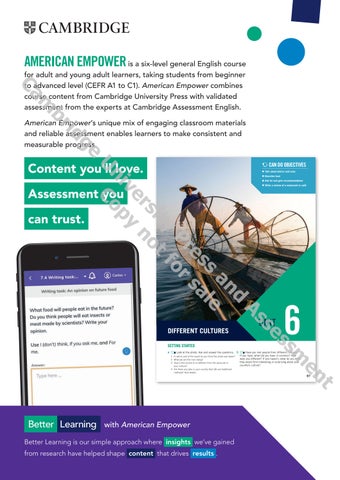
CAN DO OBJECTIVES ■ Talk about advice and rules
ss se As d an s le es sa Pr r y fo it t rs no ve y ni p ■ Describe food
■ Ask for and give recommendations
■ Write a review of a restaurant or café
can trust.
Co
Assessment you
UNIT
DIFFERENT CULTURES GETTING STARTED a
Look at the photo. Ask and answer the questions.
b
Have you met people from different cultures? If you have, what did you have in common? How were you different? If you haven’t, what do you think they would find interesting or surprising about your country’s culture?
en
m
1 In which part of the world do you think the photo was taken? 2 What job are the men doing? 3 How is this similar to or different from the same job in your culture? 4 Are there any jobs in your country that still use traditional methods? Give details.
6
67
t
with American Empower Better Learning is our simple approach where insights we’ve gained from research have helped shape content that drives results .
Learner engagement Content that informs and motivates
1
Content
Results
Sustained motivation is key to successful language learning and skills development.
Clear learning goals, thoughtprovoking images, texts, and speaking activities, plus video content to arouse curiosity.
Content that surprises, entertains, and provokes an emotional response, helping teachers to deliver motivating and memorable lessons.
m Ca
Insights
br
id
Discuss the questions.
true (T) or false (F). Find phrases in the text that tell you the answer.
GG Modals obligation Simpleof past: be nouns VV Compound Family; Years and dates
1 The new app only gives cultural advice, not practical travel advice. 2 CultureMee has already been successful. 3 John and Dee’s guidebook on East Africa didn’t tell them everything they needed to know. 4 John and Dee decided to interview ordinary people who know about a country. 5 All the interviews are with people who come from the country they talk about. 6 They would like people who use the app to contribute to it and improve it.
b Quickly read the article about CultureMee, an app
1 SPEAKING AND READING a
UNIT 6 c Read the article again. Decide if the sentences are
ge
6A
Learn to talk about your family and Learn talk about advice and rules familytohistory
YOU SHOULD WEAR GOOD WALKING SHOES
for tourists traveling to other countries. Which of the things below does the app provide? 1 2 3 4 5 6 7
“insider tips” about the culture information about main tourist sites a history of the country detailed descriptions of famous buildings lists of recommended hotels and restaurants tips about how to behave in the country information about local attitudes and customs
food people customs cities and streets
getting around
The app is called CultureMee, and it not only gives straightforward travel advice, but it also provides insights into the culture of the country you’re visiting. It was set up by an Irish couple, John and Dee Lee, and has quickly grown in popularity. Thousands of people are already using the app, which now covers locations all over the world. It has also won several international awards. The idea for the app came to them while they were on vacation in East Africa a few years ago. They had guidebooks that told them about places to visit, but they found it difficult to find out about what kind of plug they needed for their hair dryer or exactly what vaccinations they needed. They realized that it would be very useful to have an app that could give people this kind of basic travel advice. They also wanted to help people understand the culture of any country they might visit, so this became an integral part of the app’s content. The couple decided not to take the conventional approach to culture, which is already a feature of standard guidebooks, but rather to focus on the everyday lives of people in the country. There are plenty
68
1 insights a knowledge of something b suggested places to visit 2 integral a additional, extra b central, essential 3 approach to a information about b way of looking at 4 at the heart of a feeling strongly about something b central to something 5 supplement a add to something b use instead of something 6 with authority a knowledgeable about something b having permission to talk about something
THERE’S AN APP TO DEAL WITH THAT
of apps available that can help you book project is to create an online community vacations and places to stay, and that give of people who are interested in travel and you information about tourist sights and culture. As the app becomes more popular, museums. However, John and Dee felt that they hope this community will continue most travel apps didn’t focus on ordinary to augment* it with their own stories people, so they decided to put this at the and viewpoints. heart of what CultureMee does. *augment (v) to increase the size or value of CultureMee offers a wide range of something by adding to it cultural content, including background information about the country and its history, details A screenshot from CultureMee on contemporary culture, and advice on dealing with “culture shock.” Users can access videos, produced by the couple themselves, that supplement the core content of the app. Many of these give tips on how to engage with local people and how to behave in an appropriate way. They are based on interviews with people who have visited the country, and who can talk with authority about it from a visitor’s point of view. There are also interviews with local people who provide insights into how they view their own culture. So, imagine that someone from the U.S. wants to travel to Brazil. They can select the appropriate culture video and hear a Brazilian talking about Brazilian culture. They can also watch a video of a non-Brazilian person talking about how to get along with Brazilians and understand their culture. An essential aim of John and Dee’s
2 VOCABULARY Compound nouns
Special tip: Go at dawn to watch the sun rise over the ruins. It’s an experience you’ll never forget!
d Read the travel tips for Tikal in Guatemala. Complete the text with compound nouns from 2c.
a Read the information below about compound nouns, then underline the compound nouns in the title and introduction to the article on p. 68.
Compound nouns combine two words. We write some compound nouns as one word (e.g., lunchtime) and others as two words (e.g., living room). They are usually formed by: • noun + noun (e.g., newspaper) • verb + -ing + noun (e.g., washing machine) • noun + verb + -ing (e.g., ice skating)
b
e
Communication 6A Student A: Go to p. 130. Student B: Go to p. 132.
3 LISTENING
a
Look at the photos and the information about Kim, Will, and Daniel. What cultural differences do you think they noticed when they lived overseas? Compare your ideas with other students.
06.01 Pronunciation Listen to the compound nouns from the article. Which part is stressed – the first or the second word? Practice saying the words.
c Complete the compound nouns with the words in the box.
book screen insect pack shop baseball tour walking
guide 1 2 sun 3 souvenir 4 cap
5 back 6 guide 7 shoes 8 repellent
Kim from Canada went to live in Ecuador.
Will from the U.S. worked for a company in Nigeria.
Daniel from Brazil went to live in the U.S.
John and Dee Lee, founders of CultureMee
Insights
Results Personal responses make learning more memorable and inclusive, with all students participating in spontaneous spoken interaction.
Zenaide Brianez, Director of Studies, Instituto da Língua Inglesa, Brazil
t
Content Personalization tasks in every unit make the target language more meaningful to the individual learner.
There are so many adjectives to describe such a wonderful series, but in my opinion it’s very reliable, practical, and modern.
en
Language learners benefit from frequent opportunities to personalize their responses.
m ss
Personalized and relevant
69
se
2
d What do the words in bold mean in the context of the
Co
any travel apps and guidebooks can help you to book a cheap homestay or an expensive hotel with a swimming pool, and they can tell you where to go windsurfing or what restaurants serve the best seafood. But what if you want information on how to greet people politely in Tokyo, how much to tip a taxi driver in Madrid, or where to meet local people in Rio de Janeiro? Well, a new app for your cell phone can now do all that for you.
You can hire an official 1 to show you around, but it’s better to take a good 2 with you – it will tell you everything you need to know about the ruins and allow you to look at them at your own pace. The sun is very strong, so don’t forget to put 3 on your face and arms and wear a(n) 4 . Also, there are mosquitoes in the area, so you should put on some 5 before you start. The ruins cover several square kilometers and you have to walk, so you should wear good 6 . You can buy food at the site, but it’s pretty expensive. I always carry a small 7 with my own food and plenty of water to drink. After your visit, you might want to stop off at the visitor center near the entrance, where you can find a café and a(n) 8 .
article? Choose a or b.
CULTURE Shock?
M
If you’re in Guatemala, you really must go to Tikal. It’s a huge ancient city, built by the Maya civilization in the 5th century, and it’s one of the world’s most amazing sights.
As d an s le es sa Pr r y fo it t rs no ve y ni p
U
1 What do you think the phrase “culture shock” means? What difficulties might culture shock cause? 2 Think of a country you would like to visit. How do you think it would be different from your own country? Think about the words in the box.
The Ruins of Tikal: Insider Tips
Measurable progress 1
Assessment you can trust Content
Results
Tests developed and validated by Cambridge Assessment English, the world leaders in language assessment, to ensure they are accurate and meaningful.
End-of-unit tests, mid- and endof-course competency tests, and personalized CEFR test report forms provide reliable information on progress with language skills.
Teachers can see learners’ progress at a glance, and learners can see measurable progress, which leads to greater motivation.
m Ca
Insights
ge
id
br
Co
As d an s le es sa Pr r y fo it t rs no ve y ni p
U
Results of an impact study showing % improvement of Reading levels, based on global Empower students’ scores over one year.
We started using the tests provided with Empower and our students started showing better results from this point until now.
se
Evidence of impact
t
2
en
m ss
Kristina Ivanova, Director of Foreign Language Training Centre, ITMO University, Saint Petersburg, Russia
Insights
Content
Results
Schools and colleges need to show that they are evaluating the effectiveness of their language programs.
Empower (British English) impact studies have been carried out in various countries, including Russia, Brazil, Turkey, and the UK, to provide evidence of positive impact and progress.
Colleges and universities have demonstrated a significant improvement in language level between the mid- and end-of-course tests, as well as a high level of teacher satisfaction with Empower.
Manageable learning 1
Mobile friendly Content
Results
Learners expect online content to be mobile friendly but also flexible and easy to use on any digital device.
American Empower provides easy access to Digital Workbook content that works on any device and includes practice activities with audio.
Digital Workbook content is easy to access anywhere, and produces meaningful and actionable data so teachers can track their students’ progress and adapt their lesson accordingly.
m Ca
Insights
ge
id
br
U Co
ss se As d an s le es sa Pr r y fo it t rs no ve y ni p
I had been studying English for 10 years before university, and I didn’t succeed. But now with Empower I know my level of English has changed.
Nikita, Empower Student, ITMO University, Saint Petersburg, Russia
2
Corpus-informed Insights
Corpora can provide valuable information about the language items learners are able to learn successfully at each CEFR level.
m
Content
Results Learners are presented with the target language they are able to incorporate and use at the right point in their learning journey. They are not overwhelmed with unrealistic learning expectations.
t
en
Two powerful resources – Cambridge Corpus and English Profile – informed the development of the Empower course syllabus and the writing of the materials.
Rich in practice 1 Language in use
Content
Results
It is essential that learners are offered frequent and manageable opportunities to practice the language they have been focusing on.
Throughout the American Empower Student’s Book, learners are offered a wide variety of practice activities, plenty of controlled practice, and frequent opportunities for communicative spoken practice.
Meaningful practice makes new language more memorable and leads to more efficient progress in language acquisition.
m Ca
Insights
id
br
ge
6D
SKILLS FOR WRITING It’s definitely worth a visit
language course a café a cheap restaurant an expensive restaurant a venue with music or dancing (e.g., a club)
06.16 Listen to Jeff, Fabio, and Carla. Which place in photos 1–3 is each of them talking about?
Listen again and answer the questions.
06.16
reviewer gave it five stars (= excellent). How many stars do you think the other reviewers gave it?
b
“Visited twice in 3 days!”
b Read reviews a–d again. Underline any words or
We had wonderful food here. The fish was very fresh, and they had delicious salads. It’s also a great place to just sit and relax. The second time we went, we just ordered coffee, and the waiters were friendly and left us alone. We stayed for three hours! It’s right in the center of town, so it’s a little noisy, but it’s a convenient place to meet and fairly easy to get to. It’s definitely worth a visit!
phrases that are used to describe the things below. 1 the atmosphere 2 the kind of food and drinks they serve 3 the quality of the food
4 the service 5 the value 6 the location
negative language; Adverbs
a Add adjectives or phrases from the reviews above to the chart.
Positive
delicious
Discuss your places. Do you agree with your partner’s descriptions? Why / Why not? 1
Fairly positive
a little noisy
b
e Do we use these adverbs to make adjectives or phrases stronger or weaker?
friendly enough
Negative
Fairly negative
3
a little absolutely completely extremely fairly not really not very slightly barely really reasonably deeply
f Change the strong comments in the sentences in 3d so that
they sound weaker. Change the weaker comments so that they sound stronger. 1 It was a little disappointing. 2 The bread was really old.
awful
Compare your answers. Did you choose the same adjectives and phrases?
4 WRITING Two reviews
a Choose two places you know (restaurants, cafés, or venues
with music). Think of one place you like a lot and one place you don’t really like. Write notes about the points below.
c Compare the two sentences. They are both negative, but they are not exactly the same. In which sentence is the writer trying not to sound too negative? 1 The portions weren’t very generous. 2 The portions were absolutely tiny.
d Which of these sentences are slightly negative? Which are very negative? 1 It was extremely disappointing. 2 The bread wasn’t very fresh. 3 The sauce was completely tasteless. 4 My soup wasn’t really hot enough. 5 The portions were fairly small. 6 The service was awful.
• general atmosphere • location • how busy it is
b
d Work in pairs. Read your partner’s reviews. Check that your partner has done the things below.
1 covered all the points in 4a 2 used appropriate adjectives and phrases 3 used adverbs appropriately
Show your reviews to other students. Do you agree with your partner’s descriptions? Why / Why not?
m ss
Insights
77
se
Progress with language learning often requires work outside of the classroom, and different teaching models require different approaches.
American Empower is available with a print workbook, online practice, documentary-style videos that expose learners to real-world English, plus additional resources with extra ideas and fun activities.
Results This choice of additional resources helps teachers to find the most effective ways to motivate their students both inside and outside the classroom.
t
Content
en
Elena Pro, Teacher, EOI de San Fernando de Henares, Spain
• friendliness • prices • value for the money
Compare your ideas with a partner.
2 Beyond the classroom There are plenty of opportunities for personalization.
• what they serve • quality of food • service
c Write two reviews, one for each place.
e
76
“A nice place to meet friends”
This is a bright, friendly café, and they also serve good food, although the portions aren’t very generous and it’s a little overpriced. I usually go there for some coffee. It has a fairly pleasant atmosphere, and the service is always reasonably friendly and relaxed. I’d recommend it as a place to get something to drink with friends, but it might be better to eat somewhere else.
3 WRITING SKILLS Positive and
e Think of one place to go out that you really like and one
f
d
2
1 Why doesn’t Jeff like the atmosphere at expensive restaurants? 2 What does he say about the food? 3 Does Fabio go to cafés alone, or with friends, or both? 4 Why does he like sidewalk cafés? 5 What does Carla do before she starts dancing? 6 What kind of music does her favorite place play?
that you don’t really like. Write notes about their good and bad points.
We had seen good reviews of this café, but it was extremely disappointing. The service was awful – we waited for 30 minutes before anyone even noticed we were there. We ordered pasta, but it was overcooked and the sauce was completely tasteless. My soup was tasty, but it was half cold and I had to send it back. The waiters were friendly enough, but they were so slow.
I came here on my birthday. The coffee and cakes were delicious, and there was a relaxing atmosphere, with plenty of space. The staff were very friendly and gave us free birthday drinks. I can definitely recommend this café, and I’ll be going back.
a Read the four reviews of a café on p. 77. The first
Co
d
Compare your ideas. Do you agree?
W Positive and negative language; Adverbs
“Completely overrated.”
As d an s le es sa Pr r y fo it t rs no ve y ni p
1 to meet friends for a chat and a cup of coffee 2 a birthday or an anniversary 3 a party at the end of the semester or the end of a
c
“Very highly recommended. Would go back again.”
2 READING
occasions? Choose from the locations in the box.
c
a
U
1 SPEAKING AND LISTENING
a Look at situations 1–3. Where would you go for these
b
UNIT 6 Learn to write a review of a restaurant or café
Unit overview Unit Opener Getting started page – Clear learning objectives to give an immediate sense of purpose.
m Ca
Lessons A and B
Digital Workbook (online, mobile): Grammar and Vocabulary
id
br
Grammar and Vocabulary – Input and practice of core grammar and vocabulary, plus a mix of skills.
ge
Lesson C
Digital Workbook (online, mobile): Listening and Speaking
As d an s le es sa Pr r y fo it t rs no ve y ni p
U
Everyday English – Functional language in common, everyday situations.
Unit Progress Test
Co
Lesson D
Integrated Skills – Practice of all four skills, with a special emphasis on writing.
Digital Workbook (online, mobile): Reading and Writing
Review
Extra practice of grammar, vocabulary, and pronunciation. Also a “Review your progress” section for students to reflect on the unit.
Mid- / End-of-course test
Digital Workbook (online, mobile)
en
Workbook (printed)
m ss
Further practice is available for outside of the class with these components.
se
Additional practice
t
Components Resources – Available on cambridgeone.org • Audio • Video • Unit Progress Tests (Print) • Unit Progress Tests (Online)
• Mid- and end-of-course assessment (Print) • Mid- and end-of-course assessment (Online)
• Digital Workbook (Online) • Photocopiable Grammar, Vocabulary, and Pronunciation worksheets
CONTENTS
m Ca
Lesson and objective Grammar Unit 1 Talk Getting started Talk about communication 1A Talk about friendship and Subject and object communication questions 1B Describe experiences in the Simple present and present present continuous 1C Give and respond to opinions
1D
Pronunciation
Everyday English
Friendship and communication Gradable and Sentence stress: gradable and extreme adjectives extreme adjectives Word groups
br
ge
id
Work Technology
Present perfect and simple past: I’ve worked / I worked Sentence stress: main verb / auxiliary verb
Co
As d an s le es sa Pr r y fo it t rs no ve y ni p
U
Write an email giving news
WORDPOWER yourself
Sentence stress
Making and responding to suggestions
Review and extension More practice Unit 3 Relationships Getting started Talk about relationships 3A Talk about a friendship Narrative tenses
WORDPOWER look
Relationships
Linking sounds
3B 3C
Talk about families Tell a story
Multi-word verbs
Sentence stress: multi-word verbs Stress in word groups
3D
Write about someone’s life
used to, usually
4B
Describe feelings
Personality adjectives
4C
Offer and ask for help
4D
Write an informal online ad
Articles
Give reasons, results, and examples Write a discussion essay
Review and extension
2
More practice
Environmental issues The natural world
Sound and spelling: a
t
5C
Present and future real conditionals
WORDPOWER so and such
Offering and asking for help
en
Talk about if and when
Stress with modal verbs
Intonation in question tags
Review and extension More practice Unit 5 The natural world Getting started Talk about endangered animals 5A Talk about the future Future forms 5B
Ability
m ss
WORDPOWER have
Telling a story
se
Review and extension More practice Unit 4 Personality Getting started Talk about people 4A Describe people and their abilities Modals and phrases of ability
5D
Giving and responding to opinions
Write a guide
Review and extension More practice Unit 2 Modern life Getting started Talk about the workplace 2A Talk about experiences of work Present perfect and and training simple past 2B Talk about technology Present perfect and present perfect continuous 2C Make and respond to suggestions
2D
Vocabulary
Consonant clusters Voiced and unvoiced consonants
WORDPOWER problem
Giving reasons, results, and examples
Contents
Reading
Speaking
Three monologues: Online friendships
Article: “But Are They Real Friends?” Article: “Can You Really Learn a Language in 22 Hours?”
Things you have done recently
m Ca
Listening
What to cook?
Learning a foreign language Giving and responding to opinions; Using me too / me neither
Conversation: learning vocabulary
Ways of learning vocabulary
Unit Progress Test
A guide Introducing a purpose; Referring pronouns
Radio show: likeability
ge
id
br
Article: “What Kind of Learner Are You?”
Writing
A problem
Co
Conversation: life changes
As d an s le es sa Pr r y fo it t rs no ve y ni p
U
Article: “Not the Best Interview Work and training experiences I’ve Ever Had!” Article: “What’s Your Favorite Interviewing classmates about App?” technology use
Two monologues: being a twin A mistake
An email about a new job
Article: “60 Years and 1,000 Miles: How a Word Game Brought Two Unlikely People Together” Article: “Twin Tales”
An email about how great-grandparents met
Radio show: successful people
Article: “What Happens to Talented Children When They Grow Up?” Article: “Why the World Needs Introverts”
Two monologues: personality types
The story of a friendship
Family traditions Reacting to what people say; Telling a story A member of your family
Unit Progress Test
A biography Describing time
Becoming successful at something
Describing a person
Question tags; Offering and asking for help Using the Internet to buy and sell things
Conversation: an environmental project Interview: inventions inspired by nature Talking about possible jobs
Web page: The Whitley Fund Predictions about the future for Nature Article: “Animals Have Adapted The best place to experience to Survive Everywhere” natural beauty Reasons, results, and examples; Giving yourself time to think An essay about water pollution A quiz about whales
An informal online ad The language of ads
t
Three online ads
Unit Progress Test
en
Three monologues: websites
Monologue: rescuing whales
An informal email Adding new information
m ss
Asking for help
Unit Progress Test
se
Conversation: great-grandparents
Making and responding to suggestions; Sounding sympathetic or pleased Life changes
Unit Progress Test
A discussion essay Organizing an essay; Signposting language
3
Lesson and objective Grammar Unit 6 Different cultures Getting started Talk about different cultures 6A Talk about advice and rules Modals of obligation
Vocabulary
Pronunciation
Compound nouns
Word stress: compound nouns
6B
Describe food
Describing food
Sound and spelling: /ʃ/ and /tʃ/
6C
Ask for and give recommendations
Comparatives and superlatives
Sounding interested
m Ca 6D
Everyday English
Asking for and giving recommendations
Write a review of a restaurant or café
Modals of deduction
Buildings
Modal verbs: final /t/ sounds
7B
Describe a town or city
Quantifiers
Verbs and prepositions
Sentence stress: verbs and prepositions
7C
Make offers and ask for permission
7D
Write a note with useful information
WORDPOWER go
ge
id
br
Review and extension More practice Unit 7 House and home Getting started Talk about ideal houses 7A Describe a building
Making offers and asking for permission
Co
As d an s le es sa Pr r y fo it t rs no ve y ni p
U
Sounding polite
Review and extension More practice Unit 8 Information Getting started Talk about an interesting news story 8A Talk about podcasts Reported speech
Sharing information Sound and spelling: /g/ and /k/
8B
Talk about what other people say
Reporting verbs
8C
Generalize and be vague
8D
WORDPOWER over
Verb patterns
Sound and spelling: /h/ and /w/
Write an email summary of a news story Review and extension More practice Unit 9 Entertainment Getting started Talk about street entertainers 9A Talk about movies and TV The passive Give extra information
9C
Recommend and respond to recommendations Write an article
9D
WORDPOWER in/on + noun
-ed / -ing adjectives Sound and spelling: final -ed in adjectives Defining and nonMusic; WordRelative clauses: pausing; defining relative clauses building (nouns) Word stress Showing contrast
Write an email with advice
Review and extension More practice Communication Plus p. 127
4
Vocabulary Focus
Sports; Adjectives Sentence stress: would and prepositions Expressions with Sentence stress: would and have do, make, and take Sounding sure and unsure Talking about possible problems and reassuring someone
WORDPOWER Easily confused words p. 133 Grammar Focus p. 144
t
10D
en
Talk about possible problems and reassure someone
WORDPOWER see, look at, watch, hear, listen to
m ss
Review and extension More practice Unit 10 Opportunities Getting started Talk about different kinds of opportunities 10A Talk about new things it would Present and future be good to do unreal conditionals 10B Talk about imagined past events Past unreal conditionals 10C
Recommending and responding
se
9B
Generalizing and being vague
Contents Listening
Reading
Three monologues: culture shock
Article: “Culture Shock? There’s Describing different cultures an App to Deal With That” Blog: “Hungry Adventures” Describing a special meal
Radio show: vending machines in Japan A special gift
m Ca
Three monologues: special occasions
Reviews of a café
id
br Conversation: a vacation in Florida
Asking for and giving recommendations; Expressing surprise Places to go out
Writing
Unit Progress Test
Two reviews Positive and negative language; Adverbs
Describing buildings Talking about where you live
Making offers, requests, and asking for permission; Imagining how people feel A recent vacation
Unit Progress Test
As d an s le es sa Pr r y fo it t rs no ve y ni p
U
Visiting a friend’s family
ge
Conversation: comparing life in a town and a city
Web page: “A More Personal Place to Stay” Web page: “Five Reasons Why Small Towns Are Better Than Cities”
Speaking
Article: “Top Five Things to Do … in and around Miami” A note
A note with useful information Offering choices
Co Podcast: Pod-on-Pod Interview: fake reviews A job interview
Article: “Thinking of Making a Podcast? Just Give It a Try!” Article: “The Restaurant That Wasn’t There”
Giving opinions about podcasts Describing experiences using reporting verbs Generalizing; Being vague
A news story
Conversation: movie trailers
Article: “To Binge or Not Recommending a movie or TV show to Binge …” Article: “The Three Best Music A musical experience Festivals You’ve Probably Never Heard Of” Recommending and responding; Asking someone to wait A blog about staying at home Live vs. recorded music
Three monologues: musical experiences Planning an evening out Two monologues: live music
Air travel
An email about a news story Summarizing information
Unit Progress Test
se
Monologue: a news story
Unit Progress Test
Conversation: trying new activities
Taking new opportunities
Asking for a promotion
A web page about volunteering; Emails giving advice
A past event that made life better Talking about possible problems and reassuring someone; Changing the subject Volunteering
Phonemic symbols and Irregular verbs
t
Article: “Searching for Serendipity”
Monologue: volunteering
en
m ss
An article about a form of entertainment Contrasting ideas; The structure of an article
Unit Progress Test
An email with advice Advising a course of action
p. 164
5
m Ca
ge id br
Co
t
en
m ss
se
As d an s le es sa Pr r y fo it t rs no ve y ni p U
This page is intentionally left blank.
6
CAN DO OBJECTIVES ■ Talk about friendship and
communication ■ Describe experiences in the present ■ Give and respond to opinions ■ Write a guide
m Ca ge
id
br Co
As d an s le es sa Pr r y fo it t rs no ve y ni p
U
1
Look at the photo and answer the questions. 1 Where do you think the girls are? 2 What do you think the girl on the left is saying? Why do you think that? 3 How do you think the other girl feels? Why?
t
en
GETTING STARTED a
m ss
se
TALK
UNIT b Discuss the questions.
1 Do/Did you talk a lot in class in school or in college? 2 Do you talk a lot when you are with your friends? What about with your family? 3 Do you think you should change anything about the way you talk (e.g., talk more, less, more loudly, more quietly)? Why / Why not?
77
1A
WHO LIKES MY POSTS?
1 SPEAKING AND VOCABULARY
Friendship and communication
m Ca a
Learn Learn to to talk talk about about friendship your family and and communication family history G G Subject and object Simple past: be questions andand communication Family; Years dates VV Friendship
2 READING a Read the article and find out if it has similar ideas to the ones you talked about in 1a.
Discuss the questions.
ge
id
br
1 How do you usually meet new people – face-to-face or online? Why? 2 Are your online friendships different from your other friendships? How? 3 What kinds of things do you talk about online? Is this different from most of your face-to-face conversations? Why / Why not?
BUT ARE THEY REAL FRIENDS?
Co
As d an s le es sa Pr r y fo it t rs no ve y ni p
U b Match the words in bold in sentences 1–6 with definitions a–f.
d
Do you agree with sentences 1–6? Why / Why not? Now go to Vocabulary Focus 1A on p. 133.
Make sure it’s an app or website where you can exchange ideas and information – not one where you just follow what other people say. Write a clear and honest profile of yourself. Make it interesting and use a friendly tone. Don’t expect to find a friend immediately – it can take time.
And when you do find a friend … Take things one step at a time, but make sure you keep in touch. Share things about your life, but not very personal things, and try to build trust.
8
t
c
Join a discussion or community that talks about something you’re interested in.
en
to communicate with and react to a person or people to say or write what you think or believe about something to contact someone by phone, email, or text message to try to communicate with a person or group of people, usually to help or involve them e to talk about your emotions f to explain a feeling using language
m ss
a b c d
se
1 Social media is a great way to get in touch with old friends you haven’t seen in a while. 2 It’s really difficult to express your feelings online because you can’t look people in the eye. 3 When her brother, Mike, was in the hospital, Susanna reached out to all his friends to come and visit him. 4 It’s easier to interact with people online because you can think about what you want to say before you write it. 5 With good friends, you often don’t have to put how you feel into words because you just understand each other. 6 It’s not a good idea to give your opinion in an online discussion because it’s written. If you change your mind, you can’t get rid of what you wrote.
You’ve probably heard it before, right? “Facebook and Instagram friends aren’t the same as the real thing.” People from generations that didn’t grow up with online friendships criticize younger adults who say they have a lot of online friends. They don’t think friendships that are made online are as real or as meaningful as face-to-face ones. But it looks like they may be wrong. Researchers at the University of California have come to the conclusion that online friendships have the same qualities as those in the real world. In a study, the researchers looked at exchanges between online friends and observed the same kinds of behaviors that exist in face-to-face friendships. Online friends share experiences and interests, express their feelings, and reveal things about themselves. Sometimes they offer each other practical help, and they can keep each other company at any time of the day or night. Another way that face-to-face and online friendships are similar is that they take time to develop. You can’t just go online hoping to find a friend – it’s not as simple as that. Experts say that you need to build online friendships carefully, and they offer the following advice:
UNIT 1 b Read the article again. Are the sentences True (T) or
c
False (F)? Correct the false sentences.
Discuss the questions. 1 Do you think the advice in the article is good? Why / Why not? 2 What problems can happen as a result of online friendships? What are the benefits? 3 Do you think people express their feelings more or less carefully online? Why? 4 Do you think it’s easier to find someone you have something in common with in the real world or online? Why?
m Ca
1 Some older people don’t think online friends are true friends. 2 Researchers say there are many differences between face-to-face and online friendships. 3 Online friends can be available to interact with day and night. 4 You will find online friends very quickly. 5 To help an online friendship develop, share some details about yourself and your life.
3 GRAMMAR Subject and
br
object questions
id
a Look at the questions and answers and underline the correct words in the box.
ge
As d an s le es sa Pr r y fo it t rs no ve y ni p
U
1 Q: What do experts say about making friends online? A: You need to build online friendships carefully. 2 Q: Who thinks online friendships aren’t real? A: People from generations that didn’t grow up with online friendships.
Co
a The answer to question 1 is the subject / object of the verb in bold. Question 1 is a(n) subject / object question. b The answer to question 2 is the subject / object of the verb in bold. Question 2 is a(n) subject / object question.
b Are the questions below subject (S) or object (O) questions? 1 2 3 4 5 6
c
Who do I give this to? What happened to your leg? Which of these books do you want to borrow? Who gave you the flowers? Which car uses less gas? What did he say to you?
Now go to Grammar Focus 1A on p. 144.
d Make subject (S) or object (O) questions with the
words below. You may need to change the verb or add do, does, or did.
2 Who / you / last / text? (O)
m ss
se
1 Who / call / you / yesterday? (S)
3 What / you and your friends / talk about? (O)
4 What / make / you and your friends / laugh? (S)
1 Is it easy to use the app/website? 2 Is this a community I want to join?
e
t
6 What / post / last / make / you laugh? (S) Here’s a checklist of questions you can ask yourself as you explore the world of online friendships:
en
5 Which of your friends / you / see / every day? (O)
Ask and answer the questions. Try to ask follow-up questions.
3 Are there people I want to communicate with? 4 Am I interested in replying to posts? 5 Are the posts friendly and honest? 6 Do other people like or reply to my posts?
9
UNIT 1 4 LISTENING a
c
Discuss the questions. 1 Do you think online friends can become face-to-face friends? How can this happen? 2 What are the advantages and disadvantages of this change in friendship? 01.05 You are going to hear Chris, Alex, and Kelly talk about online friendships. Listen and put a name with each photo.
m Ca
b
01.05 Listen again and complete the information in the chart.
1
Chris
Alex
Kelly
Friend’s name
Common interest
ge
id
br Met – yes or no?
Co
As d an s le es sa Pr r y fo it t rs no ve y ni p
U
2
What have they done together?
d Which of the three speakers would you like most as an online friend? Why?
5 SPEAKING
a Check (✓) the things you have done recently. Write notes about the experience.
3
m ss
se
met someone new face-to-face met someone new online met someone face-to-face who you first met online met an old friend you hadn’t seen in a long time posted a strong opinion on social media or a discussion board posted a video story on social media created a playlist of your favorite music started a new job/course
b Look at the experiences your partner checked and
c Ask your partner about their experiences. Try to ask follow-up questions.
10
t
met someone new Who was it? Where were you? What did you talk about?
en
write three questions to ask them.
1B
I’M USING AN APP FOR LEARNING ENGLISH
Discuss the questions.
m Ca
a
1 How many languages can you say “Hello” in? 2 How many languages can you order a meal or have a simple conversation in? 3 What language are you best at (apart from your own)?
G Simple present and present continuous V Gradable and extreme adjectives
Gouden Dai Salut Сәлем! Bonjour Halito Salute Hallo Håfa ådai Ç’kemi Guuten takh
Dy bannee diu
1 SPEAKING
UNIT 1
Learn to describe experiences in the present
Héébee
br
b Choose one idea below and continue using because.
id
Write your idea.
Ola
Guten Tag
Servas
Bon die! Ahoj
Вітаю
Tungjatjeta
Góðan dag
Hoi
Salud Hola / Buenos días Bon dia
ge
Learning a new language is like … • making a new friend • going on a long journey • being a child again • growing plants in a garden • learning a musical instrument.
b
As d an s le es sa Pr r y fo it t rs no ve y ni p
U
Learning a new language is like being a child again because you feel like you are starting from the beginning and everything is new.
d
Co
c
Read your sentences to each other. Do you agree with each other’s ideas? Look at photos a–d and discuss the questions.
1 What are the different ways of learning a language in the photos? 2 What are the advantages and disadvantages of each way of learning a language? 3 Which have you tried? Have you tried any other ways? a
c
t
en
m ss
se d
11
UNIT 1 2 READING
4 Where do the mems come from? a Ed Cooke creates them. b Users can create mems for themselves and other users. c Every user creates mems only for themselves.
a Read “Can You Really Learn a Language in 22 Hours?” quickly and answer the questions.
c Match the words in bold in the article with meanings
1 What is Memrise? 2 Why is Jon Foster using it? 3 How much has he learned?
1–8 below. 1 2 3 4 5 6 7 8
m Ca
b Read the article again and choose the correct answers for questions 1–4.
ge
id
br
1 The writer wants to learn Lingala because he … . a loves new languages b wants to talk with the people who speak it c wants to try Memrise 2 Ed Cooke wants learners to … . a enjoy learning more b improve quickly c do more vocabulary practice 3 A “mem” is … . a a digital plant that you “water” b a translation of a new word c a picture that helps people remember new words
d
getting better changes a word from one language into another what someone wants to do learned something so that you remember it exactly something difficult that tests your ability able to communicate freely and easily to make someone remember something do something again
Have you used or would you like to use Memrise? Why / Why not?
As d an s le es sa Pr r y fo it t rs no ve y ni p
U
Co
Can You Really Learn a Language in
22 Hours?
We all know that people learn better if they enjoy learning.
Jon Foster reports on an app that makes learning a new language like playing a game.
I’ve never been very good at languages.
But next month, I’m traveling to a remote area of Central Africa, and my goal is to know enough Lingala – one of the local languages – to have a conversation. I wasn’t sure how I was going to do this – until I discovered a way to spend just a few minutes, a few times a day, learning all the vocabulary I’m going to need. To be honest, normally when I get a spare moment at home, I go on Facebook or play games on my phone. But, at the moment, I’m using those short breaks for something more useful. I’m learning a foreign language. And thanks to Memrise, the app I’m using, it feels just like a game.
se
“People often stop learning things because they feel they’re not making progress or because it all feels like too much hard work,” says Ed Cooke, one of the people who created Memrise. “We’re trying to create a form of learning experience that is fun and is something you’d want to do instead of watching TV.”
The second principle is that we need to stop after studying words and then repeat them again later, leaving time between study sessions. Memrise helps you with this because it’s the kind of app you only use for five or ten minutes a day. I’ve learned hundreds of Lingalan words with Memrise. I know this won’t make me a fluent speaker, but I hope I’ll be able to do more than just smile and nod when I meet people in the Congo. Now, why am I still sitting here writing this? I need to go and water my vocabulary!
12
t
The app uses two principles about learning. The first is that people remember things better when they link them to a picture in their mind. Memrise translates words into your own language, but it also encourages you to use “mems” – images that help you remember new words. You can use mems that other users have created or you can create your own. I memorized motele, the Lingalan word for “engine,” using a mem I created – I imagined an old engine in a motel room.
en
m ss
And Memrise is fun. It’s a challenge. It gives you a few new words to learn, and these are “seeds” that you plant in your “greenhouse.” (This represents your short-term memory.) When you practice the words, you “water your plants” and they grow. When the app believes that you have really remembered a word, it moves the word to your “garden.” You get points as your garden grows, so you can compare yourself to other Memrise users. I want to get a high score and go to the next level. And if I forget to log on, the app sends me emails that remind me to water my plants.
UNIT 1 3 GRAMMAR Simple present and
4 VOCABULARY Gradable and
a Match simple present sentences a–c with
a
present continuous
uses 1–3.
extreme adjectives
m Ca
a When I get a spare moment at home, I normally go on Facebook or play games on my phone. b I know this won’t make me a fluent speaker. c People learn better if they enjoy learning.
1 2 3 4
b
Complete the sentences with the words in the box. Listen again and check. exhausted
id
ge
1 2 3 4
b Match present continuous sentences a–c with uses 1–3.
U
sentences 1–6 with a word to make the meaning stronger. • With some adjectives (good, bad, difficult), we can use words like very, really, and extremely to make their meaning stronger (e.g., His pronunciation is really good. The exam was extremely difficult.). • Other adjectives already have a strong or extreme meaning (e.g., perfect, useless). We can use words like really, totally, or absolutely before these adjectives to add emphasis (Her English is absolutely perfect.).
Co
d
Now go to Grammar Focus 1B on p. 144.
1 2 3 4 5 6
Make questions with the words below. Then discuss the questions.
I think so, but I prefer writing to speaking.
1 Which word is stressed in each sentence? 2 Do we usually stress gradable adjectives or extreme adjectives?
e
01.09
f
Now go to Vocabulary Focus 1B on p. 134.
Listen again and repeat the sentences.
5 SPEAKING a
• • • • • • •
What do you want to be able to do with English? What level of English do you hope to reach? How often do you review what you have learned? How often do you watch or read things in English? How often do you communicate with native speakers? What are you doing at the moment to learn English? Are you having any problems with English at the moment?
t
Talk about learning a foreign language. Use the questions below.
en
Communication 1B Student A: Look at the picture on p. 127. Student B: Look at the picture on p. 129. Follow the instructions on the page.
Pronunciation Listen and check. Then answer the questions below. 01.09
m ss
Do you think you communicate well in your own language?
d
Online dictionaries are often useful. That cake’s enormous. I think Anna’s confident. I went for a swim in the river, and the water was freezing. The new Wes Anderson movie is fantastic! It’s important to learn pronunciation as well as vocabulary.
se
1 you / think / you / communicate / well in your own language? 2 How often / you / hear / foreign languages where you live? 3 you / think / you / have / a good memory? 4 What / help / you / learn / English grammar? 5 What / you / think / about / right now? 6 you / prepare / for an exam at the moment? 7 more people / learn / languages in your country than before?
e
. I’m absolutely This book’s . That’s ! I can only speak one language. It’s ! I’ll never get it right.
c Read about gradable and extreme adjectives. Complete
We can use the present continuous to talk about: 1 actions in progress at the same time as speaking/ writing (sentence ) 2 actions in progress around (before and after) the time of speaking/writing (sentence ) 3 changing situations (sentence )
c
fantastic impossible useless
As d an s le es sa Pr r y fo it t rs no ve y ni p
a I’m learning a foreign language. b Now, why am I still sitting here writing this? c Young people are spending more and more time playing video games.
James is a little / very tired. Linda likes / doesn’t like the book. Tony thinks the girl can do something really / not very impressive. The teacher thinks Olivier will / won’t be able to pronounce “squirrel.” 01.08
br
We can use the simple present: 1 to talk about things that are generally true (sentence ) 2 to talk about habits and routines (sentence ) 3 with state verbs – verbs about thoughts (e.g., understand ), feelings (e.g., want ), and possession (e.g., own). (sentence )
01.08 You will hear four short conversations about learning languages. Listen and underline the correct words.
b Report back to the class about what you found out. 13
1C
Learn to give and respond to opinions
EVERYDAY ENGLISH
P Word groups
Well, if you ask me …
S Using me too / me neither
m Ca ge
id
br Co
As d an s le es sa Pr r y fo it t rs no ve y ni p
U 1 LISTENING a
Discuss the questions.
1 Do you enjoy meeting new people? 2 Do you usually decide what you think of someone from a first impression? Or do you get to know them first?
b
Look at the photo above. What kind of store is it?
c d
01.12
Giving and responding to opinions
a
01.12 Listen again and underline the correct answers.
b
2 as / as / concerned / far / I’m
Does the speaker agree (A) or disagree (D)? I know what you mean, but … I know exactly what you mean. I’m not so sure about that. That’s right. I see where you’re coming from, but …
d Check (✓) the sentences you agree with. Change the other sentences so you agree with them.
1 2 3 4 5
e
t
en
1 2 3 4 5
m ss
14
What is Randi’s profession? What is Kristen worried about? What is Randi’s advice? What do Randi and Kristen have in common?
Listen and put the words in the correct order to make more formal phrases for giving an opinion. Complete the sentences with your own opinions on a topic. 01.15
c Look at five ways of responding to an opinion.
01.13 Listen again and answer the questions.
1 2 3 4
Well, in my , roses are always a good option. I what you mean. I something like tulips might be better. Well, if you me, you can’t go wrong with irises.
1 it / me / seems / that / to
1 Who needs advice? 2 Is the advice she gets helpful?
f
Listen and complete the sentences with one word.
se
01.13 Listen to Part 2 and answer the questions.
01.14
1 2 3 4
Listen to Part 1 and check.
1 Randi is buying flowers because she’s going to someone’s house / getting married. 2 She doesn’t want roses because she doesn’t like them / they’re too romantic. 3 She wants / doesn’t want tulips. 4 She will buy flowers in another shop / come back later.
e
2 USEFUL LANGUAGE
English is an easy language to learn. It’s difficult to communicate with older people. First impressions are important when you meet someone. Too much screen time is bad for you. Exercise is as important as a healthy diet.
Give your opinions from 2d and respond to your partner’s opinions. Use phrases for agreeing or disagreeing. Explain your opinions.
UNIT 1 3 PRONUNCIATION Word groups a
Listen to these sentences. Notice where the speaker pauses to make the message clearer. Write // where you think the speaker pauses. 01.16
5 LISTENING a
01.20 Listen to Part 3. Do you think Kristen’s dinner will be a success? Will the guest enjoy the food?
I’m a little worried. I’m cooking for some people I’ve never met tonight.
m Ca b
01.17 Listen to this similar sentence. Does the speaker pause?
I’m a little worried they won’t like my food.
br
c Look at the conversation. Write // where you think the speakers pause.
id
ge
KRISTEN See, I’m a little worried. I’m cooking for some people I’ve never met tonight, and I don’t know what kind of food they’ll like. RANDI Yeah, I don’t like cooking for people I don’t know. KRISTEN Me neither. But you’re a chef. You cook for people you don’t know every night! 01.18
As d an s le es sa Pr r y fo it t rs no ve y ni p
U
d
Listen and check.
Co
b
a
01.19
c
responses.
• a good way to meet new people • a good way to make a good first impression • a good topic of conversation with someone you don’t know well • a good reason to dislike someone you’ve just met.
b
Discuss your ideas in 6a.
If you ask me, the best way to make a good impression is to use people’s names a lot.
I’m not so sure about that.
t
en
1 A I need a cup of coffee. B . 2 A I don’t really like watching soccer. B . 3 A I wasn’t invited to the wedding. B . 4 A I’m looking forward to the party. B . 5 A I don’t really eat chocolate. B . 6 A I hate going out in the rain. B .
a Think of an example of:
m ss
b Complete the exchanges with appropriate
6 SPEAKING
se
1 We use Me too and Me neither to say we agree or are in the same situation. 2 We use Me too after an affirmative sentence. 3 We use Me neither after a negative sentence.
Discuss the questions.
Have you ever made the wrong first impression? What happened? Were you able to fix it? Why / Why not?
Listen and underline the correct words.
1 RANDI Yeah, I don’t like cooking for people I don’t know. KRISTEN Me too / Me neither. But you’re a chef. You cook for people you don’t know every night! 2 RANDI When it’s done right, a roast chicken is my very favorite meal. I love it! KRISTEN Me too / Me neither, now that I think about it. Thank you!
Listen again and answer the questions.
1 Where does Kristen know Randi from? 2 What mistake do people often make about Randi when they hear her name? 3 What does Randi offer to help Kristen with?
4 CONVERSATION SKILLS
Using me too / me neither
01.20
UNIT PROGRESS TEST CHECK YOUR PROGRESS You can now do the Unit Progress Test.
15
1D
SKILLS FOR WRITING
Learn to write a guide W Introducing a purpose; referring pronouns
Different ways of learning
1 SPEAKING AND LISTENING What do you think are some good ways to learn new vocabulary in English? Talk about the ideas in photos a–e or your own ideas.
b
01.21 Listen to Maria and Gilberto talking about learning vocabulary. Are you more like Maria or Gilberto?
m Ca
a
a
Listen again and answer the questions.
ge
01.21
id
br
c
b
c
As d an s le es sa Pr r y fo it t rs no ve y ni p
U
1 What system does Maria use for learning vocabulary? 2 What system did Maria’s sister use? 3 Does Gilberto think either system will work for him? Why / Why not?
d Read the descriptions of each style. What kinds of learners are Maria and Gilberto?
Co
VISUAL LEARNERS
They prefer to learn by seeing or reading things. They need to see new information written down.
AUDITORY LEARNERS
They prefer to learn by listening to new information. They also like to talk about the new things they’ve learned.
d
KINESTHETIC LEARNERS
They prefer to learn by doing something. They don’t like sitting still for very long.
se
e
Talk about what kind of learner you are and why.
a Read “What Kind of Learner Are You?” on p. 17. Answer the questions.
b Read the article again. Take notes about the
key study techniques for each learning style. • visual • auditory • kinesthetic
16
e
t
1 Which of Maria’s ideas is mentioned? 2 Does the article talk more about understanding new information or remembering it?
en
m ss
2 READING
UNIT 1
What Kind of
purpose; referring pronouns
a Look at these sentences from the article. Circle the words or phrases in the underlined parts that introduce the purpose in each sentence.
1 In order to find the most useful way to learn new information, it’s a good idea to think about the kind of learner you are. 2 Knowing your learning style helps you study more effectively, so you remember what you have learned more easily. 3 To learn new information, try to think of an image in your head.
m Ca
Learner Are You?
3 WRITING SKILLS Introducing a
ge
id
br
Different people learn in different ways. In order to find the most useful way to learn new information, it’s a good idea to think about the kind of learner you are: visual, auditory, or kinesthetic. Knowing your learning style helps you study more effectively, so you remember what you have learned more easily. Remember, you don’t just learn when you study – this advice can also be useful for learning at work or in your free time.
b Underline other examples of purpose words/ phrases in the article.
words/phrases. More than one answer is possible.
As d an s le es sa Pr r y fo it t rs no ve y ni p
U
c Combine the sentences using purpose 1 I write the new words in a vocabulary notebook. I remember them. 2 I practice pronunciation. I record myself saying words on my phone. 3 I write grammar rules on a piece of paper. I understand them better.
Co
VISUAL LEARNERS
It helps to study in a quiet place so that you can concentrate. To learn new information, try to think of an image in your head, or make a diagram to highlight different points. 1This technique helps your memory, and it means you can find the information easily when you look at your notes again.
d Look at sentences 1–3 in bold in the article
and underline the correct words in the rules. a This and these refer to ideas already mentioned / new ideas. b In sentences 1 and 3, this refers back to one word / a complete idea. c We sometimes put a noun / an adjective after this and these.
AUDITORY LEARNERS
4 WRITING A guide
a Think of a skill you know how to do well. It can be something to do with school, work, sports, or a free-time activity. Write notes using these questions.
se
Going to a lecture is a good way for you to learn. Read your notes aloud, then cover them and try to say them again from memory. Also, try to use new words when you’re talking to people. If you are studying words on a particular topic, you can listen to podcasts that include this vocabulary. 2These ideas should help you remember what you need to know.
m ss
1 How easy is it to learn this skill? 2 What are the problems people have when learning it? 3 What are good ways to learn this skill? 4 Why are they good ways?
KINESTHETIC LEARNERS
b Write a guide on how to learn this skill.
Use words/phrases to introduce purpose and this or these, if possible, to refer back to ideas.
c These descriptions are only a guide. Most people have a mixture of learning styles. To study successfully, you need to experiment and find the best method.
t
en
In order to learn new information, you need to be doing something. It helps to study in a place where you can walk around the room, touch things, and move as freely as possible. Make sure you take regular breaks and go for a walk. 3This will help you to concentrate and remain interested in what you are studying.
Work in pairs. Read your partner’s guide. How easy do you think it would be to learn their skill?
17
UNIT 1
3 WORDPOWER yourself a Match sentence beginnings 1–6 with endings a–f.
Review and extension
1 2 3 4 5 6
1 GRAMMAR
m Ca
a
Complete the questions. Then ask and answer the questions.
a care of yourself and have fun – enjoy yourself! b yourself and tell yourself “I can do this!” c to yourself? Is it because you’re teaching yourself German? d hurt yourself? e at home, and help yourself to food and drink. f it yourself – you don’t need to pay someone.
ge
id
br
1 You live with someone. do you live Who with? 2 Something woke you up this morning. What this morning? 3 You talk to someone every day. Who every day? 4 You read something yesterday. What yesterday? 5 Something made you laugh recently. What recently? 6 Someone speaks to you in English. Who in English? 7 You know different ways of learning English. Which different ways of learning English 8 Some ways of learning English work best for you. Which ways of learning English ?
b Underline the correct words in the rule.
As d an s le es sa Pr r y fo it t rs no ve y ni p
U
We use yourself in the phrases in bold in 3a because the object of the verb is the same as / different from the subject of the verb.
?
c Underline the correct words.
Co
1 Is it possible to help / teach yourself how to swim? 2 You could pay someone to clean the car, or you could do / do it yourself. 3 There’s a lot of food in the fridge. Please help / make yourself. 4 Don’t copy other people. Be by / Be yourself. 5 Sit down. Make yourself to / at home! 6 You should tell / tell to yourself “I’m wonderful!” every day.
b Check (✓) the four correct sentences. Then fix the mistakes in the other sentences.
1 2 3 4 5 6 7 8
John’s taking a shower. I think we need a new laptop. Are you agreeing? I’m hardly ever writing letters. You look sad, Maria. What do you think about? Monkeys communicate with sounds. I don’t know at the moment. Carrie doesn’t work this week because she’s sick. I’m getting cold.
2 VOCABULARY
d Complete the questions with the correct form of the verbs in the box and yourself. enjoy
How well did you do in this unit? Write 3, 2, or 1 for each objective. 3 = very well 2 = well 1 = not so well
I CAN … talk about friendship and communication
awful enormous exhausted filthy freezing furious terrific tiny
18
REVIEW YOUR PROGRESS
describe experiences in the present give and respond to opinions 7 bad 8 good
write a guide.
t
gradable adjectives 1–8.
Discuss the questions in 3d.
en
b Match the extreme adjectives in the box with
e
m ss
Are you going to about the terrible food? I’m very sorry. Will you please me? Please me on your progress. I you to try Thai food. It’s delicious! He prefers to his feelings in writing. She’s trying to me to go on vacation with her. Please don’t my request! You have to say yes. I try not to with my boss – even when he’s wrong!
4 cold 5 tired 6 angry
talk to teach
se
argue complain encourage express forgive persuade refuse update
1 big 2 dirty 3 small
hurt take care of
1 Have you ever how to do something? What was it? Was it easy or difficult to learn? 2 Do you ? Do you eat well and get enough sleep? 3 Have you ever at home? Did you have to go to the hospital? 4 Do you ever ? What do you say? 5 Are you right now? If not, what would make you happy?
a Complete the sentences with the verbs in the box.
1 2 3 4 5 6 7 8
Why do you keep talking This room needs a lot of work, but you can do Come in! Make yourself Good luck at the interview! Just be Bye! Have a wonderful time! Take Are you OK? Did you
CAN DO OBJECTIVES ■ Talk about experiences of work
and training ■ Talk about technology ■ Make and respond to suggestions ■ Write an email giving news
m Ca ge
id
br Co
As d an s le es sa Pr r y fo it t rs no ve y ni p
U
2
b
Discuss the questions.
t
a Look at the photo. Where do you think the person is?
en
GETTING STARTED
m ss
se
MODERN LIFE
UNIT
2 Would you like to work in a place like this? Why / Why not? 3 What would your ideal workplace be like?
1 What else do you think might be in this building? (Think of the furniture, rooms, and facilities.)
19 19
2A
THEY JUST OFFERED ME THE JOB
1 READING a
Not the Best
m Ca
Discuss the questions.
1 Have you ever had a job interview? 2 Was it a good experience? Why / Why not?
br
id
a
ge
c Read the stories again. Match a–d with headings 1–4.
Co
d
Tell your partner which story you liked best. Have you had any embarrassing experiences like the ones in the stories? I’ve received a phone call at a bad moment. Really? What happened?
Family; Years and dates V Work
Interview I’ve Ever Had!
“
They wanted to test how fast I could type. My fingers were over the keyboard, ready to type. The interviewer said, ‘Right click to open the file,’ but all I heard was ‘Write click,’ so I typed ‘click’ on a window that was already open. I felt so embarrassed when I realized my mistake, but we both laughed and I got the job. I’ve worked there for eight months now. Laura
b
“
I’ve had a lot of good interviews, but this one was a disaster. I had put on my résumé that I could speak ‘some French.’ I learned some French at school, but I’ve never really used it, and my listening skills are really bad. The three interviewers began the interview by speaking to me in French, and I didn’t understand a word. No, I didn’t get the job, and yes, I’ve changed my résumé. Dan
As d an s le es sa Pr r y fo it t rs no ve y ni p
4
Wrong Word! Better to Tell the Truth The Interviewer Probably Felt Worse Than I Did! An Unlucky Call
U
1 2 3
G Present perfect Simple past: be and simple past
Most people feel nervous when they go on a job interview, but some interviews are worse than others. Fortunately, they don’t all end in disaster!
b Read “Not the Best Interview I’ve Ever Had!” Who got the job? Who didn’t get the job?
Learn to talk about experiences of work your family and and training family history
c
”
“
I’ve never forgotten to turn my phone off in the movie theater, but for some reason I forgot when I went for my first job interview. My friend called me to wish me good luck – right in the middle of the interview. Oops! I didn’t get the job. Andy
”
d
”
“
”
t
en
m ss
se
I had a job interview with two people last week. One of them was leaning back in his chair when suddenly it fell over, and it was soon clear that he couldn’t get up again. I didn’t know if I should try to help or not, and I was worried I was going to start laughing. Fortunately, the other interviewer asked me to wait outside the room for a minute, and then the interview carried on as if nothing had happened. Guess what? They just offered me the job! Ellie
20
UNIT 2 2 VOCABULARY Work
3 GRAMMAR Present perfect
and simple past
a Look at photos a–f below and match them with sentences 1–6. 1 2 3
a Look at these sentences from the stories on
p. 20. Which verbs in bold are in the present perfect and which are in the simple past? 1 I’ve never forgotten to turn my phone off in the movie theater. 2 I’ve had a lot of good interviews, but this one was a disaster. 3 I had a job interview with two people last week. 4 No, I didn’t get the job, and yes, I’ve changed my résumé.
m Ca
Hundreds of people applied for the job, but only six candidates were invited for an interview. It’s hard to balance family life and a career. I’m proud of my practical skills and medical knowledge. There are 200 employees in this organization, but I’m only in charge of a small team. I have good grades, but I don’t have much experience to put on my résumé. I have a lot of business contacts who work for employers in different countries.
4 5
id
br
6 a
b Underline the correct words to complete the rules. 1 We use the simple past / present perfect to talk about recent past events that have an effect on the present. 2 We use the simple past / present perfect to talk about our experiences. 3 We use the simple past / present perfect when we give details (e.g., when, where, etc.) or talk about specific past events.
b
ge c
Co
d
As d an s le es sa Pr r y fo it t rs no ve y ni p
U
c
e
f
02.01 Pronunciation Listen and choose the sentence you hear, a or b.
1 a b 2 a b
I worked there for eight months. I’ve worked there for eight months. I had a lot of good interviews. I’ve had a lot of good interviews.
d
02.02
e
Now go to Grammar Focus 2A on p. 146.
Listen and practice saying the sentences.
f Complete the sentences with the present perfect or simple past form of the verbs in parentheses.
1 I (never/have) a really terrible job interview. 2 Once, I (forget) to turn off my phone when I was at a movie. 3 I don’t have very much work experience, but I (be) the leader on a project at school. 4 I (get) some useful work experience last year. 5 I (study) hard last year. I was too busy to see my friends. 6 I (always/be) able to express myself clearly since I was a child. 7 I (already/work) for more than three organizations. 8 I (know) what career I wanted when I was a child.
b Match the words in bold in 2a with these meanings.
creative thinking good grades work experience self-confidence good problem-solving skills
• • • •
a friendly personality the ability to work on a team a positive attitude at work practical skills
t
• • • • •
en
What do managers look for when they employ someone new? Choose the four qualities that you think are most important.
m ss
c
se
1 the jobs you do during your working life 2 people you know who might be able to help your career 3 contacted a company asking for a job 4 people who work for a company 5 the results of your high school or college exams 6 the things you know from experience or study 7 people who are trying to get a job 8 responsible for something or someone 9 the people you work for 10 a document that describes your education and the jobs you have had
g
Tell your partner which sentences are true for you and give more information. Number 1 is true for me. I’ve only had two or three job interviews, but they’ve all been OK.
21
UNIT 2
m Ca ge
id
br 5 SPEAKING
U
4 LISTENING
Think of five reasons why an employer might not offer a candidate a job. Compare your ideas with a partner.
b
02.06 Listen to the beginning of a radio show. Answer the questions.
a You are going to talk about your
As d an s le es sa Pr r y fo it t rs no ve y ni p
a
Co
experiences. Check (✓) three things you have done. Then write notes about your experiences.
c
studied/worked in a foreign country (where?)
Listen again and complete each sentence with one or two words. 02.06
chosen a career
1 People with likeability can with other people. 2 Nancy believes likeability is more important than other abilities in the first of a new job. 3 She advises job hunters to spend time with . 4 Nancy encourages people to apply for jobs even if they don’t have the right . 5 During an interview, it’s important to the interviewers by showing that you’re friendly, positive, and can communicate well.
d
22
Take turns talking about your work and training experiences. Ask questions to find out more information.
t
1 Think of different kinds of jobs. When applying for each job, what is more important – likeability or good qualifications? Why? 2 Do you think schools should help students develop “soft skills”? How could they do this?
b
been in charge of a project
en
Discuss the questions.
done some online learning
studied or worked as part of a team
Speaker 5
Listen again and answer the questions.
written a résumé
m ss
02.07
Speaker 3 Speaker 4
1 According to Speaker 1, why don’t people know that likeability is important? 2 According to Speaker 2, what’s the advantage of developing your “soft skills”? 3 What does Speaker 3 believe are the most important things in her job? 4 What problem does Speaker 4 have with “soft skills”? 5 According to Speaker 5, what are the most important things you can offer an organization?
f
given a talk or presentation
worked for no money
se
Speaker 1 Speaker 2
e
visited an interesting office or factory
Listen to five speakers. Do they agree that being likeable is more important than other skills? Write A (agree) or D (disagree). 02.07
learned practical skills (what?)
gotten a degree (which?)
1 Are any of your ideas in 4a mentioned? 2 What quality does Nancy Maynard believe all employers are looking for in a job interview?
I’ve been in charge of a project. It was a small team, and we all worked well together. Was this at work or at school?
2B
I’VE BEEN PLAYING ON MY PHONE ALL MORNING
Learn to talk about technology
UNIT 2
V Technology G Present perfect and present perfect continuous
1 VOCABULARY Technology Think of things you can do on a smartphone. Compare ideas with other students. Who has the most ideas?
m Ca
a
b Match words 1–5 with definitions a–e. 3 4
icon text message
5
username
a name you need to type (with a password) to start using something a written message that you send from one phone to another a computer program that you use to read information on the Internet a small picture on a computer/phone screen that you click on to open a program or an app e a small computer program that you can download onto a mobile phone or other device
ge
id
a b c d
app browser
br
1 2
As d an s le es sa Pr r y fo it t rs no ve y ni p
U
c Cross out the wrong verb in each group.
d
turn off / send / delete an email download / press / share a video install / share / upload some photos install / download / press a new app turn off / turn on / delete a phone upload / press / click on a button or icon connect to / send / browse the Internet type / change / turn on a password
Co
1 2 3 4 5 6 7 8
Think of five things that you’ve done recently using phrases from 1c. Tell a partner. I just changed my email password.
e
Discuss the questions.
Why? Did you forget it?
t
en
m ss
se
1 What apps do you have on your phone or tablet? 2 Which apps do you like or use the most? 3 Look at the apps on this page. What do you think they do?
23
UNIT 2 2 READING
3 GRAMMAR Present perfect
and present perfect continuous
a Read the article below and answer the questions.
a Read sentences a–d. Then answer questions 1–4.
a I’ve seen a lot of photos where people have put baby faces on adult bodies. b I’ve been playing it on the bus every day. c I’ve been recommending it to all my friends. d This app has really helped me!
m Ca
Which app … ? 1 is good for music lovers 2 helps you learn about the stars 3 keeps you interested because you can keep improving 4 helps busy people get organized 5 helps you create and keep photos online 6 helps you make funny photos 7 is useful if you have too many apps on your phone 8 records your fitness information
1 Which sentences use the present perfect continuous? 2 Which sentence talks about past experience with no specific time? 3 Which sentence talks about a past activity with a present result? 4 Which two sentences talk about repeated recent activities?
ge
Discuss the questions.
b
Now go to Grammar Focus 2B on p. 146.
As d an s le es sa Pr r y fo it t rs no ve y ni p
U
c
What do you get from ThingsToDo at the end of each week? How do you find a planet with SkyWatch? What changes can you make to photos with Imagegram? Why does Enzo play Balloon Pop every day? What information does ActivityTracker give you when you run? What information can TuneSpotter tell you about a song? How can StopApp make your phone work better? What kinds of photos does Luke think are funniest on Crazy Faces?
id
1 2 3 4 5 6 7 8
br
b Read the article again and answer the questions.
Co
1 Do you use any apps like the ones in the article? Which ones? How useful are they? 2 Would you like to use any of the apps in the article? Which ones? Why?
I just installed the ThingsToDo app. It’s so easy to use – which is really important when you have a lot of things to do and not much time! You just create a list and then add items to it. Once a week it sends you a list of everything you’ve done. I’ve been so busy lately, and this app has really helped me! Juan
App? ActivityTracker is a great app for running. You just press the start button when you begin your workout, and the app records your speed, distance, and heart rate. After the workout, you can then upload your information to social networking websites and compare with your friends. I’ve never found an app as good as this before. Fay
t
I love Imagegram, and I’ve been using it more and more recently. You can use different effects to make photos look different, like old-fashioned photos, or with brighter colors. Then you can store them online and share them with your friends. Paul
en
m ss
24
My favorite game at the moment is Balloon Pop. You select groups of colored balloons and pop them. I’ve been playing it on the bus every day because I always want to get to the next level – it’s very addictive! Enzo
se
Have you heard about SkyWatch? It’s great. You just point your phone at the night sky, and it tells you the names of the stars. You can also type in the name of a planet, and the program tells you where to look for it. Katya
What’s Your Favorite
UNIT 2 c Complete the sentences with the present perfect or present
4 SPEAKING
perfect continuous form of the verbs in parentheses.
1 2 3 4 5
I this phone for three years. (own) I for my own name online. (never/search) I a lot of movies over the last two weeks. (watch) I for a new tablet, but I don’t have enough money yet. (save up) I about not using my smartphone for a few weeks, just to see if I can survive! (think)
m Ca d
apps / mobile phones computer games the Internet social-networking sites
Pronunciation Listen to sentences 1–4 and underline the correct words in the rule.
br
b
ge
id
02.09
How often have you been on Instagram in the last two days? What apps have you been using recently?
3 I’ve been using this app. 4 I’ve already been using this app.
In present perfect sentences, we usually stress the main verb / auxiliary verb. If it is a negative sentence, or we add a word like already, then we also / do not stress the main verb.
Listen again and repeat the sentences.
U
f
classmates use the most technology. Think of six questions to ask about what people have used recently. Use the topics below or your own ideas.
02.09
1 I’ve used this app. 2 I haven’t used this app.
e
a You are going to find out which of your
Co
As d an s le es sa Pr r y fo it t rs no ve y ni p
Are the sentences in 3c true for you? Change the false sentences so that they are true for you. Tell your partner about your sentences.
Use your questionnaire to interview different people in the class. Who has used the most and least technology recently? Now think about your own technology use. Could you be addicted to technology?
I just downloaded TuneSpotter. If you hear a song you like but you don’t know what it is, you can use this app. It identifies the name of the song and the singer. And if you like it, you can buy the song really easily. I’ve had it for a week, and I’ve been using it a lot. Martin
t
en
m ss
se
I’ve been using Crazy Faces a lot recently. It’s very silly, but it’s fun. You just take photos of your friends, and then you can change their faces. You can make them look older or younger, taller or shorter, and you can add beards, mustaches, and glasses. I’ve seen a lot of photos where people have put baby faces on adult bodies, and they make me laugh every time! Luke
StopApp is a really useful app, and I’ve been recommending it to all my friends. If too many apps are open on your phone, your phone can be really slow. This app turns them off, which can make your phone faster. Anna
25
2C
Learn to make and respond to suggestions
EVERYDAY ENGLISH
P Sentence stress
Could you take it back to the store?
S Sounding sympathetic or pleased
1 LISTENING Talk about a problem you had recently. What was the problem? Did you solve it? How?
b
Look at the photo. What just happened?
m Ca
a
br
02.10
Listen to Part 1 to check.
id
c
What do you think Paula and Javier will do next?
e
02.11 Listen to Part 2. Do they mention any of your ideas?
f
Listen again. Are the sentences true (T) or false (F)? Correct the false sentences.
ge
d
Co
As d an s le es sa Pr r y fo it t rs no ve y ni p
U
02.11
1 Javier’s screen is still working. 2 Paula thinks removing the SIM card might help. 3 Javier is worried about losing all his phone numbers. 4 Javier bought the phone very recently. 5 Javier has insurance. 6 Paula read about using rice to dry phones.
2 USEFUL LANGUAGE Making suggestions
a Choose the correct words. 1 2 3 4 5
b
Maybe you could try turning / turn it on and off again. What about taking / take the SIM card out and drying it? Could you taking / take it back to the store? Will your insurance covering / cover it? You could trying / try that. 02.11
Listen to Part 2 again and check your answers to 2a.
c Complete the responses with the words from the box. weird
nothing worth give
1 A Maybe you could try turning it off and on again. . B I was just doing that, but still
d What solutions can you think of for these problems? Write notes.
1 You missed your bus home and the next one is in an hour. It’s raining. 2 You don’t have any ideas about what to buy your friend for their birthday. 3 You spilled coffee on your shirt, and you have an important meeting in 20 minutes. 4 The battery in your phone is low, and you need to make an important call in an hour.
e 26
Take turns asking for advice and making suggestions.
t
en
m ss
se
2 A What about taking the SIM card out and drying it? B That’s a try. Thank you. 3 A They said you put the phone in a bag of rice, and apparently it dries it out. You could try that. B That sounds a little . 4 A There were a lot of comments from people saying that it had worked. B OK, I’ll it a try. What do I have to lose?
UNIT 2 3 LISTENING Look at the photo. Who do you think Javier is talking to? Why do you think he is happy?
b
02.12 Listen to Part 3. Does the phone work now? Why / Why not?
m Ca
a
ge
id
br 5 PRONUNCIATION Sentence stress
U
4 CONVERSATION SKILLS a
02.13
As d an s le es sa Pr r y fo it t rs no ve y ni p
Sounding sympathetic or pleased
a
Listen and complete the conversations.
Co
1 2 3 4
1 PAULA How’s the phone? JAVIER Not good. The screen’s frozen. PAULA ! Maybe you could try turning it off and on again. 2 JAVIER I hope I didn’t lose all the numbers in my contacts. I haven’t saved them anywhere else. PAULA Oh no, ! 3 JAVIER My phone’s working! Obviously. That rice trick really worked. PAULA That’s ! I’m really to hear that.
important for our message. Which syllables do you think are stressed in these sentences? 1 I can’t find my phone! 2 My computer’s broken. I lost all my work! 3 I have a very annoying coworker – he complains about everything. 4 I’m really worried. I have a big exam tomorrow. 5 My car has been making a strange noise recently. I hope there isn’t a problem.
Which phrases sound sympathetic? Which phrases sound pleased?
c
a Think of a problem you have or might have (e.g., with
b
My car broke down.
My sister is coming to visit. 6
Take turns explaining your problem and making suggestions.
t
I was woken up very early this morning.
en
a coworker, your classes, a car, your computer). Write notes about the problem.
I found a new place to live.
4
5
m ss
3
6 SPEAKING
I lost my phone. 2
Listen and check. Then practice saying the sentences. 02.15
se
Take turns saying sentences 1–6 below. Respond, sounding sympathetic or pleased. Then ask for more details. 1
Maybe you could try turning it off and on again. What about taking the SIM card out and drying it? Could you take it back to the store? Will your insurance cover it?
b We usually put stress on the words that are
b Look at the completed conversations in 4a.
c
Listen to these sentences. Underline the stressed syllables. 02.14
UNIT PROGRESS TEST CHECK YOUR PROGRESS
I was offered a great new job.
You can now do the Unit Progress Test.
27
2D
SKILLS FOR WRITING
Learn to write an email giving news W Adding new information
I’m going to look for a new job
m Ca id
br 1 SPEAKING AND LISTENING
ge
a What changes would you like to make to your life? Write notes about one of the topics below.
U
Talk about the changes you would like to make to your life. Give reasons.
c
02.16 Listen to two friends, Tania and Lin, talking on the phone. What two changes is Tania thinking about?
d
02.16 Tania writes an email to an IT company in Singapore called PaySNG. Listen to the conversation again and complete the application email.
Co
b
Application
1 Does Tania have good or bad news? 2 When does she hope to see Lin?
b Read the email again and answer the questions. 1 2 3 4 5
What did Tania do the day after the interview? What kind of apps will she create in her new job? Will she only work on the company’s current products? Does the company pay well? Besides seeing Lin, what would Tania like to do in Singapore?
Singapore!!!
Hi Lin, I’m sorry I haven’t been in touch for the past few days, but it’s been a very busy time. On Monday, I had a job interview with PaySNG, the IT company in Singapore that I emailed. Then the next day, I had to do a practical test. 1You won’t believe this, but they just called to offer me a job! The work sounds really interesting – they want me to work on developing apps that can be used for making mobile payments. 2And what’s really exciting is that they also want me to think of ideas for new products. The job offer is very generous. Apart from giving me a good salary, they’re also going to pay me a bonus if I do well. And they’ll pay for my flights and help me with accommodations when I arrive. 3 But the best thing is that I’m going to live in Singapore! Besides seeing you, I’m also looking forward to learning Mandarin. Everyone at PaySNG speaks English, of course, but I’d like to be able to talk to some of the local staff in their preferred language. I’ve always wanted to learn a second language well, and I’m sure I’ll be able to do it when I’m living there. We’ll have to meet when I get there, so you can show me around Singapore. I haven’t booked my flight yet, but I’ll let you know when I’m arriving. I can’t wait to see you. Tania
t
en
m ss
Ask and answer the questions. 1 How common is it for people from your country to work abroad? 2 What are the main reasons they go? • a cultural experience • better work opportunities • language learning • other reasons • more money
28
answer the questions.
se
To whom it may concern, I’m writing to inquire about the possibility of working for your company. I’m an application software developer. I’ve been 1 at my current company for just over 2 now, but I’d like a change. I’m good at 3 thinking, and I have excellent 4 skills. In addition, I also have a positive 5 toward my work and my colleagues. I don’t speak Mandarin, but I’m very interested in 6 and would love the opportunity to live and work there. I’d be interested in any information you can send me. Please find my résumé attached. Sincerely, Tania Sampson
e
a Read Tania’s email to Lin about Singapore and
As d an s le es sa Pr r y fo it t rs no ve y ni p
your job the apartment/house you live in the town/city you live in your free-time activities your studies your friends
2 READING
UNIT 2 3 WRITING SKILLS Adding new information
e Read the sentences. Which words/phrases in bold mean as well as and which mean except for?
a Look at bold phrases 1–3 in the second email. Why does Tania use them? Choose the correct reason.
1 They’re going to pay all my expenses apart from meals. 2 Apart from my travel expenses, they’re also going to pay for my meals. 3 Besides seeing you, I’m also looking forward to learning Mandarin. 4 I’ve done everything I can to prepare, besides learning Mandarin.
1 to summarize her news 2 to introduce new information 3 to show she is very busy
m Ca
b Rewrite phrases 1–3 in the second email using the words in parentheses. 1
(will never)
f Rewrite these sentences using the words in
parentheses. Write two sentences if necessary. There may be more than one possible answer.
br
2
(cool)
id
3
1 I have a degree in software development, and I have a diploma in interactive media design. (in addition) 2 They’ll pay for a hotel when I arrive, and they’ll pay the first month’s rent on an apartment. (apart from) 3 They’re going to give me a round-trip flight now, and they’re going to pay for another round-trip flight in the middle of my contract. (besides)
(most amazing)
ge
c Put the words in the correct order and add the necessary punctuation to make sentences.
As d an s le es sa Pr r y fo it t rs no ve y ni p
U
1 but I / believe this / bought a house / you’ll never 2 is / more amazing / what’s even / the location
3 it wasn’t / thing is that / too expensive / but the best
Co
d Read sentences a–c and underline the correct words in the rules below.
4 WRITING An informal email
a Imagine you have some exciting news.
Choose one of the topics below or your own idea. Write notes about extra things you can say about this news.
a I have excellent problem-solving skills. In addition, I also have a positive attitude toward my work. b Apart from giving me a good salary, they’re also going to pay me a bonus if I do well. c Besides seeing you, I’m also looking forward to learning Mandarin. • We can use phrases like in addition (to), apart from, and besides when we want to 1emphasize / add information. • We use them at the 2beginning / end of a sentence. • We use in addition (to) in more formal writing. • After apart from and besides, we use an 3infinitive form / -ing form or a noun. • In the other part of the sentence, we can use 4and / also to emphasize that we are adding information.
1 You won a trip to a tropical island. (How did you win it? When are you going? What have you been doing to prepare?) 2 You just got a new job. (What’s the job? Why did you apply?)
b
Compare your ideas with a partner.
c Write an email to a friend explaining your
se
good news. Use phrases to introduce new information, if possible, and try to use the present perfect and present perfect continuous.
d Work in pairs. Read your partner’s email.
t
en
m ss
Is their news similar to yours? Do they use phrases to add information correctly?
29
UNIT 2
3 WORDPOWER look
Review and extension
a Match questions 1–7 with answers a–g. 1 2 3 4 5 6 7
1 GRAMMAR
m Ca
a
Underline the best answers. Then ask and answer the questions.
a b c d e f g
ge
id
br
1 What job did you want / have you wanted to do when you were a child? 2 How long have you used / have you been using this book? 3 How many emails have you written / have you been writing today? 4 Have you ever lost / been losing your phone? 5 How long have you known / have you been knowing your coworkers or classmates? 6 Have you taken / Have you been taking your driving test yet?
U
As d an s le es sa Pr r y fo it t rs no ve y ni p
look + adjective look at someone/something look around (somewhere) look for something/someone look forward to something look out look (something) up
perfect continuous, or simple past.
1 2 3 4 5 6 7
Co
(you/ever/imagine) what it’s like to be a successful game designer? That’s my goal. I2 (always/love) playing games. In fact, I 3 (play) video games since I was just three! I4 (finish) high school at 18 and studied computer animation in college. Then I 5 (work) for a software company. I 6 (develop) some useful skills there, but it wasn’t the right job for me. Then, six months ago, I got an internship at a gaming company. It doesn’t pay very much, but I 7 (already/gain) a lot of experience. I8 (work) on an idea for a game in my free time for the last six months. When it’s ready, I’ll present it to my company. I know I’ll be a success.
2 VOCABULARY a Complete the words.
1 a software program that allows users to find and read information on the web 2 a word that you use along with a secret password to log in to a website 3 a computer program designed for one purpose 4 a small symbol on a computer screen that you point to and click on with a mouse 5 something you write and send from one cell phone to another
1 2 3 4 5 6 7
d
Do you like trees, flowers, and other plants? Have you ever in a factory? Do you know anyone who’s a job at the moment? Where do you usually new English words? What are you to doing this year? Does the weather good today? In what situation would you shout “ !” to someone?
Discuss the questions in 3c.
REVIEW YOUR PROGRESS
How well did you do in this unit? Write 3, 2, or 1 for each objective. 3 = very well 2 = well 1 = not so well
I CAN … talk about experiences of work and training talk about technology make and respond to suggestions write an email giving news.
t
text message username
and a preposition (around, up, etc.), if necessary. Sometimes more than one answer is possible.
en
30
icon
c Complete the sentences with the correct form of look
m ss
b Match the words in the box with definitions 1–5.
try to find feel excited about a future event check a meaning or other fact in a book or online explore seem be careful watch
se
1 We have 72 e p s at this company. Some of them have worked here for a long time. 2 We have two c d s for the job. We need to choose one. 3 Schools should teach p c l skills, like cooking and driving. 4 He’s got great p b m-s v g skills. 5 My uncle had a long c e r in the army.
app browser
It looks good. Can I try it? I don’t know. Look it up online. I’m really looking forward to it. Someone who is reliable and hard-working. No! It came out of nowhere! No, we didn’t look around the building. It’s an ad for a sales job.
b Match the phrases in the box with definitions 1–7.
b Complete the text using the present perfect, present 1
What do employers usually look for? Did you see John’s office? What does “disconnect” mean? What are you looking at? How do you feel about your trip to Moscow? What do you think of my new SmartWatch? Look out! Didn’t you see that bicycle?
CAN DO OBJECTIVES ■ Talk about a friendship ■ Talk about families ■ Tell a story ■ Write about someone’s life
m Ca ge
id
br Co
As d an s le es sa Pr r y fo it t rs no ve y ni p
U
3
GETTING STARTED a
Look at the photo and discuss the questions. 1 Where are the two women? What do you think they have been doing? 2 Do you think they have known each other a long time? Why / Why not? 3 What is their relationship like? Think of three words to describe it.
t
en
RELATIONSHIPS
m ss
se
UNIT b Complete the sentences.
1 My oldest friend is … 2 My closest friend is … 3 When I’m old, I’ll still be friends with …
c
Talk about the people in your answers in b.
31 31
3A
SHE HAD MOVED THERE 20 YEARS EARLIER
1 SPEAKING AND VOCABULARY Relationships
G G Narrative tenses Simple past: be Family; Years and dates VV Relationships
a
Write down the names of three people you know well and show them to your partner. Ask and answer the questions about each person.
m Ca
a
Learn to talk about your family and Learn talk about a friendship familytohistory
How long have you known this person? When did you meet? How often do you see each other? What do you do together?
1 We don’t have much in common. 2 I get along with most of my family. 3 I’m not very good at keeping in touch.
b Underline the words you think will be
linked in this way (consonant sound + vowel sound).
id
br
1 2 3 4
b Match the words in bold in sentences 1–7 with the definitions
1 I fell in love with my husband the moment I saw him. 2 Kate lives in the United States, but we keep in touch online. 3 My friends and I have a very silly sense of humor. 4 I don’t think a shared background is important. 5 My relatives are all very close.
ge
a–g.
Co
As d an s le es sa Pr r y fo it t rs no ve y ni p
U
1 My sister and I have a lot in common, but we don’t like the same music. 2 I get along well with most of my family, but I don’t like my aunt very much. 3 I have a good relationship with my cousin. We’re more like friends. 4 I think you really get to know people well when you go on vacation with them. 5 Most of my friends come from the same background as I do. We all grew up in the same neighborhood and went to the same school. 6 I’m not very good at keeping in touch with friends when they move far away. 7 My longest friendship is with someone I met when I was 8 years old. a b c d e f g
to find out what someone is really like to see or contact someone often to be interested in the same things to have someone as a friend to like someone and enjoy being with them to grow up in the same kind of family and social group to find it easy to be with someone
c Use the correct form of the words and phrases in bold in 1b
Listen and check. Then practice saying the sentences. 03.02
3 READING
a Look at the headline and the photos in the article on p. 33. Answer the questions.
1 What do you think is the relationship between these two people? 2 How do you think they met? 3 How do you think they became friends? 4 Where might they be in these photos?
to complete the sentences. Sometimes there is more than one possible answer.
b Read the article and check your answers.
1 I with my brother, so I enjoy spending time with him. 2 We traveled around Asia together for two months, so we each other very well. 3 We understand each other because we . 4 We met in 1990, so we have had a very long . 5 My best friend has her own family now, but we still by sending texts and photos.
c Read the article again and answer
t
In a sentence, when one word ends in a consonant sound and the next word starts with a vowel sound, we often link these words. We say them without any pause between the words.
1 Why did Spencer stop playing the game with Rosalind? Why did he start again? 2 Who is Amy Butler? Why is she important in this story? 3 How long did Spencer and Rosalind meet for in Florida? Was their meeting a success? Why / Why not? 4 What kind of reaction was there on social media when Spencer posted his photos? How did Rosalind feel about this? 5 Choose all the words below that describe Rosalind’s attitude toward life.
en
Linking sounds
the questions.
m ss
Which sentences from 1b are true for you? Change the others so they are true. Tell your partner.
2 PRONUNCIATION
32
c
se
d
Listen to the sentences. Can you hear the linking between the words in bold? 03.01
calm old-fashioned
open-minded positive
prejudiced
UNIT 3
60 Years and
m Ca
1,000 Miles br
ge
id
How a Word Game Brought Two Unlikely People Together
Co
As d an s le es sa Pr r y fo it t rs no ve y ni p
U
What do a young rapper, a retired woman, and an online word-game app have in common? Not much, you might think. In fact, they are at the heart of an incredible true story of friendship. Spencer Sleyon, a New York rapper in his early twenties, and Rosalind Guttman, an elderly woman living a thousand miles away in Florida, are two people who would seem to have very little in common. And yet the pair became good friends. How did their unlikely relationship begin? The answer is that they got to know each other online, but not through social media, as you might expect. Their friendship began completely by chance when they both started playing a popular word-game app on their cell phones. The two played each other almost every day, and soon they also began chatting on the app. Rosalind talked about her life in Florida, and Spencer spoke of his plans to move to New York and follow a music career. They soon discovered that they were not only perfect gaming partners, but they also got along really well, even though they came from such different backgrounds. After some time, though, Spencer decided to delete the app. He was looking for a job in New York, and his life was getting too busy. He just didn’t have time to play anymore. But before he stopped, he asked Rosalind if she had any advice for him. “Shoot for the stars,” she told him. “Whatever you want out of life, just go grab it!”
t
en
m ss
They only spent one day together – they had lunch in a restaurant, and Rosalind showed Spencer around her neighborhood. But when Spencer posted photos of their meeting on social media, they quickly went viral and received more than a million likes. Several newspapers even reported the story of how the pair had become friends. Rosalind said she had enjoyed the meeting, but she wasn’t sure why it had become such a big story. She felt that it was quite natural that they should have a good relationship, and there wasn’t anything unusual about it.
se
After he had been in New York for a few months, Spencer found he did actually have a little free time. He decided to reinstall the app, and he and Rosalind started playing again. Then one day Amy Butler, the mother of one of Spencer’s friends, overheard a conversation Spencer and his friends were having. He was telling them about his friendship with an 81-year-old woman who lived in a retirement village in Florida. Amy thought it would be a great idea to arrange a meeting between the two. Soon, she and Spencer were flying down to Florida to meet Rosalind. The meeting was a great success. Spencer and Rosalind found that they got along just as well face-to-face as they did online.
And what happened next? Well, Spencer and Rosalind are still playing the word game online, but now they have a new way to keep in touch – they’ve become friends on Facebook.
33
UNIT 3 d
d Complete the story with the correct form of the verbs
Discuss the questions.
in parentheses. Use narrative tenses (simple past, past continuous, past perfect).
1 Why do you think this story went viral? Were the reasons ... ? a mainly positive c both positive and negative b mainly negative 2 Do you know of any unlikely friendships or relationships? Think about people you know or famous people. Why are these relationships “unlikely”?
I1 She 2 and I 3
(meet) my friend Amy in 2015. (work) in a café at the time, (go) there often. She 4 (not be) very happy because she 5 (just/finish) a degree in art history, and she couldn’t find an interesting job. One day she 6 (notice) that I 7 (read) a book about Leonardo da Vinci, and we 8 (start) talking about art. We realized we had a lot in common, including a love of Italian art. A few months later, Amy 9 (hear) about an art history course in Italy, and we 10 (decide) to take it together. We both still live in Rome, and we love it here.
m Ca
4 GRAMMAR Narrative tenses
a Underline the correct words in the summary.
ge
id
br
Spencer and Rosalind 1first got / were first getting to know each other through playing an online word game. Rosalind was living in a retirement community in Florida. She 2moved / had moved there 20 years earlier, when she retired. Spencer was living in Massachusetts, but he 3looked / was looking for a job in New York because he wanted a career in music. Later, after he moved to New York, Amy Butler overheard Spencer talking with his friends. They 4told / were telling each other who their best friends were, and that’s how she heard about Rosalind. Amy 5decided / had decided to go with Spencer to visit Rosalind in Florida. Spencer’s pictures of the meeting 6 went / had gone viral, and many newspapers reported the story of how they 7were meeting / had met.
e
Now go to Grammar Focus 3A on p. 148.
As d an s le es sa Pr r y fo it t rs no ve y ni p
U
5 SPEAKING
a Think about yourself and a close friend, or two people
Co
you know who are close friends. Prepare to tell the story of how the friendship started. Write notes about these topics:
b Look at the examples below. What are the tenses?
• • • •
Answer the questions. 1 He was looking for a job in New York.
Did he look for a job once or over a period of time?
2 Several newspapers even reported the story of
how the pair had become friends.
Did the pair meet before or after the newspapers reported the story?
c Find four more examples of the past continuous and
three more examples of the past perfect in the article.
b
life before you/they first met what happened when you/they met what happened next things you/they have in common.
Take turns telling your stories.
I met my best friend in high school. We had gone to the same middle school, but we were in different classes.
t
en
m ss
se
34
3B
PEOPLE USED TO MIX US UP ALL THE TIME
UNIT 3 Learn to talk about families G used to, usually V Multi-word verbs
1 READING
m Ca 1
2
3
4
ge
id
br U Discuss the questions.
b
As d an s le es sa Pr r y fo it t rs no ve y ni p
a
Co
1 Look at the photos of the twins. Which twins are identical (they look exactly the same)? 2 If you are a twin, what is it like? If you are not a twin, what do you think it would be like?
Take the quiz. Answer the quiz questions with your partner. Then check your answers at the bottom of p. 37.
QUIZ:
TWIN FACTS
1 There are about three chances out of 100 of twins
being born – they make up 3% of the general population.
2 Identical twins have exactly the same DNA. 3 Mothers of twins are likely to be a bit taller than other women. 4 Most twins would prefer to be an only child. twins are very young, about 40% develop 5 When a language of their own. 6 Many twins believe they can read each other’s thoughts. 7 Identical twins have the same fingerprints. Godói in Brazil is the twin capital of the world – 8 Cândido between 1959 and 2008, 8% of the births there were twins. 9 Many twins are left-handed. stars Rami Malek, Scarlett Johansson, and Vin Diesel 10 Movie each have a twin.
T / F T / F T / F T / F T / F T / F
se
1
Do you think the following facts about twins are true or false? Not sure? Take a guess!
T / F
m ss T / F T / F
en
T / F
t
2
Rami Malek
3
Scarlett Johansson
Vin Diesel
35
UNIT 3 c Read “Twin Tales” and answer the questions.
b Complete rules 1–3 with the verbs in bold.
1 How do Martina and Bianca feel about being twins? 2 Do they feel the same as each other?
• • • • •
d Read the article again and answer the questions. What does Martina think was typical from their childhood? How does Martina think she is different from Bianca? How does Martina say they were different as teenagers? What is Bianca’s view of their childhood? How does Bianca think she is different from Martina? What is the “crazy thing” that Bianca mentions? What is the life of the twins like now?
1 Some multi-word verbs have no object (e.g., ). 2 Some multi-word verbs are separable (e.g., ). This means that the object can go either between the verb and the particle or after the particle. (When the object is a pronoun (e.g., you, him, it), it must go between the verb and the particle.) 3 Some verbs are not separable (e.g., ). When we use a pronoun with these, it goes after the particle.
m Ca
1 2 3 4 5 6 7
If you have a brother or sister, compare your relationship to Martina and Bianca’s. If you don’t have a brother or sister, would you like to have one? Why / Why not?
ge
id
br
e
2 VOCABULARY Multi-word verbs
U
a Look at the nine multi-word verbs in bold in the to be similar to an older member of the family to meet (when you have planned it before) to have a friendly relationship with someone to gradually have a less close relationship to incorrectly think one person/thing is another person/thing to remove or make shorter, using a knife or scissors to spend time with a person or people you like to gradually become an adult to look after a child until they are an adult
Co
a b c d e f g h i
TWIN
TALES
Pronunciation Listen to these sentences. Which word in bold is stressed? 03.06
1 Bianca is the sister I grew up with. 2 We didn’t get along with each other so well. 3 We had both cut all our hair off. We usually stress the particle in multi-word verbs, not the main verb. If the multi-word verb has two particles, we stress the first one. If the multi-word verb is separated by an object (e.g., all our hair), then we often stress the object.
Statistics tell us that one in every 30 people is a twin. If you’re one of the other 29, you’ve probably always wondered what that’s like. Are twins closer than other brothers and sisters? Do they know each other’s thoughts? Is it fun being an identical twin, or is it annoying when people mix you up? We asked twin sisters Martina and Bianca for the inside story.
MARTINA
BIANCA
Martina and I had a great childhood – it was so much fun. We did all the things identical twins do at some stage, like exchange classes at school and pretend to be each other. But from the beginning, we had quite different personalities. Martina has always been a bit kinder and more caring than I am, but she’s often very forgetful! I’m usually a little more organized and maybe a bit more confident. Our parents understood this from the beginning and 6brought us up to be different people. Sometimes twins are treated like they’re one person, but that was never the case with us. Sometimes we do some crazy things that people think are typical of twins. We went to different colleges in different cities. Then, when we came home for the summer, we had both 7cut all our hair off so it was really short. But we hadn’t told each other we were going to do that. Although we’re very different people, we know each other well and Martina is my best friend. We usually 8get together once or twice a week. I don’t think we’ll ever 9grow apart.
t
en
m ss
se
When people ask me what it’s like being a twin, I don’t really know how to answer because I’ve never not been a twin! So, Bianca is the sister I 1grew up with, and that’s probably no different than having an ordinary sister. We’re identical twins, so when we were growing up, people used to 2mix us up all the time – even our parents! These days we look a little bit different and we don’t wear matching clothes. We also have different personalities. I 3take after my dad a lot more – we’re both good at drawing and love art and movies. Bianca is more into science, and she’s much better at sports than I am. There’s one quality we have that probably has to do with being twins. I usually know what Bianca is thinking or feeling, and it’s the same for her. I suppose you could say it’s a kind of telepathy. When we were teenagers, we didn’t 4get along with each other very well and we both wanted to discover our own identities, but now that we’re older, we 5hang out together all the time. We talk on the phone two or three times a day and see each other once or twice a week.
36
c
As d an s le es sa Pr r y fo it t rs no ve y ni p
article. Match them to the definitions a–i.
I mainly take after my dad. We started to grow apart. We’d both cut all our hair off. We’d both cut off all our hair. We’d both cut it off.
UNIT 3 b Complete the rules with the words in the box.
3 LISTENING a
always
Discuss the questions. 1 Think of a family event from your childhood that you remember well. What happened? 2 Do family members sometimes have different memories of past events? What are some examples from your family or the family of someone you know?
the simple past usually
m Ca
to talk about events that 1 We can use happened only once in the past. 2 We can use + base form to talk about past habits and states. 3 We can use and with the simple present and simple past to talk about present and past habits.
c
Now go to Grammar Focus 3B on p. 148.
br
d Complete the sentences so they are true for you.
ge
id
1 The whole family usually once a year. 2 My mom/dad/parents used to when I was a child. 3 My mom/dad/parents didn’t use to when I was a child. 4 My grandmother/grandfather/uncle/aunt used to . 5 My brother/sister usually . 6 Families in my country usually . 7 Families in my country used to .
Co
As d an s le es sa Pr r y fo it t rs no ve y ni p
U e
Talk about your sentences from 4d.
The whole family usually gets together once a year.
b
1 2 3 4 5
5 SPEAKING
a You are going to talk about a tradition in your family. Write notes using these questions to help you.
• What’s the tradition? • How often does it happen? • When/Where does it happen? • Which family members are involved? • How did the tradition start? • Was there anything you used to do that you don’t do now? • Do you like the tradition? • Do you think the tradition will continue in the future?
03.07 Listen again for more information about the topics in 3b and take notes.
4 GRAMMAR used to, usually
1 We wore / used to wear different clothes. 2 That’s when you started / used to start wearing black. 3 I hated / used to hate being asked the same question all the time. 4 I usually / used to know what you think about things. 5 I usually felt / used to feel that people wanted us to compete all the time.
b
Tell each other about your family traditions. Are your traditions similar?
t
Underline the correct words in the sentences. Sometimes both words are correct. Then listen and check which form was used in the recording. 03.08
We always go out for dinner on my birthday. We used to go for pizza, but now I usually choose a Japanese restaurant – I love sushi!
All answers are true except for 2, 4, and 7.
a
en
m ss
se
c
wearing the same clothes in school talking together as children wearing different clothes in high school not liking questions from other people their parents bringing them up well
Really? How big is your family?
There are about 20 of us.
Listen to Martina and Bianca talk about their childhood. Check (✓) the topics where they remember the same information. 03.07
used to
37
3C
EVERYDAY ENGLISH
S Reacting to what people say
2 CONVERSATION SKILLS
Reacting to what people say
m Ca
Discuss the questions.
1 When was the last time you bought something that cost a lot? What was it? Where did you buy it? 2 Do you do a lot of shopping online? Do you buy different things online and in stores? Which kind of shopping do you prefer?
a
ge
id
Matt is telling Terrell about a desk he bought for his home office. Look at the words in the box. What story do you think Matt is telling Terrell?
Great! What? Sounds good. No way!
1 responding positively , 2 showing surprise 3 asking for more information
very small for children
Listen to Part 1 and check your ideas. What mistake did Matt make? 03.10
a b c d
As d an s le es sa Pr r y fo it t rs no ve y ni p
c
You won’t believe what I did. It was a fantastic price, too. So I ordered it. It turned out I’d ordered a desk for a child.
b Match responses a–d in 2a with the descriptions below.
U
a desk online shopping
03.10 Listen to Part 1 again. Match Matt’s comments 1–4 with Terrell’s replies a–d.
1 2 3 4
br
b
P Stress in word groups
You won’t believe what I did!
1 LISTENING a
Learn to tell a story
c Underline two other ways to show surprise in the exchange below.
Co
A I just bought my sister’s birthday present. She loves running, so I got her a fitness tracker. B Wow! That’s a coincidence. I ordered one for myself yesterday. A Really? What kind did you get?
d Complete the sentences so they are true for you. 1 I like / don’t like … 2 Last week, I …
e
3 I really want to … 4 I haven’t been to …
Take turns saying your sentences and reacting to what your partner says. Use the phrases in 2a and 2c. I don’t like chocolate cake.
se
3 LISTENING
Really? I thought everyone liked chocolate cake.
mistake?
m ss
a What do you think Matt did when he discovered his
03.11 Listen to Part 2. What did Matt do next? Did he get a desk for his home office in the end?
c
03.11 Listen again. Are the sentences true (T) or false (F)? Correct the false sentences.
1 The company Matt bought the desk from didn’t offer a refund. 2 Looking on a freecycling website for a new desk was Matt’s wife’s idea. 3 Freecycling is an online service for people who want to give things away. 4 Terrell already knew about the freecycling website. 5 Matt is waiting for the desk to be delivered.
d 38
Have you ever had any problems with online shopping? What happened?
t
en
b
UNIT 3 4 USEFUL LANGUAGE
5 PRONUNCIATION
a
a
Telling a story
Stress in word groups
03.12 Complete each sentence with one or two words from the box. Then listen and check.
1 The funny thing is, it was really, really small. 2 In the end, my wife suggested I try one of those freecycling websites. 3 Well, I called the company to explain, and luckily they agreed to give me a refund.
m Ca
anyway believe best end funny turned out
br
You won’t believe what I did. The thing is, it was really, really small. It I’d ordered a desk for a child. But , I still had to find a desk. In the , my wife suggested I try one of those freecycling websites. 6 I found the perfect desk in just a few minutes, and the thing is, it’s free.
Notice how, in each word group, one syllable is stressed more than all the others in the group. This is the main stress.
id
1 2 3 4 5
ge
b c
• adding new information:
Listen again and repeat the sentences.
Co
a Think of an interesting thing that happened to you (or
someone you know) recently. Choose from the topics below or your own ideas. • making a silly mistake • meeting a new person • going on an interesting trip
Tell each other stories using the notes below and the phrases in 4b. 1 • • • • 2 • • • •
03.13
6 SPEAKING
• finishing a story (or part of a story):
c
Listen again. Underline the syllable in each group that is stressed more strongly than the others. 03.13
As d an s le es sa Pr r y fo it t rs no ve y ni p
U
b Add the phrases in 4a to the list below. • starting a story:
03.13 Listen to these sentences from the conversation. Notice how the speaker pauses between word groups. Use // to mark where the speaker pauses.
went to the mall saw an old friend I hadn’t seen in years had lunch she knew my wife/husband from work went shopping wanted new clothes for wedding found perfect dress/suit got a 25% discount
Write notes about what happened. Think about which phrases from 4a you can include when you tell your story.
b
Tell each other your stories. Make sure you react to what your partner is saying.
t
en
m ss
se UNIT PROGRESS TEST CHECK YOUR PROGRESS You can now do the Unit Progress Test.
39
3D
SKILLS FOR WRITING He wanted to see the world
1 SPEAKING AND LISTENING Discuss the questions.
m Ca
a
br
1 How much do you know about past generations of your family? Are there any interesting stories in your family history? 2 Do you know more about your mother’s or your father’s side of the family? Why?
03.14 Listen to Bryan talking to his cousin, Susie, about their family. Which relatives are they talking about?
ge
id
b
c Look at the photos. How do you think Bryan and Susie’s relatives met?
U
interests you. Why do they interest you?
Co
Tell a partner about the person in your family.
2 READING
W Describing time
Our great-grandparents Hi Susie, I’ve done some investigating about our great-grandparents, Mary and Joe, and how they ended up living in Canada. I told you that Joe worked as a chef on cruise ships from 1937 until 1939, when World War II started. And you know that while he was working on one of the ships, he met Mary. She was the ship’s nurse. Well, apparently, that ship’s destination was Vancouver. When the ship arrived, they spent a couple of days there. That’s when Joe proposed to Mary, and she said yes. During their stay in Vancouver, they decided that they really liked the city and that they would start a new life in Canada. However, World War II started, and Joe had to go back to England and join the British army. Meanwhile, Mary stayed in Canada because it was much safer. They were separated for several years and missed each other very much. Mary was pretty lonely at first, but after a couple of months, she got a job in a hospital and made friends there – she was always very friendly and good at talking to people.
As d an s le es sa Pr r y fo it t rs no ve y ni p
d Make notes about someone in your family who e
Learn to write about someone’s life
a Read Bryan’s email to Susie. Why did their
great-grandparents decide to live in Canada?
In 1946, Joe returned to Canada and they got married. Five years later, our grandmother was born. After she grew up and got married, she had two daughters – our mothers! Our great-grandparents lived in the same house in Vancouver for 30 years. I found it over the summer when I was on vacation. Would you like me to take you to see the house one day? Bryan
t
en
m ss
se
40
UNIT 3 b Read the email again and put pictures a–e
3 WRITING SKILLS Describing time
in the order they are described. 1
2
3
a Look at the words in bold in the examples. Do they all
5
4
describe a point in time or a period of time?
1 Joe worked as a chef on cruise ships from 1937 until 1939. 2 While he was working on one of the ships, he met Mary. 3 During their stay in Vancouver, they decided that they really liked the city. 4 They were separated for several years. 5 Meanwhile, Mary stayed in Canada. 6 I found their house over the summer.
a
m Ca
1 2 3 4
We can use while / during before a noun or noun phrase. We can use while / during before a verb phrase. We can / can’t use “during” before lengths of time (e.g., six months). Meanwhile / Over means “at the same time” and is usually at the beginning of a sentence. 5 Meanwhile / Over can mean the same as “during.”
b
ge
id
br
b Underline the correct words to complete the rules.
As d an s le es sa Pr r y fo it t rs no ve y ni p
U
c Underline the correct words.
Co
1 2 3 4 5 6
I lived alone from / until 2012 from / until I got married. I worked as a chef while / during the 1990s. I usually go abroad over / from the winter months. I lived in London while / meanwhile I was working for the government. I had a job in Los Angeles from / for about two years. Meanwhile / While, my sister was living in New York.
d Complete the sentences from another life story.
c
1 2 3 4
He was a soldier in the army five years. He went to India twice he was working on the ship. He was in Italy 1943 until 1945. She was in Rome for about six months. , her husband stayed in Milan. 5 From 1950 two years later, he worked as a chef in an Italian restaurant.
d
e Write notes about some important events in your life
(e.g., your job, your studies, your activities, etc.). Over the summer, I worked at a swimming pool. I started work four years ago. Meanwhile, I was studying for a degree.
se
f
4 WRITING
m ss
e
Take turns reading your events to your partner. Ask questions to find out more.
know about. Choose a person and write notes about the topics below. 1 why this person is important to you 2 what you remember most about this person 3 what the key events in this person’s life are
t
en
a You are going to write a biography of someone you know or
b Write the biography. Use words and phrases to describe time (from, while, etc.).
c
Work in pairs. Read your partner’s biography. Do they use time words correctly? Ask a question about the person they described.
41
UNIT 3
3 WORDPOWER have
Review and extension
a Complete the conversations with sentences a–e. a b c d e
1 GRAMMAR
m Ca
a Complete the sentences with the simple past, the past
A 1 B Yes, but I only know the oldest one, Carl. I sometimes have a bite to eat with him after work. A 2 B Yes, he does.
continuous, or the past perfect form of the verbs.
id
br
1 When I (get) home, everyone (wait) for me. My family and friends (plan) a surprise party for my birthday! 2 When I (wake up) this morning, I (be) shocked. The wind (blow) a tree down, and it (block) the front door. 3 As soon as the doctor (show) me the X-ray, I (know) I (break) my leg. 4 As I (sit) on the grass, I (realize) that I (wear) socks that (not match). I (feel) very silly.
A How was your vacation? Did you have fun? B 3
ge
A 4 B Yes, I’d like that. Where’s that new Spanish restaurant? A 5 B It’s a new place. Let’s go into town and take a look.
As d an s le es sa Pr r y fo it t rs no ve y ni p
U
b Underline the correct words.
b Add the phrases with have in bold in 3a to the chart.
Co
1 We occasionally / used to had a big family party. 2 My parents used to give / gave me a bike on my eighth birthday. 3 Did you used / use to be shy when you were a child? 4 Terry and his twin brother always wear / used to wear the same clothes. They wear matching outfits to work and at home. 5 My sister and I always used to walk / walked always home from school together when we were young. 6 My aunt doesn’t used to / usually celebrate her birthday, but I always call her. 7 I didn’t use to / hardly ever like George, but now we’re best friends. 8 My grandfather says, “Young people used to be / always were more polite than they are now.”
2 VOCABULARY
Yes, we did, but we had an accident in the car we rented. Should we have lunch at a restaurant today? Neil has three brothers, doesn’t he? I have no idea. What Spanish restaurant? Does he have brown eyes and a beard?
eating/drinking possession experience other phrases have fun
c Complete the sentences with the correct form of have or have a /an.
1 How many cousins do you ? 2 When was the last time you special meal? 3 Do you usually breakfast with your family or on your own? 4 Have you ever accident in a car or on a bike? 5 Did you good time last weekend? Why / Why not?
d
Ask and answer the questions.
a Complete the sentences with the correct word.
It’s a book about how to bring up children. (raise) When did he all his hair ? (remove) Where did you ? (live when you were a child) We used to be good friends, but we when she changed schools. (become less close) 5 I often with Martin and his cousin. (spend time relaxing)
1 2 3 4
42
How well did you do in this unit? Write 3, 2, or 1 for each objective. 3 = very well 2 = well 1 = not so well
I CAN … talk about a friendship talk about families tell a story write about someone’s life.
t
bring grow cut hang grew apart off out up up
REVIEW YOUR PROGRESS
en
has a similar meaning to the words in parentheses.
m ss
b Complete the sentences with a multi-word verb that
se
1 Do you have a lot in with your brother? 2 We became friends in college, and our lasted for 50 years. 3 Will you keep in after you move to Lima? 4 He comes from the same as I do. Our childhoods were very similar. 5 I get well with most people I meet.
CAN DO OBJECTIVES ■ Describe people and their abilities ■ Describe feelings ■ Offer and ask for help ■ Write an informal online ad
m Ca ge
id
br Co
As d an s le es sa Pr r y fo it t rs no ve y ni p
U
4
GETTING STARTED a
Look at the photo and discuss the questions. 1 What three words would you use to describe the child on the right? 2 What three words would you use to describe the other child?
b
t
en
PERSONALITY
m ss
se
UNIT Discuss the questions.
1 Who in your family is most similar to you in personality? What is that person like? 2 Which of your friends is most different from you in personality? What is that person like?
43 43
I COULD SING VERY WELL WHEN I WAS YOUNGER
4A
1 VOCABULARY Ability
m Ca
a Write down three things you are good
at. How long have you been able to do these things?
b
Talk about what you are good at.
br
ge
id
I’m good at drawing people’s faces. I’ve always enjoyed drawing and painting.
c Read “What Happens to Talented
d Read the article again and underline
Co
the correct words.
e Look at the words and phrases in the box. Which are about … ? 1 2 3 4
how smart or able you are your feelings/emotions what you have done stopping something
talented confident ability intelligent a positive attitude successful achievement give up bright
f Complete each sentence with the
preposition about, at, to, or toward. Sometimes more than one answer is possible.
What Happens to
TALENTED CHILDREN When They Grow Up? Do successful children become successful adults? We look at two talented children and see what happened to them when they became adults.
Talk about your sentences in 1g.
Oprah Winfrey is a 3success / successful TV star and media executive. Her childhood was very difficult, and her family didn’t have much money. But she was very 4intelligent / talent and did well in school. She always had a 5positive attitude / positive thinking toward life, and she was 6determined / talented to work on TV. At the age of 19, she got a job with a local radio station. In the mid-1970s, she became the first black female newsreader on U.S. television. This was the beginning of her 7successful / success story. Her TV show, where she interviewed famous people like Brad Pitt, Aretha Franklin, and Barack Obama, became famous around the world. Now she is one of the richest women in America. OPRAH WINFREY
t
1 It’s important to have a positive attitude and not give up because … 2 I’m talented at … 3 I’m not very good at … 4 If you want to be successful in life, you need to … 5 One of my biggest achievements was …
ANDREW HALLIBURTON
en
for you.
Andrew Halliburton has an IQ of 145 and was very 1succeeded / talented at math at a young age. But, rather than making a fortune in banking or computers, he ended up clearing tables in a fast-food restaurant. As a child, his parents pushed him very hard, but he didn’t spend enough time making friends. He thinks that the other children in school didn’t like him because he was always so smart. He went to college to study computing, but he thought the classes were too easy, so he 2gave up / succeeded after six months. He got a job in a burger restaurant instead, and he’s worked there for several years.
m ss
g Complete the sentences so they are true
44
VV Ability Family; Years and dates
se
1 She is good making friends. 2 I’m not very talented art. 3 It’s important to have a positive attitude your work. 4 She has the ability pass exams without even trying. 5 He is confident his ability to pass the exam.
h
G of ability G Modals Simple and past:phrases be
As d an s le es sa Pr r y fo it t rs no ve y ni p
U
Children When They Grow Up?” Did the children become successful adults?
Learn to talk about your family and Learn describe people and their abilities familytohistory
UNIT 4 c
2 LISTENING a
Listen to a radio show about age, talent, and success. Complete the chart. 04.01
Name
What do Did they show At what age did they they have a this talent at first become famous talent for? a young age? or successful?
Do you agree with these statements? 1 Talented children don’t succeed as adults because they don’t develop good social skills. 2 It’s better to be successful when you are young – you can enjoy it more. 3 If you want success in a creative job, hard work is more important than talent.
Tsung Tsung
m Ca
Lionel Messi
playing soccer
br
Vivienne Westwood
04.01
Listen again. Are the sentences true (T) or false (F)?
ge
b
singing
id
Andrea Bocelli
Co
As d an s le es sa Pr r y fo it t rs no ve y ni p
U
1 Tsung Tsung first became famous when he appeared on a TV show. 2 As a boy, Messi could play soccer better than the older boys. 3 A recent study showed that most talented children do much better than other adults when they grow up. 4 Vivienne Westwood was a teacher before she became a successful designer. 5 Bocelli’s solo classical album became an international success when he was in his forties. 6 Ed believes that talented people don’t usually make mistakes.
Vivienne Westwood
Lionel Messi
t
en
m ss
se Andrea Bocelli
45
UNIT 4 3 GRAMMAR Modals and
h Write notes about these topics. 1 three things you could do when you were a child that you can’t do now 2 two things you managed to do after a lot of hard work 3 one thing you want to be able to do better in the future 4 two things you didn’t manage to do last week because you had no time
phrases of ability
a Underline the words and phrases used to talk about ability in these sentences.
m Ca
1 Tsung Tsung could play the piano when he was three. 2 He said his dream was to be able to play like Mozart. 3 He was so good that he was able to join the Barcelona junior team when he was 11. 4 Less than 5% managed to become very successful adults. 5 He’s been able to sing well since he was a child. 6 Say to yourself: “I can do it!” 7 She’ll be able to do it when she’s a little older.
br
Talk about the topics in 3h. Ask each other questions to find out more information.
4 SPEAKING a Think about ways in which you have succeeded
(e.g., learned a new skill, passed an exam, solved a problem). Check (✓) the things that helped you to be successful.
id
b Look at the sentences in 3a. Complete rules 1–5 with
i
the words in the box.
ge
be able to can will be able to could manage to was/were able to
a positive attitude
U
working long hours
As d an s le es sa Pr r y fo it t rs no ve y ni p
1 We use and be able to to talk about ability in the present. 2 In the past, we usually use to talk about general ability and to talk about a single time. 3 There is no present perfect or infinitive form of can, so we use forms of instead. 4 We can’t say “will can,” so we say instead. 5 The verb means to succeed in doing something difficult.
knowing the right people
good luck
good health
Co
c
Pronunciation Listen to this sentence from 3a. Which is stressed more: could or play? 04.02
Tsung Tsung could play the piano when he was three.
d
04.03 Now listen to this sentence. Which word is stressed the most?
Say to yourself: “I can do it!”
e Underline the correct words in the rules below.
46
Now go to Grammar Focus 4A on p. 150.
intelligence
b
Which of the things from 4a helped you to be successful? Which do you think are the most important?
My parents helped me a lot when I was in college. You definitely can’t succeed without the support of your family.
t
1 I took my exam today, and I finish all the questions before the end. 2 After trying for 20 minutes, we open the door. 3 I’ve ski since I was five years old. 4 Lisa already read simple books when she was three years old. 5 I live near the ocean, but I swim. 6 My Spanish is getting better. I’ll speak to my Spanish friends on the phone soon.
self-confidence
en
be able to, and manage to. More than one answer may be possible.
support from friends and family
m ss
f Complete the sentences with forms of can, could,
talent
se
1 We usually / don’t usually stress words and phrases that talk about ability, unless we are emphasizing something. 2 We usually / don’t usually stress the main verb we are focusing on (e.g., play the piano).
g
patience
4B
Learn to describe feelings
ARE YOU AN INTROVERT?
G Articles V Personality adjectives
1 SPEAKING AND READING
2 LISTENING
a
a
m Ca
Discuss the questions.
UNIT 4
Discuss the questions. 1 Do you think you can tell whether a person is an extrovert or an introvert from their appearance? Think about the following topics.
1 Do you prefer spending time alone or with other people? 2 Do you think you are an extrovert (confident and sociable) or an introvert (quiet and happy to be alone)?
clothes hairstyle
br
b Complete the quiz and compare your answers with
your partner. Then go to p. 128 to see your results. Do you agree with them?
makeup body language
ge
id
2 Look at these people. Which person seems outgoing and sociable, and which person seems serious and reserved? Why?
Quiz
Alex
U
As d an s le es sa Pr r y fo it t rs no ve y ni p
Are you an
Co
INTROVERT? Read each statement and check Yes or No.
Yes
No
Kate
In class, I prefer listening to talking in groups. Yes
No
I express myself better in writing than speaking. Yes
No
I don’t always answer my phone when it rings. Yes
No
Yes
c
Listen again. What do Kate and Alex say about the topics below?
No
Number of Yes answers =
04.05
Kate: 1 parties 2 being alone 3 other people’s opinions of her 4 speaking in public
t
No
People often describe me as quiet. Yes
04.05 Listen to the two people. What number do you think they are on the scale on p. 128?
en
Yes
b
No
I don’t like other people seeing my work before I’ve finished it.
m ss
I prefer working on my own or in a small group of people.
se
1 2 3 4 5 6 7
I can be alone for a long time without feeling lonely.
Alex: 1 parties 2 being alone 3 making people laugh 4 chatting with people
47
UNIT 4 4 Jon loves parties and meeting new people. 5 Anna doesn’t talk to many people, but you can have an interesting discussion with her.
3 VOCABULARY Personality adjectives a Match words 1–8 with definitions a–h. sociable outgoing talkative shy reserved lively serious sensitive
e
m Ca
1 2 3 4 5 6 7 8
br
Which adjectives would you use to describe Kate and Alex? Why?
ge
id
b
a likes talking a lot b not confident with other people c full of energy d quiet and doesn’t laugh a lot e likes being with other people f understands how people are feeling g doesn’t show what he/she is feeling or thinking h friendly and interested in meeting new people
c Read about these people. Which adjectives would
U
best describe them? Sometimes more than one answer is possible.
Which adjectives in 3a best describe you? Explain your choices.
4 READING a Look at the four photos of famous people. Then answer the questions.
1 What do you know about these people? 2 Do you think they were/are introverts or extroverts? Why?
b Read “Why the World Needs Introverts” quickly to check your ideas.
c Read the article again and answer the questions. 1 What is the attitude that Susan Cain calls the “Extrovert Ideal”? 2 How do people organize classrooms and offices to make them better for extroverts? 3 How are extroverts useful to introverts?
Co
As d an s le es sa Pr r y fo it t rs no ve y ni p
1 Lisa loves romantic poetry. It often makes her cry. 2 Louis doesn’t say much when he’s with people he doesn’t know. 3 Stefan always has something to say.
d
Why the World Needs
Introverts
t
en
m ss
se
It’s good to be sociable! It’s good to be confident! It’s less excitement around them than extroverts, it’s true, good to be loud! In her book Quiet, Susan Cain points but that doesn’t make them less exciting people. Many of out how deeply this belief is held by society. the world’s greatest ideas, art, and inventions have Very often the qualities of extroverts – being been produced by introverts. The Indian leader active and lively, making quick decisions, Mahatma Gandhi was an introvert, as were and working well in a team or group, for the artist Vincent van Gogh and the physicist Mahatma Gandhi example – are valued more than the Albert Einstein. was an introvert, shy, serious, and sensitive qualities Then there was Rosa Parks, who helped as were Vincent of introverts. start the U.S. civil rights movement in 1955 van Gogh and Susan Cain calls this attitude by bravely and quietly saying no when a white Albert Einstein. the “Extrovert Ideal.” In passenger wanted to sit in her seat on a bus. her book, she looks Famous introverts in modern times include at the way society Angelina Jolie and Mark Zuckerberg. Jolie, places such value on a hugely successful actor, supports charities that the Extrovert Ideal that many help people in war zones. She describes herself as modern schools and workplaces an introvert, saying she loves to spend time alone are built around it. Desks in or with small groups of people because it helps her classrooms are pushed together develop as a person. so students can work in groups more easily. In Europe and the U.S., employees are frequently put in shared offices so they can work in teams. Students and employees are also expected to be confident and talkative.
Mahatma Gandhi
48
Why are the needs of introverts ignored in this way when introverts have so much to offer? Introverts need
And despite the huge success of his social networking site, Facebook co-founder Zuckerberg remains a private person who doesn’t like speaking in public. But let’s not forget that we need extroverts, too – because introverts can come up with great ideas, but they may need help in communicating those ideas to the world. Songwriters need singers. Designers need salespeople. In other words, extroverts and introverts need each other.
UNIT 4 d
b Complete the rules with a/an, the, or Ø (no article).
Discuss the questions. 1 Do people in your culture think that being quiet is a good thing? Why / Why not? 2 Are schools and offices in your country designed for extroverts? How?
1 We use when it is clear what or who we are talking about. 2 We use when we are not talking about a specific thing or person. 3 We use when there is only one of something. 4 We use when we talk about things in general, or the general idea of something.
5 GRAMMAR Articles
m Ca
a Read the text and underline the correct answers. Ø means “no article.”
c
d Write a short paragraph about one of the topics below. Try to use articles correctly.
• someone you know who is an extrovert/introvert • an interesting book you would recommend • a famous person you admire
ge
id
br
I have always been 1an / the introvert, but I pretend to be sociable. At 2the / Ø school, I was always really shy, but I acted loud and confident. I have always preferred to spend hours alone with 3the / a good book or to go for a long walk with my dog. I hate 4Ø / the clubs and groups. For example, I went to 5a / the birthday party last week, and I felt really shy and nervous. But I tried to look happy and active at 6a / the party because I didn’t want people to think I was strange. My husband is 7the / a friendliest person in 8a / the world. He loves going out and being with people. And he appreciates the effort I make to fit in when we socialize. But every so often he says, “You really don’t like 9Ø / the people, do you?”
Now go to Grammar Focus 4B on p. 150.
e Read and check your partner’s paragraph. Are there 6 SPEAKING
Co
As d an s le es sa Pr r y fo it t rs no ve y ni p
U
any mistakes with articles?
a Choose one of the topics below. Write brief notes about the person. Include some of the adjectives from 3a. • someone you know who is an extrovert/introvert • a famous person you admire • a person in your family you admire
b
Work in groups. Tell other students in your group about the person you chose, and answer any questions.
c
Tell the class about one of the people you talked about in your group.
se
Rosa Parks
t
en
m ss Mark Zuckerberg
Angelina Jolie
49
4C
Learn to offer and ask for help
EVERYDAY ENGLISH
S Question tags P Intonation in question tags
Do you need a hand?
1 LISTENING a
m Ca
Discuss the questions.
04.07 Listen to Part 1. Underline the correct answers.
Akiko is showing Olivia photos of her vacation / house. Olivia asks Akiko to take photos for her website / fun. Akiko takes photos professionally / as a hobby. Akiko is going to take photos / have a croissant tomorrow.
As d an s le es sa Pr r y fo it t rs no ve y ni p
U
1 2 3 4
ge
id
b
br
1 What qualities make a person helpful? 2 Do you think that you’re a helpful person? Why / Why not? 3 Do you know anyone who’s very helpful? Have they helped you?
c Why does Olivia need Akiko’s help? Why does she
Co
think Akiko will do a good job?
2 CONVERSATION SKILLS Question tags a
04.08 Listen to the questions below and look at the question tags in bold. Match the question tags with uses a or b.
1 2
You haven’t seen these photos yet, have you? That’s the hotel you stayed in, isn’t it?
a a statement checking something you already think is true b a real question
3 PRONUNCIATION
Intonation in question tags
b Match 1–4 with a–d to complete the rules. 1 2
If there is no auxiliary verb, or if the main verb isn’t be,
b
04.10 Now listen to the same sentence with a different intonation on the question tag. This time, the speaker isn’t sure about the answer. It is a real question. Does the intonation go up or down on the question tag?
That’s the hotel you stayed in, isn’t it? ?
t
50
You don’t drink coffee, ? It’s cold in here, ? You’ve eaten, ? It was you I saw, ? Enrico’s gone to Bogotá, ? You didn’t come to class yesterday,
That’s the hotel you stayed in, isn’t it?
en
c Complete the question tags. 1 2 3 4 5 6
Listen to this sentence. Here, the speaker thinks she knows the answer. Does the intonation go up or down on the question tag? 04.09
m ss
4
a
se
3
We usually use an affirmative auxiliary in a question tag a after an affirmative sentence. We usually use a negative b after a negative sentence. auxiliary in a question tag c use don’t or didn’t in the If there is an auxiliary question tag. verb (do /have /be) in the main clause, or if the main d use the same auxiliary verb in the question tag. verb is be,
UNIT 4 4 LISTENING a
04.11 Listen to Part 2 and underline the correct words.
1 Akiko has / doesn’t have a lot of ideas for the photos. 2 Olivia and Akiko agree / don’t agree about everything.
b
Listen to Part 2 again and answer the questions. 04.11
m Ca
Which of these things have you done to help a friend? Were you happy to do it? What happened? move furniture / help them move into a new home use your creative skills (e.g., taking photos) talk through a problem they have buy them a present give them a ride in your car
ge
Co
5 USEFUL LANGUAGE
As d an s le es sa Pr r y fo it t rs no ve y ni p
U
• • • • •
id
c
br
1 Does Akiko think it’s better to photograph a whole cake or just a slice? 2 Why does Olivia want to clean up? 3 What does Akiko think about Olivia’s hair?
Offering and asking for help
a
04.12 Complete each sentence with one word. Listen and check.
1 2 3 4
Do you Will you Could I Would you
you could take them? it? you a favor in return? me to put a slice on a plate?
6 SPEAKING
a
b Add the phrases in bold in 5a to the chart. Offers to help
Communication 4C You are going to have two conversations offering and asking for help. Read the information and think about what you are going to say.
Student A: Read the information below. Student B: Go to p. 128.
Asking for help
Student A
se
1 You need some help buying a new computer. You think Student B knows about computers. You would like Student B to come shopping with you. Tuesday would be the best day, but you can do Wednesday, too.
c Add these questions to the chart in 5b.
2 You have a big car and you’re available on weekends, but not on Fridays. However, you have a bad back, so you can’t lift things.
Can you do something for me? Can you give me a hand (with something)? Is there something I can do? How can I help you?
d Complete the conversations with the phrases in 1 A I’m having a fridge delivered this evening. B A No, it’s fine, thanks.
UNIT PROGRESS TEST ?
2 A with this report? B Of course, what do you need? A check it and see if it makes sense? 3 A B Depends what it is. A feed my cat while I’m away?
t
5b. There may be more than one answer.
Have conversations using the language in 5b.
en
b
m ss
1 2 3 4
CHECK YOUR PROGRESS You can now do the Unit Progress Test.
?
51
4D
SKILLS FOR WRITING
W The language of ads
No experience needed
1 SPEAKING AND LISTENING
2 READING
a
a Read ads a–c quickly. Which of these topics does each
m Ca
Discuss the questions.
ge
id
br
1 Which of these things do you usually prefer to do on the Internet? • buy or sell things • book trips or vacations • meet other people or join groups • find work 2 What do you think are the advantages and disadvantages of using the Internet for these things?
04.13 Listen to three people talking about websites they have used. What is the purpose of each website?
c
04.13 Listen again. What do the speakers in parentheses say about each topic?
how she traveled in India (Sheena) her personality (Sheena) earning money (Alya) teaching children (Alya) his skills (Brad) being serious (Brad)
Co
d
ad mention?
dates or times money
traveling types of people
Would you use websites like these? Why / Why not?
Ad a 1 Where is the trip? 2 How many people are they looking for? 3 What kind of person are they looking for? Ad b 1 What are the main responsibilities of the job? 2 When does the work start? 3 What kind of person are they looking for? Ad c 1 What does the job involve? 2 What experience is needed? 3 How long is it for? b
VC
Volunteer Community Project home about us
community projects accommodation
applications
TRAVELGROUPS Home
Profile
Account
m ss
Volunteer needed
se
Duties include teaching English, art, math, etc., as well as leading educational play groups. Support will be given by local teachers or project staff. Occasionally, volunteers will be asked to help with domestic duties such as preparing meals and keeping the classrooms and gardens clean to help create a happy and healthy atmosphere for the children. Volunteers should be available to start work next month. No qualifications required, but candidates should have a positive and outgoing personality and be good with young children. Please send a résumé and a short personal profile.
t
en
North India and the Himalayas – come and join us in October! Hi there, We’re planning a trip to North India and the Himalayas this October, and we’re looking for people to join us. We’ll be doing some climbing (not too much!) and also traveling in North India. We’re meeting up in Delhi in mid-October and spending about four weeks on the road. We’re looking for one or two people, male or female, under 30, reasonably fit, and able to live cheaply. Climbing experience preferred (and experience in India would be good, too). Ideally you should be sociable and not too serious. If this sounds like the trip for you, send a reply plus a photo and we’ll get back to you! Cristina, Matt, and Rob
52
work
b Read the ads again and answer the questions.
As d an s le es sa Pr r y fo it t rs no ve y ni p
U
b
1 2 3 4 5 6
a
Learn to write an informal online ad
UNIT 4 3 WRITING SKILLS The language of ads a Read about the language used in the ads. Which ads do sentences 1–6 describe? Write a, b, or c. 1 Sentences start with we or you. a, c
m Ca
2 Sentences start with impersonal nouns like jobs or duties. 3 Sentences use formal words like candidates or volunteers. 4 Passive verb forms are often used. 5 The ad uses conversational expressions (e.g., Hi there, get back to, fixing things). 6 Some sentences and phrases end in exclamation points.
id
br
ge
b Which features in 3a make the ads seem … ? a more personal and friendly b more impersonal and official
U
c Look at ad a. What is the purpose of each section?
c
tells the reader what to do next gives details of the situation (work, travel, plans, etc.) shows briefly what the ad is about says what kind of person they’re looking for
Co
a b c d
SHORT WORK
Home
Profile
Account
Wanted – help with garden and house
We’re a big family (three small children), and we need help with work on our garden and house for two weeks.
Jobs that need doing include general work in the garden, painting in the house, and fixing minor electrical problems. No experience needed, but you should be good at fixing things and willing to work hard. Payment to be arranged.
Reply to: Mel and Nick
expressions. Find expressions in the ads that mean the following: 1 2 3 4
You don’t need any experience. We’d prefer a person with climbing experience. We need a volunteer. We don’t require you to have any qualifications.
e Look at some more examples of reduced expressions
in writing. How can you express the same ideas in full sentences? 1 2 3 4
Assistance urgently needed. Driver’s license required. Male or female under 40 preferred. Accommodation included.
4 WRITING An informal online ad a Write an ad. Choose one of these situations. • You’re traveling somewhere, and you want more people to join you to make a group. • You’re organizing charity work, and you want some volunteers to help you. • You want to employ someone to work for you for a couple of weeks.
As d an s le es sa Pr r y fo it t rs no ve y ni p
Match sections 1–4 with these descriptions.
d In ads and messages, we often use fixed “reduced”
Follow this plan.
1 2 3 4
Create a heading to draw attention to the ad. Describe the situation (the job, your plans, etc.). Say what kind of person you’re looking for. Ask for a reply.
b Read and check your ad.
1 Do you think it’s too formal, not formal enough, or about right? 2 Have you used any reduced expressions?
c Read another student’s ad and write a reply. 1 Say you’re interested. 2 Give details about yourself. 3 Ask any further questions.
t
en
m ss
se 53
UNIT 4
3 WORDPOWER so and such
Review and extension
a Match statements and questions 1–6 with responses a–f.
1 GRAMMAR
m Ca
a Check (✓) the correct sentences. Sometimes both are correct. 1
ge
4
id
3
br
2
a I can kick a ball, but I can’t play soccer! b I manage to kick a ball, but not manage to play soccer! a Were you able to answer all the questions? b Did you manage to answer all the questions? a Unfortunately, I couldn’t relax. b Unfortunately, I wasn’t able to relax. a You need to can swim. b You need to be able to swim.
As d an s le es sa Pr r y fo it t rs no ve y ni p and so on so far
Co
d Complete the sentences with one, two, or three words. One of the words must be so or such.
1 2 3 4 5
Emma speaks quickly! We need to leave in 10 minutes . It was too difficult, I asked for help. She’s interesting person. I’ve been trying to find a present for my brother, but I haven’t had much success . 6 I don’t like hot weather. 7 We need simple food for the picnic, like bread, cheese, chips, fruit, . 8 It was big achievement for me.
b Complete the sentences with ability, attitude, confident, or good and a preposition.
1 I’m not very languages. I only speak English. 2 How are you passing your driving test? 3 I used to have a positive my job, but now I don’t care much. 4 You need the solve problems to be a good project manager.
Think of famous people who match the descriptions below.
1 2 3 4
… is such an amazing singer. … is so funny. … is so rich. … does such good things for other people.
REVIEW YOUR PROGRESS
How well did you do in this unit? Write 3, 2, or 1 for each objective. 3 = very well 2 = well 1 = not so well
I CAN … describe people and their abilities describe feelings offer and ask for help write an informal online ad.
t
People think I’m talented / confident, but in fact I’m very shy. I’d like to be a determined / successful businessperson. I’ve already succeeded / achieved a lot of my goals. I’m very patient / bright with young children. I’m very talkative / sensitive, so people often tell me to be quiet.
e
en
1 2 3 4 5
54
1 up to now 2 there are more things on the list 3 more or less
m ss
Underline the correct words. Which sentences are true for you?
or so
se
Do you like spending time in country? How many times year do you go to movies? Can you remember first time you went to school? Have you ever called police? Did you go anywhere interesting last week? If so, where? Can you play piano or any other musical instrument? Would you like to be artist? Why / Why not?
2 VOCABULARY a
Yes, paper, glue, paint, scissors, and so on. About 20 or so, I think. I didn’t speak to all of them. Absolutely! So he wouldn’t like to give the presentation. Yes, I’m so happy! Ten so far, but I haven’t finished yet. I know. And she’s such a nice person, too.
c Match the words in the box with the meanings.
Complete the questions with a, an, the, or Ø. Then ask and answer the questions. 1 2 3 4 5 6 7
a b c d e f
1 We use so + clause to describe a result. 2 We use so before an adjective or adverb to add emphasis. , 3 We use such before an adjective + noun to add emphasis. ,
U
Aelita Andre is 1a / Ø young artist from Melbourne, Australia. She loves 2the / Ø colors, and her paintings are bright and wild. She sometimes adds 3the / Ø small toys to her pictures, such as plastic dinosaurs and butterflies. 4 A / The young painter has already earned a lot of money, and 5 Ø / the people have described her as “the youngest professional artist in 6Ø / the world.” When Aelita was five, her work was on display in 7the / an art gallery in New York. Aelita’s mother says, “You know how 8Ø / the young children paint for a few minutes and then lose interest? When Aelita was two, she often painted for an hour without stopping.”
c
How many people were in the group? Julie works so hard! How many pages have you written? Simon’s a bit of an introvert, isn’t he? You’re getting married. That’s such good news! We’re going to need a lot of stuff!
b Find examples of rules 1–3 in 3a.
b Underline the correct words. (Ø means “no article.”)
The COLORFUL WORLD of AELITA ANDRE
1 2 3 4 5 6
CAN DO OBJECTIVES ■ Talk about the future ■ Talk about if and when ■ Give reasons, results, and examples ■ Write a discussion essay
m Ca ge
id
br Co
As d an s le es sa Pr r y fo it t rs no ve y ni p
U
5
GETTING STARTED a
Imagine you are the person in the photo. How do you feel? What would you do next?
b
How much do you know about this animal? 1 Where does it live? 2 What does it eat?
c
t
en
THE NATURAL WORLD
m ss
se
UNIT
Is protecting the environment and endangered animals important to you? If so, what kinds of things are you doing about it? What other things could you do?
3 Is it dangerous? 4 Is it endangered?
55
PEOPLE WILL CARE MORE ABOUT THE ENVIRONMENT
5A
Learn to talk about your family and family history Learn to talk about the future G G V V
Simple past: be Future forms Family; Years and dates Environmental issues
2 READING
a Match the words in bold in sentences 1–8 with the
a Read about the Whitley Fund for Nature below and
m Ca
1 VOCABULARY Environmental issues descriptions in a–h below.
answer the questions.
1 Is air pollution a problem where you live? If yes, how can we prevent it? 2 What wildlife or natural environments are endangered in your country? 3 Are there any conservation projects to help protect animals and plants in your local area? 4 How important is it to save our natural environments? 5 Have new roads and buildings damaged the environment near you? 6 Do most people in your country care about climate change? 7 What can ordinary people do to help the environment? 8 Should people always buy environmentally friendly products and recycle their glass and plastic?
id
br
1 Who do they give money to? 2 How much money do they give? 3 What can winners do with the money?
ge
THE WHITLEY FUND FOR NATURE
As d an s le es sa Pr r y fo it t rs no ve y ni p
U
The WFN is a U.K.-based charity that aims to help the environment in different parts of the world. They give money to people who are trying to save their local environment from danger. They believe that the best projects:
Co
a a noun that means the air, land, and water where people, animals, and plants live b four verbs that are used to talk about solutions c a verb that means “destroy” or “spoil” d two nouns that are environmental problems e a noun phrase that can be a solution to environmental problems f a noun that means “animals that are not pets or farm animals” g an adjective that describes animals and plants that may disappear h a phrase that means “not bad for the environment”
b
are practical
are based on good science
help local people but also depend on local people’s help.
Every year, they give awards of around $50,000 to help people run projects that will bring long-term positive change to the environment. With the help of the Whitley Award money, these people will be able to increase the size of their projects and become better known, both in their own country and abroad.
Pronunciation How is the underlined letter a pronounced in each word below? Complete the chart. Listen and check. 05.01
animals change climate conservation damaged endangered glass natural paper plants /æ/
/ə/
b You are going to read about three people who have
se
/eı/
won a Whitley Award to help their local environments. Look at the photos on p. 57. What do you think their projects are?
animals 05.01
m ss
c
Listen again and repeat the words.
e
Now go to Vocabulary Focus 5A on p. 135.
c Work in groups of three. Have each group member
read one part of the article on p. 57 and answer the questions below. 1 2 3 4 5
d
56
Where does the person work? How did they first get interested in conservation? What wildlife are they trying to protect? Do they work with local people? What do they do? What do they hope will happen in the future?
Work in your group. Use your answers from 2c to discuss these questions. 1 What do the people and their projects have in common? 2 Do you think one project is more important than the others? Why / Why not? 3 Which project would you like to visit or help? Why?
t
Choose two questions from 1a that interest you. Discuss your answers to the questions.
en
d
UNIT 5 a
Ekwoge Enang Abwe The Ebo Forest in Cameroon covers almost 2,000 km2 and is home to a unique mix of 11 primates, including gorillas and the Nigeria-Cameroon chimpanzee, the most endangered of the chimpanzees. These amazing chimps use tools to fish and open fruit. In addition, the spectacular Goliath frog, the largest frog in the world, lives here.
m Ca
The Cameroon government is considering turning the Ebo Forest into a national park, with a focus on conservation research and tourism, but there are still threats from local people and large companies who want to use the land for farming.
As well as encouraging local communities to be proud of the forest’s unique biodiversity, this project has been doing biological research in the forest. The project has regular contact with communities through environmental and conservation education. They hope they will be able to create a safe future for the Ebo Forest.
ge
id
br
Ekwoge Enang Abwe grew up in a village in Cameroon, so his love for chimpanzees began at an early age. He has played an important role in the area for over a decade and, since 2010, he has been managing the Ebo Forest Research Project.
As d an s le es sa Pr r y fo it t rs no ve y ni p
U b
Co
Alexander Blanco
The harpy eagle is one of the world’s largest eagles – its wings stretch six feet from end to end! These eagles live in forests all the way from Mexico to northern Argentina. Unfortunately, environmental problems like logging, deforestation, and poaching have endangered the species. Since 1996, veterinary surgeon Alexander Blanco has been working to save these important birds in Brazil and Ecuador, as well as in his home country of Venezuela. “After my first experience tagging an eagle chick nearly 20 years ago, I decided that this was what I wanted to do,” he explained. Now he leads a national program to protect the species. His vision is to develop protection strategies so that local people can help to save the harpy eagles and the land around them. By working with communities, he hopes to reduce deforestation and protect a greater number of places where the birds nest.
c
ˇ Sekercio Çagan ǧlu ¸
m ss
se
Turkey has a huge variety of natural environments, from Mediterranean forests to coastal mountains. But many of these areas are threatened by the construction of new dams and roads. Çağan Şekercioğlu has been working hard to protect some of these areas. He is the first conservationist to win two Whitley Gold Awards.
t
en
In 2008, he won his first award for his work to protect the natural environment around Lake Kuyucuk, home to over 40,000 birds of 227 species. This work included researching the local wildlife, creating environmental education programs for schools, and promoting nature tourism to support the local economy.
He won the award again in 2013 after he persuaded the government to create Turkey’s first Wildlife Corridor. Approximately 4.5 million trees will be planted to connect the SarıkamışAllahuekber Mountains National Park to the forests along the Black Sea coast and the Caucasus Mountains in neighboring Georgia. This will allow large animals such as the wolf, brown bear, and Caucasian lynx to move freely and safely. Çağan’s interest in conservation began when he was a teenager in Istanbul and a local wetland area, where he had played as a small child, was destroyed. This early experience inspired his life’s work of protecting Turkey’s wildlife habitats. For his next mission, he hopes to stop the construction of a dam that could destroy one of the world’s most important wetlands.
57
3 LISTENING Masha is going to Costa Rica to work on an environmental project. Listen to her talking about it. How much does she know about the project? 05.03
m Ca
a
05.03
Listen again. Are these sentences true (T) or
br
b
false (F)?
The government in Costa Rica wants to save the rainforests. Masha will find out more about her project soon. She knows exactly who she’s going to work with. She promises to send Phil regular emails.
ge
id
1 2 3 4
d
e Work in pairs. Write six predictions about your
U
4 GRAMMAR Future forms
partner using the ideas in the box.
As d an s le es sa Pr r y fo it t rs no ve y ni p
a Match the future verb forms in 1–4 with uses a–d. 1
4
travel around the world get your hair cut learn another language get a new job live in a different country be famous
It takes a long time for forests to recover. They’ll probably get better, but not immediately. Tomorrow I’m meeting someone who worked on the project. I’m going to make the most of my time in Costa Rica and learn some Spanish, too. I’ll write regular updates on the blog, and you can follow that.
Co
2 3
a to talk about an intention (a future plan) b to make a prediction about the future c to make an offer, promise, or quick decision to do something in the future d to talk about something you have arranged to do in the future
1 I think you’ll … 2 Perhaps you’ll … 3 I’m sure you’ll …
f
I’m sure you’ll get a new job and become very rich in the next few years.
sound: very or a little? What words change the meaning? They’ll probably get better, but not immediately. But I’ll definitely be able to save some turtles! Perhaps I’ll work with local people, too. I’m sure you’ll have a good time.
a Read predictions 1–6. Do you agree with them? In the future … 1 people will stop killing endangered animals and cutting down trees. 2 we will lose some animal or plant species forever. 3 people will discover new wildlife species. 4 pollution will continue to get worse in big cities. 5 more areas of my country will become national parks. 6 people will behave in a more environmentally friendly way (recycle more, use public transportation more, etc.).
Follow
m ss
About me
If not, change them so you do.
se
Home
Welcome to the first entry in my blog! Amazing news! 1
I’m probably going have / I’m probably going to have some Spanish lessons while I’m there. Perhaps 6I’ll be / I’m being fluent in a few weeks! 7
I’ll leave / I’m leaving tomorrow, and I’ll be back at the beginning of March. I’ll write / I’m writing again soon with more details. Probably not tomorrow because 9I’ll be / I’m being tired after the flight. But definitely as soon as I can.
58
b
t
5
en
I’m going / I’ll go to Costa Rica tomorrow for six weeks! 2I’ll work / I’m going to work on a turtle conservation project on the west coast. 3 It will definitely be / It’s definitely being hard work – but so interesting! 4I’m going to work / I’m working with turtles every day – counting them and collecting their eggs.
8
I hope so!
5 SPEAKING
c Underline the best phrases in Masha’s blog.
MY BLOG
4 You’ll probably … 5 You probably won’t … 6 You definitely won’t …
Discuss your predictions.
b Look at the future forms in bold below. How sure do they 1 2 3 4
Now go to Grammar Focus 5A on p. 152.
Discuss your ideas. Do you generally agree with each other? Are you optimistic or pessimistic about the future? In general, our group is pretty hopeful about pollution. It will take time, but we think it will get better. We think that people will recycle more in the future.
5B
UNIT 5
IF NATURE CAN DO IT, WE CAN COPY IT
Learn to talk about if and when G Present and future real conditionals V The natural world
1 LISTENING a
a
Look at photos a and b and discuss the questions.
m Ca
a
1 What do you think each photo shows? 2 What is the material in photo b used for? 3 What is the connection between the things in the two photos?
id
br
b Read the TV guide and check your ideas. b
ge
SPOTLIGHT ON ...
Co
As d an s le es sa Pr r y fo it t rs no ve y ni p
U
IF NATURE CAN DO IT, WE CAN COPY IT In this series, Professor Leslie Cook takes a closer look at common objects that were invented by humans, but inspired by nature. Episode 1: Professor Cook explores Velcro, a material we use every day on our shoes, clothes, purses, and bags. It was inspired by the “hook and loop” system that some plants use to move their seeds. In 1948, Swiss engineer George de Mestral was walking with his dog in the country when he noticed that little seeds from a plant were sticking to his dog’s fur. He studied the plants more closely and saw how the hooks on the plant attached themselves to the loops and curls of an animal’s fur. This gave him the idea for making Velcro.
SAVE FOR LATER
WATCH NOW
c
Match the things from the natural world (1–3) with the related objects (a–c). 1
2
3
d
05.07 Listen to part of the TV show and check your answers.
e
05.07 Listen again and complete the summary with one word in each space.
se
thorny dragon lizard
spider
en
m ss
• One reptile, the thorny dragon lizard, can pull up water through “pipes” in its 1 . It has inspired a device that can 2 water. This will help people who live in very 3 environments. and • Most spiders can move 4 make themselves very small. This has inspired the invention of a 5 robot, which will help people who are trapped in 6 spaces. and light. This • Seashells are very 7 has inspired the production of material for safety 8 such as gloves and helmets.
seashell
t
a
c
b
f Which of the inventions do you think is the most useful? Why?
g rescue robot
safety helmet
water collection device
Compare your ideas in 1f. Do you agree about the most useful invention?
59
UNIT 5 2 GRAMMAR Present and
future real conditionals
d
Now go to Grammar Focus 5B on p. 152.
e
Complete the sentences so they are true for you. Work in pairs and compare your sentences.
a Read the conditional sentences from the TV show and
1 2 3 4 5 6
underline the correct words in rules 1 and 2.
m Ca
• Present real conditional: If the lizard puts a foot somewhere wet, its skin pulls the water up and over its whole body. • Future real conditional: If we’re successful, the device will provide water for people who live in very dry environments.
id
br
1 The present real / future real conditional talks about what will probably happen in the future as a result of something. 2 The present real / future real conditional talks about what always happens as a result of something.
3 READING AND VOCABULARY
The natural world
a Look at the photos on p. 61. Which animals
or plants can you see? Read “Animals Have Adapted to Survive Everywhere” quickly and check your answers.
ge
b Underline the correct words in rules 1 and 2 below.
b Look at the words in the box. Which can you see in the photos?
As d an s le es sa Pr r y fo it t rs no ve y ni p
U
1 We can use if / when to talk about things that could possibly happen. 2 We can use if / when to talk about things that will definitely happen.
branch feathers fur leaf paws petals scales skin tail web
try
Co
c Complete the text below with the correct form of the verbs in the box.
succeed save attach
When I get a cold, I … When I need to study for an exam, I … If I go to a party where I don’t know anyone, I … If it rains today, I … If I’m not too busy this weekend, I … If I get up early tomorrow, I …
make
fall off
BIOFOULING –
?
c Read the article on p. 61 again and complete the sentences with the words in 3b.
d
Do sharks have the answer
adapt background branch destruction mushroom scream splash spreading threatened
e
Which animal or plant on p. 61 do you think is the most amazing? Do you know any other animals that can do amazing things?
f
Describe the animals and plants in the box using the words in 3b. Do not say what you are describing. Try to guess your partner’s word.
se
chicken goldfish monkey orangutan palm tree parrot pine tree rose shark snake spider
m ss
It’s tall and has short branches. It has little leaves. It doesn’t lose its leaves in the winter.
A pine tree?
g
60
ow go to Vocabulary Focus 5B N on p. 136.
t
en
When tiny plants and animals 1 themselves to the surface of a ship, they 2 the ship slower. This is called “biofouling,” and it costs ship owners a lot of time and money to fix. Yet when the same plants and animals 3 to attach themselves to a shark’s skin, they 4 . This is because shark skin is made of a lot of tiny scales that look like tiny teeth. Scientists are working on a new kind of paint for ships based on this clever natural design. If they 5 , ship owners around the world 6 millions of dollars each year.
05.10 Pronunciation Words with several consonants together can sometimes be difficult to pronounce correctly. Listen and practice saying these words, paying attention to the underlined parts.
UNIT 5
m Ca
ge
id
br
ANIMALS HAVE ADAPTED TO
As d an s le es sa Pr r y fo it t rs no ve y ni p
U Co
The natural world is full of animals that have adapted in amazing ways to gain an advantage in the race for survival. Polar bears are a great example. They have , which means they can swim in freezing layers of fat under their 1 water. Not only that, but it’s very difficult for other animals to see them in the snow. Because they have completely white 2 , they can easily run up to other animals and attack with their huge 3 . Another amazing animal is the ptarmigan. This Arctic bird is also white, which helps it hide in the snow. However, when the snow melts, the bird’s 4 change color. From its head to its 5 , it turns gray to match the rocky environment.
Plants have adapted, too. This bee orchid looks exactly like it has a real bee resting on its 6 . This “bee” is actually part of the flower, and it’s nature’s way of attracting real bees to the orchid. Many fish can change the color of their 7 background.
instantly to match their
4 SPEAKING
a You are going to recommend
• • • • •
en
b
beautiful places what you can see there (rivers, forests, beaches, etc.) animals or plants you can see what you can do the best time of year to go
m ss
This Amazon jungle spider also has an inventive way of protecting itself. It creates a 10 that looks like a much larger spider, possibly to frighten other animals.
se
the best place to experience the natural beauty of your country. Write notes on the topics below.
At first, you might think that this is a 8 . But it’s really an Indian leaf butterfly, sitting on the 9 of a tree. Because it doesn’t look like a butterfly, it can hide from other animals that would like to eat it.
t
Practice talking about the places on your list. Try to use conditional sentences. If you go to the beach near here, you will be able to see dolphins. If you like forests, you can go to …
c
Work with another pair. Take turns describing your places.
61
5C
EVERYDAY ENGLISH
and examples
m Ca
Discuss the questions.
a Complete the sentences with the words/phrases in the box. for instance such as
br
You are going to listen to Mara and Christina talking about Christina’s job. Discuss the questions.
id
ge
05.13 Listen to Part 1. Do Mara and Christina mention your ideas?
d
Listen to Part 1 again. Complete each sentence with one or two words.
because of
b
05.14
Listen and check your answers.
Co
As d an s le es sa Pr r y fo it t rs no ve y ni p
U
c
like
my husband. He spent the morning brushing and 1 That’s cleaning him up. 2 Oh, a lot of things. , all I seem to do is deal with other people’s problems, issues with their pay or vacation days. 3 MARA I wish I had a job where I could be outside, work at my own pace, and be free! CHRISTINA ?
1 Why do you think Christina decided to open a clothing store? 2 What might the advantages of the job be?
05.13
S Giving yourself time to think
2 USEFUL LANGUAGE Reasons, results,
1 What hobbies and interests do you have? 2 Could any of your hobbies become a job? Would you like to do those jobs?
b
P Voiced and unvoiced consonants
Why did you decide to open your own business?
1 LISTENING a
Learn to give reasons, results, and examples
1 Christina is going for a(n) with her . 2 Christina’s father was a(n) and her mother was a(n) . 3 Mara thinks that owning your own business is good because you can be your own . 4 Mara doesn’t like dealing with other people’s . 5 Mara hates being in a(n) all day, staring at the clock.
c Add the words/phrases in the box to the chart. because for instance like as a result due to for example since because of so such as
Giving reasons
Giving results
Giving examples
d Read this conversation and underline the correct words/phrases.
t
en
m ss
se
A So, do you still want to be a vet? B Sure. That’s my dream. I’ve always wanted to work with animals, 1 for example / due to, in a zoo or something like that. A A zoo! Wow, that would be cool! B Well, I need to do a lot of things first, 2since / like finding the best college to go to. A I see. And is it easy to become a vet? B Not really. It takes years of schooling 3because of / so all the things you have to study. But that’s OK. I really want to do it, 4 so / for example I’m prepared to work hard. A Well, if there’s anything I can do to help, 5so / such as looking at college websites, let me know.
62
a
c
b
m Ca
3 LISTENING
a Look at photos a–c above. What jobs do they show? b
Listen to Part 2. Check your answers to 3a.
br
05.15
5 PRONUNCIATION Voiced and
unvoiced consonants
a
id
c Answer the questions.
pay people business being
ge
1 What job does Christina suggest for Mara? Why? 2 What does Mara think about Christina’s idea?
d
b Repeat the words in 5a. Touch your throat when you say them. Then complete the rules with /b/ and /p/.
As d an s le es sa Pr r y fo it t rs no ve y ni p
U
Do you think that Mara should give up her job? What would you suggest Mara do?
1 When you say 2 When you say
4 CONVERSATION SKILLS 05.16
Co
Giving yourself time to think
a
Listen and complete the conversation.
c
CHRISTINA What other kinds of jobs have you had? MARA . Before this job in finance, I was a server.
b Complete the exchanges with the words in the box. just
let
sure well
that’s
d
4 rope / robe 5 pride / bride
05.19 Listen and repeat the words in 5c. Which sounds are voiced in the throat? Which sounds are not voiced?
6 SPEAKING
Communication 5C Student A: Read the information below. Student B: Go to p. 128. Student A 1 You don’t like your job and you want to quit. Think about the answers to these questions. • Why don’t you like it? • What are you going to do next? Why?
2 Student B will tell you they are going to move to another part of the country. Ask them about their decision, including why they decided to do this.
UNIT PROGRESS TEST
t
Let me see … I think my dream job involves working with animals …
1 pay / bay 2 pie / buy 3 pair / bear
en
1 What’s your dream job? 2 What skills do you need for this job?
Listen and underline the words
you hear.
m ss
Ask and answer the questions. Give yourself time to think using phrases from 4b.
05.18
, there is a sound in the throat. , there is no sound in the throat.
se
1 A When did you meet Frankie? me see, I think it was in 2019. B 2 A This thermometer says it’s 21°C in here. B I’m not . I think that’s wrong. 3 A How old were you when you decided to work with animals? B a good question … I was about 15, I think. 4 A What time does the restaurant open? B a second, I’m not sure. I’ll check their website. 5 A Why did you decide to resign? B , I was bored with my job.
c
05.17 Listen to these words that begin with the sounds /p/ and /b/.
CHECK YOUR PROGRESS You can now do the Unit Progress Test.
63
5D
SKILLS FOR WRITING
Learn to write a discussion essay W Organizing an essay; Signposting language
Taking care of our oceans
1 SPEAKING AND LISTENING How much do you know about whales?
b
Look at “The Whale File” on the right. Which sentence is NOT true? Check your answer on p. 127.
c
05.20 Liz Kerr is an environmental journalist who is helping whales that have come ashore. Listen to her audio diary and answer the questions.
m Ca
a
The
Whale File
ge
id
br
d
As d an s le es sa Pr r y fo it t rs no ve y ni p
U
1 How many whales is Liz taking care of? 2 Is she working alone or in a group? 3 What happened at the end?
Listen again and complete the suggestions for saving whales that have come ashore. Write one word in each space. 05.20
Co
1 Don’t try and do things on your own – talk to the Marine Service. 2 Put on a wetsuit – it can get pretty . 3 Cover the whale with towels. 4 Pour buckets of water over the whale to keep her . 5 Make sure you don’t the whale’s blowhole. 6 Make a in the sand around the whale to fill with water. 7 When the tide comes in, the whale out to sea again.
TRUE or FALSE?
1 Whales aren’t fish, so they need to come to the surface to breathe.
2 All whales have teeth. 3 Female whales are bigger than male ones. 4 Whales never sleep because they need to breathe. 5 Whales breathe every 15 minutes. 6 Whales can communicate by singing to each other. 7 Whales sometimes swim onto the shore and can’t get back out to sea.
t
en
m ss
se
64
UNIT 5 3 WRITING SKILLS Organizing an
2 READING
essay; Signposting language
a Read Tomas’s essay about water pollution below. In
his opinion, who should do something about this kind of pollution?
a How is the essay organized? Check (✓) 1 or 2. 1
b Read the essay again. Are the sentences true (T) or
2
false (F)?
m Ca
1 Tomas suggests that we probably don’t complain when people throw trash in water. 2 He suggests there’s more trash in lakes than on beaches. 3 Eating plastic can make animals and birds sick. 4 Forgotten pieces of fishing net can kill fish. 5 Tomas thinks water pollution is worse than air pollution.
b Look at the sentence below and answer the questions.
First of all, water pollution looks terrible.
br
1 Which paragraph of the essay does the sentence come from? 2 Does the signposting phrase in bold refer to something that has already been mentioned or introduce a new topic? 3 What other signposting phrases in the essay are similar to this one?
What do you think should be done about water pollution?
ge
id
c
If you walk down the street and see someone throw a plastic bottle on the ground, you’ll probably get annoyed. You might even say something to that person. But do we react in the same way when we see people throwing trash into the ocean? We all know how trash damages the environment on land, but we often forget the effect that it can have on environments like the ocean, lakes, and rivers, too. First of all, water pollution looks terrible. Beautiful beaches can become covered in trash when whatever we have thrown into the water comes ashore. Even rivers and lakes have some plastic bags and bottles floating in them.
3
Secondly, trash can hurt animals and birds that live in or by the water. If they see a plastic bottle, they may think it is food. However, when they try to eat the bottle, it can get caught in their mouth or stomach and stop them from eating anything else. Plastic bottles can also stop dolphins from breathing. Sometimes, fishing boats leave pieces of fishing net behind in the water. Fish can get caught in this and die.
one of the topics below or your own idea. Write notes about your topic. Try to think of at least three main points with examples. air pollution cutting down forests climate change illegal hunting of animals
b
Compare your ideas with a partner.
c Write the essay. Use the structure in 3a.
Use signposting expressions to organize your ideas. Make sure you communicate directly with the reader in the introduction and conclusion.
d
Read each other’s essays. Do you agree with the other students’ opinions?
t
en
In conclusion, I would say that we need to worry about water pollution as much as we care about land or air pollution. We should all protect the oceans, lakes, and rivers, and remember to take our trash away with us.
a Plan an essay on an environmental issue. Choose
m ss
5
Finally, people forget that plastic contains chemicals that stay in the water. This is very bad for both fish and plants. If you eat fish containing these chemicals, then you can also get sick.
4 WRITING
se
2
4
1 In the first paragraph, does you refer to “people in general” or “the reader”? 2 In the first paragraph, what does we refer to? 3 Why does Tomas use these two pronouns? 4 In paragraph 5, what phrase does Tomas use to introduce his opinion?
Co
1
c Read the essay again and answer the questions.
As d an s le es sa Pr r y fo it t rs no ve y ni p
U
Keeping Our Water Clean
introduction ➔ a discussion of different points connected to the topic ➔ conclusion introduction ➔ points in favor of the topic ➔ points against the topic ➔ conclusion
65
UNIT 5
3 WORDPOWER problem
Review and extension
a Match pictures a–f with sentences 1–6. a
c
1 GRAMMAR
b
m Ca
a Underline the correct words. 1 The flowers close when you will touch / touch them. 2 They’ve decided they aren’t building / going to build a road through the forest. 3 Should / Am I pick the apples, or do you want to do it? 4 Unless the government does more to stop illegal hunting, tigers are dying out / will die out. 5 If you find a plant that you haven’t seen before, don’t / you won’t touch it, please. 6 Don’t eat wild mushrooms unless / if you know they’re safe.
f d
e
ge
id
br
1
U
2 3
ss se As d an s le es sa Pr r y fo it t rs no ve y ni p
b Complete the sentences with the correct future form
of the verbs in parentheses. Sometimes there is more than one possible answer.
4 5
Co
1 This weekend, I (not/do) anything special – just staying at home. 2 (you/continue) learning English when you (finish) this course? 3 It’s very cold. I think it (snow) this evening. 4 If the sky (be) red in the morning, it (rain) later in the day.
2 VOCABULARY
6
b Replace the words in bold with the correct forms of
the verbs in the box. Sometimes there is more than one possible answer. be aware of cause
1 The children jumped across the stream / river / lake. 2 A valley / rainforest / national park is a tropical, wet place with a lot of trees. 3 The sun was shining, but it was completely dark inside the bay / coast / cave. 4 We could see the monkey hanging from the leaf / skin / branch of a tree. 5 The fish’s scales / feathers / wings were blue, white, and black. 6 Dogs and bears have webs / shells / paws.
face fix
c
Do you agree with the sentences in 3b?
How well did you do in this unit? Write 3, 2, or 1 for each objective. 3 = very well 2 = well 1 = not so well
I CAN … talk about the future talk about if and when write a discussion essay.
t
en
REVIEW YOUR PROGRESS
give reasons, results, and examples
66
solve
m
1 The w d e in the national park is amazing – from butterflies to parrots to elephants. 2 The blue whale and the mountain gorilla are both e g d s s. 3 Most countries r c e paper, glass, and cardboard. 4 The cl a e is changing; some places are getting hotter and some are getting colder. 5 Building new roads d m es the environment. 6 They want to c t d n the trees so they can use the land for farming.
tackle
1 Most people in my country know about the problem of rising sea levels. 2 My country is dealing with the problem of pollution in big cities. 3 I’m good at finding an answer to problems with computers. 4 I express my opinions strongly, and that sometimes creates problems. 5 Damage to the environment is a problem that everyone can try to stop. 6 Engineers will soon end the problem of people not having enough clean drinking water.
a Underline the correct words.
b Complete the words.
His shoelaces are untied, but he isn’t aware of the problem. Juan’s car won’t start, but he’s fixing the problem. They’re facing a lot of problems. Their bills are huge this month. Bad weather has caused a lot of problems for traffic. Lena is upset, but her parents are trying to solve the problem. The fire quickly got out of control, but they’re tackling the problem.
CAN DO OBJECTIVES ■ Talk about advice and rules ■ Describe food ■ Ask for and give recommendations ■ Write a review of a restaurant or café
m Ca ge
id
br Co
As d an s le es sa Pr r y fo it t rs no ve y ni p
U
6
GETTING STARTED a
Look at the photo. Ask and answer the questions. 1 In which part of the world do you think the photo was taken? 2 What job are the men doing? 3 How is this similar to or different from the same job in your culture? 4 Are there any jobs in your country that still use traditional methods? Give details.
b
t
en
DIFFERENT CULTURES
m ss
se
UNIT
Have you met people from different cultures? If you have, what did you have in common? How were you different? If you haven’t, what do you think they would find interesting or surprising about your country’s culture?
67
6A
YOU SHOULD WEAR GOOD WALKING SHOES
GG Modals obligation Simpleof past: be nouns VV Compound Family; Years and dates
b Quickly read the article about CultureMee, an app
1 SPEAKING AND READING
for tourists traveling to other countries. Which of the things below does the app provide?
Discuss the questions.
m Ca
a
Learn to talk about your family and Learn talk about advice and rules familytohistory
br
1 What do you think the phrase “culture shock” means? What difficulties might culture shock cause? 2 Think of a country you would like to visit. How do you think it would be different from your own country? Think about the words in the box.
ge
id
food people customs getting around cities and streets
1 2 3 4 5 6 7
“insider tips” about the culture information about main tourist sites a history of the country detailed descriptions of famous buildings lists of recommended hotels and restaurants tips about how to behave in the country information about local attitudes and customs
M
As d an s le es sa Pr r y fo it t rs no ve y ni p
U
CULTURE Shock?
of apps available that can help you book project is to create an online community vacations and places to stay, and that give of people who are interested in travel and you information about tourist sights and culture. As the app becomes more popular, museums. However, John and Dee felt that they hope this community will continue most travel apps didn’t focus on ordinary to augment* it with their own stories people, so they decided to put this at the and viewpoints. heart of what CultureMee does. *augment (v) to increase the size or value of CultureMee offers a wide range of something by adding to it cultural content, including background information about the country and its history, details A screenshot from CultureMee on contemporary culture, and advice on dealing with “culture shock.” Users can access videos, produced by the couple themselves, that supplement the core content of the app. Many of these give tips on how to engage with local people and how to behave in an appropriate way. They are based on interviews with people who have visited the country, and who can talk with authority about it from a visitor’s point of view. There are also interviews with local people who provide insights into how they view their own culture. So, imagine that someone from the U.S. wants to travel to Brazil. They can select the appropriate culture video and hear a Brazilian talking about Brazilian culture. They can also watch a video of a non-Brazilian person talking about how to get along with Brazilians and understand their culture. An essential aim of John and Dee’s
Co
any travel apps and guidebooks can help you to book a cheap homestay or an expensive hotel with a swimming pool, and they can tell you where to go windsurfing or what restaurants serve the best seafood. But what if you want information on how to greet people politely in Tokyo, how much to tip a taxi driver in Madrid, or where to meet local people in Rio de Janeiro? Well, a new app for your cell phone can now do all that for you.
t
en
m ss
se
The app is called CultureMee, and it not only gives straightforward travel advice, but it also provides insights into the culture of the country you’re visiting. It was set up by an Irish couple, John and Dee Lee, and has quickly grown in popularity. Thousands of people are already using the app, which now covers locations all over the world. It has also won several international awards. The idea for the app came to them while they were on vacation in East Africa a few years ago. They had guidebooks that told them about places to visit, but they found it difficult to find out about what kind of plug they needed for their hair dryer or exactly what vaccinations they needed. They realized that it would be very useful to have an app that could give people this kind of basic travel advice. They also wanted to help people understand the culture of any country they might visit, so this became an integral part of the app’s content. The couple decided not to take the conventional approach to culture, which is already a feature of standard guidebooks, but rather to focus on the everyday lives of people in the country. There are plenty
68
THERE’S AN APP TO DEAL WITH THAT
John and Dee Lee, founders of CultureMee
UNIT 6 c Read the article again. Decide if the sentences are
true (T) or false (F). Find phrases in the text that tell you the answer.
If you’re in Guatemala, you really must go to Tikal. It’s a huge ancient city, built by the Maya civilization in the 5th century, and it’s one of the world’s most amazing sights.
m Ca
1 The new app only gives cultural advice, not practical travel advice. 2 CultureMee has already been successful. 3 John and Dee’s guidebook on East Africa didn’t tell them everything they needed to know. 4 John and Dee decided to interview ordinary people who know about a country. 5 All the interviews are with people who come from the country they talk about. 6 They would like people who use the app to contribute to it and improve it.
The Ruins of Tikal: Insider Tips
br
You can hire an official 1 to show you around, but it’s better to take a good 2 with you – it will tell you everything you need to know about the ruins and allow you to look at them at your own pace. The sun is very strong, so don’t forget to put 3 on your face and arms and wear a(n) 4 . Also, there are mosquitoes in the area, so you should put on some 5 before you start. The ruins cover several square kilometers and you have to walk, so you should wear good 6 . You can buy food at the site, but it’s pretty expensive. I always carry a small 7 with my own food and plenty of water to drink. After your visit, you might want to stop off at the visitor center near the entrance, where you can find a café and a(n) 8 .
id
d What do the words in bold mean in the context of the article? Choose a or b.
ge
Co
As d an s le es sa Pr r y fo it t rs no ve y ni p
U
1 insights a knowledge of something b suggested places to visit 2 integral a additional, extra b central, essential 3 approach to a information about b way of looking at 4 at the heart of a feeling strongly about something b central to something 5 supplement a add to something b use instead of something 6 with authority a knowledgeable about something b having permission to talk about something
2 VOCABULARY Compound nouns
Special tip: Go at dawn to watch the sun rise over the ruins. It’s an experience you’ll never forget!
d Read the travel tips for Tikal in Guatemala. Complete the text with compound nouns from 2c.
a Read the information below about compound nouns, then underline the compound nouns in the title and introduction to the article on p. 68.
3 LISTENING
a
Look at the photos and the information about Kim, Will, and Daniel. What cultural differences do you think they noticed when they lived overseas? Compare your ideas with other students.
m ss
06.01 Pronunciation Listen to the compound nouns from the article. Which part is stressed – the first or the second word? Practice saying the words.
t
en
b
Communication 6A Student A: Go to p. 130. Student B: Go to p. 132.
se
Compound nouns combine two words. We write some compound nouns as one word (e.g., lunchtime) and others as two words (e.g., living room). They are usually formed by: • noun + noun (e.g., newspaper) • verb + -ing + noun (e.g., washing machine) • noun + verb + -ing (e.g., ice skating)
e
c Complete the compound nouns with the words in the box.
book screen insect pack shop baseball tour walking guide 1 2 sun 3 souvenir 4 cap
5 back 6 guide 7 shoes 8 repellent
Kim from Canada went to live in Ecuador.
Will from the U.S. worked for a company in Nigeria.
Daniel from Brazil went to live in the U.S.
69
UNIT 6 b
b
06.03
c
Now go to Grammar Focus 6A on p. 154.
talking to people being on time children making eye contact getting up early going to bed
d Complete these rules about transportation in your must have to need to don’t have to don’t need to must not should shouldn’t can can’t
Listen again and write notes in the chart. Then compare with a partner.
Country
Cultural difference
Example(s)
Buses 1 You 2 You
Comments they make about it
br
Ecuador
ge U
As d an s le es sa Pr r y fo it t rs no ve y ni p
d
Cars wear a seat belt. 6 Passengers 7 You drive with your lights on during the day.
Taxis 8 You 9 You 10 You
Co
U.S.
stop taxis in the street. book taxis in advance. give taxi drivers a tip.
e A foreign visitor is coming to live in your country for
six months. Prepare to give them some advice. Use the ideas in the box and your own ideas to make a list of rules and tips.
Think about the three cultural differences in the chart. Have you ever been in similar situations? What happened?
roads, sidewalks, and bike lanes public transportation eating and drinking going out at night clothes talking to people who are older than you language parks and public spaces
4 GRAMMAR Modals of obligation
a Complete these sentences from the interviews with
the words in the box. You will use some of the words more than once.
You shouldn’t eat or drink when walking in the street. You should always give your seat to an older passenger on the bus.
can can’t have to don’t have to must must not should shouldn’t
f
Take turns reading your rules and tips aloud. Discuss the questions.
se
1 Which rules and tips are about safety? 2 Which are about being polite to people? 3 Which rules and tips are the most important?
en
5 SPEAKING
m ss
a Work with a partner. Think about a foreign culture you both know something about. How is it different from your culture? Think about these topics and write brief notes. children meals time men and women older people greetings how people dress
b
Work in groups. Tell your group about the differences in the culture you chose. Ask the other students questions about the culture they chose. Do you agree with them?
t
Kim 1 If a meeting starts at 10 o’clock, you be there at 10:00. You come maybe fifteen or twenty minutes later, and that’s fine. 2 They expect me to come on time, and they always say, “You be late. You come on time.” Will 3 If you’re talking to someone you don’t know well, you look right at them. 4 In the U.S., you definitely look the other person in the eye when you talk. Daniel 5 At a certain time, maybe 7:00 or 8:00, all the children go to bed. 6 In Brazil, children usually stay up as long as they want. ... They go to bed at a fixed time. 7 I think children join in the life of the family, and it’s a pity if they be part of it.
70
buy a ticket in advance. buy a ticket on the bus.
Walking and cycling use a crosswalk when you want to cross 3 You the street. 4 You wear a bike helmet. 5 You ride a bike on the sidewalk. You use bike lanes.
id Nigeria
Listen and check your answers.
country. Use the modals in the box.
06.02
m Ca
c
Listen to Kim, Will, and Daniel. Which of these topics do they talk about? One topic is not mentioned. 06.02
6B
UNIT 6
Learn to describe food
IT’S TASTIER THAN I EXPECTED
G Comparatives and superlatives V Describing food
1 VOCABULARY Describing food a
m Ca
Look at photos a–e and discuss the questions.
Which food would you most like to eat? What country do you think each dish comes from? What ingredients does each dish contain? Which of the dishes could a vegetarian eat?
a
br
1 2 3 4
b Match descriptions 1–5 with photos a–e.
id
ge
1 tasty Moroccan meatballs cooked in a tomato sauce, served with couscous and fresh herbs 2 creamy Mexican avocado and tomato dip with crunchy tortilla chips 3 whitefish cooked in a spicy Thai sauce with hot green chilies 4 Japanese noodles with vegetables in a light soup served with an egg b 5 a slice of rich Austrian chocolate cake with a bitter orange filling
c
b
As d an s le es sa Pr r y fo it t rs no ve y ni p
U
c Which adjectives in 1b could you use to describe a salad, d e
Co
a bowl of soup, or a curry dish?
Now go to Vocabulary Focus 6B on p. 137.
Pronunciation Listen and repeat these words. Pay attention to the pronunciation of the letters sh and ch. 06.08
/ʃ/ fresh mash ship shape
f
d
e
/ʧ/
chocolate chop rich crunchy
A visitor has come to your town. You’re going to give advice about where to eat and what typical dishes to try. Student A: Give the visitor advice. Student B: You are the visitor. Listen and ask further questions.
g
Now change roles and have a second conversation.
Look at the photo on the right and discuss the questions.
t
b
en
1 Do you have vending machines in your country? What do they sell? 2 How often do you use them? What do you usually buy?
m ss
a
se
2 LISTENING
Listen to part of a radio show about vending machines in Japan. 06.09
1 What types of food and drink are mentioned? 2 What are the advantages for customers of vending machines over buying things from a store? 3 What does the reporter think of the hot meal?
c
Would you buy hot food from a vending machine? Why / Why not?
71
UNIT 6 3 GRAMMAR Comparatives
and superlatives
a
06.10 Complete the sentences with the words in the box. Then listen and check your answers.
as good as a little longer than the best by far the highest much better than much cheaper
Hungry ADVENTURES a
b
m Ca
ge
id
br
number of vending machines 1 Japan has per person in the world. 2 It’s for sellers to run a vending machine than a store. 3 But is curry and rice from a machine curry and rice from a restaurant? 4 It’s taking I imagined. 5 It’s actually I expected. 6 I think it might be vending machine meal I’ve ever eaten.
“Have You Eaten?” May 13th
Now go to Grammar Focus 6B on p. 154.
U
b
As d an s le es sa Pr r y fo it t rs no ve y ni p
Singaporeans are my kind of people – they’re passionate about food and eating!
c Use the ideas below to write sentences with
comparatives, superlatives, and (not) as … as.
Co
cheap fun good for you healthy interesting nice spicy sweet tasty
• dark chocolate / milk chocolate / white chocolate • street food / food in expensive restaurants / homemade food • Japanese food / Mexican food / Indian food • vegetarian food / meat dishes / fish dishes • food from my country / food from other countries • eating alone / eating with friends
Milk chocolate isn’t as healthy as dark chocolate.
d
Read your sentences aloud. Do you agree or disagree with each other?
People here eat often – they have five or six meals a day. Instead of “Hello” or “How are you?” they ask, “Have you eaten?” And it’s hard to believe just how many different kinds of dishes you can get in this tiny country – Chinese, Indian, Arabic, European, and many, many more. The best meal of the day today was lunch. The main course was muri ghonto or fish head curry – far more delicious than it sounds! It’s a southern Indian dish. You can have it with rice, but we had it the way the Chinese do, with a soft bread roll. Dessert was cendol – coconut milk, ice, and green noodles. It’s a typical Southeast Asian dish. It wasn’t as sweet as I expected, but the noodles were terrific – a little like jelly. There are places to eat here to suit everyone – from food stalls in shopping malls to more upscale (and more expensive!) restaurants. My plan is to try as many as I can in the short time I’m here.
m ss
a
se
4 READING
Look at the photo on the left. Which country do you think it is? Check your answer to 4a.
c Read the blog again. Find the
t
en
b Read the blog “Hungry Adventures.”
descriptions of the dishes and match them with the food photos a–d. 1 2
d
chicken satay muri ghonto
3 4
cendol thosai
Discuss the questions. 1 Did the blog writer enjoy the dishes in 4c? 2 Which of the dishes would you like to try?
72
UNIT 6
Traveling and Eating Around the World
d
c
m Ca ge
id
br Little India, Big Appetite
May 15th
As d an s le es sa Pr r y fo it t rs no ve y ni p
U
Hawker Centers – Street Food, but Not on the Streets May 14th
Co
Singapore is famous for its street food, but it’s been illegal to sell cooked food in the streets for many years. So, if you’re looking for Singapore’s famous street food, hawker centers are the places to go. These are indoor food courts with stalls that sell freshly cooked food. You choose your hawker stall according to what kind of cuisine you want – Thai, Malay, Chinese, Indian, Japanese, or Korean.
I went to the Golden Mile Food Center – it was amazing to see so many different food stalls under one roof. Sup tulang, a Malay-Indian dish of beef bones in a red spicy sauce, looked very tasty. But in the end I wanted something lighter, so I chose ayam buah keluak, a Paranakan (Chinese-Malay) dish. It’s chicken with Indonesian black nuts, served with steamed rice. A good choice – one of the most unusual dishes I’ve ever tasted.
5 SPEAKING
a You are going to talk about a special meal. Write
notes about one of these meals. Use the ideas in the box to help you plan what to say.
where? when? who with? ingredients? how was the food cooked? taste, smell, color?
Imagine you are visiting Singapore. Where will you go? What will you eat? I’d really like to go to a big hawker center, so we can see all the different options.
t
• the most special meal you’ve ever made • the most delicious meal you’ve ever eaten • a meal you’ll never forget
en
f
By the evening I was hungry again, so I tried some of the barbecued food at Lau Pa Sat, an old market. I went for Malaysian chicken satay, pieces of chicken on sticks served with spicy peanut sauce. Absolutely delicious!
m ss
1 What two habits show that the people in Singapore love food? 2 What did the blog writer eat with her fish head curry? 3 Why can’t you buy cooked food on the street in Singapore? 4 Why didn’t she have sup tulang at the Golden Mile Food Center? 5 Why didn’t she eat anything in the Arab Quarter? 6 Which area of Singapore did she not go to?
Still full from my Indian lunch, I explored the Arab Quarter. There was plenty of great food available, but sadly I wasn’t hungry! I’ll have to come back to Singapore. I didn’t have a chance to explore Chinatown either.
se
e Read the blog again and answer the questions.
This part of Singapore was full of the sights and smells of India. I ate thosai – crispy Indian pancakes made from rice and lentils. They were served with rich and spicy dips and vegetable curry. The meal was light and fresh – delicious!
b
Take turns describing your meals. Then talk about which of the meals sounds the most delicious. The most delicious meal I’ve ever eaten was in a little restaurant near my grandparents’ house. I ate ...
73
6C
EVERYDAY ENGLISH
and giving recommendations
m Ca
Discuss the questions.
id
br
ge
2 Have you ever given these things to anyone?
Listen to Part 1. Does Vanessa mention your ideas?
d
Listen again. Are the sentences true (T) or false (F)?
Co
c
06.12
1 Michael knows what to get Julia. 2 Michael thinks a book is a good idea. 3 Vanessa thinks Michael should get Julia something that matches her style. 4 Vanessa thinks Michael should let Julia choose something.
e
a Look at the phrases in bold below. Which ones are asking for recommendations? Which are giving recommendations? 1 2 3 4 5 6
Do you think that’s a good idea? If I were you, I’d go with jewelry. It’s probably worth thinking this through a little more. Well, what would you recommend? It’s much better to buy something that’s her style. You can’t go wrong with these earrings.
b Complete the conversations with the correct form of
the verbs in parentheses. Look back at the phrases in 2a to help you.
As d an s le es sa Pr r y fo it t rs no ve y ni p
U
Michael and his sister Vanessa are shopping for a gift for Michael’s wife, Julia. What do you think Vanessa might recommend? Look at the examples in 1a and add some new ideas of your own. 06.12
S Asking for and giving recommendations
2 USEFUL LANGUAGE Asking for
1 Which of these do you think is the best birthday present? Why? • flowers • dinner at a restaurant • a homemade meal • a book • an expensive gift (e.g., jewelry)
b
P Sounding interested
Well, what would you recommend?
1 LISTENING a
Learn to ask for and give recommendations
Do you agree with Vanessa’s advice? What should Michael get Julia?
1 MICHAEL She loves books! Well, what 1 ? (you/ recommend) VANESSA Books are great, but do you think that’s enough? I mean, that sounds kind of boring. It’s probably worth 2 this through a little more. (think) 2 A Uh, she likes to play games with me sometimes, but I just don’t know. What do you suggest? B Well, if I were you, I 3 with jewelry. A necklace, or a pair of earrings. Look, these are gorgeous. (go) A Really? They’re so … plain. I think that pair with spikes looks cooler. B I … guess they’re cool, but it’s much better 4 something that’s her style. (buy)
t
en
m ss
se
74
UNIT 6 4 PRONUNCIATION
Sounding interested
a
06.14 Listen to this extract. Is the intonation flat or not? Underline the correct word in the rule.
JULIA I love them! They’re exactly my style! How did you know?
m Ca
Sometimes, intonation is more important than the words we use. If we use varied / flat intonation, we may sound as if we’re bored, or don’t care about the subject.
ge
id
br
b
U
Expressing surprise
b c
Co
a
Do you think Julia will like the gift Vanessa helped Michael to choose? Will she be surprised? Why / Why not? 06.13
Listen to Part 2 and check your answers
to 3a.
Listen to Part 2 again and complete the sentences. 06.13
1 MICHAEL I hope you like it. JULIA Earrings! ! 2 JULIA Wow, these are gorgeous! MICHAEL ? You like them? 3 JULIA I was sure you were just going to get me a book. And that would have been fine, but these earrings, ! MICHAEL A book? You’re !
Take turns saying the sentences below and answering by expressing surprise. I’m getting married. I passed all my exams. That coat costs $300. I lost my phone yesterday.
c Practice saying the exchanges in 4b. Try to sound interested.
5 SPEAKING
C ommunication 6C Student A: Read the instructions below. Student B: Go to p. 130. Student A 1 You have been offered an amazing job. The salary is very high, and it is a great opportunity. The problem is that you need to move to Berlin next month! Tell your partner your news and ask for some recommendations about what to do. 2 Listen to your partner’s surprising news and give some recommendations.
I got an offer for a new job. It’s in Berlin!
No way! That’s great.
Do you think I should take it?
UNIT PROGRESS TEST
t
en
m ss
1 2 3 4
I got a new job. Wow. That’s incredible. I just bought some new shoes. That’s amazing. We lost the game last night. That’s terrible.
se
d
1 A B 2 A B 3 A B
As d an s le es sa Pr r y fo it t rs no ve y ni p
3 CONVERSATION SKILLS
06.15 Listen to exchanges 1–3. Which of the B speakers sounds bored?
CHECK YOUR PROGRESS You can now do the Unit Progress Test.
75
6D
SKILLS FOR WRITING
Learn to write a review of a restaurant or café
It’s definitely worth a visit
W Positive and negative language; Adverbs
2 READING
a Look at situations 1–3. Where would you go for these
a Read the four reviews of a café on p. 77. The first
m Ca
1 SPEAKING AND LISTENING occasions? Choose from the locations in the box.
br
1 to meet friends for a chat and a cup of coffee 2 a birthday or an anniversary 3 a party at the end of the semester or the end of a language course
ge
id
a café a cheap restaurant an expensive restaurant a venue with music or dancing (e.g., a club)
b
b Read reviews a–d again. Underline any words or
phrases that are used to describe the things below. 1 the atmosphere 2 the kind of food and drinks they serve 3 the quality of the food
4 the service 5 the value 6 the location
Compare your ideas. Do you agree? 06.16
U
c
reviewer gave it five stars (= excellent). How many stars do you think the other reviewers gave it?
06.16
Listen again and answer the questions.
d
Why doesn’t Jeff like the atmosphere at expensive restaurants? What does he say about the food? Does Fabio go to cafés alone, or with friends, or both? Why does he like sidewalk cafés? What does Carla do before she starts dancing? What kind of music does her favorite place play?
Co
1 2 3 4 5 6
2
As d an s le es sa Pr r y fo it t rs no ve y ni p
Listen to Jeff, Fabio, and Carla. Which place in photos 1–3 is each of them talking about?
e Think of one place to go out that you really like and one that you don’t really like. Write notes about their good and bad points.
f
Discuss your places. Do you agree with your partner’s descriptions? Why / Why not? 1
3
t
en
m ss
se
76
UNIT 6 a
c
“Very highly recommended. Would go back again.”
“Completely overrated.” We had seen good reviews of this café, but it was extremely disappointing. The service was awful – we waited for 30 minutes before anyone even noticed we were there. We ordered pasta, but it was overcooked and the sauce was completely tasteless. My soup was tasty, but it was half cold and I had to send it back. The waiters were friendly enough, but they were so slow.
I came here on my birthday. The coffee and cakes were delicious, and there was a relaxing atmosphere, with plenty of space. The staff were very friendly and gave us free birthday drinks. I can definitely recommend this café, and I’ll be going back.
m Ca b
“Visited twice in 3 days!”
ge
id
br
We had wonderful food here. The fish was very fresh, and they had delicious salads. It’s also a great place to just sit and relax. The second time we went, we just ordered coffee, and the waiters were friendly and left us alone. We stayed for three hours! It’s right in the center of town, so it’s a little noisy, but it’s a convenient place to meet and fairly easy to get to. It’s definitely worth a visit!
U
d
As d an s le es sa Pr r y fo it t rs no ve y ni p
This is a bright, friendly café, and they also serve good food, although the portions aren’t very generous and it’s a little overpriced. I usually go there for some coffee. It has a fairly pleasant atmosphere, and the service is always reasonably friendly and relaxed. I’d recommend it as a place to get something to drink with friends, but it might be better to eat somewhere else.
3 WRITING SKILLS Positive and
Co
negative language; Adverbs
a Add adjectives or phrases from the reviews above to the chart.
Positive delicious
Fairly negative a little noisy
b
Fairly positive
e Do we use these adverbs to make adjectives or phrases stronger or weaker?
friendly enough
Negative
a little absolutely completely extremely fairly not really not very slightly barely really reasonably deeply
f Change the strong comments in the sentences in 3d so that
they sound weaker. Change the weaker comments so that they sound stronger. 1 It was a little disappointing. 2 The bread was really old.
awful
4 WRITING Two reviews
a Choose two places you know (restaurants, cafés, or venues
se
Compare your answers. Did you choose the same adjectives and phrases? negative, but they are not exactly the same. In which sentence is the writer trying not to sound too negative?
negative? Which are very negative? It was extremely disappointing. The bread wasn’t very fresh. The sauce was completely tasteless. My soup wasn’t really hot enough. The portions were fairly small. The service was awful.
Compare your ideas with a partner.
• friendliness • prices • value for the money
c Write two reviews, one for each place.
t
d Which of these sentences are slightly
b
• what they serve • quality of food • service
en
1 The portions weren’t very generous. 2 The portions were absolutely tiny.
• general atmosphere • location • how busy it is
m ss
with music). Think of one place you like a lot and one place you don’t really like. Write notes about the points below.
c Compare the two sentences. They are both
1 2 3 4 5 6
“A nice place to meet friends”
d Work in pairs. Read your partner’s reviews. Check that your partner has done the things below.
1 covered all the points in 4a 2 used appropriate adjectives and phrases 3 used adverbs appropriately
e
Show your reviews to other students. Do you agree with your partner’s descriptions? Why / Why not?
77
UNIT 6
3 WORDPOWER go
Review and extension
a Match questions 1–5 with responses a–e.
1 GRAMMAR
m Ca
a Read the text and underline the best words.
a b c d e
We can use: • go to mean disappear d • go (with) to mean look similar / look good together • go to mean go toward • go + adverb to describe how things happen (e.g., go badly) • go + adjective to describe a change (e.g., go gray)
Co
As d an s le es sa Pr r y fo it t rs no ve y ni p
U
Many people here speak English, Spanish, or French, so you 6don’t have to / should / must not learn Arabic, although you 7should / must / have to probably learn a few useful phrases. You 8can’t / don’t have to / must not stay in expensive hotels; there are other options, including riads, which are hotels that feel like family homes.
c Complete each sentence with the correct form of go and a word or phrase from the box, if necessary.
b Complete the sentences with the correct form of the
around really well with my eyes bad
words in parentheses. Add any extra words you need. 1 2 3 4 5
Really well. I met some very nice people. No, they’re the wrong color. To the beach, I think. Yes, but when I got there it was all gone. It went bad. I threw it away.
b Match the phrases with go in 3a with these descriptions.
ge
id
br
Essaouira is a wonderful place to visit. You 1must / should / can enjoy walking through the streets, shopping at the market, or tasting local food. It’s often windy in Essaouira, so you 2don’t have to / should / have to bring warm clothes. The wind means that the beach isn’t good for sunbathing, but you 3ought to / shouldn’t / must go kite-surfing – it’s really exciting! If you like history, you 4don’t have to / have to / should explore the old part of town. There are a lot of market stalls here. If you want to buy something, discuss the price with the vendor. You certainly 5shouldn’t / ought to / must pay the first price you hear!
Where does that path go? How did your trip go? This is my new dress. Do these shoes go with it? Where’s the milk? Was there food at the party?
1 2 3 4 5
A burger in my country is (slightly cheap) a burger here. Indonesia is (a little hot) Jamaica. On average, trains in Japan are (much fast) trains in India. Thai food is (by far spicy) I’ve ever eaten. Traveling on this subway isn’t (nearly expensive) traveling on the New York subway.
2 VOCABULARY
a Complete each pair of sentences with compound nouns
. I got the job! I had a job interview yesterday. It When I turned to speak to Fred, he had already . The road the lake. It’s a nice drive. The store clerk said the scarf . Milk that is not refrigerated will eventually .
1 2 3 4 5
d
Look at what the people are saying. Think of two things that each person might be talking about. 1
made from the words in the boxes. air
lot
conditioner parking
light
traffic
It’s gone. Good!
machine ! near here?
b Complete the sentences with words for describing food. 1 I’m not hungry. Can I have something , like a salad? 2 I love foods like chocolate and cake! 3 This hasn’t been cooked properly. Look! The vegetables are still . 4 This juice is really . There’s too much lemon in it.
REVIEW YOUR PROGRESS
t
vending lane
7 That car shouldn’t be in the 8 I’d like a cold drink. Is there a
78
6
It goes over the river.
traffic
. 5 Sorry I’m late. I got stuck in a 6 Wait for the to change from red to green. bike
5
Oh, no! It’s gone bad!
en
jam
It goes very well with cheese.
m ss
is over.
3 Let’s go at ten o’clock, when 4 Should we drive or use ?
It went completely white.
se
public rush transportation
2
4
3
1 There isn’t a space here for the car. We’ll need to find another . 2 A It’s so hot! B I’ll turn the on. hour
It went very well, thanks.
How well did you do in this unit? Write 3, 2, or 1 for each objective. 3 = very well 2 = well 1 = not so well
I CAN … talk about advice and rules describe food ask for and give recommendations write a review of a restaurant or café.
CAN DO OBJECTIVES ■ Describe a building ■ Describe a town or city ■ Make offers and ask for permission ■ Write a note with useful information
m Ca ge
id
br Co
As d an s le es sa Pr r y fo it t rs no ve y ni p
U
7
GETTING STARTED a
Look at the photo and answer the questions. 1 Which room in the house is this? What items can you see? 2 Would you like to have a room like this in your home? Why / Why not? 3 What is your favorite room in your home? Describe it.
b
t
en
HOUSE AND HOME
m ss
se
UNIT Talk about your ideal home. 1 2 3 4
What would it look like? How big would it be? Where would it be? Who would live there with you?
79
a
7A
IT MIGHT BE A VACATION HOME
Learn to describe a building G Modals of deduction V Buildings
b
d
m Ca br
c
id
1 LISTENING a
ge
Look at photos a–d and discuss the questions.
b
As d an s le es sa Pr r y fo it t rs no ve y ni p
U
1 Where do you think the buildings are? Are they in the city or the country? Which country? Explain your answers. 2 Who do you think lives in each building? A large family? A young married couple? Explain your answers. 07.01 Listen to four people talking about photos a–d. Which photo is each person talking about?
c
07.04 Pronunciation Listen to the sentences in 2c. Underline the correct word in the rule.
Speaker 3 Speaker 4
Co
Speaker 1 Speaker 2
f
07.01 Listen again. Where do the speakers think the buildings are? Who do they think lives there? Are their answers the same as yours in 1a?
When the final /t/ sound in a word is followed by a consonant sound, it is often easier / harder to hear the /t/ clearly.
g
d Do you like these buildings? Why / Why not?
1 2 3 4
2 GRAMMAR Modals of deduction a Complete each sentence with one word.
b
It’s very small, so it belong to a big family. There be much space in there! It belong to a single person or a couple. It be on the outskirts of any big city. It not be a house. Whoever lives there have children. Or it be a vacation home. 07.02
Listen and check your answers.
h
It can’t get much sun. She must earn a lot of money. It might be very expensive. You must enjoy living here!
Discuss the questions.
1 What do you think it might be like to live in the homes in 1a? 2 What would you see from the windows? 3 Would you have a lot of space? Are there a lot of rooms?
3 VOCABULARY Buildings
se
1 2 3 4 5 6 7
Listen and check (✓) the sentences where you hear the final t. Practice saying the sentences. 07.05
a Read the email and underline the correct words.
the same meaning.
a I think it’s a vacation home (but I’m not sure). b I’m sure it’s a vacation home. c I’m sure it’s not a vacation home.
Hi James,
I’m 1moving / moving my house next Friday, so here’s my new address: 82 Spring Street, Apartment 4c, Newport, Rhode Island, 02480. I’m 2renting / buying the apartment for six months, and if I like it, I’ll stay longer. It’s on the fourth 3level / floor of a modern apartment 4building / landing, and it has 5 views / sights of the ocean!
t
It must be a vacation home. It might be a vacation home. It could be a vacation home. It can’t be a vacation home.
en
1 2 3 4
It’s in a good 6location / located. The 7neighbor / neighborhood is quiet, but there are some nice cafés and stores nearby. You should come and visit. If it’s sunny, we can sit on the 8upstairs / balcony and look at the ocean!
d Look again at the sentences in 2c. What verb form
I have to move out 9of / to this house on Tuesday, but I can’t move 10of / into my new place until Friday, so I’ll be staying with my parents for a few days next week. Are you going to be in the area?
e
Thanks, Alex
comes after must, might, could, and can’t?
Now go to Grammar Focus 7A on p. 156.
b 80
m ss
c Match sentences 1–4 with meanings a–c. Two have
Now go to Vocabulary Focus 7A on p. 139.
UNIT 7 c
4 READING a
Imagine you’re going to stay for three nights in a city that you don’t know. Discuss the questions.
d Read “What the Guests Say ...” and answer the questions. Write L (Lorena) or K (Kumi).
m Ca
1 What are the advantages and disadvantages of staying in: • a hotel? • a rented apartment? • a spare room in a local person’s house? 2 Where would you prefer to stay? Why?
b Read the introduction of “A More Personal Place to Stay” and choose the best summary.
id
br
1 How to “live like a local” on vacation 2 How to find out about a place before you visit 3 How to learn the price of accommodations
Would you like to stay in someone else’s home? What would be good or bad about it?
1 2 3 4 5
e
Who could swim at the place they stayed? Who felt “at home” in the neighborhood? Who could easily get around the city? Who cooked their own food? Who is going to see their host(s) again?
Which of the places would you rather stay?
WHAT THE GUESTS SAY …
ge
A MORE Personal
Co
As d an s le es sa Pr r y fo it t rs no ve y ni p
U
PLACE TO STAY
Do you want to live like a local when you go on vacation? Popular websites such as Airbnb help travelers find privately owned rooms, apartments, and houses to rent.
Hosts create profiles of places to rent. Guests can browse the profiles, read reviews written by guests, and make reservations online. Prices range from about $50 to $200 per night, depending on the accommodation and the location. But what’s it like to stay at a stranger’s house when you’re on vacation? And if you’re a host, what’s it like to open your home to people you don’t know? We spoke to some guests and hosts to find out.
KUMI I’ve stayed in Berlin a few times, but I’ve always stayed
in a hotel. This experience was completely different. I had the entire top floor of an old house, and the rent included a bicycle, too, which was great for traveling around the city. The hosts (Karl and Alexandra) were very kind, and we had good conversations at every meal. They let me use the kitchen, which was great since the restaurants nearby were very expensive. The shopkeepers in the area knew I was staying at Karl and Alexandra’s, and they were all very friendly. I felt like a local by the end of the week!
LORENA
t
en
m ss
se
My friends and I stayed in this amazing modern villa in California for ten days. It had eight bedrooms, a pool, and the biggest kitchen I’ve ever seen (in which Jeff, our host, cooked fantastic breakfasts for us!). Jeff was so nice. He gave us a lot of information about the local area and invited us to join him for dinner. We ended up becoming good friends – he’s going to stay in my house when he comes to Ecuador next year.
81
UNIT 7 f
What do you think are the advantages and disadvantages of being an Airbnb host?
g Read “What the Hosts Say ... .” Do they mention the
5 SPEAKING a
1 How old is each building? 2 What do you think it’s like inside? 3 Would you like to live there?
advantages and disadvantages you talked about?
WHAT THE HOSTS SAY …
Look at the buildings below and discuss the questions.
b
m Ca Maine, U.S.
Imagine you are going on vacation with your partner. Discuss which of the houses/apartments you would like to stay in. Can you agree on one house/apartment to visit?
ge
id
br
I’d like to stay in the apartment in photo e. New York must be a really great city to visit.
a
b
Co
As d an s le es sa Pr r y fo it t rs no ve y ni p
U Cappadocia, Turkey
ROBERTO
I’ve been an Airbnb host for three years. In that time, I’ve met some wonderful people – musicians, families, athletes, professors, hikers, and students – who’ve needed accommodations for different reasons. They’ve come from different parts of the world, and it’s been a pleasure to get to know them. The only problem is that you have to do so much laundry and cleaning!
Amsterdam, The Netherlands
c
LISA Some people worry about theft, but I’ve had more
Essex, U.K.
d
decided to rent it out when we’re not using it. It was easy to set up the profile on the website. You have to trust people to treat your property as if it were their own home, but we only accept reservations from guests who have good reviews. Cork, Ireland
words in bold with the definitions. 1 2 3 4 5 6
82
t
h Read the texts above again and match the
en
m ss
CLARA My family has a vacation cottage in Maine. We
e
se
than 100 guests and no one has ever stolen anything from me. Some guests are nicer than others, of course, but overall they’ve been charming and friendly. I usually ask people why they’re traveling when they make a reservation. It’s a good way to get to know a little about them.
f
a building that someone owns place(s) to stay a small house in the country an enjoyable experience the crime of stealing something an arrangement to stay somewhere (e.g., a hotel room) Miami, U.S.
New York City, U.S.
7B
THERE ARE PLENTY OF THINGS TO DO
1 LISTENING
e
b Read “Five Reasons Why Small Towns Are
id
br
Better Than Cities.” Do you agree with the reasons in the list? Can you add any more reasons?
Think of five reasons why cities are better places to live than small towns. Tell a partner.
d
07.08 Listen to Tim and Kate’s conversation. Are Tim’s reasons the same as yours in 1c?
ge
c
f
Learn to describe a town or city G Quantifiers V Verbs and prepositions
07.08
1 2 3 4 5
Where did you grow up – in a big city or a small town? What was good and bad about it?
m Ca
a
UNIT 7
Listen again. Are these statements true (T) or false (F)?
Kate grew up in a small town. Tim wouldn’t want to live in a small town. Kate thinks small towns are safer. More people have car accidents in the city than in the country. People who live in the country have a smaller carbon footprint.
Discuss the questions.
As d an s le es sa Pr r y fo it t rs no ve y ni p
U
1 Where do you think it’s safer to live – in the city or in the country? Think about: • driving • crime • hospitals • other ideas 2 Is your (nearest) city designed in a way that’s good for the environment? Why / Why not? 3 How could your (nearest) city be better? Think about: • public transportation • bike lanes • other ideas
Co
Five Reasons Why Small Towns Are Better Than Cities
Everyone knows your name and who your parents are. And they help you when times are bad. EVERYTHING is cheaper – eating out, buying houses, even going to the movies.
t
en
You can’t get lost. Who cares if you don’t have any signal on your phone – you don’t need GPS!
m ss
You don’t have to wait in line for the most popular restaurant in town. You probably know the server anyway.
se
1 2 3 4 5
There are no traffic jams. You don’t need to spend hours trying to get to work. Fantastic!
83
UNIT 7 2 VOCABULARY Verbs and prepositions a Complete the sentences with the words in the box. about (x2)
verb + preposition from 2d.
on to
1 Do I like living in the country? That the weather – when it’s warm and sunny, I love it! 2 My friend just moved from the country to the city, and she’s finding it hard to all the noise. 3 He moved here to look for work, but he hasn’t finding a job yet, unfortunately. 4 I’d like to what I said earlier. I didn’t mean to be so rude. 5 I the parking attendant about the fine for ten minutes, but in the end I had to pay it. 6 People the traffic here, but it isn’t bad compared to a big city. 7 A Do you bad luck? B No, not really. I think people are in control of their own lives. 8 All of the land near the river is private – it the university. You can’t walk there.
you. People care It’s like you belong one big family. That makes sense if you think it. You can’t rely public transportation in the country like you can in the city.
m Ca
1 2 3 4
e Complete each sentence with the correct form of a
b
br
07.09 Pronunciation Listen and check your answers to 2a. Then complete the rule.
c
07.09
ge
id
When we use a verb and a preposition, we usually / don’t usually stress the verb and stress / don’t stress the preposition.
Listen again and practice saying the sentences.
U
d Match the verbs in the box with the prepositions. Use some verbs more than once.
As d an s le es sa Pr r y fo it t rs no ve y ni p
Co
apologize argue believe belong care complain cope depend pay rely succeed think wait worry
1
with someone
2
with something think
3
pay wait
for something
1
2
1
2
c ways you can apologize
being late
2
8
in doing something
2
1
2
1
2
e things that a lot of adults worry
f things that a lot of children believe
t
en
on someone/something
1
a bus or train
m ss
in something
rely
10
84
a ways you can pay for things
se
7
12
Think of two things for each category. You win a point for each answer that no other team has written.
d things people often do when they’re waiting
6
11
“TWO”
1
5
9
Complete the game instructions below with the correct prepositions. Then play the game in teams.
b things hotel guests often complain
about something
4
f
to someone
UNIT 7 3 GRAMMAR Quantifiers
d
a
e Write sentences about each of the places
Discuss the questions.
Now go to Grammar Focus 7B on p. 156. below. Use quantifiers and the words in the box, and your own ideas. Don’t include the name of the place.
1 Are there parks and other green spaces where you live? 2 What activities can people do there? 3 How often do you use parks and other green spaces?
• a city area that you know • a country area that you know
b Look at the large photo of the High Line park. What’s
m Ca
unusual about this park? Read “The High Line, New York City” and check.
noise crime space people flowers things to do stores cafés wildlife views pollution traffic
c Read the article again. Underline the correct words.
br
1 There are a lot of / enough species of plants in the High Line park. 2 How much / many visitors go to the park each year? 3 There is very little / too much crime in the park. 4 Jen thinks there are very few / too many tourists there. 5 The website contains a lot of / not enough information. 6 There’s not much / too much trash in the park.
It’s a great place. There isn’t much traffic, and there’s very little pollution.
f
ge
id
Read your sentences aloud. Can your partner guess where the places are?
U
A lot of people go there on weekends, but there’s enough space for everyone. There aren’t many stores or cafés.
Co
As d an s le es sa Pr r y fo it t rs no ve y ni p
The High Line, NEW YORK CITY
Even the most enthusiastic city lover needs green space from time to time. In New York, one of the best places to find some nature is the High Line. Originally a 1930s railway bridge, this park opened in 2006 – ten meters above the street! It has more than 200 species of plants and spectacular views of the Hudson River. The park now attracts 4 million visitors a year, who escape the city streets to take a walk, take photos, and even get something to eat at one of the cafés. The High Line website (www.thehighline.org) is full of information about the history of the park and how they built it.
4 SPEAKING
a You are going to talk about the area where you live. Write notes about these questions:
• Is it a healthy or safe place to live? Why / Why not? • What do people like about it? (e.g., parks, restaurants) • What do people complain about? (e.g., the noise, the roads)
b
What the locals say
Take turns talking about your areas. Would the places you talk about be good to live in for each of the people below? Why / Why not?
• • • •
Kira
t
en
Jen
Make sure that you allow plenty of time. You need about three hours to see it all. There’s a lot to see – and you don’t want to miss any of it!
m ss
Pablo
It used to be a nice, quiet place to go. Now it’s full of tourists. Don’t go on weekends! But one good thing is that it’s very clean – they pick up all the trash regularly.
a teenager who likes movies and music a family with young children an elderly couple someone who likes sports and outdoor activities
se
I love the High Line. It’s calm and beautiful. It’s safe, too – apparently the crime rate is very low.
Is it the beach?
85
7C
Learn to make offers and ask for permission
EVERYDAY ENGLISH
Is there anything we can do to help?
1 LISTENING
c
a
d
m Ca
Discuss the questions.
br
1 Do you take a gift when you visit someone’s home? What might you bring? 2 What should you do to be polite when visiting someone’s home? (e.g., arrive on time, take your shoes off, etc.)
b
ge
id
Bradley is going to spend his vacation with his friend Fausto at Fausto’s parents’ house. How do you think Bradley might feel? What kind of gift might he bring?
U
Listen to Part 1 and check your ideas.
07.14
Listen again. Are the sentences true (T) or
false (F)? 1 2 3 4 5
Bradley hasn’t met Fausto’s parents before. Fausto’s mother’s favorite flowers are tulips. Alicia needs to check on the food. David is an accountant. Fausto says he told his parents Bradley was a vegetarian.
e Do you think that Bradley has been a good guest? Has he made a good first impression?
3 ask for permission?
As d an s le es sa Pr r y fo it t rs no ve y ni p
a Match questions 1–5 with responses a–e.
Co
Is there anything we can do to help? Do you think you could give me a hand in here? Come in and have a seat, Bradley. Would you excuse me for a moment? Let me make you a salad or something.
a Of course. d A salad would be b Sure. great. Thanks. e Oh, thank you. c Oh no, it’s all under control! 07.15
07.14
1 offer something politely? 2 ask for help politely?
and asking for permission
b
S Imagining how people feel
c What phrases in bold in 2a do we use to …
2 USEFUL LANGUAGE Offers, requests,
1 2 3 4 5
P Sounding polite
Listen and check your answers.
c
d Match requests 1–5 with responses a–e. 1 2 3 4 5 a b c d e
Do you mind if I borrow some money? May I sit here? Do you think I could have a glass of water? Can I use your phone for a moment? Would you mind if I opened the window?
Yes, of course. Let me get you one. Not at all. How much do you want? Sure. Here it is. Not at all. It’s hot in here. Of course. There’s plenty of space.
t
en
m ss
se
86
UNIT 7 3 LISTENING a
How do you think Bradley feels about meeting Fausto’s parents for the first time?
b
07.16
Listen to Part 2 and check your ideas.
c
07.16
Listen again. Are the sentences true (T) or
m Ca
false (F)?
1 Fausto thinks Bradley made a bad first impression. 2 Bradley is going to stay in a hotel.
br
4 CONVERSATION SKILLS a
ge
id
Imagining how people feel
5 PRONUNCIATION Sounding polite a
Complete the sentences with the missing words. Listen and check. 07.17
1 Fausto, do you think you could give me a hand in here? a / b 2 Hello! It’s great to meet you, Bradley. a / b
As d an s le es sa Pr r y fo it t rs no ve y ni p
U
1 You excited about the soccer game this afternoon. 2 I that’s very interesting.
b Read the exchanges and underline the phrases
b
we use to imagine what someone else is feeling.
Look at the sentences below. Respond with must be and an appropriate adjective. 1 I’m planning a vacation to France. 2 I just broke my tooth! 3 I lost my smartphone – and I can’t remember any of my friends’ numbers. 4 I’m learning Japanese at the moment. I’m planning a vacation to France.
Practice saying the sentences in 5b with polite intonation.
6 SPEAKING
C ommunication 7C Student A: Read the instructions below. Student B: Go to p. 132.
t
Yes, but I really enjoy them.
UNIT PROGRESS TEST
en
That must be tiring.
2 Student B is a new coworker in your office. Ask them how it’s going and try to sound interested (e.g., That must be …). They will ask you for permission to do things. Decide whether or not to give permission.
m ss
• something you’re planning on doing soon • a hobby you have • a problem you have at school/work
1 You are staying with Student B in their home. During the conversation, ask permission to: • use the Internet • take a shower • wash some clothes
se
Tell your partner about some of the things below. Answer with a phrase from 4a or 4b.
I have Spanish lessons at 7:30 in the morning, before I go to work.
c
Student A
That must be exciting!
d
07.19 Listen to three more pairs of sentences. Which sentences sound more polite, a or b?
1 How long are you staying? a / b 2 She seems really great. a / b 3 I’m really happy to hear that. a / b
Co
1 A I have three part-time jobs at the moment. B You must be very tired! 2 A I have an important interview tomorrow. B I expect you’re a little nervous!
c
Listen to these sentences spoken twice. Which sentence sounds more polite, a or b? 07.18
CHECK YOUR PROGRESS You can now do the Unit Progress Test.
87
7D
SKILLS FOR WRITING Make yourselves at home
1 SPEAKING
W Offering choices
b
Read about the top five things to do in and around Miami. Which things would you like to do? Why? Are there any things you would not want to do? Why not?
c
Rossana is talking to a coworker. Listen to their conversation and answer the questions.
Talk about a recent vacation.
m Ca
a
Learn to write a note with useful information
id
br
1 What kinds of activities did you do? 2 Did the people you were with want to do the same things as you or different things? 3 Think of a vacation you would like to go on. What would you do on the vacation?
2 READING AND LISTENING
ge
a
You’re going to read about vacationing in Miami. Before you do, discuss the questions.
1 How many people are in Rossana’s family? 2 Where are they staying? 3 Which of the “top five things” are they going to do?
d
07.20 Listen again and write notes in the chart.
Where do they want to go?
Why do they want to go there?
Co
As d an s le es sa Pr r y fo it t rs no ve y ni p
U
1 Where is Miami? Have you ever been there? Do you know anyone who’s been there? 2 What is it like, or what do you imagine it’s like? Talk about the points below. • the weather • the atmosphere • the people • things to see and do • the buildings
07.20
Rossana’s daughter
Rossana’s son Rossana’s husband Rossana
e
Do you think Rossana is looking forward to
TOP FIVE THINGS TO DO the vacation? Why / Why not? … in and around Miami, Florida
1
Admire the architecture of Miami Beach
Wander the streets of Miami Beach and admire the art deco hotels and houses from the 1930s. The movie stars from the 1930s stayed here when they came to Miami. Many of the buildings have been repainted in their original colors.
2
Go to the beach
Visit the Everglades
Walt Disney World is not very far from Miami – a great day trip. You can find all the characters from Disney movies and have hours of fun with (or without) your kids.
5
Take a trip to Cape Canaveral
North of Miami is Cape Canaveral, where the United States sends some of its rockets into space. You can tour the Kennedy Space Center and see where they built the Apollo rockets that went to the moon.
88
t
4
Spend a day at Walt Disney World
en
Ninety minutes from Miami are the Everglades, a huge area of natural swamp that is home to alligators, snakes, and rare birds. Take a boat through the area and get a close-up view of the wildlife.
m ss
3
se
Miami has endless sandy beaches along the coast. You can find crowds if you want them, or you can have a beach to yourself. And the water is always warm.
UNIT 7 3 READING
4 WRITING SKILLS Offering choices
a Read the note below that Rossana’s cousin left in the
a What do the words in bold below mean?
apartment in Miami. Underline the correct words. 1 2 3 4
1 The Sunshine Center has a few good places to eat. Otherwise, there’s a good place for burgers a little farther down the road. a if you don’t like that idea b however c finally 2 The nearest one is Golden Beach, about a 15-minute drive away. Another option is Ocean Beach, about 30 minutes farther north. a a different direction is b a different choice is c a much better beach is
The streets are safe during the day / all the time. The apartment is in downtown / just outside Miami. The apartment is right next to / far from the ocean. Alvaro will be away for a week / more than a week.
m Ca
b Which adjectives in the box best describe the tone of the
note? Which words or phrases in the note helped you decide? friendly
formal
funny
practical
br
to explain options for buying food to give information about going to places farther away to finish the note to greet the reader and say what the note is about to give safety advice about the area around the apartment to give information about things in the apartment
ge
b Read the note again and find three more words or
phrases that you could use instead of Otherwise or Another option is … .
c Use words or phrases from 4a and 4b in the second sentences below.
As d an s le es sa Pr r y fo it t rs no ve y ni p
U
a b c d e f
id
c Match the purposes a–f with sections 1–6 of the note.
d What general order are the sections in? Choose the correct answer.
1 If you drive north, you can visit Walt Disney World. You can also go to the Space Center at Cape Canaveral.
Another option is the Space Center at Cape Canaveral.
Co
1 things they need to know now ➔ things they need to know later 2 things that are very important ➔ things that are less important 3 things that are less important ➔ things that are more important
2 There are a lot of good restaurants in Miami Beach. Or you can try the restaurants in South Beach. 3 You can get an inter-city bus to go to the West Coast. You can also rent a car for a few days.
1 Welcome to Miami! Hope you have a nice stay in the apartment. 2
3
useful information
a You are going to write a note for someone who
will be staying in your home while you are away. Think about: • • • • •
b
things in the house/apartment things they can and can’t do things you want to ask them to do food and shopping things to do in the area.
Compare your ideas with a partner.
c Read another student’s note and answer the questions.
1 Did you understand all the information? 2 Did they put the information in a logical order? 3 Did they use words and phrases from 4a or 4b correctly?
t
en
6
5 WRITING A note with
m ss
5
4 You can drive through the Everglades to look at the birds and alligators. You can also see them by boat.
se
4
Here are a few things you need to know … Please make yourselves at home and help yourselves to anything in the kitchen. There’s some chicken in the fridge and a lot of fruit and salad, so that should be enough for a couple of meals. I also got a couple of pizzas for the kids – they’re in the freezer. After that, you’ll need to go shopping. The best place is the Sunshine Center. Go out of the main entrance of the apartment and turn left, and you’ll see it about 100 meters down the road. It has a couple of supermarkets, a good bookstore, and a few good places to eat. Otherwise, there’s a good place for burgers a little farther down the road. Apart from that, there are some good restaurants by the ocean, but they’re a little farther away. By the way, if you do go out in the evening, don’t walk around late at night – the streets around here are not very safe at night, although they’re OK during the day. Anyway, the car’s in the parking lot, so you can use that for any trips. If you’re going into Miami, another possibility is to take the train, but you’ll find the car easier! You’ll also need the car to go to the beach. The nearest one is Golden Beach, about a 15-minute drive away. Another option is Ocean Beach, about 30 minutes farther north, which is usually much less crowded. Alternatively, you could try Miami Beach, but it can be difficult to park there. Enjoy your stay and see you in two weeks! Love, Alvaro
89
UNIT 7
3 WORDPOWER over
Review and extension
a Match questions 1–5 with responses a–e.
1 GRAMMAR
m Ca
a Underline the correct answer.
b
As d an s le es sa Pr r y fo it t rs no ve y ni p
the box. One sentence only needs over. 16 a lifetime the last few days the next few days the world
1 What businesses from your country are known all ? 2 How much work have you done ? 3 What can you do in your country when you are ? How about 18? 4 What kinds of things do people learn ? 5 When was the last time you were sad that something was ? 6 What are you going to do ?
a Complete the text with the words in the box. building
floor location neighborhood
views
Vacation Home Swap
REVIEW YOUR PROGRESS
How well did you do in this unit? Write 3, 2, or 1 for each objective. 3 = very well 2 = well 1 = not so well
I CAN … describe a building describe a town or city make offers and ask for permission write a note with useful information.
t
en
90
Don’t worry the neighbors. Who does that house belong ? You’ll have to wait a long time a bus. How do you cope the cold winters here? You can’t rely public transportation here. We succeeded finding a good hotel. Are you going to complain the noise?
Ask and answer the questions in 3c.
m ss
b Complete each sentence with a preposition.
d
se
This summer, we exchanged homes with the Acuna family from Lisbon. Our home is in a quiet 1 in western Vermont, with beautiful 2 of Lake Champlain. The Acunas live on the third 3 of an apartment 4 in the Portuguese capital. The apartment is in a lively 5 , and there are a lot of places to visit nearby. Home swapping is a fantastic way to discover new places.
1 2 3 4 5 6 7
finished more than during (a period of time) the other side up covering
c Complete each sentence with over and the words in
Co
2 VOCABULARY
Over the summer. Yes, turn your papers over and begin. Over 7 million. You’re getting mud all over the floor! It started at 2:00, and it was over by 3:15.
1 2 3 4 5
U
a
a b c d e
a–e in 3a.
Discuss the pictures. Use must, might, could, and can’t. 1 What kind of person are they? 2 How old are they? 3 Where are they? b
When did you paint the house? How many people live in Hong Kong? How long was the meeting? Can we start the test? What’s the matter?
b Match the meanings of over with sentences
ge
id
br
1 There are a lot / too many / too much stairs in this building! 2 There isn’t enough light / light enough / enough of light. It’s always dark. 3 There’s too many / few / much noise outside. 4 It has a lot / a lot of / much windows. 5 There are very little / much / few buildings in the area. 6 It doesn’t have many / much / little floors.
1 2 3 4 5
CAN DO OBJECTIVES ■ Talk about podcasts ■ Talk about what other people say ■ Generalize and be vague ■ Write an email summary of a
news story
m Ca ge
id
br Co
As d an s le es sa Pr r y fo it t rs no ve y ni p
U
8
GETTING STARTED a
Ask and answer the questions. 1 2 3 4
What is happening in the photo? What do you think happened before the photo was taken? What might happen next? What would be a good caption for this photo if it appeared in a newspaper or online?
b
t
en
INFORMATION
m ss
se
UNIT
Talk about an interesting story you heard recently. Where did you hear it (e.g., in the news, on a podcast, on social media)? Ask and answer questions to find out more about each other’s stories.
91 91
I REPLIED THAT I’D BEEN BORED WITH MY MUSIC
8A
Learn to talk about your family and Learn talk about podcasts family to history G Reported speech Simple past: be information Family; Years and dates V Sharing
c
1 SPEAKING AND VOCABULARY
Look at the verb phrases in 1b. Have you done any of these things recently? Tell your partner.
Sharing information
m Ca
d
Now go to Vocabulary Focus 8A on p. 140.
2 READING
ge
id
br U
Discuss the questions.
As d an s le es sa Pr r y fo it t rs no ve y ni p
a
Co
1 Do you ever listen to podcasts? How often? Where? 2 Why do you think podcasts have become popular? 3 How easy or difficult do you think it is to make a podcast? Explain your answer.
b
Read the article about making podcasts. In your opinion, does it sound easy or difficult? Why?
Thinking of Making a Podcast?
a
JUST GIVE IT A TRY!
Discuss the questions.
verbs in the box. deliver
send
put up
hold
post
brainstorm
Not only are a lot of people listening to podcasts, but a lot of people are now also making them. In some ways, they are very easy to make. Anyone can do it – all you need is a microphone and a computer. However, making a podcast that people really want to listen to is a little more challenging. You need to think about what’s going to make people listen – what’s going to get their attention? And more importantly, what’s going to make them tune in again … and again … and again? The best way to learn to make a podcast is to just do it. You’ll learn a lot by just giving it a try. The following are some useful tips to guide you in the process.
t
1 I a text to Monica and told her to come ten minutes earlier if she could. 2 I only on social media if I do something interesting, like going on vacation. 3 The best way to advertise the book sale is to posters all around the campus. 4 She loves local history so much that she has decided to a podcast series about it. 5 When I was younger, I used to newspapers on my bike. 6 Before we write our essays, we should all ideas together as a group. 7 Last week, the city council a meeting to get feedback on the new bike lanes.
en
92
create
More than half of all Americans say they have listened to at least one podcast in their life, and many of us just can’t get enough of them. They are fun and they are informative, but most of all, they are portable. Our favorite places to listen are at home, in the car, or on public transportation. Podcasts are perfect for taking the pain out of long traffic jams or boring trips to work on the subway!
m ss
b Complete the sentences with the correct form of the
Not so very long ago, people got their news from the radio, their entertainment from television, and their knowledge from books. But, in case you hadn’t noticed, times are changing. These days people can get all of that from one source: podcasts.
se
1 What do you think is the best way to share information with friends and family? Why? 2 If you had to send out important information at school, at work, or in the community, how would you do this? What are the benefits of that method? 3 Do you ever want to share ideas and opinions with others? What’s the best way to do this?
UNIT 8 c Read the article again and write notes on the following topics.
podcast listening in the U.S. places where people listen basic requirements to make a podcast building your number of listeners making sure your content is good talking on a podcast before uploading after you’ve uploaded
d Find expressions in the article that match these
br
meanings. The first example is done for you: 1 make other people notice you get their attention try to do something pleased or satisfied with something do what you say you will do learned from doing something
U
3 LISTENING
ge
id
2 3 4 5
Listen again. Are the following sentences true (T) or false (F)? Correct the false sentences. 08.01
1 She first listened to podcasts at home and used her computer. 2 She found it hard not to laugh at the comedy podcast on the train. 3 Listening to the comedy podcast made the trip to work take longer. 4 The first podcast she listens to each day is the news. 5 On the train she always listens to a comedy podcast. 6 From podcasts, she has picked up a lot of ideas about baking cakes. 7 She really enjoys crime serial podcasts. 8 She’s found out useful information for her job from podcasts.
m Ca
1 2 3 4 5 6 7 8
c
What are the best and worst places to listen to podcasts? Why?
b
08.01 Listen to Andrea. She is being interviewed on a podcast about podcasts. Answer the questions.
As d an s le es sa Pr r y fo it t rs no ve y ni p
a
d
Co
08.02 Pronunciation Listen to the words below from the podcast. How are the letters c, g, and k in bold pronounced?
podcast ago guess commute work giving concentrate baking good organization
1 How did she start listening to podcasts? 2 What different types of podcasts does she listen to?
e Complete the rules with /g/ or /k/.
CONTENT
Before you grab a microphone and start talking, think about what you want to say. Your podcast series should have an overall aim or purpose, and each episode should feel like it’s taking your listeners somewhere. It helps to think of your podcast as a kind of journey. You will probably need to plan what you say – not many people are great at improvising.
RECORDING and EDITING
If people listen to music or podcasts on public transportation, they can’t hear what’s going on around them. What kinds of problems can this cause?
4 GRAMMAR Reported speech
(statements and questions)
a Andrea wrote an email to a friend about some of the things she said in the interview. Read the message and underline any reported speech.
Hi Sandy,
The interview went well. First, the interviewer asked me how I had started listening to podcasts. I replied that I’d been bored with all my music and had checked out the available podcasts on my way to the subway station. Then we talked about my podcast listening habits. I said that each day, as I was walking to the subway, I listened to a news podcast. And then I mentioned all the different kinds of podcasts I listen to. He asked me if I listened to podcast series. I told him that I loved them. I also said that podcasts could be useful for my job. I told him that I’d worked for a charity organization for the past four years, and I’d picked up some really helpful ideas by listening to podcasts.
t
Podcasts are fun to do. If yours doesn’t end up being a big hit, it doesn’t matter. You might lose some of your time, but you will have gained from the experience. So what are you waiting for? Get out there and give it a try!
g
Listen again and repeat the words.
en
Once you’re happy with your episode, all you need to do is upload it. But don’t imagine that thousands of people are going to find and listen to what you have to say. Use social media to tell people about your podcast, and be realistic about how many listeners you can expect to attract when you are starting out. It takes time to build an audience – and it’s important to treat your audience with respect and deliver on your promises. If you say you’re going to produce one episode a week, make sure you do that. And if you’re running late one week, let your listeners know.
08.02
m ss
UPLOADING
f
, there is a sound in the throat. , there is no sound in the throat.
se
If you record yourself on your podcast, try to sound as natural as possible. Don’t use a special voice – just imagine you’re talking to your friends. If your podcast isn’t trying to be serious, make it sound like you’re enjoying yourself. Finding and inviting interesting guests on your podcast can really help. You will probably record more material than you want to upload. This means you should edit it and only use what’s relevant and interesting.
1 When we say 2 When we say
See you soon, Andrea
93
UNIT 8 b What did Andrea and the interviewer actually say? Complete the sentences in direct speech.
a
08.03
id
br
c
Listen and check your answers.
Work with a partner. Look at the opinions about podcasts. Do you agree with them? Why / Why not? 1 Podcasts have completely changed the way we share information. They’re a useful way to show people a different point of view. 2 Podcasts are a very valuable tool in education because you can learn so much from them. 3 On podcasts, you just have ordinary people saying anything they like. Some of the opinions they express are too strong. 4 Podcasts just feed people more and more information and stop them from thinking for themselves. 5 Podcasts are a fantastic form of entertainment that you can take with you almost anywhere.
m Ca
1 Interviewer: “How you listening to podcasts?” 2 “I bored with all my music, so I out the available podcasts on my way to the subway station,” replied Andrea. 3 “Each day, as I to the subway station, I to a news podcast,” said Andrea. 4 Interviewer: “ you to any podcast series?” 5 “I them,” Andrea replied. 6 “Podcasts useful for my job,” Andrea told the interviewer. 7 “I for a charity organization for the past four years. I some really helpful ideas by listening to podcasts,” said Andrea.
5 SPEAKING
ge
b
Work in small groups and discuss the opinions.
d Underline the correct words in the rules.
Co
As d an s le es sa Pr r y fo it t rs no ve y ni p
U
1 When we report what someone has said or written, we often change the tense of the direct speech backward / forward in time. 2 We use question word order / normal word order in reported questions. 3 We often don’t change the tense when we report things that are still true / no longer true.
e Write the tense we use for reported speech. Direct speech simple present simple past present continuous present perfect can
f
Reported speech
Now go to Grammar Focus 8A on p. 158.
g Work in pairs. Write a story using reported speech and questions.
1 Write the first two sentences. Begin like this and continue using reported speech:
My friend called me a few weeks ago with some news. He/She said …
He/She said …
94
Check that the reported speech is correct. Then read your story to the class.
t
h
en
4 Pass your sentences to another pair. Read the sentences and add a final sentence.
m ss
I asked him/her … 3 Pass your sentences to another pair. Read the sentences you received and add another sentence. Begin:
se
2 Pass your sentences to another pair. Read the sentences you received and add another sentence. Begin:
8B
SETTING UP THE WEBSITE WAS EASY
1 SPEAKING AND READING Discuss the questions.
m Ca
a
UNIT 8
br
1 Do you read online reviews for any of these things? • restaurants, cafés, or clubs • places to go on vacation • things to buy (e.g., computers, movies, phones, cars) 2 How much do you trust online reviews? Explain your answer.
Read the review of The Shed at Dulwich and look at the photo. What is the reviewer’s opinion of the restaurant? Would you like to eat there? Why / Why not?
c
Now read “The Restaurant That Wasn’t There” and look at the photos on p. 131. How is the restaurant different from the review?
ge
id
b
Learn to talk about what other people say G Verb patterns V Reporting verbs
The Shed at Dulwich Reviewed May 16
Co
As d an s le es sa Pr r y fo it t rs no ve y ni p
U
If you enjoy creative, exciting food, then you’ll love The Shed! My husband and I occasionally take a trip to London from our home in the country. We both love food, and we love to try new places. We came across The Shed at Dulwich on the Internet. They don’t take reservations online, so I had to call. It took over a week of calling to get through to them and finally reserve a table, but we weren’t disappointed. The whole experience was wonderful. The portions were pretty small, but the food was perfectly cooked and our server made us feel really special. All their food is organic and comes from their own gardens, so the menu changes according to the season – a wonderful idea! We’ll certainly go back!
H
The Restaurant That Wasn’t There
t
en
m ss
se
ave you ever been fooled by fake reviews online? Have you gone to a restaurant with five-star reviews only to find the food was terrible when you got there? And have you ever wished you could do something about it? Well, that’s what London journalist Oobah Butler did. He managed to make his own garden shed into a five-star-rated restaurant, complete with a fake website and fake reviews. Butler had always been concerned that online restaurant reviews To his surprise, a few weeks later people started calling to make reservations. As the restaurant didn’t exist, he had to reply that might not always be genuine and that some of the people who wrote them had never actually eaten in the places they reviewed. they were fully booked for weeks in advance, and this made the restaurant appear even more popular. Over the next month, the Then one day in April, while sitting in his garden shed at home, phone kept ringing, and he also had inquiries from people who he had an idea: if people were happy to believe anything they were interested in working at The Shed and from companies who read online, maybe it would be possible not just to fake a wanted to send him free samples of products. restaurant review but to fake a restaurant itself. So he set out to turn his garden shed into a top-rated London restaurant. Six months later, The Shed was ranked number 30 online out of He created a website for The Shed at Dulwich, gave his street as all London restaurants, and he was receiving inquiries by phone the address (but no house number), and called it a “reservation- and email from all over the world. Then in November, he found only restaurant.” Then he made up an attractive menu with each out that The Shed was London’s top-rated restaurant. dish named after a particular feeling – Love, Happy, Comfort, He wasn’t sure what to do and so on. He also took photos of the dishes, using things he next, but at this point he felt found around the house – a kitchen sponge covered in coffee that it wasn’t worth pretending grounds, dishwasher tablets, and shaving cream – all beautifully any longer. So he decided arranged on plates to look like expensive dishes. And then he to make his shed into a real submitted his restaurant to online review sites and waited. restaurant. He put out a few chairs and tables and held an opening party for selected guests, Setting up the website was easy, but becoming well known was going to be a little more difficult. He started out ranked at 18,149, serving microwaved meals bought from a local supermarket. The guests seemed to enjoy eating their microwaved food, and one so he needed some convincing reviews, and these needed to be couple even asked if they could come again. written by real people in different places to avoid the anti-scam technology used by review websites. So he contacted all his So perhaps they really did think it was the best restaurant in friends and acquaintances and asked them to write reviews. London!
95
UNIT 8 d Read the article again and write notes in answer to these questions.
Then choose an ending or add your own idea to make it true for you.
What gave Oobah Butler the idea? How did he keep the location secret? How did he get positive reviews? What was unusual about the menu? How did he create the dishes pictured on the website? At what point did he open the restaurant? What kind of food did he serve?
1 I enjoy (shop) for clothes / with friends / … . 2 I’m planning (get) a new phone / new shoes … . 3 It’s difficult (choose) clothes / music / … for other people. 4 I know how (write) a good review / blog / … . 5 I think it’s worth (spend) a lot of money on a(n) meal in a restaurant / good haircut / … . 6 I’m not interested in (hear) about people’s problems / new stores and restaurants / … . 7 I often walk around the mall / look online / … (see) if there’s anything I want (buy). 8 (go) to language classes / the gym / … is a good way to meet new people.
m Ca
1 2 3 4 5 6 7
d Write the correct form of the verbs in parentheses.
e
What do you think about this story? Decide which comment(s) you agree with. Explain your answer(s).
br
ge
id
1 This shows that online reviews are a waste of time. 2 It’s easy to deceive people online, so you should be careful what you read. 3 What Oobah Butler did was wrong, and he should feel bad about it. 4 Some people waste a lot of money on things just because they are fashionable.
U
Compare your sentences in 2d. Can you find anyone who has four or more statements that are the same as yours?
3 LISTENING
As d an s le es sa Pr r y fo it t rs no ve y ni p
2 GRAMMAR Verb patterns
e
a Match the verb patterns in sentences 1–4 with rules 1 2 3 4
Co
a–d.
Setting up the website was easy. At this point he felt that it wasn’t worth pretending any longer. The guests seemed to enjoy eating their microwaved food. He also had inquiries from people who were interested in working at The Shed. We use verb + -ing: a after prepositions b after certain verbs (e.g., keep, start, love) c after some expressions (e.g., it’s worth, it’s no use) d as the subject of a sentence
b Match the verb patterns in sentences 1–4 with rules a–d.
96
Now go to Grammar Focus 8B on p. 158.
b
08.07 Listen to the interview. Did the expert talk about any of the things you mentioned?
t
c
• whether you can trust reviews • how hotels and restaurants get positive reviews • how review sites fight against fake reviews
en
We use an infinitive: a after question words b after certain verbs (e.g., want, plan, seem, decide) c after certain adjectives (e.g., difficult, good, important) d to show purpose
You are going to hear an expert on digital marketing talking about fake reviews. What do you think he will say about these topics?
m ss
a
se
1 People are happy to believe anything they read online. 2 Oobah Butler managed to make his garden shed into a five-star-rated restaurant. 3 They needed to be written by real people in different places to avoid anti-scam technology. 4 He wasn’t sure what to do next.
UNIT 8 c
Listen again and decide if the sentences are true (T) or false (F). Correct the false sentences. 08.07
m Ca
1 Nearly all customers read online reviews. 2 Most people are influenced by positive reviews. 3 If a customer promises to write a positive review, they usually write it. 4 “Opinion spam” means that someone is paid to write a fake review. 5 If Amazon finds a fake reviewer, it always takes legal action. 6 TripAdvisor employs teams of people to identify fake reviewers. 7 The expert says it’s best to read the negative reviews instead of the positive ones. 8 Fake reviews usually have fewer personal details than genuine ones.
Verb + infinitive
Verb + object + infinitive
offer
ask
recommend
form to the chart.
1 Because there was no hot water, the hotel agreed to give us a 10% discount. 2 We liked the hotel so much that I suggested staying another night. 3 The food was so bad that I refused to pay for it. 4 Twice I had to remind the server to bring me some water. 5 My coworker admitted to stealing from the office.
id
Work in a small group. Discuss the questions.
ge
1 What do you think of the expert’s advice? Do you read reviews in the way he suggests? 2 When was the last time you did the following? • wrote a review about a place or a product • thought of writing a review, but forgot or decided not to
Verb + verb + -ing
d Read these examples. Add the verbs in their base
br
d
c Write the verbs in the chart.
Now go to Vocabulary Focus 8B on p. 141.
As d an s le es sa Pr r y fo it t rs no ve y ni p
U
e
5 SPEAKING
a Complete the sentences from the interview. Which
a You’re going to talk about an experience you’ve had.
Co
4 VOCABULARY Reporting verbs
Write notes about one of the topics below.
verbs from the box do you think the expert used?
• A time when you recommended something to someone (e.g., a restaurant or a movie) or someone recommended something to you • A time when someone warned you not to do something • A time when you admitted making a mistake. What had you done? How did you feel? How did other people react? • A time when you refused to do something. What did you refuse to do? Why did you refuse to do it? • A time you or someone else promised to do something but didn’t do it. What was it?
advise ask were offering persuade promise recommend threaten warn
customers to give you a good review. 1 You can 2 Customers usually to write a good review, and then they forget all about it. 3 You can’t really a customer to write a review for you – it’s up to them. 4 They found websites that to write 10 positive reviews for $85. 5 They can them not to continue. 6 They can to take them to court. 7 I would certainly reading both the good and the bad reviews. 8 And I’d also people to read the review carefully to see what they really say.
I recommended my favorite restaurant to a coworker. He went there for dinner, and later I found out that ...
m ss
Listen to the sentences and check what the expert actually said. 08.08
Take turns talking about your experience for at least a minute. Has anyone in your group had a similar experience?
se
b
b
t
en
Something similar happened when I went to a coffee shop that my brother recommended. While I was there, ...
97
8C
EVERYDAY ENGLISH
On the whole, I prefer writing about current events
1 LISTENING Discuss the questions.
1 How do you feel before important interviews? Why? 2 What can you do to prepare for a job interview? Think of three things.
br
b
id
08.09 Listen to Part 1. Compare your ideas from 1a with those in the conversation. Then answer the questions.
ge
1 What is Laura doing to prepare for her interview? 2 How does Laura feel about her interview? Why? 3 What job will she be interviewing for? 08.10
U
c
Listen to Part 2. Answer the questions.
Co
Listen to Part 2 again. Complete each sentence with one or two words. 08.10
S Being vague
a
08.11 Listen and complete the sentences with the phrases in the box.
generally on the whole as a rule tend to typically takes a couple of years of writing at the local 1 It level … 2 Yes, our writers take turns covering stories around the country … 3 But I think, , I prefer writing about current events … 4 , for example, our newest political writers write about either city politics or state politics first …
b Underline the phrases for generalizing in these
As d an s le es sa Pr r y fo it t rs no ve y ni p
1 How does Laura feel about the writing in her portfolio? 2 What two things does Laura ask the interviewer about?
d
P /h/ and /w/
2 USEFUL LANGUAGE Generalizing
m Ca
a
Learn to generalize and be vague
1 Laura has written about children with . 2 Laura’s preference is to write about . 3 Reporters have to work locally before taking on a story. 4 Reporters travel around the . 5 In Washington, a reporter interviewed .
sentences.
1 It can be difficult to relax at the end of the day. I find my yoga class really helpful for that. 2 As a rule, I’m not very good at interviews – I get too nervous. 3 I don’t usually spend much time worrying about things that haven’t happened yet.
c Are the sentences in 2b true for you? If not, change them to make them true.
3 CONVERSATION SKILLS Being vague
a Replace the words in bold with the words in the box. a few things kind
m ss
se
1 I prefer writing about current events – politics and that sort of thing. 2 You have a couple of features about children with learning disabilities in your portfolio. 3 I’m not very good at stuff like that.
b Complete the second sentence in each pair using
vague language so that it means the same as the first sentence. More than one answer might be possible.
t
en
a couple of things/stuff like that a few that sort/kind of thing
1 I like swimming, playing tennis, and jogging. I like swimming and . 2 Everything went well except for one or two problems. Everything went well except for problems. 3 I’m going to the supermarket. I need some milk, eggs, bread, and cheese. I’m going to the supermarket. I need some milk and .
98
UNIT 8 4 LISTENING a
5 PRONUNCIATION /h/ and /w/
Discuss the questions.
a
1 How did Laura do on the job interview? 2 Do you think she will get the job? Why / Why not?
Listen to Part 3 and check your ideas.
c
08.13
Listen and complete the sentences.
1 Pretty well, I think, on the whole. 2 What was the question? 3 I was there for around two hours.
m Ca
b
08.12
08.14 Listen to these sentences. What sounds do the underlined words begin with?
b
1 Oh, it was something about my of some famous journalists – what I thought of their style. 2 There’s some travel, and the in the office seems really nice. 3 Well, they don’t tell you during the interview, but … hold on, I just got an email.
08.15 Match the words in the box with the sound each word begins with. Listen and check.
white
honest hotel wrap
who
work
br
ge
id
• /h/ e.g., happy: • /w/ e.g., water: • first letter silent:
c
08.16 Listen to the following sentences. Choose the word you hear.
You can eat / heat the food if you like. He wrote on the board invite / in white. A few weeks ago she lost her earring / hearing. The man you are looking for is the one in the west / vest. I hate / ate the food that my daughter cooked.
Co
As d an s le es sa Pr r y fo it t rs no ve y ni p
U
1 2 3 4 5
6 SPEAKING
a
Ask your partner for advice on one of these topics:
• a class you would like to take • a local restaurant for a special occasion • an area of your town/city to live in. I’d like to study French next year. Do you have any advice?
t
UNIT PROGRESS TEST
en
m ss
se
I’ve heard that it’s very difficult to be accepted into the language program. But, on the whole, the teachers are very good.
CHECK YOUR PROGRESS You can now do the Unit Progress Test.
99
8D
SKILLS FOR WRITING
Learn to write an email summary of a news story
Fortunately, everything was all right
W Summarizing information
2 READING
a
Look at the three photos of air travel below. What is happening in each photo?
a Look at the headline of a similar news story below.
b
In your opinion, what are the best and worst things about air travel?
m Ca
1 LISTENING AND SPEAKING
br
c You are going to listen to someone talking about
ge
id
a news story. Some of the key words from the story are in the box. What do you think happened? 11-year-old boy Manchester mother shopping airport security plane Rome complained
U
d
Co
08.17 Listen to the story. How close was it to your story?
f Do we know if these statements are true? Write T (true), F (false), or DK (don’t know). 1 2 3 4 5 6 7 8
g
The speaker read the story in a newspaper. The boy was alone in the shopping center. His mother went to the airport to look for him. The boy spoke to the children in the other family. The boy didn’t have a boarding pass. They didn’t count the passengers before they took off. The airline offered the mother a free flight in the future. It’s the first time something like this has ever happened. 08.17
h
Listen again and check your answers.
Discuss the questions.
He drove the car himself. He was a passenger in the car. He flew the plane himself. He was a passenger on the plane.
b Read the story quickly and check your answers to 2a. c Read the story again. Write notes about things that are the same as in the story you listened to.
13-YEAR-OLD BOY DRIVES TO AIRPORT AND FLIES ACROSS THE U.S. Kenton Weaver is 13 years old and has no photo ID. But that didn’t stop him from taking his father’s car in the middle of the night, driving more than 20 miles to a Florida airport, and taking two connecting flights to San José, California. “I really enjoyed it,” said Kenton. Kenton’s mother, Kim Casey, lives just half an hour from San José airport in Fresno, California, but the boy’s father, Dean Weaver, thinks it was the journey itself that interested the boy. According to Dean, his
Kenton did not own a credit card, passport, driver’s license, or photo ID of any kind. Yet he was able somehow to buy a plane ticket, go through airport security, fly to Chicago, and catch his connecting flight to San José without any problems. His father said it is possible Kenton used the numbers from one of his own credit cards to buy the ticket online.
t
en
m ss
c
son is fascinated by airplanes. “He’ll do anything to go to an airport,” Dean said. “He wants to be a pilot.”
se
1 Do you think something like this could happen in your country? 2 Do you think airport security in your country is a too strict? b not strict enough? c about right? b
a
1 a b 2 a b
As d an s le es sa Pr r y fo it t rs no ve y ni p
e
Compare your stories with other students.
What do you think happened? Choose a or b.
100
UNIT 8 3 WRITING SKILLS Summarizing
information
4 WRITING An email about a news story a
a Read a summary of the news story. Which words in bold tell us … ?
1 that the person is reporting a story they read or heard about somewhere 2 that the person is commenting on what happened
POLICE FIND
m Ca
MISSING GIRL
ge
id
br
There was an incredible story in the newspaper last week. Apparently, a 13-year-old boy took his father’s car, drove it to the airport, and then took two flights from Florida to California to see his mother, who lives there. Amazingly, he did all this without a credit card, ID, or driver’s license. It seems that he used his father’s credit card number to buy the plane ticket online, and no one asked him any questions. Fortunately, they found him and everything was all right in the end.
Tiger EEssccaappeess froom m Z oo fr
As d an s le es sa Pr r y fo it t rs no ve y ni p
U
08.17 Listen to the story again. Write down any more words used to comment on the story.
Co
b
Work in pairs. Choose one of the headlines below or a story in the news at the moment. Discuss and write notes about what happened.
c Compare the sentences below with the highlighted
sentence in the summary in 3a. Answer questions 1–4.
MAN JUMPS FROM PLANE –
and SURVIVES
A boy of 13 took his father’s car. The boy drove it to the airport. The boy took two flights from Florida to California. The boy flew there to see his mother. His mother lives in California.
1 How many sentences are in 3c? 2 What words are added to connect these sentences in 3a? 3 What words are left out or changed in the summary in 3a? Why? 4 Why is the summary in 3a better than the sentences in 3c?
SURFER ESCAPES SHARK ATTACK
d Here is a different summary of the same news
before but who
with
the story in a few sentences. Include words or phrases to comment on the story.
c
t
Work in pairs and compare your summaries. Are they the same?
b Work in pairs. Write an email to a friend, summarizing
en
I read an incredible news story about a boy. Apparently he flew alone from Florida to California. He was only 13. He managed to fly alone across America. He even changed planes in Chicago. He bought a ticket online. He used his father’s credit card number. No one at the airport asked him any questions. He even took his father’s car. He parked it in the airport parking lot. He got on the plane.
e
m ss
and
se
story. Connect the sentences to make four or five sentences. Use the words in the box to help you (you can use the words more than once).
Work with another pair. Read each other’s emails and answer the questions. 1 Is the information clear and in a logical order? 2 Is the amount of information right? 3 Are there too many or too few sentences? Are they connected in the best way? 4 Can you improve the summary?
d
Tell another pair about your news story.
101
UNIT 8
3 WORDPOWER in /on + noun
Review and extension
a Look at the phrases in the box and underline the correct words in the rules.
on the label on a website in capital letters in cash in the photo in a magazine
1 GRAMMAR
1 We use in / on + flat surfaces like wall, page, and screen. 2 We use in / on + movie and picture (when we talk about what they show). 3 We use in / on + the Internet, the radio, TV, Facebook, and Twitter. 4 We use in / on + written and printed material (e.g., the newspaper, a sentence, an email). 5 We use in / on with sizes (e.g., 12, medium), currencies (e.g., dollars, yen), and before stock.
m Ca
a Read the text and underline the correct answers.
ge
id
br
“Internet users worry about 1to lose / losing private information online, but they don’t mind 2to see / seeing advertisements that are personally directed at them.” That’s what the Digital Advertising Alliance discovered when they conducted a survey 3to find out / finding out how consumers feel about targeted advertising. Only 4% said they didn’t like the idea of 4to get / getting targeted advertising.
b Complete the sentences with in or on. 1 What can you see the picture? 2 I have some photos of Paul my phone. 3 The answer was the first paragraph. 4 Was it strange to see your name print? 5 The full article is page 4. 6 They were talking about his new movie the radio. 7 Did you pay cash? 8 How much is $30 euros? 9 The words “Not for sale” were the sign. 10 A I’m looking for these shoes size 9. B I’m afraid we don’t have them stock at the moment. 11 Your seat number is the ticket. 12 If you write pencil, it doesn’t matter if you make a mistake.
As d an s le es sa Pr r y fo it t rs no ve y ni p
U
Consumers seem 5to understand / understanding that ads make it possible 6to have / having free websites: 75% of people said that they didn’t want 7to pay / paying for websites with no advertising on them.
Co
b Complete the reported speech.
1 “I’ll never go to that hairdresser again,” you said. You said to that hairdresser again. 2 Kate asked John, “What are you going to buy?” Kate asked John to buy. 3 The editor said to me, “You may need to rewrite this story.” The editor told me this story. 4 The interviewer asked me, “Have you ever written a blog?” The interviewer asked me a blog.
2 VOCABULARY
c
Take turns testing each other on the phrases. The Internet.
a Complete the sentences with a suitable noun.
On the Internet.
Sometimes more than one answer is possible.
REVIEW YOUR PROGRESS
How well did you do in this unit? Write 3, 2, or 1 for each objective. 3 = very well 2 = well 1 = not so well
I CAN … talk about podcasts talk about what other people say generalize and be vague write an email summary of a news story.
102
t
advise warn threaten recommend promise
en
1 2 3 4 5
m ss
b Write a sentence with each of the reporting verbs below.
se
1 You know so much about politics. You should create your own about it. 2 I’m really excited about this project. We brainstormed some amazing in the meeting today. 3 If you’re worried, you should have a about it with your manager. 4 I watched a really funny of that new comedy series last night. Did you see it? 5 I spend too much time checking my on social media, but I love to stay up to date with what’s happening.
CAN DO OBJECTIVES ■ Talk about movies and TV ■ Give extra information ■ Recommend and respond
to recommendations ■ Write an article
m Ca ge
id
br Co
As d an s le es sa Pr r y fo it t rs no ve y ni p
U
9
GETTING STARTED a
Look at the photo and answer the questions. 1 Who are these people? 2 What are they doing and why? 3 What do you think the people watching think of the performance? Why?
b
Are there similar street entertainers in your area? Do you like them?
c
What other kinds of street entertainers can you think of? Which ones do you like or not like?
t
en
ENTERTAINMENT
m ss
se
UNIT
103 103
BINGE WATCHING HAS BEEN CRITICIZED BY DOCTORS
9A
ge
id
br a
I found the movie boring. I was so bored by the movie that I fell asleep.
Co
b
Listen to Ava and Lucas talking about trailers. Answer the questions. 09.01
1 Who was disappointed? 2 Who talks about some research? 3 What organizations use the research?
c
09.01
1 describes how the speaker felt 2 describes what the movie was like
As d an s le es sa Pr r y fo it t rs no ve y ni p
1 Do you watch trailers for movies and TV shows? Why / Why not? 2 Do trailers usually make you want to watch the movie or series? Why / Why not? 3 Think of a time you watched a movie / TV series because you liked the trailer. Were you pleased or disappointed? Explain your answer. 4 Which of these things make a good trailer? Are any other things important? a lot of short scenes one or two longer scenes only scenes with music – no talking a description of what the movie is about
c
/d/
disappoint fascinate interest amuse
depress
e Write notes about these topics. • • • • • •
f
a time you felt disappointed a book or movie that you found interesting a movie or TV show that you find amusing something you find motivating to work/study hard for something you think is boring what you do when you feel depressed
Take turns telling each other about each topic. Ask your partner questions about their ideas.
t
en
m ss
se
104
motivate
1 Nicole and I are going to a concert next week. Are you in coming, too? 2 Some people find winter sad and , but I like it. 3 That new restaurant was a little – the food wasn’t nearly as good as the review said. 4 I thought Chiara would laugh at my joke, but she wasn’t . 5 My test scores were high, so I feel very to keep studying hard. 6 The book tells an absolutely story of growing up in New York. It was an amazing read!
a Underline the correct adjectives to complete the 1 I watched this true crime show last night – it was really disappointing / disappointed.
/ɪd/
the adjectives in the box.
2 VOCABULARY -ed / -ing adjectives sentences.
/t/
d Complete the sentences with the -ed or -ing form of
Listen again and answer the questions.
Think of a trailer you have seen recently. Did it follow the structure Lucas describes? Did it make you want to watch the movie or TV show? Why / Why not?
09.02 Pronunciation Listen to the -ed adjectives. How is the final -ed pronounced in each one? Complete the chart with the words in the box.
disappointed interested amused fascinated bored motivated depressed
1 What does Ava think is a key problem with trailers? 2 Why is she surprised that they are expensive to make? 3 How did researchers check the facial expressions of people watching trailers? 4 What did this tell the researchers? 5 How did they use this information? 6 What are two important features of a successful trailer? 7 Who isn’t worried about the way movie companies make trailers? Why not?
d
/ -ingYears adjectives Family; and dates VV -ed
b Look at the two examples. Which adjective in bold … ?
U
Trailers are ads for movies or TV shows that are coming soon. Discuss the questions about trailers.
G G The passive Simple past: be
2 They make TV shows and movies look a lot more interesting / interested than they are. 3 So, from the facial expressions, they could figure out whether the people were amusing / amused or fascinating / fascinated or boring / bored. 4 But it also meant movie companies could use the information to come up with a model for making really motivating / motivated trailers. 5 It’s kind of depressing / depressed – more algorithms to make us do things. 6 And I’m always interesting / interested in finding out about the latest marketing trick.
m Ca 1 LISTENING
Learn to talk about your family and Learn talk about movies and TV familytohistory
UNIT 9 3 READING a
c
Discuss the questions. 1 Do you sometimes watch three or more episodes of a TV show one after the other? Why / Why not? 2 What are some of the advantages and disadvantages of watching TV in this way?
Read the article again and write notes for each category below. Compare your ideas with your partner. 1 2 3 4
I didn’t know about this. I agree with this. I don’t agree with this. This is something I’ve done or felt.
m Ca
b Read the article. What advantages and disadvantages does it mention? Were they the same as your ideas in question 2?
br
ge
id
To BINGE or Not to BINGE …
As d an s le es sa Pr r y fo it t rs no ve y ni p
U
Co
Last week, a new TV series was uploaded to your streaming service, and it’s great. Two nights ago, you watched the first episode, and then last night you watched episode two. It ended with a really exciting cliffhanger* and you didn’t know what was going to happen next – you just had to watch the next episode. And then the next. Then suddenly it was 1:30 a.m., and today you’re sitting at work feeling exhausted. Sound familiar? Admit it – you’ve been binge watching.
In the past, TV viewing was controlled by what was on the TV channels. But things have changed with the growth of streaming services like Netflix and Amazon Prime. Instead of waiting a week for each new episode of a TV show to become available, we can now get them all at once, and watch as many episodes as we like. In particular, young people are attracted to TV series they can binge on. In a recent study in the U.S., 76% of adults between the ages of 18 and 29 admitted canceling other plans in order to stay up all night and binge watch a show.
atch an episode from three different shows and not W the same one – if you think you need to watch three episodes in an evening. ake a break between episodes and do something T different for 10 minutes. top watching anything 30 minutes before you S go to bed.
en
Many TV streamers don’t believe that binge watching is harmful. They say it’s like reading a book you can’t put down, and that’s never been considered a health problem. You get lost in the story and you have to keep going. These TV series are also like books, because to really appreciate them, you need to stay with the story and feel they are part of your life.
t
*cliffhanger a movie, TV show, or story that is exciting because the ending is uncertain until it happens
hoose a room where you watch TV, and only watch C it there, but don’t choose your bedroom – that’s for sleeping.
m ss
However, binge watching has been criticized by doctors and other health experts. They say it encourages lack of activity, which can lead to poor fitness and problems with weight. They also say it can have a negative effect on our sleep. So, having stayed up until 1:30 a.m. watching your favorite show, you then have trouble getting to sleep. Finally, binge watching can cause psychological problems. Some viewers talk about a sense of loneliness and emptiness when a series ends, and they say that binge watching is an addictive behavior.
et a daily time limit on the number of hours you watch S TV and stick to it.
se
So why do we do it? The simple answer is that it makes us feel good. When we binge watch, we get a sense of enjoyment due to the fact that dopamine, a natural feel-good hormone, is released into our brains. Binge watchers say that a good TV series is a great way to relax and escape from some of the stress of our day-to-day lives. They also like the fact that episodes are long and are a pleasant change from the kind of bite-sized entertainment that is found on social media.
The experts say that many of the harmful effects of binge viewing can be reduced by following some simple rules:
Whether you see binge watching as harmful or harmless, the opportunity to stream your favorite show on demand isn’t going away any time soon. More and more series are being made by a wider range of streaming companies. The writing and the production quality are improving all the time. These shows are made to pull us in and keep us in front of our TVs.
105
UNIT 9 e
4 GRAMMAR The passive a Look at the examples of the passive in bold and
underline the correct words to complete the rules. Last week, a new TV series was uploaded to your streaming service. Young people are attracted to TV series they can binge on.
Communication 9A You are going to read about video and audio streaming services. Student A: Read the text below and choose the correct form of the verbs to complete the sentences. Student B: Go to p. 131. Read the text and choose the correct form of the verbs to complete the sentences.
Student A
We often use the passive when: 1 we know / don’t know who did an action 2 it’s obvious / not obvious who did an action 3 it’s important / not important who did an action
m Ca
Video streaming facts and figures Video has streamed / has been streamed in the U.S. since the early 1990s. It started / was started by a company called Starlight Networks. Now the largest streaming site in the world is YouTube, which has / is had over a billion users worldwide. The global video streaming service values / is valued at about $120 billion. An average U.S. viewer spends / is spent 15 hours a week watching streamed video.
br
The first episode was directed by Martin Scorsese. The whole episode was filmed with a cell-phone camera.
ge
id
4 We can use by / with + noun after a passive verb to tell what was used to do the action. 5 We can use by / with + noun after a passive verb to tell who/what did the action.
b Read the sentences. Underline the passive verbs and
U
circle the active verbs.
Co
c Which of the passive forms are … ? 1 2 3
simple present present continuous simple past
Work in pairs. Share the information you learned about streaming services.
5 SPEAKING
As d an s le es sa Pr r y fo it t rs no ve y ni p
1 In the past, TV viewing was controlled by TV channels. 2 Some viewers talk about a sense of loneliness and emptiness when a series ends. 3 Dopamine, a natural feel-good hormone, is released into our brains. 4 Seventy-six percent of adults between the ages of 18 and 29 admitted canceling other plans in order to stay up all night and binge watch a show. 5 However, binge watching has been criticized by doctors and other health experts. 6 Finally, binge watching can cause psychological problems. 7 The experts say that many of the harmful effects of binge viewing can be reduced by following some simple rules. 8 More and more series are being made by a wider range of streaming companies. 9 The writing and the production quality are improving all the time.
f
4 5
present perfect a modal verb
you like. Write notes on as many of the questions as you can. • • • • • • • •
What is it called? What kind of movie or show is it? What happens? Who are the main characters? When and where is it set? Who directed it? Is it based on a book or a true story? Who is in it – any famous actors or celebrities? Does it have special effects?
b Write three reasons why you like this movie or TV show. c
Take turns recommending your movie or TV show. Have you watched the movies or TV shows you hear about? If so, do you like them, too? If not, would you like to watch them? Why / Why not?
t
en
m ss
se
d Now go to Grammar Focus 9A on p. 160.
a You are going to recommend a movie or TV show that
106
9B
I WENT TO A CONCERT THAT CHANGED MY LIFE
UNIT 9 Learn to give extra information G Defining and non-defining relative clauses V Music; Word-building (nouns)
1 VOCABULARY Music
2 LISTENING
a
a
How many different musical experiences can you think of? Write a list. going to concerts, singing in a choir …
b
Compare your lists. Which of these experiences do you like taking part in or going to? Why?
c
09.05 Listen to three people talk about musical experiences that changed their lives. Match the speakers with photos a–c.
m Ca
What’s happening in the photos below? Match the words to photos 1–3. audience guitar DJ play live festival musician orchestra perform
ge
id
br
1
Annie
b
As d an s le es sa Pr r y fo it t rs no ve y ni p
Co
3
Erica
a
U
2
Jeff
c
09.05
Listen again and write notes in the chart.
Discuss the questions. Use a dictionary to check the words in bold.
Annie
1 When and where did you last listen to a song? 2 What are your favorite albums and your favorite tracks? 3 Do you like making playlists? 4 When and where did you last sing or play a musical instrument?
Jeff
What or where was the event?
How did it change their life?
t
What kind of music do they talk about?
en
d
m ss
09.04 Listen to four clips of music and underline the correct words.
1 They are playing live / in a recording studio. 2 You can hear a DJ / musician. 3 Someone is performing / enjoying a piece of music. 4 You can hear a choir / an orchestra.
c
se
b
Erica
e
Talk about which of the musical experiences you would like to have. Explain your answer.
107
UNIT 9 3 GRAMMAR Defining and
4 Look at the sentence and complete the rule.
It’s a drum (that/which) you play with your hands.
non-defining relative clauses
a Look at the underlined defining relative clauses. Circle the noun phrase that each relative clause tells you about.
m Ca
A. Defining relative clauses 1 Samba is a kind of Brazilian music that/which also has African rhythms. 2 It’s a drum you play with your hands. 3 I was sitting next to one of the people who was in my group. 4 They were all about the place where he grew up.
In defining / non-defining relative clauses, you can leave out the pronoun if it is the subject / object of the relative clause.
c
Pronunciation Listen to the sentences. In which sentence do you hear a pause before the relative pronoun in bold? 09.06
1 People who sing a lot always seem happy. 2 Carly, who’s a fantastic singer, works in a café during the day.
d e
br
Take turns describing the words in the box using a sentence with a defining relative clause. Guess which word your partner is describing.
id
B. Non-defining relative clauses 5 I was with my brother and a friend of his, who was older than me, and we were listening to Jay-Z. 6 I started noticing the words, which were really different from the songs I normally listened to.
Now go to Grammar Focus 9B on p. 160.
ge
album audience choir concert DJ festival musician orchestra playlist track guitarist
Co ,
An album?
No, it’s something that you can find on an album.
As d an s le es sa Pr r y fo it t rs no ve y ni p
1 Which kind of relative clause, defining (D) or non-defining (ND), ... ? defines what the noun phrase means and makes it more specific only adds extra information about the noun phrase has a comma before it, and sometimes after it has no comma before it 2 Where does a relative clause come in a sentence? a immediately after the noun phrase it refers to b always at the end of the sentence 3 Make a list of the relative pronouns in 3a.
that/which,
It’s something that you can download.
U
b Answer the questions.
A track!
f Add a non-defining relative clause to each of these sentences. Use who, which or where. 1 2 3 4
g
The concert at the Town Hall, … , was a little disappointing. He learned to play the guitar from his uncle, … . There’s a good café near here called The Music Room, … . They decided to sell their piano, … .
Work in small groups. Read out loud only the relative clause you added. Can the others guess which sentence it goes with?
The THREE BEST MUSIC FESTIVALS You've Probably Never Heard Of FUJI ROCK FESTIVAL, Japan
ROSKILDE, Denmark
A celebration of rock and electronic music at the foot of Mount Fuji
A rock festival that gives all its profits to charity
m ss
Don’t forget that summer days are long in Denmark. It doesn’t get dark until 11 p.m., and it starts getting light at 3:30 a.m. Past performers include: Metallica, Bruce Springsteen, Rihanna
t
en
108
se
This is Japan’s largest outdoor music event. It’s held every year at the Naeba Ski Resort. You can enjoy the beauty of the forests and rivers as you walk (often a very long way!) from one stage to another. This is one of the world’s safest and most environmentally friendly festivals, which is probably why everyone’s happiness and creativity levels are so high! Past performers include: Kendrick Lamar, Gorillaz, N.E.R.D.
Here, you can enjoy performances of rock, punk, heavy metal, hip-hop, indie, and music from around the world. The organizers donate all the money they make to projects that develop society and culture.
UNIT 9 4 READING AND VOCABULARY a
d Complete the chart with words from the article.
Word-building (nouns)
Adjective
Discuss the questions.
beautiful
m Ca
charitable creative
4
cultural
5
br
id
c Read the article again and match the
develop
happy musical
8
(person)
organized
9
(person)
organize
10 (person)
perform
11
e
Pronunciation Listen to the words in 4d. Notice how the stress sometimes changes position as we change the form of the word. Mark the stress on each word. 09.08
Co
As d an s le es sa Pr r y fo it t rs no ve y ni p
U
6
ge
5
create
7
comments with the festivals. Write F (Fuji Rock Festival), R (Roskilde), or C (Comunité Festival).
3 4
celebrate
6
Probably Never Heard Of.” Which festival would you rather go to? Why?
2
1
3
b Read “The Three Best Music Festivals You’ve
“Even the toilet paper is made from recycled cups from last year’s festival!” “I’m glad I took a good pair of walking boots with me.” “The nights were so short!” “I was happy to get away from huge crowds of people.” “It’s really nice to know that all the money goes to good causes.” “The water was so clear!”
Verb
2
1 Have you ever been to a music festival? 2 If so, what kind of music was there? Did you enjoy it? Why / Why not? 3 If not, do you know of any music festivals you would like to go to? What are they like?
1
Noun
f
09.08
Listen again and practice saying the words.
g Write the noun forms of the words. Use one suffix from the box for each pair of words, and make spelling changes if necessary. -ance/-ence -(a)tion -er/-or -ity
1 2 3 4 5 6 7
COMUNITÉ FESTIVAL, Mexico
Eco-friendly festival in the Mexican jungle
h
-ness
-ty
loyal, honest: loyalty, fit, sad: , able, responsible: , design, act: , appear, patient: , piano, guitar: , locate, relax: ,
Talk about which of the qualities in the box are important for the people 1–4. Which qualities are not needed? Say why. beauty creativity honesty intelligence kindness musical ability responsibility
se
1 a pop singer 2 a friend 3 a teacher 4 a politician
m ss
5 SPEAKING
a You are going to talk about an interesting or exciting
en
This is a small-scale festival where you can enjoy Latin American, electronic, and dance music in the jungle atmosphere of the Gulf of Mexico. If it gets too hot, just dive into one of the natural freshwater pools around the site, or head off to a nearby beach. The festival is held every January, and some of the money goes toward protecting coral reefs in the Caribbean. Past performers include: James Holden, Auntie Flo, Kaitlin Aurelia Smith
-ist
experience in your life that involved music. Write notes on the questions below.
b
What happened? When was it? Who was with you? Why was it important? Why have you remembered it?
t
1 2 3 4 5
Take turns talking about your experiences and asking follow-up questions. I went to hear a band I’ve been a fan of for years ...
109
9C
EVERYDAY ENGLISH
P Showing contrast
It’s supposed to be really good
1 LISTENING
S Asking someone to wait
2 USEFUL LANGUAGE
Recommending and responding
Discuss the questions.
m Ca
a
Learn to recommend and respond to recommendations
a
09.09 Listen to Part 1 again and check (✓) the phrases you hear.
1 2 3 4 5 6
id
br
1 How often do you have an evening out with friends? What do you usually do? 2 How easy is it to organize an evening out with your friends? Do you all have the same interests? Do you ever disagree about what you want to do? 3 Look at the photos and the activities in the box. Which activities do you enjoy?
ge
a meal in a restaurant a horror movie a meal at a friend’s house a pop concert hanging out at the mall playing online games with friends
That’s a great idea. I heard it was excellent. It was highly recommended by … It’s supposed to be really nice. I’m not a big fan of classical music. Why don’t we go to the classical music festival at the university? They have great reviews. I think you’d love it. I doubt he would be interested, though. It sounds really interesting.
Co
As d an s le es sa Pr r y fo it t rs no ve y ni p
U
7 8 9 10
b Which phrases in 2a … ?
1 give a recommendation or opinion 2 respond to a recommendation
c
Work in groups of three. Use the diagram below to have a conversation. A
Suggest going to see a movie. Say why you recommend it.
B
C
Agree.
Say that you don’t like ... (e.g., horror) movies.
b
09.09 Listen to Part 1. Two friends, Renata and Amanda, are talking about weekend plans. Which activities are mentioned? What do they decide to do in the end?
Listen to Part 1 again. Who …
Agree.
Suggest going to a new restaurant. Say why you recommend it.
t
09.09
1 suggests going to a jazz club? Renata / Amanda 2 suggests going to a classical music festival? Renata / Amanda 3 doesn’t like classical music? Amanda / Caleb 4 suggests hearing a local rock band? Milo / Renata 5 hasn’t gone to a rock concert in 10 years? Caleb / Milo
110
You don’t really like the idea either.
en
c
m ss
Say that you don’t really like the theater.
se
Suggest going to the theater instead. Say why you recommend it.
UNIT 9 3 PRONUNCIATION Showing contrast a
Listen to the following sentence. Which word is stressed? 09.10
5 LISTENING a
a
I’m not a big fan of classical music.
b
Amanda said Caleb should wear something cool. Look at the clothes below. c
b
m Ca
09.11 Listen to these conversations. Decide which words are stressed more in each sentence.
ge
id
br
1 A Why don’t we go to the classical music festival at the university? It’s supposed to be really good. B I’m not a big fan of classical music. I’m sure Milo would like it, but not me. (= It’s Milo who likes classical music, not me.) 2 A You’d think it would be easier to find something we all like to do. B I know, right? Milo says they play rock, but it’s kind of retro 1980s, so Caleb should like it, right? (= It’s retro music that Caleb likes, not rock.)
U
When we want to show a contrast (emphasize that something is different), we stress that word more.
As d an s le es sa Pr r y fo it t rs no ve y ni p
c
Work in pairs. Take turns asking the questions and replying, showing contrast by stressing a word.
Co
1 Did you buy the red shoes? (blue) 2 Did you go to the movies with John? (museum) 3 Did you see John? (Chris)
Asking someone to wait
Listen to the things Amanda and Renata said. Complete the sentences. 09.12
1 AMANDA on. Milo’s texting me now. 2 RENATA Just a . Let me check with him.
b Complete the chart with the words in the box. check hang please 1
second
on
a minute / a 3
wait
/ a moment.
2
Let me 5
6 SPEAKING
C ommunication 9C You’re going to have a conversation about what to do today. Student A: Read the information below. Student B: Go to p. 131. Student A • You would like to go to an exhibition of modern art. • You just ate, so you don’t want to go out for a meal. • Someone gave you an ad for a photography exhibition. You have the ad in your bag.
. (for you).
A Ask for Lisa’s telephone number.
Ask for time to find a pen.
t
Work in pairs. Follow the instructions and have a conversation.
That sounds OK, but I’m not a big fan of modern art.
B Ask for time to look for it. Give the number (555-123-4231).
en
We could go to the modern art exhibition. It’s supposed to be really interesting.
c Which expression is more formal? d
Discuss the questions.
m ss
One moment, 4
c
Listen to Part 2 and check your ideas. What does Renata think of Caleb’s clothes? 09.13
se
Just
b
1 Do you usually spend a lot of time choosing what to wear when you go out? Why / Why not? 2 What kind of clothes do people in your area wear when they go out for the evening (e.g., to a restaurant, to a concert, to the mall, to hang out with friends)?
4 CONVERSATION SKILLS a
Which outfit do you think is the coolest? Which do you think Caleb will wear?
UNIT PROGRESS TEST CHECK YOUR PROGRESS You can now do the Unit Progress Test.
Repeat the number.
111
9D
SKILLS FOR WRITING
Learn to write an article W Contrasting ideas; The structure of an article
I like going out, but …
a
1 SPEAKING AND LISTENING Look at photos a–e. If you could win free tickets to go to one of the events, which would you choose? Why?
b
09.14 Listen to Anna and her friend Camila. Answer the questions.
m Ca
a
br
ge
id
1 Who has tickets to the Kendrick Lamar concert? 2 Who doesn’t want to go? 3 Why doesn’t she want to go?
c Write notes about the topics below. What • live performances (concerts, etc.) • recorded performances (albums, movies, etc.)
Discuss your opinions. Do you prefer live or recorded music? Why?
Co
d
2 READING
a Read Julia’s blog, “Why I Prefer to Stay at Home.” What is her main point?
1 Movies are too expensive, and it’s cheaper to stay at home. 2 It’s more comfortable and convenient to watch movies and TV series at home. 3 Movies are less satisfying than TV shows.
b Read the blog again and answer the questions.
What annoys Julia about movie audiences? Why were the couple sitting behind her rude? What does she do if she finds a movie boring? Why is the length of a TV series sometimes a good thing?
1 What was your last experience at the movies like? I remember the expensive tickets, the long lines, and the uncomfortable seats. Does this sound familiar? I love going out to see my friends and going to parties. I like having fun. However, I don’t really enjoy going to the movie theater anymore. 2 To me, the main problem with going to the movies is the audience. Although many people say that seeing a movie in the theater is a good chance to go out and be sociable, I really hate listening to other people’s comments. The last time I went to the movies, there was a couple who commented loudly on everything. They laughed at everything in the movie, really loudly – even at things that weren’t funny! I politely asked them to be quiet. Despite this, they continued as if they were watching their own TV. If I watch something at home, I can invite my friends and spend time with people I know and like rather than sitting near noisy strangers. 3 Another reason for staying at home is convenience. I like to watch movies and TV shows when I want to watch them, not at specific times. In spite of my love of movies and TV shows, I don’t enjoy all of them. If I’m at home, I can stop the movie and watch something else, or I can skip through the boring parts. For example, I was really disappointed with a movie I saw last night – so I just turned it off!
m ss
se
1 2 3 4
Why I Prefer to Stay at Home
As d an s le es sa Pr r y fo it t rs no ve y ni p
U
are the positive and negative points of these ways of listening to music?
t
en
4 While I watch a lot of movies, I also watch a lot of TV shows online now. I really enjoy watching a whole series. It gives characters time to develop in interesting and unexpected ways. In fact, there are so many great TV shows to watch, I hardly have time to go out to the movies.
5 So these days, when my friends invite me to go to the movies, I usually say, “No, thanks.” I really do prefer to watch movies and TV shows at home. I can choose what I want to watch, I can choose the time when I want to watch it, and I can choose who I watch it with. The question really is: why should I go out?
112
c
b
d
UNIT 9
e
m Ca ge
id
br 3 WRITING SKILLS Contrasting ideas;
d Look at paragraphs 2–4 in Julia’s blog. What is the main idea of each paragraph? Choose a or b.
U
The structure of an article
As d an s le es sa Pr r y fo it t rs no ve y ni p
Paragraph 2: a movie theater audiences b being polite in movie theaters Paragraph 3: a boring movies b the convenience of staying at home Paragraph 4: a the length of TV series b an alternative to watching movies
a In the example below, however introduces a contrast.
Co
Find more examples of expressions used to contrast ideas in Julia’s blog. I like having fun. However, I don’t really enjoy going to the movie theater anymore.
b Complete the rules and examples with the words in
e
1 Is the main idea mentioned at the beginning or in the middle of the paragraph? 2 Does Julia sometimes use examples? 3 How does Julia get the reader’s attention in paragraph 1, the introduction? 4 In paragraph 5, the conclusion, does Julia introduce new ideas? Why / Why not?
the box. Use each word twice. although
despite
however
in spite of
while
, I think I prefer TV series. • I enjoy movies. 1 We can use 2 at the beginning of a sentence. It contrasts with an idea in the previous sentence. •
3
/4 movie theaters have become more comfortable, they’re not as comfortable as my sofa. We can use 5 and 6 to introduce a contrasting idea. They are followed by a clause with a verb.
4 WRITING An article
a You are going to write an article about a kind of
entertainment you love or hate. Choose one of the topics below or your own idea. Then write notes about questions 1–4.
se
• The price of a movie ticket has gone up recently. 7 /8 the cost, I still love going to the movies. We can use 9 and 10 to introduce a contrasting idea. They are followed by a noun or pronoun.
the ideas using the words in parentheses in the correct position. Write only one sentence, if possible.
a b c d e f
the words are just as important. I don’t like that kind of music, so I’ll give them away. there’s nothing like the big screen at a movie theater. I still want movies to have a good story and good acting. it’s always interesting to watch musicians perform. I prefer to see movies at a theater.
Compare your ideas with a partner.
t
6
b
What’s your opinion about this topic? What experience do you have with it? What other things do you know about it? What do other people often say about it?
en
3 4 5
I was given two free tickets to a jazz concert (However) music is something we normally listen to at home (Although) TV screens have gotten bigger and bigger (Although) the beat is very important in hip-hop music (While) the convenience of watching a movie at home (In spite of) my love of special effects (Despite)
1 2 3 4
m ss
• music concerts in stadiums or in small clubs • watching sports in a stadium or live on TV • classical music or pop music
c Match ideas 1–6 with a contrasting idea a–f. Connect 1 2
Discuss the questions about Julia’s blog.
c Plan your article. Follow these instructions: 1 Write down the main ideas of the article. 2 Write down different points for each idea. 3 Think of any examples from your experience.
d Write your article. Make sure you write an introduction and conclusion. Remember to use words or phrases to show contrast.
113
UNIT 9
3 WORDPOWER see, look at, watch, hear,
listen to
Review and extension
a Match questions 1–8 with responses a–h. 1 2 3 4 5 6 7 8
1 GRAMMAR
m Ca
a Read the text and underline the correct words. Can you imagine a movie 1who / that had no music? It would be very boring. Here are two talented movie composers 2what / that everyone should know about.
br
a b c d e f g h
ge
id
John Williams 3sees / is seen as one of the greatest movie composers of all time. He 4has nominated / has been nominated for more awards than anyone else, apart from Walt Disney. Williams, 5whose / who music can be heard in the Harry Potter and Star Wars movies, is most famous for working with director Steven Spielberg.
b Add the words in bold in 3a to the chart.
b Complete the second sentence so that it means the
Co
same as the first sentence (or pair of sentences). Use three words in each space.
1 The movie was based on a book. I loved it when I was a child. The movie was based on a when I was a child. 2 That’s the place. The final scene was filmed there. That’s the place scene was filmed. 3 The Crimes of Grindelwald is the second movie in the Fantastic Beasts series. The Crimes of Grindelwald came out in 2018. The Crimes of Grindelwald, in 2018, is the second movie in the Fantastic Beasts series. 4 People are forgetting many traditional folk songs. Many traditional folk songs . 5 They were recording the concert when I was there. The concert when I was there.
2 VOCABULARY
in parentheses.
1 The festival is a of music from different cultures. (celebrate) 2 We’d like to thank the for all their hard work in preparing the show. (organize) 3 This movie shows the of the Pacific Islands. (beautiful) 4 The are preparing for their this evening. (music; perform)
pay attention to something because of the movement (e.g., a movie) be able to recognize sights watch something that’s moving, or attend some entertainment event
3
understand visit
c
4
be able to recognize sounds
5
pay attention to sounds
Underline the correct words. Then discuss the questions.
1 How often do you watch / look at old photos of yourself? 2 When did you last see / watch the dentist? 3 What music do you listen to / hear when you’re in a bad mood? 4 Watch / Look out the window. What do you see / look at ? 5 Listen / Hear. What do you listen / hear ? 6 If you listened to / heard a strange noise in the night, would you go and watch / see what it was? 7 What is the worst movie you’ve ever seen / looked at ?
REVIEW YOUR PROGRESS
How well did you do in this unit? Write 3, 2, or 1 for each objective. 3 = very well 2 = well 1 = not so well
I CAN … talk about movies and TV give extra information recommend and respond to recommendations write an article.
t
b Complete the sentences with noun forms of the words
2
en
I stayed at home and binge watched a new animal documentary series this weekend. It was 1fascinat . I’ve always been 2 interest in nature, and I wasn’t 3disappoint . The final episode was a little 4bor , though. It was all about plastic pollution. I mean, I know it is important to get that message out there, but it was pretty 5depress to watch. I suppose I am more 6motivat to recycle; it’s just that I prefer episodes that are 7excit and dramatic.
pay attention to something because of its appearance (e.g., a photo, a flower)
m ss
correct ending, -ed or -ing.
1
se
a Read the text and complete the adjectives with the
114
Yes, I have an appointment tomorrow. I don’t see anything. No, I don’t understand. Yes, I watched it with Brendan. I don’t hear anything. She’s listening to music. Yes, come and look at it! It’s amazing! Yes, come and watch.
As d an s le es sa Pr r y fo it t rs no ve y ni p
U
The music for Titanic, The Amazing Spider-Man, and more than 100 other movies was written 6with / by pianist and composer James Horner. In his compositions, Horner often uses Celtic music, 7which / that is traditional music from Western Europe.
Amy! Amy! Why isn’t she answering? What’s that noise? Have you found another painting? Are they dancing? What’s that light in the sky? Do you see what I mean? Are you going to see the doctor? Have you seen the latest Marvel movie?
CAN DO OBJECTIVES ■ Talk about new things it would be
good to do ■ Talk about imagined past events ■ Talk about possible problems and
reassure someone ■ Write an email with advice
m Ca ge
id
br Co
As d an s le es sa Pr r y fo it t rs no ve y ni p
U
10
t
en
m ss
se
OPPORTUNITIES
UNIT
GETTING STARTED a b
What kind of event can you see in the photo? How are these events similar or different in your country? Ask and answer the questions. 1 What opportunities can going to college give you? 2 What opportunities have you had in your life? For example, think about education, travel, meeting people, and work.
3 Describe a time when you did something that you found scary or difficult (e.g., skydiving, giving a speech, or performing in a show). How did this experience make you feel? Explain your answer.
115 115
10A
Learn to talk about new things it would be good to do
IF I WERE IN BETTER SHAPE, I’D DO IT!
G Present and future unreal conditionals V Sports; Adjectives and prepositions
1 SPEAKING
2 VOCABULARY Sports
a
a
m Ca
Look at photos a–c.
1 What is happening (or going to happen) in each photo? 2 How are the people in each photo feeling?
1 2 3 4 5
br
b Add more sports in these categories.
id
• winter sports: skiing, … • ball sports: tennis, … • water sports: surfing, …
b
ge
c
Discuss the questions.
Check the meanings of the words in bold. Then match the sports in the pictures below with sentences 1–5. Sometimes more than one answer is possible. It’s an extreme sport. It’s a really good workout. You win points when your opponent misses the ball. You usually lose a game if you hit a lot of bad shots. The training is very difficult.
Now go to Vocabulary Focus 10A on p. 142.
Co
As d an s le es sa Pr r y fo it t rs no ve y ni p
U
1 Which of the sports on your lists in 1b have you tried? 2 Which do you think are the most … ? • fun • exciting • dangerous • difficult 3 Would you like to try any new sports? Which would you like to try?
a
ski jumping
table tennis
snowboarding
volleyball
tennis
c
surfing
t
en
m ss
b
diving
se
wrestling
116
UNIT 10 3 LISTENING a
4 GRAMMAR Present and future
1 What are these activities? Have you tried them or would you like to? 2 What do you think is the most fun about them?
b
unreal conditionals
Look at the photos below and discuss the questions.
a Look at these present and future unreal conditional sentences and underline the correct words to complete the rules. • Was it scary? I think if I went, I’d be terrified! • If I were in better shape, I would definitely do it.
Listen to Gina and Libby talking about scuba diving and the Color Run. Then answer the questions. 10.02
m Ca
1 We use the present and future unreal conditionals to talk about things we will probably do in the future / things we imagine, but are not real. 2 To form present and future unreal conditionals, we use If + simple past / simple present, would/will + base form of the verb.
1 Why do they like each sport? 2 What do they agree to do at the end?
c
Where did Gina try scuba diving? How much training did she have? Why was she scared at first? How long is the run that Libby’s going to do? How is it different from regular runs?
ge
id
1 2 3 4 5
Listen again and discuss the questions.
br
10.02
b
d Which of the two sports sounds more exciting/
U
1 2 3 4 5 6
dangerous? Which would you rather try? Why?
If you went, you would absolutely love it. I wouldn’t do a full marathon – I’m not in good enough shape. It would be more fun if there were a big group of us going. Would you like to try it? Yes, I would, but I don’t know. If I were in better shape, I would definitely do it.
As d an s le es sa Pr r y fo it t rs no ve y ni p
e
10.03 Pronunciation Listen to the pronunciation of would in each of the sentences. Is it strong (stressed) or weak (not stressed)? Write S (strong) or W (weak).
Co
Write down all the reasons why you like your favorite sport. Work with someone who likes a different sport and tell them why you like your favorite. Of course, soccer is the greatest game in the world. People in every country love it, and …
c
10.03
d
Now go to Grammar Focus 10A on p. 162.
Listen again and repeat the sentences.
e Check (✓) the sentences that are true for you.
Then write a present or future unreal conditional sentence for each one saying what you would or might do if things were different. I can’t run long distances. I’m not very tall. Idon’t live in a country that gets a lot of snow. I can’t afford a personal fitness trainer. I’m scared of heights. I’m not in good shape. I’m not an Olympic champion.
Compare your sentences in 4e.
t
en
m ss
f
se
If I could run long distances, I’d enter a big marathon and raise money for charity.
117
UNIT 10 5 VOCABULARY Adjectives and prepositions
6 SPEAKING
a Some adjectives are followed by a preposition. Complete
a Write notes about what you would do if you had
each sentence with a preposition.
one of the opportunities below.
1 I was a little worried it at first. 2 It sounds perfect me! 3 It’s popular a lot of different people, not just athletes.
learn a new skill or sport • What would you learn? Why?
b
Listen and check your answers.
m Ca
10.05
take a free trip to anywhere in the world with a friend
c Underline the correct prepositions. 1
meet a famous person
ge
• Who would you choose? • What would you say or ask?
U
travel in time
As d an s le es sa Pr r y fo it t rs no ve y ni p
7 8 9
id
5 6
• Where would you go? Why? • Who would you take?
br
2 3 4
I don’t like extreme sports – I’m afraid about / of hurting myself. I’m not scared of / to spiders. I am very proud of / about my little sister. I think that having good friends is essential of / for a happy, healthy life. I’m very interested in / about health and fitness. I’m worried of / about my favorite sports team’s performance right now. I’ll never get tired in / of visiting new places. I’ve found a sport that is right for / in me. I think the quality of women’s soccer is similar to / from men’s.
Co
• What year would you travel to? Why? • What would you do when you were there?
d Check (✓) the sentences in 5c that are true for you. Change the others so that they are true for you.
e Look at ads a–c below. Fill in the blanks with the correct
b
prepositions for the adjectives in bold.
a
Dance Yourself Fit Are you worried being out of shape, but afraid joining a gym? Fitness is essential good health and happiness – but what can you do if you don’t like sports? That’s simple – get dancing!
Become a
GUIDE RUNNER
Are you tired the usual exercise classes? Do you need something more exciting and challenging?
Join our intensive fitness training program for all ages and abilities. It’s similar an army-style boot camp but with an added emphasis on fun and teamwork.
t
118
Adventure Program
en
If you want to stay in shape and you’re interested helping people, too, why not become a guide runner? Running is popular blind people, but many of them need a guide runner for support. Just let us know your level of fitness and where you live. You’ll even get automatic entry into any races!
Body Training
m ss
b
c
se
We’re very proud our team of qualified dance instructors.
Compare your ideas. Would you like to do the things your partner would like to do?
Activities include
rock climbing, mountain biking, and boxing.
10B
UNIT 10
MAKING THE MOST OF OPPORTUNITIES
Learn to talk about imagined past events G Past unreal conditionals V Expressions with do, make, and take
1 SPEAKING a
m Ca
Discuss the questions.
b
id
br
1 Do you think luck is important in life? Why / Why not? 2 Have you ever had really good or really bad luck? What happened? 3 Can people do anything to make themselves “luckier”? Think of three things.
2 READING
ge
Look at the photos, which show details of three true stories about good luck. Can you guess what the three stories might be about?
b
Compare your ideas with other students. Are your ideas the same or different?
Co
As d an s le es sa Pr r y fo it t rs no ve y ni p
U
a
a
c
t
en
m ss
se 119
UNIT 10 c Read “Searching for Serendipity” quickly. Were your ideas in 2a correct?
Searching for Serendipity
HOME
Are You Making the Most of Life’s Opportunities?
|
NEWS
|
YOUR STORIES
| LOG IN
More Serendipity Stories ...
m Ca
TOM After college, I didn’t have a job. I subscribed to a job website and got a lot of emails from them every day. I usually deleted them. One day, I was feeling particularly annoyed by all the emails, so I opened one of them to click on the “unsubscribe” link. But I spotted an interesting job. It was in New York, and I didn’t really have the experience they wanted, but I decided to apply. I didn’t get the job, but they emailed me two weeks later to say they had another job I could apply for. I got it, and I ended up working in New York City, where I met my girlfriend, Paula. None of it would have happened if I had deleted the email.
ge
id
br
I had my own business but needed a website. My friend Wendy gave me the email address of a designer named Mark. Unfortunately, Wendy’s handwriting is awful, so I sent the email to the wrong person. Someone named Matt replied. Obviously, there had been a mistake. He said he wasn’t actually a designer – he was a schoolteacher – but he could help me if I wanted!
As d an s le es sa Pr r y fo it t rs no ve y ni p
U
Co
Matt seemed nice. And anyway, I didn’t have anyone else to help me, so I decided to write back to him. In the end, Matt worked on my website for free. He did a great job, and my business started to go really well. Meanwhile, we got to know each other via email. And ten months later, we met. We fell in love immediately, and a year later, we got married. If Wendy had had better handwriting, my business wouldn’t have been such a success, and I certainly wouldn’t have met Matt!
Two years ago, Anna Frances had some very good luck when her colleague gave her some wrong information.
My mom, Betty, is 71. There’s a café in town that I like, and I persuaded my mom to come with me, just to get out of the house. She didn’t want to come at first, but when we got there, she really liked the café. While we were there, she started chatting with some bikers. My mom said she had always wanted to ride a motorcycle! I was shocked! Kenny, one of the bikers, offered to take us both out with the rest of the group. To my amazement, my mother said yes! I was really worried, but my mom loved the experience!
t
en
than an accident and that we can all have more “luck” if we learn to pay attention to life’s opportunities. He has noticed that many people’s good-luck stories share the same basic pattern. First, people notice that there is an opportunity. Then they take action to make the most of it. For example, if you imagine meeting an old friend in the street who will later introduce you to the love of your life, several things have to happen. First, you have to notice the friend. Then you have to stop and talk to them, even though you might be busy. Finally, you need to be ready to follow up on whatever comes out of the conversation. So, it might be luck that leads you to walk toward your friend on the street – but the rest is up to you!
m ss
Dr. Stephann Makri is working on a project about serendipity at City University, London. He thinks that serendipity is more
CARLA
se
So was Anna just lucky? Or did she make her own luck? Why do these lucky accidents seem to happen to some people and not to others? And is there any way to make yourself more lucky? Well, it seems that the secret of happiness is to make the most of the opportunities that life gives us. We need to be open to serendipity – the random events that lead to happy, sometimes life-changing, results.
ANNA
d Complete the sentences with the names in the box. Anna 1 2 3 4 5 6
120
Betty
Carla Kenny
Matt Tom
failed at first, but was right to take a chance. did an activity she’d always wanted to do. was surprised by someone else’s behavior. did some work for someone, even though it wasn’t his job. made contact with the wrong person. did something kind for someone the first time they met.
e
Discuss the questions. 1 Which person do you think was the “luckiest”? 2 Do you agree that people make their own luck? Why / Why not? 3 Do you make the most of life’s opportunities in a similar way to the people in the stories? Explain your answer.
UNIT 10 3 VOCABULARY Expressions with do,
e
make, and take
a Underline the correct answers to complete the summary of Dr. Makri’s ideas.
f
Now go to Grammar Focus 10B on p. 162.
g Write sentences using the past unreal conditional about these people from the article on p. 120.
1
m Ca
Can we take / make / do our own luck? Dr. Makri has been 2doing / making / taking research into serendipity, and he believes we can. The secret lies in 3doing / taking / making advantage of an opportunity when it comes our way. If you see an opportunity in a chance event, you should 4take / make / do action and 5take / have / make the most of that opportunity.
br
ge
id
Everyone can be “luckier.” If you get out and meet people, you’ll have more chance encounters. Be brave and 6 take / make / do risks in order to act freely when an opportunity comes your way.
b
Anna Wendy Matt Tom Betty
h
made your life better. Write notes about one of the topics below.
U
Co
1 Did Wendy have good handwriting? Was Anna’s business successful? Did she meet Matt? 2 When do we use the past unreal conditional? Choose a or b. a to talk about the results of real past events b to talk about an imagined past event and its likely result 3 What is the correct form of past unreal conditionals? a If + simple past, would + past participle. b If + past perfect, would have + past participle.
b
What would have been different if you hadn’t gone to that school?
I wouldn’t have met my best friend, Gabriela.
Conversation 3 Conversation 4
c
d
t
en
m ss
10.07 Pronunciation Listen to the sentences below. Which words are stressed in each sentence?
1 I would have won easily if I hadn’t hurt my arm. 2 I wouldn’t have bought it if I’d known it was in such bad condition. 3 If you hadn’t pushed me out of the way, that car would have hit me! 4 I wouldn’t have discovered the truth if I hadn’t read her letters.
Take turns telling your stories. Ask each other questions to find out more about what might have happened if things had been different.
se
d
Think about the important events in your story. What were the consequences of what happened? How would your life have been different if you had done something differently?
Listen and match conversations 1–4 with pictures a–d below. Conversation 1 Conversation 2
a good friend, and how you met them a sport or hobby, and how you started doing it an accident, and how it happened a job, and how you got it a school, and why you went there a big decision, and how you made it
As d an s le es sa Pr r y fo it t rs no ve y ni p
• • • • • •
If Wendy 1had / had had / would have had better handwriting, my business 2wasn’t / hadn’t been / wouldn’t have been such a success, and I certainly 3didn’t meet / hadn’t met / wouldn’t have met Matt.
10.06
Compare your sentences.
a You’re going to tell the story of a past event that
a Underline the correct words. Then check your answers
b Answer the questions.
Kenny
5 SPEAKING
Now go to Vocabulary Focus 10B on p. 143.
in the article on p. 120.
Carla
If Anna had used the correct email address, she might not have fallen in love with Matt.
4 GRAMMAR Past unreal conditionals
c
Listen again and practice saying the sentences. 10.07
a b
121
10C
Learn to talk about possible problems and reassure someone
EVERYDAY ENGLISH
P Sounding sure and unsure
You have nothing to worry about
S Changing the subject
1 LISTENING a
m Ca
Discuss the questions.
10.10
ge
c
10.09 Listen to Part 1. What do you think Harry and Noah are talking about?
id
b
br
1 When was the last time you were very nervous? 2 What situations make you nervous (e.g., public speaking, flying, starting a new job)? What do you do to calm down?
Listen to Part 2 to check your
answers.
As d an s le es sa Pr r y fo it t rs no ve y ni p
U 2 USEFUL LANGUAGE
Co
Talking about possible problems and reassuring someone
a
Listen to Part 2 again and complete the sentences. 10.10
1 2 3 4 5
You have to worry about. I’m it’ll be OK. I’m still that something will go wrong. What she doesn’t think I’m right for the job? She’s not going to say no.
3 PRONUNCIATION Sounding sure
and unsure
a
b Add the sentences in 2a to the chart. Talking about a problem
I’m worried that I will forget what to say. You’ll be fine!
122
10.12 Listen to the following sentences. Do you think the speaker is sure or unsure?
1 A B 2 A B 3 A B 4 A B
Do you think you are prepared for your meeting? I think so, yes. Are you sure you’re right for this job? I think so, yes. When will you speak to your boss? Tomorrow at noon. What do you think she will say? Uh, “yes,” I think.
t
doing badly on an exam public speaking a stressful day at work a difficult trip
c
en
• • • •
10.10 Now listen to Part 2 again. Does Noah sound sure or unsure during the conversation?
m ss
Think of the kinds of worries you might have about these situations. Talk to your partner. Reassure them about their worries.
b
se
c
NOAH Is that a good idea? To ask for a promotion over lunch? HARRY It would be a more relaxed setting than the office.
Reassuring someone
You have nothing to worry about.
Listen to this excerpt from the conversation. Does Noah sound sure or unsure? 10.11
UNIT 10 4 LISTENING a
Noah and his boss, Mrs. Grace, are in the restaurant. How do you think Noah feels? What is a good way to ask for a promotion? How would you try to handle this situation?
b
Listen to Part 3. What happens in the meeting? Circle the correct answer. 10.13
m Ca
br
1 Noah talks about work because he doesn’t want a promotion. 2 Mrs. Grace offers Noah a promotion before he can ask for one. 3 Mrs. Grace does not offer Noah a promotion.
id
c Are the statements true (T) or false (F)?
ge
1 Noah and Mrs. Grace both think that they went to this restaurant for an interview. 2 Noah loves his job. 3 Noah wants to have the office party at the restaurant. 4 Noah was expecting Mrs. Grace to offer him a promotion. 5 Noah needs a long time to think about his decision.
As d an s le es sa Pr r y fo it t rs no ve y ni p
U
Co
5 CONVERSATION SKILLS
Changing the subject
a
10.14
Listen and complete the sentences.
1 NOAH That me, though – I need to book this place for the office party next month. 2 MRS. GRACE So, anyway, as I was , you’ve really grown in this job.
b Look again at the sentences in 5a. Who is starting a completely new subject, and who is returning to a previous subject?
c Look at the phrases in bold. Are they both ways to
change the subject or ways to return to a previous subject?
Work in pairs.
I’m sure you’ll do great.
UNIT PROGRESS TEST
t
I went to see a movie this weekend.
Anyway, as I was saying, I’m really nervous about what might happen.
en
Student A: You want to talk about your weekend. Talk to Student B. Can you keep the conversation on the same subject? Student B: You don’t want to hear about Student A’s weekend. Try to change the subject and talk about other things (e.g., a movie you’ve seen recently, someone you saw today, etc.).
Student A You want to talk to Student B about a trip abroad you are going to take (where are you going?). You are worried because: • you are scared of flying (what might happen?) • you are nervous about communicating in a different language (what problems might this cause?) • you are not very good at trying new food (what food might you have to try?). Write notes, and then have the conversation. Reassure Student B when they try to talk about a big presentation they have to give, but try to bring the conversation back to your trip.
m ss
d
Communication 10C Student A: Read the information below. Student B: Go to p. 131.
se
1 Speaking of cafés, have I told you about the place we found last week? 2 By the way, did you see that new comedy show last night?
6 SPEAKING
CHECK YOUR PROGRESS You can now do the Unit Progress Test.
Oh, speaking of movies, the latest Avengers movie is on TV tonight!
123
10D
SKILLS FOR WRITING
Learn to write an email with advice
I think you should go for it
W Advising a course of action
1 SPEAKING AND READING
NowVolunteer
Read the ad on the right for an organization called NowVolunteer and discuss the questions.
m Ca
a
Join one of our programs. See the world, help other people, develop new skills.
id
br
1 What kind of organization do you think NowVolunteer is? What kinds of programs do you think they offer, and where? 2 What kinds of people do you think join a NowVolunteer program, and why? 3 Do you think volunteers have to pay money to work on a program?
answers to 1a.
ge
b Read the web page below quickly and check your
a You’re going to hear Greg talking about his experience with NowVolunteer. Look at the photos below. What do you think he might say about his trip?
U
NowVolunteer
As d an s le es sa Pr r y fo it t rs no ve y ni p
HOME PROJECTS JOIN US
2 LISTENING AND SPEAKING
Co
Volunteering. Adventure. Experience. Do you want to have the adventure of a lifetime and make new friends from around the world? NowVolunteer is a volunteer
organization that gives young people the opportunity to travel, have fun, and help people.
Greg from Madison, Wisconsin worked on a community health project in Madagascar.
And we can help your career, too. Companies want to know about your experience, not just about your qualifications. So join us to improve your résumé. See our volunteer profiles to see what people say about their experiences.
c
10.15 Listen to Greg. Does he mention any of your ideas from 2a? 10.15
Listen again and write notes in the chart.
1 What he studied
4 What he did
We arrange everything for you
124
t
3 How he raised money
en
2 Reason for going
Just choose a program and we’ll take care of the details.All you need to do is raise up to $500 for our programs before you go. We’ll provide free accommodations while you’re volunteering.
m ss
We organize specialized programs in 50 countries. You can work with children, help local communities, work on environmental projects, learn a new skill … and, at the same time, have a great travel experience.
b
se
Unique, award-winning programs
5 What happened next
d
Discuss the questions. 1 Would you like to join the same program as Greg? Why / Why not? 2 Do you know anyone who has done volunteer work like this? If so, what was their experience like? 3 Have you ever worked for no money? If so, did you enjoy it?
UNIT 10 b Compare Amanda’s and Laura’s emails. Who uses
3 READING
more “careful” language? Why?
a Vicky is in her last year of college, studying marketing. She
a because she’s advising a friend to do something she wants to do b because she’s advising a friend not to do something she wants to do
emailed her friends asking for advice. Read her email and answer the questions. 1 What two programs is Vicky interested in? 2 What might be a problem for her?
c Which of these does Laura use?
m Ca
a adverbs to express uncertainty (maybe, perhaps) b modal verbs to express obligation (should, must) c modal verbs to express uncertainty (might, could, would) d expressions of certainty (I’m sure, definitely) e expressions of uncertainty (I think, I’m not sure)
Hi, everyone!
br
I’ve been thinking about what to do next year, and I thought I’d take a year off and do some volunteer work.
d Rewrite these sentences using the words in
parentheses to make the advice more “careful.” Make any other changes necessary.
ge
id
There’s a site called NowVolunteer that has some amazing things you can do, like looking after elephants in Thailand or teaching English in China. The only problem is you have to raise about $500 for them first, but then they give you training and pay for your accommodations.
U
1 Write to them and ask where they spend the money. (If I) 2 Look for a job with a marketing company in Thailand. (better) 3 It won’t be very interesting. (not sure) 4 You’ll meet a lot of interesting people. (think) 5 Look at the alternatives. (suggesting)
As d an s le es sa Pr r y fo it t rs no ve y ni p
What do you all think? Am I on to a great idea here, or should I just forget it and start looking around for jobs?
Co
Replies, please! ;-) Vicky
b Communication 10D Work in pairs. Student A: Go
to p. 130 and read Amanda’s reply. Student B: Go to p. 132 and read Laura’s reply. Do they think Vicky should do volunteer work? What reasons do they give?
c
5 WRITING An email with advice
a Think of an alternative to your present lifestyle or job – something you’d like to do for a year. Write an email asking other students if they think it’s a good idea.
Tell your partner about the reply that you read. Who do you agree with?
4 WRITING SKILLS Advising a course
of action
a Look at these expressions from the emails Amanda and Laura wrote. Then answer the questions.
5 It would definitely … I think you should … 6 I’m just suggesting that … If I were you, I’d … 7 Maybe it would be better to … I’m pretty sure you’d … I think you’d have a good time, but …
Which expressions … ? • also imagine what could happen
c
Read your partner’s reply to your email. Do you think it’s good advice? Why / Why not? Does the advice use appropriate expressions?
t
en
m ss
• only give advice
a reply. It can be positive and enthusiastic (like Amanda’s) or more careful (like Laura’s).
se
1 2 3 4
b Work in pairs. Read your partner’s email and write
125
UNIT 10
3 WORDPOWER Easily confused words
Review and extension
a Match the sentence halves.
1 GRAMMAR
m Ca
Underline the correct words.
ge
id
about point
track workout
, too. It’s a fun game and a great He’ll win the match if he scores one more ! You won the game! I’m so proud you! You have to hit the ball over the . You won last time, but this time your may beat you! How many times did you run around the ? Are you worried the tennis match tomorrow?
4
You’ll lose
a points if you run with the ball. b this opportunity! It’ll change your life!
5 6
a when you come to the gym. Take some water Bring some energy drinks b when you go running.
9 10
They robbed They stole
a the money from a bank. b a bank.
11
Where are you working?
12
Do you work at a bank?
a I’m currently working at home. b Actually, I work at a school.
• • • • • •
Compare your answers for c. Are they the same or different?
REVIEW YOUR PROGRESS
How well did you do in this unit? Write 3, 2, or 1 for each objective. 3 = very well 2 = well 1 = not so well
I CAN … talk about new things it would be good to do talk about imagined past events talk about possible problems and reassure someone write an email with advice.
126
t
Ask and answer the questions in 2b.
d
en
What sports do you ? Do you know anyone who a lot of risks? How often do you a break when you’re studying? Do you the most of your free time? Why / Why not? Should scientists more research into medicine or space travel? 6 Have you ever friends with someone from a different country? Who? 7 Have you ever had to an important decision?
m ss
1 2 3 4 5
places that can be robbed. things that are difficult to steal. things that you would only lend to a good friend. things you sometimes borrow. things you always take with you when you go out. things people often bring back from vacation.
se
make, do, or take.
borrow = take / give lend = take / give miss = not win / not take lose = not win / not take take = to here / away from here bring = to here / away from here raise = lift something / go up rise = lift something / go up rob = take from a person or place / take something steal = take from a person or place / take something currently = at the moment / in fact actually = at the moment / in fact
c Write down three …
b Complete the questions with the correct form of
c
Go on! Don’t miss
1 a b 2 a b 3 a b 4 a b 5 a b 6 a b
Co
1 2 3 4 5 6 7
net
3
b Underline the correct words.
a Complete the sentences with the words in the box. opponent of
a I can lend you some. b so I’ll have to borrow some.
As d an s le es sa Pr r y fo it t rs no ve y ni p
U
2 VOCABULARY
If you need money, I need some money,
7 If you want to take part, a raise your hand. 8 b your chances of getting a If you have work experience, job will rise.
br
1 A We lost really badly. B I know. We would scored / have scored a lot more points if we did / ’d done more training over the last few weeks. 2 A Are you going to accept the offer? B I can’t decide. What would / did you do if you were / had been me? 3 A If I didn’t miss / hadn’t missed the train, I’d never met / have met my wife, Jasmine. B That’s so romantic! 4 A Hey! Was that a golf ball? Where did it come from? B I don’t know, but you were very lucky. It could have / could hit you! 5 A James gets so disappointed when he doesn’t win. B If he wasn’t / couldn’t be such a competitive person, he wouldn’t play as well as he does. 6 A Why didn’t you call me? B Well, I would / wouldn’t have if I had / hadn’t left my phone at the office.
1 2
COMMUNICATION PLUS 1B
GRAMMAR Student A
Describe your picture to your partner. Find eight differences between your two pictures.
m Ca ge
id
br Co
As d an s le es sa Pr r y fo it t rs no ve y ni p
U Now go back to p. 13.
5D
SPEAKING AND LISTENING
t
en
Now go back to p. 64.
m ss
In fact, whales do sleep. They appear to let the two sides of their brain take turns sleeping. One side of their brain always stays awake so they remember to breathe.
se
The incorrect statement is number 4: Whales never sleep because they need to breathe.
127
4B READING
Results
m Ca
Research shows that about 70% of the population are extroverts and about 30% of the population are introverts, but not many people are either extreme introverts or extreme extroverts. Are you a confident introvert? A shy extrovert? Or something else? How many “yes” answers did you have?
br
1
2
3
4
5
6
7 Introvert
id
Extrovert
ge
Introverts don’t need much external excitement in order to feel happy. They feel alive when they have time to focus on the thoughts and feelings inside them. If you had four or five “yes” answers, then you’re a sociable introvert. You really enjoy spending time with people, but you always need to balance it with time on your own to recharge your batteries. Extroverts feel happiest when they have lots of external excitement. They get ideas from any kind of conversation and discussion, and they enjoy having people and activity around them. If you had more “no” answers, then you’re probably a quiet extrovert. You don’t always say much when you’re around other people, but you love the energy you get from their company.
Co
As d an s le es sa Pr r y fo it t rs no ve y ni p
U
Now go back to p. 47.
4C SPEAKING Student B
Now go back to p. 63.
t
en
m ss
Now go back to p. 51.
1 Student A will tell you about their job. Ask them about what they are going to do. 2 You are going to move to another part of the country. Think about the answers to these questions. • Why are you moving? • How do you feel about this?
se
1 Student A wants help buying a new computer. You know a lot about computers, and you like helping people. But you have your French class on Tuesdays and Thursdays, so you can’t go shopping on those days. 2 You need help moving some furniture, and you think that Student A has a big car. You would like to move it on Friday. Ask for Student A’s help.
5C SPEAKING Student B
128
Communication Plus 1B GRAMMAR Student B Describe your picture to your partner. Find eight differences between your two pictures.
m Ca ge
id
br Co
As d an s le es sa Pr r y fo it t rs no ve y ni p
U Now go back to p. 13.
t
en
m ss
se 129
6A VOCABULARY Student A 1 Read definitions 1–5 aloud. Student B will match them to compound nouns. Look at the answers in parentheses. Tell Student B if their answers are correct.
something you need in order to get on a plane (boarding pass) a place you go to stay in a tent (campground) a machine for keeping your room cool (air conditioner) a guided visit to the famous places in a town or city (sightseeing tour) a machine that washes your plates, glasses, knives and forks, etc. (dishwasher)
m Ca
1 2 3 4 5
2 Listen to Student B’s definitions. Find matching compound nouns in the box. Choose one word from each column. control bag map opener seat
ge
id
br
street window bottle passport sleeping
Now go back to p. 69.
U
Co
Hi Vicky,
6C SPEAKING Student B
As d an s le es sa Pr r y fo it t rs no ve y ni p
10D READING Student A
No wonder you don’t want to go straight into an office job next year. Looking after elephants in Thailand sounds much more exciting! I think you should definitely go for it. You don’t have much to lose (except a little money), and if it doesn’t work out, you can always come back. But anyway, I’m pretty sure you’d enjoy it and have a great time – you have always been good with animals. It would definitely look good on your résumé, too. It would show that you’re an adventurous person and you’re interested in different things, not just studying and jobs. Too bad I’ve got a job already or I’d come with you! ;-)
1 Your partner will tell you some surprising news. Listen to the news and give some recommendations. 2 You found an old ring in your house. You think it belonged to your great-grandmother, but you aren’t sure. You cleaned it and showed it to a friend, who said it was very valuable. Your friend said you could sell it for about $1,000,000. Tell your partner your news, and ask for some recommendations about what to do.
Now go back to p. 75.
Let me know what you decide. Love, Amanda Now go back to p. 125.
t
en
m ss
se
130
Communication Plus 8B SPEAKING AND READING
m Ca ge
id
br Now go back to p. 95.
U
Co
Audio streaming facts and figures Audio has streamed / has been streamed in the U.S. since 1993. It started / was started by an organization called the Internet Underground Music Archive. Now the most popular streaming services that fans use / are used are Spotify, Pandora, and Apple. The music industry worldwide has taken / has been taken over by digital streaming. More than 54% of music sales come / is come from streaming. Now go back to p. 106.
10C SPEAKING Student B
As d an s le es sa Pr r y fo it t rs no ve y ni p
9A GRAMMAR Student B
You want to talk to Student A about a big presentation you have to do (where? what is it about?). You’re worried because: • you don’t have much time to prepare (when is it?) • you don’t have any experience with public speaking (what problems might you have?) • you are worried people might ask difficult questions (what might they ask?). Write notes. Then have the conversation. Reassure Student A about the trip they are going on, but try to bring the conversation back to your presentation.
9C SPEAKING Student B
Now go back to p. 123.
t
en
m ss
Now go back to p. 111.
se
You want to arrange an afternoon with Student A. • You don’t really like modern art. • You are hungry. You’ve heard about a new café that has good food and great coffee. You can’t remember what it is called, but you have the details on your phone. • There is an exhibition of photography across town, but you don’t know where.
131
6A VOCABULARY Student B 1 Listen to Student A’s definitions. Find matching compound nouns in the box. Choose one word from each column.
m Ca
boarding camp air sightseeing dish
washer conditioner tour ground pass
2 Read definitions 1–5 aloud. Student A will match them to compound nouns. Look at the answers in parentheses. Tell Student A if their answers are correct.
a plan that shows where things are in a town or city (street map) a place to sit on a plane or train where you can easily look outside (window seat) a gadget for taking the tops off glass bottles (bottle opener) a place where you have to show your identification at an airport (passport control) something you use to keep warm at night when you go camping (sleeping bag)
ge
id
br
1 2 3 4 5
Now go back to p. 69.
As d an s le es sa Pr r y fo it t rs no ve y ni p
U 10D READING Student B
Co
Hi Vicky,
I’m not sure what I think about your idea of doing a year abroad. I can see that it might be exciting to go off to somewhere like Thailand or China for a year, but if I were you, I’d think very carefully about it before you make a decision. I think you’d have a good time, but you also need to think about getting a job after you come back. While you’re away in Thailand, everyone else will be looking for jobs. Maybe it would be better to do something more closely connected with marketing. I’m not sure experience with elephants would help much in getting you a marketing job!
7C SPEAKING Student B
1 Student A is staying in your home. They will ask you for permission to do things. Decide whether or not to give permission. 2 You have started a new job, and Student A is your coworker. Ask permission to: • play music at your desk while you’re working • turn the air conditioning up • move your desk closer to the window.
Now go back to p. 87.
Anyway, I don’t want to sound negative, but I’m just suggesting that you think about it first and make sure it’s what you really want to do. We could meet up and talk about it if you like.
t
en
m ss
Now go back to p. 125.
se
Love, Laura
132
Vocabulary Focus
VOCABULARY FOCUS 1A
Communication
a
01.01
m Ca
Listen to the words in bold. What do you think they mean?
ge
id
01.02
Underline the correct words in a. Then listen and check.
U
b c
You argue with someone when you agree / don’t agree about something. You complain when you’re happy / not happy about something. You encourage someone when you say good / bad things about what they want to do. If you persuade someone, you make them agree / forget to do something. |f you insist on something, you say that something must happen / might happen. You greet someone when they arrive at / leave a place. You admit something when you tell someone something about yourself that you want to / don’t want to. You forgive someone when you start / stop being angry with them because they did something wrong. You refuse to do something when you say you will / will not do it. You update someone when you give them the most recent / oldest information.
br
1 2 3 4 5 6 7 8 9 10
1
As d an s le es sa Pr r y fo it t rs no ve y ni p
Describe what’s happening in pictures 1–4 using the words in a. 2
Co
3
4
t
en
m ss
se
d
• a time when someone persuaded you to do something you didn’t want to do • a time when you admitted something to another person • a time when someone updated you on something
Choose three of these topics to talk about. • a time when you complained about something in a store or restaurant • a time when you insisted on doing something • a time when you argued about something unimportant • a time when you encouraged someone who was having problems
e
Now go back to p. 8.
133
1B
Extreme adjectives
a
01.10
Listen to the extreme adjectives in the box. Underline the stressed syllable in each word.
awful boiling delicious enormous filthy freezing furious miserable terrific tiny
b
01.11
Complete the sentences with the extreme adjectives in a. Then listen and check.
m Ca
1 Their house is ! It has 12 bedrooms. 2 A Was it hot? B Yes, it was absolutely ! 3 Why do you look so ? I’ve never seen you looking so sad. 4 We had a vacation. The hotel, the weather, the town – it was all really good. 5 The food was absolutely . I’m not going there again! 6 I was when I found out he’d read my private diary! 7 The picture’s – I can’t see it. Can you make it a little bigger? 8 A It’s ! Why didn’t I bring a coat? B Here, you can borrow my jacket. 9 Your T-shirt’s ! Put it in the washing machine. 10 That cake is ! Could I have some more, please?
ge
id
br
Think of an example of each of the things below. Then work in small groups and compare your answers. Are any of your answers the same?
As d an s le es sa Pr r y fo it t rs no ve y ni p
U
c
• someone who earns an enormous amount of money • something that makes you furious • a time you felt absolutely miserable
• an awful movie or TV show • something that tastes delicious • a terrific website
Co
d
Use extreme adjectives to describe pictures 1–4.
2
1
4
t
en
m ss
se
3
e 134
Now go back to p. 13.
Vocabulary Focus 5A
Environmental issues
a Match the words in the box with definitions 1–8. local destroy natural species survive limit endangered creature found in nature, and not made by people from a small area, especially of a country to control something so that it doesn’t become bigger a type of animal or plant to continue living to damage something so badly that it can’t be used anything that lives (but is not a plant) used to describe an animal or plant that might disappear because there are not many alive
m Ca
1 2 3 4 5 6 7 8
br
05.02 Complete the texts with the correct form of the words in a. Sometimes there is more than one possible answer. Then listen and check your answers.
ge
id
b
Co
As d an s le es sa Pr r y fo it t rs no ve y ni p
U
This is my favorite animal – the orangutan. Unfortunately, this great ape is 1 . It’s terrible that people are cutting down the trees in the area where it lives. If we’re not careful, its home . Fortunately, will be completely 2 there are several conservation projects working to save this beautiful 3 .
The ice in the Arctic is melting. Some people say that the melting ice is 4 – that human beings are not causing climate change. But we need to do something about it, and fast. The weather is getting stranger. Some scientists think that many 5 will not be able to 6 if the temperature changes too much.
t
en
m ss
se
Pollution is a big problem here. The air is often like a dirty gray fog. You can hardly see what’s in front of you! A lot of people are getting sick. The government needs to 7 the number of cars and factories, but we can’t do anything without the support of the 8 people. The problem is: everyone wants to drive!
c Write notes about your opinions and feelings about one of these topics. • a favorite animal, plant, or natural place • an environmental problem where you live • an environmental problem affecting the planet
d e
Take turns talking about your topic. Now go back to p. 56.
135
5B a
The natural world
05.11 Match the words in the box with photos 1–8. Then listen and check.
b
1 A park / national park is a very large area of natural beauty for use by the public. 2 A river / stream is a long (and often large) area of water that flows into the sea. 3 There are five oceans / seas in the world: the Pacific, the Atlantic, the Indian, the Arctic, and the Southern. 4 A forest / rainforest is an area of land in a tropical region, where many trees and plants grow together. 5 A sea / lake is a large area of water with land all around it.
bay cave coast desert rainforest stream valley waterfall 2
m Ca
1
05.12 Underline the correct words. Then listen and check.
br
c
ge
id
Take turns describing the animals or plants you can see in photos 1–6 below. Say where they live. 1
2
As d an s le es sa Pr r y fo it t rs no ve y ni p
U
3
4
Co
5
3
4
5
se
6
m ss
6
t
en
7
8
d
136
Now turn to p. 61.
Vocabulary Focus 6B
Describing food
a
06.07
Label the pictures using the pairs of adjectives in the box. Then listen and check.
creamy / crunchy fresh / dried cooked / raw heavy / light sweet / sour
m Ca
1a
id
br ge
1b
U Co
As d an s le es sa Pr r y fo it t rs no ve y ni p
2a
3a
2b
3b
4a
m ss
se
5a
t
en
4b
5b
137
b Complete the two recipes with the words in the boxes. mash squeeze chop serve mix
Guacamole 1
all the ingredients together.
4
the juice of half a lime into the mixture.
three chilies, three tomatoes, one onion, and a bunch of cilantro.
ge
id br
m
Ca
3
three avocados in a bowl.
2
As d an s le es sa Pr r y fo it t rs no ve y ni p U Co 5
18 • Appetizers
with tortilla chips.
Appetizers • 19
stir chop fry add heat up
Meatballs in tomato sauce
one onion and two cloves of garlic.
2
500 g minced lamb to the onions and garlic, with salt, pepper, and spices. Make the mixture into balls.
3
one tablespoon of olive oil in a pan.
4
the meatballs in the oil.
ss
se
1
c Prepare a simple recipe for a dish you like. Write notes about the ingredients you need and how you make it.
d 138
Take turns talking about your recipes. Would you like to eat each other’s dishes?
Pasta • 33
e
Now go back to p. 71.
t
32 • Pasta
en
m
5 Add two cans of tomatoes and 200 ml of water. Cook for 30 minutes. occasionally.
Vocabulary Focus 7A
Describing houses and buildings
a
07.06
Use the words in the box to label the pictures. Then listen and check.
attic balcony basement apartment building doorbell second floor front door first floor landing lock steps window 1
m Ca br
12 2
ge
id 3
U
11
ss se As d an s le es sa Pr r y fo it t rs no ve y ni p
4
10
5
Co 6
7
8
9
b
Complete the sentences with the words in the box. Then listen and check. 07.07
c
Discuss the sentences in b that are true for you.
d
Imagine you are going to buy or rent a new home. What kind of house or apartment would you choose and why? Which of these things are most important to you? • • • • • •
e
t
en
the house I’m living in. 1 I don’t own my own house, so I 2 I’ve a lot of times, so I’ve had a lot of different addresses. 3 I live in a very busy . There are a lot of stores, cafés, and cars. 4 We don’t have a yard, but we do have a where we can sit outside. 5 My home is in a good because it’s near the train station. 6 I put all the stuff I don’t use in the . 7 Our apartment is on the third of our building. 8 The from my bedroom is nothing special – just a street and more houses.
m
The second sentence isn’t true for me. I’ve only moved once in my life.
attic balcony floor location moved neighborhood rent view
price views location number of rooms yard something else
Now turn to p. 81.
139
8A
Sharing information
a Underline the correct verb in the examples. Check (✓) the examples where both verbs collocate with the noun.
1 2 3 4
5 6 7 8
create / make a podcast send / post a text or email put up / deliver a poster send / post on social media
have / hold a chat or talk with someone deliver / send a flyer create / hold a meeting make / brainstorm ideas
m Ca
b Put the collocations in the chart below. Some can go in more than one category. Involves talking
Involves writing
ge
id
br Co
As d an s le es sa Pr r y fo it t rs no ve y ni p
U Involves technology
Doesn’t need to involve technology
c Read sentences 1–3. Match the words in bold to definitions a–f.
140
Now go back to p. 92.
t
e
en
Discuss the questions. 1 What are popular topics for podcasts in your country? 2 If you subscribe to any podcasts, what are they about? If you don’t listen to podcasts, what kind do you think could be interesting? 3 How do most people in your country get news – from the radio, TV, social media, or podcasts?
m ss
d
a regular delivery of the latest news b one single podcast from a group of connected podcasts c to choose to receive new podcasts from someone who creates them on a regular basis d a number of related podcasts that follow one another e replaced with newer ones f individual pieces of news
se
1 I subscribe to podcasts on a lot of different topics – sports, music, politics, and cooking. 2 I found a new series of comedy podcasts – each episode is absolutely hilarious. 3 I subscribe to this news podcast that’s like a kind of newsfeed – items are updated every hour.
Vocabulary Focus 8B
Reporting verbs
a Match the statements with the pictures a–f. Where are the people and what are they doing? “I’ll pay for lunch if you like.” “OK, it’s true. I wrote all the reviews.” “Don’t sit down!” “Don’t forget to read the label.” “Why don’t we ask someone for directions?” “If I were you, I’d make a formal complaint.”
c
m Ca
1 2 3 4 5 6
a
br
b
ge
id As d an s le es sa Pr r y fo it t rs no ve y ni p
U f
Co
d
e
Write what happened in the situations in a using the verbs in the box. Then compare your answers with other students. admitted advised offered reminded suggested warned We were in a restaurant, and he offered to pay for lunch.
t
en
m ss
se
b
c
Work with a partner. Student A: Look at the sentences in a and write one sentence like these in direct speech. Then read it aloud to your partner. Student B: Summarize what A said using a reporting verb from b. Don’t tell the boss!
d
You warned me not to tell the boss.
Now go back to p. 97.
141
10A Sports a
10.01
Label the pictures with the words in the box. Then listen and check.
competitor court
net opponents
referee track 2
1
m Ca ge
id
br Co
As d an s le es sa Pr r y fo it t rs no ve y ni p
U 3
4
m ss
se
5
6
en
b Underline the word in each group that is not possible.
d Think of a sport and write notes on these questions.
c
Discuss the questions. 1 When did you last play a game or a sports match? What happened? Did you win? 2 Do you prefer playing on a team or individually? 3 Are you a competitive person?
142
1 2 3 4 5
e f
Is it a team sport or an individual sport? How do you play it? Do you need a special place or special equipment? Are there any special rules? Is it a popular sport?
Describe your sport but do not say its name. Try to guess your partner’s sport. Now turn to p. 117.
t
You can … 1 win / lose / beat / score a point. 2 beat / attack / score your opponent. 3 win a game / point / match / competitor. 4 compete for / win / score a prize.
Vocabulary Focus 10B Expressions with do, make, and take a Write do, make, or take for each group of words. money, a decision, a mistake, progress a risk, advantage of something, a chance sense, a difference, the most of something your homework, (some) research well/badly (e.g., on an exam), your best part in something, care of someone, action a break, a nap, it easy a phone call, new friends easily
m Ca
1 2 3 4 5 6 7 8
b Complete questions 1–6 using words from a or your own ideas.
Ask and answer the questions in b.
ge
c d
id
br
When was the last time you … ? 1 took 4 did 2 made 5 did 3 took 6 made
Now go back to p. 121.
Co
As d an s le es sa Pr r y fo it t rs no ve y ni p
U
t
en
m ss
se 143
GRAMMAR FOCUS 1A Subject and object questions
Tip
m Ca
Most questions in English need an auxiliary verb (e.g., do, be, have, or a modal verb) before the subject. Follow this pattern for Yes / No and object questions. 01.03
Auxiliary verb or be
br
Question word
Can
I
borrow
your pen?
you
have
much homework?
were
you
are
you
waiting
for?
have
you
invited
to the party?
You can use What … like? or How … ? to ask for a description of a thing or event: A What was your vacation like? / How was your vacation? B It was excellent.
As d an s le es sa Pr r y fo it t rs no ve y ni p
01.04
late?
U
How many people
ge
Who
Use How … ? to ask about a person’s health: A How’s your sister? B She’s very well, thanks.
Main verb
Do
id Why
Subject
What … like? and How … ? Use What … like? to ask for a description of a person: A What’s your teacher like? B She’s very friendly.
Co
When we ask about the subject of the verb, we use the same word order in the question as in the statement (subject – verb – object). Do not add an auxiliary verb to subject questions: Who told you the news? (Stuart told me the news.) What happened yesterday? (Nothing happened yesterday.) Question word
Verb
Who
told
What
happened
How many people
are coming
Which team
won
you the news?
yesterday?
to the party?
the match?
In questions with prepositions, the preposition goes at the end of the question: A Who did you go to the movies with? B My sister. A What’s he talking about? B His job.
1B Simple present and present continuous
t
144
Special cases Some verbs (e.g., think, see, have) can be used as states or actions, with different meanings: State: I think you’re wrong. (= my opinion) Action: I’m thinking about my birthday. (= a mental process) State: I see what you mean. (= I understand) Action: I’m seeing the doctor tomorrow. (= I’m meeting him/her) State: I have a car / a sister. (= possession, relationship, etc.) Action: I’m having a party / dinner.
en
Present continuous We use the present continuous for: • actions that are in progress at the moment of speaking Why are you carrying an umbrella? It’s not raining. • actions or situations around the moment of speaking He’s studying Russian in college. • future arrangements (see 5A p. 152). I’m meeting Andrew tonight.
States and actions The present continuous is not normally used to describe: • mental states: know, agree, understand, believe, etc. • likes and preferences: like, want, love, hate, need, prefer, etc. • other states: be, own, belong, forget, hear, seem, depend, etc.
m ss
01.07
se
01.06 Simple present We use the simple present for: • facts that are true all the time The sun rises in the east. The bus doesn’t go past my house. • habits and routines I study for about an hour a week. We never get much homework. • opinions and beliefs. Do you agree? I don’t know the answer.
Grammar Focus 1A Subject and object questions a Make questions with the words below.
c Write a subject and an object question for each
1 listening / why / me / isn’t / to / anybody
statement. The words in bold are the answers. Ask about the information in bold.
2 you / question / I / ask / can / a
1 400 people have commented on your photo.
How many people have commented on your photo? What have 400 people commented on?
3 borrow / did / book / whose / you
m Ca
2 A fire damaged the roof.
4 about / are / worrying / what / you 5 has / cake / who / my / eaten
3 Joanna is afraid of spiders.
br
b Correct the mistake in each question.
4 His brother told them a joke about elephants.
id
What time you will be here? Happened what to your leg? To what are you listening? Which speaker did gave the best presentation?
ge
1 2 3 4
d
Now go back to p. 9.
U
5 How’s your new friend like?
As d an s le es sa Pr r y fo it t rs no ve y ni p
a Match the pairs. 1 2
Co
1B Simple present and present continuous b He drives to work a He’s driving to work
3 4
He wears a red shirt He’s wearing a red shirt
5 6
I think I’m thinking
7 8
I have dinner I’m having dinner
a at the moment, so he can’t answer the phone. b every day. c every time he goes to a soccer game. d so you’ll find him easily. e it’s going to be a nice day. f about what to do this weekend. g right now. Can I call you back? h at a restaurant every Saturday.
b Complete the conversation with the simple present or present continuous form of the verbs in parentheses. A What 1 are you reading (you / read)?
t
en
m ss
c
se
B It’s an article about learning languages. It’s really interesting! A Really? 2 (it / have) any good advice? B Yes, it does. The writer 3 (learn) Japanese. He 4 (want) to learn ten new words a day. He 5 (always review) them at the end of each week to check that he 6 (still remember) them. It 7 (not sound) like much, but after a year, he now 8 (know) over 3,500 new words. That’s a lot! A Wow, yes, I 9 (see) what you mean. So 10 (you/think) of trying this technique? B Yes, maybe. I 11 (try) to learn Russian at the moment, but I 12 (not make) much progress. A Really? Why 13 (you/learn) Russian? B I 14 (go) to Moscow next year for six months.
Now go back to p. 13.
145
2A Present perfect and simple past 02.03
m Ca
Present perfect We use the present perfect to talk about: • experiences in our lifetime, or another unfinished time period Have you ever had a job interview? I’ve never worked in an office. We can use adverbs like ever, never, three times, etc. • news and recent events, often with a present result The interviews have already ended, and you’re too late. (result = You can’t have an interview.) She hasn’t called me back yet. (result = I’m still waiting to speak to her.) We can use adverbs like already and yet. • unfinished states (when we want to talk about the duration). I’ve only had this phone for a week. We’ve lived in New York since 2019. We use for to give the duration or since to give the starting point.
02.04
Simple past We use the simple past for past actions in a completed past time period: She didn’t get the job. The interviews ended five minutes ago. Why did you miss the bus? We can use past time phrases like last week, a few days ago, when I was a child. 02.05
ge
id
br
Present perfect or simple past? We often introduce a topic with the present perfect and then change to the simple past in the next sentence to talk about the details: I’ve had a lot of job interviews. The last one was about three months ago – it was terrible. I’ve been to Toronto twice. I went there for work in 2017 and for vacation in 2019. He hasn’t worked here long. He started a few weeks ago.
Co
As d an s le es sa Pr r y fo it t rs no ve y ni p
U
Don’t use the present perfect when you describe an action that happened at a particular time. Use the simple past instead: They left yesterday / at four o’clock / ten minutes ago.
2B Present perfect and present perfect continuous Unfinished actions and states (duration) • We use the present perfect with state verbs: We’ve owned this car for several years, and it has never broken down. She’s known him since they were children. They’re very good friends. • We use the present perfect continuous with action verbs: How long have you been waiting? I’ve been working on my essay since 6 o’clock. He’s been playing very well so far in this match.
I haven’t been sleeping much lately.
New habits and repeated actions • We can use the present perfect continuous to describe repeated activities that started recently: I’ve been exercising a lot lately. (In the past, I didn’t exercise much.) She’s been coming to the gym with me three times a week. (She has recently started coming.)
146
02.08
Present perfect continuous I / you / we / they
he / she / it
+
I’ve been using a new app.
He’s been using a new app.
–
I haven’t been sleeping well.
She hasn’t been sleeping well.
Have they been living abroad? Yes, they have. /No, they haven’t.
Has she been living abroad? Yes, she has. / No, she hasn’t.
Y/N?
t
Some verbs (e.g., work, live) can be used as action verbs or state verbs with no important change of meaning: How long have you worked here? / How long have you been working here?
en
m ss
se
Tip
Grammar Focus 2A Present perfect and simple past a Find and correct the mistakes. have you lived
m Ca
1 A How long do you live here? B About two years. 2 I haven’t gone to work yesterday – I was sick. 3 A We need to email the bank this afternoon. B Don’t worry – I’ve done it yet. 4 On her résumé she says she has a lot of experience, but in fact she hasn’t never had a job in her life! 5 I’ve wanted to work for your company since I’ve been a student. 6 A Have you heard the news? Louise left her job! B Yes, I know. She tells me last week. 7 I’ve worked there for about six months. I’ve started in January.
br
b Complete the conversation with the present perfect or simple past form of the verbs
id
in parentheses.
ge
A There’s a really good job ad here in the newspaper. 1 Have you seen (you / see) it? B No, I 2 (not / read) the paper yet. You 3 (have) it for hours. Can you show me? A It’s this one. Senior Marketing Specialist for a bank. I think you should apply for it. B Uh … no, I don’t think so. They want someone with a lot of experience in banking, but I 4 (never / work) in a bank. A No, but you 5 (work) for a lot of marketing companies, and you 6 (do) a lot of projects for banks. Remember? You 7 (work) on a really big banking project about eight years ago. It 8 (be) really good. B Yes, but eight years is a long time ago. Everything 9 (change) in banking since then. It’s a different world now. But what about you? Maybe you should apply. You 10 (tell) me last month that you wanted to try something new. A Yes, but that 11 (be) last month. I 12 (apply) for a job at a 13 newspaper last week, and they (email) me yesterday to offer me the job. B Wow! Congratulations! 14 (you / accept) the offer yet? A Not yet, no. But I think I will.
Co
As d an s le es sa Pr r y fo it t rs no ve y ni p
U
c
Now go back to p. 21.
2B Present perfect and present perfect continuous a Match the pairs. 1 I’ve taken 2 I’ve been taking
sentence.
a tennis lessons for a month. b swimming lessons a few times.
1 Angela’s on the phone right now – she’s talked / she’s been talking to one of her friends for the last two hours! 2 I’ve already bought / I’ve already been buying my ticket. I’m so excited about the concert. 3 I’ve known / I’ve been knowing Jon for about 15 years. 4 I’m so tired. I’ve worked / I’ve been working since 7 o’clock this morning. 5 I can’t drive, but I’ve wanted / I’ve been wanting to learn for a long time. 6 They’ve studied / They’ve been studying every night recently because they have an exam next week.
c I thought they were amazing. d I can’t wait to finish it.
e well recently? You look really thin! f lunch yet?
m ss
5 Have you eaten 6 Have you been eating
b a
se
3 I’ve read a few sci-fi books. 4 I’ve been reading this book.
c Underline the best verb form in each
b Complete the sentences using the words in parentheses and the
t
en
present perfect continuous.
1 The baby’s face is dirty because she’s been eating . (she / eat) 2 He’s tired because . (he / cut / the grass) 3 They’re stressed because . (they / try / to fix the computer) 4 I’m hot because . (I / cook) 5 We’re all wet because . (it / rain) 6 They have muddy shoes because . (they / play / outside)
d
Now go back to p. 25.
147
3A Narrative tenses 03.03 Simple past We use the simple past to describe the main events of a story in the order they happened: We met a few years ago. He offered to help me fix my car. Later, we became good friends.
m Ca
03.04 Past continuous We use the past continuous: • to describe the situation at the beginning of a story That day, I was driving home from college for the summer. • for longer actions in comparison with shorter actions in the simple past Where were you going when I saw you by the road? I was trying to get home with some heavy bags when he stopped to help me. • when actions are interrupted by main events in the simple past. I was skiing in the French Alps when I had my accident.
Don’t use the past continuous for state verbs. Use the simple past instead: We met when I was a student. NOT … when I was being a student.
ge
id
br
03.05 Past perfect We use the past perfect to describe an event that happened before the story started, or earlier in the story than a main event: That summer, I had just finished my second year of college. When we met, my car had broken down by the side of the road. I hadn’t taken my phone with me, so I couldn’t call for help.
Co
car broke down
As d an s le es sa Pr r y fo it t rs no ve y ni p
U
We can connect simple past and past continuous actions with as, while, and when: Somebody stole my bag when I wasn’t looking. Your sister called while you were out shopping. He looked out the window while the train was going through the countryside. The car broke down as I was driving down the road. We met our friends while we were trying to get home.
Tip We can use by + a time with the past perfect to show what happened sometime before a point in the past: I started reading it on Monday, and by Friday I’d read the whole book. They were really late for the party. By the time they arrived, everyone else had gone home.
we met
Past
Now
trying to get home
3B used to, usually
03.09 We use used to to describe past habits and states: When I was in school, I used to play soccer every Saturday. (past habit) The whole family used to love animals. We always had two or three pets in the house. (past state)
We can use the adverb still to talk about a past habit or state that has not changed: I still love board games. I frequently play Chinese checkers. Do you still see him very often?
148
Tip
We often use a mixture of the simple past and used to to describe past situations. It sounds unnatural if you use used to for every verb.
t
We can use the adverbials not anymore and not any longer to say that a past habit or state has now stopped: I don’t play soccer anymore. I usually go to the gym instead. They don’t live in the same house any longer.
Use the simple past, not used to, to describe something that happened once or a specified number of times: I went abroad twice when I was a child. NOT I used to go abroad twice …
en
You can also use adverbs of frequency with the simple past and a past time phrase (e.g., when I was a child, back then): We went abroad for a vacation fairly often back then.
m ss
There is no present tense of used to. Use adverbs of frequency instead: They usually go out to a restaurant once or twice a week. How many times a month do you usually visit them?
We often use used to for situations that aren’t true now: When I was a child I used to love ice cream, but now I don’t really like it.
se
The negative forms are didn’t use to (NOT didn’t used to) and never used to: My parents didn’t use to go out much, so we spent a lot of time together. We never used to understand my dad’s jokes.
Simple past or used to? We use used to for situations that were true for a long time (e.g., a few months or years). For shorter periods of time, we usually use the simple past: When we were on vacation last week, we went swimming every day. NOT … we used to go …
Grammar Focus 3A Narrative tenses a Underline the correct options.
b Complete the interview with the correct form of
the verbs in parentheses. Sometimes there is more than one possible answer. did A When 1 the happen accident
m Ca
(happen)? B It 2 (happen) as I 3 (drive) along Main Street last night. I
I 1meeting / met my friend Alex while I 2was fixing / fixed my bike last year. The wheel 3fell / had fallen off, and I 4was trying / had tried to put it back on. Alex 5had walked / was walking down the street when he 6saw / was seeing me, and he 7 was offering / offered to help. After that, we 8became / had become friends.
4
br
(turn) left, she (fall) over onto the sidewalk right next to me. I was pretty sure I could see why. A young man 7 (push) her over. Right away I 8 (stop) my car, and I 9________________ (jump) out. I 10 (run) over to the old lady. She 11 (lie) on the ground and she 12 (cry). 13 (you / notice) anything else? Yes … I saw a large flowerpot on the sidewalk. It 14 (be) broken. Where 15 (it / come) from? It 16 (fall) from a window above the street. The young man 17 (push) the old lady out of the way. He 18 (save) her life! 6
ge
id
As d an s le es sa Pr r y fo it t rs no ve y ni p
U A B
Co
A B
I 9met / had met my friend Anna in a hospital. I 10was being / was there because I 11was falling / had fallen and 12 had broken / was breaking my arm. Anna 13was / had been there because she 14injured / had injured her foot. We 15started / were starting talking while we 16had waited / were waiting to see the doctor. By the time the doctor 17 was arriving / arrived, we 18had become / became good friends.
3B used to, usually
(see) an
old lady. Just as I 5
c
Now go back to p. 34.
a Complete the text with the correct words/phrases.
b If possible, change the verbs in bold to the correct form
used to go use to have used to be went used to have usually visit didn’t use to go don’t go live lived don’t live used to enjoy
used to drink 1 I drank a lot of soda, but now I don’t. 2 I celebrated my birthday with my family last year. ✗ 3 She had long hair when she was younger.
of used to. If it is not possible, put an ✗.
se
used to go When I was a child, I 1 to my grandparents’ house in the mountains. We 2 in a city back then, and we visited them every year. We didn’t 3 a car at that time, so we traveled by bus. It always took ages! We 4 in the winter because there was too much snow.
5 I went for a run every day last week.
7 In the past, people spent more time at work.
t
en
6 We didn’t wear matching clothes all the time.
I loved helping my grandfather in his garden (although I usually avoid gardening now!). He never 5 a lawnmower, so we had to cut the grass by hand. It was hard, but I 6 it.
8 Did you play with your sister when you were kids? 9 I bought this bag in London – it’s my favorite bag.
I still 7
in the same city, but I to the mountains anymore. My grandparents 9 there any longer. They 10 to live in a large town five years ago. Now, I 11 them in the summer, but it’s not as nice as the mountains 12 .
m ss
4 Where did you live when you were a child?
10 They weren’t friends in those days.
8
c
Now go back to p. 37.
149
4A Modals and phrases of ability 04.04 General ability We use can / could to talk about general abilities: I can ski, but I can’t snowboard. I couldn’t do math at school.
m Ca
We only use can in the present tense and could in the past tense, so when we need another form, we use be able to. We use be able to: • in the present perfect, past perfect, and after modal verbs How long have you been able to drive? We hope we’ll be able to come on Saturday. Everyone should be able to swim. • after other verbs (e.g., want, need, like) or prepositions (e.g., of, about). The person who gets the job needs to be able to speak English. I like being able to visit my parents regularly. Don’t worry about not being able to understand. You’ll be fine!
ge
id
br
04.06
Co
4B Articles
As d an s le es sa Pr r y fo it t rs no ve y ni p
U
Specific past achievements Don’t use could for specific past achievements: When I went to France last year, I was able to visit the Louvre. NOT I could visit…
In negative sentences about specific past events, we use couldn’t or wasn’t able to: I went to France last year, but I couldn’t remember / wasn’t able to remember any words in French. We can also use managed to for specific past achievements, especially to show that something was difficult: It was hard work, but I managed to finish the project.
We use a / an and the with singular count nouns. We use the or no article with plural or noncount nouns. The choice of article shows: • if the topic is new or old I read a great book last week. (= we haven’t discussed this book before) What was the book about? (= the one we discussed earlier) • if something is the only one Where is the front door key? (= the only front door key we have) • if we are talking about things in general or in particular. Cats are clever animals. (= the animal in general) The cats are in the yard. (= our pets)
t
en
150
m ss
Other uses of the • We use the before a noun that has a defining relative clause: I just met the man who lives next door. (= one specific man) • We use the before superlatives: Kyoto is the most beautiful city in Japan. • We use the with certain countries, oceans, rivers, or groups of islands: I went to the U.S. / the Pacific / the Amazon / the Bahamas. • We use the with some fixed expressions about: time: all the time, most of the time, at the same time places or seasons: in the country / city; in the summer free-time activities: go to the movies / the gym; listen to the radio (but watch TV)
Other uses of no article • We use no article in phrases about meals: I had breakfast / lunch / dinner at 7 a.m. NOT I had a/the breakfast … • We use no article in some fixed phrases about routines: I usually go home / go to bed / go to work / go to school at ... o’clock. • We use no article to talk about most countries, continents, cities, streets, etc.: I went to China / Africa / Paris / Bond Street.
se
Other uses of a / an • We use a / an to describe something or say what job someone has: That’s a beautiful photo. / He’s a doctor. • We use a / an in some frequency expressions: I drink coffee once a week / three times a day.
Tip Be careful with expressions with next / last + week / month / year: I went there last week. (= the calendar week before now) I’ve been there twice in the last week. (= the seven days before now) We went there in the last week of vacation. (= a period of time with no connection to now)
Grammar Focus 4A Modals and phrases of ability a Underline the correct option. If both options are possible, underline both of them.
can swim could all swim couldn’t swim couldn’t walk didn’t manage to was able to jump was able to stand needed to be able to be able to managed to climb
m Ca
1 I went to India last year, but I cannot / could not take any pictures because my camera was broken. 2 He’s been able to swim / He can swim since he was a child. 3 When they were children, they could / were able to run really fast. 4 She tried to read War and Peace, but she wasn’t able to / didn’t manage to finish it. 5 He managed to / could climb trees when he was a boy, but he can’t / couldn’t climb them now. 6 Katya needs to can / be able to speak Japanese in her new job. 7 You will can / be able to find a new person for the job soon, I’m sure. 8 I’m scared of not being able to / can’t pass my exam tomorrow. 9 They couldn’t / didn’t manage to find a parking place. 10 I think everyone should manage to / be able to drive. It’s an important skill.
b Complete the sentences with the phrases in the box.
ge
id
br
couldn’t swim When I was a young child, I 1 – I only learned to swim when I was about 14. I guess I thought that I didn’t need 2 swim because I never went to swimming pools. But one day, I went for a walk on a hill near the ocean with my friends – we were about 13 at the time. Part of the path was missing in one place – we 3 along it, so we decided to try to jump across. My friend Andy was pretty big, so he 4 across it very easily. But then it was my turn – I was a lot smaller, so I 5 jump across. I fell down the hill and into the ocean. My friends 6 , so they thought it was really funny to see me in the water, but I was really scared. Luckily, I 7 on a rock under the water and then I 8 out of the water. After that, I knew I 9 to swim, so I started taking swimming lessons every week. And now I 10 really well.
Co
As d an s le es sa Pr r y fo it t rs no ve y ni p
U
4B Articles
c
Now go back to p. 46.
a Find the mistakes in these sentences. 1 Do you want to go to a movies with me? 2 Would you like the apple? 3 I want to buy new shirt. 4 We had the good time at the beach. 5 They recently moved to a countryside. 6 I hope we have the good weather today. 7 If you have problem, call me. 8 I was in a shock for a few days. 9 My brother is engineer. 10 Please visit us if you have a time.
Do you want to go to the movies with me?
t
en
c
m ss
I don’t like working in 1 Ø groups because I never know what to say when 2 people talk to me. 3 last year, I took 4 language class, and 5 teacher made 6 students work in 7 groups for 8 most activities. 9 lessons that we had were good, 10 but I wasn’t happy about speaking activities. I know practicing speaking is probably 11 best way to learn 12 language, but I don’t really need to speak in my job. 13 only thing I want is to be able to write 14 good emails without making 15 mistakes. 16 One day, after extremely difficult lesson, I decided to speak to 17 teacher about 18 problem. I explained 19 situation, and she listened carefully. She explained 20 21 purpose of working in groups and said that she needs to find 22 right balance for 23 24 all of students in class. In 25 end, I agreed to try to speak more, and she agreed to give me 26 more time to work quietly.
se
b Complete the text with a / an, the, or Ø (no article).
Now go back to p. 49.
151
5A Future forms
m Ca
05.04 Decisions, plans, and arrangements We use will to make a spontaneous decision (= a decision while we are speaking): OK, I’ll go for a run with you. We use be going to to talk about future plans (= decisions we made earlier): We’re not going to stay at that hotel again. We use the present continuous to talk about arrangements (= fixed plans, usually involving other people and specific times and places): She’s traveling to Central America on Sunday.
br
There is not a big difference in meaning between be going to and the present continuous to talk about future plans / arrangements. Often both are possible: I’m visiting / I’m going to visit my sister this weekend.
ge
id
05.05 Offers, promises, and suggestions We use will to make offers and promises: I’ll help you, if you like. I’ll always be here when you need me.
As d an s le es sa Pr r y fo it t rs no ve y ni p
U
We use can + I / we in questions to make offers and should + I / we to make suggestions. A Can I carry that for you? B Oh, yes, please. A Should we go swimming on Saturday? B That’s a good idea.
Co
05.06 Predictions We use will to make predictions based on our opinions: I’m sure you’ll learn a lot when you go traveling. Don’t put that there! It’ll fall off. We use be going to to make predictions based on concrete facts (= things that we can see or information that we have read, etc.): We should leave soon. The roads are going to be busy. It’s not going to rain. There isn’t a cloud in the sky.
Tip
In negative sentences, say I don’t think + will. I don’t think the forest will recover. NOT I think the forest won’t recover.
5B Present and future real conditionals
05.08
152
In general, don’t use a future form (e.g., will, be going to) in the if-clause (or after when or unless): If the government changes the law, this area will become a national park. NOT If the government will change … We’re going to miss the bus unless we leave right now. NOT … unless we’re going to leave …
t
Future real conditionals Future real conditionals describe possible future events and the expected results of those events. We use the present tense in the if-clause and a future form in the main clause: If the scientists succeed, many people will live longer. If I don’t work hard, I won’t be successful. Will you have to commute if you get the job? He’ll cook you an amazing meal if you ask him to. He loves showing off!
Tip
en
05.09
Unless Unless means “if not.” We can use it in present or future real conditionals and with imperatives: We play every Saturday unless it rains. It won’t hurt you unless you run away.
m ss
Present real conditionals Present real conditionals describe events and results that happen regularly or are always true. We use the present tense in both the if-clause and the main clause: If the lizard gets scared, it hides. If I go downtown, I always eat in that restaurant. I am happiest when my kids are happy. Butter doesn’t burn in the pan if you add a little oil to it.
Imperative conditionals We can use imperatives in the main clause. The meaning can be present or future: If you’re tired (now), go to bed (now). If you’re tired when you arrive (this evening), go to bed (then).
se
Conditional sentences have two parts: the if-clause describes a possible event, and the main clause describes the result of that event. The if-clause can come before or after the main clause. When the if-clause is first, put a comma between the two parts: If the lizard gets scared, it hides. The lizard hides if it gets scared.
Grammar Focus 5A Future forms a Underline the best option in each sentence.
c Complete the telephone conversation using the verbs in
parentheses with will, can, should, be going to, or the present continuous. Sometimes there is more than one possible answer. A Hi Dan, it’s Tony. Listen, I 1 ’m coming (come) to Boston for a
m Ca
1 A It’s a little hot in here. B You’re right. I’ll / I’m going to open a window. 2 I’m going to the store. Will / Can I get you anything? 3 A Why are you carrying those flowers? B Because I’ll / I’m going to ask Sara to marry me! 4 A I’m so tired. B I’ll / I should make you some coffee, if you want. 5 I have an upset stomach. I think I’ll / I’m going to be sick ...
B
br
A B
b Complete the sentences with will, can, should,
id
or be going to and the verbs in parentheses. Sometimes more than one answer is possible. Can I carry (I / carry) your bag down the stairs? 1
ge
A B A
U
2 What time (we / meet)? 3 (you / cook) me a nice meal tonight? 4 I (go) to bed when this show is over – I’m tired. 5 I (come) back one day – I promise. 6 I (have) a steak – no, I (have) fish, please. 7 According to the website, she (talk) about some of her trips. 8 I think you (like) my chocolate cake a lot. 9 Put your money away! (I / get) this.
B
As d an s le es sa Pr r y fo it t rs no ve y ni p
couple of days next week for a big meeting with a client. I2 (try) to see some of my old friends while I’m there. Do you want to meet up one evening? Sounds good. It 3 (be) good to see you again after all these years. Yeah, I know. 4 (we / say) Tuesday evening? Uh … no, that’s not good for me. I 5 (take) the kids to the movies on Tuesday. We already have tickets. OK, no problem. What about Wednesday? OK, that’s fine. What time do you think 6 (you / be) free? The meeting 7 (probably / end) at about 5 o’clock – that’s what the client said, anyway. OK, so around 7 then? 8 (I / pick) you up at your hotel? Where 9 (you / stay)? 10 (I / be) at the King’s Hotel. I reserved a room last week. Perfect. Listen, I 11 (call) you before I leave, at about 6:30, to see if you’re ready. Don’t worry – I 12 (be) ready.
A
Co
B
A
d
Now go back to p. 58.
5B Present and future real conditionals
a If a pair of sentences have the same meaning, write S. If they have different meanings, write D.
D
2 If you movie, we else instead. 3 He unless he more products. 4 If you 5 If you
b Underline the correct options.
d
(not finish) tonight, you (not have) the weekend free. (feel) like going out later, (call) me. (be) really cold, we (try) to run tomorrow morning. (not get) there on time if (not take) the train. (not be) ready in five (leave) without you.
t
7 You you 8 If you minutes, we
(not make) any money (start) selling
en
1 If I eat / will eat too much, I feel sleepy. 2 Simon isn’t very talkative when he wakes up / will wake up. 3 I send / I’ll send you some photos if you give me your email address. 4 If we don’t leave now, we don’t / won’t get to the airport on time. 5 If you go / will go to New York City, visit the Museum of Natural History. 6 I go to the movies every Friday unless I’m not / I’m busy. 7 Karen will speak / won’t speak to Paul unless he apologizes. 8 If someone calls / is going to call, don’t tell them I’m here. 9 You can do anything if / unless you try hard enough. 10 Will I have to bring anything if I come / will come to the party?
6 Unless it
(not want) to watch the (do) something
m ss
I’ll send you a text if Petra arrives. I’ll send you a text when Petra arrives. If a snail is in danger, it hides in its shell. When a snail is in danger, it hides in its shell. The animals won’t come out if we don’t stay quiet. The animals won’t come out unless we stay quiet. If you need some money, I’ll lend you some. When you need some money, I’ll lend you some. If you see a bear in the forest, don’t run! When you see a bear in the forest, don’t run! Lizards don’t bite unless they feel scared. Lizards don’t bite if they feel scared.
parentheses and a conditional form. Use will or ’ll where possible. ’ll feel 1 You (feel) bad if you drink (drink) too much coffee.
se
1 a b 2 a b 3 a b 4 a b 5 a b 6 a b
c Complete the sentences with the verbs in
Now go back to p. 60.
153
6A Modals of obligation
m Ca
06.04 must, have to, and need to We use have to or need to to say something is necessary: You have to buy a ticket before you get on the train. We need to show our tickets on the train. Must is very strong and can be formal or official. We often see must in written rules or laws. It is not common in speaking. Employees must wash their hands. There is no past or future form of must. When we talk about rules in the past or future, we always use the correct form of have to or need to: When you go to India, you’ll need to get a visa. I had to wear a uniform at school.
br
ge
Don’t use contractions with have to: I have to go. NOT I’ve to go.
U
Tip
We use don’t have to or don’t need to when there is no obligation. It means it is not necessary to do something: College students don’t have to wear a uniform. I didn’t need to call a taxi. Robert drove me home. 06.06 should and ought to We use should or ought to to give advice and recommendations. They have the same meaning, but ought to is rarely used in the negative. We use shouldn’t instead: We should see as much as possible. We shouldn’t waste time. We ought to see as much as possible.
id
Tip
06.05 must not, can’t, and don’t have to We use must not or can’t to say that something is not allowed. Can’t is much more common in spoken English. We use must not to express strong prohibition or to say something is forbidden. Drivers must not text and drive. We can’t cross the road yet – the light’s still red. For things that were not allowed in the past, use couldn’t: I couldn’t work in Peru because I only had a tourist visa.
Co
As d an s le es sa Pr r y fo it t rs no ve y ni p
• Often there is not much difference in meaning between need to and have to. • Have got to is also used in spoken English and means the same as have to. • Questions with must are very rare.
6B Comparatives and superlatives Adjectives One syllable
Two or more syllables*
rich ➔ richer, the richest
fast ➔ faster, the fastest
Ending in -y: easy ➔ easier, the easiest friendly ➔ friendlier, the friendliest
All: often ➔ more often, the most often carefully ➔ more carefully, the most carefully
Other: careful ➔ more careful, the most careful
well ➔ better, the best badly ➔ worse, the worst far ➔ farther, the farthest early ➔ earlier, the earliest
The opposite of more is less. We can use it with all adjectives and adverbs: The car’s slightly less clean than it was. I walk less quickly than he does.
154
We often use the present perfect with ever with superlatives: This is the best meal I’ve ever eaten. It was the least interesting movie I’ve ever seen.
t
Comparison We can use comparative adjectives and adverbs to compare two things, situations, times, actions, etc., usually with than. We can change the degree of comparison with words like a lot, much, far, even, slightly, a little: Life’s a lot more interesting than before. She’s a little happier than she used to be. He’s speaking much more slowly than usual today. 06.11
Extremes We use superlative adjectives and adverbs to talk about extremes: It’s the worst hotel in the world! I got the lowest score possible.
en
*Some two-syllable adjectives can follow the rules for one-syllable adjectives: narrow, shallow, quiet, simple.
Some common adverbs can change the degree of the comparison: You’re just as pretty as your sister! (= exactly equal) My brother isn’t nearly as hard-working as me. (= very different) She doesn’t sing quite as well as I do. (= slightly different)
m ss
good ➔ better, the best bad ➔ worse, the worst far ➔ farther, the farthest more / the most bored / tired
as + adjective/adverb + as shows that two things are equal; not as … as means less than: They’re as wealthy as some Hollywood actors. She doesn’t listen as carefully as she should.
se
Exceptions
Adverbs
We can use the expression by far to say an extreme is very different from all others: That’s by far the highest mountain I’ve ever climbed.
Grammar Focus 6A Modals of obligation a Complete the sentences with the correct form of have to, need to, or must. Sometimes more than one answer is possible. have to 1 In my country, you
m Ca
(have to / need to) cross the road at a crosswalk – it’s illegal to cross anywhere else. 2 When I lived in Moscow, I (need to / must) leave home two hours before work because the rush hour traffic was so bad. 3 Alex (have to / must) wear a tie to work? 4 I’ll tell you a secret, but you (have to / must) tell anyone. I don’t want anyone else to know. 5 We took plenty of money, but in the end, we (have to / must) pay – everything was free. 6 All visitors (have to / must) report to reception. 7 If you want to be there on time, you’ll (have to / need to) leave here very soon. 8 Your brother can borrow my books tonight, but he (need to / must) forget to bring them back tomorrow. I need them for my class in the morning.
br
id
b Look at the signs. Then complete the advice using the verbs in parentheses and a modal verb.
ge
Sometimes more than one form is possible.
Co
c
As d an s le es sa Pr r y fo it t rs no ve y ni p
U You 1 must not / can’t park (park) here.
You 2 (pay) for the bus to the shopping mall.
Now go back to p. 70.
You 3 (leave) your car unlocked. It might get stolen.
You 4 (use) that door – it’s for emergencies only.
You 5 (only use) the official taxis.
6B Comparatives and superlatives
a Complete the sentences with the comparative or superlative form of the words in parentheses. Add than or the where necessary. spicier than 1 Indian food is French food. (spicy)
box in each space. Use each word once only. a as little by ever just more most nearly one slightly than the
This is meal I’ve ever eaten. (delicious) The weather was I expected. (hot) She’s a driver I am. (slow) Are you person in your class? (smart) I didn’t have a good vacation. The thing was the hotel. It was terrible. (bad) 7 Your English is mine. (good) 8 I’m sorry, I can’t come on Friday. That’s my day. (busy)
a more lot 1 Today’s lesson was interesting than usual – it was excellent. 2 That’s worst joke I’ve heard! 3 The exam went really well. It wasn’t as difficult as I expected. 4 I think she’s of the innovative designers in the world. 5 Our vacation was a more expensive we thought, but it was still a good value. 6 They started later than usual, but they still finished on time. 7 far the oldest person in my family is my great-grandmother. 8 Our new TV is fantastic – the picture quality is as good in the movie theater, or maybe even better.
en
m ss
se
2 3 4 5 6
c Complete the sentences with one word from the
b Complete the sentences so that they mean the same as the sentences in a. Use two to five words.
t
as spicy as Indian food . 1 French food isn’t 2 I’ve never eaten a meal than this. 3 I didn’t expect the weather to be it was. 4 She drives I do. 5 Is anybody in your class you? 6 I didn’t have a good vacation. The hotel was everything else. 7 I don’t speak English you do. 8 I’m sorry, I can’t come on Friday. It’s the other days.
d
Now go back to p. 72.
155
7A Modals of deduction We can use modal verbs to show that we are making a deduction using evidence, not stating a fact: 07.03
m Ca
We must be early. Nobody else has arrived yet. They work at the same office, so they may know each other. She might not be in. The lights are all out. That can’t be Mark’s car. He told me it was in the garage. Different modal verbs tell us how sure about a deduction we are: Fact: I know it is.
It must be cold in that house.
Deduction: I’m sure it is.
It may / might / could be cold in that house.
Deduction: It’s possible that it is.
It may / might not be cold in that house.
Deduction: It’s possible that it isn’t.
It can’t be cold in that house.
Deduction: I’m sure it isn’t.
It isn’t cold in that house.
Fact: I know it isn’t.
ge
id
br
It’s cold in that house.
As d an s le es sa Pr r y fo it t rs no ve y ni p
U
7B Quantifiers
Co
07.10 some, any, and no We usually use some in affirmative statements and in questions that are offers. We use any in negative statements and other questions: There are some nice views from the hotel. Would you like some coffee? He doesn’t have any good music. Do you have any local currency?
We can use no in affirmative sentences to talk about zero quantity: There’s no crime around here. To talk about zero quantity, we can also use none of + plural / noncount or none: None of my friends could help. A How many vacations have you taken this year? B None at all.
We use few with count nouns. We use little with noncount nouns. a few friends / a little money We use (too) many with plural count nouns. We use (too) much with noncount nouns. too many potatoes / too much soda
t
We can say quite a few / very few / very little to increase / decrease the amount.
Tip
en
07.12 Small quantities We use a few / a little to talk about an amount. We use few / little to talk about a negative amount (i.e., there is not a lot): We have a little time before the show starts. I need a few things from the store. I have very little time to finish this work. This dish has very few ingredients.
We also use too + adjective / adverb and not + adjective / adverb enough: This suitcase is too heavy. They won’t let you take it on the plane. You’re walking too quickly. I can’t keep up! The meeting room isn’t big enough for all of us. There aren’t enough chairs. You’re not walking fast enough. Hurry up!
m ss
In affirmative sentences, we can use plenty of to show we are happy with the amount: Don’t worry – we have plenty of food.
07.13 too / not enough We use too much / too many + noun to say there is more than the right amount. We use not enough to say there is less than the right amount: I have too much furniture. There isn’t enough room for all of it! I couldn’t move at the concert because there were too many people.
se
07.11 Large quantities We use lots of / a lot of in affirmative sentences, not many / not much / not a lot of in negative sentences, and many / much / a lot of in questions: There are a lot of cars on the road today. I don’t have much money with me. Did many people come to the concert? We don’t need a lot of time to finish this work.
156
• The opposite of must for deductions is can’t. Don’t use must not, can, or couldn’t for deductions: This bill can’t be right. I only ordered a salad. NOT This bill couldn’t / must not be right. There must be a mistake. NOT There can be a mistake. • There is almost no difference between may, might, and could. All three mean that something is possible. • To make deductions about actions happening now, use a modal + be + verb + -ing: She isn’t answering the phone. She might be listening to music.
Grammar Focus 7A Modals of deduction a Match the deductions 1–8 with the best sentences a–h. f That man must be a doctor. That man might be a doctor. That man might not be a doctor. That man can’t be a doctor. They must be eating dinner now. They could be eating dinner now. They may not be eating dinner now. They can’t be eating dinner now.
m Ca
1 2 3 4 5 6 7 8
a b c d e f g h
He doesn’t know anything about medicine. They finished their dinner an hour ago. He’s wearing a white coat. I remember they booked a table at a restaurant for this time. Perhaps they’ve finished. Look – he’s listening to that man’s heart. They usually eat around this time. It’s possible that he’s a nurse.
br
b Complete the sentences using an appropriate modal of
deduction. Sometimes more than one modal is possible.
ge
id
1 It’s impossible that she’s in the office – she flew to Beijing yesterday. She can’t be in the office – she flew to Beijing yesterday. 2 I’m sure you’re right. You 3 It’s possible that they want to sell their apartment. They 4 I’m sure he isn’t speaking Russian – it sounds more like Spanish to me. He – it sounds more like Spanish to me. 5 It’s possible that you’re the perfect person for the job. You 6 There’s a possibility that he doesn’t know the answer. He 7 I’m sure you don’t need that coat today – it’s 30 degrees! It’s 30 degrees! You 8 They’re probably building a new shopping center. They
Co
As d an s le es sa Pr r y fo it t rs no ve y ni p
U
c
Now go back to p. 80.
7B Quantifiers
a Underline the correct quantifier in each sentence.
b Complete the second sentence so that it means the same as the first sentence.
t
c
I want no visitors for the next 30 minutes. I don’t want any visitors for the next 30 minutes. There aren’t enough chairs for everyone. There are too I wanted a cookie, but there weren’t any left. I wanted a cookie, but there were Make sure you take plenty of money. Make sure you take a They gave us too little information. They didn’t I didn’t see many people. I saw very We didn’t have any money. We had She has plenty of time tomorrow. She has a
en
1 a b 2 a b 3 a b 4 a b 5 a b 6 a b 7 a b 8 a b
m ss
We had any / no / none problems. My parents read a lot / a lot of / much books. I’m not tall enough / too / plenty to be a police officer. There’s too little / many / much noise in my neighborhood. I can’t sleep. 5 You don’t go out little / many / enough. You should go out more. 6 I watch much / many / a lot of television. 7 A Did you get much work done? B Yes, I got a lot of / a lot / none done. 8 A Do you have any potatoes? B No, I don’t have some / any / none. 9 I’ve been to quite many / few / a few countries. 10 It’s too much / too / enough hot in here. Can I open a window?
se
1 2 3 4
Now go back to p. 85.
157
8A Reported speech Reported speech and direct speech When we talk about what somebody said or thought, we can use direct speech or reported speech: • Direct speech: He said, “I don’t want to talk to you.” • Reported speech: He said he didn’t want to talk to me. 08.04
m Ca
Direct speech Reported speech “I don’t want to talk to you.” ➔ He said he didn’t want to talk to me. “I’m planning to resign.” ➔ She said she was planning to resign. “I’ve already told you.” ➔ He said he had already told me. “I saw you break it.” ➔ I told him I had seen him break it. “I’m going to cook tonight.” ➔ You said you were going to cook tonight. “I’ll see you soon.” ➔ He said he would see me soon. “I can’t hear you.” ➔ She said she couldn’t hear me. “You may be right.” ➔ He said I might be right.
ge
id
br
Other changes When we report speech, we usually need to change the pronouns (e.g., I, he) and possessives (e.g., my), depending on who is talking to whom. Time and place words may also need to change: “I want you to give this message to your boss tonight.” ➔ She said she wanted me to give a / the message to my boss that night.
As d an s le es sa Pr r y fo it t rs no ve y ni p
U
Some modal verbs (would, could, should, might) stay the same in reported speech: I’d like to go. ➔ He said he’d like to go. It might be difficult ➔ She said it might be difficult.
08.05 Reported questions When you report a Wh- question, put the subject before the verb. Don’t use the auxiliary do / does / did: “Where are you from?” ➔ She asked me where I was from. “Why did she say that?” ➔ He asked me why she had said that. For Yes/No questions, use if/whether. Whether is more formal than if: “Are you going to help?” ➔ We asked them if they were going to help. “Did you visit the London Eye?” ➔ She asked us whether we had visited the London Eye.
Tip
Co
You don’t need to change the tense when you want to show that the speaker’s words are still true now: I told you yesterday that I don’t want to talk to you. (= I still don’t want to talk to you today.)
Say and tell have different patterns. Always use a person or pronoun after tell: Tom said he had a new car. NOT Tom said me he had a new car. Tom told me he had a new car. NOT Tom told he had a new car.
8B Verb patterns
m ss
Other uses of verb + -ing • When a verb comes after a preposition (e.g., about, of, by), the verb is always in the -ing form: I’m worried about not being good enough. They escaped by breaking a window. • When a verb is the subject of a sentence, it is usually in the -ing form: Eating in a restaurant is more expensive than eating at home.
t
en
158
• Some verbs (e.g., advise, ask, invite, remind, tell, warn) need an object before the infinitive: They warned me not to tell anyone. I’ve invited your parents to visit us. Make (= force) and let (= allow) are followed by an object and the base form: My boss made me work late. He let me drive his car.
se
08.06 verb + -ing or infinitive • Some verbs (e.g., enjoy, mind, keep, admit, recommend, suggest) are followed by a verb + -ing: She didn’t mind working late. The negative form is not + verb + -ing: I enjoyed not cooking for a change. • Other verbs (e.g., want, hope, agree, offer, promise, refuse, threaten, plan) are followed by an infinitive: They threatened to tell the police. The negative form is not + infinitive: I promise not to break anything. • Some verbs (e.g., start, begin, continue) can be followed by both patterns, with no change of meaning: People started arriving an hour ago. He started to feel angry. • Some verbs (e.g., try, forget, remember) can be followed by both patterns, but the meaning changes: I tried reading some reviews online, but they didn’t help much. (= I read them as an experiment) I tried to read some reviews online, but my Internet connection wasn’t working. (= I attempted to read them) I remember going there for the first time. (= I’m looking back at an earlier experience) Please remember to book a table. (= keep the plan in your memory)
Other uses of the infinitive • Infinitive of purpose: I went online to read the news. • adjective + infinitive: I was relieved to see I wasn’t late. • verb + question word + infinitive: I don’t know where to go or who to ask.
Grammar Focus 8A Reported speech a Complete the reported speech with the correct verb form. Change the tense where possible. was going to be_ He said it She told me she They said they She said her sister She told me she He said Lucy He said he You told me that Mark
“It’s going to be a beautiful day.” “I don’t want to go out this evening.” “We’re waiting for you.” “My sister can’t drive.” “I’ve lost my car keys.” “Lucy might have a new job.” “I’ll help you with those bags.” “Mark bought a new car.”
m Ca
1 2 3 4 5 6 7 8
a beautiful day. that evening. for us. . her car keys. a new job. me with my bags. a new car.
br
b Read Harry’s conversation with Andy. Then choose the best word or phrase to complete Andy’s conversation with Harry’s sister, Lucy.
ge
id
HARRY I’m trying to buy a book for my sister, Lucy. It’s her birthday tomorrow. ANDY What kinds of books does she like? HARRY I’m not sure. She likes reading about history. ANDY This is really good, A Short History of the World. I read it a few months ago. HARRY No, I think she’s already read that. She didn’t like it. No, I’m going to get her this one, A History of Amazing Buildings. I think she’ll love it.
U
As d an s le es sa Pr r y fo it t rs no ve y ni p
Two days later, Andy sees Lucy in the street …
Co
ANDY Hi, Lucy. I saw your brother a few days ago – he said it was 1my / your / her birthday 2 tomorrow / the previous day / yesterday. LUCY Yes, that’s right. Where did you see him? ANDY At the bookstore. When I asked him what he was doing 3here / there / near, he said 4 he was / he’s / I’m looking for a present for 5me / you / her. LUCY Really? ANDY Yes. I asked him what books 6you liked / do you like / does she like, and he said he wasn’t sure. He said 7she reads / you read / I read history books. So I showed him A Short History of the World – I said it was really good. I told him 8you’ve / I’ve / I’d read it a few months 9earlier / ago / later. But he said 10you’d / she’s / I’d already read it, and you hadn’t liked it. LUCY What? I thought it was wonderful! ANDY Yeah. Anyway, he said 11I’m / he’s / he was going to get A History of Amazing Buildings. LUCY Yes – and he did. It’s really cool. ANDY Great – he said 12you’d love it / she’ll love that / you’ll love that.
c
Now go back to p. 94.
a Underline the correct option.
b Complete the conversation.
se
8B Verb patterns
A I want 1 to get (get) my laptop fixed. I don’t know where 2 (go). B Have you tried 3 (look) online? It’s easy 4 (find) repair shops, and you can read reviews 5 (see) if they’re good. A Uh … no. 6 (check) the Internet is going to be pretty difficult because my computer’s broken. B Oh, right, sorry, I keep 7 (forget). Listen, I think I know who 8 (ask). My neighbor’s a computer engineer. I’ll call him now 9 (ask) him what 10 (do).
t
en
m ss
1 I agreed going / to go to the hospital. 2 He admitted to take / taking the money. 3 Remember to pick up / picking up the dry cleaning on your way home. 4 We tried making / to make a cake, but the oven wasn’t working. 5 I made the dog sit / sitting down. 6 Maria refused watching / to watch the scary movie. 7 It’s important making / to make a reservation in advance. 8 They don’t mind walking / to walk home tonight. 9 We advised to take / them to take a short vacation. 10 When I was a kid, my mom always let me stay / to stay up late.
Five minutes later … B OK, so he says he doesn’t mind 11 (help), but he’s a little busy. He suggests 12 (turn) it off and back on again 13 (see) what happens. He says that usually works. A Yes, I remember 14 (do) that the last time I had a problem, and it did work. But now my computer just refuses 15 (start) up. B Hmm. I think I know how 16 (fix) it, but I need 17 (take) the back off. I promise not 18 (break) it …
c
Now go back to p. 96.
159
9A The passive We form the passive using a form of be + past participle. Active
09.03
Passive
A lot of movies are made in Hollywood.
The scriptwriters are writing a new script this week.
A new script is being written this week.
The real estate agent has sold the house for $1 million.
The house has been sold for $1 million.
There was an accident while they were building the bridge.
There was an accident while the bridge was being built.
A movie studio will make a movie from the book.
A movie will be made from the book.
Somebody stole our car during the night.
Our car was stolen during the night.
An expert should do the work.
The work should be done by an expert.
m Ca
They make a lot of movies in Hollywood.
• when the agent (the doer) isn’t important The house has been sold for $1 million. (We’re not interested in the real estate agent.) • when the agent (the doer) is very obvious A new script is being written this week. (by scriptwriters) • when we don’t know who did something / what caused something. Our car was stolen during the night.
ge
id
br
Negatives and questions are made in the same way as other uses of be: Movies aren’t made here. Is a movie being made here?
U
We use by to introduce the person or thing that did the action (the agent): This frame was drawn by one of the animators. We usually use with to introduce a tool, instrument, or technique that was used by the agent: The pirate’s beard was controlled with a wire.
Co
As d an s le es sa Pr r y fo it t rs no ve y ni p
We use passive verb forms: • when the main thing we are talking about is the object of the verb A movie will be made from the book. The work should be done by an expert. (We are talking about the work, not the expert.)
Tip
We can say something was made by hand or by machine: This sweater was made by hand in Scotland.
9B Defining and non-defining relative clauses
09.07 Defining and non-defining relative clauses Defining relative clauses define a noun or make it more specific. They tell us which particular thing or what kind of thing. In defining relative clauses, we can use that, which, or who: I love music that /which makes people dance. I hate books that /which don’t have happy endings. My dad met the woman who reads the news on TV yesterday!
t
160
Never leave out the relative pronoun from a nondefining relative clause: This cheese, which Greg really likes, comes from Turkey. NOT This cheese, Greg really likes, ...
en
In both types of relative clause, we can use who, which, whose, where, and when. Don’t use that in a non-defining relative clause. Have you been to that restaurant where you cook your own food at the table? Did you meet the girl whose father climbed Mt. Everest?
Don’t leave out the relative pronoun if it’s the subject of the relative clause (who, which, or that): He likes the cheese that comes from Turkey. (The cheese comes from Turkey. cheese = subject)
m ss
In writing, we need a comma before and after a non-defining relative clause. Don’t use commas in defining relative clauses: We visited the market on a Sunday, when they sell clothes and jewelry. I met Lucy, who was staying with relatives nearby, for coffee.
Omitting relative pronouns We can often leave out who/which/that or when from defining relative clauses: He likes the cheese (which/that) I bought. (I bought the cheese. cheese = object)
se
Non-defining relative clauses often start with which or who. They give extra information about a noun, but they are not necessary for the sentence to make sense: The DJ was playing hip-hop. (This sentence is complete.) The DJ was playing hip-hop, which is my favorite kind of music. (This relative clause adds more information.) My parents are from Honduras. (This sentence is complete.) My parents, who came to the U.S. 20 years ago, are from Honduras. (This relative clause adds more information.)
After where, we need to add a new subject to the relative clause. Compare: That’s the shop that sells dictionaries. (that is the subject of the relative clause) That’s the shop where you can buy dictionaries. (the relative clause has a new subject: you)
Grammar Focus 9A The passive a Complete the passive sentences. Don’t include any agents that are in parentheses.
m Ca
1 Ryan Coogler directed Black Panther. 2 (People) still make these shoes by hand. 3 (They) will build a new bridge next year. 4 My grandfather gave me this watch. 5 (We)’ve told everybody to be here on time. 6 (People) will laugh at you if you wear that hat. 7 A computer program creates the special effects. 8 My parents are looking after our dog this week. 9 (They) offered me $1,000 for my painting. 10 (Somebody) was repairing my car at the time.
br
Black Panther These shoes A new I Everybody You The special effects Our dog I My car
was directed by Ryan Coogler. are still made by hand.
b Rewrite the sentences as either Yes/No questions (?) or negatives (–). We were picked up at the airport. The painting’s already been sold. The work will be finished by Saturday. The movie’s being made in Brazil. Tomatoes are grown in Spain. The car was being driven too fast. The costumes were made by hand. The sculpture has been taken to the museum.
ge
Now turn to p. 106.
(–) (?) (–) (?) (?) (–) (?) (–)
We weren’t picked up at the airport. Has the painting already been sold?
Co
As d an s le es sa Pr r y fo it t rs no ve y ni p
U
c
id
1 2 3 4 5 6 7 8
9B Defining and non-defining relative clauses a Complete the sentences with a word from the box. Sometimes more than one answer is possible. You will use some words more than once. Which sentence is also correct without a relative pronoun? that which 1 2 3 4 5 6 7 8
who where
c Rewrite the sentences, adding the information in parentheses as a defining relative clause. Leave out who, which, or that if possible. 1 I like the tune. (You were singing it.)
I like the tune you were singing.
when whose
2 That’s the DJ. (He was here two weeks ago.)
can make me laugh. I love people I told Paula my secret, she then told everyone! The movie I saw was really good. Yesterday was the day everything went wrong. This album, came out in 1967, has some great songs. Mark is the person father used to be a singer. The store I bought this T-shirt has closed now. I met Sara, husband I work with, yesterday.
3 We need music. (It makes you want to dance.) 4 That’s the stage. (We’re going to perform there.) 5 I downloaded a new song. (You’ll like it.) 6 What did you think of the music? (I chose it.) 7 What’s the name of your friend? (You borrowed his earbuds.)
se
b Rewrite the sentences, adding the information in
m ss
parentheses as a non-defining relative clause. Use relative pronouns that refer to the underlined words.
8 The song changed my life. (It’s playing on the radio.)
1 Ariana Grande performed “No Tears Left to Cry.” (She recorded it in 2018.)
d Are the sentences below correct (✓) or incorrect
3 We’re going to Cuba. (Mambo music comes from there.)
2 a b 3 a b 4 a b
4 The Glastonbury Festival also has theater, comedy, and circus performances. (It’s most famous as a music festival.) 5 My favorite singer is Beyoncé. (Her album Lemonade was released in 2016.) 6 The best day of the festival is the last day. (There’s a big fireworks display then.)
e
t
(✗)? Sometimes both sentences in a pair are correct. 1 a I like music that makes me dance. ✓ b I like music makes me dance. ✗
2 “Auld Lang Syne” is sung around the world on New Year’s Day. (It was written by the poet Robert Burns.)
en
Ariana Grande performed “No Tears Left to Cry,” which she recorded in 2018.
It’s a drum that you play with your hands. It’s a drum you play with your hands. My father, that is a dentist, looks after my teeth. My father, who is a dentist, looks after my teeth. This album, I bought last week, is really good. This album, which I bought last week, is really good.
Now turn to p. 108.
161
10A Present and future unreal conditionals We use present and future unreal conditionals to talk about imagined events or states and their consequences. They can be about the unreal present or the unlikely future. Real present
10.04
I don’t know the answer.
➔
If I knew the answer, I’d tell you. Unlikely/imagined future and consequence
m Ca
Likely future
Unreal present and consequence
She won’t find out that you lied.
➔
She would be angry if she found out you had lied.
Tip The contracted form of would (’d) is the same as the contracted form of had. You can tell the difference by looking at the verb that comes next. ’d + past participle: He’d won (= had • won) the match. ’d + infinitive: He’d win (= would win) the • match.
id
br
We usually use the simple past in the if-clause and would in the main clause. We can use could or might instead of would to say that something is less likely: You could afford to go on vacation if you were more careful with your money. If you tried harder, you might win a medal.
ge
The verb be can have a special form in present and future unreal conditionals. We can use were for all persons (if I were, if you were, if she were, etc.): If I were taller, I’d be better at basketball.
As d an s le es sa Pr r y fo it t rs no ve y ni p
U
We use the phrase If I were you to give advice: If I were you, I wouldn’t eat that fish. It doesn’t smell fresh.
Co
We don’t always need to include the if-clause if the meaning is clear: Look at that house! That would be a great place to live. (… if I moved there) I’m sure Jack would help you. (… if you asked)
Tip
When talking about the future, you can usually choose between the real and unreal future conditionals. Use the future real conditional if you think a future event is likely; use the future unreal conditional if you think it is unlikely. • If we score one more point, we’ll win. (I think there’s a good chance of this.) • If we scored four more points, we’d win (but we probably won’t).
10B Past unreal conditionals 10.08
We use past unreal conditionals to talk about imagined past events or states and their consequences: If you’d told me about your birthday, I would have bought you a present.
Unreal past and consequence ➔
If I’d known the answer, I’d have done better on the exam.
Lou didn’t work hard.
➔
If Lou had worked harder, he would have earned more money.
Common uses of past unreal conditionals 1 Regrets about things that happened or didn’t happen in the past: If I’d sold my house two years ago, I’d have made a fortune. 2 Relief about avoiding a past problem: I might have missed the flight if you hadn’t woken me up. 3 Surprise about how things were different than expected: If you’d told me five years ago I’d have my own company one day, I wouldn’t have believed you.
162
t
We can also use could have or might have instead of would have: We could have saved some money if we’d known about the offer. If I had done more work, I might have passed the exam.
en
I didn’t know the answer.
m ss
Real past
Be especially careful with the contraction ’d. In the if-clause, it’s a contraction of had. In the main clause, it’s a contraction of would.
se
We use the past perfect in the if-clause and would have + past participle in the main clause.
Tip
Grammar Focus 10A Present and future unreal conditionals a Match the sentence beginnings 1–8 with the most logical endings a–h.
c Decide if a real or unreal conditional is more
appropriate for each situation. Then complete the sentences with the correct form of the verbs in parentheses.
c
If I had more money, I’d be grateful If I were you, If you asked her again nicely, I wouldn’t be so relaxed If he weren’t so rude, I could get a better job Angela would be really sad
a b c d e f g h
she might change her mind. more people would like him. I could eat in restaurants more often. if I spoke better English. if we didn’t invite her. I’d complain to your boss. if you didn’t tell anybody my secret. if I had an exam tomorrow!
1 I think I’ll probably leave my job soon. But if I leave ’ll be (leave) my job, it (be) difficult to get a new one. 2 I think it’s going to be a nice day. We (can) have a picnic if the weather (stay) nice. 3 I’m not very good at soccer. If I (can) play better, I (join) a soccer team. 4 If I (win) the lottery, I (buy) a new house. But I know it’s never going to happen. 5 I think we’re the best team. If we (win) the competition, I (not be) surprised. 6 You drink too much coffee. If you (not drink) so much, you (not be) so stressed. 7 She goes shopping all the time! She (not have) any money left if she (not stop) spending it! 8 I don’t like my house in the city. If I (live) in the country, I (be) much happier.
m Ca
1 2 3 4 5 6 7 8
ge
id
br
As d an s le es sa Pr r y fo it t rs no ve y ni p
U
b Underline the correct options.
5 6 7 8
I’d go / I went swimming more if I’d have / I had time. If I’d know / I knew his number, I’d call / I called him. Would / Did you mind if I’d ask / I asked you a question? If you wouldn’t / didn’t have a car, how would / did you get around? You’d be / You were a lot healthier if you wouldn’t / didn’t eat so much. If I’d be / I were you, I’d get / I got some new shoes. What would / did you do if you’d see / you saw a fire? If someone would treat / treated you like that, how would / did you feel?
Co
1 2 3 4
d
Now go back to p. 117.
10B Past unreal conditionals
a What does ’d mean in each sentence? Write had or would.
c Find and correct the mistakes.
If you’d ( had ) told me earlier, we’d ( would ) have saved a lot of time. I don’t know what I’d ( ) have done if you hadn’t helped me. We might have been seriously hurt if you’d ( ) crashed. She’d ( ) have gotten the job if she’d ( ) applied for it. I’d ( ) have loved to go to the party, but I wasn’t invited.
1 If you’d been there too, you would enjoy yourself.
would have enjoyed
2 We couldn’t have bought the house if they wouldn’t have lent us the money.
se
1 2 3 4 5
b Write past unreal conditional sentences about the situations.
m ss
3 If they hadn’t noticed the fire, the whole house could burned down.
1 Real past: I didn’t win the competition because I made a stupid mistake. Unreal past: If I hadn’t made a stupid mistake, I would have won the competition. 2 Real past: He went to live in Japan. While he was there, he met his wife. Unreal past: If he 3 Real past: The car broke down, so we couldn’t go to the concert. Unreal past: We 4 Real past: I didn’t go to see the movie because I didn’t know it was so good. Unreal past: I 5 Real past: You didn’t take my advice, so you got lost. Unreal past: If 6 Real past: You helped me so much. That’s why I was so successful. Unreal past: I wouldn’t
5 What you would have done if I hadn’t helped you?
t
en
4 If I know it was dangerous, I’d never have gone there.
6 He could have been an opera singer if he’d have some training. 7 If they’d arrive a few minutes later, they might have missed you.
d
Now go back to p. 121.
163
Phonemic symbols Vowel sounds /ə/ umbrella /ɪ/ chip
/æ/ man /i/ happy
/ʊ/ put /e/ men
/ɑ/ got /ʌ/ but
/ɜ/ shirt
/ɑ/ part
/u/ who
/ɔ/ walk
m Ca
Diphthongs (two vowel sounds) /eə/ hair
/ɪə/ near
/ɔɪ/ boy
/ɑɪ/ fine
/eɪ/ late
/oʊ/ window
/d/ dog /n/ now
/k/ cold /ŋ/ sing
/ɑʊ/ now
br
Consonants
/b/ book /z/ zoo
/f/ face /ʃ/ shoe
/v/ very /ʒ/ television
/t/ time /m/ me
ge
id
/p/ picnic /s/ sea
/g/ go /h/ hot
/θ/ think /l/ late
/ð/ the /r/ red
/tʃ/ chair /w/ went
/dʒ/ job /j/ yes
Infinitive
Simple past
be
was / were
become
became
begin
began
blow
blew
break
broke
bring
brought
build
built
buy
bought
catch
caught
choose
chose
come
came
cost
cost
cut
cut
deal
dealt
do
did
draw
drew
drink
drank drove ate
Infinitive
Simple past
Past participle
been
leave
left
left
become
lend
lent
lent
begun
let
let
let
blown
lose
lost
lost
broken
make
made
made
brought
meet
met
met
built
pay
paid
paid
bought
put
put
put
caught
read
read
read
chosen
ride
rode
ridden
come
ring
rang
rung
cost
run
ran
run
cut
sit
sat
sat
dealt
say
said
said
done
see
saw
seen
drawn
sell
sold
sold
drunk
send
sent
sent
driven
set
set
set
eaten
sing
sang
se
drive eat
Past participle
Co
fall
fell
fallen
sleep
slept
feel
felt
felt
speak
spoke
find
found
found
spend
spent
fly
flew
flown
stand
stood
forgot
forgotten
steal
stole
got
gotten
swim
swam
slept
spoken
spent
stood
stolen
swum
gave
given
take
took
taken
went
gone
teach
taught
taught
grow
grew
grown
tell
told
told
have
had
had
think
thought
thought
hear
heard
heard
throw
threw
thrown
hit
hit
hit
understand
understood
understood
hold
held
held
wake
woke
woken
keep
kept
kept
wear
wore
worn
know
knew
known
win
won
won
write
wrote
written
t
give go
en
forget get
sung
m ss
164
As d an s le es sa Pr r y fo it t rs no ve y ni p
U
Irregular verbs
Acknowledgments The authors and publishers acknowledge the following sources of copyright material and are grateful for the permissions granted. While every effort has been made, it has not always been possible to identify the sources of all the material used, or to trace all copyright holders. If any omissions are brought to our notice, we will be happy to include the appropriate acknowledgments on reprinting and in the next update to the digital edition, as applicable. Key U = Unit, C = Communication, V = Vocabulary
m Ca
br
Text U1: Guardian News & Media Limited for the adapted text from “How I learned a language in 22 hours” by Joshua Foer, The Guardian 09.11.2012. Copyright © The Guardian. Reproduced with permission; U4: Guardian News & Media Limited for the adapted text from “Are you an introvert? Take our quiz,” The Guardian 2012. Copyright © The Guardian. Reproduced with permission.
ge
id
Photographs The following photographs are sourced from Getty Images: Front cover photography by Thomas Barwick/DigitalVision/Getty Images. U1: Stuart Fox; Moyo Studio/E+; LeoPatrizi/E+; RyanJLane/ E+; Geber86/E+; PeopleImages/E+; Dougal Waters/DigitalVision; Eclipse_images/E+; Ferrantraite/E+; CarmenMurillo/iStock/Getty Images Plus; Martinedoucet/E+; Matthias Ritzmann/The Image Bank; LauriPatterson/E+; U2: Frank van Delft/Cultura; Skynesher/E+; MangoStar_Studio/iStock/Getty Images Plus; Svetikd/E+; Kupicoo/ E+; Filistimlyanin/iStock/Getty Images Plus; Nomad/E+; Tinpixels/ E+; Jacoblund/iStock/Getty Images Plus; ljubaphoto/E+; IakovKalinin/ iStock/Getty Images Plus; D3sign/Moment; AHPhotoswpg/iStock/ Getty Images Plus; Valeriy_G/iStock/Getty Images Plus; PeopleImages/ iStock/Getty Images Plus; Westend61; Owngarden/Moment; www. tonnaja.com/Moment; U3: SeanShot/iStock Unreleased; Betsie Van der Meer/DigitalVision; XiFotos/E+; Lisa Stirling/Photographer’s Choice RF; Louise Morgan/Moment; Martin-dm/E+; Jeff Kravitz/FilmMagic, Inc; Vera Anderson/WireImage; Allen Berezovsky/WireImage; Pixelfit/E+; Filadendron/E+; Westend61; George Marks/Retrofile RF; Erik Dreyer/Stone/Getty Images Plus; George Marks/Retrofile RF; U4: Ghislain & Marie David de Lossy/Cultura; Rachel Luna/Getty Images Entertainment; Pablo Morano/MB Media/Getty Images Sport; Pierre Suu/Getty Images Entertainment; James Devaney/WireImage; Kali9/E+; Fizkes/iStock/Getty Images Plus; Urbazon/iStock/Getty Images Plus; William Philpott/Hulton Archive; Bettmann; David Ramos/Getty Images News; Dia Dipasupil/Getty Images Entertainment; Dougal Waters/DigitalVision; N-Photo Magazine/Future; JohnnyGreig/ E+; SDI Productions/E+; Tim Graham/Getty Images News; Jacob Wackerhausen/E+; U5: Ken Kiefer 2/Image Source; Hanohiki/iStock Editorial/Getty Images Plus; Suzanne Dehne/Moment; Gabrielle Therin-Weise/Photographer’s Choice RF; Ben Cranke/The Image Bank/Getty Images Plus; Sergio Saavedra Ruiz/iStock/Getty Images Plus; Plume Creative/DigitalVision; Kevin Wells/iStock/Getty Images Plus; JHVEPhoto/iStock/Getty Images Plus; Scacciamosche/E+; Stocksnapper/iStock/Getty Images Plus; SergeyChayko/iStock/Getty Images Plus; FiledIMAGE/iStock/Getty Images Plus; Luc Pouliot/ iStock/Getty Images Plus; P A Thompson/The Image Bank; Siraphol/ iStock/Getty Images Plus; Mark Ralston/AFP; Stephen Frink/The Image Bank; Merethe Svarstad Eeg/EyeEm; Micheldenijs/E+; Stefan Wackerhagen; Paul Carpenter/iStock/Getty Images Plus; Wrangel/ iStock/Getty Images Plus; Marzolino/iStock/Getty Images Plus; Pcha988/iStock/Getty Images Plus; Guenter Fischer; Pixelfit/E+; Klaus Vedfelt/DigitalVision; Fizkes/iStock/Getty Images Plus; Juanmonino/ E+; Davidhoffmannphotography/iStock/Getty Images Plus; Greg Wood/ AFP; Cn0ra/iStock Editorial/Getty Images Plus; U6: Matteo Colombo/ Moment; Deimagine/E+; Imtmphoto/iStock/Getty Images Plus; FG Trade/E+; Olga Mazyarkina/iStock/Getty Images Plus; Mariha-kitchen/ iStock/Getty Images Plus; Teen00000/iStock/Getty Images Plus; Mizina/iStock/Getty Images Plus; Sheri L Giblin/Photolibrary/Getty Images Plus; Nick Dolding/Stone; Mukesh-kumar/iStock/Getty Images Plus; Calvin Chan Wai Meng/Moment; John Seaton Callahan/Moment; Fazeful/iStock/Getty Images Plus; luchezar/E+; Thomas Barwick/Stone; imagenavi; Enes Evren/E+; Bruno De Hogues/Photographer’s Choice/
Co
As d an s le es sa Pr r y fo it t rs no ve y ni p
U
Getty Images Plus; Eloy Rodriguez/Moment; JazzIRT/E+; U7: Ed Freeman/Stone; Maica/iStock/Getty Images Plus; ExperienceInteriors/ E+; Future Publishing; Wibowo Rusli/Lonely Planet Images/Getty Images Plus; Vostok/Moment; Canopy; ivo Gretener/iStock/Getty Images Plus; Jon Lovette/Stone; ArabianEye; Thomas Roche/Moment Open; Lonely Planet Images; Golibo/iStock; Jenny Jones/Lonely Planet Images/Getty Images Plus; Manoa/Moment; Photography by Deb Snelson/Moment; RiverNorthPhotography/iStock; AlexPro9500/ iStock Editorial/Getty Images Plus; Jekaterina Nikitina/Stone/ Getty Images Plus; Tim Robberts/DigitalVision; Portra/DigitalVision; Maskot; Mitchell Funk/Photographer’s Choice/Getty Images Plus; Photographer’s Choice; Bruce Weaver/AFP; Nisian Hughes/Stone; U8: Andre Ringuette/National Hockey League; Cavan Images; MEHDI FEDOUACH/AFP; 10’000 Hours/DigitalVision; Pekic/E+; Mixetto/E+; MStudioImages/E+; Eva-Katalin/E+; Liesel Bockl; FangXiaNuo/E+; FG Trade/E+; Colin Wilson/Moment; AntonioGuillem/iStock/Getty Images Plus; Santiago Urquijo/Moment; AzmanL/E+; Stock4Bcreative; U9: Perboge/iStock Editorial/Getty Images Plus; Westend61; Yiu Yu Hoi/The Image Bank; Erik Dreyer/Stone/Getty Images Plus; PeopleImages/E+; Ivan Jones/Stone/Getty Images Plus; David Redfern/ Hulton Archive/Getty Images Plus; Hiroyuki Ito; Kevin Mazur/Getty Images Entertainment; Chris Mouyiaris/Robertharding/Getty Images Plus; Kiyoshi Ota/Getty Images Entertainment; PYMCA/Universal Images Group; Richard Newstead/The Image Bank; Rawpixel/iStock/ Getty Images Plus; Ghislain & Marie David de Lossy/The Image Bank; AleksandarNakic/E+; Flashpop/DigitalVision; Uppercut; Martin-dm/ E+; Robbie Jack/Corbis Entertainment; Frank van Delft/Cultura; Wayne Eastep/The Image Bank; Mark Andersen; Jeff Kravitz/FilmMagic, Inc; Hiroyuki Ito/Hulton Archive; U10: PeopleImages/E+; Technotr/E+; CHRISTOF STACHE/AFP; Bacalao64/iStock/Getty Images Plus; Jag_ cz/iStock Editorial/Getty Images Plus; Frederic Pacorel/Photographer’s Choice/Getty Images Plus; Mint Images-Steve Prezant; Trevor Williams/ DigitalVision; Lorado/E+; Tom And Steve/Photographer’s Choice/ Getty Images Plus; FG Trade/E+; NDStock/iStock/Getty Images Plus; Fizkes/iStock/Getty Images Plus; Neale Clark/robertharding/ Getty Images Plus; Image Source; Kupicoo/E+; Westend61; Morsa Images/DigitalVision; Musketeer/DigitalVision; Tim Hall/Cultura; Jamie Grill; Kieran Stone/Moment; SimonSkafar/E+; laflor/E+; V: Herianus Herianus/EyeEm; MB Photography/Moment; Yaorusheng/Moment; FEBRUARY/Moment; Boonchai wedmakawand/Moment; Didier Marti/Moment; Alison Taylor Photography/iStock/Getty Images Plus; FG Trade/iStock/Getty Images Plus; Michael Gebicki/Lonely Planet Images/Getty Images Plus; Robert Kneschke/EyeEm; Westend61; Paul Starosta/Stone; Ugurhan/E+; JillianSuzanne/iStock/Getty Images Plus; Mathieu/500px; MirasWonderland/iStock/Getty Images Plus; Christopher Furlong/Getty Images News.
Commissioned photography by Gareth Boden.
m ss
se
The following images are sourced from other sources/libraries: U1: © Cambridge University Press; U3: Topfoto/Topfoto.co.uk; © Rachel Hojnson; U4: © The Guardian/Graeme Robertson; U5: © Whitley Fund For Nature; © Alexander Blanco; U6: Lucas Vallecillos/Alamy Stock Photo; © Dee and John Lee; U8: © Chris Bethell; C: © Chris Bethell; © Theo C. McInnes.
t
en
Illustrations QBS Learning; Beatrice Bencivenni; Mark Bird; Mark Duffin; Jo Goodberry; Mark (KJA Artists); Jerome Mireault; Gavin Reece; Gregory Roberts; Sean (KJA Artists); David Semple; Sean Sims; Marie-Eve-Tremblay. Typeset by QBS Learning. Audio Production by John Marshall Media.
165
Corpus Development of this publication has made use of the Cambridge English Corpus (CEC). The CEC is a computer database of contemporary spoken and written English, which currently stands at over one billion words. It includes British English, American English, and other varieties of English. It also includes the Cambridge Learner Corpus, developed in collaboration with the University of Cambridge ESOL Examinations. Cambridge University Press has built up the CEC to provide evidence about language use that helps us to produce better language teaching materials.
CALD The Cambridge Advanced Learner’s Dictionary is the world’s most widely used dictionary for learners of English. Including all the words and phrases that learners are likely to come across, it also has easy-tounderstand definitions and example sentences to show how the word is used in context. The Cambridge Advanced Learner’s Dictionary is available online at dictionary.cambridge.org.
m Ca
English Profile This product is informed by English Vocabulary Profile, built as part of English Profile, a collaborative program designed to enhance the learning, teaching, and assessment of English worldwide. Its main funding partners are Cambridge University Press and Cambridge Assessment English, and its aim is to create a “profile” for English, linked to the Common European Framework of Reference for Languages (CEFR). English Profile outcomes, such as the English Vocabulary Profile, will provide detailed information about the language that learners can be expected to demonstrate at each CEFR level, offering a clear benchmark for learners’ proficiency. For more information, please visit www.englishprofile.org.
ge
id
br
Co
As d an s le es sa Pr r y fo it t rs no ve y ni p
U
t
en
m ss
se
166