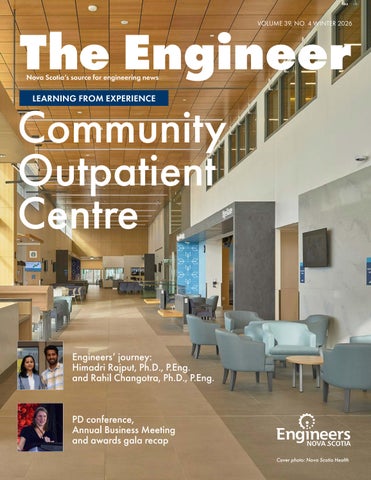
The Engineer
VOLUME 39, NO. 4 WINTER 2026
Nova Scotia’s source for engineering news
LEARNING FROM EXPERIENCE
Community Outpatient Centre Engineers’ journey: Himadri Rajput, Ph.D., P.Eng. and Rahil Changotra, Ph.D., P.Eng.
PD conference, Annual Business Meeting and awards gala recap 1
Cover photo: Nova Scotia Health
Don’t wait to update. Stay in compliance.
Report your CPD hours throughout the year. Professional Engineers must complete a minimum of 30 professional development hours annually and submit them through the Member Portal by December 31. Failure to comply with the CPD Program may result in removal from the Engineers Nova Scotia Registry. Questions about the CPD program? E-mail CPDCommittee@engineersnovascotia.ca. 2
The Association of Professional Engineers of Nova Scotia
The Engineer
VOLUME 39, NO. 4 WINTER 2026
Nova Scotia’s source for engineering news
LEARNING FROM EXPERIENCE
Community Outpatient Centre Engineers’ journey: Himadri Rajput, Ph.D., P.Eng. and Rahil Changotra, Ph.D., P.Eng.
PD conference, Annual Business Meeting and awards gala recap 1
Cover photo: Nova Scotia Health
Cover Image: Nova Scotia Health
President & CEO report
5
Events
8
An engineer’s journey: 12 Himadri Rajput, Ph.D., P.Eng. & Rahil Changotra, Ph.D., P.Eng. Learning from experience: 14 Lessons from the Bayers Lake Community Outpatient Centre Understanding Occupational 19 Health and Safety (OHS) requirements for engineers Shared expertise, stronger systems
20
Meet Nova Scotia’s newest Professional Engineers
23
2026 Award Winners
32
The Engineer is a quarterly publication of Engineers Nova Scotia. Views independently expressed in this publication are not necessarily those of Engineers Nova Scotia Council and Staff. Engineers Nova Scotia reserves the right to edit or adjust content/articles submitted for publication.
Engineers Nova Scotia Council Andrew Thalheimer, P.Eng. Wayne MacDonald, P.Eng. Dr. Jennie Rand, P.Eng. Holly Sampson, P.Eng. Quan (Sophia) He, P.Eng. Jennifer MacDonald, P.Eng. Nancy Rondeaux, P.Eng. Aaron Kennedy, P.Eng. Brain Ward, P.Eng. Martin Corbett, P.Eng. John C. Crane, P.Eng.
President Vice-President Past-President Councillor Councillor Councillor Councillor Councillor Councillor Councillor Councillor
Ex-Officio Members Denise Pothier, FEC, P.Eng. DS (Pal) Mann, FEC, P.Eng.
Engineers Canada Director CEO & Registrar
Zone Representatives Vacant Breagh C. Thomas, P.Eng. Jordan R. Foster, P.Eng. Abdallah M. T. Zeineddin, P.Eng. Vacant
Zone 1 Zone 2 Zone 3 Zone 4 Zone 5
Committee Chair Persons Legislative Committees James Brown, P.Eng. Bob MacDonald, FEC, P.Eng. Darrin McLean, P.Eng. Dr. Sue Molloy, P.Eng.
Board of Examiners Complaints Discipline Nominating
Committees of Council Jeff Knapp, FEC, P.Eng. Andrew Thalheimer, P.Eng.
Finance & Audit Honours & Awards Committee
CEO Committees John Eisnor, FEC, P.Eng. Jade Farr, P.Eng. Darrell Marsh, P.Eng. Browren Allard, P.Eng. Craig Arthur, P.Eng. Audrey Hiscock P.Eng. Alan Ehrenholz, P.Eng. Selvana Hagh Gooei, P.Eng. Alexandra MacDonald, EIT
Continuing Professional Development Emerging Professionals National Engineering Month Professional Practice Public Safety Advisory Student Affairs Sustainability Women in Engineering Youth Engagement
3
Great ideas start with great people. Our engineers are trusted partners, problem‑solvers, and collaborators. Backed by strong leadership and a culture of respect, they deliver work that strengthens communities and sets new standards for what’s possible.
Explore engineering careers at stantec.com/careers
4
President and CEO Report
Building what comes next: Our 2028–2032 Strategic Plan “Our next strategic plan will help Council establish priorities and guide where Engineers Nova Scotia focuses its effort and resources.” Andrew Thalheimer, P.Eng., President, Engineers Nova Scotia
Pal Mann, CD, FCSSE, FEC, P.Eng., ICD.D, CEO & Registrar, Engineers Nova Scotia
Since the last edition of The Engineer, registrants have raised thoughtful questions at our annual business meeting and town hall. How will we develop our next strategic plan? Why are we considering an office relocation? What should a future workplace provide? What comes next in the modernization of Continuing Professional Development (CPD)? These questions offer a useful starting point for a wider conversation about the future of Engineers Nova Scotia. This article shares our early thoughts about the 2028–2032 strategic planning process, explains the purpose of the office relocation project, and provides insight into conversations surrounding CPD audits and national efforts to reduce unnecessary duplication for registrants licensed in more than one province or territory. Although these are separate projects, they share a common purpose: ensuring Engineers Nova Scotia has the direction, capacity, and regulatory tools needed to
protect the public interest as engineering practice continues to change. Setting our direction: the next Strategic Plan Our next strategic plan will help Council establish priorities and guide where Engineers Nova Scotia focuses its effort and resources. Before looking ahead, however, we need an honest assessment of the plan we are completing. First, taking stock The 2022–2027 Strategic Plan has guided Engineers Nova Scotia through significant organizational and regulatory change. As we approach its final year, most major initiatives are complete or well underway. Our focus is shifting from building new systems and capacity to strengthening that work, measuring results, and making improvements. We have made substantial progress. Competency-Based Assessment is now 5
used for new applicants. Our Limited Licence framework is operating, and our CPD program has been modernized. We have also strengthened organizational systems, professional development, and collaboration with other engineering regulators. Legislative modernization and governance reform have moved more slowly, in part because progress depends on government priorities as well as our own efforts. Both will require substantive attention in the years ahead. The work completed over the past four years provides a strong foundation for the future of engineering regulation and professional sustainment in Nova Scotia. As we develop the next strategic plan, we will consider what we achieved, whether those efforts produced their intended results, what we learned, and what we would do differently. Rather than simply carrying forward a list of unfinished tasks, we will determine which issues deserve strategic focus over the next five years.
continued from page 5
Building the plan together Council is responsible for setting Engineers Nova Scotia’s strategic direction. Management will coordinate the planning process and translate Council’s direction into action. The objective is a focused strategy that supports clear choices, not an exhaustive operational work plan. Planning and consultation are expected to continue throughout 2027, supported by external strategic-planning expertise. The work will include an environmental scan, an assessment of lessons from the current plan, Council strategy discussions, and consultation with registrants and other interest-holders. A final plan is expected to return to Council for approval in October 2027. While Council and Management will lead the process, meaningful engagement will inform the plan’s development.
Artificial intelligence and other emerging technologies are changing engineering work. Their influence on the profession raises important questions about competence, accountability, ethics, and professional judgement. Our next plan must be flexible enough to adapt to technologies and engineering tools that may look very different by 2032.
of experiences and perspectives is better prepared to serve Nova Scotians and protect the public and the environment.
Accessibility, fairness, and confidence in regulatory processes will also matter. So will changing pathways into the profession, national and Atlantic collaboration, public expectations of regulation, legislative modernization, and the governance arrangements needed to support effective regulation. Better data will help us assess whether our programs are achieving their intended results and where improvement is needed.
Two projects raised by registrants, the office relocation and CPD modernization, demonstrate how organizational capacity and regulatory tools connect to our future direction.
We want to hear what you are seeing in your workplaces and communities, how engineering practice is changing, what you expect from your regulator, and where you believe we should focus. We will share specific opportunities to participate as the process advances. The questions that will shape our choices We do not want to decide the contents of the plan before consultation begins. We can, however, identify some of the questions likely to shape the conversation.
Photo: iStock Equity, diversity, inclusion, and accessibility within the engineering profession, both in Nova Scotia and elsewhere, remain important and unfinished work. Progress requires tangible and sustained action. The next strategic plan will need to establish a practical path toward a more equitable, diverse, inclusive, and accessible profession. A profession that draws upon a wide range 6
One challenge in developing the plan will be deciding which issues require strategic attention, and which belong within regular operations. A five-year plan cannot be a catalogue of everything we might like to do.
A workplace built for the work ahead Registrant questions about the office relocation project have focused on why Engineers Nova Scotia is considering leaving its long-time home at 1355 Barrington Street and what we need from a future workplace. An accommodation study found that the building, originally constructed as a residence, no longer meets our operational needs or supports future growth. It identified significant accessibility, building-code, and life-safety concerns. These include the lack of a barrier-free washroom and limitations involving stairs, ramps, corridors, and the building’s overall layout. That assessment helped define what a future workplace should provide: accessibility, suitable meeting and collaboration space, modern building systems, support for hybrid work, and flexibility as our needs evolve. The goal is a professional environment that serves
staff, volunteers, registrants, collaborators, and visitors. Financial stewardship is also central to the decision. The project includes an analysis of leasing versus ownership and the total long-term cost of occupying the space, rather than focusing only on upfront costs. Working with the volunteers on our office relocation task force, the project has moved into structured, competitive procurement process. It covers the sale of our existing property, the search for potential new accommodation, and the design and fit-up of the selected space. Proposals are being assessed through a documented process that considers quality, risk, accessibility, sustainability, workplace culture, and price. CPD modernization: from framework to assurance The new Continuing Professional Development framework took effect on January 1, 2025. It introduced a more intentional, risk-based approach to maintaining professional competence. Work is now advancing on the audit component, which is the next stage in supporting and assessing how registrants meet those expectations.
Photo: iStock
The approach being developed treats an audit as both a quality-assurance measure and an opportunity to help registrants manage and demonstrate their continuing professional competence. It is not intended to create another administrative burden, nor should selection for an audit automatically be viewed as corrective. Beginning in 2027, Engineers Nova Scotia aims to audit approximately 5% of registrants annually. This target will provide a meaningful level of regulatory assurance while allowing the audit process to be implemented carefully and evaluated as experience is gained. Meaningful compliance depends on clear expectations. Registrants need to understand not only what they must do, but why it matters. We must also consider whether those expectations can be met without unnecessary duplication, particularly for registrants licensed in more than one province or territory. One profession, fewer duplicate requirements For registrants licensed in multiple jurisdictions, national and regional collaboration has a practical purpose: reducing the need to satisfy several CPD programs simply because their practice crosses provincial or territorial boundaries. Meaningful progress has already been made. Engineers Nova Scotia has established reciprocal CPD recognition arrangements with the other Atlantic engineering regulators. This means that an eligible registrant who complies with the CPD program of one participating 7
Atlantic regulator can have that compliance recognized by the others, subject to each regulator’s applicable requirements.
Photo: iStock Progress is also being made nationally. Canada’s engineering regulators have reached agreement in principle on broader mutual recognition of CPD programs. Most regulators are prepared to move forward, while a few jurisdictions continue to complete their review. Although full national acceptance is not yet in place, the direction is clear and the remaining work is more focused than it was even a few years ago. Our goal is to make CPD more coherent for registrants without weakening the assurance it provides to the public. Together, the audit program and growing mutual recognition arrangements can make modernization meaningful in practice by supporting professional competence while reducing avoidable administrative burden. This progress also shows why collaboration will remain important as we develop our next strategic plan.
Annual Business Meeting, Conference & Awards Gala continued from page 7
Your voice in what comes next The questions raised at the 2026 annual business meeting and town hall remind us that transparency does not require having every answer at the outset. It means explaining what we know, what remains undecided, why options are being considered, and how people can contribute. We want to bring that approach to the next strategic plan and to the work described here. The planning process will connect what we have learned with the choices ahead, while keeping our public-interest mandate at the centre.
Engineers Nova Scotia’s Annual Business Meeting and Awards Gala was held at the Sandman Signature Dartmouth Hotel on October 22. Incoming President Andrew Thalheimer, P.Eng., Past-President Dr. Jennie Rand, FEC, P.Eng. CEO and Registrar, D.S. (Pal) Mann, CD, FCSSE, FEC, P.Eng., ICD.D., and Engineers Nova Scotia COO Kris Dove, FEC, P.Eng., and are pictured above during the Town Hall.
Photo: iStock
During the Annual Business Meeting & Town Hall, registrants asked questions on a variety of topics ranging from individual budget lines, office relocation, connections to industry and work with Engineers Canada.
Throughout 2027, we will share more information about the planning process, what we are learning, and how registrants and other interested parties can participate. We hope you will bring your questions, experience, and perspectives to the discussion. Engineering practice and professional regulation will continue to evolve. The 2028–2032 Strategic Plan is our opportunity to decide, together, where Engineers Nova Scotia should focus its efforts and how we can build upon the conversation registrants have already begun. 88
Following the Town Hall, the Annual Business Meeting focused on the business of the organization and included a review of the financial statements, an introduction of the new Council members and an opportunity for registrants to ask more questions regarding the budget. Right: Jeff Knapp, FEC, P.Eng., presents the Finance and Audit Committee’s 2025/26 Annual Report. The 2025-2026 Annual Report, Audited Financial Statements and Budget are available for download here.
After the Annual Business Meeting, our Gala for the engineering profession in Nova Scotia was held where we celebrated our 2026 Engineering Award Winners. You can read about all nine winners beginning on Page 31. Featured below, top row: award winners Kirk Herman, P.Eng., Dr. Barret Kurylyk, P.Eng., Jade Farr, P.Eng., Robbie Fraser, P.Eng., John F. Meisner, P.Eng. Bottom row: Dr. Jennie Rand, P.Eng., Past-President, award winners Andrea Doncaster, P.Eng.,Mila MacLean, P.Eng.,Wade Pottie, P.Eng., Patricia Duncan, P.Eng. and CEO and Registrar, D.S. (Pal) Mann, CD, FCSSE, FEC, P.Eng., ICD.D.
9
Our Professional Development Conference was held on October 21. This year’s theme, “Engineers Open Doors: Shaping a Responsible Future,” highlighted the role of engineers in navigating change through innovation, ethics, and community impact, while exploring emerging technologies such as AI and the responsibilities that come with them. Professional Development presentations covered a broad range of topics including ‘Indigenous Perspectives in Engineering’, ‘Responsible AI Use in Engineering Practice’, ‘AI Basics and Beasts: Understanding AI, Its History and Macro Level Impacts’, and ‘Modernized CPD Program: The Report Card Is In.’ Thank you to all our Conference presenters: Sarah L. Manley Robertson, Levi Morrison P.Eng., Christopher Googoo, Melissa Peneycad, Iaian Archibald, Kris Dove, FEC, P.Eng., Pal Mann, FEC, P.Eng, Dr. Jennie Rand, FEC, P.Eng., Andrew Thalheimer, P.Eng. and to each of our event volunteers. Affinity Partner: TD Insurance Premium Partners: CBCL Limited, Canada Life Connect Partners: Victor Insurance, Manulife, Faculty of Engineering À La Carte Partners: Cox & Palmer, Eastpoint Engineering, Lindsay Construction, Build Nova Scotia
Follow us on social media C
M BR Town Hall & Social
Stay up to date on Nova Scotia news and networking events Find out about your colleagues’ engineering achievements
11
Profile
Engineers’ journey: Himadri Rajput, P.Eng. & Rahil Changotra, P.Eng.
Rahil Changotra, Ph.D., P.Eng. (left) and Himadri Rajput, Ph.D., P.Eng., (right) at the Halifax Public Gardens Engineering is where Himadri Rajput, Ph.D., P.Eng., and Rahil Changotra, Ph.D., P.Eng., first found common ground, and more than a decade later, it remains a shared part of their lives. They met in 2013 while completing their master’s degrees in India, continued their PhDs at the same institution under the same supervisor, and married in 2019. Today, their careers have brought them to the same place, with both conducting environmental engineering research at Dalhousie University. The years between graduate school and their work at Dalhousie included several moves and new research opportunities. After marrying, they moved to South Korea for Rahil’s postdoctoral work. In November 2021, a postdoctoral fellowship at Dalhousie brought him to Nova Scotia, with Himadri joining him the following August after completing postdoctoral research in the United Arab Emirates.
Rahil arrived in Nova Scotia several months before Himadri, giving him time to settle into life in Truro before she joined him the following summer. His experience made her transition easier, and they were soon able to focus on building the next stage of their careers in Nova Scotia. Today, both work in the Department of Engineering, Faculty of Agriculture at Dalhousie University. Himadri is a Postdoctoral Fellow and Lab Manager in environmental and chemical engineering, managing the Bioproducts and Bioenergy Research Lab while contributing to research and mentoring students. Rahil is a Postdoctoral Fellow whose work connects environmental engineering, renewable energy and sustainable bioresource processing. Their research interests overlap, but each brings a different focus. Himadri’s work includes environmental remediation and wastewater treatment, while 12
Rahil explores how waste materials can be given new purpose through clean-energy and environmental applications. “As environmental engineers, all the aspects related to the environment actually excite us and make us think about how we can treat trash as a treasure,” Himadri says. That idea is at the heart of much of their work. Rather than viewing waste simply as something to dispose of, their research explores how biomass, agricultural and industrial waste can be transformed into useful materials, with applications ranging from wastewater treatment and environmental remediation to clean-energy production. Working in the same field also gives them something many couples do not have: a partner who understands the details behind a difficult day at work. When one encounters a research problem, the other can offer another perspective, ask questions or help think
through a possible solution. Rahil says their similar academic backgrounds often allow them to dig more deeply into an idea through conversation. “Sometimes we have to consciously stop discussing work because we extend our conversations even after working hours,” Himadri says. “During our mealtimes, during our rides, everywhere,” Rahil adds. Research questions and conversations about their students can easily follow them beyond the laboratory. “Personally, I feel it as a blessing,” Himadri says. “I think the partner can really help you grow personally and professionally as well. I really enjoy working with him.”
Mentoring is another part of their work they both enjoy. Rahil appreciates the discussions that come from working with students, particularly when they sit down together to talk through a research problem and consider different ways of approaching it. Himadri enjoys those different perspectives too. For her, seeing students develop is especially rewarding. “I like the new perspectives that the students, the young minds bring,” she says. “I also like to see their growth. It gives me satisfaction to see that I’m helping someone shape their career.” Professional licensure became another milestone in their journey. For
Rahil and Himadri at Diwali celebration at Dalhousie University That support extends beyond their research. Building their life in Nova Scotia has also meant balancing demanding careers with responsibilities at home. They have learned to adjust depending on what each person has on their plate. When one is particularly busy with work, the other takes on more at home.
Himadri, earning her P.Eng. represents years of hard work, dedication and continued learning. Rahil sees it as recognition of his education and experience as well as a responsibility to uphold the ethics, accountability and public safety expected of professional engineers. 13
Away from research, they make time for movies and exploring new places together, but both have creative interests of their own. Rahil enjoys sketching and painting, and according to Himadri, he is far more talented than he lets on, creating portraits with remarkable detail. Himadri has her own artistic side through dance, an interest she has pursued since childhood. These interests give them another outlet beyond the research that fills so much of their working lives. Their experiences have also shaped the advice they give internationally educated engineers beginning careers in Canada. For Rahil, patience is essential. “Don’t get disheartened,” he says. “Things take time.” He encourages engineers to keep learning and developing their skills along the way. Himadri emphasizes keeping an open mind, especially when things do not unfold according to plan. “Just keep on working hard,” she says, “and eventually you will achieve what you earlier planned.” From graduate school in India to the same research lab in Nova Scotia, Himadri and Rahil have spent more than a decade growing alongside one another. Their careers have taken them to different places and presented new challenges, but they have continued to learn from each other and support one another along the way. Today, engineering is not simply a profession they happen to share. It is woven through a partnership shaped by curiosity, mutual understanding and the space they give each other to grow.
Engineering a Healthier Future
Learning from experience: Lessons from the Bayers Lake Community Outpatient Centre Submitted by Deborah Purvis, Senior Communications Advisor, QEII Halifax Infirmary Expansion Project, Nova Scotia Health
Photo credit: Courtesy of Nova Scotia Health 14
15
Engineering a Healthier Future
Bayers Lake Community Outpatient Centre. Photo credit: Courtesy of Nova Scotia Health Opened in November 2023, the Bayers Lake Community Outpatient Centre was designed to bring a wide range of healthcare services closer to patients in a modern, convenient setting. The 104-clinic-space facility offers services including primary care, medical and surgical clinics, diagnostic imaging, specimen collection, eye care, orthopedic assessment and rehabilitation, hemodialysis, and respirology care. The centre’s design was shaped through extensive stakeholder engagement, with hundreds of clinical and non-clinical staff contributing through more than 15 end-user groups. This collaborative approach helped create a modern, technologically advanced outpatient facility designed to support both patients and care teams.
In summer 2025, Nova Scotia Health and Build Nova Scotia, in partnership with Parkin Architects, undertook a Post-Occupancy Evaluation (POE) to assess how the Bayers Lake Community Outpatient Centre is supporting patients, visitors and staff since opening its doors. The evaluation examined whether the project’s original design intentions were achieving the desired outcomes, while identifying opportunities for improvement and innovation. It also captured insights and lessons learned that can help shape the design, activation and ongoing improvement of future healthcare facilities. As the first POE conducted for a Nova Scotia healthcare P3 project, it provided a valuable opportunity 16
to capture and document lessons learned. For David Benoit, P.Eng., and Build Nova Scotia’s President and CEO, the evaluation represents an important opportunity to learn from experience and carry those lessons forward. “The Bayers Lake Community Outpatient Centre was designed through close collaboration with healthcare providers, staff and partners, and this post-occupancy evaluation helps us understand how those design decisions are performing in practice,” said Benoit. “By combining data with the experiences of patients and staff, we’re able to identify what worked well and where there are opportunities to improve. Those insights will help inform the design, activation and
Patient Experience
88%
agreed the design of the centre makes them feel calm.
Wayfinding
93%
Staff Experience
78%
85%
found the check-in process easy to complete.
agreed the facility’s physical environment supports their daily activities.
felt confident finding their way around.
81%
90%
spent less than 10 minutes at registration.
The Evaluation At a Glance
understood where to go after check-in.
497
patient surveys
71
staff surveys
359
observations (patients and staff)
11
staff interviews
Chart: Courtesy of Nova Scotia Health
delivery of future healthcare infrastructure projects across Nova Scotia.” For POE co-leads Emma Leeshanok, an Industrial Engineer with Nova Scotia Health’s Operational Readiness team, and Laura Hann, Principal Architect with Parkin Architects, the evaluation offered an opportunity to bring together something that doesn’t always happen in healthcare design: data and lived experience. “Gathering both the quantitative and qualitative data was extremely important to us,” Leeshanok said. “It helps to capture a more complete picture of the success of the project as a whole.” And it was a substantial undertaking. The team collected 497 patient surveys, 71 staff surveys, conducted observations
over several days, and interviewed 11 staff members across different departments. The results tell a positive story. The POE confirmed that daylight, views of nature, openness, and shared waiting areas support a calm, flexible outpatient experience. The centre’s Great Hall, waiting areas, and flexible clinical spaces were all designed with the patient and staff experience in mind. Staff also highlighted the difference the environment makes. “It is bright, open and modern and makes for a much better staff and patient experience than my previous workplace,” one staff member shared. “It helps to put everyone at ease and in a better mood.” 17
Another staff member described the shared waiting areas as “comfortable and not overly crowded,” adding that it was unusual to experience a space where there wasn’t enough room being an issue. But perhaps the most valuable part of the evaluation is that it doesn’t simply confirm what worked. It shows where there is an opportunity to do even better. Patient survey results indicated that most patients felt confident navigating the building; however, observational findings revealed a different perspective. Eighty-five per cent of patients strongly agreed they felt confident finding their way around the centre, while 90 per cent strongly agreed they understood where to go after checking in. In contrast, nearly 60 per cent of patients observed
continued from page 17
Bayers Lake Community Outpatient Centre. Image credit: Courtesy of Nova Scotia Health
on the main level sought assistance from volunteers to find their way, and members of Parkin’s observation team were also approached on several occasions for directions. This contrast highlights the importance of the POE in helping to interpret and understand how people experience and navigate the space in practice. The study showed that architecture and operations must work together, to make wayfinding truly intuitive. Beyond wayfinding, the findings identified opportunities to make registration processes more adaptable and to locate staff amenities closer to where employees work, helping to further improve the overall experience for patients, visitors and staff. For Emma, that is exactly what makes a POE valuable. “The project provided a valuable opportunity to capture and document lessons learned in a structured way,” she
said. “One of the biggest benefits of the POE was ensuring those insights can be applied to the design, activation and ongoing improvement of future healthcare infrastructure projects.” For Laura, the open collaboration was equally important, creating an opportunity to connect those lessons learned back to future planning and design.
operational processes to help shape the planning and design.” The Bayers Lake experience demonstrates that good healthcare design is about much more than walls, rooms and hallways. It is about understanding how people move, work, wait, connect and feel within a space. As Nova Scotia’s first healthcare P3 project and first post-occupancy eval-
“These insights give us practical evidence to refine wayfinding, registration and staff-support spaces in future healthcare projects.” “The POE gave us an opportunity to learn together from the building in use,” Hann said. “It reinforced the benefits of flexible waiting, while highlighting the importance of early conversations with future users about patient flows and 18
uation, the Bayers Lake Community Outpatient Centre is already informing future healthcare infrastructure projects across the province, with lessons learned being incorporated into their planning and development.
Public Safety Committee
Understanding Occupational Health and Safety (OHS) requirements for engineers Submitted by Colleen Rodgerson, P.Eng., OHS Engineer at NS Department of Labour, Skills and Immigration and member of the Public Safety Committee for Engineers Nova Scotia
Colleen Rodgerson, P.Eng. At a recent webinar, I was asked if an engineer can override the OHS Act and regulations. The answer is “no” and I knew that, but I wanted to give the basis for my response. So, I madly searched the Occupational Health and Safety Act for the section that speaks to this topic, but I was unable to put my finger on it quickly. This fumble has provided me with an opportunity to discuss this topic now. The Nova Scotia Occupational Health and Safety Act and regulations assign many duties to professional engineers. This approach permits flexibility to some regulatory requirements where engineers are provided with permission to make decisions on what is reasonable. However, this is limited to sections of the regulations where the regulations explicitly state an engineer may do so.
An example in the regulations which provides permission for an engineer to overrule the prescriptive regulation is section 166(5) of the Occupational Safety General Regulations which states: “Despite clause (1)(b), an employer may slope the walls of an excavation or trench at an angle that exceeds a 1 m vertical rise to each 1 m horizontal run where an engineer has certified in writing that the steeper slope will be stable and is not a hazard to a person in the excavation or trench.” This section clearly permits an engineer the authority to deviate from the regulation cited in section 166(1) (b). However, if the regulation does not specify that an engineer can deviate, they must not do so. The section of the OHS Act that clarifies this limitation is section 21. This is the section that I was searching for during the webinar. It speaks to the precautions that must be taken by engineers and architects. “21 (1) An architect, … or a professional engineer, as defined in the Engineering Profession Act, who gives advice or stamps documents shall take every precaution that is reasonable in the circumstances to ensure that a person who is likely to rely on the advice, seal or stamp will not be in contravention of this Act or the regulations as a result of such reliance. (2) Where (a) an architect, as defined in 19
the Architects Act, gives advice or affixes the architect’s seal to documents; or (b) a professional engineer, as defined in the Engineering Profession Act, gives advice or stamps documents, negligently or incompetently and a person at a workplace is endangered thereby, the architect or professional engineer contravenes this Act. 1996, c. 7, s. 21.” Engineers cannot supersede requirements that are prescriptive in the regulations unless they are explicitly permitted to by the regulations. Otherwise, they are acting negligently. If an engineer has any questions regarding the OHS Act or regulations, they can call the 1-800-9LABOUR (1-800-952-2687). References: Occupational Health and Safety Act: https://nslegislature.ca/sites/default/ files/legc/statutes/occupational%20 health%20and%20safety.pdf Webinar on Engineers Nova Scotia YouTube channel: Engineering Certification -Occupational Health and Safety (OHS) Requirements
Engineering for Impact
Shared expertise, stronger systems Submitted by Glenda MacAskill, Executive Director, Waste Water Nova Scotia areas where engineers and installers may work together, including considIn 2021, Engineers Nova Scotia erations related to sand, grades and established a working group of piping, as well as documentation of professional engineers practicing in as-built conditions. WWNS compares the process to a on-site sewage system design to review proposed selectable sloping sand filter relay race: each participant is responsitables developed by the Department of ble for their contribution before passing Nova Scotia Environment and Climate the baton to the next. It is a useful analogy. When one part Change. Waste Water Nova Scotia was included in the correspondence when of a project connects directly to another, the working group’s recommendations communication and an understanding were submitted to the Nova Scotia of each participant’s role become particularly important. government. Collaboration does not replace That work considered engineering judgment, professional accountability, professional responsibility. Rather, technical design and public safety. It understanding where responsibilities also demonstrated the value of bringing intersect can support clearer communidifferent perspectives into discussions cation while allowing each participant to when proposed standards intersect with remain accountable for their own work. professional engineering practice. Turning collaboration into The connection has continued. More understanding recently, WWNS has shared educational opportunities with Engineers Nova Scotia, including information about a Recent discussions between Engineers Nova Scotia and WWNS have identipublic webinar on septic inspections. Those interactions provide a foun- fied additional opportunities to build on dation for the organizations to contin- this history and increase understanding ue finding practical ways to share of the wastewater management sector. One is a proposed wastewater reguknowledge with both professionals and latory ecosystem graphic that would the public. help engineers, installers and members of the public better understand the key Many hands, one outcome participants involved and their general Wastewater management illustrates responsibilities. The emphasis is on making an interjust how interconnected professional and technical responsibilities can connected system easier to understand. This approach also reflects a recurbe. Engineers bring design expertise and engineered solutions. Qualified ring theme in the engineering commuPersons can select pre-engineered nity, that engineering increasingly takes systems, while installers put designs place alongside professionals from into practice in the field. Manufacturers different disciplines and sectors, making and suppliers contribute materials and communication and teamwork essential products. WWNS has also identified to complex work. Building on a shared history
A solid foundation is built to last. Image courtesy of Waste Water Nova Scotia The relationship between Engineers Nova Scotia and Waste Water Nova Scotia shows how sharing expertise and building understanding across professional boundaries can strengthen practice and benefit the communities engineering serves. A septic system may serve a single property, but the work behind it involves a much broader network of expertise. From design and manufacturing to installation and documentation, wastewater projects can bring together engineers, Qualified Persons, installers, manufacturers, suppliers and others, each contributing an important part of the finished system. It is a practical example of something that applies across engineering: good outcomes depend not only on individual expertise, but also on understanding how our work connects with the work of others. That principle has long shaped the relationship between Engineers Nova Scotia and Waste Water Nova Scotia (WWNS). Over the years, the organizations have connected on issues involving on-site sewage, where engineering, regulation and industry practice intersect.
20
VERIFY BEFORE YOU HIRE. If you suspect that you have been dealing with someone who is NOT a professional engineer, check their status in our Member and Company Directory.
21
Complex projects are failing. The future of engineering is integrated.
Dalhousie University’s Certificate in Systems Engineering and Complex Project Management will help you confidently navigate complex, interconnected, digital environments. Offered 100% online and at your own pace, you’ll come away with systems-based expertise employers need. This 3-course certificate could apply toward your professional development hours.
FOCUSED. FLEXIBLE. JUST RIGHT FOR WORKING ENGINEERS.
Register for the first course 22
Congratulations!
Nova Scotia’s newest Professional Engineers
23
New P.Eng.
Roland Agala, P.Eng. Discipline: Reliability Engineer LinkedIn
University: Memorial University of Newfoundland What inspired you to pursue a career in engineering? My desire to understand how things work and also having my father being an engineer inspired me to become an engineer. What positive changes does earning your P.Eng. designation bring? Obtaining my P.Eng designation will open new career doors, boost my professional reputation, and also act as a mentor for new graduates.
Liam Carson, P.Eng. Discipline: Mechanical Engineering University: Dalhousie University LinkedIn What inspired you to pursue a career in engineering? I have always been motivated by a desire to understand how the world around me works. I also want to apply that knowledge to solve practical problems and help create a more sustainable society and economy. What positive changes does earning your P.Eng. designation bring? Earning my P.Eng. designation will help me take on greater responsibility, own my work, and build trust with clients and colleagues. I look forward to becoming more involved in the engineering community and continuing to grow through projects that improve energy efficiency and sustainability.
24
New P.Eng.
Jana Giles, P.Eng. Discipline: Mechanical Engineering University: University of New Brunswick LinkedIn What inspired you to pursue a career in engineering? Since early in my life, I have been driven to care and advocate for our planet. As a young adult, I looked up to folks with careers that involved solving problems to make our everyday lives and the systems that support us more environmentally and socially sustainable. What positive changes does earning your P.Eng. designation bring? I saw this new achievement as an opportunity to pause and reflect meaningfully on my journey so far. And now, I’m looking forward to making change grounded in my values, grateful to be a part of the Nova Scotian engineering community, and open to never-ending learning and growth.
Nashita Jalal, P.Eng. Discipline: Electrical Engineering LinkedIn
University: Dalhousie University What inspired you to pursue a career in engineering? I wanted to pursue a career where I was bound to learn something new every day, and in turn help me stay curious and engaged with the world around me. Engineering offered the perfect balance of problem-solving, lifelong learning, and opportunities to develop meaningful solutions with like-minded individuals. What positive changes does earning your P.Eng. designation bring? I hope to continue developing my technical expertise in power systems and take on greater leadership roles in projects. I’ve been fortunate to have incredible mentors and colleagues who have supported my professional growth along the way. As I progress in my career, I look forward to giving back to the community by mentoring and inspiring future cohorts of engineers, just as others have done for me. 25
New P.Eng.
Amit Kachhadiya, P.Eng. Discipline: Instrumentation and Control Engineering LinkedIn
University: Dharmsinh Desai University
What inspired you to pursue a career in engineering? Since childhood, I have been fascinated by sensors, automated devices, and understanding how things work. I was always curious about how tiny controllers generate commands and control complex systems. This curiosity inspired me to pursue engineering and ultimately specialize in Instrumentation and Control Engineering. What positive changes does earning your P.Eng. designation bring? Earning my P.Eng. designation will enhance my professional credibility and open new career opportunities. It will allow me to take on greater engineering responsibilities, contribute more effectively to innovative projects, and continue growing as a leader. The designation will also strengthen my connection to the engineering community and profession.
Alexandra MacDonald, P.Eng. Discipline: Industrial Engineering LinkedIn
University: Dalhousie University What inspired you to pursue a career in engineering? I am fortunate to have grown up with role models who championed engineering. My father, a civil engineer, and my mother, an educator, introduced me to opportunities like Go ENG Girl. Seeing women in engineering helped me see myself in the profession. Through Engineers Nova Scotia’s Youth Engagement Committee, I hope to inspire the next generation. What positive changes does earning your P.Eng. designation bring? Earning my P.Eng. will mark an important milestone in my career, giving me the credibility to take on greater technical and leadership responsibilities. It will also strengthen my connection to the engineering community and allow me to continue giving back by supporting and inspiring the next generation of engineers. 26
New P.Eng.
Alejandro Quezada Chavez, P.Eng. Discipline: Environmental Engineering LinkedIn
University: Metropolitan Autonomous University
What inspired you to pursue a career in engineering? I was inspired to pursue engineering because I enjoy transforming complex challenges into practical solutions and finding better ways to improve the systems that shape our daily lives. As I became more aware of environmental and sustainability issues, I developed a strong interest in applying engineering to address climate change and reduce greenhouse gas emissions. What positive changes does earning your P.Eng. designation bring? Having worked in industry, academia, and government, I have gained a unique perspective that allows me to build bridges between these communities. My P.Eng. designation strengthens my ability to contribute to sustainable development by connecting diverse perspectives and expertise.
Brianna Rietzel, P.Eng. Discipline: Transportation Engineering LinkedIn
University: University of New Brunswick
What inspired you to pursue a career in engineering? The opportunity to help shape communities through better transportation systems. I enjoy the blend of engineering analysis, stakeholder engagement, and real-world problem solving. What positive changes does earning your P.Eng. designation bring? This will expand my career opportunities and enable me to make a greater contribution to the communities and clients I serve through safe and sustainable transportation solutions.
27
New P.Eng.
Sachin Soby Varghese, P.Eng. Discipline: Mechanical Engineering University: Kerala University LinkedIn What inspired you to pursue a career in engineering? I’m drawn to engineering by a lifelong curiosity about how machines, automation, and robotics work. I’m excited by the chance to design technology that solves real problems and makes people’s lives easier. What positive changes does earning your P.Eng. designation bring? Earning my P.Eng. will position me to lead in automation, robotics, and manufacturing engineering, where I can help develop safer, more reliable automated systems that improve productivity. It will also reinforce my professional credibility within the engineering community.
Sweetta Vincent, P.Eng. Discipline: Electronics and Communication Engineering University: University of Calicut LinkedIn What inspired you to pursue a career in engineering? My passion for engineering began with curiosity about how things work and how they can be made better. For me, engineering is where creativity meets technology, and every challenge is an opportunity to learn and innovate. What positive changes does earning your P.Eng. designation bring? Earning my P.Eng. designation is an important milestone in my career. It has made me more confident and proud. I believe it will bring more career opportunities and allow me to work with other engineers, share knowledge, and contribute to engineering projects that help our community.
28
New P.Eng.
Samuel Wade, P.Eng. Discipline: Structural/Civil Engineering LinkedIn
University: Dalhousie University
What inspired you to pursue a career in engineering? My inspiration to pursue engineering grew out of a lifelong love for building things. Growing up, I spent my youth working alongside my father on hands-on construction projects, building everything from fine cabinetry to rustic woodland cabins. That early exposure taught me to love the puzzle of unique, project-based problem-solving. When paired with my academic strengths in physics and mathematics, engineering was the obvious choice. What positive changes does earning your P.Eng. designation bring? Earning my P.Eng. designation means joining a network of esteemed, reputable professionals who share a fundamental commitment to lifelong learning and public safety. Stepping into this role brings a profound awareness of the gravity and seriousness of our responsibilities as engineers.
Xiaohu Yang, P.Eng. Discipline: Industrial Engineering LinkedIn
University: Dalhousie University What inspired you to pursue a career in engineering? My inspiration came from the people I met in the Dalhousie Industrial Engineering Class of 2021. Over five years, we tackled challenges, and supported one another through the journey. I am grateful to my mentor, Paula Condon, for her guidance, and to my friend Colin MacIntosh, whose determination inspired me from the day we met in Sheriff at Dal. What positive changes does earning your P.Eng. designation bring? Earning my P.Eng. will support my growth as an ILS Analyst, strengthen my professional credibility, and allow me to contribute more confidently to engineering programs. Inspired by the Dalhousie Industrial Engineering Class of 2021 and the mentors who guided me, it represents an important milestone in my engineering journey. 29
Engineers Nova Scotia can introduce new P.Eng. to the engineering community, when provided a portrait and a brief write-up.
SUBMISSION DEADLINES: January 24 for late February publication May 7 for late May publication July 27 for a mid-August publication November 5 for a late November publication
engineersnovascotia.ca
Download the PDF form here.
The Engineer Submission Guidelines for new P.Eng. Engineers Nova Scotia’s quarterly magazine introduces new P.Eng. to the engineering community, with a portrait and a brief write-up of the engineer’s future goals.
2027 Submission Deadlines: January 24 for late February publication May 7 for late May publication July 27 for a mid-August publication November 5 for a late November publication
Please Be Advised In submitting for The Engineer, authors agree to their material being published and its free access. We cannot guarantee any particular placement (i.e. near the front) of your submission. Engineers Nova Scotia retains the right to refuse content submissions in the event that the subject matter does not follow the guidelines on page 2. When submitting content, it is not guaranteed publication; Engineers Nova Scotia reserves the right to deny any content after its internal review. Engineers Nova Scotia has the discretion to edit and revise to correspond with our guidelines and associational tone.
30
Submit your project for the Spring 2027 issue ngineer VOLUME 37,
The E THE PROJEC
NO. 1 SPRING
2024
engineering
s source for Nova Scotia’
news
T ISSUE
Eight great Nova Scotia builds
The Engine
VOLUME 39,
Nova Scotia’ s sou
Celebrate your work and reach an audience of 9500+ engineers
er NO. 1 SPRING
2026
rce for engine
THE PROJEC
ering news
T ISSUE
Nova Scotia Court Ruling
ice: Faces of Serv ho Engineers W r Voluntee lic Works
artment of Pub
a Scotia Dep
Nov Cover Photo: 1
Fishing vesse hoist certificatil on Engineers’ jou Rana & Geor rney: ges Cover Photo: Nov
a Scotia Gov ernment
Deadline: January 29
1
Details: publications@engineersnovascotia.ca
2026 Engineers Nova Scotia Award Winner
F.H. Sexton Gold Medal: Robbie Fraser, P.Eng.
The F.H. Sexton Gold Medal is Engineers Nova Scotia’s highest honour, awarded to a professional engineer who has demonstrated exceptional achievement and distinguished service in their field. Recipients are recognized for outstanding careers and for advancing the economic and social well-being of Nova Scotia through engineering excellence. For more than 26 years, Robbie Fraser, M.Sc., P.Eng., has played a leading role in the design and construction of infrastructure that connects communities across Nova Scotia and Canada. From award-winning bridges and transportation projects to the engineering firm he helped establish in Dartmouth, his career has been marked by technical expertise, practical leadership, and a commitment to developing others. His influence extends beyond the structures he has helped deliver to the many engineers and technical professionals he has guided throughout his career. After earning his engineering degree from the Technical University of Nova
Scotia, graduating as a Sexton Scholar, he completed his graduate studies at the University of Alberta where he was the recipient of a National Science and Engineering Research Council Scholarship and the Walter John’s Memorial Fellowship. Robbie then began his career in earnest, a career that would lead to the design of more than 400 bridges and numerous award-winning infrastructure initiatives across Canada. Since 2000, Robbie has served as lead designer on more than 400 bridge projects and hundreds of construction engineering assignments. His work has delivered practical, constructible solutions for transportation infrastructure across Canada and has been recognized through various provincial, national, and industry awards. Among his most notable achievements is the Highway 104 Twinning Project between Sutherlands River and Antigonish, where he served as lead bridge designer for 29 new bridge structures along a 38-kilometre section of the 32
Trans-Canada Highway. In addition to leading the design, he provided engineering support throughout construction, contributing to the delivery of a project that enhanced safety, reliability, and connectivity for Nova Scotians. The project later received both the Canadian Council for Public-Private Partnerships National Award for Innovation and Excellence and the Lieutenant Governor’s Award for Excellence in Engineering. This was not the first project Robbie lead that would go on to receive the Lieutenant Governor’s Award. Until that point in his career, three other such projects of his were recognized with this marked distinction, including: the Vimy Memorial Bridge Erection in 2014; the Moriah Bridge Construction and Self-Launching Gantry in 2007; and the Seal Island Bridge Rehabilitation in 2003. In 2016, the Juno Beach Memorial Bridge Erection was also recognized with the Lieutenant Governor’s Award of Excellence (Prince Edward Island). Rounding off his list of Nova Scotian accolades, Robbie himself has been personally recognized twice before by Engineers Nova Scotia: in 2015 with the Engineering Award and in 2007 with the Young Engineer Award. Robbie has also taken part in nationally recognized infrastructure initiatives beyond Nova Scotia. As lead construction engineer for Toronto’s Port Lands Flood Protection and Redevelopment Project, he oversaw the delivery of four steel arch bridges using accelerated bridge construction techniques. The project showcased Nova Scotia engineering expertise on a national stage and
received multiple Canadian Institute of Steel Construction awards. His portfolio also includes award-winning work on the Burgoyne Bridge Replacement and the Cheticamp River Bridge Replacement. Together, these efforts demonstrate both the breadth of his technical knowledge and his ability to guide complex assignments from concept through construction. In 2008, Robbie co-founded Harbourside Engineering Consultants with business partner Greg MacDonald. What began as a specialized bridge and heavy civil engineering firm has since grown into the Harbourside Engineering Group, serving clients across multiple sectors. Under his leadership, the firm has attracted major projects to Nova Scotia, retained engineering talent in Atlantic Canada, and become known for delivering practical, high-quality solutions. Throughout its growth, he has demonstrated that world-class engineering expertise can be developed and sustained in Nova Scotia. Mentorship has remained an important part of Robbie’s work at Harbourside Engineering Group. Colleagues describe him as someone who is always willing to share knowledge, answer questions, and invest time in the growth of those around him. He routinely works with engineers, engineers-in-training, co-op students, and technical staff, helping them build technical capability and professional confidence. Through lunch-and-learn sessions, technical discussions, and hands-on project guidance, he has created a workplace culture where learning and collaboration are highly valued.
His service to the profession extends beyond his workplace. For more than 15 years, Robbie has contributed to the advancement of engineering standards through involvement with technical code committees. He has served on committees responsible for the Canadian Highway Bridge Design Code and the Nova Scotia Department of Public Works Standards Specification, helping shape the standards that guide infrastructure projects across the country. Throughout his career, he has consistently promoted professionalism, public safety, and ethical engineering practice.
teamwork, confidence, and leadership skills both on and off the ice. Those who work alongside Robbie often speak of his integrity, humility, and unwavering commitment to quality. Whether guiding the design of a complex bridge, advising a client through a difficult decision, or supporting a younger engineer, he leads by example. His influence can be seen in the transportation networks and public works he has helped shape, the organizations he has strengthened, and the professionals whose careers have benefited from his mentorship and guidance.
Beyond engineering, Robbie has demonstrated a strong commitment to community service. Through Harbourside, he has supported organizations such as Brigadoon Village, the Orenda Canoe Club, and the MacPhee Centre for Creative Learning through pro bono engineering services and charitable initiatives. Since 2013, he has spearheaded the firm’s annual Treats for Tots campaign in support of the Salvation Army. He has also devoted more than a decade to coaching minor hockey, helping young athletes develop
For his outstanding contributions to structural and bridge engineering, his leadership in delivering award-winning infrastructure projects, his commitment to advancing the profession through mentorship and technical service, and his dedication to strengthening communities in Nova Scotia and beyond, Robbie Fraser, M.Sc., P.Eng., receives the 2026 F.H. Sexton Gold Medal in recognition of his singular service and lasting contributions to the engineering profession in Nova Scotia.
33
2026 Engineers Nova Scotia Award Winner
Engineering Award: Dr. Barret Kurylyk, P.Eng.
The Engineering Award is presented to an engineer who has achieved distinction in the practice of engineering. The achievement may be a single event or a series of events that set a benchmark for others in the profession. As a researcher, educator, and professional engineer, Dr. Barret Kurylyk, P.Eng., has built an internationally recognized body of work focused on groundwater systems and water resources. His research has advanced understanding of how environmental change affects water systems while helping inform practical solutions for communities, ecosystems, and water resource management. After earning engineering degrees from the University of Prince Edward Island and the University of New Brunswick, Barret completed a Ph.D. in Civil Engineering focused on the impacts of climate change on groundwater systems and groundwater-sourced fish habitat. Following positions in consulting, postdoctoral research, and academia, he joined Dalhousie University in 2017. He is now the Acting Associate Dean of Research for the Faculty of Engineering and a Full
Professor in the Department of Civil and Resource Engineering and serves as Canada Research Chair in Coastal Water Resources. Barret’s work examines how groundwater systems respond to environmental change, including coastal flooding, saltwater intrusion, permafrost thaw, and climate-related pressures on water resources. Through a combination of modelling, field investigations, and applied engineering research, he has expanded knowledge in areas that are becoming increasingly important to communities across Canada and around the world. His research has improved understanding of risks facing communities and ecosystems while supporting more effective approaches to water management and climate adaptation. Among his most notable achievements is his work on groundwater-fed thermal refuges for Atlantic salmon. Rather than focusing solely on the impacts of warming rivers, Barret helped develop and evaluate approaches that use groundwater to create cooler habitats for fish during periods of environmental stress. The project demonstrated how engineering can support climate adaptation while providing a framework that can be applied in other regions facing similar challenges. A prolific researcher, Barret has authored more than 140 peer-reviewed publications, and his work has been cited thousands of times by researchers around the world. His achievements have been recognized through numerous provincial, national, and international honours, including major awards from the American Geophysical Union, the Canadian Geophysical Union, and the 34
Geological Society of America. His work extends beyond research. Barret has served in leadership roles within professional organizations, including as President of the Canadian Geophysical Union’s Hydrology Section. Through committee work, editorial responsibilities, conference leadership, and collaboration with researchers and practitioners, he has helped advance hydrogeology and water resources engineering in Canada and internationally. Since arriving at Dalhousie University, Barret has also played an important role in educating future engineers and scientists. He has helped strengthen hydrogeology training in Nova Scotia, creating opportunities for students to gain both classroom knowledge and field experience. His students have gone on to careers with consulting firms, research institutions, and universities across Canada and beyond. The impact of Barret’s work can be seen in the growing understanding of groundwater systems, improved approaches to climate adaptation and water management, and the engineers and researchers he has helped prepare for the future. Through research, education, professional service, and public outreach, he has advanced both the science and practice of water resources engineering. For his distinguished achievements in hydrogeology and water resources engineering, his leadership in advancing climate-resilient solutions, his commitment to mentorship and public outreach, and his contributions to engineering research and practice, Dr. Barret Kurylyk, P.Eng., receives the 2026 Engineering Award.
2026 Engineers Nova Scotia Award Winner
Engineering Award: Wade Pottie, P.Eng.
The Engineering Award is presented to an engineer who has achieved distinction in the practice of engineering. The achievement may be a single event or a series of events that set a benchmark for others in the profession. Wade Pottie, P.Eng., P.E., has built a distinguished career delivering innovative solutions for some of Canada’s most challenging bridge construction, rehabilitation, and demolition projects. Through his leadership on complex infrastructure assignments, he has advanced the practice of bridge and construction engineering while contributing to the delivery of critical transportation infrastructure across Canada and beyond. A graduate of Dalhousie University with a Bachelor of Engineering in Civil Engineering, Wade began his career with YMCL Engineering before joining Harbourside Engineering Consultants in 2011. He became a partner in 2017 and has since established himself as a leader in construction engineering and bridge infrastructure. Recognizing the growing international scope of his work, Wade independently pursued and completed the rigorous examinations
and requirements necessary to become licensed to practise engineering in the United States, expanding his ability to serve clients and projects across North America. One of Wade’s earliest landmark projects was the Angus L. Macdonald Bridge Suspended Spans Replacement Project, known as the Big Lift. As a member of both the permanent design and construction engineering teams, he helped develop the bridge components and temporary systems that allowed the bridge to reopen safely to traffic each day during construction. The project became a defining achievement in Nova Scotia infrastructure and received a Lieutenant Governor’s Award for Engineering Excellence. Since then, Wade has contributed to the design, rehabilitation, construction, and demolition of complex bridge projects across Canada and internationally. With more than 25 bridge designs to his credit, he has also led the assessment and rehabilitation of critical structures, including repairs to damaged components on the Seal Island Arch Bridge in Cape Breton. He developed an innovative solution to replace non-redundant members on the Callender-Hamilton through-truss bridge over Newfoundland’s Exploits River, extending the bridge’s service life and avoiding a costly replacement. He also served as Designer of Record and Contract Administrator for the replacement of the maintenance travellers and traveller rail system on the South Channel Suspension Bridge connecting New York and Ontario. Wade’s expertise was further demonstrated on the deconstruction of one 35
of Canada’s busiest bridges, the Old Champlain Bridge, a 3.4-kilometre crossing of the St. Lawrence River connecting Brossard and Montreal. As design lead for the steel span removals, he was responsible for the engineering behind the synchronized lowering of a 120-metre, 2,200-tonne span onto barges in the St. Lawrence Seaway. The project earned national recognition, including the Canadian Consulting Engineering Schreyer Award, Canada’s highest honour for consulting engineering achievement, as well as a Canadian Consulting Engineering Award of Excellence and a Lieutenant Governor’s Award for Engineering Excellence. Most recently, Wade led the development and design of an innovative modular gantry system for rail bridge replacement projects in Ontario. The system enabled bridge spans to be removed and replaced during short rail closures along one of Canada’s busiest transportation corridors, reducing operational impacts, improving construction efficiency, and creating opportunities for component reuse. The impact of Wade’s career can be seen not only in the infrastructure he has helped deliver, but also in the innovative methods he has developed, the professionals he continues to mentor, and the communities he serves. For his distinguished achievements in structural and bridge engineering, his leadership in delivering innovative construction and demolition solutions, his commitment to technical excellence and mentorship, and his contributions to advancing engineering practice in Canada, Wade Pottie, P.Eng., P.E. receives the 2026 Engineering Award.
2026 Engineers Nova Scotia Award Winner
Citizenship Award: John F. Meisner, P.Eng.
The Citizenship Award recognizes engineers who combine a successful professional career with outstanding service and leadership in their community. For more than four decades, John Meisner, P.Eng., has contributed to organizations that have helped shape the South Shore’s economy, culture, and natural environment. Through his leadership at ABCO Industries Limited, his long involvement with the Lunenburg Marine Museum Society and his dedication to conservation in Mahone Bay, he has played an important role in projects and initiatives that continue to benefit communities throughout the region. After graduating from Nova Scotia Technical College with a degree in Industrial Engineering in 1974, John began his career with Stelco in Hamilton, Ontario. In 1977, he returned home to Lunenburg to join Atlantic Bridge Company Limited as a Project Engineer. When the company underwent significant restructuring in 1984 and became ABCO Industries Limited, John played an important role in that transition. He served as General
Manager and Chief Operating Officer before becoming President in 2002, a position he held until his retirement in 2019 after one year supporting the business transition to new ownership. During his tenure, ABCO evolved from a company primarily serving Atlantic Canada’s fish processing industry into an international manufacturer supplying engineered metal products worldwide. The company significantly expanded its vegetable processing equipment manufacturing and developed equipment for the environmental and other specialized industries. During that time John led the development of an aluminum boatbuilding activity which grew into a very significant product line for ABCO. The company designed and manufactured boats to 65 feet and developed an enviable reputation to the regulatory and commercial boat customers. These continue to be prime manufacturing activities for the company today. John and his team at ABCO worked towards the highest level of quality and value in everything they did. Along the way he supported the development of engineers, technologists, technical staff and tradespeople, many of whom went on to leadership roles within the company and the broader industry. Those who worked with him often point to his practical approach to problem-solving, integrity, and willingness to share his knowledge. John also served on the Board of the Nova Scotia Chapter of the Canadian Manufacturing Association and the Nova Scotia Boatbuilders Association for many years and as President of the latter for two separate periods. 36
John has and continues to be actively involved with the Lunenburg Marine Museum Society, the organization that operates the Fisheries Museum of the Atlantic on behalf of the Province of Nova Scotia and since 2005, Bluenose II on behalf of the Province, as a long-serving director and multiple-term President. Over more than 40 years of service, his efforts have helped preserve and promote Nova Scotia’s maritime heritage for residents and visitors alike. John’s dedication to conservation has been equally significant. In 2003, he became a founding member of the Mahone Islands Conservation Association (MICA), an organization dedicated to protecting and making available for public use, islands and shoreline of Mahone Bay. Serving for nearly two decades as Chair and in that position today, he led the partnered acquisition and preservation of numerous island and shoreline properties for conservation and public use. MICA has become one of Nova Scotia’s most successful volunteer-driven conservation organizations, helping safeguard important natural areas for future generations. John continues to be a long-time director of agl Group Holdings Limited, Nova Wood Products Limited and West Nova Fuels Limited. For his distinguished engineering career, his contributions to Nova Scotia’s manufacturing sector, and his exceptional dedication to heritage preservation, environmental conservation, and community service, John Meisner, P.Eng., is the recipient of the 2026 Citizenship Award.
2026 Engineers Nova Scotia Award Winner
Citizenship Award: Mila MacLean, P.Eng.
The Citizenship Award recognizes engineers who combine a successful professional career with outstanding service and leadership in their community. Mila MacLean, P.Eng., has made contributions to engineering, youth development, and community service throughout her career. Through her work in the aerospace industry and more than two decades of volunteer involvement with organizations such as 4-H and Junior Achievement, she has helped create opportunities for students, young professionals, and aspiring leaders across Nova Scotia and beyond. Mila has built an accomplished career at IMP Aerospace & Defence, progressing through roles in continuous improvement, production planning, and operations management to her current position as Aircraft Production Director. Today, she leads a workforce of approximately 75 employees while contributing to the ongoing improvement of production and program management systems. Her work in the aerospace sector was recognized nationally in 2022 when she was named one of Wings Magazine’s Top 20 Under
40, recognizing leadership, innovation, influence, and achievement within Canadian aviation and aerospace. Alongside her professional responsibilities, Mila has remained closely connected to engineering education. Since her time at Dalhousie University, where she served as Vice President Internal of the Dalhousie Undergraduate Engineering Society, she has supported students through guest lectures, industry panels, co-op placements, and capstone projects. Students who have worked with Mila have been given opportunities to contribute to significant projects, explore new approaches to problem-solving, and present their work to senior leadership. Under her guidance, student capstone teams have earned recognition at provincial and international competitions, while many students have returned for additional work terms or pursued careers in industry after graduation. Community service has been equally important throughout Mila’s life. A third-generation 4-H member, she has spent more than twenty years supporting an organization that helps young people develop leadership skills, citizenship, and practical life experience. Over the years, she has served as a project leader, council secretary, provincial board member, vice president, president, mentor, and advocate. As President of 4-H Nova Scotia, Mila helped guide the organization through its transition from a government-run program to an independent not-for-profit organization. She chaired the search committee responsible for recruiting a new Executive Director and helped move the board toward a 37
governance-focused structure, strengthening the organization and positioning it for long-term success. Her involvement has since expanded to the national level. In 2025, Mila was elected to the Board of Directors of 4-H Canada, where she helps guide one of the country’s largest youth-serving organizations. She has also contributed to national strategic planning initiatives and serves as co-chair of the Provincial Leadership Advisory Committee, supporting collaboration among provincial 4-H organizations across Canada. Before many of her leadership roles within 4-H, Mila spent nine years volunteering with the Junior Achievement Company Program. Working with high school students, she helped transform ideas into successful student-run businesses while teaching entrepreneurship, teamwork, and leadership. The companies she advised consistently achieved strong results, including one that earned Company of the Year honours. Mila’s service also extends to her local community. She has served on her condominium board for much of the time she has lived in her building, contributing to governance, planning, budgeting, and resident engagement. For her distinguished professional achievements, her dedication to youth development through 4-H and Junior Achievement, her commitment to mentoring future engineers, and her outstanding record of community service and leadership, Mila MacLean, P.Eng., is the recipient of the 2026 Citizenship Award.
2026 Engineers Nova Scotia Award Winner
S.L. Devereaux Award for the Advancement of Women in the Engineering Profession: Andrea Doncaster, P.Eng.
The S.L. Devereaux Award for the Advancement of Women in the Engineering Profession recognizes engineers who, through their engineering and career achievements, have demonstrated noteworthy contributions to the advancement of women in the profession. This includes being recognized as a role model within the profession. Andrea Doncaster, P.Eng., has combined a successful engineering career with a longstanding commitment to creating opportunities for women in engineering. Through her work as a structural engineer, business owner, educator, and volunteer, she has helped create pathways for students, emerging professionals, and women pursuing careers in engineering. Andrea began her engineering studies at Acadia University before earning her Bachelor of Civil Engineering from the Technical University of Nova Scotia in 1995 and her Master of Applied Science
in 1997. After beginning her career with Campbell Comeau Engineering and later joining BMR Structural Engineering, she established herself as a respected structural engineering consultant known for her practical approach and collaborative style. In 2012, Andrea founded Andrea Doncaster Engineering Limited. What began as a sole proprietorship has grown into a multidisciplinary engineering firm with expertise in engineering, CAD, and project management. The firm’s growth has provided opportunities for students, early-career professionals, and aspiring engineers while demonstrating the success of a woman-owned consulting practice in a field where women remain underrepresented. From 2012 to 2019, Andrea served as Engineer-in-Residence at Dalhousie University, bringing industry experience into the classroom and helping students better understand professional engineering practice. She has continued to support future engineers through Dalhousie’s Capstone Project program, mentorship of Engineers-in-Training through Engineers Nova Scotia, and co-op and early-career opportunities within her firm. Her involvement with initiatives such as Go ENG Girl and Techsploration has introduced young women to careers in engineering, science, and technology while providing opportunities to hear directly from practicing engineers. Through presentations, mentorship, and 38
volunteer involvement, she has helped encourage young women to consider careers that may previously have seemed out of reach. Andrea has also contributed extensively through committee work, education, and professional service. She has served on the Structural Design Committee of the Canadian Commission on Building and Fire Codes and currently serves on the National Model Code Committee on Referenced Documents. For more than a decade, she taught Structural Engineering for Non-Structural Engineers through Dalhousie Continuing Education, helping professionals from a variety of disciplines better understand structural engineering principles and practices. Many students, engineers-in-training, and young professionals have benefited from Andrea’s guidance. Through mentorship, workplace experience, and educational initiatives, she has helped prepare future engineers for professional practice. For her accomplishments as a structural engineer, her dedication to mentorship and education, her leadership in creating opportunities for women in engineering, and her lasting impact as a role model within the profession, Andrea Doncaster, P.Eng., receives the 2026 S.L. Devereaux Award for the Advancement of Women in the Engineering Profession.
2026 Engineers Nova Scotia Award Winner
S.L. Devereaux Award for the Advancement of Women in the Engineering Profession: Patricia Duncan, P.Eng.
Over the course of her career, Patricia Duncan, P.Eng., has worked to increase the visibility and participation of women within engineering. Through her involvement with Engineers Nova Scotia, diversity and inclusion initiatives, and programs that highlight the achievements of women engineers, she has played an important role in strengthening professional networks and encouraging broader participation in engineering. Over a 14-year career in public service, Patricia has held positions of increasing responsibility. She currently serves as Manager of Internal and Investigative Services with Halifax Regional Fire & Emergency. Her work in Fire Prevention provides program oversight with fire investigation, public education, and plans examination programs while ensuring compliance with provincial legislation and municipal bylaws.
Prior to joining Halifax Regional Fire & Emergency, Patricia served as Assistant Director of Construction and Maintenance for the Province of Nova Scotia, managing project activity for approximately 2,400 government assets and leading a team of 50 staff. Earlier in her career, she worked as a Senior Design (Energy) Engineer, administering the province’s Energy Conservation Program and providing consultation on greenhouse gas emissions and sustainable building systems. Alongside her professional responsibilities, Patricia has devoted significant time to Engineers Nova Scotia and initiatives focused on the advancement of women in engineering. As Vice Chair and later Chair of the Women in Engineering Committee, she helped shape the committee’s direction and expand its reach. Through networking events and other initiatives, the committee created opportunities for members to connect, share experiences, and learn from one another. Through her involvement with Spotlight on Local Innovation, Patricia has helped showcase the accomplishments of women engineers across Nova Scotia and highlight their work on projects that affect communities throughout the province. The initiative has provided a platform to celebrate achievements, share experiences, and increase awareness of the many roles women hold within engineering. By bringing these stories to a broader audience, the 39
initiative has highlighted the breadth of talent and expertise represented across the profession. Patricia has also supported efforts to improve access to engineering and technical careers. During her time with the Department of Public Works, she championed diversity, equity, and inclusion initiatives and supported enhancements to engineering co-operative education and skilled trades apprenticeship programs. These efforts expanded pathways into technical professions and encouraged broader participation across the industry. Her service to the profession extends beyond advocacy initiatives. Since 2018, Patricia has served on Engineers Nova Scotia’s Finance and Audit Committee, providing financial oversight on behalf of the Association’s membership. She has also contributed to the broader engineering and sustainability sector through service with the Canada Green Building Council’s Atlantic Chapter and involvement with ASHRAE Halifax. For her professional achievements, her commitment to advancing women in engineering, her leadership within Engineers Nova Scotia, and her lasting influence as a mentor, advocate, and role model, Patricia Duncan, P.Eng., receives the 2026 S.L. Devereaux Award for the Advancement of Women in the Engineering Profession.
2026 Engineers Nova Scotia Award Winner
L.A. White Young Engineer Award: Kirk Herman, P.Eng.
The L.A. White Young Engineer Award recognizes early-career engineers who demonstrate exceptional leadership, innovation, and service to the profession and community. Kirk Herman, P.Eng., CEM, has built his career around complex, community serving engineering challenges at the intersection of infrastructure, energy, and climate resilience. Working with governments, municipalities, institutions, and Indigenous communities, he brings together technical analysis, strategic thinking, and practical implementation to help clients make better decisions about infrastructure that will serve them for decades. His work spans Nova Scotia and communities across Canada. Growing up on his family farm on Nova Scotia’s South Shore, Kirk developed an early appreciation for practical problem solving, adaptability, and environmental stewardship. He went on to study Environmental Engineering at Dalhousie University, where his senior design team received the 2015 Engineers Nova Scotia Senior Project Award in Environmental Engineering for the design and construction of a
concept photobioreactor for carbon capture and storage research. Kirk began his professional career with Nova Scotia Community College’s Central Facilities and Engineering Office. Over eight years, he supported infrastructure and sustainability initiatives across NSCC’s 14 campuses, gaining experience at the intersection of engineering design, facility operations, sustainability, and long-term capital planning. His work included the deployment of solar photovoltaic systems across multiple campuses, Atlantic Canada’s first bi-directional Level 3 DC fast charger at NSCC’s Middleton Campus, and leadership in the development of NSCC’s Climate Change Action Plan. In 2023, Kirk joined EastPoint Engineering, where he has helped build a growing practice focused on energy, climate, and infrastructure advisory work. A defining feature of his practice is his ability to work on problems that do not fit neatly within a single engineering discipline. His projects often require multidisciplinary teams to balance technical performance, affordability, climate risk, operational constraints, community priorities, and long-term resilience. Since joining EastPoint, Kirk’s work with the Nunatsiavut Government in northern Labrador has become a defining part of his practice. Across the five remote Inuit communities of Nunatsiavut, he has led and supported projects related to energy security, essential infrastructure, climate resilience, and long-term planning in a context shaped by remoteness, aging infrastructure, diesel dependence, harsh conditions, and limited local capacity. A 40
central part of this work is Nunatsiavut’s Regional Energy Strategy, where he is helping assess regional energy challenges, identify priorities, and develop a practical framework to guide future policy, investment, and implementation of retrofit and renewable energy projects. The work requires balancing technical, operational, financial, and community considerations while translating complex analysis into clear, decision-ready guidance for government and community leadership. In 2024, Kirk led a multidisciplinary team of mechanical, electrical, and civil engineers in assessing an aging drinking water pumphouse experiencing reliability issues in the remote community of Makkovik in Nunatisavut. The team identified critical safety and infrastructure needs and developed practical recommendations for immediate improvements and longer-term replacement. Kirk’s role was helping translate the technical findings into clear information that community leaders could use to determine a path forward for critical infrastructure. Across his work and community involvement, Kirk has built a reputation for approaching difficult problems with curiosity, humility, and a strong sense of responsibility to the people affected by engineering decisions. For his achievements in environmental engineering, his leadership in climate resilience and infrastructure planning, his dedication to supporting communities and emerging professionals, and his commitment to service both within and beyond the profession, Kirk Herman, P.Eng., is the recipient of the 2026 L.A. White Young Engineer Award.
2026 Engineers Nova Scotia Award Winner
L.A. White Young Engineer Award: Jade Farr, P.Eng.
Jade earned her Bachelor of Engineering, majoring in Electrical Engineering with a Certificate in Biomedical Engineering, from Dalhousie University in 2022, after a co-op term at Irving Shipbuilding working on safety and efficiency initiatives within the Ship Repair division, where she got her first hands-on look at the Halifax Class fleet she’d go on to support. The following year, she started her engineering career and joined Lockheed Martin Canada full-time as a Hardware Engineer Associate. She supports the sustainment and modernization of complex naval combat systems that contribute to Canada’s maritime defence capabilities. Her work focuses on engineering change management and obsolescence solutions, helping ensure critical systems remain functional and reliable as technologies evolve. In a role that demands technical expertise and coordination across multiple stakeholders, she has led support activities for obsolescence investigations, managed engineering work packages, and contributed to engineering review processes involving both internal and external partners.
In 2025, Jade was promoted to Hardware Engineer, and today she continues to support the Halifax Class Combat System Integrator In-Service Support program on the Systems Engineering team. Jade has also gained experience supporting the River-Class Destroyer program, working closely with the Facilities team as well as the Project Management team. But Jade’s instinct for building things that outlast her isn’t limited to obsolescence notices. As a stretch assignment, she took on the role of Functional Excellence Plan Coordinator, working closely with the Product Engineering Department to help execute its strategic goals — an early sign of the systems-level thinking that would come to define her leadership. That instinct showed up again when she noticed a gap in how the company onboarded its newest employees. Rather than flag the problem, she rebuilt the New Graduate Development Program, and under her leadership it’s now standardized across five national offices — reaching a cohort of more than 100 young professionals in their first engineering & technology jobs. That same drive shows up outside of Lockheed Martin’s walls. As Chair of Engineers Nova Scotia’s Emerging Professionals Committee, Jade leads a ten-plus-person multidisciplinary team supporting more than 1,500+ Engineers-in-Training and early Professional Engineers across the province. Under her leadership, the committee established zone representatives and launched regional events for the first time, carrying its reach well beyond Halifax to engineers who 41
hadn’t had the same access before. She has stayed connected to that same network through her membership with the Women in Infrastructure Network’s Halifax chapter and Women in Defence and Security — communities that, like her committee work, exist to make sure no engineer has to build their career alone. Now pursuing her MBA at Smith School of Business, Queen’s University, as a Forte Fellow and Certificate in Social Impact candidate, Jade has carried that same instinct for building community into an entirely new environment. Underneath it all is a thread that predates the titles: mentorship. Jade credits the mentors who invested in her early on with shaping the engineer she became and has spent her career since paying that forward. As a mentor with Dalhousie University, Jade has built relationships with undergraduate and graduate women in engineering, offering guidance on career planning and professional development — work that grew out of her earlier involvement with Dalhousie’s BIPOC Mentoring Academy and Women in Engineering programs. She has also served as a Student Ambassador at Queen’s University and previously as Run Director for Community Engagement with the Canadian Cancer Society’s CIBC Run for the Cure. Wherever Jade goes, she seems to leave the community a little stronger than she found it. In recognition of her technical leadership at Lockheed Martin Canada and her sustained investment in the engineers around her, Jade Farr, P.Eng., is the recipient of the 2026 L.A. White Young Engineer Award.
H
x a f i l a Social