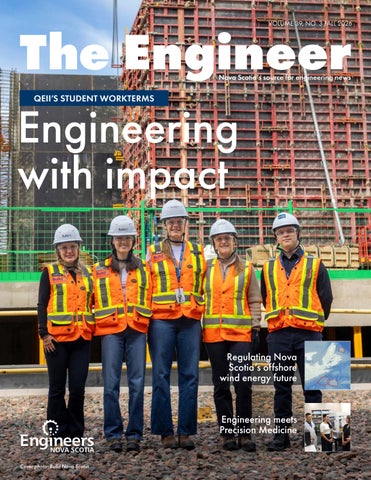
The Engineer
VOLUME 39, NO. 3 FALL 2026
Nova Scotia’s source for engineering news
QEII’S STUDENT WORKTERMS
Engineering with impact
Regulating Nova Scotia’s offshore wind energy future
Engineering meets Precision Medicine
Cover photo: Build Nova Scotia
1
Great ideas start with great people. Our engineers are trusted partners, problem‑solvers, and collaborators. Backed by strong leadership and a culture of respect, they deliver work that strengthens communities and sets new standards for what’s possible.
Explore engineering careers at stantec.com/careers
2
The Association of Professional Engineers of Nova Scotia
The Engineer
VOLUME 39, NO. 3 FALL 2026
Nova Scotia’s source for engineering news
QEII’S STUDENT WORKTERMS
Engineering with impact
Regulating Nova Scotia’s Offshore Wind Energy Future
Engineering meets Precision Medicine
Cover photo: Build Nova Scotia
1
Cover Image: Build Nova Scotia
President & CEO report
4
Why keeping your P.Eng. matters
7
AI in engineering: Moving beyond stigma toward responsible use
10
An engineer’s journey: Ismael Njoya, P.Eng.
14
How I spent my summer: Engineering with impact
18
From capstone to career: Engineering meets Precision Medicine
20
Regulating Nova Scotia’s offshore wind energy future
24
Potential for hydrogen energy in Atlantic Canada
26
Meet Nova Scotia’s newest Professional Engineers
31
Engineers Nova Scotia Council Dr. Jennie Rand, P.Eng Andrew Thalheimer, P.Eng. Dr. Sue Molloy, P.Eng. Martin Corbett, P.Eng. John Crane, P.Eng. Aaron Kennedy, P.Eng. Wayne MacDonald, P.Eng. Malcolm Palamarek, P.Eng. Krista Phillips, P.Eng. Kayleigh Rayner Brown, P.Eng. Brian Ward, P.Eng.
President Vice-President Past-President Councillor Councillor Councillor Councillor Councillor Councillor Councillor Councillor
Ex-Officio Members Denise Pothier, FEC, P.Eng. DS (Pal) Mann, FEC, P.Eng.
Engineers Canada Director CEO & Registrar
Zone Representatives Vacant Breagh C. Thomas, P.Eng. Jordan R. Foster, P.Eng. Abdallah M. T. Zeineddin, P.Eng. Vacant
Zone 1 Zone 2 Zone 3 Zone 4 Zone 5
Committee Chair Persons
The Engineer is a quarterly publication of Engineers Nova Scotia. Views independently expressed in this publication are not necessarily those of Engineers Nova Scotia Council and Staff. Engineers Nova Scotia reserves the right to edit or adjust content/articles submitted for publication.
Legislative Committees James Brown, P.Eng. Bob MacDonald, FEC, P.Eng. Darrin McLean, P.Eng. Dr. Sue Molloy, P.Eng.
Board of Examiners Complaints Discipline Nominating
Committees of Council Jeff Knapp, FEC, P.Eng. Andrew Thalheimer, P.Eng.
Finance & Audit Honours & Awards Committee
CEO Committees John Eisnor, FEC, P.Eng. Jade Farr, P.Eng. Darrell Marsh, P.Eng. Browren Allard, P.Eng. Craig Arthur, P.Eng. Audrey Hiscock P.Eng. Alan Ehrenholz, P.Eng. Selvana Hagh Gooei, P.Eng. Alexandra MacDonald, EIT
Continuing Professional Development Emerging Professionals National Engineering Month Professional Practice Public Safety Advisory Student Affairs Sustainability Women in Engineering Youth Engagement
3
President and CEO Report
Navigating change, maintaining trust “As engineering practice evolves, so must the systems, standards, and institutions that support it. ” Dr. Jennie Rand, P,Eng., President, Engineers Nova Scotia
Pal Mann, CD, FCSSE, FEC, P.Eng., ICD.D, CEO & Registrar, Engineers Nova Scotia
Over the past several months, we have found ourselves returning to a common theme in conversations with registrants, government, employers, academics, volunteers, and fellow regulators across Canada: change is accelerating. That change is visible in the projects shaping Nova Scotia’s future. It is visible in the growing discussion around artificial intelligence (AI), the emergence of offshore wind opportunities, continued pressure on infrastructure and housing, and the increasing mobility of engineering talent across provincial and national boundaries. It is also evident within Engineers Nova Scotia itself, where much of our recent work has been focused on ensuring that our regulatory systems remain effective, responsive, and grounded in public protection. For regulators, periods of rapid change present an important challenge. Our role is not to chase every trend or react to every headline. Rather, it is to ensure that the public can continue to have confidence that engineering work
is performed by competent, ethical, and accountable professionals, regardless of how technology, industry, or society evolves. That responsibility has shaped many of the discussions taking place around the Council table and throughout the organization this spring and summer. One of the most significant initiatives currently underway is our transition to Competency-Based Assessment (CBA), which remains on track for full implementation on January 1, 2027. This work goes far beyond changing the application process. It represents a modernization of how engineering competence is assessed, helping us better evaluate applicants based on demonstrated abilities rather than relying primarily on time-based measures. Council, staff, volunteers, and external advisors have continued advancing the policies, processes, and change-management activities necessary to support this transition 4
At the same time, registration volumes continue to grow across multiple applicant streams. Increased demand is encouraging, reflecting both the attractiveness of the profession and the needs of Nova Scotia’s economy. It also requires ongoing investment in systems, processes, volunteers, and staff capacity to maintain timely and fair registration decisions. Recent work involving the Board of Examiners, alternative pathways discussions, and examination of international qualification recognition all contribute to that broader objective. Modernization is also occurring in other areas of the organization. Council recently began discussing the development of Engineers Nova Scotia’s next strategic plan. While our current plan continues through 2027, both Council and management recognized that the environment facing the profession is markedly different from the one that existed when the current plan was developed in 2021. AI, digital service delivery, workforce expectations,
continued from page 4
competency-based regulation, legislative modernization, and changing public expectations are all reshaping the context in which engineering regulation occurs. Over the coming months, Council will help determine how registrants and stakeholders can contribute to identifying the priorities that should guide Engineers Nova Scotia into the next decade. We have also continued work on legislative modernization. Regulatory legislation must evolve periodically to remain effective and relevant. Conversations with government have focused on identifying opportunities to strengthen governance, improve clarity, support modern registration practices, and enhance public protection while maintaining confidence in self-regulation. Although much work remains ahead, the discussions to date have been constructive and encouraging. Another project that may seem operational in nature but carries broader strategic importance is our office relocation initiative. While the location of a regulator’s office is rarely the most exciting topic of discussion, the project is fundamentally about ensuring that our work environment and infrastructure support how services are delivered today and into the future. Considerable effort over recent months has focused on governance, planning, risk management, and long-term readiness rather than immediately pursuing physical changes. That deliberate approach reflects the same principles that engineers apply to major projects every day: define the problem thoughtfully before implementing solutions.
Beyond our own organization, we are also seeing important conversations emerge nationally. AI is increasingly becoming part of engineering practice, regulatory processes, and professional life. Engineers Nova Scotia has been actively engaged in discussions regarding responsible AI use, governance, professional accountability, and future guidance for registrants. While technology continues to evolve rapidly, one principle remains unchanged: professional judgment cannot be delegated to an algorithm. Engineers may use increasingly sophisticated tools, but responsibility for engineering decisions continues to rest with the engineer. Discussions with national regulators, professional practice leaders, and subject-matter experts have reinforced the importance of approaching AI with both curiosity and caution. Similarly, emerging industries such as offshore wind and onshore resource extraction present tremendous opportunities for Nova Scotia while raising important questions about licensure, competency, oversight, and public safety. These discussions are happening today, before projects reach full scale, because regulators have a responsibility to think proactively about risks as well as opportunities. As readers move through this issue of The Engineer, they will encounter examples of engineers contributing across a remarkable range of fields and career stages. From major healthcare infrastructure projects to industrial processes, mentorship, emerging technologies, and personal career journeys, each story illustrates something fundamental 5
about the profession. Engineering is not defined by a single discipline, industry, or project. It is defined by a commitment to applying knowledge, judgment, and integrity in service of the public. That commitment remains the constant thread connecting everything we do at Engineers Nova Scotia. Looking ahead to the coming months, our focus will remain on preparing for competency-based assessment, advancing strategic planning discussions, continuing legislative modernization work, supporting registrants through changing professional expectations, and ensuring that Engineers Nova Scotia remains a trusted and effective regulator. Change is inevitable. Public trust is earned. By continuing to adapt thoughtfully while remaining grounded in our mandate, we believe the profession is well positioned to meet both the opportunities and responsibilities that lie ahead. We hope to continue the conversation during our Professional Development Conference, Annual Business Meeting, and Engineering Excellence Gala, October 21–22 in Dartmouth, Nova Scotia. Registration is now open. On behalf of Council and staff, thank you for the work you do every day to uphold the reputation of the profession and protect the public interest.
Complex projects are failing. The future of engineering is integrated.
Dalhousie University’s Certificate in Systems Engineering and Complex Project Management will help you confidently navigate complex, interconnected, digital environments. Offered 100% online and at your own pace, you’ll come away with systems-based expertise employers need. This 3-course certificate could apply toward your professional development hours.
FOCUSED. FLEXIBLE. JUST RIGHT FOR WORKING ENGINEERS.
Register for the first course 6
Protecting the Profession
Why keeping your P.Eng. matters Submitted by Christine Larocque, Director, Communications and Information Technology, Engineers Nova Scotia met established standards, follows a code of ethics, maintains competence, and is subject to regulatory oversight. Why the professional community matters
Photo: iStock For many engineers, keeping a P.Eng. can feel like a practical decision. But the value of licensure reaches well beyond a current job description. It often starts as a practical question, especially at renewal time: “If my employer does not require a P.Eng., does not cover my dues, and I am not actively using the designation, why should I keep it?” It is a fair question. Licensure comes with cost, time, and ongoing professional development. If your employer does not require it, or does not cover the annual dues, it can be tempting to view the designation as something separate from your day-to-day work. But licensure has never been only about the job you hold today. It is part of a larger professional commitment—one tied to legal authority, public accountability, professional credibility, and the ability to step into new opportunities as your career evolves.
It is more than a credential In Nova Scotia, professional engineering is regulated in the public interest. Engineers Nova Scotia is the licensing and regulatory body for professional engineers and engineers-in-training practising in Nova Scotia or on Nova Scotia projects, guided by the Engineering Profession Act. The title “professional engineer” and the designation “P.Eng.” are not simply markers of experience; they are legal designations tied to licensure and good standing. That distinction matters. When engineering work may affect public safety, property, or the environment, accountability cannot be informal or unclear. It rests with licensed professionals, or with those working under their direct supervision. Licensure makes that responsibility clear. It confirms that an individual has 7
Self-regulation depends on public trust. Engineers Nova Scotia licenses qualified and competent individuals and supports registrants in meeting their obligation to practise engineering in the best interests of the public. That trust is sustained when licensed engineers uphold standards, practise ethically, and accept accountability for their work. Being licensed in Nova Scotia also means being part of a professional community with shared responsibility for standards, ethics, credibility, and the future direction of the profession. Maintaining licensure helps preserve what “P.Eng.” means: a trusted designation backed by standards, accountability, and a commitment to the public interest. When it is not required—but still matters For many practising engineers, this is where the question becomes personal. If your current role does not require a licence, why maintain one? One answer is that careers rarely stay exactly where they are. Responsibilities shift. New opportunities emerge in leadership, consulting, project authority, or different sectors altogether. Many of those paths either require licensure or are strengthened by it.
continued from page 7 Keeping your licence active helps keep those doors open. It also keeps you connected to a profession that extends beyond any one employer, role, or stage of career. Credibility that stays with you Professional credibility is one of the few career assets that can move with you. A P.Eng. signals that your competence and ethics have been reviewed and validated by an independent regulatory body. It carries weight across organizations, sectors, and jurisdictions, even when your current position does not require you to use the designation every day. Not every licensed engineer takes part in events, committees, or networking opportunities—and that is completely understandable. Still, the value of belonging to the profession is not limited to visible involvement. Even at a foundational level, being part of the licensed engineering community helps support a system that protects the public, reinforces consistent standards, and strengthens the credibility of the designation for all engineers. For those who choose to be more involved, that community can also offer professional development, mentorship, leadership opportunities, and a chance to help shape the future of the profession. Time, mentorship, and changing requirements Time is another real consideration, particularly for Engineers-in-Training and those balancing work, family, and professional development. Mentorship has long supported the development of safe, competent
practice. As Engineers Nova Scotia transitions to a competency-based assessment model, formal mentoring requirements will evolve. For licensed engineers, the focus remains on maintaining competence, practising ethically, and contributing— formally or informally—to the professional community. The cost question Cost is often the most immediate question. Annual dues are a real financial commitment, particularly when they are not covered by an employer. But dues are not simply a fee for services. They help support the regulatory framework that makes licensure possible and protects the trust and credibility associated with the profession. On a personal level, maintaining licensure helps preserve your legal status to practise professional engineering where applicable, your long-term career flexibility, your professional credibility, and your connection to the broader engineering profession. A professional commitment that extends beyond today’s role At its core, licensure is a professional commitment to public safety, ethical practice, ongoing competence, and the integrity of the profession. Even when it is not required by an employer, it still matters—to individual engineers, to the profession, and to the public we serve. Being a professional engineer is not only about the work in front of you today. It is about the trust you uphold, the standards you help carry forward, and the profession you remain part of— wherever your career takes you next.
Follow us on social media Stay up to date on Nova Scotia news and networking events Find out about your colleagues’ engineering achievements
9
Protecting the Profession
AI in engineering: Moving beyond stigma toward responsible use Submitted by Christine Larocque, Director, Communications and Information Technology, Engineers Nova Scotia Moving beyond the stigma
Photo: iStock Artificial intelligence (AI) is quickly becoming part of everyday professional life, and engineering is no exception. Yet for many in the profession, openly acknowledging its use still carries some hesitation. That tension is worth examining, not because AI should be adopted uncritically, but because engineers need a clear, practical, and professionally grounded way to think about it. Engineering is grounded in public trust, accountability, and sound professional judgment. Any tool that appears to automate thinking or produce outputs without clear traceability raises valid concerns. In a self-regulated profession, those concerns are heightened by the obligation to protect the public interest. However, avoiding AI altogether is neither practical nor forward-looking. As with any engineering tool, its value and its risk depend on how it is applied, governed, and understood.
There is a lingering perception that using AI may be seen as cutting corners or diminishing professional rigour. This concern echoes the introduction of technologies that are now foundational to engineering practice, including CAD, simulation software, and advanced modelling tools. AI does not replace engineering expertise; it can support it when used appropriately and with professional oversight. When used appropriately, AI can help structure information, organize large volumes of material, or considerations at an early stage. Its value lies in supporting early thinking and administrative efficiency, not in replacing analysis, judgment, or professional responsibility. Any output it generates should be treated as a draft that requires verification, context, and careful review. The responsibility never shifts. Engineers remain accountable for verifying outputs, applying judgment, and ensuring compliance with applicable codes, standards, and regulatory expectations. Transparency also matters. When engineers are open about how tools like AI are used, it supports consistency, shared learning, and better governance. Reducing stigma is not about encouraging unchecked adoption; it is about normalizing responsible, informed use.
10
Being clear about the risks That balanced view also requires a clear understanding of AI’s limitations, particularly in an engineering context where decisions can have real-world consequences. AI tools can: • Generate incorrect or misleading information, often presented with high confidence • Miss critical local context, including applicable codes, standards, and site-specific conditions • Reflect bias or incomplete datasets • Introduce confidentiality and data security risks when sensitive information is shared These are not minor concerns. They go directly to public safety, regulatory compliance, and professional responsibility. The principle is simple: AI outputs are not authoritative They should be treated as a starting point to be questioned, validated, and refined. In that respect, AI output is similar to any preliminary input: it may be useful, but it should never be relied on without professional review. Ultimately, the engineer remains responsible for every decision, every assumption, and every deliverable. The use of AI does not reduce that responsibility,; it reinforces the need for diligence.
A balanced path forward – AI Task Force
Where AI adds value Used thoughtfully and within appropriate professional boundaries, AI can offer meaningful value in engineering practice: • Efficiency and focus - AI can reduce time spent on repetitive or administrative tasks, allowing engineers to focus more fully on Photo: iStock analysis, design, and oversight. • Improved communication Engineering work often involves The following principles provide a translating complex technical practical foundation: information for different 1. Maintain professional | audiences. AI can support clearer, accountability - Engineers are more accessible communication responsible for all work produced, with clients, regulators, and regardless of the tools used. the public. 2. Verify and validate all outputs • Early-stage thinking - AI can Treat AI-generated content as assist with brainstorming and a draft. Cross-check against problem framing, helping codes, standards, and reliable engineers explore options and references. identify considerations earlier 3. Protect sensitive information in a project. Do not input confidential, • Continuous learning - As proprietary, or personal data into engineering disciplines evolve, public AI tools without AI can help professionals engage appropriate safeguards. more efficiently with new 4. Be transparent within teams concepts when used alongside Acknowledge AI use where trusted, authoritative sources. appropriate to promote • Day-to-day familiarity - Using consistency and shared AI in routine tasks such as understanding. writing, organizing, and planning 5. Establish organizational guidance can build practical understanding - Employers and regulators of both its capabilities and its should define acceptable use, limitations. including data handling and review requirements. These benefits are not about replac6. Invest in training and awareness ing expertise; they are about creating - Understanding both the more space for engineers to apply their capabilities and limitations of AI expertise where it matters most. is essential. Maintaining competence in a changing Recommendations for environment increasingly includes responsible use digital and AI literacy. 7. Use AI to support, not replace Integrating AI into engineering prac- - AI can assist with efficiency tice requires clear expectations, sound and insight, but decisions must judgment, and consistent application. always rest with the engineer. 11
Engineering has always evolved alongside technology. Each advancement required adaptation, oversight, and clear professional boundaries. AI is no different. The goal is neither to resist AI nor to embrace it uncritically. It is to approach it with openness, appropriate caution, and a clear commitment to responsible professional practice. To support this work, Engineers Nova Scotia is assembling an AI Task Force to participate in the development of a Professional Practice Guideline on AI use in engineering practice. Through a defined, time-limited mandate running from June to October 2026, the Task Force will work with the Professional Practice Committee, supported by the COO & Treasurer, to help ensure registrants have credible interim direction while a final guideline is prepared for Council approval. The Task Force will evaluate existing guidance developed by Canadian engineering regulators and other authoritative sources, identify gaps, and help shape both concise interim guidance for registrants and a final guideline document for Council to review and approve. The Task Force will focus on the principle that AI is a tool whose outputs must be understood, checked, and validated by a licensed engineer, while linking its use to established professional obligations such as accountability, duty of care, supervision and review, authentication of professional work products, and adherence to the Code of Ethics. For the engineering profession in Nova Scotia, the next step is not simply awareness; it is putting practical guidance in place. Done well, this work will strengthen responsible practice by reinforcing what matters most: public safety, professional integrity, and trust.
October 21:
Professional Development Conference October 22:
Annual Business Meeting & Engineering Excellence Gala
Early-bird prices now available
Founding Event Partner:
Showcase your organization by becoming a partner of the 2026 Engineers Nova Scotia Professional Development Conference.
engineersnovascotia.ca
Event Partnership 2026 Professional Development Conference & Annual Business Meeting & Gala
1355 Barrington Street, Halifax, Nova Scotia, B3J 1Y9 communications@engineersnovascotia.ca
Download the Partnership Package.
Profile
An engineer’s journey: Ismael Njoya, P.Eng. for his family as they adapted to a new country and culture. Their move to Nova Scotia unfolded over several years while Ismael continued working internationally before making Halifax his permanent home in 2025. “There was a culture shock. It was new, and it took me some time to adjust.” Ismael’s early experience laid the foundation for his engineering career. He moved to South Africa after high school to study at the University of Johannesburg, where he earned Ismael Njoya, P.Eng. a Bachelor of Engineering in Civil “Il faut toujours regarder de l’avant.” Engineering and later a master’s degree For Ismael Njoya, P.Eng., the French in Engineering Management. His interphrase meaning “one must always look est in engineering began early. “Ever ahead” has guided many of the big deci- since I can remember, I’ve been fascisions in his life. It set him on a path that nated by construction and the process began in Cameroon, took him across of transforming ideas into exceptional Africa’s mining and construction sector, infrastructure,” he recalls. “I’ve always and eventually brought him to Nova been drawn to the problem-solving Scotia. and coordination involved in building The idea of moving to Canada first something from the ground up.” emerged in 2017 during a conversaA university recruitment fair tion with a colleague who had worked helped launch his career. “At the time, extensively with Canadian mining the company was doing work in the companies. “He planted the seed in my Democratic Republic of Congo,” he mind,” Ismael says. At the time, Ismael explains. “Being bilingual in English had already worked alongside Canadian and French created an opportunity for engineers on mining projects in Africa me to enter the industry and begin my and saw Canada as a place where his career in this field.” family could build a future. “To me, it That opportunity introduced him was a win-win situation.” to industrial construction and mining, Ismael first travelled to Nova Scotia fields where he would spend more than with his family in July 2022, spending two decades working on projects across several weeks completing paperwork South Africa, Botswana, Namibia, and laying the groundwork for the Burkina Faso, Tanzania, the Democratic future before returning overseas for Republic of Congo, and other countries. work. “We didn’t settle immediately,” His work covered the full project lifecyhe recalls. Rather than relocating all cle, from feasibility studies and design at once, he chose a gradual approach, to construction, commissioning, and wanting to make the transition easier operational support. 14
Many of those projects were located in remote regions where engineering knowledge was only one part of the equation. “Most of the projects I was doing were in very remote areas,” he recalls. “You had local communities, villages, and people from different countries working together.” “You need to embrace the new culture,” he explains. “The more you understand the culture and the people around you, the easier it becomes to connect and work together.” As he settled into life in Nova Scotia, Ismael began working toward another important step in continuing his engineering career: becoming a licensed professional engineer.
Ismael’s family attending a Halifax festival. Through the Immigrant Services Association of Nova Scotia (ISANS), Ismael found a clearer path through the engineering licensure process. He enrolled in the Engineering Bridging Program, which helped him navigate licensure and connect with employment opportunities in Nova Scotia. “They explained what you need to do, the steps, the process flow. Before that, I was trying to piece things together myself,” he says.
continued from page 11
Inspecting a loading bay door project. In winter 2025, he earned his P.Eng. designation, formally recognizing more than two decades of engineering work across Africa and beyond. “Receiving my professional designation was a significant milestone for me,” he reflects. “It validates my skills, experience, and commitment to the engineering profession.” Today, Ismael works as a Capital Project Manager with Events East Group, which manages the Scotiabank Centre and Halifax Convention Centre on behalf of Halifax Regional Municipality and the Province of Nova Scotia. In his role, he manages infrastructure assets, leads capital projects, and oversees multidisciplinary contractors in environments where construction must happen around the rhythm of public events. At Scotiabank Centre and the Halifax Convention Centre, projects are planned around concerts, hockey games, conventions, and the constant flow of people through two of Nova
Scotia’s busiest venues. “The one thing I’m learning from this job is flexibility,” he says. “I have to adjust quickly.” One project Ismael particularly enjoyed was the upgrade of the public announcement system and digital signage throughout Scotiabank Centre. Unlike many of the industrial projects he managed earlier, this was a project where he could immediately see its impact on people. “After it was finished, the first Mooseheads game was amazing,” he recalls. “The lights, the digital signage, everything had changed.” Seeing guests respond to the changes gave him a different kind of satisfaction. “People were walking around saying, ‘Wow, what’s happening here?’” he says. “Just seeing that you’ve been part of something that makes the guest experience exceptional gives you that rewarding feeling.”
Ismael in his office. Long before engineering became his career, soccer was his first passion. “If I wasn’t an engineer, I wanted to be a professional footballer,” he says. As a teenager, he had a short stint with Cameroon’s under-19 national team and envisioned a future in the sport before engineering ultimately led him in a different direction. 15
Ismael’s first time skiing, at Ski Martock. Today, soccer remains an important part of his life. He plays in local leagues around Halifax and is a season ticket holder for the Halifax Wanderers. Outside of work, he enjoys spending time with his wife and three children and exploring Nova Scotia’s hiking trails. Reflecting on his own transition to Canada, Ismael understands how valuable guidance can be. “I understand that feeling of being lost, that feeling of being overwhelmed,” he says. “I had people help me along the way, and I’m more than willing to do the same.” For Ismael, looking ahead is not about leaving the past behind. It is about carrying each experience forward and continuing to learn and adapt with every new chapter. Through every transition, the principle that has guided him has remained constant: “Il faut toujours regarder de l’avant.”
Engineering a Healthier Future
An aerial view of the QEII Halifax Infirmary Expansion Project, where construction of the new 14-storey Acute Care Tower is now more than halfway through its vertical build, with work underway on Level 9. 16
Photo credit: Courtesy of PCL Construction 17
Engineering a Healthier Future
How I spent my summer: Engineering with impact Submitted by Build Nova Scotia Nova Scotia
From L-R: David Benoit, P.Eng., President and CEO, Build Nova Scotia; Norah Glennie of Cole Harbour (Civil Engineering Student, Western University); Marin Huypungco of Hammonds Plains (Mechanical Engineering Student, Western University); Britt Drysdale of Halifax (Mechanical Engineering Student, University of New Brunswick); Julia Mombourquette of Sydney (Chemical Engineering Student with a Certificate in Biomedical Engineering, Dalhousie University); and Nate Morrissey of Dartmouth (Electrical Engineering Student, Dalhousie University). Working alongside professional engineers, clinicians, contractors and project managers at Build Nova Scotia, Nova Scotia Health and PCL Construction, chemical engineering student Julia Mombourquette, mechanical engineering students Britt Drysdale and Marin Huypungco, electrical engineering student Nate Morrissey, and civil engineering student Norah Glennie are gaining an education that extends well beyond textbooks. “The Halifax Infirmary Expansion Project is more than a construction project—it’s an opportunity to inspire
the next generation of engineers,” says David Benoit, P.Eng., President and CEO of Build Nova Scotia. “By working alongside experienced professionals on a project that will improve healthcare for generations, these students are developing technical skills, learning the value of collaboration, and seeing how engineering can make a meaningful difference in people’s lives.” Each student arrived with different interests but quickly discovered that healthcare infrastructure demands constant coordination across disciplines—and that every engineering 18
decision ultimately affects patients and healthcare providers. Nate Morrissey says the experience has reshaped his career aspirations. “I’ve learned that teamwork on a project like this is unlike anything you experience in school,” he says. “The collaboration between engineers, tradespeople, healthcare professionals and project managers is what makes something this complex possible.” Julia Mombourquette says the project aligned perfectly with her passion for engineering and healthcare.
The new acute care tower will be substantially complete in Fall 2030 and open to patients in Fall 2031. “I was excited to work on a project that combines my interests in engineering and healthcare,” she says. “Knowing that even my small contribution will help improve healthcare for people in my province has been the most rewarding part of this experience.” For Britt Drysdale, the project’s impact is personal. “One day my family, friends and I may receive care in this hospital,” she says. “There’s something really special about knowing I played a small part in building it while I was still a university student.” The partnership between engineers and healthcare professionals has inspired Marin Huypungco.
“Every engineering decision has a direct or indirect impact on future patients and staff,” she says. “It’s rewarding to contribute, even in a small way, to a facility that will serve Nova Scotians for generations.” Norah Glennie says seeing the project come to life has reinforced why she chose engineering. “My proudest moment was visiting the construction site and realizing that I am helping contribute to something I can actually see,” she says. “This experience has opened my eyes to how much impact engineers can have on healthcare and people’s lives.” Beyond technical knowledge in areas ranging from hospital systems and 19
construction to project management, the students agree their greatest takeaway has been the value of mentorship, communication, and collaboration. As Nova Scotia builds the infrastructure needed for a growing province, experiences like these are helping develop the next generation of engineers—professionals who understand that behind every drawing, meeting, and design decision is the opportunity to improve lives. For these five students, this summer wasn’t just a work term. It was the beginning of careers that will help shape the future of engineering and healthcare in Nova Scotia.
Engineering for Impact
From capstone to career: Engineering meets Precision Medicine
Onika Drabble,EIT, IWK Health. For Onika Drabble, a Dalhousie University engineering graduate and Engineer-in-Training at IWK Health, the fundamentals do not change when working in a healthcare setting. The work begins with understanding systems, identifying constraints, and determining how to address a problem at the root cause. “In healthcare, those same engineering decisions can influence how quickly a family receives answers, how effectively a patient receives treatment, and how well healthcare teams can deliver care when it matters most,” says Drabble. That sense of purpose has shaped Drabble’s career path. She had
Drabble and three classmates, Perrin MacMullin, Rhea Proctor, and Shu Yang, selected it as their top choice and began working with both the Clinical Genomics team and IWK’s Process and System Improvement team. “Onika’s impact on our Clinical Genomics service has been extraordinary. What began as a capstone placement grew into a critical role that reshaped our testing pathways to support larger, Precision Medicine objectives”, says Boutilier. The first challenge was simply understanding the system. The lab manages many testing streams, each with its own routes, staff roles, timelines, and constraints. Drabble says one of the biggest learning curves was understanding the genetic testing itself, then translating that work into a process map and finally a discrete event simulation. Through that analysis, the capstone team identified a major capacity challenge. In 2023, the lab was at capacity considered going into medicine and and was referring many tests externally, had served for six years in the army as a either because of time constraints combat medic while studying engineer- or because the testing methodology ing. Two of her co-op terms were with was not yet available in-house. Those Nova Scotia Health, where she worked external referrals created two key issues: in an internal consulting role and could they cost two to three times more than combine the weight of purpose she in-house testing and sending tests to experienced as a medic with the engi- external laboratories meant valuable genetic data could not be retained for neering side of her brain. Her connection to IWK Health’s IWK’s own local knowledge base. The team focused on next-genClinical Genomics Lab began through her fifth-year capstone project at eration sequencing, a testing stream Dalhousie. Lee Anne Boutilier, then that was expected to grow, and that Manager of Clinical Genomics and included tests being referred out now Director of Precision Medicine, externally. Using software they learned had put forward a project to help the at Dalhousie, they built a simulation lab improve its operations. Onika of the next-generation sequencing 20
system. The goal was to replicate the current state of the lab and give the team a way to test possible changes without disrupting real operations; the purpose of the simulation was to determine what operational changes the lab could make in order to create additional capacity and then repatriate testing. “Simulation allows us to try different scenarios. It provides the environment where one can implement and trial changes to a system and understand its impact without the risk and investment associated with doing it
on the real system”, Drabble explains. The recommendations that came The model considered the full flow of from that modeling were accepted in next-generation sequencing work: case April 2024, with changes to workflow management, wet work involving the and operations implemented in the manipulation of liquids or biological following months to increase capacity. matter, sequencing, analysis, reporting, Drabble re-joined the IWK team as a and sign-off. It also had to account for full-time employee in September of different categories of staff, equipment 2024 to continue working on bringing capacity, run capacity, turnaround-time panel testing in-house and adding a expectations, workload of analysts and new stream of testing. lab scientists, and the effect of changThe lab repatriated 1182 individual Acknowledgements: Heleen Arts, Karen Bedard, Nick Bohle ing one part of the process on every patient cases through the creation of Martina Kaye, Victor Sampso other part. The teamHuyck, wanted Alice to avoid 86 new NextMartinez, GenerationCheryl Sequencing Rong Zengonly to push the panels in-house. This is 20% of all cases solving one bottleneck constraint further downstream. completed over the last two years. This
Completed NGS Cases by Month: Referred Out, Repatriated, and On Menu 300
3000
250
2500
200
2000
150
1500
CASES COMPLETED IN HOUSE: ON MENU
100
1000
50
2024
2025
2026
$60K
80
Cost Savings by Case Type (Repatriated Cases)
$50K
$50K $41K Exome (Trio)
$40K
Panel (Multi-gene)
$25K
Panel (Single-gene)
$26K
$0K $0K
$2K $2K $1K $3K
60
40
$25K
30 20
$4K
10
Apr May Jun Jul Aug Sep Oct Nov Dec Jan Feb Mar Apr May Jun Jul Aug Sep Oct Nov Dec Jan Feb Mar Apr May 2024
Charts courtesy of IWK Health.
70
50
$10K $9K $11K $12K
$10K
COST
$22K $23K
$38K $39K
$17K $16K $17K $18K
$20K
$0K
$36K
$33K
Exome (Singleton)
$30K
0
Apr May Jun Jul Aug Sep Oct Nov Dec Jan Feb Mar Apr May Jun Jul Aug Sep Oct Nov Dec Jan Feb Mar Apr May
2025
21
2026
0 CASES
CASE COUNT
0
500
CASES COMPLETED IN HOUSE: ADDED TO MENU
REFERRED OUT
60% 50% 40% 30% 20% 10% 0%
Onika Drabble, EIT, and her colleagues at IWK Health’s Clinical Genomics Lab. resulted in approximately $480,000 in cost savings (considering reagent cost plus HR cost versus the cost to refer externally). This enabled over 45 million variants to be added to the local genomic knowledge base to support future clinical analysis. In July 2025, the lab went live with whole exome sequencing, a type of next-generation sequencing that creates a much heavier analytical workload. The lab was able to repatriate 100 per cent of its exome cases with the capacity that had been unlocked, representing 135 cases while maintaining expected turnaround times of 10 weeks for routine cases and three weeks for urgent cases. “That’s a pretty competitive turnaround time compared to a lot of other commercial labs,” Drabble adds.
Local teams building the expertise, data and capacity needed to support precision medicine means a more sustainable approach to a growing area of care. Just as importantly, the lab was able to sustain performance throughout these efforts. Onika Drabble says average turnaround-time performance was 93 per cent, above the 90 per cent target, and the lab stayed above that target for 27 of the 30 months monitored during the project. The project’s next new deliverable is on the visual management side of things. Drabble is working with a genetics analyst specialist to help produce a dashboard so that the team can see what’s coming up next and prioritize the cases in the best way. 22
The project has shown Onika Drabble the importance of being embedded with the team doing the work. Clinical genomics was not a short-term consulting assignment with a simple handoff. It required ongoing capacity assessment, monitoring, project management, workflow analysis, and close collaboration with the experts inside the lab. “The lab is an incredible group of individuals who are experts in their respective fields; the successful repatriation efforts are a result of their hard work and commitment to continuous improvement. I deeply appreciate the opportunity to work with this team and continue to learn from them each day,” adds Drabble. That team environment is one of the things that continues to drive her.
Drabble, Jimena Prado, Sarah Russell Charts courtesy of IWK Health.
“I think about the dedication and drive of staff who directly impact patients and families,” she says of the clinical team around her. “I hope to emulate the qualities of a lab scientist or genetic analyst who is working meticulously to produce a result for their patient or an inpatient unit’s medical team committed to improving their patient’s condition on a day that could be one of the hardest for that family. Just because I’m not clinical does not mean my drive should be any different.” For Onika Drabble, the future also Cost vs. Cost to Refer Out depends on strengthening the relationship between IWK Health and Dalhousie University. She sees that connection as a pipeline for exposing more industrial engineers to healthcare, while helping IWK Health stay connected to the latest technical skills Added to the LocalShe has already and academic advances. movedKnowledge from capstone student Genomic Base to co-op student to full-time employee, and she has since advised on another capstone project.
Cost Savings >45 Million Variants
Turnaround “The IWK operates in a complex system that dealsand with Next a high degree Lessons Learned Steps Time of unpredictability. The methodologies taught in industrial engineering • Implement the WGS Pipeline Performance programs equip students for careers in health care where they can create Avg. TAT 93% impactful change in a dynamic environment • Streamline Panel .” Creation Process JanDrake, 2024 P.Eng, the Manager of Process & System Improvement at IWK Health -since Michael
Michael Drake, P.Eng, the Manager of Process & System Improvement at IWK Health agrees. “We were thrilled Onika made the decision to join our team in a full-time capacity upon her graduation in 2024. Through this, she has been able to bring continuity to the fter July 2025 work she beganGo-Live as a student.”
Whole Exome Sequencing
Cases) Repatriated Routine 10-Week Urgent 3-Week
• Implement Case Prioritization Dashboard
“There is so much space for indusFor an engineering discipline that trial engineers in healthcare,” Drabble is often associated with factories and • Process Improvement says. “The more industrial engineers we through production Continued lines, her work is a reminder canPipeline train and expose to the healthcare that industrial engineering also belongs Automation setting, the more people that will recog- in hospitals, clinics and laboratories nize, it’s where they’d like to work.” where the systems are complex, the data is immense, and the outcomes are life • Continue Capacity changing.
Assessment and Forecasting; Determine23 FTE Requirements to Sustain Analytical Volumes
Engineering for Impact
Regulating Nova Scotia’s offshore wind energy future The current focus is the licensing stage of the first offshore wind land tenure process in Canadian history. The federal Impact Assessment Agency first conducted a regional assessment to identify potential development areas. Following consultation, governments designated four wind energy areas: Sydney Bight off Cape Breton, French Bank near Guysborough, Middle Bank offshore of mainland Nova Scotia, and Sable Island Bank. Governments then directed the CNSOER to begin the licensing process. “The first step in the licensing process is when governments send us what’s called a strategic direction letter to start the offshore wind land tenure process,” Bonnell-Eisnor explains. From there, the CNSOER conducted an offshore wind Call for Information and a prequalification process. The Call A Canadian study group in Denmark at a wind turbine manufacturer, posing in for Information generated 77 submisfront of an offshore wind turbine base. sions from Indigenous groups, fishers, government, industry, and other interAs Nova Scotia takes its first steps The Canada-Nova Scotia Offshore ested stakeholders, providing feedback toward offshore wind development, Energy Regulator (CNSOER) has been on everything from possible licence Christine Bonnell-Eisnor, FEC, P.Eng., overseeing offshore petroleum activities terms and conditions to coexistence the CEO of the Canada-Nova Scotia since 1990. In January 2025, its mandate with other ocean users. “Coexistence is important. We Offshore Energy Regulator is working expanded beyond oil and gas to include to ensure the industry is built on a offshore renewable energy, making it recognize that we are regulating energy foundation of safety, environmental the lead and lifecycle regulator for both development in the ocean, where there are other ocean users. We have a longprotection, and public confidence. industries. Much of the public conversation “We used to be the Canada-Nova standing Fisheries Advisory Committee around turbines installed off Nova Scotia Offshore Petroleum Board,” says made-up of members of the commercial Scotia’s coast has focused on what Christine Bonnell-Eisnor. “On January fishing industry, including Indigenous offshore wind could mean for jobs, 31 of 2025, our mandate was expanded.” commercial fishers,” Bonnell-Eisnor investment, and energy production. That distinction is important, she adds. “Members of this Committee Less visible is the organization respon- notes. Offshore wind hasn’t replaced provide the CNSOER with advice sible for regulating the industry as it offshore petroleum within the regula- and suggestions for us to consider with develops. tor’s mandate. Instead, the organization respect to our regulatory activities. We regularly meet with them to learn, now oversees both sectors. 24
discuss, and address issues faced by offshore energy and fishing industries coexisting within the same ocean environment. We want to make sure there’s an open and two-way dialogue.” While the offshore wind Call for Information was occurring, companies interested in participating in the offshore wind Prequalification were required to demonstrate financial, technical, legal, and safety qualifications. Only prequalified companies will be allowed to participate in the upcoming offshore wind Call for Bids. Unlike petroleum licensing, the offshore wind process will not simply go to the highest bidder. “The offshore wind Call for Bids evaluation will be application based,” Bonnell-Eisnor says. “Those companies will have to submit various types of information to us and then we will evaluate it. Highest score wins.” One of the most common misconceptions about any offshore energy development, Bonnell-Eisnor says, is that receiving a licence means receiving approval to begin work. In reality, licensing is just the first step. Before any company can begin offshore activity, it must obtain authorizations from the CNSOER and satisfy extensive requirements related to safety, environmental protection, engineering, and operational planning. Site assessments, environmental studies, geological investigations, construction plans, operating procedures, inspections, maintenance plans, and eventual decommissioning all fall within the regulator’s mandate. Planning, design, construction, operation, maintenance, and end-oflife considerations must all be understood long before the first piece of equipment is installed. “That’s what
being a life-cycle regulator means. We the Netherlands, Germany, the United literally go from licensing all the way to Kingdom, Australia, Ireland, Brazil, decommissioning and abandonment,” Mexico, and the United States. “We’re constantly in a cycle of learnBonnell-Eisnor says. ing,” she says. That collaboration allows regulators to share lessons learned from incidents, new technologies, emerging risks, and best practices as offshore industries evolve around the world. At a time when governments are promoting offshore wind development and industry is pursuing opportunities, Bonnell-Eisnor is clear that the CNSOER is neither responsible for championing projects nor obstructing Christine next to an offshore wind turbine them. blade at the Port of Esbjerg, Denmark. “We are not a promoter,” she says. One of the engineering questions “We are regulating a process on behalf that will shape Nova Scotia’s offshore of governments.” At the same time, she rejects the idea wind future is whether turbines are fixed to the seabed or float on the ocean that regulation should become a barrier surface. Most offshore wind installations to project development. “If you meet the requirements, we globally use fixed-bottom turbines. “Floating means that it gets to will give you an authorization. We have a depth of water where the turbine to make sure it’s meeting the regulatory can’t be installed in the seafloor,” says requirements that are in place.” For the CNSOER, success won’t be Bonnell-Eisnor. In deeper waters, “It needs to float and then it’s anchored to measured by the number of turbines installed or the value of investment the seabed.” In Nova Scotia’s first licensing round, attracted to the province. Instead, governments have requested at least one Bonnell-Eisnor says success will mean 500-megawatt floating wind parcel at continuing to operate “with integrity as French Bank. The remaining parcels a regulator,” maintaining independence, are expected to utilize fixed-bottom transparency, and ensuring operators “take all reasonable precautions to technology. Regulators face the same challenge protect the health and safety of workers as industry: technology evolves quickly. and the environment.” If Nova Scotia’s offshore wind To stay current, the CNSOER relies on in-house engineers, geoscientists, industry eventually becomes a reality, environmental specialists, professional important work happens now, long development, external expertise, and before the first turbine begins turning, international collaboration. Bonnell- with regulatory decisions designed to Eisnor regularly exchanges knowledge ensure offshore development proceeds with regulators from Norway, Denmark, responsibly. 25
Sustainability Committee
Potential For hydrogen energy in Atlantic Canada Submitted by Dr. Martin Tango, P.Eng., and Samantha MacCallum School of Engineering, Acadia University
A review of hydrogen energy around the world Although hydrogen has been used industrially for decades, it has recently become a much larger area of interest as countries continue to search for cleaner energy solutions. It has the capacity to provide low-carbon energy to end-uses that are difficult to electrify directly, such as heavy transportation and industrial manufacturing, due to their demanding energy and operational requirements and is being increasingly recognized as a key technology for reducing greenhouse gas emissions and supporting the transition to low-carbon systems. Hydrogen can be produced through several pathways depending on the primary energy source and production technology employed. These methods
differ in their environmental impact, economic feasibility, and technological maturity. The most common production pathways include water electrolysis, steam methane reforming (SMR), biomass gasification, coal gasification, methane pyrolysis, and biological processes. Based on the feedstock and associated carbon emissions, hydrogen is commonly classified as green hydrogen, produced by water electrolysis using renewable electricity (This is a process in which water (H2O) is separated into Hydrogen (H2) and Oxygen (O2) by using electric power); blue hydrogen, generated from natural gas through steam methane reforming coupled with carbon capture and storage (CCS); and hydrogen derived from biomass or other low-carbon feedstocks. The suitability of each production route depends on 26
the availability of local resources, infrastructure, energy policies, and economic considerations. In the context of Atlantic Canada, the region’s abundant renewable energy resources, biomass availability, and existing industrial infrastructure provide opportunities to support multiple hydrogen production pathways, with green hydrogen expected to play a dominant role in the region’s long-term energy transition (Natural Resources Canada, 2020; Omid Yousefzade, personal communication, July 22, 2026). Therefore, since renewable energy powers the process, and hydrogen and oxygen are the only direct byproducts, green hydrogen produces little to no direct greenhouse gas emissions, making it an appealing candidate for sustainable energy production (Natural Resources Canada, 2024).
According to the International Energy Agency (IEA), global hydrogen production reached nearly 100 million tonnes in 2024, which represents an increase of approximately 2% from the previous year. Despite this growth, less than 1% of global production came from low-emissions sources, which demonstrates that a considerable expansion of green hydrogen production will still be necessary to meet future climate goals (International Energy Agency, 2025). Potential for hydrogen energy in Atlantic Canada Atlantic Canada is at a unique advantage in the efforts to utilize hydrogen energy due to its vast access to renewable energy resources, strategic location and growing government support. One of Atlantic Canada’s greatest advantages is its powerful winds, which can provide the necessary power in order to create green hydrogen. In addition, its unique location offers a variety of opportunities, such as access to deep water ports and being a close geographic region to European markets, which are also searching for reliable energy sources, especially in locations like Newfoundland and Labrador, where the combination of exceptional wind resources and pre-established port infrastructure has positioned the province as a promising hub for future green hydrogen production and export (Pourvaziri et al., 2026). Finally, Atlantic Canadians already have a preexisting wealth of knowledge in the realm of energy production, marine transportation, and industrial infrastructure, giving a strong foundation to work off and further supporting the development of a strong hydrogen economy. As of December 2023, approximately 80 low-carbon hydrogen projects have been approved across Canada, representing more than $100 billion in potential investment,
with fifty-nine projects being on the way, six projects being in advanced development at the time, and electrolysis being the dominant production pathway, as shown in Figure 1 (Natural Resources Canada, 2024). A feasibility study conducted for the Offshore Energy Association (OERA) concluded that hydrogen has the potential to become an essential component of the Maritimes’ transition toward a net-zero-emission energy system. The study found that hydrogen could help decarbonize sectors that are difficult to electrify while also supporting economic development and improving energy independence. However, it also emphasized that significant policy support and infrastructure investments will be required soon for the region to fully understand these opportunities (Zen and the Art of Clean Energy Solutions et al., 2020).
opportunities expected thereafter. The province’s Green Hydrogen Action Plan, released in 2023, states that hydrogen power is a key component in reducing the ongoing gas emissions within the province, as well as in economic growth. (Government of Nova Scotia, 2023). Nova Scotia also possesses some of the strongest winds in Canada, creating ideal conditions for large-scale hydrogen energy production through electrolysis. Many projects involving ammonia and hydrogen have already been proposed and are intended to supply both domestic energy needs and export to many different interested markets, such as those based in Europe. Because of all of this, hydrogen energy has the potential to not only lower emissions but to increase job opportunities, attract investment, and contribute to the province’s transition towards a low-carbon economy (Invest Nova Scotia, 2025).
Figure 1: Status and estimated hydrogen production capacity of announced Canadian hydrogen projects by development stage and production method. Note. Adapted from Hydrogen Strategy for Canada: Progress Report, by Natural Resources Canada (2024)
Nova Scotia is emerging as a particularly promising location for green hydrogen production. The government of Nova Scotia plans to license up to 5 GW of offshore wind capacity in its initial development stage, with additional 27
As Atlantic Canada continues to advance its green hydrogen initiatives, several factors will be important for achieving long-term success. Expanding renewable electricity generation, developing hydrogen production, storage,
and export infrastructure, and strengthening port and transportation networks will support large-scale commercialization. Continued collaboration among governments, industry, Indigenous communities, and research institutions, together with supportive policies and technological innovation, will further enhance the region’s competitiveness and help position Atlantic Canada as a reliable supplier of low-carbon hydrogen to domestic and international markets (Omid Yousefzade, personal communication, July 22, 2026).
Furthermore, while Atlantic Canada has abundant renewable resources, further research is still required to determine the most effective methods to integrate renewable energy systems and green hydrogen production into the regional energy systems.
Challenges of hydrogen production Despite its potential uses, hydrogen presents many economic, technical and logistical hurdles. One such example would be how green hydrogen requires large quantities of specifically renewable energy, and electrolysis remains more expensive than conventional hydrogen production in many ways. Currently, green hydrogen costs $5/kg larger-scale production projects; however, this figure does not necessarily reflect the cost of all production projects intended to serve the domestic demand in Nova Scotia. Small-scale production may exceed $10/kg due to costs being spread out across the lower production volumes, and because certain projects may suffer from higher electricity storage and distribution costs depending on location and other variables. On average, green hydrogen can cost roughly five times the cost of conventional hydrogen produced from natural gas, such as grey hydrogen. Most of the cost comes from the electricity used for electrolysis, which consumes about 50 kWh/kg of hydrogen produced (Public Policy Forum, 2023). Additional costs may also span general renewable-energy development, water treatment, electrolyzer installation and connection to electrical systems.
Photo: iStock Hydrogen can also be rather difficult to transport due to its low volumetric energy density. Typically, it must be compressed, liquified or converted into a carrier such as ammonia before it can be moved efficiently and safely over long distances. Each method requires additional equipment, infrastructure and precautions, which increases the overall cost throughout the hydrogen supply chain. Existing pipelines may also require certain upgrades to prevent leakage from any small pores or openings within the pipeline transmission network. Another issue to note with transportation would be that, despite Atlantic Canada’s unique advantage due to its seaside location and access to ports for exports, a substantial investment would still be required for the pipelines, terminals, storage facilities, and specialized vehicles designed with the product in mind. (Pourvaziri et al., 2026) Storage creates further challenges for a multitude of different reasons, such as compressed hydrogen requiring reinforced high-pressure tanks and liquid hydrogen requiring extremely low temperatures for it to remain in that state. Both approaches greatly increase project costs and require fine-tuned 28
safety measures. A potential solution for the issue of cost and space could be large-scale underground storage to store the hydrogen within, but its feasibility is highly dependent on the geology of the location due to requiring many specific conditions such as dense surrounding rock to prevent leakage and withstand the pressure of the hydrogen as well as a dense, impermeable cap rock above the storage area (International Energy Agency, 2021). In addition, producing green hydrogen through electrolysis requires significant quantities of freshwater. For every kilogram of hydrogen produced, about 9 kilograms of water are required. Consequently, efficient water management and continuous research on alternative production methods, such as seawater electrolysis, are crucial (Pourvaziri et al., 2026). Case study A prime example of hydrogen power’s utility in both transportation and industrial manufacturing is the use of hydrogen-powered forklifts in warehouses. Hydrogen-powered forklifts offer many key advantages over their battery-powered counterparts. They can be refuelled within few minutes, whereas standard batteries typically require a minimum of several hours to charge. This improves productivity within the facilities and prevents the need for downtime between charging sessions, allowing smooth, consistent work without interruption. In addition, due to hydrogen power’s eco-friendly emissions of simple water vapour, they are well suited for indoor use. Several large companies such as Walmart, Home Depot and Amazon have already adopted the use of this machinery, thanks to their economic benefit as well. A study of a facility operating 230 forklifts found that hydrogen-based fuel-cell systems reduced total lifetime ownership costs by
24% over a 10-year period, producing an estimated US$4 million in net present value savings while recovering the initial investment in less than one year. In addition, Plug Power claims that large facilities can save between US$260,000 and US$ 1.2 million annually compared with conventional battery-powered systems. These economic benefits, combined with swift charging times and improved work environment, explain why these large companies have adopted hydrogen-powered forklift fleets (Plug Power, 2023).
Photo: iStock A secondary example of the uses of hydrogen power would be the emerging application of hydrogen technology within the aviation industry, which is currently responsible for approximately 2-3% of global carbon dioxide (CO2) emissions (International Energy Agency, 2023). Unlike typical passenger vehicles, commercial aircraft require extremely high-energy-density fuel, making conventional battery systems impractical and nearly impossible for long-distance flights with today’s technology. Because of this, hydrogen is being explored as both a direct fuel and as a feedstock to produce sustainable aviation fuels (SAF’s). Many major aerospace companies, including Airbus, are actively developing hydrogen-powered aircraft concepts, intending to create commercially accessible hydrogen aircraft in the coming decades. In addition to reducing greenhouse gas emissions, hydrogen-based technology has the capacity to decrease reliance on controversial jet fuel and support
the decarbonization of one of the most difficult transportation areas to electrify (International Energy Agency, 2023; Airbus, 2024). References International Energy Agency (2025). Global Hydrogen Review 2025. Global Hydrogen Review 2025 – Analysis - IEA Natural Resources Canada (2024). Hydrogen Strategy for Canada: Progress Report. Government of Canada. https:// natural-resources.canada.ca/energy-sources/clean-fuels/hydrogen-strategy/ hydrogen-strategy-canada-progress-report Nova Scotia Department of Natural Resources and Renewables (2023). Green Hydrogen Action Plan. https://novascotia. ca/green-hydrogen/docs/green-hydrogen-action-plan.pdf Nova Scotia Department of Energy (2024). Offshore Wind Roadmap. Offshore wind - Government of Nova Scotia, Canada International Energy Agency. Hydrogen. Hydrogen - IEA International Energy Agency, (2021, October 22), Proving the viability of underground hydrogen storage. Proving the viability of underground hydrogen storage – Analysis - IEA Plug Power Inc. (2023, March 21.) Plug now offering turnkey hydrogen fuel cell solution that delivers savings over batteries for forklift fleets of 100 or fewer. https://www.ir.plugpower. com/press-releases/news-details/2023/ Plug-Now-Offering-Turnkey-HydrogenFuel-Cell-Solution-that-DeliversSavings-Over-Batteries-for-ForkliftFleets-of-100-or-Fewer/default. aspx?utm_ 29
Zen and the Art of Clean Energy Solutions, Dunsky Energy Solutions, Dunsky Energy Consulting, & Redrock Power Systems. (2020). A feasibility study of hydrogen production, storage, distribution, and use in the Maritimes. Prepared for the Offshore Energy Research Association (OERA). https:// oera.ca Invest Nova Scotia. (2025, April 29). How Nova Scotia is powering the future with offshore wind and green hydrogen. Winds of Change: How Nova Scotia is powering the future with offshore wind and green hydrogen | Invest Nova Scotia, Canada Airbus. (2024). Hydrogen Aircraft. Hydrogen | Airbus Pourvaziri, Z., Sabau, G.-L,. & Haghiri, M. (2026). Wind energy and green hydrogen production: A sustainable vision for the province of Newfoundland and Labrador, Canada. Academia Green Energy, 3. Wind energy and green hydrogen production: a sustainable vision for the province of Newfoundland and Labrador, Canada - Academia.edu Omid Yousefzade, personal communication, July 22, 2026. Acknowledgement We would like to acknowledge the initiative and vision of the Engineers Nova Scotia Sustainability Committee members in recognizing that a feature article on Hydrogen Energy in The Engineer is vital to disseminate sustainable energy to its members and community. Moreover, we are also grateful for the valuable editorial reviews by the Engineers Nova Scotia Sustainability Committee members to enhance the content and quality of this article.
Don’t wait to update. Stay in compliance.
Report your CPD hours throughout the year. Professional Engineers must complete a minimum of 30 professional development hours annually and submit them through the Member Portal by December 31. Failure to comply with the CPD Program may result in removal from the Engineers Nova Scotia Registry. Questions about the CPD program? E-mail CPDCommittee@engineersnovascotia.ca. 30
Congratulations!
Nova Scotia’s newest Professional Engineers
31
New P.Eng.
Walid Hisham Abdelmalek, P.Eng. Discipline: Mechanical Engineering University: Dalhousie University LinkedIn What inspired you to pursue a career in engineering? My parents are both engineers, and growing up, they inspired me to be curious and to want to learn how the things around me worked and functioned. By pursuing engineering as a career, I get to learn something new every day. What positive changes does earning your P.Eng. designation bring? Earning my P.Eng. alongside my Masters degree will open opportunities for greater responsibility and leadership, while strengthening my credibility and commitment to ethical and technical standards. Most importantly, it will let me keep growing as an engineer while contributing more to my field and community.
Manoj Das, P.Eng. Discipline: Civil Engineering LinkedIn
University: Visvesvaraya Technological University What inspired you to pursue a career in engineering? My passion for resilient infrastructure and problem-solving led me to civil engineering. Inspired by how built environments withstand natural forces, I wanted to design safe, sustainable civil structures—from power substations to earthquake-resistant buildings—that directly protect and strengthen communities. What positive changes does earning your P.Eng. designation bring? Earning my P.Eng. opens doors to elevated project leadership and technical authority across Nova Scotia. Beyond enhancing my professional standing, it deeply connects me to the regulated Canadian engineering community— enabling me to mentor emerging engineers, collaborate with industry leaders, and uphold public safety standards. 32
New P.Eng.
Mahsa Keyvan Hosseini, P.Eng. Discipline: Chemical Engineering LinkedIn
University: Dalhousie University What inspired you to pursue a career in engineering? I pursued engineering because I enjoy solving real-world problems through science and technology. I am motivated by the opportunity to develop solutions that protect aquatic environments and contribute to a safer, more sustainable future for communities and future generations. What positive changes does earning your P.Eng. designation bring? The P.Eng. designation reflects a commitment to continuous learning and ethical practice, enhancing my professional credibility, supporting ongoing development, and enabling more meaningful engagement within the engineering community.
Parisa Keyvan Hosseini, P.Eng. Discipline: Chemical Engineering LinkedIn
University: Dalhousie University What inspired you to pursue a career in engineering? I have always been curious about how things work. As a kid, I would search through my dad’s encyclopedias looking for answers to my questions. Growing up with my twin sister, who also earned her P.Eng. alongside me, made learning and exploring more exciting. Over time, the curiosity grew into a passion for engineering and solving real-world problems What positive changes does earning your P.Eng. designation bring? Earning my P.Eng. will let me take on more responsibility and contribute directly to real engineering work. It represents my growth and commitment to safe, proper practice. It will also open doors to more leadership roles, impactful projects, and more sustainable solutions. 33
New P.Eng.
Arman Mamazizi, P.Eng. Discipline: Structural Engineering LinkedIn
University: Khajeh Nasir Toosi University of Technology What inspired you to pursue a career in engineering? I’ve always enjoyed solving problems and understanding how things work. Structural engineering especially appealed to me because it combines analytical thinking with practical design to create safe and reliable structures that have a lasting impact on communities. What positive changes does earning your P.Eng. designation bring? Earning my P.Eng. is a significant milestone in my career. It represents the trust and responsibility of the profession and motivates me to continue growing as a structural engineer while contributing to meaningful projects and collaborating with other engineers.
Maggie McClure, P.Eng. Discipline: Energy Engineering LinkedIn
University: Carleton University What inspired you to pursue a career in engineering? I really enjoy problem solving and challenging myself to continue learning. I enjoy working on technical solutions to problems that have widespread societal impacts to improve the lives of people in my community. What positive changes does earning your P.Eng. designation bring? Earning the P.Eng. designation is symbolic of the commitment to the high ethical standards of the engineering profession. It opens the door to new opportunities and will allow me to take greater responsibility for my work. Obtaining my P.Eng. is a major career milestone and represents the hard work that it took to get here.
34
New P.Eng.
Diego A. Ortiz Villegas, P.Eng. Discipline: Electrical Engineering LinkedIn
University: Universidad Autónoma de Nuevo León What inspired you to pursue a career in engineering? I have always been fascinated by how electrical energy works and by the speed at which it makes life easier in modern society. Also, my curiosity about how electrical power systems work together with mechanical equipment to keep industries and communities operating safely and efficiently inspired me to pursue a career in Electrical Engineering. What positive changes does earning your P.Eng. designation bring? The designation represents years of dedication, resilience, and a commitment to maintaining the highest professional and ethical standards. It allows me to take on greater responsibilities and opens new opportunities to continue growing as an engineer.
Sadaf Rahbari Manesh, P.Eng. Discipline: Civil Engineering LinkedIn
University: Dalhousie University What inspired you to pursue a career in engineering? I’ve always been fascinated by the thinking behind structures, not just how they’re built, but why they’re designed as they are. I enjoy asking questions, understanding the reasoning behind engineering decisions, and continuously learning. Structural engineering gives me the opportunity to turn that curiosity into work that has a lasting impact. What positive changes does earning your P.Eng. designation bring? To me, earning my P.Eng. isn’t about reaching a finish line; it’s about earning the responsibility to contribute with greater confidence and accountability. It motivates me to keep learning, challenge myself with more complex work, and continue growing into the kind of engineer others can rely on. 35
New P.Eng.
Ahmed Rayyan, P.Eng. Discipline: Industrial Engineering LinkedIn
University: Dalhousie University What inspired you to pursue a career in engineering? A profession focusing on innovation and continuous improvement motivates me to keep learning and finding better, more efficient ways to make a positive impact. What positive changes does earning your P.Eng. designation bring? Earning my P.Eng. designation will strengthen my professional credibility, connect me more closely with the engineering profession while supporting my continued growth and ability to contribute to meaningful projects.
Nidhin Roy, P.Eng. Discipline: Electrical Engineering LinkedIn
University: Sri Ramakrishna Engineering College, Anna University What inspired you to pursue a career in engineering? I chose engineering because I enjoy solving problems and understanding how things work. I also like using technical knowledge to create practical and reliable solutions. What positive changes does earning your P.Eng. designation bring? Earning my P.Eng. designation will allow me to take greater ownership of my engineering work and pursue more senior opportunities. It will also strengthen my credibility with clients and colleagues and help me feel more established within the engineering community.
36
New P.Eng.
Thushara Madubashana Silva, P.Eng. Discipline: Mechanical Engineering University: University of Moratuwa LinkedIn What inspired you to pursue a career in engineering? I was always fascinated by mechanical engineering from a young age. I enjoyed understanding how things work and finding practical solutions to problems. I also discovered early on that I had a strong aptitude for mathematics and a genuine interest in science, which naturally led me toward a career in engineering. What positive changes does earning your P.Eng. designation bring? Earning my P.Eng. designation is an important milestone in my career. It will open new professional opportunities, strengthen my credibility as an engineer, and support my long-term career growth in Canada. As an immigrant, obtaining my P.Eng. is especially meaningful because it recognizes my professional experience and allows me to contribute more.
Scott Smith, P.Eng. Discipline: Mining Engineering LinkedIn
University: Dalhousie and StFX University What inspired you to pursue a career in engineering? I’ve always enjoyed solving problems and building things since I was a kid. Engineering allows me continue to learn new things daily and apply that knowledge to my work. What positive changes does earning your P.Eng. designation bring? I’ve always enjoyed solving problems and building things since I was a kid. Engineering allows me continue to learn new things daily and apply that knowledge to my work.
37
New P.Eng.
Sara Sohrabikhah, P.Eng. Discipline: Electrical Engineering LinkedIn
University: Dalhousie University What inspired you to pursue a career in engineering? I’ve always been curious about how complex systems work and how engineering solves real-world challenges. That curiosity led me to electrical engineering, research in sustainable energy, and careers in the oil and gas and power generation industries. Those experiences continue to inspire me to learn, innovate, and make a meaningful impact. What positive changes does earning your P.Eng. designation bring? Earning my P.Eng. marks an important milestone in my engineering career in Canada. It reflects years of education and professional experience, strengthens my credibility, opens new opportunities for growth and leadership, and enables me to make a greater contribution to the engineering profession and community.
Engineers Nova Scotia introduces new P.Eng. to the engineering community, with a portrait and a brief write-up.
Download the PDF form here. 38
Check out our recent publications: The Engineer
VOLUME 39, NO. 1 SPRING 2026
Nova Scotia’s source for engineering news
2026
THE PROJECT ISSUE
Pride in Engineering
Fishing vessel hoist certification
Engineers’ journey: Rana & Georges 1
Cover Photo: Nova Scotia Government
1
2026 Project Issue
2026 Pride Publication
G 2024
er The Engine VOLUME 37,
Nova Scotia
THE
NO. 1 SPRIN
’s source for
engineering
news
E PROJECT ISSU
Eight great Nova Scotia builds
Nova Scotia Court Ruling
vice: Faces of Ser o Engineers Wher Volunte : Nova Scotia
Cover Photo
2026 INWED Publication
Department
of Public Works
Submit your work for the Spring 2027 Project Issue
1
Deadline: January 29
Details: publications@engineersnovascotia.ca 39
Celebrate your work and reach an audience of 9500+ engineers
6th Annual
Golf Tournament
Photo credit: Osprey Ridge Golf Club
September 22, 9:30 AM Osprey Ridge Golf Club Pine Grove, Lunenburg County