Issue 9/2019 Climate of unrest Engineers grapple with climate change
Hazards ahead Looking after your wellbeing
To NASA and beyond When a Kiwi took control of a space rover
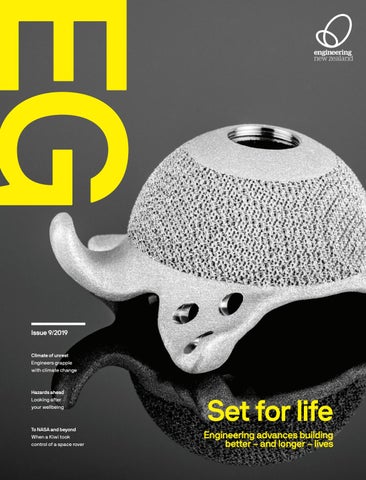
Set for life Engineering advances building better – and longer – lives
Designed with growth in mind.
In business, options are good. It won’t be their premises that limit Pack Tech’s ability to grow. Our signature approach to design and build construction provided future development options at the planning phase that they’re now capitalising on. The resource consent we secured for them during initial development covered the expansion of their production facility, further adding to the efficiency of growing their business. Time to move? We offer flexibility and choice like no other.
Let’s talk about a no-obligation feasibility plan. Visit calderstewart.co.nz
Contents
In this issue
06
16 28 06 To NASA and beyond What happens when a Kiwi takes control of a NASA space rover? 16 Climate of unrest What does climate change mean at a domestic level, and what impact does that have on engineers? 22 Set for life Engineers are behind the replacement of complex joints, attractive artificial limbs and other advances helping build better – and longer – lives. 28 Next stop: Precious Waikato
22
Features 10 Hazards ahead While perfectionist, detail-driven personalities can help engineers do their jobs well, the flip side is the risk to mental health. 16 Climate of unrest What does climate change mean at a domestic level, and what impact does that have on engineers?
Engineering New Zealand Te Ao Rangahau PO Box 12 241, Wellington 6144 New Zealand P 04 473 9444 hello@engineeringnz.org www.engineeringnz.org EDITOR Jennifer Black editor@engineeringnz.org DESIGN MANAGER Angeli Winthrop ADVERTISING SALES advertising@engineeringnz.org 04 473 9444 SUBSCRIPTIONS hello@engineeringnz.org CIRCULATION ABC audited net circulation for the six months ended 31 March 2019. New Zealand 14,311 Print ISSN 2537-9097 Online ISSN 2537-9100 EG ONLINE PDF versions of EG are available for members on our website. PRINTING Your cover is printed on Forest Stewardship Council (FSC) approved and elemental chlorine free (ECF) paper. The inside pages are Programme for the Endorsement of Forest Certification (PEFC) approved and elemental chlorine free (ECF). EG is printed using vegetable-based inks made from renewable sources. Printing and fulfilment by Printlink. Please recycle your plastic wrap – it’s New Zealand made and 100% biodegradable.
DISCLAIMER Advertising statements and editorial opinions expressed in EG do not reflect the views of Engineering New Zealand, its members, staff, or affiliated organisations unless expressly stated.
This issue of EG was published in December 2019.
22 Set for life Engineers are behind the replacement of complex joints, attractive artificial limbs and other advances helping build better – and longer – lives. 28 Next stop: Precious Waikato
Best practice 36 Run a good race The Rangitata Diversion Race was one of the most ambitious projects of its time. 39 Got a great idea? Protect it. We explain how. 40 Keeping current Electrical engineers, unite! 42 Bring it to the table Engineers can bring a lot to the boardroom table and while stakes can be high, good governance brings its own rewards.
43 Better design documentation Standardised documents have been designed to help smooth communication between councils and engineers. 44 Taking on a project There’s training, pathways and career progression opportunities for engineers who want to specialise in project management. 46 Intersection Crossing paths with engineers.
Shorts 48 Building a fine career How an afterschool job led to 50 years and counting in the construction industry. 51 Day in the life When the Central Interceptor project, and Ironman training, is all in a day's work. 52 The secret life of engineers A wakeboarder off to the world champs. 55 Leading questions Holmes Solutions' CEO shares his leadership tips.
56 Bedside table A Hokitika-based chemical engineer reveals the influences behind her reading choices. 57 Preview 59 Obituaries 60 Engineering genius
Correction: In Issue 8/2019 of EG we ran an article titled “Temporary situation” about the lessons WSP Opus learned after a scaffold collapse injured six workers. This article included the statement that WSP Opus was “found not to be in breach of the Act”, which is not correct. Because WorkSafe accepted Enforceable Undertakings from WSP Opus, charges were withdrawn, which means no finding was made. The company changed its name to WSP in October 2019.
03
Engineering Envy #12
Curiosity Rover
Has Mars ever had the right environmental conditions to support life? That’s the question NASA’s Curiosity Rover arrived on the Red Planet in 2012 ready to answer. Engineers designed the car-sized rover to roll over obstacles up to 65cm high and travel about 200m per day. It has a suite of scientific instruments, including a headmounted, rock-zapping laser, and radiation detectors which have found levels could pose health risks for humans. Its 2m arm can pick up samples from the planet’s surface and cook them inside the rover, then it sniffs and analyses the gases to work out how the soil and rocks and soil formed. With 17 cameras onboard, Curiosity treats earthlings to the odd “selfie”, whereby NASA stitches together more than 50 photographs the craft has taken of itself.
Rover's travel time to Mars
9 months Length of time on Mars
7 Earth years Full Mars year
Number of cameras on board
17
Curiosity’s Twitter followers
4,000,000+ Power source
4.8kg plutonium dioxide Electrical power produced
100W
Photo: NASA/JPL-Caltech/MSSS
687 Earth days
Your building could be put to the ultimate test. So we do the same to our steel. At Pacific Steel, we put all our products through a rigorous testing regime. Our dedicated laboratory has full IANZ certification and we’re the only local manufacturer of reinforcing steel to have third party ACRS certification. So when we say our SEISMIC® reinforcing steel is tested to meet the AS/NZS 4671 standard, you can be sure it’s been put to the ultimate test.
A steel bar about to be tested in one of five testing machines at our laboratory in Otahuhu.
PAC0015EIT
What they said
Editorial
05
Look after yourself
“These are really significant pieces of infrastructure and I think it’s fair to say that ... if there’s a major earthquake, this will be one of the safest places to be in Wellington.” Health Minister David Clark on new Wellington Children’s Hospital’s base isolators.
“I’m committed to making sure our car creates the kind of noise a rally fan enjoys.” Rally driver Hayden Paddon on plans to design and build the world’s first electric rally car with the University of Canterbury as a technical partner.
“Studying at university had been my intention from a young age, but I pursued an apprenticeship because I believed the skills I’d gain working hands-on with machinery would make me a better engineer.” Rocket Lab’s Peter Beck, new adjunct professor of aerospace engineering at The University of Auckland.
“Some of the buildings I should imagine do need to be demolished. I was half expecting Oliver Twist to run out from under one of the buildings.” Regional Development Minister Shane Jones announces nearly $20 million from the Provincial Growth Fund to re-establish Dunedin's Hillside workshop as a mechanical hub and heavy engineering facility to service KiwiRail trains.
Nau mai koutou katoa. Engineering is a great profession, and every day we’re helping make society smarter, stronger, safer, more resilient and better connected. But there’s a flip side. The demands increase as society wants more information, and quicker answers given in a way they can access and appreciate. Pressures increase as people have information at their fingertips and need our knowledge, experience and expertise to help with the interpretation. As your professional home, Engineering New Zealand wants you to be the best you can be, and we’ll support you professionally in every way we can. This includes supporting your wellbeing. We understand engineering is an extremely stressful industry and through our Foundation, we’ve created resources to ensure you’re mentally fit, and able to seek help when required. In this edition of EG, two brave engineers open up about how they suffered from, and managed, the pressure of their roles. There’s no “one size fits all” advice for dealing with the stress of our profession. I find much of my stress is self-inflicted,
as I lean towards perfectionist tendencies. If I get something wrong it ties me up in knots, then I try to find the positive by taking the opportunity to learn a bit more. But this doesn’t always work. When I ran WSP's business in Nelson for a few years I had a large turnover of staff, and nothing I did reduced the turnover. In the end I found myself with my head in my hands and tears in my eyes, frustrated at being ineffectual dealing with it. It didn’t help that my employer then dived in to find out what was going on and carried out a review of the culture in the office. In my mind this was a failure on my part, and one so bad my employer felt the need to step in. I found that talking through my frustrations and worries with my close associates was a great help during this tough time. With the Christmas period fast approaching, I hope you can have a break and take stock of where you’re at – go a little slower and recharge your batteries. Stay safe, and look after yourself and your loved ones. Ben Holland FEngNZ CPEng President, Engineering New Zealand
06
EG 9/2019
Profile
07
To NASA and beyond It’s a space rover like no other – essentially a ball that moves by jiggling itself around, and NASA hopes to use it to some day explore other planets. New Zealander Hammond Pearce was lucky enough to be
up of cables and rods. Its flexible structure allows it to withstand substantial impacts and move around on challenging ground. “What my supervisor wanted me to do was create a new, machine-learned
anniversaries of the Apollo Moon landing and the research facility’s founding in 1939, both of which were marked with a series of celebrations. He says while the technology on site is
handed the controls.
model that could drive it. So, we made an open-loop controller based on a spiking neural network, and then I tuned it on my computer to make it work under simulation.”
in varying states of modernity, a lot of it is still in working order and repurposed for new projects. “They’re updating and are still using a lot of the very old equipment – including from the 1960s, such as the vertical motion simulator, which was originally used to train Apollo astronauts. Then they updated it and it was used to train Shuttle pilots. Then they updated it again and it’s now used to train Orion and Dragon pilots.” It’s the same machine with new technology inside it, he says. “They’ve also got an Arc jet, which they use to simulate re-entry vehicles going all the way back to Mercury, and they’re still using it. But if you’ve got something that fires a huge amount of plasma at something bolted to a stick, you don’t really need to change that.” Once he completes his PhD, Hammond wants to get into post-doctoral research with an eye on a professorship – potentially at universities in the United States. While he won’t necessarily be pursuing space or robotics-related fields, he knows his time on SUPERball was worth it. “Once you’re on an academic pathway, the research you do is always the sum of everything you’ve learnt up to that point.” He says for any project involving safetycritical control systems in the future, he has an amazing case study to refer to. “The machine-learning and the spiking neural network I worked on – those apply to a huge number of scenarios, not just controlling a robot. Using those tools, I can take what I learnt and apply it to any number of case studies or research.”
As part of a National Aeronautics and Space Administration (NASA) internship, Kiwi Hammond Pearce helped design a prototype robot’s control systems earlier this year. One of four students selected for a New Zealand Space Scholarship, he spent 10 weeks working and staying at NASA's Ames Research Center in California with 250 other interns from around the world. The computer systems engineering PhD student at the University of Auckland was assigned to the team developing “SUPERball”. “It’s a very unique design, not your normal space rover with wheels,” he says. The work the interns were involved in was as wide as what the research facility does – everything from developing wings for commercial aircraft, to testing biomarkers for detecting life on other planets. “While some interns didn’t know what team they’d be in before getting there, I was fortunate in that I did know who I’d be working with. Before I arrived, I read all the papers the research group I’d be working with at NASA had published so I could hit the ground running. “My role was to do a proof-of-concept for a new software control of the explorer. The robot is very strange. Because it’s not your typical wheel design, controlling it is very difficult. NASA has worked on a number of algorithms for it that kind of work and kind of don’t.” SUPERball is a two-metre tall, collapsible robot based on a tensegrity design, made
It’s a very unique design, not your normal space rover with wheels.
Once the team was satisfied with the computer simulation, they applied it to the real thing at Roverscape, an 11,500-square-metre outdoor facility where NASA tests planetary explorers on a gravelly, Martian-like surface. Happily, the robot performed well, rolling across the ground without too much difficulty. Hammond was particularly impressed by what he saw at NASA Ames. “It seemed like there were a lot of moving parts on the base, and I really enjoyed it. Everyone was really friendly. It seemed like, from an outsider’s point of view, the sort of place where people who work there really want to be there.” NASA Ames is a huge research centre in the heart of Silicon Valley. Hammond’s time there coincided with the
VARIETY IS THE SPICE OF LEARNING.
20% OFF
Your commitment to 40 hours of ongoing professional development is due at the end of December, and there’s a host of ways you can achieve it. For a limited time only we’re offering 20% off all online learning, to help you be the best you can be. Learn more at engineeringnz.org/courses-events
Composite steel floor design just got easier Use our Excel based software for a complete floor design in accordance with AS/NZS 2327:2017 You might not have seen our work, but you’ll have walked on it!
Tray-dec New Zealand Ltd
P 09 820 9133 / E info@traydec.co.nz
www.traydec.co.nz
NELSON STUD WELDING P 09 820 9133 / E sales@nelsonstud.co.nz
www.nelsonstud.co.nz
16 Climate of unrest
22 Set for life
28 Next stop: Precious Waikato
Features
10 Hazards ahead
10
EG 9/2019
Hazards ahead WRITER ALEXANDRA JOHNSON
Perfectionists, detail-focused and driven. Whether overseeing public works or designing machinery, engineers can be responsible for ensuring the safety of thousands and the efficiency of industry and infrastructure. While these personality traits help engineers do their jobs well, they also come with risks, not least to mental health.
Feature
11
>>
EG 9/2019
12
Burnout and beyond Mid-career, civil engineer Kathryn Musgrave CMEngNZ was promoted to manager of transport operations for the Auckland motorway, a network that can be complicated. With around 60 direct reports at NZ Transport Agency (NZTA) at the time, the mother of two young children and self-professed perfectionist was in for a rough ride. “I was constantly on edge for something to happen, like a major crash or a civil emergency. I wasn’t meant to be on call, but during holiday periods I was fronting NZTA on TV and radio and I didn’t realise how much pressure that was putting on me,” she says. Her stress materialised as a constant need to be connected to work, obsessing over responsibilities and being unable to sleep. While her family was worried, Kathryn now realises it’s often the person who is reaching
She’s speaking out about her experience for a reason. “I don’t want anyone to go through what I did.” Kathryn believes civil engineers can’t get away from what they do. “When they are on holiday or in a different country, they are constantly looking for insight and new technical input, they just don’t relax.” By nature, she says, engineers are very technicallydriven people who are intent on delivering the right answer and solving problems. “It can get relentless and they need to learn how to deal with that early in their careers.” While an organisation and family are intrinsically involved in preventing, recognising and aiding recovery from burnout, she says it’s fundamentally about the individual and requires ongoing management to avoid
burnout who is the last to see it. “The day before my 40th birthday, I woke up and thought, I’m just so tired, and I physically broke down.” She was very ill and needed seven weeks off. “My counsellor and family thought I’d never return to what I was doing.” Recovery included rest, counselling, antidepressants and an acceptance and commitment theory course, which was about accepting the situation, knowing you can’t always solve problems, and putting in place mechanisms to deal with the way you are.
a recurrence. Kathryn ensures she takes lunch breaks, exercises, turns off her phone, practices acceptance theory, and meditates to look after herself. She also takes a keen interest in the wellbeing of her colleagues. Now the Technical Director Traffic Engineering and Planning at GHD, she says the company has a strong focus on people and culture and supporting people around wellness. “It’s important to embed a feeling of security and being able to talk about mental health issues is a critical one.”
>>
Feature
Battling depression Tony Harrison was also a mid-career engineer with a young family when the wheels came off. In 2010 he was in his office alone and found himself in tears. He’d been dry-retching in the mornings, felt physically exhausted and did not want to go to work. Getting well took some time, with treatment including antidepressants, counselling and building resilience. He has spent the past nine years learning about resilience and mental health and now, in addition to being a director of Hawke's Bay engineering consultancy Urban Connection, he offers workshops to organisations keen to improve staff wellness. “The training we do is all about growing resilience and being aware it is something you need to keep on top of.” The workshops cover Tony’s experience with depression and he encourages people to get help if needed. Workshops also focus on benchmarking – helping people work out where they’re at, and providing tools to increase resilience. Tony agrees wellness is not just about the individual. “It’s also your staff, your contractors, your clients, and most importantly, your friends and family. It’s about treating people with respect and being able to read them
13
He attributes some of the high levels of stress in the engineering profession to its gender imbalance. “Engineering is a male dominated industry, so that hasn’t created an environment where people are happy to talk, although thankfully, that’s changing,” he says. “Whether it is in the boardroom or office there’s a whole lot of blokes and a culture where people work late and work hard. That’s a badge of honour, which is ridiculous, but you don’t realise how unconstructive that is until you stop doing it.” A good friend told him speaking out about depression could end his career. “People feel that if you speak about it you won’t be put in a position because it might be too much for you. But if you admit some of the challenges and deal with them you are actually more resilient than other people.” His business has strong values around work/life balance and all staff work from home. “We don’t care how much our staff work as long as they get the outcomes. People can be very inefficient – even top fighter pilots have a maximum concentration of an hour and a half. You are lucky if people can get three of those in a day in a normal office, so we're more efficient and more focused when we are working.”
when they are under pressure.” >>
EG 9/2019
14
Wellness done well
2
Letitia Drury MEngNZ is the Southern Regional Manager at Beca, where flexible work guidelines provide a range of options for everyone in the team, including
1
Thirteen years ago, engineering firm Silvester Clark had a reputation for working staff hard. The leadership team, after attending a conference where three-day weeks were discussed, decided they wanted that reputation to change. The company implemented the option of a nine-day fortnight and is very satisfied with the results. “We believe that productivity has increased. People focus on efficiency to ensure they get the day off,” says Operations Manager Corina Mathie. “It’s a win/win as we have fresh staff and as a firm, we get better staff retention and are more attractive to future staff.” While 80-90 percent of staff have adopted the shorter week, some parents who can’t work longer days or people with transport issues are among those who have not. “Young people without children are very attracted to it which is a great selling point for us. It’s really useful to have a working day off where you can manage your life admin but still enjoy a full weekend.” The firm has other wellness initiatives such as fruit deliveries and family-friendly social events. “As each generation comes through, you have a different set of needs and expectations and we aim to be inclusive of everyone and create a place where people want to come into work each day.”
parents. “Focus groups informed our flexible working approach,” says Letitia. “Our new parenting policy has been a game changer, enabling all our people to have a choice in how they balance their work/life options in the early years of parenthood.” For her personally, the flexibility she has been afforded has built trust and loyalty. “I know that I’m trusted to do my job but encouraged to balance this with my home life. It makes me more focused and efficient at work and gives me the freedom to hone my train track building and colouring-in skills at home!” Letitia says it’s important to remember everyone is a whole person – what’s going on at home will impact work and vice versa. Encouraging balance has a positive impact on individuals and the wellbeing of the team as a whole, she says. “A holistic approach is key – at the end of the day an organisation is nothing without its people.”
>>
Feature
15
3
Colin Crampton FEngNZ is Chief Executive of Wellington Water, where they’ve established progressive initiatives aimed at maintaining staff mental health and preventing problems from arising. Establishing a strong company culture and workplace wellness is his priority, but he admits it’s a journey, and can be hard to do well. The organisation has a wellbeing committee of staff representatives who look at social, physical and mental health for the benefit of all employees. They arrange speakers and run programmes for staff around mental health. From celebrating diversity to encouraging flexible work hours, the organisation embraces a range of areas to encourage wellness, including a quarterly staff health, safety and wellbeing survey, where they track comments and look at trends. Colin says the key to managing workplace wellness is firstly to recognise wellness. “As people and organisations mature through the health and safety agenda, they generally start with safety as a result of the work people do, and then they will focus on workplace safety, and then start to focus on wellbeing. It’s the normal maturity curve. “You have to differentiate workplace safety from wellbeing, start a conversation off and get your whole organisation to understand the difference. You have to get the context right.” If a staff member is struggling, he says, they have a personal responsibility to put up their hand. “But the real first step is that the manager has a relationship with that individual so they feel safe to talk. The manager needs to be able to ask them if they are ok,” Colin says. “It all comes back to culture and managers looking after their troops.”
The Engineering New Zealand Foundation has launched resources to help engineers cope with stress and maintain positive mental health. Find out more at engineeringnz.org/ managing-your-mental-health
EG 9/2019
16
Climate of unrest What does climate change mean at a domestic level, and what impact does that have on engineers?
WRITER MATT PHILP
Feature
17
Whanganui flood, 21 June 2015. Photo: Mark Brimblecombe
>>
18
EG 9/2019
>> 1
The floodwaters topped 6m before the stopbank failed, releasing the swollen Rangitaiki into the streets of Edgecumbe in April 2017. While the rest of New Zealand was heading to work, the Bay of Plenty town was inundated by a wall of water that flooded 70 percent of the houses and forced the evacuation of around 1,600 residents. At least a dozen homes were destroyed or rendered permanently uninhabitable. This flood reinforced just how vulnerable parts of New Zealand are to catastrophic inundation. As Sue-Ellen Fenelon CMEngNZ, Manager of Climate Policy at the Ministry for the Environment (MFE), says: “Edgecumbe was a reminder for everyone because it was really traumatic for those affected”. But it was also a graphic intimation of the destruction we could see more frequently as a result of climate change. A stark assessment based on two reports released earlier this year by the National Institute of Water and Atmospheric Research (NIWA) and the Deep South National Science Challenge reveals the extent of our vulnerability. According to the New Zealand Fluvial (river) and Pluvial (rainfall) Flood Exposure report, almost 700,000 people and more than 410,000 buildings worth $135 billion, as well as 20 airports and 19,000km of roads, are exposed to river flooding from extreme weather events. The second
buildings worth $12.5 billion, are at risk of extreme coastal flooding. It says for every 10cm of sea level rise, thousands more individuals and billions worth of homes and assets would come under threat. And this is not only a future of storm surges and coastal erosion. “The one issue that I think is under-recognised is drought,” says Tonkin + Taylor Climate and Resilience Specialist James Hughes CMEngNZ CPEng. He was a member of the Government’s cross-sectoral Climate Change Adaptation Technical Working Group in 2017 and 2018, and is now working on the National Climate Change Risk Assessment team. “Drought incidence is something we need to understand a lot more about, particularly in the north and on the east coast. What are the cascading impacts we might see? For example, if we continue to discharge contaminants into water bodies, and we have more drought conditions, the ability of those bodies to absorb contaminants is affected – there’s a multiplier effect.” The engineering profession is going to be central to preparing New Zealand for this potential future, shoring up defences against flooding and coastal erosion, adapting cities and infrastructure, and rethinking design. There will also be an element of communicating these
report, Coastal Flooding Exposure Under Future Sea Level Rise, concludes that 72,000 New Zealanders and 50,000
new possibilities. In addition to her role at MFE, Sue-Ellen is a member of Engineering New Zealand’s Board.
Feature
19
1. NIWA hazard analysts in Edgecumbe shortly after the 2017 Rangitaiki River flood. Photo: Dave Allen/NIWA 2. NIWA scientist Dr Murray Hicks operating a RealTime-Kinematic GPS (RTK-GPS) in the Waimakariri River. Photo: Dave Allen/NIWA
2
How can we design our cities to absorb more water, to have more permeability where appropriate?
She says: “Engineers can play a vital role in helping communities to understand.” Climate change is a planetary phenomenon with specific local effects. Recently, Tonkin + Taylor helped Local Government New Zealand (LGNZ) to quantify that sector’s exposure. According to the 2019 report, Vulnerable: The Quantum of Local Government Infrastructure Exposed to Sea Level Rise, nearly $8 billion worth of council infrastructure is likely to be at risk from a 1.5m rise in sea level. With sea level rise of 3m, the exposure reaches $14 billion. Says James: “We’ve prepared guidance for elected
environmental or climate data? Do you understand flood hazards? Does your flood modelling allow for climate projections? Are you monitoring rainfall or groundwater levels?’ It’s about having the right information available to make informed decisions.” For the engineering profession, climate change means rethinking design parameters. “How are we managing events over and above our normal parameters? We need to check that no catastrophic damage occurs with climate change added on top.” James says engineers also need to work more collaboratively with other disciplines. “Particularly in the land use planning context – planners, ecologists, urban designers and so on. There’s a recognition that a water-sensitive design approach is more climate resilient, so how can we design our cities to absorb more water, to have more permeability where appropriate? “For example, having more green buffers not only responds to increasing flood hazard, but also to issues of temperature and shade, while having other benefits such as biodiversity.” Engineers can bring their expertise to designing adaptive solutions, he adds.
members and senior officials, which includes questions for technical staff. ‘Are you collecting the right
“How can we design systems that are more flexible or adaptable or modular? Given uncertainty in the future,
– James Hughes
>>
20
EG 9/2019
>> 1
2
3
1. Ian Heslop and Matt Surman (Environment Canterbury), check rock erosion protection on the Waimakariri River. Photo: Environment Canterbury 2. 3D reconstruction of flooding in Leeston, Canterbury. Image: Mappazzo 3. Sharon Hornblow (Otago Regional Council) and Phil Glassy (GNS Science) analyse core samples recovered from a drill hole at Tonga Park, South Dunedin. Photo: Otago Regional Council
Feature
are we designing something that we are going to have to rebuild completely if and when its design capacity is exceeded, or can we build solutions in a way that can be easily augmented?” This adaptive approach is in keeping with a new approach to planning at the local and national level. In a 2017 guidance document, Preparing for Coastal Change, MFE recommended that local government adopt “dynamic adaptive pathways planning” – essentially, maintaining flexibility in the face of an uncertain future. “It’s about recognising that if you do something now, you need to consider whether it’s the right solution for 100 years from now, and whether it’s the best use of available money, so you line up a whole lot of decision pathways for different options,” says Sue-Ellen. So, what’s happening on the ground around
effects,” says ECan Principal River Engineer Ian Heslop CMEngNZ CPEng IntPE(NZ). Nevertheless, he adds, “the Waimakariri River flood protection system and floodplain management approach will need to be continuously monitored, modified and upgraded to keep pace with increasing flood flows and sea level rise”.
New Zealand? Ramon Strong CMEngNZ CPEng IntPE(NZ) is Group Manager River Management for Horizons Regional Council, which covers the Manawatu-Whanganui region and includes 160km of western coastline, as well as the Whanganui and Manawatu rivers. Ramon says river managers from Northland to Southland have climate change front of mind. “It’s a big focus for us, and there’s a lot of discussion about how we can achieve a greater level of protection for our communities over time.” In the case of Horizons, a 2016 analysis by NIWA, Climate Change and Variability – Horizons Region, determined that the net effect on flood frequency for Palmerston North isn’t large. “In part, that’s because the west is likely to get wetter, and the east drier, and the catchment spans both,” he says. For the same reason, however, the Whanganui River is likely to flood more frequently. The council is now conducting a more indepth climate change assessment of the Whanganui catchment, Ramon says. “We want to get a better understanding of the current situation in terms of the likelihood and frequency of large flood events, and to overlay that with what climate change might lead to in terms of changes in rainfall.”
drone photogrammetry overlaid with hydraulic modelling data, the 3D reconstruction of Leeston can be used by the district council to identify specific impacts of predicted flooding and communicate risks to the community.
Identifying impacts of flooding Also in Canterbury, the Selwyn District Council recently engaged spatial data experts Mappazzo to build a 3D reconstruction of the flood-prone Leeston township, where the council has invested heavily in flood deviation infrastructure. “They needed to get their heads around what remaining flooding would be happening,” says Mappazzo Managing Director and engineer Kelly Norris. Using
Lying low
Environment Canterbury (ECan) has just concluded a 10-year endeavour to bolster the flood defences of greater Christchurch and surrounds. The Waimakariri Flood Protection Project involved the upgrade of 35km of primary stopbank and the construction of a 25km secondary stopbank, increasing the design flood capacity to 5,500 cumecs and 6,500 cumecs respectively. “It’s recognised that climate change will increase the risk of these design floods over time, but the very high
In low-lying South Dunedin, which has a track record of damaging flooding, the Dunedin City Council has budgeted $35 million over 10 years for alleviation measures. But given the likelihood of rising sea level and more frequent severe weather events, a long-term fix is needed. South Dunedin is not only home to 9,000 residents, some of whom live less than 50cm above sea level, but also a Transpower substation, a sizeable commercial district and Dunedin’s main water treatment plant. “And it’s not only an issue of rising groundwater and sea level, because there are also geological hazards present,” says Otago Regional Council General Manager Operations Gavin Palmer CMEngNZ. “We need to take a multi-hazard approach.” The Otago Regional Council and the Earthquake Commission have funded a research project to better understand the relationship between groundwater and sea level in South Dunedin, using pressure-sensitive piezometers deployed in 15-metre-deep holes drilled across the suburb. Gavin says the data is still being analysed, but can say “that as sea level rises in the future, we can expect that permanent groundwater levels will also rise in parts of South Dunedin, making flooding more likely”. Stormwater management will only be one part of the response, he suggests, and engineers will play a key role in finding other answers. “This is going to require consideration of all potential options. I think engineers are well-placed to do that,
standard of protection offered by the combined system provides substantial future-proofing for climate change
because this is what they do well: think long-term and holistically about solutions.”
Canterbury’s mighty river
21
22
3D-printed prosthetics for the lower arm, the foot and below the knee. Photo: Olaf Diegel
EG 9/2019
Feature
23
Set for life WRITER REBECCA HAYTER
Think replacement body parts, and The Six Million Dollar Man and The Bionic Woman of 1970s television might spring to mind. But while permanently attached, fully functioning, replacement limbs remain in the future, engineers are behind the replacement of complex joints, attractive artificial limbs and other advances helping build better – and longer – lives.
>>
EG 9/2019
24
New Zealand is emerging as a leader in prosthetic implants thanks to biomedical engineering – the combination of engineering, medicine and biology to improve human life. Additive manufacturing (AM), also known as 3D printing, is often key. Christchurch-based tech firm Ossis was an early adopter of AM more than a decade ago, and uses it to manufacture custom orthopaedic implants in titanium alloy. As well as being biocompatible and chemically stable in the human body, titanium has good mechanical properties. For example, the titanium screws used to secure the implant into bone comfortably withstand the torque. But titanium’s greatest advantage is that the bone grows onto and adheres to the implant, adding stability, so it has replaced stainless steel implants as the current
in this case, in powdered titanium alloy. There is minimal waste as the unused powder is collected and used to grow the next implant. A multi-axis milling machine completes the finishing touches. “When we first started,” says Bethany, “it was pretty limited, including in the materials you could use, but now they can use titanium and they’re working on carbon.” This will enable composite implants with specific properties in different layers, or soft and hard areas in the same implant.
“go to” choice of implant material. Ossis Development Engineer, Bethany Oates, says the company has developed porous, open mesh titanium implants through which bone and soft tissue can grow to keep the implant in place. The use of titanium was a breakthrough, she says, because the body accepts it easily. “For the soft tissues, that’s very important.”
Bethany says a 19-year-old woman recently received a titanium implant after a large section of her pelvis was removed due to a tumour. Ossis created a custom-fit titanium implant to replace the missing section, aimed at ensuring the woman will enjoy a comfortable, active life. The intention is for the implant to outlive its host. To create a custom fit, Ossis uses CT scans to generate a computer model of the patient’s anatomy in the target area. The AM software slices the 3D computer model into thin, two-dimensional digital layers and converts them
He says New Zealand’s prosthetics industry has a high number of young people compared with overseas organisations, which are usually staffed by traditional craftspeople. “A key ingredient in biomedical engineering is the ability for experts in different fields to work together,” he says. Surgeons, biologists, software engineers and engineers from other disciplines are all involved in the creation of 3D artificial limbs. His own team is working with the University’s Ophthalmology Department, developing 3D-printed corneal replacements in collagen-based materials made from fish scales. The engineers are driving the technology but they need the ophthalmologists’ input to ensure the material is suitable for optic engineering. The corneal replacements have a low risk of rejection because human bodies already contain collagen. Sometimes prosthetics are rejected on emotional grounds, including aesthetics and comfort. “An amputee’s residual limb gets bigger or smaller depending on their activity through the day, which means standard prosthetics become uncomfortable as the fit changes,” says Olaf. “We’ve had two students spin out a little company called ProstheteX. They’re doing very light, comfortable prosthetics that expand or contract with the amputee’s limbs.” So far, so good, but with the use of stem cells to create artificial organs, it gets controversial. Simple organs such as bladders and tracheas are created overseas using layers of the patient’s stem cells suspended in hydrogel. The stem cells “know” they’re supposed to be a bladder so they grow into the bladder and replace the hydrogel. The risk of rejection is small. The next step, to complex organs, is still two or three decades away. A new pancreas would cure diabetes overnight; a new kidney would free a patient from dialysis,
into machine language for the 3D printer, which creates the physical, three-dimensional object, layer by layer –
but these complex organs are dependent on artificial vascular systems.
A key ingredient in biomedical engineering is the ability for experts in different fields to work together. – Professor Olaf Diegel
It’s all about the optics Professor Olaf Diegel, head of the Creative Design and Additive Manufacturing Laboratory at the University of Auckland’s Faculty of Engineering, has worked extensively to develop prosthetic limbs in New Zealand and Europe.
>>
Feature
1
3
1. Ossis' 3D-printed titanium AceOSTM implant, designed to treat pelvic bone loss or dissociation. Image: Ossis 2. Digital model of a pelvis. Image: Ossis 3. ProstheteX compliant prosthetic socket allows a patient's limb to expand or contract. Image: Sebastian Weaver/ Connor Talbot. 4. 3D-printed passive prosthetic arm, made from a 3D scan of the patients’ residual limb. Photo: Olaf Diegel
25
2
4
>>
EG 9/2019
26
“Once they crack that, they’ll be able to print the more complex organs,” Olaf says. “I’m pretty confident that in my lifetime it will happen.” It raises questions around whether such expensive treatment will be widely available and how long humans want to live.
Breathe easy Fisher & Paykel Healthcare is also developing new materials to make treatment more comfortable for patients. The company designs and manufactures humidification products for use in respiratory care, acute care, surgery and the treatment of obstructive sleep apnea. With a degree in mechanical engineering, an MBA and substantial experience in the medical device industry, Laurence Gulliver is the company’s General Manager – Noninvasive Ventilation. He oversees the team that designs masks and tubes to deliver optimum humidity levels while a patient is being ventilated in hospital. Humidity helps ensure the respiratory system isn’t damaged by dry gas going into the lungs. “With noninvasive ventilation, two of the biggest challenges are patient discomfort and condensation in the tubes that deliver the treatment,” says Laurence. “We use innovative materials like silicone to make masks that are softer and more flexible and can adjust to different face shapes. To improve comfort, we developed a technology called Rollfit using silicone, which helps
We use innovative materials like silicone to make masks that are softer and more flexible and can adjust to different face shapes. – Laurence Gulliver
minimise pressure on the nasal bridge while maintaining a secure seal over the nose.” When a patient is being ventilated, drops of water can build up in the delivery tubes, interfering with the patient’s breathing. Opening the breathing circuit to remove the condensation can expose the patient to bacteria or infection. “We solve this problem by developing clever surface finishes and permeable materials that ‘breathe’,” says Laurence. “This allows water vapour to diffuse right through the tubing wall.”
Laurence Gulliver with Fisher & Paykel Healthcare's Rollfit technology. Photo: Fisher & Paykel Healthcare.
>>
Feature
Marco Schneider and Tony Tse, developers of the Vivify headset. Photo: Vivify
Subtle subtitles While 1970s television entertained its audience with super-powered limbs costing $6 million, in 2019, hearingimpaired people can enjoy movies for a much cheaper price, without bionics. That’s thanks to Vivify, developed by two PhD graduates from the University of Auckland. Marco Schneider completed his PhD in biomechanics, specialising in computational tools for clinical analysis of joint diseases, and was working with medical imaging data. Tony Tse, who is hearing-impaired, was working on underwater acoustic sensing technology. He mentioned his frustration that few movies in New Zealand cinemas have subtitles because most patrons don’t require them. That led the pair to develop the Vivify headset which shows the viewer a virtual projection of subtitles while watching a movie. Off-the-shelf, augmented reality headset technology is generally designed for close range, where images are projected at a virtual distance of approximately 2m. That wasn’t suitable for Vivify because the cinema screen may be 20m away, requiring the viewer to focus on the words
“Using a concept of mixed reality, we create a virtual image of the subtitle and then overlay it onto the movie screen. The challenge is in how well we discreetly combine the virtual image with the real image and at what distance we set the image, so that moviegoers enjoy the experience.” Vivify has made technology that allows them to wirelessly broadcast the subtitles in any major language including English, Chinese, French, German and Spanish. It is popular with immigrants to New Zealand, as well as hearing-impaired people. “There are a lot of challenges with synchronisation,” Marco says, “but we enable the cinema to supply the subtitles of their movies at the right time without affecting other moviegoers.” The current Vivify prototype has parts of an iPhone for the processing component of the optical system and the chips installed with Wi-Fi but Marco and Tony are redesigning the device to make it lighter and more comfortable.
and the screen at different distances. “We’re trying to tackle the optics,” says Marco.
“It’s plug and play,” Marco says. “So as long as the movie has subtitles, we can do it.”
27
28
EG 9/2019
Next stop: Waikato
Precious Waikato
Feature
29
WRITER RACHEL BERRY
While the rolling hills and lush green pastures of Hobbiton have put the Waikato firmly on the world map, the region can boast more than just being a home for Hobbits. There’s strong investment in local and national needs in a range of sectors, and engineering is at the heart of it.
Investing in education
The Waikato River system was used for freight until after World War II, and there was a busy port at Raglan from the
The University of Waikato’s vision for its new development, called The Pā, is a hub at the heart of the Hamilton campus. It’ll offer students a new space to work and socialise together on site, in addition to teaching areas, retail outlets, and a wharenui or meeting house, which has been the inspiration for The Pā’s design. “The campus is on the edge of town, so people come in for their classes and then disappear again. There’s not really anywhere that they can sit down and learn together under cover,” explains Tony Kavanaugh, Acting Director Property Services, University of Waikato. The project is driven by the Vice Chancellor with the support of the University Council, who curated concepts from architecture firms Architectus and Jasmax into a customised design. “It’s a wooden superstructure, with cross-laminated beams and columns, backed up by steel secondary structures,” says Tony. “The rest of the design is made up of glass, with a big wingspan roof structure.” It’s that roof that requires some engineering expertise, which is being provided by Beca. The design includes a dramatic swoop, and finding the appropriate method of support was challenging. “The span of the roof itself and the minimal support in the building for these big beams, and also connecting the beams onto the columns of the superstructure, has been tricky,” Tony says. “The design has four rafters all intersecting at a certain point, so the question has been how to line them up so it’s buildable, but also secure and aesthetically pleasing. It’s a big span so there’s a lot of weight in there.”
1850s through to 1981, when it was forced to close due to declining coastal trade.
The project is still in its early stages, with the build scheduled for March 2020.
Population
403,638 23,902 Land area
Engineering New Zealand Branch membership
1,293 Did you know…
>>
EG 9/2019
30
Investing in energy Along the first 225km of the Waikato River, nine power stations make up the hydro power scheme. The last one was built in 1971. They’re all now reaching end of life on either the generator components or the turbine runners – or, in some cases, both – and owner Mercury is part-way through a 20-year refurbishment process. Each station has bespoke requirements. They use a mix of Francis and Kaplan turbines, and all the parts are manufactured overseas. “These parts will be built in different parts of the world and the first time they meet each other is in one of our power stations,” says Phil Gibson, General Manager Hydro & Wholesale, Mercury. “Our team’s been out [looking at] a global supply chain, kicking the tyres to make sure the gear we get will go the distance. We’ve got to make sure these things are fit for purpose and will serve Kiwis well into the future.” The refurbishment at Whakamaru station is almost complete. Four units there had generators at end-of-life status, and there’s one left to rehabilitate. “We’ve lifted the capacity of each turbine from 25MW to 31MW,” says Phil.
The works at Aratiatia and Whakamaru are expected to finish this summer and the Karapiro refurbishment will start next summer. Then it’s on to the next one. “It really is a process,” says Phil. “The Waikato scheme accounts for roughly 10 percent of New Zealand’s energy. So, they are critical. We are incredibly mindful of the taonga that these assets are, and of the innovation of previous generations of New Zealanders who created them for us. We have a duty to look after them.”
Investing in recreation A project to design and build a pedestrian bridge across the Waikato River gave engineers at Holmes Consulting an opportunity not only to build a bridge, but to add a focal point to the Te Awa cycleway. The result:
“To power that, we needed what I call a ‘gruntier’ turbine. The existing turbine had about 10 years of life left, but we’ve gone early on that because of the opportunity to upgrade the capacity at that station and get water through more efficiently.” Meanwhile, at the top of the river, Aratiatia Power Station needed new generators. The station also got a new turbine that can run efficiently on a low flow – necessary to protect the asset following a resource consent change in 2006. Next, Mercury is moving on to the Karapiro station at the bottom of the river chain. “One innovation on the Karapiro project for us, but not for global manufacturers, is going to water-lubricating hubs on the Kaplan turbines,” says Phil. “That’s reasonably mature internationally but brand
New Zealand’s first pedestrian network arch bridge, the Perry Bridge. Holmes partnered with Emmetts Civil Construction on the design and build. The bridge comprises structural steel arches with a pre-cast concrete and steel frame deck. It’s a long, slender design, so the team needed to figure out how to deal with potential lateral vibrations. “The bridge has the longest arch in the country, with a span of 130m,” says Tim Brook CMEng CPEng IntPE(NZ), Project Director at Holmes Consulting. “That’s the length of Eden Park. But the deck is only 3m wide. We learnt from London’s Millennium Bridge that slender bridges can wobble sideways, especially as people walking on them feel that movement and start to step in sync with it, making it worse.” He adds: “We had a 3D analysis model so we were able to assess the acceleration that pedestrians would feel.” They refined the model by putting some of the mass out to the kerb, giving the deck more lateral stiffness. “We filled the ends of the arch with concrete, for added mass. We stiffened up the bracing between the arches, as well.” Once the bridge was built, the question was how to put it in place over the river. One of the engineers at Holmes came up with an idea never tried before. Tim explains: “Rather than floating the end of the bridge on a barge, we could pull some cables across the river and slide it across.” The team pulled 30 pre-stressed wire strands across the river, stressed up to over 200 tonnes and anchored into the riverbanks using screw piles. This created two cableways for the front end of the bridge to sit on. “From there, we used a tow line to pull it across along the cables,” Tim says. “The back end was supported by a crawler crane, which just crawled along behind.” The project has won multiple awards, including at the
new in New Zealand. We had to satisfy ourselves on the risks and benefits of that technology.”
Institution of Structural Engineers’ Structural Awards. But, for Tim, the real success is how much it’s used.
The Waikato scheme accounts for roughly 10 percent of New Zealand’s energy. – Phil Gibson
Feature
1. Artist's render of the University of Waikato’s new student hub, The PÄ . Image: University of Waikato 2. Mercury team members in the power house at Karapiro Power Station. Photo: Mercury 3. New Zealand's first pedestrian network arch bridge, the Perry Bridge. Photo: Saul Osborne/ Holmes Consulting
31
Snapshot The Kākahu Façade won the Engineering Creativity Award at Engineering New Zealand’s inaugural ENVI Awards. Inspired by a kākahu, or cape of feathers, it cloaks a Christchurch parking building with more than 1,000 aluminium feathers. Lewis Bradford Consulting Engineers and artist Lonnie Hutchinson created the 6.5m-high aluminium sculpture, engineered to withstand extreme wind loads.
Anything else is just a ‘Channel‘ H
ALFEN N ANCHOR CHANNELS provide safety, reliability and efficiency. They are recognised and trusted worldwide.
Accelerate construction Concrete connections are made rapidly, using a torque wrench only. No on-site welding or drilling required.
High buildability Accommodate the large tolerances associated with concrete construction.
Maximum safety and reliability Safely used in the tension zone of concrete and will not work loose over time.
Reduced design risk Load tables available for standard conditions. Full engineering support provided for non-standard situations.
Mechanical load transmission Interlocking teeth on channel and T-bolt provide positive transmission of loads in all three planes, including the longitudinal direction. Fy
Fx
Fx
Fy Fz
HALFEN HZA DYNAGRIP® Toothed anchor channel used with toothed HALFEN T-bolts. Provides safe three dimensional load capacity and superior dynamic performance.
If you want HALFEN ANCHOR CHANNELS, ensure you get HALFEN ANCHOR CHANNELS. In New Zealand, HALFEN ANCHOR CHANNELS are exclusively available from
North Island: 09 276 2236 South Island: 03 376 5205 Email: info@ancon.co.nz www.ancon.co.nz/halfen
39 Got a great idea? Protect it.
40 Keeping current
42 Bring it to the table
43 Better design documentation
44 Taking on a project
46 Intersection
Best practice
36 Run a good race
36
EG 9/2019
Run a good race WRITER CINDY JEMMETT
The Rangitata Diversion Race brings water from the Rangitata and Ashburton Rivers to irrigate 64,000 hectares of farmland on the Canterbury plains. Constructed between 1937 and 1944, it was one of the most ambitious projects of its time. Mighty rivers flow from the Southern Alps and across the Canterbury Plains to the sea. Early European settlers sought to tap into this powerful natural force to transform what they saw as the unproductive land of the Canterbury plains into fertile pastures that would support diverse agricultural use and dairy production. Irrigation trials began in mid-Canterbury as early as 1880. Bending nature In 1935, the first Labour government was elected to power. They met the challenges of the Depression by ushering in an era of large public works schemes. Minister of Public Works, Bob Semple, championed the Rangitata Diversion Race, citing irrigation as a work of national importance with wide economic benefit. A showy public speaker, he described the development of the scheme as a triumph of the human ability to bend powerful natural forces to its needs and usher in an age of prosperity.
Technology of construction When work on the scheme began in April 1937, workers used picks, shovels and wheelbarrows to begin excavating the millions of cubic meters of soil required. The Race was more than 3m deep. As the workings became deeper, workers built landings at the side, allowing them to lift the dirt out in stages, passing it up one level at a time. The first earthmoving machinery arrived later that year. A proponent of the use of machinery for all public works schemes, Bob once ceremoniously drove a bulldozer over an old wheelbarrow and shovel to usher in his age of mechanisation. Diesel-powered shovels, draglines and bulldozers soon became an integral part of the work on the Race, which is 67km long and incorporates two hydro power stations. Wide enough to fit a car One of the most celebrated engineering solutions on the Race are the Surrey Hill siphons. Excavation had begun on an open channel skirting the base of the Surrey Hills, but a large slip over the December 1938/January 1939 period saw this work abandoned and the decision made to run the water through huge pipes. The first pipe, of what would be a nearly two-and-a-half-kilometre-long siphon, was laid with great ceremony
... Bob once ceremoniously drove a bulldozer over an old wheelbarrow and shovel to usher in his age of mechanisation. on 19 October 1940. People turned out to watch and Bob drove his ministerial car into a section of pipe in an unmissable photo opportunity. Still running the Race The Race was operated by the Public Works Department and its successor the Ministry of Works and Development from 1945 to 1989. Since 1989 it has been operated by the Rangitata Diversion Race Management Ltd. It still operates today as it was first envisioned and a new information panel telling its story was unveiled in Christchurch in September.
Best Practice
37
Photo: Collection of Ashburton Museum, Ashburton
Rangitata Diversion Race
EG 9/2019
38
fischer provide strength in numbers for the NZ building industry by supplying a comprehensive range of high quality NZS 3101 compliant, seismic C2 rated products! When you need reliable construction products that comply with the NZS 3101* standard look no further than the fischer range found at Blacks Fasteners.
afford yourself the peace of mind that comes from knowing you have selected top quality products complete with the technical data to back them up!
These high quality C2 rated seismic mechanical & chemical anchors come with full ETA approvals. So when you are planning your next construction project, *NZS 3101 A3/17.5.5
FREE SOFTWARE DOWNLOAD
The fischer design software FIXPERIENCE gives you safe and reliable support in measuring your projects whether you are a planner, structural engineer or craftsman. With the help of the user-friendly program anchorages and fixings can be easily and flexibly designed and measured, it has never been so simple! Download at: www.fischer-international.com
e: robert.seitsamo@blacksfasteners.co.nz t: 027 663 4525
www.blacksfasteners.co.nz
Best practice
39
Got a great idea? Protect it. CAROLYN DING AND STACEY CAMPBELL
It’s one thing to come up with a brilliant idea, but it’s also important to know how to protect it. Intellectual property rights can be hugely valuable, but protecting them is often overlooked until it’s too late. Intellectual property (IP) can give you a competitive advantage, a source of income, and allow you the freedom to operate in otherwise regulated spaces. Multi-billion-dollar company Uber is a great example of a business that has harnessed the value of its intangible assets. The vehicles used in Uber’s shared economy operations are not owned by Uber. Instead, most of the business’ value lies in its intangible assets including its patents, which stop competitors from using its innovative systems. But what sort of work can be protected? Different kinds of IP protection apply depending on what you’re trying to protect. Inventions, designs, plans, innovations or improvements to existing technology can all be protected. The “legal toolkit of IP protection” offers a host of instruments, each suited to protecting different aspects of your work. Choosing the right option Patents protect novel and inventive ideas. Airbnb, for example, has registered many patents. One protects their system used by hosts to verify the identity of guests using valid forms of identification. Design registration protects visually new and original designs. For instance, Air New Zealand has registered the design
of its Skycouch shape. Trademarks protect brands in the form of logos, names, slogans, and can even protect sounds, colours and smells. Most household brands, like Wattie’s Baked Beans, are registered trademarks. Copyright protects creative expression, but not mere ideas. Unlike patents, registered designs and trademarks, you don’t need to register anything to obtain copyright protection – copyright exists automatically as soon as a protectable work has been created. Legal action can be sought to stop and penalise the act of copying. For example, American rapper and musician Eminem enforced his copyright when the New Zealand National Party copied his song Lose Yourself in its 2014 election campaign advertisement. The High Court awarded Eminem’s company $600,000 for the infringement. Not everyone chooses to protect their IP through registration. There are other ways to keep your competitive advantage outside “the system”, but the risks of doing so should be weighed carefully. A trade secret is confidential information kept quiet by those who own it. Coca Cola kept its formula secret for years. Kept on a piece of paper in a vault, only a small group of people knew the true recipe. The main risk of relying on trade secrets is that once they’re out, your competitive advantage is usually lost.
patents last for 20 years after you apply for registration, whereas registered designs last for 15 years. A trademark can be registered indefinitely, as long as you renew it every 10 years. The time it takes to register IP can depend on factors including complexity, whether you are seeking IP protection in different countries, and processing time in the IP office. In New Zealand, it can take two to four years, and registration of a design can take six to 12 months. Trademarks can often be registered in six months. Also, the cost varies. Here, registering a trademark begins at $150, whereas registering a patent, which generally requires the services of a patent attorney, is likely to cost at least $2,000, without factoring in the cost of expert advice.
Registering a patent, design or trademark
Getting started Keep your work secret, especially if you are considering patent protection. In most countries, an invention is not eligible for patent protection if it has already been disclosed to the public, or any member of the public without a confidentiality agreement in place. Consult a patent lawyer. IP law is complicated and varies between countries. An expert will help you determine whether your work can be protected, the scope of possible protection, and help you navigate the registration process and build a strategy
The duration of registered IP protection differs between countries. In New Zealand
to protect your intangible assets for the future.
EG 9/2019
40
Opinion Rishen Maharaj CMEngNZ is the Building Services Manager at WSP and Chair of Engineering New Zealand’s Electrical Engineering Group. The group aims to be the leading technical home for electrical engineering professionals in New Zealand.
Best practice
41
Keeping current RISHEN MAHARAJ CMEngNZ
A new technical group for electrical
improvements in safety. The 2018 wiring
must be no discretion for the installer
engineers, with a key focus on electrical building services, aims to create more knowledge sharing in this field.
to make any alteration or modification to the documents, or use their own interpretations to achieve the designer’s, or the client’s, outcomes. The electrical contractor should not alter or change the certified design without first consulting the designer. If the installer changes the design, it’s no longer certified and the contractor may be held accountable if anything goes wrong. If alterations are required, then an agreed sign-off process must be followed to maintain the design as certified. If an electrician is carrying out an installation where the compliance with Part 1 & 2 of AS/NZS 3000 is being determined by the designers through a certified design, then all documentation that the electrician is relying on to ensure compliance must be attached to the Electrical Certificate of Compliance, including any documents that were received during the agreed change process. This ensures the electrician is not held accountable for any compliance issues.
What’s the code? In 2018, an updated version of the AS/NZS 3000 Wiring Rules was released,
rules is still to be incorporated into the Building Code, so for now, the previous version is applicable. The wiring rules are made up of two parts and set out the requirements for the design, construction and verification of electrical installations. Part 1 provides uniform essential elements that constitute the minimum regulatory requirements for a safe electrical installation. Part 2 provides installation practices that achieve certainty of compliance with essential safety requirements of Part 1. The Electricity (Safety) Regulations (ESR) 2010 mandates all LV or ELV installations for large domestic and non-domestic application must comply with Part 2, with the odd exception. In exceptional circumstances, when compliance with Part 2 cannot be achieved, the installation must be completed in accordance with a certified design prepared in accordance with Part 1. But given the completeness and rigour that comes with a certified design, it should be considered good practice for all electrical designers to produce certified designs for AS/NZS 3000 Part 2 installations as a standard offering to clients. A certified design is a design package such as the drawings and specification, completed by a competent person, that will be used by an electrical contractor to complete an installation. It can include sketches, consultant’s advice notices or an engineer’s instructions. An electrical contractor should be able to
with more than 200 changes reflecting new technologies and products along with
use the design, following only the design specifications and requirements. There
design issues and notifying the designer through the agreed contractual process.
One of the most challenging parts of an electrical engineer’s job can be around knowing and applying the various acts, regulations, codes and standards that apply to their field. Sometimes there is also reference to overseas standards – European or United Kingdom standards. An additional challenge is that an electrical engineers’ interpretations of the clauses within the documents can differ. While this is not the only thing members of Engineering New Zealand’s new Electrical Engineering Group talk about, it certainly has cropped up. This group supports people working on low voltage (LV) and extra low voltage (ELV) electrical installation within in the built environment, commonly referred to as building services. The group was established to create more connections with technical experts in the electrical engineering field in New Zealand. Practitioners regularly encounter complex problems on projects and previously, there was a limited network with whom to share experiences. The group focuses on electrical building services as a way of helping people in this field better develop, and share, technical knowledge and understanding.
Taking responsibility While not mandatory, it should be considered good practice for all electrical designers to produce certified designs for AS/NZS 3000 Part 2 installations. Designers should not expect installers to take any design responsibility for any part of the designer’s documentation. This does not, however, stop the installer from acting in good faith if they identify any
EG 9/2019
42
Bring it to the table ROSALIND ARCHER FEngNZ
Engineers can bring a lot to the boardroom table and while stakes can be high, good governance brings its own rewards. Engineers in the boardroom? Isn’t that a space better suited for people with finance and legal backgrounds? It is hard to think of a company that does not depend in some way on engineering expertise – either overtly (for example the construction, energy and manufacturing sectors) or through systems such as IT, transportation, communications and the like. It is imperative that companies have directors who understand the core business and the systems that support the operation and growth of the business. Engineers have a lot to offer in governance roles. Identification and management of risk is core to both good governance and good engineering. Well run engineering projects have focus and accountability, both of which are also very important in a board setting. I joined the Board of NZ Oil & Gas in 2014 to bring expertise as a reservoir engineer to complement the mix of professional backgrounds on the Board. It has been a fascinating journey as the company has worked through a range of strategic challenges and major commercial transactions. Governance requires the ability to engage with a broad range of issues – including financial, legal, and setting strategy – that are beyond the discipline of
defined area of engineering practice, that may be a change in mindset. However, there is a wide range of ways to gain governance knowledge. One important avenue is the Institute of Directors. They have a range of education opportunities including a week-long, typically residential, company director’s course. Completion of this course is a step on the Institute’s Chartered Membership pathway. In a similar manner to Engineering New Zealand, membership of the Institute of Directors requires a commitment to ongoing professional development and to ethical conduct. Good governance also requires sound people skills – an understanding of the dynamics of the boardroom, and the relationship between the board, management and other stakeholders. Board members must maintain an independent view, constructively challenging the views of management, other board members and advisors. Just as in engineering design, “group think” must be avoided, to come up with solutions that are the best fit for an organisation’s goals, resources and constraints. Governance needs to reflect broader society – whether that is from the perspective of social licence to operate, or to bring the view of customers/ clients. In this context, the question of the representation of women on boards frequently arises. I am hesitant about
engineering. For engineers who are used to limiting the scope of their advice to a
the use of quotas to grow numbers of women on boards. I’d encourage every
board to think both carefully and broadly about the skill sets needed on their board. Nomination committee chairs need to avoid the temptation to shoulder tap people from nearby within their networks, but rather to deliberately seek out board members from diverse backgrounds. I was the first woman to join the board of NZ Oil & Gas – so in addition to being an academic and an engineer, I definitely did not “look like” more typical board members. But that has never been a problem. The Ministry of Women’s Affairs runs an excellent nomination service (women.govt.nz/ leadership/nominations-service) that supports the appointment of women to state sector boards. Anyone contemplating a governance role should be aware that in the current climate the demands placed on those in governance roles are high – in terms of legal responsibility, time commitments and stakeholder scrutiny. However, supporting an organisation – whether in the community, non-profit or corporate sector – to define its strategy, and to deliver positive results to its stakeholders is very satisfying. Professor Rosalind Archer FEngNZ is the Head of the Department of Engineering Science at the University of Auckland, Vice President of Engineering New Zealand, and a Chartered Member of the Institute of Directors.
Best practice
43
Better design documentation MARTIN PRATCHETT MEngNZ
After working with councils and engineers, Engineering New Zealand has created some standardised documents to make communication easier. While they’ve come out of the structural space, they could be used by many engineering disciplines. Templates for design documentation In discussions between Building Consent Authorities (BCAs) and engineers, a consistent theme is problems around design documentation. In particular, the paperwork that goes in front of the calculations and drawings. The resulting document set, outlined below, is available on our website at engineeringnz.org/ better-design-documentation PS1 The PS1 should define what you’ve designed and are covering in your calculations and drawings. These suggestions will help you avoid common errors: — Building Code Clause(s) should typically only refer to B1 – don’t put VM1/VM4 in this space. We advise against signing for B2 (more on this later). — Description of Building Work – be succinct. Descriptions such as Proposed New Building or Proposed Alterations and Extension to Existing Structure work well. — Extent of engagement – only the items you’re designing, not the whole building. — Compliance documents – assuming you’re working to the relevant standards, just put the governing
Verification Methods here. For example, B1/VM1 and B1/VM4 normally cover the structure and foundations of a building. You don’t need to list the individual standards you’re using as this can be done in the design features report. But be careful if using B1/VM4 as a means of compliance for the foundation design. It has a narrow scope of application and some aspects no longer meet current design practice. We recommend consulting the NZGS/MBIE Earthquake Geotechnical Engineering modules. Certificate of Work (or RBW Design Memorandum) We’re aware sometimes the multi-page Certificate of Work document has been altered by other parties without the engineer knowing, then submitted to council. To help stop this, we can offer a memorandum that has been used by some practising engineers. It’s fine to tick both the “designed” and the “supervised” boxes if more than one person has worked on a project. Restricted building work currently only applies to aspects of residential construction including foundation and structural design. Design features report Many complaints from reviewing engineers and councils are because design assumptions aren’t clearly laid out. We’ve provided a template DFR primarily designed for residential work. It provides an example of how to clearly
show your assumptions and imposed and dead loads at the beginning of your documentation. B2 letter and schedule We advise against specifically covering B2 on your producer statements because you achieve a compliance pathway when your calculations comply with the relevant standards. The letter on our website can be presented to the BCA, along with a maintenance schedule if required. Site inspection schedule Several engineers put “inspections as agreed with owner” on the documentation. However, BCAs, builders and owners need to know exactly what engineers are going to be inspecting, and at what stage of construction. With our site inspection schedule template, delete items that aren’t applicable to your job and add others as required. Number them in the order that you’ll be going to see them and include what you will inspect. Finally, another useful resource is MBIE’s Guidance on the use of Certificates of Work, Producer Statements, and Design Feature Reports by Chartered Professional Engineers under the new Restricted Building Work regime developed to assist the Canterbury rebuild. Martin Pratchett MEngNZ is Engineering Practice Manager at Engineering New Zealand.
44
EG 9/2019
Taking on a project KOSAM NYAMDELA
While many project managers find themselves in the role almost by accident, there are pathways, career progression and training for engineers who want to
agile mindset, involving an incrementally iterative and consultative process. It’s aimed at quickly creating a prototype, then improving it until it’s ready for use.
it bridges the gap between strategy and implementation”. Traditionally, career progression has been to start as a project manager,
specialise in this field.
In reality, most projects are a hybrid, with physical, infrastructure-based projects tending to favour a waterfall approach, and software development projects leaning towards agile. With the increasing influence of agile approaches, roles including tribe, scrum master, product development manager, and project lead have emerged. These terms take on different meanings depending on the organisation using them, but still have a traditional equivalent. The latest trend is “new ways of working”, which takes an agile-inspired approach to greater flexibility. However, an organisation's need for documentation and financial accountability does limit the impact any new trend might have.
become a programme manager, then a portfolio manager. This might still apply but some projects are sufficiently large or complex to require an accomplished professional to lead, like the building of a sports stadium. In this case, the project can be led by a project director.
Project management is widely considered a secondary profession. Most people who become project managers have worked in another capacity, be it engineering, health, policy development, environmental matters or business. Many don’t seek further specific technical knowledge to run projects properly, preferring to remain as “project managers by accident”. The Project Management Institute (PMI) estimated in 2017 there were about 38,000 people working in the project management profession in New Zealand. Employing an appropriately qualified project management professional, or getting employees trained, helps standardise the delivery and reporting of projects, improving organisational profitability and reputation. Earlier this year, The Project Management Institute New Zealand Chapter (PMINZ) became a Collaborating Technical Society of Engineering New Zealand. Defining a project Almost everyone participates in or manages projects, which are defined as temporary endeavours undertaken to create a unique product, service or result. The project management function is the execution arm of strategy. There are two major approaches to project execution. The first, and more traditional, is the waterfall approach, with sequential phases that must each be
Types of roles A project manager can run a single project or multiple unrelated projects, depending on their size and complexity. The PMI defines the role of programme manager as managing “multiple, related projects in a coordinated way, achieving benefits that could not occur if the projects were handled separately”. The projects related in executing a strategic objective are either led by a programme manager or several project managers reporting to the programme manager. While project/programme management is concerned with doing things right, portfolio management is about doing the right things – choosing and prioritising projects. The PMI says: “formal portfolio
completed before the next can be started. The second approach is based on the
management is the most effective way to implement strategic initiatives because
Certification PMI Global offers certification in most aspects of project management, periodically renewable, with continuous professional development requirements that must be completed. Becoming a member of PMINZ gives engineers access to valuable knowledge, networks, resources and activities, along with discounted products and services.
A global affiliation The Project Management Institute New Zealand Chapter (PMINZ) is an autonomous chartered affiliate of the Project Management Institute (PMI), a global membership organisation for project management professionals, with more than 500,000 members. PMINZ is a registered, not-forprofit incorporated society with a membership of around 1,600.
Best practice
45
Opinion President and CEO of PMINZ, Kosam Nyamdela, is a project management professional and business leader. He has been involved with large transformation projects for more than 25 years in fields including engineering, broadcasting and telecommunications and has recently launched a consulting firm.
EG 9/2019
46
Intersection
Intersection
People crossing paths with engineers.
Sean Garelli Based in: Auckland Role: General Counsel & Corporate Risk Director, Tonkin + Taylor Education: Bachelor of Laws; Bachelor of Commerce, University of Auckland, 1993 I began my career… as a financial services lawyer at a major law firm for 10 years, before becoming an in-house lawyer in the commercial property sector, working with developers, financiers, architects, project managers and engineers. I’ve been working in-house with consulting engineers for about 11 years, the past five with Tonkin + Taylor. I was the first lawyer to join T+T and now have two other lawyers working with me in our legal team. A big part of my time is spent… supporting contract negotiations for our projects which are spread across New Zealand, Australia and the Pacific, making sure the job is set up well and gets off on the right foot. Larger projects can involve multiple contracts with our client and partners, and getting everyone aligned in a way that will both meet the client’s objectives, and look after all of our respective interests, can be challenging. Then there’s a wide array of issues that can arise during the project that need legal input, like managing tricky variations, making sure a complex report conveys our advice correctly, dealing with third parties, and resolving
any problems. Basically, any issues that involve our contracts, legal risks and compliance issues, or insurance, come to the legal team. I work with engineers… and scientists at every stage during the lifecycle of a project from the point we first become aware of an opportunity, through to putting together our bid and sorting out the contracts. We also help deal with any issues in delivery of our services then debrief on what went well and things we could have done better. I encourage our team to think about their work in the broader context of the project to get a better understanding of the risks and opportunities in what they’re doing. I generally find engineers to be… passionate about what they do and genuinely wanting to make a positive and lasting impact through their work. They tend to be optimists (certainly compared to risk-averse lawyers) and they also like drawing, which is handy when I’ve no idea what they’re talking about (“can you just draw me a picture?”). Things they all seem to do well include… problem-solving, creative thinking, innovating and maths. I wish all engineers knew… while lawyers are often seen as creators of roadblocks/people who make things more complicated/just for disputes, in reality we’re all about finding ways to address legal issues in the quickest, simplest way
possible. Some find us scary, but we’re actually more user-friendly than you might think. Engineering decisions impact on my work because… engineers by nature are very helpful types and I think this can lead them to rush in sometimes and just answer the client’s question or get on with the scope they’ve been given. But they risk being sideswiped by an issue that was lurking in their blind spot. A lot of project problems that land on my desk stem more from the way we’ve gone about our work than as a result of technical engineering decisions. Usually there has been some breakdown in communication with our client and/ or others working on the project, and an issue has fallen between the cracks. My work impacts engineers… positively, I hope! By getting involved at an early stage I find I can influence the shape and terms of our engagement for the better. I often review reports and deliverables (and ask a lot of “dumb questions”) to test whether we’re communicating our advice clearly and not taking on any undue risk. It’s better to manage risks at the top of the cliff rather than as problems at the bottom.
51 Day in the life
52 The secret life of engineers
55 Leading questions
56 Bedside table
57 Preview
59 Obituaries
60 Engineering genius
Shorts
48 Building a fine career
48
EG 9/2019
Building a fine career WRITER ALEXANDRA JOHNSON
An after-school job led to 50 years and counting in the construction industry for Gisborne woman Kath Kitchen who is now helping address the sector’s high suicide
When another woman joined the department – an architect – Kath was seconded to be her understudy and was later given her job.
The Business and Professional Women’s Federation has also been a big part of Kath’s professional career, and she has been President of the Gisborne branch.
numbers. A bright schoolgirl could cut her teeth in the construction industry in the 1960s by drawing up building plans for her dad. That's how draughtsperson, kitchen designer, and joinery company director and manager Kath Kitchen started her multifarious career. “As an after-school job I used to draw houses for my father,” says Kath. “Construction is in my blood – my father was a builder all his life.” Fifty years later, Kath is an industry leader in the Gisborne region, and in addition to running a successful aluminium business, has never stopped learning or contributing to the construction industry, the advancement of women, and her community. “After school I learned draughting, while working at the Ministry of Works (MOW) in Gisborne, and part of that was to achieve a New Zealand Certificate in Engineering. I did civil and structural, and we covered surveying, structural engineering, traffic engineering, all those kinds of things. It was a very good qualification to have in those days.” There were 40 people in the class, including her husband, and she was the sole woman. “Despite the culture of the time, I topped the structural engineering class.” Kath qualified in 1974. “They had quite a big draughting room in Gisborne then, there were about nine of
“I was the Gisborne person for the MOW architectural department, covering the whole of the East Coast and Wairoa. It was a really good job, I supervised all the buildings the MOW was involved with at the time.” But when Kath and her husband decided to have children, she had to leave. “That’s what you did in those days. It wasn’t done to take maternity leave, it was not an option in 1980.” While her two sons were very young, she began her own draughting business. “But when my husband died, I went and worked for a structural engineering company. When they ran out of work, my father said, why don’t you come and work for me?” Kath’s father, Lester Traue, ran three companies – Gisborne Door Centre, Traue Joinery, and Fisher Aluminium Gisborne – and Kath had to learn the ropes quickly. “You were not told anything twice,” she laughs. Kath has been managing the businesses since 2000, selling two of them to focus on Fisher Aluminium in 2012. Her engineering background has been useful throughout her career. “The maths I learned there was really worthwhile. I may have changed fields, but a lot of the basics I still refer to today.” She has continued to learn throughout her career, studying kitchen design and completing a Postgraduate Diploma in Construction Management. “That’s been really worthwhile as I do a
The organisation advocates for women and makes submissions through the National Council of Women to both the government and the United Nations. Earlier this year Kath was one of two women named Professional Woman of the Year in the National Association of Women in Construction Awards. She has also been heavily involved with the Gisborne Master Builders Branch, first as Secretary, and she was President from 2008 to 2014. This has led her down many paths, from helping to build a hospital facility in the region, to becoming a scrutineer in Master Builder building competitions, which she still does. In association with a Master Builders committee, Kath was recently involved with a well-attended seminar on mental health and suicide prevention for people working in the construction industry. “This is really important… we have had two suicides in the industry here recently and it’s had a big impact on the community." She says one of the people who died was just 21, and a number of other people needed counselling afterwards. A Suicide Mortality Review Committee (2016) report revealed that 6.9 percent of working-age male suicides were by workers in the construction industry, the highest rate of all industries. A 2019 study by Site Safe NZ highlighted this is due to various factors, including job insecurity or uncertainty, injury, and financial stress. “When I was I younger there was no
us, drawing up civil roading, bridges and culverts.”
lot contract administration and have a lot of builders asking for advice.”
one doing it and now it’s so common. It’s terrifying.”
Profile
Despite the culture of the time, I topped the structural engineering class.
49
Progress. Study towards a postgraduate engineering qualification at UC! Engineering at UC offers many postgraduate subjects in block learning or flexible delivery format, enabling working engineers to increase their knowledge and qualifications while maintaining their careers. Subject areas include
We also offer postgraduate qualifications in a variety of other subject areas including • Electrical and Electronic Engineering
• Chemical and Process Engineering
• Architectural Engineering
• Civil Engineering
• Bioengineering
• Engineering Management
• Construction Management
• Earthquake Engineering
• Forest Engineering
• Human Interface Technology
• Fire Engineering
• Renewable Energy
• Mechanical Engineering
• Software Engineering
• Transportation Engineering
To find out more please visit: If you want to study a specific area, rather than a full qualification, you may be able to enrol in individual courses and be awarded a Certificate of Proficiency on passing. This is dependent on your background skills. Contact us for more information.
www.canterbury.ac.nz/engineering
or contact:
engpgdegreeadvice@canterbury.ac.nz
Shorts
51
D
ay in the life
Shayne Cunis FEngNZ is responsible for the procurement and delivery of the Central Interceptor (CI), a $1.2 billion wastewater tunnel that’ll run underground from central Auckland to the Māngere Wastewater Treatment Plant. He has more than 20 years’ experience in Auckland’s water industry, including in governance roles. In 2012, Shayne developed Type 1 diabetes, prompting lifestyle changes. He is now an avid Ironman competitor.
05.45 Wake up, take blood sugar test. Calculate how much insulin to take, based on predicted work and exercise load.
09:30 Grab some fruit (no snack boxes allowed at the CI office), more coffee and head to next meeting.
11.30 Change into PPE and do a site visit to Puketutu Island, near Māngere Wastewater Treatment Plant, to see how the operations team is progressing with plans to receive excavated material from the project. This is providing a sustainable outcome for Auckland, as the material has a beneficial reuse. The key issue for us is ensuring that there are no costly delays to the contractor.
Shayne Cunis FEngNZ Based in: Auckland Role: Watercare’s Central Interceptor Executive Programme Director Education: Bachelor of Engineering (Civil) (Hons), University of Auckland, 1992
17.00 Check blood sugar, inject more insulin, then onto the bike for another hour of training.
13.00 Blood sugar test and inject
18.30 Arrive home in West Auckland.
Head to the pool whilst eating a banana.
more insulin. Eat a sandwich and more fruit on the run back to the office.
06.30 Arrive at Mt Albert Aquatic
14.00 Switch to green tea, then meet
Centre. Swim for an hour and think about the day ahead - guaranteed quiet time and quite productive.
with a management consultant to discuss emergency scenario training. Tragedies like the Pike River Mine disaster have shown companies undertaking high risk tunnelling activities like ours we have to be prepared for worst case scenarios. By training for the worst, we can ensure our people are as well-equipped as possible for these potential events, and highlight areas for improvement.
Catch up with family (wife/son and his partner/grandson) and begin to cook dinner. We eat a lot of chicken and even more pasta (tough for a diabetic) when my wife is carb loading for a marathon. While cooking, I have the iPad playing the news highlights of the day. More testing and dosing – it never stops.
06.00 Make coffee for my wife and I.
08.00 Arrive at CI office. More blood sugar testing, determining what I eat. More coffee.
08.30 Leadership meeting. The key is not to get bogged in the detail, but to provide the wider team with guidance to streamline the delivery process and resolve issues. We try to predict “rough weather” and chart the best course through it. I then ask each person if there's one thing they require from me in the coming week.
15:00 Drink more green tea while I
19.30 Five minutes’ study on my Italian language app – and the Italian members of our JV say English is hard to master! I rarely watch television – Ironman has taught me to be disciplined with my time and not waste any light.
catch up with emails and chat through today’s issues with the New Zealand representative for Ghella Abergeldie, the joint venture created by an Italian and an
20.00 Review the day's training, pack
Australian company to build the tunnel.
grandson stays up way later than I do!
my gear for tomorrow, read.
20.30 Sleep beckons. My toddler
52
EG 9/2019
The secret life of engineers Photo: Sabina East Photography
Shorts
After graduating, Charlotte Broadbent CMEngNZ CPEng entered the consulting world but had several job changes early on, leaving two companies due to sexual harassment, which was “pretty tough as a
deflected and assisting the boat getting onto plane; speed and control systems within the boats. Also, ballast systems, where water is pumped into tanks within the hull to weigh down the boat and
young graduate”. Disillusioned about her career choice, she then joined MWH and enjoyed a supportive environment and great colleagues, developing her skills in hydraulics and hydraulic modelling. After travelling and working overseas, she started her own company in 2006, providing hydrologic and hydraulic modelling and infrastructure planning services for water, wastewater and stormwater. Charlotte spoke to EG before heading to Abu Dhabi to compete in the IWWF World Wakeboard Championships.
create a larger wake.
When did you become interested in wakeboarding? I first tried it in 2000 with friends I’d met through snowboarding. I loved it! However, without access to a boat I was unable to get involved in the sport until 2006. What do you love about it and where has it taken you? Being on the water has a calming effect for me – I love the feeling of contentment, the peace and feeling the water spraying your legs. Water sports dominates any planned travel – sightseeing is by the next cable park, kiteboarding spot or surf break, from the Dominican Republic to Namibia, Australia and the Pacific Islands.
How much time do you devote to the sport each week? Working in Auckland, and with a young family, I only mange to get on the water about once a week. I include strength and cardio work three to four times a week. How do you juggle training and competing with work and family life? It is a struggle for sure – I’m not really sure how it comes together each day or week! Tell us about your family’s involvement with wakeboarding and water sports. My husband Gavin grew up water skiing before crossing into wakeboarding, and has enjoyed numerous national and world titles in both sports. He also holds the New Zealand speed sailing record over a 500m distance. Our eldest son has now also taken to the water, competing in wakeboarding for the first time last year.
Does engineering come into wakeboarding? It certainly does, especially in terms of the boats. Hull design for the shape of the
This is your second time competing at an elite level, after having children. What are the biggest differences? This will be the first time travelling to an international event – I’ve been selected before, but was unable to attend. It’s definitely a lot harder with kids. You simply don’t have as much time, which limits training, and the amount of effort to get the family out on the boat is
wake; various moveable plate designs to change the shape and how water is
phenomenal. There’s no “grab a muesli bar and go”!
53
Charlotte Broadbent CMEngNZ CPEng Based in: Auckland Role: Director, Watershed Engineering Limited Education: Bachelor of Engineering (Civil) (Hons), University of Auckland, 1998
What keeps you going when training and competing get tough? I think staying as active as you can and doing at least some things you love is simply the best thing you can do for your mental health in a busy, demanding life. Hazarding a guess, what percentage of your life has been spent on water? I grew up sailing and I'm a kiteboarder and stand up paddleboarder. Of my waking life? Probably a good 10 percent or more. You’re keen to break down barriers to girls entering the sport, what can you do? We’re trying to organise more women’s ride days for those interested in competing, providing coaching and guidance for putting together a competition run. One barrier is the boat itself: owning one, backing a trailer, driving the boat on and off. Then on the water, a feeling like you don’t want to waste anyone’s time when all the guys want to ride and you don’t feel your skill level is there. What’s your favourite trick on the water? Indy Toeside Front Roll (front flip with hand grabbing the board between the feet).
The professional’s choice since 1921, is still the People’s Choice. How can we help you? At MAS, we provide quality products and services for our Members. We have a reputation for being trustworthy and straightforward, and for looking after our Members when they need us most. We’re humbled to be awarded Consumer NZ People’s Choice since 2016 for house, contents, motor and life insurance.
Talk to us today by calling 0800 800 627 or visit mas.co.nz
I wonder how we can inspire the next generation? Volunteer to help a local school complete the Rocket Challenge in Term 2 2020. Become a STEM Ambassador today at wonderproject.nz
POWERED BY
BACKED BY
Shorts
L
55
eading questions
What inspired you to become an engineer? I had a fantastic science teacher at high school who pushed me to excel in the areas I enjoyed. Who opened a key door for you? Early in my career at Holmes Consulting, I saw potential to innovate the business model and build longer-term value through creation of intellectual property. I discussed the concept extensively with Des Bull FEngNZ CPEng and we pitched it to the Board of Directors. Luckily, they saw something in the idea and backed me to proceed. I am forever grateful to the leadership team of Holmes for allowing me to follow my passion. At the end of each day, what tells you whether you’ve been successful? My role is primarily focused on advancing the strategy of the business. I reflect on how much progress I have made towards our longer vision, how many people I have helped that day, and if I have added value to the stakeholders of our business. What’s the most innovative project you’ve worked on? The majority of work we do at Holmes Solutions is confidential, working behind the scenes to solve complex engineering challenges for other businesses. However, I’ve had the privilege of working with some of the world’s most innovative companies – from Google to NASA – to create iconic products that have disrupted multiple industries. The projects I am most proud of are the ones where we make a step-
change in both performance and safety, allowing us to completely change the paradigm of the industry. How do you connect your work with a sense of greater good? A core value of Holmes Solutions is to enhance people’s lives through smart engineering solutions. We turn projects down if they don’t meet this value. As engineers we have a responsibility to use our skills and experience to change peoples lives, making them safer and more rewarding. What mistake have you learned from most? The biggest mistakes I have made in my career all relate to people. I have a high degree of conviction in my ideas and this can come across as arrogance if I don’t take the time to also share my knowledge with other people. To prevent this, I force myself to slow down and take the broader audience on the journey with me. What makes you a good leader? A good leader builds a great team, and I am super proud of the team we have built. I work hard to empower them to make and defend decisions and take chances. I hold myself to the same level of account and encourage everyone to challenge my thinking.
Chris Allington MEngNZ Based in: Christchurch Role: CEO – Holmes Solutions LP Education: Bachelor of Engineering (Hons), University of Canterbury, 1997; PhD (Civil), University of Canterbury, 2001
empathy. My natural style is to talk, so I work hard to really listen and give the other party time to respond. Who is a leader in New Zealand you admire? In my youth, I was lucky enough to train with Sir Peter Snell KNZM OBE. He taught me that the size and isolation of New Zealand is a big advantage on the global scale, as there are only four simple steps from being the fastest person in your school, to becoming a world champion (school, region, New Zealand, world champion). This message really stuck with me and has allowed our business to succeed on a global scale.
How do you start a difficult conversation with someone you lead or manage? I'm upfront and honest, outlining the
What questions have you been asking yourself lately? Questions around succession planning, talent development and stakeholder management. Our business has undergone rapid growth which requires careful ongoing management. Also,
issues as I see them. I try to consider the situation from both sides and have
questions around the next development opportunity and/or market to disrupt.
B 56
EG 9/2019
edside table
Dominique Tharandt CMEngNZ is a chemical engineer with 20 years’ work experience. Her career in South Africa included chemical developmental work, product development and process optimisation and project management. She has held Senior Process Engineer roles for WorleyParsons, and, in New Zealand, for Westland Milk Products. She joined the Westland District Council in January.
Dominique Tharandt CMEngNZ
What’s on your bedside table? A lamp and my cellphone (when I’m in the room). Next to my bed I have a stack of books as I like reading a few things at the same time. My te reo Māori workbook is on top as I’m taking lessons and trying to go through the week’s vocabulary every evening. Sapiens: A Brief History of Humankind by Yuval Noah Harari; Solve for Happy by Mo Gawdat, recommended in an EG magazine, and Complexity Avalanche by J B Wood. Almost at the bottom now is Donna Farhi’s Yoga Mind, Body and Spirit, which I have very good intentions of reading and adopting.
How do they help you in your role? Learning te reo Māori has not only been fun and challenging but I’ve been able to use it almost every day. When writing emails and letters I include a greeting, a short whakataukī or proverb, and ngā mihi at the end. I have gotten such wonderful comments back. When I recently went to the Ngati Waewae Arahura Marae to present our plans for the new Water Treatment Plant, I was able to use my paku mihi and understood part of the introduction to the formal meeting.
Based in: Hokitika Role: Capital Projects Manager, Westland District Council Education: Bachelor of Science, University of the Witwatersrand, Johannesburg, 1998; Master of Science, University of the Witwatersrand, Johannesburg, 2015
Why did you choose these books? I have interesting friends all over the world and we often talk about books that influence our thinking. I like getting different viewpoints about a topic so reading a range of authors on the same subject fascinates me and helps me to
What is the top publication you would recommend to other engineers? I think most problem solving books are a good read, including books about how the mind works and how we see and perceive things. For example: Thinking, Fast and Slow by Dr Daniel Kahneman. I enjoy the examples provided from framing choices to people’s tendency to replace
think about problems from a variety of angles.
a difficult question with one which is easy to answer. As engineers we often have
Shorts
P
57
review
to present complex technical ideas and options so that a decision can be made, and understanding how others think and perceive things can assist in presenting such information more clearly. What work-related books are on your must-read list? I’ve been re-reading project managementrelated books since I started at the council including A Guide to the Project Management Body of Knowledge (the PMBOK Guide); Stephen Covey’s The 7 Habits of Highly Effective People and Eric Ries’ The Lean Startup. In addition, I have really learned a lot from Project Management Accounting: Budgeting, Tracking, and Reporting Costs and Profitability by Kevin R Callahan, Gary S Stetz and Lynn M Brooks. What do you read for fun? I love autobiographies like Nelson Mandela’s Long Walk To Freedom as I have actually lived through some of those times (I arrived in South Africa just as Mandela was freed). Also, books that give some insight into the history of places I am not familiar with like Wild Swans: Three Daughters of China by Jung Chang. When I first came to Hokitika I read The Luminaries by Eleanor Catton and explored the various places described in the book – I loved it!
Speed read Ebook/paper copy Definitely a paper copy Library/own Mostly my own books but I do enjoy using the library Bookmark/turn down page I have some cool bookmarks from a variety of places I’ve visited.
Sleep: 50 mindfulness and relaxation exercises for a restful night By Dr Arlene K Unger Available January 2020 No matter where you are in your life – or career – you can’t avoid it: the need for a decent sleep is paramount. And engineers, with heavy workloads and high stress levels, are no exception. This book is a gentle, easy read, with practical advice on how to get a better night’s sleep. It addresses a multitude of common issues, from having trouble falling asleep, to staying asleep, to struggling to get up in the morning. Many of the strategies in the book involve visualisation, with exercises drawn from psychotherapeutic techniques, ranging from self-talk to journal writing. There are tips on the best time of day to practice sleep-related activities, for example set an alarm an hour before bedtime so you’ll start winding down. There’s also advice around eating, and healthy habits – including the benefits of making your bed before you rush out the door. Some commonly-held sleep myths are dispelled – nappers, never fear, you’re allowed to continue to enjoy this form of rest! Sleep also contains affirmations and pages for the reader to colour in if they’re so inclined, as this is recommended as a relaxation technique. There are beautiful images to relax even the most troubled sleeper. So, if you’ll excuse me, I’m heading back to p132 (a hammock under palm trees) and I’ll catch you later. Goodnight.
®
Connect steel faster with
www.Lindapter.com
Hollo-Bolt
®
The Hollo-Bolt by Lindapter is a cost-effective expansion bolt for connecting SHS and other structural steel sections without on-site drilling or welding. The convenient fixing requires access to one side only during installation, providing a solution that saves contractors’ time and money. ®
®
Key Benefits
4 Fast, cost saving structural connection 4 High resistance to shear & tensile loads 4 Unique high clamping force design 4 CE marked & full ICC-ES seismic approval 4 A range of architectural head types ICC
HIGH CLAMPING FORCE
Also available
Contact Ancon Building Products, your Approved Lindapter Distributor 03 376 5205 | info@ancon.co.nz | www.ancon.co.nz/Lindapter Offices located in Auckland and Christchurch
59
Obituaries
David John Dowrick FEngNZ 1935–2019 David Dowrick was born in Waipukurau and schooled there, and in Napier, before moving to Tauranga in 1950 and attending the then Tauranga College. In 1958 he graduated from the University of Auckland with a Bachelor of Engineering and worked for Babbage Shores and Andrell, consulting engineers. In 1961, David went to London to work for a year as a site engineer on the London Hilton Hotel. He then spent 19 years with Ove Arup and Partners, on key projects including the design of Sydney Opera House roof and the structural restoration of York Minster. He was awarded the Institution of Civil Engineers Telford Gold Medal for his paper on York Minster. In 1980, he was invited to become a partner at Brickell Moss and Partners and moved to Wellington. Six years later he set up his own practice as a research engineer. In 1986 he was appointed as a scientist with the Physics and Engineering Laboratory of the then Department of Scientific and Industrial Research. He is the author of four books on earthquake engineering. In 2003, David received a Doctor of Engineering from the University of Auckland. He was a Life Member of the New Zealand Society for Earthquake Engineering. David passed away in September.
Dean Graham Botica CMEngNZ CPEng IntPE(NZ)
Reginald Maurice Davis (Maurice) FEngNZ IntPE(NZ)
1967–2019
1929–2019
Dean Botica was born at Te Kopuru, near Dargaville, and grew up in Northland. He attended Kerikeri High School, then studied civil engineering at the University of Auckland. After graduating in 1991, his first role was as a soil technician for Geotest Services in Auckland, followed by geotechnical engineering and management roles in New Zealand and Australia. His areas of expertise included geotechnical site investigation, soil testing, slope stability assessment and retaining wall design. Dean joined Hawthorn Geddes Engineers and Architects in 2004 and became Geotechnical Director in December 2007. During his career he trained and mentored a number of young geoprofessionals, and has been described as advancing industry standards through his efforts. He passed away suddenly at home as a result of a severe coronary attack in September and is survived by his partner and two children.
Maurice Davis was born in Dunedin, the son of a civil engineer. He was schooled in Dunedin, Nelson and Napier, before studying civil engineering in Christchurch, graduating in 1955. Maurice’s career was focused around marine work, including harbour and port-facility design and construction in New Zealand, and port projects in South East Asia. He was also a qualified naval architect and an accredited Maritime New Zealand surveyor. Maurice was Deputy Engineer at the Otago Harbour Board from 1961–1967 then Chief Engineer for the next 19 years. In this role he was primarily responsible for the construction of the Port Chalmers container terminal. Following this, Maurice was Managing Director at Duffill Watts and Davis in Dunedin until 2006. He was then a Marine and Coastal Engineer at CPG NZ. His most recent role was Marine and Coastal Engineer and Director at Emtech in Dunedin. He was a former chair of Engineering New Zealand’s Otago Branch. Maurice enjoyed recreational boating and fishing and was an experienced mountaineer. He was also a Rotary Paul Harris Fellow.
EG 9/2019
60
Engineering genius
Water under the… bike 460W motor with variable levels of electrical assist allows riders to choose ride intensity. Built in tilt sensors detect if rider's falling into the water, prompting system to disable electrical motor assist. When bike returns to riding position, motor re-enables.
The water’s more than fine for this innovation from Kiwi company Manta5 – the world’s first hydrofoil bike, the Hydrofoiler™ XE-1. After eight years’ development, New Zealand's first customers will be enjoying their bikes this summer. The company was founded by Guy Howard-Willis (founder of outdoor retailer Torpedo7) to turn his dream of cycling on water into a reality. With water a new frontier for cyclists, the bike’s designed for a range of fitness levels and suitable for oceans, rivers and lakes. The Hydrofoiler has more than 50 custom parts and can be re-launched in deep water if a rider falls off. The bikes have been designed and assembled in Hamilton and manufactured in New Zealand and Taiwan.
Front tiller arm pivots, automatically adjusting the front foil pitch when riding in choppy conditions. Mini tiller section helps punch through chop and move over swell.
Aircraft-grade, TIG-welded 6061-T6 aluminium frame. Fitted with hybrid drivetrain with industry standard components for easy replacement. Cranks, gearbox and propeller/ shaft all designed for easy maintenance.
Carbon fibre hydrofoils – foil tip design minimises drag and extends effective wingspan. Rear wingspan 2m, front wing 1.2m.
60 minutes battery run time on “maximum assist” level. Fully submersible IPX8 rated battery housing system with a battery capacity of 880Wh. Easy access charging connector with five-hour charge time.
Buoyancy modules designed to streamline the Hydrofoiler above and below water, allow it to float and provide static lift, and help streamline submerged launching. Hard-wearing buoyancy shells are vacuum formed plastic with an injection-molded foam filler.
WELLINGTON FACULTY OF ENGINEERING
“Technology is changing all the time, and that is our challenge. Our focus on cutting-edge technology will help you enhance your skill sets and build the career you’ve dreamt of. Whether academia or industry is your goal, we have the resources to help you get there.” Professor Dale Carnegie Dean of Engineering
SHAPE YOUR FUTURE WITH TECHNOLOGY Do you want to make the next major breakthrough in technology, or graduate with a doctorate? Are you someone who thrived on the challenge of undergraduate study? Do you want to push yourself to become an expert in your field? If so, welcome to the Wellington Faculty of Engineering, where we have a range of postgraduate opportunities for you. Victoria University of Wellington is New Zealand’s number-one-ranked research university.
Postgraduate research in the Wellington Faculty of Engineering allows you to work with, and learn from, experts in the field who are constantly extending the boundaries of modern engineering knowledge.
AND THE ENVIS GO TO...
Congratulations to our inaugural ENVI Award winners – we’re super proud of you. See all our winners at www.envis.nz Read their envi.able stories in the March 2020 issue of EG.
Young Engineer of the Year
Engineering Innovation
Engineering Leadership
Engineering Partnership
Engineering Creativity
Engineering Education
Terry Miller
Darryl-Lee Wendelborn Kākahu Façade
Engineering Impact
Kaikōura Earthquake Recovery Te Auaunga
MicroMaker
Aspiring Artists
Meridian Energy Rural
Engineering Diversity
Honor Columbus – Māori and Pasifika in Construction
Supreme Award
Kaikōura Earthquake Recovery
SPONSORED BY
WITH SUPPORT FROM
MEDIA PARTNER