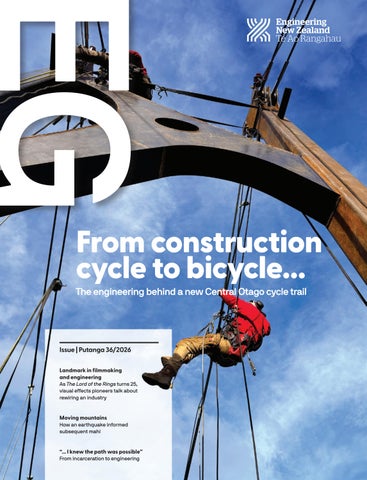
From construction cycle to bicycle… The engineering behind a new Central Otago cycle trail
Issue | Putanga 36/2026 Landmark in filmmaking and engineering As The Lord of the Rings turns 25, visual effects pioneers talk about rewiring an industry
Moving mountains How an earthquake informed subsequent mahi
“… I knew the path was possible” From incarceration to engineering
PREVIOUSLY 3.95 GWP
1.89 GWP
0.485 GWP
Locally made. Less distance. Fewer emissions. PACIFIC™ and PACIFIC DCRB® are more than reinforcing steel they’re a smarter foundation for New Zealand’s low-emissions future. As steel emissions fall, origin matters. Imported reinforcing can travel thousands of kilometres, significantly increasing cradle-to-site emissions. Pacific Steel reinforcing products are produced locally, giving local scrap new life, shortening supply chains, and avoiding unnecessary transport emissions. — Local scrap. Local steel. Lower transport emissions. — Coming to market in 2026. pacificsteel.co.nz
I roto i tēnei putanga
In this issue
14
“ It was about structure, about things that hold, about being trusted to do work that other people depend on.”
34
16
“ ... after several weeks of hand-cutting a concept line with a machete, sometimes only getting 300m in the 10-hour day, we realised it could be done.”
“ If you’re a seven-year-old that gets really excited by a spaceship going overhead, it really doesn’t matter what your background is, you’ll love working in this industry.”
52
“ I feel like a detective, pulling together information from different systems and perspectives to understand what’s really going on.”
Ngā āhuatanga
Features PO Box 12 241, Wellington 6144 New Zealand 04 473 9444 hello@engineeringnz.org www.engineeringnz.org
Editor
Jennifer Black editor@engineeringnz.org
Designers
Angeli Winthrop Karlos Tui
Advertising sales
advertising@engineeringnz.org 04 473 9444
06 Moving mountains Reflections on the Kaikōura earthquake response, 10 years on. 14 “… I knew the path was possible” How Bariz Shah’s journey into engineering was shaped by upheaval, hard lessons, incarceration and transformation. 16 Landmark in filmmaking and engineering Nearly 25 years since the release of the first The Lord of the Rings film, EG talks to visual effects pioneers who helped to rewire an industry.
24 EmPOWERing others Meet an electrical engineer whose career is defined by success in her field and a determination to open the door for others. 26 Strengthening the wastewater sector Looking to good engineering from the past could help strengthen the wastewater sector now, and for future generations. 34 From construction cycle to bicycle… The engineering behind a new Central Otago cycle trail.
Subscriptions
hello@engineeringnz.org
EG online
EG is available digitally for members on our website.
Printing
Your cover is printed on Forest Stewardship Council (FSC) approved and elemental chlorine free (ECF) paper. The inside pages are Programme for the Endorsement of Forest Certification (PEFC) approved and elemental chlorine free (ECF). EG is printed using vegetable-based inks made from renewable sources. Printing and fulfilment by Bluestar. Please recycle your paper envelope – it’s 100% recyclable and made from PEFC accredited paper.
Disclaimer
Advertising statements and editorial opinions expressed in EG do not reflect the views of Engineering New Zealand Te Ao Rangahau, its members, staff, or affiliated organisations unless expressly stated. Print Online
Ngā mahi papai rawa
Best practice 42 Leading questions 43 Ensuring “results reflect reality” Two new computational courses – the who, what and why. 44 Beyond compliance: lessons from soakage design Why the underlying message of a new soakage design guide is relevant for all engineers. 46 AI in industrial control systems: past, present and future While sounding futuristic, AI in Industrial Control Systems has been around for decades. But the future comes with a warning.
47 Engineering the next generation An update from Te Ao Rangahau Chief Executive Dr Richard Templer FEngNZ. 48 The pull of the Kawarau Gorge How a new Central Otago cycle trail follows a centuries-old travel route. 50 The importance of construction monitoring Why construction monitoring is an essential part of engineering practice, not a discretionary cost to be minimised.
ISSN 2537-9097 ISSN 2537-9100
This issue of EG was published in September 2026.
Ngā tūhinga poto me ngā pito kōrero
Shorts On the cover: Iron Ridge suspension bridge, designed by Ellis Mining Ltd, under construction as part of the new Kawarau Gorge cycle trail. Photo: Geoff Ellis
52 Inside job 54 Bedside table 55 One to watch 56 Secret life of engineers
58 Intersection 59 Obituaries 60 Engineering genius
03
Engineering Envy #134
Chosen by Te Ao Rangahau staff
Its sole function is to create moments of pure joy. It fosters community, spans cultures and turns ordinary people into musical legends for a couple of hours. – Deanna Cruse, Senior Marketing and Communications Advisor – Wonder Project
Karaoke Machine: Japan Some engineering marvels take decades and cost billions to create. The humble karaoke machine – Japanese for “empty orchestra” – needed little more than a tape deck, a microphone and a coin box to teach the world to sing. Shigeichi Negishi is credited with engineering the first karaoke machine, the 1967 “Sparko Box”, wired up so he could hear himself sing in tune over a backing track. Kobe musician Daisuke Inoue followed four years later with the Juke 8, comprised of the same parts bolted onto an 8-track car stereo – designed to flatter less-talented singers using slowed backing tracks nudged into easier keys. Neither man patented their creation. Inoue figured that off-theshelf components didn’t count as an “invention”– modesty that has cost him tens of millions per year in royalties from the multi-billion-dollar industry. But he has no regrets. In 2004 he collected an Ig Nobel Peace Prize, a satirical award presented by a science humour magazine, for giving the world “an entirely new way for people to learn to tolerate each other”.
A rātou kōrero
What they said
“Bringing together world-class engineering, long-term planning and strong partnerships, it delivers benefits for Aucklanders now while enabling a new generation of projects that will further reduce wastewater overflows and make a real difference to the health of the Waitematā Harbour and other waterways into the future.”
Watercare Chief Executive Jamie Sinclair on the completion of the Central Interceptor wastewater tunnel in July.
“We’re fortunate to have someone of Dean’s calibre, experience and strategic oversight to join our board.” Chair of Harrison Grierson, Dame Jo Brosnahan welcomes Dean Kimpton DistFEngNZ as an Independent Director.
“The Space Scholarship presents a careerdefining opportunity for these talented young New Zealanders who are set to spend three months at JPL working alongside scientists and engineers on real-world missions.” Space Minister Chris Penk announces the 2026 recipients, whose studies span physics, electrical engineering, chemistry, microbiology and aerospace engineering.
EG 36/2026
He whakaaro, he tūmanako nui
Reflection and optimism
Tēnā koutou katoa. Hei waitohu te marama o Mahuru i te taenga mai o te kōanga, te wā e hou ai ngā mea katoa, e piki ai te tūmanako nui, me ngā whāinga wāhi hou. He wā tēnei e tika ai tō tātou aro atu ki te ngākau pono me te pakari o tō tātou hapori pūkaha. E mihi ana ki ngā tāngata katoa i tae ake ki ō tātou rā Member Connect puta noa i te motu. He koanga ngākau te tūtaki ki te tini o ngā mema, ki te whakarongo ki ā koutou kōrero, ki te ako hoki i ngā āhuatanga o ā koutou mahi i roto i ō koutou hapori. Hei whakaū ēnei kōrerorero i te kaha o tō tātou umanga, me te hira o te noho tūhono, tētahi ki tētahi. Me mihi hoki au ki ngā kaipūkaha tini noa e pīkau nei i ngā mahi mō ō tātou hapori, i runga i te ngaio me te piripono, ahakoa ngā wero kei mua tonu i tō tātou rāngai. He mea taketake ō koutou pūkenga me tō koutou kaha hautū mō te hanga i tētahi Aotearoa haumaru kē atu, pakari kē atu, toitū ake hoki. Hei te marama o Tīhema kua eke ki te 25 tau mai i te whakarewanga o te kiriata tuatahi o The Lord of the Rings, nā reira, i tēnei putanga o EG kua tahuri mātou ki te whakanui i ētahi o ngā mahi atamai i puta ai ēnei pikitia takitoru, e whakataukītia nei e te ao katoa. Ka waitohu hoki mātou i te 10 tau mai i te rū i Kaikōura, me te titiro ki ngā akoranga i puta, hei ārahi i a mātou mō ā tātou mahi whakaū i te tū pakari. Waihoki ka titiro ki te rāngai waipara o te motu katoa, me te whakaaro ake me pēhea ngā āhuatanga o mua e āwhina ai i ngā mahi anamata.
Tēnā koutou katoa, September marks the arrival of spring, a season of renewal, optimism and fresh opportunities. It also provides a timely moment to reflect on the dedication and resilience of our engineering community. Thank you to everyone who attended our Member Connect events held across the country. It was a pleasure to meet so many members, hear your perspectives and learn more about the important work you are doing in your communities. These conversations reinforce the strength of our profession and the value of staying connected. I also want to acknowledge the many engineers who continue to serve our communities with professionalism and commitment, despite the significant challenges facing our sector. Your expertise and leadership are essential to building a safer, more resilient and sustainable Aotearoa New Zealand. In December, it will be 25 years since the launch of the first The Lord of the Rings film, so in this edition of EG we celebrate some of the the engineering ingenuity that helped create the world-renowned trilogy. We also mark 10 years since the Kaikōura earthquake, recognising the lessons that continue to shape our approach to resilience. Additionally, we look at the country’s wastewater sector, and consider how looking to the past can help inform the future. Kennie Tsui CNZM FEngNZ CPEng IntPE(NZ) President, Te Ao Rangahau
14 “… I knew the path was possible” 16 Landmark in filmmaking and engineering 24 EmPOWERing others 26 Strengthening the wastewater sector 34 From construction cycle to bicycle…
Ngā āhuatanga
Moving mountains
Features
6
The 2016 Kaikōura earthquake triggered slope failures that buried sections of State Highway 1. Photo: Camilla Gibbons
Āhuatanga | Feature
Moving mountains WRITER | KAITUHI Matt Philp
As the 10-year anniversary of the Kaikōura earthquake approaches, EG asks experts what worked well in the immediate aftermath, and how the disaster response has informed subsequent mahi.
07
08
EG 36/2026
Two days after a 7.8 earthquake struck Kaikōura on 14 November 2016, severing its coastal road and rail access, Camilla Gibbons joined a convoy supporting a tanker tasked with bringing drinking water through from Christchurch via the inland road. An engineering geologist with Aurecon, Camilla had already flown over the upper South Island region in a helicopter and knew what they were heading into. “It was utter carnage,” she says. “I remember flying over the slip at Waipapa Station with the cows stranded on it and thinking the mountain had split in half, and how was that even possible.” GeoNet later described the 160km rupture generated by the quake as like the Earth “unzipping” itself. With ground acceleration surpassing the fastest ever previously recorded in Aotearoa, nearly a million cubic metres of rock and material fell onto the coastal transport corridor. Even so, by the time Camilla joined the convoy she had seen enough to confirm that getting through to Kaikōura was achievable. “I didn’t think we’d necessarily get there that evening, but we made it to Kaikōura sometime between eight and nine.” By then, the water supply had been reconnected, and the tanker, the first vehicle to make it through,
was redirected to the marae where groups of locals and stranded visitors had gathered. Someone turned up with dozens of crayfish that had been exposed when the seabed uplifted. “They were handing out cooked crayfish en masse!” During the following weeks, Camilla was part of a team tasked with mapping and 3D-modelling some of the landslide-created dams that could potentially threaten the road and rail corridor. “The highest was over 100m tall, with all this water backing up behind it. We did some quick risk assessments and got a big picture view of what could potentially happen if those dams suddenly went,” she says, adding that the team came up with methods to monitor the dams and trigger alerts. The work lasted a few weeks. Despite her brief involvement, Kaikōura has had a lasting influence on Camilla's career, which has included helping with the response to the devastating 2022 New South Wales floods and Cyclone Gabrielle in 2023. “My Kaikōura experience really did help, I think,” she says, noting that a crucial lesson she took from the 2016 event was about the need to optimise data collection after a disaster hits. “It’s about making sure we get the right information and that it’s recorded in the same way for each site.”
Āhuatanga | Feature
Left: Large-scale mass movement at Waipapa Station following the earthquakes. Photo: Camilla Gibbons Above: Paula Lock. Photo: Supplied Right: A convoy supports the water truck driving along the Inland Road. Photo: Camilla Gibbons
Camilla points to the NZ Transport Agency Waka Kotahi (NZTA)-created Network Damage Assessment Tool, which evaluates disruption risks on the roading network. “It takes five minutes, gets uploaded and gives you a big picture view of what’s happening. That’s becoming the norm for new responses and the information is consistent, comparable and invaluable.” Alongside that, there’s been an evolution in technology since 2016. If the same event were to happen tomorrow, she says, “Very quickly, there would be a LiDAR plane in the sky getting LiDAR and aerial imagery – in fact, that was done after the big Hawke's Bay storm last winter.”
Reconnecting communities
Paula Lock CMEngNZ CPEng had a longer involvement with the Kaikōura recovery. Head of Project Management at WSP in New Zealand, Paula served as Design Manager for the Stronger Christchurch Infrastructure Rebuild Team (SCIRT) before she was shoulder-tapped to perform a similar role for North Canterbury Transport Infrastructure Recovery (NCTIR), the government-formed alliance charged with restoring Kaikōura’s critical transport links. Like Camilla, Paula’s first impression of the scale of the disaster came from
I remember flying over the slip at Waipapa Station with the cows stranded on it and thinking the mountain had split in half, and how was that even possible. – Camilla Gibbons
flying over the region soon after the earthquake. “We came up with ‘Moving Mountains to Connect Communities’ to describe NCTIR’s purpose, and that captured what we needed to do perfectly: the mountains were now covering the road and rail infrastructure.” As Design Manager, Paula's first task was to rapidly assemble 200-plus designers and other professionals. They came from more than 20 organisations and were co-located at SCIRT’s building in Christchurch. “There were many lessons from SCIRT, which is how we were able to put together a team so quickly, but there were
09
10
EG 36/2026
Contributions recognised in award win
To design more resilient buildings and infrastructure, you need to understand how the ground shakes when an earthquake strikes. Enter geotechnical engineer Dr Robin Lee, a Senior Lecturer at the University of Canterbury. His contributions to earthquake engineering research, teaching and practice were recognised recently when he was awarded the 2026 Natural Hazards Commission Toka Tū Ake/ New Zealand Society for Earthquake Engineering (NZSEE) Ivan Skinner Award. “Ground motion modelling is a fundamental part of seismic hazard assessment because it provides the link between an earthquake and the shaking that buildings, bridges and other infrastructure may experience,” says Robin. He uses both empirical models developed from observations of past earthquakes, and advanced physics-based computer simulations that model how earthquake waves travel through the Earth. “I also investigate how local ground conditions can amplify earthquake shaking and how these effects vary from place to place. Together, these help improve how we assess seismic hazards and provide engineers with more reliable information for designing resilient buildings and infrastructure.” New Zealand’s infrastructure needs to remain functional after major earthquakes so that communities can recover quickly, he continues. “My research helps improve the seismic hazard information that underpins engineering design standards and the assessment of infrastructure and building resilience, both for new design and existing assets.” “Better estimates of earthquake shaking help ensure that structures are designed to an appropriate level of resilience – not under-designed, but also cost effective.” Robin says that in the long term, this supports better investment decisions, reduces earthquake risk, and contributes to safer and more resilient communities across the motu.
differences, too. The SCIRT programme had a lot of three waters rebuild, whereas Kaikōura was more about marine and geotech, with lots of abseiling and rock removal. It required a different type of team.” For some, it was a steep learning curve. “On disaster recovery projects, the key thing is to make decisions; you have to keep moving forward at pace. We had people from SCIRT who had that mindset, but you also had to bring the new team members into that culture, and that was a challenge for some.” The team would eventually have to tackle how to build some long-term resilience and better safety features into the transport corridor. But initially, it was all about restoring access. “The critical thing early on is to reconnect communities and provide transport links to support the economy.” Another priority was to draw on the knowledge of the local community and businesses. “It was their patch, so what knowledge did they have that could help us to better understand the area and how it performs?” After SCIRT and NCTIR, Paula would later be involved in the response to Cyclone Gabrielle. The common lesson of all three was to never treat disaster recovery as “just another project”, she says. “You have to take everything back to people, their lives and connections. There’s that extra layer of emotion we can’t forget.”
Āhuatanga | Feature
Opposite: Dr Robin Lee (centre) is presented with the 2026 Ivan Skinner Award by MBIE-NHC Chief Engineer Professor Ken Elwood (left) and NZSEE President Pathmanathan Brabhaharan (right). Photo: NZSEE Left: Physics-based ground motion simulation of a hypothetical Hope Fault earthquake scenario, expected to produce impacts similar to those of the 2016 Kaikōura earthquake. Image: Ethan Thompson Above: Liam Wotherspoon MEngNZ. Photo: Supplied
Putting research intro practice
Kaikōura was also an education for the research community, says Liam Wotherspoon MEngNZ. Liam, who leads the Next Generation Risk Assessment programme for the New Zealand Natural Hazards and Resilience Platform and is an Associate Director of Te Hiranga Rū QuakeCoRE, was involved in the coordination of post-earthquake reconnaissance investigations following the Kaikōura earthquake. After Kaikōura was struck, Liam flew to Wellington to base himself at what was then GNS Science. “The goal was to bring engineering into the science response and reconnaisance coordination, structured through GeoNet,” he says. “This supported effective dissemination of information to the engineering profession to support response and recovery efforts.” The response to the Canterbury earthquake sequence had already strengthened relationships across the research community. “It meant that when the Kaikōura earthquake struck, we had the networks in place to mobilise and support effectively – albeit initially in a bit of an ad hoc way,” he says. “We now have more structured networks in place through NEMA [the National Emergency Management Agency] and the development of the Aotearoa Earthquake Science Advisory Panel (AESAP), and coordination across research programmes.”
Never waste a good crisis, as the saying goes. Even before the Kaikōura event, there was a coordinated programme of research across institutions working to improve understanding of infrastructure risk and resilience. “When the event occurred, these existing projects collected and applied data from the Kaikōura earthquake and additional research was mobilised where any gaps were identified,” says Liam, citing the leadership of Te Hiranga Rū QuakeCoRE (the centre of research excellence in earthquake resilience) and the Resilience to Nature’s Challenges National Science Challenge. “The events reinforced the need to better understand the potential implications of earthquakes on critical infrastructure, from understanding the hazard, to the performance of the components of infrastructure and the wider system implications.” It didn’t end there. “Kaikōura also highlighted the fragile nature of our transportation networks and showed how damage to one part of an infrastructure network can impact the wider network function, performance and longerterm implications. These effects extend well beyond the physical infrastructure, into transport behaviour, supply chain impacts and isolation of communities. Subsequent research has looked to improve our understanding of all these aspects.”
11
After the Wonder Project,
Pippa, young Kiwi, future STEM superstar
Behind each of the 200,000 ākonga we’ve reached is a story like this. We are the Wonder Project. The industry-led schools programme inspiring the next generation with STEM. And we’re just getting started.
Spark your wonder wonderproject.nz @WonderProjectNZ
EG 36/2026
14
“… I knew the path was possible” WRITER | KAITUHI Alexandra Johnson
It’s unlikely that many people have taken such a tumultuous path into engineering as Bariz Shah. A devout Muslim, civil engineer, community builder, filmmaker, keynote speaker and civic award recipient, his journey has been shaped by upheaval, hard lessons, incarceration and transformation. Arriving in Aotearoa New Zealand as an Afghani child refugee from Pakistan in 2001, Bariz Shah faced the challenge of growing up in an unfamiliar culture, marred by suspicion. “Upon my move to Auckland I found I was visibly different. My name didn’t fit easily on a roll call and the world after 9/11 had decided what people who looked like me were,” he says. He began seeking acceptance on the streets, spiralling into crime and becoming involved in drug dealing and robbing local dairies. Bariz’s first turning point came on a trip back to Afghanistan in 2012. “I realised I no longer wanted to play the victim. I came across multiple scenarios where I was faced with the reality that people have it so much harder than us here in New Zealand. I realised how lucky I was.” His lowest point, however, was yet to come, as on his return and just 18 years old, he was implicated in an aggravated robbery and sentenced to prison. There, he says, he was able to cut out the noise, gain self-control and rediscover his faith.
“In Islam we call it fitrah, your innate disposition. I realised I wanted to reconnect with my true self, be a good person and contribute to society, reconnect with my Creator.” Within those walls he also realised he wanted to pursue a career in engineering. “This path came into focus slowly. It was the opposite of what I’d been doing. It was about structure, about things that hold, about being trusted to do work that other people depend on. My father was a civil engineer and so I knew the path was possible.” Bariz continues: “After years of breaking things, including myself, building became a kind of repair.” After foundational studies, Bariz completed a Bachelor in Civil Engineering and a Global Diploma in Humanitarian Engineering at the University of Canterbury. Following the terrorist attacks in Christchurch on 15 March 2019, Bariz, then President of the University of Canterbury Muslim Students Association, was driven by grief and a determination to turn tragedy into something positive. Alongside his wife, Saba Afrasyabi, he raised $20,000 to microfinance 51 businesses in Afghanistan, honouring the 51 lives lost. Bariz has received multiple accolades for this work, including the Christchurch Civic Award in 2020 and Muslim New Zealander
Photo: Saba Afra
of the Year in 2021. He and Saba also captured the mission and their journey to Afghanistan in Project FiftyOne, an acclaimed documentary released in 2025, with which they host special screenings for companies looking to inspire their staff. Bariz says his humanitarian engineering diploma helped with this project. “It informed me to engage with the different people and micro businesses in the correct way, with honour.” Now a civil engineer at Brian Perry Civil, Bariz says he's grateful to the company for giving him a chance. “They gave me the opportunity knowing that I had a record. When, a year and a half into my role, I became a finalist for the CCNZ [Civil Contractors New Zealand] Emerging Leader Award, there was a sigh of relief from my hiring manager,” he smiles.
Kiwhaiaro | Profile
Bariz is currently working on the Second Ashburton Bridge project in Canterbury. “I’m really enjoying it because it’s delivering infrastructure that will help in times of crisis. If there’s a flood, this region gets blocked off – there’s currently only one bridge over the Hakatere River. Knowing that you are contributing to something like this, which will hopefully be here long after I’m gone, is a very comforting thing to know.” He is also an advisor to the Department of Corrections, part of a reference group that endeavours to improve the rehabilitation process of incarcerated Muslims. He recently returned to the same prison and unit where he spent almost a year of his life. “But this time, I was with the Commissioner of the Department
of Corrections. It was a humbling experience, but I was disappointed because the conditions are a lot worse. Anyone locked inside there now would have a much more difficult time finding their way.” Bariz, who is also Executive Director of Asturlab, a Christchurch-based community organisation, says faith is central to how he and other Muslim engineers approach their work. “When you see a colleague stepping out briefly to pray or fasting through a long site day in Ramadan, you’re not seeing someone whose faith is in the way of their engineering: it’s the engine behind it. Once you understand that, working together gets a lot easier and richer.” In future, Bariz says he may travel to help war-torn countries rebuild, but that such work must be led by local engineers wherever possible.
15
“Outside expertise has its place, but durable rebuilding happens when the people who know the language, the terrain and the social fabric are the ones holding the pen.” He says infrastructure is dignity. “When a road exists, a child can get to school. When a bridge exists, a market can function. When a water system works, a hospital can treat people without rationing. “In places that have been broken – torn by war – engineering isn’t just technical reconstruction, it’s the slow, physical re-establishment of normal life.” But for now, he’s staying put. “New Zealand is home. I didn’t feel like this before – since my two sons were born I have developed a deep connection to this land. I’m really focused on how I can serve in New Zealand.”
EG 36/2026
16
Landmark in filmmaking and engineering WRITER | KAITUHI Laurie Winkless
In December it will be 25 years since the release of the first The Lord of the Rings film. EG talks to some of the visual effects pioneers – including an electrical engineer – who helped to rewire an entire industry.
Āhuatanga | Feature
17
Newline Pictures Presents “The Lord of the Rings: The Return of the King” Gollum ©2003 New Line. Image: PictureLux/ The Hollywood Archive/Alamy
18
EG 36/2026
When Sir Peter Jackson’s first The Lord of the Rings film, The Fellowship of the Ring, hit the big screen in December 2001, audiences were dropped into a world that had never existed before. It instantly became a box-office hit, grossing almost US$900 million in cinemas worldwide. Twenty-five years on, the Lord of the Rings trilogy still stands as a landmark in filmmaking and engineering. The tools, techniques and problem-solving audacity that came out of Wellington’s Wētā FX (then Weta Digital) didn’t just make three extraordinary films. They arguably redefined an entire industry. And, as those who were there will tell you, none of it was easy. The scale of what Sir Peter and his team was attempting was unprecedented, so the team at Wētā FX had to invent most of what they needed as they went. “I don’t think I could overstate what an impossibility it was in many ways,” says Wayne Stables, Visual Effects (VFX) Supervisor at Wētā FX, who has worked there since 1994. “But there was just this blind faith. And a lot of that comes from Peter [Jackson] and his attitude of ‘how hard can it possibly be?’ There was never any doubt. Just never any doubt at all.”
“... the glory days of visual effects”
Ken McGaugh, a VFX Supervisor at Wētā FX, joined the company to work on The Two Towers, having watched what the Wellington team had achieved on Fellowship from the United States. “From my perspective, those are the glory days of visual effects,” he says, adding,“You didn’t have to have a PhD or some kind of specialty to do cool, genuinely groundbreaking work. You could just be someone who was slightly technical, slightly creative. And it was fun. Hard, but fun.” Wayne agrees, describing his experience of The Lord of the Rings years as “a grand, ridiculous adventure”. Kimball Thurston, now Chief Technology Officer at Wētā FX, describes himself as “an outsider looking in” during that time. He was working at hardware and software solution provider RFX Inc, making compositing software that the Wētā FX team occasionally used, watching the trilogy unfold with a mix of admiration and fascination. “What the whole VFX industry was trying to do was to capture a human performance and then integrate and manipulate that in a way that looks like it’s something fantastical,” he says. “So, everyone was looking at Wētā.”
Above and right: Massive, the crowd motion simulation software created in 2000 for The Lord of the Rings trilogy, allows for autonomous agents to make decisions and interact with their environment and each other. “The Lord of the Rings: The Return of the King” courtesy of New Line Productions, Inc. © MMIII, New Line Productions, Inc. The names of the character, events, items and places within, are trademarks of The Saul Zaentz Company d/b/a Tolkein Enterprises under license to New Line Productions, Inc. All rights reserved.
Āhuatanga | Feature
The early Wētā FX operation was small and scrappy, with no off-the-shelf solution for the problems they faced. If they needed a tool, they had to create it. “The pipeline was written by the artists themselves,” says Ken. “There was no sanctioned route to doing most tasks.” Wayne remembers it the same way: “If we didn’t have something, we would just write a tool to do it. And that gradually became an ecosystem that then got developed into much more sophisticated, formalised ways of doing things.” Weta’s approach was, paradoxically, precisely what made the work so influential. Ideas like deep compositing, which lets artists manipulate layered 3D elements without constant re-rendering; the “digital intermediate” process for colour grading, VFX integration and mastering; and sophisticated crowd simulation systems are now standardised across the industry. However, they were all either invented or significantly advanced at Wētā FX during the Lord of the Rings years.
If we didn’t have something, we would just write a tool to do it. And that gradually became an ecosystem that then got developed into much more sophisticated, formalised ways of doing things. – Wayne Stables
19
EG 36/2026
20
Beyond all count
Of all the technical achievements from the trilogy, the crowd simulation software Massive (Multiple Agent Simulation System in Virtual Environment) arguably received the most public attention. But Wayne says it may also be the most misunderstood tool created at Wētā. “People always say ‘Oh, the crowds were rendered with Massive’ but in reality, what Massive generates is expansive motion. The art of rendering pictures from it used other processes.” Wayne worked on multiple crowd sequences in the trilogy, including the battle at Helm’s Deep, which pitted 10,000 Uruk-hai against 2,000 defenders in an epic scene that regularly tops lists of the greatest ever cinematic battles. “There was a huge amount of software that we put in place early on for the crowd scenes,” says Wayne: “Like assembling bits and pieces at render time to handle massive data sets. It’s everywhere in industry now, but none of that stuff existed then.” Being at the cutting-edge often leads to competition, but it can also result in collaboration. Wayne continues: “The thing I love about this industry is that while we compete with different visual effects houses, there’s a mammoth amount of knowledge-sharing that just goes on, because we’re all trying to work out how the hell to do this stuff.” It seems appropriate, then, that in May, Massive released a “fully featured” version of their software (and video tutorials) free for personal use.
Riddles in the dark
While Wayne looked after the advancing hordes, Ken faced another question: how to create the translucent, eerily convincing skin of a key character, Gollum. “The skin shading was my primary focus when Joe [Letteri ONZM] brought me here,” he says. “I was a self-taught programmer with an engineering degree but no official training in coding. I was still able to do all this, building off other things.” When starting to work on Gollum, Ken came across a then-recently published research paper on subsurface scattering, which modelled how surfaces reflect light based on mathematical functions called Bidirectional Reflectance Distribution Function (BRDF). “This was the first time I worked with different BRDFs – different lighting or shading models – because in my previous projects, we’d just used fixed numbers.” While familiarising himself with it, Ken remembered work he’d done on underwater rendering which involved “tricking” a renderer called Renderman into producing data outside standard pipelines. “I realised that this trick would help us implement the paper. It was very much an inspired hack,” he says. “Nothing rigorous about it.” Much later in the process, Ken realised that his model contained a mathematical error. “There was basically a double exponent going on. But when I fixed it, the ‘incorrect’ version ended up
I was a self-taught programmer with an engineering degree but no official training in coding. I was still able to do all this, building off other things. – Ken McGaugh
Āhuatanga | Feature
Left and above: Wētā FX’s award-winning data centre uses the latest in closed loop water cooling for ecological impact, with around 500,000 threads of compute supporting Wētā’s artists to render movies. Photos: Wētā FX
being more artistically controllable and better looking than the ‘correct’ version. So, that’s what we used.” He laughs, adding: “I imagine if I was a properly trained scientist or software engineer, I wouldn’t have discovered that.” Error or not, the results were so effective that in 2004, Ken, along with Christophe Hery and Joe Letteri, won an Academy Technical Achievement Award for their work.
An unexpected pipeline
A quarter of a century on from Fellowship, the demands and expectations placed on VFX studios continue to grow, powered by improvements in technology. Ken articulates a principle that rings true across the history of computing: “Increases in render efficiency or render speed don’t make your frames render faster. They mean you’re allowed to do more complex things.” Kimball notes with some amusement
that this is now known in the industry as Blinn’s Law, after computer graphics pioneer Jim Blinn. Despite the expansion, the self-sufficient, build-ityourself culture Weta Digital was founded with remains a part of Wētā FX. Kimball describes the very first Wētā FX pipeline – for 1994 film Heavenly Creatures – as “… a film scanner, an SGI computer and a film recorder. That was it.” Three decades later, Wētā FX runs a hybrid graphics processing unit and central processing unit data centre with around 80,000 cores of compute. This year the company received an APAC data centre design award for its water-cooled render wall. “Just like we innovate in pictures, we also innovate in how we efficiently use technology,” says Kimball. He describes managing the data and pipeline integrity that sits behind all of this as “a constant battle” but one that three decades of tool-building has made significantly more tractable. He adds, with a grin, that he wouldn’t be surprised if some of Wayne’s
21
EG 36/2026
22
Don’t take solutions which do it all for you. Question these things. Experiment. – Kimball Thurston
original commits – save points for code – from The Lord of the Rings era are still sitting somewhere in the codebase. AI is, of course, having an impact, but as Kimball explains, “We’ve been using forms of AI tools or machine learning tools to create artist-driven effects, really for decades, before we even knew to call it AI at all.” To him, each wave of technology that threatened to displace filmmakers (television, digital, streaming) only caused the industry to expand. He argues that the key to making sure that continues is to keep humans in the creative seat: “Don’t take solutions which do it all for you. Question these things. Experiment.”
All manner of folk
Wētā FX’s work attracts people from a wide array of disciplines. Ken studied electrical engineering but moved into VFX almost immediately. Wayne and Kimball came from computer science backgrounds. The team around them has included biologists, astrophysicists – Kimball notes they’ve recently hired two – and even a rocket scientist. “Historically, our industry has been very diverse,” says Kimball. “And that is an incredible benefit.” Ken describes an office he shared with other technical directors at visual effects company Industrial
Light & Magic: “I had an engineering degree, one had a computer science degree, one had an art degree, one had an English degree, and one had no degree at all.” For engineers or students thinking about this as a career path, the message from Wētā FX’s veterans is less about specific disciplines and more about disposition. “The most important part is having a sense of adventure,” says Kimball. Wayne, who traces his love of visual effects back to watching the original Star Wars movie as a child, puts it simply: “If you’re a seven-year-old that gets really excited by a spaceship going overhead, it really doesn’t matter what your background is, you’ll love working in this industry.” With the 25th anniversary of The Fellowship of the Ring this December, that engineering spirit might be the most enduring legacy of these films. “We definitely were aware that what we were doing was pretty groundbreaking,” says Ken. “And we just could not wait for people to see it.”
Above, clockwise from top left: Wayne Stables; Ken McGaugh; Kimball Thurston. Photos: Wētā FX
Partner profile
Hilti partners with Te Ao Rangahau The Hilti Group is a globally operating company with a strong people-oriented culture, built on long-term focus, teamwork and a strong commitment to making construction better. In New Zealand, we are proud to have been recognised as a Great Place to Work® for four consecutive years, reflecting our focus on creating an environment where team members can grow, contribute and deliver meaningful value for customers and the wider industry. We work closely with engineers, consultants and contractors to help bridge the gap between design and construction. Each project presents unique challenges, whether aligning specifications with site conditions, improving constructability or ensuring installation quality. Our role is to support the industry with practical, engineeringled system solutions and software to increase productivity.
From early engagement with consultants through to on-site collaboration with contractors, we bring together technical expertise, tested solutions and application knowledge to help ensure specified systems perform as intended. Across projects, we support teams in optimising fastening design, improving installation reliability, enhancing fire safety and delivering more efficient outcomes based on digital planning and processes. This approach is reflected in our SPEC2SITE methodology, which focuses on continuity from specification through to installation. Combined with our focus on productivity, safety and sustainability, our goal is to help deliver more reliable outcomes across the full project lifecycle. Through our partnership with Engineering New Zealand, we look forward to working alongside members to support better engineering and construction outcomes across Aotearoa.
830801413_UoA_MIP_Magazine_HP_176x114mm_v2f.indd 1
Visit engineeringnz.org/hilti to view our partnered webinars.
26/09/2025 5:10 PM
EG 36/2026
24
EmPOWERing others WRITER | KAITUHI Alexandra Johnson
From being in a minority at university to the first woman engineer hired by a 65-year-old firm, Kate Macdonald has built a career defined by success and a determination to help others. An Electrical Engineer at Pedersen Read Consulting in Christchurch, Kate Macdonald CMEngNZ CPEng has dedicated hundreds of hours to increasing the number of women entering the profession. She believes the main barrier here is a lack of role models. “My dad is a mechanical engineer, and we also had an engineer female family friend, so I knew what was possible. But most people in their day-to-day lives don’t have contact with engineers like they do with other professionals, such as doctors.” In the late 1990s, as an undergraduate at the University of Canterbury, Kate set up an outreach programme at secondary schools. “I thought well, I need to go and tell young women about engineering because there’s just not enough of us. I sent a letter to schools saying, would you like us to come and talk to your students?” Armed with some overhead projector slides, Kate and a fellow engineering student spoke to school students at assembly, or during class or lunchtime. A quarter of a century later, she’s still spreading the word and has been involved in numerous school outreach programmes, including Engineering New Zealand’s Wonder Project, designed to encourage rangatahi into STEM subjects. “That’s been the most inspiring. I’ve done that a few times and just seeing the enthusiasm of the kids having fun
while learning about Newton’s Law is really rewarding – you’re inspiring the future.” Kate has received recognition for her work, including a Dark Sky Excellence Award for her lighting design of Oi Manawa, the Canterbury Earthquake National Memorial. “That was a very special one because it was more than an engineering project. I’d been through the earthquakes myself and that had a profound impact on me and the community, so being able to contribute in a small way to a memorial that honours the lives of the people who lost their lives and acknowledge what we went through as a city was really meaningful.” Another highlight was the Youth Hub project, a Christchurch facility for at-risk young people. “Being able to contribute to projects with a strong social purpose and make a difference in the lives of vulnerable young people is very important to me.” On a personal level, Kate says the most meaningful feedback comes from the enthusiastic responses of children at her school outreach work. More recently, she’s been working on resource consents, meaning influencing outcomes before construction begins. “I’m involved in the assessment of environmental effects, where I look at what the effects of the lighting associated with the proposal will be, as well as being an expert witness for the resource consent process.” She says this work is important as it will have an impact on future generations, ensuring a balance between operational requirements and the protection of wildlife and the night sky, “and it aligns with the concept of
kaitiakitanga”. She hopes her legacy will be that she has been a role model for young people and encouraged them to consider engineering as a career. “And I always want to leave things in a better way than I found them, for example, using the minimum light you need for the task, paying attention to the colour temperature – such as avoiding blue light which is a lot more visible to animals.” A strong advocate for flexible work, Kate has worked part time since returning from five years of parental leave with her three children. “I was a bit nervous about re-entering the workforce,” she says. “But as I said in my application, I’d spent five years multitasking and working on my budgeting and conflict resolution skills. If you can facilitate an argument between two toddlers, you’re well placed to deal with difficult clients.” She believes flexible and part-time opportunities are key to increasing the number of mothers returning to the profession. “I think employing a working mum is a win-win situation for firms because we’re so efficient with our time. We know that we’re only here for a short time so we’re going to get the work done. I currently work 20 hours a week, but I doubt I’d get twice as much done if I worked 40.” Women make up around 15 percent of the profession in Aotearoa, and Kate says this is not enough. “Women experience the world differently to men, and engineers are designing the world we live in. So, isn’t it true that the people making those decisions should reflect the people living in it, rather than just a small portion?”
Kiwhaiaro | Profile
Being able to contribute to projects with a strong social purpose and make a difference in the lives of vulnerable young people is very important to me.
Photo: Lightchasres
25
EG 36/2026
26
East Clive Wastewater Treatment Plant. Photo: Hastings District Council
Strengthening the wastewater sector
Āhuatanga | Feature
27
WRITER | KAITUHI Rina Diane Caballar
In the wake of recent significant wastewater failures, looking to good engineering from the past could help strengthen the wastewater sector now, and for future generations.
EG 36/2026
28
In February, Te Whanganui-a-Tara Wellington’s Moa Point wastewater treatment plant failed, resulting in millions of litres of untreated water flowing into the capital’s south coast. This is just one a number of wastewater incidents that have plagued Aotearoa, from the persistent stench emanating from Christchurch’s fire-damaged Bromley wastewater treatment plant to sewage pipe leaks and a host of other related problems. “Some of these events have a very low probability of occurrence. And yet when they do fail, they have extreme results,” says wastewater engineer Garry Macdonald ONZM DistFEngNZ CMEngNZ, a past President of Engineering New Zealand who was recognised as an Officer of the New Zealand Order of Merit in the 2026 King’s Birthday Honours for services to wastewater engineering. “They are very high risk, so we need to apply a proper risk framework.” Decades of underinvestment coupled with ageing infrastructure and deferred maintenance characterise the crisis the country’s wastewater sector is facing. “The infrastructure that delivers water and takes away wastewater is a hidden asset. Unfortunately, hidden assets tend to not get looked after and we’re seeing that around the country,” Garry says. “It’s so easy to forget that these assets have defined lives and will wear out. You’ve got to have sufficient capacity to take them out of service to repair or replace them, which can take weeks or months. We haven’t done a good job of recognising that.”
Clockwise from left: The Māngere Wastewater Treatment Plant in Tāmaki Makaurau; the plant's biosolids building, odour ducting and ammonia scrubber; final treatment coming out of the UV channels. Photos: Watercare Opposite: Māori community view of the East Clive Wastewater Treatment Plant process. Image: Hastings District Council
The infrastructure that delivers water and takes away wastewater is a hidden asset. Unfortunately, hidden assets tend to not get looked after and we’re seeing that around the country. – Garry Macdonald
Coming full circle
Aotearoa has come a long way when it comes to wastewater, from not treating it at all to rudimentary treatment followed by fine screens, disinfection and sludge intensification. Such progress is evident in the Māngere wastewater treatment plant in Tāmaki Makaurau. It went through a major upgrade in the early 2000s, which entailed implementing advanced treatment processes such as biological nutrient removal in bioreactors, clarifier tanks, filtration and UV disinfection. These processes shortened treatment time from 21 days to 13 hours.
Āhuatanga | Feature
“The big decision was to remove the 550-hectare oxidation ponds and restore the Manukau Harbour and foreshore,” says Garry, who cites the upgrade as one of the projects he’s most proud of in his years as a water market leader at Beca. “We were very pleased about that and the project has been really successful, winning the IPENZ Environmental Award in 2004 and the Supreme Award for Engineering Excellence the following year.” Jim Bradley DistFEngNZ CPEng IntPE(NZ), a recently retired environmental and public health engineer, cites the East Clive Wastewater Treatment Plant upgrade in the early 2000s as one of the most remarkable projects he worked on during his tenure at Stantec. The upgrade involved a no-sludge system, with a modified biological trickling filter process without clarifiers. According to Hastings District Council, finescreened wastewater is pumped through large tanks and trickles through flower-shaped plastic media. The media act as bug factories, housing naturally occurring microorganisms that break down and remove organic material from the wastewater. This treated wastewater then flows through a rock-lined channel named Rakahore (the personification of rock and stone), allowing it to reconnect with Papatūānuku (Earth Mother) to regain its mauri (life force) before being discharged into the ocean via a long outfall.
“It’s nature at work,” Jim says. A vital component of the project’s success, he believes, was the close collaboration between engineers, Hastings District Council and tangata whenua in co-designing a wastewater scheme that takes into account cultural, economic, environmental and sustainability considerations. Part of the treatment plant’s resource consent conditions also include an annual compliance report and a comprehensive review of the plant’s performance every nine years. A recent development in the wastewater sector that both Garry and Jim find exciting relates to a circular water economy. It treats water as a resource rather than waste, Garry says, and includes resource recovery from wastewater, including the purified recycled water. Water resource recovery facilities best illustrate the circular water economy, according to Jim. These facilities adopt a factory approach, linking energy, nutrient, product and water together. “It gives that message of what resources we have and how we can better use it,” he says.
Embracing Te Ao Māori
The team behind Neuflow Projects, which specialises in delivering complex water-related infrastructure, believes that embedding kaupapa Māori is a way forward for wastewater engineering. Founder and
29
30
EG 36/2026
Resource recovery
As a mechanical engineer, Elise O’Brien has helped deliver capacity upgrades for a water treatment plant in Tauranga and the Rosedale wastewater treatment plant in Tāmaki Makaurau. She's also managed pilot projects for emerging drinking water treatment technologies in the Netherlands and now works in Sydney, Australia, where her current project looks at rainwater reuse in an organic waste transfer facility. “The aim is to reduce the source water demand, but it also inherently reduces your wastewater loads and looks at the site as more of a circular system.” While she's only been in her new role for a few months, she's noticed some differences in how Aotearoa and Australia approach wastewater. “Australia is a lot bigger, so the scale of projects and the varied legislative context and policy frameworks we must navigate makes it complex,” she says. “It’s a much drier environment, so accessibility and availability of water are challenging. But when you have a lack of something, it generally drives ingenuity.” This includes recovering nutrients from wastewater streams and applying it to agricultural settings. “There’s this nutrient gold that I think Australia is tapping into a lot more than New Zealand.” says Elise. She views resource recovery as an opportunity to build resilience in the wastewater sector. “It requires a shift away from waste disposal and instead looking at how we can treat these products as resources to facilitate that recovery back into the natural nutrient cycle.” Elise adds that the right people need to be in the room developing these solutions together. “We need tangata whenua, engineers, scientists, environment and community specialists, and diverse people of different ages and backgrounds. We’re going to strengthen the wastewater sector in New Zealand by listening to the right people.” In addition to being an engineer, she’s a former Engineering New Zealand Wonder Project Ambassador and a Keystone Trust mentor. She has a Master of Sustainable Development Goals degree from Massey University, with First Class Honours in Environmental Sustainability. In July, Watercare’s Central Interceptor wastewater tunnel in Tāmaki Makaurau Auckland became fully operational. The $1.66 billion project – the country’s largest-ever wastewater infrastructure investment – has been designed to dramatically reduce wet weather overflows, improve the health of Auckland’s waterways and harbours, and support growth across the region for decades to come. Find out more about some of the innovative engineering behind this project at bit.ly/central-interceptor
director Adam Donaldson of Patuharakeke | Ngāpuhi descent, is currently involved in a wastewater treatment upgrade in the Whangārei district. “It’s close to my heart because I whakapapa back to that area. Working on behalf of my hapū as a technical advisor is something I deeply care about and I’m committed to achieving the results that genuinely reflect our cultural values and outcomes long term.” He’s helping to find alternatives for the treated wastewater discharge. “It’s not just infrastructure, it’s more a holistic way as to how we can treat and enhance wastewater,” says Adam. “It’s interesting to support the project and learn the concept of mauri restoration and enhancement and the kaitiaki elements of a wastewater project, as opposed to just designing and constructing a physical asset.” As part of the project, the team developed a framework encompassing different cultural and spiritual elements, including mātauranga (knowledge, wisdom) and maramataka (Māori lunar calendar). They combined that cultural framework with a multicriteria analysis framework to inform decision-making on the best option for wastewater discharge. “Every wastewater project should have an element of kaupapa Māori – how we must understand, treat, and respect wai to enhance it and restore its mauri. In addition to traditional engineering outcomes, cultural outcomes are also a key project driver and you can’t do that without partnerships with mana whenua
Photo: Supplied
Āhuatanga | Feature
31
groups,” Adam says. “There are iwi and hapū that associate to all areas throughout Aotearoa and should be engaged with as soon as possible to form close working relationships that then inform partnership and collaboration early.” Jim has worked with iwi for decades, and he attests to the importance of “acknowledging cultural protocols, understanding the cultural background as best you can, listening and developing approaches that integrate mātauranga Māori with Western science”. Similarly, Garry emphasises that engineers need to think beyond their technical expertise and realise that cultural practices are “grounded in basic public health” and rooted in the belief that water is the essence of life. Garry also noticed that countries like Australia and the United States are looking to Aotearoa as an example of working with Indigenous groups in the wastewater sector. “They’re decades behind where we are and there is a curiosity as to how we got to where we have.” Adam says that merging mātauranga Māori with Western engineering and science principles has been a long time coming, yet despite the strides our nation has taken, we still have a long way to go.
Strength and resilience
Envisioning the future, Jim notes that strengthening the wastewater sector requires more focus on asset management, particularly ageing infrastructure, including physical monitoring of the condition of the
Above: Adam Donaldson (left) and colleague commission a new gas flare to manage gas produced from the closed Horotiu landfill site in Hamilton. Left: Ecological site visit for the new Ruakākā wastewater treatement plant in Northland. Photos: Neuflow
EG 36/2026
32
Left: Products that are recovered at a water resource recovery facility offset the extraction of primary resources, supporting a circular economy. Image: Stantec
ENERGY FACTORY
Raw wastewater
NUTRIENT FACTORY
PRODUCT FACTORY
WATER FACTORY
Primary treatment Secondary treatment Advanced treatment
Waste streams
Outfall
Recieving water body
Value streams
What good looks like
Metro Water Recovery, a wastewater treatment provider in Colorado in the United States, operates the Robert W. Hite Treatment Facility. It serves more than two million people and consists of four factories: energy, water, nutrient and product. Jim Bradley says that this overseas project that Stantec was part of demonstrates exemplary wastewater infrastructure that Aotearoa can learn from. The energy factory currently operates turbines on its digester gas and generates about one-third of its total electrical power demands. There are plans to replace the turbines with a renewable natural gas facility and deliver the gas to the utility natural gas network, as well
as draw heating and cooling energy from an existing sewer interceptor to supplement the building’s yearround energy needs. During the drier portions of the year, the facility’s water factory can account for more than 80 percent of the receiving water body’s flow, enhancing water quality and ecology. The nutrient factory incorporates a phosphorus removal system to sequester and recover phosphorus as struvite, which can be reused as a slow-release fertiliser product. Meanwhile, biosolids from the product factory can be applied to dry land farming of wheat, corn and other crops.
infrastructure. He adds that adaptive management approaches can help identify the next course of action after a review. Meanwhile, Garry admits that even though “… we’re known for being quite successful in delivering water and wastewater, I feel as though we haven’t done as well as we could have”. He recommends keeping up with technology, specifically innovation in resource recovery, to help revitalise the sector. Beyond the technical aspect, increasing resilience relies on connectivity between governance, compliance and investment, Garry says. “In other words, what is the best way to achieve compliance with environmental and public health goals as cost-effectively as possible? Balancing levels of service and compliance with affordability all comes down to our public, our community.” He believes the new national wastewater standards can help improve compliance across the industry.
“The idea is to enable a better assessment of discharge options to the receiving environment and speed up the consenting process while still protecting environmental standards and public health,” Garry says. “It’s to give certainty to communities as to what standard of wastewater treatment is appropriate, and hopefully it’ll be cost-effective in the long term.” Bolstering the workforce is also crucial to futureproofing the wastewater sector. “I want young engineers or secondary school students to see the excitement of the water services sector. This is not just making sure the taps run and the wastewater gets treated, it’s looking at preserving our water sources and treating water as a taonga,” says Garry. “We need the profession to be seen as worth getting involved in and get young people excited about the fact that we’re not just delivering a utility – we’re actually delivering the basis of life.”
Partner with us. With 23,000 members and strong industry, government and academic links, Engineering New Zealand Te Ao Rangahau is the voice of the profession. Partnering with us gives your organisation a powerful way to lead, showcase expertise, and connect with the country’s largest group of engineers. Why partner with us? • Reach New Zealand’s largest engineering community through multi-channel marketing. • Engage and educate members via articles, events and thought-leadership opportunities. • Collaborate on strategically-aligned initiatives that advance the profession. • Partner with a trusted organisation committed to helping you achieve your goals. A partnership with Engineering New Zealand delivers more than visibility. It brings awareness, connection and impact. Together, we can showcase your strengths, engage meaningfully and shape the future of engineering in Aotearoa.
To learn about partnering with us, get in touch with Luke Pirie, Business Development Manager at luke.pirie@engineeringnz.org
From construction cycle to bicycle… WRITER | KAITUHI Kathy Young
Bluff bridge, and the beginnings of a suspension bridge under construction at Iron Ridge. Photo: Geoff Ellis. Opposite: Passing Lane Bridge. Photo: Stori Films
Āhuatanga | Feature
35
200
days of rope-access scaling
70-tonne
airbags used for displacing large rocks
2
5.5 tonne diggers stripped to 13 parts and reassembled on site
11
methods used to access the gorge
3
previously undocumented gold mining huts uncovered
A new Central Otago cycle trail stands out both for the challenges posed by the terrain and the feats of engineering required to construct the route.
The Southern Lakes Trails Trust is set to open the 34km Kawarau Gorge Trail for cyclists this spring, marking the culmination of a $9 million trail build that’s taken roughly seven years from initial scoping to completion. It connects Central Otago’s Bannockburn and Gibbston through steep, remote schist country. “There was a lot of doubt whether this was even possible,” says trail designer and project manager David Howard from Southern Land Development Consultants, who holds a Bachelor of Engineering – Forestry. “Eventually, a couple of brave souls said, ‘Yeah, I reckon we could get it through.’ Then after several weeks of hand-cutting a concept line with a machete, sometimes only getting 300m in the 10-hour day, we realised it could be done.”
36
EG 36/2026
Expanding the regional trail network, the Kawarau Gorge route links to the Lake Dunstan Trail (opened in 2021) and Queenstown’s wider trail network, following a route once used by Māori travelling for pounamu and later by gold miners. Two hundred metres of bluff bridges, three suspension bridges and months of drilling and blasting activity contributed to the complexity of this project. David, along with Managing Director of Ellis Mining Ltd, Geoff Ellis, explored concept solutions then Geoff developed detailed designs, which were sized by a consulting structural engineer. Geotechnical engineer Jeff Bryant of Geoconsulting Ltd, who also worked on the Lake Dunstan Trail, says the variability of the schist drove almost every anchor decision for the trail’s placement. “There are places where you hit the rock with a hammer and it rings, while in others it’s so weak you can excavate it almost by hand.” Anchor depths for bridge bars ranged from 1m into rock to 6m where the rock was weaker. When the team had doubts about the rock quality, sacrificial anchors were pull-tested before production anchors were installed. “If it’s moving out too much, obviously it’s not a good place to anchor,” Jeff says. Geoff Ellis, whose team delivered 50 percent of the trail construction work, was responsible for prefabricating the bridge components and sizing them for helicopter delivery. “We set up guides and weld keys on all the steel work so the structures could get landed in position and we could get them within a couple of millimetres with a helicopter,” says Geoff. “We were welding off ropes by certified welders quite often.” Most of the construction was engineered to fit and built “bit by bit”, Geoff says. Overall, the 2.5-metre-wide track was designed to take maintenance machinery loads, and uses 360 UB sections, six beams per span, in spans of up to 10.5m.
With its steep valley sides, rockfall was one of the main hazards of the project. An earlier environmental court decision set the principle the team worked to: “The expectation should not be to eliminate risk but to minimise it as much as feasible,” Jeff Bryant says. Since large-scale mesh netting of the cliff faces was ruled out on cost grounds, the team instead used three levels of mitigation techniques: small, medium and large. “It’s the small end of the scale that are a problem,” Jeff says. “Something the size of a fist falling 10m is enough to go through a helmet. Our aim was to try and get rid of those before nature sends them down our way.” Abseilers from Ellis Mining Ltd crowbarred smaller blocks off the face. Inflatable airbags were slid into cracks to detach blocks, a technique adapted from vehicle rescues. The largest hazards, rock sitting on 60-degree slip planes, were drilled and blasted, sometimes shifting more than 1,000m3 at once. “At Honeycomb Bluffs alone, six months and $500,000 went into mitigation,” says Jeff. Access to the trail shaped almost every other decision during construction, with crews reaching the gorge by 11 different methods, including cableways, zip lines and a purpose-built footbridge. The dominant constraint, however, was the helicopter lift ceiling of 1,250kg, which dictated how every major component was transported to the site. Compressors, generators and 1,000-litre fuel tanks were kitted to fit in a single helicopter load. Two 5.5 tonne diggers were each stripped to seven components and flown across the gorge before being reassembled with a purpose-built gantry on the far side. “We can fly any size digger you like,” Geoff Ellis says. “You just break it down into small enough bits.” Before construction began, an ecologist, a herpetologist (a zoologist specialising in the study of amphibians and reptiles) and an archaeologist walked the trail, so that lizard habitat, native vegetation and gold-mining heritage could be considered in the design. Three previously undocumented mining huts emerged during construction. David says the archaeologist’s advice was to “bring the trail closer to them, to celebrate this history”. Modelling puts the regional economic benefit at around $8 million a year. “It’s going to be here for multiple generations. It’s a legacy project,” says David.
The following entities, contractors and funders were key to the completion of this trail: Southern Lakes Trails Trust, Ellis Mining Limited, Southern Land, WKC Construction, Geoconsulting Ltd, eZed Ltd, Central Lakes Trust, Otago Community Trust and the Ministry of Business, Innovation and Employment (through the Nga Haerenga Great Rides funding).
Āhuatanga | Feature
37
Opposite: Jeff Bryant on site. Top: David Howard and others on Passing Lane Bridge. Above: Pioneer Bridge. Right: Cyclists test a section of the trail. Photos: Stori Films
Trail in numbers
Roaring Meg
Length: 34km, from Gibbston to Cromwell Width: 2.5m
to Queenstown start of trail
Cromwell
Gradient: 0-5 degrees for 90 percent of the trail Cycling trail grade: 2–3 Total climb: 800m Total continuous trail network: 550km, across Queenstown through to Dunedin
Snapshot What do a giant pink jellyfish at San Diego International Airport and The Lord of the Rings trilogy have in common? Kaynemaile architectural mesh. In his role as artistic director for the films, New Zealander Kayne Horsham created a light, polypropylene version of chain mail for the actors to wear. Following this, he explored architectural uses for the mesh and it’s now featured on buildings across the world – but still designed and made in Aotearoa. This sculpture, named RISE, was realised by artist Matthew Mazzotta in collaboration with Kaynemaile’s specialised studio team. Photo: Pablo Mason Photography
44 Beyond compliance: lessons from soakage design 46 AI in industrial control systems: past, present and future 47 Engineering the next generation 48 The pull of the Kawarau Gorge 50 The importance of construction monitoring
Ngā mahi papai rawa
43 Ensuring “results reflect reality”
Best practice
42 Leading questions
EG 36/2026
42
Leading questions Civil engineer Will Peet FEngNZ’s career has run from risk management to delivery, then senior leadership to governance, with roles in Aotearoa, Australia, Afghanistan, Aitutaki (Cook Islands) and Antarctica. His executive career has included senior roles in the rail and defence sectors. In 2009 and 2010 he was Infrastructure Coordinator for the Government of Niue. For the past decade he’s worked as an independent advisor and governance professional across New Zealand’s public infrastructure. He's an independent member or chair of major project governance groups spanning corrections, transport, parliament and joint projects with Australia, including Chair of Site Safe New Zealand, Deputy Chair of Public Trust and Chair of the Wellington region’s new water services entity Tiaki Wai.
What attributes make you a good leader? I aim to help move things forward and I like working on difficult things – a tricky problem, a project that’s gone off track, or an organisation needing confidence to act. Not getting flustered easily helps too. At the end of each day, what tells you whether you’ve been successful? Whether the people around the table left clearer than they arrived. Governance rarely gives you a finished bridge to point at, so clarity of decision is the day’s output. What inspired you to become an engineer? My first job was labouring on a building site in the sixth form (Year 12), and between seventh form and university I worked on building a ski field lodge near Arthur’s Pass, which made me realise
that engineers have a very cool role. Dad’s an engineer, along with plenty of my wider family.
Who opened a key door for you? I have a lot of fond memories of Dr Francis Small, who, as the Managing Director of Tranz Rail, appointed me to the executive team. His breadth of thinking, drive, engineering and business nous – and warmth – gave me the opportunity and support to take things on. How do you connect your work with a sense of greater good? It isn’t hard in my current portfolio – almost all my work sits at the interface between the public and private sectors and involves stuff that matters to society, the economy and our environment. Site Safe is about everyday safety for the people who work in construction and Tiaki Wai is here so Wellingtonians can trust the water coming out of their taps, and that the wastewater and stormwater systems are being cared for. What mistake have you learned from the most? I’m generally an optimistic person, but early in my career I didn’t think through the impact of a decision on people and union relationships and didn’t seek enough wider perspectives. It took hard work to earn back trust. Everybody makes stuff-ups; the key is to find out, front up and fix it – bad news doesn’t improve with age. How do you approach a difficult conversation with someone you lead? I like to frame it as on-target feedback; as an old mate told me – don’t tiptoe around or slam people.
Will Peet FEngNZ Role: Independent director and chair Based in: Te Whanganui-a-Tara Wellington Education: Bachelor of Engineering (Hons) (Civil), University of Canterbury, 1993; Master of Engineering (Distinction), University of Canterbury, 1994
Prepare properly, have it early, and be compassionately direct. Most importantly, check back in and stay with them as the issue works through. A leader’s job isn’t done until the improvement is made.
Who is a leader in Aotearoa you admire and why? I was fortunate to work with former Prime Minister Jim Bolger ONZ PC, whose wisdom and sense of humour I treasure. I’m also in awe of the early explorers, from the skilled navigators of Polynesia guiding voyages centuries before Europeans, to Frank Worsley of Shackleton’s Antarctic expedition. What questions have you been asking yourself lately? Tiaki Wai is still very new, so I’m asking how we earn back our communities’ trust and get our water services onto a sustainable footing. We’ve been open about the state of the assets; we now need to get on with fixing pipes, pumps and plants, and setting a plan for the future.
Ngā mahi papai rawai | Best practice
43
Ensuring “results reflect reality” Will Pegler
With a growing number of engineering firms in Aotearoa bringing simulation in-house, Engineering New Zealand’s launch of two new computational courses is happening at just the right time, the facilitator says. Some small and mid-sized companies are buying software for computational simulation and expecting structural and fluid analysis to follow, but user expertise doesn’t always come with the licence, says Kava Crosson-Elturan. “Even if you have the expensive software, even if you have the training manuals, that experience is lacking,” says Kava, who leads Computational Systems at Matrix Applied Computing. He says the new courses, which focus on computational simulation – Finite Element Analysis (FEA) and Computational Fluid Dynamics (CFD) – are designed to “kickstart that experience”. His own path into simulation began with a hand-me-down Tandy computer from his grandfather, and a university chemistry professor who pulled him into the lab to model a cooling system. After more than two decades’ experience and having worked on Boeing’s 787 programme, German rail and submarine work, and at Matrix, he’s clear about what a course can – and can’t – do. The courses will transfer his real-world experience as a simulation engineer to the broader engineering community and “ultimately lift the quality of what we design and make here”. He has watched the trend of in-house simulation accelerate over the past five
or six years and he believes it carries a clear risk. Simulation results can be hard to validate because physical testing is expensive and frequently skipped, he says, adding that is the point of simulating in the first place. But a self-taught engineer can be left repeating the same systematic mistake for years without being caught out. “Simulation can give you a very convincing answer,” Kava says. “Experience helps you recognise when you shouldn't trust it.” FEA is the industry-standard method for predicting structural performance. It suits engineers designing structural and mechanical systems and covers the principles behind FEA accuracy, element types, buckling, dynamic analysis, nonlinearity, heat transfer and composite materials. CFD allows engineers to predict pressure drops, forces, heat transfer and complex fluid behaviour before committing to a physical build. It covers turbulence, numerical methods, boundary conditions, multiphase flows, fluidstructure interaction and compressible flow. Kava says the two courses are independent of each other and can be taken in any order. Both are generalpurpose tools built on first-principles physics, applying broadly across the profession. “A civil or structural engineer might need complex wind loading using CFD, but also FEA for the earthquake response of a building,” Kava says. “A machine designer might want to simulate the oil flow through a gear
train, but also the gears themselves.” Each course runs over two full days online and follows a deliberate twopronged structure: theory first, then worked examples, where common pitfalls are revealed and corrected. “The application changes, but the fundamentals don't” Kava says. “You still need to know whether your results reflect reality.” He continues: “You’re not going to become an experienced engineer by attending a course, but you can get a taste of someone else’s experience – best practices, how they’d approach a problem, things they’ve seen that help them decide what to do.” While Kava says that people new to computational simulation will benefit most from these courses, self-taught veterans will also discover where the default settings quietly save them, and where they don’t. Both courses count towards annual Continuing Professional Development requirements and offer something the manuals can’t: the chance to network with others entering the simulation space. Will Pegler is Communications Advisor at Te Ao Rangahau. Build your computational capability. Explore Engineering New Zealand's specialist FEA and CFD courses at engineeringnz.org/computational
EG 36/2026
44
Beyond compliance: lessons from soakage design Matt Packard CMEngNZ CPEng
Why the underlying message of a new soakage design guide is relevant for all engineers. For years, the design of stormwater soakage systems has lived somewhere between compliance and convenience. While the New Zealand Building Code (NZBC) Clause E1 and E1/VM1 have provided a clear baseline of minimum compliance, in practice that baseline has often been treated as a complete solution, resulting in a wide range of outcomes. However, minimum compliance is not the same as good design. Engineering New Zealand’s Soakage Design Guide, due to be released at the end of 2026, introduces an important shift in mindset. It reinforces engineering principles that extend well beyond stormwater design: that compliance should be a starting point not an endpoint, and that meeting minimum requirements does not automatically produce a robust system. The Soakage Design Guide does not replace the NZBC, Verification Methods, Acceptable Solutions, district or regional plan provisions, or conditions of consent. Instead it is intended to support these documents, summarising good practice and promoting a more consistent approach to design.
Why consistency matters The Soakage Design Guide is the combined effort of an industry working group and Engineering New Zealand Te Ao Rangahau. The guide was developed through engagement with industry,
councils, designers, consultants and installers. This process identified several recurring themes: — practice is inconsistent — documentation is sometimes unclear or inconsistent — testing methods are varied and test results are often optimistic — local conditions can be highly variable — geotechnical and hydraulic considerations are often overlooked — system overflow and failure modes are often ignored or treated as an afterthought.
Start with feasibility before design The guide doesn’t begin with calculations. Instead, it asks the question: should soakage even be considered in the first place? This may seem like an obvious starting point, but it represents a key departure from past practice where the focus has often been on sizing a system before fully understanding whether it is appropriate. By encouraging an early feasibility assessment, the guidance prompts designers to think about ground conditions, groundwater levels, spatial constraints, secondary flow paths and the consequences of failure before committing to a solution. This should result in a more honest design process, where the answer may not always be “yes, we can make this work” but occasionally may be “no, we really shouldn’t consider soakage here”. Process flow and decision pathway The flow chart opposite, taken from the Soakage Design Guide, presents
a consolidated process flow diagram that aligns concept-stage collaboration, feasibility screening, risk assessment, investigation, design development construction and ongoing maintenance. A key feature of the process is the inclusion of formal decision points, including the go/no-go screening step. Rather than assuming soakage is always the preferred solution, the process encourages designers to assess suitability before progressing to detailed investigation and design. The process flow also illustrates how investigation, sizing, overflow design, documentation, construction and maintenance are connected, reinforcing that design decisions made early in the project influence outcomes throughout the life of the asset.
Understanding uncertainty Ground conditions vary considerably across Aotearoa, testing methods are inherently imperfect, and stormwater behaviour differs from design assumptions. Where soakage is considered appropriate, the guidance places strong emphasis on the quality of testing and interpretation. Historically, this has been one of the weaker aspects of practice. Tests have sometimes been too few in numbers, too short, non-representative or undertaken without adequate presoaking, resulting in over-optimistic interpretation of results. The guidance reinforces that pre-soaking is essential, that shortduration tests rarely reflect long-term performance, and that simply averaging results can be misleading.
Ngā mahi papai rawai | Best practice
The guidance also highlights the issue of scale, noting that a small test hole performing exceptionally well does not guarantee that a full-scale soakage device will behave the same way.
Consider how systems behave in reality Traditionally, many designs have relied on a single short-duration storm event. The guidance instead recommends assessing a range of storm durations, recognising that short storms generally control peak inflows while longer storms generally control total volume. Systems should be assessed across the range of conditions they are likely to experience, rather than being optimised for a single design scenario. Design for failure, not just success The guide also focuses on overflow and secondary flow paths. Historically, this has been the part of soakage design that receives the least attention, often reduced to a brief comment that excess water will discharge to a safe location. While reassuring, this is not a design strategy. The guidance asks for the design to consider defining overflow paths, discharge points, consequence of blockages and failures, and protecting neighbouring properties. The guide acknowledges the reality that every soakage system will eventually fail and/or overflow. The question is not whether it happens, but where the water goes when it does. Good design does not rely on avoiding exceedance, it relies on managing it. In this sense, the guide brings soakage design more closely in line with broader engineering practice, where resilience and failure modes are treated as integral components rather than afterthoughts. Think beyond construction Even the most carefully developed system can fail if it is poorly built or inadequately maintained. Compaction effects can reduce permeability, sediment ingress can clog infiltration surfaces, and systems that were designed to drain within 24 hours can progressively lose that capability over time. The guide also highlights the importance of regular inspections, sediment management, maintenance access and clearly defined owner responsibilities.
By emphasising construction quality and maintenance, the guide acknowledges that design does not end at consent or construction. It must also consider the intended design life and long-term performance of the system. The Soakage Design Guide does not introduce new concepts. Instead, it consolidates existing good practice in a structured framework that reduces ambiguity, encourages transparency and raises expectation for design. It is not a replacement to NZBC Clause E1 and E1/VM1, or to local authority requirements, but a supporting document that summarises good practice.
45
Its underlying message is relevant to all engineers. The intent is a shift away from optimistic design and towards evidence-based design, and a shift away from assumptions and towards understanding. Soakage design should not become more complicated as a result of the guide. Rather, it should become more robust, more transparent, and ultimately harder to get wrong. This article was written by Matt Packard CMEngNZ CPEng of ENGEO in conjunction with Siobhan Lilley MEngNZ, Project Engineer at Te Ao Rangahau, and the Soakage Design Working Group.
Below: Soakage design process flow diagram
Start: Project initiation
Desktop feasibility screening geology, groundwater, hazards, land use
Concept-stage collaboration civil, geotech, planning disciplines
Risk screening go/no-go assessment
proceed
no-go
Do not proceed consider alternatives
Derive design soakage rate interpret results, apply risk factors
Site investigation and testing soil logging, permeameter, groundwater
Min/max soakage rate test within bounds?
yes
Hydraulic design and sizing hydrology, storage, overflow pathway
no
Sensitivity check rainfall, soakage rate, groundwater
acceptable
revise
Construction and commissioning quality plan, asbuilt, producer statements
Consent documentation calculation pack, checklist, producer statements feasibility investigation design
Operation and maintenance inspection, LIM record, renewal
documentation/delivery no-go post-construction
EG 36/2026
46
AI in industrial control systems: past, present and future Chris Bonner CMEngNZ CPEng IntPE(NZ)
AI in industrial control systems may sound futuristic, but it has been around for more than 40 years in the form of expert systems, fuzzy logic and neural networks. The difference now is the pace at which they’re evolving. Tools that use AI are becoming more available, powerful and easier to use, which means this is moving from a specialist topic into something more practical and immediate, but fraught with risk. The story of AI in industrial control is a story of engineers learning to handle complexity. Early systems captured the judgement of experienced operators in rule-based logic, helping plants monitor conditions and respond more consistently. Fuzzy logic made it easier to deal with messy, real-world conditions where things are not simply on or off, high or low. Neural networks added the ability to learn patterns from data, opening the door to better prediction and more adaptive control. None of this removed the need for good engineering. If anything, it has made that need more obvious. What is changing the game today is the amount of information industrial systems produce and the new type of processing ability. Sensors, cameras, connected equipment and cloud platforms are generating a constant stream of operational data. That gives AI far more to work with than it had in the past. It can help spot faults earlier, predict maintenance needs, improve performance and create digital models that let engineers test ideas before touching the real plant. In simple terms, control systems are becoming more
aware, more connected and more capable of supporting better decisions. AI tools are starting to assist with writing programmable logic controller code, generating operator screens and speeding up parts of automation design that used to take a lot of human effort. On paper that sounds brilliant, and in many cases it will be. But there’s a catch. Fast is not the same as safe. Something can look polished, compile correctly and still contain a serious flaw. In industrial control systems, a missed interlock, a poor alarm response or a hidden cybersecurity weakness is not just a software bug. It can quickly become a plant, safety or reliability issue. Even before AI, integrators had tools that could automate some of these tasks with deterministic outcomes. Functional safety is especially important here, because safety-related control functions must perform predictably and be designed, verified and maintained to defined standards. AI may support engineering work, but it cannot replace the rigorous lifecycle, independence, experience and evidence required to show that a safety function will act correctly when needed. Engineering rigour, therefore, matters as much now as ever. As AI becomes easier to use, professional responsibility becomes more – not less – important. Competent people need to be involved in decisions about where AI should be trusted, how its outputs should be checked and who remains accountable when something goes wrong. The real issue is not whether AI will replace engineers. It is whether it could outrun
the checks and balances that make engineering safe, reliable and worthy of trust. What stands out most is that the biggest challenge ahead is not technical capability, but governance. Industrial control systems operate in the real world. They move energy, water, chemicals and other services people rely on every day. If AI is introduced without careful validation, human oversight and clear rules, the problem is not just poor software. It can become an operational, cybersecurity, or – in the worst cases – safety problem. The sensible path is not to reject AI, but to use it as a tool inside a disciplined engineering framework. AI in industrial control systems is not new, so it should be judged with perspective. The combination of AI with connected industrial data is already changing how systems are monitored, maintained and improved. The next wave of AI-assisted engineering will almost certainly speed things up, but it will also raise important questions about competence, verification and security. The most useful future is one where AI expands what engineers can do while competent people, robust standards and clear accountability remain firmly in place. Chris Bonner CMEngNZ CPEng IntPE(NZ) is Principal Control Systems Engineer at electricity generator and energy retailer Mercury.
There’s been much discussion this year about the challenges facing our economy and the implications for engineering. While firms grapple with reduced and uncertain workloads, the impacts are particularly acute for emerging and aspiring engineers struggling to secure a foothold in the profession. Difficult economic conditions make it challenging for employers to bring on new interns and graduates. We’re already seeing the consequences, with accounts of employers receiving hundreds of applications for only a handful of intern or entry level roles. This situation is exacerbated when experienced workers apply for junior positions. Growing new engineering talent is critical to the profession and New Zealand’s economic future. We need around 2,300 new engineers each year for our growing economy, yet we’re not training or retaining enough people to meet this demand. At a time when infrastructure, resilience and housing are national priorities, this gap matters. This is a system-wide challenge. Employers are more likely to invest in new talent when they have confidence in future work. Te Ao Rangahau has long called for bipartisan, long-term infrastructure planning. The National Infrastructure Plan is a good start, and it’s fantastic to see the Government’s commitment to its recommendations and the level of cross-party support. We continue to urge government to prioritise funding towards critical projects and much-needed renewals and maintenance.
Within a constrained fiscal environment, it was great to see a lift in infrastructure investment in this year’s Budget. Funding for roads, rail, housing, resilience and trade training – alongside new measures to improve scrutiny of decision-making on major infrastructure projects – are positive signals. These are important steps towards restoring confidence in the pipeline of work. While we’re advocating for a stable, long-term infrastructure pipeline, we must also recognise that it takes time for engineers to build the experience needed to practise at the highest level. A bottleneck for students and graduates today means a shortage of experienced engineers for the projects of tomorrow. Through initiatives such as the Wonder Project and our Early Career and Graduate Programme, we’re prioritising support for the next generation of engineers. We're now engaging with tertiary and industry representatives to identify ways we can help students and new graduates gain the practical experience they need to transition into employment. But we can’t do this alone. Employers across the profession play a critical role. Even in tough times, continuing to invest in interns and graduates is an investment in both the vitality of your business and the long-term strength of the profession. Without it, we risk losing talent today and limiting our ability to deliver tomorrow’s infrastructure. Dr Richard Templer FEngNZ is Chief Executive of Te Ao Rangahau.
Test your knowledge around the lunch table. It’ll pay to read through EG before attempting if you want full marks. 1. To be eligible to apply for Chartership (CPEng), an engineer must hold a four-year qualification accredited under which international agreement? 2. What name is given to the lowest temperature theoretically possible, at which a substance has no thermal energy? 3. In a standard four-stroke internal combustion engine, the four strokes are: intake, compression, power and what? A) ignition B) exhaust C) combustion. 4. Michelle Delves, winner of the Emerging Leader Award at the 2026 Auckland Awards, says that the best thing she’s introduced at her workplace is…? A) authenticity B) a well-stocked candy mug C) Both A and B.* 5. Expert systems, fuzzy logic and neural networks are long-standing concepts closely related to what modern technology increasingly used in industrial control systems?* 6. How many categorised Heritage records are available to read on the Engineering New Zealand website? A) fewer than 150 B) between 150 and 180 C) more than 180 7. The HVE Group, an Engineering New Zealand technical interest group, is the technical home for which group of engineers? 8. What Japanese invention has a name that translates as “empty orchestra”?* 9. Is the HamiltonJet propulsion system, invented by Kiwi Sir William (Bill) Hamilton, designed for land, sea or air use? 10. When was the Engineering New Zealand Foundation established? A) 1962 B) 1982 C) 2002. *This issue of EG holds the answer you’re after – hunt around and get reading! Got a question that’ll leave your peers stumped? Submit it to eg.quiz@engineeringnz.org
ANSWERS
Dr Richard Templer FEngNZ
47
1. The Washington Accord. 2. Absolute zero – 0 kelvin or -273.15 degrees Celsius. 3. B) Exhaust. 4. C) Both A and B. 5. AI. 6. C) More than 180. 7. Heavy vehicles. 8. The Karaoke machine. 9. Sea. The HamiltonJet Marine Propulsion System is acknowledged as a world leader in its field. 10. C) 2002. The Foundation exists to ensure a thriving engineering profession through initiatives, scholarships, grants and support.
Engineering the next generation
Quiz
Ngā mahi papai rawai | Best practice
EG 36/2026
48
The pull of the Kawarau Gorge Cindy Jemmett
A new Central Otago cycle trail follows a centuries-old travel route. The South Island’s Kawarau River flows from Whakatipu Waimāori Lake Wakatipu, cutting a gorge through mountainous terrain to reach MataAu the Clutha River. A new cycle trail follows the river’s path, connecting Tāhuna Queenstown to Tīrau Cromwell, filling a missing piece in the Great Rides network. And while the cycle path may be new, the route itself is old. People have used the Kawarau Gorge as a route for centuries in the quest for resources, from pounamu to gold.
Traditional travel route The route was well known to Māori. The Kawarau Gorge was the connecting link between the Clutha River and coastal Otago plains, to Lake Wakatipu and Te Tai Poutini (the West Coast) beyond. Pounamu was the prize sought in the Lake Wakatipu area and on the far side of the high mountain passes. Its strength, beauty and spiritual significance made it well worth the challenging journey. Māori travellers engineered specialist clothing including shoes and rain capes to combat the region’s unforgiving mountain weather. Shoes woven of ti kouka (cabbage tree) or harakeke (flax) leaves would last anywhere between half a day to several days of walking depending on the roughness of the terrain. Rain capes were of a range of design and materials, but all included a woven foundation to which hundreds of hukahuka (strips of leaf fibre) were attached. Harakeke and ti kouka were
commonly used. The hukahuka were highly effective in channelling off the rain, leaving the wearer warm and dry. Knowledge of the route was also important and one place in the Kawarau Gorge was particularly significant. Pōtiki-whata-rumaki-nao was a natural rock bridge where the river narrowed enough for a person to leap across. It was the only place the Kawarau could be crossed without a waka or raft. In 1853, Māori leader Reko, from Tuturau in Southland, guided European explorer Nathanael Chalmers across this route.
European journeys Nathanael was the first European to venture to the upper reaches of the Clutha River and to gaze upon the region’s majestic lakes. Many more would soon follow. The search for farmland enticed further European adventurers and entrepreneurs, who established farms in the Wakatipu area from 1860. In 1861 gold was discovered at Gabriel’s Gully near Lawrence, and the rush was on. The Kawarau Gorge and its strategic crossing point became a crucial route for prospectors working the river flats of the Kawarau, Shotover and Arrow Rivers. At its heady peak in the mid-1860s, about 100 miners worked and camped at Gee’s Flat, near the Cromwell end of the gorge. From 1867, a punt took people and supplies across the river. The crossing point was not far downstream from where the Arrow River adds its flow to the Kawarau. Floodwaters could rise swiftly and when the river was high the crossing was both dangerous and long, sometimes taking more than an hour.
As more people began to settle in the Queenstown area, they pushed local government to provide a safe route through the gorge. The Kawarau Gorge Suspension Bridge opened in 1881. As well as providing a safe crossing, the bridge enabled heavy farm and mining equipment to be brought into the region. At 91.4m, the bridge was one of the longest in the country at the time. Dunedin engineer Harry Higginson specified local schist to form the bridge’s distinctive towers, which he positioned offset to provide greater lateral stability in the high winds that frequently whip through the gorge. His engineering excellence was recognised by the Institution of Civil Engineers UK who awarded his paper on the project the prestigious Telford Premium Award in 1882.
New thrills A hundred years later, new travellers seeking not material riches but thrilling experiences, were drawn to the region. Jet boating, using the innovative HamiltonJet unit, designed by New Zealand farmer turned engineer, Bill Hamilton, gave travellers a very different way to experience the river. And from 1988, visitors have leapt not across the river, but from the 1881 Kawarau Gorge Bridge – site of the world’s first commercial bungy jump – an echo of those earliest dreams of riches and adventure. Cindy Jemmett is Heritage Advisor at Te Ao Rangahau.
Best practice | Ngā mahi papai rawai
Kawarau Bridge, New Zealand. Photo: Muir & Moodie. Te Papa (C.015546)
49
EG 36/2026
50
The importance of construction monitoring Martin Pratchett CMEngNZ CPEng
If we want better outcomes for our buildings, engineers and the public, we need to demonstrate that construction monitoring is an essential part of engineering practice. In almost every discipline, engineers are involved in construction monitoring. When we undertake design work, we should ensure that the construction is in accordance with our design. At its heart, it's a quality assurance process and a learning experience for engineers and for contractors. It’s important to note that the level of construction monitoring is determined by the risk level of the system being designed and built. That’s determined by the engineer, not the client. Factors such as the complexity of the structure, the consequences of failure, the novelty of the system and whether work can be inspected after completion should influence the level of monitoring required. For projects other than design-build, the contractor’s capabilities are typically unknown. We should identify critical elements, hold points (and clearly state these on a schedule) and work requiring inspection before it becomes concealed. The frequency of site visits should reflect the level of risk associated with the work. Site observations should be documented and include photographs, observations, non-conformances, corrective actions and confirmation that any remedial work has been completed. If we don’t undertake sufficient construction monitoring, it can reduce the education gained from site
exposure, increase insurance costs, be detrimental to the client and the public, and increase the likelihood of the project failing. The race to the bottom and lowering of our fees is impacting the quality of design and construction here and overseas. This was first widely announced by structural engineer John Scarry in a 2002 open letter to Engineering New Zealand. His views have since been corroborated by international evidence. A local, publicly available example is the Bella Vista case involving Bruce Cameron, in which he falsified construction monitoring records – a contributing factor in the development being bulldozed. Another example is the roof collapse at Southland Stadium in 2010. In addition to the design flaws, the engineer did not undertake any construction monitoring. There were defects in the connections of elements, welding, and the installation of strengthening and end-bearing plates. Some connections to the concrete wall were missing bolts and some steel truss members were too thin. When undertaking construction monitoring of work covered by the Building Act 2004, we ensure the work complies with the building consent. When a building consent is required, an engineer must not undertake construction monitoring before the consent is granted. Doing so may attract serious criminal liability. The Act provides at section 40 that “a person must not carry out any building work except in accordance with a building consent”. “Building work” is defined in
the Act to be much broader than just physical works, including work for, or in connection with, the construction, alteration, demolition or removal of a building. It also includes site work. An appellate decision arising out of Tauranga City Council v Cameron clarified that issuing producer statements following or as a result of construction monitoring is “building work” as it is “work for or in connection with the construction of a building”. That means issuing producer statements in relation to non-compliant building work may be an offence under the Act and may lead to criminal prosecution in addition to previously existing civil liability. The same conduct may also attract disciplinary action from our professional body, as it is behaviour that departs from the standards reasonably expected of a Chartered Professional Engineer. A finding such as this might lead to censure, a fine, suspension or removal of registration, or an order for contribution to the costs of investigation. Construction monitoring can be undertaken by a person nominated by the engineer, such as a regulatory authority representative or another engineer. When it is complete and there's sufficient evidence to demonstrate the work has been completed in accordance with the consented work, only a New Zealandregistered Chartered Professional Engineer can sign the PS4. Martin Pratchett CMEngNZ CPEng is Engineering Practice Manager at Te Ao Rangahau.
56 One 55 Bedside to watch table 57 Preview 56 Secret life of engineers 58 Leading Intersection questions 59 Obituaries 60 Engineering genius
Ngā tūhinga poto me ngā pito kōrero
51 Bedside 54 Inside job table
Shorts
52 Inside Secretjob life of engineers
52
Photo: VisionWorks
Michelle Delves Emerging Professional Member Role: Data, Analytics and AI Engineer, Air New Zealand Based in: Tāmaki Makaurau Auckland Education: Bachelor of Engineering Science (First Class Hons), University of Auckland, 2024
EG 36/2026
Ngā tūhinga poto me ngā pito kōrero | Shorts
53
Inside job I describe my role to non-engineers as… using data, cloud platforms and AI to uncover insights, improve workflows and solve real-world problems. The part of my job that always surprises people is… the scale and volume of data involved. I feel like a detective, pulling together information from different systems and perspectives to understand what’s really going on. The best emojis to sum up me on a typical workday…
The best thing I’ve introduced at my workplace is… authenticity. Being open and honest about how everything is going helps create a more supportive team environment where people feel comfortable collaborating and asking for help. Also, there’s the shared candy mug I keep stocked, which everyone’s free to raid. In my role, I always challenge… whether something is truly necessary. There are plenty of “must-haves” but limited time and capacity, especially in less-explored areas. I focus on asking why, prioritising what really matters and weighing up effort versus impact to make sure we’re investing energy in the right things. At work, I’ve never been afraid to… be myself, create space for all and improve the experience for others using what I’ve learned. In the past year, I’ve pushed boundaries by… getting involved in a range of initiatives and causes beyond my dayto-day role, for example STEM outreach with the University of Auckland and Air New Zealand, speaking at Parliament for
the Asian Mental Health and Wellbeing Summit, serving on the Asian Family Services lived experience collaborative, leading the soprano section for a Choirs Aotearoa New Zealand choir. I admire engineers who… consistently make decisions that prioritise long-term outcomes over short-term ease. At school, teachers always described me as… someone who was driven, took on a lot, was always kind to others and was both resilient and passionate. My luckiest break was… being born into a family who have always unconditionally supported me, and being given a chance by companies willing to back potential and trust in early-career talent. The bravest thing I’ve done to get where I am today… is bet on myself. I wasn’t sure engineering was right for me, but I chose it anyway and saw it through, and I’m so glad I did. Best career advice I’ve received… be kind to yourself. You are your own best advocate. If you don’t back yourself, no one else will. I’d advise other people interested in my type of role to… not be afraid of the unknown, especially with AI, where staying curious and adaptable is key. Also, trust that with time, you can achieve anything you set your mind to.
things I love about my job — The variety in the day-to-day work. Air New Zealand is an end-to-end business, which means there are countless opportunities to get involved in different areas. One day you could be looking after the infrastructure that supports our data platforms and the next you could be diving into the nooks and crannies of subcomponent data that has never been explored before. — Seeing the impact of my work. Whether it’s being used by customers or directly influencing stakeholders such as overseas engineering manufacturers, it’s rewarding to see the outcomes of what I do and how far that impact can reach. — The challenges, collaboration and problem solving. reasons why I chose to study engineering — I wanted to make a positive impact on the world and leave it in a better place than I found it. Engineering provides so many opportunities to help achieve that goal. — I was told I wouldn’t be able to do it. Not having anyone I could look up to who showed me it was possible motivated me to become that person for others. thing I wouldn’t change about my workday — The morning coffee runs and shared snack drawer that my deskmate and I keep stocked.
54
EG 36/2026
Bedside table
Matt Mules MEngNZ Role: Managing Director of Oxcon Construction Ltd Based in: Tāmaki Makaurau Auckland Education: Bachelor of Engineering (Hons), University of Canterbury, 2003; Master of Business Administration, The University of Manchester, 2015
Matt Mules MEngNZ was recognised with the Luminary Award at the 2026 Engineering New Zealand Auckland Branch Awards for actively and positively promoting Engineering New Zealand and the engineering profession. His career of more than 22 years has been spent in the construction industry, starting as a design consultant with Tonkin + Taylor. An early secondment to the Northern Gateway Alliance’s tunnel construction team sparked a passion for construction and tunnelling. He spent the next 15 years working for tunnelling contractors in New Zealand and the United Kingdom, including working on central London’s Crossrail project and Auckland’s Central Interceptor. For the past four years Matt’s been General Manager at Oxcon. He's also Chair of the New Zealand Tunnelling Society, an Engineering New Zealand collaborating technical society.
naturally drawn to his book. A friend pointed me towards Man’s Search for Meaning as a deeply thought-provoking read, which proved to be absolutely true.
What’s on your bedside table? Usually a few books – one or two of mine and one that probably belongs to one of my kids – a magazine (possibly still in its wrapper), a glass of water and a bedside lamp. At the moment the books are Nigel Latta’s Lessons on Living and Viktor Frankl’s Man’s Search for Meaning, both of which I have recently finished and haven’t yet put away.
Which group of engineering professionals are these books most helpful for? All engineers would benefit from the kind of self-reflection these books prompt. As engineers we work very hard on what we deliver and on the technical skills required to do our jobs well, but we don’t always invest enough time and energy in developing our behaviours and our responses to complex situations, which are arguably far more important than technical skills.
Let’s focus on those books, why did you choose them? They’re an interesting pairing, to be honest. I’ve always liked Nigel Latta and the way he took complex concepts and explained them so that everyday people could understand them, so I was
How do they help you in your role? I’ve only recently read them, but some of the messages ring very true for me. Nigel Latta talks about the idea of “driving the bus” – not being a passenger in your own life, but making conscious, intentional decisions – which I wholeheartedly subscribe to. Aligned with this in many ways is Viktor Frankl’s message that the last of the human freedoms is the ability to choose one’s attitude in any given circumstance. I’m always trying to improve the way I handle difficult situations and I find lessons like these, conveyed through people’s hard-won experience, really valuable to reflect on.
What is the top book you would recommend to engineers and why? How Big Things Get Done by Bent Flyvbjerg and Dan Gardner – a brilliant dissection of the challenges of
Ngā tūhinga poto me ngā pito kōrero | Shorts
55
One to watch
project management and delivery, underpinned by a proper data set and rigorous analysis. If everyone involved in delivering projects in Aotearoa read, understood and implemented the lessons in this book, we would be a lot better off.
What book has most influenced your career? Turn the Ship Around! by David Marquet. This book was recommended by a mentor earlier in my career. Plenty of great messages, in particular about the flaws of micromanagement and control. I took a lot from this which influenced my thinking in how to lead a team. What book is on your “must read” list? Into Thin Air by Jon Krakauer, a firsthand account of the 1996 Everest disaster. I’ve been meaning to read this for quite a while now. What do you read for fun? I read widely, but the books I probably enjoy most are adventure stories, particularly biographies. One I really enjoyed recently was Shackleton by Ranulph Fiennes, which tells the extraordinary story of Ernest Shackleton’s adventures and misadventures.
SPEED READ
Ebook/paper copy Borrow/own Bookmark/turn down page
He’s already achieved significant international recognition for his work, and now Professor Dan Zhao FEngNZ from the University of Canterbury’s (UC) Faculty of Engineering can add a prestigious gold medal to the list. The Chair of Aerospace Engineering and Energy and Director of Master Engineering Studies has received the ASME Per Brüel Gold Medal for Noise Control and Acoustics, making him the first academic based in Oceania to receive this honour. The medal is one of the highest international distinctions in mechanical engineering, conferred by the American Society of Mechanical Engineers for eminent achievement and extraordinary merit in the field. So, how does his engineering research translate into solving real problems, such as achieving net zero by 2050? Dan’s on a quest to burn carbon-free fuel and says that “green” ammonia is made using renewable energy, making the entire cycle sustainable and carbon free.
His team at UC has been working on the fundamental challenge of burning ammonia and hydrogen cleanly and efficiently – and the work has moved beyond the lab. The research results have directly informed energy strategy discussions led by Environment Canterbury and ChristchurchNZ, Dan says. “We are providing the engineering evidence that regional leaders need to make smart decisions about Canterbury’s future energy mix. This collaboration helps ensure that Canterbury can develop a safe, consistent, and scalable green energy system.” He says that while the work is just beginning, “… we believe green ammonia is a vital piece of the puzzle for a sustainable, carbon-neutral New Zealand”. Photo: University of Canterbury
56
EG 36/2026
Secret life of engineers As well as completing her final-year of engineering studies, Nitya Chatla works part-time as a Front-End Engineer at Sharesight, a Wellington fintech building software that helps investors track their portfolios. And when she’s not studying or working, she’s likely to be found dancing – or teaching – the classic Indian dance form Bharatanatyam.
What’s your current involvement with dance? I’m a graduate of Natraj School of Dance, a Bharatanatyam school in Lower Hutt, and I’ve come full circle as an instructor teaching the next generation. Recently I also stepped behind the scenes as a lighting and sound technician for the school’s June production. How did you first get involved with dance? My mum, a dancer herself, signed me up as a child and at first I hated every minute. That changed the moment I stepped on stage. Five-year-old me kept asking when I could go up next, not realising performances are rare, hard-won occasions rather than a weekly treat. What do you love most about dancing? I love that dance lets me connect with people. In Bharatanatyam, acting is woven into the movement, so I can tell a story without saying a word. Where has dance taken you? In 2023, during my first year of uni, dance took me to India to complete a formal certification, so I’m now a qualified dancer who’s performed internationally. Closer to home, it also has me travelling around Aotearoa New Zealand to perform.
What has been your biggest challenge with dance? Getting ready: hair, makeup and costume used to take nearly three hours, though I’ve trimmed that to about two. After that, it’s holding stamina and technique together at once. Some pieces run up to 45 minutes, which takes serious training to sustain. What is your greatest achievement with dance? My proudest milestones are my Arangetram (solo debut) and earning my certification with distinction in India, where I topped my college cohort. Alongside this is the character and discipline I built getting there. Who or what has had the biggest impact on your success in this area? Two people. My guru, Srimathi Prabhavathi Ravi, my second mother and lifelong teacher, who shaped everything from my posture to my stage presence. And my mum, who carried the weight of it all and did everything to keep me committed. Tell us something about your involvement with dance that might surprise readers. Dance quietly made me a serious musician! It sparked a love of Carnatic vocal singing, and I’m on track to earn my certification, trained vocally to the same level as my dance. People are often surprised that classical dance and music are so deeply intertwined. Why did you decide to study software engineering? Both my parents work in tech, so they’re my inspiration. I’d also loved my highschool digital technology class, where
I made close friends and had the best memories. I hoped to find that same community at uni, which I did.
Does your training as a software engineer bring any advantages to the way you approach singing and performance? More than I expected, and it runs both ways. Bharatanatyam is deeply mathematical: the rhythmic cycles (talam) work like modular arithmetic counted with your feet. And in reverse, I debug choreography the way I debug code, isolating the tricky passage, drilling it, then reassembling the whole. How much time do you devote to dance each week? Around three to six hours, split between gym sessions for stamina and practising routines, since conditioning matters as much as choreography for longer pieces. Do you have a set routine when you’re getting ready for a performance? As a classically trained Bharatanatyam dancer, I always perform a Namaskaram before any practice or performance, acknowledging the earth I’m dancing on, my teacher and the audience. It centres me and reminds me of the lineage I’m part of. What’s next for you? First, wrapping up my engineering degree and stepping into full-time work! On the artistic side, I've just sat my vocal certification and now I'm focusing on an upcoming production for our music school.
Ngā tūhinga poto me ngā pito kōrero | Shorts
57
Photo: Matthew Arun/ Clint Thambi
Nitya Chatla Based in: Te Whanganui-a-Tara Wellington Studying: Bachelor of Engineering (Hons) majoring in Software Engineering at Victoria University of Wellington, graduating in November.
58
EG 36/2026
Intersection
Intersection Crossing paths with engineers.
After completing a conjoint LLB/BSc (Geology) at the University of Canterbury, Natasha Hood started her career as a geologist with Newmont Mining Corporation. Her early experience spanned exploration through to open pit and underground operations, including fly-in-fly-out work in remote Western Australia – an environment that shaped her resilience, adaptability and respect for the people delivering complex, high-risk projects. She later transitioned into Newmont’s in-house legal team where she worked on major mine and processing plant developments and corporate transactions. Since moving into law firms in Australia and now at MinterEllisonRuddWatts, Natasha has focused on infrastructure, construction and energy projects. Her operational background gives her a unique understanding of the day-today realities on the ground and helps to bridge technical, commercial and legal perspectives.
frameworks and align risk allocations with how projects are actually designed and built.
How do you work with engineers in your role? I work closely with engineers and project managers throughout project procurement, contracting and delivery. Working together, we translate technical requirements into contractual
What observations would you make after working with engineers? Engineers tend to be solutions-focused and pragmatic – and the ones I work with tend to also have a good sense of humour!
How does your work impact on engineers? Procurement strategy and contracting arrangements directly affect the engineers and project managers working on a project. Ultimately, the contract sets each party’s scope, responsibilities and risks, shaping how they behave on a project. How do engineering decisions impact on your work? Engineering decisions, constraints or advice will directly influence the contract risk profile, programme, costs and ultimately the feasibility of a project. Often the legal structures will need to adapt to technical realities, so it can be immensely beneficial for the lawyers involved to have good communication with the technical advisors.
Natasha Hood Role: Partner at law firm MinterEllisonRuddWatts Based in: Tāmaki Makaurau Auckland Education: Bachelor of Laws and Bachelor of Science (majoring in Geology), University of Canterbury, 2011
What do engineers all seem to do well? Excel spreadsheets. What do you wish all engineers knew/ understood better about your role? Legal frameworks aren’t just constraints, they’re tools to enable projects to proceed, manage risk sensibly and ensure outcomes are robust over the long term. Early engagement is the key.
Ngā rārangi ingoa mate | Obituaries
59
Obituaries Tā Tamati Reedy 1936–2026
Photo: Catherine Cattanach
Te tai rā, Te tai rā, Te tai rā e pari ana ki hea, E pari ana ki te kauheke tangata, Ka rongo te ao, Ka rongo te pō. E Tā, e tangi kau ana tō iwi i Te Ao Rangahau ki a koe i tō rironga atu ki te pō, i te mutunga mai o ō rangi ki te ao. Ko tāu i koha mai, he ingoa e kawea tonutia nei. E tika ana, ko tā mātou hei whakahoki, he kōrero tonu i tō ingoa me te hononga i waenga i a tāua. E tangi ana a Te Ao Rangahau i te rironga atu o Tā Tamati Muturangi Reedy KNZM (Ngāti Porou), he rangatira, he pou tokomanawa nō te ao mātauranga, nō te ao tūmatanui, nō roto hoki i te reo Māori. Engineering New Zealand Te Ao Rangahau mourns and acknowledges the passing of Tā Tamati Muturangi Reedy in May. Tā Tamati was a leader whose influence shaped modern Aotearoa. As Chief Executive of the Department of Māori Affairs, he played a pivotal role in transformative change, including the advancement of te reo Māori through the Māori Language Act and
Are we catching you in the right place?
the progression of Treaty of Waitangi claims. His later work across academia, governance and the Waitangi Tribunal continued this legacy of impact. Together with the late Lady Tilly Te Koingo Reedy, he helped shape Te Whāriki, embedding kaupapa Māori at the heart of early childhood education. His legacy is one of enduring commitment to language revitalisation, education, and the development of Māori communities. For Engineering New Zealand, his contribution carries particular significance. In 2018, Tā Tamati gifted the name Te Ao Rangahau, which broadly means “the engineering universe”: a name that reflects both aspiration and responsibility, to bring engineering to life in a way that is grounded in Aotearoa and enriched by Te Ao Māori. We acknowledge the depth of this koha, and the whakaaro that continues to guide our direction. E te rangatira, kua whetūrangitia koe. Moe mai rā i te aroha o te tini me te mano.
Keeping your details up to date means you receive the right content, updates and opportunities – including access to your EG magazine and membership certificate.
Choose what you hear from us – inbox or letterbox, all regions or none. Stay connected as much or as little as you like. Update your details at members.engineeringnz.org
EG 36/2026
60
Engineering genius
Based in Hawke’s Bay, Louwrens is a volunteer “maker” of the Toddler Mobility Trainer, a 3D printed wheelchair for young children, designed by notfor-profit MakeGood. They’re designed for children with conditions like cerebral palsy, spina bifida or other mobility challenges. Louwrens says his love for children – and seeing how these wheelchairs make their lives easier – prompted him to get involved. While the only specialist equipment makers need is a 3D printer, Louwrens says knowledge about 3D printing, problem solving skills and “buckets full of patience” are also required. Each wheelchair takes him nearly a fortnight to complete, then there’s all the extras such as a cupholder and character wheels. The compact lightweight wheelchairs are decorated with the child’s choice of colours and characters. Louwrens has made seven wheelchairs so far and ordered materials for four more. He volunteers his time, equipment and materials, with donations welcome via a crowdfunding platform to help meet material costs. The wheelchairs are then provided free to families in need. His advice for other engineers considering becoming a maker? “The time you give up is for someone special that needs the time more than you to laugh and play and just enjoy being young.”
A moving story... Engineering and construction firm owner and operator Louwrens Burger spends a lot of his spare time using his skills – and multiple 3D printers – helping children with disabilities to move more freely.
Printed using polyethylene terephthalate glyco (PETG) for strength and durability
Adjustable harness system Uses 14–15kg of PETG per wheelchair
All parts slide in with locking pins Adjustable footrest
Wheels run on 608 bearings and two M8 high-tensile bolts
Two castor wheels in the front, one at rear
Election 2026 New Zealand’s Big Infrastructure Debate with
Five political parties found plenty of consensus on how to tackle some of our biggest infrastructure challenges, as we fast approach this year’s election. Watch a full recap of the debate, along with our Election Conversations series at engineeringnz.org/govt-election
DESIGN FOR THE YEARS AHEAD Wastewater infrastructure deteriorates under biogenic corrosion. Contech engineers design repair strategies that protect the structure and support future maintenance across long asset lifecycles.
Access structural strengthening detail contech.co.nz/restore