Reflections on temporary works engineering in Aotearoa
Sound thinking
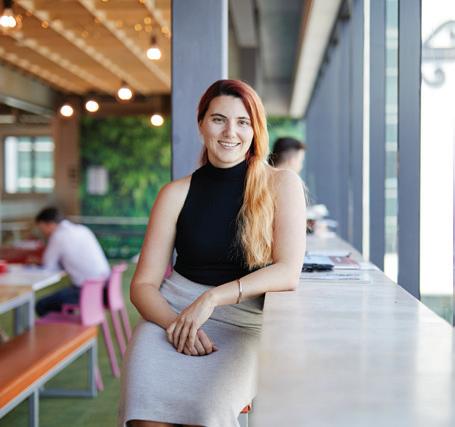
What role do acoustic engineers play in the built environment?
Engineer, polar bear, wet weather gear
The multifaceted life of one mechanical engineer
2026 AUCKLAND AWARDS
Congratulations to our winners
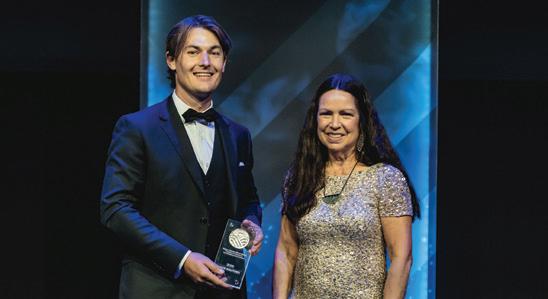
Student Leadership Award
South Pacific Indigenous Engineering Students | University of Auckland
Emerging Leader Award
Michelle Delves | Air New Zealand
Luminary Award
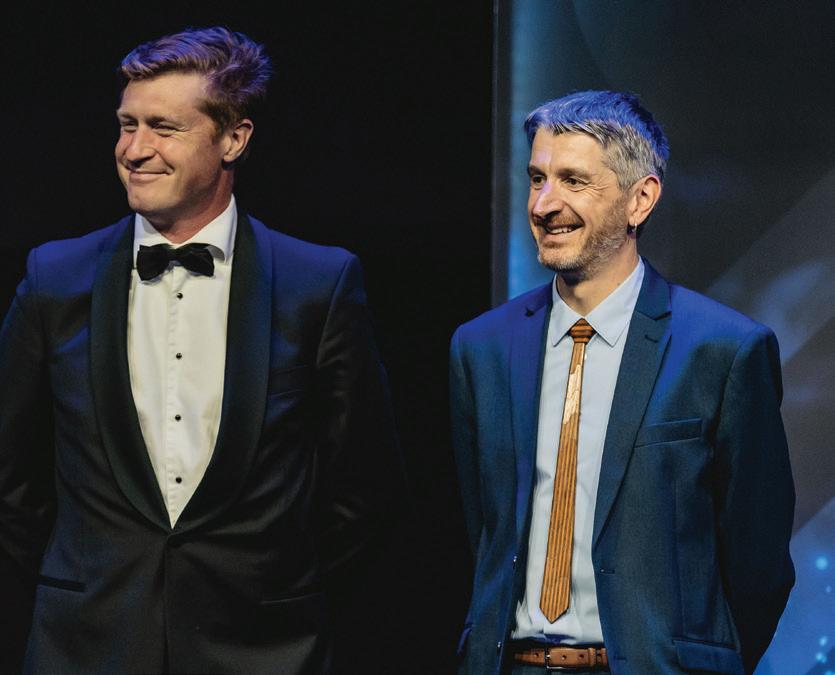
Matt Mules | Oxcon
Arthur Mead Award – Below $10 million
UNDP Samoa – E-Alia Electric Ferries | McKay
Arthur Mead Award – Above $10 million
Central Interceptor | Ghella and Abergeldie
PROUDLY SPONSORED BY
Read about the winners’ impact on engineering.
06
“It’s no longer about identifying single areas of vulnerability. It’s about pre-responding to huge areas that are susceptible."
24
30
“While we operate within strict safety parameters, it could be snowing with ice in the water and large swell and it feels like you’re having a proper adventure.”
“You have to put yourself into the mind of someone who would be using a space and think about how you can make that space better for them.”
issue
32
“ This project was a great opportunity to apply engineering thinking in conditions that bear no resemblance to a New Zealand lab.”
PO Box 12 241, Wellington 6144 New Zealand 04 473 9444
EG is available digitally for members on our website.
Printing
Your cover is printed on Forest Stewardship Council (FSC) approved and elemental chlorine free (ECF) paper. The inside pages are Programme for the Endorsement of Forest Certification (PEFC) approved and elemental chlorine free (ECF). EG is printed using vegetable-based inks made from renewable sources. Printing and fulfilment by Bluestar.
Please recycle your paper envelope – it’s 100% recyclable and made from PEFC accredited paper.
Disclaimer
Advertising statements and editorial opinions expressed in EG do not reflect the views of Engineering New Zealand Te Ao Rangahau, its members, staff, or affiliated organisations unless expressly stated.
Print ISSN 2537-9097
Online ISSN 2537-9100
This issue of EG was published in June 2026.
Features
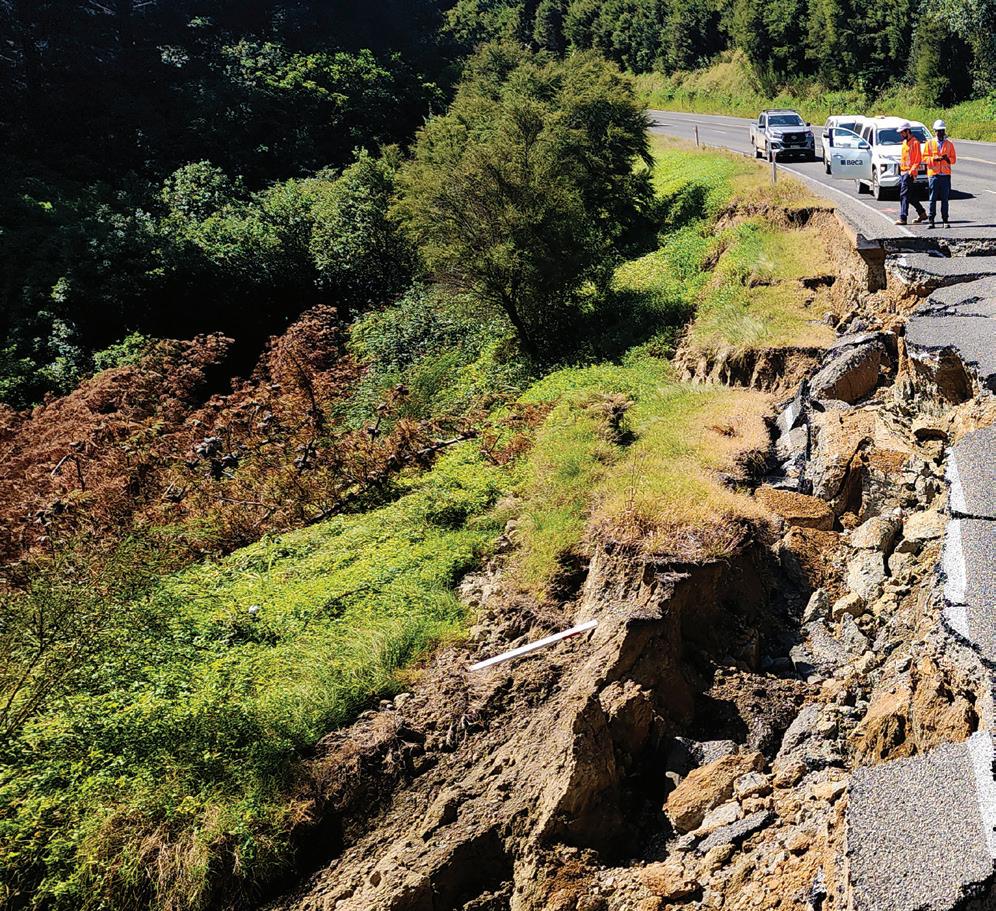
06 Landslides: risk, response and resilience How New Zealand engineers are helping find better ways to prepare for – and respond to – landslides.
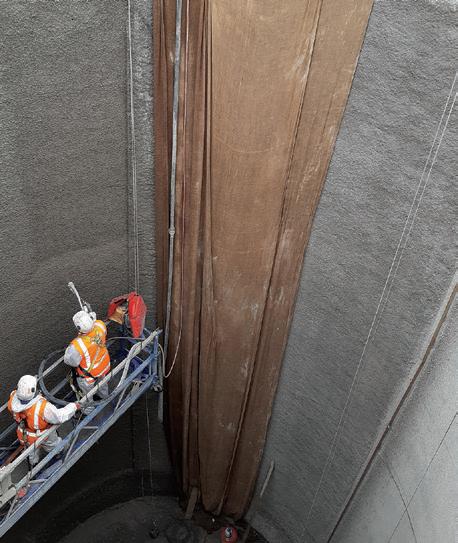
14 Temporary measures Reflections on temporary works engineering in Aotearoa.
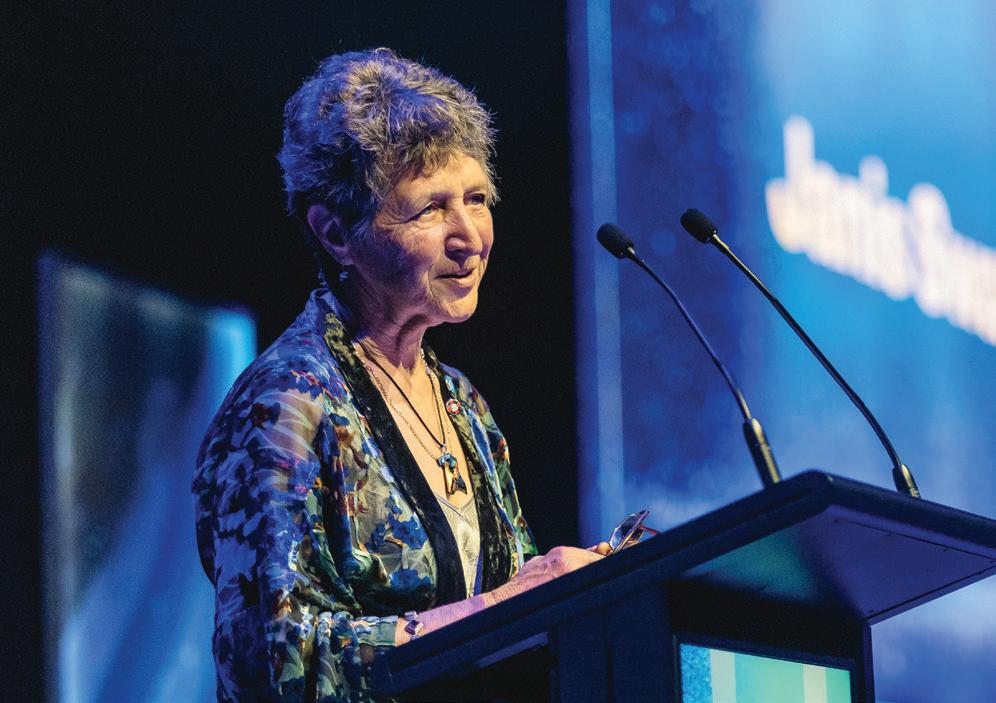
22 Exceptional service recognised Showcasing the 2026 recipient of the MacLean Citation, Janis Swan ONZM DistFEngNZ.
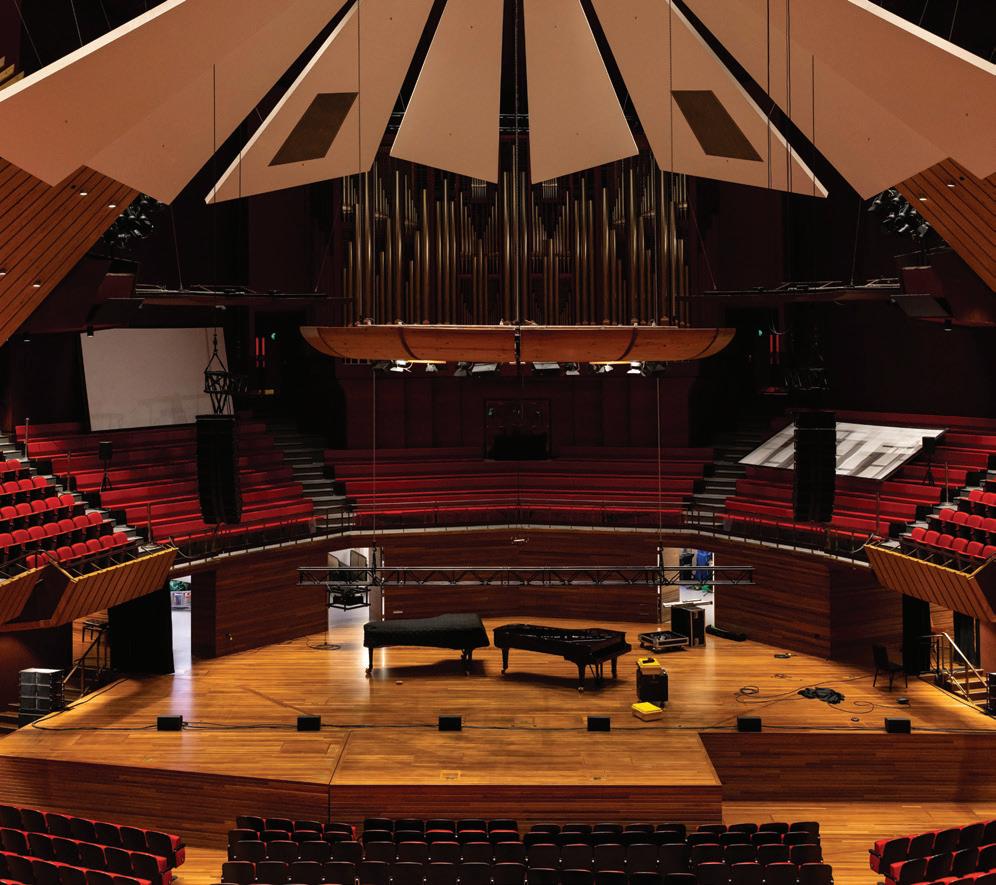
24 Sound thinking Sound plays a vital part in the built environment. So, what role do acoustic engineers play?
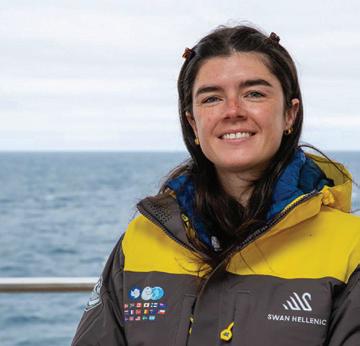
30 Engineer, polar bear, wet weather gear The multifaceted life of mechanical engineer Rochelle Kirby.
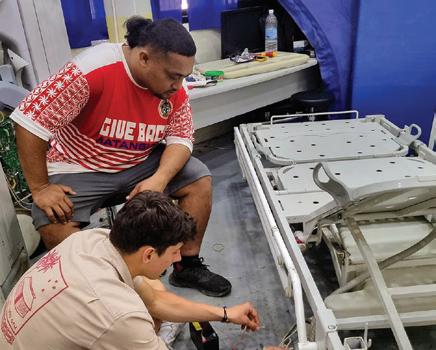
32 Fixing equipment and equipping fixers How a university’s mechanical engineering programme is helping to upskill technicians in Tonga and sustain its medical equipment.
Best practice
42 Supporting IT engineers Why Engineering New Zealand provides a natural home for IT engineering professionals.
43 Advocating for resilience Outlining Engineering New Zealand’s focus this election year.
44 Sound practice Why pioneering acoustic findings continue to resonate.
46 Reducing risk in timber retaining walls While small, engineered walls far outnumber larger walls built in any given year, they’re also among the most frequently misunderstood.
47 Leading questions
48 On “the beauty of volunteering” A Fellowship and an award for outstanding voluntary service to the engineering profession in the same year? Extraordinary, but true.
50 CEAS turns 60 Providing risk management and professional liability insurance for the country’s consulting engineers and meeting evolving needs.
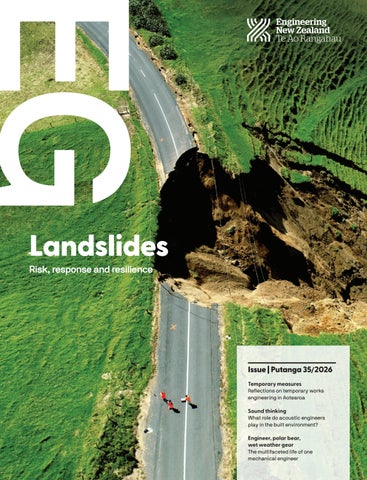
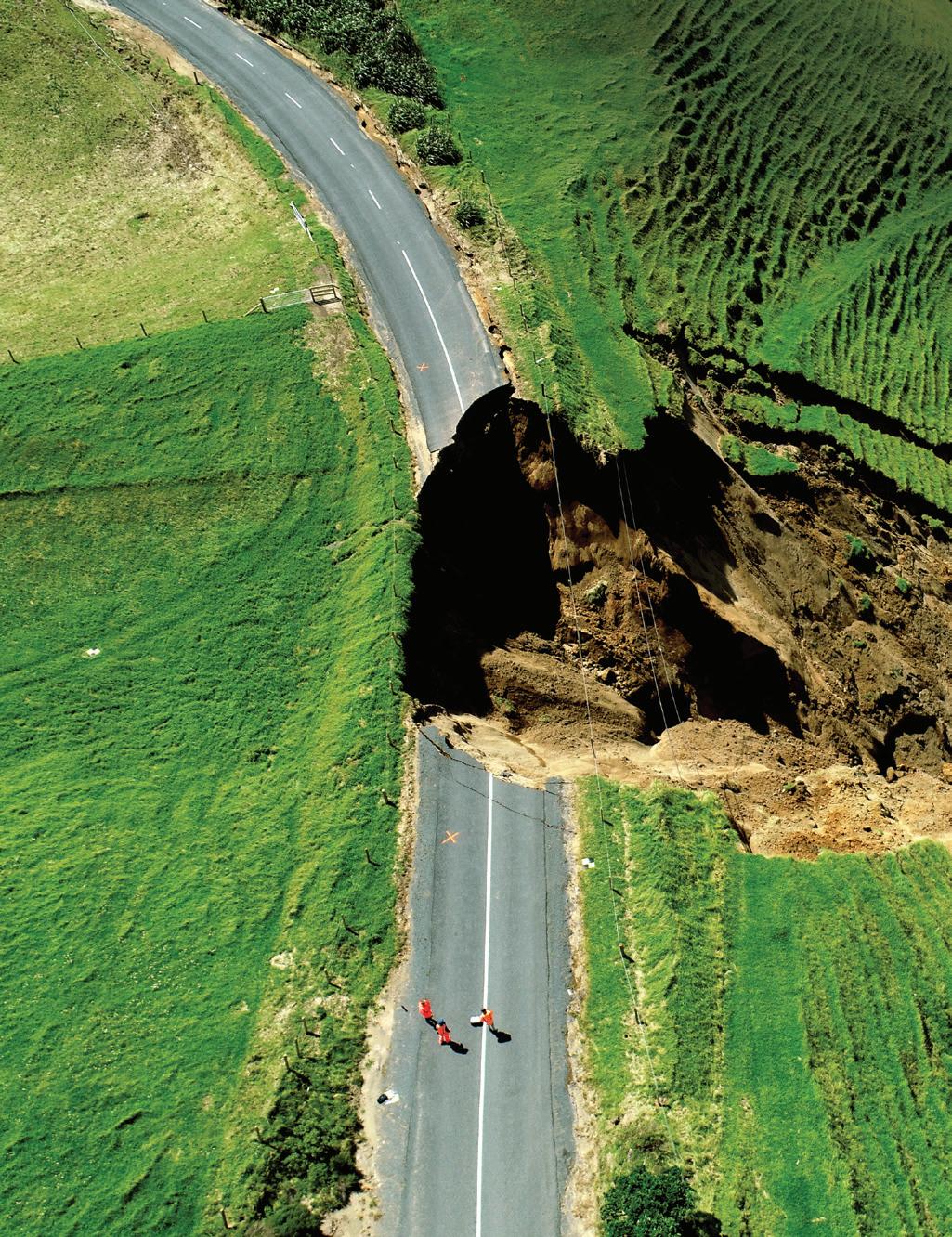
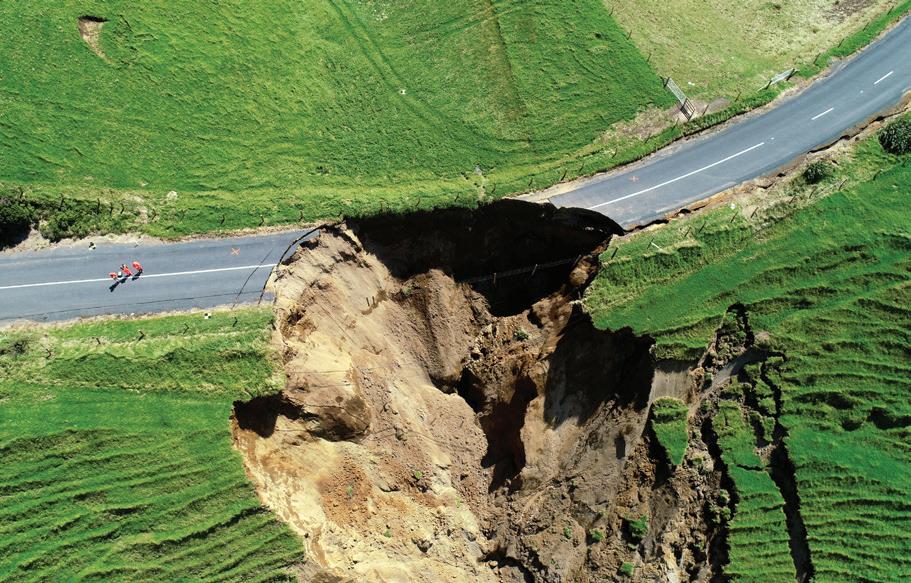
On the cover: Engineers assessing a landslide on Āwhitu Peninsula following Cyclone Gabrielle.
Photo: Beca Survey
52 Secret life of engineers
54 Bedside table
55 One to watch
56 Inside job
58 Intersection
59 Obituaries
60 Engineering genius
Engineering Envy #179
Chosen by Te Ao Rangahau staff
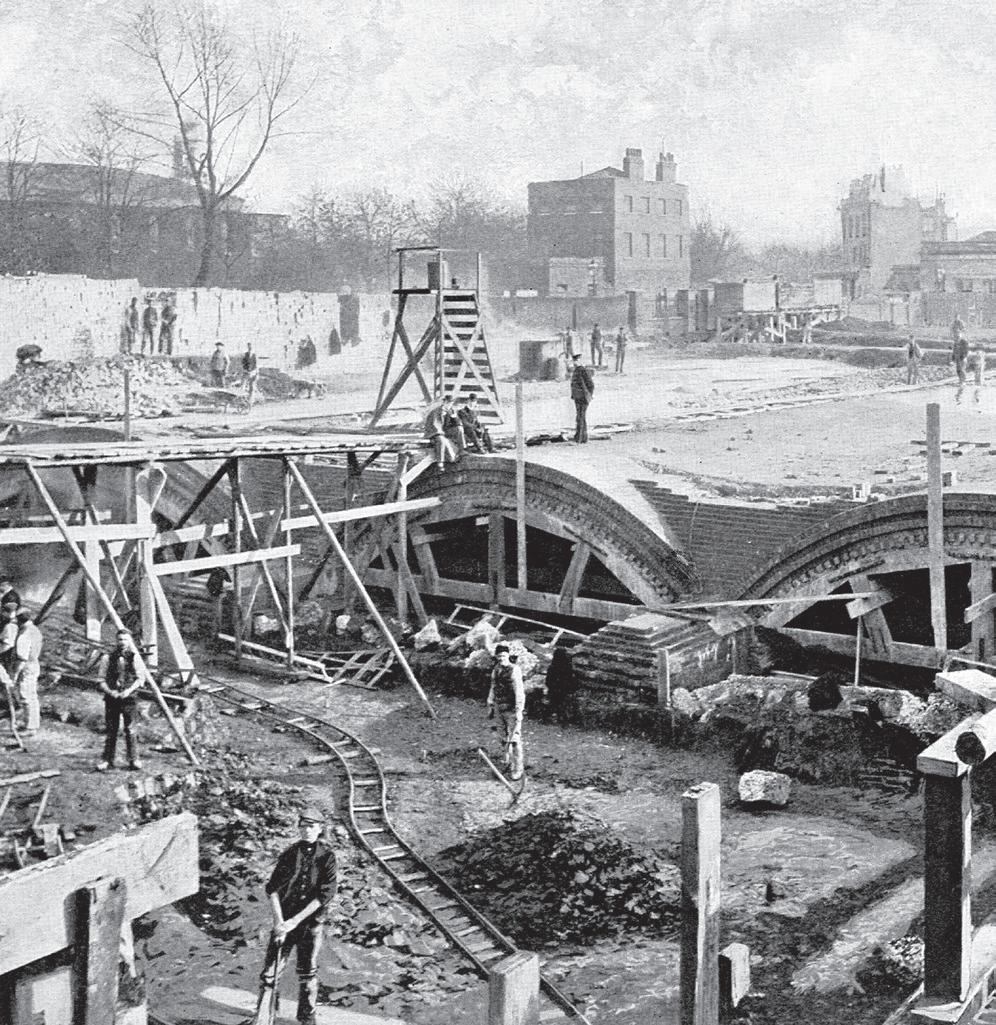
London Underground
The London Underground has lived many lives – once a wartime shelter, now moving millions daily. Its intricate network reveals an engineering feat that truly wasn’t built in a day.
– Jordan Marshall, Marketing Coordinator
When it opened in 1863, London’s steam-hauled Metropolitan Railway (the world's first) ran just 6km from Paddington to Farringdon. Built using the “cutand-cover” method – essentially digging a trench, laying track and roofing it over – in its first year it carried 9.5 million passengers, who endured pungent fumes from the coal-burning locomotives.
Further development was required by the 1880s as congestion remained an issue in central London. The cut-and-cover method was ruled out as it was too expensive and disruptive. Hard mahi and clever engineering solved the problem, with cheaper, deeper tunnels bored through London soil using James Henry Greathead’s innovative cylindrical tunnelling shield. Sooty and fume-weary travellers found relief in 1890, when the City and South London Railway became the first deep-level electric underground railway.
Today, the network has grown to 11 lines, 272 stations and 400km of track, handling up to five million passenger journeys a day.
What they said
A rātou kōrero
“At a time when public debate can feel increasingly short term and polarised, universities matter profoundly as a place of careful analysis, long-term perspective and respectful disagreement.”
Professor Nic Smith FEngNZ will become Vice Chancellor of the University of Auckland in August.
“I’ve always been motivated by projects that strengthen community resilience, and to design, engineer and deliver solutions that make a real difference across Te Waipounamu.”
Beca’s new Southern Regional Manager, Amber Comley CMEngNZ CPEng.
“I was surprised, that’s it.”
Paris-based software engineer
Ari Hodara wins a Picasso painting worth NZ$2 million in a charity raffle held to raise funds for Alzheimer’s disease research.
“Floodwater doesn’t just pool, it flows, and when it flows quickly, even relatively shallow water can become extremely dangerous.”
New research, led by Dr Lea Dasallas from University of Canterbury’s Department of Civil and Environmental Engineering, shows that even shallow floodwater can be powerful enough to knock people off their feet or sweep away vehicles if it’s moving quickly enough.
Tēnā koutou katoa, 大家好, greetings
I am deeply honoured to serve as the first Asian female President of Engineering New Zealand Te Ao Rangahau since its inauguration in 1914. This milestone reflects not only my own journey, but also the growing diversity and strength of our profession.
For more than a century, our members have devoted their expertise, passion and energy to making a positive difference in our communities. I am humbled to follow in the footsteps of those who have come before us – leaders who have shaped our profession and paved the way for future generations. It’s a privilege to continue this legacy and help shine a light for those who will follow.
I sincerely thank our immediate past President, Professor Jan Evans-Freeman, for her outstanding leadership. Thanks also to Sarah Sinclair and Aidan Cooper for their valued contributions as they stepped down at our AGM in March.
I also warmly welcome new Deputy President Keryn Kliskey, along with new Board member Deborah Curd and Felicity Glenie. I look forward to working alongside the 2026 Board as we continue
to bring engineering to life and strengthen our impact across Aotearoa.
As we navigate difficult times with current global uncertainties, I am reassured to know that our profession continues to strengthen. In this edition of EG we showcase some of the outstanding engineers who were recognised at the Fellows’ Dinner, including Emerging Professional and one of the President’s Award recipients, Jack Southee, plus Kiwibank New Zealander of the Year’s Sustainability Leader of the Year, Mike Casey, who is becoming increasingly well known for his electrification advocacy work.
Finally, I’d like to remind you to tune in to the political debate we’re hosting on 6 August as the build up to the November election intensifies (see page 43 for more details).
Ngā mihi nui, nāku noa, 此致, warm wishes.
Kennie Tsui CNZM FEngNZ CPEng IntPE(NZ) President, Engineering New Zealand Te Ao Rangahau
Landslides: risk, response and resilience
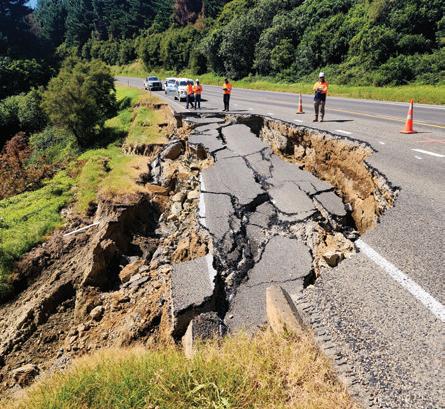
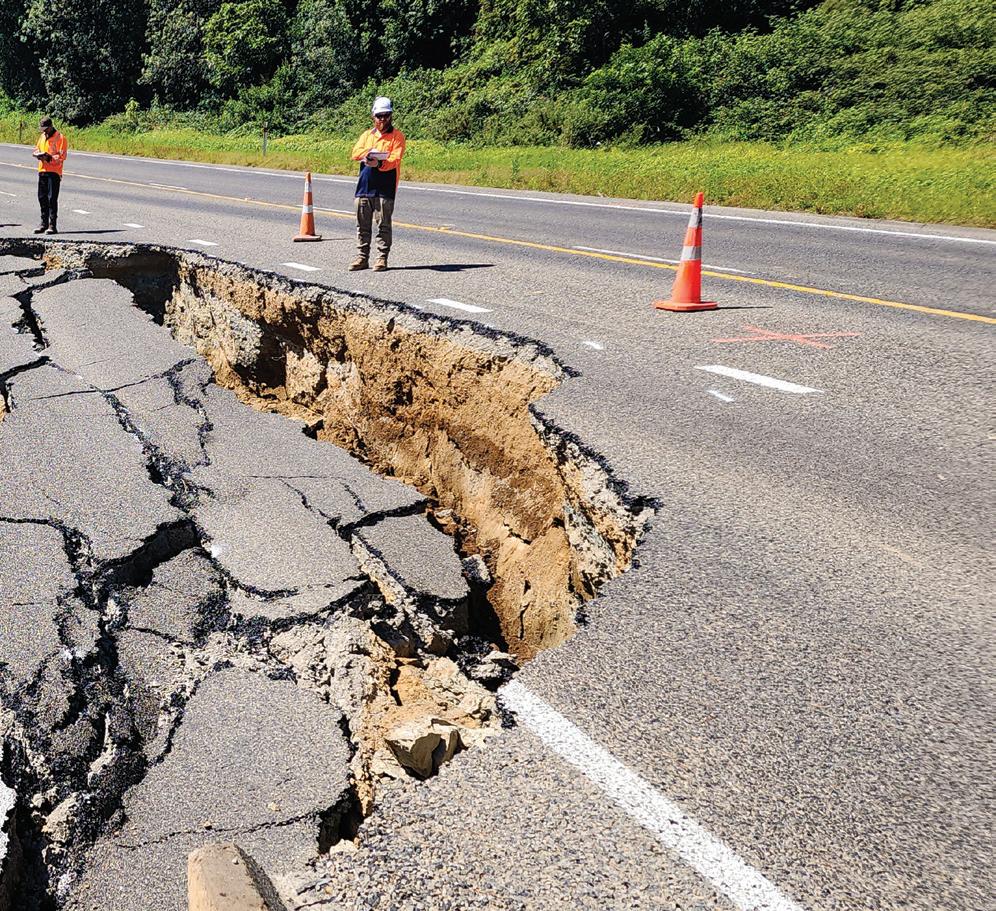
Initial assessment of an underslip on SH5 following Cyclone Gabrielle.
Photo: Joe Cant/Beca
How New Zealand engineers are helping find better ways to prepare for – and respond to – landslides.
WRITER | KAITUHI Laurie Winkless
On a rain-soaked January morning in 2026, tragedy hit Tauranga. Two landslides – one in Pāpāmoa, the other at Mount Maunganui – killed eight people and injured several others. Images of the scenes shocked the nation, but for engineers and geologists working on natural hazards, it was a stark reminder of something they already knew: Aotearoa is one of the most landslide-prone places on Earth, and there is still much work to do around mitigating their impact.
From the 1979 Abbotsford disaster in Dunedin, which destroyed 70 homes, to the devastating sweep of Cyclone Gabrielle across the North Island in 2023, landslides have repeatedly shaped and scarred our country. They have claimed more lives in the past two centuries than all of our earthquakes, volcanic eruptions and tsunamis combined. And yet, they receive far less public attention and arguably, less systematic investment. That’s beginning to change. Across hazard and risk modelling, emergency response and long-term resilience planning, engineers are developing tools, forging new frameworks and pushing New Zealand toward a more coherent approach to one of its most persistent hazards.
Understanding our level of risk
Dr Chris Massey, principal engineering geologist at Earth Science New Zealand (ESNZ, formerly GNS), has spent his career trying to quantify a notoriously complex, uncertain problem.
“The main drivers of landslides are rainfall and earthquakes,” he explains.
“The other things that are really important are steep topography, weak materials and anthropic changes. In New Zealand, we have all of those, making it an environment in which landslides occur.”
Despite this, he says, we lack any nationally applicable hazard models that would allow a proper accounting of exposure, which means “we don’t really know the full scale of the impact of landslides across the country”.
This is something that Chris and his colleagues at ESNZ are working to change, via their Hōretireti Whenua Sliding Lands programme. Co-led by Massey University, this programme is developing national-scale landslide models that can forecast hotspots – locations where rapid and dangerous landslides are most likely to be triggered – to inform decision-makers about where people and infrastructure are most at risk.
Opposite: Assessing a landslide on Āwhitu Peninsula following Cyclone Gabrielle. Photo: Beca Survey
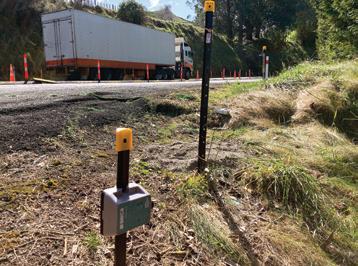
Top left: Telemetered instruments provide near realtime monitoring of landslide movement along critical transport networks. Photo: Christoph Kraus/Beca
Top right: Portland, Oregon, and the Columbia River to its north, captured through clouds by NASA-ISRO Synthetic Aperture Radar (NISAR) in November 2025. Image: NASA/ JPL-Caltech
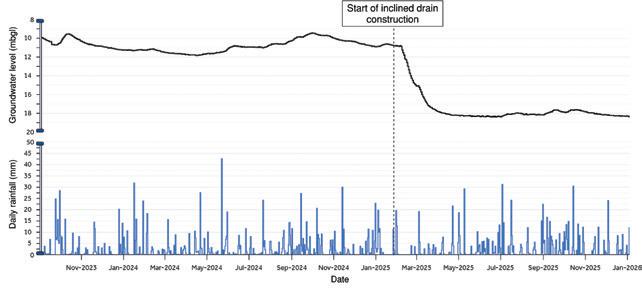
Bottom: Graph showing the notable drop in groundwater levels following installation of inclined drains (upper data set). Image: Beca
“We’ve done a lot of work in earthquake science, in tsunami science and in volcano science over the years,” he says. “So, it’s really important that we level up on the hazards we don’t know quite as much about, like landslides. It’s the only way we can compare on an equal basis.”
The science of landslide modelling is advancing rapidly. Existing landslide databases are being combined with machine learning and AI to calculate the probability of a landslide occurring at a given level of seismic activity or rainfall.
“AI has sped up the process of ingesting and analysing our data sets; there’s no doubt about that,” Chris says. “But the key is that it is physics-informed AI. We need to understand the physics and the statistical relationships underpinning these machine-learning models in order for them to have credibility.”
Remote sensing too is beginning to paint a more complete picture of our changing landscape. Photogrammetry and laser ground-mapping are regularly being carried out using drones, helicopters and fixed-wing aircraft. Radar satellites can now track ground deformation over time, and optical imagery allows researchers to observe how a piece of land
changes across multiple survey passes.
“That means we can start to build up a picture of what’s actually happening in a particular location,” Chris explains.
“For example, you can see vegetation cleared from a slope, and then two to four years later observe a landslide there. Cyclone Gabrielle showed that the removal of trees was a really critical component of why there were so many landslides.”
Looking further ahead, the next generation of satellites – including NASA’s NISAR – promises better ground movement measurements and frequency of capture; an upgrade to the current 12-day cycle.
“Once we start getting daily measurements, we can really start to use those to build better models. It’s going to be a game changer, but that’s a few years off yet.”
Responding to an event
When a landslide strikes, the engineering community mobilises in waves. The first wave involves urban search and rescue (USAR). Dr Jan Kupec FEngNZ CPEng, a principal geotechnical engineer at Aurecon, and one of only two USAR engineers in Asia-Pacific with geotechnical expertise, describes his role.
“In INSARAG [the UN’s International Search and Rescue Advisory Group] teams generally have structural engineers dealing with building collapses,” he explains. “But Fire and Emergency New Zealand recognised early on that, because we have a lot of steep terrain, they actually need people with geotechnical expertise. Landslides tend to hit buildings, and while a structural engineer can still go into the building, the hazard is still posed by the landslide.” Jan and his colleague John Seward MEngNZ carry this combined expertise into some of New Zealand’s most dangerous post-event environments. Both are on call 365 days a year. When the Mount Maunganui landslide struck in January, John – who had already been dispatched to Pāpāmoa – rerouted to the scene by helicopter and was on site within minutes of the slope failing.
“The riskiest slope is the one that hasn’t yet failed,” Jan says. “If one area has failed, and the slopes left and right of it haven’t, what’s to say those areas will stay in place? That’s the challenge. We need to make rapid decisions in high-risk environments. Our immediate job is to manage the safety of the other first responders with us.”
The second wave of response falls to people like Rori Green MEngNZ, a geological engineer and
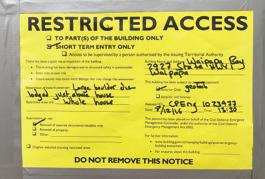
independent consultant. Her focus is the geotechnical rapid building assessment – a structured, houseby-house process for evaluating landslide risk to properties after an event. The typical response involves teams spending 20 to 30 minutes per property, documenting what has happened and assessing what could happen in future. From this, they assign placards to the building: red (unsafe), yellow (restricted access) or white (inspected, can be used).
“Landslide risk can be tricky, especially when there is limited time for observations and you have to make a call on whether it is safe to continue using the building,” Rori says.
We need to make rapid decisions in high-risk environments. Our immediate job is to manage the safety of the other first responders with us.
– Jan Kupec
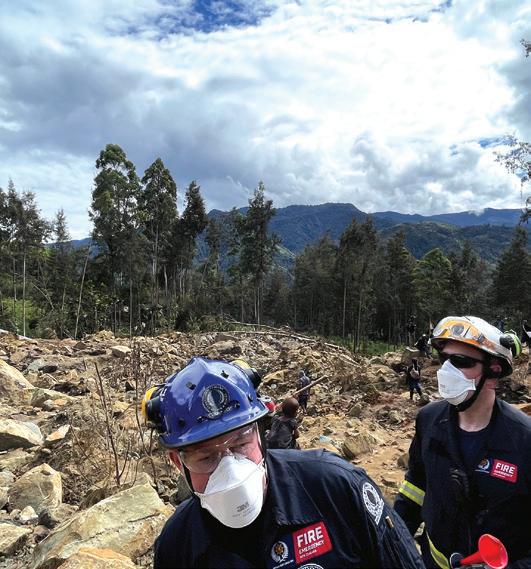
Left: USAR engineer John Seward MEngNZ assesses the likelihood of further movement at a Papua New Guinea landslide site.
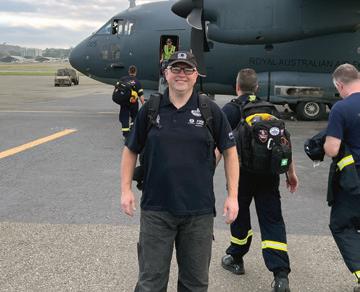
Below: Jan Kupec FEngNZ CPEng boards a Royal Australian Air Force C27 Spartan to head into the Papua New Guinea highlands, following the Mulitaka Landslide. Photos: Jan Kupec
Opposite, top left: Example of placards used for building assessments following the Kaikōura earthquake. Photo: Civil Defence Geotechnical RBA team
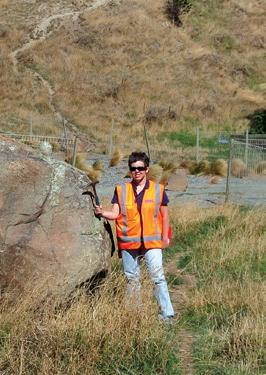
Opposite, bottom left: Geological engineer Rori Green MEngNZ at Barnett Park, Christchurch following the 2011 earthquake. Photo: Charlie Watts
Opposite, right: Members of the Port Hills Geotechnical Group observe how rocks roll and bounce down slopes. Photo: Rori Green
“Our experience and judgement play an important role.”
The process has its roots in the response to the 2011 Christchurch earthquake. There, a consortium of geoprofessionals was assembled in the immediate aftermath with, by Rori’s account, relatively little guidance on how best to proceed.
“When the earthquake happened, there was really no formalised procedure for assessing and placarding for landslide risk,” she says. That group – the Port Hills Geotechnical Group – developed the approach as they went, and their experience formed the basis for the first formal geotechnical rapid building assessment guidelines, published in 2017. Rori is now working with the Ministry of Business, Innovation and Employment to update those guidelines and roll out training to geoprofessionals across the country.
Internationally, Rori says, New Zealand’s approach stands out.
“To my knowledge, this isn’t a practice that goes on elsewhere and there are folks interested in what we’re doing.” She says the United States’ Applied Technology Council – who developed some of the first formalised procedures for post-earthquake building evaluations – is looking to develop a comparable landslide system, partly informed by New Zealand’s experience.
Jan agrees the country has come a long way.
“When I arrived in New Zealand 21 years ago, there were just a couple of professionals with knowledge of how to assess and manage landslide hazards. Nowadays, we are essentially world leaders. We’re training other countries in how to do it.”
In February this year, Jan delivered landslide emergency management training to Australian USAR teams in Queensland and New South Wales. In 2024, he and John deployed to Papua New Guinea as part of the New Zealand Government’s response to a deadly landslide in the highlands.
Building resilience in challenging times
For Ann Williams FEngNZ CMEngNZ (PEngGeol), a principal engineering geologist at Beca, the biggest challenge our country is facing is around building our longer-term resilience to events like landslides. But as she sees it, this is not solely a technical challenge – it’s a structural and cultural one, too.
“Traditionally we have done things like landslide mapping and hazard studies to identify areas of greatest risk, and try to avoid those when we’re developing. And we have some legislation, policy statements, regional and district council plans, and landslide databases. All of these are great tools,” she says.
“But as landslides become more ubiquitous –because we are subject to increasingly unpredictable weather patterns due to climate change – we’re faced with large swathes of land being impacted. It’s no longer about identifying single areas of vulnerability. It’s about pre-responding to huge areas that are susceptible.”
She suggests that one of the persistent issues is an inconsistent hazard response across regions,
“We see these differences all the time: in Auckland we do things one way, in Canterbury another, and in Hawke’s Bay another. If we had a similar response approach across the country, that would be very useful.”
She advocates for the establishment of prearranged regional response entities; contracts set up ahead of time, so that when a disaster strikes, the question of who does what and who carries the liability is already settled.
It’s no longer about identifying single areas of vulnerability. It’s about preresponding to huge areas that are susceptible.
– Ann Williams
Chris agrees that a more proactive approach would benefit everyone. “We can do all the great science we want, but we really need to see that translated into good policy. Too often, we’re on the back foot, reacting rather than taking opportunities to get ahead.”
Ann sees public communication as a critical and currently underdeveloped part of the equation.
“Public awareness will be key for us. Giving people more tools so they can identify areas that are potentially susceptible to repeat or future landslides, and empowering them not to wait to be told to evacuate.”
Marlborough, she notes, is a good example. There, communities can view near-real-time river levels and rainfall data, enabling more informed individual decisions in a region that has been hit by multiple landslides in recent years.
When asked what a genuinely resilient New Zealand would look like, Ann is frank: “We are far from it, to be honest.” Resilience, she argues, means a country that “continues to have all its core facilities functioning irrespective of whatever event it is faced with. And I don’t think we are there”.
Accessible tools, greater public awareness, an increase in proactive investment, and a shared national understanding of what resilience actually means: these are the building blocks.
“We tend to be reactive, because we just don’t have enough money to do the pre-work,” she says.
“But if these events keep happening every other year, maybe that will change.”
Left: Installation of inclined drains to lower groundwater levels, improve landslide stability and improve resilience of critical transport routes. Photo: Rhys Morgan/NZTA
Above: The Auraki Stream Road Retreat project on State Highway 4 is an example of how cut slope design can improve highway resilience. Photo: Christoph Kraus/Beca
Advancing NSE Seismic Performance
FDG is a New Zealand–owned business providing end-to-end solutions, specialising in building services support and seismic restraint systems for nonstructural elements (NSEs).
We’re privileged to partner with Engineering New Zealand and work more closely with the engineering community, sharing product and category expertise informed by our testing and development work.
We see strong value in engaging directly with engineers, both to inform our methodologies and to ensure our solutions are robust, transparent and aligned with industry expectations. By collaborating with the profession’s leading body, we aim to contribute to a shared goal of advancing seismic resilience.
This approach is central to our Seismic Assurance initiative, RightSEIS®, which focuses on independent system-level testing and reporting, while providing traceability and transparency. Our goal
is to provide clearer product information from design through to installation, while equipping engineers and contractors with reliable, evidence-based data.
At the recent New Zealand Society for Earthquake Engineering (NZSEE) conference, Kyle Segmiller, Technical Lead at FDG, presented the paper Assembly-Scale Seismic Verification of MODFRAME™ NSE Restraint Systems. While seismic qualification in our industry has traditionally relied heavily on component-level testing data, our work focused on a system-level approach to verifying non-structural restraint performance. A key outcome from the testing was clear: the seismic behaviour of a restraint assembly cannot be reliably inferred from isolated component testing alone.
The industry is clearly shifting towards holistic, evidence-based verification and FDG is committed to contributing to that transition. You can view the NZSEE paper at fdgnz.com/engineering
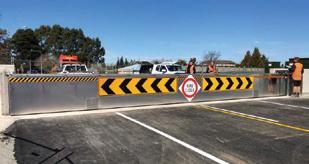
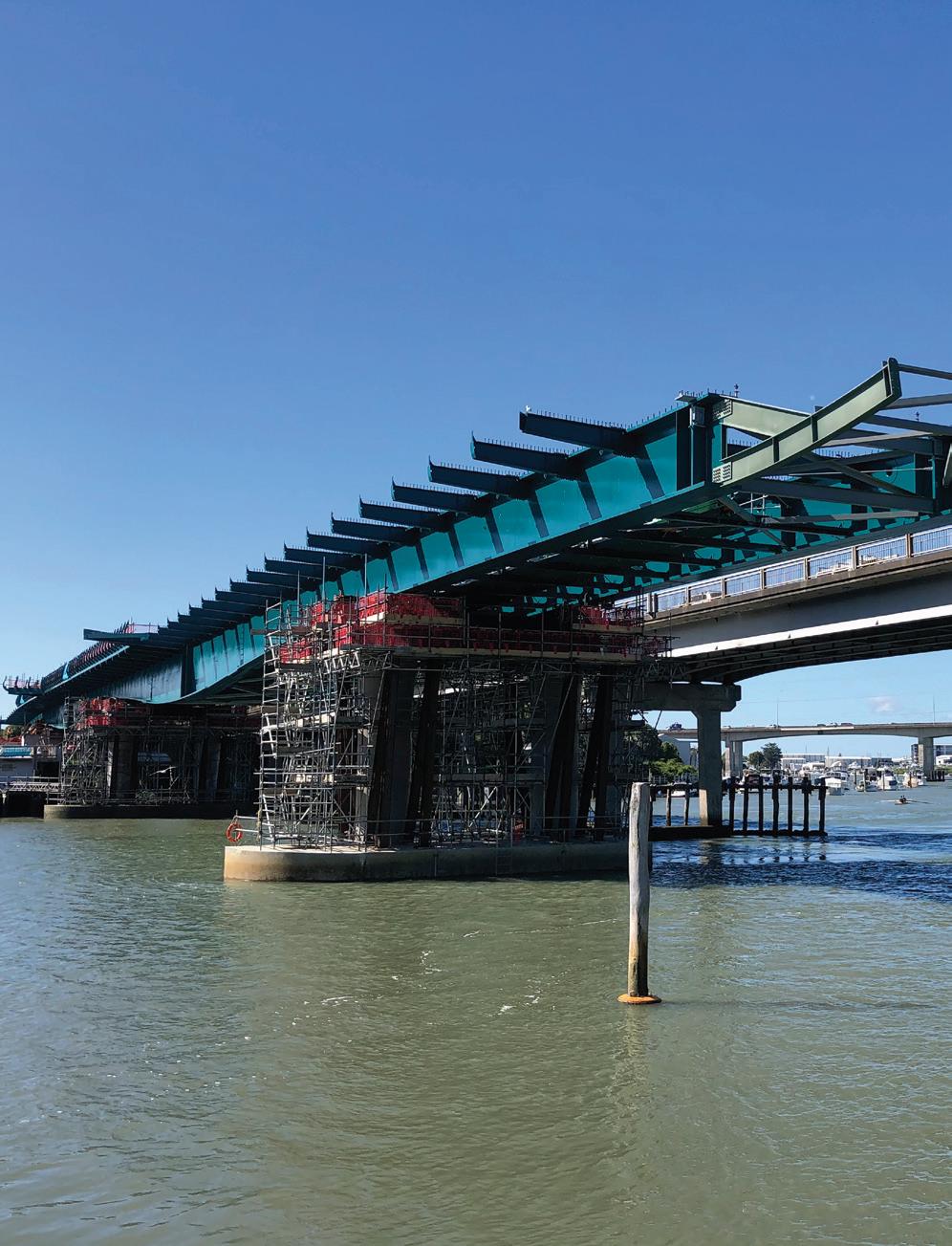
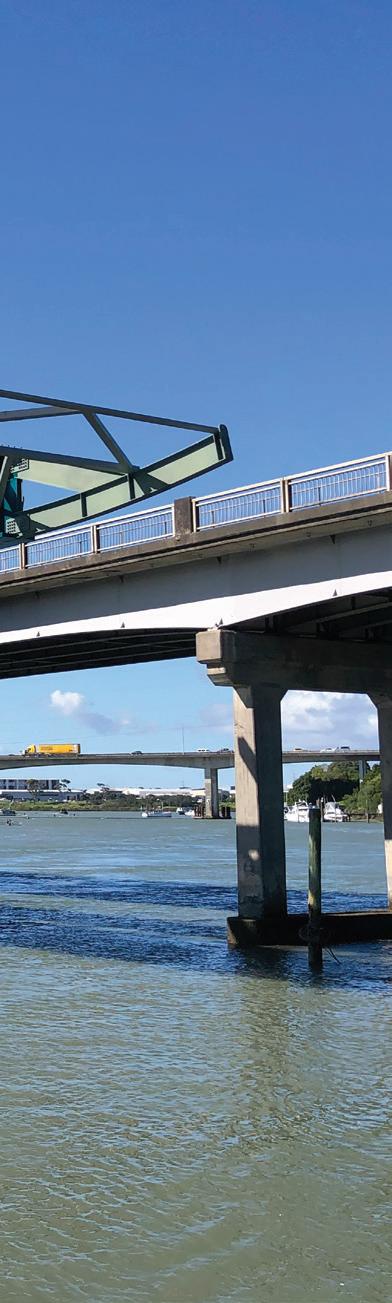
Temporary works for Auckland's Eastern Busway bridge launch was lead by Bamford Consultants in conjunction with the Fulton Hogan delivery team.
Photo: Fulton Hogan
WRITER
| KAITUHI Matt Philp
While raising the standard of temporary works in Aotearoa has been a slow process, there’s now an increased understanding – in part as a result of failures – about the need to get things right.
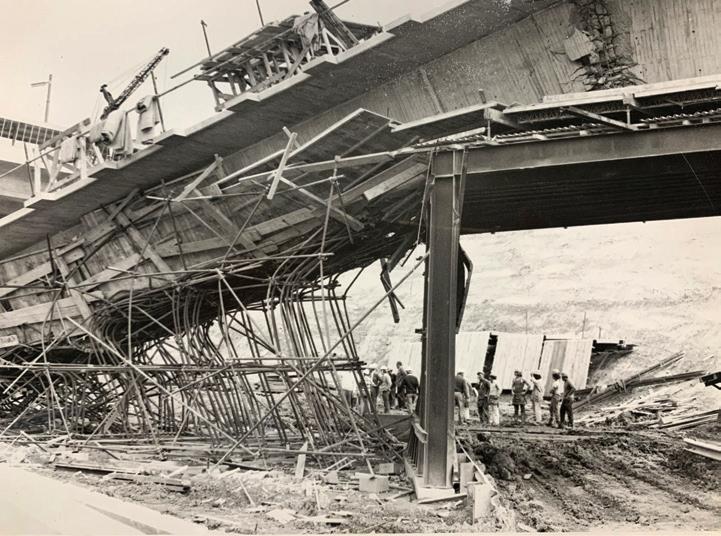
It was lunchtime on 6 May 1975, when the falseworks supporting a 55-metre span of bridge under construction in central Auckland began to buckle. An investigation later determined that prestressing of the concrete had caused “hogging” of the girders, overloading scaffolding and initiating a progressive collapse. Thankfully, everyone working on this key element to connect Auckland’s Southern Motorway to the city was at lunch and no one was hurt. Even so, the Ramp A collapse was a landmark in the evolution of temporary works in New Zealand – the ultimate cautionary tale.
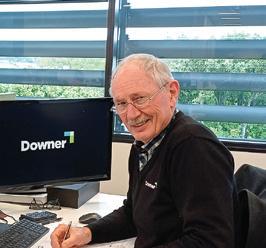
“It was such a catastrophic failure and it could have been easily avoided if good process had been followed,” says Downer Senior Principal Engineer Mark Hedley, a veteran temporary works engineer and new Distinguished Fellow of Engineering New Zealand. Mark, a key figure in the founding of the Temporary Works forum (TWf) in 2018 and its Chair until recently, says he doesn’t believe a qualified engineer was involved in designing Ramp A’s falseworks.
“As I understand, it was pretty much left to the scaffolding company,” he says, adding that that wasn’t unusual at the time.
“But when something like Ramp A occurs, you can’t just let that keep happening. There has to be some engineered design.”
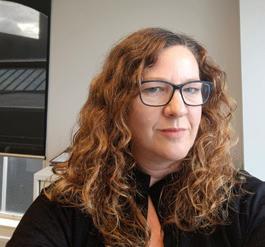
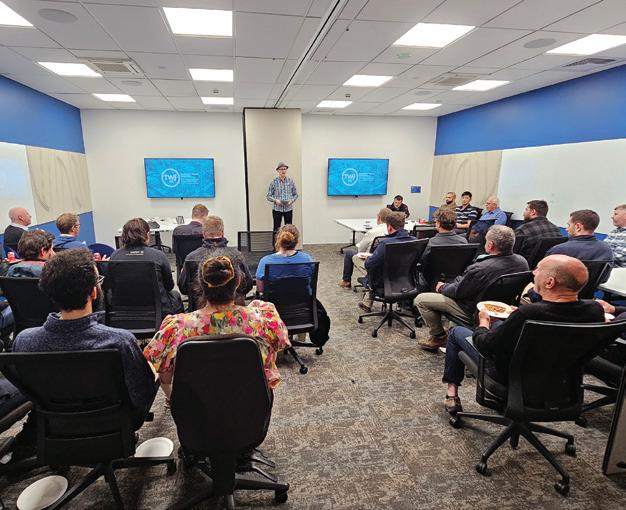
Left: Karangahape Ramp A collapse, 1975. Photo: WSP Opposite, top left: Mark Hedley DistFEngNZ CPEng IntPE(NZ) has been designing structures and temporary works for more than 40 years. Photo: Supplied Opposite, bottom left: Susan Temple FEngNZ, Chair of TWf. Photo: Supplied Opposite, right: A Temporary Works forum (TWf) public meeting in Dunedin.
An important outcome of the incident was the advent of a Code of Practice for Falsework.
“It documented good processes, values and numbers to be used in design, so that people could work off the same standard.”
Even so, raising the standard of temporary works in this country has been a slow process, despite the fact that “we are dealing with structures that are taking the same sorts of load as permanent structures”.
Strictly speaking, temporary works, like permanent structures, come under the Building Act. But in practice, the Health and Safety in Employment Act has been used as the governing legislation, Mark says.
“All prosecutions for serious failures have been through the HSE Act. And because that legislation doesn’t have acceptable solutions or verification methods, it has really been left to temporary works engineers to do what it takes to make things safe. Some do a good job, some don’t.”
Certainly, Ramp A wasn’t the last temporary works failure in this country. In February 2017, for example, scaffolding suspended from the Panmure Bridge in Auckland fell into the water. This time there were injuries, but fortunately no deaths.
Soon after, Mark and a few others founded the TWf. A Technical Interest Group of Engineering New Zealand, the forum promotes best practice through open discussion – including of failures – and the
Photo: Adam Moffat
development of research and guidance.
“The goal was to bring everyone onto the same page and provide processes that everybody could follow. Since our initial document – a guidance note on procedural control – we’ve put out others that address gaps in knowledge,” he says, citing examples like temporary works for marine environments and designing propping for precast panels.
What difference has it made? Mark says there has been a significant improvement in the approach to temporary works taken by tier one and two contractors, scaffolding companies, falseworks suppliers and others.
“But we’re on a journey and we’re not quite there yet. I think it’s more difficult for smaller contractors. Because they don’t have in-house engineering teams, they can struggle to get timely assistance for good design of temporary works. We need more support and education for those smaller players to get good practice right across the industry.”
right. Where organisations might have “winged it” in the past, increasingly they are running plans past engineers.
“They’re asking ‘What are we loading, what’s it landing on, how are we going to build it?’,” Susan says, adding that engineers are being brought into the process at tendering “rather than as an afterthought”.
Unfortunately, increased awareness has been partly driven by temporary works failures.
We need more support and education for those smaller players to get good practice right across the industry.
– Mark Hedley
Susan Temple FEngNZ, who has succeeded Mark as forum Chair, says “there’s been a massive shift in awareness” of the need to get temporary works
“It takes an accident to really make some people stop and think,” she says. But she also credits the forum’s awarenessraising efforts, the presentations it makes and the public meetings it holds, as well as its presence on committees in industries where temporary works come into play.
Susan has been engaged with temporary works since she was an engineering graduate in the United Kingdom. One of her earliest projects involved the temporary damming of historic canals so they could be strengthened. Arriving in New Zealand in the early 2000s, she handled temporary works on the Supreme Court building in Wellington, a role that required
collaborating with structural steel and demolition teams on a tight, heritage-listed site.
She is now Lead Engineer at Temporary Works Consulting (TWC), heading a specialist team devising solutions for public events and construction. TWC, an entity of the New Zealand Scaffolding Group, is responsible for temporary works on projects such as the Rotorua Museum, Wellington District Court and the Timaru Basilica. It also handles the design of temporary staging and seating for events including the Electric Avenue music festival, the ASB Classic tennis tournament and Supercars.
“The scaffolding looks amazing when it’s dressed, but there’s a huge amount of work that goes on in the background.”
That sums up something about temporary works: it’s a crucial element to get right, but it’s not exactly a glamorous field. So, what’s the attraction for
engineers who make it their specialty?
Nick Bamford CMEngNZ CPEng IntPE(NZ) of Bamford Consultants, a construction and engineering firm that specialises in structural temporary works engineering, says the appeal lies in its immediacy.
“I fell into it by accident in the UK, designing tower cranes and temporary works for high rise buildings in London. What I found interesting was that you were designing solutions to complex problems one week and they were being installed the next. There’s very quick feedback.”
Normally calculations are only a small part: it’s about working with the construction team to figure out the right answer for each specific application.
– Nick Bamford
Among recent projects, Nick designed temporary works for the bridge launching of the Eastern Busway Bridge over the Tāmaki River. That was tricky and required complex analysis, he says, adding that the bridge-launching strategy included “some very innovative rollers to accommodate the curved bottom flange of the girders, without strengthening the
permanent works”. Currently, he’s working on a bridge on the unfolding Penlink O Mahurangi project north of Auckland.
“We have a big, suspended formwork system there to allow for 200-tonne concrete segment pours, up to 40m above the waterway.”
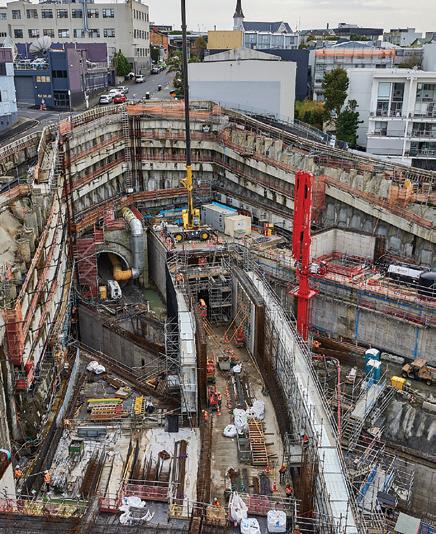
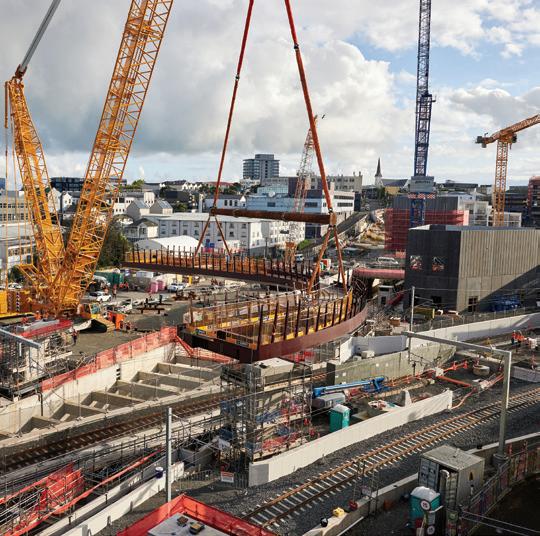
Even more challenging was the Auckland City Rail Link (CRL) project, where the temporary works included tower crane installations, conveyors for spoil removal, falsework and formwork, plus several temporary bridges to enable the 900-tonne boring machines to manoeuvre around the site. (The machine’s shield was 425-plus tonnes and 10m long, so these bridges were substantial.) This was on a busy inner city brownfields site, where there was often very little information about existing underground services. At one location near Aotea Square, Nick says, the team had to rely on details gleaned from a 1925 Auckland Star article.
Solutions on the CRL tended to be bespoke, he explains, and they were arrived at in concert with the wider project team. But that’s generally true of most temporary works assignments.
“Normally calculations are only a small part: it’s about working with the construction team to figure out the right answer for each specific application.”
Aurecon’s Will Watkins CMEngNZ CPEng says that same collaborative mindset was critical to the success of a recent project he was involved in to create a temporary accommodation ward at Wellington Hospital. The 12-bed ward, required while the hospital’s copper pipe network was being replaced, had to be delivered in 12 months.
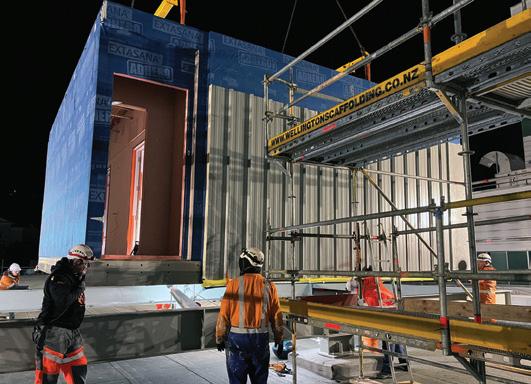
“We all put our heads together and the decision was made early to use offsite prefabrication to accelerate the programme and minimise disruption to the hospital,” Will says, noting that the location chosen was on a fourth-floor roof above the operating theatres.
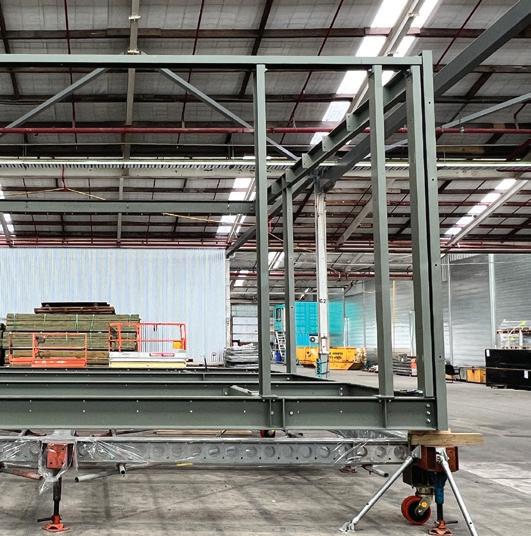
Using warehouse space in Upper Hutt, the building was prefabricated in the form of eight pods, each weighing 15 tonnes.
“There was a lot required in the design to understand and detail how they would bolt together on site and to make allowance for future removal and reassembly elsewhere,” says Will, who is Buildings Mechanical Practice Area Leader for Aurecon.
The other challenge was to transport the pods to site and crane them on to the roof.
“We were fortunate to have an industrial engineer on our team, Stephen Jenkins, a Distinguished Fellow of Engineering New Zealand, who brought his knowledge of moving wool baling machinery around the South Island.” Stephen worked closely with the contractor and subcontractors to work out a methodology, Will says. He adds that the temporary ward, which won a silver at the 2024 ACE New Zealand Awards, is still in use. Even better, “Its success has seen a programme of similar facilities currently being rolled out at several hospital sites around New Zealand.”
off site
Above: Partially fitted-out pods are craned into place at Wellington Hospital. Photo: Dan Herbison
Below: The first of eight modular structural steel frames for the temporary hospital ward, prefabricated
within a controlled factory space. Photo: Ciaran Thompson
Opposite: Installation of temporary works for Auckland's Mt Eden tunnel (left) and Fenton Street bridge (right) was delivered by Bamford Consultants in conjunction with the City Rail Link delivery team.
Photos: CRL
Industry leading the charge on STEM pipeline
Over 160,000 young Kiwis have been inspired with STEM through the Wonder Project.
And that’s because industry’s taking charge with STEM education that has massive and measurable impact by:
• Delivering free, accessible and engaging STEM learning.
• Inspiring thousands of ākonga each year.
• Connecting schools with STEM role models.
• Building confidence in kaiako and ākonga.
• Futureproofing the STEM industry.
Start making change today with the Wonder Project.
Join the rōpū wonderproject.nz
The changemakers sparking wonder
Exceptional service recognised
WRITER | KAITUHI Alexandra Johnson
In an era when engineering lecture halls were overwhelmingly male and opportunities for women in technical fields were few and hard‑won, this engineer stepped into the profession with a resolve that would define her life’s work.
With an already impressive collection of accolades and achievements, biochemical engineer-turned-academic Janis Swan ONZM DistFEngNZ was recently awarded Engineering New Zealand’s MacLean Citation, recognising her exceptional service to the profession. Raised in Levin and the eldest of four siblings, Janis says that her mother was an Italian war bride whom her father met in Europe during World War II.
“She’d only had three years of primary education and arrived here without a word of English.”
After finishing school, Janis spent a year working as a technician for the Department of Agriculture. At the same time, she studied for a New Zealand Certificate in Science by correspondence, which was “hard slog”. She knew she wanted to study at university but had no financial support.
“I won a scholarship from the local dairy company, which was enough to pay for my fees and my board for first year.” She entered Massey University in 1965 and achieved a Bachelor and then a Master of Technology in Biotechnology. Upon graduating, Janis worked in a couple of food-production
roles, but after getting a degree when gender didn’t seem to matter, it seemed the industry wasn’t ready to have women engineers, she says.
“When applying for one job at a local dairy company, the manager said, ‘well I don’t think I’ll be able to train you in running a spray dryer’. He obviously was unsure about how to have women engineers in his workforce.”
With encouragement from then professors Dick and Mary Earle at Massey, Janis applied for scholarships to do a PhD abroad.
“Everyone went to England, Australia was too close, and so I went to the University of Waterloo in Canada. It turned out to be like Palmerston North, but bigger.”
She obtained a PhD in Chemical Engineering in 1977, on modelling the operation of small-scale airlify fermenters for growing fungi on cellulose pulp. On returning to New Zealand she completed a three-year National Research Advisory Council postdoctoral fellowship at the then Ruakura Agricultural Research Centre.
In 1970s New Zealand, there was a strong focus on food processing, particularly dairy and meat, Janis says.
“There was an understanding that because we grow food and export it, we had to add value.” She says there have been many innovations in this area in New Zealand, and the country has been at the forefront of meat processing.
Janis spent the next 16 years at what
was then Meat Industry Research Institute of New Zealand (MIRINZ) in Hamilton, in leadership roles, researching and developing meat byproduct processes, and meat products for export markets.
“I really enjoyed working in the meat industry,” says Janis. “You knew who the client was, you could focus on engineering, you had problems to solve – often in short timeframes – and you had a budget to work with.”
Nearing the end of the 1990s, however, her career trajectory took a radical turn.
“I’d never seen myself as a teacher, but when a position to head the technology department at the University of Waikato was advertised, my neighbour and MIRINZ colleague bought it to my attention. I thought it might be an interesting challenge for the last 10 years of my career, although I ended up staying for 20.”
Starting as the head of the Department of Technology, which became the Department of Materials and Process Engineering, Janis applied her experience in management and research to helping develop University of Waikato’s Bachelor of Engineering with Honours programmes. From 2005–2015, as Associate Dean of Engineering, she led the expansion of the engineering school, growing the student body from six graduates in 2002 to more than 600 undergraduate students, counting this as one of her
most significant achievements.
“It involved a combination of good team effort, many challenges and a lot of opposition, but it’s been so exciting to see where the graduates have gone.”
In 2015 and 2016, she acted as Dean of Engineering, becoming the first woman in Aotearoa to lead an engineering school. She retired in 2018 and the university bestowed upon her the title of Emeritus Professor.
Janis continues to contribute to engineering and engineering education through work on accreditation panels in New Zealand and overseas. She’s on the Hong Kong Engineering Board and recently chaired the International Engineering Alliance review of Taiwan’s engineering accreditation process.
Throughout her career, she has held several national research and education governance roles, including the New Zealand Council of Engineering Deans, the Marsden Council, and the Ministry of Business, Innovation and Employment’s Science Board. After half a century in the profession, she still
radiates passion for engineering and engineering education.
“What I love most about engineering is its diversity. Scientists will focus on the detail of something small, while engineers will look at the big picture. How do we solve this problem? How do we extract this resource and produce the least waste?”
But she believes engineering faculties are making students specialise too early in highly specific fields.
“Engineers can have many jobs during a career. Having a broad foundation opens up lots of opportunities, whereas specialising too early can lead to dead ends. “Universities are developing a plethora of programmes, rather than options within programmes. They often want enrolments rather than considering the profession as a whole.”
Throughout her career Janis has supported women entering the profession and STEM fields in general. She sees some of her her greatest successes as being a role model,
convincing women that engineering is not that hard, and helping them find employment opportunities.
“I think most bright female students are steered towards the ‘caring’ programmes such medicine or law. But as one female student said to me, as an engineer you can end up helping lots of people rather than just a few.”
Even in the mid-2020s, it’s difficult to get young women to study mathematics and sciences in high school and to think they can do engineering, she says.
“We need to better publicise to careers advisors and young women that engineering is an option.” She continues: “Once women believe they can be engineers, they can make a tremendous contribution to the profession and to society.”
A career in engineering certainly took hold in the women in Janis’ family. One of her sisters, Elena Trout, is a past President and Distinguished Fellow of Engineering New Zealand. “We joke that we are the only two sisters who are also distinguished fellows.”
Photo: Brady Dyer/Engineering New Zealand
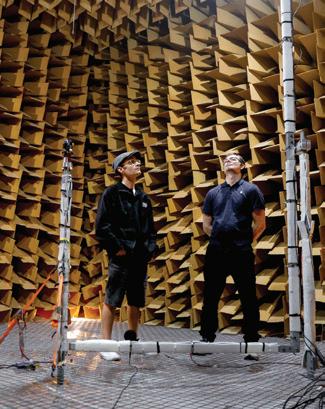
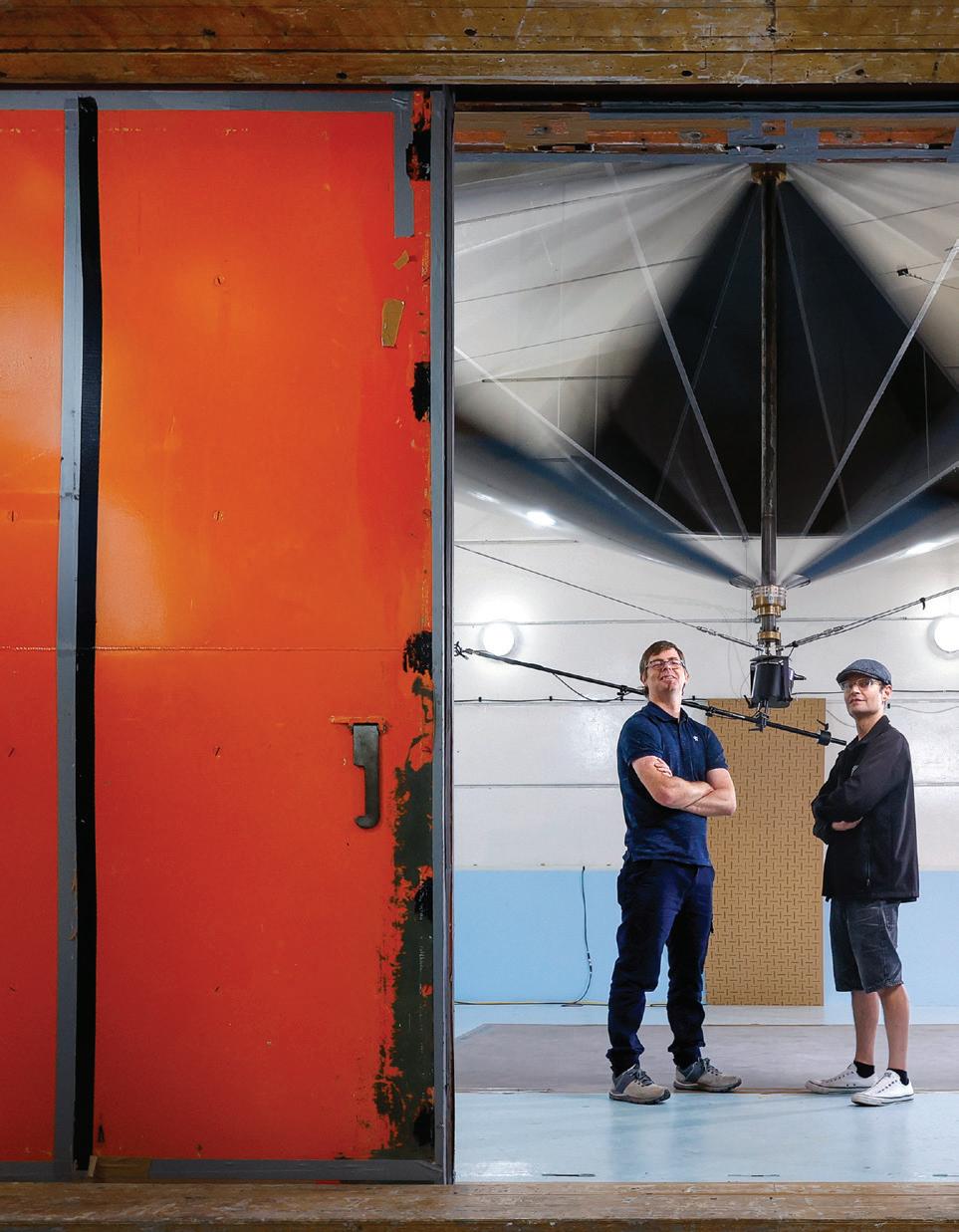
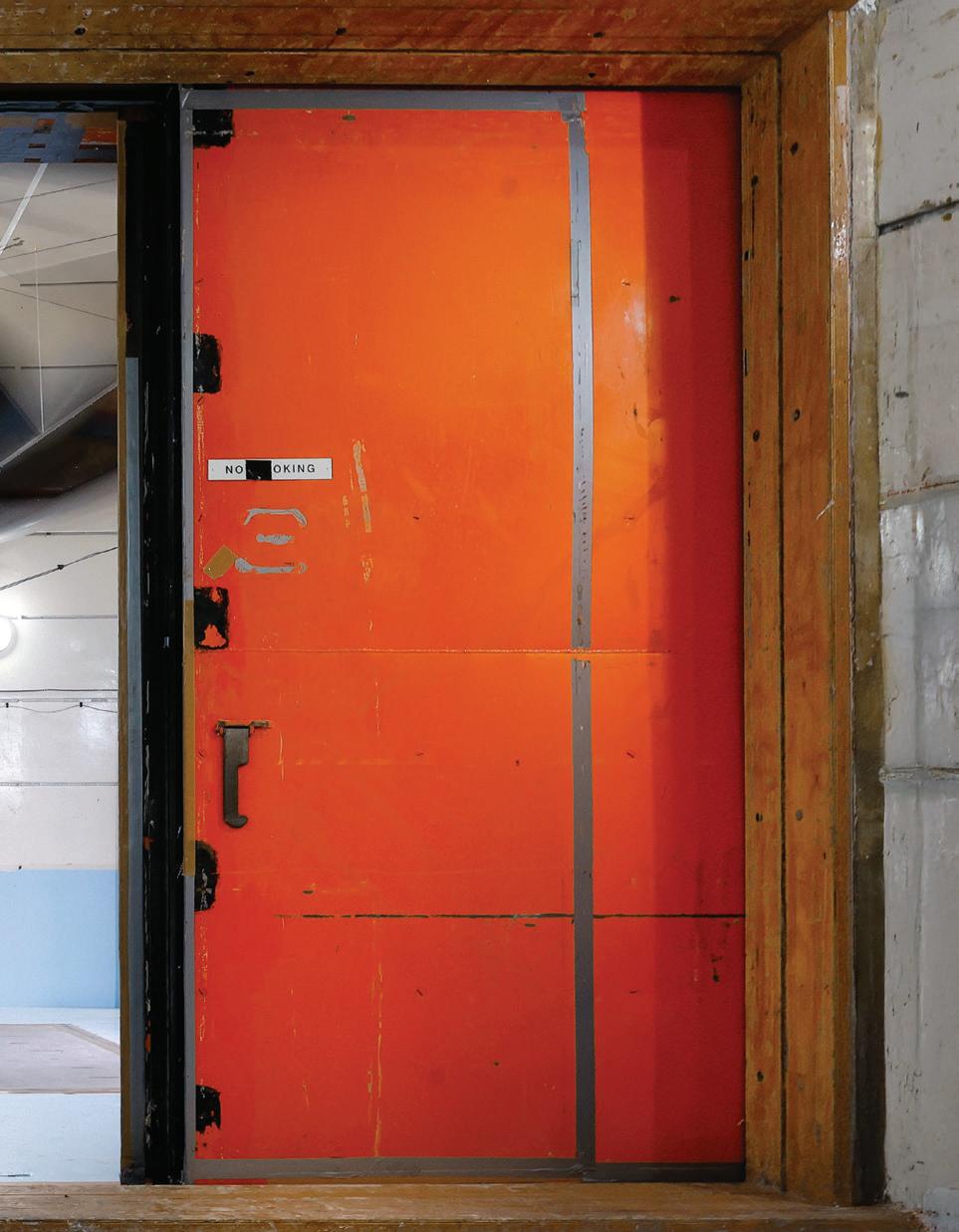
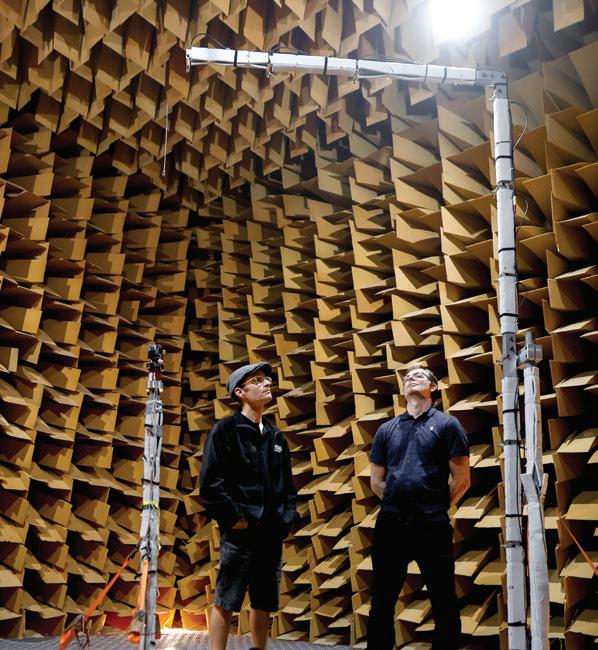
Dr Andrew Hall (left) and Gian Schmid in one of the reverberation chambers at the University of Auckland's Acoustics and Vibration Research Centre.
Photo: Media Productions, University of Auckalnd
Sound thinking
WRITER |
Sound plays a vital part in the built environment. So what role do acoustic engineers play?
KAITUHI Rina Diane Caballar
“What people hear should match what they see around them,” says Jeremy Trevathan, a Principal Acoustic Engineer and Managing Director at Acoustic Engineering Services. This means aural qualities must complement the space, such as reverberant, live sounds for huge stadiums or a productive hum in office environments.
“It’s one of the factors that needs to be well designed to make a building successful overall,” he says, because poor acoustic design can make a space challenging to use. Consider a cafe where you strain to hear conversations over all the buzz and hubbub, or a seemingly private meeting room whose discussions can be heard out in the hallway.
“You end up with parts of buildings that have a lot of thought and money put into them but aren’t being utilised as they should,” adds Jeremy.
Yet acoustics goes beyond noise. Kezia LloydMarsh, a Chartered Acoustic Engineer and Head of Building Engineering Services at WSP, describes other elements of acoustic engineering: sound absorption and how sound resonates throughout a space, sound insulation to prevent the transfer of sound, and vibration and how it might impact structural integrity.
“What I love about acoustic engineering is that you could be figuring out what the main parameters are to make a great chamber music space or how to make sure people aren’t getting fully disturbed by
construction noise outside their bedroom window,” Kezia says. “They’re important in their own way but very different, so it’s a really varied job.”
Spanning the audio spectrum
This variety is where acoustic engineers excel in Aotearoa. For instance, Jeremy recalls his involvement with customising the glass wrapped around the control cab atop Ōtautahi airport’s control tower.
“That turned into a high-stakes item and it pushed us beyond normal engineering,” he says. The glass had to be light and sturdy from a seismic standpoint and clear enough for air traffic controllers to see without any distortions from various visual angles.
In building acoustics, mass is normally your friend, so something heavier is better for preventing the transmission of sound.
– Jeremy Trevathan
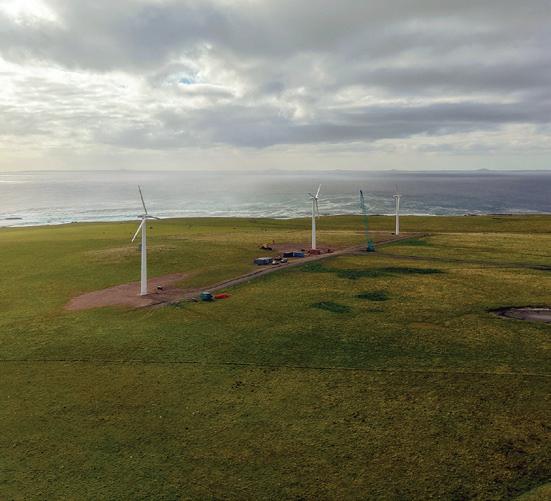
This page: Principal Acoustic Engineer Jeremy Trevathan spent time at Point Durham Wind Farm in the Chatham Islands, measuring and modelling noise produced by turbines.
Opposite: Andrew Hall and Gian Schmid working in the Acoustic and Vibration Research Centre's anechoic chamber. Photo: Media Productions, University of Auckland
Photo: Chatham Islands Enterprise Trust
But it also had to carry the right thickness to mask the whir of propellers, thrum of engines and zoom of planes taking off and landing.
Another challenging project was The Grounds, a multi-unit residential development in Tāmaki Makaurau that employed mass timber and prefab components. While timber can be engineered as huge thick slabs akin to concrete, it offers less of concrete’s noise suppression effect due to its lighter weight.
“In building acoustics, mass is normally your friend, so something heavier is better for preventing the transmission of sound,” says Jeremy.
“From an acoustics point of view, one of the ways to improve the performance of the systems is to cover them up. You’d have a ceiling below the timber slab, or you would have framework and then plasterboard on your walls still.”
Jeremy also has experience in environmental acoustics, where he gets to measure and model noise levels and assess how that might propagate into the environment. He sometimes presents evidence at council hearings or serves as an expert witness at the Environment Court.
“It’s an important part of the checks and balances in the system we currently have.”
His environmental acoustics work has taken him to the Chatham Islands, where he measured, modelled
Sound masking
Workplaces can be noisy environments, which makes acoustics integral to designing these spaces. Sound masking can help enhance acoustic privacy and comfort. This technique adds low-level background sound emitted through tiny speakers from the ceiling. The ambient sound is tuned to match the frequency of human speech, so it’s comfortable to the human ear and fades into that natural workplace hum. The sound also makes it more difficult to understand conversations, protecting speech privacy.
Sound masking can help boost productivity, “lowering that radius of distraction” says Jacques Paterson, ANZ Sales Director at audio company Biamp.
“Most people are unaware that every time you get interrupted in your workspace, it takes roughly 23 minutes to get yourself back into focus mode.”
and analysed the noise produced by wind farms. He’s currently involved with the Tāwhaki National Aerospace Centre, helping determine how much noise each aircraft will make and if they comply with the noise limits outlined in resource consents.
Innovative insulating
The country’s acoustic engineers also shine when it comes to innovation. Andrew Hall, a Senior Research Fellow and Senior Lecturer at the University of Auckland’s Department of Mechanical and Mechatronics Engineering, is all ears on metamaterials for sound insulation in houses, with the intention of commercialising them in the future.
For floors, Andrew and his students are studying the right mix of granular metamaterials – aggregate, granulated polyester, gravel, recycled tyre chips, sand and sawdust – to either spread and reduce the amplitude of sound, or sharpen and push it up to higher frequencies for easier dissipation.
“The idea is that these materials provide mass,” Andrew says. “Because they rub together, creating heat, they increase damping. But they also provide sound absorption within the cavity.”
For windows, Fano resonance acoustic airborne materials such as Helmholtz resonators absorb airborne noise through a duct.
Musical backgrounds
True to form, both Kezia and Andrew are musicians. Kezia started on the recorder at the age of around four or five, progressing to piano and cello and singing in choirs. These days, she still sings and plays the guitar and ukulele. Her musical background came in handy when she helped design a chamber music space, and the piano and music rooms at some of Google’s offices.
Andrew’s musical journey began at the age of about five or six on the recorder and piano, before switching to wind instruments such as the clarinet, saxophone and trumpet. In addition to his engineering honours degree and PhD in acoustic engineering, he also earned a scholarship to study at the New Zealand School of Music.
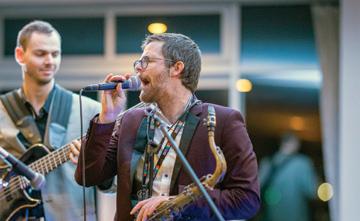
As an accomplished musician, Andrew was formerly a member of dDub and the Rodger Fox Big Band. He mostly plays the saxophone nowadays in jazz and fusion groups such as the Auckland Jazz Orchestra, where he serves as an arranger and composer.
He also tries to blend more of his passion for music into his research. He’s spearheading a Music Technology Group at the University of Auckland, hoping to bring together engineers and musicians.
“Music is a place where I can escape and get my brain to relax and be more creative.
“We need more creativity, especially in engineering, and music helps with looking at things from a different perspective.”
“We can open a duct underneath the window so air flows through but minimal sound will come through,” Andrew says.
The team are also looking into mechanical metamaterials for doors and walls, attaching oscillators and other mechanisms that absorb and reflect sound.
“These moving parts make the wall or door appear much heavier,” says Andrew. “We’re targeting low frequencies, like the footfall of a toddler jumping around, because they’re difficult to attenuate.”
Human and social aspects
Such new materials form part of the trends in acoustic engineering, according to Kezia. Others she deems noteworthy include the increasing integration of data, and adapting noise models to comparable environments.
In Australia, for example, Kezia and her team carried out noise modelling for the entire city of Melbourne. They then harnessed that same technology for an entertainment precinct, another large and acoustically complex site.
Acoustic engineering has a lot of advisory components and it’s about understanding the human experience of space, which varies from person to person and space to space.
– Kezia Lloyd
“It was interesting to apply the noise modelling of a city into a mixed-use environment, making it more detailed and being able to inform where the challenges might be for future development and how noise emissions from the site could be controlled.”
And while artificial intelligence may be the talk of the town, “it hasn’t yet made the biggest splash on acoustics in particular,” says Kezia.
“Acoustic engineering has a lot of advisory components and it’s about understanding the human experience of space, which varies from person to person and space to space. That is something AI needs to improve at before we can rely on its outputs. From an automation point of view, there are certainly processes that AI can optimise in the short-term.”
Wellington Town Hall
The stage is set for the return of Te Whare Whakarauika, the Wellington Town Hall in 2027. It’s envisioned to be a national centre of music and a home to the New Zealand Symphony Orchestra (NZSO) and Te Herenga Waka Victoria University of Wellington’s New Zealand School of Music Te Kōkī.
“The nature of the building has fundamentally altered into a performance and teaching acoustic space, so a lot of thought has gone into the acoustic design of the building,” says Gervais Lawrie, Senior Project Manager of the Wellington Town Hall redevelopment project.
As the main performance space, the Adam Auditorium’s high acoustic qualities have been preserved. An extra set of windows has been installed for acoustic isolation, while sound
insulation has been added to the corridors surrounding the auditorium. Even the thickness of the foam on the fixed seats was a factor because “we didn’t want them to be too absorbative, which would have changed the reverberation time in a way that may have been deleterious to recording or performances,” Gervais says.
Beneath the auditorium, the basement has been converted into a control room and recording suite for the NZSO. The auditorium’s timber floor had to be laid directly onto a concrete floor, changing its reverberation characteristics. To counteract that, a new acoustic floor has been installed in the roof space above the auditorium, doubling as a shield to block outside noise from intruding and ruining a performance or recording.
The human and social aspects are what keep Kezia connected to acoustic engineering.
“You have to put yourself into the mind of someone who would be using a space and think about how you can make that space better for them.”
Flexible generalists
Despite many boundary-pushing projects, Kezia observes that Aotearoa is not heading the charge in acoustic engineering.
“Unlike structural engineering, where we’re internationally sought after for seismic expertise to help other countries, it’s not the same for acoustics.”
Scale might be a major reason behind it. “Compared to regions in Europe and Australia with a larger economy to develop cutting-edge infrastructure, in New Zealand, we don’t have the same scale. However, we can draw upon international practices,” she says. She points to Australia and the United Kingdom as examples of leaders in the field, noting that the latter has certain standards for several aspects of acoustics based on building type, while each Australian state has its own requirements for distinct noise categories.
A brighter, more optimistic side to New Zealand’s generalist capabilities is our flexibility to fit varying acoustic scenarios.
“We are great at being able to see the bigger picture and do a whole lot of different things, whereas internationally, acoustic engineers and consultants can be narrower and more specific in what they do,” Kezia says.
Opposite: Kezia Lloyd-Marsh (top) and Andrew Hall (bottom) both have strong musical backgrounds. Photos: Supplied
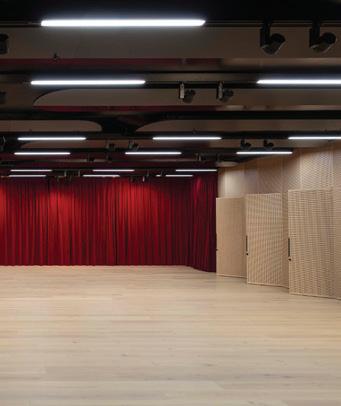
Top: Mason Mercer box-in-box at the Lloyd Morrison Theatre – part of Te Herenga Waka Victoria University of Wellington’s New Zealand School of Music Te Kōkī. Photo: Neil Price
Above: Kezia Lloyd-Marsh, Chartered Acoustic Engineer and Head of Building Engineering Services at WSP. Photo: WSP
Engineer, polar bear, wet weather gear
WRITER | KAITUHI Alexandra Johnson
Engineer, polar expedition guide, Coastguard rescue crew member and Irish dancer. These seemingly contrasting, high‑octane pursuits are just a glimpse into the multifaceted life of Rochelle Kirby.
A mechanical engineer specialising in building services for Beca in Tauranga, Rochelle Kirby MEngNZ is equally passionate about her chosen profession as she is for her seafaring activities. She says that the most important part of any role for her is the teamwork.
“What I like the most is working as a team with other engineers and disciplines. Every project presents its own challenges, but everyone is passionate about sharing knowledge. Since I started at Beca a couple of years ago, I feel as though I have learned almost exponentially.”
Passionate about diversity and bringing young people into STEM and engineering, Rochelle has contributed to numerous initiatives advancing that cause, including Engineering New Zealand’s Wonder Project. She’s also been awarded a number of professional accolades, including the 2021 joint winner of the Rising Star award from the National Association of Women in Construction and a finalist for the New Zealand Green Building Council Future Thinker of the Year award. She was also one of eight global finalists for the Chartered Institute of Building
Services Engineers and American Society of Heating, Refrigerating and Air-Conditioning Engineers Graduate of the Year award in 2020.
Teamwork is also a matter of survival in her job as a polar guide for Swan Hellenic Cruises, which offers high-end tours in Antarctica, the Arctic and beyond.
“The ships follow the seasons –Antarctica in our summer and the Arctic in our winter – so I’ve spent time guiding in both incredible environments. My contracts are for about four weeks at a time.”
Her role on the ship is a blend of polar guiding and ornithology.
“In the ornithology realm, I’ll give lectures on a variety of bird-related topics, from seabird ecology to the mechanics of feathers, where my background in mechanical engineering and physics often comes into play. I love exploring how those worlds intersect.”
Her goal is to make every voyage truly memorable for those onboard.
“Many guests have waited years for the experience, so I help them connect with the landscape and identify as many animals as possible.”
When heading out in Zodiac boats, navigating everything from open water to dense brash ice, she says safety is paramount.
“In the Arctic there are polar bears, so we go and scout for an hour before any guests leave the ship to make sure there’s no sign of them around. If there
are bears nearby, operations will stop and we have the awesome opportunity to observe them from the ship.”
Rochelle comes from a line of seafarers – her father was in the Royal New Zealand Navy, her grandfather in Merchant Navy, and boats were a big part of her childhood.
“I’ve been always interested in maritime activities and completed many qualifications just out of interest.”
She has a great respect for the ocean, which is fickle and can change quickly.
“There’s a lot to learn which is why I do a variety of things and I love how they all intertwine and the skills crossover. What I’ve learned in the Coast Guard has been really helpful for Zodiac operations as a polar guide, and even engineering relates to the marine environment.”
So, how did the extraordinary polar role come about? On an expedition cruise to the New Zealand Subantarctic Islands, Rochelle met a group of guides and asked how they got into the field.
“They gave me very helpful advice about what to study and what qualifications to get.”
She spent the next few years working toward that goal, building the skills she needed, including a certificate in ornithology and a Standards of Training, Certification and Watchkeeping for Seafarers qualification, a practical marine course covering maritime safety.
Rochelle says on the ship, things can get pretty wild.
“Sometimes the conditions are extreme. While we operate within strict safety parameters, it could be snowing with ice in the water and large swell and it feels like you’re having a proper adventure. For example, you might have your teammates holding fast on the lines for you while you embark the Zodiacs. Or helping you navigate when thick Antarctic fog rolls in and Zodiac navigation is done using GPS or compass.”
She’s also a member of the Coastguard in Maketū, recently gaining Qualified Operational Crew status.
“I’ve always had a lot of respect for the Coastguard, but I never fully appreciated the number of volunteer hours involved nationwide.”
In the high-stress environments in which they operate, teamwork is again vital. She’s currently completing a skipper’s qualification (Skipper Restricted Limits) which will enable her to operate vessels up to 12m in length within restriction limits. For the foreseeable future, she’ll focus on her engineering work and enjoy doing all the things she’s worked hard for. “I never want to take it for granted that I can go to these places.”
Rochelle also does Irish dancing twice a week, a hobby she’s loved since she was a small child. But how does she fit it all in?
“I guess I’m an active relaxer. I’m happiest when I’m learning and progressing in my career and in my personal life.”
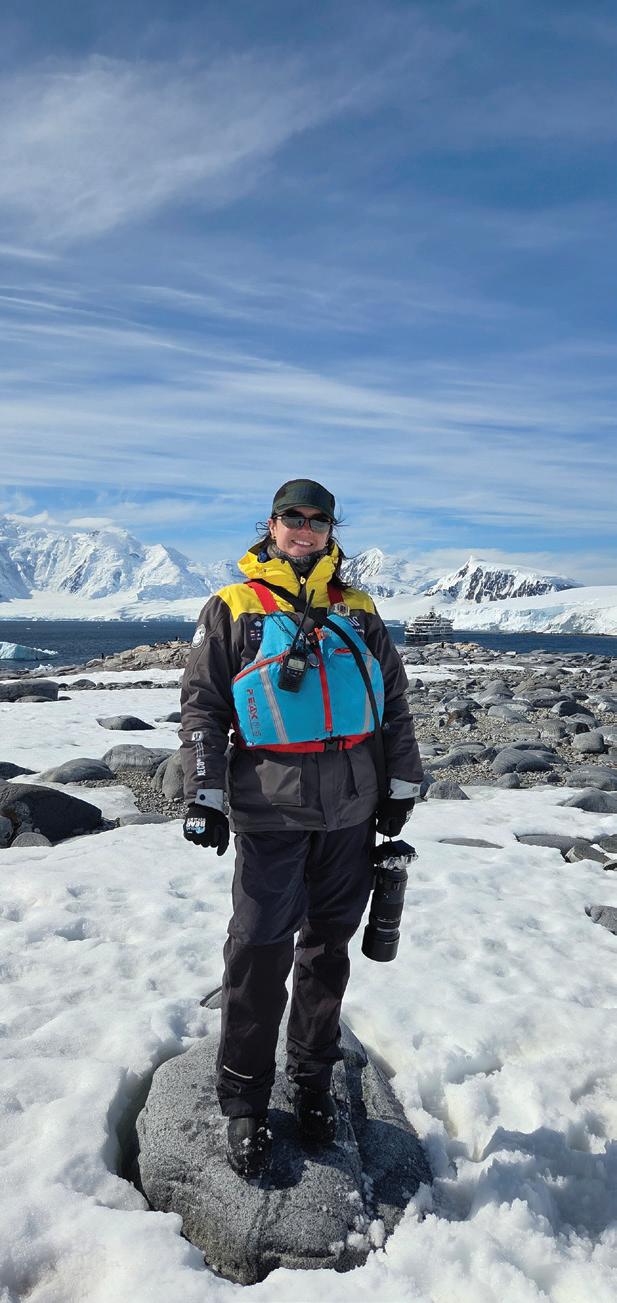
Rochelle Kirby at Damoy Point in the Antarctic Peninsula, December 2025. Photo: Claire Penny
Fixing equipment and equipping fixers
WRITER | KAITUHI Kathy Young
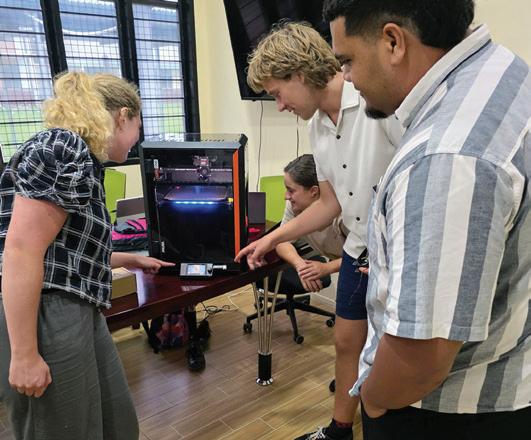
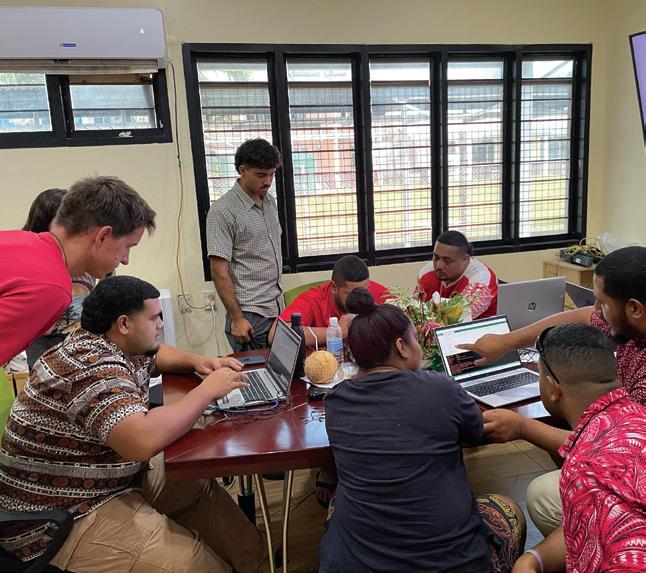
Top left: Emma Gardiner, Matisse Laskey (seated), Fergus McMullan and a Tongan technician work on a newly donated 3D printer.
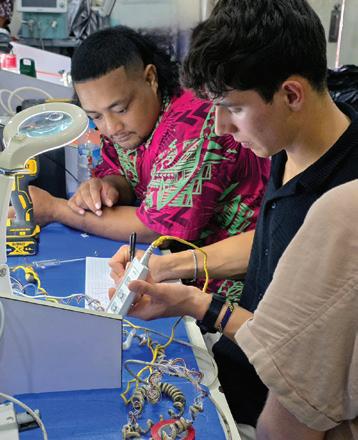
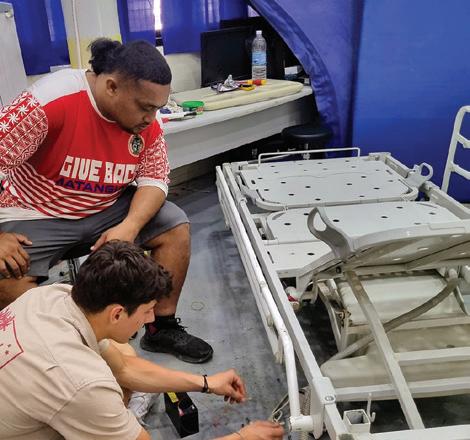
Top middle: Caleb Corban and a Tongan technician assess the hand control of an electric hospital bed.
Top right: Caleb and technician evaluate an electric hand control.
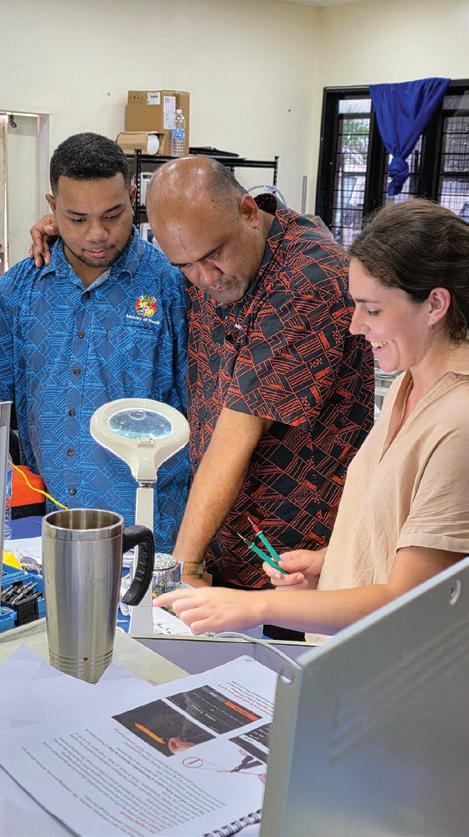
Right: Caitlin Van Rijs (right) explains the hand control for an electric hospital bed to the Director of the Biomedical Workshop, Toci Katsuki (centre) and a Tongan technician.
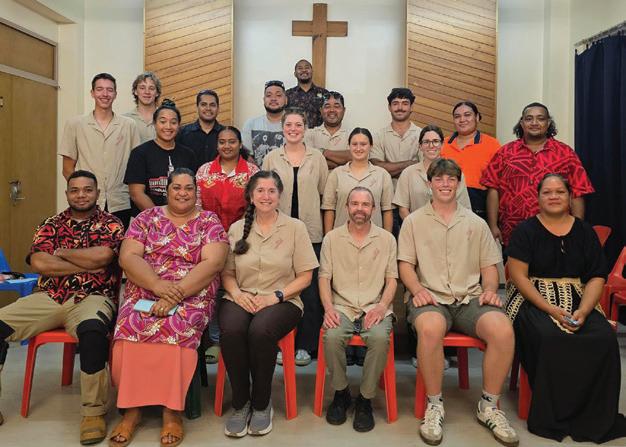
Left: UC Biomedical Outreach Programme team with technicians and leadership representatives at Vaiola Hospital. Photos: Debbie Munro
There’s no place to dispose of failed equipment in Tonga, and we realised a more sustainable approach may be to accept how their systems work and to help them improve what’s already there.
– Debbie Munro
How a university’s mechanical engineering programme is helping to upskill technicians in Tonga and ensure the sustainability of the island nation’s medical equipment.
Low-resource countries such as Tonga depend on donated medical equipment, but it’s often expired, over-engineered or in a state of disrepair. Then add high humidity and high temperatures, which cause essential equipment to corrode and fail at much faster rates than in a New Zealand clinical setting. When University of Canterbury (UC) Associate Professor of Mechanical Engineering, Debbie Munro, first assessed the state of biomedical equipment in the Pacific Islands in 2018, she realised these donations were often addressing the symptoms rather than the cause.
“There’s no place to dispose of failed equipment in Tonga, and we realised a more sustainable approach may be to accept how their systems work and to help them improve what’s already there.”
Debbie says well-meaning organisations often arrive in low-resource countries with expensive equipment and specialist expertise, address the immediate problem and then depart, taking all the knowledge with them.
Running since 2019, the UC programme is designed to do the opposite: build self-sufficient local capability that doesn’t depend on outside intervention to be sustainable in the long term. Each summer, third- and fourth-year mechanical and mechatronic engineering students, plus Debbie and two other staff members, spend six weeks training at the University then four weeks in Tonga, partnering with local technicians to work at the hospital and transfer practical skills.
There are currently eight hospital technicians servicing all of Tonga. Debbie’s team teaches them anatomy and physiology and the clinical purpose of each device. They also teach the technical theory and operation of the equipment, including hands-on lab exercises. The equipment includes ventilators, incubators, patient monitoring systems and fluid infusion pumps. For Debbie, with a background in biomechanics and diagnostic sensors, it’s a methodical framework that builds understanding from the ground up rather than parachuting in quick fixes.
For Liam Bately, a fourth-year mechanical/ biomedical engineering student, the Tonga programme is one strand of a broader ambition to work at the intersection of engineering and medicine. As co-founder of UC’s mechanical engineering society, MECHSoc (which attracted 500 members in its first
Liam Bately is former Dux and Deputy Head Boy of Christchurch Boys’ High School and a Student Volunteer Army Ambassador. In 2025 he completed a biomedical engineering internship in France, sponsored by the French Embassy in New Zealand. An Engineering New Zealand Student Member, Liam’s working on the creation of an artificial heart as part of his final-year project.
year), and later as President of The UC BIOMED Club (which Debbie founded), he seeks out projects that go beyond the conventional engineering curriculum.
“This project was a great opportunity to apply engineering thinking in conditions that bear no resemblance to a New Zealand lab.”
Liam was instrumental in coordinating the students and fundraising.
Debbie says the programme’s broader significance lies in how it changes the way engineering students think about design, producing graduates with a more adaptable approach to design constraints.
“For example, I spoke with a doctoral student working on a separate skin-based glucose monitor device. Following these ideas learnt from Tonga regarding reusability, she has redesigned the device to be donatable and repairable.”
For Toci Katsuki, Director of the Biomedical Workshop at Vaiola Hospital (Ministry of Health, Tonga), the project makes a significant impact on the health of Tongans.
“It’s always a great pleasure to have a [UC] team over every year and something we always look forward to. Thank you all for the knowledge shared with our team in Tonga and for gaining more recognition from our Honourable Minister, CEO of Health, and Directors.”
Students from this year’s trip are preparing the next cohort, delivering presentations and seminars about their experiences, and fundraising. The programme is looking to expand its regional reach, with developing connections to Samoa.
Before arriving at UC, Debbie Munro spent more than a decade in the orthopaedic medical device industry, and now leads research on wireless implantable sensors for monitoring bone healing. She worked at NASA Ames Research Centre while completing a master’s degree at Stanford University, and also writes science thriller novels in her spare time.
Healthcare improvements at a glance
Autoclave steam sterilisation: students repaired and distributed units to five clinics across the islands, enabling each clinic to independently sterilise instruments such as scalpels.
Ventilators: none of the 15 ventilators donated during Covid-19 were functioning on arrival in January 2026. Thirteen are now operational, with eight in active service, including on outer islands.
Hospital beds: electronic failures caused by humidity and corrosion were repaired, and local technicians can now maintain these beds.
3D printing: two printers from Christchurch now produce replacement parts and low-cost medical devices on site, including functional otoscopes with laser-cut lenses for nurses diagnosing ear, nose and throat infections. Tongan technicians are trained in CAD to design their own replacement parts going forward.
Left: Philip Brand (standing on left) and Josh Bergerson (standing on right), teach Tongan technicians about microcontrollers. Photo: Debbie Munro
Photo: Supplied
Snapshot Project E-Alia, winner of the Arthur Mead Award –Below $10m at the 2026 Auckland Awards, was described by judges as “a landmark example of innovation delivering meaningful environmental and social outcomes”. The McKay and United Nations’ Development Programme Samoa project was recognised for its focus on simplifying design, manufacture and operation to deliver Samoa’s first solar electric ferry service, tailored to local conditions and capable of being maintained and replicated without specialist support. The judges also applauded the transition from fossil fuels to solar and battery power; improved access to services; cost certainty and the training and empowerment of local operators.
A smarter foundation for New Zealand’s future
New Zealand is building at pace. Cities are expanding, infrastructure demand is rising and expectations around environmental performance are accelerating just as quickly. Yet beneath every building, bridge and road lies a material that rarely gets public attention: reinforcing steel. It’s invisible once poured, but its environmental impact is locked in for decades, making it a consequential material choice in construction today.
As the country moves toward a lower-emissions economy, the conversation is shifting. It’s no longer enough to ask whether materials perform. Increasingly, we are asking where they come from, how they are made and what they leave behind. In that context, Pacific Steel’s next generation of reinforcing products marks a significant moment for New Zealand construction.
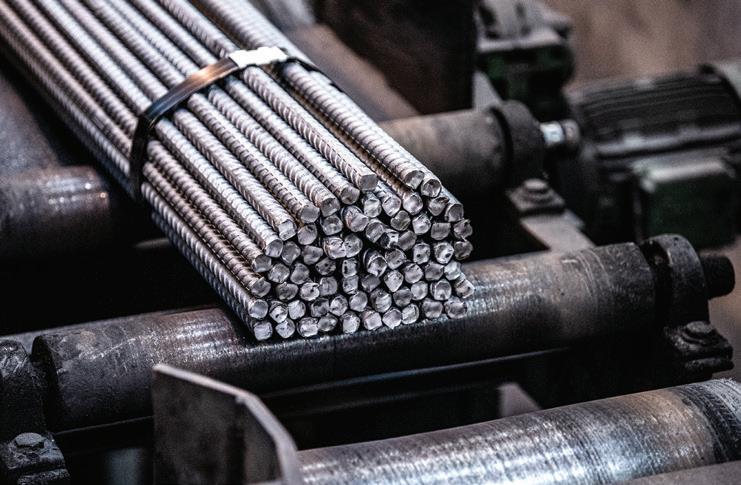
The introduction of PACIFIC™ and PACIFIC DCRB® reinforcing steel represents a step change, one that aligns performance, supply security, and climate ambition.
We believe that later this year, PACIFIC™ will become the new standard: locally produced, proven over decades and now delivered with significantly lower
emissions. PACIFIC DCRB® will go further still, setting a new benchmark for one of the lowest Global Warming Potential (GWP) figures available for locally made reinforcing steel in New Zealand. These are not incremental improvements. They are a redefinition of what “standard” looks like in a market under growing pressure to decarbonise.
What makes this shift particularly relevant is not just the emissions numbers themselves, but how they are achieved. Both products are made using recycled scrap metal sourced within New Zealand and manufactured using the country’s highly renewable electricity grid. This is lower-emissions steelmaking rooted in the local context, utilising local resources and holding local accountability. It reflects a circular approach that keeps materials in use, reduces reliance on imports and strengthens domestic capability at a time when global supply chains remain fragile.
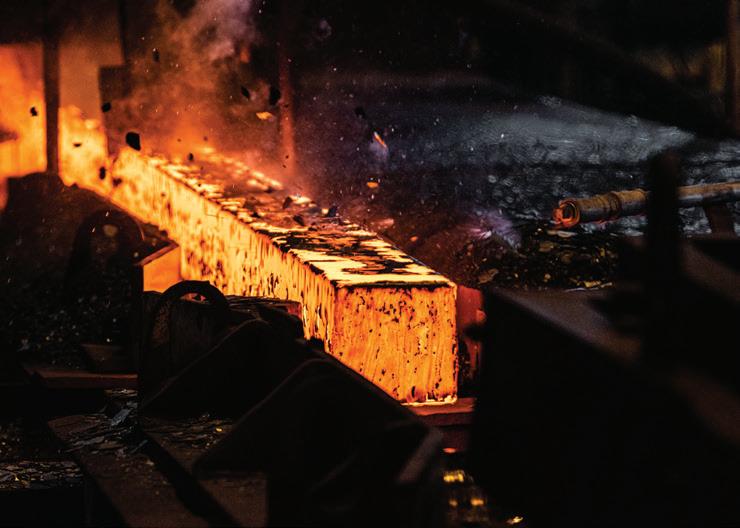
At the centre of this transition is New Zealand Steel’s Electric Arc Furnace, an investment that will significantly reduce carbon emissions while moving the country closer to steel self-sufficiency. For Pacific Steel, sourcing 100 percent of billets directly from
New Zealand Steel creates a fully integrated, locally anchored supply chain that reinforces the credibility of emissions claims and the resilience of supply.
The importance of local production is often underestimated in discussions about embodied carbon. While some international reinforcing products may report low emissions at the point of manufacture (cradle-to-gate), transport can add a substantial and often overlooked carbon cost by the time steel reaches a New Zealand construction site. Thousands of kilometres by sea can quickly erode claimed environmental advantages when assessed as part of a credible whole-of-life Life Cycle Assessment. If a comparable product with a cradle-to-gate GWP ~0.50 tCO2-e/t were to be produced out of Europe and delivered to New Zealand, the transport component (A4) would contribute an additional ~68 percent of emissions. If it were brought in from ports in Asia such as Singapore, Vietnam or Korea, we would expect additional transport emissions over 30 percent. Producing reinforcing steel locally avoids this hidden carbon through a shorter route between manufacturing and use and, in addition, can reduce risks associated with longer supply chains. With the substantial embodied carbon reductions and local supply chain, PACIFIC DCRB® is expected to provide the lowest cradle-to-site embodied carbon (A1–A4 GWP) reinforcing steel solution for projects in the New Zealand market.
The construction sector sits at a pivotal moment. It is both a major contributor to national emissions and one of the most powerful levers for change. The materials chosen today will define the environmental footprint of New Zealand’s built environment for generations to come. Reinforcing steel may be out of sight, but it should no longer be out of mind.
PACIFIC™ and PACIFIC DCRB® represent more than new products. They signal a shift in how foundational materials are specified, toward solutions that combine strength, reliability and lower emissions, with local production and supply security. They offer a practical pathway for architects, engineers, builders and clients to reduce embodied carbon at scale, without waiting for future technologies or unproven alternatives.
As New Zealand looks to the future, we believe the direction is clear. If we are serious about lowering emissions, strengthening resilience and building responsibly, the answer starts at the foundation.
View PACIFIC™ and PACIFIC DCRB® GWP numbers and Environmental Product Declarations at pacificsteel.co.nz – coming to market in 2026.
Disclaimer
This article was supplied by an external contributor as paid advertorial. While we are pleased to share industry perspectives, Engineering New Zealand does not verify any claims made here and does not endorse any products or services mentioned in this advertorial.
Effective infrastructure repair starts with matching the intervention to the structural condition. Targeted strengthening technologies extend service life while preserving the asset.
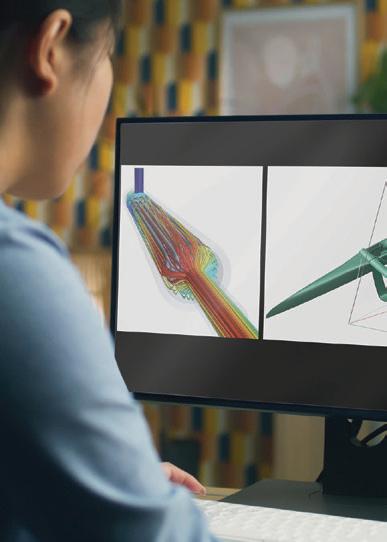
From trial-and-error to precision-engineering, our latest Finite Element Analysis (FEA) and Computational Fluid Dynamics (CFD) courses empower you to understand high-level simulation techniques.
Give your projects a competitive edge by mastering advanced techniques used to predict real-world performance long before the first build begins.
Learn more at engineeringnz.org/computational
Sound practice 46 Reducing risk in timber retaining walls
Leading questions
48 On “the beauty of volunteering”
50 CEAS turns 60
Supporting IT engineers
Associate Professor Dr Kenneth Johnson
IT is a complex, large scale system of computing technologies that form the backbone of New Zealand’s economy, healthcare and telecommunication capabilities. Here's why Engineering New Zealand provides a natural home for IT engineering professionals to meet and discuss the current state of play, best practice and the impacts of AI.
IT engineers play a critical role in ensuring our IT systems are well designed, reliable and protected against malicious cyber criminals. The IT Engineers Technical Interest Group is driven by engineering principles to guide large-scale software development, focused around topics including green computing (the economical and environmentally friendly use of IT resources and computing technology), cybersecurity and AI. AI has been an important topic since the Group was founded in 2020. With the widespread use of generative AI, we focus on its profound impact within the IT profession. It’s difficult for anyone to predict just how much AI will transform computing. Software engineering has seen the most progress, with incredible advancements in AI tools that enable teams to boost development productivity to spend time on hard engineering problems.
Navigating and leveraging AI
One of our Group’s key aims is to help IT engineers navigate and leverage AI technologies in their professional activities. We understand that these technologies can be daunting, so we provide member support in the form of discussions, along with in-person
and online events. We recently held a webinar featuring members of Engineering New Zealand’s AI Advisory Board, who develop best practice guidelines for engineers using AI technologies within their profession. Our events showcase software development tools that are underpinned by large language models to make software engineering easier and more productive.
Supporting the broader IT profession
Our members share their expertise across a broad range of professional activities. This includes supporting our members who are applying for engineering chartership, working on university programme accreditation and conducting public webinars to educate a wider audience.
We welcome anyone with an interest in the IT engineering profession to join our Group, particularly those working in the IT sector. Our current membership includes computing and engineering students, academics and IT professionals. This range of experience brings fresh insights and expertise over an incredibly diverse technical field. Our activities and events are driven by our members’ interests and we’re working towards future offerings including sponsorships in hackathons and running cybersecurity conferences.
Members of our steering committee are on Engineering New Zealand’s AI Advisory Board which advises New Zealand-based engineers on the use of AI in their profession. We’re developing a document to support software engineers in their AI journey, bringing agents into their software development
platforms to become more productive engineers.
As AI becomes a tool used daily, the proposed Southland data centre would provide the country with much needed computing power. Investing in digital infrastructure keeps Aotearoa competitive and benefits both AI innovation and entities that use the innovations.
AI at AUT
AI has transformed the way we teach at Auckland University of Technology (AUT). Our degree programmes and assessments are being developed to support students’ thoughtful use of AI to guide their learning process. Our assessments have been redesigned to facilitate learning assurances – to assure “understanding, observing and evidencing student learning”.
As Associate Professor of Computer Science, the ethical use of AI in research means that I can get instantaneous feedback on my writing and support on software development.
As I look ahead to the second half of this year and ask myself what is exciting me about IT, I reflect on how technology has transformed the way we live. We must ensure it is used in ways that strengthen our communities, improve our lives and tackle modern problems.
Dr Kenneth Johnson is Chair of Engineering New Zealand’s IT Engineers Technical Interest Group and Associate Professor of Computer Science at AUT.
Find out more about the IT Engineers group at bit.ly/it-engineers
Advocating for resilience
Dr Richard Templer FEngNZ
Without doubt we’re living in interesting times. At the time of writing, the global fuel crisis is being felt with the Middle Eastern conflict and the closure of the Strait of Hormuz. Meanwhile, parts of New Zealand are in a state of recovery after several major weather events, economic recovery is faltering, inflation is expected to rise, and the 2026 general election is looming.
What does good look like in times of uncertainty? Beyond reacting to the events of today, governments and institutions must assess the impacts of their decisions on the future. In times of uncertainty, we need to continue to build for tomorrow. This means not cutting or halting construction work that is underway.
Evidence indicates that project costs don’t decrease over time, regardless of shocks to markets. The costs of stopping and starting projects are well documented. Overcoming inertia is costly.
We must build for future resilience. Engineering New Zealand has been busy speaking with government on a range of critical topics: infrastructure, resource management, the building system, local government and emergency management. With each submission, select committee appearance and ministerial meeting, we’re arguing for long-term thinking, appropriate planning and resourcing, and a focus on building resilience to future impacts.
Looking ahead to November’s general election, Engineering New Zealand will continue to speak to officials and
Members of Parliament on the need to continue critical work and build for a resilient tomorrow. This includes strengthening systems such as in resource management and building, as well as reducing or diversifying our dependence on overseas markets. Our focus this election year is to connect your voice to the politicians who may lead the next Government. On the evening of 6 August, we’ll host a debate with members from the major political parties, focusing on infrastructure. Join us online as we put the big questions to politicians. In June, I’ll also be speaking with representatives of political parties about their vision for the future and the role of engineers in it. We’ll keep you informed and ensure the engineering profession is part of the political conversation. Our collective voice matters and is important for a healthy, functioning democracy. As the world faces significant uncertainty, complexity and change, our voice and expertise matter now more than ever.
Dr Richard Templer FEngNZ is
Chief Executive
of Te Ao Rangahau.
Learn about the country’s major political parties’ thoughts on infrastructure in the lead up to the election. Join us online on 6 August as we host a political debate. Register at engineeringnz.org/govt-election
Test your knowledge around the lunch table. It’ll pay to read through EG before attempting if you want full marks.
1. Roughly how many engineers are represented by the World Federation of Engineering Organisations (WFEO)? A) 20 million; B) 30 million; C) 40 million.
2. What principle, fundamental to hydraulic engineering, states that a pressure change applied to a confined fluid is transmitted undiminished in all directions?
3. What percentage of the London Underground is actually underground? A) 45 percent B) 55 percent C) 65 percent
4. Before taking her tour guests on excursions in the Arctic, what does engineer and tour guide Rochelle Kirby first check for in surrounding areas?*
5. BRiDGE stands for Building Resilience in for Engineering
6. What nickname was given to the original 1940 Tacoma Narrows Bridge in the US state of Washington (and why)?
7. How many years of engineering experience are required to progress from Emerging Professional to Member in the Engineering New Zealand membership pathway?
8. Daniel Moroder FEngNZ received Fellowship at the 2026 Fellows’ Dinner. What other award did he receive?*
9. In what year did Leslie Robertson become the first woman to graduate from a New Zealand university with an engineering degree? A) 1945; B) 1965; C) 1985.
10. How many times louder is a sound measured at 60dB than one measured at 30dB?
*This issue of EG holds the answer you’re after – hunt around and get reading!
Got a question that’ll leave your peers stumped? Submit it to eg.quiz@engineeringnz.org
Gertie, due to its visible up and down movement in windy conditions.
Design guidance. It’s the cross-agency programme focused on developing clear, practical and consistent engineering guidance in New Zealand.
3. A) 45 percent.
B) 30 million. The WFEO represents engineers and engineering organisations from approximately 100 countries.
Pascal’s Law.
Polar bears. 5.
6. Galloping
7. Five. 8. The Francis Small Engineering New Zealand Foundation Award.
9. B) 1965 – Bachelor of Engineering (Electrical Engineering). 10. 1,000 times louder.
Sound practice
Why pioneering acoustic findings continue to resonate.
The Wellington Town Hall first opened its doors to a music loving public in 1904. Earthquake strengthening and refurbishment of the building is nearing completion, and next year audiences will again be able to experience the main auditorium’s beautiful acoustics. The auditorium follows the classic shoebox shape, established in the 19th century as an optimal design for concert halls, resulting in a rich, resonant sound. The restoration work has paid careful attention to retaining the auditorium’s dimensions and as much of the heritage fabric as possible, allowing audiences to have the same musical experience as they did 100 years ago.
Since the Town Hall opened, our understanding of acoustic design has grown immensely. We now understand why the shoebox design works so well, and how to make other concert hall designs work acoustically too. It was New Zealander Sir Harold Marshall’s discovery of the importance of lateral sound that changed how we approach concert hall design.
In the 1960s acoustical engineering was a very new discipline in New Zealand. In 1965, Christchurch City Council began plans to build a new town hall and concert venue. They called for architectural designs by competition and appointed Harold Marshall to the assessment panel as acoustic consultant. He had degrees in architecture and physics and in 1960 had been appointed Senior Lecturer in
Acoustics at the University of Auckland. In 1965, at 33 years old, he’d never designed a performance space and was starting his doctoral research in acoustics at the Institute of Sound and Vibration Research at Southampton University in the United Kingdom. He received the five finalist architectural designs, along with a deadline to provide reports on their predicted acoustic performance. None were of the tried and tested shoebox shape. A new theory suggested initial-time-delay-gap – the time it took for the first waves of reflected sound to reach the audience –as a measurable predictor of successful design. But a recently completed building designed on this theory had proved acoustically disappointing. Harold knew there was nothing in the established literature he could draw on to effectively predict how the shortlisted designs would perform acoustically.
With his deadline approaching, Harold went to a concert at London’s Royal Festival Hall. Constructed in 1951, it follows the shoebox shape but is wider than traditional concert halls. Listening carefully, Harold noticed that the sound was very frontal with no sense of reverberation from the sides. He then went to a performance at the Concertgebouw in Amsterdam and experienced a much richer sound. He realised that the difference between the venues was down to the amount of sound reflected from the sides of the hall – the lateral sound. It was a revelation. Based on these findings, Harold recommended the Christchurch Town Hall design by architects Warren and Mahony as the most acoustically
promising. In collaboration with fellow researcher Mike Barron, he used a former NASA computer to model the acoustics of the auditorium. He then worked closely with Warren and Mahony to add a series of lateral reflectors into the design. The Christchurch Town Hall opened in 1972 to much acclaim. The design was unique and groundbreaking, and the sound was clear and resonant. Its success sent reverberations around the world of concert hall design.
The discipline of acoustical engineering was now well underway here. The New Zealand Acoustical Society formed in 1973 with Harold as its first president. He also worked with the University of Auckland on the design of an acoustics research laboratory, which opened in the early 1980s. It remains a top-class research facility, used for both academic research and commercial acoustic testing of everything from building acoustics to environmental noise, vibration and communications.
Although architecturally the Wellington Town Hall retains its 1904 form, our new understanding of acoustics has informed its redevelopment and enabled a greater appreciation of its original features and design. To complement this, there'll be a new acoustic addition: shielding installed on the roof to block traffic and aircraft noise. A new, quiet air conditioning unit in the ceiling completes the fit out, making the building a space to enjoy for another 100 years.
Cindy Jemmett is Heritage Advisor at Te Ao Rangahau.
Martin Pratchett MEngNZ CPEng and Dr Martin Larisch FEngNZ CPEng
Timber pole and post‑and‑panel retaining walls are among the most common earth retention systems used in New Zealand’s residential and light‑commercial developments. But while small engineered walls far outnumber larger walls built in any given year, they’re also among the most frequently misunderstood. As a result, Engineering New Zealand is developing a guideline on construction considerations for small retaining walls.
Over the past few years, councils, general practitioner engineers and contractors have been grappling with recurring problems in consent documentation and on construction sites: missing information, unclear responsibilities and designs that don’t fully reflect how these walls are built. In response, a recent webinar for engineers explored common consent issues, revealing that many practitioners were struggling not with what they didn’t know but with the “unknown unknowns”. This is supported by data from insurance companies which shows that foundations and retaining walls are the most common causes of claims.
At its simplest, a retaining wall allows us to make steep land useable. But by cutting into natural ground or filling against it, we’re changing the stress conditions within the soil. Ground that was previously stable may suddenly be required to support additional loads, resist water pressure and remain stable during both construction and long-term use. When things go wrong, the consequences range from excessive wall movement and cracking, to collapse.
For cantilevered timber retaining walls, the embedded poles are a critical structural element. While the visible portion of the wall often gets the most attention, it’s the below-ground embedment that provides the resistance to earth pressure, water pressure, surcharge loads and seismic effects. If embedment depth, concrete quality or ground conditions are not properly understood or achieved, even a robust-looking wall can fail.
Drainage is equally fundamental. Water pressure behind a retaining wall can easily exceed earth pressure, particularly during heavy rainfall. Without adequate drainage, walls may rotate forward, deform excessively or collapse altogether.
Unlike large infrastructure projects, residential retaining walls can be built without detailed construction specifications or method statements. Contractors often work from limited drawings, with tight budgets, close boundaries, neighbouring buildings and public accessways. Councils must assess and inspect these projects while dealing with a huge range of site conditions and construction quality. Even relatively small walls can involve significant risk if they retain neighbouring land, support driveways, or are built on marginal ground.
The new guideline recognises this reality. It doesn’t attempt to replace design standards or construction specifications. Instead, it focuses on typical construction-related risks and how they arise, particularly in situations where responsibilities between designers, contractors and owners
are not clearly understood.
Across many projects, the same issues appear repeatedly, including boundary and access constraints, Inadequate survey and set-out, poor hole stability and embedment, concrete placed under water or without proper compaction, and sub-standard drainage systems. Many of these problems occur even when a wall has been designed by a competent engineer.
Construction quality, sequencing and temporary works often govern whether a retaining wall performs as intended. A key theme of the new guideline is responsibility: temporary works, construction methodology and site safety must be considered early, documented clearly and followed on-site. Councils also play a crucial role. Building Consent Authorities are often the last line of defence in identifying when a “simple” retaining wall warrants geotechnical input, structural design, or closer inspection. Even walls under 1.5m high may require engineering involvement depending on surcharge, proximity to boundaries or ground conditions. The guideline, which grew out of conversations between engineers, councils and contractors, is intended to support the same collaboration on-site. It aims to reduce avoidable failures and improve outcomes across the sector.
Martin Pratchett MEngNZ CPEng is Engineering Practice Manager at Te Ao Rangahau and Dr Martin Larisch FEngNZ CPEng is a geotechnical engineer.
Leading questions
Wasiq Kashkari describes his early career as “a lot of jumping around companies and sectors” learning what good – and not so good – engineering teams looked like and prioritised. He then worked at Pushpay, helping to scale their app product from acquisition to a rapidly growing business. After a brief stint in the German start up scene, he returned to Aotearoa to work in education, in time becoming Chief Technology Officer at study platform Revision Village. Last year Wasiq and his wife started Coach Squad, a booking system offering coaching from professional athletes and experienced coaches. He says it has been rewarding growing something from zero to a thriving platform with 140 coaches, alongside his wife. “Sharing both a home and work life with someone I admire and love so much has honestly been the highlight of my career.”
What attributes make you a good leader?
I’m not sure I do an amazing job at this, but I make a point to ensure I know where my team members want to go in their careers and do my best to help enable that. I also think it’s important to prioritise empathy and shared ownership, working alongside a team rather than having them work for you and learning from mistakes without blame.
At the end of each day, what tells you whether you’ve been successful?
Day-to-day success in software can be hard to measure, so I tend to focus on success over longer time ranges. Over weeks and months it’s about measuring progress towards your objectives. The best signals though are over years: if you can measure your velocity over time and ensure it’s high while keeping a healthy, resilient team, you’re doing very well.
What inspired you to become an engineer?
As a kid, I loved F1 and wanted to become a mechanical engineer. However, after a semester, I quickly realised I did not enjoy what I was studying. I was floundering around a bit, not really knowing what to do and took a software engineering paper. Things just clicked into place. Solving software problems felt like putting puzzle pieces together in my head. I could see the goal and I needed to figure out the best way to get there. I was hooked.
Who opened a key door for you?
Alex Henderson from Pushpay. He was by far the most respected engineer at the company and he believed in me. Seeing his confidence in my ability unlocked something in myself (confidence?) and helped me understand that I could do hard things.
How do you connect your work with a sense of greater good?
We get such amazing feedback from both students and teachers that it’s not hard to feel like you’re doing something worthwhile. In a period where technology is completely breaking a lot of tried and tested education techniques, building tools that allow teachers and students to do the things that really matter (such as 1–1 teaching) rather than marking or generating exams is a great feeling.
What mistake have you learned the most from?
At Pushpay, while I can’t remember what the actual mistake was, I do remember the rigorous post-mortem that followed. This taught me about the importance of focusing on small improvements rather than blaming yourself.
Wasiq Kashkari
Based in: Tauranga Role: Chief Technology Officer, Revision Village Education: Bachelor of Engineering (Hons) (Software), University of Auckland, 2014
How do you approach a difficult conversation with someone you lead? With empathy and a clear outcome in mind. Understand what the other person is going through at the time and gently guide them to the outcome as best as you can.
Who is a leader in New Zealand you admire and why?
Julian Spora, my first manager at Pushpay, taught me about good leadership. He was always there to support the team and I trusted him with my career.
What questions have you been asking yourself lately?
A few years ago, if you didn’t understand a fundamental concept from a previous year at school, this would jump out at teachers straight away. I ask myself how we can identify these issues in a world where you can use AI to effectively hide these gaps for years.
On “the beauty of volunteering”
A Fellowship and an award for outstanding voluntary service to the engineering profession in the same year? Extraordinary, but true.
“You can’t do things alone and that’s the beauty of volunteering: you’ll find like-minded people. Not always thinking the same way, but with the same spirit to make things happen. That’s such a rewarding thing.” These words offer insight into the career of Dr Daniel Moroder FEngNZ CPEng IntPE(NZ), Technical Director at Christchurch’s PTL Structural & Fire.
In March at the Fellows’ Dinner, Daniel received the Engineering New Zealand Foundation’s Francis Small Award for outstanding voluntary service to the profession, along with Fellowship of Engineering New Zealand.
Daniel’s referees were quick to vouch for his contributions – and when he informed them his success, they weren’t surprised. The story of how Emeritus Professor Andy Buchanan DistFEngNZ CPEng IntPE(NZ) – longtime mentor, former supervisor and referee for both accolades – came to matter so much is also the story of how Daniel ended up here. Trained as a structural engineer in northern Italy with a specialisation in seismic design, Daniel discovered early in his career that his real passion was timber. When
the opportunity came to pursue that combination under Andy’s supervision at the University of Canterbury, he took it without hesitation. Daniel subsequently completed his PhD, moved into consultancy and co-founded what has become a 15-engineer firm. Through it all, Andy remained a constant, encouraging Daniel’s involvement in the Timber Design Society (TDS), making introductions, passing on what Daniel describes as “the passion for timber”. Without Andy, Daniel says, he would not be where he is today.
Daniel has been co-editor of TDS’s journal since he joined 11 years ago. He has been a committee member, Vice-President and President. Daniel says that the TDS he joined was well-established, but not especially
Engineering isn’t just number crunching. It’s public speaking, decision making, finding compromises. Volunteering develops all of that.
visible. Under his leadership and alongside a dedicated committee, it became considerably more public with roadshows, regional events and a webinar programme. He was also a driving force behind Timber Unlimited, a Ministry for Primary Industries-funded entity that required considerable effort to establish, before being wound back under a change of government.
Reflecting on the impact of his work and what makes him most proud, Daniel says it’s not one event.
“It’s this general change in the market – engineered timber becoming the new normal. There’s a little bit of my part in that, and I’m proud of that.”
Daniel says that when he arrived in Aotearoa in 2012 there was real interest in engineered timber, but relatively little of it in buildings.
“Now it’s mainstream, in design guides, on construction sites, in conversations my colleagues are having with clients every day.”
When the awards were announced, Daniel told his partner first, then largely kept the news to himself. Not because he wasn’t excited, but because he maintains perspective on why he’s dedicated so much of his time to volunteering and to his profession.
“Being acknowledged is confirmation that the work has made a difference; it’s not the reason I did it.”
Will Pegler
This distinction shapes the advice he gives to engineers considering voluntary roles. He says it’s not about finding time to volunteer, it’s about being honest with yourself before you commit.
“The worst thing you can do is sign up and not deliver because that puts strain on everyone else. Better to do less and actually do it.”
He believes that the threshold for meaningful contribution is lower than people assume. It could be organising a site visit, writing up a project or presenting a webinar.
“That one-hour seminar might take five hours to prepare, but you get to speak in front of an audience, share
what you’ve done, answer questions. That’s part of growing as an engineer.”
He can also speak from an employer’s perspective, adding that PTL actively supports its team in sector involvement and considers it an investment worth making.
“Engineering isn’t just number crunching. It’s public speaking, decision-making, finding compromises. Volunteering develops all of that. Some companies see it as overhead. We do too, but it’s overhead we’re proud to cover.”
He has now stepped back from the TDS committee, a deliberate move to make room for newer voices. He intends to invest the award money in upskilling
in governance and strategy, areas where he feels volunteer leaders often have to figure things out as they go.
“We’re doers, we want to see results. Getting the strategic side right is what I want to work on.”
He’ll return in due course, though. Everyone expects that, himself included. “We all know I’ll be back.”
Will Pegler is Marketing and Communications Advisor at Te Ao Rangahau.
Above: Francis Small Award recipient Daniel Moroder FEngNZ CPEng IntPE(NZ) (right) with Duncan Small, son of Francis Small.
Photo: Brady Dyer/Engineering New Zealand
CEAS turns 60
Craig Lewis FEngNZ
As the Consulting Engineers Advancement Society (CEAS) celebrates 60 years of providing risk management and professional liability insurance for the country’s consulting engineers, how does it continue to meet evolving needs?
Before the early 1960s, there was little risk of consulting engineers in New Zealand being sued. However, the contractual landscape was changing as international litigation trends became more commonplace here. In the 1960s, consulting engineers recognised the growing need for professional indemnity (PI) insurance. Engineers from the consultancy division of what is now Engineering New Zealand (which became ACE New Zealand), looked at the advantages of a group scheme. As a result, CEAS was incorporated in 1966. Early success – and growth – followed as New Zealand consulting engineers had their PI concerns handled locally rather than dictated by offshore insurers. In 1974 CEAS formed its own insurance company, Indemnity and General Limited, to help guide the management of claims and take a share of risks associated with claims. There are now more than 350 New Zealand consulting engineering CEAS member firms, ranging from sole traders through to medium-sized and large firms, spread throughout the country and representing a vast array of engineering disciplines. The make up of member firms has changed little over the years, although fewer large firms are now members as offshore ownership and insurance coverage has become more prevalent.
Since its inception in 1966, CEAS has been governed by a board made up of principals of member firms with a genuine focus on maintaining expertise and diversity in board composition, location and engineering discipline representation. The current board members are all Chartered Members of Engineering New Zealand, including past Presidents of Engineering New Zealand and ACE New Zealand, Andrew Read FEngNZ IntPE(NZ) and Arthur Park DistFEngNZ.
CEAS is run by consulting engineers for consulting engineers. While the work of CEAS members is primarily New Zealand based, cover can be extended overseas by our insurance advisors. In conjunction with Engineering New Zealand and ACE New Zealand, CEAS has helped support the construction industry as a whole, and the engineering profession in particular. CEAS was instrumental in the development of the suite of Producer Statements, the industry Short Form Agreement (SFA) for Consultant Engagement and the Conditions of Contract for Consultancy Services (CCCS). With its wide and varied membership, CEAS benefits from a coalface knowledge of what is happening in the industry. Members get information and guidance on potential risk and liability issues through regular newsletters, webinars, forums and contractual guidance documents. Through a long association with its insurance broker AON, CEAS has been instrumental in obtaining insurance cover suitable for New Zealand’s specific legal framework, regulations
and Building Code. Policies are amended as conditions change; for example when Producer Statements were introduced with the Building Act 1991, and to respond to revisions to the CCCS and the SFA.
CEAS and AON regularly work with clients, including central and local government, to address insurance and engagement requirements, helping to ensure a fair and, importantly, insurable environment.
One of the major benefits of CEAS membership is the guidance and support available to members who face a liability claim. This can be a harrowing experience. In addition to expertise available from CEAS’s broker and legal experts, CEAS has a claims committee (the “member's friend”) of engineering peers to help guide members through the issue.
To celebrate 60 years of service to the consulting engineering community, CEAS is holding an inaugural members’ conference in Christchurch in July, with insights from leading economic, legal and insurance experts. Current issues for members include bespoke (and potentially uninsurable) contract conditions, excessive cover requirements and potential proportionate liability implications.
CEAS looks forward to the next 60 years and working with Engineering New Zealand to support the country’s engineering community.
Craig Lewis FEngNZ is Managing Director of Lewis Bradford Consulting Engineers and Chair of CEAS’ board.
52 Secret life of engineers
52 Secret life of engineers
51 Inside job
54 Bedside table
56 Bedside table
55 One to watch
57 Preview
56 Inside job
58 Intersection
58 Leading questions
59 Obituaries
59 Obituaries
60 Engineering genius
60 Engineering genius
Ngā tūhinga poto me ngā pito kōrero Shorts
Secret life of engineers
An Emerging Professional Member of Engineering New Zealand, Lara Wall has been working for Holmes NZ as a Structural Engineer for three years. Her work has been focused around seismic assessment and strengthening, first when she was based in the company’s Christchurch office, and now in Wellington. Outside of work, Lara is likely to be found on a football field. She plays for the Wellington Phoenix in the A League and has been playing for the New Zealand national team the Football Ferns.
Who introduced you to the game and do you recall your first impressions?
My brother played football from a young age and I always had to go and watch him on a Saturday morning. I figured if I played myself then I wouldn’t have to go and watch, so I signed up to the same club. Once I started, I never looked back!
What do you love most about football?
Being outside and the feeling of doing something intense while also having to think tactically. I also love the team environment it creates and the friends you make for life.
Who is a role model in the game?
My good friend Annalie Longo – she has accomplished a lot for the women’s game in New Zealand and internationally.
Where has football taken you?
In the A-League we travel every second week to Australia for our league games, so I’ve been to many places there just within this league. Recently I went to the United States and Mexico with the national team and played against the US at CPKC Stadium in Kansas City, Missouri, which is the first stadium in the world purpose-built for a women’s professional sports team.
What is your greatest achievement with football?
Making my debut for New Zealand against the FIFA-ranked world number two team (the US).
How much time a week do you devote to football?
It’s hard to put a number on it because it takes up my whole life. Even when I am at work I am trying to refuel and recover. Including the travel to Australia, the weekend games and trainings, it would take up as many, if not more hours than a full-time job.
How do you juggle football with work?
Working at a modern, flexible firm has enabled me to pursue my football career while still working part time and retaining my engineering knowledge. They’re very flexible with the hours I work and allow me to work remotely when required. One thing I have had to get good at is communicating and early planning with those I work with. I live with other teammates, so my life mainly consists of football and engineering!
Does being an engineer bring any advantages to the way you approach sport?
As an engineer, I really enjoy problem solving, especially as a team. This type of critical thinking comes in handy a lot during football games, when you must work out what the problem on the field is and how you can fix it using the resources at hand.
Why did you choose engineering as a career?
As a child I would come home from school and do one of two things: kick a ball or play with Lego (my choice often depended on the weather). I was always interested in how things were made and opted for the Lego sets which allowed
me to build tall buildings. It’s fitting that I’m now a part-time structural engineer and part-time professional footballer.
Tell us something about being a football player in New Zealand that might surprise readers.
Football Ferns are not on contracts throughout the year, they only get paid when they are in camp. This makes it hard to find money and resources to improve and make the camps. I’m lucky I have a great club that pays me and provides me with great resources in Wellington.
You've recently recovered from an injury – how do you stay fit and focused if you’re unable to train?
We have a great facility in Wellington called the New Zealand Campus of Innovation and Sport where we have a lot of rehab and recovery facilities including a huge gym just for us. I spent a lot of mornings in this gym trying to stay fit and strong while rehabbing before I headed into work for the afternoon.
What’s next for you?
Now that I am back to full fitness I'm focused on helping my team during the A-league season final rounds. After this I would love to get back into the national team and it is a goal to be in contention for the 2027 FIFA World Cup squad. In terms of engineering, I want to continue to work part time and keep up the skill of engineering. I also know that female athletes’ careers aren’t as long as our male counterparts’ careers, so I know that one day I will go back to being a full-time engineer.
Based in: Whanganui-a-Tara
Wellington
Role: Structural Engineer, Holmes NZ LP
Education: Bachelor of Engineering (Civil), University of Canterbury, 2022
Photo: Supplied
Lara Wall
Bedside table
Based in: Tīrau Cromwell
Role: CEO of Rewiring Aotearoa, entrepreneur and cherry orchardist
Education: Bachelor of Engineering (Software) (Hons), Victoria University of Wellington, 2007
As oil prices continue to rise amidst global uncertainty, Mike Casey’s focus on cleaner, more sustainable energy provides a stark contrast. Trained as a software engineer, he was recently named Sustainability Leader at Kiwibank New Zealander of the Year Awards for his work with clean energy. An entrepreneur and cherry orchardist, Mike has electrified all the machines on his farm and demonstrated how the transition away from diesel can save farmers tens of thousands each year and significantly reduce emissions. He’s also the CEO of Rewiring Aotearoa, a charity dedicated to electrifying millions of fossil fuel machines across the motu as quickly as possible.
What’s on your bedside table?
When I was learning to grow cherries, I had to take in lots of different information from lots of different places, so there would always be a horticultural book. Learning about energy has been the same. Now I’m more focused on learning about leadership and developing culture within an organisation. To be honest, my phone is usually on the bedside table and I prefer listening to podcasts and audio books.
How have these learnings helped your work?
I have learned so much in the past five or six years. Some of that is by reading and listening, but a lot of it was by doing. I have regular sessions with a CEO coach who recommended some “bibliotherapy”. I recently read Viktor Frankl’s Man’s Search for Meaning, which was inspiring and harrowing
in equal measure. Ivan Cleary’s Not Everything Counts But Everything Matters was a solid lesson in leadership from a famed coach. Patagonia founder Yves Chouinard’s book Let My People Go Surfing didn’t grab me, but is still a good example of finding a purpose. I spend a lot of time keeping up with other experts in the energy space through podcasts or online content. For example Electrify This with Sarah Aubrey, Frackman Project, Chris Nelder’s The Energy Transition Show, David Roberts’ Volts, and Everything Electric with Robert Llewellyn.
What is the top book you’d recommend to others?
Dr Saul Griffith’s The Big Switch explains in fairly simple and engaging terms the role that electrification can play when it comes to climate change and costof-living relief. He argues that around three-quarters of the world’s emissions come from burning fossil fuels. Machines – big and small – use those fuels. If we want to solve climate change and save households, communities and countries money, we need to electrify the machines. That’s what I’ve done on my all-electric orchard near Cromwell and I know it works.
What book has most shaped your career?
I guess you could say the textbooks for my software engineering degree had the biggest impact. That degree led to me co-creating a platform called GradConnection in Australia that linked university graduates to employers and was eventually bought by SEEK.
Mike Casey
Reinventing Organisations by Frederic Laloux had a big impact on me more recently. Rewiring Aotearoa is like one of the “teal” organisations mentioned in the book, with a lot of autonomy, purpose, direction and vision. An “orange” organisation is one where everyone is too afraid to try anything, so innovation and agility never really even make it out of bed. We see a lot of that in the energy sector and in government.
Do you read for fun?
I mostly do exercise for fun, and Coast to Coast and Ironman have been flailing efforts to stave off the ravages of time. But as someone advocating for more efficient electric machines, I do like to increase my own efficiency and do two things at once, so I’ll often pop in a podcast or audio book when I’m on the bike or electric mower. I’ve also been on a mission to reconnect with my iwi and I’m in my second year at Te Wānanga o Aotearoa learning te reo Māori part time.
SPEED READ
Audio book/paper copy
Borrow/own
Expensive imported fuel/ New Zealand-made electrons
[Mike's edits!]
One to watch
Emerging Professional Jack Southee is the 2026 recipient of Engineering
New Zealand's Fulton Downer Silver Medal for his exceptional leadership, professionalism and commitment to strengthening the engineering community. A Structural Engineer at Beca, Jack reflects on the recognition:
What was your response when you found out about the award?
Disbelief – it was very surreal. I had to take five just to gather myself and work out whether the phone call I’d just had from Professor Jan Evans-Freeman was real or imagined. Previous award recipients are people I look up to and admire, so to be recognised alongside these Emerging Professionals is an immense privilege.
You’ve been active in civic and voluntary matters since school. What sparked your interest in this area?
Role models at high school who were involved in similar groups, including serving as Youth Councillors on the Whanganui District Council Youth Committee, like I did.
What do you hope your award says to other early career engineers?
Get stuck in however you can: nothing changes by sitting on the sidelines and, equally, nothing changes through one person acting alone.
Life's busy – how do you juggle your voluntary roles with your day job?
Setting boundaries is essential. Understand what time you need for yourself, your family and your work, then consciously carve out a sustainable balance. Equally important is not letting tasks blur together.
You’re a member of the Heritage Board, how did that come about?
This is my first formal governance role and I went into it with an open mind and little appreciation of how the Board functioned. It plays an integral role within Engineering New Zealand and it reflects the importance placed on recordkeeping and ensuring that the structures and stories shaping our history aren’t lost. I volunteered after being involved with the Auckland Young Engineers Committee and working extensively on the refurbishment of Old Choral Hall in Auckland.
What is your favourite old building in Aotearoa and why?
The Royal Whanganui Opera House. Its street-facing façade is instantly recognisable and the sky-mural ceiling is iconic. But beyond that, it performs a critical role as a venue for everything in Whanganui. I’ve performed there many times, from musicals to RockQuest.
Below: Jack Southee with immediate past President Jan-Evans Freeman.
Based in: Ōtautahi Christchurch
Role: Intermediate Software Engineer at oVRcome
Education: Bachelor of Engineering (Hons) (Software), University of Canterbury, 2020
Matt Mischewski
Photo: Lightchasers/Engineering New Zealand
Inside job
I describe my role to non-engineers as… working on an app and website to help people overcome phobias through virtual reality (VR) exposure therapy. You slowly expose yourself to what you’re afraid of, but in VR.
The part of my job that always surprises people is… the innovative idea behind the company.
The best thing I’ve introduced in my role is… for me personally in my role, starting work early and getting into it right away, so it feels like my day is immediately productive.
In my role, I always challenge… whether something needs to be implemented in the requested way, if it could be done differently, or whether it needs to be done at all. Then, if you go ahead with development, you have a much better idea of what is needed.
In the past year, I’ve pushed boundaries by… combining working my software job, having my second child (two under two now!), trying to play 3x3 basketball at the highest level and competing for a spot at the Commonwealth Games, and running a landscaping business with my brothers on the side. That’s made for a pretty busy life and some boundary pushing. Through it all I’ve been trying to keep my family first and foremost and intentionally make quality time with them each day.
I admire engineers who… aren’t so caught up in their jobs all the time, but have their own hobbies and interests outside of work. And then when they come to work, they’re locked in and great at what they do.
The best emoji to sum up me on a typical workday is…
At school, teachers always described me as… I was actually homeschooled the whole way through so you’d have to ask my mum how she’d have described me!
My luckiest break was… honestly, being homeschooled. It taught me how to be self-motivated, self-disciplined and to get work done and manage my time, which set me up really well for uni and then work.
The bravest thing I’ve done to get where I am today… I wouldn’t necessarily call it brave, but getting married and having kids, and then making the decision to start a side business with my brothers, which has grown slowly over the past couple of years.
Best career advice I’ve received… was probably to plan out your work or tasks before you start them, then be thorough in reviewing that work to make sure it’s high quality. Even if it feels like it’s going to make you slower, it speeds up implementation in the long run.
I’d advise other people interested in my type of role to… think about whether software is actually something you want to get into given all the advancements in AI, especially in the software and coding field. I think there’s going to be fewer jobs in the coming years. If it is for you, learn how to code and program, don’t just rely on AI to write the code and make decisions for you. In the future, the role of software engineers could well be looking through AI written code and making sure it’s doing things in the right way, writing safe code and following the coding practice you want.
things I love about my job
Constantly having to solve new and interesting problems. Being right at the front of using and getting access to new technology and AI.
Creating a product and service that helps improve people’s lives by helping to free them from fears and phobias.
reasons why I chose to study engineering I enjoyed problem solving and logical thinking, which seemed like it would translate well into software engineering (as it does with engineering in general). When I was finishing high school, software engineering seemed like a booming industry with lots of good jobs – now with AI I probably wouldn’t study it today!
thing I wouldn’t change about my workday
Flexibility around when I work my hours each day.
Intersection sectionInter
Crossing paths with engineers.
Chloe Williams leads Fulton Hogan New Zealand’s digital strategy, innovation, data and intelligent systems, with a clear focus on how technology can enable safer, more productive and better informed engineering and construction outcomes. While she brings strong technical and commercial acumen to her work, she also has a diverse background beyond the engineering sector, including in the arts and banking. Before beginning her tertiary studies, Chloe trained full time as a pre professional ballet dancer at the New Zealand School of Dance, later performing in New Zealand and overseas. This mix of disciplines underpins her ability to collaborate, think laterally and design technology enabled solutions that work in the real world.
How do you work with engineers?
I work alongside engineers across Fulton Hogan and our partner organisations, from project engineers and designers through to senior engineering leaders. My role sits in the middle of engineering, digital platforms, data and operational delivery. In practice, that means co-designing digital tools and platforms that support engineering workflows that let people do what they do well, consistently. I turn engineering, business and client requirements into scalable digital solutions, supporting trials and pilots of new technologies on projects, and helping engineers turn data into insights for decision-making and assurance. The partnership works best when digital and engineering are treated as equal disciplines working on the same problems from different angles.
How does your work impact on engineers?
My work shows up in the systems and tools engineers use every day. When we get it right, it reduces manual effort through integrated systems and automation – including in-house tools like our Fulton Hogan 3D scanning tool FHRapidView®, developed by our Engineering Solutions team –and improves visibility of quality, risk and performance data. It also means engineers have better support for consistency, traceability and compliance, and can spend more time focusing on engineering and less on administration. A key focus is enabling future-focused technologies such as AI to drive on-site productivity.
How do engineering decisions impact on your work?
They’re one of the main inputs that shape our digital landscape. Design standards, construction methodologies and assurance requirements all drive how digital systems are configured, what data needs to be captured and how we interpret it. When engineering decisions are well defined and consistent, digital solutions scale cleanly across projects and regions.
What are some observations you’d make after working with engineers?
Engineers are highly pragmatic. They’re interested in solutions that work in the real world, not just on a slide. Tools need to be simple, effective and intuitive – something you can pick up and use without a manual. They carry a strong sense of accountability,
Based in: Ōtautahi Christchurch Role: General Manager Digital and Intelligent Systems at Fulton Hogan Education: Bachelor of Science, 2012; Master of Engineering Management, 2013, both from the University of Canterbury
particularly around safety, quality and risk. If they can’t find tools that support performance in those areas, they’ll go hunting for them or build workarounds. Engineers are also busy delivering. Any digital or process change needs a clear benefit to get traction, and training and support so engineers can troubleshoot quickly without extra hassle.
What do engineers all seem to do well?
Engineers are exceptionally good at breaking complex problems into logical, solvable pieces, and balancing quality, time and cost in less-than-perfect conditions. They’re constantly applying professional judgement where there isn’t a single “right” answer.
What do you wish all engineers understood better about your role?
With the speed at which technology is changing across the globe, digital ways of working must underpin everything we do. Digital teams are at their best when we’re brought in early, can understand the engineering context, and work alongside engineers as part of the decision-making process.
Chloe Williams
Obituaries
Howard Edward Chapman FEngNZ 1937–2026
Howard Chapman FEngNZ has been described as one of the true pioneers of seismic bridge design in New Zealand. During his career, which spanned more than five decades, he helped shape the national standards, design philosophies and technical practices that underpin the safety and resilience of our bridge network today.
After graduating from the United Kingdom’s University of Birmingham
with a Bachelor of Science (Hons) in Civil Engineering in 1957, Howard joined the British Antarctic Survey. He spent roughly three years as a land surveyor on the Antarctic Expedition before moving to New Zealand in 1968, where he joined the Ministry of Works in Wellington.
Howard was instrumental with others in developing the New Zealand Highway Bridge Design Brief (the forerunner of NZTA’s Bridge Manual), the Concrete Structures Standard, the Standard Bridge Design Drawings, and numerous NZTA and New Zealand Society for Earthquake Engineering (NZSEE) guidelines. These documents remain foundational to bridge engineers in their daily work, reflecting Howard’s deep technical insight and commitment to lifting national practice at a time when New Zealand was rapidly advancing its seismic engineering capability.
His influence extended internationally and he represented New Zealand in the United States and Japan where he
built strong relationships with leading agencies. He brought home critical lessons from major earthquakes such as Northridge, California in 1994, and he helped bridge the knowledge gap between global research and local practice. He was a frequent speaker at international workshops and conferences, and published more than 30 technical papers.
In the later stages of his career, Howard continued to serve the profession as one of NZTA’s principal peer reviewers for seismic retrofit projects on nationally significant routes. His work strengthened the resilience of lifeline bridges across the country.
Howard was also a generous mentor. He guided many engineers, examined research students at the University of Canterbury, and shared his knowledge with humility and clarity. Colleagues remember him as steady, thoughtful and unfailingly supportive. He was a Life Member of NZSEE and received their Otto Glogau Award in 1983.
Simply log in to your member portal at engineeringnz.org and update your preferences.
The little magnet that could…
It’s hard not to get caught up in the space faring adventures of Hēki (whose name means egg), with its lab based twin here on Earth providing vital data for a landmark mission. Paihau – Robinson Research Institute has been blogging about its little doughnut sized magnet that could, from chronicling pre launch inspections, to the September 2025 launch to the International Space Station (ISS), through to progress on its return journey home.
Operations were run from Robinson via a control centre in Houston to the ISS. Data was sent back in real time so that the performance of Hēki was monitored 24/7.
Hēki produces 0.5 T –approximately 10,000x stronger than the Earth's magnetic field and almost as strong as a medical MRI’s field, while using only 50–60W of electrical power.
Hēki is a technology demonstration of the high temperature superconducting (HTS) elements of future electric propulsion thrusters for spacecraft use. Professor Randy Pollock says this was the first demonstration of a magnet of this scale in space, and of the flux pump power supply in space. “The success of both are key to commercialisation of this technology.” He says the big engineering challenges were associated with being able to fly Hēki.
“This involves adapting the design to survive launch, but also meeting NASA safety requirements and working with only approved materials.”
A key success was demonstrating that the magnet could survive a loss of power without damage. Hēki is due to return to Earth in early July and will undergo inspection at Robinson’s laboratories as it continues the journey towards commercialisation.
Features: Flux pump – an inductive power supply that greatly reduces heat load on cryocooler.
Thermal control to efficiently radiate heat to space.
Most power was for cryocooler (refrigeration unit that can get the “high” temperature superconductors down to their -200°C operation temperatures).
Low power usage is crucial in space where power is expensive and cooling requires large radiators.
HTS “wire” carries electricity with zero resistance when cold enough.
Partner with us.
With 23,000 members and strong industry, government and academic links, Engineering New Zealand Te Ao Rangahau is the voice of the profession. Partnering with us gives your organisation a powerful way to lead, showcase expertise, and connect with the country’s largest group of engineers.
Why partner with us?
• Reach New Zealand’s largest engineering community through multi-channel marketing.
• Engage and educate members via articles, events and thought-leadership opportunities.
• Collaborate on strategically-aligned initiatives that advance the profession.
• Partner with a trusted organisation committed to helping you achieve your goals.
A partnership with Engineering New Zealand delivers more than visibility. It brings awareness, connection and impact. Together, we can showcase your strengths, engage meaningfully and shape the future of engineering in Aotearoa.
To learn about partnering with us, get in touch with Luke Pirie, Business Development Manager at luke.pirie@engineeringnz.org
Election 2026
New Zealand’s big infrastructure debate
Engineering New Zealand is bringing together the country’s political movers and shakers to debate one of the key issues for this year’s general election –infrastructure.
Hear direct from ACT leader David Seymour, Greens co-leader Chlöe Swarbrick, Labour leader Chris Hipkins, National’s infrastructure spokesman Chris Bishop and New Zealand First deputy leader Shane Jones about their plans for our infrastructure crunch.