How engineers are key to innovative and potentially transformative work
PREVIOUSLY
3.95 GWP
1.89 GWP
0.485 GWP
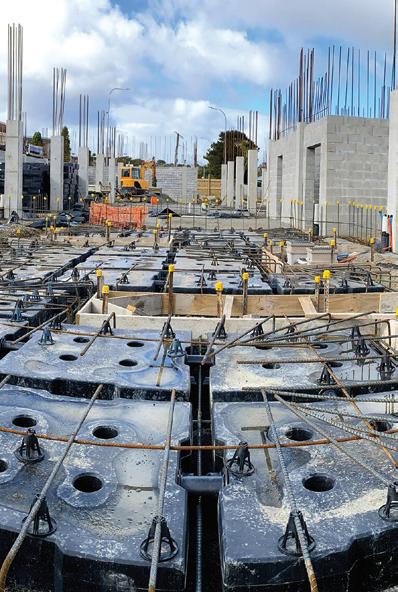
Locally made, lower emissions.
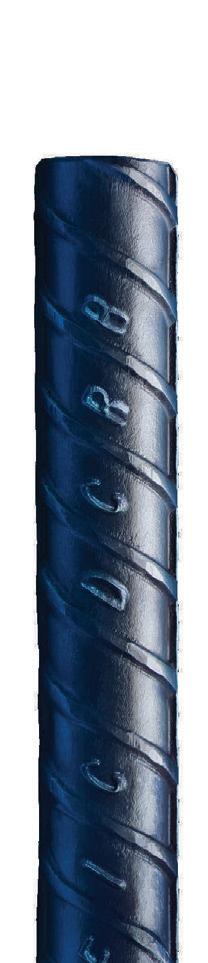
PACIFIC™ and PACIFIC DCRB™ are more than reinforcing steel, they’re the backbone of New Zealand’s next generation of sustainable buildings and infrastructure. Made locally to the highest standards, our lower-emission steel sets a new benchmark for construction. Building the foundations of a brighter, lower emissions future.
Coming to market in 2026. pacificsteel.co.nz
“You have to be flexible and make it easier for these guys to get equipment out at different heights, and to ensure systems are as light as possible.”
18
“How cool is it that I can walk across the bridges I’ve had a huge part in making, with my daughters and say, ‘your Mum did this’.” 24
In this issue
“ The beauty of 3D printing is that scaling becomes much easier because the process is digital.”
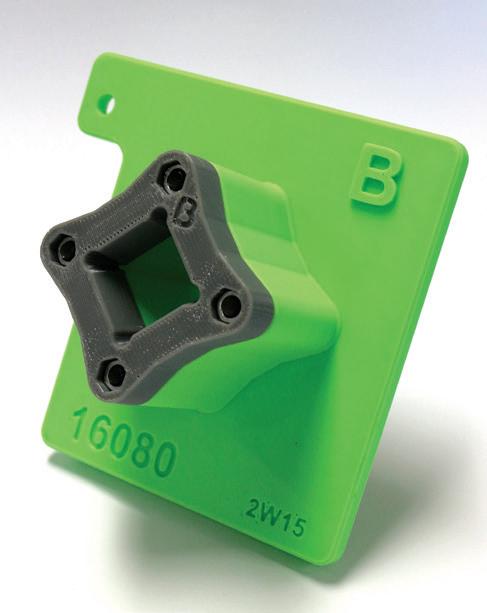
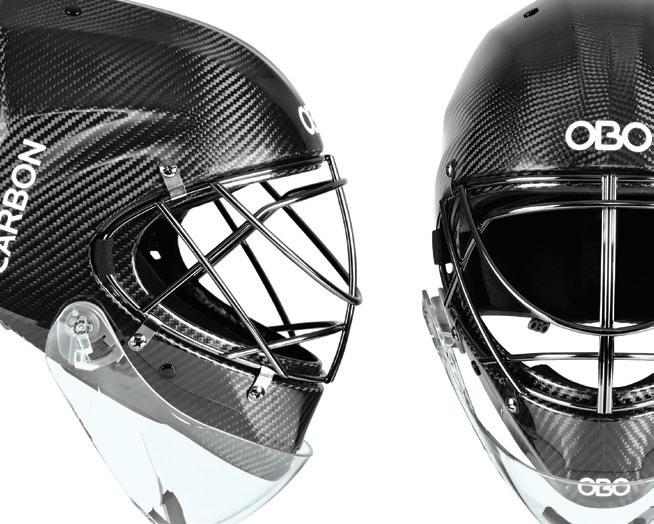
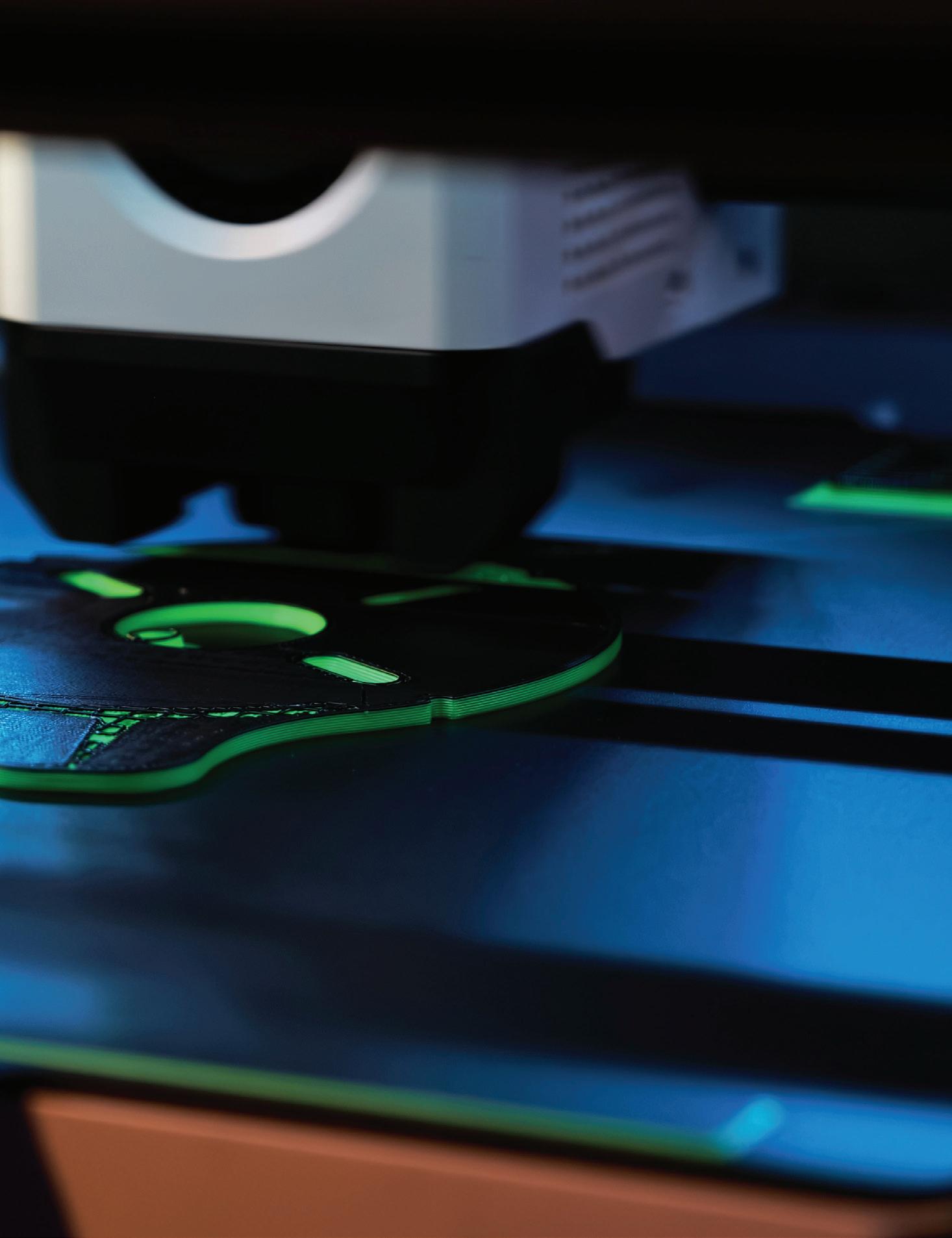
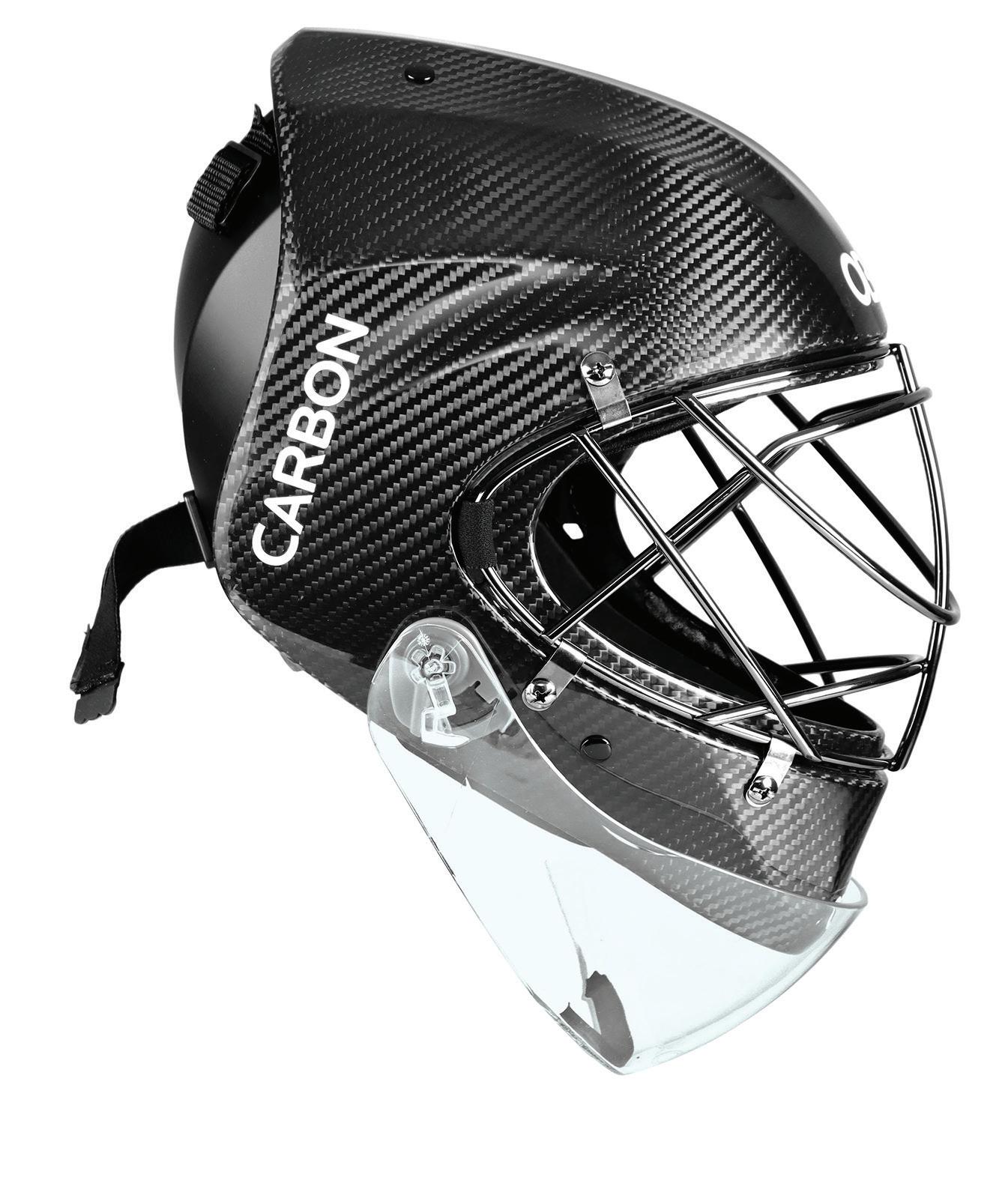
A demanding engineering brief: increase impact protection without compromising performance, fit or visibility.
PO Box 12 241, Wellington 6144 New Zealand 04 473 9444
EG is available digitally for members on our website.
Printing
Your cover is printed on Forest Stewardship Council (FSC) approved and elemental chlorine free (ECF) paper. The inside pages are Programme for the Endorsement of Forest Certification (PEFC) approved and elemental chlorine free (ECF). EG is printed using vegetable-based inks made from renewable sources. Printing and fulfilment by Bluestar.
Please recycle your paper envelope – it’s 100% recyclable and made from PEFC accredited paper.
Disclaimer
Advertising statements and editorial opinions expressed in EG do not reflect the views of Engineering New Zealand Te Ao Rangahau, its members, staff, or affiliated organisations unless expressly stated.
Print ISSN 2537-9097
Online ISSN 2537-9100
This issue of EG was published in December 2025.
Features
08 Fire fighters In a world increasingly menaced by hotter, drier conditions, the work of engineers is proving crucial to the way we deal with fire.
14 Engineering his own survival
When this engineer began building software to streamline healthcare, he never imagined he’d one day use similar technology to help save his own life.
18 3D or not 3D (printing)
How engineers in Aotearoa are key to a range of innovative and potentially transformative work with 3D printing.
24 Bridges “are like works of art”
An award-winning bridge engineer explains why she loves bridges, what drives her and how she’s helping other engineers.
26 Hope rebuilt after silt How a large-scale clean up and recovery after Cyclone Gabrielle restored not just land, but hope.
30 An engineer’s best friend..?
Engineers and animals cross paths more often – and in more places – than you might think.
Best practice
Ngā mahi papai rawa
38 Signing right Your signature as an engineer is valuable, so how do you protect yourself and manage client expectations?
39 Intersection
40 Fire! Ringing the changes in fire safety.
42 A landscape of constant change
A look at some of the shifting challenges of our coastlines.
44 Inspired not retired
If 70 is “the new 53”…
45 Proportionate liability a move in right direction Dr Richard Templer FEngNZ explains.
46 Why sustainability matters
Across engineering, sustainability is becoming a baseline expectation and engineers are well-placed to champion the move.
48 Maintaining standards When we collectively maintain high standards, everyone benefits.
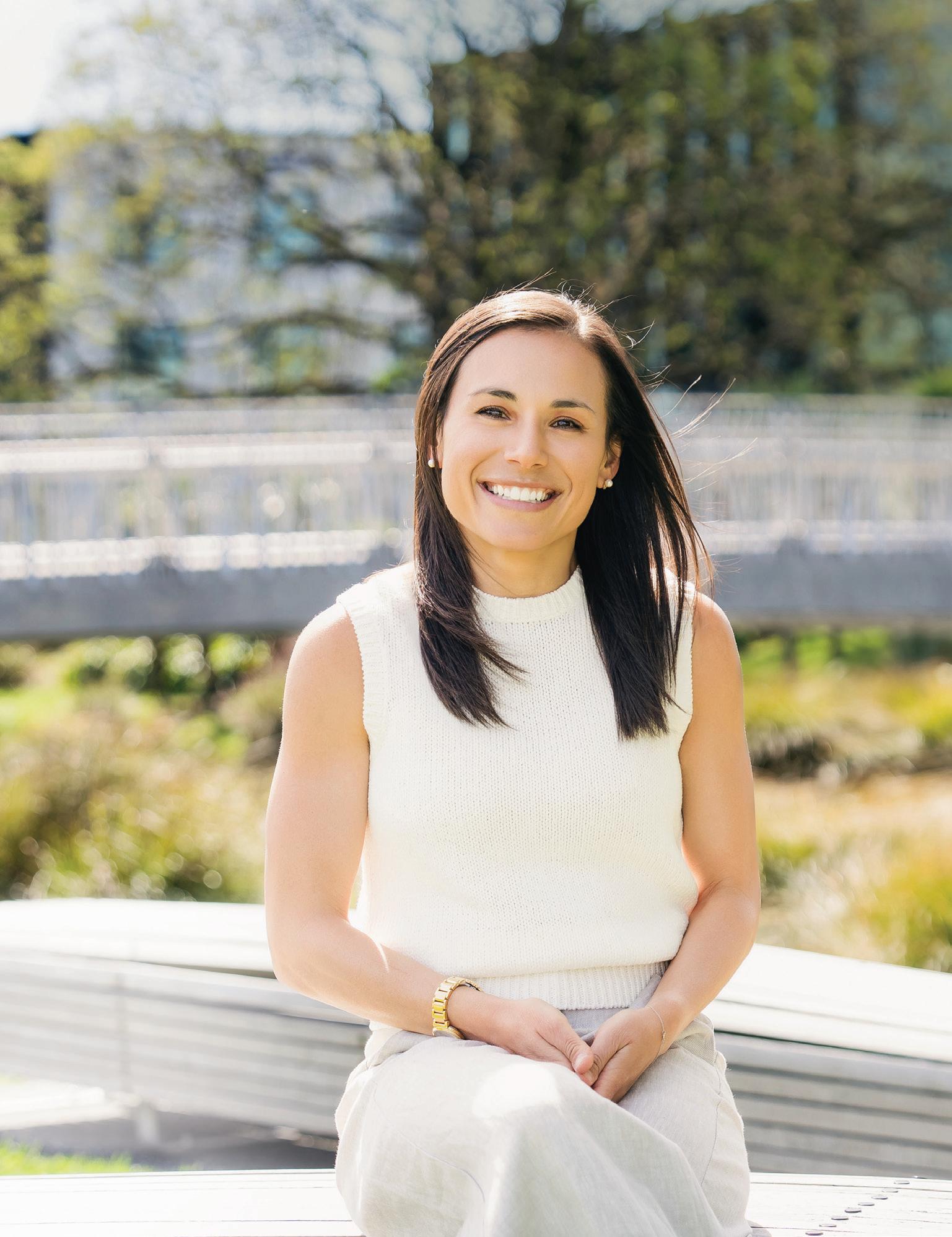
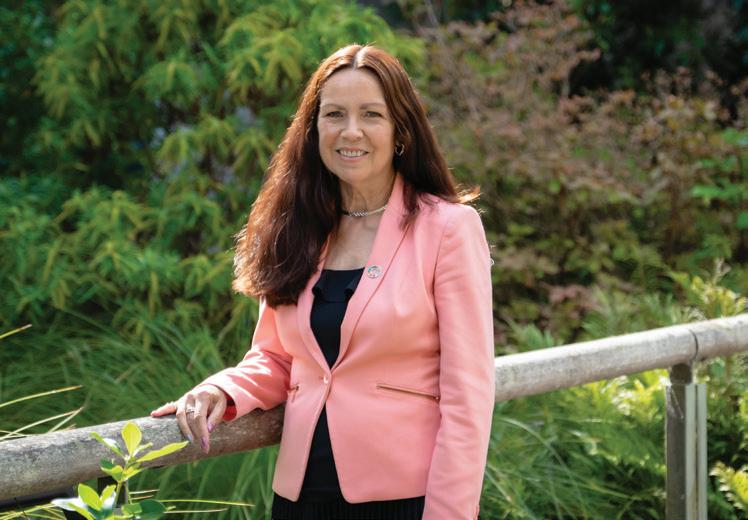
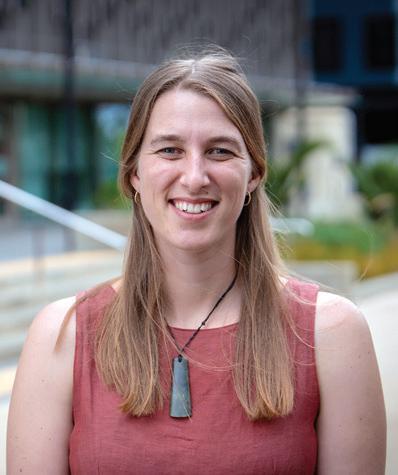
On the cover: 2025 Engineering New Zealand ENVI Awards Young Engineer winner Sabina Piras.
Photo: Craig Forster/Lightchasers
50 Community impact and collective success Transforming pathways for Māori and Pasifika engineers.
52 Secret life of engineers
54 Inside job
57 Obituaries
58 Bedside table
59 One to watch
60 Engineering genius
Engineering Envy #155
Chosen by Te Ao Rangahau staff
Nelson Mandela Bridge: South Africa
Physically, it connects areas once divided. Symbolically, it’s a reminder of the resilience and hope that carried South Africa through a painful chapter, and of people dreaming and thriving together.
– Veronica Dessein, Registrar and Manager –Professional Assessments
When engineers set out to build Johannesburg’s Nelson Mandela Bridge, one of the many challenges was the 42 active rail lines snaking beneath the site – and the bridge had to be constructed without disrupting rail traffic. Limited space available for access ramps necessitated a narrow deck, and only two structurally suitable sites were found for the supports. The resulting asymmetric cablestayed design is supported by 27m and 42m pylons and spans 284m – the largest of its type in southern Africa at the time of construction. The award-winning “Joburg” icon was opened by its namesake in 2003 – a tribute to the first Black President of South Africa’s role in uniting South African society. Striking lighting displays have marked significant events such as the 2010 FIFA World Cup and Breast Cancer Awareness Month.
PARTNER WITH US
With 23,000 members and strong industry, government and academic links, Engineering New Zealand Te Ao Rangahau is the voice of the profession. Partnering with us gives your organisation a powerful way to lead, showcase expertise, and connect with the country’s largest group of engineers.
Why partner with us?
• Reach New Zealand’s largest engineering community through multi-channel marketing.
• Engage and educate members via articles, events and thought-leadership opportunities.
• Collaborate on strategically-aligned initiatives that advance the profession.
• Partner with a trusted organisation committed to helping you achieve your goals.
A partnership with Engineering New Zealand delivers more than visibility. It brings awareness, connection and impact. Together, we can showcase your strengths, engage meaningfully and shape the future of engineering in Aotearoa.
To learn about partnering with us, get in touch with Luke Pirie, Business Development Manager at luke.pirie@engineeringnz.org
A rātou kōrero What they said
“Essentially, the backbone of our Southland and South Otago electricity networks are broken and we have to repair the backbone before we can begin to stand them back up.”
Experienced electrical engineer and PowerNet Chief Executive Paul Blue after the destructive weather event in October.
“... when a building’s looking really tired and run down, people think it has no value. But once you’ve done it up, they can see it.”
Dunedin structural engineer and heritage advocate Stephen MacKnight CMEngNZ CPEng IntPE(NZ) receives the Southern Heritage Trust’s Bluestone Award for services to heritage protection.
“The concept of extracting Rubisco protein from leafy forage crops is one that’s been known for a very long time to have a lot of potential.”
Co-founder of green protein producer Leaft Foods, Maury Leyland Penno FEngNZ, after the company signs a supply deal with multinational food ingredients business Lacto Japan.
“He’s a values-driven leader who brings with him deep engineering expertise and extensive experience in the delivery of complex infrastructure assets...”
Murray Burt FEngNZ CPEng IntPE(NZ) is welcomed as Chief Infrastructure Officer of Auckland Airport.
A win for all
Adapting to change isn’t always easy – sometimes it’s expected, other times it catches us off guard. This edition of EG includes engineers who help, or find solutions, in the face of unpredictable challenges such as storms, earthquakes and fires – times when communities often depend heavily on, and trust, engineers to guide their recovery. You’ll find articles on fire engineering, plus insights into silt recovery after Cyclone Gabrielle and the Nelson floods. We also look at how engineers worked alongside USAR dogs in the Christchurch earthquake, with the 15-year anniversary occurring in February. Plus, there's a feature about 3D printing – I sometimes think back to my early days at university and marvel at the inventions that we could barely even imagine at the end of the last century. 3D printing is one of those, along with mobile phones!
Continuing with the theme of advanced technology, this edition includes an engineer who is battling his own brain cancer with AI. We also feature the outstanding work of some of the 2025 Engineering New Zealand ENVI Award winners, including Young Engineer Sabina Piras, an
inspirational bridge engineer.
We also take a look at the “silver economy” in an article that discusses why engineers might choose to work over the age of 65. It's very timely in the light of the recent report by the Helen Clark Foundation and its partner, engineering and infrastructure consultants WSP, that found that the over-65 population is projected to grow from 870,000 in 2024 to as many as 2.5 million by 2078.
I’d like to take this opportunity to congratulate Dr Richard Templer FEngNZ, Chief Executive of Engineering New Zealand, for the organisation’s recent win at the Best Places to Work Awards. The Human Centred Impact Award 2025 recognises “workplaces where inclusion, care and human potential drive success”. This is a reflection of the way the staff feel about their work and the organisation, but ultimately, it is a reflection of the value they place on you, our members.
Finally, I wish you all a peaceful Christmas and an exciting 2026.
Jan Evans-Freeman DistFEngNZ President, Te Ao Rangahau
Meeting your immigration needs
Pathways to New Zealand® is proud to partner with Engineering New Zealand to support the employers and engineers shaping the future of our country.
Established in 1992, Pathways® is one of New Zealand’s most experienced and trusted immigration firms. Our team of 12 Licensed Immigration Advisers, who have more than 150 years of combined immigration experience, include lawyers, previous New Zealand immigration officers, and passionate local and international professionals who speak 10 languages. Our advisers are recognised as industry-leading experts and with offices in Wellington and Hamilton, and staff working remotely from Australia, France, and the United Kingdom, Pathways® has a true international focus.
At Pathways®, immigration is more than just about securing a visa, it’s about understanding the full picture. We take into account a person’s goals and circumstances, their family, and their employer. Our approach is strategic and holistic, with a strong emphasis on pre-planning and futureproofing. This approach and these values are at the heart of everything we do at Pathways®
Immigration decisions can be lifechanging, and there is often a great deal at stake. Getting the right advice from the outset is critical to achieving stress-free, appropriate and successful immigration outcomes.
Whether you’re an employer or an engineer, Pathways® is your trusted immigration partner. Find out more at pathwaysnz.com/engineering-pathways
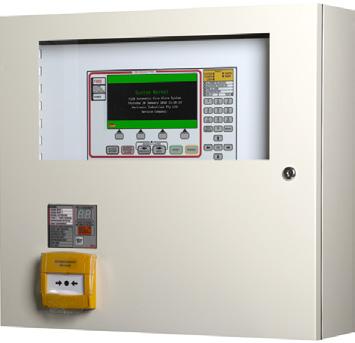
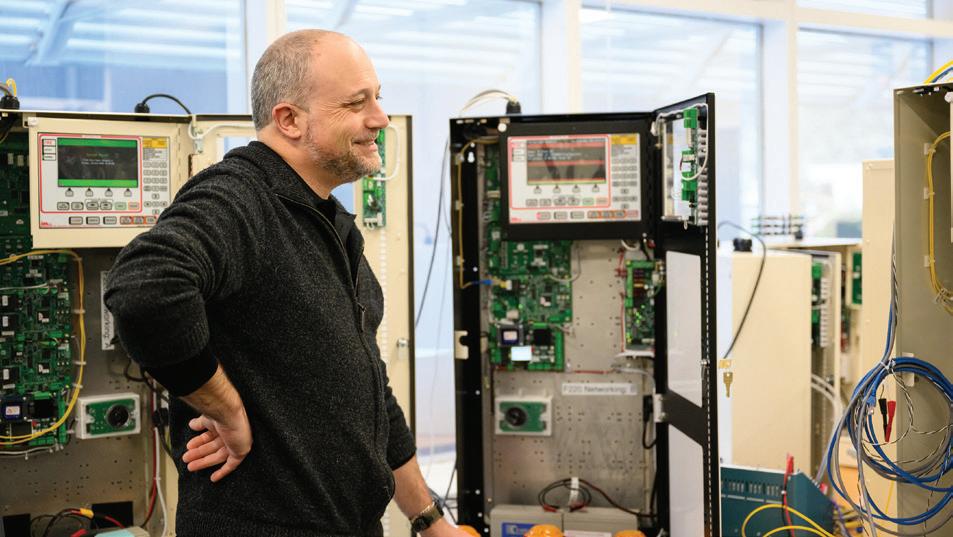
same Pertronic technology trusted in commercial buildings, tunnels, and railways now protects wind turbines—operational now at Northland’s Kaiwaikawe Wind Farm. Up to 160 F220 panels can be networked, monitored, and controlled from a central point. They detect fire instantly and activate suppression systems including aerosol, clean agent, CO2, water, and turbine shutdown.
Turbine image via Freepik
Fire fighters
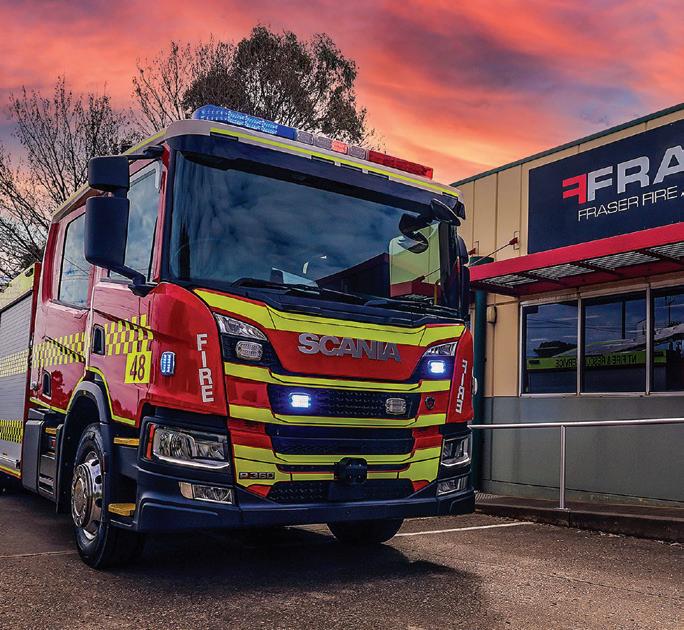
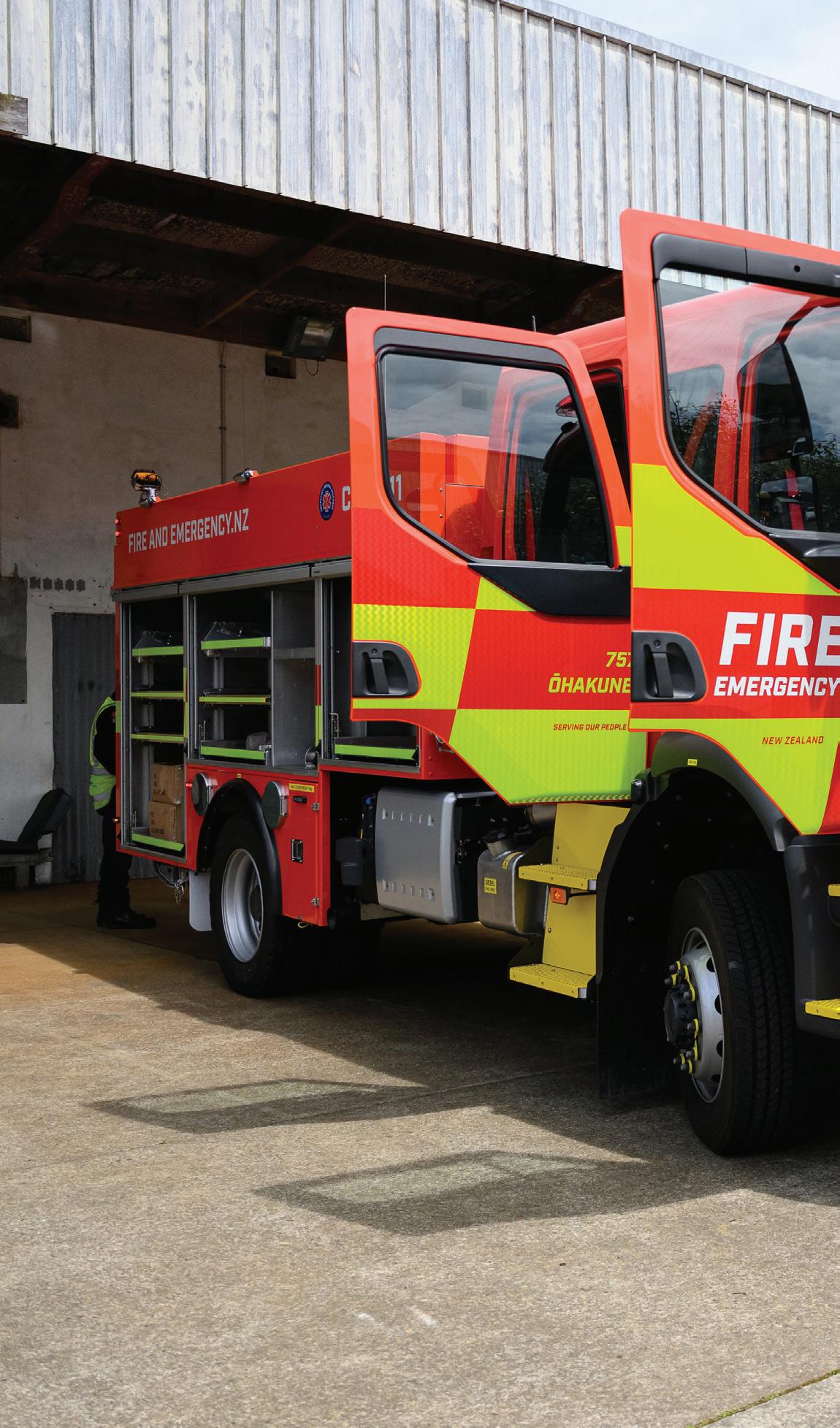
Fraser Engineering's latest Fire and Emergency New Zealand (FENZ) Type 1 4x4 pumper goes through a final pump test.
WRITER | KAITUHI MATT PHILP
In a world increasingly menaced by hotter, drier conditions, with a trend towards denser housing, the way we deal with fire is changing – and the work of engineers is proving crucial.
Photo: Mark Tantrum
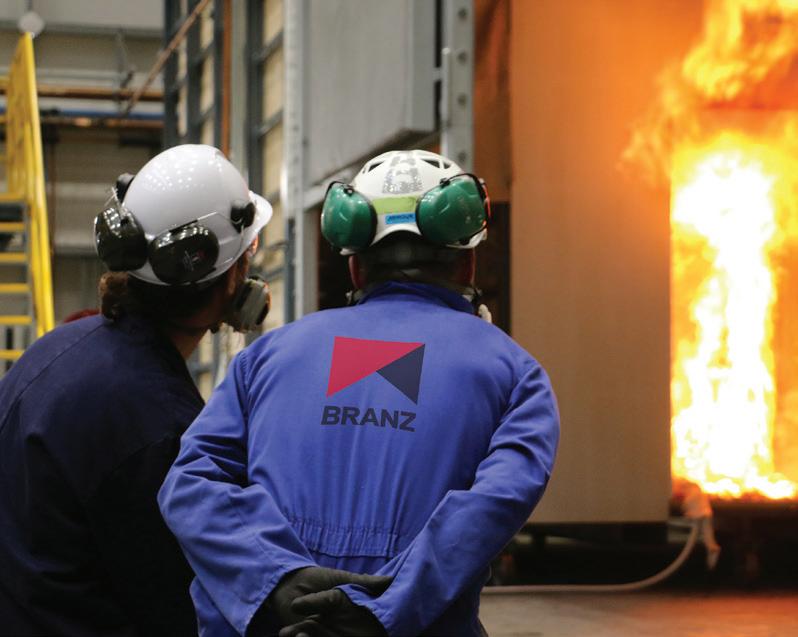
In August, the Government announced that it will change the Building Code to strengthen fire safety requirements, prompted by a nationwide review following the deadly 2023 Loafers Lodge fire. Also this year, BRANZ unveiled a new lab in Porirua offering some of the most advanced fire-testing capabilities in the Southern Hemisphere. Meanwhile, innovative New Zealand-based firms are doing their part to develop the vehicles and equipment needed to take on the mega fires experienced in Australia, California and elsewhere. Kiwi fire engineers are heavily involved in these developments. The expertise of these engineers was only formally recognised in New Zealand as an independent discipline in the early 1990s with the introduction of performance-based design and the establishment of dedicated university training. So, what exactly do they add to fire safety?
Getting “the right mix of safety features”
Greg North CMEngNZ CPEng IntPE(NZ), immediate past-President of the Society of Fire Protection Engineers (SFPE) NZ, says fire engineers are involved in diverse sectors, including insurance, policy setting and the fire service itself, but most work in the built environment. Whereas architects and other design engineers typically focus on construction elements and system components, fire engineers are more of a strategic and holistic design profession, Greg says.
“We look at performance, and our focus is more on getting the right mix of features in a building to provide an appropriate level of safety.”
He says that could be to meet the minimum Building Code, but it could involve satisfying the specific
We look at performance, and our focus is more on getting the right mix of features in a building to provide an appropriate level of safety.
– Greg North
requirements of a client such as business continuity, property protection or insurance risk mitigation.
“In some ways we’re like an acoustic engineer who starts with how much noise attenuation is appropriate to a room, and the building design features flow from that decision.
“In a similar way, we work with the architect, client and others to determine the best way to develop a suitable level of fire safety within and around the building. We then work with the design team to help them develop the specific built features that can deliver this level of safety.”
Like many European nations, as well as Australia, New Zealand fire engineering operates in a legislative regime with a performance-based focus, Greg says, while other countries are more prescriptive. Another point of difference is our historical penchant for timber. Also, earthquake resilience is a major concern here.
“Our buildings have to perform in a seismic event, where specific consideration is sometimes needed for how buildings will move and how our fire safety features
Left: The new BRANZ fire testing facility in Porirua. Photo: BRANZ
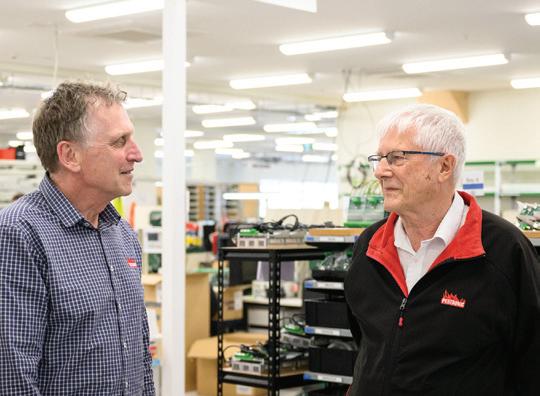
Above: Pertronic Marketing Services Manager Peter Kerr (left) and Managing Director David Percy ONZM FEngNZ.
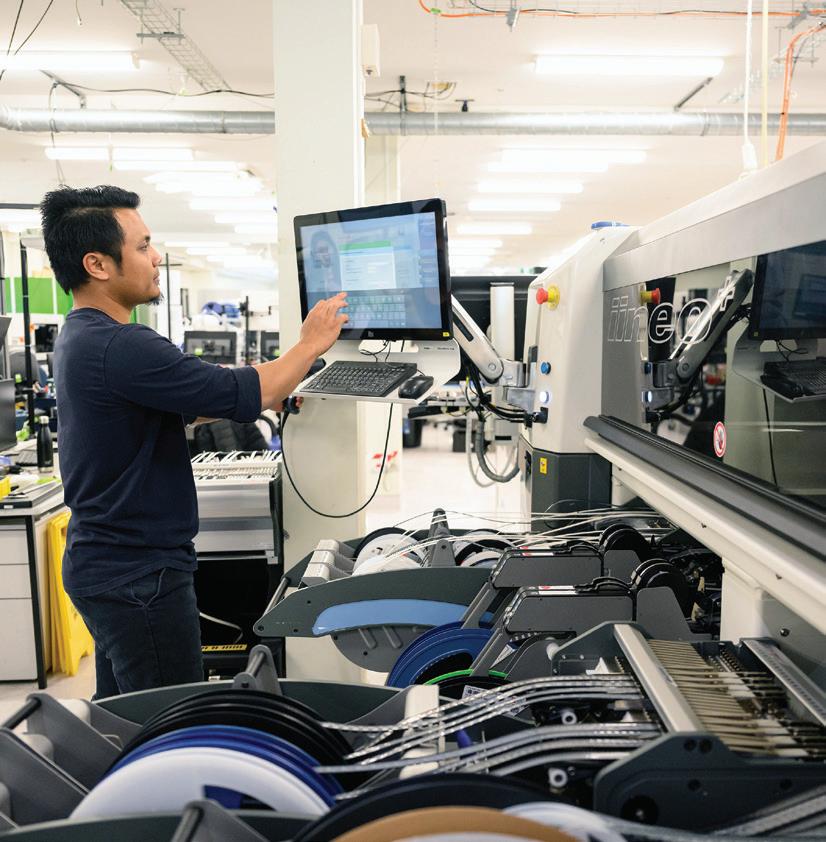
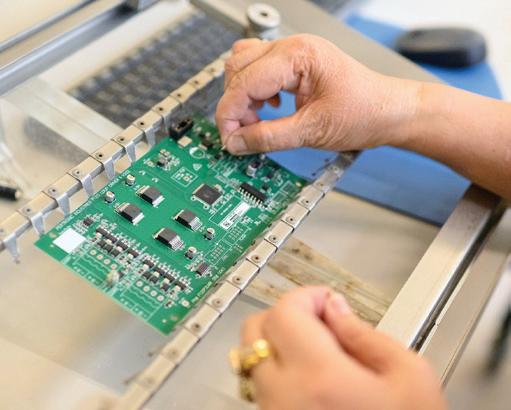
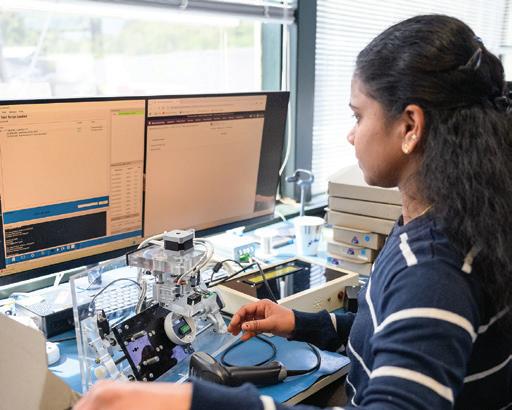
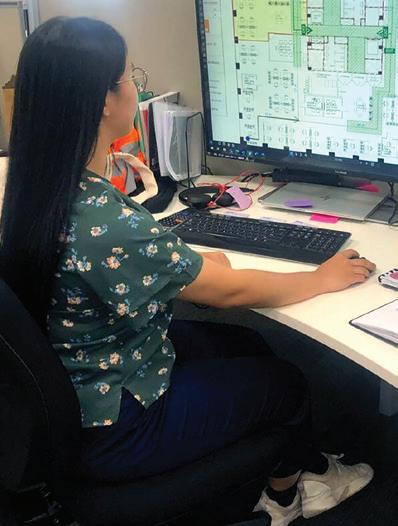
Photo: Mark Tantrum Opposite, clockwise from left: Behind the scenes at Pertronic: Surface Mount Technology machine operator Muin Abdul Wahab; larger components being placed by hand on a printed circuit board; Anusha Chevutu (print board assembler) tests heat detectors. Photos: Mark Tantrum
will move. There’s also sometimes a difference in the way we develop our fire strategies. A fire designer can choose whether to rely more on the physical construction of buildings, the passive fire features, or lean more towards active features such as sprinklers and alarm systems. In New Zealand, we have a pretty good balance between relying on both.”
But we can do better, Greg adds, and there’s always a need to evolve. For instance, the SFPE is currently working on the issue of electric vehicle fire risks.
“There’s a group of fire safety professionals, including members of the SFPE, who are looking at developing New Zealand-applicable guidelines for EVs, along with Engineering New Zealand. What’s the real risk? Is it too high? What strategy should we take in our buildings for EVs? And so on.”
In the same vein, Engineering New Zealand Practice Note 22, which was released in 2011 to improve collaboration between design professionals and to streamline fire design documentation, has recently been changed. Tellingly, while the revision clarifies the roles and obligations within a design team, the strong emphasis throughout is that fire design coordination has to be a shared responsibility. Ultimately, the goal is to make better, safer buildings.
Advancing fire safety technologies
But what about when the worst happens and a fire breaks out? Since 1986, when his Lower Hutt business Pertronic launched its first automatic fire alarm control panel, that question has preoccupied David Percy ONZM FEngNZ. He was recognised in the 2025 King’s Birthday Honours for services to fire safety technologies, as well as to business and the community. As a member of a number of New Zealand Fire Alarm Standards committees over the years, he played a role in potentially life-saving developments, including the requirement since 2003 that all fire evacuation alarms have a voice announcement to go with the alarm sound.
“New Zealand was one of the first countries to require that,” he says. “It makes it completely unambiguous.”
Pertronic’s work to improve automatic fire detection and alarm systems has been even more influential. When the company, which employs 30-odd engineers among its 160-strong staff, was founded in the early 1980s, it had half-a-dozen domestic competitors. Today, it’s the sole surviving New Zealand-based manufacturer in the field. Its systems are used throughout New Zealand in everything from small commerical buildings to big, and complex facilities, and it exports compatible products to markets in Southeast Asia, the Pacific, Australia and the
United States. One reason for that success is Pertronic’s policy of reinvesting at least 17 percent of annual gross revenue in research and development, which has enabled it to keep abreast of technological developments.
There have been a few.
“The equipment has become a lot smarter,” David says, noting that the early fire alarm control panels were relatively simple relay-based systems.
“The technology then moved to electronic panels using integrated circuits, then to microprocessors, which enable control panels to do all sorts of things. They can shut down air conditioning, for instance, or redirect it so you don’t blow smoke from one area into another.
“Modern panels also have extensive logging facilities, so if there’s been a fire you can download the log to see what happened.”
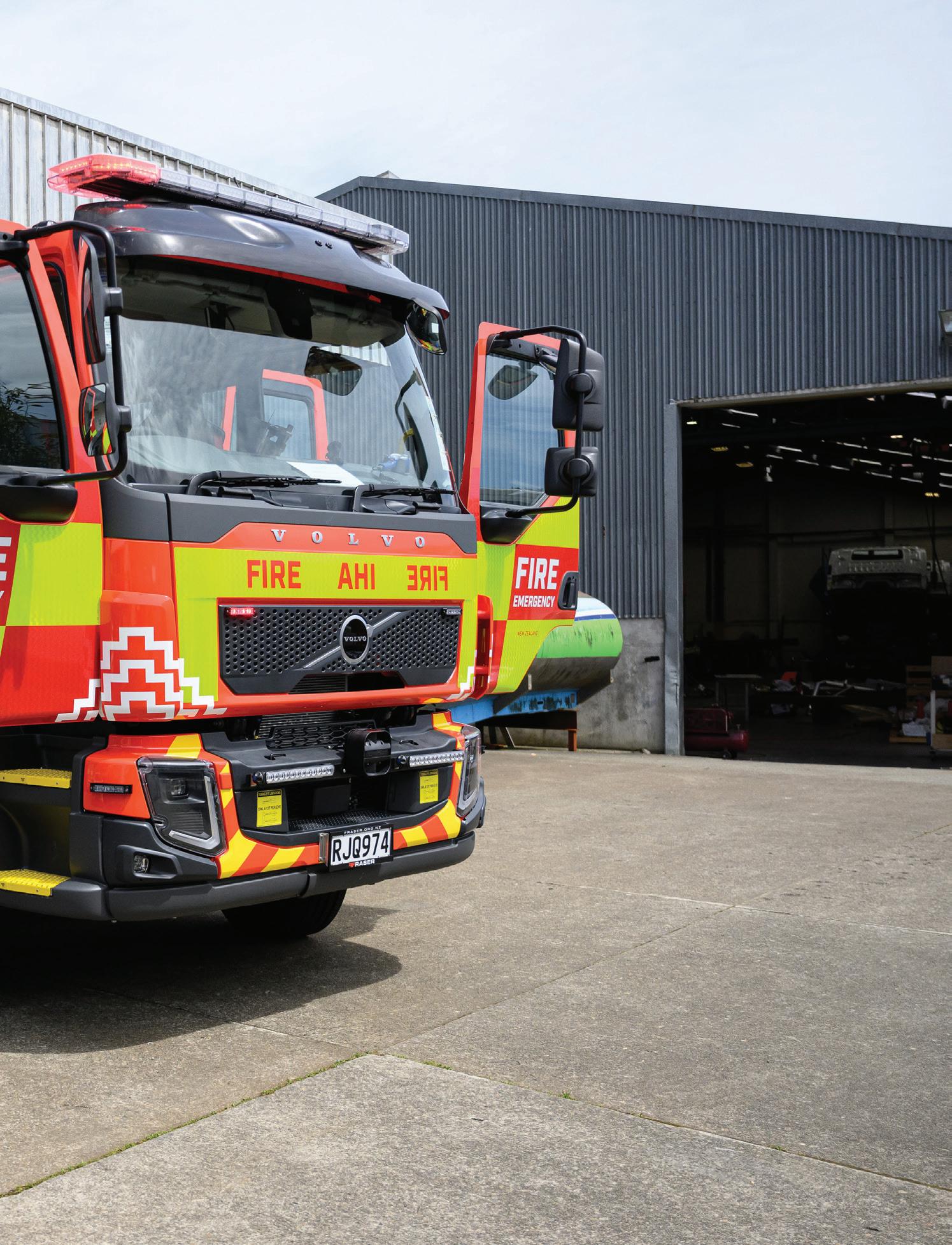
That same theme of growing sophistication also applies to the world of fire-fighting machinery. Take Lower Huttbased Fraser Engineering, for example, which produces fire appliances that are tailored to the particular demands of fighting bush fires in Australia.
“Because we’re a production engineering and design shop, as well as a fire appliance manufacturer, we design all our equipment in an ongoing feedback loop with our customers,” says General Manager Martin Simpson.
“We take into account things like climate, terrain, roads.”
The fact that many firefighters are volunteers, with diverse body types, is also a consideration.
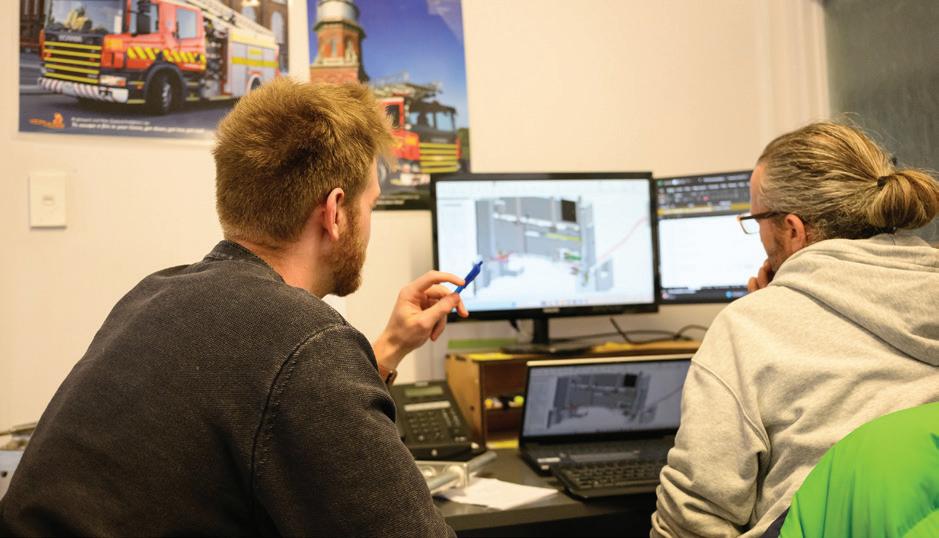
“You have to be flexible and make it easier for these guys to get equipment out at different heights, and to ensure systems are as light as possible.”
Fraser Engineering’s business has grown rapidly. Recently, it was awarded an $80-million, five-year contract to provide fire appliances to Queensland. It’s in the throes
It’s about saving lives
of doubling production capacity, including building a factory in Brisbane, and is taking on at least 50 new staff. That’s partly the result of the increasing frequency and ferocity of bush fires, but it’s also a vote of confidence in the company’s commitment to safety and constant improvement.
“All our development is about crew protection. The appliances come with deluge systems around the windows, to prevent thermal shock. We have drop-down curtains inside the cab in case windows blow out, and something like a scuba emergency system to provide air for 15 minutes if crew get into real trouble. All the tyres have water sprays so they don’t catch on fire; there are under-truck sprays, and flame-proof lagging on any system that could potentially stop the truck running. We’ve even developed safety locking mechanisms so the crew can’t lock it inadvertently.”
There’ll be more changes to come.
“It’s about things like trying to get more water onboard, coming up with smarter ways to design vehicles – things are always evolving.”
Fire Engineering class
Work is underway to launch a new CPEng Fire Engineering class in mid 2026. It will clarify competency expectations for engineers, improve the consistency of Fire Engineering standards nationwide, and provide greater assurance for BCAs and the public. Only those working in the Fire Engineering space will be affected. Transition arrangements will be published once the class is established for those CPEng wishing to be recognised in the Fire Class.
In her final year of civil engineering at the University of Canterbury, Stella Liu took an introductory course on fire engineering, not knowing exactly what was involved.
“It touched on every area: human behaviour, fire protection systems, how different materials react in fires… At the time, that just seemed so interesting and so different.” She was hooked. After completing a final research project in the structural fire engineering area, Stella joined GHD 18 months ago as a graduate fire engineer, while also studying for a Master of Fire Engineering Studies. Her job entails everything from writing fire reports, drawing fire safety sketches and issuing passive fire safety specifications, to helping with fire safety design. Her latest project involves detailed design and construction monitoring on the University of Canterbury’s new accommodation hall.
Ultimately, fire engineering is about saving lives.
“Our main objective is to make sure that people come out of a fire safely and that it doesn’t spread to neighbouring buildings, and to support fire-fighting operations.”
Photo: Supplied
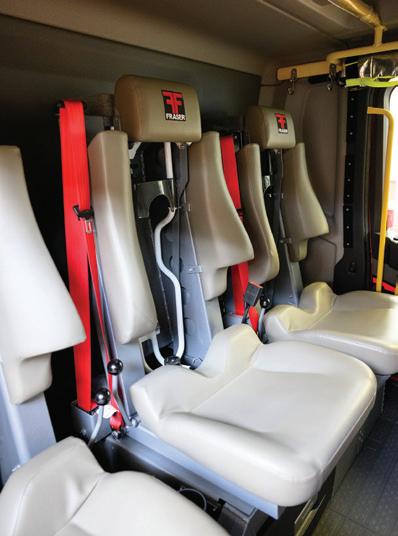
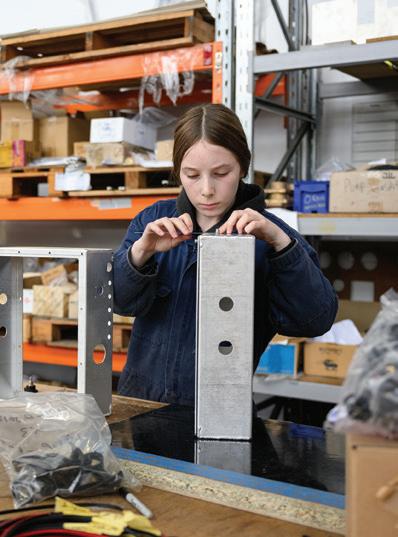
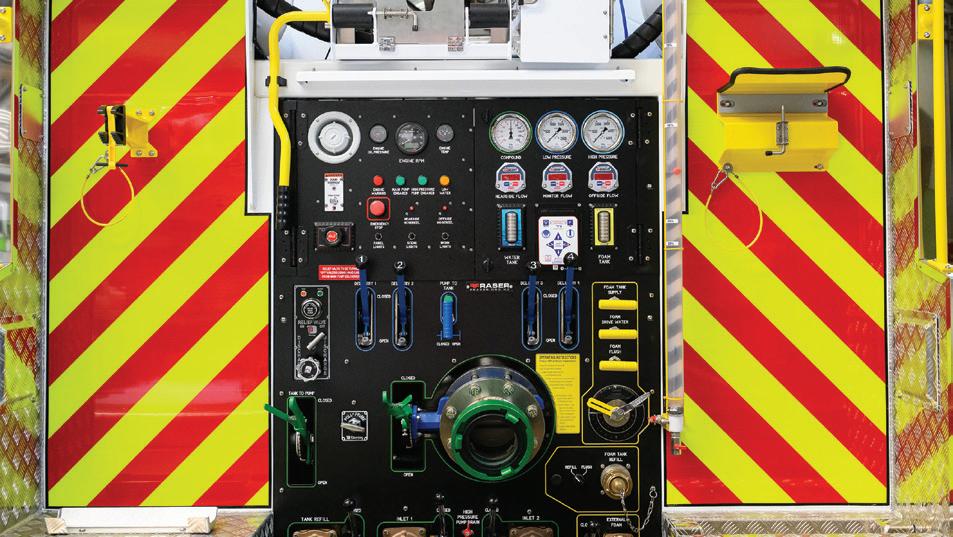
Clockwise from top left: Pertronic compliance engineer Daniel de Waal carries out internal testing on an F220 fire panel; Fraser Engineering’s patented breathing apparatus seats enable firefighters to travel to the scene safely and in comfort; collaboration on the latest fire appliance body design using solid modelling software; Type 3 heavy pumper pump panel; wiring up electrical housings, produced on site at Fraser.
Photos: Mark Tantrum
Engineering his own survival
WRITER | KAITUHI ALEXANDRA JOHNSON
When Ian McCrae first began building software to streamline healthcare, he never imagined that one day he’d be using similar technology to help save his own life.
The founder of pioneering Kiwi health tech company Orion Health, Ian McCrae has long been known as a visionary engineer. But now, facing stage-four glioblastoma, he’s taken his talents to a new frontier, using AI to guide his personal cancer treatment.
Ian says growing up in rural New Zealand in the 1960s helped forge his approach to life, business and innovation.
“It was a wonderful time to grow up. We had so much freedom – you were never told you couldn’t do things.”
Always a restless student, while studying engineering at the University of Auckland, Ian found that he was spending more time up the road at Kiwi Tavern rather than the lecture theatre.
“I knew if I carried on, I was going fail.”
He packed a bag and set off to hitchhike around the world. From the highways of America to the streets of post-revolution Iran, Ian wandered with a map in hand, pointing out he was from New Zealand, which brought warm welcomes. He nearly made it to Afghanistan, but when a German tourist was shot there, the borders were abruptly closed. Broke in Australia, he worked in the desert to fund his return to Aotearoa. It was a journey that shaped a fearless innovator.
After completing his studies, including a master’s degree in engineering sciences
and a spell in Antarctica, mathematically modelling ice shelf flows, Ian worked in various roles before establishing Orion. What began as a small software venture grew into a global health technology powerhouse, its patient record software now serving more than 450 million patients across 25 countries.
Fast forward 30 years, Ian has recently established McCrae Tech, a cutting-edge health technology company singularly focused on the use of AI to streamline data and clinical workflows, personalise treatment, and transform how patients and clinicians interact with complex medical information.
This is clearly the major thing which is going to transform society and I want to be in the vanguard.
One morning about four years ago, Ian woke up to find strangers in his bedroom. Confused, he told them they were in the wrong room, only to discover later that he had suffered a grand mal seizure. A hospital scan revealed the cause: a stagefour glioblastoma.
Surgeons removed what they could, but as Ian explains: “You can never get it all, these things have tentacles.”
The prognosis was grim. Most patients don’t survive beyond 14 months, but true to his engineering instincts, Ian turned to data.
“I built a burn-down chart, time to death,” he says matter-of-factly. Using spreadsheets, he mapped out his survival probabilities, colour-coded from green (alive) to red (dead).
“I’m very good at spreadsheeting,” he adds with a wry smile. The numbers were stark, signalling a steep decline in survival odds after just a few months.
Researching first online, then later with the help of AI, Ian mapped out a treatment plan, including diet and medication. And he’s defied the statistics. Nearly four years on, he’s still here, alert, active and innovating, which puts him in the top one to two percent of survivors.
“Even if I had a relapse tomorrow, it wouldn’t kill me instantly. I think I’ve got at least a couple more years.”
He says the very first step of any AI process is to assemble the data, and that is what McCrae Tech’s AI platform, Orchestral, is being built to do.
“Pulling your medical records together today, you’d have to get them from the GP, from the pharmacist, from labs, hospitals, if you’ve had your genome done you can throw that into the mix as well. It’s a big job.”
He continues: “Different health organisations use different codes, but all that data is fed into Orchestral, which tidies it up and pushes into an LLM [large language model].
“Once that’s done you can ask it, for example, I want to take a certain off-label drug, what’s the efficacy of this in treating glioblastoma? What are the interactions with the drugs that I’m currently taking.
What’s the recommended dosage? It’s also capable of answering more complicated queries and tapping into all of PubMed, all the latest clinical knowledge in the world. How could humans keep up with that? That’s just not possible.”
He says as long as someone is asking the right questions about diagnosis and treatment, based on symptoms, they can get in-depth information about their condition.
“This AI technology is going to completely transform healthcare for people with life-threatening conditions like mine, but it also has all sorts of usefulness right across healthcare, the ability to diagnose and treat.”
If he had a magic wand, what would this
veteran of health management do with the country’s failing health system?
“I would implement subsidiarity, moving decision-making away from the bureaucrats to the coalface where healthcare is being delivered. There is a clear correlation between where decisions are made and innovation.”
He says at the end of the 1990s, New Zealand led the world in health innovation.
“We had Crown Health Enterprises and huge fragmentation. But then things were centralised and all decisions made in Wellington. And how much innovation is going on? Zero.”
Has he any secrets to share with engineers intent on building a business?
“When I started Orion, I had negligible leadership CEO experience, but my secret power was I had a huge inferiority complex that other people knew more than I did, so I’d always ask two or three people, what do you reckon about this situation? My secret
power was that I didn’t assume that I knew everything.”
And, he adds, work with your customers.
“It’s not about raising massive amounts of venture capital or getting an MBA. Just innovate, ask your customers what they want, and listen like hell.”
Ever the innovator with an insatiable curiosity, Ian dedicates much of his time to staying up to date with AI advancements.
“This is clearly the major thing which is going to transform society and I want to be in the vanguard. Even when I was on the cycle this morning, I was watching AI podcasts. Every day I wake up and think ‘oh God, I’ve got to learn about that’.
“My biggest regret in life is that I’m a pensioner and this is the most exciting time. I’ve been in IT now 40 years, been through quite a few changes, but we’re on the brink of one of the most exciting and risky times in history and so much is about to change.”
Photo: McCrae Tech
There’s
wonder in…
an engineer connecting with a future colleague
Be the reason young Kiwis choose a STEM career
Volunteer as an ambassador for the Wonder Project and inspire the next generation of engineers in your region.
Support ākonga as they take on a fun, hands-on STEM learning experience in the classroom, and leave an impact that will last a lifetime.
Register for 2026 now
Rocket Challenge
Year 5–6, Ages 8–10
Term 2
Build and launch rockets
Find your wonder wonderproject.nz
Power Challenge
Year 7–8, Ages 10–12
Term 2
Power a mini town
Ice Cream Challenge
Year 5–6, Ages 8–10
Term 3
Create a yummy ice cream
Water Challenge
Year 7–8, Ages 10–12
Term 3
Connect hapori with wai
3D or not 3D (printing)
| KAITUHI
3D printing is changing the way we build and craft. In Aotearoa, this form of additive manufacturing is growing and while advancement may not be as quick as our global counterparts, engineers here are key to a range of innovative and potentially transformative work.
WRITER
RINA DIANE CABALLAR
“At the moment in New Zealand, the state of additive manufacturing is probably at a medium level. We’re not leading the world, but we’re not trailing the world either,” says Olaf Diegel, a professor of additive manufacturing in the Faculty of Engineering and Design, Mechanical and Mechatronics Engineering at the University of Auckland. “We’re starting to see it used for real-world engineering applications, but not as much as in some countries like the United States and in Europe in particular.”
Such medium-level progress can be attributed to equating 3D printing only with prototyping. Olaf calls it a “misunderstanding” that most companies still think they can’t implement 3D printing for production. “But in general, you can,” he says.
The key, Olaf notes, is to use 3D printing to add value, forging a product that is better than if it was made with conventional manufacturing. “If you’re not adding that substantial amount of value, it becomes an expensive manufacturing proposition.”
3D printing also uncovers a realm of possibilities when it comes to engineering innovations in Aotearoa. “I think the potential is huge… We need New Zealand companies to start doing new things rather than business as usual because we’re trying to compete with the rest of the world. We need some more innovative applications of additives,” Olaf says.
Transformative possibilities
In the world of healthcare, engineers harness 3D printing to help enhance patient outcomes. Dr Maedeh Amirpour, a senior lecturer in engineering science and biomedical engineering at the University of Auckland, is developing wearable human interfaces and prosthetics with the help of 3D printing. Her recent work revolves around custom orthotic insoles to reduce pain and pressure under the feet.
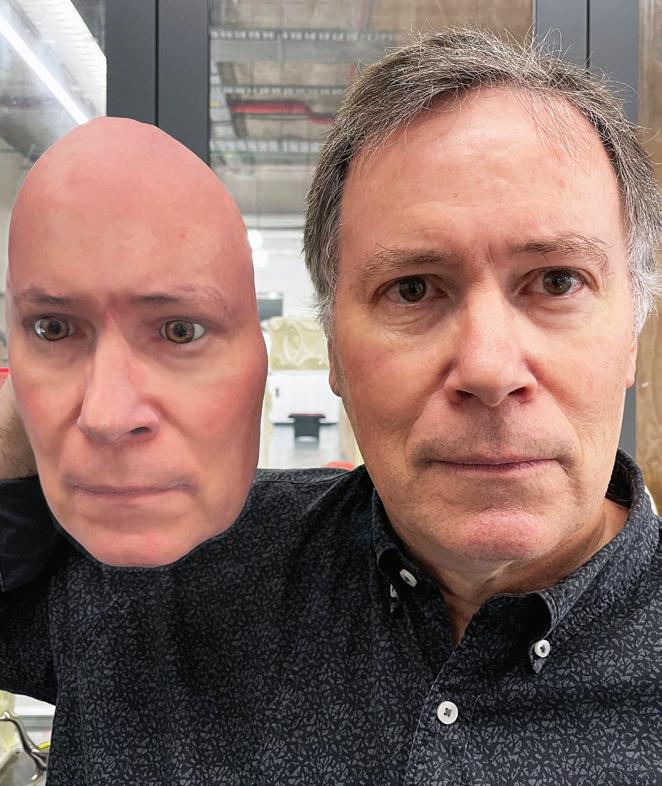
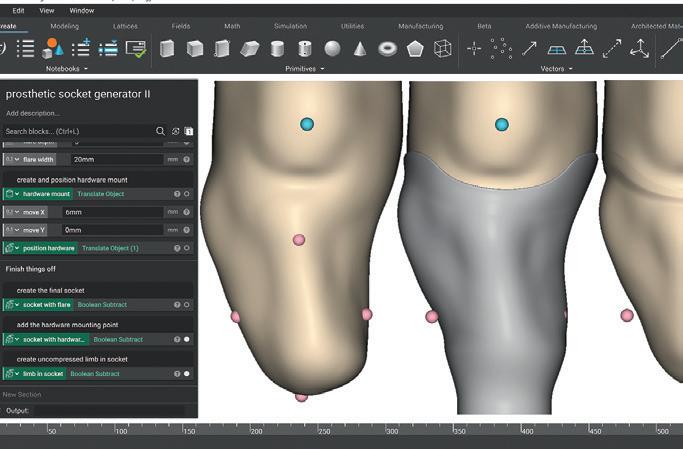
Maedeh and her team begin by taking a scan of the foot or part of the limb to get an exact digital map of its anatomy and geometry. Next, they run a computational simulation and optimisation algorithm to design and predict how the orthotic device will behave during dayto-day movements such as walking or climbing steps. Then, they run tests to ensure the optimised 3D-printed personalised device can cope with real-world use. Accuracy, comfort, quality and safety are integrated into every step of the process.
“By combining the scans, advanced computational modelling and 3D printing, we can create orthotic insoles that are not only comfortable but also built to last in reallife conditions,” Maedeh says. “If our computational model shows that the design might be too stiff or too weak, we can optimise it based on our algorithm before it’s ever printed.”
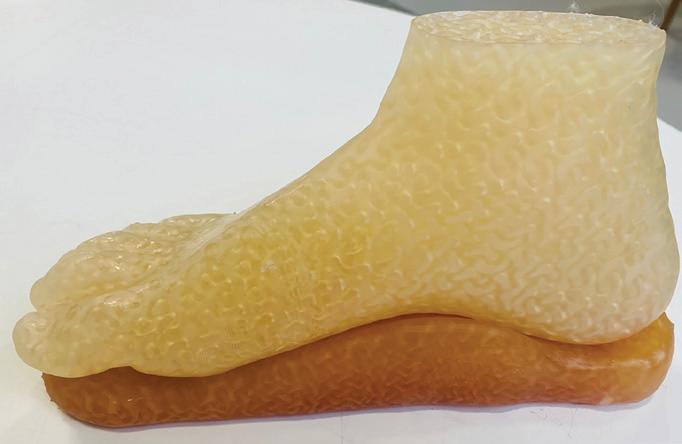
The orthotic insoles are made from a blend of biocompatible resin and hydrogel. Resin forms a durable outer shell for support, while soft hydrogel supplies comfort. Through 3D printing, each orthotic device is tailored to a patient’s needs, enabling them to rapidly adapt to it and providing them with a cost-effective option.
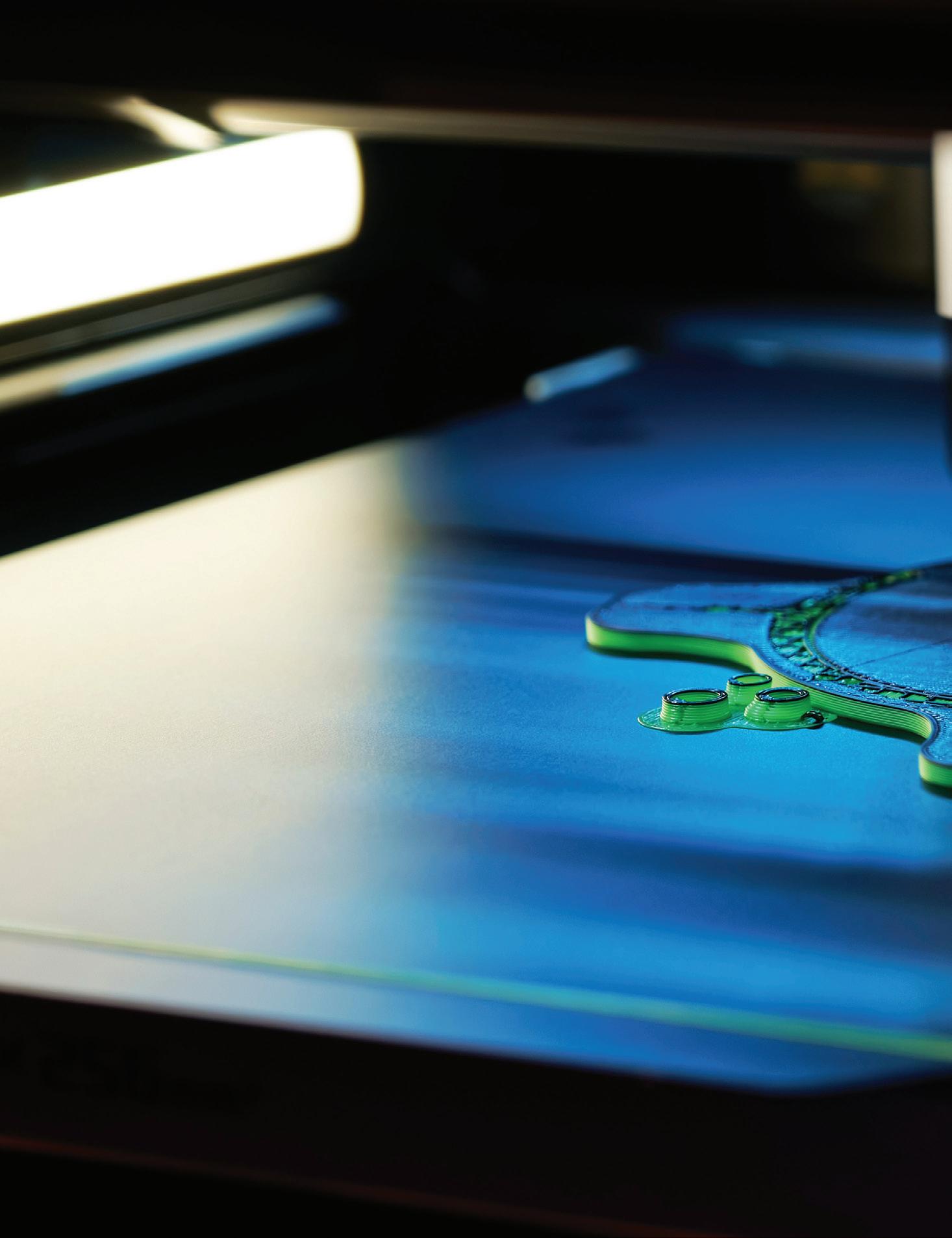
“Traditional prosthetics and orthoses often require multiple fittings, long wait times and expensive tooling. With 3D printing, once we have the scan and digital model, we can produce a device quickly without wasting materials and at the fraction of the cost of other methods,” says Maedeh. “It also gives us the freedom to create shapes and a lightweight structure that’s strong but flexible – similar to how nature designed our bones.”
Most of Maedeh’s current work is happening at the lab, where prototypes are tested and refined. To deliver their solution at a larger scale, the team needs to obtain funding and investment for clinical trials.
“The beauty of 3D printing is that scaling becomes much easier because the process is digital,” Maedeh says. “It ensures people get solutions that fit their bodies perfectly. Whether it is a child needing a fast-growing prosthetic or an older adult needing a pain-free insole, 3D printing can definitely help.”
Can they 3D print it?
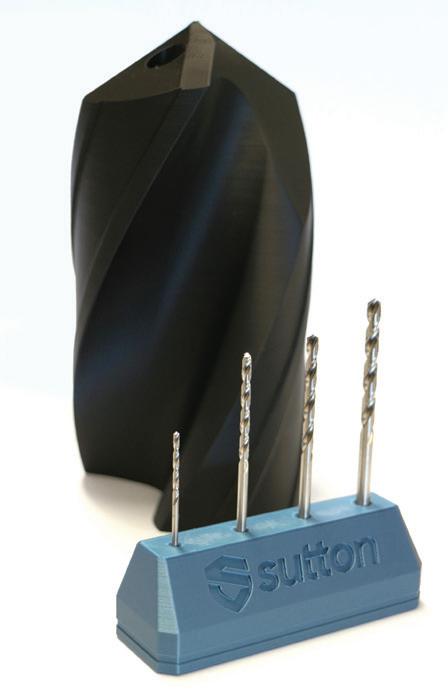
Sutton Tools began using 3D printing for prototypes to test machine components.
“When we started using it, we realised all the possibilities,” says Richard Frew, engineering manager at the firm’s manufacturing plant in Rangiora, Canterbury.
They’ve moved beyond prototyping to printing multiple tooling and parts – from complex machine guarding and custom extraction adaptors to non-structural mounting brackets for machines.
“3D printing is a good way to make new iterations, refine things and make sure everything’s going to fit in,” he says.
Packaging automation has been a key growth area. “Instead of spending large amounts of money on a wide range of tooling to handle the many drill sizes we manufacture, 3D-printed tooling can be made ‘lights out’ overnight at a low cost,” says Richard.
It also gives us the freedom to create shapes and a lightweight structure that’s strong but flexible – similar to how nature designed our bones.
– Maedeh Amirpour
“We have also found that this tooling lasts well in our production environment and can be customised with extra features that would be difficult and expensive to machine conventionally.”
While Sutton Tools mostly prints with plastic materials, they also work with carbon fibre and hope to move to metal 3D printing as it becomes more affordable. After all, their motto has been and continues to be: “We could 3D print that!”
Photo: Sutton Tools
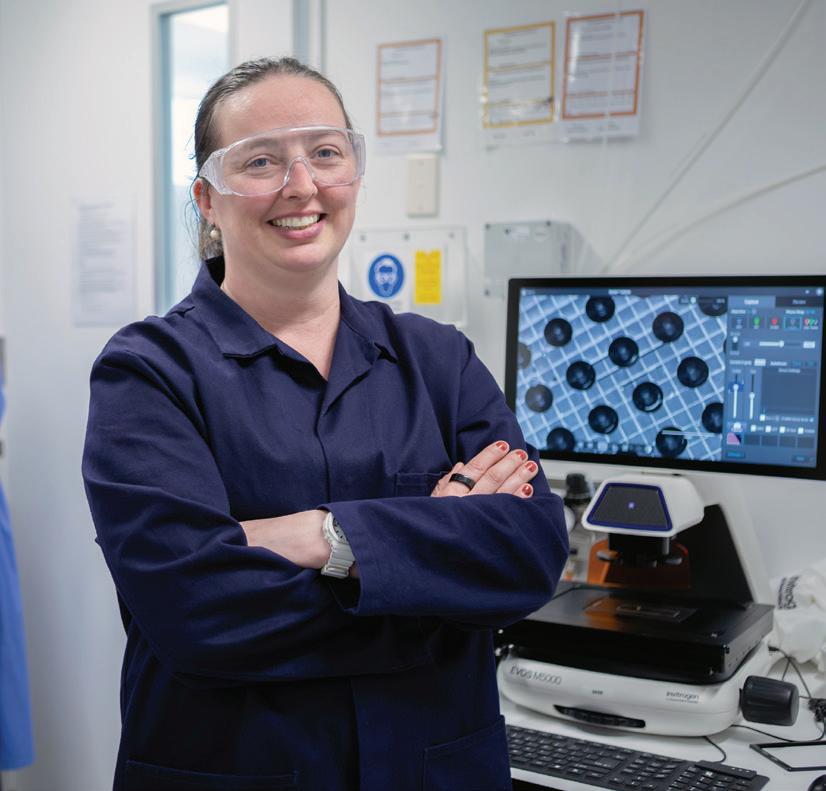
Meanwhile, Dr Rachael Wood, a senior lecturer in chemical and process engineering at the University of Canterbury, has embarked on a research project to fabricate 3D-printed bioscaffolds that support neural regrowth after a spinal cord injury. These bioscaffolds will be implanted into the body, guiding the growth of new cells. As a framework for cell regeneration, they will help reconnect damaged neurons in the spinal cord and restore function.
Rachael and her team will apply a method known as cell imprinting.
“The idea is to get the physical imprint of the cells,” she says. They can grow the cells, form moulds of them, and build 3D models of the moulds to make ‘fake’ cells.
“If we use 3D printing, we can do that accurately and then we can make changes easily.”
The team must also choose the right bioink to print with, allowing the cells to hold the structure and grow on it.
“It has to be something we can put in a body, can be imaged, and can be handled and actually implanted by surgeons,” explains Rachael. “And if we put any cells’ chemical signals in a bioink, we need to make sure the cells can still extract them.”
While the project is in its beginning phases, Rachael hopes to offer transformative possibilities for those with
a spinal cord injury, and 3D printing can boost those possibilities.
“It opens the door for more personalised medicine and solutions that will be more comfortable for the patient and bring about better patient outcomes,” she says.
“Because it’s not always going to be one-size-fits-all. Making something that’s uniquely built for the patient can have a real impact.”
Modelling a 3D-printed future
Looking ahead, Olaf sees generative AI assisting with designing the right way for 3D printing.
“The one truth you can’t get away with in additive manufacturing is you need a 3D model.” This can be a challenge for organisations without the necessary design skills, which is where generative AI comes in.
“We’re using AI to create the computational design, and it can generate the model instantly. You still tell it what you want, and in a few minutes, you’ve got your parts ready to print,” he says.
And in the factory of tomorrow, Olaf envisions a trifecta of CNC machines, injection moulders, and 3D printers all sitting side by side, working together to yield the next generation of engineering innovations.
Concrete changes
3D-printed concrete can lead to swifter build times, lower cost and less waste than conventional construction methods. Poornima Rao Telikicherla, a PhD student at the University of Canterbury’s Department of Civil and Natural Resources Engineering, says it’s still an emerging technology compared to a regular reinforced concrete or masonry building.
Poornima’s research entails improving the seismic performance of 3D-printed concrete structures. She aims to define the behaviour and performance of 3D-printed walls during an earthquake by conducting quasi-static tests on reinforced 3D-printed rectangular walls.
Despite being in the early stages of testing, she says 3D-printed concrete has a lot of potential. Her final goal is to formulate guidelines that could help architects and engineers design and build these structures.
“If you have a certain force that a structure would be experiencing, how would you even design these walls? That’s the ultimate question I want to answer.”
Left: University of Canterbury senior lecturer
Rachael Wood: Photo: Corey Blackburn
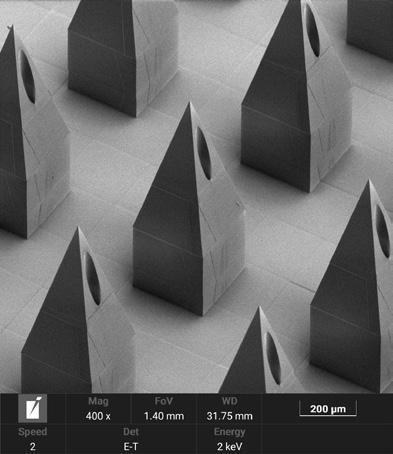
Above: 3D printed micro-needles for developing dermal drug delivery methods. Photo: Volker Nock
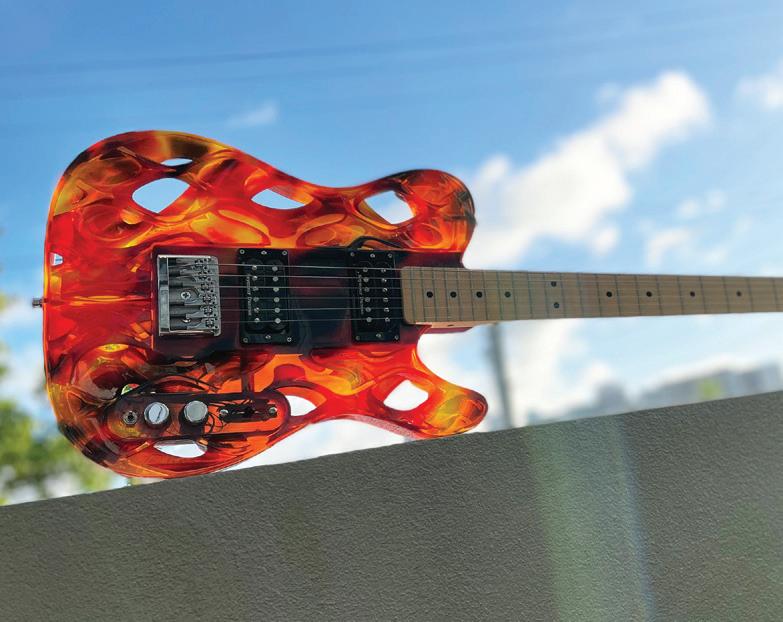
Below: Olaf Diegel's 3D-printed Fire guitar.
Photo: Supplied
Opposite: PhD student Poornima Rao Telikicherla.
Photo: Rashmi Natarajan, University of Canterbury
3D printed instruments strike chord
During his spare time, Olaf Diegel 3D prints guitars, a hobby he started more than a decade ago. “I used to play a lot of music in my younger days, so I printed my first one just to see if it could be done. I was amazed by how well it played and how good it sounded.”
After posting a blog about it, he received emails from musicians around the world who’d never seen anything quite like his eclectic string instruments, which he named ODD Guitars. He has since designed more than a dozen electric guitars, and built and sold more than 100. The University of Auckland and Eden Park even gifted one of his 3D-printed guitars to Coldplay during one of the band’s Auckland concerts in 2024.
Olaf has now expanded to 3D printing bass guitars, drum kits and keyboards.
Bridges “are like works of art”
WRITER | KAITUHI ALEXANDRA JOHNSON
This award-winning bridge engineer, elite athlete and mother of three (including twins!) explains her choice of field, what drives her and how she’s helping other engineers.
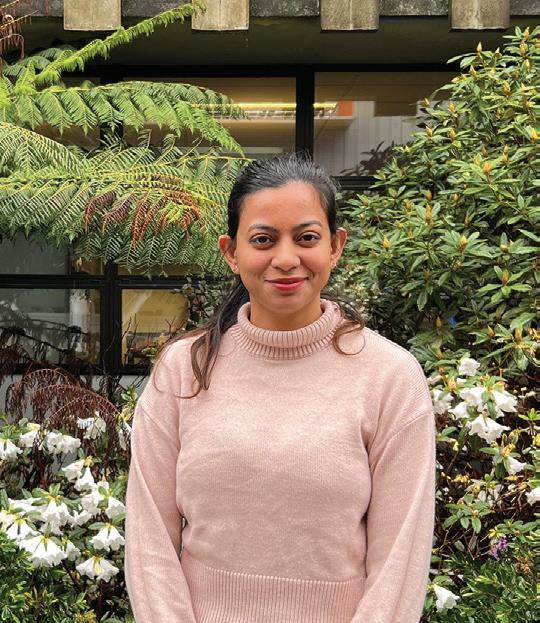
When Sabina Piras CPEng began studying engineering in San Diego, California, it didn’t take her long to realise she wanted to be a bridge engineer.
“Bridges often serve as iconic statement pieces for cities, which makes the work both technically and creatively fulfilling,” she says. “They are like works of art. The physics of how they work is quite intuitive to me, for example, I can easily visualise the load paths.”
Technical Principal in Bridge Engineering at WSP and winner of the Young Engineer Award at the 2025 Engineering New Zealand ENVI Awards, Sabina has already made a significant contribution to bridge engineering, having been involved in the design of landmark and community-impacting projects both abroad and in Aotearoa.
“I moved to New Zealand because I’ve always believed that to become a great engineer, you need to step outside your comfort zone and expose yourself to new codes, standards and construction practices,” she says.
Following her move to Auckland in 2017, Sabina completed a PhD at the University of Canterbury, offering innovative insights into the seismic performance of bridge columns and the impact of soil-structure interaction – work that is likely to impact the New Zealand Bridge Manual.
She describes that time as “by far the hardest three years of my life, and also quite transformative”.
“It challenged me to grow in how I communicate and solve problems. I went from a world of consultancy to the more open-ended environment of academia, which changed the way that I approach engineering challenges.”
Sabina says the earthquakes in Christchurch are a powerful reminder of the immense responsibility engineers have for preserving life and livelihoods. Similarly, she says the rebuilding after Cyclone Gabrielle, in which she has been intrinsically involved, has been eyeopening.
“Rebuilding after Cyclone Gabrielle, especially the Moteo-Puketapu Bridge in Hawke’s Bay, has required instilling confidence into the community. A lot of people are traumatised from the events, watching the bridges get washed away and their communities being cut off. I can only imagine how distressing that was.”
She says there are some significant differences between bridge engineering here and in the United States.
“The scale of projects is obviously the biggest difference, particularly in states like California, where they are predominantly cast in situ. Here, precast construction is far more common.”
Recently, she’s applied a lot of United States’ design philosophy to her New Zealand infrastructure projects to help save costs and reduce the environmental footprint.
“Coming from the US, I’ve been able to bring alternative methods to the table,” she says. “For example, in California we tend to design for more sacrificial damage, while here we try to keep everything intact after an earthquake, which can result in
a much more expensive design.
“But if we can allow a little bit of damage, which we can easily inspect and repair, then that’s so much better than spending an extra million on construction.”
Sabina’s ENVI Award win in part recognised her leadership skills. She believes a good leader is someone who can steady the ship through natural ups and downs of project work.
“Projects come in waves, there are intense periods where burnout is a real risk and there are times when people may feel underutilised, so it’s important to keep morale high through both ends of that spectrum.”
She believes leaders are ideally extroverted, “... which, fortunately, I am. My love language is communication.
I believe in being very transparent and bringing everyone along on the journey”.
Sabina is intent on supporting other young, motivated women in engineering.
“It’s more than just about building confidence but giving them the exposure and experience that they’re going to need in a male-dominated field.”
As the mother of three girls, including twins born earlier in the year, she tries to lead by example and show that it’s possible to have a fulfilling career and a family.
And if that were not enough, Sabina is also a competitive long-distance runner having competed, among other key events, in the US Olympic Team Trials – Marathon and the Ironman World Championships.
She says she’s lucky to have chosen a career that doesn’t feel like a job, and the
need for constant problem solving is part of what drives her.
“I find a lot of motivation seeing tangible results from my work, knowing that I’m contributing to something lasting, something that’s going to impact communities. That sense of purpose, combined with the opportunity to keep learning, is what fuels my passion and energy.”
And, she says: “How cool is it that I can walk across the bridges I’ve had a huge part in making, with my daughters and say, ‘your Mum did this’.”
Photo: Craig Forster/ Lightchasers
Hope rebuilt after silt
WRITER | KAITUHI KATHY YOUNG
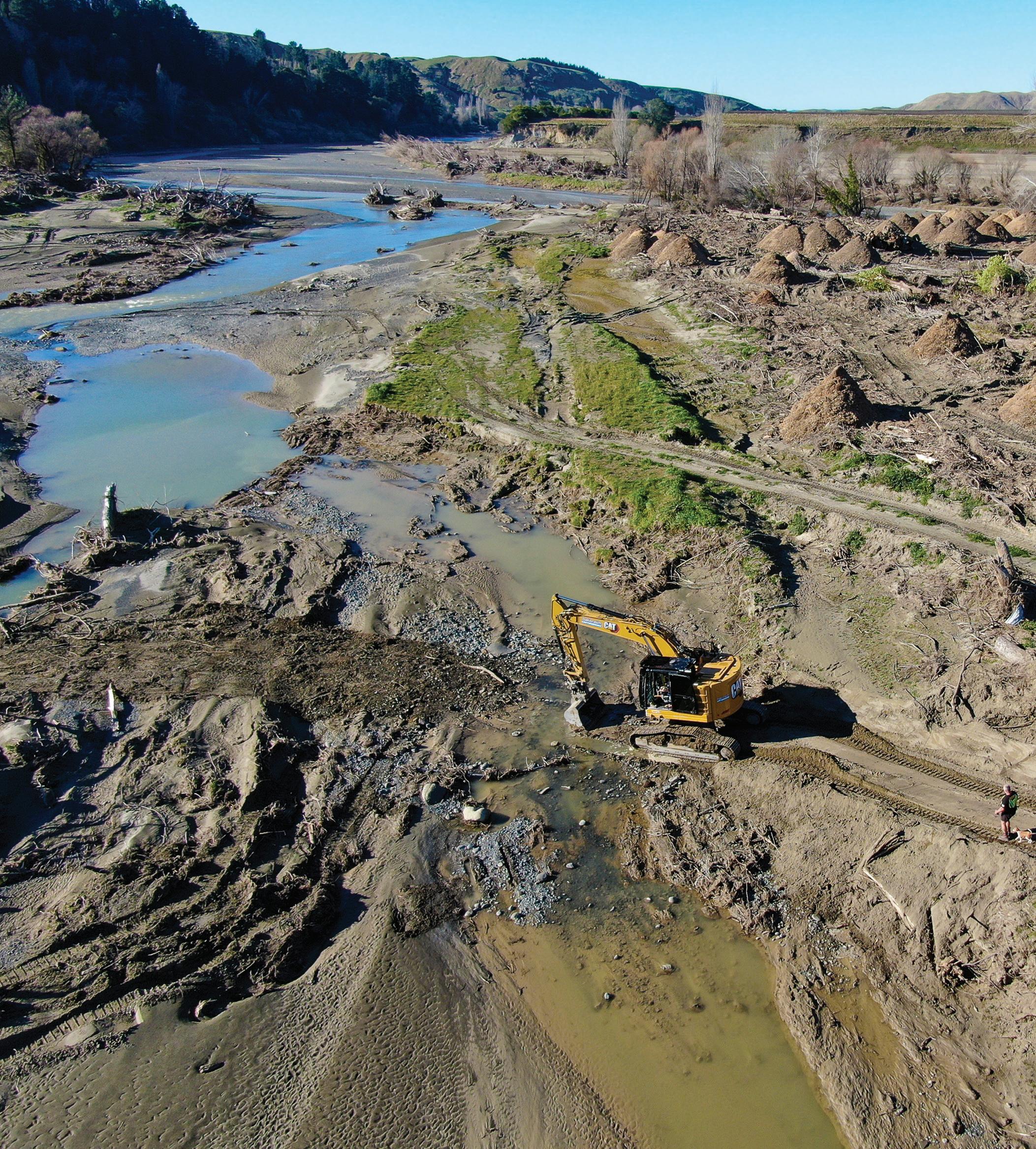
Early stages of clean up along the Mangaone River in the Hastings District after Cyclone Gabrielle in 2023.
Photo: Hastings District Council
Silt recovery taskforce project in numbers
Jobs completed across residential and agricultural land: 1,184 between March 2023 and December 2024
Community meetings held: More than 50
Education videos: 18, reaching more than 2,000 viewers
Website hub views: 15,000
Makeup of workforce: 83 percent local contractors, 20 percent of the contractors Māori and Pasifika
Volume of silt processed:
2.5 million m3 across 7,000 ha (of which 4,000 ha is horticultural land and 600 ha is pipfruit)
Woody debris recovered and repurposed: 1 million m3
Debris sent to landfill: Less than 100,000 tonnes
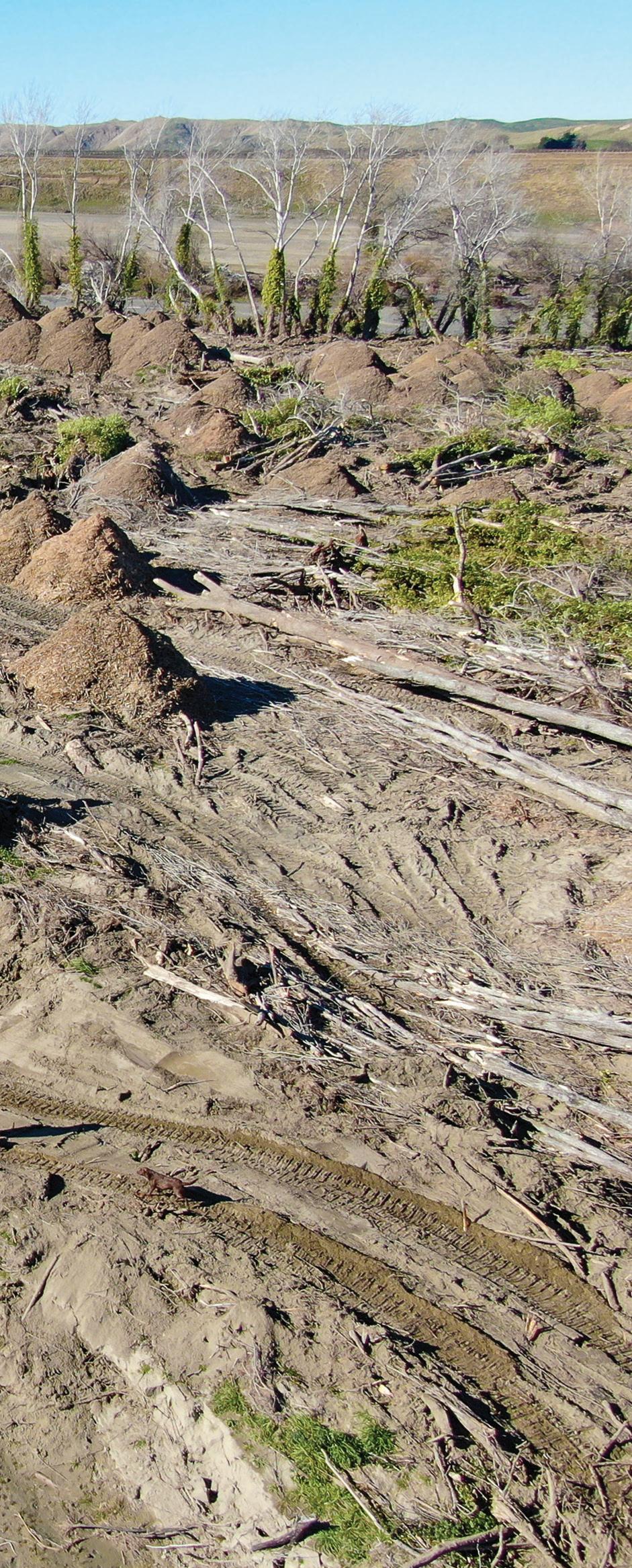
A staggering engineering challenge was left behind after Cyclone Gabrielle devastated the Hawke’s Bay region in February 2023: multi-million cubic metres of silt and debris, scattered across 7,000 hectares of residential and once-productive land. What followed was a large-scale clean up and recovery that restored not just land, but hope.
After just nine days into a new role with Beca, Darren de Klerk, Business Director – Water, was thrust into responding to Cyclone Gabrielle. He worked in the local Civil Defence team in Central Hawke’s Bay for three weeks before being seconded to Hastings District Council and Hawke’s Bay Regional Council as Silt and Debris Recovery Leader. By May 2023, working with regional leaders, Councils had secured government funding for a Sediment and Debris Recovery Taskforce.
“You had to ground yourself in the scale of what was going on,” Darren says, having experienced first-hand slips at his family home in Havelock North. “My motivation was to be involved, and influence a positive outcome. There were people far worse off than me.”
So how do you start moving such vast amounts of material? Darren says: “In peacetime, if you had to establish this, you’d go through a process to establish appropriate sites like landfills to deal with the material. This in itself is a large engineering task, in terms of site assessment, hydrology, consenting and environmental considerations around management and monitoring.”
But time was of the essence, and each landowner’s situation was unique.
The Taskforce divided Hawke’s Bay into six zones, each with its own contracting team, project managers and community liaison officers. The multidisciplinary Taskforce included civil and geotechnical engineers, hydraulic modellers, surveyors, contaminated land specialists, GIS analysts and civil contractors. Daily stand-up meetings ensured coordination and momentum, meaning those involved could quickly adapt to changing community needs, Darren says.
The emergency solution was to set up 15 cleanfill sites across the six zones, and two processing sites equipped with screening equipment. An 0800 number and online job request system for landowners was integrated into the Regional Council website. GIS data was merged from multiple agencies, giving “real-time visibility of jobs”.
Regular drone surveys conducted volume monitoring, and testing was carried out regularly to benchmark soil quality and contamination risks.
When dust became an issue during the first summer, the Taskforce partnered with Te Whatu Ora, Environmental Science and Research and NIWA for air quality monitoring.
“A lot of what we did was forward-thinking, trying to pre-empt the issues.”
Other challenges included managing the volume of trucks on the road and contending with the weather.
Darren says that a community-first approach was the priority. “Every property owner had their own set of circumstances and hence the Taskforce worked hard to connect with every landowner,” says Darren. “Our objective was to find the best outcomes for them and
Lessons learnt
Following the devastating one-in-100-year flood event in the Motueka Valley, Nelson-Tasman District Council has implemented a silt management system in Riwaka. The site has already received 2,500m3 of “relatively clean silt” with approximately 13,000m3 still requiring removal, says Richard Kirby FEngNZ, Tasman District Council Group Manager – Community Infrastructure.
Nelson-Tasman’s approach is more bespoke than Hawke’s Bay’s. “The scale of their operation is orders of magnitude greater than what we are dealing with,” says Richard. “But we did have early discussions with them. Our engineering response involves geotechnical and biotechnical assessments to ensure the silt quality, and mechanical raking systems to remove debris during layered placement of the silt in its new location.”
Cross-regional knowledge sharing has taken place, and looking ahead Richard recognises the need for pre-identified disposal sites.
with them, rather than placing problem solving on them.”
Landowners were encouraged to keep suitable silt on their properties, where feasible. Agricultural consultants assessed whether the silt would benefit the soil productivity, rather than require removal.
“This way, best possible choices to recover the land were balanced with sustainable and pragmatic needs,” says Darren. “Where possible, silt was repurposed for land levelling and local projects.”
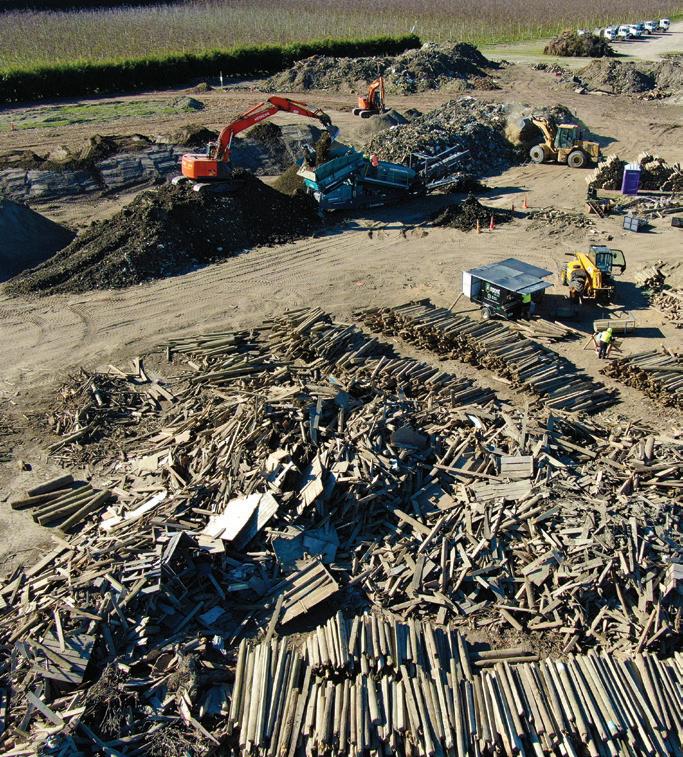
Recycling and repurposing the silt and debris became a high priority. Treated orchard posts that had been scattered across land in the floods were repurposed as fencing posts through the work of Nelson-based company Repost and Federated Farmers. Concrete was crushed and used for road stabilisation. Green waste was transformed into mulch and compost for community giveaways, or as a way of getting sites fertile again. Of the 4.5 million tonnes of total material collected and processed, just less than 100,000 tonnes reached landfill – roughly two percent.
Darren’s work won him recognition as a finalist in the 2025 Engineering New Zealand ENVI Awards. He says the project was about more than just moving silt. “It was about rebuilding lives, restoring confidence and making progress in a time of crisis.”
He and his team continue to share their learnings with the Nelson/Tasman, Waikato and Gisborne regions.
“Taking my own reflections of those early days around what to do and how to do it, and how overwhelming that can be, I am a staunch advocate of sharing lessons and not reinventing the wheel or having to learn the lessons we had to.”
Darren now works for Hastings District Council in a leadership role focused on infrastructure delivery.
“We will always live with natural hazards...”
Ben Exton CMEngNZ CPEng IntPE(NZ) knows a thing or two about silt. When the devastating Christchurch earthquake struck on 21 February 2011, claiming 185 lives, Ben was a Year 11 student. He became one of the thousands of people who helped clear liquefaction silt from Christchurch streets.
The Student Volunteer Army (and many other groups) mobilised 13–15,000 volunteers who contributed more than 75,000 working hours helping clear 360,000 tonnes of silt. Ben was part of the broad volunteer effort that included countless professionals in engineering, response and medical sectors whose expertise often went unacknowledged during the highly visible silt-shovelling operations.
Now aged 31, Ben remembers that experience as one that would shape his career in earthquake damage reduction.
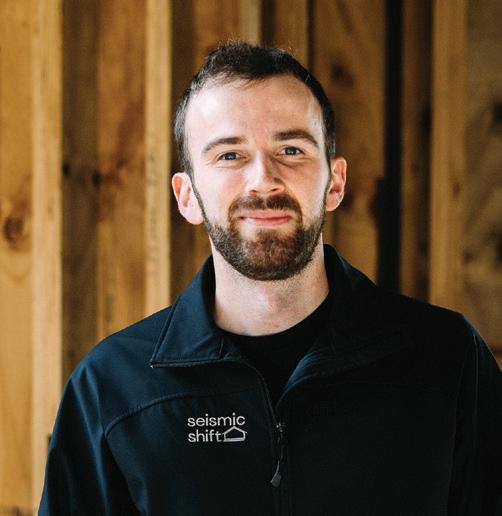
His strongest memory is of his elderly great uncle in tears over his award-winning garden destroyed by liquefaction. He says: “We will always live with natural hazards, but there are a lot of things we can do to avoid them becoming natural disasters.” After studying engineering and working in engineering consultancies, he helped establish Seismic Shift in 2022, an earthquake resilience research and development company.
Fifteen years later, in the same week as the anniversary of the September 2010 Canterbury earthquake, his team celebrated installing their first FrontFoot base dissipation technology – an earthquake damage-reduction system. The technology addresses horizontal shaking damage, complementing existing foundation settlement solutions.
Above: Salvaged timber posts and screening operations at the Pakowhai silt and debris processing site. Photo: James Douglas, Sitrep Projects
Below left: Darren de Klerk at the Pakowhai silt and debris processing site. Photo: Mark Henderson, HDC
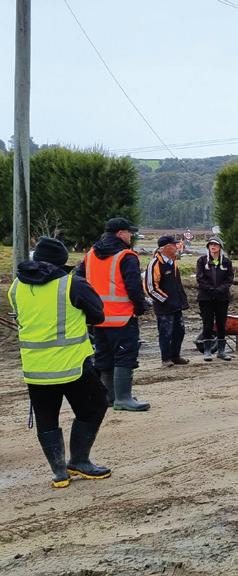
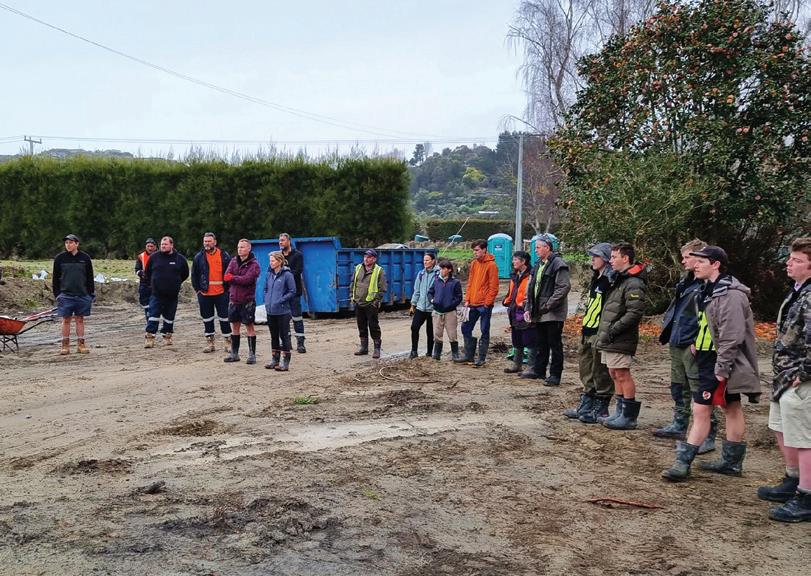
Below right: Community members and contractors volunteer at a clean up event in Esk Valley in August 2023. Photo: Darren de Klerk
Photo:: Supplied
An engineer’s best friend..?
WRITER | KAITUHI MATT PHILP
Engineers and animals cross paths more often –and in more places – than you might think.
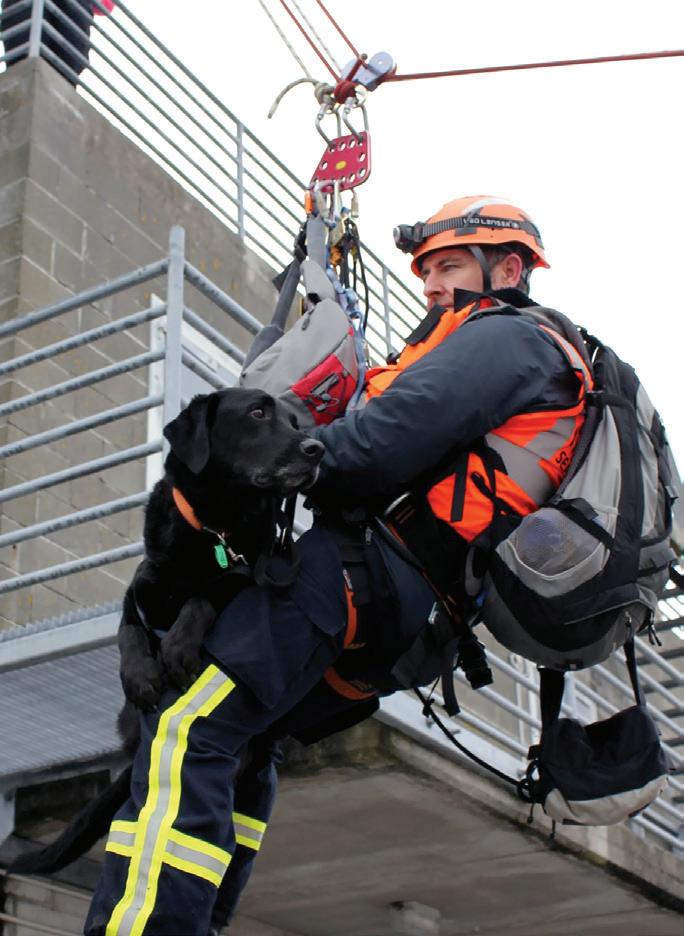
Left: Dog handler John Appleby and retired advanced operational dog Monty abseil down a building during a training session in 2019.
Photo: New Zealand USAR Search Dog Association
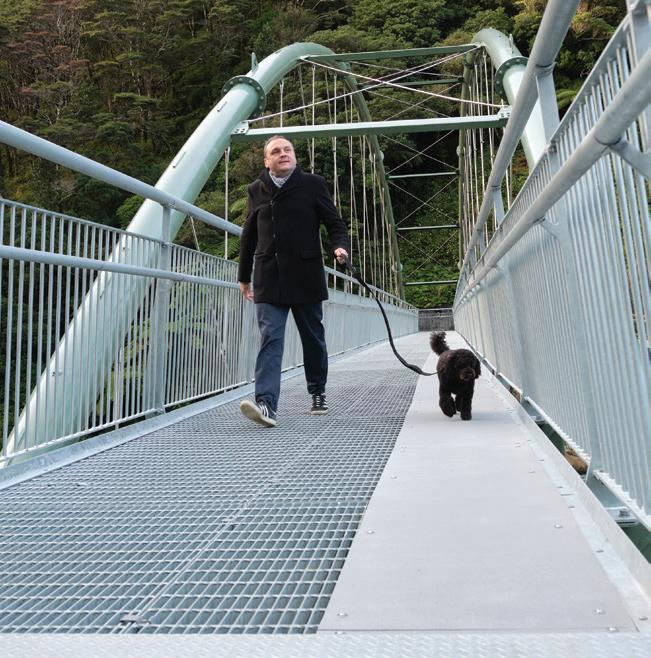
Above: Wellington Water Board Chair Nick Legget and cavoodle Teddy testing the dog-friendly panels on the new Kaitoke water pipe bridge. Photo: Greater Wellington Regional Council
While the Millenials and Gen Z might not be rushing to have children, when it comes to fur babies, they’re all in. The generations born between the 1980s and early 2010s are at the forefront of a rise in pet ownership, including in Aotearoa, where nearly two-thirds of households now include at least one pet. They are also spearheading a shift in the way we think about pets, who are increasingly treated as family members, to be fussed over and worried about, monitored and spoiled.
As a result, the global pet care sector is booming, with analysts predicting the current US$259 billion market will top US$427 billion by 2032. Today’s devoted “pet-parents” are spending big on products that didn’t exist until recently, the likes of GPS-enabled wearables and automated feeders with two-way audio and cameras. (Even if you’re at the office, you can still keep tabs on Fido!)
Engineers are involved in all of these innovations, as they are with the development and deployment of technology such as cow collars in the agricultural industry. Likewise, the engineering profession is playing
a part in the rollout of more pet-friendly infrastructure around our towns and cities, such as paw-friendly panels installed on a new water pipe bridge in Wellington, making it more comfortable for dogs to walk across. All of which is to say that engineers are more involved in the world of animals than you might imagine.
“We think of them as rescuers”
Carl Devereux CMEngNZ is one engineer whose role intersects with the animal world – in his case, very directly. As National Portfolio holder for New Zealand Urban Search and Rescue (USAR) Engineers, Carl and other engineer volunteers work hand-in-glove with the USAR dog handlers and rescue dogs when disaster strikes and buildings have collapsed or are badly damaged.
“We help the rescue teams to figure out the safest way to enter, search, locate and extract victims. We might say: ‘We think there could be someone at this particular location’, and then the search dogs can run over the site and, using their amazing skills and training, pinpoint where people are,” Carl says.
“We think of them as rescuers. And our job is to make sure that we are not going to put them or their handlers into an unsafe environment.
“They’re part of our team, and everybody has to come home safely.”
Carl had first-hand experience of these dogs in action following the February 2011 Christchurch earthquake, when he was part of the search and rescue effort.
“The first day is a blur, but I remember the days afterwards when there were still missing people and the dogs were used to search damaged buildings and collapsed building facades to confirm no one was trapped.”
It’s an amazing environment when you’re working alongside these highly trained rescue dogs. They put a smile on everyone’s faces.
– Carl Devereux
Carl, Director Earth, Environment and Water for WSP, is one of a dozen engineers on the USAR taskforce. Most have a structural or geotechnical engineering background and a wide range of practical experience –15-plus years is standard – as well as being team players who can operate under pressure. When not responding to disasters, they’re involved in USAR training, including designing “hide structures” and other simulations of disaster zones for rescue dog training.
“At times we’ve had to lower dogs in harnesses down to particular areas, and we also use rope rescue lines to access small spaces. That’s all part of the training, too,” he says, adding that it’s rewarding work.
“It’s an amazing environment when you’re working alongside these highly trained rescue dogs. They put a smile on everyone’s faces.”
Warm fuzzies furries
Pet project
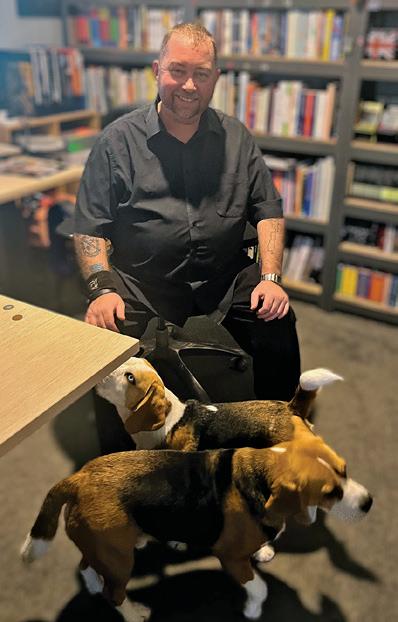
Putting a smile on everyone’s faces might be a theme when it comes to dogs. Proud pet parent Luke Mainwaring CMEngNZ is based in Tauranga and when he works from home periodically, he’s showered with love and cuddles from Bustah (Rhymes) and Snoop (Dogg). The Design Engineer Manager – Substations and Protection at Powerco was initially planning to get one dog.
“But then after a few months we thought we could benefit with another one, as Bustah was always wanting to play.”
It was an easy decision after seeing photos of Snoop, who was then just a puppy. But the two dogs are quite different.
“Bustah is the perfect model Beagle – his dad is on food packaging. Snoop has one blue eye and a kink in his tail and he’s a bit smaller than your average Beagle. Bustah is the sensible one and Snoop is the rebel!”
Luke says that having dogs at home is a great for reducing stress, going so far as to say it’s “the best investment in my health I could have possibly made”.
“Whenever you feel a bit down, things are complicated… you’re under pressure to deliver yesterday, you look down at the boys lying at your feet. They look you back in the eye and their little tails (that remind me of white flags) start to wag, and it puts everything into perspective, and you know no matter how things pan out, everything is going to be ok.”
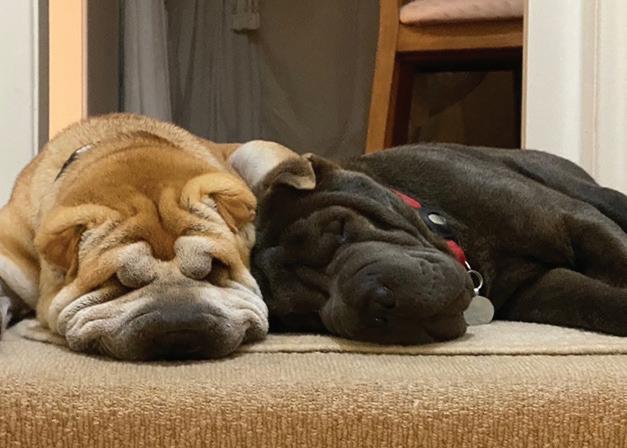
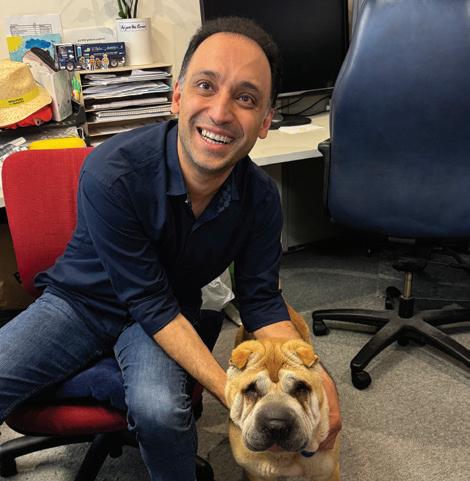
Clockwise, from top right: Snoop, one of Powerco engineer Luke Mainwaring's beagles, busy at work; Luke with Bustah and Snoop in the home office; Shar Peis Xin Xin and Bei Bei; Q DESIGNZ LIMITED Director Mark Foo with Xin Xin.
Photos: Supplied
Principal Psychologist at Umbrella Wellbeing, Dougal Sutherland, agrees, saying there is good evidence to support the positive benefits of having a pet at home, at least for most people. And dogs, specifically.
“Having a good bond with your dog is linked to an increase in levels of oxytocin – sometimes referred to as the 'love' hormone – the same chemical that gets released when we have a long hug with someone we care about.”
Dougal says people often talk about the companionship that comes from having a dog at home and a reduced sense of loneliness for those who are by themselves during the day, such as remote workers. But fear not if you are a cat lover.
“Recent research showed some of these same benefits from pets of the feline variety!”
When it comes to taking pets to the office, Dougal says other dog lovers will receive a similar positive “hit” from having a dog around.
“And you can often see this when there is a dog in a public area – they are often magnets for people.”
But he does note that as not everyone loves dogs, particularly in an area they may not expect to see them, such as a workplace, it’s advisable to check your workplace policy and let colleagues know if you’re planning to bring in a pet.
Another day at the office
Dr Mark Foo CMEngNZ CPEng is Director of Q DESIGNZ LIMITED in Auckland.
He has two Shar Pei, Xin Xin and Bei Bei, who came into the office daily as young puppies, but nowadays visit once or twice a month.
Mark says the staff of 16 love the dogs and are very receptive to having animals in the workplace.
“Engineers often work under very stressful, tight deadlines and sometimes a funny dog incident at work will crack everyone up laughing.”
Other staff members also bring in pets periodically, including a very young kitten who couldn’t be left home alone.
Mark says staff don’t have to ask permission to bring in pets, but they only do so if the pets need special attention and cannot be left alone at home.
“This culture allows the staff to focus on their work knowing that their pets are taken care of. The pets enjoy the visit and are not stressed being left alone at home.”
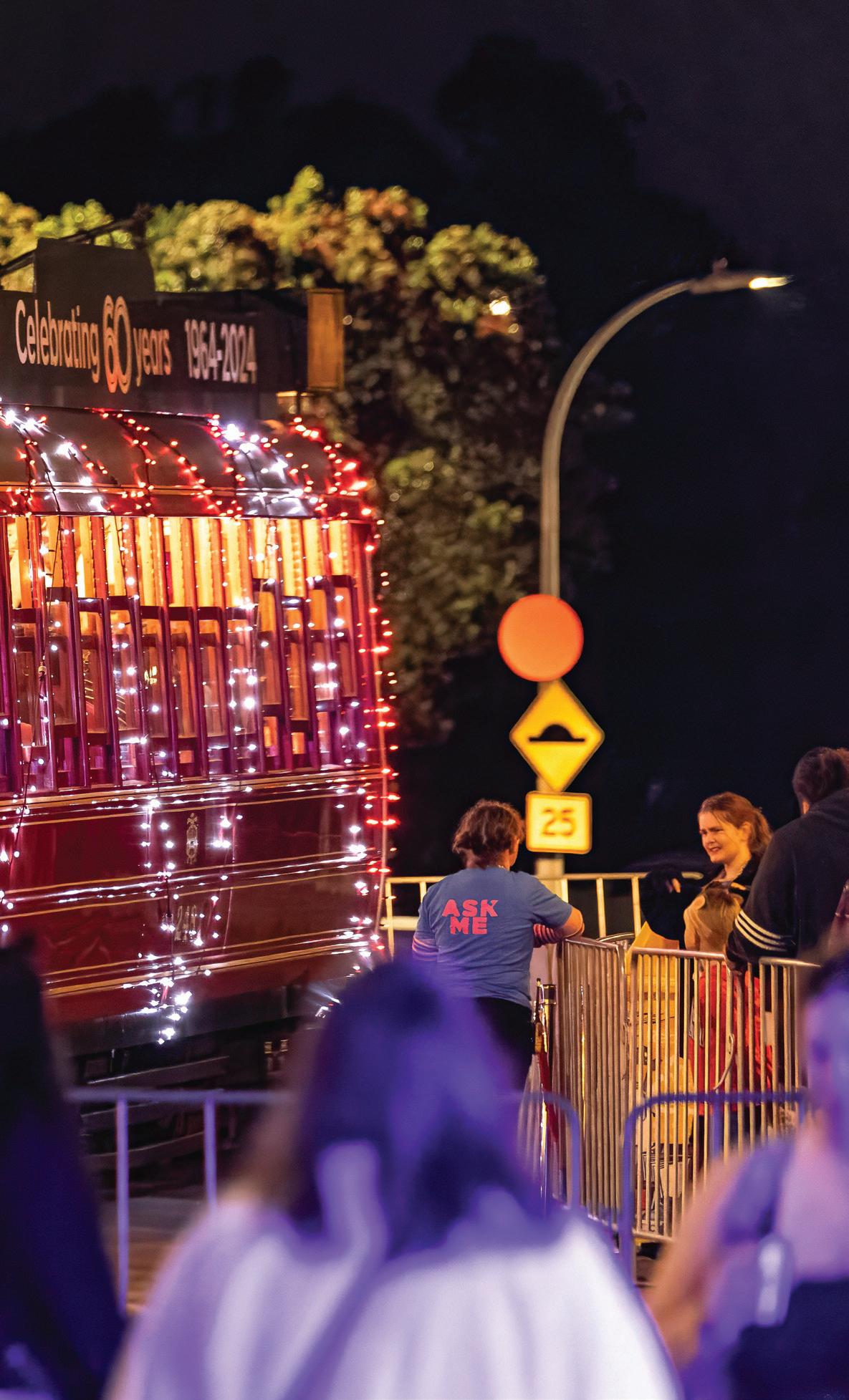
Snapshot All aboard for Christmas! Tram number 248 –one of the Museum of Transport and Technology’s (MOTAT) two Streamliner trams –is just one of the attractions that will be decked in some of the approximately one million lights illuminating this Tāmaki Makaurau museum in December. Many of MOTAT’s buildings, including the historic village and the Pumphouse plus some of the transport displays, will be lit up, as will the trams, which visitors can ride. As the event attracts more than 40,000 visitors, advance ticket purchase is essential.
Photo: MOTAT
Signing right
IZAAC SUGRUE
Your signature as an engineer is valuable, so how do you protect yourself and manage client expectations?
Engineering New Zealand was recently made aware of a serious situation involving a consent application, a Chartered Professional Engineer, a client and a signature.
Initially, a council had spotted something odd with a producer statement signed by a Chartered Professional Engineer and they contacted Engineering New Zealand with their concerns. Following a flurry of emails and phone calls, the mystery was solved. But the news was not good. The engineer had signed the producer statement, but their client had, without the engineer’s knowledge or consent, modified the signed statement and submitted it to the council in support of a consent application. When the issue was detected, the consent was declined. Engineers, and in particular Chartered Professional Engineers, are prominent in the construction sector. This is due in large part to their technical expertise. However, in a more administrative sense, their signatures provide access to the all-important council stamp of approval, making them valuable indeed.
It is that value that sometimes makes them targets, and that’s a risk of which all engineers should be aware. At the extreme end, we have the well-canvassed case of Jonathan Beau (JB) Hall. He forged signatures of Chartered Professional Engineers to perpetrate the largest scale
fraud the sentencing judge had ever heard of, earning him a prison sentence of four years and six months plus a hefty fine. At the other end, we have a more mundane, but still serious issue: commodification.
In this recent situation, there was no evidence that the client had any sinister intentions behind modifying the signed document. Additionally, the engineer was absolved of any wrongdoing or competency concerns. However, it has raised serious questions over this practice and how widespread it could be. Particularly chilling, the last thing the engineer said to me and the Registrar was: “I think there may be more instances like this as this is the second time that I have become aware of someone altering my documents.”
We haven’t delved further into this specific case, but a potential explanation is that the client felt entitled to edit a document they had paid for. Admittedly, this is speculation, but it reflects an attitude we sometimes see in the complaints space. A member of the public calls us complaining that an engineer they have paid to provide a producer statement has refused to provide that statement. The usual response from the engineer is that as a professional, they are not prepared to provide their sign off.
In simple terms, a producer statement is a promise to a council that an engineer stakes their professional reputation on. In it, an engineer states that they believe on reasonable grounds the engineering work complies or will comply with the
Building Code and that the persons who have undertaken it have the necessary competency to do so. It also attracts liability to the signatory if something goes wrong and can attract a disciplinary outcome if not signed in good faith. Councils rely on these statements when providing their approval of building works. To a lay client, however, it is frequently considered just another document they need to get for the council’s tick. Something they need to pay for, and something that can be owned after payment. A commodity.
Engineering New Zealand has been working on an online producer statement system that will help reduce the risk of altered documents and JB Hall-style signature fraud. In the meantime, engineers are advised to have conversations with their clients. Manage their expectations and make it clear that they have purchased your services and your expertise, not your signature. Be helpful – if you are not prepared to provide sign off on their project, help the client to get the project to a state where you are able to sign. Ultimately though, they should know they cannot purchase a signed producer statement if you as the signatory aren’t prepared to stand behind it. Nor can they modify any producer statement that you have already signed.
Izaac Sugrue is Legal Team Leader at Te Ao Rangahau.
Intersection sectionInter
Crossing paths with engineers.
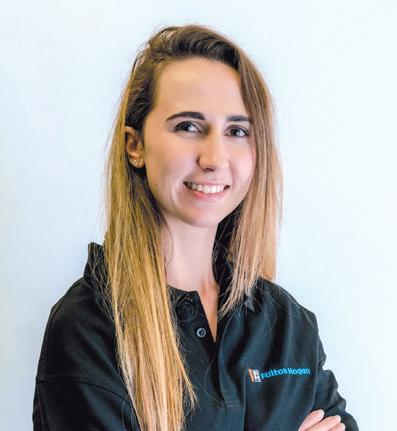
Zhanellé Scholtz’s career focus has been on growing as a Quantity Surveyor, particularly in tendering and pre-construction planning. While working full-time, she’s also studying part-time to build her technical expertise. Alongside her professional development, Zhanellé is passionate about community and wellbeing initiatives. At Fulton Hogan, she has led and supported projects such as Jammies for June for Middlemore Hospital and donating essentials to Under the Stars (a charity supporting homeless people), and coordinated donations for Homes of Hope, a charity that provides therapeutic foster care services. She also raised more than $1,000 by braving a skydive with Jump for Cancer. Zhanellé believes in the importance of helping others where she can, and is known for encouraging her colleagues to join in.
How do you work with engineers in your role?
I work closely with engineers when reviewing designs, assessing constructability and aligning cost estimates with technical solutions. Our collaboration ensures that the project scope, budget and methodology are realistic and achievable.
How does your work impact on engineers?
My work provides engineers with accurate cost and quantity data to inform their decisions. By aligning tender submissions with their designs, I help engineers focus on technical quality without losing sight of project affordability and client expectations.
How do engineering decisions impact on your work?
Engineering decisions directly influence project costs, materials and methodologies. A design change or technical specification can shift tender pricing and construction programming significantly, so adaptability is crucial in my role.
What are three observations you’d make after working with engineers?
1. Engineers are incredibly detail-oriented, but also big-picture thinkers who balance innovation with practicality.
2. They bring strong problem-solving skills, especially when unexpected challenges arise on a project.
3. Collaboration improves outcomes – when engineers, surveyors and contractors work together, projects are delivered more efficiently and sustainably.
What do engineers all seem to do well?
Breaking down complex technical ideas into something practical and easy to understand, which makes collaboration across disciplines much smoother. Engineers are skilled at thinking ahead, considering not only how a project will be built, but how it will perform in the long term for communities and the environment.
Zhanellé Scholtz
Based in: Tāmaki Makaurau Auckland Role: Junior Quantity Surveyor in the Civil Department at Fulton Hogan Education: Studying part-time towards a Level 6 Diploma in Construction with strands in Quantity Surveying through Open Polytechnic (expect to complete early 2026)
What do you wish all engineers understood better about your role?
As a quantity surveyor, my role extends beyond numbers. I collaborate closely with engineers to align design decisions with the client’s vision and budget, providing cost and quantity insights that help turn concepts into reality. By working closely together from the start, engineers and quantity surveyors can avoid rework, keep projects within budget and ensure great ideas are delivered successfully.
Fire!
Ringing the changes in fire safety.
Fire was an ever-present threat to buildings in 19th and early 20th century New Zealand. The majority of buildings were timber and lacked any form of fire safety design or early warning system. The earliest fire alarm was simply a bell installed in the centre of a town, rung manually to alert anyone in earshot.
From the early 1880s, New Zealand cities trialled a system of electric street alarms. When an alarm was activated, it would automatically send a signal to the fire brigade station, ringing a bell there and transmitting a one letter code by telegraph to indicate which city alarm had been activated.
Alarming developments
Some organisations invested in their own fire alarms. One popular system was the invention of Charles May, a mechanical electrician employed by the Dunedin Telegraph Department. He exhibited a model of his Automatic Fire Annunciator in February 1899. The Evening Post gave a detailed description and was full of praise for this “exceedingly ingenious and effective contrivance”.
The alarm consisted of a long metal wire hung close to the ceiling. When the wire became hot, the metal would expand and make contact with an electric magnet and a Morse telegraphic transmitter. The alarm would sound and a disk would drop on an indicator board showing a plan of the building and the location of the
activated alarm. If connected to a street alarm system, the fire brigade would be automatically notified.
A successor to Charles May’s Fire Annunciator was the Vigilant fire alarm system. Its inventor was another Dunedin Post and Telegraph Department employee, Matthew Moloney. The alarm also used a metal heat sensor and automatically telegraphed the fire brigade. Insurance companies offered generous rebates for buildings where the alarm was installed. The Vigilant system became well known and was later used all over the world.
Sprinkler systems
Automatic sprinkler systems were another hit with insurance companies. Already popular overseas, they were first used in here in the late 1880s. Auckland businessman Josiah Clifton Firth was among the first in New Zealand to adopt this new technology. In February 1888 he hosted a demonstration of the sprinkler system newly installed in his Quay Street flour mill for the mayor and other local dignitaries and businessmen. The Auckland Star reported with enthusiasm how a pile of wood shavings was set alight and promptly extinguished by the sprinkler. The sprinkler system was connected to the city water supply and was activated by heat. A valve on the sprinkler head was covered by a metal bar held in place with a soft solder. In the heat of a fire, the solder would melt, releasing the sprinkler.
Another early adopter of automatic
sprinklers was drapery and soft-goods merchant Sargood, Son, and Ewen. They fitted out their Dunedin warehouse with the Grinnell sprinkler system and May’s Fire Annunciator in 1899 and soon did the same for their Wellington and Christchurch warehouses. Their investment in the sprinkler system had been prompted by the loss of one of their Melbourne warehouses in a fire that swept away an entire block, leaving only a building in which a sprinkler system was installed.
Parliament Buildings fire
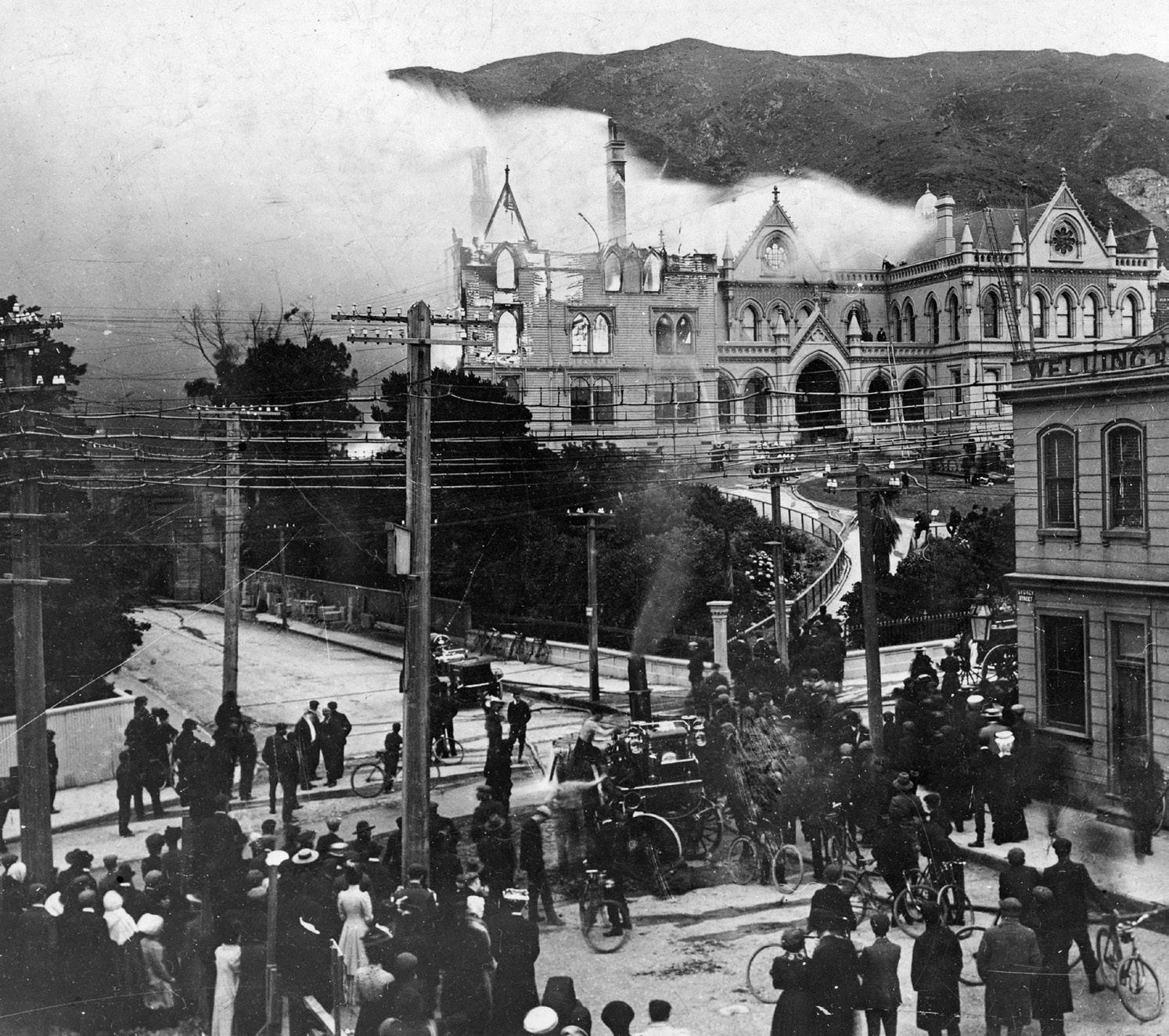
By the early 20th century, automatic alarms and sprinkler systems were established technologies, but not yet widely adopted. It was down to individual business owners whether they chose to make the investment. There was no requirement for public buildings to include fire protection systems. This lack of protection was brought home sharply in this period by the devastating fire at Parliament Buildings in December 1907. Upon discovery, the nightwatchman triggered the manual alarm within the buildings. By dawn the wooden Parliament Buildings were completely destroyed – but the adjoining parliamentary library was saved by its brick walls and metal fire door.
Despite this significant disaster, it was the second half of the 20th century before even limited fire protections were mandated in Aotearoa.
Cindy Jemmett is Heritage Advisor at Te Ao Rangahau.
CINDY JEMMETT
1907 fire at Parliament Buildings, Wellington. Photo: Stebbart, G, Alexander Turnbull Library, Wellington, New Zealand. Ref: 1/2-022885-F.
A landscape of constant change
ANA SERRANO ME ngNZ
New Zealand’s coastlines are in constant transformation. Shaped by waves, tides and currents, they present shifting challenges for those who live, work and play near the shore. Engineers have long wrestled with these conditions to protect communities, infrastructure and the environments that support them.
The New Zealand Coastal Society’s Sixth Special Publication (SP6), Shoreline Strategies: Embracing coastal transformation in Aotearoa New Zealand, brings together articles that reflect on past practice and showcase case studies from across the motu. They show how technical excellence, paired with cultural grounding, ecological understanding and community partnership, can create enduring resilience. These highlights from SP6 show why this publication matters for engineers of every discipline, illustrating how diverse perspectives can broaden the way we approach dynamic environments.
Looking backwards to move forward
The article “Coastal erosion hazard management – what have we learned since the 1970s?” revisits decades of shifting approaches, from early reliance
on seawalls and stopbanks, through the adoption of hazard mapping and setback lines, to today’s more adaptive planning practices. Retracing this journey shows how our approach is evolving – moving from reactive fixes to more adaptive and transformative engineering practices.
Planning for uncertain futures
If the past reveals how practices have shifted, today’s challenges call for new approaches to planning. SP6 recognises that uncertainty is a defining condition of coastal management, and “Shortterm defence for long-term retreat in the Coromandel” captures this tension clearly. It describes how communities facing immediate erosion risks still need urgent protection, even while long-term retreat remains the most sustainable option. The case study shows how engineers and planners can design short-lived defences that buy time, creating space for communities to prepare, adapt and eventually relocate.
For engineers, the Coromandel example demonstrates that planning must operate on multiple time horizons. Infrastructure cannot always be permanent; sometimes its value lies in enabling transition. By
accounting for change, engineers can help communities move steadily from present needs toward future resilience.
Reshaping roles through community leadership
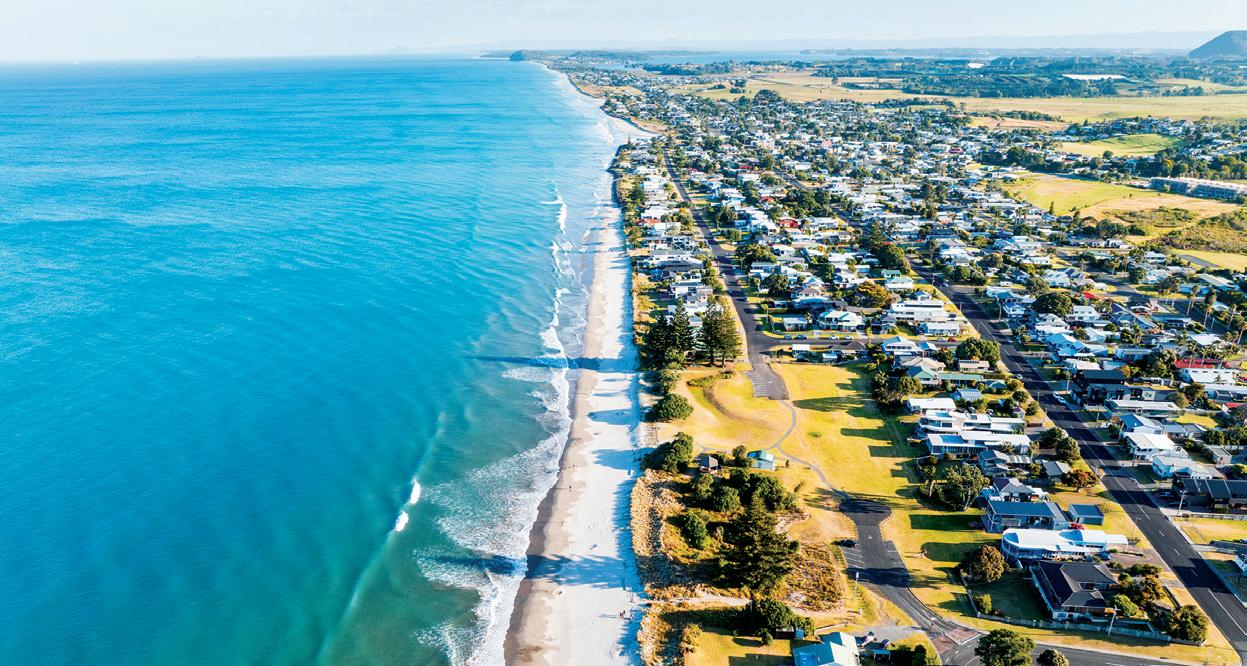
Another case study, “Coastal adaptation and transformation: Empowering Waihi Beach Lifeguard Services” explores how professionals and communities can contribute together to resilience. The surf club, highly exposed to coastal hazards, embarked on a communityled adaptation process with invited stakeholders to safeguard its lifesaving services and the beach users it supports. Technical expertise, drawn from hazard mapping and scenario analysis, was conveyed clearly, enabling residents to weigh up risks, values and long-term consequences.
The strength of the process lay in how knowledge was shared, allowing the community to make integrated decisions and take ownership of outcomes. Resilience, in this example, is not only engineered in plans and structures, it also grows from trust, transparency and recalibrated roles between engineers and communities.
Grounding practice in culture and values SP6 also highlights the central role of iwi and hapū in coastal adaptation. These case studies show how Māori perspectives bring intergenerational responsibilities, cultural wellbeing and kaitiakitanga into planning alongside technical and ecological assessments. Decisions are not viewed purely through the lens of hazard management, but as part of sustaining whakapapa and the relationship between people and place.
For engineers, this makes clear that cultural grounding is not an add-on but part of the required foundation for professional work. A resilient strategy is one that communities recognise as reflecting their values and identity as much as their safety. Embedding this perspective reshapes engineering practice: extending responsibility beyond protecting assets towards safeguarding the cultural and social fabric of coastal environments.
Lessons beyond the shoreline SP6 focuses on our shorelines, but the lessons it captures are transferable across disciplines – from rivers and transport networks to energy systems
Resilience, in this example, is not only engineered in plans and structures, it also grows from trust, transparency and recalibrated roles between engineers and communities.
and urban infrastructure. All fields of engineering face the challenges of uncertainty, change and collaboration. The case studies remind us that when engineering is approached as part of a social–ecological system, the same principles apply everywhere. Design for uncertainty by embracing flexibility in planning and structures to accommodate evolving risks. Align with natural systems – resilience often comes from letting landscapes breathe, shift and regenerate. Ground projects in culture by honouring local values, mātauranga Māori and kaitiakitanga. And co-create solutions through genuine partnerships, where lasting impact comes from shared ownership.
Shoreline Strategies is more than a compilation. It is an invitation to engineers of every discipline to reflect on how practice is changing and how it must continue to evolve. By weaving together engineering experience, cultural knowledge, ecological science and community action, SP6 shows that resilience is built through connection. The coast keeps changing and so must we.
Read the full publication at coastalsociety.org.nz
Ana Serrano MEngNZ is a coastal engineer and climate resilience specialist, and Deputy Chair for the New Zealand Coastal Society.
Inspired not retired
STEWART FORSYTH
With 70 dubbed “the new 53”, there’s hope that more people can continue to work, contribute and grow in later life. Here are some insights from engineers in Aotearoa who are thriving in the “silver economy”.
If I told you there’s a good chance you’ll live to be 100 you might feel a flicker of delight, quickly followed by questions. Will I be healthy enough to enjoy those years?
Will I still have my smarts? Will my money last? And perhaps most importantly: Will I still be doing meaningful work?
I’ve been talking to engineers who are thriving well past the “gold card” age of 65. These professionals, aged between 65 and 84, offer insights into how we can continue to work, contribute and grow in later life.
They’re not alone. A recent International Monetary Fund economic outlook includes a chapter on the “silver economy”, noting that older adults in wealthy countries are doing well physically and cognitively. In fact, cognitive performance is improving across generations, making “70 the new 53”, when comparing cohorts from the 2000s with those in the 2020s.
Who are these engineers?
Most of the engineers I spoke with are white men, a reflection of the demographics of their generation. However, the broader sample includes women and migrants, and future work will aim to better represent these voices. All of the Kiwi engineers had done their overseas experience, or OE, before the age of 30, a formative chapter that
New Zealand research links to increased “mental openness”.
What drives career success after 65?
I used a career model developed by the University of Georgia’s Lillian Eby and colleagues, which tracked American university graduates. It focuses on three key factors, the first being what you know (skills and expertise). The second is who you know (networks and relationships) and third, why this work (why you are taking this direction in your career)?
The conventional wisdom of what you need for career success is “it’s not only what you know, it’s who you know”.
The “what” and “who” were two of the factors that Lillian Eby found mattered. But these researchers reasoned that in an increasingly complex world it is important to adapt and stay proactive, asking yourself: “Why am I doing this work in the light of what is going on in the world?”
The “why”, measured through the trait of “proactivity” (always looking for better ways to do things) turns out to be the most important of the three for career success. In a complex world, career success hinges on flexibility and initiative.
I asked engineers to reflect on their proactivity across three career stages: early, mid and recent. Most reported consistently high levels, though recent proactivity dipped slightly. Still, their self-perceived employability and career satisfaction remain strong.
What about AI?
A recent EG article by University of Canterbury academics found that nearly all engineering students are using generative AI. We might expect that these proactive engineers would be trying AI. Among my mature sample, a few use AI for research or report writing, but most haven’t yet integrated it into their work. This gap presents an opportunity, especially for those who pride themselves on always looking for better ways to do things.
Insights from the field
Some common themes emerged from my conversations, including work with people you like. One entrepreneur emphasised the joy of collaborating with colleagues who became lifelong friends. Another theme is to look beyond your employer. Many engineers found meaning through involvement with professional bodies, community groups and projects outside engineering. Another was the importance of staying versatile. People who worked in project-based environments valued the adaptability that comes with a “jobbing mentality”.
If you’re an engineer around retirement age, consider your own “why”. What new directions could your career take? How might you stay curious, connected and proactive? The silver economy is a growing reality where experienced professionals have a vital role to play.
Stewart Forsyth is a leadership coach and chartered organisational psychologist.
Proportionate liability a move in right direction
D r RICHARD TEMPLER FEngNZ
A move away from joint and several liability is a step towards fair accountability.
Since the leaky building crisis, New Zealand has been grappling with a flawed liability framework that potentially unfairly burdens certain parties – particularly councils. Under the current joint and several liability model, each party responsible for a loss is liable for the full total of that loss.
This has created a “last person standing” problem. If some parties are absent, insolvent or unreachable, councils are often left footing the bill, leaving ratepayers to pick up the cost for others’ mistakes. And it’s not just councils. Engineers, often backed by strong indemnity insurance, are also targeted for compensation due to the perception of having “deep pockets”. This is not about fair accountability – it’s about who can pay.
As an example, in 2015 the Oaks Shores body corporate filed a $160 million claim for weathertight defects. The developer had been placed into voluntary liquidation. It is estimated that if the case hadn’t been settled privately, Queenstown District ratepayers could have faced rates increases of $300 a year for 30 years.
A fairer system
In August, the Government announced a major shift: New Zealand will move from joint and several liability to a proportionate liability framework. This approach better reflects individual accountability, spreads risk across the sector, and reduces the incentive to pursue the “easiest” party rather than the most responsible.
Under proportionate liability, each party is only responsible for the share of the loss that reflects their actual level of fault.
For example, if a builder is 60 percent responsible, the council 20 percent, and a subcontractor 20 percent, each pays their share. If the subcontractor is insolvent, their 20 percent doesn’t shift to the council or builder, it falls to the building owner or their insurance provider, if they have cover.
Success depends on consumer protections
A key challenge with proportionate liability is that homeowners may face shortfalls if a responsible party can’t pay. To address this, the Government is exploring consumer protection measures such as mandatory professional indemnity insurance for industry professionals and home warranty products to protect homeowners from financial loss.
Our existing insurance market may not be equipped to handle mandatory insurance requirements. Insurers also assess financial strength and cash flow before offering cover. This could disadvantage smaller companies who may not have the level of cashflow insurers are comfortable with, risking shrinking the industry. There will need to be a focus on ensuring the insurance market is equipped to manage increased demand.
Proportional liability also comes with a risk of increased litigation. More reliance on the court system could delay resolutions and increase costs for homeowners. It will also be challenging for the courts to work out
precedent, particularly when it comes to manufacturers and suppliers of building materials.
Many territories in Australia have had proportionate liability for a number of years. These models have shown a range of benefits from improved consenting processes and more accountability of industry professionals, to enhanced consumer confidence. Success has relied on strong insurance products. While the Australian models aren’t perfect, things have improved – risk is spread across the industry and underpinned by insurance that gives homeowners real protection.
Key questions remain
Engineering New Zealand supports the shift to proportionate liability. It’s a fairer, more balanced system, but its success depends on the details. Legislation is expected to be introduced in early 2026, with changes likely taking effect by the middle of the year. We hope that the legislation will answer the big questions we are left with: how will the proportion be determined, and will limits be set? How will demand on the insurance sector be managed and what support will be provided? How will the system manage the complexities of different types of buildings and sophistication of clients? Will homeowner insurance be compulsory or voluntary?
Dr Richard Templer FEngNZ is Chief Executive of Te Ao Rangahau.
Why sustainability matters
SARAH SKILLEN
Across engineering, sustainability is moving from being a “nice to have” to a baseline expectation, and engineers are well-placed to champion the move.
Whether it’s designing infrastructure, modelling transport systems, developing software or working in manufacturing, the decisions engineers make every day ripple far beyond their immediate project outcomes, shaping communities, ecosystems and economies for generations. The Sustainability Society’s (TSS) work is focused on building the skills, networks and conversations that will help engineers of all disciplines embed sustainability and regenerative thinking into their practice.
Globally, we are seeing inspiring examples of regenerative design in the built environment, where nature, technology and community seamlessly intersect. An example is Singapore’s Supertree Grove at Gardens by the Bay. These vertical gardens, soaring up to 50m tall, are more than just aesthetic. They integrate solar panels and rainwater harvesting, and act as air exhaust systems for nearby conservatories. The Supertrees also support a diverse range of plant species, creating vertical biodiversity corridors within a dense urban setting.
In Aotearoa, we’re making progress. Our building and infrastructure sectors are moving towards low-carbon design, with policies like the Carbon Neutral Government Programme setting the direction. We are also starting to see
kaupapa Māori worldviews and values of kaitiakitanga inform how projects are framed, such as the recent example of Ngā Mokopuna building at Victoria University of Wellington which aspires to Living Building™ certification. But there are still some gaps. We lag in scaling up circular economy approaches to construction waste, in embedding biodiversity goals in urban development, and in long-term resilience planning. Too often, short-term economic decisions override long-term environmental outcomes.
Recognising these challenges, TSS has refreshed its focus. Our mission is to be a cross-disciplinary connector, creating spaces where engineers, planners, architects, ecologists and communities can learn from each other and work collaboratively. This refresh is in response to a fast-changing professional landscape. Engineers are being asked not only to deliver technical solutions, but also to engage with complex societal and environmental systems. TSS provides the forums, tools and networks to build that capability.
A great example of our refreshed approach is the Future Forward Sustainability Hackathon, co-hosted with our organisational member Tonkin + Taylor and the University of Auckland’s Engineering for Sustainable Development student group. This one-day event brought together students from multiple disciplines to tackle pressing challenges like preventing wastewater overflows, mitigating biodiversity loss in urban
environments, and reducing emissions. With guidance from industry mentors, students developed bold, practical solutions that reimagined how engineering can directly address sustainability issues.
An exciting development is the creation of our Emerging Professional and Student Sub-Committee. Student engineers are passionate about sustainability, but often unsure how to translate that into real-world influence. At the same time, many younger professionals are eager for mentoring and platforms to contribute. With a formal voice within TSS, we create pathways for leadership, fresh perspectives and stronger intergenerational dialogue. Today’s students are tomorrow’s decisionmakers, and engaging them early helps embed sustainability as second nature in their practice.
Of all our work, perhaps the greatest impact comes from shifting mindsets. Tools and technologies are important, but it is engineers’ values choices, and willingness to challenge “business as usual” that will drive change.
All engineers, regardless of their discipline, can help by asking sustainability questions at every project stage, championing long-term value over short-term cost savings, supporting crossdisciplinary collaboration, and getting involved with TSS events and initiatives.
Sarah Skillen is Manager of The Sustainability Society.
Victoria University of Wellington’s Ngā Mokopuna, designed by engineering firm Dunning Thornton and architects Tennent Brown.
Photo: Victoria University of Wellington
Maintaining standards
MARTIN PRATCHETT MEngNZ CPEng
When we collectively maintain high standards, everyone benefits.
Earlier this year, the Engineering Practice team received a call that demonstrates the power of professional vigilance. An engineer noticed something concerning when entering a building: a warehouse that looked remarkably similar to those featured in the warehouse review findings we published in 2023. Instead of dismissing what they’d seen or assuming someone else would handle it, the engineer acted. This demonstrates the principle that the standard that you walk past is the standard you accept.
The duty on members to uphold standards is also reflected in the Engineering New Zealand and CPEng Code of Ethics which states “If you have reasonable grounds to believe that another member has committed a significant breach of the Code of Ethical Conduct you must report the matter to Engineering New Zealand. The engineer noted the similarities and emailed a contact at the local council. Fortunately, that council officer had attended one of our courses and knew who to contact. Upon review, serious design issues became apparent, prompting us to seek expert opinion which confirmed our initial opinion. We’re now working with the involved parties to resolve the situation properly.
Lieutenant General David Morrison popularised a phrase during his tenure as Chief of Army in Australia. In 2013, addressing serious cultural issues within the Australian Army, he stated: “The standard you walk past is the standard you accept. That goes for all of us, but
especially those who are leaders.” As engineers, we are all leaders, whether we’re designing structures, managing projects or simply observing the work around us. Every time we encounter substandard work, safety breaches, design flaws or unprofessional behaviour and choose to remain silent, we implicitly endorse that standard.
The warehouse case illustrates positive professional leadership. The engineer who reported their concerns didn’t just identify a technical problem, they upheld the professional standard that defines our field. Their action demonstrates that maintaining engineering standards is everyone’s responsibility.
When and
how to act
Knowing when and how to raise concerns can be challenging. Not every issue requires formal complaints or regulatory intervention. If you observe concerning practices or standards, consider speaking directly with the individuals involved. Many issues stem from misunderstandings or knowledge gaps that can be resolved through professional dialogue. A good phrase to open the conversation is: “Please help me learn and understand, why did you..?” Having an open mind helps to reduce confrontation.
Seek guidance when uncertain. This aligns with Engineering New Zealand’s Code of Ethical Conduct, which expects members to act to safeguard public safety and maintain professional standards. If you’re unsure about the severity of an issue or the appropriate response, contact Engineering New Zealand. We have learned from past experiences. We are changing the way we operate and can
provide guidance on appropriate next steps without necessarily triggering formal processes. We are also more willing to act without heavy involvement from the person providing the information.
Escalate serious concerns that cannot be resolved through other means. Use the formal process for issues involving public safety, significant professional misconduct or persistent non-compliance. Where appropriate, matters can be referred through Engineering New Zealand’s complaints process for independent assessment and resolution.
The engineer in our warehouse example succeeded because they were part of a functioning network. They had established professional relationships, knew appropriate contacts and trusted that their concerns would be taken seriously. Creating this culture requires several elements, including strong professional relationships, which can be built by joining your local Engineering New Zealand Branch and technical groups. These relationships enable effective communication when issues arise. Also, keep building your knowledge of standards and expectations. Stay informed about current best practices, safety requirements and professional standards. Attend courses, engage with our resources and maintain your professional development. Finally, have the confidence to act. Raising legitimate concerns is not just acceptable, it’s a professional obligation.
Martin Pratchett MEngNZ CPEng is Engineering Practice Manager at Te Ao Rangahau.
52 Secret life of engineers
50 Community impact and collective success
51 Inside job
52 Secret life of engineers
56 Bedside table
54 Inside job
57 Preview
57 Obituaries
58 Leading questions
58 Bedside table
59 Obituaries
59 One to watch
60 Engineering genius
60 Engineering genius
Ngā tūhinga poto me ngā pito kōrero Shorts
Community impact and collective success
WILL PEGLER
The Engineering New Zealand Te Ao Rangahau wānanga in September brought together the engineering profession to celebrate Māori engineering success, share challenges and shape the future of the profession in Aotearoa. Among them was 2025 ENVI Award winner and newly appointed Fellow, Stan Schwalger FEngNZ, whose leadership across three decades has transformed pathways for Māori and Pasifika engineers.
For Stan Schwalger FEngNZ, Project Controls Manager at McConnell Dowell, attending the wānanga He kura nā Rātā, He kura pūkaha, plus taking home the Community Impact ENVI Award, carried deep meaning.
“It’s humbling,” says Stan. “You don’t do the mahi for recognition, but it’s powerful to see the difference a community can make when it works together.”
In the early 1990s, while studying engineering at the University of Auckland, Stan noticed how few Māori and Pasifika students there were.
“We didn’t have much of a presence and sort of felt a little lost.”
With a handful of like-minded students, he founded the South Pacific Indigenous Engineering Students (SPIES) group, creating a supportive space for connection, mentorship and belonging.
“We just wanted to stop the cycle of students dropping out. It started small –pizza and conversation – but it became something bigger.”
SPIES evolved into a strong, nationally recognised network and later inspired the creation of the South Pacific Professional Engineering Excellence group (SPPEEx) to continue that support into professional life.
“SPIES students mentor high-schoolers, and professionals mentor the students. Each generation gives back to the next.”
Te Ao Rangahau Chief Executive Dr Richard Templer FEngNZ says Stan’s contribution reflects the best of the profession.
“Stan’s leadership and the recognition it has earned show that engineering
isn’t just about the tangible outputs and systems, it’s about people. He has built a community that continues to lift others up decades later.”
That same spirit of connection was at the heart of He kura nā Rātā, He kura pūkaha, named in reference to the wisdom Rātā learned on his journey to save his people. Designed around three themes –past, present and future – the wānanga wove together stories of progress and purpose. The “past” sessions explored the origins of groups such as SPIES and the long journey toward representation and inclusion. The “present” sessions
Photo: Smoke Photography Ltd
There’s a real sense of belonging now.
– Stan Schwalger
highlighted what it means to lead and collaborate with purpose in this moment. And the “future” sessions focused on visibility, leadership and the next generation of Māori engineers.
“The wānanga showed what’s possible when we combine wisdom, experience and forward thinking,” Richard says. “It was a reminder that collective success is what drives real change.”
For Stan, taking part in the wānanga’s exploration of the “past” theme was “a fullcircle experience”.
“To see such a number of Māori and Pasifika engineers and supporters gathered together, it shows the profession has shifted and is shifting. There’s a real sense of belonging now.”
He credits the support of companies and clients who back initiatives like SPIES, SPPEEx and the wānanga itself.
“Nothing happens without that partnership,” he says.
“It takes the profession as a whole –consultants, contractors, educators and clients – to keep the progress moving forward.”
Quiz
Test your knowledge around the lunch table. (It’ll pay to read through EG before attempting if you want full marks.)
1. How many core principles make up the Engineering New Zealand Code of Ethical Conduct?
2. The newest Wonder Project challenge will see ākonga from across the motu explore states of matter, food composition and the science behind what tasty treat?
3. What three-word term is used to describe the use of digital modelling of all physical and functional characteristics of a building, to facilitate better collaboration across all involved parties?
4. Johannesburg’s Nelson Mandela Bridge (which had to be constructed without disrupting rail traffic) spans how many active rail lines?*
5. How many free, self-guided heritage walking tours are available through Engineering New Zealand’s Heritage programme?
6. What technology underpins health tech platform Orchestral, engineered to transform healthcare for people with life-threatening conditions like that of engineer and founder Ian McCrae?*
Looking ahead, Stan believes the focus should be on the next stage of the pipeline: getting young people interested in STEM from an early age.
“By the time kids reach intermediate, it can be too late if they’ve already decided maths isn’t for them,” he says.
“We need to start earlier, in primary schools where we can catch them while they’re curious.”
Richard agrees, citing the Wonder Project as an example of how rangatahi can be inspired early to get involved in STEM. He adds that the wānanga’s success shows what can be achieved through shared purpose.
“Events like the wānanga prove that progress comes from unity,” Richard says.
Stan says we’ve come a long way, but the mahi continues.
“The more we work together for inclusion, the stronger engineering becomes.”
Will Pegler is Marketing and Communications Advisor at Te Ao Rangahau.
7. How many Technical and Special Interest Groups are administered by Engineering New Zealand?
8. What does a factor of safety (FoS) represent in engineering design?
9. Phoebe Moses, Carbon Navigator at Beca, has “a serious book addiction”. Which book has most influenced her career? (A) Donut Economics by Kate Raworth, (B) The Hobbit by JRR Tolkien; (C) Skunk Works: A Personal Memoir of My Years at Lockheed by Ben Rich.*
10. New guidance was released in September to help structural and geotechnical engineers when assessing damage caused to houses by what?
*This issue of EG holds the answer you’re after – hunt around and get reading!
Got a question that’ll leave your peers stumped? Submit it to eg.quiz@engineeringnz.org
Donut Economics by Kate Raworth
. Slope movement.
Photo: Tim Hamilton/VisionWorks Photography
Secret life of engineers
Elite diver Frazer Tavener loved physics and maths in high school and says he knew that the natural progression was engineering. He enjoyed mechanics and coding in his first year at the University of Auckland and he specialised in mechatronics. In August, he transferred to the University of Tennessee after getting an offer from Olympian Tom Daley’s coach. He’s competing in the National College Athletic Association league while pursuing a degree in aerospace engineering. Frazer, who has competed for New Zealand for six years, specialises in 3m springboard and 3m synchronised diving with Liam Stone. The pair recently placed seventh at the World Aquatics Championships in Singapore.
How did you first get involved with diving?
Mum enrolled me in a holiday programme at West Wave Aquatic Centre in Auckland when I was 12 and I loved it from day one.
What’s your earliest memory diving or jumping off something into water?
Visiting my Grandma in Mount Maunganui when I was seven or eight and jumping off some rocks. Little did I know I would spend a lot more time doing that in the future.
Are you from a family of high-performing athletes?
Although none of my family are highperforming athletes, my parents have always been exceedingly active. My dad played a lot of high-level sport when he was younger but never competitively, and my parents love hiking (to a point where my legs would nearly fall off as a kid).
What’s your current involvement with diving?
I train 20–25 hours per week. About half of this involves diving off boards and into the
pool. The other half is spent lifting weights, doing diving specific strengthening like abs and making sure we can point our toes and keep our legs straight.
How often do you learn a new dive and what’s your approach to this?
At this stage in my career, it’s about one a year. There are a certain set of dives which are considered optimal to compete when you get to a high level and I’ve done many of them and only have a few to go. They’re also very difficult and take a long time to build up to now. Earlier in my career I would be learning new dives every month.
Do you have a favourite dive?
Reverse 1.5 somersaults and 3.5 twists (you end up facing the opposite way to how you started as you do 3 twists then an extra half!).
What do you love about synchronised diving?
Diving can be a lonely sport. Everything depends on you – every mistake is yours, as is every victory. That’s a blessing and a curse. Synchronised diving makes it much more of a team effort.
What achievement with diving makes you most proud?
My recent achievement of 7th in the world. The past year has been very intense, exciting and scary and I've invested a lot of time and effort. It was all for the World Championships in July and all of that hard work, in that moment, felt worth it!
What’s one diving experience you’d rather forget?
At an international competition at the end of 2023 I had my worst performance ever. I had been training harder than ever,
but on that day none of it showed. I felt embarrassed and disappointed in myself in front of some of my heroes (who were fellow competitors).
Tell us something about diving that might surprise people.
Most diving pools have large air tanks underneath them and outlets into the bottoms of the pool. This allows the air to come up from under the water and break the surface tension. This is usually used when divers are learning new dives so that if it goes wrong and you bellyflop, the impact doesn’t hurt as much.
What’s the best advice you’ve received about mental preparation for diving?
Just to enjoy diving and competing. Often, I will be really focused on coming a certain place or diving a certain way or improving to a certain point. It is good to have goals but when I lose sight of why I started doing this sport in the first place, to have fun, it usually ends up in a worse performance or training session.
What is your dream role as an engineer?
I’m passionate about climate action and wish to work in the sustainability space. Given I will graduate with a degree in aerospace engineering, I would love to work with aircraft companies to make their planes more efficient or maybe work on electric or hydrogen powered aircraft.
What’s next for you?
Studying and competing for the University of Tennessee, plus I’ll do training camps with Liam Stone back in New Zealand or in the USA. My big goal is the LA 2028 Summer Olympics – and graduating with an engineering degree of course!
Frazer Tavener
Based in: Knoxville, Tennessee, USA
Role: Student
Education: University of Tennessee (Aerospace Engineering), Knoxville, United States of America, due to finish 2028
World Championship divers Frazer Tavener (foreground) and Liam Stone. Photo: Nathan Brown
in:
Role: Marine Engineer, Royal New Zealand Navy, Devonport Naval Base
Education: Bachelor of Engineering (Hons) (Mechanical), University of Auckland, 2011
Photo: NZDF
Chris Bone
Based
Tāmaki Makaurau Auckland
Inside job
After studying Mechanical Engineering at the University of Auckland, Chris Bone spent two years achieving naval engineering qualifications in New Zealand and the United Kingdom. He has recently taken up a staff officer role at Devonport Naval Base, following nearly a year as the Commanding Officer for HMNZS Te Mana. It was a role normally reserved for Warfare Officers in the Navy, but Chris held the role as the ship underwent a major refit and upgrade period to prepare for and enable operations for the next 10 years until the end of its service life.
I describe my role to non-engineers as… enabling the team I lead and work with to execute their roles to the best of their ability, while simultaneously forecasting and planning for future requirements.
The part of my job that always surprises people is… that I do so little engineering despite being an engineer both in qualification and trade specialisation. So much of the job (currently, and on Te Mana) is about people – looking out for them, providing advice or direction, or just being a sounding board.
The best emoji to sum up me on a typical workday is…
In the past year, I’ve pushed boundaries by… restarting my own personal journey in te reo Māori. It is a challenge to find the time and to give the learning the respect it deserves, but it has been worth it so far.
My luckiest break was… getting the role as Commanding Officer of a frigate. While I may not have had the whole experience of commanding at sea, having the opportunity of this responsibility at all was humbling and a privilege.
Best career advice I’ve received… whether you’re seeking to advance in your own organisation or another, look two to three years in the future to see where your opportunities may be, then prepare for, and navigate yourself towards, these opportunities. The person who is best placed to help you in your career is you.
I’d advise other people interested in an engineering role in the Navy to… go for it and apply – there’s top-quality training, awesome people and travel opportunities!
In my role, I always challenge… the phrase “it is what it is”. It implies acceptance of a less-than-ideal situation, but there is nearly always something we can do to seek to improve our circumstances.
things I love about my job:
I really enjoy the diverse range of people I get to work with. Even though we’re all military and trained to the same standard, we come from different backgrounds and bring different thoughts and perspectives to the job. You always walk away with new friendships for life, no matter what you’re doing. I also enjoy the continuous challenge of learning a new role every two to three years, as while they all build on the same foundations, no two jobs are ever the same.
Finally, in my current role I get to promote and commend people for their achievements in the New Zealand Defence Force, and doing this in front of their friends and whānau is an awesome thing to be a part of.
reasons why I chose to study engineering:
I enjoy working through problems and testing/adjusting different solutions to see tangible results. Engineering offered a means to pursue that and gain a better understanding of the principles behind so much of what we rely on in our daily lives.
thing I wouldn’t change about my workday:
The people I get to work with – they are what brings the most fulfilment to any role in the Navy.
Solving tomorrow’s water problems today
When it comes to solving any tricky water related issues on a development, engineers know that they can trust Watersmart to help them come up with a solution.
With years of experience and practical implementation, we pride ourselves on finding ways to:
Maximise development yield in areas of constrained development. Provide options for high invert levels, discharge to curb, high water tables, and sites that wouldn't otherwise meet planning and engineering requirements. Effectively detain stormwater – with solutions that are up to 40 percent cheaper than traditional underground tanks.
Prevent flooding with a range of different fixed flood barriers available.
We are not only innovators in our field but, most importantly, we understand the local compliance requirements of all the local regional councils. This not only gives you peace of mind but will also save you time and money with getting consents.
Our highly qualified team will not only help you to design and plan a solution that works for your site, they will also take you right through the process of supplying and installing whatever is required.
You can be rest assured that your project will not only be handled professionally but completed with both precision and speed.
Watersmart is helping to solve tomorrow’s water problems today, so send us yours. We’d be happy to help! Find out more at watersmart.co.nz/ professionals#engineers
TALK TO A LOCAL EXPERT
Obituaries
Denys Pinfold FEngNZ
1926–2025
Denys Pinfold FEngNZ was born in Ashburton and moved to Christchurch at the age of six. He won a scholarship to Cathedral Grammar where he excelled academically and in sport, something he continued after his schooling, winning a university Blues Award for open range shooting. After graduating from the University of Canterbury as a civil engineer in 1949, his first job was with Shell Oil in Wellington. In 1953 he and wife Barbara and their young family moved to the Philippines, where he supervised the reconstruction of Shell’s oil facilities that had been bombed in WWII. He learnt to fly, and hired planes to visit distant construction sites. In 1959 he transferred to Palembang, Indonesia, then Jakarta. Following his return to New Zealand, Denys held management roles before becoming CEO of the Standards Association for 13 years. He then worked part time for the Petroleum Export Association for 13 years, then the Aviation Industry Association for 13 years. With a keen interest in flying, his next part-time role was quality control work for Peter Jackson’s aircraft restoration and manufacturing company The Vintage Aviator Ltd for 12 years.
Denys joined Engineering New Zealand in 1951 and was promoted to Fellow in 1993. He was also a longstanding member of Wellington North Rotary Club for 53 years, where his roles included being President and selecting potential candidates for Ambassadorial Scholarships to prestigious overseas universities.
Richard James Brand FEngNZ
1946–2025
Richard James Brand FEngNZ was a pioneering figure in New Zealand’s fire engineering profession. Born in Masterton, his journey began as a plumbing apprentice in Hamilton, followed by engineering training at the Ministry of Works and Development in Wellington. In 1978, he moved to London as managing director with DSSR, then established and managed DSSR’s consulting business in Doha, Qatar, overseeing groundbreaking infrastructure projects during the Middle East’s transformative development. He subsequently established a secondary office in Muscat, Oman. Returning to New Zealand in 1986, Richard joined Beca as a fire protection engineering specialist. He authored the “Mechanical Smoke Movement” chapter in both editions of the New Zealand Fire Engineering Design Guide (1994, 2000) and influenced Acceptable Solutions Fire Resistance Ratings. As principal fire engineer, he contributed to iconic structures including Sky Tower, Auckland International Airport refurbishments, and Macau Tower. His work in the early 1990s helped establish formal fire engineering as a recognised profession. He co-presented the 1992 Fire Engineering Building Design course at the University of Auckland, launching what became a distinguished academic discipline. A Past President and Honorary Member of the Society of Fire Protection Engineers NZ Chapter, after retirement Richard continued consulting work, and was an active volunteer.
Dr Lindsay Robertson FEngNZ IntPE(NZ)
1954–2025
The family of Dr Lindsay Robertson FEngNZ IntPE(NZ) say his identity couldn’t be separated from his profession. Motivated by the ability to contribute to a fairer and more resilient society, Lindsay was passionate about the profession and about developing young engineers, and had an enthusiasm for the technicality of engineering. Born in Dunedin, after attending Otago Boys’ High School, Lindsay gained a Bachelor of Engineering (Mechanical) with Honours from the University of Canterbury, in time adding a Master of Technology and a Doctor of Philosophy, Technology Vulnerability, which he completed later in life, and continued to publish extensively on the topic. He described his career as having a strong interest in energy, combustion and bioenergy topics with a few career excursions into food processing and technology vulnerability. His first role was with NZ Forest Service with secondments to the Huntly Power Station project. He also spent time in the United Kingdom then back in New Zealand with what became Fonterra’s research and development centre. A subsequent role as consultant engineer at WSP took him to Singapore, the Americas, Australia and the Philippines. Lindsay was an active member of Engineering New Zealand’s Manawatū Branch and the Mechanical Engineering Group, and Chair of New Zealand panel of The Institution of Mechanical Engineers.
Bedside table
Phoebe Moses CMEngNZ CPEng spent the first six years of her career in the building structures team at Beca and says she worked with some amazing engineers and on some incredible projects. These included the New Zealand International Conference Centre and Horizon Hotel, AUT’s Tukutuku, and the B201 building at the University of Auckland. During this time, Phoebe also led internal structural sustainability initiatives and achieved Chartered Professional Engineer status. She then completed a master’s degree in sustainability in Edinburgh before rejoining Beca in Aotearoa, leading the carbon assessment and advisory side of the business. Phoebe, who was named Sustainability Champion at the 2025 Engineering New Zealand ENVI Awards, uses her structural engineering background every day and enjoys integrating the two technical areas.
What’s on your bedside table?
A reading lamp, my phone, a digital room thermometer (my husband is obsessed with knowing the room temperature), a glass of water for my cats (Nutmeg and Basil), and generally four or five books on rotation. There are a couple of “should” reads which last a few months, and a couple of “enjoy”’ reads which only last a week or two. Currently, my “should” reads include Rising Strong by Brene Brown, and Mātauranga Māori by Hirini Moko Mead. My current “enjoy” reads are The Mill on the Floss by George Eliot, and Piranesi by Susannah Clarke (a reread).
Let’s focus on those books – why did you choose them?
I found Rising Strong at the op shop last month and it’s one of Brene Brown’s books I have never read and always wanted to. I was gifted Mātauranga Māori for my birthday recently and it went straight to the “to-read” list!
How do they help you in your career?
As a people leader, you can never be reminded too many times of the importance of building trust and empathetic connections – Brene Brown has an unparalleled ability to make you think about how you can better serve the people you lead.
As technical people, it’s easy to overlook our positivist bias towards a Western approach of knowledge (both in its development and application).
Mātauranga Māori helps us engineers to see knowledge (who holds it and how they use it) through a different lens, which is so important to build cultural understanding and make us better, more holistic engineers.
Which group of engineering professionals is this type of publication most helpful for and why?
All engineering professionals who deal with people (should be everyone!) and operate in Aotearoa (again – should be everyone who reads this magazine!). The strength of our profession is in our people, and in our ability to develop
Phoebe Moses CMEngNZ
CPEng
Based in: Tāmaki Makaurau Auckland Role: Carbon Navigator, Beca, Sustainable Buildings team Education: Bachelor of Arts/Bachelor of Engineering (Hons) (Civil and Environmental Engineering) University of Auckland, 2015; Master of Science, Environmental Sustainability, University of Edinburgh, Scotland, 2022
complex solutions with a multitude of perspectives/drivers/inputs. Both those books develop us in those areas.
What is the top publication you would recommend to other engineers and why?
The Māori in Engineering podcast, hosted by Alyce Lysaght. Māori are underrepresented in the engineering profession and this podcast is awesome for platforming those who are – hopefully to make it more accessible and attractive to rangatahi Māori deciding on their career pathways.
What book has most influenced your career?
Donut Economics by Kate Raworth. I read this book while doing my master’s in sustainability and it was pivotal in my
decision to transition from the structural engineering profession to sustainability consulting.
What book is on your “must read” list but you haven’t had a chance to read it yet?
Mr Surveyor Thomson by John Hall-Jones. It’s about John Turnbull Thomson – an old-fashioned Victorian-era polymath who was an engineer, surveyor, and artist – as well as the first Surveyor-General of Aotearoa.
What do you read for fun?
A lot of fantasy and sci-fi (particularly female authors from the 1960s–1990s, think Ursula Le Guin and Patricia McKillip), 19th and 20th century literature and anything by Robert MacFarlane.
SPEED READ
Ebook/paper copy My guilty pleasure is the Libby (Auckland Library) and/ or Kindle app on my phone – so easy for a quick read when waiting for an appointment or travelling Borrow/own I have a serious book addiction and had to downsize by many boxes worth when I married a minimalist but do have a pretty substantial home library.
Bookmark/turn down page Neither –I optimistically look at the page number, instantly forget it, and when I go to open it again spend a couple of minutes flicking through pages to find my spot.
One to watch
Set to open in time for the summer holidays, Christchurch’s Parakiore Recreation and Sport Centre will boast the country’s only trapdoor hydroslide, which will reach speeds of up to 40kph. There’s also a 50m competition pool with an adjustable floor, allowing the pool depth to be tailored for different uses. The 32,000m² indoor sports and aquatics facility is being delivered by Crown Infrastructure Delivery, built by CPB Contractors, and will be owned and operated by Christchurch City Council. Engineer and Director of New Wave Aquatics Gordon Harper tells us more.
What was your involvement here?
We designed and installed the water toys in the leisure area and developed the Aquatic Sensory Room. It was a joint design, based on preliminary concepts provided by the client’s architects. The work included selecting or designing equipment, plus designing the water systems and the LED and overall control system that will make these features come alive when used, creating a cool interactive experience. We developed the bubble wall design concepts, as well as the overall room function and interface details.
What aspects of the interactive room do you think will wow engineers the most?
The combination of creative software systems typically seen in performing
arts and light shows, blended with industrial approaches to engineering so it can be used in a corrosive, chlorinated pool environment. Yet it’s easy to use and creates a playful interactive environment.
How many engineers from your company worked on this complex?
About four, on and off, with a range of subcontractor experts, but fellow mechanical engineer Rebecca Lawrence and I have led the design and management efforts.
How would you sum up this process of working on creating experiences for pool users such as what you’ve helped create here?
A fun challenge that I’m hopeful will create some cool buzz.
How does this differ most from other water play/interactive areas you’ve worked on in Aotearoa?
This is a first of its type in Australasia, as far as we can tell.
What unique engineering challenges did you encounter with this project?
The combination of safe, reliable, entertainment industry systems adopted to a more industrial environment and the inevitable demands of a large project.
Photo: Crown Infrastructure Delivery
Head in the game
Being a field hockey goalkeeper is not for the fainthearted, and great safety gear is critical. New Zealand-based goalkeeping equipment company OBO developed its next-generation helmet in partnership with Kiwi company Idea Development. Idea’s Kim Scott says it was a demanding engineering brief: increase impact protection without compromising performance, fit or visibility.
Material research was key. Carbon fibre was chosen for its resilience and high strength-to-weight ratio. Engineers used 3D CAD modelling from early-stage headform capture through to final mould manufacture, ensuring anatomical accuracy and consistency across production. Multiple prototypes were iteratively tested using high-speed ball cannons (simulating shots at more than 140 kph). A major milestone was CE certification (mandatory for products sold in the EU). Kim says extensive feedback from elite goalkeepers was critical as their input helped finetune factors like weight distribution, airflow and peripheral vision. At the 2024 Paris Olympics, 71 percent of goalkeepers wore OBO gear. In 2028, all OBO-sponsored athletes will compete in the new carbon helmet. The helmet was awarded Silver in the consumer products category at the 2025 Designer’s Institute of New Zealand Best Awards.
High-impact resistant moulded fixtures and fittings
Lightweight ABS rear shell
Optimised internal foam construction featuring performance ultrastop 150 for attenuation requirements
Withstands 163g ball impact at 45m/s
Plated copper “p-clips”
High strength interchangeable injection moulded pivots to tune motion range to user’s preference
POWERING SMARTER ASSET MANAGEMENT
At Accruent, we help streamline key stages of your asset lifecycle — enhancing efficiency, compliance, and performance.
Simplify document and asset management
Improve maintenance workflows
Connect teams and systems across locations
BOOST UPTIME AND OPTIMISE ASSET PERFORMANCE WITH CONFIDENCE.
Build the next generation of engineers
Do you have an early-career or graduate engineer at your workplace?
Our six-month programme turns early-career potential into real-world performance.
A complete, ready-to-go programme for employers without in-house development options – tailored for early-career and graduate engineers and aligned with Engineering New Zealand’s Emerging Professional Development Framework.
Special rate for members of Engineering New Zealand $1,500 (valued at $3,000)