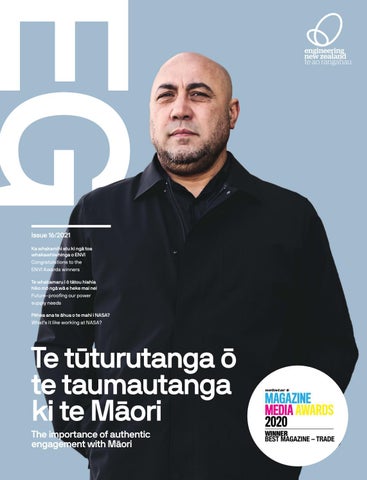
Issue 16/2021 Ka whakamihi atu ki ngā toa whakawhiwhinga o ENVI Congratulations to the ENVI Awards winners Te whakamaru i ō tātou hiahia hiko mō ngā wā e heke mai nei Future-proofing our power supply needs Pēhea ana te āhua o te mahi i NASA? What’s it like working at NASA?
Te tūturutanga ō te taumautanga ki te Māori The importance of authentic engagement with Māori
WINNER BEST MAGAZINE – TRADE
In this issue
8
54
08 Te tūturutanga ō te taumautanga ki te Māori The importance of authentic engagement with Māori. 22 ENVI.able engineers Congratulations to all the incredible winners at the recent ENVI Awards. 54 The secret life of engineers Software engineer Rose Lu is becoming increasingly well known for her writing. 56 Inside job NASA Robotics Technologist Joseph Bowkett on why he loves his role.
22
56
Features 08 Te tūturutanga ō te taumautanga ki te Māori The importance of authentic engagement with Māori.
28 State of the arts A 120-year-old church + a new three-storey building in Invercargill = one of the country’s most modern creative sites.
16 Generating for generations How can we future-proof New Zealand’s electricity needs?
32 Engineering a cartoon world From civil engineer to cartoon animator – what’s behind Yaser Shakib’s temporary career switch?
22 ENVI.able engineers Congratulations to all the incredible winners at the recent ENVI Awards. Engineering New Zealand Te Ao Rangahau PO Box 12 241, Wellington 6144 New Zealand P 04 473 9444 hello@engineeringnz.org engineeringnz.org EDITOR Jennifer Black editor@engineeringnz.org DESIGN MANAGER Alisa McGrath ADVERTISING SALES advertising@engineeringnz.org 04 473 9444 SUBSCRIPTIONS hello@engineeringnz.org CIRCULATION ABC audited net circulation for the six months ended 30 September 2020. New Zealand 13,278 Print ISSN 2537-9097 Online ISSN 2537-9100 EG ONLINE PDF versions of EG are available for members on our website or through our EN.CORE app. PRINTING Your cover is printed on Forest Stewardship Council (FSC) approved and elemental chlorine free (ECF) paper. The inside pages are Programme for the Endorsement of Forest Certification (PEFC) approved and elemental chlorine free (ECF). EG is printed using vegetable-based inks made from renewable sources. Printing and fulfilment by Printlink. Please recycle your plastic wrap – it’s New Zealand made and 100% biodegradable.
DISCLAIMER Advertising statements and editorial opinions expressed in EG do not reflect the views of Engineering New Zealand, its members, staff, or affiliated organisations unless expressly stated.
This issue of EG was published in September 2021.
35 International acclaim for bioengineering Professor Merryn Tawhai has been instrumental in putting New Zealand on the global bioengineering map.
Best practice 42 No jab, no job – true or false? Can your employer require you to get vaccinated against Covid-19? 43 The importance of clear documentation If people can’t understand an engineer’s designs, the engineer has effectively failed. 44 Staying power Imagining our future energy generation systems is not a new problem for policymakers and engineers.
47 Intersection Crossing paths with engineers. 48 Informing a rescue effort How engineers help in Urban Search and Rescue operations such as the Miami building collapse. 50 Hydropower engineers: what’s next? New Zealand has an important legacy in the hydropower sector, but how do we ensure expertise in this field into the future?
46 Build your mental fitness It’s how we react to stress that really counts.
Shorts 53 Leading questions 54 The secret life of engineers Software engineer Rose Lu is becoming increasingly well known for her writing. 56 Inside job NASA Robotics Technologist Joseph Bowkett on why he loves his role.
58 Bedside table Dmytro Dizhur CMEngNZ CPEng IntPE(NZ) talks us through his reading choices. 59 Preview 61 Obituaries 62 Engineering genius
03
AT&T Stadium: Texas, USA
Engineering Envy #5 Chosen by Engineering New Zealand staff
I visited this stadium in 2016 to attend Wrestlemania 32 and was blown away by its size – especially the giant video screen. — Andrew Drummond, Senior Competence Assessment Advisor
The home of the Dallas Cowboys and countless entertainment events, the domed AT&T Stadium with a retractable roof in Arlington, Texas, is arguably one of the most impressive venues in the world. The nearly 280,000m2, multi-award-winning structure was completed in time for the 2009 NFL American football season. It includes two 5m wide x 10.5m deep arched box trusses with a span of just over 370m, making them some of the longest of any building structure. A 78m x 125m opening in the roof is covered by two translucent, tensile fabric membrane retractable panels. One of the stadium’s most striking elements is the massive 48.5m long x 22m high, four-panel video board which sits high in the middle of the playing area, so no one misses any action.
US$1.15
Image: AP Photo/ Tony Gutierrez
80,000
billion to construct
seated capacity
14,100 tonnes
12 minutes
of structural steel support the domed roof
to open or close roof panels
Composite steel floor design just got easier Use our Excel based software for a complete floor design in accordance with AS/NZS 2327:2017 You might not have seen our work, but you’ll have walked on it!
Tray-dec New Zealand Ltd
P 09 820 9133 / E info@traydec.co.nz
www.traydec.co.nz
NELSON STUD WELDING P 09 820 9133 / E sales@nelsonstud.co.nz
www.nelsonstud.co.nz
What they said
05
ENVIs, energy and emigration
“With news coming in of how stretched the Fiji health system is becoming, we just had to offer our support.” Dunedin medical engineering start-up SouthMED Ltd’s Mark Seaton MEngNZ on giving 50 respiratory hoods to the Fijian Government for hospitals.
“Ben epitomises a new generation of climateconscious, caring professionals and brings a fresh face and fresh ideas to the Chair’s role.” Carbon and Energy Professionals New Zealand’s Yvonne Gilmour announces Ben Thomson CMEngNZ as Chair.
Nau mai koutou katoa.
British civil engineer Will Cutbill
Celebrating success matters. Congratulations to everyone involved in this year’s ENVI Awards. The online event (with local watch parties) was an example of the Engineering New Zealand/Te Ao Rangahau team continuing to think boldly and creatively. The diverse achievements of the finalists were outstanding and I know they gave the judges a lot to think about. I hope you enjoy reading more about the finalists in this issue. This edition of EG also highlights challenges and opportunities in New Zealand’s energy sector – now and in the future. Te toto o te tangata, he kai; te oranga o te tangata, he whenua: While food provides the blood in veins, our health is drawn from the land. Will the New Zealand battery project at Lake Onslow proceed? Will it solve our energy system’s “dry year” challenge? Could our electricity grid cope if transportation moves rapidly toward electrification? Engineering clearly has to be part of the national conversation on the future of our energy system – as
stacks five M&Ms on top of each other, breaking the world record.
Engineering New Zealand reiterated in its submission in response to the draft advice
“The University has an important role to play in the aerospace industry, creating a pathway for aspiring students through our current world-class Science and Engineering degrees and the new Aerospace Engineering minor, as well as attracting talent to the region that can be retained within a thriving industry.” University of Canterbury’s Professor Ian Wright on a new Aerospace Engineering minor.
“I was pretty ecstatic when I got the fifth. I can’t lie. I was running around the room, arms in the air.”
from the Climate Change Commission. Our national ambition to decarbonise our energy sector is powered both by technology and by people. Covid-19 has reminded us all how deeply connected to the rest of the world we are. I hope your organisations are handling the challenges of moving talented people across national borders. Yaser Shakhib – profiled in this issue – is an excellent example of the contribution that engineers who are immigrants make in New Zealand. I was pleased to see him awarded the FultonDowner Silver Medal earlier this year. I will be emigrating from New Zealand in December, to take up a new role at Griffith University on the Gold Coast. I will continue as President remotely and hope to be back in Aotearoa in March to hand over to the next President of Te Ao Rangahau. Finally, I have enjoyed meeting members at Member Connect events around New Zealand over the winter months. I’d like to thank all the branch committees for the work they do to help connect members. Dr Rosalind Archer FEngNZ President, Engineering New Zealand
Me tūhono mai koe ki te kaihora KiwiSaver e mahi nei mō te kaupapa, kaua mō te moni. Ko te kaihora KiwiSaver e whakahihiri nei i ngā hapori kia pai ai te hauora kia hauora hoki te ao. Tūhono mai i tēnei rā. mas.co.nz/kiwisaver
Ko te kaiwhakaputa o te kaupapa KiwiSaver o MAS ko Medical Funds Management Limited. E wātea ana te PDS i mas.co.nz
16 Generating for generations 22 ENVI.able engineers 28 State of the arts 32 Engineering a cartoon world 34 International acclaim for bioengineering
Features
08 Te tūturutanga ō te taumautanga ki te Māori The importance with authentic engagement with Māori
EG 16/2021
08
Te tūturutanga ō te taumautanga ki te Māori The importance of authentic engagement with Māori
WRITER MATT PHILP He aha i pai ake ai te hangaroto kaupapa me ngā whakataunga pai ake mo te tangata ma te tuturutanga ō te taumautanga. Why authentic engagement with Māori creates better infrastructure and better outcomes for people.
Feature
09
>>
EG 16/2021
10
>>
There was a moment during the almost four-year process to deliver New Plymouth’s stunning new airport terminal, Te Hono, when something shifted in the relationship between local hapū Puketapu and the project team. “I noticed a change,” says Puketapu creative Rangi Kipa, who became a central figure in the $28.7 million project to rebuild Taranaki’s dated 1960s airport. “The architectural team, the engineers and all the others we had face-to-face contact with started to see that we were attempting to build something more than four walls and a roof, that this thing we were all contributing to had a soul.” The deep involvement of Puketapu created a special building, but it has also set a benchmark for Māori engagement in infrastructure projects. “Traditionally a lot of iwi consultation has been seen as a tick-box exercise,” says Beca’s Matthew Low Rangi Kipa
CMEngNZ CPEng IntPE(NZ), who project-managed the design phase for the terminal and served as engineer’s representative during construction. “To be fair, this started out that way, too, but as it grew and the design changed, we stepped back and really listened. It was quite a journey.” Something similar occurred when Watercare Services upgraded its Pukekohe Wastewater Treatment Plant,
It’s the kind of authentic engagement we’re moving towards every time there’s a project of that scale and importance. – Richie Waiwai Richie Waiwai
Feature
another project that evolved into a partnership, with mana whenua values and a Māori worldview incorporated into decision-making. Watercare’s Poutiaki Tikanga Māori (Principal Advisor) Richie Waiwai says it was a challenge for the organisation to appreciate the Māori understanding of the Waikato River as a living being – but it got there. “It’s the kind of authentic engagement we’re moving towards every time there’s a project of that scale and importance. It definitely put a stake in the ground.”
Te Rangapū me te maea
Partnership and visibility The airport in Taranaki and the plant upgrade on the Waikato, both Engineering New Zealand ENVI Awards finalists, show how engaging closely with iwi on engineering projects can produce better outcomes for everyone involved. They stand out because arguably they’re the exception – at least for now. Rangi Kipa doesn’t gloss over the strained beginnings of Puketapu’s involvement with the airport project. The land on which the airport stands was acquired through the Public Works Act in the 1960s. It contains a series of pā and urupā (burial sites) along the coastal estate that remain highly significant to the hapū and its identity. Yet when the New Plymouth District Council began planning a more modest expansion of the existing terminal in 2016, Puketapu was told it was one of 20 special interest groups that would have a say. “We had to remind them, ‘Actually, we are the special interest group here. Without this land being taken off us, you wouldn’t have an airport’,” Rangi says. Puketapu wasn’t interested in merely being consulted, he adds. “We wanted a partnership – and that’s what we got.” Rangi’s decades-long career as a sculptural artist,
11
Kō te taumautanga hāngai tonu ki te Māori Effective engagement with Māori Hone Hurihanganui is the founding director of Engaging Well, a consultancy that runs “Engaging Effectively with Māori” programmes for organisations in the public and private sector, including Engineering New Zealand /Te Ao Rangahau. EG: Many engineers will be fearful of making cultural errors. What’s your advice? HH: Errors are inevitable and you shouldn’t do nothing just because you don’t want to mess it up. The good thing about cultural competence training is that it focuses on the importance of building relationships with people. EG: What does good engagement look like? HH: I’d suggest when you’re operating in the homelands of a particular iwi, you should have a relationship already. Tell them who you are and that you’d like to complete any future projects in a way that upholds the iwi’s mana. When the time comes to connect on a particular project, it’s not just transactional – you have an established relationship. EG: And when engaging on particular projects? HH: Start early. Find out who the key players are and let them know: ‘These are our plans; we’d like to do this with your blessing and if there are things we need to consider, can we have some guidance on that?’ Engineering firms bring in consultants all the time to advise on special issues and iwi are no different.
Hone Hurihanganui
>>
EG 16/2021
12
along with his personal journey, made him uniquely qualified to drive the rethinking of the project that followed. Trained as a tauira whakairo (master carver), he’s been commissioned to carve works for universities, government departments and corporates, and helped lead a revitalisation of ta moko. More recently, he started focusing on what he describes as the “invisibility” of Māori in our built infrastructure. On the airport project, he was central to a redesign that embedded the Te Ati Āwa creation narrative of the celestial Tamarau and terrestrial Rongoueroa and their child Awanuiarangi (from whom the iwi descends) in every aspect of the terminal, from its architectural form to the colour scheme to the artwork. He talks about a process of building trust with the architects and engineers. “I recognise that we were a risk to the project. As soon as you let in a bunch of people who haven’t had
1
the same training and don’t easily fit into the same western qualifications framework, it potentially becomes a problem." Initially, he did a lot of talking, “trying to backfill their understanding of our experience in Taranaki and what happened here so they could grasp why we wanted to be involved”. “We also spoke aspirationally into the future, tried to push their vision out and make them comfortable with being uncomfortable.”
It makes our people visible again on a landscape where they’ve been made invisible for 140 years.
1 – 4. Te Hono – New Plymouth Airport Terminal is architectually unique and intimately connected to its whenua.
– Rangi Kipa
From Beca’s perspective, it changed the direction entirely, according to Matthew Low. “We listened to the stories and the history, the airport and Beca team presented the functional elements we needed to work through, then we all looked at what could be done. We rewrote the design brief to give a lot more focus on integrating the cultural narrative,” he says, adding that the collaborative relationship with Puketapu on design carried over into construction. The outcomes? For Beca, its approach to projects involving Māori is now more focused on listening upfront. For Puketapu, Rangi says the collaborative approach has been a healing process. As for the final product, visitors to Taranaki fly into an airport that's architecturally unique and intimately connected to its whenua. “It makes our people visible again on a landscape where they’ve been made invisible for 140 years,” Rangi says.
Matthew Low
>>
Feature
13
WAIHO I TE TOIPOTO, KAUA I TE TOIROA. Let us keep close together, not wide apart.
3
2
4
>>
14
EG 16/2021
1
>>
Patience Te Ao
1. Pukekohe Wastewater Treatment Plant. Image: Watercare
Me hanga kia pai ake, kaua kia nui ake Building better not bigger At New Plymouth, a solution was found that balanced cultural considerations with the technical requirements of an airport. It was a similar case with the upgrade of the Pukekohe Wastewater Treatment Plant, a response to population and industrial growth that proposed expanding the plant and relocating the outfall from a neighbouring creek directly into the Waikato River. Consultation to reconsent the discharge quality began in 2014, followed by nine affected marae coming together as a single entity, Te Taniwha o Waikato, to negotiate and to prepare a Cultural Impact Assessment. “The challenge for an organisation like Watercare is understanding and appreciating the tribal worldview,” says Richie, explaining that for Māori, an awa (water body) is regarded as a tipuna (ancestor) and a source of identity. “To have a discharge into the Waikato River and continue to place structures on the bed of the awa would be like cutting a hole in my chest and leaving something in there. That first couple of years the discussions were challenging, because the designs our team put on the table didn’t fit the iwi narrative. The team wasn’t listening to the deeper side of the conversation.”
wider issues of restoring the Waikato in partnership with Te Taniwha o Waikato, adopting the iwi’s principles that the awa should once again be fishable, swimmable and drinkable. The project team shifted focus to building better rather than bigger, revising the proposed solution to ensure discharge would not only match, but improve, parameters for flow, bacteria and suspended solids, and water clarity against background levels. It added cost – the star of the $110 million upgrade is an advanced membrane bioreactor with UV disinfection – but the payoff was a 35-year uncontested consent. “It wasn’t always a bed of roses, but we worked through an acceptable solution for all, and the awa was the beneficiary,” says Te Taniwha o Waikato Chair, Patience Te Ao. Her organisation and Watercare have twice-yearly workshops to discuss the scheme’s performance, while the consent’s conditions include regular monitoring. “It’s an ongoing relationship.” As for the other partner, Watercare’s Sven Harlos FEngNZ CPEng says: “We broke new ground here.” Sven says Te Taniwha o Waikato had a clear influence over the water quality parameters and the design.
That understanding evolved with further kōrero about the health of the river. Watercare began to address the
“The outcome is better for the environment and for everyone in the community along the lower Waikato.”
Feature
Ko te arotahi ki ngā kaipūkaha Māori me te Pasifika
Sifa Pole
Focusing on Māori and Pasifika engineers The other side of the engaging-with-iwi coin is Māori representation in the engineering profession. Māori and Pasifika make up an estimated one percent of Chartered Professional Engineers in Aotearoa. One organisation working hard to change that is South Pacific Professional Engineers for Excellence (SPPEEx), whose work focuses on promoting engineering in communities and schools and supporting Māori and Pasifika professionals. Among various initiatives, SPPEEx, who were finalists at the ENVI Awards, runs engineering career expos in Ōtahuhu that target Māori and Pasifika rangatahi (young people). In addition, it has established a mentoring programme partnering young engineers with more experienced colleagues and holds networking events throughout the year as a forum to help Māori and Pasifika engineers strengthen and celebrate their distinct identity in the profession.
Success is the increased representation of Maori and Pasifika in the engineering industry with more of them in leadership roles. For SPPEEx, it’s not just about representation but also providing the platform - and Pasifika to network, stay connected for Maori and understand their value in the engineering industry, and within their communities. – Sifa Pole, CMEngNZ (Eng. Technologist) President, SPPEEx
15
EG 16/2021
16
Generating for generations WRITER MATT PHILP It’s an enormous machine, cobbled together over generations and running continuously for more than 100 years: the national grid. It lights our homes, charges our devices and powers our workplaces, while most of us give it barely a thought. That is, until something goes wrong, like in early August when rolling power outages plunged tens of thousands of homes into darkness in some parts of the country. But the future of the grid and of New Zealand’s power supply more broadly is a “live” issue in 2021 as we contemplate a decarbonised future, population growth, and the increase of alternative sustainable energy sources such as solar and wind.
Feature
17
>>
EG 16/2021
18
>>
Over the past decade, Transpower, which owns and operates the national grid, with its 178 substations and 12,000km of high voltage lines, has spent $5 billion on boosting the network’s capacity, performance and resilience. But that’s only the opening salvo. The picture painted by the state owned enterprise’s 2018 strategy, “Transmission Tomorrow”, and its more recent blueprint for a decarbonised economy, Whakamana i Te Mauri Hiko – Empowering our Energy Future, is that we will need significantly more generation – roughly 70 percent more by 2050 – as our emissions-intensive sectors electrify and we all start driving electric vehicles (EVs).
Anticipating future needs That’s not any reason to panic, according to Andrew Renton FEngNZ, Senior Principal Engineer at Transpower.
Andrew Renton
New technology provides smarter ways of doing things, and there will be lots of opportunities for that. – Andrew Renton
Neville Watson
Some of the anticipated growth in demand will be offset by improved energy efficiency, better insulated homes and other developments. And it’s not like the grid is maxing out. “The network is never running at 100 percent capacity 100 percent of the time. Over the years, we built lots of extra capacity into it,” Andrew says. “We’re not talking here about the need for a wholesale rebuild; we don’t need to double the size of the network or anything like that. New technology provides smarter ways of doing things, and there will be lots of opportunities for that.” Nevertheless, there will be challenges ahead as demand grows and new sources of generation with different profiles are integrated. Transpower’s Net Zero Grid Pathways project, currently in the consultation phase, is about getting a read on how and where solar and wind power is likely to be generated, how quickly demand is increasing, and what this will entail for the network. “We’re not only looking at this from the systems operation perspective – considerations such as system strength, voltage, inertia – but also looking at the grid itself, the poles, wires, transformers and can all those bits accommodate it. We’re doing that over three time horizons of five, 15 and 30 years to align with the 2025, 2035, 2050 scenarios covered in Whakamana i Te Mauri Hiko,” Andrew says. Intermittency issues have to be considered, as do the ramifications of having a more distributed and diverse bunch of generators. “Is there going to be lots of wind and solar appearing in Northland? And if so, what would we need to bring that south? Is it all going to appear in the central North Island, and what are the constraints there?” Andrew says. Plenty of work ahead, in other words. He says a lot of the issues come from having a system that was built in a certain historical context, “and we’re now wanting it to do something else. So how can we convert what we have to provide what we need for the future?”
Feature
19
Drones help maximise the utility of the existing network. Images: Transpower New Zealand
A more efficient, sustainable grid The same question lies at the heart of work by University of Canterbury Engineering Professor Neville Watson CMEngNZ IntPE(NZ) to develop a more efficient and sustainable grid. Last year, his research team was granted $13 million over seven years to investigate how high levels of direct current (DC) from renewable electricity sources can be integrated into the grid, which runs on alternating current (AC). Neville notes that as modern devices and appliances use DC power, converters are needed, creating inefficiency, loss and distortion. “We’re already seeing lots of problems: irrigation pumps in rural areas, for instance. With photovoltaic (PV) generation there are issues with how much the grid can withstand, as well as loss, inertia and voltage issues.” Neville says in Australia, they’re talking about restricting
“We don’t want to have restrictions; we want a highway that can cope with future technology, to be able to add and remove things with minimal issues, whether that’s renewable energy in terms of PV, wind and other sources, or on the load side with EVs or equipment that uses DC.” A hybrid grid of AC and DC is inevitable, he reckons. His project is about how we get there, how much we should convert to DC and where, and what tools, technology and personnel will be needed. “What current equipment can we use? Can AC cable be used for DC, for instance? What are the limitations? What’s a likely transition path? We have a few ideas, but this is going to involve a lot of testing, planning and careful thought.” Neville says: “By the end, we want a roadmap, to have set the goals and developed the capability of
renewable energy going into the network because of problems with inertia and frequency response.
people to deliver.” >>
EG 16/2021
20
>>
Increasing energy efficiency What about the role of energy efficiency in all this? Robert Tromop FEngNZ has been involved in developing this country’s appliance and equipment regulatory programme, as well as evaluating energy efficiency and renewable energy policies. “Look at a fridge today compared with one from 15 years ago. It has advanced electronics controlling the compressor and uses a lot less power – and that goes for every aspect of life,” Robert says. “I did some work for the Green Party a few years ago looking at whether it was realistic to go out there with a 100 percent renewable electricity target. One of the key drivers was that the improvement in appliance efficiency is probably halving the rate of growth in electricity demand you’d expect from population growth. That’s huge.” This is not, however, about “saving energy”, which is a common misreading of the benefits of energy efficiency. “That term doesn’t work: you’re either getting more productivity out of something or you’re reducing the energy needed to produce that productivity,” he says. “Productivity gains for industry from energy efficiency efforts and improving process systems are typically an extra 40–200 percent over the direct energy cost reduction from those measures.” Historically, we’ve been a resource-rich country that hasn’t had the same pressure as nations such as Japan and Korea to be energy efficient. But Robert says that time has gone. Some sectors such as dairy have made big strides; others such as the government sector are badly lagging. More effort and vision are required. “Why, for instance, do we put double glazing, floor and wall insulation in buildings when we could get a faster return and much greater carbon reductions by putting in efficient, low-carbon hot water systems?” Looping back to the question of future-proofing our power supply, Andrew Renton says Transpower is increasingly deploying new technologies to maximise the utility of the existing network. By using drones to collect high-quality images of towers, insulators and wires, for example, Transpower can make targeted interventions rather than wholesale replacements. Better data management is also proving useful. “In the last 10 years we’ve been adding all sorts of special protection schemes and demand management schemes so we don’t have to do a large grid upgrade, and that’s built around collecting and managing information,” he says. “Technology gives us the ability to do more, faster, and in greater detail.”
Robert Tromop
…you’re either getting more productivity out of something or you’re reducing the energy needed to produce that productivity. – Robert Tromop
Feature
21
Emrod uses a highly reliable phased array antenna to transmit power over vast distances.
What about wireless? Nikola Tesla wasn’t able to nail wireless power transmission, but a New Zealand outfit may have more success. Auckland-based Emrod is set to field trial the point-to-point transmission of energy through electromagnetic waves using proprietary beam shaping, metamaterials and rectenna technology. It follows successful indoor demonstrations at Emrod’s testing facility in which a few kilowatts of power were beamed 40m between antennae. The breakthrough has been enabled by advances in radar and advanced materials technology, among other developments. “As with a number of innovations, it’s about the culmination of improvements occurring throughout the world and how you bring those together,” says
greater distances, but transmitting more power. Emrod has a planned series of developments to achieve hundreds of kilowatts in the near future, and megawatts in the medium term. What are the potential benefits if Emrod can deliver? “It can help to overcome some of the limitations of power line infrastructure such as the cost and difficulty of laying and maintaining poles, or underwater cables, over challenging terrain,” says Mark, noting that reduced infrastructure costs would improve access to power for remote and less advantaged communities. He also highlights the potential to unlock renewable energy sources. “Wind farms and to some extent solar farms are often located in areas that are remote from grid connections.
Emrod Product Manager Mark Tomkins, who adds that the challenge ahead is not so much about achieving
A wireless link can overcome those obstacles.”
22
EG 16/2021
ENVI.able engineers Engineering New Zealand/Te Ao Rangahau’s recent ENVI Awards celebrated amazing engineers and engineering feats, highlighting the important role engineering plays in society. Congratulations to all finalists and winners for what the judges described as a “remarkable range of successful projects, inspiring people and great partnerships”. Judges noted the difficulty of their task, but what clinched it for the winners was an x-factor that makes an impact on how we live in Aotearoa. A number of category winners also put engineers and their achievements at the cutting edge internationally. Meet our winners here.
Feature
23
Image: Lana Young, NIWA
>>
24
EG 16/2021
>>
Young Engineer of the Year
Student Engineer of the Year
J O N AT H A N C H A M B E R S MEngNZ
FRANCIS POOKE
Environmental Engineer, Harrison Grierson
"All the nominated people, teams and projects were outstanding, but the winners had an x-factor which elevated and enhanced their contribution to New Zealand. This contribution, which was beyond technical, was often our deciding criteria." – Richard Templer FEngNZ, ENVI Awards judge
At 26, Jonathan’s an outstanding leader and communicator with enthusiasm and drive extending beyond his specialist skills in flood hazard management, watersensitive urban design, community-scale climate resilience, and sustainability. Concerned about the impact of climate change and the growing wealth and wellbeing inequalities in Aotearoa, he believes intergenerational perspectives must be heard on challenging national issues. In 2019, he was appointed to the Harrison Grierson Board as Emerging Director – a 12-month role only held previously by senior staff. Judges said: “Jonathan is a real leader in climate change – and is actually working to make a difference”. 3 words for the win “Honestly, no words!” What does this win say about your work? We’re on the right track. In many cases there is a huge amount of work to be done just to characterise the baseline for a single community, then communicating it and developing a consensus around the way forward. Let alone understanding an entire district or region. Meeting with the community and learning about past events is a great way to gather information and understand experiences.
Novel Design for Tracheostomy – University of Canterbury
Mechanical Engineering student Francis navigated medical device design challenges to develop an elegant solution and a potentially life-saving device. Securing a viable airway after a major injury is critical to patient survival. Tracheostomies are the best choice for bypassing severely compromised airways to insert a breathing tube, but they’re complicated. Reinventing tracheostomies to significantly decrease complexity and risk could transform apprehensive doctors and paramedics into experts with minimal training. Francis has achieved this through innovative design, significant iteration, clinical consultation and extensive testing, delivering a simplified tracheostomy device and procedure. Judges said: “This could have an impact on a global level”. 3 words for the win “Surprise, delight, disbelief.” What made you stand out in your category? The focus placed on developing a device for the end user. The entire project was a co-design process with senior intensive care specialist Dr Geoff Shaw HonFEngNZ. Clinical end-user feedback ensured the final results were safe, effective and easy to use, all of which allowed me to ensure the best possible design offering a real, measurable improvement over current methods was achieved.
Feature
25
Engineering Leadership Award
Engineering Education Award
Engineering Creativity Award
DOUG JOHNSON CMEngNZ (PEngGeol)
PROF SUSAN KRUMDIECK
L I F E I N P L A S T I C , I T ’ S FA N TA S T I C : 3 D P R I N T E D A N AT O M I C A L M O D E L S
Managing Director Tonkin+ Taylor
Doug was appointed Managing Director of Tonkin + Taylor in 2010, in the shadow of the global financial crisis. His leadership skills were tested when Christchurch was struck by a sequence of devastating earthquakes. Doug has supported Tonkin + Taylor, alongside industry partners, to play critical roles in many of New Zealand’s most significant infrastructure projects. A champion of diversity, he was a founding signatory of the Diversity Agenda Accord and has led by example in encouraging a diverse and inclusive environment within Tonkin + Taylor and across the sector. Judges said: “There’s a very positive culture at Tonkin + Taylor which comes from the top. Doug is a visionary leader who has significantly contributed to promoting excellence within the engineering profession”. 3 words for the win “Surprised, excited, humbled.” What does this win mean to you? It's recognition of those I’ve worked with over many years. Together, we’ve worked to make things better for our industry. Without a team and a purpose, there’s no leadership. It’s also a chance to reflect on my work and that of my team – it’s not often we get to take stock and say: “We got a good outcome as a result of all that effort
Department of Mechanical Engineering Advanced Energy and Materials Systems Lab, University of Canterbury
Susan is at the cutting edge of engineering academia, showcasing New Zealand engineering education internationally. Her development and offering of energy transition engineering, and her world-first development of an online micro-credential for professional engineers, are major innovations. Her online, international delivery of the microcredential makes it creative and inclusive. Transition engineering is required for effective action on climate change and for building a sustainable future in a variety of organisational contexts. Judges said: “Susan is a massive contributor to engineering education – this is just a snapshot of all the work she does. She’s amazing”. 3 words for the win: “Honoured, hopeful, happy.” What made you stand out in your category? Where my contribution is unique is it is a purpose-driven progress in discipline and I applied the extra personal passion to build up the teaching of something new. It can be a risk to propose a really new subject. I also invested the time and effort to create the first engineering micro-credentials for professionals.
Creative Design and Additive Manufacturing Lab, the University of Auckland
The medical community has long needed better tools to visualise medical conditions, do surgical planning and educate medical students and these 3D visualisations fill that need. The highly accurate models are made from combinations of clear and coloured material, reproducing anatomical models in great detail. They will enable surgeons to use augmented 3D models to determine, and even practice performing specific surgeries. Judges said: “This has the potential to have a massive impact on higher medical research and future surgical training – in both Aotearoa and the rest of the world”. Spokesperson: Professor Olaf Diegel Professor of Additive Manufacturing 3 words for the win “Proud of (my) team.” What’s your advice for engineers who would like to follow in your footsteps? Push technologies to their very limit – sometimes till they break – then figure out ways to make them even better, to use them to improve lives. Use technology as a catalyst for innovation. The key to innovation is fail fast and fail often, and additive manufacturing technologies allow users to fail extra fast and extra often.
– well done”. >>
26
EG 16/2021
>>
Engineering Diversity Award
Engineering Partnership Award
Engineering Innovation Award
AURECON NEW ZEALAND
WEST COAST NET WORK OUTCOMES CONTRACT
NZ People Team
Fulton Hogan and Waka Kotahi (NZ Transport Agency)
TRENTHAM TO UPPER HUTT DOUBLE TRACKING ( P a r t o f We l l i n g t o n M e t r o U p g r a d e P r o g r a m m e) Kiwirail, Downer, Aurecon New Zealand
By recruiting and inspiring a diverse workforce, Aurecon is creating an inclusive, high-performing culture where everyone can be their full, authentic selves. It was the first New Zealand engineering consultancy to offer Shared Care, offering more choice around fulfilling childcare responsibilities at home, and the first engineering consultancy to be Rainbow Tick accredited. Aurecon has launched its New Zealand Diversity & Inclusion Network, which includes five pillars, focused on gender diversity, Te Ao Māori, LGBTI+ inclusion, accessibility and disabilities, and cultural diversity. Judges said: “They have a strong local focus and are standing out in terms of their journey towards diversity”.
The West Coast Network Outcomes Contract (NOC) is New Zealand’s longest and arguably most challenging, traversing 878km of highway. The West Coast's isolation meant partnerships were key. From storms, flood damage and the varied expectations of local stakeholders, through to major damage causing destruction to bridges and infrastructure, this contract has it all. Judges said: “The relationships between all of the partners made this entry stand out. They’re not just achieving outcomes, they’re achieving great outcomes”. Spokesperson: Peter Anderson West Coast NOC Contract Manager, Fulton Hogan Ltd
Spokesperson: Tracey Ryan Managing Director
3 words for the win: “Surprised, humbled, proud.”
3 words for the win: “Pride, excitement, journey.”
What does this win say about your work? Teamwork is an essential part of our contract and our success. This result reflects collaboration, in particular with our client and main partner Waka Kotahi NZ Transport Agency. The award recognises the hard work by the many people across our network, 24/7, often in very trying weather conditions.
How will this success shape your plans for the rest of 2021? It shows us we are on the right path, but we recognise D+I is a journey and there is still much more we can do. One key focus for the remainder of 2021 is the formal launch of our Māori Strategy, implemented in three stages: Tikanga Māori training for senior leaders, launching our Aurecon waiata and Te Reo Māori training.
Trentham to Upper Hutt involved doubletracking 2.7km of the Hutt Valley line between Trentham and Upper Hutt stations, enabling trains to travel in both directions simultaneously and delivering more frequent and reliable services. Delivered under a collaborative early contractor involvement model, KiwiRail was intentional in achieving a new way of working that aligns with the values of the Construction Sector Accord. Judges said: “The project was completed without a single drawing being done – completely digital. It has the potential to change the way future projects are delivered. It’s a game-changing project which has set the standard for future projects”. Spokesperson Andy Lyon CPEng Programme Director - Digital Engineering, KiwiRail 3 words for the win: “Over the moon.” What does this win say about your work? This win validates the vision and hard work that went into this project. We encountered challenges that could have tempted us to return to more traditional techniques, but the team was committed to making digital engineering work.
Feature
27
Engineering Impact and Supreme Award Winner T H E N AT I O N A L C L I M AT E C H A N G E RISK ASSESSMENT (NCCRA) NCCRA consortium led by AECOM, Tonkin + Taylor and NIWA, with Latitude, Victoria University
As a critical and core tool for the future of New Zealand, there’s no area of society that The National Climate Change Risk Assessment will not touch. It gives a national overview of how New Zealand may be affected by climate-changerelated hazards, and identifies the main risks and opportunities. It highlights information gaps and helps identify where the government needs to focus its actions. It will inform all facets of New Zealand’s adaptation plan. Designed for practical application, it helped inform the Climate Change Commission’s Report and will shape government policy, help central agencies make key decisions, and flow into the work of iwi, hapū and local government. The judges said: “The nature and scale of what this could potentially mean to New Zealand in the future made The National Climate Change Risk Assessment the winner”. Spokesperson: Richard Reinen-Hamill FEngNZ, Sector Director – Natural Hazards Resilience 3 words for the win: “Proud, excited, hopeful.”
Bad weather in Weka Bay, Wellington. Image: Dave Allen, NIWA
change affects everyone and identifies risks and opportunities at a national level. It’s a beacon to the world that we’re taking climate change seriously and gives clarity to stakeholders on the role we each have to play to reduce risk and build a more resilient Aotearoa, together.
What is the biggest impact of this work on New Zealand?
How can you leverage from this win to inspire other engineers? Engineers collaborating with mana
This project affects everyone in New Zealand. It recognises that climate
whenua, government agencies, scientists and policy experts demonstrates we have
an important part to play in adapting to climate change and identifying future opportunities. The significant contributions by female professionals across all aspects of this project highlight the roles women play in delivering better outcomes for our people, clients and communities. Our young engineers understand the imperative for action and it’s fantastic to see our teams empowered to deliver, through positive and meaningful leadership.
EG 16/2021
28
Exemplar: Engineering community
State of the arts WRITER ALEXANDRA JOHNSON
An innovative blend of a 120-year-old church and a new three-storey learning facility in downtown Invercargill is set to become one of the most modern creative arts sites in the country.
Feature
29
What is it? — Restored, restrengthened brick church for exhibitions and concerts — New three-storey, 2,250m2 teaching facility for film, animation, game design, fashion and music programmes — Two soundproof classrooms within church — Glass atrium between church and new build which is also a thoroughfare for the public — Café
The numbers — $17m development — First intake anticipated for February 2022 — Church will seat up to 100 people, theatre-style — Public art exhibitions capacity for approximately 150 people — Teaching capacity for up to 400 students
Student involvement — A graduate of SIT has created a stainedglass window which will be installed in the exhibition space of the church — Students are creating an oral and visual history of the site and church which will be displayed at the centre — SIT hospitality students will staff the café
Image: Southern Institute of Technology Photographer : Elana Bai
We had to find a robust engineering solution that met economic restrictions, while also achieving a light touch in terms of the look and feel of the church. – Brenton Easson
>>
EG 16/2021
30
>>
A church's journey The first Anglican church in Invercargill, the Church of St John the Divine was opened in 1861. From 1887, the original buildings were gradually replaced, and the completed building was consecrated in 1913. The church celebrated its centenary in 1961 and the last service was held in December 2018.
Invercargill’s St John’s Anglican Church is being restored and strengthened, and a light-filled glass atrium, which echoes the roofline of the church, will connect it to the new centre beside it. Part of the Southern Institute of Technology Limited (SIT), the new Centre for the Creative Industries will provide teaching space for up to 400 film, animation, game design, fashion and music students along with various public spaces, including an exhibition centre and a café. The school is currently based in Don Street in the CBD in what was originally a bank “which we purchased over 20 years ago, but it has done its time”, says Hamish Small, Head of Faculty, New Media, Arts and Business. Hamish says SIT had been considering a new campus when the St John’s Anglican parish asked if they would be interested in purchasing the church, as it is adjacent to the tertiary institute’s main campus. “They unfortunately couldn’t afford the maintenance of it, and we thought it would be great for the community to keep the old building and incorporate it into a new centre. “We will use the new centre for our digital technology schools, and the church will be used for performances, as well as exhibitions.” In addition, two self-contained, soundproofed teaching pods in the church will be used as classrooms. The church’s organ has also been retained and refurbished, to be enjoyed by students and the public alike. Invercargill city centre is currently undergoing a major $165 million redevelopment and the new centre fits perfectly with that, says Hamish. “The beauty of it is that a fully enclosed glass atrium flows between two main streets in the CBD which will coincide with the new CBD build as well. It will be a wonderful new public space and learning centre for the city.”
and the adjacent three-storey new build. “The fundamental structure of the church was in
Structural Engineer Brenton Easson MEngNZ says
remarkably good condition. We had to find a robust engineering solution that met economic restrictions, while also achieving a light touch in terms of the look and feel of the church,” he says. “Heritage New Zealand had input on what that strengthening could look like and made sure we didn’t detract from the overall heritage sense of the structure.” They were able to adopt a very simple, straightforward design philosophy, Brenton says. This involved creating direct load paths by tying all wall elements into the roof plane structure and ensuring adequate in-plane capacity of the unreinforced masonry (URM) walls. This negated the need for transfer structures between the four wings of the church. Because there were no plans of the unreinforced masonry church, BMC utilised cutting edge technology to create them. “We scanned the inside using a point cloud laser scanner and the outside with a drone. These point clouds were further processed to create an envelope that could be imported into our 3D modelling software, Revit.” This detailed model, along with on-site measurements, provided enough dimensional information to construct a 3D analysis model in the engineering software product ETABS, Brenton says. “These 3D drawings and analysis models formed the basis of how we analysed the building to define the stress points and the creation of the construction drawings.” He says a huge benefit of the 3D modelling was being able to give Heritage New Zealand a visual example of what the strengthening was going to look like, “and that really helped them understand what we were trying to achieve and led to a smooth approval process”. Brenton says while this technology is used more commonly now, he believes it is still underutilised when working on old buildings. “It’s a great example of how utilising technology to
Batchelar McDougall Consulting (BMC) was engaged at the end of 2018 to design strengthening for the church
achieve engineering outcomes reduces overall cost and increases both accuracy and understanding of a
A “robust engineering solution”
Feature
31
structure with all its intricate details or dimensions.” The architecture allowed relatively free rein with the new build and they were able to accommodate the atrium structure and keep it separate from the church, “so although there is a seismic gap between them, it looks like one structure”, Brenton says. He adds that the project is a great example of how economically repurposing an old building that would have otherwise been left to decay over time, can benefit a community. “That’s what we are most proud of – we were able to strengthen and repurpose the building into something beyond itself which will be enjoyed and used for a long time to come."
It’s a great example of how utilising technology to achieve engineering outcomes reduces overall cost and increases both accuracy and understanding of a structure with all its intricate details or dimensions. – Brenton Easson
Artist’s impression of the Centre for the Creative Industries. Image: Southern Institute of Technology, Invercargill
Pipe up The first pipe organ in St John’s was built by TC Lewis of Brixton, London, in 1872 and installed in 1873. The current organ arrived in 1904 and the existing pipework was incorporated into the new instrument. The refurbishment was completed by The South Island Organ Company of Timaru, costing approximately $100,000. SIT students will be trained to play the instrument and the community will be invited to attend concerts.
32
EG 16/2021
Engineering a cartoon world WRITER KATHY CATTON
From civil engineer to cartoon animator: what has led Yaser Shakib to make this temporary career switch, and how does he credit engineering with his success? Moving to New Zealand from Iraq at the age of six, life was never ordinary for Engineering New Zealand Emerging Professional Yaser Shakib. When his family left their war-torn homeland, all Yaser knew of New Zealand was that it was the furthest place away from Iraq on the map. “The Salvation Army was a huge help to us. My father was a mechanical engineer in Iraq, but was told he was too ‘overqualified’ to work as one here, so he worked overseas until we saved enough to start a business here,” says Yaser. From the age of 10, Yaser worked Saturday mornings and school holidays for his parents’ mechanical business and later childcare centre. "My friends would be off to Rainbow’s End, but I would be working with customers and staff at the workshop in Manurewa.” Saturday afternoons were spent at local mosques, firstly being taught ethics and then from his teenage years, teaching others and helping Afghan refugees. Grateful for this early work ethic and community-minded outlook, Yaser soon realised he had an in built capacity to work hard, and a love of working with people from diverse backgrounds. Combine that with his passion for digital technology, and the cards start stacking up. “Looking back, it was when I picked up maths, alongside the arts subjects I chose, that my world suddenly seemed to make sense.”
During a year off from Auckland University of Technology (where he was
broadcast the animations and work with them to create more episodes.
studying Commercial Law), he began to weigh up his options while continuing to work in the family businesses. “With my love of maths and my entrepreneurial spirit, I began to see the practicality of engineering and how transferable it was across all disciplines in business.” With new-found impetus and purpose, Yaser completed a Civil Engineering degree at Unitec Institute of Technology in 2015 and has been working for Maven Associates for the past two years. Now responsible for large-scale subdivisions throughout New Zealand, he enjoys the work and the company culture. “They have been so generous in giving me a six-month secondment to work on my latest project. I’ll still work four hours a week for Maven, training the graduates.” Yaser was faced with the difficult decision to press the pause button while he pursues his other passion: creating and marketing cartoon animations in the Iraqi-Arabic dialect. Together with his wife, Ibtihal Al-Asadi, a qualified dentist, the couple is excited by the gap in the market. “We wanted to teach our daughter Arabic in the Iraqi dialect but nothing was there. We sang her mainstream songs like ‘If you’re happy and you know it’ or ‘Baby Shark’ in Iraqi-Arabic, and then decided to turn them into animations. There are currently no cartoons in Iraqi-Arabic like this, other than ours.” Funding the project themselves for the past two years, the couple now has interest from networks in Iraq, who wish to
“We are targeting audiences inside and outside Iraq. Three million Iraqis live outside Iraq, so we want to set the trend to help children learn Arabic through music, while also honouring Iraqi history and its classical poems.” Yaser’s role project managing the enterprise will see him use his practical engineering mind to get the job done, as well as his people skills and digital media marketing knowledge to work with stakeholders here and in Iraq. Lyricists, musicians, animators, broadcasters, budgets and timelines all need coordinating. “A 90-second animation takes nearly 100 hours of accumulated work. “If we continue with 10-minute episodes, that’s several hundred combined hours.” He'll continue to work as a volunteer, both within his community and for his profession. Earlier this year, he was awarded Engineering New Zealand’s Fulton-Downer Silver Medal in recognition of his volunteer work and his support of the Diversity Agenda, an initiative to help engineering and architecture firms become more diverse and inclusive. “Voluntary work comes naturally to me,” he says. “It gives my life meaning, and it’s my way to give back and show my appreciation. I'm so blessed to have come to New Zealand, and I want to give back to the communities and country that have supported me.”
Profile
33
With my love of maths and my entrepreneurial spirit, I began to see the practicality of engineering and how transferable it was across all disciplines in business. – Yaser Shakib
34
EG 16/2021
Images: Billy Wong, University of Auckland
Profile
35
International acclaim for bioengineering WRITER ALEXANDRA JOHNSON
Professor Merryn Tawhai has been instrumental in putting New Zealand on the global bioengineering map. But while she – and the institute she helps lead – are renowned internationally, they’re lesser known back here at home. Professor Merryn Tawhai always loved biology and maths at school, but wasn’t sure where that would take her. “My entire family are farmers, so engineering wasn’t part of our conversation, though my parents were always of the opinion I would go to university.” The bioengineer settled first on studying electrical engineering, but quickly changed her mind when she discovered the University of Auckland offered engineering science. “I saw the work that was being done in mathematical modelling and knew that was for me.” She co-leads 250 researchers as the Deputy Director of the Auckland Bioengineering Institute (ABI) and in her national role as the Director of the Medical Technologies Centre of Research Excellence (MedTech CoRE). For the past 20 years, she’s been intrinsically involved in building a structure-based mathematical model
mathematics, biology and engineering. With information derived from medical imaging data and computational algorithms, the digital lung model will allow clinicians to diagnose what is occurring in real time for individualised treatment of a patient. Collaborating with clinicians is key to the success of the work, she says. “We work with clinicians to identify what the key issues are and how we can impact on the clinical pathway for patients. If we were only working with other engineers, we’d probably create fancy solutions with lots of bells, whistles and lights that perhaps wouldn’t deliver what they really need.” Merryn and her team work with respiratory clinicians, radiologists, critical care physicians and radiation oncologists, who all require different information. “The radiation oncologist wants to know how well the patient will respond to a specific treatment plan and whether lung function will be compromised by the treatment. The radiologist wants to know how we can use robust and automated methods to detect specific types of pathology on lung imaging.” While they have very different questions, “the underlying technologies we use to address those questions are the same”.
lung imaging, mostly in the United States, and have developed models of hundreds of people's lungs. “The same way you would apply engineering methods to, say, analyse a bridge, we use the same methods to create a structural model of the lung, and to simulate its function.” Last year, the Ministry of Business, Innovation and Employment (MBIE) was looking for projects that could be produced for implementation if New Zealand were to have a large wave of Covid-19 cases. Merryn and her team created a low-cost, diagnostic device that can provide precise and dynamic monitoring of lung function of a patient being treated with a ventilator. The project was started from “essentially nothing” and completed in eight months. Commercial devices are available at about $US50,000 per unit, “but this is New Zealand, we are not going to get one of those in every [intensive care unit] ICU in the country”, she says. ABI’s device would cost just several hundred dollars to produce. “We are starting our clinical testing now and can see that our modelling methods combined with new hardware are definitely improving the data and information that you get.”
of the lung, combining the disciplines of
Merryn says they work with experts in
But while there is commercial potential
>>
36
>>
The same way you would apply engineering methods to, say, analyse a bridge, we use the same methods to create a structural model of the lung, and to simulate its function. – Professor Merryn Tawhai
for the new device, it needs to be funded. “The reality is that no matter how good, novel and cheap your technology is, you need some kind of commercialisation model around it, it needs to be funded through to the end user.” Internationally, bioengineering has been growing rapidly for many years and it’s also gathering pace here. The University of Auckland has offered a biomedical undergraduate specialisation for a number of years, and this year the ABI is celebrating its 20th year as a stand-alone research institute of the university. The institute’s work is recognised as unique across the world. “Our institute has put New Zealand on the global bioengineering map. For our 20year celebrations we tried to come up with a slogan,” she jokes. “Something like, ‘we are world famous, but not in New Zealand’.” But that really is how it is, she says. “We are extremely well known around the world, and a lot of people do want to work with us. We are highly connected
not as much awareness about what we do.” The same could also be said of Merryn herself. She is a Fellow of the International Academy of Medical and Biological Engineering (IAMBE) and a Fellow of the American Institute for Medical and Biological Engineering (AIMBE), whose website says their Fellows represent the top two percent of medical and biological engineers. She’s also a Fellow of the Royal Society of New Zealand (RSNZ) Te Apārangi and was awarded the 2016 MacDiarmid Medal. So, what does the future hold for bioengineering in New Zealand? “For me it’s about seeing a translation of our work into clinical practice and we have recently received quite a boost from MBIE towards this.” ABI has been awarded $15 million to lead an international collaboration that aims to translate its mathematical modelling of human physiology into clinical practice. “It’s about linking all of the very detailed modelling work that’s been done by the people here, in the heart, the lung, every organ system. It is about linking that up
internationally and that goes across our whole institute, but in New Zealand there is
and taking it into clinical workflows so it can become part of the clinician arsenal.”
CELEBRATE YOUR TEAM
THE COLLABORATION, INNOVATION AND EXCELLENCE THAT BRINGS OUTSTANDING COMMERCIAL PROJECTS OF ALL SIZES TO LIFE
ENTRIES OPEN
OPEN TO CONSTRUCTION COMPANIES, ARCHITECTS AND DESIGNERS, ENGINEERS, OWNERS – ALL MEMBERS OF THE PROJECT TEAM
COMMERCIALPROJECTAWARDS.CO.NZ
Snapshot The Rosedale Wastewater Treatment Plant on Auckland’s North Shore is Watercare’s second largest wastewater treatment facility, serving approximately 220,000 people. This 1,040kW floating solar array project, a partnership between Watercare and energy company Vector, will produce 1,486,000kWh per annum – enough to power 200 homes for a year. With 2,700 solar panels and 4,000 floating pontoons, it occupies about 9,500m2 on the wastewater treatment pond. The power from the array reduces grid electricity consumption at the plant by about 25 percent and any unused solar electricity is exported to the grid.
WATCHED IT? If you missed the live event, you can enjoy the ENVIs TV show online any time and on any device. It’s an entertaining hour of amazing engineers showcasing the best of engineering in Aotearoa. envis.nz/watch
THANK YOU TO OUR SPONSORS
WITH SUPPORT FROM
PRODUCTION PARTNER
43 The importance of clear documentation 44 Staying power 46 Build your mental fitness 47 Intersection 48 Informing a rescue effort 50 Hydropower engineers: what's next?
Best practice
42 No jab, no job – true or false?
42
EG 16/2021
No jab, no job – true or false? TIFFANY MATSIS
The Covid-19 vaccination is being rolled out, in stages, to all eligible people in New Zealand by the end of the year. But can your employer require you to get inoculated? Vaccines play a critical role in reducing the risks of Covid-19 infection and transmission. But regardless of your personal views on vaccinations, can your employer require that you get inoculated? The short answer is no. Vaccinations are not mandatory. Under the New Zealand Bill of Rights Act 1990, everyone has the right to refuse medical treatment – which includes vaccinations. Your employer does, however, have obligations under the Health and Safety at Work Act 2015 to do everything they can to reduce risks to the health and safety of their staff. So, where there is a high risk of contracting and transmitting Covid-19, a business can require that certain work must only be done by vaccinated employees. To decide whether work is high risk, a business will need to carry out a risk assessment in consultation with workers. That assessment will need to consider whether other public health measures, such as personal protective equipment (PPE) use and social distancing, can sufficiently minimise the risk. If, after a risk assessment, your employer decides certain roles do fit the criteria for requiring vaccination, this will need to be discussed with you as a variation to your existing employment agreement. Importantly, even in a global pandemic, existing employment
making changes to terms and conditions of employment by agreement, engaging in good faith consultation and avoiding unlawful discrimination. There are some workplaces that, since 30 April 2021, have been covered by the Covid-19 Public Health Response (Vaccinations) Order 2021, which requires that only vaccinated workers are able to undertake certain roles. There are few of these; they include airports, ports and managed isolation and quarantine facilities. These workers were in the priority groups for the vaccine rollout and will have already had discussions with their employers. Whether or not you are willing to roll up your sleeve for the jab, you do not have to tell your employer. If you do discuss your vaccination status with them, they must treat this as personal information under the Privacy Act 2020 and not share it with your colleagues without your consent. Your employer is allowed to ask you about your vaccination status, but you are under no obligation to tell them, nor do you have to disclose the reasons. Your employer cannot redeploy or disadvantage you if you refuse to share your vaccination status, unless particular work needs to be done by vaccinated workers. The Government is encouraging employers to make it as easy as possible for workers to get vaccinated. Some larger workplaces may make arrangements for on-site vaccinations or allow you to take time away during your workday to visit a
law obligations still apply. This includes
vaccination centre. Your employer can
encourage you to use a particular provider but ultimately the choice is yours. Although side effects from vaccinations are uncommon and usually mild, if you do have a reaction that requires time off work, you will be able to use your sick leave to cover this time. All of the above discussion relates to current employment. The situation is different if you are embarking on a new job with a new employment agreement. A prospective employer may ask you about your vaccination status and may require you, as part of a new employment agreement, to agree to be vaccinated. This must be reasonable for the role and must not amount to unlawful discrimination under the Human Rights Act 1993. There may, for example, be religious or medical reasons why you are unable to receive the vaccine. The first rule of Engineering New Zealand’s Code of Ethical Conduct is that all members must, in the course of their engineering activities, take reasonable steps to safeguard the health and safety of people. You also have a legal duty as a worker, under the Health and Safety at Work Act, to take reasonable care for your own health and safety and to take reasonable care that what you do – or do not do – does not adversely affect the health and safety of other people. Tiffany Matsis is Senior Legal Advisor at Engineering New Zealand.
Best practice
43
The importance of clear documentation MARTIN PRATCHETT MEngNZ
Engineers generally pride themselves on understanding complex problems and coming up with ingenious designs. However, if people can’t understand those designs, they have effectively failed. While there is a lot of information available for engineers on design, it’s harder to find information on presenting design documents. Yet clear documentation is vital to a project, or it can cost the engineer – and the client – time and money. The contractor may not complete the build according to the design intent, and the client may not pay the bill. What good looks like Talking to engineers across the country revealed that one of the problems was that different Building Consent Authorities (BCAs) want different levels of documentation. What is acceptable in smaller BCAs can be very different to what is acceptable in Auckland, Wellington or Christchurch. As a result, there is no consistent bar for good. Producer Statements Most BCAs expect a Producer Statement 1 (PS1) with the project. Fourteen percent of Requests for Information (RFIs) relate to the PS1 not being filled in correctly. Design Features Reports Many engineers don’t submit a Design Features Report (DFR) with their work. The engineer should fill out a DFR as the project begins and clearly state
any assumptions. It helps the checking engineer understand what’s going on when they pick up the job. Engineering New Zealand has developed a two-page example aimed at the residential market that members can download from the members’ section of engineeringnz.org under “forms and tools”. Construction Monitoring Schedule If an engineer designs it, they should state who will be monitoring the construction. For example, a Building Consent Officer (BCO) can inspect things like timber lintels and gib bracing, but an engineer’s representative should inspect everything else. The contractor uses these documents to know when to call for an inspection before continuing with work. Therefore, it is good practice to reference the construction monitoring schedule on the drawings. The importance of pictures and drawings A picture of the project makes it easy for a checker to quickly confirm whether basic assumptions are correct. Pictures of what the engineer is designing included with the calculation set makes following the calculations much easier. Drawings describe the project and tell the story of how to build it. The engineer should ensure the contractor can easily interpret the drawings and the design is buildable. Calculation set Calculations must be legible and logically ordered. Sections may consist
of loads, vertical system, lateral systems, foundations, envelope, parts – frequently in that order. Each section should have a cover page with a picture showing the relevant overview. For example, a beam layout plan with the gravity system. — Gravity This is a constant. There have been recent examples where buildings have failed under gravity load. The beam layout plan shows where all the beams are going and lets the engineer check the load path and beam sizing at a glance. — Lateral loads The concept is the same here. Have a picture of the load resisting system and how it ties into the building. — Foundations Images can be vital here. Provide slope cross-sections and any other relevant information such as soil testing. While this information is aimed at structural engineers, it does apply to all disciplines. Making your calculations and drawings easy to understand improves your understanding of the job, reduces RFIs and increases profitability. In short, define the loads, follow the load path and ensure the system meets requirements. Martin Pratchett MEngNZ is Engineering New Zealand’s Engineering Practice Leader.
44
EG 16/2021
Staying power
Entries are open until 4 October for the inaugural Engineering Heritage Award, with the winner announced at the Australasian Engineering Heritage Conference dinner in November in Dunedin. Find out more at engineeringnz.org/ heritage2021
CINDY JEMMETT
As we work to transition to a low-carbon future, policymakers and engineers are tackling the challenge of imagining our future energy generation systems. But it’s not a new challenge – it was also at the fore
United States, to survey New Zealand’s hydroelectric potential. Mr Hancock toured the country over nine weeks in late 1903, accompanied by Public Works Department Superintendent,
interested hands of business, the Dunedin City Council opposed the company’s bid to supply the city and eventually bought and developed the scheme itself. Electricity from Waipori powered Dunedin from 1907.
more than a century ago.
Peter Seton Hay. The pair visited waterfalls, rivers and lakes from Whangārei in the north, to Fiordland in the south. In his report, Mr Hancock made much of New Zealand’s potential and emphasised the profitability of hydro. He wrote of New Zealand’s water-powers as “white diamonds” to rival “black diamonds” – coal. Mr Hay was a little more reserved in his conclusions and looked closely at the logistics of implementation, supply and demand. He also considered how existing technology – in particular the railways – could be transitioned to electricity. While there would be challenges, his recommendation to the government was clear – coal was a finite resource and could not meet New Zealand’s increasing demand for power. Hydro, on the other hand, would “remain as a national asset as long as the climatic conditions and the mountains endure”.
The Waipori scheme has been expanded several times since and continues to supply power to Dunedin today. In 1910, the Government passed the Aid to Water-Powers Works Act, authorising it to borrow to finance the development of hydropower schemes and to establish the Hydro-Electric Branch of the Public Works Department. The first major hydro scheme developed by the Government was at Lake Coleridge, to supply the city of Christchurch. Work started in 1911 and the scheme began operation in 1914.
More than 100 years ago, politicians and engineers were facing an almost blank canvas as they imagined how a system of electricity generation and transmission could be developed in New Zealand. Some of the questions they had are ones we are asking today. What infrastructure is needed? How much will it cost? What will be the return on investment – not just in economic terms, but as a driver of social, environmental and technological change? New Zealand in a new light By the 1880s, it was becoming clear that electricity was going to be an important part of people’s lives and the economy. Use of electricity for lighting was gaining momentum, and electric tram services began operation in Auckland (1902), Dunedin (1903), Wellington (1904) and Christchurch (1905). Electricity also promised opportunities for industry and wide application in the home. Most cities used steam-generating plants to run their trams and streetlights, but the most promising technology gaining increasing attention was hydro. Hydro a “national asset” Looking overseas for inspiration and expertise, the government commissioned LM Hancock, an electrical engineer and General Superintendent of the Transmission Department of the California
Private versus public money Despite such recommendation, the government was for some years reluctant to borrow the funds needed to construct any of the schemes Mr Hancock and Mr Hay advocated. Instead, it was private business that took the first leap into the market. In 1902, the Waipori Electric Power Company began to construct a scheme on the Waipori River with the intention of supplying electricity to residents and businesses in the growing city of Dunedin. Feeling strongly that such an important
Gas and Electric Company in the
utility should not be left in the self-
The next 100 years Today hydro generates around 60 percent of our total electricity supply. Energy generated from renewable sources makes up approximately 30 percent of our total energy consumption. At the beginning of the 20th century, the barriers to developing hydro technology were the large upfront costs and the yetto-be-established demand for electricity, including the question of how to transition existing technology. The values that drove development were a desire for the lifestyle changes and the opportunities for industry that electricity would bring. As we look ahead to the next 100 years, we must focus on the social, cultural, and environmental outcomes we want to achieve, and invest in solutions that will serve us well for generations to come. Cindy Jemmett is Heritage Advisor at Engineering New Zealand.
Best practice
45
First electric tram going up Queen Street, Auckland. Image: Auckland Libraries Heritage Collections, 7-A92
EG 16/2021
46
Build your mental fitness DR PAUL WOOD
Contrary to popular belief, stress is not a threat to be avoided. But it’s how we react to it that counts, and it’s something we can improve, with practice.
as trying to get my kids out the door. I regularly find myself asking my kids multiple times to get ready to go, without these requests having any impact on their preparedness. When this happens, I find
You lose your job. Your relationship falls apart. A loved one dies. Your city is devastated by an earthquake… Even the most blessed life is a series of ups and downs. But the difference between people who are flourishing and people who seem less fortunate is their ability to cope with reversals in their fortunes. As we seek to fulfil our potential, we will inevitably fail from time to time. Since avoiding failure is not an option, our task is learning to cope with and grow from failure, loss and adversity. The more mentally fit we are before we’re overtaken by crisis, the better we’ll cope, and the faster and more completely we’ll recover and even grow stronger. Prepare, perform, recover In the army, it’s called Stress Exposure
Training – a way to make sure you can deal with whatever comes your way. The system that’s used to increase this capacity is Prepare, Perform and Recover. Preparation is all about situation, reaction and strategy. Identify the situations in which you experience stress. For the Defence Force, that’s pretty easy: bombs and bullets are flying. But all of us experience stress and if we predict where it’ll come from, we’ll cope with it better. For me, sometimes it’s as simple
myself starting to feel a combination of high energy and unpleasantness, and run the very real risk of losing my temper. However, if I expect to be ignored by my kids and experience a potential loss of temper, then I stand a far better chance of controlling my reactions. Once we have identified situations that cause us stress, we need to gain insight into our reactions to this stress. Once we understand our reactions, we can use these as cues to pull the trigger on the mental skills strategies required to manage our emotions. Different people react to stress in different ways, so study your reactions to
Breathe, to get oxygenated blood back into the brain. Acceptance – accept your situation and let go of expectations and preconceptions. Listen, look and learn from your environment. Take in your surroundings and formulate an effective response/ course of action. Manage your response – choose your response, rather than allowing yourself to simply react without thinking. We all know that when it comes to physical fitness, recovery is as important as exertion. Mental fitness is the same – we need time to recharge, to put fuel back in the tank. We also need time to reflect. Mental toughness – the application of successful strategies for coping in times of crisis – is a learning process. You need to constantly evaluate what you did and how effective it was, so next time, you will know what works for you and what doesn’t.
determine your own pattern. Sometimes, it can be helpful to ask someone who knows you well for their feedback. Keep CALM New Zealand Defence Force personnel who are deployed to high-risk areas attend what is known as Conduct After Capture training. They are taught the mental skills required to cope with and survive becoming a prisoner of war or hostage. Some of the skills taught can be summarised with the acronym CALM. Control emotions – control your negative thoughts and unpleasant emotions.
About the author At 18, Paul Wood was in prison for murder and his life was off the rails. In his work today, he uses his subsequent journey from delinquent to Doctor of Psychology to help people strive to be the best version of themselves. He is a motivational speaker and runs workshops. This is an edited extract from his latest book, Mental Fitness, Build Your mind for strength and resilience every day. paulwood.com
Best practice
47
Crossing paths with engineers.
After initially working in the health and social sectors to support vulnerable populations, Jolie Wills turned her sights towards the aid sector. She began studying
come. Hummingly works with engineers new to disaster recovery to help them understand the post-disaster context and how to best work with communities.
international development and volunteering for Red Cross. After the Canterbury earthquakes, Jolie led the psychosocial work for New Zealand Red Cross, before shaping best practice in disaster recovery globally. In this work, she met Hummingly co-founder, Elizabeth McNaughton. The pair undertook two Winston Churchill Fellowships and interviewed more than 100 recovery leaders. These insights helped in the establishment of their agency, Hummingly, whose tools help thousands of people around the globe do well and be well during times of stress and uncertainty.
Our Hummingly tool, Cards for Calamity, is an essential part of this process. We’ve seen the negative consequences for communities of failing to understand the recovery context and what is needed. But we’ve also seen phenomenal examples of engineers leading the way and doing this well.
How do you work with engineers in your role? Risk and disruption are defining features of this decade. The organisations we work with understand the importance of supporting their people to adapt and do well in times of pressure and uncertainty. This is especially vital for engineers as they have a critical role to play in preparing for, addressing and responding to these challenges. Our products are designed to support engineers in wellbeing, resilience and performance during challenging times, and support their work postdisaster. How do engineering decisions in times of disaster impact on your work? Engineers keep us busy as they are required to step up, lead and advise on post-disaster recovery projects. Their decisions in this context have a huge impact on communities for generations to
How does your work impact engineers? We help engineers understand and prepare for the unique features of mass disruption – scale, uncertainty, time pressure, endurance, psychology – so they can continue to do what they do well and rise to challenges. To help them do this, we supply engineers with our Doing Well tool to help them create a wellbeing, resilience and performance plan so they can be at their best, no matter the challenge. What are three observations you’d make after working with engineers? Tight timeframes and pressure on engineers can be relentless, and organisations need to be intentional about how they support engineers so they can grow rather than burn out. The scope of the engineering curriculum doesn’t currently allow for a nuanced understanding of how to work well with communities in complex, postdisaster situations. Engineers are essential to my life. I couldn’t be without them – both due to the way their work shapes the world I live in but also because I married one and I’ve raised one.
Jolie Wills Based in: Auckland Role: Co-founder and Director, Hummingly Education: Bachelor of Science, University of Canterbury, 1996; Master of Science (in Cognitive Psychology), University of Canterbury, 2000
What do engineers all seem to do so well? We intentionally shared our office space with engineers after the earthquakes to increase collaboration across sectors in the rebuild. From this we learned that engineers are better than humanitarians at i) stacking the dishwasher efficiently, ii) running their meetings to time in shared meeting rooms (sorry on both counts) and iii) technical wizardry. How could engineers and humanitarians work together more effectively during disasters? Supporting cities and communities to rebuild after a disaster is like putting a jigsaw together. Humanitarians, engineers and other professions all have different pieces of the puzzle. It is only by working together as a multidisciplinary system that we can see the full picture and complete the puzzle. Collaboration of this kind is hard to do when tired or under pressure, but the results are well worth the effort.
48
EG 16/2021
Informing a rescue effort JENNIFER BLACK
Engineers are a vital part of Urban Search and Rescue operations in events like the recent building collapse in Miami, Florida, as they help inform the rescue effort. But, what is their role, how are they trained and how can other engineers get involved? There’s always an increased interest in Urban Search and Rescue (USAR) engineering after a significant event such as the Miami building collapse, or earthquakes, says New Zealand USAR Engineering Team Leader, Carl Devereux. “We had a lot of interest after the Canterbury earthquakes. When we see an event occur like what’s happened in Florida, there will generally be a lot of interest.” Carl says in a USAR situation, engineers provide technical engineering advice after a structure has partially, or fully, collapsed. With an event like Miami, engineers first consider the stability of the remaining building. Their knowledge of a building’s structure, and how it would likely have collapsed, allows them to make a good assessment of where survivors might be located. Engineers also provide guidance on the most appropriate hazard mitigation. “Rescue teams will always go in and attempt to rescue, so structural and geotechnical engineers provide advice on the best way to approach that rescue. Also, we provide advice on shoring, cribbing, bracing and how to support a damaged structure while a rescue is underway.”
There is a rigorous training and selection process for USAR engineers, and there’s more interest than there are available placements. “The majority of people employed by the USAR team are full-time firefighters and they add on specialist services – paramedics, dog handlers, and structural and geotechnical engineers.” Carl says the work comes with a culture and a team dynamic, and an engineer – who must be a highly experienced structural or geotechnical engineer – needs to be the right fit. “We’re looking for people who have very good site experience and are used to complex situations and confident enough to provide advice about what to do next.” One thing people learn quickly about a rescue situation is that everybody has to look out for each other, he says. “It’s very much a team dynamic – there’s a culture that goes with working in a rescue situation, with [Fire and Emergency NZ] FENZ, with paramedics and police – a culture built on a high amount of trust and there’s no one person who’s doing anything in isolation.” And it’s very hierarchical. “It’s like a military hierarchy and as an engineer you’re just one part of that; you’re providing advice to a squad leader then a Task Force leader on the next course of action. The leaders are constantly assessing information from a range of sources. It’s a live environment that’s
potential for conflicts to arise, particularly in differences of opinion in the approach being taken. But in the end, everyone needs to be happy with the decision that is made, Carl says. Initially a volunteer with Civil Defence in Nelson in the early 2000s, Carl became involved with USAR when FENZ was looking for structural engineers. He worked his way up to become a member of the national Task Force, and now Engineering Team Leader, in addition to his role as Director – Water at WSP in Christchurch. He recalls an early training session in the United States alongside engineers from every state who had been deployed to large-scale events including the World Trade Center collapse, Hurricane Katrina and the Oklahoma City bombing. The only person from outside the US, Carl hadn’t then been on any deployments. However, he says, he calls on that training every day that he’s involved in USAR work, and the friendships and connections he made then proved invaluable. “When we had our first deployment, which was the Canterbury earthquakes, one of the first things that happened was international teams were mobilised, including the California Task Force. They arrived within a couple of days of the event and I was there to welcome that team.” In the early days when New Zealand was setting up its USAR engineering capability, we looked to the US for advice and examples.
changing very, very quickly.” The hierarchy helps mitigate the
“However, now that we’ve had our own significant experiences, including the
Best practice
49
Aftermath of the Champlain Towers South collapse. collapse. Miami Beach, Florida, USA. 24 June 2021. Image: Felix Mizioznikov / Shutterstock.com
Canterbury and Kaikōura earthquakes, a lot of people reach out to us for learnings,” Carl says. Every deployment is different and will provide information the international USAR community can learn from and potentially use in the future. “We will be learning from the Miami event.” Training engineers to support rescues The New Zealand USAR Task Force has 13 engineers who undergo ongoing training and there’s an expectation they’ll spend at least five years on the team. Some of these engineers were selected following the NZ USAR engineering specialist training course in late 2019. Twenty engineers completed the course and a number of them are now “reserves” for the Task Force. The engineers are located around the country – including in the regions, which Carl says is important given the next deployment could be anywhere. “It won’t necessarily be in one of the
big urban centres – particularly if we think about planning for an Alpine Fault movement.” Queenstown-based Senior Structural Engineer at WSP, Jess Orpwood MEngNZ, is a USAR Supporting Engineer. She first became interested in USAR engineering through Professor Des Bull DistFEngNZ at the University of Canterbury, who often told rescue stories during her undergraduate course. Jess completed the three-day USAR Engineering Specialist Training Course, which focused on structural collapse rescues. The course was followed by a visit to her local USAR base in Christchurch. “We met the team, familiarised ourselves with the base and carried out a practical exercise of shoring a building – providing temporary support for a damaged section of structure built out of timber. A section of the collapsed building may need to be shored before the Task Force can enter the building to begin the rescue.” In the course, Jess learnt about the
scope, role and expectations of USAR engineers and how this differs from consulting engineering. “A USAR Engineer is to provide advice to the Task Force Leaders during a deployment. This advice needs to be quick, clear and concise. There is no time for detailed analysis or calculations and the USAR Engineer needs to help facilitate the rescue while maximising rescue safety.” Supporting engineers are part of USAR’s succession planning for Task Force engineers. They provide support to the USAR Engineer in a major event, or in a smaller, localised event where local expertise is required. Jess says many supporting engineers have been involved in events like the Christchurch earthquake or major storm and flood events, giving advice on building and infrastructure damage to assist USAR in their operations.
50
EG 16/2021
Hydropower engineers: what's next? O PINIO N
ANDREW BIRD CMEngNZ
New Zealand has an important legacy in hydropower, but with little recent large
purely on the revenue, ie standing on their own feet. This, combined with the
30 years. A project such as this, delivered by New Zealanders in New Zealand, would
scale hydropower development, how can we ensure expertise in this sector into the future?
challenges of consenting large water infrastructure projects, has made the development of new projects almost too hard and risky. Larger schemes have continually been looked at, such as Project Aqua, the Wairau Hydro Scheme, Arnold Power Station, Mokihinui Hydro and Project Rockwater, but these ultimately never made it past feasibility. This lack of development has resulted in an extensive skills gap in this sector. This continues to worsen as more principal-level engineers retire with fewer seniors around to replace them and ultimately train up the next generation. The industry potentially faces a large drop off and skill shortage, which could take years to fill if succession planning isn't implemented now. This is not just a New Zealand problem, it's reflected globally.
be instrumental in developing the next hydropower engineers and provide an opportunity to again sell New Zealand expertise to the world. However, it isn’t just about building “mega” projects. To meet the 100 percent renewable target, more intermittent renewables, such as using wind, will need to be constructed, increasing the need for highly flexible, fast-responding power generation sources, of which hydropower is perfect. As has been seen in North America and Europe, where they have installed large numbers of wind and solar farms over the past 15 years, having hydropower operate differently than originally designed has opened up opportunities for refurbishment. This will also be required in New Zealand’s hydropower fleet. We are fortunate to have fantastic resources and higher education facilities that produce high-calibre students with the background needed for hydropower engineering, from hydrologists to electrical, mechanical, geological and civil engineers, to name a few. It's also essential we share learnings across disciplines, so we've established the Hydropower Technical Interest Group as a forum to share knowledge, experience and learnings, maximising the opportunity for a “green recovery” from Covid-19.
New Zealand has a long and proud history in hydropower, going back to the 1880s when the first schemes were built in Central Otago, to significant developments throughout the South Island in the 1960s and 1970s. This major programme of consistent large-scale development resulted in a highly competent, experienced workforce across all engineering disciplines within the field of hydropower. This legacy was then exported all over the world. However, with little large-scale hydropower development here since the construction of the Clyde Dam in the 1980s, how will New Zealand make sure the next generation of Kiwi-trained hydropower engineers are given the same opportunities as previous generations? My hydropower training in the United Kingdom (UK) coincided with the Renewable Obligation Certificates (or ROCs) and the UK Government Feed-in Tariff for renewables which stimulated the development of new projects. From no development in the 1990s, suddenly there was a burst of activity in all renewables, particularly small hydro. This gave me, as a young civil engineer, the opportunity to learn at the start of my career, taking jobs from feasibility to design and construction. Looming skills shortage? New Zealand has had no such stimulus, and projects have had to be funded
Potential industry stimulation There’s light at the end of the tunnel for hydropower engineers wishing to practise in New Zealand. The government’s recent commitment to a 100 percent renewable energy generation and Net Zero Carbon targets to meet the Paris Agreement could see the industry stimulated. The most obvious focus is the Lake Onslow pumped hydro scheme, which would be one of the largest “batteries” in the world in its scale of stored energy. This would be the largest infrastructure project of its type undertaken in New Zealand. It would stimulate jobs and experience that New Zealand engineers have had to predominately seek overseas over the past
Andrew Bird CMEngNZ is Stantec’s Asia Pacific Dams & Hydro Market Leader.
54 The secret life of engineers 56 Inside job 58 Bedside table 59 Preview 61 Obituaries 62 Engineering genius
Shorts
53 Leading questions
BUILT FOR THIS MOMENT
On the ground and in the sky, the building goes on. The air is buzzing. The team’s all here – still digging, lifting; still sawing and shouting. But this time, it’s different. Now the teamwork – and the fist bumps – mean a little bit more. Now you’re working together like never before. On beams and girders, in hoists and trailers, you’re building our future – right now. And we’re here to help you do it. We’re Bluebeam. Built for today. Building for tomorrow. bluebeam.com/au/now © 2021 Bluebeam, Inc. Bluebeam and Revu are trademarks of Bluebeam, Inc. registered in the US and other countries.
L
Shorts
53
eading questions
Doug Johnson CMEngNZ (PEngGeol) has worked as an engineering geologist on projects across New Zealand, in the Pacific and in the United Kingdom. Having
What inspired you to become an engineer? As a kid, I was always building things or working on something to do with the earth – digging mines, clearing landslides and
worked for Tonkin + Taylor since 1995 as Geotechnical Group Manager, Team Leader, Project Director and Principal Engineering Geologist, he was Managing Director from 2010 until April 2021. Doug won the Engineering Leadership Award at the 2021 ENVI Awards.
building dams in the sandpit. I later fell in to engineering from geology.
What attributes make you a good leader? For me, leadership is about going somewhere with purpose. I’m an imaginative, reflective thinker and strategist. My strengths are seeing bigpicture connections and relationships, putting collective outcomes first, and exploring different ways of moving forward. People say I think differently to them. This can be a limitation as it can be hard to explain these connections and sometimes people just don’t get it. That said, understanding this makes me a better leader. At the end of each day, what tells you whether you’ve been successful? Movement is often incremental and hard to assess over a short time. Reflecting on what has happened, and is happening, helps me see that despite frustration, going in circles and endless meetings, we’ve travelled somewhere. Movement generates heat, so at the end of a day of hard or frustrating conversations, I’m comforted knowing that friction means movement. It helps me understand that we must be doing something.
Who opened a key door for you? I’ve had many early mentors who helped shape my career. Peter Millar DistFEngNZ CPEng IntPE(NZ) and Terry Kayes FEngNZ (ret.), T+T’s former Geotechnical Managers and Managing Directors, encouraged me into senior leadership roles. As Managing Director, the support of T+T’s Board Chair, Dr Lester Levy CNZM, has strongly influenced my leadership. How do you connect your work with a sense of greater good? It’s easy – modern society wouldn’t function without good engineering. Good engineering outcomes create better environments so our people, clients and communities flourish. What mistake have you learned from most? I’m constantly learning from my mistakes. The key to success is to observe, reflect and think about what you need for success and what you may need if things don’t go to plan. When we’re doing things for the first time, we have to try new ways of working. If we’re pushing boundaries, we’ll seldom get it right the first time. People work hard to do the right thing, and holding people to account should be a conversation in a supportive environment. We often focus on the mistakes, but for me, the key is focusing on what people are learning and empowering them to deliver differently next time.
Doug Johnson CMEngNZ (PEngGeol) Role: Former Managing Director, Tonkin + Taylor, now Principal Consultant Based in: Auckland Education: Bachelor of Science (Geology), University of Canterbury, 1984; Master of Science (Hons) (Engineering Geology), University of Canterbury, 1984
How do you start a difficult conversation with someone you lead? It’s best to not dance around the issue. Say it’s going to be a hard conversation, then just get on with it. But everyone matters, and what’s important is respecting and caring for the person afterwards. What type of leaders do you admire? Those with high levels of integrity who are committed to making things happen, for little or no personal reward. What changes have you made to your leadership style since Covid-19 hit? I’ve been more sensitive to issues of community and social wellbeing, and supported people thinking differently about creating and sustaining a better world. We live in a complex ecosystem and our businesses are influenced by factors well beyond engineering and building codes. What questions have you been asking yourself lately? Simple: what’s next?
54
EG 16/2021
The secret life of engineers
Rose Lu Role: Software Engineer, Buildkite Based in: Wellington Education: Bachelor of Engineering (Hons) (Mechatronics), the University of Canterbury, 2011; Master of Arts (Creative Writing), Victoria University of Wellington, 2018
Shorts
After graduating, Rose Lu wrote software for microcontrollers for a wheelchair company in Christchurch for two years. But she says the role “was extremely not my vibe and I considered leaving the tech industry at that point”. Things turned
about growing up in Aotearoa as a Chinese-New Zealander, and there was a paucity of writing about this, which I think contributed to its success.
around after she got involved with the web framework community Ruby on Rails when she moved to Wellington, and she’s worked as a web developer ever since. Her current role is making developer tooling at software company Buildkite. In addition to being a software engineer, Rose is a writer and she released her debut collection of essays in 2019.
Life! Weird and interesting things are happening constantly if you keep your eyes open and are engaged in the world. Also, other Chinese-New Zealanders – this community keeps me motivated to keep writing.
What first sparked your interest in writing? I have always loved reading and writing, but I never really considered it as a serious option because it didn’t seem like a “job”, per se. In 2016, I travelled through China and East Asia and got back into writing then. I was sending severalthousand word emails to friends back home, and one of them suggested that I do the Victoria University creative writing programme. How did you juggle your Master of Arts with your software engineering work? The MA is unique in that it’s entry by portfolio, so it didn’t matter that my undergrad was irrelevant. I dropped down to two days a week at my job while I did the full-time masters. I was very lucky to have supportive employers and a supportive partner, as it was quite full on. What do you credit as the springboard to your writing success? The MA at Victoria University has a very close relationship with Victoria University Press, so if they like your work they will publish it. My book was an essay collection
What inspires your writing?
When do you write and for how long? I try and take a week off work every few months and get a good chunk of something done. I work at home because I can’t use the inbuilt keyboard on my laptop without my hands hurting and I would feel like a huge dork taking my external keyboard to a cafe with me. What do you love about writing? I like that it engages with a part of myself that feels quite intrinsic, rather than something that I’ve learned to do because it’s useful to others. I also love that in contrast to software development, there are never any right or wrong answers. What written work are you most proud of? All Who Live on Islands, the essay collection I published in 2019.
55
How would you describe your writing style? Terse, honest, warm. What’s your advice for other engineers in any field who think they might “have a book in them”? Do it! The writing community loves to have different voices as so many creative writers have read the same canon of literature. How does being an engineer affect the way you approach your writing – do you approach your work and your writing in the same way? I think my engineering work has had a big impact on the level of clarity and precision in my writing. Do you know any other engineers in New Zealand who are also published writers? Not in my circles! There are a few scientists who are writers, like Rebecca Priestley. Tell us something about your writing that will surprise most people. In my experience, engineers are way more pedantic about spelling and grammar than writers are. That’s what editors are for, folks!
You’re building a profile as a writer, what has surprised you most about your success? I don’t think I was ready for the impact that the book has had on the Chinese-New Zealand community. I’ve had so many heartfelt messages and tears and made new friends because of this book, it’s been
What impact has Covid-19 had on your writing? A big part of book promotion is writers' festivals and public events and a lot of these events were cancelled in 2020, or organisers had to figure out how to run them online. It’s mostly back to normal now, and in some ways it’s been good for New Zealand authors as international
much bigger than I thought it would be.
authors can’t get into the country easily.
EG 16/2021
56
Joseph Bowkett Based in: California, USA Role: Robotics Technologist at National Aeronautics and Space Administration (NASA) Jet Propulsion Lab (JPL) Education: Bachelor of Engineering (Hons), (Mechatronics), University of Auckland, 2014; Master of Science (Mechanical Engineering), California Institute of Technology, 2016; Doctor of Philosophy (Mechanical Engineering), California Institute of Technology, 2020
NASA/JPL-Caltech
Shorts
Inside job I describe my role to non-engineers as… making robots do science in space so people don’t have to.
I admire engineers who… make their thoughts known and contribute, but take no offence when they’re wrong or their ideas aren’t always adopted.
The part of my job that always surprises people is… the extreme level of analysis that goes into ensuring a robot will work when it lands on another planet, yet how basic much of that analysis is.
The best emoji to sum up me on a typical workday is…
The best thing I’ve introduced at my workplace is… automation of most of our testbed procedures. No more manual copy pasting dozens of files each time the robot lifts a finger.
In my role, I always challenge… technical solutions that don’t make sense. If you suggest something that won’t work, I’ll be nice about it, but you’re definitely going to know.
At work, I’ve never been afraid to… question why red tape exists, and how I can cut or bypass it.
In the past year, I’ve pushed boundaries by… joining a “flight” project as a foreign national, who historically haven’t been able to work on that type of thing. This means something that gets sent to space, as opposed to a research task that doesn’t launch anything.
At school, teachers always described me as… selectively interested. My luckiest break was… getting offered a spot at Caltech, which led the way to interning, then working, at JPL.
The bravest thing I’ve done to get where I am today was… apply to a few universities for which I wasn’t sure I could make the cut. Grad school positions in the US can be pretty selective and it still seems crazy that I studied alongside some of the smartest people I’ve met. I think the Kiwi accent just made it sound like I knew what I was talking about, when the reality was that I hadn’t the foggiest.
Best career advice I’ve received… work on something that makes you look forward to getting back to the office/lab each morning. It’ll still feel like work, but you’ll be glad you’re doing it.
I’d advise other people interested in my type of role to… apply to study, intern or work at universities affiliated with the institutions you’re interested in. Many of their full-time roles go to people who have studied or worked alongside them in the past, as they’re human and prefer to hire known quantities.
57
3
things I love about my job: — Every day involves a deluge of different problems to solve: “How do we collect ice samples on Europa”? “Why is my robotic arm going haywire?,” or “Where on Earth (most of the time) did my package get to in the institution’s tracking system?” — Robotics integrates mechanical, electrical and computer engineering so roboticists dabble in all three. The fanciest machine learning algorithm is worthless if the motor controller that would act on it is fried. — JPL operates as a Federally Funded Research and Development Centre under NASA, so employees can be both one tiny piece of a giant project puzzle, such as the Perseverance Mars Rover, and an entire team unto themselves on small research and development tasks they propose, which can be a stark contrast.
2
reasons why I chose engineering
— In engineering, there is usually some definitive answer for any question, for example: “How much force would it take to snap the fingers of my robotic gripper?” A result can normally be found, at times through unintentional empirical evidence. — Engineering can lay claim to creating much of the quality of life we enjoy in the modern world. The way humans interact may not have changed a great deal in the last century, but the way we interact with the world has changed drastically. Scarcity is almost a distant memory in the developed world, as engineering has seen the bottom few tiers of Maslow’s hierarchy of needs met for nearly every citizen. It feels pretty good to be part of that.
1
thing I wouldn’t change about my workday:
— The frequent opportunity to simply teach a robot to do something fun.
EG 16/2021
58
B
edside table
Dmytro Dizhur has dedicated his career to mitigating earthquake risks for large-scale buildings and global heritage structures. He leads efforts in devising innovative stability testing methods to simulate earthquake loads, and drives new thinking towards optimising solutions. After advising on more than 1,000 major projects and being heavily involved in the Christchurch earthquake rebuild, he has collated his key experience and findings into a book, Structural Performance, delving into the reasons why the earthquakes were so damaging to Christchurch’s historical buildings. What’s on your bedside table? A night reading lamp, a lion that I got as a birthday present 15 years ago – it has been on my bedside table since, along with reading material. My reading list is very diverse, ranging from commercial property news in New Zealand and Australia, to highly niche and technical reading material. I keep up to date with world economic and political news by reading such publications as The Economist, Time and Fortune magazines. For lighter reading, I enjoy my 20-year long subscription to National Geographic magazine. This month’s light reading is Michael Stephenson’s The History of Architecture, which I find fascinating, and a series of short books, Problems in Building
Dmytro Dizhur CMEngNZ CPEng IntPE(NZ) Role:Director, DIZHUR Consulting; Managing Director, PYTHON Fixings (NZ & AUST) Based in: Auckland Education: Bachelor of Engineering, (Civil) (1st Class Hons), University of Auckland, 2007; Doctor of Philosophy (Civil Engineering), University of Auckland, 2012 Construction. With a fresh mind I tend to read more technical, industryoriented material, such as the New Zealand Society for Earthquake Engineering’s The Bulletin and the Structural Engineering Society New Zealand’s SESOC Journal. Let’s focus on these publications, why did you choose them? I love diversity and readings across many different industry fields.
Which group of engineering professionals are these types of publications most helpful for? My view is that all professionals should expose themselves to reading material from a wide range of directly related, and remotely detached, industries, as this greatly diversifies and improves problemsolving abilities.
How do they help you in your role? Technical reading keeps me on my toes, industry wise. More general reading gives me a wider perspective on world
What is the top book you would recommend to other engineers? Not to toot my own horn, but my book, Structural Performance. The analysis of earthquake strengthening techniques used in Christchurch masonry buildings, put in an historical context, will lead to a
economic and political outlooks.
greater understanding of the earthquake-
Shorts
59
P
review
related issues facing New Zealand structures. My hope is that these learnings will ultimately help save lives down the track. What publication has most influenced your career? An engineering prospectus I was given while in high school! There is no one single book, but a range of readings that I believe shape a person and their ultimate contribution to wider society. What do you read for leisure? Top of my most recent reading are books by Yuval Noah Harari, Sapiens: A Brief History of Humankind, Homo Deus: A Brief History of Tomorrow and 21 Lessons for the 21st Century. I also love to read biographies and history – some people I’ve read about in the past two years include Winston Churchill, Napoleon the Great, Alexander the Great. Also, I enjoyed Total Recall: My Unbelievably True Life Story by Arnold Schwarzenegger, A Promised Land by Barack Obama, Trump: The Art of the Deal by Donald J Trump with Tony Schwartz, The Romanovs: 1613–1918 by Simon Sebag Montefiore, and The Fall and Rise of China by Richard Baum.
Speed read Ebook/paper copy? Library/own? Bookmark/turn down page?
2021 Hopkins Lecture: Will science and engineering save our civilisation? Presented by Dr Rod Carr Wednesday 6 October, Christchurch The Hopkins Lecture encourages discussion of engineering within the profession and public understanding of engineering issues. It covers broad and social engineering issues rather than being purely technical. This year’s speaker is Dr Rod Carr, Chair of the Climate Change Commission. He has extensive experience in public and private sector governance and leadership. He served as Chair and non-executive director of the Reserve Bank of New Zealand and as Deputy Governor and for a time Acting Governor of the Bank. He was the founding Chair of the National Infrastructure Advisory Board and for more than a decade was a non-executive director of the Canterbury Employers’ Chamber of Commerce. He led the University of Canterbury as Vice Chancellor for 10 years, and holds a PhD in Insurance and Risk Management, an MA in Applied Economics and Managerial Science, an MBA in Money and Finance and honours degrees in law and economics. The inaugural lecture was held in 1978, by Professor HJ Hopkins, Head of the Department of Civil Engineering of the University from 1951 to 1978. Past Hopkins Lectures have been delivered by a range of notable people, including Sir Edmund Hillary, former Governor-General Dame Catherine Tizard and former Prime Minister Helen Clark. It's hosted by the Department of Civil and Natural Resources Engineering and supported by the Canterbury Branch of Engineering New Zealand.
Join the KiwiSaver provider driven by purpose, not by profit. The KiwiSaver provider that’s inspiring healthier communities and a healthier planet. Join today. mas.co.nz/kiwisaver
Medical Funds Management Limited is the issuer of the MAS KiwiSaver Scheme. The PDS is available at mas.co.nz.
KA MUA, KA MURI. The future of the past. Australasian Engineering Heritage Conference 14–17 November 2021 : : Dunedin Themed ‘The Future of the Past’, the conference will focus on heritage engineering or technology which has endured, undergone development, restoration and repurposing to claim its place in the future. Register now engineeringnz.org/heritage2021
Obituaries
61
Obituaries
Peter Brian Kirkwood MEngNZ
Ernest Bertram Lapish FEngNZ IntPE(NZ)
Peter Charles Spearman FEngNZ
Alan John Watt CMEngNZ
1988–2021
1936–2021
1925–2021
1926–2020
Dr Peter Kirkwood MEngNZ
Ernest Lapish FEngNZ
London-born Peter Spearman
Born and raised in Alexandra,
grew up in Cardiff, Wales. Specialising in civil and mechanical engineering, Peter held a BA, an MEng and a PhD (2015) from the University of Cambridge in the United Kingdom. He undertook PhD research into cyclic lateral loading of offshore wind turbine monopile foundations at the Schofield Centre, using their 150g-tonne, 10m beam centrifuge. Peter then spent two years as a Research Associate at the University of Colorado, Boulder, in the United States. He ran the centrifuge lab, including a 400g-tonne centrifuge capable of accelerating payloads to 200g; mentored and instructed PhD students, and conducted his own research quantifying the seismic response of structures founded on liquefiable soil. He moved to New Zealand with his wife in 2018 and joined Tonkin + Taylor's geotechnical team in Christchurch. Colleagues described him as “supremely capable” and “a pleasure to work with”. He was a member of New Zealand Geotechnical Society and an active member of the geotechnical research
IntPE(NZ) has been described as hard working, with integrity and a social conscience at his core. He worked for more than 60 years in New Zealand and the Pacific to make construction safer and affordable. He was an enthusiastic supporter of timber engineering. Born in Auckland, he began his career at the Ministry of Works then moved to Manukau City Council’s City Design Office in the 1960s. He started Foundation Engineering then moved to Cocks Lapish and Compton (now CLC consulting Group) around 1970, helping grow the business for 27 years. In 1999, he left to continue his own practice until his recent passing. Ernest represented Engineering New Zealand on Standards Committees and was active with the Structural Engineering Society New Zealand, the New Zealand Society for Earthquake Engineering, the New Zealand Geotechnical Society and the Timber Design Society. He received a Standards New Zealand Meritorious Service Award in 2004. He is known for his extensive work on the Standards Committees,
FEngNZ achieved a Higher National Certificate in Mechanical Engineering with Endorsements, from City, University of London. In 1949, he and his wife moved to New Zealand where Peter took up a position in the Mechanical Design Section of the Ministry of Works – Power Division. An esteemed hydraulic gate designer, Peter was appointed Senior Design Engineer of the Mechanical Design Section of Power Division in 1977, in charge of mechanical design work for hydro works. He was Principal Design Engineer from 1983 until his retirement in 1987. Under his watch, the gates for Waipapa, Aratiatia, Benmore, Aviemore, Pukaki, Arapuni and Clyde dams were designed, built and commissioned. After retirement, he was commissioned to inspect hydro mechanical equipment at Maraetai and Waipapa power stations. In 1989, he became a consultant to Electricorp Production on hydro mechanical equipment. He held roles as Councillor, Executive Vice President and Hon Secretary/Treasurer of what is now Engineering New Zealand, and received
Alan Watt CMEngNZ studied engineering at the University of Canterbury in 1945, then worked on the hydroelectric construction site at Roxburgh. In 1951, he was commissioned into the army and following some months with the Department of Scientific and Industrial Research, went to Imperial College, London, working under Sir Donald Bailey before studies began. He later undertook research into aspects of ground behaviours and graduated with a Master of Science. In 1956, he went to Malaysia to lead tropical troop trials on equipment. In 1957, he joined a large British construction company and set up the site investigation department to work in the UK and internationally. In 1971, Alan returned home to join Beca Carter Hollings and Ferner, spending two years back in the UK in the late 1970s helping sell projects in Saudi Arabia. From 1981 to 1985, Alan was Chair of Foundation Techniques Ltd before spending two years in Singapore with Gammon Hong Kong. He then moved into management consultancy and retired in 2011.
community.
especially NZS 3604.
the 1962 Angus Award.
62
Engineering genius
Beyond the Lego brick road Playing with Lego has been a joy for generations of people, helping build imaginations, a love of construction – and budding engineers! And in a move with inclusive education at its heart, the Danish toy company now has Lego Braille Bricks to help children with vision impairment learn braille, critical thinking, problem solving and collaboration, through play. The Lego Braille Bricks kits are free for selected education facilities, including Blind and Low Vision Education Network NZ (BLENNZ), whose Senior Manager Assessment and Teaching, Elaine Gilmour, says they’re delighted to be involved in this teaching programme. “Lego Braille Bricks add a new dimension to learning through play that is engaging and inclusive. Students are highly motivated to explore the Braille bricks and are excited to learn.”
— Each kit contains 300+ Lego Braille Bricks. — Kits cover the full alphabet in the chosen language, numbers 0–9, and select mathematical symbols and punctuation marks. — Building blocks are moulded so the top studs are arranged to correspond to letters and numbers in the Braille alphabet. — Each brick shows the printed version of the symbol or letter, allowing sighted and visually impaired children to play and learn together. — All bricks fit with Lego’s “system of play”, meaning they’ll fit with all other Lego bricks. — The toolkit includes inspiration for brick-based activities to enhance learning and skill development.
UC’s new Engineering Management programmes Engineering Management Programmes Designed in response to industry needs and delivered by experts. Join our Master of Engineering Management or Postgraduate Diploma in Engineering Management. Part-time options available.
Personal Growth We extend our thinking, and continually improve our knowledge, actions and behaviours to improve capability and performance. Connected We are connected with industry and the broader engineering community. Collaborative We value different perspectives and create value for people. People focussed We foster meaningful connections with each other and across different disciplines to improve individual and team performance. Integrators We apply business and technical knowledge. Find out more about the course content and dates at www.canterbury.ac.nz/mem
Engineering Pūkaha
We live in a world where the data we generate is growing exponentially and increasing in complexity day by day. Are you making the most of it? Connect with us and challenge our Master of Applied Data Science students with the projects that will help your business grow, innovate, and maximise your data.
To find out more about the opportunities on offer, email engindustry@canterbury.ac.nz or visit www.canterbury.ac.nz/engineering/industry
Engineering Pūkaha ENGC1074
Virtual Event 19 – 21 Oct. 2021
Online Summit for Engineering & Construction Hosted by 12d, the highly anticipated 12d Tech Forum returns virtually on 19-21 October 2021! The three-day event connects thousands of engineering and construction professionals to learn, upskill, and be inspired. 150 sessions across civil and water engineering, surveying, data management & leadership 50 hours of industry insights and training
60+ industry speakers Talks are tailored for the engineering industry, not just 12d operators All sessions available on-demand for 12 months
Register for FREE Today To learn more and register, point your camera here or go to: 12dsynergy.com/tf2021-engNZ