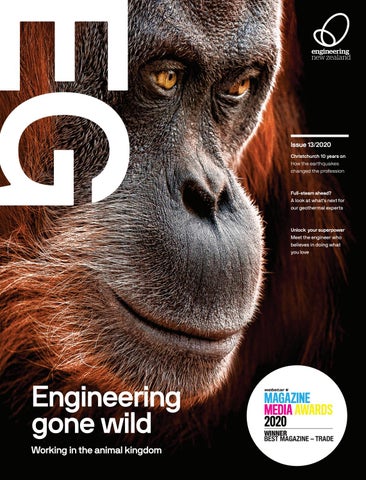
Issue 13/2020 Christchurch 10 years on How the earthquakes changed the profession
Full-steam ahead? A look at what’s next for our geothermal experts
Unlock your superpower Meet the engineer who believes in doing what you love
Engineering gone wild Working in the animal kingdom
WINNER BEST MAGAZINE – TRADE
Helping New Zealand keep on building
In this issue
06 Christchurch 10 years on Some of the biggest lessons for engineers have been personal. 12 Engineering gone wild Meet the engineers applying their skills to the animal kingdom. 24 Full-steam ahead? As early adopters of geothermal energy, Kiwi engineers have for decades shared their geothermal energy knowledge and expertise abroad. 54 Inside job Could doing what you love be a superpower?
06
12
24
54
Features
Engineering New Zealand Te Ao Rangahau PO Box 12 241, Wellington 6144 New Zealand P 04 473 9444 hello@engineeringnz.org www.engineeringnz.org EDITOR Jennifer Black editor@engineeringnz.org DESIGN MANAGER Angeli Winthrop ADVERTISING SALES advertising@engineeringnz.org 04 473 9444 SUBSCRIPTIONS hello@engineeringnz.org CIRCULATION ABC audited net circulation for the six months ended 31 March 2019. New Zealand 14,311 Print ISSN 2537-9097 Online ISSN 2537-9100 EG ONLINE PDF versions of EG are available for members on our website or through our EN.CORE app. PRINTING Your cover is printed on Forest Stewardship Council (FSC) approved and elemental chlorine free (ECF) paper. The inside pages are Programme for the Endorsement of Forest Certification (PEFC) approved and elemental chlorine free (ECF). EG is printed using vegetable-based inks made from renewable sources. Printing and fulfilment by Printlink. Please recycle your plastic wrap – it’s New Zealand made and 100% biodegradable.
06 Christchurch 10 years on Some of the biggest lessons for engineers have been personal. 12 Engineering gone wild Meet the engineers applying their skills to the animal kingdom. 18 Taking the lead Having a female leader can help boost a company’s bottom line. Three key players in the engineering sector reveal how they’re doing things differently.
24 Full steam ahead? As early adopters of geothermal energy, Kiwi engineers have for decades shared their geothermal energy knowledge and expertise abroad. 30 Next stop: Bay of Plenty Land of plenty
Best practice 38 Cultivating culture The culture of an organisation reflects its values. So, how can you measure it, and how can you improve it? 39 Learning from mistakes A new, confidential scheme with a no-blame approach allows engineers to learn from the mistakes of others. 40 Landing pad While the aviation sector often takes the first hit when economic shocks strike, there’s a stable base – or landing pad – for its professionals.
43 Re-calculating risk An industry-wide response to dangerous risk allocation and unfair contract practices is needed to avoid serious ramifications for New Zealand’s construction sector. 44 Shaking up building standards How the 1931 Hawke’s Bay earthquake led to New Zealand’s first building codes. 46 Engineering that’s good enough to eat Global trends in the food industry mean good hygienic engineering and design practice are vital. 48 Intersection Crossing paths with engineers.
Shorts
DISCLAIMER Advertising statements and editorial opinions expressed in EG do not reflect the views of Engineering New Zealand, its members, staff, or affiliated organisations unless expressly stated.
50 The secret life of engineers Roger Williams QSM FEngNZ on why conservation has been a huge part of his life. 53 Leading questions
56 Bedside table Award-winning engineer Dr Najif Ismail CMEngNZ CPEng lets us in on his reading choices. 57 Review 59 Obituaries
This issue of EG was published in December 2020.
54 Inside job Could doing what you love be a superpower?
60 Engineering genius
What they said
03
Future focused
“I enjoy my work so much that I don’t even think of it as work.” University of Canterbury Computer Science and Software Engineering Department’s Dr Richard Lobb wins the university’s Teaching Medal.
EG is a trade magazine that has consumer magazine appeal. It cleverly walks the tightrope: delivering to its core audience of engineers, while also appealing to a wider audience. It’s modern, topical, and always interesting.
Nau mai koutou katoa.
Caleb Anderson (12), set to be
It’s been a huge year and Covid-19 has not only presented many challenges, but has also detracted from other challenges that we as a profession still need to address. We must remember that as engineers, we make things happen for the benefit of New Zealanders and in doing so, must protect our environment and the security of future generations. Engineering is a very broad sector. But regardless of what we engineer, and how we contribute to society, whether as a software engineer or a mechatronics engineer or a civil engineer, we must do it in a way that aspires to get the balance right between people and the environment, with water also a crucial factor here. Overseas examples suggest a low carbon way of doing things means a lower operating cost, so why are we so slow to adopt activities that will get us on track for a net carbon economy by 2050?
youngest aerospace engineering student at Georgia Tech, USA.
While we need to be mindful of the impact this transition will have on society – it will
Judges’ comments at Webstar Magazine Media Awards 2020.
“Pasifika are underrepresented in engineering and I hope to show the possibilities available in STEM for younger students who are still deciding on a career path.” Toloa Tertiary Scholarship winner Aisea Fanamanu, final year BE (Hons), University of Auckland.
“I have this distinct memory of going to a first grade class and learning there, and everyone was way taller than me because I was two – I could barely walk.”
change many aspects of our everyday lives – why are we all bunched up at the start line trying to figure out what to do? While the urgency of Covid-19 took the spotlight off this challenge, it could now provide a shining light. With fiscal stimulus money still to be properly allocated and implemented, we owe it to future generations to ensure it goes towards carbon-efficient ways of doing things. Then we will know we are on track for lowering costs in the future, and for getting that ideal balance between people and the environment. As we approach the end of 2020, I am delighted to see Richard Templer FEngNZ in place as Chief Executive of Engineering New Zealand – see p53 of this edition for some of his leadership insights. I would like to wish you all a happy and relaxing festive season. Do take time out to relax and re-charge, reconnect with friends and family, and look after your own mental health. Colin Crampton FEngNZ President, Engineering New Zealand
04
EG 13/2020
Angkor Wat: Cambodia
Angkor Wat is an amazing feat of ancient engineering construction. It’s the largest religious monument in the world by land area, measuring 162.6 hectares. The temple complex, which appears on the Cambodian flag, was recognised as a UNESCO World Heritage Site in 1992. It’s made up of sandstone blocks held together with mortise and tenon joints, and in some cases vegetable compound instead of mortar. Between 2012 and 2015, lasers were fired from an aircraft into the dense vegetation on the ground using lidar (light imaging detection and ranging) technology. This found networks of roads and canals, revealing a previously unknown city existed around the monument, about the size of Los Angeles.
Construction began in the
early 1100s 5 million tonnes of sandstone were used
Each stone block weighed up to
1,500kg Blocks were carried
50km
from the quarry site It took around
30 years to complete
Engineering Envy #70
It would be amazing to watch the sun rise over the temples, quietly contemplating life. – Leanne Asher, Professional Development Partner Advisor, Engineering New Zealand
Christchurch 10 years on
12 Engineering gone wild
18 Taking the lead
24 Full-steam ahead?
30 Next stop: Bay of Plenty
Features
6
06
Christchurch city centre, September 2020.
EG 13/2020
Feature
07
Christchurch 10 years on WRITER MATT PHILP
With the 10th anniversary of the September 2010 Canterbury earthquake gone, and the equivalent milestone for the 22 February 2011 disaster fast approaching, there’s likely to be plenty of reflection, including among engineers. So, what are some of the biggest professional – and personal – lessons learned?
>>
EG 13/2020
08
1
2
When Holmes Group CEO John Hare FEngNZ CPEng IntPE(NZ) looks at Christchurch’s evolving postearthquake cityscape, he sees something missing. It’s not the heritage-sized hole left by much-loved historic buildings – although they are sorely missed. No, what John’s engineer’s eye sees is a positive absence, evidence that a critical lesson of the quakes has been absorbed in the rebuild. There are few ductile concrete moment resisting frames, and – you’d hope – fewer precast concrete floors in the city’s new buildings. “That was once all we used to do,” says John, who spent two years as principal engineering advisor to the Canterbury Earthquake Recovery Authority (CERA). “You’ll hardly see any of those as new construction in this part of the world now – and that’s a good thing.” So how have engineering practices changed over the past decade? How well have we adapted to the seismic challenge? And beyond buildings and infrastructure, what lessons have engineers taken from the human impact? Johns says one surprise of the 6.2 magnitude quake was the havoc it wrought with some modern buildings. “The real horror story of both the Christchurch earthquake and the Kaikōura event has been the level of damage to precast concrete flooring systems, which have been commonly used in New Zealand for a long time,” he says.
“Some of the older buildings actually performed better than might have been expected because they had more robust in-situ floor systems.” That particular lesson has still not been taken on board, he says. Attention is being paid to alternatives commonly used overseas such as post-tensioned concrete flooring, but there’s resistance in the industry. Sure, precast concrete systems are cheap and widely available, he concedes. “But, frankly, their ongoing use is questionable unless we find considerably different ways of dealing with them.” Looking more broadly, however, he does see changes for the better. Floors in commercial buildings of any scale are now more commonly steel composite systems – or even timber in some cases. “And people now are a lot more conscious of looking at seismic form, seismic structure – almost to the point where developers and tenants want the bracing on show so you can see that it’s safe.” The sheer number of structures condemned after the earthquakes has also changed thinking about building resilience. “People are choosing systems that are less likely to be damaged and more easily repairable. There are now quite a lot of base-isolated buildings being constructed. “Previously, there were just a handful and they tended to be very specialised buildings – hospitals, Te Papa, seismic
>>
Feature
09
1. Building damage in Christchurch CBD following the 22 February 2011 earthquake. Image: Jan Kupec 2. Land scar in Clifton. Image: Jan Kupec 3. Base isolators were used in the construction of the Justice and Emergency Services Precinct. Image: Holmes Consulting LP 4. Justice and Emergency Services Precinct. Image: Dennis Radermacher
3
4
retrofits of important heritage structures – whereas now it’s seen a little more as something you might build into more routine buildings.” However, he cautions that the use of new technologies doesn’t necessarily mean we can relax. One of Christchurch’s biggest lessons – an old one, but it was rammed home by the earthquake – was of the importance of keeping things simple. “The more complicated your systems are, the more likely you are to get failures,” he says. “With low damage design, a lot of people immediately think ‘high-tech’, ‘base isolation’, ‘viscous dampers’, and that sort of thing. But actually, if you do a bad design and put that technology into it, it will still be a bad design. “The key is thinking not just about technology, but how we can keep things simple and regular.”
Changes from the ground up There’s also the question of the ground on which we build. More than 400,000 tonnes of silt came to the surface during the two earthquakes as a result of liquefaction, and swathes of Christchurch were rendered uninhabitable. Veteran geotechnical engineer Dr Jan Kupec CMEngNZ CPEng IntPE(NZ), who leads Aurecon’s ground engineering team in the city, says that aspect of the disaster was a shock.
“In Christchurch, everyone – at least in the industry – appreciated there was a liquefaction hazard; it was always evaluated on a property-by-property basis. But no one thoroughly understood what it would look like if a large earthquake hit. That lesson has been learned. The industry and regulatory bodies now appreciate much more the impact on society from a natural hazard.” He adds: “We have changed how we develop land, and what land we want to develop. We’re better at assessing the strength of the ground and its ability to respond to earthquakes, and we have improved foundation design significantly.” This heightened appreciation of risk goes beyond earthquakes. “It relates also to hazards such as climate change. We now appreciate that if you place a residential development near the seashore, for example, then you need to account for all the hazards associated with that.”
The impact on people What of the human side of the earthquakes? What did Christchurch teach the engineering profession in that regard? Engineer Rob Kerr CMEngNZ CPEng IntPE(NZ) has had plenty of opportunities to ponder the question. He was brought in to run Waimakariri District Council’s infrastructure recovery following the first quake.
>>
EG 13/2020
10
>> 1
He later spent time as general manager of the red zone and led a number of anchor projects, as well as the planning for the redevelopment of the Ōtākaro Avon River Corridor. Rob says he came to understand “The Rebuild” as being a distinct thing from “The Recovery”. The former is a tool to deliver the latter, which is all about moving on from uncertainty and anxiety. He cites a couple of anchor projects. The Margaret Mahy Playground involved a lot of “very interesting” engineering, but its significance was really as a “beacon of what Christchurch could be like”. Similarly, early public consultation over reconstructing a particular area of Kaiapoi might, on the face of it, have been about carriageways and footpaths, but actually it was more about engaging people in thinking positively about
optimism bias. Too many times in Christchurch things were over-promised, and when they failed to materialise, it generated distress and distrust – and remember that we were in a context where there’d been some failures of engineering.” Rob says: “It’s vital that when we provide leadership, that not only are we trustworthy and credible, but that we tell the hard truths as well.” Expertise, credibility and communication are key. Rob agrees not every engineer will have all three. “It’s really important that those who can communicate and who do have engineering expertise step up and lead.”
the future. “This is where I think our profession sometimes lets itself down by failing to recognise the purpose of what we’re doing,” he says. “The purpose of fixing a sewer is not to fix the sewer, but to enable the community to do a, b, c and d. So, the way we do things is really important.” Christchurch exposed weaknesses in that regard. “Sometimes, we engineers might know things, but we are really bad at explaining them. We also suffer from
The team at structural engineers Ruamoko Solutions, for instance, had barely moved into their new office on the corner of Manchester and Worcester Streets when the February quake hit. They watched buildings collapse, and within hours were thrust into the Civil Defence effort. For the next fortnight, a team of eight operated out of Managing Director Julian Ramsay’s CMEngNZ CPEng IntPE(NZ) lounge. “We were running on fumes,” says Julian. “And that remained the case for the couple of years,
The impact on mental health Of course, in Christchurch engineers were also among those affected by the trauma and stress of the disaster.
1. Eddy Snook, photographed in Krakow, Poland. Image: Wioletta Kawulak 2. Construction of Te Pae Christchurch Convention Centre. Image: Ōtākaro Limited
Feature
workload through the roof, trying to do our bit for the city.” He saw the same pattern repeated among other engineers. “You were highly sought after as an engineer following the quake, and tried to do everything you could, but it was to the detriment of a lot of people’s mental health – and I think the effects of that are still being felt.” For retired structural engineer John Snook CMEngNZ, the mental toll of the earthquakes cut too close to home. John and his wife Linley lost their 33-year-old engineer son Edward to suicide three years after the second quake. A thoughtful, adventurous and happy man, “Eddy” was unmoored by the February event, becoming increasingly anxious and obsessed with safety. His work with a local engineering firm was affected; a return to London, where he’d previously been employed, ended with his father
know you can get better.” That message also goes out to employers in his profession. “Engineers have a stressful life anyway, and I think it’s important for employers to make facilities available for the wellness of their staff – and, again, to communicate, and give people time out if they need it. These are things we feel strongly about as a family.” There will be many other families reflecting on absences around the table when 22 February rolls around. We acknowledge their grief. And it’s likely that engineers and others in the construction industry will be prompted to think about what more could be done to make our built environment safer. But the 10th anniversary won’t be without an upside for some. “I’m looking at it positively,” says Julian Ramsay.
having to bring him home. John believes there’s been progress in New Zealand since then in talking about mental illness. But in 2011, communication wasn’t as open or effective. “It’s important to face up to these things, to recognise the signs early, those changes in behaviour, and for the person affected to realise there’s no shame or stigma about having certain feelings,” he says. “We need to treat mental illness like any other form of unwellness. Don’t hide it away; keep your self-esteem; and
“There’s more resiliency in our buildings, and some amazing new ones have been built – Tūranga, the new convention centre and the justice precinct are impressive in anyone’s eyes. I regularly reflect on the time I walked down the city mall on February 22 and think ‘wow, we’ve come a long way’.”
2
Engineering New Zealand has a range of wellbeing resources – find out more at engineeringnz.org/ engineer-tools/wellbeing
11
12
EG 13/2020
Engineering gone wild WRITER MATT PHILP We’ve all heard about animals as engineers – beavers and their mud-andbranch lodges, the ovenbird’s ingenious nest, and, of course, bees and their perfectly wrought hexagonal hives. But human engineers working on behalf of animals? That story’s less familiar. From perfecting zoo habitats to improving veterinary surgery, here are some instances of New Zealand engineers bringing their skills to the animal kingdom.
Feature
13
Charlie, a male Bornean orangutan, at home in Auckland Zoo’s new South East Asia Jungle Track high canopy primate habitat. Image: Auckland Zoo
>>
EG 13/2020
14
Step inside the animal kingdom
>>
Fancy a stroll through tiger lowlands, big cats prowling on a bridge above your head? Or how about going face to face with a crocodile in a tropical swamp forest? Auckland Zoo’s South East Asian Jungle Track takes the philosophy of bringing visitors closer to nature to a whole new level, inspired by conservation science and enabled by engineering smarts. The $60 million project is the most ambitious undertaken in the zoo’s nearly 98 years, and when completed late in 2021, will span one-fifth of its territory. A high canopy primate habitat for orangutans and siamangs opened in winter 2020, along with a new café, Te Puna. Still to come: an aerial primate pathway network strung 25m above the high canopy habitat and out over the zoo’s central lake. Also, an Indonesian swamp forest under a transparent, climate-controlled dome; and a habitat for tigers and small-clawed otters with bridges, elevated ridges, plantings and pools. All the habitats will feature “shared shelters” where people and animals are separated only by glass. “Our design objective and mission is to bring people together with animals, with each other and with nature to build a future for wildlife,” says Auckland Zoo’s Head of Facility Services Monica Lake. Lead engineering consultant Jacobs has contributed through every stage, starting with an investigation
Artist's impression of the South East Asia Jungle Track lowlands habitat at Auckland Zoo, due in 2021. Image: Auckland Zoo
The engineers needed to understand how our animals move and what kind of loads they present. – Monica Lake
of the zoo’s challenging ground conditions and an infrastructure plan. Three-dimensional laser scanning technology was used to compare existing site features with the primate’s proposed climbing network. Engineers were instrumental in the revitalisation of the central lake, and collaborated with the zoo’s design firm, Studio Hanson Roberts, to develop the primate habitat’s “canopy climbers”, which mimic the lines of a tree in steel, as well as aerial pathways. They were also key to designing the features that safely separate animal and human. All of it involved close collaboration with the zoo’s Life Sciences staff, says Monica.
Feature
15
1 1. A little blue penguin. 2. Veronica Byrne (WCC) and Alastair Judkins (Kaikōura Ocean Research Institute) with Mena the penguin dog. Images: Wellington City Council
“The engineers needed to understand how our animals move and what kind of loads they present. What limits would we need in terms of sag of ropes? As an apex predator that likes looking down on its prey, at what height should the tigers’ bridges be? What are the specific climatic needs of crocodiles from the tropics? There were many conversations over a three-year period.” The fruits of that collaboration are already obvious. “Seeing our orangutans and siamangs living high up in the trees and canopy climbers, as these arboreal species live and behave in the wild, is just beautiful,” Monica says.
When penguins rule the roost Over the past year, Wellington City Council engineer Veronica Byrne has had to deal with an unlikely complication on a council infrastructure project: penguins. The project, which includes new walking and biking paths, landscaping and a 430-metre-long rock revetment, is under construction on the seaward side of Cobham Drive, a notable nesting and moulting habitat for little blue penguins or kororā. Every morning, the contractors check their diggers and equipment to be sure no errant bird has taken up
2
residence during the night, and use a special camera to check between rock crevices for nests. If there’s any risk to the birds, the DOC-approved management plan dictates that work should immediately come to a halt. And that’s only part of it. Landscaping has been designed to keep penguins off the road, and a marine biologist was consulted for penguin-friendly lighting. Additionally, the new boulder wall has been built to provide new habitat options for the birds. “The project really runs around them,” says Veronica, who has been through a steep learning curve in the past year. “As an engineer, this was my first time working with little blue penguins. I’ve learned a lot, and it’s been challenging, but nothing impossible.”
New tricks for dogs For a dog, living with canine cruciate ligament disease is the equivalent of a human athlete “doing their ACL”, but with a couple of significant differences. In the dog’s case, it’s a degenerative condition and the surgical fix has tended to be less successful. Enter Christchurchbased OssAbility, a veterinary implant and surgical
>>
EG 13/2020
16
instrumentation firm that has upended traditional cruciate surgery, reducing complication rates and helping more dogs regain normal, pain-free movement. The company was founded in 2013, when veterinary surgeon Brent Higgins met then mechanical engineering PhD candidate Seamus Tredinnick. The former was frustrated by the traditional “practice makes perfect” approach to new procedures. The latter was developing a new 3D-printed titanium implant for human orthopaedic patients. Says Seamus: “We saw no reason why animals couldn’t and shouldn’t have access to the same fantastic technology.” In terms of hardware, OssAbility has introduced a 3D-printed porous titanium scaffold that stimulates the surrounding bone and promotes healing, as well as a
>>
stainless steel osteotomy guide that can be reconfigured for every surgery. But the company also promotes deep engagement with the surgeons who use its products, from pre-operative planning to workshops to post-op debriefing.
Ossability Guided TTA (Tibial Tuberosity Advancement) allows surgeons to precisely control where to drill and cut bone. Image: Seamus Tredinnick
We saw no reason why animals couldn’t and shouldn’t have access to the same fantastic technology. – Seamus Tredinnick
The cumulative effect has been to widen treatment access –“your local first-opinion practitioner is now able to confidently perform this orthopaedic surgery” – while “massively” reducing the complication rate. Seamus says the surgical guide is key. The procedure relies on cutting bone and repositioning part of it. “By controlling that through a surgical guide we can make sure we don’t weaken the weight-bearing part.” For an engineer who once wanted to design yachts, using his skills to help animals has been an unanticipated but hugely rewarding ride. “Working on medical devices and implants is a great reason to get out of bed in the morning,” he says. And yes, he has a dog, a Miniature Schnauzer called Nemo. “He’s well insured!”
Feature
Trail(er) blazers Back in 2006, Gary Neal needed a trailer for his St Bernards. Nothing on the market seemed right, so Gary, the General Manager of Hastings-based Wassco Engineering, built one himself – then promptly sold it at the first dog show. He built a replacement – and someone asked if they could buy that one, too. And so K9 Caravans was established as a division of Wassco, constructing trailers for the domestic and Australian market, mostly for the greyhound racing and dog show sets. What makes the trailers so popular? Gary points to the high-density hydrophobic foam insulation, the smooth and comfortable ride, and the heavy-gauge steel frame designed to protect dogs in an accident. “It’s all about the comfort of the dogs. You don’t want to get to a show with them all shook up, and you want your greyhounds nice and rested,” he says, adding that feedback from the hounds tends to be just as complimentary. “One lady told me that they used to have to drag their dog into their old trailer – with the K9, they had to drag him out of it.”
Cutting edge techniques for polo Equestrian polo is a sport anchored in long traditions, where nothing moves fast, other than the ponies. That said, engineering academic and materials scientist Dr Paul Ewart CMEngNZ (Eng. Technologist) is working on ways to bring a cutting-edge to equestrian polo.
One of Wassco Engineering's K9 caravans. Image: Wassco Engineering
Paul and his sports science colleagues at Wintec have been looking at the traditional cane mallet to see if it might be possible to introduce efficiencies into the design and construction. The process involves characterisation of the existing designs by flex-testing and load-testing the mallets and fitting them with sensors to see how they perform in a match situation. The complicating factor here is the need to consider animal welfare. Ponies are at risk of being hit, he notes; it’s why polo has largely continued to use natural materials for mallets. The project is a first of its kind and remains a work in progress. There are other developments where smart engineering could be of advantage for the ponies. Saddles, for instance. “We’re looking at the stress to the animal that comes from overheating, and the potential use of more breathable materials and creating fabric structures with inbuilt cooling channels,” says Paul, who adds that the “wraps” used to protect ponies’ legs from injury are also being looked at. “We’re talking there about being able to create reinforced composite materials, using woven and nonwoven fibre structures backfilled with polymer foam. “These advances would enable impact resistance, strength and cooling capability not currently seen.” In polo, he points out, elite players are treated like stars. “There’s no reason why we can’t look after the animals just as well.”
17
EG 13/2020
18
Taking the lead CONTRIBUTORS
ATTHEW PETERS M ALEXANDRA JOHNSON
Feature
19
Successful businesses are interested in more than just making money. But what if research showed there was a secret weapon to help boost a company’s value in the marketplace? For example, having a female leader at the helm. Appointing a female CEO is worth nearly A$80 million to the average company, recent Australian research shows. The report, Gender Equity Insights 2020: Delivering on Business Outcomes, shows having more women in key leadership positions – and on boards – drives better company performance, more productivity and increased profitability. So, what makes a great leader in the engineering sector, traditionally a male-dominated sphere? A combination of factors, according to three women with first-hand knowledge. Van Tang, Tracey Ryan and Dr Troy Coyle each bring their own styles and personalities to their leadership role. They’re all highly successful and while they have a differing approach to leadership, there are similar themes. The importance of trust. Of leaving a legacy. Of developing the next generation of leaders. The value of diversity and inclusion, along with thriving staff. Then there’s the need to keep learning as a leader. Not to mention innovating so you can lead well during the unexpected, such as a global pandemic.
>>
EG 13/2020
20
>> Van Tang. Image: GHD
Trust, curiosity, legacy, diversity As a leader, Van Tang’s philosophy is to have complete trust in her people to do their jobs. This was put to the ultimate test when she joined GHD as New Zealand and Pacific’s General Manager in February, at the onset of the global Covid-19 pandemic. “I didn’t know the business in New Zealand, didn’t know the clients and the people, and then we went into lockdown – what could possibly go wrong? “My approach was to lead with 100 percent trust in the people around me. Through Covid-19, I had to do that. I had to work with the team who at the time I didn’t know very well (nor did they know me very well either), and I had to trust their judgement." Van says: "I didn’t have a lens on a lot of what we were doing, but I think leading with trust has been key to us coming out the other end in good shape.” Before relocating to New Zealand from Australia, Van had already been with GHD for more than 14 years, including in technical roles in the aviation sector working on airport projects around the world – “the travel was awesome” – and more recently in managerial positions in South Australia.
Originally from Vietnam, Van arrived in Australia by boat as a refugee when she was just three years old. At school she loved maths and chemistry. As she got older, she became keenly interested in engineering, not just the technical elements but also the aesthetic of good design and why it matters. “The built environment is so important. I love thoughtfully designed public spaces, whether that’s architecture, engineering or urban design, the way it can influence your life."
Don’t ask just one question – it’s the third and fourth question that allows you to dig deeper. – Van Tang
Feature
Equally passionate about people and ideas, she studied humanities alongside engineering at university. She admits it was an unusual mix. Going from a pure maths lecture into her Chinese philosophy class, she’d need a good 10 minutes to recalibrate. But doing humanities allowed her to mix in different circles, and she says she’s a better engineer for it. Naturally curious, Van was that child who was always asking questions, and she still does. Asking questions is a key part of being a leader, she says. “It doesn’t mean I agree or disagree, I just ask the question to test our thinking to understand whether we’ve thought wide enough. And don’t ask just one question – it’s the third and fourth question that allows you to dig deeper. “ Van sees her job as fundamentally being about developing the next generation of leaders. “As you grow into your career, legacy becomes increasingly important. One of the first things as a manager is to consider who’s going to replace you." Van’s conscious of the need to create a more diverse engineering profession and ensures inclusivity is reflected in GHD’s workplace culture and behaviour. “A friend said to me, the difference between diversity and inclusion is this: diversity is being invited to the dance and inclusion is being asked to dance… it’s no use having diversity in your business if you’re not inclusive about it.” Everyone in the workplace has a role to play in creating the culture they want, and Van says it’s her job to empower people to do that. “Don’t be a passenger. We’ve all got a role to play in creating our family culture, our community culture and business culture. I do enjoy creating and being part of high-performing teams – that sense things are humming, that’s really fulfilling for me.” Van’s loving the new role and the New Zealand way of life, and her family are benefitting from the move to a country of green open spaces. She says while New Zealand and Australia are very similar in many ways, there are some business culture differences. She says in Australia people are more direct and more comfortable being challenged. “A colleague described this beautifully to me once as ‘in Australia you can have strong conversations in the boardroom then go for a beer afterwards. Whereas if you had the same robust conversation in New Zealand you probably wouldn’t go for that beer’.” Van is an engineer at heart, and does miss the energy and excitement of delivering technical services. Ultimately, however, she’s doing what she’s always done but at a more strategic level. “Engineering is about legacy. We develop outcomes for our clients and the communities they serve. Now, our challenge is to look to the future and deliver a legacy for our future communities.”
21
Leading with courage and kindness Tracey Ryan stepped into the role of Managing Director, New Zealand for Aurecon in February. Little wonder then that her priority over the past few months has not only been business continuity, but the wellbeing of her 850-strong team, and responding to the pandemic’s shifting challenges. Top priority was getting staff working safely from home. “We had a strong flexible working policy so we were able to do that quickly and seamlessly.” Following that, she says the biggest focus was stress and anxiety, including how people could work when removed from their teams, and the stress parents with young children experienced juggling responsibilities. The certainty of workload was another stressor, “and, initially, a lot of our work was postponed, so that created some fear”.
Tracey Ryan
>>
EG 13/2020
22
There was also the concern staff would start to burn out, or experience “surge capacity”, when the ability to constantly respond to new stressors becomes exhausted. Aurecon provides support to staff through counselling, training, seminars and webinars, and keeping people connected. “And people just want a bit more security and certainty, so showing people we have a strong business is important. We continue to be busy and win work, and we continue to introduce some great innovations, so it’s about bringing those stories through to our people.” Tracey describes her leadership style as very caring. “My two core values are courage and kindness, and I bring these to the heart of my decision making. I would describe my leadership as empathetic, transformational, and inspirational to a certain point.”
My two core values are courage and kindness, and I bring these to the heart of my decision making. – Tracey Ryan
Creating an inclusive culture drives her, as does helping people feel a sense of belonging. “I want people to bring their whole selves to work and feel safe, but also empowered and able to flourish." She says it’s very important to her that people can be their best and also bring that best experience to clients. This is partly achieved by ensuring the leadership team is part of diversity and inclusiveness conversations. “We have wonderful D and I champions, we have KPIs and objectives and we are very visible, it’s not a tick box exercise.” Aurecon was the first consulting engineering company in New Zealand to be Rainbow Tick certified. Tracey is focused on what makes the organisation future ready, and how innovations made during Covid-19 can be utilised long term. She says lockdown expediated some innovations they had in the pipeline. “Things that may have taken a couple of years were achieved in a couple of months. For example, where people might have done site visits, during lockdown they were able to continue work using digital platforms like 3D
photos and point cloud scans and provide support for some of our sites in that way.” While sustainability has long been a priority for Tracey, the pandemic accelerated progress there too, including reducing staff travel. The leadership team has reduced its carbon footprint by 50 percent by switching operational meetings online. Currently, 30 percent of Aurecon's employees are women and that's set to increase. “We have to make sure that we remove the traditional stereotyping and biases.” Aurecon recently won the Work Life Balance Award from Diversity Works New Zealand for its shared care scheme and flexible working policy. The organisation is a founding member of University of Auckland’s Women in Engineering Network and a Diversity Agenda Accord Signatory. “And there’s still a lot of work to do as far as stereotyping of what an engineer looks like, so a big part of that is going back into the schools and being involved there.” Tracey says the company is intent on creating long term benefits to communities through the work they do. “It’s about creating a legacy, rather than just looking at the project in a linear way, and a lot of that is partnering with local iwi,” she says, acknowledging there’s more work needed in this space, but that Aurecon’s committed to it.
Committed to continuous improvement A traditional industry such as heavy engineering mightn't be where you'd expect to find a radical change maker, but that’s where Troy Coyle, CEO of the Heavy Engineering Research Association (HERA), is making waves. Originally from Brisbane, she’s had a unique career journey, moving from achieving a Doctorate in Marine Science and a Master’s in Communication to multiple industrial research, management and innovation roles. Troy says her leadership differs from a traditional style due to the nature of her work history. “I’ve always been involved in innovation and the commercialisation of new technologies so working in a traditional industry and having that kind of approach can be quite disruptive or transformative. It is not the norm.” Well-read and committed to continuous improvement, Troy refers to social psychology professor Dolly Chugh, who writes about how people fight bias and approach social transformation. “She describes people as either radicals or moderates and I definitely would be a radical as I like pushing for structural change. That really motivates me and gets me excited, and that’s probably unusual.” Since taking the helm at HERA almost three years ago, Troy has shifted the organisation’s focus to increasing both Māori and women in engineering, and the digital transformation of the industry.
>>
Feature
“We have a big focus on improving Māori presence, particularly wahine. We have a relationship with Pūhoro STEM Academy, which encourages Māori in schools to consider STEM subjects, and what they are doing is truly transformative.” HERA also has a scholarship for undergraduate women entering engineering and is developing a Māori engagement plan. Troy says HERA has a reputation for being a reliable and trusted advisor for heavy engineering and she has been careful to maintain that. “I also recognise that there are parts of being a steadfast organisation that might prevent it from being at the forefront of new developments. The focus for me is on the future direction of the industry and looking at how we increase the capability to innovate, as well as providing
activities, to a narrow and quite different set of focuses.” She wants HERA to benefit long term from the silver linings from Covid-19, such as more flexible work practices. “Staff have been able to reassess what’s important in their own lives. The team is working flexibly and from home up to four days a week." In addition to reading widely and listening to podcasts, Troy is studying He Papa Tikanga at Te Wānanga o Aotearoa. She’s also passionate about animal rights and is a director of animal rights group SAFE, and holds a number of directorships. A dedicated women’s rights advocate, Troy says that if we believe women and men are equally capable then we should feel comfortable allocating space for women around the table, such as quotas on boards. “Affirmative action and skills-based appointments are
the underlying evidence-based research.” She says HERA has achieved a good mix of both old and new priorities. “Our foundational capability has been in welding and fabrication and structural systems and we’ve added on a third – innovation and digital communications.” Like in almost all industries, Covid-19 has forced HERA to change tack. “We have been significantly impacted in terms of our levy income... we have had to nimbly shift from what was going to be a very exciting year, budget and set of
not mutually exclusive. I think there’s a role for women of my generation to sit with the discomfort of people perhaps thinking they have been appointed to these roles for diversity reasons, so that future generations will not have that issue.” She says some of the reluctance around diversity, especially at a governance level, is that decision processes might slow down because there is more discussion and looking at things from multiple angles, “but this gives the right decision in the end and that’s ultimately going to save time operationally.”
23
Dr Troy Coyle. Image: Tim Hamilton
>>
24
>> Wairakei geothermal power plant. Image: Contact Energy
EG 13/2020
Feature
25
Full-steam ahead? WRITER RACHEL HELYER DONALDSON
As early adopters of geothermal energy, Kiwi engineers have for decades shared their knowledge and expertise around the world. But as Covid-19 clips the sector’s wings, can it still capitalise on the global need for renewable energy?
>>
EG 13/2020
26
In 1958, the world’s first geothermal power plant whirred into life to generate electricity using wet steam at Wairakei. That the technology was developed in New Zealand from scratch was “incredible”, and came from a quintessential Kiwi “get stuff done” approach, says New Zealand Geothermal Association (NZGA) past President Andy Bloomer CMEngNZ CPEng IntPE(NZ). “Within 10 years, they’d gone from not even having a basic knowledge of geothermal to a 90MW power station.” Six decades on, Wairakei is still running and New Zealand’s geothermal expertise is highly sought after internationally. But it is little-known outside the geothermal industry that New Zealanders have played a part in almost every geothermal development around the world.
Exporting our geothermal knowledge As early adopters of geothermal energy, Kiwi engineers and scientists, both private and public sector, took their knowledge to the world. New Zealand engineers were instrumental in building the first geothermal power plants in Indonesia, Philippines, Kenya and Papua New Guinea, and continue to have significant involvement here and globally. Government aid programmes have helped build power plants, and provide training in conjunction with the Geothermal Institute at The University of Auckland.
We bring in very good, long-term experience and we’re very happy to share that. – Dr Mike Allen
Institute director Dr Rosalind Archer FEngNZ says Kiwis are seen as trusted advisers, or “honest brokers”, selling expertise rather than components. “We bring in very good, long-term experience and we’re very happy to share that,” says Dr Mike Allen, executive director of Geothermal New Zealand (GEONZ), an industry association that promotes and markets Kiwi companies overseas. “New Zealanders have been possibly ‘over-generous’, particularly in the early days, he adds. “We didn’t give away stuff but it took us a while to realise that we could make money from it.” But in the past six years, the amount earned from exporting this expertise has shrunk. “It was probably getting close to $100 million a year, but it’s significantly less than that now.”
International development and the maturity of markets like Indonesia has, perhaps inevitably, seen an increase in domestic competition from local companies, Mike says. “We’ve shared our skills and we’ve upskilled people.” There’s also competition from other countries with similar geothermal expertise, such as Iceland.
Adapting and changing But, like those intrepid engineers and scientists who built Wairakei all those years ago, the New Zealand geothermal industry is adapting to change, and embracing new opportunities as the world looks for renewable energy alternatives. September saw the launch of a hydrogen production project at the Mokai geothermal power plant near Taupō. Halycon Power is a joint venture between Tuaropaki Trust and Japan’s Obayashi Corporation, and will see “green” (carbon-neutral) hydrogen produced using geothermal energy. Meanwhile heat (often seen as waste) from the Mokai geothermal field powers the Trust’s Miraka dairy-processing company and warms glasshouses for hydroponics. Geothermal is a tough market, says Mike Allen, who under the National Government was appointed New Zealand’s Renewable Energy Envoy in 2012. He continues this role as Renewable Energy Special Adviser under the Labour-led Government. But, drawing on heat from within the earth, geothermal also provides a consistent energy source, unlike wind or solar, which are weather dependent. “So the opportunities are there.” Currently the production of geothermal energy results in some CO2 emissions. The future of geothermal has to be “as close to carbon neutral as you can go”, says Rosalind. The Institute – seen as a hugely influential hub for both industry and government – has a big focus on sustainability. It is researching how that can be achieved, and developing its reservoir engineering expertise to better predict how long geothermal resources will last.
Kaitiakitanga A unique aspect of the New Zealand geothermal industry is its commercial partnerships with iwi. This extends to exporting this expertise and experience: in 2018, the Ngati Tahu Landowners Collective and Contact Energy worked with Kenya’s Maasai people to help them build a more equal relationship with state-owned power company KenGen. Indigenous people’s aspirations for geothermal energy are not just cultural, but economic, social and environmental, says Nona Taute-Hohepa, an Auckland University geothermal engineer who is doing his PhD on the cultural dimension of environmental impact assessments.
>>
Feature
27
1
2
1. Wairakei Geothermal Power Station, Taupo District, May 1957. Image: Alexander Turnbull Library, Ref: WA-44106. 2. Ngati Tahu and Contact Energy representatives with Maasai near a KenGen station in Kenya. Image: Contact Energy 3. Construction of the Karaha power plant in Indonesia, built with Kiwi engineering input. Image: Mike Allen
3
>>
EG 13/2020
28
Geothermal energy is a taonga, yet legislation such as the Public Works Act 1928 and the Geothermal Steam Act 1952 saw the Crown take or retain land to build geothermal power stations like Wairakei. But modern geothermal developments such as Rotokawa, Tauhara and Mokai do feel like equal partnerships for the iwi involved, says Nona, who is Te Arawa. New Zealand needs to take “a bit of a step up” when it comes to managing geothermal resources sustainably and respectfully. Iwi need more of a say in the maintenance of geothermal resources, while reframing “geothermal management” as “geothermal kaitiakitanga” could also help people look at geothermal management in a different way. “Kaitiakitanga for Māori is simply the practice, monitoring and upkeep of the environment. It is just
two decades have seen sustainable growth. New Zealand is now the fourth-largest producer of electricity from geothermal energy in the world, with geothermal energy providing 22 percent of its primary energy, including 19 percent of electricity generation. “I think geothermal is here to stay, it’s got a good future.” The geothermal industry has adapted quickly to the constraints of Covid-19. Wintec, the Geothermal Institute, and the Ministry of Foreign Affairs and Trade are putting training programmes for geothermal professionals in Asia and East Africa online. New Zealand Trade and Enterprise is organising digital conferences. Consultancy firms export skills and services to clients via webinars and are using online technology for remote site visits. People are thinking positively, says Mike. “Perhaps [working virtually] will overcome the huge cost
inherently understood. Whereas to professionals, kaitiakitanga is more of a concept they think they need to preserve for Māori. But kaitiakitanga is something that everyone should be doing.” Nona grew up in Rotorua, attending Te Kura Kaupapa Māori ō Ruamata from Years 1–13 and learning about geothermal resources from a Māori perspective. His PhD asks: “how do we maintain the indigenous, spiritual connection while progressing towards using more resources to make energy?” He says many professionals don’t realise that a lot of these values have a practical aspect. “It’s just a matter of finding what those practical aspects are, and how you can maintain those values, physically.”
of us flying to these other regions. If we can do it remotely maybe we’ll get more business out of it. Whether it’s as profitable, we have yet to see.” New Zealand engineers and scientists continue to innovate with new approaches, he says. Christchurchbased company Seequent’s Leapfrog 3D reservoir analysis software is used worldwide. Meanwhile Taupōheadquartered geothermal consultancy firm Upflow is doing “groundbreaking” work with machine learning. Its co-director, Andrea ‘Andy’ Blair, is also the International Geothermal Association’s new President. “Geothermal is getting more and more sophisticated. It’s about taking our technology to the next level,” says Mike. “Early on, we were all running around punching holes in the ground, trying to find steam. Now we’re learning about reservoir management, re-injecting the waste fluids, managing the resources long-term. It’s been a progressive change.”
Steaming ahead Historically the demand for geothermal energy within Aotearoa has been cyclic, says Andy Bloomer. But the past
Leapfrog geothermal imaging of the Wairakei-Tauhara geothermal system in Taupō. The image shows integrated 3D visualisation of subsurface geology, well deviation, well permeability (red spheres), modelled subsurface temperature (hot/cold colours), and zones of interest in the geothermal reservoir. Image: Seequent
>>
Feature
Creating “an enduring legacy”
Aaron Hochwimmer with the next generation of Jacobs’ Filipino engineers at the Makiling-Banahaw (Mak-Ban) geothermal power plant. Image: Aaron Hochwimmer
During his five years in the Philippines, Jacobs geothermal engineer Aaron Hochwimmer CMEngNZ CPEng IntPE(NZ) was conscious of “standing on the shoulders of giants” – the Kiwi engineers who have shared their geothermal know-how with their Filipino clients since the 1970s. Jacobs, for instance, has worked on more than 100 geothermal projects in more than 20 countries. It has exported this geothermal know-how to other parts of the world, such as Indonesia, Africa, and Latin America. In 2015, Aaron relocated his young family from Auckland to Manila to take up the role of country manager for the multi-national’s business operations in the Philippines. He led 200 office and field
29
staff and, from 2018, oversaw 600 people in the Philippines and Hong Kong as executive director of operations in East Asia. Jacobs’ work in the Philippines is multisector. But its Kiwi staff are famous, says Aaron, for their geothermal capabilities. New Zealanders excel in the kind of “out-of-the-box thinking and innovation” that is needed in the Philippines, where the engineering challenges are “complex”. Other Kiwi traits – “patience, empathy and being down-to-earth” – also held him in good stead there. One of Aaron’s and the wider Jacobs’ geothermal team’s biggest challenges came after a fatal 6.5 magnitude earthquake struck the island of Leyte in Eastern Visayas in 2017. The Mahanagdong B 60MW geothermal power plant suffered severe damage and the entire region lost power. Aaron, as project manager, and his team responded immediately getting the job done in record time, despite the plant’s remote location and aftershocks. Their smart, swift work saved millions and won two internal project excellence awards. Further highlights ranged from meeting Prime Minister Jacinda Ardern at a 2017 Philippines-New Zealand business event, to stretching his emotional range at the staff Christmas party. The three Kiwi engineers in the office had to perform a “hugot” – a Filipino concept that involves sharing deep emotions. “You can imagine the challenge for engineering types,” Aaron says. Jacobs has a well-established health, safety, and compliance culture. Along with others in the firm, Aaron helped share that culture with local project teams, clients, and stakeholders, leaving “an enduring legacy” in these areas. The benefits were two-way. He was struck by the high proportion of talented, female engineers in the Philippines business. This motivated Aaron, now back in Auckland as Jacobs’ director of operations for power in Australia and New Zealand, to sign Jacobs up to the Diversity Agenda Accord to ensure they remain accountable for their commitment to greater diversity in engineering. Find out more at diversityagenda.org/accord
EG 13/2020
30
Next stop: Bay of Plenty
Land of plenty
Population
308,499 Land area
12,071km
2
Engineering New Zealand Branch membership
611 Did you know‌ From the 1920s, holidaymakers began heading to Waihi Beach, Mount Maunganui and ĹŒhope due to improved roads as well as the railway.
Feature
31
WRITER RACHEL HELYER DONALDSON
One of New Zealand’s fastest-growing regions, the Bay of Plenty, attracts new residents and visitors alike with its sunny climate, pristine white-sand beaches and bright blue waters. Tauranga’s recent population growth has put pressure on infrastructure and its CBD is faltering. But, as these three projects show, resilience, and a commitment to regeneration and revitalisation, are at the heart of both the city and the wider region’s willingness to move forward.
Dynamic boost for Tauranga’s CBD Despite Tauranga’s population explosion, it’s no secret that the city’s CBD is struggling. But the new Farmers Tauranga Development – a $200 million project that mixes retail, townhouses, apartments and car parking – will bring “a new energy and focus”, says Brett Nicholls, project manager for Elizabeth Properties, part of the James Pascoe Group that owns Farmers. The flagship development is sited on “Farmers' corner”, where the department store has operated since the early 1970s. It will include two floors of retail and dining, more than 300 car parks and 120 residences. Its shops should open in mid-2021, exactly a century after Farmers first opened its doors in Tauranga. The whole building is due to be completed in late 2021. The primary engineering firms are Beca – providing building services and fire engineering design – and Holmes Consulting, which has led the structural design. The venture is the biggest in a series of projects to revitalise Tauranga’s CBD. It is also thought to be the largest mixed-use development project currently being constructed nationwide. “This project is all about creating an environment where people want to live, work and play,” says Beca director and lead for building services and fire engineering, Ben Hume. “The scale and nature of the project are complex, so we’ve drawn on our technical skills and digital capability to deliver a development that will enhance people’s lives and reinvigorate the CBD,” Ben says. Eva Cuttriss CMEngNZ CPEng of Holmes Consulting says “the development has shown the region’s ability to deliver these major projects using primarily local people”. “It’s been a huge team effort across all disciplines, and a great project for us all to be part of.” Liquefaction and settlement was an issue. The geotechnical solution has been to undertake one of the largest building
>>
EG 13/2020
32
ground improvement projects in the country, including the installation of 5,300 piles. “That’s over 70km of concrete piling and 32,000m3 of concrete – a huge and impressive undertaking.” “Certain retail spaces needed to be completed and occupied first, therefore the team utilised full 3D modelling to limit risks associated with construction,” adds Ben. “At its heart, the building and its systems are designed around people and making every day better for them.”
A vital link
More than two decades in the planning, the Southern Pipeline was built to give Tauranga’s wastewater network some much-needed capacity and accommodate future population growth. It was also crucial to reduce the risk of sewer overflows into the harbour. It's the biggest
Every day around 36,000 vehicles travel along the Baypark to Bayfair Link on State Highway 2 in Mount Maunganui. Local traffic heads to Bayfair Shopping Centre at one end, and Baypark Stadium at the other, while logging trucks travel to and from the Port of Tauranga. A significant portion of traffic comes off the Tauranga Eastern Link. The current upgrade to Bay Link, as the section of SH2 is known, is an “important, final element” of the eastern corridor. It will improve safety and enhance community outcomes, says Waka Kotahi NZ Transport Agency projects team manager John McCarthy. The original roundabout at the Maunganui-Girven intersection is being replaced with a larger version with traffic signals and a flyover to take SH2 traffic over
infrastructure project Tauranga City Council (TCC) has ever completed, costing $107 million and taking 15 years to build. The 10km network connects the city’s two wastewater treatment plants and incorporates three new pump stations. The final element of the plan was the $21 million Harbour Crossing, completed in July 2019. The installation of the longest pipeline of its kind in Australasia was by far the most challenging and innovative part, says Steve Wiggill, TCC’s project director on the Southern Pipeline project. Cutting-edge directional drilling technology allowed the contractors – led by Brian Perry Civil – to place the 1,550-metre-long, 710mm-diameter polyethylene pipe across the harbour, 35m underground. Another unique feature is that the plastic pipe is encased in a 1,000mm steel pipe. “It protects the harbour with double containment,” says Steve. Several setbacks delayed the project by 10 months. A reamer in the drilling rig was damaged when it struck a 50,000-year-old piece of totara. Meanwhile, the long steel drill pipe used to drive the equipment across the harbour snapped twice. “But our contractor, and specialist sub-contractor Lucas, persevered, and they came up with a product that works well.” TCC team leader for drainage services Wally Potts says the Southern Pipeline has given the city a unique way to deal with its wastewater. Most treatment plants are operated separately. But the two treatment plants at Te Maunga and Chapel Street are now linked up together. It allows TCC to better switch from one plant to another, and even manage the amount of flow between the two plants. It also means certain areas in the city, in the south and west, can be developed without overloading the nearest treatment plant, Wally says. “It future-proofs the city for growth, for wastewater for
the top. Improvements are also underway at the SH2/ SH29A intersection near Baypark Stadium, where state highway traffic will be diverted onto two grade-separated structures. Cyclists and pedestrians are catered for with safer connections and urban designers are involved in the new underpass that will link the shopping centre and street-level routes. Construction started in 2017 and is anticipated to finish in late 2022. The $146 million project aims to provide greater safety benefits for road users and the community and improves a vital route to the port. Separating local, through and heavy traffic is crucial to the upgrade, says John. Beca team leader Tim Haig CMEngNZ CPEng IntPE(NZ) says the biggest challenge has been logistical: “keeping traffic moving and users and the community safe while constructing two grade-separated interchanges in close proximity requires specialist skills and collaboration”. Engineering challenges have included the relocation of a railway line to make extra construction space. Noise and vibration effects were minimised by installing a rubberised low-vibration pad and a 210-metre-long concrete wall. In partnership with local iwi, the wall has also provided a space to share the cultural narrative of the area. Ground strengthening work is a significant part of the project, requiring more than 5,600 stone columns. Uncovering soft ground conditions earlier this year required an inventive concrete secant pile lattice design to achieve the right level of ground improvement and support. Straight-through traffic is diverted onto the flyover, reducing the number of vehicles passing through the new roundabout. Giving pedestrians the option to pass through the Bayfair roundabout at street level together with the new
the next 50 years-plus. It gives us a lot more resilience in the way we operate our network and our treatment plants.”
underpass provides multiple safe travel choices for pedestrians and cyclists, says Tim.
Going with the flow
>>
Feature
1
33
At its heart, the building and its systems are designed around people and making every day better for them. – Ben Hume
2
1. 3D render of the Farmers Tauranga Development, due for completion in late 2021. Image: Beca 2. Wastewater outer sleeve about to be pulled through the 1,550m tunnel under Tauranga harbour. Image: Tauranga City Council 3. Aerial shot of the Baypark to Bayfair Link project. Image: Chris Parker/Waka Kotahi NZ Transport Agency
3
Snapshot When results of a major renovation are revealed in April 2021, the Academy Museum of Motion Pictures in Los Angeles, California, aims to be the world’s premier institution devoted to exploring the art and science of movies and moviemaking. The 1930s Streamline Moderne building has been restored and expanded and a new spherical glass and concrete building added, housing a 1,000-seat, base-isolated theatre. It has been awarded Leadership in Energy and Environmental Design (LEED) Gold Certification by the US Green Building Council for building design and construction. Image ©Renzo Piano Building Workshop/©Academy Museum Foundation/Image from L’Autre Image
fast track
to a career in DEmand
Located in the heart of New Zealand’s booming infrastructure sector and with unparalleled industry partnerships, the University of Waikato is the ideal place to accelerate your engineering journey. Our Engineering Fast Track Graduate programme offers a career pivot to an industry with huge potential and the opportunity to complete a full-time engineering degree within two years instead of four. Specially designed for skilled workers whose jobs may have been impacted by COVID-19, this new programme comes at a critical time for New Zealanders looking to upskill or retrain.
“I see the Fast Track programme as a unique opportunity to diversify my skills and futureproof my career.” Dean Morris, student
Each student’s study path will be customised based on their prior qualifications and skills. Find out what your Fast Track journey might look like at eng.waikato.ac.nz.
39 Learning from mistakes
40 Landing pad
43 Re-calculating risk
44 Shaking up building standards
46 Engineering that’s good enough to eat
48 Intersection
Best practice
38 Cultivating culture
EG 13/2020
38
Cultivating culture VIVIAN CHANDRA
The culture of an organisation reflects its values. So, how can you measure it, and how can you improve it? Google hires some of the best talent in the world. But they found when they put those talented people into teams, the outcomes were inconsistent. Sometimes the teams performed well, but sometimes they struggled, even though every person had to pass through a rigorous hiring process. Google’s People Operations team wanted to find out why some teams performed so well while others didn’t. Google’s Project Aristotle reviewed half a century of academic studies on teamwork. They studied hundreds of Google’s engineering teams using the company’s best statisticians, organisational psychologists, sociologists, and engineers. They looked at the teammates’ interests, hobbies and educational backgrounds. But no matter how researchers cut up the data, they couldn’t find any patterns. Out of the most effective teams, some were composed of close-knit friends while others had people who were strangers outside of work. When researchers stumbled upon the concept of psychological safety, everything started to fall into place. Amongst all the data and research, how someone felt in the team made the difference. Former London Business School Professor Sumantra Ghoshal describes how you feel in a team as “the smell of
imagining you can almost “smell” it makes the intangible more tangible. The key is to make sure the people who work within your organisation are attuned, inspired, and energised by that “smell”: the distinct culture, values, and experience your company offers. Culture is simply the set of behaviours that people practice at work. These behaviours reflect your company’s values, and influence how people feel at work, and they can be measured. One measure is wellbeing. People can’t do great work when they're exhausted. Our cognitive resources deplete over time and we need breaks to refuel. Examining behaviours such as how often people are working long hours (ie during weekends or evenings) can provide insight into whether your team members are getting enough space for their own wellbeing. Measuring behaviours such as levels of participation in team conversations can show the level of psychological safety within any given team. As Google’s Project Aristotle research showed, when teams have high psychological safety, everyone is more likely to participate equally in conversations. When a team has low psychological safety, some team members may be reluctant to take part in public discussions. One easy way to look for this is to watch for whether everyone is getting a chance to speak in team meetings. Looking at who is, and who is not, getting feedback, and who provides support to whom can provide insight into whether
the place”. He said while measuring organisational culture was difficult,
your team supports each other to grow. When considering teams, and team
culture, diversity is important. Having diverse teams, and working on creating safe, inclusive workspaces, leads to better team culture. American academic Margaret A Neale says diverse teams have an advantage when it comes to managing conflict. She says when team members can see diversity, such as a person’s race, it cues a team there’s likely to be differences of opinion. Team members expect it and are not surprised when it occurs as can be the case in a more homogeneous team that is not expecting conflict. Making progress on diversity, inclusion, and team culture can be challenging. It takes time and requires people to acknowledge and engage with their unconscious biases and see how these intersect with the organisation’s ideal culture. We suggest you start with three simple steps. 1. Assess where you are today, perhaps by discussing your goals as a company or running an in-depth diversity and inclusion survey. 2. Set goals and create systems for accountability and change. Decide on what metrics you want to measure and set up ways to track that progress. 3. Experiment and learn. Find out more about improving your organisation’s culture, and diversity and inclusion outcomes, at allyskills.nz and multitudes.co Vivian Chandra is a facilitator at Ally Skills.
Best practice
39
Learning from mistakes MARTIN PRATCHETT MEngNZ
A new, confidential scheme with a no-blame approach allows engineers to learn from the mistakes of others. One of the issues identified in New Zealand within the engineering profession is the lack of sharing our mistakes, allowing others to learn from them. The topic was brought up by Gordon Hughes FEngNZ CPEng IntPE(NZ) at the 2019 Structural Engineering Society of New Zealand (SESOC) conference. One of the problems identified was liability concerns. If we admit we have made a mistake, we feel it opens us up to liability. As a result, we don’t broadcast our own mistakes and don’t widely distribute the mistakes of others in a “no-blame” environment, which could help prevent the same mistakes happening in the future. We’ve been working on the problem with other engineers and organisations and we’re launching two initiatives to help. CROSS-AUS Recently, a confidential reporting scheme called CROSS-AUS started in New Zealand. It is an offshoot of a system that has been active in the United Kingdom since 2005. It was established in Australia in 2018 and expanded to New Zealand in 2020. It captures and shares lessons learned from engineering safety incidents to help prevent future failures. It is a way for engineers to analyse and learn from the mistakes
and near misses of others. CROSS, which stands for Confidential Reporting On Structural Safety, covers structural and civil engineering. CROSS-AUS allows you to submit confidentially about structural safety issues or matters of concern. It’s not a whistleblowing scheme – it isn’t about alerting authorities to problems. Being confidential means lessons can be published that wouldn’t otherwise be shared. It allows reporting of safety issues without creating concerns about things like co-worker relations, client loyalty, or insurance. There is a no-blame approach. Reporting an issue to CROSS-AUS doesn’t remove your Code of Ethical Conduct obligation to engage with the appropriate regulator if that’s relevant. If you’re concerned about a problem, you need to take appropriate steps to make sure it’s resolved. Potentially, if action isn’t taken, this includes reporting it to the applicable regulator. You can sign up to CROSS-AUS for free at cross-aus.org.au There are already a lot of interesting resources there and reading this material counts towards your CPD hours. Learning from mistakes webinar series In 2014, while working at the University of Canterbury, Dr Glen Koorey CMEngNZ published the paper, Learning from Failures: Using Historical Engineering Projects to Teach Better Professional Engineering Skills. He introduced a paper at the university where students would
look not only at the technical reasons for engineering failures, but also the human factors behind the decisions that were made that led to the failure. He found there is a loss of institutional knowledge that occurs in a certain timeframe. When that knowledge is lost, the same mistakes that were made 30–50 years ago begin to happen again. Gordon, Glen and I have created a webinar series looking at engineering mistakes and the reasons behind them. These can range from common detailing errors through to larger failures/near failures. We have worked to involve as many engineering disciplines as possible. The first webinar is set to take place in December, then we plan to run them monthly in 2021. You can find the webinars on the Engineering New Zealand website at engineeringnz.org/courses-events
40
EG 13/2020
Landing pad DES ASHTON ONZM
Aviation and its engineering dimension have been vital to the development of New Zealand as we know it today. And while the sector often takes the first hit when economic shocks strike, as Covid-19 has shown, there’s a stable base – or landing pad – for its professionals. Engineers have been part of New Zealand’s aviation heritage since its earliest days. George Bolt was a famous pioneer engineer and pilot at the Walsh Flying School at Kohimarama from the early 1900s. He was a Royal Aeronautical Society (RAeS) Fellow and a founding member of the RAeS’ New Zealand Division in 1949. This brilliant engineer not only designed and built aircraft but became the chief pilot at the school. Aviation and its engineering dimension have contributed to some of history’s most spectacular technological triumphs and, conversely, well-publicised catastrophes. The success of New Zealand’s agricultural aviation industry, which provides services to primary production activities and associated rural activities, and the 1979 Mount Erebus disaster that resulted in a huge loss of life count as examples of each. It is an exciting profession, or rather collection of professions, often driving technology development that is taken up by other disciplines – for example, yacht racing. However, aviation often takes the first hit when economic shocks strike.
immediately flowed on to the rest of the aviation industry. Because of New Zealand’s geographic isolation, its topography, weather and large maritime economic zone, aviation has been, and remains, a vital contributor to the country’s sustainment, development and prosperity. Those factors also provide some unique challenges, many of which are covered at the monthly online continuing professional development presentations the RAeS New Zealand Division coordinates for aviation professionals. These presentations are managed by organisations employing RAeS members; for example, the Royal New Zealand Air Force and the Civil Aviation Authority. Parent organisation the RAeS (aerosociety.com) is a learned society, promoting and encouraging professional knowledge in aeronautics, aviation and aerospace and offering professional membership in those fields. It was established in the United Kingdom in 1866 and has more than 22,000 members worldwide. While most members are engineers, there are also pilots, astronauts, academics and aeromedical professionals. Also, people from fields including logistics, electronics, artificial intelligence, along with metallurgists, military personnel and scientists – and the proverbial “rocket scientists”. Only a few members regularly wear leather flying jackets and silk scarves though!
Covid-19 has devastated airline passenger numbers and this contraction has
The RAeS is a licensed body of the Engineering Council (United Kingdom),
accredited to award the professional qualifications of Chartered Engineer (CEng), Incorporated Engineer (IEng) and Engineering Technician (EngTech). Many New Zealand aeronautical engineers have chosen this path to certification partly because of its international transportability in the highly regulated aviation industry. The New Zealand division (aerospacenz. com) celebrated 70 years of continuous operation in 2019. It operates as a charitable organisation and is managed by a council elected by the membership. In addition to the professional membership arm, the RAeS and its divisions worldwide operate local branches in various cities and towns, with a number of branches in New Zealand. Branches hold monthly events open to the public, including lectures, company visits and air show attendance. The many issues and objectives that the RAeS shares with similar organisations include the need for diversity in all its forms, youth involvement, leveraging digital technology, development of relationships and harmonisation with kindred organisations, maintaining membership numbers and dealing with the fallout of Covid-19. As a past President of the RAeS said: “The greatest value of membership is the other members”. We would welcome many more.
Best practice
41
Opinion Des Ashton ONZM trained as an aeronautical engineer and pilot. His career has included the RNZAF, airlines, government and other industries, consulting in aviation and technology and President of the New Zealand division of the RAeS. Contact des.ashton@outlook.com
You’re in good company with MAS.
The insurance, investment and lending provider to NZ professionals.
Robbie Richmond Engineer and MAS Member
Experience MAS today at mas.co.nz
Composite steel floor design just got easier Use our Excel based software for a complete floor design in accordance with AS/NZS 2327:2017 You might not have seen our work, but you’ll have walked on it!
Tray-dec New Zealand Ltd
P 09 820 9133 / E info@traydec.nz
www.traydec.nz
NELSON STUD WELDING P 09 820 9133 / E sales@nelsonstud.co.nz
www.nelsonstud.co.nz
Best practice
43
Re-calculating risk CAROLYN DING
An industry-wide response to dangerous risk allocation and unfair contract practices is needed to avoid serious ramifications for New Zealand’s construction sector. The collapse of British construction giant Carillion in 2018 was described as the “most spectacular corporate failure in recent memory”. At the time, it was the second largest company in the United Kingdom. It predominantly operated in low-margin industries with highly competitive markets and inherent risks. At the heart of the collapse was a lack of understanding and management of risk by both the UK Government and Carillion. There are symptoms this is a growing problem in New Zealand, including failed projects, insolvent contractors, unpaid subcontractors, and insurance companies refusing to provide professional indemnity insurance to engineering firms. CEAS, and others including law firm Bell Gully, have identified and discussed these issues in recent publications, adding to voices of concern in the industry. Experts say New Zealand needs an industry-wide response to avoid facing a similar fate to Carillion. This includes reassessing harmful contracting practices: the tilting of risk allocation to parties that cannot manage the risk, wrongful risk acceptance, and risk transfer culture. The Treasury’s 2019 NZS Conditions of Contract report identifies significant
the construction sector. It finds a number of special contract conditions are unfair, not well understood, and provide a false sense of security. Director of Pedersen Read and past President of Engineering New Zealand Andrew Read FEngNZ CPEng IntPE(NZ), says an increasing number of representatives, such as lawyers, have been advising local government clients to distance themselves from risk by introducing special conditions to contracts. For example, to Conditions of Contract for Consultancy Services, which extend other contracting parties’ liability beyond common law. This shifting of risk is perceived to be more beneficial to the clients – but is it? Andrew says in some instances, and particularly in the current insurance market, consultants are unlikely to be able to obtain insurance for this increased scope of liability. “Clients are therefore misled into thinking that such conditions better protect them and that they are appropriately managing their risk. [But] in reality, the belief that their risk has been contracted to someone else can result in them not putting in measures to manage the risk themselves,” he says. A related problem is clients, including some councils, requiring all contractors and subcontractors to accept high levels of liability, irrespective of the consultant’s role in the project, the risk profile of the
issues with the contracting practices of major infrastructure projects impacting
services they are responsible for, or the nature of the project. Andrew says in a
bid to manage the client’s own risk, risk is shifted to the consultant, then the contractors and subcontractors. “The assumption being that requiring a high level of liability (combined with some special conditions) results in the council better managing their risk. Unfortunately, removing risk discussions from projects often results in risks not being identified and incorrect risk management.” Additionally, it provides false confidence that project managers do not need to “understand and quantify the risks for each project”. A 2019 report by Bell Gully, A critical review of risk in the New Zealand construction market, comments on risk transfer culture and how risk (and loss) is passed down the “contracting-chain” rather than being appropriately allocated. The Treasury report recognises risk is landing with those who feel pressured by competition and a shortage of work, who have been accepting certain risks that they should not. Andrew says consultants might know they are signing up to conditions which are not covered by their insurance, with the hope that their own internal risk management strategies will get them through. The collective voices of industry experts indicate unless the industry responds to these problems and moves towards fairer risk allocation, the quality and outcome of future projects will be jeopardised. Carolyn Ding is Legal Advisor at Engineering New Zealand.
44
EG 13/2020
Shaking up building standards CINDY JEMMETT
On 3 February 1931, a magnitude 7.8 earthquake shook the Hawke’s Bay, leaving Napier’s central business district in ruins. The city’s destruction led to the development of new building guidelines, which developed into New Zealand’s first building codes. Prior to the Hawke’s Bay earthquake, there were no national building standards. Individual councils set their own building bylaws. Neighbouring councils often had different rules and some had no requirements at all. Even though New Zealand had experienced previous significant earthquakes, the government and local authorities were not overly concerned about preparing for them. Between 1913 and 1926, Mr G Hogben, Government Seismologist, stated in the New Zealand Official Yearbook that earthquakes were more a “…matter of scientific interest than a subject for alarm”. But in Napier in 1931, shaking was felt as an uplift, followed by 30 seconds of relative calm before a severe downwards jolt sent further shockwaves rolling through the ground. Eyewitnesses described the sound of the approaching quake as being like the roar of a freight train. Buildings leapt about and roads wavered and buckled. Unreinforced masonry buildings collapsed in clouds of dust so thick it completely obscured vision. Many who rushed out into the street after the first
collapsed around them. More than 400 people were hospitalised and 256 were killed. Fire then ripped through the city centre, ignited by flammable materials in chemist’s shops falling onto gas jets used for melting wax to create seals on prescriptions. Firefighters battled to contain the blaze but were forced to retreat as available water dwindled, leaking away through broken pipes. With power disconnected firefighters were unable to pump water to refill the local reservoir. The fires in Napier burned for 36 hours before smouldering out. In the weeks that followed, Napier residents camped with their possessions on the beachfront and in the Botanical Gardens. An official refugee camp was set up in Nelson Park. The army managed two kitchens, able to cater for up to 4,000 people. Some 6,700 people passed through Nelson Park before being evacuated to nearby towns or to other centres before continuing their journey to join relatives and friends. Another 2,000 people made their own way out of Napier. With the city centre destroyed, engineers and architects saw a unique opportunity to rebuild the city with a new look and feel. Roads were widened and power and telephone lines placed underground. Architects worked together to plan, and to agree on features such as consistent veranda height for downtown shopping areas. Art deco was the favoured design.
shake were struck by falling masonry, others were trapped in buildings as they
Building profiles were sleek and free of the ornate features that had fallen from so
many facades during the quake. While planning was underway a temporary shopping area was established in Clive Square. A festival in January 1933 celebrated Napier’s “rebirth”. As well as new buildings, 41km of new sewers and 2,473 service drains had been relaid. Five new pumping stations were built and repairs made to 56km of water mains and 2,000 connections. The loss of life suffered in the earthquake shocked the nation. Change was needed to ensure buildings could better withstand future shakes. Just two weeks after the quake, the Government set up a Building Regulations Committee to make recommendations for improving the standard of building construction in relation to earthquake resistance. In June that same year, the committee tabled its report. It recommended immediate action through the adoption of a bylaw that set minimum standards for new builds. In 1934, a second committee spent a year reviewing the 1931 recommendations and produced what became NZSS No. 95, New Zealand Standard Model Building By-Law. The Standard required parts of buildings to be tied together, specified types of bracing, and requirements for masonry, reinforced concrete and structural steel. Not all councils adopted the Standard, but it was taken up in the main centres and in Napier. Cindy Jemmett is Heritage Advisor at Engineering New Zealand.
Best practice
With the city centre destroyed, engineers and architects saw a unique opportunity to rebuild the city with a new look and feel.
45
EG 13/2020
46
Opinion David Lowry is a food safety scientist and Chair of EHEDG NZ. He was instrumental in establishing a regional section of the European Hygienic Engineering Design Group in New Zealand. In his work investigating microbiological food safety and quality issues, he says more than 85 percent of root causes can be traced back to poor hygienic design. He believes New Zealand’s food industry would benefit from a greater awareness of hygienic design and principles. EHEDG NZ welcomes all engineers who provide services to the food industry. Contact David at info@ehedg.co.nz
Best practice
47
Engineering that’s good enough to eat DAVID LOWRY
Current global trends in the food industry are towards minimal food processing and preservation, making good hygienic engineering and design practice more important than ever. Consumer demand for “fresh-like”, additive-free foods that maintain their nutritional and sensorial properties during preparation, conservation, packaging, storage and finally consumption, is on the rise. But the general tendency to apply mild processing and conservation techniques to achieve that purpose often shortens the shelf-life of food, may put foods at risk and may compromise consumer health. Good hygienic engineering and design practice is fundamental to preventing contamination of food products. Equipment and factories with poor hygienic design are difficult to clean. Residues (soil) may be retained in crevices and dead areas. Product residues allow micro-organisms present in the product to survive and multiply. Residues of cleaning and disinfection chemicals increase the risk of corrosion and may cross-contaminate subsequent batches of product. Additionally, contaminants such as allergens, lubricants, detergents and disinfectants, might be carried with the product during processing and packaging. Hygienic design addresses the design of components, assembled equipment,
foreign materials and enable cleaning to an appropriate microbiological or chemical standard. While the primary objective of equipment and factory design is to fulfil engineering functions, sometimes the requirements of hygienic design conflict with operational functionality. An acceptable compromise must never put food safety at risk. Food safety is a team effort involving many stakeholders, each bringing different disciplines to bear. It is not just the responsibility of food safety and quality compliance personnel, but also plant management, environmental health and safety personnel, manufacturing staff, sanitation companies and workers, procurement teams and engineering teams. Likewise, hygienic design requires a multi-disciplinary effort. Best practice work processes are defined globally and implemented locally, to ensure consistent approach and delivery of food safety objectives. No food factory development project, greenfield or brownfield, is ever a cut-andpaste job. A clear hygienic design mindset is key, rooted in well-aligned process management. It is much more effective to incorporate hygienic requirements into initial design work, because upgrading an existing design can be prohibitively expensive and is not assured of success. Good hygienic engineering incorporates food safety considerations in all engineering design aspects of a food
utility services and manufacturing plants to avoid contamination of foods with
production site, from the buildings down to the supporting facilities and process
lines, permeating all development levels. A disciplined approach is essential for hygienic design assessment to identify needs and functional requirements, hygiene zoning requirements and applicable regulations and standards and to enable development of specifications and requirements that have readily validated measurable goals. Everyone in the project team must understand the implications of each engineering decision for the hygiene and cleanability of the total solution. The European Hygienic Engineering Design Group’s (EHEDG) goal is to be recognised as the leading source of hygienic engineering expertise and its application, focused on solutions for enhancing food safety and quality across the food industry. EHEDG was founded in 1989 in the Netherlands. EHEDG New Zealand has been a fully affiliated Regional Section of EHEDG since December 2018. Through EHEDG Working Groups we contribute to new guideline development addressing local and global needs. We also provide certified EHEDG Advanced Hygienic Design Training Courses and welcome the opportunity to provide application focused courses and/or industry specific courses for stakeholder groups. We are working towards introducing hygienic design modules into Food Engineering and Technology courses at tertiary level in New Zealand so hygienic design becomes part of the DNA of new engineering graduates entering the workforce.
48
EG 13/2020
Intersection
Intersection
I am… a qualified resource management/ town planner and have been a practitioner in this space for 16 years. I now primarily work with central and local government
My approach to work is influenced by… my values. They influence what work I take on, who I work with, and why I do what I do. I don’t distinguish or separate who I am as
agencies and resource users, including developers, to support their efforts considering, integrating and incorporating Māori values and perspectives in their processes, information gathering, reporting and decision making. Informed decision making requires reports to contain cultural content and/or local Māori knowledge measured equally alongside other societal values and technical information.
a person when I am at work or when I am at home, or when I am at the sports club or marae.
I got where I am today because… after completing my studies I began following a traditional career path for planners in consents planning for six years. I moved into policy planning in 2010 and started working for Waikato-Tainui with the implementation of the Waikato River Treaty of Waitangi settlement legislation. I was then at the Waikato Regional Council, involved in the hearings process of the Regional Policy Statement and the preparation of the Healthy Rivers Plan Change 1 document. I took a leap of faith when… in 2015 I started my own consultancy after recognising I wanted to do things differently as a planner. I had observed constraints and limitations in planning process and practice that hinder environmental, social, and cultural outcomes sought by communities, particularly Māori. Our goal is to bring worlds together. We are a Māori and Pākehā owned and operated consultancy, led by myself and my wife Amy.
I work with engineers in my role… primarily in the master planning and design for potential developments and the subsequent preparation of resource consent applications to councils (civil engineers). These are common for subdivisions and/or comprehensive developments; however, in the development of Māori land (including papakaainga, a housing development for Māori on ancestral land) we often search for green infrastructure options to reflect the values of that Māori community. Engineering decisions impact my work because… we recognise engineering can either enable or be a barrier to our work, especially influencing feasibility of proposals that aim to achieve a higher environmental standard. This is a regular situation for us as we often work with Māori trusts to enable development of their lands.
James Whetu Based in: Ngāruawāhia Role: Director and Principal Planner, Whetū Consultancy Group Education: Bachelor of Tourism, University of Waikato, 2004; Post Graduate Diploma in Planning, Massey University, 2018, Master of Planning, Massey University, 2020
you want investigated; patience and support are necessary when working with engineers who are not familiar working with Māori communities. Something engineers all do well is… understand their craft. I wish all engineers knew… I often work for a small fee or for free for community groups or Māori trusts, and work alongside similar-minded colleagues, to help them navigate planning jargon and processes. It would be great for other professionals to do the same.
Three observations I’d make about working with engineers are… always make sure
My advice for engineers wanting to better incorporate Māori values in their work is… mātauranga Māori of an area or place that has been formed over time and generations can add value to engineers’ work. There’s an emerging discipline of professionals who can help in both the science/technological/engineering space and Māori values/knowledge. There’s no shame in asking for help
you ask the right question; correctly state location and time and the scope of works
when engaging and exploring options with Māori.
My work impacts engineering decisions… on rare occasions when mātauranga Māori/local Māori knowledge conflicts with the engineers’ observations and their familiarity (or lack thereof) of the area of interest.
53 Leading questions
54 Inside job
56 Bedside table
57 Review
59 Obituaries
60 Engineering genius
Shorts
50 The secret life of engineers
50
EG 13/2020
The secret life of engineers
Roger Williams QSM FEngNZ Role: Conservation volunteer Education: Bachelor of Science (Civil Engineering) (Hons) Queen Mary College, University of London, 1963
Shorts
51
PHOTOGRAPHER JESSICA WHITING
Roger Williams QSM FEngNZ came to New Zealand “when shipping was still the preferred mode for immigration”. His career includes helping design and later being Project Engineer for the Beehive. He
possible, making them accessible to the public to appreciate them without destroying them.
worked on the Tongariro Power Development project planning and building the Poutu Tunnel. He has worked on projects in Tonga, Fiji, London, Hong Kong and Amman in Jordan. He was also the Civil Designer of Britomart and prepared a Construction Feasibility Report for the next crossing of the Waitemata Harbour. Since retirement Roger has focused on conservation projects. He recently received a Queen’s Service Medal for services to conservation.
conservation work? Volunteers are passionate about nature and will come with great solutions. They can get it done quicker and better than contractors and often at a tenth of the cost. Unfortunately, because they're not paid they're not valued and are being squeezed out by bureaucracy and people with a lack of vision or financial imagination.
When did you first get involved with conservation volunteering? I have been a member of Forest and Bird for 40 years but became more active during the past 20 years. What’s the extent of your current involvement? I work on improving and creating new access tracks and structures, monitoring kiwi, takahē and pāteke, leading weeding and planting teams both at Tāwharanui and around Warkworth. Warkworth has been designated a satellite town of Auckland. The pressure for growth is immense and it seems to have become almost my full-time job reviewing proposals, making submissions and presenting at hearings. Why conservation volunteering? I have always been an outdoor person. When I came to New Zealand, it was still a gem. We should try and leave this world in a better place than when we came here. Preservation is rarely possible, but conservation is about recognising the values, maintaining them and, where
Why are volunteers important in
Has there been much overlap between your professional work and your conservation interests? Definitely, as I try to bridge the gap between development and preservation. I am a hands-on person and made a point of trying everything so I could understand what is involved. I lead from the middle. I always get everyone to participate in the team and its decisions, whatever their background. Volunteers enjoy learning on the job and being part of a team. Some of the best ideas come from those outside the immediate professional skill. How does being an engineer help your conservation work? Being an engineer makes you take apart the complexity of the problem, identify what is happening and put it together so it works better. Engineering is about solving problems and making the solution work when you don’t know all the answers. Simplify, simplify, simplify. Complexity will come without you trying. What project makes you most proud? The 16-metre-high timber tower at Mangatautari, a project after I retired.
I was asked to come up with ideas for a tower to look into the forest canopy. The site was beside several immense rata trees. I could immediately see the solution but explaining a 3D triangular tower required a model, and this inspired the client and Rotary Waikato. I led the build, done by fellow volunteers. The most satisfaction came later from taking children and adults up the tower and seeing that even my engineering was little match for the forest itself. Winning the Timber Design Society Supreme Award was the icing on the cake. During my career I looked for the right project to enter the competition but only found it after I retired. Tell us something about your conservation work that will surprise people. The greatest satisfaction comes from sharing the amazing design solutions that already exist in Mother Nature. How can all engineers better consider conservation values in their roles? Engineers should never lose sight of the big picture. Remember that because the client is paying the bills it does not make them automatically right. Persuasion is not always as difficult as it first seems. How can you continue conservation work through a pandemic and lockdowns? This is difficult when sites are shut and the pests and weeds keep breeding and growing. Forward planning and submissions still need to be done. How can you pass on your passion for this work to future generations? By providing access to nature and explaining what you see in it.
Great work deserves great reward. Tickets on sale soon for the Fellows’ Dinner 2021. Join us as we celebrate our 2020 and 2021 stars, including: • New Fellows, Honorary Fellows and Distinguished Fellows • President’s Gold and Silver Medal recipients • MacLean Citation recipients Friday 26 February 2021 Banquet Hall, Parliament Wellington Tickets available soon at engineeringnz.org/fellowsdinner2021
Shorts
53
L
eading questions
What attributes make you a good leader? I like people, I build teams, I work hard at being a good person and I make decisions that I am comfortable to own. I include “being a good person” to acknowledge an insightful article by Richard Searle, “Leadership for Goodness Sake”, where he contends there are four ingredients to great and successful leadership: being good, thinking well, acting committedly and managing skillfully. He notes if you are not trying to be good, to make the world a better place, then you can’t be a good leader. At the end of each day, what tells you whether you’ve been successful? If we achieved what we set out to do while living our values, then we have succeeded. Also, have we made progress, even if it was learning what not to do? When I was a research engineer, we attempted to develop a sheep-processing robot. Many days we tried and failed hundreds of times to get the robot to do the task correctly. Ultimately, it was the repeated failures that taught us what would work. The result was the commercialisation of the world’s first sheep processing robot, Robochop. What inspired you to become an engineer? I grew up on a dairy farm in Ngāhinepōuri in the Waikato where I was fascinated by the machinery (rather than the cows, grass or soil), especially when the Kapuni gas pipeline went through our farm. My mum would take my twin brother and I to the work site and we’d happily watch for hours
before attempting to recreate the scenes in our sandpit or with our meccano. Only in my teens did I realise what fascinated me was called engineering. Who opened a key door for you? Professor John Duncan and the late Professor Gordon Mallinson inspired and guided my PhD. Lewis Gradon and Chris Hutchinson of Fisher & Paykel Healthcare took a chance on the company’s first ever PhD grad. Peter Connor, Tom Nicolle and Dr David Bibby of Industrial Research Limited recommended me for key roles and awards that expanded my horizons and experience, which ultimately prepared me for CE roles. My wife and son have made me a better person. How do you connect your work with a sense of greater good? I realised early on in my career that I am motivated by contributing to making the world a better place. My roles have focused on greater good in infant care, increasing efficiency and worker safety in the meat industry, sustainability in the meat and wool sector and innovation in our manufacturing sector. Most recently I looked after an entire district as CE of Manawatū Council. How do you start a difficult conversation with someone you lead? Politely, professionally and directly. As a leader and manager, especially in New Zealand, I urge people to get training on how to have difficult conversations.
Dr Richard Templer FEngNZ Role: Chief Executive of Engineering New Zealand Based in: Wellington Education: Bachelor of Engineering (Mechanical) (Hons), University of Auckland, 1988; PhD in Engineering, University of Auckland, 1995
Who is a leader in New Zealand you admire and why? Professor Juliet Gerrard, the Prime Minister’s Chief Science Advisor and her team, for being some of the unsung heroes of New Zealand’s Covid-19 response. What leadership style changes have you made since the onset of Covid-19? Covid-19 reinforced the importance of constant communication. Every day during lockdown I sent an email to all staff that included the reminder: “Don’t worry, we will continue to pay you”. After we came out of lockdown several staff let me know the daily reminder helped them a lot. What questions have you been asking yourself lately? Given predictions of the future are usually wrong, what should we be preparing for? How do we increase the resilience of organisations and people for what comes next – positive and negative.
54
EG 13/2020
Haritina Mogoșanu (left) and ROMARS 2011 crew member Dragoș Brătășanu (right) at the Mars Desert Research Station in Utah. Image: Romanian Space Agency
Haritina Mogoșanu Based in: Wellington and Wairarapa Role: Executive Director of the New Zealand Astrobiology Network, Senior Science Communicator at Space Place Education: Horticultural Engineering Degree, University of Agricultural Sciences and Veterinary Medicine, Bucharest, Romania, 1996; Master of Environmental Management, University of Agricultural Sciences and Veterinary Medicine, Bucharest, Romania, 1997; Master of International Security, Massey University, 2015
Shorts
55
Inside job I describe my role to non-engineers as… Many people said to me that I have green thumbs. I do not have green thumbs. I have a manual (or a few) of how to grow plants and stick to it. The part of my job that always surprises people is… That there is such thing as biosecurity in space and people now take it seriously. The best emoji to sum up me on a typical workday is…
The best thing I’ve introduced at my workplace/in my role is… I've introduced celery (the crop) in Romania as part of a practical research project for my horticultural engineering degree. In my role, I always challenge… People who do not have a passion for what they do. When people love what they do, their achievements are off the charts. At work, I’ve never been afraid to… Speak in public. In the past year, I’ve pushed boundaries by… Trying to launch a batch of seeds into space on the International Space Station. It was very challenging as we had to send them to our partners abroad during Covid-19 and that proved harder than sending them to space.
At school, teachers always described me as… I’ve always been too shy to ask. My luckiest break was… I believe lucky breaks do happen because your attention is 100 percent on the objective you want to achieve. Opportunities start appearing not because they were not there before, but because now you are looking for them with all your energy. It’s what you put your attention into that really matters. Probably for me was when I got an internship at NASA Ames in 2014 in Planetary Protection (biosecurity in space). But I worked really hard for it and being there, learning about space and how to live in space was the culmination of a lifelong dream. The bravest thing I’ve done to get where I am today… I decided to lead and organise a training mission to the Mars Desert Research Station in Utah with the first New Zealand crew to ever train for Mars in 2012. When I thought of it, I had no clue how I was going to do it and no money. It was a huge success. Best career advice I’ve received… To show up and say: “I have a dream”. Then do the hard work.
I admire engineers who… Invent all the things that make life easy
I’d advise other people interested in my type of role to… Never let anyone tell you who you are, what you should do, or ridicule your ideas. Follow your dreams and only choose to do what you absolutely love. When you do what you love it is like having a superpower. This is the only superpower
for us here on Earth.
you will ever need.
3
things I love about my job: — Working in a team — Problem solving — Always working with the big picture
2
reasons why I chose to study engineering: — My grandfather was an agronomist and he knew how to create a farm from scratch. He was also a great leader of people, and he worked as a public servant for the Ministry for Agriculture in Romania in the 1930s. I grew up calling plants by their scientific names and with stories of him problem solving agricultural challenges and helping people. He was honest, competent, fair, trustworthy and diligent. In my eyes, he was the most knowledgeable person I have ever met. I wanted to be like him. — I love science and engineering is applied science, which for me is even better than science because you get to do something with all that knowledge.
1
thing I wouldn’t change about my workday: — I would not change a thing! I look forward to doing my work every day.
EG 13/2020
56
B
edside table
Dr Najif Ismail CMEngNZ CPEng has dedicated his career to seismic hazards since university, when his homeland Pakistan was hit by a huge earthquake that killed 86,000 people. He's investigated innovative ways to increase earthquake resilience of building infrastructure in his research career, and put research into practice working as a consulting engineer. He received the 2020 EQC/NZSEE Ivan Skinner Award for his work investigating the seismic risk associated with building stock in the Wellington region and possible ways to manage this risk.
What’s on your bedside table? Photo of my family, kids’ arts, my phone charger, The Holy Quran and two to three books that keep changing.
profession and to learn from the research and lessons learnt. In addition to these, I often read books on parenting, leadership, fiction, and Urdu literature.
Role: Director, Seismic Solutions Limited Based in: Lower Hutt Education: Bachelor of Science (Civil Engineering) (Hons), University of Engineering and Technology, Taxila, Pakistan, 2006; Master of Science (Civil Engineering), University of Engineering
Let’s focus on those books, why did you choose them? The Holy Quran is the central religious text of Islam, and being a Muslim, I seek guidance in every aspect of my life through it. The Art of Resilience by Ross Edgley – the transformative lessons are inspiring and gave me motivation to deal with adversity. Thomas Ricks’ Churchill and Orwell: The Fight for Freedom is a delight to read. The Culture Code: The Secrets of Highly Successful Groups by Daniel Coyle. I also have the New Zealand Society for Earthquake Engineering bulletin and the
How do they help you in your role? Mental health is very important for me, so is spirituality. I use books to learn leadership skills, for transformative learning, and to seek motivation to fight adversity. All these skills are key to performing well for any professional – in addition to technical knowledge of course. The journals and bulletins are crucial for lifelong learning and continuous professional development.
and Technology, Taxila, Pakistan, 2008; PhD, University of Auckland, 2012
latest edition of a journal or two to keep abreast of the recent developments in the
for and why? I think inspirational books and anything
Najif Ismail CMEngNZ CPEng
Which group of engineering professionals are these types of publication most helpful
Shorts
that motivates you to utilise your full potential, and books on leadership and team building are as important as technical knowledge for managers (admittedly this is often not well understood by us, the engineers). Technical journals to ensure currency of your knowledge and work is important too. What is the top publication you’d recommend to other engineers? Earthquake Geotechnical Modules 1–6 by New Zealand Geotechnical Society Incorporation. Also, the assessment guidelines for engineers dealing with
57
R
eview
seismic assessments and strengthening of existing buildings, which I believe most consulting engineers would be reading and using on day-to-day basis anyway. What book has most influenced your career? Dynamics of Structures by Anil K Chopra was my first textbook for structural earthquake engineering and has formed the basis of my knowledge to date. It’s a very well written, comprehensive textbook for structural engineers starting in the field of structural earthquake engineering. What work-related books are on your must-read list? Seismic Design of Reinforced Concrete and Masonry Buildings by Thomas Paulay and M J N Priestley. Dynamics of Structures by Anil K Chopra. Structures as Architecture by Andrew Charleson. Diversity by Design: Guide to Fostering Diversity in the Civil Engineering Workforce by Sybil Hatch. What do you read for leisure? Romantic comedies, crime, and science fiction. I read Harry Potter in my younger days and have to admit I still enjoy reading it.
Speed read Ebook/paper copy Library/own Bookmark/turn down page My kids make cool bookmarks for me.
Pathway of the Birds: The voyaging achievements of Māori and their Polynesian ancestors By Andrew Crowe Published by David Bateman Ltd Polynesian people have been called the supreme navigators or wayfinders of history, known for their “extraordinary feat of maritime exploration”. They didn't use instruments such as a compass or sextant. So how did they use observation of the natural world to reach and settle nearly every archipelago across 28 million km2 of the Pacific Ocean? And did accidental drift voyages lead to settlement in places such as New Zealand, or were Polynesian people intentional two-way navigators? Science and natural history writer, photographer and designer Andrew Crowe looks at evidence from diverse sources, including archeology, palaeoecology (the ecology of fossil animals and plants), genetics and linguistics. He lays out the information in easily digestible chunks as he island-hops throughout the Pacific, starting in Easter Island with its famed immense statues. This award-winning book, which was 15 years in the making, takes the reader on a visual journey with detailed maps, diagrams and more than 350 photographs. The writer covers the basic principles behind making an exploratory voyage, wayfinding at sea, and traditional boatbuilding as well as looking at some recent attempts to retrace original voyages. Readers traverse the Pacific on their own journey of discovery, with the opportunity to learn about a lot more than navigation techniques along the way.
Downer volunteers with their counterparts in the Solomon Islands. Photo: Claire McClintock
Partner with Volunteer Service Abroad - Te Tūao Tāwāhi (VSA) to transform lives VSA is Aotearoa’s largest and most experienced volunteer agency working in international development. At VSA, partnerships are the foundation for all the work we do. We bring together New Zealanders and our Pacific neighbours to build lasting positive change and create a fair future for all. VSA has worked in partnership with Downer since 2011 to provide young engineering graduates with the opportunity to build new skills while supporting the development of infrastructure projects across the Solomon Islands. “Our returned VSA young professionals have taken on larger projects, asked to work more independently, taking ownership of a complete project and offering to work in remote areas of New Zealand with confidence.”
vsa.org.nz Connecting people – transforming lives
We’re keen to work with partners who are committed to making real change in the Pacific, who support collaboration, capacity building and sustainability, and who are committed to developing people so that they reach their full potential. Working with VSA will enable you to: • Develop the talent of your people with new leadership challenges and career development opportunities • Enhance your reputation as a responsible organisation in the wider Pacific • Support sustainable development in developing countries to reduce poverty and contribute to a more secure, equitable and prosperous world To find out what you could achieve by partnering with VSA contact partnerships@vsa.org.nz or call VSA on +64 4 495 8522
59
Obituaries
Peter Raymond Goldsmith FEngNZ
Graham Harold Wheeler FEngNZ
Dr John Beauchamp Berrill
1935–2020
1941–2020
Peter Goldsmith FEngNZ was a prominent geotechnical engineer in Auckland where he managed engineering consultancy Fraser Thomas for 23 years. He took a strong personal interest in developing business links between New Zealand and Papua New Guinea, and was a well-known expert witness. He was renowned for his uncompromising pursuit of quality and fierce intellect. Outside of engineering, he was a longstanding, valued trustee of the City of Manukau Educational Trust. Peter grew up in Nelson and began his engineering career there as a draughting cadet with the New Zealand Electricity Department in 1962. His studies took him to Wellington, then Auckland, resulting in a PhD in Geotechnical Engineering. He put his engineering expertise to use in service with the Territorial Force from 1966–1980. He achieved command of the 3rd Independent Field Squadron, Royal New Zealand Engineers with the rank of Major. This work took him to Indonesia, Papua New Guinea, Fiji and Cambodia. His work in Papua New Guinea led to a strong interest in the development of the engineering profession there, and he played a prominent role developing bilateral trade. In 2010 he became Honorary Consul General for Papua New Guinea in Auckland. Besides his work in geotechnical engineering, Peter developed Fraser Thomas’ waste management work. He
Graham Wheeler FEngNZ has been described as an outstanding leader in the engineering profession. He specialised in geotechnical engineering and made pioneering contributions in the development of geothermal power, notably in the Philippines. Raised in Paeroa, he was twice Dux, and Head Prefect, of Paeroa High School. He gained a Bachelor of Engineering at Auckland University’s Ardmore School of Engineering, then a Master of Engineering. In 1960, after graduation and a year’s work at KRTA, Graham moved to Canada to work on foundation investigations and water and wastewater design. Back in New Zealand he was Managing Director of KRTA from 1986–1993. After a merger, he became CEO of Kingston Morrison, then Regional Manager for Sinclair Knight Mertz in New Zealand and Asia, and Chair of its New Zealand companies until his retirement in 2000. From the 1980s, KRTA became a world leader in harnessing geothermal energy for power generation. Graham headed a major New Zealand Aid development programme in the Philippines. He also led a number of scientific exploration and geothermal power projects abroad. After retirement, he was Commissioner for many Auckland Regional Council hearings and panels. He held roles as President of ACENZ; Board Member of the Auckland University Geothermal Institute; Chair of the Philippines – NZ Business
Dr John Berrill made an outstanding contribution to earthquake engineering, particularly with his high density seismometer network, which captured the Darfield and Christchurch earthquakes. After gaining a Bachelor of Engineering from the University of Canterbury in 1964, then a Master’s degree from the University of Colorado, he completed a PhD at the California Institute of Technology. Following an academic appointment at the University of Newcastle in 1975, John moved to the University of Canterbury’s Department of Civil Engineering in 1977. In recent years he was an Adjunct Professor at the European School for Advanced Studies in Reduction of Seismic Risk located at the University of Pavia, Italy. One of his key contributions to the industry was work with University of Canterbury colleague Professor Rob Davis on the concept of liquefaction being related to dissipation of energy in the soil. John was a Life Member of the New Zealand Society for Earthquake Engineering and was awarded the Society’s President’s Award in 2011. This recognised his excellence in developing and installing a world-class dense strong motion seismic instrument network, which captured invaluable data from the 2010 Darfield earthquake and subsequent aftershocks, including in February 2011. After his academic career, John became Technical Director at Canterbury Seismic, an award-winning company he
also authored or co-authored 19 published papers on geotechnical topics.
Council and Honorary Life Member of Diabetes NZ Auckland Branch.
founded to enable widespread adoption of earthquake monitoring.
1944–2020
EG 13/2020
60
Engineering genius
Stepping out in front A gelatine and glycerinebased recipe for biodegradable foam replaces more traditional blown polyurethane.
Natural proteins and fibres are added to improve strength, compression, and water resistance.
How can you dispose of your old footwear in a sustainable way? Compost, of course. Step forward the Voronoi Runners, national winner of the 2020 James Dyson Award. To address waste in the footwear industry, Industrial Design graduate Rik Olthuis has designed a biodegradable shoe that’s easily deconstructed. Rik says while it’s important to focus on performance, footwear makers aren’t considering what happens to the product when it’s no longer of use. He says using adhesives prevents the separation and treatment of materials at the end of the product’s lifecycle. With no adhesives, every component of his shoe can be composted. When designing the shoe, Rik explored parametric structures – repetitive structures renowned for their strength-weight ratio. This led him to the Voronoi structure, which is used to divide a surface into a network of regions.
An insole made from a denser bio foam with a thin layer of fabric prevents rubbing or sticking.
The upper is cut from a Merino wool fabric.
3D printed heel and toe caps are inserted with a plant fibre reinforcement and sewn shut before stitching onto edge of sole. A Voronoi diagram structure is 3D printed from a strong, flexible, biodegradable filament, forming a skeleton for the sole and midsole.
The structure allows for tailoring to each individual foot using 3D scanning, ensuring the shoes are comfortable.
I wonder how we can ignite creativity in young Kiwis?
The Wonder Project is a free programme for schools, designed to get young Kiwis excited about science, technology, engineering and maths (STEM). As an industry professional, you can help inspire the next generation to see the wonder in STEM by joining as a Wonder Project Ambassador.
2021 programme Rocket Challenge Year 5–6 | Term 2 Plant Challenge Year 7–8 | Term 4 STEM Careers Year 7–13 | Year-round Help us spark wonder by becoming an ambassador today at wonderproject.nz
POWERED BY
BACKED BY