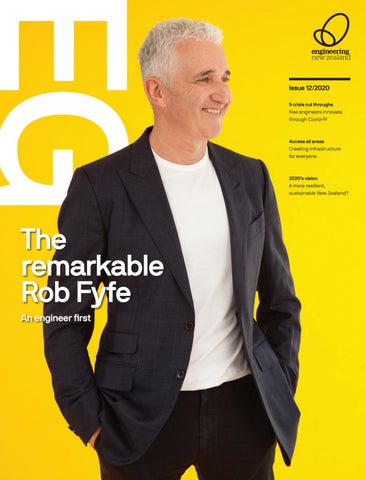
Issue 12/2020 5 crisis cut throughs Kiwi engineers innovate through Covid-19
Access all areas Creating infrastructure for everyone
2020’s vision A more resilient, sustainable New Zealand?
The remarkable Rob Fyfe An engineer first
In this issue
06 The remarkable Rob Fyfe In the beginning, Rob Fyfe was an engineer. 10 5 crisis cut throughs The Covid-19 crisis has sparked rapid-fire engineering innovations. 22 Access all areas Engineers have a part to play in inclusive access so everyone in society can participate fully. 46 World-class problem solver Engineers are in a unique position to help solve the complex problems the world now faces, says eminent engineer Delwyn Moller.
06
10
22
46
Features 10 5 crisis cut throughs The Covid-19 crisis has sparked rapid-fire innovations. 16 2020’s vision Will Covid-19's economic disruption catalyse a more resilient and sustainable New Zealand?
Engineering New Zealand Te Ao Rangahau PO Box 12 241, Wellington 6144 New Zealand P 04 473 9444 hello@engineeringnz.org www.engineeringnz.org EDITOR Jennifer Black editor@engineeringnz.org DESIGN MANAGER Angeli Winthrop ADVERTISING SALES advertising@engineeringnz.org 04 473 9444 SUBSCRIPTIONS hello@engineeringnz.org CIRCULATION ABC audited net circulation for the six months ended 31 March 2019. New Zealand 14,311 Print ISSN 2537-9097 Online ISSN 2537-9100
22 Access all areas Engineers have a part to play in inclusive access so everyone in society can participate fully. 28 Next stop: Taranaki Earth wind and gas.
Best practice 36 Firing up Strengthening the pathway to becoming a fire engineer. 38 Intersection Crossing paths with engineers. 39 The pandemic and the pipeline What is the likely impact of the Covid-19 pandemic on the engineering profession’s pipeline of talent? 40 Back to public works What effect did past government-funded infrastructure projects have on the country?
42 Get with IT There’s a new meeting place for IT engineers and anyone interested in IT engineering. 44 Resolving a quake insurance dispute We analyse a recent Canterbury Earthquakes Insurance Tribunal decision.
EG ONLINE PDF versions of EG are available for members on our website. PRINTING Your cover is printed on Forest Stewardship Council (FSC) approved and elemental chlorine free (ECF) paper. The inside pages are Programme for the Endorsement of Forest Certification (PEFC) approved and elemental chlorine free (ECF). EG is printed using vegetable-based inks made from renewable sources. Printing and fulfilment by Printlink. Please recycle your plastic wrap – it’s New Zealand made and 100% biodegradable.
DISCLAIMER Advertising statements and editorial opinions expressed in EG do not reflect the views of Engineering New Zealand, its members, staff, or affiliated organisations unless expressly stated.
This issue of EG was published in September 2020.
Shorts 46 World-class problem solver Engineers are in a unique position to help solve the complex problems the world now faces, says eminent engineer Delwyn Moller. 50 Inside job 53 Leading questions 54 The secret life of engineers Music is more than just a hobby for Design Engineer Holly Wright.
56 Bedside table Engineering New Zealand Board member and 2020 Fulton-Downer Gold Medal winner Kennie Tsui explains her reading choices. 57 Review 59 Obituaries 60 Engineering genius
03
Engineering Envy #6
Large Hadron Collider
Billed the largest scientific instrument on the planet, the Large Hadron Collider (LHC) is a giant particle accelerator. It was created to study the universe’s inner workings. So, how does it do that? Inside the accelerator, two high-energy particle beams travel at nearly the speed of light, then they’re made to collide. They travel in opposite directions in beam pipes – tubes kept at ultrahigh vacuum. A strong magnetic field maintained by superconducting electromagnets guides them around the accelerator ring. The LHC's located at CERN, the European Organization for Nuclear Research, on the border of France and Switzerland. In its quest for the origin of mass, its biggest discovery so far was in July 2012, with the observation of a particle consistent with the Higgs boson, a subatomic particle that provides mass to other particles. This has been described as a “smashing” discovery!
Year LHC first fired up
2008 Circumference
27km Depth underground
100m Cost (approx)
US$4.75 billion Temperature of electromagnets
-271.3°C
Total annual power consumption Image: CERN
600 GWh
Light fitting thingamajig
Quake dampening thingamajig
Water sealing thingamajig
New Zealand’s most innovative thingamajigs. For over 45 years we’ve helped businesses create those little polymer ‘somethings’ that make their big idea work. Our customers often come to us unsure of what they need. And that’s ok, because we have a history as innovators, designing and developing rigid and flexible polymer products to solve even the most specific challenges. They just tell us what they need it to do and together we work to make that happen. How can we help you become a pioneer in your field? eplgroup.com eplgroup.com
Facade connecting thingamajig
What they said
Editorial
05
Why are we here?
“We are absolutely flat out, and are for the next two to three years, and our order book is growing.” Lower Hutt fire engine maker Fraser Engineering CE Martin Simpson.
“Thomas is a very talented engineer. I have no doubt he will be a very successful engineer, innovator and entrepreneur. New Zealand needs more like him.”
NASA Administrator Jim Bridenstine announces the agency’s HQ in Washington DC is to be named after mathematician and aerospace
Nau mai koutou katoa. Engineering New Zealand is a membership organisation tasked with looking after members, strengthening the profession and supporting its contribution to New Zealanders. It has to understand engineering and enable engineers. Take, for example, the sector programmes we deliver for the Ministry of Business, Innovation and Employment (MBIE). This is a unique, exclusive partnership between MBIE and Engineering New Zealand (and our members) to develop pieces of engineering guidance. Now worth nearly $19 million, this programme is coordinated by Engineering New Zealand but undertaken by experts from within our membership who peer review each other. As an organisation supporting professionals, we need to ensure all members aspire to minimum standards of quality and ethics so we reflect a quality mark the public can trust. We have regulatory experts who help us administer this system by engaging with members and making it easy for them to oversee and enforce these standards. As the
Our wider mandate is to put engineering on the map, encourage future engineers and ensure this profession thrives, reflects society and has a loud voice in societal issues where engineering is at their heart. Five years ago, the Board selected Susan Freeman-Greene as Chief Executive to make engineering more relevant, inspiring, inclusive and modern. The Board approved a strategy designed to bring engineering to life, centred around the pillars of credibility, connection, influence and recognition. At our July Board meeting we reviewed the achievements since then with huge satisfaction. Highlights for me include the Wonder Project, increasing our membership from 15,000 to 23,000 and building stronger, more trusting, influential relationships with key stakeholders. The Board now has a big job recruiting a new CE, but we all agree the direction and culture of Engineering New Zealand is excellent. Susan, thank you for having the vision, strategy, relationship skills, courage and drive to make a huge difference – to make us look beyond ourselves in our conversations with society.
engineer Mary W Jackson, celebrated in the film Hidden Figures.
regulator of CPEng, we also need to report to Government.
Colin Crampton FEngNZ President, Engineering New Zealand
University of Canterbury’s Donald Clucas FEngNZ on Thomas James (17), winner of PM’s Future Scientist Prize for wheelie bin robot.
“You can easily be fed or you can converse with the doctor. You can also fall asleep easily, because your head is free to move.” Otago Polytechnic product design lecturer Andrew Wallace on New Zealand-created ventilator hood.
“Mary never accepted the status quo, she helped break barriers and open opportunities for African Americans and women in the field of engineering and technology.”
06
At its heart, engineering is about problem-solving, founded on system design thinking.
EG 12/2020
Profile
07
The remarkable Rob Fyfe PHOTOGRAPHER LUCI HARRISON
In the beginning, Rob Fyfe was an engineer. As Covid-19 began turning life on its head back in March, former Air New Zealand CEO Rob Fyfe DistFEngNZ expressed concern in the media that New Zealand wasn’t moving quickly enough against the virus. The upshot was a conversation with Prime Minister Jacinda Ardern, who approached Rob to ask if he’d join the response effort. And while this initial role was short term and unpaid, the Prime Minister has recently appointed Rob in a new, paid role as a business advisor on the Covid-19 recovery. Back in March, he headed to Wellington and worked alongside former Police Commissioner Mike Bush in the Operation Command Centre. Rob was the liaison between government and the business community. “Our focus was on everything from getting our testing capability up and running to where it should be and repatriating New Zealanders, to sourcing enough PPE [Personal Protective Equipment] into the health system and securing the food supply chain into communities in need. We were deploying businesses and businesspeople to support all those key areas of focus.” From the outset, it was clear the response team would need to move quickly on a number of fronts – not something that comes naturally to government, he says. “Governments are designed to develop and implement legislation, and that generally happens over quite long timeframes.” It was about getting the best out of both the government
One of the achievements he’s most proud of is helping get PPE into New Zealand early in the piece. “We had a real issue in those early days – a lot of pandemic stock in DHBs [District Health Boards] wasn’t fit-for-purpose. We had to move really quickly to secure the PPE we needed. “We got ahead in the queue of the likes of the United States and Australia. If that hadn’t happened, we could’ve been waiting months to get the equipment we needed. I’m really proud of how the private sector mobilised to allow that to happen much quicker than government alone could’ve achieved it.” Another success was working with Kiwi Harvest, a charity that redistributes food that would otherwise go to waste to those in need. “A lot of people were struggling. In Queenstown there were thousands of migrant workers suddenly without income and who couldn’t afford accommodation – they needed to be fed. In April alone, the network we deployed provided 1.5 million meal equivalents. This work was critical in supporting New Zealand while we were in lockdown.” While Rob’s career is largely carved out of the corporate boardroom, he sees his training as a mechanical engineer as foundational to his working life. “I identify as an engineer first. At its heart, engineering is about problem-solving, founded on system design thinking. I’ve applied the frameworks, methodologies and principles that I learnt through my training to
and the business community to support the pandemic response, he says.
everything I do. At Icebreaker and Air New Zealand, in particular, I relied on those disciplines enormously.”
>>
08
>>
I have quite a high appetite for risk. I enjoy putting myself into situations where I’m out of my comfort zone.
EG 12/2020
His career pathway has largely been organic, but the common thread is a desire to seek out the next challenge. “As a kid I loved pulling things to bits to figure out how they worked – I always had that curiosity. As I went through my career, I was excited by problems that needed solving. “I have quite a high appetite for risk. I enjoy putting myself into situations where I’m out of my comfort zone.” Rob’s involvement in the Pike River recovery effort is a good case in point. The high-stakes project is fraught with technical difficulty, risk and emotion. Rob joined as an independent advisor to Andrew Little, the Minister responsible for the project. He felt a duty to the miners’ families to “do everything we can to understand what caused the explosion, and ensure it doesn’t happen again”. “At the time, when I put my hand up for the role, a lot of people said, ‘why on earth would you want to do it? There’s a lot of downside and no upside’. But I tend to be drawn to these types of things, I guess. The risk doesn’t in any way dissuade me.” When it comes to the challenges presented by the pandemic, engineers have a big role to play, he says. “New technologies need to be developed to enable us to better protect against the outbreak, supporting key areas like contact tracing and quarantining. Those will be the most valuable projects for New Zealand. “With that framework in place, we then need to look at how we enrich our comparative natural advantages to grow the economy. There needs to be a strong focus on what we do well – high-quality horticulture, agriculture, viticulture, aquaculture and a whole bunch of associated technologies that can improve our productivity.” Overall, Rob’s impressed with how well business and government came together during the pandemic response, and commends the move to lock down the country early. “My personal view is this was exactly the right strategy. “Look at the countries that were slower to go into lockdown than we were, like the United Kingdom and Italy. They ended up having to lock down their countries a lot longer because the virus got away on them. The result was poor health outcomes, and consequently worse economic outcomes.” He says the challenge ahead is leveraging any advantages we have created. Rob is always busy and he’ll continue working on various projects and governance roles in addition to the government advisory work. But it’s through his work helping up-and-coming businesses and entrepreneurs get off the ground that he finds the most joy. “I feel very privileged to have the career that I’ve had. I’m in my late 50s and at the stage where I just want to give back – that gives me the biggest buzz.”
16 2020’s vision
22 Access all areas
28 Next stop: Taranaki
Features
10 5 crisis cut throughs
10
5
EG 12/2020
crisis cut throughs WRITER MATT PHILP
Feature
11
The Covid-19 crisis has sparked rapid-fire innovation by engineers. Producing Personal Protective Equipment (PPE) faster, detecting disease and supporting respiration are just some of the Covid-19 challenges engineers have turned their minds to, often freely sharing solutions both here and overseas. Here, EG wraps up some of the great New Zealand engineering work.
>>
12
1.
EG 12/2020
1. Yifan Chen FEngNZ. Image: University of Waikato 2. MMI image, showing mammary hyperplasia in a patient's breast. Image: Yifan Chen.
1
2
Reimagining microwave medical imaging If a Covid-19 infection is a battle, the lungs are its frontline. According to the World Health Organisation, one in six Covid-19 patients become seriously ill and have difficulty breathing, to the point where some require mechanical ventilation. It’s that life-or-death scenario where Yifan Chen FEngNZ hopes to make a difference. The University of Waikato Professor of Engineering was made a Fellow of Engineering New Zealand in 2020, partly because of his work on microwave medical imaging (MMI). For 10 years, Yifan has been developing MMI for breast cancer screening and for detecting stroke. When Covid-19 arrived, he recognised the technology’s potential to help in the pandemic response, providing an alternative to X-ray and CT scans for imaging sufferers’ lungs. “We’d never looked at it for infectious disease, but essentially the principles are the same,” says Yifan, whose team has modified their computational modelling and algorithms to the new purpose. Essentially, MMI works like radar, detecting dielectric contrast in tissue and mapping it as an image. As opposed to X-ray and CT scans, it’s benign. It’s also considerably cheaper, portable, and can be used even on unstable patients. Yifan sees its primary application as helping clinicians develop a ventilation strategy. It could also be used to monitor the progress of patients rehabilitating at home, and as a handheld screening device, potentially picking up people who don’t have fever but have symptoms in the lungs. His team is now working on lungspecific hardware, including a new transceiver design, and hopes to develop a prototype for pre-clinical testing by the end of the year. Covid-19 is going to be with us for some time, he suggests, and there will be new infectious diseases. “This imaging modality will still be relevant and useful.”
>>
Feature
From fighting pests to a pandemic Long before Covid-19 emerged, Grant Ryan’s enterprising engineer’s brain was focused on another introduced threat: mammalian predators. The YikeBike inventor and serial entrepreneur launched the not-for-profit Cacophany Project four years ago, focused on new ways of finding and eradicating stoats and other scourges of our native birds. When the pandemic struck, Grant and his team pivoted, repurposing a low-cost thermal imaging camera they’d developed to monitor predators into a tool to detect fever. Initially, it was about plugging a gap, with overseas-sourced commercial devices in high demand internationally. But as more time passed, they’ve been tweaking the camera system to do a more difficult job: identify people with low-level fever, those seemingly asymptomatic cases that other thermal screening can miss. “The reason other methods struggle is because everyone has a naturally different temperature point, and during the day it also fluctuates,” says Grant.
13
“You might have what is a high temperature for you, but it’s within normal bounds – or the other way round. So, you get a lot of false negatives and false positives.” Working with Callaghan Innovation, the University of Canterbury and medical device researchers from the University of Auckland’s MedTech CoRE unit, the team has introduced dynamic thermal referencing to account for individual idiosyncrasies. When someone walks in front of the camera, a thermal map of their face is created, which is then compared to their baseline thermal profile. Inevitably, that means the technology is destined for settings such as workplaces where the same people will pass in front of the camera several times a day. “If you have a lower temperature than the average, but it’s a degree higher than you normally are, you’d be flagged for testing,” he says. Combined with highquality contact tracing, “that’s a powerful set of digital tools to contain the disease”. The tripod-mounted camera has been trialled at a police call centre, a meatworks and half-a-dozen other locations. Grant’s hope is that it will become the default method used in high-risk locations such as rest homes and quarantine facilities. “We’re doing a lot of rapid development to see if we can plug part of the problem for New Zealand, then we’re most likely to open-source it overseas.”
The Cacophony Project's thermal imaging camera. Image: Grant Ryan.
>>
EG 12/2020
14
>> 1
Ventilator innovators As New Zealand entered lockdown in March, Ministry of Health numbers from February indicated the public health system could muster 230–260 potential ventilated intensive care unit (ICU) and high dependency unit (HDU) beds, or approximately 4.6–4.7 such beds per 100,000 of population. Given that a Covid-19 patient sick enough for ventilation will tend to need it for weeks, it’s likely that if we hadn’t “gone hard and gone early”, capacity would have been quickly overwhelmed. It was that calamitous scenario that galvanised Geoff Chase FEngNZ. A Distinguished Professor at the University of Canterbury College of Engineering, Geoff has collaborated with other engineers and clinicians on a low-cost, high-impact innovation that would enable a single ventilator to safely support two patients. Previously, others had suggested doubling the amount of pressure or volume to enable two patients to breathe together. But that notion of “in parallel” breathing carries risk because every individual’s lungs are different – the patient with less “stiff” lungs would receive more pressure and flow. By contrast, Geoff has concentrated on “in series” breathing, where patients essentially take turns breathing on a ventilator that is operating at double the rate. Geoff’s thinking was influenced by 20 years researching dynamic systems modelling, with a particular focus on intensive care medicine. “Because I work with doctors, I understand how ventilation therapy is given, which is different from a lot of engineers,” says Geoff, who collaborated with Christchurch Hospital Senior Intensive Care Specialist Geoff Shaw HonFEngNZ and Professor Merryn Tawhai of the Auckland Bioengineering Institute on the innovation. It’s both clever and remarkably simple, incorporating a 3D-printed Y joint and
2
pressure sensor, a couple of valves and some software to create an active breathing circuit. Backed by a $150,000 grant from the Government’s Covid-19 Innovation Fund, a prototype has been proven using mechanical lungs, with further testing to come at Christchurch Hospital. Assuming favourable results, the design and software will be made available open source. “Every time it gets used, that’s an opportunity for a patient to live who otherwise would have died,” says Geoff.
1. Geoff Chase FEngNZ and lead student Lui Holder Pearson with an early prototype of the ventilator system. 2. Refined prototype of the ventilator. Images: Geoff Chase/University of Canterbury.
4. 5. Feature
15
3D printing lends a hand
For Professor Olaf Diegel, responding to the Covid-19 crisis has both highlighted the strengths of 3D printing, and shown there are times when other technologies make more sense. Olaf, who heads the University of Auckland’s Creative Design and Additive Manufacturing Laboratory, collaborated early in the crisis with the University of Canterbury’s Donald Clucas FEngNZ to develop a low-cost, disposable face shield for frontline medical workers. After a trial using 3D printing, it became obvious that laser cutting was a faster and more effective way of manufacturing the mask in volume, so they switched. On the other hand, Olaf has successfully used additive manufacturing for his most significant Covid-19-inspired innovation: a simple emergency ventilator operated by an
automated hand. Designed to replace inflatable manual ventilators, or “bag valve masks”, it automates the squeezing function, “allowing the doctor, nurse or medic to do other things that might be more vital”, explains Olaf, who envisages it only being used in emergencies or when moving someone within a hospital. Developing the prototype involved medical input from an anaesthetist at Nelson Marlborough DHB. “He gave us a lot of advice about things such as how far the hand opens and how quickly it opens and closes. You have to be able to control the pressure, the volume and the inspiration/expiration ratio.” The Covid-19 crisis has highlighted 3D printing’s advantages when it comes to urgent development and localised distribution. But it has also opened up new ways for engineers to collaborate, says Olaf, who has made all the design, 3D print and software files available open source.
3D-printed emergency ventilator. Image: Olaf Diegel
Image: Frank Beinersdorf
Mapping out needs In the early weeks of Covid-19, a global shortage of PPE inspired people with 3D printers to start manufacturing masks and face shields. Enter Frank Beinersdorf. As part of his volunteer work for ShieldsUp, the robotics engineer at Mechadept and WelTec mechatronics tutor developed a real-time map so other volunteers could see at a glance where the demand was, the delivery status of orders and other useful features. “I thought it was a good idea to map the whole thing out, give it some perspective, and give easy access to the database,” says Frank. ShieldsUp volunteers produced nearly 19,000 face shields. While the initial concern about PPE has abated here, Frank says if the need arises again “it would take me way less time to do something”.
16
EG 12/2020
vision
WRITER MATT PHILP
17
2020’s
Feature
Will Covid-19’s economic disruption catalyse a more resilient and sustainable New Zealand?
>>
EG 12/2020
18
The Government has primed the pump, announcing a stimulus package that includes $3 billion for infrastructure projects. That’s in addition to the $12 billion “The New Zealand Upgrade Programme” for infrastructure announced in blissfully pre-pandemic January. The May Budget allocated $16 billion of a Covid-19 recovery fund towards relief packages. At the time, it left $20 billion unspent, but in July it announced it would save $14 billion of the recovery fund for a rainy day. Given this scale of investment, many organisations have stressed the need to be bold and transformational. Beca, for example, in Decarbonising a Prosperous New Zealand, argues we have a gilt-edged opportunity to accelerate the shift to a low-emission economy. In a joint leadership statement endorsed by major engineering firm chief executives, Engineering New Zealand and the New Zealand Institute of Architects speak of the need to “rethink, adapt and reimagine”. And in June, web summit Vision Week aimed to give “purpose and direction” to recovery spending by hashing out a long-term national vision. Vision Week was the brainchild of Infrastructure New Zealand CEO Paul Blair, who says: “What we did with the health crisis has put us in an incredibly good position. “I think there’s an opportunity here for New Zealand to absolutely transform itself to be one of the leading countries in the world.”
Wanted: new thinking now The key will be to translate heady ambitions and potent funding into effective action on the ground. Engineers are going to be vital to that, says Sustainable Business Council Executive Director Mike Burrell. “If there’s one thing that defines engineers, it’s taking abstract ideas and making them real,” says Mike, who argues the infrastructural response to Covid-19 must also confront the looming climate crisis. “The things we build today will lock in carbon and other sustainability decisions for decades, if not longer. This is a time when engineering companies and engineers need to be quite vocal about what kind of policies need to be in place to encourage a greater uptake of sustainable building practices and sustainable engineering in general. I think engineers are in great position to lead that discussion.” The sector certainly has clout: according to the PwC report, Economic contribution of engineering, based on 2019 data, engineering generates $15 billion per year, or five percent of GDP. But engineers also bring something else. As the joint leadership statement with the architects put it: “We are problem solvers and visionaries”. These qualities will be needed, along with new ones. Paul Blair suggests the pandemic has highlighted that the world is a more volatile place.
“That makes it more complex to build 30-, 50-, 100-year infrastructure. It’s become even more about scenarioplanning, thinking of alternative versions of the future, and allowing for infrastructure to be modified to be made more resilient or upgraded,” he says. “The opportunity is to move from a linear mindset in approaching problems to one that embraces more of that complexity and the need to collaborate. Diversity of thought is crucial.”
A fresh approach to civil engineering Holmes Consulting’s Andrea Jarvis CMEngNZ CPEng IntPE(NZ) says this uncertain moment is an opportune time to rethink our approach to civil engineering. “Things have changed. Budgets are going to be tight. Looking at ways to future-proof and make things more adaptable is going to be important, and whatever we design now has to have long-term applicability.” In particular, Andrea believes engineers should take a more holistic view of projects. “The most valuable tool in a civil engineer’s toolbox is the ability to listen,” she says.
If there’s one thing that defines engineers, it’s taking abstract ideas and making them real. – Mike Burrell
“We can end up becoming experts to the point where we might not necessarily think about how what we’re doing affects the whole. We need to make sure we understand what everybody is trying to achieve in the vision we’re all working towards.” The benefits are time and money saved, and a better, more integrated, project outcome. She gives the example of stormwater design. If the engineer responsible is thinking holistically they will have engaged early with the landscape architect, looked at the natural surroundings and perhaps considered green infrastructure alternatives to the usual concrete piping. “Instead of treating stormwater flows as a thing to be hidden away, you can use it as an asset using raingardens or naturalising streams – integrating it into the landscape.”
>>
Feature
19
1
2
3
4
1. Christchurch Airport's new plaza area. Image: Holmes Consulting. 2. Mike Burrell, Sustainable Business Council. 3. Andrea Jarvis, Holmes Consulting. 4. Paul Blair, Infrastructure New Zealand.
>>
EG 12/2020
20
At Christchurch International Airport, Holmes recently worked with master planners, the airport’s infrastructure planning team and landscape architects Boffa Miskell on a new plaza between the terminal and the Novotel. Andrea says close collaboration ensured cultural aspects, the future use of the site and natural resources were all included in the civil design and planning. “It was a great process,” she says. “We worked together to get a common understanding of the end goal from day one.”
Time to raise standards? Jason Quinn CMEngNZ seconds the notion Covid-19 ought to prompt a widening of perspective among engineers – particularly when it comes to buildings. Jason, a former NASA engineer turned passive house designer and building scientist, argues the Covid-19 economic stimulus (which includes 8,000 additional public housing homes) could be the circuit breaker New Zealand needs to start building healthier, higher quality and more durable and energy-efficient houses. It can be done, he says, citing a co-housing development underway on Dunedin’s High Street that includes 21 “passive house” homes, all with triple glazing, thick walls and superior insulation. He wants to see the Building Code “fixed” to raise minimum standards, and the Government demonstrate what is possible by significantly lifting the bar when it comes to new social housing. But engineers need to play their part.
“Mostly, engineers are concerned with compliance, not with what the client gets in the end, and to provide the lowest first-cost solution that meets the Code – essentially, design a building that is just above the legal minimum. Builders are taught the same way,” he says, giving the example of thermal bridging being ignored. “When a client asks ‘Is there enough insulation?’, we will say yes, meaning it complies with the Code. But it ignores the floor slab edges and all these other details we don’t want to get into. “Engineers need to start looking at the bigger picture for their clients, and to think about the whole building. That might mean a structural engineer putting in a structural system that helps the insulation value as well. If we refuse to widen our perspective then we’re dooming clients to this absolute minimum approach.”
Is it sustainable? The even bigger picture here is climate change. Infrastructure Minister Shane Jones has stressed the stimulus package is no “green reset”. But that seems like a wasted opportunity to sustainability engineer and New Zealand Green Business Council 2019 Future Thinker of the Year Kate Boylan. Kate says when the focus is on sustainability, people talk about initiatives such as “cleaning our energy, reducing emissions and waste”. “This ‘great pause’ provides the perfect opportunity to shift to that kind of thinking for all future infrastructure,” she says, adding “an engineer’s role might be to stay open to new ideas, opportunities and ways of thinking, and to ask the right questions”. Mike Burrell says the engineering firms he knows from the Sustainable Business Council membership are “walking the talk” when it comes to sustainability. He wants to see engineering as a sector now lead the way, particularly on greening the built environment. “I’d love to see leadership from the sector stepping forward and saying ‘This is eminently do-able; we have the materials, the know-how and the technology. If you want us to be more sustainable, here’s what we need to see in terms of policy and legal framework.’” For Paul Blair, it’s vital the response to Covid-19 is a “no regrets” stimulus. In terms of new infrastructure, resilience and sustainability features can no longer be regarded as ‘soft’ and expendable, he says. “There’s a real opportunity here for us to move our thinking from being wholly focused on economic and physical outcomes... to realising the other value we get from environmental, social and cultural outcomes.”
A co-housing development on Dunedin's High Street. Image: Architype
>>
Feature
Shovel-ready report card
Key Infrastructure Reference Group (IRG) investment
Very poor Poor
In July, the Government announced the first tranche of approved shovel-ready projects. We checked in with a few of our Engineering New Zealand Branch Chairs to get their thoughts on projects in their region that made that first cut.
East Coast: Rugby Park Grandstand
21
Southland: Invercargill Inner City Development
Fair Good
Jobs
Very good
West Coast: Ports Package
Northland: Whangarei Rejuvenation
Approx. $8 million
$10 million
Approx. $7 million
$20 million
Approx. 30
Approx. 350
Approx. 35
Approx. 200
The demolition and rebuild of a fit-for-purpose grandstand and facilities for Poverty Bay Rugby Football Union and the community of Gisborne. The historic Rugby Park grandstand's been closed since May 2019 due to its condition, primarily its seismic strength. Construction is expected to begin by January 2021. Henk de Wet CMEngNZ (Engineering Technologist) East Coast Branch Chair
This project will give new life to the Invercargill CBD which currently poses a considerable seismic risk, has low levels of foot traffic, struggles to retain businesses and lacks the soul and presence expected of a modern CBD. There’ll be a range of dining offerings, retail space, a covered, multi-storey car park with 625 parking spaces, open air internal laneways and outdoor dining spaces within the precinct, more office space and apartments.
Appropriateness of project choice given region’s needs
Robert Williams MEngNZ Southland Branch Chair
Ability to kickstart local economy
Appropriateness of project choice given region’s needs
A package of wharf and port infrastructure investments in Greymouth, Westport and Jackson Bay to improve the region’s ability to service regional fishing and bulk industries. In Greymouth, an upgraded post slipway will enable the Grey District, and wider region, to develop a boat repair and maintenance hub for the South Island. Tate Bradley CMEngNZ West Coast Branch Chair
The Whangarei Rejuvenation is an investment in the social and community infrastructure of Whangarei, covering a group of projects identified as priorities for the area including a cultural centre, new shared paths infrastructure, and sporting and trades training facilities. Joseph Camuso MEngNZ Northland Branch Chair Appropriateness of project choice given region’s needs
Appropriateness of project choice given region’s needs Ability to kickstart local economy Ability to kickstart local economy Benefit to local communities
Benefit to local communities
Ability to kickstart local economy
Job creation
Benefit to local communities
Sustainability values
Job creation
Benefit to local communities Job creation Job creation Sustainability values Sustainability values
Sustainability values
22
EG 12/2020
Access all areas WRITER RACHEL HELYER DONALDSON
Engineers have a part to play in inclusive access, be it roads, buildings or other infrastructure, so everyone in society can participate fully.
Feature
23
Christchurch's new Metro Sports Facility incorporates a range of specific features to meet a variety of accessibility needs. Image: ĹŒtÄ karo Limited
EG 12/2020
24
During the March and April Covid-19 lockdown, all New Zealanders faced a hugely restricted life. It was far more difficult to leave home. Yet many local councils sprung into action to cater for Kiwis’ social distancing needs, widening footpaths so we could take walks or go to the supermarket. Those extraordinary weeks highlighted how adaptable we can be “when everyone has an access need”, says chief executive of the Disabled Persons Assembly (DPA) Prudence Walker. “We can make flexible, systemic changes. The challenge is whether we can do that for the percentage of the population who need that all of the time, on an ongoing basis.” According to the 2013 Disability Survey, a staggering 24 percent of New Zealanders – roughly 1.1 million people
features, such as kerb ramps, inclines and wide enough spaces to manoeuvre around, to tactile indicators and good design for people who are vision impaired or blind. For many people with disabilities, “a whole lot of organisation” must go into the planning of a journey. This is stressful. “Design comes into it, before they’ve even left home. Can I access the building I’m going to, can I find a suitable park close or get public transport close, can I even get in the building, what am I going to have to encounter along the way?” Prudence uses a mobility scooter. Whenever she needs to cross a road, she braces herself. If the kerb cup is just an inch too high, it could mean she can’t use it, or could suffer a painful jolt or even ongoing pain. She has even fallen out of her scooter, on the way to a meeting.
– have access needs. This includes mobility issues, vision or hearing impairment, autism, speech, ageing, mental health, learning and cognitive function. Our ageing population means the number of people living with a disability is set to increase markedly. Yet there is persistent disparity between the able-bodied and those with disabilities. A 2019 report by CCS Disability Action found that households with disabled children are significantly more likely to live in poverty. Meanwhile disabled adults under 65 faced “concerning levels” of discrimination and were 2.5 times more likely to experience material hardship.
“All because of a design flaw that could have been avoided.”
Inclusive access is the outcome when everyone in society can participate. – Bridget Burdett
Designing better lives Failure to create inclusive public infrastructure can have an “absolutely profound” impact on an individual and the direction their life takes, says Minnie Baragwanath, founder of social change agency Be. Lab. A building that is not accessible to all means “designing out” potential customers, employees and talent. For someone with a disability, universally accessible public transport can mean the difference between gaining an education or employment, or not. “That’s what is disabling for many people: the design choices we make, consciously or unconsciously,” she says. “Inclusive access is the outcome when everyone in society can participate,” says MRCagney principal researcher and engineer Bridget Burdett CMEngNZ CPEng, whose work focuses on transportation and accessibility. “It means that everything that we design and every system that we introduce and every interaction that someone has is inclusive to everybody. So everybody can access it comfortably, with dignity, they can afford it, and that society welcomes all people.” People with access issues face a myriad of barriers when they venture out in public spaces, says Prudence. These range from a lack of properly designed physical
Big street numbers that are clear and visible are really important for sight-impaired people, says Minnie, who is legally blind due to a rare eye condition called Stargadt disease. Yet many buildings have no numbering whatsoever. Large glass frontages can be extremely trying, as it’s impossible to see where to get in. Once inside, a lack of clear signage is common, making it difficult to find the right floor. Many buildings have “talking lifts” but this function is often turned off, Minnie says.
“Blind to the challenges” Most of the engineering profession is “blind to the challenges” of people with disabilties, says Bridget, who is vice Chair of the Engineering New Zealand’s Transportation Group. “We literally don’t see those challenges in our own lives. If we don’t invite the voices of disabled people into our planning conversations, it’s difficult to see the limitations we are building into infrastructure.” Engineers need to be far more aware of the impact on the end-user, says Waikato University professor Mark Dyer.
Feature
25
Ask the experts Consultancies such as Be. Lab can provide engineers with “a onestop shop for their accessibility needs”, offering specialist advice, says Minnie Baragwanath. “Nine times out of 10, what we create doesn’t actually cost more, it’s just a better design that more people can afford.” Be. Lab is currently working with Wellington Airport and Auckland's City Rail Link. In 2019 it helped Countdown with making its Hāwera store more user-friendly and inclusive. Mobility and accessibility were at the heart of Hāwera’s redesign, with aisles wide enough for wheelchairs, mobility scooters and prams, contrasting colours for doors for visually impaired customers and dedicated mobility scooter parking.
1
2
1. Bridget Burdett, researcher and engineer, says step-free routes should be easy to use, not too steep and obvious. 2. Prudence Walker, chief executive of the Disabled Persons Assembly.
>>
EG 12/2020
26
1
Making good sense Consultation with future users and their caregivers has been critical to creating the layout and fitout of New Zealand’s first aquatic sensory room for Christchurch’s new Metro Sports Facility. The pioneering Aquatic Sensory Experience area will incorporate a closedoff pool area in which users can control their environment, including lighting, noise levels and how the water works, with a range of jets and sprays. The aim is to provide a safe, managed aquatic experience, and give users with disabilities the chance to build their confidence around water. Ōtākaro Limited chief executive and civil engineer John Bridgman FEngNZ, who is heading the facility’s construction, says it was “heavily influenced” by its target audience. “There is no blueprint to follow.” This involved creating a full-scale, cardboard mock-up of the rooms and accessways before inviting a group of potential users to test the space’s accessibility. Scheduled for completion in 2022, the large aquatic and indoor recreation and leisure venue will incorporate a range of specific features for people with disabilities, including changing rooms that meet a variety of accessibility needs, and eight accessible pools.
1. Artist's impression of the new Metro Sports Facility. Image: Ōtākaro Limited 2. A full-scale cardboard mockup was used to test accessibility. Image: CCC Newsline
2
>>
Feature
“Design and construction of infrastructure is a complex process with high technical challenges but it is important for us to recognise that infrastructure is not the end in itself. It is instead a means to an end which is supporting livelihood and liveability.” Most engineering schools don’t teach this, he says. “We still spend a lot of time talking about solid mechanics... The undergraduates of the future require a very different mindset.” In 2009, Mark set up Ireland’s 24-hour “universal design challenge” during his tenure at Trinity College Dublin. Each student team worked with a design partner with an access issue. The brief: to improve the visitor experience around Dublin’s lively Temple Bar district. Mark found the exercise “fascinating”. His research now includes people-centred design.
This “best practice design” could benefit everyone. “Calling it inclusive means it’s not separating out any particular group. If you’re in a rush or you’re tired, or you’re carting luggage or with children or with an older parent." Bridget is involved in two Waka Kotahi NZ Transport Agency projects, refreshing design guidance for walking in New Zealand, and for public transport. Both projects will “reframe” the guides within the concept of universal access – a first for NZTA, she believes. Her research involves a series of paid interviews with 18 people with disabilities, and their quotes will feature prominently in the resulting guides. It will remind design engineers who they’re designing for. Measuring outcomes and data collection are routinely used for road safety and seismic strengthening. Bridget would like to see that approach applied to inclusive
“I began to realise how badly designed the built environment was. It presented lots and lots of barriers.”
access. “We’ve only got standards, we can’t know whether those standards are working unless we measure diversity of participation.” In the absence of data, talking to a range of people and organisations is crucial in project planning, she says. Engineers can also reference Stats NZ data on disability, providing information such as the proportion of people in a specific area who have difficulty walking or seeing. Measuring trips not made, and asking why they’re not made and who’s not making them, could provide some “really powerful” data, says Bridget. “We don’t count the people who aren’t there. Yet who you see out in the streets is not wholly representative of who lives in New Zealand.”
Transport must include everyone Transport is key to inclusive access, says Bridget. “It’s the first gate that people have to get through to be able to live their lives.” Roads and transport should follow three principles of design: safe, obvious and step-free choices. People need to feel safe and secure – not just from trips and falls, but from harm. Transport systems must be obvious, intuitive and give clear instructions. Step-free routes should be easy to use, not too steep and obvious. “They need to be dignified, not down a back alleyway or further out of your way.”
I began to realise how badly designed the built environment was. It presented lots and lots of barriers. – Mark Dyer
Mark Dyer. Image: University of Waikato
27
EG 12/2020
28
Next stop: Taranaki
Earth, wind and gas Population
117,561 Land area
7,254km
2
Engineering New Zealand Branch membership
359 Did you know‌ The Wind Wand on the New Plymouth foreshore is a 48-metre-high kinetic sculpture – and has 1296 tiny red lights on top.
Feature
29
WRITER RACHEL HELYER DONALDSON
Dubbed a “secret paradise” by Lonely Planet, Taranaki’s remote west coast locale is part of what makes it unique, from its dramatic maunga to its diverse energy resources. Natural gas and oil remain important yet change is vital as Aotearoa aims for a low-carbon future. Regional engineers recognise the need to act sustainably, and place iwi and community at the heart of their projects.
Helping journeys, jobs and habitats State Highway 3 plays a crucial role in linking Taranaki to the rest of the North Island and it’s used by around 2,300 vehicles – including 450 trucks – every day. But the stretch that heads north over Mt Messenger is notorious for its narrow, winding route. The Mt Messenger Bypass project aims to to improve safety and resilience, with 6km of new road, two bridges 125m and 30m in length respectively, and a 235-metre-long tunnel. The $200 million bypass is Taranaki’s biggest roading infrastructure project, and there is much at stake. Appeals to the Environment Court’s interim decision about the project were yet to be heard at the High Court when EG went to print. Also, an iwi-wide vote by Ngāti Tama’s uri (descendants), whose land the bypass traverses, recently saw 82 percent in favour of agreements with Waka Kotahi NZ Transport Agency, allowing land needed for the Mt Messenger Bypass to be exchanged. The project’s managed by an alliance between Waka Kotahi, Downer, HEB Construction, Tonkin + Taylor and WSP. It includes engineers with geometric, geotechnical, structural and construction expertise, as well as transport designers, RMA planners, stakeholder and environmental specialists. Construction will take four years and is slated to start during the 2020/21 summer. WSP’s New Plymouth office has provided survey services and environmental planning expertise, as well as offering a base for visiting alliance members. Large-scale projects are rare in the region, says WSP Taranaki business manager and civil engineer Adam Jowitt MEngNZ. It’s been “a great opportunity” to be involved, and a chance for local staff to see how an alliance project works. Challenges for the survey team have included the remote, hilly and heavily vegetated terrain. Drones with
EG 12/2020
30
high-definition cameras and 3D laser scanners have helped them model more difficult areas. Stakeholder engagement has been a significant part of the project, started in 2016, says Adam. The land has cultural and spiritual significance to Ngāti Tama. It is also important ecologically, with unique wildlife like the critically endangered long-tailed bat. An ecology programme aims to minimise disruption and impact on the environment, both during and after construction. “Safer and more reliable journeys around Mt Messenger are obvious benefits,” says Adam. “But people are also realising the bypass will bring jobs and other economic benefits to the region plus very special gains to local habitat. It’s a great chance to help increase our connection with the land.”
It will involve a 12-month build once all consenting requirements and finance investments are finalised, and should be ready by the end of 2021. It will create 50 construction jobs and seven skilled operational jobs. But the venture’s real focus is on “sustainability and creating a long-term future” for the 140 existing jobs at Ballance’s Kapuni plant, one of South Taranaki’s biggest employers, as well as those working in transport, farming, and the oil and gas sectors, says Matt. Making green hydrogen safely requires the same skills needed for the conventional hydrocarbon energy industry. The project will leverage Taranaki’s energy sector capability and know-how. “Green hydrogen can provide a more sustainable pathway for those skillsets which is pretty exciting.”
Taranaki’s new energy future?
Heavyweight wellhead compressor for natural gas field
In South Taranaki, the roaring westerly bounces off Mt Taranaki, funnelling wind across Kapuni’s dairy flats. Hiringa Energy and fertiliser giant Ballance Agri-Nutrients plan to harness this outstanding wind resource via four wind turbines, as part of a $50 million “green” hydrogen project. The two Taranaki companies will add 17MW of wind generation to Ballance’s existing Kapuni plant to power the facility and produce green hydrogen (which uses renewable energy) as a feedstock for additional ammonia production and a transportation fuel. Hiringa’s head of projects and operations, Matt Luscombe, calls the joint venture “a sustainable transition for the future” for both companies. But the project, which has received $19.9 million from the Government’s Provincial Growth Fund, could be a game changer for both region and country. It aims to spearhead the hydrogen industry in Taranaki, creating sustainable jobs and supplying the heavy transport sector. The venture will allow Ballance, which produces around 260,000 tonnes of ammonia urea annually at its existing Kapuni plant, to make some of its fertiliser using sustainable energy. This will reduce its carbon emissions and make it less reliant on natural gas and fossil fuels, and imported urea. Hiringa will use hydrogen from this project to power hydrogen-powered trucks. Working with independent fuel retailer Waitomo Group, it plans to create a national network of hydrogen refuelling sites. The Kapuni plant provides hydrogen production scale and off-take to get the network up and running, says Matt. He says the Kapuni project will also be one of the first projects in the world that produces hydrogen by “direct coupling” wind with electrolysis. Electricity generated by wind is used to transform water into hydrogen and oxygen. This “green” hydrogen can then be combined with nitrogen in Ballance’s existing plant at Kapuni to produce ammonia.
Sitting 4.5km offshore in North Taranaki, Pohokura is New Zealand’s largest natural gas field, providing around 40 percent of New Zealand’s supply. In operation since 2006, its natural reservoir is declining following continuous production. To increase total well deliverability and access additional gas reserves, OMV New Zealand on behalf of the Pohokura joint venture has enlisted a heavyweight machine from Switzerland. At 10MW, the single stage centrifugal compressor from MAN Energy Solutions is New Zealand's most powerful wellhead compressor, says OMV NZ Head of Projects Kerry Williamson CMEngNZ. This considerable field reinvestment project began in late 2018. Some “pretty major infrastructure” was needed to ensure power supply to the offshore plant, Kerry says. This included a six-month work programme to install 1.5km of significant copper power cabling from the neighbouring Methanex methanol plant’s Transpower substation, crossing a series of roads, pipelines, and fibre optic cables on its way to Pohokura. Extensive civil engineering works followed, with more than 18,000m3 of earthworks required. OMV is proud to have delivered the project primarily through Taranaki and New Zealand-based expertise, including its Integrated Services Contract held with Worley New Zealand and local subcontractors. Kerry says local Taranaki contractors have “world-class” competency and skills. OMV has an “open and excellent” working relationship with its community stakeholders. Ngāti Rāhiri hapū, as kaitiaki (guardians) of the land and sea Pohokura sits within, played an important role as cultural monitors throughout the project, Kerry says. “The Pohokura site is rich in cultural history and it was important we respected this.”
Feature
31
1
2
3
1. The existing tunnel near the summit of Mt Messenger on State Highway 3. Image: NZTA 2. Ballance's Kapuni plant. Image: Ballance 3. OMV New Zealand's new centrifugal compressor. Image: OMV
Snapshot Ford’s new prototype all-electric Mustang Mach-E 1400 has been developed through 10,000 hours of collaboration with RTR Vehicles. Designed to demonstrate the performance possibilities of electric propulsion, it has seven electric motors and targets 1,400 peak horsepower. The hood is made of organic composite fibres, a lightweight alternative to the carbon fibre that makes up the rest of the vehicle. Ford is investing more than US$11.5 billion in electric vehicles worldwide. Image: Ford Motor Company
SHAPING A NEW TOMORROW TOGETHER GO.BLUEBEAM.COM/THANKYOU
38 Intersection
39 The pandemic and the pipeline
40 Back to public works
42 Get with IT
44 Resolving a quake insurance dispute
Best practice
36 Firing up
36
The Institution of Fire Engineers works with Engineering New Zealand as a Collaborating Technical Society. It has an important role providing fire safety knowledge in New Zealand through its representation on NZ Standards committees, MBIE working groups and its relationships with Fire and Emergency NZ, Fire Protection Association NZ, United Fire Brigades Association and Society of Fire Protection Engineers. The Institution was founded in 1918 in the United Kingdom and incorporated in New Zealand in 1922. Prior to the Chartered Professional Engineers of New Zealand Act 2002, the Institution was the main pathway to gain recognition as a fire engineer in New Zealand as stated in the Fire Service Act 1975. Trent Fearnley is the National Advisor Fire Risk Management for Fire and Emergency New Zealand. Over the past 24 years his roles have included operational firefighting and fire engineering. He is a Director and Trustee of the Institution of Fire Engineers, International.
EG 12/2020
Best practice
37
Firing up TRENT FEARNLEY
The pathway to becoming a fire engineer is being strengthened with the creation of a new, homegrown baseline qualification. Over the past two decades, major events such as the Canterbury earthquakes, and slower emergencies such as the leaky buildings saga, have highlighted the need for stronger regulation and monitoring of the engineering industry as a whole. A gap analysis of qualifications offered for fire engineering professionals in New Zealand revealed a gaping chasm in the education pathway. Aspiring fire engineers could undertake various Level 3 and 4 Certificates in fire protection/detection/ alarms systems, as the beginning of the journey, with the University of Canterbury’s Master of Engineering Studies in Fire Engineering as the capstone qualification. The link from one qualification to the other, however, was through traditional engineering degrees, with no option to study fire engineering directly. The gap in education meant that people working as fire evacuation consultants, Independently Qualified Persons, Building Consent Officials, Fire and Emergency New Zealand Fire Risk Management Officers, and in other fire-related roles,
education at the level required for their roles. Despite this lack of tertiary study, they were responsible for safety-critical work. The level of work and remuneration for these roles did not require a four-year engineering degree followed by a two-year post-graduate qualification, but it did require a baseline qualification pitched at the fire engineering/engineering technician level. Needing professionals at the engineering technician level, the fire industry led by the Institution of Fire Engineers (IFE), Fire and Emergency New Zealand and the New Zealand Board of Engineering Diplomas joined forces to develop the New Zealand Diploma of Engineering – Fire Engineering. Extensive collaboration between fire engineers from IFE, Fire and Emergency New Zealand and wider industry resulted in a curriculum designed to provide students with a grounding in fire science, knowledge of the fire safety industry and an understanding of fire safety aspects of the New Zealand Building Code. The Open Polytechnic of New Zealand began developing the diploma in January, with the intention of making the first firespecific papers available for enrolment
have been able to connect the learning designers at the Open Polytechnic with leading subject matter experts. I intend to ensure strong industry input and engagement drives the development of the content and its application, and that the diploma produces graduates who can contribute positively in the New Zealand fire safety scene. Even as the diploma is being developed, plans are afoot to begin paving the next section of the pathway towards a full suite of fire engineering qualifications in New Zealand. Our aim is to establish an undergraduate fire engineering degree, bridging the final gap in the fire engineering pathway. This will allow New Zealand to grow our own fire engineers, from the end of secondary school right through to postgraduate qualification and professional registration. The Covid-19 pandemic highlights the necessity for collaborative relationships in information sharing and collective visions for improvement. The development of the NZDE Fire Engineering is one example of these principles at work, and will hopefully continue to strengthen the ties between the engineering industry and the education community as we forge ahead together in a changing vocational
possibly held the certificates and had valuable experience, but no formal tertiary
in Trimester 2, 2020. I have strategic and technical oversight of the project and
landscape.
EG 12/2020
38
Intersection
Intersection
People crossing paths with engineers.
My career… has been extremely varied and I certainly didn't plan to end up where I am, but I am pleased to be here! My first “real job” out of university was working for Christchurch City Council as a Community Recreation Assistant, running events for communities all over Christchurch. I enjoyed the long days and seeing smiles on kids’ faces as they skateboarded, gave a new sport a go, or showcased their talents. In the coming years I would become a general manager of a few sporting organisations. This phase of my life really solidified my love for communities and the impact of community facilities. I also ran my own café business for more than four years. I ended up in engineering consultancy due to… the growing work area of sport and recreation planning studies, strategies and design projects being undertaken by local councils and universities. The skills I learned in business, combined with my knowledge of sport and recreation, and my affinity for getting along with the community gave me a foundation for the work I do now. I’ve learned a great deal through many roles, projects and titles since then, but there’s a part of me that still feels I fight for the little person who gets to use that hockey turf we design or that sport hub our business case was for.
architecture, urban design, active and healthy places, and programme management of major transport projects with community objectives. I work with engineers in my role… because they make a lot of my projects “go” (and I’m thankful to them for it). For example, transport engineers who plan out a new park development that needs new intersections or carparking, acoustic engineers who assess how loud a skateboard will be to a nearby neighbour. Or civil engineers who determine cut and fill for a new sport field and structural engineers for a new indoor court. Engineering decisions impact my work because… engineering decisions about the location of a piece of infrastructure – for example a pump station in a park setting – may seem simple at the time. But sometimes the wider impacts of those decisions mean a recreation reserve that desperately needs a sport field in the future cannot accommodate one. Or, a rest stop that cuts into a public golf course. There are some good examples of times we wish we could go back in time and consider the future community.
Jenn Benden Based in: Christchurch Role: Team Lead – Placemaking Northern (Queensland) and New Zealand, Jacobs Education: Bachelor of Sport and Recreation Management, Lincoln University, 2011. Currently studying Master of Applied Science – Parks, Recreation and Tourism, Lincoln University, 2018-present
In my observation, engineers are… usually super passionate about a particular subject, witty, and very committed to their work. Something they all seem to do well is… they are great at finding problems, in the best way possible. Balance is key – when we are able to bring different perspectives to the project table, the outcome is even better. The water engineers in my office also do a Stuff quiz every so often at 3pm, and they seem to be pretty good at trivia knowledge too.
I spend my time… being both a parks, sport and recreation consultant and managing
My work impacts engineering decisions because… it might mean we take a little longer to talk to some stakeholders or look at the project from a different perspective. The end goal is always a successful project
I wish all engineers knew… parks and recreation facilities aren’t just the fluffy stuff, sometimes our work can ensure projects over-deliver for clients on liveability, biodiversity, and urban
a placemaking team that brings many of our Jacobs skills together: landscape
that achieves outcomes for the end-user and the client.
objectives. Also, a little genuine stakeholder engagement goes a long way.
Best practice
39
The pandemic and the pipeline GERARD ROWE FEngNZ
What is the likely impact of the Covid-19 pandemic on the engineering profession’s pipeline of talent? In responding to Covid-19, the profession needs to ensure it is not being shortsighted and creating skills shortages down the track. There may be lessons to be learnt from history. In the 1980s privatisation of some government departments led to the abandonment of bonded tertiary study scholarships and reduced hiring of new graduates. That eventually led to a shortage of middle management engineers and pressure on some staff to continue working well beyond normal retirement age. One likely outcome of a Covid-19induced recession is a longer-term skills shortage. If firms reduce their hiring of graduates in the short-term, there will be a reduced number of intermediate level engineers in five years’ time. This will possibly coincide with still-limited inward migration to New Zealand. For those who already have roles as engineers, this will likely mean higher workloads. For those close to retirement, it may correspond to increased pressure to keep working. We may also see more recent graduates and working professionals furthering study to upskill or convert to a related professional area. In that context, collaboration between tertiary institutions and the profession to develop an appropriate suite of professionally aligned
tertiary institutions were already directing attention to “stackable” qualifications – micro-credentials, short courses and certificates. Focus on this space is likely to intensify. The prospect of a global recession and tightening job market is producing anxiety for recent graduates and current students. The latter are worried about getting jobs to pay fees and living expenses, completing their practical work requirement and obtaining employment upon graduation. The concerns around reduced practical work opportunities have been eased by the waiver issued by the Standards and Accreditation Board to temporarily reduce the practical work requirement. Similarly, the establishment of hardship funds and scholarships for accommodation in University Halls of Residence has helped those with pressing financial problems or unsuitable accommodation. However, the long-term issue is ensuring opportunities for the pipeline of engineers who are at university now, or will be in the coming years. In the context of rising unemployment, it seems likely students will have a heightened expectation a university degree will deliver a career pathway as well as an education. A challenge for tertiary institutions is how best to support students and graduates to think about different ways of participating in the workforce. This could include generating jobs of the future and participation as entrepreneurs,
or “tailored” postgraduate qualifications would be desirable. Before Covid-19,
innovators, and independent contractors. Tertiary curricula need to prepare
students for innovation and creativity, adaptability, resilience and for leadership in an uncertain world. A priority must be to foster graduates who have breadth and can apply learning across disciplines. Someone's ability to acquire and continually enhance their technical skills and their personal and professional attributes makes them more likely to find and/or create work that benefits themselves, the community and the economy. Expect to see tertiary institutions concentrate more on introducing WorkIntegrated Learning (including real-world experiences, volunteering, internships and service learning). Remember also we can expect a significant youth “bulge” in the Pacific region, an increasing proportion of Māori, Pasifika, and Asian youth aged under 25, and a population characterised by increasing cultural diversity. The Covid-19 crisis has also created educational opportunities, with the rapid switch to online delivery likely to lead to a longer-term adoption of blended learning far faster than it would otherwise. It has also highlighted the importance of the social function of higher education, including evidence-based decision making and policy generation, especially in the area of big societal challenges. Professor Gerard Rowe FEngNZ is the Acting Dean of the Faculty of Engineering at the University of Auckland. Eligible for help? See feesfree.govt.nz
40
EG 12/2020
Back to public works CINDY JEMMETT
Infrastructure projects are set to play a part in New Zealand’s Covid-19 recovery so it’s an interesting time to reflect on past government-funded infrastructure
retrenchment. Public works programmes stalled. In 1932, the Department’s budget was cut by 75 percent and permanent staff were
disruptions to work programmes during the Depression and WWII meant that by the mid-1940s demand for electricity easily outstripped supply. The Government
projects and the effects they had on the country.
reduced to little more than administrators of the Coalition Government’s relief work scheme. The work was menial and the projects uninspired, designed to occupy as many people as possible for the least amount of money. By 1935, export prices were recovering. The first Labour Government, coming to power that year, rejected subsistence wage relief work and instead strove to stimulate the economy by putting money back in people’s pockets. Public works would provide long overdue infrastructure and help to bring the country out of the tail of the depression. Roads and highways were top priority. Following WWII, housing took precedence. Through to the early 1950s, approximately half the Department’s budget was dedicated to housing. Between 1945 and 1950 it oversaw the construction of more than 17,000 dwellings.
responded by sharply increasing expenditure and pushing forward major projects. Schemes in the North Island included the development of eight stations on the Waikato River. South Island developments included Roxburgh, Benmore, Aviemore, Lake Tekapo and Ōhau. In 1965, the high voltage directcurrent link brought power from these large South Island schemes to the big population centres in the North through the national grid.
One of the boldest public works programmes undertaken in New Zealand was Colonial Treasurer Julius Vogel’s scheme for the development of New Zealand’s railways. In 1870, he proposed borrowing millions of pounds on the London money markets to finance a scheme of assisted immigration and rail and road construction. To administer this ambitious programme and the large sums of money involved, the government established a dedicated department – the Immigration and Public Works Department. This was the forerunner of the Public Works Department, later the Ministry of Works. Between 1870 and 1880, New Zealand’s rail network grew from 74km to 2,000km. But his vision did not just encompass infrastructure. The immigration scheme saw the Pākehā population almost double. Both strands of the programme were a means of hastening colonisation and “opening up” Māori land for settler development. Battered by wars and the Great Depression Over the next 100 years, the Public Works Department was reorganised several times, its responsibilities and aims shaped by the politics of the day, and in response to wartime and fluctuating economic conditions. In the depression of the late 1870s
Electricity demand surges Public works were transforming New Zealand. Along with rail, roads, housing and public buildings, the development of hydro-electricity is another significant legacy of the public works era. In the early 20th century, demand for electricity was growing and the government decided it was time to step in. The scheme at Lake Coleridge, opened in November 1914, supplied power to Christchurch, lighting up domestic households and supplying power to the city’s tramways, freezing works, dairies and butter factories.
– mid-1880s, and again in the 1930s, the government followed a policy of
Over the following decades generating capacity grew slowly. Delays and
Environmental and social impact Through much of its life, the Department’s work programme developed in response to pressing needs, political influence and economic changes. In the 1960s the public began to demand an approach that also considered the environmental and social impact of large-scale infrastructure. Hydro-electric development increasingly drew criticism, culminating in the Save Manapōuri campaign, which opposed raising the level of Lake Manapōuri to generate additional hydro-electric power. The campaign drew people from across the political spectrum and opened a wider debate about the use of natural resources. This conversation continued throughout the following decades and slowly led to a number of legislative changes including the establishment of the Ministry for the Environment, the Department of Conservation and the introduction of the Resource Management Act. Cindy Jemmett is Heritage Advisor at Engineering New Zealand.
Heritage
41
Engineering New Zealand has a network of engineering and industrial heritage enthusiasts who work to ensure the country’s engineering achievements are widely recognised and valued. Find out more at engineeringnz.org/programmes/ heritage
Hydroelectric station at Roxburgh under construction, circa September 1955. Image: Alexander Turnbull Library, Ref: PAColl-6203-23
EG 12/2020
42
Opinion Matt Stevens MEngNZ is Chair of Engineering New Zealand’s IT Engineers Technical Interest Group. He is a Teaching Fellow, Researcher and Work Experience Coordinator (Engineering & Computer Science) at Victoria University of Wellington. Matt’s research interests are in cyber security and engineering education. He is a member of the Institute of Directors. matt@stevens.net.nz
Best practice
43
Get with IT MATT STEVENS MEngNZ
There’s a new meeting place for IT engineers and anyone interested in IT engineering. Over the years, Engineering New Zealand has adopted numerous new engineering fields as part of increasing professionalism and improving engineering outcomes for stakeholders and society. In 2007, the organisation embraced Information Technology (IT) by supporting New Zealand universities to adapt the Washington Accord within IT education. This resulted in the creation of four-year engineering degrees in, for example, software, network, cyber security, computer, electronic and mechatronic engineering. Since 2011, IT engineers have been graduating in steadily increasing numbers and it is time for a home within Engineering New Zealand to provide recognition and support. Hence, the fledgling IT Engineers (ITE) Technical Interest Group. Graduates are not the only Engineering New Zealand members involved in IT engineering. Up and down the country, members have engaged with or managed IT engineering projects, a task to which engineers are well suited. Most engineering firms utilise IT talent and service providers. Every Engineering New Zealand member uses complex IT tools for engineering purposes – IT tools they hope were themselves competently engineered. The IT field is distinguished by a high
engineer in their title. For example, data engineers, embedded systems engineers, AI engineers and cloud engineers, to name just a few. While not necessarily educated as engineers, people adopting “engineer” in their titles clearly identify as such. There are other national bodies that facilitate professional development and professionalism for people in the IT field as well as advocating for IT solutions. Two such bodies in New Zealand that achieve these goals well are the IT Professionals New Zealand (ITP) and NZTech (as an IT sector advocate). Given this, it is natural to question why we need another group. In short, because neither represents engineers. Engineers as a collective represent one of the pillars of modern day society. Engineers are looked upon to build great works and trusted because of peer review processes, culture and history. Engineers are recognised as drivers of the economy, utilised in nearly every major project and have a hand in many minor projects. To engineer something implies building artefacts that are fit for purpose and of high quality. Can the engineering profession bring the same sorts of benefits to IT that it has brought to other fields? After all, engineering failures in New Zealand are uncommon. In contrast IT services are largely “best effort” and “no liability in the event of failure”. This IT culture is slowly starting to change. For example,
degree of specialisation with many in the field adopting the generic term of
IT services provided to IT companies are increasing in reliability and providing
service guarantees. Nevertheless, these questions are raising discussions within our group around quality and whether a higher standard can or should be expected of IT engineers. Ultimately, the IT field is new – around 50 years, or two generations. Arguably there is value in aligning with a profession that is hundreds of years and many generations old, that also uses mathematics, modelling and artistic licence to do great works. That existing IT practitioners use the title “engineer” speaks to this, perhaps recognising or seeking to associate with this tradition. The IT Engineers group aims to provide a home for IT engineers within Engineering New Zealand. To provide member services including events, professional development and networking opportunities, advocacy to central government on topical matters and a resource of talent for Engineering New Zealand to draw upon as needed. As the group runs on volunteer time, its success in achieving these goals will depend greatly on the willingness of members to contribute a few hours to help create this community. The group is open to all Engineering New Zealand members and anyone with an interest in IT engineering. If you have ever wondered if engineering principles and values might improve IT project outcomes, you should consider joining – you will be in good company.
44
EG 12/2020
Resolving a quake insurance dispute STACEY CAMPBELL
The interaction between policy and compliance standards, and how they relate to proposed earthquake repairs, is analysed in a recent Canterbury Earthquakes Insurance Tribunal decision. The Tribunal has been operating since June 2019. Alongside the Greater Christchurch Claims Resolution Service, it provides an efficient, cost-effective way for homeowners to resolve long-standing insurance claims relating to the Canterbury earthquakes. It is chaired by former District Court Judge Chris Somerville and receives technical advice and support from Engineering New Zealand’s Expert Engineering Panel. H Trust v SR involved an insurance dispute about proposed quake damage repairs to a 50-year-old house. As the Chair observes, these disputes are complex because “they occur at an intersection between insurance law, building law, geotechnical engineering, and structural engineering”. The Building Act 2004 provides two “compliance standards” – one for repairs and another, higher standard, for new buildings or replaced elements. The repair standard, promised by the insurer to the homeowner in the policy, is known as the “policy standard”. Two common policy standards are “as when new” (quality standard applying to the standard of the house when it was built) and “as new” (applying to new
to meet any additional costs incurred to comply with the Building Code. The practical result is that the insurer must meet either the policy standard or the compliance standard, whichever is higher. If the damage to the house is such that it must be rebuilt, then it must comply with the current Building Code. With an “as when new” policy, the compliance standard for the new house is higher than the policy standard for the damaged house; with the “as new” policy, the policy standard is the same as the compliance standard. Both policies deliver the same result (a new house) but by different mechanisms. When only a repair is required, the compliance standard requires comparing the compliance levels before and after the repair – in most repair cases, the policy standard (whether “as when new” or “as new”) would be higher than the compliance standard. For repairs on an “as when new” policy, repaired elements must be restored to the same condition as when they were built. However, policies with an “as new” standard – which applied in this case – are more complicated, as it can be difficult to determine what the “as new” standard is for a repair. The decision discusses the hypothetical example of a staircase. How do you repair a non-complying staircase to be the equivalent of a staircase in a new house? What if the damaged stairs are too steep, the
houses built today). Almost all policies also oblige the insurer
risers are too high, or the tread depth is insufficient? … Does the policy standard
mandate a replacement: that the damage be repaired by the replacement of the staircase or the handrail? The homeowner said it does – the insurer said this was “absurd,” and would mean a damaged obsolete item could never be repaired, no matter how minor the damage. The homeowner submitted the only viable option was for the foundations to be replaced, since a repair to the standard of new foundations in 2020 was not possible for a house built in 1960. The insurer submitted the only aspect of the foundations that had been damaged was levelment, and that they could be relevelled to meet the current requirements of the Building Code without needing to be replaced. The Tribunal determined although the “as new” and “as when new” policy standards may differ, they arrive at the same conclusion: repairs must comply with the contemporary Building Code. It concluded the structural function of the foundations had not been affected and therefore no structural repairs were required. The engineers for both parties agreed that repair by the method of over-pinning, as proposed by the insurer, would meet the levelment requirements of the Building Code. As the insurer had proposed a foundation repair that met the policy and the compliance standards, the Tribunal concluded it could not be said to have acted unreasonably. Stacey Campbell is Legal Manager at Engineering New Zealand.
50 Inside job
53 Leading questions
54 The secret life of engineers
56 Bedside table
57 Review
59 Obituaries
60 Engineering genius
Shorts
46 World-class problem solver
46
EG 12/2020
Profile
World-class problem solver Engineers are in a unique position to help solve the complex problems the world now faces, says eminent engineer Delwyn Moller.
47
WRITER ALEXANDRA JOHNSON
large-scale look at those dynamics and mechanisms, and making a real contribution to the climate science community, made her very happy.
Joining NASA After completing a Master’s in electrical engineering at the University of Auckland, Delwyn earned a PhD from the University of Massachusetts Amherst. After her studies she joined one of National Aeronautics and Space Administration’s (NASA’s) prime contractors, Jet Propulsion Laboratory (JPL). “It was a pretty awesome first experience,” says Delwyn. “In terms of working on a space mission, I got to work with astronauts, with the shuttle, go to the Johnson Space Centre,
At JPL, Delwyn worked on radar technology, primarily with a focus on Earth science. One project involved the airborne development of vegetation mapping, and another, a channel radar topography mission, which mapped the earth from plus or minus 60 degrees latitude in 10 days. She says the staff of 5,000 – which is the same as the population of Wanaka, where she now lives – was very international. While she met few fellow Kiwis there, New Zealand-born rocket scientist William Pickering had headed the organisation for 22 years, “although he of course was before my time”. “I was at JPL for 11 years, before moving to a small company called Remote Sensing Solutions (RSS) where I continued my NASA research.” At JPL and RSS, Delwyn developed innovative remote sensing systems for measuring critical aspects of the Earth’s surface, including ocean currents, terrestrial hydrology and topography, snow and ice mapping, and soil moisture. “I spent years working on advanced techniques for imaging radars, and the highlight for me was seeing one of the instruments I had worked on playing a key role in a NASA Earth Venture Mission. “In this case, it was sub orbital and circumnavigated Greenland four years in a row, mapping marine terminating glaciers to look at the mass change of the ice sheet.”
and be part of the mission control centre. It was the ultimate geek experience.”
She says that to have developed something that contributed to the first
looking at the difference between what comes directly from satellites and what
Recognised University of Auckland Adjunct Professor Delwyn Moller has spent her career developing state-of-theart remote sensing systems for measuring critical aspects of the Earth’s surface to support science research and applied sciences. Delwyn says while she has a creative inclination and considered a career in architecture, engineering was a practical choice because of the solid vocational options it gave her. “But retrospectively, I realised that engineering is about problem solving and if you are creative in your problem solving, that’s when the fun comes in.”
Returning to her roots After winning multiple prestigious awards, including being a co-recipient of the NASA Space Act Award for a planetary landing radar design, Delwyn moved back to New Zealand in 2018 for personal and professional reasons. “I have two children, both New Zealand and US citizens, and we’d visit, but I wanted them to feel they belonged to both countries. “Professionally, it became an intriguing option which I might not have considered earlier. The formation of the New Zealand Space Agency and of course, Rocket Lab, opened up the potential that perhaps I could actually work in this field in New Zealand.” Now, she says, she wears a few hats. “I’m an adjunct professor at Auckland University, where I’m working on two projects. One is Forest Flows through Scion, which will be using remote sensing to look at forest hydrology.” The other is a world first, whereby Air New Zealand, the University of Auckland and NASA are working together to monitor climate change impacts, with the airline set to collect unique environmental data during domestic flights. “It involves listening to GPS signals and >>
48
EG 12/2020
>>
The real world will provide new challenges, make you a better engineer, and you will actually make something better for society.
gets bounced off the earth. This difference tells us something about what’s going on with the surface that the signal interacted with.” She says because aircraft fly so much lower than satellites, the images received are much higher in resolution and quality. She says with the frequent but long-term high-quality data, "the better we are able to see seasonal and annual changes over multiple years, and therefore determine the effects of human irrigation, susceptibility towards droughts and flooding, and climate changes in general”. “The reason NASA is so excited about this is that it helps them interpret the complex signatures they are seeing from their satellites and helps them design their next satellite mission. It’s going to be fabulous science. I’m just super excited.”
you do need to be physically present.” She says Covid-19 exposes where we need to start focusing to be self-sufficient. “There are going to be lots of challenges, New Zealand has a closed border, other countries have closed their labs. I’m used to working around problems, but this pandemic, this of course is a new one”.
The impact of Covid-19 But as with almost everything, Covid-19 is having an impact on Delwyn’s work, although she and her University of Auckland team are able to keep working on the project. “I fly back to the US four times a year, and was planning on having people come
Engineer is a verb Delwyn says real-world problem-solving is key to being an effective engineer. “If you are an engineer, it is not just a title, it is also a verb. You are supposed to do something. Find the problems that get you excited and think creatively about a solution.” She urges innovative engineers to take their work into the real world. “Sitting in front of the computer simulating something is just one step of the process. The real world will provide new challenges, make you a better engineer, and you will actually make something better for society. Do something with your time that is actually creating a benefit.” Delwyn says her driving motivation is that she wants to make a difference in the world.
helpless and depressed thinking, there was so much uncertainty, we just didn’t know how it was going to go. “I’m living in Wanaka, where it’s going to be incredibly hard hit, where people are going to lose their jobs, and I went ok, what can I do with my skillset that can make a difference? Then I read an article by Dame Anne Salmond calling for a green economic recovery, and realised that was where I could make a start.” She says New Zealand needs to turn back to primary industries for its economic recovery, but in a sustainable fashion. “I now have a couple of projects that are progressing, although it’s a little early to discuss them. But they are looking toward a green economic recovery, such as supporting optimised resource management and regenerative agriculture. That’s where we can make a real contribution, and remote sensing technology can help us manage our resources.” Meanwhile, life in Wanaka is not all work for Delwyn, who is also a helicopter pilot and a brown belt in jiu jitsu. She and her partner have established jiu jitsu classes for children in the town, now offering eight
down here for integration and tests. I’m working on hardware, for which at times,
“When lockdown first happened, I almost found myself getting into that
classes a week. “This is such a privilege.”
“I feel secure knowing my insurer will work out my rebuild cost.” Are you certain your house insurance covers a full rebuild in the event of a natural disaster? In most cases, MAS can provide area replacement insurance so our Members don’t have to worry about getting their rebuild cost wrong. We’ve got 100 years in the game of protecting professionals like Geoffrey and their assets.
Dr Geoffrey Horne Orthopaedic Surgeon and MAS Member
Applications are now open for this year’s Fellowship nominations. If you’re doing incredible work in your field, we want to hear from you. Find out more and apply at engineeeringnz.org/fellowship
Keep good company with MAS mas.co.nz 0800 800 627
EG 12/2020
50
Image: Anne Paar Photography
Tom Shand CMEngNZ CPEng IntPE(NZ) Based in: WhÄ ingaroa (Raglan), and spends a couple of days in Auckland each week Role: Technical Director of Coastal Engineering, Tonkin + Taylor; Senior Lecturer, University of Auckland Education: Bachelor of Engineering (Civil) (Hons), University of Canterbury, 2003; PhD in Coastal Engineering, University of New South Wales, 2010
Shorts
51
Inside job I describe my role to non-engineers as… I’ve had it described to me (by nonengineers) as we throw stones in the water, but I’d prefer: we work at the intersection of the dynamic coast and the static built
I admire other engineers who… Are both at the forefront of their profession but also taking an active role in training future generations of engineers. I was impressed by Des Bull DistFEngNZ CPEng
environment and try to find balance between those two in a way that is best for the community and the environment.
at the University of Canterbury in this regard and I think that stayed with me.
The part of my job that always surprises people is… Probably that I get paid to take long walks on the beach. The best emojis to sum up me on a typical workday… Start of day End of day The best thing I’ve introduced at my workplace is… Our cross-company technical interest group (also known as Coastal Club). In my role, I always challenge… Whether there’s a better way of solving a problem or communicating the results, even if we’ve done it this way for years. Physical modelling is great for this as you can move away from generic guidance and refine or test new solutions. In the past year, I’ve pushed boundaries by… Figuring out where we want to get to and then turning the problem over to some of our smart young engineers and scientists to solve. It’s a bit daunting when you realise they’re much better than you at coding/modelling/solving but they’ve made some much bigger steps with the problem at hand than you could have.
At school, teachers always described me as… That kid that counts on his fingers and reads out loud (both of which I still do). My luckiest break was… Either Richard Reinen-Hamill FEngNZ giving me my first job as a Coastal Engineer at Tonkin + Taylor or Prof Ron Cox agreeing to remain my PhD supervisor after I changed my whole topic at my first review without telling him. The bravest thing I’ve done to get where I am today… I’m not sure about brave but stepping away from everything for a year to go travelling certainly gives you a refreshed outlook on things. It never seems like the right time to go but things will be right where you left them – you’ll just look at them from a different perspective. Best career advice I’ve heard… “In life most people tend to find a job, some a career but few find their calling,” Stefan Sagmeister. I’d advise other engineers interested in my type of role to… Spend time in the field observing. Learn about the processes rather than just solving the problem. Do some specialist study. And make sure that you enjoy it.
3
things I love about my job: — We build things that make such a big difference to communities. This was particularly evident in the Chatham Islands when most of the population turned out for the opening of the new port. — Learning new things. Thankfully I have the opportunity to do this frequently as the coast is so varied and each job is different. — Working with great teams. We’ve got a great young coastal team at Tonkin + Taylor who constantly impress me with their skills and enthusiasm for what they do. And we’re developing a really good team around coastal engineering at the University of Auckland.
2
reasons why I chose engineering — I grew up on the coast with a father who was completing a PhD in coastal geomorphology so I was immersed in trying to understand natural systems and processes from a young age. — My dad really pushed me in the direction of engineering as an opportunity to take the science and apply it to real world situations.
1
thing I wouldn’t change about my workday — Surf checks with my son on the way to kindy drop off are pretty special.
*Godber Collection - Alexander Turnbull Library
3D ACOUSTIC MODELLING CAD DESIGN PROGRAMMING AND COMMISSIONING NATIONWIDE INSTALLATION IQP SUPPORT
Passenger Information System suppliers Wellington Railway Station
Composite steel floor design just got easier Use our Excel based software for a complete floor design in accordance with AS/NZS 2327:2017 You might not have seen our work, but you’ll have walked on it!
Tray-dec New Zealand Ltd
P 09 820 9133 / E info@traydec.co.nz
www.traydec.co.nz
NELSON STUD WELDING P 09 820 9133 / E sales@nelsonstud.co.nz
www.nelsonstud.co.nz
Shorts
L
53
eading questions
At the end of the day, what tells you whether you have been successful? As a leader and now, a mentor, my end-of-day reflections are about the conversations I have had. What have I learnt? What was the possible influence I have had? How is the person I have engaged with “travelling”? What might I have done differently? What inspired you to become an engineer? When I was a secondary school student my father, through a builder friend, arranged for a summer holiday job with a consulting engineering practice. As an impressionable teenager, this exposed me to practical, hands-on experiences and opened my eyes to what an engineer did.
extreme challenges post the 1987 share market crash, then pressure to sell the company to a multinational. Subsequently the company blossomed through the 1990s and early 2000s, during which time we came to truly believe in who we were. We broadened the ownership, expanded our capability and created a unique culture. The company has since built on this to bigger and broader endeavours.
Terry Kayes ONZM, FEngNZ Based in: Auckland Role: Director, Kayes Consulting Education: Bachelor of Engineering (Hons), 1967, Master of Engineering, 1969, University of Auckland; Grad Dip Business Studies (Dispute Resolution), Massey University, 2004
What mistakes have you learnt most from? My sense of any regrets is that they stem from not taking actions. I can’t think of any real regrets where I acted and then wished I hadn’t.
What’s the most innovative project you’ve ever worked on? In my early years I was responsible for the site investigation for the Thames Barrier located in Woolwich, London. The project’s concept was hugely innovative and challenging for its time. Later, I think the most innovative “project” which also shaped me was Tonkin + Taylor’s journey.
How do you connect your work with a sense of greater good? In my time as Managing Director of Tonkin + Taylor (1989–2006), I hoped staff would feel a sense of meaning and purpose in their work and they and the company would be respected for their contribution to New Zealand and beyond. In wider roles I’ve held, for example as a board member of CEAS and as a member of the Advisory Board to the University of Auckland Department of Civil and Environmental Engineering, there’s been satisfaction in contributing to the profession and supporting the growth of young engineers. More recently, I’ve been a member of the Christchurch earthquake expert engineering panel set up by Engineering New Zealand to help resolve insurance claims through the Greater Christchurch Claims Resolution Service. This has been helping homeowners with resolution of what are often longoutstanding claims. In my current work as a mentor it is a joy to see people grow
Building on the strong base established by the founders, what followed were the
and expand, and to enhance their sphere of influence.
throughout the recent challenges facing New Zealand.
Who opened a key door for you? At Engineering school, Professor Peter Taylor and Dr Geoff Martin were hugely influential. Subsequently, Ralph Tonkin and Don Taylor, founders of Tonkin + Taylor, saw things in me and supported me to learn and grow.
What makes a good leader? Clearly the foundation is integrity and trust. Genuine empathy for others and being a great listener. I believe the medium of leadership is “conversation”. How do you start a difficult conversation with someone you lead or manage? Before the conversation, it is important to understand the context and to consider what is the right thing to do. Then, being upfront is important, but also listening to ensure you understand the situation from their viewpoint. Who is a leader in New Zealand you admire and why? Our Prime Minister Jacinda Ardern has exemplified outstanding leadership
54
EG 12/2020
The secret life of engineers Holly Wright Emerging Professional Member Based in: Auckland Role: Design Engineer – Holmes Consulting Education: Bachelor of Engineering (Civil) (Hons), University of Auckland, 2016
Image: Anna Wright: The Midnight Empire
Shorts
55
If you saw Holly Wright on stage playing the trumpet, laughing off any mistakes, you could be fooled into thinking she’s a full-time performer. But by day she’s a Design Engineer at Holmes Consulting with
Is music a hobby or something bigger? Music is definitely more than a hobby for me. When I have exhausted the left side of my brain with engineering, the right side of my brain is brimming with ideas
Scoundrels. There are 10 people in the band – two trumpets, two trombones, three saxophones, a sousaphone, a bass drum, and a snare drum. I’m one of the trumpet players.
an interesting range of projects on her CV. Highlights include working on the Massey University buildings, the David McCracken sculptures at Commercial Bay, the Waikato Regional Theatre, and the Christ Church Cathedral rebuild. Holly’s role also involves mentoring graduate engineers.
which are ready to be let out and formed into something. It works the other way too – when I’ve spent enough time with my instruments being creative, I’m ready to get the calculator out and do some engineering. My two passions feed off each other – I can’t have one without the other.
What type of gigs have you had? We’ve played plenty of bar gigs and we’ve also played at weddings, balls and various events around Auckland. My favourite gig by a long shot was at the festival Splore last year.
When and how did you get involved with music? My parents are both musical and gave my sisters and I the opportunity to take up an instrument when we were all in primary school. I started learning the piano when I was nine but decided I wanted to switch to the trumpet after I saw my older sister playing bass in the Tauranga Girls’ College Big Band. I was drawn to the loudest instrument in the back line of the brass section, which inspired me to start playing the trumpet when I was 12. What instruments do you play? I play the piano and trumpet, but I also sing from time to time. I am currently teaching myself the guitar and bass guitar, but my favourite instrument will always be the trumpet. You’ve made an instrument in the past, tell us about that. Holmes got a 3D printer in the Auckland office last year. As part of learning how it worked, I was allowed to print whatever I wanted, so I printed a trumpet. It looks awesome but unfortunately doesn’t play very well – the valves are made of rough plastic which makes changing notes quite a challenge.
You competed in Construction Rocks last year, how did you go? Last year was the first time we entered Construction Rocks, a rock band competition for the industry. We had a great band of seven called “Holly and the Shear Studs”, which included my two sisters. It was an awesome experience and so much fun to play music with such talented people. What did you learn from this experience? — No matter how cool the lead break is in the song, covering Queen is hard and best avoided. — I like writing rock band songs. They are much more fun to put together with the band because there are no firm, preset ideas about what they should sound like, so you can mould them however you like and highlight the assets each person brings to the band. — There is so much hidden musical talent in the engineering world! You also play with a New Orleans street brass band, how would you describe this style of music? Bold, brash and heaps of fun for everyone. The band is called the Auckland City
Do you experience stage fright? Not really. I have a habit of laughing off mistakes. This works well for the Auckland City Scoundrels, which is more of a fun environment, but definitely doesn’t go down so well in a formal piano performance. What are you working on at the moment? I have been writing a musical over the past three years, and it’s finally taking shape. The show is called "Perseus" and is based on the Greek myth of the same name. I finished writing the script and lyrics at the start of the year and am now working on a demo album. I have reached the end of Act One (19 songs) and am about to start on Act Two (23 songs). The musical is mostly sung, without dialogue. I have made a little recording studio in my house which I spent a lot of time in during lockdown.
EG 12/2020
56
B
edside table
Kennie Tsui CMEngNZ CPEng IntPE(NZ) Role: Principal Analyst, Climate Change Commission Based in: Wellington Education: Bachelor of Engineering (Chemical and Process), University of Canterbury, 1996; Master of Business Administration, Victoria University of Wellington, 2003
What’s on your bedside table? It's quite simple – some books, headphones, a lamp, a photo of my husband and me on our wedding day. From the age of 7, Kennie Tsui dreamed of becoming an engineer or scientist. She immigrated to Christchurch as a teenager and studied in Christchurch and Wellington. She is former Chair of Engineering New Zealand’s Wellington Branch and became a Board member in 2020. She is the 2020 recipient of the Fulton-Downer Gold Medal for her work as a leader. Kennie is also Chair of the International Partnership of Geothermal Technologies and a member of the Institute of Directors. She says it's an honour to have the opportunity to serve members and it helps her value diverse
Let’s focus on those books, why did you choose them? I often enjoy reading multiple books concurrently to let me enjoy varied genres at once. Sometimes it might be hard copies, or digital or TED talks. 94 not out: Tales of an Engineer by Bob Norman. Oh Bob, what a legend! Gracefully expressing the complexity of engineering using short stories and poems about his private and public service lives. They’re sobering, funny reminiscences. I’ve read this book several times and each
opinions, cultivate a culture of trust and encourage others to lead.
time makes me more inspired by Bob’s intelligence.
Beyond the Obvious: Killer Questions That Spark Game-Changing Innovation by Phil McKinney. This book is even more important while we are designing a “new normal” globally by generating breakthrough innovations. Get off the Grass: Kickstarting New Zealand’s Innovation Economy by Shaun Hendy and Paul Callaghan. This is a must read for people trying to unpack New Zealand's innovation system. Can someone create a version for our young readers? What is the top book you would recommend to other engineers and why? I have recently finished reading the memoir Becoming by Michelle Obama. There are important messages not just for engineers but for all professionals, to be authentic, vulnerable and true to your values.
Shorts
What publication has had a big impact on you and your work? Over the past decade, Colmar Brunton has published the Better Futures report annually and it highlights topics that New Zealanders care about the most. It’s an insightful report and climate change is a real concern for at least half the surveyed population, particularly women. (See colmarbrunton.co.nz/latestthinking/better-futures). Another international report published by Carbon Tracker, Decline and Fall: The size & Vulnerability of the Fossil Fuel System, says fossil fuels already reached peak demand in 2019 and are entering accelerated decline. (See carbontracker. org/reports/decline-and-fall). What work-related books are on your must-read list? The Future We Choose: Surviving the Climate Crisis by Christiana Figueres and Tom Rivett-Carnac. This is an inspirational book which gives practical approaches to create a better future for everyone. What do you read for fun/leisure? Besides reading, over the lockdown period, I also spent time on Netflix (which many of us did). I really enjoyed Brené Brown: The Call to Courage which shows leaders must have the courage to share their failures and lessons learned to shape an inclusive work culture.
Speed read Ebook/paper copy Library/own Bookmark/turn down page Neither
57
R
eview
Smiling Mind mindfulness app Mindfulness is a hot topic – a Google search of “mindfulness resources” offers up around a million results. Even before the global pandemic it was a growth area and it’s now a multi-billion dollar industry. One mindfulness digital resource developed close to home but achieving widespread success is Smiling Mind. Australian-based, it's a web- and app-based meditation programme developed by psychologists and educators. It aims to help bring mindfulness – and balance – into peoples’ lives. By mindfulness, they mean paying attention to the present moment with openness, curiosity and without judgment. There are resources for adults through to young children and mindfulness activities for parents to do with children. Many of the programmes are 5-10 minutes long, making it easy to factor into the day as a new habit. There are also programmes for workplaces and classrooms. Topics for adults cover stress, sleep (there’s a 21 day sleep programme), wellbeing, attention and concentration, mindful eating, sport, relationships, study and performance. The resources get quite specific – you can listen to something to help you through the daily commute or undergo a digital detox if you want to take a break from technology (except for when you're using the app!). Once you’ve downloaded it, you can be more mindful at any time, without being locked into a class situation. Just open the app, take a deep breath (or two) and you’re away. Available on Google Play and App Store
The floor system others look up to.
When speed and quality are critical, don’t settle for second best. Speedfloor’s transformational roll-formed Steel Joist System delivers groundbreaking, cost effective and 100% New Zealand manufactured solutions for the most demanding projects. If you need superior spanning capability pre-engineered to AS/NZS 4600:2018 and compliant with AS3623, AS4100, NZS3404 and NZS1170.0, we should talk. With over one million meters of Steel Joist sections delivered to date, we stand on our reputation.
Call (+64) 9 303 4825 speedfloor.co.nz
IN-HOUSE TRAINING. Engineered for you.
Upskilling your staff is vital to the development of your business. And now, we’re offering a cost-effective way for you to train them in one place, at one time – with our customised professional development courses run at your workplace, a local venue, or online. Learn more at engineeeringnz.org/in-house
59
Obituaries
David Leonard Hutchison FEngNZ CPEng IntPE(NZ) 1946–2020 David Hutchison gained a Master of Engineering from the University of Auckland in 1969 and a PhD in 1973. He began his career at the Ministry of Works and in 1978 was assigned to the Indonesian Department of Works in the Institute of building research, working on their seismic loading codes. David returned to Wellington in 1981 and led the structural research and development programme for the Ministry of Works until 1986. He then worked in the People’s Republic of China for three years, where he was section head for Intertech Corporation. He was made a Fellow of Engineering New Zealand in 1987. He returned to New Zealand in 1989 to Works Consultancy and then Opus (now WSP). He joined Works Civil Construction (now Downer) as Chief Engineer in June 1999. When David retired from Downer in 2018, a scholarship was established in his name at the University of Auckland in recognition of his achievements. The David Hutchison Civil Engineering Financial Support Scholarship, funded by Downer, acknowledges his illustrious career, connection to the faculty and his desire to help students with financial hardship. Referred to by many in the industry as “Dr Dave”, he was well known for his incredible capacity for work, unwavering professional standards, ethics, and thought leadership. His contribution to the civil profession has been enormous and will continue to be felt in the future through the many people he has inspired, influenced, mentored and developed.
Gordon Draisey Mallinson FEngNZ 1944–2020 Emeritus Professor Gordon Mallinson FEngNZ has been described as a gentle, generous soul, and many engineering students benefited from his wisdom, experience and insights. He was born in Napier and schooled in Waipukurau and Whanganui. He completed a BSc(Hons) in mathematics at Victoria University, Wellington in 1967 then worked for the Hydrology Division at the Ministry of Works. In 1967 he moved to Melbourne to work for the Aeronautical Research Laboratory (ARL). In 1973 he completed his PhD thesis on “Natural Convection in Enclosed Cavities” at the University of New South Wales and in 1976 undertook a Postdoctoral Fellowship at Imperial College, London, returning to ARL each time. In 1982 Gordon moved to the University of Auckland and took up a Senior Lectureship in Mechanical Engineering where he was instrumental in setting up the Faculty’s first Computer Aided Design system, while also establishing new Computational Fluid Dynamic (CFD) capabilities. He had a major influence on the expansion of computer facilities through participating in and chairing Faculty and University IT committees. His international research reputation is in the fields of computational fluid dynamics, visualisation and computer graphics. Gordon was Head of the Department of Mechanical Engineering from 2005 to 2012. In 2013 he served as Acting Dean of the Faculty of Engineering, and Deputy Dean from 2013 to 2015. He served on Engineering New Zealand’s Standards and Accreditation Board from 2013 to 2019 and contributed to several accreditation teams.
EG 12/2020
60
Engineering genius
Conducting electricity
Ever wanted to control high voltage arcs of electricity to create sound? Look no further than CHIME RED, a Tesla coil synthesiser that can produce many sounds at the same time. Tesla coils, invented by Nikola Tesla, are resonant electrical transformers that produce a high voltage, high frequency current. With CHIME RED, a musician can directly control high voltage arcs of electricity to create sound. The sound itself is produced by the electrical arc, or the lightning, as it heats and travels through the air around the Tesla coil. CHIME RED was created in Wellington by open source software developer and researcher Josh Bailey and James McVay designed the hardware. Josh has worked with Swedish artist, Goto80, to produce an album and has staged live performances in New Zealand.
An entire musical piece can be performed using just one Tesla coil.
The musician can play chords and make a note sound loud or soft and change pitch.
How does a musician use CHIME RED? Team it with industry standard software (eg Ableton Live) which outputs an industry standard protocol Musical Instrument Digital Interface (MIDI).
CHIME RED works by taking MIDI commands over a cable and running an algorithm to produce pulse waveform signals.
Express yourself: CHIME RED can produce up to 16 notes simultaneously in the same arc, providing musical expression.
Danger! High voltage! But don’t worry, the musician is kept safe as the signals are sent over a fibre optic cable to the Tesla coil. Image: Mark Tantrum Photography
BEING A MEMBER NOW GIVES YOU MORE. Engineering New Zealand members can download our new loyalty app EN.CORE to receive discounts on a range of products and services. Plus, through our partnership with MAS, members can now access a free wellbeing portal for personalised advice and resources to improve physical and mental health.
Download
Log in or join us at engineeringnz.org