Issue 11/2020 Space enough for everyone Punching above our weight in the space race
Flocking to it Wool: a miracle material?
Green thumbs up Engineering medicinal cannabis
“Because we are nuts� New Fellow explains life as a walnut farmer
In this issue
12 Space enough for everyone Will New Zealand’s knack for innovation and engineering smarts help us overcome our size in the space race? 18 Flocking to it Wool is enjoying a resurgence and has proven useful in the fight against Covid-19. 24 Green thumbs up What roles are there for engineers in the new medicinal cannabis production industry? 60 Engineering genius Self-driving reality.
12
18
24
60
Features Engineering New Zealand Te Ao Rangahau PO Box 12 241, Wellington 6144 New Zealand P 04 473 9444 hello@engineeringnz.org www.engineeringnz.org EDITOR Jennifer Black editor@engineeringnz.org DESIGN MANAGER Angeli Winthrop ADVERTISING SALES advertising@engineeringnz.org 04 473 9444 SUBSCRIPTIONS hello@engineeringnz.org CIRCULATION ABC audited net circulation for the six months ended 31 March 2019. New Zealand 14,311 Print ISSN 2537-9097 Online ISSN 2537-9100 EG ONLINE PDF versions of EG are available for members on our website. PRINTING Your cover is printed on Forest Stewardship Council (FSC) approved and elemental chlorine free (ECF) paper. The inside pages are Programme for the Endorsement of Forest Certification (PEFC) approved and elemental chlorine free (ECF). EG is printed using vegetable-based inks made from renewable sources. Printing and fulfilment by Printlink. Please recycle your plastic wrap – it’s New Zealand made and 100% biodegradable.
DISCLAIMER Advertising statements and editorial opinions expressed in EG do not reflect the views of Engineering New Zealand, its members, staff, or affiliated organisations unless expressly stated.
This issue of EG was published in June 2020.
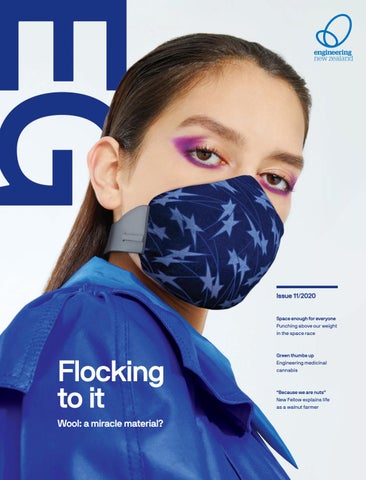
On the cover: Lanaco’s Helix Filter, launched in Healthy Breath’s MEO mask, utilises the protective qualities of wool. Image: © Alisha Lovrich/ Healthy Breath
12 Space enough for everyone Will New Zealand’s knack for innovation and engineering smarts help us overcome our size in the space race? 18 Flocking to it Wool is enjoying a resurgence and has proven useful in the fight against Covid-19.
24 Green thumbs up What roles are there for engineers in the new medicinal cannabis production industry? 30 Next stop: United Kingdom Going underground.
Best practice 38 Eyeing a low-emissions economy Working towards a low-emissions economy can be a complex engineering exercise. 40 Remote acquaintance How can workplaces make a quickly-scaled, flexible workforce sustainable, and why do it? 42 Intersection Crossing paths with engineers. 43 Stop complaints before they start Complaints can offer valuable lessons for the engineering profession.
44 Does compute Technology has been a saviour during the global pandemic, and it’s come a long way since the early computers. 46 Well-oiled machine Find out more about the group supporting the country’s mechanical and mechatronics engineers. 48 Make 40 hours work Courses are just one aspect of CPD, so how else can you make up the required 40 hours?
Shorts 50 Working on water This new Distinguished Fellow’s career has covered a lot of watery ground in 40 years. 52 Leading questions 53 Day in the life New Fellow Fergus Tate’s days differ a little pre-Covid-19 and during lockdown. 54 The secret life of engineers Why this new Fellow of Engineering New Zealand bought a walnut farm, and what life involves.
56 Bedside table Former Environment Commissioner Russell Howie FEngNZ (Life) ONZM recommends some good reads. 57 Review 59 Obituaries 60 Engineering genius
03
Engineering Envy #71
Dunedin Railway Station
Considered one of the world’s great railway stations, the Dunedin Railway Station was New Zealand’s busiest when it opened in 1906. Designed in Flemish Renaissance style by Scottish immigrant architect and engineer George Troup, it’s made of Central Otago bluestone with Oamaru stone facings and trim. The roof is clad with Marseilles tiles. It’s two storeys high, but arcades, gables, balconies, turrets, a tower and a porte-cochere all make it look bigger. A muchphotographed stained glass window depicting a steam train took 200 hours (and $24,000) to restore in recent years. The only passenger train regularly using the station was the Taieri Gorge Railway service (facing potential mothballing due to Covid-19) which travelled through 10 tunnels and across many bridges, including the wrought iron Wingatui Viaduct.
Number of platforms
Cost
Number of tiles in mosaic floor
Daily train departures at peak in history
Height of clocktower
Average yearly passengers departing pre-Covid-19
2
750,000 37m
£800,000 100
400,000
ENGINEERING
What they said
Editorial
05
Let's embed the good things
“We support the Government acting as if this was wartime to protect the nation because we know the most precious resources we will need in the recovery are people.” Rob Fyfe DistFEngNZ, public and private sector liaison in Covid-19 response.
“It doesn’t have to be in contact with your body, there could be some kind of distance.”
University of Auckland’s Professor Olaf Diegel on his team’s Covid-19 innovations, including an emergency
Nau mai koutou katoa. I stepped into the role of President during our second day of Covid-19 lockdown. It’s been a dramatic few months, not dissimilar to the upheaval our profession feels when a natural disaster occurs. We will play a critical part in this recovery, but we need to make sure it isn’t focused on turning back the clock and looks at longterm solutions. As the government moves to stimulate the economy by accelerating so called “shovel-ready” projects, we need to take the opportunity to embed some of the good things that have been done over the years, but not uniformly adopted. Engineers have a leadership role to play here. We need to think about how we can shape conversations with clients differently – especially in the scoping and investigation stage. Good clients will stay focused on outcomes. They engage with engineers at this stage, then allow them to innovate. This means not only can engineers find the most effective way to achieve outcomes, but it often also means achieving better value for money. Procurement models also need to be
stratified the roles of client, consultant and contractor. For some, this has now moved into more of a partnered approach where everyone shares a project’s aims, works through the risks together and finds ways to maximise the talents of all parties involved. These partnerships are more rewarding and result in greater skill development. As we look to stimulate the economy and retain skills across our sector with “shovelready” projects, we need to ensure we steadily rebuild a consistent level of activity across New Zealand. If the work remains at predictable levels we can all plan with confidence and keep building capability, something I’m sure the Infrastructure Commission will be focused on. At this time, there’s also good news. In this edition of EG we recognise our two new Distinguished Fellows, and some of our Fellows, all of whom we’ll celebrate in person in due course. As we all keep working towards a new New Zealand, keep talking to each other, and to us. We’ll continue to support you in whatever way we can.
ventilator operated by an automated hand.
much more collaborative going forward. For too long we’ve unnecessarily
Colin Crampton FEngNZ President, Engineering New Zealand
University of Waikato engineering professor and new Engineering New Zealand Fellow, Yifan Chen, on his research into portable imaging for people affected by Covid-19.
“Our engineers quickly knocked up a little prototype.” Founder of The Cacaphony Project, Grant Ryan, on tweaking their thermal imaging cameras from being predator tracking cameras to start detecting fevers in humans.
“This is why 3D printing and laser cutting have proved so useful, all over the world, in allowing localised distributed manufacturing – products made where and when they are needed – instead of being shipped around the country or world.”
06
EG 11/2020
Engineer to the rescue WRITER MATT WINTHROP
The decision to study engineering – taught by “gurus of concrete earthquake engineering” – has opened many doors for new Distinguished Fellow Des Bull, recognised for his contribution to structural
and Concrete Association of New Zealand (CCANZ). It was around this time he started thinking about teaching as a career. “Fortuitously, in 1993 I was offered a
“What amazed me was how everybody helped where they could... It was uplifting.” Another inspiration is the work Des has done with younger engineers over the years, noted in his award citation.
engineering practice. Like many engineers, Des Bull DistFEngNZ CPEng always had a leaning towards the sciences in high school. This wasn’t the only reason he decided to study engineering at university, though. “To be fair, a lot of my mates were heading to engineering school and I thought, ‘that sounds like me too’ – so off I went. At the time I thought ‘engineering or teaching’ as a career – fortunately, I got to do both.” While at the University of Canterbury, his lecturers were the late Professors Bob Park, Nigel Priestley and Tom Paulay, “gurus of concrete earthquake engineering” who influenced his lifelong interest in seismic design. His first job out of university was with New Zealand Railways designing bridges, returning two years later to do a master’s degree in civil engineering, focusing on structures. Following that was a three-year stint designing more bridges for Beca Carter Hollings and Ferner, then on to multi-storey building for Smith Leuchars in Wellington during the building boom. “Those were really interesting times. Steel went out of favour due to problems with the BNZ Tower, Wellington, and everyone was building in concrete. “This sparked my interest in concrete structures and materials – how concrete performs in all sorts of environments.” However, with the 1987 stock market crash, work started drying up, so Des
teaching position at the University of Canterbury and CCANZ offered to fund it. So, I’ve actually had two jobs for much of the last 25 years – Holcim Adjunct Professor in Concrete Design until about a year ago, and my current role as a Technical Director at Holmes Consulting.” Des has also been heavily involved in developing the engineering service inside New Zealand’s urban search and rescue (USAR), operating within the former New Zealand Fire Service. In 1994, following the Northridge earthquake, Des joined a group of New Zealand earthquake engineers on a fact-finding mission to California. A key lesson was the need for New Zealand to have something similar to California’s engineering USAR service. Des and fellow engineer Dave Brunsdon DistFEngNZ CPEng IntPE(NZ) established the engineering functionality of New Zealand’s existing USAR service, based on engineering practice from North America. “We train New Zealand engineers to be part of response teams during emergencies, heading out with USAR teams to help assess the stability of buildings before teams are deployed to rescue people. In all, we’ve trained around 80 engineers. At any one time we have 10 to 15 engineers on call around the clock.” Des was heavily involved in the USAR response for the 2011 Canterbury earthquake, working on the PGC site with first responders and building contractors over the first 14 hours. He also helped support USAR engineers in the recovery
“Through my connections in teaching, I’ve got to know countless undergraduate and postgraduate engineering students. It’s about communication, building trust and ensuring there’s shared understanding to help people develop.” He’s amazed at the rate of change in the profession over the past 30 years. “The development of computer tools to do engineering – that’s been the biggest, in terms of analysis and documentation, along with Building Information Modelling technology. “It’s led to some amazing efficiencies but also changes in the more traditional approach to engineering. The younger engineers spend a lot of time relying on computer-based tools whereas the older engineers still tend to sketch out designs by hand. “The challenge is to ensure modern tools are being used correctly. Now more than ever we need to maintain high standards of quality assurance.” He still works in a busy, demanding role, but has switched down a gear. He’s still involved in training USAR engineers, but not as much as he used to be. “It’s a younger person’s game and I don’t want to become a medical liability. They’re a great crew and I know they’re in very capable hands.” It also means more time for his other passion – motorbikes. “Yes, I’m a cliché. I own a Harley Davidson. I ride most weekends, my wife and I do a bit of touring around
headed to the concrete and cement industry, working with the Cement
effort on many of the city’s damaged sites over the following month.
New Zealand, and overseas too.”
Profile
07
ENGINEERING FOR EVERYONE We’ve always known engineering is a big deal for New Zealand but now we’ve got the data to prove it. Here’s how much engineering is worth to our economy.
that’s about
3%
of our country’s workforce
We currently have
74,000+ +
engineers in New Zealand
BUT... we need another
1,500 new engineers each year to support our economy. Plus we need to keep the engineers we’ve got (and replace those who retire).
On average, each engineer contributes
$213K to our GDP
Engineering generates
$15billion
per year for New Zealand’s economy
that’s
5% of our GDP
about the same as the primary sector!
Engineers make New Zealand a better place. Because engineering is for everyone, and everyone needs engineering.
Find out more at engineeringnz.org/big-deal
Data source: PwC. (2020). Economic contribution of engineering.
Composite steel floor design just got easier Use our Excel based software for a complete floor design in accordance with AS/NZS 2327:2017 You might not have seen our work, but you’ll have walked on it!
Tray-dec New Zealand Ltd
P 09 820 9133 / E info@traydec.co.nz
www.traydec.co.nz
IT’S TIME TO STAND UP AND BE COUNTED. The Diversity Agenda Accord is the new flagship commitment for the engineering and architecture professions. Is your firm committed? Find out more at diversityagenda.org/accord
NELSON STUD WELDING P 09 820 9133 / E sales@nelsonstud.co.nz
www.nelsonstud.co.nz
18 Flocking to it
24 Green thumbs up
30 Next stop: United Kingdom
Features
12 Space enough for everyone
12
EG 11/2020
Space enough for everyone WRITER MATT PHILP
Will New Zealand’s knack for innovation and engineering smarts see our achievements outweigh our size as we get increasingly involved in the space race?
Feature
13
>>
14
EG 11/2020
Is Oamaru, the New Zealand capital of steampunk and little blue penguins, about to become a hub for spaceflight? The North Otago town was recently announced as the preferred test site for Christchurchbased Dawn Aerospace. Founded by five engineers, including two New Zealand brothers, Dawn has signed a memorandum with the Waitaki District Council that would allow it to begin test flying its unmanned, rocket-propelled spaceplane from the local airport later this year. The prospect of Oamaru joining the space race says a couple of things about the idiosyncratic nature of New Zealand’s fledgling space sector. Firstly, this is not about “space” as traditionally defined – an industry of enormous state budgets and galaxy-conquering ambitions. For Cape Canaveral you can substitute the Mahia Peninsula, where Rocket Lab has built the world’s first privately owned
“Good engineers who can apply science very effectively are going to be crucial.” Deloitte’s 2019 New Zealand Space Economy report notes space contributed $1.7 billion to our economy in 2018-19. Overseeing it all is the New Zealand Space Agency, established under the Ministry of Business Innovation and Employment (MBIE) in 2016. “Space represents precisely the kind of industry that New Zealand should be developing,” wrote the Agency’s head Peter Crabtree in The Spinoff recently. He added it is “highly productive, innovation-led, offers highly skilled jobs, and has significant supply chains and consumer markets that connect into a global economy”. But how well are we placed to grasp that opportunity, what kind of engineers are needed, and do we have
orbital launch site and is pioneering the rapid launch of small-scale satellites. The second thing it highlights is that, as a newly coined spacefaring nation, New Zealand is drawing on historical strengths, particularly a knack for innovation and engineering smarts. “The intention of engineering is to use innovation to create new value, and that’s exactly what this industry is bringing to New Zealand. Without innovation you’re in a zero sum game,” says Dawn co-founder James Powell, whose company’s ultimate ambition is to fly reusable craft bearing small satellites into orbit, multiple times a day.
enough? Aerospace engineer John Cater is a key member of the University of Auckland’s Space Institute (Te Pūnaha Ātea), a new multi-disciplinary centre that aims to “coalesce academic expertise in space systems, and connect academic researchers with industry”. Among the many hats he wears, John is engineering lead for the Auckland Programme for Space Systems, an annual competition whereby undergraduates design a small-satellite mission. The winning team gets to build a CubeSat (a 100mm cube) and have it launched into
Rocket Lab Launch Complex 1, with an artist’s impression of the site’s second launch pad, due to be operational by the end of this year. Image: Rocket Lab
>>
Feature
15
1. John Cater, aerospace engineer at the University of Auckland’s Space Institute. Image: Auckland Space Institute 2. Dawn Aerospace co-founder James Powell. Image: Dawn Aerospace
1
2
space. Already, the competition has produced two spinout companies, including satellite propulsion and software startup ZENNO Astronautics. The Institute’s other two major activities are teaching and research, and its aim is to build capability. “The industry is looking for people with skills that previously didn’t exist in New Zealand – propulsion design, spacecraft re-entry, and so on,” says John, who is a prime mover behind the university offering a new master’s degree in Aerospace Engineering from 2021. “We’re trying to grow the capacity in New Zealand to support that kind of industry.” What breed of engineers are going to be needed? “We see the demand being for small satellites, and those platforms require telecommunications, software and electrical engineering,” John says, adding mechatronics engineers will also be popular. His own research is focused on in-space propulsion, as well as the use of titanium alloys for thermal shielding on re-entry craft. The propulsion work is about developing ways to efficiently move craft in orbit or around the solar system. “We’ve got our eyes on a mission to Venus, and we’d like to contribute to an international mission to Mars.” As for the thermal shielding research, New Zealand has existing strengths in titanium, he notes. “We’re trying to develop structures that can be manufactured using the new techniques of additive
The intention of engineering is to use innovation to create new value, and that’s exactly what this industry is bringing to New Zealand. – James Powell
manufacturing to protect spacecraft and their contents from very high heat loads.” For James Powell, meanwhile, the big dream is that Dawn Aerospace can help revolutionise access to space by combining the power of rocketry with the utility and repeatability of aircraft flight. “If you want to truly scale spaceflight, you have to do it like aircraft do it. You need to be able to take off and land from runways so you can utilise existing infrastructure, and use airspace collaboratively,” he says. “Dawn is working towards a technology, a system and an operational capability that means flying to space a thousand times a year is no big deal.”
>>
EG 11/2020
16
>>
James, whose background is in aircraft design and certification, co-founded Dawn in 2017 with his brother Stefan, plus a Dutch engineer and two German engineers with expertise in rocket system design. Operations are split between New Zealand and Delft, in the Netherlands, which is home to a leading aerospace engineering school. The Dawn Mk II Aurora spaceplane, designed for suborbital flight, is intended to start flying later this year. “That’s the key milestone, doing a first-stage flight profile multiple times per day,” says James. “Going to orbit after that is no trivial task, but at that point you don’t have to demonstrate so much that is new.” If the company achieves its vision, it would open up space to a raft of industries to deploy satellites for all sorts of purposes, from in-space manufacturing to super-
Rocket Lab Mission Control. Image: Rocket Lab
It is rocket science In January, Rocket Lab conducted its 11th successful launch from the southern tip of the Mahia Peninsula, making a total of 48 small satellites that have been deployed by the Electron rocket since early 2018. The New Zealand-founded venture has staged a soaring ascent into the international space industry. It now employs a 500-plus global team, more than 400 of whom are New Zealand-based team members working in specialised aerospace roles across design, testing and manufacture. Even so, “attracting skilled aerospace engineers is one of the biggest challenges Rocket Lab faces as we scale the business”, says founder Peter Beck, and that’s likely to remain the case as the New Zealand space industry matures. Certainly, it’s still early days for Rocket Lab, which is transitioning into a fully-fledged space venture that also builds satellites, while increasing its launch capacity with a second launch pad under construction at Mahia and another recently completed in the US. Peter notes that the company is involved with NASA in a launch to the Moon in 2021 to scout an orbit for a planned mini space station. “We’re also making huge strides in our work to convert the Electron rocket into a reusable launch vehicle by tweaking its design and adding protective elements to its structure so that a rocket booster can be recovered, refurbished and reused after each mission.”
accurate navigation networks for autonomous vehicles. “This is not about growing the current industry,” he says. “We’re thinking: what can you do in space that doesn’t get done now?” Meantime, Dawn has a second iron in the fire – a chemical satellite propulsion system James says is more environmentally friendly than toxic fuel systems such as hydrazine, yet capable of far higher thrust than green alternatives such as electric propulsion. It can be scaled up from CubeSats to satellites weighing hundreds of kilos. He says the system is already selling to customers overseas. Behind both of Dawn Aerospace’s innovations is a team of around two dozen engineers. “There’s structural engineering; there are CFD [Computation Fluid Dynamics] gurus who do everything from hypersonic vehicle and flight dynamics through to combustion analysis for rocket engine operation. We have software engineers who do the guidance, navigation and control systems; control engineers who figure out the maths of how a plane flies, and how the control systems need to respond to all the sensor inputs. “There are avionic and electronic engineers who get together sensors like GPS, Lidar and pressure sensors, and feed that data into control systems. We have radio engineers, and compliance engineers working on how we build a system,” says James. He says the European engineers tend to be great at the hard science, while the Kiwis excel at getting things built. John Cater is confident the nascent Kiwi space industry has a bright future. He predicts one or two new launch providers will emerge in the next couple of years, and reckons there’s potential for New Zealand to become an exporter of satellite subsystems, particularly high-value instruments and sensors. “We have a nimble and very focused space agency, a relatively small group of people on the technical side who know each other and are working together, and we’re all going in the same direction.”
Feature
17
1. The Dawn Mk II structural model in late stages of assembly. 2. Testing of Dawn’s 20N thruster for an Italian customer. Images: Dawn Aerospace
1
2
The impact of Covid-19 The space industry isn’t exempt from the coronavirus crisis. Following the announcement of New Zealand’s lockdown, Rocket Lab postponed its 12th launch from Mahia and paused other operations. At time of writing, it remained in a state of readiness, stating on its website: “We’re fortunate to have enough launch vehicles ready that we can effectively manage a pause in production and still have vehicles available for launch as soon as conditions allow.” Dawn Aerospace’s James Powell says the situation slowed down some satellite system production for customers and delayed flight testing of the MK II spaceplane. “However, we are able to reprioritise a lot of our work to focus on analytics, software development, etcetera, so that overall progress isn’t slowed too much.” For the Auckland Space Institute, disruptions to date have been minor.
18
EG 11/2020
Flocking to it WRITER RACHEL HELYER DONALDSON
Feature
19
Could wool, used by humans since the Stone Age, regain its crown as a miracle material? A growing awareness about the sustainability of natural fibres, as well as health, safety and wellness benefits, is leading to innovative wool products – including in the fight against the global coronavirus pandemic.
>>
20
EG 11/2020
Wool was once New Zealand’s most valuable export before it fell into the doldrums, superseded by synthetics. The bulk of it, known as strong wool, is sold as a commodity product, lately for rock-bottom prices. Wool prices hit an historic low in 2017, with the value of wool exported from New Zealand at around $522 million. In December, MPI forecast that wool export revenue would fall to $490 million for the year ending June 2020. This was due to the China-US trade war, and prior to the Covid-19 outbreak and expected global recession. None of this is good for wool growers. Yet postpandemic, the world is tipped to be a radically different place. The economy and environment are now seen as intertwined. Natural products, such as wool, could potentially play a big role. In Auckland, mechanical engineer Nick Davenport’s
NASA tested Lanaco’s wool-filter technology for particle loading capacity, breathability and flame resistance, plus the ability to function when exposed to water-based fire extinguishers. NASA’s seal of approval means the technology could be adopted by first responders, like fire fighters, and the military, or automotive and public transport. “It’s based purely on performance,” says Nick. “First responders don’t want to compromise on performance because lives are involved.” Lanaco was originally called Texus Fibre when Nick established it in 2011. Then, “the perceptions of wool weren’t so good in our space”. These days Lanaco wears its wool connections proudly. Its name stems from the Latin, lana, meaning wool. The company is based in Ellerslie, on land that used to be one
company Lanaco has been inundated with orders for its new protective wool mask in the wake of the Covid-19 outbreak. Its first production run of N95-level masks all pre-sold as the small company of 10 staff fielded demand from around the world for “hundreds of millions” of masks, says Nick. “We’ve been flat out since this all happened, just trying to keep up, as well as developing new products to suit local demand. “There are very few supply chains for filter media outside China, so our capability resonates strongly with all markets seeking a trustworthy media from a reputable country.” N95-level masks like Lanaco’s are seen as the gold standard in protection. They block out at least 95 percent of very small (0.3 micron) particles, including bacteria and viruses. “This is the perfect size for capturing in Lanaco’s wool filter media,” says Nick. “That’s our sweet spot.” Because wool is bacteria-resistant, manages moisture and removes toxins from the air, the filter media was perfect for healthcare products. Lanaco’s Helix Filter launched in Healthy Breath’s MEO mask, an anti-pollution face mask sold in several Asian markets, with a range of interchangeable cover designs created by Kiwi fashion designer Karen Walker.
of Auckland’s first sheep farms. Nick discovered wool “by accident” while trying to produce a clothes dryer rotary seal that needed to cope with high temperatures and compression.
We’ve been flat out since this all happened, just trying to keep up, as well as developing new products to suit local demand. – Nick Davenport
Lanaco’s wool-based filter system received the “greatest possible endorsement” when, late last year, NASA selected it to protect astronauts on the Orion spacecraft in the event of a fire. “Orion is the most expensive vehicle ever created, and the biggest exploration mission ever undertaken which will see man and woman taken to the moon, Mars and
At the time he was manufacturing polymer-based material components for a host of products. The best material for the seal was wool. He says it was “fascinating” that it was possible to manufacture raw materials that acted like the polymers he’d been using, yet were made from a natural fibre. The idea of using wool for filtration came from Australian research. But the technology needed more development – “it wasn’t reliable enough or thin enough” – and Lanaco created a prototype wool filter with the help of AgResearch. Nick then took a punt, he says, and decided to manufacture it himself, despite never having processed wool. There was a huge amount of variability in the wool.
beyond,” says Nick. “We are over the moon, of course. It’s fantastic.”
Lanaco created the trademarked Astino breeding programme with Wanaka breeder Andy Ramsden,
Where no Kiwi wool has gone before
>>
Feature
21
1
2
3
1. Lanaco CEO Nick Davenport and sheep breeder Andy Ramsden holding HELIX™ respirator filters. Image: Lanaco 2. The unique properties of Astino™ fine wool fibre provide high levels of filtration with low breathing resistance. Image: Lanaco 3. Lanaco’s New Zealand-made disposable filter elements are placed into reusable masks. Image: Lanaco
>>
EG 11/2020
22
to address its precise requirements for “a highly technical product addressing global health needs”, says Nick. “If we were going to compete with products that use synthetic materials, it had to be of a very high standard to prove itself in performance and be consistent.”
“Time for a wool renaissance” Around 90 percent of the wool produced in New Zealand is strong, or coarse, wool while around five percent is fine, soft merino. The defining difference between strong and fine wool is the micron or fibre diameter of the wool. Merino – New Zealand’s success story, used in premium apparel brands Allbirds and Icebreaker – is about 18 microns. More than 80 percent of wool produced in New Zealand is 32 micron or coarser. Strong wool of 30-plus microns has traditionally been used for carpets and upholstery.
Two decades ago, around 80 percent of carpets were wool and 20 percent were synthetic. Then, armed with huge marketing budgets, the synthetics industry arrived in Aotearoa. They sold a story around durability, colour fastness and recycling, recalls Stephen McDougall of Studio Pacific Architecture. “They told an apparent ‘green’ story but this entailed picking up old carpet and melting it down.” Now it’s “more like 10 percent wool carpets, and 90 percent synthetic”, says Tom O’Sullivan, Chair of the New Zealand Campaign for Wool Trust. He says it costs farmers more to shear a sheep than they get from selling the wool. “It’s the price factor: the world has become a very throwaway society, and people just go with what’s cheap.” But the “environmental groundswell” over the past decade has meant “a huge opportunity for wool”, says Tom. “It’s an anti-synthetic, anti-plastic lobby and it’s global.” Wool’s attributes are very significant in terms of sustainability, adds Stephen. “It is time for a wool renaissance. It just makes sense now.” Wool growers hope to capitalise on this. The Campaign for Wool (CFW) is an international initiative to raise awareness about wool’s unique attributes and encourage people to buy more wool products. It hopes to encourage collaboration between an international community of wool growers and industry – including retailers, manufacturers, architects, designers and engineers.
A “wonder product”
Wool textiles were used in the redesigned Royal Society of New Zealand buiding in Wellington. Image: Patrick Reynolds.
Ewe beauty Innovative Kiwi entrepreneurs are finding a multitude of uses for wool.
Wool’s many inherent properties make it a “wonder product” for use in building, industrial and lifestyle areas, says Stephen, a CFW ambassador since 2011. “Wool simply makes sense on so many levels. It’s a natural soak of VOCs [volatile organic compounds], it’s renewable, it’s biodegradable, it’s got low-carbon impact. It’s breathable, it’s got in-built humidity control,
1 2
Wool for wellbeing
Cool wool
T&R Interior Systems’ Floc 3D tiles are made from New Zealand-grown strong wool fibres, manufactured and handcrafted locally, and pressed into 3D panels. Benefits include reverberation control in offices, boardrooms and other commercial interiors, plus temperature
Woolcool insulation is made from biodegradable and compostable felted sheep’s wool sealed within recyclable, breathable film. Wool fibres absorb and release moisture, which maintains temperature. Used with ice packs, Woolcool keeps contents – from pharmaceutical
regulation and moisture control.
goods to My Food Bag chilled products – between 2–8 degrees for at least 72 hours.
>>
Feature
low-allergy properties, it absorbs toxic chemicals, it’s a sound absorbent, it’s a thermal insulator and it’s got signficant flamability advantages.” Studio Pacific Architecture tries to use wool in as many of its projects as possible, including residential developments – from high-end projects to Housing New Zealand clients – and commercial projects. Meanwhile, wool carpet, upholsteries and textiles can “completely” change a room’s atmosphere, thanks to the way wool absorbs moisture, sound and heat, says Stephen. Using wool not only benefits the New Zealand economy, but could also provide the answer to sustainability, health, wellness and safety issues. He says engineers, along with architects and designers, have a “crucial” role to play. They understand sustainability and environmental issues. As “specifiers of products”, they make conscious decisions to select particular materials. “I would encourage them to consider wool. They should also encourage their clients to choose wool over synthetics.”
23
1
2
Environmentally sound When synthetics are washed, be it clothes or carpet fibres, tiny granules of plastic end up in the oceans. In contrast, new research by AgResearch in Lincoln and Scion in Rotorua has found that carpet wool biodegrades in the marine environment, just as it does on land. Meanwhile modifications to the strong wool fibre – such as dye, or treatments to make it stain resistant or machine washable – do not reduce biodegradability, generally. AgResearch senior scientist Stewart Collie says that, when comparing the life cycle of wool and synthetics, it’s important to remember that wool has no lasting impact on the environment. “Wool provides a reliable, sustainable opportunity in most applications where you might think you can recycle a product at the end of its life.”
34 Wool’s making waves
Where there’s a wool...
In 2018, Tauranga surfboard maker Paul Barron developed a surfboard made from wool. The Woolight range is produced with US-based Firewire Surfboards. The wool composite technology could replace fibreglass in boats, aircrafts, automotive components and furniture.
Outside the Box Caskets already sells sustainable cardboard coffins but is developing a casket made from strong wool. Founder Becs Bartells was the 2019 winner of Idealog and NZ Merino Company’s Wool-ovation competition to design a product that harnesses the potential of strong wool.
3
1. AgResearch senior scientist Stewart Collie. 2. Microscopic image of polyester shows the fibre is unchanged after a biodegradation test. 3. Microscopic image of wool shows the fibre breaking down after the same test. Images: AgResearch
24
EG 11/2020
Green thumbs up WRITER MARY-JO TOHILL
A new industry is emerging in New Zealand, positioned in the wellness market: medicinal cannabis production. And there are roles for engineers.
Feature
25
>>
EG 11/2020
26
>> In December 2019, the Government passed the regulations for a Medicinal Cannabis Scheme, which makes it possible to cultivate, manufacture and distribute medicinal cannabis in New Zealand. Since 1 April, a Medicinal Cannabis Agency has been in operation to administer the scheme and ensure medicinal cannabis products meet the minimum quality standard. About 20 companies are licensed to grow cannabis for research purposes and another 238 are growing industrial hemp (iHemp). It’s expected at least some of these companies will apply for licences for medicinal cannabis.
the high number of regulatory hurdles to pass when entering the industry. Changes to these regulations bring more clarity around licensing, quality standards, prescribing and supply. “New Zealand’s real advantage in this industry lies in its agricultural proficiency, innovation and marketing. New Zealand’s agricultural sector has a global reputation for producing high-quality products in a clean and green way,” Daniel says. He says Greenfern Industries’ goal is to bring high quality, affordable products to the market.
Marketing into the wellness space
Processing the flowers of their labours
One of the first to join the so-called “green rush” into the medicinal cannabis industry was Taranaki-based Greenfern Industries, which describes itself as a therapeutics company. Co-directors Daniel Leyden and civil engineer Dan Casey and the team are in the process of building stage one of their medicinal cannabis research facility in Taranaki, with crowdfunding supplementing other investment. There’s a hydro-electric power station on the same site and they have an exclusive power agreement with its owner.
The legalisation of medicinal cannabis in New Zealand had presented engineers with the opportunity to learn new technology and gain new skills in design and installation, according to Dr Stephen Tallon, Callaghan Innovation’s process engineering group team leader. “It’s a chance to upskill in some relatively new technology areas such as extraction and purification of plant extracts.” Extraction techniques are used to isolate specific desirable compounds. Cannabis contains at least 100 different cannabinoids, including cannabidiol (CBD) and
Until now, New Zealand hasn’t been particularly wellplaced for a cannabis industry boom, one reason being
tetrahydrocannabinol (THC), which form the majority of the active components in medicinal cannabis products.
Feature
2
1. Callaghan Innovation’s supercritical fluid extraction plant. 2. Dr Stephen Tallon, Callaghan Innovation’s process engineering group team leader. Images: Callaghan Innovation
Stephen’s team specialises in the separation techniques and has an established pilot-scale test facility for new process design and validation. This enables a comparison to be made between different processing technologies such as ethanol, butane, or supercritical CO2 extraction. In 2002, the New Zealand hop industry commissioned a CO2 extraction plant at Richmond, near Nelson. The compounds and the chemicals in hops were fairly similar to cannabis, including the cannabinoids, Stephen says. While still “niche”, this sort of extraction was fast becoming the preferred option for medicinal cannabis, he says. They used iHemp for the trial. Carbon dioxide extracts the cannabis components from the plant matrix, using high pressure to the turn the CO2 into a “supercritical” fluid state. Essentially, the system works like an espresso coffee machine, which brews coffee by forcing pressurised water near boiling point through a packed bed of ground coffee in order to dissolve out the desired components that make a good cup of coffee. “So instead of putting the coffee beans into the puck you put the cannabis flowers in. And instead of water to extract the caffeine, you use carbon dioxide to extract the cannabinoids.” Supercritical CO2 had been widely used to remove caffeine from coffee beans since the 1970s.
27
2
New Zealand’s agricultural sector has a global reputation for producing high-quality products in a clean and green way. – Daniel Leyden
However, the extract produced from cannabis was quite different, Stephen says. Unlike water, supercritical CO2 takes out the sticky, oily, components from the cannabis flower resulting in an extract rich in cannabinoids. It can range from a dark green, gummy consistency through to a golden fluid oil in more concentrated form. “Because of the variable nature of pilot development work, we have designed and built a lot of our own bespoke processing equipment. We use imported valve and pipe components, but key parts of the plant including control
>>
28
EG 11/2020
>> 1. BioLumic’s UV ray system. Image: BioLumic 2. BioLumic’s UV treatment reduces the need for chemical sprays. Image: BioLumic 3. Cannasouth research scientists Daniel Reason and Sameek Singh. Image: Cannasouth 4. Cannasouth’s cultivation facility. Image: Cannasouth
1
3
2
4
Feature
systems, and the high pressure vessels, were designed and built in New Zealand. “There’s plenty of capability in New Zealand for heavy engineering design and fabrication.” The system developed at Callaghan Innovation has four, 10-litre extraction vessels that can process up to 20 kilos of flowers at a time, and the whole plant is designed to fit inside a shipping container so that it can be shifted around. “You buy or build the size of the espresso machine for as much espresso you think you’re going to need. It is the same for cannabis extraction.” He says there is definite interest in this sort of equipment in New Zealand. “The cannabis industry has a historical association with illicit drug production and some of the ‘rough and ready’
the need for chemical sprays. They’ve experimented on different crops, ranging from Spanish lettuce, to cannabis, to soy. During the Covid-19 lockdown period, staff took the soy plants home to look after them, so all the research and development work they’d been doing wasn’t lost. “The idea is that it’s clean and green, which is part of our ethos for building a sustainable industry.” BioLumic’s mechanical engineer Jason Phillips MEngNZ has a dairying background. The move from cows to cannabis is not that much of a stretch for the engineer who has worked on everything from superyachts to biogas systems to agricultural engineering. Being on intimate terms with the inside of a milking shed has also been an advantage. Engineering and agriculture had always been in a symbiotic relationship, he says. “And this is just continuation of that.”
practices traditionally used had some influence on early production as cannabis use became legalised in some countries.
Potential for innovative engineering
Meanwhile Palmerston North-based BioLumic starts with the seedlings, combining a high-tech UV light system with good old-fashioned engineering. The agritech company is based on science developed by Massey University Professor Dr Jason Wargent. He is BioLumic’s founder and chief science officer and an expert on UV photomorphogenesis, the science of how light can unlock a plant’s true potential to increase yields and defence against disease, drought or pest attacks. (See EG issue 7/2019 for more on BioLumic.)
Cannasouth is a medicinal cannabis product development and research company near Hamilton. Conor English, brother of former Prime Minister Bill English KNZM, is an independent director, with his broad agricultural background and governance and business experience around New Zealand products and exports. With its joint venture partner, Cannasouth Cultivation, the company is building a hybrid greenhouse facility using a heating, ventilation and air conditioning (HVAC) system. Co-founder and chief executive Mark Lucas says HVAC is not commonly used in greenhouses, therefore presented a host of design and engineering challenges. The sealed, insulated structure gives a much higher R-value (rating which measures how well insulation can resist heat flow) than a glass structure to reduce energy use, specifically heating costs, when compared to traditional glasshouses. However, while the innovation unfolded indoors, the true excitement lies outdoors, he says. On the company’s visits to Oregon, the iHemp and CBD epicentre in the United States, Mark noted some farmers were harvesting and hanging the biomass by hand, which he describes as “very primitive”. He says there are many opportunities for innovative harvesting technology. Mark predicts outdoor cultivation in New Zealand “will be massive” one day, but the industry would need 12-15 years to come of age and reach an equilibrium. “This is a new crop, which a lot people are interested in growing, but it’s got its own characteristics. “Medicinal cannabis is a pharmaceutical product that is highly regulated – I’m not sure everyone involved is entirely sure what is involved to make it. Even as a raw ingredient it has pretty high quality standards.” But he’s confident New Zealand would make a
A mechanised light ray passes over the seedlings – a bit like a scanner – delivering a UV treatment, reducing
success of it, as a country of innovators who like to solve problems.
Engineering and agriculture had always been in a symbiotic relationship. – Jason Phillips
“However, the industry has matured and wellestablished engineering design and manufacturing companies, particularly in Northern America, supply well designed and functional equipment off-the-shelf.”
Growing an industry from the seed up
29
EG 11/2020
30
Next stop: United Kingdom
Going
underground UK population
66.4 million UK land area
243,305km
2
Engineering New Zealand Branch membership
153 Did you know‌ The only branch based outside New Zealand, Engineering New Zealand’s UK Branch welcomes members living in, or just visiting the UK. It offers site visits, technical presentations and social events and shares a regular programme of events with engineers from Australia and Singapore.
Feature
31
WRITER RACHEL BERRY
While the outbreak of Covid-19 stalled normal life – and work – in the United Kingdom, there are many engineering projects this part of the world will benefit from throughout the recovery, and beyond. EG talked to some Engineering New Zealand United Kingdom Branch members about recent and current innovative projects they’re working on. With London in particular so built up, engineers are increasingly working underground.
A super sewer Beneath the River Thames, London’s new super sewer is under construction. Stretching from Acton in the west to Stratford in the east, the 25km, 7.2-metre-diameter Thames Tideway Tunnel is the largest water infrastructure project ever undertaken in the United Kingdom. London’s original sewer system, built in the 1860s, is a network of combined system overflows (CSOs). “It was nearing capacity and because of the way it’s designed, that capacity just spills out into the river during storm events,” says Russell Scoones CMEngNZ CPEng IntPE(NZ), Project Engineer, Ferrovial/Laing O’Rourke (FLO). “In 2020, this isn’t an acceptable approach to managing one of the world’s largest cities’ sewer networks.” The £4.9 billion Tideway Tunnel will prevent 39 million tonnes of raw sewage entering the Thames each year. It will intercept sewage from the CSOs and carry it to a new treatment plant in east London. Six tunnel boring machines are excavating the tunnel. Spoil is removed by barge, keeping thousands of trucks off London’s roads. At interception sites along the river, shafts drop down and connect to the main sewer tunnel. At the Victoria Embankment site in Central London, Russell says the first task was to reclaim a section of the river to, in effect, build their own site. “We built a twin wall sheet pile cofferdam,” he says. “Everything had to be done from a barge-mounted plant working from the water. Nothing comes by the road. Logistically, it’s an extremely challenging site.” The team sank a 15-metre-diameter shaft 47m into the ground and poured a base slab. They’re now building the connection tunnel, which runs from the bottom of the shaft toward the river to connect into the main tunnel. It’s risky work; as well as working underground on a reclaimed site, connecting the old and new systems will happen while the original sewer is still live. The sewer is scheduled to be completed by 2023. Russell says the scope of the project and the tough conditions make it so exciting. “It’s extremely challenging,” he says. “The engineering that goes into this is significant.”
>>
EG 11/2020
32
A luxury basement In London’s Mayfair, the five-star Claridge’s Hotel has epitomised luxury since 1856. To maintain this status, and attract new clientele, the hotel required an upgrade. With no space above ground, they wanted to dig down. In 2016, exploratory work began on a £35 million civil engineering project to form a new five-level basement. The catch? Claridge’s was adamant that the hotel stayed open. The basement sits beneath the newer Art Deco section of the hotel. It contains a new swimming pool and spa, an in-house bakery and chocolatier, and a wine cellar. It also houses kitchen and staff facilities, plus the boiler room and plant, which were originally at roof level. Access was provided to the original Victorian part of the hotel from the basement by forming adits and shafts to accommodate lifts and stairwells. It’s hand excavated, with the load that was originally on a 1.1-metre-thick raft foundation transferred onto pile foundations. Underneath each of the 61 columns, the team hand dug 1.8-metre-diameter shafts 30m down in the ground to form the piles and then transferred the superstructure load via temporary jacks. Bulk excavation of the first basement level, again by hand, could then begin. “The big challenge was, because the hotel remained open, the engineers were only allowed to come in through a 2m by 2m window at the back of the hotel,” says Jonathan Gammon FEngNZ, Director of Geotechnical Observations Limited, who delivered instrumentation and monitoring on the project. Another key challenge was dealing with different configurations of wall around the perimeter. “There’s an existing sheet pile wall that separates the Art Deco building from the Victorian building,” he says. “There were gaps in the perimeter that needed ground retention so they could start the works and put the basement walls in. They used electrically powered bored piling rigs to form a secant piled wall. They did some underpinning work as well, to keep the ground in place and the groundwater out. It’s a remarkably dry basement. The finish on the concrete is superb.”
two earth-pressure balanced tunnel boring machines worked their way through Nine Elms to Kennington. An overhead conveyor system took the spoil back to Battersea, where it was put onto barges and taken away along the Thames. Local government body Transport for London obtained the works order it needed for the project following a fourweek public inquiry at the end of 2013. “The two main areas of concern for the public at large were the potential for property damage from ground movement, and possible noise during construction and operation,” says Jonathan, who was an expert witness at the inquiry. A key engineering challenge was how to join the new tunnel and line to the existing Northern Line. Contractors FLO, with designers Mott MacDonald, solved the issue with a step plate junction. It’s made up of two parts: the hand mined 6.5-metre-diameter section, and the larger 9.5-metre-diameter section. This larger section was excavated mechanically and lined with spray concrete and iron rings, installed with a custom-designed ring erector. These were connected to the existing tunnels over a single weekend in September 2017. The railway lines were connected up over the Christmas break that year. While the project was temporarily halted in March, due to Covid-19, it is scheduled to be completed in 2021.
Kiwi in UK’s most influential 100
On the south bank of the River Thames, the iconic Grade II listed Battersea Power Station is being transformed. The site will regenerate the local area, with new homes and jobs, plus shops, bars and restaurants. Below ground, engineers are delivering a £1 billion project to extend the London Underground’s Northern Line. It’s the most significant upgrade to the Tube since the Jubilee Line extension in the 1990s. The Northern Line extension comprises a 3.2km twin bore tunnel from the existing Kennington station,
Award-winning engineer Fritha Bevin-McCrimmon MEngNZ is passionate about recruiting the next generation of engineers. In addition to her role as Project Engineer at Stantec, the University of Canterbury graduate runs schools programmes that introduce engineering to children in the north east of England. Her work promoting women in STEM saw her awarded the WISE Rising Star Award in 2018. In 2019, she was named one of the UK’s top 100 most influential women in engineering. Following roles at the Stronger Christchurch Infrastructure Rebuild Team and Fulton Hogan, Fritha relocated to the UK in 2015. Based in Durham, she worked for the Environment Agency before joining Stantec in 2016. Her focus is the three waters; she’s worked on key regional projects including the AMP6 framework for Northumbrian Water and the Sunderland Strategic Transport corridor. She serves as the community leader representative for Stantec, organising school and community engagement. “Engineering wasn’t really ever presented to me as an option at school,” she says. “I want to change that and to make sure school children – girls and boys – learn what engineering is. Women make up 50 percent of the population, but only a much smaller percentage of the engineering workforce. But as engineers, the things we design are for 100 percent of
to new stations at Nine Elms and Battersea. Tunnel excavation began at the Battersea end, from which
the population, men and women. That’s why it’s crucial to include views from all sides in civil engineering designs.”
Significant Tube upgrade
>>
Feature
1
33
Covid-19 and Kiwi engineers in the UK A message from the Chair of Engineering New Zealand’s UK Branch During the United Kingdom’s lockdown due to Covid-19, our members in the UK made the rapid adjustments required by the Government to reduce the spread of the virus. The UK approach and rallying cry was based around the slogan “Stay home, save lives, protect the NHS”. We began working from home in late March, except for key workers providing essential services. However, our Branch Secretary, an essential worker who supplies
2
3
thermal imaging equipment, was busier than ever during the lockdown period. A highlight of the week was the Thursday evening 8pm applause from our front doors for carers. Many projects in the design stage were able to continue during the lockdown, however construction work on major projects slowly ramped down then stopped. That was a key difference with New Zealand, with the UK allowing construction work to continue even during the first stages of the lockdown. The UK Branch continued to provide support to members and worked to keep morale and engagement up. This was through initiatives such as webinars, a newsletter with a focus around offering support with chartership and mentoring, and virtual branch “drop in” sessions. We continued with committee meetings and plans for future events and have an exciting programme planned for when restrictions ease. Together we will get through this challenging period, and we have an exciting future ahead. Andrew Delugar FEngNZ
1. Blackfriars Bridge Foreshore shaft excavation for the Thames Tideway Tunnel. Image: Tideway 2. Roundels are installed at Battersea Power Station, part of London’s Northern Line extension Image: Transport for London 3. Fritha Bevin-McCrimmon.
Snapshot Winner of the NZ Wood-Resene Timber Design Awards 2020, The Lindis, in North Otago’s remote Ahuriri Valley, offers luxury accommodation with just five guest suites. It’s built on a moraine wall formed by a retreating glacier. Designed by Architecture Workshop and engineered by Dunning Thornton Consultants, it features a soaring timber and steel grid shell that suggest it’s another layer of the land. It was crowned best hotel at the 2019 World Architecture Festival. Is this the kind of experience that will drive New Zealand’s post-Covid-19 tourism in the future? Image: Lindis Group
40 Remote acquaintance
42 Intersection
43 Stop complaints before they start
44 Does compute
46 Well-oiled machine
48 Make 40 hours work
Best practice
38 Eyeing a low-emissions economy
EG 11/2020
38
Opinion Dr Mike Hopkins has been Chief Executive Officer of Carbon and Energy Professionals New Zealand since 2016. His background includes consulting, academia and working with energy companies in the United Kingdom before moving to New Zealand in 2002. Find out more at cep.org.nz
Best practice
39
Eyeing a low-emissions economy DR MIKE HOPKINS
Working towards a low-emissions economy can be a complex engineering exercise. Energy and carbon are inextricably linked. Even in New Zealand, with our high proportion of renewables in our electricity generation portfolio, there is enormous potential for reducing emissions, particularly in the industrial sector (heatbased processes) and transport. Even in the electricity sector, every efficiency saving not only saves money but helps towards our Government’s target of a 100 percent renewable electricity sector. Most non-agricultural emissions in New Zealand and around the world come from burning fossil fuels. Whether it’s in transport, industrial processes or water heating, making sure that conversion is as efficient as possible and that we’re not wasting energy is critical. This can be a complex engineering exercise and members of the Carbon and Energy Professionals New Zealand (CEP) rise to the challenge. CEP is, arguably, a new and an established body. Set up as the Energy Management Association of New Zealand in 1993, we changed our name in 2019 to better reflect our own and our members’ activities. Initially we were a Special Interest Group of then-IPENZ, becoming an Incorporated Society in 2001. We remain a Collaborating Technical Society of Engineering New Zealand. We have also worked very closely with the Energy
develop our training and accreditation programmes, initially to drive energy efficiency but now also in reducing emissions. Our annual highlight is a national conference, open to members and nonmembers. We have partnered with The Sustainability Society to provide more information about emissions across the areas of water and waste as well as energy. Due to Covid-19, the 2020 conference in June, “Next Steps to Net Zero”, became a digital event, with strong national and international speakers. We are keeping members updated digitally about the latest innovations and best practices around energy efficiency and emissions management. Our portfolio of events and training continues to evolve. As well as bringing in carbon management, we also introduced a carbon auditor training and certification programme early in 2020. Our training programmes are still being delivered – albeit online – and we’re working out new ways of engaging with members. We are also active in representing member interests and adding to the debate on government energy and climate change policy. We regularly submit on government consultations, especially those related to climate change. It was refreshing to see several ideas we put to the Productivity Commission Inquiry into a low-emissions economy find their way into
we have developed a good rapport with relevant ministries and ministers. The need to prepare for changing work functions and environments is ever growing and we see CEP becoming an integral part of helping New Zealand transition to a low-emissions economy and developing the careers of younger professionals entering the workforce. In short, CEP is for the doers of energy efficiency and emissions reduction, the people who will develop and deliver the solutions that will bring about a lowemissions economy. We foresee a huge uplift in interest in our area and expect membership to grow correspondingly. Labelling it “The Great Effect”, a recent survey by the Institute of Chemical Engineers of teenagers in the United Kingdom revealed 25 percent are interested in careers in environmental, emissions or climate-change-related careers. Our growing membership will cater for generalists in those areas as well as those wishing to develop expert-level engineering skills and knowledge. It is CEP members who will deliver the planning capacity and technical expertise to transition New Zealand to a low-emissions economy. The introduction of a Climate Commission and expected increases in carbon prices will see much more focus on emissions and efficiency over the coming decade. At our launch last October, the Minister for Climate Change, James Shaw, promised plenty of work for
Efficiency and Conservation Authority since its inception and they have helped
subsequent consultations on accelerating energy efficiency and renewables, and
our members over the coming decade. We shall be holding him to that.
40
EG 11/2020
Remote acquaintance TONY HARRISON
With the outbreak of Covid-19, thousands of workers suddenly had to work remotely, highlighting how being agile and flexible benefits organisations and the economy by allowing businesses to continue operating through a crisis. But is a quickly-scaled, remote, flexible workforce sustainable, and why might a company choose to continue in this manner? In March, many workplaces in New Zealand were given just days to ensure anyone who could work from home would be in a position to do so. Those that fared best had good mobile devices for staff and a strong associated IT network. Beyond IT, challenges included the lack of an appropriate workspace at home, interruptions and juggling childcare. But through this, there will be companies that decide flexible and remote working is something they incorporate more for staff. And while scaling at the breakneck speed of earlier this year is not ideal, with planning and processes, a remote workforce – particularly for smallto medium-sized businesses – can be sustainable. Two of us established Urban Connection (UCL), transportation and civil engineering advisors, nearly two years ago, and we’re fully remote. We quickly found there were many benefits and as our small business expanded, we offered and encouraged a fully flexible working model to new employees. We believe this model can be scaled, and see no issues having a team of up to 50 working in this manner.
Best practice
41
They’re free to fit in things like walking children to daycare or school, walking the dog, attending appointments or other everyday life activities whenever it works best.
The key factor is having the ratio of Principal to staff correct – between two and four staff mentored and led by a Principal works well. Tools of the trade We run a “bring your own device” approach, providing funding to purchase the computer and mobile device of choice. We run MS SharePoint, and as external IT support, we have our cloud backup system. MS Teams, with video calling, screen sharing, chat and the ability to link project files, is our main communication platform. Our team have dedicated workspaces at home, proper desk setups, full size monitors and the ability to close off the office.
always have a general social chat up front and we don’t rush that. We get everyone together for biannual team building retreats and strategy sessions. Team members based in the same area typically meet face-to-face weekly either for project-related reasons, or socially. We also encourage the team to regularly get out and meet with our supply partners, clients and others in the industry.
Building a remote team When recruiting, we tell interviewees we start from a position of trust. Some team members have taken a little while to adjust to the model – mainly the balance of getting the interaction with people right – but once they do, they don’t want to go back to a traditional office model. We have a strong focus on team building and believe having fun and knowing each other’s working styles and capabilities is very important. While our weekly calls used to focus on workload, they’re now based on our company values. The focus is on good team discussion about work and play, opportunities, industry news,
Managing a remote team Managing a geographically spread team is similar to mainstream models where project teams are made up of people from multiple offices. It’s key to establish strong relationships and provide briefs at a level of detail that aligns with experience. Regularly check in, and make sure people know they can always ask for assistance. We focus on outputs and outcomes rather than micro-managing everyone’s hours, so staff have autonomy over how and when they deliver. Some are morning people, others prefer later starts. They’re free to fit in things like walking children to daycare or school, walking the dog, attending appointments or other everyday life activities whenever it works best. They find their work time is more focused and efficient with considerably fewer interruptions than in an office environment. This provides dividends for them, our clients and the bottom line. Six hours of uninterrupted time working
interesting project news and technology and innovations. We do make a point to
remotely on a report is worth two days in the office environment due to the improved
focus. The more efficient they are, the more “life” time they can utilise. Sustainability and the bottom line The model has a positive impact on the bottom line, though ultimately it’s about quality of life for our team and the environment. On average, our team members save 144 hours and $957 of fuel per annum by not commuting. The national average sick leave per employee is 4.1 days per annum, whereas for us it’s 0.5 days. There is a direct saving of about five percent by not having physical premises and associated costs and we use about 80 percent less paper than we would in an office. The offset in office and transport emissions is equivalent to planting 476 trees. We have expanded this out to see the results if five percent of the country’s workforce moved to this model – it would mean the equivalent of 4.49 million trees, $1.056 billion saved in sick days and office operating costs and 19 million hours of travel saved. Could something like this be more widespread in our post Covid-19 life? Tony Harrison is the cofounder of Urban Connection, transportation and civil engineering advisors with staff in Hawke’s Bay and Christchurch.
EG 11/2020
42
Intersection
Intersection
People crossing paths with engineers.
I embarked on this career path because… I was always interested in maths and also the natural environment in New Zealand, so studying geophysics seemed like a great fit. After completing a master’s degree at Victoria University, I continued my studies in near-surface geophysics at ETH Zurich, Switzerland. A key part of my work experience is… due to timing – starting at GNS Science as a Seismologist just one month before the start of the Canterbury earthquake sequence. The earthquakes were a very difficult challenge for many people in Canterbury, with a long-lasting impact on our society. One of the silver linings is we learnt a great deal from the earthquake response in terms of new scientific understanding and analyses, and how best to produce the most useful and usable science to aid the recovery effort. This continual learning has served us well in responding to the last decade of major New Zealand earthquakes and being better prepared for the future. A career highlight has been… that the active New Zealand tectonic setting has led me to explore an increasingly wider range of seismology research topics over the past 10 years. I also served as one of GeoNet’s Earthquake and Tsunami Duty Officers for many years, before handing over to the new crop of duty officers and 24/7 National Geohazards Monitoring Centre team and have recently taken up a seismology team leader role.
I work with engineers… closely, as do other seismologists at GNS Science, particularly around understanding the ground motions during our recent major earthquakes, and their impact on buildings and infrastructure. Together, we’ve also been helping to better plan for the future by quantifying what local ground motion we could expect during future earthquakes and considering how to incorporate that into seismic-resistant design and planning. One of my topics of interest is… understanding the local subsurface geology and how it impacts local ground shaking. Our team has been in regular contact with engineers in Wellington to share data, models, maps and understanding of our sedimentary basin. In my observation, engineers are… seeking practical solutions, which is the basis of great collaboration to figure out how to get science into practice. They also often have a general background in earthquake science – obviously the fields are related. We often have fruitful discussions, distilling the science into key observations important for the engineering community. Things engineers all seem to do well include… having a practical, to-the-point style of communication – they are not afraid to ask questions, test assumptions, and suggest solutions. They focus on getting things done.
Anna Kaiser Based in: Wellington Role: Seismologist/Seismology – Source to Surface Team Leader, GNS Science Education: Bachelor of Arts (German), Bachelor of Science (Geophysics and Mathematics), Victoria University of Wellington, 2003; Master of Science (Geophysics), Victoria University of Wellington, 2006; PhD (Geophysics), ETH Zurich, Switzerland 2011
Engineering decisions impact my work because… ultimately, we want to make our science useful and usable for engineers, so any decisions made in the engineering space will impact how we look at a problem and what we deliver. For instance, New Zealand’s building code, regulations and practice provides a framework that influences how we design, carry out and deliver projects such as our Wellington basin characterisation and ground motion studies. My work impacts engineering decisions because… the nature of science means we are continually improving our knowledge of earthquake behaviour, earthquake occurrence, and expected ground motion – leading us to update our understanding of seismic hazard and its implications. Ultimately, this knowledge is developed, tested, distilled, and taken up in engineering practice.
Best practice
43
Stop complaints before they start STACEY CAMPBELL
Engineering New Zealand receives around 50 concerns and complaints about Chartered Professional Engineers and members each year. But they can offer valuable lessons for the engineering profession. Some of the complaints Engineering New Zealand receives relate to serious issues of competence or ethical conduct. Many others arise from miscommunication, inattention to client care, or a misunderstanding over what the engineer has been engaged to do. We have received several concerns recently involving structural engineers undertaking geotechnical assessments or giving geotechnical advice. Structural engineers and geotechnical engineers work closely, and their roles can overlap. Most engineers working in structural or civil fields have at least a basic understanding of geotechnical engineering, and many “general practitioner” engineers will routinely work across all three fields of practice. In many cases, it may be well within an engineer’s competence to provide geotechnical advice, even if that is not their primary practice field. However, building consent authorities may require that geotechnical advice is provided by a geotechnical specialist, or ask for specific geotechnical input to support a resource or building consent application. In other instances, we have been told that
because of their client’s concerns about cost, or because they decided to rely on their own skills and judgment. It is important to keep in mind you are obliged to only act within your areas of competence. Engineers working on structural projects should be mindful of the need to ensure their client obtains the right level of geotechnical input for the project, to satisfy the BCA’s requirements and good engineering practice. This is particularly important when working for lay clients who may not have a professional’s understanding of the consenting process. We often receive complaints about engineers withholding PS4s or other documentation needed for building consent, on the basis that complainants have not paid their fees. In our experience, complainants often refuse to pay their fees if they are unhappy with the terms of payment, or they are unsatisfied with the project. For example, if the engineer’s services didn’t cover what the client thought they would have – perhaps the engineer didn’t carry out inspections, or the client misunderstood that the engineer would be managing the project and the consent applications. We don’t have jurisdiction to investigate pure invoicing disputes, but these often play a part in broader engineering concerns that come to us. Most complaints of this nature stem from a breakdown in communication. Engineering is a specialised and technical
always ask the right questions at the early stages and may realise later they are missing vital services or information. Clear and informative communication with clients – ensuring the client knows what they need, knows what the engineer can deliver and has an idea about how much this will cost – can significantly reduce the chance of a dispute arising. When we receive concerns, one of the first questions we ask is whether the complainant has tried to resolve their issue directly with the engineer involved. Often, their response is that the engineer has refused to engage with them or has brushed off their concerns without adequately explaining themselves. More than once, an engineer has refused to respond to concerns raised with Engineering New Zealand, which has led to the concerns process taking longer, and being more difficult to resolve, than if they had engaged with us from the outset. It’s difficult to deal with unhappy clients – and more so if those clients are perceived as troublesome or have not paid their bills. But facing into these conversations early can avoid a complaint or commercial dispute arising in the first place, saving you stress and time. Responding to concerns is part of professional life. We recognise it’s never pleasant to be on the receiving end of criticism or complaints, but your response has a significant impact on the speed and manner in which complaints are resolved.
structural engineers have not sought geotechnical advice when it was needed,
field which most people don’t have common knowledge about. Clients won’t
Our Managing Complaints Toolkit is available at engineeringnz.org
44
EG 11/2020
Does compute CINDY JEMMETT
It’s hard now to imagine our lives without our personal computers – they’re at work, at home and in our pockets. Through the Covid-19 pandemic, technology has enabled us to stay connected while physically distant. Computing and the development of the internet have radically changed our lives and the way we work and communicate in a remarkably short space of time. The first digital computer in New Zealand was an IBM 650. It was installed at the Treasury in 1960, where its primary function was to process the payroll for New Zealand’s 34,000 public servants. The computer was capable of 1,000 sums per second and stored these calculations on magnetic tape. Each fortnight, the pay vouchers were printed from this tape record. As its operation generated a significant amount of heat, the computer was housed in a special air-conditioned room. A false floor accommodated the multitude of cables. By 1969, nine government departments had computers and many others shared the facilities at Treasury and the Department of Education. The capability of these early computers and the uses to which they could be put steadily increased and they became a valuable tool for engineers. The Ministry of Works and Development operated the Vogel Computer Centre. The Vogel Computer was one of the largest
Electricity, Forestry, and Broadcasting for engineering and scientific work. The computer proved a cost-effective tool in the planning and operation of civil engineering works. Engineers used the computer to compare multiple alternate routes for new roadways and for projects such as the Upper Waitaki hydro scheme, where the computer was used to accurately predict the flow of water through the hydro scheme canals and to set station operation rules to deliver the most efficient performance for the generating system. In the 1970s, the government began to use computer systems, not only for computations, but increasingly for the storage and retrieval of information. Arguably the most famous early computer system in New Zealand was the National Law Enforcement Data Base, also known as the Wanganui Computer. Established under the Wanganui Computer Centre Act 1976, it was New Zealand’s first centralised electronic database. It held records of driver’s licences, vehicle registrations, traffic convictions, criminal convictions and firearms licences and allowed Police, and the Departments of Transport and Justice to share and access this information from their own terminals in their offices across the country. The computer itself was a Sperry mainframe and had its own multi-storey building to house it. The media called it “New Zealand’s Big Brother”, but from
in New Zealand and was used by several government departments including
today’s perspective its abilities were innocuous.
The technology of the computer centre became outdated as agencies developed their own computing capacity and computers became ubiquitous tools in many workplaces. By 1985, some 12,000 people were employed in a computerrelated role, approximately a quarter of these in the public sector as data processing staff. A key innovation was the development of the micro, or personal computer, so named for its microprocessor chip. IBM introduced its PC in 1981 and by 1985, about five percent of New Zealand homes had personal computers. The internet arrived in New Zealand in 1989. In 1994, more than 30,000 computers in New Zealand were connected to the internet. Ten years later, this figure was 2.45 million. Computers, and the ways we use them, have changed greatly in a short space of time. But one thing hasn’t changed; and that is our agency and responsibility as humans to direct the use to which we put technology with awareness and intention.
Heritage
45
The media called it “New Zealand’s Big Brother”, but from today’s perspective its abilities were innocuous. Man working on computer, taken for Mobil in 1970. Image: Alexander Turnbull Library Ref: 1/2-225446-F
46
Well-oiled machine SIMON FLEISHER FEngNZ CPEngNZ
Opinion Simon Fleisher FEngNZ CPEngNZ is an experienced professional engineer, project manager, general manager and director who has worked in a number of different sectors including Defence, the electricity supply industry, public transport, automotive and mining.
EG 11/2020
Best practice
47
Mechanical and mechatronics engineers are involved in most engineering projects, or significant undertakings, and they’re supported in New Zealand by a large,
renewable electricity generation, including technologies such as wind, hydro, solar photovoltaics, and marine. The good news is that mechanical
come from one of two areas. Some are engineers undertaking mechanical engineering or mechatronics study who join Engineering New Zealand and the
strong professional group. It’s an interesting, exciting time to be an engineer as technology is changing very quickly in many areas, coupled with a high societal awareness and desire to deal with long-term issues such as climate change. Looking at the impact in just one area, such as electric vehicles, the downstream effects are huge across a number of sectors. A good example of this was brought to life by Transpower’s Energy Futures paper, Te Mauri Hiko, with many different industrial sectors represented in their view of the future. Within our engineering community, all the projected impacts outlined will have farreaching implications for society due to significant changes in electricity demand, decarbonisation of the New Zealand economy and a huge growth in the number of electric vehicles. The exciting thing is that although Transpower’s role in this is purely as the owner of New Zealand’s National Grid for electricity transmission, the potential outcomes they envisage touch almost every part of New Zealand. The great lesson for us is the certain knowledge that skilled engineers will have a vital role to play helping deliver the infrastructure and manufactured goods that will enable New Zealand to achieve this future. Examples include a step change in the number of electric vehicles (potentially 40 percent market share by 2030), a doubling of electricity demand by 2050 (currently
and mechatronics engineers, with their expansive skill set and broad education across the whole engineering science domain, are eminently employable in just about any engineering project or undertaking of significance. Mechanical engineering, along with electrical engineering and civil engineering, forms part of the three classical disciplines of the engineering profession. Mechanical engineering is a very broad discipline covering a wide range of industrial sectors, including rail, energy, automotive, marine, aeronautical, automation, manufacturing, health, building services and the hospitality industry (for example, ski lifts). The type of organisations that employ mechanical engineers is incredibly varied, but includes large companies employing multitudes of personnel (eg Fonterra), Central Government departments and agencies (eg New Zealand Defence Force), State Owned Enterprises (eg KiwiRail, Transpower), councils, consultancies, the high-tech sector (eg Rocket Lab) and small-to-medium enterprises (SMEs). The Mechanical Engineering Group (MEG) has a diverse population of approximately 500 members. There are two professional engineering institutions represented within the MEG – Engineering New Zealand and the United Kingdombased Institution of Mechanical Engineers (IMechE), whose members living in New Zealand are automatically enrolled as MEG members. A snapshot of attendees at one of the regular MEG technical presentations
MEG as they are interested in mechanical engineering and wish to further their careers. The others are professional engineers at various stages of their career who value the benefits of belonging to Engineering New Zealand and the MEG, and who may wish to get involved with the MEG’s activities. These include site visits, presentations, forums and support for tertiary education competitions and projects, presentations and mentoring. It is common for people to think the route to success as an engineer is to become highly skilled and accomplished from a technical perspective. The reality of the modern-day working world is that technical skills are almost a given, so often just as important to employers is the combination of technical prowess combined with business skills such as communication and collaboration. The MEG fosters these skills by providing an environment in which engineers can meet and learn from each other and undertake continuing professional development in the broadest sense. The MEG can help you develop technical prowess and broader management skills, and welcomes new members. We’re active in Auckland and Wellington and looking to expand operations to the South Island, including Christchurch.
approximately 40 terawatt hours (TWh) to approximately 90 TWh by 2050), and more
which are held in Auckland and Wellington would show that the people there generally
48
EG 11/2020
Make 40 hours work MARTIN PRATCHETT MEngNZ
With courses just one aspect of continuing professional development, how can you fill the rest of the 40 hours required yearly? Part of my role as Engineering Practice Manager at Engineering New Zealand is to find out what engineers need and see how we can provide it. Most are aware our professional development team works with industry to offer courses ranging from technical writing to foundation or stormwater design, with many now being delivered online. While courses are one aspect of continuing professional development (CPD), there are a number of other ways to get quality CPD and fulfil the 40-hour commitment. What constitutes CPD? Most of your CPD should be on the job including internal discussions, reading and training – attending formal courses should be the minority. A lot of learning comes from our informal interactions and networks. Our branches and technical groups and societies host events and briefings to help you connect, share and learn and you can allocate CPD hours to these. If you subscribe to technical publications, reading them counts towards CPD, as does reading EG magazine. I can log at least 10 hours by reading my subscriptions to the Timber Design Society, the Structural Engineering Society of New Zealand, the New Zealand Society for Earthquake Engineering and the Concrete NZ Learned Society. Several senior engineers have said they thought it would be a struggle to get enough CPD hours because they were already at a very high knowledge level. If this applies to you, one option is mentoring
– a valuable experience for both parties. Volunteering on a committee or as a Wonder Project Ambassador is also great CPD. Make sure you log these hours. Sharing your expertise in house It can be challenging to share learnings in house – one engineer putting together a half-hour presentation takes time and energy. I’ve been speaking to companies and engineers around the country about different approaches. Many companies use projects they’re currently working on, or have just finished. That’s because many projects contain elements that other engineers will find interesting. Having five people each do a two-minute presentation on their current work every week with a Q&A will give you at least half an hour of quality CPD. It also allows engineers to get used to standing up and doing short presentations or conducting these online. Keeping track of your CPD Since Engineering New Zealand introduced the CPD commitment in 2017, we’ve simply asked members to declare they’ve completed the required number of hours. You need to keep track of your CPD and we encourage you to log your hours in the members’ area of our website. Other professions in New Zealand, including lawyers, company directors and teachers, have their CPD audited. Overseas, the Institute of Structural Engineers asks for your CPD to be uploaded each year and undertakes random audits, and that’s something we’re planning to phase in. I’ve found the best way to make sure my hours get logged is a calendar reminder each Friday.
Keeping us sharp New Zealand engineers have always had a good reputation overseas for our ability to look at problems from different perspectives and problem solve creatively. There’s a feeling among some senior engineers we’re in danger of collectively losing some sharpness. Key skills include the ability of engineers to do “back of the napkin” calculations to get an idea of what we’re designing. Together we need to ensure we develop and maintain a questioning mind, and retain an idea of how our disciplines work from first principles. We are looking to set up a resource for Engineering New Zealand members to access, to supplement any internal CPD you already have underway and cover all the disciplines that we represent. The idea is currently at the concept stage and we’re sharing thoughts and getting feedback. One idea is simply to go and find something that is failing, analyse why and discuss what you would do differently. The item or system could be anything, from the straightforward to the complex. You would back up your ideas with hand calculations and do a twominute presentation. Another idea is having modules available, linked to external resources such as technical papers and videos. Your company would start from module one and work through, saving the time you’d usually spend developing CPD internally. Your feedback on this concept is welcome, along with any topic suggestions. Email me at martin.pratchett@engineeringnz.org
52 Leading questions
53 Day in the life
54 The secret life of engineers
56 Bedside table
57 Review
59 Obituaries
60 Engineering genius
Shorts
50 Working on water
50
EG 11/2020
Profile
51
Working on water WRITER ALEXANDRA JOHNSON
New Distinguished Fellow Anthony Wilson has covered a lot of watery ground in his infrastructure-focused career that spans more than 40 years.
During his 29 years at New Plymouth District Council he established six new water treatment plants and three new wastewater treatment plants, “and I shut
“And we found that unless we sort them out, it is going to happen again.” He says the aggregation of water utilities is essential and long overdue.
A child of the 1950s, Anthony Wilson DistFEngNZ CPEng IntPE(NZ) attributes his career trajectory to the era in which he was raised. “The 60s and early 70s were really the height of the building of New Zealand’s main infrastructure. We had a new power station commissioned every second year or so, we were building the national grid and urban motorways, which was a new thing. Engineering was a high-profile activity.” Family holidays meant touring New Zealand in a converted bus, visiting engineering sites. “It was quite common in those days – all of the big engineering projects had visitors’ centres. It was part of the nation building in the 50s, 60s and 70s." Long recognised by his peers as an innovative leader within the engineering profession, Anthony is one of Engineering New Zealand’s two new Distinguished Fellows for 2020. His CV is packed with key infrastructure roles, including General Manager Infrastructure of New Plymouth District Council; Advisor to the Auditor-General; Technical Manager Infrastructure at the Canterbury Earthquake Recovery Authority and Chief Asset Officer/City Engineer for Wellington City Council. Much of his career has been spent transforming New Plymouth’s water and wastewater systems. As a graduate, he was given the responsibility of
down 10 tips, converted them to a single, properly engineered landfill for the district and replaced some with transfer stations”. Anthony has long been an advocate for reforming the country’s water utilities, recognising early on that the only way he could provide efficient services was to increase his customer base, which was constrained by local government political boundaries. He says he started looking overseas, and found other countries had faced exactly the same problem. “They had come to the common conclusion that you needed to set water and wastewater entities up as proper utilities. You needed to charge customers directly, and the utilities needed to be much, much bigger than we were used to in New Zealand.” He says Scotland now has one entity for the whole country. “New Zealand still has 2,000 plus water suppliers, of which 67 are local authorities.” Following the 2016 Havelock North drinking water crisis, Anthony was appointed as part of the three-person Government Inquiry. “Havelock North exposed huge issues. The evidence showed New Zealand’s water compliance is woeful, that we cannot demonstrate the safety of the water for approximately 1,000,000 people a year. We also heard there may be up to 100,000 cases of water-borne disease per annum in New Zealand.”
“And the upside [of aggregation] is that if you do it properly, you can save up to 40 percent operating costs due to economies of scale.” Anthony says he’s been the leading advocate for change for nearly 25 years. “And I was delighted to see on 28 January this year, Cabinet has expressed a preference to move to between three and five water and wastewater entities.” He has also spent a considerable amount of his career in the Corps of Royal New Zealand Engineers, retiring in 2013 as Commandant Colonel. “In the 50s and 60s, New Zealand had effectively been continuously at war since 1939. When I was in high school it was at the height of the Vietnam War and I can well remember standing in silence remembering the old boys that had died. We had a school cadet unit, we were trained in machine guns as 14 year olds. As a potential leader I was sent down to Linton Camp for leadership skills.” Within two days of the Christchurch earthquake in February 2011, Anthony was on the ground in his capacity as Colonel Commandant of the Royal Engineers Corp. “We happened to have soldiers on the ground and we mobilised two more squadrons and I went down and did some liaising between local government and the army, because I knew both teams.” This included providing the strategic planning overview of all infrastructure rebuild and the establishment of the Programme Management Office - work
commissioning a new, sophisticated land-based wastewater treatment plant.
He says there are serious funding and capability problems across the sector.
that was frustrating, exciting, depressing and rewarding “all at the same time”.
EG 11/2020
52
L
eading questions
Bronwyn Rhynd FEngNZ CPEng IntPE(NZ) Based in: Auckland Role: Director and Shareholder of CKL – Planning, Surveying, Engineering, Environmental Education: New Zealand Certificate in Civil Engineering then Bachelor of Engineering (Civil), University of Auckland, 1998; Master of Environmental Engineering Science, University of New South Wales, 2010 What inspired you to become an engineer? Leaving school to head outdoors was the reason engineering appealed. I started as a cadet with WSP in the drafting department. As I moved through surveying and construction it cemented that the indoors wasn’t for me. I wanted to be involved in shaping the way roading and land development supported New Zealand’s way of life. Who opened a key door for you? I’ve had many opportunities, mostly as guidance and encouragement from family, friends, dedicated lecturers and former employers. The real turning point was when I started my own company in the specialist field of stormwater management. I had confidence there was a need for dedicated expertise and I had the skills to make it happen. I couldn’t have achieved this without the first job I had when I was fresh out of university, with Pattle Delamore Partners.
More recently, the merger of my company Stormwater Solutions with CKL – I’m now part of a larger family of like-minded, talented professionals. At the end of each day, what tells you whether you’ve been successful? It’s not just about work completed and client feedback – success is also about relationships built with clients and team members. Mentoring and developing younger engineers is important to me and to the future of the profession. I also get great satisfaction knowing the work we’re doing is protecting or regenerating New Zealand’s rivers and streams and positively shaping the future of our land and natural resources. What’s the most innovative project you’ve worked on? Judges Bay, Auckland. The whole team, which included urban designers, landscape architects, archaeologists and stormwater specialists, turned an underutilised reserve into something for Auckland to be proud of. Families can enjoy the park areas and swim in the beach with confidence knowing the stormwater runoff has been cleaned. How do you connect your work with a sense of greater good? The guiding principle for all the work we undertake is to ensure sustainability, in design and function, regardless of the scale of the project. We have undertaken community projects where we have
introduced rainwater collection tanks to water community gardens. CKL has worked with UNICEF, improving access to drinking water and sanitation. We also partner with Sustainable Coastlines. What mistake have you learned the most from? Good communication is key and something I value highly. If you can communicate well and really understand the people you are working with, things go a lot more smoothly. What makes you a good leader? It’s important to have a vision and a goal: know where you want to take people, communicate that clearly and ensure everyone is heading in the same direction. It comes down to listening, learning and interpreting. How do you start a difficult conversation with someone you lead or manage? Honesty is important. I don’t shy away from difficult conversations as every challenge provides us with a valuable opportunity to learn and grow. Who is a New Zealand leader you admire? We can learn a lot from our sporting leaders who contribute so much to their sport, develop players and share their passion, then represent us on the world stage. Silver Ferns head coach Dame Noeline Taurua had a clear vision and managed to turn our team around and guide them to the 2019 Netball World Cup.
Shorts
53
D
ay in the life
New Fellow Fergus Tate is widely acknowledged as an expert in road safety, having worked on a wide range of transport-related projects and research during his 40-year career to date. These range from highway construction and maintenance management to professional services consultancy, academic and applied research, policy development and performance monitoring. Fergus has extensive international experience, including in Malaysia, Jordan, the United Kingdom, Greece, Vietnam, China and Tonga. He’s received a number of study awards, and a British Council Fellowship, that have enabled him to undertake both undergraduate and postgraduate studies. He has recently returned to WSP following stints with the NZ Transport Agency and MWH.
06:00 Pre-Covid-19, alarm goes off and I roll over and pretend to sleep while listening to the news, before getting out of bed and doing all the morning things.
07:00 Leave home and walk to the train station for the 15 minute ride into the city and a walk to the office, grabbing a coffee on the way. In lockdown, I’m not very good at following the advice about how best to work at home; so my alarm goes off at 07:00, then I do all the morning things and walk 11 paces to my “office” in a spare bedroom.
08:00 Start the day looking at emails then working out my priorities for the next couple of days, as it changes day by day, and at times even by the hour.
08:15 Begin working on a proposal to develop a road safety strategy for a local authority client. This includes having an initial look at the crash issues they have using the Waka Kotahi NZ Transport Agency Crash Analysis System. In lockdown at 08:30, we had a regular Wellington Transport Management Team video catch up.
10:00 Break for a conference call to discuss safety issues associated with a proposed State Highway roundabout.
10:30 Back into proposal with various interruptions to answer questions about a proposed guardrail installation, and a call from NZTA asking for information to answer an Official Information Act request.
Fergus Tate FEngNZ CPEng Based in: Wellington Role: Technical Director Transportation, WSP Education: New Zealand Certificate in Engineering (Civil), Wellington Polytechnic, 1982; Bachelor of Engineering (Civil), University of Canterbury, 1986; Master of Science (Transport Planning and Engineering), University of Leeds, 1991; PhD, University of Leeds, 2003
15:00 Call from my Austroads project manager about the arrangements for some upcoming workshops in Perth and Adelaide. Draft an agenda and associated memo before getting back onto my road safety proposal – in between calls asking for advice on a range of road safety issues.
17:15 Usually begin the journey home.
12:30ish I don’t really have lunch,
In lockdown I typically worked though until 17:30 then rejoined the family and helped make dinner.
but I do like to go for a short walk around the block to get some air.
18:00 Dinner and watch the news. Re-
13:00 Pre-Covid-19, I would sit down with one of our developing engineers and undertake a safe system assessment of three options for an intersection treatment on a rural State Highway.
read part of an Austroad report on passing lanes ready for tomorrow. Check the home emails and off to bed. In my spare time, I like to spend time with my wife Cate, walking and cooking – particularly on weekends – and catching up with my three adult children.
54
EG 11/2020
The secret life of engineers
Shorts
New Fellow Tim Armitage has “successfully retired from full-time engineering – at my third attempt”. In addition to assessing Chartered Members and Chartered Professional Engineers, he’s an assessor
What does walnut farming involve? The main issue is quality, the main activity is the harvest. We spray the trees to control blight, fertilise and irrigate to provide the essential food, harvest in late March to
and moderator for Connexis. Tim led the teams that developed a training system for road maintenance workers, and that introduced infrastructure management (through the Road Asset Maintenance Management System) throughout New Zealand. This led to work for the United Nations and The World Bank in Papua New Guinea and Nepal, for state authorities and councils in Australia and for projects in the Philippines, Bougainville, Samoa and Fiji. He and wife Cherry have a 20-acre walnut farm with more than 300 walnut trees and a retail plant nursery.
early May, and prune in July.
We’ve caught you during the Covid-19 lockdown, how has this affected you? “Positively! This coincides with our walnut harvest when we stock up on all necessities in advance and seldom leave the farm for six weeks. The big advantage is that one of our friends has “self-isolated” with us, and is helping us seven days each week instead of juggling his own job and our harvest.
What’s the yield from your trees? We inherited 240, eight-year old trees when we bought the property. We have since planted another 100. The yield from our 240 now-mature trees is approximately six tonnes. That depends on frosts which can affect our crop until mid-November. Do you employ staff? We have good friends who help us when they can. Otherwise we are the “squirrels”. What do you do with the walnuts? We wash, dry and sort the nuts by quality, variety and size before sending them to the factory. We began as peasants – selling our crop to the business that processed and marketed them. Now, we’ve become capitalists, with shares in the co-operative that bought the business, including the factory.
55
Tim Armitage FEngNZ CPEng IntPE(NZ) Based in: Eyreton, Canterbury Role: Lead Assessor for Chartered Professional Engineer assessments Education: Bachelor of Engineering (Civil), University of Canterbury, 1967
What are the biggest challenges for a walnut farmer? Getting quality nuts to the factory. That is where my quality assurance background has been useful. New Zealand produces walnuts of a higher quality than the imported ones we often see in shops. We want to keep it that way. What’s a walnut farmer’s favourite season? For me, it is late spring to early summer when we can see the fruits of our labours growing on the trees, and we can begin to estimate the size of our crop. How much time do you spend on this work? I have retired from full-time engineering work, so my weekday is readily organised into three sessions: four hours in my office; four hours on the farm; four hours for Engineering New Zealand or Connexis. The latter session disappears during the walnut harvest, and it moves to the chilly mornings during winter.
Is this a hobby or something bigger? We chose walnuts because they appealed to us as a high-nutrition food, and we wanted a hobby with an income. Little did
How does your engineering help you with this work? I am in charge of irrigation for our walnut orchard and our retail plant nursery – my water supply background helps. We have a pothole-free drive – I get to use a grader to achieve the result that I was asking of grader operators. Excavators and mole ploughs are useful occasionally, so I get to put into practice what I have seen experienced operators do. Each year, we place a floor over our swimming pool so we can use the pool house as our processing
we consider that the initial expenses would equal that income!
shed for drying and sorting the nuts – structural engineering helped there.
“Why?” To which I make the obvious reply: “Because we are nuts.”
How did you get involved with walnut farming? We bought this property in 2004, when, after 34 years, the family home had become an empty nest. Being born and bred townies, we opted to try a life in the country.
What’s the main question you get asked when other engineers hear you have a walnut farm?
EG 11/2020
56
B
edside table
In 2019, Russell Howie retired as Environment Commissioner in the Environment Court. The 18-year role allowed him to apply his engineering and scientific expertise in a courtroom situation to varied resource management proposals. During this period, he also served on several Boards of Inquiry, including for Electricity Transmission, Transmission Gully and the Tukituki Catchment Proposal. Prior to this, Russell was Environmental Manager for the Electricity Corporation. The foundation for his roles in environmental resource management was laid down during 28 years with the then Ministry of Works. In 2019, he was appointed an Officer of the New Zealand Order of Merit for services to environmental resource management.
What’s on your bedside table? A table lamp, a back scratcher, a glass of water, a telephone, a comb and a book waiting to be read. Tell us more about this book… It’s titled Surely you’re joking Mr Feynman! by Richard P Feynman, winner of the Nobel Prize for Physics in 1965. Who wouldn’t want to read about Feynman when he is described as one of the world’s greatest theoretical physicists, an artist, safecracker, practical joker and storyteller! How does this book help you as an engineer? Hopefully it keeps my curiosity alive.
Russell Howie FEngNZ (Life) ONZM Based in: Nelson Education: Bachelor of Engineering (Civil), University of Canterbury, 1964
Which group of engineering professionals is this book most helpful for? All engineers think physics.
What is the top book you’d recommend to other engineers? A top book for engineers is tricky. Engineering is so much about providing for people that it helps to understand peoples’ thinking, so I would suggest a delve into Daniel Kahneman’s book Thinking Fast and Slow. It explores how we think, make decisions, perceive risk and assess information. What publication most influenced the way you work? I guess that a technical book Open Channel Hydraulics by Ven Te Chow created my enduring interest in the subject, together with my prof Frank Henderson’s teaching and his sequel book. I contributed to this, along with other students. My interest in the behaviour of water in rivers, and the management and control of water resources, really began
Shorts
57
R
eview
at university where I specialised in open channel flow and hydraulic structures. At the Ministry of Works I did the usual design and construction duties, bridges, stormwater design and motorways in Dunedin, before moving to Wellington and joining the newly established Water and Soil Division. There, I was able to develop computerised analysis of river flows and sediment transport. At this time the Kapuni gas pipeline from Kapuni to Auckland and Wellington was being designed and I was required to specify the design for all the many submerged river crossings. Scour in riverbeds was a little known topic at the time but I am glad to say that there have been no failures by this mechanism. Flood control, community irrigation schemes, the allocation of water resources and finally the control of water pollution all became prominent undertakings for the Water Resources Council for which I provided the technical services. Thus was born my interest in water resources. What do you read for fun? Casual reading often takes me to the magazine New Scientist, or to an adventure book and occasionally to a publication by the BBC called Poetry Please, a compilation of popular poems requested by listeners.
Speed read Ebook/paper copy Reading evidence for court I use a paper copy, an electronic copy and a red pen! Library/own
Podcast series: How I Built This This incredible podcast series, How I Built This, lifts the lid on some of the best known companies in the world, as the people behind the businesses – or sometimes the movements – explain how they created what they did. And they’re not afraid to cover failures as well as successes. The podcasts are put out by the USA’s National Public Radio (NPR) and The New York Times has called host Guy Raz “one of the most popular podcasters in history”. There is something to satisfy a diverse range of interests, from computer company Dell, whose founder Michael Dell became the youngest CEO to head a Fortune 500 company at 27, to athletic apparel retailer Lululemon, which started as a small pop-up store in Vancouver. Perhaps Burton Snowboards is more your scene – the company’s founder helped launch a whole new sport. Trace the origins of Fitbit, which came into being in part due to Nintendo Wii, or learn about the two school friends behind the ice-cream sensation Ben & Jerry’s. And there are some well-known Kiwi companies interviewed here, such as environmentally friendly footwear company Allbirds, and Springfree Trampolines. Regular podcasts have continued to run on this site since the outbreak of the global pandemic, but the host has also included sessions talking to founders and entrepreneurs about how they are navigating these turbulent times.
Bookmark/turn down page npr.org/podcasts
ENGINEERING
59
Obituaries
John Douglas Bennion CMEngNZ 1932–2020
Trevor Brent (Brent) Norriss CMEngNZ CPEng
Eric Lodewyk Verstappen CMEngNZ
Winsbury James (Jim) Robinson FEngNZ
1954–2020
1921–2020
1954–2020 John Bennion was born and educated in the United Kingdom. After serving compulsory military training, he trained as an engineer. In 1958, he emigrated to New Zealand for a senior engineering position with the then Ministry of Works at Mangakino, working on the Waikato River electric power development scheme. In 1964, the Tongariro Power Development scheme was approved and John was appointed Resident Engineer for the development and construction of Turangi, a town to house the project’s workforce. He went on to be Resident Engineer Tokaanu and Project Construction Engineer. The Kaimai railway deviation was under construction in the late 1960s, and when the main section, the 8.9km tunnel, was started in 1969, John was Project Engineer. In 1980 he began working for Beca, where he was involved with upgrades and extensions at the Glenbrook Steel Mill, the Patea hydro scheme, Auckland Airport and Huntly Power Station. He retired in 1998. John is survived by his
Brent Norriss died as the result of a collision while cycling home from work on SH2 in Wellington. His passing has been described as a great loss for the engineering community, highlighting the importance of dedicated infrastructure to make cycling safe across the Wellington region. A memorial ride of 600 people was held in the capital the week after his death. Brent lived in Christchurch but commuted to Wellington to work as Principal Engineer at the Commerce Commission where he’d worked since 2017. He was involved in projects including advising on aspects of the Powerco Customised Price Path asset management strategy and expenditure plans; helping develop metrics to assess electricity distribution business asset management plans and representing the Commission at external technical forums. He received a Bachelor of Electrical and Electronic First Class Honours Degree from the University of Canterbury after training and working as an electrician. Brent enjoyed completing
Eric Verstappen was born in Wellington in 1954, two years after his parents had emigrated from Holland. He was educated in Tokoroa, becoming a competitive academic student. He completed a Master of Engineering at the University of Canterbury. Eric began his professional career as a Civil Engineer in the Ministry of Works and Development in Hamilton, working on roads and bridges. In 1980 he joined the Nelson Catchment Board, beginning his long career with water. When the Nelson Marlborough Regional Council was formed, Eric changed roles, advising on consent applications where rivers were affected. The Regional Council then became Tasman District Council, and he continued in that role, adding coastal science to his skill set. He helped shape natural hazard management and planning in Tasman and Nelson. Eric was a member of New Zealand Coastal Society for 25 years, joining the Management Committee in 1995. He served as Secretary from 2001. He was also a long-serving member of
Jim Robinson was born in Taihape and after attending Feilding High School, he joined the Post Office before moving to Wellington City Tramways. With the start of WWII, Jim joined the Air Force and undertook pilot training, going on to fly spitfire fighters. He became a celebrated fighter pilot in No. 81 RAF Squadron and at his funeral, with military honours, a restored Spitfire flew loops overhead. After completing his studies at the University of Canterbury, Jim worked on the construction of the new 220kV transmission line from Bunnythorpe to Haywards, followed by the Whakamaru to Otahuhu line, and substations at Otahuhu and Bunnythorpe. In 1953, he was appointed Assistant Engineer at Auckland Electric Power Board, involved in substations and underground cabling. In 1973, Jim took on a World Bank role as Chief Electrical Engineer, then General Manager, of the Fiji Electricity Authority. He served on Engineering New Zealand’s Auckland Branch Committee for more than 10 years and was Chair in 1972. He
wife, four children and 12
endurance challenges with
New Zealand Society on Large
was a Fellow of the Institution of
grandchildren.
his family, here and abroad.
Dams.
Electrical Engineers.
EG 11/2020
60
Engineering genius
Self-driving reality
Quick installation – all lidars, antennas, cameras and other navigation sensors are mounted on unit’s arms.
The Hammerhead has been designed to convert almost any vehicle into a self-driving vehicle, with modular adaptable elements. It’s designed so installation, removal and modification have minimal impact on other parts within the system and there’s no need to permanently modify a vehicle. Made from aircraft grade aluminium and polycarbonate resins, it’s designed for full disassembly and recyclability. It’s waterproof, vibration- and shock-isolated and equipped with an air-cooling system. Queenstownbased 4DESIGN won the bid to design, engineer and manufacture the first units for US rideshare software company Ridecell, working closely with their Auro Robotics team in San Francisco. The Hammerhead is being tested on the streets of San Francisco, with an eye to mass production.
Simple structure – main body houses modular gear tray and has three sensor mounts on top.
Top panels of main unit can be opened and gear tray with all electronics attached removed. Allows for switching of equipment elements inside and reinstalling gear tray without sensors losing calibration.
Four modular arms each hold a sensor mount and connect to the car via off-theshelf mounts. Unit shape ensures no obstruction to sensors’ field of view and means minimal wind resistance and noise. Arms and mount connections can be switched to adapt to different vehicles.
Sensor mounts can be switched to hold sensors or cameras that customers need.
1959
Image credit: Alexander Turnbull Library, Wellington, New Zealand. Ref: WA-50544.
What we do starts with what we know Image credit: Ewen Cafe
2020 Shaping the future of Aotearoa since 1870 2020 marks the 150th anniversary of WSP in Aotearoa. From the Public Works Department’s earliest roads and railways that connected communities, through to the power stations that created energy for the nation, the buildings that facilitate democracy, health and learning, and the ports and airports which connect Aotearoa to the rest of the world, we’ve been there. We’re proud to combine 150 years of local knowledge with our global network of over 49,000 experts to help our clients. Together we learn from the past, to design for the future, so that our local communities and environments continue to thrive. Find out more about the projects that have shaped Aotearoa. wsp.com/nz/150
Strategic Advisory | Design | Engineering | Environment
We’re here to help. COVID-19 Response
If you use MAS for your insurance or investments, then we have a number of ways we can help you and your loved ones at this time. Your mental, physical and financial wellbeing is important to us. To learn more about our response to COVID-19, options for financial support, and the free wellbeing and counselling resources available to all Members and their families, please visit mas.co.nz And if you’re one of our nation’s frontline heroes in this crisis, you and your families have our deepest gratitude.