Issue 10/2020 ENVI.able talent Meet our ENVI Award winners
How to win bids and influence people Procurement with a conscience
Saving lives every shift When engineering complements paramedicine
At the top of their Games The engineers behind Kiwi Olympic dreams
Designed with growth in mind.
In business, options are good. It won’t be their premises that limit Pack Tech’s ability to grow. Our signature approach to design and build construction provided future development options at the planning phase that they’re now capitalising on. The resource consent we secured for them during initial development covered the expansion of their production facility, further adding to the efficiency of growing their business. Time to move? We offer flexibility and choice like no other.
Let’s talk about a no-obligation feasibility plan. Visit calderstewart.co.nz
In this issue
10 At the top of their Games Meet the engineers helping give Kiwi athletes the edge at the 2020 Olympics. 16 ENVI.able talent We celebrate our inaugural ENVI Awards' winners. 52 The secret life of engineers A paramedic who was frontline after the Christchurch mosque attacks. 60 Engineering genius VR on a roll.
10
16
52
60
Features 10 At the top of their Games Meet the engineers helping give Kiwi athletes the edge at the 2020 Olympics. 16 ENVI.able talent We celebrate our inaugural ENVI Awards' winners. Engineering New Zealand Te Ao Rangahau PO Box 12 241, Wellington 6144 New Zealand P 04 473 9444 hello@engineeringnz.org www.engineeringnz.org EDITOR Jennifer Black editor@engineeringnz.org DESIGN MANAGER Angeli Winthrop ADVERTISING SALES advertising@engineeringnz.org 04 473 9444 SUBSCRIPTIONS hello@engineeringnz.org CIRCULATION ABC audited net circulation for the six months ended 31 March 2019. New Zealand 14,311 Print ISSN 2537-9097 Online ISSN 2537-9100 EG ONLINE PDF versions of EG are available for members on our website. PRINTING Your cover is printed on Forest Stewardship Council (FSC) approved and elemental chlorine free (ECF) paper. The inside pages are Programme for the Endorsement of Forest Certification (PEFC) approved and elemental chlorine free (ECF). EG is printed using vegetable-based inks made from renewable sources. Printing and fulfilment by Printlink. Please recycle your plastic wrap – it’s New Zealand made and 100% biodegradable.
DISCLAIMER Advertising statements and editorial opinions expressed in EG do not reflect the views of Engineering New Zealand, its members, staff, or affiliated organisations unless expressly stated.
This issue of EG was published in March 2020.
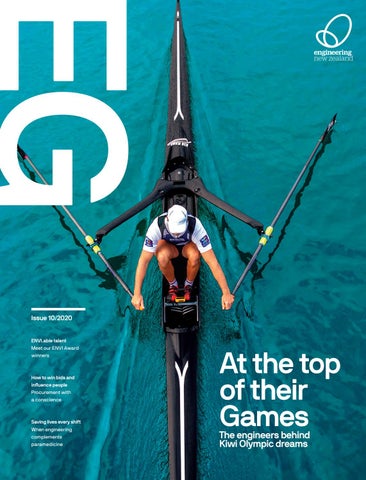
ON THE COVER Robbie Manson, New Zealand elite men's single scull, Netherlands 2019. © Steve McArthur/photosport.nz
22 How to win bids and influence people Procurement practices are changing and firms that don’t keep up will be left behind. 28 Next stop: Hawke’s Bay
Best practice 36 Concrete plans Reducing carbon emissions from concrete is a hot topic for the Concrete NZ - Learned Society. 38 Climate change: changing our minds? What to do if you’re suffering from “eco-anxiety”. 40 Safe harbour? Wellington’s sewerage system history explained. 43 Under assessment What a knowledge assessment involves if your qualification doesn’t meet the standard.
44 Ethics and the environment We explain what “have regard to the environment” means for engineers. 45 Intersection Crossing paths with engineers. 47 Maintaining standards Why the Maintenance Engineering Society is passionate about growing great engineers.
Shorts 50 Sacrifice + faith + VR = win Meet our Young Engineer of the Year and CEO of Wellington start-up Eight360. 52 The secret life of engineers A paramedic who was frontline after the Christchurch mosque attacks. 54 Leading questions Rocket Lab’s Production Designer reveals his leadership tips. 55 Day in the life Could engineering be the “secret sauce” behind this baker’s success?
56 Bedside table A Professor in Mechanical Engineering and author reveals the influences behind her reading choices. 57 Review 59 Obituaries 60 Engineering genius
Correction: In Issue 9/2019 of EG on p60 we stated the Manta5 was “the world’s first hydrofoil bike” – we should have said it's an electric hydrofoil bike.
03
Engineering Envy #12
Lambretta Li 150 Series II: Italy In post-World War II Milan, businessman Ferdinando Innocenti saw the need for cheap, speedy transport. His company made the first Lambretta scooter in 1948. The Lambretta Li 150 Series II, built in 1959, became their best-selling model, building on the success of the Series I. For the engine, a longer cylinder and piston assembly was fitted, along with a stronger crank and bearings. It also featured a rear seat, and a headlight built into the headset, that turned with the steering. Production of this model ceased in 1961.
Engine size
150cc Number of speeds
4
Power output
6.5hp Dry weight
105kg Number produced
206,020
I wonder how we can help our kids soar?
Being a STEM superstar is awesome – are you ready to inspire the next generation? Help us spark wonder by becoming an Ambassador today at wonderproject.nz
POWERED BY
BACKED BY
What they said
Editorial
05
Humbled and inspired
“… engineering is critical to achieving the UN Sustainable Development Goals.” World Federation of Engineering Organizations President Dr Marlene Kanga announcing 4 March as World Engineering Day for Sustainable Development.
“The future is in greener satellite fuels and totally reusable vehicles that do not add to space debris, have better propulsion due to being lighter, are less expensive to launch, and where satellites can even ride share.” Dawn Aerospace GM James Powell on potential space flights from Oamaru.
Nau mai koutou katoa.
Prince Charles urges the private sector
As I reflect on my year’s Presidency, I recall the humbling moment at the 2019 Fellows’ Dinner when all Past Presidents stood up, and I fully appreciated the company I was in – and the shoes I had to fill. From the outset, it was obvious the groundwork was in place for the media and politicians to want to talk to us, showing genuine interest in engineering, and what we as a profession have to say. Branch visits were a highlight in 2019, including seeing the United Kingdom Branch. I’ve been struck by the passion evident in our profession, and the amount of talent. It was wonderful to celebrate some of our top people at the inaugural ENVI Awards in November. The slick, elegant night was a total testament to a real culture change, both within Engineering New Zealand, and the industry. We proudly celebrate the winners in this edition of EG. Last year wasn’t always an easy one for New Zealand, and as engineers, we lost a number of our own in the Christchurch
to help lead the world out of a climate calamity.
mosque attacks. Collectively, we continue to support each other – indeed
“The sheer scale of the devastation is quite overwhelming when you see it firsthand, so we’re very pleased to be able to help our neighbours with people power and resources.” National Officer Major Ron Christmas on NZ Army Engineers helping during Australia’s bushfires.
“… an exemplary case of a sustainable and flexible workplace.” Judges comment on Auckland coworking building B:HIVE, winner of the world’s top “inside office” award at the World Architecture Festival.
“The only limit is our willingness to act and the time to act is now.”
there’s a groundswell of recognition of the importance of mental health and wellbeing, in and beyond our industry. This is something the Engineering New Zealand Foundation supports, as evidenced in the excellent wellbeing resources available at engineeringnz.org At the start of my term, I said I wanted diversity to be the cornerstone of my Presidency. I’m proud to say this has extended to diversity and inclusion. I was honoured to attend, chair or be a panel member at a number of meetings in this space, and it’s fantastic to see how the profession is raising and discussing these issues. I encourage your company to sign up to the Diversity Agenda Accord to be held publicly accountable for achieving truly diverse and inclusive industries. I’m also proud of the work our Wonder Project team has done, as this ongoing focus on STEM aims to positively influence young peoples’ career choices. In 2020, let’s build on all this groundwork and continue to make a difference in everything we do. Ben Holland FEngNZ CPEng President, Engineering New Zealand
06
EG 10/2020
Leadership: a verb WRITER ALEXANDRA JOHNSON
As Beca turns 100, its award-winning Managing Director shares her thoughts on leadership, the changing focus of industry and work/life balance.
Director in 2017. She says long-term employees are not unusual at Beca. “Because we are employee-owned, we are very focused on people who are
they can be is just a no-brainer.” She believes engineering is becoming much more holistic. “The industry is moving away from
Having a love for maths and science while attending an all-girls school in Rotorua in the 80s was complicated. It meant that Darryl-Lee Wendelborn MEngNZ, Managing Director of Beca, one of Asia Pacific’s largest independent advisory, design and engineering consultancies, needed to take lessons at the nearby boys’ school. After finishing school, Darryl-Lee wanted some direction rather than just continuing to study science. “Engineering offered me a very applied direction. It was a step into the unknown. I had my own concepts of what engineering was – I initially thought I’d probably study structural engineering, but of course I had no real experience of what that meant.” Quarter of a century on, Darryl-Lee has made an extraordinary contribution to the industry in a myriad of ways. The 2019 winner of the Engineering Leadership Award at Engineering New Zealand’s inaugural ENVIs, her achievements include the delivery of major communityshaping infrastructure projects, speaking at the United Nations to further the representation of women in STEM, actively leading Beca in working collaboratively with other groups to promote Māori and Pasifika representation in the engineering profession, and being intrinsically involved in transforming Beca’s business model from a regionally focused one to a global structure. Darryl-Lee has been with Beca for 24
invested in the business for the long term." But how does an engineer transition so successfully to lead a 2,400-strong team? Darryl-Lee says it’s important not to limit yourself. While it’s easy to pigeonhole yourself by focusing on your obvious strengths, a belief you can learn new skills and develop new strengths is an intrinsic part of continuous development. It’s also an important aspect of her leadership philosophy. “At school, we like to be confident of who we are and what we are good at. Because I was very fact-driven for example, you come to rely on that.” While her upfront, direct approach to life – and work – has been an asset, some feedback early in her career about further developing her soft skills was pivotal. “I used that feedback as an opportunity to learn and grow in lots of different spaces.” Now, she describes her own leadership style as “leading from the middle”. “Everybody responds to a slightly different form of leadership,” she says. “I never think of leadership as a recipe or even a noun. It’s a verb, it’s what you do when you’ve got a challenge in front of you and a group of people to work with.” Combining her analytical and problemsolving skills with a proactive desire to help other people has contributed to her success. “You can achieve so much more with a group of motivated, inspired and wellengaged people. There’s only so much you
niche, specialist, technical people to community-based solutions where we are thinking about sustainability and our impact on different communities. We are almost reverting back to when engineering first came about and building communities was the focus.” And engineers are primed for such collaboration. “When we come together on a project, we understand the need for multidiscipline thinking; you need multiple perspectives to know that you have thrashed around a solution in so many ways to know that it’s robust.” Meanwhile, beyond work, Darryl Lee says work/life balance is an important challenge to be aware of all the time. “When my children were young, the fact that my husband was self-employed was a lifesaver. I look out there now and see couples with children who both have corporate jobs, and I don’t know how they do it.” But she firmly believes equality starts at home. “My husband and I both have careers and we have always been very equal in what we do in the domestic environment.” Though Beca is celebrating 100 years in business, Darryl-Lee won't get complacent. She says that to keep building on this legacy, Beca must continue to respond and change. “We need to keep asking are we valuable, are we improving the environment and the world that we live
years, rising up through the ranks from a new engineering graduate, to Managing
can ever do alone, so the more impact you can have on allowing people to be the best
in? That’s the only thing that will give us success.”
Profile
07
I never think of leadership as a recipe or even a noun. It’s a verb, it’s what you do when you’ve got a challenge in front of you and a group of people to work with.
“They’ve been insuring New Zealand families like mine for nearly 100 years.” MAS is 100% New Zealand owned and we’ve been serving our Members, like Katherine, for nearly 100 years now. Not only have we established a foundation to fund health initiatives, we have been awarded Consumer NZ People’s Choice across four categories* for three years running.
Keep good company with MAS mas.co.nz Katherine Reinhold (and Rosa) Lawyer and MAS Member
0800 800 627 * House, contents, car and life insurance
Composite steel floor design just got easier Use our Excel based software for a complete floor design in accordance with AS/NZS 2327:2017 You might not have seen our work, but you’ll have walked on it!
Tray-dec New Zealand Ltd
P 09 820 9133 / E info@traydec.co.nz
www.traydec.co.nz
NELSON STUD WELDING P 09 820 9133 / E sales@nelsonstud.co.nz
www.nelsonstud.co.nz
16 ENVI.able talent
22 How to win bids and influence people
28 Next stop: Hawke’s Bay
Features
10 At the top of their Games
10
New Zealand's Campbell Stewart, Dylan Kennett, Nicholas Kergozou and Corbin Strong during the men's team pursuit qualifying at the 2019 Tissot UCI Track Cycling World Cup in Hong Kong. ďż˝ Alex Whitehead/ SWpix.com
EG 10/2020
Feature
11
At the top of their Games WRITER MATT PHILP It’s 100 years since the first official New Zealand team of four athletes competed at the Olympic Games in Antwerp, Belgium. Since then, the team size has grown, as has the number of people helping our athletes achieve elite-level performances. That support crew includes top-notch engineers.
>>
EG 10/2020
12
When New Zealand athletes compete at the 2020 Summer Olympics and Paralympics in Tokyo later this year, their performances will be tracked particularly closely by half-adozen engineers back home. Based at High Performance Sport New Zealand’s (HPSNZ) Auckland campus, this team is known in-house as Goldmine. It's a reference to the colour of medals its members hope to help our elite sportspeople achieve – as well as a nod to the precious quality of their intellectual property . HPSNZ Head of Innovation Professor Stafford Murray says the unit is driven by the recognition that margins between winning and losing in elite international sport are wafer thin. “Without small points of difference and aggregations of marginal gains, we simply couldn’t compete,” he says. “Goldmine’s work is about ensuring that our athletes
to sporting performance from both sides. A professional squash player in his native England, he was a junior world number one before a back injury forced him out. He shifted to academics, completing a sports science degree and a master’s in coaching science, followed by a PhD in data science. After the English Institute of Sport was launched in the late 1990s, Stafford headed up its performance analysis, biomechanics and skills acquisition team for 15-odd years – or as he puts it, “from when GB was crap until it was second best in the world”. After the 2016 Rio Olympics, HPSNZ headhunted him to run its innovation programme.
have everything possible to put them in the best position to deliver their full potential. Whether it’s through equipment, nutrition, clothing or training feedback via software or hardware devices, we want to be able to look back post-competition and say we turned over every stone for that athlete.” Unusually, Stafford knows the relationship between athletic talent and the application of engineering smarts
a year – but the engineering talent is second to none. “I’ve worked all over, and I think they’re the best bunch of sporting engineers in the world,” he says. “We’ve got two software engineers, one hardware guy who is purely fabrication and is an expert in CAD design, a firmware engineer, a mechatronics engineer, and a guy who’s an electrician by trade but is a kind of hybrid expert in all areas. The beauty of this team is that they all have very good working knowledge of each other’s areas, because most of the projects overlap.” How are projects chosen? Goldmine won’t build anything that’s available off the shelf. And the innovation has to have a performance impact – the unit’s tight budget has the advantage of concentrating minds on that priority, says Stafford. For each of the 13-plus sports the HPSNZ innovation programme works with, an “innovation lead” is responsible for identifying that sport’s critical performance question, based on feedback from the people who are putting in the hard yards. “It’s not what we think as engineers or scientists, but what the coaches and athletes think is going to make a difference. What’s stopping the boat from going faster? What’s preventing that athlete throwing the shotput further?” Until now, 70 percent of Goldmine’s work has been aimed at improving how athletes train, rather than innovations to create an edge on competition day. But things are changing. “We’ll be shifting in coming years to more delivery of on-the-day performance innovations, because the technology is available now. In the sports that we’re big on in this country, such as boats and bikes, it’s mainly around using our world-leading carbon knowledge to enhance our equipment.”
High Performance Sport New Zealand's Head of Innovation, Professor Stafford Murray. Image: HPSNZ
Concentrating on priorities Compared with where he’s come from, it’s a lean and mean machine – Goldmine’s budget is just $1.5 million
>>
Feature
Goldmine engineer Andre de Jong working with Kiwi paddler Kayla Imrie. Image: HPSNZ
13
I’ve worked all over, and I think they’re the best bunch of sporting engineers in the world. – Stafford Murray
>>
“Water and electronics don’t mix well”
>>
That said, providing better data will always be a key Goldmine function. One recent world-first innovation from the unit is an instrumented paddle designed to provide canoe sprinters with realtime feedback on how much force is being generated with each stroke. “We wanted to provide highly accurate force/time data,” explains Goldmine’s hardware engineering guru Robert Tang. “To do that we had to put strain gauges on the paddle – one of the earlier iterations had 32 gauges, which is quite a number. They measure deflection, so we know how much the paddle is moving, and because we have a sense of what the paddle is doing in a 3D space, we can estimate the power the athlete is putting out.” So far, so straightforward – and other canoeing nations
From engineer to Olympian It was while watching the 1984 Olympics on television that Rebecca Wardell decided she was going to compete at the Games. She was seven. In 2008, aged 30, she finally made good on her dream, competing in the heptathlon at Beijing’s “Bird’s Nest” stadium. Athletic talent and a serious appetite for hard work got her to Beijing, but she also had to be highly organised, a skill that she partly attributes to her engineering background. Rebecca completed a master’s degree in traffic engineering in 2010, after working in administration support on projects for consulting engineering firm GHD in Christchurch. “I had to be quite organised in how I planned my training and travel for competitions, which essentially was project management,” she says via email from Lausanne, Switzerland, where she works for the International Olympic Committee (IOC). That background is again proving useful in her role as the IOC’s Senior Games Delivery Manager for the Beijing 2022 Winter Olympics, coordinating functional aspects such as food and beverage and accommodation for stakeholders. “I also get to use my transport studies to see how transport for the Games is planned and delivered.” And she’s still chasing down big dreams: starting out from Lausanne in April 2018, Rebecca completed a year-long cycling trip through Europe, Iran, China and Southeast Asia, capped off by cycling the length of New Zealand to her Lake Hawea home. Her “Long Way Home” adventure raised funds for the Forward Foundation, which aims to empower teenage girls through sport and leadership opportunities.
have done something similar. But Goldmine has gone one step further by solving the waterproofing conundrum – as Robert says, “water and electronics don’t mix well”. In a process of trial and error, the engineers experimented with hot melt (the heat caused the gauges to lift off the carbon
These young people are absolutely committed to what they are doing, and it’s a pleasure to help them along their path. – Duncan Anderson
shaft), a cold urethane (paddle flex broke the tracks on the circuit boards), and finally the current solution, which involves injecting a runny gel inside a hardshell case. The gel not only waterproofs the electronics, it isolates them. To get there, Robert and his collaborators had to assess a range of gels, many of which proved too viscous to be injected by syringe. Using mockups, they then tested what happened when the parts were violently twisted – would water find a way through? It was a long and iterative process. Says Stafford: “One of the things I’ve found doing this job is that often the final thing looks quite simple, but the process of getting there is incredibly complicated, multi-faceted and can involve many partners.”
Feature
Partnering for precision Those partnerships are key to Goldmine’s work – at least half of HPSNZ’s innovation projects involve external partners. Auckland-based Southern Spars, for example, has created carbon fibre wheels for New Zealand’s Olympic track cyclists and is currently building other pieces of equipment for the sprint cycling team. “The fact that innovative Kiwi firms want to help is our point of difference,” says Stafford. Recently, Goldmine partnered on a project for two New Zealand Paralympians with Auckland-based Zenith Tecnica, a leader in titanium additive manufacturing. Both athletes, javelin thrower Holly Robinson and long jumper/ sprinter Anna Grimaldi, are missing part of an arm and have prosthetics. Their common problem was that the off-the-shelf attachments they used for lifting weights in training were downright dangerous. “They needed an attachment custom-designed for their anatomy that would allow them to weightlift a variety of implements, each of which has a slightly different grip diameter,” says Goldmine’s CAD and fabrication expert Duncan Anderson.
1
3
15
Duncan settled on a simple clamp system, and made a plastic prototype of the two variants from high-strength nylon. Based on testing and feedback from the athletes, the design was fine-tuned, then Zenith Tecnica was engaged to 3D-print the titanium parts. “Holly and Anna have been using them for a year now, and the exercises have become a whole lot safer, which allows them to lift heavier weights. They used to have a wishlist of exercises; now they’re able to do those, and it’s just been great for their physical strength and confidence,” says Duncan. “For me, that’s the best part of this work. These young people are absolutely committed to what they are doing, and it’s a pleasure to help them along their path.” In the short term, that path leads to Tokyo. Goldmine has been working on a handful of innovations aimed at giving Kiwi athletes an edge on the day, none of which Stafford can share publicly. “We know these things are going to take seconds off times and improve performance by quite a large percentage. Whether it’s enough to win you can’t know, but we’re going to help make our athletes the best they can possibly be.”
2
1. Custom-designed titanium weightlifting attachments. Image: Zenith Tecnica 2. Para-athlete Anna Grimaldi trains with the prosthetic attachment. Image: Zenith Tecnica 3. Custom electronics mounted on a kayak paddle shaft allows measurement of eight strain gauges to deduce the forces the athlete applies on the water. Image: HPSNZ
16
EG 10/2020
Feature
17
ENVI.able talent
Engineering New Zealand’s inaugural ENVI Awards last November showcased some of the industry’s top talent. Competition was fierce and we congratulate all finalists across all categories. Here we celebrate seven of the winners.
>>
ENGINEERING CREATIVITY.
ENGINEERING DIVERSITY.
>>
Kākahu Façade: Lewis Bradford Consulting Engineers Lewis Bradford teamed up with artist Lonnie Hutchinson to create a stunning façade, inspired by a kākahu, or cape of feathers. Cloaking a Christchurch parking building with more than 1,000 aluminium feathers required innovative engineering to withstand extreme wind loads. The 6.5m-high aluminium sculpture was installed in the Justice and Emergency Services Precinct. The marriage of creativity and engineering provides a traffic-stopping platform for Hutchinson’s largest-ever artwork. Judges said the Kākahu Façade embodies the essence of the Engineering Creativity Award, using technical ability that gives New Zealand designers an opportunity to significantly scale up their canvas and bring engineering to life.
Quick Q&A Helen Trappitt CMEngNZ – Director, Lewis Bradford Consulting Engineers What's the biggest impact of this work on your community? “The Kākahu façade is a beautiful addition to the built environment of Christchurch. It has transformed the back end of a car parking structure into a huge work of uplifting art. We are proud to have played a role in helping artist Lonnie Hutchinson ‘go big’.” What advice would you give to people thinking about entering the ENVIs? “Be unafraid to give it a go. The process of entering is straightforward, and it is rewarding to pause and reflect.”
3 words for the win
Eeeeek, speech unprepared.
Honor Columbus MEngNZ Māori and Pasifika in Construction Honor Columbus created Māori and Pasifika In Construction in 2018 after repeatedly hearing Māori and Pasifika people talk about the pressure to assimilate when they enter engineering, leading to a loss of culture and community connections. This self-funded, volunteer-run initiative, based in Christchurch, helps connect, encourage and promote Māori and Pasifika in the construction industry through opportunities including speakers, social media, mentors and scholarships. The judges congratulated Honor for developing a powerful initiative that builds awareness and embodies inclusion.
Quick Q&A What’s the biggest impact of this work on your community? “Creating a safe space for people who identify with marginalised groups in the construction industry to come together and connect, share and be heard. The conversations have been honest, vulnerable, and, at times, really challenging. It’s important to tackle these difficult conversations and to ensure communities are empowered to become self-determined, and able to lead these discussions.” What does this win say about your work? “It demonstrates that you can be what you can’t see, and that female indigenous leadership is valued in our industry.” 3 words for the win
Humbled, honoured, encouraged.
ENGINEERING EDUCATION.
Feature
ENGINEERING IMPACT.
19
Meridian Energy Rural Meridian Energy is passionate about opening children’s eyes to the wonder of engineering and it's been working with schools and communities near its wind and hydro sites as part of an educational initiative. Meridian extended its reach to support the Girls with Hi-Vis initiative, encouraging women into trades and technology careers, and supports Engineering New Zealand’s Wonder Project. The judges said Meridian had made an incredible effort to help local communities understand more about electricity and energy, calling them committed to education, “particularly in rural communities that don’t typically have strong science or engineering programmes”.
Quick Q&A Norman Geary – Engineering Manager, Meridian Energy What do you think made you stand out in your category? “We showed actual results from our engineering education initiatives, especially with our Girls with HiVis programme that has since seen two young women approach Meridian for work experience – one of whom has now been employed as a mechanical apprentice. Also, while our formal education programmes are successful structures, our engineering teams take every opportunity to talk about the way we act as guardians of our assets.” What does this win mean to you? “True recognition of our efforts to help our communities and bring engineering to life for so many young people. It has inspired us to do more and improve our programmes."
Te Auaunga (joint winner): Auckland Council, Fulton Hogan, Boffa Miskell & AECOM Auckland’s longest uninterrupted urban stream, Te Auaunga, or “swirling waters”, was converted to a concrete stormwater channel in the 1930s. However, surrounding parkland became flood prone, causing significant damage to houses in the 1970s. It desperately needed care and restoration. By addressing the flood risk, the project dug deep into engineering solutions that enable higher density and affordable housing in the area. Along with park and stream restoration, the project included an extensive public space upgrade, an outdoor education zone, a community fāle, and the planting of 120,000 native trees. Te Auaunga demonstrates environmental guardianship, and what’s possible when local government, the community and engineers collaborate.
Quick Q&A Tom Mansell – Sustainable Outcomes Programme Manager Healthy Waters, Auckland Council
3 words for the win
Wow, really? YES!
What's the biggest impact of this work on your community? “We’ve created a place for people to meet and children to play, and re-engineered how best to deal with stormwater by integrating it back into a naturalised stream environment.” How can you leverage from this win to inspire other engineers? “It is a shining example of public sector and private contractors and designers working together to deliver an outstanding asset for the community."
3 words for the win
Elated, proud, excited.
>>
ENGINEERING INNOVATION.
ENGINEERING PARTNERSHIP.
>>
MicroMaker: Callaghan Innovation With the MicroMaker, 3D-printed rapid prototypes can be created in forms finer than a human hair. Think sensors, wearables, point-of-care diagnostics, micro-robotics or aerospace components, engineered with speed and affordability. The MicroMaker prototype has successfully printed items with a resolution of 10 microns, and can be configured for as low as 5 micron resolution. By contrast, the human hair has a diameter of about 80 microns. This microfabrication technology represents a huge technological step forward and into a lucrative market projected to be worth more than US$13 billion by 2021. The judges said MicroMaker was a game changer they believe would spark many other innovations.
Quick Q&A Neil Glasson CMEngNZ CPEng IntPE(NZ) – Lead Research Engineer, Callaghan Innovation What does this win mean to you? “This win is a welcome recognition for the team for an exciting and challenging development project. Taking a lab concept and turning it into a practical working prototype, when it wasn’t clear when we started that it would be technically feasible, was the greatest buzz.” What do you think made you stand out in your category? “I think this project was a standout because of the massive potential to be a game changer in microfabrication internationally, enabling cost effective prototyping and production of functional microstructures.” 3 words for the win
Thrilled, surprised, grateful.
Aspiring Artists: SCAPE Public Art & Lewis Bradford Consulting Engineers In Christchurch, the Re:ACTIVATE programme pairs aspiring artists with engineers and brings their public artworks to life. Lewis Bradford and SCAPE Public Art select the winning submissions, which are turned into displays as part of the SCAPE Public Art Walkway. Students are mentored throughout, providing insight into the working world of art, design, engineering and construction. The judges see the programme as a truly altruistic venture that relies on goodwill and community leadership: “It’s testament to a working and visionary partnership that is not held together by money or commercial construct to deliver outcomes for the community”.
Quick Q&A Helen Trappitt CMEngNZ – Director, Lewis Bradford Consulting Engineers How can you leverage from this win to inspire other engineers? "I hope that shining a light on this collaboration inspires other engineers to consider how they might use their expertise to give back to their community, whether by mentoring a young engineer, giving a talk at a school or by discounting their services for a worthy cause." How do you hope people feel about the work you do? "The drivers of this partnership are to encourage people to visit the recovering CBD of Christchurch and to expose lots of students to the synergies of engineering and art. I hope that people enjoy the art that we help produce and recognise the enrichment that it provides to the young artists and their schools." 3 words for the win
Whaaaaaaaat!?!?!?
SUPREME AWARD.
Feature
Kaikōura Earthquake Recovery: NZ Transport Agency, KiwiRail & NCTIR Alliance (also joint winner of the Engineering Impact Award) The 2016 Kaikōura earthquake devastated transport networks, cutting off communities across the upper South Island. The NZ Transport Agency and KiwiRail quickly set up the North Canterbury Transport Infrastructure Recovery (NCTIR) Alliance with Fulton Hogan, Downer, Higgins and HEB Construction. The extraordinary seismic event caused almost 1 million cubic metres of rock and material to fall onto SH1 and the Main North Line. Repairs on the Main North Line constituted the largest rail construction
Quick Q&A
effort in New Zealand since World War II, with 220 worksites along 190km of track. SH1 reopened to freight less than a year after the quake. Not long after, SH1 reopened to other vehicles, reconnecting communities. The judges said the rebuild set the standard for how we need to mobilise as a country following a natural disaster.
communities and we will always be indebted to the local people for their tolerance and support.”
Tony Gallagher CMEngNZ CPEng IntPE(NZ) – Project Director, NCTIR What is the biggest impact of this work on New Zealand? “While there were significant economic benefits for New Zealand in restoring the road and rail, our greatest impact was at a social level – reconnecting local communities and providing hope for Kaikōura during a very difficult period. We literally had to move mountains to reconnect
What would you like people to say about this work? “If our work was remembered as a project about people, we would view that as success. While the speed of the work and the engineering feats were remarkable, we would like to believe we got the balance right between engineering needs and the needs of the local community.” 3 words for the win
Surprised, ecstatic, proud.
21
22
How to win bids and influence people WRITER ALEXANDRA JOHNSON
Procurement practices are changing, and firms that don't keep up will be left behind.
EG 10/2020
Feature
23
>>
24
EG 10/2020
Height CEO Warner Cowin. Image: Qiane Matata-Sipu
>> Procurement is starting to take more than money into account. In a major shift, social, environmental, and economic responsibility are increasingly being factored into procurement decisions. The government’s new procurement rules, which came into effect last October, move away from a lowest-price model to a broader outcome model, taking into account a construction company’s financial health, the health and safety of its workers and the building’s environmental health. This means factors including skills development and training, strong governance, and sustainability practices are all at the fore. The changes address some of the issues raised in The Construction Accord, a shared commitment between government and industry to transform the construction sector. The Accord aims to increase productivity, capability and resilience, and restore confidence in the construction industry. Considering broader outcomes One framework to help companies consider broader outcomes as they tender for government projects is the Sustainable Outcomes Toolkit, developed by Auckland
“The initial aim was to see how procurement could grow Māori capability within infrastructure, construction and maintenance, as we’d found that there were not enough Māori suppliers within the market to respond to opportunities,” says Height CEO Warner Cowin CMEngNZ CPEng IntPE(NZ). “We found that this model was not only applicable to Māori but could be broadened to increase participation from all disadvantaged groups. As Māori values aligned with goals around sustainability, carbon neutrality, community consultation and engagement, we could then incorporate a whole set of broader outcomes within the procurement framework.” Warner says the Toolkit is about identifying, articulating and measuring broader value than just delivering a physical works outcome and can be used by buying agencies and contractors. “For a reputable contractor, it’s exactly what they have been after, as now government organisations are starting to value the investment contractors are making in their people and sustainability drives. “Traditionally, when they were pricing a contract, they would often consider training or carbon emissions
Council Healthy Waters and Height, a small, Māori-owned, technical tendering and procurement consultancy.
anyway. We are now actually paying the true price of what it costs to deliver something, as opposed to something
Feature
25
Eco nom i
Soc ial w ing be ell
eing b l l e w c
t
Height Director and Head of Procurement, Kel McBeath. Image: Height.
The Sustainable Outcomes Toolkit considers broader outcomes in the procurement process. Adapted from Auckland Council Group Sustainable Procurement Framework.
that’s cheap and unsustainable for the long-term future of NZ Inc and its community.” He says contractors who still have a lowest-price mindset will struggle with this broadening focus. “Those contractors who have not been investing into training, the equipment, their communities, are now forced to look at the way they are delivering, and start to invest in those things.”
The hardest part is we need to change perceptions and the cultural mindset on how we define value not just being on lowest price. – Warner Cowin
we
we
en
al
llb
nm
eing
Env i r o
Sustainable procurement
llbei
ng
ur Cult
al
He believes when operational teams, such as project managers and engineers, are empowered to own and deliver sustainable outcomes, there is more commitment and ownership. “The hardest part is we need to change perceptions and the cultural mindset on how we define value not just being on lowest price.” The second challenge is upskilling and growing the supply chain to meet the opportunities and demand. But, he says, you can’t change the world in one procurement. “Organisations can choose just one or two areas to focus on, such as great community or mana whenua engagement if that’s where your hotspots are. Just do a couple of things really well.” Impact and legacy Fellow Height Director and Head of Procurement Kel McBeath says the company had been looking at how it could help smaller contractors grow to become prime bidders for some time. “Everybody wants healthy vibrant markets, where there’s competition and innovation. All procurers in New Zealand should be striving for and supporting healthy markets for their long-term benefit as well.” >>
26
EG 10/2020
Kel says organisations should first think about the impact they are having on New Zealand and their local area, and the legacy they will be leaving. “Organisations need to challenge their thinking as to how they are operating socially, environmentally, economically and culturally.” Valuing resources, particularly around recruiting, should be another focus. “New Zealand’s current unemployment rate is very low and that might mean you need to employ people from disadvantaged groups, pulling in pastoral care to make sure they are supported. Then we are maximising the use of resource within the country.” He says organisations must then look after their employees. While social procurement is new for New Zealand,
“It was a normal infrastructure project which had quite significant outcomes.” Through community consultation, they found youth unemployment was one of the biggest concerns. Twenty local unemployed young people were put through a short course at Unitec and the lead contractor, Fulton Hogan, engaged them for the contract. A separate planting contract within the project took on 22 young people and placed them in employment or training. “Our contractors are being incentivised to take on local unemployed people. We have a contract with the Ministry of Social Development whereby they give us $10K for every person we place back into employment. That money is given to the employer for whatever needs the employee has, such as pastoral care or additional training.” However, Tom says the money has not been the
he says “we hope that within 10 or 15 years it’s standard practice”.
main driver for contractors to employ people from disadvantaged groups. “If they take on four unemployed people on one contract, they have a better chance of getting the next one. That’s the main incentive.” During a recent five-month period, Healthy Waters gave jobs to 45 unemployed people. “One guy had been incarcerated for 30 years and had little chance of being employed. He’s now got four people working under him.”
>>
Best-practice procurement – a case study Tom Mansell, Sustainable Outcomes Programme Manager at Auckland Council Healthy Waters, says the project that confirmed the benefits of the Sustainable Outcomes Toolkit involved the replacement of a concrete channel running through Mt Roskill with a wider naturalised stream to prevent ongoing flooding.
1
2
1
1. Mt Roskill's Te Auaunga stream project used the Sustainable Outcomes Toolkit. 2. Tom Mansell. Images: Auckland Council
Feature
Quashing the “race to the bottom” Skills and labour shortages, poor risk management and a culture of shifting risk are some of the key challenges the construction sector is facing, says Karen Mitchell from the New Zealand Infrastructure Commission, Te Waihanga. “They’re all interconnected in a way, and they all come to the fore in procurement.” A review of issues associated with the use of NZ Standard Conditions of Contract by Treasury’s Infrastructure Transaction Unit in 2019 revealed a culture of mistrust between the public and private sectors, which manifested in the approach to procurement, contracting (including transfer of risk), and the construction methods used. A focus on lowest price, says Karen, rather than value for money, arguably drives a “race to the bottom” on the part of contractors competing to win work at any cost. “This had multiple knock-on effects, and in some cases, reduced build quality as well as corner-cutting and decreased investment in training and skills.” She says a focus on lowest price also means many contractors don’t make enough provision for construction risks. Then when risks do arise, this impacts their bottom line and can lead to insolvency. She says some risk transfer to the contractor was unsustainable and aggressive, instead of placing risk with the party best placed to manage it. “Contractors are not averse to taking on risk that can be quantified and managed as long as they are able to price it into the contract. Indeed, contractors welcome the transfer of risk, where, if managed well, it can result in increased margin.”
Subsequently, as part of its commitment to the Construction Sector Accord, the Government has signalled further work to improve public sector agencies’ understanding of risk in design and construction. “This includes an understanding of the balance of risk between designer and contractor across the entire life of the infrastructure project, the value of risk transfer and acceptance that it must be budgeted for and priced, as well as choosing the appropriate form of contract. “A sustainable approach to risk transfer must also consider the cumulative risk exposure across the public sector of the party managing the risk.” Under the new Government Procurement Rules, Karen says agencies now also have to consider how they can deliver wider outcomes, including investment in the workforce, and creating opportunities for New Zealand businesses, including Māori, Pasifika and regional businesses, as well as social enterprises. The rules are mandatory for some agencies, which must report to the Ministry of Business, Innovation and Employment about their procurement capability, designated contracts, and significant service contracts. Agencies will be audited for compliance and suppliers have a right to complain if they think that an agency has breached the rules. “Agencies will need to be proactive as gaps in capability, risks, and issues with contracts will be more visible.”
27
28
EG 10/2020
Next stop: Hawke's Bay
Fruit, arts and crises
Population
151,179 2 14,137km Land area
Engineering New Zealand Branch membership
263 Did you know‌ In the 1950s, Napier and Hastings competed for the region’s main airport. In 1932, the first airport was built in Napier, on land raised by the 1931 earthquake. When improvements were needed in the 1950s, Hastings was growing faster but Napier still won out as it already had an established airport.
Feature
29
WRITER RACHEL BERRY
Whether it’s packing increased volumes of fruit, housing the arts or managing emergencies, success is often built on collaboration in Hawke’s Bay. Hawke’s Bay is a key apple-growing region, so processing needs to be efficient. In Hastings, Omahuri Orchards’ packing line was more than 20 years old, so the familyrun business approached MAF Roda NZ to design and manufacture a new one. A New Zealand first, the bespoke solution included the latest sorting technology for apples, Globalscan 7. “Omahuri Orchards had projections for increased produce. Their line needed replacing to make sure they could still pack as efficiently as possible,” says Chris Bray, Business Development Manager – NZ, MAF Roda NZ. The new line needed housing, so Stead Construction joined the project. They engaged WSP Opus to complete the structural design of a new, 900m2-plus orchard packhouse. “We factored geotechnical challenges identified in an existing report into the design,” says Matthew Lloyd, Project Manager, WSP. He says there was a moderate liquefaction risk in an ultimate limit state event. "We were working with low-strength soils and a shallow water table. Plus, we’re in a relatively high seismic region. He says the original report contained a recommendation for initial ground improvement of a one-metre-deep raft of compacted gravel for every 150mm layer. “After the first 150mm layer of aggregate, it was recommended we placed and tensioned a geogrid layer to reinforce the raft in an earthquake. We recommended crushing the gravel, too, which would increase the interlock and shear strength of the raft.” The final design was a conventional portal frame with steel purlins and girts and light cladding. The foundation included deeper footings for the portals to land on, and ground beams tying them together through the width of the building. Then it was a conventional slab on grade, which was 150mm thick to support forklift loadings. Stead Construction approached WSP about using their stockpile of lime silt instead of the crushed aggregate, and collaborated with WSP to test the material’s suitability. “Based on the lab testing, we agreed it would be acceptable structural fill,” says Matthew. >>
30
EG 10/2020
Teams from Stead and WSP worked together to put a layer of geotextile down at the base of the cut to separate the natural ground from the structural fill. They compacted the material in 200mm layers using a club foot roller. They followed each lift with plateau density testing. After the cut was half full, extensive Dynamic Cone Penetration/ Scala testing confirmed the improvements achieved the required structural design bearing. When the cut was filled to 400mm below ground level, they used compacted GAP40 to further increase the ground bearing. Once it was filled to ground level, final testing confirmed the site was suitable for construction. Matthew says: “The partnership between Stead Construction, the WSP geotechnical and structural teams and the Napier WSP lab really helped get this project delivered on time with considerable cost savings in
Municipal Building upgrade; Strata Group designed the plaza upgrade; Matthews and Matthews Architects developed the new look of the former plaza and the Municipal Building; and construction company Gemco built it all. “Focus Project Management and Gemco had their work cut out managing the logistics because, effectively, you had three projects running simultaneously, immediately adjacent to each other. Everyone can be proud of what’s been achieved,” says Guy. The Opera House, Cushing Foyer and Functions on Hastings reopened under the umbrella of Toitoi – Hawke’s Bay Arts and Events Centre, in February. The Municipal Building is still undergoing construction.
materials used. It shows the value in designer/contractor collaboration.”
The Hawke’s Bay Opera House, a Category 1 heritage building built in 1915, is the cultural heart of Hastings. “It’s an amazing performance venue with remarkable acoustic performance for a building of this era,” says Guy Lethbridge CMEngNZ CPEng, Director, Strata Group Consulting Engineers. “The Council commissioned a seismic assessment in 2013 and then closed the facility in 2014 after it was declared earthquake prone. This left Hastings without a significant arts and culture centre.” The Opera House sits alongside other venues: the renamed Cushing Foyer and Functions on Hastings formerly the plaza – and the Municipal Building. After robust public consultation, Hastings District Council decided on a refurbishment and upgrade. Earthquake strengthening for the theatre included the added challenge of retaining the building’s heritage features. “It will be difficult for the general public to spot where the strengthening has been done,” says Guy. “For example, when the foyer tiles were replaced, they had to be exactly the same as the originals. Even the joinery details were scrutinised by the heritage architect.” He says because the acoustic performance of the building is so good, it had to be the same after the works were completed. The contractor, Gemco, was required to benchmark the building’s acoustic rating and then retest it once the works were complete to make sure it matched. “To achieve that target, the shape before and after had to be pretty much identical.” The strengthening and refurbishment of the Opera House Theatre, and the precinct as a whole, could be described as a masterclass in collaboration. Focus
A January bushfire north of Napier, while the devastating Australian fires continued to rage, was another reminder this region is vulnerable to emergency events. It's also no stranger to earthquakes. Therefore, a new project the Branch and regional civil defence have developed has a simple goal: to be prepared. Hawke’s Bay Branch Chair Michael Kemsley CMEngNZ CPEng IntPE(NZ) says the Engineers’ Emergency Response Initiative is a database of engineers who are ready to be deployed in an emergency response. He's working with Ian Macdonald, Group Manager/Group Controller for Hawke’s Bay Civil Defence Emergency Management Group, to build relationships and share knowledge so that in an emergency, everyone knows the relevant processes and can begin responding immediately. “The important thing is that we’re having these conversations now,” says Ian. “We don’t want to be having them during an emergency." The project is about putting the building blocks in place so when something happens, there’s a single point of contact for activating local engineers. Professional engineers giving good advice on the day are critical to people’s safety and wellbeing, but as Ian says: "We need to be focused in the way we deploy them". The database has been built by previous members of the Hawke’s Bay Branch – it's an indicator of who’s available and what expertise they bring. Having this knowledge available instantly makes deployment a slicker operation that could potentially save lives. It’s a local project with national relevance. In the Canterbury and Kaikōura earthquakes and the 2019 Nelson fires, professional engineers were brought in from across the country to help. With this in mind, the database is intended to become national. “Each region’s information may look slightly different,” Michael says, “but there’ll be a critical core of information
Project Management oversaw all three projects. Holmes Consultancy designed the Opera House Theatre and
in the national database, which will be the go-to for larger events.”
Hawke’s Bay Arts and Events Centre
Engineers’ Emergency Response Initiative
>>
Feature
1
2
3
1. Construction of the new Omahuri Orchard packhouse. Image: Stead Construction 2. The project team in the Hawke's Bay Opera House. Image: Strata Group 3. Helicopters fighting forest fires north of Napier, January 2020. Š John Cowpland/alphapix
31
Snapshot Every wave is perfect at artificial surf park URBNSURF in Melbourne, whether you want the beginner’s area, or a two-metre-high thrill. The 2ha lagoon can produce up to 1,000 surfing waves per hour. It needs 20ML of water per annum, sourced largely from stormwater from the Melbourne Airport precinct, treated to near drinking water standards before entering the surf park’s filtration system. Image: URBNSURF
TRAINING YOU HERE, THERE OR ANYWHERE. We offer a range of professional development courses at venues across New Zealand – including in your workplace. Talk to us about running a course exclusively for your team at learn@engineeringnz.org
38 Climate change: changing our minds?
40 Safe harbour?
43 Under assessment
44 Ethics and the environment
45 Intersection
47 Maintaining standards
Best practice
36 Concrete plans
36
EG 10/2020
Concrete plans JAMES MACKECHNIE CMEngNZ CPEng
Reducing carbon emissions from concrete is just one of the current hot issues for members of the Concrete NZ - Learned Society. Along with many other industries, in recent years, a key issue for the building and construction industry is reducing carbon emissions. Concrete has been in the spotlight lately for its carbon footprint. Emissions associated with concrete are primarily carbon dioxide from the production of Portland cement, either in terms of energy required to heat cement kilns or during calcination of limestone. However, the journey to decarbonise concrete is well underway. Locally produced Portland cement has made significant steps in reducing emissions by using recycled materials in the firing of cement kilns. Further reductions are being developed by using supplementary cementitious materials, including exploring using local natural pozzolans such as ground pumice powder. In New Zealand, concrete producers have also taken steps to reduce the environmental impact, including recycling wash water, improving fleet efficiency and, where available, using recycled materials such as fly ash in concrete mixes. For more than 50 years, the Concrete NZ - Learned Society (CNZLS) – formerly the New Zealand Concrete Society – has been promoting the safe and sustainable design and construction of concrete
and supply, keeping up with industry developments through the Society’s annual concrete conference and regular seminars around the country. At the 2019 Concrete Conference in Dunedin, Chief Executive of Concrete NZ Rob Gaimster outlined significant steps taken by the cement and concrete industry to decarbonise concrete. These include the reduction of carbon intensity via alternate fuels and a reduction of clinker in cement through technology improvements. Concrete NZ also highlighted some initiatives that are happening internationally and could soon be implemented here, such as carbon capture in concrete and alternative binder systems. The conference attracted more than 300 delegates, with a keynote presentation on the art and science of the design and construction of tall buildings by Andy Davids, chief engineer for French architect Jean Nouvel. Other presentations ranged from an update on the infrastructure rebuild in Kaikōura, to the latest in structural and materials research, standards development, innovative construction practice and sustainability and professional issues. Social responsibility is another issue in this industry, and quarrying was also on the agenda. The CEO of the Aggregate and Quarry Association spoke about the need for new quarry operations to support major infrastructure projects. While some
structures. Members work in fields ranging from academia to design, construction
replacement of aggregates is being explored, such as waste tyres for eco-
friendly foundations, large infrastructure such as bridges, tunnels and airport expansions require high-quality aggregate from hard rock quarries. Quarrying does not contribute significant emissions but the social licence to continue operating close to major centres is being challenged by some residents. Concrete has the advantage of being produced from mostly local materials and transporting aggregate significant distances not only increases costs but affects the sustainability of the material. While the future shape of the concrete industry continues to evolve, it is critical that current design and practice is guided by the latest research. Academic research in New Zealand provides excellent information for designers of concrete structures, which is especially important given the advances in knowledge after recent major earthquakes here. The Society has always had a strong relationship with researchers at universities in New Zealand and overseas. This university research is rapidly disseminated to the design profession through regular seminars covering a range of topics including the structural design of concrete, post-tensioning, diaphragms, strut and tie design, building assessments and strengthening with fibre reinforced polymers. In the coming year, webinars will be launched to reach a wider audience.
Best practice
37
Opinion James Mackechnie CMEngNZ CPEng is the Immediate Past President of Concrete NZ – Learned Society, and Research, Education and Training Manager for Concrete NZ. He is also an adjunct researcher at the University of Canterbury with interests in concrete durability and sustainability.
38
EG 10/2020
Climate change: changing our minds? DR JACKIE FEATHER
Health professionals are recognising increasing numbers of people experiencing “eco-anxiety” – high levels of stress about climate change. But there are practical measures engineers and other professionals can take to maintain balance and perspective. Can psychology contribute to engineering? Engineers have highly developed cognitive abilities and a logical approach to problem solving. This is extremely important when working on engineering projects. As a psychologist, I wonder whether this might mean that emotions may need to be put aside in order to keep the mind focused on the job at hand? How might this play out when it comes to managing personal responses to situations? Regardless of our profession, we all have a similar physiological make up. Our minds and bodies are designed to respond a certain way when we are under threat. A stressful situation, whether it be environmental, such as a looming work deadline, or persistent worry such as fear of failure, can trigger a cascade of stress hormones. We may experience these as shallow breathing, racing heart, muscles tensing and sweating. These reactions are commonly known as the fight/ flight response. They evolved as survival mechanisms to enable us to react quickly to life-threatening situations. These kinds of reactions can also emerge in response
The rise of "eco-anxiety" Climate change has become more evident recently, as we witnessed the death and destruction from the bushfires that ravaged the land and communities of our closest neighbours. This has brought reality to the predictions by the UN Intergovernmental Panel on Climate Change. In 2018, the Panel said we had 12 years to act to keep global warming to a maximum of 1.5 degrees Celsius or face the increased prospect of droughts, heatwaves, flood and other extreme conditions. Many other organisations and scientists have made similar predictions. Since 2015, the World Health Organisation has recognised that climate change is the leading threat to global health in the 21st century. These kinds of statistics can’t help but impact on our physiology, and therefore on our emotions and behaviours. The media has picked up on the effects of climate change on our mental health and often terms this “eco-anxiety”. Psychology has been slower to define these effects, and there is no agreed clinical definition. However, health professionals do recognise people are experiencing high levels of stress over climate change, with symptoms including panic attacks, obsessive thinking, loss of appetite and insomnia. While this clearly causes significant distress, we are wary of pathologising a rational response, but we
The fear and guilt that lurk When we feel anxious and under threat we might dissociate from or deny our feelings in order to protect ourselves from mental distress. This can be functional in some situations, especially if you are an engineer with a job that requires close attention to detail to ensure a safe structure or outcome. However, beneath dissociation and denial can lurk fear and guilt, for example for our own carbon footprint, even a sense of apocalyptic dread.
to chronic or slow-developing threats, such as worry about climate change.
do want to help people understand and cope with these feelings.
involves identifying what you value most, and acting consistently with these values.
Alleviating anxiety There are psychological approaches that have good evidence for alleviating anxiety. Mindfulness involves focusing on the present moment and engaging in your here-and-now experience. This can be as simple as noticing what you can see, touch, hear, taste and smell. There are guided mindfulness and meditation practices available online that many people find very helpful in building this skill (try calm.auckland.ac.nz). Opening up or making room for difficult thoughts and feelings (and looking for them if they are well hidden) is an antidote to anxiety, which is maintained by avoidance. If we can try to be with our feelings and not make them wrong, they will come and go of their own accord, like clouds in the sky. Doing what matters is particularly relevant when it comes to eco-anxiety. This
Best practice
Doing what matters is particularly relevant when it comes to eco-anxiety. This involves identifying what you value most, and acting consistently with these values.
In your work, it may be seeking roles where you can contribute to resource-efficient systems. For parents, it might be teaching your children how to recycle or grow vegetables. Finally, self-compassion is a skill that helps us realise our common humanity and the importance of selfkindness – we are all in this together and the most helpful way forward is to be kind to ourselves and each other and do what we can (see self-compassion.org). As for the future? The future will be a different place. The new climate change resource in schools will help children understand how to live with climate change, and how they can make a difference. For those of us already well into our professions, switching off and hoping it will all go away is no longer an option. Engineers have the training, ingenuity and a commonsense approach that will be required to keep our planet liveable. Psychology can help by providing skills to manage the inevitable feelings that will come with our changing climate, and enable each of us to focus on doing what matters. Dr Jackie Feather is a clinical and counselling psychologist and senior lecturer at Auckland University of Technology, a member of the New Zealand Psychological Society and Co-convenor of the Society’s Climate Psychology Taskforce.
39
40
EG 10/2020
Safe harbour?
CINDY JEMMETT
When they’re working well, sewerage systems are the hidden wonder of our cities, essential to public health. Beneath Wellington’s streets run a system of waste
it flowed into the harbour. Business such as cattle yards also discharged their waste into the streams. Such was the state of the waterways that the council installed street
Quay, where Waitangi Park is today. The destructor was a huge incinerator. Workers toiled in shifts, shovelling in a mixture of the city’s rubbish and coal. The sewerage
and stormwater pipes that are more than 100 years old.
lighting to stop residents falling into this polluted water on moonless nights. In the 1870s, it was believed that disease was spread by noxious vapours. The link between unclean water and disease was hypothesised, but until 1884, remained unproven. To solve the problem of the city’s sewage would take not only engineering skill, but political will and buy-in from ratepayers. The council commissioned two different plans for a sewerage system in the 1870s, but the cost of constructing such infrastructure was considered too high. Prominent businessman John Plimmer dismissed concerns about polluting the harbour as sentimental nonsense. Further moves towards the development of a sewerage system stalled. In 1890, 77 people died from typhoid, cholera and other waterborne infectious diseases. The council could delay no longer. They commissioned engineer Harry Pasley Higginson to design a sewerage system. Construction began in 1892 and by 1899 the system was operational. Sewage now flowed through pipes under the city to the south coast, where it was discharged, raw, into Cook Strait. It would be almost 100 years before the Moa Point treatment plant was completed, in 1998.
system was electrified in the 1930s and the destructor closed in 1946.
Wellington sewerage has had a lot of bad press lately, including a wastewater tunnel collapse that saw sewage spill into the harbour, and a revelation wastewater from a central city apartment building had been going into the harbour for at least 10 years due to incorrectly connected pipes. But if we look back further, many stormwater pipes contain our streams; natural water courses that were once abundant with a range of freshwater species and were an important social, cultural and economic resource. Understanding the story of these streams and the history of the development of our sewerage and stormwater infrastructure allows engineers to better envision the next chapter in their story. A problem with sewage In the second half of the 19th century, Wellington had a growing problem with sewage. By the end of the 1860s, the population was almost 7,500 and by the mid-1870s, it exceeded 10,000. Water sources were contaminated and disease was rife. There were only rudimentary systems for the removal of effluent. Night soil, as it was called, was collected by “night men” with horse and cart and taken to manure depots located in valleys on the outskirts of town. For wealthier citizens, a water closet allowed them to flush their waste away into open drainage ditches and streams where, along with stormwater,
The destructor The new sewerage system used Shone ejectors to pump waste through the pipes and out to the coast. The power needed for this was generated by the municipal rubbish destructor which sat at Clyde
New directions In the 19th century, the polluted state of Wellington’s streams saw them banished below ground. The development of a contained sewerage system was a health revolution. Today, the separation of our stormwater and wastewater is an opportunity to rediscover our urban streams. Streams can become the focal point of innercity recreation spaces, enhancing the liveability of our cities. Wellington Water's Ben Fountain says the protection of public health is Wellington Water’s main driver, but communities also expect services will enhance the natural environment and be resilient to earthquakes or the impacts of climate change. He says: "We are entering an era where significant proportions of the original three waters networks in the Wellington region will be replaced. This presents an opportunity to repurpose and transform our services to deliver on what our communities now value and to meet the needs of future generations that will inherit the decisions made today".
Best practice
41
Wellington harbour c. 1900, with the Wellington City Council Destructor visible right of centre. Image: Alexander Turnbull Library, Ref: 1/1-011944-G.
Wellington's sewerage system
ENGINEERING
Best practice
43
Under assessment MARTIN PRATCHETT MEngNZ
A firsthand look at what a knowledge assessment involves when your qualification doesn’t quite meet the required standard. You can become Chartered at the Professional Engineer level without a Washington Accord-accredited degree. But you will need to undertake a knowledge assessment to prove you have the required level of expertise in your field. I recently went through a knowledge assessment to show I had the same level of knowledge as someone with a Bachelor of Engineering (Civil). I needed to do this before I could apply for Chartership because my highest full qualification is a Diploma in Engineering (Civil), however the knowledge assessment process is the same for someone wanting to become a Chartered Member. Beforehand, people expressed their opinions about the process, however I found it was much more straightforward than I’d expected. Firstly, look at the knowledge assessment requirements. They are based around eight parts: natural sciences, mathematics, engineering fundamentals, specialised engineering, design process, engineering practice, engineering in society and research-based knowledge. You will also need to upload a copy of your qualifications to your member area at engineeringnz.org Then you need to show evidence of
any other experience gained. I used work examples such as tied back retaining wall design to demonstrate knowledge of chemical reactions around galvanic corrosion and soil mechanics. My commercial pilot’s licence with a gas turbine rating showed knowledge of thermodynamics, entropy and fluid dynamics. Mathematics was covered by seismic assessments I had carried out, as well as the paper I had completed in the NZDE. This was supported by extra papers I had completed towards a Bachelor’s Degree in Engineering Technology through Weltec and the Open Polytechnic. After submitting my initial documentation I received a phone call from the knowledge assessor saying he’d be looking at my information and would let me know if more was required. He asked for an outline of what was covered in each of the papers and a CV, as well as asking about what I had studied at school. Being in my 40s, remembering school subjects was a bit of a stretch! We also set up an appointment for a video interview. The video interview was scheduled for two hours and the knowledge assessor wanted to start with the things he thought might present issues. We began with maths. I hadn’t done an advanced maths paper, and in my day-to-day work there wasn’t a need to be doing differential equations and the like. It turned out I had covered a bit more in my maths paper
knowledge in each of the eight parts through work, academic studies and
than was obvious from the description. Regarding Fourier equations and some
of the more advanced maths questions, although I hadn’t studied them, I was aware of the concepts and could work out what was required because of my understanding of modal analysis with seismic assessments. We discussed various topics, ranging from the laws of thermodynamics to chemical reactions and some of the unknowns when using computer models. The assessor was looking for gaps in my knowledge. This was so he could recommend a way forward if I didn’t have the right level of knowledge, using a mix of assessment and mentoring. For example, if I was deficient in maths, he might ask for an assignment to be completed, or for an advanced maths paper to be done through a polytechnic or university. Alternatively, if the gap had no relevance to the type of work for which I was applying for Chartership, then he might pass that information to the assessor so they would be aware of the knowledge gap and could decide whether it was an issue. Typically, the assessor lets you know how the interview went once it’s finished. Because I work for Engineering New Zealand, he wanted to make sure there was no potential bias, so he asked for his assessment to be peer reviewed. As it turns out, I was ok. I passed with no extra work needed, and my Chartership application is progressing. Martin Pratchett MEngNZ is Engineering Practice Manager at Engineering New Zealand.
44
EG 10/2020
Ethics and the environment CAROLYN DING AND STACEY CAMPBELL
Every year we ask Engineering New Zealand members and Chartered Professional Engineers to make their annual commitment to our Code of Ethical Conduct. It’s an opportunity for reflection, and with environmental issues dominating headlines, some members are considering what the obligation to “have regard to” the environment means for engineers. Engineering New Zealand’s Code of Ethical Conduct states that in the course of engineering activities, members must have regard to reasonably foreseeable effects on the environment from those activities; and have regard to the need for sustainable management of the environment. In this rule, sustainable management means management that meets the needs of the present without compromising the ability of future generations (including at least the future generations within the anticipated lifetime of the end products and by-products of those activities) to meet their own reasonably foreseeable needs.
For example, if you design a wastewater plant to eject treated effluent into a river, you need to ensure the effluent won’t have an impact on river health. There are regulations and laws to tell you the minimum standards of treatment required. But what if you are meeting those standards and still having an impact on the natural environment? In some cases, you might decide you have an ethical obligation to go beyond meeting a minimum legal standard. Environmental effects must be considered alongside factors such as regulatory requirements, safety concerns, financial cost and your client’s goals. This obligation sits alongside your ethical obligations to keep the public safe and to act in the interests of the public.
To “have regard to” – what does this mean? This means to consider, give genuine concern and thought to, and weigh against other factors. There is no onesize-fits-all rule about how often, or to what extent, you must take environmental concerns into account in your engineering practice, because every situation is contextual. Environmental concerns are
Reasonably foreseeable effects on the environment The first part of this obligation asks engineers to consider the consequences of activities, and how engineering activities affect others and the environment. This might prompt you to consider whether, for example, sustainable building materials could be used; how waste material from the project will be disposed of thoughtfully; and how the choices made in your design might affect the environment. It could be useful to reflect on how you or your firm currently considers these effects on the environment. Do you keep up with latest developments in
among many factors engineers must weigh up in their decision making.
sustainable engineering practice? How can environmental effects be measured
and assessed in your area of practice? It’s also useful to consider how and when you can raise these issues with your clients. Again, this will depend on the context of your work and your relationship with your client. In general, you have an obligation to alert clients to environmental risks, and how they could be mitigated. This doesn’t mean you need to refuse work that has any kind of effect on the environment. We are all living in a society that is, for now, reliant on fossil fuels and non-sustainable building materials. Often, it’s a matter of thinking about whether there are options available for reducing or mitigating environmental effects. Sustainable management of the environment The second part of this obligation is about considering the life cycle of a project, and how decisions now might affect future generations. This is particularly relevant where you are working in areas with a direct environmental connection, such as water, energy and waste management. Also, when considering, for example, the lifespan of a new building, and how it may be demolished or recycled in the future. It is unrealistic to expect engineers to stop working in industries that aren’t yet fully sustainable. Perhaps ask yourself how you can help transition your industry to more sustainable practices or developing methods to reduce the industry’s effects on the environment.
Best practice
45
Intersection
Intersection
People crossing paths with engineers.
Anna Scarth Based in: Auckland Role: Health and Safety Systems and Assurance Manager, Link Alliance Education: Diploma in Occupational Safety and Health, British Safety Council, London, United Kingdom 2013
My career path… was unplanned. On leaving secondary education, not knowing what I wanted to do, I completed a qualification in business administration. After a move to North London l worked in administration for one of the UK’s major construction companies. There, I engineered myself into the health and safety team and my career took off. It took me from construction, through infrastructure and onto rail. My experience includes… an amazing seven years of project-based experience in Central London, ranging from housing and small commercial developments to work on the Olympic Park (EDF Energy Centre) and Crossrail. I moved to Network Rail (owner/operator of the railway infrastructure in England, Wales and Scotland on behalf of the nation) and my dream job – National Health and Safety Manager for High Output Track Renewals. Then I moved halfway around the world, and took a step back in my career. But landing the role at the Link Alliance has me back in a role and industry that I love.
A career highlight was… achieving Chartered status with the Institute of Occupational Safety and Health in 2018. I gained my qualifications over a reasonably long period of time, supporting these with strong technical knowledge from varied practical experience. Chartered membership was the final step.
how they are planning the work, and the people, equipment and activities needed.
My role involves… demystifying health and safety. Hearing the words “health and safety management systems” creates a certain reaction in people. I work to humanise the subject and communicate requirements in a manner that enables ownership of responsibilities. I spend of lot of time analysing, considering, reviewing, applying logic – and then trying to chop this down into a few paragraphs of plain English. Along with the process side of my role, I also get involved with the good stuff. The Link Alliance is committed to achieving industry leading standards for health, safety and wellbeing and I am involved in supporting and developing transformational programmes to help achieve this.
Things engineers all seem to do well include… analysing everything. You can rely on an engineer to make a sound, fact-based judgement using the information presented to them. It makes them very useful for supporting complex investigations.
I have a passion for… trains – yes, it really is that simple!
My work impacts engineering decisions because… together we can remove the perceived barriers and help health and safety and production go hand in hand.
I work with engineers… on a day-to-basis. Their technical input is vital for me to create processes that meet the needs of the project. The most useful engagement comes through operational meetings, where I can get an understanding of
In my observation, engineers are… considered, logical, systematic thinkers. Presented with a problem they are the best people to go to for an alternative, innovative solution – maybe after some considered, logical, systematic thinking!
I wish all engineers knew… health and safety can be an enabler. We are too quick to sell the negatives of safety – we need to shout the positives, and our successes, louder. Engineering decisions impact my work because… they play a significant role in the safe design, construction and operating life of our projects.
28 April is World Day for Safety and Health at Work, promoting safe, healthy and decent work.
EG 10/2020
46
Opinion Barry Robinson is a Director of RAM3D Metal 3D Printing, General Manager of S.A.F.E. (South Auckland Forging Engineering Ltd) and Immediate Past Chair, Maintenance Engineering Society of New Zealand (MESNZ). His 35 years in heavy engineering include hot forging, heat treatment and metallurgical failure analysis (all in a solarpowered plant). He has created a series of short, intensive, practical engineering training modules aimed at upskilling engineers on the fundamental connections between material selection, manufacturing processes, and failure.
Best practice
47
Maintaining standards BARRY ROBINSON
The Maintenance Engineering Society of New Zealand is passionate about growing great engineers, regardless of their role or career stage. For the Maintenance Engineering Society of New Zealand (MESNZ), continuous improvement is always top of mind. This Engineering New Zealand technical group aims to advise, mentor and connect engineers of all levels, from apprentices to plant owners, by identifying and addressing the big issues facing engineers, and providing pathways for them to succeed. The MESNZ is more than just maintenance engineers. They advocate for, network with, and inspire engineers from all industries and regions across New Zealand on topics including team management, asset management, preventative maintenance, planning and execution. Also, on technical training, health and safety, business risk management, and more. The Society’s members represent the full realm of engineering, from apprenticeships to trades, maintenance management and asset management. Many engineers battle with the same problems, and in our older engineers we have a huge amount of valuable experience and knowledge that is ripe for sharing. It’s important that young engineers connect with and benefit from this incredible resource, and we facilitate those
As part of its drive for continuous improvement, each year at the National Maintenance Engineering Conference the MESNZ awards the $5,000 Bill Buckley Engineering Scholarship to a deserving young engineer who shows good promise for a productive engineering career. It aims to encourage New Zealand students into tertiary study in engineering technology. Recipients of the Award can spend the money on further engineering training or tools for their trade. The Scholarship is named after the MESNZ’s Patron, Bill Buckley CNZM HonFEngNZ, the much-celebrated and multi-award-winning engineer (and speedway enthusiast) who founded Buckley Systems. His company manufactures some amazing machines, including massive electromagnets weighing 30 tonnes, vacuum chambers and accelerators. Bill typifies the engineer that the MESNZ looks to replicate as much as possible. He is a quiet achiever of big things, and designs and builds incredible engineering solutions to some big problems. In November, the MESNZ awarded this scholarship to two young engineers, due to the high calibre of applicants. One winner, Caitlin Smith, has a New Zealand Diploma of Engineering (Electrical Power) and is studying for a Bachelor of Engineering Technology (Electrical and Electronics) at Ara Institute of Canterbury, while also working part time, and as an
connections. And who doesn’t love sharing their expertise with a worthy trainee?
intern during term breaks. She joined the MESNZ Committee and is looking forward
to helping the Society engage with more young engineers across the country. Joint winner Kieran Waghorn-Tipu has a Diploma in Mechanical Engineering and works at Farra Engineering in Dunedin. He has just completed his Certificate in Mechanical Engineering Level 3 and loves the problem-solving aspect of engineering, along with building something to high standards. The MESNZ also celebrates excellence in achievement by promoting and awarding the Stuart Tolhurst Memorial Apprentice Award. Stuart Tolhurst was a highly regarded application engineer who was employed by SKF New Zealand for more than three decades. He was widely acknowledged as the New Zealand expert in rolling-element-bearing design and application. The award acknowledges young tradespeople and their endeavours to not only strive for success, but to question when they felt something was not being done as it should have been. The 2019 winner was Inia Te Wiata who is working towards a New Zealand Certificate in Mechanical Engineering – Maintenance, Level 4, and works at Fonterra's Hautapu plant. This is just a snapshot of people helping to enhance the industry. We encourage more maintenance engineers to apply for these awards and scholarships, and to take advantage of the opportunities on offer to connect within the industry, as we all work together to grow great engineers.
Transform your life (and the lives of others) Volunteer Service Abroad - Te Tūao Tāwāhi (VSA), New Zealand’s largest and most experienced volunteer agency working in international development.
All VSA's assignments are based on our principle of skills-sharing — committed volunteers from Aotearoa New Zealand working alongside committed local people in the Pacific and beyond. We cover costs while you are on assignment, including travel, accommodation and a living allowance.
vsa.org.nz/volunteer Connecting people – transforming lives
We have several engineering assignments and are keen to hear from experienced engineers with skills in water and sanitation. We offer short- and long-term assignments.
52 The secret life of engineers
54 Leading questions
55 Day in the life
56 Bedside table
57 Review
59 Obituaries
60 Engineering genius
Shorts
50 Sacrifice + faith + VR = win
EG 10/2020
50
Sacrifice + faith + VR = win WRITER MATT WINTHROP
Profile
He’s 29, lives with his parents and hasn’t had a regular pay cheque in years – meet Engineering New Zealand’s 2019 Young Engineer of the Year and CEO of Wellington start-up Eight360.
51
electronics. He had a soldering iron which I could attack things with.” A born tinkerer, Terry’s always had some kind of project on the go. “I used to pull apart broken stereos to see how they worked. When I was in college, I would ‘Frankenstein’ broken iPods off Trade Me and sell them. “I learnt from a young age that once you understand how stuff works, you have power over it – you can fix things and also improve them. It’s an engineering tendency to want to know how the world works.” Perhaps uncharacteristically for an engineer, Terry failed statistics and
“When I have free time my hobbies are engineering projects, I absolutely take my work home with me. My wife’s not that hot on it, but I think she understands.” After studying computer systems and electronics engineering at Victoria University of Wellington, Terry worked for Tauranga-based electronic metering and control equipment company Bluelab, before returning to Wellington to work for dairy automation company Radian Technology. It was around this time that the NOVA took shape. Wanting to bounce ideas around for cool projects to work on, he contacted
out of hand.” Terry’s sunk a lot of his own money into the NOVA and hasn’t been getting paid, so he and his wife live with his parents. And being a start-up, everyone involved has done it hard, eating two minute noodles and working out of leaky buildings all around Wellington. But with the NOVA securing its first customer – the New Zealand Defence Force (NZDF) – Terry recently got paid for the first time in two-and-a-half years and can finally start paying his team of seven a better wage. He says the NZDF project will explore how Eight360’s technology can enhance training and simulation outcomes. Terry's efforts getting Eight360 off the ground were recognised at Engineering New Zealand’s inaugural ENVI Awards in November, where he won Young Engineer of the Year. The NOVA was a finalist in the Engineering Creativity Award. “Winning Young Engineer of the Year came out of leftfield, and it’s humbling,” Terry says. “But it really was a team effort, even though my name’s on the award.” The award also recognises the work he has done in the community, which included going into schools to spread the word about science, technology, engineering and mathematics (STEM) and engineering as a career. “As a child, there wasn’t the same career outreach as there is today. I didn’t ever have a clear idea of what I wanted to be.
calculus at high school and barely got into university.
Wellington Makerspace, a product design and rapid prototyping company. “Over a few beers we came up with the idea of a helicopter hover trainer. The whole thing about helicopters is the feeling – you fly with the seat of your pants. It needs to move in a certain way to get close to what it actually feels like, but none of the simulators around operated like that. He says they thought they could do it better. “VR is cool, let’s stick some of that on it. We started white boarding ideas, going on AliExpress and shopping for parts to build a prototype.” Terry soon left his job to go full-time on the project alongside business partner George Heather-Smith. “What’s the saying? Start your own company, be your own boss, take control of your life and work any 80 hours you like.” Terry says the transition from engineer to CEO was challenging, but a necessary part of growth. “As we hired more people, it’s meant handing off the knowledge I’d built up and worrying about all the other stuff I’d tried to avoid – managing people, talking to customers, raising money, doing business strategy and payroll. “But I’m still solving problems, and I’m proud of what we’ve built and that we’ve found serious use-cases that create value. Everyone wants an ironman suit but what would you actually do with it?”
But I learnt a lot from my father, who’s very practical and worked with computers and
reality for him, that’s more by design than anything else.
Almost five years ago, Terry Miller and his co-founders had a crazy idea – an untethered motion simulator that takes virtual reality (VR) to the next level. Known as the NOVA, it’s now Eight360’s flagship product, attracting commercial interest locally and internationally. “It required a huge leap of faith and sacrifice to make that happen,” Terry says. “It’s basically a garage project that got
I learnt from a young age that once you understand how stuff works, you have power over it – you can fix things and also improve them.
“Those subjects weren’t interesting and I didn’t see the point. My natural inclination is towards applying things in a real-world situation, solving problems. Once I got to university and was actually using knowledge to build things, I put the effort in to learn because it became useful.” While Terry says work/life balance isn’t a
Find out more about the NOVA on p60 in Engineering genius.
52
EG 10/2020
The secret life of engineers
Shorts
Deane McNulty FEngNZ CPEng began his career as a laboratory technician with the then Ministry of Works (now WSP). After that, and a couple of years
Is it volunteer work? My role now is a mix of volunteer and paid. Frontline ambulance work is usually volunteer for me. Contributing
working on large earthworks and motorway construction sites, he studied for a degree in civil engineering. He stayed with WSP, specialising in roads and pavements, progressing into general project management. In 2002, with his environmental planner wife, he established McNulty Engineering Management. He has supported engineering teams after the Christchurch earthquakes, the Pike River Mine explosion, and the Kaikōura earthquake. Outside of work, Deane is a qualified, experienced paramedic.
to your community is very rewarding and I encourage everyone to volunteer somehow – you’ll be surprised what you get out of giving up a little of your time. My other roles are paid. I deliver training to other ambulance personnel, as well as firefighters. I also work in the ambulance communications centre, where ambulance and firefighter crews, and police officers in the field, can call an experienced paramedic for advice.
What inspired you to become a paramedic? I’ve always been interested in the technical side of first aid. My dad had a cardiac arrest when he was 61. Paramedics got him back, and he lived another 19 years. That was inspirational. What did the training involve? A mix of vocational experience and internal St John courses around my work commitments. Volunteers can still complete a New Zealand Diploma in Ambulance Practice the same way, and St John pays the fees for them to become Emergency Medical Technicians. Plus, I undertake ongoing training and courses. How many shifts do you do each week? Usually, one 12-hour shift. I started in Hokitika and now work out of Christchurch. I can juggle this as I work for myself and for clients who appreciate that contributing to community is an important part of life. Not to mention a very understanding – or is that long-suffering – and supportive wife.
What’s the most stressful situation you’ve worked in? I was crewing a frontline ambulance in Christchurch during the mosque attacks on 15 March 2019. But for every bad job, there are 100 good ones. One rewarding job was with a terminally ill man who was getting married that day, but had lapsed into unconsciousness at home. My crew mate and I treated the man and got him to hospital, where he was married in the Emergency Department, before dying a short time later. His new wife hugged me when she saw me later that day. What’s one misconception you’d like to dispel? People still call me an ambulance driver. Most paramedics have a Bachelor of Health Science in paramedicine. We genuinely save lives in the community every day – we’re far from just drivers.
53
Deane McNulty FEngNZ CPEng Based in: Hokitika Role: Director, McNulty Engineering Management Education: New Zealand Certificate in Civil Engineering, Authority for Advanced Vocational Awards, 1988; Bachelor of Engineering (Civil) (First Class Honours), University of Canterbury, 1992
How do you keep a calm head in a crisis? We’re very well trained, very committed and we’re a team. I like to think I’m aware enough to leave a scene if it looks unsafe – and we come across them from time to time. How have the types of callouts you attend changed since you started in this role? Many medical conditions are better managed in the community these days by GPs and other services, but there's been a huge increase in drugand alcohol-related harm, and an increasing prevalence of mental health conditions. Being exposed to people in these situations is both challenging and illuminating.
What makes a good paramedic? We all enjoy helping people, and most of us
How does your engineering training help you in this role? The human body is an amazing machine – lots of pumps, pipes, valves, heat and gas exchangers, control systems and feedback loops, obeying the laws of physics and chemistry. I like that, plus I can think on my feet, I’m good with calculating drug doses
are good communicators and empathetic. The ability to stay calm in a crisis is vital.
(with a range of variables), and am well organised.
EG 10/2020
54
L
eading questions
What inspired you to become an engineer? When I was young, I spent a lot of time playing with Lego, and I remember a huge sack of assorted bricks I could fool around with to construct my own weird designs. When I was three or four, someone said I’d make a good engineer and it stuck with me. The feeling of satisfaction and joy from those early days of creative freedom remain, and throughout my career I’ve always looked for jobs that allow me to solve unique problems creatively.
What’s the most innovative project you’ve ever worked on? I’ve been extremely fortunate to work on some signature projects at Air New Zealand, Team New Zealand, and Fisher & Paykel, but leading production at Rocket Lab tops them all. If designing a rocket to put satellites into space from New Zealand wasn’t a big enough challenge, developing the production line to mass produce them so that on average, one Electron rocket rolls off the factory every 30 days, has been even harder.
Who opened a key door for you? During my degree I needed to complete some practical work experience. In 1997, I was lucky enough to get an interview with Tom Schnackenberg OBE OAM, the famed New Zealand sailor and yacht designer with Team New Zealand. That led to a summer internship processing test data for the team, which ultimately led to me joining four America’s Cup campaigns over 16 years.
How do you connect your work with a sense of greater good? Satellite infrastructure can change the life of every single person on the planet. Our mission is to open access to space to improve life on Earth because small satellites play such a crucial role in our day-to-day lives – they connect us, keep us safe, help us understand our planet and manage our impact on it, and they enable us to innovate and explore.
At the end of each day, what tells you whether you’ve been successful? Small things going well can be a huge indicator of continuous success, so my teams staying on track can be an accomplishment. I’ve installed goal setting at the start of every day that’s comparable to our master schedule. At the end of a shift we reflect on whether that day has worked out well, and if it
What mistake have you learned the most from? To always do the important thing first. It’s super easy to just fight the fires that crop up in front of you and be “busy”. If you can put that aside and solve the truly important issues, that’s what makes a difference. What makes you a good leader?
Who is a leader in New Zealand you admire and why? I really enjoyed working with Grant Dalton OBE at Team New Zealand. He had an unshakeable passion for the team and the brand, and he was always prepared to
hasn’t, we take away lessons and fix things.
Every leader needs to be very aware of their strengths and weaknesses so they
make a decision. We never left a meeting with something unresolved.
Jamie France Based in: Auckland Role: Production Designer, Rocket Lab Education: Bachelor of Engineering (Mechanical) (Hons), University of Auckland, 1998
can play the role their team needs in each situation. I try and lead with humility and honesty, projecting a clear message about the direction we want the team to go. A leader isn’t the apex of the org chart, but is the navigator and supporter for their teams to enable them to achieve great things. How do you start a difficult conversation with someone you lead or manage? Prepare your message in advance so you can deliver it honestly and directly. No one enjoys difficult conversations, but the situation will only get worse if you don’t confront the issue. Clearly explain the situation and your observations, and state the expectations going forward so the changes you require are well understood.
Shorts
55
D
ay in the life
Anadil Sameen Based in: Auckland Role: Assistant Project Manager, Beca Education: Bachelor of Engineering (Civil) (Hons), 2018, University of Auckland
After graduating, Emerging Professional Member Anadil Sameen’s first role was with Fletcher Construction, working as a Site Engineer on the SkyCity Horizon Hotel. Wanting to explore other facets of construction before specialising, she joined Beca in November to broaden her view and gain a client perspective. Anadil was a recent contestant on the TVNZ show The Great Kiwi Bake Off – despite first using an oven when she was a university student. Anadil says both engineering and baking need precision and time management. Her engineering background helps her stay focused while baking, and to approach the different components of a recipe systematically.
06:30 Sleep through first alarm. 06:40
08:30 Get into work, prepare green
14:30 I’m still absorbed in the most
tea, read emails, reply to outstanding queries.
yesterday and re-write my task list for the day ahead.
pressing task of the day. Engineering helps me to prepare my work in a way that each task segues into the other with overlap. For example, learning how to use presentation software will dovetail into producing a monthly design report.
10:30 If it’s Monday, there is usually
15:30 If it’s sunny I’ll take a 10-minute
a section meeting and we congregate around the kitchen area for updates on how projects are progressing, health and safety and office social updates.
break and walk around the garden area around the office or surrounding streets to stretch a little from the constant sitting – it’s good for the soul.
11:30 Sometimes tune in to a
16:30 Often, I’ll be given an urgent
development conference from my desk with my headset. Topics vary, for example how to better adjust risk and explain numerical risk data to clients. This will be done at the same time as project-specific work, such as reading through consultantcontractor correspondence threads and instructing tasks on behalf of the client.
task at this time! The more time I spend in my role, the more specific tasks become. In my first few weeks I was helping out with the cost managers and bidding to give me a wider appreciation of project management.
09:30 See what tasks I had lined up
12:30 On my lunch break – usually I will pack something and eat in the office kitchen to catch up on everyone’s plans and what they’ve done that day.
13:30 My biggest stretch of
Get ready for work, prepare porridge, read up on the latest news. I find it important to be aware of local news updates – if certain construction businesses are doing well or if something major has happened legislatively then it
uninterrupted time where I get into the “zone” and work efficiently on the task at hand. This might be preparing an acceptance letter on behalf of the client or producing an action register to make sure designers and subcontractors know what
can impact the projects in our pipeline.
is expected of them.
17:30 I try to leave by 5pm if I have nothing urgent to finish, and at most I try not to stay longer than 5.30pm as I like to head to the gym.
20:00 If traffic is light, I’ll bake part of a cake or some other dessert to help me wind down for the day. I can come home after work tired and bake a simple cake to feel rejuvenated again. Lately, I’ve lessened the weekday pressure by preparing icings and fillings at the beginning of the week and baking cake layers at the end of the week so I have time to make a finished cake before the weekend.
B 56
EG 10/2020
edside table
Susan Krumdieck MEngNZ went into mechanical engineering in 1981 to save the world through sustainable energy. She works on bringing together energy technology, social behaviour, economics and environment. She moved to New Zealand to work on the transition of the carbon energy civilisation, and is the Director of the Advanced Energy and Material Systems Lab, Co-Founder of the Global Association for Transition Engineering and author of Transition Engineering: Building a Sustainable Future.
What’s on your bedside table? Radio alarm clock so I can wake up to Radio New Zealand National news of the day and the bird call exactly at the hour. Kindle Fire eBook reader, cellphone charger, The Body Shop hand cream, photo of family at my daughter’s wedding.
Role: Professor in Mechanical Engineering, University of Canterbury Based in: Christchurch Education: Bachelor of Science (Mechanical and Aerospace Engineering), Arizona State University, Arizona, 1986; Master of Science (Mechanical Engineering in Energy Systems), Arizona State University, Arizona, 1989; PhD (Mechanical Engineering in Energy and
What’s on your Kindle? Donut Economics by Kate Raworth. I am always looking for evolution in the field of economics. 1177 BC, The Year Civilization Collapsed by Eric H Cline. If someone will write up archaeology in a book, I will read it. Energy Myths and Realities by Vaclav Smil. I thought Smil might have had an innovation in how to explain to politicians and the public why they must stop waiting for energy miracles and start getting busy with transition engineering. The Big Pivot by Andrew Winston. I’ve read it but am going back through the companies he says were making the big pivot by taking bold action on climate change and seeing if there was any current evidence
High Temperature Materials), University of Colorado, Boulder, 1999
of this actual change. Storms of my Grandchildren by James Hansen, which
Susan Krumdieck MEngNZ
I’m using as resource material. I read this 10 years ago, but it still has the clearest explanation of the science of global warming and I am planning to add this to the beginning of my heat transfer course in Mechanical Engineering. Plugged by Eoin Colfer. See above reading choices – need a very excellent laugh. How do these books help you in your role? As a transition engineer, I need to keep the big picture. I need to understand business, civilisations, and what we can possibly do about economics. Which group of engineering professionals are these books most helpful for? I think it is urgent that all engineers look up from the computer and their current task list and give themselves a transition challenge, for example: “The International Energy Agency has just announced an agreement between all major oil companies that production will be cut back by 20 percent starting in 12 months. What would we do?”
Shorts
What is the top book you’d recommend to other engineers? This one is easy: Transition Engineering, Building a Sustainable Future, by... me. It
R
57
eview
is a good read, and engineers can save the world by transitioning to zero carbon. It teaches engineers how to discover, design and carry out the projects of redevelopment for regeneration. Policy makers, economists and the general public can also learn how to drive the transition. What publication has most influenced the way you work? State of the World, by the World Watch Institute. I read my first of these reports in 1986 as background research for my master’s degree. What other job could engineers possibly have than to not mess up the planet for everyone? What work-related books are on your must-read list? Blowout: Corrupted Democracy, Rogue State Russia, and the Richest, Most Destructive Industry on Earth by Rachel Maddow. What do you read for fun? I really like historical semi-fiction – not about royalty or the one percent – where the author has done a top-notch job of getting the context and setting right. Speed read Ebook/paper copy? Ebook Library/own? Own Bookmark/turn down page? Bookmark
We are here: An atlas of Aotearoa Dr Chris McDowall and Tim Denee Massey University Press While we all know not to judge a book by its cover, sometimes the cover genuinely evokes the riches within. That’s the case with this modern atlas that aims to bring Aotearoa to life. This book transforms facts and figures into graphics, making data visible, at times in unconventional ways. It’s separated into a number of broad sections that are then narrowed down and depicted graphically. Under Water and Air, for example, maps include lightning strikes, wind patterns and dry spells. In the Living Things section, there’s a fascinating depiction of the secret lives of cats, showing information gathered when cats wore GPS collars for a week. The book is full of interesting facts (did you know New Zealand has 6,000 beetle species?) and while an atlas isn’t typically referred to as a page-turner, the breadth of topics here invites readers to keep going. After all, who can resist a quick look at the gauntlet of human misfortune in the People section, covering how we tend to injure ourselves? There’s a history of places, as well as people – Oamaru was the country’s eighth largest urban centre in 1891 – a major agricultural service centre. Guest writers introduce each section, providing personal insights about aspects of their own lives in Aotearoa. This book offers readers the opportunity to be better informed and better connected to people and place, covering not just the “where” of “you are here”, but the “why” and the “how”.
fischer provide strength in numbers for the NZ building industry by supplying a comprehensive range of high quality NZS 3101 compliant, seismic C2 rated products! When you need reliable construction products that comply with the NZS 3101* standard look no further than the fischer range found at Blacks Fasteners.
afford yourself the peace of mind that comes from knowing you have selected top quality products complete with the technical data to back them up!
These high quality C2 rated seismic mechanical & chemical anchors come with full ETA approvals. So when you are planning your next construction project, *NZS 3101 A3/17.5.5
FREE SOFTWARE DOWNLOAD
The fischer design software FIXPERIENCE gives you safe and reliable support in measuring your projects whether you are a planner, structural engineer or craftsman. With the help of the user-friendly program anchorages and fixings can be easily and flexibly designed and measured, it has never been so simple! Download at: www.fischer-international.com
e: robert.seitsamo@blacksfasteners.co.nz t: 027 663 4525
www.blacksfasteners.co.nz
59
Obituaries
James Harold (Peter) Vernon FEngNZ
John Foster FEngNZ
Peter Gerald Lowe FEngNZ
1932–2019
1934–2019
Peter Vernon grew up in on a farm in Raglan, and its reticulation piqued his interest in electrical engineering. He studied first at the University of Auckland, completing his electrical engineering degree at the University of Canterbury in 1949. He also obtained a Bachelor of Commerce from Victoria University of Wellington. Peter joined the then State Hydro-Electric Department in Hamilton and worked on the Karapiro, Arapuni and Maraetai dams on the Waikato River as well as spending time at Kuratau doing line construction. In 1952, he moved to head office in Wellington and worked on the design of the Roxborough Dam. He then moved into the supply sector, as a first step towards a hoped-for return to the north, getting a job with the Wellington Municipal Electricity Department (MED) in 1955. However, he remained in Wellington and after 17 years of re-engineering the CBD electrical supply system was appointed General Manager of Wellington MED in 1972. He joined the Electricity Engineers’ Association EEA in 1966, was on the Executive for 16 years and President in 1984–1985. His service was recognised in 1989 with a Meritorious Service Award. He held various offices with Engineering New Zealand and was President from 1987– 1988. He was a Fellow of the Institution of
John Foster was born in Auckland and attended Takapuna Grammar School. He joined the then Ministry of Works as a cadet, then studied civil engineering at the Ardmore campus of what is now the University of Auckland. Road and traffic engineering captured his interest, and in 1961 he travelled to Sydney and completed a Master of Science in Traffic Engineering at the University of New South Wales. Back in New Zealand, John’s career centred on highway design and traffic engineering. He became team leader of the Geometrics and Traffic Section of the Roading Division of the Ministry of Works and Development, responsible for providing technical advice and operational overview for national highways throughout New Zealand. John initiated and oversaw detailed transportation studies in all major areas and was highly regarded in this field. In 1981, following a period managing the Eagle Signal Company in Melbourne, John took up a position as Technical Director of the Traffic Design Group consultancy, working in Australia then back in New Zealand. For the next two decades, his experience and advice extended across strategic transportation studies, economic analyses and traffic investigations commissioned by central, regional and territorial local authorities, and a wide range of private clients.
Emeritus Professor Peter Lowe was schooled in Palmerston North, then was an early graduate from the Ardmore School of Engineering in 1956. He was awarded a research studentship to the University of Sydney, completing a Master of Engineering Science. In 1958, he joined Ove Arup and Partners, London, designing multi-storey buildings and some early stages of the Sydney Opera House. He spent four years as an engineering calculation analyst at Ferranti. In 1963, he joined the University of Cambridge as a Lecturer in Engineering, having completed a PhD in mathematics. His main research was in plate bending mechanics and structural optimisation. In 1977, he was appointed Professor of Structural Engineering, University of Strathclyde, Glasgow. In 1981 he was appointed Personal Chair in Civil Engineering at Auckland University, then Head of Department from 1986 until 2001. In 2004, he was appointed Honorary Professor of Civil Engineering at the University of Sydney, continuing his academic writing and research on the theory of plates and slabs, adding to his 50 publications in addition to five books. A founding member of Engineering New Zealand’s Auckland Heritage Chapter and former National Committee Secretary, he also held a range of other positions
Electrical Engineers (London) and had a wide range of professional associations.
He was a Life Member of Engineering New Zealand’s Transportation Group.
including former IPENZ Council member.
1927–2019
EG 10/2020
60
Engineering genius
VR on a roll Custom motion profiles allow the NOVA to change behaviour for each vehicle. Race car vs off-road, airplane vs jet fighter, submarine vs spaceship. Uses standard off-the-shelf parts where possible, such as the motors and gearboxes, and modular construction designed for simple and quick manufacturing/maintenance.
The NOVA, by Wellington start-up Eight360, has been designed to make virtual reality – or VR – feel as real as it looks. The difference here is motion. A user sits inside the untethered motion simulator platform that can move in any direction and roll up to 180 degrees per second. With the VR headset, the user is immersed in another world, experiencing all the sensations they'd feel in a real vehicle, whether it’s a jet fighter, rollercoaster or spaceship. The NOVA is suitable for entertainment (put yourself inside that video game), training (practice dangerous jobs safely) and education (be transported to another place). As users are feeling the movement to match the VR visuals, it helps counter motion sickness.
Physical controllers can be tailored to the simulated vehicle.
Full position-tracked VR means user can lean forward to check dials or look out the window.
Designed to be convenient and portable – requires just over 2x2m of floorspace.
Plugs into a standard 3 phase socket.
Weighs less than 500kg, can be moved around on a pallet jack.
Light fitting thingamajig
Quake dampening thingamajig
Water sealing thingamajig
New Zealand’s most innovative thingamajigs. For over 45 years we’ve helped businesses create those little polymer ‘somethings’ that make their big idea work. Our customers often come to us unsure of what they need. And that’s ok, because we have a history as innovators, designing and developing rigid and flexible polymer products to solve even the most specific challenges. They just tell us what they need it to do and together we work to make that happen. How can we help you become a pioneer in your field? eplgroup.com eplgroup.com
Facade connecting thingamajig
Together, we’ll recognise the outstanding and be inspired by industry leaders. Join us for a prestigious night of celebration. Our 2020 Fellows’ Dinner will take place at Parliament on 27 March. You don’t want to miss out. Find out more at engineeringnz.org