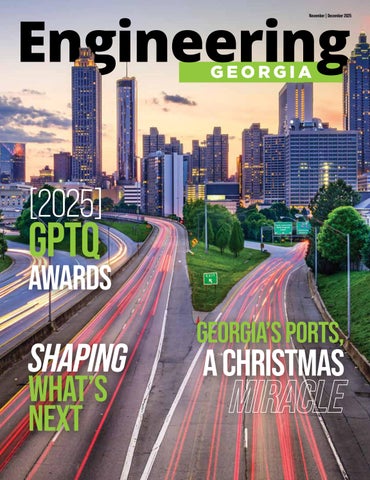
November | December 2025
[2025]
GPTQ
AWARDS
SHAPING WHAT’S NEXT
GEORGIA’S PORTS,
A CHRISTMAS
MIRACLE
TABLE OF CONTENTS
22 COVER STORY:
7
Shaping What’s Next:
THE PULSE News Coverage From In And Around The Engineering Community
HOW GEORGIA’S YOUNG PROFESSIONALS ARE REDEFINING ENGINEERING’S FUTURE
12
POLITICAL PULSE
28 40 Georgia’s Ports, A Christmas Miracle
The 2025 GPTQ Awards:
SANTA DELIVERS GIFTS TO GOOD BOYS AND GIRLS, ALL ELSE GOES THROUGH GEORGIA’S PORTS
CELEBRATING EXCELLENCE IN GEORGIA’S TRANSPORTATION ENGINEERING
Stay Up-To-Date With Political News That Affects Engineers In Georgia
55
ASSOCIATION NEWS Updates From The Associations That Make Up The Georgia Engineering Alliance
66
A LOOK BACK A Back-Page Throwback Picturing Georgia’s Most Historic Landmarks
ON THE COVER Futuristic Atlanta
EDITORIAL BOARD
Publisher: Michael “Sully” Sullivan Editor-in-Chief: Brett Hillesheim Creative Director | Designer: Sabrina Tongren www.in8-design.com Contributing Editors: Alia Sims Christy Tarallo Contributing Writers: Marc Hyden Brett Hillesheim Christy Tarallo Contributing Photographer: Jennifer Stalcup Accounting Services Manager: Melisa Beauchamp Advertising Sales Manager: ACEC Georgia 229 Peachtree Street NE Suite 1800 Atlanta, GA 30303 brett.hillesheim@acecga.org (404) 665-3539
CECILIA ARANGO Thomas & Hutton/SMPS Atlanta STACEY CHAPMAN CIT, Croft Architecture and Engineering STEPHANIE DAMMEN-MORRELL Hussey Gay Bell ANDREW FARMER PE, Gresham Smith / GEF LIGIA FLORIM PE, Cobb County DOT / WTS Atlanta CATHERINE JOHNSON AECOM / NSBE JEFF MILHEIZLER Uzun + Case / SEAOG CHRISTY JEON Ph.D, PE, Atkins / ITE Georgia JOHN PIERSON PE, Georgia Tech Research Institute / ASCE Georgia RANDAL RIEBEL PE, Delta Air Lines / GSPE CODY ROGERS, PE / ASCE Georgia CANDANCE SCALE / SAME KATHERINE SCHNELL Kimley-Horn THOMAS TRUE PE, LS, Maser Consulting SASHA UGI Croy Engineering BILL WELLS ITS Georgia KYLE WILCOX PE, Heath & Lineback/ASHE Georgia
Send change of address to: ACEC Georgia 229 Peachtree Street NE, Suite 1800 Atlanta, GA 30303 or email editor@engineeringGA.com
Facebook.com/EngineeringGA @Engineering_GA www.EngineeringGA.com Engineering Georgia 2025 is published bi-monthly by the American Council of Engineering Companies of Georgia (ACEC Georgia) and its partner associations ASCE, ASHE, GEF, GSPE, ITE, ITS, SAME, SEAOG, SMPS and WTS. All rights reserved. Reproduction in whole or part without permission is prohibited. In8 Design, ACEC Georgia, and its partner associations ASCE, ASHE, GEF, GSPE, ITE, ITS, SAME, SEAOG, SMPS and WTS, as well as their representatives, employees and agents, are held harmless from any claim, demand, liability or action on account of, or in any way arising out of, the client’s advertising, products and services, or its participation in Engineering Georgia.
Atlanta Post
W
When you stand on the docks in Savannah or Brunswick, you see more than containers and cargo. You see Georgia’s economy flowing in real time. From advanced manufacturing to agriculture, automotive, and the global brands headquartered in our state, so much of what makes Georgia a national leader depends on the efficiency, reliability, and resiliency of our ports and supply chain. These gateways connect Georgia companies to global markets and connect global investment back to our communities. Georgia’s economic success has never relied on a single industry or a single region. The ports at Savannah and Brunswick, the inland port facilities in Chatsworth and Cordele, the logistics hubs ringing Atlanta, and our interstate corridors and freight rail networks all demonstrate how interconnected our state has become. Our supply chain is the quiet engine that keeps every economic sector humming. Our supply chain used to be an exclusively arterial one – ports, roads, rail, regional distribution centers, and end users. But with the exponential growth of online retail, direct wholesale delivery and just in time inventory management, our supply chain is more like a capillary system, with routes that ultimately reach as close to us as our own driveways. New investments are needed to meet the new demands and to sustain our state’s continued economic growth. Investing in infrastructure grows our economy and when that falters, everyone feels it. Speaking of investments, investing in people is vital to the future of any business or industry. And I can think of no finer example of that kind of investment than John Heath, who recently retired from Heath & Lineback, the firm he founded and led for many decades.
John has always demonstrated a deep commitment to investing in people and contributing to the long-term success of our industry. Whether it was his long-time stewardship of the Georgia Partnership for Transportation Quality (GPTQ) with GDOT or his many years of leadership on the ACEC Georgia Board, including his term as Chairman. John always shows up—consistently, thoughtfully, and with a genuine desire to make things better. His counsel has helped guide ACEC Georgia through many critical decisions, and his friendship, kindness, humor and advice have meant more to me personally than he probably realizes. John’s impact will be felt long into the future through the people and organizations he invested in for so many years. As always, if you have any thoughts about how we can make Engineering Georgia better, please don’t hesitate to let me know. My cell phone is (770) 356-3769 and my email is sully@acecga.org.
GET SOCIAL Michael L. "Sully" Sullivan President / CEO, ACEC Georgia Publisher, Engineering Georgia
SULLY@ACECGA.ORG 770-356-3769 @MICHAELLSULLY MICHAELLSULLY MICHAELLSULLIVAN
NEWS BRIEFS DOUG WILLIAMS NAMED INTERIM DEAN OF GEORGIA TECH COLLEGE OF ENGINEERING
Both Seo and Kwon serve in KSU’s Southern Polytechnic College of Engineering and Engineering Technology, where Seo is a professor of civil engineering and Kwon is an associate professor. Their selection as Fellows highlights KSU’s growing reputation for research excellence in infrastructure, sustainability, and applied engineering solutions.
YOUNGGUK SEO RECOGNIZED FOR ADVANCEMENTS IN SUSTAINABLE TRANSPORTATION INFRASTRUCTURE
Doug Williams has begun serving as Interim Dean of the College of Engineering at Georgia Tech, succeeding Raheem Beyah, who was recently appointed provost. In this role, Williams becomes the chief academic officer of the largest engineering program of its kind in the nation, providing leadership for more than 500 faculty members and 21,000 students across the College’s eight schools. Williams has served as the College’s Senior Associate Dean and is a Professor in the School of Electrical and Computer Engineering (ECE). He has played a central role in advancing initiatives related to faculty development, student success, and interdisciplinary collaboration, and has contributed significantly to shaping the College’s academic programs. A member of the Georgia Tech faculty since 1989, Williams’ research focuses on statistical signal processing with applications in communications, radar signal processing, and nonlinear dynamics. He is affiliated with the Center for Signal and Information Processing and has held numerous leadership positions, including service on the Institute’s Executive Board, Academic Faculty Senate, and Undergraduate Curriculum Committee. He has also represented Georgia Tech on the University System of Georgia Faculty Council.
Seo brings more than two decades of public-sector research experience with the South Korean government and the U.S. government in Virginia, with expertise spanning transportation systems, infrastructure policy, and renewable energy applications. His work integrates traditional civil engineering with emerging sustainability priorities, including the development of geothermalbased roadway systems designed to melt snow and ice by harnessing ground heat beneath road surfaces. His research contributes to safer winter driving conditions and explores broader applications for renewable energy integration. Seo’s commitment to teaching and mentoring has been central to his career, incorporating collaborative research experiences that advance innovation while preparing students for leadership in the field.
Williams previously served as Senior Associate Chair for ECE (2012–2016) and Interim Chair of the ECE School (2011–2012). He holds bachelor’s, master’s, and doctoral degrees in electrical and computer engineering from Rice University.
KENNESAW STATE ENGINEERING FACULTY NAMED ASCE FELLOWS
Kennesaw State University faculty members Youngguk Seo and Jayhyun Kwon have been elevated to the grade of Fellow within the American Society of Civil Engineers (ASCE), a distinction held by only 3% of ASCE members worldwide. The recognition honors their leadership, research contributions, and impact on advancing civil engineering practice.
JAYHYUN KWON HONORED FOR CONTRIBUTIONS TO GEOTECHNICAL AND TRANSPORTATION ENGINEERING
Kwon’s elevation to ASCE Fellow recognizes nearly 25 years of contributions to geotechnical and transportation engineering. His research focuses on creating sustainable, resilient, and cost-effective infrastructure systems, with advancements in pavement performance, railroad track design, and the use of recycled materials in roadway construction. N
engineering ga [ feature the pulse [ news briefs ]]
November | December 7
His work includes evaluating quarry byproducts for roadway improvement and developing performance-based design frameworks used by national agencies. Kwon’s expertise has been sought by organizations such as the U.S. Army Corps of Engineers, where he has provided independent technical reviews to strengthen pavement modeling and rehabilitation standards. He is also recognized for mentoring students through hands-on laboratory and field research, fostering the next generation of engineering professionals. Together, Seo and Kwon’s recognition as ASCE Fellows reflects Kennesaw State University’s continued leadership in civil and transportation engineering research and education.
CROFT & ASSOCIATES OPENS SIXTH OFFICE IN HISTORIC DOWNTOWN SAVANNAH
CROFT & Associates has expanded its footprint with the opening of a new office at 24 Drayton Street in downtown Savannah. The firm marked the milestone with a ribbon-cutting ceremony on October 29, reflecting more than 20 years of continued strategic growth.
EDWARDS-PITMAN ENVIRONMENTAL EXPANDS SOUTHEASTERN PRESENCE WITH ACQUISITION OF TERRAXPLORATIONS
Edwards-Pitman Environmental, an Atlanta-based environmental consulting, compliance, and planning firm, has acquired TerraXplorations, Inc. (TerraX), a cultural resources consulting firm headquartered in Alabama. The acquisition broadens EdwardsPitman Environmental’s footprint across the Southeastern United States and significantly enhances its capabilities in cultural resources and environmental services. As part of Braun Intertec, Edwards-Pitman Environmental continues to strengthen its multidisciplinary expertise to support infrastructure, energy, and environmental projects throughout the region. The addition of TerraX brings expanded service offerings through a specialized team with experience in cultural resources surveys, historic research, laboratory analysis, bioarchaeology, geophysical analysis, and public interpretation programs. Founded in 2012, TerraX has served public- and private-sector clients across the full lifecycle of cultural resources compliance and research.
The new Savannah location strengthens CROFT’s ability to support existing clients throughout coastal Georgia while extending its reach across the Southeast. The expansion aligns with the firm’s commitment to delivering innovative, people-centered design solutions tailored to the unique needs and character of the communities it serves. CROFT has an established history of work in the region, contributing to several notable preservation and renovation efforts. The firm supported the rehabilitation of the Reynolds Mansion on Sapelo Island, modernizing the historic landmark with enhanced safety, comfort, and functionality. CROFT also played a role in preserving the Torrey West Mansion on Ossabaw Island, providing design solutions that protect the site’s cultural and environmental significance. In addition, the firm completed the design of the Skidaway Island Visitors Center, an educational gateway for coastal exploration and stewardship. These projects highlight CROFT’s longstanding commitment to honoring the heritage and historic fabric of Savannah and Coastal Georgia while supporting the region’s future growth and resilience. The new Savannah office will expand the firm’s regional capabilities and foster greater collaboration, innovation, and community engagement. CROFT also plans to hire locally, drawing talent from SCAD and surrounding colleges and universities to support the next generation of architects, designers, and engineers. A
This acquisition adds nearly 60 highly skilled employees to the employee-owned organization, increasing its capacity to support large and complex environmental and infrastructure initiatives. The transaction became effective November 24, 2025.
engineering the pulse [ news ga [ feature briefs ]]
November | December 9
ON THE MOVE ATHENA ENGINEERING
Andrew Garcia
is pleased to welcome Andrew Garcia, PE as Roadway Design Practice Lead. Garcia brings extensive experience in roadway design, 3D modeling, construction staging, and project delivery, further strengthening the firm’s core transportation services.
Garcia also brings a strong commitment to professional development and mentorship, supporting the growth of emerging engineers within the organization. His leadership will enhance Athena’s ability to deliver innovative, high-quality roadway solutions across the state.
EUA is excited to welcome Mark Tredo to
the firm as an Atlanta market leader. Tredo brings decades of experience in commercial real estate, workplace strategy, design and construction. He will help expand EUA’s presence in the Atlanta region and support Mark Tredo national workplace relationships. In this role, Tredo will focus on the growth and development of our workplace and advanced manufacturing + industrial markets. Tredo has partnered with EUA for many years and brings a strong background in the workplace, industrial and manufacturing sectors. In his new role, Tredo will focus on building client relationships, engaging with the local community and supporting strategic growth in the region. Tredo will also collaborate with Eric Romano on national workplace relationships and contribute to other markets where he brings established connections and expertise.
GHD proudly announces that Marsha
Anderson Bomar, Ph.D., AICP, ENV SP, F.ITE, F.ASCE, Strategic Transportation Advisor, has been inducted as President of the American Society of Civil Engineers (ASCE) for the 2025–2026 term. She also joins the National Academy of Engineering’s Marsha Anderson Bomar Class of 2025, recognizing her outstanding contributions to engineering practice, leadership, and innovation. Anderson Bomar becomes the second GHD professional to lead ASCE at the national level, following Maria Lehman, who served as President in 2022–2023. Her distinguished career spans transportation planning, traffic engineering, and public infrastructure leadership, with a long record of service across ASCE, including roles on the Board of Direction and two decades of involvement with the Transportation and Development Institute.
10 Engineering Georgia
Her career includes significant leadership positions in both the public and private sectors, including Commissioner Emeritus of the City of Atlanta Department of Transportation, Assistant General Manager at MARTA, and founder of Street Smarts and Data Smarts. Her election reflects her continued commitment to advancing resilient, equitable, and sustainable infrastructure. ASCE, with more than 160,000 members worldwide, remains a leading voice in infrastructure policy and professional development. Anderson Bomar’s leadership will help guide the society’s efforts during a pivotal period for the profession.
VHB
has established the Piedmont Atlantic Region to enhance service delivery in Georgia, North Carolina, and South Carolina and to support the continued growth of these rapidly expanding markets. As part of this advancement, the firm has appointed Fabricio Ponce as Piedmont Atlantic Regional Manager and Joe Wanat as Mid-Atlantic Regional Manager, effective January 2026. The new Piedmont Atlantic Region comprises five offices across Georgia and North Carolina and includes more than 250 employees. Fabricio Ponce will lead this newly created region, bringing extensive experience in market growth, client engagement, and regional strategy. Fabricio Ponce Since joining VHB in 2019, he has tripled the size of the Atlanta office to more than 125 professionals and has advanced major initiatives such as the Atlanta Regional Commission’s Safety Strategy and MARTA’s General Planning Consulting Services. His leadership will guide the continued expansion of VHB’s footprint throughout the Southeast. Joe Wanat will oversee the Mid-Atlantic Region, which includes 300 employees across Washington, DC, Maryland, and Virginia. With more than 30 years at VHB, Wanat has played a key role in doubling the size of the Metro DC office and delivering high-impact Joe Wanat projects, including the DC Strategic Fleet Electrification Plan. His previous leadership roles include serving as Managing Director of the Providence office and Director of Transportation Planning & Operations in the Watertown office. In addition to his professional achievements, he has 35 years of service in the U.S. Army Reserve and currently serves as a Colonel at the Pentagon. With Wanat transitioning to his new leadership role, Nancy Barker, PWS, PWD, will now dedicate her full attention to advancing VHB’s Federal Market program. A
engineering the pulse [ on gathe [ feature move ]]
TOP 5 FIVE Resources for Setting (and Achieving) Your 2026 Goals
Whether you're aiming to strengthen leadership skills, improve health, or simply gain clearer direction for the year ahead, these five well-researched, widely recommended resources offer practical frameworks and science-backed strategies for effective goal setting in 2026. ATOMIC HABITS by James Clear
A global bestseller for a reason, Clear’s book breaks down how small, consistent changes lead to big results. His “1% better every day” approach and emphasis on identity-based habits provide a proven framework for creating goals that stick. Why it works: Clear’s methods are grounded in behavioral science and offer step-by-step systems you can apply immediately.
MINDSET: THE NEW PSYCHOLOGY OF SUCCESS
by Stephen R. Covey
A classic in personal and professional development, Covey’s “begin with the end in mind” principle is one of the strongest goal-setting frameworks ever written. Why it works: Covey teaches readers how to prioritize what matters, set long-term vision, and create balanced, purpose-driven goals.
DEEP WORK by Cal Newport
by Carol S. Dweck, Ph.D.
Dweck’s landmark research on growth mindset is one of the most influential frameworks in modern psychology. The book explains how shifting from a fixed mindset (“I’m either good or not good at this”) to a growth mindset (“I can improve with effort and strategy”) dramatically improves goal achievement, resilience, and long-term performance. Why it works: Decades of peer-reviewed research show that mindset plays a direct role in whether people set ambitious goals, persist through setbacks, and ultimately succeed.
12 Engineering Georgia
THE 7 HABITS OF HIGHLY EFFECTIVE PEOPLE
the pulse [ top 5 ]
(Book + Podcast Features) Newport’s book digs into how focused, distraction-free work leads to higher achievement—and he frequently expands on these ideas in interviews on shows like The Tim Ferriss Show. Why it works: As attention becomes harder to protect, Newport’s researchbacked methods help people set goals that harness concentration, not chaos.
HBR IDEACAST
(Harvard Business Review Podcast) One of the most respected business and personal development podcasts available, HBR IdeaCast features weekly interviews with psychologists, leadership experts, authors, and researchers. Episodes frequently explore goal setting, motivation, behavior change, and long-term success strategies. Why it works: It delivers short, actionable insights backed by research and real-world case studies.
November | December 13
POLITICAL PULSE Georgia’s 2026 Legislative Session
CHRISTY TARALLO
T
‘Tis the time of year for counting. Many people count the number of “sleeps” until Christmas, days until the New Year, business days until holiday travel, or seconds until their in-laws leave. Yet, there’s a significant number of people who are counting down the days until the second Monday of January, which, per the Georgia Constitution, marks the first day of the Georgia Legislative session. Hark! What a session it will be! Roughly a third of the Senate is seeking higher office, with many senators rumored to be mulling a run for various positions. While the House has escaped the sheer volume of aspirants, it is not without its own turnover. In fact, since January of 2025, the House has lost two members due to resignations and one due to the death of Chairwoman Mandi Ballinger. The House also has about ten individuals who have announced that they are seeking higher office. However, whether someone has announced a run for higher office or are simply rumored to be considering it, the real test will be the first week of March when candidates must formally file the paperwork required to “qualify” to run for the position they seek.
[ political pulse ]
With so many legislators running for higher office, grandstanding will be inevitable. Georgia’s primary system perpetuates a continuous cycle of “appealing to the base”, which forces candidates on both sides of the aisle to tout policies that die-hard party-line voters – who come out for every election, hell or high water – want to hear. It’s something candidates must do to increase their chances of becoming their respective party’s nominee. Then, after clinching the nomination, they tend to run to the middle to appeal to the majority of voters in a general election. If you’re looking to read the tea leaves to figure out what the 2026 legislative session will hold, look to the 2026 election season. Republicans will have a more difficult cycle to contend with than previous cycles when the state was a darker shade of red. The November 4th Public Service Commission elections, in which Democrats unseated two Republican incumbents by a 60/40 margin, have put many in the GOP on high alert. On top of that, mid-term elections generally tend to favor the party that doesn’t hold the White House. So, it will be a delicate balance for Republicans vying for Governor, Lt. Governor and other statewide offices to appeal to their primary base in a manner that still allows them to credibly run to the middle after receiving the nomination, while staying true to the values they initially ran on.
of housing development that local permit issuing authorities impose on developers. House Bill 812 by Representative Mike Cheokas proposes to tighten parameters around the statutory shot clock that governs local land disturbance permit issuance. The bill would require the local issuing authority to specifically cite the local, state, or federal law or regulation an application purportedly violates and to require that the authority either issue or deny an application no later than 14 days after receiving the re-submitted application. Advocates tout this as a commonsense reform that will hold local governments accountable and end the 6 to 18 month waiting period developers have been increasingly experiencing since COVID. Opponents of the measure believe that local governments are likely stalling the process for benign reasons and need as much flexibility as possible. Whatever the reason, permit delays are an unmistakable cost that have driven up the price of housing and lawmakers seem eager to fix it.
FORTUNATELY, VOTER PRIORITIES HAVE SHOWN TO BE LARGELY THE SAME, REGARDLESS OF PARTY AFFILIATION, AND THE NUMBER ONE ISSUE, BY FAR, IS AFFORDABILITY.
Fortunately, voter priorities have shown to be largely the same, regardless of party affiliation, and the number one issue, by far, is affordability. As James Carville stated in 1992, “it’s the economy, stupid” and going into 2026, the statement still rings true. Affordability of homes, groceries, childcare, and insurance premiums are top of mind for both parties going into the 2026 session. It’s a ubiquitous issue that will be top-of-mind for swing voters going into the mid-term election season. Since the last legislative session, the Georgia House has been largely focused on insurance premiums, and a special committee called the House “Blue Ribbon Study Committee on Insurance Rates” has met over the interim to study the effects of tort reform on insurance prices and to determine what, if anything, the legislature can do in order to reduce rates. Recently, Speaker Jon Burns expressed interest in trying to get Georgians quick relief on premiums and pointed to the committee’s work to provide a means to achieving that goal. Voters can expect that passing legislation to lower insurance rates will be a top priority for House leadership. Housing affordability will also be a top priority for legislators, though as Georgia REALTORS’ External Affairs Officer Jeff Ledford has stated, “there’s no one silver bullet to ease housing affordability.” However, there is a measure that aims to help alleviate some of the soft costs
The Senate will also likely grapple with housing affordability; however, the proposal taking up most of the air in the Senate is eliminating the state income tax. The Special Committee on Eliminating Georgia’s Income Tax is chaired by Senate Appropriations Committee Chairman Blake Tillery and every Republican candidate vying for the Lt. Governor’s position—Senators Greg Dolezal, Steve Gooch, John F. Kennedy, and Chairman Tillery—serve on the Special Committee. Advocates argue that it’s high time to make Georgia competitive with neighboring states that don’t levy an income tax, while opponents fear a double digit sales tax (which many see as a regressive tax that more heavily burdens the lower and middle classes) or a reduction in funding for public services (or some combination of both) would be the inevitable result of eliminating the $16.2 billion in state revenue that the income tax currently generates. Other legislative leaders have been slow to endorse the idea of eliminating the income tax wholesale, but many have stated their support for reducing the income tax to below five per cent this upcoming session, with incremental reductions in future years. Property taxes are yet another sticking point for lawmakers and have become a common talking point amongst gubernatorial candidates who believe property tax increases should be reined in or even capped. House leadership has also been vocally supportive of property tax relief, though the exact details of that proposal are still in the works. Any legislative initiative to address affordability will likely be based on the best intentions and will aim to provide relief for Georgians. However, the mid-term elections will almost certainly ensure that any of these proposals are fair game for primary pandering. Whether you’re counting days or counting (endangered) pennies, the 2026 legislative session—which will be heavily molded by electoral politics—will be one to watch. A
engineering [ political gapulse [ feature ] ]
November | December 15
the pulse
OUT & ABOUT The 2025-2026 ACEC Georgia board of directors and ACEC Georgia staff at the end of the firstever ACEC Georgia Fall Retreat.
Nikki Parris (AtkinsRealis), Rachael Sadler (ACEC Georgia), Holly Painter (KCI), Alia Sims (ACEC Georgia), and Katie West (AtkinsRealis) pose for a quick picture during the 2025 Council for Quality Growth Four Pillars Award.
Christy Tarallo (ACEC Georgia), Rachael Sadler (ACEC Georgia), Holly Painter (KCI), Nikki Parris (AtkinsRealis), Alia Sims (ACEC Georgia) at ACEC Georgia’s Halloween-themed Thirsty Thursday Augusta.
ACEC Georgia’s Brett Hillesheim, Michael “Sully” Sullivan, Rachael Sadler, and Christy Tarallo at the 31st annual Georgia Transportation Summit.
Brad Robinson, Angela Snyder, Katie Dickerson, Jeff Brashears from the PDP team, celebrating their 5th anniversary.
Participants as the first annual Civil Pickle Social, hosted by ACEC Georgia in partnership with ASHE Georgia, ITS Georgia, Georgia ITE, and Georgia ASCE.
The AtkinsRealis team posed for a photo at the 2025 Civil Pickle Social.
Jeff Clayton (Garver), Holly Painter (KCI), Rob Jacquette (Keck & Wood), Christy Tarallo (ACEC Georgia), Michael “Sully” Sullivan (ACEC Georgia), Tommy Crochet (VHB), and Ron Osterloh (Moffatt & Nichol) pose with Miss Georgia outside the US Capitol during the fall DC Fly-in.
Michael “Sully” Sullivan dressed as Sully from Disney’s Monsters Inc. at ACEC Georgia’s Halloween-themed Thirsty Thursday Augusta.
Jay Wolverton (CHA), Michael “Sully” Sullivan (ACEC Georgia), Drew Pitman (CHA), Jeff Adams (Stambaugh Ness), Ron Osterloh (Moffatt & Nichol), Julie Daniel (Freese & Nichols), Rachael Sadler (ACEC Georgia), Rob Jacquette (Keck & Wood), Alia Sims (ACEC Georgia), Holly Painter (KCI), Tommy Crochet (VHB), Adielo NwanKwp (C2G), and Thomas Pace (Thomas & Hutton) posing for a quick picture before the Georgia Delegation Dinner during the ACEC Fall Conference in San Diego.
Benesch’s Erik Hammarlund, Vic Conover, and Bob Baisden network during ACEC Georgia’s Halloweenthemed Thirsty Thursday Augusta.
November | December 19
the pulse
GEORGIA NUMBERS by the
5,000+ MANUFACTURING
facilities statewide, making Georgia a leader in advanced manufacturing, automotive technology, and aerospace production.
42,000
955
BILLION Georgia’s
total Gross Domestic Product (GDP) in 2024, making it the 8th-largest state economy in the nation.
MILES of public roads, highways, and
interstates maintained across Georgia, forming the backbone of the state’s economic mobility.
377,000+ JOBS supported by the logistics
and supply chain industry, buoyed by the Port of Savannah and HartsfieldJackson Atlanta International Airport.
38.5
BILLION Total
economic impact of the Port of Savannah, one of the nation’s fastestgrowing container terminals. November | December 21
SHAPING WHAT’S NEXT: How Georgia’s Young Professionals Are Redefining Engineering’s Future
BRETT HILLESHEIM
A
A NEW GENERATION AT A DEFINING MOMENT
Every era of engineering in Georgia has been shaped by a particular set of challenges — and the people bold enough to face them. After the Great Depression, it was the engineers who modernized the state’s highways and built the foundation of the Georgia Department of Transportation (GDOT). Decades later, it was the planners and builders who reimagined Atlanta ahead of the 1996 Olympic Games, delivering MARTA expansions, Centennial Olympic Park, and transformative upgrades to utilities, roads, and telecommunications. Their work didn’t just prepare Atlanta for the world; it propelled the region into a new era of economic prominence. Today, Georgia stands in another moment of transformation. Over the past decade, the state has experienced the fastestgrowing economy in the Southeast, maintaining the title of Top State for Business for 11 consecutive years, according to Area Development Magazine. Georgia has become a national epicenter for logistics, advanced manufacturing, clean energy, and film production — each sector expanding faster than the one before it.
22 Engineering Georgia
The engineering implications of this growth are enormous. GDOT’s current construction program exceeds $3.5 billion annually, the state is investing more than $1.8 billion into major mobility projects through the Transportation Funding Act, and federal programs like the Bipartisan Infrastructure Law are delivering unprecedented resources for roads, transit, energy, broadband, and water systems. Georgia’s electric-vehicle manufacturing boom — with historic investments from Hyundai, Rivian, Qcells, and SK Battery America — has reshaped entire counties and generated tens of thousands of engineering and technical jobs. As Governor Brian Kemp noted during a 2024 economic briefing, “Georgia is not just keeping up with the future — we’re building it.” At the same time, Georgia’s population continues to climb. The U.S. Census Bureau reports that Georgia added more than 116,000 new residents in 2023 alone, making it one of the top five fastest-growing states in the nation. The Atlanta Regional Commission projects the metro area will reach 8 million residents by 2050, placing immense pressure on transportation networks, water systems, energy grids, and housing infrastructure. Engineering challenges that once seemed distant are now urgent, interconnected, and unfolding in real time. In this environment, the demands on Georgia’s engineering workforce have never been higher — and the opportunities have never been richer. But this time, something is different. The newest generation of engineers isn’t simply being prepared for the future. They are shaping the future as it unfolds. They are entering the field at a moment when new technologies, new expectations, and new modes of collaboration are redefining what engineering must become. Their work, their mindset, and their leadership are already filtering through Georgia’s most critical systems: in the way transportation models are built, in how infrastructure is communicated to the public, in the sustainability practices embedded into design, and in the values guiding complex decisions.
TECHNOLOGY AS TRANSFORMATION — NOT REPLACEMENT
The rise of artificial intelligence has stirred debate across every corner of the engineering world. Yet Georgia’s young professionals approach the trend not with hesitation, but with discernment. At AtkinsRéalis, Project Manager Katie West sees the emergence of AI as one of the most significant forces shaping the next decade of engineering. She notes that the integration of artificial intelligence is already redefining “infrastructure design, transportation systems, and project management,” and she believes her generation is uniquely positioned to lead this transformation responsibly. Millennials, she explains, are preparing by pursuing new certifications, staying engaged in continuous learning, and leveraging their fluency in both “pre-fintech and AI-driven eras.” For Usenmfon Udo, PE, a geotechnical engineer with NOVA Engineering & Environmental, AI is becoming a companion to engineering judgment rather than a replacement for it. He sees young professionals leaning into that partnership intentionally — not simply adopting new tools, but interrogating them. His generation, he says, wants to “ask why we do things a certain way and explore smarter, safer, more efficient methods,” ensuring innovation strengthens, rather than weakens, the fundamentals of the profession. That balance of curiosity and responsibility runs deep. Across interviews, young engineers emphasized that AI may accelerate certain tasks, but cannot replace the experiential, ethical, and contextual judgment that underpins sound engineering.
Their influence can be felt in the systems we build, the projects we pursue, and the priorities we elevate. They are bringing curiosity, transparency, and empathy into a field that has historically been dominated by hierarchy and tradition. And they are doing so at a moment when Georgia needs their perspective most. Governor Kemp has often said that “Georgia is the best state to live, work, and raise a family because we work together and invest in our future.” In engineering, that future is increasingly being designed, led, and imagined by the young professionals rising through the ranks — individuals who not only understand where Georgia is going, but who feel a deep responsibility for shaping how it gets there.
At HNTB, Christopher Gallien captures the moment clearly: AI, he says, “automates tasks that free us to focus on higher-value decisions,” enabling young professionals to engage more deeply with the kinds of choices that shape safety, mobility, and quality of life. In Georgia — a state experiencing a historic construction boom — this shift is profound. Engineers are not just adapting to technology; they are deciding how it should be used, how it should be governed, and how it can serve the public interest. N
Within ACEC Georgia’s Young Professionals Network (YPN), these future-shapers are already leaving their mark — and their collective vision offers a blueprint for where Georgia’s engineering industry is heading next.
engineering ga [ feature ]
November | December 23
LEARNING TO LEAD BEFORE THE TITLE ARRIVES
One of the most striking characteristics of this generation is their refusal to wait. They don’t see leadership as a destination; they see it as a posture. Their influence appears everywhere — in design meetings, mentorship programs, public engagement sessions, and cross-disciplinary collaborations. West has seen firsthand how empowering young professionals early can shape entire project cultures. Her firm invites emerging engineers into key discussions, encouraging them to “pull up a seat to the table and take an active role in shaping both their company’s methodologies and the broader direction of the industry.” Her own career progression — from novice to subject matter expert to managing multimilliondollar NEPA programs — demonstrates the power of early and intentional leadership cultivation. Gallien notes that young professionals are redefining the concept of expertise. Instead of remaining narrowly specialized, many earlycareer engineers in Georgia are actively pursuing cross-training opportunities. He believes “the engineer of the future is the one who can think broadly across specialties,” bringing a holistic perspective to challenges that increasingly intersect across disciplines. At BGE, Inc., Don F. Singer, PE, sees another emerging dynamic: the changing nature of mentorship. Remote and hybrid work environments — once unimaginable in engineering — have created new challenges for knowledge transfer. Yet Singer points out that the firms that thrive in this context are those “investing in their people,” ensuring that emerging talent receives the guidance, repetition, and exposure needed to grow into leadership roles with confidence. This is not leadership defined by tenure. It is leadership defined by initiative, adaptability, and vision.
COLLABORATION AS A CULTURAL SHIFT
As Georgia continues to grow — adding over 116,000 residents in just the past year, according to the U.S. Census Bureau — the demands on infrastructure are evolving rapidly. That means collaboration has become one of the most important engineering skills of the 21st century. Transportation engineer Kate Saunders of 2MNEXT sees young professionals leading a shift toward transparency and trust-building in both internal teams and community engagement. Her generation, she explains, is fluent in real-time coordination tools and collaborative platforms that allow teams to work seamlessly across firms, geographies, and specialties. Yet she is quick to point out that
24 Engineering Georgia
technology alone does not improve collaboration — people do. Young professionals, she says, prioritize relational leadership, focusing on communication, inclusivity, and early stakeholder engagement. Instead of treating community input as a final checkpoint, her peers bring residents into the design process earlier, using digital tools to help them visualize and understand proposals. At Barge Design Solutions, Rakeem Jackson, PE, approaches collaboration as a form of civic stewardship. With Georgia’s transportation network under tremendous strain — the state now ranks 8th in the nation for population and is projected to reach 11 million residents by 2030 — Jackson believes every design decision carries long-term consequences. Young professionals, he says, feel a responsibility to ensure that those decisions “are sustainable and improve mobility,” prioritizing multimodal access, context-sensitive solutions, and infrastructure that works for all users. This alignment of transparency, collaboration, and purpose-driven design signals a generational shift — one that positions engineering not simply as technical work, but as community-building work.
ENGINEERING WITH PURPOSE IN A STATE THAT’S GROWING FAST
Infrastructure is not only about concrete and steel; it is about people. And for this generation, that truth anchors every decision. At Athena Engineering, Abigail Burks, PE, reflects on the tangible impact of projects on people’s daily lives. Every time she drives through a corridor she helped design, she is reminded that engineering is “deeply human,” because “these projects change how people move and live.” That sense of responsibility fuels her commitment to clarity, safety, and problem-solving rooted in empathy. Udo expresses a similar aspiration: to contribute to systems that are “safe, reliable, and built to last.” Gallien’s purpose focuses on innovation in Georgia’s Intelligent Transportation Systems, where even small advancements can reduce crashes, improve flow, and ultimately save lives. Meanwhile, Jackson emphasizes accessibility and inclusion. He envisions a transportation network that is intuitive for all users — from daily commuters to visitors to residents with mobility challenges. West sees this work as fundamentally tied to equity. Transportation, she says, is “the backbone of equitable access,” and the opportunity
to expand mobility for underserved communities is part of what motivates her to build her career in Georgia. This is a generation that does not view purpose as an add-on to engineering. Purpose is the engineering.
WHY GEORGIA? BECAUSE THE FUTURE IS BEING BUILT HERE
Georgia’s economic momentum has created fertile ground for young engineers to shape meaningful careers. The state has led the nation in business climate for 11 straight years. Companies like Hyundai, Rivian, Qcells, and SK Battery America have invested billions in manufacturing and clean energy, catalyzing new industries and reshaping workforce needs. GDOT continues to deliver record-setting transportation programs, with more than $1.8 billion awarded in construction contracts last year alone. Against that backdrop, young professionals say Georgia feels like a place where their work matters — where growth brings not just challenges, but purpose. Jackson describes Georgia as “a dynamic place,” filled with new industries, new ideas, and new residents who depend on thoughtful infrastructure solutions. Burks highlights the state’s commitment to transportation and technology as fertile ground for innovation. Udo appreciates Georgia’s balance of opportunity and community impact, while West sees alignment between her values and the state’s approach to mobility and equity. And Gallien offers the most personal reflection, noting that he originally came to Georgia “chasing a girl,” but stayed because it offered the right mix of family life and professional fulfillment. Their reasons differ, but their conviction does not: Georgia is not just a workplace. It is a canvas.
A COLLECTIVE VISION FOR THE DECADES AHEAD
Across the seven voices of this cohort, a coherent and compelling blueprint emerges — not written into policy or codified in a single statewide plan, but woven into the values they carry into each meeting, design charrette, field inspection, and community conversation. It is a vision informed by technical training, sharpened by the pace of Georgia’s growth, and driven by a deep sense of public responsibility. Their vision is for a Georgia where technology strengthens, rather than replaces, engineering judgment. These young professionals see AI, automation, and digital modeling as tools that enhance clarity
and efficiency — freeing engineers to spend more time solving human problems rather than performing repetitive tasks. They believe engineering’s future lies not in choosing between people and machines, but in using technology to elevate insight, creativity, and safety. As Georgia embraces intelligent transportation systems, digital twins, and real-time mobility analytics, these emerging leaders are guiding how those tools are deployed, ensuring they serve communities rather than overshadow them. They envision a state whose infrastructure is resilient, inclusive, and deeply connected. With Georgia’s population projected to reach nearly 11 million within the next decade, the YPN generation confronts infrastructure demands far more complex than those faced by previous eras. Climate variability, aging water and sewer systems, supply chain volatility, and rapid economic shifts all require adaptable solutions. These young engineers are already thinking in terms of resilience — designing stormwater systems that can weather stronger storms, transportation corridors that support all modes of travel, and energy systems that align with the Southeast’s expanding clean-tech footprint. Their vision also prioritizes collaboration — early, often, and transparently. They want stakeholders at the table long before decisions are set in motion. They rely on open-source tools, real-time design platforms, and interactive public engagement methods not because they are trendy, but because they introduce clarity where there was once confusion. In a state with increasingly diverse communities, complex regional partnerships, and fast-moving infrastructure timelines, they understand that collaboration is no longer a soft skill; it is a foundational engineering requirement. They imagine leadership that is shared, grounded in empathy, curiosity, and purpose. Their generation is shifting firm cultures away from rigid hierarchies and toward environments where emerging voices are welcomed, mentoring flows in multiple directions, and leadership is defined by accountability rather than title. They are helping refine office cultures, strengthen DEI commitments, and champion mental health and work-life balance in ways that support both long careers and healthy teams. Above all, they believe engineering should improve lives, not just systems. Every interview reflected this grounding idea: that the true measure of a project is not whether it meets a specification, but whether it serves the people who depend on it. Whether it improves safety. Whether it expands access. Whether it strengthens a neighborhood or connects a region. As Georgia invests billions into roads, water infrastructure, broadband expansion, and clean energy manufacturing, these young professionals see each project not as a job, but as a chance to contribute to a safer, stronger, more equitable state. N
engineering ga [ feature ]
November | December 25
And importantly, this is not a passive or abstract vision. It is already taking shape — in the models they refine late at night, optimizing safety margins and material efficiencies. In the meetings they lead, where they push for clarity and elevate questions others might overlook. In the communities they serve, where they listen first and design second. In the reviews they conduct, the innovations they test, and the professional networks they strengthen. From Gwinnett County transit planning rooms, to Savannah’s port expansion corridors, to the NEPA studies shaping rural mobility, to the stormwater models protecting coastal communities, their fingerprints are on the present — and their values are charting the next decades. Georgia’s future infrastructure will bear their imprint. Its systems will reflect their priorities. Its resilience will echo their determination. And its progress will rise from their sense of purpose. This generation is not simply inheriting Georgia’s engineering legacy — they are rewriting it for the world their children will one day inherit.
CONCLUSION: THE FUTURE IS ALREADY UNDER CONSTRUCTION
As Georgia continues its extraordinary economic and population growth, the demands on its infrastructure will be complex, urgent, and interconnected. But Georgia is not facing that future alone. It is facing it with a generation of engineers who are imaginative, grounded, collaborative, and bold. A generation that embraces innovation without losing sight of humanity. A generation that leads early, listens deeply, and builds intentionally. The question is no longer whether young professionals will shape the future of engineering in Georgia. They already are. Every day. In ways big and small, visible and unseen. The future is under construction — and Georgia’s young professionals are engineering it with purpose, clarity, and heart. A
26 Engineering Georgia
November | December 27
GEORGIA’S , PORTS A CHRISTMAS MIRACLE Santa delivers gifts to good boys and girls, all else goes through Georgia’s ports
N
Now that the holiday season has come and gone and Christmas has passed, it is worth looking back on the remarkable systems that kept the season running smoothly. Each year, people who put off shopping until the last minute inevitably feel the anxious pinch, and this past season was no exception. Regardless of whether they were chronic procrastinators or the grumpy old Grinch incarnate, they were far from alone. Recent polls have found that around 51 percent of Americans wait until the last minute to wrap up their holiday shopping. Under normal circumstances, this would be wholly inadvisable, but something curious—or perhaps magical—happens each year. Christmas miracle or not, the American economy and its infrastructure evolve drastically to account for the stunning influx of spending and shipping. Sure, Christmas is rooted in religion, but it is also big business. Retailers expected to hire an additional 500,000 seasonal employees, Amazon brought on 250,000, UPS over 100,000 and USPS 14,000—and for good reason. N
28 Engineering Georgia
engineering ga [ feature ]
MARC HYDEN
THE AMERICAN ECONOMY AND ITS INFRASTRUCTURE EVOLVE DRASTICALLY TO ACCOUNT FOR THE STUNNING INFLUX OF SPENDING AND SHIPPING.
engineering ga [ feature ]
November | December 29
For the first time in history, economists believed that holiday spending would exceed $1 trillion—much of which flowed through Georgia’s ports. To put that figure into perspective, if you lined up one trillion one-dollar bills end-to-end, it would stretch from the Earth to the sun and still have plenty left over. Put simply, that is a lot of spending, and with it came shipping and logistics. While Santa obviously delivers toys personally to good boys and girls, just about everything else in Georgia went through our ports. How it all works remains a true feat of engineering and is reminiscent of a timeworn essay.
Ever since Gen. James Edward Oglethorpe landed in Georgia in 1733, the port of Savannah has been an important part of Georgia’s economy. Its level of importance, however, began to accelerate markedly starting about 80 years ago. “The Georgia Ports Authority—with control over the deep-water ports in both Savannah and Brunswick—was created by an act of the Georgia legislature in response to the post-World War II economic boom,” according to the Georgia Ports Authority. “The new authority was empowered to operate state-owned facilities and ‘to do any other things necessary [and] proper to foster or encourage the commerce, domestic or foreign, of the state, the United State[s] of America, or the several sister states.’ The order was signed by Governor Ellis Arnall on March 9, 1945.”
GEORGIA'S TWO DEEP-WATER PORTS ACCOUNTED FOR $174 BILLION IN SALES IN THE LAST FISCAL YEAR
Back in the holiday season of 1958, acclaimed economist Leonard E. Read published what became his most famous article, I, Pencil. Writing as though he were ghostwriting a pencil’s autobiography and genealogy, he wrote, “I am a lead pencil— the ordinary wooden pencil familiar to all boys and girls and adults who can read and write […] Simple? Yet, not a single person on the face of this Earth knows how to make me.” Over the course of his essay, Read highlighted the surprising complexities involved with creating a humble pencil. Every stage of the process—from growing and harvesting trees, to shipping them, to turning wood, lead and rubber into pencils and to delivering them to people across the world—requires myriad experts, a host of materials, specialized machinery with finely tuned parts and a vast supporting global network.
Fast forward 80 years, and the Peach State’s ports are considered critical infrastructure, unmistakable economic engines, and part of the state’s success story. “Georgia has been recognized as the No. 1 state for business for over a decade in part because we’re also the best state for reliable infrastructure,” Gov. Brian Kemp announced. “As powerful economic drivers, the Ports of Savannah and Brunswick are a key part of the pro-job creator environment we’ve fostered to ensure every part of our state can thrive.”
The essay is well worth a read, and it revealed that a simple writing instrument was far from simple. However, if the process of creating pencils befuddled Read in 1958, then he would be astonished at the elaborate intricacies of Georgia’s deep-water ports— especially leading up to Christmastime—and the outsized role they play in international supply chains.
30 Engineering Georgia
Gov. Kemp is right, and the economic impact of the state’s deep-water ports is dumbfounding. “According to the [University of Georgia’s] Selig Center study, Georgia's two deep-water ports accounted for $174 billion in sales in the last fiscal year […] and contributed $77 billion to the state's Gross Domestic Product,” reported the Savannah Morning News. “The ports also generated $43 billion in income.” N
engineering ga [ feature ]
November | December 31
MOVING MILLIONS OF TONS OF CONTAINERIZED CARGO ANNUALLY, SAVANNAH IS ALSO THE THIRD-BUSIEST CONTAINER GATEWAY IN THE U.S.
Moreover, port activity contributes billions of dollars in taxes per year—$10 billion to the federal government, $3 billion to the state, and $3 billion in local taxes. Georgia’s ports and inland terminals also help sustain a statewide workforce of over 650,000 employees, and they are needed to handle the massive demands on the ports. “The Port of Savannah is home to the largest single-terminal container facility of its kind in North America, encompassing 1,345 acres,” reads a Ports Authority statement. “Moving millions of tons of containerized cargo annually, Savannah is also the thirdbusiest container gateway in the U.S.” On a weekly basis, the Savannah Port facilitates roughly 35 vessel calls, 42 rail services and 16,000 trucks. Meanwhile, the Brunswick Port is the nation’s busiest for roll-on/roll-off (RoRo) cargo, which includes heavy machinery and vehicles. These are not exactly toys tailored for good boys and girls, but rather for adults who appreciate the sheer volume that goes through the Brunswick Port. 2 million tons of RoRo cargo sped through the port last year alone. In fiscal year 2025, the Ports Authority in total handled 5.7 million 20-foot equivalent shipping containers. They each can hold, on average, 1,170 cubic feet of cargo and weigh up to 30 tons, which is a lot of toys—among other products. “The top imports [that passed through Georgia’s ports] were machinery, retail goods and furniture,” the Ports Authority noted. The “top three export commodity groups […] were forest products, food and automotive cargo.” N
32 Engineering Georgia
engineering ga [ feature ]
November | December 33
TOP THREE EXPORT COMMODITY GROUPS […] WERE FOREST PRODUCTS, FOOD AND AUTOMOTIVE CARGO.
The level of efficiency and hulking bandwidth of Georgia’s ports would make Santa green with envy, but how do they accomplish this? I caught up with the Ports Authority to find out. At a macro level, they rely on skilled engineers, scale up staffing for busy seasons and enjoy vast shipping networks and machinery that ensure they can meet demand and do so in a timely manner. While the holidays are the busiest time of the year for retailers, that is not the case for the ports. That is because businesses stock up far in advance of Christmas—meaning August, September, and October are the busiest periods at the ports—and the ports need to staff accordingly. At the Port of Savannah, for instance, leadership keeps infrastructure capacity at 20 percent beyond what the average monthly demand requires to guarantee they can handle whatever comes their way. From Santa’s 30,000-foot view, this sounds relatively straightforward and simple. At a micro level, however, the entire process is so complex—much like Read’s I, Pencil—that no single person intimately knows how it all works in detail, save for maybe jolly old Saint Nick. Take one of my daughter’s favorite cuddly toys, for instance, that may have traveled through Georgia’s ports. It is a fuzzy rattle that looks like a cow that we have affectionately nicknamed Milton Moo, but he is not from Santa’s workshop. He was a gift from her great-aunt and is sold at a local Big Box store. According to his tag, he is a product of China, which is where his story begins.
Not long ago, Chinese factory workers stitched Milton together, placed him in a cramped box filled with other Miltons, and shipped it to America. After traversing China's byzantine postal distribution centers and clearing customs, the box found its way inside of a 20-foot shipping container, and dock workers placed it atop a massive ship, which are themselves modern marvels. It is difficult to know which vessel ferried Milton, but it could have been the OOCL Iris. It sails under the Hong Kong flag and is the largest container ship to ever dock in the Port of Savannah. It is over 1,200 feet long and 167 feet wide. It is designed to carry almost 17,000 shipping containers, like the one Milton may have once been in. When fully loaded, the Iris weighs over 165,000 tons and is a maze of steel, piping, engines, fuel tanks, and so forth. Thanks to modern inventions, like onboard GPS, radar, sonar and weather stations, vessels like these can safely make their way from China to Panama where they snake through another mega-marvel: the Panama Canal. Originally built in the early 1900s, workers carved a canal connecting the Pacific and Atlantic oceans and created an extensive, complex system that raises and lowers ships based on elevation changes along the waterway. Once through the canal, container ships probably enjoy relatively smooth sailing, so long as the weather cooperates. As they speed through the sunny Caribbean, around Florida and up the United States’ eastern seaboard, they soon reach Georgia’s pride: our ports. Ships like the one that carried Milton line up at a buoy about 20 miles off Georgia's coast, wait for permission to enter the Savannah River and turn toward Savannah. A motorboat holding the river pilot crew subsequently meets the ships, and vessels like the Iris toss a rope ladder over the edge—allowing the crew to board their ship. The crew then advises the helmsman how to conduct the approach to the Port of Savannah, and they make their way slowly inland. It can easily take 4 hours for them to travel up the Savannah River. N
34 Engineering Georgia
engineering ga [ feature ]
November | December 35
As they near the Talmadge Bridge, another pilot boards the vessel, although this one specializes in docking, and two-to-three tugboats begin escorting the ship. They subsequently pass under bridges built high enough to accommodate lofty container ships and through a river that has been dredged to maintain a depth of over 40 feet to allow for large vessels, like the Iris, to come and go. Dredging the Savannah River is a herculean task led by the Army Corps of Engineers and is part of the port’s regular maintenance. “The Inner Harbor dredging contract uses a Cutterhead Dredge to remove up to 7 million cubic yards of sediment [each year] from the channel and continues throughout the year while the Entrance Channel Hopper Dredge removes up to 800,000 cubic yards of sediment,” per the Army Corps of Engineers. This clears the way for ships to troll into harbor and to the ports. Eventually, they reach what is called a turning basin where the tugboats reposition the vessel and push it toward the dock. Then they dock alongside platforms strong enough to hold them in place and large enough to move the cargo. A number of machines stand waiting to assist. Georgia’s ports boast 44 ship-to-shore cranes, which are colossal. Some of them stretch 457 feet tall with boom up and can lift nearly 73 tons, and their base is so wide that six truck lanes pass under them. Beyond these, there are also 237 rubber-tired gantry cranes and “nearly two miles of uninterrupted berthing space,” according to the Ports Authority. Along with cranes are various vehicles, including flatbed jockey trucks and forklifts, to move more manageable cargo. Using these tools, dock workers slowly and carefully lift each container from docked vessels, meticulously organize the containers, and then the contents end up on trains and/or semi-trucks that shuttle the goods—often to hubs where the cargo is separated further. Eventually, they reach their destinations—stores where Christmas shoppers effortlessly picked up gifts like Milton. Meanwhile, the process begins anew as Georgia’s dock workers load the ships with exports before the sailors head to sea once more. N
others assemble these into larger components—forming anything from buoys, to engines, to ships and to cranes. These are transported to the ports through another complex process, and some of them are installed on-site. Then dock workers operate and maintain them. They also follow rigid operational workflows and policies to keep the ports running smoothly, which could only be done thanks to their antecedents and through some trial and error. The ports operate like a living, breathing being with myriad moving parts, and it requires a dizzying amount of expertise, division of labor, and project management that no single person has. Rather, success relies on a global network of experts, cooperation, and an incalculable amount of effort. The ports are poised to become even more complex too as the economy evolves and Georgia’s international footprint grows. “In the past decade, [the Georgia Ports Authority] has invested $3.2 billion in infrastructure,” the Ports Authority proudly notes. It “anticipates investing $4.5 billion in the next ten years as part of its port master plan to expand cargo handling capabilities and support future supply chain requirements.” Despite no single person in the world possessing the expertise to build, operate, and maintain everything needed to run Georgia’s ports, thanks to skilled engineers, administrators, and dock workers, they run like a well-oiled machine. They are also a central pillar of Georgia’s economy, and Georgians should appreciate the ports even more in hindsight. Whether they were dawdling or were holiday grumps, last-minute shopping did not undermine Christmas—thanks in large part to our ports that kept shelves stocked with a cornucopia of products. A
It sounds relatively simple in theory, but every step of the process is far from it. The satellite-linked GPS systems safely guiding ships, rockets that took the satellites to space, onboard weather stations, canals, bridges spanning the river, enormous dredgers, giant cranes, engines, hydraulics, locomotives and the rail they use, semis and the roads they drive on, and buildings specially designed for their purpose are mind-bogglingly complicated. Yet they work in perfect harmony, but how? Skilled workers must mine, source, and process all of the raw materials to form the basis of every single component used as part of this critical infrastructure, but that is only part of it. Workers need to somehow obtain the knowledge to perform these functions, which does not occur in a vacuum, and someone must make the tools that they use—further complicating the matter. Once this is sorted out, factory workers can form the raw materials and machine them into something usable, and
36 Engineering Georgia
engineering ga [ feature ]
THE PORTS OPERATE LIKE A LIVING, BREATHING BEING.
November | December 37
38 Engineering Georgia
engineering ga [ feature ]
November | December 39
2 0 2 5
GPTQ
PRECONSTRUCTION
DESIGN AWARDS Celebrating Excellence in Georgia’s Transportation Engineering ACEC GEORGIA STAFF
T
The Georgia Partnership for Transportation Quality (GPTQ) Awards honor the exceptional engineering achievements that are shaping the future of mobility across our state. Each year, transportation agencies nominate projects that exemplify outstanding planning, innovative design, and a shared commitment to GPTQ’s mission: delivering Georgia’s transportation program efficiently, collaboratively, and with an unwavering focus on quality. Eligible projects must demonstrate technical excellence and alignment with GPTQ’s goals, including fostering strong partnerships, elevating quality across every phase of project delivery, and improving the long-term performance and durability of Georgia’s transportation network. To ensure relevance and recency, nominated design projects must have a “let” date within the past five years, and projects that have previously received a GPTQ Preconstruction Design Award are not eligible. Firms may submit projects in multiple award categories, though each project will only be shortlisted in one category.
40 Engineering Georgia
ABOUT THE AWARDS
GPTQ Awards are presented to the top projects in each category— categories intentionally designed to reflect the evolving challenges, innovations, and opportunities within Georgia’s transportation landscape. Awards recognize the engineer or engineering firm most responsible for the project’s success, while also honoring the full design team and partner agencies involved in bringing the project to life. Additional award plaques may be purchased through ACEC Georgia upon request. Together, these awards showcase the high-quality work being done across the state and celebrate the collaborative spirit that continues to advance Georgia’s transportation system.
engineering ga [ feature ]
GRAND PRIZE WINNER Category 9 – Design-Build
I-85 AT SR 42 / NORTH DRUID HILLS ROAD
INFRASTRUCTURE CONSULTING & ENGINEERING
The I-85 at North Druid Hills Road Interchange Design-Build project delivered major upgrades to one of metro Atlanta’s busiest corridors, introducing a displaced left-turn interchange, a braided ramp system, and new bridges to enhance safety, improve traffic flow, and support the opening of the new Children’s Healthcare of Atlanta campus. Despite an aggressive schedule, the project team maintained strong coordination and met all key milestones. The effort demonstrates the power of innovation, collaboration, and the design-build model in advancing Georgia’s transportation network.
engineering ga [ feature ]
November | December 41
PROJECT WINNERS
Category 1 – Innovative Solution to a Design Problem
US 17 EMERGENCY BRIDGE REPAIR OVER CYPRESS MILL CREEK GRESHAM SMITH
In November 2024, rehabilitation work on U.S. Highway 17—the key link between Saint Simons Island and I-95—revealed severe pile deterioration caused by marine organisms, forcing an unexpected closure that threatened safety and local mobility. Gresham Smith and GDOT quickly developed an innovative emergency solution, driving new piles through deck openings, casting a new bent cap, and transferring loads without temporary supports. This accelerated approach preserved original bearing locations, reduced risk, and allowed construction to advance despite tidal and material challenges. Through rapid coordination and creative engineering, the bridge was safely reopened in less than a month, restoring a vital coastal connection.
42 Engineering Georgia
engineering ga [ feature ]
Category 2 – Design of an Alternative Mode Transportation Facility
SR 141/MEDLOCK BRIDGE ROAD TRAIL FORESITE GROUP
The Medlock Bridge Trail is a signature element of The Boardwalk at Town Center, Johns Creek’s newest park located behind City Hall. The 15-foot-wide path runs parallel to Medlock Bridge Road, providing safe, convenient access for pedestrians, cyclists, and personal transportation vehicles to both the park and surrounding Town Center amenities. Developed as part of the city’s effort to establish a strong Town Center identity, the trail fulfills priorities outlined in the Recreation & Parks Strategic Plan and reflects community demand for more connectivity. Serving as a catalyst for future redevelopment, the trail is designed to enhance market potential, support mixed-use growth, and elevate overall quality of life.
MEDLOCK BRIDGE ROAD
2
3
1
3
11 2
EE K CR NS
4
6
14
AY W RK PA
6
1
15’ MULTI-USE TRAIL
11
EVENT LAWN
2
BOARDWALK
12
STAGE
3
BRIDGE
13
TERRACE SEATING
4
WETLANDS LANDSCAPE
14
POND
STREAM TRAIL CONNECTION
7
OVERLOOK TUNNEL CONNECTION TO GREENWAY TRAILHEAD LOCATION
8 9
13
UPPER POND
1
LEGEND
6
7
1
5
SSING
JOH
WETLAND
5
NS CRO
6
2 9
EAST JOH
8
7
1
12
7
9
13
LAKE
FIELD
DRIVE
6
5
CITY HALL
CREEKSIDE PARK CONCEPT RENDERING
0 20 40
November | December 43
80
120
160
Category 3 – NEPA / Environmental Protection / Preservation / Restoration
I-285 TOP END EXPRESS LANES
GDOT / HNTB / JACOBS
The I-285 Top End Express Lanes Project—the largest Design-Build-Finance-OperateMaintain initiative in Georgia DOT history— exemplifies the agency’s commitment to GPTQ and NEPA principles through early and continuous coordination with Federal, state, and local resource agencies. The project incorporates rigorous environmental analysis along with proactive mitigation and enhancement strategies, ensuring responsible delivery of one of the state’s most innovative and transformative transportation investments.
44 Engineering Georgia
engineering ga [ feature ]
Category 4 – Context Sensitive Planning & Design
THE STITCH – MASTER PLAN WSP USA
The Stitch is a transformative initiative to reconnect Atlanta’s Downtown and Midtown by creating a 17-acre cap park over the I-75/85 Downtown Connector, repairing a divide that has separated neighborhoods for more than six decades. Advancing in phases, the initial five acres are progressing toward 60% design with NEPA clearance to enable construction. When complete, the project is expected to generate more than $9 billion in economic value, create 4,500 jobs, and support broader downtown revitalization. Shaped by input from over 6,000 community members, the Stitch demonstrates how infrastructure can successfully reconnect people and places.
November | December 45
Category 5 – Bridge / Structural Design
I-285 AT I-20 EAST INTERCHANGE PROJECT
INFRASTRUCTURE CONSULTING & ENGINEERING
The I-285/I-20 East Interchange project is reconstructing one of metro Atlanta’s most congested and operationally challenging interchanges. The design-build effort delivers new flyover ramps, collector-distributor roads, auxiliary lanes, and multiple bridge replacements to enhance safety and mobility. Through innovative phasing and structural strategies, the project reduces congestion, improves traffic flow, and strengthens one of Georgia’s most vital commuter and freight corridors.
46 Engineering Georgia
engineering ga [ feature ]
Category 6 – Traffic Safety & Intersection Design
SR 7 / US 341 AT SR 7 CONNECTOR GDOT
This project reconstructs the intersection of SR 7/ US 341, SR 7 Connector/East Church Street, and the Norfolk Southern Railroad in Fort Valley to reduce delays caused by stopped trains. New bypass curves on both sides of the crossing, along with relocated and upgraded gates, will allow certain traffic movements to continue even when trains are present. An at-grade crossing will remain to connect the bypass roadways, with no left turns permitted and stop control on each approach. The design also incorporates updated intersection geometry, drainage improvements, and revised signing and pavement markings to enhance overall safety and operations.
November | December 47
W/ ϬϬϭϴϭϵϯ &ƵůƚŽŶ Θ Žďď ŽƵŶƚŝĞƐ I-285 FROM CS 843/COLLIER DRIVE TO CR 2838 /PACES FERRY ROAD Congressional District 06 7.22 miles
W/ ϬϬϭϴϭϵϮ &ƵůƚŽŶ ŽƵŶƚLJ
I-285 FROM CS 2971/MT GILEAD ROAD TO CS 843 /COLLIER DRIVE Congressional District 05 & 06 4.80 miles
W/ ϬϬϭϴϭϵϭ &ƵůƚŽŶ ŽƵŶƚLJ
I-285 FROM SR 14 TO CS 2971/MT GILEAD ROAD Congressional District 05 & 06 5.30 miles
Category 7 – Highway Design (Large Project ≥ $35M)
I-285 FROM SR 14 TO CR 2838 / PACES FERRY ROAD WSP USA
This project rehabilitated 17 miles of deteriorating pavement along the I-285 Westside corridor, extending roadway life and improving overall safety and performance. Work included overlaying existing concrete with a minimum six-inch asphalt layer, correcting cross-slope deficiencies, replacing the Jersey barrier median with a single-slope barrier, and upgrading guardrails to the 31-inch standard. The project also replaced all signage and Intelligent Transportation System structures and installed broadband fiber to strengthen GDOT’s ITS network.
48 Engineering Georgia
engineering ga [ feature ]
Category 8 – Highway Design (Small Project < $35M)
AKERS MILL RAMP EXTENSION
PARSONS TRANSPORTATION GROUP
Parsons and the Cumberland Community Improvement District partnered with GDOT to deliver the $23 million Akers Mill Ramp Extension, providing a new access point to the Northwest Corridor Express Lanes in one of Georgia’s largest economic hubs. Designed within the existing highway footprint, the project avoided environmental impacts and land acquisition while minimizing cost and disruption. Serving more than 100,000 daily commuters, the ramp improves travel times and regional mobility. Enhanced safety features, including night-vision cameras and a modern traffic management system, support secure operations and reinforce the Cumberland area’s significant economic impact.
November | December 49
Category 10 – Right of Way Acquisition
SARDIS ROAD CONNECTOR CROY
The Sardis Road Connector is a major $86.2 million infrastructure investment designed to improve safety and mobility in Hall County by creating a critical link between State Route 53 and State Route 60. The 3.4-mile roadway will feature a four-lane, curb-andgutter divided section with pedestrian lighting, streetscape furnishings, and multimodal accommodations. The project required an extensive right-of-way acquisition effort, yet achieved a condemnation rate of less than one percent—reflecting a strong commitment to collaboration, transparency, and public trust.
50 Engineering Georgia
engineering ga [ feature ]
GPTQ LEGACY AWARD
The GPTQ Legacy Award honors individuals whose extraordinary leadership, service, and commitment have undeniably shaped Georgia’s transportation industry. The inaugural recipient, John Heath, PE, SE, leaves an enduring footprint on the consultant community and the statewide GPTQ partnership. With a 49-year career spanning two continents, John’s journey began in Middlesbrough, England, where he worked on the groundbreaking River Trent Bridge—the UK’s first precast segmental post-tensioned concrete box girder bridge. That experience led him to the United States, where he continued building major long-span bridges and, later, discovered a passion for quality engineering management.
John’s leadership grew during his years at Benesch and continued when he co-founded Heath & Lineback Engineers, a firm dedicated to delivering high-quality transportation design across Georgia. His legacy extends far beyond his technical contributions. John has devoted decades to the GPTQ partnership—serving in roles that include Procurement Subcommittee leader, Transportation Forum leader, Consultant Relations Committee Co-Chair, and ultimately GPTQ Steering Committee Co-Chair. His steady guidance, collaborative spirit, and unwavering commitment to quality helped strengthen GPTQ into the partnership it is today.
LEGACY AWARD ACEC Georgia and the entire GPTQ community proudly honor John Heath as the first-ever recipient of the GPTQ Legacy Award.
engineering ga [ feature ]
November | December 51
52 Engineering Georgia
engineering ga [ feature ]
54 Engineering Georgia
DARREN MICKLER PELS Boards Executive Director www.sos.ga.gov
NEW PATHWAY TO LICENSURE FOR U.K. CHARTERED ENGINEERS The Georgia Board of Professional Engineers and Land Surveyors is pleased to share that U.K. Chartered Engineers now have a streamlined pathway to obtain a Georgia Professional Engineer (P.E.) license through the U.S.–U.K. Mutual Recognition Agreement (MRA). Under this agreement, engineers who hold both Chartered Engineer (CEng) and International Professional Engineer (IntPE) status and are listed on the U.K. International Register for Professional Engineers (IRPE) may pursue licensure in Georgia with certain exam requirements waived. Those not yet on the IRPE should contact the Engineering Council UK (ECUK) at international@engc.org.uk for guidance on meeting this prerequisite. The process begins with creating a MyNCEES account and establishing an official NCEES Record, which serves as the applicant’s comprehensive credential file. MRA applicants must submit education documentation (including transcripts and diplomas), work experience with strong engineering references—preferably from CEng or P.E. professionals—and arrange verification of their CEng and IntPE status through ECUK. While the FE and PE exam requirements are waived under the MRA, candidates must still provide at least five professional references, ideally from licensed or chartered engineers, following the instructions provided within the NCEES portal.
Once the NCEES Record is complete, applicants should purchase a transmittal to the Georgia board. Their record will display a special MRA badge to identify their eligibility. After the transmittal is sent, applicants must submit a formal application for licensure through the Georgia Board’s online Licensing Portal at gapelsb.evokeplatform.com, including all required information, documentation uploads, and applicable state fees. It is important to note that transmitting an NCEES Record does not constitute an application—both steps are required. Applicants should monitor their email and Licensing Portal account for any additional requests from the Board, as statespecific documentation or clarifications may be needed. Fees will include both the NCEES transmittal fee and a separate Georgia licensing fee. For questions related to CEng/IntPE status or registry, applicants should contact ECUK at international@engc.org. uk. For assistance with the NCEES Record or transmittal process, resources and FAQs are available at ncees.org. For help with the Georgia Licensing Portal or application status, contact the Board office at info@pels.ga.gov or 404-693-5754.
56 Engineering Georgia
ANITA ATKINSON, P.E., F.ASCE Patterson & Dewar Engineers, Inc. ASCE Georgia President www.ascega.org
Rumbidzai Mureru, YMG STEM Director, attended the 2025 Convention in Seatle, Washington (October 8-11). There, she was also honored at the OPAL Gala as one of the 2025 New Faces of Civil Engineering (Professional), and Marsha Anderson Bomar was sworn in as ASCE Society President during the Convention.
Sam Dennard, GA Section Treasurer, attended the ASCE YMLS Alumni Summit in Portland, OR (Sept 19–21). He connected with younger members nationwide and sharpened skills in leadership, people/project management, and professional development.
November | December 57
LINDSEY DUNNAHOO AECOM ASHE Georgia President www.georgia.ashe.pro
RECAP OF SEPTEMBER LUNCHEON The September luncheon was held at Maggiano’s in Cumberland on September 19th. Our speakers were Ravi Vachhani with Moffatt & Nichol and Chase Horton with HNTB who spoke about updates on GDOT’s 3D Modeling Delivery Process. It was a great presentation accompanied by a chance to network and polish off some delicious food. Thank you to all who came out!
RECAP OF ASHE GEORGIA YOUNG MEMBERS HAPPY HOUR In October, ASHE Georgia Young Members flexed their brain muscles with some trivia at Round Trip Brewing. There was an awesome turnout with more than 20 young members showing up for trivia and brews. We look forward to the next one!
RECAP OF ASHE SOUTHEAST REGION CONFERENCE We had a great time attending the 2nd Annual ASHE Southeast Region Conference in Jacksonville! Thank you to our friends with the ASHE – Northeast Florida section for hosting!
58 Engineering Georgia
UPCOMING EVENTS
2026 ASHE/ITE Winter Workshop: Date TBD 2026 Annual Poker Tournament: Date TBD association [ news ]
MIHYEON [CHRISTY] JEON, PH.D., PE, PTOE, AICP, ENV SP AtkinsRéalis Georgia Section ITE President www.gaite.org
FALL IN FULL SWING The Georgia Section of ITE (GAITE) has had an action-packed fall. Since our last update, members have planned, hosted, and participated in a variety of events alongside our transportation community.
EVENTS RECAP We kicked off the season with our September monthly meeting featuring student research presentations from Kennesaw State University. Our October monthly meeting was a joint event with ASCE, where we heard updates regarding ongoing and future transportation initiatives across the state from GDOT Deputy Commissioner Andrew Heath, P.E. Gifted with beautiful weather, our annual golf tournament raised funds for the GDOT Traffic Engineer of the Future Scholarship. In partnership with Georgia sections of ACEC, ASCE, ASHE and ITS, GAITE also co-hosted the Civil Pickle Social — a fun opportunity for professionals to connect. We held our Annual Leadership Program, where attendees networked with peers and industry leaders, learned strategies for effective leadership, including emotional intelligence, meeting facilitation, and communication and collaborated on a group project to develop ideas for improving existing ITE committees. Finally, we hosted the 2025 Technical Exchange alongside the Tennessee Section ITE at the Tennessee Aquarium in Chattanooga, to foster regional collaboration and knowledge sharing.
PODCAST LAUNCH We are thrilled to announce the launch of our podcast: PeachTEA – Transportation Engineering Advancement in Georgia, spearheaded by Kumari Duvvari, PE, RSP1 (HNTB) and Paul Sloan, PE, PTOE (C2G), and. The first three episodes feature conversations with Iris Ortiz (HNTB), current WTS Atlanta president; Sam Harris, P.E. (GDOT), former GAITE president/current board member; and Marsha Anderson Bomar, Ph.D., NAE, AICP, ENV, H.ITE, F.ASCE (GHD), current ASCE president.
association [ news ]
November | December 59
GEF SCHOLARSHIP SEASON IS UPON US! ANDREW FARMER, PE Gresham Smith GEF Secretary andrew.farmer@greshamsmith.com www.gefinc.org
GEF dates back to 1971, when the presidents of fifteen Georgia Engineering societies met to discuss forming a non-profit, tax exempt organization to improve engineering education and the image of the engineer in Georgia. For the last 50 plus years, the Georgia Engineering Foundation has sponsored a program that
awards college scholarships to worthy Georgia students who are preparing for a career in engineering or engineering technology. GEF is currently looking for volunteers and donors to help carry out our mission. Volunteering provides a great opportunity to give back to the future generation of engineering in Georgia and to stay involved with your Georgia based engineering alma maters. As a volunteer, you will help interview the best and brightest Georgia engineering
students. The scholarships will be awarded to these deserving students based on academic achievements, participation in the industry through student organizations, internships and co-ops, and financial need. Last year, our team of volunteers awarded 57 scholarships totaling more than $136,000. These scholarships have helped countless engineering students over the last 54 years with books, room and board, and tuition. If you are interested in volunteering for this year’s application cycle, please reach out to us at the GEF. We can’t continue this essential work without volunteers like you!
THE GEORGIA ENGINEERING FOUNDATION IS A 100% VOLUNTEER 501(3)C ORGANIZATION MADE UP OF A WIDE RANGE OF ORGANIZATIONS AND SOCIETIES THAT HAVE JOINED TOGETHER TO IMPLEMENT A COMMON SCHOLARSHIP PROGRAM AND PROMOTE STEM FOR THE BENEFIT OF STUDENTS FROM GEORGIA 60 Engineering Georgia
association [ news ]
AUSTIN DUEHR, PE GSPE President www.gspe.org
GSPE had a busy and engaging fall, with active chapter programming, strong support for future engineers, and valuable professional development opportunities statewide.
FALL PROGRAM HIGHLIGHTS The Atlanta Metro Chapter hosted Investigations Without the Missteps, Pitfalls & Consequences with J. Larry Stine, Esq., offering practical guidance on navigating investigations. The Cobb Chapter welcomed Robert L. Graham, P.E., of GDOT for Lighting the Way to the World Cup: GDOT’s Plans for 2026, sharing updates on lighting, safety, and infrastructure preparations for the 2026 FIFA World Cup. PDH Day on December 5 delivered 8 Professional Development Hours with sessions on team communication and psychological safety, data centers’ impact on Georgia’s electrical grid, and engineering ethics.
SUPPORTING FUTURE ENGINEERS: The Georgia MATHCOUNTS Foundation held its annual Golf Tournament on October 3, drawing 54 golfers and raising over $15,000 for the 2025 State Competition. Top sponsors included Stratus, Schneider Electric, Schnabel Engineering, and Terracon.
For 2024–2025, 847 students from 95 schools registered statewide. Volunteers and financial supporters are needed for the spring regional and state competitions. Learn more at gspe.org/mathcounts.
MEMBERSHIP GROWTH GSPE welcomed 25+ new Professional Engineer members this fall and looks forward to supporting their continued growth and engagement.
LOOKING AHEAD: ENGINEER OF THE YEAR AWARDS GSPE's next major event is the Engineer of the Year Awards, presented at the Georgia Engineering Awards on March 6, 2026. Join us as we celebrate excellence across Georgia’s engineering community, including the Lifetime Achievement Award.
CONNECT WITH US ON SOCIAL MEDIA! Facebook.com/gspeorg
Linkedin.com/company/Georgia-society-of-professional-engineers
www.youtube.com/GSPEng
TO LEARN MORE VISIT GSPE.ORG | TO JOIN VISIT NSPE.ORG/MEMBERSHIP/JOIN-NOW association [ news ]
November | December 61
MATT GLASSER, PE Arcadis ITS Georgia President president@itsga.org www.itsga.org
ITS GEORGIA ELECTS NEW OFFICERS AND BOARD MEMBERS On November 18th, at our annual Best of ITS Georgia Awards Banquet, ITS Georgia announced our incoming officers and directors, who will serve a two-year term, effective January 1, 2026 through December 31, 2027. Elected Officers include:
“As I step into the role of President of ITS Georgia, I’m honored to lead an organization consistently recognized as the state chapter of the year by ITS America. Congratulations to my colleagues and friends who were elected to serve alongside me today.” said Ms. Painter. “We’re inviting even more companies to join us this year, whether you’re rooted in transportation or exploring ITS, so you can connect, collaborate, and help us continue shaping a safer, smarter, more innovative Georgia.” Congratulations to our newly elected board members, all of whom are well qualified to provide leadership as we move the organization forward over the next two years of their term. Thank you to our outgoing directors, Alex Estrada (GDOT) and Derrick Crowder (City of Roswell) for the years of valuable service that you have provided this community. Thank you as well to Thomas Glueckert (Kimley-Horn). Tom served as ITSGA’s Treasurer, President, and Past President, providing valuable guidance on the continued growth of our chapter – you will be missed.
ITS GEORGIA ANNOUNCES 2025 BEST OF ITS GEORGIA AWARDS HOLLY PAINTER
KAITLYN STEWART
FARRAH GLASGOW
MICHAEL PRESLEY
Elected Board Members include:
KATE SHEARIN
ANDY PHLEGAR
GEORGE CURTIS
MERRI MINSHEW
They join current board members Mary Thumaty (SEI), Greg Ramsey (City of Peachtree Corners), Troy Galloway (360NS), Gautum Mistry (Arcadis), Steven Sheffield (Seyond), and Kelley Patrick (Arcadis). Additionally, Matthew Glasser (Arcadis) will remain on our board of directors as Past President. 62 Engineering Georgia
Every year, ITS Georgia takes pride in recognizing the outstanding people, projects and organizations that make our state a leader in the development, deployment, and operation of intelligent transportation systems. This year, we are honored to be able to recognize the people and agencies who have contributed so much to our industry these past years. Congratulations to all our winners! The 2025 Best of ITS Award Winners are: • 2025 Innovation: Outside the Construction Box Award - Presented To: City of Doraville – Developing and supporting a grant management application that streamlines grant project oversight and ensures CFR Part 200 compliance with clear guidance, documentation, and collaborative review. • 2025 Innovation: Best Use of Existing ITS Technologies Award – Presented To: Georgia Department of Transportation – In recognition of the successful enhancement of the FTS Application, enabling accurate and consistent management of fatal crash data. This upgrade unifies three separate platforms, improving data integrity and user efficiency. • 2025 ITS Small Project of Significance Award - Presented To: Gwinnett County Department of Transportation association [ news ]
– In recognition of the deployment of advanced ITS technologies, made possible through USDOT SMART Grant funding, to enhance safety and convenience for pedestrians and transit users, improve daily commutes for all road users, and implement data-driven solutions for a safer, smarter community. • 2025 ITS Large Project of Significance Award - Presented To: Georgia Department of Transportation and HNTB – In recognition of the implementation of the Akers Mill Road Express Lane Extension project, enhancing mobility and safety for Cumberland—one of Atlanta’s busiest job and entertainment centers. • 2025 Outstanding Member Agency Contribution Award - Presented To: City of Peachtree Corners – In recognition of outstanding dedication to ITSGA through exemplary leadership, volunteer service, and a commitment to ongoing education— demonstrated by managing the 2027 ITSGA Annual Meeting, showcasing local smart mobility innovations at the 2025 ITS World Congress, and supporting student chapters across the region. • 2025 Larry R. Dreihaup Award - Presented To: Betsy Williams - In recognition of a distinguished career marked by visionary leadership in shaping ITS strategies and specifications, pioneering adaptive traffic systems, advancing ATMS expansion, and leaving a lasting legacy of mentorship and support for young engineers in Georgia. • 2025 Larry R. Dreihaup Award - Presented To: Kenn Fink - In recognition of a distinguished career in leadership and collaboration— developing and nurturing project teams that continue to serve the traveling public through regional operational contracts, fostering partnerships with GDOT and local agencies to break down jurisdictional barriers, and advancing ITS solutions across the state. • 2025 President’s Award - Presented To: Kaitlyn Stewart - In recognition of exemplary service as a dedicated board member, for outstanding management of ITSGA’s monthly technical programs, and for her unwavering support of fellow board members. • Best Use of Existing ITS Technologies Award presented to Sam Harris with GDOT • ITS Small Project of Significance Award presented to Kristin Phillips and Ken Keena with Gwinnett County
CHRIS LYTLE Uzun & Case Engineers, LLC SEAOG President www.seaog.org
EVENT RECAP FABRICATION FACILITY TOURS In September, SEAOG members travelled to the Wheelers truss fabrication facility to see firsthand the process of truss design, fabrication, and assembly. Thank you to everyone at Wheelers for their hospitality. In October, Steel LLC graciously welcomed SEAOG members for a tour of their facility as well as a great question and answer session on best practices and industry trends. This was a great opportunity to see the nuts and bolts of steel fabrication.
SE3 (STRUCTURAL ENGINEERING ENGAGEMENT AND EQUITY) The 2025 edition of the SE3 survey is now live. Please participate in the survey to help the structural engineering profession understand current trends and promote dialog within our profession. benchmarking.ncsea.com
UPCOMING EVENTS
Please plan on attending our upcoming events (exact dates and locations TBD). Organization events are a great opportunity to meet with fellow engineers and learn more about industry topics.
_____________________ FEBRUARY - SPEED MENTORING
Planning is underway for our February Speed Mentoring event. Both new and experienced engineers will benefit from this interactive event.
_____________________ APRIL – AISC’S NASCC CONFERENCE IN ATLANTA Announcements forthcoming for SEAOG’s integration into this widely attended national event. _____________________ MAY – BI-ANNUAL SEAOG STRUCTURAL ENGINEERING EXCELLENCE AWARD CEREMONY Start thinking about which of your projects you would like to submit. More details coming soon.
association [ news ]
November | December 63
ANGEL MALLARD, CPSM SMPS President www.smpsatl.org
64 Engineering Georgia
association [ news ]
IRIS ORTIZ WTS Atlanta President iortiz@hntb.com www.wtsinternational.org/atlanta
2025 has been a very busy year for WTS Atlanta, and that is thanks to all its volunteers, who every month spend hours planning and executing great events for our members and the greater transportation community in Metro Atlanta. A few highlights of WTS Atlanta Chapter events during the months of September and October include: • The Annual Multimodal Exchange Breakfast brought local, regional and state transportation leaders to discuss the transportation challenges (or rather opportunities) in our region, the use of technology and AI in our industry, and how their agencies are preparing for the 2026 FIFA World Cup next summer. The panel consisted of leaders from the State Road & Tollway Authority, ARC, MARTA, Atlanta Beltline, City of Atlanta, and the Airport. • We joined our sister chapter in Savannah, GA for a tour of the Port of Savannah and a presentation from the Georgia Ports Authority. • WTS and COMTO hosted its annual event, “Beyond Barriers – Small Business Success” to educate, encourage and support small and disadvantaged businesses in Georgia’s transportation industry. The amazing line-up of speakers engaged in a meaningful dialogue about how firms can better align with procurement opportunities, clearly communicate their value, and forge relationships that translate into contracts and business success. • We partnered with Trees Atlanta and South Atlanta High School for a hands-on community service event focused on strengthening Atlanta’s urban forest. Together, volunteers planted 30 new trees! In our next edition, we will celebrate the scholarship winners and chapter award recipients from our upcoming luncheon.
TO BECOME A 2025 CORPORATE SPONSOR, CONTACT IRIS ORTIZ, IORTIZ@HNTB.COM association [ news ]
November | December 65
A LOOK BACK Garden City Terminal A 1962 photo of the Georgia Ports Authority’s Garden City Terminal.
66 Engineering Georgia