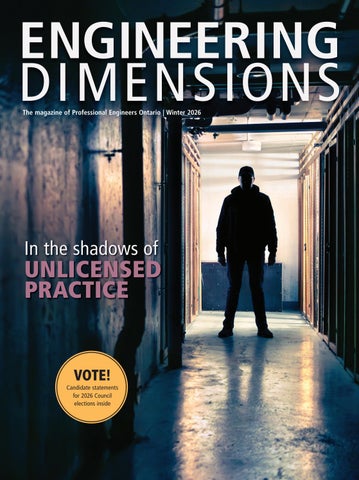
The magazine of Professional Engineers Ontario | Winter 2026
In the shadows of
UNLICENSED PRACTICE
VOTE!
Candidate statements for 2026 Council elections inside
YOUR PROFESSION MATTERS. SO DOES YOUR VOTE. Find the 2026 Council Elections candidate statements in this issue’s insert. Go to peovote.ca for all election-related resources, including key dates and the 2026 Council Elections Guide. Voting closes February 23. Count yours in.
CONTENTS
Winter 2026 / Volume 47, No.1
Features 22 The Imposter Crackdown PEO’s enforcement team is working to detect, investigate and shut down unlicensed engineering practice. By Sharon Aschaiek
26 The Next Chapter PEO is entering its next chapter with a new strategic plan to guide the next five years. By Sharon Aschaiek
« COVER STORY
Departments 5 EDITOR’S NOTE 7 CEO/REGISTRAR’S REPORT
30
8 NEWS Thousands Weigh in as PEO Reviews CPD Program; Early Exam Access Enhances Licensing Process; PEO Introduces 10-Day Pathway for Incoming Engineers; PEO Named One of Greater Toronto’s Top Employers
17 GAZETTE 30 PROFILE Inside a Summer Camp Powered by Women Engineers 32 IN COUNCIL Council Approves Reducing TimeBased Experience Requirement
14 BULLETIN BOARD 16 PROFESSIONAL PRACTICE Land Surveying: What Engineers Need to Know
www.peo.on.ca
Engineering Dimensions
3
MASTHEAD
Managing editor Nicole Axworthy Senior graphic designer Cindy Reichle Senior writer Leslie Sinclair Contributors Sharon Aschaiek Al Jeraj Engineering Dimensions (ISSN 0227-5147) is published quarterly by P rofessional Engineers Ontario and d istributed to all PEO licence holders. Engineering Dimensions publishes articles on regulatory business and professional topics of interest to the professional engineer. The magazine’s content does not necessarily reflect the opinion or policy of PEO Council, nor does PEO assume any responsibility for unsolicited manuscripts and art. All material is copyright. Permission to reprint editorial copy or graphics should be requested from the editor. Approximately $5 from each membership fee is allocated to Engineering Dimensions and is non-deductible. Canada Publications Mail Product Sales Agreement No. 40063309. Printed in Canada by Wellington Printworks Inc. ADVERTISING SALES Finally Content Vice president, media sales Laura Maurice laura.maurice@finallycontent.com 647-394-5567 CONNECT WITH US Online: engineeringdimensions.ca Email: editor@peo.on.ca TO UPDATE YOUR SUBSCRIPTION All licence holders and engineering interns registered with Professional Engineers Ontario receive Engineering Dimensions in print or digital form. Subscription preferences can be updated in the PEO portal at secure.peo.on.ca. Other subscription requests can be made to editor@peo.on.ca.
EXECUTIVE STAFF CEO/registrar Jennifer Quaglietta, P.Eng., MBA, ICD.D
Eastern Region councillors Chantal Chiddle, P.Eng., FEC Susan Jingmiao Shi, MEng, P.Eng.
Vice president, regulatory operations and deputy registrar Vacant
East Central Region councillors Shahandeh Hannah Ehtemam, P.Eng. Nanda Layos Lwin, P.Eng., FEC
Vice president, policy and governance and chief legal officer Dan Abrahams, LLB
Northern Region councillors Ahmed Elshaer, PhD, P.Eng. Luc Roberge, P.Eng., FEC
Vice president, corporate operations and digital transformation Arun Dixit, P.Eng.
PEO COUNCIL Officers President Fred Saghezchi, MASc, P.Eng., FEC president@peo.on.ca Past president and Council chair Gregory P. Wowchuk, P.Eng., FEC President-elect Leila Notash, PhD, P.Eng., FEC Vice president (elected) Sardar Asif Khan, PhD, MBA, P.Eng., FEC, PMP Vice president (appointed) Randy Walker, P.Eng., FEC Executive Members Shahandeh Hannah Ehtemam, P.Eng. Lorne Cutler, MBA, P.Eng. Councillors Councillors-at-large Sean Decloux, MEng, MBA, P.Eng., PMP Paula R. Klink, PhD, P.Eng., FEC Randy Walker, P.Eng., FEC
Western Region councillors Vicki Hilborn, MASc, P.Eng. Susan MacFarlane, MSc, PhD, P.Eng. West Central Region councillors Pappur Shankar, P.Eng., FEC Ravinder Panesar, P.Eng., FEC Lieutenant governor-in-council appointees Cosimo Casale, P.Eng. Lorne Cutler, MBA, P.Eng. Andrew Dryland, C.E.T. Lorraine Fraser, PhD, MBA, MEng, P.Eng. Paul Mandel, MBA, CPA, CA Shelly Markel, JD, MBA, ICD.D Gus Mastroianni, BEd, C.Tech Andrew Naassan, P.Eng. Rachel Prudhomme, BEng, MSc, P.Eng., BPHE Scott Schelske, P.Eng., FEC Uditha Senaratne, P.Eng., FEC Sherlock Sung, BASc Engineers Canada Directors Arjan Arenja, MBA, P.Eng., ICD.D Christopher Chahine, P.Eng., PMP Nick Colucci, MBA, P.Eng., FEC Tim Kirkby, P.Eng., FEC Marisa Sterling, P.Eng., FEC
www.peo.on.ca The office of Professional Engineers Ontario in the City of Toronto is situated on the traditional territory of many nations, including the Mississaugas of the Credit, the Anishnabeg, the Chippewa, the Haudenosaunee and the Wendat peoples.
4
Engineering Dimensions
Winter 2026
EDITOR’S NOTE
engineeringdimensions.ca
Protecting the Public From Pretenders
Unlicensed engineering practice doesn’t always begin with dramatic wrongdoing. More often, it creeps in quietly: a fabricated credential on a LinkedIn profile, a stolen seal affixed to drawings or a title used by someone who hasn’t earned it. But the consequences are far from faint. Fake engineers compromise safety, mislead clients and erode public confidence in the profession. In “The Imposter Crackdown” (p. 22), we take readers inside this shadowed world to show how these cases surface. Sometimes it starts with a homeowner who questions the expertise of someone they hired. Other times, a building official notices a seal that doesn’t hold up. When those concerns reach us, our enforcement team steps in to verify documents, gather evidence and determine whether unlicensed practice has occurred. And when it does, we act. Through compliance orders and, when necessary, legal action, we work to hold individuals and companies accountable. While this topic speaks to immediate risks, our second feature looks at how we’re planning for the future. In “The Next Chapter” (p. 26), we explore how the goals of PEO’s 2026–2030 Strategic Plan will directly impact licence holders. Think modernized processes, improvements to the licensing experience, strengthened regulatory tools and clearer, more efficient interactions with PEO. These changes aim to improve efficiency, enhance transparency and better support practitioners.
www.peo.on.ca
Also in this issue, you’ll find an update on PEO’s review of its mandatory continuing professional development program (p. 8). Through extensive engagement—including focus groups and a survey of licence holders and engineering interns—we’ve gained valuable insight into what’s working well and where refinements may be needed. These findings will help ensure the program continues to support professional competence and public protection. Finally, a reminder that Council elections are underway. Candidate statements can be found in this issue’s insert. I encourage you to take a moment to learn about the individuals stepping forward to serve. Your participation helps shape the future of the profession and PEO, so be sure to cast your vote before the February 23 deadline. e
Nicole Axworthy MANAGING EDITOR
ON THE COVER
The magazine of Professional Engineers Ontario | Winter 2026
In the shadows of
UNLICENSED PRACTICE
VOTE!
Candidate statements for 2026 Council elections inside
llegal engineering practice poses serious risks to public safety and undermines trust in the profession. PEO’s enforcement team works to ensure those practising without a licence are investigated and held accountable.
LET US KNOW To protect the public, PEO investigates all complaints about unlicensed individuals or companies, and unprofessional, inadequate or incompetent engineers. If you have concerns about the work of an engineer, fill out a Complaint Form found on PEO’s website and email it to complaints@peo.on.ca. If you suspect a person or company is practising engineering without a licence, contact PEO’s enforcement hotline at 800-339-3716, ext. 1444, or by email at enforcement@peo.on.ca.
Engineering Dimensions
5
Discover preferred rates.
PEO members could save on home and car insurance with TD Insurance.
T learn more or to get a quote visit To tdinsurance.com/<partner page> tdinsurance.com/ peo
FPO
The TD Insurance Meloche Monnex program is underwritten by SECURITY NATIONAL INSURANCE COMPANY. It is distributed by Meloche Monnex Insurance and Financial Services, Inc. in Quebec, by Meloche Monnex Financial Services Inc. inNATIONAL> Ontario and by TD Insurance Direct Agency Inc. in the rest of Canada. Our address: 50 Place <SECURITY <PRIMMUM> Crémazie, 12th Floor, Montréal, Québec H2P 1B6. Due to provincial legislation, this Car and Recreational Insurance program is not offered in British Columbia, Manitoba ® or Saskatchewan. All trademarks are property of their respective owners. The TD logo and other TD trademarks are the property of The Toronto-Dominion Bank or its subsidiaries. 2022-23307-7027_GI National
CEO/REGISTRAR’S REPORT
engineeringdimensions.ca
Strengthening the Systems That Support You
Last year, many of you shared thoughtful insights about where you see the profession heading and what you need from PEO to navigate that future with confidence. Those conversations informed the development of our 2026–2030 Strategic Plan, launching this month. I want to take a moment to reflect on what this new chapter means for you as licence holders. One theme that emerged from the strategic planning process was the importance of staying closely connected with the people and communities we serve. As we put this plan into action, ongoing engagement will continue to be central to our work. Your experiences ensure our regulatory decisions remain grounded, relevant and clear. You are the ones applying engineering judgment every day, and your perspective is essential as we strengthen the systems that support responsible practice. Our new strategic plan is also a commitment to enhancing the resources that help you uphold the high standards the public expects. We will continue modernizing our regulatory processes so they are more consistent, accessible and easy to navigate. This includes continuing efforts to improve licensing pathways, clarify requirements, streamline interactions with PEO and ensure our guidance materials reflect the realities of today’s engineering environment. Our goal is straightforward: to make it easier for you to understand what is required, to meet those requirements confidently and to focus on delivering safe and quality work. Another important component of this plan is our continued emphasis on using evidence and data to guide decision-making. This approach helps ensure our policies reflect best practices in modern regulation and evolve in step with technology, industry needs and professional practice. Whether we are reviewing standards, improving assessment tools or refining accountability measures, we are doing so with intention and to strengthen public trust.
www.peo.on.ca
OUR VISION OF THE FUTURE As we launch this plan, we are also introducing a refreshed organizational vision: “Leading regulation. Inspiring excellence. Thriving communities.” While developed through a separate process, this vision reflects the same forward-looking mindset and reinforces our commitment to leadership in professional regulation. It speaks to what we aim to be: a regulator that adapts thoughtfully, acts with integrity and supports a thriving engineering profession that contributes to strong, safe and resilient communities. Looking ahead, I am encouraged by the opportunities before us. This plan is not only a roadmap; it is a shared commitment to continuous improvement. It will guide how we engage with you, how we refine our regulatory tools and how we uphold our mandate to protect the public interest. The work ahead is meaningful. It is work we will undertake together. INTEGRATING INCLUSION Recently, I had the honour of testifying before the House of Commons Standing Committee on the Status of Women, an experience that coincided with the National Day of Remembrance and Action on Violence Against Women. This day commemorates the anniversary of the 1989 Montreal massacre, when 14 women, most of them engineering students, were killed at Polytechnique Montréal simply for choosing a path in our profession. In my statement before the committee, I emphasized the profession’s longstanding gender imbalance and the responsibility we all share to foster an environment where women feel welcomed, supported and valued in engineering. As we advance our new strategic plan, this commitment remains central. We must work toward a profession those young women would have been proud to join: one where every engineer can contribute safely, confidently and fully. Thank you for your continued engagement, your professionalism and your trust. I look forward to building this next chapter with you. e
Jennifer Quaglietta, P.Eng., MBA, ICD.D CEO/REGISTRAR
Engineering Dimensions
7
NEWS
Thousands Weigh in as PEO Reviews CPD Program Stakeholder feedback is informing an in-depth assessment of how mandatory CPD can better support professional accountability. By Leslie Sinclair
PE K
REACHING NEW HEIGHTS
A comprehensive review of PEO’s mandatory continuing professional development (CPD) program is underway to determine how the program can be strengthened. Stakeholder engagement is forming the foundation of the review to ensure inclusive, representative input. To date, the process has included 17 focus groups with over 100 stakeholders and a survey of engineering interns (EITs) and licence holders that garnered nearly 2000 responses. PEO Council directed the review last June to take a closer look at key aspects of the program, including who it applies to, potential exemptions and extensions and the enforcement and compliance framework. Council remains firmly committed to CPD as an ongoing requirement for licensure. Ensuring licence holders keep pace with evolving technical and professional standards is essential to protecting the public interest. Across professional regulators, CPD is widely recognized as being a critical component of a quality assurance program. Currently, the program is mandatory for all licence holders, with limited exceptions, and consists of three annual requirements: a practice evaluation, a self-paced professional practice module and, for practising licence holders, a CPD report declaring their completed CPD target hours (as determined by their practice evaluation).
8
Engineering Dimensions
STAKEHOLDER INPUT Now that licence holders have completed two cycles of the mandatory CPD program since its launch in 2023, PEO External Relations Director David Smith says this is the ideal time to re-engage with stakeholders: “It’s a great chance for us to collect feedback on the current program and solicit ideas that will help to ensure our CPD program is meaningful and unambiguous.’” As part of the consultation process, focus groups were conducted with a variety of stakeholders, including PEO’s Strategic Stakeholder Advisory and Employer Advisory groups, staff from provincial government ministries, the Ontario Society of Professional Engineers, the Ontario Association of Certified Engineering Technicians and Technologists, the Association of Consulting Engineering Companies–Ontario, engineering students and deans, PEO staff licence holders, certification of authorization holders and PEO chapter representatives. A publicly available online survey seeking both qualitative and quantitative data was also emailed to all current EITs and licence holders. “The comments we heard in the focus groups were quite thoughtful,” says Sarah Robicheau, PEO’s manager of policy, who sat in on most focus groups. “A lot of people could see the arguments for different approaches.” PEO asked participants about enforcement, who should have to do CPD and whether everyone ought to complete the same number of CPD hours or if hours should be assigned based on the risk associated with various types of roles. PEO also sought feedback on the efficacy of its professional practice modules, including whether PEO should continue to develop them or if, like some other regulators, a component of CPD hours should be dedicated to ethics and professionalism while allowing for self-directed learning on the topic rather than an assigned course. “We looked at the primary approaches that other regulators tend to take and tried to engage people in a discussion of what they saw as the advantages or disadvantages of each,” Robicheau says, explaining that the review aimed to go beyond simply learning what people like or find convenient. NEXT STEPS The stakeholder feedback is now being analyzed with the goal of developing a policy proposal for Council’s consideration in April. The data will be considered alongside additional research PEO has conducted into how other engineering and professional regulators approach CPD, a review of relevant academic research and literature and internal feedback from PEO’s CPD implementation team and P.Eng. holders. The next phase of stakeholder engagement will focus on seeking feedback on the draft policy framework. PEO will continue to communicate updates as the review advances. For more information about the stakeholder engagement process, visit www.peo.on.ca/about-peo/stakeholder-engagement.
Winter 2026
NEWS
engineeringdimensions.ca
Early Exam Access Enhances Licensing Process The change aims to shorten licensing timelines and provide greater flexibility for prospective applicants. By Leslie Sinclair
PEO has updated its licensing process to allow prospective applicants to complete the National Professional Practice Exam (NPPE) before submitting their application. The change offers greater flexibility to individuals planning to apply for a licence to practise professional engineering. It also allows PEO to process an application within 90 days, meaning applicants get licensed quicker. The NPPE is a 2.5-hour online exam covering ethics, professional practice, engineering law and professional liability. It is one of the requirements for licensure in Ontario. The update allows prospective applicants to take the exam any time after they graduate. Once their academic eligibility has been confirmed by PEO, they can book their exam through PEO’s application portal during an open exam registration period. This more accessible approach gives individuals the opportunity to prepare for the exam on their own timeline and retake it as many times as necessary to ensure success. “There is no longer a time limit,” says José Vera, P.Eng., PEO’s director of licensing, referring to the previous requirement to complete the exam within six months. “Prospective applicants now have unlimited time to write the exam before submitting their application.” SUPPORTING THE PATH TO LICENSURE Previously, the NPPE was the last step in the application process. Prior to July 1, 2025, applicants needed to meet all licensing requirements— including a degree from a recognized engineering institution, 48 months of work experience and proof of good character—before taking the exam. This means applicants couldn’t write the exam until at least several years after graduating from engineering school. “If someone applies after completing their work experience requirement, that means it has been [at least] 48 months since they were in school,” Vera explains, noting that the exam concepts are ones that would likely need to be revisited and reviewed after that length of time. “But now that you’re allowed to write it right after graduation as a prospective applicant, the [engineering ethics and law] material is still fresh.” STREAMLINING THE PROCESS The change to the timing of the NPPE enabled PEO to comply with July 1, 2025, amendments to the Fair Access to Regulated Professions and Compulsory Trades Act. The new application requirement has been updated in Regulation 941 under the Professional Engineers Act as of October 24, 2025. This shift follows other significant changes in recent years to make the licensing process more efficient, fair and transparent. In 2022, PEO introduced a fully online application system that allows prospective applicants to complete the necessary forms and upload supporting documentation though PEO’s application portal. In 2023, the Canadian experience requirement was removed from the licensing criteria, a pivotal change for international applicants. That same year, a competency-based assessment model was introduced
www.peo.on.ca
to examine applicants’ engineering competencies across several categories, including technical competence, project management and communication, to ensure they meet the standards of practical skill required for professional engineering practice (see “Assessing Experience: The Road to CBA,” Engineering Dimensions, Fall 2023, p. 46). This year, PEO is preparing for the launch of a new Engineering Intern (EIT) program. The optional, pre-licensure program aims to enhance support for engineering graduates on the path to obtaining their licence (see “Council Endorses New EIT 2.0 Program, Seeks Legislative Changes,” Engineering Dimensions, Summer 2025, p. 8). For more information about the NPPE, including how to confirm academic eligibility and the NPPE registration schedule, visit www.peo.on.ca/apply/ become-professional-engineer/national-professionalpractice-exam.
THE APPLICATION PROCESS To be considered for licensure, applicants must meet PEO’s requirements. Here’s how the process works: 1. Confirm your eligibility. Complete the “Am I ready to apply?” survey on PEO’s website. 2. Complete the requirements. These include academic and experience requirements, the NPPE, a competency-based assessment and a good character assessment. 3. Submit your application. Pay the application fee and submit your application. PEO will review your submission and let you know within 10 business days if it is complete. 4. PEO assesses your application. Within 90 days, PEO will evaluate your academic verification, experience assessment and good character assessment requirements. 5. You receive a decision. Once assessed, your application can lead to two possible outcomes. If your licence is granted, you pay a registration fee to become a licence holder. Some applicants may receive a notice of proposal to refuse to issue a licence from the registrar. In this case, you may request a hearing by the Registration Committee. For more information on each step, visit www.peo.on.ca/apply/become-professional-engineer.
Engineering Dimensions
9
NEWS
PEO Introduces 10-Day Pathway for Incoming Engineers The expedited process makes it easier for professional engineers across Canada to secure a licence to work in Ontario. By Leslie Sinclair
PEO has launched a new application process to support professional engineers coming to Ontario from other Canadian jurisdictions. The Canadian P.Eng. Mobility Application allows engineers registered in another province or territory to get licensed quicker by providing a full P.Eng. licence to qualified applicants within 10 business days. Last September, the provincial government announced new regulations intended to remove interprovincial barriers for professionals within Canada. The new regulations under the Ontario Labour Mobility Act, which came into effect on January 1, allow professionals who are licensed in another province or territory to apply to work in Ontario through a simplified process. The legislation states that eligible applicants are deemed certified within 10 business days for up to six months while a decision is made on full registration. PEO will surpass these requirements by issuing a decision on a full P.Eng. licence within 10 business days of receiving a complete application. PEO’s previous interprovincial transfer process ensured that licence applications were acknowledged within 10 days, with registration decisions made within 30 days. Like the new process, PEO’s previous interprovincial transfer process allowed engineers licensed in good standing by another Canadian engineering regulator to apply for a P.Eng. licence without repeating the standard application process. As PEO Director of Licensing José Vera, P.Eng., puts it, the former 30-day process was like waiting for a table at a busy restaurant. “They’ll say, ‘Hey, come for half an hour to the bar, have some tapas,’ and then [the patron is] there for half an hour before they go off to the nice patio where they get the full meal.” But with the new process, Vera explains, “That half-hour wait where you have a temporary meal is gone. In 10 minutes, we can get you straight to the patio—it’s expedited.”
Vera notes, PEO’s role is to ensure increased mobility is supported by strong, consistent licensing oversight. “We’re making it easier for engineers licensed in other Canadian jurisdictions to start practising in Ontario—without lowering the bar that protects the public,” Vera says. “This streamlined process keeps our standards strong and gives employers a clear way to ensure they’re hiring properly licensed professionals from other provinces.” To learn more about the Canadian P.Eng. Mobility Application process, visit www.peo.on.ca/apply/peng-transfers-canadianengineering-regulator.
WHAT IS “DEEMED CERTIFIED”?
Ontario has introduced a first-in-Canada system that makes it faster for qualified professionals from other provinces and territories to start working in Ontario. If someone is already licensed elsewhere in Canada, the legislation states that they may now be deemed certified in Ontario for six months, as long as they meet prescribed criteria. Certified workers from across Canada are now able to start a job in Ontario within 10 business days once their credentials are confirmed. These new rules apply to more than 50 regulatory bodies and over 300 types of certifications, including engineering.
SUPPORTING PROFESSIONAL MOBILITY The government’s enhanced professional mobility law aims to address labour shortages and facilitate projects both in Ontario and across the country. At the same time, it allows workers in regulated professions to pursue work with fewer delays. But, as
10
Engineering Dimensions
Winter 2026
NEWS
engineeringdimensions.ca
PEO Named One of Greater Toronto’s Top Employers The recognition highlights the regulator’s evolving people-first culture and its impact on public protection. By Nicole Axworthy
PEO has been named one of Greater Toronto’s Top Employers for 2026, recognized for its progressive people practices and strong workplace culture. The annual competition, hosted by Mediacorp Canada Inc. and featured in The Globe and Mail, celebrates organizations with exceptional human resources programs and forward-thinking workplace policies. PEO’s selection places it at the forefront of employers that are reshaping what it means to attract and retain talented staff in the GTA, one of Canada’s most diverse and competitive labour markets. For PEO’s nearly 150 employees, the honour affirms what they experience every day. In recent years, the organization has made deliberate changes to create a workplace where employees feel connected, empowered and supported. The result is an environment where colleagues greet one another warmly, collaborate openly and contribute ideas confidently. “The recognition reflects the culture we’ve been intentionally building: one that is grounded in trust, belonging and shared purpose,” says PEO CEO/ Registrar Jennifer Quaglietta, P.Eng., MBA, ICD.D. “Being named a top employer tells us we’re moving in the right direction.” PUTTING PEOPLE FIRST Part of Canada’s Top 100 Employers project, the Greater Toronto competition evaluates workplaces across eight key criteria, including workplace culture, benefits, performance management and training. It also considers factors such as mental health supports, safety and innovative approaches to inclusion. PEO’s modernization across these areas reflect both changing demographics and the evolving expectations of today’s workforce. As new generations enter the organization and bring fresh perspectives, diverse skillsets and higher expectations for flexibility and inclusion, PEO has embraced the opportunity to modernize. The result, leaders say, is a stronger and more agile organization, which also serves as a model for engineering employers seeking to foster modern, inclusive workplaces. “Our diversity is one of our greatest strengths,” Quaglietta notes. “It broadens our perspective and helps us make better decisions in fulfilling our public-protection mandate.”
EMPLOYEE PERSPECTIVES Employee development is a key part of this evolution. Professional growth is a consistent theme across departments, fuelled by paid continuing education and association memberships along with accessible learning opportunities through the PEO Academy, which includes a dynamic learning hub that enables employees to advance skills through a one-stop digital platform. A refreshed performance management program now incorporates SMART goals and individual development plans. For Rob Dmochewicz, events management and volunteer recognition lead, these opportunities have been transformative. “PEO has provided me with countless opportunities for growth and development,” he says. In 2023, he earned his CVA designation through the Council for Certification in Volunteer Administration. This milestone was supported through the organization’s tuition reimbursement program. “I’m very grateful that PEO paid for my certification, and I’m very proud of this achievement.” Flexibility and wellness supports are equally important. Employees benefit from a competitive vacation and wellness day package as well as the continuation of a hybrid work environment. Expanded mental health coverage, a modernized compensation structure, parental leave top-up at 90 per cent for 17 weeks, and a GRRSP with PEO matching up to 5 per cent round out the organization’s enhanced total rewards package. Imelda Suarez, a long-serving certificate of authorization and consulting engineer designation representative, says that increased flexibility and improved supports make a meaningful difference in terms of promoting both efficiency and work-life balance. “I love how I now have time to work out in the mornings when I don’t have to go to continued on p. 13
www.peo.on.ca
Engineering Dimensions
11
NEWS
HELP BUILD A MORE INCLUSIVE ENGINEERING PROFESSION
PEO is collecting voluntary demographic information from our licence holders and applicants to better understand our community and advance equity, diversity and inclusion. SHARE YOUR INFORMATION TODAY: Log in to the PEO portal at secure.peo.on.ca, go to the Profile tab and click on Demographic Data Collection. By sharing your demographic data, you help PEO: • Identify barriers and disparities that might exist • Track progress toward a more inclusive profession • Inform initiatives that better support licence holders and applicants All responses are voluntary, secure and reported in summary form only. Sharing will not affect licensure or regulatory decisions. Make a small effort today for a more equitable tomorrow.
12
Engineering Dimensions
Winter 2026
NEWS
engineeringdimensions.ca
the office,” she says of the hybrid work schedule. “And I like how they packaged a variety of traditional supports, such as sick days and personal days, into wellness days. It’s more inclusive and more reflective of people’s different life situations and personal needs.” PEO’s inclusive culture stands out to Melissa Dean, a policy analyst who co-chairs PEO’s employee-led Social Committee. She points to the organization’s efforts to engage employees through cultural learning events, mental health discussions and equity training. “I like how creative they get,” Dean says, referencing sessions such as one on Indigenous cultural learning with speaker Jesse Wente, which included an opportunity to sample some Indigenous food. REFLECTING BROADER WORKPLACE TRENDS PEO’s efforts align with national shifts toward flexibility, well-being and belonging as top workplace priorities. A recent Randstad study found that worklife balance has overtaken pay as the number 1 motivator for many Canadian workers. According to a Gallagher report, 85 per cent of employers say they’re increasingly focused on emotional, physical, financial or social well-being supports. And in Robert
Half’s 2025 Canada trends report, 65 per cent of professionals cited flexible work schedules as one of their most valued benefits. Internal results show this momentum clearly: With a 92 per cent response rate, 93.2 per cent of PEO employees reported being engaged or almost engaged. Eighty-five per cent felt the organization offers strong learning opportunities, 89 per cent expressed alignment with PEO’s mandate, and 90 per cent felt that PEO supports an inclusive environment. “These results didn’t happen by accident,” Quaglietta reflects. “They came from honest conversations, thoughtful change and a shared commitment to improve. I’m incredibly proud of how far we’ve come.” For licence holders and other stakeholders, the award underscores how investing in its employees strengthens PEO’s ability to serve the public and effectively govern the engineering profession. As the organization modernizes and expands its people-first programs, the award highlights the essential link between engaged employees and credible regulatory work. “A strong workplace culture isn’t just a ‘nice to have.’ It’s foundational to our ability to protect the public,” says Quaglietta. “When employees feel supported and encouraged to bring their full expertise to the table, the quality of our work improves.”
PEO CEO/REGISTRAR TESTIFIES BEFORE THE STANDING COMMITTEE ON THE STATUS OF WOMEN On November 26, 2025, PEO CEO/Registrar Jennifer Quaglietta, P.Eng., MBA, ICD.D, testified before the House of Commons Standing Committee on the Status of Women on the progress made and the work still needed to close the engineering profession’s gender gap. “A lack of supports and a relative lack of female role models are significant barriers to women getting and staying licensed,” said Quaglietta. “If our future licence holders are to reflect Ontario and Canadian society, we must ensure any systemic barriers to entry and retention are removed. The profession itself must make sure strong female role models are visible and celebrated in all aspects of the profession and its work.” Through its Anti-Racism and Equity Code, PEO is removing barriers for various historically marginalized communities in engineering. Since completing an audit of its licence application process, PEO has focused on finding ways to support women in getting licensed and staying in the profession.
www.peo.on.ca
Engineering Dimensions
13
BULLETIN BOARD
READ Offshore Operations Engineering: A Useful Guide for the Offshore Worker, by Marcus da Silva Neves, Gustavo Arruda Ramalho Lira and Guilherme Fortes O. F. Lima, 2025: An accessible guide for offshore workers operating in oil production facilities, this book explores the unique challenges of the offshore environment, offering essential knowledge on platform stability, vessel navigation and legal compliance. Sustainability Engineering: Challenges, Technologies, and Applications, edited by Eric C.D. Tan, 2025: This book is designed for engineers and scientists working to advance sustainable technologies. It explores key emerging topics in sustainability science and engineering, such as the circular economy, advanced recycling technologies, decarbonization, renewable energy and waste valorization. Engineering, Justice, and Animals: A Call for a New Engineering Ethic, by George D. Catalano, 2026: This book explores synthetic biology engineering, a new discipline combining principles from biology, chemistry, computer science and engineering to design and construct new biological parts, devices and systems. The text fills a gap in professional ethical training for 21st-century engineers who will be developing devices at the intersection of engineering and biology.
14
Engineering Dimensions
The following events may have an in-person and/or online component. See individual websites for details.
ATTEND JANUARY 14–15 Toronto | International Conference on Robotics and Automation in CSE https://www.iarfconference.com/conf/ index.php?id=3429217
FEBRUARY 2–6 Regina | International Canada Engineering & Innovation Summit https://www.eventbrite.ca/e/2026international-canada-engineeringinnovation-summit-iceistickets-1249437744929
FEBRUARY 3 Toronto | Critical Connect Conference https://www.ece.utoronto.ca/eventscalendar/critical-connect-conference/
FEBRUARY 9 Toronto | International Conference on Machine Operations & Engineering https://www.eventbrite.ca/e/ international-conference-on-machineoperations-engineering-2026-tickets1963644771371
FEBRUARY 11–12 British Columbia | International Conference on Innovation Management in Design Engineering https://www.wrfconference.com/event/ venue.php?id=100029120
MARCH 23–25 Edmonton | Electrical Safety, Technical, Maintenance & Projects Workshop https://cmte.ieee.org/estmp/
MARCH 24 Toronto | React Advanced Conference https://reactadvanced.com/canada/
LISTEN The Engineering Leadership Podcast Hosted by Patrick Gallagher and Jerry Li, this podcast uncovers stories of great leadership in software engineering and shares actionable insights from thought experts in leadership and management https://open.spotify.com/ show/1wIytRQ4Ub8McXSP1iDwVX Women in Engineering Podcast This podcast features interviews with successful women engineers who are looking to help the next generation succeed. Host Tiffani Teachey offers inspiration, knowledge and career advice. https://podcasts.apple.com/us/ podcast/women-in-engineeringsuccess-stories-from-stemprofessionals/id1709191260
WATCH Branch Education Branch Education dives deep into the science, engineering and technology of the modern world using 3D animation and detailed models. https://www.youtube.com/@Branch Education The Engineering Mindset Since 2015, the mission of The Engineering Mindset has been to help students and engineers learn about technical engineering topics through short tutorials that minimize jargon. https://www.youtube. com/@EngineeringMindset
Winter 2026
ARE YOU INVOLVED IN YOUR LOCAL PEO CHAPTER? Make note of the upcoming annual general meetings. Niagara Chapter AGM Tuesday, January 27 at 5:30 p.m. EST Stone Mill Ballroom (Johnny Rocco’s), 271 Merritt Street, St. Catharines, ON https://niagara.peo.on.ca
Brantford Chapter AGM Saturday February 21 at 2 p.m. EST Brantford Public Library, 173 Colborne Street, Brantford ON https://brantford.peo.on.ca
Lambton Chapter AGM Wednesday, January 28 at 6 p.m. EST Four Points by Sheraton, 1498 Venetian Boulevard, Point Edward, ON https://lambton.peo.on.ca
Kingston Chapter AGM Wednesday, February 25 at 7 p.m. EST Donald Gordon Centre, 421 Union Street, Kingston, ON https://kingston.peo.on.ca
London Chapter AGM Friday, February 6 at 12 p.m. EST 465 Sunningdale Road West, London, ON https://www.eventbrite.ca/e/peo-londonchapter-agm-tickets-1975855850036
Algonquin Chapter AGM Monday, March 23 at 6 p.m. EDT 133 Pembroke Street East, Pembroke, ON https://algonquin.peo.on.ca
Chatham-Kent Chapter AGM Friday, February 6 at 6 p.m. EST 2 King Street West, Chatham, ON https://chathamkent.peo.on.ca Brampton Chapter AGM and Certificate Presentation Ceremony Friday, February 6 at 7 p.m. EST Chandni Convention Centre, 5 Gateway Boulevard, Brampton, ON https://brampton.peo.on.ca
www.peo.on.ca
Simcoe-Muskoka Chapter AGM and Spring Licence Ceremony Saturday, April 11 at 11 a.m. EDT Barrie Country Club, 635 St. Vincent Street North, Barrie ON https://simcoe-muskoka.peo.on.ca North Bay Chapter AGM Thursday, April 16 at 5:30 p.m. EDT https://northbay.peo.on.ca
Oakville Chapter AGM Wednesday, March 25 https://oakville.peo.on.ca Windsor-Essex Chapter AGM Thursday, March 26 at 6 p.m. EDT https:/windsoressex.peo.on.ca
Engineering Dimensions
15
PROFESSIONAL PRACTICE
Land Surveying: What Engineers Need to Know Understanding the legal limits between engineering and cadastral land surveying is key to avoiding unauthorized practice. By Al Jeraj Property boundaries do more than mark where one parcel ends and another begins. They underpin planning decisions, infrastructure development and public confidence in the built environment. That’s why the work of cadastral land surveyors is tightly regulated and legally distinct from engineering. When engineers perform land surveying without the proper licence, they risk disciplinary action and unlicensed practice claims. The Association of Ontario Land Surveyors (AOLS), which regulates surveying in Ontario, has noted an increase in engineers performing tasks that fall within the exclusive scope of cadastral land surveying. This trend underscores the need for greater clarity around the responsibilities of licensed land surveyors and the limits engineers must observe when preparing site plans, grading plans and construction drawings or promoting their services to the public. WHAT IS CADASTRAL LAND SURVEYING? Cadastral land surveying involves establishing or re-establishing property boundaries. It is a practice reserved exclusively for licensed Ontario land surveyors under the Surveyors Act. This is similar to how only licensed engineers may legally practise professional engineering under the Professional Engineers Act. To offer services to the public, both engineers and surveyors must do so under a certificate of authorization from their respective regulatory bodies. Surveying is a complex practice, very often misunderstood by the public and other professions. Cadastral surveying involves the application of sophisticated measurement techniques and mathematical concepts, coupled with a requirement to carry out in-depth historical legal research and marry documentary evidence with field evidence. Cadastral surveying continues to improve the accuracy of land information over time, so old surveys that may exist cannot necessarily be relied upon. Surveyors and engineers often collaborate on development projects, from small buildings to major infrastructure. Each profession requires specialized knowledge, and it is essential that practitioners stay within their professional limits to protect the public. COMMON ISSUES Engineers should be aware of several common pitfalls that cross into the scope of cadastral land surveying. 1. Misleading Website Advertising Websites are a primary way through which the public finds engineering services. Often, clients seeking civil engineering services also need land surveying. However, unless an engineer or engineering company holds a certificate of authorization from the AOLS, they cannot advertise services
16
Engineering Dimensions
such as “legal,” “cadastral,” “boundary,” or “property” surveys. Doing so may lead to prosecution by the AOLS and even complaints to PEO for unprofessional conduct, as these services constitute the practice of professional surveying and cannot be offered or provided by engineers. 2. Misrepresentation to Clients Recently, an engineering firm hired a senior technician from a surveying company. Although experienced, the technician was not licensed by AOLS and lacked authorization to offer surveying services. The firm advertised surveying services but subcontracted the work to an appropriately licensed surveyor—without informing the client. When a boundary issue arose, the client filed a complaint with AOLS, believing the engineering firm had conducted the survey. Even though the actual survey was done by a licensed firm, the engineering firm misrepresented its capabilities. Transparency about subcontracting could have prevented the issue. On larger projects, it’s common for engineering firms to manage the project and subcontract surveying work. However, clients should be informed about all professionals involved. 3. Misrepresentation on Site or Grading Plans Engineering firms often use CAD files from surveyors as a base for adding engineering details like grades or gridlines. However, they must obtain permission from the surveyor, as survey plans are protected by copyright. Using them without consent is illegal, just as it would be for someone to use an engineering plan without the engineer’s approval. Engineers should not include boundary annotations (bearings and distances to boundaries, for example) on their plans. They may show the boundary as a solid line and include the original survey as a separate drawing. Including dimensions implies the engineer is certifying the boundary, which is not permitted under law. Engineers are held to high ethical and professional standards. While there are many engineering disciplines, there is only one licence, and engineers are expected to practise only within their area of expertise. Just as a mechanical engineer cannot practise civil engineering without proper qualifications, no engineer can engage in cadastral surveying without being licensed by the AOLS. Engineers and surveyors are mandated to protect the public interest, and setting clear boundaries between the two disciplines is essential to accomplish that goal. Questions can be directed to the AOLS registrar at registrar@aols.org. e Al Jeraj, OLS, is the executive director of the Association of Ontario Land Surveyors.
Winter 2026
GAZETTE
engineeringdimensions.ca
Summary of Decision and Reasons In the matter of a complaint regarding the conduct of GUEORGUI (GEORGE) IONDOV, P.ENG., a member of the Association of Professional Engineers of Ontario. July 14, 2025 The Discipline Committee considered allegations of professional misconduct referred to in respect of Gueorgui (George) Iondov, P.Eng., a member of the Association of Professional Engineers of Ontario. At all material times, Iondov was a professional engineer licensed pursuant to the Act. On December 14, 2023, his licence was cancelled due to non-payment of fees. The parties filed an Agreed Statement of Facts. At the time of the events leading to the matters in issue, Iondov was a principal and the acting President of Urban Steel Products Inc. (“USP”). The complainants, together the “Homeowners,” retained Lines Construction Management Inc. (“Lines”) as the general contractor for the project. Lines in turn retained USP in or about May 3–4, 2022, to provide railing systems for an elevated exterior front deck and an interior stairway (“Railing Systems”). After an occupancy inspection took place on October 6, 2022, a dispute arose among the Homeowners, Lines and USP as to whether the design of the Railing Systems used by USP complied with applicable provisions of the Ontario Building Code (“OBC”). Iondov signed a cover letter dated November 25, 2022, identifying himself as a P.Eng., in which he stated that he had assessed provided documentation detailing USP’s design for the Railing Systems and certified that such design complied with applicable OBC requirements. The cover letter was provided to the Homeowners, Lines and USP, with a copy of USP’s design drawing EXTSSGL1.5, which had been stamped with Iondov’s P.Eng. seal and signed by him dated November 30, 2022. Iondov did not prepare or check any calculations of the strengths, or of the required loads, related to the design elements shown therein, before applying his P.Eng. seal to the design drawing and signing both the design drawing and cover letter. In or around May 2023, the Homeowners filed a complaint with PEO.
www.peo.on.ca
PEO retained an independent expert to review the actions and conduct of Iondov. He prepared a report (the “Tacoma Report”) and an addendum to his report (the “Tacoma Addendum Report”). The Reports concluded, among other things, that the rail, post sleeve and anchorage were all structurally inadequate. Iondov pleaded guilty on the agreed-on facts. The Discipline Committee found that Iondov committed acts of professional misconduct contrary to section 72(2) (a), (b), (d) and (j) of Regulation 941 under the Professional Engineers Act, R.S.O. 1990, c. P. 28. A plea inquiry was conducted for Iondov, and the Panel was satisfied that the admissions made were voluntary, informed and unequivocal. A Joint Submission on Penalty was agreed to in this matter. The Discipline Committee imposed the penalty as jointly submitted: Iondov shall be reprimanded, and the fact of the reprimand shall be recorded on the Register for an unlimited period of time; the finding of the order of the Discipline Committee shall be published in summary form, with reference to names; Iondov is not currently a member of the Association but is entitled to seek reinstatement of his licence to practise as a professional engineer upon compliance with the requirements of Section 51.1 of Regulation 941. Therefore, if, as and when Iondov’s licence is reinstated, he shall be automatically subject to the following penalties: Iondov’s licence shall be suspended for a period of two (2) months; it shall be a term, condition or restriction on Iondov’s licence that he shall be prohibited from providing structural engineering services; if Iondov demonstrates his competence in structural engineering by successfully passing the Elementary Structural Design examination, then the term, condition or restriction set out above shall be lifted; and there shall be no order as to costs.
Engineering Dimensions
17
GAZETTE: VOLUNTARY UNDERTAKING
Complaints Committee: Voluntary Undertaking Under Subsection 24(2)(c) of the Professional Engineers Act In the matter of a complaint regarding the actions and conduct of Harjinder (Harry) Singh, P.Eng. (Singh), a member of the Association of Professional Engineers of Ontario, and MEM Engineering Inc. (MEM), a holder of a certificate of authorization (C of A).
BACKGROUND The complaint concerns the actions and conduct of Singh and MEM in providing professional engineering services related to the proposed structural design in support of the renovation by the owner (Owner) of a single-family dwelling (SFD) located in the Waterdown neighbourhood of Hamilton (City), Ontario. At all material times, MEM held a C of A naming Singh as the individual accepting professional responsibility for engineering services provided under the C of A. On or about July 9, 2017, the Owner contacted WA Drafting Services Inc. (WA) to discuss the proposed SFD renovations. On or about July 11, 2017, WA met with the Owner and again on July 12, 2017, with Singh, to further discuss the renovation plans. A July 12, 2017, written agreement between WA and MEM included the provision of Structural Engineering Services for the “Connection of 2nd floor new to old house, removal of existing stair and relocated in the old house, adding column and beams, Joist design for basement and main floor and support modifications, and designing of steel beamssizes and grade” at a quoted cost of $2,250 to be paid by WA. Over the next several days, WA exchanged emails with the Owner over the contract terms and on or about July 29, 2017, the Owner provided WA with a $1,500 deposit for services. WA’s services were to include “all the engineering documents to get you the building permit” at a total cost of $4,500.
On or about October 19, 2017, the Owner emailed WA noting that the drawings had no opening in the ceiling above where the two staircases meet. WA’s reply, copied to Singh, confirmed to the Owner that WA was not proposing to open the ceiling as there was enough head room. On or about October 23, 2017, the Owner emailed WA stating that there was under four feet of headroom, it would not pass code and was unacceptable. From this date, until in or about December 2017, WA and the Owner exchanged emails, including a demand from the Owner for WA to issue a refund. On or about June 25, 2018, the Owner applied for a building permit complete with the October 3, 2017, drawings sealed and signed by Singh, including a handwritten note on suspected code deficiencies in the drawings. On June 26, 2018, the City issued a Building Permit Application Review Letter that identified numerous deficiencies.
THE COMPLAINT 1.
The complaint raised issues concerning the actions and conduct of Singh and MEM, including negligence in that Singh and MEM appeared to knowingly provide design drawings, intended for use in obtaining a building permit from the City, that did not meet the minimum requirements of the Ontario Building Code (OBC), failing to apply the appropriate code or standard.
2.
The Complaints Committee (Committee) received a response to the complaint from Singh and MEM that included several explanations and clarifications relating to the MEM’s actions, knowledge and the intended scope of work for the SFD.
On or about September 27, 2017, the Owner received an initial set of SFD drawings referenced as “Issued for Permit,” sealed and signed by Singh. On or about September 28, 2017, the Owner paid a final invoice from WA for the balance owing to the Agreement. On or about October 2, 2017, the Owner informed WA that there was no drawing for “rejoisting the first floor.” On or about October 3, 2017, the Owner received a second set of drawings signed and sealed by Singh and again referenced as “Issued for Permit.” The Owner sent the drawings to a contractor, who identified issues with the proposed ceiling clearances.
18
Engineering Dimensions
Winter 2026
engineeringdimensions.ca
THE CONSIDERATION OF THE COMPLAINTS COMMITTEE
VOLUNTARY UNDERTAKING
3.
The Committee considered the complaint on July 15, 2020, November 26, 2020, March 18, 2021, and December 5, 2022.
4.
PEO retained the services of an independent expert (Expert) to provide an Independent Review Report (IRR). On or about June 18, 2020, the Expert provided their final signed and sealed IRR concluding that Singh’s work contained errors and omissions and that the drawings submitted under the professional seal of Singh failed to meet the standards expected of a reasonable and prudent engineer. The Committee accepted the Expert IRR at the July 15, 2020, file review meeting deferring any decision pending submission of further information.
Singh and MEM voluntarily agreed to undertake all the actions listed above and subsequently provided all requested documentation and completed all required actions as outlined above.
5.
On November 26, 2020, the Committee decided that Singh would be provided an opportunity to submit a Voluntary Undertaking (VU) that would address the Committee’s concerns, including: • Undertake to review and follow the guideline Use of the Professional Engineer’s Seal; • Undertake to practise only in his area of expertise; • Undertake to have his architectural work peer reviewed; • Undertake to complete courses in Part 9 and Part 11 of the Ontario Building Code; and • The voluntary undertaking and a summary of the matter would be published with names in the official publication of the association (the Gazette).
6.
The Committee decided that if the issues raised by the complaint were addressed through a voluntary undertaking, as well as the publication of a summary of this matter, the public interest issues raised by the complaint would be addressed. Singh prepared a VU and on March 18, 2021, Singh’s VU was considered and accepted by Committee.
www.peo.on.ca
On or about December 5, 2022, the voluntary undertaking described above was accepted by the Committee as a dispositive measure, and pursuant to its powers under section 24(2)(c) of the Professional Engineers Act, the Committee decided that this matter would not be referred to the Discipline Committee.
Engineering Dimensions
19
GAZETTE
Windsor resident sentenced to jail for violating order to cease representing themselves as a professional engineer The Ontario Superior Court of Justice in Toronto has sentenced BENABDALLAH CHOUCHAOUI, of Windsor, Ontario, to serve 14 days in jail for violating a 2011 injunction. The injunction prohibited Chouchaoui from using a professional engineer’s seal and offering engineering services to the public unless licensed by Professional Engineers Ontario (PEO), the province’s engineering regulator. Sentence for contempt of the injunction was imposed on October 15, 2025, and Chouchaoui was immediately taken into custody. The court also ordered him to reimburse to PEO over $21,000 in investigative and legal expenses. PEO had previously been awarded costs for the contempt hearing, amounting to $50,000. Per the Professional Engineers Act, in Ontario, only licensed individuals can practise professional engineering and only firms with PEO-issued certificates can provide professional engineering services to the public. Chouchaoui has never been licensed by PEO. The 2011 injunction, which Chouchaoui was found to have violated, ordered him to refrain from describing himself as an engineer; engaging in the practice of professional engineering in Ontario; offering to the public, and engaging in the business of providing to the public, services that are within the practice of professional engineering; and using an engineer’s seal. Starting in 2023, PEO began to receive new complaints, which it investigated. The regulator eventually discovered that Chouchaoui had once again misused the seal of a licensed professional engineer and that he continued to advertise his company, Windsor Industrial Development Laboratory Inc. (WIDL), as an engineering firm.
20
Engineering Dimensions
The contempt motion was heard in April 2025 by Justice Gina Papageorgiou. She subsequently found that between 2019 and 2024, Chouchaoui submitted four separate building permit applications to the City of Windsor that included engineering drawings bearing the seal of a licensed engineer. These drawings were neither prepared nor authorized by that engineer and bore falsified or manipulated engineering seals. In imposing a jail term, Justice Papageorgiou noted the importance of PEO’s licensing and regulatory regime in protecting the public. She also pointed to the grave risk to Ontarians posed by those who falsify engineering seals or practise engineering without being properly trained and licensed to do so. “PEO takes allegations of unlicensed engineering very seriously, and actively investigates offences under the Professional Engineers Act,” said PEO CEO/Registrar Jennifer Quaglietta, P.Eng., MBA, ICD.D, in response to the court’s decision. “We thank our municipal, provincial and other partners and members of the profession and the public in bringing these cases to our attention.” PEO reminds the public that the unauthorized use or forgery of a professional engineer’s seal on letters of committal, construction or design drawings is a quasi-criminal offence under the Professional Engineers Act. Such conduct may also result in criminal charges under the Criminal Code of Canada.
HOW TO VERIFY LICENSURE To check whether an individual is licensed or a firm holds a certificate of authorization (C of A), prospective clients and employers can search the directories of practitioners (licence and C of A holders) at https://peo.on.ca/directory. To report unlicensed individuals and unauthorized companies, contact PEO’s unlicensed practice enforcement hotline at 1-800-339-3716, ext. 1444, or email enforcement@peo.on.ca.
Winter 2026
Strengthen Your Practice. Fulfill Your 2026 Continuing Professional Development Requirements.
The 2026 PEAK cycle is underway. Completing your mandatory learning keeps you compliant and helps you stay current in a rapidly evolving profession. Licence holders must comply with the program unless they are automatically exempt, such as first-year licence holders and those in PEO’s fee remission program. NEW PROFESSIONAL PRACTICE MODULE This year’s module explores how diverse perspectives and lived experiences strengthen project outcomes and support better decision-making. The module also highlights PEO’s efforts to promote fairness and nurture a culture of belonging. KEY DEADLINES The annual program consists of three elements with accompanying deadlines. 1. The Practice Evaluation is due on January 31, 2026. Licence holders must declare their practice status and complete either the Practice Evaluation Questionnaire (for practising licence holders) or the Non-Practising Survey. This takes about 15 minutes to complete. 2. The Professional Practice Module is due on January 31, 2026. The one-hour, self-paced learning module explores inclusive engineering. 3. The CPD Report is due on December 31, 2026. Practising licence holders must record their professional development activities to meet their personalized CPD hours target, as determined by the Practice Evaluation Questionnaire. Reporting takes about one minute per activity. To complete the program, log in to your PEO portal account at secure.peo.on.ca and go to the PEAK section. Follow the prompts to be directed to the PEAK platform.
PE K
REACHING NEW HEIGHTS
For more tools and resources, visit peopeak.ca
22
Engineering Dimensions
Winter 2026
THE IMPOSTER CRACK DOWN Unlicensed individuals practising engineering across Ontario are putting lives and reputations at risk. PEO is on a mission to shut them down. BY SHARON ASCHAIEK
PRETENDING to be a licensed professional engineer in Ontario
can have serious consequences, as Benabdallah Chouchaoui recently learned the hard way. Last fall, after years of misleading municipal officials and citizens in his home community of Windsor by falsely posing as a P.Eng., an intentional choice that violated a legal injunction imposed on him in 2011, Chouchaoui was dealt a distinctly harsh punishment by the Ontario Superior Court of Justice: 14 days in jail. The sentence capped off a lengthy pursuit by PEO to hold Chouchaoui accountable for his repeated engagement in unlicensed engineering practice. In the 2011 case, Chouchaoui was found to have publicly promoted his company, Windsor Industrial Development Laboratory Inc., as offering professional engineering services, and misusing the seal of a licensed engineer in the conduct of his services. Chouchaoui has never been a licensed engineer in Ontario. Revelations of Chouchaoui’s continued unlawful misrepresentation of being a licensed engineer came to light in 2023, when fresh complaints were made about him to PEO. The regulator’s comprehensive investigation found that once again, he was misusing the seal of a licensed engineer. This time, he included it in engineering drawings for four building permits he had submitted to the City of Windsor
www.peo.on.ca
between 2019 and 2024. The licence holder who owned the seal did not authorize its use or contribute to the drawings. In handing Chouchaoui a two-week jail sentence— a rare legal consequence for civil contempt of court stemming from unlicensed engineering practice— Justice Gina Papageorgiou underscored the grave risk to Ontarians posed by those who purport to practise engineering without having a professional engineering licence or proper engineering training. “Her sentence speaks to the sanctity of the seal and protecting its use in the interest of public safety,” says John Mania, manager of PEO’s unlicensed practice enforcement team. “It also reflects the potential that he’ll reoffend… Unfortunately, this person would just not accept responsibility for his actions.” STOLEN SEALS, REAL RISK Holding Chouchaoui, and all other perpetrators of unlicensed practice, responsible for their actions is key to how PEO accomplishes its mandate to regulate
Engineering Dimensions
23
the engineering profession in Ontario in the public interest. The Professional Engineers Act (PEA) states that only individuals with full or temporary licences to practise professional engineering, and only firms with PEO-issued certificates of authorization, can provide professional engineering services to the public in the province. The PEA specifies that anyone convicted of falsely presenting themselves as a licence holder, either by using the term “engineer,” “P.Eng.” or a variation or abbreviation of these in their occupational designation, or by stealing or forging the seal of a licence holder, is liable to pay a fine to the Ontario government—up to $10,000 for a first offence and up to $25,000 for subsequent offences. The act also indicates that a fine of up to $50,000 could be issued to the individual’s business partner or the directors or officers of their corporation. Typically, the costs of seeking court injunctions to prevent future offences may require the individual to reimburse PEO for part of its legal expenses, as was the case with Chouchaoui, who was ordered by the court to pay PEO a total of $71,000.
Perpetrators commit their offences throughout Ontario, usually while offering structural design services to building developers or homeowners. “First and foremost, enforcing the law in these cases is about public safety… Individuals or companies who misrepresent themselves can cause a lot of harm,” Mania says. “The other part is, if someone is paying for a document or a drawing to be sealed by an engineer and not getting an actual engineer’s professional opinion on it, they’re getting defrauded. They’re paying for a service they didn’t actually receive. When this offence is discovered, their project can be held up by building officials. So, there’s a financial risk as well.” To support PEO in fulfilling this essential requirement of the PEA, Mania leads a team of three that reviews about 450 cases per year of actionable complaints of title use and unlicensed engineering practice. About two-thirds of them arise from PEO staff leads, and the rest are reported by the public. He says about 80 per cent of these cases involve someone using the title “engineer” when they are not actually licensed with PEO, while the rest involve practice violations. These include unlicensed persons or businesses producing final drawings, reports or other documents that may include a stolen or digitally fabricated seal of a licence holder. He adds that perpetrators commit their offences throughout Ontario, usually while offering structural design services to building developers or homeowners. HOLDING IMPOSTERS ACCOUNTABLE On the front line of responding to unlicensed practice complaints is Steven Haddock, PEO’s senior enforcement officer who has been assisting PEO with this problem since joining the regulator in 2002. Haddock responds to reports from the public about suspected cases of professional misrepresentation. His colleague, Enforcement and Outreach Officer Ashley Gismondi, monitors compliance by former holders of certificates of authorization and educates university engineering students about licensees’ professional obligations under the PEA. He says while most cases of misuse of the engineering title are perpetrated by individuals, many companies also commit the offence.
24
Engineering Dimensions
“A surprisingly large portion involve businesses that hold themselves out in a way that would suggest they’re authorized to provide professional engineering services. That includes businesses that use ‘engineering’ or ‘engineers’ in their name without being authorized,” Haddock says. “It’s an increasing problem, particularly when it’s easy enough to throw up a Facebook or LinkedIn business promotion page to describe yourselves as ‘engineers.’” Mania says PEO resolves most of these cases without having to go to court. The regulator will send a suspected offender a letter advising of their violations and requesting voluntary compliance. If the offence relates to a business name, PEO may also ask the corresponding provincial or federal government registry to change or cancel the unauthorized name. If this approach fails, PEO may then engage its legal unit to send a demand letter explaining the legal claim against the offender and the fine they must pay and threatens prosecution if the request is not met by a certain deadline. If PEO receives no response, investigator Grace Shin steps in to collect evidence about the offence. Shin identifies all relevant paper and digital documentation, including business contracts, construction permit applications, structural drawings, and the perpetrator’s company website and professional profiles. She also works to track down non-compliant individuals—usually the most challenging task of an investigation—and interviews those adversely affected, including building permit providers within municipalities, construction companies and individual homeowners. She also gathers information from engineers who may have had their identity or seal stolen. Shin underscores how such incidents can harm the professional reputation of practitioners. “Building officials and members of the public rely on seals and the engineers who own such seals,” Shin says. “If an engineer’s seal is compromised, it will be difficult to trust the work and seal of that engineer again.” In the 2 per cent of cases that involve the most persistent and egregious offences, PEO must take offenders to court. This was the case in 2024 with Amr Adel Mousta Robah, a senior project manager at YEJ Studio + Consulting Inc. in Mississauga. In 2018, Robah pled guilty in court to falsely referring to himself as an engineer but then repeated the offence by submitting municipal permit applications stamped with the seals of two professional engineers without their knowledge or consent. The regulator secured an injunction against him from the Ontario Superior Court of Justice, which ordered Robah to pay PEO more than $88,000 in costs. Meanwhile, a particularly notorious case of unlicensed practice involved Jay Lawrence Harding, who used a forged seal and the title of a licensed engineer to conduct at least 80 building inspections and non-destructive tests on cranes and lifting
Winter 2026
devices in Kitchener-Waterloo via his company, AJ Ontario Hoist Inspections. In 2023, PEO laid 352 charges against Harding, who is known to have moved to New Brunswick during the investigation. The prosecution moved forward and the summons to court was served to him at his New Brunswick address. In the interest of proactively protecting the public, PEO informed New Brunswick’s engineering regulator, Engineers and Geoscientists New Brunswick, of Harding’s move to their jurisdiction. “This individual was undercutting actual qualified engineers who had the expertise to do that work,” Mania says. “Relying on a seal for a project that has no professional opinion or no professional analysis behind it—that’s a real risk. Although it happens infrequently, some offenders can be prolific.” A UNITED FRONT Helping to facilitate PEO’s court case against perpetrators of unlicensed practice is paralegal Christine Hickey, who formerly worked as an investigator on Mania’s team. Hickey prepares all the necessary documentation to initiate a legal charge and support the efficacy of PEO’s prosecution. She notes that the regulator is shifting from using an external law firm to in-house counsel to handle illegal practice and title violations, in part so it can pursue these cases more assertively. “It’s about making sure we attend to these important matters in a timely way and with more control over the process,” Hickey says. “Engineering is a highly regarded profession, and it suffers when you have people out there falsely representing themselves as engineers. Building public trust in the profession is a critical component of the mandate of PEO, so I think that’s a really important reason to be proactive in pursuing charges against individuals who are holding themselves out as engineers.” In addition to relying mostly on in-house legal counsel, Mania says the team has taken another key step to operate more effectively: optimizing its schedule to review cases so it can gather evidence and, if necessary,
initiate a prosecution within their two-year statute of limitations. With streamlined operations, the team is resolving unlicensed practice cases in record time. By last September, the median case duration had dropped to 58 days, slashing 2023’s timeline by more than 50 per cent. As well, the team is more focused on preventing unlicensed practice through public education. It produced a digital brochure on identifying the red flags of unlicensed individuals or companies that includes a visual guide to detect a phony or stolen seal. The brochure is distributed to building officials across Ontario. They also now deliver in-person and virtual presentations on this topic to city staff involved in issuing building permits. For investigator Shin, observing the reckless and deceitful actions of unlicensed practitioners up close, and the damage they cause to diverse parties, continually renews her resolve to hold perpetrators accountable and safeguard the reputation of the engineering profession. “Unlicensed practice undermines the integrity of the engineering profession,” Shin says. “Engineers study for years and go through a rigorous licensing process to obtain their P.Eng. and their seal. If anyone without the licence can undertake the same work, the expertise required by the profession will be undervalued.”e
WHAT TO DO IF YOU SUSPECT UNLICENSED PRACTICE If you learn about someone misrepresenting themselves as an engineer, a good first step is to check PEO’s directory of registrants and companies at www.peo.on.ca/directory. You can also express your concerns, including if you are an engineer who suspects your title or seal has been misused, directly to PEO’s unlicensed practice enforcement team: enforcement@peo.on.ca What to include in your report: • The name of the individual or company of concern • A description of the suspected violation • Contact information for the individual or company • Documents, media links or other evidence of a violation PEO may need to conduct an interview with you to gather evidence, and during this time, you can choose to remain anonymous. However, on rare occasion, you may be needed to testify as a witness to support legal proceedings against an unlicensed practitioner.
www.peo.on.ca
Engineering Dimensions
25
E
ngineering regulation rarely makes headlines, but it quietly defines the standards that keep bridges strong, systems safe and communities thriving. This month, PEO is stepping confidently into the future with a new five-year strategic plan designed to enhance how it regulates and governs the profession. Developed through a methodical, evidence-based process and informed by wide-ranging input from engineers, partners and stakeholders, the plan reflects a shared commitment to ensuring regulation evolves alongside technology, society and professional practice. It empowers PEO to set new benchmarks for excellence across its regulatory, self-governance and operational functions while keeping its core mandate of protecting the public at the heart of everything it does. “We have an increasingly complex environment affecting the practice of engineering that includes sophisticated artificial intelligence, evolving
26
Engineering Dimensions
government legislation, emerging disciplines, the global mobility of practitioners and shifting public needs,” says CEO/Registrar Jennifer Quaglietta, P.Eng., MBA, ICD.D. “We have to continue to innovate how we operate so we can meet and exceed expectations around transparency, speed and equity.” A YEARS-LONG TRANSFORMATION Since joining PEO in 2023, Quaglietta has been steering the organization through a period of meaningful change, building on the strong foundation laid by the 2023–2025 Strategic Plan and accelerating progress toward a more modern, responsive and transparent regulator. Many of the priorities that professional engineers have seen take shape over the past three years now serve as the springboard for PEO’s next phase of growth. One of the most visible impacts for practitioners and applicants alike has been the transformation of the licensing process. Under Quaglietta’s leadership, PEO has made applying for an engineering licence clearer, fairer and faster, particularly for internationally trained engineers. PEO became Ontario’s first regulator to remove the Canadian experience requirement from its licensing criteria after the province introduced
Winter 2026
THE NEXT CHAPTER Guided by its new 2026–2030 Strategic Plan, PEO is evolving to reflect the realities and possibilities of modern regulation. By Sharon Aschaiek
amendments to the Fair Access to Regulated Professions and Compulsory Trades Act. This landmark change opened doors for more qualified professionals to contribute their expertise sooner. Today, every applicant receives a registration decision within 90 days, demonstrating PEO’s commitment to efficiency, transparency and compliance with the updated legislation. Behind the scenes, PEO has also made sweeping operational improvements that licence holders, applicants and volunteers are now experiencing firsthand. PEO introduced a competency-based assessment model to its licensing process that better recognizes the diverse professional paths engineers take, aligning with regulators across Canada. Governance has been strengthened through a councillor orientation program and a director accountability framework. The launch of PEO’s first organizational scorecard now gives Council and leadership a clear lens to guide decisions and track performance in real time. To make interactions smoother and more member-focused, PEO established a customer service team dedicated to supporting applicants and licence holders (see “Engineering a Culture of Care in Regulation,” Engineering Dimensions, Fall 2025, p. 19). It also shifted the entire licensing application process online, improved cybersecurity safeguards
www.peo.on.ca
and invested in a stronger internal culture through enhanced communications and annual employee engagement surveys. “I think we made great progress in achieving the goals of the previous strategic plan,” says Gregory P. Wowchuk, P.Eng., FEC, current chair and past president of PEO Council. “The previous plan was about public safety and licensing, which are the prime reasons PEO exists.” BREAKING DOWN BARRIERS At its heart, PEO’s new strategic plan is about the people it serves, both the public and the engineers who make that service possible. For Quaglietta, that human focus is one of the most rewarding parts of PEO’s evolution. She’s especially proud of how intentionally the organization has worked to welcome practitioners who have traditionally been underrepresented in the profession.
Engineering Dimensions
27
Over the past year, PEO has licensed a record number of women, an achievement that moves the profession closer to genuine gender parity and reflects the organization’s belief that diversity strengthens the quality and integrity of engineering in Ontario. To further advance inclusion, PEO is now collecting voluntary demographic data from licence holders and applicants, guided by the priorities of its 2022 Anti-Racism and Equity Code. These insights are helping the regulator identify and address systemic barriers, so every qualified practitioner has a fair opportunity to thrive. “We are going to continue to promote a professional culture in which every current and aspiring engineer can see a place for themselves within the profession and feels they belong,” says Quaglietta. She notes this commitment to inclusion extends inside, strengthening PEO’s workplace culture and earning it a place on the Greater Toronto’s Top Employers 2026 list, a first for the organization (see p. 11). MAPPING THE PATH FORWARD To continue building on the momentum and ensure it is ready for the challenges ahead, PEO undertook a comprehensive process to develop its 2026–2030 Strategic Plan. The regulator engaged MDR Strategy Group Ltd., a leading professional services consultancy based in Nova Scotia, to conduct a literature review and complete two vital analyses: strengths, weaknesses, opportunities and threats (SWOT) and political, economic, social, technological, legal and environmental (PESTLE). MDR also held focus groups, workshops and meetings and conducted surveys that engaged a wide spectrum of voices: Council and leadership, licence holders, engineering associations, educators, the Ministry of the Attorney General, members of the public and other key stakeholders. “I am impressed by PEO’s strategic planning journey,” says David Collie, a governance expert who was not involved in the process. “It started with a broad environmental scan to be fully aware of changes in the professional regulatory world in order to get ahead of them and self-change. It included extensive engagement with key leadership, members and stakeholders. And finally, it kept a focus on the mission of public protection and a future focus.” Approved by PEO Council last June, the 2026–2030 Strategic Plan charts a clear course for how the organization will continue to protect the public interest while evolving to meet the realities of modern engineering practice. The plan is built around three overarching goals: 1. Model excellence in regulating the practice of professional engineering and governing the engineering profession in order that the public interest may be served and protected; 2. Enhance governance structures to champion effective leadership and decision-making to deliver on PEO’s statutory mandate; and 3. Nurture a high-performing organization through its people, processes and systems. Each goal reflects what PEO aspires to achieve as a regulator and how professional engineers will experience the organization in the years ahead through transparent processes, smarter systems and stronger alignment with the needs of today’s practitioners. Prioritizing Legislative Reform One of the most significant undertakings within Goal 1 is the review and proposed modernization of the Professional Engineers Act (PEA). Originally enacted in 1922 and last revised in 1984, the PEA has served
28
Engineering Dimensions
the profession well, but the engineering landscape has changed dramatically since then. Emerging disciplines such as biomedicine, nanotechnology and machine learning are challenging the conventional definition and scope of engineering. At the same time, longstanding issues such as the industrial exception, which allows unlicensed individuals to perform certain engineering work within their employer’s facilities, continue to raise questions about accountability and public safety. For these and other reasons, Quaglietta says, the time is ripe to update the PEA so it aligns with the current dynamics of engineering practice. “This will be an historic undertaking to modernize the act to ensure we can be relevant in how we regulate engineering,” Quaglietta says. Beyond legislative reform, Goal 1 also focuses on building confidence in PEO’s regulatory effectiveness. Planned initiatives include a rebranding effort, a public confidence survey and the creation of a student advisory group to engage the next generation of engineers. Another subgoal will refine professional standards and the mandatory continuing professional development program, ensuring every engineer has the tools and guidance to uphold excellence throughout their career. Strengthening Governance and Leadership Under Goal 2, PEO will enhance how it makes decisions and leads as a regulator. This includes updating the Engineering Intern program and Chapter Procedure Manual—key touchpoints for many who are entering or engaging with the profession—as well as a comprehensive review of Council’s election system to reinforce transparency and accountability. These measures, Quaglietta notes, are designed to ensure every decision made by PEO reflects its statutory mandate and the public interest at its core. Empowering People and Systems The third goal turns inward, recognizing that great regulation depends on great people and effective systems. Goal 3 focuses on fostering a collaborative, innovative and inclusive workplace culture, one where technology and design thinking are used to streamline processes and improve service. PEO will pursue several initiatives under this pillar, including enhancing its customer service model, advancing its stakeholder experience project, developing an AI roadmap and continuing its digital transformation project. “There is no doubt our recent progress in IT systems and personnel have improved factors such as licensing times,” Wowchuk says, adding that continued investment in innovation will help PEO
Winter 2026
stay ahead of growing cybersecurity threats that affect even the most sophisticated organizations. Collie adds that the new strategic plan reflects best-in-class regulatory practice, following the strategic management model developed by Malcolm K. Sparrow, professor of the practice of public management at Harvard University. As provincial governments across Canada place greater expectations on professional regulators to introduce more standardization and transparency, he commends PEO for taking a proactive approach to reform its regulatory oversight of engineering. “Recognizing and reacting to these major shifts is a key element of PEO’s new strategic plan,” Collie says. “Self-regulation is privilege and not a right.” A PLAN TO GUIDE AND INSPIRE To keep progress measurable and transparent, the 2026–2030 Strategic Plan will be supported by annual action plans with defined targets. PEO’s leadership and Council will review the plan at its midpoint to assess progress and make any needed adjustments. “Our new strategic plan is our north star,” Quaglietta says. “At its core, the plan commits us to regulatory excellence. We will modernize systems, reduce administrative burden and use data and emerging technologies to anticipate risk. We will strengthen governance, sharpen accountability and report progress openly.” For professional engineers, the plan represents a renewed commitment to making every interaction with PEO clearer, faster and more meaningful. From streamlined licensing to smarter use of technology and stronger professional standards, the changes on the horizon are designed to make regulation work better for those who uphold it every day. “We approached this work with one clear goal: raise the bar for professional regulation in Ontario,” Quaglietta says. “Together, we will translate this strategy into meaningful action, uphold public trust and position PEO for another century of leadership.” e
26
MOVING FORWARD with PUR PO
STRATEGIC PLAN 20262030 MOVING FORWARD with PURPOS
E
SE
30 1
NEW VISION STATEMENT PUTS
PEO’s FUTURE IN FOCUS
Alongside the 2026–2030 Strategic Plan, PEO is unveiling a refreshed vision statement: “Leading regulation. Inspiring excellence. Thriving communities.” Short, bold and purposeful, this statement captures where PEO is headed in the coming decades. Its three elements highlight the breadth of PEO’s purpose and impact: • “Leading regulation” positions PEO as a proactive and credible regulator; • “Inspiring excellence” reflects the high standards expected of the engineering profession, and staff, and the regulator’s role in supporting them; and • “Thriving communities” extends the impact of regulation beyond the profession to the public, underscoring PEO’s commitment to ensuring engineering continues to benefit and protect society. The vision statement grew out of a priority set in PEO’s 2023–2025 Strategic Plan: to identify the organization’s long-term aspirations as a modern regulator. Its development, led by former PEO president Roydon Fraser, PhD, P.Eng., FEC, began in 2023 and included extensive discussions and consultations, as well as a working group consisting of broad stakeholder representation.
www.peo.on.ca
Engineering Dimensions
29
PROFILE
Inside a Summer Camp Powered by Women Engineers Camp Engies is a hands-on program that helps girls discover engineering early. By Sharon Aschaiek
DRIVING EARLY ENGAGEMENT Such support was in short supply in the latter half of the aughts, when Fonseca was an electrical engineering undergraduate student at Queen’s University. She recalls being one of very few women in her class and having just one woman engineer as a professor. The gender gap became more apparent to Fonseca during her first job as a project manager at Hydro One. When she volunteered to be a corporate ambassador, which involved representing the company at engineering conferences and competitions, she noticed few women participants. Fonseca discerned a distinct need to inspire more girls to consider engineering before they subscribed to limiting gender stereotypes. “I thought, why are we not showing and proving to girls at a younger age that they can do engineering, they can be part of this community, they can succeed?” says Fonseca, who is the global director of governance, risk and compliance for Four Season Hotels and Resorts. “By the time they get to Grade 9 or 10, they think, I’m not good at math, or science isn’t for me. They need to have the right mentors and role models.” Fonseca’s conviction is underscored by data reflecting a continuing gender imbalance in the profession. Of the approximately 90,000 professional engineers licensed by PEO, just 14.5 per cent are women. Meanwhile, the Council of Ontario Universities reported that in the 2023–2024 academic year, women made up 27 per cent of engineering students in the province.
Columbia, the Northwest Territories and the Yukon. The camp operated online during the height of the COVID-19 pandemic. And in 2023, Fonseca introduced the Cyber Edition, a one-day camp in Ontario focused on cyber engineering and related digital skills. Over the years, Engies has engaged about 2000 girls in discovering the world of engineering. A key part of campers’ experience is participating in handson problem-solving activities that involve engineering-related skills. They have made soap or ice cream from scratch to learn about chemical engineering processes. In a previous year, a challenge with a mechanical engineering angle involved taking apart a vacuum cleaner, examining its components and rebuilding it, while another connected to environmental engineering involved designing, building and testing a climate-resilient earth dam. The second day of each two-day session features a designand-build competition. This year’s challenge was to create a trebuchet, or catapult, using Meccano, the popular construction kit, along with materials such as elastics, paperclips and a golf ball. The girls worked in teams to devise and develop their model and demonstrate its efficacy in different contests to a panel of judges consisting of industry professionals. “The whole thing about this camp is letting the girls see that engineering is fun. Engineering is not necessarily sitting in front of your laptop all day, counting numbers. It’s more than you think,” says Engies’ Director of Logistics Karen Callery, P.Eng., a civil engineer who works as a grid operations field manager at Hydro One. Rounding out the camp’s board of directors is Director of Supply Chain and Volunteer Engagement Mandy Weigensberg, P.Eng., an electrical engineer who helps lead electricity services at Hatch; Director of Finance Rana Tehrani Yekta, P.Eng., a structural engineer who is the general manager at Toro Railings; and Director of Talent Management and Administration Bryn Sexton, P.Eng., a civil engineer who is a senior project manager of transit expansion at the City of Toronto. Campers are guided by these accomplished women engineers along with others who volunteer as counsellors, and from guest speakers who are leaders in domains such as telecommunications, construction, software, medicine, mineral processing and cosmetics. “The engagement of these women offers the campers valuable role models,” says Fonseca, who was bestowed with the Ontario Professional Engineers Awards 2025 Engineering Achievement of the Year. “I think representation really matters.”
INVESTING IN TOMORROW’S TALENT Fonseca piloted Camp Engies in June 2018 at Camp Tamarack in Bracebridge with 75 girls. Receiving an overwhelmingly positive reception from campers and their parents, Fonseca expanded the operation to include periodic offerings in British
CREATING A COMMUNITY OF SUPPORT Programs like Camp Engies complement PEO’s focus on inclusion by encouraging early interest and access for groups historically underrepresented in engineering. PEO has strived to make the profession more welcoming to women in various
Many different efforts have been made to engage more women in Ontario’s engineering profession, but only one involves the potent formula of an all-girls weekend with fun technical challenges, access to mentors and warm camaraderie. That formula is embodied by Camp Engies, a non-profit weekend summer camp for girls ages 10 to 14 to creatively explore their engineering talents in an inclusive environment. Operated voluntarily by women engineering professionals and students who run annual editions in Muskoka, ON, and at times in other parts of Canada, the camp provides an opportunity for girls to engage in hands-on activities, hear inspiring talks by accomplished women engineers and discover how engineering innovations advance society. “We want to show them that engineering is all around you; it is a part of everyday life,” says Cassondra Fonseca, P.Eng., founder of Camp Engies. “The idea is, ‘I’m an engineer, you can be like me and I’m here to support you.’”
30
Engineering Dimensions
Winter 2026
engineeringdimensions.ca
PROFILE
Cassondra Fonseca, P.Eng., founded Camp Engies to inspire more girls to consider engineering as a career.
Attendees of Camp Engies learn about chemical engineering while making bath bombs.
ways, including by cohosting a Women in Engineering Summit in 2024 and adopting Engineers Canada’s initiative to have 30 per cent of newly licensed engineers be women by 2030. More broadly, universities, the Ontario Society of Professional Engineers and the Ontario Network of Women in Engineering have also worked to recruit and retain more women via mentorship, networking and scholarships. Improving gender parity in engineering is also a priority for Engies’ long list of sponsors and partners and the dozens of companies that provide engineering services or employ engineers. These supporters provide financial contributions or equipment donations that enable the camp to charge a highly subsidized registration fee, which this past summer was $110 per camper, a sum Fonseca says is equivalent to about 5 per cent of the actual cost. As part of its annual community outreach, PEO’s Willowdale-Thornhill Chapter supports the camp’s mandate by covering the fee for eligible children of its members. The ongoing growth in the number of campers led Fonseca to introduce in 2020 Next Gen Engies, a leaders-in-training program for previous campers who are in grades 9 to 12. They gain hands-on experience in organizing activities while getting mentored by engineers and fulfilling their required high school volunteer hours. Importantly, Fonseca says, by maintaining this connection to engineering, they become more likely to study the discipline at university. “We want them to know, we’re here to support you, to be your references for your university programs or jobs,”
says Fonseca, noting multiple former campers have gone on to pursue engineering degrees. “It’s about creating a community of support.” One former Engies camper and leader-in-training whose experience shaped her post-secondary path is Karen Callery’s daughter, who is now studying chemical engineering at Lakehead University. Callery, who says she was also marginalized by the “boys club” nature of her engineering education at Queen’s in the 1990s, says that even though women are still outnumbered in engineering programs, her daughter is well equipped with the experience, contacts and confidence she gained from Engies to hold her own. “This camp is making that difference for girls, and that’s really special,” Callery says. “I just want the world to be better for the girls coming behind us.”e
www.peo.on.ca
Engineering Dimensions
31
IN COUNCIL
Council Approves Reducing Time-Based Experience Requirement Decisions of the 573rd meeting of Council on November 28, 2025 By Nicole Axworthy At its November meeting, Council approved in principle the reduction of the time-based engineering experience requirement for licensure from four years to a minimum of two years. Council also instructed staff to work with the Ministry of the Attorney General (MAG) to develop proposed amendments to Regulation 941, which will be required to give effect to the new Council direction. In May 2023, PEO shifted to competency-based assessments (CBA) as the primary means of evaluating an applicant’s experience and readiness for licensure. In September 2023, Council directed the Regulatory Policy and Legislation Committee (RPLC) to develop a plan for the review of the time-based experience requirement. Part I of a policy impact analysis prepared by staff was presented to RPLC in November 2024. At that time, RPLC accepted the recommendation that staff continue to monitor implementation of the CBA framework, as well as related activities undertaken by other provinces and territories, and report back to RPLC and Council in 2025. The following key points were highlighted in the report presented to Council: • Over three decades ago, PEO increased the time-based experience requirement from two to four years. The intent was to make it easier for Canadian licence holders to become licensed elsewhere, notably the United States. However, in the decades since, these anticipated labour mobility improvements did not materialize; • Engineering regulators across Canada, including PEO, now rely on CBA as a trusted, psychometrically valid method of assessing readiness for licensure based on demonstrated skills and abilities rather than simply months of experience; • PEO has a high degree of confidence in the CBA approach to ensure only validly qualified applicants are approved for licensure; • The Ontario fairness commissioner recently improved PEO’s risk rating from medium high to moderately low, partially in recognition of the demonstrated benefits of the CBA program. However, the revised risk rating is
32
Engineering Dimensions
•
•
•
conditional on PEO’s continued efforts to improve the efficiency of the licensing process, including by reviewing the 48-month time-based experience requirement; In April 2024, the Time-Based Experience Group under Engineers Canada’s National Admissions Officials Group recommended that regulators gradually move towards a recommended time-based experience requirement of four years instead of a required four years; Manitoba has eliminated its time-based experience requirement altogether and Quebec has reduced it from three to two years. Many other jurisdictions are also actively reviewing their requirements and considering similar options; and When asked, other Canadian engineering regulators stated that reducing or removing the time-based experience requirement would not affect their labour mobility practices or the transferability of a PEO licence to another Canadian jurisdiction.
In pursuing the necessary regulatory changes associated with this policy direction, PEO will inquire with MAG whether it is advisable to draft the regulation in a manner that does not specify a particular amount of time and instead allows the required time to be set by Council. Pending these amendments, the four-year minimum requirement remains in place. 2026 BUDGET Council approved PEO’s 2026 budgets, as presented at the meeting. They include the operating, capital and strategic plan budgets, encompassing all expenses necessary to fulfill PEO’s regulatory objectives. In September 2025, the draft budgets were presented to the Audit and Finance Committee (AFC) and then to Council for discussion purposes. During the AFC meeting, PEO’s finance team presented analysis performed in support of a fee increase of approximately 18 per cent to proportionately offset a proposed operating deficit of $5.7 million for 2026. Through discussion with the committee, the AFC recommended that PEO defer a fee increase for at least one year and instead plan to absorb the $5.7 million deficit in 2026 using cash reserves that had accumulated during the pandemic. Accordingly, the budget was presented to Council for discussion purposes excluding any fee increase considerations. The budgeted 2026 revenue is expected to be $39.1 million. This represents an increase of $1.3 million, or 3.5 per cent, over the 2025 budgeted revenue. Primary factors contributing to this increase are a $0.7 million increase in P.Eng. revenue; $0.3 million increase in affinity revenue; $0.2 million increase in funds collected for application, registration, exam and other fees; and a $0.2 million increase in 40 Sheppard Avenue revenue. This is partially offset by a $0.1 million
Winter 2026
engineeringdimensions.ca
decrease in investment income because of lower interest rates and investment returns, in addition to cash reserve utilization. The budgeted 2026 expenses for operations and strategic projects are expected to be $44.8 million, compared to a budget of $38.2 million in 2025. This represents an increase of $6.6 million, or 17.2 per cent, compared to 2025 budgeted expenses. In addition to compounded inflationary pressures, key reasons for the increase are: • An increase of $3.1 million, or 16.1 per cent, in employee salaries and benefits and retiree and staff future benefits over the 2025 budget. This increase includes an additional eight full-time staff to support continuing expansion of operations, as well as a 9 per cent increase in projected employee benefit costs and a 3.5 per cent global merit increase as recommended by PEO’s external consultants. The full-time headcount in 2026 is expected to be 157 versus a budgeted headcount of 149 in 2025; • An increase of $0.9 million, or 43 per cent, in strategic plan projects over the 2025 budget. This is due to the approval of a new strategic plan with considerable initiatives, including EIT 2.0, the PEAK program and digital transformation; • An increase of $0.8 million, or 24.3 per cent, in purchased services, due to increases in exam costs; • An increase of $0.5 million, or 35.5 per cent, in legal costs associated with increased volume of enforcement activities, investigations and other prosecution and tribunal activity requiring independent legal counsel; • An increase of $0.3 million, or 52.3 per cent, in consultants due to the addition of costs associated with technical experts for Council orientation and meetings, together with the increased use of technical experts in support of complaints and investigations; • An increase of $0.2 million, or 82.9 per cent, in postage and courier expenses due to communications required to licence holders, including an expected increase in Notice of Proposal communications and the ongoing expansion of PEAK; • An increase of $0.2 million, or 22 per cent, in Engineers Canada fees because of a fee increase from $8 per licence holder in 2025 to $10 per licence holder in 2026; and • An increase of $0.2 million, or 27.5 per cent, in Council expenses, primarily related to increases in travel costs for in-person meetings related to AGM and Council meetings. An amount of $0.6 million is budgeted for capital improvements to PEO headquarters that are part of common area maintenance (CAM) costs, which are recoverable from tenants and recommended by Avison & Young, PEO’s property manager. Planned improvements in 2026 include: • $0.3 million for card access and monitoring system upgrades; • $0.1 million for building sustainability and efficiency retrofits; • $0.1 million for the replacement of original heat pumps; and • $0.1 million for upgrades to the common area surveillance cameras.
www.peo.on.ca
PROFILE
An amount of $0.1 million has been budgeted for capital expenditure related to the ongoing replacement of furniture, fixtures and other equipment. PEO is also considering an office renovation designed to optimize space utilization and improve staff workflows. A detailed proposal will be brought to the AFC at a future meeting for review and approval. ANNUAL REVIEW OF ANTI-WORKPLACE VIOLENCE, HARASSMENT AND DISCRIMINATION POLICY At its November meeting, Council approved updates to the Anti-Workplace Violence, Harassment and Discrimination Policy, as presented at the meeting. In 2024, Council adopted an Anti-Workplace Violence, Harassment and Discrimination Policy to reflect compliance with, and commitment to, the Occupational Health and Safety Act (OHSA) and the Ontario Human Rights Code. An annual review of the policy is required under the OHSA and the policy. Feedback on the policy was received from PEO’s Joint Health and Safety Committee; the communications and human resources teams; the equity, diversity and inclusion manager; and a consultant on Indigenous inclusion. Staff also reviewed legislative updates to ensure the policy reflects current legal requirements. Based on the review, the policy changes include: • Updates to the section on refusing unsafe work to reflect the process under the OHSA; • Updates aimed at making the policy more accessible to those with disabilities, including highlighting that accommodation is available and that the policy and procedures should be interpreted to ensure accessibility; • Updates to clarify the reporting structure; • Reference to reconciliation with Indigenous Peoples were added to the statement of principles, along with other updates to align with reconciliation principles and commitments made in the Anti-Racism and Equity Code; and • Updates to the definitions of “workplace harassment” and “workplace sexual harassment” to reflect changes to the OHSA. Additionally, the policy will generally be referred to as the “Safe Workplace Policy.” While the official policy name will remain the same, feedback was that a colloquial name would allow for greater clarity and ease of use.
Engineering Dimensions
33
IN COUNCIL
DIRECTION OF GOVERNMENT LIAISON PROGRAM Council stood down the Government Liaison Committee with thanks and adopted the recommendation from Wellington Advocacy’s audit of the Government Liaison Program (GLP) to centralize and reform the program to increase accountability and reporting requirements for participants. At its September 2025 meeting, Council considered an audit report of the GLP prepared by Wellington. The purpose of the evaluation was to determine whether the program is a suitable and effective component of PEO’s broader government relations strategy and obligation to meet its mandate to serve and protect the public. The analysis demonstrated that while the current GLP model has delivered some benefits and is enthusiastically supported by some members of PEO, it also exposes PEO to significant risks that warrant Council’s immediate attention. The Wellington report concluded that the Ontario government’s shift toward shorter, more targeted consultations, coupled with a more cabinet-centric decision-making structure, has diminished the effectiveness of the GLP in its current form. Timely, clear, consistent messaging void of distractions and informed by nuanced political insights were deemed critical in the current context. A more centralized and strategic approach to GLP engagements will preserve volunteers’ role in government relations. However, it will also require greater accountability by, and oversight for, those who seek to contribute to the work of PEO by participating in discussions with MPPs. These controls will limit risk, preserve PEO’s credibility and ensure each engagement directly supports and advances PEO’s government relations priorities and regulatory mandate. With the motion approved, staff will work with Wellington to implement the new approach to the GLP. This will include: • Engaging GLP representatives in this process; • Revising the GLP manual to reflect the updated policy for engagement; • Training for GLP representatives emphasizing message discipline; • Implementing targeted briefings to those directly involved in approved activities;
34
Engineering Dimensions
•
•
Conducting an annual compliance review to evaluate adherence to these protocols and confirm that all engagements are consistent with approved messaging and organizational priorities; and Incorporating standardized post-meeting reports for GLP representatives to provide within 48 hours of an engagement. These reports will include key discussion points, attendee list and commitment/follow-up requests. These reports will be entered into a central engagement tracker to maintain a full line of sight into GLP engagements.
CEO/REGISTRAR GOALS FOR 2026 Council approved the CEO/registrar performance goals for 2026, as presented at the meeting. Under the Professional Engineers Act (PEA), Council has one critical employee: the CEO/registrar. Particularly at this most senior staff level, human capital is a vital component in the successful transformation of PEO as it strives to become a more modern regulator. Setting and monitoring goals and objectives for the CEO/registrar is an important component of Council’s role in moving the organization forward. The approved goals will be evaluated by way of a performance review. Meetings will take place as required with the Human Resources and Compensation Committee. A mid-year review of the goals will be conducted in June, and the year-end review will be conducted in November. FITNESS TO PRACTISE PROGRAM At its November meeting, Council endorsed establishing a Fitness to Practise program to address practitioner incapacity and public protection. Fitness to practise issues focus on a licence holder’s ability to perform their professional duties competently and safely in the face of physical or mental health conditions. Council directed staff to work with MAG to develop the necessary act and regulation changes to implement a Fitness to Practise program. In September 2024, Council directed the CEO/registrar to develop a formal fitness to practise process specifically designed to address issues of incapacity. Such a program would support PEO in fulfilling its principal object under the PEA of regulating the practice of professional engineering in the public interest. A proposal for the program was presented to RPLC at its February 2025 meeting for discussion. An updated proposal along with policy directions for submission to MAG were reviewed by RPLC at its November 2025 meeting before being presented to Council. e
Winter 2026
20 26 AGM
TOGETHER, WE MOVE the PROFESSION FORWARD
MARK YOUR CALENDAR for our 2026 ANNUAL GENERAL MEETING ON APRIL 25. The event will be offered both in person in Ottawa, ON, and online. Stay tuned for registration details.
engineeringdimensions.ca PROFESSIONAL PRACTICE
YOUR ENGINEERING LICENCE IS NOW AVAILABLE DIGITALLY VERIFIED AND SHAREABLE
The new digital certificate complements your existing printed version by giving you more flexibility over how you share your credentials. Now you can: 4 Share your verified licence through email, text or social platforms like LinkedIn 4 Add it to your digital resume, portfolio or personal website 4 Let anyone verify your licence with a single click or scan
YOUR DIGITAL CERTIFICATE IS ENCRYPTED, PROFESSIONALLY RECOGNIZED AND EASILY ACCESSIBLE. Here’s how to access it: 1. Log in to the PEO portal at secure.peo.on.ca 2. Click the Profile tab 3. Select Licence Profile 4. Navigate to the Digital Certificate section 5. Click the link to access your unique and secure digital certificate URL Present your digital certificate publicly, allowing anyone to validate your PEO licence with ease.
36
Engineering Dimensions
www.peo.on.ca
Winter 2026
Engineering Dimensions
15