MAGAZINE No. 15
TRACES
WINTER ENGLISH
Engadin
Engadin Winter — 26/27
Germany
Austria
SWITZERLAND France
GRISONS
UPPER ENGADIN
Italy
Piz Palü, 3905 m
Diavolezza, 2978 m
Piz Cambrena, 3604 m
Piz Lagalb, 2959 m
Piz Lavirun, 3058 m
Punta Saliente, 3048 m
Punta Casana, 3007 m
Map: Rohweder
Italy
Diavolezza Lago Bianco
Lagalb
Bernina Pass l Va
M
or
te
ra
Swiss National Park
Muottas Muragl
ZERNEZ CINUOS-CHEL
S-CHANF CHAPELLA
ZUOZ
LA PUNT CHAMUES-CH MADULAIN
S A M E DA N BEVER
PO
➞
Allegra! When we see tracks in the snow, we can’t help but feel curious. So we decided to follow some and they led us straight to wonderful winter tales. Hot on the trail, we joined a gamekeeper and his tracker dog. We set off on cross-country skis, enjoying the choice between classic track skiing and skating thanks to the Engadin’s versatile trail network. Vanished without a trace or a completely made-up case? Author Romana Ganzoni takes us up the Diavolezza mountain in her winter mystery. Meanwhile, a sgraffito artist told us all about the traces left behind on local buildings through the generations. And finally, we follow the trail of the Engadin nut cake as it travels abroad with the region’s confectioners – and finds its way home again. Come and follow your own trail with us!
Va
lR
os
eg
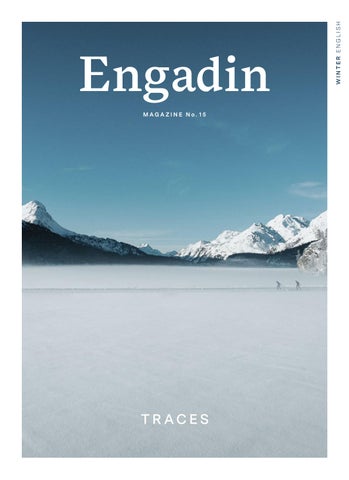
Cross-country skiing on Lake Sils
Cover: Filip Zuan
lF
or
no
lF
ed
oz
Piz Fora, 3363 m
Piz Led, 3088 m
Piz Tremoggla, 3441 m
Piz Corvatsch, 3451 m
Piz Murtèl, 3433 m
Corvatsch
Va
Va
ra
Piz Surlej, 3188 m
te
Piz Roseg, 3937 m
Piz Bernina, 4049 m
Piz Palü, 3905 m or
h
F ex
M
c ts
Va l
l Va
Piz Scerscen, 3971 m
Wishing you all the best from the Engadin
Maloja Pass
MALOJA Lej da Segl
PONTRESINA
S T. M O R I T Z BAD
SURLEJ Lej da Champfèr
Lej da San Murezzan
S T. M O R I T Z DORF
Lej da Silvaplauna
SILS
S I LVA PL A N A
CHAMPFÈR Julier Pass Corviglia
CELERINA
Nord
4 p. 20
p. 56
p. 38
p. 100
Contents
E N G A D I N Magazine W I N T E R
06 14 18 20 32
36 38 50 54 56 74
78 80 92 94
98 100 108
p. 80
Photos: Christian Reichenbach
111
1
INTRODUCTION Deep in the Snow On winter’s trail. N AT Ü R A Follow Your Nose Tracking training with gamekeeper Gianni Largiadèr and his dog Billy. Winter Wildlife Who said anything about hibernation? L I T T E R AT U R A Vanished Without a Trace The Yellow Cabin – a mountain mystery by Romana Ganzoni. A Solid Lead Exciting reads in the Engadin. C U LT U R A Lines in the Lime An ancient scratching technique, explained by sgraffito artist Lorenzo Buzzetti. Artistic Façades Sgraffito – from simple to sophisticated. ACT I V I T E D S Keeper of the Trail A big beard and a good sense of humour – introducing trail legend Simon Willy. Winter Wonders What makes for a perfect piste? Tracks in the Snow On the slopes or on the trails. CULINARICA Secret Recipe The Engadin nut cake as a symbol of moving away and returning home. Tempting Bakes A taste of the valley. Engadin Culinary Tradition Rediscovering a collection of traditional recipes. G U I DA ( F L I P M AG A Z I N E OV E R) Introducing the regions of the Engadin – complete with top tips on activities, local attractions, and cultural highlights to ensure a magical stay in the Upper Engadin.
Contents
Photo: Filip Zuan
Step by step through pristine powder: Piz Palü is a paradise for ski tourers.
Sweeping bends: the Maloja Pass winds through larch forests, connecting the Engadin and Val Bregaglia.
Photo: Roberto Moiola / Sysaworld
A rare spectacle: when black ice forms, skaters carve elegant lines into the shimmering surface of the Engadin lakes.
Photo: Filip Zuan
A magical moment: the full moon rising over the UNESCO World Heritage route of the Rhaetian Railway at the Bernina Pass.
Photo: Rhätische Bahn, Erik Süsskind
Deep in the Snow ON WINTER’S TRAIL
Pristine paradise Engadin – The frozen mountain lakes, snowy forests, idyllic villages, incredible slopes, and amazing trails between the peaks and glaciers of the Eastern Alps are just waiting to be explored and enjoyed as part of your winter walking and skiing adventures. Rest your body and mind as you breathe in the fresh mountain air surrounded by untouched nature. The Engadin Tourism team unlocks this opportunity for all by protecting the landscape and working hard to keep the environment pristine and unspoilt. That’s why you can pick up “Clean Engadin” bags from any tourist information office in the Engadin. Visitors and locals alike collect litter while they’re out and about to play their part in keeping the area clean. Thank you all for your efforts! engadin.ch/en/clean-engadin
Far above the valley
Winter camping Pontresina – Welcome to what has to be the highest winter camp site in Europe and one of the loveliest anywhere in Switzerland. You can pitch up at 1,860 metres above sea level among the larches and pines with an impressive view of the Bernina massif. Camping Morteratsch is open all year, but its direct access to the cross-country trails makes it an ideal spot for winter camping. Not to mention that the Diavolezza ski and snowshoe trails are only a few minutes away on the bus or Rhaetian Railway train.
Corvatsch – The “Lake Trail Furtschellas” circular snowshoe walk starts at the Furtschellas middle station. An initial steep climb is followed by a flat stretch leading to the restaurant Ustaria Rabgiusa, home to a large, sunny terrace. After you’ve enjoyed a well-earned break, there’s another short incline to conquer before heading back down to the Furtschellas middle station. Breathe in the tranquillity of the mountains and admire the magnificent view of the lake plateau and the jagged crags of the Corvatsch massif along the way. engadin.ch/lake-trail
camping-morteratsch.ch
E N G A D I N Magazine W I N T E R
15 Winter wonderland walk St. Moritz / Silvaplana – You can truly be at one with nature in the winter wonderland around Lej Nair and Lej Zuppo. Lasting just under an hour and a half, this loop starts and ends in St. Moritz Bad. Walk through the silent, snowy woodland on your way to the two mountain lakes and back again. engadin.ch/en-lej-zuppo
Illustrations: Atelier Cartographik
Riverside magic Samedan – Bever – Samedan – Set off on a varied winter walk, starting in Samedan and making your way through the historical village centre on a slight incline. Not long after you pass the school building, you can admire the view of the Upper Engadin’s magnificent mountain landscape. Head downhill through the larch forests towards Bever. From there, the trail follows the Beverin and Inn rivers through the restored floodplains, which look even more stunning during the winter. This winter walk ends back in the centre of Samedan. Tip: Prepare to marvel at a natural spectacle as you stroll beside the Inn on a chilly winter’s morning: trees covered in delicate ice crystals all along the riverbank. engadin.ch/en/ samedan-bever
Vast plateau St. Moritz – Maloja – There is a distinct magic to a long winter walk across the frozen lakes of the Engadin lake plateau. Start your adventure on foot in St. Moritz Bad and pass frozen Lej Marsch on your way down to Lake Champfèr, where the glorious panorama of the Engadin unfolds in all its splendour. Spot the peaks of the Bregaglia Range from the Surlej Bridge and head to Sils via Lake Silvaplana. Stop for a bite to eat in the pretty village before setting off on the final leg, taking in the Chastè peninsula and Lake Sils on the way to Maloja. engadin.ch/winter-lakeside-trail
Introduction
Ready to explore
Engineered in Switzerland. Built on a Modular Layering System.
radys.swiss
17
Endless ice There are so many wonderful views to enjoy in the Engadin, but just wait until the moment you catch sight of the glaciers:
1 Real: Diavolezza viewing platform You can marvel at two ice spectacles from the viewing terrace – the Pers and Morteratsch Glaciers. The stunning scene is set against a unique backdrop of rock, snow, and ice – also known as the “Ballroom of the Alps” – the Bernina massif. engadin.ch/diavolezza
2 Virtual: VR Glacier
Experience Visitor Centre at the Diavolezza valley station Everything you’ve learned or heard about the evolution of the glaciers is brought to life right in front of your eyes here. Pop on the virtual-reality headset to watch what happens to our glaciers on a virtual journey through time from 1875 to 2100. glacierexperience.com
Ice trail Madulain – Follow the unbelievably beautiful ice trail through the idyllic floodplains along the Inn River between Madulain and Zuoz. Enjoy the serene stillness of winter, the glistening river, and the views of the traditional Engadin villages along the 2.5-kilometre stretch. The cosy Engadin River Ranch offers hot drinks and delicious homemade cakes.
Illustrations: Atelier Cartographik
engadin.ch/ice-trail-madulain
Ice-cold beauty Pontresina – A captivating ice stupa is created near the Diavolezza valley station every winter. The idea comes from the Himalayan region, where these cone-shaped ice stores were created to save winter meltwater for the dry spring and summer months. The 15-metre ice stupa near the Diavolezza highlights the vital role of water in sustaining life and draws attention to the changing state of our glaciers and water reserves. engadin.ch/ice-stupa
Introduction
Natüra “Hope is a curtail dog in some affairs.” WILLIAM SHAKESPEARE (1564–1616), E N G L I S H P O E T, P L AY W R I G H T, A N D A C T O R
Photo: Christian Reichenbach
Tracking dog Billy on the trail of an injured wild animal. He is wearing a GPS tracker around his neck.
21
Follow Your Nose In the Upper Engadin, pristine, unspoilt nature – and the diverse wildlife inhabiting it – is right on the doorstep of locals and visitors alike. Gamekeeper Gianni Largiadèr is the man responsible for maintaining the natural balance of this environment around the S-chanf area. He works with his dog Billy to pick up on trails – even when they have long since vanished from view. Text K A R I N D E H M E R Photo C H R I S T I A N R E I C H E N B A C H
B
illy is a good boy when their visitor arrives. He gets up from his spot, approaches the door, and willingly has his head stroked. To be honest, the Styrian Coarse-Haired Hound doesn’t seem to be all that interested in the strange woman in his doorway. But the backpack she has placed on the floor? The one filled with crumbs from leftover snacks, that has seen better days after no end of train journeys surrounded by people from all walks of life, and hiking adventures through fields and meadows in all sorts of weather? Billy is sniffing it so hard that you’d think he’s trying to inhale all the scents hidden deep within its fabric. It only takes a single command from his owner, Gianni
Largiadèr, to make Billy trot back to his basket, completely unaware that today’s visit involves an activity that happens to be right up his street. As one of five gamekeepers in the Upper Engadin, Gianni is responsible for the S-chanf area and the north of Zuoz. And today, he and Billy are going to be giving us a glimpse into the daily life of a gamekeeper working in and around villages that live side-by-side with the untouched wilderness. Gianni might be the one officially employed by the Office for Hunting and Fisheries of the Canton of Grisons, but five-year-old Billy really deserves a spot on the payroll too, given Natüra
22
that the pair of them work as a team for the best part of Gianni’s day job. Gamekeepers are responsible for overseeing hunting in their assigned area and monitoring the habitats of wild animals and their populations. They are relied upon to track down injured animals when they have been caught but not killed by a hunter’s shot or when they have been hit by a car. Billy is a highly specialised tracking dog who follows trails using the scent of blood as well as fur, footprints, and stress-related odours.
Gianni Largiadèr, Billy is trained to track down injured animals. Is that work or play for him? Or maybe a mixture of the two? He does it with pleasure! It’s the job he was born to do. If he had the choice between going for a nice walk or tracking down wild animals, he’d choose the latter every time.
He does so several times a year. Even so, he has to retake the assessment for trained tracking dogs four years after his initial assessment. Billy’s is due next summer. Artificial scent trails are used for the assessment, so he can’t do all his training on real trails. Even though that would be his preference. Does Billy know if he’s following a genuine or an artificial trail? He knows straight away. And then he’ll be a bit disappointed. Really? You can tell? Oh, yes. He takes the search a little less seriously and concentrates a little less hard if he knows it’s not real.
So how does a dog tell the difference between a genuine trail and an artificial one? An animal with a fresh injury releases stress and alarm chemicals that the dog can smell. When an animal is already dead, these chemicals are no longer produced or they’ve already You set an artificial deer trail earlier today, which we’re going to be following faded, meaning that the scent trail is weaker or not there at all. later. And you once used trails like this to introduce Billy to his future job as a What happens if Billy suddenly picks tracking dog. Is today’s trail just for up on another animal’s scent on a trail? demonstration purposes or does Billy He distinguishes between the two scents often run through drills like this? Natüra
E N G A D I N Magazine W I N T E R
23
Gamekeeper Gianni Largiadèr takes a moment to connect with his dog before they get to work.
Natüra
24 A tracking shoe is used to leave a trail of blood from a dead wild animal for dog-training purposes.
The gamekeeper straps the tracking shoe – containing the severed foot of the dead animal – to his own shoe.
Natüra
E N G A D I N Magazine W I N T E R
25
and keeps following the original trail that leads to the injured animal. We’re about to start following the trail for an animal that has supposedly been injured – a dead deer that Gianni hid at the edge of a stream bed in the charming little village of Susauna earlier this morning. He used the deer’s own blood to create a trail. Billy certainly looks the part – and rightly so – with the GPS collar that Gianni is just kitting him out with and the rest of his work gear. Gianni is also gearing up with his hi-vis jacket and his backpack containing the gun he uses to put animals out of their misery in the worst-case scenario. He won’t be needing his weapon today, of course, because the hidden deer is already dead. But all these little details are important because they signal to Billy that it’s time to get to work. Gianni speaks softly to his dog. The dog listens attentively. The two of them take a moment together, almost as though they’re secret agents about to embark on a challenging mission. Gianni, would you compare your relationship with your dog to your relationship with one of your children? No, definitely not. That would be a very bad idea. If anything, it’s comparable to a relationship one might have with a close work colleague. In all seriousness, whenever I let Billy off his lead to track
A dog’s nose It’s hard to grasp just how much dogs can sense with their nose and the sheer amount of information they can filter out from the world around them and then sort and store. A dog has up to 300 million olfactory receptors, while a human has around 20 million.
On top of that, a dog’s olfactory system consists of two different parts – the main system, which they use to smell food, people, trails, and changes in the way the air smells, and the Jacobson’s organ, which is located in the roof of the mouth, behind the incisors. This allows dogs to detect chemical signals revealing whether another dog is male or female, whether or not they are ready to mate, whether they are stressed, and what their social ranking is. It’s no coincidence that a dog’s nose is always wet – the moisture provides a sticky film that traps scent particles. When scent molecules are caught in this liquid film, it’s easier for them to be detected by the olfactory receptors.
Natüra
Billy tracks down the dead deer at the edge of the stream.
27
Billy expects nothing but praise for a job well done. To him, his work is the greatest gift of all.
Natüra
The dog follows the trail; the man follows the dog.
29
an injured animal, I say goodbye to him. I can’t take it for granted that he’ll come back. When he’s frantically chasing, he blindly follows the animal and stops seeing and hearing everything else. He could end up crossing the road in front of a car or falling into a ravine. When it comes to it, he will pursue an animal and corner it, as they say in the hunting world. Yes, exactly. And we’re still only ever talking about injured animals here. Billy and I never hunt healthy animals. The goal is always to find the injured animal and end its suffering. The dog follows the trail; the man follows the dog: On Gianni’s command, Billy starts following the trail into the snowy woodland. The long lead connecting the dog to his handler slides across the floor. It will only tighten towards the end of the trail, when they are about to find what they are looking for. Until that point, Billy trots on slowly ahead, confidently leading the way with his nose in the snow. It soon becomes clear that this is focused detective work rather than a frantic chase. Gianni watches his dog with just as much precision. Gianni, what do you look out for when you’re following Billy? The dog communicates constantly with
its handler. A wag of the tail tells me that he has come across something note worthy – drops of blood or bone frag ments – or he will use his nose to point to something interesting. The dog I had before Billy would urinate a little every 50 metres, which told me he was marking the trail as his own. And then I would know we were on the right track. Billy often shakes when we’re on a trail as a way of refocusing and regrouping. Almost like he’s recalibrating his senses? That’s exactly it. Other dogs might suddenly start chewing on a branch or eating grass. That tells you that they’re struggling to concentrate. When that happens, it’s important not to put pressure on them. You need to let them take a break. It’s often the case that the dog sees the animal running away and the handler does not. His posture will change in that case and that’s his way of telling me that he wants to be let off his lead. Gianni begins training his tracking dogs through play from around 10 weeks of age. This runs alongside the puppy’s general socialisation. At that stage, he drags an animal lung through the garden a few times a week to create a straight trail, with a reward waiting for the puppy at the end – a piece of fur or a chunk of meat from the Natüra
30
dead animal. The dog doesn’t go out into the wider world for at least six months, which is when they start their introduction to proper tracking work. The first assessment to become a fully trained tracking dog takes place when they’re 15 months old. Billy has now guided Gianni out of the woodland, across the road and into a meadow covered in a thick layer of snow. He is heading towards the hidden animal on the bank of the stream. The dog is up to his shoulders in snow, which, quite literally, leaves him cold. Gianni, is it right that snow stores scent molecules, which makes it easier for dogs to pick up the scent? Yes, you hear that sometimes. But the experts don’t agree on that point. In my experience, it’s better for the dog when the sun warms the snow a little and brings the scent molecules back to the surface. It certainly hinders our work when fresh snow settles on top of a trail. In that case, I have to place all my trust in my dog because there are no visual signs like drops of blood to tell me that he’s on the right trail. Do you always trust your dog’s instincts? For the most part, I trust him whole heartedly. There are rare occasions
Natüra
when I’m not completely confident. One option I have then is to take him back around 100 or 200 metres and let him go again. This is really tricky, though, because the dog might think they’re being punished and there’s a risk they might lose interest. All of a sudden, the lead tightens. Billy’s strides get longer and more urgent. The dead deer down by the stream is close. Gianni plods along behind, quietly encouraging his dog, praising him for doing well, and working up quite a sweat. The gamekeeper stays up on the little slope while Billy finds the deer nestled among the tree roots at the water’s edge. You might expect the dog to bark with joy or run back impatiently to his owner, keen to show him what he has found. But he does nothing of the sort. Ever the professional, Billy stays calm, just sniffing and nudging the animal here and there, as if he’s too cool to openly express his delight. Only his tail gives him away, wagging wildly from side to side. Gianni, do you ever reward Billy when he’s done a good job? (Laughs) You mean do I give him edible treats? No, but he gets plenty of praise. Having the opportunity to do this job is enough of a reward for Billy.
E N G A D I N Magazine W I N T E R
31
Billy and Gianni Largiadèr work together as a strong team driven by mutual trust.
Natüra
Winter Wildlife WHO SAID ANYTHING ABOUT HIBERNATION?
Winter serenity Engadin – The National Park is closed over the winter. The wild animals retreat to secluded areas where there is food and shelter from the winter weather conditions. Minimising human disturbance boosts their chances of survival, as they don’t waste precious energy by fleeing unnecessarily. Wild animals are not fed over the winter in the canton of Grisons or the National Park. The National Park Centre in Zernez is open all year round. nationalpark.ch
Ibex inspiration Pontresina – Children and grown-ups can learn all about the characteristics of ibexes, their natural habitat, and their geographic distribution at seven stations on the entertaining Ibex Promenade. The winter walk, which is suitable for prams and pushchairs, covers one kilometre above the village, starting at the Church of Santa Maria. The view from the path down to Pontresina, into Val Roseg, and across to St. Moritz is absolutely breathtaking.
Animal kingdom Val Roseg – Venturing into the pristine, snow-covered Val Roseg is the perfect way for wildlife lovers to spend a memorable winter’s day in the Engadin. Set off from just behind the train station in Pontresina. You’ll soon be surrounded by tall larches – and ready to spot your first birds. There’s also a good chance you’ll come across chamois, deer, and plenty of squirrels. When you reach your destination – Hotel Roseg Gletscher – you can treat yourself to a coffee and try the famous dessert buffet. You then have the option of walking back or taking it easy in a horse-drawn carriage instead. engadin.ch/ winter-val-roseg
engadin.ch/ibex-promenade
Natüra
E N G A D I N Magazine W I N T E R
33
Bird feeding Pontresina – While many species of bird fly south for the winter, some do brave the cold and stay in the Engadin, with the Taiswald forest near Pontresina being one popular spot. In return for a small donation, you can feed nuts and seeds to the birds. If you’re feeling brave, you can even let them eat straight out of your hands. Join a guided tour to the bird feeding station to learn all about the species in the local area. engadin.ch/en/taiswald
Snow prints
Goat trekking Madulain – Stroll at a leisurely pace through the wonderfully snowy Engadin landscape with the gentle sound of bleating as your soundtrack. Your trekking experience with nine goats starts and ends in Madulain. And you can look forward to a tea-and-cake break along the way. Over the course of the approximately 90-minute tour, you will learn all sorts of fascinating facts about Engadin traditions, its people, and the valley. engadin.ch/goat-yoga-trekking
Sils – You can spot mountain hares, deer, and other wild animals in the woodland around Sils. Several wonderful winter walking trails take you into the car-free Fex Valley or across the frozen lakes to Silvaplana, Isola, and Maloja. An evening stroll across the plain at sunset is an experience you will never forget.
Illustrations: Atelier Cartographik
engadin.ch/winter-hiking-sils
Natüra
grow outside.
Designed and developed in Switzerland.
35
Wildlife encounters Engadin – Nature offers humans a place to relax and unwind. For wildlife, it is both home and refuge. To help humans and wildlife coexist harmoniously, wildlife protection areas are in place throughout the year, with additional designated wildlife quiet zones during winter. These protected areas must be respected at all times. Wildlife quiet zones are off limits from 20 December to 30 April. Outside of these areas, please make sure you still behave according to the basic guidelines for the benefit of the wild animals living there. Find out more here: engadin.ch/wildlife-protection
Look up Engadin – You can see golden eagles and bearded vultures circling in the sky above you. Both of these birds of prey use the rising air currents that form as the day goes on to gain height without having to flap their wings too much. Golden eagles tend to hunt for mammals of all sizes, while bearded vultures eat carcasses, thereby serving a crucial function in the ecosystem. Vultures even breed in the middle of the winter, laying their eggs in January.
Illustrations: Atelier Cartographik
Hoof prints Engadin – Horses can cope really well with cold temperatures. They can pull you through the enchanting winter wonderland on a carriage or you can ride them – at places like Gina’s Riding School in Pontresina. If you’re feeling brave, you can give skijoring a go and be pulled along on skis by a horse. Try it out at the Engadin River Ranch in Madulain. engadin.ch/horse-riding
You’re most likely to spot these birds at around midday. It’s well worth using binoculars to look up at exposed rock faces and mountain slopes.
Natüra
Photo: Christian Reichenbach
Litteratura “The mountains are silent teachers with loud echoes.” R E I N H O L D M E S S N E R ( 1 9 4 4 ) , E X T R E M E M O U N TA I N E E R
38
Litteratura
E N G A D I N Magazine W I N T E R
39
The Yellow Cabin Short crime story R O M A N A G A N Z O N I Photo C H R I S T I A N R E I C H E N B A C H
M
y leaflet told me that the two Diavolezza cable cars are classic cabins that shuttle back and forth. One goes up while the other goes down. Counterbalanced. Distinct in colour. One yellow, one blue. They approach and pass each other on the same track. Like sun and sky drifting over the rock faces, scree fields, moraines, meadows and pastures, stream channels, avalanche paths, and mountain lakes. I was standing on the concrete ramp of the valley station. The blue cabin headed back up into the air. My heart was pounding. Oh, how I wished I was on board! Carefree. Cheerful. Just a tourist excited about going up Diavolezza and admiring the Bernina massif. Taking photos for Instagram. Selfies in front of the mountain backdrop. I looked around. The kid next to me, his dad, and his siblings would all make it safely to the top. For one thing, it would be unlikely for such an anomaly in space and time to recur on the same date, at the same time, and in the same place. For another, I posed no danger to these people. I’d left the Thing back in Zurich. I closed my eyes. When I opened them again, I spotted the bird strike prevention stickers on the two window fronts. A grey snow groomer crossed the huge snowfield much too quickly. The giant billboard opposite me said: Feel the connection to Grisons in every choice you make. The AIgenerated woman posing right at the front clearly shared this sentiment. I joined her in gazing at an enhanced version of Lago Bianco. The woman didn’t look anything like Chloé. Well, her hair was the same length but that was it. I could never have a stronger connection to any other place. It was here in this canton that I had lost my sister. She dissolved into the land
Litteratura
40
scape and was lost without a trace along with 80 other people. Up there. On the short stretch that was hidden from view from both the bottom and the top. Eighty people stood on this ramp at the valley station and boarded the yellow cabin. The attendant was the only one to exit the cabin on the mountain. My mum said that only God knows what happened between the third and fourth mast. Only the devil, corrected my father. That fateful cabin moved down towards me and began to swing. Cheerfully. How cruel! What did I expect? A new coat of paint. Black? Like a hearse. Did I think I’d find messages of condolence written across the front of the cabin? The names of the victims? That’s what the prominent memorial plaque was for at the entrance. The names were chiselled into the stone. Stone taken from the very landscape where it happened. It wasn’t the cabin’s fault. There was no sign of a perpetrator. Because there wasn’t one. Of course, everyone turned on the attendant. But after his initial unintelligible words, he said nothing more. Lost his mind. His family took him away. His brother took over. Somehow foolish enough to step into his shoes. I remembered reading his name in the newspaper: Bruno. Were Bruno and I alike? Two people who had lost their siblings. Bound together by some strange fate. Like the two cabins. The yellow one was open now. I allowed myself to be pushed inside by a lively group of Italians. Oh, how I longed to turn around and leave. But I owed it to Chloé to visit the place where she had last been seen. As I looked up, I saw the attendant, whose name I knew, in the scuffed Perspex cabin. Our eyes met. Then I looked away at a sign: Cab in 1, max. 102 + 1 passengers or 8,240 kg. My sister had weighed 50 kilograms. I used the calculator on my phone. The average weight allowed per person was 81.5841 kg. I had included the cleanshaven Bruno in my calculations. Dark eyes. Tall. Red woolly hat. What was his role? I looked at the control panel with its illuminated button, the fire
Litteratura
E N G A D I N Magazine W I N T E R
41
Were Bruno and I alike? Two people who had lost their siblings.
Litteratura
42
extinguisher, the black telephone, a red metal arm. Bruno lifted his chin and raised his eyebrows. I nodded. He knew. He leaned forward and asked me what was in my rucksack. Nothing, I said. You look like your sister, he continued. Yes, I said. Want to get a drink together at the top? Yes. He contacted his colleague on his radio. Am fest ün plaschair? He was asking if they would cover him for the journey back down to the valley. I could understand what he was saying. It was the language my grandparents spoke. Your first time here? Yes. I didn’t tell him that I’d made the journey from Zurich to the Engadin before. I’d only got as far as Landquart. And then rushed back to Zurich, to my lab. I needed to speed up the total synthesis. My competitors wouldn’t be resting. If I didn’t keep making progress, my project would be shut down and I’d have to find somewhere else. Unthinkable. I needed a job that involved both chemistry and art. That allowed me to open the door to another world and jump through it every day. By night, I conjured something volatile, something sensitive to heat, to pressure, and to false moves. Bruno had guessed as much. I’m sure he wanted to blow everything up too. Especially himself. His intuition was like mine – welldeveloped. And we both knew how to search online. He had obviously done his research. But the bomb, which I called the Thing, was not in my rucksack. I’d wrapped up a glass tulip in my scarf instead. Chloé’s favourite flower. Des tined for the eternal ice. First mast, second mast. I looked around the cabin. Handrails, a solid floor, rounded corners, panoramic front windows. The view was almost perfectly aligned with the slope.
Litteratura
E N G A D I N Magazine W I N T E R
45
As we approached the third mast, we came to a ledge where a whole new vista opened up before us. High above the ground, we were leaving the world behind us. Floating freely. Above tracks, slopes, and ants on skis. Lej da Diavolezza, Sass Queder, Rasulaunas. That last one means caterpillars. Was that the back of a caterpillar lifting itself up? Hungry for the next delivery of human flesh? And for its metamorphosis come spring. What on earth would hatch down there on the dark, undulat ing formations beneath the deep snow? Eighty mobile phones? When the cabin stopped for a few seconds, I saw Chloé’s face. Then it started moving again. Towards the fourth mast. On a prominent spur, Corn Diavolezza. Reentering the world. I hurried along to the restaurant terrace. Where did Bruno go? I’m here, he said. What’s your name, anyway? Surely it was in the obituary. You saw the photo of my sister and studied all the other pictures and read the obituaries, right? Because you feel guilty. Yes, said Bruno. Your name is Livia. And you feel guilty too. Yes, Bruno, my name is Livia. And I feel guilty. Even though that makes no sense. Yes, but there’s no way around it. There is, he said. What would you suggest? Understanding. Oh, come on. Really. There’s nothing to understand. We will never understand what happened, I said. Not true. It is true, I shouted. You’re shouting. And you never shout? I do. Bruno paused, then pointed towards the landscape. There’s Munt Pers.
Litteratura
46
Down there, we have Vadret Pers. Isla Persa is further down. And there’s Piz Zupò and Piz Trovat. Notice anything? No. The names go together. He spoke softly. Almost affectionately. Lost mountain. Lost glacier. Lost island. Hidden mountain. And, finally, found mountain. You think it’s intentional? I asked. I think the landscape remembers – and tells a story. Been drinking the New Age KoolAid? He shrugged his shoulders. Earlier generations listened. They looked closely. At shapes. Paths. Dangers. Names aren’t plucked out of thin air. They’re shaped by experience. And the story behind Diavolezza? It doesn’t hold up. There’s mayhem at the heart of Diavolezza. Chaos. Wilderness. No shedevil. And what about this Aratsch character that Morteratsch is named after? A load of rubbish. “Morter” refers to a large thicket. A densely wooded valley. The “atsch” ending emphasises the size. It refers to something massive. Looming beneath. Bruno leaned against the railing. So you believe that the landscape has its own senses and is a sentient being? It’s much more complex than that. I’m just saying that we should take names seriously – the names of people and the landscape. Otherwise, we’re asking for bad luck. And so the landscape is writing a new story? Maybe, said Bruno. The story of the yellow cabin. Maybe it set something to rights. Now you sound like a fanatic. We drive masts into the mountain, said Bruno. Blast avalanches and carve pathways into the ice. Make our own snow. Hang cable cars above crevasse fields. Meanwhile, we invent harmless legends for our
Litteratura
E N G A D I N Magazine W I N T E R
47
So you believe that the landscape has its own senses and is a sentient being?
Litteratura
48
own amusement. The landscape becomes the backdrop. And yet it’s steeped in truth and violence. That’s the story of the yellow cabin, I said. Yes. Look closely over there! It’s a back. That there looks a bit like a face. An arm in the snow. That sent a shiver up my spine. How awful – it all sounds a lot like cultural pessimism, I said. Maybe. And you really believe that the landscape has spoken? Bruno fell silent for a while. And then he said that something certainly had. The wind picked up. Glasses rattled on the terrace. Are you sure that all of this really happened? I asked in the end. What? Them disappearing. They didn’t disappear. They’re right here and in the stories of our ancestors. Since the disaster, my brother always carries a copy of the Engadin fairy tales with him. The book by Gian Bundi and Giovanni Giacometti. You should buy a copy. Why? Take a look at page 50, said Bruno, resting a hand on my shoulder. I started to cry. Bruno cried too. And it felt good.
Romana Ganzoni Born and raised in Scuol, the Engadin-based author now lives with her family in Celerina. Her stories are often set in places that are familiar and meaningful to her. The author writes novels, stories, poems, essays, and columns in both German and Romansh. She has been awarded many accolades, including the Grisons Literature Prize in 2020. Read → Interview with Romana Ganzoni: Engadin Culture Guide No 3 – Literature
Litteratura
E N G A D I N Magazine W I N T E R
49
Litteratura
A Solid Lead EXCITING READS IN THE ENGADIN
Engadin crime fiction Philipp Gurt – Berlin influencer Maxima is abducted on Piz Lagrev with the camera rolling. This is a case for Corina Costa, a member of the alpine police force in Pontresina. “Engadiner Teufel” (“Engadin Devil”), Phillip Gurt’s third crime novel, is set in the Engadin in autumn (book in German). kampaverlag.ch
Gian Maria Calonder – The Massimo Capaul series combines exciting criminal cases with the extraordinary atmosphere of the Engadin and its unique mountain landscape. In each novel, detective Massimo Capaul stumbles upon new mysteries, quirky characters, and crimes. With plenty of charm, unwavering persistence, and a keen eye for the quirks of human nature, he cracks cases built on secrets that even the mountains would prefer to keep hidden (book in German). kampaverlag.ch
Herbert Rehbein – The serene beauty of the Upper Engadin conceals a hidden web of entanglements that only gradually unravel following the mysteriously mundane death of a local councillor. “Kaltgestellt und abserviert” (“Best Served Cold”) is a classic detective novel that also asks questions about society that extend well beyond the seemingly tranquil mountain setting (book in German). somedia-buchverlag.ch
Engadin – special stories Follow the Inn River through the entire Upper Engadin region, from its source at Lake Lunghin to the bridge in S-chanf, where the river flows on to meet the Danube in Passau in Germany. There’s a story from every village, with vivid images enticing you to explore its special surroundings and people (book in German). engadin.ch/book
Litteratura
E N G A D I N Magazine W I N T E R
51 The loveliest libraries in the local area Pontresina – If you’re keen to learn more about the Engadin, head straight to the library at Hotel Maistra 160. Explore Grisons women’s literature, the history of local hospitality, the fate of Swiss mercenaries, the emigration and eventual return of the region’s confectioners, and so much more in the collection of some 1,000 books. engadin.ch/maistra160-library
Sils – Settle down in the traditional Biedermeier furniture and make yourself at home in the Biblioteca next to the fireside room at the Parkhotel Margna. The old stately home holds a carefully curated collection of books and illustrated volumes about Sils and the Engadin. engadin.ch/margna-library
Pontresina – Colour is key to the new concept at the Engadinerhof, especially in the Blue Bar and the Red Library. With the combination of restored seating and a modern design, you won’t be able to resist a cosy evening with a good book. The lobby and the rotunda are excellent reading spots too.
Illustration: Atelier Cartographik
engadinerhof.com
St. Moritz – Hotel Laudinella has been home to a collection of literary works since 1960. There are plenty of special surprises among the 2,000 or so books, which include crime novels, children’s stories, and signed limited editions. engadin.ch/laudinella-library
Litteratura
The most beautiful stories from the valley brought together in one book.
Available from the end of September 2026. Explore now: engadin.ch/book
53
Literary haven Sils – Culture has always been at the heart of Hotel Waldhaus. With the Hesse Days, Sils Art and Literature Tour Days, and the SRF Kulturclub Reading Seminars, there’s something for every avid reader at this legendary establishment. And you can always pay a visit to the hotel’s library. Settle down with a book in an armchair that you can safely assume Thomas Mann or Hermann Hesse once sat in. waldhaus-sils.ch
Book benches La Plaiv – The five “Lö da Ler” benches in La Plaiv invite you to sit and read for a while. Pick a book to match your mood from the little wooden hut next to each bench. This is your call to take a seat, breathe in the fresh mountain air, and immerse yourself in a good story. engadin.ch/lö-da-ler
Archive treasures Universal library St. Moritz – With the launch of its podcast “Sbrinzlas”, the school and documentation library opens up access to the literature and history of the Engadin and Val Bregaglia for locals and visitors to enjoy. Created by local journalists, authors, and famous figures, the podcast can be listened to anytime, anywhere, becoming a natural part of exploring the region. biblio-stmoritz.ch/sbrinzlas
Upper Engadin Cultural Archive – This collection of documents about culture in the Engadin is open to the public. Guided tours are also offered on a regular basis. kulturarchiv.ch
Chesa Planta – The library and archive at the Chesa Planta in Samedan are home to one of the largest and most valuable collections of Romansh books and manuscripts.
Illustrations: Atelier Cartographik
chesaplanta.ch
Biblioteca Engiadinaisa – This library has so much more to offer than books and cosy reading nooks. The Biblioteca Engiadinaisa is also a popular meeting spot, entertainment venue, and cultural hub. bibliotecasegl.ch ← Nietzsche House in Sils – Friedrich Nietzsche spent seven summers in this 200-year-old house in the centre of Sils Maria – and it has since been turned into a museum in his honour. nietzschehaus.ch/en
Litteratura
Cultura “If you are seeking happiness, don't wait for it. Go out and meet it.” INSCRIPTION ON A BUILDING F RO N T I N SA M E DA N
Photo: Fabian Gattlen
56
Lorenzo Buzzetti from Samedan represents the fifth generation of skilled painters and sgraffito artists in his family.
Cultura
E N G A D I N Magazine W I N T E R
57
Lines in the Lime Nobody knows exactly how the dragons, mermaids, and dolphins ended up on the fronts of the houses in the Engadin. But the same ancient scratching technique is still used to this day. We pay a visit to a sgraffito artist. Text C L A U D I U S W I R Z Photo C H R I S T I A N R E I C H E N B A C H
“W
hy did I become a painter? My mother ran a florist, but flowers aren’t really my thing,” says Lorenzo Buzzetti with a grin. “And because my father and grandfather were painters before me, I decided to train to become one too. My grandfather would join us for lunch every day. The knowledge I picked up around the table was worth its weight in gold when I did my training.” The wiry 54yearold from Samedan is standing in his workshop. The room is filled with painting equipment. There are wooden burial crosses that Lorenzo is painting for a church community in one corner and skeleton bobsleighs on a table. He explains that he got into the sport when he was 28 years old and he enjoys repairing bob sleighs for his friends. A fire is roaring in a wood burner, crackling every so often. Outside, the mild winter is trying its best to save its reputation with a decent flurry of snow. Flakes drift down in front of the workshop windows. Cultura
A world unto itself: Lorenzo Buzzetti’s workshop is a veritable treasure trove.
59
The workshop cellar is home to all the colour pigments used for the work on the façades.
Cultura
60
After training to become a painter, Lorenzo moved to Zurich, took courses at the school of arts and crafts, and later qualified as a paint and coatings technician in the German city of Fulda. And then he took over his father’s business in Samedan. But how did he make the move from painting to scratching? Surely the two techniques are nothing like each other? “Both my father and my grandfather did sgraffito. As a child, I would often go with them to building sites and help out. That’s how I learned how to do it. As part of the training to become a painter, you just rush through the sgraffito part in half an hour.” Lorenzo disappears down into the cellar and returns with a tub of yellow pigment powder. He mixes it with water, sand, and bind ing agent in a bucket to make a plaster. He spreads a little onto a wooden board to demonstrate the scratching technique from start to finish. “First, the plasterer or bricklayer applies a layer of coloured plaster over the base coat on the building front. And then I apply the lime layer once the plaster has started to set, meaning it is drying slowly. It has to still be soft so I can scratch in the sgraffito design,” explains Lorenzo. “The bricklayer or plasterer starts under the roof. And I come along and work behind them. I have to work extremely fast before the plaster dries out too much. That’s why we always start on the shaded side of the house. One side of a house can typically be completed in a day.” Lorenzo’s tools are sitting in a pot on his workbench – a Gothic compass and an assortment of rather battered old scrapers that started off as medical equipment. “My father always kept an eye out for new tools at flea markets.” There are some long nails next to the pot too. “No need to take a photo of those, though. They’re for the schoolchildren,” he says as he tidies them away. Lorenzo often teaches lessons on the art of sgraffito scratching to kids and also offers courses for adults. He Cultura
E N G A D I N Magazine W I N T E R
61
With a steady hand and minimal tools, Lorenzo Buzzetti creates a sgraffito design.
Cultura
62
Sgraffito artist Lorenzo Buzzetti outside a house in Samedan featuring artwork created by his father.
Cultura
E N G A D I N Magazine W I N T E R
63
Sgraffito starts to mix water and lime paint to create a lime mixture, explaining that “in the past, decorating businesses would often have their own lime pit, but I just buy mine from Italy these days,” as he coats a strip of the yellow surface with it. Having waited a short while, he uses a onemetre wooden ruler and a scraper to draw lines in the lime. “This reveals the layer of yellow plaster underneath, creating a contrast with the white lime. When the plaster on the bottom layer is grey, which we often see with the traditional houses around here, there’s a nice contrast between light and shade.” Lorenzo is one of the few people who still work with the sgraffito technique that used to be so common in the Upper Engadin. But requests to decorate entire building fronts have become few and far between. “This is partly down to the architects,” he says. “Sgraffito changes the way a house looks on the outside quite considerably. Architects don’t necessarily want that.” It’s for this reason that he finds himself spending more time working on interior spaces, such as in the spa at a new hotel or in private homes. “Some of my customers ask for geometric patterns, while others go for a more floral design. The symbolism
The art of scratching (sgraffiare in Italian) is a centuries-old technique that is believed to have originated in Italy. Evidence of its practice in Florence was first recorded around 1300. Sgraffito artwork also appears on some of the finest palace façades there.
The oldest building decorated with sgraffito in Switzerland dates back to the 16th century. It is assumed that migrant workers brought the scratching technique back with them when they returned to the country from Italy. Sgraffito started to become popular in the Engadin from 1650. After many houses in the valley were destroyed during the Thirty Years’ War, elaborate sgraffito designs, often created using stencils, were used in the reconstruction process, especially in the Upper Engadin. The idea of decorating the front of a building in this way follows the classic concept of an optical illusion. Decorating window lintels, house corners, and roof gables with sgraffito can make a simple farmhouse look like a grand villa from the outside. This scratching technique was forgotten for a while but experienced a revival in the middle of the 19th century as tourism began to boom.
Cultura
Take a closer look on a stroll around the village: every turn reveals charming new details on the house fronts.
65
Striking contrasts: a centuries-old façade in Zuoz.
Cultura
66
isn’t as important as it used to be.” What used to be known as the mill or flower of life is simply called a rosette these days. Lorenzo adds with a chuckle that people also read a lot more into many symbols than was actually ever intended. Take the topless mermaids, for example, which were declared symbols of good luck because the church probably wouldn’t have allowed the images of bare breasts otherwise. On the whole, it’s difficult to know what the original Engadin influences were. “Some concepts and symbols were taken to other countries by people who emigrated. And they brought back other styles with them when they returned. There are houses in Italy that are covered with sgraffito artwork all over. The geometrical patterns are perfect compared to the more freestyle look here. But then all of a sudden, houses decorated with precise patterns also appeared in the Engadin. One example is Chesa Salis in Bever, which was converted into a stately home in 1883.” Lorenzo opens the workshop door, letting in a flurry of snowflakes. “Come on, I’ll show you some beautiful houses in the village.” He plods through the snow that’s quickly settling on the ground, occasionally greeting people heading towards him through the winter weather. “You can see the year this dates back to above the pillars here.” He points to a building near his own house. “I did this one when I was still at school. I did the right and my father did the left. You can tell by the initials.” A little further down the lane, Lorenzo stops in front of a paleblue house with artistic sgraffito patterns on it. On the side exposed to the elements, the blue is slightly faded so it almost looks transparent. “This is my father’s work. There’ll be a pair of scissors somewhere around here because the owner was a hair dresser. You’ll often be able to spot hidden messages or inside jokes. The artist would enjoy subtly making fun of the owner of a house if they knew them.” When we stop at another house, Lorenzo mentions that he spent almost an entire day working on one of the delicate Cultura
E N G A D I N Magazine W I N T E R
A softly shimmering building front in the old village centre of Samedan.
68
The traditional technique of sgraffito scratching may be beautiful, but it’s a rare art form these days.
Cultura
E N G A D I N Magazine W I N T E R
The decorative wave pattern beneath the roof gable is called “running dog”, house in Samedan.
70
The sgraffito artwork on Chesa Salis in Bever is exquisitely precise and ornate.
Cultura
E N G A D I N Magazine W I N T E R
71
Traditional sgraffito motifs corner designs. And then he points to some flamboyant artwork on another house on the street. “Some of this is just painted. That keeps the costs down. And over there...” He looks over at a house diagonally opposite. “Well, that’s not really up to scratch. Some homeowners prefer to give it a go themselves...” The artist has a fascinating story to tell for pretty much every other house. “I love being able to walk past my life’s work,” he says, before finally stopping outside a house that’s decorated with giant fish. “Signature Könz. Steivan Liun Könz. The son of Selina Chönz, the author of the famous Swiss children’s book called Schellenursli, was an outstanding sgraffito artist. Even if he did tend to overdecorate houses later on in his career, during the 1970s. But that was probably also a sign of the times,” says Lorenzo with a shrug of his shoul ders. “When you look at old photos, you can see that there used to be many more decorated houses on this street in the past. Some of the artwork has disap peared as buildings have been renovated over time. But the sgraffito is also refreshed, modified, or extended as part of some renovation projects. I really like that because it means that every genera tion is leaving their mark on the village.”
We don’t know for certain which symbols hold true significance and which were merely decorative, inspired by Italian designs, or simply copied from the neighbours. Nonetheless, several prominent motifs might signify the following: Ibex/Capricorn Emblem of Grisons; guardian Dolphin Symbol of purity and wisdom; good luck charm Nymph Mythological water spirit; protection for the souls of newborn babies Rosette Source or flower of life Wave pattern (running dog) Cycle of life and death; fertility Dragon Protection against demons and forces of nature Flower bouquet Symbol of transience and also fertility if presented as a tree Circle Symbol of unity and eternity; protection against spirits
Cultura
Mythical creatures or protective spirits? A stunning historical façade in Cinuos-chel.
Artistic Façades FROM SIMPLE TO SOPHISTICATED Fresh take
Signature scratching The book “Sgrafits” by creative director and graphic designer Pauline Martinet features some 80 decorated building fronts across the Engadin. The author shares key information about the traditional art form and some of the main sgraffito artists alongside the photos taken by Marie-Christine Gerber and Juliette Chrétien. sgrafits.com
Celerina – Following in the footsteps of his painter father Turo, Giuliano Pedretti (1924–2012) became a ground-breaking sculptor and sgraffito artist with his own fresh take on the traditional sgraffito motifs. Discover the captivating artwork of the Pedretti family of artists on a guided tour of the studios of father and son, Turo Pedretti and Giuliano Pedretti, in Celerina. giulianopedretti.ch
Modern sgraffito Samedan – The 1967 work “Cum Pumpa Majestusa” by Giuliano Pedretti adorns the south-west façade of the school building in Samedan. The artist’s aim was to show that sgraffito still has a place on modern buildings. The motif – titled “Great World View” – was inspired by his memories of his own first day at school.
Cultura
E N G A D I N Magazine W I N T E R
75
Creative tour St. Moritz – The traditional Hotel Kulm runs fascinating sgraffito tours for its guests, who are guided through St. Moritz by Pauline Martinet, author of the book “Sgrafits”. kulm.com
Prettiest houses Zuoz, Celerina, and above all Cinuos-chel also have well-preserved village centres and no end of building fronts adorned with sgraffito art. Cinuos-chel might not get all the attention it deserves, but it is home to numerous traditional Engadin houses decorated with nymphs, dolphins, flowers, and dragons.
Illustration: Atelier Cartogrphik Photo b.l.: Wikimedia Commons Photo b.r.: Christian Reichenbach
Sgraffito stroll Bever – Take yourself on a 60-minute digital tour of the sgraffito highlights in the pretty village of Bever. This interactive experience guides you on an enjoyable walk, teaching you some traditional Romansh sayings and their meanings along the way. engadin.ch/sgrafitto-walk
Village history Pontresina – Join a tour of Pontresina on a Wednesday to learn all about the history of the mountaineering village that started out as a pass settlement. Find out more about the pretty Engadin houses covered in sgraffito as well as the culture and language of the Upper Engadin (make sure you book ahead). engadin.ch/guided-tours-pontresina
Cultura
ULTIMATE COMFORT BEGINS NEXT-TO-SKIN
VISIT PLAZZA DA SCOULA 10, 7500 ST. MORITZ
77
Standout façade 1
Wise words Some of the inscriptions gracing the Engadin building fronts are humorous, others are philosophical. Occasionally, they’re even cryptic or carry a religious message. Erna Romeril presents many of them – along with translations where required – in the little book called “Engadiner Lebensweisheiten” (“Engadin Words of Wisdom”). romontsch.ch
St. Moritz – The original Hanselmann café building was acquired by Fritz Hanselmann in the 1890s and renovated by architect Nicolaus Hartmann Jr in around 1910. When you look at the ornately decorated front, it might remind you more of Engadin woodcarving than the traditional sgraffito technique. The confectionery and tea room is currently being run by the fourth generation of the Mutschler-Hanselmann family. engadin.ch/en/hanselmann
Illustration: Atelier Cartogrphik Photo: Christian Reichenbach
Standout façade 2 Bever – The original Chesa Salis farmhouse was converted into a stately home by the architect Nicolaus Hartmann Sr towards the end of the 19th century. The building is covered in an array of sgraffito architectural features that frame the windows, arch over the doors, and imitate ashlar masonry.
Cultura
Photo: Christian Reichenbach
Activiteds “I fall in love with cross-country skiing all over again every winter.” ANDI GRÜNENFELDER (1960), F O R M E R T O P AT H L E T E
Simon Willy’s little kingdom. He doesn’t need anything else – he spends most of his time out in the fresh Engadin air.
81
Keeper of the Trail With his big beard and even bigger sense of humour, attentive steward Simon Willy is at the heart of all the off-trail action. He has become a local legend around the frozen lakes. Text M A R T I N H O C H Photo C H R I S T I A N R E I C H E N B A C H
“H
ello, can I buy a day pass, please?” a young woman on crosscountry skis asks Simon Willy. He is one of 12 crosscountry ski pass sellers stationed between Maloja and Zuoz. He replies with a question of his own: “Oh, so you’re not too keen on the Engadin, then?” “Yes, yes, I am, what do you mean?” replies the woman in surprise. The stocky seller has a cheeky response: “Well, you’d be better off buying a weekly pass in that case.” Simon Willy is one of a kind. Even at 77 years of age, 34 of them spent beside the trails, this living legend from Champfèr still hasn’t lost his sense of humour. Every winter without fail, you will find him “without gloves on even when the temperature drops to minus 20 degrees and with just his beard to keep him warm”, alternating between Punt Muragl and opposite Crap da Sass Castle in Silvaplana, where he is today. His little kingdom is a wooden cabinlike structure covered with all sorts of information about crosscountry skiing. It’s his job to sell and check passes for the crosscountry ski trails. You won’t manage to have a longer conversation with Simon Willy. Not on a sunny day like today, at least. And it’s not because he’s a Activiteds
82
Gliding freely is what life is all about in the Engadin.
Activiteds
E N G A D I N Magazine W I N T E R
Simon Willy is one of 12 cross-country ski pass sellers in the Upper Engadin.
84
silent man of the mountains. Rather, he has a lot on his plate and he likes to have a little chat with more or less everyone. He’s a sociable soul who always has a funny quip up his sleeve. And he’s never short of top tips or useful information. It’s a joy to shadow him as he goes about his work. A people person “Will there be any wind this afternoon?” Simon’s answer is quick and concise: “Yes, at quarter to two.” Everyone laughs. He’s a natural with people. This Engadin local has always had two jobs, with farming on the agenda in the summer. As for the winter, he started off as a ski instructor, then became a postman, and ended up as a crosscountry ski pass seller. This arrangement didn’t change much when he reached retirement age. “I still wake up at six o’clock every morning and check on the twelve horses, nine cows, calves, two donkeys, and chickens in my barn.” And then he heads dutifully to his post on the trail for half past nine and sells crosscountry ski passes “along with alpine cheese and dried sausage”. Both of those extras are popular with his regular customers. And he has plenty of those. One of them heads over to him now. “Ciao, Simon! Do I need to show you my ski pass?” Simon strokes his grey beard and asks: “Which one have you got?” The reply? “The season pass, of course.” He waves her through, “Don’t bother getting that out – I know what it looks like.” Everyone laughs again. Three young men glide in now and call out: “Grüezi! Ciao, Simon! Did you prepare this bumpy run?” He calls back: “Yes, it was my pleasure to get it ready just for you guys.” In actual fact, it’s not his fault at all. His role as a crosscountry ski pass seller doesn’t involve actually preparing the trails. And here comes the next crosscountry skier: “I need a day pass. Can I pay by card?” Simon says yes and adds: “You can also pay up front for next year now if you like.” Simon Willy makes sure that the winter sports enthusiasts here train their laughter muscles as well as their calves and thighs. He says later that the introduction of card payments almost made him leave his job. “I wanted to quit because my fingers are too big for those little devices.” But they brought in a card terminal with bigger Activiteds
E N G A D I N Magazine W I N T E R
85
Simon Willy with his legendary beard and sense of humour.
Activiteds
Photo: Filip Zuan
Across the frozen lakes, cross-country skiers are surrounded by a landscape that feels almost infinite.
88
After a day at the trail, Simon Willy is ready to go back home to his animals.
Activiteds
E N G A D I N Magazine W I N T E R
89
buttons just for him and “that worked perfectly”. A lot has changed during his 34 years beside the trails. Right on cue, a skier speeds smoothly past the checkpoint, oblivious to Simon’s calls. “Another one listening to music.” A good example of one of the more recent developments. Track changes Crosscountry skiing and everything that goes with it might have evolved over the past few decades, but people have been making their mark in the snow for thousands of years. In the Scandinavian countries, Russia, and the Altay region of China, they used wooden slats early on to get around, transport goods, hunt, and respond in conflict situations during the snowiest months. Crosscountry skiing became an increasingly popular sport in Scandinavia during the 19th century. Despite still being relatively unknown in this country, the sport made its Olympic debut in the French town of Chamonix in 1924. The first Engadin Skimarathon in 1969 marked a major milestone in Switzerland. From that point on, crosscountry skiing grew in popularity here in the Alps. Unlike nowadays, people were only familiar with “classic” crosscountry skiing back then. The version that involves moving forwards on crosscountry skis along a preset track. A shift started in the 1970s and picked up momentum, as athletes discovered the halfskate step. With this technique, one crosscountry ski continued to glide along the track, while the other was used outside the track to push off with the leg. It became known as the Siitonen step, taking its name from the Finnish crosscountry skier Pauli Siitonen. It wasn’t until the early 1980s that the free skating technique outside the track finally revolutionised the world of crosscountry skiing. It was permitted at international competitions from the middle of that decade onwards. Event excitement The Engadin Skimarathon has also changed a lot since the first event in 1969. It became the biggest competitive sports event in Switzerland Activiteds
90
and the second biggest crosscountry skiing race in the world after Vasaloppet in Sweden. In March 2026, over 13,000 participants representing more than 60 countries raced across the Engadin lake plateau. Following this event’s lead, a second race has made a name for itself among ambitious crosscountry skiers: the Maloja–Zernez crosscountry contest organised by the Skiclub Sarsura Zernez. Participants have to cover 56 kilometres between Maloja and Zernez. However, the fastest skier isn’t crowned the winner. Instead, victory goes to the person who finishes in the time closest to the average time of all the participants. Today, race times are a professional affair. But back in the day, the official time was whatever was written on the drinks receipt at the Hotel Baer & Post in Zernez, where competitors would head at the end of the race. Missing his animals “Hello, Simon!” a skier waves at the crosscountry ski pass seller. He pronounces his name as SAIMON. That’s what the locals call him. Unless they come from Zuoz, in which case he’s “Monel”. And he’s Willy to the Italians. He replies with a question: “Do you have a pass?” The man laughs and responds: “Too right – I have my Swiss passport.” Simon’s regulars know and love his sense of humour, so he often ends up engaging in a funny backandforth. Besides all the banter, sales, and checks, Simon’s job also involves a lot of standing around. But that doesn’t bother him at all. After his work at the trail – “I really start to miss home at about four o’clock in the afternoon” – he heads back to tend to his animals again. “I’ll then spend another three hours in the barn.” Doesn’t he want to put his feet up once in a while or take the occasional trip like other people when they hit retirement age? His answer is not at all ambiguous: “My wife and I went on holiday to Appenzell for four days. I was bored out of my mind.” Being a workaholic is part of who he is. Does the same apply to his beard? “Yes, it’s my trademark. But I do give it a trim once the season’s over.” Engadin summers are warm enough without a big bushy beard. Activiteds
E N G A D I N Magazine W I N T E R
Simon Willy has donkeys, horses, cows, calves, and chickens waiting for him at home.
92
Winter Wonders
St. Moritz – There’s a small hut high above St. Moritz on Piz Nair. Even the sight of it might be too much if you’re not a fan of heights. It’s from here, at 2,836 metres above sea level, that the world’s best downhill skiers launched themselves down the steepest professional starting slope at the World Championships in 2003. And it was a wild ride from the second they set off. They reached 100 km/h in just four seconds before skiing down the rest of the three-kilometre Corviglia slope. If you’re keen to explore this free fall up close, you can now pay to join a guided tour. Make an enquiry by email: reservation@stmoritz.ch The world’s top skiers will be competing on the slopes of Corviglia, St. Moritz’s local mountain, from 18 to 20 December: skiweltcup-stmoritz.ch Activiteds
E N G A D I N Magazine W I N T E R
Photo: Filip Zuan
Free fall
93
Snow farming
Three questions for:
St. Moritz – Waxed cross-country skis, fogged-up goggles, and perfectly groomed trails. It doesn’t seem like you need much at all to ski your way through the Engadin’s winter wonderland, channelling your inner Dario Cologna with every stride. But, in reality, ensuring that both world-class professionals and weekend enthusiasts can count on pristine trails by late November takes a whole lot more than a bit of fresh snow. The dependable start to the ski season is the result of a method perfected over many years – a technique known as snow farming. Storing snow from the winter before over the summer has become an essential part of the preparations for the next season in the Engadin. Snow from the skills park and machine-made snow are used to create a huge stockpile with a volume of around 9,000 cubic metres under ideal conditions during the previous winter. This snow is then covered with several layers of wood-wool insulation mats and protected from direct sunlight by a fleece placed over the top. While it’s inevitable that some of the snow will melt, around 70% to 75% of it is retained. Come the following winter, this snow is distributed and expertly prepped for skiing. And voilà – we have a circular trail measuring two kilometres in length and six metres in width in the St. Moritz Bad area before the season starts. So begins the cross-country season, ushered in by the very first snow – made possible thanks to careful groundwork laid last season.
Joel Hasler (29) from Surlej, trained forester and Head of Corvatsch Park How do you create a freestyle park? First of all, the snow is collected up, pushed to where it is needed, and moulded into shape. When building a jump, you start with the landing and the table (the flat section) before adding the kicker (the ramp) on top. And then rails are anchored into the snow for tricks.
What are the ideal conditions? Ideally, you want natural hills that aren’t too steep – and you need plenty of snow. For our Pro Line (World Cup area), for example, we use snow-farming reserves and natural snow first. We add artificial snow as soon as the conditions allow for it. What makes a snow park perfect? You want the transitions between the individual elements to be nice and smooth for skiers. A good snow park evolves constantly, offering sections for all skill levels, plenty of variety, and regular redesigns to keep things fresh.
Activiteds
Tracks in the Snow ON THE SLOPES OR THE TRAILS
Foodie trail Celerina-Zuoz – The Engadin Gourmet Cross-Country Trail combines skiing adventures with culinary stop-offs between Celerina and Zuoz. You’ll take three breaks to enjoy your starter, main course, and dessert at carefully selected restaurants along the 14-kilometre route. Indulge in local cuisine as you explore the winter wonderland around you.
Perfect slopes Corviglia – Are you keen to join the exclusive early-bird club? If you manage to arrive by 7.45 am, the white carpet will be rolled out ready for you. Think crisp snow, pristine slopes, and a panoramic view that gradually reveals itself in the morning sunshine.
engadin.ch/en/genussloipe
engadin.ch/en/white-carpetengadin
Headlamps on Pontresina & Samedan – As dusk starts to fall, the skiing fun can continue on the headlamp trails. Cross-country skiers light their own way through the winter night with their headlamps. While all the other trails are closed, these two headlamp trails in Pontresina and Samedan are open from 5.00 pm until 9.00 pm. engadin.ch/headlamp-trail
Ski dream Corviglia – Boasting 24 lifts and 38 pistes covering some 155 kilometres, the Corviglia ski resort near St. Moritz has something for everyone – and that includes all the good food on the menu. Indulge in creative haute cuisine at the White Marmot, soak up the sun on the traditional terrace at the Alpina Hütte, and make the most of the après-ski vibes at Marguns. engadin.ch/en/corviglia
Activiteds
E N G A D I N Magazine W I N T E R
95
All abilities Silvaplana – If you’re new to cross-country skiing, a skills circuit is the perfect place to hone your classic or skating skills. Head to the Skills Parcours Silvaplana around Crap da Sass Castle for stations with specific exercises that will introduce you to cross-county skiing one step at a time so you can start to gain experience.
Full-on halfpipe Corvatsch – Corvatsch Park is one of the few resorts in the world to boast a first-class halfpipe built to the highest international standards. Seamlessly integrated into the terrain, the impressive 165-metre long, 7-metre high feature is set to be an incredible highlight of the Freestyle World Cup at the Corvatsch Park & Pipe Finals 2027. engadin.ch/
engadin.ch/skills-parcourssilvaplana
freestyle-en
Illustrations: Atelier Cartographik
Night skiing
Unlimited freedom
Corvatsch – As the sun sets, a unique skiing experience is only just beginning on Corvatsch. Switzerland’s longest floodlit ski run stretches for 4.2 kilometres from the Murtèl middle station down to Surlej. This night-time adventure is open from 7.00 pm.
Engadin – As the spring sunshine melts the uppermost layer of snow by day and crisp night-time temperatures harden it once more, perfect conditions emerge for the unique experience of firn skating. Leave the groomed cross-country trails behind and experience the exhilaration of gliding freely across the snow-covered landscape.
engadin.ch/snow-night-corvatsch
engadin.ch/spring-skating
Activiteds
TO THE PEAK OF TASTE.
97
Canine companions Engadin – It feels so unfair to exclude our four-legged friends from our skiing adventures in nature. Luckily, your dog can join you on three signposted trails in La Plaiv between La Punt and Madulain, Zuoz and S-chanf, and on the cross-country route in Samedan. engadin.ch/crosscountry-skiing
Foodie favourites Engadin – There’s absolutely no need to go hungry or thirsty when you’re cross-country skiing in the Engadin. There are so many wonderful places to stop for a drink or a bite to eat right beside the trails. You could try Café Curtinet in La Punt, OchsebruggBeizli in Celerina, Restaurant Piste 21 in Samedan, or La Tenda sur Lej in Silvaplana.
Illustrations: Atelier Cartographik
Valley descent Sils – You can only make it to the Kuhstall on foot or on skis. Housed in a former alpine barn, this cosy restaurant is the perfect spot to relax or celebrate the end of an exciting day on the slopes. If the weather is good, the barbecue will be fired up on the sun-soaked terrace. engadin.ch/the-kuhstall
Skiing fun Pontresina – You’ll be amazed by just how many cross-country skiing trails there are in the Upper Engadin. Can you believe they cover over 240 kilometres? Whether you’re looking for active adventures or leisurely fun, the landscape is ready for you. While you’re here, enjoy a classic fondue or raclette treat inside an old cable car at Gondolezza, right in the heart of Pontresina, where many of the trails start or end. engadin.ch/ restaurantgondolezza
Activiteds
Culinarica “Oh, if only you knew what is contained within these meringues! Oh, Aphrodite, if you had risen from such foam, you would be far sweeter still!” POET HEINRICH HEINE WRITING ABOUT THE S W E E T T R E AT S AT C A F É J O S T Y I N B E R L I N (LET TERS FROM BERLIN, 1822)
Photo: Wikimedia Commons
100
Sweet dreams: Grisons confectioners were famous across Europe for their creations.
Culinarica
E N G A D I N Magazine W I N T E R
101
Secret Recipe There’s one sweet treat you’ll spot in every patisserie window across the region. The Engadin Nusstorte (nut cake) is a symbol of moving away and returning home that has become a cornerstone of Swiss culinary tradition. Text PA U L I M H O F / “ S W I T Z E R L A N D ’ S C U L I N A R Y H E R I TA G E ”
Photo: Kulturarchiv Oberengadin
T
he dessert with a nut filling fully encased in pastry has become the sweet emblem of the canton of Grisons as well as a popular export along with Birnbrot (dried pear bread) and Bündnerfleisch (airdried meat). It only started to make a name for itself outside of the canton towards the end of the 1950s as a result of booming tourism and improved infrastructure. The cake was listed in Larousse gastronomique as “tourte aux noix de l’Engadine”. The tradition of the Grisons nut cake is believed to have started here in the Engadin, which fills local bakers and pastry chefs with pride to this day. And the delicacy is even called an “Engadin nut cake” in some other parts of Switzerland. In principle, what goes into the cake is always the same – even when individual bakers put their own spin on the recipe. The story of the nut cake from Grisons, or more specifically the Engadin, is closely linked to emigration in the southern Alps, which began in the 13th century and continued well into the 19th century. The presentday canton of Grisons boasts a long tradition of confectionery, with practitioners of the craft moving from here to Venice back in the late Middle Ages. At the start of the 18th century, the port and trading city was the ultimate, if not only, magnet for those leaving their homeland. In 1733, 1,180 businesses were registered in Venice, 618 of which belonged to people from Grisons. When emigrants from the canton were driven out of Venice in 1766 for political reasons (the Bündner Wirren conflict between France/ Culinarica
Venice and Spain/Austria relating to control of the Alpine passes), they spread out across Europe, further developing their expertise. There was a long period during which intercultural exchange flourished, with old traditions, recipes, and skills being taken abroad and new ones being brought back home. From time to time, the confectioners would return to their homeland for longer stints. It’s hard to quantify their actual influence on Grisons confectionery with any real precision because not much is known about the products sold by confectioners back in those days. In the sparsely populated mountainous regions that didn’t attract tourists for a long time, there were no markets that could be compared to the European hubs. But why would anyone choose to ignore a tasty recipe from another country that could be made without requiring any particularly challenging skills? The recipes were recorded by hand in closely guarded recipe books, most of which have been lost over time. Identical – or at least very similar – cakes were sold in various patisseries beyond Switzerland. For example, a recipe for an orange and walnut cake dating back to 1834 was found at Café Josty in Berlin, a patisserie run by “a prominent Madulain family of confectioners and café owners abroad” (HLS, Historical Dictionary of Switzerland). It seems the recipe for nut cake was already known about in the 18th century. Most sources support the assumption that the cake was brought to the canton of Grisons from the south of France. Cultural historian Chasper Pult writes: “People who had emigrated from Grisons discovered this way of using wholesome nuts in France and created their own Engadin speciality over the course of a century” (Bündner Küche (Grisons Cuisine), 2007). This theory is backed up by the fact that the shortcrust pastry used for the nut cake is very similar to a traditional biscuit from the Engadin that was mentioned in Romansh literature all the way back in 1773 – fuatscha grassa or grassins (made without eggs). The only difference is that the pastry for the nut cake is made using less butter. Another source takes us further east: Nicolin Orlandi (1744–1802) was an Engadin confectioner based in Leipzig, who acquired Schloss Culinarica
E N G A D I N Magazine W I N T E R
Photo: Archivio storico di Bregaglia
102
XXXXXX.
A glimpse behind the scenes at patisserie Pasticceria Klainguti in Genoa, 1912.
105
Photo: Kulturarchiv Oberengadin
← From Samedan to the world: Fausto Pult was the pioneer who first introduced the Engadin nut cake to the wider world.
Mammertshofen in Thurgau in 1792. “It’s said that they [the Orlandi family] baked their own speciality in the castle – the turta da nusch” (E. Widmer, Elfhundert Jahre Roggwil (1,100 Years of Roggwil), 1954). Cakes and tarts featuring nuts have been around for a long time, even though Pliny the Elder (79 CE) didn’t mention any specific recipes. He described the walnut, the “Persian and royal nut”, also known for “causing a headache with its strong scent”, in great detail in his monumental work Natural History and explained how the shells could be used to dye wool. “The nuts, while still small and just developing, can be used to give hair a reddish tinge – this was discovered because they stain the hands when handled.” A recipe in Ein köstlich new Kochbuch (A delicious new cook book) (1597) by Anna Wecker, a doctor’s wife from Basel, requires almonds, and there’s a recipe for tourte de pistaches (pistachio cake) in Le cuisinier françois (The French chef) by La Varenne (1651). But both of these examples (and many more) are very different from the Grisons/Engadin nut cake, which has a caramelised filling of walnuts, sugar, and cream, fully encased in shortcrust pastry to keep the dessert fresher for longer. The Heinz & Tester patisserie in Toulouse is known to have pro duced and widely sold the genuine nut cake in its current form from 1881. Heinz & Tester, both from Grisons, included the words “Spécialité de gâteaux aux noix” (specialising in nut cakes) in their logo. This patisserie closed its doors in 1930. Fausto Pult, another local from the Engadin, worked at Heinz & Tester from 1920 to 1926. He returned to Samedan and opened a confectionery there, where he made the “Pultorte, tuarta da nusch Engadinaisa”. Pult was the first to commer cialise the nut cake in the Engadin in 1926. Konditorei Ribi, a confec tionery in Chur, reports that the cake was sold from 1901 onwards. It’s not possible to measure the impact of tourism and luxury hospi tality in the Upper Engadin on the global spread of the nut cake. However, this sweet treat can only be regarded as a traditional Engadin creation through the lens of confectionery history, given that its main raw ingredient – the walnut (Juglans regia) – does not grow in Culinarica
106
Still made according to Pult's original recipe: the Engadin nut cake from Laagers bakery in Samedan.
Culinarica
E N G A D I N Magazine W I N T E R
Photo: Christian Reichenbach
107
the Engadin region. The weather is too cold. Leonhard Truog, a pastor and historian from Grisons, wrote the following in his publication Neue Geographie (New Geography) in 1826: “The walnut trees in Seewis grow beautifully but they can’t be classed as productive because the spring frost often ends up killing their blossoms.” Seewis is located at 937 metres above sea level. So how did the people of Grisons come across the nuts? One baker from the middle of the canton recounts the theory that Grisons locals who had emigrated to France eventually returned home bringing walnut trees with them. Ancient walnut trees in Val Bregaglia are said to offer insight into this period of time. The Périgord region near Toulouse in France is one of the main walnutgrowing hubs. Indeed, the Aquitaine edition of L’inventaire du patrimoine culinaire de la France (Inventory of France’s Culinary Heritage) describes Noix du Périgord (Périgord walnuts) as traditional culinary cultural heritage. Confection ers from Grisons obviously took inspiration from the tarte aux noix du Périgord (Périgord walnut cake) in the south of France, although that particular dessert doesn’t have a pastry top. Le Bourianoix, another speciality from Périgord, is also very similar to the Engadin nut cake. To make the shortcrust pastry, the baker kneads together flour, sugar, butter, eggs, a little margarine (to make the dough easier to handle), and a pinch of salt, then chills it in the fridge. The filling is so simple and yet each baker has their own secret recipe, with subtle differences defining their signature flavours. The baker we visited caramelises the sugar at a low temperature (to ensure a delicious taste that’s not bitter) and adds cream to soften and solidify the mixture. At this point, coarsely chopped walnuts are added without being toasted or prepared in any other way. The dough is rolled out into a circle and the filling is spread out over the base. The pastry lid is placed on top and pricked a few times with a fork before the cake is placed in the oven to bake for around 35 minutes at 200°C. It is possible to store the nut cake in a cool location for up to two months. Leave it to the cynics to suggest this is the only reason why tourists like taking them home as gifts and souvenirs. The caloriedense treat is best enjoyed in small portions with a cup of tea or coffee. Culinarica
Tempting Bakes A TASTE OF THE VALLEY
Treasure troves of treats La Punt – We’re all fired up about the new bakery called “Fö e Flamma dal Barun”. Fresh bread is baked daily in the wood-fired oven in partnership with the pros from John Baker. The homemade nut cake with Swiss stone pine nuts is a tempting sweet treat. Follow it up with your daily dose of caffeine, knowing that Vicafe in Zurich is in charge of the coffee here. engadin.ch/en/fö-e-flamma
Zuoz – Hotel Klarer in Zuoz has had its own bakery, confectionery, and café for the past 100 years. That proud tradition continues today – along with the original recipes created by the hotel’s founder, Karl-Hans Klarer. engadin.ch/en/klarer
Pontresina – Nougat, vanilla cream, kirsch, and a caramelised top. Say hello to the legendary Engadin Torte. What truly makes Kochendörfer’s Engadin Torte so special is its precise ratio of ingredients. It’s believed that the recipe has been closely guarded and lovingly baked here for almost 100 years. engadin.ch/en/kochendoerfer
Nut cake recipe Filling:
Dough:
300 g
250 g 150 g 150 g 1 egg 1 pinch
Culinarica
180˚C, 50 – 60 min
200 ml
300 g
E N G A D I N Magazine W I N T E R
109
Across generations Sils – After a decade as a professional alpine skier, Dumeng Giovanoli returned to the kitchen on a mission to refine Engadin cuisine. Working with his photographer son, Gian Giovanoli, he presents over 150 family recipes alongside stories and photographs from their native Engadin in the book “Bap & Figl” (in German). shop.giangiovanoli.com
Traditional treats ← Celerina – Working in close partnership with local producers, Restaurant Heimatli serves timeless Grisons comfort food at its very best. rosatsch.ch Pontresina – Locanda and Stüvetta are two cosy restaurants serving up authentic Grisons dishes at Hotel Bernina. hotelbernina.ch
Illustrations: Atelier Cartographik
Sweet stars Pontresina – It’s not possible to talk about local confectioners and not mention one name... Gianottis in Pontresina. The first confectionery founded by the returning confectioner and ancestor of the Gianotti family, Jules Calonder, was called Piz Süss. Now, the confectionery with the same name serves an exquisite selection of pralines, chocolate bars and slabs, and all sorts of cakes. engadin.ch/en/gianottis
Samedan – Indulge in a slice of Engadin history for your dessert at Laagers Hotel, where the genuine Engadin nut tart is made according to the original recipe created by Fausto Pult in 1926. laagers.ch
St. Moritz – Restaurant Stüvetta at the Berghotel Radolins high above St. Moritz serves up traditional local dishes, including Capuns and Grisons barley soup, with home-made Engadin nut cake for dessert. stuevetta.ch
Culinary heritage Samedan – Fuatscha grassa biscuits, Engadin sausages, and, of course, Engadin nut cake are all part of Switzerland’s culinary heritage. Paul Imhof has compiled an extensive encyclopaedia of Swiss cuisine. This fascinating volume is a valuable resource when it comes to traditions and innovations from Val Bregaglia to the Jura and from Lake Geneva to Appenzell (in German). echtzeit.ch
Culinarica
Did you know that the highest whisky distillery in the world is located on the mountain of Corvatsch? ORMA Swiss Whisky was voted in 2025 as the best whisky distillery in Switzerland. Plan your winter holiday and see for yourself. Book a guided tour and whisky tasting directly at: www.ormawhisky.com
111
Engadin Culinary Tradition La padella, a collection of traditional recipes from the Engadin, is a welcome relic from the past in the modern age of sushi and kimchi. In the 1970s, the Il Chardun publishing house in Tschlin released two booklets containing recipes collated by Cilgia NoglerPedrun with support from house wives across the Engadin and Münstertal. The only people familiar with sushi in Switzerland at that point were the ones who had travelled far and wide. Riz Casimir, curry and rice served with tinned pineapple and peach, might have been considered the height of exoticism back then. These days, every big supermarket stocks products from all around the world on its shelves. However, dishes like Cullas da Vnà – small balls made from potato, flour, breadcrumbs, bacon, and chopped Engadin sausages, boiled in water and fried in butter – are now bringing an element of surprise to the dinner table. The likes of chilli con carne have nothing on this local delicacy. Locally grown, seasonal produce and homecooked traditional dishes inspire even the best chefs in the country. If you want to experience the authentic original, you can’t go wrong with La padella (meaning pot or pan), the cookbook produced from the booklets. The recipes inside – illustrated with documents and gems from the archives – cover the beautiful breadth of Engadin cuisine, including ardöffels cun lard (potatoes with
lard), vaungias ravitscha grassa (wild spinach), Apfelkuchen (apple cake), and Zernezer Fladen (sweet pastry tart). Fuatscha grassa is one example. This sweet and flat biscuit is bursting with butter. You can make it by mixing together 500 grams of butter, 600 grams of flour, 150 grams of sugar, an egg, and a pinch of salt. Knead into a dough and leave to prove. Press the dough into a round cake tin so it is one centimetre thick. Bake the biscuit until it is golden brown. Butter is combined with flour and sugar to create a large and extremely rich shortbread biscuit. Mind you, the calories in this sweet treat were exactly the point, as painter and writer Jacques Guidon explains in his introduction to the recipe book: “Labourers, haymakers, and craftspeople on the move would have eaten six meals a day.” Fuatscha grassa was more than just a butter bomb – it was a store cupboard staple and popular travel snack enjoyed, for exam ple, by the confectioners who once emigrat ed from the Engadin. As sustenance in their pocket and memories in their mind, it provided the inspiration that led to the creation of the Engadin nut cake (page 102). Text: Paul Imhof Book available from: liarumantscha.ch Culinarica
112
Engadin Grassins
Recipe traditional Grisons shortbread biscuits, rtr.ch/rezepte
Ingredients
Instructions
200 g butter (softened) 100 g sugar A pinch of salt ½ tsp vanilla sugar (or a splash of vanilla extract)
250 g plain flour
Cream together the butter, sugar, salt, and vanilla extract. Add the flour and knead gently into a dough. Cover and place in the fridge for around 30 minutes. Roll out the dough between two sheets of cling film until it is 3–4 mm thick. Cut out circles and place on a baking tray lined with baking parchment. Chill in the fridge overnight. Preheat the oven to 180°C. Bake the biscuits on the middle shelf of the oven for 12 minutes.
Culinarica
E N G A D I N Magazine W I N T E R
Photo: RTR | Nom Nom | rtr.ch/recepts
113
Culinarica
IE
CE
SHO
P ENG
AD
IN
.c
h
EXP
ER
N
book g.enga in
di
n
Allegra! The Upper Engadin has something for everyone – whether you’re looking for active winter sports adventures or hoping to indulge in the local cuisine. The following pages are filled with our top tips for each region to help you make the most of your time there. You can take inspiration from our suggestions, see them as a direct invitation, or use them to build your bucket list for your next visit. Enjoy!
Experience Shop When it comes to hotels, holiday homes, sports activities, ski passes, event tickets, restaurant reservations, winter sports lessons, merchandise, or vouchers – everything you need for your holiday can be booked directly online via our Experience Shop. Go and explore it now!
Engadin
Val Susauna Zernez Chapella
Cinuos-chel
S-chanf Zuoz La Punt Chamues-ch
Albula Pass
Bever
n
Beverin
Madulain
In
Samedan Celerina
Fl
Champfèr
Julier Pass
Silvaplana
az
St. Moritz
Lake St. Moritz
Pontresina
Lake Champfèr Surlej
Lake Silvaplana
Sils Lake Sils Maloja Pass, Val Bregaglia
Maloja
Lago Bianco
ITALY Lake Albigna
Bernina Pass, Valposchiavo
Lake Region Maloja – Sils – Silvaplana – St. Moritz
Silvaplana – The first written record to mention Silvaplana dates back to 1288, and the merger with “Surleich” (now Surlej) and “Chiamfer” (now Champfèr) was also reported at the time. The Suvrettabach stream was established as the border between the municipalities of St. Moritz and Silvaplana – as a result, Champfèr remains politically divided into two parts to this day.
Maloja – Piz Lunghin (2,780 metres) is Maloja’s local mountain. The nearby Lunghin Pass is a mountain pass renowned for being the only triple watershed in Europe. From here, the water flows in three directions – into the Black Sea, the North Sea, and the Mediterranean Sea. Just below the watershed sits Lake Lunghin, which the River Inn flows into.
Julier Pass
Lake Sils Isola
Lägh dal Lunghin
2
1
Maloja
Maloja Pass, Val Bregaglia
Lägh da Bitabergh
Lägh da Cavloc
3
5
Corviglia Central Region
St. Moritz 7
Champfèr
8
Lake St. Moritz
Inn Lake Champfèr
Silvaplana Surlej
Lake Silvaplana
Sils
St. Moritz – The history of this remarkable holiday resort began in the early 19th century as a popular summer destination, but St. Moritz owes its reputation as a dazzling winter paradise to hotelier Johannes Badrutt. In 1864, this resourceful Engadin native made a legendary bet with some English guests: he promised them that the St. Moritz winter was just as beautiful as the summer. If he failed to keep his promise, he would pay all their travel expenses. The enthusiastic English guests stayed for the whole winter until Easter – and winter tourism was born.
5
Illustrations: Atelier Cartographik
Furtschellas
4
Val Fex
Corvatsch 6
Sils Maria and Sils Baselgia – Sils Maria and Sils Baselgia: the village has two names because it encompasses two localities. The Val Fex side valley, Plaun da Lej, and three alpine hamlets – Grevasalvas, Blaunca, and Buaira – also fall within the area covered by this municipality. Sils Baselgia is located near the Church of San Lurench, with the name “Baselgia” coming from the word “basilica” (church). And Sils Maria used to be home to a dairy or “Meierei”, which is the origin of “Maria” in its name.
1
– 8
see next page
Guida
Nos tips Regional highlights
1 Model vision
Maloja – Giovanni Segantini lived in Maloja from 1894 until he passed away. You can still visit the artist’s workshop here. It’s a small-scale, wooden version of the “Engadin Pavilion”, which was originally designed for the World Exhibition in Paris in 1900 but never completed. engadin.ch/atelier-segantini/en
Summer residence Sils – Friedrich Nietzsche spent seven summer seasons in Sils – and he stayed at the house that has been modestly renovated and turned into a museum in his honour. The exhibition inside explores the life and work of the great philosopher, inviting visitors to let their own thoughts meander in unexpected directions. nietzschehaus.ch/en
2 Tasty trip
Maloja – It’s well worth putting in the effort required to enjoy this particular pit stop. You can only reach Restaurant Lagrev on foot or on cross-country skis, taking the route on land or via frozen Lake Sils. But you’ll forget all about your tired legs as soon as the tempting smell of gnocchi and polenta starts to waft your way. engadin.ch/en/restaurant-lagrev
3
4 Peaceful surroundings
Sils – Listen carefully to that... silence. If you’re longing for some quiet time, head to the snowy surroundings of Val Fex, where the world is more peaceful and the pace is more leisurely. Winter walks, snowshoe tours, crosscountry trails, and carriage rides take you across the crisp snow. And, with a bit of luck, you’ll be able to follow fresh footprints left behind by the local wildlife. engadin.ch/winter-hiking-val-fex
Guida
E N G A D I N Magazine W I N T E R
7
Adrenaline adventures Silvaplana – Fancy freestyling where the pros show off their elite skills? International competitions are held at the Corvatsch Park halfpipe, which is 165 metres long and seven metres tall, but it’s also open to the public.
6
corvatschpark.ch/en/halfpipe
5 Highest heights
Silvaplana – They say that you’re closer to heaven than earth when you’re on Corvatsch. At an incredible 3,303 metres above sea level, it’s the highest mountain station in the canton, offering up a view of the Bernina massif, the lake plateau, and, on a clear day, even the Valais peaks. Making the first turn in the fresh snow here is just as enjoyable as relaxing on the sun-soaked terrace at the end of the day. corvatsch-diavolezza.ch
Segantini’s spirit St. Moritz – Giovanni Segantini expressed the deep connection between people and nature in his own signature style in his works of art. Keep your eyes open as you explore the valley and you’ll be reminded of the artist time and again. You can find the world’s most comprehensive collection of his works at the Segantini Museum, which first opened its doors back in 1908. engadin.ch/segantinimuseum
7
Illustrations: Atelier Cartographik
8 Super smooth
St. Moritz – When Lake St. Moritz is frozen over in the winter, it becomes a dance floor, a golf course, and so much more. Plus, you can try your hand at Bavarian curling at the Ludains Ice Arena just next door. “Amusements on the Lake” transforms the ice into a dynamic, action-packed stage. stmoritz.com/en/events
Guided village tours Explore the recent and ancient history of these four municipalities on a guided village tour of Silvaplana, Sils, Maloja, or St. Moritz. Who knows what you’ll discover? Guida
8
Beverin
er Val Bev 8
Bever Spinas
7
n In Flaz
Samedan 3
Trais Fluors Marguns
2
Celerina 1
Lake Region Samedan – The capital of the Upper Engadin is the region’s political and financial hub, but Samedan still stays true to the authentic Engadin way of life. As you look around the village, the old traditions shine through. Just look at the signature sgraffito on the photogenic building fronts down the little streets and alleyways. And there’s plenty of culture in the heart of the village too, with one highlight after another.
1
– 8
Guida
see next page
Celerina – The landscape is gorgeously green and visitors to the area are bathed in stunning sunshine. And that’s because Celerina (or Schlarigna) is officially the sunniest municipality in the Upper Engadin. With 300 days of sunshine a year, there’s a good chance you’ll be able to see for yourself that the sun shines for longer over the mountain peaks here than in other parts of the country.
Lej da Staz
Central Region
La Plaiv
Celerina – Samedan – Bever – Pontresina Lej da Gravatscha
4
Bever – The classic colourful Engadin houses in Bever feature artistic white decorative elements created using the sgraffito scratching style, including rosettes, animals, wave patterns, and words of wisdom. This traditional technique is still used to this day when renovating old buildings or constructing new ones.
Muottas Muragl
Pontresina 5 6
Illustrations: Atelier Cartographik
Va l
Ro s
Pontresina – Thanks to its location on the Bernina Pass, Pontresina was one of the most important municipalities in the area in the Middle Ages. The alpine crossing was a crucial trade link to the south for the local farmers, who made their living by breeding cattle, hunting, fishing, and growing grains.
eg
Ova
da B
erni n
a
Piz Lagalb
Diavolezza
Lago Bianco
Bernina Pass, Valposchiavo
Nos tips Regional highlights
3 Cool coffee
Samedan – With its premium coffee drinks, creative latte art, and elegant ambience, the Kunst-Café is a firm favourite with the Engadin locals. Just make sure you allow plenty of time for your coffee break as there are lots of art books to flick through.
1 Time travel Celerina – Bobsleighing was born in the Engadin, which is still home to two legendary ice tracks. But when did this success story start? And what sort of sledges did the original pioneers use to take to the ice in the 19th century? The Bobsleigh Museum takes you all the way back to the origins of this super-speedy sport.
engadin.ch/en/kunst-cafe
engadin.ch/en/bobmuseum-celerina
Lightning strike Celerina – The Church of San Gian is Celerina’s most famous landmark. You can’t miss it at the top of a small hill – even though its spire has been missing ever since it was struck by lightning. Inside, it boasts impressive frescoes and a hand-painted wooden ceiling. When the church is open, you can explore it on your own or book onto a guided tour. engadin.ch/en/san-gian
Guided village tours Explore the recent and ancient history of these four municipalities on a guided village tour of Pontresina, Celerina, Samedan, or Bever. Who knows what you’ll discover? Guida
E N G A D I N Magazine W I N T E R
Illustrations: Atelier Cartographik
2
11
6 Ibex spotting
Pontresina – Follow in the footsteps of the alpine ibex on a fascinating two-hour walk. You’ll learn lots about these majestic creatures along the way – and chances are you’ll even be able to spot some of the survival specialists in their winter spot in Pontresina. engadin.ch/guided-tours-pontresina
Alpine finds Pontresina – The Museum Alpin is an ode to the magnificent mountain landscape. Learn all about the local flora and fauna, the geology of the Grisons mountains, and the history of alpinism at the museum set within a traditional Engadin house. engadin.ch/alpine-museum
5
Revealing relics Bever – The church of San Giachem in the village of Bever first appears in written records dating back to 1334. When you visit, make sure you look at the impressive frescoes at the back of the church that tell stories from long ago.
7
engadin.ch/en/san-giachem
Hop on, stay awhile Samedan – The view of the Upper Engadin’s Alpine lakescape and the icecapped peaks from Muottas Muragl is truly breathtaking – no matter how many times you stop to admire it. You’ll be pleased to hear that it’s easy enough to get up and down, with the red funicular railway heading back into the valley until late in the evening. As if you needed an excuse to stay for a little longer to watch the sun set.
4
muottasmuragl.ch/en
8 Horse-drawn happiness
Bever – Wandering through Val Bever in the snow feels like stepping into a winter wonderland. Add an extra sprinkle of magic by traversing the sparkling snowy landscape in a horse-drawn carriage. You can also enjoy exploring the picturesque side valley on foot or on the cross-country skiing trail. engadin.ch/carriage-rides-bever
Guida
La Plaiv La Punt Chamues-ch – Madulain – Zuoz – S-chanf Madulain – There are just under 200 people living in Madulain at the moment, which makes it the smallest municipality in the Engadin. But the village has plenty to offer. And that includes sheep. There are around 450 of them altogether, including 250 ewes, in Madulain.
Pizzet
Zuoz 5
6
3
Albula Pass 4
La Punt Chamues-ch
Madulain
2 1
Guida
Illustrations: Atelier Cartographik
La Punt Chamues-ch – Home to churches, fountains, memorials, and a river right at its centre, La Punt Chamues-ch has many different faces. The village fountain by the old community hall, for example, bears an image of Adam da Chamues-ch, the liberator of the Upper Engadin from the bailiffs of Guardaval Castle. The village church in Chamues-ch is one of the most significant Gothic buildings in the Engadin. It is worth noting, however, that the lower floors of the tower and the northern wall date back to the Romanesque era.
Central Region
13
Val Susauna
Zernez Cinuos-chel Chapella
Inn
7
8
S-chanf – S-chanf is the western gateway to the Swiss National Park, which also encompasses Val Trupchun. This side valley of the Engadin is known as one of the most wildlife-rich areas in Europe. See if you can spot deer, chamois, hares, marmots, golden eagles, and bearded vultures among all the fabulous flora.
Val Trupchun
S-chanf Zuoz – The former capital of the Upper Engadin brings together the past, present, and future like nowhere else in Switzerland. The authentic village landscape with splendid stately homes and flourishing Romansh culture contrasts magnificently with the dynamic contemporary art scene and the young people who come from all around the world to study at the Lyceum Alpinum.
Val Chamuera
1
– 8
see next page
Guida
Nos tips Regional highlights 2 Ice travel
1 Farm fresh
La Punt Chamues-ch – Hof Seglias in La Punt sits right next to the trail. Pop into the farm’s selfservice shop for some locally made goodies to keep you going, including alpine cheese, nut cakes, and all sorts of homemade preserves. You can also buy meat – including sausages and dried sausage – and goat milk produce fresh from the farm here.
La Punt Chamues-ch – Forget the car and save your aching legs! You can glide down into the valley on the ice during the winter instead. When snow settles across the Engadin, the Albula Pass is transformed into a toboggan run like no other. The whole stretch covers around three kilometres, which gives you plenty of opportunity to admire the view as you zoom down. engadin.ch/toboggan-run-albula
engadin.ch/farm-shop-seglias
3 Pit stop at the mountain inn
Madulain – Enjoy a cosy alpine experience at 2,063 metres above sea level on Alp Escha Dadour. Active adventurers set off on ski tours from here, while foodies indulge in local specialities in the traditional Stüva. Book ahead to enjoy a delightful raclette or fondue in the evening. You can reach the mountain in an hour from Madulain and in an hour and a half from Zuoz. Hire a sledge to speed up your return journey! engadin.ch/winter-alp-es-cha-dadour
Guided village tours Explore the recent and ancient history of these four municipalities on a guided village tour of La Punt Chamues-ch, Madulain, Zuoz, or S-chanf. Who knows what you’ll discover? Guida
E N G A D I N Magazine W I N T E R
15
4 Sweet treats
Madulain – Mangiativas KLEIN is a well-kept local secret. The bakery sells bread and legendary croissants fresh out of the oven every day, with the delicious aroma of coffee wafting through the little bistro. You’ll soon forget your promise to watch what you eat when you see all the sweet treats at the counter.
7 Marathon route
S-chanf – The Engadin Ski Marathon ends in Schanf, with thousands of racers reaching the finish line here every year. You can, of course, also enjoy the ski setting at your own pace and without all the raceday pressure. engadin.ch/en/tipps-s-chanf
mangiativas-klein.ch
5 Historical hotel Zuoz – This must have been what it felt like to holiday in style in the Engadin towards the end of the 19th century. Following extensive renovation work, Hotel Concordia has just reopened. Historical features have been cleverly preserved and incorporated into the modern design to create a stunning setting. hotelconcordia.swiss
Local delicacies S-chanf – Located just off the beaten track, Restaurant Veduta sits within the hotel of the same name in the tiny hamlet of Cinuos-chel. Indulge in traditional dishes like Capuns, barley soup, and locally sourced game – and admire the Swiss stone pine interior. Book an overnight stay at Hotel Veduta to drift off into dreamland right beside the Swiss National Park. veduta.ch/en
8
Illustrations: Atelier Cartographik
6 Coffee calling
Zuoz – The “Caferama” experience is part of the oldest coffee roastery in the canton of Grisons. Learn all about the popular pickmeup, including its discovery, preparation, and effects, and find out when coffee beans first arrived in the Engadin. Visit the shop and bistro while you’re there. engadin.ch/en/caferama
Guida
Nos tips
DI
2
ga
4
di
n.c
h /e v e n t s
22 – 24 January 2027
COOP FIS CrossCountry World Cup
Silvaplana – The Engadin is the official host of the FIS Cross-Country World Cup every two years. Some 200 international athletes at the top of their sport compete across five events over the course of three days. weltcup-engadin.ch
14 – 17 January 2027
La Diagonela/ La Sfida
Engadin – This is one of the most important weekends on the cross-country skiing calendar. La Diagonela is the biggest classic-style cross-country skiing race in Switzerland, covering 55 km from Pontresina to Zuoz. Meanwhile, La Sfida takes place on Sunday, covering 23 km in the freestyle technique from Zuoz to Pontresina. ladiagonela.ch
3
E
S
engadin.ch/christmas-markets
E
NT
Engadin – You’ll find a Christmas market in almost every village during the Advent season. Look forward to that festive feeling as you admire local crafts, sample regional delicacies, and soak up cosy winter vibes.
OV E R M O R
VE
1
Christmas markets
en
Events
28 November – 20 December 2026
SC
5
6 – 14 March 2027
Engadin Ski Marathon Week
Pontresina – The legendary Engadin Ski Marathon is part of a whole marathon week dedicated to cross-country skiing. You can expect plenty of races alongside events at the popular Marathon Village, including product demonstrations and concerts. engadin.ch/ski-marathon-week
22 December 2026 – 7 March 2027
Olympic bobsleigh run
6
31 March – 4 April 2027
Corvatsch Park & Pipe Finals
St. Moritz-Celerina – The Olympic bobsleigh run is the oldest run that’s still in use and the last remaining natural ice bobsleigh run in the world. Training sessions and high-level events like bobsleigh, skeleton, and luge world cups and European championships are held here almost every day.
Silvaplana – The world’s top athletes compete in the Slopestyle and spectacular Halfpipe events at the FIS Freeski & Snowboard World Cups for the chance to take the final World Cup victories and the Crystal Globes.
olympia-bobrun.ch
engadin.ch/corvatsch-worldcup
Guida
E N G A D I N Magazine W I N T E R
17
Top Tips for Every Season Picture-perfect sunrise Maloja – Sunrise over Lägh da Cavloc is a beautiful sight, with the surrounding peaks being bathed in gorgeous golden light by the day’s first rays of sunshine and reflected on the surface of the crystal-clear mountain lake. The trail up to the lake is best enjoyed from June, when early alpine roses begin to bloom. Keep your eyes peeled – you might also spot chamois and other wildlife. engadin.ch/hike-cavloc
Nature’s wonders Pontresina – The four-and-a-half-hour hike from Alp Languard to the Bernina Suot train station that takes you down into the Val da Fain via Fuorcla Pischa is particularly rewarding in July because that’s when the alpine flowers are in full bloom. As you take in all the different vegetation varieties, you’ll keep coming across new plants you haven’t spotted before. Other highlights include all the lakes, potential ibex sightings, the huge plateau, rocks in an array of colours, and the pretty but rare Rhaetian poppy.
Illustrations: Atelier Cartographik
engadin.ch/hike-val-da-fain
BBQ with a view
Early-morning climb
Engadin – Picture the scene... You light up the BBQ and hold your campfire bread or sausages over the flames until they’re ready for you to enjoy with a view of nature at its finest. What could be better? You’ll find plenty of ruggedly romantic fire pits across the Engadin – and firewood is usually provided. If you’re looking for the perfect spot in autumn, head to Lej da Staz to cook among the golden larches.
Samedan – Whether you make the journey on foot, on touring skis or, if there’s enough snow, on a sledge, you won’t regret climbing to the top of Alp Muntatsch and admiring the view of Samedan down below. Don’t be surprised if you come across foxes, hares, and deer early in the morning on the well-maintained winter hiking trail. When you reach the alpine hut, a Chascha da Marenda (a snack box filled with yummy treats from Cafe Laagers) will give you all the energy you need to make it back down. engadin.ch/alp-muntatsch-trail
engadin.ch/barbecue-sites
Guida
Inspiraziun
Engadin – If you’re struggling to choose between the slopes spanning 350 kilometres and over 50 ski lifts, our “Snow Safari” could be ideal for you. Set off on a one-day tour of the captivating world of skiing in the Engadin that promises an excellent mix of exciting slopes, cosy mountain restaurants, and breathtaking vistas. engadin.ch/snow-safari
Guida
↓
1
The cream of the crop
Information Starting point: Furtschellas valley station End: Celerina Distance: 89 km Altitude: 4,444 m Equipment rental La Fainera Intersport Rent, Sils Giovanoli Sport, Sils
E N G A D I N Magazine W I N T E R
Photo: Filip Zuan
Skiing and snowboarding
19 OV
ER MORE S
NO
W
DI
SC
SP
O RT S
enga
din
.c
h/
2
sk
i-an
d-snowb
oa
rd
Challenge accepted
Pontresina – For keen ski tourers looking to build in some altitude training, the “Diavolezza Challenge” is just the ticket. Covering 890 metres in altitude, this marked route provides a safe training opportunity that you can enjoy with friends or tackle on your own. And the reward waiting for you after all that effort? Immerse yourself in the magnificent mountain landscape when you reach your destination on Diavolezza. Marvel at the majestic Piz Bernina, rising above 4,000 metres, and the striking Piz Palü from your spot on the viewing platform, with the impressive Pers and Morteratsch Glaciers right at your feet. engadin.ch/diavolezza-back-country
Photo above: Corvatsch AG / Photo below: Filip Zuan
↓
Information Best time of year: January–April Distance: 4.8 km Duration: approx. 2 hours 15 min Altitude: 890 m
3
Top tip You can hand in your luggage at the valley station and pick it up again when you’ve reached your destination.
Ski and save
Engadin – Take advantage of the “Snow Deal” to get an early-bird discount and boost your budget for après-ski drinks. Depending on the exact offer you go for, you could also save on your public transport ticket, easily covering the cost of your well-earned lunch. With the “Sleep+Ski” offer, you can also get your hands on a oneday ski pass for a fixed price of CHF 55 per day for the entire stay at selected hotels. engadin.ch/en/snow-deal
Information Day and multi-day passes are available across the Upper Engadin, with prices starting at CHF 55. If you have two or more children, you can save with a family pass (terms and conditions apply).
Top tip Use the ski pass calculator to compare prices and find the best deal for you.
Guida
Inspiraziun Cross-country skiing
1
Pretty plateau
Val Fex – This cross-country trail is not suitable for beginners. You’ll cover an altitude of around 190 metres across 10 kilometres of crisp snow, ending up at 2,070 metres above sea level when you reach Plaun Vadret (which is Romansh for glacier plain or plateau). All your hard work will be rewarded with the breathtaking beauty of nature. engadin.ch/en/plaun-vadret
Top tip If your legs are feeling tired, jump into a horse-drawn carriage at Hotel Fex for a relaxed ride back to Sils.
↓
Information Starting point: Sils End: Plaun Vadret Duration: 2 hours Distance: 9.6 km Altitude: 190 m
2
Explore the Engadin on cross-country skis
↓
↓
Information Distance: 111 km Stages: 5 Altitude: 812 m | Difficulty: medium
Guida
Top tip Fit cross-country skiers can also extend the route to 205 km. 1,337 m
E N G A D I N Magazine W I N T E R
Photos: Filip Zuan
Engadin – Pure bliss: explore the Engadin’s sprawling high valley region on stunning cross-country trails from Maloja to Scuol/ Martina without any luggage to worry about. Discover new landscapes and idyllic villages on each of the four or five days on this tour, while your luggage is transported from one hotel to the next for you. Early booking is advised. engadin.ch/long-distance-engadin
VER
MORE T
ER
R IC
DI
CO
IF
S
21
TRA
ILS
engad in.
/
3
Heart health
Samedan – Celerina – “Heart Trails” have been launched in partnership with the Swiss Heart Foundation. With the routes being mostly flat, they’re ideal for people living with a heart condition and complete beginners. You can give one a go in Celerina/Samedan. It takes you past the Church of San Gian and back to where you started in Celerina via the golf course in Samedan. engadin.ch/heart-trail
/c r o
ng
ch
en
ss-countr y-
sk
ii
Information Distance: 6.7 km Duration: approx. 45 minutes Difficulty: easy Swiss Heart Foundation swissheart.ch
Guida
Inspiraziun
1
Glorious glaciers
Pontresina – If you’re keen to find out more about the phenomenon of glacial retreat, you won’t want to miss out on this circular winter walk via the Morteratsch Glacier. Learn fascinating facts about how the glaciers came about and uncover secrets from the early days of the earth’s history at 16 stations, while soaking up the views of the mighty Bernina Range. engadin.ch/morteratsch-trail
Guida
Information Start & finish point: Morteratsch train station Distance: 6 km / Duration: 2 hours Top tip Families with kids can learn all about the glacier landscape from the children’s book “Sabi’s Big Dream”. Pick up your copy at the tourist information office in Pontresina.
E N G A D I N Magazine W I N T E R
Photo: Romano Salis
Winter walks and snowshoe hikes
IS
CO
VER MORE H
IK
I
NG
D
23
ID E
AS
eng ad
in
2
.ch
/w i
n t e r- hi ki n
g
Soul searching
Samedan – Looking for food for thought? Make your way straight to the Philosophers’ Trail! Starting on Muottas Muragl, the initial short climb on foot is soon rewarded with a breathtaking view over Val Champagna. You’ll mostly be heading down from there, passing plaques featuring quotes from famous poets and thinkers. Distracted by their thought-provoking words, you’ll wonder how you made it back to the Muottas Muragl mountain station so quickly. engadin.ch/hike-muottas-muragl
3
Top tip You can find the Philosophers’ Trail booklet here: engadin.ch/booklet
Snowshoe adventure to Plan Canin
Maloja – This signposted snowshoe tour takes you from the Orden car park to Lägh da Cavloc via the bridges at Salecina. Once you’ve stopped for a rest at the top, you can make your own way back or carry on past the Alp da Cavloc to Plan Canin. engadin.ch/plan-canin
Information Distance: 6.4 km Duration: 2.5 hours Altitude: 242 m | 150 m
↓
↓
Photo above: Max Unterharnscheidt / Photo below: Bregaglia Maloja Turismo
↓
↓
Information Distance: 2.4 km Duration: 45 minutes Altitude: 112 m | 109 m
Top tip If you fancy a change of scenery on the way back, you can follow the winter hiking trail.
Guida
Inspiraziun
Ice
1
Engadin ice
Engadin – Winter sports are at the heart of the Engadin’s history. That includes sports on ice, so it should come as no surprise that every municipality in the Engadin has its own ice rink. They come in all shapes and sizes, ranging from natural ice tracks and frozen lakes to perfectly prepared ice fields and an ice trail. engadin.ch/ice-rinks
Recommended ice rinks – Historical ice rink at – Kulm Hotel in St. Moritz – Sunny ice rink in Sils – The Engadin’s smallest ice rink in Cinuos-chel
2
Top tip It’s free to use the ice rinks in the Engadin area, so you just need to pay a token amount to hire your equipment.
Learning curling
engadin.ch/ice-sports
Information You need to pre-book your spot and your equipment to play Bavarian curling at the Ludains Ice Arena in St. Moritz or the Promulins Arena in Samedan.
Guida
Top tip You can have a go at curling at one of the taster evenings in SilsMaria, Celerina, Pontresina, La Punt, and more.
E N G A D I N Magazine W I N T E R
Photo below: Agostina Schenone
Engadin – The Engadin tourism pioneer Johannes Badrutt once received eight curling stones as a gift from a British guest. Always looking for new and exciting winter sports activities for his guests, he arranged the first match on the continent in 1880. As one of the oldest winter sports around, Bavarian curling has an even longer history behind it. There are several places in the Engadin where you can go to have fun while competing against your family and friends.
OV
ER M
ORE IC
EA EN
DI
C
DV
S
25
T U R ES
en
ga
di
3
n.c
h/ic
e-spor ts
Speed session
St. Moritz – You have no choice but to keep your head down when you’re zooming down the Olympic bobsleigh run at 135 km/h between a professional pilot and brakeperson. You might end up nervously asking what on earth you’ve signed up for. Or maybe you’ll get hooked on the thrill and adrenaline rush that this passenger bobsleigh ride delivers. There’s only way to find out – come and get an idea of what it takes to be an Olympic athlete. olympia-bobrun.ch
Photo above: Olympia Bobrun St. Moritz / Photo below: Filip Zuan
Information Distance: 1,722 m Duration: 75 seconds Speed: up to 135 km/h Feel up to four times the force of gravity!
4
Book here: olympia-bobrun.ch
Health matters
Sils – The trend of plunging into ice-cold water has become so popular that there’s now an official ice bath at Plaun da Lej. Whether you’re on a journey of self-discovery, in need of a freezing cold boost, or hoping to channel your inner Wim Hof, the water is waiting! Just imagine how wonderful that hot cup of tea will taste afterwards. And why not book to visit the sauna next door while you’re there? engadin.ch/ice-bathing
Information Start: middle of January Times: every day, 10.00 am to 5.00 pm Price: CHF 5.00 Enter the ice bath at your own risk
Top tip There’s another ice bath near the riding hall at Lake St. Moritz.
Guida
Inspiraziun Family
1
Family ski resort
Zuoz – The sun-soaked slopes of Pizzet, Zuoz’s local mountain, provide the perfect place for children to try out skiing for the first time. If you’d rather leave the teaching to the pros, the “Swiss Snow Kids Village” has you covered. Kids aged 3½+ have fun picking up the skiing basics. And who knows? Maybe they’ll turn out to be the next big alpine ski champion. Or, with enough practice on the Gian Plaiv Fun Slope, freestyle could end up being their sport. engadin.ch/family-ski-resort
Schools Swiss Ski School Zuoz – La Punt True Values Snowboard School, Zuoz
2
Top tip Tuck into authentic pizzas and local dishes at Restaurant Pizzet.
Magic carpets
Information Magic carpets always or sometimes open to the public: children’s area at Sils Ski School, Surlej-Silvaplana Cristins ski lift, Languard ski resort in Pontresina, Survih Samedan ski lift, Müsella La Punt ski lift, and Snowli Kids Village Zuoz
Guida
Top tip On the “Small ski resorts” page, you’ll find a list of all the family-friendly spots: engadin.ch/small-ski-resorts
E N G A D I N Magazine W I N T E R
Photo above: Andrea Furger
Engadin – The Engadin is home to not just magic, but magic carpets too. At a number of small ski resorts, children can use these magic carpets (a type of conveyor belt on the slope) to learn how to ski or improve their skills. From Maloja to S-chanf, you’re bound to find a suitable slope you can all enjoy together as a family. Most of the magic carpets are open to the public and free to use.
27 RM
ORE FAM
ILY VE
DI S
C
VE
AD
O
N T U R ES
en
ga
d
in
3
.ch
/fam
ily-wint
er
A swift descent
Zuoz/Madulain – Enjoy a leisurely hour-long walk up to Alp Es-cha Dadour. After a well-deserved rest, it’s time for the real fun to begin. Sledge your way down to Zuoz at your own pace on the 2.2-kilometre toboggan run. You can also head to Madulain and take the train back to Zuoz. engadin.ch/toboggan-madulain
Information It’s worth checking if the toboggan run is open because the snow conditions have to be good.
4
Top tip The ski slope in Celerina is lit up and turned into a toboggan run on one evening a week throughout February.
Cross-country skills
Photo above: Filip Zuan
Samedan – Practise your cross-country skiing skills at 16 different stations along a short course spanning around one kilometre. There are easier sections designed for beginners, but slightly more experienced skiers will have plenty of fun here too. Children are bound to have the best time! engadin.ch/skills-parks
Information Experience 16 different stations. Hire equipment from the ski centre in Samedan.
Top tip A number of cross-country schools also offer group courses and private lessons for kids.
The Eviva Famiglia label highlights businesses and experiences that are particularly family-friendly. Explore now: engadin.ch/en/eviva-famiglia
Guida
Inspiraziun
1
Natural sauna
Top tip It’s easy to book the sauna online at: gutesauna.ch
La Punt – There’s a strong DIY vibe at La Sauna. With no electricity, no running water, and no shower available, you have to fend for yourself in the great outdoors in the Upper Engadin. The sauna is wood-fired, with the snow and stream providing natural ways to cool down. Just imagine having the sauna cabin all to yourself, while you experience the magic of the mountain landscape and enjoy being at one with nature.
Guida
E N G A D I N Magazine W I N T E R
Photo: Susanne Hefti
All-weather activities
29 OV
ER MORE W
IN
T
ER
DI
SC
GIC MA
eng
ad in
.
ch
2
/in
doo
r- a c t i vi t
ies
Explore local gems
Engadin – Not hitting the slopes today? If strong winds, restricted visibility, or snowy conditions are putting you off, why not enjoy a leisurely village stroll instead? The “SmarTrails” digital themed routes guide you to some truly special spots. Find different stops on a virtual map on your smartphone and discover fascinating stories, fun facts, and surprising details along the way. Not to be missed are the digital sgraffito walking tour in Bever and the architecture trail in Samedan, which showcases a host of buildings dating from the Middle Ages to the present day. All you need to enjoy the “SmarTrails” is a smartphone with an internet connection and GPS – then you’re good to go. After your adventure, settle down in a cosy Engadin establishment and finish up your wonderful winter’s day with your hands wrapped around a hot cup of tea.
Photo above: Lorenz Richard / Photo below: Fabian Gattlen
Information Explore all of the Engadin’s SmarTrails here: engadin.ch/en/smartrails
3
Splashtastic fun
St. Moritz – The Ovaverva has it all. Hit the slides inside on a fun family day out, treat your partner to a lovely romantic evening in the spa, or work up a sweat in the gym. There’s plenty of space to let off steam here, with four indoor pools, three water slides, and one outdoor pool to keep the whole family entertained. Genuine wellness is also firmly on the agenda here, with the spa covering 1,620 square metres. Now run in partnership with Activ Fitness, the gym continues to offer state-of-the-art equipment for fitness fanatics and top athletes.
Information Find out more and check the opening times here: ovaverva.ch/en
More pools: – Bellavita Adventure Pool and Spa, Pontresina – Mineral Bath & Spa, Samedan
Guida
ER MORE H
n.c
h/hiking
IK
I
DI
G
TR AILS
en
Hike and bike
ga
1
OV
N
Inspiraziun
SC
di
On the pack animal trail
La Resgia
La Resgia
Chapella – Val Susauna – Back in the Middle Ages, Val Susauna would have been bustling with pack animal drivers using the pass to travel south with their convoys. And now? It’s a quiet, lesser-known side valley in the Engadin, an ideal spot for outdoor adventures on foot. If you’re lucky, you might even stumble upon one of the waystations the pack animal drivers would have used to store their goods.
2
↓
Length: 11.6 km Altitude:
236 m
↓
Difficulty:
Animal kingdom
Guida
Length: 13.4 km Altitude:
↓
Pontresina
↓
1,119 m |
864 m
E N G A D I N Magazine W I N T E R
Photos: Filip Zuan
Lej da la Pischa
Difficulty:
Lej Languard
Bernina Diavolezza
Pontresina – You stand a good chance of encountering two mountain locals on this relatively long walk: the guardians of the alpine pastures and the king of the Alps. If you walk calmly and quietly through Val da Fain, you’re bound to catch a glimpse of a marmot or two. Carry on towards Fuorcla Pischa and you might just spot ibexes grazing on Piz Albris. This route finishes up in Pontresina, which is a wonderful place to end your day.
31 ER
M ORE BIK
DI
S
OV
EA
E DV
C
NTU R ES
en
g
ad
3
in.
c h /e
n / b i ke
Albula Trail
La Punt – This trail promises all kinds of fun, but you have to put in some work first! You start the Albula Trail with a steep climb up the mountain pass. This is followed by a descent to about halfway down the pass, where a short stretch leads you up to the Chamanna d’Es-cha hut. Be sure to stop and take a breather here because the descent back to La Punt is challenging, with technical skills required.
La Punt Chamues-ch
Chamanna Es-cha SAC 1,005 m
Go gravel
Zuoz
Length: 22.9 km Altitude:
↓
Difficulty:
↓
Ideal for gravel bikes
Acla Serlas
Zuoz – Gravel bikes, the latest big biking trend, are perfect for this route because they’re actually just road bikes with mountain bike tyres. With the terrain becoming increasingly rugged as you make your way from Zuoz to Val Chamuera and on to the mighty Alp Serlas, you’ll be well equipped to handle this route with a gravel bike. You also have the option of completing the loop on a mountain bike. On the other side of the Inn River, the route takes you through Madulain and back to Zuoz along the old Kantonsstrasse road.
Zuoz
Photo above: Filip Zuan / Photo below: Florence Gross
4
Length: 26 km Altitude:
↓
Difficulty:
↓
La Punt Chamues-ch
Albula Hospiz
Ideal for mountain bikes
409 m
Guida
Inspiraziun Summer and autumn
1
Lake loop
Silvaplana – This route is best suited to experienced trail runners. It takes you up 905 metres to the hidden Lej da la Tscheppa lake in the mountains. You’ll know all that uphill effort was totally worth it the moment you finally arrive at the lake. After a quick dip in the water to cool off, head back down into the valley and admire the spectacular view across the Engadin lake plateau.
Silvaplana
2
Fabulous fairy tales
↓
Length: 12.3 km Altitude:
↓
Difficulty:
905 m
Bever – Spinas – Striking sculptures created by local artists tell stories written by Engadin authors and bring the fairy-tale magic to life at six exciting stations. The Fairytale Trail celebrated its 20th anniversary at the start of summer in 2026. To mark the occasion, the trail was given a modern makeover, welcoming Mr Beaver, who tells the stories to the children along the way. The whole family will enjoy the updated Fairytale Trail, which promises a surprise or two. engadin.ch/märliweg-val-bever
↓
↓
Information Starting point: Bever or Spinas Distance: 5.1 km Duration: approx. 1.5 hours Altitude: 118 m or
Guida
Top tip You can take the fairytale experience home with you in the form of a new illustrated book, which you can buy at the tourist information office in Bever.
E N G A D I N Magazine W I N T E R
Photo above: Florence Gross / Photo below: AndreaFurger
Silvaplana
Lej da la Tscheppa
engadin.ch/en/running
IS
CO
VER MORE S
UM
M
D
33
ER
FUN
en
g
ad
3
in.
ch/
summer
Fly high
Lake Silvaplana – Every child has dreamt of flying. While it’s a difficult dream to make reality, you can actually get surprisingly close to flying at the only foil sailing school in the Engadin. At Lakefly, you can explore the art of sailing on hydrofoils and get one step closer to spreading your wings. engadin.ch/water-sports
Information Prices: Children under 16: CHF 160 per person Adults: CHF 180 per person.
4
Top tip A foil sailing voucher is the ideal gift for the active adventurers in your life!
Golf taster
Photos: Filip Zuan
Engadin – Beginners can pick up basic golf skills at four different golf courses from May to September every year. Experienced golfers share their tips and tricks, while explaining what they love most about the sport. These courses are suitable for anyone who’s interested in learning a new sport. Golf clubs and balls are provided.
Information Find out more and register here: engadin.ch/golfing
Top tip You must register in advance and you are advised to dress for the weather
Guida
O
T IN THE E
NG IN C U LT U R E
D I S C OV E R M
AR
AD GU
I
DE
These mountains. This vastness. This light.
RE
Countless artists have had an influence on the Engadin over time and, in return, this special place has inspired them and their work.
“I’ve started making myself at home in this area, which is a rich source of inspiration for my art.” G I O VA N N I S E G A N T I N I ( 1 8 5 8 – 1 8 9 9 ) , PA I N T E R
“A landscape we know intimately moves us more deeply. We can understand it better precisely because it’s familiar to us. You need to have lived in a place to be able to truly capture its spirit in the same way that you need to have suffered to be able to portray suffering. You need to have seen the skies.” F E R D I N A N D H O D L E R ( 1 8 5 3 – 1 9 1 8 ) , PA I N T E R
Guida
E N G A D I N Magazine W I N T E R
35
“The Engadin has long been a hive of creativity, holding profound significance for generations of artists who, like Richter, have been captivated by its breathtaking natural beauty and rich cultural heritage.” G A L L E R Y O W N E R I WA N W I R T H O N T H E PA I N T E R , S C U L P T O R , A N D P H O T O G R A P H E R GERHARD RICHTER (1932)
“There’s something magical about the delicate drifts in the snow.” E L E N A KÖ N Z (1987), S N OW BOA R D E R A N D A RT I ST
“This is my second home, and I don’t really have a first. I naturally feel deeply rooted in St. Moritz, just like my family before me.” Illustrations: Atelier Cartographik
RO L F SAC H S (1955), A RT I ST
Publisher: Engadin Tourismus AG, engadin.ch — Contact: Sereina Jost, sereina.jost@engadin.ch — Production / Concept / Text / Editing / Copyediting : Transhelvetica /Passaport AG, transhelvetica.ch; Jon & Pia Bollmann, Claudius Wirz, Karin Dehmer, Romana Ganzoni, Martin Hoch, Paul Imhof, Thomas Obrecht, Lisa Savenberg, Claudia Walder, Nils Willard — Layout: Transhelvetica/Passaport AG; Franca SidlerPhotographs: Christan Reichenbach, reichenbach-bildwelten.ch; unless specifically mentioned, provided by Engadin Tourismus AG and partners Illustrations: Atelier Cartographik — Translation & proofreading: Supertext — Printer: Multicolor Print AG, Baar — Copyright: All rights reserved. Reprint of all or part of this magazine only by express permission of the tourism organisation Engadin Tourismus AG and with acknowledgment. Retail price: CHF 20
Guida
ENGADIN
WINTER ENGLISH
Guida