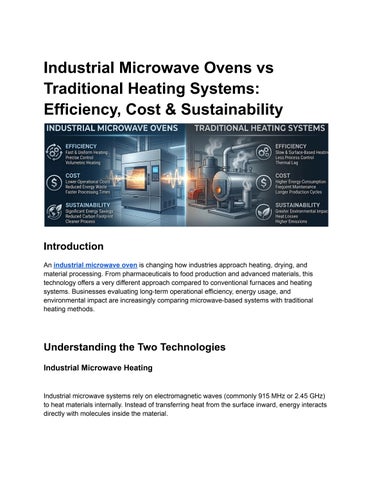
Industrial Microwave Ovens vs Traditional Heating Systems_ Efficiency, Cost & Sustainability
Industrial Microwave Ovens vs Traditional Heating Systems:
Efficiency, Cost & Sustainability
Introduction
An industrial microwave oven is changing how industries approach heating, drying, and material processing. From pharmaceuticals to food production and advanced materials, this technology offers a very different approach compared to conventional furnaces and heating systems Businesses evaluating long-term operational efficiency, energy usage, and environmental impact are increasingly comparing microwave-based systems with traditional heating methods
Understanding the Two Technologies
Industrial Microwave Heating
Industrial microwave systems rely on electromagnetic waves (commonly 915 MHz or 2 45 GHz) to heat materials internally Instead of transferring heat from the surface inward, energy interacts directly with molecules inside the material.
This process is known as dielectric heating, where polar molecules respond to alternating electromagnetic fields, generating heat uniformly throughout the material. The dielectric heating advantages include faster processing, reduced thermal gradients, and improved product consistency.
Another critical component in advanced systems is the phase shifter in microwave technology It controls wave distribution inside the cavity, helping achieve uniform heating and preventing hotspots an essential factor for industrial-scale applications.
Traditional Heating Systems
Traditional systems such as gas furnaces, electric ovens, and kilns rely on conduction, convection, or radiation Heat is generated externally and then transferred to the material surface before moving inward.
This method often leads to uneven heating, longer processing cycles, and higher energy consumption, especially for dense or moisture-rich materials.
Efficiency Comparison
Heating Speed
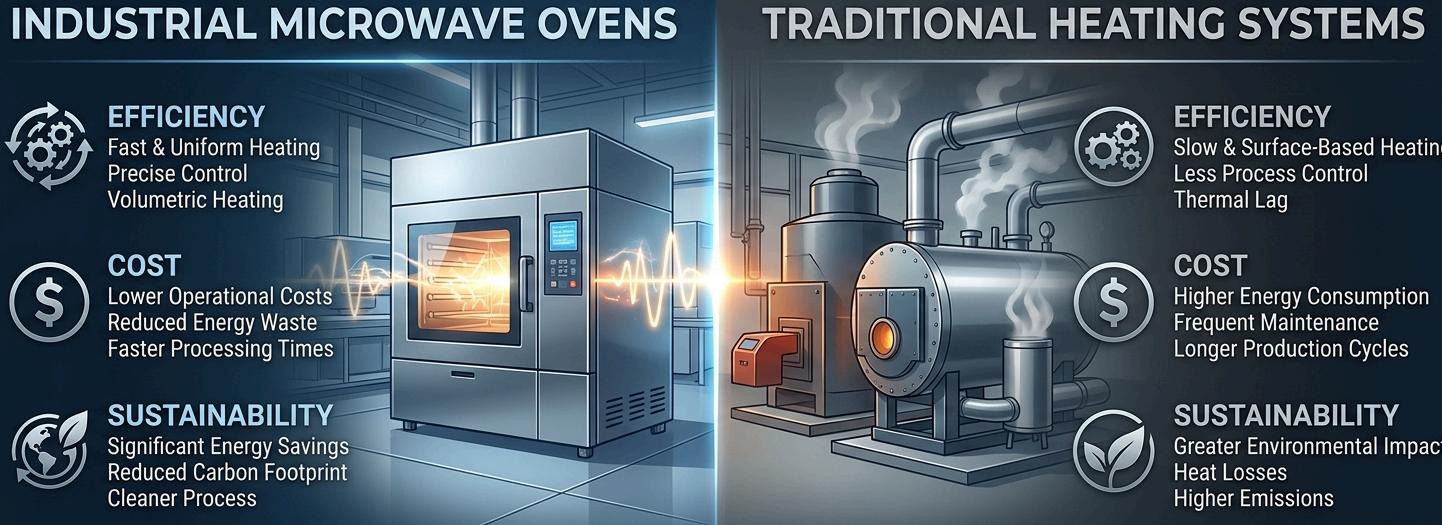
Microwave systems heat materials volumetrically Energy penetrates the material and generates heat internally, which reduces processing time significantly
Traditional systems depend on surface heating, which slows down the overall cycle, especially for thick or low-conductivity materials
Uniformity
Microwave heating, supported by components like phase shifters, offers better control over energy distribution. This reduces overheating at the surface and underheating inside.
Conventional heating often struggles with uniformity, leading to inconsistent product quality
Energy Consumption
Microwave systems convert electrical energy directly into heat within the material, minimizing losses
Traditional systems lose energy through exhaust gases, insulation, and surrounding air, which increases operational costs.
Cost Analysis
Initial Investment
Industrial microwave ovens generally have a higher upfront cost due to specialized components, control systems, and engineering requirements.
Traditional furnaces are more widely available and often cheaper to install
Operating Costs
Microwave systems tend to reduce electricity consumption over time due to shorter processing cycles and targeted heating Maintenance requirements are also lower since there are fewer moving parts.
Traditional systems incur higher fuel or electricity costs and may require frequent maintenance due to wear from prolonged high-temperature operation.
Return on Investment
Faster production cycles, reduced waste, and improved product quality contribute to a quicker return on investment for microwave systems, especially in high-volume industries
Sustainability Impact
Energy Efficiency
Microwave heating aligns well with energy-conscious manufacturing practices. Direct heating reduces wasted energy and lowers overall consumption.
Traditional heating methods consume more fuel or electricity to maintain high temperatures over extended periods.
Carbon Emissions
Microwave systems, especially when powered by renewable electricity, can significantly reduce emissions
Conventional furnaces relying on fossil fuels contribute to higher carbon output
Material Quality & Waste Reduction
Uniform heating minimizes defects, leading to less material rejection
Traditional systems often result in uneven processing, increasing waste and rework.
Industrial Applications
Industrial microwave ovens are widely used in:
● Food processing (drying, pasteurization)
● Pharmaceutical manufacturing (vacuum drying)
● Chemical processing (reaction acceleration)
● Ceramics and metallurgy (sintering)
Traditional systems still dominate in applications requiring extremely high temperatures or where microwave absorption is limited.
Key Decision Factors
Businesses selecting between these technologies should evaluate:
● Material compatibility with microwave energy
● Production volume and cycle time requirements
● Energy costs and sustainability goals
● Space and infrastructure availability
Microwave systems are particularly effective for moisture removal, chemical processing, and applications requiring precise thermal control
Final Thoughts
Industrial heating is shifting toward methods that reduce energy consumption while improving product quality. Industrial microwave ovens present a compelling option for industries aiming to reduce operational costs and environmental impact Traditional heating systems still hold
relevance in certain applications, though the gap in efficiency and sustainability continues to narrow in favor of microwave-based solutions.