


IN ACCORDANCE WITH EN 15804+A2 & ISO 14025
energystore TLA®
energystore
Published on 27.06.2026, last updated on 27.06.2026, valid until 26.06.2031
Life Cycle Assessment study has been performed in accordance with the requirements of EN 15804, EPD Hub PCR version 1.2 (24 Mar 2025) and JRC characterization factors EF 3.1.


Manufacturer energystore
Address Unit 1 Scotia Close, Northampton, UK
Contact details info@energystoreltd.com
Website www.energystoreltd.com
This EPD is intended for business-to-business and/or business-to-consumer communication. The manufacturer has the sole ownership, liability, and responsibility for the EPD. EPDs within the same product category but from different programs may not be comparable. EPDs of construction products may not be comparable if they do not comply with EN 15804 and if they are not compared in a building context.
Program operator EPD Hub, hub@epdhub.com
Reference standard EN 15804:2012+A2:2019/AC:2021 and ISO 14025
PCR EPD Hub Core PCR Version 1.2, 24 Mar 2025 EN 16783 Thermal insulation products
Sector Construction product
Category of EPD Third party verified EPD
Parent EPD number -
Scope of the EPD Cradle to gate with modules C1-C4, D
EPD author Connor McCandless, energystore Ltd
EPD verification Independent verification of this EPD and data, according to ISO 14025:
Internal verification
External verification
EPD verifier Vera Durão, as an authorised verifier acting for EPD Hub Limited

Product name energystore TLA®
Additional labels -
Product reference -
Place(s) of raw material origin Ludwigshafen, Germany
Place of production Northampton, UK
Place(s) of installation and use UK
Period for data
01-01-2025 to 31-12-2025
Averaging in EPD No grouping
Variation in GWP-fossil for A1-A3 (%) -
GTIN (Global Trade Item Number) -
NOBB (Norwegian Building Product Database)A1-A3 Specific data (%) 100
Declared unit 1 cubic metre with thermal conductivity ranging from 0.043 W/mK to 0.054 W/mK
Declared unit mass 8.82 kg Mass of packaging 0 kg
GWP-fossil, A1-A3 (kgCO2e) 27
GWP-total, A1-A3 (kgCO2e) 27
Secondary
ABOUT THE MANUFACTURER
energystore manufacture and install expanded polystyrene (eps) insulation products for use in domestic and commercial properties throughout the UK & Ireland.
BIOGENIC CARBON CONTENT
Product’s biogenic carbon content at the factory gate
Biogenic carbon content in product, kg C 0
Biogenic carbon content in packaging, kg C 0
PRODUCT DESCRIPTION
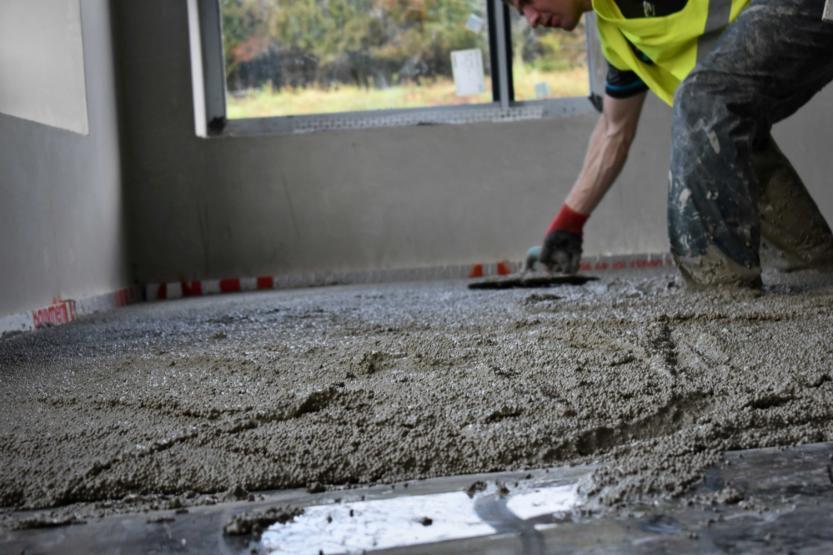
energystore TLA® combines eps beads coated in a specially formulated additive with cement and water to create a pourable insulation in accordance with BS EN 16025. This poured insulation offers an A2 - s1, d0 fire rated alternative for use in floor and roof construction as a high strength void former or insulation.
Further information can be found at: www.energystoreltd.com
PRODUCT RAW MATERIAL MAIN COMPOSITION
Raw material category Amount, mass % Material origin
Metals
Minerals
Fossil materials 100 EU
Bio-based materials
FUNCTIONAL UNIT AND SERVICE LIFE
Declared
SUBSTANCES, REACH - VERY HIGH CONCERN
The product does not contain any REACH SVHC substances in amounts greater than 0,1 % (1000 ppm).
This EPD covers the life-cycle modules listed in the following table.
The environmental impacts considered for the product stage cover the manufacturing of raw materials used in the production as well as packaging materials and other ancillary materials. Also, fuels used by machines, and handling of waste formed in the production processes at the manufacturing facilities are included in this stage. The study also considers the material losses occurring during the manufacturing processes as well as losses during electricity transmission.
A market-based approach is used in modelling the electricity mix utilized in the factory.
The environmental impacts considered for the product stage cover the manufacturing of raw materials used in the production as well as packaging materials and other ancillary materials. Also, fuels used by machines, and handling of waste formed in the production processes at the manufacturing facilities are included in this stage. The study also considers the material losses occurring during the manufacturing processes as well as losses during electricity transmission.
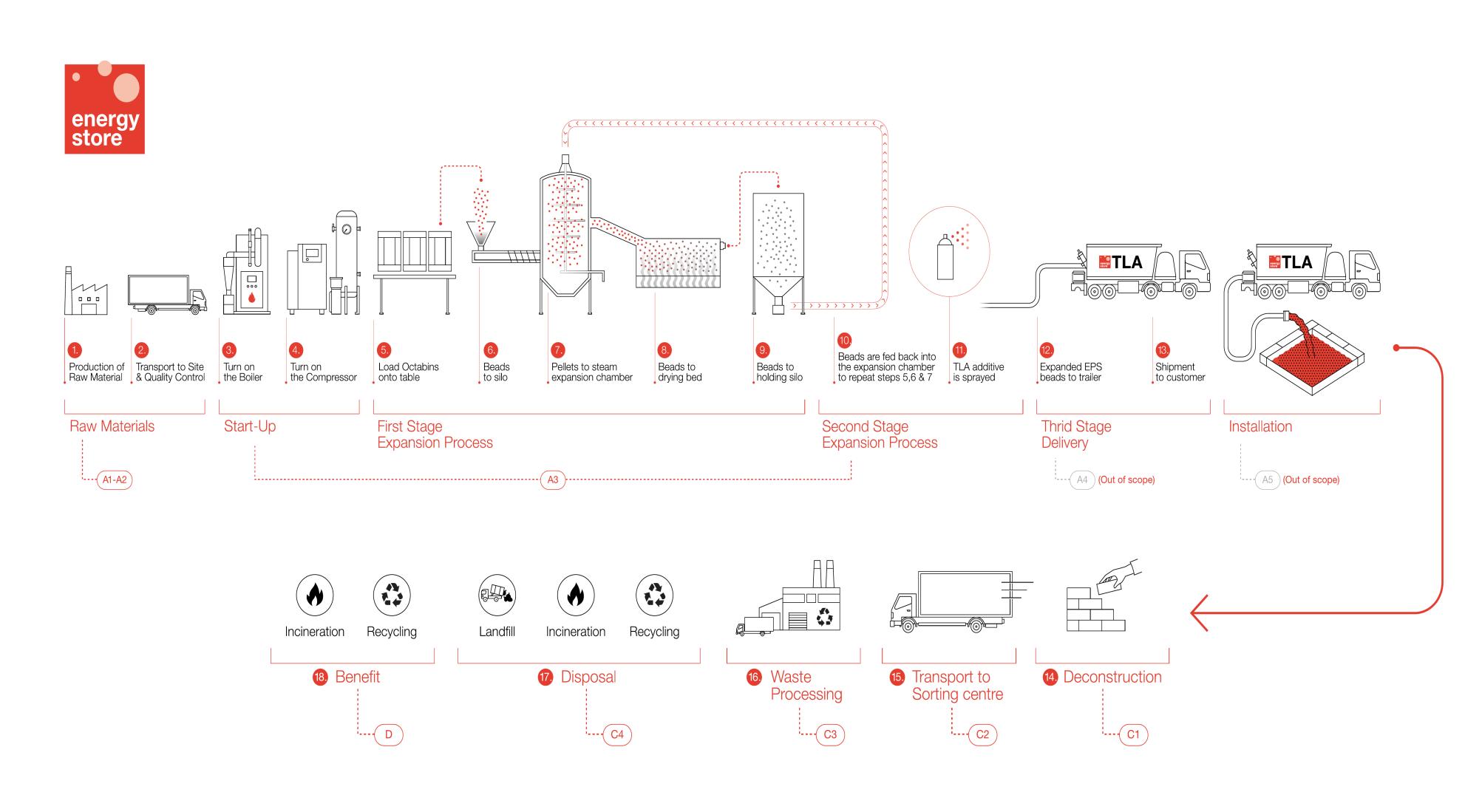
Energystore TLA+® is manufactured following a 2 stage steam expansion process, using raw grey expanded polystyrene (EPS). The key steps to the manufacturing process are set out below:
• Raw EPS is received from suppliers typically in sealed containers of 1.1tonne per container. The material travels by road 930km from the supplier to energystore’s manufacturing facility.
• The EPS is fed into the expansion machine using a sealed screw. This feeding process ensures the EPS is fed into the expansion machine at the correct rate to ensure accurate product density.
• Once the EPS is within the expansion chamber, it circulated with low pressure steam of temperatures between 85 – 100 degrees Celsius. Once the material has circulated sufficiently to achieve the desired 1st stage density, it is fed from the expansion chamber through a sealed drying bed enabling any excess moisture to drain from the eps beads.
• The material is then blown from the drying bead through a series of sealed pipes to be kept in storage silos for a period of time. Once the material has stabilised and dried, it is blown back through a series of sealed pipes to be fed back through the expansion chamber and drying bed, repeating the expansion process for a 2nd time to achieve the final desired product density.
• At the end of this 2nd stage expansion, the material is again blown through sealed piping to final storage silos.
• Once the material has cooled, it is then fed through silos to the
spraying machinery which is used to apply an additive coating to the eps.
• After spraying of the additive, the product is ready to be shipped. The material is again blown through sealed pipes into specially designed, sealed transport vehicles. The material is then delivered to installing companies, typically in shipments of 120m3. As the material is shipped in specialist vehicles, there is no packaging necessary for the product.
• As the material is handled in sealed expansion chambers and transfer pipework there are no production losses. In the event of a spillage at the manufacturing site, the raw material can be collected using vacuum equipment and put back into the manufacturing cycle. As a result, there are no manufacturing losses in our processes.
A residual mix approach is used in modelling the electricity mix utilized in the factory. A market-based approach is used in modelling the natural gas mix utilized in the factory.
At end of life, the material can be removed from construction sites prior to demolition. This process involves breaking the material into chunks and transported to waste processing sites. The polystyrene can then be easily separated from the light cement mortar using a scrubbing process. Once this is complete, the material is ready for recycling or incineration. Demolition is assumed to consume 0,01 kWh/kg of product. The source of energy is diesel fuel used by construction machines (C1). It is assumed that 100% of the waste is collected and transported to the waste treatment center. Transportation distance to treatment is assumed as 50 km and the transportation method is assumed to be lorry (C2).
EPS recycling: 9 % recycling rate assumed (source: Plastics Europe (2020) https://plasticseurope.org/knowledge-hub/plastics-the-facts-2020/; C2 transport: 50 km assumed (source: Gervasio, H. & Dimova, S., JRC Technical report: Model for Life Cycle Assessment (LCA) of buildings, 2018)
EPS landfill: 32 % landfill rate assumed (source: Plastics Europe (2020) https://plasticseurope.org/knowledge-hub/plastics-the-facts-2020/; C2
transport: 50 km assumed (source: Gervasio, H. & Dimova, S., JRC Technical report: Model for Life Cycle Assessment (LCA) of buildings, 2018)
EPS incineration: 59 % incineration rate assumed (source: Plastics Europe (2020) https://plasticseurope.org/knowledge-hub/plastics-the-facts-2020/; C2 transport: 50 km assumed (source: Gervasio, H. & Dimova, S., JRC Technical report: Model for Life Cycle Assessment (LCA) of buildings, 2018)
Module D incineration benefits modelled on avoidance of electricity generation from European averages and thermal benefit for heat in the UK (Market for heat, district or industrial, other than natural gas (Reference product: heat, district or industrial, other than natural gas)).
Module D recycling benefits modelled based on avoidance of typical European virgin EPS production.
The study does not exclude any modules or processes which are stated mandatory in the reference standard and the applied PCR. The study does not exclude any hazardous materials or substances. The study includes all major raw material and energy consumption. All inputs and outputs of the unit processes, for which data is available for, are included in the calculation. There is no neglected unit process more than 1% of total mass or energy flows. The module specific total neglected input and output flows also do not exceed 5% of energy usage or mass.
The production of capital equipment, construction activities, and infrastructure, maintenance and operation of capital equipment, personnelrelated activities, energy and water use related to company management and sales activities are excluded.
For easier modelling and because of lack of accuracy in available modelling resources some constituents under 1% of product mass are excluded. These include some ancillary materials which are all present in the product only in very small amounts and have no serious impact on the emissions of the product.
This LCA study includes the provision of all materials, transportation, energy and emission flows, and end of life processing of product. All industrial processes from raw material acquisition and pre-processing, production and end-of-life management are included.
The production of capital equipment, construction activities, and infrastructure, maintenance and operation of capital equipment, personnelrelated activities, energy and water use related to company management and sales activities are excluded (unless modelled in background datasets).
Data collection for production, transport, and packaging was conducted using time and site-specific information, as defined in the general information section on page 1 and 2. Upstream process calculations rely on generic data as defined in the Bibliography section. Manufacturer-provided specific and generic data were used for the product’s manufacturing stage. The analysis was performed in One Click LCA EPD Generator, with the 'CutOff, EN 15804+A2' allocation method, and characterization factors according to EN 15804:2012+A2:2019/AC:2021 and JRC EF 3.1.
A technical inconsistency has been identified between PENRT (Total use of non-renewable primary energy) and ADP-fossil (Abiotic depletion potential for fossil resources) results in modules A1–A3. A contribution analysis shows that the remaining discrepancy originates from the specific characterization factors in the background environmental profiles of the primary raw materials (datapoint). These inconsistencies are inherent to upstream data from specific supplier and cannot be adjusted by the practitioner.
Allocation is required if some material, energy, and waste data cannot be measured separately for the product under investigation. All allocations are done as per the reference standards and the applied PCR. In this study, allocation has been done in the following ways:
Data type
Raw materials
Packaging material
Ancillary materials
Manufacturing energy and waste
Allocation
Physical Properties
Not applicable
Physical Properties
Physical Properties
Type of grouping No grouping
Grouping method Not applicable
Variation in GWP-fossil for A1A3, %
This EPD is product and factory specific.
This EPD has been created using One Click LCA EPD Generator for EPD Hub V3 and EPD Process Certification v3.2.5. The LCA and EPD have been prepared according to the reference standards and ISO 14040/14044. The EPD Generator uses Ecoinvent v3.10.1/3.11/3.12 and One Click LCA databases as sources of environmental data. Allocation used in Ecoinvent 3.10.1/3.11/3.12 environmental data sources follow the methodology ‘allocation, Cut-off, EN 15804+A2‘.
- EPD Hub Core Product Category Rules version 1.2, March 2025
- EPD Hub General Program Instructions version 1.3, March 2025
- EN 15804:2012+A2:2019/AC:2021 Sustainability of construction worksEnvironmental product declarations - Core rules for the product category of construction products
- BASF Neopor F2300 Life Cycle Impact Assessment, April 2025
- Diesel for demolition assumed 0.01kWh/kg (source: Bozdag, O & Secer, M. 2007)
- 50km truck transportation to waste treatment site (source: Gervasio, H. & Dimova, S., JRC Technical report: Model for Life Cycle Assessment (LCA) of buildings, 2018)
- Plastics Europe (2020): 'Plastics - the Facts 2020: An Analysis of European plastics production, demand and waste data'
The estimated impact results are only relative statements which do not indicate the end points of the impact categories, exceeding threshold values, safety margins or risks.
1) GWP = Global Warming Potential; 2) EP = Eutrophication potential. Required characterisation method and data are in kg P-eq. Multiply by 3,07 to get PO4e; 3) POCP = Photochemical ozone formation; 4) ADP = Abiotic depletion potential; 5) EN 15804+A2 disclaimer for Abiotic depletion and Water use and optional indicators except Particulate matter and Ionizing radiation, human health. The results of these environmental impact indicators shall be used with care as the uncertainties on these results are high or as there is limited experience with the indicator.

6) EN 15804+A2 disclaimer for Ionizing radiation, human health. This impact category deals mainly with the eventual impact of low-dose ionizing radiation on human health of the nuclear fuel cycle. It does not consider effects due to possible nuclear accidents, occupational exposure nor due to radioactive waste disposal in underground facilities. Potential ionizing radiation from the soil, from radon and from some construction materials is also not measured by this indicator; 7) SQP = Land use related impacts/soil quality.
8)
9) This indicator includes all greenhouse gases excluding biogenic carbon dioxide uptake and emissions and biogenic carbon stored in the product. In addition, the characterisation factors for the flows – CH4 fossil, CH4 biogenic and Dinitrogen monoxide – were updated. This indicator is identical to the GWP-total of EN 15804:2012+A2:2019 except that the characterisation factor for biogenic CO2 is set to zero
Manufacturing energy scenario documentation
1. Market for heat, central or small-scale, natural gas, Albania, Ecoinvent, 0.0777 kgCO2e/MJ
2. Electricity, low voltage, residual mix, United Kingdom, Ecoinvent, 0.45 kgCO2e/kWh
End of life (C1-C4) - Scenario documentation
Scenario information
Collection process: collected separately (kg)
Collection process: Mixed waste (kg)
Scenario assumptions e.g. transportation (mode, km) & other Diesel truck 16-32 metric ton, EURO5. Distance to treatment centre: 50 km
EPD Hub declares that this EPD is verified in accordance with ISO 14025 by an independent, third-party verifier. The project report on the Life Cycle Assessment and the report(s) on features of environmental relevance are filed at EPD Hub. EPD Hub PCR and ECO Platform verification checklist are used.
EPD Hub is not able to identify any unjustified deviations from the PCR and EN 15804+A2 in the Environmental Product Declaration and its project report.
EPD Hub maintains its independence as a third-party body; it was not involved in the execution of the LCA or in the development of the declaration and has no conflicts of interest regarding this verification.
The company-specific data and upstream and downstream data have been examined as regards plausibility and consistency. The publisher is responsible for ensuring the factual integrity and legal compliance of this declaration.
The software used in creation of this LCA and EPD is verified by EPD Hub to conform to the procedural and methodological requirements outlined in ISO 14025:2010, ISO 14040/14044, EN 15804+A2, and EPD Hub Core Product Category Rules and General Program Instructions.
Verified tools
Tool verifier: Magaly Gonzalez Vazquez
Tool verification validity: 27 March 2025 - 26 March 2028
Vera Durão, as an authorised verifier acting for EPD Hub Limited 27.06.2026