CODE GBA501
Gilberto Bejarano VENEZUELA
TITLE
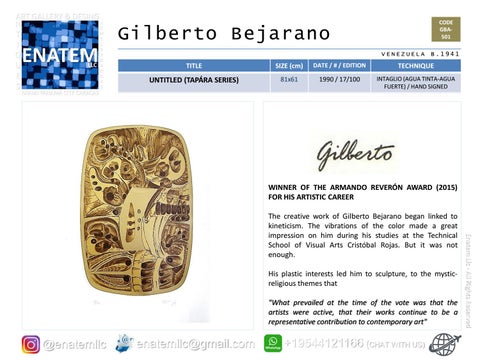
TITLE UNTITLED (TAPÁRA SERIES)
SIZE (cm)UNTITLED 80,50x61,00 (TAPÁRA SERIES)
SIZE (cm) 81x61
B.1941
DATE // ##/EDITION / EDITION DATE
TECHNIQUE 1990 / 17/100
1990 / 17/100 TECHNIQUE
INTAGLIO (AGUA (AGUATINTA-AGUA TINTA-AGUA INTAGLIO FUERTE) / HAND SIGNED FUERTE) / HAND SIGNED
WINNER OF THE ARMANDO REVERÓN AWARD (2015) FOR HIS ARTISTIC CAREER
His plastic interests led him to sculpture, to the mysticreligious themes that "What prevailed at the time of the vote was that the artists were active, that their works continue to be a representative contribution to contemporary art"
@enatemllc
enatemllc@gmail.com
+19544121166 (CHAT WITH US)
Enatem Llc - All Rights Reserved
The creative work of Gilberto Bejarano began linked to kineticism. The vibrations of the color made a great impression on him during his studies at the Technical School of Visual Arts Cristóbal Rojas. But it was not enough.
CODE GBA501
Gilberto Bejarano VENEZUELA
@enatemllc
enatemllc@gmail.com
The Ólidas series combines pieces loaded with organic sense and sinuosity. The Ristras seek the expressiveness of the metaphorical element to create poetic images in harmony with the landscape. At the beginning of the 1990s he made the Keys, sculptures worked on the basis of modules, and the Flowers, where the potential of organic language is evident. At the end of the decade, he makes the Trefoils, which again integrate geometry and pure color in an organic aspect that refers to plant forms. In addition to his work as a sculptor and teacher, Bejarano has a long career as a cultural promoter in the east of the country. He was director and founder of the Museum La Tradición (Barcelona, Anzoátegui State, 1969), later converted into the Museum of Anzoátegui, and founded in 1977 the Municipal Art Gallery of Puerto La Cruz, which he has directed to date. He has been director of culture of the district Sotillo (1981) and the mayor of the municipality Sotillo (1992) in the Edo. Anzoátegui. From Bejarano, the GAN has Warao No. 3 of the Tribute to the Delta series (1978), Silver blue colonial plank nº 15 (1980) and Altar del amor (1982). SOME AWARDS 1986 Prize for the best work, I Biennial of Visual Arts of the East, Cumaná 1987 Prize Julio Morales Lara, XLV Salon Arturo Michelena 1988 Government Governing Prize Nueva Esparta, IV Francisco Narváez Biennial 1989 First prize of sculpture, XIV Aragua Hall, Maracay Art Museum 1990 Sculpture Prize, I National Biennial of Plastic Arts of Merida Collections: Conac / Municipal Art Gallery, Puerto La Cruz / GAN / MACMMA / Mamja / Antonio José de Sucre Museum Gran Mariscal de Ayacucho, Cumaná / Francisco Narváez Museum https://issuu.com/revista-artefacto/docs/artefacto_16_issuu/90 https://article.wn.com/view/2015/05/08/Premio_Armando_Reveron_a_la_rebeldia_de_Gilberto_Bejarano/
+19544121166 (CHAT WITH US)
Enatem Llc - All Rights Reserved
Birth: December 4, 1941, Mérida - Venezuela. Sculptor. Son of José Rafael Bejarano and Isabel Escalante Lobo. He studied pure art at the Cristóbal Rojas School (1958-1961) with Mateo Manaure, Miguel Arroyo, Rafael Ramón González, Luis Guevara Moreno and Régulo Pérez, among others. In 1961 he moved to Barcelona (Edo. Anzoátegui), where he worked as professor of analysis and composition at the School of Plastic Arts Armando Reverón and, between 1961 and 1963, he took up the chairs of engraving, drawing and painting at the Gómez Cardiel School of Cumaná, institution where also dictates, in 1963, the matter of elements of expression of the visual arts of space. That year he traveled to Europe and settled for two years in Paris, specializing in engraving at the Superior School of Fine Arts. When he returned from Europe, in 1965, he worked as a professor of experimentation and assembly at the Armando Reverón Plastic Research Center in Barcelona, Edo. Anzoátegui. Inclined in the beginning towards the painting of abstract-lyrical filiation, it soon ventures into sculpture linked to the non-orthodox kinetic current. By then he works with wooden rods arranged in serial frames that he called Kinetic Structures, title that later it will change to that of Homage to the Delta. Later he uses a language of pure forms and colors that gradually becomes more subjective, perhaps due to his growing interest in the symbols and rituals of American syncretism. In 1980 he made works in which organic volumes made in direct size with linear forms are mixed. His interest in the sacred grows, which leads him to make the series of Retablos y Bateas. In these works, the desire for perfection proper to constructivism is only maintained by the use of pure color and the recurrence of geometric backgrounds, which contrast vividly with the free-like sizes that lie in the niches. Upon entering this language, he introduces the religious element, which reaches its culminating point in the Altars, great assemblies in which he experiments with different techniques and with the use of strongly symbolic elements. At the end of the eighties, he investigated the tree structures that derived, in 1990, in the series Ólidas and Ristras. The circle and the "stem" that holds it will be fundamental characteristics of the structure of these pieces.
B.1941
@enatemllc Direct Link: https://www.instagram.com/enatemllc/
+19544121166 Direct Link:
wa.me/19544121166 Español - English
SMS
+13055456818
Direct Link: https://issuu.com/search?q=enatem%20llc
Direct Link:
info@enatem.store
Direct Link: https://www.youtube.com/channel/UCfEqEqobtcCbuS8fUGVLpDQ
CONTACTOS CONTACTS
Enatem Llc - All Rights Reserved
https://www.arteinformado.com/guia/o/enatem-llc-132302