

The Kansas Prosecutor
The official publication of the Kansas County and District Attorneys Association
Volume 23, No. 2, Summer 2026
2025-26 KCDAA Board
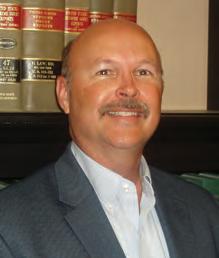
Ron Paschal President
Deputy District Attorney, Sedgwick County
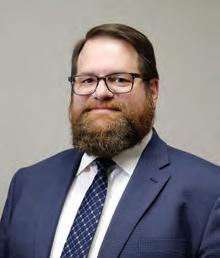
Andrew Davidson
Director I
Deputy District Attorney, Reno County

Bethany Lee Director IV
Jackson County Attorney
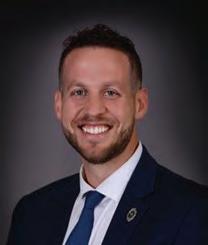
Mike Kagay Vice President
Shawnee County District Attorney
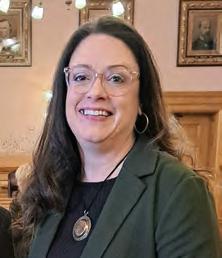
Missi Schoen Director II
Phillips County Attorney
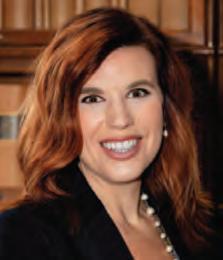
Tabitha Owen Past President
Smith County Attorney
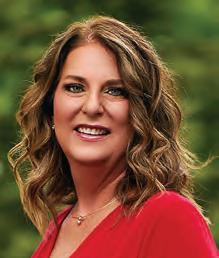
Susan Richmeier Secretary/Treasurer
Finney County Attorney
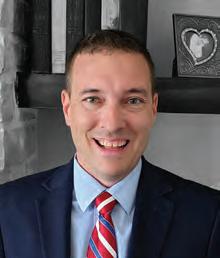
Will Hurst Director III
Assistant District Attorney, Johnson County
Chairs & Representatives
Shannon Wilson CLE Committee Chair
Assistant District Attorney, Sedgwick County
Todd Thompson
Legislative Committee Chair Leavenworth County Attorney
Sherri Schuck Best Practices Committee Chair
Deputy District Attorney, Shawnee County
The Kansas Prosecutor
The official publication of the Kansas County and District Attorneys Association
Published by the Kansas County and District Attorneys Association, 1200 S.W. Tenth Avenue, Topeka, Kansas 66604.
Phone: (785) 232-5822 Fax: (785) 234-2433
The Kansas Prosecutor
Our mission:
The purpose of the KCDAA is to promote, improve and facilitate the administration of justice in the state of Kansas.
For questions or comments about this publication, please contact the editor: Mary Napier
mary@napiercommunications.com (785)783-5494
Board of Editors
Kendall Kaut, Chair Kris Ailslieger
Chelsea Anderson Amy Aranda
James Crux Stacy Edwards
Chris McMullin Elizabeth Oliver
Tabitha Owen Barry Wilkerson
Mary Napier, Editor
KCDAA Administrative Staff
Steve Kearney, Executive Director
Melissa Flachsbarth
Brian Harmer
This magazine is dedicated to professional prosecutors across the state of Kansas for public information. The KCDAA and the members of the Editorial Board assume no responsibility for any opinion or statement of fact in the substantive legal articles published in The Kansas Prosecutor. We welcome your comments, suggestions, questions, information, etc. From time to time, The Kansas Prosecutor will publish articles dealing with controversial issues. The views expressed in The Kansas Prosecutor are those of the authors and may not reflect the official policy of the KCDAA. Send correspondence to: The Kansas Prosecutor editor, 1200 S.W. Tenth Avenue, Topeka, Kansas 66604 or e-mail Editor Mary Napier at mary@napiercommunications.com
Photocopying, reproduction or quotation is strictly prohibited

Photo by Seth Varner CEO, Wandermore Publishing
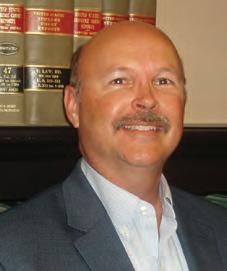
By Ron Paschal, KCDAA President Deputy District Attorney, Sedgwick County
Felons in Possession of Firearms President’s Column
Clearing the Statutory Fog, Navigating the Confusion of K.S.A. 21-6304
In the halls of our courthouses, we often hear the refrain that instead of passing new regulations, the state should simply do a better job of enforcing the laws already on the books. As a gun owner and a long-time member of the Kansas legal community, I find some truth in that sentiment; however, the reality we face as prosecutors is that existing laws are often not as easy to enforce as they appear on paper.
Our current framework for the criminal possession of a weapon by a convicted felon, found in K.S.A. 21-6304, has, over time, become a patchwork of timelines and technicalities that undermines the very public safety it was designed to protect. Last year we introduced Senate Bill 506 to create a necessary path forward by replacing administrative complexity with a clear, tiered system of accountability.
The Current Dilemma: A Statutory Patchwork
The primary problem with our current law is its inherent complexity. The statute is currently a confusing array of different timelines based on specific facts that are frequently difficult to determine in the heat of a police contact. One of the most significant impediments is the “ban period clock,” which can stop, start, or toll based on a variety of triggers: the satisfaction of a sentence, the completion of diversion, or discharge from probation, parole, or post-release supervision. This lack of clarity creates a “statutory fog” for all stakeholders. Law enforcement officers, particularly during after-hours or weekend contacts, often cannot be certain whether an individual is
lawfully prohibited from possessing a firearm or if they should seize the weapon. Prosecutors have even been forced to use a matrix simply to figure out if a violation of the law has occurred. Furthermore, our current system contains a significant loophole regarding juvenile offenders: because they are “adjudicated” rather than “convicted,” repeat juvenile offenders who possess firearms are often treated as first-time misdemeanor offenders regardless of their history.
Real-World Consequences: When Technicalities Cost Lives
In the real world, these technical shortcomings translate into missed opportunities for intervention. We know that unlawful possession is frequently the “warning sign” that precedes a shooting, an armed robbery, or a murder. When the law is “weak and overly technical,” it loses its credibility and its value as a deterrent.
For example, the current requirement to prove that a firearm was used in a prior crime to trigger a lifetime ban creates a logistical nightmare for law enforcement trying to verify status during a car stop. This raises a fundamental question for our community: Should an offender who killed someone with a knife or a hammer be allowed to possess a firearm simply because of their choice of weapon in the past? Across Kansas, we are seeing felony murders increasingly linked to drug trafficking—an inherently dangerous activity where guns are used to ensure compliance and settle disputes. Without a clear, enforceable ban, we are effectively waiting for the next tragedy to occur before we can treat
the possession of a weapon with the seriousness it deserves.
The Solution: Clarity, Consistency, and Public Safety
2026 Senate Bill 506 resolves these issues by establishing four distinct categories of prohibited persons with timelines that are consistent with our neighboring states:
• Lifetime Ban: Reserved for the most violent offenders, including off-grid crimes and severity level 1 through 5 person felonies (such as homicides, robberies, and higherlevel sex offenses). Critically, this ban applies regardless of whether a firearm was used in the predicate offense.
• 20-Year Ban: Applied to higher-level drug manufacturers or distributors (level 1 through 3 drug felonies).
• 10-Year Ban: Covers lower-level person felonies and all other non-person felonies.
• 5-Year Ban: Targets misdemeanor domestic violence offenders, aligning Kansas law with federal standards.
The most transformative change in SB 506 is that the “clock” for these bans starts at a clearly identifiable time: the date of conviction. There is no more stopping and starting as individuals move in and out of custody; the date of conviction is a
fixed point that is easy for law enforcement and prosecutors to find and enforce. Additionally, the bill fixes the juvenile loophole by adding two words to the statute “or adjudication” ensuring that repeat juvenile offenders face felony consequences for possessing handguns.
Conclusion: Balancing the Second Amendment with Community Protection
As we consider these reforms, it is important to note what does not change. SB 506 preserves the path to regaining firearm rights through the expungement of prior convictions for those who demonstrate consistent good behavior.
By adopting this bill, we provide clarity to intended gun owners, law enforcement, and the broader community. This approach honors the rights of those who exercise them appropriately while providing Kansas prosecutors with a legally sound, easy-to-understand tool to protect the public from those who have demonstrated a likelihood to abuse those rights. This is not just a change in the law; it is a commitment to intervening sooner and saving lives.
It is our intention to reintroduce the contents of SB 506 in the 2027 Legislative Session to help answer the proliferation of gun violence by convicted felons. We hope that the Kansas Legislature and the new Governor will support this important public safety initiative.

Kansas Prosecutors Foundation
Prosecutor Community Service Award Nominations Due Sept. 1
In 2014, the Kansas Prosecutors Foundation gave out its first annual Community Service Award. The award is intended to recognize a Kansas prosecutor who has rendered outstanding service to his or her community in addition to the performance of the duties required by the position of a prosecutor.
How to Make a Nomination
To nominate yourself or one of your colleagues, please use the nomination form at the link below. All forms and materials must be sent using the online award nomination form by Sept. 1 at 5 pm.
SUBMIT
If you have any questions, contact:

by Steve Kearney, KCDAA Executive Director
Stewardship Beyond the Courtroom Executive Director’s Column
Prosecutors Strenghtening Kansas Law
In more than two decades representing prosecutors before the Kansas Legislature, one truth has remained constant: prosecutors occupy a unique place in our constitutional system.
Unlike any other advocate, a prosecutor’s responsibility is not simply to prevail. It is to seek the truth in pursuit of justice, and to exercise discretion wisely, protect the constitutional rights of every individual, give voice to crime victims, and faithfully enforce the laws enacted on behalf of the people of Kansas.
As Executive Director of the Kansas County and District Attorneys Association (KCDAA), I have the privilege of representing prosecutors who shoulder those responsibilities every day and ensuring their experiences help shape the laws that govern our state.
That perspective has reinforced an important lesson: stewardship of justice begins long before a case is ever filed.
Every charging decision, criminal trial, juvenile proceeding, sentencing recommendation, and effort to protect a crime victim depends upon a legal framework established by the Kansas Legislature. The KCDAA advocates for laws that are clear, constitutional, practical, and worthy of the public’s confidence.
A Trusted Resource for Sound Public Policy
Throughout its history, the KCDAA has served as a trusted, nonpartisan resource for members of the Kansas Legislature, the Executive Branch, and our many criminal justice partners.
Legislative leaders, committee chairs, governors, attorneys general, and members of the judiciary naturally change over time. The Association’s
commitment to serving as an objective, professional resource has not.
Regardless of political party or philosophy, KCDAA’s responsibility remains the same: to provide policymakers with the practical experience of Kansas prosecutors responsible for implementing Kansas law in every judicial district across the state.
Good Public Policy Benefits from Practical Experience
Prosecutors understand how statutes function in real courtrooms. They recognize when ambiguity creates uncertainty by identifying unintended consequences and shaping legislation that better serves victims, defendants, law enforcement, the judiciary, and the public.
Providing lawmakers with the benefit of prosecutors’ firsthand experience is not advocacy for prosecutors alone; it is the stewardship of Kansas’ justice system.
Stewardship Is a Year-Round Responsibility
One of the greatest misconceptions about the legislative process is that it begins each January when lawmakers return to Topeka. Nothing could be further from the truth.
The work resumes immediately following adjournment of each legislative session. Following sine die, interim committees are authorized and assigned study topics, legislative priorities are solicited from the KCDAA membership for the next legislative session, and the KCDAA Legislative Committee and Board of Directors evaluate those proposals to develop the Association’s legislative agenda.
Throughout the year, the KCDAA works with
legislators, legislative staff, the Office of the Revisor of Statutes, the Attorney General’s Office, judges, law enforcement organizations, victim advocates, and many others to identify opportunities to improve Kansas law long before the Legislature convenes.
During the 2025-2026 biennium, the KCDAA tracked 102 separate bills involving criminal law, criminal procedure, juvenile justice, Child in Need of Care proceedings, victims’ rights, sentencing, and numerous other issues affecting the administration of justice. Some proposals require technical refinement. Others involve substantial policy discussions. Many never become law. Each bill requires thoughtful analysis because every proposal carries the potential to influence the administration of justice throughout Kansas.
For the KCDAA, stewardship is not measured by the legislative session calendar; it is a year-round commitment.
Senate Bill 374: A Case Study in Good Government
KCDAA’s top legislative priority for the 2026 Legislative Session was Senate Bill 374. A critical gap between the competency to stand trial and involuntary commitment statutes had created an environment that permitted dangerous individuals to be released into Kansas communities with tragic consequences.
Like virtually every successful piece of legislation, Senate Bill 374’s story began long before it received a number.
Months before legislators returned to Topeka, KCDAA members from across Kansas devoted countless hours reviewing existing law, evaluating practical implications, and refining proposed language.
KCDAA members (too numerous to name) worked extensively with Deputy Attorney General Jessica Domme and her staff who shared the Association’s commitment to addressing this issue. Their expertise and dedication were invaluable throughout the process.
Well before the Legislature was convened, the bill was drafted and put in the capable hands of the Office of the Revisor of Statutes to prepare it for introduction. Contemporaneously, we began discussions with committee chairs and key
legislators regarding both the need for legislation and its anticipated impact on the administration of justice.
Once the session began, the pace accelerated. From introduction to the Governor’s signature, Senate Bill 374 required no fewer than 18 separate official legislative actions.
Those actions included introduction, committee referrals, hearings before both chambers’ committees, committee deliberations, floor debate, floor passage, conference committee negotiations, adoption of the Conference Committee Report, enrollment, and ultimately the Governor’s approval. Throughout the process, the KCDAA coordinated testimony from prosecutors and other proponents to ensure legislators had the information necessary to evaluate the bill.
Those official actions tell only part of the story.
Behind each committee hearing were conversations before and after testimony with committee chairs and committee members.
Every amendment reflected policy and drafting discussions with stakeholders, legislators, legislative staff, and the Office of the Revisor of Statutes.
Most importantly, the bill’s successful hearings and votes reflected the courage of the families affected by this dangerous gap in the law. They were willing to publicly relive deeply personal and painful experiences to help prevent others from becoming victims.
Standing alongside those families were KCDAA member prosecutors, who shared their firsthand experience with these cases and others like them. That work rarely receives public attention. It is, however, how thoughtful public policy is developed.
Making the System Stronger Than We Found It
KCDAA has represented generations of Kansas prosecutors dedicated to public service since its inception. It has served communities large and small across Kansas under governors and attorneys general from both political parties. Throughout their careers, they have prosecuted some of the most difficult and challenging cases imaginable, protected victims, safeguarded constitutional rights, and upheld the rule of law with professionalism, fairness, and integrity.
Their work has reinforced my belief that every
generation inherits more than a body of laws. We inherit a justice system, and with it, it is our responsibility to leave it stronger than we found it.
That responsibility belongs to prosecutors, legislators, judges, law enforcement, defense counsel, victim advocates, and every public servant entrusted with preserving the integrity of our justice system. The KCDAA is honored to contribute to that work by serving as a trusted resource, a thoughtful advocate for sound public policy, and a steadfast partner in the administration of justice.
Seeking the Truth. Pursuing Justice. Serving Kansas.
Throughout my time representing Kansas prosecutors, I have come to believe those words capture both the profession they have chosen and the mission of the KCDAA. These words remind us that the highest calling is not simply to advocate for legislation or prosecute cases, but to strengthen the administration of justice and faithfully serve the people of Kansas.

KCDAA Virtual Spring Conference Brings Timely
Training to Prosecutors and Support Staff
The Kansas County and District Attorneys Association (KCDAA) successfully hosted its 2026 Virtual Spring Conference on June 11–12, bringing together prosecutors and prosecution support professionals from across Kansas for two days of practical, relevant continuing education.
The CLE program featured presentations on a wide range of current legal topics, including digital evidence search and seizure, juvenile law updates, organized retail theft, legislative and appellate developments, extraditions and detainers, ethics in digital evidence, jury selection, and prosecuting distribution resulting in death cases. Attendees also heard from the Kansas Department of Wildlife and Parks on law enforcement issues and gained valuable insight into defense perspectives to strengthen courtroom preparation.
Support staff participated in a dedicated
educational track focused on the vital role they play in the criminal justice system. Sessions covered peer support, victim and witness services through a case study, legislative updates from the Kansas Sentencing Commission, generational trauma, diversion programs, grants and training opportunities, electronic sentencing filings, the Property Crime Compensation Fund, appeals and post-conviction matters, traffic case management, and software management best practices.
The Virtual Spring Conference provided an opportunity for legal professionals statewide to stay current on emerging issues, strengthen professional skills, and share knowledge that will enhance the administration of justice throughout Kansas. Thanks to everyone who attended the virtual event. Stay tuned for more details on the in-person KCDAA Fall Conference, Oct. 8-9 in Overland Park.
KCDAA Award Nominations
2026 KCDAA Award
Nominations
Please take time to nominate a member of the KCDAA whom you believe to be deserving of an award. This is the opportunity to recognize the accomplishments of the hard-working prosecutors who make up the membership of the KCDAA, and a policymaker who has championed the interests of the KCDAA.
FIVE categories of awards are eligible for nomination: Prosecutor of the Year, Rural Prosecutor of the Year, Lifetime Achievement Award, Associate Member Prosecutor of the Year, and Policymaker of the Year. The awards winners are chosen by the KCDAA Board of Directors.*
Award Qualifications:
The Prosecutor of the Year Award is presented to a prosecutor in a jurisdiction with four or more attorney positions for outstanding prosecution of a case or cases throughout the year. Nominations may be made by either the prosecutor himself/herself or by a colleague. The nominee must be a regular member of the KCDAA.
The Rural Prosecutor of the Year Award is presented to a prosecutor in a jurisdiction with no more than three attorney positions for outstanding prosecution of a case or cases throughout the year. Nominations may be made by either the prosecutor himself/herself or by a colleague. The nominee must be a regular member of the KCDAA.
The Lifetime Achievement Award is presented to a regular KCDAA member for his/her longevity as a prosecutor. The nominee must have served no less than 25 years in a prosecutor position, and not previously received this award. Nominations may be made by either the prosecutor himself/herself or by a colleague.
The Associate Member Prosecutor of the Year Award is presented to a prosecutor for outstanding prosecution of a case or cases throughout the year from an office other than a County or District Attorney’s office. Nominations may be made by either the prosecutor himself/herself or by a colleague. The nominee must be an associate member of the KCDAA.
The Policymaker of the Year Award is presented to an individual who is determined to have made the most significant impact on policy related to county and district attorneys either during the past year or over an extended career of public service. One award is presented each year. The award is open to individuals having public policy making authority as evidenced by legislative support of the KCDAA.
Nominations: To nominate yourself or one of your colleagues, please use the online form at kcdaa.org/ awards. Emailed nominations will not be accepted, so please submit using the online submission form.
All nominations MUST BE received by 5:00 p.m. on September 1, 2026. For questions, please contact Brian at (785) 232-5822 or via e-mail at brian@kearneyandassociates.com.
*The Board of Directors reserves the right to choose which awards categories are granted each year, if any.
Member Highlights
By Mary Napier, Editor, Kansas Prosecutor
KCDAA is proud to recognize the talented prosecutors who serve communities across Kansas. Our member highlight series showcases the people behind the profession, highlighting their career journeys, commitment to justice, and the advice they’ve gained along the way.
Brock Abbey County Attorney, Dickinson County City Prosecutor, Solomon
For Brock Abbey, becoming a prosecutor was never about simply practicing law. It was about serving alongside law enforcement and making Kansas communities safer.
Raised in Goodland, Kansas, Abbey earned his undergraduate degree in Political Science with a minor in History from the University of Nebraska at Kearney before graduating from Washburn University School of Law in 2011.
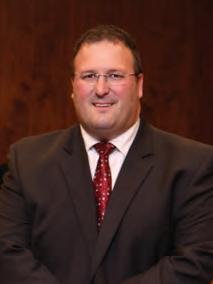
Abbey says his career path was shaped by a lifelong respect for law enforcement and a desire to bridge the gap between investigative work and the courtroom, ensuring public safety and delivering justice. “Prosecution was the only area of law I was truly interested in,” he explains.
He credits retired Saline County Attorney Ellen Mitchell as a key mentor, noting her example taught him a prosecutor’s role is not about winning cases, but about upholding the integrity of the law, seeking the truth, and ensuring accountability.
“Witnessing her dedication and the impact she had on protecting her community set the standard for the kind of attorney I wanted to be,” said Abbey.
Throughout his career, Abbey has served in a variety of prosecutorial roles, including Assistant County Attorney and County Attorney in Sherman County, Assistant County Attorney in Saline and Dickinson counties, Assistant City Prosecutor for Salina, and since 2023, Dickinson County Attorney and City Prosecutor for Solomon.
His caseload has been remarkably diverse. Abbey says he has handled “nearly every type of case a community can face,” ranging from loose
chickens in Solomon to sexual assaults, drug distribution, and homicide cases. Today, much of his work focuses on high-level person felonies and drug distribution. He finds the greatest satisfaction in cases that bring closure to victims and their families and in dismantling major drug networks to protect Kansas neighborhoods.
When asked what advice he would offer aspiring prosecutors, Abbey acknowledges that the profession may not offer the financial rewards of private practice, but he believes the work provides something even more valuable. He says success comes from seeking justice, protecting victims, and serving the community, adding that the greatest reward is knowing you’ve made your community a safer place at the end of each day.
Abbey has also remained active in the legal profession beyond the courtroom. He served four years on the Saline/Ottawa County Bar Association, holding every officer position from Treasurer to President, and participated in a four-year working group that helped revise Kansas DUI laws. He believes professional associations play a vital role by building relationships with peers to build a network for joint success, creating mentorship opportunities, and encouraging collaboration across jurisdictions. He says KCDAA equips prosecutors with Kansasspecific training and legislative changes, while providing invaluable access to experienced colleagues who are willing to share their knowledge with newer attorneys.
Outside of work, Abbey enjoys spending time with his family and exploring the outdoors. He
and his wife, Brooke, a paralegal in the Dickinson County Attorney’s Office, have two children in high school and a golden retriever named Louie. Whether camping, boating, fishing, exploring national parks, or visiting historic landmarks in the Colorado mountains, family time remains a priority.
For Abbey, public service has always been the driving force behind his career. His commitment to justice, dedication to supporting law enforcement, and passion for protecting Kansas communities continue to define his work as a prosecutor every day.
Kurt Benecke County Attorney, Cherokee County
For Cherokee County Attorney Kurt Benecke, the practice of law has always been rooted in a simple idea: stand up for victims and do right by your community every single day.
Benecke grew up in St. Louis, Missouri, and earned bachelor’s degrees in Philosophy and Anthropology, along with a minor in Political Science, from the University of Missouri–Columbia before receiving his Juris Doctor from Washington University School of Law in St. Louis. His undergraduate studies sparked an interest in questions of justice and how people live together, making law school a natural next step for a career. After spending time in a prosecutor’s office, he knew he had found his calling.

most meaningful involves child victims. He believes his greatest impact has come from advocating for children who cannot advocate for themselves and helping ensure dangerous offenders are held accountable so victims and their families can once again feel safe.
When offering advice to aspiring prosecutors, Benecke emphasizes the importance of finding a strong mentor, continually learning, and focusing on justice rather than simply winning cases. He encourages prosecutors to remember that every file represents real people and that treating victims, witnesses, and the community with respect is essential to the profession.
Benecke credits much of his professional development to the mentors who shaped his early career. He cites Dean Dankelson, then Prosecuting Attorney for Jasper County, Missouri, as a major influence, along with Theresa Kenney, now Jasper County Prosecuting Attorney, and Kimberly Fisher, now Jasper County Drug Court Commissioner, who demonstrated the importance of professionalism and public service.
His prosecutorial career began as an Assistant Prosecuting Attorney in Jasper County, Missouri, from 2010 to 2015. In 2018, he joined the Cherokee County Attorney’s Office as an Assistant County Attorney before being elected County Attorney in 2022.
Serving in a smaller county means Benecke handles many of the jurisdiction’s most serious criminal cases, including murders and off-grid sex crimes. Much of his current caseload centers on Jessica’s Law cases, and he says the work he finds
Benecke is an active participant in the Kansas County and District Attorneys Association (KCDAA), attending its conferences each year. He values not only the continuing legal education but also the opportunity to collaborate with prosecutors from across Kansas, exchange ideas, and build professional relationships that become invaluable when difficult cases arise. As the reason all prosecutors should be members of KCDAA, Benecke said, “Because it makes every one of us better at protecting our communities. KCDAA provides the training, resources, and collegial network that a prosecutor — especially in a smaller office — simply can’t get anywhere else.”
Outside the courtroom, Benecke enjoys coaching youth sports and staying involved in his children’s activities. He and his wife, Ashley, are the proud parents of Nora and Nolan. He says he is grateful for the opportunity to serve the citizens of Cherokee County and to work alongside dedicated prosecutors throughout Kansas.

An End to the Jail Credit Ping-Pong Battle and How You Can Prevent Another
By Olivia R. Higdon, Assistant Attorney General, Economic Crimes Unit
In the 2026 legislative session, the Kansas Legislature amended K.S.A. 21-6615 to address how jail credit is to be calculated in cases involving consecutive sentences. The statute has been the ball in a ping-pong battle of the branches, leaving practitioners with metaphorical cricks in their necks.
Background: The Ping-Pong Battle of Jail Credit
Back in 1978, when the Kansas Supreme Court held, in Campbell v. State, that defendants were not entitled to receive credit for time “spent in jail upon other, distinct, and wholly unrelated charges.”1 The Court elaborated, “a defendant should be given credit by the sentencing court for each day spent in jail solely on account of the pending charge.”2 Plainly stated, defendants who received an allowance for time spent in jail in Case 1 were not entitled to the same allowance in Case 2. The Court was then operating under a much earlier version of the jail credit statute, K.S.A. 1977 Supp. 21-4614, which required courts to compute the sentence-begins date with “an allowance for the time which the defendant has spent in jail pending the disposition of the defendant’s case.”3
In 2023, the jail credit statute was substantially the same, now requiring an “allowance for the time which the defendant has spent incarcerated pending
Footnotes
1. Campbell v. State, 223 Kan. 528, 528, 575 P.2d 524 (1978). Campbell had claimed he was entitled to jail credit for time spent in the Barton County jail in his Reno County case, as he had outstanding Reno County warrant while he was in custody. Campbell, 223 Kan. at 528-29. The Court highlighted that Campbell had received credit for his time spent in custody at sentencing in his Barton County case, and therefore was not entitled to the same credit in his Reno County case. Campbell, 223 Kan. at 531.
2. Campbell, 223 Kan. at 530-31.
3. K.S.A. 1977 Supp. 21-4614; Campbell, 223 Kan. at 529.
4. 317 Kan. 652, 537 P.3d 845 (2023).
5. Hopkins, 317 Kan. at 656-57.
6. Hopkins, 317 Kan. at 656 (quoting K.S.A. 2022 Supp. 21-6615(a)).
the disposition of the defendant’s case.” Yet, that year the Kansas Supreme Court started the match and came down with State v. Hopkins, 4 overruling Campbell and erasing 45 years of precedent. In Hopkins, the Court took issue with the word “solely” and found the Campbell rule was “unworkable” and not a “proper plain language reading of the statutory language” contained within K.S.A. 21-6615.5 Instead, the Court explained, the statutory language should be interpreted to “straightforwardly [give] jail credit for every day the defendant spent incarcerated during the ‘disposition of the defendant’s case.’”6
Campbell was not the only case overruled by this decision; Hopkins overruled other cases that followed Campbell 7 It is important to note, the Court did not include State v. Lofton8 and State v. Davis9 in the cases overruled by Hopkins: both cases upheld the rule that jail credit cannot be duplicated in consecutive sentences.10 Post-Hopkins, the lower courts were left with this new interpretation of K.S.A. 21-6615 without clear guidance on whether this interpretation applied in more complex cases such as those with consecutive sentences, which the Court of Appeals highlighted in State v. Feikert 11
The Kansas Legislature responded to the Hopkins decision in the 2024 legislative session by adding a subsection to K.S.A. 21-6615: “When
8. State v. Lofton, 272 Kan. 216, 32 P.3d 711 (2001).
9. State v. Davis, 312 Kan. 259, 474 P.3d 722 (2020).
10. Lofton, 272 Kan. at 218 (“Nothing in Jenkins supports defendant›s contention that he is entitled to jail time credit on his aggregate sentence for twice the number of days he was actually incarcerated.”); Davis, 312 Kan. at 288 (“[U]nder the rule in Lofton and Molina no jail credit may be awarded against the sentence in this case because it has already been “used up” in the prior case.”); see also, State v. Romey, 321 Kan. 400, 423-26, 580 P.3d 1 (2025) (Standridge, J., dissenting).
11. See State v. Feikert, 64 Kan. App. 2d 503, 506, 553 P.3d 344 (2024) (“Beyond this statement, the Supreme Court’s decision in Hopkins provides scant guidance as to how this simplified rule should be applied in more complicated instances, like when a defendant is sentenced in multiple cases.”).
7. Hopkins, 317 Kan. at 652 (listing State v. Smith, 309 Kan. 977, 981, 441 P.3d 1041 (2019) and State v. Harper, 275 Kan. 888, 890, 69 P.3d 1105 (2003) alongside Campbell).
computing the defendant’s sentence, the following shall not be considered time spent incarcerated pending disposition of the defendant’s case: (A) Any time awarded as credit in another case when consecutive sentences are imposed on a defendant; or (B) any time spent incarcerated in another jurisdiction if no hold has been issued in such jurisdiction for the case being sentenced.”12 That change went into effect May 23, 2024, to quickly effectuate the change and provide the guidance that was not in the Hopkins decision. The Court of Appeals in State v. Mitchell held this 2024 amendment should not be applied retroactively to defendants sentenced after the amendment went into effect, if their crimes were committed prior to May 23, 2024.13
In 2025, the Supreme Court issued State v. Ervin, sending the ball back over the net.14 Ervin extended Hopkins to consecutive sentencing cases and declined to address the retroactivity of the 2024 amendment of K.S.A. 21-6615.15 The Court addressed the ruling by Feikert panel, stating that it was the rule in Campbell, Lofton, and Davis that caused confusion at sentencing in complex cases, not Hopkins 16 The Court ultimately held that K.S.A. 21-6615, prior to the 2024 amendment, “required the district judge to award one day of credit for each day that Ervin was incarcerated, pending disposition of this case, regardless of whether he received an allowance for some or all that time against a sentence in another case.”17 With those words, the Court created a double credit rule for consecutive sentences—if a defendant was in jail for two cases, in each case an allowance for that time would be awarded. However, this Ervin
12. K.S.A. 2024 Supp. 21-6615(a)(2).
13. State v. Mitchell, 66 Kan. App. 2d 196, 203, 579 P.3d 970 (2025), rev. granted __ Kan. __ (Feb. 24, 2026); see generally, K.S.A. 2024 Supp. 21-6615.
14. 320 Kan. 287, 566 P.3d 481 (2025).
15. Ervin, 320 Kan. at 311 (the Court declined to address the retroactivity issue because as the State did not ask the Court to apply the 2024 amendments retroactively).
16. Ervin, 320 Kan. at 309, 311.
17. Ervin, 320 Kan. at 312 (emphasis added).
18. See Ervin, 320 Kan. at 311.
19. K.S.A. 2026 Supp. 21-6615(d)(1) (emphasis added).
20. K.S.A. 2026 Supp. 21-6615(d)(2) (“The provisions of this subsection shall apply to: (A) All sentences, whether
rule would not apply to crimes committed on or after May 23, 2024.18
The result at the end of this back and forth? For crimes committed before May 23, 2024, defendants received jail credit for the same time spent in custody in multiple cases, despite being sentenced consecutively. For crimes committed after May 23, 2024, K.S.A. 2024 Supp. 2215 would apply, and there is no double credit for consecutive sentences.
The Changes: The Legislature’s Latest Return Shot
In 2026, the legislature added another subsection to K.S.A. 21-6615: subsection (d), which sought to clarify what was meant by the 2024 amendment. In short, K.S.A. 2026 Supp. 21-6615(d) ends the Ervin double credit rule for all cases by unambiguously commanding that “days spent in custody that are attributable to more than one case shall be credited only once against the aggregated consecutive term.”19 It also retroactively applied the amendment to all criminal cases, no matter the posture of the case,20 and in no uncertain terms superseded the Hopkins and Ervin decisions.21 At sentencing, you as a prosecutor no longer have to worry about double credit. And, for those dealing with jail credit issues in post-conviction cases, these amendments apply to your cases too.
When you go to calculate jail credit, defendants are entitled to receive credit for each day they spend in custody once. If they receive credit for time spent in custody in another case and your case is ordered to be served consecutively, you do not need to factor those days into your calculation of jail credit, even if your case was also pending
pronounced before, on or after July 1, 2026, and to all computations of jail credit by the department of corrects and the courts; and (B) any case posture, including, but not limited to, direct appeals, probation revocation proceedings, motions to correct illegal sentence, habeas corpus actions and actions under K.S.A. 60-1507, and amendments thereto, pending on or filed after July 1, 2026.”).
21. K.S.A. 2026 Supp. 21-6615(d)(3) (“Any judicial interpretations regarding application of jail time credit to consecutive sentences in conflict with or inconsistent with this section and the amendments to this section by this act are superseded to the extent of such conflict or inconsistency.”).
during that time. We are back to the Campbell rule, just with different language.
Our Own Match: What Defense Counsel is Likely to Argue and How to Counter
We all should expect challenges to the application of these amendments to offenders who committed their crimes between October 20, 2023, when Hopkins was decided, and May 23, 2024, when the legislature’s first amendment to jail credit went into effect. Defense counsel will likely argue that the application of the retroactive language of K.S.A. 2026 Supp. 21-6615(d)(2) violates both the Due Process Clause and the Ex Post Facto Clause of the United States Constitution, on the basis that “the fundamental rule for sentencing is that the person convicted of a crime is sentenced in accordance with the sentencing provisions in effect at the time the crime is committed.”22
Basically, defense counsel needs Hopkins to stand for the change in the law that “matters,” such that it would be unfair to not give defendants double credit if their crimes were committed while the state was under the Hopkins framework. The key here, for prosecutors, is to argue that it was Ervin that created the double credit rule for cases involving consecutive sentences, not Hopkins. The core of this argument, simplified, is Hopkins pointed out the “plain language” of the statute and applied it in the context of concurrent sentences, but it was Ervin that created the specific rule for how the statutory language applied in cases involving consecutive sentences. To fully flush this argument out, I point you to the dissent in State v. Romey. 23 To anticipate defense’s argument, look to the dicta in the plurality decision, which opined that Hopkins was the change in law that governed in consecutive sentence cases, despite declining to take up the jail
22. State v. Overton, 279 Kan. 547, 561, 112 P.3d 547 (2005).
23. 321 Kan. 400, 423-26, 580 P.3d 1 (2025) (Standridge, J., dissenting).
24. Romey, 321 Kan. at 419-21. For those wondering how this was a plurality decision, Justice Wilson did not participate and Justice Stegall concurred relating to the majority’s exercise of discretion not to address the jail credit issue, but not in their opinion that Hopkins marked the change in the law. Romey, 321 Kan. at 422.
credit issue.24
Conclusion: What We as Prosecutors Should be Doing in this New Era
I know you have heard this before, but you must do your homework. You must find out if a defendant has multiple cases pending in different counties or different jurisdictions. That knowledge will be key at sentencing and prevent defense counsel from misdirecting the court.
When you get to sentencing, how you navigate jail credit will depend on where in the multi-case sentencing line you stand. If you sentence your case first, give the defendant credit for time spent in custody prior to sentencing. This creates the paper trail for the prosecutors after you to be able to determine what credit must be awarded in their cases.
If your case is not first in line, cross-reference journal entries in other cases to confirm that defendants are given credit once. By doing the work up front, you will be able to confidently drop the receipts (case numbers) and state that the defendant is not entitled to credit in your case.
Most importantly, do not be afraid to send an email or pick up the phone and call your fellow prosecutors. Talk about jail credit early and communicate what your results are at sentencing. If you need help preparing to argue this issue, call us at the Attorney General’s office! We are happy to help, both in the Criminal Division and the Solicitor General’s office. Together, we can avoid another ping-pong battle. Let’s not put the paddle back in the Court’s hand.
About the Author
Olivia R. Higdon is an Assistant Attorney General in the Economic Crimes Unit of the Kansas Attorney General’s Office and an adjunct professor at Washburn University, where she teaches undergraduate Mock Trial. She earned her J.D. from the Washburn University School of Law in 2025. She was published in Volume 18 of the Albany Government Law Review. Prior to joining the Attorney General’s office, she interned with the Shawnee County District Attorney’s Office and externed for the U.S. District Court for the District of Kansas. Olivia extends her gratitude to Jonas Andrulonis for his research support, and to Natalie Chalmers for her insightful guidance during the writing of this article.
Specialty Courts: Behavioral Health Courts
By Elizabeth L. Oliver, Attorney
This article is the third installment in a series examining specialty courts in Kansas. It explores Mental Health Courts, also known as Behavioral Health Courts, including their purpose, structure, and operation within the Kansas court system.
“About 2 million times each year, people with serious mental illness are booked into jails.”1 The criminal justice system intersects with mental illness often creating a revolving door of incarceration for individuals with a medical need. In 1997, Broward County, Florida started the first Mental Health Court in the United States.2 Today, there are at least 655 Mental Health Courts in the United States providing guidance, structure, and treatment to defendants suffering from mental illness.3 Throughout this article, Behavioral Health Court will be used in place of Mental Health Court. This article will define a Behavioral Health Court, discuss Behavioral Health Courts in Kansas, and describe implementing a Behavioral Health Court.
What is a Behavioral Health Court
Behavioral Health Court is a problem- solving court docket that incorporates judicial components, mental health professionals, and law enforcement partners to create individualized community-based treatment plans for qualified defendants with mental illness.
According to the article, Improving Responses to People with Mental Illnesses: The Essential Elements of a Mental Health Court, there are 10 essential elements of a Behavioral Health Court that provide a framework for effective court design and implementation.4 In the article, these are broken down from beginning to end, starting with a planning
Footnotes
1. Nami. (n.d.). Mental Health by the numbers | Nami. Mental Health by the Numbers. https://www.nami.org/mentalhealth-by-the-numbers/
2. Nolan, R. (2015, July 30). Broward gets nation’s first mental health court. South Florida Sun Sentinel. Retrieved from https://www.sun-sentinel.com/2015/07/30/ broward-gets-nations-first-mental-health-court/.
3. Treatment courts across US states/territories (2023)
and administration committee.
The planning and administration committee is responsible for designing the behavioral health court by establishing the policies for “determining eligibility criteria, monitoring mechanisms, and other court processes.” The planning and administration committee should reflect the multi-disciplinary focus of the court and include representatives from law enforcement, judges, prosecutors, defense counsel, court administrators, pretrial services staff, corrections officials, mental health professionals, substance abuse treatment professionals, and community members: including family members of defendants and crime victims.5
The second element is establishing the target population. This is an important element because there is a high probability that a person could qualify for both drug court and behavioral health court, and you want to place the person in the program best situated to handle the defendant’s needs. The article suggests that eligibility be based on clear clinical definitions of mental illness and that the mental illness be related to the “current offenses” that a defendant is charged with.6 Mental health diagnoses for participants could include major depressive order, ADD/Hyperactivity, schizoaffective disorder, kleptomania- impulse control, schizophrenia, bi-polar disorder, and depressive disorders.
In Douglas County, Kansas, the target population is defendants with a severe mental illness, as determined through State-approved criteria. Defendants who have a severe mental illness with a co-occurring substance use disorder may be eligible. Defendants with misdemeanor, nonviolent charges and defendants charged with a felony and/or violent charges are considered on a case-by-case basis. Individuals charged with murder and sex crimes are
Treatment Courts Across US States/Territories (2023). https://ntcrc.org/wpcontent/uploads/2024/06/2023_NTCRC_TreatmentCourt_Count_Table.pdf
4. Thompson, M., Osher, F., & Tomasini-Joshi, D. (2008). Improving responses to people with mental illnesses: The essential elements of a mental health court. New York. 5. Id.
6. Id. At 2
not eligible for participation.
The third element is identifying participants early and accepting referrals from a variety of people. In Douglas County, Kansas, participants are identified through referrals from prosecutors, defense attorneys, jail staff and treatment providers, police and probation officers, and Municipal and District Court Judges.
The fourth element is terms of participation. The participant needs to know the length of the program, the supervision conditions, and the impact of the program. Most terms of participation will include “adherence to a treatment plan that will be developed after engagement with the mental health court program, and defendants should be made aware of the consequences of noncompliance with this plan.”7 There is an emphasis on the benefit to the defendant for participating. This benefit can be not having charges filed in a pre-conviction behavioral health court to having probation terminated early and even having the charges expunged on completion of the program in a post-conviction behavioral health court.
The fifth element is ensuring the defendant is making an informed decision to participate in the program, and the defendant’s participation is voluntary.8 The defense attorney plays a vital role in ensuring the defendant is informed and making a voluntary decision.
The sixth element is treatment support and providers.9 It is essential that a Behavioral Health Court have a good working relationship with treatment support and providers. This ensures that defendants’ needs are being met, and that defendants are being given the tools to succeed in the program. Treatment support and providers also play a key role in preparing the defendant to transition out of the program and remain successful.10
The seventh element is confidentiality. This is crucial in ensuring that the defendant’s “confidentiality rights as mental health consumers and their constitutional rights as defendants” are protected.11 The information shared should be limited
7. Id. At 4
8. Id. At 5
9. Id. At 6
10. Id. At 6
11. Id. At 7
12. Id. At 8
to what is needed to make a decision and should be discussed in closed staff meetings.
The eighth element is the Court team. This team consists of a judge, prosecutor, defense attorney, a treatment provider or case manager, and probation officer.12
The ninth element is monitoring adherence to Court requirements. It is important that the Court have “up-to-date information on whether participants are taking medications, attending treatment sessions, abstaining from drugs and alcohol, and adhering to other supervision conditions.”13 Relapses are expected, and the first response should be to determine if the treatment plan needs to be modified. If issues persist, then sanctions may be necessary.14
Behavioral health courts must recognize both good and bad behavior. Incentives should be used to “recognize good behavior and to encourage recovery through further behavior modification.”15 These incentives can be as simple as individual praise to gift cards, or even a decrease in court appearances.
The tenth element is sustainability. The planning and administration team must have identified a long-term funding source to maintain the Behavioral Health Court.16
Behavioral Health Court in Kansas
There are three Behavioral Health Courts in Kansas. They are located in Wyandotte County, Douglas County, and Johnson County. Douglas County was the first county in Kansas to develop a Behavioral Health Court. It started with the criminal justice coordinating council.17 The criminal justice coordinating council was established through a resolution by the Board of County Commissioners on March 9, 2016. This resolution provided the formation for the planning committee that developed several programs in Douglas County including the Behavioral Health Court, Pretrial Services, House Arrest/Electronic Monitoring, Drug Court, and Enhance Diversion. The members included: the Chief Judge of the District Court, Douglas
13. Id. At 9
14. Id. At 9
15. Id.
16. Id. At 10
17. Oliver, Elizabeth. (2025, July 9). James Carpenter, Douglas County District Attorney’s office. personal.
County Sheriff, district attorney, city commissioner, criminal defense attorney, Lawrence Chief of Police, Lawrence Municipal Judge, Director of Douglas County Youth Services, Executive Director of Bert Nash Community Mental Health Center, Executive Director of DCCCA, community representatives, county administrator, Lawrence City Manager, Director of Douglas County Reentry, and a Court Services representative. The Douglas County Behavioral Health Court is funded by a county tax. The first Behavioral Health Court hearing was held in 2017.
On July 17, 2025, I observed the staffing and court proceedings at the Douglas County Behavioral Health Court. Judge Pokorny led the staffing before court and handled the difficult conversations amongst the parties, including defense counsel, the prosecutor, service providers, and probation. There was one participant whose options were running out, and the discussion revolved around whether the participant needed to be removed from the program.18 These closed staffing meetings take on a different life when Court is held, and all the participants are present in the Courtroom.
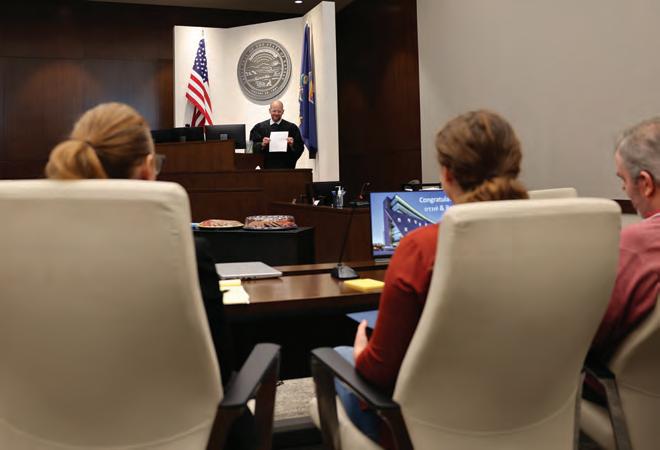
gift card.
In Douglas County, the all-star (the defendant who has been the most successful for the week) gets to go first. The participant on the verge of being removed remained in custody serving a sanction until the participant’s housing issue had been resolved. Judge Pokorny sits opposite the defense counsel table across from the participant and his/her attorney. Some participants are doing well while others reveal struggles. Judge Pokorny asked one participant what they had to share, and they revealed they were starting a new job. Judge Pokorny observed they didn’t seem seem happy about it, and the participant revealed why. This enables the treatment provider to be able to follow-up with the participant about this concern. Everyone was able to get candy or chips for coming to court, and those who were hitting milestones had the opportunity to spin the wheel for a
18. Douglas County staffing and court observation: July 17, 2025. (2025, July).
Each Behavioral Health Court is different. That became evident when I observed the Johnson County Behavioral Health Court on June 18, 2026. Judge Wonnell remains on the bench for part of the cases, and sits across from defense counsel and the participant for part of the cases. The difference is based on the phase that the participant is in. Other differences between the two courts include the number of all-stars, the requirement that people stay through the entire court process unless they are in a particular phase, and the number of defense counsel. Douglas County has three defense attorneys to ensure there are no conflicts of interest in the representation of individuals in Behavioral Health Court, and Johnson County has two defense attorneys. One of the more interesting things that happened during staffing was a provider mentioning how intimidating a participant found it to have to talk with the judge. Judge Wonnell followed up to learn what the participant liked to do, and then he developed a question around that topic that he could ask each individual participant in the courtroom so the participant could hopefully be more comfortable with the process.
One of the key components in both Douglas
19. Johnson County staffing and court observation: June 18, 2026. (2026, June).
Judge Robert Wonnell signing the expungement paperwork for one of the graduates in Johnson County Behavioral Court on June 18.
County and Johnson County is the judge. The compassion that is needed to accommodate and make sure each participant feels welcome and given the opportunity to succeed is on full display when you watch both Judge Wonnell and Judge Pokorny do staffing and court hearings. They utilize the conversations in staffing to have real conversations with the participants. On the day I observed Johnson County Behavioral Health Court, there was a sanction hearing and the participant stipulated to the sanction; there was a person considering applying for Behavioral Health Court who had the opportunity to observe the process; and there were two graduations. Each graduate in Johnson County is given the opportunity to make a special request, and one graduate wanted to race toy cars. Judge Wonnell brought out the small racetrack, and he raced his toy cars against the graduate. The graduate’s car won the first round, and they decided to do the best out of three. This is what success looks like in Johnson County Behavioral Health Court. It is putting in the work at treatment, at probation, and at Court, and in the end, if you are successful, you get your case expunged, and you get to race your toy car against the Judge’s car.
Implementing a Behavioral Health Court
The first thing to do in implementing a Behavioral Health Court is to form the planning and administrative team. One way to do that is to follow Douglas County’s format and pass a resolution establishing a committee. Once the committee is formed, each member should complete the “Developing a Mental Health Court: An Interdisciplinary Curriculum” at Interdisciplinary Curriculum - CSG Justice Center.20 It is a self- paced curriculum with 10 components that cover everything from understanding what Mental Health Courts are to Facilitating the Success of Participants. I completed the curriculum and found it to be helpful in presenting ideas and things to be aware of.
Next, talk to people who have a Behavioral Health Court. In my interview with Ms. Ferwalt and Ms. Olson with the Johnson County District
20. The Council of State Governments Justice Center. (n.d.). Interdisciplinary curriculum. Interdisciplinary Curriculum. https://csgjusticecenter.org/projects/mental-healthcourts/learning
Attorney’s office, they mentioned that their team did site visits of the Behavioral Health Courts in Wyandotte County District Court, Douglas County District Court, Bonneville County Mental Heaht Court in Idaho Falls, Idaho, and they attended a court in Minnesota by zoom.21 This is important for learning what to expect, and what you want in your court and what you don’t.
Finally, figure out how the court will be funded. While Douglas County funded their Behavioral Health Court through a county tax, Johnson County started with a grant and then found other funding sources.
Both Douglas County and Johnson County’s Behavioral Health Court consist of four phases. In Johnson County, there are four elements in each phase. They include court requirements, probation requirements, drug screens, and substance use disorder and behavioral health services.
In both counties, Phase 1 requires a minimum of 60 days. There are weekly meetings for court, probation, and mental health services. For a participant to progress to Phase 2 in Johnson County, they must complete an application and have a phase-up meeting. In Douglas County, they progress to Phase 2 when they take medications as prescribed, abstain from drugs and alcohol for fourteen consecutive days, and are sanction-free for two consecutive weeks.
Phase 2 requires a minimum of 120 days in Johnson County and is 60-90 days in Douglas County. In Johnson County, participants in phase 2 attend court every other week, meet with the probation officer as directed, submit to random urinalysis screenings (UAs) with the expectation that there may be several UAs in a week, meet with a case manager for mental health weekly, complete a treatment review, and develop multiple plans including plans for stable housing, stable employment, and a Personal Recovery Plan. To progress to phase 3 in Johnson County, they must complete an application and have a phase-up meeting. In Douglas County, they progress to phase 3 when they take medications as prescribed, abstain
21. Oliver, Elizabeth. (2026, September 24). Letitia Ferwalt, and Abby Olson, Johnson County District Attorney’s office. personal.
from drugs and alcohol, are sanction-free for 30 consecutive days, and complete five sessions of Decision Points Group when available.
Phase 3 requires a minimum of 90 days in Johnson County and is 90 to 120 days in Douglas County. In Johnson County, participants in phase 3 attend court monthly, meet with probation as directed, submit to random UAs, and meet with a mental health case manager as directed. While in Douglas County, participants in phase 3 attend court monthly, meet with probation monthly, comply with mental health treatment, and begin developing plans to pay restitution, court fees, or community service, and prepare a proposal for their giveback project. The giveback project in Douglas County is part of the requirements for a participant to graduate, and it involves the participant coming up with a community service project where they give back to the community. In the past, a participant donated a children’s book she wrote to the program, and others volunteered at food pantries.
Participants will move to Phase 4 in Johnson County upon completing an application to phase up and have fulfilled the requirements of Phase 3. To move up to Phase 4 in Douglas County, a participant must take medications as prescribed, abstain from drugs and alcohol for 60 consecutive days, and be sanction-free for 30 consecutive days.
Phase 4 requires a minimum of 30 days in Johnson County and is 30 to 90 days in Douglas County.22 Participants in Phase 4 in Johnson County attend court monthly, meet with probation as directed,
22. Phases of the Douglas County Behavioral Health Court. https://www.dgcoks.gov/sites/default/files/media/depts/ district-court/pdf/behavioral-health-court-phase-model. pdf. Retrieved June 29, 2026.
23. Douglas County Behavioral Health Court, Behavioral Health Court Policies and Procedures (June 2018). Retrieved from https://www.dgcoks.gov/sites/default/files/ media/depts/district-court/pdf/behavioral-health-courtprogram-manual.pdf
Additional resources:
24. Council of State Governments. (2008). Mental health courts: A primer for policymakers and practitioners. Washington, DC.
25. Criminal Justice/Mental Health Consensus Project. (2009). Mental health courts: A guide to research informed policy and practice. New York.
26. Frailing, K. (2010). How mental health courts function:
must have all court obligations including restitution resolved, meet with mental health treatment as directed, utilize a budget, successfully complete all treatment programs, and create a relapse prevention plan.
To graduate from Behavioral Health Court, a participant in Johnson County must fill out an application upon completing the requirements for graduation. Upon graduating from Behavioral Health Court in Johnson County, the defendant’s case is expunged. While in Douglas County, a participant is eligible to graduate from the program when they have completed their giveback project, maintained sobriety for 90 consecutive days, and are sanction-free for 30 days.23
These phases allow the Court, mental health professionals, defense attorneys, prosecutors, law enforcement, and probation officers the ability to assist defendants in maintaining their sobriety and success in Behavioral Health Court.
Conclusion
As the criminal justice system continues to collide with the mental health system, three counties in Kansas have answered the problem by developing Behavioral Health Courts. Each Behavioral Health Court operates within a framework of policies with stakeholders who assist in establishing the court and maintaining the court. Defendants are given the tools to be successful from help with developing a budget, maintaining housing, finding employment, maintaining treatment, and sobriety.
Outcomes and observations. International Journal of Law and Psychiatry, 33(4), 207-213.
27. National Center for State Courts. (2010). Mental health court performance measures: Implementation & user’s guide. Williamsburg, VA.
28. Redlich, A. D., & Han, W. (2014). Examining the links between therapeutic jurisprudence and mental health court completion. Law and Human Behavior, 38(2), 109118.
29. Redlich, A. D., Steadman, H. J., Monahan, J., Robbins, P. C., & Petrila, J. (2006). Patterns of practice in mental health courts: A national survey. Law and Human Behavior, 30(3), 347-362.
30. Jalain, C. I., Lucas, P. A., & Higgins, G. E. (2024). Assessing the Effectiveness of Mental Health Courts in Reducing Recidivism: A Systematic Review with Metaanalysis. Justice Evaluation Journal, 7(2), 212–230.
Prosecuting Drug Distribution Resulting in Great Bodily Harm or Death
By Thomas R. Stanton, Reno County District Attorney
When I began my career as a drug prosecutor in 1991 in Saline County, law enforcement and prosecutors were dealing with three main drugs - marijuana, powder cocaine, and crack cocaine. Different segments of society seemed to prefer one drug over another, and we did not deal with overdose deaths. There certainly may have been other drugs being sold and used in the metropolitan areas, but drug use in central Kansas was limited to those drugs.
In about 1994, I saw my first case of methamphetamine use. The first methamphetamine came to our community from the West Coast biker gangs. The methods used to manufacture methamphetamine resulted in a product that smelled like cat urine to the extent that an experienced law enforcement officer would be allowed to testify to the identity of the methamphetamine based solely on its odor in a preliminary hearing. Methamphetamine at that time was used by snorting through straws or rolled up dollar bills, and only the most hard-core addicts used hypodermic needles.
Slowly but surely, methamphetamine became the most abused drug in my community. The West Coast meth distributors gave way to Mexican cartels and powder methamphetamine gave way to crystal meth. In 1997, we had our first anhydrous methamphetamine labs in Saline County, and I continued the fight against manufacture, distribution, and abuse of controlled substances as I transitioned into the position of Deputy District Attorney with Reno County. Even at that point, I was not seeing opioid distribution or abuse, but was fighting the scourge of methamphetamine. In June 2005, pseudoephedrine products were required to be sold from behind the counter in Kansas, which led to a sharp decrease in methamphetamine labs. It was at that
point that we began to see the use and distribution of pharmaceutical opioids such as hydrocodone, oxycodone, hydromorphone, and oxymorphone. Metropolitan areas began seeing a resurgence of heroin use. With the introduction of these drugs into the community, people suffering from a substance abuse disorder began to experience overdoses that affected their health, or in many cases, resulted in their death.
The Kansas Legislature Steps In

In 2013, the Kansas legislature passed a bill creating the crime of distribution of a controlled substance causing great bodily harm or death now found in K.S.A. 21-5430. The legislation contains five subsections. Subsection (a) creates the crime of distribution of a controlled substance causing great bodily harm defined as “distributing a controlled substance in violation of K.S.A. 21-5705, and amendments thereto, when great bodily harm results from the use of such controlled substance.” Subsection (b) creates the crime of distribution of a controlled substance causing death defined as “distributing a controlled substance in violation of K.S.A. 21-5705, and amendments thereto, when death results from the use of such controlled substance.” Subsection (c) categorizes the crime of distribution of a controlled substance causing great bodily harm as a level 5, person felony, and distribution of a controlled substance causing death as a level 1, person felony. Subsection (e) of the statute defines the terms “controlled substance,” “distribute,” and “use,” primarily relating those terms back to the definitions found in K.S.A. 21-5701. One of the main issues always present in a prosecution under K.S.A. 21-5430 is the fact that in almost every situation, the distribution occurs to a person who fully intends
to use the controlled substance to fuel his or her substance abuse disorder. In many other kinds of prosecutions, a defendant can argue that some action taken by the victim was an intervening factor relieving the defendant of criminal responsibility. However, K.S.A. 21-5430(d) makes that defense inapplicable in a case where the use of the drug is preceded by a distribution crime. The section states, “It shall not be a defense that the user contributed to the user’s own great bodily harm or death by using the controlled substance or consenting to the administration of the controlled substance by another.”
This proscription of the use of the intervening cause defense is also found in the jury instruction for this crime at P.I.K. Crim. 4th 54.201, so prosecutors are assured that the jurors will be instructed not to consider the victim’s actions of using the controlled substance in making their decision in the case. However, it would be foolish on the part of the prosecutors to assume that the instruction would remove the attitudes that some jurors may have regarding prosecution of these cases. While there is a greater understanding today of substance abuse than perhaps there was 10 years ago, we remain in a society where many citizens believe people are responsible for their own actions, including a belief that persons with substance abuse disorders simply choose to use drugs. Overcoming this bias takes more than a simple instruction. If I were to ask a jury 10 years ago how many of them had drug use in their families, I might get two or three responses. In 2026, the response might be half the jury because so many of those serving as jurors have now had personal experience with someone close to them having dealt with substance abuse issues or, in some cases, having dealt with overdose deaths. It is important to ask appropriate questions of your jurors to allow you to educate your jury panel on substance abuse disorders and the trauma that results from overdose incidents.
Culpable Mental State
The court must be able to determine the culpable
Footnotes
1. (See P.I.K. Crim. 4th 54.201 – Notes on Use.)
2. (See P.I.K. Crim. 4th 52.300.)
mental state for this crime.1 K.S.A. 21-5430 does not specify a particular required mental state in the language of the statute, that is, the terms intentional, knowingly, and recklessly do not appear in that statute. However, the State in filing a complaint is required to include a culpable mental state.2
There are essentially two prongs of this crime. The first prong is the crime of distribution of a controlled substance, which is referenced in K.S.A. 21-5430 as being identical to the crime identified in K.S.A. 21-5705. That statute simply reads “It shall be unlawful for any person to distribute or possess with the intent to distribute any of the following controlled substances or controlled substance analogs thereof:” followed by a series of controlled substances which are unlawful to use or possess in the state of Kansas. Again, no culpable mental state is clearly defined in that statute. However, in State v. Cartmell, No. 118,787, 435 P.3d 1185, 2019 WL 1213236 (Unpublished) (2019), the Kansas Court of Appeals found that the proper culpable mental state for distribution of a controlled substance is that the crime was committed intentionally, and I am unaware of any other Kansas appellate case that has ruled otherwise.
The second prong of the crime of distribution of a controlled substance causing great bodily harm or death is simply that the use of the drug by the victim resulted in great bodily harm or death. Focusing on the crime of distribution of a controlled substance causing death, what culpable mental state should be applied to the fact that someone died due to the initial crime of distribution of controlled substance being committed? There are no Kansas appellate cases addressing this issue. Therefore, we should look outside of Kansas for guidance on this issue. Pennsylvania has a statute very similar to the Kansas statute. In Commonwealth v. Carr, 227 A.3d 11 (Penn., 2020), the appellate court found that the first prong, distribution of a controlled substance, required an intentional culpable mental state, while the second prong, resulting in death, required only a reckless culpable mental state.3
In determining the culpable mental state for the
3. See, also, State v. Thomas, 464 Md. 133, 211 A.3d 274 (2019)
second prong of the crime, it is also important to look at federal law. The federal courts have found that the act of distribution of a controlled substances carries an intentional and knowing mens rea, but that the “resulting in death” element is a strict liability element requiring no specific mens rea.4
The Moya Court ruled that “As multiple courts have recognized, ‘Where serious bodily injury or death results from the distribution of drugs, Congress has elected to enhance the defendant’s sentence regardless of whether the defendant knew or should have known the death would result.’”5 As indicated above, K.S.A. 21-5430 was first enacted in 2013.6 The legislative history shows that the Kansas statute was based on the federal statute. The testimony of the Kansas Attorney General’s office specifically referenced the federal statute and its penalties in its testimony before the legislature. Therefore, it would follow that the second prong of the Kansas statute would be subject to a strict liability standard. It should also be noted that a defendant is not required to know the exact type of controlled substance being distributed to be held liable under the statute. The State must prove that the defendant had knowledge of the nature of the controlled substance – meaning that the defendant either knew the identity of the substance or knew the substance was controlled.7 The State is not required to show that the defendant knew the exact substance being sold. Thus, the defendant selling what appears to be oxycodone pills laced with fentanyl may not rely on a defense suggesting he was only trying to distribute oxycodone and was unaware the drugs contained fentanyl. The fact that he knew he was distributing a controlled substance is sufficient. Other states and the federal courts have taken the same position.
Trial Issues
Given that one of the major obstacles to get past in a prosecution for distribution of a controlled substance causing death is a juror’s subjective
4. United States v. Moya, 5 F.4th 1168, 1181 (10th Cir.), cert. denied, 211 L. Ed. 2d 205, 142 S. Ct. 385 (2021)
5. Citing United States v. Jeffries, 958 F.3d 517, 522–23 (6th Cir., 2020). (quoting United States v. Robinson, 167 F.3d 824, 830 (3d Cir. 1999)
6. Kan. Sess. Laws Ch. 20, § 1 (2013)
belief that one is solely responsible for one’s own decisions, jurors should be questioned during Voir Dire regarding their ability to follow the instruction that the victim’s use of the drug is not to be considered in jury deliberations. It also may be helpful to file a motion in limine prior to trial requesting that the court bar any argument by the defense that would suggest jury nullification on this issue.
The standard at trial that the State must be able to show that “but for” the sale of the controlled substance and the victim’s subsequent use of that drug, the victim would not have died.8 In other words, it must be shown that the drug sold by the accused was the proximate cause of the victim’s death. Other drugs may be present in the victim’s system as long as the coroner or other medical expert can testify that the victim would not have died, and that the level of the drug that caused the death was, in and of itself, sufficient to cause death.
Investigative Issues
The largest obstacle in the prosecution of cases under K.S.A. 21-5430 is the historical manner in which drug overdoses were viewed. I know of no cases in which prosecutors attempted to charge a drug dealer with homicide under either a felony murder theory or under a reckless involuntary manslaughter theory of prosecution. This is largely due to the fact that law enforcement traditionally has not investigated an overdose as a crime. In most overdose deaths, the reaction of law enforcement has been a disconsolate admission that the victim was likely to face great bodily harm or death if they continued to use dangerous controlled substances. Officers generally did not look at a scene where an overdose death had taken place as a crime scene. Because of that, there were very few investigations which would have provided sufficient evidence for a prosecutor to go forward with charges.
The prosecution of cases under K.S.A. 21-5430
7. State v. Rizal, 310 Kan. 199, 208, 445 P.3d 734 (2019) (citing State v. Keel, 302 Kan. 560, Syl ¶ 1, 357 P.3d 251 [2015]; State v. Washington, 244 Kan. 652, 654, 772 P.2d 768 [1989]; State v. Faulkner, 220 Kan. 153, 156, 551 P.2d 1247 [1976])
8. Burrage v. United States, 571 U.S. 204, 134 S.Ct. 881, 187 L.Ed.2d 715 (2014)
requires a culture change among law enforcement officers and prosecutors. It requires a more thorough understanding of substance abuse disorders and requires us to view overdose death victims as we would any homicide victim. Every overdose death should be investigated by law enforcement in the same manner as they would investigate any homicide. The crime scene should be preserved while a search warrant is obtained for the premises in which the death occurred. Photographs and video should be taken, and any drug paraphernalia, drugs, and electronic devices capable of setting up a drug deal should be seized. Preservation orders should be submitted and search warrants obtained for cellular telephones and any seized electronic devices for social media contacts that may establish the identity of the person or persons responsible for distributing the substance which was ultimately used by the victim, and which caused the victim’s death. Applying for and receiving an inquisition pursuant to K.S.A. 22-3301 will aid in the attempt by law enforcement to obtain records relevant to the case. The case must be worked to establish proof beyond a reasonable doubt that the person to be charged is the person who distributed the lethal drugs to the victim. Autopsies should always be performed as toxicology reports are vital in the prosecution of these cases. These results should be reviewed before filing charges.
Polysubstance Cases
In many cases involving the distribution of controlled substances causing death, the autopsy and accompanying lab report will come back showing various levels of other controlled substances in the victim’s blood. This is known as a polysubstance case. In these cases, there will often be a determinative cause of death specifying a specific drug, usually fentanyl or methamphetamine, as the cause of death. Fentanyl cases are fairly straightforward because of the relatively low serum level of the drug that can be fatal. According to the United States Drug Enforcement Administration,
9. DEA Fentanyl Website
10. “How Much Fentanyl is Lethal?”, The Grove Estate Addiction Treatment Newsletter, July 21, 2025
11. “Fentanyl: toxic or therapeutic? Postmortem and ante-
2 mg of fentanyl is a potentially deadly dose.9 Two to three ng/ml of fentanyl in the blood can be lethal.10 One study has shown deadly doses ranging from about 5 ng/ml to 120 ng/ml or more.11 Thus, when the drug involved in the death of the victim is fentanyl, the issue of polysubstance abuse by the victim becomes easier to present to a jury. When the drug is methamphetamine or another opiate, providing the required proximate cause can become more difficult. The key to dealing with this issue is whether the coroner is willing to state that the drug identified as the cause of death in the case being prosecuted is the primary cause of death rather than just a contributing factor. See, Commonwealth v. Proctor, 156 A.3d 261 (Penn., 2017), wherein the defendant distributed heroin, and the victim died after using the drug. The conviction of the defendant was upheld despite other drugs being found in the victim’s system after testimony that the amount of heroin alone was sufficient to cause death.
Kansas Cases
There are no Kansas Appellate Court decisions interpreting K.S.A. 21-5430 at the time of the writing of this article. I did check with the Kansas Attorney General’s Office Appellate Division to inquire as to any cases that might be winding their way to the courts at this point. Natalie Chalmers advised there were at least two cases in the process of appeal. Those cases involve, among other issues, whether fentanyl is properly classified as an opiate drug and whether a prosecution under this statute can be sustained if the intent of the victim is to commit suicide. My initial reaction to the latter issue would be that K.S.A. 21-5430(d) stating that it is not a defense “that the user contributed to his own death by using a controlled substance or consenting to the administration of the controlled substance by another” answers the question of whether or not suicide is included. If the legislature had intended to exclude situations in which the person taking the drugs was committing suicide, they would have done so when the statute was promulgated.
mortem blood concentrations after transdermal fentanyl application.” National Library of Medicine, National Center for Biotechnology Information at the National Institution of Health, April 2012
Taking on the Unfamiliar: Lessons from Learning a New Area of Law
By Kendall Kaut, Assistant Johnson County District Attorney
Despite having never tried a CINC case, I have now argued my second CINC case to the Kansas Supreme Court. Some might joke that they could tell I’d never handled a CINC case when they watched the argument.
Many of us eventually face that reality though: How do I handle a case where I have zero experience or knowledge? Maybe you’re prosecuting in a jurisdiction where there hasn’t been a homicide in years and suddenly one happens at 3 a.m. on a Thursday. Or maybe your county attorney or district attorney has told you that it’s time to help with juvenile law or an appeal.
Each new experience is unique. The skills to prosecute in one area aren’t perfectly transferrable. But having to get up to speed quickly on CINC statutes taught me some important principles for delving into an unfamiliar area of the law.
1. Looking stupid prevents you from being stupid. I was more than willing to ask anyone who had handled a CINC case in our office if I was right about something that probably seemed obvious to them. But inquiring about what a random acronym meant, or how temporary proceedings worked, ensured I had a better understanding of the law. I knew it was better if someone thought I was dumb within the office, on that narrow question, than looking dumb in front of the Kansas Supreme Court.
2. Read the most recent appellate decisions in that area of law.
The appellate defender’s office is likely to raise many issues you’ll confront. Those issues are also likely to be the ones that defense attorneys hear about at conferences, or the ones that are brought
up by another person waiting for a case to be called. Those more recent opinions often delve through the statutes too. Plus, they explain a common fact pattern for your new area of law.
3. Recognize where your argument can be simplified, and if that’s fatal for one of your positions. All prosecutions have chains of arguments we may need to win. In my most recent CINC case, Justice Stegall and I discussed whether the appeal solely came down to whether a permanency plan survived transfer to another guardian. I had recognized that a way to simplify each side was to present a narrower question like Justice Stegall had, so I was prepared to argue why we wanted the question to be a bit more complex.
4. Give yourself optionality.
There’s a good chance that despite how long and hard you work, you will eventually confront that you’ve messed up or assumed you grasped that area of law better than you hoped. Then suddenly the defense brings up one statute or case that crushes your position. Instead of risking a single argument eviscerating your position, give yourself multiple outs. In the recent case discussed above, I pointed out that there were several ways to resolve the appeal with a favorable resolution for the state. Those included whether the permanency could transfer, whether parental rights were limited, or whether jurisdiction even existed. While we could still lose on all those arguments, I felt much better providing more viable options than limiting myself.
New roles are scary because they contain uncertainty. But the chance to take on a new task is what keeps the work interesting and us at our best.

ARTICLES WANTED!
ChildFirst® Expanded Forensic Interview Process
By Elizabeth L. Oliver, Attorney
As a board member of Kansas ChildFirst®, I had the opportunity to attend the advanced ChildFirst® Training with law enforcement, forensic interviewers, and DCF employees in June 2026 in Wichita. The training focused on equipping law enforcement and forensic interviewers with the ChildFirst® expanded forensic interview process. For complex cases with multiple perpetrators, multiple places involved, multiple acts of abuse, or victims with poly-victimization, the expanded forensic interview process provides the interviewer with the tools to put the child’s best interest first by breaking the interview up over several days. This article will define an expanded forensic interview and will provide a brief overview of when an expanded forensic interview may be used.
Defining the Expanded Forensic Interview
An expanded forensic interview is a single interview conducted over multiple sessions that are non-duplicative, flexible, and child-centered. These interviews may be referred to as multisession forensic interviews and extended forensic interviews. It is important to realize that an expanded forensic interview is not a follow-up interview. A follow-up interview is triggered when new evidence emerges, or a child recants his or her statement.
Expanded forensic interviews can be planned or they can be done on the fly. They can be planned when the interviewer knows that the child has special needs or the case is complex. On the fly expanded forensic interviews occur when it becomes clear that the child is having difficulties in the interview. This can be because the child has special needs or has a limited attention span.
It is possible that the first session could be spent building rapport, and that a second session be used to discuss the topic of concern, exploring the details, and closure. The forensic interviewer must adhere to the ChildFirst® Protocol. This means, when the other sessions begin, the forensic interviewer reminds the child of the interviewer’s name, the instructions, and that the session is being recorded. From this point, the forensic interviewer can pick
up where they left off in the protocol. The final session of the interview will conclude with closure statements.
A forensic interviewer should be able to articulate why a forensic interview is stopped and why an expanded forensic interview was used. The following are reasons that might be cited for stopping a forensic interview: it is late, the child is hungry, it is close to the child’s bedtime, there are too many topics remaining to cover, or the child is shutting down.
When is an Expanded Forensic Interview Used
Expanded forensic interviews are not common, but they are a tool that forensic interviewers can use when it is in the child’s best interest. They can be used with younger children with shorter attention spans, children with disabilities, children who have a speech impediment, children with multiple victimizations, children with high trauma responses, children with mental health issues, children who have been trafficked, children who are reluctant to talk, and any other situation where a child exhibits signs of needing a break.
Conclusion
In conclusion, it is important to recognize that an expanded forensic interview is not the same as a follow-up interview. When a child has special needs, there are multiple types of victimization, multiple perpetrators, or the child requires a break, an expanded forensic interview allows for a forensic interview to be stopped and picked back up at a different time or date. The best practice is to have all interviews conducted in the same week. This tool allows law enforcement and forensic interviewers to put the child’s best interest first in their investigation.
References
1. Farrell, R. Not another bite at the Apple: Individualizing the forensic interview process to meet the child’s needs - zero abuse project https://zeroabuseproject.org/notanother-bite-at-the-apple-individualizing-the-forensicinterview-process-to-meet-the-childs-needs/
Appellate Decision Summaries/Highlights
By Shawn Minihan, Assistant Johnson County District Attorney
In this ongoing series, we have included some notable cases from the appellate decision summaries from March 2026-June 2026 that might be of interest to you. Please be advised that quotations from the cases are liberally used; and these updates are only meant to pique your interest. You should reach the full case for complete details, and you should not rely on these updates for accuracy. You should get that from the case itself. The summaries posted on the KCDAA website include links for direct access to the cases.
If you visit kcdaa.org and log in, you will be able to see a page in the navigation called Members. This is a private members only section that provides additional benefits and resources for you. One of these resources is appellate decision summaries that are posted weekly. These summaries are provided by Shawn Minihan with the Johnson County District Attorney’s Office on Fridays. You can view the cases on the website once they are posted or reach out to shawn.minihan@jocogov.org to be added to the weekly email list.
In re K.S. (SCT/Published/Sedgwick/Appeal dismissed)
• Facts: K.S. appeals the district court’s order revoking his probation and lifting the stay on a 36-month direct commitment to a juvenile correctional facility with 24 months of aftercare.
• Ruling: The Revised Kansas Juvenile Justice Code, K.S.A. 38-2301 et seq., does not authorize appeals from district court orders that revoke probation, we dismiss his appeal.
o In sum, given that the right to appeal is entirely statutory, and because the Revised Kansas Juvenile Justice Code contains no provision allowing for the appeal from a probation revocation, we lack appellate jurisdiction to hear the case and have a duty to dismiss it. See Board of Sedgwick County Comm’rs v. City of Park City, 293 Kan. 107, 111, 260 P.3d 387 (2011) (finding that if the record shows that an appellate court does not have jurisdiction, it is the duty of the appellate court to dismiss the appeal).
State v. Ruff (SCT/Published/Leavenworth/Affirmed)
• Facts: Ruff filed a pro se postconviction petition under K.S.A. 21- 2512 seeking DNA testing and retesting in three rape cases. The district court denied his request in each case, reasoning Ruff failed to show new DNA techniques provide a reasonable likelihood of more accurate and probative results warranting retesting under K.S.A. 21-2512(a)(3).
• Ruling: K.S.A. 21-2512(a)(3) does not authorize DNA retesting merely because time has passed. It requires a petitioner to show new DNA techniques “provide a reasonable likelihood of more accurate and probative results” when that is disputed by the State or questioned by a court.
o In its written order, the district court made a factual finding that Y-STR (new) testing is less accurate than RFLP (old) testing and, based on that finding, concluded Ruff failed to demonstrate he was entitled to have the existing biological materials retested. This finding is supported by Ruff’s concession, and the court’s legal conclusion is consistent with K.S.A. 21-2512(a)(3).
State v. Exon (SCT/Published/Shawnee/Conviction affirmed, sentence vacated)
• Facts: Exon appeals from his convictions and sentence for first-degree felony murder, failure to report the death of a child, and aggravated endangering a child, all stemming from the death of his two-year-old daughter.
• Ruling: The district court properly prohibited the defendant’s expert from laying blame for the victim’s death on the medical staff that worked on her.
o Exon argues that the trial court impaired his ability to present a complete defense when it prohibited his expert witness from giving her opinion that A.E.’s medical providers committed malpractice when they did not intervene more aggressively in determining why her growth was not keeping up with projected expectations and when they did not initiate an investigation by child protective services.
o Contributing factors by other parties do not diminish a defendant’s culpability for a criminal act.
“[W]hen a defendant acts with the requisite mens rea, and that act sets events in motion that lead to a victim’s death, the defendant will be criminally liable for the death unless an
unforeseeable event supersedes the defendant’s act and becomes the sole cause of death, thus breaking the chain of proximate causation.” State v. Wilson, 308 Kan. 516, 526, 421 P.3d 742 (2018).
o Indeed, Dr. Bartholomew’s report and testimony supported the State’s theory that Exon’s neglect was a causative factor in A.E.’s death. Her report concluded that Exon had “some culpability in the death of his daughter, especially in the last three days of her life when she became more and more lethargic.”
State v. Ingram (COA/Unpublished/Saline/Affirmed) (P4R filed 06-02-26)
• Facts: A jury convicted Justin Thomas Lee Ingram of rape, aggravated criminal sodomy, and battery for acts perpetrated against an eight-year-old girl.
• Ruling: The State erred by telling the jury, on more than one occasion, that a lack of physical evidence, the lack of eyewitnesses, and delayed disclosures were typical for child sex offense cases. But it was harmless.
o Statements Voir dire
• During jury selection, the State inquired whether the prospective jurors believed the State possessed the “same capabilities” as crime shows where “they seem to always figure it out based on DNA or, you know, somebody left a hair here, or something.” The State then told the pool that “in the vast majority of child sex cases, there [are] no eyewitnesses. . . . [I]t makes sense, right? . . . [N]obody commits sex crimes with kids in front of others. So you can eliminate the eyewitnesses, which eliminates a lot of stuff you see on TV about crimes.”
• ”The other thing that’s very common with sex crimes involving children is children don’t usually report the same day . . . . Children often have delayed reporting. Sometimes days, sometimes weeks, sometimes months, sometimes years. So what that means is no physical evidence. And so what you rely on in these kinds of cases is who the child told at the time, other kinds of . . . I guess you would call hard evidence, because testimony, the accounts from people the child knew, those are all things that constitute evidence. It may not be a hair. It may not be DNA. But it’s evidence.”
• The State then questioned whether anyone thought they “could never find anybody guilty of any crime unless there was an eyewitness or some kind of hard physical evidence[.]”
Closing arguments
• “[A]nd as I told you when we were doing jury selection yesterday morning, this is a typical child sex crime. People don’t typically commit child sex crimes in front of witnesses. And so there are no witnesses. Children typically do not report immediately, so that eliminates any physical defense; DNA, fingerprints, the things that we look for in physical evidence. So that leaves you with judging the credibility of all the witnesses you’ve heard for both sides . . . and deciding . . . who you believe and who you do not.”
Rebuttal closing
• During rebuttal, the State repeated its assertions as to what is considered “typical” evidence in child sex offense cases: “I’d love to give you some DNA. I’d love to give you an eyewitness. But this is the typical child molestation case. No eyewitnesses. No physical evidence. What it comes down to is, [d]o you believe [Jane] and her sisters?” Ingram’s counsel was, again, unmoved by these statements.
o The State acknowledged that it did not elicit this testimony during the trial, but it asserts that the challenged remarks simply “not[ed] the obvious fact that [eyewitnesses and physical] evidence was not required for a conviction.” Thus, the prosecutor was merely “asking the jury to use its common
sense and not require impossible evidence to convict Ingram.” That is, in the State’s view, it is common knowledge among the population as a whole, what the prosecution of child sex crimes entails.
o The comments fell outside the wide latitude afforded prosecutors
The prosecutor here commented on the type of evidence typically involved or absent in child sex offense cases and directed the jury how it should consider such evidence. By suggesting the lack of physical evidence and absence of eyewitnesses was normal for such cases, the prosecutor’s statements were integral to the case, whereas the comments in Henderson are more aptly described as a picturesque analogy.
Thus, Kansas courts have previously and consistently found it to be an improper disclosure of facts not in evidence when prosecutors specifically comment on the type of evidence that is “typical” for cases of a particular nature when no evidence was offered at trial to substantiate such contentions.
o Harmless
o Warning to prosecutors
In the cases we outlined during our analysis of the “facts not in evidence” claim, the respective prosecutors in those cases directed the jury’s attention to only a single factor that was outside the scope of the evidence elicited at trial. By contrast, and a distinction we find particularly troublesome, while the underlying root point was the same here—what is “typical” for prosecutions of child sex crimes—the prosecutor independently enlightened the jury as to three separate evidentiary facets of what is considered “typical”: (1) an absence of physical evidence; (2) the lack of eyewitnesses; and (3) delayed disclosures by the victims.
We cannot caution strongly enough the need for this conduct to be avoided in future cases. In Chanthaseng, the court cautioned that “[t]he prosecutor in this case flew far too near to the sun. The next prosecutor to do so is highly likely to be burned.” (Emphasis added.) 293 Kan. at 150. The prosecutor for Ingram’s trial came extraordinarily close to fulfilling that prophecy.
State v. Fry (COA/Unpublished/Butler/Reversed) (Mandate issued 06-23-26)
• Facts: Fry stands convicted of aggravated criminal sodomy with a child under the age of 14 years for acts perpetrated against his stepdaughter.
• Ruling: The district court judge’s questioning of witnesses constituted improper judicial comment.
o No objection, but allegations of judicial comment error and judicial misconduct are reviewable on appeal despite the lack of a contemporaneous objection at trial. See State v. Boothby, 310 Kan. 619, 628, 448 P.3d 416 (2019) (judicial comment error); see also State v. Miller, 308 Kan. 1119, 1154, 427 P.3d 907 (2018) (applying rule to judicial misconduct pre-Boothby).
o Judge as exemplar of impartiality
“The trial judge is not merely a moderator but is the governor of the trial. The judge should strive to conduct the trial in an atmosphere of impartiality and should refrain from remarks or conduct that may injure a litigant. The judge should be the exemplar of dignity and impartiality, should exercise restraint over judicial conduct and utterances, should suppress personal predilections, and should control his or her temper and emotions.” State v. Hayden, 281 Kan. 112, 125, 130 P.3d 24 (2006).
Presiding over a criminal jury trial is an important task and one that requires a district court judge to act “in a neutral manner.” Bowser, 312 Kan. at 298. As a result, a district court judge must take steps to safeguard against being viewed by the jury as being an advocate for either party during a trial. See State v. Kahler, 307 Kan. 374, 391, 410 P.3d 105 (2018).
This does not mean that a district court judge may never question a witness. See 291 Kan. at 114 (stating that a trial judge may “examine witnesses based upon the premise that one of the functions of a trial judge is to accomplish the full development of the truth”). But it is a practice we strongly caution against because such action “is fraught with . . . dangerous consequences.” State v. Boyd, 222 Kan. 155, 159, 563 P.2d 446 (1977).
o Judge overstepped his bounds here
When the prosecutor ended direct examination, the judge asked, “On either of the partial of the underwear, were you able to determine whether or not the contributor was male?”
• The expert responded and informed the court that while one swab revealed a “mixture of three individuals” none offered a clear indication of a male contributor, but one other separate swab did indicate the presence of “male DNA” but “[the] results were insufficient for any comparisons.”
• Fry argues this questioning by the judge informed the jury that there was male DNA on T.M.’s underwear—a fact about which the jury would have otherwise been unaware.
Fry also points to the district court judge’s questioning of witnesses regarding the victim’s middle name.
• Fry notes that the State included T.M.’s middle initial on its charging document, so it needed to ensure it provided evidence of T.M.’s middle initial.
• Fry’s final complaint concerns the district court judge’s actions in questioning Mother.
o Defense counsel cross-examined Mother about her willingness to testify against Fry. On redirect, the State asked if Mother was sure whether T.M. was telling the truth. Mother indicated that Aunt might have coached T.M. to make the allegations against Fry. Mother went so far as to say, “my sister is a liar.” The State referenced T.M.’s trial testimony that Fry “made me suck his D-I-C-K,” asking if T.M. would have lied about it.
Mother said that T.M. would not have lied about it unless she was told to, whereupon the district court called counsel to the bench for an off-the-record discussion. The State then asked Mother whether anyone in law enforcement or with family services threatened her with losing her child. Mother stated that no one explicitly threatened it, but it was just something Mother felt.
o After this redirect by the State ended, the district court judge then interjected with questions about Mother’s reintegration plan to get more time with T.M. Fry contends that the district court wanted the jury to know that Mother would not lose her child if she failed to testify, but only if she failed to complete her reintegration plan.
o Our Supreme Court has also made it clear that a district court judge must be careful to avoid giving the jury the impression that he or she is attempting to do the job of counsel in an adversarial, criminal proceeding. Rather, it is vital that district court judges promote the impartiality of our courts. This is especially important where a person is facing a serious deprivation of liberty
State v. Boese (SCT/Published/Marion/Affirmed COA reversal)
• Facts: D convicted of violation of a protection from abuse.
o At the close of evidence, the district court orally stated that Boese “violated the PFS, and I find him guilty of this.” However, the journal entry of judgment recorded the conviction as a violation of K.S.A. 21-5924(a)(1) (“Violation of a protective order is knowingly violating: A protection from abuse order . . . .”). Also, at sentencing, the judge referenced Boese’s conviction as “one count of violation of a PFA” and sentenced Boese to serve 12 months in the county jail but granted him 12 months’ probation.
• Ruling: The charging document in any specific case sets the outer limits of the conviction or convictions that can result.
o Regardless of whether the State proved that Boese was guilty of violating a PFS order, Boese was never charged with and therefore not properly tried for that crime. Because Boese was convicted of a crime he was never charged with, his conviction must be reversed and his sentence vacated.
Overcoming Jury Misconceptions in Human Trafficking Cases: The Role of Survivor Expert Witness Testimony
By Sheri Lopez
This article was published in The Prosecutor, a publication of the National District Attorneys Association, Volume 60, Number 2 - April 2026. Reprinted with Permission.
One of the most significant challenges in prosecuting human trafficking cases is not always proving what the trafficker did—it is helping jurors understand why the victim behaved the way they did.
Jurors often enter the courtroom with expectations shaped by common myths. They may expect victims to attempt escape, refuse contact, or immediately report their trafficker. When victims instead maintain communication, return after leaving, or delay disclosure, defense counsel may use these behaviors to suggest consent or undermine credibility.
Without context, these arguments can create reasonable doubt.
Survivor expert witness testimony can help prosecutors address this challenge by providing jurors with a framework to understand victim behavior within the realities of trafficking.
I was trafficked at the age of 15 and exploited for seven years. Today, I serve as a lived-experience expert witness in human trafficking prosecutions. My role is not to offer opinions on the specific victim or the defendant, but to provide general educational testimony about common trafficking dynamics, including coercive control, trauma bonding, delayed disclosure, and continued attachment to the trafficker.
This testimony helps jurors understand that victim behavior in trafficking cases often reflects survival strategies rather than consent.
Traffickers frequently rely on psychological manipulation rather than physical force. They build trust, create emotional dependence, and exploit vulnerabilities such as youth, prior trauma, homelessness, or isolation. Victims may come to rely on the trafficker for perceived protection, stability, or emotional connection.
As a result, victims may not initially identify themselves as victims. They may remain connected
to the trafficker, defend them, or hesitate to cooperate with law enforcement. These realities can be confusing to jurors without proper context.
In a recent trafficking prosecution in which I testified, the jury heard explanations about how traffickers establish and maintain control through manipulation rather than overt violence. This helped clarify why the victim had remained in contact with the trafficker. The defendant was ultimately convicted.
While survivor expert testimony is only one part of a prosecution, providing jurors with this context allows them to evaluate victim behavior more accurately.
Survivor expert witnesses offer experiential insight that complements clinical and investigative testimony. Clinical experts provide diagnostic and research-based explanations. Survivor experts provide practical insight into how trafficking unfolds in real-world situations.
This can be particularly valuable when prosecutors anticipate defense arguments focused on victim credibility.
Explaining concepts such as trauma bonding, coercive control, and delayed disclosure can help jurors understand why victim behavior may appear inconsistent with their expectations.
Survivor expert testimony can also assist prosecutors in reframing juror assumptions during trial.
When jurors understand that trafficking is a crime of control—not necessarily confinement— they are better able to evaluate the totality of the evidence.
My work as a survivor expert witness is part of a broader effort to improve understanding of trafficking within the justice system. I am the founder of Pearl at the Mailbox and serve as President of the Arizona Human Trafficking Survivor Coalition. I have also testified before
lawmakers in Washington, DC, to support legislation strengthening protections for trafficking victims, and I am the author of multiple books on trafficking prevention and survivor education.
These experiences reflect the increasing recognition that survivor-informed expertise can support the justice system.
It is important to emphasize that survivor expert testimony is not advocacy for a specific outcome. Its purpose is to provide general education that assists the trier of fact.
When jurors understand the realities of trafficking, they are better equipped to evaluate evidence fairly and reach informed verdicts.
Human trafficking cases often depend on jurors’ ability to understand behavior that may initially seem counterintuitive.
Providing jurors with accurate context can help ensure that verdicts are based on evidence rather than misconceptions.
Survivor expert testimony is one tool prosecutors can use to help support that understanding.
As trafficking prosecutions continue nationwide, improving juror understanding remains essential to achieving justice.



Kansas County and District
Attorneys Association
1200 S.W. Tenth Avenue
Topeka, Kansas 66604