BARBADOS
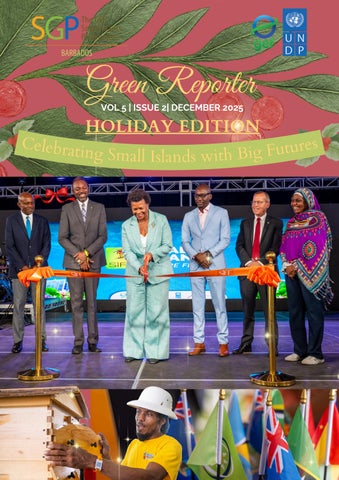
Green Reporter VOL 5 | ISSUE 2| DECEMBER 2025
HOLIDAY EDITION C ele b ra ti n g S m a ll I sl a n d s w it h B i g F u t u r e s
1
INTHIS I S S U E SMALL CELEBRATING ISWILANDSTH
BIG FUTURES
Fro m S m a llH o p e t o B ig I m p a c t : HOW A ROOFTOP SOLAR PV SYSTEM ON A PIG FARM CONTINUES TO POWER BREA’S MISSION
Caribbean Caribbean Hotspot Hotspot of of Biodiversity Biodiversity & & Targeting Targeting Molecular Molecular Endemism Endemism
spotligh
GEF SGP BARBADOS TEAM VISITS ELAINE’S CARIBBEAN CROCHET CROCHET
isha Toppin Nik
E
la
t
grantee t
in
e’
s C
aribbean
Cr
oc
he
ion: h s a RF So ul-
ur o Y e n atight i m Illunner L I
Bridging Learning and Action:
A UN HOUSE EXPERIENCE FOR STUDENTS
2
e
e Fr o
m ou r
A M
s
g a s
NATIONAL COORDINATOR
As the United Nations commemorates eighty years of advancing peace, development, and human dignity, we are reminded that true global progress is built upon the foundation of empowered local communities. The journey of the Global Environment Facility Small Grants Programme (GEF SGP) implemented by UNDP is interwoven with that legacy. A legacy of partnership, innovation, and the unwavering belief that small communities can lead big change. This edition of the SGP Green Reporter celebrates the power of small islands to shape big change through innovation, community action, and partnership. It highlights the transformative impact of the Small Island Future Fest (SIFF), that has bloomed into a regional movement inspiring youth, creativity, and climate resilience across the Caribbean, alongside features on renewable energy innovation by BREA, biodiversity research by the Biocultural Education and Research Programme, and creative sustainability through initiatives like Elaine’s Caribbean Crochet and Soul-R Fashion. This edition also places the spotlight on cultural entrepreneurship, academic collaboration, and new opportunities under GEF SGP Operational Phase 8, reflecting the vibrant mosaic of local action driving global environmental progress. On behalf of the GEF SGP Barbados team and our National Steering Committee, I extend heartfelt gratitude to all our partners, grantees, and contributors whose work fills these pages with hope and possibility. I encourage you to read, share, and enjoy this edition, and to continue amplifying the community voices and actions that are redefining sustainable development across our world. Happy Holidays & A Prosperous New Year!
Dr. David Bynoe 3
SMALL I S LANDS CELEBRATING WITH
BIG FUTURES Daniel Clarke-Whitehall Programme Assistant, GEF SGP Barbados In the heart of Barbados, where turquoise waters meet vibrant communities, the Small Island Future Fest (SIFF) is a flagship initiative of the GEF Small Grants Programme implemented by UNDP. SIFF 2025 was hosted in partnership with the Ashley Lashley Foundation (ALF) and brought together thousands of participants, innovators, and changemakers in a twoday celebration of youth empowerment, environmental stewardship, and community collaboration. At its core, SIFF was more than just a festival , it was a movement. One that inspired individuals to take ownership of their roles in advancing environmental conservation, tackling climate change, and achieving the United Nations Sustainable Development Goals (SDGs). With a focus on the Blue, Green, and Orange Economies, the festival served as a living classroom, empowering over 3,000 attendees including more than 300 students , to envision a sustainable path forward for Small Island Developing States (SIDS).
4
Empowering Through Education and Experience The festival’s dynamic programming blended education, creativity, and hands-on learning, transforming the space into an interactive hub of discovery. Through expert-led discussions, interactive booths, and youth-focused activities, SIFF opened doors to knowledge on sustainable agriculture, marine conservation, health and wellness, renewable energy, and eco-conscious entrepreneurship.
Across the UN Village and thematic zones (Blue, Green, Health, and Kids) participants explored practical solutions to real-world challenges, learning how sustainable choices can transform both livelihoods and communities. Key highlights included: The Sustain-a-Bee Spelling Bee, a fun and educational challenge for primary school students; Cooking demonstrations led by the Ministry of Health, featuring nutritious, locally sourced ingredients; The Green Loans Fair, linking the public with financial institutions offering eco-friendly investment opportunities; and Ten expert-led panels and two major side events that deepened understanding of climate resilience and nature-based solutions. Each experience reinforced the festival’s central mission — to inform, engage, and inspire collective action toward a sustainable future.
5
Partnerships That Power Progress
The success of SIFF reflected the strength of collaboration and the transformative power of partnerships. The festival united stakeholders across government, academia, and civil society — including the Ministries of Agriculture, Health and Wellness, Tourism, Environment, National Beautification and the Blue and Green Economy, UWI Cave Hill, Export Barbados, and the Organic Growers and Consumers Association (OGCA). Each partner brought unique expertise and resources that amplified the festival’s reach and impact. Farmers and agripreneurs showcased circular economy practices; UN agencies hosted knowledge-sharing sessions; and youth ambassadors championed sustainable messages across social media and communities. This multi-sectoral approach not only strengthened cross-institutional ties but also demonstrated a replicable model for advancing sustainability — one that other islands and nations can adapt to build local capacity and foster inclusive growth.
Inspiring a Generation of Changemakers
Youth were at the heart of SIFF’s vision. Ambassadors Ocean Campbell Cumberbatch (Green Economy), Chelsea Tuach (Blue Economy), and Michael “Mikey” Mercer (Orange Economy) used their platforms to spark curiosity, dialogue, and action among their peers. Through workshops, interactive activities, and social media challenges, young people were empowered not just as participants but as leaders and innovators — designing creative solutions and taking their first steps toward becoming stewards of the planet.
As one attendee reflected, “SIFF showed us that small islands aren’t limited by size — we’re defined by our creativity, resilience, and commitment to the future.”
6
SMALL ISLANDS BIG FUTURES WITH The Small Island Future Fest has emerged as a beacon of hope and innovation for SIDS and beyond, a blueprint for how festivals can catalyze learning, partnerships, and transformative action. SIFF reminds us that when knowledge meets action, when youth meet opportunity, and when communities unite around a shared vision, the possibilities are boundless. From the shores of Barbados to small islands across the globe, SIFF’s message echoes clear and strong: Our size does not define our potential — our purpose does.
Photos by Ezra Sealy Photography
The festival’s ripple effects extend far beyond its two days of activity: Over 3,000 attendees left with new knowledge, tools, and inspiration. Green businesses and innovators gained visibility and community support. Students and educators built networks for future sustainability projects. New partnerships formed across schools, NGOs, and private sector players. By modeling an inclusive, engaging, and replicable approach to sustainability, SIFF proved that development isn’t just a policy goal — it’s a shared journey built on awareness, collaboration, and action.
7
8
e p t o o B ig I m p H l l a m S a m c t: o r F
W HO
Photo of the Solar PV Installation at Harris Pig Farm in Small Hope St. John by Rodney Greenidge & BREA
Mr. Peter Gollop BREA Member & Solar PV Installer doing a roof inspection of the system by Rodney Greenidge & BREA
P FTO O O AR
ON A PIG FARM CONTINUES SYSTEM TO PO V P R WER SOLA
BRE A’S MIS SIO N
Ms. Meshia Clarke- BREA President & Mr. Peter Gollop- BREA Director
Nestled in the quiet hills of Small Hope, St. John, a modest pig farm has become an unlikely symbol of Barbados’ renewable energy journey. In 2017, the farm’s rooftop was outfitted with a small solar photovoltaic (PV) system—an initiative spearheaded by the Barbados Renewable Energy Association (BREA) with funding support from GEF SGP Barbados to demonstrate the viability of decentralized, communitybased energy solutions. What began as a pilot project to support agricultural resilience has evolved into something far more enduring. Today, that same solar PV system (up until recently due to maintenance requirements)[1] continued to generate clean electricity- as a source of income for the Association and the small framer via the lease of his rooftop which acts as an income generator. The revenue earned from this feed-in arrangement has quietly supported some of BREA’s core functions for nearly a decade.
9
AModelofMicro-Scale SustainabilityforNGOS
Mr. Timothy Dalrymple of Apex Electrical and Mr. Peter Gollop pose for a photo prior to the maintenance check and fixture by Rodney Greenidge & BREA
The system, rated at just under 5 kW, was designed as a Roof Leasing Model benefitting the increase supply of clean energy to the grid and acted as an additional revenue resource for Barbados’ sole not-for-profit community-based organisation in the clean energy space. Its installation marked a turning point in BREA’s advocacy for small-scale producers, proving that renewable energy isn’t just for large corporations or utility-scale projects —it’s for everyday Barbadians, too.
AgricultureMeetsEnergyInnovation The pig farm, operated by a local family, has benefited from an increase in revenue through the lease of their roof top. But the ripple effects extend beyond the farm gate. The system’s performance data has informed BREA’s policy recommendations, and public education campaigns—making it a living lab for sustainable development.
StillGivingBack Up until recently, the system continued to generate income through Barbados’ renewable energy rider program. That income has helped to fund BREA’s stakeholder consultations, and strategic communications— quietly powering the movement for a just and inclusive energy transition.
ATestamenttoHope
Photos of the Pigs at the Harris Pig Farm in Small Hope St. John by Rodney Greenidge & BREA
In a community aptly named Small Hope, this project stands as a testament to what’s possible when vision meets action. It reminds us that even the smallest systems can have outsized impact—especially when rooted in community-support, collaboration, and long-term stewardship. BREA remains committed to scaling similar initiatives across Barbados and the region and to ensuring that renewable energy is not only accessible, but transformative.
10
Caribbean Biodiversity Caribbean Hotspot Hotspot of of Biodiversity & & Targeting Endemism Targeting Molecular Molecular Endemism Sonia Peter, Ph.D. Director Biocultural Education and Research Programme The title of this article may seem lofty, but it is all about valuing our botanical resources. It is indeed a lofty ideal, that of searching for potential molecular therapeutics within our unique plant species in the region. It is, however, an angle of biodiversity conservation that must be explored for the benefit of our people. The Biocultural Education and Research Programme has a mandate to promote conservation of Caribbean biodiversity using platforms of education and research. The research component involves examination of plant profiles for sustainability in the natural environment, that is rapidly undergoing change, but also the molecular profiles of plants of medicinal value. Within a hotspot of biodiversity there is a high degree of endemism with species unique to a particular region and even island. The estimated degree of endemism in the Caribbean is approximately 72%, and these species would have developed unique ways to extract nutrients from the soil and convert them into useful molecules, referred to as secondary metabolites, that can be part of their protective arsenal. Plants are stationary in their natural habitat and so they must respond to irritants for survival by manufacturing potent active agents. These useful agents, or molecules, can deter animals from feeding on their leaves, can hinder the growth of other species as they compete for resources, can repel attacks by bacteria, fungi and viruses and intervene in the generation of abnormal cells. Human beings, and animals, have found ways to utilize plants based on their plant protective agents for similar applications. We hear of plants being antibacterial, antifungal, antiviral, anti-inflammatory to mention a few of these so-called bioactivities. Now think on this, what must be the complexity of novel molecules produced by plants that are unique to our regional dynamics in terms of climate, soil profiles, species profiles and other impinging parameters? I refer to this as Molecular Endemism and I argue that we can no longer ignore this in our conservation strategies and scientific exploration. Our nonprofit, through a collaborative effort, has embarked on research to discover molecular uniqueness within plants that are known to have medicinal value in our traditional systems of healing, as a This natural agent is simulated against RNA dependent Polymerase that is involved in virus replication model for such exploration. We have TheRNAmolecular agent is binding to specific sites on the protein thus hindering its activity been able to demonstrate, using AI capacity, that some of these molecular targets can impact on the proteins in viral bodies to hinder replication.
11
This project will be elaborated within an extension of the research programming of the Biocultural Education and Research Programme. One of the plant families utilized across the Caribbean region for respiratory illnesses, typically caused by corona viruses, is the Mint or Lamiaceae family. Plants belonging to this family include Peppermint (Mentha piperita), Mosquito bush (Ocimum campechianum), and Broad-Leaved -Thyme (Plectranthus amboinicus or Coleus amboinicus). Plant extracts from some of the Lamiaceae species were analyzed for molecular uniqueness and these molecules were tested via simulation to estimate their capacity for antiviral activity. The diagram provided illustrates one of the compounds identified from a plant of the Mint or Lamiaceae family hindering the activity of a viral protein by binding to specific sites thus inhibiting the role in replication of the virus. This model for conservation is based on adding value to species that can be translated into protective strategies.
PLANTS AND PLANTS AND PLANTING PLANTING FOR FOR THE THE FUTURE FUTURE IV IV AP C E R
The Biocultural Education and Research Programme (BERP) hosted the fourth edition of its biennial symposium, Plants and Planting for the Future, from April 7–11, 2025, in collaboration with Andromeda Botanic Gardens, Coco Hill Forest, Ocean Spray Apartments, and the Bahamas Network of Rural Women Producers (BAHNROP). This year’s symposium brought together researchers, practitioners, and plant enthusiasts to explore the critical role of plant biodiversity in advancing food security, medicine, and climate resilience. The event fostered vibrant exchanges in fields such as ethnobotany, ethnomedicine, drug discovery, and biocultural traditions, bridging scientific insight with traditional knowledge. Participants experienced Barbados’ rich ecological and cultural heritage through interactive sessions, curated exhibits, and site tours. At Andromeda Botanic Gardens, attendees explored over 500 plant species and the newly launched Ethnobotanical Garden, which honors indigenous medicinal plants and ancestral wisdom. Meanwhile, the Coco Hill Forest tour showcased the island’s growing food forest movement, highlighting bamboo groves, tree ferns, and heritage crops — and concluded with a tasting of Coco Hill’s signature botanical rum. The symposium also celebrated tea culture, culinary heritage, and plant-based entrepreneurship, providing a platform for local innovators and artisans. The closing ceremony, held in the Ethnobotanical Garden, paid tribute to ancestors whose knowledge preserved many of the species now thriving across these landscapes. The featured addressed was delivered by Dr. David Bynoe, National Coordinator of the GEF Small Grants Programme. Through knowledge-sharing, cultural appreciation, and community partnerships, Plants and Planting for the Future IV reinforced the message that our resilience is rooted in the biodiversity we protect and the traditions we sustain.
12
spotligh
isha Toppin Nik
E
la
t
grantee t
GEF SGP BARBADOS TEAM VISITS ELAINE’S CARIBBEAN CROCHET CROCHET
in
e’
s C
aribbea
r n C
oc
he
Bridgetown, Barbados — The Global Environment Facility (GEF) Small Grants Programme (SGP), implemented by the United Nations Development Programme (UNDP) through the Community Empowerment and Environment Partnership (CEEP), recently visited Elaine’s Caribbean Crochet to learn more about the “Crochet for a Cause: Ridge to Reef” project. Funded by GEF SGP UNDP CEEP and administered through the BYBT, the project uses crochet to raise awareness about climate change, renewable energy opportunities, marine pollution, and coral reef degradation. Now in its fourth year, the project has reached communities across Antigua and Barbuda, Barbados, Saint Lucia, Grenada, and Trinidad and Tobago. During the visit, the team toured Elaine’s Creative Studio, exploring the Fibrary, crochet classes, and the signature Crochet for a Cause exhibit, which showcases Ridge to Reef concepts and aligns with the Sustainable Development Goals. GEF SGP National Coordinator for Barbados, Dr. David Bynoe said, “The resources they get from selling these crochet products are then used to maintain the facility and generate revenue for participants. This is what the SGP is about — sustainability and the SGP family. We try to get the grantee partners to work together where there are synergies, and this is another example of synergistic working together.” The “Crochet for a Cause: Ridge to Reef” project looks forward to expanding its reach, engaging more youth and artisans, and continuing to combine creativity with sustainability. About Elaine’s Caribbean Crochet Elaine’s Caribbean Crochet empowers local artisans and youth through craft, education, and sustainable initiatives, integrating environmental awareness with skill development, 13 revenue generation, and community engagement.
n: o i h s a F R Soul-
r u o Y e t a n ight i m Illun ner L I In a world of fast fashion and fleeting trends, what if your clothing could do more? What if it could connect you to the very essence of our planet, empowering you from the outside in? Welcome to Soul-R Fashion, where we ignite a luminous dialogue between humanity and the sun, transforming sustainable style into a source of literal and spiritual energy. Soul-R is built on a simple, profound belief: harnessing the sun’s power is not just a sustainable choice—it is a return to our core. Solar energy is the soul of our planet, and wearing it is designed to awaken your own. We fuse cutting-edge solar technology with intentional, conscious design to create garments that energize your life and your spirit. Our collection is a testament to this harmonious blend. For the practical innovator, the Solara Breeze Hat and Guardian Solar Cap offer solar-powered cooling, providing a personal oasis under the sun. For the modern professional, the Aurora Solar Blazer integrates discreet shoulder-pad solar arrays, while the Aegis Solar Jacket features a powerful back panel for on-the-go charging, turning your commute into a power source. But technology is only one facet of our soul. We believe true style tells a story. The Reclaimed Mosaic Dress is wearable art, crafted from landfill-rescued textiles, while the Botanical Sleeveless Shift, made from organic cotton and hemp, celebrates minimalist, sustainable elegance.
14
IOur most enchanting innovation lies in our photo-chromatic accessories. Witness the Chroma Cuff Bracelet and Lumina Solar Pendant transform under the sun’s rays, their colors shifting in a beautiful, dynamic dance with the light. This is more than an accessory; it’s a personal reminder of your connection to the energy around you, a wearable metaphor for your own inner light adapting and glowing. From the Sargasso Sea earrings, which encapsulate reclaimed ocean materials in resin, to the artisanal Solaris Crochet Clutch, every piece is a conversation starter designed with purpose. Soul-R is an invitation. It’s for those who seek more from their wardrobe—not just style, but substance; not just function, but feeling. It’s for those who believe that fashion can be a force for good, a source of power, and a catalyst for connection. Step into the light. Explore our collection and discover how it feels to wear the sun. Illuminate your inner light with Soul-R.
15
16
GEF SGP Barbados and UNDP Evaluation Team taking in the beauty at Andromeda Botanic Gardens during a BERP project site visit by Daniel Clarke-Whitehall
Bridging Learning and Action:
A UN HOUSE EXPERIENCE FOR STUDENTS Daniel Clarke-Whitehall Programme Assistant, GEF SGP Barbados
Dr. David Bynoe warmly welcomes students to the United Nations House, setting the tone for an inspiring session ahead.
At the start of the semester, GEF SGP Barbados welcomed 19 students, a mix from McGill University and UWI Cave Hill, along with Professor Virginie Millien for an inspiring afternoon of learning at the United Nations House. As part of the Barbados Field Study Semester facilitated by the Bellairs Research Institute, the visit offered students a unique opportunity to explore the island’s community-driven sustainability initiatives and see firsthand how local innovations are advancing global environmental goals.
During the session, students engaged with several GEF SGP grantee partners, each addressing sustainability through different but equally impactful approaches, providing practical insights into the transformative work happening across Barbados.
SPOTLIGHT ON COMMUNITY INNOVATORS The Sojourner Foundation Known for its work in climate justice and community resilience, the foundation shared how its programmes improve food security, strengthen women-led households, and support vulnerable families through sustainable, climate-smart solutions. Elaine’s Caribbean Crochet Blending creativity with advocacy, this initiative uses handcrafted crochet pieces to spark conversations about marine health, coral reef decline, and climate awareness— demonstrating how art can inspire environmental stewardship. CORALL Barbados Students were intrigued by CORALL’s hands-on coral restoration efforts, including the establishment of coral nurseries and reef rehabilitation work that supports coastal protection and marine biodiversity.
17
Biocultural Education and Research Programme (BERP) BERP introduced students to its unique approach of merging traditional ecological knowledge with modern conservation practices, highlighting the importance of ethnobotany, cultural heritage, and biodiversity restoration. Barbados Roaring Virtual Lions Club (BRVLC) BRVLC showcased its environmental outreach initiatives, including volunteer-led cleanups and youth empowerment activities that help build a culture of service and sustainability. Youth Equipped to Achieve (YEA!) With a focus on mentorship and youth development, YEA! emphasized how equipping young people with life skills and leadership opportunities can strengthen communities from within.
LEARNING THROUGH EXCHANGE The atmosphere throughout the tour was vibrant and engaging as students connected with project leaders, asked thoughtful questions, and explored how local organisations are addressing environmental challenges through practical, communityoriented solutions. From creative climate communication to coral restoration science, from ethnobotanical knowledge to volunteer-driven change, the visit exposed students to a rich tapestry of grassroots innovation. Many expressed admiration for how these organisations blend culture, science, and community action to create lasting impact. One student shared, “It was eye-opening to see how much can be achieved through community collaboration and passion. These projects show what true sustainability looks like in practice.” By the end of the session, participants left with a deeper understanding of how local action drives national and global sustainability efforts. For many of the students, the tour provided not only new knowledge but also a fresh appreciation of the important role that community-based organisations play in shaping a sustainable future. (L-R) GEF SGP grantee partners The Sojourner Foundation, Elaine’s Caribbean Crochet, CORALL Barbados, BRVLC and BERP, posed for photo with students from McGill and UWI, who beamed with excitement outside UN House at the conclusion of the study tour.
18
CALL FOR PROPOSALS GEF Small Grants Programme (Barbados) Operational Phase 8 (OP-8)
ABOUT THE CALL TThe Global Environment Facility (GEF) Small Grants Programme (SGP), implemented by UNDP, provides technical and financial support to civil society organizations (CSOs) and community-based organizations (CBOs) to design and implement projects that conserve and restore the environment while also enhancing livelihoods, resilience, and community well-being. Eligible applicants: NGOs, CBOs, youth groups, academic bodies, faith-based groups, business/civic associations, hotel and resort associations, and charitable foundations
OUR PRIORITY AREAS Under OP8, projects are expected to contribute to global environmental benefits through locally-led, inclusive, and innovative initiatives that align with national priorities and adopt a landscape–seascape approach. All proposals should fit within the following OP8 strategic priorities: Ecosystem & species protection (land, freshwater, marine) Sustainable agriculture & fisheries Clean, renewable energy access Chemicals & waste management Sustainable urban solutions (energy, waste, mobility, green spaces) Projects should also demonstrate viable sustainable livelihood components and promote social inclusion.
19
FUNDING GUIDELINES The GEF SGP OP8 provides support through two levels of grants: Planning Grants: Planning Grants help applicants initiate participatory planning processes, conduct research, assess organizational capacity, or engage consultants to develop a project proposal for a Full Grant. Grants are up to US$5,000, though most awards typically average around US$2,000. Full Grants: The combined total of Planning and Full Grants for any single project cannot exceed US$75,000. Co-Financing and In-Kind Contributions: Applicants are encouraged to provide cofinancing or in-kind contributions, such as volunteer time, donated materials, or complementary funding from other sources. Such contributions strengthen the proposal and demonstrate a commitment to project sustainability. Application Period: Project Concepts, Planning Grants, and Full Grant Applications are accepted anytime during the fiscal year, which runs from July to June.
SUBMIT YOUR PROPOSAL Send proposals and all requests for information to: The National Coordinator GEF SGP Barbados United Nations Development Programme, United Nations House, Marine Gardens, Hastings, Christ Church Barbados Sendto: david.bynoe@undp.org Forms&details: www.sgpbarbados.org Contact: (246) 467-6011 / 6013 20
CALL FOR APPLICATIONS/INTEREST GEF SGP NATIONAL STEERING COMMITTEE The Global Environment Facility (GEF) Small Grants Programme (SGP) implemented by UNDP is pleased to announce a call for applications/interest from Civil Society Organizations (CSOs), including Community-Based Organizations (CBOs), Non-Governmental Organizations (NGOs), academia, scientific institutions, women, youth, and conservation groups to serve on the GEF SGP National Steering Committee in Barbados.
ROLE OF THE NSC The main decision-making body of the SGP at the country level and provides overall oversight, guidance, and direction to the Country Programme. NSC Members operate in a voluntary capacity and provide technical expertise on national environmental and/or social issues of global concern. Review and approve projects in alignment with the Country Programme Strategy. Provide technical support to project oversight and implementation at the country level. Support partnership development and resource mobilization.
COMPOSITION OF THE NSC Selection of members is based on expertise and the qualification of the candidates as well as the balance between representatives of civil society and other sectors. Members should have credibility and extensive experience working with local communities and CSOs in Barbados. Participation on the NSC is voluntary and without monetary compensation.
How to Apply? Interested persons are invited to submit a curriculum vitae and motivation letter to the National Coordinator Dr. David Bynoe, david.bynoe@undp.org before January 31, 2026. For more information, download the Terms of Reference from the SGP website, https://www.sgpbarbados.org/.
21
INTRODUCING
THE NATIONAL STEERING COMMITTEE
Kerryann Ifill: NSC Chair & Human Rights Commissioner (HRC) of Barbados Tonya Millar: Caribbean Development Bank, Microfinance and Venture Capital/Youth Focal Point Emmanuel Joseph: Barbados Association of Journalists and Media Workers & Media/Communications Focal Point Travis Sinckler: Programme Director, Caribbean Learning Nexus Project, University of the west indies, Dr Marsha Hinds - Women's Advocate & Gender Focal Point Ron Goodridge: Ministry of Environment and National Beautification, and Green and Blue Economy & GEF Operational Focal Point A. Karima Degia: Programme Manager - Prevention, Recovery and Resilience (PRR) Cluster
22
ACKNOWLEDGEMENTS Producer Daniel clarke-whitehall Programme Assistant Editors Dr David Bynoe, National Coordinator Daniel Clarke-Whitehall, Programme Assistant
CONTRIBUTORS: Meshia Clarke and Peter Gollop Barbados Renewable Energy Association (BREA) Nikisha Toppin Elaine's Caribbean Crochet Sonia Peter, PHD Biocultural Education & Research Programme William Hinds Solar R Fashion Daniel clarke-whitehall Programme Assistant
Global Environment Facility Small Grants Programme United Nations Development Programme United Nations House Marine Gardens, Hastings Christ Church, Barbados david.bynoe@undp.org DANIEL.CLARKE-WHITEHALL@undp.org
(246) 467-6000
23
"HERE’S
TO A
y p p a H
HOLIDAYS
& Happy New Year! From SGP Barbados
24