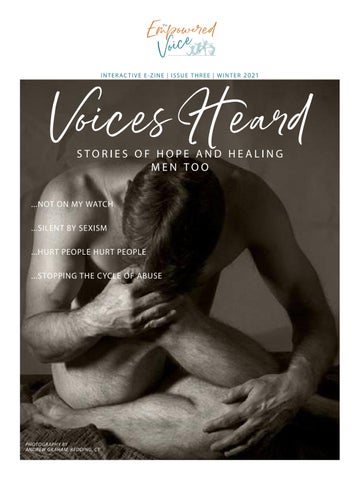
Voices H eard I N T E R AC T I V E E -Z I N E | I S SU E T H R E E | W I N T E R 2 021
STORIES OF HOPE AND HEALING MEN TOO
...NOT ON MY WATCH ...SILENT BY SEXISM ...HURT PEOPLE HURT PEOPLE ...STOPPING THE CYCLE OF ABUSE
PHOTOGRAPHY BY ANDREW GRAHAM, REDDING, CT
VOICES HEARD ISSUE III
EDITORIAL TEAM
CLAIRE O’LEARY
Fo un d e r, Edi to r- in - chi e f Creative Director
JULIE HART
Copy Editor
CONTRIBUTORS
PHOTOGRAPHY
Thomas J. Dubois Rachel Grant David Irvin Roger House Bob McNutt Claire O’Leary Jay Santos
TOMO SAITO
C l a i r e O ’ L e a r y , p g . 7, 4 5
ANDREW GRAHAM ANDREW GRAHAM
ANDREW GRAHAM
Dav i d Ir v in , Cove r, p g .
12 , 15 , 18
® 2021 T H E E M P O W E R E D V O I C E , VOICES HEARD ALL RIGHTS RESERVED
INSIDE FROM THE EDITOR ...#MEN TOO
7
I know it happens to MenToo because it not only happened...
7
THE STORIES DAVID IRVIN ...NOT ON MY WATCH
8
I’m someone who has spent his adult life fighting a low self-esteem, self-loathing...
8
ROGER HOUSE ...HURT PEOPLE, HURT PEOPLE
19
I go deeper and deeper into my own world, closing off from everyone and anyone...
19 BOB MCNUT T ...STOPPING THE CYCLE OF ABUSE
22
One of the devastating things about sexual abuse of a boy...
22
BUILDING RESILIENCE
27
IF SOMEONE YOU KNOW IS IN CRISIS... 27 If you or someone you know is in immediate danger and needs...
SHARE YOUR STORY IN VOICES HEARD
27
Giving voice to your story helps you heal. Seeing it, hearing it...
SILENT BY SEXISM
28
47
BOYS/MEN VICTIMS OF SEXUAL ASSAULT Shame, fear, an inability to recognize what happened
28
and difficulty in seeing...
SELF EMPOWERMENT THROUGH TOUCH THERAPY
30
Just the act of getting a treatment done for one’s self is an act of
30
self-love...
WE SURVIVED... WE THRIVE
33
We Survived... We Thrive is a new sponsored page that allows
HOW TO HAVE SATISFYING EMOTIONAL & SEXUAL RELATIONSHIPS 34 Emotional, physical and verbal abuse all impact the development of a man’s perspective and ...
A FEW STATISTICS...
47
34
FROM THE EDITOR... #MenToo
I know it happens to MenToo because it not only happened to my sisters and I but to two of my brothers as well. I see how our culture affects men daily and I watched it growing up. It has affected all of society and it’s time to make changes—Big Changes. I see the effects it’s had on my brothers and consesequently their families and know without a doubt that we need to let go of the social attiudes and stereotypes so prevalant today, with their widespread effects, rampant throughout society and so damaging to male survivors. Jay Santos reminds us in Silent by Sexism that we need more discussion on this subject in order to break the mentality full of stereotypes and myths. David Irvin, Not On My Watch, helped me realize that not only women, but so many men, even those protrayed as a Man’s Man, virile and strong, will spend so much time fighting low selfesteem and self-loathing when they’ve
been sexually abused. Bob McNutt, In Spite of the Pain, shares his growth through his healing journey and that, like me, he wouldn’t change a thing because it made him who he is today. Roger House, Hurt People, Hurt People, is vulnerable enough to share how he hurt people for years until he finally accepted love from others and was able to share love himself. Thomas Dubois, helps us realize the importance of selfcare in healing from trauma in Self Empowerment Through Touch Therapy. Rachel Grant offers profound advice on overcoming the many things that get in the way of really great sex in her article How to Have Satisfying Emotional & Sexual Relationships. I truly appreciate the vulnerability these survivors have expressed in sharing their trauma and it’s lifelong effects. I understand how much work it took for them to get to this point. Sharing can be extremely difficult for anyone. The depth of vulnerability and openness shared by these men is healing and so refreshing.
“
Sharing can be
extremely difficult
for anyone. The depth of vulnerability and
openness shared by
these men is healing and so refreshing.
7
DAVID IRVIN ...NOT ON MY WATCH
“
I’m someone who
has spent his adult 8
life fighting a low self-esteem. . . self-
loathing. . . apologizing to the world. . . avoiding social situations so I
won’ t feel awkward. . . calling myself a “failure”.
I’m a professional forester, managing public land to grow forest products sustainably, to produce healthier and more diverse forests and to provide habitat for wildlife that are in trouble or losing their homes. It makes me very proud. And it doesn’t end there. I have been a wildland firefighter and helicopter crew member on wildfire and have been credited with saving lives. I have been a stage actor by hobby, a Cub Scout leader, a Winter Camping instructor and a nude artist’s model. I’ve lived in 7 states and once nearly died in a hiking accident that was the ordeal movies are made of. I have a family that I am very proud of.
But who am I really, behind the scenes? I’m someone who has spent his adult life fighting a low self-esteem . . . self-loathing . . . apologizing to the world . . . avoiding social situations so I won’t feel awkward...calling myself a “failure” . . . with suicidal thoughts dozens of times per day—per hour...Fighting anger issues with seemingly no source.
Why would a guy with such an adventurous and bold life feel like any of this? At age 54, I have finally taken the time, during our COVID-19 pandemic, to look back and realize . . . wow, I’ve really had quite the run so far. It took me years –decades – to figure out why and to uncover what had been buried deep for many years. Growing up was hard. When is it ever easy? As a child who always looked smaller and younger than my age, right through college, I was bullied. In fact, I was bullied so badly in 4th grade that I was actually moved to a new school. My father was probably the most strict, controlling, uptight person I have ever known. He had a 24/7 powerful hand over my life. We celebrated no holidays, didn’t intermingle with extended family much and Dad was not supportive of extracurricular activities . . . or friends. I lived a life of isolation as an only child and relied on my imagination. This made me enter adolescence a bit socially inept and therefore a bit unsure of myself and vulnerable.
Any topic relating to sex was taboo in my household. You didn’t talk about it – didn’t bring it up – ever. Instead, my introduction to this came from a peer when I was 11 or 12. A bigger boy who I had grown up with that I thought was my longestrunning friend, introduced me to new pastimes while we shared a bed during sleepovers. This evolved from
exploration, comparison and fondling to much more. Always something new, always something more. Eventually, this turned into the only thing that interested him in our friendship. I no longer was interested in hanging out.
This
was
experience
my with
first such
a
betrayal. I felt he wasn’t my friend anymore, just someone
who
developed
singular motives and uses for me. As I progressed through the teen years, a pattern began to follow me there. I was propositioned, groped, stalked— one stalking while jogging at 17 turning into an attempted kidnapping. It ended well for me only because in those days, I was one of the fastest sprinters around and few could keep up with me. If you can, picture Ferris Bueller’s Day
Off, running through backyard after backyard to get back home. I didn’t ask for help. I never reported any of it. I didn’t report it because this was the 80s and not as enlightened an era where sexual assaults are concerned, but most importantly, because I was a male. These things happen to women, not men. I could just imagine the derision. The blame. The humiliation. If they believed it at all. A young person’s life is already so full of pressure and angst, it was the last thing I needed. No one would ever know, if I could help it. These perpetrators were men. ALWAYS men. Was it any wonder that most of my friends over the years were girls and women? They had never done anything to me. They hadn’t exactly wanted to date me either, so they really hadn’t done anything to me. But, that’s likely a story for another time.
9
I remember looking at myself in the mirror and wondering what was so wrong with me that these things kept happening to me. Why me?
Am I the only guy who’s treated
this
way?
How
quietly creeping in the background and waiting for its moment. Anger enveloped the question of why I was never good enough to love on other levels, but obviously perfect to use and fondle. My self-worth tanked alongside the value my world seemed to place on me.
unbelievably humiliating.
“
I began to resent my own reflection — even 10
the sound of my voice. I disliked who I was. I was a loser and a failure. This didn’ t
seem to be happening to anyone else, so I had to be doing something to bring it on.
I began to resent my own reflection. Even the sound of my voice. I disliked who I was. I was a loser and a failure. This didn’t seem to be happening to anyone else, so I had to be doing something to bring it on. I had a lame personality and everyone could probably smell the “loser” on me. Eventually my resentment and hurt developed into an anger that followed me into my adult life, always present, but often
Once in high school, my father told me, “You’d better keep getting good grades, because it’s all you’ll ever be good at.” Like any other great parental-failure moment in history, that stuck with me. I immersed myself in books and studying, as a distraction from personal
continued to unload, making trips in and out of the house while the men conversed outside. Whenever I passed, Rennie would stop and peer at me again. It was enough to make me shiver in the muggy August air.
life and myself as an individual. And I got pretty darned good at academics from early in high school and all the way through college. I stayed busy. And I stayed away from a lot of people.
late summer, just the hint of crisper, fall air trying to edge into the Tennessee mountains. So I was possibly going to be home with Dad until winter, unless something else came along meanwhile.
I had been bullied a lot over the years in grade school, so when I made it to college, I was disappointed to find that the universe thought this pattern was worthy of continuing. As the young oddball student of my small graduating class, I was viewed as more of a mascot than a classmate and was picked on and even sexually harassed during a field trip.
It was late August 1988 as our moving truck headed up the Main Street of what I decided on the spot was the sleepiest and most desolate small town I had experienced. It was not hard to spot our rental house, it was bright purple, the only one of its kind. We didn’t even need to look at the address.
At 21, college was put behind me. Beyond the era of childhood, living with parents and institutionalized education, I was really hoping for a fresh new beginning, to leave these chapters behind. But I had no job at first, so I continued living with my dad as he moved into a new small town in Tennessee for a teaching position. There were going to be new starts all around. I did have a possible seasonal job lined up for the winter season, but this was
I helped Dad unload furniture and boxes and had become a real pro at moving, something we had done all too often. A man from next door walked over, curious and introduced himself as Rennie. He was more than a full head taller than me and very heavyset, with glasses set down on his nose, making him squint over them. Rennie was a very large man in every respect and I guessed a pretty happy one, because he was smiling the whole time. He smiled a lot...at me. I was polite and
As a few days passed, I realized I would want to get a local job, if I didn’t want autumn in this town to make me stir crazy. Rennie told me that the lady he worked for next door might hire a young man to help her out around the place. As it had turned out, Rennie didn’t live next door, he worked there for an elderly lady who was purportedly quite well off. He helped care for her, the house and the grounds. So one afternoon I went next door and met this lovely, grandmotherly lady, who did agree to hire me. She told me that her Rennie would show me everything that needed to be done. But sometimes, she might just want to walk down the street into town and have me along just for company and to give her a helping hand. So I started mowing, hedge-trimming, feeding the dog, doing dishes and anything else I could help with. Rennie said it would also be a great help if I joined him on jobs he did at other addresses, too. He had house cleaning jobs and lawns to mow all over town. Early fall was going to be pretty busy. I worked on my own a lot, but sometimes one-on-one with Rennie at a job. Whenever he got close to me, close enough to brush against me, he made the creepy and annoying point of rubbing me, touching my shoulder, mussing my hair...I would just roll my eyes to myself and ignore it, hoping he’d knock off the nonsense soon. While a big man, he really did seem largely harmless enough, once you got to know what a marshmallow he was.
11
“
But the touching
gradually escalated. I made the mistake 12
of mowing a lawn shirtless once and
found him caressing my chest and back,
almost in full view in
the front yard. I asked him to stop, and he just laughed.
PHOTOGRAPHY BY ANDREW GRAHAM, OF REDDING, CT
But the touching gradually escalated. I made the mistake of mowing a lawn shirtless once and found him caressing my chest and back, almost in full view in the front yard. I asked him to stop and he just laughed. Then the compliments also started. Rennie was telling me I was one of the most beautiful people he had ever seen. As this seemed to quickly be ramping up, I decided to make a concerted effort to keep my distance as much as possible. It wouldn’t always work, depending on the chores for the day, but if I could avoid him, I was certainly going to. It was actually a pleasant break to be able to take the old lady for a walk. At times, she wouldn’t even have any
expectations of me other than to provide some company and listen to her stories. Plus she said “the townsfolk would be envious when they saw her with a handsome young man.” I’d laugh warmly and we would continue on, admiring the leaves showing early fall color. I wondered vaguely how she would view Rennie if she knew of all the uncomfortable touching.
“I got muscle,” Rennie said to me one day. “What?” “I got muscle’, that’s the first thing you said to me that day at the moving truck, when I said I could take that box,” he said, as if reminiscing on his wedding day.
“I never would have said that. ‘I’ve got muscle,’ maybe ‘I have muscle’. I’m a college graduate, I use better grammar.” At least I was able to amuse myself at a moment of superiority. At times, the lady would be taken on a drive somewhere. After all this time, I can no longer remember where she went or what she would be doing, but the house would be empty for a few hours except for me and Rennie. The second time this was the case, I was working in the kitchen and he came up behind me and began rubbing my shoulders with slow, therapeutic motions. It did feel good. “You’ve been working too much,” he’d say. This progressed to a guest room where he had me lay down for better massaging, then asked me to take my shirt off to make it better. This was not going well, I thought. I said no and protested but he insisted and I tried my best to humor him, because to my own detriment, I was that way. I lay as he massaged my back, buttocks (to his vocal delight) and thighs. He then suddenly rolled me over and unzipped my pants. This is when I realized the fall season was going to get a lot worse. Shortly after the first time I was sexually assaulted, I went into the small cottage of a post office to buy some stamps. The postal clerk chatted me up about what I had been up to since coming to town. I told her who I worked for. She frowned, looking me over. “Stay away from that man, Rennie, you hear?” “Why?” “Because you’re a nice young man, just trust me, he’s no good, stay away!” She knows about him. So there was maybe even a pattern. What if I wasn’t the first, but the latest in a long line? Maybe I could be the one to finally stop it.
I would stay up late at night and think long of what I could do. Under absolutely no circumstance could my dad know. He would kill him, most likely. And disown me. Regardless of the actual end result, it would not be a good ending for me. The old lady, what if she knew? It would be very personally disturbing to share something like this with her. I couldn’t do that to her. Police? And what exactly would I report? I’m not a minor anymore. They’d probably ask me why I didn’t just leave or tell him to stop. I couldn’t leave, I had nowhere to go. It was hard to quit, how would I explain it to my dad or the old lady? I really seemed to be in a logistical and moral trap. Sexual boldness continued to rise. I would be washing dishes and he would come up behind me, pull my shorts down and begin stroking me, without even a word. I was told to continue my work. He began complimenting my lips and wanting to kiss, which grossed me out most of all and still brings a shiver to this day. What he wanted most was to be kissing me at the moment I climaxed. He would get out of hand in his excitement and hold my head so he could French kiss me. He held me so hard that I noticed hand impressions on one side of my face after going home and looking in the mirror. I had to make sure my Dad didn’t see that when he got home, so I took a bike ride. Then he brought condoms. The first time I was raped, the most painful and humiliating day of my life, I went home and threw up. And cried like I was a little boy all over again. To hide blood in my underwear, I threw away two days’ worth. I stuck them in the trash under other items when it was
nearly full so that my dad wouldn’t see them. My showers became long and I would find myself staring into the spouting water, losing complete track of time. I wouldn’t know if I’d been in there 10 minutes or an hour. The rapes coincided with the advent of the psychological games. Especially his favorite statement, “You can’t rape the willing.” He pointed out that since I was erect and had ejaculated, it meant I enjoyed it and wanted it. I would have no case. It’s mutual, consenting adults. You can only rape women. I wouldn’t want Daddy to find out, would I? What would our poor old lady think? What if that were enough to put her over the edge and give her a heart attack or something? It became routine to reinforce these questions and statements daily with each entry of this nightmare. He was also a very strong man and I found out on multiple occasions that his full weight on my 140 pounds very effectively made me powerless. I imagined Rennie as Renfield from Dracula, catching and eating flies around the room. Anything to amuse myself during these times. I began to always call him Renfield in my head. I pondered hopelessly every day, as fall trudged onward like a slow moving funeral march. The leaves had begun to lose color and drop to the ground. I felt truly trapped, although maybe not in the traditional or literal sense.
13
Near the end, Rennie forced me onto all fours on the floor of an abandoned house that was in his care by the owners. There was no heat and he enjoyed having me there because the cold made nipples hard and genitals so “cute and boyish”. The next day I was tied to a bed.
me. But like so much darkness, it does its best to hide the light for a very long time afterward, until the light is actively sought.
Flash forward 30 years. It
was
special
then panic
I
had
a
attack,
wondering since I had so underestimated
him
a
while back, maybe I had
“ 14
I pondered hopelessly every day, as fall
trudged onward like a slow moving funeral march.
still been doing so. This would be a perfect time for him to slice and dice me, while I couldn’t move. It could all end for me right now and I wouldn’t be able to do a thing. I tried to relax so he could have his way. Being afraid and unaroused would only drag it all out that much longer. I had learned to focus and force myself to become erect and ejaculate as soon possible— the quicker I could get it over with, the sooner I would probably be freed again for the day. This is when I called my winter employer. I had been hired a long while ago as a winter camping guide for a Boy Scout program in Maine. But instead of bringing me on board in mid-December as planned, I asked if there was something I could do in early November? With one quick phone call, I discovered there was! I was hired to help out with preparation of the program and facilities for winter and found my excuse to get out immediately. I packed up and left for the northeast without a goodbye or a look back. As it turned out I never lived with my dad again or returned to this town, so this dark episode was behind
The nation was in the middle of the #MeToo movement and the Brett Cavenaugh confirmation hearings. Social media was alive with opinions and daily updates. I found myself getting curiously more and more drawn into the discussion. I began to get vocal myself. It hit a nerve when victims of sexual assault were disregarded because they had spent years to decades not reporting the crimes. This was very familiar and I became incensed that anyone could be so shallow as to assume this was cause for disbelief.
I was also hypersensitive that women always seemed to be the points of this discussion,
but
men,
I
knew fully, could easily be victims as well. It was at this point that a local friend of mine spoke up on Facebook and asked me if there was anything I needed to talk about myself? This floored me at first. Was there? She told me there were groups out there that advocated for survivors, including one she supported, Jane Doe No More (JDNM). Maybe I would like to check this out. This is when it began for me, in September 2018. I was invited to
“
I still did not believe I
qualified as a survivor because I was a male
PHOTOGRAPHY BY ANDREW GRAHAM, OF REDDING, CT
join a Facebook page for sexual assault survivors created by JDNM, which felt really strange to me at first. I had never thought of myself as someone who was sexually abused, raped or assaulted. In fact, I used to maintain that these are things that had never happened to me. I had blocked it from my mind for so long, that this false narrative almost became a new truth. In addition, I still did not believe I qualified as a survivor because I was a male and because of the “non-traditional” nature of my assaults. It was from another kid and then the ordeal with Rennie was while I was a legal adult. No one was going to care. I did not know how I could bear to tell those embarrassing stories, either. Just what I needed, one more reason for people I don’t know to instantly judge me for the worst. And as
a guy, I automatically felt like a creepy intruder and one that would never be welcomed. After all, most survivors in these groups were women who were wronged by men.
I didn’t plan to tell my “story” completely, or at all. But I was told I would be welcome when I was ready. Within days, I had told it all. It began to pour forth in a therapeutic stream. Suddenly, something that I had sworn no one would EVER know, that I would take to my grave, was not only exposed but was the source of an outpouring of love and support that I had never experienced anywhere.
and because of the
“non-traditional” nature of my assaults.
15
As I began to collect books and articles and read more of what other survivors experienced, it became abundantly clear how much we all had in common and how oddly normal my weird and hidden past suddenly seemed.
The
traits
so
to
survivors,
common were
the
laundry list of my own habits,
“
I t became abundantly 16
clear how much we
all had in common and how oddly normal my
weird and hidden past suddenly seemed.
behaviors
and
quirks. It was all falling into place like long missing puzzle pieces. So much was becoming clear — my years of increasing anger and touchiness. My marriage. So much. It didn’t even occur to me until the past year that even my nude modeling for
art classes and professional and hobby artists was a way for me to reach out and grapple with some of this, before I consciously knew of the problem. For the first time, I could feel that I had complete and total control over my body and how it was seen and used. I could be in charge of myself. When all this began to overwhelm my psyche, one of the first things I did was disclose what happened during my youth to my wife . . . and then apologize profusely to her for years of issues that were likely MY issues. It had all nearly ended in divorce just a half-dozen years prior. How much of this took away from fatherhood, from my career effectiveness and upward mobility? From pastimes that I loved? I promised myself it would happen no more and I will end my tenure in this world on a much higher note, realizing there will
always be times of backpedaling. The following is the “short list” of what I want all men everywhere to understand, who have had the misfortune of experiencing sexual assault or abuse — just from my experience: • It’s never too late to begin healing, regardless of how long ago this happened. As long as there is still life, there is hope! • Healing. Takes. Time. There will be challenges and pain along the way. • In the end, YOU WILL NOT REGRET IT. Actually, in the beginning you may not either. • You are not alone. You never have to be alone. Find a therapist, support group, close friends who you believe will understand. It doesn’t take many, just that special person or two. Anti-anxiety medication or an anti-depressant may help your state of mind immensely as you try to work through things. Only you and your doctor can decide if that is appropriate. The JDNM Survivor Facebook page and a mens’ therapy support group found many new friends for me that have been invaluable getting me through two years of awakening and renewal. • All sexual assault is trauma, but I believe men experience a particular degree of this because of the stigma of society on males. These are things that happen to women, right? An incredibly large percentage of men won’t report or speak up because of the shame, the humiliation, the perception of being less of a man, the innate hesitation of many men to confront emotion and pain in situations like this. But literature states, 1 in 6 males will be sexually assaulted and some say as high as 1 in 4. That is a lot of trauma and a lot of
silence that no longer needs to be. • It isn’t your fault. It doesn’t matter if you were grown at the time. • Your assaults don’t have to fit a textbook mold. Everyone has different experiences from everyone else and most could use that argument. The common thread is that something happened to you that was damaging because it happened wrongfully without your consent. No means no, regardless of sex, age and circumstance. • Forgiveness is up to you. Forgive perpetrators only if you consider that a critical part of your healing. I didn’t. Don’t listen to advice that says you must forgive or forgive “first”. Even if that advice comes from a counselor or religious clergy. • Confront your past. Tell your story (when you’re ready, you will know) to someone. If it helps, write it all down first just for yourself. If you don’t face down this past, then recognize that this was not your fault in any way. I think it will be hard to begin the healing climb. Think of it as Luke not being able to take the next step as a Jedi until he faced down and defeated Darth Vader. You have your own darkness to confront, which cannot be defeated if you are hiding. • Start being kinder to yourself, including taking breaks from all this reflection. Schedule and follow through with treats just for yourself. Get a massage, go skiing, have a marathon of your favorite movies, grab some ice cream, go on exploratory drives, read a good book. If you aren’t used to doing so, begin exercising and getting outdoors in the sun and fresh air more. This will help you to develop a new beginning and the endorphins and vitamin D will do wonders for your state of mind.
“
For the first time, I
could feel that I had complete and total
control over my body and how it was seen
and used. I could be
in charge of myself.
17
A recurring regret of 30 years ago is not making that stand and reporting then. I realized at the time that the same thing may have happened to others before me. And most regretfully of all, it may have happened after me. Could I have stopped this from happening again, even if that meant just one more boy or young man that would not have to fight these demons all his life? So I made a personal moral commitment 2 years ago–never again.
“
18
You will be heard.
You are worthy of the love and acceptance
you will receive. The world is waiting and your future is here.
I have vowed to myself and the world that nothing like this will ever happen to any other child or adult on my watch. Not if I am around. Even to my own detriment, I will not allow it to happen. Ever. It’s my intention not only to heal myself but to help other men out there in any way I can. To me, this is a “gap” in the #MeToo movement that is still too large and the number of men coming forward is still too small. Please take that first step toward healing. Today is a great day for a new beginning, even better than tomorrow. You will be heard. You are worthy of the love and acceptance you will receive. The world is waiting and your future is here. Make it a better one.
I will sure be there to cheer you all the way, my friend.
ABOUT THE AUTHOR
David S. Irvin is a professional forester by day and a proud and devoted family man. He enjoys hiking and anything outdoors, and hopes to return soon to his favorite hobby, stage acting. David was introduced to Jane Doe No More (JDNM), a nonprofit organization devoted to survivors of sexual violence, in 2018, and began his journey to the past in order to bring forth a brighter future. He hopes to share his awakening with others so that more will be inspired to tell their story and heal in their lives, especially other men. You can reach David here.
ROGER HOUSE ...HURT PEOPLE, HURT PEOPLE!
It’s 3 in the morning and all I can think about is what to write you? I am struggling because I am not just tired of talking about my past, but it sounds so much like everyone else’s. Let’s begin this story with a statement that keeps coming into my world… “Hurt people, hurt people!” But before we get into what that means, let me take you back to the early 60’s when I was a mischievous kid always trying to get attention. At that time I can remember playing, laughing and enjoying life with my best friend, Tommy. Tommy and I would do everything together, in fact, we were inseparable. Life was fun! Every morning whoever got up first would go and wake the other so that we could continue the games we were playing from the day before. One morning I wake up late wondering where Tommy is? By now he would have woken me? So I run to his home
as fast as I can, standing at the door out of breath knocking with all my might, I got no answer? Looking in the window, I see his home empty. Nothing left? I cry out “Where is Tommy!” Only to hear nothing. Tears rolling down my face, I slowly make it home and cry out “Tommy’s gone!” Expecting my mom to know something, or at least to hold me and tell me it’s ok. But all I get is “Good riddence” Huh? What does she mean, good riddance? Now not only am I confused about what she said, I miss my friend. (Side note: Tommy was Hispanic.) Days go by and still no Tommy? I go deeper and deeper into my own world, closing off from everyone and anyone. The only attention I got was a belt or wooden spoon across my butt, for fighting. That became my new Tommy! Fist fighting anyone who got in my way of being alone. During that time I would watch as my brothers would come home from Boy Scouts excited about something new they learned. Little by little I found myself interested in wanting some of
19
“
I go deeper and
deeper into my own
world, closing off from everyone and anyone.
The only at tention I got was a belt, or wooden
spoon across my but t, for fighting.
Up until my late 40’s all I could remember from that weekend was the excitement of driving up there walking into the front door, and... Remembering nothing until I got home Sunday. I changed! I found myself fighting everyone, including adults.
I didn’t care. I just wanted to take out my rage on someone – anyone, it really didn’t matter.
20
“
Up until my late 40’s all I could remember from that weekend
was the excitement
of driving up there walking into the front door, and…
Remembering
nothing until I got home Sunday.
that. I wanted to learn and be a part of something again. I was tired of fist fighting and wanted to replace it with something else. All that time waiting for Tommy I always felt hurt and wanted everyone to hurt like I did. I knew I had to do something so I made a promise that I would stop fighting if I could join Boy Scouts and learn new things. Being in the Boy Scouts I finally felt something again, but the damage was done. My family really didn’t have time for me nor were they interested in my lashing out in the way I would. I didn’t care! I had the scout master who gave me attention. He was a volunteer with a wife and little girl, so he decided to work as a scout master so he could have boys in his life. And I was one of the special ones that he would share his attention with. One day he asked if I wanted to go up to the “forty” (our boy scout cabin) the coming weekend to do some repairs to the cabin with him. Excited that someone actually cared, I begged my mom to let me go. I did everything she asked and more just so she would let me go up there. It was going to be a time where I had the loving attention of a man that I so wanted from my dad.
As the years passed, I softened up, but was cold to the world. If you would look at me I was a shell of a person. After joining the Marines, I started to feel again. I found that I could legally fight and it was alright. I struggled for years putting who I was into whatever work I did. I was a Marine, a baker, a specialist, a director, moving into becoming a performance consultant. That is, until 9-11 when I no longer had a job, which meant I no longer existed. I dropped out of the world, couch surfed and dumpster dove for food many nights.
I hurt, so I perfected how I could push people away and blame them for giving up on me! As the years passed, I lived with so many great people, every one of them showing me love. Unfortunately, by that time, I didn’t know how to accept it, nor give it. Staying at each place ’til I couldn’t handle the love any more so I would move on. During that time I also found many different types of healers, each of whom taught me their technique and each
one brought me closer to being the me that I deserve to be. Little by little I came back into the world, only to have one toe in and one out. Knowing that I had to go all in I decided to change how I see the world. Moving forward to March of 2020… I was walking over a walking bridge on my way to work as I always did, when I heard this voice that said… “ENOUGH!” It was so loud that I thought someone was next to me screaming. “Enough learning! It’s time for you to get out there and share what you’ve learned the past 50 plus years!” Waking up from a 50 year bad dream is like nothing I can explain, except to say “I’m tired of being hurt and hurting others.” Now it’s time to step into everything I’ve learned and empower others so everyone can share a little of themselves with the world so that we become united as humans.
So you see, “Hurt people, hurt
people”
and
if
we
together can give love, all the hurt will lighten up and be replaced with love. And, change the statement to… “Loving People, Love People!”
ABOUT ROGER HOUSE
Who am I? I’m a diamond who’s come alive. It took 64 years of compression just like a diamond to make me into the person I am today. Many of my friends suffered due to it, but now the world is a better place. I now say “Loving People, Love People!” What got me into trouble was defining myself as my work. I now empower coaches so that instead of struggling, they have the inner power to get their message out in the world. I’m currently interviewing coaches and healers who are struggling to market themselves to be a part of a beta class. They will learn how to be really heard, seen, trusted and empowered to be successful with ease. For those guys who struggle. please contact me! You’re not alone and I listen really well! Whether you’re interested in joining the class or just need someone to talk to, I’m here.
“
Waking up from a 50 year bad dream
is like nothing I can
explain, except to say “I’m tired of being hurt and hurting others.”
21
BOB MCNUTT ...STOPPING THE CYCLE OF ABUSE
“ 22
One of the devastating things about sexual
October
age is that his body
Four years earlier I had gotten married, had three kids within a few months, moved to a new town, accepted a new job and worked for a very oppressive woman who was my manager.
abuse of a boy at that betrays him and in
his mind he is excited about the sex.
1996,
I
was
an
inpatient at a mental hospital.
At the time I checked into the mental hospital, I really didn’t understand what was going on. The reason I checked into the mental hospital was I had gotten very angry with my wife and punched a hole in the wall of our bedroom. I came very close to losing my marriage. After spending a week there, it became apparent that a lot of my issues stemmed from the fact that I was physically and sexually abused as a child. Although I was really not conscious of the physical abuse I had suffered, I immediately knew I never wanted to be angry like that with my wife again or to physically lash out in the way I had done.
While I had very vivid memories of the sexual abuse that I had suffered, it took many years to start remembering the physical abuse. The reason I had these vivid memories of the sexual abuse is because they happened when I was about 12 to 13 years old. This abuse happened at the hands of what should’ve been a trusted female in my life. One of the devastating things about the sexual abuse of a boy at that age is that his body betrays him and in his mind he is excited about the sex. In some ways I think it would’ve been better for me if I had been forced into the sexual abuse as opposed to wanting and enjoying the experience at the time. During my stay in the hospital I was diagnosed with PTSD which also included flashbacks and lost time. What is interesting is I resigned from my job because of the fact that I spent one week in a mental hospital. As I look back, I realize that I would not have resigned from my job had I been in the hospital
for a heart attack, car accident, severe illness or injury. In some ways mental health carries a stigma similar to boys being sexually abused.
The shame I felt was just devastating. Not only the shame of the abuse but even moreso the shame of the
After the
getting inpatient
out
of
treatment
program, I was eventually
thoughts that dominated 99% of my thoughts.
working on my healing.
Sex was all I could think about. Since I was even unable to make an emotional connection with my wife of over 25 years, let alone anyone else, my spiral downward began.
Instead of continuing to try and heal I just put the pain and suffering back into a box in my mind and went on with my life. This mostly worked for the next 25
My wife was aware of some of what happened to me as a child and was very accepting of me. She loved me immensely and was willing to do
able to put my marriage back together but I stopped
“
In some ways
mental health carries a stigma similar to
boys being sexually abused.
years until I was around 50 years old. At that point in my life the thoughts and feelings associated with the tremendous shame I had continued to overwhelmed me.
anything she could to help me heal. I, however, could not accept her love or in return show her any kind of real love.
While I had been faithful for over 25 years of marriage, that began to change. I once again became angry although I never let it get physical again. I pulled away from the person who loved me and began working even more than I always had. Being a workaholic had always been one of my coping mechanisms but I took it to a new level and pulled back from everyone.
turn towards sex and work
Instead I slowly began to as my coping mechanism and approximately 5 years later my wife left me when I finally told her I had been unfaithful.
23
I don’t want to give you the wrong impression: I only told her of my unfaithfulness because she would soon discover it. Even though she left me she was still willing to try and work on our marriage in spite of the fact that I had devastated her life. Once again I was unable to feel any feelings or to make any type of emotional connection with her, so eventually all hope of healing our marriage ended.
“
One thing I ‘m 24
very proud of is I
stopped the cycle of
physical and sexual abuse which runs
generations deep in my family.
One thing that came from my unfaithfulness is the pain and devastation that I caused in many peoples lives. Obviously I caused a lot of pain and devastation in my wife’s life. Additionally, the impact in my children’s lives is very substantial even though all three of them were in their 30s at the time. That pain and devastation even extended to my employees and customers in the consulting business that I owned with my wife.
My lack of courage in confronting the pain and suffering I had inside me eventually spread to the lives of many people. While I have absolutely no responsibility for what happened to me as a child I take full responsibility for what I caused in my life and others’ lives. God had blessed me tremendously over the years and given me a tremendous amount of resources to deal with the shame that I felt. Those resources include the financial ability to get the help I needed plus people in my life who loved me and were willing to help me heal. I chose not to utilize those resources which is why I am responsible for all the pain and devastation I’ve caused in others.
24
One thing I do want to be clear
about
though,
the
trauma I suffered as a child shaped me into the man that I am – most of which is very good and I am proud of. I have said in the past, even if I had the opportunity to go back in time to change the things that happened to me I would not. I like the man I have become but obviously not the pain, distraction and upheaval that I caused. One thing I’m very proud of is I stopped the cycle of physical and sexual abuse which runs generations deep in my family. My father stopped the cycle of alcoholism and I stopped the cycle of abuse. If I were to accomplish nothing else in life that accomplishment is worth all the pain and suffering that I have felt throughout my life. I have spent a tremendous amount of time and money in the last two years in the journey of healing. God provided that path for me by removing all options in my life. One of the blessings he has bestowed on me is the fact that I have always felt his presence in my life even as a child. I would be lying if I said that I’m not very angry with him at times for allowing the things that happened to me as a child but the one thing I am sure of is he has never abandoned me. My hope is in writing this is I can encourage others to continue the process of healing. No matter what may have happened to you in the past darkness cannot exist in the light. Please have the courage to shine light into the darkness that you feel and either begin the process or continue the process of healing.
ABOUT THE AUTHOR
Bob McNutt spent the last 26 years on an entrepreneurial journey starting several companies. He founded an IT products and services company in 1992. Success came after years of tough lessons, sleepless nights and relentless stress. These challenges led him to join a leadership peer group where he discovered the book Traction by Gino Wickman, which illuminates The Entrepreneurial Operating System® (EOS®). Recognizing the power of a simple, holistic way of operating a small business, he implemented EOS®. in his IT business. It helped him clarify his company’s vision, gain consistent traction and vastly improve team health. It also helped him formalize his leadership team and solve even the toughest business challenges. Ultimately his quality of life improved and his company flourished. e successfully sold his company H to a local business owner in 2018. With the tremendous changes EOS® brought to his company he decided it was time to return to his entrepreneurial roots by helping implement EOS® for other companies and founded OpExNow Advisers. His passion to help other small business owners succeed continues to grow exponentially.
“
Even if I had the
opportunity to go back in time to change the
things that happened to me I would not.
25
BUILDING RESILIENCE
I F S O M E O N E YO U K N OW I S I N C R I S I S . . . I F YO U O R S O M E O N E YO U K N O W I S I N I M M E D I AT E D A N G E R A N D N E E D S M E D I C A L A T T E N T I O N , C A L L 9 11 .
N AT I O N A L
COLORADO
RAINN Hotline: 800.656.HOPE (4673) Live Chat 24/7 Crisis Text Line: Text “START” to 741741 Website
CCASA Hotline: 800.799.SAFE (7233) Website
National Domestic Violence Hotline: Select “chat now” Or call 1-800-799-7233 (If you’re not alone text LOVEIS to 22522) Website
Response Hotline: 970.925.7233 Website
Advocate Safehouse Hotline: 970.285.0209
Colorado Crisis Services: 844.493.TALK (8255) Text TALK to 38255 4 pm – 1 2 am, 7 days a week
S h a r e Yo u r St o r y in Voices Heard Giving voice to your stor y helps you heal. Seeing it, hearing it, helps othe rs heal as well.
S H A R E YO U R S TO RY . . .for you . . .for the m Voices Heard is the interac tive e -Zine that emp ower s se xual abuse sur vivor s to shat ter their long held silence through stor y telling, and e xpressive ar t s.
BE ONE OF THE VOICES HEARD! Join Us! Submit ar t , vide o, poetr y or a per sonal stor y for a future e dition. SUBMIT AN ARTICLE HERE JOIN THE MOVEMENT
27
SILENT BY SEXISM BOYS/MEN VICTIMS OF SEXUAL ASSAULT By Jay Santos
“
Over 20 years – this is the period of time that 28
most men take to report. Shame, fear, an
inability to recognize what happened and
difficulty in seeing
oneself as a victim are
just some of the factors that play a role in
making this period of silence so long.
Men/boys may have many of the same feelings and reactions as other sexual assault victims, but they also face other challenges due
to
social
and
stereotypes
attitudes about
masculinity. Men feel even more humiliated and inhibited in reporting this type of violence, some of them wonder about their sexuality after experiencing an attack or abuse. That’s totally understandable, especially if they had an erection or ejaculated during the assault. Physiological responses, such as an erection, are involuntary, which means that we have no control over them.
There are so many misconceptions about this matter. For instance: 1. If a boy had an erection during the abuse, he did not really suffer an abuse. 2. If he was sexually excited it is because he was consenting. 3. If a victim does not try to escape or does not try to prevent the abuse this would be a sign of consent. Sometimes abusers, especially adults who sexually abuse boys, use these physiological responses to maintain confidentiality, using phrases such as: “You know you liked it.”
Please, never forget this: What happened to you was not your fault! In no way is an erection an invitation for unwanted sexual activity and ejaculation may happen even with the violence suffered.
Over 20 years – this is the period of time that most men take to report. Shame, fear, an inability to recognize what happened and difficulty in seeing oneself as a victim are just a few of the factors that play a role in making this period of silence so long. These are all consequences of the mistakenly constructed stereotypes of masculinity, which teach men the destructive art of omitting their emotions and traumas. From the beginning, men are placed by patriarchy in a position of dominance and strength. This construction of masculinity prevents them from recognizing their place as victims in cases of sexual abuse, because they feel obliged to always like and be ready for sexual relations. If they lose themselves in a position of fragility, in relation to a man or especially a woman, homophobic comments emerge. Abuse against men is a taboo. Stereotypes like these, added with the aggressors strategies of manipulation, make it even more difficult for a man to assume he has suffered sexual abuse. It is an experience that leaves a deep trauma as a mark, which many people carry throughout their lives in silence. This issue must be treated with respect, beginning with the principle that we don’t know what kind of history of violence people around us may or may not suffer. We need to realize that it can be one of our friends, our brother, our father, someone from our family. When there are conversations that devalue, make fun of and diminish, we are saying in the background to the survivor (who is silent): you can’t count on me.
And when someone says “you’re not alone, I’m here, I
understand
and
you
weren’t at fault,” it breaks this feeling of loneliness and helps them to share and begin their healing process. HERE ARE SOME SUGGESTIONS ON HOW TO SUPPORT A SEXUAL ABUSE VICTIM: • Listen. Many people in crisis feel as though no one understands them and that they are not taken seriously. Show them they matter by giving your undivided attention. It is hard for many survivors to disclose assault or abuse, especially if they fear not being believed because of stereotypes around masculinity. • Validate their feelings. Avoid making overly positive statements like “It will get better” or trying to manage their emotions, like “Snap out of it” or “You shouldn’t feel so bad.” Instead, use statements like “I believe you” or “That sounds like a really hard thing to go through.” • Express concern. Tell them in a direct way that you care about them by saying something like “I care about you” or “I am here for you.” • Do not ask about details of the assault. Even if you are curious about what happened and feel that you want to fully understand it, avoid asking for details of how the assault occurred. However, if a survivor chooses to share those details with you, try your best to listen in a supportive and nonjudgmental way. It is necessary to discuss this subject further in order to break the mentality full of stereotypes and myths.
The media could run prevention and awareness campaigns to bring new concepts to the public. We also need a greater investment in sex education both in schools and at home.
If
everyone
knowledge
has
more
about
these
cases, it will be easier to welcome more
victims
with
sensitivity,
giving
more support and access for them to seek help. ABOUT THE AUTHOR
Jay Santos is a Brazilian, who graduated with a degree in business administration and is also a psychology student. She is a survivor who wants to help all survivors as much as possible. She is the creator of the Instagram page @movimentometoo, one of the support pages of the official #MeToo movement. Join her in spreading the word and follow her for support. You can also find help on the official #MeToo Movement web page.
29
SELF EMPOWERMENT THROUGH TOUCH THERAPY By Thomas J. Dubois
Massage is something that we often think of as a remedy for physical ailments 30
“
Just the act of get ting a treatment done for
one’s self is an act of self-love which can be an amazingly effective tool in
recovery from trauma.
such as sprains, strains, and chronic pain. The general population
does
not
as
easily draw the connection between massage and its potential benefit in recovery from trauma. Massage can be extremely helpful in recovery from trauma because it can give the survivor a situation where they are in control. It can also help people who, following trauma have become estranged from their bodies as it can give them a bodily avenue through which they can experience joy or even pleasure. Just the act of getting a treatment done for one’s self is an act of self-love which can be an amazingly effective tool in recovery from trauma. The ways that massage might be used as a recovery tool may vary from person to person and from situation to situation. The severity of trauma and how recent the trauma often determines
how massage and bodywork fit into the survivor’s recovery. The stage of recovery that the survivor is at also determines how to use bodywork as a recovery tool. HOW MASSAGE CAN HELP When massage is administered at the right stage of recovery it can be extremely helpful. It can give a person a situation in which they are in complete control of areas massaged, pressure used, lighting etc. Massage can help a person release anxiety and it can also help a person start to experience their body as something positive that they can experience joy and pleasure through. Massage can help people begin to feel comfortable with touch again. Just the act of doing something that is perceived to be good for the self can be an act of care and can teach survivors to love and care for themselves. This can also begin to remind survivors that they are worthy of care and love. As mentioned earlier, massage can give a person a situation where they are in complete control. The recipient has complete control of whether they
disrobe for the session, amount of pressure used, and what parts of the body are worked on. Although a lot of traditional massage situations involve the recipient disrobing this also does not have to be the case. I have done many full hour massages through the clothing which is just as effective. Some forms of massage are best done through the clothing. The recipient is in full control of how much clothing, if any, they take off for the session. I once had a client who, for the entire year I treated them, only wanted their hands worked for the 30-minute duration of the session. I can think of another client who put on more clothing including gloves for her massage. I was happy to accommodate and work through this extra barrier and she always loved her massages. The recipient can request what music is played or whether music is included at all. The recipient can request that essential oils or scents are used or can request that they be left out of the treatment entirely. Putting the power back in the hands of the survivor can be a huge step in recovery and a great exercise in self-advocating.
FINDING THE RIGHT MASSAGE THERAPYIST FOR YOU
First, keep in mind that you never have to tell a massage therapist anything about your past that you are uncomfortable sharing. A massage therapist is not a mental health practitioner and although they will many times be happy to lend a caring ear, massage therapists will not give you verbal advice on how to manage your trauma. Also keep in mind that massage, when used for help in treating trauma is a secondary treatment. Massage is not a primary treatment. If you have experienced trauma it is advised that you work with a mental health practitioner who can help determine when and if massage is right for you at your current stage of recovery. Most massage therapists have at least basic training in how to work with people who have been through trauma. Some massage therapists even specialize in this work. Many therapists have taken the extra step to specialize in working with trauma by getting
“
Put ting the power
back in the hands of
the survivor can be a
huge step in recovery and a great exercise in self advocating.
31
“
32
The massage
environment can also be a trigger in that
the recipient can feel more vulnerable in the massage set ting.
certified in a modality called Trauma Touch Therapy. Massage therapists are also aware that traumatic history is often not shared by every client that walks through the door.
It is for this reason that I work under the assumption that everyone who walks through
my
door
is
a
survivor. This is an important mindset to work from because the massage environment can also be a trigger in that the recipient can feel more vulnerable in the massage setting. The fact that many types of massage involve disrobing, low lighting and having the practitioner standing above the recipient means there are many factors that can contribute to a feeling of vulnerability on the part of the recipient. Many massage therapists utilize scents and smells in their treatment. Because smells can often be triggers for people who have experienced trauma I tend to avoid this in my sessions unless requested by the recipient. For this same reason, I also only use unscented deodorant as fragrances such as cologne have been known to
be triggers for people with trauma. The massage atmosphere can be a trigger but there is also the concept of people “holding” trauma in their tissue. Certain muscles, when worked, can cause a person to think of their previous trauma or in extreme cases of unresolved trauma can put the person into a dissociative state where they feel that they are re-living their previous trauma. Although this is rare most massage therapists are trained in how to handle such a situation safely if and when it does arise. Additionally massage therapists should have people in the mental health professions they can refer to. This does not mean that you should avoid massage if you have been through trauma. Many people who have worked through their trauma go for regular massage treatments even without thinking of it as a trigger or treatment. However, if you are thinking of using bodywork or massage to help specifically with trauma then it is good to also talk with a mental health practitioner regarding whether or not you are at the right stage of recovery and what considerations to take.
Although
any
massage
therapist can be potentially helpful it is good to look for
WE SURVIVED... WE THRIVE
someone who is certified
GENEROUSLY SPONSORED BY THE EMPOWERED VOICE
in Trauma Touch Therapy.
We Survived... We Thrive is a new sponsored page that allows survivors to be listed free of charge in support of other survivors. It demonstrates the pervasive nature of sexual abuse/assault and the support from the survivor community. The list has just begun to form...
ABOUT THE AUTHOR
Thomas J. Dubois was drawn to the field of massage as an exchange student in college in Nagpur, India. Thomas, who speaks, reads and writes Hindi, was intrigued by the health benefits of regular massage, something that has been practiced routinely in India to treat a wide variety of health conditions for thousands of years. After graduating from the Hudson Valley School of Massage Therapy in West Park, New York, Thomas specialized in orthopedic massage and the Active Isolated Stretching and Strengthening technique. In 2012 Thomas received permission from the founder of the AIS technique, Aaron L. Mattes, to teach it to other massage professionals as a continuing education course. You can connect with Thomas at accuracyaistherapy.com or on Facebook
DEBRA ADAMS Rifle, Colorado
ANNE LAUREN San Diego, California
TANYA BLACKLIGHT Paonia, Colorado
CARI KNAUDT LAUSIER Fruita, Colorado
KATE BOSWORTH Oakland, California
VERAKERR LOPEZ Oakland, California
DRU COWAN Oakland, California
CHARLOTTE LOZANO Seattle, Washington
RACHEL GRANT Oakland, California
ANNIE MARGIS Long Beach, California
JULIE HART Glenwood Springs, Colorado
BOB MCNUTT Glenwood Springs, Colorado
KIMBERLY HENIE Glenwood Springs, Colorado
CLAIRE O’LEARY Glenwood Springs, Colorado
ROGER HOUSE Denver, Colorado
HOLLY PERREAULT Ireland
DAVID IRVIN Watertown, Connecticut
SHIRKYDRA ROBERTS Seattle, Washington
JACOB JAQUEZ Avondale, Arizona JEANNETTE JAQUEZ Avondale, Arizona SHANNON JONES Carbondale, Colorado
JAY SANTOS Brazil STEPHANIE STANFIELD Glenwood Springs, Colorado DINA ZISKIN FORTUNE Latham, New York
33
HOW TO HAVE SATISFYING EMOTIONAL & SEXUAL RELATIONSHIPS
WHY DO MEN WHO HAVE BEEN ABUSED STRUGGLE WITH RELATIONSHIPS AND SEXUALITY? By Rachel Grant
“
Emotional, physical and verbal abuse 34
all impact the
development of a man’s perspective and
opinion of himself, his partner, relationships and sex, so it can
make experiencing freedom and ease in this area very difficult.
When it comes to sex, there can be a lot that gets in the way of it being great – like
be addressed before one can enjoy a healthy intimate, sexual relationship. They are:
really great!
1. An absolute and overwhelming fear of being rejected
Some guys aren’t sure what to do, some guys aren’t sure they can do it and some guys don’t even get the chance to find out because they hide out, disconnect, or just avoid the subject all together.
2. A lack of trust in others and one’s self
And then there’s the other big obstacle that can stand in the way – past abuse. And I’m not just talking about sexual abuse (though that’s the obvious one). Emotional, physical and verbal abuse all impact the development of a man’s perspective and opinion of himself, his partner, relationships and sex, so it can make experiencing freedom and ease in this area very difficult. Essentially, what I’ve learned is that sexual freedom comes down to a few key sticking points and they have nothing to do with what happens in the bedroom. However, they need to
3. Avoiding vulnerability like it’s the plague 4. Being disconnected from the present
WHAT CAN MEN DO ABOUT THE FEAR OF REJECTION? I want to first share with you a quote about fear: “When something hurts you, to be afraid of that source of pain is normal. However, the fear and isolation begin to create more fear and loneliness.” —Cynthia Kubetin-Littlefield, Shelter from the Storm
One of the hardest things about being afraid is that the fear takes on a whole life of its own. A single moment—one dog nipping at you—becomes a fear of all dogs. One person hurting you, whether that was because of abuse or general mistreatment, becomes a fear that everyone will hurt you. Being rejected by one partner turns into being rejected by all. Our fears are not to be taken lightly. They can be so strong that they immobilize us. Let’s pause a moment so you can take a look at the fears that are keeping you stuck and out of relationships— because, it’s really hard to have sex if you don’t have a partner (well, at least sex that involves more than your hand)! That said even masturbation becomes a richer, more fulfilling experience when one is able to manage one’s fears. Take a moment to jot down the fears that are coming to mind. Maybe it’s the fear of always being alone, not being lovable, not being man enough to please your partner. This is for you, so be open and honest with yourself about what it is you are scared of. We may have a lot of fears in our lives given the experiences we’ve had. However, fear causes us to remain frozen. There can be something comforting about the familiar, yet, when we find ourselves in a moment when we can take a step forward or simply keep our
feet planted, the choice we make at such a defining moment is crucial. Reasons for standing still are numerous. Movement, on the other hand, creates momentum and we can be unsure or afraid of where that momentum might take us. We may feel a bit unsteady when we take some new, first steps— kind of like toddlers fumbling around. Those “fumbly” steps are so critical though. Without them, we never have the opportunity to experience walking, leaping, running or dancing! Please understand fear can be a good emotion. It can warn us that “Something is wrong here!” Generally speaking, the fears we are talking about today are based on false beliefs and actually aren’t protecting us. As a result, we remain stuck, repeating the same things over and over again. The more we feed these fears and pay them attention, the more stuck we become. For example, I once had a client who hadn’t been on a date in two years. His last relationship had ended badly and as a result; he had started to believe that no woman would want him. He was stuck in the loop of going to work, coming home, going to work, coming home. He had even stopped hanging out with his guy friends, because he didn’t want them trying to hook him up when they went out. He was seriously stuck.
“
Generallyspeaking, the fears we are
talking about today are based on false
beliefs and actually aren’ t protecting us.
As a result, we remain stuck, repeating the
same things over and over again.
35
SO, HOW DO WE TRANSFORM A FEAR? Let’s do a little exercise. We are going to identify the payoffs and costs of your particular fear. We will then create a measurable result that will move you into action to challenge the fear. The first step is to name the fear. My client was afraid that no one would want him.
“ Instead of giving in 36
to the fear, I focused
on what one lit tle step I could take. Now, I get to work with
survivors every day and it’s amazing!
The next step is to identify the payoff of that fear. What are you getting out of it or what are you getting to avoid? My client was able to both reinforce the underlying belief that he wasn’t good enough and also to believe he was avoiding being hurt. Now, you’ll want to check in and see if you are really getting the payoff that you’ve identified—is the fear even doing the job you’ve assigned to it! For my client, he was in fact reinforcing a negative belief, however he was NOT avoiding being hurt. In fact, he hurt every day because he was lonely, disconnected and full of self-hate. The next step is to identify the costs of the fear. What are you missing out on because of the fear? For my client, he was
missing out on fun, connection, love, sex, happiness, and being able to go out. Finally, you want to identify one small thing that you can do to challenge your fear by getting into action. Imagine that the fear doesn’t exist. What’s the first thing you would do? For my client, he decided to set up a weekly guy’s night so that he could get out of the rut of hiding out at home. After about a month of going out with his buddies, feeling more connected and confident, he was then able to start chatting up potential partners and, along with using some of the other skills we will talk about today, he met someone and they have now been together for many years.
One key thing to notice is that I didn’t spend any time on the fear. Instead, we put all of our focus on the action or choice you can make to counter the fear. Here’s why. Believe it or not, fear and confidence are in the same camp. We often think, “When I’m no longer afraid, I will do x y or z.” or “When I feel
confident, I will ____.” However, that’s not actually how it works! We have to do things that counter the fear or that build confidence and that is how the fear goes away or confidence grows. This work can apply to anything in your life you may be scared of. Why, I had fears about starting this program but if I had waited until that fear went away, we wouldn’t’ be here today. Instead of giving in to the fear, I focused on what one little step I could take. Now, I get to work with survivors every day and it’s amazing! Can you think of one time in your life in which you’ve experienced this? Where you started out in fear or lacked confidence and then through practice and experience you became confident and less fearful? One key thing to understand is that you are so much more powerful and so much more adept than you might give yourself credit for. You have done this before and have done it successfully many times – not in all areas, but in some areas. So you can take the same resourcefulness, fortitude and creativity and use it in all areas of your life. You are powerful. You get to choose all of the time. It’s okay to have fears or lack confidence. We all experience this. But to get around it, we first have to investigate what we are getting out of it, what we are missing out on because of it and then identify one small little thing we can do to move us forward so that we can reach out to others, start conversations, go on dates and create opportunities for relationships!
WHAT’S TRUST GOT TO DO WITH IT? Many of us struggle with trust. In fact, it is hard for some of us to remember ever trusting anyone. When I first thought about trusting others following my abuse, I felt a huge knot in my stomach. I did not want to rely on the integrity or character of another person. After all, I had relied on the character of another person and he abused me. I also had a very hard time believing that people would not leave me, let me down or harm me. I was in a terrible loop of being out to prove that no one could be trusted and I was succeeding. There are a few layers involved when we think about trust: defining trust, trusting ourselves, trusting others and determining who is trustworthy. So, we have a lot of work to do. First, take a moment to become present to the impact of not being able to trust yourself or others is having on your life. For me, the impact of not trusting others was that I walked around guarded all of the time. It was as if I was operating behind a piece of gauze; I remained fuzzy to others and others remained fuzzy to me. I was never able to experience real connection or intimacy. Now, as we think about trust, our focus is often on determining if other people are trustworthy. To be sure, this is important. However, trusting ourselves is actually the first step in coming to trust others! Thinking about trusting others will prove to be an empty and meaningless endeavor if we do not have the confidence to judge situations with wisdom and clarity and set the boundaries that are necessary to determine when others violate our trust.
“ Trusting ourselves
is actually the first step in coming to trust others!
37
To start off, take a moment to identify some areas in which you trust yourself and others in which you don’t. For example, I trust myself to show up on time but I don’t trust myself when it comes to avoiding ice cream, especially if it has peanut butter in it!
“ Ultimately, being
grounded in who we are, confident in our 38
ability to make good
decisions and to set and keep boundaries, are
the critical components that are necessary for trusting others. And as I’ve noted, this is essential to having great sex.
In what areas of life do you trust yourself to make good choices? In what areas of life do you doubt your ability to make good choices? There is one key difference between the areas in which you trust yourself and the areas in which you don’t—practice. You may have had lots of practice with good results when it comes to, say, building a career. However, the same may not be true for setting boundaries with your partner.
to begin. There was a time in my life when I didn’t trust myself to walk away from an abusive relationship, because I had more experiences of staying and taking it than of leaving. Today, it’s quite the opposite, because I’ve done lots of healing and also because in instances where someone presents themselves in a way that was less than loving, I have been able to immediately step away, so that the abuse was never an option. So, I now trust myself to recognize potential abusers and say no. Ultimately, being grounded in who we are, confident in our ability to make good decisions and to set and keep boundaries, are the critical components that are necessary for trusting others. And as I’ve noted, this is essential to having great sex.
Yet, if you go back to the very first time you had to choose your next step in your career, you didn’t feel the level of trust and confidence that you feel today.
HOW DO WE LEARN TO TRUST
So, to begin developing trust and confidence in the areas in which you don’t trust yourself, the first step is to create opportunities to practice. As in all things, start small. Setting a goal that focuses on just one area is a good place
Sometimes our “trust meter” is a bit off balance. We have it tilted far to the side of not trusting, trusting too easily, or remaining apathetic about it by never really connecting or pushing away others.
OTHERS?
One of the first mistakes we make when determining who is trustworthy is looking for the qualities in others that we ourselves lack. I know that I’m not very good at avoiding ice cream in the freezer. If someone comes over and they aren’t at all tempted by the ice cream, I might think, “Oh, they’re really trustworthy.” But this is a mistake. Just because they are able to do something that I’m not doesn’t mean that they are trustworthy. The second mistake we make is to believe that a violation of our trust is a statement about our value. When someone lets us down, we might think, “I must not be worth much to him or her.” We need to remember to make breakdowns about the other person’s ability to come through in a particular area and not about our value. If we buy into this false belief—and link trusting others to our own value—then we will never trust anyone! There is just too much at stake. The truth of the matter is that when someone doesn’t keep a commitment, that’s about their choice and their values and is not about whether they love us or don’t love us. For example, one of the things that drives me bonkers is when I find the floor wet after someone takes a shower. When my partner moved in, I asked him to wipe up the floor after he showered. Now, months later, I’m clear that this is not a commitment he’s willing to keep. There’s no value in it to him and it has nothing to do with his love for me. In the past, I might have thought, “If he really loved me, he’d wipe up the floor.” Now I know it has nothing to do with that. It’s just about a commitment he’s not willing to keep. Most importantly, because the issue is not a deal-breaker, I just find a way around it. But if I had tied it to my value, it could
have caused a lot of disruption and upset. For instance, I would have continued to do battle about this until he complied so that I could feel valued.
SO, HOW DO WE AVOID THESE TRAPS? First, we need to notice that trust is not about judging the character and quality of another person. Because, we suck at that! And this is how we most often get ourselves in trouble in relationships and end up hurt. Instead, what we want to look at are the specific commitments that a person is willing to honor. And this requires an important and interesting change in our perspective about trust. Namely, that we never trust a person as a whole because no one is 100% trustworthy. For example, take a woman who has never missed a deadline but happens to cheat on her taxes. Here is an example of a person who is completely trustworthy when it comes to completing tasks on time but not trustworthy when it comes to dealing with the IRS. And notice that if I happen to cheat on my taxes, that her behavior won’t bother me. So not only is this about what a person commits to, but it is also about how those commitments align with our own values and the commitments that matter to us the most. For any given person, there are always some commitments we can trust, but there are always others we cannot. By the way, notice that we already saw this in ourselves—we trust ourselves for some things and not for others. I believe there is a lot of room to let people be this way—trustworthy in some areas and not trustworthy in others—without experiencing it as unsafe. It is simply human nature.
“
So not only is this
about what a person commits to, but it is
also about how those commitments align
with our own values and the commitments that mat ter to us the most.
39
The trap that we fall into as survivors is thinking our job is to protect ourselves. How we do that is by trying to make sure that people are 100% trustworthy in every single thing and if there is even a little hint that they are not, we feel the need to kick them to
“
40
We do not have to eject people from our lives
just because they are
not trustworthy in some
area. They can remain connected to us but at a different level.
the curb. Instead, I propose, it is our job to decide whether or not to trust someone by considering their behavior and speech as signals of their beliefs, values and intentions. These are all indications of what commitments they are willing to keep, how often and for how long. Rather than asking the question “Can I trust you?” which we now know is a loaded question and the only honest answer is “Not always. Not with everything.” The real question we need to ask instead is: “Can I trust him/her to ______?” Next, we want to begin thinking of trust as a spectrum rather than an all or nothing deal. We may trust some people in our lives with just a few things and others more deeply. Not every person in our life needs to be trusted to the same degree. Imagine that you are at the center of a hub and there are concentric circles extending out around you. Now, when you first meet someone, they are on the outer circle, because you have no clue as to which commitments they are willing to keep or not keep. So, you spend some time together and in the process determine that
they can keep certain commitments. So, you bring them in a bit closer to a new level, a circle closer to your center, which means there are new types of commitments you expect them to keep. You then check it out, see how they do, have some experiences and assuming all goes well, you bring them a bit closer. Now, let’s say at this step they aren’t able to keep a commitment that is required for this level of trust. Well, all you have to do is just bump them back out a circle further away. You don’t have to totally boot them out altogether. We do not have to eject people from our lives just because they are not trustworthy in some area. They can remain connected to us but at a different level. A quick side note: When I speak of this, I’m not referring to extreme examples of keeping people in our lives who are not trustworthy because they are abusive. This is more like, “I have a friend who told someone else a private thing I shared with him. Well, okay, I will no longer share those sorts of private things with him but I will continue to enjoy going to the movies with him.” One of the most beautiful outcomes for me is that I went from having just a few close friends to having a bountiful community of people around me. I have friends who I see once a month and all we do is play Scrabble and drink tea. And I have friends who I only talk about certain things with. And then I have friends who I share everything with. Between them all, I have a rich and rewarding circle of friends and acquaintances that make my life an exciting and rewarding experience. And in regards to sex, my partner was off the hook for having to meet every single one of my needs and so my relationship and sex life became richer and more fulfilling. The tension and frustration was no longer there.
“
It is important that we understand what commitments are important to us that someone should be able to keep at each level. Having this clearly defined will help you greatly in all your relationships. Finally, the great thing about trust is that it serves as the gateway to experiencing vulnerability. Um, did you really just say, “vulnerability” as if it were a good thing? I sure did!
Listen. I get it. Life after hurt or trauma or rejection can feel like a battlefield. We become warriors, constantly striving to guard ourselves from being wounded or hurt again. By definition, being vulnerable means to be capable of or susceptible to being wounded or hurt. Is it any wonder that we adamantly resist vulnerability? We may have experienced very real moments when our weakness, naivety, or lack of control or power was fully used against us. Once we escaped, we
became determined to never be used or harmed in such a way ever again. In addition, we lost all sense of safety and security, which needs to be present in order to embrace vulnerability. In an effort to regain a sense of safety and security, we typically resist feeling vulnerable and instead focus on being in control. Our need to be in control of outcomes drives so many of our behaviors. However, this is where we make the greatest error. Being controlling only provides a false sense of security. It is an illusion! Whereas, through the openness and sensitivity that vulnerability requires, we are able to develop deeper and stronger connections that can be relied upon and trusted with greater and greater confidence. It is a huge false belief to think that we can actually prevent being vulnerable or avoid vulnerability alltogether. Each of us, no matter what we do, is susceptible to being physically or emotionally wounded. There is no escaping this vulnerability, so we might as well embrace it and use it to our benefit.
Our need to be in control of outcomes
drives so many of our behaviors. H owever,
this is where we make the greatest error.
Being controlling only provides a false sense of security. It is an illusion!
41
BUT HOW?
42
“
The idea is to learn
how to increase our tolerance so that we don’ t fight being
vulnerable when the time comes.
I often hear people say, “I hate feeling vulnerable. I can’t stand being vulnerable.” And that’s okay, I actually think vulnerability is just something that we do and trying to get to a place where we enjoy vulnerability is actually a losing battle, because it’s not something to like. It is not ice cream or our favorite meal—it is a challenge. And it will always be a challenge. So striving to reach a place where we enjoy being vulnerable is the wrong idea. Instead, the idea is to learn how to increase our tolerance so that we don’t fight being vulnerable when the time comes. The first thing to know about vulnerability is that it should move at the same pace as trust. Think of it like two levers. As you move the trust lever forward, then vulnerability moves forward.
Not moving these levers in sequence is what leads to a lot of the hurt we experience in relationships. Trust allows for more vulnerability and vulnerability can lead to more trust. In this way they reinforce positive relationships. Now, we have all sorts of reasons why we want to avoid being vulnerable. We think we will be hurt, taken advantage of, that people will know things we don’t want them to know or when they do know us they will run away screaming. These are just the false beliefs that have come about as a result of the experiences we’ve had in the past. You can actually use the payoffs and costs skill I taught you earlier to challenge the false beliefs you have about vulnerability. One thing that happens when we are abused is that our risk meter gets broken or we continuously engage in high-risk behaviors to reinforce negative stories. Then, when we are hurt, we blame being vulnerable when the real problem may be who or what we are choosing to be open to and our poor evaluation of the risks involved. A new skill to develop then is the ability to better evaluate and manage the risks
involved. This is in opposition to trying to control the risks. The former involves evaluating a situation and others and considering how we might manage or reduce the risk. The latter involves trying to manipulate or change a person or circumstances so as to eliminate all risk. We have all done things to try to eliminate risks. Perhaps in your relationship, you have your partner check in every hour. Or in your body, you might only allow yourself to eat particular types of food. In your circumstances or environment, things have to be a particular way or you get upset. One client, intent on maneuvering to get some guarantee that his partner would never leave, would text him every couple of hours in order to keep tabs on him. If he did not get an immediate response, he would think, “He must be with someone else.” As we worked together to challenge his false beliefs, he first had to acknowledge that, while it was possible that he was with someone else, it was unlikely given all of the experiences they had shared. Furthermore, his partner’s actions time and again indicated he was committed. The risk he was taking in trusting therefore seemed well calculated. We then decided that he would wait for four hours after sending a text and would limit his texting to three times a day. Over time, his fear and anxiety gradually abated and he was able to form a deeper bond based on trust and respect rather than fear and anxiety. As you can imagine, their sex life also improved. Here’s the thing though. Anytime we try to shift or change these things, we freak because these behaviors were chosen as a way to stay safe. They came about a long time ago and yet we can actively change these behaviors.
Now, I want to share with you a step-by-step process that will help you both evaluate and
the
risk
level
manage/reduce
the
risk so you can shift these behaviors
and
embrace
vulnerability: · Step 1: Evaluate the risk on a scale of 1-10 and be clear about how high or low the risk really is. Notice that it’s okay to take big risks! You just want to know how much risk you are going to be managing. · Step 2: I am most worried that _________ might happen. · Step 3: List some things you could do beforehand that could minimize or reduce the risk (e.g. requests you could make, conversation that needs to be had, etc.). · Step 4: If _________ still happens, I will follow my game plan (name specific things that might happen that would indicate it’s time to follow the next steps). · Step 5: The first thing I will do is_________ to keep myself safe. · Step 6: If that doesn’t work, I will _________. · Step 7: The worst-case scenario is_________ . If that happens, I will _________ . · Step 8: List places you can go for safety and people you can call for support. · Step 9: What might get in the way of my implementing this plan? · Step 10: What are the costs of not doing so? The main thing to remember is, if things don’t go as planned, don’t fall
“
A new skill to develop then is the ability to bet ter evaluate and manage the risks involved.
43
into the trap of thinking, “I should never have done that. I’m always going to get hurt.” Remember to keep it local and specific to the situation.
“
In the game of life, 44
to be vulnerable
means that we will likely experience
disappointments and hurts—there is a
risk—but we are also
entitled to payoffs.
For example, one of my clients struggled with flashbacks during sex. He determined that the risk level of having a flashback was a seven. He was most afraid that his new partner would think he was defective if a flashback occurred when they had sex for the first time. We talked about how he could discuss it with her beforehand, what strategies he could use to stay present, etc., and talked through the various scenarios, how they might play out, and what he would do. He decided to have a conversation with his partner and gave her some specific things she could do to help him remain present (looking into his eyes, saying his name). By using this process, he was able to open up, be vulnerable, and created a deeper connection with his partner. And please remember, this will always be a challenge. It’s a challenge for me! Sometimes it’s easier, sometimes not. But I can tell you that I have a much higher tolerance for being vulnerable today than I did years ago. And by having a system in place wherein you can manage and reduce risk makes being vulnerable more accessible. Finally, we need to understand, and I mean really understand, that there is always a risk involved in everything we do and in every relationship we have. But, without the risk, there is no chance for reward. Check out this other definition of vulnerability in the context of a bridge game: “Liable to increased penalties but entitled to increased bonuses after winning a game in contract bridge.” —Merriam-Webster Dictionary
I love that! To be vulnerable in this card game means that we will likely experience penalties but we are also promised increased bonuses upon winning. In the game of life, to be vulnerable means that we will likely experience disappointments and hurts—there is a risk—but we are also entitled to payoffs. These include intimacy, connection, adventure, authenticity, joy, great sex and independence—lots of bonuses!
WHY IS GETTING OUT OF OUR HEADS AND RECONNECTING WITH THE PRESENT MOMENT SO IMPORTANT? When it comes to relationships, we are often driven by a fear of the unknown. We do not know if the people we are connecting to may one day withdraw their protection or support, or simply disappear. They may “forsake” us, and not just a little, but utterly. The greater the connection, the greater the risk, because we have more at stake should the person choose to walk away. In an effort to alleviate this terrible sense of “not knowing,” we will often do a variety of things. We will overcontrol, seek constant reassurance, or be on high alert for anything that looks like withdrawal. Worst-case scenario, as soon as we start to feel close, we will push away and sabotage the relationship. All of this keeps us in our head. The fear of abandonment, which is what drives these behaviors, is extremely common in those of us who have been abused. We have experienced very real and tangible abandonment, the loss of protection by those who were entrusted to care for us.
“
As the first part of the definition of the word states, abandonment means to be utterly forsaken. It’s a scary thing to have been through and is scary to think about going through again. The problem is that we then begin living as if this is going to be the case with everyone we come across. For me, I had a strong belief that people were always going to leave. As a result, in my relationships I would create drama, pick fights, find problems and try to goad the other person into leaving. Testing them—“Will you stay here if I do this? What if I do this? What if I act really ridiculous?” And my partners would stay for a bit, but eventually they’d have to say enough is enough already and would be exhausted and frustrated and would leave. Then, I felt redeemed in saying, “See, people will always leave.” It is hard to acknowledge, but we have to be honest about the role we play that leads us to re-create the experience of being abandoned over and over again. I encourage you to reflect upon the losses you have you experienced that you are now trying to protect yourself from experiencing again and in which ways you contribute, if at all, to the cycle of loss?
SO, WHAT DO WE DO ABOUT THIS? As I thought about this topic, it became clear that the way I was behaving was not working—throwing Tupperware, constantly being afraid that people would leave, manipulating my partners or the situation to get what I wanted in order to feel safe and secure—wasn’t how I wanted to continue behaving. So, I read the definition of abandonment again and noticed that the second definition was “to give up control”. I began thinking about when in my life I felt like I was releasing control but still felt safe. I realized that I felt this when I was dancing with my hip-hop company. I noticed that, whenever I was performing, if I started thinking ahead, to what was coming up next, I would miss a step or get off beat. However, when I just abandoned myself to the moment, gave up control, and stayed present—everything went smoothly. And so I say, we need to abandon ourselves to abandonment! We need to shift our focus and energy away from trying to prevent the withdrawal of others and enter into an open, free space where we are present to the fact that they are here with us right now, in this moment. Instead of maneuvering to get some guarantee that they will
I noticed that,
whenever I was
performing, if I
started thinking ahead, to what was coming
up next, I would miss
a step or get off beat.
H owever, when I just abandoned myself to
the moment, gave up control, and stayed
present—everything went smoothly.
45
“
At the end of the
day, having a great sex life begins 46
with overcoming
our fears, learning
to trust in a healthy way, increasing our tolerance for
vulnerability and remaining everpresent with our partners.
always be here no matter what, we can appreciate the person for being here right now. Below, I share with you a few strategies that can help you shift your focus away from trying to manage future outcomes and stay in the present.
fears, learning to trust in a healthy way, increasing our tolerance for vulnerability, and remaining ever present with our partners.
· Orienting · Naming objects · Mantras “Right here, right now” One final thought here: looking into the future is not inherently a bad thing! We can look into the future and be inspired—for example, “I would love to spend the rest of my life with this person,” and if we then become more open and generous and loving—that is a good thing! Let the future be an inspiration rather than fear producing. When we really start to experience being in our relationships from the place of, “I’m here with this person right now,” or, “This is where I am in my life right now,” the ease and comfort that come with it is amazing. See, we think that through manipulating, being in charge, and attempting to control everything, we are creating ease and comfort. All this really produces is stress, anxiety, and upset—and doing so keeps our focus on all of the wrong things, causes us to be over-reactive—basically a whole lot of yuck. When we adamantly bring ourselves back to right here, right now, and make powerful choices about the kind of risks we are taking, as we talked about earlier, that is when we have peace in our lives. At the end of the day, having a great sex life begins with overcoming our
ABOUT THE AUTHOR
Rachel is the owner and founder of Rachel Grant Coaching and is a Sexual Abuse Recovery Coach. Rachel holds a Master of Arts in Counseling Psychology and is the author of Beyond Surviving: The Final Stage in Recovery from Sexual Abuse and Overcome the Fear of Abandonment. You can download both free on her website. She works with survivors of childhood sexual abuse to help them let go of the pain of abuse and finally feel normal. Her program, Beyond Surviving, is specifically designed to change the way we think about and heal from abuse. she has successfully used this program to help her clients break free from the past and move on with their lives. Reach Rachel here or on Facebook.
A FEW STATISTICS NISVS 2010 SUMMARY REPORT SEXUAL VIOLENCE BY ANY PERPETRATOR • “Nearly 1 in 5 women (18.3%) and 1 in 71 men (1.4%) in the United States have been raped at some time in their lives, including completed forced penetration, attempted forced penetration, or alcohol/drug facilitated completed penetration. • More than half (51.1%) of female victims of rape reported being raped by an intimate partner and 40.8% by an acquaintance; for male victims, more than half (52.4%) reported being raped by an acquaintance and 15.1% by a stranger. • Approximately 1 in 21 men (4.8%) reported that they were made to penetrate someone else during their lifetime; most men who were made to penetrate someone else reported that the perpetrator was either an intimate partner (44.8%) or an acquaintance (44.7%). • An estimated 13% of women and 6% of men have experienced sexual coercion in their lifetime (i.e., unwanted sexual penetration after being pressured in a nonphysical way); and 27.2% of women and 11.7% of men have experienced unwanted sexual contact. • Most female victims of completed rape (79.6%) experienced their first rape before the age of 25; 42.2% experienced their first completed rape before the age of 18 years. • More than one-quarter of male victims of completed rape (27.8%) experienced their first rape when they were 10 years of age or younger.” SOURCE: Black, M. C., Basile, K. C., Breiding, M. J., Smith, S. G., Walters, M. L., Merrick, M. T., Chen, J., & Stevens, M. R. (2011). The National Intimate Partner and Sexual Violence Survey: 2010 summary report. Centers for Disease Control and Prevention. NISVS 2015 DATA BRIEF - SEXUAL VIOLENCE BY ANY PERPETRATOR • “Approximately 1 in 5 (21.3% or an estimated 25.5 million) women in the U.S. reported completed or attempted rape at some point in their lifetime, including completed forced penetration, attempted forced penetration, or alcohol/drug facilitated completed penetration. About 2.6% of U.S. men (an estimated 2.8 million) experienced completed or attempted rape victimization in their lifetime.
SEXUAL VIOLENCE BY ANY PERPETRATOR ...CONT • About 1 in 14 men (7.1% or nearly 7.9 million) in the U.S. was made to penetrate someone else (attempted or completed) at some point in their lifetime. • Approximately 1 in 6 women (16.1% or an estimated 19.2 million women) and approximately 1 in 10 men (9.6% or an estimated 10.6 million men) experienced sexual coercion (e.g., being worn down by someone who repeatedly asked for sex, sexual pressure due to someone using their influence or authority) at some point in their lifetime. • A majority of female victims of completed or attempted rape first experienced such victimization early in life, with 81.3% (nearly 20.8 million victims) reporting that it first occurred prior to age 25. The majority of male victims (70.8% or an estimated 2.0 million) of completed or attempted rape reported that their first experience occurred prior to age 25.”(Smith et al., 2018, p. 2) SOURCE: Smith, S. G., Zhang, X., Basile, K. C., Merrick, M. T., Wang, J., Kresnow, M., & Chen, J. (2018). The National Intimate Partner and Sexual Violence Survey: 2015 data brief – updated release. Centers for Disease Control and Prevention. NCVS 2018 REPORT • Thirty-seven (37%) of the total violent victimization experienced was identified as rape, sexual assault, robbery, or aggravated assault. • The self-reported incidence of rape or sexual assault more than doubled from 1.4 victimizations per 1,000 persons age 12 or older in 2017 to 2.7 in 2018. • Based on data from the survey, it is estimated that 734,630 people were raped (threatened, attempted, or completed) in the United States in 2018. • Despite the increase in self-reports of rape and sexual assault, there was a decrease in reporting to police from 2017 to 2018. Forty-percent (40%) of rapes and sexual assaults were reported to police in 2017, but only about 25% were reported to police in 2018. SOURCE: Morgan, R., & Oudekerk, B. (2019). Criminal victimization, 2018 (NCJ 253043). U.S. Department of Justice, Bureau of Justice Statistics.
47
Voices Heard shatters the long held silence of sexual abuse survivors through story-telling and expressive arts.