Voices H eard I N T E R AC T I V E E Z I N E | FA L L / W I N T E R 2 5
SPEAKING UP AND SPEAKING OUT
BROTHERS BOLD JOURNEY INTERVIEW I SPEAK SHATTERING THE SILENCE: THE COURAGE TO LET GO AND LIVE FORWARD DANCING WITH THE WIND EDUCATOR SEXUAL ABUSE — A GROWING EPIDEMIC INTIMACY AS JOY — EMBRACING CONNECTION, PLEASURE, AND PLAY
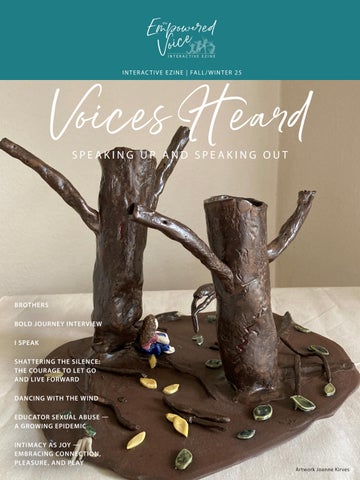
Artwork Joanne Kirves
VOICES HEARD
FA L L W I N T E R 202 5
EDITORIAL TEAM
CLAIRE O’LEARY
Fo un d e r, Edi to r- in - Chi e f Creative Director SHERYL BLAHNIK
Copy Editor
CONTRIBUTORS
D O N N A B U L ATO W I C Z RACHEL GRANT DONNA JENSON JOANNE KIRVES DARLENE LEKOWSKI CLAIRE O’LEARY
PHOTOGRAPHY
TOMO SAITO
®2025 THE EMPOWERED VOICE, VOICES HEARD ALL RIGHTS RESERVED
INSIDE BROTHERS
6 6
I want them to walk ahead and clear…
FROM THE EDITOR: INTIMATE STORIES OF SPEAKING UP These intimate stories of abuse by…
BOLD JOURNEY INTERVIEW
7
7
8 8
I suspected that it would be through the arts that hearts…
I SPEAK
14
14
I speak for them all – my fellow survivors…
SHATTERING THE SILENCE: THE COURAGE TO LET GO AND LIVE FORWARD
16
I also believed the truth would…
DANCING WITH THE WIND
16 21
She was naught but a tiny sapling when the first…
21
EDUCATOR SEXUAL ABUSE — A GROWING EPIDEMIC 26 My lower lip and jaw trembled, and I struggled to…
26
BUILDING RESILIENCE INTIMACY AS JOY — EMBRACING CONNECTION, PLEASURE, AND PLAY
32 32
When we open ourselves up to trust — in ourselves and in others…
RESOURCES: BOOKS FOR ADULT SURVIVORS
36
36
Books by survivors and professionals that help…
IF SOMEONE YOU KNOW IS IN CRISIS…
40 40
Resources for anyone needing immediate assistance…
BOOKS FOR KIDS
41
41
New books to explore by kids and professionals tor kids, and parents…
BOOKS FOR TEENS
42
New books to explore by teens and professionals tor teens and parents…
ONLINE SUPPORT
42
43
Online Support Groups for all…
43
BROTHERS By Joanne Kirves
I want them to walk ahead and clear the way. “Little sister coming through” Don’t mess with them when she’s involved. Their words and eyes protect her. They wrap her in a shield of protection. They know her. She’s an artist. She’s strong. She’s independent but, they also know she needs them – their protection. 6
They are there for her. Arms crossed – You can’t get to her. They surround her like a fortress. They stomp out intruders. She is safe. There is kindness. There is compassion. There is protection. There is admiration. There is none of this. These brothers don’t exist.
ABOUT THE AUTHOR Joanne has a BFA in Photography & Ceramics and an MA in Arts Administration. She spent three years as an artist before turning to arts administration for 20 years. In 2020 she returned to clay. Art has been vital in her healing journey from CSA. Find out more about her on Instagram@ JoanneKirves.
“ I found my voice in clay!“
Joanne Kirves
FROM THE EDITOR: INTIMATE STORIES OF SPEAKING UP By Claire O’Leary
adults, kids, and parents. It also offers many online resources, links to websites and helpful groups, pg 36.
“
We’re always looking for new articles and resources. Share your wisdom and your stories with me at Claire@ClaireOLeary.com.
These intimate stories
Photo by Tomo Saito
It’s all about speaking up and speaking out in our Fall/Winter issue of Voices Heard. These intimate stories of abuse by parents, siblings and teachers all have the common theme of speaking out, speaking up! And... What happens when we don’t. In her poem, Brothers, Joanne Kirves reminds us that our need for protection is not always met, especially by brothers, pg. 6. Published author, Donna Jenson, shares her extraordinary journey from defining moment through advocacy in Bold Journey Interview, pg. 8. Joanne Kirves finds the strength to speak up with her poem, I Speak, pg. 14. A new author Darlene Lekowski writes about her experience, empowering us all in Shattering the Silence: The Courage to Let Go and Live Forward, pg.16. My epic poem Dancing In The Wind, unfurls my personal experience as an allegory on pg. 21. Educator Sexual Abuse — A Growing Epidemic by Donna Bulatowicz builds our awareness regarding sexual abuse in schools and shows us ways to stop this epidemic, pg 26. Our Building Resilience section continues with our ongoing contributor Rachel Grant expanding our understanding and capacity for intimacy with Intimacy as Joy — Embracing Connection, Pleasure, and Play, pg. 32. As always, The Resources section offers memoirs, books for adult survivors, advocacy, teens, young
View Past Issues of Voices Heard The one and only printed issue of Voices Heard (thus far) is available for purchase for only $25. It would make a lovely gift for another survivor or those associated with survivors. Check it out. REACH OUT ANY TIME!
of abuse by parents,
siblings and teachers all have the common theme of speaking out, speaking up!
7
BOLD JOURNEY INTERVIEW By Donna Jenson
8
Diversity of Sacred Hues, agsandrew/Getty Images/iStockphoto
I found the seed to my purpose at age thirty-three. In the decade leading up to that awakening I was building grassroots women’s centers within the Women’s Liberation Movement of the 70’s and ‘80’s. A defining moment was ignited in a customer line of a local delicatessen. Several steps ahead of me was a large swaying, obviously inebriated, middle-aged man. I was overtaken with the need to turn around and leave without placing my order. Later that day, I retold this story within my women’s support group, shaking and wondering why I had swiftly exited the shopping line. That wondering evolved into a query about my alcoholic father and what could have been going on within myself to run from the deli. Ultimately it was about all the buried pain and shame I’d been holding since my childhood experience of incest at the hands of my father and the absence of protection from my mother. The deli incident happened shortly after my divorce of ten years with my first husband as my daughter reached the age I was when my incest began – at seven years old. The combination of personal freedom from the marriage, the proximity of a little girl like I had been, and a nurturing women’s support system was fertile ground for my heart to open to the healing I needed. I dedicated myself to the work of healing through peer counseling, therapy, yoga, acupuncture, cranial sacral and EMDR therapies, and building a strong supportive family of choice – often saying, “I gotta get this gunk out of me.” Gunk being all the unresolved suffering I was carrying. Only those close to me knew of my experience, the “secret” I held, the truth I had been hiding from myself and my family. Time and again my father’s command, after every assault, “You tell anyone, and I’ll kill you,” would resound in my mind. This requirement to not tell became as insidious as the crime itself. Eventually, I realized I absolutely had to tell if I was going to rise to a deeper level of healing; to find my voice and use it to break the silencing engulfing my spirit. It became clear to me that I wanted, no HAD, to find ways to support and encourage other survivors to break the silence as well, for themselves, for each other and for our whole culture. That purpose I found in 1995 remains the same to this day. I turned to the arts to find my voice as a survivor and help others to do the same. Instead of my well-known social change activities through grass roots organizing I suspected that it would be through the arts that hearts and minds could be changed regarding childhood sexual abuse. Little did I know how enormous my own healing would be furthered by participating in this “art-making” for change. First, I wrote a one-woman play depicting what it was like growing up in a sexually abusive family; what one woman experienced to reclaim her life and make it worth living. My play, What She Knows: One Woman’s Way Through Incest to Joy, took seven years to write. I brought in a master guitarist, John Sheldon, who wrote a beautiful soundtrack. He accompanied me in every performance of our 11-year run, closing with his riveting song that reflected the main theme of the play, It Wasn’t Your Fault. Listen to it here.
“
Instead of my well-
known social change activities through
grass roots organizing I suspected that it would be through the arts that hearts
and minds could be
changed regarding childhood sexual abuse.
9
“
10
Buried under our
traumas there runs
a deep wellspring
of creativity and joy
waiting to be tapped within a circle of survivors writing together.
In 2008 I founded a non-profit project, Time To Tell, through the fiscal sponsorship of Fractured Atlas to provide a platform offering healing through the arts for survivors. I pulled together a think-tank to create a mission which remains intact to this day: Sparking stories from lives affected by incest and sexual abuse to be told and heard. After viewing a performance we did in Miami my daughter, Jennifer, announced, “Mom, you have to write a book about your life!” I smiled back at her, silently telling myself, ‘Not likely’. But she and a few other dear hearts in my life were persistent enough that I took the challenge. My book, Healing My Life from Incest to Joy, was published by Levellers Press in 2017. I would narrate the audio book version in 2023, published by Audible. In 2019 I launched the online Time To Tell Writing Circles for survivors. Buried under our traumas there runs a deep wellspring of creativity and joy waiting to be tapped within a circle of survivors writing together. Our circle format is designed to foster both personal exploration and the creation of community with an amalgamation of two primary activities: 1. Writing and reading our narratives to each other. 2. Mindfulness practices such as focused breathing and gentle yoga stretches. We follow a set of group guidelines that holds our space together. Writing prompts are offered and participants write within the safe container of the group. We then honor each other’s voices by actively listening to each member reading aloud what they have just written. This act of listening, to one’s own words as well as each other’s, confirms and affirms that what each narrator has to say is worthy of our undivided attention. And when the narrator gets
“
’ The number one to hear feedback about what has stayed with us from a piece of their writing, they are given the profound message that their voice has been received, heard, and honored. The tech moderator of each circle creates a digital collage from the writings and sends it to the members. In response to the Me Too Movement my article, Are We Making Headlines or Headway, was Published by MS Magazine 2019. I placed second in the Western Mass. 2021 Story Slam performing We Tiptoed Back. Telling the story of my 25-year heartbreaking journey of losing the majority of my biological family for disclosing and the ultimate miracle reuniting with my beloved niece, Melisa. I co-produced Survivors’ Voices: Works of Resilience Written and Read by Survivors of Childhood Sexual Abuse, a virtual weekend event to share original writing regarding people’s experiences of childhood sexual abuse and their paths of healing. The audience was filled with community and family members as well as professionals who work with survivors. I then edited the anthology which is comprised of all the readings. Survivor’s Voices was published by Levellers Press in 2021. In 2022 I curated VISIONS FROM OUR VOICES: A Collage Exhibit Depicting Survivor Narratives comprised of fifteen 12” x 12” collages from the TTT Writing Circles. The exhibit takes viewers on an emotional journey, offering a window into the profound healing power of storytelling and art. The exhibit invites visitors to immerse themselves in the narratives, emotions, and symbolic representations embedded within each collage. Where possible writing workshops are offered in conjunction with the exhibition. I began offering an interactive continuing education workshop for therapists and social workers with my colleague Reena Bernards, LCMFT in early 2023. Its title is Helping Survivors to Heal from Sexual Trauma: An Attachment Approach. It’s groundbreaking nature of being co-led by a clinician and a leader in the survivor movement offers participants theories and techniques not only to help survivors but addresses therapist self-care to prevent secondary traumatization. Then I produced the documentary, Telling is Healing, showing excerpts from my play in conversation with an ally, Susanne Beck. The film shows the importance of healthy relationships with non-survivors.
obstacle has always
been, and remains to this day, the silence surrounding sexual trauma. Not only
perpetrators and their
enablers but families, communities, and
social institutions all
collude with the taboo
of this “unspeakable” epidemic.
11
“
My dedication to
persist is founded on my strong belief that
12
healing is possible as
Presently I am in the process of producing a video podcast to be in conversation with survivors about ways we have healed and, most importantly, what has changed or been added to our lives through our healing journeys.
silence surrounding
The number one obstacle has always been, and remains to this day, the silence surrounding sexual trauma. Not only perpetrators and their enablers but families, communities, and social institutions all collude with the taboo of this “unspeakable” epidemic. Most insidious is the success this silencing has on each survivor to hold down the truth of their experience for fear of ostracization, or worse, retaliation. Even deeper is how we often bury our experience since it’s too horrific to look at.
levels. Since I started
To overcome and resolve this obstacle requires constant attention
is the breaking of the sexual abuse at all
this journey, I realized I would be rejected
and should still keep going – and so I do.
to, first, my own healing. I’ve come to see self-care as a super power. I take care of myself on many levels: eating and sleeping well; quality time with good friends and beloveds; exercise and yoga; listening to music; writing and art making; reading inspiring novels and non-fiction; peer–to–peer counseling and therapy. And being in community with other survivors. I have always had to deal with the obstacle of organizations and institutions not ready, able and/or interested in offering programs or resources to survivors. For every “yes” there are many more who say “no” to requests for support or collaboration. I understand this has much to do with the widespread cultural taboo to not speak of, let along take on, this issue.
The three qualities, skills, or areas of knowledge that were most impactful on my journey have been persistence, humor and love. My dedication to persist is founded on my strong belief that healing is possible as is the breaking of the silence surrounding sexual abuse at all levels. Since I started this journey, I realized I would be rejected and should still keep going – and so I do. It’s a quality that not only makes me a good organizer but friend as well.
ABOUT THE AUTHOR Donna Jenson is the survivor support person for The Survivor Nest Project. Author of Healing My Life From Incest to Joy, playwright of What She Knows: One Woman’s Way Through Incest to Joy, editor of the anthology, Survivor Voices; and producer and principle of the documentary Telling Is Healing. She has
There was a great lack of humor growing up my home environment, given the presence of alcoholism and abuse. But, every year, I visited my maternal grandparent’s farm – where joy lived. I have vivid memories of being passed around the laps of my mother and her two sisters where the air was filled with laughter. The first time I heard it and felt the buoyancy of their spirits I was elated and began searching for laughter. It became the deciding factor for every relationship I built from then on. I came to understand that laughing out loud, sincerely and often, is extremely medicinal. And it’s served me very well – all this laughing. So is love a quality, skill or knowledge? Probably all three and more. To love and be loved is, for me, what life is really all about. Likewise, I fill my life with places and experiences that I love. To do this requires lots of attention and awareness. I regularly check in with myself and ask: Am I loving where I am, what I’m doing, who I’m with? If not – something has to change – and the “something” is usually me. When needed I ask myself key questions: What conflict or lack do I need to address? What do I need to do to get back to feeling loving and lovable?
My advice for folks who are early on their journey is – first and foremost – be very kind and gentle with yourself. Healing from our traumas and working to find meaning in our lives takes a lot of work and time. Luckily there exists many individuals and groups who can support and help us heal. Find them. When I started, I had this pie in the sky idea that I would get to the end – be fully healed and move on. About 20 years along the way I realized I’d be healing till the day I die, and that’s okay. Because a bigger realization unfolded for me – healing is possible, and we can build a life worth living.
been leading writing circles for survivors since 2008. Find her on Time To Tell Instagram and her website, Timetotell. org.
13
I SPEAK By Joanne Kirves
I speak for them all – my fellow survivors. The perpetrators come from within, or from very close circles. I finally found the will to speak. And Speak I will.
No one wants to see it.
It comes out in different ways and to varying degrees.
No one wants to feel the pain of acknowledging “he” or “she” could do that.
From “I work with survivors.” and
“Perhaps you are mistaken.”
“I too had a childhood trauma.” to
We hear it all too often.
“I am a survivor of Childhood Sexual Abuse.”
I am pretty sure my 5-year-old self didn’t know “this” was even a thing.
I can’t shorten it or soften it. I have to write it out. Say it out loud. 14
How do they get in?
“I am a survivor of Childhood Sexual Abuse.” It’s long and I need to say it.
How could she/he be mistaken? It is unmistakable. It is undeniable. It HAPPENED. I finally have the will to speak.
And then comes the “who was it?” I still flounder with this one.
We have been taught “do not make mountains out of mole hills.”
In my inner healing circles, they know.
“Let it go.”
Who else should know?
“Forgive and forget.”
To them I say…
Forgive him/her/whoever, maybe.
It was him.
Forget? Perhaps temporarily.
A father, a brother, a grandfather, an uncle, a cousin, a family friend, a neighbor, a priest, a teacher.
But then it emerges in all parts of our lives,
It was her. A mother, a sister, a grandmother, an aunt, a cousin, a family friend, a neighbor, a nun, a teacher.
from how we see ourselves to how we react. They don’t understand, how could they? They didn’t see it then.
It’s all of them.
And some still don’t see it now.
They are all to blame. They did it to us!
Or they see it, acknowledge it, then later turn away saying, “Perhaps you are mistaken.” I hear those words inside my head. Am I mistaken? NO! I didn’t even know these were things people did.
How would I know unless it happened to me. A 5-year-old doesn’t know. Until she/he does.
Right now, I just need you to know. I was sexually abused as a child. I was not protected.
And then, the blame sets in. If you can’t tell, then it must be me/we/us. It must be our fault. NO! It wasn’t my fault. It wasn’t your fault.
It was not my fault. I am not to blame. And he/she is dead/alive. I am healing and that is what is important. I am working towards the day when my whole body believes that it wasn’t my fault.
So, who’s fault, is it? It’s his/her fault. The grandfather, the father, the brother, the uncle, the cousin, the priest, the close family friend, the teacher.
15
The grandmother, the mother, the sister, the aunt, the cousin, the nun, the close family friend, the teacher. Name them. I did. It is all of them. It is all of them who did it to all of us. If I name him/her, then what? ABOUT THE AUTHOR
You question me further.
Joanne has a BFA in Photography & Ceramics
How?
and an MA in Arts Administration. She spent
When?
arts administration for 20 years. In 2020 she
Where? Why? Did you tell anyone? Why didn’t you say something? Why now? If I just say I was sexually abused as a child, what can you say? If we need you to know or want you to know, we’ll name them.
three years as an artist before turning to returned to clay. Art has been vital in her healing journey from CSA. Find out more about her on Instagram@ JoanneKirves.
“ I found my voice in clay!“
Joanne Kirves
SHATTERING THE SILENCE: THE COURAGE TO LET GO AND LIVE FORWARD By Darlene Lekowski
“
I loved my parents and 16
believed they would
have protected me—
but I also believed the truth would kill my
mother and shame me forever. So, I stayed quiet. The cost of
that silence was my freedom.
For more than fifty years, I lived inside a silence so heavy it shaped every breath, every choice, every dream I dared to have. I was sexually assaulted by two of my oldest brothers as a young girl. They told me that if I ever spoke out, I’d destroy our family, be abandoned, and end up alone. In the conservative, upper-middle-class Midwest home where I grew up in the 1970s and ’80s, nobody talked about their problems. We pretended everything was fine. I loved my parents and believed they would have protected me—but I also believed the truth would kill my mother and shame me forever. So, I stayed quiet. The cost of that silence was my freedom. Every relationship, every achievement, even every success was built atop a secret that kept me trapped in survival mode. I learned to control, to plan, to anticipate harm before it arrived. That hyper-vigilance made me a strong businesswoman and effective leader—but a deeply wounded human being.
For decades, I measured safety by control. If I could out think every situation, I could keep the chaos of my childhood from repeating itself. But control is not the same as peace. When you live your life constantly fighting unseen enemies, everyone starts to look like an opponent—even the people who love you. My silence and fear built a prison that looked, from the outside, like success. I had a career, a family, and a life that most would call enviable. Inside, I was still that little girl begging to be believed. After my mother passed away and my father was slipping into dementia, I confronted one of my brothers. I wasn’t looking for vengeance— only an apology and acknowledgment of what had been done to me. What I received instead was a lawsuit. He sued me for defamation and I counter sued for the same. In court, the weight of half a century of fear met the light of truth. The jury believed me. I won. I thought victory would feel like peace, but it didn’t.
The anger, shame, and bitterness
The second act of my life began
I’d buried didn’t dissolve with
the day I chose to let go. Letting
the verdict. It began to leak
go meant more than forgiving
out—especially
my abusers or accepting the
toward
those
I loved most. That was when I
understood:
survival
had
carried me this far, but it could not take me home. The lowest moment of my life wasn’t in that courtroom—it was in a restaurant parking lot in Charleston, SC, when I hit my daughter in the head during a PTSD episode, thinking she was the brother who raped me. That moment became my mirror. It allowed me to see that trauma doesn’t end when the abuse stops—it ends only when we stop running from it. What triggered it wasn’t what was happening in front of me—it was what had happened fifty years earlier. My mind replayed a child’s terror of abandonment; I believed, for an instant, that my daughter leaving her brother meant she was abandoning me as well and I’d lose her forever. I saw my brother’s face where hers should have been. That day, I hit the person I loved most because I had never truly faced the depth of my pain. It shattered me. My daughter told me that unless I got real help, she couldn’t have me in her life. And she was right.
past. It meant dismantling the strategies that had once kept me alive but were now keeping me stuck: the obsession with control, the need to win at all costs, and the belief that silence equals safety. Letting go meant surrendering the narrative that being strong meant being unbreakable. It meant learning that vulnerability isn’t weakness— it’s truth in motion. I started to release the emotional residue that clung to me like black tar: anger, shame, resentment, and bitterness. All that weight wasn’t about me anymore—it was about my brothers, about a history that no longer deserved ownership of my present. It was messy and painful. Healing always is. But once I began purging the darkness, light had somewhere to enter.
Living Forward isn’t just a slogan—it’s a daily practice. It means waking up and choosing presence over fear, hope over control, faith over perfection. It’s not erasing the past; it’s learning from it and refusing to let it dictate who you are today.
“
Let ting go meant surrendering the
narrative that being strong meant being unbreakable. It
meant learning that vulnerability isn’ t
weakness—it’s truth in motion.
17
Even the word incest still triggers me. But I learned something miraculous happens when you name your pain: it begins to lose its power. Every time I told someone, they believed me. That truth shattered fifty years of silence. It also connected me to an extraordinary community of survivors—through organizations like 5WAVES, A Brave Step, Thriving Survivors, SSTA Aware, Blue Borage, and AILA. These communities reminded me that I was truly never alone. They offered what trauma steals first—belonging.
To live forward, I had to cultivate seven inner tools that now define my healing mindset:
18
“
Every time a survivor breaks their silence,
they don’ t just reclaim their own story—they create a ripple that invites others to do the same.
• • • • • • •
Resilience Optimism Courage Perseverance Self-awareness Self-help And Hope
These principles became my compass. They guided me away from shame and toward agency. They helped me rebuild relationships, especially with my husband, Tom—my “Viking,” whose steadiness has helped me find my own. The Charleston Incident taught me that trauma left unhealed becomes transmitted pain. I realized that if I didn’t surrender my rage, I would lose the people who mattered most. Finally leaving my first husband after years of trying showed me that I don’t have to cling to what makes me small, just because I once believed that’s all I deserved. I am worthy of peace, of kindness, and of more. And marrying my second husband, Tom, taught me that real love requires trust. The more I let go, the stronger and more joyful our marriage and my life became.
There is no easy way to expose a terrible truth. To say I was sexually abused by my brothers still makes my body tremble.
People often ask if I feel healed. My answer is always the same: healing is not a destination; it’s a direction. There’s no finish line where all the pain disappears. There’s only the daily practice of choosing peace over bitterness, empathy over anger, forgiveness over control. Some days, I still stumble. I still get triggered. I still have weekly nightmares. But I no longer let those moments define me. They’re reminders of how far I’ve come— and how committed I am to living forward. Silence and healing are intertwined—one imprisons you, the other sets you free.
Silence
doesn’t
protect
families—it fractures them. It doesn’t spare reputations—it destroys souls. For generations, families like mine believed that keeping secrets maintained dignity. What it actually maintained was pain. Every time a survivor breaks their silence, they don’t just reclaim their own story—they create a ripple that invites others to do the same. That’s how cultures change. For years, I equated strength with perfection. I wanted to be the woman who had it all together, who didn’t let the past define her. But perfectionism was just another mask for pain. Healing required imperfection. It meant admitting when I was wrong, apologizing when I hurt others, and allowing myself to be seen in all my messy humanity.
ABOUT THE AUTHOR Darlene Lekowski is a survivor, speaker, advocate, and business leader who
As I began to heal, my focus shifted outward. I realized that my story wasn’t just about what had happened to me—it was about what I could do with it. Today, I partner with organizations worldwide to raise awareness about sibling sexual trauma and abuse (SSTA). Breaking that silence matters. It saves lives. Through public speaking, advocacy, and my upcoming memoir, I aim to give survivors language for what happened to them—and permission to speak it aloud. Because healing begins the moment we stop whispering. The process of letting go and living forward is deeply personal, but no one should have to do it alone. These are steps that helped me—and that may help others: • • • • • • •
Share your story Lean on loved ones Reframe your inner dialogue Work toward self-acceptance Set clear intentions Ask for help Find your people
There are others walking this same road. Strength isn’t the absence of pain; it’s the ability to face pain without letting it own you. For so long, I thought being strong meant never breaking down. Now I know real strength is being honest enough to say,
I’m hurting—and brave enough to keep going anyway. Living forward doesn’t erase what happened—it honors the survivor who refused to give up. When the foreman read the verdict in my defamation trial, I cried silently. I looked at the faces of twelve strangers who believed me and mouthed ‘thank you’. That moment didn’t erase the trauma—but it affirmed my truth. For survivors, belief is everything. It’s oxygen after years of suffocation. That verdict was justice on paper, but the real justice has been in letting go of the silence of my secret.
transformed decades of pain into hope and healing—for herself and others. After fifty years of silence about the sibling sexual trauma and abuse (SSTA) she endured as a child, she found her voice, winning the civil lawsuit brought against her by her own brother. Her debut memoir, Shattering Silence: A Story of Survival, Justice & the Power of Telling the Truth (April 2026), shares her journey of resilience, justice, and healing. She speaks publicly about her journey and partners with SSTA and sexual assault organizations worldwide to raise awareness and give a voice to all survivors. Darlene lives in the Charlotte, NC suburbs
Letting
go
doesn’t
mean
forgetting. It means releasing the power that pain once held over you. Each time I tell my story, I let go a little more. Each
time
another
survivor
tells theirs, the world becomes a little safer—and the silence shatters a little more.
That’s
what it means to let go to live forward.
with her husband, Tom, their dog, Pepper, and is the proud mother of three adult children. Visit darlene-lekowski.com | Instagram: @darlenelekowski
19
20
DANCING WITH THE WIND By Claire O’Leary
It was her first season She was naught but a tiny sapling when the first big storm hit Her trunk no larger than a stem Tiny leaves trembling from her nimble branches Roots only a few inches deep But she was strong nevertheless Having known only sunshine and light rain She welcomed the cooling drops on her branches Seeping into her roots Nourishing her But the north wind came Cold and strong The tiny leaves were sheared away Crying When lightning struck deep into her trunk She felt herself fold in half Protecting herself From the searing pain The young sap ran deep into her gaping wound Sealing the tiny holes where leaves had once been Healing her gentle soul
Leaving the first deep scar Many seasons had passed She was strong and lithe Branches stretching to the sky Sunshine and rain fed her Softened her soul Bright green leaves clung to her strong branches Long forgotten was the storm that had left those scars The storm that had bent her trunk But storms come and storms go And this one she braced for when she felt the cold wind blow It was unexpected It had been so warm So gentle
The leaves clung to her branches as the north wind blew Not yet ready to release But the wind was too strong Unwilling to let go Yet unable to cling any longer She felt them rip from her branches One by one Two by two The leaves flew far and wide
Like secrets being torn away It was too early for them to leave She was too young She felt so naked and alone She heard the thunder Just as the lightning struck Ripping the old wound wide open Unwillingly She felt herself fold in half again Felt the searing pain spread into her soul The scar zigzagging across her trunk
This storm she would never forget This wound would take much longer to heal They whispered from a distance The other trees It’s easier if you bend, she heard them confide She would not bend She would stand strong For nothing Nothing Would keep her from being the powerful tree she knew she was But she struggled to grow The wound was too deep She could not heal it alone Her sap alone was not enough
21
22
She began to bend and sway with the wind She listened to the trees coming near
They know it’s time To unleash those many secrets
Her roots are strong now Reaching deep and wide Beyond anything she had ever imagined
She thinks back to a time When those secrets almost ate her up Her roots were getting loose Her trunk was getting soft Rotting
The strength of those roots Rising throughout the many branches Reaching for the nearby forest Yet, she is still lithe
Until she allowed that child at the foot of her roots to speak
The leaves are yellowing They are ready to release soon
Her soft voice quivers in the darkening sky Her heart tightening against her chest
23
Tears flowing down her cheeks Am I safe truly? Am I loved? Can I share?
Suddenly, she spoke forcefully
And pointing again It was him And it was him And him And him
Finger pointing…
They all did it
He’s the one She says He led me in there In the dark bedroom
Took away my voice Took away my peace Took away my power Took away my joy Took away my soul
Finger pointing elsewhere It was him she said
It was the power in the child’s voice that strengthened her
24
Her roots began to mend
They close their eyes at last
With much help from the forest Her roots became strong Long and gnarly Deep and wide as her branches They stretch Exploring
Build strength Feel hope Find themselves Know love Find their voice
They welcome those who need her like arms reaching out Those who wish to climb Or simply rest their weary bones Nestled against her She cradles them
Feel safe within her bosom
Know that they too will One day Be strong
Only a few leaves cling to the tree Not yet ready to let go
Hidden secrets yet to be released They shimmer and shake in the fading light They tickle her branches as they quiver She knows they must go soon Let go A soft breeze arises as if to say It’s okay You can let go now Your secrets are safe in the greater world You can let go
ABOUT THE AUTHOR Claire O’Leary is founder of The Empowered Voice (Traveling Art Exhibit & Symposium) and Voices Heard, the interactive e-Zine that
The long branch shakes a little With the gust of wind Saying it’s time You’re safe You are loved
The last leaf flies into the wind Its last secret with her
The little girl sits below the branches Smiling
empowers survivors to shatter the silence of their sexual abuse which helps them heal and help others heal through sharing their stories. She lives in Donnelly, Idaho with her husband, and enjoys being a mother and grandmother. Claire’s a CSA (incest) survivor, an avid reader, meditates and dances her heart out any time she can. She’s an advocate, speaker, and mentor.
Today she dances with the wind Knowing that winter is yet to come They were right
It’s easier if you dance with the wind All artwork is from Joanne Kirves, Ceramic Artist and founder of the Survivor Forest. Creating the Survivor Forest was how Joanne was able to connect and share art with other survivors. She began with her own tree story, My Beloved Trees. Then began reaching out to other survivors in her healing circles. Her first two collaborators were Donna Jenson and Jen Marie. The first few times they met individually about their writing and when they were complete she headed off to the studio to create it in clay. The process of writing their own story is healing, but to then create in clay is a visual reminder that their story was also heard. It is a true collaboration. Joanne also hosts Survivor Forest writing circles where together we write and share. As each participant completes their tree story they share it with the group. Then she begins to create it in clay. Both options are available to survivors who want to write their tree story and possibly collaborate with her on sculpture. If you are interested, email her.
25
EDUCATOR SEXUAL ABUSE — A GROWING EPIDEMIC By Donna Bulatowicz
“
26
My lower lip and
jaw trembled, and I
struggled to hold back tears. I was trying to tell her that some
older boys had pulled down my pants and underwear.
Getty Images/iStockphoto, Drazen Zigic
I didn’t talk in kindergarten. My friends spoke with and for me. But I didn’t say a word in class, and I rarely said anything to my teacher. I was overwhelmed by the noise, bright lights, new expectations, changes in my routine, and—most of all—the other children, some of whom bullied me. One day, I ran to my teacher at the end of recess. I was shaking. “Some big boys…” I started. She immediately jumped in with a sing-song rhyme, cutting me off. “Sticks and stones will break my bones, but words will never hurt me.” I tried again, “But it wasn’t…” She cut me off again with a firm, “No tattling, Donna. I’m disappointed in you.” My lower lip and jaw trembled, and I struggled to hold back tears. I was trying to tell her that some older boys had pulled down my pants and underwear. I never tried again to tell her about mistreatment by
other children. Since I learned she didn’t care about what was done to me, I didn’t bring up the gym teacher. Most of us little girls didn’t like being around him. If we forgot it was gym day and wore skirts, he’d stare at us, especially if it was a dance unit, circuit training that included rope climbing (yes, we had to do that in skirts), etc. Even when I started talking in school— thanks to my fabulous first grade teacher, Mrs. Kindsfather—I still remembered the rebuke from my kindergarten teacher, and I kept my mouth shut about the gym teacher. Until the third day of school in upper elementary. My new teacher saw me sitting on the gym floor and crying. She asked what was wrong. I told her that the gym teacher had tried to make me climb the rope in my skirt and punished me for not doing so. She yelled at the gym teacher in front of the entire class. She also made it clear bullying wasn’t okay and stopped peers whom she caught bullying me. For the first time since the beginning of kindergarten, a teacher refused to tolerate the constant bullying. An adult actually stood up for me. She also groomed and sexually abused me.
Though I didn’t know it at the time, I was far from being the only child being sexually abused or harassed by a teacher. According to the most recent study (Grant, Haverland, & Kalbfleish, 2024), 17.4% of young adults reported being sexually harassed by school staff in K-12. In a previous survey (Jeglic et al., 2023), 11.7% of recent high school graduates reported being victimized by educator sexual misconduct, most of whom experienced non-contact sexual abuse. The percentages reflect those who were comfortable reporting it on a survey, as well as those who elected to complete a survey. Educator sexual misconduct is an epidemic that goes largely unacknowledged. Those who work in schools may not want to think of their colleagues potentially harming children, due to the halo effect or other preconceptions about educators. (The halo effect happens when someone attributes other positive values to someone based on one characteristic. For instance, some view rich people as more worthy, valuable, etc. Beautiful people are seen as more trustworthy, likeable, moral.) Teachers may attribute their own reasons for an
educational career choice to others, not realizing that some choose teaching, at least in part, to victimize children. Teachers often have heavy workloads, which tend to steadily increase as budgets shrink. Thus, the thought of an additional training or more responsibilities can cause overwhelm to already burdened people. Studies show elementary teachers have 200 – 300 interactions with students each hour on average, or one every 12 – 18 seconds. Thus, they often have decision fatigue by the end of the day, if not sooner. They may not have the energy to do more than they already are. That’s what predators rely on. They depend on their colleagues to be overburdened and distracted by their own students. Perpetrators are skilled at using misdirection and taking advantage of the kind nature of others. They perfect manipulation and offer to take on some of the burden, often leading them to be viewed as superhero teachers. They cultivate popularity, gregariousness, generosity, and more, so as to benefit from the aforementioned halo effect. Educator sexual abuse, like any sexual abuse, can change a child’s developing brain, body,
“
Those who work
in schools may not
want to think of their
colleagues potentially
harming children, due to the halo effect or
other preconceptions about educators
Getty Images/iStockphoto, Drazen Zigic
27
nervous system, DNA, and more. There can also be fallout from peers (bullying, etc.), when a teacher sexually abuses a child, and unkind and even cruel treatment from other teachers if the child tells on the sexual predator teacher, as I experienced.
“
All adults in schools must learn about 28
sexual abuse— including the
impacts—as well
as ways to protect
students. They need to learn about signs of possible grooming, behaviors to watch
for, how to bring up concerns, and more.
So what can be done?
FIVE THINGS THAT PARENTS/ GUARDIANS CAN DO TO HELP PREVENT EDUCATOR SEXUAL ABUSE: Parents/guardians can work toward preventing sexual abuse, including incest, COCSA, educator sexual abuse and more. There are things specific to parents/ guardians, including knowing your child well, taking time to listen to them, repairing the relationship when ruptures happen, setting reasonable boundaries, and more. 1. Ask the school what steps they take to prevent sexual abuse 2. Advocate for laws that require body safety lessons, mandatory teacher training, and more 3. Teach your child anatomically correct names for all body parts 4. Model consent 5. Talk with your child about body safety and read developmentally relevant books with them that address various aspects of body safety, consent, etc.
Here are some steps teachers, administrators, and other school staff can take: SOME SUGGESTED RULES: • • • • •
No adult should be alone with a child, especially out of sight Classroom doors open unless there is a fire or other drill, test, or an emergency Administrators walk around the schools at unpredictable times Doors to storage closets, etc., locked when not in use Children and adults use separate bathroom facilities
REQUIRE SEXUAL ABUSE EDUCATION AND PREVENTION TRAININGS •
Offer developmentally relevant body safety lessons • Teach about and model consent • Observe those around you for possible signs of grooming behavior • Have rules that make it harder for sexual abuse to occur • Learn how to prevent child-on-child sexual abuse, the fastest-growing type of sexual abuse Teachers and all school staff need training. All adults in schools must learn about sexual abuse—including the impacts—as well as ways to protect students. They need to learn about signs of possible grooming, behaviors to watch for, how to bring up concerns, and more. There should be one or more experts available to answer questions during and after the training. While some schools have mandatory educator training on sexual abuse education and prevention, the trainings are usually completed individually, online, with minimal interaction if any. Staff may not participate in the training. No one usually follows up with those who took the training, whether to answer questions, check for understanding, provide additional training, etc. Some of the trainings include inaccurate information.
AT A MINIMUM, TRAININGS SHOULD INCLUDE: • • •
• •
Definitions and descriptions of different types of sexual abuse Statistics and examples Recognizing and responding to – Possible grooming – Possible signs of sexual abuse – Warning signs of a potential predator – Possible disclosure of abuse Information specific to district rules and state laws Mandatory reporting
29
Getty Images/Jacob Wackerhausen • • • •
•
Opportunities to ask questions during and after the training Follow-up interactive training (not just “one and done”) Body safety education (additional details below) Awareness of Child-on-child sexual abuse (COCSA) in schools (additional details below) Grooming (additional details below)
BODY SAFETY EDUCATION Many states have mandated body safety education. There may be set curricula. The lessons may happen once a year or be spread throughout the school year. These are necessary for teaching children what sexual abuse is, how to stay safe, and more.
AT A MINIMUM, BODY SAFETY LESSONS SHOULD INCLUDE: • • •
Spiraling (content each year builds on the previous year) Defining sexual abuse, private parts, consent, and more Supplemented by books and other materials
And be: • Developmentally relevant • Engaging • Clear Adults rely too frequently on children to prevent sexual abuse. That is an enormous and unfair burden to place on children. It’s challenging for many adults to talk about sexual abuse or speak up about sexual harassment, rape culture, and more. It’s even harder for children. This is why trainings for adults are essential along with body safety lessons for children. Adults need to teach and model consent. Ask before giving someone a hug, high five, etc. Before borrowing something from someone, ask them if it’s okay, and respect a no. Children will learn and practice body boundaries and consent if the adults around them model and teach these topics.
“
It’s challenging for many adults to talk
about sexual abuse or speak up about sexual harassment, rape culture, and
more. It’s even harder for children.
30
Grooming
All of it is harmful.
Five signs that an adult may be grooming a child:
More and more children are sexually abusing other children. It’s the fastest growing type of sexual abuse. It’s happening in schools as well as elsewhere.
1. Fixation on a child 2. Ignores/pushes boundaries 3. More affectionate with one child than others 4. Favoritism toward a child 5. Child’s behavior changes and/or child shows other possible signs of sexual abuse These are just a few of the signs to watch for. There are more, and these don’t necessarily indicate someone is sexually abusing a child. They are, however, causes for concern that you can document and address. For instance, you can say, “I noticed you are more affectionate with _______ than the other children. I’m concerned that may come across as favoritism.” If someone isn’t doing anything wrong, they will almost certainly appreciate the head’s up. If someone gets defensive, that’s something to document and perhaps take further (e.g. conversation with administration).
Child-on-child (COCSA)
sexual
abuse
Child-on-child sexual abuse (COCSA) comprises around 40% of all cases of sexual abuse. Research shows different motivations for children who sexually abuse depending on age, developmental level, etc..
Children imitate what they see and hear, and they may act things out with other children. Some don’t realize it’s wrong because they have been told it’s normal, it’s how one shows love, etc..
Some are reacting from
other stress, such as violence in the home. Some are seeking power and control. Some are acting out what they’ve seen in pornography. Some have other motivations.
HERE ARE FIVE WAYS TO HELP PREVENT COCSA IN SCHOOLS: 1. Minimize chances of groups of children being alone without adult supervision 2. Teach children about COCSA in body safety lessons 3. Limit opportunities for older children to be alone with younger children without adult supervision 4. Educate adults about developmentally common sexual behaviors and ways to talk to children about boundaries, appropriate behavior, etc. 5. Include information about COCSA in trainings
Parents/guardians, administrators,
and
ABOUT THE AUTHOR Dr. Donna Bulatowicz has recently moved to the beautiful state of Maryland to be closer to family. She studies and advocates for inclusive children’s literature as well as sexual abuse prevention. She is a former chair of the Charlotte Huck Award for Outstanding Fiction for Children and a former president of the Montana Association of Teachers of English Language Arts (MATELA). Dr.
teachers,
Bulatowicz has created and given sexual
school
abuse prevention trainings for teachers and
staff must work together to prevent sexual abuse in schools. Children are counting on us to stand up and protect them.
other school officials. You can reach Donna on her Facebook page, or email Donna.
BUILDING RESILIENCE
31
INTIMACY AS JOY — EMBRACING CONNECTION, PLEASURE, AND PLAY By Rachel Grant
32
“
It’s about being seen, known, and accepted — and about seeing, knowing, and
accepting someone else.
Getty Images/iStockphoto,
When we open ourselves up to trust — in ourselves and in others — and embrace vulnerability, one of the most beautiful rewards is intimacy. This kind of connection isn’t just something we want — it’s something we crave, something we’re wired for. And it isn’t limited to romance or sex — intimacy shows up in deep conversations, playful teasing, quiet presence, and those soft, electric moments of knowing and being known. But what is intimacy, really? One definition I love describes it as: “Private and personal knowledge, detailed and obtained by much study or experience.” In other words, it’s the kind of closeness that comes with curiosity, time, and presence. In the context of sexual health and joyful relationships, intimacy becomes a shared journey — an unfolding dance of learning, exploring, and playing with another person. It’s about being seen, known, and accepted — and about seeing, knowing, and accepting someone else. And yes, it includes our bodies, desires, fantasies, and the sacred space of sensuality.
Intimacy involves both the ability to give and receive love, and it grows over time as we have experiences with — or “study” — the person we’re connecting with. One of the main problems we face, especially if we’ve been hurt in the past, is that we tend to jump ship well before any of that can happen. As a result, our relationships remain superficial — never delving into detailed, private, and personal sharing.
WHY IS THAT? WHY DO WE AVOID INTIMACY LIKE IT’S THE PLAGUE? When we’ve been hurt or carry distorted beliefs about intimacy, it can feel threatening rather than nourishing. We may fear that intimacy means: • • • • •
Blindly trusting people Betrayal or abuse Physical or emotional isolation Agreeing when we don’t Disclosing private information we don’t want to share
TO PROTECT OURSELVES, WE OFTEN ADOPT AVOIDANCE STRATEGIES.
SO LET’S FLIP THE SCRIPT. Let’s rewrite what intimacy can mean:
These might look like: • •
• •
•
Substituting (perfectionism, false compassion, attention-seeking) Compulsive behaviors (eating, smoking, shopping, sex, work, religion, TV) Suppressing the need altogether Fantasy, self-pity, anger, rigidity, judgmental attitudes
Over-scheduling ourselves to the point of disconnection These are understandable responses — especially when intimacy has been associated with pain. But they also keep us from experiencing the very things we long for: connection, trust, pleasure, and joy. •
Intimacy is shared laughter and lingering eye contact
•
Intimacy is being touched the way you like, when you like • Intimacy is enthusiastic consent and mutual pleasure • Intimacy is silly and steamy and everything in between • Intimacy is knowing someone’s breath patterns and how they take their coffee • Intimacy is feeling emotionally safe enough to explore sexually Instead of focusing on what to avoid, we can focus on what we get to move toward:
It’s easy to short-circuit our
Connection. Pleasure. Choice. Adventure. Healing. Play.
potential
So here’s a loving challenge:
for
intimacy
out
of fear. But when we stay guarded, we also miss out on the laughter, the tenderness, the playful vulnerability, and the freedom of being fully seen and accepted.
TRY MAKING AN “INTIMACY IS…” COLLAGE. Whether it’s with paper and scissors or a Pinterest board, or Canva, fill it with images, colors, textures, words, and moments that represent the kind of intimacy you want more of. Maybe it’s candlelight and laughter. Maybe it’s skin-on-skin, breathless kisses. Maybe it’s texting inside jokes from across the room. Whatever lights you up — name it.
Because when we get clear on what intimacy means to us — when we give ourselves permission to want it, enjoy it, and create it — it stops being something to fear or fix. It becomes something to celebrate, savor, and share.
Answer this question: By never entering into intimate relationships, I never get to experience…
33
Then ask yourself: What does intimacy look and feel like when it’s joyful? Want to take it further?
ABOUT THE AUTHOR Rachel is the owner and founder of Rachel Grant Coaching and is a Sexual Abuse Recovery Coach. Rachel holds a Master of Arts in Counseling Psychology and is the author of Beyond Surviving: The Final Stage in Recovery from Sexual Abuse and Overcome the Fear of Abandonment. You can download both free on her website. She works with survivors of childhood sexual abuse to help them let go of the pain of abuse and finally feel normal.
Getty Images/iStockphoto,
Her program, Beyond Surviving, is specifically designed to change the way we think about and heal from abuse. She has successfully used this program to help her clients break free from the past and move on with their lives. Reach Rachel here or on Facebook.
34
SUPPORTING SURVIVORS
35
RESOURCES: BOOKS FOR ADULT SURVIVORS But one day, Dina breaks her silence, and after that—with counseling and faith—her life gradually begins to improve. She even manages to forgive Jude for abusing her in multiple ways for years, until the day Jean reveals that Jude is abusing the next generation of the family. Can Dina convince the family that never protected her to speak out and act to stop Jude?
Beyond Surviving: The Final Stage in Recovery from Sexual Abuse by Rachel Grant.
36
In Beyond Surviving, author Rachel Grant, a Sexual Abuse Recovery Coach, provides an understanding of the three stages of recovery: victim, survivor, and beyond surviving – and offers survivors guidance and tools for empowerment and healing.
The Brave Knight, by Diane Tarantini (Author), Jessie Haring (Illustrator) In The Brave Knight, Tarantini articulates incredibly complex child abuse grooming techniques/dynamics (ie. desensitizing physical contact, isolation from familial supports, love for perpetrators, disparity of social power), and somehow does it in an age-appropriate, non-threatening way. A brilliant, compelling, and inspiring resource for kids and those who love them.”
Female Sex Offenders: What Therapists, Law Enforcement and Child Protective Services Need to Know by Julia Hislop Ph.D.
Female-Perpetrated Sex Abuse (Concepts for Critical Psychology) 1st Edition, by Sherianne Kramer.
The Body Keeps the Score: Brain, Mind, and Body in the Healing of Trauma by Bessel van der Kolk M.D
Dr. Bessel van der Kolk, uses recent scientific advances to show how trauma literally reshapes both body and brain, compromising sufferers’ capacities for pleasure, engagement, self-control, and trust. He explores innovative treatments—from neurofeedback and meditation to sports, drama, and yoga—that offer new paths to recovery by activating the brain’s natural neuroplasticity.
Everyone Was Silent: A memoir by Diane Tarantini Dina Martinelli grew up in a family where everyone was silent. And everyone kept secrets, including Dina.For over three decades, Dina Martinelli—now a young wife and mother—keeps quiet about what happened in her family all those years ago. She doesn’t disclose what her brother Jude did to her, and she doesn’t discuss her lifelong relational war with her mother, Jean, due in part to Jean’s struggle with mental illness.
Female-Perpetrated Sex Abuse is a groundbreaking study into gender, sexuality and victimhood. It examines the cultural conditions of possibility for FSA victimhood as a means to advance contemporary critical understandings of the role of gender and sexuality as instruments of modern power. By tracing the historical and cultural conditions of the emergence of FSA broadly and FSA victimhood specifically, Kramer illustrates how deeply ingrained constructions of gender and sexuality both produce and constrain the possibilities for reporting, disclosing and self-identifying victimhood.
For everyone responsible for the well being of children, this book explains one of the hardest to detect threats to their safety. Female sex offenders have victimized an estimated two to three million people in the United States. As a society we find it nearly impossible to believe that females, usually seen as nurturing, are capable of sexual abuse. The result is that each year hundreds of thousands of youth are not protected, not believed, and not treated for the trauma associated with the abuse.
Female Sexual Abuse of Children 1st Edition by Michele Elliott This courageous and powerful book is a first step in addressing the secrecy, distress, anger, and
fear surrounding female sexual abuse of children. Refuting the rationales for our lack of attention to the problem and contradicting some commonly held beliefs about sexual abuse, it combines accounts from survivors with input from professionals working with both survivors and abusers.
Female Sexual Offenders: Theory, Assessment and Treatment 1st Edition, by Theresa A. Gannon (Editor), Franca Corton Featuring a collection of essays by leading experts, Female Sexual Offenders: Theory, Assessment and Treatment is the first book to bring together current research, clinical assessment, and treatment techniques of female sexual offenders into one accessible volume.
and youths and what adults and children and youths themselves should understand to prevent victimization. Karen A. Duncan helps adults be proactive so children will not fall prey to this violation.
Flightpath to Healing: A Guide for Child Sexual Abuse (CSA) Survivors by Gloria Masters. To all Child Sexual Abuse (CSA) Survivors out there, this book is for you. Are you seeking support while navigating your way to recovery? Are you hoping for insight on reclaiming the life you should have had? Do you want the freedom to finally shine your light in the world?
questions “How do you forgive when you’ve been wounded deeply?” “How do you move past the pain that keeps you up at night, leaves you isolated, untrusting, and afraid? How can you possibly forgive them, especially when they don’t deserve forgiveness?”
her sense of humor firmly intact, reminding us that joy is possible in the face of great pain. Poignant, brave, and helpful, Healing My Life offers a much-needed testimony for anyone affected by childhood sexual abuse.
Glorious Awakenings, My Journey of God’s Healing by Chris Cline is about her journey of God’s healing from sexual abuse. It shares the abuse and the path she took to heal – God redeeming the pieces of her that were broken emotionally, physically, spiritually, and sexually. Chris says “It is a beautiful story of how Jesus saved me – how my journey healed me and brought me to a closer relationship with God, Jesus and the Holy Spirit.”
Healing Sibling Sexual Abuse: A Very Personal Story by Hannah Louise Cartwright RN, MA
Look no further. This step by step guide includes excerpts, teachings and exercises you can try, to start rebuilding your way back to yourself. Beginning with where you are, it gently leads you to a more peaceful place of healing
Healing My Life: From Incest to Joy by Donna jenson. Female Sexual Predators: Understanding Them to Protect Our Children and Youths (Forensic Psychology) by Karen A. Duncan (Author). This unprecedented look at female sexual predators explains why and how they prey on our children
Forgiving The Nightmare, by Pastor Mark Sowersby begs the
A deeply personal story that explores the sexual violence Jenson endured at the hands of her father, the refusal of her family to acknowledge her pain, and a rocky escape as a teenager from the Midwest to start anew in sixtiesera California. Jenson writes with
Memoir and self-help book for adult survivors of sibling sexual abuse written by a psychotherapist. Her book tells the personal story of recovering from sexual abuse at the hands of a sibling. Cartwright aims to help victims understand the impact sibling abuse has on survivors, provides tools to help them begin their healing journey and emphasizing that survivors can leave the past behind and build happy lives ahead.
Healing Steps by Sharyn Higdon Jones: A Gentle Path to Recovery for Survivors of Childhood Sexual Abuse is a step-by-step guide to healing from the deep pain of early sexual abuse. Such profound abuse touches the core of a woman’s being: in unwanted
37
memories, confusing feelings, distorted self-image, ongoing relationship struggles, and more. This frank and thorough book, written by a therapist who has herself survived sexual abuse, offers clear-eyed advice, stories of struggles and recovery, and exercises to guide you in y healing.
This road-map is for parents, teachers, grandparents, and frontline staff everywhere.
The Journey of the Heart by Anna Cley. From floating boxes to lifesaving riddles to an enlightened mirror, The Journey of the Heart is a timeless tale that speaks to the inner child in us all.
38
I Feel Real Guilty: A Memoir of Sibling Sexual Abuse by Jane Epstein
The Journey of the Heart offers heartfelt assurance that no matter what circumstances we are born into, our future is ours to write.
I’m sorry for what I did to you when you were younger. When Jane Epstein’s brother makes this confession, a tsunami of memories floods over her. She remembers the years of sexual abuse at his hands. The pain. The shame.
Leaving Darkness Behind by Elizabeth M. Altmaier. This book helps survivors find the road to recovery and learn healthy practices that will lead to thriving, not just surviving. Survivors of childhood sexual abuse can begin a recovery journey informed by accurate understandings, not myths, and empowered by processes that help them thrive. Written for men and women by an author who is herself a survivor, this guide tells the truth about what complex trauma means for your physical and mental health.
The MindBody Toolkit by Kim Deramo, D.O. Ten Tools to Instantly Increase Your Energy, Enhance Productivity, and Even Reverse Disease. The MindBody Toolkit explains the science behind the mind-body connection and gives you 10 tools you can use anytime, anywhere to activate self-healing and awakening now!
Suffering from trauma few talk about, Epstein searches for solace in strip clubs and hotel rooms. She finds love, loses it, and loves again. Years pass before she dares to dive into the depths of her past. Only then does she begin to heal. It’s a call to arms, an invitation to survivors to speak out and reclaim their power.
Keeping Kids Safe: A Roadmap for Parents, Teachers & Others by Gloria Masters. “Notice and trust children’s behavior, over their words: That is where the truth lies.” Did you know that children are at risk of sexual abuse, now more than ever? While your children are ‘playing on their laptops’ online grooming could be occurring. Sexual abuse and grooming of children across the world are both frightening realities, and ways to manage this are desperately needed.
Loving My Salt Drenched Bones by Karo Ska. Karo Ska delivers an ensemble of poetic magic in her highly anticipated book, loving my salt-drenched bones. Ska’s mastery of emotional and interpersonal subject matter takes the reader on a journey into the bright side of darkness filled with love, heartache, joy, and the poetic tone that only Ska can manifest.
Miss America by Day by Marilyn Van Derber. Former Miss America, Marilyn Van Derber, tells the story of how she was sexually violated by her father from age 5 to age 18. She was 53 years old before she was able to speak the words in public: “I am an incest survivor.” Van Derbur describes in detail what specific “work” she did on her successful journey from victim to survivor.
My Life Now: Essays by a Child Sex Trafficking Survivor by Mary Knight A unique survivor memoir. Essays that range from heartwarming to brutal. Individual trigger warnings (TW) allow readers to practice self-care. Washington State native Mary Knight, MSW, experienced various forms of child sex trafficking, sometimes in her own home. Her parents were her pimps. Knight’s current life is filled with safety, love, joy, and children. Happily married, she is a child advocate, a foster parent, and a grandmother.
On Angels’ Wings: My Flight From Trauma To Grace by Gloria Masters This extraordinary powerful story of Gloria’s journey from darkness into light is one of hope, resilience and the unrelenting power of the human spirit to survive. It’s June 1960 and in middle-class suburban New Zealand, a child was born into sex slavery. For the first sixteen years of her life, Gloria suffered horrendous sexual, physical and psychological abuse at the hands of her father, with no one to protect her. Experienced through the eyes of a child, On Angels’ Wings will forever highlight the way we deal with child abuse, shining a light on this darkness, and challenging us not to assume that every child is safe. One voice speaking out is all it takes to save a life.
Often excused by parents as `kids will be kids’ behavior, sibling abuse remains largely unrecognized. Symptoms of such abuse and its devastating effects on victims go undetected, victims do not receive appropriate therapeutic intervention, and transgressors do not come to the attention of the courts.
Sibling Sexual Abuse: A Guide for Confronting America’s Silent Epidemic by Brad Watts.
My Pain is My Power by Tanisha Bankston. Tanisha’s life changed before it began at the age of 5 or 6 years old when she was raped by a friend of the family and she wasn’t believed. The damage caused her to have to relearn how to walk. Her pain continued through adulthood before she could finally enjoy life.
Sibling Abuse: Hidden Physical, Emotional, and Sexual Trauma Second Edition by Vernon R. Wiehe
Shattered Innocence by Darlene J. Clark. Abuse happens too often. Back in the 1960’s, it was taboo to speak about this - especially the sexual abuse. “Shattered Innocence” takes us on Darlene’s journey of discovery and healing.
This book is written by a counselor who rehabilitates offenders. The author gives insight into sibling sexual abuse—the causes, the effects and the devastating statistics.
Thriving After Sexual Abuse: Break Your Bondage to the Past and Live a Life You Love by Denise Bossarte. This book is an eloquent and empathetic self-development book laying out a blueprint for survivors to heal themselves. Bossarte writes with fierce candor as she shares her own traumatic experience with childhood sexual abuse.
The Ugliest Word by Annie Margis tells the story of a little girl named Lark whose father is molesting her, as she navigates childhood, and the woman she becomes. An aspiring writer and artist, Lark’s spunk and creativity buoy her as the abuse progresses. The Ugliest Word is for those who survived childhood incest and for everyone who loves a survivor, is friends with or works with one.
39
Educational Brochure about talking with someone when you are concerned about their behaviors.
IF SOMEONE YO U K N O W I S I N C R I S I S… Understanding Female Sexual Offenders to Protect Youths and Children by Whitney Ezeh This book explains why and how female abusers prey on both youths and teens and how one can avoid them.
40
What Do I Do Now? A Survival Guide for Mothers of Sexually Abused Children (MOSAC) by Mel Langston PhD and Leona Puma. What do I do now? is a mother’s cry after she learns her child has been sexually abused. A mother’s belief in her child’s disclosure and her active support and protection after disclosure are essential to recovery from the horror of sexual abuse.
Considering Family Reconnection and Reunification after Child Sexual Abuse: A Road Map for Advocates and Service Providers by Joan Tabachnick. Few topics stir up such deeply emotional responses as the sexual abuse of a child. When we began talking about this guide we were met with a range of reactions from anger and fear to a deep appreciation for taking on a project that will provide a thoughtful examination of this important issue, sometimes from the very same people.
FREE PUBLIC EDUCATION
Engaging Bystanders in Sexual Violence Prevention by Joan Tabachnick. Victim 2 Victor by Anu Verma. This inspiring and brutally honest memoir details the struggle for survival and the search for healing and happiness. Raised in abuse and navigating through consequences, a young, broken soul finds the strength to embark on a journey to reclaim her self-worth. Her inspiring journey is a lifelong struggle to find self-worth on the ruins of self-esteem.
MATERIAL
This booklet reviews the concept of bystander intervention and some factors that lead people to act. It considers who bystanders are and some circumstances that would motivate people to get involved.
A Reasoned Approach: Reshaping Sex Offender Policy to Prevent Child Sexual Abuse by Joan Tabachnick, and Alisa Klein.
IF YOU OR SOMEONE YOU K NOW IS IN I M M E D I AT E D A N G E R AND NEEDS M E D I C A L AT T E N T I O N , C A L L 9 11 .
N AT I O N A L
RAINN Hotline: 800.656.HOPE (4673) Live Chat 24/7 Crisis Text Line: Text “START” to 741741 Rain Website National Domestic Violence Hotline: Select “chat now” Or call 1.800.799.7233 (If you’re not alone text LOVEIS to 22522) NDVH Website
COLORADO
CCASA Hotline: 800.799.SAFE (7233) CCASA Website Advocate Safehouse Hotline: 970.285.0209 Response Hotline: 970.925.7233 Response Website
Published in April 2011, provides an in-depth analysis of current sex offender policies and their impact on preventing child sexual abuse.
Let’s Talk, Adults Talking to Adults about Child Sexual Abuse by Stop It Now!.
Colorado Crisis Services: 844.493.TALK (8255) Text TALK to 38255 4 pm – 12 am 7 days a week
BOOKS FOR KIDS story, assessment and treatment activities, and detailed parent handouts. Geared to children aged 4 to 12.
30 Days of Sex Talks for Ages 8-11: Empowering Your Child with Knowledge of Sexual Intimacy by Educate and Empower Kids. This is a series that helps you discuss sex education as a family. Having these talks with your child will establish a pattern of healthy conversations for the future. As you move through the discussions, these interactions will gain depth and your relationship will strengthen. Your child will become more comfortable talking to you about anything as he or she grows into the healthy, knowledgeable person he or she will become.
Good Pictures Bad Pictures Jr.: A Simple Plan to Protect Young Minds by Kristen A. Jenson (Author), Debbie Fox (Illustrator) It’s not if our kids come across pornography, it’s when. This is a great book for parents to read to kids about why pornography can be harmful.
How to Protect Kids from Sexual Abuse Body Safety Toolkit by Defend Young Minds. For parents and professionals. Help your child create a body safety plan and learn to recognize and report 3 “red flag” situations to stay safe. Every child deserves to be empowered with self-defense!
Cory Helps Kids Cope with Sexual Abuse First Edition by Liana Lowenstein This therapeutic story and collection of creative activities are designed to help children cope with sexual abuse and trauma. Therapeutic games, art, puppets, and other engaging techniques address the eight components of TF-CBT (TraumaFocused Cognitive Behavioral Therapy). Includes a reproducible
I Said No! A Kid-to-kid Guide to Keeping Private Parts Private by Kimberly King and Zack
King (Authors) and Sue Rama (Illustrator) Helping kids set healthy boundaries for their private parts can be a daunting and awkward task. Written from a kid’s point of view, I Said No! makes this task a lot easier.
Please Tell: A Child’s Story About Sexual Abuse (Early Steps) by Jessie Written and illustrated by a young girl who was sexually molested by a family member, this book reaches out to other children in a way that no adult can, Jessie’s words carry the message, “It’s o.k. to tell; help can come when you tell.
Repair for Kids: A Children’s Program for Recovery from Incest and Childhood Sexual Abuse by Margie McKinnon (Author), and Tom W. McKinnon (Illustrator) R.E.P.A.I.R is Recognition, Entry, Process, Awareness, Insight, and Rhythm. Enter a Six-Stage Program with your child to cross the Bridge of Recovery and make available a whole new world of hope.
Some Secrets Should Never Be Kept by Jayneen Sanders (Author), and Craig Smith (Illustrator). A beautifully illustrated children’s picture book that sensitively broaches the subject of keeping children safe from inappropriate touch.
41
Tootles the Turtle Tells the Truth by Lenell Levy Melancon. This is a lovely book that playfully walks a child through a story about someone scaring a child into not telling. The characters ask interactive questions at the end of the book to engage readers in a candid discussion of good, bad and scary secrets.
BOOKS FOR TEENS
Ascend, a Zine for teen survivors of sexual assault and friends. Ascend supports young people who are survivors of sexual assault.
From acclaimed author Kate Messner comes Chirp, the powerful story of a young girl with the courage to make her voice heard, set against the backdrop of a summertime mystery.
had her older sister, Suki. When their mom went to prison, Della had Suki. When their mom’s boyfriend took them in, Della had Suki. When that same boyfriend did something so awful they had to run fast, Della had Suki. Suki is Della’s own wolf--her protector. But who has been protecting Suki? Della might get told off for swearing at school, but she has always known how to keep quiet where it counts. Then Suki tries to kill herself, and Della’s world turns so far upside down, it feels like it’s shaking her by the ankles. Maybe she’s been quiet about the wrong things. Maybe it’s time to be loud.
When Mia moves to Vermont the summer after seventh grade, she’s recovering from the broken arm she got falling off a balance beam. And packed away in the moving boxes under her clothes and gymnastics trophies is a secret she’d rather forget.
42
Caprice by Coe Booth, written with extreme sensitivity and honesty for middle-grade readers, is a painful but ultimately healing novel about finding support from your parents and friends, articulating your truth, and choosing your own path. As Caprice tries to figure out her future, she is pulled back toward her past, and the abuse she endured from her uncle when she was little -- an abuse she’s never told anyone about.
Fighting Words by Kimberly Brubaker Bradley In this powerful novel that explodes the stigma around child sexual abuse and leavens an intense tale with compassion and humor, Kimberly Brubaker Bradley tells a story about two sisters, linked by love and trauma, who must find their own voices before they can find their way back to each other. Ten-year-old Della has always
It Happened on Saturday by Sydney Dunlap. Thirteen-year-old Julia would much rather work with horses at the rescue barn than worry about things like dating and makeup. But when her BFF meets a boy at camp, Julia’s determined not to get left behind. After a makeover from her older sister, she posts a picture of herself online and gets a comment from Tyler a seemingly nice kid who lives across town. As they DM more and more, Julia’s sure that Tyler understands her in a way her family never has. Even better, their relationship earns her tons of attention at school. Then Julia finds out Tyler’s true plan…
Let’s Talk About It by Erika Moen and Matthew Nolan. The Teen’s Guide to Sex, Relationships, and Being a Human. Inclusive, accessible and honest graphic novel guide to growing up, from gender and sexuality to consent and safe sex. Perfect for any teen starting to ask questions.
The Secrets We Keep by Cassie Gustofson In the vein of The Way I Used to Be and Kelly Loy Gilbert’s Conviction, this “exceedingly well-written, powerful, and suspenseful” young adult novel follows a girl’s struggle to reconcile friendship, sexual abuse, and the secrets we bury deep down inside to survive. High school freshman Emma Clark harbors a secret—a secret so vile it could implode her whole world, a secret she’s managed to keep buried…until the day her best friend, Hannah, accuses Emma’s father of a heinous crime.
ONLINE SUPPORT ONLINE SUPPORT GROUPS FOR SURVIVORS: 1 in 6 sponsors free anonymous chat-based support groups for male survivors of sexual abuse seeking a community of support. Sessions are offered Monday through Friday. These written chat (no audio or video) groups focus on education and mutual support for males and are facilitated by a counselor. 5Waves promoting Worldwide Awareness, Voice, Education, and Support around Sibling Sexual Trauma—child sexual abuse caused by a sibling. Defend Young Minds We call it “digital self-defense.” Let our bestselling books, curriculum, guides and newsletter help you raise empowered, resilient, screensmart kids. Exodus Cry is committed to abolishing sex trafficking and breaking the cycle of commercial sexual exploitation while assisting and empowering its victims. Enough Abuse is a citizen education and community mobilization initiative working to prevent child sexual abuse in our homes, schools, youth organizations and communities. We are providing adults and communities with the knowledge and skills they need to put an end to the silence, and eventually, the epidemic of child sexual abuse. Healing PTSD Naturally Kathryn Berg, of Lotus Homeopathy offers support on Facebook for people who suffer from PTSD to help them discover natural methods of dealing with PTSD, no matter what the cause. This group supports all trauma not only sexual abuse survivors. HelpRoom Offered by 360 Communites an affiliate of RAIIN, HelpRoom is an anonymous online group chat option that allows members of the community who have been affected by sexual violence to connect with one another. Trained staff facilitate group discussions to ensure a safe environment for all visitors to discuss topics and experiences related to sexual violence.
Hidden Water Healing Circles meet weekly — either in-person or online — and are designed to enable participants to find the growing edge of their healing alongside others who have had similar experiences with childhood sexual abuse. Incest AWARE is a group for those working to end incest and help survivors of incest abuse to heal. Isurvive is an online abuse survivor support group. Their forums/chat rooms are open to adult survivors and their loved ones seeking to heal from all forms of abuse including sexual, physical, verbal, emotional and ritual. Jane Epstein is a website and blog for sibling sexual abuse survivors. The Lamplighter Movement is dedicated to recovery from incest and child sexual abuse. They have chapters located throughout the US that organize groups for survivors. MASOC is the Massachusetts Society for a World Free of Sexual Harm by Youth. Since our founding in 1986, MASOC has provided education and training services to professionals; educated legislators on emerging issues; and coordinated efforts with the partners critical to this important work. National Association of Adult Survivors of Child Abuse NAASCA has a list of recovery groups and services worldwide for adult survivors of abuse, including incest. Their online daytime recovery meetings are an open discussion forum about child abuse trauma and recovery and are hosted by volunteer members. NSVRC (National Sexual Violence Resource Center) has compiled a list of linkable websites and resources offering support and help for survivors, which includes links to support groups. Sexual Assault Advocacy Network (SAAN) Facebook Group was founded to support the people who support sexual violence survivors. Their active Facebook group connects survivoradvocates who are working to support other incest and other
sexual abuse survivors, change policy and raise awareness. RAINN’s National Resources for Sexual Assault Survivors and their Loved Ones resources and references. SiblingsToo Podcast The voice of sibling sexual abuse survivors and their families. Reducing stigma with heartfelt stories and real science.
Stop It Now! Stop it Now! Prevents the sexual abuse of children by mobilizing adults, families, and communities through direct support, information, and resources to take actions that protect children before they are harmed. Survivors Of Childhood Trauma is a friendly Facebook group that offers help and advice to fellow survivors from all walks of life. Survivors of Incest Anonymous (SIA) is a 12-step recovery program for adult survivors of incest. They offer a range of peersupport groups including virtual, phone and in-person – all free of cost. Their website also contains resources and information of interest to incest survivors. Wings Support Groups offers a variety of virtual and in-person groups in the Denver Metro area. Wings supports adult survivors of childhood sexual abuse to live their fullest, healthiest lives as they speak about, heal from and thrive beyond CSA trauma.
SUPPORT FOR FAMILIES OF SURVIVORS
M*OASIS Support (Mothers* Of Adult Survivors of Incest and Sexual Abuse) is a resource website and blog for anyone looking to understand how to support a survivor of incest and sexual abuse. StopSO Support for Families Online Group is a safe and supportive space for family members of a sexual offender or for family members of someone who is worried that they may cause sexual harm. (StopSO also provides services for those at risk of offending and concerned about their thoughts or behavior.).
JOURNAL ARTICLES
Uncovering Female Child Sexual Offenders—Needs and Challenges for Practice and Research The Proportion of Sexual Offenders Who Are Female Is Higher Than Thought: A MetaAnalysis Authors Franca Cortoni, Kelly M Babchishin, and Clémence Rat Insights on Female Sex Offenders from the Missouri Registry
SEARCHABLE DATABASE
Psychology Today’s website has a “Find a Therapist” directory of therapists, psychiatrists, treatment centers and support groups located throughout the US that is searchable by city or zip code.
ONLINE ARTICLES
Insights on Female Sex Offenders from the Missouri Registry by Elias Ghossoub and Nadia El Harake. The sociocultural description of women as being nurturing, non-aggressive and, more significantly, nonsexual has diverted the attention from female sexual offending. The true rate is remarkably higher because the care-taking behavior of women masks their sexual offenses. The Proportion of Sexual Offenders Who Are Female Is Higher Than Thought: A MetaAnalysis by Franca Cortoni, Kelly M Babchishin, and Clémence Rat. Women commit sexual offenses, but the proportion of sexual offenders who are female is subject to debates. Uncovering Female Child Sexual Offenders—Needs and Challenges for Practice and Research by Safiye Tozdan, Peer Briken and Arne Dekker. This article provides a short literature overview on female child sexual offenders (FCSO) focusing on the discrepancy between prevalence rates from different sources, characteristics of FCSO and their victims, as well as the societal “culture of denial” surrounding these women.
43
Voices Heard shatters the long held silence of sexual abuse survivors through story-telling and expressive arts.