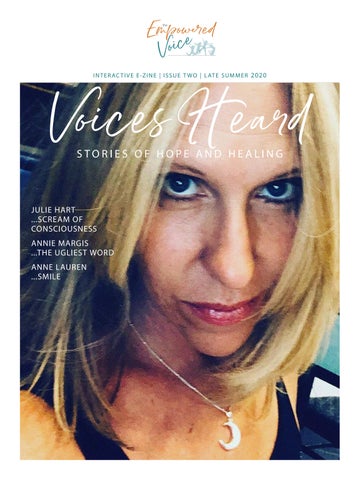
Voices H eard I N T E R AC T I V E E -Z I N E | I S SU E T W O | L AT E SU M M E R 2020
STORIES OF HOPE AND HEALING
JULIE HART ...SCREAM OF CONSCIOUSNESS ANNIE MARGIS ...THE UGLIEST WORD ANNE LAUREN ...SMILE
EDITORIAL TEAM
CLAIRE O’LEARY
Fo un d e r, Edi to r- in - chi e f Graphic Designer
JULIE HART
Copy Editor
ARTISTS
PHOTOGRAPHY
Anne Lauren Charlotte Lozano Claire O’Leary
TOMO SAITO C l a i r e O ’ L e a r y , p g . 7, 4 5
B E R TA A M E L I N A I T E
Anne Lauren, pg. 27
VOICES HEARD
ISSUE II
VIDEOGRAPHY
MICHELLE WHITE HART
Video Editing
® 2020 T HE EMPOWER ED VOICE, VOICES HEARD ALL RIGHTS RESERVED
INSIDE
7
FROM THE EDITOR FIERCE AS A LIONESS
7
RACHEL GRANT FROM BROKEN TO BEYOND SURVIVING
8
8
I was terrified, frozen, and confused...
SHIRKYDRA ROBERTS THE GIFT OF YOU
11
We will not speak up for ourselves and we will not speak out because we are afraid....
11
JULIE HART SCREAM OF CONSCIOUSNESS
14
I know that saying no works! Not because I ever remember saying no, but because...
ANNE M. LAUREN SMILE
23
I can walk away from my entire family and build a new one and have, but...
14
23
CHARLOT TE LOZANO MADE FOR A REASON
28
28
During the first four and a half years of my life, I was electrocuted, starved,..
ANNIE MARGIS THE UGLIEST WORD
34
If everyone started saying the word incest out loud...
CLAIRE O’LEARY ENOUGH
45
34
I’ve taken control of my life now I’m safe but the voice in my head...
BUILDING RESILIENCE HOW WE HEAL
47
45
Healing from sexual abuse and sexual assault is a journey and often a long one...
IF SOMEONE YOU KNOW IS IN CRISIS...
47
If you or someone you know is in immediate danger and needs...
SHARE YOUR STORY IN VOICES HEARD
47
IT’S NOTHING BUT A NEURON!
48
47
The ability to actually respond in a new way comes as a result of, first, developing the ability...
48
FROM THE EDITOR ...FIERCE AS A LIONESS
I see fierceness in each and every contributor to Voices Heard. As I read each story, I see the fierceness of a lioness, protecting and caring for herself, for her young and for future generations in a way I’ve seen only in survivors who have done a lot of deep work and healing from their trauma. I see that each and every one has the courage, the dedication to healing and the determination to do ‘whatever it takes’ to pull through the dark times. I know from experience how difficult it can be to pull through those tough times when you’re writing your story and you feel as though “I just can’t do this one more minute.” I understand the courage, the tenacity it takes to be on the ‘heroes journey’ that each contributor is on. Rachel Grant, From Broken to Surviving has taken the helm to help women heal from childhood sexual abuse. Shirkydra Roberts, The Gift of You has become an author and motivational speaker,
Julie Hart, Scream of Consciousness, has joined our team at Voices Heard as Copy Editor, Social Media Maven and so much more. I couldn’t be more excited to have her on board. Anne Lauren, Smile one of our early contributors has returned to write an ‘afterward’ to her original article. Her artwork and writing is a testament to how much she has healed and grown this past year. Charlotte Lozano, Made For a Reason has started a foundation. Annie Margis, The Ugliest Word has written a book and a movie. And I? ...Well, I continue to expand and refine Voices Heard as the e-Zine that shatters the long held silence of sexual abuse survivors through story-telling and expressive arts so they can heal more quickly. And to plan a live online art exhibit ...stay tuned. All have accomplished fiercely amazing things to promote the healing of other survivors and accomplish our goal to Eradicate Sexual Abuse in our lifetime.
“
I’ve said it before
and I say it again.. . . I am so blessed to
work with some of
the most courageous women alive.
7
RACHEL GRANT ...FROM BROKEN TO BEYOND SURVIVING
“
I was terrified, frozen, 8
and confused. I
remember thinking that he just didn’ t
realize that he was
touching my breast and so I shifted my body, but his hand returned.
I was a five-year old, middle-class kid, growing up in Oklahoma with an acre out my back door when my grandfather came to live with our family. As an innate nurturer, I would help my mom and dad take care of him by doing simple things like bringing him a bowl of cereal, keeping him company, and reading to him. We spent hours on our front porch swing talking, laughing, and watching the people in the park across the street. He was my friend and a quiet companion. One day, glowing from having just turned 10, I was hangin’ out – watchin’ some cheesy 80’s TV when I heard my grandfather coming down the hall. I knew he was heading outside, so I hopped up, and went to the door. Usually, my grandfather hung out by himself for a while then knocked when he was ready to come back in. But this day was different. When my grandfather pulled my arm and dragged me with him to the porch swing, I didn’t think much of it. It was a nice day; I imagine I thought he wanted some company. I’ve always been a snuggly person – at that age I still loved to crawl in behind my dad in his chair while he watched game shows. So, when my grandfather put his arm around me – I snuggled in close to his fuzzy brown and orange sweater.
And then it happened. This day was the first day my grandfather molested me. I was terrified, frozen, and confused. I remember thinking that he just didn’t realize that he was touching my
breast and so I shifted my body, but his hand returned. This was the
first day of many that my grandfather would violate our friendship and rob me of my peace and innocence. It went on for months and got worse, but no one noticed and I didn’t tell. I just knew I’d done something to cause it. To everyone else, I was the same ol’ Rachel – laughing, crackin’ jokes – but in my room all alone I’d sit trying to fight off all of the confusing new thoughts that had become a part of my everyday life, “I deserve it. It’s my fault. I’m ugly. I’m worthless.” One day, my aunt drove up unexpectedly while he and I were on the porch. He withdrew his hands so quickly that I finally knew for sure that what was happening was
wrong. But that made things more complicated. I thought I should know how to stop it and therefore I must have been doing something to cause it. This was the first day I
felt deep shame about what I experienced. Then, on another day, here I was again – on the porch, being yet again violated. Then all of a sudden, my mom came flying out onto the porch yelling, “Rachel, get in the house!” I jumped up so shocked and scared – I mean, this was my mom’s best, “You’re in trouble, child” voice. She had been walking by the window and saw him touching me. What I vaguely remember next is her standing over me, not aggressively, not in anger, but just her presence. What I do clearly remember in that moment is thinking, “It really is my fault, I’m the one in trouble.” Of course, this belief is one that I struggled with for years and years until I eventually was able to challenge that belief by recognizing that my mother was just scared and wanted to get me away from him. Fortunately, when my parents discovered what was happening, they immediately removed him from our home. Unfortunately, that didn’t make the thoughts stop. My mind was
quickly becoming my worst enemy: You made it happen! No one loves you! Why bother living? You must have liked it or you would have done something to stop it. My parents wanted me to get help and even found me a counselor, but I wasn’t having it. I didn’t want to talk about it –
I would literally run away to the woods so they couldn’t force me to go. I just wanted to pretend that everything was okay. So, I buried my head in the sand and tried to be a “normal” little girl.
distrustful,
I spent my teen years learning how to “perform” – how to keep the outside looking great while everything fell apart on the inside. I was a straight A student for the most part. I had a job and played volleyball and did a lot of writing and acting. That was all a part of the performance. Behind closed doors, I was full of fear about my selfworth and value. I was confused about relationships and intimacy. I felt very alone most of the time, and felt that no one could truly understand me.
I became fed up with feeling this way and began doing all of the things we do when we want to get better—talking to friends, seeing a therapist, reading books. I was starting to feel better, but in many ways was still going around and around the same mountain of self-doubt, anger, shame, acting out, and living a life with nonexistent boundaries.
In my early twenties, I was trying to have my first “real” relationship, and it became pretty clear pretty quickly that I was completely ill-equipped for this. I was
antagonistic,
created drama all the time, and was in constant fear of the relationship ending.
By my late-twenties, I was going through a divorce, was in a new city with no friends or sense of community, and was still in pain and feeling ashamed as a result of the abuse that had occurred 16 years before. I realized that I could not keep going in the
9
same direction, that something had to give or I was going to live out the rest of my life feeling alone, broken, and miserable – merely surviving. That is when I had my “ah ha” moment. The thought occurred to me, “I don’t
I need, feel unburdened and joyful, and have the skills and tools needed to successfully navigate any bumps in the road. And the best part of it all is that I get to share this with other survivors and walk alongside them in their journey!
want to just survive my life, I want to live it!” I also had
“
I realized that I could 10
not keep going in the same direction,
that something had to give or I was going to live out the rest of
my life feeling alone,
broken, and miserable – merely surviving.
the realization that I now saw my abuse as an experience; that I had successfully made connections between being abused and how it affected my current behavior. I could understand why I didn’t trust others, for example. However, the most critical question remained unanswered by any of the books, therapists, or friends I’d come across: “So, what do I do about it?!” So I started asking this question, and I was shocked by the answers I got. It was as if everyone believed this was a life sentence and I was just going to have to deal with it. I thought, “Man, wrong answer!” And that’s really what spurred me on to do my masters in counseling psychology and to study how the brain is impacted by abuse and what that tells us about how we really heal and move on. So, I started using myself as a guinea pig. I would think about an area in life that I was struggling in and try to figure out what I was missing, what was going on in my brain, and what needed to happen in order for me to heal. Ultimately, this all came together into what is now the Beyond Surviving program. Today, I am Beyond Surviving. It’s been a hell of a road, but today my new “normal” is that I am confident in who I am, able to connect with others and ask for what
ABOUT THE AUTHOR
Rachel is the owner and founder of Rachel Grant Coaching and is a Sexual Abuse Recovery Coach. Rachel holds a Master of Arts in Counseling Psychology and is the author of Beyond Surviving: The Final Stage in Recovery from Sexual Abuse and Overcome the Fear of Abandonment. You can download both free on her website. She works with survivors of childhood sexual abuse to help them let go of the pain of abuse and finally feel normal. Her program, Beyond Surviving, is specifically designed to change the way we think about and heal from abuse. she has successfully used this program to help her clients break free from the past and move on with their lives. Reach Rachel here or on Facebook.
SHIRKYDRA ROBERTS ...THE GIFT OF YOU
11
11
Like many of you, I once felt rejected. I felt violated. I felt unloved. I felt like I had
“
We will not speak
up for ourselves and
we will not speak out
because we are afraid of the response.
no choice in my sexuality, sex life, or my feelings and emotions. I was molested from the age of 5 to age 14. I grew up feeling alone, purposeless, useless and abandoned. I felt that I had no voice and no choice but to deal with what was going on in my mind. At an early age, I had suicidal thoughts that led me to cutting. I was searching for a different pain than the pain from the sexual abuse. In school, I was the class clown, popular student and athlete. I tried to hide my pain with laughter. I poured my heart into sports or anything else at school to keep me from thinking about home.
Some people don’t understand that being abused in any form or fashion will cause you to feel unloved, unattractive and ugly inside and out. It causes you to not love the skin that you are in because someone belittled your character, your body and your feelings. We grow up not knowing how to absolutely love ourselves until we are abused over and over. We don’t learn how to wear our pain with purpose until we have been broken so much that the only option is to be put back together.
We want to be loved, admired, cared for and for someone to genuinely care about our wellbeing. Hence, when it does not happen, we hide in our shells. We create walls and can’t break through barriers because we don’t want to feel that feeling of rejection. We won’t speak up for
ourselves and we will not speak out because we are afraid of the response. That feeling that we run from causes us to be re-victimized at times. That feeling causes the tears and the pain to come back repeatedly. Even when we are not being rejected, we carry the feeling around. We assume that we will be rejected which causes us to find ways to protect ourselves from being rejected.
“
12
Understand that you
experienced pain but it produced a gift, that gift is You!
At the age of 25, I got tired of rejecting my life, my story and the truth. I told my mother everything that happened to me. The fear of the response from my family, mother, peers and society had kept me silenced for so many years. I spent too many nights wondering if people would believe me.
I battled mentally, spiritually and sexually for years until I decided to find purpose within my story. I woke up one day and decided that I did not have to live in darkness any longer. I made a vow to myself to refuse to live in the shadows of someone else’s pain. I knew that hurt people hurt people and I wanted to break that cycle. Once I told my family, I was free. I started my healing process. Although my story caused pain, chaos, confusion and discord, I was mentally free. I learned the cost of freedom is the desire to deal with what comes with being free. Initially, I hit some roadblocks. I had nightmares, sleepless nights and I cried but it was all part of the process. As I continued to return to that 5-yearold girl to bring her to life, I began to see my life transition.
After constantly seeking mental, emotional and spiritual stability, God showed me that I was called to be a mogul in the #MeToo community. I found myself speaking and assisting women who had stories like mine. I started encouraging other women to come out of silence. Even though I was speaking and coaching, business was tough because I could not trust people. Life was tough because I couldn’t trust people. I began reaching the youth, men and the older generation who had been taught to keep silent about their pain. I began to walk out my healing with others who were ready to be free with me. That is what started I.A.M.E. (Impact, Aspire, Motivate Enterprises). I wanted to impact the world through my story, give them a reason to aspire to be greater than their yesterday and motivate them to turn around and motivate others to do the same. I wanted to form a group of cycle breakers. We all have a piece of the pie and people are counting on us daily! I searched for love and approval in all the wrong places which victimized me all over again. I assumed everyone’s intentions were negative. I looked for pain to cover the pain that I was working through. However, I powered through. I mention this because when you start telling your story, that does not mean all the problems, thoughts and feelings go away. We must continue to walk out the healing process and refuse to stay in the box that abuse put us in.
Over the years, I have learned how important the spirit of discernment is to love myself and still allow people to love me without accusing the innocent. I developed a sense of searching for someone’s heart rather than just taking their words. Being betrayed automatically causes one to develop a strong sense of protection physically, mentally and emotionally. We naturally get defensive and we search for a reason why a person is harmful even when they are harmless. As I learned how to sense my environment and the people in it, I have gained control over my thoughts and responses to triggers. Discernment is important so that you have a sense of control versus being controlled. Now I successfully use my story to motivate and empower others to move in purpose rather than drown in pain. I have seen the masses experience breakthroughs and freedom from their chains of pain and trauma. I have spoken at multiple women’s conferences, high schools, victim retreats and been featured on multiple blog platforms. While in uniform, I mentor and train those up and down the ranks in how to use their strength from overcoming past experiences to elevate and rise in every endeavor they encounter. I coach people on how to get through traumas, challenges and trials in order to walk out their purpose, gift and their life calling. I hold people accountable on their day to day goals so that they are successful. I help you re-frame your pain to turn it into your purpose. OUR stories matter and I will not be silenced and you shouldn’t either. Understand that you experienced pain but it produced a gift, that gift is YOU!
ABOUT THE AUTHOR
Founder and CEO of Impact, Aspire, Motivate Enterprises (I.A.M.E.), Shirkydra Roberts was raised in a single-family home with her mother and two siblings in Dallas, Texas. She uses her story as a #MeToo Survivor to impact those in the world who feel as though they have no voice. She aims to empower those who have yet to embrace or tell their story. She helps people experience emotional, spiritual and financial freedom after traumatic experiences. A Motivational Speaker, #MeToo Advocate, Life Transformation Coach, Shirkydra is also a published author of two books: What’s a Word Worth and Just Unwrap It, which focuses on the gifts we all have within us that we overlook due to pain, struggles, challenges and lack of selfconfidence. She is also serving as an Engineering Officer in the U.S. Navy. You can find Shirkydra on Facebook, Instagram, YouTube, LinkedIn and on her website www.impactaspiremotivate.com.
“
Even though I
was speaking and
coaching, business
was tough because I
could not trust people. Life was tough
because I couldn’ t trust people.
13
JULIE HART ...SCREAM OF CONSCIOUSNESS
“
14
I know that saying no works! Not
because I ever
remember saying no, but because when
I was a 12-year-old babysit ter, a lit tle
girl said NO to me.
I know that saying NO works! Not because I ever remember saying no, but because when I was a 12-year-old babysitter, a little girl said “NO” to me. I’m all about being melodramatic, but with this next sentence, I am being anything but. I am being straight up real.
That “NO” changed my
life. For some reason, that “NO” coming from that little person that I had responsibility for and was acting irresponsibly with made me know that sexually touching a child was something I would never do again. In fact, it has become something I orient my life quite oppositely around. Why am I such a champion of this cause? Because...
I am as mad as hell... And I want you to be, too. I get we all have our passions; we want to save the rescues and rescue the Amazon and cool the climate. But does anyone besides me see that if we have a bunch of funked-up kids coming up in a decade or two, all of that won’t matter? It’s the kids we need to make sure are saved and rescued and functioning with level heads. Why am I such a champion of this cause? Why do I know the three things a child must say, must do to keep her / his own body safe? Why will I not shut up? • I could tell you that from at least the age of four, I had multiple abusers. • I could tell you that in my late 20’s, I worked as a sexual assault counselor at the local YWCA and learned the three things. • I could tell you that I first heard Marilyn Van Derbur Atler, 1958 Miss America, speak about her own childhood sexual abuse when I was 22. That I sat at a table of co-workers and when Marilyn invited survivors to stand and be recognized I hesitated, but at the last moment, I stood. The next morning, I wrote notes of explanation to each of my co-workers, as though I had to explain myself away. And that in the years since, I have stood boldly, spoken boldly, not explaining at all, just stating the fact of it: I am one in three girls who will be sexually abused before we turn 18.
Julie reveals something shocking
• I could tell you that in one of the four speeches I’ve seen Marilyn Van Derbur Atler present, she mentioned that babysitters are the number one perpetrators. • I could tell you that in the years since then, I have known the truest story about sexual abuse I know. • I could tell you that I’m about to tell you that story and I’m scared as... Wait. No, I’m not scared anymore. I’ve used my experiences and stories as a survivor to turn on lights in musky places that others would rather turn away from. It’s gross, I get that, but I would rather smell something gross and be done with it than have it keep popping up in musky corners for me to have to slide away from over and over again. So, is it enough to hear that I’m a failed and reformed perpetrator from the age of 12 on? Or do you want to hear my story? Cause it’s kind of the story that keeps on giving. By that I mean that parts and pieces keep popping up that, if I am honest with myself, are re-traumatizing.
It’s only been since “the COVID” that I’ve begun to look at this life story of mine through the lens of trauma, of the special kind of PTSD called C-PTSD or Complex Post Traumatic Stress Disorder, which develops as a result of chronic exposure to traumatic events over a period of months or years. Can I just list it like a laundry list? No! No, I can’t. Why is any of it relevant, anyway? Why does my story of childhood sexual abuse matter? Honestly, sitting here right now, reading my words about why my story matters, all I can think of is because I have the “whatever” to tell it. Whatever = balls, chutzpah, gumption, etc. It was through hearing Marilyn Van Derbur Atler tell her story that I was able to stand in my truth for the first time.
I was four or five when my 22 or 23-year-old brother touched me. We lived in a split-level home and he and I were downstairs “playing Twister,” while my big sisters were upstairs
15
1 in 3 girls will be sexually abused before their 18th birthday.
“
16
I take it personally
when things don’ t go as planned, which
sounds in my head
like, “What’s wrong with me (that I
fucked that up)? doing the dinner dishes. Our mom, a nurse, was working at the hospital, 2nd shift. I only have a few memories of this happening, one of which was my memory of me asking my big brother to “play Twister,” and him telling me no. Now’s a really good time in the story to let you know that even though a child is not biologically, physiologically, emotionally, spiritually, or intellectually
prepared for sexual touch, it can still feel good. There is also the kind of warped secondary benefit that a child ...me... is getting attention. A couple of years later, maybe 6 or 7, I remember being on the couch at the neighbor’s house, with my older sister’s friend, Donna, who was probably 14 or 15. Again, my
recollection of this is a freeze-frame of the setting only. I don’t recall thoughts, or emotions, or sensations – just that it happened and where. I would say I was a master at hiding myself, although I developed the nasty anxiety disorder that would later become known as trichotillomania sitting at my second grade school desk at age 7. I loved to see the roots of all the eyebrows and eyelashes I picked out and put on my desk. I knew I looked like a freak and I certainly felt like one. I suffered from vicious neck pain and headaches that had me seeing a specialist at one point. My mother even told me years later that the specialist was definitely just a specialist in head and neck pain. But in my eyes, he was a certain kind of special: one who could see into my head into all my dark secrets and I had to stay as far away from this man as possible. I think I was successful, as he never got anything out of me and after a time or two, he never saw me again.
I think it was sometime in college that I first spoke my secret to both a counselor and to my best friend, Alig. But it wasn’t until after college graduation and after my summer spent on the dude ranch in the Black Hills of South Dakota, when I was sitting on my parents’ sofa waiting for a call from VISTA – Volunteers in Service to America – and watching Oprah, that wheels were set in motion. Oprah’s show that day was on childhood sexual abuse and at the end she shared a phone number that I tucked away. I only got it out months later when, for the first time, I was 1800 miles away from my family. Surprisingly, almost three decades later that same number still exists as the Childhelp Hotline: 1-800-4-A-CHILD (1-800-422-4453). I share it because maybe it is what will be your saving grace. I remember the day I called the
number from my new home in Denver. After a few questions about what I was dealing with and where I lived, the man on the other end gave me the contact information for the WINGS Foundation (Women Incested Needing Group Support) in Denver.
So began my healing, sitting around a table with women in their 40s, 50s, and 60s, hearing how I was so young (22) and so brave to be dealing with this at such a young age. I felt both embarrassed and emboldened by their special recognition but now, I just feel humbled... If they could see me now, struggling as much, if not more, than I did then. Because then it was only me, only my brother, only the neighbor... As I understand my story now, I have a
17
“
Running away from 18
Julie shares another piece of her story...
her, running away
special story of incest and child sexual abuse that keeps on giving as the years go by and the truths (plural) keep coming out.
running away from
And so... Onward.
from my family,
my brother, running away from a reality
that didn’ t’ fit with the reality I had held for 18 years... That I was the only one.
Oh! Sheesh! How could I forget the trip to Boston my mom and I took in October of 1992. It was just weeks before I left for Denver, Colorado to begin my new life as a VISTA Volunteer. VISTA was the precursor to AmeriCorps and I was assigned to a placement in Denver. I was to develop a program of self-sufficiency for people with mental illness by linking housing, job training, employment, childcare, education, bus passes, and sometimes theater and Broncos tickets. In the days before Airbnb and Google, I somehow found a bed and breakfast in downtown Boston for our accommodations. I remember it was three flights up and at age 63 and an asthmatic to boot, my mom had difficulty climbing the stairs. I felt a certain kind of guilt that I didn’t get us the right place... I should have done better. It’s probably a good
time to let you know that as a survivor of something I couldn’t control, I take it personally when things don’t go as planned, which sounds in my head like, “What’s wrong with me (that I fucked that up)?” In the end, she navigated the three flights just fine. We also saw the Paul Revere House. That’s the extent of what I remember about our three days. Now is probably a good time to let you know that as a survivor, my memories are most present and vivid for those events which had an emotional impact on me... Which leads us up to the next big story... But wait! It was September 23, 1992 and my older brother was turning 40. We were gathering as a family (now’s a good time to reveal: there are 7 children in my family) to celebrate in the park. Looking back, I think all family gatherings (even when we were “one big happy family”) have been unduly stressful on me. This one was no different, as evidenced by the fact that I took a walk with my big sister (a different one than was doing the dishes when I was 4 or 5) and while on the swings she saw it fit to drop this on me:
“Well, you know David (older brother) got Maggie (older sister) pregnant and that’s why she had to have an abortion”. I jumped off the swing mid-air and began running. Running away from her, running away from my family, running away from my brother, running away from a reality that didn’t fit with the reality I had held for 18 years... that I was the only one. That my brother molested only me and it was just a couple of times. That it was NOT a big deal. That I could handle this by myself. So fall 1992 had my sister telling me of this sexual misappropriation, Oprah talking about childhood sexual abuse and providing me an 800 number
and a car drive home from Boston to Pennsylvania in which I would have my mom a captive audience. Now, before I begin the captive audience car drive home story, let me let you in on a little embarrassing factoid: Beginning at an unknown age but continuing through her mid-20s or so, Julie thought that this knowledge that her brother had sexually abused her would (somehow) kill her mom. I had recently told a therapist this and I think the therapist was kind of taken aback, like: any cognizant, intelligent adult (which, Julie, clearly you are) would realize that this knowledge would not kill her mother. Nope, not me! Until I was forced to tell (because
“
Any cognizant, intelligent adult (which, Julie,
clearly you are)
would realize that
this knowledge would not kill her mother.
Edvard Munch, The Scream represents Julie’s feelings as she jumped mid-air...
19
20
“
This was like a
guillotine coming
down on my throat
chakra, silencing me.
the captive audience tactic BACKFIRED like a classic car), I honestly believed that the knowledge would kill her (it didn’t). But I get ahead of myself...
For our drive home from Boston to Lancaster, Pennsylvania, I wanted to be in control. I wanted to hold her captive or captured. I wanted her complete attention! I wanted her to not be able to leave me alone. I wanted to be the one in the driver’s seat. So we got in the car, drove away from the city and got on to I-95 South. I don’t know how long it took me to get up the gumption, but I finally did. And these are the words, well, the sounds really, guttural, scared as all get out – terrified.
(Because remember, I thought this knowledge would kill her.) I opened my mouth. And what came out. Sounded like this, “Mah, Mah, Mah, Mah.” In her inimitable way, she snapped “I don’t know what you’re talking about.” And I shut down…
That’s the first time I think she ever broke my heart. Because it wasn’t heartbreaking when I was a kid and she would slap me across the face and my mouth would bleed because of my braces. I would sulk and pout and do everything I could to make her feel guilty to elicit an apology. What I felt then was rage. Humiliation. This was like a guillotine coming down on my throat chakra, silencing me. I shut up.
There was silence for I don’t know how much longer on the drive back. I didn’t speak those words again until 4 years later when I was in my therapist’s office in Denver, having to call my mom. Before the authorities got to my brother’s home. I was sitting in my therapist’s office when she excused herself for a second. When she came back, she told me that because my brother had shared custody of his two girls, my nieces, both under the age of 18, that she would have to report him to child protective services in our hometown.
Inside me, all hell broke loose. I felt cornered, I felt handcuffed, I felt tied to the wall and the only thing I could think of was I had to tell my mom before she found out from someone else. At age 26, I still held the childish notion that this news would kill her. I asked the therapist to allow me to call my mom before she called a report into the authorities and she granted me time, private space, and a telephone to make the long distance call. “Mom, Mom, I’m at my therapist’s and she’s going to call child protective services on David. He sexually abused me when I was little.” Silence and I’d bet money I wasn’t breathing. Verbatim here are the next words that came out of her mouth:
“Well, I’m not surprised. He did it to all your
sisters, except Anne, too.” Whoosh, I have to think all that hot air I held inside me got expelled as I deflated. The importance of my story – my story of being molested and my story alone – suddenly not surprising, not life-ending, not a secret anymore. [Now to interject something here: the brain on trauma is not the brain that works logically or organizationally or even really consistently. What it does is store images, smells, sounds, and most of all, emotions.] So although I remember, verbatim, my mom’s first words... reaction... to my confession (yes, I picked that word deliberately; maybe later we’ll touch on survivor shame, guilt, and feelings of dirtiness and inherent bad-ness) I remember verbatim because I must have repeated those words: “Well, I’m not surprised...” A thousand times, tens of thousands of times in the 24 years since.
“
The brain on trauma is not the brain that works logically or organizationally or even really consistently.
21
And if those words shocked me, what she said next broke me: “So because you think David ruined your life, you want to ruin his, too?” ME THEN:
“
22
We talk about mental illness now, we talk
about alcoholism, we talk about domestic violence, we talk about
P TS D.
What we don’ t talk about is incest.
Insert picture of a victimized, deflated girl – woman, with gun-metal grey duct tape marking an X where her mouth should be.
2) Get away! Get out of there. Go into a room with other people, go outside, go to the neighbors. Get away! 3) Tell someone! And keep telling until someone says, “I hear you. I understand. I’m sorry that happened to you. Let’s get help.” Tell your mom, tell your best friend’s older sister, tell your teacher, tell the school nurse. Tell somebody you like and feel good around. Tell someone!
ME NOW: “No, Mom, I want to protect the children...” So how do I do that? How do I protect the children? By sharing with you the three things I know. The three things you will teach your children. Because the children are their own first line of defense. We must give our children the words and the actions they need to keep their own bodies safe. THE THREE THINGS The first I learned in real life when I was 12: 1) Say no! It can be soft-spoken or shouted, but when you say it you mean it. This is Your body. You get to say. You are your own superhero in this moment and you are protecting the gift of your body. Your “No!” is your final word. No! The other two I learned as a sexual assault counselor working with kids who had been abused. I role played with them so they would get it into their minds and bodies the words they would say and the actions they would take if someone ever tried to touch them again in a way that made them feel “ewww.”
ABOUT THE AUTHOR
Julie Hart has been speaking out against sexual abuse and assault, specifically incest, way before it was “trending.” Since 1999 when she worked as a sexual assault counselor and two of her clients were threeyear-old twins, she has believed in the ferocity of the human spirit to live through, survive and thrive after such violations of one’s body and spirit. By sharing her story of how she and her six siblings ended the legacy of incest in one generation, Julie hopes to bring courage to others to share their stories. For it is by speaking that we are empowered. It is by fully living that we are free.
ANNE M. LAUREN ...SMILE
“
I can’ t transform my
DNA. I can walk
23
away from my entire family and build a new one and have,
but I can’ t abandon
the personality traits passed down from him to me.
I’m sitting at a picnic table, my body melting to meet the shape of the wooden bench, while my eyes fix their gaze on the bright orange sun. My mask sits on the corner of the table in case someone walks by to protect us both from contracting COVID-19. The wind sweeps by my nostrils with a light smell of campfire, common in environments like mine, but more
pungent this time of year as the wind has brought with it the smoke from the California fires over 700 miles away from where I’m currently camping alone in Twin Falls, Idaho. I play light music while I boil black beans on the free stove that was gifted to me from a neighbor before I left Seattle to find a new home in San Diego where I’ll be spending a sunny winter. Lee Ann Womack’s voice spreads across the table like a loving blanket sweeping me back to the memory of the man who raised
me, Tom. A soft and subversive smile welcomes itself onto my face, as the lyrics dance playfully across the stage they have created for themselves on my picnic plate.
24
Surprisingly, this song has always been protected from triggers, from trauma energy. Why? I have absolutely no idea. Tom raped me while raising me. He created a hostile home environment where women were expected to serve men. I had a mother and three brothers, so us women were grossly outnumbered. My mother complied. I didn’t as soon as I had a choice. The memories of the number of rapes are stored deeply in my subconscious and did not rise again until I was 24 years old. Today, at this campsite, I am now 34 years old. It has been a decade of healing and even more than that from the last time I spoke with Tom. I used to call him Father, but that sacred title has been rescinded due to his awfully abusive acts. Yet, still when the words from this song reach out from buried places and fill my ears with the years I spent by his side, I can’t help but smile: “I hope you still feel small when you stand beside the ocean Whenever one door closes I hope one more opens Promise me that you’ll give faith a fighting chance And when you get the choice to sit it out or dance I hope you dance”
While the abuse reflected the worst of Tom, this song represented his very best. This melody too calls from me my very life force. Because this is the truth: I no longer call Tom father, but I will always be his daughter. I can change my last name and have, but I can’t transform my DNA. I can walk away from my entire family and build a new one and have, but I can’t abandon the personality traits passed down from him to me.
than I have ever wanted to admit. He was brilliant, full of exuberant energy, a businessman who made millions with creative ideas. His soul could have moved mountains with the power of its purpose. But my family history was riddled with violence, mental health issues, suicidality, and addiction. And he, like his forefathers and their forefathers alike, couldn’t control himself. So all of his precious gifts were directed toward narcissistic ends.
Tom means, “Twin,” and the truth is that I am much more like my father
According to a narcissist, he is never at fault. So, I was the problem.
I don’t consider Tom a pedophile, someone who is solely sexually attracted to children. I consider him an opportunist perpetrator, meaning he takes what he wants when he can. So he took me, over and over again since the age of two because he could. Because my mother didn’t recognize the very obvious signs back then, and when I told her at the resurface of the memories she chose her commitment to codependency over me. In a codependent system, the perpetrator is never held accountable. So, again, I was the problem. The white community that I was raised in remained silent the entire time. They challenged my mother to divorce Tom due to his mistreatment of her, but never made the connection that I, his only daughter, was even more vulnerable to his abusive behavior (or they did and just ignored it). When I made my memories public, I heard nothing from them. Maybe they didn’t know what to do? Maybe they didn’t know what to say? Maybe I was the problem? Their complacency made me certain of it. Children can’t defend themselves. Children often don’t even know that sexual violence is wrong. My father simply told me it was my job: He provided for me and I for him. An unsafe, secret exchange without my consent completely necessary for survival. I forgot what happened and all was almost lost until my body shut down at 22, and kept me in a decade of deep rest (depressed) forcing me to urgently recover my brain, body and being so that I could live the rest and best of my life. This song rolls off my tongue as a litany
to the model of life I’ve been leading to recover and the framework for the future that welcomes me home. “Don’t let some hell-bent heart leave you bitter When you come close to sellin’ out reconsider Give the heavens above more than just a passing glance And when you get the choice to sit it out or dance I hope you dance” Tom had the power to rob me of my childhood, but does not have the same power over my adulthood. I refuse to sit this one out. Yes, I manage Complex-PTSD, a disability given to me in exchange for a number of orgasms, my entire life affected for seven seconds of pleasure on repeat like a scratched record. I have few memories of being in his presence and not feeling afraid or completely numb. This song is one of the anomalies: This was our song. “I hope you never fear those mountains in the distance Never settle for the path of least resistance Livin’ might mean takin’ chances but they’re worth takin’ Lovin’ might be a mistake but it’s worth makin’”
“
They challenged my mother to divorce Tom
due to his mistreatment
of her, but never made the connection that I,
his only daughter, was
even more vulnerable to his abusive behavior (or they did and just ignored it).
25
My faith in myself and the restorative power of healing have led me to freedom. My heart has released all the rage at the ruins he made of me. I have never sold out myself for someone else’s values. I have engaged every part of resistance in me to uncover all that I deserve. I have welcomed an experience of heaven during this life. I have climbed the mountains that led to healing within unjust systems with no proposed path. I took every chance I could after leaving everything behind.
26
All of this I have done with the power of Love. And all of these choices were worth making.
12 years ago I left him, and in the past 10 I have climbed what has felt like an impossible mountain of healing in political, medical, religious, familial, and social systems hell-bent on keeping survivors silent, women submissive, and men in control by making us believe that we are the problem. It’s ironic to me that the very song he gave me to guide my life was also the path that freed me from his.
My subversive smile celebrates all I have accomplished regardless of the individual and systemic injustices that for so long ran and ruined my life: The ocean has always honored my smallness, respecting the difference between our power. I closed the door on my family system and opened new ones to find safety and satisfaction.
Following this song’s list of brave guidelines has led me to a lovely life. My body, brain, and being are finally finding balance, bounty, and beauty as my system regulates around the Love it was meant to receive from the very beginning. My family consists of beloved friends who support me unconditionally and help me to grow. I’m an author and entrepreneur who can travel the world while sharing my story and supporting other women to do the same. I’m still learning to hold and heal some deeper traumatic energy as the gifts of the present still reveal more grief and grievances of the past. But I trust myself to do both gracefully. And as I look now to my future, hopeful and free, I hear the lyrics leaving my lips:
“I hope you never lose your sense of wonder You get your fill to eat but always keep that hunger May you never take one single breath for granted God forbid love ever leave you empty handed” Tom is nearly 700 miles away from me, but has been bound to my body since the abuse. I honor that I am like him in all the best ways, while I relieve all of the violence, addictions, and justifications internalized as mine in unsafe micro and macro systems. I allow all of him still left within me to fall out as strong as the waters cascading from the cliffs to the depths of the rivers below here in Twin Falls, Idaho. The fires he caused extinguish within me. I commit to my own protection and to the safety of children to come. I certainly have been left empty handed. But know now in the space between to simply honor the privilege of my breath, the hunger of my being, and the ceaseless wonder of my brain. For I am brilliant, energized and creative. I move mountains with the power of my purpose. So, what is my job now? I am the solution. I arise free from my picnic bench, unmasked, and feel a smile shaping on my face. I dance in liberated hope, as I await the setting of the sun. I rest now and ready myself to receive in the space welcoming me free.
PHOTO: BERTA AMELINAITE
ABOUT THE AUTHOR
Anne Lauren is a writer, creator and advocate. She shares her story of healing from childhood incest and illness to end sexual violence, influence policy to help those hurting and encourage survivors to seek recovery resources. She also dabbles in intuitive painting, tinkers on the piano, unashamedly sings at the top of her lungs in the shower and pretends that she’s funny. You can find her here. LIsten to Anne’s story on video.
“
I honor that I am
like him in all the best ways, while
I relieve all of the
violence, addictions, and justifications
internalized as mine
in unsafe micro and macro systems
27
CHARLOTTE LOZANO ...MADE FOR A REASON
“
28
During the first
four and a half years of my life, I was
electrocuted, starved, beaten and burned;
sometimes it was with hot oil, other times I was set on fire.
What would you do if you spent your entire life fighting for your right to live? Your right to breathe? Your right to be heard? For equality? Sometimes I think I spend too much time fighting and not enough time living. But if I don’t fight, who will? If we don’t all stand up and take a stand, then nothing will ever change. My name is Charlotte Lozano, originally born as Lois Charlotte Ritenour. I was larger than the average baby, weighing in at twelve pounds one ounce – largely due to the fact that I was two-and-a-half weeks overdue. I can’t help but wonder
if that was a sign of how stubborn I would be in the future – something that helped me survive over the years and brought me to who I am today. During my mother’s pregnancy she didn’t receive proper medical care; and somewhere along the way, my brain lacked the oxygen it needed to stay healthy so I was born with Cerebral Palsy (CP) – a disorder that affects muscle tone, movement and motor skills. This often makes some of the easiest things I do very difficult – even the smallest things like brushing my teeth or eating. The doctors told my mother to get me into therapy, otherwise I’d be a vegetable. Thankfully, I was a fighter and excelled beyond their expectations.
If that wasn’t enough, I was also born into abuse. During the first four and a half years of my life, I was electrocuted, starved, beaten and burned; sometimes it was with hot oil, other times I was set on fire. And to this day, I still have the scars. My mother wasn’t the nurturing type and she was married to a man who was an alcoholic and a drug abuser. He also developed schizophrenia, likely because of his addictions. Since he was in and out of institutions, my mother often had affairs. She ended up with twelve kids; ten girls and two boys, of which I was the third youngest. Sadly, we lost the second oldest, my oldest brother, when he was just fourteen months old. The medical reports state he died from starvation and water on the brain. As you can tell, our home life was disruptive, a very horrific environment. It’s hard enough growing up in the world without having to deal with a challenging home life too. Home is supposed to be the one place that is our safe place – a place where we can go to get away and relax. Sadly that wasn’t to be for me, nor for my siblings. Most of them are in denial over what happened to us, especially because they’re the ones who got to grow up with my mother; whereas, I was placed in the system at four and a half years old. Maybe that allowed me to put some distance between myself and what happened, allowing me to see things more clearly. A lot of people can’t remember much of when they were younger, but because of the traumas I experienced, it’s a little too ingrained in my psyche. The aftermath of the events didn’t really give me a chance to forget.
When I was electrocuted by an industrial extension cord and it blew out the right side of my mouth, it resulted in numerous painful surgeries throughout my young life. And if you add in being set on fire and needing skin grafts on a body that was already struggling Cerebral Palsy, pain was something I lived with constantly. It was after being set on fire – and abandoned by my mom at the hospital – that I wound up in the foster care system, a ward of the state. She was afraid to lose her other kids, so she took off with them, leaving me behind. So now, I was not only dealing with the physical pain, but also the pain of abandonment. As
if I didn’t already have enough going on, right? After spending eight months in the hospital, with third-degree burns from my waist to my knee, I was placed in a foster home. I stayed there until I turned six years old. That’s when my first family adopted me. They had three biological boys, but the mother wanted a daughter. I wish I could say that things got better at this point, but they didn’t. My adoptive father hated my guts, as did his sons. They mentally and physically abused me. Their oldest child was often left to babysit us and he’d lock me in the garage and hold me down. He’d try to
29
“
30
One would hope that my next family, or
even the family after
that, would have been bet ter, but like many
other foster kid stories; bad luck seemed to
follow me everywhere.
pour pee down my throat and would throw his pet snake, spider and mice at me. But, the hardest part was when he would try to touch me. I couldn’t fight back because my right side was weak, due to the CP. After a while, their father grew tired of me and called Social Services to come pick me up. One would hope that my next family, or even the family after that, would have been better, but like many other foster kid stories, bad luck seemed to follow me everywhere. The light that I tried so hard to hold onto was dimming. Eventually, I was given a Big Sister through the Big Brothers Big Sisters of America organization. That could have been a great thing, but, her boyfriend
started to sexually assault me shortly after. It was hard, but I did find the courage to tell someone. After that, my Big Sister dumped me in favor of her boyfriend. That was something I couldn’t understand. Was I so hard to love? With my heart broken again, I grabbed on to the only other ray of light I had left in my life. My birthday was coming and my new family was planning a birthday party for me. My first foster sister was going to come. But, in the end, it was canceled. My young heart was devastated and darkness overtook me. If this was how life was going to be, I didn’t want it. That’s when I decided I wanted to die, to end this life of misery. I didn’t want
to be abused or beaten or deal with the pain anymore and decided to drown myself in the pool in my foster family’s backyard. Nobody would miss me, anyway. As I lay there in the pool, trying to drown myself, a warm feeling filled my heart and after going to church with one of my foster families, I knew that God was telling me I was loved and wanted. At first I didn’t like being forced to go to church, especially as my foster family acted like high rollers and were very strict. But attending church had planted a seed in my heart, which grew into the faith I have today and allowed God to touch my heart in those shallow waters. I found the strength to go on. Later, at nine and a half years old, I was labeled by the foster care system as unwanted. Everyone wanted a little baby, not an older kid like me. It wasn’t until I was ten years old that my social worker, by some miracle (although I wouldn’t view it that way now), found me a single mother who wanted a child. “Was I finally going to have the family I’d been dreaming of?” I wondered. After an overnight weekend visit, the woman wanted me to move in with her and the social worker agreed. I wasn’t so sure about the situation myself. Trust didn’t come easy for me because of the many times I’d been hurt in the past. For a while things were good with my new adoptive mom, but little did I realize, the honeymoon phase would soon end and her evil side would appear. I know it seems impossible that one kid could have such rotten luck. I bet if photographs appeared in a dictionary,
you’d find mine next to the word jinxed. That’s honestly what it felt like. Nothing good ever seemed to come my way. If anyone had a reason to complain, it was I. If anyone had a reason to want to leave this world, it was I. When everything appeared to be going well, I eventually started calling her mom. I’d been calling her by her name at first because I didn’t feel safe enough to consider her my mom yet. But she knew what to do to break me down and pull me into that supposed ‘safe’ place, before ripping it all away. She knew how to beat me down and put the fear of God in me with just a look. Sadly, she didn’t just leave it with a look. I was beaten and once again, abused mentally and physically. She loved beating me with a belt until bleeding welts appeared on my skin. I’d plead with her to stop, but she wouldn’t, not until she was ready. She even let her boyfriend pull down my pants while she beat me. I was humiliated and angry with her for treating me that way. She even made me wear sexy clothes to impress her guy friends who would come over to have sex with her. They’d often try to touch me as they were leaving. My room became my safe haven in her house because I could hide inside and lock the door. What social services didn’t realize was that they had put me in the home of a woman who was an alcoholic and a drug addict. How did they miss that during the screening process? I’ve heard many stories from other people who grew up in the system and their stories were much like mine. I believe that social services need to vet the foster/adoptive families better, investigate them a little
“
As I lay there in the pool, trying to
drown myself, a warm
feeling filled my heart and after going to
church with one of my foster families,
I knew that God
was telling me I was loved and wanted.
31
“
What should have 32
been a fun time for me, turned into the beginning of my
next nightmare. One that wasn’ t as easy to get away from.
I eventually started calling him “the monster.”
more deeply. They need to make sure they are mentally stable enough to give the kids what they need; otherwise, what’s the point of taking them away from their biological family to begin with if they are just going to be placed into an equally bad situation? At eleven years old, my adoptive mom’s stepfather molested me. The first time it happened was when my adoptive grandparents came to watch my ballet recital. What should have been a fun time for me, turned into the beginning of my next nightmare. One that wasn’t as easy to get away from. I eventually started calling him “the monster.” I’d fallen asleep that night, like everyone else, but woke up to him lifting up my shirt and pulling my pants down. What blew my mind was the fact that my mom walked in on this and just turned around and left, saying nothing. Doing nothing. Nobody helped me. No one responded to my cries for help. Later that night, my mother came into my bedroom and found me with my pillow between my legs crying. She
called me dirty and disgusting just because of where I had my pillow. I tried to speak up about what happened, but she told me she didn’t want to hear it. She told me to shut up in a very nasty way. Thankfully, my adoptive grandparents lived far away from us so that gave me a mild reprieve. But they visited a lot. And when they did, stuff like that always happened because I was his little toy. I found out later that he gave my mother hush money and she gladly accepted it. The only saving grace in this was my grandmother. She was a wonderful woman who I love dearly. I would have told her what happened, but every time I would try, my grandfather would interrupt me somehow. At one point, my mother had me go and stay with them and my grandfather would order me to go to work with him so he could have his wicked way with me. I tried to refuse, but my adoptive mom and grandfather would threaten me. What was a kid to do? Since I felt like had no other choice, I ended up being molested numerous times and raped. I even got pregnant twice, but lost both the babies.
After the life I’ve lived, I’m sure people wonder how I have any hope left, any faith left in humanity. To be honest, when I was trapped in that life, I didn’t feel alive. I was just surviving from one day to the next. But now that I look back, I realize it was my faith and stubbornness that carried me through. It’s the very same stubbornness that pushes me to live the best life I can, even when my body doesn’t want to work properly and when life throws me curve balls. I don’t share this story to look for pity, but to show that you can survive anything if you put your mind to it. As I reflect back on my life, I’m not sure how much of it I would change because everything I went through shaped me
into the person I am today and gave me the heart to open a foundation called, “The Open Heart. You were made for a reason. You have purpose. You are loved and worth every breath you take. Today, I am married and have two wonderful kids. I’m still here to tell my story because I was able to overcome and rise above my challenges. And because I did, I know you can too. All you have to do is believe in yourself and never, ever give up. I don’t share this story to look for pity, but to show that you can survive anything if you put your mind to it. You were made for a reason. You have purpose. You are loved and worth every breath you take.
ABOUT THE AUTHOR
Charlotte Lozano is an author, activist, inspirational speaker and founder of Charlotte’s Voice at My House. She is a survivor of physical, mental, emotional and sexual abuse and of the foster care system. She recognizes that everything she went through shaped her into the person she is today and gave her the heart to start a foundation called, “The Open Heart.” Her passion is to help others overcome their own trials and struggles and rise up to be the best that they can be, regardless of their circumstances, so they know hat nothing has to stand in their way, not a disability, not abuse. Nothing! If you are interested in reading more of Charlotte’s story, she recently published “Born to be a Warrior.” It’s the first in a series about Charlotte’s faced and overcame her struggles. She is also author of the “Jeanettie” Book Series and “Jordan and Jane” book series You can find Charlotte on Instagram and Facebook.
33
ANNIE MARGIS ...THE UGLIEST WORD
34
“
If everyone started
I imagine myself standing on the TEDx stage – knees are knocking, my insides shake, my mouth is dry. A few seconds go by but it feels like a million years as I stand under the lights... I BEGIN:
saying the word
“When you were a kid, did anybody... Did anybody ever touch you, in a wrong way? Because if somebody did, you are not alone. It happened to me.
“Childhood Incest“
Did it happen to you? You can raise your hands, if you want to, and tell us that it happened to you. Hands? Not very many hands.
public conversation,
I’m going to guess that the taboo against talking about childhood incest is keeping some survivors of childhood sexual abuse in this audience from raising their hands, and that’s okay. It can take years before a survivor heals enough to say it out loud.
incest out loud
specifically in
we could dissolve the
taboo against talking
about childhood incest.
I can say it out loud, now. I am a victim of childhood incest.
It wasn’t my crime. It isn’t my shame. I want you to be free to say it out loud, too, if you’re a survivor. If everyone started saying the word incest out loud – childhood incest – specifically in public conversation, we could dissolve the taboo against talking about childhood incest. Like a body in a vat of acid. Let’s say it. Childhood incest. Makes you feel snakes in your stomach, huh? Me too.” I ASK FOR A VOLUNTEER...
Three empty chairs sit onstage next to me. A stuffed animal sits on each chair. “Now that I’ve put reptiles in your tummies, I need a volunteer from the audience to come up here with me. You’ve gone back in time. You are now a little kid. How old are you? Please choose a stuffed toy and sit down in a chair. All you have to do is sit there and hold your stuffie. Now I’ll set my alarm.” (The volunteer sits in the chair.)
FACTS ABOUT CHILDHOOD INCEST
Listen. Look. Adults are raping kids all around us. One out of three girls and one out of five boys are molested, almost always by somebody they know. 90% of child sexual assault is committed by parents and other family members. That’s incest. I’ll repeat that statistic. 90% of childhood sexual assault is committed by parents and other family members. That’s incest.
You can’t un-know that. How many of you know someone who was a childhood victim of a pedophile? All of you do. All of you know a childhood incest survivor, it’s just that most victims never tell anyone. So they may not have told you. How many of you know a pedophile personally? All of you do. They’re your friends. They’re your neighbors. They’re your family members. “One out of 100 men, and one out of 3,300 women are sexual abusers of children.” Look around you. Can you spot the pedophile?
When I was born, my mother had pneumonia, so the nuns put my bassinet out in the hall where my crying wouldn’t bother her. I got a staph infection – painful boils. I took my painful boils home with me and gave them to my sisters, my brother, my parents and my grandparents. They hated me from the start. Don’t worry! I won them over eventually. I can be quite charming. Fast forward. I’m three years old. When I sit on a chair, my feet don’t touch the ground. My father sexually assaults me. I remember it clearly. Other times, in other rooms, I remember well. How many years did it continue? I don’t know that. When I was ten, I had what they used to call a “nervous breakdown.” I had to quit fifth grade. I kept getting strep throat over and over again. I was delusional. Part of my delusion is that I believed every breath I took, every cell of my being was a sin against my father. Every thought in my head was a sin against my father. It wasn’t rational, but if I touched a doorknob, sins got on my hands and I had to wash them off. I compulsively washed my hands over and over until my skin came off. My mother told the doctor I just had dry skin.
In my delusion, I believe I am the greatest sinner who ever lived. I try to count up my sins and take them to the Catholic confessional for forgiveness. I tell the parish priest, “I disobeyed my father a million trillion zillion quadrillion times.” I firmly believe what I’m saying. The priest says, “You’re not such a bad little girl. Go home and do what your father tells you to do. Second Commandment: Honor thy father.” That was it: I was damned to hell. AMNESIA
Getting out of my insanity is kind of a miracle, not of religion, but a miracle of self-will. In my eleven-year-old brain, I reasoned that as long as I was going to hell anyway, as long as I was already damned, I might as well just give up trying to please God. I might as well leave the sins on my hands and accept my fate. I quit the hand-washing and sin counting, because I realized it wasn’t doing me any good with God, since I’m already damned. I went back to school in the sixth grade. During my spell of insanity, I did some fancy brain rewiring. I emerged from the episode with no conscious memories of sexual abuse. This probably made high school easier: I wasn’t branding myself a hopeless
35
sinner. I forgot the sin. But it didn’t forget me. The minute I turned 18, I got pregnant. This commonly happens to childhood sexual abuse victims. Childhood Sexual Abuse (CSA) victims are twice as likely to become pregnant in their teens as other children are.
For years, I was ashamed of having done this. I was afraid people would find out. It was part of my terror. When I look back now, I see eighteen-year-old Annie performing an act of supreme courage and self-sacrifice for the sake of another human being – one of my best moments.
In the hallway of the public medical center, where they gave free pregnancy tests, a young doctor with dark hair came up to me and said, “You’re pregnant. Do you want an abortion?” In 1974, abortion was legal.
Now that your heart is broken for poor little Annie, let me tell you that a few months postpartum, I went back to that adoption agency and told them to give my baby back to me. They did. I was the single mom of a lovely son.
He gave me a choice. I could put all this behind me. I could still go to college. I could still be a writer. That moment is etched in the stone of my memory, a moment of horror and peace. The decision I made: my future would rest on it.
GRANDPARENTS
PREGNANCY
“
H e gave me a choice. 36
I could put all this behind me. I could still go to college. I
could still be a writer.
That moment is etched in the stone of my
memory, a moment of horror and peace.
for adoption. And that is what I did.
“I can’t do an abortion. I’m a devout Catholic.” I know that if I have an abortion, I’ll feel so guilty I’ll kill myself, and never be a writer at all. So, I decide to carry the pregnancy through to birth and give the baby up
Helping single parents was not a thing back then in the seventies, even with the feminist movement. It was practically a crime to give birth if you weren’t married. Any discussion of illegitimate children was hushed up. Nobody talked about these things. My family members treated me like a pariah: my uncle the priest, my uncle the monk, my aunt the nun and my maternal grandmother. But my paternal grandfather didn’t seem to care that I was an unwed mother. He liked me.
37
Grandpa was an avid gardener, and I was studying ornamental horticulture at a community college and working as a gardener at a school district. Grampa said, “Why don’t you move into our rumpus room? You and your little boy. And go to college full time?” So I did. Within a month, my grandma got lung cancer. Within nine months, she was dead. In that short time, I inherited the job of taking care of her, helping her dress, driving her to chemo. I had to do all the housework she couldn’t do anymore, like laundry and cooking.
There I was, in my twenties, going
to
college,
parent
of a kindergarten child, suddenly the mother-bee of the household and caregiver of a dying woman.
After grandma died, grandpa used to ask me to wheel him in his chair around the house and the yard, looking for her, calling “Ruth!” He had Parkinson’s and saw people who weren’t there. He missed her painfully and only lived for a few months after Grandma’s death. UCLA
Due to the care-taking of my grandparents, I had to defer my admission to UCLA but I started in the spring, and I blossomed. I dropped my ornamental horticulture major and switched to British Literature. Writing is my first passion; gardening is second. I could be a writer and have a garden more easily than I could be a gardener and have time and energy to write. And if I wanted to be a writer, what better course of study than to read everything written in the English language, from Beowolf to Virginia
Wolfe? But not just read it: imitate the piece. Copy the style. Learn how the author manipulated words. Learn the secrets of the masters. I read all my Shakespearean plays into a tape cassette and played them back while I commuted to UCLA. I rewrote sonnets. I reconfigured the endings of novels. I rewrote Love’s Labour’s Lost as a feminist play and put it on in the English department courtyard. I played the part of a prince. One of my professors told me, “You, Annie Margis, are a cross between Mary Poppins and Anais Nin.” UCLA’s literary magazine, Westwind, published every piece of writing I sent in: poetry and fiction. I graduated from UCLA Magna Cum Laude, with my sevenyear-old son in the grandstands.
ADULTHOOD 38
“
I was afraid they’d find out I’m not
making my bed
every day. I’m not
vacuuming. I can’ t keep up with the dishes or laundry.
After college, and for most of my adult life, I lived in hiding. I didn’t have friends, I worked, but never socialized outside work. I was afraid of baby showers. I was afraid of people. I was afraid to leave the house. I was afraid to be
seen, because I was afraid they’d find out my secret. As Klevon, a character in my novel, says, “How can someone be my friend if they don’t know my secret? But when I tell them my secret, poof! They disappear – good friends; best friends. Some secrets have to stay hidden. World can’t handle some secrets.” My amnesia about my childhood sexual assault continued. I’d buried it deeply in my subconscious. Only the terror remained. For more than half my life, I lived in amnesia with no conscious memory of the abuse. So what was I afraid of if I didn’t even remember the abuse?
I was afraid they’d find out I’m not making my bed every day. I’m not vacuuming. I can’t keep up with the dishes or laundry. They’d find out I’m a slatternly housekeeper. They’d find out I’m poverty-stricken, unable to manage my affairs. They’d find out I’m fat. Ugly. Stupid. They’d find out all my fancy dreams of being a writer were for naught, because I’m not writing. They’d find out how absolutely worthless I am! I became delusional again. I was afraid the FBI would find me. I was afraid of the telephone.
Mostly,
I
was
afraid
respectable people would find out that I am what they used to call an “unwed mother.” Even though I am a rabid feminist and believe I am perfectly capable of raising a child alone, the little Catholic demon who still pops up on my shoulder berates me, “Jezebel! Mary Magdalene! You are bad, bad, bad!
You need to be under the protection of a man, married, obedient, servile.” That’s the little voice I would hear. I couldn’t explain my craziness to people in an “I’m not crazy, honest,” way. I had no explanation for the terror, but it controlled my life. TEACHING CAREER
I hid in the house for a long time, years. I gave birth to a second child. I needed to support my family, so I got up the courage to get a job. I looked in the newspaper, and there was a job for teaching English. “I speak English! I have a degree in English! I can recite Chaucer in the original Old English. I can teach!” I may speak Chaucerian English, but in no way was I prepared to teach English as a Second Language to adult students who speak not a word of it. I did it anyway. As Terry Black, famous writer, says of me, “Mere mortals...” I enjoyed teaching ESL, but I spent 3 hours prepping for each 3-hour class while taking care of a new baby.
In the early days of personal computing, I evolved into an educational computer expert. I designed and built computerized learning centers for adults, a rewarding experience. SICK
Happily, my 20-year teaching career provided me with a pension, because in my fourth decade I got very sick. I kept working for a few years, because I was terrified of not being able to take care of myself financially. I retired at 49, on disability. I decided that this was the time to deal with my childhood sexual assault issue. I went to a therapist… and then another… then another. The first 5 that I saw were not helpful. I finally found someone to help me. He told me about a theater performance at the local playhouse – a play about incest. After the performance, a panel from a peer support group for survivors of childhood incest answered questions. I joined their group. We met twice a
week just to talk for five minutes, and knew we were being heard. Remember I said I never had any friends? I have friends now, people who know the most important truth about me and remain my friends anyway. I hosted a Thanksgiving dinner for my new circle of survivor friends – a watershed moment. Doctors eventually diagnosed me with fibromyalgia, which didn’t help me at all, because back in the 2010s, doctors were taught at universities that fibromyalgia was an imaginary disease that only women get. I was in agonizing pain for years, and I slept most of the time. I had no life except for my twice weekly incest survivors meeting. But I managed to start writing. Among my artistic projects was a website whose URL I had purchased. DeadPedophiles.com. DeadPedophiles.com. “I’m thinking it’s
39
a great idea! Victims of childhood incest whose perpetrators are dead are invited to post homemade “Dead Pedophile” signs on their perpetrator’s grave and take a picture. They send in their photos, with their incest-related writings, and I put them on the website”. I thought it was a good idea! DeadPedophiles.com! Who wouldn’t visit a URL like that?
My third therapist read the website and suggested that we work a little on our anger.
“
40
And then I started to feel loving towards myself.
PHONE LINE
I was attending telephone meetings of an anonymous peer support group formed to let adults talk about their childhood pain. People in the phone meeting got five minutes each to talk, and no one was allowed to talk back or comment on what they said. It was a safe place to share your story. After a while, I begin hosting my own phone meeting at 7 am Pacific Time, seven days a week. Other meetings only meet once a week, but I figured the routine and repetition would help me understand the concepts and take them to heart. And it would get me out of bed in the morning.
After a year of leading those 7 am meetings, it occurred to me that since my first complaint was childhood incest, I should be spending more time in peer groups specifically for that. So I set up a seven-day-aweek meeting for adults who survived childhood incest, in conjunction with an anonymous international program. It turned into a 24/7 line. I was on that phone for hours every day for 4 years. I informally ran it, as a peer-to-peer volunteer. Listening to someone else say what pedophiles did to them took me out of my own head. “I’m not alone”, I realize. I’d get so mad when I heard what happened to other survivors, when I listened to their stories on the phone line. I’d wish a bad end to every abuser. I felt fury. I also felt so loving toward survivors when they shared about what they’d done to survive. They did the same things I did. Those weren’t sins, they were coping mechanisms. And then I started to feel more loving towards myself. That phone line helped me realize it wasn’t my fault. Not my crime. Not my shame. Listening to hundred of victims tell their stories on the phone line hit home for me the fact that childhood
41
incest isn’t just a small crime. Kids don’t just get over it. It ruins lives. WRITING ABOUT INCEST
Before I retired, I met a friend who told me he was a survivor, too. He is the first person who ever told me that. I wrote my first poem about incest. That poem morphed into a short story, very short, about incest. I was able to share that with a couple of people. While I was on that phone line, the short story developed into a play called Say a Few Words. It’s a revenge drama about incest. I published it on Create Space under my own name! That was a great step in my recovery from childhood incest. For the first time, I was saying publicly that it happened
to me, and I signed my name to it. While I was associate-producing a movie, I gave the play to the producer/author. He read it and said, “Let’s make the movie.” But he wanted me to change the play. “What I really want to see is your childhood.” “So I edited the play, added my childhood and reformatted the manuscript as a screenplay. I gave it to the producer. “I couldn’t possibly make a movie like that,” he said. I gave it to another producer I know. He says, “Let’s make the movie.” So we worked on that. Once the story became a screenplay, I decided to reformat it again, as a novel. Odd that I didn’t start with a novel, as fiction is what I usually write. Instead,
the novel is the last iteration of the story. It’s called The Ugliest Word. It comes out October 15. SHOW OF HANDS
Now that you’ve heard me say out loud that I’m a survivor of childhood incest, does anyone want to stop the taboo by raising their hand and announcing that you survived childhood incest too? It happened to me. You can raise your hand if it happened to you to. And if you are not raising your hand, if you didn’t suffer from this hideous crime – turn to the nearest person raising their hand and say, “I believe you.” Now you know a victim. Now you can be a pro-survivor. Imagine if you knew enough to actually prevent a pedophile from raping a child. Even one child. Imagine that.
“Childhood sexual abuse is a silent epidemic,” says the World Health Organization. Let’s take away the silence.
42
“
The Ugliest Word
isn’ t a memoir: it’s an amalgam of many authentic victim
experiences. If you’ve
ever been abused, you may hear part of your own story.
When we take away the silence and talk about this crime, we release kids from the cage of shame, and free them to tell somebody they are being abused. Take away the silence and you treat the victims of the epidemic and prevent new ones.
Silence is the monster in the closet. We need to slay that monster so little kids can be safe in their own homes. I TALK ABOUT CHILDHOOD INCEST
Let’s talk about the crime of childhood incest with our friends and neighbors, family and co-workers.
I’m asking you to be doers.
When we abolish the taboo against talking about the crime of childhood incest, current victims and survivors will feel free to speak up.
Together, we can
Recognize childhood incest
• Talk about childhood incest
Child victims exhibit specific symptoms of childhood incest that you can recognize! When you do recognize it:
• Learn to recognize childhood incest • Report childhood incest • Prevent childhood incest
Report childhood incest Report suspected childhood incest to local police and the your local Child Protective Services office.
Prevent childhood incest. How can we prevent it? Talk about it.
If enough people talk about it, if enough people tune into the symptoms children express when they’re being sexually
abused,
children
will be heard and understood when they show signs of sexual abuse. CONCLUSION
Did I talk for nine minutes? I need another volunteer to come up on stage and choose a stuffy, then sit down. (They sit in the second of three chairs.) Every nine minutes, a child in the US is sexually assaulted. So while I’ve been standing here speaking, while you were sitting there listening, kids were getting raped. Look around you. Listen.
ABOUT THE AUTHOR
Author and filmmaker Annie Margis is a childhood incest victim working to give millions of victims a voice by wiping out the taboo against talking about incest. In 2012, with the support of a cadre of volunteers, she created a helpline where adult victims from around the world connect with fellow survivors and share their stories. Having heard thousands of tragic personal histories, Annie is a frontline expert on the life-long impact of childhood incest.
We’ve still got an empty chair. What child will be next? A child you know? A child you love? Let’s keep that chair empty!
View The Ugliest Word Fact Sheet to learn more about childhood incest.
We’ve got nine minutes to stop the next sexual assault on a child. Let’s do it.
She is the author of a new book, The Ugliest Word, available on Amazon Oct. 15, 2020.
ABOUT THE BOOK
The Ugliest Word isn’t a memoir: it’s an amalgam of many authentic victim experiences. If you’ve ever been abused, you may hear part of your own story. I thought I was the only one. Guess what? I’m not the only one. I don’t live in the past. The past lives in me.
You can email Annie or follow her on Facebook, Instagram, or Twitter.
“
When we abolish the taboo against talking about the crime of childhood incest,
current victims and
survivors will feel free to speak up.
43
44
CLAIRE O’LEARY ...ENOUGH I’ve been through therapy I’m rid of the shame I’m done with blame But the anger remains
I’ve founded a company That’s going strong Yet I hear it at night Still NOT ENOUGH
I tell her I love her For all that she’s done I tell her I love her For all she’s become
I’ve taken control of my life now I’m safe But the voice in my head Still remains NOT ENOUGH
I’m an advocate, speaker Inspire so many And yet there it is I’M STILL NOT ENOUGH
She can stop anytime She feels that she’s done
I take one more workshop To learn …one more thing But the voice in my head Still says NOT ENOUGH When will I know? When will I feel? Comfortable Enough In my skin I’m an author, advocate, Coach and a healer I’m an artist, a speaker, Alchemist, teacher I am passionate, compassionate, loving and kind But I still hear that voice say NOT ENOUGH I am loyal and just I am joyful and gay And yet I still hear that voice say NOT ENOUGH I’ve a natural beauty A cute little nose My body is strong For a sixty year old I’ve designed a few things I’ve won several awards Yet the voice in my head Still says NOT ENOUGH
I’m a mother, a baker and A homemaker A grandma, a lover, a sister, a wife I’m pensive I’m thoughtful Courageous and kind I struggle a lot with Two parts of my mind I stop now, I say I’ve accomplished so much STOP IT I SAY I AM MORE THAN ENOUGH
YOU’RE ENOUGH I say YOU’RE MORE THAN ENOUGH You can stop becoming YOU’RE MORE THAN ENOUGH You have many years still To enjoy and have fun So relax and enjoy Your efforts are done And she replies There is one more thing That still needs to be done I want to help others know THEY ARE ENOUGH
He took it all from me when he First touched my thigh I’m still looking to find it Nowhere to be found I’ve rummaged through everything Searched low and high I search and I search But it’s not to be found I’m looking and looking But it’s not around That voice of self-confidence The voice of Self Love I search in my mind But it’s not to be found I see her at 5, 16, 21 I watch her get older She’s now 61 I tell her I love her And she comes undone I tell her she’s wise And deserving of more
ABOUT THE AUTHOR
Claire O’Leary empowers sexual abuse survivors to shatter their long-held silence to become more confident, feel comfortable in their skin and be seen and heard. She is the founder of the Empowered Voice Traveling Exhibit, and Voices Heard. Claire is a Speaker, Mentor and Advocate.
45
46
BUILDING RESILIENCE
HOW WE HEAL By Claire O’Leary
Healing from sexual abuse and sexual assault is a journey and often a long one. But you will heal. Everyone heals at their own pace and through their own journey. No one path is always right for all. Our aim in this new Building Resilience section is to provide articles and links to information and resources that you might find helpful in healing from your own abuse or assault. Included also are ideas to help those we know and care for who’ve been abused. Things to know and resources to share when our loved one shares with us the dreaded words... “Mom, I was sexually abused.” Whether they come to you at 5 or at 50, those are words we never want to hear. And of course... Ways to eradicate sexual abuse in our lifetime. I’m excited to announce that Rachael Grant is our first quarterly contributor in our Building Resilience section. You’ll find great resources and ideas in her article “It’s Nothing But a Neuron” about how your brain works and how that helps us heal. If you read Annie Margis’s story you gleaned a lot of information about childhood incest. But to help stop it, delve further, read her book and The Ugliest Word Fact Sheet. If you or someone you know is interested in sharing ideas on healing, helping or stopping sexual abuse in our Building Resilience section, reach out.
IF SOMEONE YOU KNOW IS IN CRISIS... I F YO U O R S O M E O N E YO U K N O W I S I N I M M E D I AT E DA N G E R A N D N E E D S M E D I C A L A T T E N T I O N , C A L L 9 11 .
N AT I O N A L
COLORADO
RAINN Hotline: 800.656.HOPE (4673) Live Chat 24/7 Crisis Text Line: Text “START” to 741741
CCASA Hotline: 800.799.SAFE (7233)
National Domestic Violence Hotline: www.thehotline.org Select “chat now” Or call 1-800-799-7233 (If you’re not alone text LOVEIS to 22522)
Response Hotline: 970.925.7233
Advocate Safehouse Hotline: 970.285.0209
Colorado Crisis Support: 844.493.TALK (8255) Text TALK to 38255 4 pm – 1 2 am, 7 days a week
Share Your Story in Voices Heard Your Voice Wants to be Heard . . . Needs to be Heard It ’s impor tant for you to share your stor y . . .for you . . .for the m Voices Heard is the interac tive e -Zine that emp ower s se xual abuse sur vivor s to shat ter their long held silence through visual ar t, stor y telling, p oetr y, dance, or other e xpressive ar t s.
BE ONE OF THE VOICES HEARD! Join Us! Submit ar t , vide o, poetr y or a per sonal stor y for a future e dition. SUBMIT AN ARTICLE HERE JOIN THE MOVEMENT
47
IT’S NOTHING BUT A NEURON! EXPLORING HOW TO RE-TRAIN THE BRAIN AND HEAL FROM SEXUAL ABUSE By Rachel Grant
“ 48
The ability to actually
respond in a new way comes as a result of,
first, developing the ability to separate what is actually
happening from
the interpretations or emotions that follow.
Have you ever walked by a pie shop and, upon smelling a fresh baked pumpkin pie, been transported back in time to a fond memory of Thanksgiving? Or maybe caught a glimpse of a stranger with certain features and found yourself thinking about that girl or guy from way back when? How about a significant other who one day playfully wrestles with you, and all of a sudden you find yourself lashing out at him without really understanding why? What exactly is occurring neurologically and what are the implications for the recovery from abuse? According to Daniel Siegel in The Developing Mind: How Relationships and the Brain Interact to Shape Who We Are (1999, Guilford Press), “understanding how trauma affects the developing brain can yield insights into the
subsequent impairments of memory processing and the ability to cope with stress.” Before exploring the impairments and coping he refers to, let’s take a quick look at how memories are created and recalled in the first place. There is a saying – neurons that fire together, wire together. When we have an experience, neuronal pathways are created in the brain by neurons firing and connecting to create a neural net. When we smell the pumpkin pie, what is actually happening is that a particular neuronal pathway is ignited. This neural net has now been modified in that it holds the initial memory of Thanksgiving with family and now the time walking by the store and experiencing the same smell. Thus, the neuronal pathway is expanded and reinforced by the reactivation. It’s like turning a one lane into a two lane road.
Now,
consider
the
implication if, instead of the warm smell of pumpkin pie, the experience is abuse. As Siegel points out, with “chronic occurrence, these states can become more readily activated (retrieved) in the future, such that they become characteristic traits of the individual. In this way, our lives can become shaped by reactivations of implicit memory, which lack a sense that something is being recalled. We simply enter these ingrained states and experience them as the reality of our present experience.” This is what Siegel means by “impairments of memory processing.” You respond to your significant other in the moment with fear and anger thinking that what he is doing is the problem, when, instead, a neuronal pathway has been triggered and the implicit memory of your abuser restraining you is activated. This is what you are responding to in reality. The same thing occurs in response to stressors. If our experience starts to make us feel trapped or scared, we may respond in the same way we did when needing to survive the abuse rather than in a way that actually addresses the present day stressor.
So then, are we always to be held hostage by these firing neurons?
Absolutely
not!
“Each day is literally the opportunity to create a new episode of learning, in which recent experience will become integrated with the past and woven into the anticipated future” (Siegel). Neurons can be re-wired!
Perhaps the first step is to simply absorb the fact that many of our present day responses, thoughts, emotions are nothing but a neuronal pathway lighting up! Recognition of this creates space for us to consider the possibility that what we think or feel is going on may not be what is, in fact, really happening.
You can begin challenging these
connections
and,
as a result, create new possibilities for the way you view yourself, others, and experiences!
Secondly, as Siegel states, when one is able to inhibit the ingrained state and respond to a situation, trigger, or stressor in a new way, that neuronal pathway will be adapted. The more frequently this occurs, the more modified the neuronal pathway becomes, and the behavior, thought, or emotion that is produced is also modified. Finally, from my experience coaching people who have been abused, the ability to actually respond in a new way comes as a result of, first, developing the ability to separate what is actually happening from the interpretations or emotions that follow. There are other steps, to be sure, to complete the work of re-wiring, but this initial step is critical. I’ve come to affectionately think of these interpretations as “stories” – our little efforts at trying to explain, understand why something has happened. Unfortunately, most of the time – like 99% of the time – the story we come up with is really just an old neuronal pathway begging to be fed. We usually quickly oblige and find ourselves mired in negative selftalk and self-thought. So, as you consider what “stories” you have, just take a moment to really get the connection between the thought, past experiences, and present day “lighting” up of the neuronal connections.
49 ABOUT THE AUTHOR
Rachel is the owner and founder of Rachel Grant Coaching and is a Sexual Abuse Recovery Coach. Rachel holds a Master of Arts in Counseling Psychology and is the author of Beyond Surviving: The Final Stage in Recovery from Sexual Abuse and Overcome the Fear of Abandonment. You can download both free on her website. She works with survivors of childhood sexual abuse to help them let go of the pain of abuse and finally feel normal. Her program, Beyond Surviving, is specifically designed to change the way we think about and heal from abuse. she has successfully used this program to help her clients break free from the past and move on with their lives. Reach Rachel here or on Facebook.
Voices Heard shatters the long held silence of sexual abuse survivors through story-telling and expressive arts.