Friday, October 16, 2026
V
V
V
THE GAZETTE, EMPORIA, KANSAS
V
V
Page 17
V
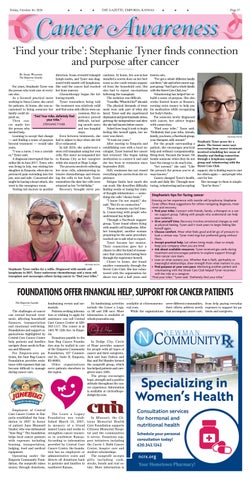
Cancer Awareness ‘Find your tribe’: Stephanie Tyner finds connection and purpose after cancer By Jessie Wagoner
direction. Scans revealed enlarged lymph nodes, and Tyner was diagnosed with mantle cell lymphoma. For years, Stephanie Tyner was She said the cancer had reached the person who took care of every- her bone marrow. one else. Chemotherapy began the folAs a licensed practical nurse lowing month. working in Yates Center, she cared Tyner remembers being told for patients. At home, she was ac- the treatment was relatively mild customed to being someone her and that some side effects were unfamily could decommon. Her ex“Find Your tribe, definitely find perience proved pend on. your tribe.” Then candifficult, includSTEPHANIE TYNER cer made her ing mouth sores the person who and two hospital needed help. stays. Learning to accept that change Even between treatments, she — and finding a sense of purpose had to adjust to days when she felt beyond treatment — would take ill or exhausted. years. In fall 2018, she underwent a “I was a nurse. I was a caretak- stem cell transplant using her own er,” Tyner said. cells. Her sister accompanied her A diagnosis interrupted that fa- to Kansas City as her caregiver miliar life in June 2017. Tyner, who while she stayed at Hope Lodge. was living in Iola, was visiting her The process involved collecting daughter in Emporia, when she ex- her stem cells, administering inperienced pain extending into her tensive chemotherapy and returnjaw, arm and side. Concerned she ing the cells to her body. Tyner might be having a heart attack, she remembers the date her cells were went to the emergency room. returned as her “re-birthday.” Testing led doctors in another Recovery brought strict preThe Emporia Gazette
PROVIDED PHOTO
Stephanie Tyner smiles for a selfie. Diagnosed with mantle cell lymphoma in 2017, Tyner underwent chemotherapy and a stem cell transplant and encourages others facing cancer to “find your tribe.”
cautions. At home, her son-in-law installed a screen door on her bedroom so she could remain separated from the household cats. She also had to repeat vaccinations following the transplant. The isolation was difficult. “I was like, ‘What do I do?’” she said. The physical demands of treatment were only part of what she faced. Tyner said she experienced depression and post-traumatic stress, grieving the independence and identity she had known before cancer. Asked how long it took to begin feeling like herself again, her answer was direct. “It took me years.” After moving to Emporia and establishing care with a local oncologist, Tyner learned her cancer had returned. She began taking medication to control it and said she has been in remission since September 2023. Still, remission has not erased everything she carries from the experience. Fatigue limits how much she can work. She describes difficulty finding words or losing her train of thought midsentence — something she calls “chemo brain.” “I know I’m not stupid,” she said. “But it’s no connection.” Those moments can feel lonely. Connecting with people who understand has helped. Through a Facebook support group, Tyner found others living with mantle cell lymphoma. After her transplant, another woman preparing for the same procedure reached out to ask what to expect. Tyner became her mentor. Their connection gave her a chance to offer the kind of reassurance that comes from having been through the experience herself. Closer to home, she found another community through the Street Cats Club. She has volunteered with the organization for about two and a half years and
fosters cats. “I’ve got a whole different family out there,” she said of her cancer support group. “And I got a whole family with the Street Cats Club, too.” Volunteering has helped her rebuild a sense of purpose. She also works limited hours at Braum’s, earning extra money to help pay for medication while recognizing her body’s limits. For someone newly diagnosed with cancer, her advice begins with connection. “Find your tribe,” Tyner said. “Definitely find your tribe, friends, family, you know, a Facebook group, your therapist, rally around.” For the people surrounding a patient, she encourages practical help and ordinary companionship. Bring food. Vacuum the house. Sit beside someone when they do not have the energy to do much else. “Act normal,” she said. “Like the person’s the person you’ve always known.” Cancer changed Tyner’s health, work and daily life. Through mentoring, volunteering and accepting
PROVIDED PHOTO
Stephanie Tyner poses for a photo. The former nurse says recovering from cancer treatment involved rebuilding her sense of identity and finding connection through a lymphoma support group and volunteering with the Street Cats Club.
support, she is finding ways to care for others again — and people who care for her. Her message to them is simple. “Just be there.”
Stephanie’s tips for facing cancer Drawing on her experience with mantle cell lymphoma, Stephanie Tyner offers these suggestions for others navigating diagnosis, treatment and recovery. • Find your tribe. Connect with friends, family, a therapist or a cancer support group. Talking with people who understand can help ease isolation. • Give yourself time. Recovery involves emotional changes as well as physical healing. Tyner said it took years to begin feeling like herself again. • Choose comfort. Wear what feels good and let go of pressure to look a certain way. Tyner tried wigs but preferred going without them. • Accept practical help. Let others bring meals, clean or simply keep you company when you are tired. • Ask about available resources. Tyner received gas cards during treatment and encourages patients to explore support through their cancer care team. • Lean on what sustains you. Whether that is faith, spirituality or meaningful relationships, draw strength from what matters to you. • Find purpose at your own pace. Mentoring another patient and volunteering with the Street Cats Club helped Tyner reconnect with her role as a caregiver. “Find your tribe,” Tyner said. “Definitely find your tribe.”
FOUNDATIONS OFFER FINANCIAL HELP, SUPPORT FOR CANCER PATIENTS The Emporia Gazette
The challenges of cancer can extend beyond treatment, affecting household finances, transportation and emotional well-being. Foundations and support organizations highlighted by Central Care Cancer Center help patients and families navigate those needs in Kansas and Missouri. For Emporia-area patients, the June Bug Cancer Foundation provides assistance with expenses that can become difficult to manage during cancer care.
fundraising events and memorials. Patients seeking information or wishing to apply for assistance can call Central Care Cancer Center at 620342-1117. The center is at 1401 W. 12th Ave. in Emporia. Donations payable to the June Bug Cancer Foundation may be mailed in care of the Emporia Community Foundation, 527 Commercial St., Suite B, Emporia, KS 66801. Other organizations serve patients elsewhere in the region.
Employees of Central Care Cancer Center in Emporia established the foundation in 2007 in honor of patient June Monnard Sauder, who was nicknamed “June Bug.” The foundation helps local cancer patients with expenses including housing, transportation, lodging, food and medical equipment. Operating under the Emporia Community Foundation, the nonprofit raises money through donations,
The Leave a Legacy Foundation was estab lished March 16, 2007, in memory of a friend named Laura and works to strengthen cancer resources in southwest Kansas. According to information provided by Central Care Cancer Center, the foundation has no employees or administrative costs and directs all donations back to patients and families in southwest Kansas.
Its fundraising activities available at citizensmemo- serve different communities, from help paying everyday include the Leave a Lega- rial.com. their efforts address needs expenses to support for pacy 5K and 10K race. More While the organizations that accompany cancer care, tients and caregivers. information is available at whodoyourunfor.org.
In Dodge City, Circle of Hope provides support for people with all types of cancer and their caregivers. Jack and Jane Dalton and Ray and Pat Shrader formed the nonprofit group, which has helped patients and caregivers since 1993. The group encourages hope, strength and a positive attitude throughout the cancer experience. Information is available at circleofhopedodgecity.com.
In Missouri, the Citizens Memorial Health Care Foundation supports Citizens Memorial Hospital and the communities it serves. Donations support initiatives including the Carrie J. Babb Cancer Center, hospice care and student scholarships. The nonprofit accepts gifts including cash, stocks, bonds and real estate. More information is
Page 18
V
V
V
THE GAZETTE, EMPORIA, KANSAS
V
V
V
Friday, October 16, 2026
Central Care Cancer Center offers treatment, support close to home The Emporia Gazette
For Emporia-area residents facing cancer, Central Care Cancer Center offers access to treatment and resources that address needs beyond medical care. Located at Newman Regional Health, the center develops treatment plans tailored to individual patients and coordinates with other health care professionals to address physical, emotional and financial concerns. According to Newman Regional Health, treatment options include chemotherapy, radiation therapy, immunotherapy, surgery and participation in clinical trials. Palliative care is also among the services listed. The center’s Emporia team includes medical oncologist and hematologist Dr. Ali Wazir, radiation oncologists Dr. Claudia Perez-Tamayo and Dr. Omoruyi Irabor, and nurse practitioner Hannah Schmidt. For patients concerned about the cost of care, financial counselors can help explain insurance benefits, verify coverage, discuss necessary referrals and review payment plans and balances patients may owe. Counselors also work with patients to identify grants and assistance for treatment and prescription costs. Information about discount schedules, eligibility requirements and hard-
ship applications is available upon request. The Emporia financial counseling number is 620-487-7924. Another local resource is the June Bug Cancer Foundation, established in 2007 by employees of Central Care Cancer Center in Emporia in honor of patient June Monnard Sauder. The foundation helps ease financial burdens for local cancer patients by assisting with expenses such as housing, transportation, lodging, food and medical equipment. It operates under the Emporia Community Foundation and receives support through donations, fundraising events and memorials. Patients can learn more about the foundation or apply for assistance by calling the cancer center at 620-3421117. Newman Regional Health also identifies Central Care Cancer Center as certified through the Quality Oncology Practice Initiative certification program. The program recognizes outpatient hematology-oncology practices that meet nationally recognized standards for quality cancer care. Central Care Cancer Center is at 1401 W. 12th Ave. in Emporia. Hours are 8 a.m. to 4:30 p.m. Monday through Friday. For information about treatment or patient resources, call 620342-1117.
M E E T T H E STA F F
Ali Wazir, MD Oncology
Hannah Schmidt, APRN-C Oncology
Claudia Perez-Tamayo, MD Oncology
Omoruyi Irabor, MD Oncology
3012 US-50 • (866) 759-5167
3012 US-50 • (866) 759-516 3012 US-50
(866) 759-5167
www.longbineauto.com
Friday, October 16, 2026
V
V
V
THE GAZETTE, EMPORIA, KANSAS
V
V
Page 19
V
Beyond ‘Let me know’: Small acts can make a difference for someone facing cancer By Jessie Wagoner
The Emporia Gazette
When someone receives a cancer diagnosis, friends and family often respond with a familiar offer: “Let me know if you need anything.” The words express care. But they also leave the person facing cancer responsible for identifying a need, deciding whom to ask and making the request. A more specific offer can make help easier to accept. A ride to an appointment, groceries on the doorstep or someone handling the laundry can lighten an ordinary burden during an extraordinary time. The starting point is simple: Ask permission, offer something concrete and follow through. Instead of offering to help
with food, ask whether dinner on Tuesday would be useful. Before preparing a meal, check about dietary needs, preferences and how many people to feed. Ask whether the household would prefer a homemade meal, takeout or a grocery gift card. Transportation is another way to offer support. Someone may welcome a ride to an appointment or help picking up a prescription. Make the offer clear, including when you are available, so the person can decide whether it fits. Everyday responsibilities continue during treatment. Children need rides, pets need care and bills still arrive. Offering to mow the lawn, walk the dog or take out the trash can relieve one task without requiring someone to organize a larger project. Help should respect the person’s choices. Ask before cleaning, rearranging belongings or taking over a responsibility. What feels helpful to one person may feel intrusive to another. Emotional support matters, too. Being present does not require finding the perfect words. Sometimes it means listening without offering advice or trying to turn a difficult moment into a positive one. Give the person room to talk about fear, frustration or uncertainty. Avoid comparing their experience with someone else’s cancer story or suggesting they must stay upbeat. Let them decide whether they want to discuss cancer at all.
An ordinary conversation about children, work or a favorite television show can also be welcome. A diagnosis does not erase the rest of someone’s life. Respect privacy. Ask before sharing health updates, posting online or organizing a fundraiser. Even well-intended efforts can create pressure if the person has not agreed to them. Visits should be welcome and flexible. Check before stopping by, accept a cancellation without taking it personally and make it easy for the person to decline. A brief message that says, “Thinking of you — no need to reply,” offers connection without another obligation. Remember caregivers as
well. A spouse, relative or friend managing appointments and household duties may appreciate a meal, an errand or someone willing to listen. Continue checking in over time. Put a reminder on the calendar to reach out again in a few weeks. Keep invitations open and understand that someone’s ability to participate may change from day to day. No friend or neighbor can remove every difficulty that comes with cancer. But a thoughtful offer, delivered consistently and on the person’s terms, can make daily life a little easier. Sometimes the most useful words are specific: “I’m going to the grocery store Thursday. What can I pick up for you?”
IS IT TIME FOR A SCREENING? A GUIDE TO COMMON CANCER CHECKS The Emporia Gazette
Cancer screenings look for cancer before symptoms appear. Knowing when to schedule them can help peo-
ple keep up with preventive care. This guide follows finalized U.S. Preventive Services Task Force recommendations. Other organizations
may recommend different schedules. Family history, previous abnormal results and certain health conditions may mean earlier or more frequent testing.
Breast cancer Wo m e n a ge s 4 0 - 7 4 should have a mammogram every two years. Those with previous breast cancer, certain genetic mutations or chest radiation at a young age need an individualized plan. Women 75 and older should discuss continued screening with their provider.
Central Care Cancer Center Emporia Oncology Team 1401 W 12th Ave | 620-342-1117 | cccancer.com "We are honored and proud to offer comprehensive integral; cancer treatments in Emporia through our collaboration. We remain dedicated to ensuring that patients are treated at the highest level for both medical and radiation oncology which includes immunotherapy, protocols and sterotactic treatments." -Dr. Ali Wazir
Hannah Schmidt, DNP, APRN, FNP-C. Dr. Wazir, MD Dr. Perez-Tamayo, MD, MACR, FACRO Dr. Irabor, MD, MPH
Colorectal cancer Adults at average risk should begin screening at 45 and continue through 75. Between 76 and 85, screening depends on health, previous testing and personal preferences. Options include a colonoscopy every 10 years when results are normal or an annual at-home fecal immunochemical test, called FIT. Other tests have different intervals. An abnormal stool test requires a follow-up colonoscopy. Previous polyps, inflammatory bowel disease or certain family histories may change the schedule.
ery three years. Ages 30-65: A Pap test every three years, a high-risk HPV test every five years, or both together every five years. Screening can generally stop after 65 with adequate previous screening and no high-risk factors. After a hysterectomy, screening needs depend on whether the cervix was removed and medical history.
ingness to undergo treatment.
Lung cancer
Don’t wait for symptoms
A yearly low-dose CT scan is recommended for eligible adults ages 50-80 with at least a 20 pack-year smoking history who currently smoke or quit within years. Cervical cancer 15 One pack daily for 20 For people with a cervix years equals 20 pack-years. at average risk: Eligibility also depends on Ages 21-29: A Pap test ev- health and ability and will-
Prostate cancer Men ages 55-69 should discuss the benefits and harms of prostate-specific antigen, or PSA, testing with their clinician before deciding. There is no universal testing interval. The task force recommends against routine PSA screening at 70 or older.
These schedules apply to people without symptoms. Report new or persistent health changes rather than waiting for a scheduled screening. Ask your provider which tests you need and whether your personal risk changes the timing.
Page 20
V
V
V
THE GAZETTE, EMPORIA, KANSAS
V
V
V
Friday, October 16, 2026