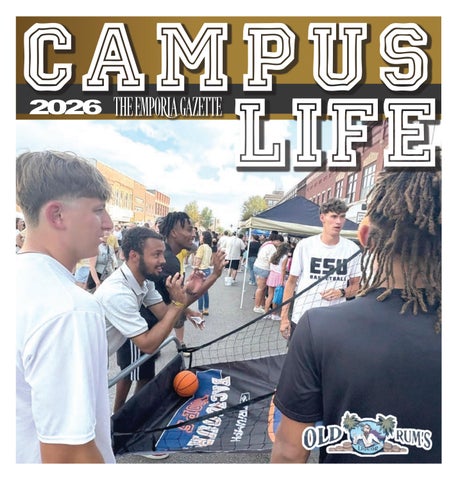
CAMPUS LIFE 2026 T E G
Page 2
V
V
V
THE GAZETTE, EMPORIA, KANSAS V
Welcome to Emporia!
F
LINT HILLS TECHNICAL COLLEGE employees welcome you to our community. Whether you’re new here or you’ve got deep roots in the Flint Hills, come tour our campus and see for yourself the energy of hands-on learning — students creating, building, solving, and engineering their way through high-quality labs every day. Read on to see how we live out our mission: to equip students with the educational, career, and professional skills that support personal growth and meet the needs of our community and workforce. COMMITMENT TO STUDENT SUCCESS: OUR PASSION Students in FHTC’s LPN nursing program take a licensure exam through the Kansas Board of Nursing — our first-time pass rate was 100% in 2026, Dr. Caron Daugherty part of a three-year average of 100%. Our Dental Hygiene students consistently earn 100% pass rates on clinicals. The Hospitality and Culinary Arts program is regularly represented on the national stage as students earn first place at state SkillsUSA competition. And our most recent job placement data show the employment rate for 2025 graduates is 97% — continuing a strong 10-year average of 96.7%. Flint Hills Tech puts students at the center of everything we do. Every effort across our campus is built around one goal: helping students like you succeed and reach the goals that brought you here. COMMITMENT TO EMPLOYEES: OUR HEART None of this happens without our people. FHTC employs industry-trained, highquality faculty who lead their academic and technical programs with integrity and real-world expertise. Our staff make sure the pathways and resources are in place to support every student’s investment in their education, and our whole campus takes a holistic approach to helping people reach their goals. COMMITMENT TO PARTNERSHIPS: OUR ENGAGEMENT Our employees live here and work here. They serve on local boards, support the local economy, and raise their families in our communities. They build learn-to-earn pathways and internships for their programs, and they work alongside nonprofit partners to keep resources accessible for students. They know the pulse of the Flint Hills — all seven counties of our service area — because they’re part of it. COMMITMENT TO CAMPUS AND FACILITY EXPANSIONS: OUR STEWARDSHIP Since launching the Advancing Tomorrow Capital Campaign in April 2025, we’ve been laying the groundwork for transformational change in workforce development across our region for decades to come. We’re expanding our Main Campus to support the new Advanced Industry Education Center, and we’ve purchased an additional facility to grow our Precision Agriculture and Commercial Driver’s License (CDL) training programs. Through it all, we remain committed to responsible stewardship of our capital and fiscal resources. Come take a tour and see it all in action — a wall of award banners in the culinary demonstration kitchen, clean and organized labs full of equipment, even a program proudly celebrating three generations of Automotive Technology graduates in one family. You’ll hear about our strong placement rates for graduates. But more than anything, you’ll meet extraordinary people who are passionate about technical education and about changing lives for the better. It’ll change how you see technical education — and open your eyes to a new world. Come to campus, and we’ll show you why it’s a great day to be a Wrangler. The door is open. See you soon!
Dr. Caron Daugherty Flint Hills Technical College President
V
V
Friday, August 14, 2026
Friday, August 14, 2026
V
V
V
THE GAZETTE, EMPORIA, KANSAS V
V
Page 3
V
Looking forward to a momentous new year
T
HROUGHOUT MY CAREER in higher education, the start of a new academic year has always been special. The final weeks leading up to it can be busy, but there is something special about those first days on campus. Energy, excitement and a sense of possibility are everywhere.
Dr Matt Baker
It’s a joy to watch families help their students begin this new chapter as they settle into their first home away from home, meet new friends and begin discovering all that college has to offer. In 2026, I am especially excited to launch a new academic year at Emporia State University, my first since joining Hornet Nation last spring. Each of us at Emporia State University, from staff and faculty to administrators, know that we are changing the world one student at a time by creating a welcoming and friendly place with support and tools students can use
Emporia State University and the community we proudly call home. Whether it is athletic events, music, art and theatre productions, STEM outreach activities or just enjoying walks on campus, we hope you’ll join us as a part of Hornet Nation. Here’s to a great new year!
Matthew C. Baker, Ed.D. Emporia State President
to achieve their dreams. We are thankful for everything the community of Emporia does to welcome our students and embrace them throughout their time at ESU. A highlight of each new year is the Welcome Back Block Party organized by Emporia Main Street, which gives our students a chance to discover the businesses, restaurants, events and attractions that make Emporia such a special place to live. Just as Emporia opens its arms to our students, I want to extend a personal invitation to you. Join us on campus, take part in our events, enjoy our activities and experience the unmistakable energy that defines life in a college town. Your presence enriches these moments and strengthens the connection between
605 COMMERCIAL • DOWNTOWN EMPORIA
Page 4
V
V
V
THE GAZETTE, EMPORIA, KANSAS V
V
V
Friday, August 14, 2026
FHTC’S COMPUTERIZED MACHINE TOOLING PROGRAM GIVES STUDENTS THE OPPORTUNITY TO LEARN MACHINING
By Trey Donovan
The Emporia Gazette
The industry of machining is not a very public one, but it is an important one for modern society. Machining is a manufacturing process that takes raw materials and turns them into parts for a plethora of everyday objects. Everything from phone cases to heavy machinery- a machinist makes the parts for it, and Flint Hills Technical College offers a program just for it. The program offers two different routes to go down, whether someone just wants their certificate or their associate’s degree. Within the program, students are expected to learn the fundamentals of machining and program and operate CNC (computer numerically controlled) mills and lathes. “The purpose of the program is to train people with little to no knowledge of machining to become skilled operators. We start them out with the fundamentals where we sit down and talk about things like shop math, how to read blueprints, how to read measuring equipment,” Computerized Machine Tooling instructor Terry Rhoads said. “It is called Fundamentals of Machining 101. It is just to introduce you to the skills required to go out on the shop floor and have an idea of what you’re doing and how you’re doing it.”
That is a part of the classroom work, and Rhoads goes on to explain that after the class, he takes students to the shop on campus to show and give students the opportunity to do hands-on work. He adds that the program will take place more often in the shop than in the classroom, because the shop floor is where the majority of the learning will take place. For the upcoming semester, Rhoads is slightly changing his course to make the classroom more like the shop floor. “I’m currently redoing my class so that it is an extension of the shop floor. I got rid of all my desks, and we are putting workbenches in, so every desk is technically a butcher block workbench, and we will have an island of workbenches in the center to do layout work and hand tool work that we can do in there,” Rhoads said. “When we go out on the shop floor and power up machines, it gets loud. So it’s a lot harder for me to teach a group on the floor than it is to teach a group in what we will call a lab extension.” While modern machining is done through programming CNC lathes and mills, a key part of Rhoads’s class is teaching students to use the equipment manually. Having students manually use the equipment teaches them what each thing does before they get into programming the equipment.
Rhoads’s class, as he explains, is a mix of hands-on learning with learning how the equipment works by teaching students how to manually use it; then they get taught how to automate the process. He also discusses some goals he has for students in the class. “The way that this works is that there
are so many opportunities to fail, and I want you to fail because that is where you’re going to learn. I would rather students fail in my program than go to a shop and fail, because we have time to fix it here,” Rhoads Please see Tooling, Page 15
Friday, August 14, 2026
V
V
V
THE GAZETTE, EMPORIA, KANSAS V
V
V
Page 5
WELCOME BACK BLOCK PARTY TO KICK OFF NEW SCHOOL YEAR IN DOWNTOWN EMPORIA The Emporia Gazette
College students will get a chance to explore downtown Emporia, meet local businesses and organizations, and celebrate the start of a new school year during Emporia Main Street’s annual Welcome Back Block Party. The free event will be held from 5:30 to 7 p.m. Monday, Aug. 17, in the 600 and 700 blocks of Commercial Street, welcoming students from Emporia State
University and Flint Hills Technical College back to the community. The event is designed to introduce students to the businesses, organizations and opportunities available in Emporia while encouraging connections between students and the local community. Students do not need tickets to attend and can simply show up to enjoy an evening featuring music, food, giveaways and Please see Party, Page 14
FILE PHOTO
1 GIG FIBER Internet
Fast, Reliable & Secure
Great value. No surprises.
Scan, call 855.692.4116 or visit Sparklight.com/internet
†Limited Time Offer. Equipment, taxes, surcharges, and fees are not included for most plans. Offer available to new customers only (those who have not had Internet service with Sparklight in the past 90 days). Promotional rate is $40/mo. for the first 12 months, $45-$55/mo. for months 13-24 and $50-$75/mo. for months 25-36 depending on location and requires Auto Pay with checking/savings account or debit card plus paperless billing. Regular rates from $60-$105/mo.; subject to change at any time. Pricing and availability vary by location, and speeds vary by equipment and location; all are subject to change. Modem with eero Wi-Fi device lease is from $0-$14.99/mo. Includes Unlimited data plan. Visit sparklight.com/legal/acceptable-use-policy for details of Sparklight’s Acceptable Use Policy. All services and offers are not available in all areas. Certain taxes, fees, and costs not included for mobile offer. Sparklight Mobile requires Sparklight Internet. Available to new and existing residential Sparklight Internet customers in eligible service areas, excluding Lift Internet and FlexConnect customers. Mobile offer cannot be combined with any other offers. Maximum of one mobile line at no monthly service charge for 12 consecutive billing months from activation date; free monthly service only up to the standard monthly rate of the Unlimited plan while customer has active, eligible Sparklight Internet service during 12-month billing cycle. Unlimited plan has high-speed data thresholds; speeds may be reduced during times of network congestion. For more information, visit mobile.sparklight.com/network-management. Coverage and service availability may vary by location and device. Offer limited to Sparklight serviceable areas only; not all offers and services are available in all areas. Restrictions apply. ©2026 Cable One, Inc.
Page 6
V
V
V
THE GAZETTE, EMPORIA, KANSAS V
V
V
Friday, August 14, 2026
More Than a President: Dr. Matt Baker’s mission is making every Hornet feel at home By Jessie Wagoner
The Emporia Gazette
By the time many students arrive on the Emporia State University campus this fall, they may have already seen videos of the university president handing out donuts during finals week, giving students rides across campus in a golf cart or chatting with students between classes. That isn’t a carefully crafted public relations campaign. It’s simply Dr. Matt Baker’s approach to leadership. Whether he’s encouraging a prospective student he met at a dry cleaner to tour campus, attending Main Street events downtown or stopping to visit with students on the Quad, Baker believes relationships are the foundation of a successful university. “The students are not an inconvenience to our job,” Baker said. “They are our job.” It’s a philosophy that has quickly made Baker a familiar face since becoming Emporia State University’s president earlier this year.
Building on a strong foundation After spending more than 30 years in higher education, Baker arrived in Emporia knowing the university had endured difficult years of budget reductions and change. Instead, he found a campus ready to move forward. “I was pleased to find out that people were resilient,” Baker said. “They’re ready for what’s next, and let’s build on the difficult work we’ve done.” He said he has been impressed not only by the dedication of the faculty and staff, but also by the optimism he sees across campus. “I think Emporia State is as well-poised as any institution I’m aware of to be ready to meet those challenges,” he said.
A university connected to its community One of Baker’s biggest surprises has been the close relationship between ESU and the city of Emporia. From Emporia Main Street events and the Chamber of Commerce to Unbound Gravel and community festivals, he believes the university and community thrive because they work together.
Dr. Matt Baker’s Five Tips for Student Success 1. ENJOY THE EXPERIENCE. College is about much more than earning a degree. Take time to enjoy campus traditions, meet new people and create lasting memories. 2. REMEMBER THAT EVERYONE IS ADJUSTING. Even the students who appear confident are figuring things out. The worries about roommates, finding classes and making friends usually work themselves out within the first few weeks. 3. DON’T BE AFRAID TO ASK FOR HELP. “The strongest people I know ask for help when they need it,” Baker said. Reach out to professors, advisers, resident assistants or classmates whenever you need support. Dr. Matt Baker, ESU President
“I think people who live here don’t always appreciate how special it is,” Baker said. “This is what people say, ‘My town used to do.’” He believes that partnership is essential to the university’s future. “We cannot function without a good relationship with the city,” Baker said. “The city’s existence is strengthened by ESU. We are creating a win-win situation.”
Students come first
Faculty, maintenance crews, groundskeepers, electricians, plumbers and countless others all play a role in creating a campus where students feel welcomed and supported.
Finding the right fit One piece of advice Baker frequently gives prospective students comes from his own experience. Although he attended Kansas State University, he later realized he would have been happier at a regional public university like Emporia State. “I didn’t understand colleges and universities were different,” he said. That’s why he encourages students to visit multiple campuses before making one of the biggest decisions of their lives. “I hope it’s ESU,” Baker said. “But if it’s not, I’d much rather you’re happy in the place you need to be than you go someplace just because you thought that’s what you should do.”
Ask Baker why he spends so much time interacting with students, and his answer comes without hesitation. “We’re here for students.” His years working in student affairs taught him that college should challenge students academically while also creating memories they’ll carry for the rest of their lives. That’s why he’s willing to climb into a golf cart during finals week, pass out donuts before exams or simply stop and have a conversation. “Our job is to provide an incredible exLooking ahead perience that students want to tell their Like universities across the nation, friends about,” he said. Emporia State faces challenges, including He believes every employee on campus enrollment and the changing landscape of contributes to that experience. higher education. “It’s an ecosystem,” Baker said. “We run Baker believes the university’s future a little town here.”
4. BE COMFORTABLE BEING YOURSELF. College is a time to discover who you are. It’s okay if your interests change or your career path looks different than you expected. 5. EMBRACE THE CHALLENGE. College is supposed to stretch you. The difficult moments are often where the greatest growth happens, so don’t be discouraged when things get hard. depends on embracing what makes ESU different rather than trying to imitate larger institutions. “We’re not KU or K-State,” he said. “Thank goodness. I don’t want to be KU or K-State. I want to be Emporia State.” He says ESU’s greatest strength is the personal relationships formed between students, faculty and staff. “Our faculty matter to our students, and our students matter to our faculty,” Baker said. As another academic year begins, Baker hopes students will discover more than classrooms and residence halls. He hopes they’ll find a place where they belong. “Emporia is way more special than it realizes,” he said. “Both the community and the university. What excites me is I get to help write the next chapter.”
Friday, August 14, 2026
V
V
V
THE GAZETTE, EMPORIA, KANSAS V
V
Page 7
V
HOW TO SURVIVE YOUR FIRST SEMESTER OF COLLEGE cies, contact information and expectations for assignments. At the beginning The first semester of college comes of the semester, take a few minutes to enter major exams, projects and deadwith plenty of expectations. There is the excitement of a new be- lines into a calendar. Your future self will thank you. ginning, new friends and newfound independence. There may also be a new city, a new roommate and the realizaGo to class tion that nobody is going to remind you Without parents or teachers monitorthat the paper listed on the syllabus ing attendance, skipping an 8 a.m. class three weeks ago is due tomorrow. For new college students, the tran- can become surprisingly tempting. Don’t make it a habit. sition can be exciting, overwhelming Missing one class can mean missing and occasionally messy. The good news is that nobody has to have everything information that makes the next class figured out during the first week — or harder to understand. Before long, catching up can become much more difeven the first semester. A few simple habits can make the ficult than simply getting out of bed in the first place. transition considerably easier. The Emporia Gazette
Read the syllabus
Find a routine
on your phone. Figure out when you will study, eat, exercise, do laundry and relax. You don’t need to schedule every minute of your life, but having some structure makes it easier to stay ahead of responsibilities.
Don’t wait until you’re struggling to ask for help One of the biggest differences between high school and college is that students are expected to advocate for themselves. If you don’t understand something, talk to your professor. Use office hours. Visit tutoring or academic support services. Ask questions. Seeking help after the first confusing lecture is much easier than trying to rescue a grade during finals week.
College schedules can be strange. It may not be exciting reading, but Meet people the syllabus is essentially the instruc- You might have a class at 9 a.m., another at noon and nothing else until 3 p.m. tion manual for a college course. For many freshmen, one of the hardThose gaps can either become proIt usually contains important dates, est parts of college isn’t academics. It’s ductive time or disappear into scrolling attendance requirements, grading polifinding a place to belong.
Introduce yourself to the person sitting next to you. Attend an activity. Join a club. Go to a sporting event. Eat with someone instead of always grabbing food to go. Not every person you meet will become your best friend, and that’s OK. Friendships take time.
Take care of the boring stuff Sleep matters. So does eating something besides chips for dinner. College students don’t need perfect diets, elaborate workout routines or eight-step wellness plans. They do need enough sleep, regular meals, water and occasional movement. You’ll have a much harder time succeeding academically when you’re exhausted and running on caffeine. And yes, you really do need to wash your sheets occasionally. Please see Survive, Page 12
Page 8
V
V
V
THE GAZETTE, EMPORIA, KANSAS V
V
Friday, August 14, 2026
V
ESU ALUM JUSTIN RAHE TAKES LEAD AT MEMORIAL UNION Special to The Gazette
Rahe
An Emporia State alumnus active in the local business community will return to campus as the new director of the Memorial Union. Justin Rahe begins his new role on Monday, Aug. 3. “I am thrilled to step into this role 10 years after I walked across the stage at graduation,” said Rahe. “My undergraduate years were some of the most impactful of my life, and I spent much of that time in the Memorial Union. I can’t wait to join a tremendous team and give back to the university that has given me and my family so much! Stingers Up!” Rahe built a solid career at the Emporia State Federal Credit Union in Emporia, where he began in 2018 as
a member service representative. He moved up through leadership roles before becoming assistant vice president: communications and projects in 2022. That role included building relationships with vendors and reviewing contracts as well as supervising the planning and execution of community events. Those skills will work well in ESU’s Memorial Union, which serves a dual purpose as both a hub for success services for students as well as a fullservice event venue for both campus and the Emporia area community. “We are excited that Justin is returning to Emporia State and welcome him to our team,” said Kala Maxfield, ESU vice president of engagement and chief marketing officer. “His relationships both on campus and in the community are invaluable in his new role.”
Friday, August 14, 2026
V
V
V
THE GAZETTE, EMPORIA, KANSAS V
V
V
Page 9
Page 10
V
V
V
THE GAZETTE, EMPORIA, KANSAS V
HOW INCOMING COLLEGE STUDENTS CAN CHOOSE A MAJOR
Incoming students’ first days on a Though it’s not uncommon for college freshmen to meet their peers college campus can seem like a whirland feel a little intimidated by those wind, particularly for those who are who seemingly have a career path moving into a dorm or another type of mapped out already, it’s good to on-campus housing. With so much gokeep in mind that as many as half ing on, from relocating to meeting new of the students in a 101 class may roommates and tasting independence be undecided. Give yourself time for the first time, it’s easy for students and resist rushing into a decision to overlook academics as they adjust to regarding a major. Colleges and college life. But once classes begin, life universities typically don’t mandate on campus tends to settle down and stuselecting a major until the end of sophomore year. dents gradually become acclimated to ✦✦Recognize you can always change their new surroundings. majors. BestColleges notes that Many students begin their college around three in four college students careers without a major. Choice of machange their major at least once jor is a significant decision, and college in their college career. That also students who need a little help finding should help undeclared students the right one can approach the process feel a little less intimidated by the in a number of ways. process and even encourage them to dip their toes in as many academic ✦✦Give yourself time. College students waters as they want to. who checked the “undecided” box ✦✦Use general education requirements should know they’re not alone. Acto your advantage. Students may cording to the education advisors lament general education requireat BestColleges, between 20 and 50 percent of college students enPlease see Major, Page 13 ter college undecided on a major.
V
V
Friday, August 14, 2026
Friday, August 14, 2026
V
V
V
THE GAZETTE, EMPORIA, KANSAS V
V
V
Page 11
HOW MUCH SLEEP DO COLLEGE STUDENTS ACTUALLY NEED? College students are known for plenty of things — late-night study sessions, early-morning classes, busy social lives and consuming impressive amounts of caffeine. Getting enough sleep doesn’t always make the list. Between classes, studying, jobs, activities, friends and the temptation to stay up for “just one more episode,” sleep can quickly become something students plan to catch up on later. But how much sleep do college students actually need? For most college-age students, the answer is about seven to nine hours each night. Younger college students may need even more, with sleep experts generally recommending eight to 10 hours for teenagers ages 18 and younger. That can sound nearly impossible when an alarm is set for 7 a.m. and bedtime keeps creeping past midnight. However, regularly sacrificing sleep can affect much more than how tired someone feels during an early morning lecture.
Your brain needs sleep, too Studying until 3 a.m. might feel productive, particularly before a big exam, but sleep plays an important role in learning and memory. While sleeping, the brain processes and consolidates information gathered throughout the day. In other words, studying is only part of the learning process. The brain also needs time to organize and retain that information. Lack of sleep can make concentrating, remembering information and solving problems more difficult — exactly the skills students need when taking an exam. An all-night study session may buy a few additional hours with the textbook, but students can arrive at the test exhausted and less able to use what they learned.
You can’t always “catch up” on the weekend Sleeping until noon Saturday after surviving on five hours of sleep each night may feel wonderful, but relying on weekends to make up for consistently inadequate sleep isn’t an ideal strategy. An irregular sleep schedule can also make Sunday night difficult. Sleeping several hours later than usual on weekends can shift the body’s internal clock,
aren’t necessarily the same thing. It’s easy to climb into bed at 11 p.m. and suddenly discover it’s 12:30 a.m. after scrolling through social media, watching videos or answering messages. Setting the phone aside before bedtime can help the brain transition from the constant stimulation of the day to sleep. Caffeine isn’t sleep For students using their phones as Coffee and energy drinks may make alarm clocks, putting the device across a tired student feel more alert, but they the room has another advantage: It don’t replace the benefits of sleep. makes hitting the snooze button considCaffeine also stays in the body for erably more difficult. hours. That afternoon energy drink meant to get someone through class Naps can help — within could make it harder to fall asleep later that night, potentially creating a cycle of reason too little sleep followed by more caffeine Sometimes a nap really is necessary. followed by another difficult night. A short nap can help improve alertStudents don’t necessarily have to ness when students are tired, but a give up coffee. Paying attention to when and how much caffeine they consume three-hour afternoon nap may make it difficult to sleep that night. can make a difference. Keeping naps relatively short and avoiding them too close to bedtime The phone isn’t helping can help prevent them from interfering Going to bed and going to sleep with nighttime sleep.
making it harder to fall asleep when it’s time to return to a weekday schedule. Consistency helps. Students don’t have to go to bed at exactly the same minute every night, but keeping bedtime and wake-up times reasonably similar can make falling asleep and waking up easier.
Make sleep part of the schedule College students schedule classes, work shifts, meetings, practices and study sessions. Sleep deserves a place on that schedule, too. Start with the time you need to wake up and work backward. If the alarm rings at 7 a.m., going to bed at 1:30 a.m. simply doesn’t leave enough time for a full night’s sleep. There will inevitably be late nights during college. There will be papers that take longer than expected, nights out with friends and mornings when an alarm feels particularly cruel. One late night isn’t likely to ruin a semester. But regularly getting enough sleep can make it easier to concentrate in class, remember what you’ve studied and simply feel better during the day. So before starting another episode, opening another energy drink or deciding that the research paper can definitely be written between midnight and 4 a.m., consider one of the simplest study tools available. Go to bed.
Page 12
V
SURVIVE From PAGE 7
V
V
THE GAZETTE, EMPORIA, KANSAS V
them about your classes. You may be surprised how good it feels to hear a familiar voice, too.
Give yourself some grace
Learn how to manage money Freedom gets expensive quickly. A few coffees, restaurant meals, online purchases and nights out can add up faster than expected. Create a simple budget and pay attention to where your money goes. Learning to distinguish between “I need this” and “I want this right now” is one of the less glamorous parts of becoming an adult.
Call home Independence doesn’t mean disappearing. Your family probably misses you, even if they’re trying not to text you six times a day to ask whether you’re eating. Call occasionally. Send pictures. Tell
There will probably be a bad test grade. You might oversleep. You may forget an assignment, get homesick, argue with your roommate or spend a Friday night wondering why everyone else seems to be having a better college experience. They’re probably not. College isn’t supposed to be perfect, and neither are you. Your first semester is about more than earning credits. It’s about learning how to manage your own time, make decisions, solve problems, meet different people and become a little more independent. You don’t need to arrive on campus knowing exactly who you are, what you want to do with your life or how the next four years will unfold. Show up. Ask questions. Try new things. Make some mistakes. And read the syllabus.
V
V
Friday, August 14, 2026
GET PAID TO STREAM WITH KASASA PLAY™.
EARN REWARDS EVERY TIME YOU STREAM YOUR FAVORITE SHOWS, MUSIC, OR GAMES. LEARN MORE AT ESBFINANCIAL.COM.
Friday, August 14, 2026
V
V
V
THE GAZETTE, EMPORIA, KANSAS V
V
V
Page 13
THE BENEFITS OF EXTRACURRICULARS FOR COLLEGE STUDENTS Assimilating into campus life at a college or university can take time. After all, much changes between high school and college. Residential students may find college is the first time they spend considerable time away from home among their peers. College students have more responsibility than their counterparts in high school. College students must manage their schedules, get to class on time without help from Mom and Dad and speak with professors on their own behalf. One way to mitigate some of the stress that comes with the increased responsibility of college is to take full advantage of campus life. This includes participating in extracurricular activities. High school students may participate in extracurriculars because they know they look good on college applications. But now that college is here, the benefits of extracurriculars may be slightly different. PHYSICAL ACTIVITY: The Freshman 15 is no urban legend. The National Center for Biotechnology Information says that while most college students do not gain 15 pounds freshman year, a lot do gain some weight upon entering college. A 2008 study published in the Journal of American College Health found the average weight gain upon entering college was 2.7 pounds, with about half of students polled gaining weight. Extracurricular activities, like sports and additional physical pursuits, can help college students maintain a healthy weight even when consuming some not-so-healthy dining hall fare.
dents who participate in extracurricular activities at least two days a week are less likely to smoke marijuana and drink alcohol. These students also are less likely to miss class without a reason.
IMPROVED MENTAL HEALTH: Getting involved can counter feelings of loneliness or boredom that many students feel, especially in their first year at school, says Psychology Today. Rather than feeling unsure and isolated, participation in extracurricular activities can give students NETWORKING: Students interact with reason to chat with new people beyond their peers during curriculum-related the rigors of class. clubs, musical performances or sports practices and games. Finding common FUTURE CONNECTIONS: Some extracurground and making new connections is riculars can pay professional dividends. a cornerstone of success in the profes- Academic and social Greek organizations sional world. Extracurriculars can helps have very strong alumni networks, which AVOID POOR HABITS: A 2023 study by students develop networking skills that can help graduates secure interviews and the Afterschool Alliance found that stuwill be useful in the future. job offers.
MAJOR From PAGE 10 ments that mandate they take courses in a diverse array of subjects. However, those requirements are meant to create well-rounded students and expose them to new
subjects that might just spark a hidden passion and ultimately direct them down a career path. Make the most of these early college classes if you’re uncertain about which major to choose. These courses also can serve as a process of elimination, as you might identify certain subjects you aren’t fond of, which can help
you narrow down your options regarding a major. ✦✦Look to extracurricular clubs. Clubs offer a great way to make new friends, and they’re also effective at opening students’ eyes and minds to potential areas of study. What’s more, clubs don’t require a substantial commitment, so if it turns out your passion isn’t sparked, you can
BETTER GRADES: There is evidence that managing multiple extracurriculars helps students academically. Cambridge International Education says juggling multiple commitments helps a student value time management, which carries over into school work. SELF-ESTEEM: Participating in activities can boost confidence and self-esteem. Taking on leadership roles in extracurriculars can further a positive self-image as well. Extracurricular activities can offer a wide-ranging array of benefits for college students.
let club organizers know without any residual obligations like homework. It can be intimidating to begin a college career without a major. But incoming students should know they have lots of time to make that decision and plenty of opportunities to find a course of study they will be passionate about.
Page 14
V
V
V
THE GAZETTE, EMPORIA, KANSAS V
PARTY From PAGE 4 information from student organizations, local businesses and community groups. Instead of the traditional passport system used in previous years, students will check in electronically at the Emporia Main Street tent to become eligible for prize drawings. Winners will be an- giving students multiple chances to win nounced during an Emporia Main Street throughout the event. Facebook Live broadcast the following Organizers encourage students, facday and can claim their prizes at the Em- ulty and community members to attend poria Main Street office. the annual event as a way to celebrate Each participating Emporia Main the beginning of the fall semester while Street member business will donate a showcasing everything downtown Empodoor prize valued at a minimum of $20, ria has to offer.
V
V
Friday, August 14, 2026
Friday, August 14, 2026
V
TOOLING From PAGE 4 said. “I lean heavily into problem solving. I require my students to really think problems through and get to the point where they think problems through and come up with the correct correction. What I’m looking for is that students start processing problem solving themselves.” He adds that the program builds upon itself and by the end of the class, the skills are going to be stretched as the parts given will be harder. The class is set up to give students the ability to recognize what they know and what they don’t know, and be confident in the foundation given with the program and stay teachable. Rhoads discusses the success of his program and the issues within the machining industry.
V
V
THE GAZETTE, EMPORIA, KANSAS V
“I have a very good job placement rate for my program. From year to year, I average 96% job placement rate. It is a really good industry,” Rhoads said. “The biggest challenge this program faces right now isn’t finding jobs for my students; it’s finding students. Because people don’t know that machine shops exist, you don’t see us from the road. We are in a building tucked away and people don’t understand where our things come from or how things are made or what it takes to make things.” Machining is an important modern industry, but it is a private one that people don’t see every day. Just about everything in modern life that is made comes from machining, and FHTC is looking to continue sending new trained machinists out to continue creating. “Without machinists, there would be no modern life as we know it, machinists touch everything in modern life,” Rhoads said about what he tells his students.
V
V
Page 15
Page 16
V
V
V
THE GAZETTE, EMPORIA, KANSAS V
V
V
Friday, August 14, 2026