The Emory Wheel Since 1919
Emory University’s Independent Student Newspaper
Volume 107, Issue 11
Printed every other Wednesday
Wednesday, October 7, 2026
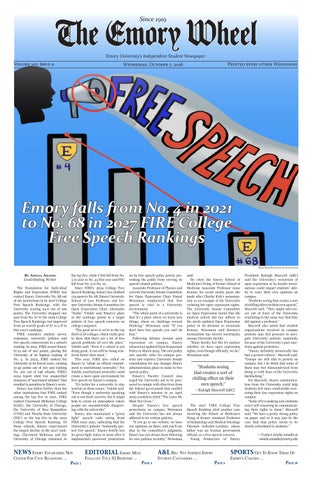
Emory falls from No. 4 in 2021 to No. 68 in 2027 FIRE College Free Speech Rankings Trien Song/Contributing Illustrator
By Amelia Amadio Contributing Writer The Foundation for Individual Rights and Expression (FIRE) has ranked Emory University No. 68 out of 261 institutions in its 2027 College Free Speech Rankings, with the University scoring 64.6 out of 100 points. The University dropped one spot from No. 67 in the 2026 College Free Speech Rankings, but improved from an overall grade of D- to a D in this year’s rankings. FIRE considers student survey responses, university policies and free speech controversies in a school’s ranking. In 2021, FIRE scored Emory 67.14 out of 100 points, placing the University at its highest ranking of No. 4. In 2024, FIRE ranked the University at its lowest score, earning 37.49 points out of 100 and ranking No. 202 out of 248 schools. FIRE’s 2024 report cited two unspecified instances of “sanctioned scholars” that resulted in penalties to Emory’s score. Emory has fallen further than the other institutions that FIRE ranked among the top five in 2021. FIRE ranked Claremont McKenna College (Calif.), the University of Chicago, the University of New Hampshire (UNH) and Florida State University (FSU) as the top five in the 2021 College Free Speech Ranking. Of those schools, Emory experienced the largest decline in the 2027 rankings. Claremont McKenna and the University of Chicago remained in
the top five, while UNH fell from No. 3 in 2021 to No. 44 this year and FSU fell from No. 5 to No. 21. Since FIRE’s 2024 College Free Speech Ranking, Emory has climbed 134 spots to No. 68. Emory University School of Law Professor and former University Senate Committee for Open Expression Chair Alexander “Sasha” Volokh said Emory’s place in the rankings points to a larger pattern of free speech concerns on college campuses. “The good news is we’re in the top third of all colleges, which really goes to show that there are a lot of free speech problems all over the place,” Volokh said. “Even if a school is not doing great, it can still be doing relatively better than most.” This year, FIRE also called on Emory to “adopt an official commitment to institutional neutrality.” For Volokh, institutional neutrality could create a more open environment for free speech on Emory’s campus. “It’s better for a university to stay neutral on these issues,” Volokh said. “Even though a university speaking out is not itself coercive, but it might help to create an atmosphere where people are uncomfortable disagreeing with the university.” Emory also maintained a “green light” speech code rating from FIRE since 2021, indicating that the University’s policies “nominally protect free speech.” Emory briefly lost its green-light status in 2020 after it implemented password protections
on its free speech policy portal, preventing the public from viewing its speech-related policies. Associate Professor of Physics and current University Senate Committee for Open Expression Chair Daniel Weissman emphasized that free speech is vital to a University environment. “The whole point of a university is that it’s a place where we learn new things, where we challenge current thinking,” Weissman said. “If you don’t have free speech, you can’t do that.” Following debates around open expression on campus, Emory released an updated Open Expression Policy in March 2025. The new policy sets specific rules for campus protests and requires University Senate consultation for any changes Emory administration plans to make to free speech policy. Emory’s Faculty Council also urged the University not to be pressured to comply with directives from the federal government that conflict with Emory’s mission in an April 2025 resolution titled “The Lines We Must Not Cross.” Despite Emory’s free speech protections on campus, Weissman said the University has not always adhered to its written policies. “If you go to our website, we have our opinions on there, and you’ll see that in the committee’s judgment, Emory has not always been following its own policies recently,” Weissman
NEWS Emory Establishes New EDITORIAL Emory Must Center For Civic Reasoning ... Evaluate Title XI Response ... PAGE 4 PAGE 2 P P
said. He cited the Emory School of Medicine’s firing of former School of Medicine Associate Professor Anna Kenney for social media posts she made after Charlie Kirk’s assassination as an example of the University violating her open expression rights. The University Senate Committee on Open Expression found that the medical school did not adhere to the newly updated Open Expression policy in its decision to terminate Kenney. Weissman said Kenney’s termination has stirred uncertainty among University faculty. “Many faculty feel like it’s unclear whether we have open expression rights, even though officially, we do,” Weissman said.
"Students seeing that creates a sort of chilling effect on their own speech." - Raleigh Maxwell (28C) The 2027 FIRE College Free Speech Ranking cited another case involving the School of Medicine’s firing of former Assistant Professor of Hematology and Medical Oncology Fatemeh Ardeshir-Larijani, whose father was an Iranian government official, as a free-speech concern. Young Democrats of Emory
A&L Bill Nye Inspires Emory Student Canvassers ...
PAGE 6
President Raleigh Maxwell (28C) said the University’s restriction of open expression in its faculty terminations could impact students’ ability to voice their own opinions on campus. “Students seeing that creates a sort of chilling effect on their own speech,” Maxwell said. “They might self-censor out of fears of the University retaliating in the same way that they did against a professor.” Maxwell also noted that student organizations involved in campus protests may feel pressure to navigate University policies cautiously because of the University’s past reactions against protestors. “Emory definitely historically has had a protest culture,” Maxwell said. “Groups are still able to protest on campus, but I do think that some of them may feel disincentivized from doing so with fears of the University backlashing.” For Maxwell, clearer communication from the University could help students feel more comfortable exercising their free expression rights on campus. “Some of it is making sure students aren’t self-censoring by communicating their rights to them,” Maxwell said. “We have a pretty strong policy on paper, and so it may just be the case that that policy needs to be clearly articulated to students.”
— Contact Amelia Amadio at amelia.amadio@emory.edu
SPORTS Get To Know Three Of Emory's Coaches ... PAGE 10
2 Wednesday, October 7, 2026
NEWS
The Emory Wheel
Emory humanities, social science faculty debate artificial intelligence, tech-free classrooms By Sukhroop Singh Contributing Writer As artificial intelligence (AI) continues to affect universites across the country, institutions like Columbia University (N.Y.) and the University of Chicago Law School have suspended technology use in some of their text- and discussion-based courses. Members of the humanities and social science departments at Emory University discussed the impacts of increased student dependence on technology. Associate Professor and Director of Undergraduate Studies of Political Science Hubert Tworzecki said that faculty members have “varied” views on technology in the classroom as use of AI platforms like ChatGPT and Claude become more prevalent. “We are dealing with an unprecedented challenge to education, posed by AI,” Tworzecki said. “It is forcing institutions to respond and to try new things. Some institutions have responded in a really strict way, banning or severely restricting technology in the classroom. We’ll probably need to wait a few years to see which of these experiments produce the expected or anticipated results.” Tworzecki said that before the advent of AI, technology would distract students in the classroom. Now, Tworzecki said faculty are concerned about AI’s impact on students’ ability to formulate their own ideas and opinions about class materials. “There is the additional challenge of being able to get quick answers to questions posed in a classroom setting, answers which are not their own, which are generated by a chatbot,” Tworzecki said. According to Tworzecki, AI can provide quick answers in a classroom setting, which can be detrimental to student learning. Masse-Martin NEH Professor of Political Science Zachary Peskowitz said the rise of AI has indirectly
Sasha Emmerich/Image Editor
affected his classroom structure as he now focuses more on ensuring students can think critically about class material. “I’m emphasizing more verbal communication and writing assignments that you’re doing on the fly without advance notice of what precisely the question is going to be, as opposed to more methodical writing outside of the classroom,” Peskowitz said. “To some extent, students will develop different skills than they may have 10 years ago.” Professor and Director of Undergraduate Studies of English James Morey strongly opposes stu-
dents’ use of screens in the classroom, unless they need them for accommodations. “These machines, especially websites and social media, [are] designed to be distracting and addicting,” Morey said. Morey said he and his colleagues in the English department believe AI is not conducive to students learning how to write and think. “The English department is virtually unanimous in our resistance,” Morey said. “We despise AI in the production of student writing. None of us have any interest in reading one word of AI-generated text that’s turned in
as a student’s own work.” Peskowitz noted that the United States Military Academy (N.Y.) published a study in 2016 that researched the effect of technology in the classroom and students’ academic performance. The study found that students performed better on final exams in classrooms that allowed only tablets kept flat on the surface compared to students who had unrestricted use of computers. “There is some evidence that laptop use and device use can decrease retention of information, particularly compared to handwritten notes,” Peskowitz said. “That can
have an adverse effect on student performance.” Peskowitz added that one student improperly using a laptop in the classroom can negatively affect other students’ attention. “If a student has a laptop open and they’re doing their personal business or doing something not related to the course, that can be a distraction to other students,” Peskowitz said. However, Peskowitz suggested that banning devices in the classroom might not work for every classroom. He said both faculty and students should consider their own views toward using devices, describing how “there’s not a one-size-fits-all solution for all classrooms and all students.” Tworzecki suggested that technology has a role in the classroom, especially for students who struggle with handwriting notes. “For many students, the habit of note-taking on a laptop results in a higher quality of what they can get out of a lecture than trying to scribble something by hand and then decipher their own handwriting,” Tworzecki said. “I am personally reluctant to impose a no-laptops policy because I want people to keep good notes.” For Tworzecki, different-sized classrooms need distinct ways to approach technology use. As classes get larger, he said it becomes harder to control student use of technology. Tworzecki observed that while classroom technology bans at other universities are experimental for now, they could become the new norm across campuses in upcoming years. “Time will tell,” Tworzecki said. “We need a few years for the effects of these different policies to become evident, and then perhaps the time will come for university and college-level committees to think about standardizing some policies across the range of classes.”
— Contact Sukhroop Singh at sukhroop.singh@emory.edu
'Getting the conversation started': Emory launches new Center for Civic Reasoning By Marielle Munakwa Contributing Writer Emory University launched the Center for Civic Reasoning with a fireside chat with former U.S. Sen. Jeff Flake (R-Ariz.) in Goodrich C. White Hall on Sept. 29. The center aims to give students tools to engage in constructive disagreement across political and ideological differences through courses, speaker events and student-led programming. The center is the brainchild of Associate Professor of Political Science and Data and Decision Sciences Pablo Montagnes and Masse-Martin NEH Professor of Political Science Zachary Peskowitz, who said they had begun to think about creating a larger program but wanted to teach a test course to determine whether students were interested first, which they did in the fall of 2025. “We had something in mind, but what we wanted to do was to show that there was enthusiasm and demand on the student side before developing it,” Montagnes said. “We wanted to make sure that our hypothesis that there was interest among students was borne out. Accordingly, Montagnes and Peskowitz taught the pilot course “Policy Debates: Left and Right.” The class focused on guided discussions of disagreements across politi-
cal perspectives, and Montagnes and Peskowitz also invited guest speakers with different ideological perspectives to engage students in respectful disagreements. Speakers such as former U.S. Sen. George LeMieux (R-Fla.) (91C) and the University of Notre Dame (Ind.) Gilbert F. Schaefer Professor of Economics Melissa Kearney all came to talk to the class. Montagnes said students’ responses to the speakers helped convince him and Peskowitz to create another place on campus that exposed them to political viewpoints they typically did not encounter in the classroom. He pointed to the class’s response to LeMieux as one example. “Most of the students in the class probably wouldn’t have voted for him if they’d been in Florida,” Montagnes said. “But they left that interaction really energized, and some students saw themselves represented in a way that they hadn’t in the classroom before.” Peskowitz hopes the center’s events encourage students to understand that not all politicians think the same. He said examining disagreements between both Republican and Democratic ideals can help students develop their own beliefs. “You understand your own position better when you understand the arguments against it,” Peskowitz explains. “That can really strengthen your own
abilities, whether it’s…somebody who’s always your political opponent or somebody who you may agree with on many things but disagree on some things.” The center has also scheduled programming outside the classroom, partnering with groups such as Emory’s Barkley Forum for Debate, Deliberation, and Dialogue to host constructive discussions where students learn to be open-minded citizens. Center for Civic Reasoning Fellow Santiago Pailhé (28C) hopes to promote more of these spaces where “dialogue can be still used to build and not to destroy.” Pailhé said these discussions allow students to apply what they learn in class to real life. “I want to be an interlocutor of thoughtful discussion,” Pailhé said. “I want to give the best of myself to promote spaces where students learn to be open-minded citizens that look critically at the world’s problems.” As a fellow, Pailhé helps plan events that foster constructive dialogue among students, including the center’s World Cafés. During World Cafés, fellows pose a current topic or question for students to discuss among different participants before the group reflects on the conversation. By discussing timely topics in a group, Pailhé said students can listen to other perspectives and contribute
their own ideas. “Those spaces really, really work for people to start getting into the conversation,” Pailhé said. “By helping that happen, I’m also helping students to first listen [to] what’s going on, get in touch with timely political debates, and then getting the conversation started.” Both Montagnes and Peskowitz said they are optimistic about the center’s future and hope to broaden its reach. “We’d like to see contact with a wide variety of students, not just students in political science or related
majors,” Peskowitz said. Montagnes also hopes to expand the center’s reach beyond current undergraduates and attract prospective students interested in learning how to constructively disagree. “I would like this to become a reason people select to come to Emory,” Montagnes said. “Civic reasoning is a high standard to hold each other to … I’d like to see that notion of high standards applied to all kinds of interactions.”
— Contact Marielle Munakwa at marielle.munakwa@emory.edu
The Emory Wheel Volume 107, Issue 11 © 2026 The Wheel Publishing Company Alumni Memorial University Center, Room 401 630 Means Drive, Atlanta, GA, 30322 Business (404) 727-6178 Editors-in-Chief Jack Rutherford and Lauren Yee editorinchief@emorywheel.com
Founded in 1919, The Emory Wheel is the financially and editorially independent, student-run newspaper of Emory University in Atlanta. The Wheel is a member publication of Media Council, Emory’s organization of student publications. The Wheel reserves the rights to all content as it appears in these pages, and permission to reproduce material must be granted by the editor-in-chief. The statements and opinions expressed in the Wheel are those of the authors and do not necessarily reflect those of the Wheel Editorial Board or of Emory University, its faculty, staff or administration. The Wheel is also available online at www.emorywheel.com.
Wednesday, October 7, 2026 3
NEWS
The Emory Wheel
Clery Report 2026: Motor vehicle thefts, drug Crime Report: Harassing communications, theft law violations, dating violence increase by taking By Lilian Ameer Contributing Writer
Content Warning: This article contains references to sexual assault and domestic violence. Emory University reported updated campus crime statistics and security policies from 2023-25 in its annual Clery Report. Emory Police Department Chief Burt Buchtinec, Associate Vice President and Chief Compliance Officer Melissa Hall and Emory Healthcare Public Safety Vice President Jerome McCants released the report in an email to the University community on Oct. 1. The University distributes the report in accordance with the Clery Act, which requires universities that participate in federal financial aid programs to record and publish crime statistics and safety policies. The report compiles crime statistics across Emory’s Atlanta and Oxford College campuses. Emory also reported hazing statistics for the first time in the 2026 Clery Report in compliance with new state law enshrined in the Max Gruver Act. The act requires all public and private higher education institutions in Georgia to report any hazing incidents and conduct dispositions online within 15 days of adjudication and retain them for at least 5 years.
Fondling offenses doubled, going from five cases in 2024 to 10 in 2025. There were eight reported cases of rape in 2025, a slight decrease from the 12 reported cases in 2024. At Oxford, there was one case of rape and two cases of fondling in on-campus student housing. In 2024, there were zero reported cases of fondling or rape at Oxford. Burglary offenses decreased from four in 2024 to zero in 2025. Violence Against Women Act (VAWA) offenses VAWA offenses, including domestic violence, dating violence and stalking, have slightly decreased on the Atlanta campus since 2024. There were 70 reported VAWA offenses in 2024 and 65 in 2025. In 2024, there were 52 cases of stalking on campus, which decreased to 39 cases in 2025. Dating violence increased from 12 reported cases in 2024 to 20 in 2025. Reported cases of domestic violence remained constant at six. At Oxford, reported dating violence on campus increased from zero cases in 2024 to one case in 2025. There were three reported stalking cases in both 2024 and 2025, and there were no reported cases of domestic violence in either year.
Criminal offenses
Drug and liquor law violations
The Atlanta campus saw a slight increase in criminal offenses on campus property from 59 cases in 2024 to 62 cases in 2025. The Oxford campus saw a slight decrease, with five cases in 2024 to three cases in 2025. In Atlanta, burglary and robbery offenses decreased, going from 34 cases in 2024 to 28 in 2025. However, motor vehicle thefts rose from five to 12 cases between 2024 and 2025.
On Atlanta campus property and on-campus housing, there was a significant increase in drug law violations resulting in disciplinary referrals, rising from 19 cases in 2024 to 38 cases in 2025. Liquor law violations resulting in a referral decreased, going from 125 in 2024 to 114 cases in 2025. Drug and liquor law violations resulting in arrests remained constant at zero since 2024.
Law enforcement made no arrests on Oxford campus property or in oncampus housing for drug and liquor law violations in either 2025 or 2025, but disciplinary referrals for drug and liquor violations both increased. Drug violations resulting in referrals increased from one case in 2024 to seven in 2025, and liquor violations resulting in referrals increased from 25 cases in 2024 to 40 in 2025. Other crimes Emory began collecting and reporting hazing data in the Clery Report in 2025. There were 11 reported cases of hazing on the Atlanta campus, and zero on the Oxford campus. One reported weapons law violation resulted in a referral on the Oxford campus, and one reported weapons law violation resulted in a referral on the Atlanta campus. If you or someone you know experienced sexual assault, you can access Emory’s Department of Title IX at 404-727-0541 and the Office of Respect’s hotline 24/7 at (404) 727-1514. You can reach the RAINN National Sexual Assault hotline 24/7 at (800) 656-4673. You can reach the Atlanta Grady Rape Crisis Center crisis hotline 24/7 at (404) 616-4861 and the Decatur Day League Sexual Assault Care and Prevention crisis hotline 24/7 at (404) 377-1428. If you or someone you know is experiencing abuse or domestic violence, you can reach Emory’s Counseling and Psychological Services at (404) 727-7450. You can call the Emory Police Department at (404) 727-6111. You can reach Georgia’s domestic violence statewide hotline 24/7 at (800) 334-2836.
— Contact Lilian Ameer at lilian.ameer@emory.edu
By George Segall Crime Report The Emory Wheel regularly meets with Emory Police Department (EPD) Commander of Emergency Communications Captain Leigh Vaughn and Communications Director of Campus Safety Morieka Johnson (94C, 24L). The Wheel uses EPD’s public crime log to inform the Emory University community about recent crime on and around Emory’s campuses. To report a crime, contact EPD at 404-727-6111 or police@emory.edu. Harassing Communications at the Jolley Residential Center (JRC) Stone Hall A student at Oxford College filed a complaint with EPD around noon on Sept. 20 about a post on Yik Yak, a social media app that lets users post messages anonymously for their college campus community. An anonymous user created a post on Sept. 13 that stated “furry convention at JRC Stone Middle … pull up,” and included the complainant’s dorm room number. Around 4:30 a.m. the next day, people began knocking on the complainant’s door, but no one was there when the student responded. According to EPD, the complainant reported that a male student jokingly asked him about it later that day at 1:30 p.m. The student notified his residential advisor, who contacted the Residence Life Coordinator. The student also provided EPD with screenshots of the Yik Yak post thread. Theft by taking at The Fixie A volunteer at Emory Bike Social, a club for Emory University students who enjoy cycling, reported a theft
Jack Rutherford/Editor-in-Chief
The Emory Wheel meets with the Emory Police Department regularly.
to EPD at The Fixie, the volunteerrun bicycle repair shop on the Atlanta campus. The volunteer reported several missing bicycle parts and tools from the bicycle workshop at around 10 a.m. on Sept. 29. The volunteer entered the workshop at about 2 p.m. on Sept. 26 and noticed that bicycle frames, wheels, tires and other tools were missing. The volunteer contacted other club members with keycard access, none of whom reported relocating or taking the items. According to EPD, the volunteer said that the missing items were last seen on Sept. 17, between about 5 and 8 p.m. The volunteer told EPD that the workshop was also open on Sept. 24, but they could not confirm whether the items were there at the time. The Fixie stores the items in a padlocked area that volunteers generally do not enter, according to the volunteer. The estimated value of the missing items is about $500. However, there are no known serial numbers for the missing parts.
— Contact George Segall at george.segall@emory.edu
Yale professor discusses role of local journalism in India By Kimble Schiller Staff Writer Emory University’s Middle Eastern and South Asian Studies (MESAS) Department hosted Yale University (Conn.) Associate Professor of Political Science Adam Auerbach for a talk on the impact of grassroots journalism on Indian politics at the Callaway Memorial Center on Oct. 5. The event, titled “Politics of Journalism in India,” is part of the department’s South Asia Seminar Series. During the talk, Auerbach discussed his research on “stringers,” local freelance journalists in India. He said that stringers play an important role in determining which stories to cover and how to report on them. “Any news that bubbles up from the countryside or small towns is being filtered through one of these local journalists and then sent upward to district bureau offices, where there’s further decisions being made,” Auerbach said. Faced with several breaking stories each day, stringers decide which stories to investigate and pitch to larger news outlets. Auerbach said these decisions give stringers control over how information moves from local communities to broader audiences, since they decide how and when to cover local events.
“This really fundamentally shapes the information environment and the ability for ordinary citizens to turn to their newspaper, to turn on TV, look on social media and find out what their local politicians are up to,” Auerbach said. However, Auerbach also highlighted that political pressure and intimidation from politicians can influence stringers’ reporting. According to Auerbach, journalists covering politically sensitive articles experience “all types of threats,” including the use of defamation laws, anti-terrorism laws, intimidation, violence, online and offline persecution, threats and other criminal charges.
"The power dynamics between politicians, local news and journalists, and the local public and what they get to consume was really interesting to see." - Adam Auerbach “Stringers hesitate to publish negative stories so politicians don’t get upset, but if there’s public anger, then you have to publish a story in a moder-
ate way,” Auerbach said. Auerbach connected the stringers’ experiences covering politically sensitive news stories to concerns about press freedom in India. Reporters Without Borders, a non-profit focused on freedom of the press, ranked India No. 157 out of 180 countries in its 2026 World Press Freedom Index. Since Prime Minister Narendra Modi’s term began in 2014, India’s ranking dropped 17 places, from No. 140. According to Amnesty International, journalists are experiencing increased rates of harassment and abuse from Hindu nationalists. “[The press has] been heavily bent towards the governing party in power right now,” Auerbach said. “There are deep ties between big business and the media that’s consolidating power and creating these avenues for politics to exert its influence on the media.” In an interview with The Emory Wheel, Auerbach said that although pressure can shape how stringers approach politically sensitive articles, the stringers he spoke to understood the risks associated with their work but continued to pursue accountability-focused reporting. “It’s very difficult to be a journalist in India,” Auerbach said. “We face a lot of intimidation, harassment, but against the odds, many of these grassroots journalists are covering stories
K imble Schiller/Staff Writer
Adam Auerbach researched both Indian politics and media. about corruption, underdevelopment, other sort of problems of governance.” Shreeya Krishnan (26Ox), a firstgeneration American whose parents are from India, attended the event as part of her Elementary Hindi I class. She said Auerbach’s presentation gave her a new perspective on the relationship between journalism and the general public in India. “The power dynamics between politicians, local news and journalists, and the local public and what they get to consume was really interesting to see,” Krishnan said. Teaching Professor and Language
Coordinator in Hindi-Urdu in the MESAS Department Brajesh Samarth said Auerbach’s research was particularly personal to him, as it was conducted in Rajasthan, India, where he was raised. Samarth said he hoped students at the event would develop a deeper understanding of India through this type of research. “India is a very politically aware society,” Samarth said. “The people want to study that and to hear about it.”
— Contact Kimble Schiller at kimble.schiller@emory.edu
The Emory Wheel
Opinion Editorial
Amid Cornell controversy, Emory must reform Title IX outreach
Content Warning: This article contains references to sexual assault
The blaze of media coverage and outrage surrounding the “Cornell Seven” spurred New York state prosecutors to reopen a 2024 sexual assault case at Cornell University (N.Y.) last week after initially declining to prosecute. In the suit, a Cornell student alleges that seven members of the university’s Chi Phi fraternity chapter gang raped her. Despite the heinous nature of the act, the perpetrators received relatively light sentences, ranging from expulsion to required reflection essays. Furthermore, there were over 50 fraternity members who were in the group chat where the attack was discussed but did nothing as it happened. Cornell students have spoken out against the university’s poor handling of the case and its culture of complacency in dealing with sexual misconduct. In light of Cornell’s failure to respond with adequate punitive action, Emory University must prioritize victim support and craft a system that actually serves students in times of need with immediacy and clarity. As a peer institution of Cornell, Emory has a responsibility to demonstrate to students that it will be proactive in protecting victims of sexual assault. While the University has written policies in place for such events, those policies are only part of its duty to students. To reassure its community, Emory must foster an environment supportive of victims and exact harsh punishments against future perpetrators. In the past, Emory has dealt with Title IX cases in a similarly deficient manner to Cornell. The administration often takes the necessary steps to protect its image and limit legal liability, and little more. Most notably, in Jane Doe v. Emory University (2022), a female law student claimed she was sexually assaulted by a classmate, after
Tiany Guo/Deputy Illustration Editor
which the University “subjected her to aggressive, hostile questioning about her rapist’s accusations.” Doe ultimately withdrew from the University, and her Title IX claims were dismissed because they were filed after the statute of limitations had expired. The hostility with which Doe’s allegations were allegedly met likely led subsequent victims to feel uncomfortable coming forward to report sexual assault, only increasing barriers to accessing Title IX resources. According to her attorney, the University also failed to grant Doe protections such as the option to join her classes virtually in order to avoid her attackers. Most horrifyingly, Doe stated that Emory discouraged her from filing a complaint and claimed that her post-tramautic stress disorder undermined her credibility, an indication that the administration itself was potentially complicit in this miscarriage of justice. Emory administrators also allowed the perpetrator
to finish his degree online, while Doe was denied these accommodations. Emory must reform how it handles Title IX issues. The current approach is more focused on alleviating potential public relations woes than actually helping victims seek justice. Emory has a responsibility to educate its community about Title IX resources, but this burden is more pronounced in light of the Cornell incident. The University failed to make a public message about the case. Rather, they embedded vague information about “sexual harm” in “The College Weekly” email that gets sent out each week. They framed important sexual assault and Title IX resources as the “Red Zone Toolkit” and gave students two short paragraphs, competing with announcements about student photography contests and autumnal coffee orders. Additionally, while students should understand what the Red Zone is — a high-risk period for sexual
assault between the beginning of the school year and November — sexual assault occurs all the time outside of this zone. By sending out Red Zone information in a nondescript way, the University further avoids drawing attention to resources that can benefit students year-round. Emory needs to improve the ways it conveys information about sexual assault resources so students know all of their rights. Those who are most vulnerable or in need may not be the most active in seeking information because of shame, guilt or anxiety. As such, the onus is on the University administration to proactively assist victims. Emory’s top representatives, such as University President Christopher Augostini, should publish an official statement that unequivocally states our University’s commitment to supporting victims, bringing perpetrators to justice and highlighting existing resources. However, Emory has made
improvements in providing Title IX support. For one, the school changed the class of 2029’s ID cards to include safety numbers on the back, including the National Sexual Assault Hotline. While this change is a positive step, Emory should implement these resources consistently. The University should require all upperclassmen to replace their ID cards for free because the old models lack that vital information. This would help distribute victim resources while also marketing those resources to students who may otherwise be unaware. While universities hold a great deal of responsibility for keeping students safe, students also have an obligation to step in to protect one another. Each Emory student should familiarize themselves with the steps of bystander intervention. The 5 D’s of being an “upstander,” include distracting, delaying, delegating, documenting and directly inserting themselves into a potentially harmful situation. This case is only one of thousands nationwide in which universities have failed students who look to them in times of desperation and need. While it was Cornell this time, it could be Emory the next. As students, professors and administrators, it is time we strengthen our policies and practices in a meaningful way so each student feels safe on the campus that vows to support us. If you or someone you know experienced sexual assault, you can access Emory’s Title IX resources at 404-727-0541 and the Office of Respect at their hotline 24/7 at (404) 727-1514. You can reach the RAINN National Sexual Assault hotline 24/7 at (800) 656-4673. You can reach the Atlanta Grady Rape Crisis Center crisis hotline 24/7 at (404) 616-4861 or gradyrapecrisiscenter@gmh.edu and the Decatur Day League Sexual Assault Care and Prevention crisis hotline 24/7 at (404) 377-1428.
The above editorial represents the majority opinion of The Emory Wheel’s Editorial Board. The Editorial Board is composed of Shreya Aithal, Sanskrithi Arun, Kenan Bajraktarevic, Ana Sanchez Botello, Kate Gelb, Editorial Board Editor Mira Krichavsky, Wayne Liang, Sonia Liew, Nirav Mandhani, Luciana Mendy, Lahiri Nooka, Blake Poerscout-Edgerton, Niki Rajani, and Crystal Zhang.
The Emory Wheel Volume 107 | Number 11
Jack Rutherford Editor-in-Chief
Lauren Yee Editor-in-Chief
Amelia Bush Managing Editor Ethan Jacobs Managing Editor Siya Kumar Managing Editor Jacob Muscolino Managing Editor Chloe Nam Managing Editor Irene John News Editor Mira Krichavsky Editorial Board Editor Will Carraway Opinion Editor Crystal Zhang Opinion Editor Mia Hamon A&L Editor Clara Hilsman A&L Editor Hunter Buchheit Features Editor
Sophie Bergman Sports Editor Sonia Liew Sports Editor Sasha Emmerich Image Editor Sage Buchris Photo Editor Jack Sutton Deputy Photo Editor Emerson Farrar Deputy Photo Editor Saba Faisal Deputy Illus. Editor Tiany Guo Deputy Illus. Editor
Ethan Altshul Crossword Editor Malk El-Abtah Social Editor Kristen Seo DEI Editor Angela Chan Copy Chief Disha Kumar Senior Copy Editor Alaina Crotty Copy Editor Malia Yap Copy Editor
Tony Zhou | Business Manager Business/Advertising Email business@emorywheel.com
The Emory Wheel welcomes letters and op-ed submissions from the Emory community. Letters should be limited to 300 words and op-eds should be at least 500. Those selected may be shortened to fit allotted space or edited for grammar, punctuation and libelous content. Submissions reflect the opinions of individual writers and not of the Wheel’s Editorial Board or Emory University. Send emails to opinion@emorywheel.com or postal mail to The Emory Wheel, Drawer W, Emory University, Atlanta, GA, 30322.
Disagree With Us?
Write a Letter To the Editor!
OPINION
The Emory Wheel
Wednesday, October 7, 2026
5
Do not let political absurdity desensitize you Break away from the algorithm By Will Carraway Opinion Editor
Content Warning: This article contains references to sexual assault and domestic violence. As the United States braces for what is likely to be a contentious midterm election in November, U.S. President Donald Trump continues to push the moral boundaries of political office. His administration reportedly used taxpayer money to produce advertisements praising him and his presidency in September, an act that violates federal law. This, of course, is just a drop in the bucket of egregious acts that have contributed to the moral and legal backsliding that has characterized Trump’s second term. From cash-grab cryptocurrency schemes to questionable foreign gifts, Trump repeatedly pushes the limits of ethics in political office.
Americans are becoming desensitized to absurdity in politics, and we must break ourselves out of our habit of complacency. What would have certainly sparked a scandal and prompted numerous federal investigations 20 years ago seems to have resulted only in a strongly worded letter from Democrats in Congress and little in terms of actual consequence. Such blatant corruption and disregard for elected office should be cause for greater outcry. Americans are becoming desensitized to absurdity in politics, and we must break ourselves out of our habit of complacency. We cannot continue to accept the ethical shortcomings of candidates and elected officials. Ignoring their continued pushing of moral boundaries will ultimately degrade the system until there is nothing left holding it in place. The 2020s have been a decade defined by unprecedented political failings and unrest. From the Trump administration’s botched handling of the COVID-19 pandemic and the January 6 attack to the degradation of federal government programs under Trump’s second term, little has remained the same since 2020. The rapid change and political degradation of the last six years have created a general feeling of disillusionment with political institutions and representation, especially among young people. While such feelings propelled mass protests against, for example, rampant police brutality and systemic racism in the first half of the decade, they seem to have given way to a more pessimistic sentiment in recent years. With conditions for Americans seem-
ingly only worsening as the decade progresses, pessimism and disillusionment have nested in our society. It is no wonder scandals and corruption no longer generate outrage in the wider public. However, as exhausting as it is, now more than ever, it is critical to stay informed and hold officials to a standard reflective of the importance of their office. During his second term, Trump has taken advantage of political apathy to blur ethical lines in the federal government with little to no repercussions. He has incited conflict domestically and abroad and continues to line his pockets and those of his family members through government influence, earning just under $3 billion since the start of his second term. In contrast, former Vice President Hillary Clinton became the subject of a national scandal in 1994 over a questionable investment that earned her around $100,000, nearly 30 times less than what Trump has made in the first two years of his second term. Clearly, standards have shifted — and it is up to us to reestablish them. We must hold politicians to a higher standard, and we cannot accept unethical candidates simply because their misgivings may seem small compared to the wider sense of political instability that defines the current age. Holding candidates and officials accountable at the ballot box and in the media keeps rogue power in check, ensuring that politicians continue to actually represent the interests of their constituents. While the absurd democratic backsliding of the Trump administration does not come as a surprise, it should spark alarm. A populace desensitized to the crimes of its government cannot keep politicians in check. The fault lies with the media, politicians and the general public. Everyone plays a role in keeping democracy alive, and without a moral standard, individuals can easily consolidate power. This consolidation is already occurring as Trump and his family continue to get away with increasingly questionable financial and political behavior. With seemingly no intention of slowing what amounts to blatant cash-grabs, the brakes lie in the hands of the people — and the people must act. Such activities are not normal and never should they be accepted as the political norm. Voters and the media must recognize that by lining his pockets and moving the moral goalpost at every turn, Trump is not only sowing corruption in the current government — he is degrading guardrails meant to keep corruption and power consolidation out of the system as a whole. Such consequences will last long after the end of the Trump presidency. This absurdity has also manifested outside the executive. As candidates
battle for tight Senate seats ahead of the midterm elections in November, frightening details have arisen surrounding candidates on both sides of the aisle. Some scandals have resulted in candidates dropping out of races, as was the case for Graham Platner, a Democratic U.S. Senate candidate from Maine who, despite exiting the race amid allegations of sexual assault, endured months of controversy surrounding a hateful tattoo and a history of domestic violence — controversy voters largely tolerated as Platner maintained his popularity through the primary elections. Not all scandals have pushed candidates to exit their races, however. Rep. Max Miller (R-Ohio), for example, has faced significant backlash and a Congressional ethics investigation over credible allegations of domestic abuse. Despite this, he has retained his candidacy for reelection in November, even as members of his own party assert that he is not fit to serve. These situations illustrate a broader trend of voters accepting scandal in high-profile elections. Platner and Miller remaining in their races despite multiple concerning allegations ultimately sends a message that hate and violence are acceptable in society and in political institutions. Voters should not be willing to tolerate such scandal and must use their ballots to hold politicians accountable and maintain trust in the system at large.
Holding candidates and officials accountable at the ballot box and in the media keeps rogue power in check. With the midterms coming in November, the easiest way to keep politicians in check is at the ballot box. However, even when important elections are not on the horizon, the general public, namely the younger generations who are set to inherit the political system, must return to holding elected officials in both parties to a high moral standard. Do not simply pass off controversies as just another day in the age of absurdity. Outrage is vital to keeping the system in check — it is the source of our power. If you or someone you know experienced sexual assault, you can access Emory’s Title IX resources at 404-727-0541 and the Office of Respect on their hotline 24/7 at (404) 727-1514. You can reach the RAINN National Sexual Assault hotline 24/7 at (800) 656-4673. You can reach the Atlanta Grady Rape Crisis Center crisis hotline 24/7 at (404) 616-4861 and the Decatur Day League Sexual Assault Care and Prevention crisis hotline 24/7 at (404) 377-1428. If you or someone you know is experiencing abuse or domestic violence, you can reach Emory’s Counseling and Psychological Services at (404) 727-7450 and intimate partner violence resources at https://womenscenter.emory.edu/ resources/violence.html. You can call the Emory Police Department at (404) 727-6111. You can reach Georgia’s domestic violence statewide hotline 24/7 at (800) 334-2836.
Courtesy of Wikimedia Commons/Nvss132
Demonstrators march against U.S. President Donald Trump at a No Kings Protest on Oct. 18, 2025 in Washington D.C.
— Contact Will Carraway at will.carraway@emory.edu
— choose a digital detox
By Maddux McClymonds Contributing Writer Social media apps have become part of every aspect of our lives. We constantly use them to talk to our friends, receive news and stay involved in campus life. Their omnipresence, while useful at times, has contributed to widespread phone addiction among young people. I have deleted Instagram off my phone dozens of times because I find the app to be overwhelming and a leech on my personal time and productivity. Yet, I am frequently sucked back in because I do not want to miss out on important school-related news or deadlines, or what’s happening in a particular group chat. As our lives become increasingly digitized, it is vital to be able to put down our phones from time to time, a skill today’s students lack. We, as students, cannot allow massive technology corporations to keep us systematically tethered to their products, no matter how ubiquitous the use of such services may be. Jonathan Haidt, a renowned professor at the New York University Stern School of Business, argues that excessive use of technology is destroying young people’s cognitive function. He claims that the way that we devote our focus to short-form content is causing people to lose their ability to pay attention for long periods of time, leading them to struggle to concentrate on a single task even for just a few minutes. Constant exposure to rapidly changing content can prime the brain to seek immediate stimulation, resulting in unsatisfied dopamine loops and contributing to unproductive behaviors like doomscrolling. I can attest to this phenomenon myself: I often open Instagram intending to check it for a moment, and then find myself scrolling mindlessly for an hour. I am often mentally exhausted and struggle to focus after being on my phone for an extended period of time, and I am not alone. Students everywhere are suffering from a system designed to keep them staring at a screen at all hours of the day, and may not even realize the extent to which these platforms threaten their happiness. A 2024 Springer Nature study linked greater screen usage with worse mental well-being and “psychological distress” among college students. Fundamental needs such as sleep, exercise and eating are hindered when a student uses social media excessively, exacerbating risks for anxiety, depression and even loneliness. Social media has also been known to worsen users’ self-perception, as people compare themselves to the unrealistic portrayals of others that they see online. Despite knowing these facts, I often feel as though I am missing out on important events or what my friends may be doing while I am offline. In turn, I find myself pulled back into a digital space that I know is harmful for my mental health. The normalization of chronic cell phone use has made it increasingly difficult to consciously choose to unplug, since nearly every college student today uses social media. It is simply easier to scroll and to avoid the potential discomfort of talking to people face to face, despite how harmful this is to our emotional well-being. We are seldom alone with our own thoughts because we have decided to find an excuse to integrate our phones into everything that we do. We listen to podcasts while walking,
Muhammad Faisal Hossain/Staff Illustrator
we watch Netflix while eating lunch and we scroll TikTok while using the restroom. These companies have woven their way into all parts of our lives, and it is not to our benefit. Ironically, apps that were initially created to connect us are driving us further apart from each other. Fewer and fewer young people are interacting with each other, both in-person and even online. Proclaimed “social” platforms have become cesspools of low-quality brainrot videos, irrelevant headlines and ragebait content designed to keep us angry and scrolling. These apps are not designed to show us what is happening in our friends’ lives. Instagram and Facebook’s shift from their community-centered algorithm is a grim reminder that social networks’ primary goal is to do anything and everything that they can to keep users’ eyes glued to a screen. Emory University enrolls a highly talented and diverse cohort of students from all walks of life. As a friend and as a peer, I am genuinely concerned about our state as young people. It is time for us to revolt against the companies and programmers who engineered products that destroy our attention and our autonomy. It is increasingly important that we seek connection with each other in the real world. A 2025 Georgetown study found that when participants downloaded an app that blocked internet access on their phones over the course of two weeks, they reported feeling happier, less anxious and more focused. So, I implore students to take back control of their lives by designating certain hours of their day to be completely screen-free. Go for a walk, catch up with a friend or read a book. Other solutions, such as setting timers on certain apps and not using our phones while in bed, are also effective in combating excessive screen time. No matter how we choose to unplug, any time we spend in tune with our surroundings and away from technology will improve our well-being. This isn’t to say that we shouldn’t use social media at all, but the ability to make the conscious decision to step away for one’s own health is a critical skill we are lacking today and one that will become progressively vital throughout our lives. Technology companies that never had our best interests at heart to begin with have unfairly volunteered young people for a social experiment without our consent. But, with a commitment to understanding the effects of social media on ourselves and those around us, we can begin to shape a future for ourselves and future generations in which algorithms do not replace authentic human connection. At the end of the day, all we have in this world is each other. — Contact Maddux McClymonds at maddux.mcclymonds@emory.edu
The Emory Wheel
Arts Life
‘When we fight, we win’: Bill Nye leads Atlanta canvassing event By Amelia Bush and Clara Hilsman Managing Editor and Arts & Life Editor American culture has long intertwined celebrities and politics. Former U.S. President Ronald Reagan and current U.S. President Donald Trump both acted before entering politics. In 2014, Emma Watson became a UN Women Goodwill Ambassador, advocating for gender equality. More recently, Olivia Rodrigo revived Sarah McLachlan’s Lilith Fair with her own Daisy Chain Fields, an all-women music festival that donates all proceeds to nonprofits supporting women’s rights, including Planned Parenthood. But perhaps the most compelling and common form of celebrity civic engagement is urging fans to register to vote. Ahead of the 2024 presidential election, celebrities including Taylor Swift and Quinta Brunson encouraged Americans to vote. On Oct. 4, Bill Nye, an American television presenter and science educator, brought that tradition to Atlanta, joining Eagles for Ossoff and Young Democrats of Emory for a canvassing event. The event supported Sen. Jon Ossoff’s (D-Ga.) reelection campaign and former Atlanta Mayor Keisha Lance Bottoms’ gubernatorial bid. As rain poured outside, students huddled under a pavilion in Dresden Park to hear Nye and Georgia State Rep. El-Mahdi Holly (D-Stockbridge) speak before heading into nearby neighborhoods to knock on doors.
In his speech, Holly emphasized the role student volunteers play in direct voter contact, noting they will interact with “low propensity” Democratic voters — people who may occasionally skip voting in midterms but are generally “friendly doors.” He encouraged volunteers to “speak from the heart,” pointing to their willingness to canvass, rain or shine. Holly also emphasized that the goal of canvassing is to generate dialogue with the local community. “We’re trying to talk to our neighbors about politics,” Holly said. “We’re trying to talk to people about the things that affect us all.” President of Young Democrats of Emory Raleigh Maxwell (28C) said he hopes to encourage Emory University students to become more involved in local politics and Georgia state elections. “We are super excited to get Emory students off campus and to help elect Democrats up and down the ballot across Georgia this year,” Maxwell said. “It’s a great way for them also to connect in with the broader Georgia community to meet different groups, different communities, and to put in the work and turn out the vote across Georgia.” Maxwell also cited increased student political engagement on campus, adding that over 500 students have already registered to vote through the Young Dems. “Make sure you go to the polls this November,” Maxwell said. “We’d encourage early voting, but we’ll be out tabling a bunch until Election Day, and we’re really excited to get the vote out.” Georgia native Akosua Baah
(30C) attended the event because Republican-backed legislation in the state has impacted her personally. “Get out and vote,” Baah said. “There’s a reason why you’re able to, and that goes for everyone. Every single person fought to be able to vote.” According to Nikhil Sodha (29C), president of Eagles for Ossoff, the club holds similar canvassing events once a week or biweekly, which typically draw 15 to 30 volunteers. About 150 people attended the Oct. 4 event. By the end of the day, volunteers had knocked on 1,800 doors, according to Maxwell. Elijah Falkenstein (30C), who has canvassed with the organization before, noticed a drastic difference in turnout with Nye’s presence. “There’s a lot more engagement, and people are interested in doing this and people who never even knew what canvassing was,” Falkenstein said. “It’s great to see that they’re involved in the community.” Baah had never canvassed door to door before the event, having only campaigned over the phone. But after hearing Holly speak, by the time she started door-to-door canvassing, she felt “quite prepared.” “There’s still that aspect of nervousness,” Baah said. “But the fact that I’m here with other people and they’re going to come along with me and my friends, it makes it all better.” For Nye, the canvassing event was a communal effort, reflecting the collective work that goes alongside progress. “This election, this mission, start-
Christabel Engel/Contributing Photographer
Television presenter Bill Nye joined Young Democrats of Emory and Eagles for Ossoff to speak at a door knocking event. ing in Georgia, you all work together,” Nye said. “Dare I say it? Change the world.” Nye explained that students have the power to change and transform the discourse on science from fearful to valued. He called students to action, saying their efforts can make a difference. “We’re going to get out the boat, and we’re going to turn it around,” Nye said. Nye described the canvassing event as transformative, pointing to scientific discoveries he believes students could witness in their lifetimes. “You guys, you’re going to be alive when life or evidence of life is discovered on another world,” Nye said.
“You guys are going to be alive when dark energy comes out. You’re going to be alive when fission power is developed here on Earth, and we can bring more of the world’s people out of extreme poverty. But we are going to do that starting right here.” During his closing remarks, Nye took charge of the crowd and commanded students to confront opposition and champion their beliefs. “When we fight, we win,” Nye said. Contributing Writer Maya Baum (29C) contributed to this reporting. – Contact Amelia Bush at amelia.bush@emory.edu and Clara Hilsman at
With ‘Crisco,’ Lambert transcends country norms, disco takes flight By Emma Locke-McAllister Contributing Writer When you think of a stereotypical country song, you normally think of four things: a twangy guitar, warm fiddles, an objectified woman and a swanky pickup truck. Because the genre is typically dominated by men, female artists have struggled to get airtime on mainstream radio. Despite this, something in the genre has shifted in recent years, as women have begun taking the genre’s reins. From past icons like Dolly Parton, who opened the door for contemporary artists, to modern-day idols like Ella Langley, who has led the Billboard Top 10 for 24 weeks with her chart-topping hit, “Choosin’ Texas,” women in country music continue to push boundaries, blending traditional country instrumentals with upbeat pop and gritty rock. Known for her ability to transcend genre norms, Miranda Lambert is one of these trailblazers. On her 11th studio album, “Crisco,” she tells stories of breakups,
Photo manipulation by Sasha Emmerich/Image Editor
female friendships and self-discovery. Released on Oct. 2, Lambert’s album utilizes spunky guitar, tantalizing synthesizers, bouncy violin and upbeat drums to branch into a different style: country-disco. While adding a funkier melodic element, Lambert remains true to her raw storytelling and country roots. The album’s opening track, “Snakeskin Boots (featuring Ella Langley),” mirrors a nostalgic western film. Opening with whistling wind and a strumming mandolin, the song takes on a dangerous tone. Lambert’s muffled voice interjects as she sings of a troublesome woman on the run from California. Highlighting the woman’s ability to deceive and manipulate others for personal gain, Langley and Lambert alternate lines, singing, “Too cool for California / You fool, let her tug-o’-war ya.” Adding to the western aesthetic, Lambert sings, “Stealin’ diamonds (Diamonds) / In her snakeskin boots.” The lyrics build a powerful image of the character, depicting her as headstrong. While a common image in country music, it remains effective nonetheless, creating community and empowering female listeners. Sharing the stage with Langley, Lambert takes the lead vocally, guiding industry newcomer Langley and allowing her to follow in her footsteps. On “Crisco,” Lambert briefly departs from traditional country instrumentals, curating a unique sound by blending country and disco. Opening with classic guitar strums and flavorful violin, Lambert sings, “It’s an old-time recipe, just a pinch of you and me / Whisk it up and toss it on the flame.” Describing the
ease within her relationship, Lambert compares it to the simplicity of cooking with Crisco and its delectable end product, singing, “Baby, we’ve been cookin’ with Crisco / Ain’t we mixin’ country and disco?” Lambert crafts a universally recognizable portrait that lets any listener place themselves in the track. The melody then shifts as a high-pitched, twinkling synthesizer joins crisp piano, creating a danceable track as Lambert sings of a ’70s kind of love, furthering the disco representation she cultivates. Conversely, with “Cuttin’ Onions,” Lambert returns to traditional country instrumentals. The track opens with rhythmic guitar paired with steady cymbals as Lambert sings, “No, don’t flatter yourself, I ain’t been goin’ through hell.” Lambert finds control amid a breakup by telling herself and her previous partner that she remains unaffected by the split, no matter how true that sentiment may be. Masking her sadness, Lambert continues, singing, “Hadn’t shed one tear over you not bein’ here / I ain’t been cryin’, I’ve just been cuttin’ onions.” Using onions as a facade for her tears, Lambert refuses to give her ex the satisfaction of witnessing her own heartbreak. It is funny and reflects the coping mechanism — humor and deflection — Lambert relies on. Over time, Lambert’s heartache turns into anger, a shift reflected by the intensifying drums. The transition from steady verses to a demanding chorus signifies the emotional whiplash Lambert experiences from her breakup, from sadness to lividity, and back to sorrow once more, as sharp cymbals and
demanding vocals take control of the track, marking Lambert’s emotional shift. Recovering from the heartbreak, Lambert sings of the desire to discover new passions on “Till the Going’s Gone.” Opening with a light, airy fiddle and electric synthesizer, Lambert establishes a dreamy, reflective atmosphere. As she contemplates past decisions, Lambert sings in a shy tone, “He saved up for a ring, but I was scared of shiny things / So I left a note and dropped him on a dime.” Lambert admits to her fear of settling, as her desire for adventure overrides all other senses. The track adds a relatable element to the album — the feeling of exploring the unknown creates a deeper connection to the audience compared to the more fun, lighthearted songs on the album. The melody picks up with steady cymbals and an expressive violin as Lambert sings, “Yeah, I gotta keep movin’, gotta keep groovin’ / Let that song that’s in my soul carry me on down the road.” Despite any past indiscretions, Lambert has no regrets. Instead, she embraces her experiences, serving as a powerful reminder that self-discovery flourishes in times of weakness. “To Everything” sheds light on Lambert’s experience as an entertainer, offering a break in the tracks discussing love. Dynamic drumsticks tap on a cymbal, introducing the track before blending with a bouncy violin, creating a sweet and delicate ambiance as Lambert’s vulnerability peeks through. She sings longingly, “Today I ran away and joined the circus / I never felt at home on steady ground.”
Lambert recalls feeling ready for life in the music industry amid the uncertainty. Twangy electric guitar and steady drums intensify, unleashing excitement as Lambert sings, “So I’m flyin’ high tonight, singin’ from the rafters / I don’t care where I’ve been or where I’m goin’ after,” crafting an image of fame that contradicts the audience’s expectation that stardom comes with security — it is unexpected, which makes it all the more appealing. Lamenting fame is no easy feat, as if a singer makes one wrong move, they could come off as pretentious or ungrateful. Lambert, however, balances this fragile line with the ease and skill only an industry veteran could. The melody amplifies to match the growing confidence in Lambert’s demanding vocals, portraying her evolving uncertainty as she chases her musical aspirations and realizes her grueling trials were worth it. Country music relies heavily on tradition, both instrumentally and vocally, yet Lambert continues to push the boundaries of what the style customarily encapsulates. At face value, country and disco are an unlikely pairing. Yet Lambert crafts an album with diverse instrumentals and conventional storytelling, appealing to both traditional and contemporary listeners. The album’s jovial tone is refreshing in country music, trading in cowboy boots and saloons for roller skates and a dance floor, producing an album that is dance-worthy, sassy and relatable. – Contact Emma Locke-McAllister at emma.locke-mcallister@emory.edu
Wednesday, October 7, 2026 7
A&L
The Emory Wheel
Theater Emory turns grief into fairytale OFF THE RECORD By Clara Hilsman Arts & Life Editor A room full of college students and community members laughed loudly and often in the Donna and Marvin Schwartz Center for Performing Arts, immersed in the fractured story of three sisters that unfolded onstage. In partnership with Alliance Theatre, a regional theater company in Midtown Atlanta, Theater Emory opened its 45th season on Oct. 1 with “This Girl Laughs, This Girl Cries, This Girl Does Nothing” (2011), written by Finegan Kruckemeyer and directed by Sam Provenzano. For the brief one-hour runtime, the audience gave the stage their full, undivided attention. The story follows three sisters — Albienne (Kyra Bomberger (28C)), Carmen (Jane Minus (27C)) and Beatrix (Sofi Keith (29C)), who are triplets. Their mother raised them alongside their father (Francis Marquez (28C)) until her demise. Soon after her death, their father starts seeing a woman named Eleanor (Delaney Ford (27C)), and the family loses its sense of connection as Eleanor forfeits her kind facade. One night, the father brings his daughters to a forest under the guise of collecting firewood, but abandons them there, giving each the same impossible choice: pick which way to walk, or choose whether to walk at all. Heartbroken by their father’s actions, the sisters are at first bewildered by the decision they have to make. But the conundrum is not about direction. Rather, each sister is meant to taste every experience the world has to offer, meet every person worth meeting and find whatever place actually fits her. Albienne sets off to prove herself, heading east; Beatrix chases adventure, heading west; and Carmen stays exactly where she is because she finds contentment in growing where she is planted. From there on, the play splits into the three stories, spanning years of the characters’ adolescence until their eventual reunion in their 30s. Albienne hardens into a soldier, her grief curdling into a hunger for battle before it softens. Her love of baking and sweets also returns as the years pass. Beatrix follows the horizon until
she stumbles onto a lighthouse which, humorously, fish pull into the sea, where it becomes a submarine — she spends years crossing oceans in it, chasing a warmth she swears she can still remember from before her life fell apart. Carmen never leaves, opening her home up for the hungry and hurt. She teaches herself to survive in the same patch of forest her father walked away from, and the animals she first hunts to stay alive slowly become her only family. Throughout each girl’s story, they each feel as though a part of themselves is missing, one that can only be found with the reunion of the triplets. The lighting mimicked the characters’ emotions, turning blue as the girls fall into grief and warm as the seasons shift. As the actors playing each character morphed into other identities — strangers, animals and allies — the small cast felt large yet intimate. Lived-in and cozy, the set’s rustic elements pulled the story together: a flowered rug worn soft at its edges, a gray wooden table, a single lamp post standing against a wash of colorful sunset. Warm lighting illuminated every detail of the set, crafting a cozy storybook atmosphere that juxtaposed the heartbreak and loss. Each of the sisters went on their own journey. One needed to fight, one needed to keep moving and one needed to stay still long enough to grow roots. Watching all three stories unfold side by side teaches the audience that there is no single correct way to survive losing everything, only the way that aligns with one’s destiny. Getting into character took a while, according to Marquez, who also plays a handful of background characters in addition to their role as the father. “There were a lot of times some of the characters completely switched their meaning,” Marquez said. “Some characters were really mean at the beginning, and now they were really nice, or the other way around.” For Marquez, the hardest part of preparing for the role was not deciding who a character was, but embodying someone else entirely mid-scene. As the actors shapeshifted from role to role, they took on new accents, genders and entire personalities to match whatever the scene needed.
That same sense of transformation carried through to how the sisters’ three separate stories eventually folded back into one another, each incomplete without the others — a structure that pulled audience member Ellie Twersky (30C) into the sisters’ world. Twersky came to the production for his Introduction to the Theater class, but left feeling connected to Albienne, Beatrix and Carmen’s story. “Family is so important. I have two sisters, and I love them,” Twersky said. Ari Klasky (28C), another audience member, found the characters breaking the fourth wall “incredible.” Because the play spans decades, Klasky, who is 21 years old, watched the sisters’ lives unfold through their entire adolescence until they reached his age, witnessing them discover their passions and find themselves. “I could see myself in where they’re at in life when they were 21 in the play,” Klasky said. Not every audience member connected to the play through its characters. For some, it was the technical aspects that drew them in. Rohan Vasandani (27C), who is in the same introductory theater class as Klasky and Twersky, watched the lighting as closely as he watched the sisters, tracking how it worked as its own kind of symbolism throughout the play. “The way we use lighting is off or on, so being able to see the more detailed, useful crew that can have more specific lighting is really cool,” Vasandani said. That same craft carried the story to its final scene. The sisters find each other again, reuniting with their father along the way, grown and changed and strange to each other. By this time, Carmen has even found love with Peter (Tai Jackson (27C)) and becomes a mother. The play emphasizes that finding one’s way home is never simple — we must first endure trials that teach them to value what we left behind. Even after decades apart, the play promises that the girls will still be sisters when it’s over. And that is enough to send the audience out the door still laughing, even after everything the sisters lost before finding their way back. — Contact Clara Hilsman at clara.hilsman@emory.edu
4 tracks that do feared group projects best
Ginna Nebrig/Staff Illustrator
By Amelia Bush Managing Editor As I have gone through my college years, I have begun to realize that the single most quintessential, canon college experience may not be what I once suspected. No, it is not lying on the quadrangle. Not watching fraternity brothers throw a football on their front lawn. Not even learning to live with a roommate in what will, of course, be the worst dorm, as you haul your caddy to the communal showers. I mean group projects, specifically, randomly assigned ones. As an English major, I have dodged these fateful assignments — until now. Since I am beginning my first undertaking of the sort, it helps to remember the few success stories. Therefore, I present four tracks rooted in their collaboration. Hopefully, they can reignite your faith in the all too often treacherous group project. ‘exile (featuring Bon Iver)’ by Taylor Swift (2020) In early 2024, one girl sat in a gray sweatsuit outside the Accor Stadium in Sydney sobbing into her friend’s arms, who filmed her reaction. Her hysterical response was not the result of a catastrophic disaster, but rather Taylor Swift at the Eras Tour playing “exile (featuring Bon Iver)” as a surprise song or, as the girl dubbed it, “the song that saved my life.” The video later went viral, with most, including the girl, finding the entire situation comical. But what this incident most tells us is that “exile” shows Swift at her finest as she retells a relationship falling apart from two perspectives. The song feels less like a duet and more like a dual internal monologue — an entanglement of the words spoken and the words we wish we could say. When Swift and lead singer Justin Vernon’s voices blend, it is magical — when apart, it is all the more devastating. The communication between the two former lovers begins to break down, yet Swift and Bon Iver’s writing could not be clearer: “‘Cause you never gave a warning sign (I gave so many signs)/ So many signs, so many signs / You didn’t even see the signs.” “exile” could not exist without two voices, and as Vernon’s low range bleeds pain, Swift’s gentleness lets it shine. Their collaboration marks not just an excellent track but one of Swift’s best. If anyone can teach us how to ace a group project, it is Swift. ‘Girl, so confusing (featuring Lorde)’ by Charli xcx (2024)
Photo courtesy of Brody Young
Kyra Bomberger (28C), Jane Minus (27C) and Sofi Keith (29C) play triplets in the production.
“exile” may unpack a fictional relationship, but “Girl, so confusing (featuring Lorde)” dissects real tension between Charli xcx and Lorde. The track, which originally only featured Charli xcx on her 2024 album “BRAT,” became a collaboration on her remix project “Brat and it’s completely different but also still brat” (2024). As Lorde sings in her verse, “‘Let’s work it out on the remix.’” The two girls do just that, offering
a moment of catharsis that balances nicely with the upbeat pacing. Ultimately, the track resolves the beef between the two singers. Lorde’s verse elevates the track from a reflection on modern girlhood that only encompasses one point of view to an expansive, full narrative. “People say we’re alike / They say we’ve got the same hair,” Charli xcx sings before Lorde builds off her narrative, singing, “I was trapped in the hatred / And your life seemed so awesome / I never thought for a second / My voice was in your head.” Charli xcx and Lorde’s rekindling only further proves the track’s thesis: “Girl, it’s so confusing sometimes to be a girl.” ‘Love the Way You Lie (featuring Rihanna)’ by Eminem (2010) “Love the Way You Lie” offers a different show of collaboration. Rihanna and Eminem’s voices never touch. Rather, they interrupt each other, making the track more of a feature than a full collaboration — yet it works. As with any good partnership, the track feels as much Rihanna’s as it does Eminem’s. The duo discusses a toxic love, one where harm makes it all the more addictive and appealing. “High off of love, drunk from my hate / It’s like I’m huffin’ paint and I love her, the more I suffer, I suffocate,” Eminem sings. Rihanna’s slower vocals offer a moment of reflection in between Eminem’s rapid-fire expositions, as she repeats, “Just gonna stand there and hear me cry? / Well, that’s all right because I love the way you lie.” ‘Dawns (featuring Maggie Rogers)’ by Zach Bryan (2023) “Dawns (featuring Maggie Rogers)” offers a subdued reflection on love and the loss that often comes with it. Using the metaphor of dawn, the duo discusses life’s simultaneous beauty, intensity and impermanence: “It just dawned on me / Life is as fleeting as the passin’ dawn,” Zach Bryan sings. The pre-chorus picks up the pace, with an acoustic guitar strumming with increasing intensity as Bryan and Maggie Rogers both separately continue their reflections, singing, “I miss goin’ out to bars, shootin’ stars / Not worryin’ ‘bout what’s left of us, mm.” Bryan’s vocal rawness contrasts the smoothness of Rogers’ voice, creating a satisfying listening experience. Together, the emotion in their voices creates a devastation worthy of their lyrics: “’Cause everything that dies makes its way on back / I lost her last July in a heart attack / I need one small victory.” Just as pain cannot be tackled alone, Roger and Bryan need each other’s verses to create a story, a universe. Collaboration on “Dawns” is more than just two voices singing together — it is two souls intertwining, a collision of vulnerability and pain that could not be achieved by just one. – Contact Amelia Bush at amelia.bush@emory.edu
8 Wednesday, October 7, 2026
A&L
The Emory Wheel
Noah Kahan brings acoustic angst to Panem with ‘Draw You Out’ By Madison Bencomo-Merino Music & Live Art Desk Noah Kahan does not need much to make a song hurt — a guitar and a handful of well-chosen words always seem to do the trick. On “Draw You Out,” Kahan trades the spectacle of “The Hunger Games” (2008-2010) for something more personal: a meditation on grief, memory and what it means to keep going. Kahan’s intuition to provoke even the most intense emotions has defined his career from the start. Employing his own history with depression and anxiety, “Draw You Out” is no exception to Kahan’s style. Written for “The Hunger Games: Sunrise on the Reaping,” the melancholic, folk-sounding ballad makes aching feel universal. The upcoming film follows a young Haymitch Abernathy (Joseph Zada) through the events that transform him into the troubled character audiences recognize from the original “The Hunger Games” book trilogy. The franchise has already found massive soundtrack success with major artists, most notably Olivia Rodrigo’s “Can’t Catch Me Now” (2023), an ethereal, haunting ballad for “The Hunger Games: The Ballad of Songbirds & Snakes” (2023) that paired Rodrigo’s airy vocals with the bleak backdrop of Panem, the city the dystopian work takes place in. “Draw You Out” now steps into that role, bringing Kahan’s emotional vulnerability to the classic world and Haymitch’s story within it. The song opens with a typical Kahan note — a soft vocal hum settles into a gentle acoustic guitar. The bare opening leaves Kahan’s voice to do most of the work. “I carry you on with me / I promised you I would, and I do,” Kahan sings, establishing that surviving does not mean leaving someone behind. In the novel “Sunrise on the Reaping” (2025), after Haymitch survives the 50th Hunger Games, President Coriolanus
Snow has his mother and brother killed, as well as Lenore Dove, Haymitch’s girlfriend, soon after. Before Lenore dies, she extracts two promises from Haymitch — to keep fighting against the Capitol and to not turn that fight on himself. The rest of the story shows Haymitch grappling with that conflict and the emotional wreckage it leaves behind. As the song strips back further and Kahan changes his voice to sound more airy, it reveals a more complicated interpretation of grief: “I was born with someone else’s face / A coward’s anger and a fighter’s rage.” Rather than framing Haymitch as a conventional hero, the lyrics capture the contradiction at the story’s heart. Haymitch has every reason to be angry with the Capitol, but alongside that comes resignation because he knows the cost of his resistance. Between the simple instrumentals and overly emotional lyrics, these sentiments feel personal, grounding the song in complex emotions. This tension makes the track work. Instead of Haymitch being only brave or broken, he is caught between the two as Kahan allows outward anger and internal strife to sit in the track. Kahan’s delivery keeps the lines intimate, but his vocal restraint works in the song’s favor, letting the lyrics carry the weight instead of forcing the emotion. While Kahan highlights Haymitch’s path through Panem, “Draw You Out” also alludes to a universal experience of grief, speaking to its lingering nature. As the guitar and instrumentals gradually build, that tension deepens, giving the chorus more weight. The lyric “It feels good to say your name / It’s all I have now, what a wonderful sound it makes” feels more like a vow to Lenore than to anyone else. Haymitch carries her memory with him no matter what, and for a time, that remembrance will be all that keeps him going. This moment is where the song reaches its instrumental peak — the swell-
Photo manipulation by Sasha Emmerich/Image Editor
ing arrangement mirroring everything Haymitch carries throughout the story. The song does not simply mourn Lenore — it suggests that her memory has become the very reason Haymitch remains alive. As Kahan displays on the track, grief is not something to get over or avenge, but is more so an action, something to carry and a form of remembrance, even if that means feeling pain. The chorus matches his agony with a steady and soft melody, drawing on Kahan’s gift for making a simple sound feel like an emotion in itself. Rather than treating his heartache as something paramount, he lets it last, a more fitting choice
for the nature of grief in Haymitch’s character. As the arrangement begins to expand, adding more instrumentals and deepening the song’s lushness, Kahan pulls it back, favoring intimacy over show. “And I float around, show up unannounced,” Kahan sings, searching for something to ground himself. Grief feels less like a single moment and more like something that endures. The song swells and retreats again and again, mimicking mourning’s uneven, unpredictable nature. More than anything, “Draw You Out” feels genuine. Kahan brings his own beautiful and sincere sound
to the franchise with warm, weathered vocals that fit Haymitch’s story. Every time the song pulls back, another layer of Kahan’s voice or instrumentation fills it in. “Draw You Out” succeeds because it understands that Haymitch’s story is not just about survival but about what endurance leaves behind. Without melodrama, the song has an intense emotional edge, sounding unmistakably like Kahan, but also, characteristically, like Haymitch. – Contact Madison Bencomo-Merino at m a d i s o n . b e n c o m o. m e r i n o @ emory.edu
‘Your Mother Your Mother Your Mother’ finds faith in contradiction By Aliyah Aftin Contibuting Writer A man comes to the Prophet Muhammad, the last prophet in Islam, and asks, “Who deserves the best of me?” The Prophet answers, “Your mother.” The man asks, “Who next?” and the Prophet says again, “Your mother.” He asks a third time, and the Prophet again says, “Your mother.” Only after the man asks a fourth time does the Prophet say, “Your father.” Bassam Tariq’s new film “Your Mother Your Mother Your Mother,” which opened in an expanded release on Oct. 2, begins with the slow recitation of this hadith, a recorded saying
of the Prophet, playing over Latif (Mahershala Ali), an ex-military man, murdering someone in a bathroom. Latif is a devout Muslim man and a contract killer in Houston when his wife, Khadijah (Shakirah DeMesier), dies. Suddenly, Latif is left alone with Zizi, his newborn daughter, and two older children, Fatiha (Adia) and Qadir (Jahleel Kamara). At the same time, Latif’s contractor, Mike Mahmoudi (Laith Nakli), hires him to kill Pastor Hwan (John Cho), an Army veteran who started a militant Christian church that believes violence is a righteous way to rid his community of evil. The church is also trying to kill
Photo manipulation by Sasha Emmerich/Image Editor
Mike’s son Hatty (Abubakr Ali). Latif decides not to kill Yoon and does not let him kill Hatty, causing both Yoon and Mike to pursue him. For years, Latif has kept his two lives apart, praying and killing on the same days and treating the first as justification for the second. The imam, or leader of prayer, at Latif’s mosque, Abdul Malik (Giancarlo Esposito), knows that Latif is a contract killer but keeps him in the community anyway, hoping he will stop killing. With his wife dead, the barrier Latif held up between his home and his work falls: he needs to feed his newborn and homeschool his older children while the danger from his work reaches his household. Latif spent his life taking matters into his own hands, and the film frames that tendency against a problem violence cannot solve — a crying baby who will not take formula. The film finds unexpected humor in this problem. Latif knows how to kill, yet he has no idea what to do with a newborn who refuses to eat. As such, he then searches for someone to breastfeed his daughter, which eventually takes him to a strip club-turned-church, run by the Christian congregation, where a former porn star agrees to help him. The situation is strange enough to be funny on its own, but Tariq never lets the scene turn into a joke at Latif’s expense because Ali plays the role with such sincere relief when his daughter finally eats. That distress highlights that Latif’s love for his children did not begin with his wife’s death.
Almost everything he does in the film comes from his determination to keep his kids safe, but the life he chose shapes how he understands protection. When someone threatens his family, Latif’s first instinct is still to eliminate the threat, even when it exists because of the same violence he spent years bringing into others’ lives. Visually, Tariq keeps the two halves of Latif’s life pressed together until they begin to bleed into one another. A bag of breast milk is stained with blood, and later, blood seeps into the prayer mats. These images are harsh, turning objects tied to caring for his children and practicing his faith into reminders of the work he has tried to keep away from both, and they show that the barrier Latif believed in was never as clean as he thought. When his wife dies, he begins to question that faith and loses his excuse to kill. The film weaves religion throughout the work. Latif’s children’s closest friends and neighbors are Mormon, and his own community includes devout Muslims like his Imam, alongside people connected to his criminal work like Mike and the militant Christian community at the forefront of the danger enclosing him. These different religious and moral communities exist alongside one another, each with their own ideas about faith, family and right and wrong. Tariq repeatedly puts prayer and violence in the same scene, making faith feel less like a theme the film explains and more like a part of everyday life that shapes each
character differently, a choice that gives the film room to explore what it means to be Muslim in America. For Latif, faith is simply part of his life, existing alongside his grief, his family and his violence. He prays sometimes, goes to the mosque when he can and raises his children within his faith, while none of those details are treated as an explanation for the others. For a film about a Muslim character who is also a contract killer, that distinction matters, because it lets Latif be complex without making his religion the explanation for his violence. “Your Mother Your Mother Your Mother” is at its most interesting when it lets those tensions in Latif’s life stay unresolved. Latif loves his children, believes in and questions God, kills for a living, grieves his wife and wants to be the kind of father she wanted him to be. None of those cancel out the other. “Your Mother, Your Mother, Your Mother” tries to combine a hitman thriller, a tale about grief and a family drama about faith into a single film, and it does so confidently. However, the film’s attempts to dissect all these convoluted ideas at once leave it occasionally stretched thin, with the thriller never as engaging or exciting as films in the genre should be. What the work does achieve, however, is widening what a Muslim story can look like on the big screen, and its imperfections matter less than the door it opens — one where Muslims in media are not portrayed as extremists. — Contact Aliyah Aftin at aliyah.aftin@emory.edu
Wednesday, October 7, 2026 9
A&L
The Emory Wheel
ON SCREEN
3 dedicated actors who gave their all By Alex Gerson Senior Staff Writer
Every year at the Academy Awards, actors and actresses receive awards for having the year’s “best” performance. But how “best” is defined remains unclear. It could be the most realistic or the most impressive, but even then, how does one quantify an impressive acting performance? Watching Robert Pattinson in the newly released “Primetime” prompted me to reflect on what I admire in an actor’s performance. What I define as a “great” performance steps beyond conventional lines — for me, what matters is an actor’s commitment. Whether their performance is good or bad, I want to feel that the actor fully immerses themselves in their character’s world. Robert Pattinson as Chris Hansen in ‘Primetime’ The newest entry on this list is Pattinson’s portrayal of “To Catch a Predator” (2004-2007) host Chris Hansen. Pattinson’s performance, which has already gone viral online, eerily resembles Hansen in real life as Pattinson mimics his odd vocal tone and cadence, capturing Hansen’s infamous embodied sense of power and incredulity. However, Pattinson’s performance is not mere mimicry. What makes Pattinson so impressive in “Primetime” is this approach to embodying Hansen’s persona while also driving the role even further into a full-scale meltdown. His character, driven by a looming tabloid scandal and an endless quest to catch more child predators, slowly devolves into madness. It remains unclear whether Hansen actually lost his mind during ACROSS 1. Agenda part 5. November 3rd undecided, in short 8. Large group, as of birds 12. Like Diet Coke 14. Cattle call 15. Pennsylvania port 16. Certain flower power 17. Gifts 19. Pacific island nation 20. Jefferson’s religious belief 21. Uncle ___ 22. Sister #1 24. Snuggle 26. Med. care option 27. Horse’s morsel 28. Downward spiral 33. Rarest base hit, in baseball 37. “___ want for Christmas ...” 38. Novelist Wharton 40. A, B, or C 41. “Charlotte’s Web” pig 43. Sister #3 45. N.Y. engineering sch. 46. Brian of ambient music 47. Insect that lives underground for 17 years 50. Anguagelay ofyay isthay ueclay 55. Elec. text-reading method 56. Like big siblings 58. How solitaire is played 59. Sister #2 61. Points to 62. All ten may be down 63. Plop down 64. Turn inside out 65. English ending 66. Brit. legislators 67. CPR pros
this period, but I am sure Pattinson dramatized his mental state for the movie’s sake. Pattinson makes this exaggerated descent into insanity feel realistic and consistent with the persona we already know by mimicking Hansen’s demeanor and delivery nearly perfectly. Daniel Day-Lewis as Reynolds Woodcock in ‘Phantom Thread’ (2017) When I think of a performer who is completely committed to their craft, Daniel Day-Lewis is the first to come to mind. Known for his intense role preparation, Day-Lewis is the most prolific method actor of our time, often demanding to be called by his character’s name while on set. Taking on a mythic status of sorts, stories of his methodology inspire some of today’s best working actors. In “Phantom Thread,” Day-Lewis plays Reynolds Woodcock, a fictional famous dressmaker in 1950s England. Day-Lewis plays, in a way, a version of himself — like Day-Lewis, Woodcock works meticulously on his craft. And while that obsessive ethos seems natural to Day-Lewis, the actor still spent nearly a year readying for the role. To immerse himself in Woodcock’s profession, Day-Lewis studied 1940s and 1950s fashion, learned to sketch and sew dresses and worked for a year as an apprentice for the New York City Ballet’s costume director, Marc Happel. Despite Day-Lewis’s intensive preparation, the film rarely shows Woodcock making dresses. Almost all of the development was simply for Day-Lewis to get inside his character’s head, demonstrating a strong commitment to his work. While I cannot say for sure whether Day-Lewis need6. Sushi seaweed 7. Sister #3 action 8. Worker with a comb? 9. ___ & Young (accounting firm) 10. Like some organs 11. Annoyed response to “Who, you?” 13. Sister #1 action 18. Dirty campaign campaign 20. R2-D2 or C-3PO 23. Subject of “How to Hide an Empire” 25. 8 Down attack 28. Shooting marble 29. ___ Baba 30. ___-advised 31. Sign of balance 32. Pickable quibble 34. Luau dish 35. Paper size: Abbr. 36. Electric ___ 39. Nonbinary possessive 42. “Is it me or does it smell like ___ in here?” 44. Comfort in hard times 47. Terra ___ 48. Blood of the Greek gods 49. Sister #2 action 50. Animal hides 51. “Stayin’ ___” (disco classic) 52. Venerated symbol 53. Nonreactive 54 Robins’ homes 57. Swag 60. Opposite of NNW
DOWN 1. Ill-suited 2. Book commanding Sukkot 3. Recent outbreak tied to raw milk cheese 4. Half a ‘60s quartet 5. Press on
Scan for answers!
ed all of that planning for “Phantom Thread,” his performance is certainly mesmerizing, intense and precise. Amy Madigan as Aunt Gladys in ‘Weapons’ (2025) No actress has made an oddball aunt as terrifying, charming and hilarious as Amy Madigan does in “Weapons” with Aunt Gladys. Her character, a witch who feeds off the life force of 17 young children, is, on the surface, evil. But what makes Madigan’s performance as Aunt Gladys so impressive is how she infuses an inherently unlikable character with wit and a magnetic personality. Madigan’s character commits several heinous acts in “Weapons,” including abducting 17 children, possessing a man to murder his husband with his bare hands and forcing her sister and brother-in-law to stab themselves with a fork. But at every malicious turn, Madigan pivots, landing a quick joke or charming vocal inflection that makes her character all the more captivating. Madigan’s commitment to infusing her character with levity earned her an Academy Award for Best Actress in a Supporting Role, cementing her role as an all-time horror performance. While Pattinson, Day-Lewis and Madigan all deliver different performances, they share the same ethos — it feels like you are watching an actor put in their best effort and succeeding. Sometimes the actor melts into their character, and sometimes they intentionally ham it up, but one thing is undeniable: These performances will stand the test of time.
Date
Oct. 7, 1 p.m.
Oct. 7, 7:30 p.m.
Oct. 8, 2 p.m.
Oct. 15, 4:30 p.m.
Location
Event
Creative Writing Program Reading Series Jeremy Kemp Malone Redmon: Tell the Kids Library, Callaway I Love Them: A Memoir N301 — Colloquium The Emory Cinematheque Presents: Crooklyn
White Hall 208
Rethinking Stewardship Symposium: Ethics and Creative Problem Solving in Museum Deaccessioning
Carlos Museum, Ackerman Hall
“The Black Church Now—What’s Changing and Why It Matters”
Room 252, Rita Anne Rollins Building
Oct. 15, 6:30 p.m.
Jazz on the Green
Patterson Green, adjacent to Schwartz Center for Performing Arts
Oct. 15, 7 p.m.
The Rose Library Drag Show
Rose Library (Level 10) Teaching and Learning Studio
— Contact Alex Gerson at alex.gerson@emory.edu
Ivana Chen/Senior Staff Illustrator
Emory Theater By Ethan Altshul Crossword Editor
The Emory Wheel
Sports Beyond the game: Q&A with Emory’s coaches By Lily Wise Staff Writer What does it take to spend decades coaching college athletes, and what keeps coaches excited to come back year after year? For three of Emory University’s longtime head coaches, the answer has little to do with championships and everything to do with the people that make it worthwhile to show up early and stay late. In individual interviews with The Emory Wheel, women’s soccer head coach Sue Patberg, swim and dive head coach Jon Howell and men’s golf head coach and director of golf John Sjoberg revealed the journeys behind their careers, the experiences that shaped who they are as coaches, and the lessons they carry with them and relay to their athletes today. While their paths to Emory look different, all three have found that their careers have ultimately been shaped by the people they’ve met along the way. Sue Patberg Patberg’s career started long before becoming the head coach of the Emory women’s soccer team prior to the 2005 season. In college, Patberg was a four-year starter for the University of Massachusetts Amherst women’s soccer team and appeared in the NCAA Division I Final Four three times. After graduating, Patberg served as an assistant coach for the University of Maryland women’s soccer team from 1990-1991 and at Colorado College from 1991-1993. Following that, she moved on to become the firstever head coach of the University of Minnesota women’s soccer program, building the team almost entirely from scratch. Patberg spent seven years coaching at Minnesota before serving as head coach at the University of Georgia for five seasons and ultimately finding her coaching home here at Emory in 2005. The following Q&As have been edited for clarity and length. The Emory Wheel: You coached for the U.S. U16 national team, and also were an assistant coach for the U21 national team. What was it like, and how did working with players at the national level influence your coaching at Emory? Patberg: They’re very driven people, very goal-oriented, and they already have so many strengths in many areas of the game, and you are constantly, as a coach at that level, thinking about ‘What are the tiny pieces that are missing to help them become a more complete player while helping them keep their strengths?’ The sophistication at that level is incredible; the tactics at that level, really understanding what their environments are when they’re not with you. When I was coaching the U16s, some of these guys were in eighth grade. We had Tobin Heath; she [was] a huge player on the U.S. women’s national team, and she was in eighth grade. We had a camp, and some of them were like, ‘Well, I have eighth-grade graduation.’ The thing that was helpful for me is that I had my own children, and so it’s like, okay, these are kids, hold on a second. These are incredible athletes and players, but these guys are just kids. It gave you
become more and more front and center and more and more important in our programming. We take a lot of cues from our athletes, and we are not a coach-down program. We’re very much a collaborative program, and so they add a lot to what we do, and they’re a big part of our success. TEW: After 28 years of coaching at Emory, what still keeps you excited?
Sasha Emmerich/image editor
some clarity and grounded you. Even with the under-21s, these guys all have their college teams, and what’s happening in their lives, and so it really grounds you to know that these are just still just young people, and that is helpful with our college team. TEW: In 2024, Emory returned to the Final Four for the first time in 12 years, and the following year, the team made it to the national championship game. What changed between those two seasons? Patberg: The only change was that the first year we went after 12 years, that group of players was like, ‘Okay. This is what this looks like. This is what this feels like. We belong here. Yeah, we should be here.’ The following year, it was, ‘We already know what this looks like. We already know what this feels like. We already know how to prioritize this. We already know what it’s going to takwe to get there. Let’s do this.’ It is incredibly, incredibly rare — I cannot think of another time in my entire coaching career, 30 years, that I’ve ever had a starting lineup where every starter returned except one. That never, ever, ever happens, and that was a fairy tale. TEW: You reached 400 career wins in 2025. What was going through your head when you found out about this accomplishment, and what were you focused on along the journey? Patberg: I’m weird like this, but I rarely know what my win-loss record is. I couldn’t tell you what my overall win-loss record is as a coach. I have no idea what that is right now. That’s not something I focus on. It’s not something that I keep track of. In all the times — whether it’s 100 wins, 200, 300, 400 — I have never known. I have never known that it was coming, or it was about to happen, or could happen in that next game. I have never known it. In the moment, I’m just thinking about that game. TEW: You’ve been coaching soccer for more than 30 years. What is something about coaching or about yourself in terms of coaching that has changed during that time? Patberg: There’s so many things. Growing as a coach in my knowledge, prioritizing things like, ‘Okay, what’s
really important right now? What does this student-athlete need right now in life?’ Coaching a team for 20-some years, you become really close with the players, and you go through a lot together. Whether that’s things happening in their lives or even things happening in your life – something’s happening with family, and you have to leave and go to be at the hospital with a family member, so you’re not at practice. They know what’s going on in your life because you’re not just going to leave and be like, “Sorry guys, I can’t be here.” The relationships really matter, and we have an incredible coaching staff that have terrific relationships not just with each other, but with our student-athletes. That all makes a huge difference. It’s not just about the X’s and O’s. TEW: What is something that your athletes would be surprised to learn about you that has nothing to do with soccer? Patberg: I, not too many years ago, did downhill mountain biking down Whistler Mountain in Canada. They probably don’t know that. I guess something like that, or that I can skateboard. There’s just things that they never see me do, so they probably have no idea. TEW: What is one of the best pieces of advice that you’ve ever received? Patberg: Comparison is the thief of joy. Something about looking at somebody else’s life or world or coaching program and being like, ‘Oh, they have this or they have that or they’re doing this or they’re doing that.’ It sucks the joy out of your own life and the things that you’re doing and you’re accomplishing. We talk about it a lot in our staff and in our family because it’s so easy to always think the grass is greener somewhere else, instead of being like, ‘Hold on a minute, I have a pretty great life. I have a pretty great job. I have a pretty great family.’ Jon Howell For Howell, swimming began after his family moved from Chicago to Michigan, where his parents signed him up for a summer swim team so he could meet other kids before starting school. Howell’s parents couldn’t have predicted that their choice for his summer activity would set his career in motion.
As a swimmer at Kenyon College (Ohio), Howell specialized in sprint freestyle and won the NCAA Division III 50-meter freestyle title three straight times from 1988-90, eventually becoming an 11-time NCAA champion and 21-time All-American swimmer. Following his success in the pool, Howell stepped into the coaching role at Kenyon before joining the Emory swim and dive program in 1998, where he has spent nearly three decades and has coached 61 individual and 53 relay national champions. In 2017, after Emory swept both NCAA Division III titles, Howell was named the men’s and women’s National Coach of the Year. TEW: You were an 11-time national champion at Kenyon College. How did being an athlete shape the coach you are today? Howell: As an athlete, you have a perspective on what student-athletes are balancing and the challenges of being both a student and an athlete at the NCAA level. You have a firsthand understanding of the pressures and the anxieties that go with competing, and so even though it was a long time ago, I still remember a lot of those aspects of the sport. Just being able to live through that has given me a perspective that I can carry into coaching as well. TEW: When you look back on your own swimming career, what do you remember most? Howell: The team and the team atmosphere. I had an opportunity to be part of a successful team that won nationals, and so wanting to swim well not only for myself, but also for the group that was behind me was a big part of my experience overall. TEW: After coaching at Emory for almost three decades, what’s the biggest thing that the athletes have taught you? Howell: I learned a lot from our athletes. The philosophy of our program is very collaborative. We’re always working together, and I’m always learning from them as we go through the season. Every season is a little bit different. One thing that I’ve learned, certainly in recent years, is the importance of supporting them not just as athletes but also as people. Especially with the climate of mental health and anxiety and that sort of thing, that’s
Howell: Honestly, it’s the people. We attract such an amazing group of student-athletes who are inspiring and driven and committed and talented and fun. That’s really what drives me and motivates me. And I am grateful to be at Emory. It’s a place that really supports what we do and supports excellence at a very high level. This has been a great place for me. I’ve certainly had opportunities to go to other places over the years, but it’s really the people and the place that’s kept me here. TEW: Swimming takes up a huge portion of your life. What are your hobbies outside of coaching? Howell: I enjoy my family very much. I have two kids who both went to Emory and graduated, and we live within walking distance of campus, which is awesome, so this is our community as well. I definitely try to spend as much time as I can with them when I’m not here. I enjoy traveling, and my wife and I have started traveling a little bit more now that the kids are out of college, and I enjoy cooking. I enjoy exercise and working out in general. Those are some things that help balance me. TEW: You mentioned that you enjoyed cooking. If you were not a swim coach right now, what do you think you would be doing? Howell: I ran the business side of a catering company for a while, and I opened a restaurant with them, and so I’ve worked in that space before. Sometimes when you’re a professional chef, it takes some of the love out of cooking and changes the perspective on things. It is a lifestyle that is a grind for sure. But I don’t know what I would do if I wasn’t doing this. Something that supports people in some way. TEW: What is one thing that your athletes or anyone in general would be surprised to learn about you? Howell: Not a lot of the people on my team know, before I was a swim coach, I ran a U.S. swim campaign, I ran a gallery in D.C. and worked with the Phillips Collection of Art. It’s a side of me that is far removed from the swimming side, but was part of my time before I became a coach. John Sjoberg Sjoberg became Emory’s men’s head golf coach in 2011 before transitioning into the newly created Director of Golf position this May, now overseeing both the men’s and women’s teams. For Sjoberg, the sport has always
See TALKING, Page 11
NFL, time to fix your injury problem By Liam Rojas Contributing Writer The modern National Football League prides itself on having evolved the game: With the help of revolutionary technology, players are better equipped to showcase their incredible talents than ever before. Quarterbacks make mind-bending throws every week, running backs defy gravity with their change of direction and receivers make spectacular catches look routine while the league’s ratings and revenue rapidly rise. But as the 2026 regular season approaches its second quarter, the NFL seems to have one issue it can’t quite figure out. Football has always had an injury problem. With the boom in athleticism in the past decade, players move faster and hit harder than ever. Pointing to steady per-play injury numbers over the past half-decade, the NFL insists that this stability is reflective of their commitment to improving player safety and that advances in equipment technology have counteracted the game’s increased intensity. Nevertheless, the question is: At what point should we consider the number and severity of injuries to be unacceptable? In 2017, Pittsburgh Steelers linebacker Ryan Shazier suffered an injury while diving to make a tackle and required spinal surgery to regain his ability to walk before retiring in 2020. In 2022, then-Miami Dolphins quarterback Tua Tagovailoa suffered two concussions within four days, resulting in his hospitalization. Just last month, on Sept. 27, Washington Commanders linebacker Leo Chenal was carted off the field after a season-ending neck injury. The NFL seems at a loss for multifaceted solutions serving to lower the number of both minor and serious injuries. The league wants us to look in just one area for these solutions. The widespread adoption of Guardian
Wednesday, October 7, 2026 11
SPORTS
The Emory Wheel
Caps during practices, with some players even wearing them during games, is its evidence of an adequate league-wide commitment to player safety. High rates of head and neck injuries have caused concern in recent years, specifically regarding chronic traumatic encephalopathy. Star players of the 2000s and 2010s, such as Demaryius Thomas and Vincent Jackson, have died in recent years following battles with the disease. As fans become increasingly aware of the game’s dangers, the NFL points to this new technology as evidence that it is doing all it can to protect players. It is a convenient shield. Every time a crushing head-on collision rattles a player, the league can gesture toward the padded shells and talk about innovation. The Guardian Caps do work; concussions are down by almost 40% since 2015, but the NFL has refused to apply the same care and attention to other injuries and areas of player wellness. For instance, take the continual expansion of the regular season schedule. The NFL added a 17th game in 2021 and is open to expanding to an 18-game regular season, ignoring player pushback in an effort to increase revenue. The human body requires recovery time that a compressed, grueling professional football schedule simply does not allow. Ligaments, joints and bones do not heal on a timeline compatible with what NFL executives deem acceptable. Athletes who put their bodies on the line week after week are forced onto the field with less rest and more strain. By expanding the schedule, the league increases the risk of both minor and catastrophic injuries. Hollow safety campaigns should not mask this blatant disregard for player well-being. Additionally, the NFL refuses to standardize playing surfaces across
its 30 venues. Currently, half of the league’s stadiums use artificial turf surfaces, while the other half uses natural grass. This inconsistency causes a disruptive, week-by-week adjustment that often leads to injuries. Players have made their preference for grass no secret, yet owners prioritize maintenance costs over the desires of those who actually play on the field. Moreover, playing on turf causes a significantly higher rate of lower-leg injuries, including ACL and Achilles tears. In a league where team valuations range from $8 to $17 billion, the cost of reducing this avoidable danger is a small one to pay. Inconsistency across playing surfaces reflects glaring, unnecessary negligence that goes unaddressed year after year. Compounding these risks is the league’s new kickoff rule, a bizarre effort to reduce collisions while increasing big plays. The new format moves the kicking and receiving teams closer, but also disincentivizes the touchback. With kicks into the end zone now moving out to the 35-yard line instead of the 30, the rate of returns has more than doubled between 2024 and 2025. Though there are now more explosive plays on kickoff, it also brings more hard hits as a result. The league’s insatiable urge to make the game more exciting has come at the cost of meaningful improvement in player safety. The NFL cannot engineer away the inherent violence of football while actively making the sport more grueling and harder on players. Even in its attempts to improve player safety, the league shows that it will always prioritize viewership and revenue over health. The price of innovation, it seems, is one the league believes the players must pay.
— Contact Liam Rojas at liam.rojas@emory.edu
Talking leadership behind the accolades
Continued from Page 10
been part of his life. He began playing golf as a kid with his family, and went on to play in college at Methodist University (N.C.). Sjoberg admitted he wouldn’t become a professional golfer, but coaching let him stay close to the competitive side of the sport. TEW: Golf is obviously a very individual sport. How do you create a sense of team identity and unity when each player is technically responsible for their own shots and their score? Sjoberg: Yes, it’s very much an individual sport. It is really unless you’re at a rare high school that is competitive. It’s the one time you get to really play team golf, and so you try to embrace that there’s five of you playing each event. There’s eight to 10 of you on the roster competing against each other, cheering for each other, pushing each other. You just try to find young men and women that want to be involved in that. TEW: Golf isn’t just about physical skill. So much of the sport is about managing emotions and mindset. What is the biggest mistake you see players make? Sjoberg: The short answer to that question is probably the inability to forget. It’s so easy to remember the good and the bad, especially the bad. It’s a game where you fail a lot more than you succeed, right? It’s not a headto-head matchup. Winning in golf is really hard because it’s a field of 60 or 80 or 100 players that you have to beat; it’s a team of 12 or 15 or 18 teams that you have to beat. It’s not a winor-lose situation. It’s a lose, lose, lose, win every once in a while, lose, lose, lose, lose again. And so it’s the ability
to forget, to let go, to be on to the next because the margins are so small, and the ability to hit great shots is really, really hard. Generally speaking, golfers expect to hit great shots on every swing, but rarely do. TEW: You’ve been a finalist for the Dave Williams Award multiple times. How would you compare that accomplished feeling when you get coaching recognition to the feeling of celebrating something that your team has accomplished? Sjoberg: That’s a team award. Bad teams don’t get nominated — [their] coaches don’t get nominated, right? So you’ve got good players. You’ve had some success. That is certainly a team award. You’re gonna have to have good players to get nominated for those types of awards. That’s a direct correlation to the players, for sure. TEW: What would the perfect day off from coaching and from golf in general look like for you? Sjoberg: I’ve got two young kids, so at this point in time, it’s going to be playing or watching a soccer game or a tennis match or something related to them with all the travel we do, especially this time of year. TEW: What is the best piece of advice you’ve ever received? Sjoberg: Be where your feet are. TEW: What does that mean? Sjoberg: Be present in what is happening in front of you right now.
— Contact Lily Wise at lily.wise@emory.edu
‘Just Sports,’ but women are the selling point By Alex Waryn Sports Desk
How do you sell a sports prediction app? Apparently, you start by giving potential users a woman to look at. That seems to be the strategy behind Novig’s latest campaign, “Just Sports,” which features actress Sydney Sweeney nude with strategically placed sports equipment. She repeats the company’s slogan, “Just Sports,” and uses footballs, basketballs and tennis rackets to cover her nearly naked body. Novig is a peer-to-peer sports prediction market where users trade event contracts tied to sporting outcomes instead of betting against the sportsbook, which is how traditional betting apps operate. There is no built-in fee or “vig,” a structure that aims to give users a higher chance of profitability; and unlike platforms such as Kalshi that cover a wide variety of events together, Novig focuses solely on sports. That explains the “Just Sports” slogan, though it does little to explain the need for nudity. The company’s advertising strategy is hardly new. Placing Sweeney among sports equipment carries a familiar implication: Women in sports are something to look at, but not something to take seriously. Sure, the equipment connects her to sports, but the campaign itself gives
A malia Manton/Contributing Illustrator
viewers little reason to consider anything beyond her appearance. It is no surprise that female athletes were quick to push back. Gymnast Gracie Kramer responded with footage of herself engaging in several sports, with text over the video that read “[I don’t know] what Sydney Sweeney was doing, but this is what a woman in sports looks like.” Olympic swimmer Ariarne Titmus publicly criticized the campaign on her Instagram stories, calling the
ad an “absolute joke” and not only a “kick in the face to every woman who has dedicated her life to perfecting her craft, but [to] every woman who enjoys sports for what it really is.” These are two of many examples of female athletes rejecting this campaign. One actress’s ad does not diminish these athletes’ achievements, but the campaign does help reinforce an idea female athletes have spent years challenging: that appearance is what
makes women worth watching. What has upset even more people is that Sweeney herself helped shape that choice. According to Novig’s CEO, Jacob Fortinsky, she helped decide on the campaign’s visuals, and her status as an equity partner gives her a financial stake in the company’s success. While Sweeney has every right to decide how she wants to present herself, viewers also have every right to criticize that decision. She and Novig
clearly understood that her appearance would attract attention from the audience they wanted to reach. Yes, the campaign obviously got people talking. But saying “it worked” is a defense of its effectiveness, not its message. If provoking female athletes generates publicity for Novig, the company benefits from the frustration its campaign creates. It is worth asking whether Sweeney and Novig anticipated that outrage would attract even more attention to the campaign, which would make their strategy all the more frustrating for female athletes. I’ve heard people justify the ad by emphasizing that Novig’s target audience is primarily men. However, men who follow sports are capable of being interested in a product’s features, the competition it covers, or the experience it offers without a campaign that features only a nude woman surrounded by sporting equipment. No one is saying that Novig needs to turn every campaign into a lesson about equality. But this campaign does the opposite, undermining female athletes’ decades-long fight for equal treatment. There are plenty of ways to sell the excitement of betting on a game without making a woman’s body the center of attention.
— Contact Alex Waryn at alex.waryn@emory.edu
B:10.25"
12
T:10"
Wednesday, October 7, 2026
ADVERTISEMENT S:9.5"
The Emory Wheel
T:16"
S:15.5"