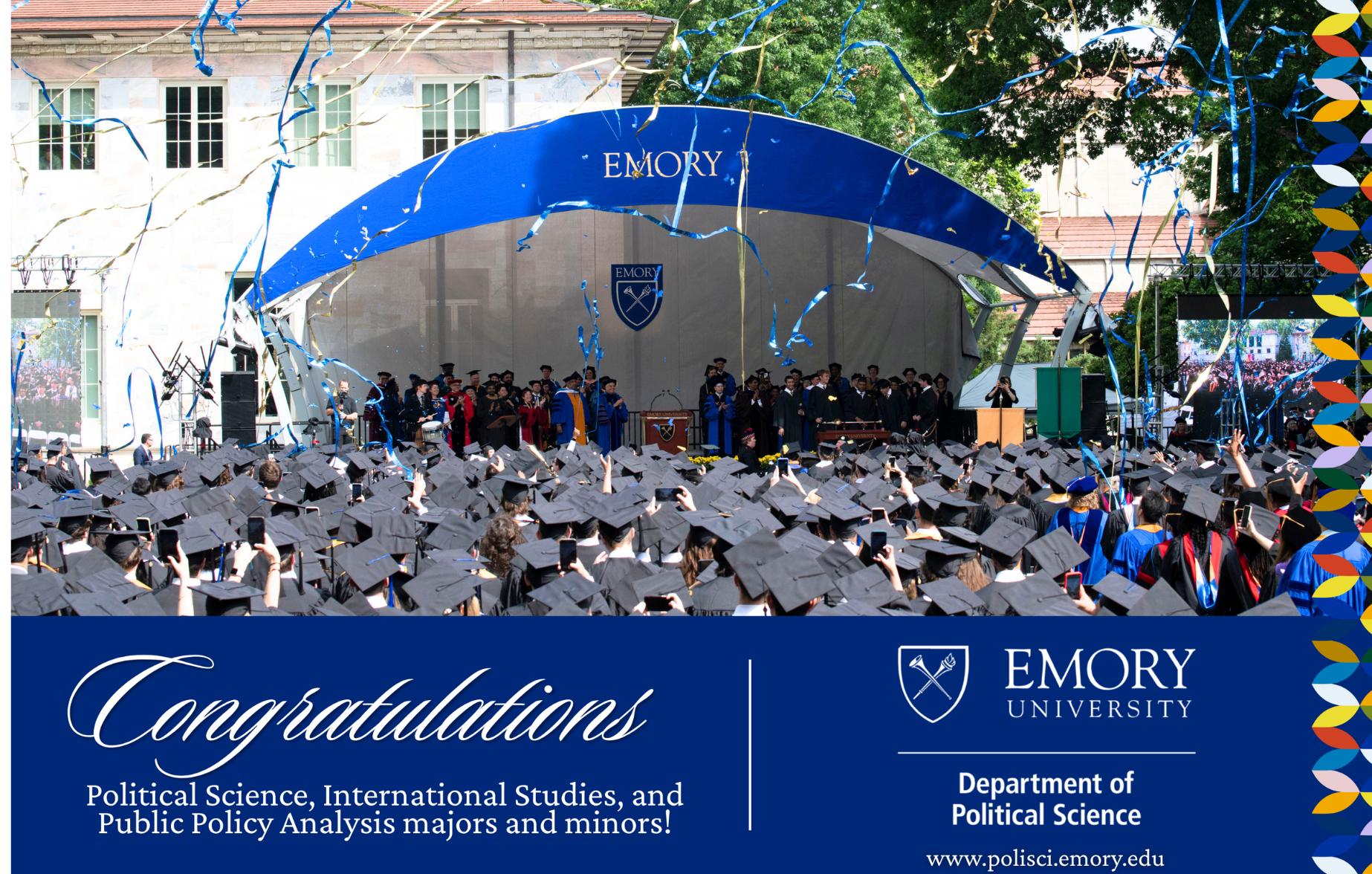
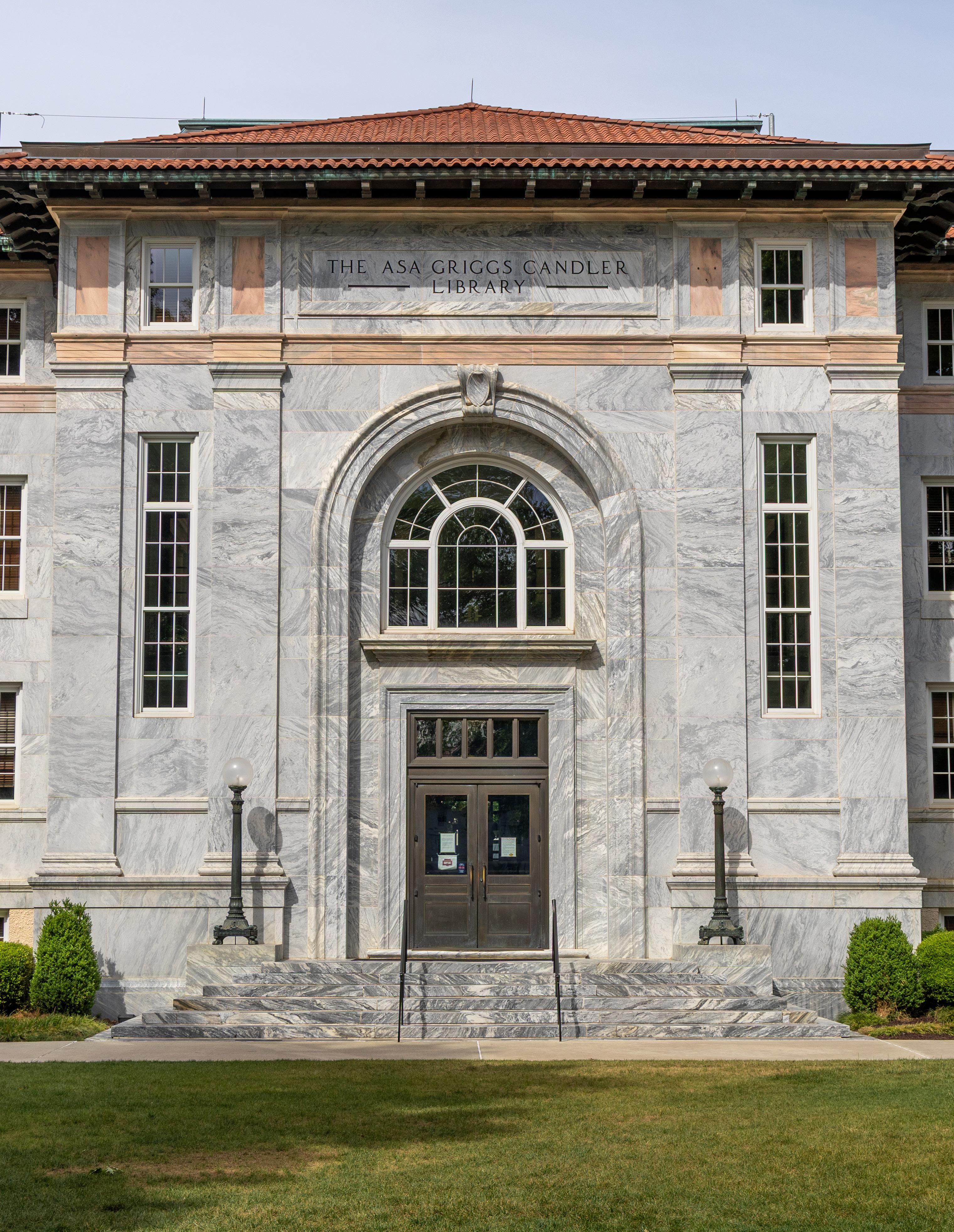
The Emory Wheel Graduation Magazine
Emory University's Class of 2026
Commencement
Tracing
The Emory Wheel
Emory’s only independent student newspaper www.emorywheel.com
Cover and back photos: Jack Rutherford
Delta Air Lines CEO to deliver 2026 Commencement address
By Jack RutheRfoRd and IRene John, edItoR-In-chIef and news edItoR
Edward Bastian, chief executive officer (CEO) of Delta Air Lines, will deliver the keynote address at Emory University’s 181st Commencement at the Gas South District Arena and Convention Center on May 11, according to an email Interim University President Leah Ward Sears (80L) sent to the Emory community on March 5. Bastian has served as Delta Air Lines’ CEO for 10 years.
“Mr. Bastian is a renowned business leader known for his ‘people-first’ approach that has transformed Atlanta’s hometown airline into one of the world’s most beloved brands,” Sears wrote. “He has been honored numerous times for his visionary leadership, guiding Delta through some of its most challenging times, including 9/11, bankruptcy, and the COVID-19 pandemic.”
A native of Poughkeepsie, N.Y., Bastian joined Delta in 1998 as vice president of finance and controller and became its CEO in 2016. He holds a bachelor’s degree in business administration from St. Bonaventure University (N.Y.), and was named in Fortune magazine’s “The World’s 50 Greatest Leaders” list in 2018. Delta Airlines is headquartered in Atlanta and, due to its proximity, has worked with Emory in the past.
“Emory University and Delta Air Lines are long-time partners through a number of educational and philanthropic initiatives; both share a common mission to advance, serve, and connect humanity,” Sears wrote.
The University will award Bastian an honorary Doctor of Humane Letters degree during the ceremony. Emory also plans to recognize educators Ruth Simmons and Susan Stone with honorary degrees.
Simmons, who Emory awarded a President’s Medal in 2006 for her contributions to promoting peace and service, has served as president emerita of Prairie View A&M University (Texas), Brown University (R.I.) and Smith College (Mass.).
During her tenure at Smith College, Simmons established the first accredited engineering program within an American all-women’s college, before departing to become the first Black president of an Ivy League institution at Brown in 2001. At Brown, she formed a Steering Committee on Slavery and Justice in 2003 to investigate the university’s historical link to the transatlantic slave trade. Former U.S. President Joe Biden awarded Simmons the National Humanities Medal at the White House in 2024.
Stone served as president of Frontier Nursing University (Ky.) from 2001 to 2024. Frontier Nursing University has the nation’s oldest and largest continually operating nurse-midwifery education program.
“During her tenure, the institution evolved from a certificate-granting program with approximately 200 students into a fully accredited university offering master’s and doctoral degrees
in advanced nursing practice, including nurse-midwifery,” Sears wrote.
Stone also served as president of the American College of Nurse-Midwives from 2018 to 2019, and the National Academy of Medicine named her as an inductee in 2018.
Last year, the University moved its 180th Commencement off the Quadrangle to the George W. Woodruff Physical Education Center and relocated several smaller ceremonies due to forecasted inclement weather conditions. Emory announced in November 2025 that all commencement ceremonies going forward will be held at Gas South District in Duluth, Ga. In 2024, the 179th Commencement was held at Gas South following a week of campus unrest over pro-Palestinian protests.
Sears wrote that she will award the President’s Medal to Samuel Candler Dobbs Professor of Chemistry Dennis Liotta, Frances Winship Walters Professor of Pediatrics Raymond Schinazi and former Emory Postdoctoral Research Associate Woo-Baeg Choi for their work in developing antiviral treatments for HIV/AIDS.
“We are thrilled to have each of these illustrious honorees join us for Emory’s 181st Commencement ceremony on May 11, where we will celebrate the accomplishments of the Class of 2026,” Sears wrote. “May the remainder of your semester be a joyful and productive time.”
Tracing student activism at Emory University from 1960 to now
By sIya kumaR, managIng edItoR
Over the past 60 years, Emory University community members have publicly protested for civil rights, against the Vietnam War and the Israel-Hamas war. These acts of student activism are not new or unique — Emory has been, over the last half of a century, a space for students, faculty and staff to challenge national policies directly impacting their communities.
This year, students demonstrated against the current presidential administration’s actions and increased Immigration and Customs Enforcement (ICE) activity across the country.
1960s
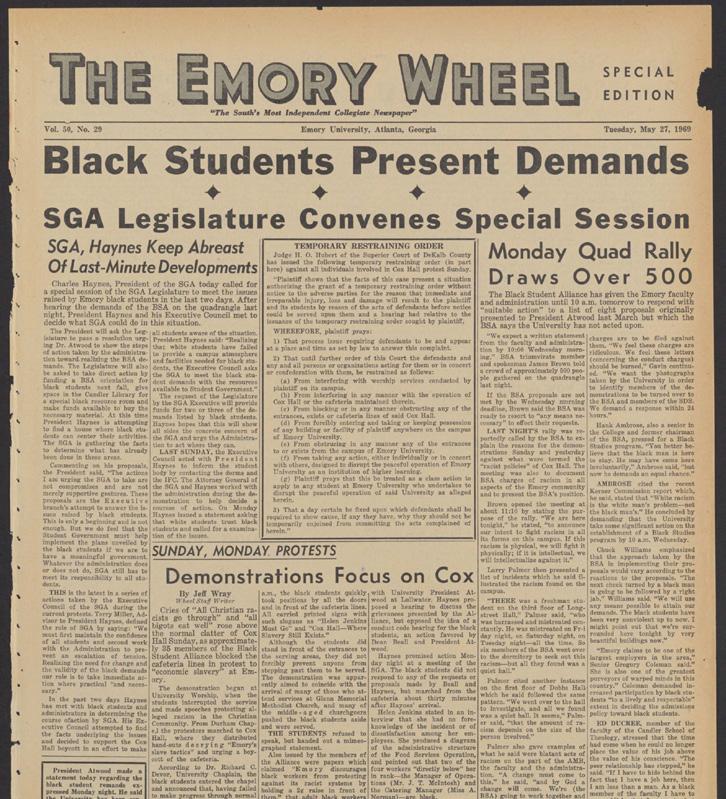
Even after the United States Congress passed the Civil Rights Act of 1964, private institutions’ treatment of Black Americans disappointed many activists across the country. At Emory, Black students demonstrated against institutional racism on campus in 1969, six years after the University first admitted Black students.
The Black Student Alliance (BSA) proposed eight changes to then-University President Sanford Atwood, including ensuring unbiased admissions processes, creating a “Black House” with dedicated programming and admitting “qualified” Black students who apply to Emory.
After months of waiting, BSA organized a protest with nearly 500 attendees on May 27, 1969, to demand action. The rally began on the Quadrangle, and BSA members also interrupted Sunday services at the Durham Chapel, where Convocation Hall stands today. Protestors emphasized the unequal treatment of Black employees in the dining halls with signs that read “Cox Hall — Where Slavery Still Exists.” The protests also led the University to temporarily seek a restraining order against the students involved.
Demonstrations continued into the following week with then-Student Government Association (SGA) President Charles Haynes (71C, 85G) and faculty,
including former Dean of Students B Jerome Zeller, advocating against the restraining order.
On May 30, 1969, after 70 hours of demonstrations, Atwood agreed to BSA’s resolution and rescinded the University’s restraining order against them. At a university-wide convocation, 1,200 people watched Atwood and Edward Ducree (68T), the first Black graduate from Emory’s Candler School of Theology, discuss the upcoming changes to campus in response to the new resolution.
1970s
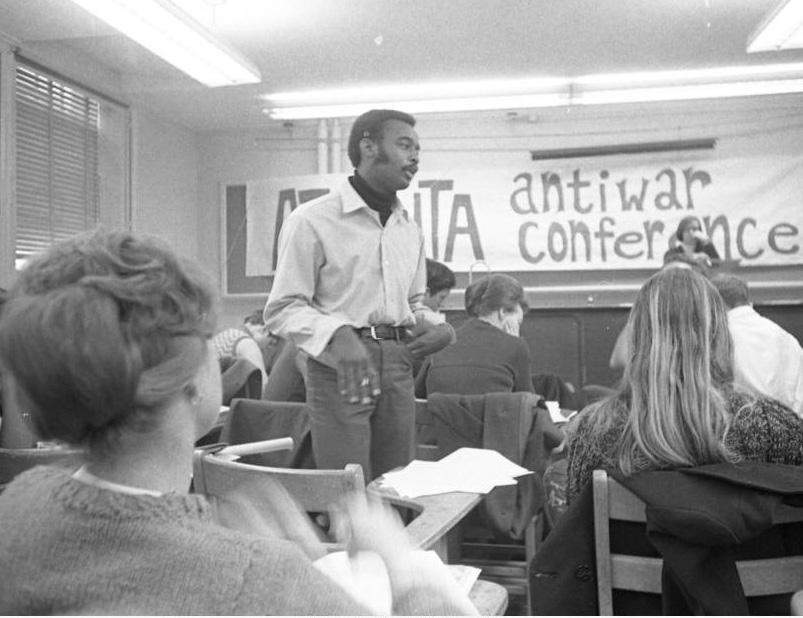
During the Vietnam War, students nationwide protested against the military draft and increased U.S. intervention in Asia. At Emory, faculty and students criticized the war’s draining of American resources and its fraught promotion of “American exceptionalism abroad.”
On May 4, 1972, nearly a thousand Emory students gathered on the Quadrangle on the second anniversary of the Kent State University (Ohio) shootings, where members of the Ohio National Guard opened fire on individuals protesting the Vietnam War. In response to student protests, Emory discontinued its Air Force Reserve Officers’ Training Corps (ROTC) program on campus in
1974. ROTC is a college-based program that trains officers for the U.S. military. These protests signaled a major political shift from the pro-war sentiment of the 1960s, when Affirmation Vietnam, a student organization supporting the intervention, hosted a 1966 rally at the Atlanta-Fulton County Stadium, drawing more than 15,000 attendees, including Atwood, then-Georgia Governor Carl Sanders and former U.S. Secretary of State Dean Rusk.
1980s
With growing national protests against apartheid in South Africa, students nationwide attempted to push universities toward divestment in the 1980s.
With Emory’s financial ties to The Coca-Cola Company after Robert Woodruff (1912C) and George Woodruff’s 1979 donation of over $105 million to the school, many students questioned why there was not a larger movement for divestment on campus, given Coca-Cola’s business operations in South Africa.
Students organized an anti-U.S. intervention group called No Business As Usual and pressured SGA to create a South Africa Education Committee to raise awareness on campus through
Courtesy of the emory Wheel
Emory University students protest poor treatment of Black peers.
Courtesy of GeorGia state university library Community members protest the continuation of the Vietnam War.
educational initiatives such as vigils, film screenings and guest lectures about apartheid.
The University responded to these student movements with a student-faculty President’s Advisory Committee on South Africa, which eventually recommended against total divestment.
1990s
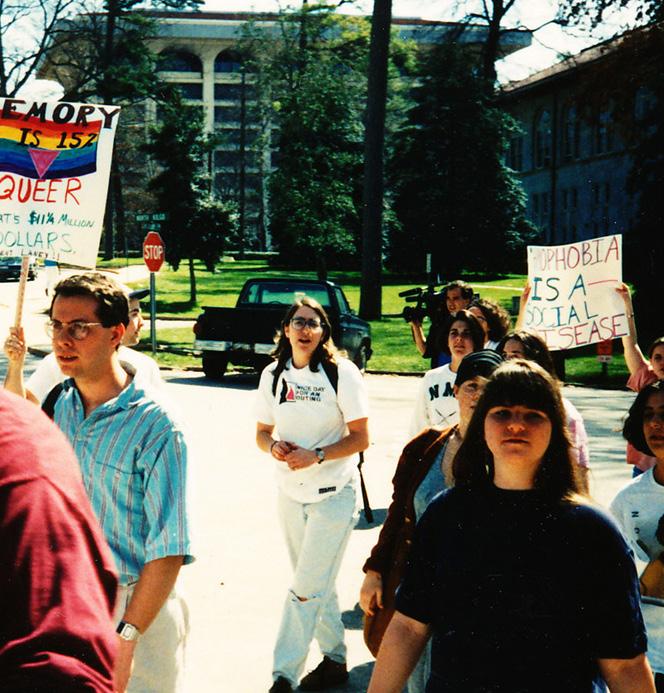
On March 2, 1992, nearly a hundred Emory students gathered on the Quad to protest the University’s response to LGBTQ+ harassment charges. The protests came after a group of around 40 students harassed two Emory freshmen, Michael Norris and Alfred Hildebrand, after they were seen kissing in a dorm common area.
Disappointed with the University’s response to the incident, students protested and held a sit-in at the office of thenUniversity President James Laney. The students presented Laney with a ninepoint proposal, including anti-homophobia training and the inclusion of sexual orientation as a protected category in Emory’s Equal Opportunity Policy in order to improve the University’s response to harassment claims.
Less than a month after the sit-in, Laney created a blue-ribbon committee to study the campus response to the LGBTQ+ community, which eventually became the President’s Commission on
2010s
The 2010s brought a variety of social justice protests to Emory. In 2014, more than 200 people held a “die-in” protest, where participants simulated being dead, in front of the Candler School of Theology. The protest was in response to a grand jury’s refusal to indict Daniel
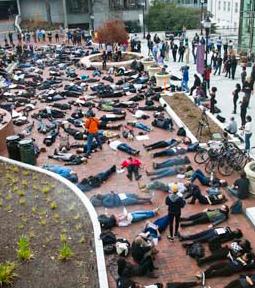
Pantaleo, a New York City police officer who killed an unarmed man, Eric Garner, in a chokehold.
On Nov. 11, 2015, Black Students at Emory gathered in Asbury Circle to protest the racial climate at Emory. Students cited the University’s closure of departments with higher numbers of Black faculty and then-University President James Wagner’s apology for his 2012 “three-fifths compromise” statement as reasons for the protest.
Students also delivered a list of 13 demands to the University administration to improve the treatment of Black students on campus. The demands included improving the response of the Bias Response Team, specialized Counseling and Psychological Services programs for Black students and for the University to create a General Education Requirement that explores issues affecting people of color.
undocumented students.
In 2017, Sterk called the university a “safe harbor” for undocumented students or those with Deferred Action for Childhood Arrivals (DACA).
2020s
The Emory community has continued to respond to the changing political climate over the last decade. Emory Stop Cop City protested the City of Atlanta’s development of a police training facility in Georgia’s South River Forest on the Quad on April 24, 2023. EPD asked protestors to leave the Quad around 1:20 a.m. on April 25, 2023, according to a statement from Stop Cop City.
On the morning of April 25, 2024, approximately 45 to 50 people assembled an encampment on the Quad to hold proPalestine demonstrations.
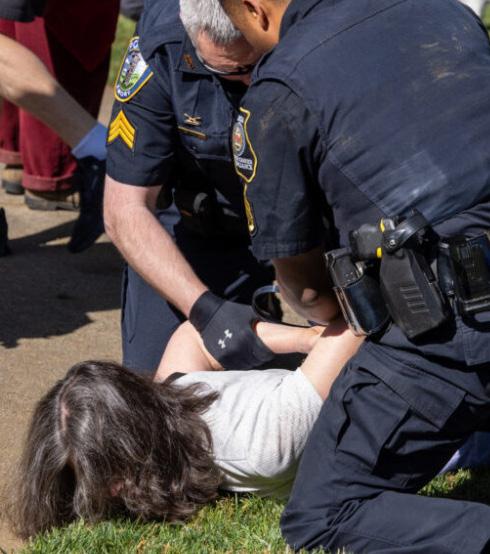
Around 10:30 a.m., the Atlanta Police Department and Georgia State Patrol arrested 28 demonstrators, 20 of whom were Emory community members. Following the arrests, nearly 500 people regathered on the Quad in the evening of April 25. Protesters dispersed from the Quad around 9:00 p.m.
Following the April 25, 2024, protests, University faculty, SGA and individual protesters spoke out against the University’s response to the demonstrations. In a referendum indicating confidence in University President Gregory Fenves, 75.05% of Emory College of Arts and Sciences faculty, over 90% of Oxford College faculty and 73.5% of undergraduate students voted “no confidence.”
LGBT Concerns. The commission effectively implemented all the proposals presented by the protesters.
Furthermore, after the first election of U.S. President Donald Trump in 2016, 17 campus organizations and more than 1,500 Emory community members submitted a petition to then-University President Claire Sterk asking for the University to become a “sanctuary” campus — to not participate in the deportation of
Courtesy of emory m aGazine
Students demonstrate against Emory University's handling of a LGBT harassment case in 1992.
Courtesy of emory neWs Center
People gather at Candler School of Theology in a die-in protest.
Courtesy of the emory Wheel Police officers arrested 28 people on the Quadrangle on April 25, 2024.
Emory also relocated the 2024 Commencement ceremony from the Quad to the Gas South District in Duluth, Ga. At the ceremony, students continued to display support for Palestine with keffiyehs, Palestinian flags and by shouting “Free Palestine” from their seats.
2025-26
Since the 2024 U.S. presidential election, Emory community members have protested many of Trump’s directives and policies.
In September 2025, Interim University President Leah Ward Sears (80L) announced that the University would terminate all diversity, equity and inclusion (DEI) programs and initiatives. Sears said that the University’s decision came in response to pressure from federal policies.
Following Sears’ announcement, around 30 Emory students, faculty and staff joined in Asbury Circle to denounce Emory’s decision to terminate DEI programs. Emory Students for Socialism organized the protest to “take a stand against Trump & the billionaires’ attack on our rights.”
Sunrise Emory President and CoFounder Ava Trachtenberg (28C) noted that the increased national political turbulence has led students to take action. Sunrise Emory is a campus chapter of a national movement advocating for climate regulation.
“I’ve seen a big increase in student activism, and in general, a lot more people have been willing to get involved politically, to show up to protests, to organize, to talk about politics in classes,” Trachenberg said.
As Trump ramped up ICE activities nationwide, Emory community members organized protests and speeches against ICE and the Department of Homeland Security’s (DHS) actions and potential intervention on campus.
Earlier this year, the DHS announced plans to create an ICE “mega center” in Social Circle, Ga., less than 15 miles from Emory’s Oxford College. The center would house 7,500 to 10,000 detainees. As of April 1, DHS has halted its plans to establish the detention center because of leadership transition and infrastructure issues.
Community members have also protested the presence of Flock Safety cam-
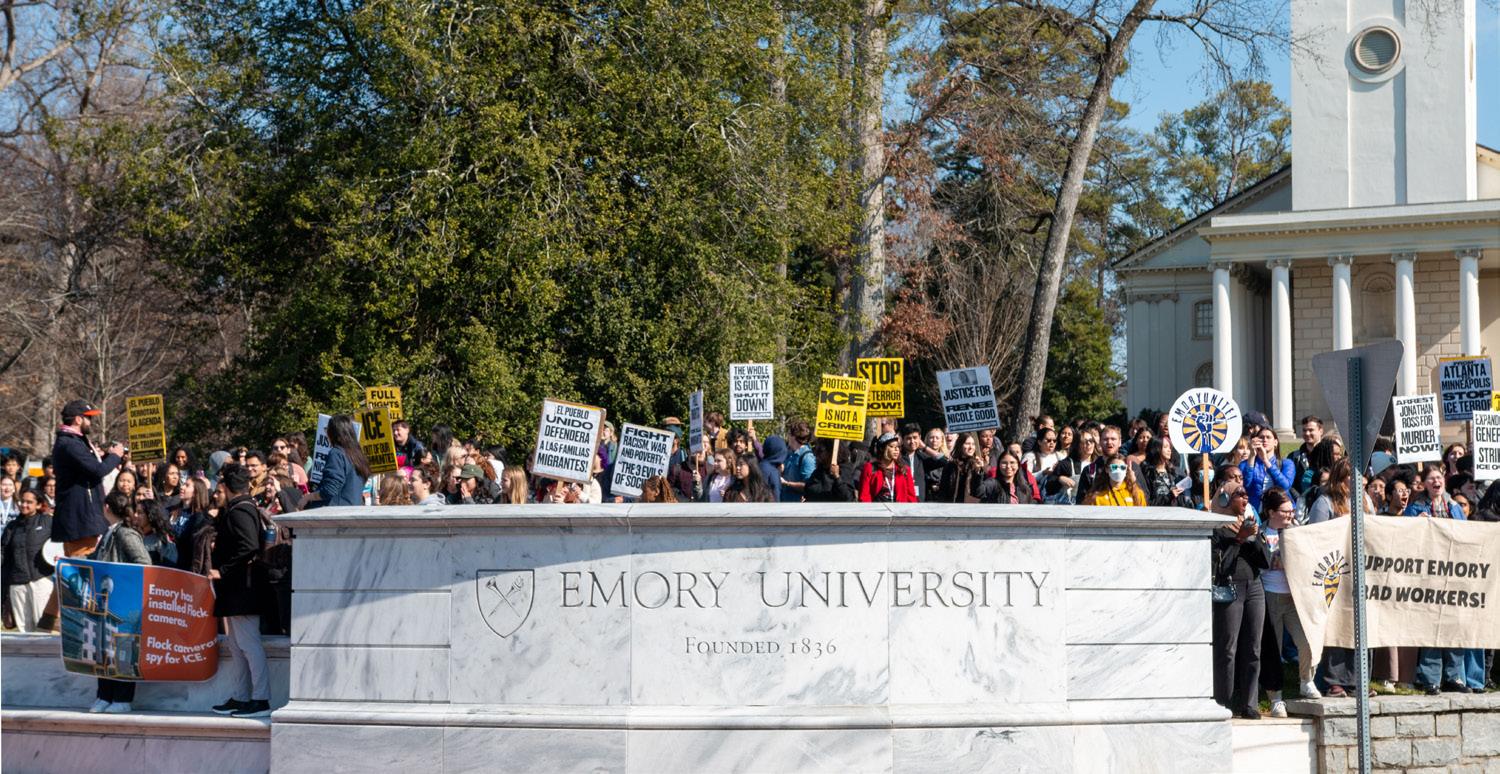
eras on campus. Flock Safety is a security technology company that partners with local, state and federal governments to provide artificial intelligence-powered services such as automated license plate readers.
Several cities across the United States ended their partnerships with Flock amid concerns that ICE and DHS could access data the company collects.
Nearly 80 Emory community members gathered on April 10 to demonstrate against the presence of Flock cameras on campus. According to the DeFlock Emory Coalition, at least seven Flock cameras are present on Emory’s campus. In a statement to The Emory Wheel, Assistant Vice President of University Communications Laura Diamond confirmed the presence of Flock cameras on campus and noted that only sworn EPD officers have access to footage from the cameras unless presented with a valid criminal warrant or court order.
For Anayancy Ramos (28G), who is a DACA recipient, ICE activities nationwide have increased fears and safety concerns among students, leading them to student activism.
“A lot of people are scared,” Ramos said. “It goes one of two ways. They’re so scared that they don’t want anyone to do anything, but on the other hand, the only way we can fight back against everything that’s going on, fight against being scared and feeling hopeless, is by doing something.”
Bella Mazet (26C), who worked on Kamala Harris’ presidential campaign, noted the significance of political activism at Emory and how it has changed over her time on campus.
“Students in general are more cued
into certain parts of the political climate,” Mazet said. “Emory overall is a fairly active campus. I definitely have seen, over the four years, the issues that have made students come out of their shell a bit more.”
Mazet said the current administration’s policies have negatively impacted universities’ ability to provide opportunities for their students.
“The changes that are happening with federal funding for universities, that’s obviously impacting research and different directives from the executive level that are changing the way that universities are able to spend their money,” Mazet said.
Young Democrats of Emory Membership Director Dominic Pacoe (27C) also mentioned that national uncertainty has impacted the University’s willingness to support political activism.
“University administrators feel really hesitant to sort of allow a wide range of political activities on campus,” Pacoe said. “There was a period when we wanted to have some campaign staffers come in, and that wasn’t allowed.”
Pacoe added that political instability in Iran has impacted students’ confidence in the job market and their futures.
“This administration has created a lot of uncertainty,” Pacoe said. “With AI we’re seeing a lot of uncertainty, especially with entry-level roles. Our current president has sort of compounded that with the Iran war, the crazy gas prices. It’s just very hard to predict how everything is going to shake out.”
News Editor Eileen Zhu (27Ox) contributed to reporting.
Courtesy of ellie fivas
Community protests Immigration and Customs Enforcement activities.
Redefining the Finish Line: Senior Athletes Cope With Injury
By Sonia Liew and Sophie Bergman, Sports Editors
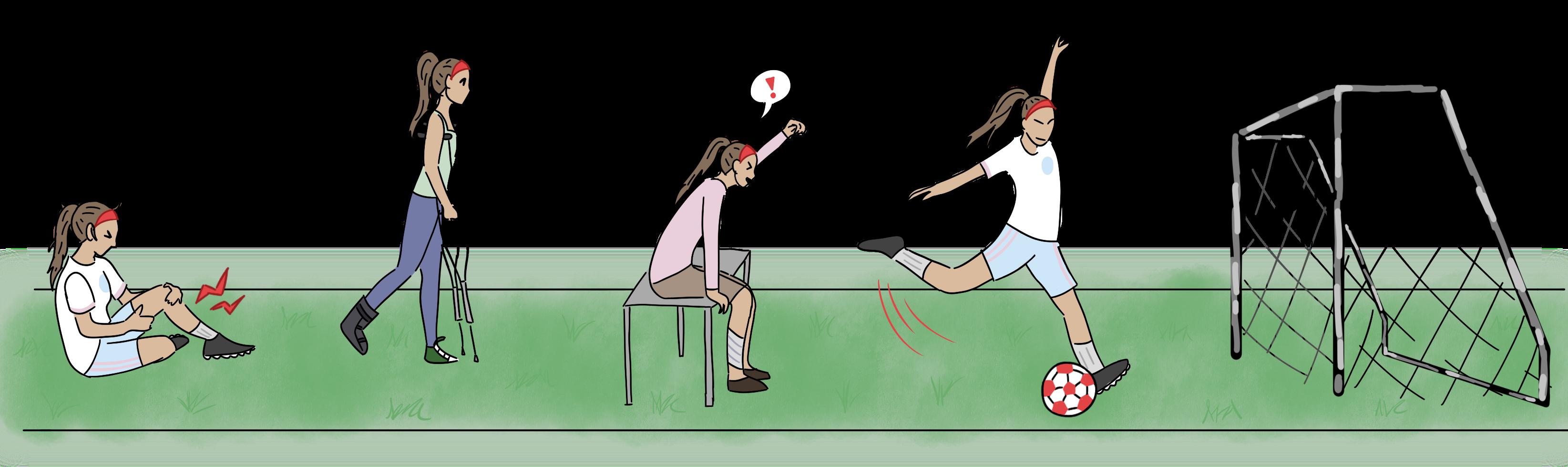
While most people leave their athletic careers behind in their middle school or high school days, college athletes spend four more years training at the highest level of their respective sports. What starts as curiosity about a novel experience transforms into dedication to long practices, tough games and necessary sacrifices. Playing a sport every day, it is easy to take health for granted, but it only takes one moment for that to change. These graduating Emory University senior athletes have dealt with injuries that interrupted or ended their careers, as well as the mental and physical battles that come with those experiences.
Josh Grand - Men's Soccer
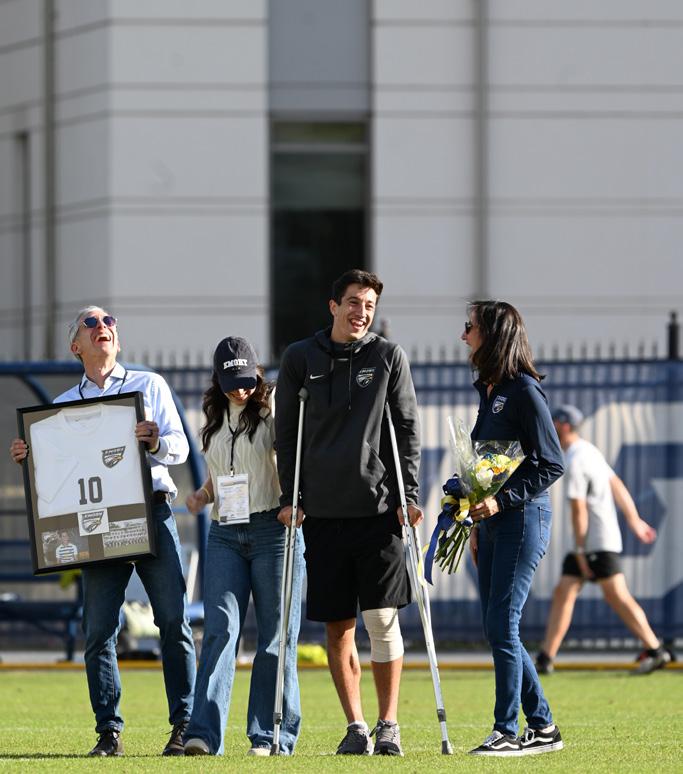
Over his four years on the Emory men’s soccer team, senior midfielder Josh Grand has built a career defined by consistency. Starting in 12 out of 18 games as a rookie, Grand established himself as a star player early on and has made a lasting impact on the program, totaling 16 career goals and 25 career assists.
As decorated as his career was, it was not without setbacks. Toward the end of his sophomore season, Grand’s shoulder began to pop out every game. Being in the midst of the 2023 NCAA Division III Men’s Soccer Championship tournament, Grand toughed out the injury, popping his shoulder back into place and playing through the end of the season. Only after the season ended did he visit the doctor, who diagnosed him with a labrum
tear that required surgery and would warrant a five-to-six-month recovery.
Grand was able to return to the field for an outstanding junior season, where he played 1,271 minutes — the most minutes out of any player on the team — scored the second most points on the team and recorded at least one shot on goal in each of Emory’s regular season games.
He then dribbled into his senior season with incredible achievements right out of the gate. In the first 11 games of the season, he led the team in assists, was awarded UAA Athlete of the Week three times and set a program record for most assists in a single game. However, Grand’s Emory soccer career came to an early end in the opening game of the conference schedule against Carnegie Mellon University (Pa.) when he tore his ACL within
“Life goes on, and you decide how you respond.”
— Josh Grand
the first few minutes of the game.
“I went to try to cut back to check for the ball, same cut I’d made 100 times a game before and 1,000 times the week before in practice, but for whatever reason, my deep knee didn’t cut with me,” Grand said. “I tore my ACL. I could tell right as it happened that
something was seriously wrong.”
A senior season injury, especially one as serious as an ACL tear, meant that Grand likely would not return to play on the team ever again. Grand said this realization was difficult to process, especially because he had “professional ambitions” after college.
In the wake of his injury, Grand’s teammates and coaches supported him through a rigorous recovery. One of his teammates sent him an article published in The Emory Wheel just over a week before his injury, which reminded him of what his captainhood meant to the team.
“It included a quote from me, something along the lines of, ‘I want to continue playing with my role as a captain, whether that’s scoring goals, getting assists or just helping the team win,’” Grand said. “He was like, ‘Now you gotta help the team win, even if you can’t do the former two.’ It was a good reminder that team sports are bigger than just one person.”
Reflecting on his experiences with injury and recovery throughout his career, Grand shared advice for other athletes enduring similar circumstances.
“Life goes on, and you decide how you respond,” Grand said. “Whether that’s to make you the happiest, or to contribute to something bigger, you’re ultimately the decider of what your role is.”
Emma Bernstein - Women's Soccer
For soccer players, a torn ACL is one of the

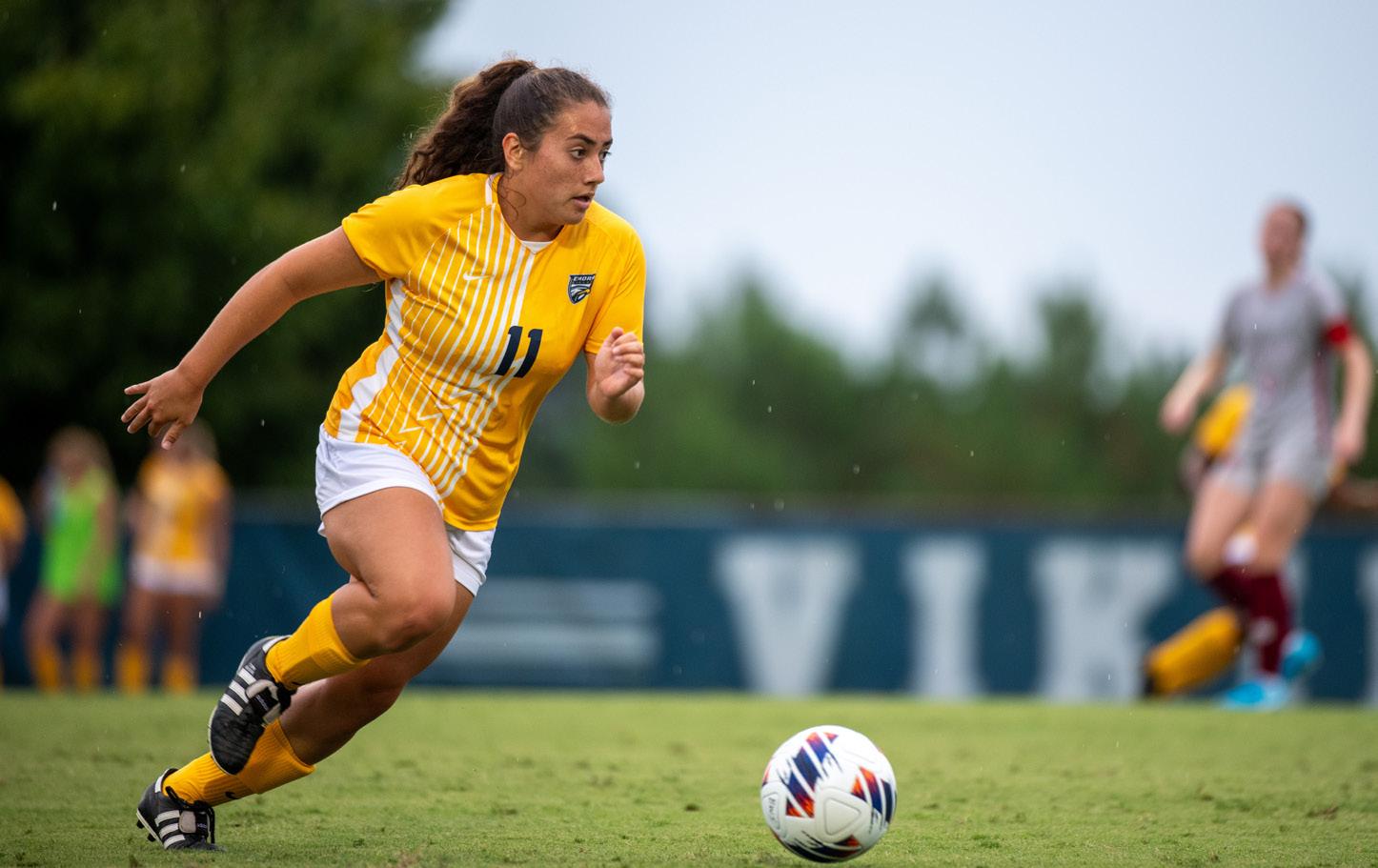
scariest possibilities that comes with their sport. For senior forward Emma Bernstein, that chance became a reality when a misstep affected the rest of her collegiate career with the women’s soccer team.
Before college, Bernstein was unsure if she could commit to playing soccer at the collegiate level. As an aspiring pre-med student, she was told that balancing academics and athletics would be difficult. However, Bernstein soon realized how central soccer was to her identity, and despite entering the recruiting process late, found a home at Emory.
“I realized that soccer keeps me disciplined, it keeps me focused, and I know I also didn’t want to lose that aspect of having a team and a community,” Bernstein said.
It was in a friendly match during Bernstein’s junior year that her career changed. She recalled knowing exactly what had happened in that moment.
“I was going to try to cut off a passing lane, which I have done 1,000 times before in my whole soccer career, and I went and planted, and I just felt and heard a pop in my knee,” Bernstein said. “I knew in that moment that I tore my ACL. It was like living out one of my worst nightmares as a soccer player.”
The road to recovery was no easy feat, both physically and mentally. Bernstein described her injury as one of the hardest experiences of her life. She went from running and lifting every day to having to learn how to walk again — a difficult reality to process, especially as a student-athlete.
“The hardest part for me was watching my team play,” Bernstein said. “It was really hard to sit at practice and wishing I was out there
doing something that I love, and it was just taken away from me. I never thought that I was wishing to be running sprints.”
Still, Bernstein did what she could from the sidelines to remain present for her team. Her “second family” supported her throughout recovery, encouraging her to find other ways to make herself a valuable contributor, even if it was not on the field.
“I stepped into this pseudo-mini-coach role. … My coaches would let me help out with things, they would want to hear my input,” Bernstein said. “I stepped into the role of being the one to check on everybody, make sure everyone’s doing okay.”
Post-injury, Bernstein set a new goal: playing in her senior game. On Oct. 26, 2025, in a matchup against Washington University in St. Louis (Mo.), she achieved it. While this journey was far from easy, Bernstein said the experience left her stronger and taught her lessons she plans to carry with her beyond graduation.
“It definitely taught me about resilience and determination,” Bernstein said. “It also showed me how much being there for other people matters, because when I needed it people stepped up. Now I go through every day trying to be there for my people.”
Jeff George - Swim and Dive
For more than 15 years, senior swimmer Jeff George has built his life around the pool. It all started back in George’s home state of Virginia, where he grew up participating in a summer swim league with his brother and sister. From there on, George committed
to the sport, ultimately deciding to pursue swimming at the collegiate level.
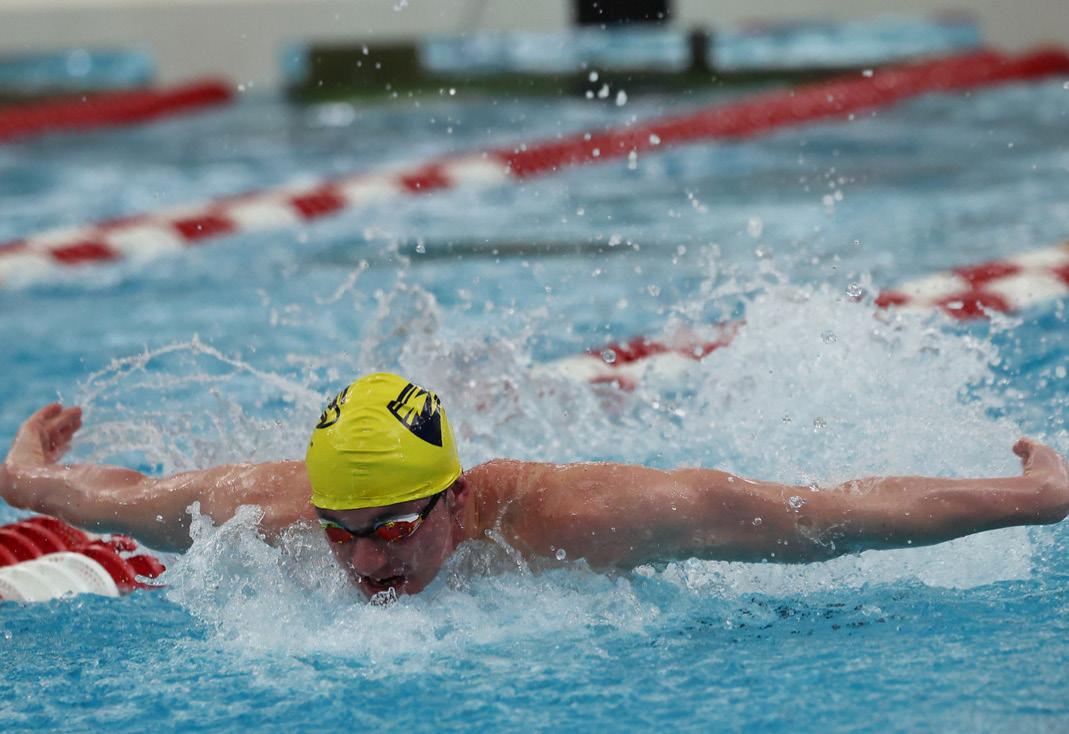
This decision paid off, as his transition onto the Emory swimming and diving team started smoothly. As a freshman, George earned College Swimming and Diving Coaches Association of America Scholar All-America Second Team honors and began to establish himself as a strong competitor in backstroke and butterfly events.
However, during George’s junior year, his progression was suddenly interrupted. For swimmers, the season usually does not end on land, but a high-grade ankle sprain sidelined George for the latter half of his junior year. While he was able to walk and run on land after recovering, he was unable to perform basic movements like kicking in the water to the best of his ability.
“When I got back in the water, I tried to kick for the first time … and it felt like I was back at square one again,” George said. “My ankle felt like it was getting stabbed every single time I did the smallest motion of a kick. I was like, ‘Dang, I am really farther away from where I want to be from a recovery standpoint.’”
George was completely out of the water for about a month and a half after his injury, and even after getting back in the pool, his recovery time was longer than he anticipated. He said he was not back to his full potential until the start of his senior year.
While many athletes only view injuries as setbacks, George said his recovery process helped him rediscover his love for the sport and better understand why he continues to compete. Before George’s injury, his relationship with swimming had become shaky — he

Chloe nam/m anaGinG eDitor
Senior midfielder Josh Grand at Emory men's soccer Senior Day.
Courtesy of emma bernstein
Senior forward Emma Bernstein dribbles the ball down the soccer field.

struggled to drop time and was not enjoying the sport as much as he wanted to. His goals centered around training as hard as he could to place well in meets. However, George’s injury presented him with an opportunity.
“It allowed me to say, ‘Okay, you’re injured, now you’re going to have to wait another month at least to get back into the swing of things,’” George said. “It allowed me to reflect and set new goals. Now my goal is to be able to swim and have fun my senior year, rather than just focusing on times.”
In his final appearance at the Emory February Invitational, George set a personal best time in the 200-meter backstroke, earned University Athletic Association (UAA) Athlete of the Week honors and qualified for the Division III NCAA Swimming and Diving Championships. George attributed his success to the rediscovery of why he was swimming.
“When you actually enjoy what you’re doing instead of focusing on super niche or specific goals, the results will just come with you because you actually have a reason to show up to practice,” George said. “Any athletes who are facing an injury, you should totally take this time to consider why you’re doing the sport that you’re doing.”
For George, an injury spurred a period of reflection that reshaped how he approached the sport. After his injury allowed him to reconsider why he continued to swim, he brought that perspective to his teammates, encouraging them to reflect on their drive and be intentional in the work that they are
putting in.
“I was able to tell people once this is all going to be over, you have to make sure that you put in everything that you wanted to put in, and that every single practice counts, and make sure that everything you’re doing is with a purpose,” George said.
Luna McCauley - Track and Field
For senior mid-distance runner Luna McCauley, track and field was synonymous with injury during her time at Emory. Each year, she experienced a new injury, and each year, she stayed committed to recovery and improvement.
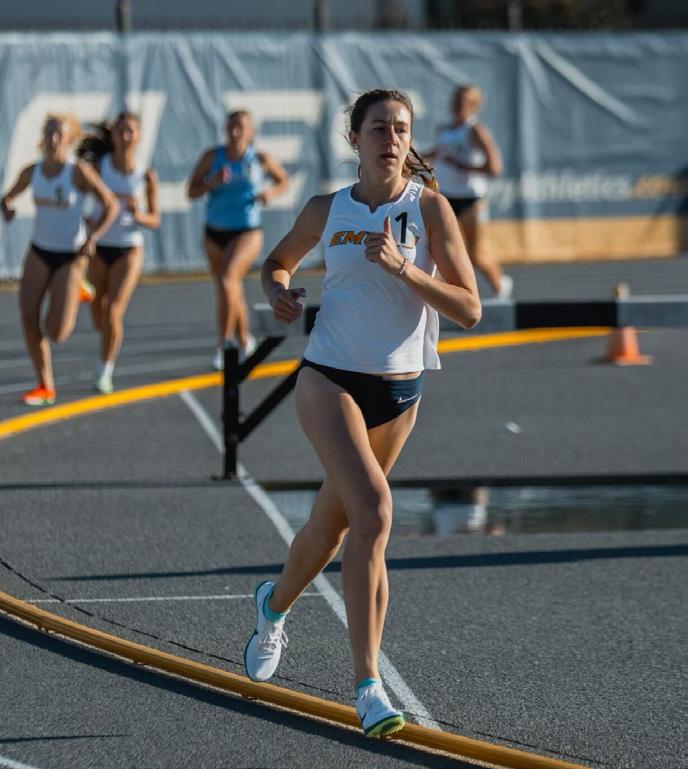
McCauley hit the ground running in her freshman year and was named All-Region in the 800-meter run by the U.S. Track & Field and Cross Country Coaches Association. However, a femur stress injury cut short her first season and sidelined her for the entire spring semester.
In her sophomore and junior seasons, McCauley faced more bone stress injuries. Throughout these years of back-to-back injuries, McCauley developed a mental toughness around recovery and continuing to pursue her goals.
“One thing for me is, you’re so much stronger than you know,” McCauley said. “People are capable of a lot more than they think, so that’s the thing that’s driven me to keep going and pushing myself to see what I can achieve despite the setbacks.”
While McCauley came into her senior season healthy and ready for an exciting final lap, she was ultimately met with a season-ending stress reaction. She said that with it being her final season on the team, it was mentally the hardest injury for her to cope with.
“Honestly, a big part of me wanted to quit,” McCauley said. “Because it’s senior year, I was like, ‘Oh my gosh, I only have one more year in college and I really want to make the most of it.’”
However, McCauley motivated herself to stay by focusing on how much she enjoyed being part of a team, even if it was not in a traditional way. It proved to be a good lesson for her, as she said staying showed her she did not have to cope with her injury alone.
“For better or worse, we’ve had a couple of girls get injured this year, so although that sucked for a lot of us, it was nice to have a group of us who were all going through the same thing,” McCauley said. “Having a group who would be cross-training instead of running and not being totally isolated in that way was really helpful.”
Despite experiencing setbacks along the way, these graduating athletes have not let injuries define their careers. Instead, they have learned to adjust their journeys and turn unfortunate circumstances into lifelong lessons.
“It’s really important to give yourself grace and allow yourself to do your best, whatever that looks like,” McCauley said. “It’s okay to be hurt and not feel too good about the whole thing, but that you can come back stronger than you were before.”
Courtesy of Jeff GeorGe
Senior swimmer Jeff George performs the butterfly stroke at a meet.
Courtesy of luna mCCauley Senior mid-distance runner Luna McCauley runs at a track meet.
Beyond college: Seniors, professors celebrate connection
As Emory University freshmen first step onto campus, eager but anxious for what lies ahead, the only certain thing is uncertainty — a honeymoon phase that can sometimes only be grounded by human connection.
Clinging to newfound relationships that burst with the excitement of learning and growth, Emory students form a tight-knit community. Oftentimes, the relationships that take the most careful cultivation are those with faculty. While life can grow more complex over the four years students spend at Emory, leaning on the wisdom and expertise of professors and advisors can help mitigate the uncertainties and emotions that come with being a college student. So, as the Class of 2026 prepares to venture out into the world, graduates are not only saying goodbye to their home for the past four years, but also to the cherished relationships they have formed with friends and faculty members. For the 2026 Graduation Magazine, the Arts & Life section of The Emory Wheel sat down with three pairs of students and their favorite faculty members to honor these heartfelt bonds. Reminiscing and reflecting, each duo shared their favorite moments, discussing what they will carry forward from their relationship as their time together as student and mentor draws to a close.
This Q&A collection has been edited for clarity and length.
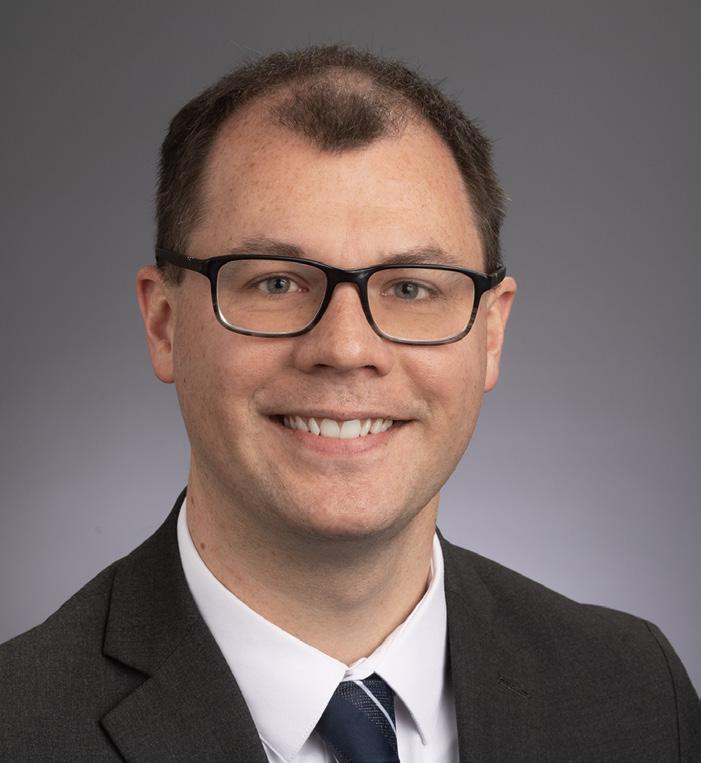
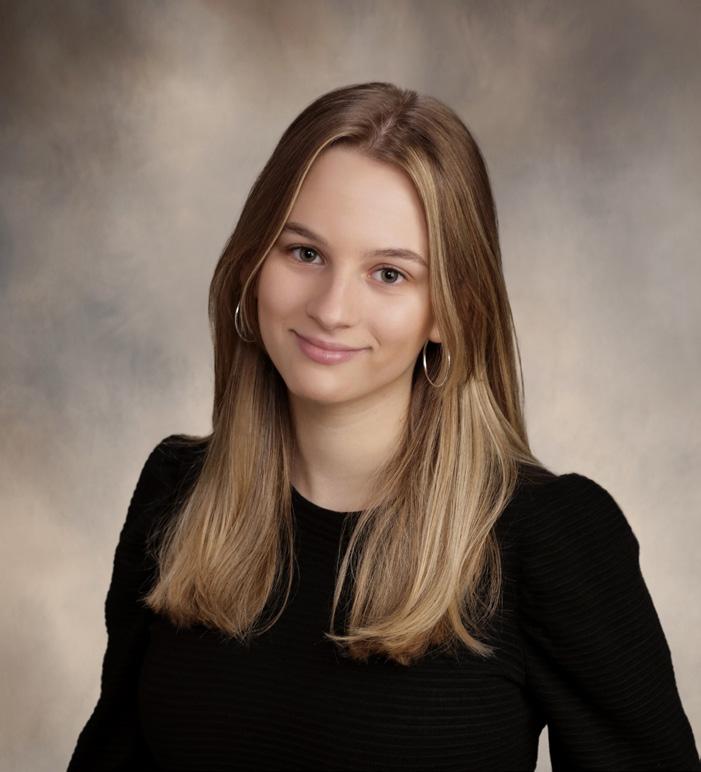
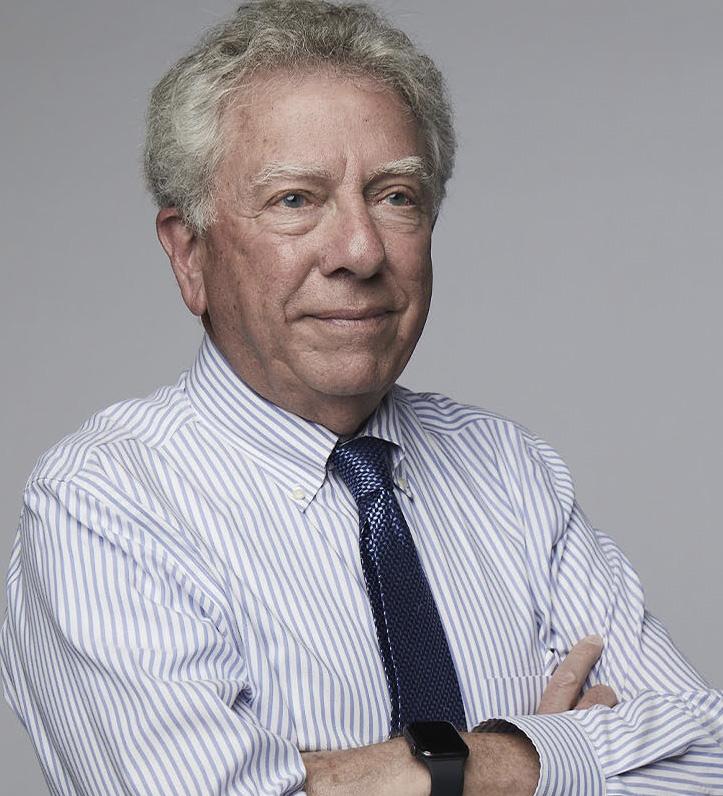
Chemistry and Spanish double major James Grant (26C) and Department of Pharmacology and Chemical Biology Assistant Professor Tyler Beyett sat down with the Wheel first.
Grant: Why did you decide to go into research and pharmacology?
Beyett: When I started my PhD at the University of Michigan, I didn’t think I would do a postdoc or go into academics. My plan was to go and work in the pharmaceutical industry. It was mentoring
By mIa hamon, aRts & LIfe edItoR
students during my PhD and then later my postdoc that just got me interested in this career path. I’m really motivated by the training and mentoring aspects more than being a famous scientist.
Beyett: What will you take away from your time in the lab, both scientifically and on a personal level? What have you learned?
Grant: Being in the lab was the first time that I was working in a workplace environment. Up to this point, I had been to school, I had done clubs, I had done extracurriculars, things like that, I had on-campus jobs. Here, I'm working with people, and this is their full-time job. It was really sort of an adjustment to be like, ‘I’m with people who aren’t just students full-time,’ and it’s a different lifestyle when you’re actually with full-blown adults. It’s honestly helped me adjust to post-grad. It’s really helped me now that I’ve started working at [Children’s Healthcare of Atlanta’s Arthur M. Blank Hospital], having that experience as well. Personally, I’d say definitely interpersonally just being able to — I’m not a very professional person — but interact with people in a more professional manner, and then scientifically, just having the resilience to try and keep trying. I would say there’s so many points where I’m just like, ‘F*ck this, I don’t want to do it anymore.’ I come in here,
and I’m like, ‘Tyler, it didn’t work again. I can’t do it anymore,’ and, well, Tyler’s like, ‘Oh well, try it again.’ I think it’s honestly just really important, with science, a lot of things that are happening, you can’t really see them while they’re happening, you just see the aftermath. So you’re just really in your head. You’re like, ‘What could be going wrong?,’ and you’re just going crazy in your mind. Something that’s been really helpful is learning how to deal with the uncertainty and working with what I know and trying again and trying again and trying again. I feel like that’s something where two years ago, I wouldn’t do.
Grant: How did you really develop your teaching philosophy?
Beyett: It really goes back to when I was a PhD student. I was in a very social lab. We had cookouts and things like that, and I found that it just was good for the larger group. The student training community was so much better when people got along with each other and didn’t always talk about science. That’s what I’ve tried to emulate here, building a lab where there’s an emphasis on the people as well as the science and trying to make sure that everyone gets along and is happy. I don’t always have the time, but I always make the time to go and do one-on-one meetings and really help out, because that’s what I’m here for.
Courtesy of tyler beyett
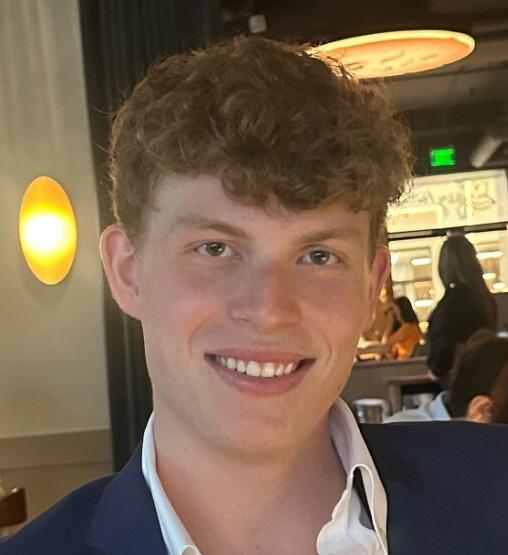
Courtesy of James Grant
Beyett: What are you most looking forward to next?
Grant: I’m entering a period in my life of a lot of uncertainty. Everything up to this point has been: ‘You’re going to graduate high school, you’re going to go to a good college, and you’re going to graduate college.’ Now we’re at the point where I’m graduating college, so it's like, ‘Well, what comes next?’ It’s going to be really exciting to sort of go out on my own and have my own apartment and live my own life. But also, I think it’s going to be scary having that adjustment. I’m most looking forward to experiencing what adult life is like, because you can imagine it in your head, you can predict what it’s going to look like. You can try and forecast what the days will be, but you don’t know until you’re in it.
The next conversation was with Abby Charak (26C), a creative writing major and economics minor, and Emory Creative Writing Program Professor of Practice Hank Klibanoff.
Charak: Why did you decide to become a professor after you left the Atlanta Journal-Constitution (AJC)?
Klibanoff: Well, first of all, I didn’t decide. I decided I wanted to be one, but they had to decide that I would be. I was at The Philadelphia Inquirer newspaper, based in Philadelphia. At some stage — I had a multitude of jobs there for 20 years — there was a course at the University of Pennsylvania, that a group of journalists over the years had taught. It was in the
Department of Urban Studies at Penn and it was for adjuncts for me to teach. The previous fellow who had taught it, who was himself pretty important — Buzz Bissinger — who wrote ‘Friday Night Lights’ (1990) and a bunch of other books and stories. He worked at the same newspaper I was at. He got tired of teaching the course and students got tired of him insulting them all the time. But he said, ‘Hey, I’m leaving that. You want to teach it?’ I said, ‘God, I’d love it.’
So I went and met the head of urban studies, and she said, ‘We’d love to have you. What do you want to teach?’ It had to be about journalism somehow. I said, ‘I want to teach, let’s call it “The State of the American Newspaper.”’ I was teaching that, and I just loved it. I really, really loved it. Then, when I came [to Atlanta], I knew that there was this endowed chair here at Emory. When it was time to leave [the AJC] I decided to apply for it. I really wanted it because, based on my experience at Penn, I put together an application that I thought Edward R. Murrow couldn’t beat. Right from the beginning, as part of my pitch, I pitched that I wanted to teach a civil rights cold cases class, because I was doing that kind of work with professional journalists over in Mississippi, Louisiana, Alabama, after I left the newspaper. I was very fortunate that, and you’ve heard me say this before, that Emory went for the idea.
Klibanoff: What do you think makes a great professor?
Charak: I’ve actually been thinking about this a lot because I’m getting very reflective and nostalgic as graduation approaches.
The biggest thing that I’ve noticed is there needs to be a certain willingness to engage with your students. It’s an intangible quality, almost, because clearly all the professors here are very smart, very well trained, intelligent, brilliant, but there’s a certain intangible quality of being willing to earnestly engage with students and care about their lives inside the classroom and outside of the classroom. I think that this is what makes a great student also — you have to be genuinely interested. You have to be genuinely engaged. I actually don’t think that it’s that different from what makes a great student because, like I said, all these professors are so smart, but it’s this meaningful, genuine interest and engagement. The professors that I will remember most fondly are people like yourself who are genuinely engaged, genuinely interested in students’ work.
Charak: What is your favorite part of being a professor?
Klibanoff: Just seeing the spark. Seeing it the same when I was an editor and seeing a reporter come in saying, ‘You wouldn’t believe what I just heard.’ The spark, excitement about things that are complicated, that are not easy to pin down. It can’t always be proven, but you can come up with some pretty good surmises.
Klibanoff: How did you decide to take my course?
Charak: My older sister, Hannah, who was here, she was a history major. She took Professor Klibanoff’s cold cases course and was like, ‘You really need to take this.’ I don’t think that freshmen are allowed to enroll in the course, because freshmen can only take the intro creative writing courses, but I kept it in the back of my head. I wasn’t 100% sure exactly what I was going to major in yet my freshman year. I cycled through a bunch of different things. I started out thinking I was going to be an English major, and then I was like, ‘I don’t really know.’ I thought about maybe economics or philosophy. I kind of rolled my way back to English. I took a creative writing class my spring semester of freshman year, and I was like, ‘I think this is it. I want to be English and creative writing.’ Once I decided that English and creative
Courtesy of a bby Charak
Courtesy of h ank k libanoff
writing was going to be what I was going to be majoring in, I knew that fall semester of my sophomore year, I was going to apply for Professor Klibanoff’s course, the cold cases course. It’s so unique, there’s no other class at Emory, and probably very few classes at college, period that are like it. You do almost investigative work, and it’s very research-based, not in a data analytics way or a lab way, but I really liked that aspect of it. Out of all the creative writing classes I’ve taken, I’ve loved the fiction classes and stuff. But if we’re talking about practical skills, and hireable skills, I think that the research skills that I’ve learned in your class are probably the most important, and practical skills that I’ve learned at a college course. That’s kind of on a personal level, that class is fulfilling for me, and being able to make a difference in a weird way by storytelling, too, because the cold cases class is research and service to Professor Klibanoff’s podcast called ‘Buried Truths,’ and the goal is to solve racially motivated killings. It’s about finding the facts to tell the story and bring it to light.
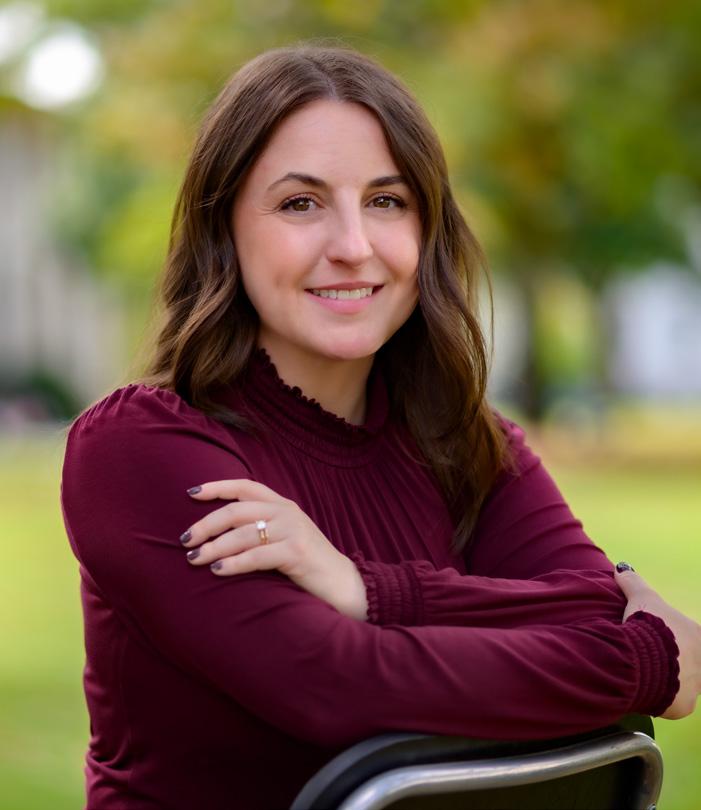
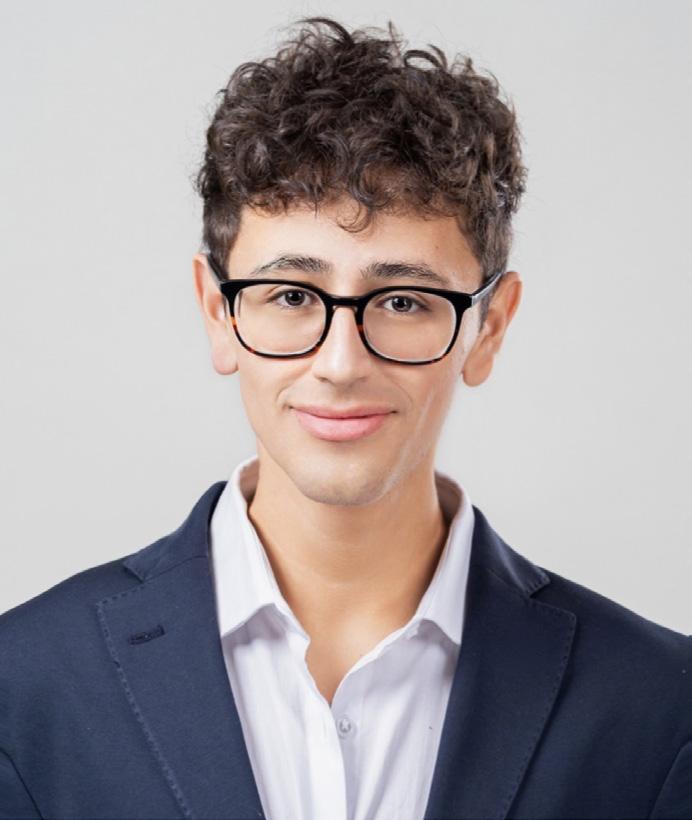
The final discussion was between Luka Heidari (26C), a senior majoring in interdisciplinary studies and minoring in Persian language and literature, and Rose Deighton-Mohammed (21G), an assistant teaching professor in the Institute for the Liberal Arts (ILA) and the director of the Interdisciplinary Exploration and Scholarship Fellowship.
Heidari: What has been your favorite memory of this year so far?
Deighton-Mohammed: My students’ thesis defense moments were my favorite, because I watched them piece by piece, brick by brick, build their theses into robust research projects. I saw the effort and the sweat and the tears that went into putting that much effort and focus into a project. It was so wonderful to have a moment in which we could celebrate the things that you did to bring your interests and questions to life.
Deighton-Mohammed: What are the lessons that you’re gonna take from our relationship, or from your time at Emory more broadly, with you as you go on to whatever’s next?
Heidari: I’m doing my masters next year, and the program I’m doing is the area studies masters at Oxford [University (England)]. It’s a very, very theoretical, highly intellectual program, which I’m super excited and I’m really happy for it. I really, truly was never a student that was like, ‘I’m gonna get my PhD.’ I love, love learning, and I think it’s something that we haven’t really talked about, but I’m teetering on the idea now of a PhD sometime in the future. I never really saw myself as a person to be infused or truly embedded in academia that way. I think the ILA was a huge part of me getting there and seeing that there’s a whole world of things to explore with thinking and the way that your imagination goes. It’s easy to think of academia, or academics, as a very inaccessible thing, and one of the things that I’m honestly most grateful for, with you especially truly, is the fact that I’ve gotten close to people whose minds I admire and minds I love that are also just great people.
Heidari: What inspires you?
Deighton-Mohammed: I love my job. Hands down, I love my job. I have the best job in the world, in my opinion, or at least I love it. What I love about it is that I get to interact with young people who generally are excited to learn new things and are invested in the world being better tomorrow than it is today. It’s this perfect mixture of curiosity and a kind of ethical commitment to human beings and to the world and to the earth and everything. Witnessing other people on a daily basis asking questions and becoming curious about things so that they can learn how to
take whatever their unique potential is into the world, that’s the most inspiring thing. I feel so fortunate, because not everybody works in a place that’s filled with this much curiosity and hope and effort, and all of these kinds of things to learn and to improve and to care for other people. My biggest inspiration is really my students. It’s not just a nice thing to say when teachers say, ‘I learn from my students,’ it’s very genuine.
Deighton-Mohammed: What inspires you?
Heidari: I’ve always felt the issues that I deal with, the things that bother me, the things that have shaped my life, have been so top-down that my only solution is to charge ahead. That’s why I’ve been compelled to do so much government work and so much diplomacy work in college — kind of taking on the bull by its horns and asserting myself in a space that really challenges me. There’s an expectation that when you’re representing a country or when you’re representing institutions, that you stand for everything that it believes, or that you suddenly have to be the spokesperson for an entire culture or an entire country or an entire institution or entire label, or whatever, but I would be lying if I said it’s not what inspires me. The challenge of bridging what I know intrinsically, what I feel like I know about these spaces, and then bringing it into things that are honestly sometimes too difficult for me to conceptualize, but it just feels right, and affecting change in that way.
Courtesy of rose DeiGhton-mohammeD
Courtesy of luka heiDari
E mory S Enior r E flEctionS
Good Night and Good Luck
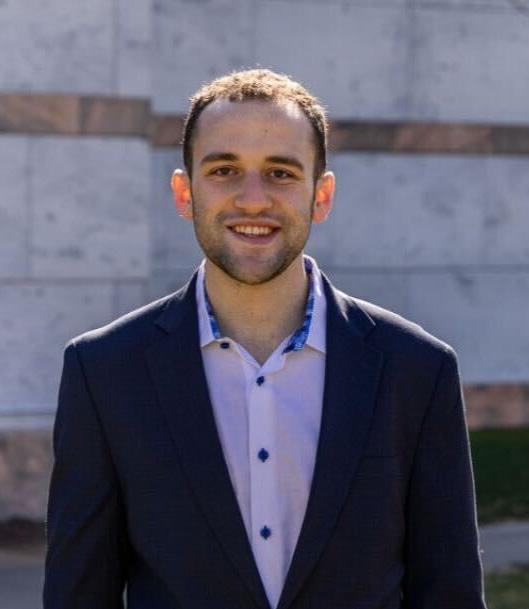
Spencer Friedland
If you walk down the stairs of Emory University’s Robert W. Woodruff Library and hike 20 feet past Banjo Coffee, you will see a dusty display case showcasing The Emory Wheel’s coverage of student activism during the Civil Rights era. During caffeine-fueled late nights studying for midterms or writing essays, I would often wander over to this exhibit and inspect my predecessors' work. Like the authors of those articles, during my
For a brief period, I was the historian of Emory, chronicling northern
Atlanta’s 2020s.
time at Emory I found myself through the Wheel.
What made the paper special to me was not the number of likes important stories would get on Instagram or how this extracurricular would improve my chances at getting into a top law school — instead, for a brief period, I was the historian of Emory, chronicling northern Atlanta’s 2020s.
After getting rejected from The Emory Spoke, the University’s satirical publication, I joined the Wheel on a whim, thinking it would be a cool way to get involved in life at Emory. That first-year student who joined the paper is unrecognizable to the graduate who is walking across the commencement stage today. Back then, my father was alive and I was an 18-year-old afraid of putting myself in uncomfortable situations. A nervous wreck, I had little confidence in my ability to succeed, never envisioning I would one day take on the role of leading the small company that the Wheel is just a few years later.
The challenges of running and writing for a newspaper have made me into a person whom I know my father would be proud to see. As a writer, being in situation after situation, asking fellow students, faculty, administration and politicians questions that made them squirm, I became comfortable with being uncomfortable.
Years later, learning how to be a boss and a leader as an editor made me confident in myself. Becoming co-editor-in-chief put me in situations in which I had to be an expert in journalistic ethics. During my time at the paper, I made more tough decisions than I could count, which I would relive when my head hit the pillow after a long day at the office. Despite the challenges faced and mistakes made, the 46 Tuesday nights over three
years, during which my friends and I stayed up late into the early morning to work on the Wheel’s print editions, hold some of my favorite memories. The Wheel is what defined Emory for me.
That first-year student who joined the paper is unrecognizable to the graduate who is walking across the commencement stage today.
Writing for the Wheel gave me the opportunity to meet people from across Emory I would never have interacted with if I had stayed in the safe bubble I created for myself in my first semester.
Thanks to the Wheel, I have made life-long friends from Minnesota to Hong Kong, from Wheelies who have graduated long ago to those who have just started their career at my home away from my dorm. At Emory, where people can struggle to make connections, the Wheel made it easy.
When I look back at my life at Emory, I gloss over the hours I spent working on classwork and the days I spent missing my father. Instead, when I am away from campus, I find myself daydreaming about taking the elevator up to the fourth floor of 630 Means Drive and walking inside the Wheel’s offices to laugh with my friends under yellow fluorescent lighting while we would trudge away till 4 a.m. to make sure copies of the Wheel are on our newsstands by 9 a.m.
Spencer Friedland (26C), originally from Long Island, double majored in Philosophy, Politics and Law, and Film and Media Studies. At Emory, Friedland served as the co-editor-in-chief of The Emory Wheel, on Emory College of Arts and Sciences Honor Council and was a member of the Franklin Fellowship. While working for the Wheel, the newspaper won the Society of Professional Journalists award for best small student newspaper in the country. Outside of the classroom, Friedland has worked as an intern for film companies GoodDocs and Kids Video Connection. After graduation, Friedland will attend Fordham Law School.
Care That Continues Unseen

Abby Roth
“Hey, I’ll come back and check on you before the end of the day.” I have said this phrase countless times to patients as a nursing student — whether in the emergency department, labor and delivery room or whichever lucky floor I am on for my clinical.
I always mean it in the moment, though I know the reality of healthcare is that the day rarely goes as planned. Patients are transferred or discharged. New admissions arrive. Priorities shift. I usually circle back, but not always in time to see a familiar face.
I have always valued closure and long to see the endings of the stories I touch: the babies I witness taking their first breaths, the patients navigating their hardest hours or the families leaning on hope at the bedside. I want to know that my presence and care truly made a difference. Yet, life moves on often without asking permission.
When my Opa passed this January, it reminded me sharply that some will never witness our complete stories, no matter how much we wish they could. These moments are a lesson in impermanence. You see it in the
clarity of a first heartbreak, the realization that you have drifted from long-time friends or even the recognition that you have grown far from the person you once were.
Beyond hospital walls, I have seen this same impermanence in the quiet rhythms of campus life. I remember the casual promises we make as students: the half-hearted, “We should grab lunch soon” or “Let’s hang out” exchanged between classes — flippant plans that may never be put into action.
In the final weeks of my senior year, I am hit full force with how fleeting these moments are. Faces that were once strangers and became familiar will blur into passing figures I no longer know well enough to wave to or stop and chat with.
Through my various roles on campus, I have seen the constant evolution of community and relationships up close. As vice president of recruitment of Kappa Kappa Gamma, I was responsible for welcoming the new member class: a group of 38 bright, eager women at the start of their college journeys. Seeing my newest sisters grow close, I recognized how each individual contributes to the collective shaping of our chapter, their influence continually evolving our reputation and legacy.
I may never know who all these new members will become or how they will carry forward our chapter with new traditions and rituals. I have felt that same wistfulness as a student ambassador for the nursing school meeting prospective students, whose curiosity I hope sparks something meaningful. I know I will not witness the lives they go on to build here at Emory University.
nence is critical for how we, as students and graduates, approach our actions and interactions — reminding us that what we do today may plant seeds whose growth we never witness.
Being named a Heart of Emory Award recipient for community involvement last spring crystallized this lesson. I believe I received this recognition not for moments I could catalog, but for the quiet ripples I helped set in motion: mentorships, spaces shaped, encouragement offered and lives touched briefly. The award honored the work of building community at Emory, even without knowing the outcome.
As I count down to graduation, I find myself making the same kinds of promises I have made the past four years, urgently hoping time will slow down. “Let’s get dinner soon!” “We’ll find time.” Some of these assurances will go unfulfilled. Some connections will shift, some stories will be left incomplete — that is okay, as belonging is about presence, not permanence.
In these moments, I am both participant and observer, shaping communities I can only glimpse once they are no longer mine to stand within.
Graduation, for me, has loomed less as a celebration and more as a quiet reckoning, a reminder that the experiences we cherish will slip from our grasp before we fully understand their significance. My four years feel fleeting in comparison to the grand legacy of Emory, yet they are luminous, heavy with memory, and unforgettable to me. They will be the “good ol’ days” I revisit with a smile, the moments I carry forward in heart and habit.
In these moments, I am both participant and observer, shaping communities I can only glimpse once they are no longer mine to stand within. Acknowledgment of that imperma-
Whether in a hospital room, a dorm, or across campus, it is in the small, everyday choices where connection takes root. That is the wisdom the wise heart seeks — not a place to belong, but the courage to build it when the story is unfinished and everchanging.
Abby Roth (26N) grew up in Rancho Cucamonga, CA, and Holliston, MA, and is a BSN graduate of the Emory Nell Hodgson Woodruff School of Nursing. A recipient of the Heart of Emory Award in Spring 2025, Abby demonstrated leadership and engagement across campus through her involvement with SILT, SCOE and OSFL. She served as president of the Pre-Nursing Club and the Body Positive Alliance, vice president of recruitment for Kappa Kappa Gamma and participated in SGA First Year Council. Within the School of Nursing, Abby contributed as a Nursing School Ambassador, Dean Search Committee member and frequent panelist. She also gained hands-on clinical experience working with teams at Emory Healthcare and Piedmont Atlanta. Following graduation, Abby will begin her career as a registered nurse in a residency program with clinical interests in labor and delivery, cardiology and neurology.
Find Clarity in the Chaos of Your City
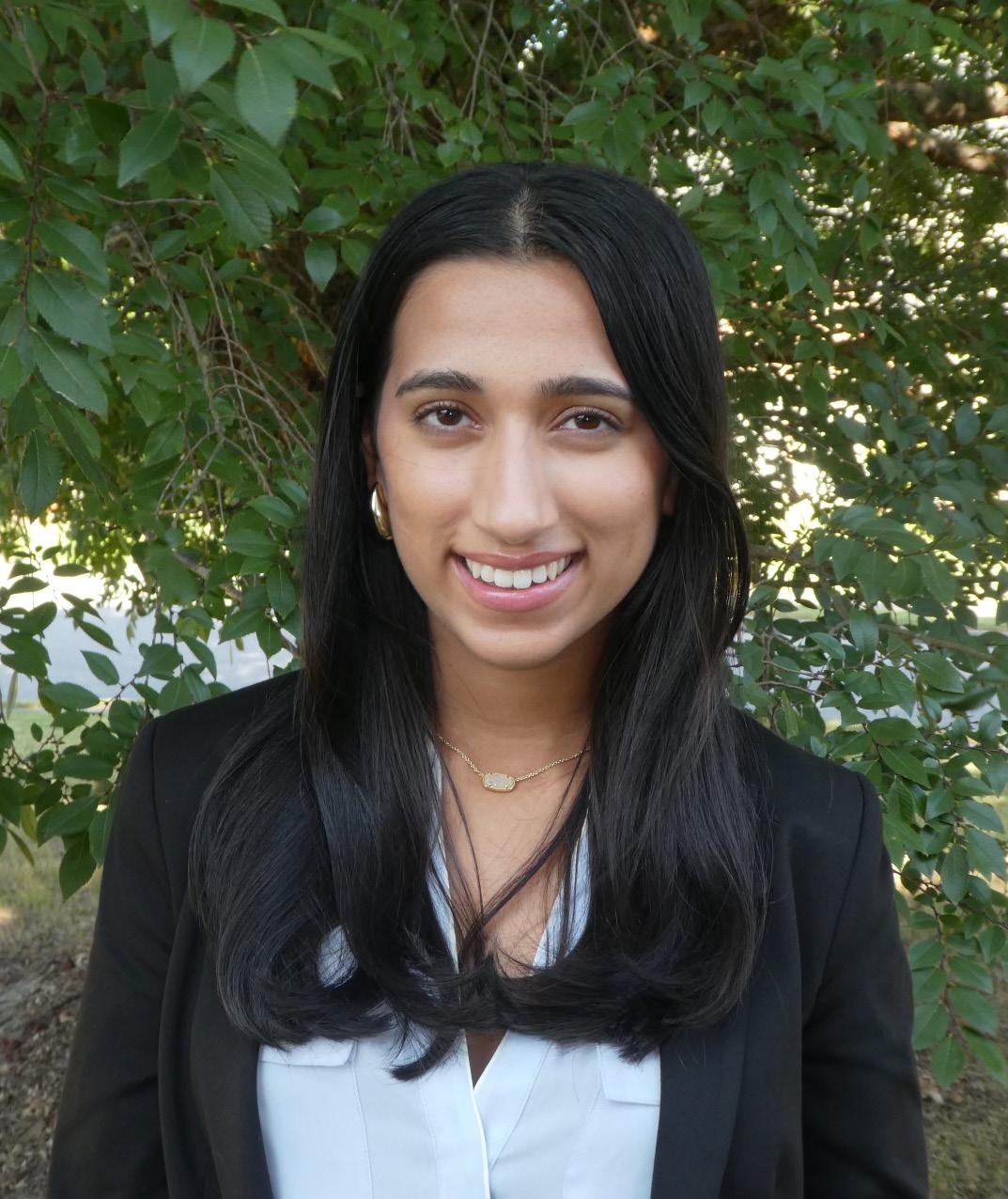
A few weeks ago, I found myself staring at a pollen-covered mirror installation in a corner of Piedmont Park amid a slew of “404 Day” festivities. Those 36 mirrors, collectively titled “Myriad,” are a daunting sight. Scattered at various lengths, the surfaces leave nothing to the imagination, reflecting each object in the peripheral park from a series of fragmented angles.
Trying to look back on the last four years — while deep in the trenches of draining job interviews, trapped in an endless array of convivial ceremonies — feels very much like standing in front of those mirrors again, enveloped by the lingering motion and magnitude of everything that lies behind me. I’ve written before that Emory University can sometimes feel like a bubble, but at the cusp of graduation, I know the most formative parts of my college experience have always been deeply intertwined with the landscape of the surrounding city.
Each time I’ve experienced a letdown on campus, I’ve discovered something new I love about Atlanta. There’s the contentment of walking the Beltline on a Saturday afternoon and the chaos of braving the Beltline on a Saturday evening. There’s the first sip of a Coke float from Andy’s Frozen Custard and
the last bite of a Crunchwrap from Perc Coffee. There’s the time when I scored free tickets for an evening at the Atlanta Symphony Hall, and there’s the eccentric performances I’ve seen at eclectic — some would say sketchy — theaters across town. There’s also the summer I spent interning at The Atlanta Journal-Constitution (AJC), a role that fundamentally reshaped my understanding of what it means to stay actively informed about and engaged with your community.
I turned 22 last November, and to celebrate, I gathered a handful of my friends for dinner at Colony Square, across from where I interned on the AJC’s local news team. I wanted to mark my last collegiate birthday with an activity that felt sophisticated, foreshadowing what life after Emory could be.
In my mind, the memory is hazy, golden under the light of an Italian restaurant and blurry at the edges like a vintage photograph. We were the youngest people in the venue, but I felt completely at ease. The evening was the beginning of the end of college: I felt like I was finally making grown-up decisions, and that restaurant was the first place that ever saw the adult version of me.
I know the most formative parts of my college experience have always been deeply intertwined with the landscape of the surrounding city.
Since then, I’ve walked around for more hours than I can count listening to “The Only Living Boy in New York” (1970) by Simon & Garfunkel, staring at the University Quadrangle in the dreamy way I’ve previously made fun of prospective students and their eager-eyed parents for doing. I am neither a boy nor a resident of New York, but something about the gentle strums of the song’s guitar — the lyrics steeped in desire and melancholy — resonates with me. “I know that you’ve been eager to fly now,” Simon sings to Garfunkel, resigned to
the fact that he is about to let go of someone that he loves. I’ve lived in Georgia since I was born, and at times, I have felt like the only girl in Atlanta, a place where it’s so incredibly easy to feel lonely. As I prepare to let go of Emory, I realize I’ve still managed to carve out pockets of neighborhoods where I get the sense that I belong — a skill that has defined my coming of age and one that I will take forward with me. Atlanta is an inspiring place, in part, because the city is constantly being redefined and reshaped while simultaneously attempting to stay true to its history and values. As I look ahead to postgraduate life, I plan to embrace a similar attitude with my decisions and my identity.The concept of where one cultivates a home is one that continues to pervade all of my writing. I recently confessed this to my memoir workshop professor, who assured me that during formative moments of their lives, writers sometimes have a tendency to return to specific touchpoints for inspiration. Sense of place remains one of those touchpoints for me. When I think back to high school, I recall feeling a lot of pressure from well-meaning elders to attend a certain red and black school in a college town with a pretty good football team. In hindsight, I am happy that I trusted my gut — that just wasn’t the right path for me. I believe most young people can only find themselves by losing themselves in a sprawling metropolis, and I wouldn’t be who I am if I didn’t choose to go to college in an overwhelming, yet exhilarating, city.
My sister gave me a copy of Dr. Seuss’ “Oh, the Places You’ll Go!” right before I came to Emory. Evidently, I did not go very far: the University’s recent decision to relocate Commencement ceremonies to the Gas South District Arena means that I will be receiving my Bachelor’s degree in the same place where I received my high school diploma. It’s a parallel that I’m not thrilled about. Nonetheless, there is one page of the book that I find especially poignant. Seuss writes, “All alone! Whether you like it or not, Alone will be something you’ll be quite a lot.” If I can carry this much love for the place where I grew up, I can only imagine how much I’ll love the spaces I will take on by myself — the cities and homes where I’ll spend my 20s.
Safa Wahidi (23Ox, 26C) is originally from Sugar Hill, Ga., and double-majored in political science and English and creative writing at Emory. She worked as a columnist and editor for The Emory Wheel, a bookseller for the Emory Bookstore, a social media coordinator for the Emory English Department and an intern for the Emory News Center. Beyond campus, Safa interned at Forsyth County News, CNN International and The Atlanta Journal-Constitution, earning national recognition from the Society of Professional Journalists and ProPublica. After graduation, she will pursue journalism and spend her summer in Nashville as an intern reporter at The Tennessean.
Safa Wahidi
We Are More Alike Than We Think
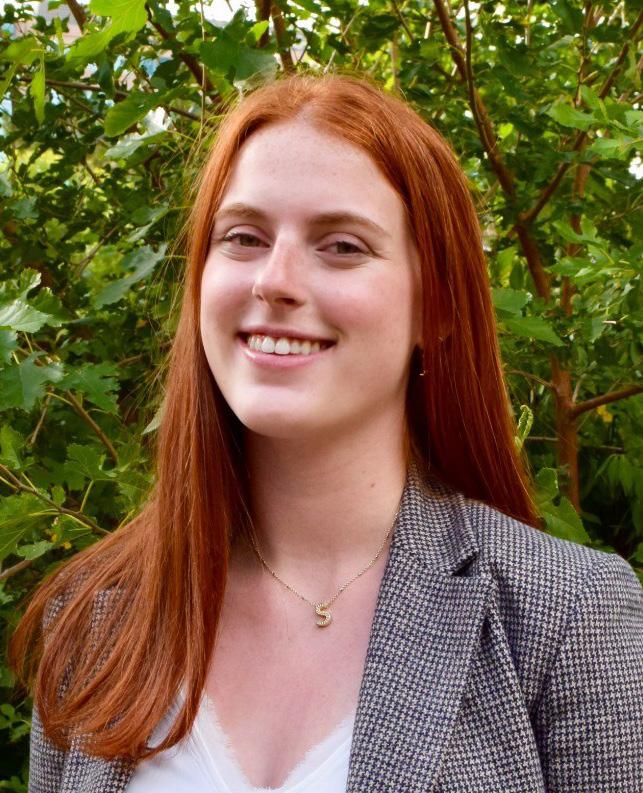
Kalmin
I am not an organized person. People who know me know that they can count on me for an event idea or a trip to the zoo, but staying focused or keeping my room tidy is not my strength. I am very easily distracted, as many of us are these days.
A song in the morning reminds me of a friend who recommended a podcast related to the latest breaking news, which I’m sure we will cover in class today. That reminds me, I should probably not interrupt the music so I can finish up and head out the door.
While I have not figured out how exactly to hone my focus, I know why I get distracted — there are too many things to think about. But while assignments and commitments can be hectic, as Emory University students, we excel at juggling these responsibilities.
Sure, these obligations include writing a thesis, managing a full course load and juggling extracurriculars, but also overthinking social interactions, theorizing about “Avengers: Doomsday” and sorting out each weekend’s restaurant lineup. Furthermore, I’m curious about existential issues facing the university, such as the lack of continu-
ous administrative leadership and impossible decision-making that leaves every stakeholder unhappy. You may be thinking that you do these things too — we are all so much more alike than we think.
In a national landscape that thrives on division, we cannot afford to let our campus become an echo chamber, serving figures we will never meet. Taking agency necessitates that we show up to difficult conversations and represent our perspectives, refusing to let others dictate how we engage with challenging ideas, and reclaiming the right to seek knowledge, as our university’s motto encourages.
Emory challenges its students in ways we never have been, balancing a massive undergraduate community with rigorous academic pressure and diverse voices. For many of us, we are in a new city with unfamiliar levels of humidity and a renewed appreciation for Coca-Cola.
At Emory, we vote in elections where our voices come closer to tipping the scales than many of our home districts. Students from all over the world and the political spectrum share the need for club funding, exhaustion over studying for the MCAT and the desire to kick their habit of doomscrolling. We are bound by the same local stressors and the same global anxieties. We are not as unfamiliar as we are made to believe.
Of course, I do not mean to be reductive. I am not taking the MCAT and I will vote in Texas in a naive pursuit of flipping our Senate seat this fall. I’ve navigated global cities like Houston and London, but Emory is the first place where diversity was my daily reality rather than a backdrop, and the individual stories and interests of my classmates are what make this place so fulfilling.
backgrounds — a chance I never had growing up. I built relationships as a Student Ambassador, in the Student Government Association and in my Middle Eastern Studies classes, crafting a foundation for earnest conversation.
Given my lifelong connection to the Jewish community, I naturally drifted to Jewish and pro-Israel groups on campus. As I look back on my time as the President of the Emory-Israel Public Affairs Committee, then President of Emory Hillel, I realize how critical the individual perspectives of students around me truly are.
Some students could not point out the Jewish homeland on a map, while others had personal connections to Gaza and the West Bank. I certainly do not claim to be a policy expert, nor do I have that expectation of others. Yet, Israel is inseparable from my identity, and it’s an imperfect place that I love in the spirit of tradition and nuance — just like Texas or Emory.
Our university is special because it is full of outstanding individuals who comprise a wellrounded, high-achieving and dedicated community. While I am grateful for a more peaceful campus climate that is more conducive to learning and connection, I implore Emory students not to lose the value of nuance.
When faced with any issue, do not believe that you must pick one side or the other. Embrace the people who have shaped your Emory experience because they are the ones who offer perspectives you can’t see when you get your news from social media.
We are bound by the same local stressors and the same global anxieties.
I grew up attending a Jewish school called The Emery/Weiner School in Houston (yes, that’s really its name), and besides a handful of students, everyone was Jewish. Here, countless opportunities arose to meet people from all religions and
Think beyond the conclusions that bring instant gratification or require little mental gymnastics. Lean into the parts of your identity that you are proudest of, and do not let anyone take that from you — especially a detractor.
Our campus is flawed, but it is so rewarding. In a place as special as this one, there is truly so much to wonder about.
Sophie Kalmin (26C), originally from Houston, majored in American Studies and minored in Middle Eastern Studies. At Emory, Sophie served as Emory Hillel President, Emory-Israel Public Affairs Committee President, SGA Legislator and Ranking Member, College Council Legislator and Education Abroad Committee Chair. She was also a Peer Ambassador in Pathways Center’s National Scholarships and Fellowships Program and a Student Ambassador in the Office of Undergraduate Admissions. Sophie is a Henry L. Bowden Dean’s Achievement Scholar as well as a Sam Bredow Memorial Scholar and beyond campus, was involved with Hillel International’s Israel Leadership Network and American Jewish Committee’s (AJC) Campus Global Board.
Sophie
My Walk Down Harvard Road
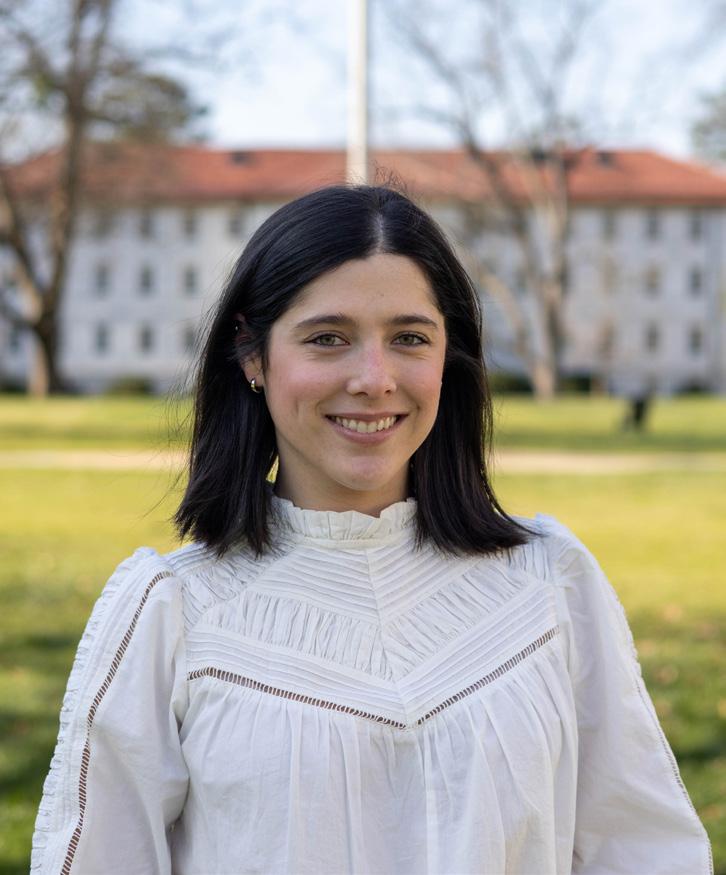
Catherine Goodman
Approaching the intersection of Briarcliff and Harvard Roads is a true test of patience. Chirping birds compete with humming engines, the bright sun beats down on the black asphalt and the complicated traffic pattern wreaks havoc on drivers in all directions.
For two years, this busy junction has been a constant obstacle in my morning commute from my off-campus apartment to Emory University.
If you ask my roommate, who totaled her car on a gray November day while attempting to cross the road, it is no easy feat to pass on four turning wheels.
But, if you endeavor to cross by foot, taking
From the desolate winters marked by grief and barren bushes to the shimmering spring marked by budding flowers, these jagged sidewalks bore witness to the pivotal years of my life.
the extra 20 minutes to walk to school, this chaos unravels into unparalleled beauty.
Harvard Road, a residential street lined with towering trees and historic houses, has become more than a shortcut to the classroom. Waiting to cross the bustling street and pass into the quiet stretch of the same road has become a precious ritual in my busy life that invites me, urges me, to slow down.
A few weeks ago, I remembered the “365 buttons” meme from earlier this year. In January, a TikTok user named Tamara announced that she planned to collect one button for each day of the year. “I’m scared of time, so I want to be more conscious of it,” she said.
Although her declaration spawned an onslaught of confusion and criticism — ultimately culminating in the viral defense that it only had to make sense to her — it actually does make sense to me. Time is tricky: Days crawl, but years fly. In the final stretch of my college life, I, too, have sought a greater awareness of each minute passing by.
Time
is tricky: Days crawl, but years fly.
In
the final stretch of my college life, I, too, have sought a greater awareness of each minute passing by.
Nowhere am I more cognizant of time than on Harvard Road. I have seen this street — and this street has seen me — through various seasons of life.
From the desolate winters marked by grief and barren bushes to the shimmering spring marked by budding flowers, these jagged sidewalks bore witness to the pivotal years of my life.
When I lost my grandmother and returned to Atlanta, the place she called home, the cardinals in the lush green trees provided company; when I panicked over challenging assignments, a glimpse into the lives of the road’s residents provided perspective; and when I waited for my dream job offer this
April, the patches of dandelions provided a little glimmer of hope.
In the solitude of this stretch, even when my toes sometimes catch on uneven sidewalks as I scan the blue sky, I am present. To be present is to have patience: a virtue acquired with each moment spent waiting for a slight pause in the stream of cars through that fateful
Harvard Road is nothing out of the ordinary: Homes line the streets, couples pass on morning walks and dogs bark from the windows. But, like the sites of Emory — the residential hall where I met my boyfriend, the sorority lodge where I made lifelong friends, the newspaper offices where I nurtured my passion — time has endowed this street with immeasurable value.
In the solitude of this stretch, even when my toes sometimes catch on uneven sidewalks as I scan the blue sky, I am present. To be present is to have patience: a virtue acquired with each moment spent waiting for a slight pause in the stream of cars through that fateful intersection.
As the sun causes little beads of sweat to form on my spine, it is easy to stare across the street with frustration. But, the promise of peace that rests just beyond keeps this annoyance at bay.
In many ways, I anticipate crossing the graduation stage in May with the same understanding. I know that beyond the podium lies beauty I have yet to uncover and that waiting is a lesson in itself.
That is college after all: a rush of paths crossed, of lives briefly touching before breaking through to the other side.
Catherine Goodman (26C) is from Savannah, Ga., and majored in English and Art History at Emory. In college, she served as Managing Editor for the Arts & Life section and Editorial Board of The Emory Wheel and completed an honors thesis in Ancient Greek art. Last summer, she served as the Arts in Review Bartley Fellow at The Wall Street Journal. She will pursue magazine journalism following graduation.
College Unsettled Me in All The Best Ways
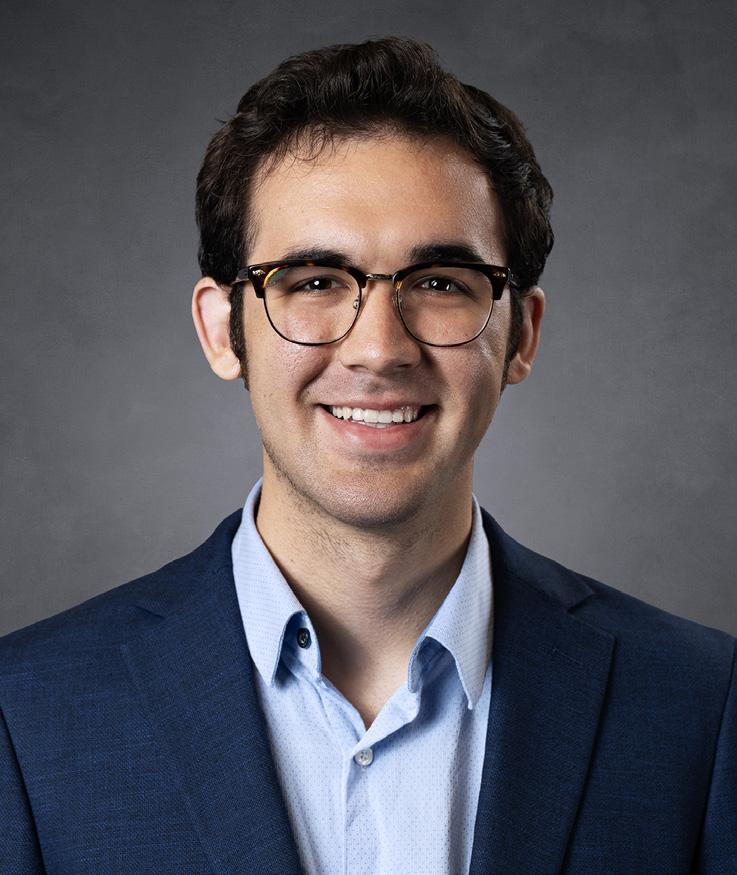
streaming family comedy.
Perhaps it is not the noblest commemoration, but two seconds of fame is more than most could ask for. Still, the spontaneity of the whole affair made me think. We have so many unexpected and absurd opportunities thrust upon us during our time here at Emory, but we so rarely take them.
This chaos of opportunities is something I’ve taken for granted. Real life will not dump a perfect opportunity into your lap. Our inquisitive culture exists at Emory because of the students, faculty, resources and staff who foster it. College is not real life — and perhaps that is for the best.
Many things in life excite me, but if I’m being fully honest with myself, it’s the highprofile things that bring me the most excitement. Over the last four years, I have worked on a respectable number of independent projects, ranging from essays, research reports, plays and speeches.
Statistically speaking, however, my most viewed endeavor was one in which I was barely involved. In my first year at Emory University, I got the chance to be an extra in the film “The Family Plan” (2023), starring Mark Wahlberg. For about two and a quarter seconds, you can see half of my face next to Wahlberg in the final cut. He was so close I could have poked him. I didn’t – although maybe I should have.
Senior Reflections
And, just like that, this random cameo has become the most well-known project I’ve ever been involved in. It also came close to never happening — in fact, if I had had my way from the start, it never would have. This opportunity, which a friend offered, was not a role I sought out. In fact, I had to be cajoled into going at all. I complained that it was late, cold and on a school night. Several years later, I am now forever immortalized in a direct-to-
So, to all current Emory students, I urge you to enjoy your time here. Embrace the volatility and chaos, because your time as an undergraduate gives you a unique opportunity to remake yourself. Changing a major, trying a new club, or adding or dropping a habit of yours are all much more easily done here than in the post-graduation world.
In the real world, I will not live 40 feet from my friends or work 30 steps from my front door. I will no longer have easy access to the world’s top scholars and professionals and eat lunch with renowned doctors and scientists. I may never catch the bus again alongside esteemed poets and artists. Random opportunities, like being an extra in a film with Wahlberg, will not be dangled in front of me daily.
Emory is a bubble, for all the good and bad that it can bring, but eventually, the bubble must burst.
There does not need to be an overarching purpose or scheme to these explorations. After all, I have no interest in beginning a film career. Sometimes it is worth doing things just to do them and to know things for the sake of knowing. After all, that is the ultimate hope of the liberal arts at Emory.
Real life will not dump a perfect opportunity into your lap. Our inquisitive culture exists at Emory because of the students, faculty, resources and staff who foster it. College is not real life — and perhaps that is for the best.
This is all not to say that post-graduation stability is a bad thing. I will get to truly live on my own, charting my own path through life. My routine schedule will no longer shift every semester. I will be free to explore what I love without thinking about how it affects my resume. The places I wander in my free time will be filled no longer just with students and faculty but with people from all walks and stages of life.
Emory is a bubble, for all the good and bad that it can bring, but eventually, the bubble must burst.
I am sad to leave the place I have called home for the last four years and sad that life will likely become a little calmer. That said, I am excited at the prospect of a fresh start, a chance to begin life anew.
Most of all, I am incredibly grateful for the friends, family and mentors who have made these four years so unpredictable yet fulfilling. I will miss the energy and uncertainty of it all. But, I do not think I could reasonably ask for more.
I might permit myself, then, to just a single unreasonable hope: that I’ll continue to live for the uncertainty and seize what chance throws at me with all my strength. There’s a whole world out there waiting to surprise us. After four long years, all I can say now is “how exciting!”
Daniel Bell (26C), originally from Chicago, double-majored in economics and history. At Emory, Daniel served as the co-president and musical director for the Catholic Student Union. He also worked as a senior resident advisor on the Clairmont Campus, marketing fellow and tour guide in the Office of Undergraduate Admission and as a student director for Dooley’s Players. He also performed with the Emory University Chorus. After graduation, Daniel will be joining Cornerstone Research in its Chicago office as an analyst.
Daniel Bell
Still, I Rise: Black Leadership, Resilience at Emory
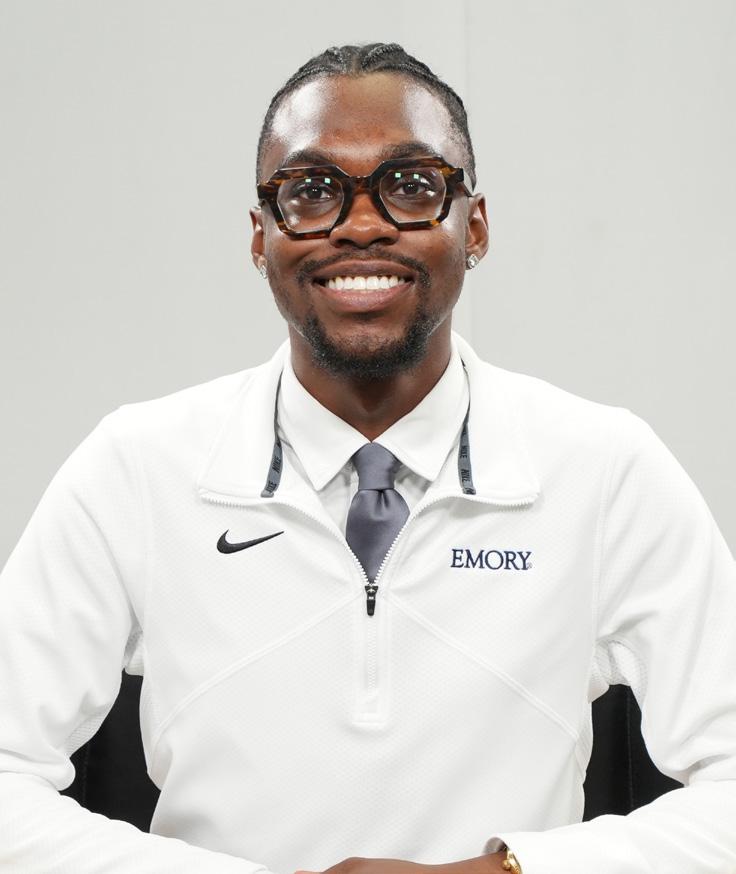
Tyler Martinez
Esteemed boxer Muhammad Ali once stated, “He who is not courageous enough to take risks will accomplish nothing in life.” This quote has defined my journey at Emory University in ways I never could have anticipated. When I arrived at Emory and first walked through the Haygood-Hopkins Gate, I assumed my presence as a first-generation, low-income Black man would blend into the background. I believed that no matter what I accomplished, I would leave without ever truly being seen or known by the larger Emory community. Little did I know that Emory would reshape not just my understanding of leadership and impact, but my understanding of myself. What began as an effort to stay in my lane quickly turned into a journey of stepping fully into my light. I was drawn back to the very thing I once believed I needed to quiet — my voice. As a marginalized student, I came to recognize that my sense of belonging was rooted not in the broader University experience, but in the spaces we created for ourselves. I found belonging in organizations like the Brotherhood of Afrocentric Men, the
Black Male Initiative and the Emory chapter of the National Association for the Advancement of Colored People. In these spaces, I was not an exception or an afterthought — I was understood, supported and made to feel like I was at home. At the same time, I could not ignore the contrast between the belonging I felt in my communities and the distance I often experienced across the broader University. There were many moments in my four years at Emory where it felt like the whole community acknowledged my presence but did not fully embrace it. I began to realize that while belonging did exist, my sense of belonging was not embedded in the larger University experience. Instead, it was something we had to intentionally build, protect and sustain in smaller pockets.
One of the first moments that made this reality clear to me was when I applied to the Student Programming Council in my second year. I approached my application with passionate and innovative ideas, experience and a genuine dedication to creating programming that brought students together. I knew I had something meaningful to offer, but I was rejected outright. What I quickly came to realize was that this was not just my experience but a shared one. The feeling of systemic denial echoed in conversations with other students who looked like me, who carried similar ambitions, ideas and drive, yet found themselves met with the same barriers and closed doors. Here lies the infamous question: Why would I even apply for these positions when we hardly get them in the first place?
That question became a turning point for me. Instead of waiting for a seat at a table that was not built with me in mind, I chose to be courageous and create my own through the Belonging and Community Council (BCC) under the Student Government Association (SGA), for which I served as the inaugural president. For the first time in my college experience, I was shaping a system that truly supported cultural organizations, listened to overlooked communities and responded to
real student needs. BCC showed me that a change in culture was not just possible, but necessary. The impact I made in this role led me to step further out of my comfort zone and run for Emory’s 59th SGA president. I could not pass up the opportunity to push against the inequities I had experienced and witnessed, to take what I had learned in community and translate it into action and to ensure that future students could step onto this campus knowing they already belong and will be supported. Here I stand as the 59th SGA president, but not without battle scars. I faced doubts about my qualifications while running, and even after winning, I was denied a proper transition because I disrupted what felt like a good old boys club. Later, the very organization I sought to improve was paused for over six months because of the behaviors I had set out to challenge. Through it all, I took every microaggression, every instance of racism and every display of entitlement in stride. Not because it was easy, but because I knew my purpose in this role was greater than any attempt to shrink it. In many ways, this journey demanded the very courage that Ali spoke of. Out of that courage, I rose above the doubt, the resistance and the barriers in front of me. I worked to make SGA more transparent and accessible, to build a more diverse and representative student government and to center equity and inclusion even in moments when our institution did not. I remained committed to one thing above all else: proving that breaking through barriers is possible, that the ceilings placed above us are not permanent and that marginalized students have the power to redefine what leadership looks like for those who come after us.
Because of these experiences, I now understand the true weight of Black leadership in predominantly white spaces. Shakespeare said, “heavy is the head that wears the crown,” and that is true. But, I carry the crown with no regret. As I walk back through the HaygoodHopkins Gate at Emory, I know I am leaving this place better than I found it.
Tyler Martinez (26C), originally from Brooklyn, N.Y., majored in African American studies. At Emory, Tyler served as the 59th SGA president, inaugural president of the Belonging and Community Council, and senior advisor to the Emory NAACP. Tyler also worked in the Emory Student Center as a project assistant and in the Emory Black Student Union as a program assistant. During his time at Emory, he was the recipient of the Pellom McDaniels Research Award, Caucus of Emory Black Alumni’s Dr. Herman L. Reese Community Service Award, National Association of Student Personnel Administrators Region III Undergraduate Rising Star Award and the Collective Impact Leadership Award (Student Involvement, Leadership and Transition’s inaugural Hall of Fame). After graduation, Tyler will pursue a M.S.Ed. in Higher Education and Student Affairs at Indiana University Bloomington, where he will serve as a Cox Scholars Programming graduate assistant and Edson W. Sample Fellow in the Office of Scholarships.
Maybe Emory is the Friends We Made Along the Way Senior
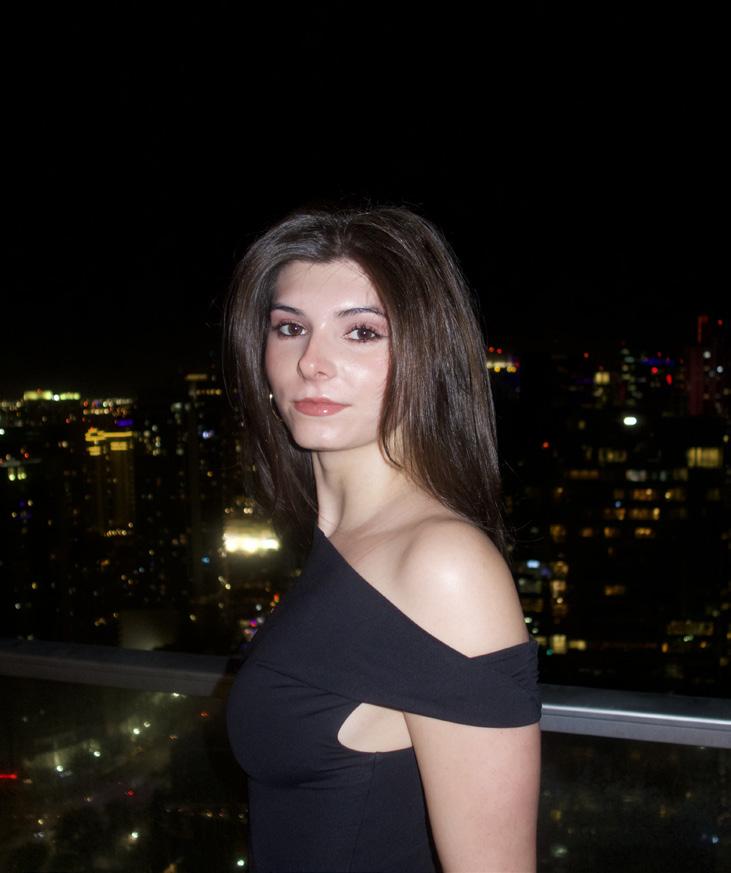
Lucy Gardner
Hollywood Boulevard is quite beautiful at night, when the dried urine is pressure-washed off the Walk of Fame and the crowds have thinned. No sweaty Batmen or Transformers try to pull me over for a photograph as I walk back towards the Emerson dorms. Instead, my dear friend Jayden Davis (25B) is tugging on my arm, begging me to record him turning cartwheels down the empty street — Emory University club gymnastics would be so proud. I pull out my phone and record a blurry video of him clumsily somersaulting as my friend, Skylar Lewis (25C), laughs so hard it sounds like she is wheezing. We had another halfmile to go, much more turf for Jayden to try to cover in leaps and bounds. In that moment, despite my high heels being coated in some strange brown crust that I would spend an afternoon scraping off, my heart was full.
I found those who would soon become my closest friends, my creative community, in the heart of Hollywood, because, on a whim and with a little bit of encouragement from Associate Professor of Film Studies David Resha at Oxford College, I applied to the Emory Pathways Program for film and media — something I never dreamed I would do
when I started at Oxford.
When I applied to Oxford, I indicated my intended major as quantitative sciences and creative writing. I had done somewhat okay in a statistics class in high school, and I thought that because of that, I obviously had to be a statistician. That dream fizzled before I even set foot on campus. So, with a light reality check, I applied to an Oxford discovery seminar that seemed even more unrealistic: Introduction to Screenwriting. The first day of class, I sat in the quiet conference room on the top of the recently remodeled humanities building while Resha emphatically told the class that we would not be writing what we wanted to write. Nobody was going to write their magnum opus, and under no circumstances would we be writing coming-of-age college stories. I sat there, staring at the tree limbs that swayed just outside the window, and thought that I was really going to hate this class.
I did for the first two weeks. I was itching to write some cheap, “Ladybird,” knock-off. But after we wrote our first mini-screenplay and workshopped it in class, I was in love. Not with my writing, which was objectively bad, but with the enthusiasm and creativity of my peers. We were excited to help each other improve and excited to read each other’s scripts, no matter if they had been written in a coffee-induced, all-nighter haze. We were, for a brief semester, a little screenwriting support group. When the course ended, I was a little heartbroken that they no longer took up my Tuesdays and Thursdays, yet I continued to pursue screenwriting in an independent study with Resha and Shannan Adams (24Ox, 26C).
I wish I could say that I became an amazing screenwriter over those two semesters. I improved, certainly. But, if one were to read the screenplays my 18-year-old self wrote, well, I just have to say that I am sorry. What I took from those two semesters was the ability to make mistakes and be embarrassed, because I had such a wonderful, vibrant writing group that supported me, and in turn, I supported them: Abby Brown (24Ox, 26C), Shannan Adams (24Ox, 26C), Chris Pocharski (24Ox, 26C), and Theo Lin (24Ox, 26C). They
reminded me what creating art was all about — the people you meet along the way. Your one perfect reader. So, when I applied to the Pathways Program, I did not realize that I was looking for that perfect reader on the Emory campus. I filmed my HireView wearing business casual in Fleming Hall with my roommate's towel hanging behind my head. The interview did not feel quite real. I never expected, in my wildest dreams, to be interviewing for a program in Los Angeles. Never did I expect to be living with ten strangers for three months.
I am not sure what the future holds or where I will be next, but I am certain that I have the community that I have built, and for that, I will be eternally grateful to Oxford and to Emory.
Never, ever did I expect that it would be the most formative moment of my time at Emory. That summer solidified that no matter what I am doing or where I am, the people around me are the most important thing. I made my best friends that summer, shot a short film, and struggled for my life to turn Los Angeles into a walkable city. But, when I returned to Emory, the things I loved about my time in Los Angeles were there too.
I have incredible classmates, classmates who inspire me each and every day with what they are doing. But, more than being an inspiration, they have been the people I will continue to rely on and create with far past my time at Emory. I am not sure what the future holds or where I will be next, but I am certain that I have the community that I have built, and for that, I will be eternally grateful to Oxford and to Emory.
Lucy Gardner (24Ox, 26C) is from Birmingham, Ala., with majors in creative writing and anthropology with a concentration in politics, identity and social justice. During her time at Oxford and Emory, she was a Stipe Fellow for Creative Writing, a Pathways Film and Media Scholar, and received highest honors for her creative writing thesis. She and her dog, Little Dog, can be seen leaving the Anthropology Building in the wee hours of the night. After graduation, Lucy intends to move to Los Angeles and pursue a career in creative writing and film.
Fingerprints, Smudges, Scars: What College has Left Behind
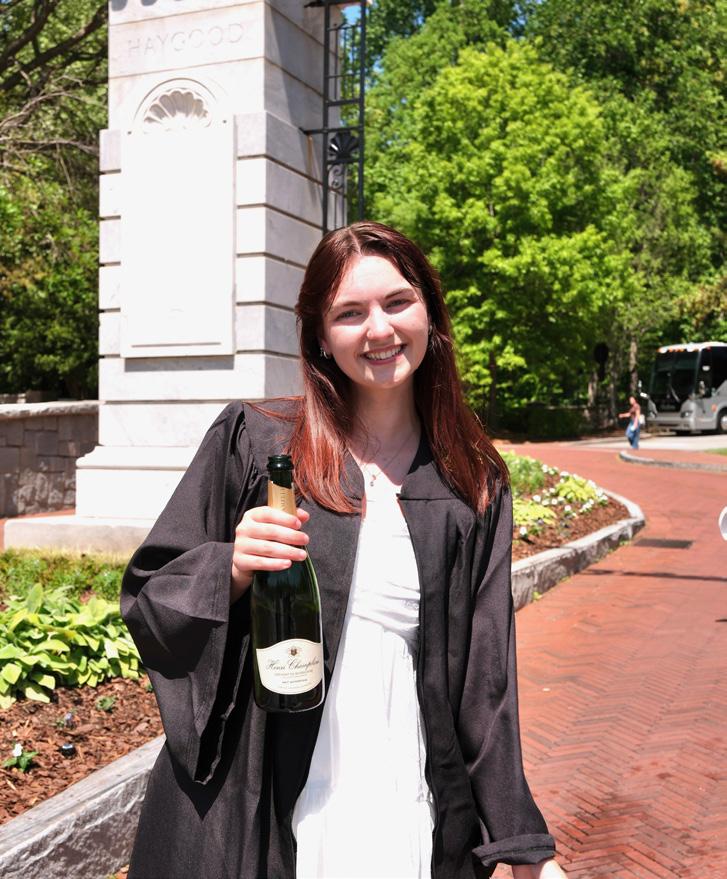
Ellie Fivas
Metaphor is a funny thing. I spent the majority of my brainstorming time for this reflection on the hunt for a perfect metaphor for graduation. Ever an English major, I knew the right image — one visceral enough to shoot straight through every senior’s heart yet familiar enough to soften the blow — would help tackle this reflective beast.
The descriptor I finally landed on is more cliché than brilliant or pioneering, but it is fitting nonetheless: fingerprints. Inspired by the handprints my friends leave on my pollencovered car every morning in April, I considered what sort of fingerprints others have left on my college experience and why those prints matter.
While we may have the impulse to brush the metaphorical college-experience pollen off our brand new, post-graduation lives, we should also pause to appreciate yesterday’s fingerprints and the memories that come with them.
You can find the imprint of Oxford College all over my head, from my ears to my mouth. Somewhere between the depths of Bonnell Hall and on the top floor of Seney Hall, two years went by, which I spent thinking, talking,
listening and learning. In class, my professors shaped my mind, their extraordinary mentorship taking me from William Shakespeare’s Vienna to Accra, Ghana. Serving as a liaison to the Emory Student Government Association and Oxford Speaker of the Senate molded my voice. I learned what it meant to speak for someone other than myself.
My shoulders are smothered with the marks of my time at The Emory Wheel. Whether hunched over a laptop, slouched over on the office couches or tensed during a particularly stressful print night, this part of my body has gotten a much-needed break since I retired as editor-in-chief in March. But I wouldn’t trade the lingering aches for anything — it only reminds me that those fingerprints are still there.
For instance, the Wheel editors left their mark on me each time I wrote an article. Every new writer at the Wheel is always shocked by the number of hands that their work passes through — at least four rounds of edits for every article.
And I would pick a car dent, some newspaper ink stains and a few frisbee-shaped bruises over a pristine degree any day.
While some may be affronted by the process, I adore it. After publication, my work is at its strongest, with imprints left over from all parts of the editing cycle.
No, I am not crazy. I promise.
Between current editors, former editorsin-chief, my partner-in-editing Spencer Friedland and our North Star, Professor Hank Klibanoff, I have a built-in ethical, moral and even a grammatical compass.
Even in matters unrelated to journalism, I often replay words of advice in their voices during the rough patches of life. My term as
editor-in-chief was long, draining and the best thing that I have ever done. I would not trade anything for the fingerprints left over.
Working at the Wheel is many things: exciting, mind-numbing, controversial, stressful. I could dedicate many more paragraphs to the Wheel in this reflection, but I will resist. Aside from my invigoration for student media, the most valuable thing I have gained from the Wheel is the new voices in my head.
To the upper left of my sternum, you can find a spot so riddled with marks and smudges that it hardly looks like the same heart I entered Emory University with as a freshman. My friends — the new ones, old ones and former ones — are everywhere in how I move through life.
I am reminded of trips to Krog Street Market for Varuni Napoli, speed walks between classes around the University Quadrangle, fun Tuesday nights at The Po’Boy Shop and even longer ones in the Wheel offices. I feel lucky to walk around campus and see so many familiar smiles, knowing that I can walk off the Commencement stage with a little piece of them.
Even further down, at my knees, are the most meaningful imprints of all. Right when I am about to buckle from life’s stressors, I can always count on my parents to be there to steady my stance. Whether I needed a pep talk, moral support or someone to laugh with, my parents were there with open arms. And I could not be more grateful.
I was shaped by my experiences at Emory in countless ways, but I also left my mark in a few places. For one, after a long project, I am proud to say the Wheel is now a nonprofit newsroom, entirely financially separate from the University.
Another high point was helping Emory Gender Expansive and Women’s Ultimate Tuna team take home our first game victory in program history. And, of course, I accidentally left my mark on one of the poles in the Clairmont Residential Center parking garage — twice.
And I would pick a car dent, some newspaper ink stains and a few frisbee-shaped bruises over a pristine degree any day.
Ellie Fivas (24Ox, 26C) is from Cleveland, Tenn., and majored in English and political science at Emory. In college, she served as editor-in-chief of The Emory Wheel, interned at CNN and The Carter Center, worked as an Emory Writing Center tutor and played ultimate frisbee. After graduation, Fivas will report on state politics for The Georgia Recorder.
More than Four: From Emory’s Campus to Georgia’s Communities
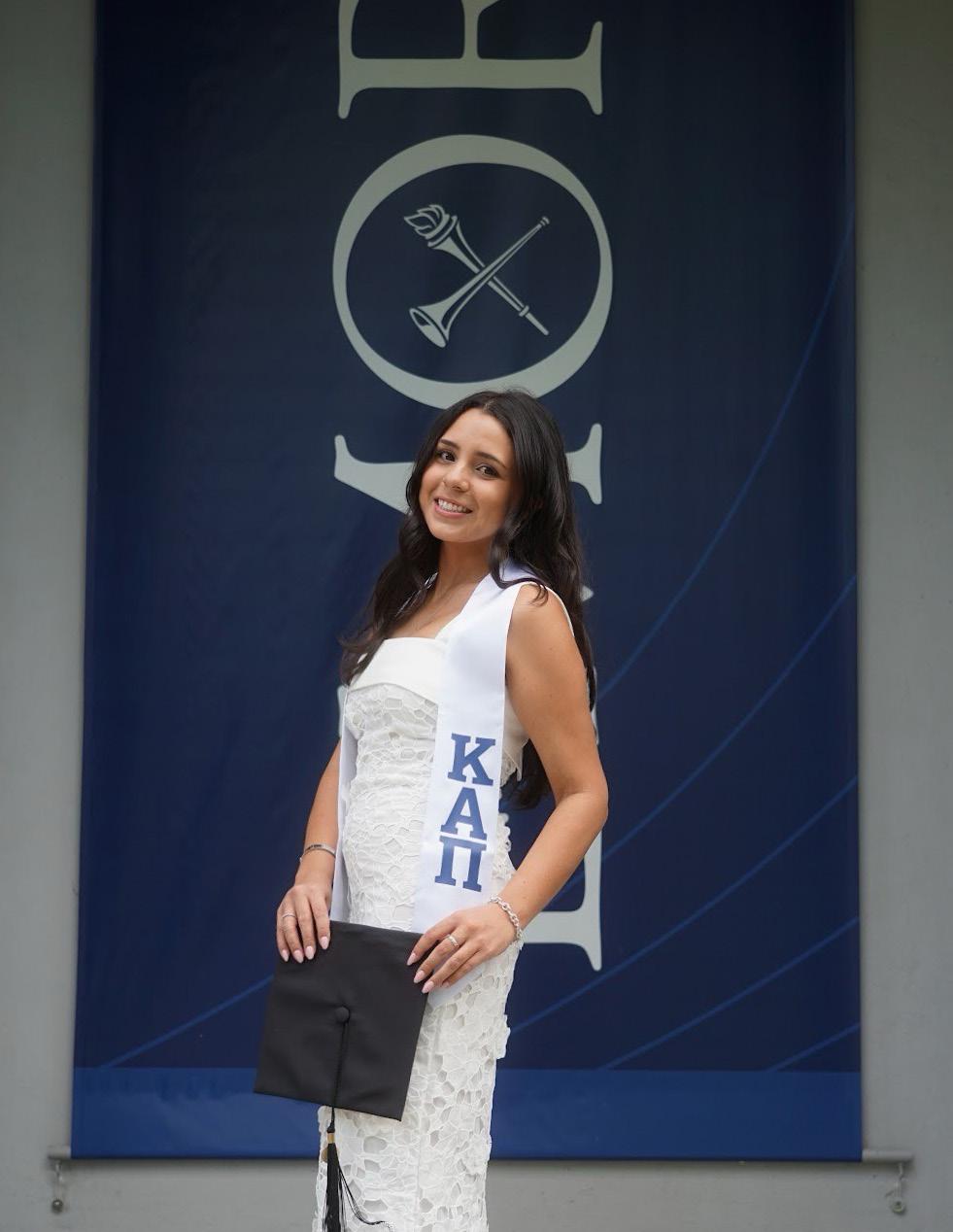
Four years ago, as a senior in high school, I found myself choosing between a university in Washington, D.C., and Emory University. Since my first trip to Washington when I was six, I knew I wanted to make that city home, and I was eager to begin that life as soon as possible. But, a mentor asked me to pause and think not about where I wanted to end up, but which college would expose me to new perspectives and experiences that would shape me into a more effective leader. She said that Washington trained great bureaucrats, but Atlanta made great leaders. She challenged me to take the decision as an opportunity to experience something entirely different from what I knew. That advice stuck with me, even as I quickly realized how easy it was to stay inside the Emory “bubble.” During my freshman year, I met many people who, like me, had come from outside Georgia, and much of my life remained confined to campus culture. Atlanta felt distant, and the challenge my mentor had set for me to learn from a new city and community felt far off. In April of my freshman year, I made the decision to step away from Emory for a semester to intern at
the White House. In many ways, this decision felt like I was returning to the path I had almost chosen from the beginning, to move to Washington and immerse myself in the world of federal politics. I thought maybe it was a sign I had chosen wrong. But, it was in Washington that my relationship with Atlanta and Georgia began to take shape. While working on Vice President Kamala Harris’ Public Engagement team in 2023, I often found myself advocating for different parts of who I was: my background, generation and perspective as a college student. But, I also became a representative of Atlanta. In small rooms where no one else had a direct connection to the area, I began to advocate for the city. I began to realize that I was representing a place I had not yet fully taken the time to know. When I returned to Emory the following spring, I carried that realization with me, and that semester, I continued to support Harris during her visits to Georgia. Each trip and event allowed me to become more familiar with this state and its leaders. I met students, small business owners and community members who had deep roots in the state, and slowly, I began to put down my roots.
Following the spring semester of my sophomore year, I began traveling full-time with Harris. During this time, I had the chance to travel to 19 states with Harris on both official and campaign trips. Georgia quickly became a pivotal state for the campaign, and I frequently found myself returning to the state. I was in Massachusetts with Harris the day before former President Joe Biden withdrew from the 2024 presidential race. I could use a lot of words to describe the emotions of that moment, but when your boss becomes the Democratic presidential nominee overnight, there is little time to process it — there is only time to act, and I knew I wanted to be on the ground where the outcome would be decided. So, when I was asked what role I wanted to play in the transition, my answer was immediate: Georgia. Therefore, in August 2024, instead of returning to classes, I began working as the assistant to the campaign manager
for Georgia, and for the next 90 days, I traveled across the state, heard from communities and learned what issues mattered most to Georgians. I stepped into spaces I had never been in before and met people whose lives and perspectives expanded my understanding of the place I had chosen to spend four years in. One of my favorite moments was a trip to Fort Valley State University (Ga.), around 200 miles south of Emory, where I attended a Southern fish fry alongside former President Bill Clinton. Exposure to the deep southern accents, fried food and generation-old roots in the community was an experience that grounded me in a part of Georgia culture that, as a California native, I might have never encountered otherwise.
Through each of my experiences on the campaign trail and in the White House, I came to understand that being part of a place comes with responsibility. As students at Emory, we are not separate from Atlanta — we are a small part of it. We represent a piece of this place whether we actively choose to or not. When we put down roots and choose to commit to Emory, we must do our best not to take, but to engage, learn and give back to the community. This means stepping beyond the boundaries of our campus and recognizing that our presence here in Atlanta and Georgia has an impact. As I leave campus, I am deeply grateful to have chosen Emory. My mentor encouraged me to see college not as a step towards a career, but as a place to grow beyond what I knew and to engage with a new community.
For me, Emory will become more than an alma mater. During my four years, I have had the opportunity to become a part of a new community. The people and the experiences have expanded my perspective and made me a more understanding leader. Although I am leaving, I know that my roots will remain on this campus, in this city and in this community. In every room I enter, I will carry the lessons I learned here and a sense of responsibility that comes from being part of a community that shapes you.
Bella Mazet (26C), originally from Palm Springs, CA, majored in political science and history. At Emory University, Mazet served as the professional development chair of Kappa Alpha Pi and interned in Emory's Office of Government Affairs. Outside of Emory, Bella interned for Katie Porter’s U.S. Senate campaign, Vice President Kamala Harris’ Office of Public Engagement and Intergovernmental Affairs, traveled on behalf of the White House’s Advance Office, served as the Special Assistant to the Campaign Manager for the Harris Campaign, conducted research as Legislative Fellow for the U.S. House of the Representatives and most recently served as an advisor to the founder of a political strategy technology startup. After graduation, Mazet will be joining DemandJustice in Washington D.C. before heading off to the London School of Economics to earn an MSc in politics and communication.
Bella Mazet