The Emory Wheel Since 1919
Emory University’s Independent Student Newspaper
Volume 106, Issue 8
Orientation Edition
Friday, August 22, 2025 the search for a replacement provost after initially expecting to replace Bellamakonda by the end of the spring semester.
Ivana Chen/Illustration Editor
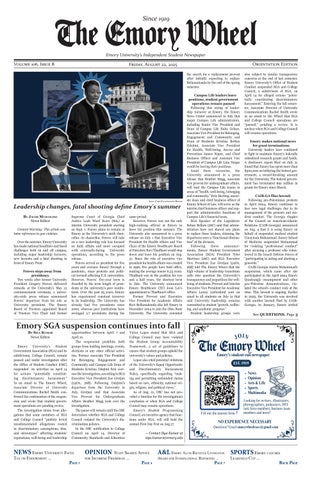
Leadership changes, fatal shooting define Emory's summer By Jacob Muscolino News Editor Content Warning: This article contains references to gun violence. Over the summer, Emory University has made national headlines and faced challenges both on and off campus, including major leadership turnover, new lawsuits and a fatal shooting in front of Emory Point Fenves steps away from presidency Two weeks after former University President Gregory Fenves delivered remarks at the University’s May 12 commencement ceremony, a university-wide press release announced Fenves’ departure from his role as University president. The Emory Board of Trustees appointed Board of Trustees Vice Chair and former
Supreme Court of Georgia Chief Justice Leah Ward Sears (80L) as interim University president starting on Sept. 1. Fenves plans to remain at Emory as the University’s sixth chancellor. As chancellor, Fenves will take on a new leadership role less focused on daily affairs and more occupied with externally-facing University operations, according to the press release. Fenves served as president for five years and oversaw Emory through a pandemic, mass protests and political turmoil affecting U.S. universities. However, Fenves’ five-year term is dwarfed by the term length of presidents at the university’s peer institutions. Over the past 25 years, Emory has experienced constant turnover in its leadership. The University has already had five presidents since 2000, whereas peer institutions have averaged 2.7 presidents during the
same period. However, Fenves was not the only high-ranking official at Emory to leave his position this summer. The University also announced in a press release on July 1 that Executive Vice President for Health Affairs and Vice Chair of the Emory Healthcare Board of Directors Ravi Thadhani would step down and leave his position on Aug. 31. Since the role of executive vice president for health affairs was created in 1996, five people have held office, making the average tenure 6.25 years. Thadhani was in the position for two and a half years, the shortest term to date. The University announced Emory Healthcare CEO Joon Lee’s appointment to Thadhani’s office. Former Provost and Executive Vice President for Academic Affairs Ravi Bellamakonda also left Emory in December 2024 to join the Ohio State University. The University extended
Campus Life leaders leave positions, student government operations remain paused Following this string of leadership turnover at Emory, the Emory News Center announced in July that major Campus Life administrators, including Senior Vice President and Dean of Campus Life Enku Gelaye, Associate Vice President for Belonging, Engagement and Community and Dean of Students Kristina Bethea Odejimi, Associate Vice President for Health, Well-being, Access and Prevention James Raper, and Chief Business Officer and Assistant Vice President of Campus Life Lina Vargas would be leaving their positions. Amid these vacancies, the University announced in a press release that Heather Mugg, associate vice provost for undergraduate affairs, will lead the Campus Life teams in areas of “health, well-being, belonging and community.” Erin Herting, associate dean and chief business officer of Emory School of Law, will serve as the interim chief business officer and support the administrative functions of Campus Life’s financial team. SGA Speaker of the Legislature Sohan Bellam (26C) said that administrators have not shared any plans to replace these leaders, claiming the departures were a “functional elimination” of the division. Following these announcements, Emory Student Government Association (SGA) President Tyler Martinez (26C) and SGA Executive Vice President Zoe Grotjan (24Ox, 26B) told The Emory Wheel that the high volume of leadership transitions calls into question the University’s transparency and jeopardizes the wellbeing of students. Provost and Interim Executive Vice President for Academic Affairs Lanny Liebeskind sent an email to all students on July 21 that said University leadership remains committed to student “growth, wellbeing, and academic progress.” Student leadership groups were
also subject to similar transparency concerns at the end of last semester. Emory University’s Office of Student Conduct suspended SGA and College Council, a subdivision of SGA, on April 14 for alleged actions “potentially constituting discriminatory harassment.” Entering the fall semester, Associate Director of University Communications Rachel Smith wrote in an email to the Wheel that SGA and College Council operations are “paused,” pending a review. It is unclear when SGA and College Council will resume operations. Emory makes national news for grant terminations University leaders have continued to fight to maintain Emory’s federally subsidized research grants and funds. A disclosure report filed on July 21 found that Emory has spent more than $500,000 on lobbying the federal government, a record-breaking amount for the University. The federal government has terminated $92 million in grants for Emory since March. CAIR-GA files lawsuit Following pro-Palestinian protests in April 2024, Emory continues to face new legal challenges due to its management of the protests and student conduct. The Georgia chapter of the Council on American-Islamic Relations (CAIR-Georgia) announced on Aug. 4 that it is suing Emory on behalf of suspended medical student Umaymah Mohammad. Emory School of Medicine suspended Mohammad for violating “professional conduct” after accusing a professor who volunteered in the Israeli Defense Forces of “participating in aiding and abetting a genocide.” CAIR-Georgia claims Mohammad’s suspension, which came after she participated in the April 2024 Emory Quadrangle encampment and other pro-Palestine demonstrations, violated the school’s conduct code at the time. This lawsuit is ongoing. Earlier in 2025, the University was involved with another lawsuit filed by CAIRGeorgia. In January, Emory settled
See QUESTIONS, Page 3
Emory SGA suspension continues into fall By Siya Kumar News Editor
Emory University’s Student Government Association (SGA) and its subdivision, College Council, remain paused and under investigation after the Office of Student Conduct (OSC) suspended its activities on April 14 for actions “potentially constituting discriminatory harassment.” In an email to The Emory Wheel, Associate Director of University Communications Rachel Smith confirmed the continuation of the suspension and wrote that student government operations are pending review. The investigation stems from allegations that some members of SGA and College Council “publicly levied unsubstantiated allegations rooted in discriminatory assumptions, bias, and stereotypes” affecting students’ reputations, well-being and leadership
opportunities between April 7 and April 10. The suspension prohibits both groups from holding meetings, events, elections or any other official activities. Former Associate Vice President for Belonging, Engagement and Community and Campus Life Dean of Students Kristina Odejimi first oversaw the investigation, according to SGA Executive Vice President Zoe Grotjan (24Ox, 26B). Following Odejimi’s departure from the University in July, Grotjan said that Associate Vice Provost for Undergraduate Affairs Heather Mugg took over the investigation. The pause will remain until the OSC determines whether SGA and College Council violated the University’s discrimination policies. In the OSC notification to College Council on April 14, Director of Community Standards and Education
NEWS Emory University Faces Tax on Endowment ... PAGE 3 P
Victor Lopez stated that SGA and College Council may have violated the Student Group Accountability Framework, a set of guidelines to ensure that student groups uphold the university’s values and policies. Lopez also cited potential violations of the University’s Equal Opportunity and Discriminatory Harassment Policy, specifically regarding “making and permitting unfounded claims based on race, ethnicity, national origin, religion, and political views.” As of Aug. 21, OSC has not provided a timeline for the investigation’s conclusion or when SGA and College Council may resume operations. Emory’s Student Programming Council, an executive agency that functions under SGA, will still hold the annual First Day Fest on Aug 27.
— Contact Siya Kumar at siya.kumar2@emory.edu
OPINION Staff Shares Advice
for Incoming Freshman ...
P
PAGE 4
A&L
Emory Alum Receives Livingston Award for International Reporting ...
PAGE 7
SPORTS Emory catches Learfield Cup ... Back Page
2 Friday, August 22, 2025
NEWS
Emory facing antitrust lawsuit stemming from rising tuition By Jacob Muscolino News Editor As Emory University’s tuition increased to $67,080 and Early Decision I (EDI) applications rose 22%, Emory University is one of 32 institutions now facing a new antitrust lawsuit filed in the U.S. District Court of Massachusetts. Two current undergraduate students and two graduates of U.S. colleges filed the lawsuit against the higher education institutions on Aug 8. The complaint claims these institutions violated Section One of the 1890 Sherman Antitrust Act by reducing competition among students in the EDI round of undergraduate applications. According to the complaint, through the Early Decision process, colleges and universities have created a system that impairs students’ ability to negotiate for financial aid. Section One of the Sherman Act prohibits conspiracies among organizations to reduce competition, such as price fixing. EDI and EDII are binding admission programs in which prospective students receive an earlier acceptance or rejection. At Emory, students can apply to Emory College or Oxford College, or apply to both and obtain entry to one, neither or both campuses. The binding component of a prospective student’s acceptance requires that Emory deliver “adequate” financial aid to the prospective student. The lawsuit alleges that colleges and universities have offered inflexible contracts that disproportionately harm lower-income students in the EDI plan. The plaintiffs argue that students lose the ability to compare price offers and negotiate aid when they enter these agreements,
making EDI less accessible for these students. In turn, the suit explains that this reduces competition for wealthier students. During the 20242025 application cycle, Emory’s EDI acceptance rate was 31% compared to its overall acceptance rate of 14.95% when including EDII and regular decision. The lawsuit also alleges that some colleges and universities share lists of admitted students, limiting competition by reducing the amount of financial aid or other incentives that other schools offer students. Additionally, the lawsuit claims that programs, including the Consortium on Financing Higher Education, Common Application Inc. and Scoir Inc., which are organizations involved in the undergraduate application process, offer avenues through which schools can share information. Additionally, the lawsuit cites a vice provost at a “non-defendant institution” who told the plaintiffs that they are certain that “schools that offer Early Decision collude by sharing Early Decision admission information.” The plaintiffs argue that this collusion between colleges and universities works to limit competition for EDI and make acceptance to schools via regular decision more difficult. The plaintiffs are seeking an injunction to halt these actions and financial compensation for the students attending these institutions. The plaintiffs estimate that grants and aid could have partially covered tuition for tens of thousands of students over the past few years if colleges and universities had complied with the Sherman Act. Assistant Vice President of University Communications Laura Diamond declined to comment on the lawsuit. Senior Vice President for Communications Cass Cliatt at
Brown University (R.I.) wrote in a statement to The Brown Daily Herald that the lawsuit does not have merit. In addition, Brown stated it was ready to defend itself against such allegations. “Brown has always made decisions about its admissions processes and financial aid independently as part of the University's longstanding commitment to enhancing access to the benefits of a Brown education regardless of socioeconomic circumstances,” Cliatt wrote. Previously, Emory settled a financial aid price-fixing lawsuit for $18.5 million in January 2024. Plaintiffs alleged that Emory, among 17 colleges and universities, limited competition for financial aid by participating in a group called the 568 Presidents Group. In November 2024, Emory faced another antitrust lawsuit for allegedly colluding to inflate tuition prices of students with divorced parents, which plaintiffs also claimed violated the Sherman Antitrust Act. A judge has yet to issue a decision and the lawsuit remains ongoing in the U.S. District Court for the Northern District of Illinois. The concern over Emory and other colleges’ rising tuition comes adter Emory’s tuition rose by 5.8% for this upcoming school year, an overall rise of 26.4% in the last five years. Tuition has increased from $53,070 to $67,080 between 2020 and 2025, and total costs, including tuition, fees, room and board, have surged from $69,440 to $88,536 in the same period. Amid these tuition increases, the Class of 2029 also saw a recordbreaking 22% increase in EDI applications.
The Emory Wheel
Fenves earned $2.4 million last year, endowment posts modest gains By Jack Rutherford Managing Editor Emory University paid University President and incoming Chancellor Gregory Fenves over $2.4 million in tax year 2023, which spanned from Sept. 1, 2023 to Aug. 31, 2024. Fenves earned a $1,412,520 base salary and $309,096 in bonus pay, with a total compensation of $2,425,941, according to the University’s financial disclosure report. 501(c)(3) nonprofit organizations are required to file Internal Revenue Service Form 990 every year, disclosing information about their financial details and the annual salary of their key officers, which for Emory includes Fenves. Emory filed Forms 990 and 990-T, using the latter to report unrelated business income. Fenves’ salary is 14.6% higher than the average of presidents at peer institutions. The average peer institution president's salary is $2,116,841. Fenves’ pay rose 8.02% from the previous fiscal year’s total compensation of $2,245,851. On the lower end of peer compensation, the president of Duke University (N.C.) made over $1.81 million in total compensation and the
president of Georgetown University (D.C.) made around $1.6 million, both in fiscal year 2023. The two highest earning peer presidents made $3.6 million at Johns Hopkins University (Md.) and $2.8 million at Vanderbilt University (Tenn.). Ravi Thandani, former executive vice president for health affairs and vice chair of the Emory Healthcare Board of Directors, was the University’s highest-paid employee, with a total compensation of $5,120,802. Notably, Emory also paid over $2.6 million in retention bonuses to certain executives in tax year 2023. The University has faced consistent turnover in its top ranks, with numerous executives announcing their departure over the past year. The University’s main source of income was from healthcare-related activities, topping over $4 billion in revenue. Emory netted over $280 million from its endowment revenues, a 14.29% increase from last year’s total of $245 million.
— Contact Jack Rutherford at jack.rutherford@emory.edu
— Contact Jacob Muscolino at jake.muscolino@emory.edu
Department of Health and Human Services cancels Emory mRNA research grant
Wikimedia Commons/Daniel Schwen
Secretary of Health and Human Services Robert F. Kennedy Jr. has been a critic of mRNA vacines. Subsequently the federal government has cancled grants for research into mRNA vaccines at Emory University earlier this summer.
By Tori Mooney Staff Writer U.S. Secretary of Health and Human Services Robert F. Kennedy Jr. announced on Aug. 5 that the Department of Health and Human Services (HHS) terminated an Emory University grant for mRNA research. While HHS terminated the Emory grant as part of a “coordinated winddown” initiative to end funding for 22 mRNA vaccine development projects, Philip Santangelo, the lead researcher for the grant and professor in the Wallace H. Coulter Department of Biomedical Engineering at Georgia Institute of Technology School of Engineering and Emory University School of Medicine, said the Emory grant did not involve vaccine development.
mRNA is a type of ribonucleic acid that carries the genetic information needed to make proteins. Vaccines that utilize mRNA technology instruct the body to make specific proteins that mimic those of pathogens. When mRNA vaccines enter the body, a person’s immune system is trained to fight against the pathogen. Kennedy expressed opposition to the development of mRNA vaccine technology, stating that the vaccines “fail to protect effectively against upper respiratory infections like COVID and flu.” The grant, from the Biomedical Advanced Research and Development Authority, allotted $750,000 to develop an inhalable dry powder that doctors could use to treat patients for influenza and COVID-19.
Santangelo emphasized that this differs from a preventative vaccine since it uses mRNA to treat patients after a virus has infected them. “Probably the most important thing that I want people to understand is that it was not a vaccine,” Santangelo said. Santengelo also mentioned that in case of an outbreak or pandemic, the powder would be easy to stockpile and is potentially effective against many variants and strains of pathogens. “[The treatment] works against a wide range of influenza A’s, and then we had a version that would also work against influenza B and a version that would work against COVID,” Santangelo said. “We were combining all of those so that you could treat influenza A, B and all the COVID variants.”
According to Santangelo, the grant research explored mRNA technology as a safe and efficient tool for treating viruses. “The reason why mRNA is useful is that it’s easy to make,” Santangelo said. “It’s easy to formulate, relatively speaking, and you can use it for lots of different applications. It doesn’t take a huge infrastructure to be able to make a reasonable amount of it.” Emory School of Medicine Sumner Thompson III Distinguished professor of Vaccinology and Infectious Diseases Nadine Rouphael described the termination of mRNA grants as a “setback.” While Rouphael was not involved in the Emory mRNA grant, she previously participated in mRNA research at Emory and stressed the importance of mRNA technology. Rouphael
shared her worries about the funding cuts to mRNA research. “It’s a technology where improvements could be made, but again, it’s being taken away, or at least the message is being sent that this is not a priority platform to invest in,” Rouphael said. “We’re losing a tool that could be helpful to us.” HHS is terminating the Emory mRNA grant near the middle of the project’s original timeframe, according to Santangelo. The team began research around November 2024 and planned to continue until about March 2026. At the time of its termination, the research team was making significant progress in developing the mRNA inhalable treatment technology, according to Santangelo. The recent cuts in mRNA research follow HHS’s defunding of scientific research across the country. In an Aug. 21 email to The Emory Wheel, Assistant Vice President of University Communications Laura Diamond touched on the University’s readiness to adjust to potential government funding changes. “We continue to monitor actions from HHS as it relates to Emory’s research and remain in communication with government officials,” Diamond wrote. “Emory will adjust as needed to pursue our research goals and ambitions.” Rouphael emphasized how the negative messaging of the mRNA grant cuts could affect future research. “I’m just afraid that the cuts of funding could signal that this is not a tool that we could use moving forward, which is a shame because we need more tools, rather than less,” Rouphael said.
— Contact Tori Mooney at tori.mooney@emory.edu
Friday, August 22, 2025 3
NEWS
The Emory Wheel
Emory anticipates $26 million tax hike on endowment By Lauren Yee Managing Editor Emory University may face a potential endowment income tax increase of $26 million in 2026 after President Donald Trump’s “One Big Beautiful Bill Act” established a new tiered endowment tax rate. This figure is almost three times the $9 million endowment tax paid in 2024. Emory currently has an endowment of nearly $11.4 billion. According to an Emory News Center article regarding the endowment tax’s impact on the University’s mission, Emory is anticipated to fall under the 4% tax category, and the change will take effect in 2026. The 4% tax rate requires Emory to pay an estimated $26 million based on its endowment income. The 2017 Tax Cuts and Jobs Act originally created a flat tax of 1.4% on private colleges and universities’ endowments. However, the U.S. House of Representatives passed the “One Big Beautiful Bill Act” on July 3, adding a 4% and 8% bracket for larger endowments. The federal government aims to hold “woke, elite universities that operate more like major corporations and other tax-exempt entities account-
able” with this tax, according to the House Committee on Ways & Means. Through the legislation, the committee expanded on existing endowment tax policy for higher education institutions. Many U.S. colleges and universities are now facing fiscal challenges due to the increased endowment tax, including cuts to financial aid and increases in tuition. Arts and Sciences Distinguished Professor of Economics Esfandiar Maasoumi clarified that the tax is not on the endowment itself but the income it generates. He called the tax “anti-education” and “regressive,” as it undermines students’ research opportunities and available scholarships. Maasoumi said Emory’s administration is facing uncertainty in financial planning for the tax. “They’re in a bit of a panic,” Maasoumi said. “They’ve frozen hiring, salaries, lots of measures that anticipate that it might qualify for taxes.” Associate Professor of Data & Decision Sciences and Political Science Pablo Montagnes said the endowment tax penalizes “the concentration of wealth,” especially in elite, wealthy
universities. On the other hand, small liberal arts colleges such as Amherst College (Mass.) are exempt from the new tax. Montagnes speculated that “political elements” also influenced the decisions. “There were exceptions made, so for schools that were below a certain size, that was largely made to protect more conservative religious schools that have high endowment per capita, at least, that’s what the coverage suggests,” Montagnes said. Maasoumi added that the tax will harm higher education in the U.S., raising concerns about international students opting to pursue their education elsewhere. “The attitude by the policymakers right now is anti-elitism and education,” Maasoumi said. “Higher education is regarded as part of that cultural war going on.” In an Emory News Center article, Advancement and Alumni Engagement Senior Vice President Josh Newton and Government and Community Affairs Vice President Cameron Taylor emphasized the importance of Emory’s endowment for scholarships, professorships, research and clinical care.
“Endowments are not idle reserves,” Newton and Taylor wrote. “They are purpose-driven investments in students, teachers, research teams, patients, health care providers and community members. When a nonprofit private university is taxed, the people who suffer are those we serve.” Associate Professor of Economics Chris Karbownik added that Emory could increase enrollment, which could result in the University paying a lower rate of 1.4%. Additionally, he suggested that the University could stop selling assets to generate income or use assets that generated losses to reduce the amount of taxable income. In this case, Emory may still fall under the 4% category but pay less because the school’s total investment income is lower. “It’s up to the administration to figure out where the money comes from, and given Emory’s legacy, I would be shocked if they compromise on teaching,” Karbownik said. “I don’t think that’s where the cuts are going to be.” Economics Assistant Teaching Professor Keith Robinson expressed hope that Emory would not compromise its current approach to financial aid and student scholarships despite
the tax. “I would like to think that the University is looking to provide financial aid from endowments, and I think they want to continue to do that, because that makes the University competitive, and it’s part of its mission and overall education,” Robinson said. However, Robinson mentioned that grant cuts, along with the tax, would hurt research, especially healthcarerelated research. Emory reports that around 40% of the endowment funds “health care” and “health sciences.” “The bigger hit to research, without a doubt, is grant cuts,” Robinson said. “A sizable chunk of the endowment at Emory is healthcare related.” While $26 million in endowment taxes will certainly affect the University, Emory is not among the schools hit the hardest by the tax hike. Harvard University (Mass.) could pay more than $200 million annually in endowment taxes and Stanford University (Calif.) could pay an estimated $202 million from an 8% tax on endowment income based on its current endowment of $37.6 billion.
— Contact Lauren Yee lauren.yee2@emory.edu
Crime Report: Aggravated sodomy, terroristic threats, theft Questions remain about Emory By George Segall Crime Desk Content Warning: This article contains references to sexual assault. The Emory Wheel regularly meets with Emory Police Department (EPD) Records Manager Ed Shoemaker (87G, 90G) and uses EPD’s public crime log to inform the Emory University community about recent crime on and around Emory’s campuses. Aggravated sodomy at The Ridge A student reported an incident of aggravated sodomy to the Emory Police Department (EPD) on Aug. 12 which had occurred on May 11. A graduating student living at The Ridge, a new graduate and professional school housing development, met an acquaintance at a commencement ceremony on May 11. Following the event, the pair returned to the student’s room at The Ridge. Once in the student’s room, the perpetrator committed the act of sodomy against the student. Shoemaker explained that an aggravated act of sodomy means sodomy with force and against the will of the other person.According to Shoemaker, the perpetrator is alleged to be an alumnus who had graduated the previous year, which is why the two parties knew one another. EPD will investigate further and determine possible avenues of prosecution. Terroristic threats made to Budd Terrace An unknown caller made a terroristic threat on an Aug. 13 call to the
Parkside at Budd Terrace Nursing & Rehab Center, a rehabilitation facility on Emory’s campus that supports elderly patients. The front desk receptionist received a phone call from a specific phone number, with the caller using profane language throughout the call. The caller said they were going to “pull up tomorrow and beat up whoever.” Shoemaker said terroristic threats are different from mass acts of terrorism because, instead of a large act of violence against civilians or government, it is a threatened crime of violence against an individual. The receptionist told EPD that it sounded like a male voice and that she did not believe the call was directed toward her personally, but possibly for somebody else who works at the front desk. EPD searched the employee directory and found a name that matched the caller ID provided by the facility. The employee in question was not on duty at the time the report was made. The receptionist claimed not to have any knowledge about what might have caused the employee to make that call. EPD recommended that the receptionist take measures to ensure her safety and made arrangements to contact the other employee alleged to be associated with the situation. Theft by taking at Atwood Chemistry Building A complainant claimed that her MacBook was stolen at the Atwood Chemistry Building on Aug. 15. The complainant last saw her MacBook on the desk in her office, around noon that day. She said she
The Emory Wheel Volume 106, Issue 8 © 2025 The Emory Wheel Alumni Memorial University Center, Room 401 630 Means Drive, Atlanta, GA, 30322 Business (404) 727-6178 Editors-in-Chief Ellie Fivas and Spencer Friedland ellie.fivas@emory.edu spencer.friedland@emory.edu
Founded in 1919, The Emory Wheel is the financially and editorially independent, student-run newspaper of Emory University in Atlanta. The Wheel is a member publication of Media Council, Emory’s organization of student publications. The Wheel reserves the rights to all content as it appears in these pages, and permission to reproduce material must be granted by the editor-in-chief. The statements and opinions expressed in the Wheel are those of the authors and do not necessarily reflect those of the Wheel Editorial Board or of Emory University, its faculty, staff or administration. The Wheel is also available online at www.emorywheel.com.
left the office between noon and 12:30 p.m. to go to lunch. When she returned to the office at about 1:30 p.m., she noticed that the MacBook was missing. The complainant’s office is adjacent to a research lab that several people share. The colleagues who shared the lab were all present at lunch with the complainant, so no one in the lab was present to see what had occurred. The complainant does not believe that anyone would have reason to target her belongings specifically. She believes that the theft was random, as someone may have seen her unoccupied office and objects that they could easily steal.The building has a loading dock that is not routinely card accessible or locked which people can easily enter and go upstairs into the lab and office area. According to Shoemaker, the MacBook is valued at $3,000. It has a “GO BLUE” University of Michigan sticker on the laptop. EPD will continue to investigate the theft. Johnson urged the Emory commuity to avoid allowing unknown people into a building, as well as to keep an eye on personal items, especially during the early days of the semester. If you or someone you know experienced sexual assault, you can access Emory’s Title IX resources at 404727-0541 and the Office of Respect at its hotline 24/7 at 404-727-1514. You can reach the Atlanta Grady Rape Crisis Center crisis hotline at (404) 616-4861 and the Decatur Day League Sexual Assault Care and Prevention crisis hotline at (404) 377-1428.
— Contact George Segall at george.segall@emory.edu
Point shooter's motives
with the Department of Education’s Office for Civil Rights when it was accused of and sued for discriminating against Muslim students. Gunman kills police officer in Emory Point shooting In a crisis that made natinal headlines, a shooter near Emory Point on Aug. 8 triggered a “police emergency” across campus and the surrounding area. The deceased gunman, 30-yearold Patrick Joseph White, shot and killed responding DeKalb County police officer David Rose. White, a former U.S. soldier, fired shots that hit nearby Centers for Disease Control (CDC) buildings. He died from gunfire injuries at the scene. The University messaged the community on Aug. 8 to “RUN, HIDE, FIGHT” and by the morning of Aug. 9, the Atlanta Police Department lifted the emergency status and cleared the area.
While news outlets reported that the shooting was linked to the CDC, authorities have not confirmed a motive. The incident occurred right outside the Emory Point, where many Emory students live, raising safety concerns among community members. As students return to campus this week, Emory’s community will feel the aftershocks of the changes and challenges of this summer, continuing to influence the upcoming school year. If you or someone you know is struggling in the aftermath of gun violence, you can reach Emory’s Counseling and Psychological Services at (404) 727-7450 or the Substance Abuse and Mental Health Services Administration Disaster Distress hotline 24/7 at +1 (800) 985-5990.
— Contact Jacob Muscolino at jake.muscolino@emory.edu
Jack Rutherford/News Editor
The Aug. 9 shooting, which resulted in the death of a police officer occured near Emory Point where many students live.
The Emory Wheel
Opinion Eagle-eyed guide: Tips for your time at Emory By Madeline Shapiro and Ethan Jacobs Managing Editor & Opinion Editor
best views of campus and Atlanta’s skyline above the expansive canopy.
College guides and Reddit threads can only go so far when getting the inside scoop about what a school is really like. That’s why we are bringing new and returning students a candid back-to-school guide that answers all of your burning questions. Q: Are there any hidden gems on campus? In the first few weeks of college, you will quickly learn that Emory’s Atlanta campus is small — really small. If you walk at a brisk enough pace, you can get from the Freshman Quadrangle to Emory Village in about 10 minutes. After a few weeks at Emory, you will have explored pretty much every building and pathway there is to see. For the exploratory student, however, there are several hidden spots around campus that I wish I had discovered sooner. Be sure to go visit Lullwater Preserve, a park off of Clifton Road near the Woodruff Residential Center, as often as you can, especially in the fall. With paths that wind around a small reservoir, it’s the perfect spot to clear your mind on a walk or run or to hold an impromptu picnic during a stressful week. If you are looking for a cozy, quiet and rarely-crowded study spot, I suggest the third floor of Emory’s Michael C. Carlos Museum, where there is a new coffee shop and a few tables hidden away from the University Quadrangle. Additionally, even though it’s not a place you can study, everyone should take at least one trip to the Stuart A. Rose Manuscript, Archives, and Rare Book Library. It is on the 10th floor of the Robert W. Woodruff Library and contains rare books, manuscripts and other archival materials. Besides being a cool place to look at old letters, on a clear day, it’s got the
Q: What are the most accessible and cheap transportation methods to explore Atlanta? It’s no secret that Atlanta’s public transit system — the Metropolitan Atlanta Rapid Transit Authority (MARTA) — is not the most efficient or robust in the country. For incoming students hoping to traipse around Atlanta with ease like on New York’s subway system or “the T” in Boston, you will quickly learn that this will not be the case given Emory’s suburban location in Druid Hills. This is not meant to discourage you from using MARTA — it is by far the cheapest way to get around Atlanta, with $2.50 for basic one-way tickets, buses and rail lines able to take you all across Atlanta’s sprawling metro area. If you have any concerns or questions about taking MARTA, I suggest reading our writer Josselyn St. Clair’s op-ed in favor of the public transit system as the best way to explore the city. For Emory students, there is also another option for getting around select parts of the city in addition to MARTA and rideshares: the Emory shuttles. Don’t get too wrapped up in your daily commute — the shuttles can take you much further than across campus. Despite not always being the most prompt or easy to track, the Emory shuttle system, which is centered at Woodruff Circle on the Atlanta campus, can bring students places like the Toco Hills Shopping Center, downtown Decatur, Ga., and Ponce City Market, a special weekend route Emory Student Government Association launched last semester to the popular food and retail hall. Even if you’re just getting groceries at Toco Hills, I recommend making use of the shuttles on campus, especially if you don’t have a car. Q: What are the best restaurants near Emory?
As a freshman, you automatically get $150 Dooley Dollars with your meal plan. If you like coffee, the best places to spend your Dooley Dollars on campus are at Kaldi’s Coffee and Costa Coffee. If coffee is not your style, you can also go to Cox Hall’s food court, where every student can find their favorites after the remodel. You can also walk 10 minutes from the Freshman Quadrangle to Emory Village, where you will find staples including Chipotle, Cava, Falafel King (my favorite), Summit Coffee and tons of other restaurants bus-
one of the best pizzas in Atlanta. I highly recommend the lamb burgers from Botiwalla by Chai Pani and Porrecca Picante pizza from Varuni Napoli. Gu’s Dumplings in Krog is also a must-eat spot in Atlanta, and a favorite of the Wheel staff on late production nights. If you’ve already met someone special, or just want to get a fun dinner with friends, my favorite date spot is in Inman Park, which is close to Krog. At Bartaco, which boasts upscale street food, any taco you try will be delicious. And for des-
tling with students and community members. While there are plenty of options close to home, we urge you to venture off campus whenever possible. Try Buena Gente Cuban Bakery, which is a 25 minute walk down North Decatur Road. This small bakery sells out quickly, so arrive early in the morning to get amazing cortaditos, heavenly guava cream cheese pastries and the best cubanos. If you can’t decide what cuisine you are interested in, sampling the incredible food halls nearby is a right of passage for all Emory students. Ponce City Market and Krog Street Market sit along the Atlanta Beltline, a 22-mile loop of development around Atlanta. Stop by Botiwalla by Chai Pani in Ponce for excellent Indian street food or Varuni Napoli in Krog for
sert, walk only 50 feet over to Voga Italian Gelato for amazing crepes.To our Oxford College new students, we have not forgotten you — despite its scale compared to Atlanta, there are plenty of great spots in Covington. Check out @Local Coffee House, located conveniently in Covington Square, which is only a shuttle ride away from the Oxford campus. For “The Vampire Diaries” (2009-2017) fans, snagging a table at the Mystic Grill is also a must. For a casual lunch or dinner, Your Pie Pizza is also a great choice for fast and fresh pizza on a budget. No matter what you are interested in, my most crucial recommendation is to explore. Atlanta is a big place, overflowing with culture and personality. Go see for yourself and find your own favorites.
Gabbi Fivas/Contributing Illustrator
Q: What is school spirit like at Emory? If you’re attending Emory this fall, you already know that we lack a football team. We have other things: an R1 research status, top liberal arts, nursing and business programs and a skeleton mascot. But alas, no packed stadiums with crazy fans decked in their school colors or intense rivalries with other southeast football fanbases. As a result, Emory school spirit suffers, and, during your first year, you may look wistfully at Instagram posts of friends at other colleges on game day. A relative lack of athletics-based school spirit compared to other schools may not be a bad thing, though. It teaches you to cherish the moments when Emory does have spirit and when students come together with a common sense of pride in the university. The Coke Toast, for example, which happens at the beginning of a student’s time at Emory and at the end, is the perfect Emory tradition to mark entering and exiting your four years here. Despite how inconvenient or tiresome the practices may be, the Atlanta campus’ Songfest is worth savoring, as it may be the height of competitive spirit on campus. Don’t sleep on Emory Athletics, either. As recent winners of the Learfield Directors’ Cup, Emory has some of the best Division III athletics. With the gym and sports arena both so close to the center of campus, make sure to check out soccer and volleyball games in the fall and some Friday night basketball games. Even though we do not have a football team, I am confident that a series of small moments throughout your time at Emory will culminate in your own unique sense of school spirit. — Contact Madeline Shapiro at madeline.shapiro@emory.edu and Ethan Jacobs at ethan.jacobs@emory.edu
The Emory Wheel Volume 106 | Number 8
Ellie Fivas Editor-in-Chief
Spencer Friedland Editor-in-Chief
Madeline Shapiro Executive Editor Catherine Goodman Managing Editor Will Peck Managing Editor Wendy Pelayo Managing Editor Jack Rutherford Managing Editor Lauren Yee Managing Editor Siya Kumar News Editor Jacob Muscolino News Editor Carly Aikens Editorial Board Editor Ethan Jacobs Opinion Editor Cayden Xia Opinion Editor Hunter Buchheit A&L Editor
Amelia Bush A&L Editor Sammy Brodsky Sports Editor Chloe Nam Sports Editor Esther Fu Social Editor Ivana Chen Visual Editor Meiya Weeks Design Editor
Clément Lee Senior Editor Alex Gerson Deputy Editor Angela Chan Copy Chief Disha Kumar Senior Copy Editor Malia Yap Copy Editor Aimee Zhang Copy Editor
Ivan Wang | Business Manager Business/Advertising Email business@emorywheel.com
The Emory Wheel welcomes letters and op-ed submissions from the Emory community. Letters should be limited to 300 words and op-eds should be at least 500. Those selected may be shortened to fit allotted space or edited for grammar, punctuation and libelous content. Submissions reflect the opinions of individual writers and not of the Wheel’s Editorial Board or Emory University. Send emails to opinion@emorywheel.com or scan the QR code on the right.
Disagree With Us?
Write a Letter To the Editor!
OPINION
The Emory Wheel
Friday, August 22, 2025
For the rich, affirmative ‘The Paper’ worries me, as a journalist action exists at Emory By Madeline Shapiro Managing Editor
By Ethan Jacobs Opinion Editor Since President Donald Trump first took office, higher education has come under a regulatory microscope. The administration enforced new controls on endowment taxation, free speech, antisemitism and the legitimacy of campus diversity initiatives such as race-based admissions at elite universities. Yet, amid these flashpoints, one of the most harmful and discriminatory practices in higher education has escaped scrutiny: early decision (ED). The ED system, which universities market as a way for students to signal strong commitment by applying early, functions instead as a gatekeeping mechanism that privileges wealth over merit. As a binding admission program, ED provides better acceptance chances to applicants who can afford to forgo comparing financial aid packages while spurning students who must weigh costs before commitment. If Trump, legislators and university leaders are serious about fairness in higher education, then they should instead turn their attention to dismantling this broken ED system. At Emory University, ED admissions are the most common pathway into the University. Over 60% of Emory’s incoming Class of 2029 was enrolled through ED at more than double the acceptance rate of regular decision. That gap is not an accident. By leaning so heavily on ED, Emory tilts the scales toward wealthier students who can afford to commit to the $93,352 yearly cost of attendance without financial assistance. Other elite universities exhibit the same pattern. At the University of Pennsylvania and Dartmouth College (N.H.), nearly half of each incoming class are ED admits, demonstrating how the practice is a gatekeeping tool for the Ivy League and its peers. In a recent class action lawsuit filed on Aug. 8, top universities — including Emory, the University of Pennsylvania and Dartmouth — were accused of conspiring to inflate tuition costs through the ED process. The lawsuit labels the ED system as a blatant antitrust violation, as would-be competitors essentially agree not to compete over a select group of students willing to pay the sticker price. Moreover, schools use intentionally vague language that leads students to believe ED is a contract, even though it is not legally binding. When students agree to attend a university and pay its full tuition cost by applying ED, schools lose the incentive to drive down costs to compete with other universities for applicants. This effect, the lawsuit claims, leads to higher tuition for all students. ED is not about student choice or institutional stability — it is about locking in wealth and squeezing fairness out of the admissions process. Emory’s reliance on ED exposes a contradiction in the story the University tells about itself. As students, we have all heard Emory tout its commitment to diversity and inclusion through University leaders, orientation programming and campus tours. These words ring hollow as the University fills nearly half of each class with inherently more privileged students before regular decision admissions even begin.
Before the University turns to expanding access and selecting students from the regular decision admissions pool, its coffers are already secured by a homogenous pool of wealthy students. As a result, lowincome and first-generation students are transparently handicapped in the admissions process solely based on wealth. The concept of need-blind admissions is, in this sense, a scam. It may be true in the technical sense that Emory does not consider a student’s ability to pay when reviewing an application. But, when the ED applicant pool is already skewed toward those from affluent families, the outcome is predetermined. ED supporters may argue that Emory is simply responding to economic pressures. Binding admissions boosts yields, helps stabilize enrollment and ensures the school extracts more tuition. However, this common argument misses the point: Universities are not just market actors extracting rent from their students — they are supposed to be public-minded institutions committed to education, mobility and the greater good. Moreover, I find it curious that universities such as the University of North Carolina at Chapel Hill and the University of Virginia do not have binding ED processes, yet they have steadily risen in rankings over the past few years and maintain strong endowments. If Emory were serious about being a leader in higher education and practicing its values, it would stop clinging to practices that entrench inequities simply because it is convenient to their bottom line. My critique of ED and university admissions does not mean I endorse Trump’s assault on higher education. I find it deeply troubling for both students and society at large. The administration chose its targets — diversity initiatives, woke programming and race-based admissions — only because they supposedly disadvantage white, affluent applicants. Despite Trump’s desire to restore merit-based opportunity, the administration’s plans to fight against discrimination in higher education strategically omit the inequities of the ED system, which overwhelmingly disadvantage lower-income, first-generation and minority students. Despite the lawsuit against ED, I doubt that either Emory or higher education more generally will willingly abandon this system. However, as students and advocates, we cannot lose sight of the institution we want to build. Vocal resistance does yield results: When the Trump administration attempted to freeze billions in education grants, grassroots organizing helped push ten Republican senators to sign a letter opposing the move, leading Trump to abandon it. With higher education under threat on multiple fronts, it is crucial to continue calling out how Trump’s agenda ignores real threats to fairness while pretending to defend meritocracy. Even when change feels unlikely, it is our responsibility to speak out against inequity and to keep raising our voices until they no longer echo into empty air. — Contact Ethan Jacobs at ethan.jacobs@emory.edu.
When I first watched “The Office” (2005-2013) in middle school, a lot of the jokes flew over my head. Nonetheless, the show still charmed me. Over the course of the sitcom’s nine seasons, we watch a paper company carve a comedic path for survival amid the rise of the big, scary internet. There’s so much to love about an ensemble of oddballs working in an office in Scranton, Penn., pulling pranks on each other, starting fires and contracting rabies to then search for a cure. And as a Stamford, Conn., native, I especially enjoyed Jim Halpert (John Krasinski)’s sidequest to the Stamford office, giving my ordinary city a small moment in the limelight. Over a decade later, some of “The Office” creators are returning with a new workplace sitcom, “The Paper” (2025). The show follows a struggling newspaper called The Truth Teller in Toledo, Ohio. With Greg Daniels, the screenwriter and producer who adapted Britain’s “The Office” (2001-2003) for American television, behind this new newspaper sitcom, it is destined to be funny. Despite my high hopes for the show, which premieres Sept. 4 on Peacock, I have discovered that I’m not ready for journalism to become the butt of the joke. I can’t help but see the likely intentional parallels between “The Office,” a show about a paper company airing after the internet boom, and “The Paper,” a show about newspapers as print media sits on a knife edge. According to a 2024 Northwestern University (Ill.) study, 3,200 newspapers have shuttered their doors since 2005, the year of the original sitcom’s debut — a staggering rate of two newspapers per week as websites and short-form content pilfer market share. This trend is not limited to national outlets either — it’s in our own backyard. Georgians are currently facing a heightening local news crisis, ranking 46th in the country for number of journalists per 100,000 residents. Out of Georgia’s 159 counties, 21 counties have no local newspaper and 116 counties only have one, contributing to a vast news desert across rural parts of the state. When local journalism disappears, accurate reporting on local
emergencies, elections and culture goes with it, as well as a reliable record of local history. This absence can have a destabilizing effect on democracy at both the local and national levels. Statewide and nationally, fears of a tree falling in a rural forest and no one hearing it are becoming more and more real. With an accelerating decline in local news, I worry “The Paper” will harp on this demise by poking fun at the underfunded and struggling state of current newsrooms without highlighting the evergreen value of local news. I can already predict that episodes will follow the show’s eccentric yet loveable oddball reporters face one curveball after another, like declining trust in the media or competition with viral influencers.
Despite my high hopes for the show, I have discovered that I’m not ready for journalism to become the butt of the joke. As a student journalist striving for a career in the media industry, it’s slightly unnerving that this crucial profession is about to be turned into over-the-top satire. While these characters will certainly win audiences over with their humor and heart, like the characters of “The Office” did, I worry that future generations may start to see local and traditional news as unimportant or silly, discouraging them from pursuing a job in the mocked profession. Yet, some comparisons between the fictional paper company and a newsroom will likely be apt. During my last three years at The Emory Wheel, I have experienced much of the workplace camaraderie that the show celebrates. Spending hours on Tuesday print nights crammed in the Alumni Memorial University Center at Emory University’s fourth floor offices forges friendships, as does covering major breaking news on campus that ropes in each member of our small, yet dedicated, staff. Not to engage too much in shameless self-promotion, but working
on the newspaper has also been one of my most rewarding college experiences. I remember running on Wednesday mornings to the Emory Student Center to grab copies of my first stories in print. A few months later, my freshman year dorm wall was covered with cut-out clips of all my stories. Since my early days at the Wheel, my appreciation for the newspaper has only grown. Student reporters covering campus protests and administration changes have access to unique insights and information because of our proximity to the Emory community, enabling us to inform the wider student body. This has helped me see how real, tangible journalism matters on college campuses, as it does on the local level. That is why a new sitcom poking fun at local journalism’s overall bleakness is terrifying. “The Paper” is a sadly accurate sign of the times, but I hope it will also serve as a call to action for communities to recognize and support how crucial their Sunday newspaper truly is. Nonprofit news organizations are forging a new path in media outside the constraints of typical ad sales business models, like ProPublica and Savannah, Ga.’s, The Current. As recently as 2024, the Georgia Trust for Local News bought 18 newspapers, hoping to save more communities on the brink of desertification. In “The Paper,” The Truth Teller will turn to volunteer reporters to combat its economic woes, something Canopy Atlanta leans on with its community-based journalism. Yet, as newsfeeds become oversaturated with short-form content and other noise on the internet, volunteer efforts can only go so far in filling gaps in local news coverage. Considering “The Paper” has not even aired yet, it’s probably a little over the top to start making broad sweeping claims about what the fictional show means for journalism. Despite my reservations, I am excited to watch a journalismthemed sitcom from such storied TV executives. I only hope that decades from now, we won’t look back and reminisce on the days when local newsrooms were once enshrined on TV before going extinct, like the once-lauded, always reliable paper company. — Contact Madeline Shapiro at madeline.shapiro@emory.edu
Photo Courtesy of Wikimedia Commons/Phillip Pessar. Photo Manipulation By Ellie Fivas
5
6
OPINION
Friday, August 22, 2025
The Emory Wheel
Arts criticism is crucial — don’t let it die By Catherine Goodman Managing Editor
These days, everyone is a critic. Scrolling for just five minutes on social media, I encounter multiple amateur critics — typically men in baseball caps behind microphones — sharing their commentary on new and old music, ranging from “Hamilton” to Sabrina Carpenter’s deluxe drop. In an age of abundant cultural commentary, when seemingly expert, or at least entertaining, opinions threaten to drown out verified voices, we need traditional arts criticism now more than ever. But The New York Times might disagree. On July 15, the national daily newspaper reassigned four of its prominent arts critics: Margaret Lyons (television), Jon Pareles (music), Jesse Green (theater) and Zachary Woolfe (classical music). In an internal memo Variety obtained, culture editor Sia Michel wrote that the publication would assign critics “new roles” and search for new writers to take up their posts and pens. Michel added that “readers are hungry for trusted guides to help them make sense of this complicated landscape, not only through traditional reviews but also with essays, new story forms, videos.” Like many traditional critics of our time, these writers are still working to provide the public with thoughtful art reviews, but they are forced to compete against an ever-growing pool of digital voices with devoted fans. Quality research, drafting
and editing just can’t keep up with the pace — or with the widespread engagement — of visual content. Although not yet implemented, this realignment likely entails a shift toward short-form content that captures the consumers’ attention and demands very little intellectual engagement, replicating the formulaic production of digital creators who have seen growing success since 2020. Traditional media companies are diving into social media-based journalism, with TikToks, Instagram reels and other short-form digital content published alongside standard articles. The Times’ decision to plunge into this swipeable abyss is shocking and potentially short-sighted. Although it opens doors for younger journalists by establishing new positions and moving seasoned writers to alternate beats, it offers only a small crack of light for aspiring professionals, no longer promising a career of quality storytelling but instead one of clickbaiting. While videos, essays and other new digital story forms provide opportunities, these are not necessarily for journalists: Instead, these require a different set of skills and interests altogether. Many college-aged consumers may welcome this decision as more than 40% of Generation Z gets its news from social media. The Times’ turn toward “new story forms” could be exciting and valuable, but lacks direction. Today’s media landscape is con-
fusing and dangerously oversaturated, and a historically respected voice paving the way for intelligent and constructive online discourse is welcome. Journalism is, unfortunately, an industry, and often at the mercy of the public’s fickle desires and consumption behavior. Instead of digging in its heels, it is trudging forward.
The internet is a minefield of disconnection, but the written review is a roadmap toward discourse. I have hope that The Times can create a blueprint for exemplary alternative content. However, algorithmic, simple and easy journalism is also the quicksand in which our generation stands stuck. Scenic gallery-set Instagram reels, albumranking Tik Toks and pop culture Youtube videos are all interesting forms of entertainment, but not always places for passionate, evocative and thorough journalism. I love a late-night doom scroll, laughing at my highly curated algorithm and swapping reels with my mom, but this exchange lacks the connection, intimacy and intelligence inherent in the written language. As the managing editor of The Emory Wheel’s Arts and Life and
Editorial Board sections, I have no interest in being an influencer, but rather an interpreter, as critics have always been. As Richard Brody explains in The New Yorker, traditional arts criticism is centered around the written review, an invaluable form of journalism. Criticism is an act of service, with the writer serving as a mediator between the maker and the market. The internet is a minefield of disconnection, but the written review is a roadmap toward discourse. For creators, content is more about garnering attention than offering thoughtful analysis. A viral 45-second clip ranking Taylor Swift eras pales in comparison to 800 words tirelessly interrogating the artist’s intention and consumer’s reaction — the former is fun while the latter is vital. These media can and should coexist, but arts criticism should never be fully eclipsed. Additionally, critics hold artists accountable. In the same way that reporters on Capitol Hill survey the political landscape with a keen eye and glistening badge of honor, arts critics survey exhibition halls and movie theaters, applying pressure to painters and poets alike to offer the public their best. As Brody writes, “When media companies quiet or subordinate voices that meet art where it happens — that lend it the spark of life on the page, that kindle artistic fervor in readers — a decline in enthusiasm for the arts, and for arts journalism, becomes a self-fulfilling prophecy.” It is not the sole responsibility of
media companies such as The Times to avoid this prophecy and protect the integrity of arts journalism. Such companies are in a precarious position, walking the thin line between progress and stagnation. But, during this perilous period, media companies should not be so quick to give up on traditional journalism. Major publications that can afford the risk should experiment with new avenues of storytelling, but these changes should be thoughtfully revolutionary, not reactionary. I implore my fellow college students to seek arts criticism that is ambitious and accessible, provides illuminating insight into the background of the artist and supports conscious consumption of the craft. Chase criticism that is both educational and entertaining, striking the correct balance between individual taste and mass enjoyment. Embrace new forms of journalism without forsaking that which is tried and true. Fight against the declining quality of cultural commentary, and as such, the declining quality of the arts. Traditional criticism persists in national and regional publications such as The Wall Street Journal, The Atlantic, ArtsATL, The Atlanta Journal-Constitution and, of course, right here at The Emory Wheel. I think you will find that to avoid drowning in today’s churning sea of media, traditional criticism offers an alluring anchor. — Contact Catherine Goodman at catherine.goodman@emory.edu
Students deserve transparency regarding future of Campus Life By Sohan Bellam Contributing Writer Ahead of the upcoming school year, the Emory University Office of the Provost announced on July 21 that there would be “several leadership transitions within the division of Campus Life.” According to an email sent to select Student Government Association (SGA) leaders a week earlier, these transitions included the departure of Senior Vice President and Dean of Campus Life Enku Gelaye, Dean of Students and Associate Vice President for Belonging, Engagement and Community Kristina Odejimi, Assistant Vice President and Chief Business Officer of Campus Life Lina Vargas and Associate Vice President for Health, Wellbeing, Access and Prevention James Raper. Earlier this summer, former Vice President of Campus Life David Clark also left Emory. These former administrators redefined well-being on our campus, championed belonging and aligned University policy with student needs. They launched an award-winning campaign to address toxic perfectionism, brought eminent public figures to speak with students and guided students through the COVID-19 pandemic. Their professional accomplishments at Emory are numerous, and many likely remain untold. The sudden and nearly complete elimination of Campus Life leadership, carried out without explanation, risks leaving students without the
advocates they need and undermines the transparency that should guide major university decisions. These administrators’ leadership styles were grounded in authentic relationships with students across campus. As a member of Emory SGA, I watched as they not only listened to student leaders but also sought out those who often felt unheard or unseen in an institution as complex as Emory. When disagreement arose, these leaders responded with humility, engaging in good faith to restore trust and advance Emory’s mission. With empathy and care, they brought an unshakable commitment to the student experience.
Emory’s leadership faces defining choices that will shape the institution for years to come. Students found out about these changes through leaked emails and social media posts before an official University announcement. When Emory did issue one, it offered only a vague recommitment to the Division of Campus Life. Instead of naming interim leaders, the University outlined a new structure that dispersed Campus Life functions across divisions. Weeks later, in a message unre-
lated to these transitions, students learned that Associate Vice Provost for Undergraduate Affairs Heather Mugg is now also “Interim Dean for Student Affairs,” a title that was never formally announced and seems to represent both a renaming and reframing of what was once Campus Life. The quiet rollout of this change, buried at the bottom of an email about campus resources after the shooting at Emory Point, underscores how little transparency has guided this transition. What has been framed as a temporary redistribution, however, appears to be a more profound reorganization that may last for years. Emory has yet to indicate that it will launch searches for permanent successors. This lack of action doesn’t just affect Campus Life’s work, but the ability to raise student concerns to the highest levels. For example, the Dean of Campus Life served on the President’s Leadership Team, enabling coordination across the University to respond to emerging crises and long-term challenges facing students. Currently, the Interim Dean for Student Affairs is not listed as a member of the President’s Leadership Team on Emory’s website. This is a moment when Emory’s mission to freely produce knowledge, conduct transformative research and its ability to enroll students from across the world faces a multifaceted attack from the federal government. Now, Emory faces an internal credibility crisis that could be just as damaging if it does not communi-
cate with students. Emory’s leadership and Board of Trustees must recognize that rebuilding the community’s trust is a precondition for responding to external challenges. That begins with a commitment to collaborative leadership. These are not abstract principles, but they are defined principles that Emory has shared with students.
Now, Emory faces an internal credibility crisis that could be just as damaging if it does not communicate with students. I am not naive to the difficult administrative and financial decisions that must be made under financial and political pressure, including those that affect the student experience. Students perceive uncertainty in Emory’s future as well as the added stress that uncertainty places on faculty, staff and administrators. However, despite these difficulties, the way forward is not to make silent changes to campus life, contributing to the chaos. Instead, clear, transparent and honest communication could mitigate some of that uncertainty. For example, there may be budget cuts throughout Campus Life due to federal funding pressure, affecting
student programming and resources. The University should dispel rumors about what will be cut and reassure students by communicating the urgency and necessity of these changes. It should make those difficult decisions through shared governance, consulting the University Senate, SGA and other governing bodies. While specific details may not yet be available, an acknowledgement of Emory’s financial situation and the necessary actions it will take would go a long way in building trust with students. In partnership with the broader community, administrators and the Board of Trustees must articulate a long-term vision for Campus Life through a transparent, participatory process. That vision should include defining how the student experience can advance University values and its plan to achieve that. It should include consultation across Emory and purposeful listening to students, faculty and staff. Through collaboration, we can build a rich academic culture, robust student well-being resources and an excellent cocurricular experience. Emory’s leadership faces defining choices that will shape the institution for years to come. Imagining a new future for University life and rebuilding trust begins with clear communication and a genuine commitment to engage students, staff and faculty as true partners in shaping the student experience. — Contact Sohan Bellam at sohan.bellam@emory.edu.
The Emory Wheel
Arts Life
From Georgia to Kazakhstan: Emory alumna receives Livingston Award By Ilah Ross Staff Writer On a summer day in Kazakhstan, Nicole Sadek (20C) sat with Alina Kusmangaliyeva, a young woman from the village of Berezovka, Kazakhstan, as Kusmangaliyeva recounted the day she and nearly two dozen classmates suddenly collapsed, foaming at the mouth and convulsing. Former residents of Berezovka and environmental advocacy groups believed the fainting episodes were the result of years of exposure to toxic emissions from a nearby oil and gas field. These episodes were not a thing of the past: Kusmangaliyeva had fainted as recently as four days before her interview with Sadek in July. That interview confirmed the story Sadek had traveled across the world to tell. Sadek received the Livingston Award for International Reporting on June 10 for her article, “The Lost Village,” published with the International Consortium of Investigative Journalists (ICIJ). ICIJ is a global network of journalists who collaborate on cross-border investigations and share reporting with media outlets worldwide. The Livingston Awards for Young Journalists, presented annually by the University of Michigan’s Wallace House Center for Journalists, honors outstanding journalism by reporters under 35 years old. Sadek’s piece exposed the displacement and health consequences that residents faced in Berezovka, a village located near a massive Karachaganak oil field jointly operated by Western energy giants.Though her trip to Berezovka was her first foreign reporting trip, Sadek was no stranger to the field of investigative journalism. Georgia News Lab,
CROSSWORD ACROSS
1.Extra pds. 4. Agrees 11. Short-lived trend 14. Labor member? 15. Trailblaze 16. Wrath 17. Makes even worse 19. Rueben bread 20. Where some take a breath 21. Qty. 22. Close by 23. First Amendment org. 24. Pass, as time 27. Fortnite, e.g. 33. Mathematician Lovelace 36. Angels, on a scoreboard 37. Relating to the mind 38. “Old Town Road” musician 40. Adipocyte 41. Easel user 42. The end of 17, 27, 44, or 59 across, e.g., for short 43. Singer Carly ___ Jepsen 44. Car starting point 48. Short trailer 49. Beavers’ buildings 53. Eleventh ___ 55. Chest muscle, for short 57. Sasha Obama’s sister 58. Strange 59. Problem for a witness 62. Be deceitful 63. Moderately quickly 64. “For ___ a jolly ...” 65. Connections 66. “Cowboy Carter” singer 67. “Much ___ About Nothing” DOWN 1. Alphabetic watch brand
Courtesy of Nicole Sadek
a now-defunct investigative reporting partnership between college students and Georgia newsrooms, gave Sadek her first taste of investigative work with outlets like the Atlanta Journal-Constitution and Georgia Public Broadcasting during her final year at Emory. Even before this program, Sadek had already begun cultivating her interest in journalism through campus clubs. “I always knew I wanted to be a writer,” Sadek said. “But it wasn’t until the Wheel that I started considering journalism.” As an undergraduate student, Sadek served as social media editor, copy editor, editor-at-large and eventually co-editor-in-chief of The Emory Wheel. Each position offered her new angles on storytelling. “I had an opportunity to jump around and write where I was interested in,” Sadek said. “That gave me a taste of a whole bunch of different styles of writing.” In a media ethics course with Professor of Practice in Emory’s Creative Writing Program Hank Klibanoff, Sadek furthered her commitment to journalism.
2. Brittney Spears hit with an iconic strings intro 3. “It’s a ___ world” 4. Gibbons, e.g. 5. Knight’s title 6. Japanese noodle 7. Canine’s outer layer 8. Stinging plant 9. Baseball stand 10. Class of ‘26, this yr. 11. Hot carnival performer 12. Stark played by Maisie Williams 13. A few bucks 18. Bash 22. Justin Timberlake’s boy band 25. Italian fashion brand 26. Beautifully worded 28. Denali’s state 29. Tries a bite of 30. Payment to the IRS 31. “___ Land” (2016 film) 32. French fashion magazine 33. Dramatic word of woe 34. Earth 35. Heights 39. More kind 40. Canine’s outer layer 45. Ref’s help on a challenge 46. Magician’s word 47. Dutch cheese 50. Hawaiian hello 51. Bogged down 52. 2019 Doja Cat hit 53. Spring Hindu festival 54. Thor’s father 56. Large Hadron Collider org. 57. Dole (out) 59. “Rad” 60. Consumed 61. Soft shoe, for short
Scan for answers!
“The ethics class was really, really helpful because it was the first time I even understood the ethical dilemmas that can come up in journalism,” Sadek said. “In my early career, I have already faced things of that nature.” Klibanoff’s course prepared Sadek to face similar difficult media ethics decisions at ICIJ, such as procuring anonymity for sources. One of Sadek’s recent projects, “China Targets,” investigated how the Chinese government works to repress dissidents both inside and beyond its borders. “A lot of those people were understandably nervous to speak out because of the threats from the Chinese government,” Sadek said. “We often have to deal with, is this person facing an imminent threat? And if they are, should we keep them anonymous?” After graduating from Emory with degrees in International Studies and English and Creative Writing, Sadek headed to Arizona State University to pursue a master’s degree in investigative journalism. Following her studies at ASU, Sadek began a fellowship at ICIJ, where she now works as an investigative reporter. Her work at ICIJ has included major international investigations such as “The Uber Files,” a collection of articles drawing from a leak of over 129,000 documents to reveal Uber’s tactics to influence U.S. politicians, evade regulations and expand globally through questionable practices. In another story, Sadek and other ICIJ journalists traced looted Cambodian artifacts to a billionaire’s Florida mansion, which they accomplished using online photos and archival research.Sadek is drawn to the long-form, research-heavy nature of investigative journalism. “There’s a lot of reading, reading
other journalism that’s been done on that topic, speaking with experts on that topic before I even find what angle I want to pursue,”Sadek said. Sadek joined ICIJ’s “Caspian Cabals” project, which investigated how Western oil companies secured access to the lucrative Caspian pipeline network despite widespread corruption. Sharing the broader story about these companies’ involvement in Kazakhstan was already underway. However, Sadek was eager to find a human-centered perspective through which to tell it. The ICIJ team was seeking a story that highlighted the impact of oil development on local communities. That was when the team learned of Berezovka, a small village whose residents relocated in 2014 because of concerns over toxic emissions from the nearby oil and gas field. Despite the time that had passed since Berezovka residents’ relocation, Sadek was intent on finding evidence of the present-day consequences. “We knew we didn’t want to do a story if it was entirely historical, we needed to find something that was current,” Sadek said. “And for a long time during the reporting, we couldn’t find it.” That changed when Sadek met Kusmangaliyeva, one of the affected residents willing to share her story. Throughout the months Saddek spent researching, she faced many hurdles: language barriers, limited local media coverage and gaining the trust of a community that had been traumatized, relocated and largely forgotten. She leaned on local partners from Radio Free Europe/ Radio Liberty, who had already built trust in the region. A non-governmental organization working with the villagers had also preserved cru-
College is Back By Ethan Altshul Crossword Desk
cial documentation, like health surveys, letters and agreements, that laid the foundation for her investigation. Sadek’s article, “The Lost Village”, which was published in November 2024, painted a portrait of Berezovka’s transformation from a self-sufficient village, where families raised animals and grew vegetables, to a shuttered community whose residents were eventually relocated after years of illness and uncertainty. Sadek explained that stories similar to Berezovka’s typically drive change by raising global awareness rather than directly prompting government investigations or causing corporate consequences. “It’s a bit idealistic to hope that these oil companies would change anything,” Sadek said. “So there hasn’t been that tangible impact the way there was for the Cambodian statues being repatriated. But I do think that people becoming more aware of this story is a pretty great result of the story.” The Livingston award, Sadek believes, will help bring this piece to a broader audience. With the award under her belt, Sadek is already looking toward her next story, hoping to continue weaving narrative storytelling into her future work. Sadek’s advice for aspiring journalists applies to those pursuing any profession — she urges students to embrace collaboration, double-check everything and welcome feedback. “I would say if you want to do journalism, you need to read a lot of journalism,” Sadek said. “I would also say double check everything. Do not give yourself room for someone to discredit you, which I think today is happening a lot more than it used to.” – Contact Ilah Ross at ilah.ross@emory.edu
8 Friday, August 22, 2025
The Emory Wheel
A&L
MUSIC
Editors’ Picks: Explore four albums from summer 2025
Foreword Catherine Goodman, Managing Editor
After three grueling months apart, we’ve got a lot to catch up on. From controversial cover art to surprise drops to a Buckingham-Nicks reissue, the music world kept on playing despite our undergraduate community’s brief pause. As we return to our red-roofed campus, the Arts & Life staff invites readers to reflect on four albums from summer 2025 that caught our eyes — and ears — during the busy season.
“I Want My Loved Ones To Go With Me” by Noah Cyrus
A parna Hemchand/Contributing Illustrator
By Catherine Goodman Managing Editor Noah Cyrus made her first television appearance in the seventh episode of Disney Channel’s “Hannah Montana” (2006). She played the “Little Shopper,” a young girl with curly brown hair, bright blue eyes and some serious pipes who screamed “Mommy!” after discovering Miley Ray Stewart (Miley Cyrus, her reallife older sister) pretending to be a mannequin. Almost 20 years later, the little shopper is all grown up. Cyrus’ hair is darker and her voice is deeper, but she is still tugging at heartstrings like she tugged at Miley’s skinny jeans on screen. After two decades of shedding skin and finding her place in the public eye — most notably launching her music career in 2016 — the younger Cyrus sister finally comes into her own with her second album, “I Want My Loved Ones to Go with Me,” released on July 11. “I Want My Loved Ones to Go with Me” follows in the tradition of her debut album “The Hardest Part,” which was an eclectic mix of Americana, indie pop and country, but forsakes general relatability for acute authenticity. Where “The Hardest Part” ruminated on relationships, “Loved Ones” meditates on mortality, faith and family. At just 25 years old, Cyrus is mature, confident and introspective as she confronts a lonely life and does not shy away from the good, bad or outright ugly. “I Saw The Mountains” cracks the album open like a busted skull. Anxiety, anger and acceptance mingle in this acoustic ballad thick with layered harmonies. “I saw the mountains and they saw me / I stood in the ground with the redwood trees,” Cyrus muses. Her lyrics confront her reflection in the wilderness, find a sense of home in the natural world and seek comfort in the vastness of the universe. When Cyrus belts the chorus, “Oh, when you feel alone in the dark / Yeah, I am wherever you are / Circling around the same star / Yeah, I am wherever you are,” her voice blankets the listener like a layer of fresh snow on green grass. Cyrus leaves Mother Nature’s loving arms to confront her bloodline on the second track, “Don’t Put It All On Me (feat. Fleet Foxes).” Here, Cyrus tiptoes around a difficult interpersonal relationship, inching toward a sorrowful resolution, yet remaining resolute that the love is not lost. Unlike most featured artist tracks, Cyrus rejects an alternating duet sequence in favor of Fleet Foxes singing every line alongside her. This chosen style amplifies the weight of the lyrics: “Some days we might fall apart / But we’re never broken / The words that were spoken / Mean nothing to me.” Both singers share the same discontent, perceive
the same lapse in communication and occupy the same loneliness. In this situation, no one is right and no one is wrong. And, it is in that perverse beauty that Cyrus excels. The singer slides deeper into country music by inviting new and old stars for two show-stopping tracks: “Way Of The World (feat. Ella Langely)” and “New Country (feat. Blake Shelton).” The former presents a bleak, though sonically inspiring, outlook on life. Opening with a soft percussive segment, Cyrus’s Nashville roots emerge most clearly on this track. “The first thing you learn is grievin’ and loss / ‘Cause you can’t return to the safe place you lost / From your mother’s womb into the chaos of a cold hospital room,” Cyrus begins. The song follows a life of bereavement that forsakes the innocence of adolescence for the piercing knowledge of adulthood. “From the very first moment it hurts / ‘Til the day that you’re laid in the dirt / Yeah, but that’s just the way that it works / The way of the world,” the pair sings. Despite its painful observations, this song is not a sour ballad. Instead, with its boot-tapping beat and the honey-like musings dripping off the two women’s tongues, it is a soft-spoken acceptance — perhaps even celebration — of everything out of our control. “New Country,” the second single off the record, is a practice in perspective. The production is sticky, gritty and choppy, contrasting with Cyrus’ smooth crooning and Shelton’s powerful vocal support. This friction lends itself to a force that mimics the lyrics: “This is walking through a wildfire / This is
learnin’ how to live and not just stay alive.” On her 2009 track “The Climb,” Miley Cyrus reflected on personal growth and perseverance, singing, “Ain’t about how fast I get there / Ain’t about what’s waiting on the other side / It’s the climb.” On “New Country,” Noah Cyrus refutes her older sister’s optimistic notion, singing with a quaint realism that perhaps it is the destination — this “new country” — that everyone must inhabit in order to grow. On her sophomore album, Cyrus finds this “new country” but not without some missteps. “Apple Tree,” incorporates a captivating recording of her grandfather reciting a prayer, but the preceding musical verses feel ill-fitted and incomparable to the haunting hymn. The final track, “XXX,” falls flat with its uninspiring rhythm and lyrics such as “I sign every text with ‘XXX’ / Even if it’s to my ex, ex, ex.” Nevertheless, such moments of dissonance and superficiality are few and far between on “I Want My Loved Ones to Go with Me.” Across 11 tracks, Cyrus charts a journey of maturation and self-discovery not limited to a specific audience as she confronts the often unspoken truths lurking in every corner of life. She inhabits the mind of an infant entering this terrifying world, a young adult cornered by uncertainty and an elderly woman pushed by the heavy hand of time toward the cold dirt. She sings to mountains and mortals with a searing yet sweet perspective — and she has only just begun. – Contact Catherine Goodman at catherine.goodman@emory.edu
Photo Manipulation by Sasha Emmerich/Staff Illustrator
Photo Manipulation by Sasha Emmerich/Staff Illustrator
“DON’T TAP THE GLASS” by Tyler, The Creator A parna Hemchand/Contributing Illustrator
By Alex Gerson Deputy Editor Tyler, The Creator’s newest album, “DON’T TAP THE GLASS,” begins with a list of instructions for the listener. Tyler gives the audience three simple rules in a modulated, almost robotic voice: “Number one, body movement / No sitting still / Number two, only speak in glory / Leave your baggage at home / Number three, don’t tap the glass,” in the album’s first track, “Big Poe.” With those three simple commands, Tyler lays out the mission statement of his latest record: He is here to dance, flex and have an unadulterated good time. Tyler has every reason to celebrate. After a string of critically acclaimed albums, sold-out arena shows and headline festival performances, he currently sits at a level of fame and success known by few modern music artists. That is why “DON’T TAP THE GLASS” — a lean, non-conceptual album focused more on vibes than deeper messages — is a surprise, especially after his chart-topping album, “CHROMAKOPIA” (2024). His previous album explored ideas about Tyler’s childhood, his worries about aging and self-directed questions on whether or not he wants to be a father. However, what “DON’T TAP THE GLASS” lacks in thematic depth, it makes up for in its all-out embrace of dance music. “Big Poe” starts the album off with Tyler at his loosest, craziest and most braggadocious. He goes from describing sexual escapades in the backseats of cars to expounding upon his distrust of white people with dreadlocks. Is any of this profound or emotionally significant? Not really, but Tyler’s quick-witted bars paired with a thumping bass and pulsating synth are enough to make you want to run through a brick wall. To top off the infectious energy he brings to “Big Poe,” Tyler enlists Pharrell Williams, who he often cites as one of his biggest inspirations and mentors, to hit the audience with two more flex-laden verses. Williams, despite his calmer delivery, packs just as much of a punch as Tyler while describing his high-end clothing, jewelry and private jets. It is only fitting for Williams to appear on a song like “Big Poe,” which is clearly sonically inspired by the iconic musician and
producer’s hip-hop group, N.E.R.D. From there, Tyler only builds upon his unfettered, unfiltered and egotistic verses. But where some rappers may make this kind of uninterrupted flexing feel rote and redundant, Tyler makes it feel fresh and exciting, partly because of his endlessly entertaining production. Songs like “Stop Playing With Me” and “Don’t Tap That Glass / Tweakin’” are dance-rap at its finest, with bass that makes you think your car might explode, synth lines that might as well be from another planet and bars so ridiculous that only Tyler could come up with. On “Don’t Tap That Glass / Tweakin’,” Tyler lacks no confidence as he tells a potential sexual partner, “Hey, baby wanna know what I might do / That’s about nine inches long if I like you / You can get a workout, not in the gym, b**** / You ain’t gotta lie, we can smell the Ozempic.” The line is unequivocally Tyler: It is equal parts boastful, disrespectful and utterly hilarious. However, Tyler understands that dance music is not just about going all-out all the time, as he balances out “DON’T TAP THE GLASS” with more low-key, pop-centric tracks. On “Don’t You Worry Baby (feat. Madison McFerrin)” and “I’ll Take Care of You (feat. Yebba),” Tyler enlists female vocalists to deliver smooth, soulful choruses that provide a nice reprieve from his relentless rapping. Additionally, the song “Ring Ring Ring” finds Tyler less sexual and more loving — a perfect combination of sweet R&B to counterbalance the intensity he presents throughout much of the record. In some respects, “DON’T TAP THE GLASS” is a minor work from Tyler, The Creator. With a runtime of less than 30 minutes, low-concept lyrics and lack of thematic depth, it could be easily dismissed as an unnecessary addition to the rapper’s discography. However, every track is executed so well and with a unique vision that you can’t help but have a good time. Whether you’re blasting “Big Poe” and “Stop Playing With Me” or quietly jamming to “Ring Ring Ring” and “Don’t You Worry Baby,” one thing is undeniable: Tyler will get you to dance. – Contact Alex Gerson at alex.gerson@emory.edu
The Emory Wheel
A&L
“Virgin” by Lorde A parna Hemchand/Contributing Illustrator
By Hunter Buchheit Arts & Life Editor Content Warning: This article contains references to disordered eating. Over the past decade, Ella YelichO’Connor — the 28-year-old singer-songwriter known as Lorde — has grown up. And with her fourth studio album “Virgin,” released on June 27, she sinks into the messiness of adulthood. Leaning into bare-bones production, unconventional song structure and intense lyricism, Lorde has never been more unglamorous, devastating and inexplicably beautiful. The first track, “Hammer,” starts the album with a bang, setting the stage for a record that finds Lorde in a spotlight more interrogatory than ever. The song begins with a steady synth pulse and a simple declaration, “There’s a heat in the pavement, my mercury’s raising.” Throughout the introductory track, Lorde beckons the listener into a world where spiritual items like a “liquid crystal” or “aura picture” can soften the cut concrete edges of the city. A muted bass line leaves room for the song’s lyrics to shine, with “Hammer” acting as the album’s thesis: This LP is about uncertainty. On “Virgin,” Lorde confronts the nuances of fame, gender, sexuality and a lost love’s long-lasting impact, setting out to bear a lifetime of insecurity. “Shapeshifter,” the album’s third track, harkens to Lorde’s musical past while charting a path to her lyrically vulnerable present. As she details her desire for privacy, Lorde centers her bedroom
By Amelia Bush Arts & Life Editor From an outside perspective, Justin Bieber’s newest album, “SWAG,” may seem like a scattered collection of thoughts, musical ideas and elements. It boasts eight features, a voice memo recording of the song “GLORY” and another is a conversation between Bieber and Druski — an actor and comedian — accompanied by light background music. However, after the first listen, it becomes clear that Bieber’s love for his wife is a subtle yet welcome throughline, leading to an unexpectedly cohesive record. Bieber announced on July 10 via billboards scattered throughout various U.S. and international cities that his seventh studio album, “SWAG,” would drop later that night. As a pop music veteran, Bieber quickly rose to fame as a child star, becoming a
as a place laden with the childhood nostalgia of her past songs. Now, as she unpacks the emotional baggage of her younger years, Lorde mourns her teenage self: “I become her again / visions of that teenage innocence,” she sings. Today, Lorde’s bedroom is barren — just a bed and a mirror — as she sheds the soothing, yet inauthentic, self-assuredness of “Solar Power” (2021) for something raw, grungy and defiant. “Man of the Year” is the strongest track on “Virgin.” At the outset, it becomes clear that Lorde’s relocation from New Zealand to New York City has had a sobering influence on her songwriting. In this song, she focuses on the freneticism of the city streets rather than the saccharine sweetness of nature. Beginning with a few simple strums of the guitar, “Man of the Year” finds Lorde “gliding through” the cityscape. The production is restrained, letting Lorde’s dysphoric lyrics sear at the forefront. She battles ennui: “Days go by in a haze, stay up and sleep late,” as she struggles with a stagnancy she seeks to break and gender walls she aims to tear down. With pain in her voice and verses that catch at the back of her throat, Lorde looks in the mirror while providing the listener a window into her struggles with body image and identity. And as she thrashes in a dirt-filled apartment in the “Man of the Year” music video, the drums and synths blister beneath the surface as if they were filtered through the walls of the neighboring apartment. Lorde sings of self-empowerment: She will give herself the confidence that society promises a man will prohousehold name at only 15 years old after releasing his hit song “Baby ft. Ludacris” (2010). And now, at 31, Bieber is flexing his command of the music industry. An expansive 21-track record, “SWAG” features artists like Gunna and Sexxy Red, and it arrives four years after his last album, “Justice” (2021). “SWAG” opens with “ALL I CAN TAKE,” setting the tone for a record focused on contained yet experimental production and lyrical vulnerability. “These symptoms of my sensitivity (Uh-uh) / Feels personal when no one’s listening (No one’s listening),” Bieber sings. The repetition of the track’s title, Bieber’s smooth vocals accompanied by a funky piano synth, weave together with a dynamic fluidity, allowing each line to slip effortlessly into the next. And while Bieber repeats the phrase “all I can take” frequently throughout, the lushness of the track makes it feel fresh and
Photo Manipulation by Sasha Emmerich/Staff Illustrator
vide. In “Current Affairs,” Lorde dissects the effects of a purely physical relationship as she struggles with wanting more. Physical intimacy with her lover is empty and more self-serving than satisfying: “He spit in my mouth like / He’s sayin’ a prayer,” she sings. But on tracks like “GRWM,” a double entendre for “grown woman” and “get ready with me,” the singer’s hard-hitting lyrical simplicity suffers from a lack of relatability. After all — with lines like “2009 me’d be so impressed (So impressed, oh)” referencing the year when she signed a development contract with Universal Music Group — Lorde admits she has lived with fame longer than she has lived without it. And that is why some lines on “GRWM,” feel contrived, like she is trying too hard to come off as a regular city-dwelling twenty-something-year-old. Further, some lyrics are overtly sexual to the point of becoming off-putting — the kind of scoff-worthy vulgarity you find in the vocabulary of a 13-yearold harnessing their first set of curse words. But as she describes finding maturity as she nears her thirties, like when Lorde discovers her present form as a “grown woman in a baby tee,” even Lorde’s weakest lines pack an emotional punch. Her signature entrancing, gravelly vocals and electrifying humming over synth-heavy soundscapes amplify this strength. On “Broken Glass,” a catchy tripsynth track that confronts an eating disorder, Lorde strikes a balance between sizzling production and lyrical weight. She quips rhetorically about what her body image struggles have led to, “Did I cry myself to sleep about that? / Cheat about that? / Rot teeth about that?” and she provides a sarcastic answer, “Huh, all of the above.” She wonders what life could be like if she punched her mirror, a simple yet shattering act of rebellion that signals a rejection of externally imposed beauty standards. “Virgin” concludes with the memorable. Songs like “DAISIES” and “GO BABY” hint that “SWAG” is more tender than the suave title insinuates, and most songs in the album reference his wife, Hailey Bieber. In “DAISIES,” Bieber reminds his listeners that love and vulnerability go hand in hand. He raises questions — like the line “Blowin’ kisses like, ‘Will you catch ‘em or not?’” — which come from a place of self-consciousness rather than mistrust. In the chorus, Bieber even mentions, “Way you got me all in my head,” before asking, “I’m countin’ the days, how many days ‘til I can see you again?” The pop star’s booming vocals lend weight to the emotional lyrics of “DAISIES,” culminating in a track that is simple yet sweetly effective. With a catchy beat and memorable chorus, it is no surprise “DAISIES” — the second track on “SWAG” — quickly became a fan-favorite, debuting at number two on the U.S Billboard Hot 100. While the word “daisies” is not included in the track, the song’s title stems from its opening line, “Throwin’ petals like, ‘Do you love me or not?,’” one that sets the scene for a highly personal track. “GO BABY,” an album highlight, builds on themes of love. With the song’s opening lyric, Bieber showcases his pride in his wife. Referencing Hailey’s successful skincare business, Rhode, Bieber sings, “That’s my baby, she’s iconic / iPhone case, lip gloss on it.” This line does more than compliment Hailey and assert her iconic status — it highlights that, while she may carry Bieber’s last name, Hailey has carved a powerful presence in pop culture separate from her husband. As “GO BABY” continues, Bieber attempts to serenade his wife’s worries away, “It’s comedy, just block it out, my baby,” he sings. The lyrics are
Friday, August 22, 2025
9
Photo Manipulation by Sasha Emmerich/Staff Illustrator
haunting “David,” which unravels the uncomfortable power imbalance between her — a vulnerable young star — and her former lover. As a quiet pool of synths builds to a shimmering crescendo, Lorde admits she gave “David” what he wanted: “At the Sunset Tower, you said ‘open your mouth’ / I did,” as she laments her impressionability: “If I’d had virginity, I would have given that too.” She looked up to this man, whom she named after Michelangelo’s “David” (1501-1504), a representation of masculine perfection. At the end, after chipping away at the image of a man she once viewed as infallible, she wonders if she can ever find love again. But with the raw power, intense self-reflection and spiritual healing of the songs we have heard up to this resounding finale, it is clear that she can. On “Virgin,” we find Lorde at her most lyrically vulnerable since “Melodrama” and musically experimental in her career. She has never bared more or sung better. The restrained power of Jim E-Stack’s production, which aims to uplift Lorde’s poetry rather than create a party anthem, strengthens her voice. With the whirlwind of superstar-
dom behind her, Lorde is ready to unpack all she’s gained and lost along the way — the supercut of memories and feelings she is only now looking through. She has moved past the seclusion that kept her at arm’s length from her fans in “Solar Power” and she has returned to her brooding roots. After all, Lorde has always been an artist living on the edge — of youth and adulthood, of shadow and spotlight, of broken and whole. And in “Virgin,” she rediscovered the wild and daring darkness that has always made her so compelling. If you or someone you know is struggling with disordered eating, you can reach Emory’s Counseling and Psychological Services at (404) 727-7450. You can reach the National Eating Disorders Association helpline by texting (800) 931-2237 from 3 p.m. to 6 p.m. Monday through Thursday and 1 p.m. to 5 p.m. on Fridays. You can call the hotline at (800) 9312237 from 11 a.m. to 9 p.m. Monday through Thursday and 11 a.m. to 5 p.m. on Fridays. – Contact Hunter Buchheit at hunter.buchheit@emory.edu
“SWAG” by Justin Bieber A parna Hemchand/Contributing Illustrator
sweet and provide a heartwarming glimpse into the couple’s love life while demonstrating more generally that the beauty of love does not depend on perfection. And through and through, “GO BABY” is a song meant to encourage his wife. Bieber repeats the phrase “go baby go” throughout the track, which highlights the simplistic sentences that follow. Lines like “Lay it all down, and I can love it away” or “Cry on my shoulder whenever you need it” begin to feel more complex after the frequent repetition of this three-word phrase. With his nature-based lyrics, with lines like “When sunlight turns to shadows and it gets hard to face / Like water to a flower, babe, I know you need the rain,” Bieber evokes a feeling of enduring love, which remains alive despite any struggles the couple may face. Some of the tracks on “SWAG,” however, fall somewhat short. The repetition in “DADZ LOVE,” as opposed to “GO BABY,” drags down the track rather than fueling it because the repetition is all the track has. And the obvious messaging in the lines “We need more people to get together / More people to come together around the world, less separation / Less hatin’, more unity, more love,” rings hollow and serves as a cliché. “THINGS YOU DO” falls victim to similarly lacking lyrics, with plain lines like “that was attractive” that suck the substance from Bieber’s good intentions. On the other hand, the
repetition on track seven, “WAY IT IS,” proves that with strong production, each line can still sound fresh, even if the words are the same.“GLORY VOICE MEMO” and “ZUMA HOUSE” take a different approach than other songs on “SWAG,” with an acoustic aesthetic and audible background noise that create a homey atmosphere. Both feel intimate and personal, adding a rawness to the album accentuated by the tracks’ scratchiness and slight echo. The two act as a nice breather between the layers of heavy production on the rest of the record. As a whole, “SWAG” is a purely enjoyable listen, filled with tracks of different styles, artists and themes. The album’s all-caps styling matches its sonic aesthetic of heavy production and exhilarating lyricism. Listening to “SWAG” feels like reading a journal, with entries that beautifully encapsulate Bieber’s emotions, despite some occasional stumbles. While the lyrics and spoken-word tracks may indicate that Bieber, as an individual, feels a little lost, the album marks a strong return to the spotlight. “SWAG” is a fresh, creative journey in which Bieber takes the time to dive into his emotions, experiment with new production styles and display the beauty — and hit-making power — of his words and voice. – Contact Amelia Bush at amelia.bush@emory.edu
A&L
10 Friday, August 22, 2025
The Emory Wheel
CAMPUS
Emory film community relishes in Cinematheque, anticipates fall 2025 By Clément Lee Senior Editor
In the back of Goodrich C. White Hall Room 208, Emory University Motion Picture and Digital Projectionist Saundra Conner tests the projector every Wednesday at 6 p.m., anticipating a trove of around 100 Emory and Atlanta community members to watch the latest installment of the University’s Cinematheque film series. Every semester, the Emory Cinematheque draws community members to its free weekly screenings. Hosted by professors in the Department of Film and Media of Emory College of Arts and Sciences, the series features films on specific themes, by auteur directors and relevant to student coursework. Goodrich C. White Professor of Film and Media Matthew Bernstein elaborated on the difference between the Cinematheque and other focused screenings. “It’s different from a film festival, which is a lot of screening concentrated over the course of a few days, but here’s your weekly appointment, 7:30 — White Hall 208,” Bernstein said. Film and Psychology major Siena Lonsdorf (27C) is one of the students in the Cinematheque’s packed audience. She tries to attend a screening every week and enjoys basking in the Cinematheque’s purpose and atmosphere. “It’s nice to have some place to go with your friends, and I would say community is one of the perks,” Lonsdorf said. “I also think that they show movies that you wouldn’t necessarily think of watching yourself. So, in that way, I think it’s really informative as someone who really likes film because you get to see what other people pick to show each semester.” Behind the Cinematheque In past years, the Cinematheque has screened films under a wide array of themes, ranging from the representations of African Americans in television, a series on Alfred Hitchcock and the French New Wave. Although the primary audience for the Cinematheque is Emory students, the film screenings regularly attract attendees from off campus. “When we were doing the David Lynch series, I had somebody email me who drove in for a film from South Carolina,” Associate Professor of
Film and Department Chair Michele Schreiber said. “We have a broad reach, and I think with the help of social media, we’ve been able to let people far and wide know what the programming is.” All films are shown in White Hall 208, which boasts one of the largest academic classrooms on Emory’s campus. White Hall 208 is also where two 35mm and digital cinema projection (DCP) projectors reside. The Cinematheque initially began as a series of film screenings, showing movies discussed in film classes on the big screen. Today, professors introduce and screen films relevant to their field of study. It was not until the late 1990s that the series became strictly semester-focused and adhering to one theme, which Bernstein noted as a “natural progression” towards the series format today. “I arrived at Emory in 1989, and we were doing film series of various kinds,” Bernstein said. “We did a four-film series with the Japanese Consulate, and so we would show Japanese films and that was a lot of fun. So, we would do a couple of these across the year.” Conner, who has been projecting films for three decades, recalled that Emory professors wanted to screen 35mm films but only had 16mm projectors in White Hall. The University contracted Cinevision Corporation in 1994 to help provide projection. This meant Cinevision set up the projectors, the University showed the film and then the company came back to campus the next day to take it apart. Ultimately, Emory allotted the department enough funding to purchase a 35mm/70mm projector with a platter from Cinevision. Bernstein coincidentally found two 35mm projectors discarded at the Mall of Georgia in 2011 after Regal Theaters and all U.S. commercial movie theaters made the transition to DCP. He was able to connect with people working in the industry and eventually received two projectors for free, which the film department installed in White Hall Room 208 — a larger room than White Hall Room 205. Since the Cinematheque’s inception, the film department has grown fivefold. Schreiber said that when she first joined the faculty at Emory in 2008, the film department had four full-time faculty members. Now, the department boasts 20 members. The growth in size has allowed film
faculty members to display a broader range of interests, which translates to a more diverse film series. “Because we take turns doing the Cinematheque and we all come to the department with our different areas of research expertise, we’ve been able to expand what kinds of screenings we are offering through the Cinematheque,” Schreiber said. Professors are given the liberty to screen whichever films they want, provided that they fit within the context of their academic focus and the prints are available. The Emory film department sources either 35mm prints or DCP films from various institutions, including Harvard University (Mass.), the Academy of Motion Picture Arts and Sciences and the Library of Congress. Beyond the Cinematheque’s impressive coordination and logistics, the series also lets professors and students appreciate the simple feeling of watching films with their peers. Schreiber elaborated on this same sense of joy when she hosted a series on Alfred Hitchcock’s films
Courtesy of Ted Davis
with her students in 2018. “To be able to show those films to an audience that was really excited about them and to introduce them, and for me to be able to watch them with an audience and to expose my students to those films, because it is such a different experience watching them with a crowd,” Schreiber said. “And even in our course screenings, it’s wonderful to see them with other students.” Rising senior Olivia Gilbert (26C) has been attending the Cinematheque since the first semester of her first year. Gilbert knew that she wanted to major in film and brought along a friend she met at first-year orientation to attend the Cinematheque. That year, Bernstein and the
SABA FAISAL/STAFF ILLUSTRATOR
Cinematheque hosted a centennial tribute to Italian director and screenwriter Federico Fellini, and Gilbert and her best friend attended every screening. “That just became a ritual for us, for the Fellini films,” Gilbert said. “We had never seen any Fellini films. We just went every single week to the point where we now know more about Fellini than we feel like anyone else does. And we were hooked after that.” Conner emphasized that accessibility is one of the Cinematheque’s strengths compared to movie theaters like the Plaza Theatre and Tara Theatre in Atlanta. “You go to a theater, you’re watching whatever is new,” Conner said. “But here at Emory, these are free movies. You’re already there doing schoolwork. You probably live right there [in] walking distance. ‘Hey, there’s this movie. I have never seen it before. I’ve heard it’s great. Let’s go see it.’” Chomping into Fall 2025 This fall semester, the Cinematheque will host a series of films directed in 1975. While the year was a box-office hit for Hollywood, featuring films such as Jaws (1975), One Flew Over the Cuckoo’s Nest (1975), Dog Day Afternoon (1975) and The Rocky Horror Picture Show (1975), the Cinematheque will project films from all over the world. Associate Professor and Director of Undergraduate Studies Daniel Reynolds noted that the primary motivation for showing films made in 1975 is to mark their 50th anniversary. “It just kind of occurred to me,” Reynolds said. “I was thinking about the fact that 1975 is a major transition year, especially for Hollywood cinema, and it’s the year that ‘Jaws’ came out. And ‘Jaws’ had this seismic effect on the way movies are made, promoted and released.” Schreiber shared a similar sentiment and, in her opinion, believes that 1975 was a “pivotal” time in Hollywood film history because it marked a shift from the “classical Hollywood system” to the “tentpole blockbuster-driven film industry.” “The ’70s was the bridge between what was before and what we are now,” Schreiber said. “Because the studio system was no longer in place, you started seeing filmmakers taking
a lot more artistic risks with films.” Normally, the Cinematheque assigns a faculty member to curate a list of films. However, this year, Associate Professor and Director of Undergraduate Film and Media Studies Daniel Reynolds pitched the idea of having different professors and faculty each present one film from 1975. Reynolds noted that the selection of films was “verbal” at first. Eventually, he sent an email with a 1975 film list and asked whether any faculty members would be interested in presenting a film. “Everyone could think of a film they loved from 1975,” Reynolds said. “It was also an opportunity for us to all come together as a faculty and work on this project together. And I think one that’s also an expression of film love that we can all think about movies that are important or that we like and that we want to present for the Cinematheque.” Gilbert expressed excitement for the upcoming series. “I’m looking forward to seeing what the lineup of films is going to be,” Gilbert said. “They always pick really, really great stuff.” On Aug. 27, the Cinematheque will host its first segment of this semester’s series with Nashville (1975). Shampoo (1975) and Barry Lyndon (1975) will follow on Sept. 3 and Sept. 10, with the rest occurring every Wednesday night. One can perceive the Cinematheque as an escape for burnt-out students, idealistic first-year students, older couples or cinephiles alike who want to expand their movie tastes. The screenings in White Hall 208 at 7:30 p.m. draw them together, and after a professor introduces their film, the lights in the room begin to dim. Conner awaits her cue to begin projecting at 8 p.m. Audience members’ murmurs start to fade as the only source of light, the lens, projects an image onto the screen. For Bernstein, the Cinematheque is bigger than just watching a movie. “I grew up in an era before home video, and so the theatrical experience, to me, has always been a defining aspect of cinema,” Bernstein said. “Seeing the film on a big screen, seeing the film with a group of people — it’s ephemeral. But for the duration of the film, you form a community.” – Contact Clément Lee at clement.lee@emory.edu
SPORTS
The Emory Wheel
Friday, August 22, 2025
11
Tight-knit volleyball team in high spirits for upcoming season
Courtesy of Emory University
The Emory University volleyball team hopes that their strong team chemistry can help propel them to an NCAA championship title in the upcoming season.
By Sammy Brodsky Sports Editor The Emory University women’s volleyball team’s 2024 season was full of successes. The Eagles finished with a 29-3 record and captured the 11th University Athletic Association (UAA) title in program history before their stellar campaign ended with an Elite Eight loss in the NCAA tournament. This year, the team is hoping to learn from that experience and build on it through mental toughness and unwavering camaraderie. The 2025 Eagles roster is made up of 24 players who are not just teammates, but a group of close-knit friends. Senior setter Olivia Rabinowitz said that despite all the time they spend training and practicing together, they still prioritize spending time with each other off the court. “You would think that being in the gym for four hours practicing and lifting that you would be tired of each other after leaving the gym and want nothing to do with each other, but we actually are best friends on and off the
court,” Rabinowitz said. “It’s pretty awesome that we can just hang out with each other 24/7. These girls are all my best friends.” Rabinowitz will be a crucial piece for the Eagles this season. She led the team in assists last year by averaging 5.79 per set, which ranked fifth in the UAA and earned her All-UAA Second Team honors. Rabinowitz will be working alongside senior outside hitter and defensive specialist Kate LaRocco, who averaged 2.81 kills per set and recorded 25 blocks during the season. LaRocco received All-UAA First Team honors while making it to the American Volleyball Coaches Association All-Region First Team. With seven incoming freshmen, the team is facing major roster changes this year. Amidst these new additions, LaRocco said she recognized the importance of guiding her teammates in the right direction as a senior this season. “We had a lot of strong leaders … who just graduated this past year,” LaRocco said. “This year I definitely need to step up, and same with the
seniors in my class, to lead the incoming freshmen and the rest of the team throughout the season.” After last season’s run, the team has seen what it takes to advance deep into the postseason. Head coach Brianna Jones said that being only three wins away from winning the national championship has made their ultimate goal seem more achievable as they prepare for this season. “Now that we’re in and understanding that we can get to the finals, and understanding that it’s a doable thing for our program because we have the talent, we have the mindset, we have the drive to get there, I think that was a big thing,” Jones said. “We stay in the moment, but at the same time knowing that this is a part of our journey and every single day will eventually help towards the goal that we really want.” Other valuable returning Eagles include junior right side hitter Sophia Luo, who notched 2.45 kills per set last year, and senior middle hitter Sophie Zerrouki, who charted 0.98 kills per set. Jones believes that the
seniors, who have already contributed greatly to the program, will play into their new roles as leaders. Jones and LaRocco specifically mentioned that senior defensive specialist Caroline Coyle could jump into a leadership role in addition to taking on a new position this season. “I see her as our libero and our main defensive player this year,” LaRocco said. “She just has the most energy on our team, and I think that really is what’s going to carry us through. I think she’s really going to step up as more of a leader than she already is.” Jones shared that the team has a yearly tradition of having the seniors choose a book for the team to read together. This season, the seniors chose the book “Mind Gym” by Gary Mack, which Jones said is helping the team instill mental toughness ahead of the season. “We are working on, essentially, our mind gym, our mental side, and how that is truly 90% of what’s going to lead us to our goals,” Jones said. “That has been a key focal point and what we do every single summer, but this year
this book has resonated with our team in a totally different way.” The Eagles’ season starts at home on Aug. 29, where they will face off against LeTourneau University (Texas) in the Jenny McDowell Invitational. The following weekend, the team will travel to the University of WisconsinOshkosh for the Marty Petersen Invitational. The Eagles will start conference play in late September before finishing out their regular season back at home with the Emory Invitational in early November. With the whole schedule in front of them, Rabinowitz said that the team is ready to use last year’s tournament loss as fuel to propel them even further this year. “We still definitely have the same goals,” Rabinowitz said. “We’re excited and we’re even more determined because we stopped at the Elite Eight, but we want to make it even further to the championships.”
— Contact Sammy Brodsky at sammy.brodsky@emory.edu
What first-years can expect from Emory’s athletics Emory’s athletic program
Continued from Back Page
first time in program history after a 10-0 start to the season, and a run to the Elite Eight in the NCAA tournament. On the women’s side, the Eagles are aiming to extend their streak of consecutive winning seasons to 10 following last year’s 15-10 record. The swimming and diving teams will also bring some excitement to the winter season. Head coach Jon Howell has made both the men’s and women’s teams a force to be reckoned with since joining Emory in 1998. In that time, the women’s team has won 12 NCAA Championships while the men’s team has won four, including three wins in a row from 2022 to 2024. Not only that, but both teams have won a staggering 26 consecutive UAA Championships and will work to maintain their dominance this season.
Spring athletics will continue to be exciting watches for new and returning students, playing host to the majority of eight teams’ seasons. The track and field teams have had success in both their indoor and outdoor seasons, which span from the winter through late May. The men’s and women’s teams finished in the top three in both the indoor and outdoor UAA Championships last year, including a win for the men in the outdoor season. On the tennis court, the men’s team earned third-place finishes at both the Intercollegiate Tennis Association (ITA) Indoor Tennis Championships and the UAA Championships, and reached the quarterfinals in the NCAA tournament. The women’s team matched the men’s placement at the ITA Championships, but finished second in the UAA and reached the semi-
Courtesy of Emory University
The George W. Woodruff Physical Education Center is home to Emory’s athletic program as well as a gym open to students.
finals in the NCAA tournament. Both the softball and baseball teams had bounce-back seasons in 2025. The softball team made the postseason and had its first 30-win season since 2019, finishing with a 33-14 record and advancing to the Super Regionals. The baseball team finished with a 28-16 record in Bobby Perez’s first season as the head coach, and made their first trip to the postseason since 2017. The golf teams enjoyed considerable success last year and aim to be contenders for championships this year. Both teams captured UAA titles last fall, with the men winning their second consecutive title, and the women winning their third in four seasons. The women’s team went on to become NCAA Champions and junior Carys Code earned the individual championship, while the men’s team finished in third place nationally. Expectations are high heading into this year, and teams are looking to continue the momentum that Emory Athletics has built in recent seasons. Whether you’re a die-hard sports fan or looking to watch something new, there’s year-round excitement across Emory’s sports for everyone.
— Contact Will Peck at will.peck@emory.edu
sits atop the nation
Continued from Back Page
stood in third place for the Learfield Directors’ Cup. During the spring, Emory added 586.25 points — the most for any DIII program across any of the three athletic seasons during the 2024-25 athletic year — bumping Emory up to first. The women’s golf national championship contributed 100 points while third-place finishes from men’s golf and women’s tennis added 85 and 83 points, respectively. The men’s tennis team’s NCAA quarterfinal run, the softball team’s trip to the Super Regionals and performances from men’s and women’s outdoor track and field and baseball also aided in Emory’s top score. Price-Carter noted that Emory sponsored fewer sports than all previous DIII winners of the Cup, so each team had to play an important role in contributing to the overall score. Emory sponsors a total of 19 sports, while previous winners have sponsored anywhere from 23-32 sports. “We have less supporting programs, so to know that we won, it just made it that much [more] special,” Price-Carter said. “It really shows
how everyone and every program contributed in order for us to win.” In addition to bringing the teams together through the scoring system, women’s golf head coach Liz Fernandes said that the collaboration between all Emory sports to win the Cup helped remind them that they are part of a broader community outside of their individual teams. “That’s something that puts the whole perspective on the season,” Fernandes said. “With being such a big part of that, with our win and our individual win, it brings our coaches and student athletes together into one group and shows that … it is a bigger world than just us.” Moving into this year, PriceCarter said Emory Athletics aims to continue its momentum, while still striving to support athletes in their pursuits outside of sports. “We want to be competitive, don’t want to be complacent, but to embrace the Division III philosophy, which is to support our students in having a well-balanced experience while also competing for championships,” Price-Carter said.
— Contact Chloe Nam at chloe.nam@emory.edu
The Emory Wheel
Sports Emory Athletics wins Learfield Directors’ Cup for first time
Natalie Sandlow/Former Photo Editor
The National Association of Collegiate Directors of Athletics awards the Learfield Director’s Cup to the top athletic program in each division of college sports.
By Chloe Nam Sports Editor Earlier this summer, Emory University Athletics captured the 2024-25 Division III Learfield Directors’ Cup, becoming the first University Athletic Association conference member to ever win the award. The National Association of Collegiate Directors of Athletics (NACDA) gives out the award every year to recognize the top athletic programs across each division in college
sports. Points are awarded based on each institution’s finish in the NCAA Championships across its varsity sports. The NACDA bestowed this year’s honor to Emory on June 10. With a total of 1,198.75 overall points, the Eagles captured first place while Johns Hopkins University (Md.) and Tufts University (Mass.) followed in second and third, respectively. The Cup counts a maximum of 18 sports for each institution’s score, and requires men’s and women’s bas-
ketball and soccer scores to count among the sports included in the final point tally. With its first win, Emory became just the seventh institution to receive the Cup since it first started being handed out to DIII schools in 199596. In that time, Emory has earned 24 top-10 finishes for the Learfield, including second-place finishes in 2003, 2004 and 2013. Director of Athletics Keiko PriceCarter said that the Cup was the result of the entire department’s
efforts, and emphasized the work of the staff behind the scenes. “We could not [accomplish] what we accomplished by winning the Director’s Cup without the village that it takes,” Price-Carter said. “It’s not just the athletes and the coaches, it is everyone in this department. Behind the scenes, we have staff and units that, quite frankly, don’t want to settle for complacency.” Men’s tennis head coach John Browning, who joined Emory Athletics in 1999, credited Price-
Carter as a key part of the program’s success and said that the department builds off the energy she brings. “It starts from the top, in terms of building the culture, and [PriceCarter] has done an amazing job,” Browning said. “She’s so good at her job that you want to do well. the whole tenor of the department and the positivity and the culture changed when she joined us.” After the winter season, Emory
See EMORY’S, Page 11
A new student’s guide to Emory Athletics By Will Peck Managing Editor For many incoming students, choosing Emory University can feel like sacrificing the traditional college sports experience in favor of a stronger focus on academics and other opportunities. While you won’t come across any rowdy football tailgates to attend on campus, Emory’s 17 varsity sports teams provide plenty of championship-level excitement to satisfy fans. In June, Emory was awarded the 2024-25 Learfield Directors’ Cup, which recognizes the most successful athletics program from each division of collegiate athletics based on their teams’ performances in NCAA Championships. The achievement is proof of Emory’s athletic prowess at the Division III level. The Eagles have been members of the University Athletic Association (UAA) conference since its inception in 1986. The conference is one of the most prestigious in DIII, evidenced by four of its eight members finishing in the Director’s Cup top 10 standings this past year. There will be plenty to root for when everyone returns to campus as the fall sports teams kick off the 2025-26 athletic year. The men’s and women’s cross country teams will be among the first teams to race into their new seasons, and they will look to build off
of last season’s success. The women’s team finished in seventh place at the NCAA Championships last year, which tied the program-best finish, while the men’s team earned 24th place. The men’s and women’s soccer teams will similarly work to continue their momentum from last season. This season, the women’s team was ranked No. 4 in the United Soccer Coaches preseason poll after last year’s campaign saw them reach the NCAA Final Four for the second time in program history. The men’s team is seeking their third consecutive UAA title this season and will also look to return to the NCAA tournament after a first-round exit last year. The volleyball team enters this season with high expectations under head coach Brianna Jones, who is entering her third year with the team. The Eagles have posted an impressive 55-6 record across Jones’ first two seasons at the helm and will strive to earn their 29th consecutive NCAA tournament appearance after reaching the quarterfinals last year. When the winter season rolls around, the action will continue as four more teams get added into the mix. The men’s basketball team will attempt to build off of their historic season last year, which included being ranked at No. 1 in the country for the
See WHAT, Page 11
We are a full service hair salon located in The Point. We use Aveda products and color. Our talented staff is ready to give you the best hair of your life!
On Tuesdays & Wednesdays, Emory students, staff, and faculty can receive 15% off haircuts with a valid Emory ID. 1568 Avenue Pl D1-100 Atlanta, GA 30329
404-600-2170 www.dothedo.co