SPRING 2019
bitter salty sour sweet
after cancer, he can taste them all In si d e : YOUTH VAPING EPIDE MI C p. 6 PROTON PATI ENT L OOKS TO TH E FU T U R E p. 1 6
4
“I come every week, at least once a week, and some are 12-hour days.”
26
–Paulette “Alex” Alexander
4
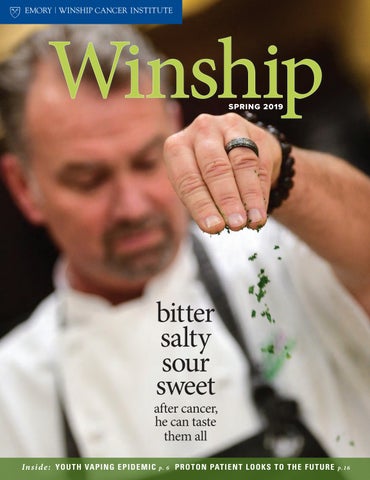
8 On the cover — When chef Scott Adair was diagnosed with a type of head and neck cancer, he was told he needed surgery to remove his jawbone and 40 percent of his tongue. But Winship gave him other treatment options, and today he's back in the kitchen, with tongue and taste buds intact. Page 8.
19
3
15
4
16 Winship Magazine | Spring 2019
From the Executive Director 2
After cancer, he can taste again 8
Fashion Forward 19
A fresh look at how we deliver research-
Advanced treatments for head and neck
Walking the runway for cancer research.
based, patient-centered care.
cancer deliver better quality of life, and an
In the News 3 CAR T-cell therapy comes through; thumbs up for the new Phase I unit; The Winship Way changes the health care landscape.
Features The vape industry: friend or foe? 6
innovative new clinic boosts multidisciplinary care. Also, a vaccine that can help prevent head and neck cancer.
High risk, high reward: the pursuit of game-changing science.
Proton patient looks to the future 16 The Emory Proton Therapy Center gave this man his best shot at treating a spinal tumor.
E-cigarettes help smokers kick the
Giving Back
habit, but can they be kept out of the
The power of endowed chairs 18
hands of youth?
Honoring high-achieving faculty.
Emory | Winship Magazine is published biannually by the communications office of Winship Cancer Institute, a part of the Woodruff Health Sciences Center of Emory University, emoryhealthsciences.org. Articles may be reprinted in full or in part if source is acknowledged. If you have story ideas or feedback, please contact catherine.s.williams@emory.edu. © Emory University
Emory University is an equal opportunity/equal access/affirmative action employer fully committed to achieving a diverse workforce and complies with all federal and Georgia state laws, regulations, and executive orders regarding nondiscrimination and affirmative action. Emory University does not discriminate on the basis of race, age, color, religion, national origin or ancestry, sex, gender, disability, veteran status, genetic information, sexual orientation, or gender identity or expression.
19-WINSHIP-0497
Point of View 20
6
Teens who use e-cigarettes are more likely to start smoking.
Website: winshipcancer.emory.edu. To view past magazine issues, go to winshipcancer.emory.edu/magazine.
Executive Editor: Judy Fortin Editor: Catherine S. Williams Art Director: Peta Westmaas
Photographer: Jack Kearse Production: Carol Pinto
Winship | From the Executive Director
Progress, Promise, and The Winship Way SINCE THE FOUNDING OF WINSHIP CANCER INSTITUTE IN 1937, OUR FOOTPRINT AND IMPACT HAVE GROWN SUBSTANTIALLY. AND WE’RE NOT DONE YET.
The phrase “bench to bedside” is more meaningful than ever as we think about how we translate vital discoveries in the laboratory into new cancer therapies.
I’ve donned a hard hat several times in the last few years as new buildings go up and older spaces get renovated. I enjoy rolling up my sleeves and getting involved in the planning process, but what I enjoy most is seeing Winship people use their creativity and passion to design spaces that improve the patient experience and help us deliver on our mission to lessen the burden of cancer in Georgia. In the past year, Winship opened the Emory Proton Therapy Center just two blocks from Emory University Hospital Midtown (EUHM). We also created a new patient-focused Phase I Clinical Trials Unit in the Emory University Hospital Tower to support the painstaking demands of rigorous clinical trials research. This spring, we completed work on the new multidisciplinary head and neck cancer clinic on the 10th floor of EUHM. Plans are also in the works to break ground next year on a new Winship at Midtown facility. We value the expanded patient access and ad-
vanced technology that these new facilities provide. Our challenge going forward is to use the space and technology well and to keep our focus on meaningful patient and employee experiences. In a project we’ve dubbed The Winship Way, we’re taking a close look at our staffing needs and our overall approaches to cancer care as best aligned with research. From breaking down silos to facilitate knowledge sharing and information flow, to fostering patient engagement and education, we are reaffirming our standards of sustaining research-based, patient-centered care. The phrase “bench to bedside” is more meaningful than ever as we think about how we translate vital discoveries in the laboratory into new cancer therapies. We are committed to providing personalized and individualized care to our patients. We are also making a promise to care for our own multidisciplinary teams by creating work environments that encourage collaboration and integration and by offering more training and professional development. Eight decades after opening our doors, Winship continues to make amazing progress that will help cancer survivors now and for years to come.
[ Winship Magazine | 2 | winshipcancer.emory.edu ]
Wally Curran
Winship | In the News
The CAR T-cell therapy experience (Inset top) Patricia Fuller in the hospital getting her re-engineered T cells. (Bottom) Back for a check-up.
PHOTOS BY ANN WATSON
SHE HAS NEVER BEEN ONE TO SIT STILL. Even at age 73, Patricia Fuller was
cells are then infused back into the patient. still cutting her own lawn (“with a hand mower, mind you, I don’t Fuller got her re-engineered cells last August. Doctors keep a have a riding lawn mower”), she's a cracker jack bowler, and she close eye on patients after treatment because some side effects can still shoots hoops, recalling her younger days as a basketball star. be severe. Like many patients, Fuller had fever, neurotoxicity, and But after 10 years in remission, she was side-lined by a recurwas vulnerable to infections. Her daughter, Leslie Woods, stayed rence of non-Hodgkin large B cell lymphoma. with her throughout the process and says it was tough. Last summer, Fuller became one of the first But by December, her doctor reported that the Winship patients to be treated with axicabtagene toxicities had resolved. “CAR T was Ms. Fuller's ciloleucel (trade name Yescarta), a Food and chance at a remission. It is remarkable that this Drug Administration (FDA) approved CAR new therapy is effective for both older and CAR T-cells attack T-cell therapy. Winship has been conducting younger patients with lymphoma,” said Edmund a cancer cell CAR T-cell clinical trials for several years, but K. Waller, Winship immunotherapy expert. the therapy only recently became available for Fuller is getting treatment for heart problems patients not on clinical trials. resulting from multiple rounds of chemotherapy T cells are a type of white blood cell essential she has received over the years, but she feels the CAR to our immune systems; the CAR stands for chimeric T-cell therapy has done its work. And she's ready to get out antigen receptor, which is a special receptor designed to bind this summer and mow her lawn.—Catherine Williams to certain proteins on cancer cells. During treatment, a patient's white blood cells are removed from the body and genetically As with all treatments, individual patient results may vary. It is important to discuss changed to recognize and kill cancerous cells. The re-engineered your cancer treatment options with your physician. [ Winship Magazine | 3 | Spring 2019 ]
PHOTOS BY STEPHEN NOWLAND
Winship | In the News
Thumbs up for the new Phase I Clinical Trials Unit “I COME EVERY WEEK, AT LEAST ONCE A WEEK, AND SOME ARE 12-
Hospital Tower, is triple the size of the original unit and expands access for patients to the critical first phase of testing new cancer I CLINICAL TRIAL FOR METASTATIC OVARIAN CANCER. therapies. It was designed by the people who use it – patients, The environment she spends those long days in matters a lot, nurses, physicians, research staff, pharmacists – so that it’s funcand recently she got a nice surprise walktional and comfortable. The new facility ing into Winship’s new Phase I Clinical specially-designed furniture, like “Thank you for the heated features Trials Unit. heated treatment chairs, and treatment “This place is impressive, it’s more seats, that’s a nice thing!” bays with full length windows that proprivate. It was well thought out,” says Alvide light as well as campus and skyline —Tom Broyles, Phase I patient exander, pictured (above right) with nurse views. Monica Goodman. “Thank you for the heated seats, that’s a nice thing!” said Tom Construction started in the summer of 2018 and on January Broyles, a Phase I patient being treated for renal cell cancer, who 7, 2019, physicians and nurses in the new unit started treating pawas also there the day the new unit opened (above center). tients. Alexander was one of the patients there that first day. Alexander, Broyles, other patients, and many enthusiastic staff The new unit, on the fourth floor of the Emory University members cut a ribbon to inaugurate the new facility. w HOUR DAYS,” SAYS PAULETTE “ALEX” ALEXANDER, WHO’S ON A PHASE
[ Winship Magazine | 4 | winshipcancer.emory.edu ]
Winship | In the News
The Winship WAY IT’S CALLED INTEGRATED FACILITY DESIGN, OR IFD, A WONKY NAME FOR A VERY DYNAMIC PROCESS THAT’S CHANGING THE WAY WINSHIP IS BUILDING
PHOTOS BY STEPHEN NOWLAND
AND RENOVATING ITS FACILITIES. IFD was used to design the new Phase
I Clinical Trials Unit and the new head and neck cancer clinic at Emory University Hospital Midtown. It’s being used to renovate clinic spaces within the Winship building on the Clifton Campus, and it’s been initiated on a grand scale for the new Winship at Midtown facility that will break ground next year. Implementing the IFD process is part of The Winship Way, a project that takes a fresh look at cancer care, with an eye toward better integration and streamlining of services, while delivering innovative research-based treatment and individualized care. IFD involves patients and families, physicians, nurses, hospital administrators, and staff in planning and designing spaces that create the best possible experience for the patient. The process begins with a day (or days) of reckoning: what are we doing now and how do we make it better?
Teams of stakeholders are brought together and armed with poster board, post-it notes, markers, and colored string. They set to work figuring out floor plans that break down silos, put the patient at the center of the work flow, and eliminate wasted movement and wasted human potential. “We’re building on the strength of our own people to create environments that allow them to do what they do best, and that is to care for patients,” says Melissa Childress, vice president of cancer services. “Their enthusiasm for this process is exciting.” In the Winship building, the second floor patient clinics are being expanded and renovated, and the ambulatory infusion center on the plaza level is being reconfigured to create a new pharmacy and to make the overall environment more pleasant for both patients and staff. The new Winship at Midtown facility is still in the planning stage, which includes building life-size cardboard models of the new spaces and test-driving them. More to come on that project. w
[ Winship Magazine | 5 | Spring 2019 ]
By Sonya Collins
EMORY RESEARCHERS, LED BY WINSHIP’S CARLA BERG, WORK TO STEM THE FLOW OF MARKETING E-CIGARETTES TO YOUNG PEOPLE.
Todd Gano smoked two packs of cigarettes a day for 30 years. He tried everything to quit: the patch, gum, Chantix, acupuncture, and hypnosis. Nothing worked. Then about 10 years ago, he heard about a device, only available in China, that let you inhale nicotine vapor without smoking a cigarette. “I got my kit from China, started vaping, and I quit smoking that day,” Gano says. When the devices – now widely known as e-cigarettes, vapes, or vape pens – hit the United States, Gano wanted to make the technology available to others desperate to quit smoking cigarettes. Today, the Atlanta businessman owns and operates VapeRite, which includes an online retailer, four brick and mortar vape shops, and VR Labs, a manufacturer and wholesaler of the nicotine-infused liquids or “e-juices” vaporized by the devices.
Public health experts have watched the growth of the U.S. vape industry with skepticism, unsure if the tobacco alternatives are friend or foe. While the products may reduce harm for smokers, they offer no benefits to the scores of young non-smokers who have gotten their hands on them. The VAPES Study (Vape shop Advertising, Place characteristics & Effects Surveillance), led by Carla Berg, associate director for Population Sciences at Winship, is following the market closely to understand the role retailers play in getting the products into the hands and lungs of young people. “How do you brand and market a product so it only appeals to a population that could potentially benefit from it – smokers – without marketing it to a population – youth – that will absolutely not get any benefit from it? That’s the question,” says Berg. In the shadow of a predatory industry The tobacco industry is known for capturing and keeping young customers. “Over the years, and throughout different regulatory
[ Winship Magazine | 6 | winshipcancer.emory.edu ]
TEEN E-CIG USERS ARE MORE LIKELY TO START SMOKING*
just how prevalent vaping is among middle-schoolers. “Six or seven boys had been doing it with him.”
START SMOKING WITHIN 6 MONTHS
30.7% 8.1%
E-CIG USER NON USER
* includes combustible tobacco products
[ cigarettes , cigars , and hookahs ] Source: National Institute on Drug Abuse
contexts, they have always managed to engage young people in their products,” says Berg, “And if there’s anything the tobacco industry knows how to do, it’s how to keep their customers.” Berg’s research seeks to determine whether the vape industry is taking a similar tack. E-cigarettes may be a potential pathway for smokers to quit, but for young people, that path moves in the opposite direction. Middle- and high-schoolers are up to three times as likely to vape as they are to smoke. Yet, once they start vaping, nearly one in three will start smoking in the next six months. Compare that to just one in 12 non-vaping teens who will become a smoker in the next six months. More than 3.6 million middle- and high-schoolers vape. Nakiema Wallace’s 13-year-old son is one of them. The Atlanta mother of three was shocked when she found her son’s vape pen in the dryer. “He’s only in middle school. I just didn’t think we were there yet.” One look at her son’s social media history showed
Shining light on gray areas Berg and her colleagues want to learn what retail behaviors are helping get these products into children’s hands. “Tobacco retailers have historically placed themselves in communities of low socioeconomic status with a high proportion of minorities and young people,” Berg says. “Whether the vape shop industry is doing the same thing is still a question.” Berg’s research team visited 180 retailers, including convenience stores and dedicated vape shops, in Atlanta, Boston, Minneapolis, Oklahoma City, San Diego, and Seattle. The researchers are examining the extent to which young people are the targets of e-cigarette sales and advertising and what’s happening at the point of sale that might discourage or encourage young people to take up the habit. The team also aims to uncover innovative ways in which retailers might get around regulations, such as the federal ban that prohibits retailers from offering free samples. “To circumvent that, they’ll charge a ‘membership’ fee of a dollar a year, which buys you as many samples as you’d like, or you can put a quarter on the bar and sample for the next two hours,” Berg says. The team’s findings could help inform FDA regulations intended to restrict youth access to the products. Friends and foes It’s too soon to tell what lessons public health officials and regulatory agencies will learn from the VAPES Study, which will continue through 2022. But there’s one thing Berg is sure of: the point isn’t to get rid of e-cigarettes altogether. “A lot of smokers are saying they benefit from them, so we don’t want to throw the baby out with the bathwater,” Berg says, “but there’s a huge concern about the public health impact.” What’s more, she adds, the vape industry is made up of both friends and foes of public health. In their visits to vape retailers around the country, the research team has found retailers that operate ethically with a mission to support smoking cessation. Gano’s VapeRite, she says, is one of them. “We check every single ID. I don’t care if you’re 18 or 80, or if you come in here every week,” Gano says. “And if you aren’t already a smoker, we’re going to say ‘This is really for people who smoke – to get them off of cigarettes. Are you sure you want to get into this?’” w
[ Winship Magazine | 7 | Spring 2019 ]
“ I’ve been a chef for 28 years. It’s my
whole life. It’s everything I do. I love it. I have the greatest job in the world because it’s never really work!”
Scott Adair started in restaurant kitchens but now, as an executive chef for SupHerb Farms, he travels the country discovering the latest food trends. [ Winship Magazine | 8 | winshipcancer.emory.edu ]
bitter, salty, sour, sweet after cancer, he can taste them all
By Dana Goldman
F
or chef Scott Adair, the diagnosis was a worst-case scenario. In 2014, he kept feeling short of breath when doing paintball with his son. “I thought I had inflamed lymph nodes or something,” he remembers. Instead, doctors gave the 49-year-old dad the news that there was a major mass in the back of his throat. A surgeon near Adair’s home in Asheville, North Carolina, told the chef that the only answer was surgery to remove his jawbone and almost half his tongue. The news put Adair into a state of shock. “My greatest tool is my tongue,” Adair says. “I make a living using my taste buds.” Would he really have to lose his tongue to save his life? When Mark El-Deiry tells people he’s director of the Head and Neck Oncology Surgery Center at Winship he invariably gets asked what that means. “I tell them head and neck cancer includes all cancer above the collarbone, except brain tumors or cancer that starts in the eye,” says El-Deiry. He and his colleagues treat cancers centered around the mouth, throat, or nasal passages: tongue cancer and cancers of the larynx, sinuses, nasal cavities, oral cavity (mouth), or salivary glands.
[ Winship Magazine | 9 | Spring 2019 ]
HEAD AND NECK
CANCER STATS • More than 65,000 men and women diagnosed in 2017. • More than twice as common for men as women. • At least 75% associated with tobacco and alcohol. Source: The National Cancer Institute
Given their sensitive location, these cancers are difficult to treat and often debilitating. Unless doctors address them with the most advanced and targeted treatments, head and neck cancers also have the potential to be disfiguring and can impair a person’s ability to swallow, taste, smell, and talk. But increasingly, there are alternatives. Many head and neck cancers can be treated using noninvasive and less-scarring technologies. Now, as Winship’s head and neck experts move into a new multidisciplinary clinic at Emory University Hospital Midtown (EUHM), they’re even more determined to catch and treat head and neck cancer for patients throughout Georgia and the Southeast.
HEAD AND NECK
CANCER AREAS
A
Sinuses Nasal cavity Oral cavity
the Winship team gave him the good news that advanced radiation and chemotherapy would be enough. They warned him, though, that he’d lose his taste buds, at least for a period of time. Adair and his family moved to Atlanta for seven months so that Adair could undergo radiation and chemotherapy at Winship. The treatment worked, but Adair spent several months waiting nervously for his taste buds to return. They came back one at a time: first, salt. Then bitter, then sour. The last one was sweet. “I knew I was ok when I took a bite of chocolate cake and it tasted so great!” Today, Adair is back in Asheville, cancer-free, and pursuing his passion as a chef. He says his sense of taste is stronger than ever. “I can pinpoint all kinds of great flavor notes,” he says with relief. “I’m back to doing the job I love.”
Nasopharynx
Tongue
Oropharynx
Salivary glands
Hypopharynx
Larynx
Adair met El-Deiry when he came to Winship for a second opinion. Would the chef have to lose his tongue? The answer was no. Adair was evaluated by Nabil F. Saba, director of Winship’s Head and Neck Cancer Medical Oncology Program, and radiation oncologist Jonathan Beitler, and [ Winship Magazine | 10 | winshipcancer.emory.edu ]
dair was lucky his diagnosis happened quickly. In 2017, Rayford Cleveland, a retired mechanic, began noticing his voice was hoarse. Over the course of months, it became more and more hoarse. “My voice kept getting worse and worse until I couldn’t even talk,” he remembers. His doctors gave him antibiotics that didn’t help. By Thanksgiving, his voice was barely audible. If chef Scott Adair is a new face of head and neck cancer—young with limited exposure to known carcinogens—Rayford Cleveland may fit a more traditional profile. Until about 20 years ago, most head and neck cancers were associated with tobacco and other carcinogens, and largely occurred in adults over the age of 60. Cleveland, now in his 70s, smoked cigarettes and was exposed to the toxin Agent Orange while serving in the military in Vietnam. Despite his risk factors, Cleveland was not diagnosed properly for months as
Therapist Hannah Cornett checks Rayford Cleveland and gives some tips on swallowing technique.
multiple doctors tried to make sense of his hoarseness. Finally he was diagnosed with stage III cancer of the vocal cords and came to Winship for treatment. If Cleveland had been given the same diagnosis 20 years ago, he most likely would have undergone surgery to remove his larynx, making speech incredibly challenging. Winship doctors didn’t think such surgery was necessary but also didn’t think Cleveland could withstand chemotherapy. Immunotherapy specialist Nabil Saba explains, “Because he is older than 70, he is considered a somewhat high risk for the standard chemotherapy. Instead, we looked for an option that would be better tolerated for him.” Winship doctors found a clinical trial combining radiation and immunotherapy that was a good fit for Cleveland. Immunotherapy works by enhancing the immune system’s ability to recognize abnormal cancer cells and kill them, and it can cause
fewer and less intense side effects than chemotherapy and radiation. Saba says immunotherapy is proving to be a literal lifesaver (and quality-of-life saver) for many patients like Cleveland whose bodies may not tolerate chemotherapy or for those whose cancer has been unresponsive to traditional chemotherapy and radiation. “Head and neck cancer is very difficult to treat and has a significant mortality rate—especially if the cancer comes back after radiation and chemotherapy,” says Saba. “But now with immunotherapy we have a novel treatment that improves survival rates while preserving quality of life.” Cleveland finished his treatment at the end of 2018 and is now disease-free. “Finding out the cancer was gone was one of the greatest moments I’d ever had,” says Cleveland. “I’m just so thankful.” He’s back to cooking, gardening, and doing his own yard work and housework—as well as speaking with ease. [ Winship Magazine | 11 | Spring 2019 ]
Both Cleveland and his doctor are optimistic about the future. “I am hoping that Mr. Cleveland will have long-term disease control and cure,” says Saba. While immunotherapy is still primarily being used for patients who’ve already tried other treatments, Saba is continuing research efforts through clinical trials combining immunotherapy with chemotherapy and radiation. He says that immunotherapy will likely become the new standard of treatment for patients with newly diagnosed or early stage diagnoses in the near future. “It’s a game changer,” says Saba. “It’s changing the landscape of treatment completely.” Research advances leading to effective, less toxic treatments like immunotherapy promise long-term control of disease, even for some patients who were deemed incurable as recently as a few years ago. Winship’s team is at the forefront of new treatments that improve longevity and have better quality-of life outcomes. Proton therapy
CLINIC STATS • 1 0,000 square feet dedicated to head and neck cancer patients. • Central care station instead of closeddoor offices. • 22 rooms for patient care and consultation. • Medical, radiation, and surgical oncologists together in the same clinic. • Support staff all specializing in head and neck cancer.
(Left to right) Nabil Saba, Mark El-Deiry, and Jonathan Beitler toured the new clinic as it was being built.
[ Winship Magazine | 12 | winshipcancer.emory.edu ]
Many staff members work together in the new clinic. (Top, left to right) Social worker Avril Phillips, oncology nutritionist Tiffany Barrett, nurse practitioner Ashley Parrish. (Bottom) Speech therapist Hannah Cornett (left) and nurse April Meche (right).
THE NEW 10,000-SQUARE FOOT HEAD AND NECK CLINIC ON THE 10TH FLOOR OF EUHM has 22 patient care rooms that may be used for ap-
pointments with any physician or healthcare provider at any time— so patients can stay put in one space and have multiple providers come to them during a single appointment. Doctors work from a central care station with other care team members rather than in closed-door offices. In addition to the medical, radiation, and surgical oncologists, the clinic is fully staffed with speech therapists, clinical trial researchers, advanced practice nurses, physician assistants, social workers, dietitians, nutritionists, and dentistry experts, all specializing in head and neck cancer. [ Winship Magazine | 13 | Spring 2019 ]
is another advanced treatment that can effectively treat some head and neck cancer patients and preserve quality of life. Winship started treating patients at the Emory Proton Therapy Center in late 2018 and is the only cancer center in Georgia offering proton therapy. Proton therapy is a very precise form of radiation that targets the tumor and has minimal effect on healthy tissues surrounding it. Mark McDonald, Winship radiation oncologist and medical director of the Emory Proton Therapy Center, says proton therapy can reduce long-term side effects like dry mouth that can affect a patient’s ability to talk, swallow, and taste. Winship radiation oncologist Jonathan Beitler treats head and neck cancer patients with both traditional radiation therapies and with proton therapy (Scott Adair is one of his patients but did not have proton therapy), so he divides his time between EUHM and the Emory Proton Therapy Center. He says proton therapy has great potential for patients whose cancer has come back after chemotherapy and traditional radiation. “If someone’s cancer comes back, most of the time the recurrences are near critical areas, making surgery impossible,” he explains. “But the precision with which we can deliver proton therapy to address the recurrence is breathtaking.”
W
inship specialists, who care for more than 50 percent of head and neck cancer patients from throughout the state, often diagnose cancers that other doctors miss. Part of the challenge of accurate diagnosis and prompt treatment relates to shifting risk factors. The good news is that fewer people are smoking cigarettes, the most common cause of head and neck cancers. The not-so-great-news is that human pap-
illomavirus (HPV), the most common sexually transmitted infection, is now a leading cause of head and neck cancer. (See sidebar on HPV vaccination, page 15.) The CDC reports that HPV is so common that almost all people who are sexually active may get it at some point, though most people are asymptomatic. At the time of his diagnosis, chef Scott Adair discovered that his cancer was related to HPV. “I didn’t even know I had HPV,” recalls Adair now. “I was blown away. I didn’t know what to think.” Adair may have been surprised by the link between HPV and his cancer diagnosis, but Winship doctors are not. “Most adults who are sexually active have probably been exposed to the virus and never know it,” says El-Deiry. Research about HPV-related head and neck cancers is advancing rapidly as scientists—including those at Winship—collect more and more data. Today HPV-related head and neck cancers are considered among the most treatable. Specialization enables the team to more quickly and correctly diagnose patients, implement an effective treatment plan, and achieve better outcomes. “If you see two head and neck patients a year, you won’t be as experienced as if you’re seeing 15 to 20 head and neck patients per day,” explains Saba. Beitler adds, “We have an enormous team with a depth and breadth that is very hard to reproduce at a small hospital.” The head and neck cancer specialists at Winship make the most of that depth and breadth through weekly multidisciplinary meetings called tumor boards, where they work together as a team to review each
patient’s care. “Head and neck cancer needs collaboration between experts,” explains Saba. “Together, we need to agree on a treatment plan.” While Beitler, Saba, and El-Deiry all have their specialties within the head and
team members in one day and in one place result in better clinical outcomes. That’s no surprise to Saba. “When we go in to see the patient at the same time and have a common plan, confusion is reduced, mistakes are reduced, and clarity is improved.”
T
neck cancer treatment team, all three are united in their efforts to improve patient experience and quality of life after treatment. “A lot of times when a patient comes in with cancer, the anxiety level is super high,” says Beitler. “It’s literally a life-threatening problem and anything we can do to make the process easier is important. We try to be responsive to patients on the physical level as well as the emotional level.” For many patients, physician collaboration makes the difference between a cohesive, comprehensible treatment plan, and confusion. Studies show that multidisciplinary clinics where patients see all [ Winship Magazine | 14 | winshipcancer.emory.edu ]
o that effect, a new head and neck cancer clinic recently opened in Emory University Hospital Midtown based on the knowledge that patients do better when clinicians can interact and collaborate. “We didn’t design a physician-centered clinic,” says El-Deiry. “We designed a better place for patients to see physicians, not for physicians to see patients.” When Cleveland and Adair first step foot into the new clinic, they will do so as cancer survivors getting regular follow-up checks rather than as cancer patients. Adair will come, as he often does, bearing cupcakes for the staff as a sign of his gratitude. “I love Winship, man,” he says. “Dr. Beitler has become like a friend to me and the staff are angels on this earth.” These days, Adair shows his gratitude by spreading the word about HPV prevention and running a nonprofit literacy-focused camp called Bound for Glory to support low-income children with learning differences. He credits Winship for it all. “I probably would have never done any of this if I hadn’t had cancer.” He not only has his life back, but is determined—like his doctors—to help the lives of others. w As with all treatments, individual patient results may vary. It is important to discuss your cancer treatment options with your physician.
* 45.7
ACCORDING TO THE CDC, ONLY
percent
OF ADOLESCENTS IN GEORGIA COMPLETED THE HPV VACCINE SERIES BY AGE 17 IN 2016.
What Georgians know about HPV ers dug deep into rural areas throughout Two common misperceptions about HPV Georgia and talked to parents, health care (human papillomavirus): only women get providers, religious and community leadcancers from HPV infection; if you don’t ers, and to the adolescents themselves, have symptoms of HPV infection, then you to find out what they know about HPV and haven’t been exposed to the virus. what information is needed to help people Adrian King, coordinator of a Winship understand the value of HPV vaccination. project that researched attitudes about According to the CenHPV vaccination in ters for Disease Control Georgia, heard these and Prevention (CDC), misconceptions and HPV is the most common many more when he sexually transmitted conducted 23 focus infection in the United groups around the States. It’s known to be state and a survey of the most common cause 700 Georgia parents of of cervical cancer and is 9 to 17-year-olds. now thought to be assoThe project, led by Adrian King (left) and Robert ciated with 70 percent of Robert Bednarczyk, Bednarczyk led a team of oropharyngeal cancers Winship member and researchers who gathered data HPV researcher in (back of the throat, from throughout Georgia. Emory's Rollins School including the base of the tongue and tonsils), which of Public Health, are affecting younger people, particularly was launched in 2017 by a grant from the National Cancer Institute (NCI) that men ages 40 to 55, in greater numbers. The HPV vaccine is most effective when is a supplement to Winship’s NCI Cancer Center Support Grant. Working closely with given to boys and girls at ages 11 to 12, but vaccination rates are low.* King, a public regional cancer coalitions, the research[ Winship Magazine | 15 | Spring 2019 ]
health program associate at Rollins, says their research showed that parents think their children are too young to be vaccinated against a sexually transmitted virus. Other findings point to a general lack of information and knowledge about vaccinations and a disconnect in communication between doctors and parents. Although health care providers reported that they “strongly recommended” the vaccine to parents, parents didn’t remember hearing that message. Bednarczyk says the research highlights the importance of understanding belief systems and how people make decisions. Discussing people’s misconceptions, he says, is more effective than dismissing them: “Everybody is trying to do the best for their children. We’ve discovered that it’s not just what we’re communicating, but how we’re communicating it.” King says he’s keen to take the next step and use the research and momentum of the project to develop messages and tools to communicate them. Bednarcyzk says they’re hoping for two grants to come through that will enable them to do that. w
ZACK USILTON
LOOKS TO One of the first patients treated at THE FUTURE the Emory Proton Therapy Center By Sonya Collins
When Zack Usilton learned, at age 25, that he had a tumor tangled up in the nerves at the base of his spine, his choice was clear. He would have surgery regardless of the risks. “The doctor said there were thousands of nerve [linings] back there and that no one knows what they go to,” Usilton recalls. “I did it knowing that it might damage my ability to walk, to feel my fingertips, or anything else, and there was the chance that they wouldn’t scrape away every last tumor particle. I guess in a way, I played the odds.”
Zack and Anne Usilton, pictured here with 2-year old Caroline, are expecting their second child in May.
“I didn't want to take the risk of a second surgery, but I had major concerns about radiation and its long-term effects.” —Zack Usilton
Back then, the Atlanta native only had himself to worry about. Playing the odds was his prerogative. Ten years later, when the tumor came back, Usilton had a wife, a daughter, a new house under construction, and another child on the way. And he wasn’t crazy about either of his options: another chancy surgery or radiation. The former brought with it all the same risks as the first time, including months of recovery and potential loss of bladder or bowel function, and the latter upped his odds of more cancer later in life. “I didn’t want to take the risk of a second surgery, but I had major concerns about radiation and its long-term effects,” Usilton says. That’s when family friend, retired Winship radiation oncologist Ian Crocker, told Usilton about the newly opened Emory Proton Therapy Center. Proton therapy reduces the exposure of surrounding healthy tissue to unnecessary radiation while delivering the prescribed dose of radiation directly to the tumor. In Usilton’s case, the most advanced X-ray plan delivered radiation to a volume of normal [ Winship Magazine | 16 | winshipcancer.emory.edu ]
tissues more than four times larger than the proton treatment plan. Avoiding radiation to normal areas means a lower risk of developing new cancers later and can reduce side effects from radiation. “Proton therapy is about reducing unnecessary radiation in cases where we can reduce or avoid some of the side effects and risks of therapy,” says Mark McDonald, medical director of the Emory Proton Therapy Center, who described Usilton as a perfect candidate for such treatment. “Someone who is young like Zack stands to benefit greatly from proton therapy by reducing the risks of longterm consequences of therapy, and in his case we were also able to avoid any nausea or diarrhea during treatment by avoiding delivery of any radiation to the intestines.” Usilton was one of the first patients at the new center. The treatments, every weekday for six weeks, took less than one hour of his day. As for options that would bring Usilton the greatest odds of a long life with his wife and children, he says, “proton therapy was my best bet.”
Usilton is positioned so that the nozzle apparatus delivering the proton beam can rotate 360-degrees around the treatment table. CT scanning is also built into the nozzle in order to pinpoint the exact areas that need to be targeted.
THE POWER OF THE ROOM Within five minutes of his arrival at the Emory Proton Therapy Center every day, Usilton was escorted back for the painless procedure. He was glad that the treatment room was a wideopen area that patients walk right into, a far cry from the claustrophobic conditions of an MRI machine. “It’s something out of a movie. When you walk in, you can feel the power of the room.” Protons themselves strike a tumor more precisely than traditional radiation, and the experience as a whole was customized precisely for Usilton. Before his first session, staff custom molded a cushion under Usilton’s head and legs to help position him on the table and make it as comfortable as possible. During treatment sessions, which lasted only a few minutes, staff played Usilton’s music picks. “You’re comfortable. You’re greeted by friendly faces,” he says. “They slide me under the machine and then – I don’t even know that the treatment has happened – they say, ‘All right, time to go.’” Proton therapy didn’t cause any serious side effects for Usilton, although he did experience fatigue. “The minute I put my daughter down at night, I crash pretty quickly. If the worst
thing that happens is going to bed at eight rather than 10 or 11, that’s pretty good.” That’s a relief for Usilton’s wife Anne, too. She says the thought of another surgery was scarier to her than the cancer itself. She was friends with Usilton when he had surgery 10 years ago and still remembers it. “It was so debilitating; I just didn’t want to see him in pain again.” She saw no pain at her husband’s last treatment in March. “It’s easy to see that everyone loves what they do. They’re very passionate about it. That makes the whole process easier, especially for people in far more difficult situations than Zack’s.” LOOKING AHEAD The tumor at the base of Usilton’s spine will not simply melt away. That’s the nature of the tumor, not the treatment. But proton therapy could prevent it from ever growing again. Usilton and his doctors will watch it through follow-up MRIs – just as they have done for the last 10 years. Usilton goes in for his first post-treatment scan in May. But those results will surely be upstaged by some other news expected that month. “We don’t know whether it’s a boy or a girl,” Usilton says. “It’s a ton of fun to be surprised. I’ll be the first to know.” w
[ Winship Magazine | 17 | Spring 2019 ]
Winship | Philanthropy
THE SECRET POWER OF ENDOWED CHAIRS AND PROFESSORSHIPS by Megan McCall
Endowments of $2 million for chairs and $1 million for professorships raise the caliber of research at an academic institute.
WITHIN THE FIRST TWO MONTHS OF 2019, FOUR ENDOWED CHAIRS AND PROFESSORSHIPS WERE BESTOWED ON WINSHIP PHYSICIAN-SCIENTISTS AND RESEARCHERS. Winship
Senior Director of Research Administration Kim Kerstann says they are the best tools for retaining and recruiting competitive faculty and lead to stronger collaborations, a better understanding of cancer, and better treatment options for patients. Endowed chairs and professorships give faculty the ability to purchase more lab resources and free up time for more research. These extras become invaluable as faculty take on more research projects, mentor more students, and publish more research papers.
The endowments, usually $2 million for endowed chairs and $1 million for endowed professorships, are typically targeted to a research program or disease focus. The chair or professorship recipient receives an annual allocation of funds and a prestigious academic title. These perks reward high achieving faculty with critical salary and research support that expands opportunities for scientific exploration and draws students looking to work in the best labs and collaborate on cutting-edge research. “Recipients of endowed chairs and professorships are esteemed faculty members who are recognized for their expertise in key areas of teaching, research, or service,” says Kerstann. “Chosen faculty have an established track record for scholarship and a national or international presence.” Honoring faculty with endowed appointments supports a competitive academic environment and encourages scientific discoveries that change the face of cancer treatment. w
(Top left) Madhav Dhodapkar (left), director of Winship's Center for Cancer Immunology, received the Anise McDaniel Brock Chair. John Brock (right) was one of the Brock family members attending the ceremony. (Top right) Edmund K. Waller (left), director of Winship's Bone Marrow and Stem Cell Transplant Program, with Rein Saral (right), Winship Professor Emeritus, receives the Rein Saral, MD Professorship in Cancer Medicine. (Bottom right) Jing Chen (right), director of the Division of Basic and Translational Science, is honored by R. Randall Rollins (left) with the R. Randall Rollins Chair in Oncology. (Bottom left) Winship Executive Director Walter J. Curran, Jr., (left) with Sagar Lonial (right), Winship chief medical officer and chairman of the Department of Hematology and Medical Oncolgy. Lonial received the Anne and Bernard Gray Family Chair in Cancer.
[ Winship Magazine | 18 | winshipcancer.emory.edu ]
FASHION
1
FORWARD
NEARLY 550 GUESTS ATTENDED THE 7TH ANNUAL FRIENDS OF WINSHIP FASHION A CURE FASHION SHOW AT THE ST. REGIS ATLANTA. The event raised over $360,000 in support of women’s cancers and immunology research at Winship Cancer Institute. Special guest speaker Barbara Dooley entertained the crowd with colorful anecdotes about her life married to Vince Dooley, one of college football’s winningest coaches, and as a cancer survivor. On the runway, volunteer models wore clothes donated by local boutiques. In the last six years, the Fashion a Cure Fashion Show has raised over $1.3 million for research targeting
2
3
women’s cancers. (1) Jordan Sneed honored a loved one touched by cancer by walking the runway. (2) Winship Executive Director Walter J. Curran, Jr., flanked by (left to right) event co-chairs Peggy Lientz and daughters Shannon Kollme, Mary Kathryn Green, Margaret Anne Masters; Georgia's First Lady Marty Kemp. (3) Marty Kemp, Walter J. Curran, Jr., Barbara Dooley. (4) Winship Associate Director for Population Sciences Carla Berg. (5) Winship Associate Director for Basic Research and Shared Resources Adam Marcus.
4
Roses carried by models symbolized their status as survivors (red), family members (yellow), or Winship faculty or volunteers (white). [ Winship Magazine | 19 | Spring 2019 ]
5
Winship | Point of View
High risk, high reward By Adam Marcus
Every four months, 30 scientists and physicians from around the
This is research that is not only moving the field forward,
country gather for a 2-day intellectual marathon that decides the fate of cancer research across our nation. We discuss, critique, and
defend the ideas of our peers to determine whose research we think will have the
but is actually
greatest impact on beating cancer. These proposals that we review for the National
creating the
Institutes of Health are enormous undertakings, where even to be in contention,
field.
years of supportive research and early-stage funding have already been completed. [ Winship Magazine | 20 | winshipcancer.emory.edu ]
* State-of-the-art light microscopy images produced in the Integrated Cellular Imaging Core, a shared resource. Young researchers from Winship labs competed with each other to come up with these unique images.
Emily Summerbell won first place for imaging tubulin (purple) and DNA (blue) in cancer cells.
Brandon Ware got second place for staining a stellate cell isolated from a pancreatic tumor.
Cara Schiavon was a runner-up for showing structures in mouse embryo fibroblasts.
At Winship, we specialize in these early
thropic funds from its annual Winship Win
for research, and, most importantly, passion
investments that support high risk, poten-
the Fight 5K event, Winship supported this
to make a difference in the lives of patients.
tially paradigm-shifting research when it is
research when it was an idea drawn on a
We know, however, that passion does not
just an idea. One way we do this is through
whiteboard outside of Boise’s office. This ear-
mean success and that some, if not many,
Winship Invest$, a peer-reviewed program
ly investment supported a genomics expert,
of these ideas will fail. But that one idea
designed to fund novel, innovative research.
Ben Barwick, who sifted through huge clini-
that has the potential to be a game changer
We look for adventurous and unique
cal and molecular datasets on these patients.
is motivational and keeps us coming back
research ideas early on that could impact
This effort paid off and the team ended up
for more. It is a difficult feeling to explain
our understanding, prevention, treatment,
discovering a new marker of poor prognosis
but the closest analogy is perhaps related
or diagnosis of cancer. For me personally,
in patients previously thought to have that
to golf: research is similar to hitting golf
this is research that is not only moving
“good” prognosis. In the future, doctors
balls into the lake, into the weeds, into the
the field forward, but is actually creating
could determine which patients test positive
sand trap, or not even hitting the ball at all
the field. Questions that are unanswered,
for the marker and be treated differently
(I’m very experienced with this). But, that
and perhaps have never been asked before,
with the hope of prolonging their lives.
great one, the one shot that feels and sounds
fall into this category. These answers will
Part of our mission at Winship is to less-
perfect, that shot keeps golfers coming back
drive research not only at Winship, but in
en the burden of cancer through this type
for more and ready to play again. In science,
laboratories around the country. In this way,
of high risk/high reward research. I know I
we have many misses, but it is the great ones
groundbreaking ideas become a collective
speak for many of us that these big ideas are
that we all strive to create, be a part of, and
effort to spawn new insights into cancer that
created out of a passion for science, passion
deliver to patients. w
can guide clinical practice. A great example of this is a unique partnership formed by Winship researcher Larry Boise and Winship clinician Sagar Lonial. Over the past few years, these two multiple myeloma experts have teamed up to decipher why patients who had what was considered a “good” prognosis, unexpectedly died early in their treatment. Using philan-
As Associate Director for Basic Research and Shared Resources,* Adam Marcus provides oversight and direction for the development and growth of Winship's shared resources and its basic scientific activities across all of Winship's four research programs. Marcus also directs a research lab studying non-small cell lung adenocarcinomas, which make up the largest group of lung cancer types. The lab focuses on how mutations of the lung cancer tumor suppressor protein and epithelial signaling protein, LKB1, impact metastasis, and how this information can help develop new treatments specific to LKB1-inactivated tumors. [ Winship Magazine | 21 | Spring 2019 ]
1365-C Clifton Road N.E. Atlanta, GA 30322 winshipcancer.emory.edu 1-888-Winship
Printed by an FSC-certified printer using sustainable methods that reduce waste and volatile organic compound (VOC) emissions. Paper is a 50% PCW recycled sheet, sourced from a certified managed forest
Run, walk, cheer! Join us Oct. 5, 2019 for the 9th annual Winship Win the Fight 5K Run/Walk: winship5k.emory.edu