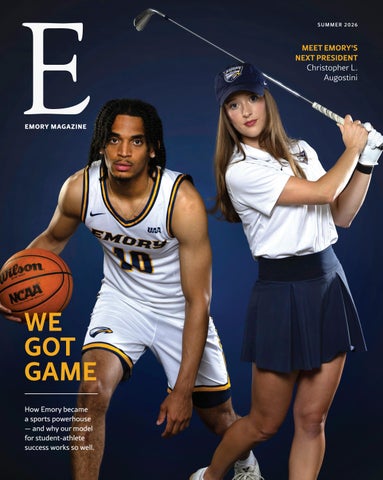
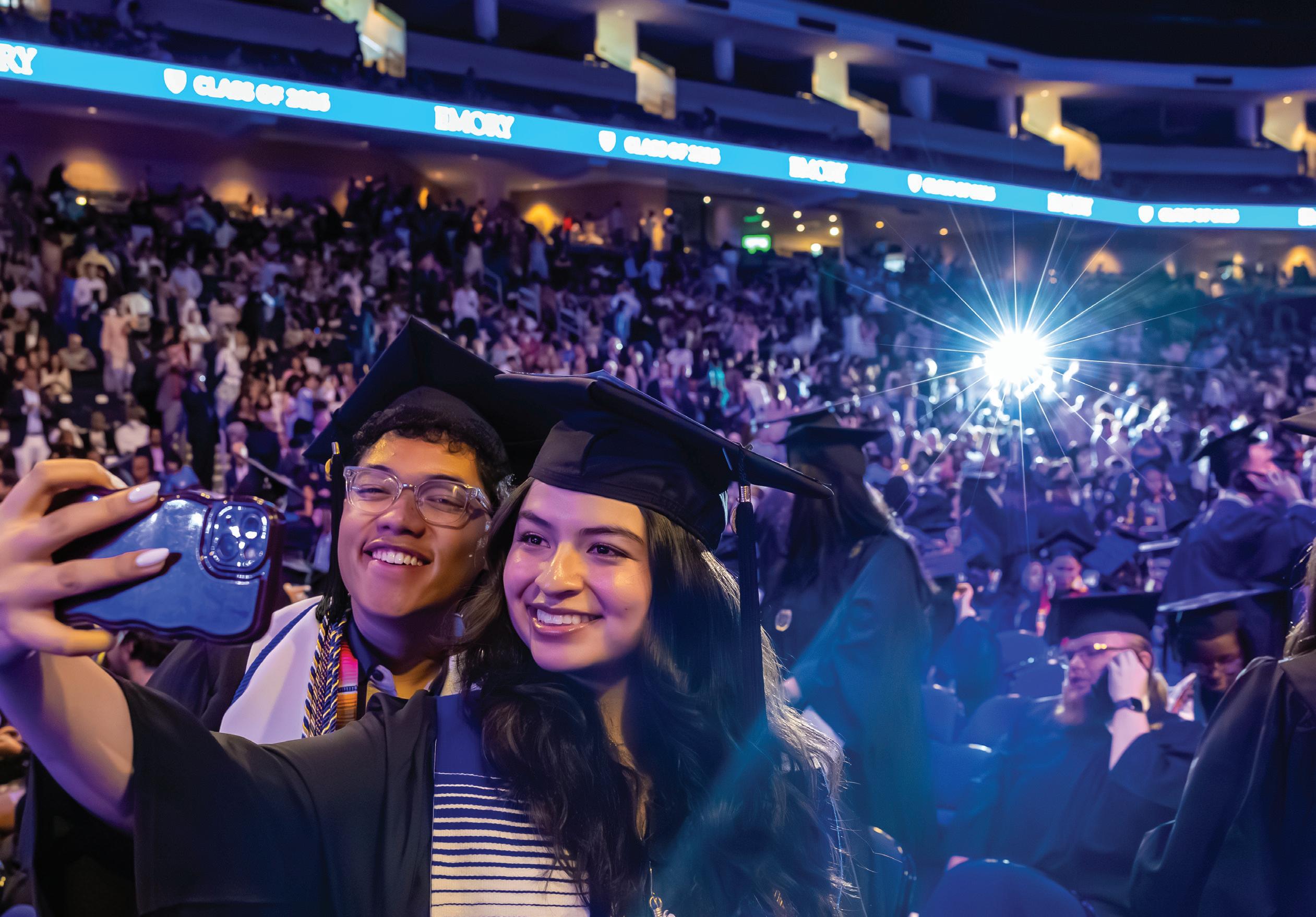
How Emory became a sports powerhouse — and why our model for student-athlete success works so well.
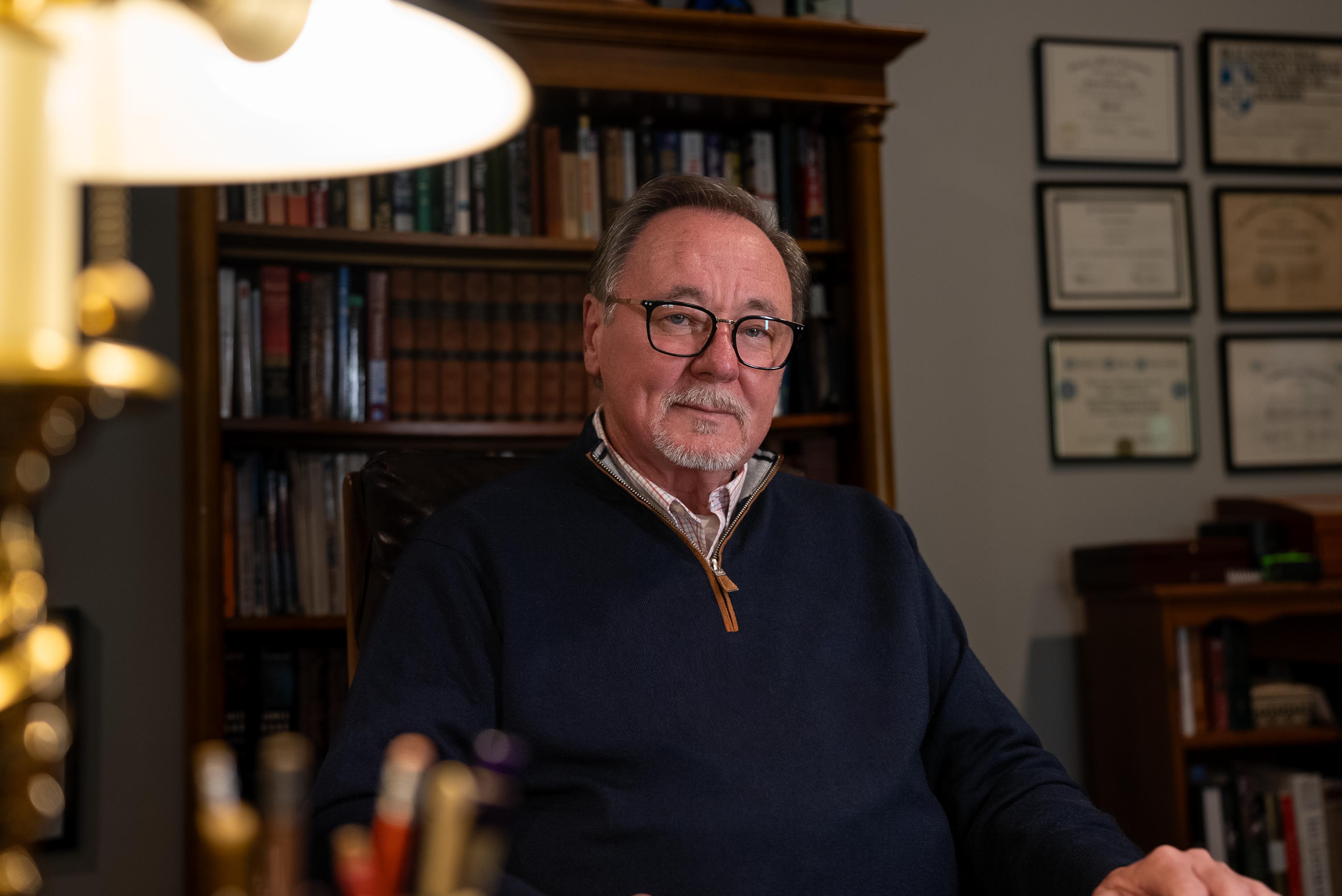
MEET EMORY'S NEXT PRESIDENT
Christopher L. Augostini
What
do a former
PRIME MINISTER , T HE CEO OF UNICEF, AND A TWO-TIME UNICORN FOUNDER
have in common?
4 AUGOSTINI NAMED EMORY PRESIDENT
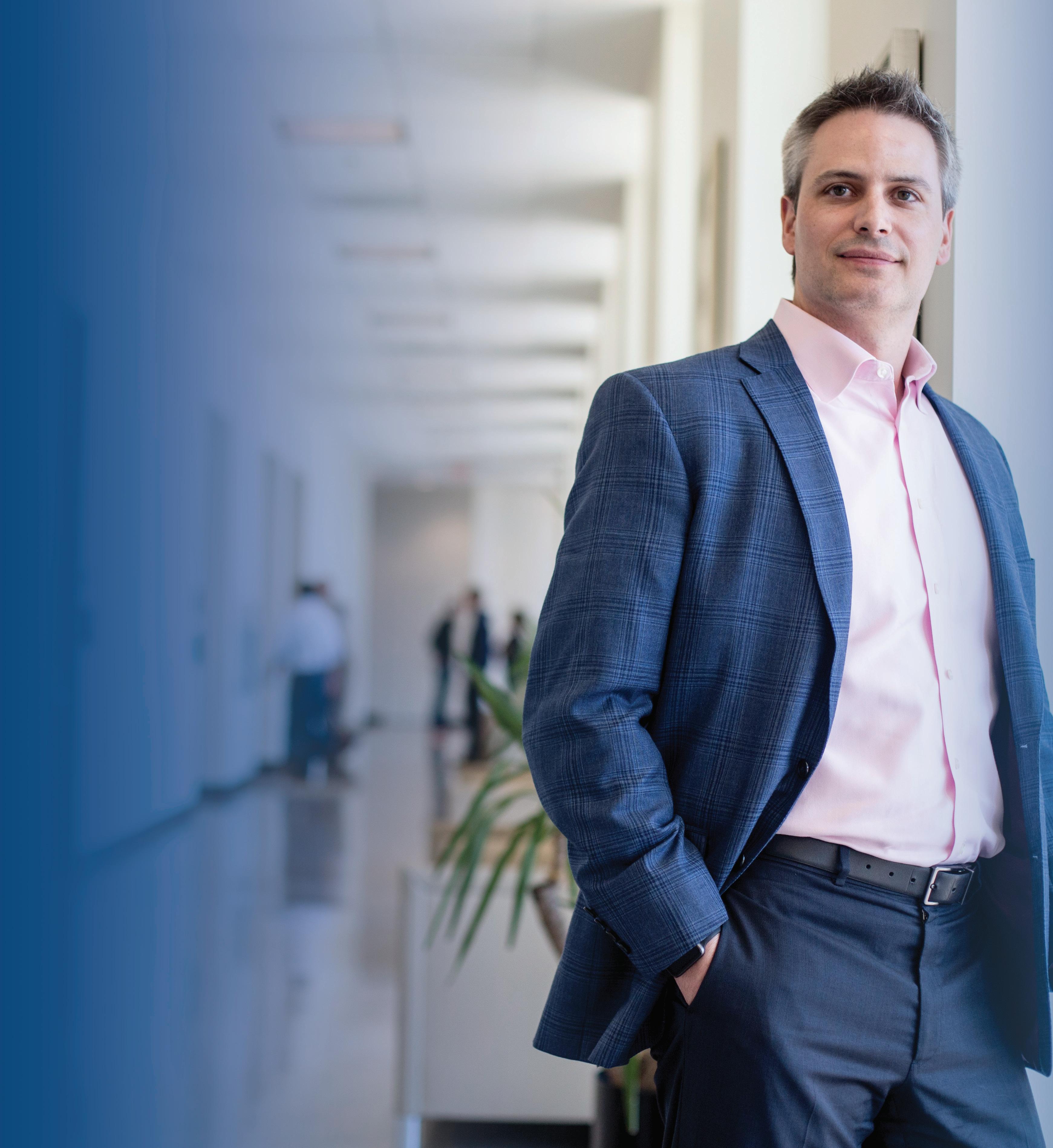
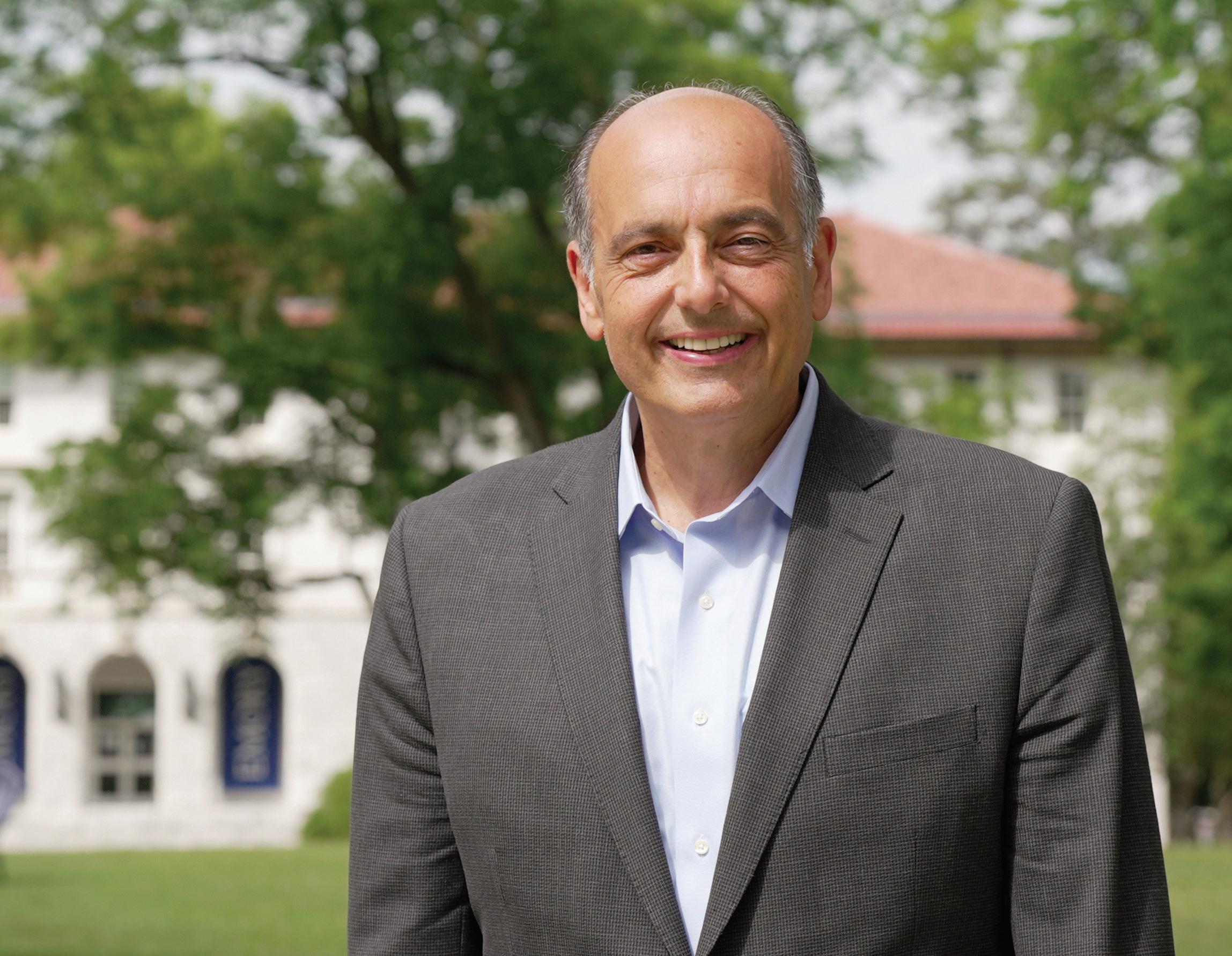
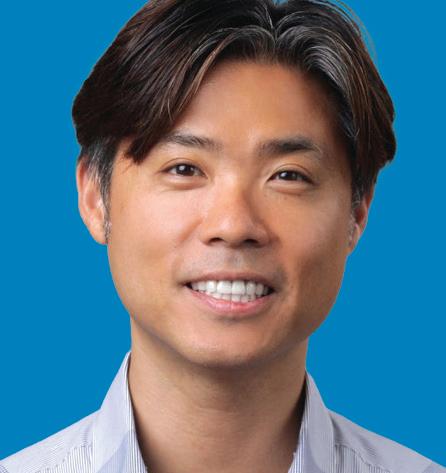
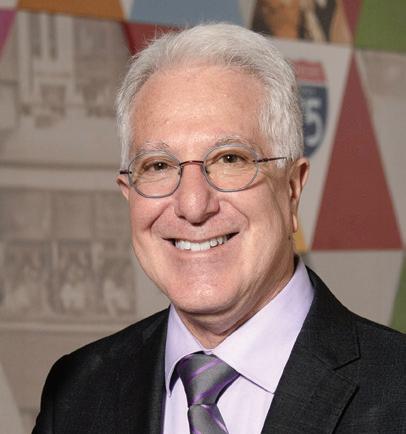
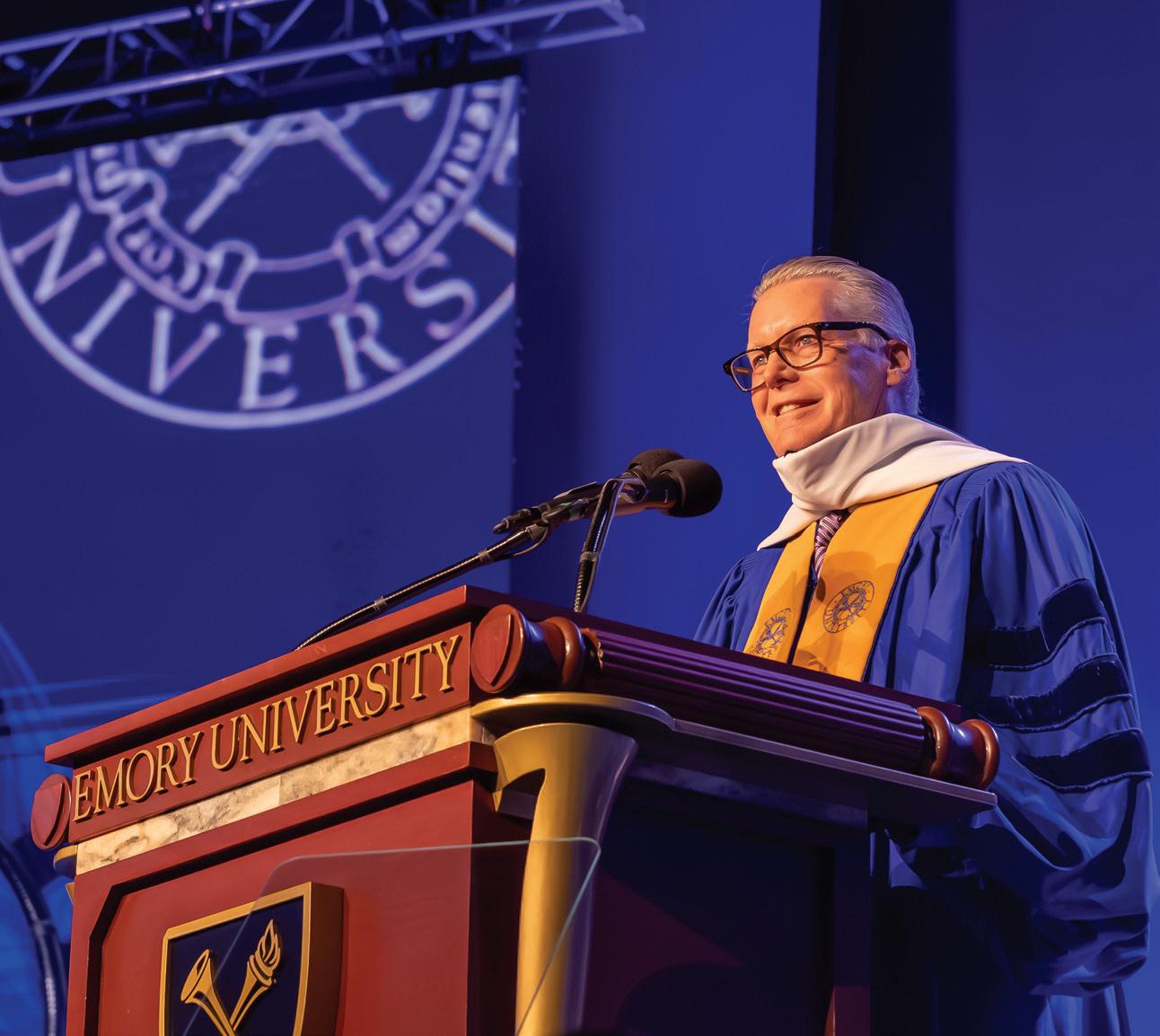
Christopher L. Augostini, executive vice president and chief operating officer, was unanimously appointed to be the university’s 22nd president.
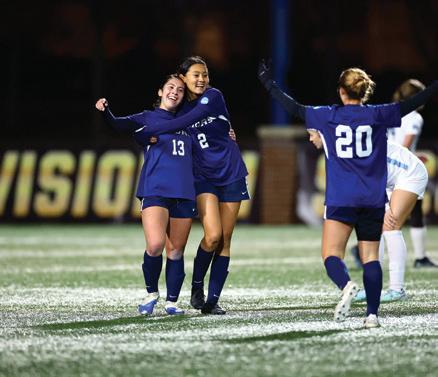
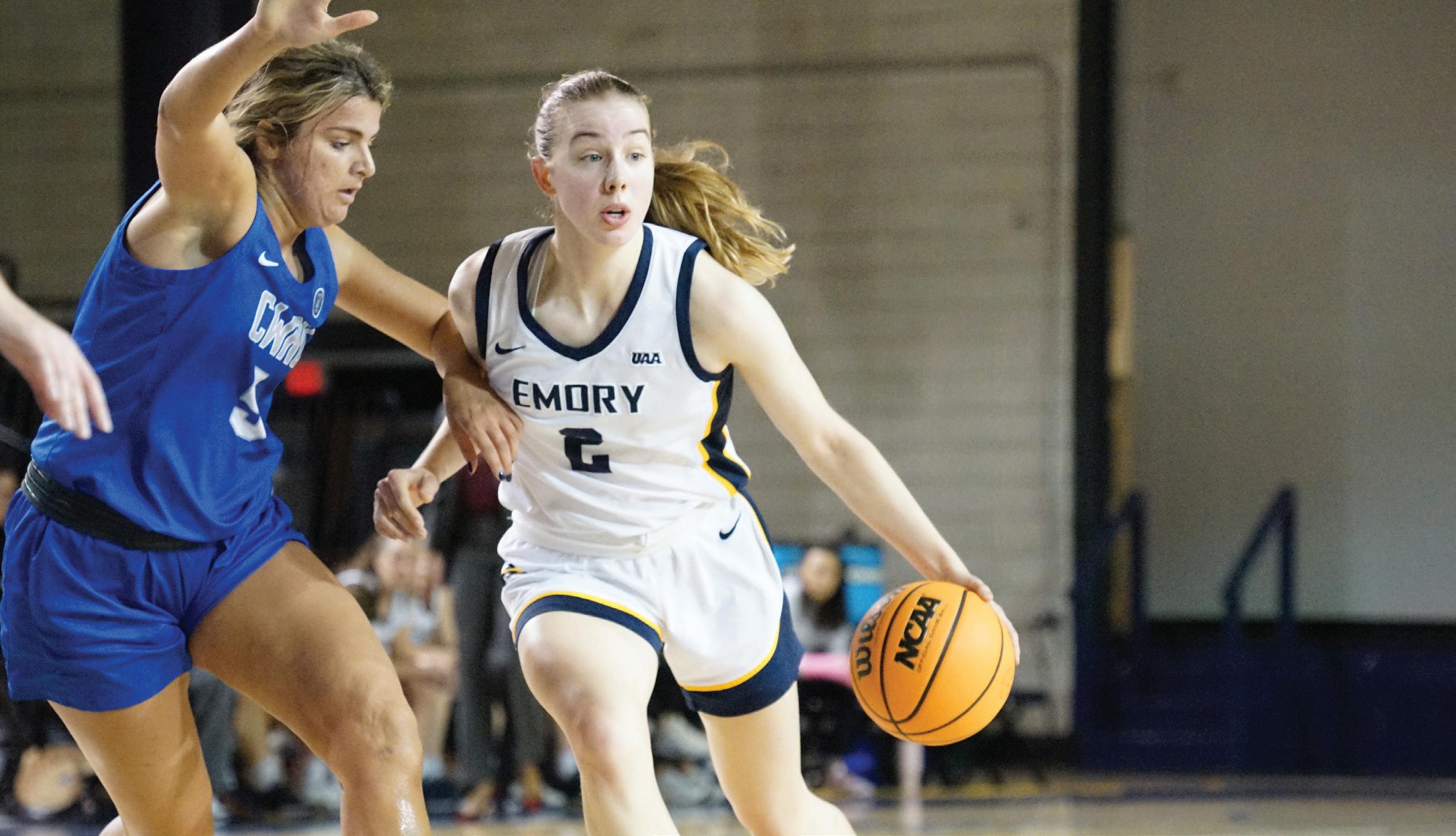
WE GOT GAME
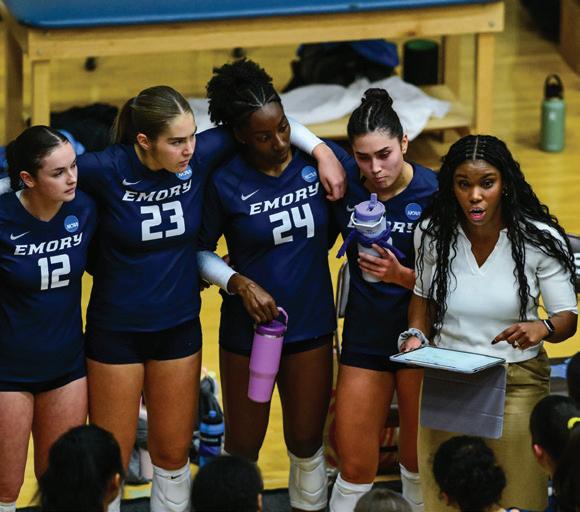
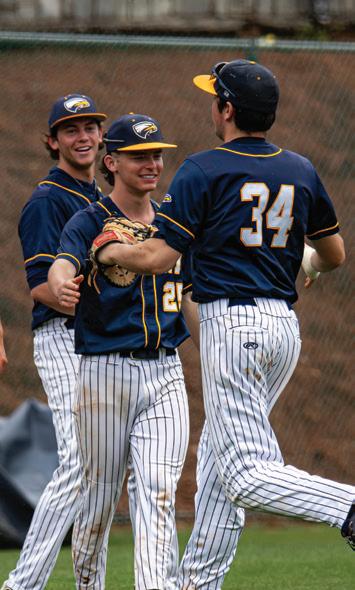
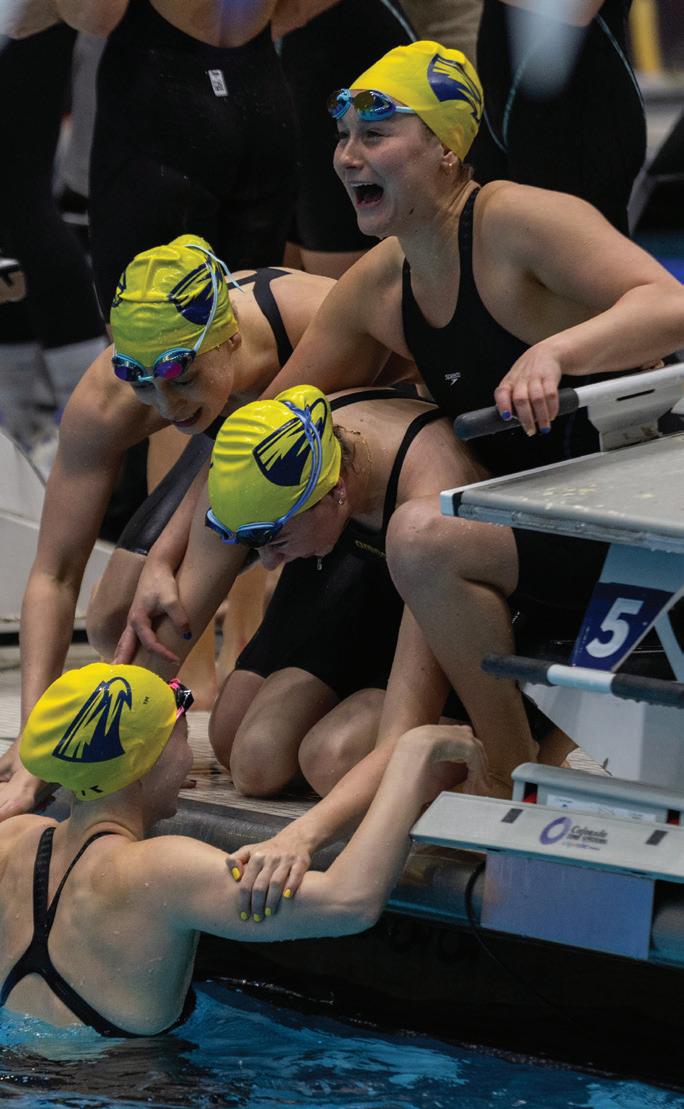
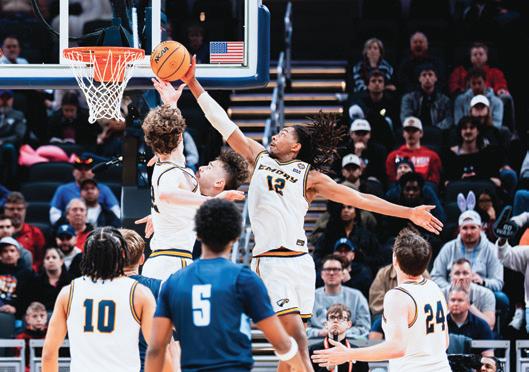
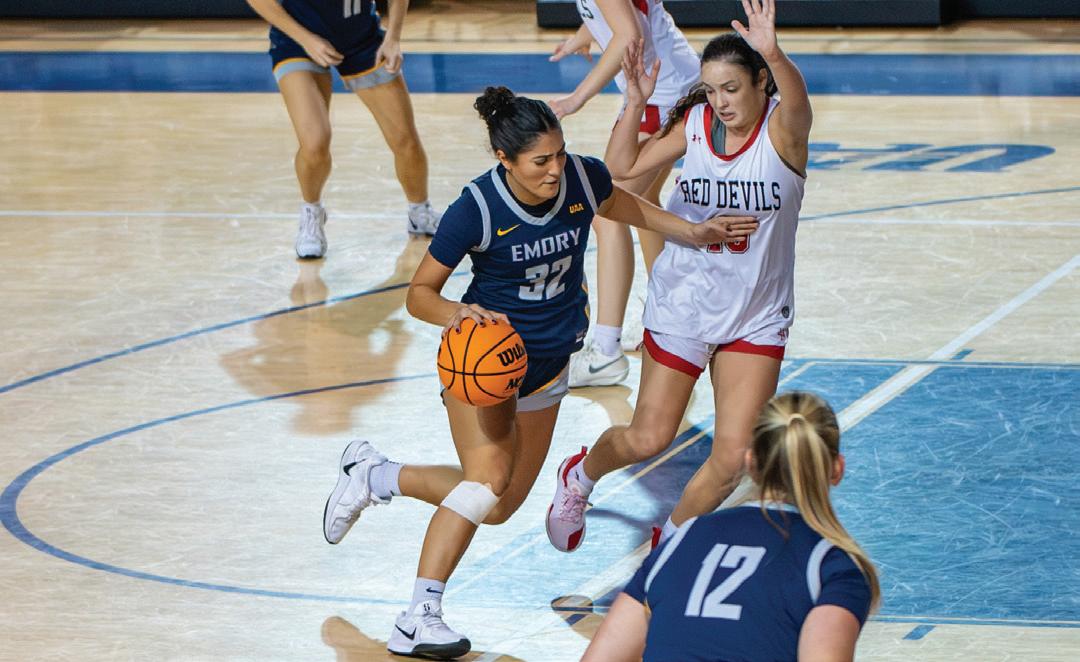
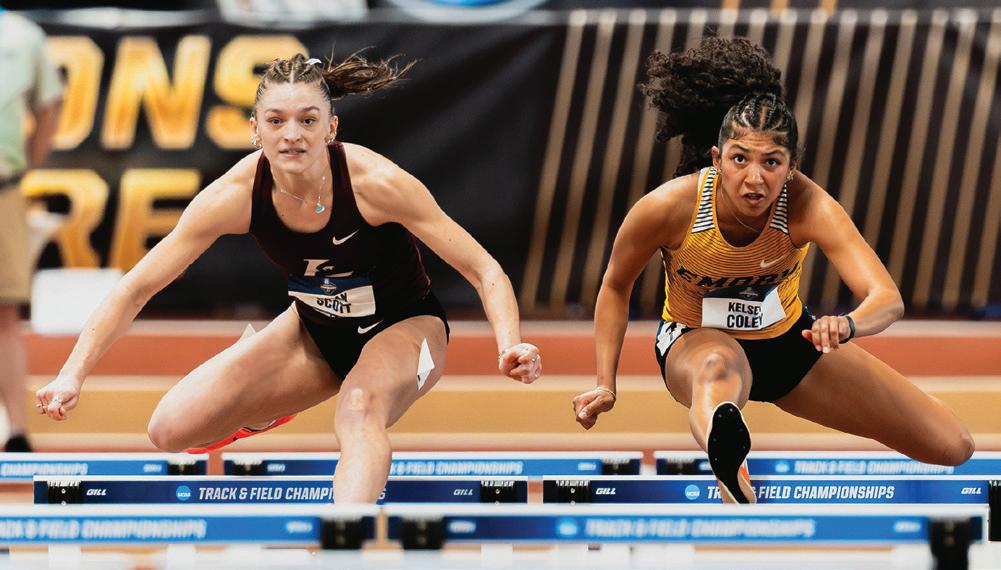
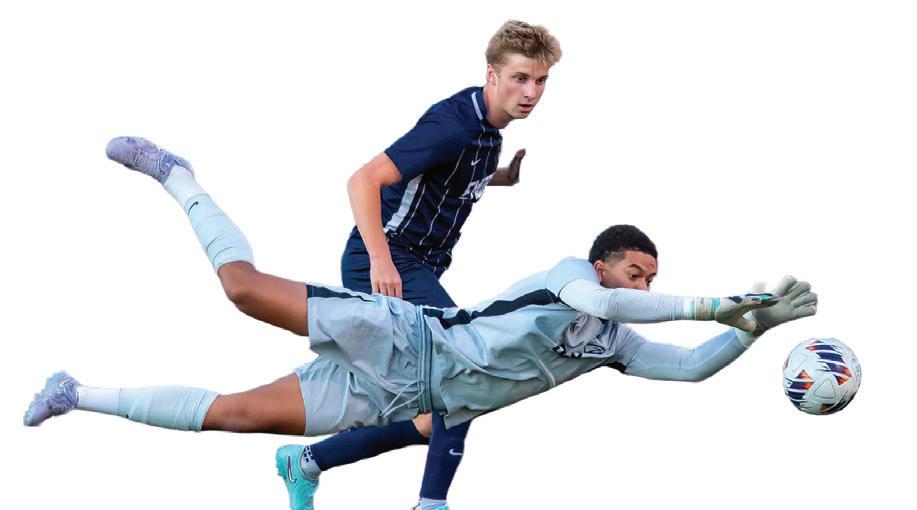
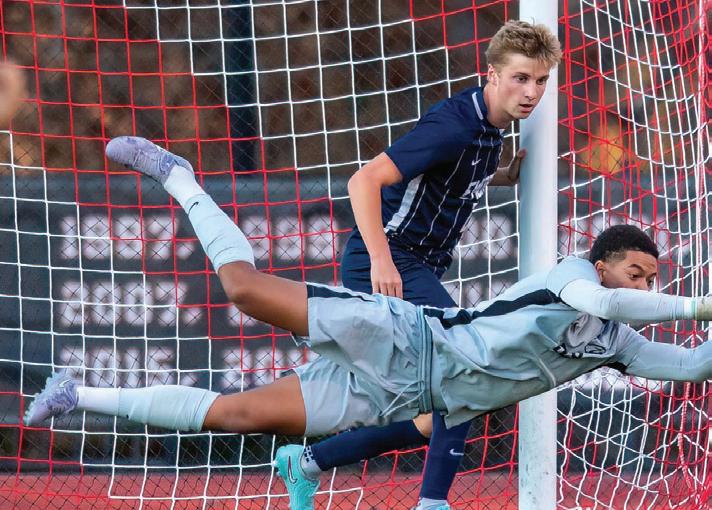
The story of Emory’s rise in Division III athletics and the coaches, studentathletes and culture that make excellence in sports and academics part of the same winning formula.
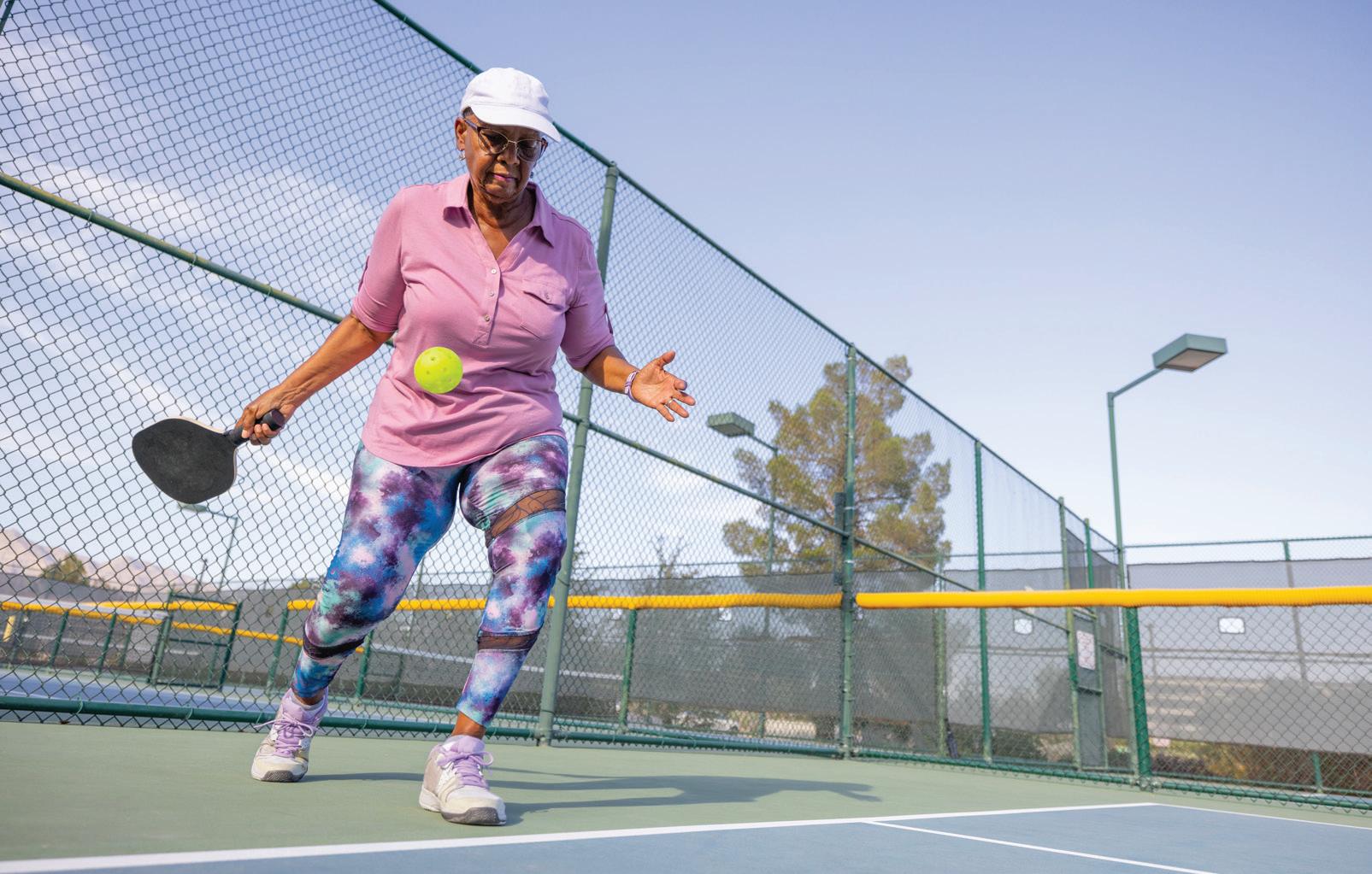
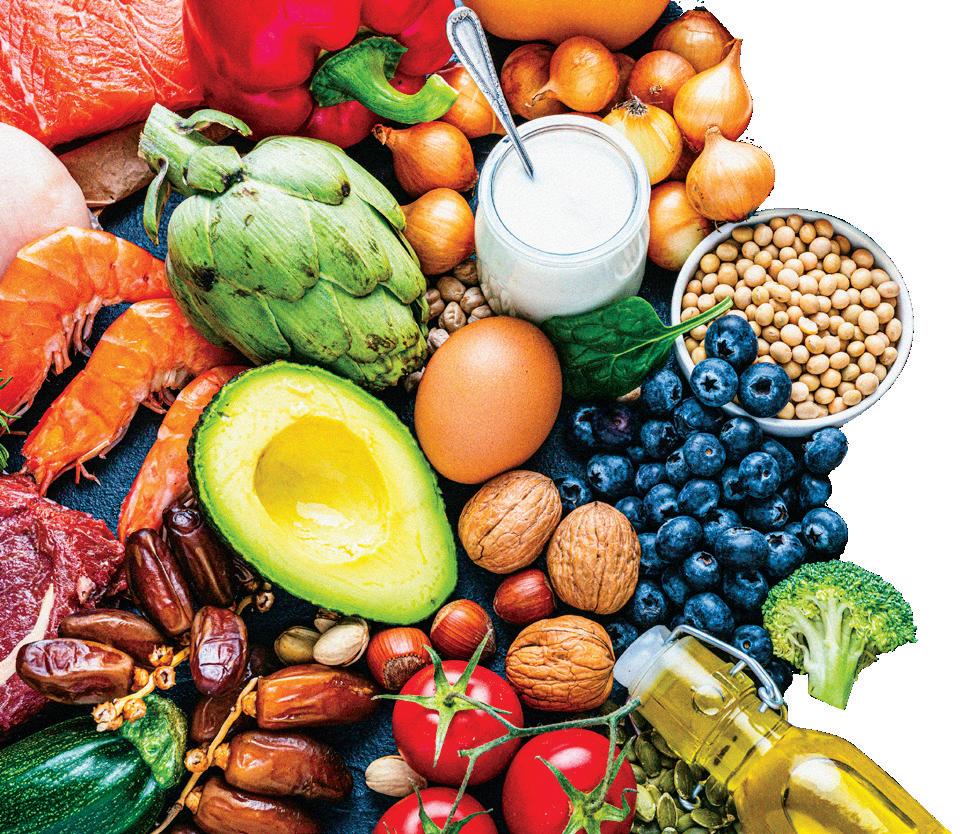
THE SCIENCE OF AGING WELL
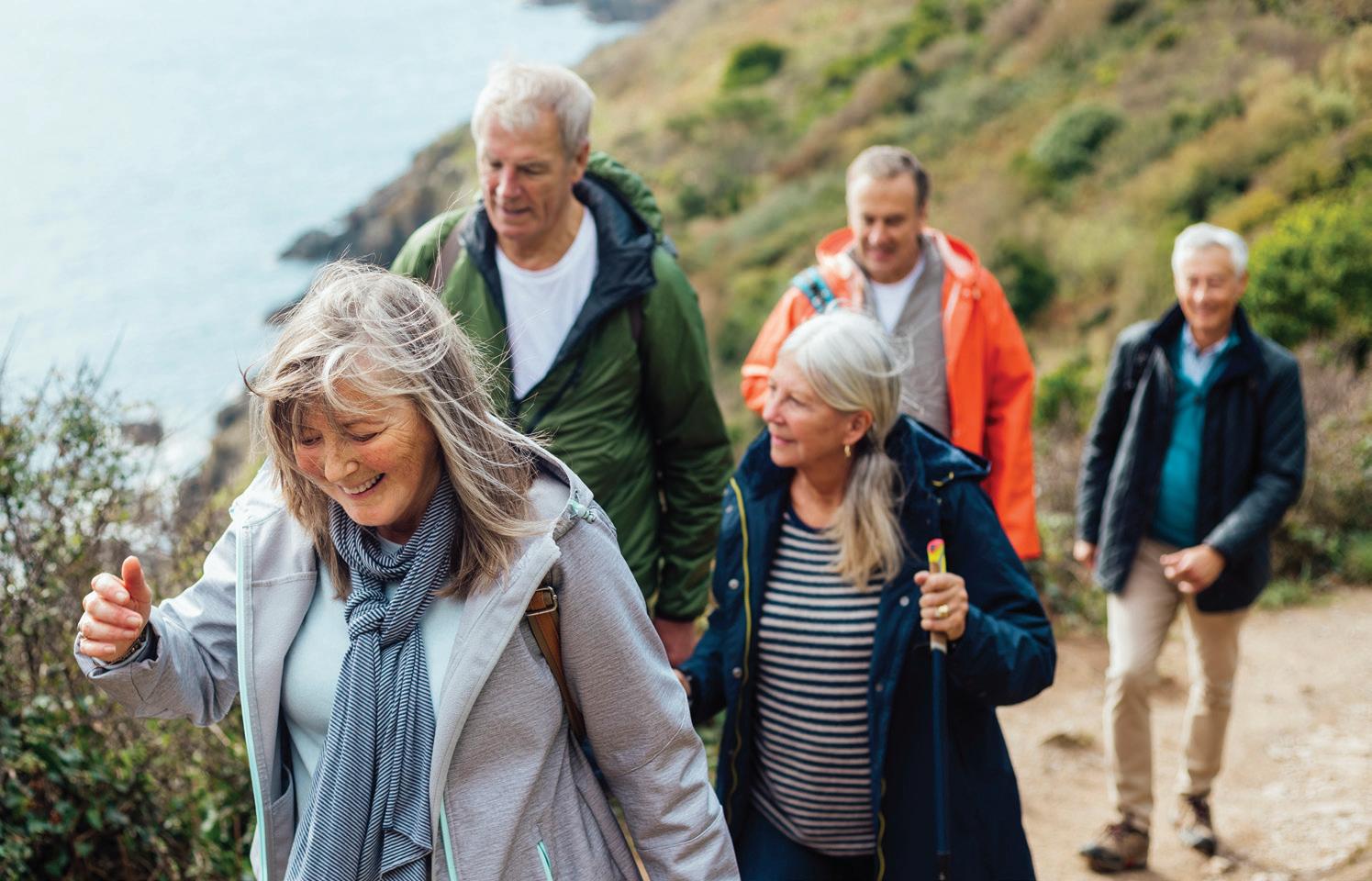
Emory researchers are looking beyond longevity to explore what it truly means to thrive in the extra years modern medicine and care can give us.
44
A PUZZLE OF PROVENANCE
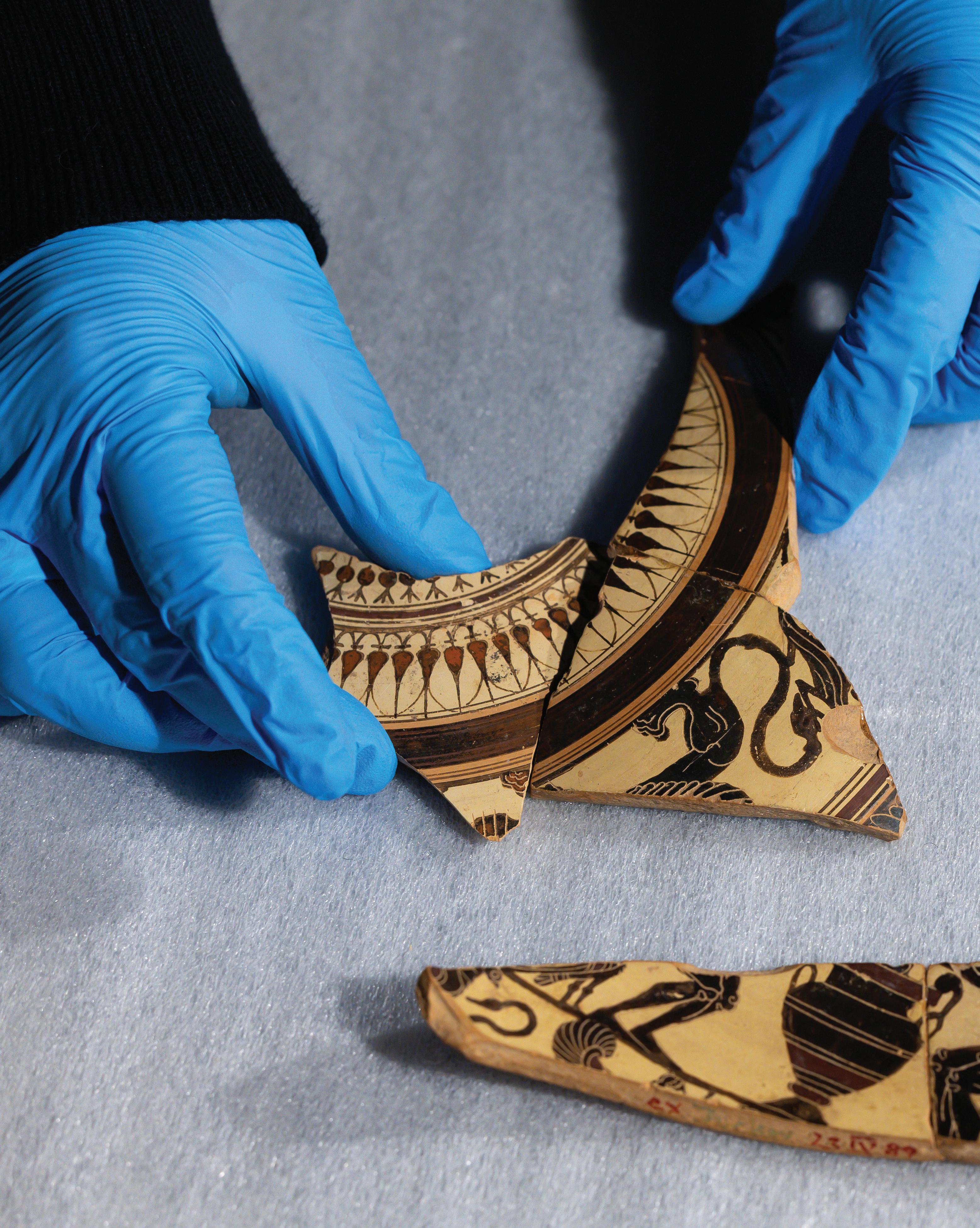
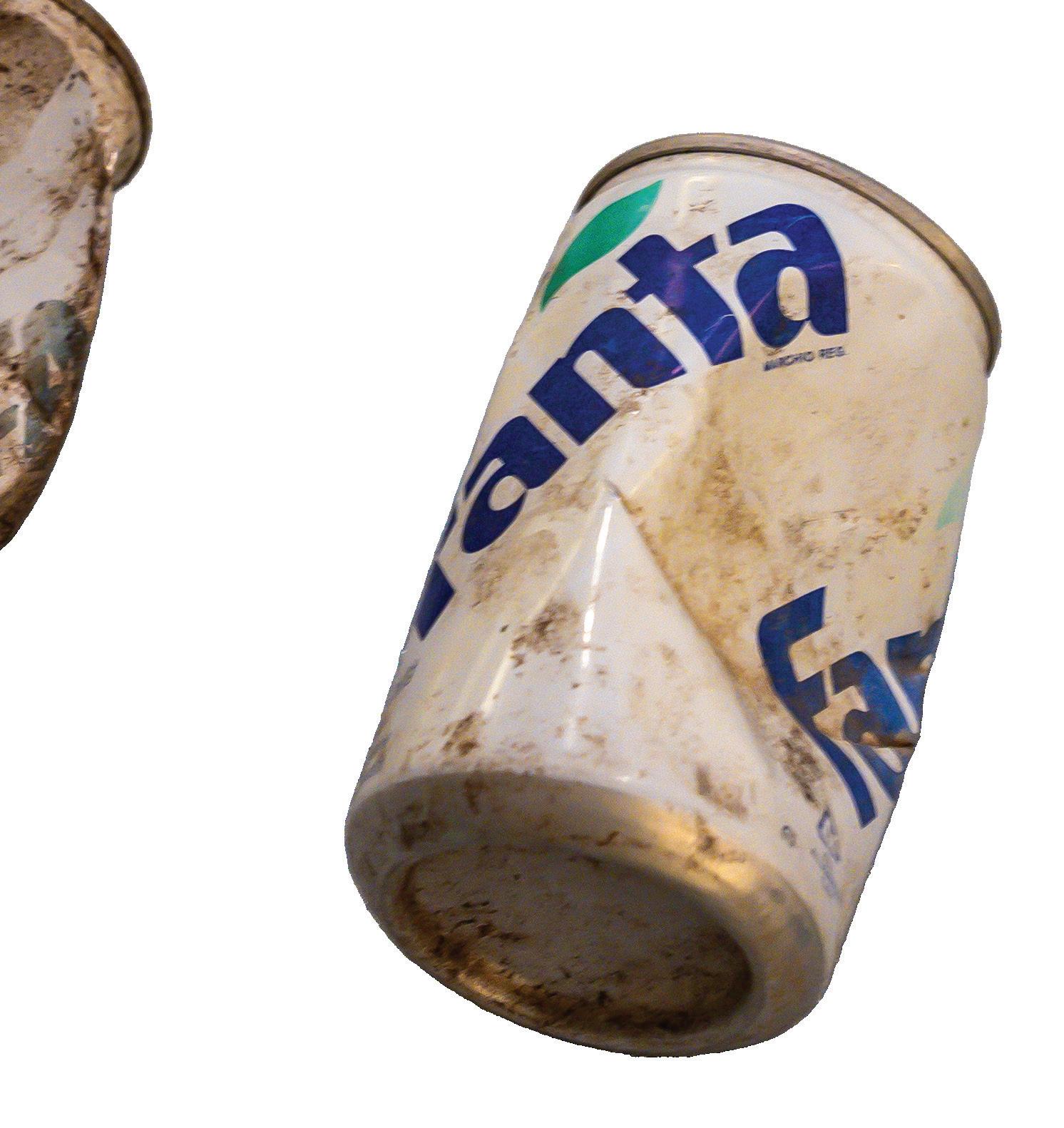
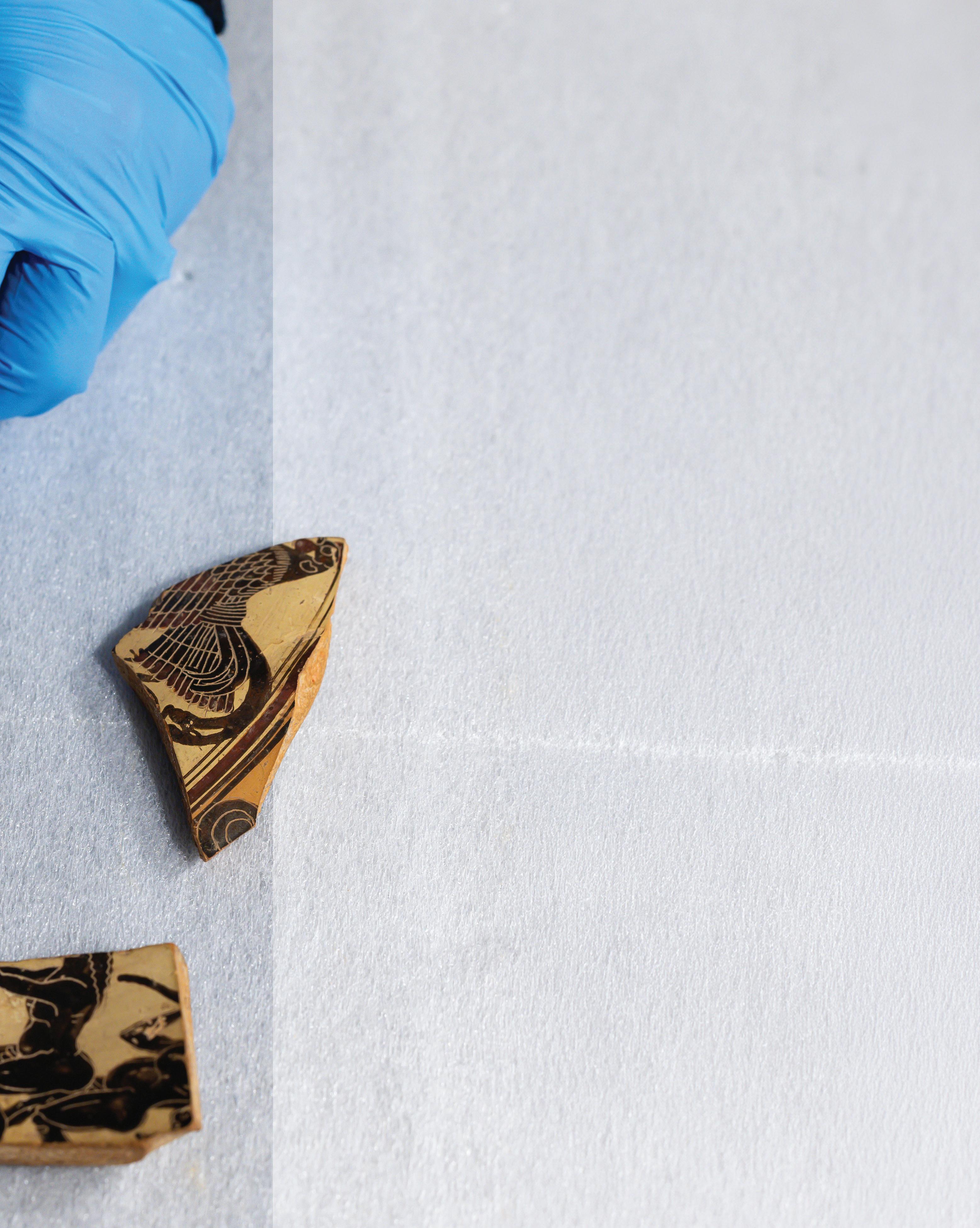
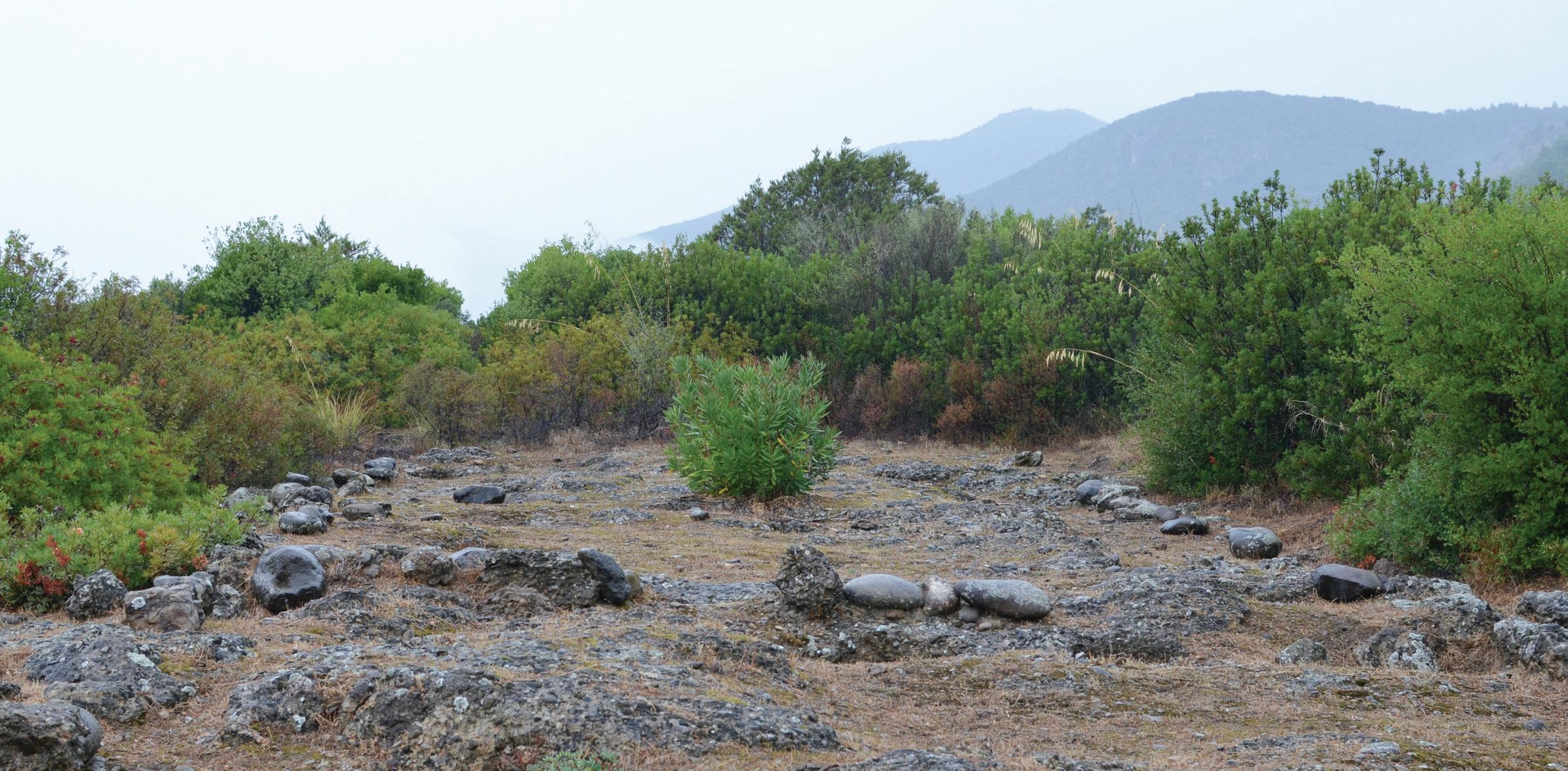
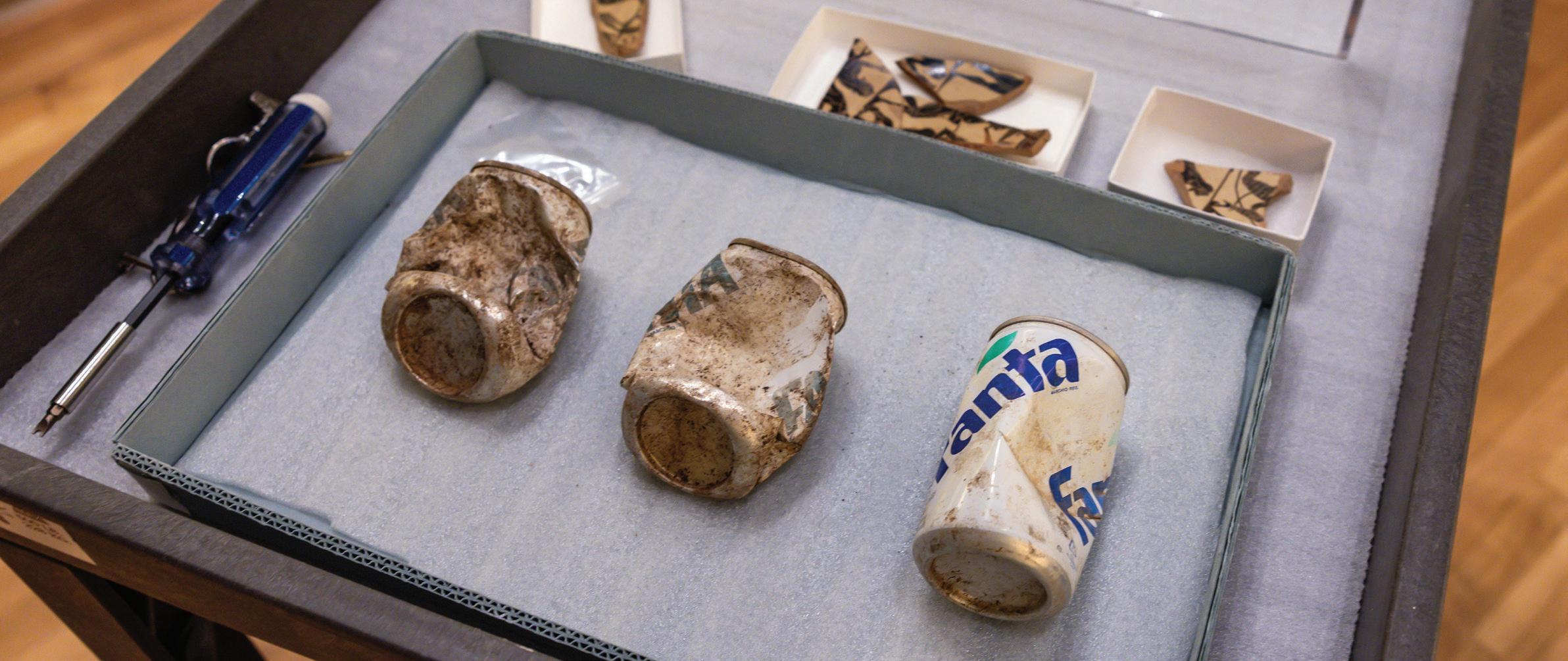
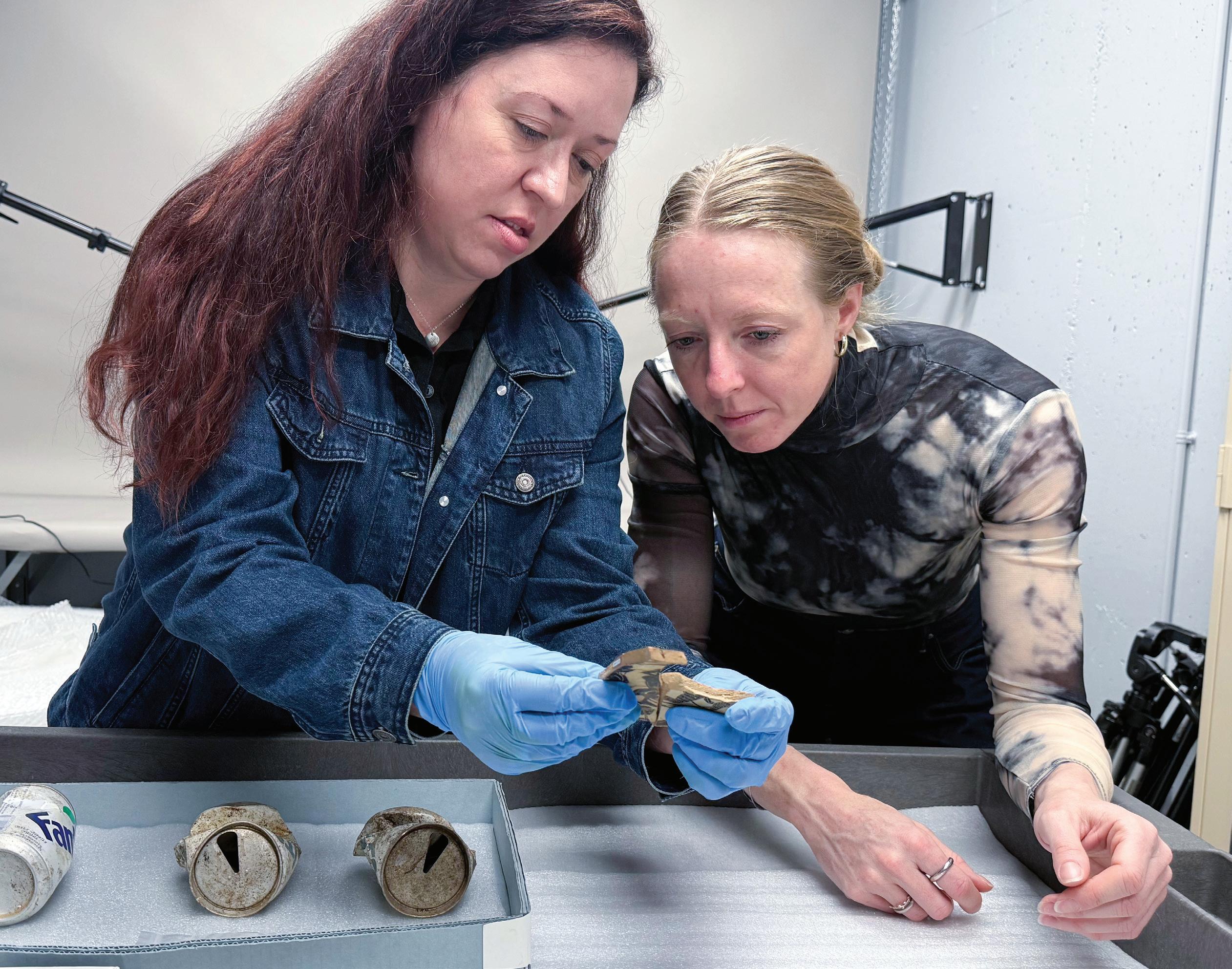
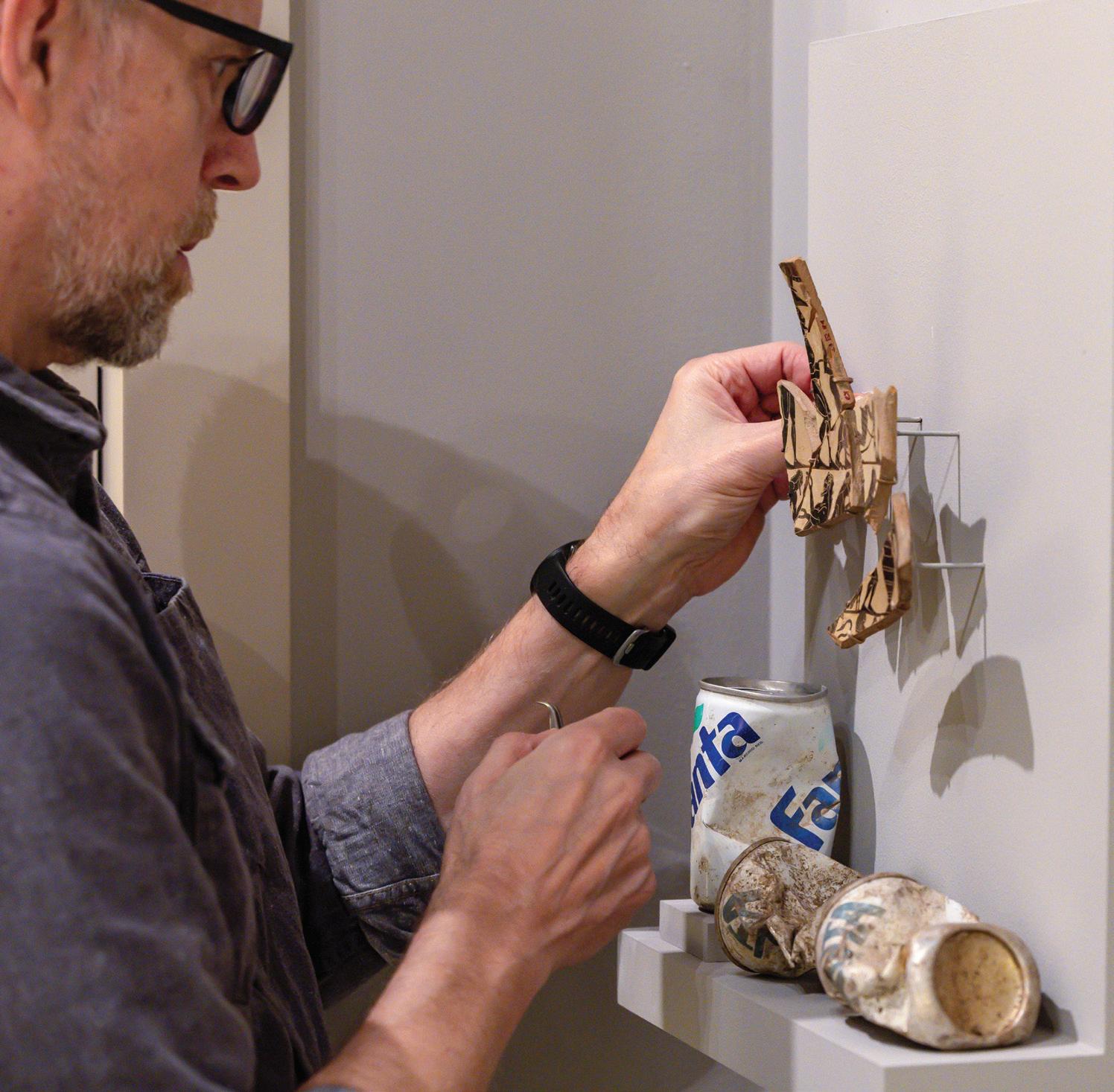
At Emory's Carlos Museum, six ancient Spartan cup fragments and Fanta cans left by looters unlock an unlikely story of theft, scholarship and repatriation.
BY KAY HINTON
ICYMI
Our Spring 2026 digital-only issue featured stories on the little-known history of Swoop, the writing of deaf author Rachel Kolb 20PhD, the creation of a “ChatGPT for genetics” and a look inside student radio station WMRE.
Bonus
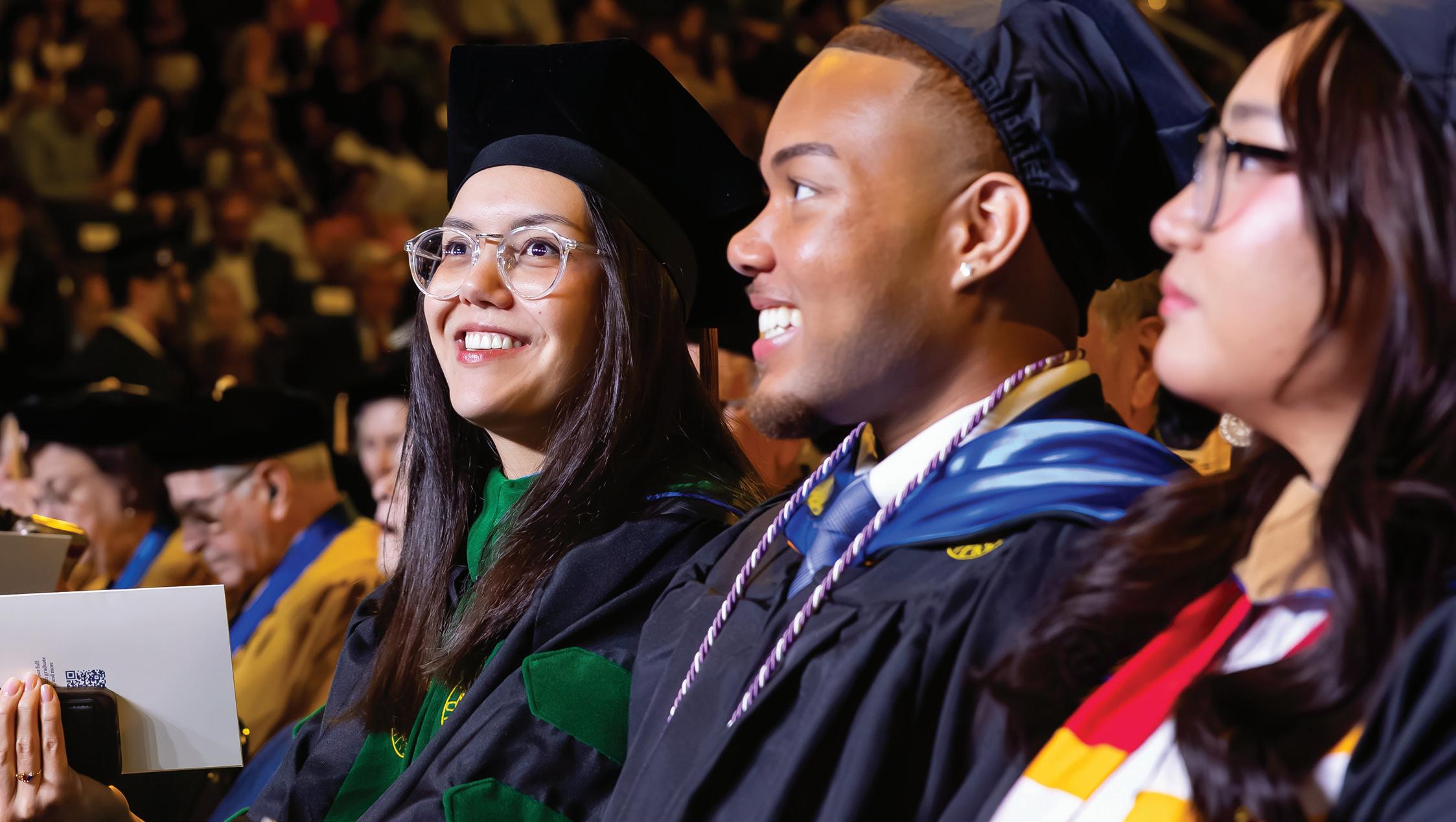
Check out rich multimedia coverage of Emory's 2026 Commencement, including profiles of award-winning students and faculty.
EMORY MAGAZINE
Editor-in-Chief
Roger Slavens
Assistant Vice President, Content and Brand Story
Laura Douglas-Brown 95C 95G
Contributors
John Baker Brown
Susan Carini 04G
Daniel Christian
Carol Clark 20PH
Kyndra Farley
Ashlee Gardner
Mary Loftus
Martha Nolan
Shawn Reeves
Michelle Ricker
Kate Sweeney
Art Director
Elizabeth Hautau Karp
Graphic Design
Elizah Huff
Selena Lim
Creative Director, Communications and Marketing
Amanda C. Qubty
Production Manager
Matilda Redfern
Advertising Manager
Jarrett Epps
Photography
Avery Spalding
Sarah Woods
University Interim President
Justice Leah Ward Sears 80L
EMORY MAGAZINE (ISSN 00136727) is published by Emory’s Division of Communications and Marketing. Nonprofit postage paid at 3900 Crown Rd. SE, Atlanta, Georgia, 30304; and additional mailing offices. POSTMASTER: Send address changes to Advancement and Alumni Engagement Office of Data Management, 1762 Clifton Road, Suite 1400, Atlanta, Georgia 30322.
Emory Magazine is distributed free to alumni and friends of the university. Address changes may be emailed to eurec@emory.edu or sent to the Advancement and Alumni Engagement Office of Data Management, 1762 Clifton Road, Suite 1400, Atlanta, GA 30322. If you are an individual with a disability and wish to acquire this publication in an alternative format, please contact Roger Slavens (address above).
Emory is an equal opportunity employer, and qualified applicants will receive consideration for employment without regard to race, color, religion, sex, national origin, disability, protected veteran status or other characteristics protected by state or federal law. Inquiries should be directed to the Department of Equity and Civil Rights Compliance, 201 Dowman Drive, Administration Bldg., Atlanta, GA 30322. Telephone: 404-727-9867 (V) | 404-712-2049 (TDD).
The comments and opinions expressed in this magazine do not necessarily represent those of Emory University or the staff of Emory Magazine.
THE BIG PICTURE
A SPACE TO JAM
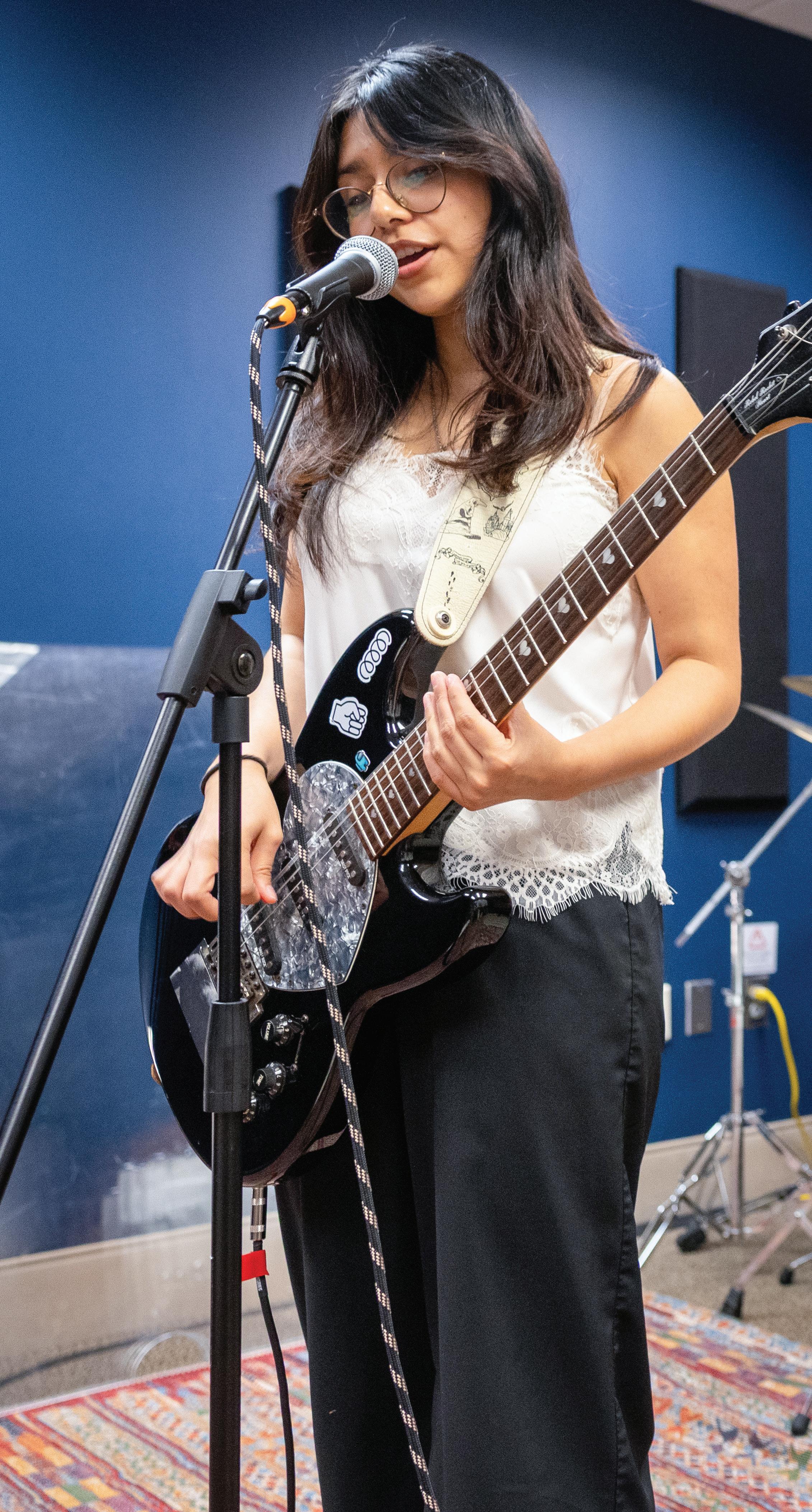
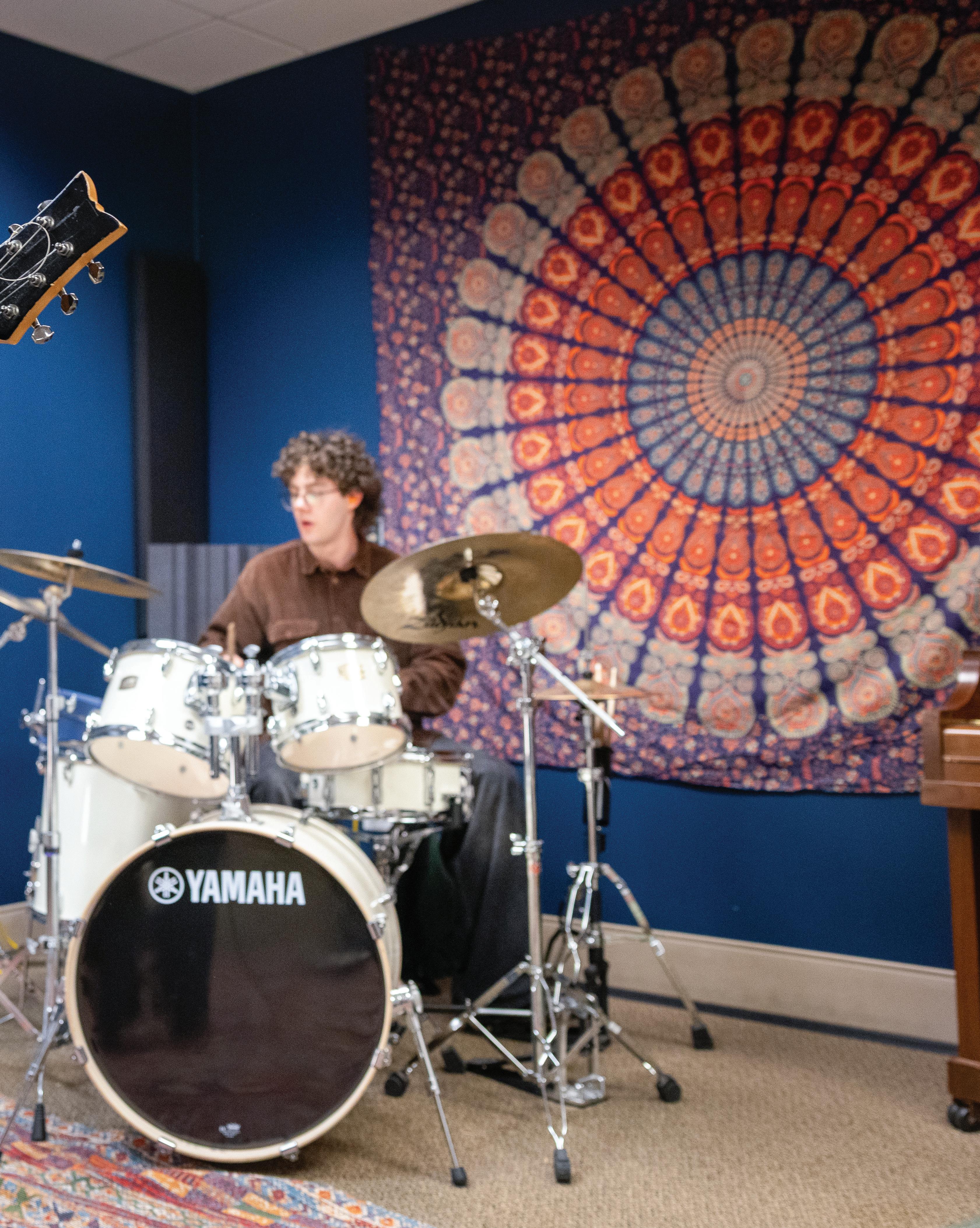
Long after most of Emory has gone to sleep, the Music Den still thrums with guitar riffs, crashing drums and bands working deep into the night. Hidden deep within the Schwartz Center for Performing Arts, the 24hour rehearsal room has become a favorite spot for student musicians. That includes rising juniors Cami Yanes 28C and Shane Donnelly 28C of the band Arbre Day, who use the Music Den to write, record and rehearse original music. It’s one of three Emory Arts maker spaces open to all students at the Atlanta campus, alongside the nearby Mini Studio dance area and the ArtsLab located in Cox Hall. Whether students are painting, sewing, choreographing or making music with friends, the rooms give them a place to step away from academics and make something entirely their own. — Daniel Christian
Christopher L. Augostini Appointed Emory’s 22nd President
As I look across the higher education landscape, I believe Emory is positioned better than any other university to meet our current challenges and opportunities.
— Christopher L. Augostini, President-Elect
The Emory University Board of Trustees announced that Christopher L. Augostini, the university’s current executive vice president and chief operating officer, has been elected by unanimous vote to serve as Emory’s 22nd president. He will assume his duties on Sept. 1, 2026.
The appointment by the Board of Trustees concludes a national search conducted by the Presidential Selection Committee, advised by a national search firm. Importantly, the committee sponsored more than 40 listening sessions and reviewed extensive feedback from students, faculty, staff, alumni and other stakeholders, along with survey responses and messages submitted through the presidential search website. Based on this input, the committee developed a presidential prospectus outlining the opportunities and expectations for Emory's next leader.
“On behalf of the entire Board of Trustees, I want to express our enthusiasm and excitement about the appointment of Chris Augostini as president. Our search generated a significant number of highly qualified candidates, but Chris’s exceptional leadership skills, distinguished record of achievement as executive vice president and COO, along with his deep understanding of Emory’s culture and community, made it clear he is the right leader for Emory,” says Robert C. Goddard III, chair of the Emory University Board of Trustees.
“I’m extraordinarily honored and thrilled to be named Emory’s next presi-
dent,” Augostini says. “As I look across the higher education landscape, I believe Emory is positioned better than any other university to meet our current challenges and opportunities. I look forward to beginning this new chapter in partnership with faculty, the board, students, staff and the entire Emory community.”
Interim Emory President Leah Ward Sears 80L offers her unique perspective on Augostini’s appointment. “I got to know Chris through my service on the Board of Trustees and have long admired his professionalism, deep knowledge of the university, and commitment to Emory. Over the past year, as Chris and I have worked closely together, I’ve watched as he’s navigated any number of difficult issues with sound judgment and a genuine spirit of collaboration. I have absolute confidence he will be an exceptional president,” Sears notes.
Over the past nine years, Augostini has collaborated extensively with the Board of Trustees, the Emory Healthcare Board of Directors, and the university’s executive, academic, administrative and healthcare leaders to help
enable Emory’s long-term growth and competitiveness. As executive vice president and system-wide chief operating officer, he oversees all enterprise functions for Emory, which is one of Georgia’s largest and most complex organizations and one of the nation’s top 25 universities.
Prior to joining Emory, Augostini served for 17 years as senior vice president and chief operating officer at Georgetown University. Earlier in his career, he held senior government positions with the city and state of New York. He earned bachelor’s and master’s degrees in public policy analysis from the State University of New York at Albany.
Provost Badia Ahad, an ex-officio member of the Presidential Selection Committee, also engaged with Augostini in her role as dean of Oxford College and, more recently, as provost. “I’m looking forward to continuing my close partnership with Chris as he becomes our new president,” Ahad says. “Chris has a strong belief in the transformative power of higher education and he understands that great universities must support impactful scholarship and engaged teaching. He believes, as I do, that Emory has something distinctive and powerful to offer the world.”
Adam Rogers 92C 96M, the chair-elect of the Emory University Board of Trustees and a member of the Presidential Selection Committee, strongly supports Augostini’s appointment. “Coming into this selection process, I knew Chris to be an effective leader and creative administrator,” Rogers comments. “During our interviews with Chris, I was struck by the clarity of his vision for Emory and his grasp of the issues facing universities today. He’s a listener with a strong bias for action. Chris is the president we need at Emory right now.”
Faculty member Hashem Dezhbakhsh, chair of the Department of Economics in Emory College of Arts and Sciences, also served on the selection committee. “Chris understands Emory’s aspirations as well as the challenges we face, and he has a genuine commitment to the intellectual and human community that defines our university,” Dezhbakhsh explains. “I’m particularly enthusiastic about his plans for sustained engagement with faculty, staff and students. His inclusive nature is exactly what is needed at this critical moment for Emory and universities everywhere.”
Board Chair Goddard also emphasizes the debt of gratitude the university owes Justice Sears. “On behalf of the entire Emory community, I thank Leah for her excellent leadership over the past year. She has been a thoughtful and calming force during volatile times, and we were extremely fortunate that she was willing to step in on an interim basis. I know Leah and Chris will provide steady leadership in the months ahead and will ensure a smooth and strategic transition for the university,” Goddard says.
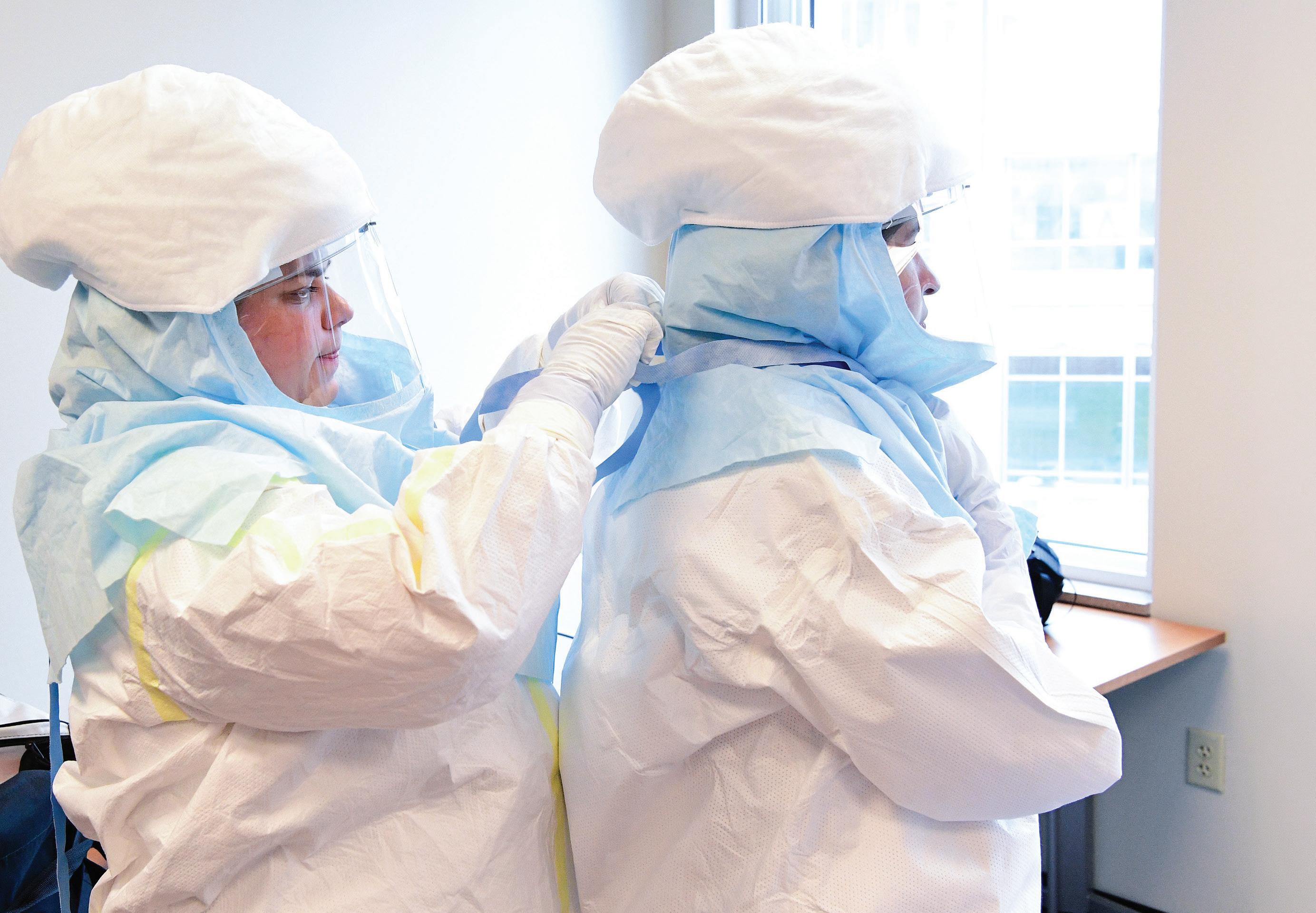
Lessons from Emory’s 2014 Ebola response helped reshape how healthcare workers put on and remove personal protective equipment (PPE), strengthening safety protocols for high-risk infectious disease care.
Ready for the Next Outbreak
From hantavirus to Ebola, Emory Healthcare’s Serious Communicable Diseases Unit was built to contain the world’s most dangerous biological threats.
BY MARY LOFTUS
Early in May 2026, two American passengers from a luxury Antarctic cruise landed at Hartsfield-Jackson Atlanta International Airport under extraordinary circumstances. They had been aboard the MV Hondius, a Dutch expedition ship carrying 147 passengers and crew from 23 countries. An outbreak of the Andes strain of hantavirus prompted a quarantine at sea. Most American passengers were sent to a federal quarantine facility at the University of Nebraska Medical Center, while the remaining two were brought to Atlanta for specialized monitoring.
At the airport, they were met by Grady EMS medics specially trained for high-risk transports. They were taken directly to Emory University Hospital’s Serious Communicable Diseases Unit (SCDU). The transfer went smoothly.
“Our system worked, our preparedness worked and, most importantly, my teammates performed very, very well,” says Aneesh Mehta, chief of infectious diseases at Emory University Hospital.
The hantavirus response offered a timely reminder of what Emory’s SCDU was built to do.
Then, just days later, another threat emerged: a new outbreak of Ebola Bundibugyo disease in the Democratic Republic of Congo and Uganda. It renewed global concern about one of the world’s most feared viruses and brought back to mind Emory’s defining role in the 2014 Ebola crisis.
These threats are different, but the question is the same: When a patient may be carrying a highly infectious, potentially lethal disease, who is ready?
A SYSTEM BUILT FOR WORLDCLASS CARE AND CONTAINMENT
From the outside, Emory Healthcare’s SCDU is unmarked and unassuming. Inside, it is one of the most sophisticated biocontainment facilities in the world.
Built in 2002 in close collaboration with the Centers for Disease Control and Prevention (CDC), the SCDU was designed specifically to care for patients with the most dangerous infectious diseases known to medicine.
Along with the University of Nebraska Medical Center and NYC Health + Hospitals/Bellevue, Emory is a consortium lead for the National Emerging Special Pathogen Training and Education Center (NETEC), a congressionally supported program that drives national preparedness for serious and rare infectious diseases such as Ebola, hantavirus and other high-risk illnesses.
Through Emory’s leadership in NETEC, the expertise developed inside the university’s SCDU extends far beyond Atlanta, informing national standards for preparedness, training and patient care during high-risk infectious disease events.
The unit protects patients, healthcare workers and the public through multiple layers of containment: 11 beds, including three ICU rooms; negative-pressure airflow with up to 20 HEPA-filtered air exchanges per hour; an on-site lab for high-risk specimens; strict sterilization and incineration protocols; and air-lock zones separating clean corridors from patient rooms.
If further assessment, testing or consultation is needed, the CDC and its resources are readily available. Emory’s close proximity to the CDC allows teams to collaborate quickly as situations evolve.
This unit exists for moments exactly like this.
— Aneesh Mehta, Chief of Infectious Diseases at Emory
“The CDC is next door,” said David Fitter, director of the Division of Global Migration Health at the CDC, at a hantavirus press briefing. “The SCDU is a fantastic facility, and we’re able to work very closely with them as we move quickly through dynamic and evolving situations.”
Most of the time, the SCDU is not actively caring for patients. But the work never stops. The team runs continuous drills, updates protocols, educates clinicians and global health leaders and stays current on emerging threats. Since the Ebola outbreak in 2014, more than 60 groups have visited the unit, including scientists, government officials and international health ministers.
Today, there are 13 federally designated biocontainment units across the United States. That national network exists largely because of lessons learned at Emory.
TEAM EBOLA: A TURNING POINT IN HEALTHCARE
In the summer of 2014, Emory became the first hospital in the United States to care for patients with Ebola virus disease. Four patients were admitted. All four survived. The clinicians who staffed the unit became known as “Team Ebola.” Alongside advanced intensive care, they provided something equally critical: reassurance, connection and compassion.
They made “Welcome, we’re glad you’re here” signs, told corny jokes, asked about favorite foods, helped patients communicate remotely with their families and met with family members throughout.
At the time, the prevailing belief was that patients with advanced Ebola could not survive. Emory’s team challenged that assumption by delivering evidence-based ICU care. They also learned critical lessons about infection control, particularly the precise process of putting on and removing personal protective equipment (PPE). Those lessons reshaped safety protocols worldwide.
SETTING STANDARDS IN PREPAREDNESS
The experience caring for Ebola patients prompted a broader shift in how Emory approached infection prevention.
Led by Michael Konomos, the medical illustration team at Emory University School of Medicine developed step-by-step PPE graphics and training videos that were adopted nationally and internationally. These tools helped standardize PPE protocols for healthcare workers and reduce risk.
The CDC later updated its own PPE guidance based on what was learned at Emory. Colleen Kraft, medical director of the SCDU and a professor at Emory School of Medicine, describes that period as “the beginning of a healthcare revolution.”
When COVID-19 arrived in early 2020, the SCDU’s greatest contribution came through knowledge sharing. Alongside NETEC, the team developed PPE guidance, training and a web-based app used by healthcare providers around the world.
That expertise matters well beyond any single crisis. Without specialized isolation units like the SCDU, the risk of wider spread from even a small number of patients would be far greater.
When the call comes saying a patient is on the way, the disease may be highly infectious and lethal, and the situation frightening. But inside a quiet, unmarked unit at Emory, a team will already be prepared and ready.
A NEW CHAPTER FOR TAYARI JONES
The Emory professor’s latest novel, “Kin,” arrived with bestseller momentum, critical acclaim and a world tour which included a sold-out campus homecoming.
BY KATE SWEENEY
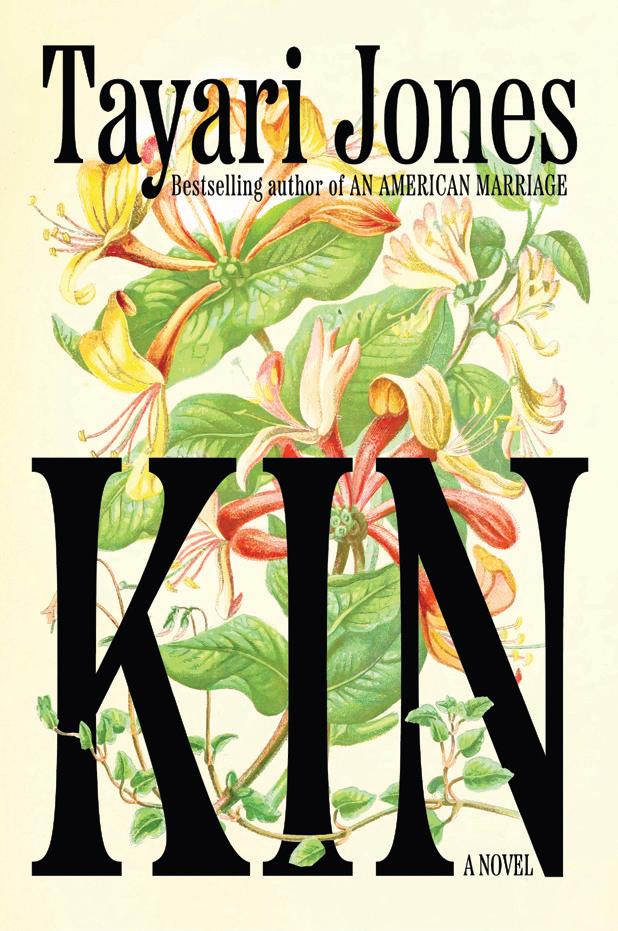
Stories of love, distance and the ties that endure have long defined Tayari Jones’ work. With “Kin,” the Emory professor and acclaimed Atlanta novelist returns to that terrain in a novel that debuted at No. 3 on The New York Times bestseller list and earned a coveted Oprah’s Book Club selection.
Jones’ previous novel “An American Marriage” became a defining work of its moment — a novel that moved from bestseller lists to award-winning acclaim and was later singled out by The New York Times as one of the top 100 books of the 21st century. Her body of writing, including the books “Leaving Atlanta,” “The Untelling” and “Silver Sparrow,” explores the bonds that shape lives.
With “Kin,” Jones — the Charles Howard Candler Professor of English and Creative Writing at Emory — revisited that emotional landscape while expanding its scope. Set in rural Louisiana and Atlanta during the mid-20th century,
the novel unfolds through alternating points of view between Annie and Niecy, two motherless friends whose lifelong bond is tested by the years, geography and class shifts.
The novel itself took an unexpected path. Jones initially set out to write a contemporary novel set in modern-day Atlanta, but the work resisted her. “I was getting words down,” she recalls, “but it felt almost like I was in an arranged marriage. It made perfect sense for me and this book to be together, but we just didn’t vibe.” She returned to a more instinctive practice — writing with pencil on lined paper — “just for the pleasure of writing, to see what was on my mind,” and discovered a different story emerging, one rooted in the 1940s and ’50s in the Jim Crow South.
At first, she assumed the characters were the parents of those in the book she'd been working on. But as the pages accumulated, she realized, “Perhaps this is not backstory.
Perhaps this is the story.” The shift felt almost magical. “And I don’t like magic,” Jones says, laughing. “I have always rolled my eyes at people who claim, ‘Oh, the story just came to me.’ And now, here I am, among them!”
As I write, it’s like I’m telling the reader about people I know, and I want to make them as real to the reader as they feel to me.
That turn opened the door to a novel shaped as much by intuition as intention. The characters came to feel, in her words, like “people I know,” revealing themselves through small, vivid details. “When those details come, they tickle me,” she says. These moments make the world of the novel feel lived-in and real. Even as “Kin” took form, Jones was writing through physical challenges, including an episode of Graves disease. “I had to write the book with an eye patch on,” she says. “So here I am, looking like a pirate. And the characters really kept me company.”
— TAYARI JONES
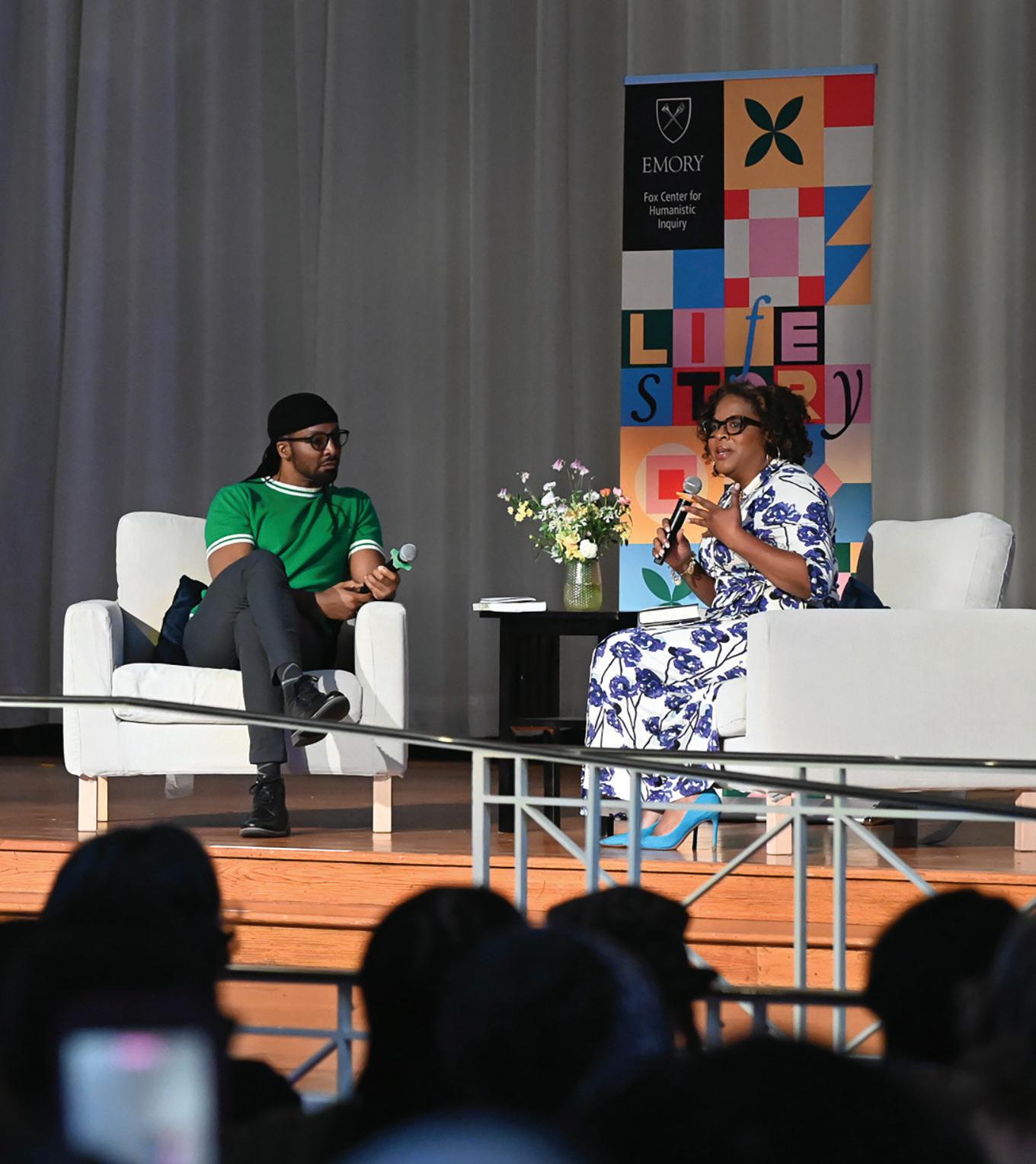
took her book tour back to Emory in April for a sold-out conversation with Pulitzer Prize-winning poet and fellow creative-writing faculty member Jericho Brown.
That sense of gratitude has followed Jones into a very different kind of literary moment. “The novel is having a pretty big rollout,” she says of the multimonth, worldwide tour that has followed the book’s release in February. “And that can be very isolating. So, you’ve got to figure out ways to bring friends in so that it’s their moment, too.” Even amid that scale, the emphasis remained on connection, the same idea that anchors “Kin.”
Jones has described her career as a “slow burn,” built over decades and sustained by loyal readers. Early on, she says, “My little prayer [at book events] used to be, ‘Oh, please let me get into the double digits.’” That perspective still shapes her approach. “If you have an event where three people come, you need to look at each of those three people like, ‘Hello, friend.’ … That’s a gift.”
A return to Emory in April, hosted by the Fox Center for Humanistic Inquiry, underscored that connection. Demand for the campus event quickly outpaced expectations, prompting organizers to move the program to Glenn Memorial Auditorium, one of the university’s largest venues. There, Jones appeared in conversation with Jericho Brown, the Pulitzer Prize–winning poet and fellow Emory creative-writing faculty member, before a sold-out crowd of more than 700 attendees.
The evening served as both a celebration of “Kin” and a reflection of the community that shapes Jones’ work. For Jones, the homecoming stop was also a welcome pause — a chance to bring her new novel back to people and a place that helped shape her voice.
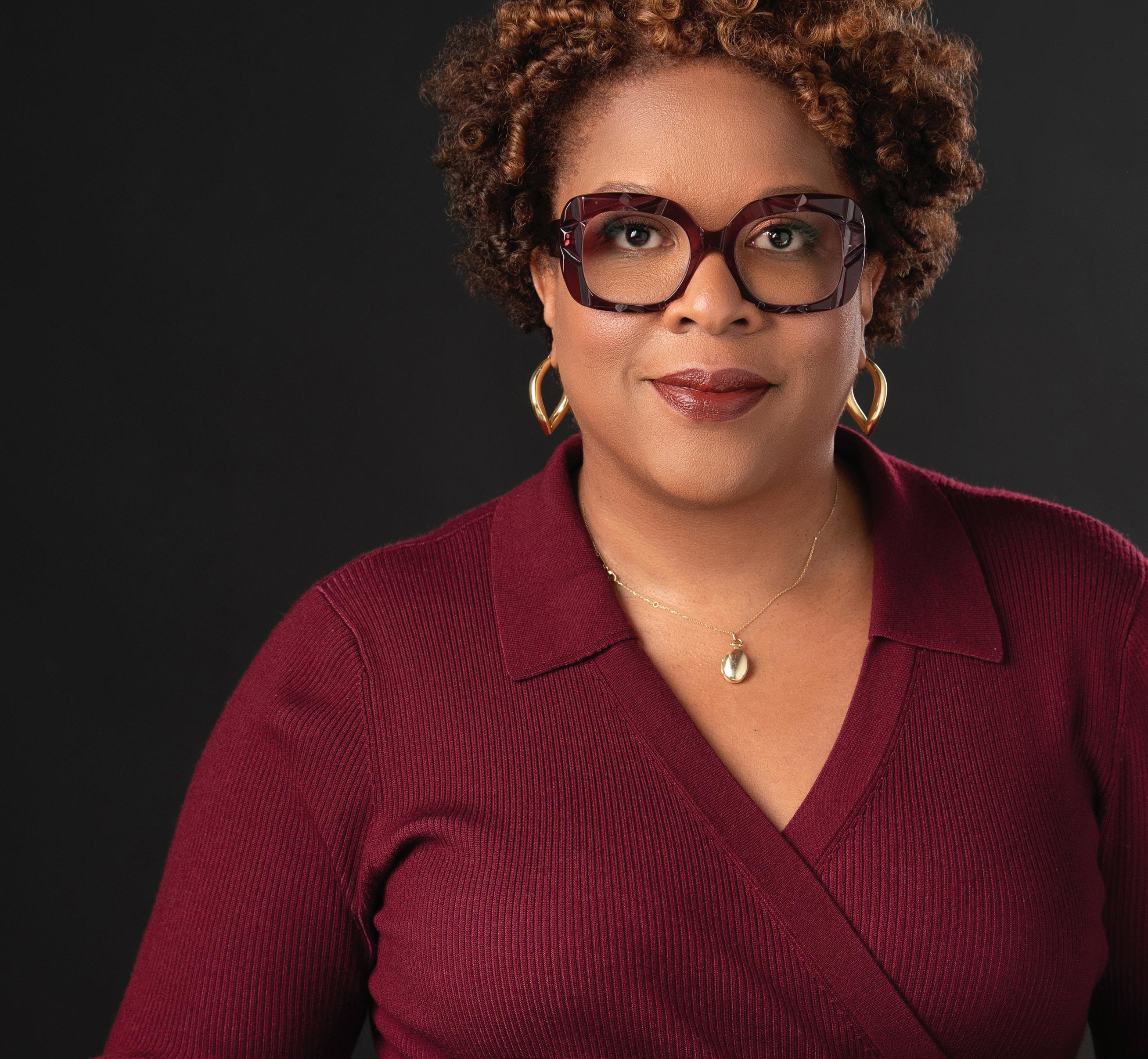
Tayari Jones
HONORING EMORY’S HIV DRUG PIONEERS
SCIENTISTS RARELY HEAR DIRECTLY FROM THE PEOPLE WHOSE LIVES THEY HAVE SAVED OR IMPROVED.
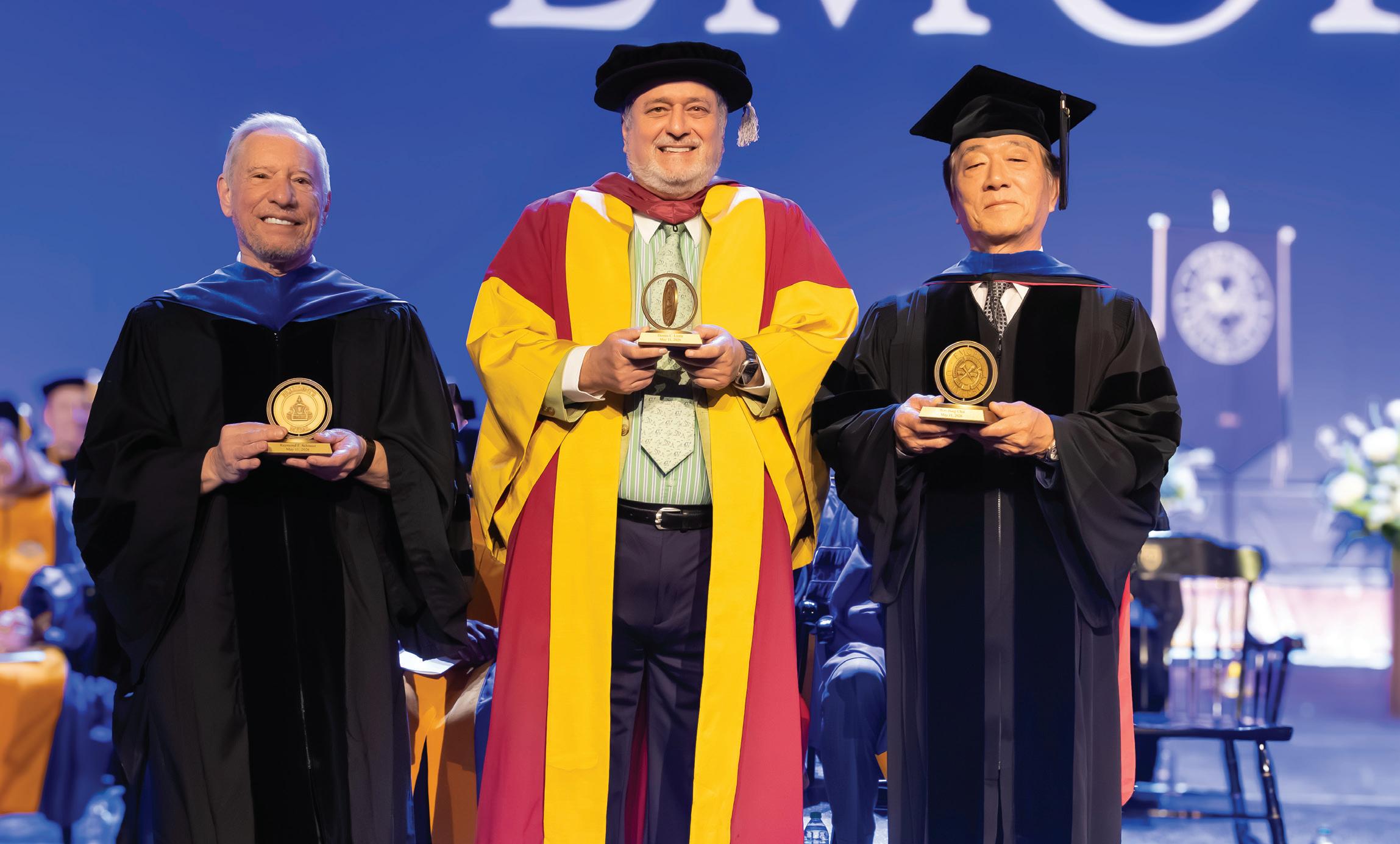
Dennis Liotta, Raymond Schinazi and Woo-Baeg Choi received the President’s Medal for discoveries that helped turn HIV into a treatable disease.
And yet, Dennis Liotta, Raymond Schinazi and Woo-Baeg Choi have had that experience. The three biomedical researchers developed key HIV antiretroviral medications that helped transform HIV from a fatal disease to a manageable condition, saving millions of lives worldwide. “Being approached by HIV/ AIDS survivors who thank me is powerful and humbling,” Liotta says. “When someone tells me, ‘I’m on that drug and it changed everything,’ or ‘You saved my son’s life,’ it makes the science feel deeply personal.”
At Emory’s 2026 Commencement, these three pioneers were each awarded the President’s Medal — one of the university’s highest honors — in recognition of a collaboration that reshaped global public health. Liotta, the Samuel Candler Dobbs Professor of Chemistry at Emory; Schinazi, the Frances Winship Walters Professor of Pediatrics at Emory; and Choi, founder and president of FOB Synthesis, met at Emory.
For Schinazi, the urgency was impossible to ignore. “When HIV came along, I was working in a clinic,” he recalls. “My lab was next door to patients with HIV, and you could see them outside the door, dying slowly. That leaves a tremendous impact and motivates you to find a solution to the problem. Putting the clinicians and PhDs side by side is so important.”
Liotta brought the tools of synthetic organic chemistry to the problem. In the 1980s, when he first chose to pursue HIV/
AIDS treatments as a young Emory professor, some colleagues warned that a small academic lab could not compete with large pharmaceutical companies. He persisted anyway.
In the early 1990s, the team announced the discovery of two groundbreaking antiviral compounds: emtricitabine (FTC), later marketed as Emtriva (the “Em” stands for Emory), and lamivudine (3TC), marketed as Epivir. Both are nucleoside reverse transcriptase inhibitors that block the enzyme HIV uses to replicate.
The impact was profound. More than 90% of people in the United States living with HIV — and millions worldwide — have taken at least one of these drugs as part of life-saving treatment regimens.
Trained in chemistry but new to nucleosides, Choi approached a key step in making FTC without built-in assumptions. By using a novel strategy, he achieved a much higher yield of the correct form of the molecule, which proved critical to the drug's development. “It turned out, the very first compound we made and the third compound we made led to FDA-approved drugs,” Liotta says. “Drug development is a team sport.”
Liotta and Schinazi’s work at Emory has expanded into treatments for cancer, hepatitis C, liver disease and emerging viral threats, while helping to create pipelines like the Emory Institute for Drug Development and Drug Innovation Ventures to translate academic discoveries into real-world medicines. “The goal is not just to make drugs, but to make drugs that are accessible so the people who need them can actually get them,” says Schinazi. “A drug that sits on the shelf helps nobody.” — Mary Loftus
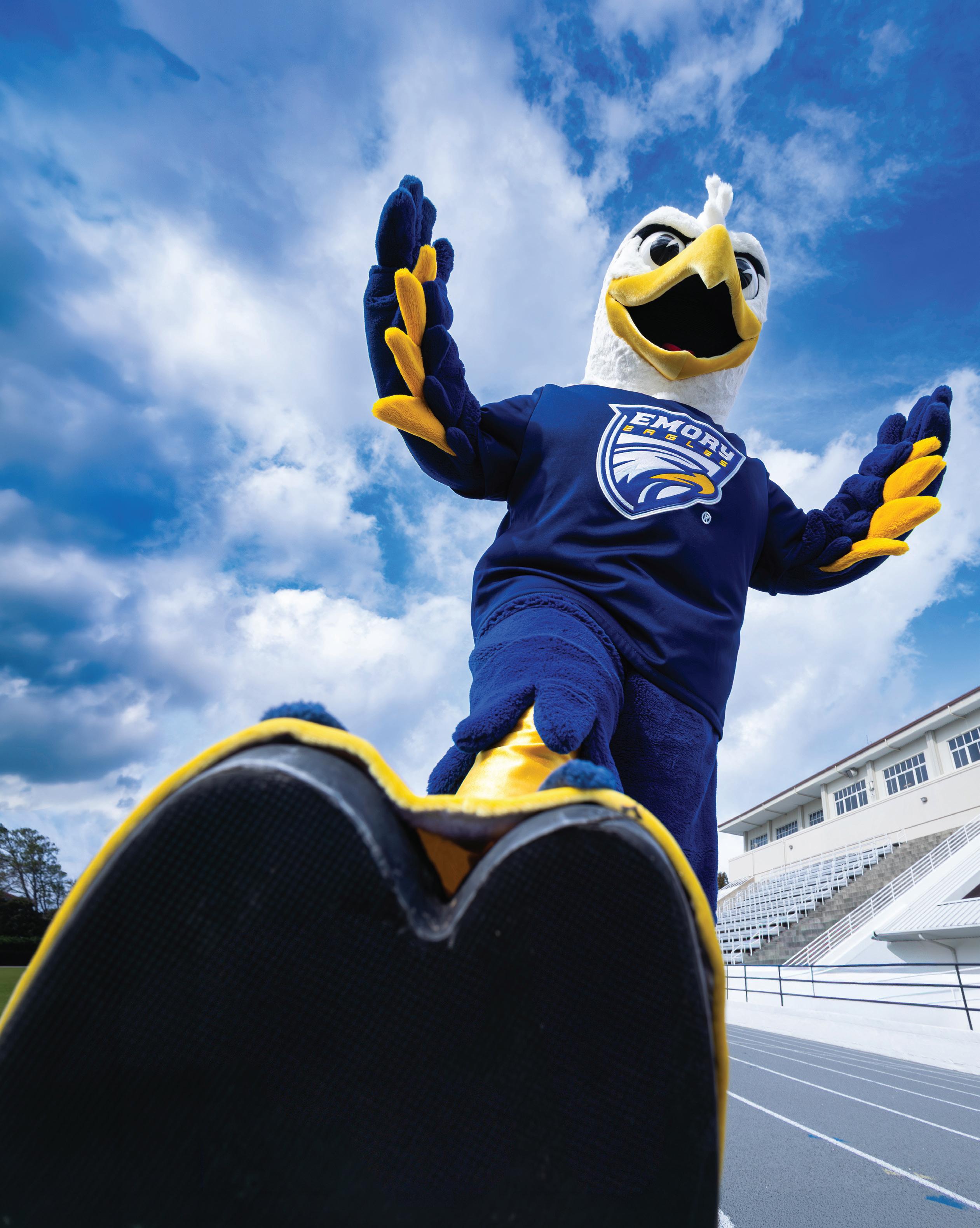
Behind the Beak
This past fall, Swoop got sleeker feathers, sharper eyes and a unified presence at both the Atlanta and Oxford College campuses. It’s the latest chapter in a four-decade evolution for Emory Athletics’ beloved eagle mascot — one that started from remarkably humble beginnings.
When Swoop first appeared in the mid-1980s, the suit was less fierce eagle and more “a bathmat with a chicken head,” as former athletics director Gerald Lowrey put it. Still, the idea had wings. Swoop brought something Emory didn’t know it needed: energy, mischief and an extra reason to cheer from the sidelines.
But the real magic has never been the costume. It’s the students who bring the mascot to life. From rowdy basketball games to spirited campus events to emotional rites of passage, every flap of the wings, high five or dance break is powered by students who step into the suit. Their identities stay secret until graduation, part of a tradition that keeps the spotlight on Swoop and what he represents.
Across four decades, those anonymous performers have turned a once-humble bird of prey into something much bigger: a connector, a spark and a shared symbol of Emory at its most joyful and proud. — Daniel Christian
LIGHTS, CAMERA, TRUTH
In Emory’s new hands-on film course, students pitch, shoot and edit documentaries with guidance from Emmy- and Oscar-level alumni mentors.
BY KATE SWEENEY
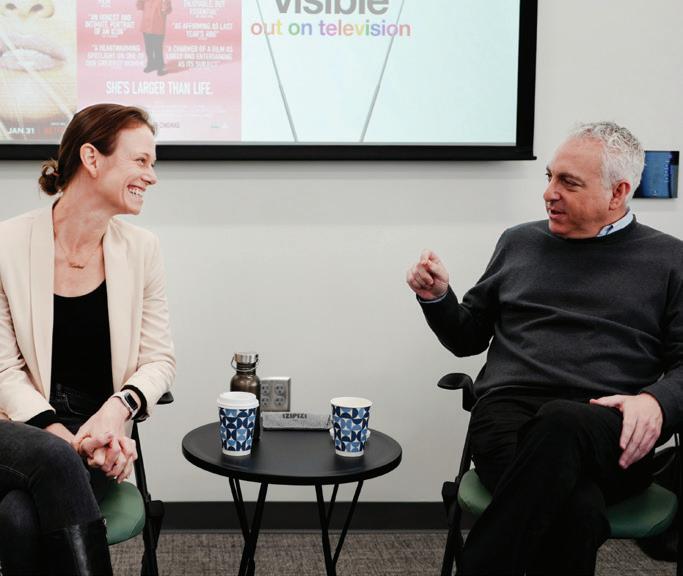
“THINK OF A FILM PITCH AS A SECRET YOU’RE EXCITED TO TELL,” Andrew Fried 98C told students in the new film and media class “Producing the Truth.”
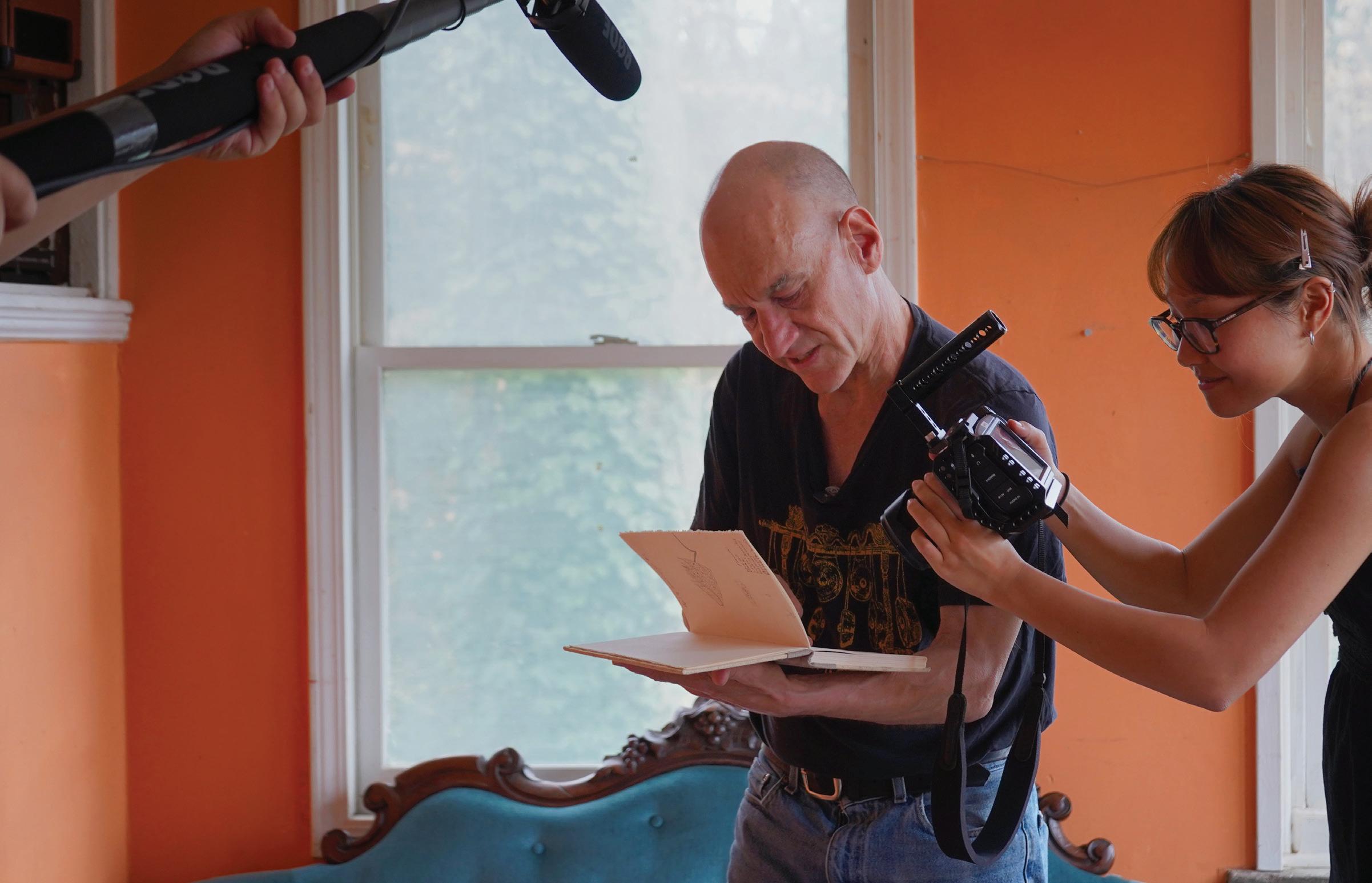
Fried’s words inspired Anna Zhai 28C, a rising senior majoring in film and media management, to make a pitch focused on her first love: music. She had often thought that Railroad Earth, a community arts space near Emory Village, would make a great subject for a documentary. The space has hosted countless artists and musicians, including her band, since opening in 1997.
“It suddenly occurred to me that, ‘Oh, my gosh, this is my chance to make that documentary,’” recalls Zhai, who hopes to pursue a career at the intersection of music and filmmaking. During the class break, she stayed at her desk, furiously writing out her concept for the film.
Fried, an Emory alumnus, is the Emmy Award–winning founder and CEO of Boardwalk Pictures, whose credits include the Netflix documentary series “Chef’s Table,” “Seven Days Out” and “Cheer.”
He co-taught “Producing the Truth” with David Barba, assistant professor in the Department of Film and Media.
Each week, working producers, writers, editors, agents and executives visited the classroom to counsel students as they created short documentaries. Some of the guests have won Oscar and Emmy Awards. All are Emory alumni.
And for the first time, they came to discuss the craft of filmmaking with students.
“It’s a one-of-a-kind class,” says Barba, “because we’re able to bring guests from across the country to spend significant
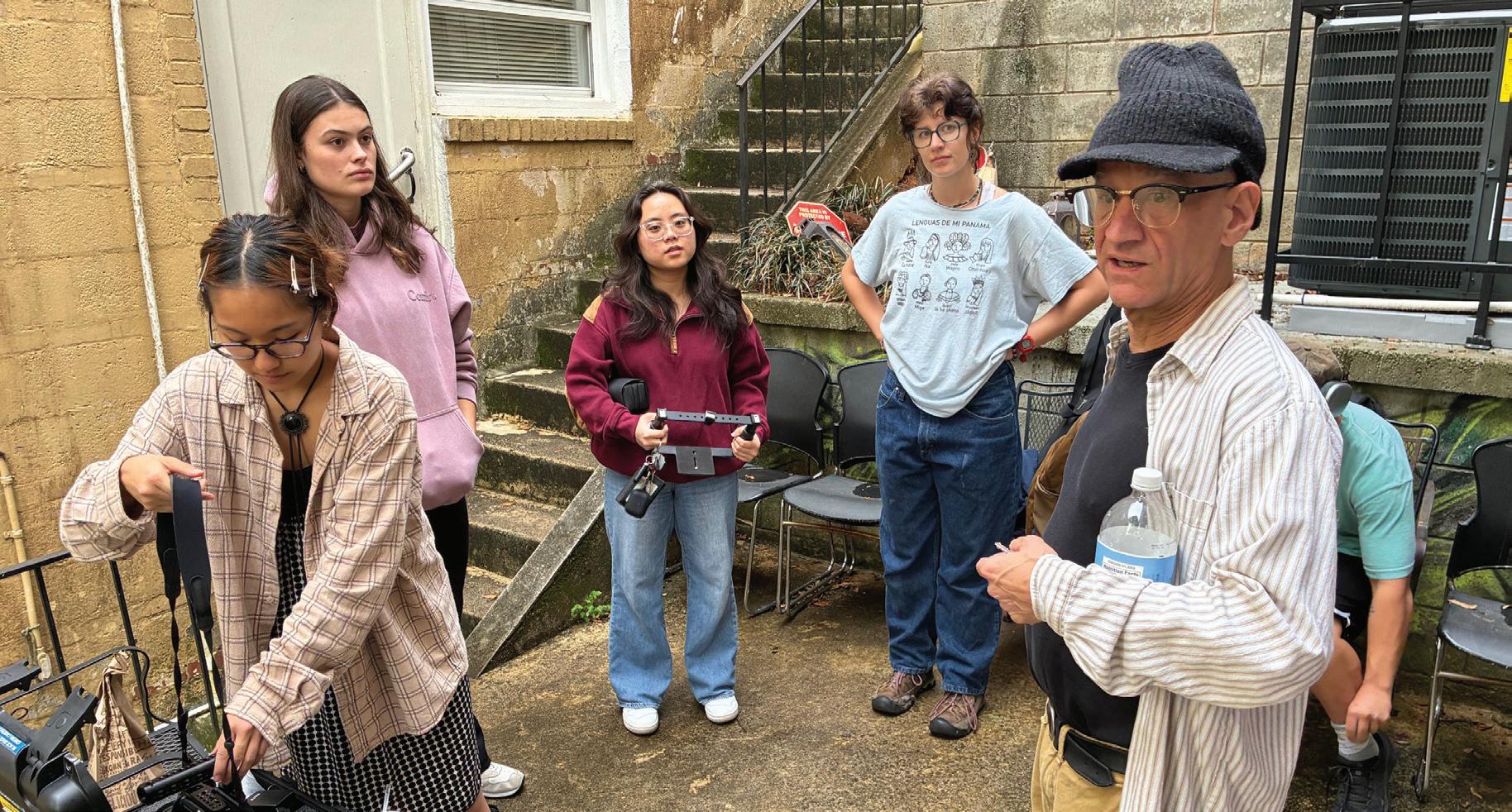
Neil Fried (no relation to Andrew Fried), who founded Railroad Earth, a community arts space in Emory Village, shows Anna Zhai an old journal with a note from musician John Mayer. Zhai and three classmates are filming a documentary about Railroad Earth.
time engaging with students — offering their own stories and struggles and providing substantive feedback on student work.”
Each guest professional joined two classes over the course of a week. On Thursdays, they participated in a Q&A led by Fried for students in “Producing the Truth” and “Film and Media Management,” a capstone class taught by Jennifer Porst, associate professor and co-director of the film and media management concentration. The visits were a team effort of Fried, Barba and Porst —
who regularly brings in film professionals to counsel her capstone class students on the business of filmmaking.
On Fridays, the visiting pros gave Barba’s students feedback on their film projects.
The class provided “a safe environment” for students to experience “the A to Z of the film production pipeline,” Barba says, as they honed their ideas, voted on which 10-to-15-minute documentaries to produce, then worked in teams to plan, shoot and edit.
“In the class, they can make mistakes or choose different avenues,” Barba says. Students might learn, for instance, that conducting interviews on film makes them nervous. “So, they can say, ‘Maybe one of my teammates can do it next time.’ It’s part of the process of finding your path. That’s the beauty of the liberal arts.”
INSPIRED BY NEW PRODUCTION SPACE
This version of “Producing the Truth” was sparked in 2023, when Fried delivered the keynote address at the Sophomore Summit. The event, sponsored by Emory’s Pathways Center, helps second-year students consider their future beyond college.
When Fried learned Emory planned to launch a film and media production space this semester, he was inspired to take his engagement to a new level, connecting young filmmakers with the creative processes of working industry professionals.
“For me, it was a matter of, ‘They’ve got some shiny new equipment and a soundstage, and we know a lot of people
who can offer these students some advice along the way,’” says Fried. “I feel a ton of gratitude for how I grew during my time at Emory, and I’m just proud to be a small part of this growing community of excellent storytellers in film and media.”
After months of planning with Barba, Porst and Michele Schreiber, associate professor and chair of the Department of Film and Media, a class was born. Fellow alumni Staci Weiss 97C, a business development executive at Amazon, and Serena El-Khatib 21C, coordinator at Boardwalk Pictures, also helped develop the class.
‘DON’T-CALL-IT-A-PITCH’ SESSIONS
Students spent the semester’s early classes pitching their film ideas to Barba, Fried and visitors.
Selling movie concepts is a fundamental industry skill. But instructors reassured students that these were not high-stakes pitch sessions.
“When you hear our feedback, don’t think, ‘Oh, I did this wrong,’” Barba
It’s a one-of-a-kind class, because we’re able to bring guests from across the country to spend significant time engaging with students — offering their own stories and struggles and providing substantive feedback on student work.
— DAVID BARBA
Jessica Hargrave talks with fellow alum Andrew Friend during a class visit, where they gave students feedback on their film pitches.
told the class. “Think about the questions we’re asking like, ‘Who will be the main character?’ ‘What is the world of this story?’”
The “don’t-call-it-a-pitch” sessions, as the class began referring to them, offered students a chance to work collaboratively with the instructors and guests to refine their ideas.
“We’ve learned how to really see an idea and express it to producers,” says Kayleena Nguyen 24Ox 27B, a rising senior pursuing a double major in business administration at Goizueta Business School and film and media. “And that’s very valuable to learn — to be able to articulate and really promote our ideas.”
“We don’t have to worry about ‘Oh, I messed up,’ which I think allows people to be more open with their ideas,” adds Nicole Botha 25Ox 27B, a rising senior majoring in business administration, with a concentration in film and media management.
EVERY JOB MATTERS
The class enabled Zhai to make her dream documentary about Railroad Earth, joined by Nguyen, Botha and Stella Rae Kinard 24Ox 26C. Each student on the team quickly found her role. For Botha, a people person, it was making contacts and doing interviews.
Kinard, who graduated in May with a double major in film and media and environmental science, got to hone her skills at editing and sound design.
Nguyen found her niche overseeing the project’s logistical details. She would like to run her own production company one day. “Anna is the director of photography, and this is her creative vision,” says Kinard. “But as we’re on a team, this is our film; this is our baby. We’re all excited that we’re able to do our part.”
Introducing students to professionals working in so many roles opened their eyes to “the possibilities of what their careers could look like,” says Barba.
“Sometimes, when they think about movies, they say, ‘I want to be a writer or director,’” he adds, forgetting that making any successful movie or TV show requires an array of responsibilities.
LEARNING TO LEAN INTO UNCERTAINTY
Documentary filmmaking calls for meticulous planning. It also requires the ability to change course on the fly, when the events playing out on camera take unexpected detours.
As students have learned, unforeseen twists and turns are part of the professional journey, too.
Jessica Hargrave 04C told the class
about graduating from Emory with a double major in German and psychology before joining Tripod Media, her best friend’s film production company. They have since made more than a dozen movies, including “Come See Me in the Good Light,” a documentary about poet Andrea Gibson. The film received an Academy Award nomination this year in the category of “Documentary Feature Film.”
“As someone who took a while to understand exactly what I wanted to do,” says Hargrave, “I wanted to relieve some of the pressure on these young filmmakers. They’re on incredible paths, and it’s okay to take time to figure it out.”
Hargrave told students she got to where she is by following her interests. She likens her professional life to switching majors every few years.
“Making ‘Come See Me in the Good Light,’ I majored in Andrea Gibson and poetry for a few years,” she says. “Before that, we did a film about the Mars rover, so I learned about that. It’s just feeding your curiosity.”
“I think that’s one of my favorite parts of the class,” says Botha. “All of these people have these careers that didn’t necessarily have a straight-line path. So, it’s not too late to take that risk and to do what you’re passionate about.”
Emory students plan the day’s shoot with Railroad Earth’s Neil Fried.
FLOWER POWER
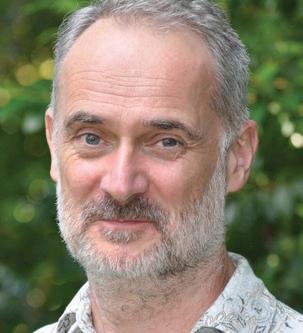
5 Questions with David George Haskell
BY CAROL CLARK 20PH
Flowers brighten neighborhoods and mark life’s biggest moments, but David George Haskell argues they’ve done far more than that. They helped shape the world we know. The acclaimed biologist, writer and new adjunct professor of environmental sciences at Emory is the author of several celebrated books, including Pulitzer Prize finalists “Sounds Wild and Broken” and “The Forest Unseen.” His latest book, “How Flowers Made Our World: The Story of Nature’s Revolutionaries,” explores how flowering plants transformed ecosystems, inspired culture and influenced human evolution.
Q: WHAT SET YOU ON THE PATH TO NATURE WRITING?
A: I see my writing as an extension of teaching. About 15 years ago, I decided I wanted to break down the walls of classrooms to share knowledge that is often locked up within science departments. These are amazing stories, sometimes troubling stories, that we need to get out into the world. A lot of my colleagues here at Emory are also writing books for popular audiences out of that same desire to tell important stories and encourage intelligent, thoughtful community.
Q: WHAT PROMPTED YOU TO MOVE FROM SEWANEE,
TENNESSEE, TO A BIG CITY LIKE ATLANTA?
A: We moved here partly because my partner, Katherine Lehman, took a job as executive and artistic director of Spivey Hall at Clayton State University. Another draw is my connection to Emory, which is one of the world leaders in studying the environment. And Atlanta is an ecological hub. It has one of the highest percentages of tree-canopy covers of any major metro area in the world. Few cities have more bird life or such an incredible diversity of plants. Because of the climate here, there is something in bloom every month of the year.
Q: HOW ARE YOU CULTIVATING YOUR YARD?
A: Our house is quite shaded so we plan to grow things that are more shade tolerant. I believe in supporting the local ecology by choosing plants like native azaleas and blueberries, mountain mint, beautyberry and May apples. These are plants that have been part of the ecology here for thousands of years. Some of my favorite plants in my yard are the weeds growing in the cracks in my driveway, like bittercress and violets. This is beauty erupting in an unexpected place. To me that feels hopeful. It’s delightful and it inspires me.
Q: DO YOU HAVE A FAVORITE FLOWERING PLANT?
A: Magnolias — huge, big trees with flowers that are really in your face, the size of dinner plates. Magnolias are little changed over 100 million years, since the time of Tyrannosaurus rex. And the aroma of magnolias is really layered and transporting. Aroma is a very primal sense. The sense of smell goes directly to the part of the brain associated with emotion and memory.
Q: WHAT ARE YOU MOST LOOKING FORWARD TO AT EMORY?
A: More opportunities to invite people to engage with plants and animals right here in Atlanta. It’s a fun and enriching way to connect with some important questions. How did the ecosystems that support us come to be? How should we deal with biodiversity loss and climate change? Healthy ecosystems are the foundation of collective well-being. And there’s a great hunger in students for a connection to real, embodied experience.
Once Upon an Algorithm
Through an AI-powered storytelling game, Emory researchers are helping children think creatively and critically about technology.
BY KYNDRA FARLEY
Jinho Choi, associate professor of computer science
AS ARTIFICIAL INTELLIGENCE
becomes more common in classrooms and everyday life, Emory researchers are asking a new question: How can children learn to use AI thoughtfully from the start?
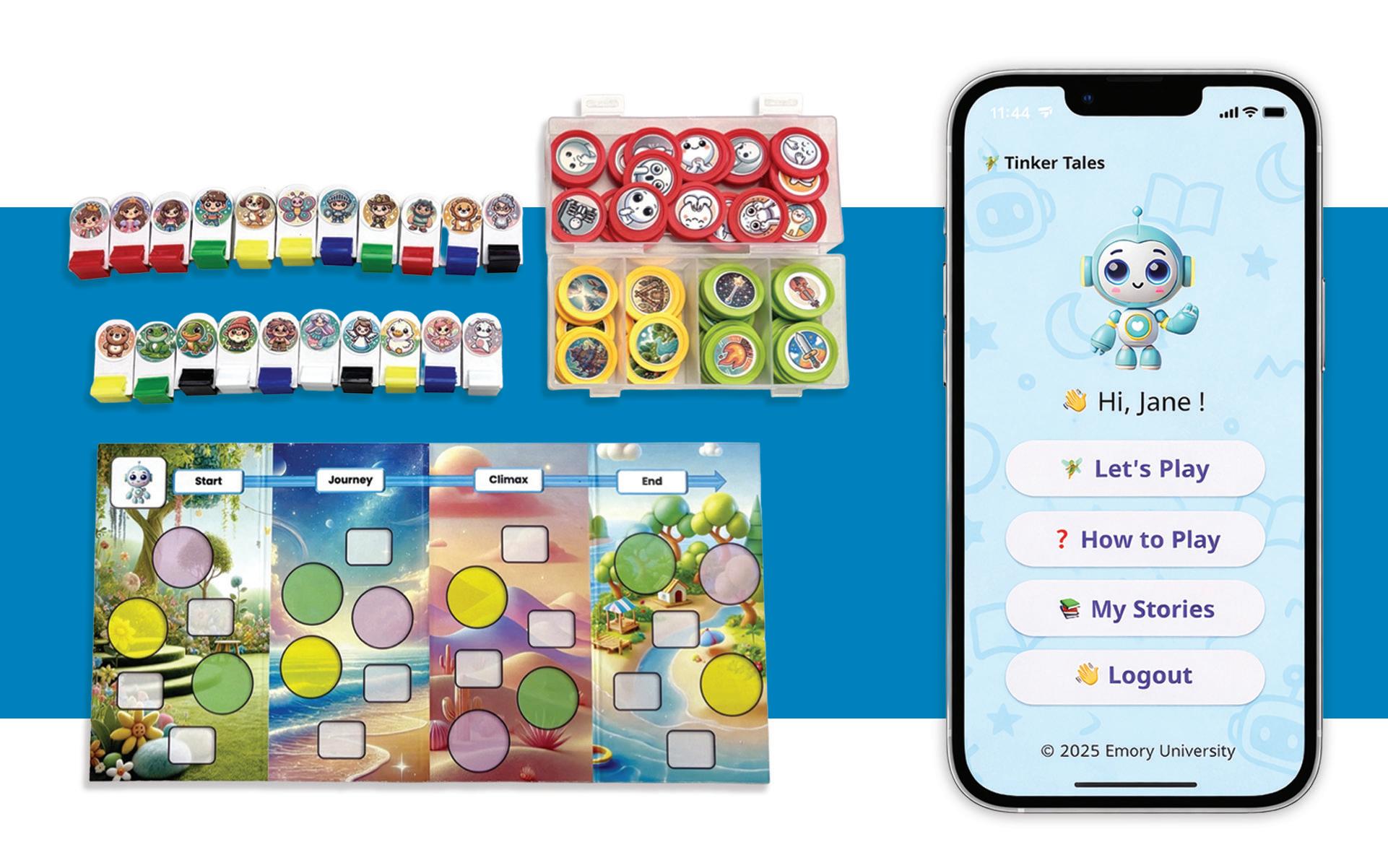
A team in Emory’s Natural Language Processing lab is developing Tinker Tales, an interactive storytelling experience designed to help young children understand how AI works by building stories with it.
Led by Jinho Choi, associate professor of computer science, the project introduces elementary school students to AI through guided, hands-on experiences
that emphasize creativity, collaboration and reflection.
The Tinker Tales AI-powered app works in conjunction with a physical boardgame. As players build a story, they are prompted to choose different game pieces — including characters, objects, scenery and emotions — to add as the story builds. Players scan each piece with a mobile phone running the app. Each piece contains an NFC chip that allows the app to recognize the player’s choices and use them to guide how the AI develops the story. The app has received funding from the Georgia Research Alliance to aid in its development.
“We have seen this pattern before,” Choi says. “When the internet became widely accessible, students who knew
how to navigate it effectively had a significant edge. AI is a similar inflection point, but the gap it creates will be wider and its impact on human thinking will be more fundamental.”
AI is already something children interact with directly, he adds, and those early experiences can shape how they understand and use the technology.
“As a parent of young children myself, I did not want to address this by putting more screens in front of them,” Choi says. “So, we built Tinker Tales as a physical storytelling experience. The child drives the story; the AI is a collaborator, not the author.”
Tinker Tales is currently being tested with students in kindergarten through third grade. During the activity, children
Tinker Tales pairs an AI-powered app with physical game pieces, inviting children to build stories through handson choices that guide how the narrative unfolds.
What AI cannot do is bring your specific experiences, perspective and imagination to the work that human contribution is what makes something original.
— JINHO CHOI
co-create stories with an AI system, making narrative choices and watching how the story evolves in response.
After making choices for their characters, players are asked reflective questions designed to encourage empathy and build social awareness, such as, “How do they feel about each other right now?” and “Does anyone feel differently from the others?” The goal is for the questions to make children think more deeply about the story and their role in shaping it.
Researchers say the goal is to move beyond passive use of AI tools and instead teach children how to engage with them critically and creatively.
“The clearest sign that something has gone wrong in education is when a student submits work that AI produced but cannot explain or defend it,” Choi says. “That failure reflects a misunderstanding of what AI collaboration should be.”
AI cannot replace human perspective, he notes.
“What AI cannot do is bring your specific experiences, perspective and imagination to the work,” he says. “That human contribution is what makes something original.”
Tinker Tales is designed to reinforce that creative instinct early.
“When a child places a piece on the board and says, ‘The prince is brave but scared of water,’ the AI builds on the child’s idea,” Choi says. “The goal is for children to develop a sense of ownership and confidence in what they create.”
AI LITERACY FOR EVERY MAJOR
EMORY UNDERGRADUATES looking to learn the fundamentals of AI without coding knowledge or math prerequisites have a new, accessible entry point.
Offered by the Department of Data and Decision Sciences, the two-credit course “Introduction to AI Applications” is open to all majors and provides a nontechnical introduction to AI and its growing effect on work, institutions and daily life.
Danilo Freire, a visiting assistant professor in DSci, developed the syllabus and is teaching the first cohort of 50 students. Rather than focusing on technical training, the course features
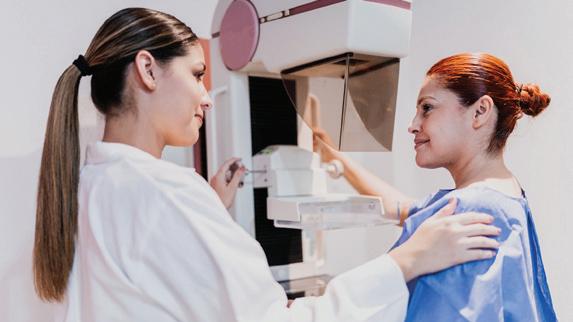
A new Emory study published in the European Heart Journal found that analyzing mammograms with AI can lead to better detection of cardiovascular disease in women.
lessons on real-world scenarios that help students understand how AI systems operate and where they have limitations.
“AI is going to be a companion in the job market for the foreseeable future,” Freire says. “The goal is to make our students better informed citizens and to give them the tools they need to be competitive in the market.”
Together, the course and DSci’s planned AI track reflect the core mission of Emory’s AI.Humanity initiative: preparing students to use emerging tools, evaluate their outcomes and make informed decisions.
— Ashlee Gardner
Detecting Heart Risk via AI and Mammograms
Trivedi and his team used AI technology to analyze calcium deposits in the arteries of breast tissue.
The retrospective study, led by Hari Trivedi, associate professor in the Department of Radiology and Imaging Sciences and the Department of Biomedical Informatics at Emory School of Medicine, included 123,762 women ages 40 to 79.
Women with mild calcification were about 30% more likely to suffer serious cardiovascular disease. For women with severe calcification, the risk was two to three times higher.
The Emory researchers were awarded grants by the National Institutes of Health for the study.
DRIVEN BY DISCOVERY
BY MICHELLE RICKER
AT EMORY, RESEARCH ISN’T JUST FOR THOSE WHO WEAR LAB COATS
or have “PhD” behind their names. Undergraduate students have opportunities to conduct research from their very first days on campus, where they can work alongside top faculty to explore big questions across the sciences, the humanities and business.
For some, it’s the first step toward a research career. For others, it’s a chance to delve deeply into a topic that inspires them while building skills they can apply to any future job.
Meet seven undergraduates pursuing ideas that piqued their curiosity — and learn how their experiences are shaping their future plans.
HENLEY ADAMS ELECTIONS AND IDENTITY
Junior Henley Adams 28C says a first-year seminar on identity in the 2024 election “jumpstarted” her love of research. Working with Andra Gillespie, professor of political science, Adams compiles election data at the county and precinct levels across the country, gathering turnout information and census data. “I love how recent the work is,” Adams says. “All these things, I’m watching them in real time on the news and I’m also doing a deep dive into what is actually going on.” Originally planning on law school, Adams is now considering a PhD in political science.
ANDREW CONLON PLANT MEDICINE AND TOXICOLOGY
An interest in plants and mushrooms led junior Andrew Conlon 28C to the Emory Herbarium, where he works with botanist Cassandra Quave. There, he researched mushroom poisonings in Georgia using 20 years of toxicology data. Conlon later presented findings showing an increase in intentional poisonings among adults after 2017. Now double majoring in biology and chemistry, he is screening Mediterranean plants for compounds that could fight staph infections. “Now I feel like an investigator trying to discover the bioactive molecules that could translate into antibiotics,” he says.
ELLA DAY
CANCER CAREGIVING AND PAIN
Recently graduated nursing student Ella Day 26N discovered a passion for research through the Veterans Affairs Nursing Academic Partnership before beginning an honors thesis focused on colorectal cancer pain among patients and caregivers. Mentored by nursing professor Yufen Lin, Day studies how age, health and social factors contribute to pain. “What’s been surprising is how complex cancer pain is for caregivers,” she says. This fall, Day will be-
gin work in the ICU at Emory University Hospital and hopes to continue integrating research into her nursing career.
YUJIN HA
VIOLINS, MUSIC AND THE BRAIN
Junior Yujin Ha 28C paired Emory’s Summer Undergraduate Research Experience with a music abroad program in Italy after Director of Orchestral Studies Paul Bhasin encouraged her to pursue both. A neuroscience and music performance major, Ha visited workshops of Italian luthiers while researching how violin construction affects both musicians and audiences. “I used to think research was very structured,” she says. “But for independent research, especially in the humanities, you have a lot of freedom.”
JOEY HOUGH
RNA AND DISEASE RESEARCH
Junior Joey Hough 28C works in the RNA and epigenetics lab of Blerta Xhemalçe, studying a protein known as NAT10 and how manipulating its activity could help treat lupus, cancer and premature aging disorders. Hough says mentorship has been central to his experience. “Even when I’ve made mistakes, it’s always been an environment that is kind and under-
standing,” he says. Though currently on the pre-med track, Hough is considering a combined MD/PhD program.
MOLLY LANHAM BREAST CANCER AND DAFFODIL EXTRACTS
Rising junior Molly Lanham 26Ox 28C began connecting with researchers before she officially enrolled at Oxford College after meeting biology professor LaTonia Taliaferro-Smith during an admitted students event. Now studying biology and anthropology, Lanham works on triple-negative breast cancer research involving crude daffodil bulb extract. When the project took unexpected turns, Lanham’s team adapted and continued experimenting. “You never know what’s going to happen,” she says. “It’s a lot of, ‘Here’s a problem, now fix it.’”
CLARA WASSERMAN GRASSROOTS BUSINESS INITIATIVES
New graduate Clara Wasserman 26B, who double majored in business administration and political science, became involved with research through Goizueta Business School and faculty mentors Peter Roberts and Robert Kazanjian. During a class trip to Honduras, Wasserman helped conduct a case analysis of Hospital de Ojos Fraternidad, an eye hospital and outreach initiative, to better understand how the initiative scaled locally and how that success could be replicated elsewhere. “I feel replenished and fulfilled when I’m helping others,” she says, “and this experience has confirmed my gut instinct that I want my career to make a difference to others.”
STUDENT SUCCESS
Winning Arguments
Emory’s Barkley Forum capped a historic season with a national debate championship and one of the most dominant performances in program history.
By John Baker Brown
Emory’s Barkley Forum for Debate, Deliberation and Dialogue capped an extraordinary season by winning the National Debate Tournament (NDT) championship and sweeping additional top honors in one of the most dominant performances in the history of collegiate policy debate. The national title is the fourth for Barkley Forum, placing Emory among a select group of institutions to reach that mark in the 80-year history of the tournament, widely regarded as the nation’s premier collegiate policy debate competition.
Daniel Gallagher 27C and Ike Song 28C claimed the championship for Emory after entering the tournament as its highest-ranked team. They won all eight preliminary rounds, advanced to elimination rounds as the top seed and received a first-round bye. Their title run completed a season already highlighted by the Copeland Award, presented annually to the duo with the best overall regular-season performance.
The victory also showcased the depth of the program. Three Emory teams advanced to the tournament’s Sweet 16, including the teams of Lucas Lobo 26C and Coralynn Yang 27B, as well as Aaron Kim 24Ox 26B and Jared Shirts 26C. Having
three teams reach elimination rounds is a rare marker of program-wide excellence.
Mikaela Malsin 10C, director of the Barkley Forum and a program alumna, called the season one of the finest in history. “This is a historic performance for Barkley Forum and the university,” says Malsin, the NDT 2025 National Coach of the Year, the fourth Emory debate coach to earn the honor. “Winning the Copeland Award, reaching the elimination rounds as the top seed, and claiming the championship while losing only three ballots throughout the tournament is an extraordinary honor that every generation of the Barkley Forum family can be proud of,” she says.
This is a historic performance for Barkley Forum and the university.
—Mikaela Malsin
The winning tradition is rooted in a much broader mission. Founded in 1950 and named for former U.S. Vice President and Emory alumnus Alben W. Barkley, the Barkley Forum promotes competitive debate, civic engagement and leadership development. The program operates the Barkley Forum for High Schools, the Emory National Debate Institute and partnerships such as the Atlanta Urban Debate League, extending debate opportunities to students across metro Atlanta and beyond.
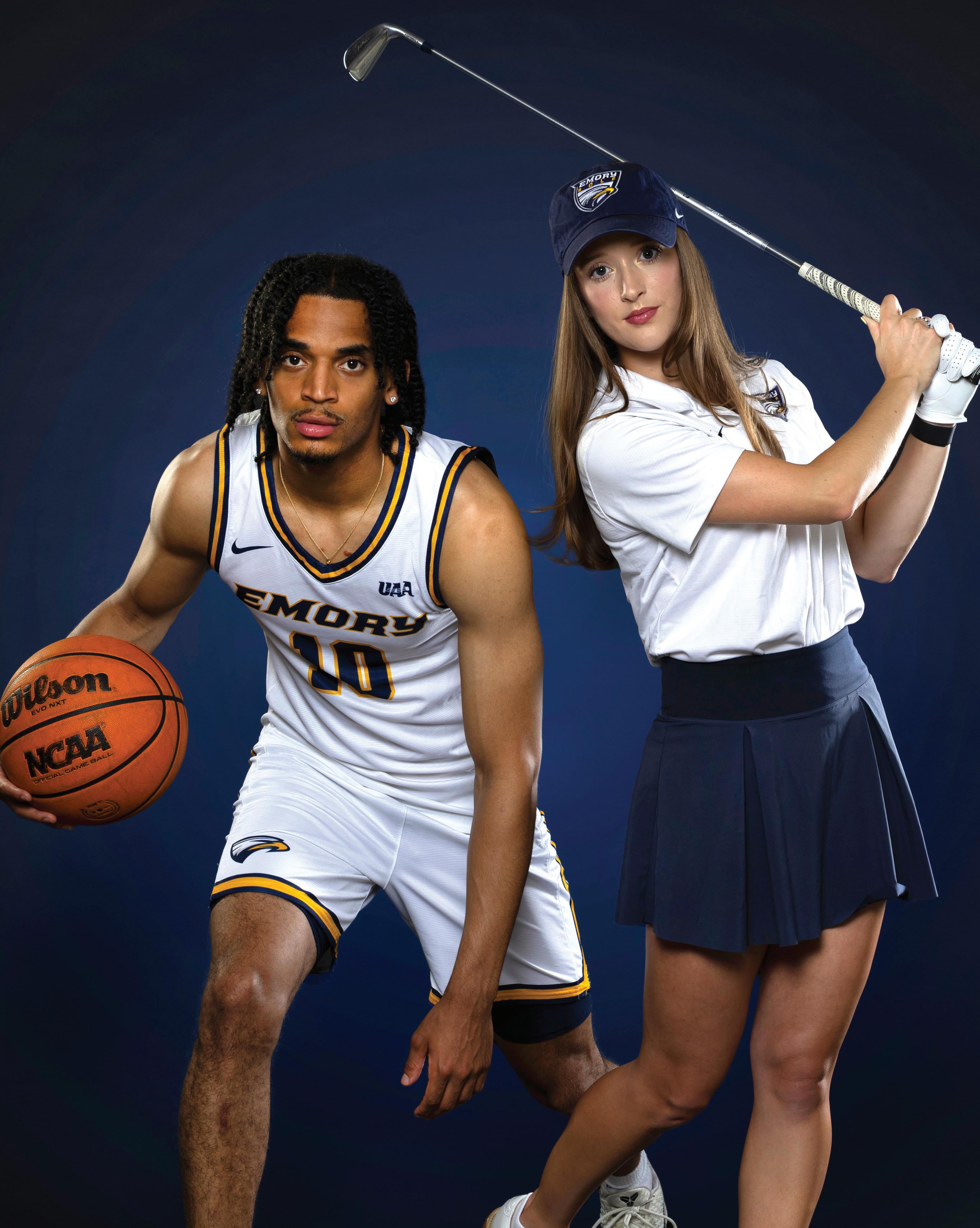
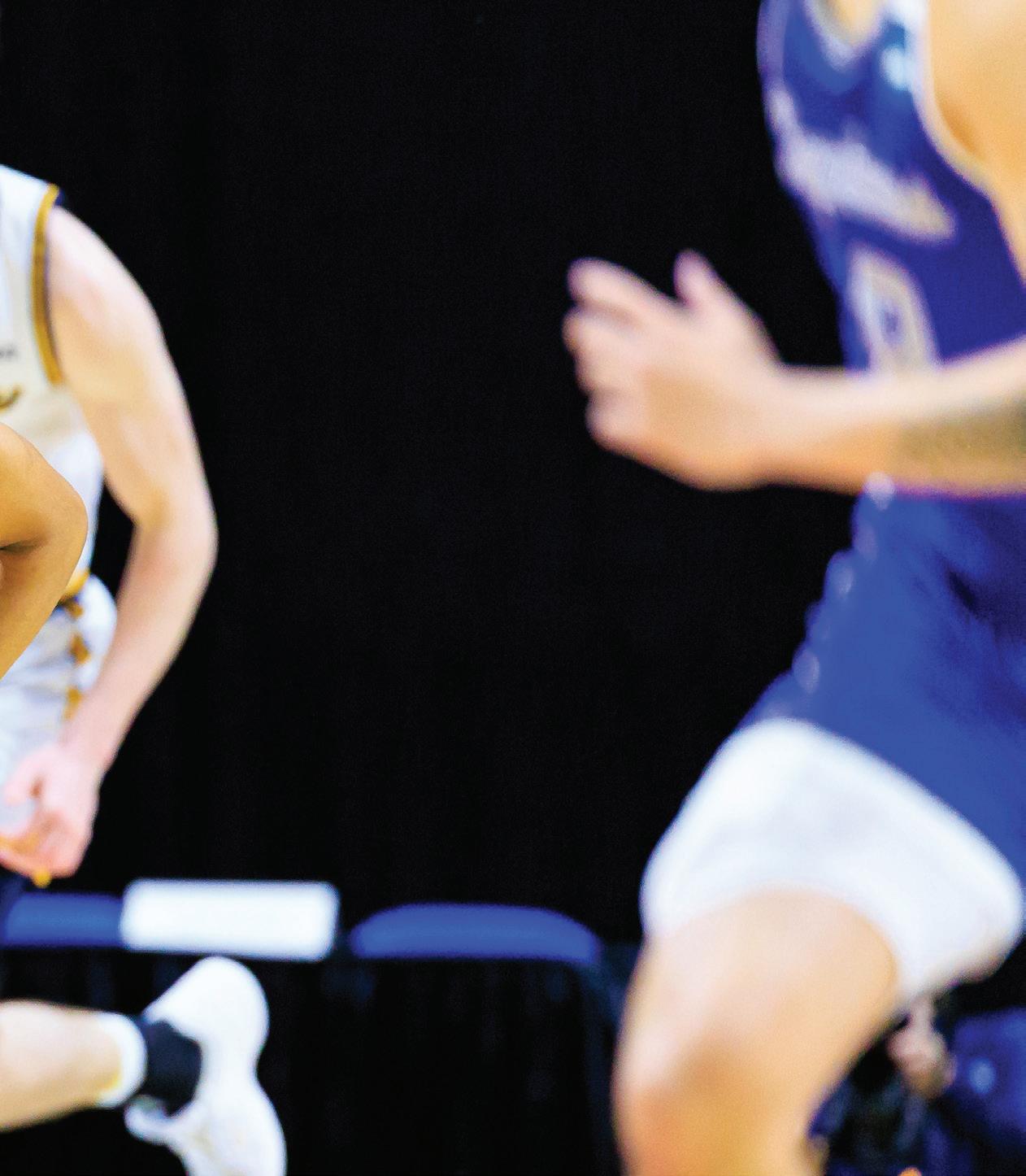
WE GOT GAME
HOW EMORY BECAME A SPORTS POWERHOUSE — AND WHY OUR MODEL FOR STUDENT-ATHLETE SUCCESS WORKS SO WELL.
BY ROGER SLAVENS
What does it take to build an athletics program where winning, academic excellence and full engagement in college life aren’t competing priorities — where student-athletes can pursue all three without compromise?
Emory has been answering that question for more than 40 years.
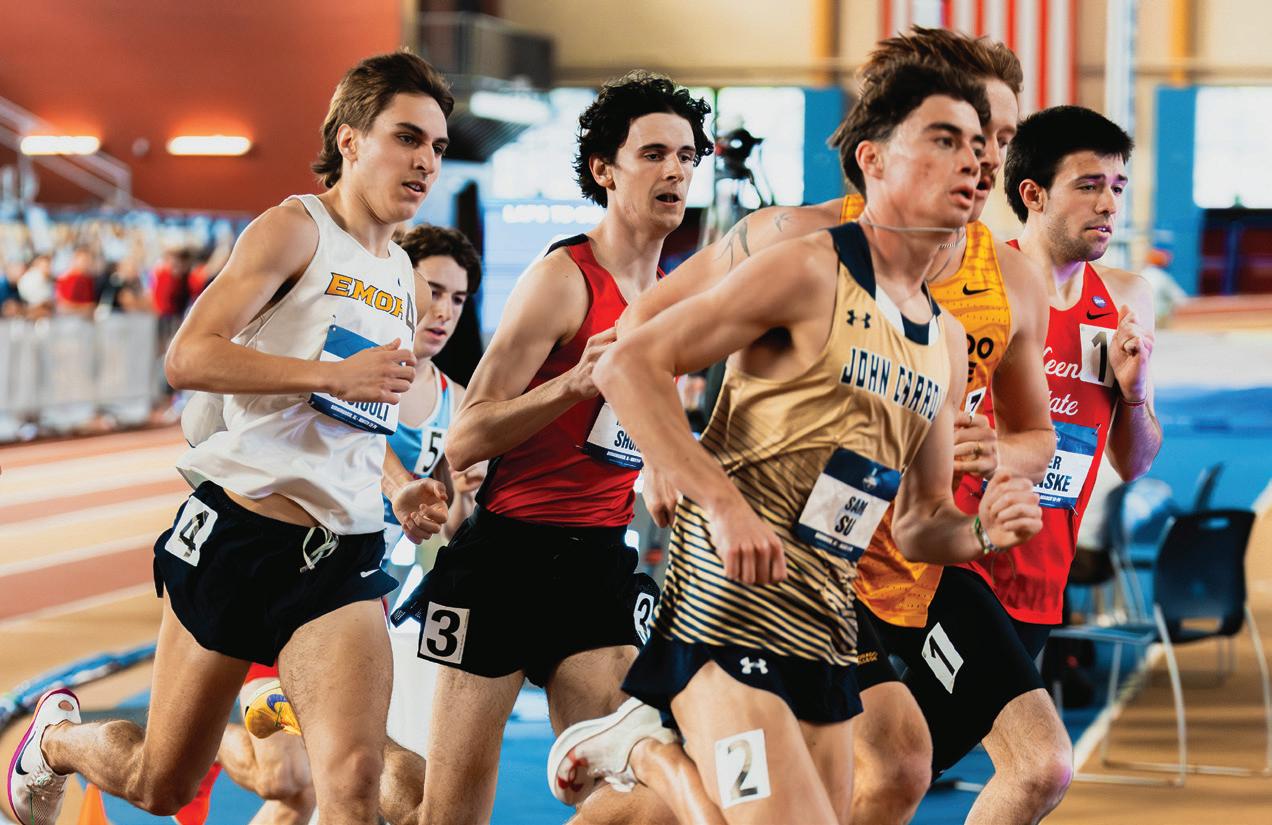
Nineteen varsity sports. Thirty-five NCAA team national championships. Two hundred and fifty-four Academic All-Americans. One unifying goal: excellence in every arena.
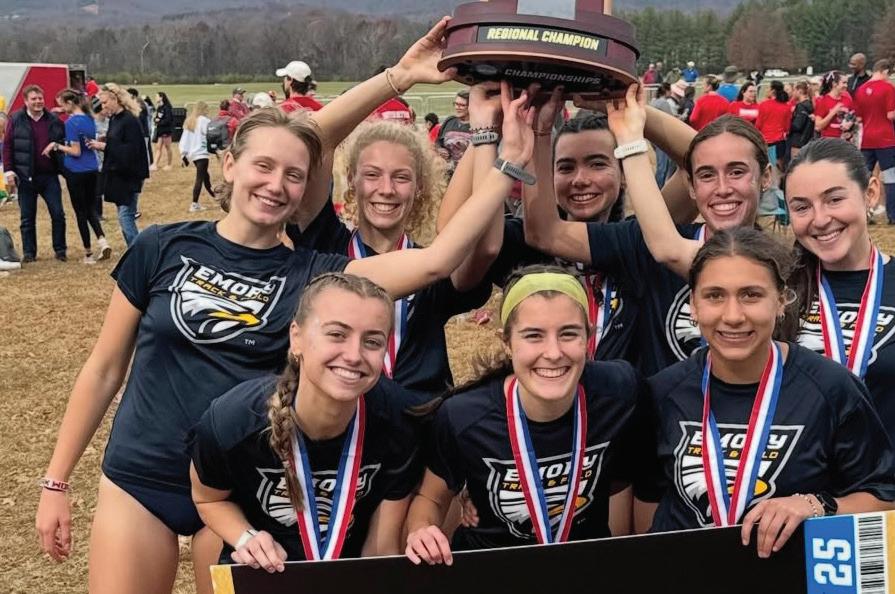
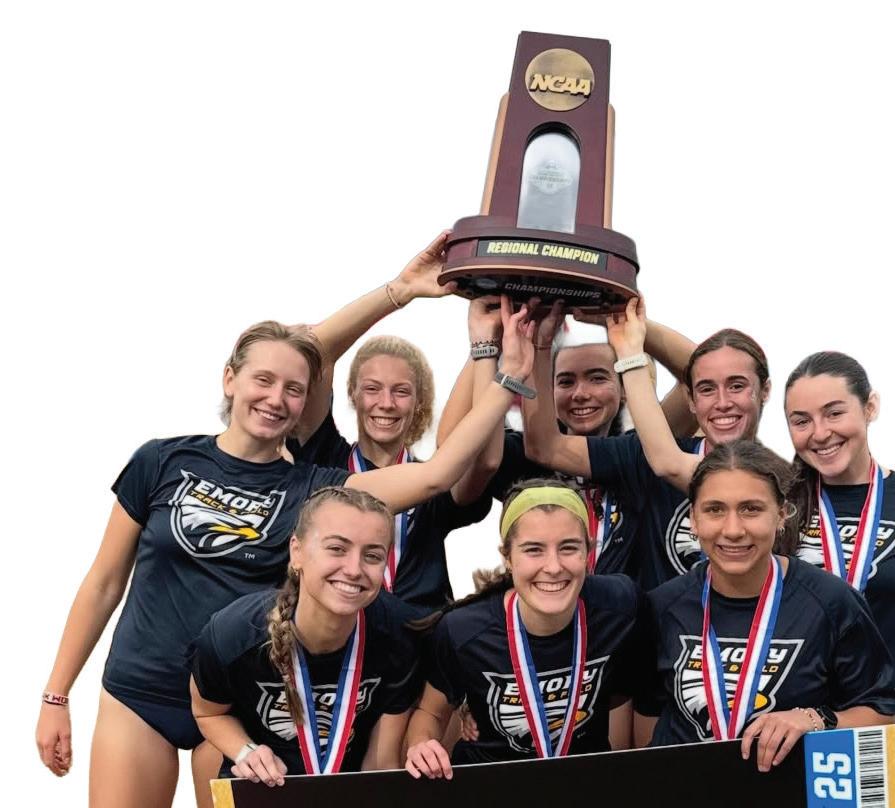
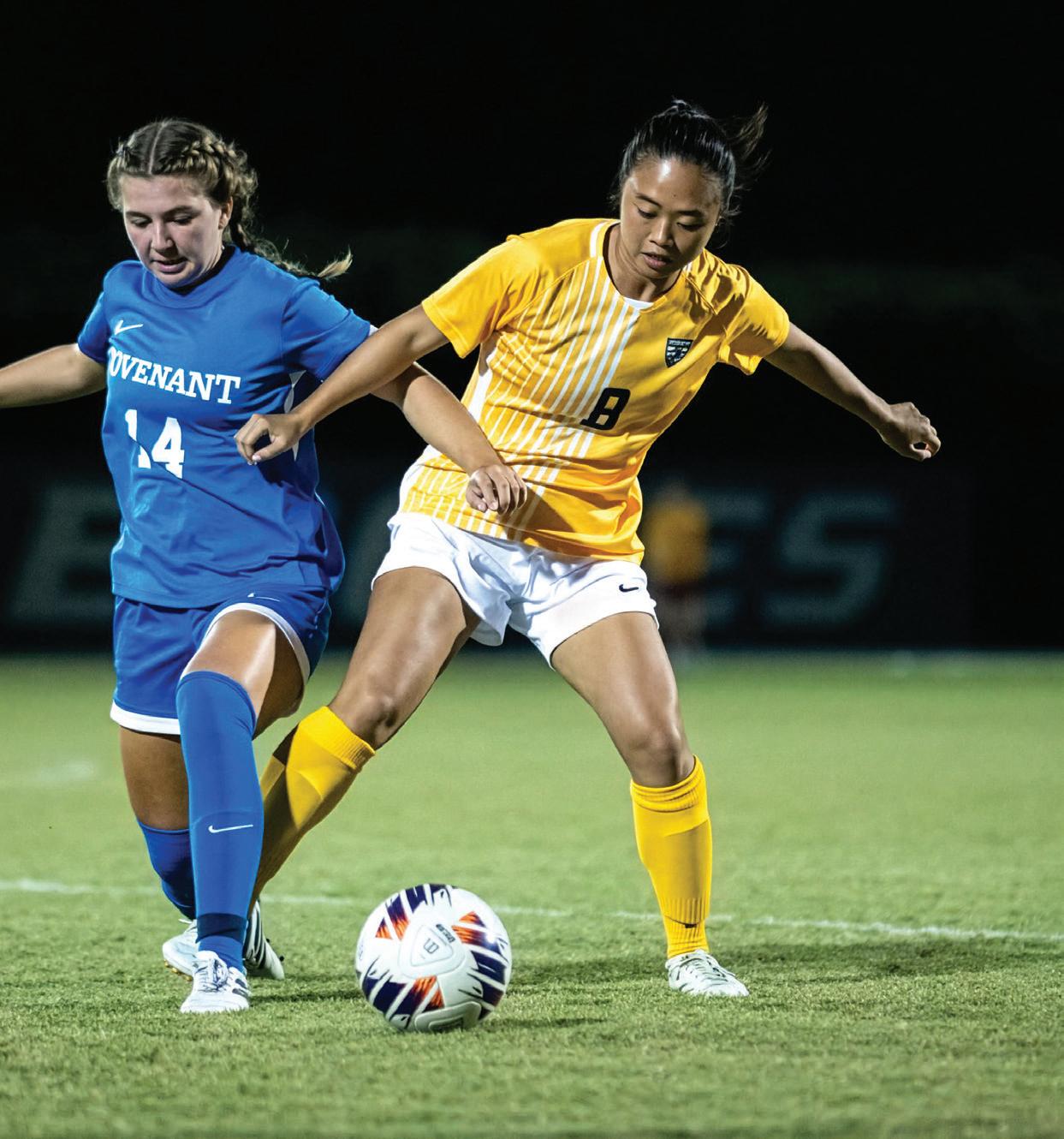
Season after season, across pools, courts, tracks, fields and fairways, the Eagles keep winning. Emory has finished among the nation’s top 10 Division III athletics programs almost every year since the Learfield Directors’ Cup standings were introduced in 1995. In 2024-25, the Eagles soared all the way to No. 1 and they finished fourth this year.
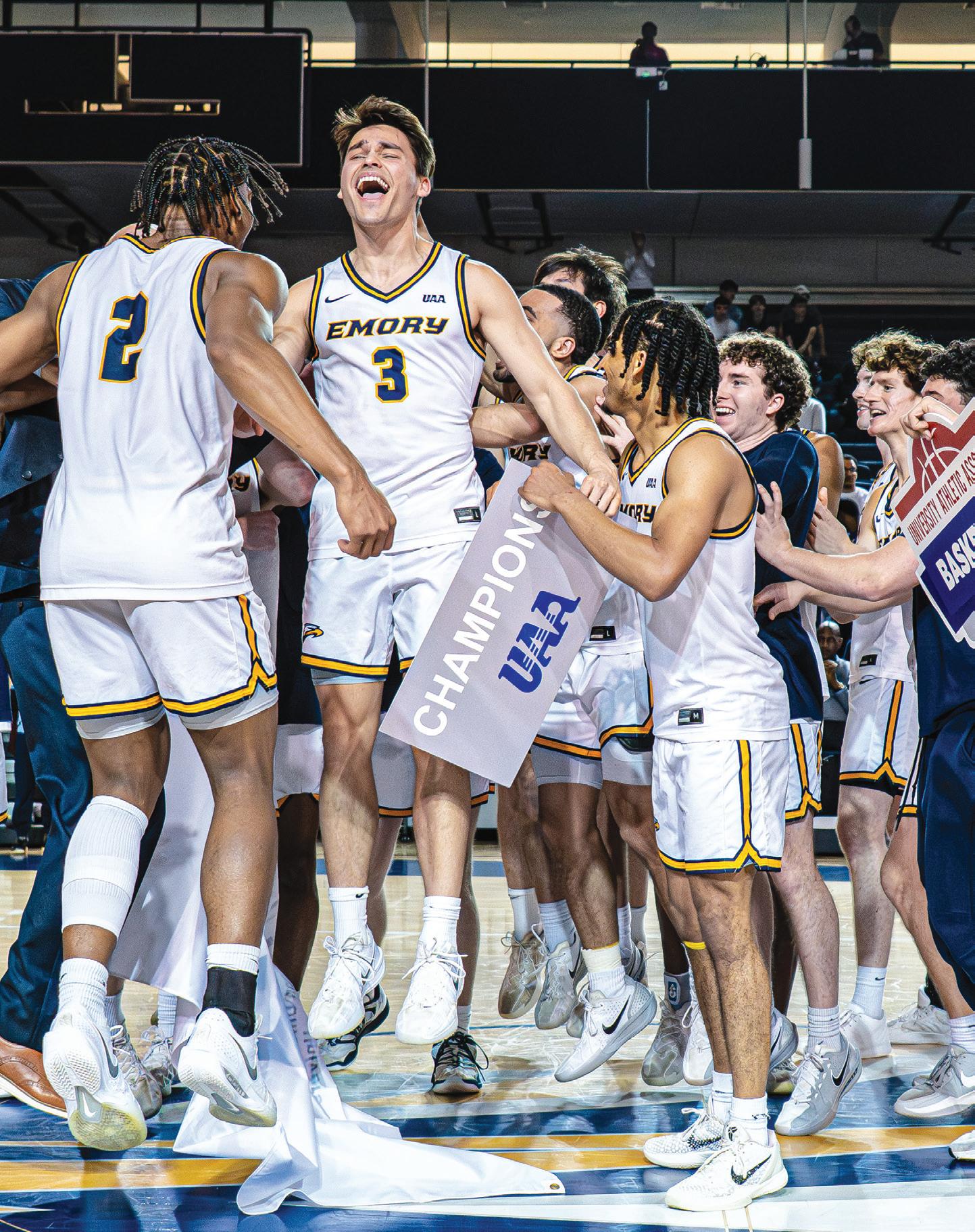
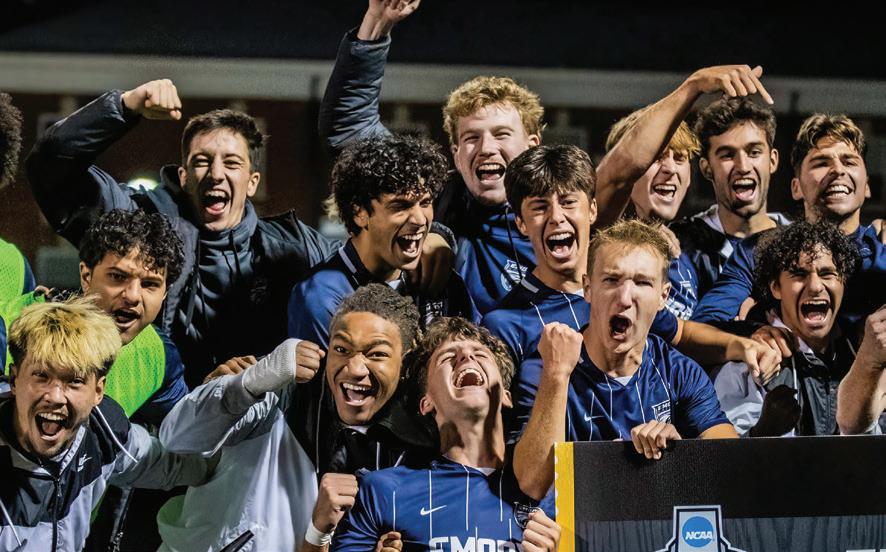
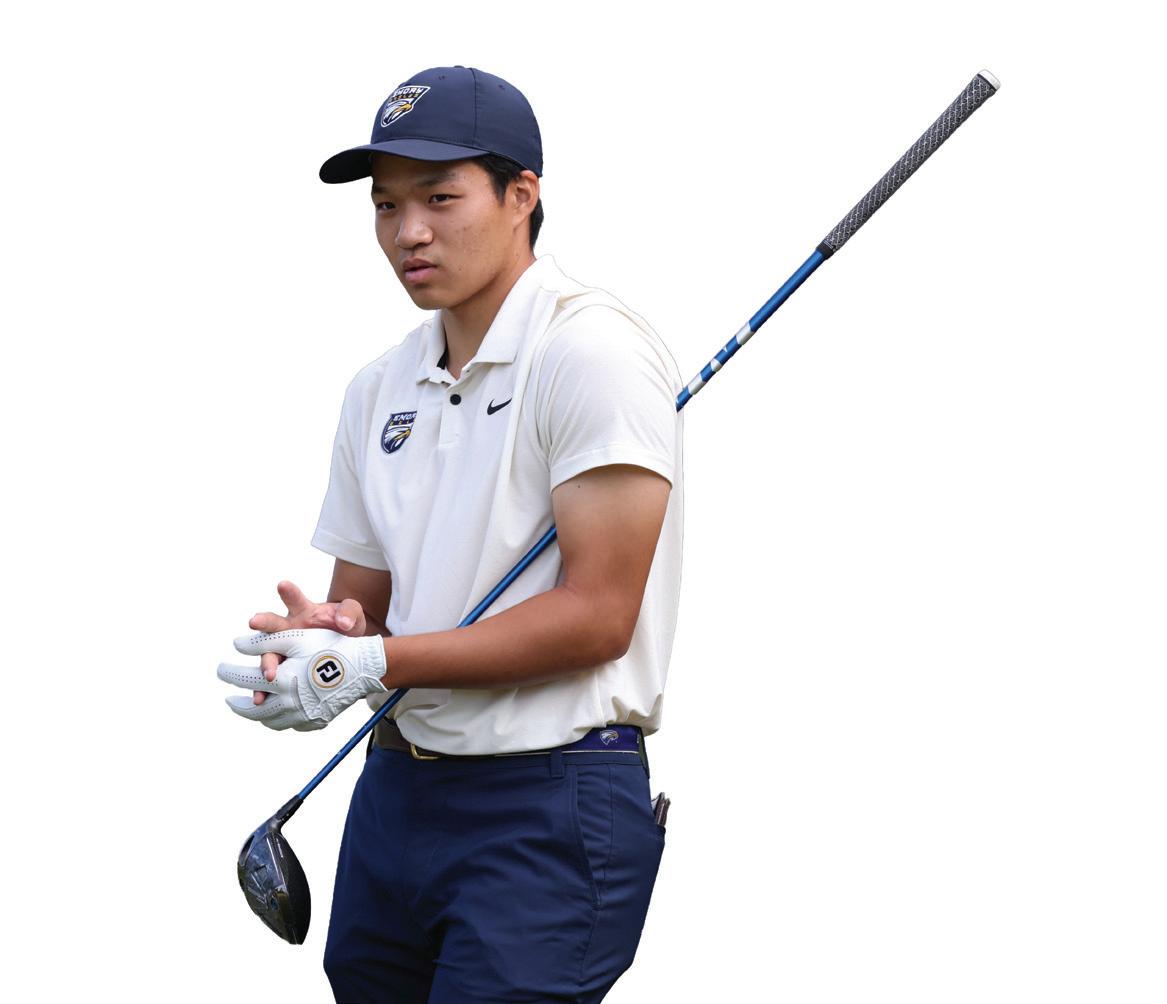
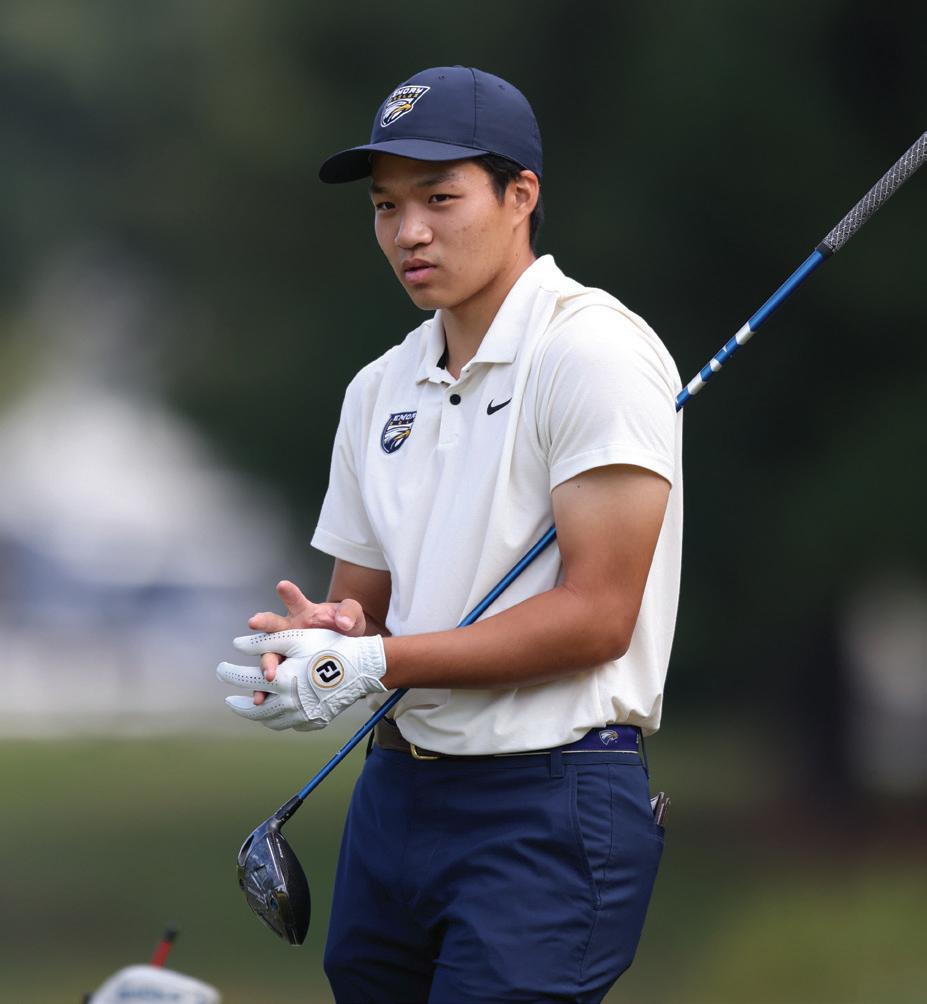
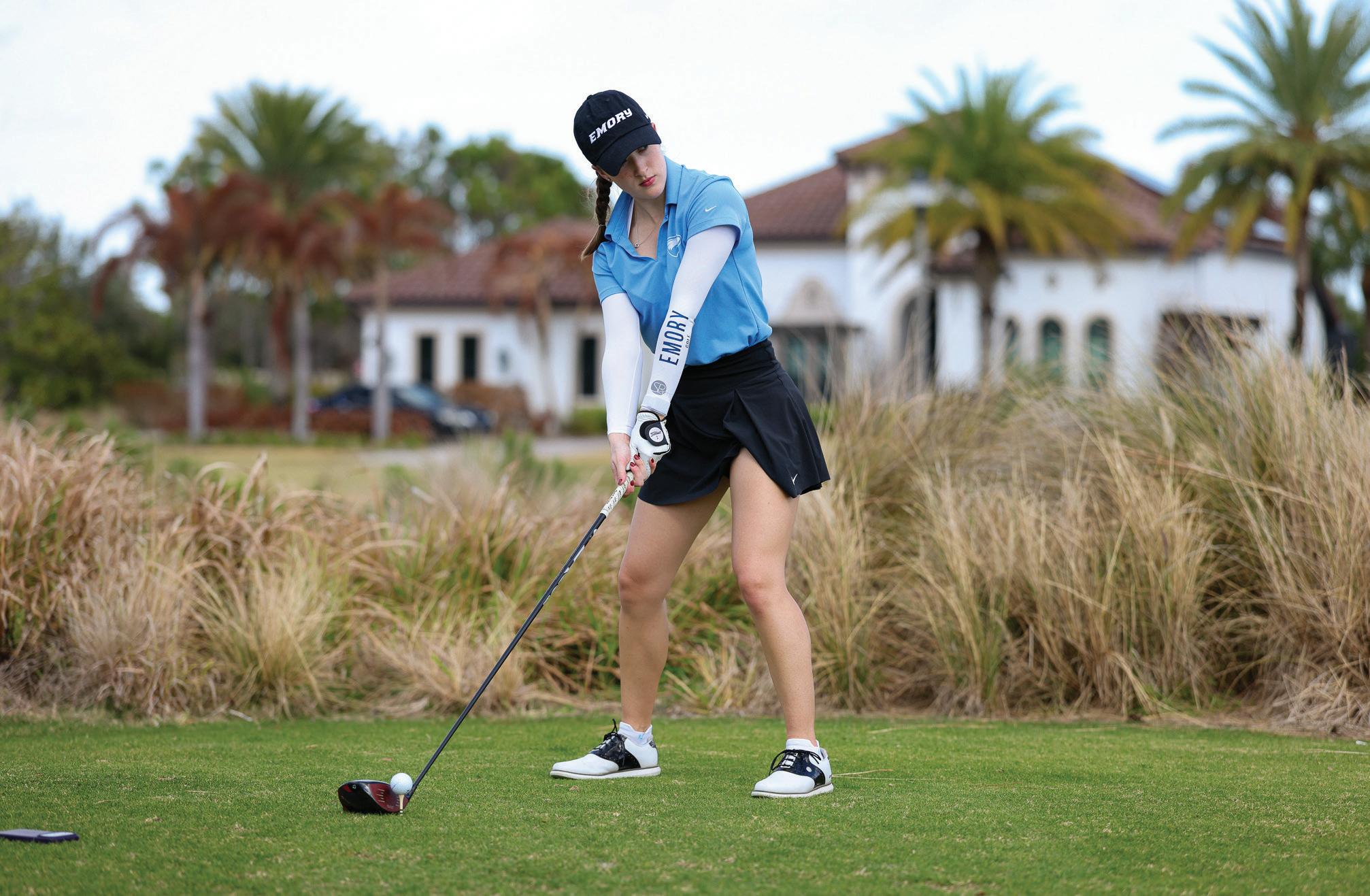
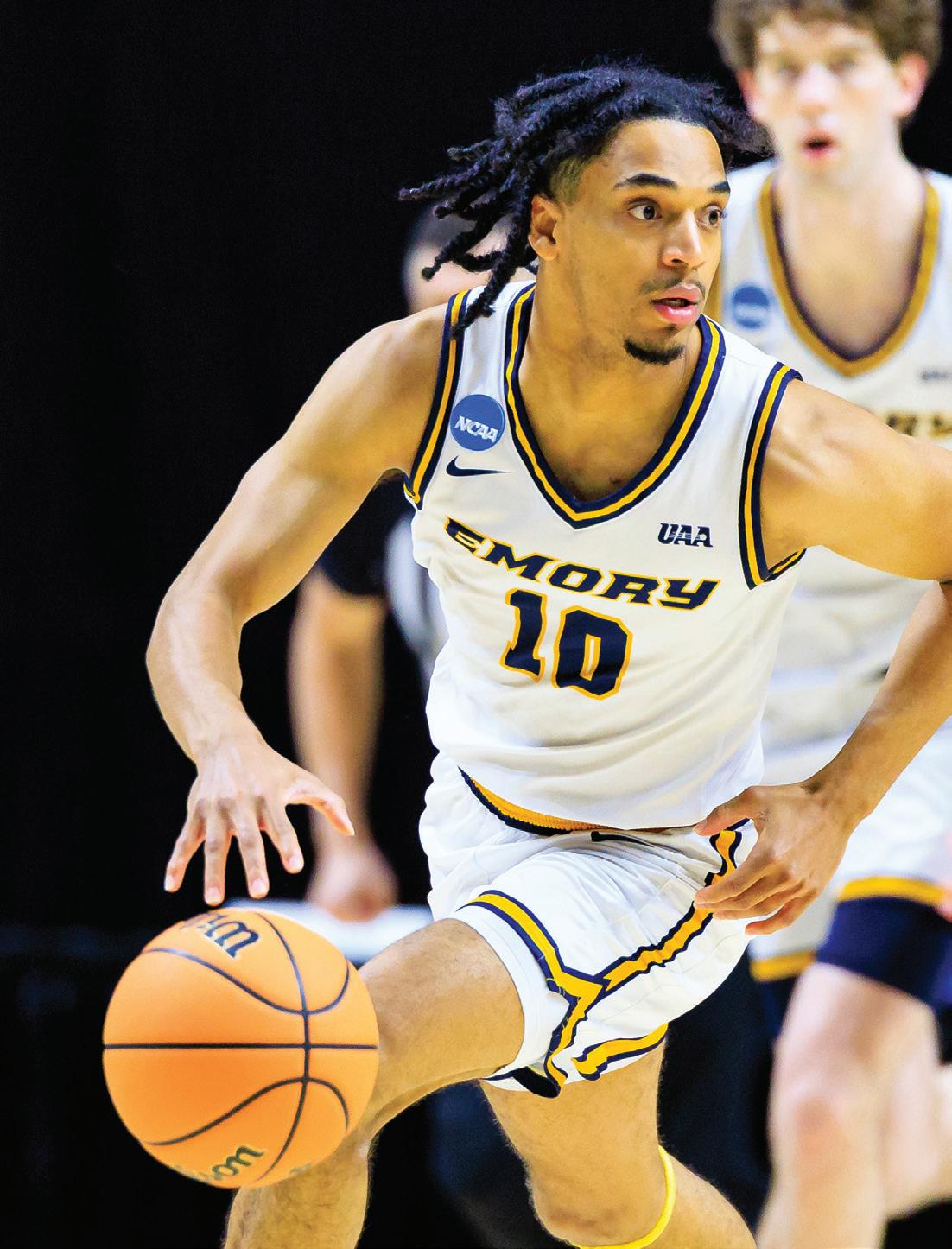
This past year, the women’s golf team won its third national championship and second in a row, the men’s basketball team reached the NCAA title game for the first time, and both soccer programs made the Final Four, with the women’s team also reaching the title game. In addition, Emory Athletics celebrated two national players of the year — Ben Pearce 26B in men’s basketball and Zimo Li 28C in women’s golf.
While the Eagles have become one of the most consistent success stories in Division III athletics, they’re also winning in the classroom, across campus and in the lives they build beyond sports.
For men’s basketball head coach Jason Zimmerman, academic and athletic excellence have never been competing forces.
“We don’t have to apologize for being great in the classroom and in competition,” he says. “We can do both.”
Carys Code 27B has lived that from the top of the leaderboard. She was the 2025 NCAA Division III individual national champion and also helped lead the Eagles to back-to-back team championships. Off the course, she’s a standout student at Goizueta Business School, one of the country’s best.
“How many places could I get both a top-tier education and compete on the national stage?” Code says. “At Emory, I’ve been able to do both — and it’s an opportunity and experience I’ll never forget.”
Winning so consistently like this, across the board, requires a plan.
Keiko Price Carter, Emory’s newly named vice president for student engagement and dean of Campus Life and outgoing athletics director, is under no illusions. Getting to the top of Division III athletics was hard. Staying there is harder. That work never ends, and it shows up in the students Emory recruits, the coaches it hires, the support it provides and the culture it protects.
BUILDING AN ATHLETICS PROGRAM THE RIGHT WAY TAKES TIME, INTENTION AND COMMITMENT.
When she arrived in 2020 to serve as the Clyde Partin Sr. Director of Athletics, Price Carter brought an elite athletic résumé with her. A former standout competitive swimmer at UCLA who went on to hold leadership roles at major college programs, Price Carter understood what serious athletics demanded of everyone working in the field. She also understood what made Emory unique, and what it could become.
Here, ambition did not have to mean imitation. “We are never going to settle for good enough,” she says. “We always aim to be the best.” For Price Carter, the standard applies everywhere — on the field, in the classroom and beyond.
However, such clarity and commitment did not arrive overnight. Joyce Jaleel, senior director and a longtime Emory Athletics administrator, remembers a department that looked little like the one today. When Jaleel arrived in 1986, the same year Emory joined the University Athletic Association (UAA), the department was still small and undeveloped.
“There were very few sports, and they were unorganized, mostly men’s teams,” Jaleel says.
Joining the UAA, led by the ambition of then-athletic director Gerald Lowrey, changed the trajectory. Emory suddenly belonged to a conference of academic peers — among them the University of Chicago and Carnegie Mellon — that treated athletics as serious intercollegiate competition. “That put us on the map,” Jaleel says.
The move also extended the university’s commitment. Sports were added, specifically women’s sports. Coaches were hired. Staff roles grew. The department had to create the more sophisticated systems that competitive athletics require: recruiting, scheduling, travel, compliance, athletic training and student support, all while fitting within Emory’s rigorous academic culture.
Growth like this required a university that believes athletics is a key part of student life. And Emory’s leadership, across decades and administrations, has consistently made that case.
Jon Howell understood that kind of deliberate work. Like Price Carter, he had been a competitive swimmer before moving into coaching. He came to Emory from Clemson, having previously competed and coached at Kenyon — at the time the powerhouse in Division III swimming.
But Emory was not Kenyon. Howell remembers another coach warning him early that he could not simply recreate that program here.
“In some ways he was right,” Howell says. “If we were going to be successful here, we had to create something that was uniquely Emory.”
The path to national success ran through Emory’s own strengths: its academic culture, its institutional commitment and its ability to recruit students who demand excellence in everything they do.
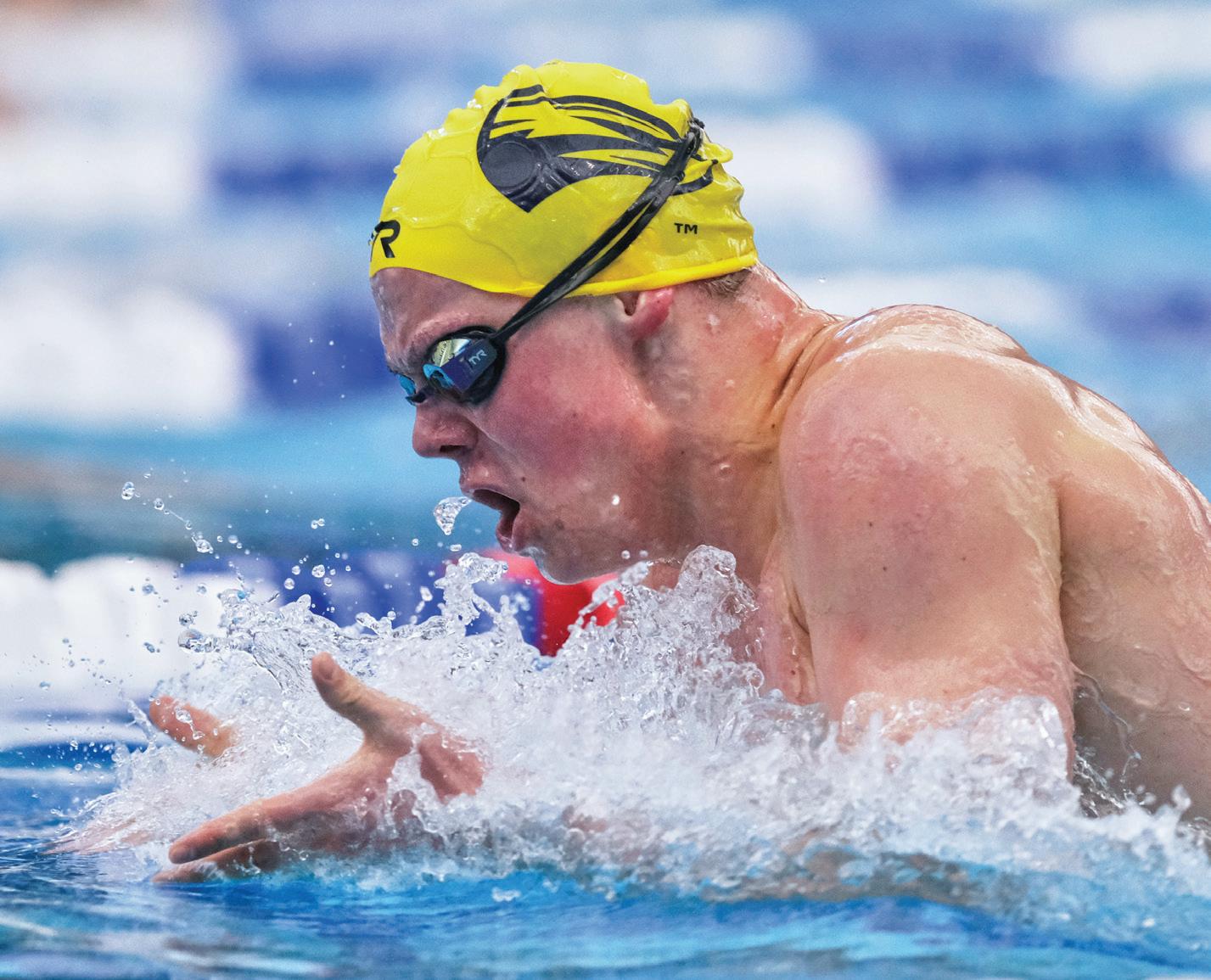
It worked. Under Howell, Emory swimming and diving has won a combined 16 NCAA team championships on both the women’s and men’s sides. The program has also developed standout individual champions, including Andrew Wilson, the first Division III swimmer ever to make the U.S. Olympic team and a gold medalist at the Tokyo Games.
What Howell built in the pool has helped inspire sustained success across all 19 varsity sports. Excellence is now the expectation, not the exception for Emory Athletics programs.
Keiko Price Carter
Jon Howell
tunity to taste,” she says. “To come to Emory and hear from these people who come from all these different backgrounds and experiences — it really opened my eyes.”
FINDING HER VOICE
Hildreth arrived on campus in 1995 after growing up in upstate New York. A three-sport athlete in soccer, basketball and track, she quickly found community through competition. “I found my people through athletics, as you so often do,” she says.
At the same time, she was beginning to see storytelling as a possible career path. Her journalism and English coursework pushed her in that direction, as did a class trip to South Africa that proved to be one of her most formative experiences at Emory.
The class learned about the South African history and culture before visiting the country for three weeks. Hildreth used the time to produce a profile on women in sports there — an early glimpse of the work that would later define much of her career.
After graduating from Emory in 1999, Hildreth joined the Atlanta Journal-Constitution (AJC) as a reporter, following an internship with the newspaper. Though she cut her teeth as a print journalist, she found herself drawn toward television. She joined the AJC High School Sports Show, a weekly program covering local prep athletics.
Hildreth learned the business from the ground up. “I was pulling cable at Georgia Tech games, logging tape, just doing whatever I could,” she says.
A connection to Fox Sports South followed, beginning a decade-long run in regional TV. At the time, however, opportunities for women in sports broadcasting looked very different than they do today.
“Where I saw women in sports television was largely on the sideline,” she says. “Very rarely did you hear or see them in the booth. So I didn’t even have any idea that could be something that I would aspire to.”
A SEAT IN THE BOOTH
Hildreth spent years working as a sideline and feature reporter covering ACC and SEC collegiate games before a producer encouraged her to try play-by-play. “I was terrified to try it,” she says. “But I did.”
The shift changed her career. “It truly is an art,” she says of play-by-play announcing. “It is not just calling
what you see. You’re telling a story, but you don’t know what that story is until the game happens.”
That approach carried her from regional broadcasts to some of the biggest stages in sports, including multiple Women’s World Cups and March Madness.
Over the course of her career, Hildreth has watched women’s sports move from the margins toward the center of the sports landscape. “Twenty years ago, that was really pretty true — you’d watch women’s sports in maybe the Olympics or a World Cup, but there was not nearly the buzz around it that there is now,” she says. “Now you see so many more people getting their eyes on the sport and waking up to what we’ve known for a long time, which is that the product sells itself.”
Hildreth is honored to have been part of that growth. “I’m really proud to be a female voice that calls women’s sports,” she says.
TALES OF MOTHERHOOD AND SPORTS
The experiences that led to “Tough as a Mother” came from another side of her life entirely. “I was in all these crazy scenarios and situations,” she says.
At the time, Hildreth was traveling constantly while raising young children and trying to navigate an industry that had not fully adjusted to the realities of working motherhood. “I remember sitting on a suitcase in the middle of a bathroom in Hartsfield-Jackson pumping milk — not even in a stall,” she says. “I was scared to show the struggle because I didn’t want anyone to look at it as a weakness. I didn’t want anyone to think, ‘Oh, she’s a mom now — she can’t handle this type of work.’”
Eventually, those experiences became the foundation for the book she co-authored with Aimee Leone, a longtime media executive at Fox Sports. “We wanted people to be able to hear these women’s stories in their own voices and to connect with them,” she says.
The title reflects the central idea behind the project. “You think about mothers as these soft, nurturing, graceful, loving, gentle people,” she says. “All of those things are true — but we are also tough and gritty and determined.”
That mix of vulnerability and resilience is something Hildreth still tries to capture in the stories she tells on air. That instinct, she says, traces back to her years at Emory. “I think Emory gave me the perfect opportunity to dream big and to dare to fail,” she says.
“I'VE ALWAYS BEEN A BELIEVER THAT HARD WORK GETS REWARDED — AND THAT FELT LIKE THE MOMENT WHERE ALL OF OUR HARD WORK FINALLY PAID OFF.”
— CARYS CODE, WOMEN'S GOLF
STUDENT-ATHLETES WHO CHOOSE EMORY ARE DRIVEN TO WIN — AND TO MAKE THE MOST OF EVERY OPPORTUNITY.
Joyce Jaleel
Joyce Jaleel has watched thousands of Emory student-athletes come through the program over nearly four decades. What strikes her most is not their talent. It is their hunger.
“They are driven individuals who set high standards in every part of their lives,” Jaleel says. “They want to be the best at everything.”
That hunger is what India Chiles recruits for every season.
Before becoming Emory’s softball coach, Chiles played at the University of Tennessee, was named SEC Player of the Year and went on to play professionally. She knows firsthand what high-level athletics demands — the training schedules, the travel, the competition pres-
sure and the discipline required to perform consistently. She also knows what it looks like when a program takes those demands seriously without letting them crowd out everything else college has to offer.
When she first visited Emory, the athletic intensity she found on the field surprised her.
“Emory, in ways, felt very much like what I was coming from at UT,” Chiles says. “Sure, the stadiums aren’t as big, but you get this feeling that this is truly a sports school.”
In recruiting, she pushes athletes to define the experience they want as competitors and as students. She puts it to them directly: What does playing actually mean to you? What will it feel like? When they describe that feeling, she shows them Emory will give them exactly that and more.
The athletes who arrive at Emory prove the point. They compete because they want to — not because they have to.
“We all start intrinsically motivated,” Chiles says.
“They have that drive, that passion to show up and perform. That never goes away here.”
Ben Pearce had plenty of options when it came time to choose a program. But when he found Emory, something clicked. The men’s basketball standout would go on to become the program’s all-time leading scorer and help carry the Eagles to their first NCAA Division III championship game.
“I would still put this opportunity on top of so many others,” he says. “There’s nowhere else I would have rather been.”
Pearce is precisely the kind of student-athlete Price Carter seeks. “We want the best of the best minds and athletic ability on our teams,” she says. “And we’re not going to compromise that.”
And what she and the program demand shows up not just in individual performance but in how those student-athletes make each other better. In men’s basketball, Pearce found that in teammate Tyson Thomas 26B.
They were in the same recruiting class, playing the same position. In a different environment, Pearce says, the relationship could have felt adversarial, even threatening — two players chasing the same minutes, the same role, the same recognition.
At Emory, it became something else.
Thomas, Pearce says, was “probably the best teammate that I’ve ever had.” He watched the game closely, shared what he saw and became, in Pearce’s words, “an extension of the coaches.” When the team wobbled, Thomas was often the one pulling it back together.
“He always tells us we’ve got to connect and stay connected,” Pearce says. “We can’t break when things are getting bad.”
That is what exceptional recruiting produces: not only skilled competitors, but teammates who hold each other to the same standard they set for themselves.
Women’s golfer Carys Code knows what the daily commitment between teammates and coaches can produce.
“I’ve always been a believer that hard work gets rewarded,” Code says, “and winning those titles felt like where all of it finally paid off. My teammates and coaches have shown me ways to get better, to work harder and keep pushing for success.”
For Nikki Boon 29PhD, the push is almost the point. A neuroscience PhD student and one of Division III’s most accomplished track and field athletes, Boon has won national titles in the indoor pentathlon and outdoor heptathlon, set Division III records and represented the Netherlands in the Women’s Decathlon World Championships, where she won gold and earned the event’s official designation of “World’s Greatest Athlete.”
“I like to do difficult things,” Boon says.
Here, that instinct has found a team around it. Boon came to Emory as the only heptathlon athlete on the roster, unsure
whether that would leave her isolated. Her demanding training schedule — competing across more events than anyone else on the team — became something of a legend. During grueling weekly workouts, teammates would watch her still-unfinished event list from the sideline and joke that their workout could always be worse.
“Just look at Nikki’s,” they’d tease.
“I thought I was going to be secluded,” Boon says. “But everyone has been so kind and supportive.”
Sydney Holden’s path back to competition was harder than most. During her first year at Emory, torn cartilage and a femur rotated 30 degrees forced her to confront a fear she had carried since age 5 — that she might never run again. The surgery required breaking the bone, rotating it back into position and inserting a titanium rod for stability. Holden 26C had to re-establish connection with her right leg and relearn to walk, then run, then sprint.
Two years of competition lost. But not lost alone.
“My coaches and teammates kept me involved and encouraged me throughout my recovery,” Holden says. “From day one, they helped me manage my schedule and athletic commitments, offering advice and sharing laughs.”
She bounced back. This past indoor season, Holden
“EVEN IF YOU WERE TO TAKE BASKETBALL OUT OF IT, EMORY IS A REALLY, REALLY SPECIAL PLACE. THERE ARE SO MANY GREAT OPPORTUNITIES.”
— BEN PEARCE, MEN'S BASKETBALL
OXFORD COLLEGE’S WINNING FORMULA
As Emory Athletics continues to thrive nationally in Division III sports, another championship culture is flourishing 31 miles east of Atlanta.
earned all-region honors as part of Emory’s distance medley relay team. Now a double major in human health and integrated visual arts, she is more determined than ever to become an orthopedic surgeon and to help others reclaim what she nearly lost herself.
What student-athletes become starts with who they are when they arrive. But it depends just as much on the coaches and staff guiding them along the way.
COACHES HERE DEVELOP ELITE ATHLETIC SKILLS AND INSTINCTS, ALONG WITH THE RESILIENCE AND CHARACTER TO MATCH.
The coaches at Emory are more than in-game tacticians. They are recruiters, teachers, planners, mentors and culture builders. They ask students to pursue championships, but also to grow enough that the journey changes them.
Jaleel sees that work happening across programs and between them.
“The coaches feed off of each other,” she says. “They pick each other’s brains.”
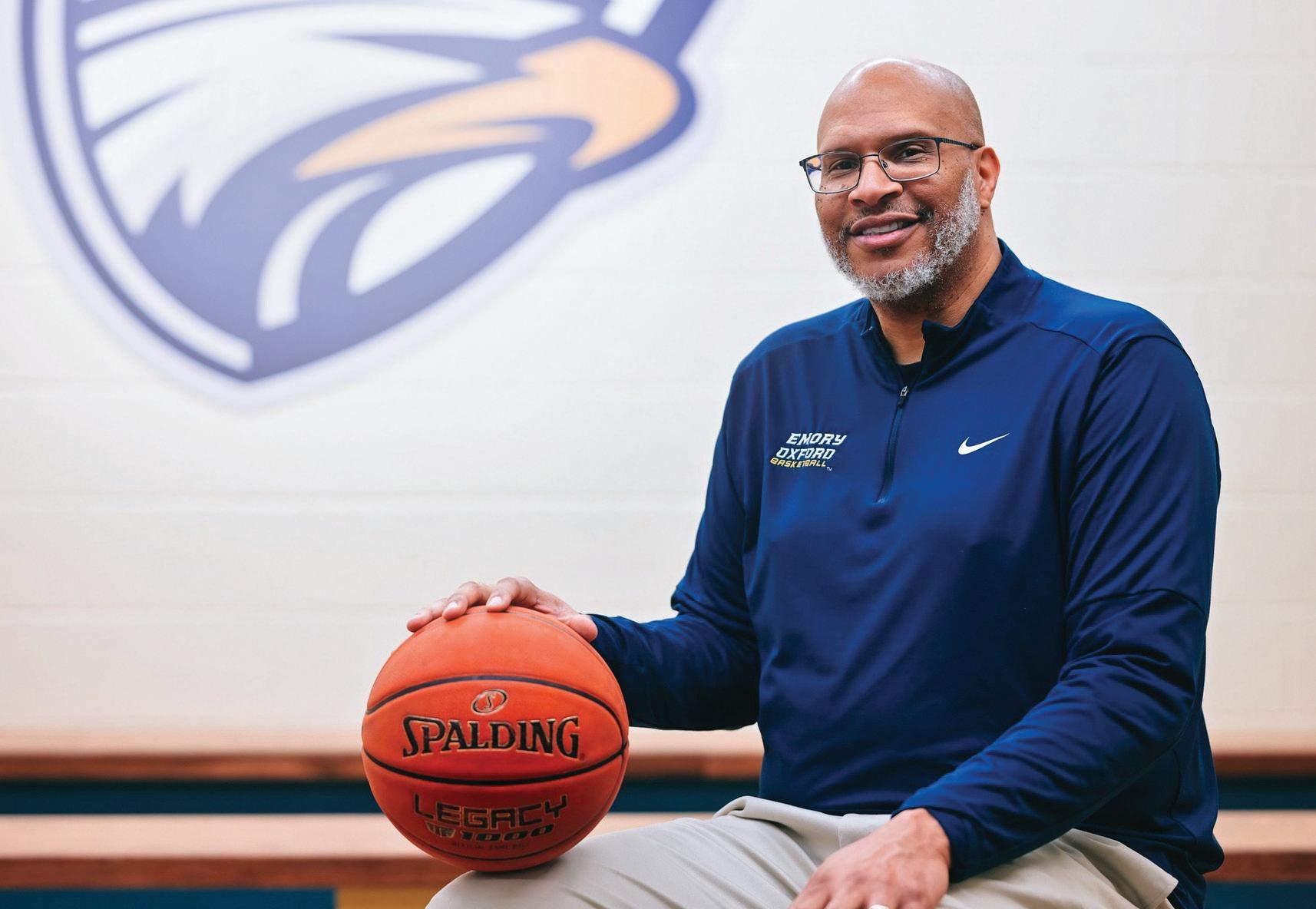
Since 1999, Oxford College Athletics has grown into one of the National Junior Collegiate Athletic Association’s (NJCAA) top nonscholarship programs, sponsoring 10 varsity sports. This spring, athletic director and head men’s basketball coach Roderick Stubbs was named the 2026 NJCAA Athletic Director of the Year.
Stubbs, who joined Oxford in 2005 and became its athletic director in 2013, has emphasized long-term student-athlete development over hardware. “Winning national championships is not the end goal; we want to be able to provide that excellent athletic experience for the student-athlete,” he says.
That philosophy has produced results both on and off the field. For 14 consecutive years, every varsity team has maintained a cumulative GPA above 3.0, with student-athletes earning 492 NJCAA Academic All-American honors. On the competitive side, teams have captured 24 national titles during Stubbs’ tenure, including both men’s and women’s tennis championships in 2024-25, when the program also finished 16th nationally among 160 nonscholarship programs in the Daktronics Cup standings.
“I want Oxford to keep growing,” Stubbs says. “We’ve built a strong foundation, and the next step is expanding our facilities and enhancing the structure that supports our programs.”
“I ARRIVED ON CAMPUS WITH 80-PLUS TEAMMATES WHO WERE MY FRIENDS FROM DAY ONE. MY MEMORIES WITH THEM, COACHES AND OTHERS MEAN THE WORLD TO ME.”
— CROW THORSEN, MEN'S SWIMMING
One program breaks through. Another studies how it happened. A coach asks a colleague how to handle a slump, a leadership issue, a recruiting question or the pressure that comes with winning. Around Emory, Jaleel says, “success breeds success.”
That cross-program momentum can make a breakthrough season look sudden from the outside. Jason Zimmerman knows better. The men’s basketball run this season may have marked new territory for the program, but Zimmerman does not describe it as a one-year surge.
“I think it’s grown from many, many years of sustained work from our staff, our players and our alums,” he says.
Howell has spent nearly three decades proving the same point in swimming and diving. At a time when college programs can rise and fall quickly, Emory’s strongest programs have been developed more patiently.
Sustained success can look automatic, but it is not.
“We can never take our success for granted,” Howell says. “It’s always something we earn.”
That is why, even in a program accustomed to winning, the work never stands still. Recruiting demands shift. Training science advances.
Athletes arrive with new expectations and coaches have to meet them where they are.
What stays constant, Howell says, is the community of people committed to improving themselves and helping those around them do the same.
For Howell, coaching at Emory also means paying attention to everything outside the pool. He and his staff are trying to help students become the best swimmers and divers they can be, but he believes they underperform if that is their only focus.
Such conversations stretch well beyond practice: research opportunities, medical school applications, internships, wellness, confidence, leadership and life after graduation.
“I probably have more of those conversations than I do swimming conversations at some points of the year,” Howell says.
That broader view shapes how he measures success. The best memories are not always the national championships or personal records set, he says. Instead, they come from the students who arrive uncertain, struggle, grow and leave stronger.
He thinks of one swimmer who had a rough freshman year and missed the travel squad entirely, then returned as a sophomore transformed — an All-American, an All-UAA swimmer and someone beginning to think about how he could lead.
“It’s not about winning,” Howell says. “It’s about how we support each other and grow.”
That idea, that the sport is a means, not just an end, runs through the coaching culture Howell describes.
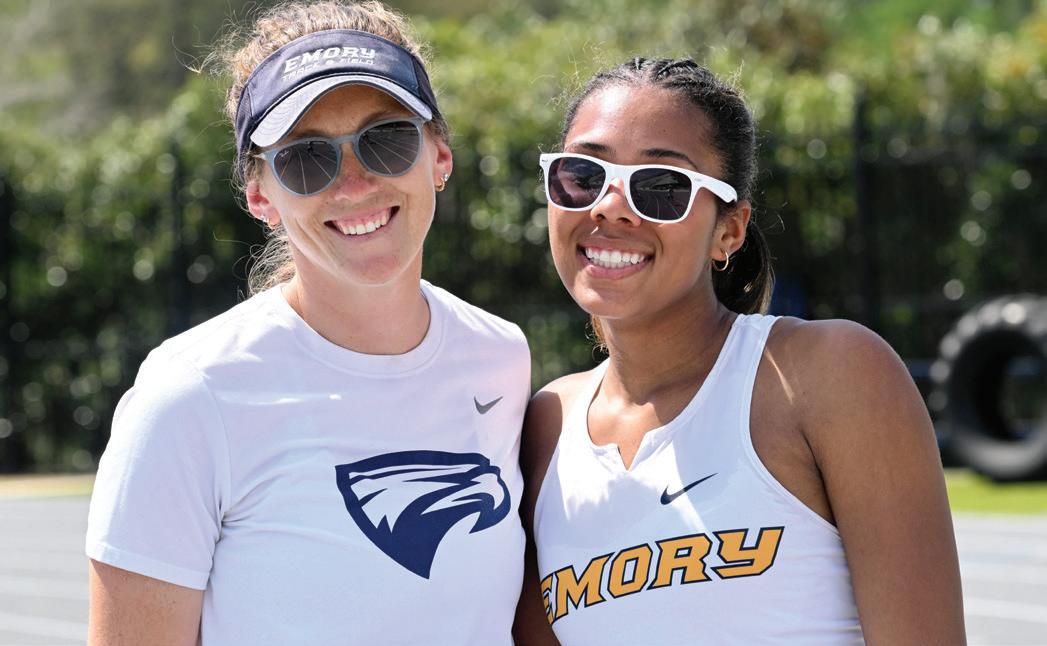
Bridget Disher 18C 20PH lived it first as a player and now carries it as a coach.
When she arrived at Emory as a student, women’s tennis had already won six national championships.
“I felt this very palpable connection to that legacy,” she says. “There’s something in the air — the confidence that comes from what those teams built, but also the responsibility I had to carry with it.”
Jason Zimmerman
Bridget Disher
A CAREER FULL OF CURVEBALLS
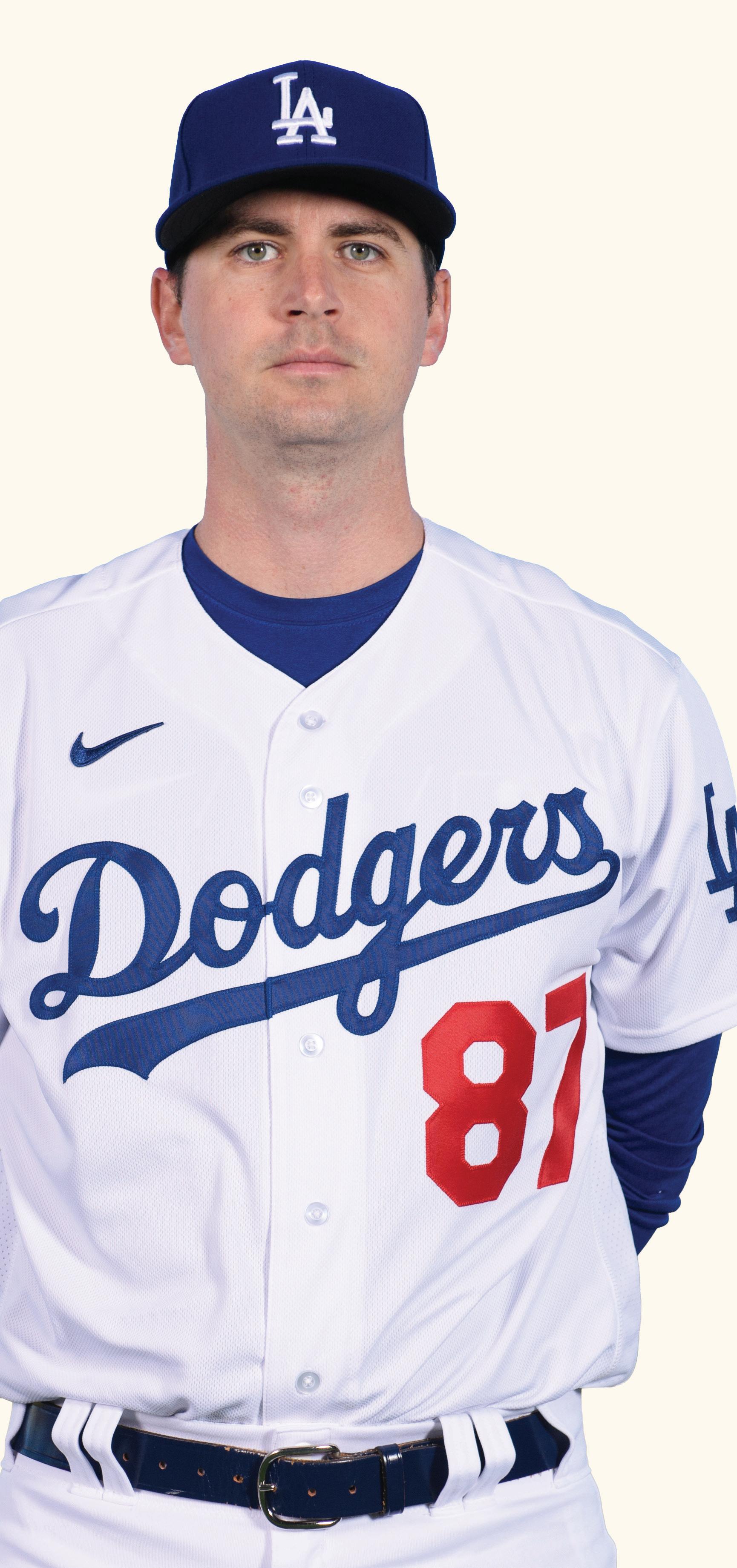
When injuries cut short his baseball playing days, former Emory pitcher Connor McGuiness forged a different path to the big leagues — as a coach and analytics guru for the Los Angeles Dodgers.
BY ROGER SLAVENS
Like most kids who grow up playing baseball, Connor McGuiness 12C dreamed of one day becoming a World Series hero. He often imagined himself on the mound under the bright stadium lights, fastballs popping into the catcher’s mitt in the chill autumn air, the crowd roaring with every strike.
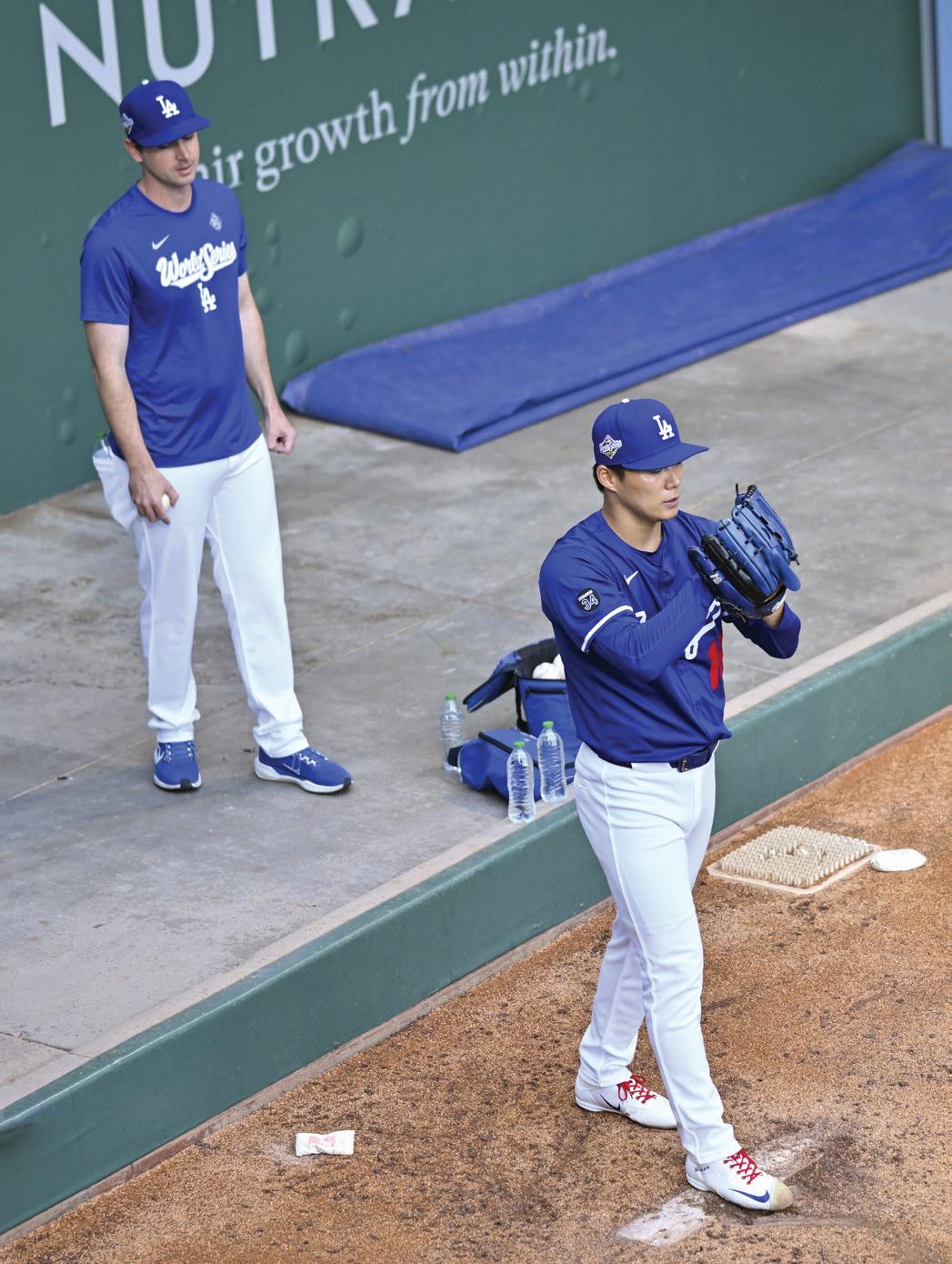
Years later, a version of that dream came true. McGuiness has won three World Series championships as a member of the Los Angeles Dodgers — not as a pitcher, but as one of the coaches who helped guide the team to October glory.
He serves as the Dodgers’ assistant pitching coach, a role at the forefront of baseball's analytical revolution. Part strategist, part teacher and part psychologist, he studies pitch spin rates and player biomechanics, dissects high-speed video and helps stars like Shohei Ohtani and Clayton Kershaw make the tiny adjustments that win games and championships. It's a role that barely existed in Major League Baseball a decade ago.
It might not be the path he once imagined. But it has brought him exactly where he always wanted to be.
FINDING EMORY
McGuiness grew up in the Washington, D.C., area and considered other strong academic schools before choosing Emory.
“It was in the South. It was warm. And the educational opportunities were immense,” he says. “On the baseball side, the team was coming off an NCAA Division III College World Series run. And when I visited campus during an alumni weekend and saw how many former players came back, that sealed the deal.”
He arrived in Atlanta with ambitions of pitching professionally. Unfortunately, his body had other plans. Shoulder. Elbow. Back. “I was the guy who was always hurt,” he says.
The injuries pushed him toward studying the game from an unexpected angle. With no dedicated pitching coach during his junior and senior years, McGuiness began helping teammates with mechanics and game planning while he was sidelined. “By default, I kind of became the pseudo pitching coach,” he says.
McGuiness graduated in 2012 with a degree in economics and a passion for analytics. A course on game theory and strategic decision-making taught him to think about pitching as sequencing and anticipation — a constant chess match between pitcher and hitter to find an advantage.
AN UNCONVENTIONAL PATH
After a year exploring options postgraduation, McGuiness was recruited back to Emory as a pitching coach. He helped guide the Eagles to back-to-back Division III College World Series appearances, including a national runner-up finish in 2014. He later joined the coaching staff at The Catholic University of America while earning a master’s in business management. He spent a lot of that time immersing himself in baseball's rapidly evolving analytical landscape.
In 2016, he attended the league’s Winter Meetings and found Dodgers officials describing the same problems he'd been thinking about. “They told me, ‘Yeah, we have all of the data. But none of our coaches know how to use it,’” McGuiness says.
The Dodgers began sending him video and scouting assignments, then offered him a role in its minor league system — an unconventional hire in a sport that had long favored former major leaguers for coaching positions. He cut his teeth with low-level teams including the Great Lakes Loons and Rancho Cucamonga Quakes, working with young pitching prospects such as Walker Buehler, Dustin May and Julio Urías.
McGuiness believes one of the most important parts of coaching is understanding individual pitchers rather than forcing everyone into the same blueprint. He points to Urías as one example. The young left-hander had spent years trying to emulate Clayton Kershaw, but McGuiness thought he was fighting his natural delivery. “I told him, ‘Your curveball doesn’t have to be 12-6. It can just fit your natural arm path,’” McGuiness
says. “He replied, ‘I’m allowed to do that?’ I said, ‘Yeah, man. You’re allowed to do anything you want.’”
Urías trusted the adjustment. Three years later, he was on the mound for the final out of Game 6 of the 2020 World Series — the Dodgers’ first title in 32 years.
BASEBALL’S NEW FRONTIER
In his 10th season with the Dodgers organization and 7th with the big league club, McGuiness now works inside a pitching operation defined by screens — video rooms, motion-capture rigs, biomechanics dashboards. “The amount of information in today’s game is unbelievable,” he says. “My role is helping pitchers make sense of it without overwhelming them.”
Every day, he reviews reports generated by systems such as Hawk-Eye, which uses radar and high-speed cameras to track every pitch and every movement on the field down to fractions of an inch. The data piles up by the inning — spin rates, release points, the precise angle of a wrist at the moment a curveball is born.
McGuiness’ job is to translate it. He might pull a young starter aside to show how his glove flares open a half-second before every changeup — a form of “pitch tipping,” where body language or arm angle gives away what’s coming to the batter. He might walk a reliever through video frame by frame, pointing out a subtle drift toward third base that’s flattening the break on his curveball. Or he might suggest a pitcher could squeeze a tick more velocity out of his fastball by driving harder off his back leg, then sit in the bullpen until it clicks.
But technology is only part of the equation. Kershaw, the future Hall of Famer, has 17 years of MLB experience — the kind of hard-won instinct no algorithm can replicate.
“I’ll have Kershaw next to me during a game watching the opposing team’s pitcher. Before the pitch, he’ll say, ‘This is 100% a slider right here.’ And of course it’s a slider. He almost always nails it. There’s no book or analytics that can replace his experience on the mound.”
Regardless of how much data McGuiness has at his fingertips, he knows the game always has more to teach — especially when you're standing next to some of the sport’s most seasoned veterans. Surprisingly, he says there’s not a lot of difference between coaching student-athletes at the DIII level versus coaching Ohtani, Kershaw or last year’s World Series MVP Yoshinobu Yamamoto. “Their bankrolls are different,” he says. “The cars they're driving are different. But the same issues pop up." Confidence. Fatigue. Preparation. Trust.
For all the information now available in baseball, McGuiness believes coaching still comes down to reading people — understanding how different players think, com-
municate and respond under pressure. The best adjustments, he says, are often as much psychological as mechanical.
STILL A FAN
Even after three championships, there are moments McGuiness has to pause. “Sometimes I catch myself zoning out and being a fan,” he says. “I have a front-row seat to one of the greatest teams ever assembled.”
One of those moments came during Freddie Freeman's walk-off home run in Game 1 of the 2024 World Series, when Freeman predicted exactly how the at-bat would unfold moments before the swing. “As soon as he hit it, all of us just lost it. It was such a cool moment,” McGuiness says.
Then there's Ohtani. “Shohei is incredible,” McGuiness says. “His actions speak volumes. And he's always thinking.”
What impresses him most is Ohtani’s curiosity. Even as one of the biggest stars in sports, he constantly asks questions about teammates, pitching design and player development. Interactions like that still catch McGuiness off guard. He grew up watching players like these. Now he coaches them. It is not the version of baseball success he imagined as a kid. But somewhere between the data, bullpen sessions and October celebrations, McGuiness realized he had found something just as meaningful — a place in the game he never stopped loving.
Now, as head coach of the women’s team, she is the one teaching the next generation what that level of excellence requires. She sends books to recruits before they arrive. A written code of values is posted in every locker. The culture, she says, is a conscious effort.
She knows her players are after rankings, titles and lineup spots. But the larger purpose is what tennis teaches along the way.
“We care, of course, about the results,” Disher says. “But what we really care about is the people that they become when they leave this program.”
The tennis, she says, “is a vehicle for that.”
Disher’s path points to something larger — coaches who could have gone anywhere and chose to build something here.
“A lot of people ask me if I ultimately want to coach somewhere else,” she says. “I love coaching, but what I really love is coaching at Emory. I can’t see myself doing much else.”
Softball coach India Chiles came to Emory having experienced other program environments and chose something different. “I feel like I hit the jackpot with her,” Price Carter says.
Chiles walked into a program that needed it.
When she was hired, the roster had only nine players, barely enough to field a team.
Chiles did not come in trying to erase what existed. The players who were there had stayed for good reasons. But the program needed depth and a clearer sense of what it could become.
Her first goal was modest but essential: get the team above .500. The next was postseason. Both happened. The deeper work was helping players see they were capable of more.
“I worked a lot on their mental game,” Chiles says. “I just tried to meet them where they were emotionally and mentally and build them up. I let that be the catapult for success on the field.”
What also makes that work possible at Emory, Chiles says, is what she doesn’t have to fight. She has nursing majors on her roster — students whose clinical schedules run 12 hours at a stretch. At many programs, that would be a nonstarter.
Connor McGuiness (left) watches Los Angeles Dodgers ace Yoshinobu Yamamoto during a bullpen session.
India Chiles
“That’s easily the number one ‘no’ you get in other college athletics programs,” she says. “I don’t say no. And those athletes in nursing are also my top performers on the team.”
That support matters everywhere. At practice. On the road. In the classroom. And in the moments when the most driven students need someone beside them.
CHAMPIONSHIPS REFLECT A WINNING CULTURE. COMMUNITY AND BELONGING ARE WHAT SUSTAIN IT.
By the time they arrive at Emory, most student-athletes already know how to push themselves. They have spent years chasing faster times, cleaner strokes, sharper swings, better grades, more challenging classes and one more level of achievement.
What they do not always know yet is how much they will need one another.
Crow Thorsen 25B 26C found that almost immediately. He came to Emory as a swimmer with the same
ambitions many Eagles carry: compete at the highest level, succeed academically and make the most of everything the university could offer.
The culture that drew him in started before he even arrived.
“I chose Emory because I loved the swimmers and coaches I talked to throughout the recruiting process,” he says. “It meant a lot that so many upperclassmen took the time to connect with me, even though we wouldn’t be overlapping on the team.”
That sense of belonging only deepened once he arrived.
“I arrived on campus with 80-plus teammates who were my friends from day one. My memories with them, coaches and others mean the world to me. I’ve learned that it’s all about relationships,” Thorsen says.
With such support, he became a national champion, record holder and 13-time All-American in swimming.
For Jaleel, that web of support is both cultural and structural. Culturally, it starts inside teams, where student-athletes arrive as strangers and leave as lifelong friends, bound by shared early morning practices, road trips and exam weeks. Beyond that human core, it extends structurally through Eagle Edge, Emory’s student-athlete development program, which helps athletes navigate the academic, physical, emotional and professional demands of college life.
The goal is simple: no student-athlete should have to face everything alone.
“I'VE LEARNED TO STAY GROUNDED AND APPRECIATE THE OPPORTUNITIES I HAVE.”
— LEAH WANG, WOMEN'S SOCCER
Price Carter has been deliberate about what that support looks like in practice. She has invested in resources that go well beyond what many programs offer, including an embedded mental health clinician available to student-athletes. Nutrition programming, sports psychology support, massage therapy and strength and conditioning resources — many of these made possible through the generosity of Emory’s donors — round out a support infrastructure anchored in one core conviction.
“I think it’s really, really important to have those types of supports and systems in place,” she says, “so that student-athletes can feel like they’re getting the best well-rounded experience through our department.”
The facilities must reflect that commitment. A new track, resurfaced tennis courts and updated locker rooms and training spaces are all part of an ongoing effort to match the program’s competitive ambitions.
THE MEASURE OF EXCELLENCE
Emory Athletics’ Sustained Success
Emory Athletics has built one of Division III’s most successful programs — a culture of excellence across 19 varsity sports and spanning more than 40 years. The numbers tell the story.
A PERENNIAL
TOP 10 PROGRAM
Emory has finished among the nation’s top 10 Division III programs 25 times in 29 Learfield Directors’ Cup seasons, including a first-ever No. 1 finish in 2024-25 and a fourth-place finish in 2025-26.
Emory Sports Teams by NCAA Championships
12
Women’s Swimming and Diving
6
Men’s Tennis
3
4
Men’s Swimming and Diving
8
Women’s Tennis
2
Women’s Golf Volleyball
TWO PLAYERS OF THE YEAR
Emory student-athletes earned topof-their-sport national accolades in 2026, adding individual excellence to another standout year for the Eagles.
Zimo Li Women’s Golf Ben Pearce Men’s Basketball
232 UAA Championships
The University Athletic Association, formed in 1986, is widely regarded as Division III’s premier athletic conference.
136
NCAA Postgraduate Scholarships
NCAA National Championships
Emory’s first NCAA championship came in women’s tennis in 1996. The most recent is women’s golf in 2026.
Among collegiate sports’ most prestigious honors, NCAA postgraduate scholarships are awarded to student-athletes who excel both academically and athletically. Since 2000, Emory has produced more NCAA postgraduate scholarship recipients than every institution except Division I Stanford University.
254 Academic All-Americans
An annual national honor for the country's top scholar-athletes — Emory ranks among Division III's alltime leaders.
“ATHLETICS ORIGINALLY DREW ME TOWARD EMORY, BUT THE AMAZING ACADEMICS ULTIMATELY CONVINCED ME THIS IS WHERE I WANTED TO GO.”
— LILY KENNEDY, WOMEN’S BASKETBALL
The commitment extends beyond facilities and resources.
“Keiko sets the tone and gives us the freedom,” Chiles says, “but it’s up to each of us as coaches to make sure these students are being taken care of and that they have the mental support, the physical support and the emotional support so that they can succeed on all fronts.”
That culture of care extends into how student-athletes engage with student life more broadly. They are encouraged to engage fully with the college experience by joining student organizations, finding leadership opportunities and creating communities outside sports.
“The student-athletes themselves formed many of these groups,” Price Carter says.
Leah Wang 27B is one of them. A history and business major on the women’s soccer team, Wang founded Emory’s Asian and Pacific Islander Student-Athlete group while also balancing varsity athletics with advocacy work that has taken her before Congress in support of Title IX. Her efforts earned her recognition as a Billie Jean King Youth Leadership Award regional honoree.
“We Eagles have a strong sense of camaraderie and mutual support,” she says. “Whether it’s studying together, showing up for each other’s events or building friendships off the field, the student-athlete community plays a meaningful role in my Emory experience.”
For Wang, managing it all has been a lesson in perspective as much as discipline. “I’ve learned to stay grounded and appreciate the opportunities I have,” she says.
Belonging, at Emory, becomes something larger than friendship. It becomes the foundation everything else is built on. That is what all of it is ultimately for. Not just the student-athlete. The whole person.
EMORY STUDENT-ATHLETES SET THE PACE IN THE CLASSROOM — AND GRADUATE READY FOR THEIR NEXT PURSUIT.
What makes Emory different is the scope of what student-athletes can pursue here: serious athletic competition, an exceptional education, research opportunities, professional development and a campus community that supports all of it. Price Carter expects them to take full advantage of every bit of it — and the results show they are.
In each of Price Carter’s five years leading the department, Emory student-athletes have recorded a higher GPA than the general student body. At a university built on academic intensity, that is a rare and telling distinction.
The postgraduate record makes the case even more sharply. In 2026, swimmer Sven Becker 26C, women’s tennis player Izzy Antanavicius 26C and women’s cross country and track and field runner Madison Tiaffay 26C brought Emory’s total number of NCAA postgraduate scholarship recipients up to 136 across program history. That includes 119 since 2000, second in the nation behind Stanford. The award recognizes student-athletes who excel academically and athletically while serving as leaders on and off campus.
At Emory, the combination of athletic and academic excellence is more the norm than the exception.
Lily Kennedy 26C is one example. She came for the basketball and stayed for everything else. A biology major and guard on the women’s basketball team, she earned UAA Winter All-Academic honors and received the Emory Pathways Center Domestic Award, which funded her summer research at the university’s Draganova Lab in biochemistry.
“Athletics originally drew me toward Emory, but the amazing academics ultimately convinced me this is where I wanted to go,” Kennedy says.
The support she found went well beyond the classroom.
“Our coaches are incredibly dedicated to helping each player succeed,” she says, “like sending us information on networking events and internships. My teammates and I spend time together outside basketball, support each other in our personal and academic lives — they provide a shoulder to lean on when you need it.”
Carl Suddler has made it his mission to make sure student-athletes see that possibility before their time runs short. An associate professor of history, Suddler shows up at games, mentors athletes and connects them with community opportunities across Atlanta. In his classes, sports become a way to examine power, culture, race, community and responsibility. He teaches students to see how the visibility they gain through competition can be used well beyond the playing field.
“Education is about freedom,” he says.
He has watched that awareness take hold in ways he didn’t always expect. Suddler knew Ben Pearce since his first year at Emory — encouraging him, crossing paths across campus, always suggesting he take
one of his classes. In his final semester, Pearce enrolled in Sports, Power and Society, an interdisciplinary course Suddler co-teaches that uses Atlanta as a living classroom to examine how sports shape culture, power and everyday life. After their last class meeting, Pearce pulled Suddler aside.
“I really wish I had taken one of these classes sooner,” Pearce told him.
By then, Pearce had already begun putting the ideas into practice. He founded the Emory Sports Business Association, a student organization focused on the sports business landscape, and co-founded the Atlanta Sports Business Symposium with teammates, drawing more than 250 attendees to its inaugural event this spring.
He was named an Arthur Blank 100 Scholar and used his name, image and likeness (NIL) rights — the framework that allows college athletes to profit from their personal brand — to run a basketball skills camp in his hometown.
For Suddler, it comes down to this: the platform student-athletes earn through their sport, combined with the faculty access and educational depth available at a place like Emory, can become what he calls “a superpower of support” as they move into the next phase of life.
Pearce felt that beyond basketball. Even setting aside the record-setting career and the championship run, he says, the experience held up.
“Even if you were to take basketball out of it,” Pearce says, “it’s a really, really special place. There are so many great opportunities.”
This is what sets the Emory experience apart: not just the chance to keep playing, but the chance to keep expanding.
Winning is the visible part. The records, the championships, the postseason runs — these are the proof that the program has learned how to compete.
But the deeper measure is what happens after the whistle, after the season, after the final game: student-athletes who leave Emory with degrees, faculty mentors, research experience, internships, alumni connections and a clearer sense of what they can do with everything they have built here.
Sports may bring them to Emory. But, in turn, the university gives them the world beyond it.
John Baker Brown and Daniel Christian contributed additional reporting for this story.
Carl Suddler
“ Our philosophies of health and aging are about keeping people engaged in doing the things they want to do.”
Camille Vaughan
The Science of
The goal is no longer just longevity, but the ability to thrive through the years we gain.
By Martha Nolan
The first signs of aging often appear in quiet, almost unremarkable moments.
Pushing off your knees to stand up from a chair. Barely catching yourself before a stumble. Reaching for a name that used to come instantly.
At Emory University and Emory Healthcare, researchers pay close attention to these moments — not because they are dramatic, but because they are predictive. Individually, they might not mean much. But over time, they begin to tell a story about strength, balance, memory and independence. About whether the years we are gaining are years we can fully live.
For much of modern medicine, the goal was straightforward: extend life. Public health advances, vaccines, antibiotics and better treatment for chronic disease have added decades to life expectancy over the past century.
But that success has revealed a more complicated question, one that now sits at the
center of aging research: What, exactly, are those added years like?
Clinicians and researchers are now focusing more on health span — the portion of a person’s life spent healthy, active, cognitively sharp and engaged. The urgency is clear. The population is aging rapidly. By 2040, the number of Americans 65 and older is expected to double. Many people will live into their 80s and beyond; some of today’s children will live well beyond 100.
That longer life has not automatically meant healthier life. As Sharon Bergquist, founder of Emory Lifestyle Medicine and Wellness, notes, the gap between lifespan and health span in the United States is about 12.4 years — more than a decade lived in suboptimal health.
That gap is where Emory’s researchers are working. Some are studying balance, mobility and the subtle physical changes that predict decline before a crisis occurs. Others are probing how sleep, cardiovascular health, education
“ We used to think being a ‘weekend warrior’ had lower health benefits, but in fact the data shows that as long as you meet the 150 minutes per week, you get the bulk of the health benefits.”
— Felipe Lobelo
and social connection shape the aging brain. Still others are asking what it takes to build communities in which older adults can remain safe, supported and engaged.
Taken together, their work suggests that aging well is not one thing. It is a mosaic of physical resilience, cognitive health, social connection, access to care and purpose. And it is increasingly clear that while aging is inevitable, many aspects of how people age are not.
MATTERS OF MOBILITY
For Camille Vaughan, professor of medicine and director of Emory School of Medicine’s Division of Geriatrics and Gerontology, mobility is more than a measure of physical health. It can also be an early signal of resilience, independence and future risk.
“Our philosophies of health and aging are about keeping people engaged in doing the things they want to do,” Vaughan says.
In clinic, she sees the difference every day. A patient who can still get up, move confidently and stay engaged in daily life is far more likely to remain independent — even with chronic conditions — than someone whose mobility quietly declines.
That distinction matters. Aging well does not mean aging without disease or limitation. More than half of people will develop high blood pressure as they age, Vaughan notes, simply because blood vessels stiffen over time.
The goal is not perfection. It is resilience: the capacity to adapt, function and continue doing what matters.
Movement is central to that effort. Vaughan points to a now-familiar guideline — about 30 minutes of moderate physical activity most days of the week — as a starting point. Moderate intensity, she says, means you can still talk while doing it, but not sing. But she is quick to add that cardio is only part of the story. Strength training, balance and practical, functional movement are just as important.
“Chair stands can be a very functional exercise,” she says. “Just sit in a chair and stand up without using your arms. You have to be able to get up. There are exercises that help you with activities of daily life.”
That practical orientation is central to Emory’s work. Falls, for example, are often treated as isolated accidents, but Emory geriatric specialists tend to see them as signals of diminished strength, poor balance, medication side effects, dizziness, infection or brittle bones. A fall may be the first visible sign that something deeper is shifting.
Emory has a long history in this work. Vaughan notes that Emory researchers were involved in National Institutes of Health-funded trials three decades ago showing that tai chi can reduce falls in frail older adults.
The biggest benefit appeared after several
BPM
months, as participants built confidence, balance and control. The trial helped establish tai chi as a credible, evidence-based fall prevention strategy and demonstrated Emory’s strength in studying real-world, high-risk patients and focusing on function and independence, not just disease.
But tai chi is hardly the only option. Walking groups, exercise classes, resistance bands and programs like SilverSneakers can all help. The best exercise, Vaughan says, is often the one a person will actually do.
That message aligns with broader exercise science across Emory. Felipe Lobelo, associate professor of global health in the Rollins School of Public Health, notes that federal guidelines recommend at least 150 minutes of moderate exercise or 75 minutes of vigorous exercise each week, plus strength training twice a week. How those minutes are accumulated matters less than once assumed.
“We used to think being a ‘weekend warrior’ had lower health benefits,” Lobelo says. “But in fact the data shows that as long as you meet the 150 minutes per week, you get the bulk of the health benefits.”
MOVEMENT AS MEDICINE
Even so, Emory researchers emphasize a shift beyond exercise alone.
Prolonged sitting carries its own risks, independent of workouts. Scientists now understand that long stretches of inactivity impair fat metabolism, worsen glucose regulation and are linked to diabetes, cardiovascular disease, depression, dementia and some cancers. In other words, someone can work out faithfully and still be too sedentary for good health.
That is one reason Sharon Bergquist emphasizes cardiorespiratory fitness, often measured by VO2 max — the maximum amount of oxygen your body can utilize during intense exercise. It is not a term most patients hear in clinic, but she argues it deserves far more attention.
“There are literally thousands of clinical studies that show it is a better predictor of mortality than established risk factors such as smoking, hypertension, high cholesterol, cardiovascular disease and Type 2 diabetes,” she says.
Mobility research at Emory is also becoming
more precise. Jane Chung, a nurse scientist in the Nell Hodgson Woodruff School of Nursing, is using GPS-based tracking, fitness watches and other digital tools to study how people move through their environments and how those patterns may predict cognitive change.
Rather than relying only on expensive scans or blood tests, her team is exploring whether everyday measures — gait speed, how often people leave home, sleep patterns, room transitions — might serve as “digital biomarkers” of risk.
The appeal is obvious: affordable, scalable tools that might detect trouble early, before a fall, hospitalization or major cognitive decline. In that sense, physical resilience is not simply about muscles and joints. It is about preserving the freedom to keep participating in life.
THE AGING BRAIN
If physical decline is the most visible marker of aging, cognitive change may be the one people fear most. James Lah, the Alice and Roy Richards Chair in Neurology at Emory School of Medicine, spends much of his time helping patients distinguish between what is normal and what is not. Some changes, he says, are part of typical aging. Processing speed slows. Reaction times lengthen. Learning something new may take a bit more effort than it once did. But other forms of cognition — semantic knowledge, experience, judgment, wisdom — remain stable or even deepen over time.
“It’s not all downhill,” Lah says. “The respect and deference to elders based on what they have accumulated in terms of knowledge and wisdom is entirely appropriate.”
Nevertheless, the brain does change with age, just like the rest of the body.
“I often use the analogy of our skin,” says Allan Levey, Robert W. Woodruff Professor of Neurology at Emory School of Medicine. “As we age, we get wrinkles, sunspots, changes in pigmentation. Physical changes are also happening in our brain. If we look at almost anyone’s brain, we will be able to see a host of different pathologies under a microscope — the pathology of Alzheimer’s disease, of Parkinson’s disease, of vascular disease.”
Much of the anxiety around aging centers on dementia, particularly Alzheimer’s disease. It
Camille Vaughan, professor of medicine and director of Emory School of Medicine’s Division of Geriatrics and Gerontology
James Lah, the Alice and Roy Richards Chair in Neurology at Emory School of Medicine
Felipe Lobelo, associate professor of global health in the Rollins School of Public Health
Jane Chung, associate professor in Nell Hodgson Woodruff School of Nursing
accounts for about two-thirds of late-life dementia, but many brains also show vascular injury or other pathologies alongside it. The biology is messy, overlapping and still not fully understood.
What is increasingly clear, though, is that brain aging is shaped by far more than just genetics. The 2024 Lancet Commission estimated that roughly 45% of dementia risk may be potentially modifiable.
MORE THAN MEMORY
The biggest impacts on cognition vary across the life course. Education is one of the strongest influences early in life. In midlife, hearing loss looms large, followed by hypertension, cholesterol, diabetes and depression. In later life, social isolation become especially important.
The connection between cardiovascular health and brain health is another recurring theme. Poorly controlled blood pressure and other vascular risks can lead to small-vessel injury in the brain, visible on MRI even in people who have never had a major stroke. Those changes can impair cognition on their own and also interact with Alzheimer’s pathology in damaging ways.
“Things that are good for your heart are also, generally speaking, very good for your brain as well,” Lah says.
Sleep belongs on that list too. Poor sleep affects thinking in the short term, but it may also influence long-term risk. New evidence
suggests that the brain clears amyloid — one of Alzheimer’s hallmark proteins — most efficiently during certain stages of sleep. Disrupted sleep may interfere with that process, while also undermining memory consolidation and emotional regulation.
Lah notes that Emory Healthcare is among a select group of centers nationwide delivering recently approved infusion therapies for very early-stage Alzheimer’s — treatments that require highly specialized teams, advanced imaging and close patient monitoring.
The drugs do not stop or reverse disease, but they can slow progression in carefully selected patients. That can matter enormously.
“If I can slow it down enough so that you never live to see the inside of memory care or skilled nursing, that’s a big win,” he says.
At the same time, Emory researchers are trying to move the field upstream — toward prediction and prevention.
The Healthy Brain Study, which is an offshoot of the Healthy Aging Study, has enrolled more than 2,500 cognitively normal adults ages 50 to 75. Participants return every two years for memory testing, imaging, blood collection and, in many cases, spinal taps. Over time, the study aims to identify biomarkers of who is at risk for developing Alzheimer’s and other brain diseases, as well as who is likely to be resilient.
“Two brains can have the same pathologies present, but one person developed Alzheimer’s and one didn’t,” says Levey. “This study could help us identify what factors are protective, which might then help us work toward better treatments and perhaps prevention.”
SOCIAL IMPACTS
The science of aging can be measured in biomarkers and brain scans. But it can also be read in bus routes, sidewalks, school quality, caregiver stress and social support.
That is where Regina Shih, professor of epidemiology in the Rollins School of Public Health, spends much of her time. Her research examines how where you live, education, income and access to services shape aging trajectories — and why some groups face steeper risks than others.
Sharon Bergquist, founder of Emory Lifestyle Medicine and Wellness
Allan Levey, Robert W. Woodruff Professor of Neurology at Emory School of Medicine
Regina Shih, professor of epidemiology in the Rollins School of Public Health
In dementia research, she notes, lower socioeconomic status, racial inequities and rural residence are all associated with higher rates of cognitive impairment. In some of her work, rural older adults had higher dementia prevalence than those in urban areas. The gap has narrowed over time, but not because the problem solved itself. Education appears to be a major reason.
“Early life education gives you one of the biggest bangs for your buck in terms of reducing your risk for dementia,” Shih says.
More and better education is associated with cognitively stimulating jobs, healthier behaviors and better management of risk factors later in life. That is why Shih now studies not just years of schooling but educational quality: teacher-student ratios, STEM exposure and access to financial aid. These are not usually framed as aging policy. Yet they may shape cognitive health decades later.
Her work also extends into the everyday systems that make aging in place possible — or impossible. Through partnerships with Area Agencies on Aging and the national organization USAging, Shih is helping service providers build research capacity so they can document outcomes and make stronger cases for funding.
The need is immense. Meals on Wheels, respite care, transportation, home care, fall-prevention classes and caregiver support can keep older people in their homes and out of hospitals or nursing homes. But these services are chronically underfunded.
SYSTEMS OF SUPPORT
The strain shows up most clearly in caregiving. Unpaid family care in the United States was recently valued by AARP at roughly $1 trillion a year. That staggering figure reflects how much the long-term-care system depends on labor that is largely invisible and uncompensated.
“Our public health and healthcare systems rely heavily on family caregivers to help older adults age in place,” Shih says.
And family, of course, does not always mean spouse or adult child. Friends, neighbors, church members and volunteers are increasingly part of the picture. So are grassroots efforts like the Village to Village Network, in which local organi-
zations help members with rides, social outings, health education and practical support. Shih has seen firsthand how such efforts can reduce isolation, one of the clearest threats to dementia in later life.
Camille Vaughan makes the same point from the clinical side. The social engagement she urges patients toward is not “screen time.” It is conversation, reciprocity, listening and responding. It is the mental and emotional work of being with other people.
Technology, paradoxically, may sometimes help. Chung’s work with smart speakers and motion sensors explores how digital tools can identify loneliness or help people manage chronic conditions. She is also acutely aware of the digital divide. Many lower-income older adults lack reliable internet, devices or confidence with technology. Teaching someone how to set medication reminders or troubleshoot a misbehaving speaker may sound modest, but Chung sees it as part of a broader mission: making sure innovation reaches the people most likely to be left behind.
Her research asks whether speech patterns, home activity and sensor data might help flag loneliness or cognitive risk early. It is not a replacement for human connection. It is an effort to notice vulnerability sooner — and respond.
Access to dementia care is another major front. Through Georgia Memory Net, Emory and its partners have helped create a statewide network of memory assessment clinics so patients can receive evaluations close to home rather than traveling to Atlanta. Each patient also meets with a care coordinator who addresses daily living challenges, caregiver burden and referrals to community resources. As new treatments work best in the earliest stages of disease, that kind of access becomes increasingly important.
Step back, and a consistent pattern emerges. Aging well is not simply a matter of personal responsibility. It depends in part on whether neighborhoods are walkable, whether hearing aids are affordable, whether public health departments have resources, whether caregivers have support, whether a person can get to a memory clinic, whether a library or coffee shop or pickleball court is close enough to reach.
“ If I can slow [Alzheimer’s] down enough so that you never live to see the inside of memory care or skilled nursing, that’s a big win.”
— James Lah
“ Early life education gives you one of the biggest bangs for your buck in terms of reducing your risk for dementia.”
— Regina Shih
In that sense, Emory’s aging research is not just about adding years. It is about redesigning the conditions that make those years livable.
FINDING PURPOSE
Physical and cognitive health are central to aging well. But Bergquist argues that something less measurable belongs in the conversation too: a sense of purpose.
For Bergquist, healthy aging is not just about adding years or even avoiding disease. It is also about what fills those years — whether they feel meaningful, joyful and connected to something larger than routine.
“What people remember at the end, ultimately, are memories,” she says. “You can have a very long life and not create memories, or you can have a short life that’s packed with moments and impact.”
That idea is beginning to find support in research.
Bergquist points to studies suggesting that purpose in life may buffer the effects of stress and support healthier aging at a biological level. In Emory research tied to the
Healthy Brain Study, purpose in life emerged as one of the strongest predictors of cognitive resilience, outperforming some more familiar risk factors.
Her point is that healthy aging may be broader than physical and cognitive health alone. It may also depend on whether people continue to feel engaged, useful and connected to what matters most.
For all the data, the science of aging may rest on a simple cultural correction: growing older is not a failure. It is, as Vaughan puts it, “a gift.”
A gift measured not in years alone, but in moments — the ability to rise from a chair without thinking, to steady yourself after a misstep, to recall a name, to stay part of the world around you.
At Emory, the work of aging research is ultimately about protecting those moments. Because in the end, aging well is not just about how long we live, but whether we can keep living our lives — fully, independently and on our own terms — and how our social support systems and communities can help make that possible.
Practical Tips For Thriving in Your Later Years 10
Healthy aging is not built on any single supplement, app or breakthrough. Across interviews, Emory experts returned again and again to a familiar set of habits and supports — many of them simple, though not always easy.
1. Keep moving.
Regular movement is foundational to healthy aging. Camille Vaughan, professor of medicine and director of Emory’s Division of Geriatrics and Gerontology, recommends moderate activity most days, along with strength and balance work. Simple exercises like chair stands can help maintain independence and reduce fall risk.
2. Break up long periods of sitting.
Even if you exercise, long stretches of sitting can undermine your health. Felipe Lobelo, associate professor of global health in the Rollins School of Public Health, emphasizes that movement throughout the day matters. Stand up, walk, stretch — small breaks add up.
3. Protect your cardiovascular health. Managing blood pressure, cholesterol, blood sugar and weight supports both heart and brain health. As James Lah, the Alice and Roy Richards Chair in Neurology, notes, what’s good for the heart is “generally speaking, very good for your brain.”
5. Stay socially engaged.
Connection is a powerful driver of health. Vaughan emphasizes that real interaction — conversation, shared activities, community — helps keep both mind and mood strong, while isolation can accelerate decline.
7. Keep learning.
Challenge builds resilience. Sharon Bergquist, founder of Emory Lifestyle Medicine and Wellness, encourages activities that stretch the brain — learning a language, picking up an instrument or engaging in new experiences.
9. Make the healthy choice easier.
Environment matters. Regina Shih, professor of epidemiology in the Rollins School of Public Health, recommends tapping local healthcare organizations and community groups to find the best options for transportation, healthcare access, social connection and walkable spaces.
4. Prioritize sleep.
Sleep plays a critical role in memory and long-term brain health. Research highlighted by Lah suggests the brain clears harmful proteins most effectively during certain stages of sleep. Aim for seven to nine hours a night.
6. Treat hearing loss.
Hearing loss is one of the most overlooked risk factors for cognitive decline. Lah points out that untreated hearing issues can increase isolation and strain the brain. Early evaluation can make a meaningful difference.
8. Eat for diversity, not perfection.
A varied, plant-forward diet supports gut and brain health. Bergquist recommends focusing on diversity — adding beans, vegetables, whole grains and herbs over time — rather than trying to overhaul everything at once.
10. Focus on what matters most. Bergquist encourages patients to think beyond avoiding disease and focus on what gives life meaning. Aging well, she says, is about maintaining purpose, connection and the ability to do what matters most.
Ancient pottery sherds from a Spartan cup are arranged for “One Broken Cup and Three Fanta Cans.” The triangular fragment at far right, found in Italy in 2022, helped connect the Carlos Museum’s fragments to a larger story of looting, repatriation and provenance.
OF PROVENANCE
AT EMORY’S CARLOS MUSEUM, SIX ANCIENT FRAGMENTS OF A SPARTAN DRINKING CUP AND CLUES LEFT BEHIND BY LOOTERS — INCLUDING THREE DISCARDED FANTA CANS — UNLOCK AN UNLIKELY INTERNATIONAL STORY OF THEFT, SCHOLARSHIP AND REPATRIATION.
BY KATE SWEENEY
A partially completed jigsaw puzzle covers much of Henry Kim’s desk. In the airy space of his office it’s easy to overlook, but every one of its 1,000 pieces is an identical slate gray.
“It’s the perfect puzzle for an archaeologist,” says Kim, associate vice provost and director of the Michael C. Carlos Museum. Determining the provenance of a museum artifact can also be a difficult puzzle, he notes. “One with half its pieces missing,” he adds.
“Provenance” refers to the history of an object from the day it was crafted to the present.
When it comes to museum objects hundreds of years old, that historical picture is always shifting. When new information turns up, it changes the landscape — just like a forgotten puzzle piece.
“One Broken Cup and Three Fanta Cans,” a new exhibit on view at the Carlos Museum through 2030, delves into one such case, linking
“It is possible to jointly research and come up with resolutions that really do advance the field.”
— Henry Kim
Atlanta’s Coca-Cola Company with classical history in a story involving thieves, soda cans and a millennia-old vessel from Sparta — a prominent city in ancient Greece. The exhibit’s creation illustrates the unique relationship the museum has cultivated with its objects’ countries of origin.
“One Broken Cup” invites visitors to view six ancient pottery fragments which once formed part of a cup crafted in Sparta in the 6th century B.C.E. Five of these ceramic fragments — called “sherds” by archaeologists — were donated to the Carlos in 2006.
The 2022 discovery of a sixth, joining sherd, in a pit dug by antiquities thieves in Italy, kicked off a series of events demonstrating the five others had likely been stolen. Fanta cans left behind by looters at the spot where the fragment was excavated teach valuable archaeological lessons of their own and are included in the exhibit as well.
“Without the joining fragment that was excavated in 2022, we would never have been able to access the human story behind the fragments that were donated to the Carlos in 2006,” says Ruth Allen, curator of Greek and Roman art at the museum. “And that, for me, is the whole point of my work: to know about and care for the people these objects represent.”
When Carlos staff learned their five sherds had been looted, they returned ownership to Italy.
And thanks to a trusting relationship that Kim and his colleagues previously established with that country, the Italian Ministry of Culture agreed: The remarkable events that pieced the puzzle together marked a unique opportunity for the university museum to educate the public about looting, repatriation and provenance. When the exhibit closes, the museum will return the fragments to their home country, along with the cans.
“The work that the Carlos is doing to rehome objects is akin to a book with many chapters,” says Valeda Dent, vice provost of libraries and museum. “Repatriation is only the opening chapter. Those that follow are about relationship-building between the museum and our partners in other countries where these objects are being returned. This is what makes the Carlos Museum’s approach unique — it focuses on the future, not the past.”
Kim hopes “One Broken Cup” serves as a positive example. “I want other institutions to see it is possible to collaborate with officials in other countries,” he says. “It is possible to jointly research and come up with resolutions that really do advance the field.”
For visitors, the exhibit is a deep dive into a puzzle of provenance with twists and turns that play out like a detective novel.
A VERY LARGE HAYSTACK
The modern-day mystery begins in 2022, at Timpone della Motta, an archaeological site overlooking Francavilla Marittima, a coastal town located just above the heel of Italy’s boot. In ancient times, a religious temple built by Greek colonists occupied the spot.
Gloria Mittica and Jan Jacobsen, two archaeologists working for the Danish Institute in Rome, were excavating the site when they unearthed an eye-catching fragment. The three-inch ecru sherd was painted with vivid black muscular figures.
“Oh, it was very remarkable,” says Jacobsen. “It’s one fragment out of a thousand that is this particular decoration style.”
Mittica and Jacobsen gauged that the sherd had once been part of a cup dating to 560 B.C.E. from Sparta. Discovery of a sherd from a Greek vessel of this size that had made its way to this spot in southern Italy was unprecedented. But no other pieces of the broken cup were there to help tell the story.
The reason for that absence was obvious to the two archaeologists: they had found the sherd in a pit dug by antiquities thieves.
While archaeologists meticulously unearth layers of soil using trowels and brushes, looters carelessly dig holes with shovels, looking to load up on ancient finds before beating a hasty retreat. Mittica and Jacobsen knew the other fragments had probably been taken by tombaroli — the Italian term for looters of archaeological sites.
The archaeologists also found three crumpled orange Fanta soda cans likely left by looters.
“Sometimes, we find batteries from their torches,” says Jacobsen, referring to flashlights. Unlike archaeologists, tombaroli often work at night.
The archaeologists decided to try to track down fragments within museum collections that might join with the one they found. Forget searching for puzzle pieces under the sofa; this was like searching for a needle in a haystack the size of the world itself.
Thankfully, every one of the 30,000-plus objects in the Carlos’ permanent collection is listed in the museum’s online catalogue — created and maintained by Annie Shanley, the museum’s associate registrar and provenance researcher. Each listing includes photos and key provenance details.
It’s rare for museums that house antiquities to put their catalogues online, explains Jacobsen. Searches of collections of most museums entail poring over articles and books.
Jacobsen and Mittica, however, decided to give the internet a try. A single Google search was all it took.
Up sprang the image of five strikingly similar sherds. They featured the same type of imagery from Greek mythol-
ogy painted on the same ecru ceramic. In fact, it looked as if the sherd they’d just unearthed would join perfectly with the Carlos fragments.
Jacobsen and Mittica worked with the Italian Ministry of Culture to share their discovery with the Carlos staff. After the parties examined the evidence together, Kim and his colleagues agreed to return the looted sherds to Italy.
The ministry sent the sixth fragment to the Carlos for further study.
Then came the real moment of truth. Allen and Shanley met with the Danish archaeological
In the 6th century B.C.E., a Greek religious temple occupied this spot (top) at Timpone della Motta, Italy, where archaeologists unearthed fragments of a rare ancient cup and Fanta cans (bottom) left behind by looters.
team in a Zoom call. When they slid all six fragments together to show that they really did join perfectly, Jacobsen says his crew erupted in “a big cheer.”
“We’re less interested in, ‘Here’s a beautiful object,’ and more in, ‘Who were the people who used it and made it and thought about it, and how can we understand them?’”
— Ruth Allen
And an idea for an exhibit was born — a step Jacobsen applauds.
“There are different ways to address something like this,” he says. “You can close down. You can choose not to answer questions. Or, you can embrace the story. Until now, nobody has actually done it that way, and for the Carlos to say, ‘We would like to tell this story,’ that’s just a really great move.”
A TALE OF ANCIENT SACRIFICE
The exhibit shares details of the fragments’ fascinating story that would have remained a mystery had Carlos staff never learned where they were excavated.
Timpone della Motta is an ancient religious site scholars believe was sacred to Artemis, the Greek goddess of the hunt. In the 6th century B.C.E., priests and priestesses held ritual sacrifices of animals there, followed by feasts, says Allen. Afterwards, they would have broken and buried everything associated with the event as a final gift to the gods.
Annie Shanley holds the pieces of the Laconian cup together as Ruth Allen looks on.
The fragments represent the only Spartan ceramic vessel excavated from the site so far, leading Allen and her colleagues to conclude that the cup “was a precious object broken at the site” by ancient people. Not just any cup; it’s likely that this vessel was “a luxury import from Greece that was deemed an appropriate gift for a god,” says Allen. The discovery opens routes of potential scholarly inquiry for years to come, she says.
“That’s why we put provenance information from our records online,” says Allen. “We want to be transparent about the information that we have, but we also want people to say, ‘Hey, I have more information to share with you.’
“We’re less interested in, ‘Here's a beautiful object,’” she says, “and more in, ‘Who were the people who used it and made it and thought about it, and how can we understand them?’ We can’t do that without context.”
Now, the fragments are much more than pretty pieces of the past; they are sherds that tell their stories.
“Looking at them, I think about the person who held that drinking cup,” says Allen, “who participated in the sacrifice, who prayed or gave thanks to Artemis for divine beneficence, and who shattered that cup and buried its fragments in a final act of piety.”
Since the vessel was intentionally shattered in ancient times, the exhibit shows the fragments broken rather than pieced back together.
The Fanta cans spurred more archaeological detective work.
Were the litterbugs the thieves who stole the five fragments? For scholars to entertain that possibility, the cans would have to date to before 1985. That’s when the five sherds were photographed in the collection of the individual who donated them to the Carlos.
The museum contacted the archivist of The Coca-Cola Company. After examining the can’s labels, she dated them to 1988 or 1989, meaning they were left behind by thieves visiting the site after the five fragments were stolen.
“Now, we know that orange Fanta was the preferred drink of tombaroli in that era,” quips Kim.
And knowing that looters remained active at Timpone della Motta through the late ’80s could be a useful clue in future provenance investigations.
A MATTER OF TRUST
This entire story — from the exchange of information with the Danish and Italian archaeologists, to the resulting loan and exhibit — was made possible by two things. The first is the online catalogue maintained by Shanley.
The second are the unique, international relationships that Kim and his colleagues have cultivated. Since coming to the Carlos in 2022, Kim has made it a priority to develop cooperation agreements with other nations represented in the museum’s collections.
He had been on the job for less than a week when he began conversations with Greece that led to the return of three objects to that country — and a formal agreement that keeps the door open for future discussions.
Theodoros Dimopoulos, the consul of Greece, credits the success of that effort to the personal touch of those involved, calling Kim “the right person, with high ethical awareness and values.”
“In my profession,” Dimopoulos says, “we see that in-person communication is an essential part of our work. Anyone can exchange letters with detailed requests but when you need to yield results, I believe that a vis-à-vis acquaintance and conversation will make the difference.”
A NEW MODEL FOR MUSEUMS
At Emory's Michael C. Carlos Museum, provenance research is treated as an evolving puzzle — one that prioritizes transparency, ongoing inquiry and a willingness to follow the evidence wherever it leads. The museum views itself as a current caretaker of its collections, not a final owner, and invites new information through its public catalog and research efforts.
When that research reveals an object was looted or improperly removed, the Carlos works with countries of origin to return it, often building lasting partnerships in the process. That approach — grounded in shared stewardship rather than ownership — is helping position the museum as a model for how institutions can move beyond the conflicts of the past and toward more open, cooperative futures.
The museum’s relationship with Italy originated in 2023, when Carlos staff members held their first face-to-face meeting with representatives from the Italian Ministry of Culture and carabinieri, Italian federal officials whose duties include combating antiquities trafficking.
At the two-day meeting in Italy, “we were on the same side of the table,” says Kim, poring over material evidence and database information about various ancient objects. This exchange of scholarly information would prove fruitful in numerous provenance investigations — including the case of the ceramic cup and the Fanta cans.
The Carlos works with Indigenous communities as well, to identify objects in its collection that require return under the Native American Graves Protection and Repatriation Act. Established in 1990, the federal law requires museums and federal agencies to identify and cooperate with Indigenous groups to return items of cultural significance.
Carlos staff members are working to analyze hundreds of objects the museum acquired from early-1900s excavations of the Etowah Mounds in Bartow County, Georgia. Representatives from the Muscogee Nation pay periodic visits to identify objects for repatriation.
Bruce Raper, head preparator and mountmaker, assembles “One Broken Cup and Three Fanta Cans” at the Carlos Museum.
“I think the work they’re doing is phenomenal,” says Jennifer Udell, who has served as curator of university art for the Fordham Museum of Greek, Etruscan and Roman Art since 2007.
When it comes to repatriation discussions, she continues, “there’s only so much you can do with email or phone conversations. The fact that the Carlos staff members have face-to-face conversations with these ministries of culture has just paid dividends, because those nations get to know the Carlos team, and they realize that they both want the same thing.”
Kim says he would like to develop similar relationships with every country of origin represented at the Carlos.
“I think up until this point,” he says, “the whole field of provenance and repatriation has been a pitched battle: museums on one side, governments on the other.”
It’s a notion based in fear, says Kim, which the Carlos staff members counteract through vociferous transparency about their own efforts.
“As an archaeologist,” he says, “not only do you study artifacts, you look to whom these objects belong, culturally. And in that regard, you have a very strong predilection toward addressing issues of provenance, ownership and being open to the idea of a shared heritage.”
Throughout the museum, exhibits foreground objects’ communities of origin while prominent gallery signage and labels tell the stories of repatriated objects on loan. Monthly blog posts written by Shanley explore the complexities of provenance and public talks invite the wider community into the conversation.
After all, the Carlos is a university museum with a responsibility to help people see the statues, jewelry, artwork and coins housed under its roof as more than just artifacts.
“These objects are a testament to lives that have been lived,” says Allen, “To people who were born, who loved, who cried, who felt pain, who felt joy, who made things, who believed things, who lived in a society, who died. They have lives and they connect us to people. And so, sometimes, I think to let them go home is a good thing.”
SARAH WOODS
Emory Celebrates the Class of 2026
This May, the university welcomed 5,239 graduates from across the U.S. and around the world into its global alumni community.
Across five days of ceremonies, celebrations and age-old traditions, Emory honored the accomplishments of its newest graduates from the Class of 2026 during its 181st Commencement. Pride and possibility came together at the university-wide ceremony on May 11, when graduates filled Gas South Arena in caps and gowns, surrounded by cheering family members, friends and faculty.
A burst of snare drums, bagpipes and brass carried the procession of students forward. Then Jessica Barber, chief marshal, set the Emory mace onstage, and Commencement was called to order.
Speakers acknowledged the accomplishments of the Class of 2026, especially considering the challenges they’d experienced and overcome.
“The path that has brought you to this moment has not been simple,” said Justice Leah Ward Sears 80L, interim president. “You have learned and grown through a period marked by profound change and uncertainty. And yet, you stand here today not only with knowledge but also with perspective, empathy and a deeper understanding of what it means to be part of a shared human story.”
Sears charged graduates to maintain the values that had sustained them as Emory students, including curiosity, service and the pursuit of knowledge.
“Hope is not passive,” she said. “It is something you choose and build each day — through small acts of kindness, perseverance in the face of obstacles and a commitment to something greater than yourself.”
Keynote speaker Ed Bastian, CEO of Delta Air Lines, also emphasized the importance of community and character. Bastian dedicated the honorary doctor of humane letters degree conferred upon him to the more than 100,000 Delta employees around the world.
Our world is ready to be led by those who don’t run from their fears but lead through them. This is your time.
— ED BASTIAN, CEO OF DELTA AIR LINES
“You did not reach this moment alone,” Bastian told the graduates, adding that the day’s achievement also belonged to “families, loved ones, mentors and friends” who supported them along the way.
He charged Emory’s newest alumni to embrace the challenges that await them. “You are stepping into a world that needs your energy, your compassion and creativity,” he said. “Our world is ready to be led by those who don’t run from their fears but lead through them. This is your time.”
When the degrees were conferred, Emory welcomed 5,239 graduates into the university’s alumni community of more than 180,000 around the world. Together, they earned a total of 5,329 degrees and hailed from 54 U.S. states and territories, as well as 63 other nations.
During the ceremony, Emory also awarded honorary doctor of humane letters degrees to education pioneers Ruth J. Simmons, president emerita of Prairie View A&M University, Brown University and Smith College and the first Black president of an Ivy League institution, and Susan E. Stone, a certified nurse-midwife who helped expand advanced nursing and midwifery education as president of Frontier Nursing University.
(top) Ed Bastian, CEO of Delta Air Lines, gave the keynote address. (middle) Graduates celebrated their accomplishments with loved ones after the cerermony. (bottom) Emory's Commencement procession is always a spectacle of tradition and music.
SARAH WOODS, BRANDON CLIFTON
YOU’RE NOT DONE GROWING
Upcoming Courses:
• Presenting with Confidence for Leaders
• Strategic Decision Making in the Age of AI
• Leading Teams To High Performance
• Executive Communication & Leadership Presence
• Executive Coaching Diploma Program
What comes next requires more than technical skill. It’s how you think, lead, and communicate. All Emory alumni enjoy a 25% discount on Emory Executive Education offerings. ON-CAMPUS SHORT COURSE ONLINE CERTIFICATES
Seeing Skin Cancer in a New Light
COULD CHRONIC SUN EXPOSURE INFLUENCE HOW MELANOMA SPREADS? ANDREW JAFFE’S GIFT IS HELPING EMORY RESEARCHERS INVESTIGATE.
BY SHAWN REEVES
Andrew Jaffe, a board-certified dermatologist and Mohs surgeon in Naples, Florida, has spent years noticing patterns and making diagnoses. One observation about melanoma has stuck with him: The disease appears less likely to become aggressive and spread in areas of the body that receive chronic sun exposure than areas with intermittent, intense exposure.
That observation led Jaffe to an unconventional question: Could chronic exposure to ultraviolet (UV) light actually help slow the spread of melanoma? Perhaps the biology might be more complicated than the usual public-health message allows.
This kind of question needed a research lab — and funding. Jaffe himself stepped up with philanthropy that now supports research at Emory to determine whether the pattern he noticed points to something real in the biology of melanoma.
Through a mutual acquaintance, physician-scientist Brian Pollack, a former professor at Emory School of Medicine, Jaffe’s question reached Lindsey Seldin, an assistant profes-
(pictured, from left to right) Michael Hamersky IV, Dorothy Lerit, Anna Staskiewicz, Andrew Jaffe, Ruochong Wang, Lindsey Seldin, Kierra Regis and Shaelin Lamb. Lerit and Seldin lead the Emory labs exploring how chronic sun exposure may influence melanoma spread; the others pictured are members of their research teams.
sor in the school’s Department of Cell Biology who was just building her lab. Seldin studies the inner machinery that helps cells grow, divide and move through the body. In melanoma, movement can change everything. A tumor on the skin can often be treated. The real danger begins when cancer cells break away, travel and take hold elsewhere. That process, known as metastasis, can make melanoma lethal.
If the work uncovers a biological pathway that influences how melanoma cells move and spread, it could eventually help researchers find new ways to predict, slow or target metastasis — without changing the basic public-health message that UV exposure can cause harm.
Melanoma was not part of Seldin’s original plan when she launched her lab in 2022. She was already building studies of other forms of skin cancer while doing what all new principal
DONOR IMPACT
investigators must: hiring, troubleshooting and stretching every dollar. Taking on a third cancer type was no small decision.
“I was initially hesitant,” Seldin says. “But Andrew’s mechanistic interest in how the melanoma cells migrate to become more invasive — that’s completely in my wheelhouse.”
Jaffe never saw his role as proving the theory himself. He saw it as helping the right scientists test it.
“This started as a hunch I carried for a long time from seeing patients over many years, not as something I could prove myself,” Jaffe says. “What appealed to me was the chance to give that question a fair scientific test. Lindsey has the kind of curiosity and expertise to follow the biology where it leads, and I feel fortunate to have helped create the opportunity for that work to begin.”
Even if Jaffe’s original hunch turned out to be wrong, the biology underneath it still seemed worth exploring. But the idea presented a familiar challenge: How could Seldin attract
purchase supplies and equipment for the next stage of experiments and acquire a new UV system.
In Seldin’s lab, the project has already begun to widen. Seldin has engaged Dorothy Lerit, an Emory Cell Biology Department colleague who studies the internal structures that help cells organize themselves and move. Together, Lerit and Seldin’s team are examining whether metastatic melanoma cells show distinct changes in those structures and whether UV exposure alters the cells’ ability to migrate.
For Seldin, that visual dimension is part of the appeal. Long drawn to theater and the arts, she is captivated by images of cells under a microscope and by the chance to make that hidden world seem real.
The science is complicated, but the question is simple: Could the same source that helps cause skin cancer also influence how aggressively some melanoma cells behave? Seldin is cautious. The team has seen intriguing differences between
“What appealed to me was the chance to give that question a fair scientific test.”
— ANDREW JAFFE
enough support to determine whether this early research idea would hold up? Promising ideas often outpace the funding needed to test them. Major federal grants usually require preliminary data, but gathering that evidence takes people, supplies, equipment and time.
Jaffe understood that the project would be exploratory — the kind of work that can struggle to win traditional support at the outset — so he chose to invest directly. His gift gave Seldin’s lab what bold ideas often need: a fighting chance.
For a young investigator still building her lab, this gift offered something especially valuable: the freedom to explore an early-stage idea before more traditional funders would be ready to take the risk. The funding has helped support salaries,
metastatic and nonmetastatic melanoma cells, and in early migration experiments UV-exposed cells appeared to move more slowly. But early signals are not proof. The work is still in the slow phase of testing and refining.
Next comes the harder work of testing whether those early signals hold. Seldin’s team is now repeating the migration experiments with a more advanced UV system. The research is also moving into mouse models. In those models, the team will determine whether the same changes appear in intact tissue and how melanoma cells move in a living system.
If all goes well, Seldin hopes the group can post a summer preprint on the work so far — an important step in preparing a Department of Defense team-science grant application. Most people only hear about research once the answers are clearer. They rarely see this earlier stage, when methods are still being adjusted and no one yet knows whether a hunch will pan out.
Philanthropy often matters most at this stage. By helping prepare a project for federal funding, donors give researchers time to build collaborations, gather evidence and make a stronger case to larger funders. For Seldin, that process has already begun. She hopes the early data from this work will help support her team-science grant, which will bring in more than $1 million over several years.
The preparation to secure a larger grant is just one possible return on Jaffe’s philanthropic investment. Another is the ability it gives a young lab to test an early idea that more traditional funders may have passed over. Before larger grants arrive and results are published, what matters most is simply giving discovery a chance.
JOIN US FOR HOMECOMING AND FAMILY WEEKEND, OCT. 22–25, 2026.
Emory Homecoming and Family Weekend once again arrives in late October, bringing alumni, students, families, faculty, staff and friends together for several days of connection, celebration and Emory pride.
It’s a chance for you to return to the people, places and traditions that make Emory still feel like home. Across the weekend, alumni and community members can gather during special campus events, school-based programs, tours, exhibits and much more. These offerings showcase the energy of Emory today while honoring shared memories across generations of graduates.
The Alumni Reunions and Kickoff Party on Friday, Oct. 23,will be the university’s largest alumni celebration of the
year. Reunion classes, school cohorts and affinity-based communities will reconnect with classmates and fellow alumni, with milestone reunion years recognized throughout the weekend.
The celebration continues Saturday, Oct. 24, with the Homecoming Food & Music Festival, as well as a campus parade, a variety of programs and fun activities for children and families. From alumni reunions to families and friends exploring campus with today’s students, the weekend offers many ways to share in Emory’s past, present and future.
Find out all the details and make plans to participate this fall. together.emory.edu/homecoming
ALUMNI INK
Haunted Lives, Restless Hearts
Ghosts, secrets, heartbreak and reinvention shape three new works of fiction written by Emory alumnae.
Japanese Gothic
By Kylie Lee Baker 17C
A bestselling author of dark fantasy and horror, Baker has built a fastrising career on genre-bending fiction shaped by myth, history and the supernatural. Her latest novel, “Japanese Gothic,” named a New York Times Most Anticipated Book for 2026, brings those gifts to a haunted-house story that slips between centuries. In October 2026, Lee Turner flees New York for his father’s remote home in Japan after killing his college roommate, though he cannot remember how or why. The house, hidden by sword ferns and wild ginger, seems wrong from the start: animals avoid it, the bedroom window does not always behave like a window and a woman with a sword appears in the yard after dark. In October 1877, Sen, a young samurai in exile, hides from imperial soldiers in the same house, stalked by troops and haunted by a father who returned from war as something monstrous. When Lee and Sen discover a doorway between their worlds, the novel turns the haunted house into a place where memory, violence and family devotion blur across time. Baker draws on Japanese mythology, psychological horror and gory suspense to build a story of ghosts, lies and buried histories, asking what happens when the past refuses to stay sealed beneath the floorboards.
Dear Second Husband
By Susan Finch 99C
In Finch’s debut short story collection, set in and around a rapidly changing Nashville, characters confront longing, grief and the uneasy reckonings that come with lives in transition. Across 14 stories, women navigate love after loss, ambition and disappointment, fractured marriages, family secrets and the quiet pressures of identity and desire. Finch, an associate dean and professor at Belmont University, draws on the region’s suburban streets, music-scene edges and natural spaces, from Forest Hills and Radnor Lake to the broader American West. With sharp observation and emotional restraint, “Dear Second Husband” captures the private ruptures that reshape ordinary lives and the fragile hope that can emerge when people begin to understand what they truly want.
Roland’s Labyrinth
By Anne Echols
75C 78G
In this historical novel, Echols introduces Roland, a young man from Barcelona who defies his family to study medicine at the University of Montpellier, one of Europe’s leading medical schools. Disillusioned by professors who cling to false teachings and outdated doctrine, Roland leaves for Arles, where he apprentices with Hubert, a master surgeon, and meets Isaac, a Jewish physician who urges him to test ancient remedies rather than accept inherited wisdom. When Roland falls in love with Magali, a young woman suffering from mental illness, his search for truth expands from the body to the mysteries of the mind. Filled with intrigue, betrayal and romance, “Roland’s Labyrinth” evokes the beauty and danger of early Renaissance Provence.
CLASS NOTES
Bill Lee 60Ox 63C was honored at a surprise dinner on Sept. 27, 2025, celebrating the 25th anniversary of his founding of the South Carolina–based Embrace the Dream Foundation, a Christian nonprofit supporting orphaned and abandoned children in Mexico.
Mike Serby 65C 69M recently published “The Holy Nail,” a novel available through Amazon and BookBaby.
Allie Funk 67Ox 69C 71G 75PhD published “The Princess Witch: A Backstory for Rapunzel,” a new book that imagines the story behind the fairy-tale character. 70
Howard Zaritsky 71C was elected in Jan. 2025 to the board of directors of the Montpelier Foundation, which administers James Madison’s Montpelier, a property of the National Trust for Historic Preservation, in Orange County, Va.
Ellen Zimmerman 73C published “Vessels of Light,” a photopoetry book of inspirations for a spiritual landscape created with Cantor Karen Webber.
Clifford Feingold 76D was installed as president of the American Association of Dental Boards in Dallas on Oct. 19, 2025. The organization represents state dental boards and other dental regulators and works to promote uniform professional standards.
Kay Colbert 79C opened a private therapy practice in Santa Fe, N.M.
Gordon Rogers IV 79Ox was featured in a Senoia Area Historical Society program, “History and Impact of the Flint River on Our Region” this spring.
David M. Hawthorne 81C joined Miami, Fla.-based Leech Tishman as a partner in the firm’s litigation, real estate and construction practice groups.
Cherie Blackburn 82Ox 84C was named to South Carolina Lawyers Weekly’s 2026 “Employment Law Power List,” which recognizes leaders in the field who help employers and human resources professionals navigate complex workplace laws and compliance issues. She was also named to the 2025 South Carolina Super Lawyers list for employment litigation: defense. Super Lawyers selections are based on nomination, research and peer review.
William E. Flippin Sr. 82T was honored with an oil portrait tribute at Morehouse College’s Martin Luther King Jr. International Chapel. Flippin has served since 1990 as senior pastor of The Greater Piney Grove Baptist Church in Atlanta.
Harold Yellin 82L 82MBA was among 31 HunterMaclean attorneys listed in “The Best Lawyers in America 2026,” a peer-review guide to legal excellence.
Yossi Feintuch 85PhD recently published “Taming the Beast: Human-Animal Encounters in the Bible.”
T. Scott Jones 86Ox 88C was elected a fellow of the International Society of Barristers, becoming only the eighth Tennessean to receive the honor. The invitation-only society is limited to a select group of trial lawyers worldwide.
John Sidd 87C was selected for inclusion in “The Best Lawyers in America 2026.” Sidd is a partner at Hancock Estabrook in Syracuse, N.Y., with a practice focused on business law, commercial real estate and economic development.
CHEERING FOR THE EAGLES
Mike Garfinkel 90C joined eight fellow Emory alumni — including six former men’s soccer players — in Salem, Va., to cheer on Emory’s men’s and women’s teams at the NCAA Division III Final Four, despite snow and sub-30-degree temperatures this past winter.
Pictured (from left to right): Paul Watson 89C, David Van Glish 89C, Lane Bruns 89C, Mike Garfinkel 90C, Brad Katz 89C, Chris Dray 87C, Sam Stodghill 90C, Claus Brandigi 90C, Ho Lee 91C.
Richard Bell 89L was named CEO of Openly Gray, a strategic firm focused on helping brands understand and engage consumers age 50 and older.
Jennifer Morris 91C was announced as Maryville College’s May 2026 commencement speaker. Morris is CEO of The Nature Conservancy and was introduced by the college as a global conservation leader.
Cherie Berkley 92Ox 94C edited “The Happiest Reboot” by Craig M. Robinson.
Francesca Macchiaverna 95C was among 31 HunterMaclean attorneys listed in “The Best
Your Key to Class Notes
Lawyers in America 2026,” a peer-review guide to legal excellence. She was also named one of HunterMaclean’s 2025 Georgia Trend Legal Elite attorneys, an honor determined through attorney voting. She was recognized for her work in bankruptcy rights. Josh Kaplan 96B had his podcast, “FTS: Friends Talking Shop,” named 2025 Podcast of the Year and Best Comedy Podcast by DiscoverPods.
John Howard Jr. 97PhD wrote a new foreword for the 75th-anniversary edition of Thomas Hal Phillips’ Southern literary classic “The Bitterweed Path.”
Gordon Z. Novod 98C joined Boies Schiller Flexner LLP as a partner in the bankruptcy litigation practice in New York City, N.Y.
AH = Allied Health | BBA = Goizueta Business School (undergraduate) | C = Emory College of Arts and Sciences | D = School of Dentistry
DNP = Doctor of Nursing Practice | FM = Fellowship in Medicine | G = James T. Laney School of Graduate Studies | H = Honorary degree | JM = Juris Master L = School of Law | M = School of Medicine | MBA = Goizueta Business School (graduate) | MSN = School of Nursing (graduate) | MR = Medical resident N = Nell Hodgson Woodruff School of Nursing | OX = Oxford College | MPH = Rollins School of Public Health (graduate) PhD = All doctor of philosophy degrees | T = Candler School of Theology SUBMIT CLASS NOTES TO:EUREC@EMORY.EDU
COURTESY
Todd Baiad 00L was honored as a Super Lawyer in the transportation/maritime category. Super Lawyers is a rating service that uses peer recognition and professional achievement to select attorneys for its lists.
Donn Andrew Simmons 00G 02PhD published his debut novel, “The American Cure,” on April 3, 2026.
Meg Blackwood 02L was featured in a story in the Atlanta Journal-Constitution for her move from corporate law to nonprofit leadership as CEO of InCommunity, an Atlanta-area organization serving adults with intellectual and developmental disabilities.
Caroline Riegel 02G helped deliver the first baby born on U.S. soil in 2026 at 4:09 a.m. Chamorro Standard Time on Jan. 1 in the Northern Mariana Islands. She serves as nurse-midwife and obstetrics department midwife co-chair for Commonwealth Healthcare Corporation.
Britt Cole-Johnson 03C 08L was among Robinson+Cole lawyers named finalists in the 2025 Women, Influence & Power in Law Awards from Corporate Counsel. Cole-Johnson was a finalist in the Law Firm Thought Leadership category.
Adam Kaswiner 03C is a Las Vegas–based private chef and culinary entrepreneur known professionally as ChefKas, with training in applied culinary nutrition from the Culinary Institute of America.
Lauren Velevis 03C was featured for her work under the writing name Lauren Kate. She is best known for the bestselling “Fallen” series, which began at a Civil War–era academy inspired in part by her time at Emory.
Tamura Lomax 04T 05T published “Loving Black Boys: A Black Feminist Bible on Racism and Revolutionary Mothering” with Duke University Press in May 2026.
Marvin Ellison 05MBA was featured in Fortune magazine for his rise from a $4.35-an-hour job at Target to chairman, president and CEO of Lowe’s, a Fortune 100 company.
Andy Wilson 06C was admitted to the Bar of the Supreme Court of the United States in April 2026, allowing him to practice before the nation’s highest court. A partner at Young, Berman, Karpf & Karpf, Wilson is board-certified in marital and family law by the Florida Bar.
Ben Rose 07C had Ben Rose Law, The Aspen Lawyer, named Aspen Times “Best Law Firm” for the fourth year in a row, continuing a run from 2022 through 2025.
Emily Harrington 08T received the Herzog Foundation’s 2025 National Teacher of the Year award in Sept. 2025. Harrington teaches middle school Bible at Mount Pisgah Christian School in Johns Creek, Ga., and was one of 12 teachers nationally recognized by the foundation.
Lee Wendell Loder 09T 22T 25L was recognized as one of Positive Maturity’s Top 50 Over 50, a Birmingham-area program honoring central Alabama residents age 50 and older for achievement, contribution and community impact.
Carlos Fernandez 12Ox 14C and Allison Sykora welcomed daughter Camila Ann Fernández on Oct. 13, 2025.
Danny Crispino 13C was elected to the partnership at Boies Schiller Flexner, a leading global law firm.
William Ponder 13L was named a partner at Atlanta law firm Krevolin Horst.
Jenae Ward 13C was named a 2025 Texas Rising Star by Super Lawyers. Ward is an associate in the Complex Commercial Litigation practice at Weil, Gotshal & Manges and maintains an active pro bono practice, including work connected to the Innocence Project of Texas.
Christopher Hinkle 14MBA completed a successful recapitalization with Tallvine Partners in Aug. 2025. Hinkle is CEO of TRG Datacenters, which entered a new growth phase after being acquired by Tallvine Partners.
Shikha Thomas 15B and Johan Thomas 14B welcomed their first child, Kiaan Thomas, on Oct. 4, 2025.
Andrew G. Britt 15G 18PhD published “I’ll Samba Someplace Else: A Spatial History of Race, Ethnicity and Displacement in São Paulo” with Duke University Press in April 2026.
Oliver Paprin 15C and Cara Ortiz welcomed daughter Clover Jane on Oct. 24, 2025.
John Rose 18L was named to Variety’s 2025 Dealmakers List. Rose is a Fox Rothschild entertainment attorney whose work has included music, film and media clients.
Augusto Michael Trujillo 18MBA joined the National Kidney Foundation as regional director of philanthropy.
Thomas Grant Brunson 25L joined Fish & Richardson P.C. as a member of the 2025 fall associate class, focusing on patent litigation involving mechanical and biomedical engineering technologies.
Fiona Kuo 26Ox received the “Collegiate Dreamer” Award during the 2026 Newton County MLK Celebration. The honor recognizes a college student whose leadership reflects King’s values of justice, unity and community uplift.
IN MEMORIAM
James V. Davis 41L, of Birmingham, Ala., on Sept. 29, 2025.
Richard Johnston 42Ox 44B 68G, of Atlanta, on Oct. 12, 2025. E. Harvey Estes Jr. 43Ox 44C 47M 48MR, of Durham, N.C., on Oct. 16, 2025.
Nancy Virginia Phillips 46G, of Austin, Texas, on Feb. 28, 2026.
Thomas G. Mundy Jr. 47Ox 48B, of Covington, Ga., on Dec. 4, 2025.
Paul Sharian 47Ox, of Decatur, Ga., on Feb. 10, 2026.
Christine H. Garrett Fallis 48N 54N, of Memphis, Tenn., on Dec. 25, 2025.
Dorothy Allen Jones 48N, of Cedar Hill, Tenn., on Dec. 2, 2025.
Joseph H. Kite Jr. 48C, of Clarence, N.Y., on Nov. 27, 2025.
John L. Coker Jr. 49C, of Gainesville, Fla., on Oct. 23, 2025.
Martha Ann Giles 49G, of Powder Springs, Ga., on April 12, 2026.
Joseph Belknap Harris 49C, of Birmingham, Ala., on April 19, 2026.
Fred I. Breck Jr. 50C, of McDonough, Ga., on March 10, 2025.
Walter J. Bryson 50C, of Tallahassee, Fla., on March 7, 2026.
Edward V. Gibson 50G, of Sumter, S.C., on Jan. 28, 2026.
John Erwin Penland Jr. 50C, of Irmo, S.C., on May 7, 2026.
William J. Cunningham 51B, of Midland, Ga., on Jan. 27, 2026.
John B. Hampton 51C 55M, of Tampa, Fla., on Nov. 30, 2025.
Charles King Sewell 51Ox, of Marietta, Ga., on March 23, 2026.
Montgomery E. Thorne Sr. 51Ox, of Columbus, Ga., on Feb. 18, 2026.
William Dewey Logan Jr. 52M 56MR, of Covington, La., on Jan. 28, 2026.
Arthur Ray Rowland 52G, of Evans, Ga., on Nov. 19, 2025.
Phillip Slotin 52L, of Atlanta, on Jan. 3, 2026.
Edison M. Amos 53T, of Port Saint Lucie, Fla., on Aug. 3, 2025.
Robert A. Chapman 53C, of Elizabethton, Tenn., on Nov. 3, 2025.
W. Dawson Durden Jr. 53C 57M, of Tallahassee, Fla., on Jan. 20, 2025.
Ann E. Fink 53G, of Henrico, Va., on Feb. 14, 2026.
Robert W. Goodloe Jr. 53T, of Dallas, Texas, on July 8, 2025.
Hellen J. Jackson 53G, of Carrollton, Ga., on Oct. 28, 2025.
Martha E. Morehead 53N 57N, of Bessemer, Ala., on Dec. 30, 2025.
Robert I. Triff 53C 57D, of Atlanta, on Jan. 22, 2026.
Francis M. Brown 54C 55G 62M, of Charleston, S.C., on March 9, 2026.
Murray W. Coulter 54C, of Katy, Texas, on July 4, 2025.
Herman Jackson Downey Jr. 54T 55G, of Saint Johns, Fla., on Sept. 29, 2025.
Franklin D. Gore 54C, of Orange City, Fla., on Feb. 28, 2026.
Robert W. Gunn 54Ox 59C, of Mills River, N.C., on Feb. 18, 2025.
Robert J. Nealy 54Ox 59M, of Gainesville, Ga., on Sept. 3, 2025.
Joseph Owen Saseen 54L, of Savannah, Ga., on Sept. 20, 2025.
Ronald D. Strickler 54C, of Orlando, Fla., on March 17, 2026.
Thomas R. White 54C 58M, of Milton, Mass., on Feb. 10, 2026.
Norman Leslie Estroff 55B, of Atlanta, on Dec. 19, 2025.
Alexander Sheldon Gelburd 55C, of Chattanooga, Tenn., on March 24, 2026.
Joseph E. Hastings 55T, of Montgomery, Ala., on April 3, 2026.
Brooke R. Johnson 55C, of Boone, N.C., on Oct. 26, 2025. Eloise Penn 55G, of Atlanta, on Nov. 18, 2025.
Richard John Reynolds III 55B 58L, of Atlanta, on Dec. 24, 2025.
William B. Roane 55C 59T, of LaGrange, Ga., on Sept. 23, 2025.
Elizabeth Fincher Summerhill 55C, of Conyers, Ga., on Nov. 19, 2025.
Saul Weinberg 55B, of Atlanta, on Feb. 1, 2026.
Elna-Jean Bentley 56G 65PhD, of Birmingham, Ala., on Feb. 10, 2026.
Thomas E. Boland Sr. 56C, of Alpharetta, Ga., on Dec. 24, 2025.
Grady S. Clinkscales Jr. 56M 57MR, of Atlanta, on April 27, 2026.
Clifford Duane Colquitt 56C, of Atkinson, N.H., on Nov. 23, 2025.
Alex K. Gup 56C 60M, of Gulf Breeze, Fla., on Jan. 9, 2025.
Charles A. LeGuin 56PhD, of Portland, Ore., on Jan. 4, 2025.
Thomas E. Lide Jr. 56D, of Greenville, S.C., on Jan. 28, 2026.
Walter H. Mattison 56T, of Austin, Texas, on April 30, 2026.
Daniel R. McMillan Jr. 56C, of Lake Havasu City, Ariz., on April 21, 2026.
Donald Allen Reynolds 56B 63T, of Orlando, Fla., on Oct. 12, 2025.
Guy Storman Clark 57Ox 59C, of Santa Barbara, Calif., on March 16, 2026.
Sandra S. Freeman 57N, of Statham, Ga., on Oct. 21, 2025.
Martha Jean Jensen 57C, of West Warwick, R.I., on Feb. 19, 2026.
William E. Johnson 57C, of Rome, Ga., on Jan. 13, 2026.
Mary Rose Jones 57C, of Atlanta, on Jan. 21, 2025.
Ronald A. Kanen 57G, of Tallahassee, Fla., on Nov. 5, 2025.
Frances Stevens Gradick Landel 57C, of Brunswick, Ga., on Nov. 26, 2025.
Elbert Hearst Roane Jr. 57C 65L, of Alpharetta, Ga., on Sept. 26, 2025.
Charles William Sever Jr. 57C, of Norman, Okla., on July 9, 2025.
Eldon Robert Smith Jr. 57T, of Millersville, Md., on Sept. 30, 2025.
Nancy Rankin Tarbutton 57C, of Sandersville, Ga., on Jan. 9, 2026.
John Pierce West Jr. 57T, of Birmingham, Ala., on Sept. 4, 2025.
Charles Y. Allgood 58B, of Rockmart, Ga., on Aug. 27, 2025.
Frederick E. Blumer 58T 62PhD, of Wernersville, Pa., on Oct. 23, 2025.
Julian Hearn Brackman Sr. 58T, of Woodstock, Ga., on March 10, 2026.
Ray Allen Chapman 58C, of Lilburn, Ga., on June 7, 2025.
Fay W. Clem 58Ox, of Louisville, Ky., on Jan. 27, 2026.
William S. Gustin 58Ox 64D, of Savannah, Ga., on Jan. 18, 2026.
Winston Richmond Harriss Jr. 58Ox 60C, of Henderson, N.C., on Oct. 13, 2025.
James B. Hiers Jr. 58L, of Atlanta, on Aug. 24, 2025.
R. Allen Hunt 58Ox 62C, of Holiday, Fla., on Feb. 27, 2026.
Robert P. Iler Jr. 58D, of Seminole, Fla., on Jan. 16, 2026.
Richard E. Markwalter 58B, of Huntsville, Ala., on Nov. 9, 2025.
Joyce R. May 58Ox 60C, of Federal Way, Wash., on Dec. 8, 2025.
Martha Reed Moore 58C, of Suwanee, Ga., on April 4, 2026.
Mardis W. Parker Sr. 58Ox 61C, of Bessemer, Ala., on Feb. 9, 2026.
Joseph M. Perry 58C, of Orange Park, Fla., on April 5, 2026.
Howard Wallace Potts 58Ox, of Oxford, Ga., on March 12, 2026.
William C. Renneker Jr. 58C, of Birmingham, Ala., on April 19, 2026.
Houston D. Smith Jr. 58MBA, of Decatur, Ga., on Dec. 30, 2025.
Fred W. Snell Jr. 58C, of Peachtree Corners, Ga., on Oct. 1, 2025.
William J. Sonenshine 58C, of Sandy Springs, Ga., on Nov. 13, 2025.
Mary Elise Thomas 58C, of Chicago, Ill., on Sept. 26, 2025.
W. Paul Westbrook Jr. 58C, of Brunswick, Ga., on Dec. 6, 2025.
Betty Jane Wilson 58C, of Winter Park, Fla., on Feb. 11, 2026.
Ernest White Abernathy Jr. 59M, of Cumming, Ga., on Jan. 8, 2026.
Ralph E. Baker Jr. 59C, of Stuart, Fla., on Oct. 29, 2025.
Allen J. Blass 59C 63D, of Atlanta, on Feb. 2, 2026.
Diana H. Butler 59C, of Roswell, Ga., on Aug. 28, 2025.
Jerry L. Crawford 59Ox 63D 67D, of Bogart, Ga., on Jan. 29, 2026.
Richard Lee Freeman 59T, of Montevallo, Ala., on Jan. 20, 2026.
Martha B. Hastings 59T, of Birmingham, Ala., on March 30, 2026.
Stanley Krugman 59D, of Miami, Fla., on Jan. 3, 2026.
Marian A. Van Landingham 59C 60G, of Alexandria, Va., on April 4, 2026.
David Levy 59C 61L, of Atlanta, on Sept. 12, 2025.
William Emory Linder Jr. 59D, of St. Simons Island, Ga., on Nov. 12, 2025.
Gatra Reid Mallard 59T, of Decatur, Ga., on May 21, 2026.
Jesse Walton Moore 59T, of Meridian, Mich., on Jan. 9, 2026.
Frances Willard Pate 59C 69PhD, of Greenville, S.C., on Dec. 2, 2025.
Frances Walker Ray 59C, of Decatur, Ga., on Feb. 1, 2026.
Allen J. Shaw 59D, of West Palm Beach, Fla., on April 20, 2026.
Betty Shulenberger Snow 59N, of Vass, N.C., on Sept. 21, 2025.
Beverly Jeanne Clonts Turner 59C, of Greenville, S.C., on Sept. 20, 2025.
Shirley B. Chapman 60N 63N, of Atlanta, on Oct. 18, 2025.
David L. Cobb 60T, of Arab, Ala., on Jan. 30, 2026.
B. H. Copeland 60D, of Bluffton, S.C., on Oct. 21, 2025.
Wendell Bickmore Crowe 60Ox, of Covington, Ga., on Jan. 31, 2026.
John D. Grier 60C, of Chamblee, Ga., on Dec. 3, 2025.
Morris J. Holtzclaw 60T, of St. Petersburg, Fla., on Aug. 17, 2025. Frantz Bozeman Lipsey 60B, of Temple, Ga., on Jan. 20, 2026.
Wilfred M. Mayton 60T, of Seaford, Va., on April 27, 2026.
Walter H. O'Briant 60G 66PhD, of Austell, Ga., on Feb. 12, 2026.
Samuel H. Reams Jr. 60C 61T, of Whitestown, Ind., on Oct. 31, 2025.
H. Clarke Rodgers Jr. 60Ox, of Atlanta, on Feb. 17, 2026.
Dorothy S. Rutledge 60G 66PhD, of Raleigh, N.C., on Jan. 6, 2026.
Jerome M. Walker Jr. 60C 65M 66MR, of Missoula, Mont., on Oct. 16, 2025.
Cephas D. Williamson 60C 63T, of Fort Wayne, Ind., on Jan. 25, 2026.
Ellen W. Allison 61Ox, of Warm Springs, Ga., on Feb. 5, 2026.
Jo Ann Hagan Bates 61Ox, of Albany, Ga., on Jan. 4, 2026.
Mary E. Brantley 61C, of Atlanta, on May 3, 2026.
Camilla Pridgen Fischer 61Ox 63C, of Montgomery, Ala., on Feb. 3, 2026.
James E. Garman 61G, of Portsmouth, R.I., on Feb. 22, 2026.
Carl Norman Gilbert 61C 64M 66MR, of Alpharetta, Ga., on Nov. 19, 2025.
Judith Crow Hoffman 61C, of Johns Creek, Ga., on April 27, 2026.
Mabel Peacock Holland 61C, of Atlanta, on Jan. 2, 2026.
Lyman H. Howe III 61G, of Signal Mountain, Tenn., on March 3, 2026.
John William Robinson Jr. 61C, of Sea Island, Ga., on Sept. 16, 2025.
Iris Abelson Weissman 61C, of Atlanta, on Sept. 5, 2025.
Beverly M. Whitmire 61C 66G, of Columbia, S.C., on Feb. 8, 2026.
Karen Denning Bishop 62C, of Statesboro, Ga., on Jan. 20, 2026.
Robert Edward Boyett Sr. 62C, of Miami, Fla., on Jan. 30, 2026.
Locke Y. Carter 62M 67MR, of Kingsport, Tenn., on March 7, 2026.
James T. Collier Jr. 62Ox, of Alpharetta, Ga., on Oct. 2, 2025.
Susan Whitford Drake 62C 64G, of Newburgh, N.Y., on April 18, 2026.
James J. Griffin 62MBA, of Atlanta, on Nov. 15, 2025.
Gilbert D. Grossman 62M 65MR, of Asheville, N.C., on Sept. 25, 2025.
J. Hayden Hollingsworth 62M, of Roanoke, Va., on April 13, 2026.
David St. John Sr. 62C 67L, of Falls Church, Va., on Aug. 21, 2025.
Henry Amis Mann 62Ox 64C, of Atlanta, on Feb. 25, 2026.
Dianne Fleming Marks 62Ox 64C, of Tucson, Ariz., on Dec. 29, 2025.
Maurice H. Rowell Jr. 62C, of Birmingham, Ala., on March 5, 2026.
R. C. Allsbrook 63N, of Mountain Brook, Ala., on Sept. 20, 2025.
John Foster Ansley 63C, of Monroe, Ga., on Sept. 18, 2025.
David French Apple 63MR, of Atlanta, on March 23, 2026.
Judith Larsen Barban 63G, of Fort Mill, S.C., on Jan. 16, 2026.
David Keith Clarke 63T, of Murrells Inlet, S.C., on Jan. 2, 2026.
H. Freeman Dennis 63C, of Coweta, Okla., on April 18, 2026.
Robert W. Godwin 63C, of Knoxville, Tenn., on Jan. 26, 2026.
John G. Guccion 63MR, of Bethesda, Md., on Dec. 25, 2025.
Anne L. Kelley 63N, of Loganville, Ga., on Dec. 27, 2025.
Joe W. Lisenby 63T, of Greenville, Ala., on April 21, 2026.
Ann Manchester 63G, of Savannah, Ga., on Jan. 20, 2026.
Ralph E. Mayo 63C 66PhD, of Decatur, Ga., on Nov. 22, 2025.
Dean R. Morley III 63L, of Atlanta, on March 2, 2026.
Lillouise Green Nelson 63C, of Cumming, Ga., on April 30, 2026.
Benjamin H. Oehlert III 63L, of Charlotte, N.C., on Oct. 7, 2025.
Mary Power Ryan 63G, of Washington, D.C., on Feb. 3, 2026.
Harry L. Shufflebarger Jr. 63C 66M 68MR 71MR, of Jupiter, Fla., on Aug. 11, 2025.
Paul E. Stanton Jr. 63Ox 65C, of Jonesborough, Tenn., on March 5, 2026.
Kate Whelchel Sterling 63G, of Virginia Beach, Va., on June 8, 2025.
Carolyn P. Vrtunski 63N, of Cleveland, Ohio, on April 28, 2026.
Rita Walker Wilkes 63C, of Orlando, Fla., on Sept. 8, 2025.
Sally Sue S. Bradley 64Ox, of LaGrange, Ga., on April 15, 2026.
Weymon H. Forrester 64C 66L, of Gainesville, Ga., on Jan. 14, 2026.
M. Corbet Hankey 64B, of Dorchester, Mass., on April 17, 2026.
Shirley F. Curry Haselwood 64B, of Greenville, S.C., on May 24, 2025.
William L. Horton 64C, of Asheville, N.C., on Dec. 13, 2025.
Leslie J. Power 64C, of Richmond, Va., on Dec. 27, 2025.
E. Lee Rice Jr. 64C 73M 77MR, of Asheville, N.C., on Sept. 26, 2025.
Paul C. Serff II 64MBA, of Columbus, Ga., on Aug. 13, 2025.
Mary L. Southwick 64C, of Fernandina Beach, Fla., on March 16, 2026.
Fred H. Widerman 64C 67D 69D, of Cocoa Beach, Fla., on April 14, 2026.
Janice T. Astin 65C 66G, of McDonough, Ga., on March 23, 2026.
T. Max Browning 65T, of Plainview, Texas, on Feb. 6, 2026.
Marsha Smith Cabbage 65T, of Seneca, S.C., on Oct. 23, 2025.
John Charles Dominy 65C, of Duluth, Ga., on March 29, 2026.
Geri E. O'Brien 65G, of Blairsville, Ga., on Oct. 18, 2025.
Ronald Edward Parrish 65D 69D, of Augusta, Ga., on Nov. 22, 2025.
J. Harold Smith 65T, of Blairsville, Ga., on Jan. 7, 2026.
Franklin D. Turney 65T, of Hartselle, Ala., on Sept. 24, 2025.
Michael Webster Broadbear 66L, of Roswell, Ga., on Dec. 27, 2025.
Carolyn Y. Broce 66Ox 68C, of Duluth, Ga., on Feb. 4, 2026.
Charles L. Czermak Jr. 66M 67MR 72MR, of Vilas, N.C., on Nov. 10, 2025.
M. Terry DeLoach 66T, of Brooklet, Ga., on Sept. 10, 2025.
Stephen Howard Fink 66Ox, of Albany, Ga., on Dec. 20, 2025.
Freddie T. Ford 66C 67G, of Atlanta, on Dec. 13, 2025.
Kenneth Allen Jacoppi 66L, of East Setauket, N.Y., on April 12, 2026.
Hoyt E. Jenkins 66T, of Jasper, Ga., on Aug. 26, 2025.
Frederic Gordon Jones Sr. 66MR, of Mount Pleasant, S.C., on Feb. 25, 2026.
Thomas Ray McKinney 66C, of Colfax, N.C., on March 31, 2026.
Patricia Kennedy Pennington 66N, of Augusta, Ga., on March 6, 2026.
Jean Loemker Read 66C 67G, of Huntington, W.Va., on Nov. 9, 2025.
Hoke Joseph Thomas Jr. 66L, of LaGrange, Ga., on March 19, 2026.
David Wayne Williams 66C, of Birmingham, Ala., on Jan. 21, 2026.
William Bonneau Ansley Jr. 67L, of Atlanta, on Dec. 31, 2025.
George Patterson Chandler 67PhD, of Sumter, S.C., on Dec. 7, 2025.
Thomas W. Hamilton 67T, of Vero Beach, Fla., on March 27, 2025.
Charles M. Holman Jr. 67C 71M 76MR, of Ocean Springs, Miss., on April 13, 2026.
Dale Leigh Evans 67C 71D, of Covington, Ga., on March 17, 2026.
Douglas L. Johnston 67L, of Milton, Ga., on March 4, 2026.
Michele Murphy Mitchell 67G, of Atlanta, on Sept. 22, 2025.
Donald C. Patterson III 67L, of Hatfield, Pa., on Aug. 22, 2025.
Carol R. Perry 67C, of Durham, N.C., on Nov. 7, 2025.
Leonard Alexander Pullen 67MBA, of Valrico, Fla., on Dec. 4, 2025.
Susan Smith Robert 67Ox 69C, of Atlanta, on Jan. 9, 2026.
G. Frederick Atwell Jr. 68C 72D 81D, of Bradenton, Fla., on Jan. 13, 2026.
Charles L. Browne III 68C, of Baltimore, Md., on March 3, 2026.
David J. Burroughs 68Ox 70C, of Gainesville, Ga., on Feb. 5, 2026.
Charles B. Clark 68D, of Dalton, Ga., on Feb. 15, 2026.
Christopher T. Conyers Jr. 68M, of Salisbury, Md., on Oct. 28, 2025.
Donna S. Davis 68N, of Kingsland, Texas, on Feb. 15, 2026.
Thomas E. Farmer Jr. 68T, of Keystone Heights, Fla., on Aug. 28, 2025.
Arthur Randolph Garrett Jr. 68PhD, of Kingsport, Tenn., on Jan. 10, 2026.
Judith Ann Smith Golden 68G, of Perry, Ga., on Aug. 22, 2025.
J. Felton Harden 68T, of Thomson, Ga., on April 20, 2026.
Margaret Marshall Holmes 68C, of Conway, S.C., on Dec. 31, 2025.
Charles E. Jones Jr. 68MBA, of Nashville, Tenn., on Dec. 10, 2025.
Kay Elizabeth Kelly 68G, of Macon, Ga., on Jan. 11, 2026.
Pamela Pickens Kubiak 68C 70G, of Del Mar, Calif., on Nov. 27, 2025.
Donald D. Latella 68Ox 70C, of Fayetteville, N.C., on April 23, 2026.
Harold J. Lowry Jr. 68D, of Kingston, Ga., on Dec. 27, 2025.
Joel D. Poole 68Ox, of Athens, Ga., on April 1, 2026.
Harry W. Scott Sr. 68MR, of Hilton Head Island, S.C., on Nov. 15, 2025.
Alice Pierce Vigil 68C 70G, of Austin, Texas, on Jan. 8, 2026.
Robert E. Whitley Sr. 68L, of Cumming, Ga., on Dec. 17, 2025.
Diane Daniel Wilkinson 68C, of Atlanta, on Nov. 3, 2025.
Sandra G. Withers 68N, of Douglasville, Ga., on March 8, 2026.
Joseph Baird 69MR, of Atlanta, on Jan. 8, 2026.
Robert G. Bottoms 69T, of Athens, Ga., on Jan. 27, 2026.
Paul B. Butler Jr. 69C 72T 76L, of Palm Beach Gardens, Fla., on April 15, 2026.
Virginia R. Cherry 69G, of Stony Creek, Va., on Sept. 29, 2025.
Thomas G. DeLong 69Ox, of Jacksonville, Fla., on Jan. 25, 2026.
Woodrow Wilson Hudson Jr. 69T, of Carrollton, Ga., on Dec. 21, 2025.
J. Branch Kennon 69D, of Panama City, Fla., on Feb. 25, 2026.
Linda B. Langsdorf 69C, of Ross, Calif., on March 7, 2026.
Helen Liu 69G, of Milwaukee, Wis., on Dec. 24, 2025.
Sara June McDavid 69G, of Atlanta, on Nov. 15, 2025.
James B. Moncrief Jr. 69D 74D, of Athens, Ga., on Oct. 22, 2025.
Leann Olansky 69C 72G 76M, of Cleveland, Ohio, on Aug. 7, 2025.
Delma Eugene Presley 69PhD, of Statesboro, Ga., on Jan. 8, 2026.
Thomas L. Warren 69MR, of Hickory, N.C., on Dec. 31, 2025.
Harriett Elliott Whitley 69N, of Charlotte, N.C., on Feb. 7, 2025.
Kathleen B. Winter 69G, of Douglasville, Ga., on Feb. 13, 2026.
BLANK
Richard J. Bidstrup 70MR, of Opelousas, La., on Nov. 14, 2025.
Samuel J. Boldrick 70G, of Miami, Fla., on March 13, 2026.
Anita C. Briggs 70G, of Landrum, S.C., on March 14, 2026.
C. Edward Britton 70T, of Milton, Fla., on Sept. 17, 2025.
Joseph W. Chambers Jr. 70C, of Dayton, Md., on April 19, 2026.
Guy Stephen Davis 70C 79PhD, of Alpharetta, Ga., on April 20, 2026.
Margaret P. Easterlin 70Ox 72C, of Macon, Ga., on Feb. 6, 2026.
Frank L. Ferrier 70MR 72MR, of Atlanta, on April 8, 2026.
Carol B. Harrison 70G, of Travelers Rest, S.C., on Dec. 5, 2025.
Denise Fears Hemmann 70Ox 72C, of Jackson, Ga., on Jan. 18, 2026.
Clifford M. Kerley Jr. 70MR, of Atlanta, on Jan. 25, 2026.
Judith P. Marine 70G, of Austell, Ga., on Oct. 14, 2025.
William H. Needle 70L, of Atlanta, on April 11, 2026.
Robert A. Raddant 70MBA, of Syracuse, N.Y., on Feb. 7, 2026.
Mary Anne Sharp 70G, of Decatur, Ga., on Oct. 2, 2025.
Susan Shriver 70G 71G, of Chatham, Ontario, on Feb. 7, 2026.
Sam V. Stacy Jr. 70B, of Griffin, Ga., on April 15, 2026.
JoAnn Ann West 70N, of Waynesboro, Va., on June 22, 2025.
Janet Payne Zeigler 70N 82MBA, of Vero Beach, Fla., on Feb. 20, 2026.
Douglas N. Bragg 71Ox, of Atlanta, on Feb. 23, 2026.
Ann Kelly Collins 71G, of Richmond, Ky., on April 19, 2026.
David Christopher DeLaney 71MBA, of Daphine, Ala., on Sept. 30, 2025.
Bruce M. Hoff 71T, of Atlanta, on Sept. 25, 2025.
Craig Alan Iversen 71G 74PhD, of Waynesville, N.C., on Aug. 24, 2025.
Henry S. Jordan Jr. 71M, of Anderson, S.C., on Jan. 8, 2026.
Patricia Kathryn O'Kane-Trombley 71N, of Glenview, Ill., on April 29, 2026.
Seymour Oscar Solodar 71M 75MR, of Atlanta, on Oct. 6, 2025.
Edd D. Wheeler 71PhD, of Tucker, Ga., on Dec. 1, 2025.
Hilde Beskin Van Houten 72C, of Peachtree Corners, Ga., on March 21, 2026.
William Edward Lovett Jr. 72D, of Naples, Fla., on Nov. 6, 2025.
Jerry Hilton Mayo 72T, of Crossville, Tenn., on March 3, 2026.
Thomas L. Parker 72T 79T, of Montgomery, Ala., on Feb. 17, 2026.
Thomas D. Peterson Jr. 72Ox 74C, of New York, N.Y., on Nov. 6, 2025.
Louie G. Scales Jr. 72T, of Evans, Ga., on March 12, 2026.
Jeffrey R. Sliz 72C, of Jefferson, Ga., on April 26, 2026.
Jaquelyn C. Thomas 72C, of Walkersville, Md., on Aug. 13, 2025.
Martha W. Wollbrinck 72C, of Tazewell, Va., on March 22, 2026.
Edith Walker Woodling 72C 24T 24T, of Atlanta, on Sept. 21, 2025.
Stephen Nicholas Cherewaty 73AH, of Beaumont, Texas, on Oct. 24, 2025.
Gail Claudia Croy 73N, of Tallahassee, Fla., on Feb. 14, 2026.
Mark Raphael Funk 73M, of Alpharetta, Ga., on Nov. 7, 2025.
Douglas F. Hallman 73T, of Lakeland, Fla., on March 24, 2026.
Morris L. Jenkins 73C 77M, of Brevard, N.C., on Feb. 25, 2026.
John Paul Jones 73FM, of Newport News, Va., on April 5, 2026.
Kathleen M. Puziak 73G, of Las Vegas, Nev., on Dec. 22, 2025.
Stephen B. Rohrer 73C, of Decatur, Ga., on Feb. 23, 2026.
Peggy Sue Salwen 73G, of New York, N.Y., on Sept. 4, 2025.
W. Samford Turner 73MBA, of Augusta, Ga., on Dec. 28, 2025.
David Carroll Waggoner 73MR, of Largo, Fla., on Sept. 6, 2025.
Righton Calhoun Willis 73AH, of Atlanta, on Jan. 25, 2026.
Louis Blakeman Wood 73C, of Macon, Ga., on Nov. 26, 2025.
Cortland P. Bassett 74AH, of Raleigh, N.C., on Feb. 4, 2026.
Jack E. Cody 74MR, of Danville, Ky., on Jan. 3, 2026.
Benny G. Cosper 74T, of Wedowee, Ala., on Sept. 20, 2025.
Frank R. DeLuca 74L, of Atlanta, on April 20, 2026.
Gerald Michael Feldman 74C, of Denton, Md., on March 28, 2026.
Mary Rogers Garrison 74C, of Flat Rock, N.C., on March 18, 2026.
Deborah Meredith Gilles 74G, of Chattanooga, Tenn., on Feb. 3, 2025.
Ralph H. Greil 74L, of Atlanta, on Feb. 4, 2026.
David Warren Hendon 74G 76PhD, of Woodway, Texas, on Oct. 1, 2025.
Dennis M. Nelson 74B, of Brentwood, Tenn., on Feb. 27, 2026.
George K. Pollock 74D, of Naples, Fla., on Jan. 13, 2026.
Joseph Matthew Scherberger Jr. 74Ox, of West Palm Beach, Fla., on Nov. 10, 2025.
John H. Skinner 74C, of Lynnwood, Wash., on March 19, 2026.
Celia Stephens 74C 74G, of Greensboro, N.C., on Sept. 23, 2025.
Lane A. Stokes 74T, of Brookhaven, Ga., on Jan. 16, 2026.
Frank Anthony Swisher 74Ox 76C, of Atlanta, on Feb. 14, 2026.
Donald Ray Wood 74T, of Macon, Ga., on Dec. 31, 2025.
Arnold L. Goodman 75PhD, of Boca Raton, Fla., on Feb. 26, 2026.
Marion G. Gray III 75C 78G, of Kerrville, Texas, on April 29, 2026.
Marian K. Heilbrun 75G, of Austin, Texas, on Sept. 19, 2025.
C. John Holmquist Jr. 75L, of Jacksonville, Fla., on April 18, 2026.
Roger Kent Hux 75G, of Florence, S.C., on Dec. 25, 2025.
Richard M. Loftis 75L, of Jacksonville, Ala., on March 1, 2026.
Stephen Franklin McGucken 75T, of Huntsville, Ala., on April 16, 2026.
Gary Alan Moon 75MBA, of Aberdeen, N.C., on Sept. 10, 2025.
Deborah Dobson Moore 75N, of Greer, S.C., on April 21, 2026.
M. Michael Pulliam 75MR, of Covington, Ga., on Oct. 29, 2025.
Douglass A. Quinn Jr. 75D, of Pinellas Park, Fla., on Aug. 27, 2025.
Gary L. Seacrest 75L, of Atlanta, on Oct. 31, 2025.
Dale A. Waters 75MR 77MR, of Albuquerque, N.M. on Jan. 1, 2026.
Sam C. Webb Jr. 75C, of Duluth, Ga., on Jan. 5, 2026.
Robert L. Ashley 76AH, of San Antonio, Texas, on Dec. 18, 2025.
Edward L. Biggers 76T, of Gastonia, N.C., on April 10, 2026.
David W. Elliott 76T 85T, of Johnson City, Tenn., on Oct. 2, 2025.
Deborah A. Landes 76C, of Lilburn, Ga., on Sept. 16, 2025.
Andrew A. Mickle 76L, of Atlanta, on Oct. 11, 2025.
Lesley Ann Anderson 77AH, of Plumas Lake, Calif., on March 21, 2026.
Frank Robert Beadle Jr. 77G, of Canton, Ga., on Jan. 19, 2025.
Craig W. Davis 77PhD, of Columbia, S.C., on Oct. 16, 2025.
Martin R. DeBovis 77PhD, of Annapolis, Md., on Nov. 15, 2025.
Stephen Dunsmoor Freniere 77AH, of Gainesville, Ga., on Jan. 26, 2026.
Myric William Laite 77T, of Verp Beach, Fla., on Jan. 21, 2026.
Donald Eugene Loveless 77L, of Atlanta, on Nov. 24, 2025.
Michael S. Robinowitz 77MR, of Atlanta, on Oct. 4, 2025.
Douglas Ray Sullenberger 77L, of Johns Creek, Ga., on March 23, 2026.
Anne Bradford Warner 77PhD, of Atlanta, on Dec. 10, 2025.
Robert Wallace Campbell 78C, of Biloxi, Miss., on Dec. 2, 2025.
Glenn P. Crooks 78D, of Dalton, Ga., on Aug. 25, 2025.
Camille S. Hegg 78T, of Canton, Ga., on Aug. 21, 2025.
Joyce Thomas 78MR, of Athens, Ga., on Nov. 12, 2025.
Wallace Hugh Warren 78C, of Monroe, Ga., on Jan. 23, 2025.
Elaine Wood Whitehurst 78L, of Atlanta, on Oct. 17, 2025.
Sallie P. Dowd 79MBA, of Charleston, S.C., on Jan. 12, 2026.
Barbara DeConcini 80PhD, of Newtown Square, Pa., on Feb. 24, 2026.
Lonnie Roy Eldridge 80T, of Niota, Tenn., on Sept. 22, 2025.
Michael Henrickson 80C, of Cincinnati, Ohio, on Sept. 5, 2025.
Robert R. Merck 80B, of Tampa, Fla., on Nov. 30, 2025.
Sigrid E. Myrdal 80PhD, of Portland, Ore., on Aug. 28, 2025.
Alon Panovka 80Ox 82B, of Atlanta, on Feb. 26, 2026.
James Henry Savage 80T, of Birmingham, Ala., on Jan. 24, 2026.
Donald Scot Thompson 80L, of Atlanta, on Dec. 7, 2025.
Larry E. Bird 81T, of Statesboro, Ga., on Nov. 7, 2025.
Geralyn Anne Boccher 81L, of New York, N.Y., on May 24, 2025.
George R. Freeman Jr. 81T, of Sandersville, Ga., on Oct. 27, 2025.
Gloria W. Gayles 81PhD, of Atlanta, on Jan. 25, 2026.
John C. Gray 81Ox, of Orlando, Fla., on March 14, 2026.
Richard Bevan Hays 81PhD, of Nashville, Tenn., on Jan. 3, 2025.
Julie Swanson Klavans 81B, of Largo, Fla., on Sept. 15, 2025.
Robert Didier Rose 81G, of Monroeville, Pa., on Jan. 1, 2026.
Jeffrey D. Schultz 81AH 88D 92D, of Newnan, Ga., on Feb. 22, 2026.
Stephen Cecil Waller 81AH, of Rossville, Ga., on Jan. 2, 2026.
Clifford Roy Wessling Jr. 81AH, of Cincinnati, Ohio, on Sept. 8, 2025.
Walter Richard Crowder 82B, of Cornelia, Ga., on Sept. 9, 2025.
Carole Lynn Duncanson 82C, of Tallahassee, Fla., on Feb. 22, 2026.
Delmas E. Hare 82PhD, of Fletcher, N.C., on April 14, 2026.
J. Casey Healy 82L, of Wilton, Conn., on Oct. 12, 2025.
Madelyn S. Kelly 82C, of Swampscott, Mass., on March 6, 2026.
Shereen Magee Walls King 82L, of Atlanta, on Feb. 9, 2026.
Michelle Annette Antle Lowrey 82C, of Graham, Texas, on Feb. 8, 2026.
Patti McGee MacDonald 82C 84N, of Hilton Head Island, S.C., on April 29, 2026.
Cathleen Omodio 82AH 83AH, of Dublin, Ga., on Oct. 17, 2025.
Hayley Beth Kurzman Rosenthal 82Ox, of Marietta, Ga., on Dec. 8, 2025.
Margaret Ruth Siemon 82Ox 85C, of Dunedin, Fla., on Dec. 9, 2025.
Paul William Snider 82M, of Jacksonville, Fla., on March 1, 2026.
Thomas Ray Stevenson 82MR, of Sacramento, Calif., on Jan. 23, 2026.
Dolores Todd Waters 82T, of Atlanta, on Dec. 11, 2025.
Alan Peter Zaggy 82MR, of Saint Louis, Mo., on March 7, 2026.
Marialyce D. Lavelle 83N 86N, of Cullman, Ala., on April 11, 2026.
Clyde Edward Markon 83AH 87M, of Minneapolis, Minn., on July 15, 2025.
Alice Wilkerson Sarrett 83C, of Leeds, Ala., on April 23, 2026.
Albert A. Taber III 83MBA, of LaGrange, Ga., on Aug. 15, 2025.
Barbara Farley White 83N, of Haddam, Conn., on Sept. 11, 2025.
Benjamin Conrad Wouters 83C, of Prattville, Ala., on March 9, 2026.
Judith Miller Alligood 84MBA, of Jensen Beach, Fla., on Nov. 11, 2025.
Peter S. Elmore 84Ox 86C, of Richmond, Va., on Oct. 15, 2025.
Kenneth D. Hagan 84C 88M, of Atlantic Beach, Fla., on Oct. 8, 2025.
Virginia Nell Hardison 84Ox 86C, of Atlanta, on Nov. 16, 2025.
Mark Timothy Shepherd 84T, of Erlanger, Ky., on March 10, 2026.
Janet Johnson Applegarth 85AH, of Atlanta, on Feb. 15, 2026.
Cheryl Lynn Clement 85N, of Milford, Mich., on April 8, 2026.
Phillip John Haggerty II 85C, of Knoxville, Tenn., on Dec. 15, 2025.
Loris A. Mann 85C, of Marietta, Ga., on April 4, 2026.
Anthony D. McKissick 85G, of Columbia, S.C., on Dec. 16, 2025.
John F. O'Brien 85MBA, of Charleston, S.C., on April 12, 2026.
Jeffery David Thomas 85T, of Valrico, Fla., on Oct. 27, 2025.
Julia Burke Torbert 85G, of Tucker, Ga., on May 1, 2026.
William MacMillan Wilson 85B, of St. Louis, Mo., on Jan. 27, 2026.
Patricia Serena Wood 85T, of Greenville, S.C., on Dec. 9, 2025.
Terry A. Boulware 86FM, of Las Cruces, N.M., on Oct. 22, 2025.
Alvin N. Harbour Jr. 86T, of Eufaula, Ala., on Sept. 27, 2025.
Leon Edward Matthews Jr. 86T, of Fairburn, Ga., on May 10, 2026. Aziz Rahman Samadi 86PH, of Buford, Ga., on Jan. 31, 2026.
R. Theodore Staton III 86T, of Athens, Ga., on Oct. 5, 2025.
Gregory Lee Adkins 87T, of Springfield, Va., on June 5, 2025.
Effuah Elisabeth Gray Chisholm 87C, of Lithonia, Ga., on April 25, 2025.
Amy Suzanne Lipsius Halpern 87C, of Potomac, Md., on Nov. 20, 2025.
Lisa Immermann Hleap 87B, of Glen Cove, N.Y., on Dec. 1, 2025.
Tony S. Kim 87D, of Duluth, Ga., on Sept. 30, 2025.
Hugh Richardson Howell 88C, of Atlanta, on Dec. 10, 2025.
Danny Merrell Leslie 88T, of Kirksey, Kan., on Nov. 15, 2025.
Millard Mazer 88D 91D, of Baltimore, Md., on March 20, 2026.
Twila Laverne Hargrove Payne 88L, of Miami, Fla., on Nov. 15, 2025.
Laura W. Adams 89L, of Glenville, N.C., on March 27, 2026.
Charles Jay Kron 89L, of Raleigh, N.C., on Sept. 27, 2025.
Donna Lynn Morgan 90L, of Dalton, Ga., on Aug. 11, 2025.
William Cushing Hinkley 91G, of Toledo, Ohio, on Jan. 21, 2026.
Christy Bandy 92T, of Adel, Ga., on Nov. 10, 2025.
Paul B. Compton 92MBA, of Ellijay, Ga., on Nov. 15, 2025.
Margaret Elizabeth Strow 92MR, of Springfield, Ill., on Sept. 23, 2025.
Sandra Lee Dwyer 93G 94PhD, of Atlanta, on March 23, 2026.
Larry R. Hyder 93T, of Chesnee, S.C., on Oct. 16, 2025.
Susan Margaret Smith 94C, of Atlanta, on April 16, 2026.
Michael R. Standish 94L, of Atlanta, on Feb. 24, 2026.
Thomas Paul Thigpen 94G 95PhD, of Kennesaw, Ga., on Feb. 24, 2026.
Aurora Linda Isaac 95PhD, of Denton, Texas, on Jan. 6, 2026.
Daniel Ethan Sperling 95Ox 97C, of Roswell, Ga., on Dec. 16, 2025.
Ellen Elizabeth Burton 96T, of Richmond, Va., on Nov. 17, 2025.
Matthew Alan Mitchell 96C, of Houston, Texas, on May 4, 2026.
Anita Marie Boddie 97PhD, of Weston, Fla., on Jan. 25, 2026.
James Shelby Bowron Jr. 97PH, of Guntersville, Ala., on Feb. 15, 2026.
Margaret Ann Pease 97N, of Fernandina Beach, Fla., on Oct. 16, 2025.
Mary D. Peterson 97N, of Jasper, Ga., on Nov. 20, 2025.
Newton Jasper Wardlaw IV 97L, of Atlanta, on Sept. 2, 2025.
Jack S. Bass 98PhD, of Raleigh, N.C., on April 23, 2026.
Leo Carl Wilkerson Jr. 98MBA, of Manhattan, Kan., on Aug. 29, 2025.
Jonathan Wesley Hickerson 99C, of Christiana, Tenn., on Oct. 12, 2025.
Andrew W. Jung 99MBA, of Milwaukee, Wis., on Dec. 3, 2025.
Jyoti Prakash Lall 99C, of New York, N.Y., on March 21, 2026.
David Michael Lang 99MR, of Olney, Md., on Jan. 20, 2026.
Laura Solomon Youngblood 01PH, of Newnan, Ga., on Oct. 24, 2025.
Diana M. Stephens 02N, of Monroe, Ga., on Sept. 27, 2025.
Troy Allen Tatum 02T, of Raleigh, N.C., on March 26, 2026.
David Bailey Pratt 04PhD, of Atlanta, on May 7, 2026.
Virginia Elaine Hagenbuch 05T, of Trussville, Ala., on April 26, 2026.
Alexander Hutton 06Ox 08C, of Peoria, Ill., on Aug. 26, 2025.
Jeanette G. Merriweather 06N, of Augusta, Ga., on Feb. 26, 2026.
Ansley Nicole Thompson 07N, of Lawrenceville, Ga., on March 21, 2026.
Sarah Elizabeth Smithson 08PH 08M, of Hillsborough, N.C., on April 7, 2026.
10
Rebecca Charlotte Bloom 10L, of New York City, N.Y., on April 27, 2026.
Jillian Carter Ford 11PhD, of Smyrna, Ga., on Oct. 3, 2025.
Donald Duane Richards 11T, of Monroe, Ga., on Feb. 2, 2025.
Alison Deborah Wagman 16C, of Decatur, Ga., on May 8, 2026.
Ivena Saintilair 18B, of Boston, Mass., on April 10, 2026.
Christy Chang 19N, of Roswell, Ga., on Nov. 26, 2025.
20
Lauren Frances Collins 20FM 20G, of Atlanta, on Jan. 23, 2026.
Shreya Gowducheruvu 24Ox 26C, of Alpharetta, Ga., on Feb. 15, 2026.
Carolyn Wechsler Belfer 90C, of New York, N.Y., on Jan. 10, 2026.
Myrtle Antonette Henry 90N 90PH, of Punta Gorda, Fla., on April 23, 2026.
Willie Edward Bordwine 00C, of Abingdon, Va., on Sept. 7, 2025.
Vicki Williamson Travis 00MBA 00L, of Atlanta, on Jan. 30, 2026.
Sona P. Joshi 01C, of New York, N.Y., on Dec. 11, 2025.
Shari Lynn Rates 01T, of Stockbridge, Ga., on March 8, 2026.
1
. THE PIEDMONT PROJECT Launched in 2001, the Piedmont Project is the nation’s longest-running faculty development program in sustainability.
2. SUSTAINABLY CERTIFIED BUILDINGS Emory boasts 42 LEED-certified buildings, including 21 Gold certifications and more than 4 million square feet of sustainably certified space. Whitehead Biomedical Research Building became the first LEED-certified building in the Southeast in 2002.
3 Emory Farmers
Market Since 2008, the weekly market has connected campus with local growers, entrepreneurs and fresh food from across the Atlanta area. Sustainable and local food now accounts for more than 40% of food served in dining halls.
FOUR
Student Internships
More than 200 students have participated in OSI internships focused on research, outreach, communications and sustainability projects.
WAYS EMORY IS BUILDING A GREENER FUTURE
Sustainability made its debut as a priority in the Emory’s 2005 strategic plan, spurring the creation of the Office of Sustainability Initiatives (OSI). Ideas that started as ambitious goals — from reclaimed water and rooftop solar to greener buildings and local food — are now staples of campus life, shaping everything from dining and transportation to academics and daily operations. Here are 20 signature achievements from two decades of sustainability at Emory. — Michelle Ricker
5
THE WATERHUB
Created in 2015, the WaterHub recycles up to 400,000 gallons of wastewater daily for nonpotable campus uses and has helped reduce potable water use by about 40%.
6. GREEN ROOFS
What began as a student-led pilot study has grown into six green roofs that help disperse heat and absorb stormwater runoff.
9. SUSTAINABILITY IN THE CLASSROOM
More than 400 sustainability-related courses are offered across 40 departments, from environmental science and law to climate and health.
10. CAMPUS FOREST CANOPY
Emory’s No Net Loss of Forest Canopy policy helps preserve and expand tree coverage across campus.
THIRTEEN
Green Networking
Night
The annual event connects students with alumni and professionals working across the sustainability sector.
14
MAKING MOVE-OUT GREEN
“Don’t Dump It, Donate It” helps students donate unwanted items during move-out rather than sending them to landfills.
15. OXFORD COLLEGE ORGANIC FARM
The three-acre Oxford College Organic Farm combines fresh produce, hands-on learning and interdisciplinary teaching.
17RECYCLING
AND COMPOST
BINS Emory’s five-bin recycling and compost system supports the university’s commitment to divert landfill waste.
18. FUNDING FOR GREEN IDEAS
OSI sustainability grants support projects focused on energy, water conservation, waste reduction and community engagement.
19. GEOTHERMAL WELLS
SHUTTLES AND COMMUTER
BENEFITS About 2.5 million riders use Emory’s free shuttle system each year, helping reduce greenhouse gas emissions from commuting.
8. SOLAR ROOF PANELS When finalized, more than 15,000 solar panels will generate renewable energy equal to about 10% of Emory’s peak needs.
EDUCATIONAL GARDENS
Eight educational gardens on campus give volunteers opportunities to grow food, learn gardening skills and donate produce to combat food insecurity..
12. PROTECTING POLLINATORS
In 2014, Emory became the first campus in the nation to adopt a comprehensive pollinator protection plan.
16. FARMS FUND PARTNERSHIP
The Farms Fund partnership helps preserve farmland while supporting local farmers and sustainable food systems.
Beneath McDonough Field sits a network of geothermal wells that help heat and cool the Emory Student Center.
20
BREAKING FREE FROM PLASTIC
A student-led effort helped launch Emory’s commitment to reducing unnecessary single-use plastics across campus.
Emory University
Office of Alumni and Development Records
1762 Clifton Rd., Suite 1400 Atlanta, Georgia 30322
RECYCLE ME! Finished with this issue of Emory Magazine? Pass along to a friend or colleague!
Smiling graduates celebrated well-earned degrees as Emory welcomed 5,239 new alumni during the university’s 181st Commencement celebrations in May.