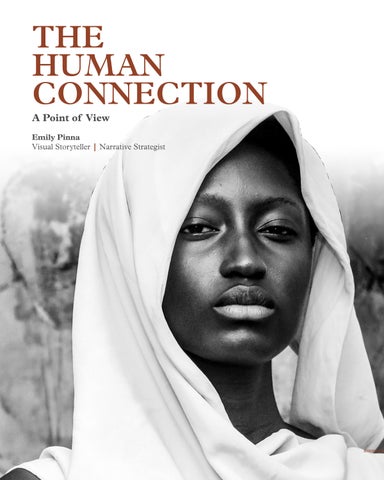
THE HUMAN CONNECTION A Point of View
Emily Pinna Visual Storyteller | Narrative Strategist
Before we are beneficiaries or donors, refugees or presidents, farmers or ministers, we are first and foremost
human beings.
THE HUMAN CONNECTION A Point of View
Emily Pinna Visual Storyteller | Narrative Strategist
Information explains. Emotions create connection. ”
Earlier this year, while documenting a World Food Programme school feeding programme in Haiti, I noticed a girl of about twelve sitting beside a toddler. The younger child wasn‘t a student. She was there because her older sister was responsible for looking after her. In that moment, the story stopped being only about school feeding. It became a story about responsibility, invisible care and the quiet realities that often remain unseen.
Children return to school. Communities regain access to clean water. Families rebuild livelihoods. The impact is real. Yet somewhere between the work happening in the field and the way it is communicated, something is often lost. Not the facts, but the feeling.
Information helps us understand what happened. Emotion helps us understand why it matters. That is where connection begins, and where trust, engagement and That experience reminded me why some action follow. moments stay with us. Not because they are the biggest, but because they reveal something deeply human. They awaken “ empathy, compassion and hope. They I believe the future of remind us that before we are beneficiaries communication is not about or donors, refugees or presidents, farmers producing more content. It is about or ministers, we are first and foremost helping people feel why the work human beings. Every day, organizations around the world create extraordinary change.
matters. ”
The Connection Gap We often talk about a funding gap, an education gap, a health gap or a climate gap. Yet I believe there is another gap that receives far less attention: a connection gap.
ge is that information alone rarely creates connection. People may understand what an organization does without ever understanding why they should care. Facts inform. Meaning stays with us.
Every year, foundations, development banks, humanitarian agencies and international organizations invest extraordinary resources in improving lives. Communities become stronger, opportunities are created and millions of people benefit from their work. Yet much of that impact reaches the outside world through reports, dashboards and carefully prepared communications that explain what was achieved, but rarely why it matters.
Narrative begins with intention. Before creating a photograph, campaign, publication or exhibition, I ask a different set of questions: What do we want people to remember? What do we want them to feel? What conversation do we hope this work will start?
Only then do we decide how that narrative should be expressed—through a photograph, a campaign, The challenge is not a lack of information. If anyt- a publication, an exhibition or something else entirely. hing, we have never produced more of it. The challenTHE HUMAN CONNECTION A Point of View
Emily Pinna Visual Storyteller | Narrative Strategist
Looking is passive. Seeing is intentional.
THE HUMAN CONNECTION A Point of View
Emily Pinna Visual Storyteller | Narrative Strategist
Before we can communicate differently, we first have to learn to see differently. That sounds obvious. It isn‘t. ”
We often assume that seeing happens automatically. We open our eyes and believe we have understood what is in front of us. But looking and seeing are not the same thing. Recently, while working with UNESCO and Education Cannot Wait in conflictaffected areas of Cameroon, I met a young girl named Grace. She had only recently returned to learning after years without access to education. When I spoke to her mother, she smiled and told me that every afternoon Grace came home and taught her everything she had learned that day.
The programme was not only educating one child. Its impact travelled home. That moment reminded me that some of the most meaningful outcomes are also the easiest to overlook. They rarely appear in a report or an evaluation. They live in a child‘s growing confidence, in the knowledge carried home to a parent and in the quiet belief that tomorrow can be different from yesterday. People often assume my work begins with a camera. It doesn‘t. It begins with listening, observing and paying attention. It begins with empathy.
The Dignity Lens The question is never simply what story we tell. It is how we choose to tell it. Over the years, I have come to think of this as the Dignity Lens. Too often, stories about social impact begin with need. They focus on crisis, loss and vulnerability. These realities matter. But when hardship becomes the only story we tell, we risk reducing people to the circumstances they are trying to overcome. The Dignity Lens does not ignore suffering. It asks a different question: How can we tell this story in a way that allows people to be seen not only for what they have endured, but also for who they are beyond it? Behind every assignment is someone with a history, relationships, ambitions and strengths that deserve to be seen. When communication reflects that complexity, it does more than explain a programme. It creates understanding, respect and trust. Because the stories we tell shape not only how people see the world, but how the world sees the people in those stories.
THE HUMAN CONNECTION A Point of View
The stories we choose to tell shape not only how people see the world, but also how the world sees the people in those stories. ”
Emily Pinna Visual Storyteller | Narrative Strategist
What began as visual storytelling has naturally evolved into helping organizations define their narrative, and then bringing it to life through campaigns, exhibitions, publications and visual stories that people remember. ” Communication Begins with Leadership story an organization chooses to tell reflects what it values. Communication Every It signals what deserves attention, whose voices are heard and how success is defined. Over time, those choices shape not only external is not simply perception, but organizational culture. about telling That is why I see communication as a leadership responsibility. people what you Long before a campaign is launched or a report is published, leaders shape how their organizations are understood. They decide what do. It is about matters, what is celebrated and what conversations they want to spark. helping them The organizations that leave a lasting mark are rarely those that the most. They are the ones with the clearest sense of understand why it communicate who they are and why their work matters. matters. When communication grows from that clarity, it does more than explain impact. It helps create it. ” When people feel genuinely connected to a story, they become advocates, partners and champions for a cause. That connection strengthens fundraising, deepens trust and builds lasting relationships. THE HUMAN CONNECTION A Point of View
If this perspective resonates with your organization, let’s continue the conversation.
Emily Pinna Visual Storyteller | Narrative Strategist www.emilypinnaphotography.com emily@emilypinnaphotography.com
Emily Pinna Visual Storyteller | Narrative Strategist
The way we see shapes the world we create