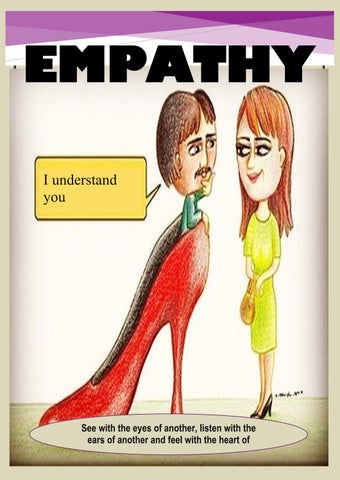
EMPATHY I understand you
See with the eyes of another, listen with the ears of another and feel with the heart of another.
HISTORY ……………………………………………………………..Page 2 WHAT IS EMPATHY? ………………………………………………Page 3 CONCEPT …………………………………………………….………Page 3 INTERCULTURAL APPROACH …………………………………..Page 5 AFFECTIVE AND COGNITIVE EMPATHY ………………………Page 6 NATURAL BASES………………………………………………..….Page 7 CHARACTERISTICS OF AN EMPATHIC PERSON ……………..Page 8 ADVANTAGES OF EMPATHY …………………………………….Page 9 EMPATHY IN ADOLESCENTS ………………………………….. .Page 10
EDITION 1 YEAR 2022 EDITOR: MARIA EMILIA ALBUJA
pág. 1
H
ISTORY:
Aristotle stated that man is a politicalanimal, that is, he is a social creature: he lives in groups called families, clans, groups, villages, towns, cities or states and feels the need. Joining with others in the process produces unwritten rules. Of coexistence in principle, in which individuals generally care about others, go beyond others and care about the community. Westerners call it pág. 2
politeness and the Japanese, and more broadly, in Japanese terms of politeness or omotenashi, kikubari: knowing how to anticipate the needs or demands of others by putting yourself in their place and being happy for them. Since 1971, some authors have seen the concept separately, and it was not until 1983 that Davis considered the concept to be multidimensional, including cognitive and affective components, and considered it as a set of variables related to sensitivity towards others.
WHAT
IS
EMPATHY?
Empathy is the ability of a person to perceive the thoughts and emotions of others, based on the perception of the similarities of others, that is, as similar individuals with their own thoughts. That is why it is vital for social life. It also includes
a useful motivation, however, it can become the basis for empathy
or personal distress, which can lead to reactions. In psychotherapy, the therapist can provide empathy, which is a way of understanding the patient, the r feelings, their motivations, or their actions and outcomes
C understanding a person from their perspective rather than your own, or vicariously experiencing another person's feelings and perceptions. Empathy by itself does not imply pág. 3
ONCEPT:
According to the American sociologist Jeremy Rifkin, empathy is a unique and relatively new concept in the vocabulary of any human language so far,
not in use until 1909. While there are similar concepts of empathy, such as empathy or altruism, neither of them provide the exact meaning of when the term "empathy" is currently used. When it comes to empathy, it refers to the cognitive, affective or emotional capacity of an individual in which he places himself emotionally in the situation of another person. This is very different from concepts used earlier, such as the predecessor of the term "sympathy", which is understood in English as a feeling of self-pity that precedes another person's unpleasant situation. The appearance of the concept of empathy seems to be related to developments in equally recent scientific
pág. 4
fields, such as psychology or the behavioral sciences. According to some hypotheses in these areas of research, this is because the ability to empathize is highly dependent on the development of selfawareness. According to some researchers, people's own emotional histories can influence or distort others' perceptions of which emotions. Empathy is not an automatic process of informing another person about your emotional state. It is a skill or ability that develops gradually throughout life, and the more you come into contact with that person, the more people identify with you. According to some researchers, people's own emotional histories
can influence or distort others' perceptions of which emotions. Empathy is not an automatic process of reporting another person's emotional state. It is a skill or ability that develops gradually throughout life, and the more you come into contact with that person, the more people identify with you.
INTERCULTURAL APPROACH: Intercultural empathy is the ability to perceive the world in terms of a culture or worldview different from that of its origin, it is related to
the pág. 5
sociological
concepts of emic and etic. For example, what is the different conception of death that the Russian-Indian culture has? What is the approach to time in the Nordic or Latin American cultures? How to negotiate with people and organizations from different cultures, and be able to incorporate all possible differences in your communication strategy. According to learning studies, intercultural empathy can enhance self-awareness and critical awareness of one's interaction style, how it was conditioned by one's cultural background, and promote a view of oneself as a process.
AFFECTIVE
AND
COGNITIVE EMPATHY:
Measuring empathy and being able to study its individual differences requires a reliable and valid scale. Therefore, empathy is divided into two aspects: affective empathy, which can be defined as the ability to experience the emotional state of another person; and cognitive empathy, the ability to understand another person's state of mind, including imagination and the ability to place oneself in another person's location. On the other pág. 6
hand, some studies have proposed a threecomponent model of empathy: in addition to affective and cognitive empathy, there is also motor empathy. The latter is the tendency for people to automatically replicate and synchronize another person's facial expressions, vocalizations, and certain movements. In short, it is part of "emotional contagion." These studies support the three-factor model as the most reliable. Emotional empathy can be subdivided into the following levels: "Empathy" is sympathy for others, a reaction to the suffering of others. "Own pain" is one's own discomfort and anxiety about the pain of others. Whether personal suffering is a form of basic empathy,
or not empathy at all, is open to debate. There may be growth/development factors in this segment. Children cope with pressure from others by putting pressure on themselves; at the age of two, they begin to try to help, comfort and participate in other ways, finishers. Cognitive empathy can be subdivided into the following degrees: "Perspective taking," the tendency to spontaneously adopt another person's perspective.
NATURAL BASES:
pág. 7
Throughout history, studies have established relationships between empathy and different parts of the brain. Therefore, one of the neural regions most involved in the empathy circuit is the medial prefrontal cortex. Its function is to process social information to compare one's own point of view with the point of view of another. In addition to the medial prefrontal cortex, there are other brain structures involved in empathy. First, the fact that the inferior frontal gyrus plays an important role in recognizing other people's emotions caused the subjects to start developing empathy. Likewise, the anterior cingulate cortex and the anterior insula perform the
same function, but differ in that they recognize only one specific emotion: pain. Likewise, the Anterior Cingulate Cortex and the Anterior Insula fulfill the same function, but with the difference that it only recognizes one particular emotion: pain. Both structures are activated at the moment in which a person observes that another is experiencing pain, functioning in the same way when the pain is felt in the flesh.
CHARACTERISTICS OF
AN
PERSON:
pág. 8
EMPATHIC
To be an empath, a person must learn to be sensitive to the feelings of others, that is, to be an empath, they need to understand the feelings of others without them feeling forced to get involved in an inconsequential situation. Do it yourself., because this
trait must come from themselves. Second, a truly empathetic person likes to listen to others, but not only based on hearing what they say, but also analyzing why they feel that way based on what they say. Third, an empathetic person should not be an extremist, which means that they do not take
one side or the other, but try to find answers in the middle. Fourth, empathic people respect the decisions that others make, even if their opinions differ. Therefore, it is essential that they not only focus on paying attention to verbal language, but that they must also understand non-verbal language since, through gestures, the look, the tones of voice that are transmitted, messages can be extracted about the emotions that those who use it are experiencing. Among other aspects that being empathic requires is that of presenting a passive communication, which means that the person puts aside their interests and rights in order to put those of others before them.
pág. 9
ADVANTAGES
OF
EMPATHY:
We find the validation of the emotional experience, where it is shown that an experimentation is taking place and it is demonstrated.
It is verified that the issuer of the information does so with greater security and tranquility as if it were something natural. We know that one of the advantages is that it facilitates communication and reinforces the learning of new behaviors, so we pay more attention.
It makes possible the creation and
construction of intimate relationships between different members.
It should be noted that empathy guarantees wellbeing, relief, relief, reduction of emotional tension and motivation, among other aspects.
More specifically, when adolescents feel safe, supported, and connected to their parents or other adult caregivers, they are better equipped to pass on the empathy they receive to others. "I don't think teens in particular like being told what to do, and I don't think it works to tell teens
pág. 10
Teens who have close and secure relationships with their families are more likely to show empathy toward their peers, according to a new study.
EMPATHY
IN
ADOLESCENTS they need to empathize with other people," said Jessica Stern, the study's lead author and a postdoctoral fellow in the department. in psychology from the University of Virginia. "But what does work is showing them empathy, and having them pass it on to the people in their lives. Stern's work revolves around how having
secure relationships contributes to prosocial behavior, that is, behavior driven by the intention to benefit others. The researcher studies parent-child relationships, also known as attachment theory, which is "the idea that all human beings have a fundamental need for connection," but the quality of those connections may be different. Stern says those differences are important because "they shape who we become over time." Effects of the pandemic: "Adolescents can no longer" Following these initial interviews, the researchers saw the participants again at ages 16, 17 and 18 and observed their interactions with a close
pág. 11
friend. The researchers looked at how the participants responded when their friend presented a problem and confided in them, assessing the extent of the participants' empathy. Teens who had more secure family relationships showed more empathy toward their friends at ages 16 and 17 than less secure teens. But it's not all bad news, as less confident teens "catch up" with empathetic behavior by age 18, much to Stern's surprise. This is cause for hope, she said, because it may indicate that those empathic skills can develop over time for teens who don't have great relationships at home. Stern suggested that having strong friendships or a trusted teacher might influence
empathy in insecure teens, but said more research would be needed to find out more. The results are consistent with much previous research linking positive relationships with the development of empathy in adolescence, said Mary Buckingham, a research assistant professor at Tufts University's Institute for Applied Youth Development Research. Breastfeeding for Any Duration Linked to Lower Blood Pressure in Young Children: Study. More research is already being done on this particular group of participants, who are now in their 30s, Stern said. Led by Joseph Allen, a psychology
pág. 12
professor and head of the Adolescent Research Group at the University of Virginia, the researchers are interested in seeing how the empathic capacities they examined in adolescents now shape their romantic relationships and parenting behavior as adults. . Being able to pick up on other people's emotions and see from their point of view is important "for a variety of other things that we see as positive in the world," Stern said. For parents and even teachers, Stern advises understanding the need for empathy and really dedicating yourself to relationships with teens
pág. 13