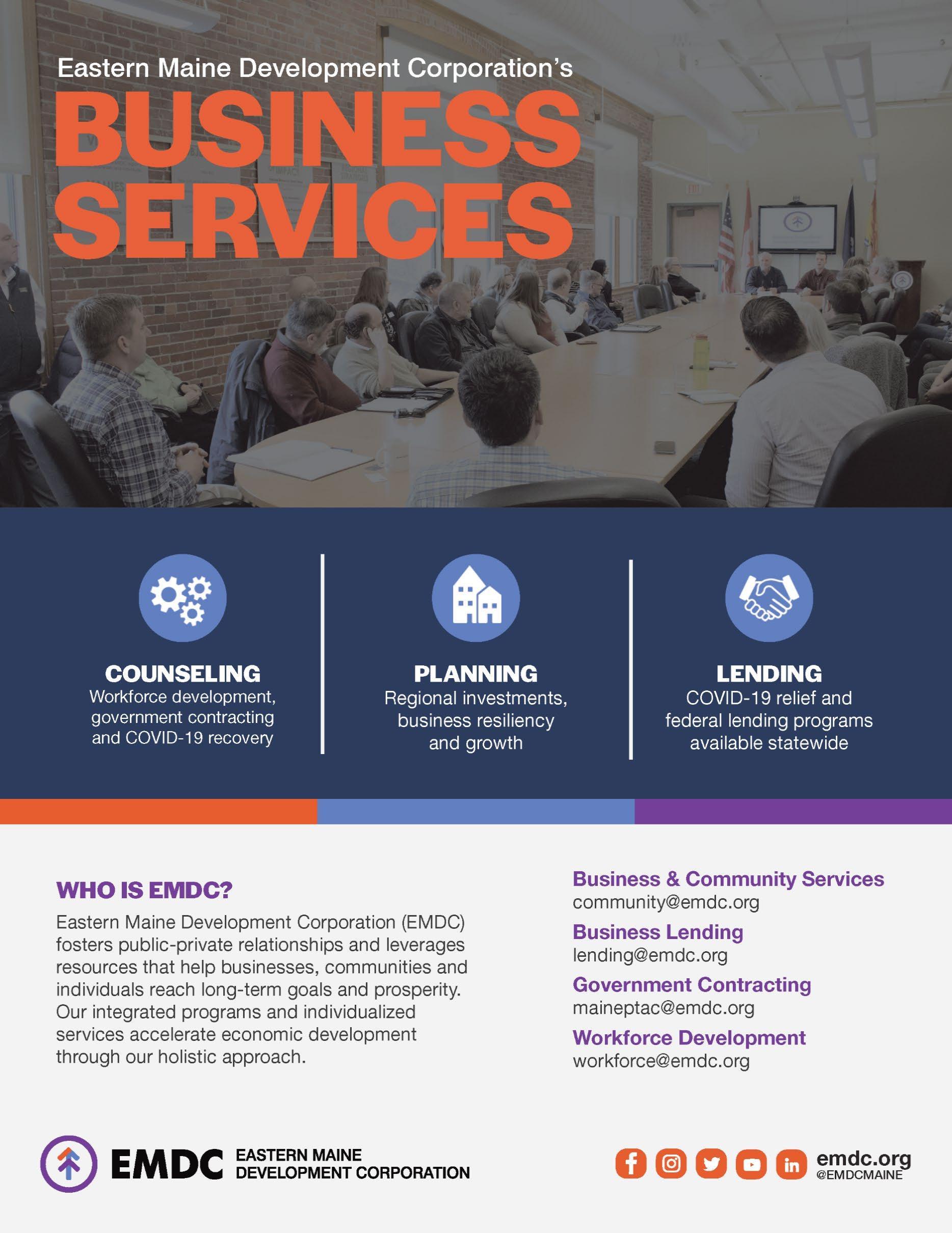
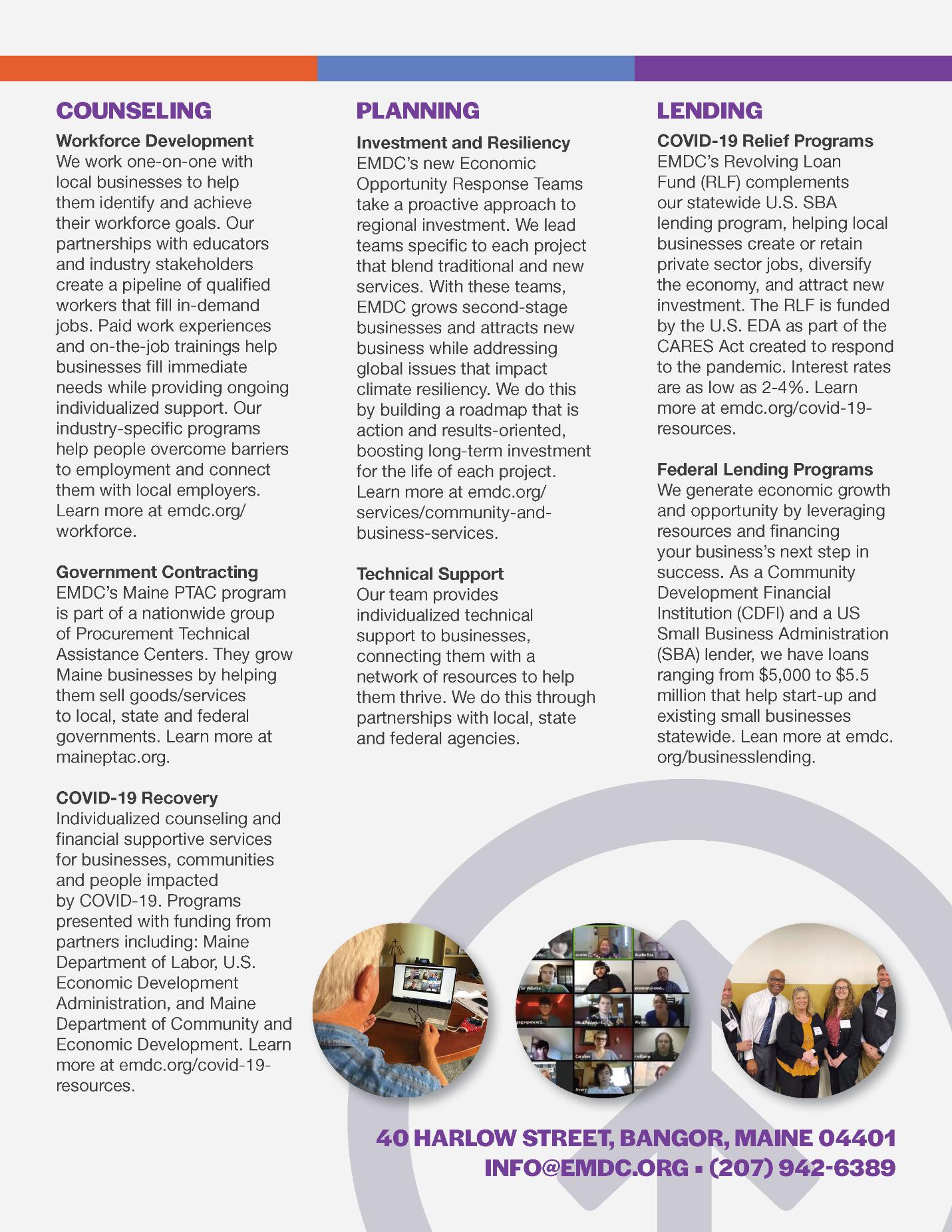
EMDC is meeting the economic crisis created by the COVID-19 pandemic hands-on. As a result, we’re providing enhanced support to the businesses, communities and people who need it most. To provide that support, we’ve created a Business Needs Assessment as a tool to efficiently meet the needs of local organizations. Click here to view the assessment.
Using the Business Needs Assessment as guide, EMDC will supply your business with local, state and federal resources as you build your roadmap to resiliency in response to the COVID19 pandemic.
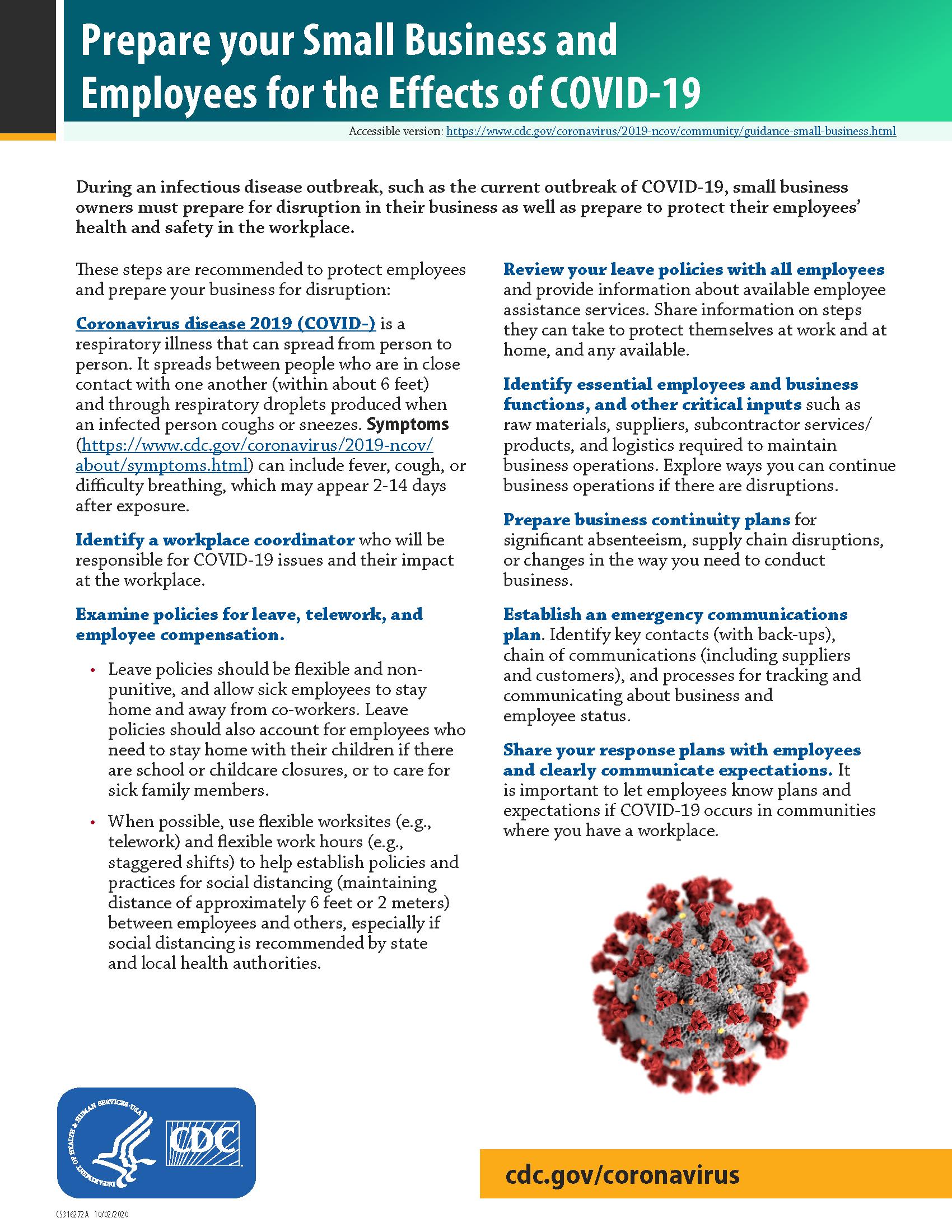
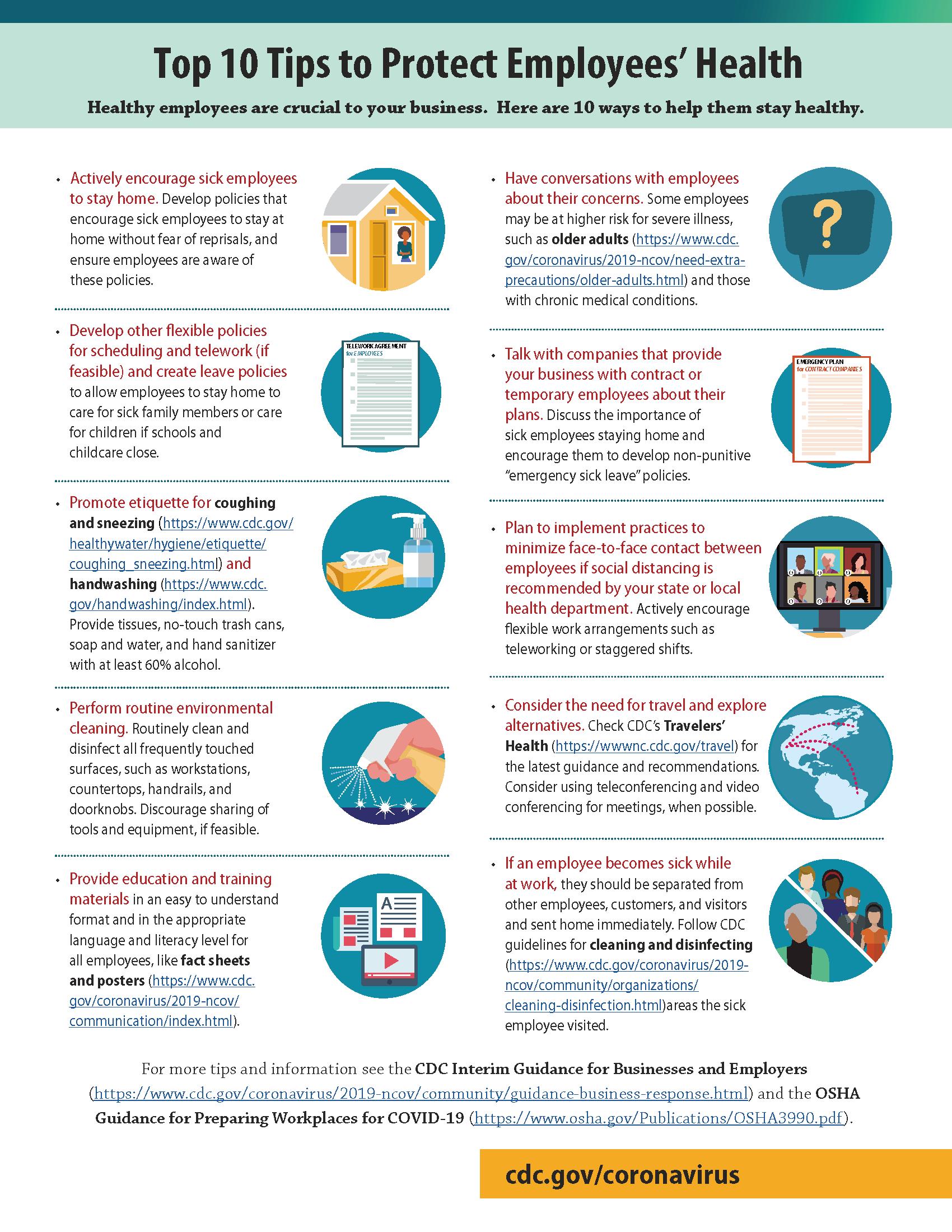
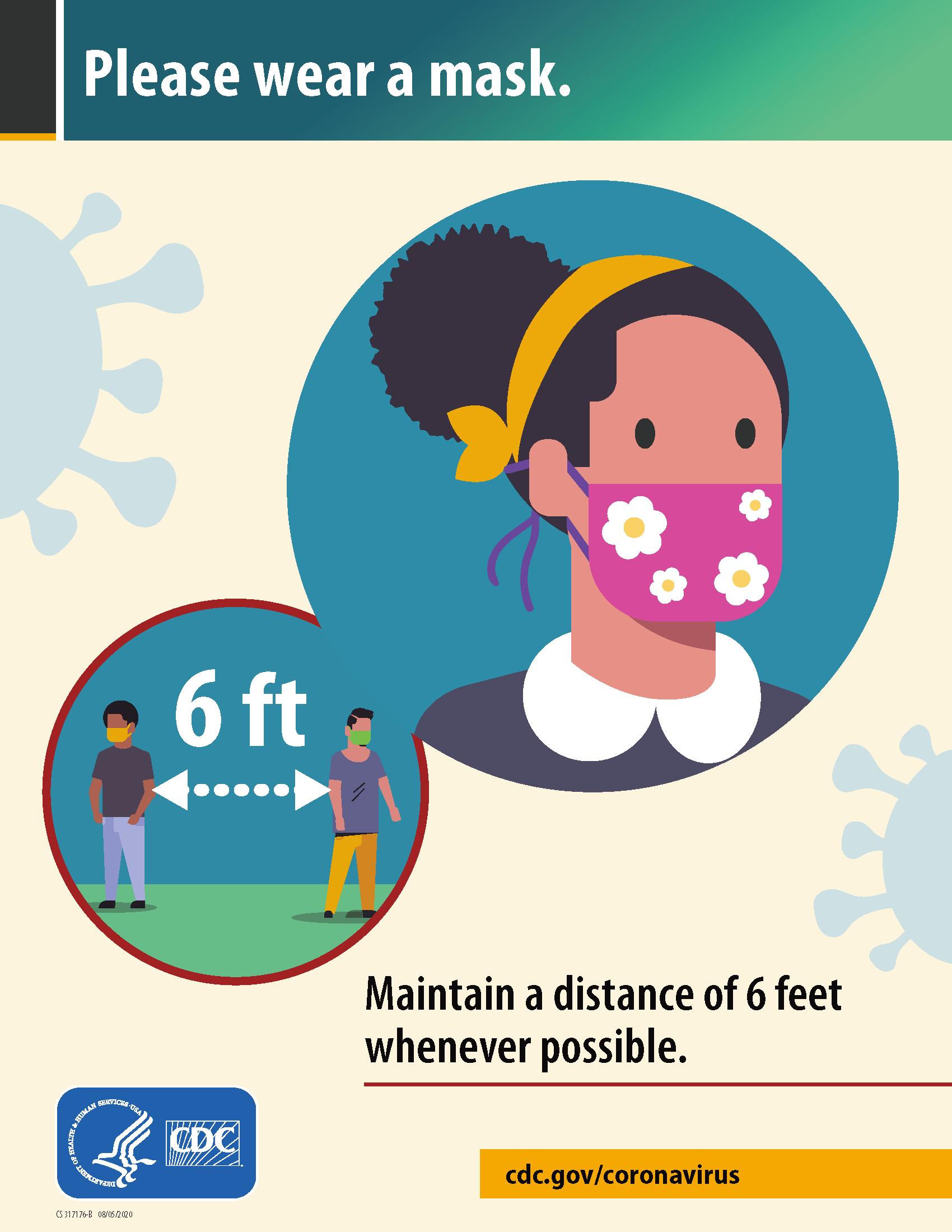
In this Resource and Reopening Guide you will find both state and federal guidelines for gatherings, mask mandates, and safety in the workplace. We’ve also provided CDC signage for use in your business. For an updated list of COVID-19 related resources please visit our website at: emdc.org/covid-19resources.
Eastern Maine Development Corporation is here to support local businesses as we move forward. If at any time if you have questions, concerns, or would like to learn more about our services please give us a call at (207) 942-6398 or email us at business@emdc.org.
Ryan Grindle Regional Development Coordinator
2020 Winter Capacity FAQs from Maine.Gov
Updated: October 6, 2020
(1) What if 50% of my capacity is larger than 100 people?
The maximum capacity of indoor facilities is 100 people, although retailers remain subject to the 5 person per 1,000 square feet of shopping space occupancy limit.
(2) My capacity prior to COVID-19 was 30 people and I could seat 100 percent of them with more than 6 feet distance between tables. Do I have to newly limit capacity to 15 people including frontof-house staff?
Yes. With the arrival of colder temperatures, it is harder to keep air circulating in closed spaces. The 50% capacity limit, which is based on people per square foot, helps ensure distance and safety. That said, enforcement discretion will be applied to establishments that have been providing indoor seated service under the previous rules in adjusting to this change.
*Please note that these capacity figures are based on pre-pandemic configurations.
(3) Does the 100 people include staff?
Yes, the 100 people includes staff and guests.
(4) Does the 100 include kitchen staff who don’t interact with customers?
No, it only includes the staff that enter into and exit the gathering space.
(5) What does “seated service” mean?
Seated service means customers do not stand once served and stay seated with the group they came with. They do not move from table to table, stand consuming drinks or food, or stand listening to a speech or entertainment. Food, beverages, education, or entertainment such as movies are served.
(6) What types of businesses fall under seated service?
Restaurants, bars, tasting rooms, fast food restaurants with seating, social clubs, movie theaters, other entertainment venues with seating, churches and other religious organizations’ sites. Restaurants already open must adopt to this new guidance by October 13th. Bars and tasting rooms may newly reopen for indoor service on November 2nd. As with all reopening guidance, this is subject to a review of the quantitative and qualitative public health measures of COVID-19 transmission.
(7) Why November 2 start date for bars and tasting rooms?
Bars and tasting Rooms have not yet been open for indoor service. This is because of the nature of these settings, where people interact in close spaces, often speaking loudly, with limited face covering wearing since people are drinking. The additional time is for preparation, training, and other operational readiness actions. Public health officials also want to ensure that the number of new cases and positivity rate in Maine continues to remain stable. This is an important consideration given the higher COVID-19 transmission associated with this sector of the economy.
(8) What types of businesses do not fall under seated service and what rules apply to them?
Gyms, fitness centers, auditoriums without seating, airplane hangars, barns, indoor fairs or farmers’ markets. The current limit of 50 people and physical distancing rule still applies to such activities.
(9) Can we still use multiple rooms like we have been safely doing all summer?
The total occupancy of an establishment (combining indoor maximum of 100 and outdoor maximum of 100) must not exceed 200 people.
(10) How many people can we have outside? How do we count employees for that?
You can still have 100 people outside. Employees that enter and exit the space count toward that limit.
(11) What if my event has some seated and some non-seated activity? How many people can I have?
If there is non-seated activity in the same room as the seated activity, the 50-person limit applies.
(12) Can any bar re-open under the new Checklist?
To simplify and align guidance, one new Checklist applies to all seated service, including bars. Bars that follow the Checklist may reopen on November 2. Tasting rooms and bars may need to significantly change their operations to protect the public health. For example, such establishments cannot: allow people to stand or walk around while drinking, have live singing or playing of brass or woodwind instruments, open dance floors, or otherwise allow congregation of people in a small space.
(13) Can an indoor bar have standing service but admit less than 50 people?
No. Following the Checklist for seated services is needed for bars and tasting rooms re-opening for indoor service during the public health emergency.
(14) Are the rules for retail establishments – a total of 5 customers per 1,000 square feet of shopping space – changing?
No.
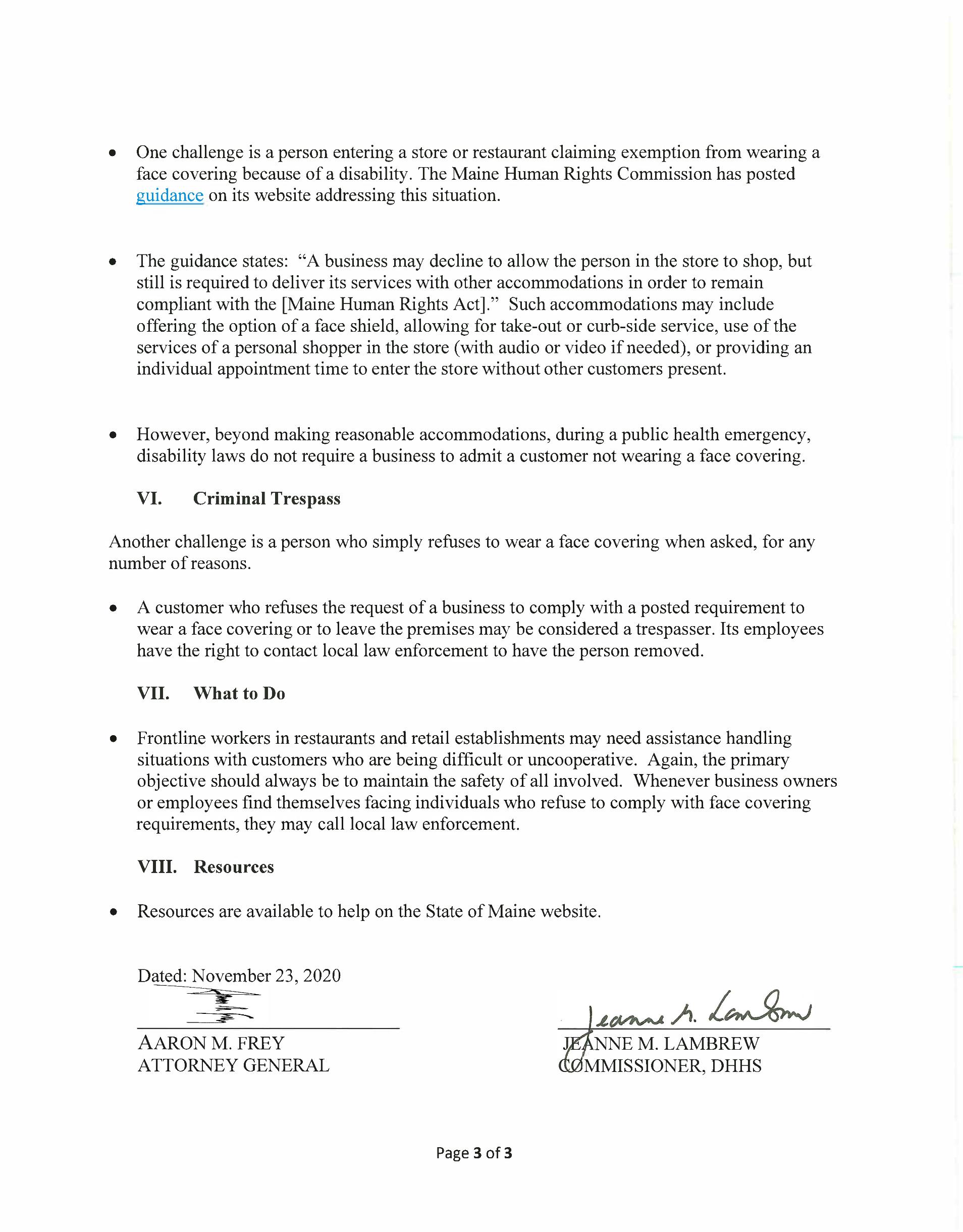
(15) Do I have to require a mask if someone says they have a medical condition?
A. A person not wearing a required face covering who seeks to enter an establishment shall first be informed of the face covering requirements and given a chance to comply by putting on either a cloth face covering or plastic face shield. If that person continues to refuse and asserts a medical condition as the reason for the refusal, the operator of the establishment may offer alternative means of service at curbside or delivery if available as an accommodation, but may not permit the person to enter without a face covering. The establishment operator shall not ask for the nature of the medical condition, or ask for proof.
(16) Am I liable if I ask a customer refusing to wear a mask to leave?
No, so long as the business offered an accommodation such as offering a mask or face shield or suggested take out or other forms of service.
(17) Will law enforcement help my employees if a customer becomes belligerent regarding required masks?
Yes since the executive order on required face coverings has the force of law.
Face Covering Executive Order FAQs from Maine.gov
Updated: 12/16/2020
(1) Why is wearing a face covering important?
COVID-19 is an airborne virus that most commonly spreads between people who are in close contact with one another. It spreads through respiratory droplets or small particles, such as those in aerosols, produced when an infected person coughs, sneezes, sings, talks, or breathes. Wearing a face covering has been proven to be one of the most significant, effective, and easiest ways to reduce the spread of COVID-19 because it helps contain respiratory droplets.
(2) Does everyone have to wear a face covering in public settings?
Persons under age 2 are not required to wear face coverings. All others must wear a face covering in public settings. For individuals who have a disability that prevents them from wearing a face covering, the requirements of state and federal disabilities laws must be followed. Individuals who have a disability that prevents them from wearing a face covering must be afforded a reasonable accommodation outside the establishment, such as take-out or curbside service or use of a personal shopper in the store. Claiming a medical exemption does not allow an individual to enter an establishment without a face covering. The change comes in light of reports from retailers of individuals abusing the exemption.
(3) If I am walking or running on the sidewalk with no one in my immediate vicinity, do I still need to wear a face covering?
If you are in a public setting, you should wear a face covering. Of course, common sense will come into play, but, if you are asking yourself whether you should wear a face covering, the answer is most likely yes. We are confident that Maine people will exercise good judgment and will do their best to honor this requirement because wearing a face covering will save lives, keep our economy moving, and keep schools and businesses open.
(4) Am I supposed to wear a face covering when out hiking and there’s no one around?
Hiking trails are not within the definition of “public setting” under the Executive Order, so the requirement would not apply. However, as mentioned above, if you are asking yourself whether you should wear a face covering, the answer is most likely yes. We are confident Maine people will exercise good judgment.
(5) Do people in gyms, including yoga classes, now have to wear a face covering? Yes.
(6) If I am exercising on my own or with members of my household – not in a public setting or in organized sports – do I have to wear a face covering?
No. The purpose of the policy is to protect you from others, and others from you.
(7) How about skiers?
Generally, yes. Skiers often wear buffs and gaiters which are an acceptable substitute for masks as long as they cover the nose and mouth and provide two-ply coverage. Wearing a face covering is required when skiing as part of an organized event or competition. For example, even with staggered starts, the nature of Nordic skiing with unexpected trail events and differences between
athletes often results in bunched up groups later in the race. That said, when skiing on your own in a non-public setting a face covering is not required.
(8) What about during school or community sports like high school basketball or a private hockey league?
Based on experience in different states, Maine now requires participants in sports activities organized by K-12 schools, or by leagues and communities, to wear face coverings. This is to protect all people involved. Collegiate sports and professional sports organizations may follow their own guidance.
(9) Do people have to wear face coverings during outdoor photo shoots?
Yes, if they are taking place in a public setting.
(10) Are all attending religious services required to wear a face covering, including the person leading the service, even if he or she is 14 feet away from other participants?
Yes, for the safety of all involved.
(11) Do people sitting six feet apart in a movie theater or live performance have to wear a face covering? What about actors?
Yes. The audience, performers, and staff must wear face coverings since these are public settings live entertainment guidance is in the Performing Arts Venues COVID-19 Prevention Checklist.
(12) Does this face covering requirement apply in restaurants?
Yes. To reduce the risk of COVID-19 to other patrons and restaurant employees, patrons are required to wear face coverings whenever they are not seated at the table or eating or drinking.
(13) Does this apply to private workplaces?
Private employers whose staff do not interact with the public may determine the persons who should wear a face covering at their workplace. However, when people are in shared or public spaces in a workplace, they need to wear a face covering.
(14) Are business owners and people who operate indoor public spaces required to enforce the face covering orders?
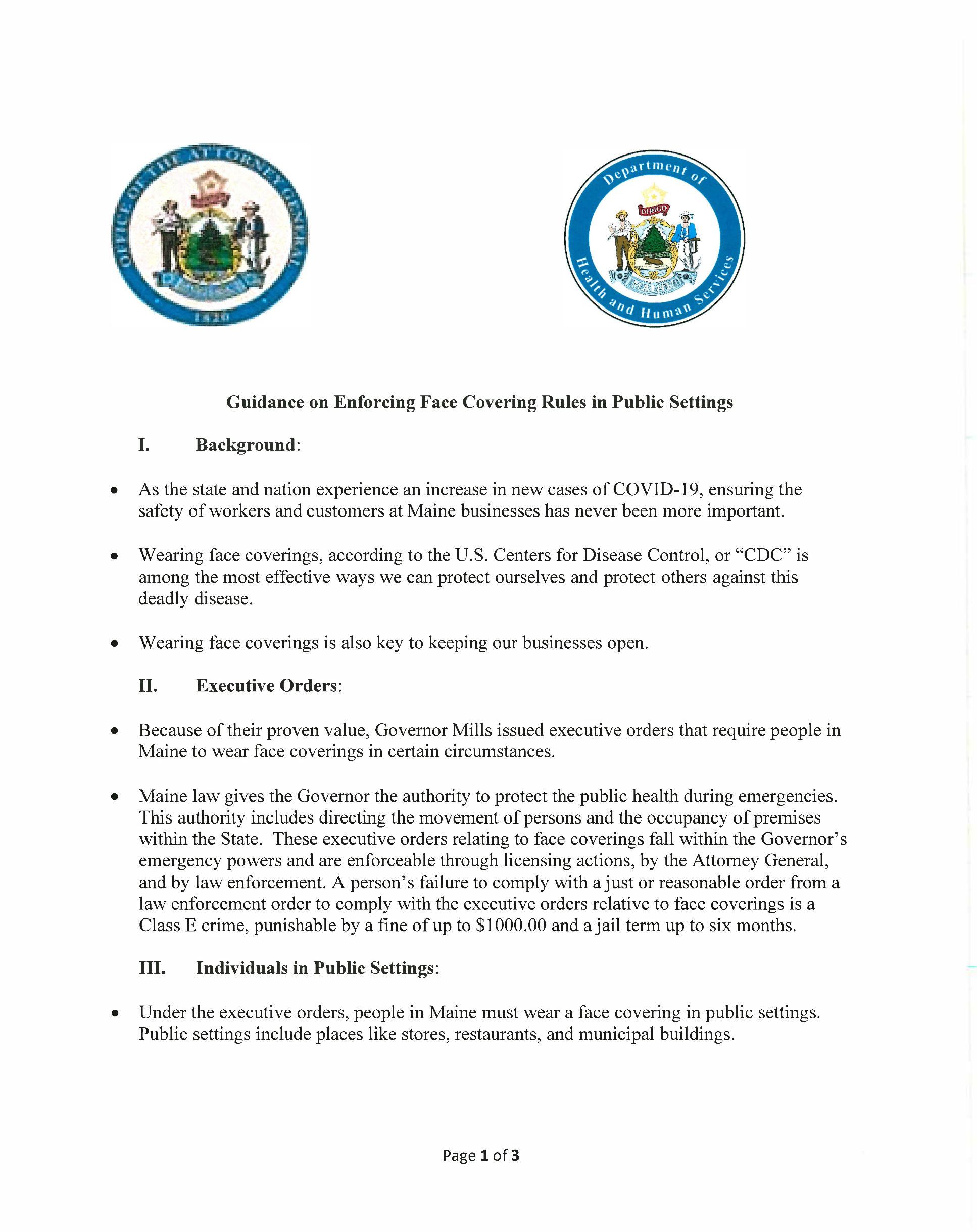
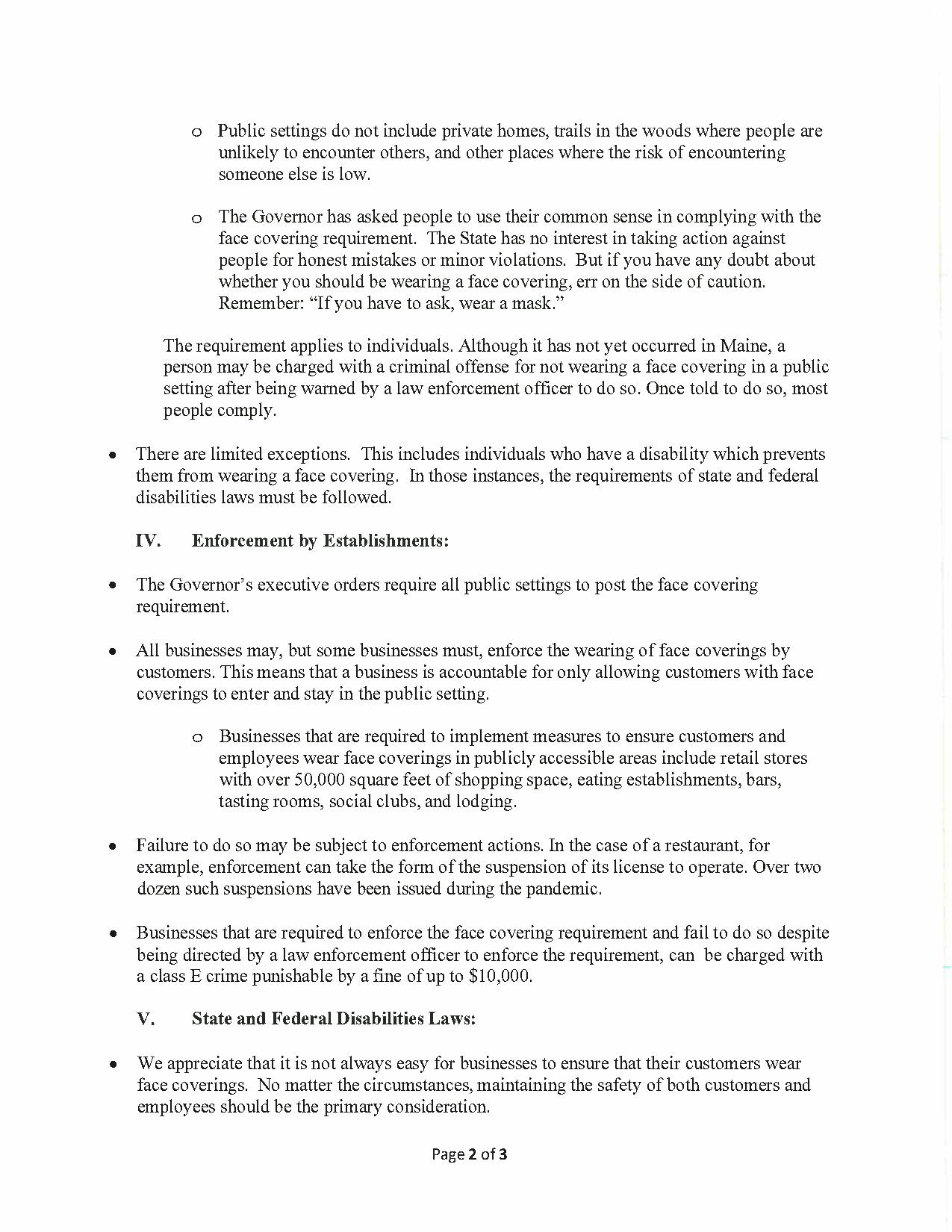
Yes, the Executive Order requires that owners and operators of all indoor public settings –regardless of the type of public setting or size – must deny entry to those who refuse to wear a face covering. Large retail businesses as well as, municipal buildings, and certain other types of organizations, have already been responsible for implementing measures to ensure customers wear face coverings. Owners and operators of all indoor public settings in Maine must post plainly visible signs notifying entrants of the requirement to wear cloth face coverings. Those who are made aware of the face covering requirement and are offered a reasonable accommodation, yet nevertheless insist on entering an establishment may be refused service and/or charged with trespassing.
(15) What will enforcement of this order look like?
The State places a high priority on voluntary compliance and is encouraged by Maine people and businesses who are taking the very real threat of the virus seriously by following the State’s health and safety protocols. In the event of non-compliance, the State has the option of taking action against a facility’s operating license and violations of Executive Orders are a Class E crime, punishable by up to 180 days imprisonment and $1,000 fine. As noted above, people who are made
aware of the face covering requirement and insist on entering an establishment must be refused service and/or charged with trespassing.
(16) Should a business call law enforcement if customers refuse to wear a mask?
Yes, the Mills Administration has communicated with law enforcement entities, many of whom stand ready to assist store employees if they encounter difficulty enforcing the face covering requirement.