Download the OPEC MOMR App free of charge!
• Essential information on the oil market • 100+ interactive articles and tables detailing crude price movements, oil futures, prices and much more • Analysis of the world economy, world oil supply and demand • Compare data interactively and maximize information extraction
21
ay 20
11 M
Fe supply de
i s light iii t high ticle 1 ure ar ts Feat emen 8 ov em ts l pric arke oi m 11 ity Crude mod omy on Com 28 ld ec Wor and m de l 37 ld oi ly Wor l supp 52 ld oi ns Wor io at er t 58 ery op ke fin ar re d er m 62 ts an Tank de ke ar tra ts ct m 68 oduc ts pr Produ en ed em refin k mov d 73 and stoc man Crude d de ercial an m ly pp Com of su ce Balan
il
EC o
-OP
Non
: ticle e ar ment atur velop arke
Oil m
V
enezuela is central to the history of OPEC. Dr Juan Pablo Pérez Alfonso, the country’s Minister of Energy and Hydrocarbons in the late 1950s, was a leading figure in the push for the formation of the Organization. This led to the stepping-stone of the ‘Maadi Pact’ on the sidelines of the Arab Petroleum Congress in April 1959, and then OPEC’s eventual formation in Baghdad on September 14, 1960. Following the establishment of OPEC, Pérez Alfonzo said: “We are now united. We are making history.” These words proved extremely prescient, for both Venezuela and the then fledgling Organization. Ever since, the stories of both have intertwined. Venezuela has been at the forefront of OPEC’s decisionmaking processes, and in the establishment of key documents, such as the original version of the ‘OPEC Statute’ that was approved at the Second Meeting of the OPEC Conference in Caracas in January 1961. Many generations of distinguished Venezuelan public servants have also taken up the baton passed to them and served the Organization with distinction in various capacities over the past six decades and more, including Dr Francisco R Parra, who was the country’s first OPEC Secretary General in 1968. Parra was central to the adoption of the landmark ‘Declaratory Statement of Petroleum Policy in Member Countries’, at the 16th Meeting of the OPEC Conference in June 1968. In later years the statement became a byword for a turning point in OPEC’s history, by providing vision and intellectual weight to the Organization’s actions. The country also held the Second Summit of Heads of State and Government of OPEC Member Countries in September 2000 under the leadership of (then) President, Hugo Chávez, which was a critical milestone in aligning the Organization with the needs of the twenty-first century. In more recent times, Venezuela has been integral to the establishment and successful implementation of the ‘Declaration of Cooperation’ (DoC), and held the Presidency of the OPEC Conference when the ‘Charter of Cooperation’ (CoC) was endorsed in July 2019. This historical context, and the future of the VenezuelaOPEC relationship, was evident in the recent high-level visit to Venezuela by OPEC Secretary General, Mohammad Sanusi Barkindo, and an accompanying delegation, from May 7–13, 2022. Barkindo was received by Nicolás Maduro Moros, President of the Bolivarian Republic of Venezuela, at the Miraflores Palace, where the two held a working meeting to discuss ongoing oil market developments. Barkindo commended the extraordinary leadership that President Maduro has played in the formation of the DoC and his unwavering support over the last six years, and the President praised the Secretary
General’s tenure and said he bequeathed a remarkable legacy of accomplishment to future generations. Barkindo was also bestowed with Venezuela’s highest civilian honour, the Order of General Francisco de Miranda, first class. The award recognizes Venezuelan citizens and foreigners who have made an indelible contribution to the progress of the country, with Barkindo acknowledged for his outstanding stewardship of OPEC during an extremely challenging period. The ever expanding positive ties between Venezuela and OPEC were also on display when Barkindo visited the Ministry of Petroleum, where he was received by Tareck El Aissami, the People’s Minister of Petroleum. Barkindo commended the visionary leadership of El Aissami in proactively stewarding the oil industry and highlighted the positive economic impact of the reforms the Minister has spearheaded, under the guidance of President Maduro. The Secretary General was also awarded an honorary doctorate from the Venezuelan University of Hydrocarbons on his visit to the Ministry, which he dedicated to his hard working comrades at the OPEC Secretariat. Talks and meetings were held with many others highlevel Venezuelan dignitaries, including Vice-President, Delcy Rodríguez Gómez; Felix Plasencia Gonzalez, Minister of Foreign Affairs; Wilmer Castro Soteldo, Minister of Popular Power for Agriculture and Land; Ali Padron, Minister of Tourism; and Asdrúbal Chávez, President of PDVSA, the group’s Board of Directors and many of the inspirational workers. As Venezuela has over 40 national parks, covering over 20 per cent of the nation’s territory, no visit there would be complete without experiencing some of the country’s breathtaking natural beauty. The OPEC delegation had the privilege of visiting Canaima National Park, which is a UNESCO World Heritage Site, and location of the Angel Falls, the world’s highest waterfall. Upon departing, Barkindo reflected upon the remarkable and enduring relationship between the two, and the immense generosity of the Venezuela people. He wished continued success and prosperity to the great and heroic Venezuelan people, who remain a source of inspiration for the rest of the world in their capacity to overcome any adversity. Barkindo also accentuated that Venezuela is the ‘land of heroes’, outlining how OPEC continues to be inspired by the legacy of the great liberator, Simon Bolivar, Commander Hugo Chavez and President Maduro. The story of OPEC and Venezuela has a unique history and heritage that has evolved over its more than six decades of existence. Full of personalities, events, stories and deeds that have helped shape the Organization’s path, and a history that will no doubt evolve further in the decades to come.
Commentar y
Venezuela: a ‘land of heroes’
APPO
Contents
38
8 34 4
DoC sticks to recovery plan amid new challenges
Focus on Member Countries
8
Barkindo returns to Venezuela: the ‘land of heroes’
OPEC bulletin
Conference Notes
22
Venezuela and OPEC: A brief history
28
Caracas: charming and elegant
34
Canaima National Park: Stunning natural wonder
Spotlight
38
Angola plays host to prestigious APPO event
Dialogue
44
EU-OPEC Energy Dialogue convenes in Vienna
Global Energy Forum
46
Atlantic Council hosts Global Energy Forum
49
Barkindo named Atlantic Council Distinguished Fellow
Workshop
50
Harnessing innovation to meet future energy needs
MDTC
52
Record-breaking attendance at 22nd MDTC
Cover
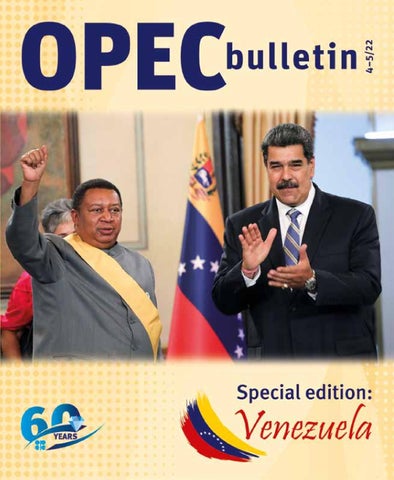
This month’s cover shows Nicolás Maduro Moros (r), President of the Bolivarian Republic of Venezuela; with Mohammad Sanusi Barkindo, OPEC Secretary General during his visit to Venezuela (see story on page 8). Vol LIII, No 3, April/May 2022, ISSN 0474–6279
Publishers OPEC Organization of the Petroleum Exporting Countries Helferstorferstraße 17 1010 Vienna Austria Telephone: +43 1 211 12/0 Telefax: +43 1 216 4320 Contact: Editor-in-Chief, OPEC Bulletin Fax: +43 1 211 12/5081 E-mail: prid@opec.org Website: www.opec.org Website: www.opec.org Visit the OPEC website for the latest news and information about the Organization, and for back issues of the OPEC Bulletin, which are available free of charge in PDF format.
OPEC Membership and aims OPEC is a permanent, intergovernmental Organization, established in Baghdad, on September 10–14, 1960, by IR Iran, Iraq, Kuwait, Saudi Arabia and Venezuela. Its objective — to coordinate and unify petroleum policies among its Member Countries, in order to secure a steady income to the producing countries; an efficient, economic and regular supply of petroleum to consuming nations; and a fair return on capital to those investing in the petroleum industry. Today, the Organization comprises 13 Members: Libya joined in 1962; United Arab Emirates (Abu Dhabi, 1967); Algeria (1969); Nigeria (1971); Angola (2007); Equatorial Guinea (2017). Ecuador joined OPEC in 1973, suspended its Membership in 1992, rejoined in 2007, and suspended its Membership again on December 31, 2019. Qatar joined in 1961 and left on December 31, 2018. Indonesia joined in 1962, suspended its Membership on December 31, 2008, reactivated it on January 1, 2016, but suspended its Membership again on December 31, 2016. Gabon joined in 1975 and left in 1995; it reactivated its Membership on July 1, 2016. The Republic of the Congo joined the Organization on June 22, 2018.
Reuters
ddp images
46
56 62
Obituary
56
In memoriam: Sheikh Khalifa bin Zayed Al Nahyan
Appointment
62
Sheikh Mohammed bin Zayed Al Nahyan elected UAE President
Forum
66 70
Resource conversion: Ensuring capacity growth for the future
74 74 75 75
Aramco and Hyundai Motor Group collaborate on advanced fuels for hybrid electric vehicles
Graduation
76
OPEC youngsters continue to climb the academic ladder
OPEC Fund News
78 79
Inaugural OPEC Fund Development Forum to discuss ‘Driving Resilience & Equity’
81 83
Summer oil market outlook
89
Reading material about OPEC
Newsline
Market Review
OPEC Publications
Secretariat officials Secretary General Mohammad Sanusi Barkindo Director, Research Division Dr Ayed S Al-Qahtani Head, Energy Studies Department Dr Abderrezak Benyoucef Head, Petroleum Studies Department Behrooz Baikalizadeh General Legal Counsel Leonardo Sempértegui Vallejo Head, Data Services Department Ms Boshra Alseiari Officer-in-Charge, PR & Information Department Hasan Hafidh Head, Finance & Human Resources Department Abdulmonem Allafi Head, Administration & IT Services Department Hasan Alhamadi Head, Office of the Secretary General Shakir Mahmoud A Alrifaiey
Building bridges
Sonatrach and Eni expand natural gas cooperation Iranian NPC continues to strengthen national petrochemical sector ADNOC celebrates successful first year of Murban Futures Contract
OPEC Fund sponsors ‘Rookie runners’ from developing countries
Non-OPEC oil supply development
Contributions The OPEC Bulletin welcomes original contributions on the technical, financial and environmental aspects of all stages of the energy industry, as well as research reports and project descriptions with supporting illustrations and photographs. Editorial policy The OPEC Bulletin is published by the OPEC Secretariat (Public Relations and Information Department). The contents do not necessarily reflect the official views of OPEC or its Member Countries. Names and boundaries on any maps should not be regarded as authoritative. The OPEC Secretariat shall not be held liable for any losses or damages as a result of reliance on and/or use of the information contained in the OPEC Bulletin. Editorial material may be freely reproduced (unless copyrighted), crediting the OPEC Bulletin as the source. A copy to the Editor would be appreciated.
Editorial staff Chairman of the Editorial Board Mohammad Sanusi Barkindo, Secretary General Editor-in-Chief Hasan Hafidh, Officer-in-Charge, PR & Information Department Editor James Griffin Associate Editors Maureen MacNeill, Scott Laury, Mathew Quinn, Timothy Spence Contributors Ayman Almusallam Production Diana Lavnick Design and layout Carola Bayer, Tara Starnegg Photographs (unless otherwise credited) Herwig Steiner, Wolfgang Hammer Distribution Mahid Al-Saigh
Indexed and abstracted in PAIS International Printed in Austria
This product is from sustainably managed forests, recycled and controlled sources. PEFC/06-39-22
OPEC bulletin 4–5/22
Conference Notes
2 7 t h a n d 2 8 t h O P E C- n o n - O P E C M i n i s t e r i a l M e e t i n g s
4
DoC sticks to recovery plan amid new challenges
Conference Notes
Mohammad Sanusi Barkindo (r), OPEC Secretary General, at the 28th OPEC and non-OPEC Ministerial Meeting, with Members of the OPEC Management and Secretariat staff (l).
Ministerial Meetings in March and May mark the latest milestones in the Declaration of Cooperation’s efforts to address the severe market disruptions spurred by the pandemic.
M
eeting two years after the countries participating in the ‘Declaration of Cooperation’ (DoC) began the most
far-reaching production adjustments in oil industry history, OPEC and non-OPEC Ministers in early May stuck to their monthly plan to gradually At the 28th OPEC and non-OPEC Ministerial Meeting (ONOMM) on May 5, the DoC participants decided on a 432,000 b/d adjustment for
OPEC bulletin 4–5/22
adjust output.
5
Conference Notes
2 7 t h a n d 2 8 t h O P E C- n o n - O P E C M i n i s t e r i a l M e e t i n g s
June 2022, mirroring action they took at the 27th ONOMM
Meeting took place under the Presidency of Saudi
on March 31 to adjust output for May.
Arabia. The Ministers of leading economies collec-
In a statement after the 28th ONOMM, Ministers
tively endorsed immediate measures to stabilize the
said the “continuing oil market fundamentals and
global energy market in response to the pandemic-re-
the consensus on the outlook pointed to a balanced
lated slump. In remarks to the videoconference, OPEC
market. It further noted the continuing effects of geo-
Secretary General, Mohammad Sanusi Barkindo, told
political factors and issues related to the ongoing
the Ministers: “There is a huge historic challenge before
pandemic.”
us, but I firmly believe that is not insurmountable if we work together in solidarity and courage for the common
A blueprint for stability
cause of market stability.”
The outcomes of the key Ministerial videoconferences
available policy tools to maintain market stability” and
marked the latest in a series of adjustments that were
to “ensure that the energy sector continues to make a
first set in motion at the 19 ONOMM on July 18, 2021.
full, effective contribution to overcoming COVID-19 and
The mid-2021 blueprint marked a significant moment
powering the subsequent global recovery.”
th
In the end, the G20 Ministers agreed “to use all
in the DoC’s COVID-19 recovery efforts, with Ministers
Then on April 12, 2020, the DoC participating coun-
of the participating countries announcing the upward
tries ushered in the largest stabilization effort in oil
adjustment of overall production by 400,000 b/d on a
market history. The initial voluntary production adjust-
monthly basis starting in August 2021.
ments of 9.7 million barrels/day (m b/d) for both May
Also at their mid-2021 videoconference, the DoC
and June, or about ten per cent of world demand, were
Ministers extended their initial two-year window of coop-
followed by gradual reductions in the adjustment levels
eration on addressing the pandemic’s impact to the
over two years.
end of 2022. The groundwork for the historic two-year
Also at the outset of the crisis, some OPEC Member
response to the pandemic was laid at the 10th ONOMM,
Countries — led by Saudi Arabia, the United Arab Emirates
held on April 12, 2020.
(UAE) and Kuwait — along with non-OPEC DoC participant
The World Health Organization (WHO) declared
Oman offered additional voluntary adjustments to help
COVID-19 a global pandemic on March 11, 2020. At
rebalance the market. These volumes, totalling around
the time, WHO Director-General, Dr Tedros Adhanom
1.2m b/d, contributed to reducing the risk of stocks
Ghebreyesus, called for “urgent and aggressive action”
reaching tank tops and offered reassurance and confi-
to contain the virus. The consequent economic lockdowns
dence to the market.
and other restrictions put in place hammered key oil-
Despite these collective efforts, the lockdowns and
consuming sectors, including road transportation and
the deadly impact of the pandemic continued to roil com-
passenger aviation.
modity markets. The West Texas Intermediate (WTI) contract for May 2020 nosedived into negative territory for
Grounded in experience
the first time ever on April 20, hitting nearly minus $38/
OPEC and its non-OPEC partners, drawing on the expe-
Monday’ by the oil industry.
barrel before recovering. The day was dubbed ‘Black
rience gained since the DoC framework was signed on December 10, 2016, reacted quickly. Their actions were
OPEC bulletin 4–5/22
underpinned by the support of key stakeholders.
6
Focusing on balance and stability
On April 9, 2020, the 9th (Extraordinary) ONOMM
But by early 2022, the oil market had staged a solid
reaffirmed the DoC participating countries’ continued
recovery. Following growth of around 5.7m b/d in 2021,
commitment to a stable oil market. Argentina, Colombia,
demand was on a course to exceed pre-pandemic vol-
Ecuador, Egypt, Indonesia, Norway, Trinidad and Tobago
umes and average more than 100m b/d for 2022. In their
and the International Energy Forum (IEF) participated in
first meeting of 2022, DoC participants reaffirmed the
the videoconference as observers.
plan mapped out in July 2021 with an eye on ensuring a
A day later, an Extraordinary G20 Energy Ministers
stable and balanced market in the new year.
Conference Notes
OPEC held the 27th and the 28th OPEC and non-OPEC Ministerial Meetings via videoconference.
However, geopolitical tensions and mounting eco-
to 3.5 per cent in the May MOMR), noting significant
nomic pressures — including a surge in inflation, and
risks to the downside. This comes on the heels of a 5.8
global supply chain gridlock — presented challenges by
per cent expansion in 2021, a sharp rebound from the
the second quarter of 2022. Regionalized COVID-19 lock-
4.1 per cent freefall in 2020.
also posed a risk to global economic growth. The OPEC Monthly Oil Market Report (MOMR), released between the 27th and 28th ONOMMs, saw the
Oil demand growth for 2022 was revised down by 500,000 b/d, to 3.7m b/d (now at 3.4m b/d in the May MOMR), which compares with a robust increase of 5.7m b/d in 2021.
world economy growing more slowly than previous pro-
OPEC and participating non-OPEC oil producing
jections. The April MOMR pegged economic growth at
countries in the DoC will next meet again on June 2, to
3.9 per cent this year versus 4.2 per cent in the previ-
discuss and assess any developments over the previ-
ous monthly report (subsequently revised down further
ous month.
OPEC bulletin 4–5/22
downs in key finance and manufacturing centres of China
7
Focus on Member Countries
Barkindo returns to Venezuela:
the ‘land of heroes’ During his tenure as OPEC Secretary General, Mohammad Sanusi Barkindo, has visited Venezuela six times. His final mission to the country in his capacity as Secretary General was akin to an emotional homecoming, with Barkindo awarded the country’s highest civilian honour, the Order of General Francisco de Miranda, first class, by the President of the Bolivarian Republic of Venezuela, Nicolás Maduro Moros, as well as an Honorary Doctorate by the Venezuelan Hydrocarbon University. The OPEC Bulletin files this report from the mission.
I
f not for the travel restrictions due to the COVID-19 pandemic, Mohammad Sanusi Barkindo, would likely have visited Venezuela every year dur-
ing his six-year tenure as OPEC Secretary General. Missions took place in October 2016, January 2017, February 2018, January 2019, September 2021 and May 2022. This is a reflection of the unique role Venezuela has played in the history of the Organization over the last 62 years. It is also indicative of the depth of affection that Barkindo feels for the land of the Great Liberator, Simon Bolivar. Barkindo’s arrival at the Simon Bolivar de Maiquetía International Airport in La Guaira State was broadcast live on Venezuelan State TV. He was graciously received by the People’s Minister for Productive Agriculture and Land, Wilmar Castro Soteldo. Others present were the Governor of the
State of La Guaira, José Alejandro Terán; Ramón OPEC bulletin 4–5/22
Velásquez Araguayán, the President of Conviasa,
8
Venezuela’s largest airline and flag carrier; Yomana Koteich, Senior Advisor to the Minister of Petroleum; and Astrid Da Costa, Head Office of the Minister of
Nicolás Maduro Moros (r), President of the Bolivarian Republic of Venezuela; with Mohammad Sanusi Barkindo, OPEC Secretary General.
Petroleum. Eng Angel Gonzalez Saltron, Venezuela’s
Venezuela, particularly those who live below the pov-
Governor for OPEC, and Eng Ronny Romero, National
erty line. The programme was founded by educator,
Representative, were also in attendance and present
musician and activist Jose Antonio Abreu, with a group
for many of the Secretary General’s engagements dur-
of fellow musicians in 1975, inspired by the principles
ing the Mission.
of Simon Bolivar. As UNESCO’s website explains: “This project is meant
Orchestral arrival
to incorporate children and teenagers in vulnerable sit-
The welcoming ceremony involved a performance by the
Children and Youth Orchestras by creating, equipping,
Afro-Venezuelan Choir of Venezuela’s National System of
developing, supervising and assessing regional orches-
Children and Youth Orchestras (El Sistema). El Sistema
tras and choirs for children and teenagers, as well as
is a music education initiative for young people across
artisanal workshops with musical instruments, giving
OPEC bulletin 4–5/22
uations or extreme poverty into the National System of
9
Focus on Member Countries Mohammad Sanusi Barkindo (centre l) with Wilmar Castro Soteldo (centre r), the People’s Minister for Productive Agriculture and Land.
priority to people with disabilities, children whose rights
social integration strategy, providing the population
have been infringed upon, and people living in poverty,
with activities that allow them to attain development in
to achieve a significant improvement in the quality of life
a socially-minded democracy by establishing and ade-
of participants, their families and communities, by using
quate, productive use of spare time.”
music as a cohe-
UNESCO continues: “The widespread expansion of
sion and
social measures and music education that is El Sistema, seen from a functional, educational, artistic and administrative perspective, has been made possible by setting up local centres and modules in all 24 states of the federal territory. “There are currently 440 centres and 1,340 modules across the country, where children, teenagers and young adults are looked after by an academic staff made up of 10,191 teachers distributed across 24 states, and based, most of them, in the
OPEC bulletin 4–5/22
schools to support the Simón Bolívar Project for
10
the teaching of orchestral and choir music. The entity currently has 1,210 orchestras and 372
choirs for youths and children.” One of the most moving pieces of music the talented young people played to welcome the delegation was the patriotic song called ‘Venezuela’, written by Pablo Herrero and José Luis Armentero. It is a beautiful song reflecting the stunning natural splendor of the country. The lyrics are particularly emotive, with the concluding lines: Which translates as: De los montes quiero la inmensidad
From the mountains I want their immensity
y del río la acuarela
and from the river its colours
y de ti los hijos que sembrarán
and from you the children who will sow
nuevas estrellas...
new stars.
Y si un día tengo que naufragar
And if one day I must be shipwrecked
y el tifón rompe mis velas
and the typhoon breaks my sails
enterrad mi cuerpo cerca del mar
bury my body near the sea
en Venezuela
in Venezuela.
OPEC bulletin 4–5/22
Mohammad Sanusi Barkindo was welcomed by the Afro-Venezuelan Choir of Venezuela’s National System of Children and Youth Orchestras (El Sistema).
11
Focus on Member Countries
Asdrúbal Chávez (r), President of PDVSA; with Mohammad Sanusi Barkindo.
Asdrúbal Chávez, President of PDVSA.
OPEC bulletin 4–5/22
Barkindo also met a group of PDVSA workers from Petrocedeño.
12
Mohammad Sanusi Barkindo (l), was accompanied by Olorundare Philip Awoniyi (r), Ambassador of the Federal Republic of Nigeria to Venezuela.
exploitation operations, drilling, the rehabilitation of wells, and service infrastructure. There are six opportunities with regard to gas field exploitation operations, gas industry infrastructure and gas compression. There are ten opportunities in refining, including integrated services, procurement and construction, as well as in operation and maintenance. Barkindo commended the leadership of Venezuela, the management of PDVSA and the heroism of PDVSA workers who have done an outstanding job in supporting the recovery of the country’s oil industry. There have been extensive improvements to the complex over the
‘José Antonio Anzoátegui’ petrochemical complex
last two years. This constitutes a monumental achieve-
The OPEC delegation visited the ‘Jose Antonio Anzoátegui
years of impactful leadership of OPEC that Barkindo
Petrochemical Complex’ in Anzoátegui State. Barkindo
has provided and his strong support for the industry
was received by Asdrúbal Chávez, President of PDVSA.
in Venezuela. He expressed gratitude for the role OPEC
Deputy Minister of Hydrocarbons, Erick Pérez, and
has played in market stabilization efforts under the
Olorundare Philip Awoniyi, Ambassador of the Federal
‘Declaration of Cooperation’ (DoC).
Republic of Nigeria to Venezuela were also in
ment given the extremely challenging conditions. Asdrúbal Chávez paid tribute to the six eventful
Barkindo held a meeting with members of the Board of Directors of PDVSA; also present were Eng Angel Gonzalez Saltron (l), Venezuela’s Governor for OPEC; and Eng Ronny Romero (second l), Venezuela’s National Representative to OPEC.
attendance. The Secretary General held a meeting with members of the Board of Directors of PDVSA and had an opportunity to meet PDVSA workers. The complex is composed of four main upgraders and a petrochemical plant. PDVSA presented on the main investment opportunities in Venezuela in exploration and producare currently 46 opportunities with regard to production, including oil field
OPEC bulletin 4–5/22
tion, gas and refining. There
13
Focus on Member Countries Tareck El Aissami, Venezuela’s People’s Minister of Petroleum.
OPEC bulletin 4–5/22
Tareck El Aissami (r), during the meeting with the OPEC Secretariat delegation, headed by Mohammad Sanusi Barkindo (l), OPEC Secretary General.
14
Bilateral meeting with Minister El-Aissami
Chávez, President of PDVSA, and other Venezuelan dignitaries in attendance.
On Wednesday, May 11, 2022, the Secretary General vis-
At the meeting, El Aissami thanked Barkindo for his
ited the Ministry of Petroleum of the Bolivarian Republic
outstanding leadership during six of the most eventful
of Venezuela, where he was received by Tareck El Aissami,
years in the history of the oil industry. In particular, he
the People’s Minister of Petroleum. The Minister and
thanked him for his strong commitment to strengthen-
Barkindo held a bilateral meeting, with Felix Plasencia
ing the cohesion of the Organization and advancing the
Gonzalez, Minister of Foreign Affairs, and Asdrúbal
welfare and interests of Venezuela.
Moving tribute from El Aissami Following the meeting, a ceremony was held in Salon Simon Bolivar, with members of the Ministerial Cabinet, representatives from PDVSA, members of the diplomatic corps, including OPEC and non-OPEC Ambassadors accredited to Caracas, members of the Venezuelan Oil Chamber and the Venezuelan Hydrocarbons Association, and the Academic Board of the Venezuelan University of Hydrocarbons, in attendance. Former OPEC Secretary General, Dr Álvaro Silva Calderón (July 1, 2002–December 31, 2003), was also in attendance. Dr Silva Calderón had been part of the consultative commission of the Ministry of Petroleum during the management of Dr Juan Pablo Pérez Alfonso, a Founding Father of OPEC. General. He said: “I want to talk to you about this exceptional man, diplomat par excellence, whose actions have
difficult situations, highlighting especially the marked
given him world stature, our current Secretary General of
human and personal sensitivity that characterizes him
OPEC, Mohammad Sanusi Barkindo. To offer him a simple
as a long-time politician and diplomat.”
tribute to celebrate another chapter of a full and fruitful
The Minister continued by saying: “His ability to reach
life, within the framework of this important stage: as it
consensus and overcome obstacles demonstrated the
is the closing of his brilliant cycle in front of OPEC, after
spirit from which he is made and his temperament in
two of the most extraordinary periods that we have expe-
steering crises. But above all, his long-term vision has
rienced within our Organization.”
allowed OPEC to anticipate events and foresee the mag-
Throughout these years in which he has held the posi-
nitude of the complex situations that we have had to face
tion of OPEC Secretary General, he said, “we highlight
up to now, in a difficult time, marked by uncertainties.”
not only his technical and political sagacity in the perfor-
The Minister also described the genesis of the DoC,
mance of his management, which had to go through diffi-
explaining: “In 2016, OPEC supported the proposal pro-
culties in the world oil industry, but also his great human
moted by President Nicolás Maduro Moros to create an
and professional qualities in playing such an important
alliance with those producing countries allied in the oil
role. We recognize and salute his great ability to face
business, what we know today as OPEC+, whose joint
Tareck El Aissami (l), Venezuela’s People’s Minister of Petroleum; with Mohammad Sanusi Barkindo.
Tareck El Aissami (l); with Mohammad Sanusi Barkindo (r), receiving the honorary doctorate.
OPEC bulletin 4–5/22
El-Aissami delivered a moving tribute to the Secretary
15
Focus on Member Countries Mohammad Sanusi Barkindo (third l), OPEC Secretary General, was awarded an honorary doctorate from the Venezuelan University of Hydrocarbons.
actions have brought notable stability to the world economy and the market.”
On receiving this award, Barkindo said: “After listening to your words carefully, I must confess that I am
The Minister quoted remarks made by the Secretary
speechless. I would like to stand on previous protocols to
General on December 10, 2019, when he said: “We at
recognize, our dear comrade, compatriot, Félix Plasencia;
OPEC see sanctions as distortions to the efficient func-
comrade Asdrúbal Chávez, President of PDVSA … and I
tioning of the market. The oil that Venezuela produces
would like to recognize my boss Calderón, Silva Calderón;
and exports belongs to the peoples of the world ... this
I am very grateful for the honour and for this tribute
means that the imposition of sanctions on Venezuela is
that you have given me.”
also the imposition on OPEC, on other exporting coun-
He continued: “To be present here, in this
tries and, in general, on the world of the oil industry. We
great surprise that Tareck has given me, in
at OPEC demonstrate our solidarity with President Nicolás
this distinguished meeting. The Minister
Maduro, the government, and the Venezuelan people.”
and I had not seen each other for a
OPEC bulletin 4–5/22
long time, but I fondly remember
16
Honorary doctorate
the times you have visited OPEC, in
At the ceremony, the Academic Board of the Venezuelan
friendship, your generosity. You are
University of Hydrocarbons awarded the Secretary
one of the legends of this great coun-
General an honorary doctorate in recognition of his life-
try, of the Liberator Simón Bolívar, the
time of service in the oil market. In presenting the honour,
land of Commander Hugo Chávez, whose
the Dean of the Academic Board commended Barkindo
memory has been bequeathed to his caliph,
for his unwavering support for Venezuela throughout his
President Nicolás Maduro, and of course, I cannot forget
career. The event was televised by national state media.
the land of Pérez Alfonso, the founder of OPEC.”
Vienna, I remember of course your
The Secretary General also relayed an anecdote from his earlier tour of the José Antonio Anzoátegui petrochemical complex: “This is truly the country of great men and great women. I told Tareck this morning that I learn something new every day. When I went to visit Asdrúbal Chávez, at the José Antonio Anzoátegui petrochemical complex, in Barcelona, and then he introduced me to the president of this petrochemical company, Simón … he [Simon] shook my hand and said: ‘Mr Secretary General, welcome to the land of heroes!’ I was moved by these words of Simón, but at the time, I did not fully understand the meaning of what he was telling me. “That was until Asdrúbal took me to a meeting and I
And I saw them pleased, I saw happiness on their faces
saw a very complete presentation of the best recovery I
and I also saw pride, national pride. I saw confidence in
have seen in the history of the oil industry, of the trans-
every one of them, and so I said to Asdrúbal, I whispered
formation of the industry, the transformation of that com-
to him, ‘Well, now I know what Simon meant when he
plex, José Antonio Anzoátegui, in Barcelona, which they
welcomed me to the land of heroes’.”
did in only two years. This transformation was made by
Barkindo commended El Aissami for his leadership.
the sons and daughters of this great country under the
“Your Excellency, you have done wonders for this great
most difficult conditions. After hearing that comprehen-
country, when they are attacked with the most severe
ers, and I saw their faces and greeted them.
sanctions I have seen in this modern age, almost a lockdown, and you can provide leadership. You direct your workers, your people, you motivate them. They have regained his confidence and decided they were going to do it, and under his able leadership, they did all of this in two years, record time.” The Secretary General also highlighted the blight of energy poverty in his remarks. “Today, in this world, we have more than 600 million people who do not have access to electricity and do not have access to drinking water. Approximately 2.6 billion people do not have access to domestic gas to be able to cook breakfast for their families, lunch, or dinner, they cannot do so because they do not have access to domestic gas. “Under the auspices of the United Nations, it passed a resolution for the Sustainable Development Goals.
OPEC bulletin 4–5/22
sive presentation, he took me to meet the work-
Mohammad Sanusi Barkindo (r), receiving the honorary doctorate from Tareck El Aissami (l), Venezuela’s People’s Minister of Petroleum.
17
Focus on Member Countries Above and below: Mohammad Sanusi Barkindo met with Delcy Rodríguez Gómez, Venezuela’s Vice-President.
In these United Nations Goals, SDG 7 says that from
“This is what we take for granted … access to energy
now on, access to energy by all the peoples of the world,
is a right for everyone, regardless of the sanctions that
whether they are in Caracas, in New York, in California,
have been imposed on Venezuela, which are sanctions
in Vienna, in Nigeria, in Japan, in any part of the world, it
that have been imposed on the whole world, they are
is a right, it is not a privilege.
sanctions against those 600 million people,” he said. Barkindo dedicated the honorary doctorate to his colleagues at the OPEC Secretariat, emphasizing that successes at OPEC are attributable to teamwork and a spirit of collegiality.
Meeting with the Vice-President The Secretary General met with Delcy Rodríguez Gómez, Vice-President of the Bolivarian Republic of Venezuela. He commended the Vice-President for her remarkable supOPEC bulletin 4–5/22
port of OPEC’s market stabilization efforts, particularly in
18
her role as Foreign Minister during the challenging year of 2016, which culminated in the adoption of the DoC. The Vice-President commended Barkindo for his
The OPEC Secretary General (second l) laid a floral wreath at the memorial of the liberator, Simon Bolivar, at the National Pantheon in Caracas.
stellar work at the helm of OPEC, guiding the Organization
the Miraflores Palace in Caracas. The
through challenging times. Barkindo emphasized his
President and Secretary General held a pri-
desire to “to continue supporting and defending ideas
vate meeting where they discussed current market
and continue protecting the interests of Venezuela.”
developments, the seven price cycles in OPEC’s history and the critical contribution that Venezuela has made
National Pantheon of Venezuela
during the more than six decades of OPEC’s existence.
On May 12, the Secretary General laid a floral wreath
and El Aissami, were also in attendance.
Cilia Flores, the First Combatant (la primera combatiente)
at the memorial of the liberator, Simon Bolivar, at the
President Maduro presented Barkindo with the
National Pantheon in Caracas. He paid homage along-
highest civilian honour in Venezuela, the Order of
side Felix Plasencia Gonzalez, Asdrúbal Chávez and Eng
General Francisco de Miranda, first class. The award rec-
Angel Gonzalez Saltron.
ognized his outstanding stewardship of OPEC for the
The Pantheon is located in the northern edge of the
last six years. The ceremony was televised live by the
old town of Caracas. It was originally built as a church,
Venezuelan national broadcaster and attended by high-
but in the 19 century became the location to conserve
level Venezuelan dignitaries and members of the diplo-
the remains of national heroes and other eminent people.
matic corps resident in Caracas.
th
The central nave is dedicated to the great liberator, Simon
The Order of Francisco de Miranda is conferred by the
Bolivar, with his bronze sarcophagus as the centerpiece.
Bolivarian Republic of Venezuela in memory of Francisco
The vault of the pantheon is adorned with paintings
de Miranda, Venezuela and Latin American independ-
depicting scenes from the liberator’s life. It was reo-
ence hero, who is considered one of the most influen-
pened in 2013, after a restoration project that lasted
tial Venezuelans in modern history. He is regarded as a
three years.
forerunner of Simon Bolivar and is known as the ‘First Universal Venezuelan’. He participated in three major movements of his time: the American Revolutionary War; the French Revolution and the Spanish-American wars of Independence.
The final engagement of the mission was the most
The national honour recognizes Venezuelan citizens
prestigious: an audience with President Maduro at
and foreigners who have made an indelible contribution
OPEC bulletin 4–5/22
Barkindo bestowed with Venezuela’s Highest Civilian Honour
19
Focus on Member Countries
President Maduro presented Barkindo with the highest civilian honour in Venezuela, the Order of General Francisco de Miranda, first class.
rstock Shutte
to the progress of the country, exem-
as an “exceptional leader”, who had been instrumental
plifying outstanding merits. President
in navigating the oil industry through two oil price cycles:
Maduro praised the Secretary General
the 2014–16 downturn caused by supply outpacing demand and the huge 2020 contraction of oil demand due to the COVID-19 pandemic. President Maduro commended Barkindo’s lifetime commitment to combatting energy poverty, a scourge of our age. He praised his advocacy that nobody on the planet should be left behind in the energy transition. President Maduro said that the Secretary General will bequeath a remark-
OPEC bulletin 4–5/22
20
able legacy of accomShutterstock
Venezuela and Latin American independence hero, Francisco de Miranda.
plishment to future generations. He underscored Venezuela’s commitment to defend and continue its support of OPEC. He congratulated Barkindo for a “mission accomplished”.
Former President of Venezuela, Commander Hugo Chávez.
The Venezuelan President (c) and the OPEC Secretary General, held a private meeting where they discussed oil market developments.
Barkindo commended the extraordinary leadership
affection for Venezuela, a
that President Maduro played in the formation of the
beautiful country, which has
DoC in 2016. The President engaged with a broad range
a glorious history and a bright
of world leaders to rally support for the unique cooper-
future ahead of it.
ation with ten non-OPEC oil producing countries. Barkindo praised Venezuela for a monumental recovery in its economy and oil industry despite extreme
Successful mission
circumstances. This is testimony to the dedication and
The mission reaffirmed the depths of the bonds
professionalism of Venezuela’s leadership and workers.
between OPEC and Venezuela. The Organization is proud
The Secretary General stressed that Venezuela is
of the role Venezuela has played in its founding, devel-
the ‘land of heroes’. He outlined how OPEC continues
opment and many successes over almost 62 years.
to be inspired by the legacy of the great liberator, Simon
The beauty of the country and the warmth and
Bolivar, Commander Hugo Chávez and President Maduro.
friendliness of the great Venezuelan people meant
Barkindo thanked President Maduro for his unwa-
that this Mission offered memories to cherish for a
vering support over the last six years. He wished con-
lifetime.
tinued success and prosperity to the great and heroic
As the OPEC delegation departed for the return jour-
Venezuelan people, who remain a source of inspiration
ney to Vienna, the immortal lyrics from the great song
for the rest of the world in their capacity to overcome
echoed in their ears:
any adversity. And if one day I must be shipwrecked and the typhoon breaks my sails
lege to be part of a team of such talented and committed
bury my body near the sea
professionals. He also expressed his deep and abiding
in Venezuela.
Photographs, unless otherwise credited, courtesy of the Venezuelan People’s Ministry of Petroleum.
OPEC bulletin 4–5/22
Barkindo again dedicated the award to his colleagues at the OPEC Secretariat, saying it was a privi-
21
Focus on Member Countries
Wikimedia Comm
ons
Venezuela and OPEC: A brief history As a Founder Member of OPEC, Venezuela was integral to the Organization’s formation in 1960 and it has played a crucial role in its subsequent successes over the past 60 plus years. The OPEC Bulletin looks back on Venezuela’s contribution to OPEC, referencing some of the key events that have shaped this history.
L
ooking back on the decade prior to the formation of OPEC
Dr Alirio Parra, Venezuela’s Energy and Mines
on September 14, 1960,
Minister from 1992–94, a close assistant to one of
Venezuela was at the forefront of
OPEC’s architects and Venezuela’s Minister of Energy
evolving relations between oil pro-
and Hydrocarbons in the late 1950s, Dr Juan Pablo Pérez
ducing developing nations, and
Alfonso, concurred in an interview with the OPEC Bulletin
helping shape what the Organization
in September 2010. He said: “There were a number of
would eventually become.
factors pushing us towards some kind of manifestation
In his book, A History of O.P.E.C, published in 1971, Iran’s head of rez Alfonso.
OPEC bulletin 4–5/22
Dr Juan Pablo Pé
22
rather than rivals in that region of growing importance.”
for securing the national interests of the oil-producing countries.”
delegation to the 1 st Meeting of
It was in 1959 that an opportunity arose to consolidate
the OPEC Conference in Baghdad
these relationships. In January of that year, Shell reduced
and the Organization’s first Secretary General, Dr
the price of West Texas crude by 15¢/barrel. The following
Fuad Rouhani, said that beginning in 1949, Venezuela
month it then initiated a similar reduction in the posted
“embarked on a policy of establishing contact and
prices of comparable Venezuelan crudes, and a few days
arranging a regular exchange of information with the pro-
later, British Petroleum instigated an 18¢/b reduction in
ducing countries of the Middle East.”
Middle East crude postings.
Rouhani labelled it a “rapprochement with the Middle
According to Daniel Yergin, in his acclaimed book on
Eastern oil-exporting countries, in order to have allies
the history of oil, The Prize: The Epic Quest for Oil, Money
and Power, the decisions galvanized oil-exporting countries into action and this came to a head on the sidelines of the first Arab Petroleum Congress in April 1959. The Venezuelan delegation, headed by Pérez Alfonzo, alongside another key architect, Abdullah al-Tariki of Saudi Arabia, and other senior Arab and Iranian oil officials, held several secret meetings at a local yacht club in the Cairo suburb of Maadi. Pérez Alfonzo gave his version of events to A Parra who recounted these conversations. He said Pérez Alfonzo had gone to Cairo with a purpose, which was to see “if the oil-producers could, in some form or other, get together.” A Parra said that it was “really was cloak and dagger stuff,” and it eventually led to a loose agreement, or a ‘Gentlemen’s Agreement’, with Iran, Iraq, Kuwait and Saudi Arabia. This has since become known as the ‘Maadi Pact’.
OPEC’s birth
The five Foundin g Fathers of OPEC were: Dr Juan Pa Saudi Arabia; Dr blo Pérez Alfonso Tala’at al-Shaiban of Venezuela; Ab i of Iraq; Dr Fuad dullah Al-Tariki of Rouhani of Iran; and Ahmed Saye d Omar of Kuwait.
For many OPEC historians, the developments in Cairo
On the last day of this meeting the five Founding
could be described as the harbinger of the Organization.
Fathers of OPEC, Pérez Alfonzo of Venezuela; al-Tariki
Over the next year or so, further consultations ensued that
of Saudi Arabia; Dr Tala’at al-Shaibani of Iraq; Dr Fuad
eventually led to the seminal ‘Baghdad Conference’ from
Rouhani of Iran; and Ahmed Sayed Omar of Kuwait
September 10–14, 1960.
gathered together in the Al-Shaab Hall in Baghdad and brought the Organization into being. Following the establishment of OPEC, Pérez Alfonzo said: “We are now united. We are making history.” These words proved extremely prescient. The initial resolution signaled a fundamental change for the global oil industry, signifying that oil-producing countries were no longer willing to tolerate ‘business as usual’. In an interview with the OPEC Bulletin in September 2010, the then OPEC Secretary General, Abdalla Salem El-Badri, said the Five Founder Members “took a very courageous action when they said that enough was enough and they set up OPEC to defend their legitimate interests. In the context of the times, which were very different to those of today, this in itself was a major achievement.”
Venezuela at OPEC public servants have taken up the baton passed to them and have served the Organization with distinction in var, ergy and Mines , Minister of En 94). 19 1, y Dr Alirio A Parra ar ru eb –F ruary 29, 1992 Venezuela (Feb
ious capacities in the period since.
OPEC bulletin 4–5/22
Subsequent generations of distinguished Venezuelan
23
Focus on Member Countries OPEC bulletin 4–5/22
24
This has included Venezuela assuming the mantle of OPEC Secretary
Second OPEC Summit
General on four occasions. The first was Dr Francisco R Parra from January 1, 1968, to December 31, 1968. F Parra was central to the adoption of a
One of the most significant events in the history of the
landmark document in 1968, the ‘Declaratory Statement of Petroleum Policy
Organization was the Second Summit of Heads of State
in Member Countries’, at the 16th Meeting of the OPEC Conference in Vienna
and Government of OPEC Member Countries, held in
from June 24–25.
Caracas, Venezuela, from September 27–28, 2000. It
In later years’ the ‘Declaratory Statement’ became a byword for a turning point in OPEC’s history and in the policies of its Member Countries, by
came a quarter of a century after the First Summit that was held in Algiers in 1975. Shortly before the Summit, the then Conference
providing vision and intellectual weight to OPEC’s actions. The second Venezuelan Secretary General was Dr Arturo Hernández
President, Rodríguez Araque, and Venezuela’s Minister
Grisanti, who was OPEC Conference President from January 1, 1986, to June 30,
of Energy and Mines, said: “The purpose of the Second
1986, and at the same time was given a mandate to supervise the Secretariat.
Summit is to take a fresh look at OPEC’s aims and objec-
Grisanti was also part of the OPEC initiative in 1986, alongside Dr
tives, its institutions, its procedures and its achieve-
Subroto from Indonesia and Dr Rilwanu Lukman from Nigeria, which under-
ments, to see whether they match up to the evolving
took shuttle diplomacy that year to producers outside of OPEC to better
demands and requirements of the 21st century. Where
understand market participants. They became known as ‘The Three Wise
we find shortcomings, we shall seek to rectify them, so
Men’ as they embarked on what could be deemed a type of global dia-
that a stronger and more focused Organization emerges
logue to help return stability to the market.
for the years ahead.”
Then in the early 2000s, Dr Alí Rodríguez Araque and Dr Alvaro Silva
The importance of the event was further empha-
Calderón served as Secretary General from January 1, 2001–June 30, 2002
sized in a speech delivered to the Summit by the former
and July 1, 2002–December 31, 2003, respectively.
President of Venezuela, Commander Hugo Chávez Frías,
Venezuela has also served as OPEC Conference President on 20 occa-
whose enduring legacy for OPEC continues to be felt to
sions, and Caracas has been host to Meetings of the OPEC Conference five
this day. He said: “It was precisely here, in Caracas, where
times.
the Statute of the Organization of the Petroleum Exporting
Dr Francisco R Parra, OPEC Secretary General, January 1, 1968– December 31, 1968,
Dr Arturo Hernández Grisanti, OPEC Secretary General, January 1, 1986– June 30, 1986.
The Second Summit of Heads of State and Government of OPEC Member Countries, held in Caracas, Venezuela, from September 27–28, 2000.
objectives and today we are re-launching to continue disCountries was approved, in January of 1961. I was barely
charging more effectively our objectives and to update
born at that time.”
them; to join the new path and write the new history of this new century.”
cooperation and success of OPEC, commenting: “OPEC
Only a year later, President Chávez Frías visited the
in these 40 years, the first 40 years, has discharged its
OPEC Secretariat in Vienna and noted that the Second
Dr Alí Rodríguez Araque, OPEC Secretary General, January 1, 2001– June 30, 2002.
Dr Alvaro Silva Calderón, OPEC Secretary General, July 1, 2002– December 31, 2003.
OPEC bulletin 4–5/22
He continued with a reflection on the 40 years of
25
Focus on Member Countries
OPEC Summit had gone a long way in developing relations among OPEC nations and had offered a “wonderful opportunity to show our people to the world.” The concluding Second Solemn Declaration accommodated the new challenges that had arisen over the previous 25 years, placing them in the context of the overall vision and objectives of the Organization. This included adding environmentalism, broadening out the concept of economic development to embrace the key component of sustainability, and at the same time placing a heavy stress on eradicating poverty.
Declaration of Cooperation In recent times, Venezuela has also been an active participant in the ‘Declaration of Cooperation’ (DoC) between OPEC and non-OPEC producers. The DoC was initially set-up at the end of 2016 to tackle the grave oil market downturn of 2014–16, with Venezuela a key advocate of the cooperation with the steadfast support and wise counsel of Nicolás Maduro, President of the Bolivarian Republic of Venezuela, a key element of bringing together OPEC and non-OPEC producers in the DoC. In the years that followed, Venezuela continued to be an outspoken champion of these efforts, a consensus builder, a valued member of the Joint Ministerial Monitoring Committee, and in 2019 it held the Presidency of the OPEC Conference. It proved to be a successful year for OPEC and the DoC, ably guided by the Venezuela Conference Presidency, and the year is also remembered for the clear endorsement of the ‘Charter of Cooperation’ (CoC) at the Ministerial Meetings in July 2019. The CoC is an innovative and inclusive framework longer term framework that aims to evolve oil’s role in an ever-shifting global energy mix,
OPEC bulletin 4–5/22
advance the environmental creden-
26
vez Frías ezuela, Commander Hugo Chá The former President of Ven na, Austria. Vien in riat reta Sec C to the OPE (c and above), during a visit
tials of oil and boost energy efficiency across the value chain. The CoC is a great legacy for the Venezuelan Presidency of OPEC in 2019; one that the country, government and people of Venezuela should be proud of. The strength and commitment from Venezuela to the
Nicolás Maduro Moros, President of the Bolivarian Republ
ic of Venezuela, with Mohammad Sanusi Barkindo, OPEC
DoC in 2019 also helped the group shoulder yet another major crisis with the onset of the COVID-19 in 2020.
Secretary General.
The story of OPEC and Venezuela has a unique history and heritage that has evolved over its more than six
The DoC proved to be the best mechanism to initiate
decades of existence. Full of personalities, events, sto-
production adjustments, the largest in the history of the
ries and deeds that have helped shape the Organization’s
oil industry, and for the longest duration, in April 2020
path, and a history that will no doubt evolve further in
to help tackle the unprecedented and sudden oil market
the decades to come.
downturn.
A rich history As a Founder Member and the birthplace of OPEC’s Statute, Venezuela has always understood the goals and ambitions of the Organization. This was clearly evident in the photo exhibition that the Venezuelan government prepared on the occasion of OPEC’s 61 st Anniversary in September 2021. Mohammad Sanusi Barkindo, OPEC wonderful to revisit so many treasured memories, and be reminded of so many great occasions.” on’ was endorsed.
al Meeting the ‘Charter of Cooperati
th Ministeri During the 6 OPEC and non-OPEC
OPEC bulletin 4–5/22
Secretary General, said: “It was
27
28
OPEC bulletin 4–5/22
Focus on Member Countries
Caracas: charming and elegant
OPEC CITIES IN
F O C U S
Aerial view of Caracas with the iconic mountain Avila.
OPEC bulletin 4–5/22
Shutterstock
In a world filled with rich history and mounting modernity, Caracas stands as one of the unique examples combining both characteristics. Building on its remarkable past, the city and its leadership have continuously ensured that the city remains central to the country’s success. In this article, OPEC’s Ayman Almusallam explores the Venezuelan gem of Caracas.
29
Shutterstock
Focus on Member Countries
The National Assembly in downtown Caracas, Venezuela.
Shutterstock
O
fficially known as
create a settlement in the valley of Caracas in the 1560s.
Santiago de León
Native inhabitants then populated the valley.
de Caracas, the
Towards the end of the decade, the Spanish conquis-
city serves the Bolivarian
tador Diego de Losada established a city called Santiago
Republic of Venezuela in var-
de León de Caracas in the summer of 1567. The new
ious capacities.
city was chosen as the capital of the Spanish colony in
Caracas is the nation’s
Nicolás Maduro Moros, President of the Bolivarian Republic of Venezuela.
Caracas saw several vicious attacks by pirates in the
the seat of the national par-
17th century. Yet, the region’s topology and its coastal
liament. It is also the coun-
mountains helped protect the newly-established city.
try’s key administrative, eco-
The 18th century brought various changes to the
nomic and cultural hub, hosting a great
region’s political landscape. Caracas became the capi-
number of important landmarks, companies and insti-
tal of the Spanish-ruled Captaincy General of Venezuela
tutions, including the presidential palace ‘Palacio de
in 1777.
OPEC bulletin 4–5/22
Miraflores’.
30
Venezuela a decade later in 1577.
capital, its largest city and
Two decades later, efforts by locals to gain inde-
Nicolás Maduro Moros currently serves as the
pendence spread. The Independence War continued until
President of the Bolivarian Republic of Venezuela. He
1821, when the Spanish were defeated by independence
assumed office in 2013.
fighters, led by the legendary General Simón Bolívar, at
The city’s history dates back to an attempt by Spain to
the Battle of Carabobo.
OPEC CITIES IN
F O C U S
Shutterstock
Simón Bolívar — A legacy for the ages Known as ‘El Libertador’, Statue of Simón Bolívar in Caracas.
Simón Bolívar was born on July 24, 1783, in Caracas during the era of the Captaincy General of Venezuela.
in Caracas. It was ratified by Congress on July 5, 1811, and
Serving as a military
recorded in the Congress’s Book of Minutes on August
and political leader, Bolívar
17, 1811. The anniversary of this declaration (July 5) is
played an instrumental
celebrated as Independence Day.
role in the independence
Since gaining independence, Venezuela has
efforts that emerged in Latin
embarked on a journey of progress and prosperity,
America. He aimed to eradi-
backed by its remarkable wealth in natural resources,
cate the Spanish regime and
including oil, and various thriving industries.
its influence in the region and was largely credited with
forms the centrepiece of the Greater Caracas area. The
the liberation of several nations, such as Venezuela, Peru, Ecuador, Colombia,
Guaire River flows through Caracas and empties in the
Bolivia and Panama.
Tuy River. The city is separated from the Caribbean coast
His commitment, leadership and wisdom helped the iconic hero to hold
by the El Ávila National Park, which is home to a large
a number of important offices, including President of Venezuela, President of
number of birds, butterflies and mammals.
Peru and President of Bolivia.
Caracas enjoys a typical tropical savannah climate.
Bolivar died at the young age of 47 due to tuberculosis. He left an extraor-
The temperature overall is rather moderate. The city also
dinary legacy with countless achievements that will be remembered for centu-
experiences heavy fog during cold months. Precipitation
ries and felt by generations.
levels vary throughout the year.
OPEC bulletin 4–5/22
Geographically, the capital is located in a valley and
Wikimedia Commons
Venezuela’s Declaration of Independence was signed
31
Shutterstock
Focus on Member Countries View of the Twin Towers in Caracas from the Central Park.
Economy and energy
wealth of hydrocarbons. The country possesses around 303,561 million barrels of proven crude oil reserves,
Many sectors are active and productive in the city
according to OPEC’s Annual Statistical Bulletin 2021,
of Caracas, including service- and industry-based
while its impressive proven natural gas reserves reached
ones, which contribute positively to the welfare of all
5,590 billion cu m.
Venezuelans and support the growth of the capital’s economy. Among the vital industries are chemicals, food, wood products, textile and leather.
OPEC bulletin 4–5/22
Caracas is a home to many economic entities, such
32
PDVSA is tasked with the management of Venezuela’s hydrocarbon treasures, oil in particular, including exploration, production, marketing and distribution. The national oil company (NOC) was founded in the 1970s and it is currently headed by Asdrúbal Chávez.
as companies, malls and banks. It also hosts the head-
Historically, Venezuela started producing oil in 1914,
quarters of Venezuela’s national oil company — Petróleos
with the drilling of the oil well Zumaque I. Its initial pro-
de Venezuela, SA (PDVSA) — and the Caracas Stock
duction then amounted to around 200 barrels per day.
Exchange.
Venezuela has been regarded as a prominent leader
Nationally, the oil industry signifies a substantial
with tremendous influence in the oil sector. This has
share of the Venezuelan economy, with an extraordinary
become undoubtedly evident through its significant
OPEC CITIES IN
Shutterstock
F O C U S
The Parque Cristal complex, an office and recreation building on Avenida Francisco de Miranda, a famous landmark and iconic shopping centre.
and positive contributions to OPEC, the landmark
The meeting was the historic ‘Baghdad Conference’,
‘Declaration of Cooperation’ (DoC), the ‘Charter of
which was held from September 10–14.
Cooperation’ (CoC) — it held the OPEC Conference
Venezuela also took part in earlier initiatives that
Presidency when the CoC was ratified in 2019 — and
helped found the Organization. This included attending
the global oil market.
a meeting at the Maadi Sports and Yacht Club in Cairo,
In 1960, Venezuela participated in a meeting with fel-
Egypt, with representatives of the same countries, which
low oil-producing countries: Iran, Iraq, Kuwait and Saudi
hosted the signing of a ‘Gentlemen’s Agreement’ that
Arabia, which culminated in the establishment of OPEC.
paved the way for OPEC’s creation.
OPEC bulletin 4–5/22
Shutterstock
The facade of the ‘Museum of Science’ was designed by Carlos Raul Villanueva and is located at the Museum square.
33
OPEC bulletin 4–5/22
Canaima National Park: Stu
34
Focus on Member Countries
nning natural wonder The Angel Falls at Canaima National Park.
OPEC bulletin 4–5/22
Shutterstock
It is difficult to convey in words just how stunning and majestic Canaima National Park is. The waterfalls, the savannah, the vistas, the tepui that are some of the world’s oldest rock formations, the flora and the fauna: they all amount to a spectacular overwhelming of the senses. Small wonder it is a UNESCO World Heritage Site. The OPEC Bulletin files this report on one of the wonders of the natural world.
35
Focus on Member Countries View of one of the waterfalls at Canaima National Park.
C
anaima is a unique landscape. Located in Bolivar
Indeed, the lobby has one of the most astonishing views
State, near the borders with Brazil and Guyana,
of the Canaima lagoon that one could imagine. The staff
it encompasses an area of 12,000 square miles.
is composed 100 per cent of the local indigenous Pemon
Reaching Canaima takes about a bit over an hour with
people. Guests are immersed in nature and can feel the
a plane from Caracas airport. After Parima Tapirapecó
unique Canaima energy throughout their stay.
National Park in Amazonas State, Canaima National Park is the second largest national park in Venezuela and the sixth largest in the world. For size comparison, it is about
OPEC bulletin 4–5/22
Mohammad Sanusi Barkindo, OPEC Secretary General, at Canaima National Park.
36
Canaima excursions
the same area as Belgium. The flight to Canaima offers
It has become a staple quiz question around the world:
spectacular views of the jungle from the air.
what is the highest uninterrupted waterfall in the
Campamento Canaima is accommodation befitting
world? The answer is the star of Canaima national park:
the breathtaking surroundings. Simply put, it is one of the
Kerepacupay, the Pemon for Angel Falls, one of the great-
most unique hotels in the world. It harnesses the local
est wonders of the natural world.
environment, provides luxury amenities in the middle of
At almost a kilometer, its torrent flows from the Auyan
the jungle and offers stunning sights from every room.
tepui. Tepui are the unique geological formation found
throughout Canaima. They are sometimes described as
mountains; lush rainforests and steaming marshlands.
plateau rock formations and are one of the key reasons
A sporting enthusiast, the Minister invited the
UNESCO designated the National Park a World Heritage
OPEC team to take a bike ride through the savannah of
Site. Table-top plateau mountains contain near-vertical
Canaima. The views were spectacular, the landscape
walls reaching heights over 3,000 feet (1,000 m). The
unspoiled. For everybody involved, this was truly a once
soaring tepuis are believed to have been the inspiration
in a lifetime experience. And listening to Padron’s great
for Sir Arthur Conan Doyle’s 1912 novel ‘The Lost World’.
love of his country, all involved could only share his won-
Angel Falls can be accessed either by boat or helicopter.
derment at this great country.
The boat excursion takes 14 hours, but is reputedly the experience of a lifetime. The view from a helicopter is also awe-inspiring.
Venezuela: much to offer tourists
Other excursions possible in Canaima National Park
There are rich rewards to be found for any traveler headed
include the Kavac caves, Kusari, Sapo and Hacha water-
to Venezuela. One is guaranteed a warm welcome by the
falls. There are also options to use paddle boats and kay-
generous-hearted people. There is much to see in Caracas
aks for the Canaima lagoon, which is part of the Carrao
and tremendous options for accommodation, like the
River. Wildlife within Canaima National Park includes the
Hotel Cayena, which has wonderful amenities.
giant anteater, giant armadillo, jaguar, puma, Brazilian
Canaima, however, is something exceptional, even
tapir, red howler, titi, uacari, capuchin and white-faced
in a land of superlatives. The stunning backdrops it
saki monkeys. The tepuis zones of the park have more
offers, provide cherished memories. Perhaps the most
than 628 types of birds and there are many additional
fitting description comes from the lyrics of the great
species elsewhere.
song, ‘Venezuela’ by by Pablo Herrero and José Luis Armentero:
Ali Padron, Minister of Tourism
I am desert, jungle, snow, and volcano
One of the most vocal and enthusiastic proponents of
and where I go I leave in my wake
everything Venezuela has to offer tourists is Ali Padron,
the rumor of the plains in a song
Minister of Tourism. His vivid descriptions of Venezuela’s
that unravels me ...
national parks and geographical diversity will whet the With your landscape and my dreams I will go
OPEC Bulletin that Venezuela has something for every-
through those worlds of God
one: sun soaked coastal mainland and Caribbean islands,
and your memories in the twilight
Margarita Island being a famous example; snow-capped
will shorten my journey ...
OPEC bulletin 4–5/22
appetite of any prospective traveler. He explained to the
37
Spotlight
Angola plays host to prestigious APPO event The 8th African Petroleum Congress & Exhibition (CAPE VIII) was held in OPEC Member Country, Angola, from May 16–19, under the theme ‘Energy transition and the future of the oil and gas industry in Africa: opportunities, challenges and development’. The OPEC Bulletin reports on the event, with the OPEC Secretary General, Mohammad Sanusi Barkindo, delivering a speech via video to the opening ceremony.
T
he conference, one of the most prestigious on the
Producers Organization (APPO), the organizer of the
continent, brought together national, regional,
event. The Secretary General stated that OPEC knows
and international energy, oil and gas industry
first-hand of the leadership skills and diplomatic creden-
experts to deliberate on the challenges and opportuni-
tials of Dr Diamantino Pedro Azevedo, Angola’s Minister
ties of the energy transition and the future of the oil and
of Mineral Resources and Petroleum. “APPO is fortunate
gas industry in Africa.
to have such a capable public servant holding the pres-
OPEC bulletin 4–5/22
Barkindo, stressed that it was particularly pleasing
38
idency at this time.”
that APPO VIII was taking place in OPEC Member Country,
Barkindo also paid tribute to “my brother, Dr Omar
Angola, and emphasized the importance of the event for
Farouk Ibrahim, Secretary General of APPO. Dr Ibrahim
the continent.
has been a tremendous asset for the oil industry, Nigeria,
In terms of Angola, Barkindo noted that the country
OPEC and APPO over his long and distinguished career.
held the Presidency of the OPEC Conference in 2020 and
We have seen relations between our two Organizations
this year, it holds the presidency of the African Petroleum
move from strength to strength.”
Shutterstock
Opportunities and challenges Barkindo took note of the theme of the conference, as well as theme of the panel, ‘Current developments in global oil and gas industry: opportunities and challenges for African producers,’ in addressing the event. In terms of the current outlook, Barkindo stated that the industry continues to face a broad range of challenges. “The COVID-19 pandemic has repeatedly shown itself to be capricious — while certain regions of the globe have seen case numbers decline, others are experiencing spikes. Geopolitical developments in Europe continue to have spillover consequences in energy, food and commodity markets across the world. “Supply chain disruptions continue to impact global trade growth. Concerns regarding inflation weigh heavily on central bankers and policy makers. The Bank of International Settlements has recently reported that more than half of emerging economies have inflation rates above seven per cent and 60 per cent of ‘advanced economies’ have inflation of over five per cent. Much of economy from the pandemic.” Looking more long term, the Secretary General noted that the seemingly relentless tide of globalization Mohammad Sanusi Barkindo, OPEC Secretary General, delivering a speech via video to CAPE VIII.
OPEC bulletin 4–5/22
this casts a shadow over the fragile recovery of the global
39
Spotlight
Dr Diamantino Pedro Azevedo, Angola’s Minister of Mineral Resources and Petroleum.
consuming countries to diversify sources and discover alternative or new markets. This has significance for Africa, which is still relatively unexplored, with approximately 125 billion barrels of proven oil reserves and 16 trillion standard cubic metres of natural gas.” Set alongside this, he noted, is the range of factors and challenges related to the energy transition. “In recent years, public discourse around energy, climate and sustainable development has become noisier and more forceful. This greater attention on the energy transition is warranted, given the pressing need to reduce global emissions, alleviate energy poverty, counter the and economic integration that have characterized the
impacts of the COVID-19 pandemic and find a sustain-
last three decades are being reevaluated. “Certain
able way forward that leaves no one behind.
countries are ‘de-coupling’ their economies from oth-
“Unfortunately, the conversation has become less
ers, and some commentators have even suggested the
global and inclusive, with some voices all but excluded.
global economy may fragment into economic blocs, as
The narrative is often overtaken by emotion, with rational
financial flows and supply chains reorganize and re-ori-
discussions based on facts, hard-data and science, tak-
entate themselves,” he said. This can be viewed in
ing a back seat.
downward revisions to growth projections, from most institutions. In the face of the economic headwinds, however,
“Our industry is at an inflection point and has never before faced so many challenges across multiple fronts in its long history. Put simply, we are under siege.”
Barkindo stressed that OPEC and ten non-OPEC countries
He talked of the more than 1,200 litigation
participating in the ‘Declaration of Cooperation’ (DoC),
cases against oil companies in courts worldwide.
continue to meet on a monthly basis, to monitor market
“Environmental NGOs, investors and even some corpo-
developments and decide on supply adjustments that
rate boards are pressuring oil companies and govern-
aim to contribute to oil market stability.
ments to pursue aggressive policies and initiatives that could, in the end, be more disruptive than productive for
OPEC bulletin 4–5/22
Energy security and sustainability
40
the global energy industry, especially given current concerns related to energy security,” he said.
Barkindo also referenced one of the predominant
In this regard, he said the industry also need to be
concerns for many nations across the globe, espe-
cognizant of how investments are being impacted by
cially given recent dislocations in oil and gas markets:
Environmental Social Governance (ESG) requirements
energy security. He said: “There is a move among some
and the climate disclosure drive from the financial
Dr Omar Farouk Ibrahim, Secretary General of APPO.
community. “We are concerned about the ESG footprint and stranded asset risk of the industry. The environmental aspect of ESG is perhaps outweighing the need to address the social and development issues.” He underscored that “the challenges before us are enormous, and we have seen recently that the strains and conflicts related to energy affordability, energy security and the need to reduce emissions require a delicate balancing act, comprehensive and sustainable solutions, and with all voices heard, and listened to.” He stressed that focusing on only one of these issues, while ignoring the others, can, and has led to unintended consequences, such as market distortions and price volatility, and underlined the need for all forms of energy to be used in the transition. In looking at the prevailing narrative, Barkindo said that it does not correlate with the future trajectory of the “Never theorize before you have data. Invariably, you end up twisting facts to suit theories, instead of theories to suit facts.” Delegates attending the event.
OPEC bulletin 4–5/22
world’s energy needs and referenced the old quote:
41
Spotlight
João Lourenço, President of Angola, at CAPE VIII.
which every person has access to energy as referenced in UN Sustainable Development Goal 7, and reduce emissions. He said: “The challenge of tackling emissions has many paths, as evidenced by the Intergovernmental Panel on Climate Change, the United Nations Framework Convention of Climate Change (UNFCCC) and the Paris Agreement. It is not just one path for all, whether that be a country or an industry. “The capacities and national circumstances of developing countries must be taken into account in all actions. In order to not render countries already struggling even more besieged, it is necessary to carefully consider the adverse socio-economic
The data In looking at the data, the OPEC Secretary General high-
impacts on these countries due to mitigation activities, in order to identify remediation measures and share best practices.”
lighted the Secretariat’s World Oil Outlook (WOO). It sees the global economy in 2045 more than double the size it was in 2020 and the global population is expected to reach 9.5 billion people by 2045, an increase of 20
Barkindo also highlighted the importance of future invest-
per cent.
ments, citing WOO figures that see cumulative oil-re-
“As a result of these phenomenal demographic and economic changes, global energy demand is set
OPEC bulletin 4–5/22
lated investment requirements of $11.8 trillion in the 2021–45 period.
to increase from 275 million barrels of oil equivalent a
He stressed that creating the stability in the oil mar-
day in 2020 to 352m boe/d by 2045, growth of approxi-
ket necessary to attract the required levels of investment
mately 28 per cent. No single source of energy can meet
“has been one of the primary motivations behind OPEC’s
this demand growth alone,” he said.
collaborative efforts with ten non-OPEC countries under
Oil is forecast to remain the fuel with the largest share
42
Critical investments
the DoC umbrella.”
of the global energy mix up to 2045, at approximately
The investment requirements, said Barkindo, clearly
28 per cent and oil and gas together are still expected to
underline that any talk of the oil and gas industries
account for more than 50 per cent in this time horizon,
being consigned to the past is misguided. “Any shortfall
he added.
could have severe consequences. We could see crude
In looking to the future, he underlined the need to
oil and product shortages, all of which would have an
transition to a more inclusive, fair and equitable world in
impact on the global economy. The consequences of
Delegates and speakers gather for a group photograph.
underinvestment as a result of the supply-driven market
Connecting the energy trilemma
already been felt in the low spare capacity we see today.”
In talking about energy poverty, Barkindo said that
In looking at emissions, the Secretary General started
“access to affordable, reliable, sustainable and modern
that here is no doubt that the oil and gas industry can
energy, is a right for all, not a privilege of the few. We must
foster its resources and expertise and help unlock a
bear in mind that climate change and energy poverty are
low-emissions future, through its role as a powerful inno-
two sides of the same coin.”
vator in developing clean and more efficient technolog-
The unfortunate reality for developing countries, he
ical solutions to help reduce emissions. This includes
said, is that a staggering 759 million people worldwide
carbon capture utilization and storage (CCUS), blue
did not have access to electricity in 2019, with three out
hydrogen and others, as well in the promotion of the
of four of them in sub-Saharan Africa. Moreover, there
Circular Carbon Economy to improve overall environmen-
were roughly 2.6 billion people or 34 per cent of the
tal performance.
global population who did not have access to clean cook-
He said: “Investing in technologies such as blue
ing fuels and technologies — and this includes a massive
hydrogen and CCUS while harnessing the ‘reduce,
70 per cent of Africans, exposing them to high levels of
reuse, recycle and remove’ carbon principles are all
household air pollution.
critical paths towards a sustainable society in Africa.
He underscored the need to see the bigger picture.
These principles not only minimize the environmen-
“We need to connect all aspects of the energy trilemma.
tal impacts of GHG emissions, but also contribute to
This means working with each other, and not against
achieving socio-economic development and prosperity.
each other. It is in the interests of each and every one
Additionally, hydrogen production development could
of us to evolve a sustainable energy future that works
make Africa a net exporter in the global market.”
for all.”
Photographs, unless otherwise credited, courtesy of APPO.
OPEC bulletin 4–5/22
downturn in 2015–16 and the COVID-19 pandemic is
43
Dialogue
Kadri Simson (r), Commissioner for Energy at the European Commission; with Mohammad Sanusi Barkindo, OPEC Secretary General.
EU-OPEC Energy Dialogue convenes in Vienna On April 11, 2022, OPEC and the European Union (EU) held their 15th High-level Meeting as part of the EU-OPEC Energy Dialogue at the OPEC Secretariat in Vienna, Austria. The OPEC Bulletin reports.
T
he Meeting was co-chaired by Mohammad Sanusi Barkindo,
the ongoing COVID-19 pandemic and the current geopolitical
OPEC Secretary General, and Kadri Simson, Commissioner
developments.
for Energy at the European Commission. Some delegates
participated in the meeting via videoconference. In welcoming the participating EU delegates to the OPEC
They also agreed that the dialogue should remain a priority given the short-, medium- and long-term issues facing the energy sector.
Secretariat, the Secretary General recalled that it had been over
In this regard, the Secretary General lauded the efforts of the
three years since the parties had met in person due to the COVID-
Commissioner in steering the EU through a challenging energy cycle.
19 pandemic.
“Allow me to recognize Her Excellency, Kadri Simson,
“It is a great pleasure to be able to meet in-person after
Commissioner for Energy from the European Commission. I com-
many months of being restricted to discussing important mat-
mend you, Commissioner, for your very able leadership in helping
ters via cyberspace and through computer screens,” he said. “It
the Commission successfully navigate some of our industry’s tough-
is hard to believe that the last in-person meeting we held with the
est times in recent history,” he said, adding, “Our bilateral meet-
European Union was in November of 2018 at the EU headquarters
ing on March 16 was a perfect example of the increasingly open
in Brussels.”
and transparent nature of the EU-OPEC relationship. This dialogue
OPEC bulletin 4–5/22
platform enables us to share insights and outlooks in times of sta-
44
Crucial role of dialogue
bility, but, even more importantly, during times of crisis.”
Both parties stressed the importance of transparent and open
brought on by the conflict in Ukraine and the ongoing COVID-19
communication, as well as the exchange of energy outlooks,
crisis, the Secretary General pointed out that these were predom-
particularly during periods of volatility, making reference to
inantly non-fundamental factors.
In terms of the current high levels of volatility in the markets
“These crises have compounded to create a highly volatile market. I must point out, however, that these are non-fundamental factors that are totally out of our control at OPEC,” he stated. “What we can do is what we have always done — and that is to continue collaborating with our non-OPEC partners in the ‘Declaration of Cooperation’ (DoC) to help support market stability and economic growth through our joint actions.” He recalled the efforts of the DoC participating producers who helped rescue the industry in 2020 after the onset of the global pandemic and its crippling effects on oil demand. “Two years ago, we helped rescue an industry in distress during the wake of the pandemic
The teams of both OPEC and the EU, led by Kadri Simson and Mohammad Sanusi Barkindo.
and have helped restore it to balance and growth,” he said. “I am confident we will persevere once more with the cur-
countries of the upcoming COP Meetings and to ensure that all par-
rent challenges we are facing. However, we will need the concerted
ties’ voices are considered in the negotiations.
efforts of global leaders to employ this stance of multilateralism to help secure a steady flow of energy to the whole world.”
“We thus would like to call on the EU to rise to this historic challenge in promoting a realistic approach to the energy tran-
Noting the effective global response of the G20 Energy Ministers
sition within the context of the current major challenges we are
in the wake of the pandemic, he urged the EU and other global
now facing,” he stated. “It would be in the interest of all parties
leaders to “follow this example of multilateralism and once again
if the EU would engage with the host countries of the upcoming
ensure an unhindered, stable and secure flow of energy to the
COP Meetings in Egypt (COP27) and the United Arab Emirates
whole world.”
(COP28) during the lead-up to these pivotal gatherings to help reshape the climate conversation as one based on equity, com-
Fair and balanced energy transition
mon-but-differentiated responsibilities and national circum-
During the meeting, OPEC presented its forecasts for the short,
no one is left behind.”
stances. We want to make sure that all voices are heard and that
medium and long-term energy market outlooks, while the EU premate change, including its REPowerEU project, as well as its efforts in regulating methane emissions.
Looking ahead Both parties noted the positive outcome of the Fourth Technical
The Secretary General stressed that OPEC continues to seek fair
Meeting of the EU-OPEC Energy Dialogue, which was held via
and inclusive solutions to two important priorities: ensuring energy
videoconference on April 6, 2022, in preparation for the High-
access to all of the world’s people while addressing climate change.
level Meeting. Both parties highlighted the positive cooperation
Referring to the recently released IPCC Six Assessment Report
both on the technical and research fronts and agreed to enhance
(AR6), Barkindo emphasized that stable energy markets are a pre-requisite to any energy transition.
efforts in these areas. Some of the agreed topics for future discussions included
“In the context of the current market dynamics, we are reminded
energy efficiency, stimulating investment, the role of hydrogen, the
that if the energy transition is to take place, stable energy markets
Circular Carbon Economy, carbon capture, utilization and storage
and security of supply must be guaranteed,” he said. “And this
(CCUS) and reducing methane emissions.
cannot be achieved without adequate industry investment to help
OPEC and the EU underlined the significance of accurate, reli-
us meet future demand while also investing in innovative and sus-
able and relevant data and highlighted its role in enhancing the
tainable solutions. Thus, we continue to advocate for a balanced
understanding of the drivers and dynamics of the energy market.
approach that seeks to reduce greenhouse gas emissions while ensuring energy affordability and security.” In this regard, he encouraged the EU to engage with the host
Both parties expressed their strong commitment to the dialogue and underscored the importance of international cooperation, mutual understanding and multilateralism.
OPEC bulletin 4–5/22
sented some of the latest initiatives it is undertaking to address cli-
45
Global Energy Forum
Atlantic Council hosts
Global Energy Forum The Atlantic Council’s sixth annual Global Energy Forum, held in Dubai from March 28–29, saw the world’s top energy decision-makers come together to examine the current global energy agenda, and assess the longer-term economic and geopolitical implications of the ever-evolving energy system. The OPEC Bulletin reports.
T
he Atlantic Council was held along-
The opening session saw Kempe on stage with Dr Sultan
side Expo 2020 in Dubai
Al Jaber, the UAE’s Special Envoy for Climate Change,
a n d i n co n j u n c t i o n
Minister of Industry and Advanced Technology and
with the 2022 World
Managing Director and Group CEO, Abu Dhabi National
Government Summit
Oil Company, and Suhail Mohamed Al Mazrouei, the
— a major global con-
UAE’s Minister of Energy and Infrastructure. They both
vening focused on
emphasized the need to balance a long-term transition
the tools, policies,
with immediate, near-term, energy security needs.
and models that are
Al Jaber said: “While we fully embrace the energy
essential in shaping
transition, we need to recognize that policies should be
future governments.
tailored to real-world scenarios. And they should follow
It was an opportu-
the basic rule of progress, that if we fail to plan our plan
nity to take stock of
“An unrealistic approach that ignores basic eco-
energy sphere, and par-
nomics will only lead to tighter markets that are even
ticularly the ever-evolving
more exposed to geopolitical shocks. Divesting from
challenges and opportuni-
the energy sources that drive the global economy will
OPEC bulletin 4–5/22
lead to a systemic supply crunch that erodes economic
This was encapsulated suc-
growth. Put simply, we cannot and must not unplug the
cinctly in remarks from Frederick
current energy system before we have built the new
Kempe, President and CEO of the Atlantic
46
will definitely fail.
current events in the
ties of the energy transition.
Frederick Kempe, President and CEO of the Atlantic Council.
Navigating the energy transition
Global Energy Forum
one.”
Council, in opening the forum. “We open this year’s
He added that many in Europe and the US are begin-
Atlantic Council Global Energy Forum at a moment when
ning to realize that the transition will take time, which
our energy system is confronting concurrent geopoliti-
has resulted in a belated pivot to policies to ensure that
cal, energy security, and climate crises. I cannot imagine
near-term energy security is not undermined by long-term
a better time for us to gather and put our best minds
goals. “They have now come to the same conclusion that
together so that we can better navigate this period of
we came to a while ago — that we need to hold back emis-
uncertainty.”
sions, not progress.”
Members of the session on ‘Oil and gas in a netzero world’ (l–r): Sharif Alolama, Undersecretary for Energy and Petroleum Affairs, Ministry of Energy and Infrastructure, UAE; Dan Brouillette, former US Energy Secretary; Eithne Treanor, Moderator and Managing Director, E Treanor Media; Mohammad Sanusi Barkindo, OPEC Secretary General; Helima Croft, Managing Director and the Head of Global Commodity Strategy and Middle East and North Africa (MENA) Research at RBC Capital Markets; and Hunter Hunt, President and Chief Executive Officer, Hunt Consolidated, LLC.
and not allowing politics to kick in to this Organization ... we always believe that whatever we do as countries when it comes to production and to this work, it needs always to stay out of politics.” Al Mazrouei also noted that the energy transition will
It was a point further emphasized by Prince Abdul
take time, and emphasized the need for more invest-
Aziz Bin Salman, Saudi Arabia’s Minister of Energy, dur-
ments. “We need actions from the investors. We need
ing a session at the World Government Summit.
them to be investing and promoting investments.” He added that the UAE is doing its best. “We are investing and raising our capacity to five million barrels. We said this when people were saying you should not invest, and we were wise to do that because now we are seeing the need for it. So we are continuing on that — on that pathway.” Al Mazrouei added that the UAE is also promoting renewable energy in more than 40 countries, through the work of Masdar, and the commitment to bringing affordable hydrogen to market. The event also saw a number of questions related to OPEC, the ‘Declaration of Cooperation’ (DoC) and oil market stability. Al Mazrouei stressed that the UAE will continue to work with OPEC to ensure stable global markets, as well world. He highlighted the importance of “staying together, staying focused,
OPEC bulletin 4–5/22
as produce the lowest carbon barrels in the
47
Global Energy Forum Mohammad Sanusi Barkindo (third l), OPEC Secretary General; Majid Jafar (second l), Chief Executive Officer, Crescent Petroleum; Suhail Mohamed Al Mazrouei (third l), UAE’s Minister of Energy and Infrastructure; Frederick Kempe (second l), President and CEO of the Atlantic Council; amongst other delegates.
Barkindo
On climate change, Barkindo underscored that there are no “climate deniers” in OPEC, highlighting that
Speaking on a panel session titled, ‘Oil and gas in a net-
the Organization’s Member Countries have taken
zero world’, OPEC Secretary General, Mohammad Sanusi
measures in accordance with the principles of
Barkindo, reiterated a number of the key points high-
the United Nations Framework Convention on
lighted by Al Jaber and Al Mazrouei.
Climate Change (UNFCCC): equity and common
On the future of energy, Barkindo stressed that the role of oil and gas is guaranteed for the foreseeable
Addressing the issue of declining investment,
viewed as moving from one source of energy to another,
the Secretary General underlined the importance
highlighting that all forms of energy will be required in
of investment to secure future energy needs. He
the decades to come.
noted that more than $11 trillion is required in the
the Secretary General said that oil and gas are expected to still account for over 50 per cent of the future energy
OPEC bulletin 4–5/22
capabilities.
future. He noted that the energy transition should not be
Referencing OPEC’s World Oil Outlook (WOO) 2021,
48
but differentiated responsibilities and respective
upstream, midstream and downstream oil sectors, referencing the Organization’s WOO. Barkindo concluded by calling on the gov-
mix in 2045, noting the projected increase in global eco-
ernments of Egypt and the UAE to take up the
nomic growth and world population.
strategic responsibilities placed on them
The Secretary General addressed the topic of the
as hosts of COP27 and COP28, respec-
energy sustainability trilemma — ensuring energy is
tively, and start the process of rede-
affordable for all, transitioning to a more inclusive, fair,
fining the global conversation on the
and equitable world in which every person has access
energy transition, as well as associated
to energy as referenced in UN Sustainable Development
challenges and opportunities. He noted
Goal 7, and reducing emissions. He stated that it was
that it is vital to recognize that climate
vital to keep in mind that “energy is a right, not a
goals and the role of the oil and gas are
privilege.”
not contradictory.
Barkindo named Atlantic Council Distinguished Fellow
O
n the evening before the Global Energy Forum,
He also stressed that none of the achievements
OPEC Secretary General, Mohammad Sanusi
would have been possible without the tireless efforts of
Barkindo, was named a Distinguished Fellow
the OPEC Secretariat’s staff members, highlighting their
of the Atlantic Council in acknowledgement of his out-
dedication and professionalism.
standing achievements as Secretary General of the
Barkindo will become a Distinguished Fellow of the
Organization and contributions to the global energy
Council after he completes his second term as OPEC
community.
Secretary General on August 1, 2022.
In his acceptance speech, the Secretary General highlighted that serving as Secretary General of OPEC has been an honour of a lifetime. Barkindo emphasized that he has witnessed both challenging and historic moments over the last six years, which have underscored time and
OPEC bulletin 4–5/22
again the importance of cooperation and teamwork.
49
Workshop
Harnessing innovation to meet future energy needs The 4th Workshop on Energy Technology draws on a field of experts to explore key developments related to carbon capture and utilization. industries,” Al-Qahtani said, echoing Barkindo’s remarks. “The narrative that the energy transition involves moving away from oil and other fossil fuels to renewables is simply not realistic, especially when considering the rising demand we see for oil and gas in the years to come.” He went on to note that OPEC’s World Oil Outlook sees total primary energy demand expanding by a significant 28 per cent in the run-up to 2045. Oil is expected to retain the largest share of the energy mix, accounting for just over a 28 per cent share in 2045. “Thus, the question we must ask ourselves is not whether fossil fuels will be needed,” Al-Qahtani told the workshop, “but rather how to best adapt these products to make them cleaner and less carbon intensive.”
Two sessions focus on key developments Dr Ayed S Al-Qahtani, Director of OPEC’s Research Division, opened the event.
Around 110 people from ten OPEC Member Countries and
T
five non-OPEC participants in the ‘Charter of Cooperation’ he OPEC Secretariat hosted the 4 Workshop on
(CoC) took part in the 4th Workshop on Energy Technology.
Energy Technology on May 23, 2022, featuring a
It was a hybrid event — with the OPEC Secretariat serving
line-up of leading experts on carbon capture, car-
as a hub for those joining by video link. The workshop
th
bon utilization and other promising technologies. In opening the event, Dr Ayed S Al-Qahtani, Director
Of the workshop’s two sessions, the first focused on
of OPEC’s Research Division, pointed out that the delib-
carbon capture, transport and storage technologies. The
erations about the energy transition have risen to the top
second session dealt with carbon utilization, including
of the agenda at many energy events and international
enhanced oil recovery technology; carbon to chemical
meetings.
solutions; the carbon capture and hydrogen economy;
The COP26 climate conference, which took place in
OPEC bulletin 4–5/22
and ways of achieving zero-emissions production.
November 2021, is a prime example. Meeting in Glasgow,
“Today, we have a golden opportunity to discuss
Scotland, global leaders debated how the world can
in detail some of our industry’s leading technology
address climate challenges while at the same time meet
advances that have come to the forefront in recent years,
the world’s burgeoning energy requirements.
and these will certainly be poised to evolve with step-by-
Al-Qahtani recalled that OPEC Secretary General,
50
was held under the Chatham House rule.
Mohammad Sanusi Barkindo, stressed that there are many ways to achieve the goal of tackling emissions when he addressed the COP26 plenary session. “There is no one proven solution for countries or
step changes in innovation in years to come,” Al-Qahtani said at the opening of the workshop. “Many of OPEC’s Member Countries, as well as non-OPEC countries participating in the CoC are making great inroads in leveraging many of these important
In addition, it was pointed out that treating carbon emissions
technologies,” he added, including developments related to carbon capture, utilization and storage (CCUS).
as waste and imbedding the costs of treating it products is another
“CCUS continues to prove itself as a commercially viable solu-
way to finance and mainstream the technologies. “This is happen-
tion, and is thus seen as a win-win proposal for many industry
ing and more is coming,” one panellist said, noting that some cus-
players,” he said. “Our hope is that CCUS might contribute to the
tomers are beginning to demand and pay for products with a low-
establishment of a circular carbon economy (CCE), which the G20
er-carbon footprint.
endorsed in 2020 under the presidency of Saudi Arabia. This type of economy would enable this industry to combat climate change through the recovery and recycling of carbon emissions.”
Carbon utilization
The workshop’s panellists touched on the importance of both
The second session — focusing on carbon utilization — led to a
CCUS and the CCE, which aims to close the loop in the climate cycle
comprehensive discussion and give-and-take by participants. Key
through four pathways: reduce, remove, recycle and remove. They
points included:
also discussed how technologies such as CCUS can help achieve
•
climate emissions while ensuring that future energy needs are met.
The environmental benefits of enhanced oil recovery (EOR), whereby carbon dioxide (CO2) is injected into existing oil wells to improve flow, efficiency and longevity. The result is a “car-
Carbon capture, transport and storage
bon-negative barrel”, said one panellist. •
“We are going to use oil for a long, long time in the future,” and
During the first session, one speaker addressed technology’s impor-
EOR — “having already stored a billion tonnes of CO2 — can be
tance to helping achieve the UN Sustainable Development Goals
further scaled up to enormous size.”
(SDGs). The panellist noted that around one billion people, or 13
SABIC, the Saudi Arabian chemicals giant, presented an over-
per cent of the global population, lack access to modern energy.
view and short video on its cutting-edge operations that use purified
Eradicating energy poverty is set out in SDG 7.
CO2 in the production of agriculture nutrients, medical applications
One common theme discussed during this session related to
and the food and beverage industry. Such technologies increase
the cost of carbon capture, with some speakers noting that there
operational efficiency and maximise the value of energy resources.
are many who doubt whether the deploying the technologies is worth the price.
The workshop’s participants also heard a presentation on how voluntary carbon credit systems, which are aimed at reducing
But some panellists stressed that cooperation — both private
greenhouse gas emissions in heavily-polluting industries, could be
and public — can help achieve scaled-up operations, leading to
used to scale-up CCUS projects. Credit schemes could help address
economies of scale. The presenters in the first session pointed to
some of the financing challenges in carbon capture, the panellist
these promising initiatives:
explained.
One company is working on pre-fabricated modular systems to capture and store carbon emissions. Such systems help reduce the cost of infrastructure, significantly shorten the delivery time-
•
line and reduce the system’s overall operational footprint.
Following the presentations of the experts and a number of fol-
Cooperative ventures being undertaken to capture carbon in
low-up questions, Al-Qahtani thanked all participants, stressing
one location and transport it to storage facilities in other loca-
that the future of the industry will be shaped by technologies that
tions provide greater market flexibility by providing energy
are being developed today.
where it is needed. •
•
‘Smarter, greener solutions’
“As we prepare to enter a more intensified period of the energy
One firm is working on direct air capture of carbon which can
transition in the next decade, these technologies will enable the
“effectively reverse emissions from anywhere, any place” and
development of smarter and greener solutions while allowing the
turn it into cost-effective energy.
industry to continue meeting the rising energy needs of a rapidly
Saudi Arabia is harnessing the potential of the CCE with the
growing global population, predominantly from developing coun-
goal to achieve its domestic ‘Net zero by 2060’ ambitions and
tries,” he said.
to advance global carbon mitigation efforts. Panellists noted that scepticism about carbon capture goes beyond its financial viability to include concerns about the safety of
He further emphasized that technology will continue to play an increasingly important role as the industry grows and adapts to future needs.
storage and potential for leaks. “It is important to build confidence
“In this regard, OPEC and its non-OPEC partners of the DoC and
in the technology and overcome misconceptions about safety and
CoC stand ready to contribute their combined technological exper-
where risks may occur, ensure that they are addressed,” one pan-
tise to the global efforts in addressing climate change in the dec-
ellist said.
ades to come.”
OPEC bulletin 4–5/22
•
51
MDTC Members of OPEC Management greeting participants of the 22nd MDTC.
Record-breaking nd attendance at 22 MDTC The 22nd Multi-Disciplinary Training Course (MDTC), held from March 28–30 via videoconference, saw record participation from OPEC Member Countries, with 86 participants from 11 Member Countries, including a delegation from the African Petroleum Producers’ Organization (APPO).
OPEC bulletin 4–5/22
T
52
he MDTC is a highlight at the OPEC Secretariat
The OPEC team shared insights on Secretariat
every year, presenting a unique opportunity for
operations and the work they carry out on behalf of
Member Country representatives to meet experts
the Organization, Member Countries and other energy
in OPEC and the industry. The work of the various depart-
stakeholders. The sessions were all interactive, with
ments and offices within the Secretariat was explained
opportunities for participants to initiate discussions
across five sessions, connecting them to the all-
and ask questions. The feedback from attendees was
important mission of the Organization.
positive.
The 22nd MDTC in progress.
Value of dialogue
back stronger each time. “One of the most significant adaptations to date,” he noted, “was the creation of the
In opening the event, Dr Ayed S Al-Qahtani, Director of
‘Declaration of Cooperation’ (DoC) in December 2016,
OPEC’s Research Division, said: “Since OPEC’s founding
which stemmed from the 2014–16 downturn.”
in 1960, we have reached many milestones. Our Founder
He added that the hard work of the DoC prevented an
Members banded together all those decades ago to gain
unprecedented crash at the onset of the COVID-19 pan-
control over their natural resources from Western powers
demic in 2020 and has helped guide the recovery since
and international oil companies. Today, we have our own
then. Recognizing the importance of the high-level col-
national oil companies, which in their own right have
laboration, the DoC countries endorsed the ‘Charter of
become highly regarded global leaders in the industry.”
Cooperation’ in July 2019, which provides participants
Today, OPEC is a leader in fostering international
with a platform to work together on a broader scale.
energy dialogue, added Al-Qahtani. “Since the beginhave expanded greatly to include many more stake-
A bright future
holders, including secondary sources, academics and
Looking ahead, and with students and those partic-
leading institutions. During the sharp downturn in
ipating in the MDTC clearly in mind, Al-Qahtani said.
2020, we needed to hear more voices, draw on more
“Our industry has a bright future. We have always been
opinions and collect more expertise to manage this
innovators and the problem-solvers, and our skills will
extraordinary situation.”
be even more necessary in the future. Our figures in
The Director also spoke of the various challenges
the most recent OPEC World Oil Outlook show that oil
OPEC has faced over its 62-year history, including mar-
will continue to hold of the biggest share of the energy
ket ups and downs, adding the Organization has come
mix in 2045.
OPEC bulletin 4–5/22
ning of the COVID-19 pandemic, our dialogue efforts
53
MDTC Dr Ayed S Al-Qahtani, Director, Research Division.
“We will be called upon to
OPEC Member Countries and the ten non-OPEC countries
use our talent and knowl-
in the DoC have made in supporting a balanced global oil
edge to help support the
market since its inception in 2016, and especially since
energy transition and drive
the onset of the COVID-19 crisis.
technology that will help
“Efforts during this period of uncertainty are continu-
address our world’s grow-
ing with key meetings taking place monthly, during which
ing energy needs in a sta-
the oil market is constantly observed and analyzed,” he
ble and sustainable way.
added, which is “a process that is vital to supporting sus-
At the same time, we have
tainable stability.”
an important role to play in
He said: “We will adapt and succeed in the face of
expanding energy access to many millions of people in
these new challenges as well, with more expertise at our
underserved regions.”
disposal than ever before, not only through the DoC, but
The Director encouraged the students to participate fully and openly share their experiences, opinions and
OPEC bulletin 4–5/22
questions during the three-day training course.
54
through the many partnerships we have developed and nourished over the years.” In concluding, he encouraged the young profession-
In his closing remarks, Al-Qahtani, who spoke on
als to enrich their knowledge of the industry and the long
behalf of OPEC Secretary General, Mohammad Sanusi
history of OPEC, through seminars, internships and coop-
Barkindo, said that sharing expertise and learning are
eration with academic institutions.
especially important in these difficult times during the
“Allow me to say that the future of this industry is
pandemic, and hoped that all participants had embraced
bright, and there is a bright future for each of you in the
the opportunities that the MDTC provides.
oil industry. We hope that this opportunity through the
“During the course of this programme, you had the opportunity to discuss the vital contributions that our
OPEC Academy has provided tools to bring you further in achieving your goals.”
Download the app:
woo.opec.org
Android/iOS
OPEC bulletin 4–5/22
Avaliable online now:
55
Obituary
In memoriam:
Sheikh Khalifa bin Zayed Al Nahyan On Friday, May 13, 2022, the world bade farewell to a highly respected president and distinguished OPEC Member Country leader. His Highness Sheikh Khalifa bin Zayed Al Nahyan, the late President of the United Arab Emirates, who guided his country to an extraordinary epoch of prosperity and progress, will be greatly missed.
W
hen reviewing the world’s history, it becomes
and Ruler of Abu Dhabi on November 3, 2004, following
evident that a nations’ success requires
the passing of his father and the Father of the Nation,
extraordinary leadership: a guiding figure that
HH Sheikh Zayed bin Sultan Al Nahyan, the country’s first
can navigate the country from one milestone to another
President, one of the Founders of the Union and former
and overcome any challenges that may emerge.
Ruler of Abu Dhabi.
Sheikh Khalifa bin Zayed Al Nahyan throughout his almost 18-year reign as the UAE’s Head of State and President ensured that his home nation pursued a path of sustainable growth that allowed the UAE and
The period of Sheikh Khalifa’s reign saw many accom-
its people to flourish. However, Sheikh Khalifa con-
plishments and numerous milestones. It can be viewed
tributed to the UAE’s success story for much longer
as an incredible era of success for the UAE.
than that.
During his reign, the UAE launched numeorus
Sheikh Khalifa was born in 1948. He was appointed
initiatives to support its ongoing pursuit of growth
as the representative of the Ruler of Abu Dhabi in the
and improving the quality of life. This included foun-
Eastern Province in 1966. He also presided over its legal
dations and the designation of 2015 as the Year of
system in August of the same year.
Innovation, 2016 as the Year of Reading, 2017 as the
Three years later, on February 1, 1969, he became
Year of Giving, 2018 as the Year of Zayed, 2019 as the
Abu Dhabi’s Crown Prince, then its Prime Minister and
Year of Tolerance and 2021 as the Year of the 50th. The
Minister of Defence and Finance on July 1, 1971.
late President also recognized the importance of edu-
OPEC bulletin 4–5/22
On 20 January 1974, Sheikh Khalifa was appointed
56
Successful journey, prosperous nation
cation, science and technology.
as the country’s Deputy Prime Minister in the second
In 2007, Sheikh Khalifa founded the Khalifa Bin
Federal Cabinet. Two years later, he became the Deputy
Zayed Al Nahyan Foundation, with an objective to develop
Supreme Commander of the UAE Armed Forces.
leading domestic and international welfare initiatives and
Sheikh Khalifa became the President of the UAE
strategies, particularly for education and health.
Right: His Highness Sheikh Khalifa bin Zayed Al Nahyan, the late President of the United Arab Emirates.
57
OPEC bulletin 4–5/22
ddp images
ddp images
ddp/PPE
Obituary
During a state visit of His Highness Sheikh Khalifa bin Zayed Al Nahyan with Queen Elizabeth II.
Netherlands (then) Queen Beatrix, Prince WillemAlexander and Princess Maxima on their state visit to the UAE, with the late President, HH Sheikh Khalifa bin Zayed Al Nahyan. HH Sheikh Khalifa bin Zayed Al Nahyan receives (then) French President, Francois Hollande, in Abu Dhabi, UAE.
The Cabinet of the UAE, under the guidance of Sheikh Khalifa, named 2015 as the Year of Innovation. The late President then said that the initiative’s objective is to support the efforts of the federal government through attracting national skills and boosting quality research, as well as to develop national talents, that can help lead the nation towards further advancement and innovation.
58
Emirates Science, Technology and Innovation Higher Policy. The policy
ddp images
OPEC bulletin 4–5/22
The same year also saw Sheikh Khalifa assign AED 300 billion to the
Reuters
included 100 national initiatives in various fields to help establish a solid future for coming generations away from the fluctuation of energy prices and markets. The year 2018 was a special one in the history of the UAE, as it marked the 100th anniversary of Sheikh Zayed’s birthday. The initiative aimed to highlight the instrumental role and exceptional contributions of the late President, both regionally and globally, including those that culminated in the establishment of the OPEC Member Country. Sheikh Khalifa designated 2019 as the Year of Tolerance. The announcement aimed to promote the country’s tolerance and its approach in this respect since its foundation. It highlighted the UAE’s role in building bridges between people from different cultures in a respectful environment and through the facilitation of communication. In 2021, the UAE commemorated its 50th anniversary since the country’s formation in 1971. During Sheikh Khalifa’s presidency, the UAE also hosted a large number of leading regional and global
“[The Custodian of the two Holy Mosques] and His Royal Highness the Crown Prince expressed their deepest condolences and sympathy to the government of the United Arab Emirates, the honourable Al Nahyan family, the brotherly Emirati people, and to the Arab and Islamic nations on the passing of a leader who has given a lot to his people, nation and the world.” — King Salman Bin Abdulaziz Al-Saud (r) of Saudi Arabia and HRH Crown Prince Mohammed bin Salman (l)
gatherings, including Expo 2020 in Dubai and many iterations of the Abu Dhabi International Petroleum Exhibition
contributions were further intensified during the era of
and Conference in the Emirati capital.
Sheikh Khalifa.
Distinguished leadership at OPEC
Mohamed Al Mazrouei, the country’s Minister of
The UAE has played a pivotal role in OPEC’s affairs
to OPEC, undertook tremendous efforts throughout the
since it became a Member Country. These positive
‘Declaration of Cooperation’ (DoC) process, including
For example, the UAE, represented by Suhail
Germany’s (then) Chancellor, Angela Merkel (l), with HH Sheikh Khalifa bin Zayed Al Nahyan, during a state visit to the UAE.
OPEC bulletin 4–5/22
ddp images
Energy and Infrastructure and Head of its Delegation
59
Obituary
during the period that led to the establishment of the landmark framework. The DoC is an unprecedented milestone in OPEC’s history that provided a platform for OPEC Member Wikimedia Commons
Countries and ten non-OPEC oil-producing nations to
HH Sheikh Zayed bin Sultan Al Nahyan, the Founder and first President of the UAE and former Ruler of Abu Dhabi.
cooperate in the interests of oil market stability. Additionally, the UAE held the rotating Presidency of the OPEC Conference — the Organization’s supreme authority — in 2018, which turned out to be a significant year in the history of OPEC and the DoC. Sheikh Khalifa, as the UAE’s President, also took part in the Third Summit of OPEC Heads of State
Reuters
and Government, which was held in Riyadh, Saudi
“[Sheikh Khalifa] devoted his life to serving the people of the United Arab Emirates and his relationship with its allies and friends. He will be long remembered by all who work for regional stability, understanding between nations and between faiths, and for the conservation cause.” — Queen Elizabeth II
60
— HH Sheikh Nawaf Al-Ahmad Al-Jaber Al-Sabah, Emir of Kuwait Reuters
OPEC bulletin 4–5/22
“Sheikh Khalifa was a ‘great leader’ that dedicated his life for the service of his people, defending Arab and Islamic causes.”
Arabia, in November 2007. The Summit resulted in one of the Organization’s three Solemn Declarations, which provided guidance for the Organization’s future work.
Condolences by world leaders Many world leaders, senior officials and distinguished dignitaries paid respects and tributes to the late leader and President of the UAE. Among these were the Custodian of the two Holy Mosques, King Salman Bin Abdulaziz Al-Saud of Saudi Arabia, and HRH Prince Mohammed bin Salman bin Abdulaziz, the country’s Crown Prince, Deputy Prime Minister and Minister of Defence, who said in a statement carried by the Saudi Press Agency (SPA): “[The Custodian of the two Holy Mosques] and His Royal Highness the Crown Prince expressed their deepest condolences and sympathy to the government of the United Arab Emirates, the honourable Al Nahyan family, the brotherly Emirati people, and to the Arab and Islamic nations on the passing of a leader who has given a lot to his people, nation and the world.” HH Sheikh Nawaf Al-Ahmad Al-Jaber Al-Sabah, Emir of Kuwait, said that a “great leader” was lost, in reference to Sheikh Khalifa, adding that the late President dedicated his life for the service of his people, defending Arab and Islamic causes.
Reuters
HH Sheikh Khalifa bin Zayed Al Nahyan, late President of the UAE.
“I am deeply saddened to know about the passing of HH Sheikh Khalifa bin Zayed. He was a great statesman and visionary leader under whom the India-UAE relations prospered.”
Queen Elizabeth II of the United Kingdom said: “[Sheikh Khalifa] devoted his life to serving the people of the United Arab Emirates and his relationship with its allies and friends. He will be long remembered by all who work for regional stability, understanding between nations and between faiths, and for the conservation cause.” Narendra Modi, Prime Minister of India, said in a tweet: “I am deeply saddened to know about the passstatesman and visionary leader under whom the IndiaUAE relations prospered.”
Reuters
ing of HH Sheikh Khalifa bin Zayed. He was a great
— Narendra Modi, Prime Minister of India
The Secretary-General of the United Nations, António Guterres, extended his condolences to the leadership, Sheikh Khalifa. OPEC Secretary General, Mohammad Sanusi Barkindo, highlighted that “Sheikh Khalifa dedicated his life to the UAE and his commitment to building the impressive nation that we see today is widely admired across the world. Since becoming the President of the UAE in 2004, he had presided over major changes and restructurings, with a focus on achieving balanced and sustainable development. His legacy will no doubt live on for generations. The Arab world and the international community has lost a great leader.”
“Sheikh Khalifa dedicated his life to the UAE and his commitment to building the impressive nation that we see today is widely admired across the world.” — Mohammad Sanusi Barkindo, OPEC Secretary General
OPEC bulletin 4–5/22
government and people of the UAE on the passing of
61
Appointment
Sheikh Mohammed bin Zayed Al Nahyan elected UAE President
62
Reuters
OPEC bulletin 4–5/22
The United Arab Emirates (UAE) elected Sheikh Mohammed bin Zayed Al Nahyan (pictured) as the nation’s new President, following the sad passing of late President and former Ruler of Abu Dhabi, Sheikh Khalifa bin Zayed Al Nahyan, to continue the journey of growth and prosperity that started decades ago in the OPEC Member Country.
“We are pleased to express to Your Highness the most sincere fraternal congratulations, praying to Allah Almighty to grant Your Highness success, help you and direct your steps to serve the United Arab Emirates and its people to continue the process of goodness and development.”
S
ince the unification of the UAE, three visionary leaders and wise dignitaries have assumed the
country’s first President, Father of the Nation, one of the Founders of the Union and former Ruler of Abu Dhabi;
Reuters
office of President.
These were Sheikh Zayed bin Sultan Al Nahyan, the
Sheikh Khalifa bin Zayed Al Nahyan, the second President and former Ruler of Abu Dhabi, who passed away on
— The Custodian of the two Holy Mosques, King Salman Bin Abdulaziz Al-Saud of Saudi Arabia
May 13, 2022; and the UAE’s new and third President and Ruler of Abu Dhabi, Sheikh Mohammed bin Zayed Al Nahyan. Sheikh Mohammed has played an instrumental role for many decades in the numerous successful endeavours that have propelled the UAE towards pro-
of ADNOC’s Board of Directors, Vice Chairman of the
gress and prosperity.
Supreme Council for Financial and Economic Affairs of
Sheikh Mohammed was born in March 1961. He
Abu Dhabi, Deputy Chairman of Abu Dhabi Investment
joined the Royal Military Academy Sandhurst in the UK
Authority, Chairman of Abu Dhabi Education Council,
in 1979 to pursue various trainings, including in tactical
Chairman of Mubadala Development Company and
and helicopter flying. He then undertook the Officers’
Chairman of the UAE Offset Program Bureau.
Training Course in the Emirate of Sharjah.
On Saturday, May 14, 2022, Sheikh Mohammed
Throughout his military career, Sheikh Mohammed
was unanimously elected by the UAE’s Federal
has held several roles in the UAE’s forces, such as pilot
Supreme Council to become the President of the
in the UAE Air Force and Officer in the Amiri Guard. He
UAE. The Council comprises the Rulers of UAE’s seven
was later appointed as Deputy Supreme Commander of
Emirates and is the country’s highest constitutional,
the UAE Armed Forces in 2005.
legislative and executive authority. He also became
Sheikh Mohammed has also contributed significantly
the Ruler of Abu Dhabi.
to the development of the UAE Armed Forces, from strateties. His exceptional leadership and guidance has helped
Leading by example
the UAE Armed Forces to become a leading institution that
Throughout his life, Sheikh Mohammed has dedicated
is respected and well regarded by military organizations,
himself to serving his nation and its people. His distin-
both regionally and globally.
guished achievements and contributions have empha-
In addition to his notable military career, Sheikh
sized how he has the interests of the UAE and all Emiratis
Mohammed has held many positions in the political and
at heart. It is therefore unsurprising that he has received
economic landscapes of Abu Dhabi and the UAE.
numerous accolades and recognitions.
Among these were Crown Prince of Abu Dhabi,
These include the Monarch Medal for Officers from
Chairman of Abu Dhabi Executive Council, Chairman
the late King Hassan II of Morocco in June 1986; the OPEC bulletin 4–5/22
gic planning to training and promoting defence capabili-
63
Reuters
Appointment
Sheikh Mohammed bin Zayed Al Nahyan, the newly elected President of the UAE.
Medal of Outstanding Service awarded by the Chief of
Congratulatory messages
OPEC bulletin 4–5/22
Staff of the UAE Armed Forces in May 1992; the Kuwait Medal of Excellent Class bestowed in June 1995 by the
Following the unanimous election of Sheikh Mohammed
late Emir of Kuwait, Sheikh Jaber Al Ahmad Al Sabah;
as President of the UAE, congratulatory messages poured
the Oman Order of Military Merit of Second Class pre-
in from world leaders, dignitaries and high-level officials
sented by Sultan Qaboos bin Said of Oman in February
from across globe.
2000; the Badge of Honour of Independence awarded by
All these messages were consistent in believing that
Sheikh Hamad bin Khalifa Al Thani, former Emir of Qatar,
Sheikh Mohammed will build on the UAE’s success story
in January 2005; the Badge of Honour of United Nations
to elevate his nation to new heights in the years ahead.
Food and Agriculture Organisation (FAO) in September
The Custodian of the two Holy Mosques, King Salman
2008; and, France’s National Order of Merit presented
Bin Abdulaziz Al-Saud of Saudi Arabia, said: “We are
by President Francois Hollande in January 2013.
pleased to express to Your Highness the most sincere
Sheikh Mohammed’s exceptional accomplishments
fraternal congratulations, praying to Allah Almighty to
underscore the strong belief in the principle of leading
grant Your Highness success, help you and direct your
by example, and in pushing his nation and his people
steps to serve the United Arab Emirates and its people
forward. In a speech delivered on the 39th Anniversary
to continue the process of goodness and development
of UAE’s national day, Sheikh Mohammed he said:
proceeded by your father, Sheikh Zayed Al Nahyan, and
“Our reliance upon knowledge and scientific thinking
your brother, Sheikh Khalifa bin Zayed Al Nahyan (may
to achieve total development is the only way to bring
Allah bestow mercy upon them).”
our nation ahead.”
His Royal Highness Prince Mohammed bin Salman
“My best wishes to the Ruler of Abu Dhabi HH Sheikh Mohammed bin Zayed Al Nahyan on being elected as the new President of the UAE. I am confident that under his dynamic and visionary leadership, our Comprehensive Strategic Partnership will continue to deepen.”
bin Abdulaziz, the Kingdom’s Crown Prince, Deputy Prime Minister and Minister of Defence, wished Sheikh Mohammed every success to serve his people and country, and continue the march of development and prosperity. He also wished the new President continuous health and happiness and his sisterly country steady Press Agency. The Cabinet of Kuwait expressed its heartfelt con-
Reuters
security, prosperity and stability, according to the Saudi
gratulations to Sheikh Mohammed on his election as the UAE’s President.
— Narendra Modi, Prime Minister of India
Dr Mohammad Abdullatif Alfares, Kuwait’s Deputy Prime Minister, Minister of Oil, Minister of State for Cabinet Affairs and Head of the country’s Delegation to OPEC noted that the election of Sheikh Mohammed reflected the unity of the Emirati people, adding that it showed an interest to continue with the wise approach of Sheikh Zayed bin Sultan Al Nahyan and Sheikh Khalifa
“Your Highness, the unanimous endorsement you received on your election is evidence of the great support you have as you take on the great responsibility of serving the UAE and its loyal people. We wish you every success in your new position.”
bin Zayed Al Nahyan. In a congratulatory message, Queen Elizabeth II of the UK stated: “While it is under sorrowful circumstances, I offer my sincere and warmest congratulations on your appointment as President of the United Arab Emirates and Ruler of Abu Dhabi. I look forward to the continuation of the strong and historic bonds between our two countries and peoples.” The President of the People’s Republic of China, Xi Jinping, emphasized that China-UAE relations have developed in comprehensive and deep manners since the beginning, noting that both countries have always
— Mohammad Sanusi Barkindo, OPEC Secretary General
supported each other firmly on issues of core interests and major concerns. In a tweet, Narendra Modi, Prime Minister of India, said: “My best wishes to the Ruler of Abu Dhabi HH Sheikh Mohammed bin Zayed Al Nahyan on being elected as the new President of the UAE. I am confident that under his dynamic and visionary leadership,
high duties, for the benefit of his country, his people
our Comprehensive Strategic Partnership will continue
and the region.” OPEC Secretary General, Mohammad Sanusi
Kyriakos Mitsotakis, Greek Prime Minister,
Barkindo, said: “Your Highness, the unanimous endorse-
expressed on Twitter his “warmest congratulations to
ment you received on your election is evidence of the
Sheikh Mohammed bin Zayed Al Nahyan, a close friend
great support you have as you take on the great respon-
of Greece, on his election as President of the UAE,” add-
sibility of serving the UAE and its loyal people. We wish
ing, “I wish him from my heart, every success in his new
you every success in your new position.”
OPEC bulletin 4–5/22
to deepen.”
65
Forum
Resource conversion: Ensuring capacity growth for the future An OPEC Academy lecture featuring S&P Global Chief Strategist and Vice-President, Bob Fryklund, provides an in-depth look at the risks of focusing on proven fields rather than frontier exploration.
L–r: Bob Fryklund, S&P Global Chief Strategist and Vice-President; Dr Ayed S Al-Qahtani, Director of OPEC’s Research Division; and Behrooz Baikalizadeh, Head, Petroleum Studies Department.
G
lobal oil producers will need to step up efforts
Bob Fryklund, Chief Upstream Strategist and Vice-
oped oil resources to ensure future energy secu-
President of S&P Global Commodity Insights, touched
rity, one of the industry’s leading upstream analysts said
on these issues during an OPEC Academy presentation
in a presentation to the OPEC Academy.
on May 6, 2022, entitled: ‘Resource conversion: A key to
OPEC bulletin 4–5/22
Following years of decline in tapping discoveries,
66
the energy transition and shifting market trends.
to harvest the world’s vast proven but undevel-
the future of crude oil supply’.
many producers have sought to maximize production
The event was the latest in the Academy’s lecture
through existing fields. This has occurred as the indus-
series that draws on some of the industry’s foremost oil
try faces mounting challenges related to investment,
and energy market and technology experts. The OPEC
Academy, headed by Dr Ayed S Al-Qahtani, Director of
but undeveloped oil will ever be developed,” Fryklund
the Research Division, supports knowledge sharing
said: “If you think around the world of different fields
within the OPEC Secretariat and Organization.
and different projects — which ones should not really
Fryklund noted that exploration has continued
be categorized as ‘discovered undeveloped’ as part of
to grow even as the COVID-19 pandemic hammered
the supply curve, but really ought to be moved over into
demand. Over the past two decades, he said, annual
‘contingent’ — there are a lot of barrels in that bucket.
liquids discoveries have averaged eight to ten billion
One extreme example is up in Alaska. There was a dis-
barrels.
covery there that was touted as one billion barrels — it
Despite this “relatively steady” exploration success, Fryklund pointed out that harvesting proven but undevel-
will never be developed, but it is carried as ‘discovered and undeveloped’.”
oped oil supplies has been in steady decline since 2000.
Field growth is not insignificant, however. In fact,
Between 2000 and 2007, on average 56 per cent of
production from exiting fields resulted in around 530bn
discovered oil fields were then converted into produc-
b of liquids, he noted. “It is a massive amount when we
tion. In the ensuing seven years, that dropped to around
look at what has been added between 2000 and 2020,”
35 per cent. After 2014, the amount of resources going
Fryklund said. “That’s pretty remarkable and is almost
online “fell off the cliff”, said Fryklund.
two and half times the amount we’ve added through
From 2015 onwards, “on average, only nine per cent
exploration.”
of the resources that have been discovered are getting
But looking ahead, regions like the Middle East and
online,” he told a rapt audience at the OPEC Secretariat
the Commonwealth of Independent States (CIS) may
and others joining by video link, adding that for natural
need to focus more on exploration to harvest additional
gas “it is even worse” — less than six per cent. “This is
barrels. “There has been almost no exploration in
critical. And probably one of the most important things I
the CIS or Middle East” in the past decade, he
will talk to you about today is resource conversion — we
noted.
are not doing a good job.”
Saudi Arabia and the United Arab Emirates
“There has been a lot of harvesting from existing
(UAE), along with DoC participants like
fields over the years, but look at what is happening as
Bahrain and Oman, are exceptions. Fryklund
we look at future years,” he said, pointing to graphics
noted that “a new wave of exploration is tak-
highlighting the shift. “From about 2010 forward, there
ing place,” with Saudi Arabia and the UAE “in
has been a big switch — we have harvested mostly from
particular looking beyond conventionals.”
existing fields for our barrels.” The sharp decline starting in 2015 coincided
Over the past 20 years, conventional North America has been the global leader in
with the severe market downturn that would pave the
expanding resource growth through explo-
way for the signing of ‘Declaration of Cooperation’
ration, at 71 per cent, followed by Africa
(DoC) on December 10, 2016, and its history-mak-
at 58 per cent. Exploration in many OPEC
ing efforts to restore oil market stability and sustain-
Member Countries has slowed compared
ability. Those efforts gained further traction after the
to non-OPEC producing nations, Fryklund
unprecedented market slump triggered by widespread
said. In fact, growth in many OPEC Member
COVID-19 containment efforts, particularly in the first
Countries along with producers in the CIS
half of 2020.
has largely come from existing fields.
New production potential
significant resources available in the
Turning to future growth, the S&P strategist highlighted
ration potential, but it is still at the
the importance of converting discovered but undevel-
back of the bus as far as an invest-
oped resources into barrels of oil. In fact, this category
ment goes because of the harvest-
“is the big bogeyman”, he noted, amounting to a “very
ing and conversion of existing
significant” amount of close to 20 million barrels per
fields,” Fryklund explained.
Citing Iraq as one example, he sees
Raising the question of how much of the “discovered
OPEC bulletin 4–5/22
day (m b/d).
Western Desert. “There is lots of explo-
67
Oil fields discovered since 2000 by production status 16
100 Phase 1: 56 per cent average resource conversion
14
90 80 70 Phase 2: 37 per cent average resource conversion
10
60 50
8 Phase 3: 9 per cent average resource conversion
6
40 30
per cent producing (%)
Total volume (billion boe)
12
4 20 2
10 0
0 2000
2001
2002
2003
2004
2005
2006
2007
2008
2009
2010
2011
2012
2013
2014
2015
2016
2017
2018
2019
2020
year discovered Producing
Abandoned
Appraising
Developing
Discovered undeveloped
Amt producing
Source: S&P Global Commodity Insights.
Resource conversion OPEC May 06
1
Uncertainty about Russian output
From wildcats to a new dynamic
Responding to a question during the OPEC Academy dis-
Fryklund also noted that a structural change in global
cussion, Fryklund stressed the need to take a closer look
market dynamics is taking place. This can be traced
at basins where there has not been major exploration in
partly to 2009 and 2010 when big oil companies began
decades. Anxiety about the security of energy supplies in
to watch their traditional double-digit rates of return sink
the current geopolitical environment could prod produc-
into single digits. Investors pushed producers to do more
ers to seek new resources in these basins. For instance,
with what they had and to shorten the timeline between
“there is a lot of undiscovered and undeveloped gas in
exploration and actual production, with offshore Guyana
Algeria and Libya and a lot of it throughout North Africa,”
an example of the latter.
Fryklund added.
“Companies and investors started losing confidence
Russia remains a wild card given the sanctions
in the exploration side and it became more of a harvest-
on its energy sector and uncertainties about its future
ing business,” the S&P senior analyst said. “Since then,
production.
despite the ups and downs of oil, the market has also
“We have indications from COVID-19 of how much
been shrinking over time. That has happened at the same
production they can drop and then recover, and this will
time as the discussion on the energy transition, and that
be another test of that,” Fryklund said. “Right now they
energy transition discussion is pushing this concept of
are about a million barrels below their peak, but if
an industry that is shrinking forever.”
they go as much as two or three, that should be an
The industry structure has changed along with these
interesting challenge to think about,” he added. “As
perceptions, he added, pointing out that European firms
we all know, it is difficult to get some of these old
have begun to invest heavily in more diversified energy
fields back up and running once you shut them in.”
portfolios, including power generation through renewables. Producers in other regions remain focused on traditional markets and decarbonizing their operations.
Advantaged basins In this respect, there are many opporOPEC bulletin 4–5/22
tunities for OPEC Member Countries
68
and their National Oil Companies (NOCs).
In discussing what he called ‘advantaged basins’, Fryklund noted that many OPEC NOCs enjoy relatively low-cost production, high crude quality and are close to growth markets of the future. These will be important as investors — as well as consumers — demand more from producers. Pointing to the example of the Rovuma Basin gas development project offshore Mozambique, Fryklund said: “In more than ten years we don’t have one dollar coming out of there, we don’t have one molecule coming out of there. That is not going to be tolerated going forward. Those kinds of projects will not be advantaged and may get left behind as
Oil companies that scale back their investment in
we transition because there are things that are much
traditional resources to focus on renewable risk substan-
easier to put online.”
tially reducing their rates of return, he noted, creating
Being close to consumers is also going to be increas-
conflicts with investors, as well as growth potential.
ingly important. “This is why some of your Member
Fryklund also stressed that the transition is not with-
Countries have built refineries and petrochemical plants
out risks. Incidents like the Texas ‘ice age’ in February
in Asia so they can get those molecules to where they are
2021 — when extreme winter weather overwhelmed
consumed,” Fryklund said. “There has been a flip where
the state’s renewables-dependent power grid — and
consumers are driving the market rather than producers.
Europe’s efforts to wean itself off Russian oil and gas are
So access is an advantage.”
a “wake-up call” when it comes to the transition.
A further plus for OPEC Member Countries is that
Such incidents show that “hydrocarbons are going
they are located in what Fryklund called ‘super basins’,
to get funded,” he said, “but only those that can demon-
or areas with major renewable potential on top of their
strate that they are advantaged.”
L–r: Bob Fryklund, S&P Global Chief Strategist and Vice-President; receiving a certificate of appreciation from Dr Ayed S Al-Qahtani, Director of OPEC’s Research Division; with Behrooz Baikalizadeh, Head, Petroleum Studies Department.
advantaged hydrocarbons.
‘A dear friend of the Academy’
rently used in the production process or in electricity gen-
Fryklund’s presentation and the discussion that fol-
eration with solar, wind or other renewables could lead
lowed marked the first time an OPEC Academy guest
to improvements in efficiency, lower operational costs
speaker has appeared at the Secretariat since the
and reduce the industry’s environmental footprint. All are
first COVID-19 containment efforts were introduced in
pluses in terms of global competition. Harnessing tech-
March 2020.
nologies such as carbon capture and storage and using
Fryklund is “a dear friend of the OPEC Academy,”
rather than flaring methane could also free up barrels of
Dr Al-Qahtani said in welcoming the S&P chief strategist.
oil for export, the analyst explained.
Participants attended the 90-minute event both in person
“Why should we drill for a barrel when quite frankly
at the OPEC Secretariat and by video link.
all we need to stop consuming that as heating oil or for
Al-Qahtani noted that Fryklund’s presentation
electricity generation and replace it renewables so the
touched on very relevant issues related to future oil pro-
barrel can be sold,” Fryklund said in his presentation.
duction, investment and global climate policy.
“That’s our cheapest barrel.”
“It is comforting to see [from the presentation]
Fryklund foresees more alliances between NOCs and
that oil will be with us for the foreseeable future,”
their international counterparts to harness the complemen-
the OPEC Research Director said. But he added: “Oil
tary power of hydrocarbons and renewables. In his response
producing countries and companies are torn between
to one question, Fryklund cautioned that there is a contin-
many very significant forces, be it climate and the
ued need for oil and oil exploration and that the energy
climate change agenda on the one hand, and cost of
transition is not a clear-cut solution to the energy future.
things on the other.”
OPEC bulletin 4–5/22
Drawing the strengths of both can be beneficial to these producers. For instance, replacing oil or gas cur-
69
Forum
Building bridges While visiting the OPEC Secretariat, Bob Fryklund also took time out to chat with the OPEC Bulletin about the annual CERAWeek conference in Houston, organized by S&P Global, the importance of OPEC’s participation, and the role the OPEC Secretary General, Mohammad Sanusi Barkindo, has played in expanding dialogue with a plethora of US energy industry stakeholders.
Bob Fryklund (l), with Bulletin Editor, James Griffin.
“His (Barkindo) willingness to engage with all kinds of
This included informal gatherings with US independent
folks at CERAWeek has absolutely made a difference,”
producers, which one Bloomberg journalist at the time
says Fryklund. “He is extremely engaging, warm and
labeled ‘Breaking Bread’, and with financial community
open, accessible to everyone. He is always happy to talk;
participants.
OPEC bulletin 4–5/22
he shows the human side of OPEC.”
70
Fryklund who was directly involved in bringing OPEC
Dialogue with US stakeholders has been a central
and the US independents together says: “There was a
plank of Barkindo’s expansion of the Organization’s dia-
dialogue that was initiated between the two … and this
logues during his six-year tenure as Secretary General. At
dialogue has been very helpful to at least help people
CERAWeek this harks back to March 2017, when Barkindo
on a personal level to have an opportunity to meet, and
and an accompanying OPEC delegation set out to build
understand a little more about each other.”
bridges and learn more about the US oil and gas industry.
He adds that it has been mutually beneficial. “Both
Bob Fryklund (second r), during his visit to Mohammad Sanusi Barkindo (second l), OPEC Secretary General; with Nadir Guerer (r), Senior Research Analyst; and Jasmina Bosto (l), Senior Executive Secretary.
parties have a common interest to provide affordable and
Longer-term challenges
secure energy to consumers. The dialogue was a means to explore the issues and challenges that those attend-
Fryklund also talks of some of the longer-term challenges
ing faced.”
facing the oil industry, specifically the energy transition, climate change and industry investments.
become increasingly pertinent given shale’s inexorable
He notes that it is evident that the industry has a
rise in the easy 2010s. Fryklund says: “As part of the
narrative and image issue. From this perspective, he
education process, it opened up OPEC’s understanding
highlights the importance of evolving a better under-
of the US supply picture, and many independents to a
standing of issues around energy security, energy
better understanding of global markets. They each took a
affordability, reducing emissions, financing, and the
harder look at how the other operated in the oil market.”
role the oil industry is playing, and can play, in the
The CERAWeek dialogues have evolved positively
future energy transition.
over the years, and Fryklund stresses that one of the rea-
“I often say that the oil industry is currently on trial
sons for this is Barkindo’s “appreciation of the situation
with the public. What is it doing? What is its purpose?
that this was a means to build bridges to better under-
These need to be better explained. There is definitely
stand each other. His vision and his willingness to take
common ground in the dialogues, as noted by the
a chance, to develop relationships with people and find
Secretary General. Common solutions can be found when
common understandings, were critical to the process.”
looking at these challenges.”
The value of the dialogue, and the personal trust and
Given Barkindo’s role in advancing the dia-
friendships that have evolved, were evidently beneficial
logues and evolving personal relationships, Fryklund
when the oil industry was hit hard by the COVID-19 pan-
believes it is important that the Secretary General
demic in the second quarter of 2020. “There was a com-
continues to be involved in the industry, one way
mon understanding of the questions that had to be dealt
or other, when his tenure ends. He says: “While the
with by both OPEC and the independents, as they nav-
Secretary General is closing one chapter in his career
igated the downturn in their own ways,” says Fryklund,
he is opening another where he can continue to help
when recalling the upheavals witnessed by producers
educate consumers about our business, which is one
and operators at the time.
of life’s essential elements.”
OPEC bulletin 4–5/22
It was a discussion that was long overdue, and had
71
OPEC bulletin 4–5/22
Available online now:
72
asb.opec.org
S R E P A P R CALL FO ’ n o i t i s n a r t ‘Energy Introduction Few topics are more important for the future of energy than the energy transition. Yet the subject is complex, affected by a range of issues and policy frameworks, as well as the factors that drive supply and demand in the oil market. It is closely tied to the issues of energy poverty, sustainable development and the need for a just and equitable transition for all. To examine these issues, the OPEC Secretariat intends to publish a Special Edition of its OPEC Energy Review on the energy transition. Interested authors are cordially invited to submit their original, unpublished work focusing on topics related to the energy transition. The relevant topics include, but are not limited to: > The impact of the energy transition on the global economy; > Energy access and energy poverty alleviation; > Sustainable development; > Ensuring energy security during the energy transition. Manuscript submission Information Authors should submit their manuscripts by registering and logging into the website https://mc.manuscriptcentral.com/opec. The deadline for submission is July 31, 2022, as stated in the timeline below. A peer-review process will follow. Submitted manuscripts should not have been published previously, nor be under consideration for publication elsewhere.
t your i m b u S papers by
022
,2 July 31
OPEC Energy Vol. XL V,
Review
No. 3
Origina l Articles Energy market approa dynami ch cs
Septem
ber
2021 le of fi scal po licy in oil-expo rting co predict untries ability: : a TVAR insigh Assess ts from me consum develop nt of envir er vehi onment Rozina ment in cle-buy al impli Shahee G7 Bright ing as cations n Akwasi countries sessme of ener Gyamfi nts gy cons Ha , Murad mi d umption Baghes A. Bein, The ro tani toward le Festus s susta consum of income lev Victor inable Bekun, el and pt in Afric ion and life institut Sarpon a ion expecta g Stev e Yaw ncy ne al quality in and Xu xus: ev the no an idence nMethod Vinh VO from se renewable s en lected and OP and prioriti oil-pro ergy es for EC ducing Rid hu wa man re n Lanr econom Alexey source e Ibrah Fadeev ies planning im and , Nade jda Ko Kazeem in oil an mendan Bello Aj d gas tova, Ale projects ide xey Ch in Russ erepovit ia syn, An na Tsve tkova and Param Ivan onov and ro
Gasolin e price
Organi zat Petrole ion of the um Exp orting Countri es
Timeline of the OER Special Edition — The energy transition 1. Paper submission deadline: by July 31, 2022; 2. Decision notice to authors: by September 30, 2022; 3. Special Edition publication: November 30, 2022.
OPEC Energy Review Chairman, Editorial Board: Mohammad Sanusi Barkindo Editor-in-Chief: Dr Ayed S Al-Qahtani Executive Editor: Hasan Hafidh Deputy Editor-in-Chief: Dr Mohamed K Sarrab
OPEC bulletin 4–5/22
For further information, please contact Dr Mohamed Khalefa Sarrab (focal point of the OER Special Edition and Deputy Editor-in-Chief of the OER) at msarrab@opec.org.
73
Newsline
Aramco and Hyundai Motor Group collaborate on advanced fuels for hybrid electric vehicles Aramco, Hyundai Motor Group, and the King Abdullah
gasoline engine for use by the research team. The tests
University of Science and Technology (KAUST), have
will be conducted by researchers in the Clean Combustion
agreed to jointly research and develop an advanced fuel
Research Center (CCRC) at KAUST.
for an ultra lean-burn, spark-ignition engine that aims to lower the overall CO2 emissions of a vehicle.
Ahmad O Al-Khowaiter, Aramco’s Chief Technology Officer said: “As hybrid electrical vehicles are rolled
The two-year partnership seeks the development of
out, the real challenge now lies in making strides with
an optimal fuel formulation for use in combination with
optimal fuels and exceptional combustion systems.
a novel combustion system coupled with an electrified
The Aramco team provides fuel design and blending
hybrid vehicle.
know-how to improve Hyundai Motor Group engine
The research team aims to unleash greater CO2 reduc-
combustion performance and the outcome could lead
tion potentials by deploying Hyundai Motor Group’s ultra-
to the application of synthetic e-fuels. This is a space
lean burn combustion design in a modern hybrid vehicle.
in which we are pushing boundaries and we are excited
Each party brings unique expertise to the partner-
to be part of it.”
ship. Aramco, which has significant R&D and operational
Aramco‘s R&D efforts aim to accelerate transporta-
experience in fuel formulations, will leverage in-house
tion technologies that can reduce emissions and improve
expertise to carefully design an optimal fuel formulation.
fuel efficiency. This entails partnerships with leading
Hyundai Motor Group, with its automotive and technol-
automakers worldwide through the company’s research
ogy leadership, will provide a state-of-the-art ultra-lean
centres in Dhahran, Paris, Detroit, and Shanghai.
Sonatrach and Eni expand natural gas cooperation Algeria’s National Oil Company, Sonatrach, and Italy’s,
gas through the TransMed/Enrico Mattei pipeline, accord-
Eni, have agreed to further strengthen their ongoing coop-
ing to a press release. The statement also emphasized
eration in natural gas.
that the cooperation will allow the full use of the pipe-
The agreement was signed in Algiers by Toufik Hakkar,
74
Reuters
OPEC bulletin 4–5/22
Sonatrach’s CEO, and Claudio Descalzi, Eni’s CEO, and
line’s available capacity and can provide up to nine billion cubic metres per year in 2023–24.
in attendance were Abdelmadjid Tebboune, President
Thanking Algeria and its leadership, Descalzi stated:
of Algeria, and Mario Draghi, Italy’s Prime Minister. The
“Today is a special day for the relations between Italy
event took place during Draghi’s visit to the OPEC Member
and Algeria, in particular for Eni and Sonatrach. Thanks
Country, and was attended by Mohamed Arkab, Algeria’s
to the close long-standing collaboration between the two
Minister of Energy and Mines and Head of its Delegation
companies, it was possible in a short time and with an
to OPEC, among other dignitaries.
enormous joint effort to sign this important agreement
The visit focused on enhancing cooperation in the
that further consolidates the partnership between the
energy domain between the two nations. For example,
companies and strengthens the cooperation between
the agreement aims to help increase exports of Algerian
our countries.”
Iranian NPC continues to strengthen national petrochemical sector The National Petrochemical Company (NPC) of the IR Iran
Shahmirzaei also encouraged investments in the pet-
has announced the successful conclusion of its produc-
rochemical sector of the OPEC Founder Member, includ-
tion plan for the previous year, which ended on March 20.
ing international ones.
Highlighting the company’s success, Morteza
“The general space for foreign investors to join IR
Shahmirzaei, NPC’s CEO, said: “The NPC status has
Iran’s petrochemical industry has been prepared and
become much stronger after privatization,” noting that
preparations have been made to increase international
it is more dynamic today than before. He also stressed
interactions in the petrochemical industry,” the CEO
the importance of precise planning and monitoring in
stressed.
this regard.
Shahmirzaei also noted the importance of the
The CEO also emphasized that policies and plans
ongoing petrochemical development plans in helping
developed to advance the petrochemical sector should
IR Iran achieve a self-sufficiency status in respect to
be objective. “Any industrial development programme
petrochemicals.
that is based on science and expertise and away from
According to Shana, around 68 petrochemical pro-
tendencies and prejudices must be continued,” he
jects are planned that require a total investment of
stated.
around $36 billion.
A bu D ha bi N a t i o na l O il Co m pa ny ( A D N O C ) ,
Dr Sultan Ahmed Al Jaber, Minister
Intercontinental Exchange (ICE) and partners in ICE
of Industry and Advanced Technology
Futures Abu Dhabi (IFAD) have officially celebrated the
and ADNOC Managing Director and
first anniversary of trading of the Murban Futures Contract
Group CEO, said: “As we celebrate the
on the IFAD commodities exchange.
anniversary … we pay tribute to Abu
IFAD began operations on March 29, 2021, and dur-
Dhabi’s visionary leadership whose
ing its first year, the equivalent of around 1.5 billion bar-
bold decisions to move to forward
rels of Abu Dhabi’s flagship lower-carbon Murban crude
pricing, to use a market-driven pricing
oil was traded on the exchange.
mechanism and to remove destination
IFAD has attracted over 90 market participants and
restrictions on Murban, have trans-
Murban is now more widely available to both physical
formed how Murban is bought and sold
purchasers of crude oil and financial market participants
around the world.”
global energy supplier. The introduction of the Murban Futures Contract was
The continual growth of the trading ecosystem at Abu Dhabi Global Market (ADGM), including the establishment
backed by ICE, ADNOC and nine of the world’s largest
of ADNOC Global Trading, ADNOC Trading and the open-
energy companies who joined IFAD as founding part-
ing of trading offices for both India’s Reliance Industries
ners; BP, GS Caltex, INPEX, ENEOS, PetroChina, PTT, Shell,
and Thailand’s PTT, signals the growing importance of
TotalEnergies and Vitol.
Abu Dhabi as a trading hub.
Dr Sultan Ahmed Al Jaber, Minister of Industry and Advanced Technology and ADNOC Managing Director and Group CEO.
OPEC bulletin 4–5/22
around the world, reinforcing the UAE’s role as a reliable
Reuters
ADNOC celebrates successful first year of Murban Futures Contract
75
Graduation L–r: Ammar Abdulhafedh; Professor Dr Johannes Pollak, Rector of the Webster University Vienna; Asma Barkindo; with her father Mohammad Sanusi Barkindo, OPEC Secretary General.
OPEC youngsters continue to climb the academic ladder On Saturday, May 14, 2022, two members of the OPEC Family celebrated years of educational excellence and exceptional achievements. Asma Mohammad Barkindo and Ammar Hasan Abdulhafedh both graduated from Webster University in Vienna, which marks their latest academic accomplishment.
OPEC bulletin 4–5/22
I 76
n an ever-evolving world, education has always
of South Africa from 1994–99, once said: “Education is
been an important pillar and vital platform to ena-
the most powerful weapon which you can use to change
ble humans to garner knowledge, effect personal
the world.”
growth and contribute positively to the global commu-
In this spirit, Webster University held a graduation
nity. Education is one of the most important investments
ceremony on May 14, 2022, at the prestigious Hofburg
a person can make in their future.
Palace in Vienna’s historic first district to celebrate the
The late Nelson Mandela, who served as President
excellent achievements of its 2022 class and allow
L–r: Asma’s mother Hadizah Barkindo, Mohammad Sanusi Barkindo, Asma Barkindo, Ammar Abdulhafedh, and Ammar’s father Hasan Hafidh.
students to share these moments of success and happiness with their parents, families and friends. Ambitious
Asma Barkindo completed her
bachelor’s studies in management, while aspiring Ammar Abdulhafedh obtained a bachelor’s degree in international relations. Both are nationals of OPEC Member Countries: Nigeria and Iraq, respectively. Professor Dr Johannes Pollak, the university’s Rector, in a message, emphasized that the graduation day represents the highlight of the institution’s academic calendar. He noted that since the outbreak of COVID-19, the pandemic has had a tight grip on people’s social lives, but he hoped that this was now part of history. The Rector underscored: “Your achievements are impressive. The obstacles you surmounted in your last year amid another batch of lockdowns and remote classes were considerable, but you did it! “We witnessed nothing but a triumph of science — the triumph of a trusted and tested way to produce knowledge.” Following the graduation ceremony, Asma Barkindo said: “I am very excited that I have completed my bachelor’s degree in management, which I hope will help me to pursue new adventures in the future, achieve further success and eventually serve my home country Nigeria.” Ammar Abdulhafedh highlighted that “while this journey has ended — with an extraordinary moment of happiness — it has without doubt equipped me with the nec-
Webster University
L–r: Hasan Hafidh, Officerin-Charge of OPEC’s PR & Information Department; Ammar Abdulhafedh; Ammar’s mother, Anhar Turki; and Asma Barkindo.
essary skills and knowledge to embark on an exceptional Webster University was established in 1915.
Both students also thanked their parents and fami-
According to its website, the University
lies for the endless support they have received through-
aims to “ensure high-quality learning experi-
out their academic journey.
ences that transform students for global citi-
The OPEC Bulletin takes this opportunity to wish
zenship and individual excellence.” The insti-
both graduates success and to flourish sin all future
tution embraces the principles of diversity and
endeavours.
inclusion — two of OPEC’s key values.
OPEC bulletin 4–5/22
professional career and rise to any challenges I may face.”
77
Global leaders invited to share experience, express views and move to concrete action. By Axel Reiserer, OPEC Fund
S
quaring the circle between targeting
development partner the
climate resilience with the goal of
OPEC Fund intends to estab-
ensuring equitable access to energy
lish the Development Forum
will be the main theme of the inaugural OPEC
as a regular feature in the calendar
Fund Development Forum in Vienna on June
of international conferences with the goal
21, 2022, discussing ‘Driving Resilience &
of accelerating progress in the delivery of
Equity’. Global leaders, policymakers, heads
the SDGs. The United Nations has indicated
of financial and development institutions,
in recent reports that both the Sustainable
business representatives and senior experts
Development agenda and more specifically
are expected to share their experience,
the climate change agenda are behind tar-
Kuwait Fund for Arab Economic Development
exchange views and devise concrete action.
get. Recent geopolitical events have caused
(KFAED), the OPEC Fund for International
OPEC Fund Director-General Dr Abdul-
further disruption and are severely affecting
Development, the Qatar Fund for Development
hamid Alkhalifa said: “We are convening this
many developing countries with basic needs
(QFD) and the Saudi Fund for Development
forum to mobilize momentum at a time when
such as food supplies.
(SFD) are invited to meet on June 20, 2022,
there is a real danger that these urgent issues
The Development Forum will follow con-
at the OPEC Fund’s Headquarters in Vienna.
will slip behind on the global agenda. Our
sultations of the Arab Coordination Group,
A busy events week will come to a close
conference will raise awareness, renew our
an organization dedicated to economic and
with the annual meeting of the OPEC Fund
commitment and pave the way to concrete
social development. The heads of the Abu
Ministerial Council, the highest decision-
action. Solutions to global challenges such
Dhabi Fund for Development (ADFD), the Arab
making body of the organization, on June
as climate change, energy transition, or other
Bank for Economic Development in Africa
22, 2022, and the 180th Session of the OPEC
urgent needs must be crafted smartly and
(BADEA), the Arab Fund for Economic and
Fund Governing Board on June 24, 2022,
inclusively so as to work for everyone — every
Social Development (AFESD), the Arab Gulf
which will be chaired by Director-General
country, every society and every household.”
Program for Development (AGFUND), the Arab
Dr Alkhalifa.
The event will take place at the Hofburg,
Development Bank Group
in the centre of Vienna. Following an opening
(IsDBG), the
and keynote speeches, the event will highlight critical questions such as: how to strike the right balance between ensuring climate health and essential energy access; how innovations in technology as well as financing mechanisms can fundamentally transform OPEC bulletin 4–5/22
Monetary Fund (AMF), the Islamic
the former principal imperial palace located address by the OPEC Fund Director-General
78
EVENT: Inaugural OPEC Fund Development Forum
delivery; and what it will ultimately take to translate joint ambitions into on-the-ground development action and impact. Leveraging its position as a globally active
Shutterstock
OPEC Fund News
Inaugural OPEC Fund Development Forum to discuss ‘Driving Resilience & Equity’
Debut of the rookie team brings runners from developing countries to this international event.
EVENT: Vienna City Marathon 2022
By Nicholas K Smith, OPEC Fund
F
or the 12 th time, the OPEC Fund for
opportunity to demonstrate the Fund’s strong
with Dickson finishing 11th and Victor 12th in
International Development was one of
ties with its host city Vienna.
the men’s race, while Chaltu finished 10th and
the main sponsors of the Vienna City
This year marked the debut of the OPEC
Fanose 13th in the women’s marathon. Austrian
Marathon, which took place on April 24, 2022.
Fund Marathon rookie team, a joint initiative
media, as well as specialized websites reported
Runners from the OPEC Fund, as well as fam-
with the marathon organizers that gave runners
the results. The Fund’s support allowed the
ily members joined an estimated 32,000 other
from developing countries the opportunity to
members of the rookie team to complete an
participants who took part in this year’s series
take part in the event. Victor Serem and Dickson
integral step in their careers as runners.
of races. The Fund also hosted a hospitality tent
Kiptoo, two young men from Kenya, and Fanose
This is not the first time the OPEC Fund has
at the finish line that drew staff members and
Tessema Gonfa and Chaltu Fikasu Marama, two
hosted a special programme during the Vienna
their families.
young women from Ethiopia, demonstrated
City Marathon weekend. In 2016, the Fund sponsored 100 children from two Viennese
The race is one of the largest sporting
their potential to race at the highest level on a
events in Austria and the course passes
stage that regularly attracts professional run-
schools that have integrated students from ref-
by OPEC Fund’s headquarters on the his-
ners from all over the world.
ugee and asylum-seeking families into estab-
toric Ringstrasse. The event marks an ideal
The rookies delivered beyond expectations
lished classrooms.
OPEC bulletin 4–5/22
OPEC Fund sponsors ‘Rookie runners’ from developing countries
79
Visit our website
OPEC bulletin 4–5/22
www.opec.org
80
Market Review
Summer oil market outlook April 2022 nearly 5.0m b/d of capacity for operations by July 2022, supporting refinery intakes. At the same time, the increasingly tight global product balance will drive refinery intakes. Total OECD commercial product inventories in February were around 150m b below the latest five-year average, with gasoline and distillate inventories standing at 27m b and 84m b below the latest five-year average. The combination of restricted fuel supplies and low product inventory levels, amid projections of rising product consumption during the summer season, could lead to a tighter product supply-demand balance, with a significant shortage in gasoline and distillates. The geopolitical tensions in Eastern Europe are expected to dislocate product supply to other regions, lending support to refinery intakes in those regions. Indeed, the US has increased diesel exports to Europe and Latin America, with waterborne diesel exports out of the US Gulf Coast having climbed notably in late March, nearly reaching the highest level seen in over two years. Refinery intakes are also expected to pick-up in Asia and the Middle East in the coming months, in an attempt to make up for any shortfall in product supply. Given the current uncertainty surrounding the recent developments, the geopolitical turmoil and the outlook for the summer months, the countries participating in the ‘Declaration of Cooperation’ continue to reaffirm their unwavering commitment to supporting oil market stability by ensuring adequate crude oil supply to the global market.
12 April
2022
Featur e artic er oil m arket ou le: tlook
Summ
Oil mar ket high lights Featur i e article oil price iii movem ents Comm 1 odity m arkets World ec 7 onomy World oi 10 l deman Produc d 25 World oi t marke l supply ts and refinery 33 operatio ns 47 Crude Tanker and refin market ed prod 54 Comm ucts tra ercial st de 57 ock mov Balanc ements e of su pply an 63 d deman d 68 Crude
OPEC bulletin 4–5/22
At a global level, as most countries relaxed lockdown measures imposed during the COVD-19 pandemic, oil demand in 1Q22 witnessed strong growth of almost five million barrels/day (m b/d) y-o-y. However, due to recent geopolitical developments in Eastern Europe, 2Q22 and 3Q22 are both forecast at growth of 3.5m b/d y-o-y. Nevertheless, demand in the summer months is anticipated to be driven by increasing mobility, leading to a further pickup in gasoline demand, while diesel requirements are projected to continue on a healthy upward trend. The US is expected to see the bulk of this product demand growth, increasing by around 900,000 b/d in 2Q22 and 3Q22, y-o-y. Although OECD Europe is strongly impacted by the current geopolitical developments, the region is expected to see demand growth of around 500,000 b/d y-o-y on average in 2Q22 and 3Q22, with the impact of COVID-19 expected to fade in the summer season. In the non-OECD countries, India’s oil demand picked up strongly from the contraction seen in 4Q21 to average growth of 300,000 b/d y-o-y in 1Q22. Gasoline and diesel demand have already surpassed 2021 levels as lockdown measures were mostly removed and as the recovery gained traction. However, China is confronted with a resurgence of COVID-19, causing oil demand growth in 1Q22 to drop to 400,000 b/d, y-o-y, from 800,000 b/d growth seen in 4Q21. For 2Q22 and 3Q22, global oil demand is expected to grow by 3.5m b/d, y-o-y, on average. The 2Q22 gasoline and diesel demand is expected at 25.4m b/d and 27.7m b/d, respectively. Moreover, 3Q22 is projected to recover and surpass prepandemic levels, with global gasoline demand forecast at 27.5m b/d and diesel at 29.0m b/d. On the refining side, the heavy refinery turnaround season is expected to drive global offline capacity to a peak in April 2022, before declining again thereafter. This should lead to a return of
81
Market Review
MOMR … oil market highlights Crude oil price movements — Crude oil spot prices rose for the third-consecutive month in March. The North Sea Dated benchmark gained more than $20/b on a monthly average and WTI gained almost $17/b, on the back of escalating geopolitical tensions in Eastern Europe and concerns this might result in large oil supply shortages, amid trade dislocations. The OPEC Reference Basket price increased $19.53, or 20.8 per cent, to settle at $113.48/b. Oil futures prices witnessed elevated volatility due to the uncertain short-term oil supply and demand outlook. The ICE Brent front month rose $18.36, or 19.5 per cent, to average $112.46/b and NYMEX WTI gained $16.63, or 18.1 per cent, to average $108.26/b. Consequently, the Brent/WTI futures spread widened further by $1.73 to average $4.20/b. The market structure of all three major crude benchmarks — ICE Brent, NYMEX WTI and DME Oman — remained in steep backwardation. Hedge funds and other money managers cut net long positions in Brent and WTI-related futures contracts. World economy — World economic growth in 2022 is revised down to 3.9 per cent from 4.2 per cent in the previous month’s assessment. This takes into account the impact of the conflict in Eastern Europe, as well as the ongoing effects from the pandemic, with the risks skewed to the downside. This follows growth of 5.8 per cent in 2021, which represents a minor revision from last month. US GDP growth for 2022 is revised down to 3.8 per cent from four per cent, after growth was reported at 5.7 per cent for 2021. Euro-zone economic growth for 2022 is revised down to 3.5 per cent from 3.9 per cent, following growth of 5.3 per cent in 2021. Japan’s economic growth for 2022 is revised down to 1.9 per cent from 2.2 per cent, after growth of 1.7 per cent in 2021. China’s 2022 growth is revised down to 5.3 per cent from 5.6 per cent, after growth of 8.1 per cent in 2021. India’s 2021 GDP growth is reported at 8.1 per cent, while the growth forecast for 2022 remains at 7.2 per cent. Brazil’s 2022 growth is revised down to 1.2 per cent from 1.5 per cent, following growth of 4.6 per cent in 2021. Russia’s 2022 growth is revised down to show a contraction of two per cent, following reported growth of 4.7 per cent in 2021. The continuing pandemic, rising inflation, aggravated supply chain issues, high sovereign debt levels in many regions and expected monetary tightening by central banks in the US, the UK, Japan and the euro area require close monitoring.
OPEC bulletin 4–5/22
World oil demand — World oil demand growth in 2021 is revised slightly down by 40,000 b/d,
82
reflecting actual data across the regions, standing now at 5.7m b/d. The downward revision is necessitated by an upward revision to the 2020 baseline. Oil demand in the OECD increased by 2.6m b/d in 2021, while the non-OECD showed growth of 3.1m b/d. For 2022, world oil demand growth is revised down by 500,000 b/d to stand at 3.7m b/d, mostly reflecting the downward revision in world economic growth. Oil demand growth is forecast at 1.9m b/d in the OECD and 1.8m b/d in the non-OECD. World oil supply — Non-OPEC liquids supply growth in 2021 is broadly unchanged at around 600,000 b/d y-o-y. Total US liquids production in 2021 increased by 100,000 b/d, y-o-y. The largest growth increases were seen in Canada, Russia and China. Meanwhile, production is estimated to have declined in the UK, Brazil, Colombia and Indonesia. Non-OPEC supply in 2022 is revised down by 300,000 b/d to 2.7m b/d, mainly on the back of a downward revision for Russia. On the other hand, the US liquids supply growth forecast for 2022 is revised up by 300,000 b/d to 1.3m b/d. The main contributors to liquids supply growth in 2022 are expected to be the US, Russia, Brazil, Canada, Kazakhstan, Guyana and Norway. OPEC NGLs are forecast to grow by around 100,000 b/d both in 2021 and 2022, averaging 5.1m b/d and 5.3m b/d, respectively. In March, OPEC-13 crude oil production increased by 57,000 b/d, m-o-m, to average 28.56m b/d, according to available secondary sources. Product markets and refining operations — Refinery margins jumped in all main trading hubs in March, as product prices soared in response to a growing product supply-demand imbalance. A decline in total product output levels, amid the onset of a heavy turnaround season, resulted in a notable and disproportional rise in product netbacks relative to crude prices. Moreover, in contrast to other regions, US refinery runs trended higher over the month, with gasoline availability showing signs of recovery. However, middle distillate availability continued to contract beyond the already low levels. This resulted in massive upward pressure on product prices and the robust performance of middle distillate markets, particularly in Europe. Tanker market — Tanker markets are being broadly impacted by uncertainties related to the conflict in Eastern Europe, which is expected to affect trade patterns. Aframax and Suezmax freight rates, the main vessels used to transport Black Sea flows, have particularly been ef-
April 2022 fected. Aframax spot freight rates around the Mediterranean are up more than 70 per cent in March from January levels, while spot Suezmax rates in the Atlantic basin are some 50 per cent higher over the same period. Clean rates have also seen strong support on all monitored routes, particularly on the Mideast-to-East route. Crude and refined products trade — Preliminary data shows US crude imports increased three per cent, m-o-m, in March to average 6.4m b/d, while crude exports gained eight per cent, m-o-m, from the low levels witnessed in the previous month to average 3.1m b/d. US product exports surged 22 per cent, m-o-m, up from a weak performance the month before. In China, the latest data shows crude imports averaged 9.5m b/d in February, down from the strong performance seen the month before as the Lunar New Year Holidays and Winter Olympics reduced refinery runs. India’s crude imports recovered some of the January losses, averaging 4.6m b/d in February, as domestic demand continued to accelerate following the tapering off of the third wave of COVID-19 infections. Japan’s crude imports averaged 2.8m b/d in February, amid higher product exports. Commercial stock movements — Preliminary data sees total OECD commercial oil stocks down 22.8m b, m-o-m, in February. At 2,599m b, they were 372m b less than the same time one year ago, 334m b lower than the latest five-year average, and 321m b below the 2015–19 average. Within the components, crude stocks rose by 700,000 b, m-o-m, while products stocks fell by 23.5m b, m-o-m. At 1,254m b, OECD crude stocks were 185m b less than the latest five-year average and 194m b below the 2015–19 average. OECD product stocks stood at 1,345m b, representing a deficit of 148m b compared with the latest five-year average, and 128m b below the 2015–19 average. In terms of days of forward cover, OECD commercial stocks fell by 0.6 days, m-o-m, in February to stand at 57.3 days. This is 11.0 days below February 2021 levels, 8.6 days less than the latest five-year average, and 5.2 days lower than the 2015–19 average. Balance of supply and demand — Demand for OPEC crude in 2021 is revised up by 100,000 b/d from the previous month’s assessment to stand at 28.1m b/d, which is around 5.0m b/d higher than in 2020. In contrast, demand for OPEC crude in 2022 is revised down by 100,000 b/d from the previous month’s assessment, to stand at 29.0m b/d, which is around 800,000 b/d higher than in 2021.
The feature article and oil market highlights are taken from OPEC’s Monthly Oil Market Report (MOMR) for April 2022. Published by the Secretariat’s Petroleum Studies Department, the publication may be downloaded in PDF format from our Website (www.opec.org), provided OPEC is credited as the source for any usage. The additional graphs and tables on the following pages reflect the latest data on the OPEC Reference Basket and crude and oil product prices in general.
Non-OPEC oil supply development May 2022 to rise too. In the US, the oil rig count has rebounded from 287 units in January 2021 to 552 units in the last week of April 2022. Moreover, US core oil Non-O Feat PEC oi l supply ure article: frac operations condevelo pment tinue to show steady increases. Canadian oil production, particularly Alberta’s oil sands, is forecast to grow by 160,000 b/d y-o-y. Production growth in the North Sea and OECD Europe countries is projected at around 100,000 b/d, supported by the start-up of the second phase of the Johan Sverdrup field development in 4Q22, which is projected to add 220,000 b/d to Norway’s output. In the non-OECD region, total liquids output growth is forecast at 700,000 b/d y-o-y. Latin America is the key driver of this supply growth. It is forecast to increase by 270,000 b/d y-o-y in 2022, mainly from two offshore start-ups of Mero-1 and Peregrino Phase 2 in Brazil and Liza-2 FPSO in Guyana. Kazakhstan and China’s liquids output are also expected to rise, by 140,000 b/d and 80,000 b/d, respectively. Uncertainties to the forecast remain large, especially given recent geopolitical developments in Eastern Europe. Moreover, high inflation levels, coupled with labour shortages and tighter monetary policies by major central banks may also impact the cost of oil production and investment levels in the upstream beyond the short term. Indeed OPEC Member Countries and countries participating in the DoC will continue to closely monitor market developments over the course of the year and safeguard a stable and balanced market for the benefit of all oil market participants; consumers and producers alike. 12 May
2022
Oil mar ket high lights Featur i e article oil price iii movem ents Comm 1 odity m arkets World ec 7 onomy World oi 10 l deman Produc d 26 World oi t marke l supply ts and refinery 35 operatio ns 49 Crude Tanker and refin market ed prod 56 Comm ucts tra ercial st de 59 ock mov Balanc ements e of su pply an 65 d deman d 70 Crude
OPEC bulletin 4–5/22
In 2021, non-OPEC supply increased by 590,000 b/d. US liquids production increased by 150,000 b/d y-o-y, mainly on the back of increased NGLs output from non-conventional basins and a few project start-ups in the Gulf of Mexico. At the same time, US tight crude and condensate production decreased by 70,000 b/d, with all major US shale basins showing drops, except for the Permian. Output in the Permian increased by 200,000 b/d y-o-y, supported by a lower breakeven price and higher drilling rig activities. Cumulative production in Canada rose by around 300,000 b/d as production from oil sand basins hit a high of 3.3m b/d in October 2021. China, Guyana, Argentina and Norway also contributed to production growth in 2021. This was offset by a cumulative supply decline of 600,000 b/d, mainly from the UK, Brazil, Colombia and Indonesia. Spending for oil and gas exploration and production (E&P) in non-OPEC countries increased by $16 billion in 2021 to $350bn, and is expected to rise by around 14 per cent in 2022. On a country level, E&P spending for 2022 is forecast to increase in Brazil, the US, Canada, and Norway by 36 per cent, 28 per cent, 15 per cent, and 11 per cent, respectively. However, the overall level remains below prepandemic levels and significantly below the high of $749bn seen in 2014. Upstream spending by major international companies has increased in response to higher oil prices and world oil demand growth, but remains lower than the level seen in 2019, as major shale producers continue to focus on capital discipline to improve their balance sheets. For 2022, non-OPEC liquids supply is forecast to grow y-o-y by 2.4m b/d, a downward revision of 300,000 b/d from the previous month’s assessment. This is on the back of geopolitical developments and the impact of sanctions on Russian oil imports. Liquids output in the OECD is expected to increase by 1.6m b/d, on the back of production increases in the US, Canada, and Norway. US crude oil production is anticipated to grow by 900,000 b/d, y-o-y, with NGLs and biofuels production set
83
Market Review
MOMR … oil market highlights Crude oil price movements — Crude oil spot prices dropped in April after three-consecutive months of rises. The OPEC Reference Basket dropped by $7.84, or 6.9 per cent, to settle at $105.64/b. Crude futures prices declined m-o-m in April, amid elevated market volatility, fuelled by persistent uncertainty regarding market outlook. The ICE Brent front month fell $6.54, or 5.8 per cent, in April to average $105.92/b and NYMEX WTI decreased by $6.62, or 6.1 per cent, to average $101.64/b. Consequently, the Brent/WTI futures spread widened 8¢ to average $4.28/b. The market structure of all three major crude benchmarks — ICE Brent, NYMEX WTI and DME Oman — softened significantly, but remained in backwardation. Hedge funds and other money managers kept net long positions in WTI and Brent little changed after the previous month’s sharp selloff. World economy — World economic growth in 2022 is revised down to 3.5 per cent from 3.9 per cent in last month’s assessment, following growth of 5.8 per cent in 2021. US GDP growth for 2022 is revised down to 3.2 per cent from 3.8 per cent, after growth was reported at 5.7 per cent for 2021. Euro-zone economic growth for 2022 is revised down to 3.1 per cent from 3.5 per cent, following growth of 5.4 per cent in 2021. Japan’s economic growth for 2022 is revised down to 1.8 per cent from 1.9 per cent, after growth of 1.7 per cent in 2021. China’s 2022 growth is revised down to 5.1 per cent from 5.3 per cent, after growth of 8.1 per cent in 2021. India’s 2022 GDP growth was revised down to 7.1 per cent from 7.2 per cent, after 2021 growth stood at 8.1 per cent. Brazil’s economic growth forecast for 2022 is revised down to 0.7 per cent from 1.2 per cent, following growth of 4.6 per cent in 2021. For Russia, the 2022 GDP growth forecast is revised down to show a contraction of six per cent, compared with a contraction of two per cent expected in last month’s assessment, which follows reported growth of 4.7 per cent in 2021. Challenges related to ongoing geopolitical tensions, the continued pandemic, rising inflation, aggravated supply chain issues, high sovereign debt levels in many regions and expected monetary tightening by central banks in the US, the UK, Japan and the euro area require close monitoring.
OPEC bulletin 4–5/22
World oil demand — World oil demand growth in 2021 remains broadly unchanged from the previous month’s assessment at 5.7m b/d. World oil demand growth in 2022 is expected to increase by 3.4m b/d y-o-y, representing a downward revision of 300,000 b/d from last month’s report, with 1.8m b/d in the OECD and 1.6m b/d in the nonOECD. Oil demand growth in 2Q22 is projected to
84
be slower at 2.8m b/d, compared with 5.2m b/d in 1Q22. Demand in 2022 is expected to be impacted by ongoing geopolitical developments in Eastern Europe, as well as COVID-19 pandemic restrictions. World oil supply — Non-OPEC liquids supply growth y-o-y in 2021 is broadly unchanged at around 600,000 b/d. Total US liquids production is estimated to have increased y-o-y by 150,000 b/d. Non-OPEC supply growth for 2022 is revised down by 300,000 b/d y-o-y to 2.4m b/d. Russia’s liquids production for 2022 is revised down by 360,000 b/d. The US liquids supply growth forecast for 2022 is broadly unchanged at 1.29m b/d. The main drivers of liquids supply growth for the year are expected to be the US, Canada, Brazil, Kazakhstan, Guyana and Norway. OPEC NGLs are forecast to grow by 100,000 b/d both in 2021 and 2022 to average 5.1m b/d and 5.3m b/d, respectively. OPEC-13 crude oil production in April, increased by 153,000 b/d m-o-m, to average 28.65m b/d, according to available secondary sources. Product markets and refining operations — Refinery margins on all main trading hubs continued to soar in April, amid a continued tightening in global product balances, and lower crude prices. Favourable product demand-side dynamics, as the overall negative impact of Covid-19 further diminishes on a global level, strengthened fuel markets in general, including that of jet fuel, despite some mobility restrictions in a few Asian countries. Middle distillates were the main margin contributor over the month, while their margins spread widened further versus that of gasoline. Going forward, refinery intakes are expected to rise and that could provide partial relief to the global product shortage, and potentially de-pressure product prices. Tanker market — Suezmax and Aframax rates continued to outperform those in the VLCC class, with gains of 61 per cent and 28 per cent m-o-m. The Suezmax market was supported by a strong market in the Atlantic basin while Aframax saw from support from both the East and West markets. After a sluggish start to the year, VLCC rates finally saw a pickup of 24 per cent. However, gains were short-lived dissipating by the end of the month amid ample availability. Clean rates continued to perform well, gaining a further 15 per cent. The market has been supported by strength in the East and rising activity in tanker demand West of Suez, amid preparations ahead of the driving season in the northern hemisphere. Crude and refined products trade — Preliminary
May 2022 data shows US crude imports declined to an 11-month low of 5.9m b/d in April, while exports averaged 3.4m b/d for a gain of five per cent m-o-m. US product exports strengthened for the seventh month in a row, averaging 6.4m b/d, supported by strong flows to Latin America and increasing flows to Europe. In March, China’s crude imports averaged 10.1m b/d, recovering from the weak performance the month before. Recently released customs data shows China’s crude imports increased to 10.5m b/d in April, despite expectations that reduced demand due to COVID-19 lockdowns would weigh on imports. China’s product imports declined eight per cent, while product exports rebounded, amid unexpectedly strong gasoil outflows. With domestic demand impacted by lockdowns, China’s product outflows are likely to be higher than previously expected in April, particularly for jet fuel. India’s crude imports dipped in March, but remained near the strong performance seen over the previous four months, averaging 4.5m b/d for the month. Product exports saw a robust increase of 26 per cent or about 300,000 b/d to average 1.7m b/d in March, the highest since September 2013, as Europe sought alternatives to Russian oil product flows. Japan’s crude imports have risen steadily since the start of the year, averaging 2.9m b/d in March, amid healthy demand. Commercial stock movements — Preliminary March data showed total OECD commercial oil stocks increasing m-o-m by 10.1m b. At 2,621m b, inventories were 298m b lower than the same time a year ago, 304m b lower than the latest five-year average, and 293m b below the 2015–19 average. Within the components, crude stocks rose m-o-m by 12.9m b, while products stocks fell m-o-m by 2.8m b. At 1,265m b, OECD crude stocks were 189m b lower than the latest five-year average and 198m b below the 2015–19 average. OECD product stocks stood at 1,356m b, representing a deficit of 115m b compared with the latest five-year average and 95m b below the 2015–19 average. In terms of days of forward cover, OECD commercial stocks fell m-o-m by 0.3 days in March to stand at 57.4 days. This is 8.8 days below March 2021 levels, 8.7 days less than the latest five-year average, and 5.0 days lower than the 2015–19 average. Balance of supply and demand — Demand for OPEC crude in 2021 was revised up by 100,000 b/d from the previous month’s assessment to stand at 28.2m b/d, which is around 5.0m b/d higher than in 2020. Demand for OPEC crude in 2022 was revised up by 100,000 b/d from the previous month to stand at 29.0m b/d, which is around 800,000 b/d higher than in 2021.
The feature article and oil market highlights are taken from OPEC’s Monthly Oil Market Report (MOMR) for May 2022. Published by the Secretariat’s Petroleum Studies Department, the publication may be downloaded in PDF format from our Website (www.opec.org), provided OPEC is credited as the source for any usage. The additional graphs and tables on the following pages reflect the latest data on the OPEC Reference Basket and crude and oil product prices in general.
Table 1: OPEC Reference Basket spot crude prices
$/b
2021
Weeks 14–18/2022 (week ending)
2022
Crude/Member Country
Apr
May
Jun
Jul
Aug
Sep
Oct
Nov
Dec
Jan
Feb
Arab Light — Saudi Arabia
64.09
67.72
72.76
74.15
71.36
75.01
82.77
80.81
75.49
86.15
93.82 112.99 107.24 109.54 105.74 105.57 111.14 106.52
Basrah Light — Iraq
62.31
66.15
70.88
72.41
69.40
72.64
80.45
78.55
72.81
83.80
92.44 112.21 104.63 108.05 103.39 103.26 108.04 103.66
Bonny Light — Nigeria
64.17
67.61
72.21
75.37
71.23
74.09
82.90
80.73
74.43
86.85
98.76 120.68 106.39 114.26 105.60 106.30 107.98 105.09
Djeno — Congo*
57.01
61.04
65.51
67.54
63.35
66.95
76.09
73.92
66.66
79.16
90.56 111.30
Es Sider — Libya
62.11
66.16
71.01
73.64
69.45
72.75
81.59
80.32
73.35
86.16
98.06 117.90 104.42 111.64 103.63 104.33 106.01 103.12
Girassol — Angola
64.00
68.39
73.47
75.45
70.93
74.76
84.47
82.29
75.16
88.28 100.78 121.58 105.28 114.63 105.08 105.73 106.66 102.95
Iran Heavy — IR Iran
63.00
66.72
71.68
72.98
70.34
74.08
82.14
80.50
74.68
85.59
93.04 112.40 106.28 108.96 105.05 104.42 110.30 105.28
Kuwait Export — Kuwait
63.75
67.54
72.54
73.80
71.06
74.92
82.74
81.13
75.38
86.28
93.84 113.28 107.46 109.90 106.22 105.59 111.49 106.45
Merey — Venezuela
46.16
49.13
53.52
54.49
51.76
54.96
62.72
61.21
54.89
63.58
71.02
Murban — UAE
63.35
66.82
72.34
73.64
69.89
73.41
82.73
82.06
74.57
85.11
94.18 112.48 104.48 108.32 102.64 102.60 108.89 103.99
Rabi Light — Gabon
64.00
68.03
72.50
74.53
70.34
73.94
83.08
80.91
73.65
86.15
97.55 118.29 103.91 111.85 103.12 103.82 105.50 102.61
Saharan Blend — Algeria
64.01
67.81
72.31
75.34
71.05
73.85
83.54
81.97
75.50
88.21 100.71 121.80 109.37 115.75 108.58 109.28 110.96 108.07
Zafiro — Equatorial Guinea
64.75
68.49
73.50
75.66
70.41
74.03
84.12
82.25
74.35
87.28
99.51 120.50 105.71 114.86 105.32 105.48 107.16 104.03
OPEC Reference Basket
63.24
66.91
71.89
73.53
70.33
73.88
82.11
80.37
74.38
85.24
93.95 113.48 105.64 109.31 104.35 104.27 109.10 104.70
Mar
88.12
Apr
Apr 1 Apr 8 Apr 15 Apr 22 Apr 29
96.92 104.86
83.40
85.06
96.13
82.02
96.83
81.87
98.51
87.00
Table 2: Selected spot crude prices
95.62
82.74
$/b Weeks 14–18/2022 (week ending)
2022
Crude/country
Apr
May
Jun
Jul
Aug
Sep
Oct
Nov
Dec
Jan
Feb
Arab Heavy — Saudi Arabia
63.31
67.22
72.08
73.25
70.65
74.07
81.92
80.19
74.27
85.28
92.78 112.13 106.21 108.73 104.97 104.34 110.24 105.20
Brega — Libya
62.66
66.51
71.21
73.74
69.35
72.80
81.69
80.22
73.35
86.26
98.31 118.15 105.27 112.01 104.48 105.18 106.86 103.97
Brent Dtd — North Sea
64.46
68.51
72.96
74.99
70.80
74.40
83.54
81.37
74.10
86.61
98.01 118.75 104.37 112.31 103.58 104.28 105.96 103.07
Dubai — UAE
62.92
66.41
71.50
72.83
69.37
72.57
81.46
80.29
73.31
83.34
92.11 110.49 102.91 107.32 101.66 100.84 106.72 102.34
Ekofisk — North Sea
65.00
69.44
73.54
76.24
71.85
74.74
84.24
82.75
75.30
89.37 101.34 123.27 107.22 117.40 106.42 107.08 108.58 106.03
Iran Light — IR Iran
61.58
65.73
70.00
71.52
66.51
71.08
80.36
78.51
71.50
85.19
95.38 117.33 102.40 111.82 102.96 103.36 103.25
Isthmus — Mexico
60.94
64.47
68.61
69.61
65.25
68.82
78.20
75.50
68.50
79.55
89.68 107.42 100.40 102.07
Oman — Oman
63.10
66.42
71.66
72.87
69.54
72.78
81.58
80.29
73.22
83.62
92.03 110.96 102.40 106.47 101.19 100.73 106.66 100.95
Suez Mix — Egypt
61.45
65.60
69.87
71.39
66.38
70.95
80.23
78.38
71.37
85.06
95.25 117.20 102.27 111.69 102.83 103.23 103.12
Minas — Indonesia*
62.86
66.06
71.12
72.24
68.45
72.62
81.34
79.35
72.44
82.96
92.25 111.23 103.44 108.63 102.61 101.57 107.31 102.28
Urals — Russia
63.02
67.26
71.57
73.09
68.14
72.65
81.93
80.08
73.14
86.23
94.94
WTI — North America
61.71
65.23
71.38
72.58
67.73
71.46
81.36
79.11
71.87
83.16
91.70 108.52 101.77 103.51
Notes: Brent for dated cargoes; Urals cif Mediterranean. All others fob loading port. * The Republic of the Congo joined on June 22, 2018. Sources: Argus; Secretariat’s assessments.
Mar
92.59
Apr
72.55
Apr 1 Apr 8 Apr 15 Apr 22 Apr 29
83.05
99.55
98.00 100.11 102.79 100.94
71.63
72.33
74.01
99.42
71.12
99.15 101.52 104.20 102.66
OPEC bulletin 4–5/22
2021
85
Market Review
Graph 1: Evolution of the OPEC Reference Basket spot crude prices, 2021
$/b
135 130 125 120 115 110 105 100 95 90 85 80 75 70
Arab Light
Es Sider
Merey
Basrah Light
Girassol
Murban
Zafiro
Bonny Light
Iran Heavy
Rabi Light
Djeno
Kuwait Export
Saharan Blend
OPEC Reference Basket
65 Feb 4
11
18
25
Mar 4
11
18
25
Apr 1
8
15
22
29
Wk 6
7
8
9
10
11
12
13
14
15
16
17
18
Graph 2: Evolution of selected spot crude prices, 2021
$/b
135 130 125 120 115 110 105 100 95 90 85 80 75 70
Arab Heavy
Ekofisk
Oman
Brega
Iran Light
Suez Mix
Brent
Isthmus
Urals
Dubai
Minas
WTI
OPEC bulletin 4–5/22
OPEC Reference Basket
86
65 Feb 4
11
18
25
Mar 4
11
18
25
Apr 1
8
15
22
29
Wk 6
7
8
9
10
11
12
13
14
15
16
17
18
Graph 3 Rotterdam
Table and Graph 3: North European market — spot barges, fob Rotterdam
2021
2022
naphtha
regular gasoline unleaded
diesel ultra light
jet kero
fuel oil 1 per cent S
fuel oil 3.5 per cent S
April
61.70
79.81
68.65
69.58
63.84
55.90
May
65.58
83.11
73.18
74.53
65.03
57.19
$/b fuel oil 1%S fuel oil 3.5%S
jet kero diesel
naphtha regular unleaded 160 150
June
70.13
86.70
77.83
79.34
68.84
61.43
140
July
74.43
91.10
79.27
80.29
71.11
62.09
130
August
71.63
90.74
76.59
77.67
68.47
59.88
120
September
75.19
93.89
82.87
84.35
73.93
64.09
110
October
84.42
103.48
95.73
96.92
81.72
72.06
100
November
81.41
100.77
91.26
92.83
77.65
65.40
December
77.40
90.49
86.20
86.38
73.64
62.52
January
85.91
102.47
101.51
101.18
82.97
73.18
February
95.37
114.12
110.60
112.77
90.83
78.59
70
March
111.98
134.95
152.33
156.48
109.70
95.07
60
April
100.31
133.44
156.07
151.46
97.60
89.20
50 Apr 2021
90 80
May
Jun
Jul
Aug
Sep
Oct
Nov
Dec
Jan 2022
Feb
Table and Graph 4: South European market — spot cargoes, fob Italy naphtha 2021 April May
premium gasoline 50ppm
diesel ultra light
fuel oil 1 per cent S
fuel oil 3.5 per cent S
60.82
75.80
70.21
65.31
54.41
64.72
78.60
75.11
66.22
56.01
150
June
69.56
82.43
79.92
69.97
59.94
74.03
87.81
81.16
72.11
60.93
130
August
71.28
85.79
78.50
70.01
58.97
120
September
74.92
88.58
85.00
75.26
63.76
110
October
83.83
97.74
97.63
83.38
71.40
100 90
80.76
92.83
93.15
79.64
64.50
75.50
86.82
87.05
75.70
61.24
84.89
98.09
101.29
85.58
72.09
February
93.90
109.76
112.16
92.31
77.06
March
110.29
130.57
155.32
114.69
93.45
April
97.78
128.46
150.56
104.14
87.17
2022 January
80 70 Graph 5 US East Coast Market 60 50
Apr 2021
May
Jun
Jul
Aug
Table and Graph 5: US East Coast market — spot cargoes, New York regular gasoline unleaded 87 2021 April May
gasoil*
jet kero*
fuel oil fuel oil 0.3 per cent S 3.0 per cent S
83.63
78.15
73.87
74.30
58.36
89.28
85.02
78.47
76.53
58.91
June
91.13
89.04
82.14
80.07
63.08
July
94.66
89.31
84.05
82.19
63.44
August
94.02
86.91
81.17
79.64
63.31
September
95.18
92.40
88.21
87.76
68.08
October
105.17
105.85
100.64
95.27
75.86
November
100.78
100.43
97.55
92.28
69.91
December 2022 January
91.80
94.33
92.12
88.45
66.37
102.81
109.86
107.23
101.02
79.27
February
115.43
121.00
119.03
112.79
85.91
March
134.68
158.55
158.01
149.32
100.95
April
135.92
172.32
238.78
148.24
97.19
* FOB barge spot prices. Source: Argus. Prices are average of available days.
fuel oil 1.0%S fuel oil 3.5%S
prem 50ppm diesel
naphtha
160
July
November
Apr
$/b
140
December
Mar
Sep
Oct
Nov
Dec
Jan 2022
Feb
Mar
Apr
$/b, duties and fees included
May
Jun
Jul
Aug
Sep
fuel oil 0.3%S LP fuel oil 3.0%S
gasoil* reg unl 87
jet kero* 250 240 230 220 210 200 190 180 170 160 150 140 130 120 110 100 90 80 70 60 50 Apr 2021
Oct
Nov
Dec
Jan 2022
Feb
Mar
Apr
87
Table and Graph 6: Singapore market — spot cargoes, fob
2021 April
$/b
naphtha
premium gasoline unl 95
premium gasoline unl 92
gasoil
jet kero
fuel oil 180 Cst
fuel oil 380 Cst
160
62.40
73.94
71.69
67.73
67.40
66.74
57.08
May
65.94
76.11
74.38
72.11
71.90
71.71
57.70
June
70.64
80.31
78.81
76.78
76.61
75.91
62.62
July
75.57
85.14
83.08
77.93
77.72
77.25
63.53
130
August
71.01
81.13
78.94
73.77
73.55
74.05
62.33
120
September
75.15
84.06
82.05
79.66
79.46
79.88
69.18
110
October
84.45
98.48
95.71
93.38
93.10
93.09
74.81
100
November
84.21
95.01
92.15
90.84
90.65
89.09
68.76
90
December
77.82
87.92
85.79
84.94
84.50
83.47
63.75
84.56
98.04
96.18
97.84
97.43
95.78
72.97
February
95.75
110.72
108.26
109.91
109.24
106.17
79.78
March
111.42
131.07
127.47
138.51
136.25
134.32
97.61
April
97.75
126.73
123.45
139.18
137.21
134.35
102.47
2022 January
prem unl 95 prem unl 92
naphtha
gasoil jet kero
fuel oil 180 Cst fuel oil 380 Cst
150 140
80 70 60 50 Graph EastSepGulf Apr Jun Jul Aug Oct Market Nov Dec May7 Middle 2021
Jan 2022
Feb
Table and Graph 7: Middle East Gulf market — spot cargoes, fob gasoil
jet kero
fuel oil 180 Cst
60.32
65.82
64.58
56.61
May
64.44
71.57
69.94
57.31
June
69.20
76.83
74.28
62.28
140
July
73.78
77.98
75.70
63.22
130
August
69.36
73.10
71.82
61.82
120
September
73.62
78.84
77.78
68.97
October
82.62
91.80
90.95
74.55
November
81.38
88.36
86.86
68.20
December
74.69
82.60
81.08
63.13
82.69
96.06
93.69
72.39
80
February
92.53
107.14
104.15
79.25
70
March
106.28
136.88
130.70
96.67
60
April
94.92
143.61
130.70
100.96
2022 January
OPEC bulletin 4–5/22
Source: Argus. Prices are average of available days.
88
Apr
$/b
naphtha 2021 April
Mar
naphtha
jet kero
gasoil
fuel oil 180 Cst
160 150
110 100 90
50 Apr 2021
May
Jun
Jul
Aug
Sep
Oct
Nov
Dec
Jan 2022
Feb
Mar
Apr
PR & Information Department, OPEC Secretariat Helferstorferstrasse 17, A-1010 Vienna, Austria Tel: +43 1 211 12-0; fax: +43 1 216 4320; e-mail: prid@opec.org Annual Statistical Bulletin 2021
OPEC Bulletin (free of charge)
World Oil Outlook 2021 (free of charge) 92-page book Interactive version available at http://asb.opec.org/
Organization of the Petroleum Exporting Countries
2021
OPEC
OPEC Annual Statistical B u l le t i n
Annual Statistical Bulletin 2021
56th edition
February/March 2022 OPEC Monthly Oil Market Report (free of charge)
12 May 2022
Annual Report 2020 (free of charge) • Crude oil and product prices analysis • Member Country output figures • Stocks and supply/ demand analysis
Organization of the Petroleum Exporting Countries
Feature article: Non-OPEC oil supply development Oil market highlights Feature article Crude oil price movements Commodity markets World economy World oil demand World oil supply Product markets and refinery operations Tanker market Crude and refined products trade Commercial stock movements Balance of supply and demand
i iii 1 7 10 26 35 49 56 59 65 70
2020 Annual Report
OPEC
bulletin
11/21
December 2021/January 2022
OPEC Energy Review
Special Edition
Vol. XLV, No. 3
OPEC Energy Review Contains research papers by international experts on energy, the oil market, economic development and the environment. Available quarterly only from the commercial publisher. Annual subscription rates for 2015:
September 2021
Original Articles Energy market dynamics and role of fiscal policy in oil-exporting countries: a TVAR approach Rozina Shaheen Gasoline price predictability: insights from consumer vehicle-buying assessments Hamid Baghestani Assessment of environmental implications of energy consumption towards sustainable development in G7 countries Bright Akwasi Gyamfi, Murad A. Bein, Festus Victor Bekun, Sarpong Steve Yaw and Xuan Vinh VO The role of income level and institutional quality in the non-renewable energy consumption and life expectancy nexus: evidence from selected oil-producing economies in Africa Ridwan Lanre Ibrahim and Kazeem Bello Ajide Methods and priorities for human resource planning in oil and gas projects in Russia and OPEC Alexey Fadeev, Nadejda Komendantova, Alexey Cherepovitsyn, Anna Tsvetkova and Ivan Paramonov
Europe € UK £ Americas $ Rest of world $
Institutional Personal & Print & Print Online Print online online 615 615 738 182 485 485 582 123 814 814 977 203 949 949 1,139 £123
Canadian residents, please add five per cent for GST.
Organization of the Petroleum Exporting Countries
November 2021
Orders and enquiries: John Wiley & Sons, 9600 Garsington Road, Oxford OX4 2DQ, UK. Tel: +44 (0)1865 776868; fax: +44 (0)1865 714591; e-mail: cs-journals@wiley.com; http://onlinelibrary.wiley.com/
OPEC Publications
OPEC offers a range of publications that reflect its activities. Copies can be obtained by contacting this Department, which regular readers should also notify in the event of a change of address:
www.opec.org