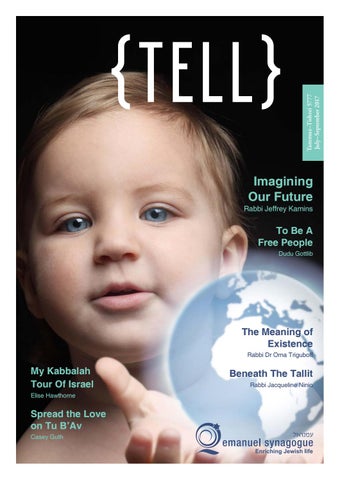
Tammuz–Tishrei 5777 July–September 2017
Imagining Our Future
Rabbi Jeffrey Kamins
To Be A Free People Dudu Gottlib
The Meaning of Existence Rabbi Dr Orna Triguboff
My Kabbalah Tour Of Israel Elise Hawthorne
Spread the Love on Tu B’Av Casey Guth
Beneath The Tallit Rabbi Jacqueline Ninio
Following the amazing success of previous year’s concerts, we are thrilled to announce that the acclaimed Australian Chamber Orchestra, led by Richard Tognetti, will return to Emanuel Synagogue for a concert on the evening of 26 October, 2017.
SAVE THE DATE
Y O U R Q U A R T E R LY J O U R N A L O N S P I R I T U A L I T Y, L E A R N I N G & C O M M U N I T Y Emanuel Synagogue offers a home where you can live your Judaism in a contemporary world, drawing on our ancient teachings and traditions. We are a pluralistic community offering a choice of services, programs and activities for the Masorti, Progressive and Renewal movements. We do this with contemporary understanding to create a dynamic and diverse community, welcoming you and your involvement.
PROGRESSIVE The structure of our Progressive services allows you to choose the type of prayer that is most meaningful for you. You may choose from alternate readings in English, you may read the Hebrew prayer (available in both Hebrew script, and in English transliteration), or you may choose to take a moment of personal reflection. Our Friday night “Shabbat Live� service is a moving, innovative service where prayer is enhanced with musical instruments, beautiful melodies, creative readings and stories. Shabbat Live is held at 6:15pm every Friday. The Progressive Shabbat Service begins at 10am each Saturday morning.
MASORTI Our Masorti (traditional) services are run almost entirely in Hebrew, honouring the tradition with contemporary insights.
The Renewal movement is devoted to personal and spiritual development, reinvigorating modern Judaism with Kabbalistic and musical practices.
As with all services at Emanuel Synagogue, men and women participate equally and fully.
Through our Renewal activities you will have the opportunity to reach a new level of awareness, stress relief, self-development, relaxation and inner healing.
The Friday night Carlebach service is a traditional Kabbalat Shabbat service, featuring the well-known melodies of Shlomo Carlebach. The Carlebach service is held at 6.15pm every Friday. Our Masorti Shabbat Service begins at 9am on Saturday mornings. We also hold a Masorti Minyan at 6:45am on Monday and Thursday mornings. 6pm Mondays; 8:30am on the first Sunday of each month. followed by breakfast in the Neuweg Sanctuary.
Rabbi Jeffrey B. Kamins
RENEWAL
Rabbi Jacqueline Ninio
Rabbi Dr Orna Triguboff
Kabbalah Meditation Weekly Class with Rabbi Dr. Orna Triguboff Term 3, 2017: 18 July - 19 September Open to beginners & advanced. Relax, rejuvenate and meditate in spiritual community. Be inspired! Renewal Kabbalat Shabbat - July 28, 2017 - 6:15pm to 7:15pm in Neuweg Sanctuary. Kabbalat Shabbat service with music and meditation followed by a potluck Shabbat dinner.
Rabbi Rafi Kaiserblueth
Reverand Sam Zwarenstein
{ A NOTE FROM THE CEO }
One evening, a few weeks ago I was sipping a cup of tea with a friend while discussing the experiences of being part of a redevelopment team. I shared the many insights I had gained from working with experienced professionals in building something new as well as the challenges of meeting the expectations and hopes of so many. This in turn, led me to reflect on our community’s unique and wonderful treasures. My thoughts wandered through the history of Emanuel and the excitement of turning 80 years old next year; dreaming about all the possible celebrations we could have to mark this significant milestone to encapsulate the strength, vibrancy and dynamism of Emanuel Synagogue. This is especially extraordinary at a time when other communities in Australia and around
{ INSIDE THIS EDITION: HIGHLIGHTS }
the world face challenges and struggles. Here we are at Emanuel, building a wonderful new sanctuary, with a new preschool. Every day on the campus, we have vibrant life happenings and activities, including voices coming together in prayer and the laughter of children learning and playing. I am grateful for all that we have here, and hopeful for all we still want to grow and accomplish. We constantly challenge ourselves to ensure the decisions we make and the paths we choose are aligned to our values and strategies. I reflected on how Emanuel is so fortunate to have such a positive, generous and caring community. Our social justice team and activities, the growing number of volunteers reaching out to support our neighbours and wider community, (see for example,
TRANSFORMATIVE LEARNING
INSPIRING PRAYER
6
SPREAD THE LOVE ON TU B’AV
IMAGINING OUR FUTURE
Casey Guth
Rabbi Kamins
11
13
9
ATTENDING MORNING MINYAN
SECURING THE FUTURE
Cyndi Freiman
William Nemesh
14
MAY THEIR MEMORIES BE A BLESSING Reverend Sam Zwarenstein
15
BENEATH THE TALLIT Rabbi Jacqueline Ninio
17
REDEVELOPMENT UPDATE Ed Lippmann
hatred or Sinat Chinam. Indeed, our tradition teaches that the Temple was destroyed not due the actions of the invaders, but the hatred and rivalry within their community. At Emanuel I have witnessed an honest attempt to avoid this pattern and create a centre built on love and respect. Indeed, the very fact that we have multiple streams and approaches to Judaism within our community is testament to this. Yet, simply having multiple approaches is not sufficient. We need to earnestly continue to lead by example and demonstrate with confidence and graciousness that we can and will have a positive effect not just on the environment, but the people. By providing spaces for open and respectful dialogue, welcoming people, and providing a spiritual home, and most importantly implementing a common,
shared vision of the future, we are adding that positive energy to our community.
SUSTAINING THE ENVIRONMENT & HEALING THE WORLD
CONNECTING WITH ISRAEL & WORLD JEWRY
COMMUNITY
18
24
MY KABBALAH TOUR OF ISRAEL
I LEARN SO MUCH FROM MY STUDENTS
SHARED TABLE PROJECT
Elise Hawthorne
Daniel Samowitz
19
26
30
MATTHEW TALBOT HOSTEL
HESHBON NEFESH
A CONVERSATION WITHOUT A DIFFICULT QUESTION IS LIKE A HOLE WITHOUT A DOUGHNUT
the article inside about the ongoing work of our volunteers at Matthew Talbot Hostel and our involvement in the wonderful Shared Table Project). There is no doubt that human beings have an effect on their environment and community. From urban sprawl to climate change, we tend to notice the physical variations in our surroundings, as they are the easiest to observe. What is more difficult to appreciate is the impact we can have on the non-physical or spiritual. Over the last 18 months, I have witnessed the amazing impact of the positive energy shown by our volunteers, staff and board among others, in ensuring Emanuel remains the most vibrant Jewish centre in Australia. History has many examples of Jewish communities fracturing due to baseless
Peter Keeda
Rafi Kaiserblueth
20
27
MEANING OF EXISTENCE
ALL THIS, IS NETZER
Rabbi Dr Orna Triguboff
Nicki Braun
28
TO BE A FREE PEOPLE Dudu Gotlib
We believe in an optimistic vision of the future, where people of all approaches will come together in harmony. The outlook is bright. The positive energy we add by coming together with a common vision and purpose, will irrevocably alter the spiritual bonds of our community for the better, leading to a society where justice and mutual respect are the norm and judgment and exclusion are marginalised. Suzanna Helia
29
Nathan Compton
32
WUPJ CONNECTIONS Joel McCarroll
33
ISRAEL AS A HOME FOR ALL JEWS Steve Denenberg
34
MAZAL TOV
{ IMAGINING OUR FUTURE } Rabbi Jeffrey Kamins
At the beginning of the 21st century, as we consider our future, we Jews must first process and integrate the influence of four significant events of the last 200 years: the emancipation, the enlightenment, the Shoah, and the re-establishment of Jewish sovereignty in the land of Israel. Each of these has had a huge, transformative impact on our constitution as a people; the four together have created a new reality for us, opening new possibilities for our future. The emancipation refers to the events of the late 18th and early 19th century in western Europe, in which Jews first became basically equal citizens in the newly created nation states of Europe and soon thereafter, the Americas. Until this time, around the world, wherever Jews had dispersed since the destruction of the Second Temple in the year 70 CE they continued to see themselves as members of a faith people, Jews and Judaism deeply intertwined. Beginning with the emancipation, the notions of faith and nation became separated for many Jews. On one hand, some began speaking of Judaism as a religion; others focused on the Jews as a nation, with the nascent seeds of Zionism slowly sprouting by the end of the 19th century. The enlightenment also had profound impact on our self-understanding. Until this time, it was assumed that the Torah was the literal word of God, and rabbinic interpretation of it determinate of Jewish law and practice. The enlightenment refers to the explosion of knowledge in science, history, literary critique, philosophy and other intellectual pursuits; in particular, the “light” the enlightenment shone upon the reading of scripture had profound consequences. Reason and humanism led to the disintegration of clerical authority and 6
the varieties of expression of modern Judaism in the 20th century, including neo or modern Orthodox, Masorti (also known as conservative or positivehistorical), Progressive (also known as liberal and reform) and Renewal.
On the heels of the emancipation and enlightenment came the Shoah, the incomprehensible destruction of one third of our people, a trauma that will continue to reverberate for all time. In terms of physical impact, a population that with natural increase would now be around 50-60 million is closer to 14 million. The psychic impact is far more profound, shattering the belief in God for many, turning others inward and cautious. The call of “never again” has led to highly defensive behaviour for some; for others it has produced an unflinching commitment to fight for the oppressed.
19th century Zionism took root in the midst of the trauma of the 20th century. We will never know what the rebirth of Israel would have been like if it had occurred gradually with the backing of 50-60 million Jews. Instead, its security is now perceived through the prism of the Shoah and the persistence of antisemitism. Yet, the significance of our third experience of sovereignty of our people in our land, the basis of our Torah story and a major focus of rabbinic tradition, is just beginning to unfold. Being a free people in our own land is not a response to the Shoah, but the fulfilment of thousands of years of dreaming of that possibility. Now we need to consider what our dreams for the future should be. Our rebuilding of Israel requires us to reinterpret our self-understanding. Two thousand years of dispersal, with powerlessness and antisemitism culminating in the Shoah, leads us to be cautious but should not lead us to be fearful. Rather, we need to celebrate that we are an ancient people whose civilisation has amazingly survived historical challenges, including those four major events of the last two centuries. All these events require each of us to consider what it means to be a Jew engaged with Judaism, and how we thereby create a community of clear intention. The gift of the emancipation allows us to live freely in our lands of
multiple forms of spirituality from traditional davening to meditative practice, and many ways of engaging with each other from welcoming the stranger to visiting those in need to giving back to those less fortunate than we.
Join our morning MASORTI minyan Mondays & Thursdays at 6:45am
Judaism is not just a religion, but also our multi-faceted way of life that can find expression in myriad ways; synagogues are not just places of prayer,
but communitarian hubs where Jews live their Judaism in all its aspects. Temple Emanuel may have begun as a place of progressive prayer, but as we embrace our past we also envision our future as Emanuel Synagogue, where we will have ongoing opportunities for learning,
TRANSFORMATIVE LEARNING
choice, even as many choose Israel as our homeland. The blessing of the enlightenment allows us critical self reflection – the more we learn, the more we understand our history as a people, our literature guiding our traditions, rituals, ethics, rhythms in life and perceptions of it. While our return to Zion reminds us we are first and foremost a nation, our shared story that enabled us to fulfil that 2,000 year-old dream teaches us that wherever we go, our communities form part of that nation.
I look forward to having the opportunity to speak with you more about envisioning our future. In the months ahead, I hope to come to various homes in our congregation, and learn and imagine with you.
SHABBAT LIVE A spiritual, meaningful and musical Shabbat experience every Friday at 6:15pm 20
7
Insight 2
It’s not the amount of marble in your reception, but the relevance of your insight.
s t r e v d A
Private Businesses Private Clients Family Office
8
William Nemesh is Jewish Community Relationship Manager for the NSW Jewish Board Of Deputies and has recently joined the board of Emanuel Synagogue
This year we reflect on many watershed moments. It has been 100 years since the Balfour Declaration which proclaimed the United Kingdom’s support for the establishment of a Jewish homeland in Palestine; 100 years since the charge of the Light Horse Brigade which in effect ended 500 years of Ottomon rule over Palestine; and 50 years since the reunification of Jerusalem. These anniversaries provide us an opportunity to reflect on our past, evaluate our present and look to the future. But we need to ask ourselves what future do we want? The Australian Jewish community is small, very small. It comprises only 0.5% of the total population of Australia. Unlike other communities our growth is relatively static and there has not been any recent waves of immigration, nor are any expected in the future. Our population on average is older than the rest of society and is ageing. This will put additional strain on communal services in years to come and highlights the importance in obtaining adequate burial space. In order to secure a prosperous future, our community must be mindful of such demographic challenges; its own geographic concentration which sees approximately 65% of all Jews in NSW living in the Eastern Suburbs of Sydney. We must decide now what kind of community we want remembering to never forget our past, remain vigilant in the present but optimistic and hopeful for the future. Jonathan Sacks reminds us as Jews we must be true to our faith and a blessing to others regardless of their faith. In a world of growing complexity and uncertainty and in an age where people
stand for everything and nothing it is an even greater imperative that we remain true to our faith. Education, Jewish education is essential. Our children must have an understanding and love of Judaism, a connection to Israel and importantly hope for a more prosperous and kinder society. Our community has started to take up this call with the creation of programs such as Y2i and the JCA’s Jumpstart and Observership programs. There are now 7 youth movements or youth organisations that empower our children to be leaders of today and of tomorrow.
TRANSFORMATIVE LEARNING
{ SECURING OUR FUTURE }
of the past. The NSW Jewish Board of Deputies was formed in 1944 during the Shoah, the JCA was formed in 1967 in response to the Six Day War and Emanuel Synagogue was established in 1938 with its membership primarily comprised of refugees who fled Europe. For a secure and prosperous future, the institutions and organisations of the Jewish community must remain strong and vibrant. They cannot become complacent and must adapt to the conditions of the future. I am privileged and honoured to serve on the board of this Synagogue, one of the most active, vibrant, and egalitarian in the nation. And so where do we go from here?
But is it enough? On the historical visit of Benjamin Netanyahu to Australia earlier this year, the Israeli Prime Minister remarked that the Jewish people have been successful because they not only have a deep connection to their past and its traditions but optimistically look to the future despite the past. Some of our communities most enduring and important organisations and institutions were borne out of the horrors and threats
The community must come together and be united. There will always be points of contention and disagreement but we must value and respect the opinions of others and remain proud of our Judaism. Rabbi Sacks poignantly remarked that nonJews respect Jews who respect Judaism and non-Jews are embarrassed by Jews who are embarrassed by Judaism. I further believe in the words of the HaTikvah ‘Kol ode balevav p’nimah As long as the Jewish spirit is yearning deep in the heart’ holds true not just in relation to Israel but underlies the same principle for a secure and prosperous future for our community. 9
A MELTON SCHOLARS COURSE AT EMANUEL SYNAGOGUE
KABBALAH AT MELTON with Rabbi Dr. Orna Triguboff CENTRE FOR CONTINUING EDUCATION
Kabbalah today is one of the best known facets of Judaism, yet also one of the least well understood. Gain familiarity with the rich history of Jewish mysticism. Study texts central to Kabbalah. 5 week course Wednesdays 8pm-9:30pm 2 August until 30 August ENQUIRIES: orna@emanuel.org.au
{ SPREAD THE LOVE ON TU B’AV } Casey Guth
L is for the way you LOOK at me, and O is for the only….. don’t mind me!! Just very partial to a love song… call me a female Richard Mercer aka the Love Goddess….. Two in love can make it. Take my heart and please don’t break it…… LOVE…. I’m referring to those who decide to fully find themselves before they find somebody else. As our girl Gal Gadot, the new Israeli Wonder Woman said: “I think it’s important for girls, and also for boys, to have a strong female character to look up to”
Since this is the night of a full moon in our lunar calendar there is a link to romance, love, and fertility - all hot topics in today’s modern society. Which gets one thinking about the demands placed on young adults to find love and find it fast. And who says that makes one happier anyway? The pressure on today’s society with young men and women to be a relationship is very much rife. Whilst young adults in the Jewish community are breaking away from such a pattern of marrying or coupling up at a young age, they are still made to feel inadequate if they have not. For us female Gen X & Y’ers, we have been indoctrinated since childhood to wait patiently for our Knight in Shining Armour to magically appear and sweep them us off our feet. But what about the women who choose not to wait so patiently? The women who meet and date knight numbers one, two and three, before choosing the right knight. The difference may be night and day…
So why does being a thirty-something single lady still have such a stigma attached to it? One must be happy within themselves before they can give to another, and being in a relationship does not necessarily lead to happiness. This is a message we need to spread. Turn that ‘oy vey’ into ‘oy yay’! The more you become a more content version of yourself, the better chance you have of attracting the person you are meant to be with, and who cares if you find that
person later in life? This is probably the right timing for you. Best not to compare to others and repeat the mantra “stay in your own lane”. (Heck, it works for me!)
INSPIRING PRAYER
As we approach Tu B’Av, the 15th Day of Av on the Jewish Calendar, one may find themselves questioning their love status. Tu B’av is both an ancient and modern holiday that has been rejuvenated in recent decades to become a Hebrew/Jewish day of lurrve…think Valentine’s Day with a side of bagel, lox and love.
Let’s recall all the wonderful moments we have experienced in the last year with loved ones - holidays, great meals, fun nights out or a conversation that keeps you buzzing for days. Allow yourself to re-live those experiences and have gratitude for all that is love; I’m not just referring to your Facebook relationship status. Feeling pressure from your friends and family to find that special someone can often be discouraging. Above all, the most important thing is making sure that you are happy with yourself first. The rest will follow. It’s okay to move at a pace that is most comfortable for you. So people, on this holiday, let’s all take time to stop and realize how fortunate we are to have such a wonderful community here at the shule, of family, friends, and loved ones. Let’s rally together and support people who are single, dating, divorced, married, in a relationship or in an ‘it’s complicated’ relationship. L’chaim to that.
11
our morning minyan Join Join our morning MASORTI minyan Mondays Mondays && Thursdays Thursdays at at 6:45am 6:45am (6:30am on Rosh Chodesh)
Women’s Rosh Chodesh Group
SHABBAT LIVE
Tuesday 25 July, Tuesday 22 August, Sunday 22 October, Sunday 19 November, Sunday 17 December Why a Women’s Rosh Chodesh Group?
There is a legend told that when the Israelites came to create the golden calf, the men asked the women to give them all their jewellery and gold to be melted down for the calf. The women refused to supply their jewels and as a reward a special festival was given to them: the festival of Rosh Chodesh, the celebration of the new moon.
We would love to have anyone who is interested or curious come and join us at any or all of our gatherings. All Rosh Chodesh meetings begin at 8:00pm in the homes of our members.
Please call the Emanuel Synagogue office before the meeting to find out the location on 9389 6444. Any questions: call the office or email info@emanuel.org.au.
A spiritual, meaningful and musical Shabbat experience every Friday at 6:15pm
A number of women in our congregation expressed an interest in participating in a Rosh Chodesh group and began meetings in 1999. We begin with a short prayer to welcome the new month. This is followed by a discussion about topics of interest led by a different person each meeting. We have a broad range of ages and perspectives in the group which is warm, welcoming and open.
21 02
{ ATTENDING MORNING MINYAN } By Cyndi Freiman
Rabbi Jackie Ninio asked me to write a piece for the Tell describing my experience of attending the early morning minyan services on Monday and Thursday mornings.
On July 26th my beloved mother, Cecilia died, just a month before her 85th birthday. I flew to South Africa and arrived just in time to be with her in the last 36 hours of her life. She was a wonderful caring loving person and I was blessed to have her as a mother. When I arrived home, 3 weeks after her death, my friend Zara Yellin suggested I came to the morning minyan with her. In March 2016, Zara tragically lost her 41-year-old son Marc to a rare form of cancer. She told me the morning minyan had been a lifesaver in her grieving process and invited me to accompany her to a service. As a creature of habit, I was reluctant to give up my early morning gym class on a Monday morning and adjust my schedule. However, I booked a later class and went to the minyan wearing my gym gear. I decided to give it a go and see how I felt. So on a cold winter’s morning in August last year, I met Zara outside Emanuel Shul at 6.40 am and now 9 months later I haven’t missed a minyan, unless I have been out of town! Like Zara, I have felt this to be a very rich and meaningful practice. First of all, there is a dedicated space and time where the business of life stops and through prayer and rituals you have the time to focus and think about the loved one you have lost. I remembered when my father died some 30 years ago, I was too busy to mourn
properly. Every now and again the emotions of grief would overcome me unexpectedly. This year of mourning has been far more gentle and integrated in the flow of my life with regular, special time to think about my Mum.
one and are now part of this supportive and nurturing community. The strength, warmth and bonding from being together in community and prayer is a special experience.
During the hour of the service there may be times that I am focussed on the service and other times that I am more distracted. Sometimes it takes a while to focus and concentrate, other times I feel more mindful and present with the service. Through meditation and prayer, I have discovered a therapeutic process of healing. By the end of the service I am left with a calm, still mind that allows the words of the text to speak to me. Each minyan we have a 3-minute drosha from Rabbi Kaiserblueth, which we look forward to, just a gem of inspiration to take away with us.
Now that I face the last 4 weeks of my mourning period I feel sad that it is coming to an end. I may continue to attend the morning ritual even though my official mourning period for my Mum will be over. I am also encouraged to add the dates of my grandparent’s yortzeit to my calendar and say a memorial prayer for them.
INSPIRING PRAYER
As my mourning period comes to an end I would like to share the gift of joining the “Emanuel Minyanaires.”
Initially my biggest challenge was learning to say the memorial prayer, a real tongue twister, however Zara stood next to me for the first month and said it with me until I was confident to say it on my own. We all suffer loss in our lives and I can encourage other members to give the morning minyan services a go. Out of 3,500 members, we get between 12-16 attending twice a week.
As the year progressed others have joined the minyan, either for a specific yortzeit or the regulars who come rain or shine as part of their commitment to this special “Emanuel Minyanaires” community. Many regulars such as Zara, started with saying Kaddish for a loved
It is a blessing; it is a healing ritual and a mitzvah to come. You will feel so welcome both from the Rabbis and the community. If you wish you can also participate actively in the services, which makes the whole experience even more significant and spiritual. I can honestly say it has been one of the best choices I have made to attend and will be sad when my 11 months comes to an end. 13
{ Z I C H R O N A M L I V RA C H A - M AY T H E I R MEMORIES BE A BLESSING} By Reverend Sam Zwarenstein, Director of Communal Engagement
“... for Jews memory is no less primary than the prick of a pin, or its silver glimmer, or the taste of the blood it pulls from the finger. The Jew is pricked by a pin and remembers other pins. It is only by tracing the pinprick back to other pinpricks – when his mother tried to fix his sleeve while his arm was still in it, when his grandfather’s fingers fell asleep from stroking his great-grandfather’s damp forehead, when Abraham tested the knife point to be sure Isaac would feel no pain – that the Jew is able to know why it hurts. When a Jew encounters a pin, he asks: What does it remember like?” – Jonathan Safran Foer, Everything Is Illuminated Modern day commentator and educator, Avraham Infeld, explains that the difference between history and memory is that history is what happens to us in the past, but memory is what connects that history with who we are today. As Jews we live our memories, we connect to our past through celebrating and commemorating our history. At Pesach we recall our “national birthday”, our journey from slavery to freedom. At Shavu’ot, we celebrate the giving of Torah. At Chanukah, we celebrate the miracle of the oil that lasted eight days, but was supposed to last only one day. Our very existence is contingent on our ability to connect to our past, while acknowledging the present, with a vision toward the future. In his book; “Zachor: Jewish History and Jewish Memory”, historian Josef Yerushalmi argues that memory flows; “above all, through two channels: ritual and recital”. Each time we engage in the various rituals associated with each festival, Shabbat, special occasion, we are connecting ourselves and others in the community to that which is not only important to us, but vital to our existence. Each time we celebrate or commemorate our history, we are remembering our story and we make a statement that 14
names on the board, we immediately think of them and the role they played in our lives. We remember them.
this is important to us, to our existence - now and for future generations. I have had the privilege of visiting many synagogues around the world. As you’d expect, no two are exactly the same, and the various styles are based on their leaders’ visions and desires for their community. No matter what their size, or the intricacy or simplicity of their design, or how old or new the synagogue is, one of the key features of every synagogue I have visited, is a yahrzeit board or memorial wall. It’s usually located just outside the sanctuary, or prominently displayed in the sanctuary. In all cases, the board or wall is placed there for all to see. It takes pride of place in our communities because it allows us, as members of these communities, to honour those who are no longer with us, be they parents, grandparents, siblings, spouses, or children, other relatives, or dear friends. When we see their
French Jewish philosopher Maurice Halbwach, known for his development of the concept of collective memory. argues that the while the word or term “zachor” denotes memory or remembrance, it is also an instruction not to forget. Just as we view immersion in the rituals that link us to our memory, in order to celebrate or commemorate them as an important part of our existence, we should also consider acknowledging our loved ones and other community connections. Each Shabbat and Festival and the many other times we have the opportunity to come to the Synagogue, especially on the anniversary of a loved one’s passing and the 4 times we recite Yizkor each year, we further honour and acknowledge the importance of their role in our lives and in the community. From the day this Synagogue building was opened, the Yahrzeit Memorial Board at the back of the Main Sanctuary has been there. When the Neuweg sanctuary was built, a Yahrzeit Memorial Board was constructed there as well. The plaques on these boards have allowed us to connect ritual and recital to honour our loved ones. As the years have gone
The names of those who have already been honoured on the other boards
will automatically be transferred to the new board. We also know that there are a number of people who would like to honour loved ones in the same way, but due to previous space restrictions, they have not been able to do so. As we transition to our newly designed foyer, it is an opportune time to consider honouring the memories of loved ones in a way that not only pays tribute to who they were, but also to their importance in our lives and the community. Through ritual and recital, and connecting memory to history, we can make sure that their legacy lives on in our community. By actively remembering them in these ways, we are ensuring that they will not be forgotten, and equally as
important, we are honouring their name in a prominent way, showing commitment to their memory and to supporting our community. If you would like to learn more about the new Yahrzeit Memorial Board, or if you would like to discuss including family or friends on our new Yahrzeit Memorial Board, please call (02 9389 6444) or e-mail me (samz@ emanuel.org.au). While we will have space for some years to come, this is the ideal time to have the names of your loved ones recorded for future memories within family groupings.
INSPIRING PRAYER
by, the board in the Main Sanctuary has been “oversubscribed”, and designs for a new board were included as part of the redevelopment of our campus from very early on. Because part of our vision as a pluralist community is to have one point of entry to all our prayer services and learning programs, we have decided that the foyer will be that space and all our Yahrzeit Memorial Boards will be there for all to see. At this time, the final stages of the redesign of the foyer, which will serve as the key entry point for all the buildings and facilities on the campus, have commenced, and new Yahrzeit Memorial Boards are being constructed in this space.
{ BENEATH THE TALLIT } Rabbi Jacqueline Ninio
Every year at the end of Yom Kippur services we invite everyone who is wearing a tallit to lift it over their heads, draw in the people beside them and shelter the whole community beneath a canopy of tallitot. It is such a moving and special moment to see the whole congregation underneath a sea of tallitot, joined together as one as we recite the words of the priestly blessing, asking that God’s presence be wrapped around us bringing us peace, shelter and blessings. From this powerful moment of communal togetherness, we go out into the star-filled night refreshed and ready to begin the new year. It is such an incredible experience every year, with the tallit symbolizing our connection with God and with each other, all beneath a canopy of blessings. I remember when I first began to wear a tallit regularly for prayer. I wore one at my bat mitzvah when I was 13 but after that day, I put it away in a drawer and did not think much about it. When
I was considering going to rabbinical school my father said: “you know, if you really believe all this equality business, you should be wearing a tallit.” I took a deep breath, ready to argue with him, but then I realized that he was right. If I believed that we are equal, that the tallit represents the commandments and God’s presence, if I felt that the Torah was speaking to me as much as to my brother when it said “place fringes on the corners of your garment” then I should be wearing a tallit. So I resolved to wear a tallit. The first time I put one on, I felt very strange and a little self conscious, I worried, what would people think, how would they feel about seeing me in a tallit? How did I feel about being in one? I worried that I was not doing
it right, that I was making a mistake. But then slowly, I started to feel more comfortable, I found myself holding the tzitzit, arranging the strings as I had seen so many men doing in shule. I treasured those brief moments beneath the tallit, wrapped and sheltered from the outside world as I whispered the blessing and had a moment with God. I felt like a child with the covers over my head, safe, protected. Continues on page 23... 15
16
{REDEVELOPMENT UPDATE} Ed Lippmann, Senior Partner at Lippmann Partnership Architects Congregants who have visited the Synagogue over the past six months will be aware that the old Pre-School precinct is now a construction site. The recent disruption along Ocean Street is further indication that something of gravitas is underway.
building will be richly imbued with that. Together with Janet Laurence, we have developed a set of glazed images which impart Rabbi Kamins’ vision of the evolution of our people. This will involve a journey throughout the campus starting with “The Tree of Life” by Janet Laurence continuing with “The Parting of the Seas” in the Kiddush courtyard and “The Seven Species” at the entry to the new sanctuary.
It’s been 50 years since Neuweg and almost 70 years since the main Synagogue building was completed. It’s been a privilege and pleasure for me to be entrusted with the twenty first century addition which will soon take its place alongside its fine old heritage classic. The project has been several years in the making and our efforts have, until recently, focussed on architectural concept and detail which the builders are now delivering - the finely crafted roof structure, naturally lit and ventilated sanctuary interior, the articulated timber ceilings and wall
INSPIRING PRAYER
The new development has been described as “a once in a generation opportunity” and is a powerful reflection of the growth and vitality of the Emanuel community. Our community’s diversity and pluralism will be both reflected and enhanced by the new building which is taking shape.
panelling, a twenty first century ark, bimah and seating. These elements, described in the parasha Terumah, are both centuries old traditions and modern, sustainable innovations. In recent days, our attention has been directed to the religious scriptures, “decorations” and artworks which will embellish the building and give it warmth and humanity. Mathematics, structure and geometry embody their own innate spirituality and the new
Emanuel Synagogue has commissioned well-known Sydney artist, Janet Laurence to design and create the window representing the Tree of Life that will be the first element welcoming visitors to the main foyer. Exploring notions of art, science, imagination, memory, and loss, Janet Laurence’s global work examines our physical, cultural and conflicting relationship to the natural world through both site specific, gallery and museum works. The great undertaking which we set out to achieve will soon materialise and, I trust, become something much loved by our entire community.
The Tree of Life 17
{ SHARED TABLE PROJECT } For the past few months, Emanuel Synagogue has been honoured to host the Shared Table Project. Shared Table Project is an initiative of the NSW Jewish Board Deputies with a focus on promoting intercultural and interfaith dialogue with women from many backgrounds, including Muslim, Jewish, and newly arrived immigrants from Syria and Iraq, celebrating diversity from all our cultures. Shared Table Project promotes social inclusion while fostering friendships and empowering women to establish and experience diverse communities. ‘Culture’ is a fusion of spiritual, emotional, mental and physical
18
realities, all of which interact in the life of society and individuals. It involves the way we think, dress and speak, the words we use, our beliefs, the style of our clothes and our homes, relationships, our music and our art, and much more. Melissa Port, director of ‘Shared Table Project’ commented, “Food is an important aspect of cultural identity. The Shared Table Project is an outstanding example of how food can break down cultural barriers. It brings together women from diverse
communities, sharing stories and cultural insights in dialogue through food. Its aim is to break down prejudices and barriers to intercultural harmony, building relationships which will hopefully enhance the social fabric of our society”. Many of the participants utilise the project to make new friends, to overcome preconceived ideas and to share their cultural backgrounds through family recipes that have been passed down through the generations. For more on the Shared Table Project, see www.sharedtableproject.com.
{ HELPING MATHEW TALBOT } Peter Keeda
Emanuel Synagogue Volunteers at Matthew Talbot Hostel for Men
Every Sunday, for five years, our great team of amazing volunteers has been there at 6 in the morning, serving coffee and other products on sale at the canteen. Well, over that period we have missed three times which means we have had over 99% performance rate! The Matthew Talbot Hostel provides accommodation and specialised support to people who are homeless or at risk
During a recent kiosk service, we spoke to a few of our customers and they shared some stories: Glen
of homelessness. The service aims to provide immediate support and accommodation for people at the time of crisis as well as facilitate access to other essential services and more permanent housing. These services range from provision of nutritional meals, clothing, showers and basic medical to intensive case management, legal and housing support, specialised health care, advocacy and providing a safe, welcoming environment for people who are sleeping rough and have experienced trauma.
He has been staying at the hostel for past 3 months after a relationship breakup. He enjoys the community and safe place to stay while he gets back on his feet again. Things are looking promising with a new job in demoliton for which he is grateful. ‘Unknown’ originally from Yugoslavia some 40 years ago He has been a kiosk regular for a long time. We always know he is around with his cheerful smile, and sense of humour. When asked to comment about his life, he told us he sleeps ‘under the stars’ at the ‘sky hotel’.
SUSTAINING THE ENVIRONMENT & HEALING THE WORLD
Five years ago, representatives from Emanuel Synagogue’s Social Justice committee approached Matthew Talbot and asked them how we can help. They asked us if we could man the canteen for a few hours a week. As we wanted to do a bit more than the ‘usual’ we responded: “What is your most difficult shift to fill?” “Sunday morning 6-8am”, was their reply and ever since Emanuel Synagogue volunteers have being doing this ‘unpopular’ shift.
19
{ WHAT IS THE MEANING OF EXISTENCE AND WHY ARE YOU HERE? } by Rabbi Dr Orna Triguboff
10 Steps to Teshuvah a 40 Day Process The month before Rosh ha Shana (New Year) and the days leading up to Yom Kipur (Day of Atonement) are a special gift to be received and experienced. Why are you here? What is your purpose? These questions are part of the Teshuvah Process. We will unravel the concept of Teshuvah in this article by exploring ten aspects of this multi-faceted process. 1. You are important 2. Tikun Olam and Tikun ha-Nefesh 3. Soul accounting 4. Compassion – 13 Attributes 5. Return to What is Important 6. Purity of Heart, Neshama 7. Repentance and Forgiveness 8. Atonement - At One-ment 9. Shofar 10. Renewal
1. You are Important Whether you believe in God or not, there is a principle in Judaism that states that every person is important and has their own unique gift to bring to the world. Each person is created in the image of God (Genesis). Realising you have something to give to the world that noone else can give. This period is a time to reflect, discover and remember what that is. It might not be something that makes you famous, it might be something very humble, but it is YOU and only YOU. The highest level of the soul, in Hebrew, is called Yechidah, which means both ‘united’ and ‘unique’, that is to say, a part of you that is at the same time 20
united with everything and stands out as unique and original in the creation. You are unique and part of Teshuvah is asking yourself: What is special about me? (You might want to journal while you read this article.)
2. Tikun Olam and Tikun haNefesh The Social Justice and SelfImprovement Connection: Rabbi Isaac Luria of Sixteenth Century Tsfat focused his teachings on two main concepts related to Teshuvah: Tikun Olam – repairing the world or social justice work, and Tikun ha-Nefesh - repairing yourself. These 40 days are a time to reflect on what you are passionate about in terms of social justice and considering projects you are involved in or would like to be involved in. It’s a time to consider how you will have time for these projects and a time to get things started if they aren’t already. The other side of the coin is to consider what you would like to improve within yourself. The month of Elul and the ten days in Tishrei culminating with Yom Kipur, are times to reflect on something you do for your own tikun ha-nefesh, it is a time for self-care and self-love. What is one aspect of your self or your life you would like to improve? How can you start or continue with this process? As you can see, there is a balance between externalizing and internalizing, between working to improve the world and working to improve yourself. Both processes are complimentary and help balance your life.
3. Soul accounting Teshuvah is a process of “soul accounting” or cheshbon hanefesh, where we think about the year gone by in terms of positives and negatives in our lives. Think about the way you conduct our life, considering which things are going well and which could be improved. You can do this for the various aspects in your life – health, family relations, friendships, finances, creativity, education and so on. In the soul accounting, consider it is really important to remember the positive elements, asking yourself, What is going well in my life and how can I continue to build on that? Xxx jonah? These 40 days are a time to reflect and plan and for beginning or continuing actions that bring wellbeing in your life.
4. Compassion – 13 Attributes One of the themes of the High Holiday period, in its teachings and in its liturgy, is the concept of compassion in all its fullness - thirteen aspects of compassion. Whether you can relate to this number or not, this is a time to remember acts of compassion that people have done towards you and acts of compassion which you have done for others. Gratitude for the compassion people have shown towards you is also an element of Teshuvah: Have you felt gratitude and expressed gratitude to people in your life? Now is the time to do so if you haven’t. This is also a time to reflect on feeling compassion for yourself. Are you kind to yourself? How do you care for yourself?
The Hebrew word Teshuvah contains within it the root – shav – to return and part of the process of Teshuvah is giving yourself the opportunity to return to what is important in your life. During the year we get pulled in so many directions. We can get distracted or lose our focus. These 40 days are a time of remembering what we really want out of life and analyzing where the actions we have taken over the last year are leading us. Are they leading us in the direction we want to be going? What are some goals and are we moving towards them? Rabbi Shlomo Carlebach wrote a song for this period called “Return Again”, in which he sang the words: “Return to who you are, return to what you are.” There is a level of wisdom in the Jewish tradition, in terms of it carving out this time each year to
reflect on our lives and how we can return to what is important to us.
6. Purity of Heart, Neshamah Part of the process of ‘return-Teshuvah’, is to acknowledge the light in your heart and your essence. The Psalms repeatedly mention the ‘pure heart’ lev tahor, and the ‘pure soul’ neshamah tehorah and this period is especially designed for us to connect with that light and purity. The process of Teshuvah includes a metaphorical brushing off of the dust that has covered the pure heart over the past year. Connecting with what is pure and good in you and giving that part of yourself the chance to shine and act in the world.
amends. Considering what you have done that ‘missed the mark’, asking for forgiveness from others and working out how these things won’t happen again is essential to Teshuvah. Transgressions have so many aspects: between you and others, you and yourself, you and God, you and the environment. This is a time to reflect, ask for forgiveness, give forgiveness to others and make plans for tikun, ‘repair’ in the year to come.
7. Repentance and Forgiveness
Rabbi Zalman Schachter-Shalomi z”l, the founder of the Jewish Renewal movement, spoke of the release of knots in the heart that happen when one can ask for forgiveness and give forgiveness to others who sincerely ask for it.
Considering the transgressions and misdeeds you’ve done over the past year leads to a process of making
For the process of repentance to be a healing one, we might need to reach
SUSTAINING THE ENVIRONMENT & HEALING THE WORLD
5. Teshuvah as Return
21
out and ask for help. Knowing that we are not alone in this path can be helpful.
Hear O Israel, Adonai Eloheinu Adonai is One.
On a cosmic level, it is interesting to note that the midrash (Jewish mythology) teaches that Teshuvah was one of the first things created in the universe and it the ‘way back’ and the ‘path of repentance’ is embedded within each transgression we do. There is always a path or process leading to forgiveness, we just need to find it and act on it.
When we connect with a feeling of Oneness in our lives we connect with the Divine and the holiness of life.
Makings amends is part of bringing wholeness and harmony into our lives.
8. Atonement During this period of Teshuvah, we reflect on the way it is often translated, ‘atonement’. Rabbi Zalman SchachterShalomi wrote that we can understand it as a reflection on ‘At-One-ment’. It is a time to ask ourselves, What brings me a feeling of harmony and Oneness? How can I foster a greater sense of harmony and Oneness in my life? Think of our prayer Shema Yisrael, Adonai Eloheinu Adonai Echad,
9. The Sound of the Shofar During the month of Elul, we are invited to listen to the blowing of the shofar, horn, as well as on Rosh ha-Shana and Yom Kipur. It is seen as a call to awaken and listen to that ‘still subtle inner voice’, the voice of the inner core of yourself. There are many teachings about the shofar and repentance, and one that I love, is that the shofar is the deep sound of the heart that has is beyond words. That piercing sound can cut through so much confusion and help connect us to that inner sound. Teshuvah is listening to your inner wisdom.
10. A Renewal 40 days of Teshuvah, 40 measures of pure water in a mikvah!
KaBBALAH MEDITATION WEEKLY CLASS with Rabbi Dr. Orna Triguboff
1. CROWN
כתר
KETER 3. INTELLIGENCE
2. WIDSOM
BINA
HOKHMA
בינה
חכמה
KNOWLEDGE
דעת
DA’AT
Tuesdays 7:30pm - 8:30pm at Emanuel Synagogue Term 3, 2017: 18 July - 19 September Open to beginners & advanced Relax, rejuvenate and meditate in spiritual community. Be inspired! For more info, contact orna@emanuel.org.au
5. STRENGTH
4. LOVE
GEVURA
HESED
גבורה
הסד
6. BEAUTY
תפארת TIFERET
8. SPLENDOUR
7. ETERNITY
HOD
NETZACH
הוד
נצח
9. FOUNDATION
יסוד
YESOD
10. REIGN
מלכות
MALKHUT
22
The period of Teshuvah is understood by Jewish mystics, as a metaphorical time of being immersed in a virtual Teshuvah Mikvah. It is a time when your very being is held by spiritual forces and cleansed. Of course it there is the active role that we play, but there are also spiritual energies available at that time, to help our process. Some Kabbalists call it the cosmic womb of Binah ‘Understanding’, that receives our soul for 40 days and gives it back to us on Yom Kipur refreshed and renewed. It ties in to the words of Psalms: or chadash al tsion ta’ir “Shine a new light on Zion.” By going through the process of Teshuvah, in its multi faceted way, we become renewed and reinvigorated. We gain new inspiration for the year ahead. May we all be blessed with a meaningful period of Teshvuah this year, and may our efforts bring a new level of wellbeing for ourselves and for the world.
... “Beneath the Tallit” – continued from page 15
And then emerging from that cave into the embrace and familiar faces of the community, prayer, ready to be together, all the while feeling wrapped in the arms of holiness as the folds of the tallit wrapped around my body. These days I feel naked without my tallit, it is a part of me, a part of my prayer and my experience of synagogue, community, of being Jewish.
Now we are about to embark on a new tallit project at the synagogue. One of our members felt it would be so special for us to make tallitot as a community, to work together to craft tallitot for our synagogue and for those who may wish to wear them. He has offered a generous donation to get us
Whoever wrapped in a tallit in one’s youth will never forget: taking it out of the soft sack, opening the folded tallit, spreading it, kissing the border along its length (sometimes embroidered, sometimes embossed). Afterwards, a great sweep over the head like the heavens, like a hupah, like a parachute. Afterwards, folding it around one’s head as if playing hide and seek,
started and we hope to make 50 tallitot, all different, for our congregation to have and be able to embrace the mitzvah, to find our own connection.
or morning tying and winding and fulfilling the mitzvah. Third, and finally, we will make them beautiful. I would love to hear from you if you are able to help us with the sewing. If you are interested in the beautifying or the tzitzit tying then please keep your eyes open for the advertising of a date and time and see if you can join us. You don’t have to wear a tallit in order to help us with this project but who knows, it may inspire you to try it out.
We are searching for a number of different volunteers. First, people who have a sewing machine and would be willing and able to sew hems and button holes on the material for the tallitot. Second, we need people to join us for our tzitzit-tying day when we will come together and tie all the tzitzit. We will learn how and then spend an afternoon
This year as we gather on Yom Kippur, I hope we will all have a tallit under which we can gather crafted by community and feel always wrapped in its arms.
and then wrapping the body in it, tight, tight, letting it fold you like a cocoon and then opening it like wings for flying. And why are there stripes and not black-white squares like a chessboard? Because squares are finite without hope and stripes comes from infinity and go on to infinity like the runways at the airport so that angels may
land and take off. When you wrap yourself in a tallit you cannot forget coming out of a swimming pool or the sea and being wrapped in a great towel and casting it over one’s head and wrapping in it, tight tight and shivering a little and laughing and-blessing.
I want to share with you this poem from our siddur, Mishkan Tefilah, written by Yehudah Amichai about the tallit. (Mishkan Tefilah, pg. 191)
INSPIRING PRAYER
I also remember the beauty of creating my own tallit, tying the tzitzit for the first time, the meditative rhythm, the art of creating something beautiful. Then, with Larraine Larri, guiding our community to feel empowered to craft their own tallit, to express the beauty and holiness in a way which was meaningful and reflective of who they are. Watching children and adults tying, winding, painting, creating the visible connection to the mitzvot and shaping something holy was a true privilege.
23
{ MY KABBALAH TOUR OF ISRAEL } Elise Hawthorne
Arriving at Tel Aviv’s airport propelled me towards what would become a very personal spiritual journey which also felt like a homecoming of sorts. I was also about to mix it up with a delightful group of travel companions which was an unexpected joyful part of my inaugural trip to Israel. I was very lucky to have been included in the Land and Spirit Kabbalah Tour of Israel organised and led by the delightful and wise Rabbi Dr Orna Triguboff. Rabbi Triguboff serves at the Emanuel Synagogue in Sydney and is the Spiritual Director of the Neshama Life Association, an organisation that fosters spiritual development through Kabbalah. Diving into the warm Mediterranean water at Tel Aviv’s Gordon Beach washed away my jet lag which prepared this Sydney girl for a 10day mind, body and spirit adventure like no other I have encountered. The first unexpected bonus was meeting up with fellow traveller Pippa just before our tour commenced. We breakfasted with her friend Meira Priuman one of the leaders of the Woman Wage Peace group, and it is fair to say they are both my kind of women. The tour kicked off in Tel Aviv; we dived right in when we arrived at Independence Hall to relive David Ben Gurion’s declaration of the State of Israel on the 69th anniversary. I marvelled at the spirit of the brave men and women who were determined to build Tel Aviv on the sand dunes outside the old city of Jaffa. Our group of twenty-three then travelled by coach to the beautiful hilltop town of Zichron Ya’akov. It was such an
24
honour to spend Independence Day in this picturesque part of Israel. We moved on touring the Ramat Hanadiv Gardens visiting the tombs of Baron Edmond de Rothschild and his wife; learning about their enormous contribution to a movement promoting the Jewish return to Zion. We studied Kabbalah at the Ein Tzur Spring with Dr Yossi Chajes of Haifa University and sang in twopart harmony with the delightful Josh Laufer. We then ventured to the much revered grave site of Rabbi Shimon Bar Yochai, credited with writing the Zohar, the lead book of the Kabbalah.
Next up we spent three days in the mystical town of Tzfat where we visited synagogues, art galleries, and some of us ventured to the only Hungarian Museum in Israel, which was fascinating – my Austro-Hungarian heritage was awakened so far from home, and I only wished that my father was with me on this tour.
We walked along an, at times challenging, Rosh Pina trail and learnt Jewish martial arts with Golan Ben Chorin. We visited a Rosh Pina beit midrash, where we were warmly welcomed by the local Jewish Reform community. Other highlights included… The delicious food, the people – the joy of seeing Jews, Muslims and Christians living side-by-side just going about their daily lives in harmony and the pleasure of hanging out with my tour mates; hearing their stories, sharing our experiences. A surprise bonus was that we were very lucky to be in the company of the delightful Emanuel Lieberfreund, a very talented musician and composer who played one of his many instruments – accompanying mediation sessions, moments of quite reflection and at various celebrations along the way. Attending a Shabbat service in Jerusalem at Shira Hadasha, a pluralistic Orthodox congregation where women can lead services. Visiting the Israel Museum – seeing the Dead Sea Scrolls up close at last! Exploring the Western Wall Tunnels and the Jewish and Muslim Quarters of the Old City. A nature walk and study in the Sataf with Avraham Leader.
Having the pleasure of travelling to the Negev and partaking in a Bedouin lunch at the Joe Allon Centre followed by a visit to the Desert Stars leadership high school for Bedouin youth sponsored by the Triguboff Foundation. Masada Visiting Masada – a lesson in heroism I’ll never forget. Floating in the Dead Sea at Neve Midbar – I haven’t laughed so hard in ages. The Tower of David Night Times Spectacular – with the help of light projected on to this ancient fortress,
we were transported back in time, reviewing the history of Jerusalem. Jerusalem Visiting Jerusalem was my favourite part of the tour. Seeing the ruins of King David’s palace was both mindblowing and a great honour. Visiting the Kotel once on Shabbat and again a few days later, my thoughts went to my family members who perished in the Holocaust – I must admit I cried and I found it hard to stop. One of the very special moments was when walking away from the Kotel, Orna, myself and Lynda, one of my travelling companions, linked arms, standing in a tight knit-circle we sang in Hebrew; it makes me weep as I write this sentence. I felt lucky to be
able to walk in the Old City; many have died so that my generation and future generations can do so in peace. Interwoven in our journey was Rabbi Orna’s Kabbalistic teachings which not only taught me about the ancient mystical aspects of Judaism but also brought the tour participants closer together via so many shared, meaningful moments. We were all far from our family and friends, but we created our own little travelling family in the land of our forbears. I can trace my family heritage back to 13th Century Spain and then as rumour has it back to the House of King David so walking Israel’s ancient pathways was a feeling hard to put into words; pure joy just about sums it up.
CONNECTION WITH ISRAEL & WORLD JEWRY
Meeting Rabbi Roberto Arbiv, Sufi scholar and pluralistic rabbi who has opened a synagogue as a secular oasis in Tel Aviv.
25
{ HESHBON NEFESH } Rabbi Rafi Kaiserblueth
The cycle of the year inevitably brings us to focus, not on Rosh Hashanah and Yom Kippur, but ourselves. We are encouraged to engage in a deep inner gaze to bring about the full accounting that we need. SY Agnon recounts a Hasidic tale that captures the spirit of heshbon nefesh: Once on the New Moon of Elul [the month leading up to Rosh Hashanah], the zaddik Rabbi Levi Isaac of Berditchev was standing at his window. A Gentile cobbler passed by and asked him, “And have you nothing to mend?”
and personal growth does not occur in a month. All of these are a continual process that is almost imperceptible if viewed on a constant basis.
These developments are so striking not only because of the speed in which they are occurring, but also because of the leaps and bounds in which they are progressing. When I haven’t seen a close friend or relative in a significant period of time, the difference in appearance or character can be obvious, versus someone I see regularly. Does that mean then that a significant change has not occurred? Or is it simply that I am not aware because I do not perceive it? The changes do not occur on a day to day basis, but slowly over time. Hair does not change color overnight, wrinkles do not appear within a week, 26
I come into the sadness and compassion permeating the Synagogue to contemplate and be instructed by the panorama of Jewish martyrdom and human misery. I come to be strengthened in my determination to be free, never to compromise with idolatry, pettiness and fanaticism.
At once the zaddik sat himself down on the ground and weeping bitterly cried, “Woe is me, and alas my soul, for the Day of Judgment is almost here, and I have still not mended myself!” I look at my son Jordy now, just over 1 year old, and then look back at his birth photos, and it is difficult for me to comprehend that this is the same person. How could that tiny bundle of joy have morphed into this almost walking, babbling little person? He was born a blank canvas, and now, a year later, he is walking, beginning to talk, becoming aware of the world around him, and interacting with it on his terms.
I come for self-renewal and regeneration.
I come to behold the beauty of the Lord, to find Him who put an upward reach in the heart of man.”
Every year, we gather together during the High Holidays to try and take an accounting of our souls, a heshbon nefesh, from the previous year, and to seek ways to improve for the coming year. It can be a profound change if taken seriously. In this upcoming season, we gather in our community center, the Synagogue, where we highlight this process as we are surrounded by one another. Together, we lift ourselves up and push one another to reach ever deeper depths of our inner selves. But, why there in shul? A contemporary rabbi, Solomon Goldman, replied to this question with the following words: “I come to the synagogue to probe my weakness and my strength, and to fill the gap between my profession and my practice. I come to lift myself by my bootstraps. I come to quiet the turbulence of my heart, restrain its mad impulsiveness and check the itching eagerness of every muscle to outsmart and outdistance my neighbor.
As the new spiritual year is approaching, and we gather under one roof in a solemn spiritual mood, may we again be able to renew our spiritual strengths; may we all dive within ourselves and our loved ones, to bring out the best and holy; may we renew our bonds of love and care towards those in need; may we face the challenges of our daily life with courage and determination, and may we strengthen our commitment to our Jewish People, our holy traditions and the Source of all life: God. Perhaps, this year, we will see one another in a completely different light, with a profound change, as we all, together, undertake this process of hesbon nefesh, a spiritual accounting of ourselves and our actions, so that we can look at each other in a year and without a doubt perceive the holiness we have achieved, and the positive change we enacted in our lives. Let us not wait for the year to pass. The time for healing is upon us. The time for mending is now. Shana Tova Umetukah, A Sweet and Happy New Year. Rafi
{ ALL THIS, IS NETZER } Nicki Braun, Chairperson Netzer Sydney Mazkira
The most amazing things in life are things you stumble upon by accident.
For me, all these things represent Netzer, the youth movement that operates parallel to the world, offering opportunities that are not otherwise well known, operating in our beautiful community. Netzer takes people on a journey. The youngest of participants engaging in dialogue of Jewish tradition and how to practice them. Then suddenly, sitting in a circle, playing games
and eating food turns into the secret discovery of yourself, the people around you and the Jewish community. Netzer allows young people to discover Judaism in any way they want. No textbooks or ‘How to Jewish 101’ books. The discovery comes from the guidance of people who have gone through the journey before you, facilitating a place of non-formal education and no pressures to be something or someone you are not. Netzer encourages people to try new things and to explore new pathways. The opportunities are limitless and the participants are given no limits to what they can and want to achieve. Netzer gave me all of this. Feeling disenfranchised with Judaism, I started
Netzer because of a friend who was involved at the time. I was unaware of the possibilities out there and of the Netzer role models to look up to, until then. How can someone know what they want if they don’t know that what they want exists? As time went on, Netzer taught me that progression is good and it is important to discover new things, walk along the ordinary path but explore the small ones too, for as long as you want to be exploring. Judaism can be viewed through many different directions and there is not necessarily an end to the path of your personal Judaism, but the process of discovery along the way is worth it. All this, is Netzer.
CONNECTION WITH ISRAEL & WORLD JEWRY
The forest track you didn’t realise was right beside your house, the hidden freeway one block away that would help you skip all the morning traffic and the new glasses you get that allows you to see the world better but you didn’t know you needed them until you got them.
{ TO BE A FREE PEOPLE IN OUR LANDISRAEL’S YAMIM AND MYSELF } Dudu Gotlib, Netzer and Community Shaliach I’ve been in Australia about a year and a half now. Sometimes it seems like I just arrived a month ago, and sometimes it seems like I never been anywhere else in my life. The warmth and love of this community, it’s leaders is so special, unique and beautiful. So quickly it became my Mishpacha (family). However, during the weeks of the Yamim (Israel’s national days), which we commemorate a few weeks ago I feel so foreign, almost like an alien. In these weeks you can usually find me running around from one shul to another, from one class to the other, teaching about the Yamim, their customs and why does Israel choose to attach Israel’s saddest day, Yom Hazikaron (Israel’s Commemoration Day for Israel’s Fallen Soldiers and Victims of Terror Attacks) to the happiest day in the state’s calendar, Yom HaAtzma’ut (Israel’s Independence Day). I find explaining how natural it is for me to mix grief, happiness, love, loss, freedom and the terrible price challenging in a 36 hours cycle very challenging. An interesting way to explain this may be done using 4 words. These four words are known to almost every Jewish person I know - in almost any age. They are taken from the Hatikva (The Hope), Israel’s national anthem: Lihiyot Am Chofshi BeArtzenu (to be free people in our land). It is such a short sentence but a very unique one if you really think about it. Freedom - Freedom offers the Jewish people freedom,- not only from persecution,- but freedom to be ourselves, and to be responsible over our own actions, well being and destiny. 28
People - It refers of course to our people, to the Jewish people: our heritage, our culture, our tradition. I would also say it refers to the Jewish people living- here and now- but also- Jewish people who
influenced our history. One word that expresses our desire to have a connection to all Jewish people- in Israel and Diaspora. It’s a recognition that we are one. We have always been, and always will be, a whole greater than it’s parts. Our land - this refers to a particular land in the world which we see as crucial to the wellbeing of the Jewish people. It’s located in the biblical land of Yehudah (Jude’a), the boarders are up for negotiation, but it needs to be in the Middle East and not somewhere else. A crucial piece of this puzzle is the connection to a specific territory, the land of Israel. This is the final and most important part of this hope. We can also see that in the past, the Jewish people never had all three of the puzzles joined together. There were timesWe had time when we had a connection to Jewish people all over and to the land and we never had our freedoms: After the destruction of the Temple, there were Jewish people in Israel, maintaining social ties to Jewswish all over the world by forming the Sanhedrin (later known as the council of Rabbis) but they were never free or independent.
There were also times we were free in our land but we were not allowed to be Jewish, every conquest of foreign armies throughout Israel’s history. Many people have converted since they feared deportation;- which is what happened to almost every person that refused to do so. And of course there’s many examples when the Jewish people had freedom to be a people, but not in their land. And until today- all those Jewish communities have many social and spiritual ties to Israel and it’s people. As you can understand from the above, t. This case- where all three components came together- for the first time since the second exile- is so unique in the Jewish people’s history.- Wwe treasure it, it’s more precious than anything and we should not and can not take it for granted. The Yomim remind us not only how precious it is but the fact that yes there is a price to be paid, at least for now- but - there is a greater price to be paid if these three components dwon’t come togetherthe fear of losing our own identity. Israel’s history as a modern state is short but very eventful, and I’m sure we’ll see many more events before it’ll be a state where all Jewish people will feel it is their home (emotionally and maybe physically) - but all of them are steps in the way to Hagshama (materializing). But, Israel it has done quite well for itself and to any over Jewish person in the world. I wish us all to remember Lihiyot Am Chofshi BeArtzenu NEXT YEAR, when we’ll celebrate Israel’s 70th Independance Day.
{ I LEARN SO MUCH FROM MY STUDENTS } Daniel Samowitz, Head of Youth Education
It’s easy in days like these to fall into despair about the world and its goings on. At times the Trump administration makes me wish for Frank Underwood (President from House of Cards). A refugee crisis is exploding around the world, and borders are getting tighter - that begs the question when people say ‘never again’ what do they mean?
But every now and then you need to cherish the moments that you are reminded of the arc of history and you see in future generations, connections to our vibrant story and more tools to deal with the dilemmas of the future than we had. It’s not uncommon to hear murmurs of the God debate in the hallways of Emanuel, a debate I’ve chosen not to deal with for years. I remember the night when I was 18 that I stopped my conversation with God. I felt immature, I felt like I needed to grow up. I remember the questions: • If there is a God, why do bad things happen? • What about science? • How did the lion not eat the sheep on Noah’s ark?
• Also speaking about Noah, why did God kill everyone? Do I want to believe in a God that conducts itself in that way? • If I was born in Pakistan would I still believe in this one true God? How would I look at the world? • Did God really write a book? And did she really think homosexuals should die because they wanted to be who they were? • Who, what was I talking to? We live in an age of choice; We live in a postmodern reality that seems to have no place for a God. It used to be that believing in God gave you a certain amount of certainty, safety and security. Now not believing feels more logical. Science answers most questions except for why and even then it sometimes does too. I write all this because this Shavuot I had a revelatory experience. I went into a situation where I, the educator, brought
a conversation about how as individuals and a community we relate to God. That day I found God in my students. I found God in the next generations’ abilities to dream, abilities to think, feel and delve into the depths of their souls and make themselves vulnerable to each other, to humanity to justice, to truth, to a higher purpose. I found people with a maturity that could teach a thing or two to leaders in the world today. I found people with questions and I found people confused. My students taught me that the way I have been relating to the God question has been incredibly flawed. They taught me belief isn’t immature, they taught me God can be spirituality, connection and justice. My students taught me to answer my 18-year-old questions in a way that I feel comfortable and true to myself. I was and am still deeply moved by the younger generation in our community. People sometimes feel uneasy with the apathy of the younger generations and I do understand where they are coming from. I don’t think liking a post on Facebook is a form of social protest/ Tikkun Olam! But I am excited by this new generation of young people who are answering the age old Jewish question of “who, if not I”. They have taught me to believe again, believe in myself, to believe in a better world and a brighter tomorrow, to believe in starting a conversation that I stopped a long time ago.
COMMUNITY
When it comes to peace in the Middle East, one is left speechless, because it’s all been said and nothing changes.
29
{ A CONVERSATION WITHOUT A DIFFICULT QUESTION IS LIKE A HOLE WITHOUT A DOUGHNUT } Nathan Compton
International Doughnut Day fell on the 2nd June this year and I forgot. My Instagram account explicitly mentions my love of doughnuts and it simply slipped my mind. To regain my credibility, the following Sunday, I took my photo and searched the Internet high and low for an appropriate pun to tweak (or lift). There I stumbled upon Mona Haydar. In the wake of the San Bernardino attack, Mona and her husband decided to hold a stall serving free doughnuts and coffee where members of the public could ‘Ask a Muslim’ anything. Why? To give the non-Muslim public a chance to ask questions, silly, real or offensive that otherwise would not be asked. To try to break down walls that come from never having difficult conversations. In our age of free information and endless internet debates, we are surprisingly polemical. Quick to judge and dismiss, we function as online tribes. One who does not share the views of our online tribe are blasted, often by people who are well-meaning. They become memes, sound bites, clickbait. The ‘conversation’ fades away and we gloat with a sense of accomplishment: we took them down!
But if the conversations that are difficult are not being had when students are in their formative years, those walls begin to be built early. In my first year of teaching, I was confronted with a statement from one of my students as we began learning about genocide and the Holocaust: “I hate Jews”. My nightmare had begun. I knew many of the students shared this view, but it was in the ‘too-hard’ basket and hoped that I wouldn’t have to be the one to deal with it. In an impulsive decision, I blurted out ‘I’m Jewish by the way’ to a shocked classroom. The faces of the classroom changed as their eyes darted back and forth between myself and the student. She continued to look forward and shrugged. “I’ll listen to you, and you’ll listen to me, and we’ll see where this goes,” I said and we continued on with the lesson.
As a Jewish teacher at a government high school in a diverse part of Sydney with few or no Jews, the difficult conversations seem like they should best be avoided. It’s easy to blend and hide your Jewishness. 30
This lead to her reading Holocaust narratives, including one of a girl who survived a camp with her mother. She had escaped Iraq with her mother seven years prior. She saw herself in the survivor. She saw we shared a humanity and a similar narrative. The term ended with her telling that she couldn’t hate Jews because ‘they were people like me’. In our age, we’re more like Shammai in chasing away the gentile who facetiously asks to be taught the entire Torah while standing on one leg. We take the comments and questions as offence, as provocation and ridicule rather than discuss, dismiss rather than engage. We need more Hillels in our world, people who can see past the question and provide something more meaningful: “What is hateful to you, do not do to your fellow: this is the whole Torah; the rest is the explanation; go and learn” (Shabbat 31a). If we are to secure the future of our own community and the place of our community in our country and the wider world, we need the courage to ask and the courage to answer.
But, what does that do to difficult conversation being had online? We just build the walls between the tribes higher and the difficult conversation is never really had. Their views remain.
Arabs so much?”, until they started to change, “Do you guys fast like us?” to “You guys can’t eat pork like us too?”
Photo: Mona Haydar and her husband, Sebastian Robins, standing outside of a library in Cambridge.
My focus for the term was to show the human stories behind the Holocaust and other genocides, and to be open to any question, regardless of their offence. She spoke to me every day after class. The questions began in an accusatory tone: “Why do you Jews hurt us
Will we enter into meaningful discussions that challenge bigotry and lead to real dialogue about our shared humanity? Possibly not. But the words of Rabbi Tarfon ring true: “It is not incumbent upon you to finish the task. Yet, you are not free to desist from it” (Avot 2:21).
302 Oxford Street Bondi Junction Phone (02) 9389 3499 enquiries@waltercarter.com.au www.waltercarter.com.au Funeral Directors onsite 24 hours a day, 7 days a week
Looking after families in the Eastern suburbs for over 120 years. Traditional Values. Contemporary Choices.
{ CELEBRATING CONNECTIONS } Joel McCarroll Chairperson Netzer Australia Mazkir
For a week in May, I had the privilege of attending and presenting at the World Union of Progressive Judaism’s ‘Connections’ Conference and the TaMaR Young Adults Seminar in Jerusalem. Over 450 attendees from over 30 countries including Australia, Israel, America, England, Japan, South Africa, Germany, Russia and many more were involved in the conference. Included in this group were roughly 50 Young Adults, aged 18-30, which was a refreshing sight to see. ‘Connections’ was a celebration of Progressive Judaism around the world with the theme of the conference being Milestones and Innovations and the conference did an excellent job at creating new, fantastic milestones and memories for it’s participants. One of the highlights of the conference was a joint Bat Mitzvah Ceremony for 13 women from Latin America at the Kotel. Hundreds of conference attendees ascended to the Egalitarian section at the kotel for a moving Shacharit service which was then followed by us marching Torah Scrolls and singing songs of celebrations. Despite the controversial nature of Egalitarian prayer at the Kotel, we were lucky that this celebration wasn’t dampened by any opposition. Being able to participate in this ceremony and milestone was truly a privilege. It’s quite a rare opportunity to be a part of a Progressive majority at the Kotel and it was one of the most empowering, progressive jewish experiences I have and it is a memory I will hold onto. I was at the conference in my capacity as the Mazkir (Chairperson) of Netzer Australia and I was invited to facilitate a session entitled ‘Building a Global Youth Movement for the 21st Century’ alongside other Netzer leaders from around the world. Young Adults and Leadership were the focal points of many of the sessions throughout the conference and it was a refreshing 32
change to see so many Young Adults being consulted in conversations about Youth and Young Adults. The approach at Connections about Young Adults I believe is truly a marker of a change in the discussion about Young Adults and I’m thrilled to see it happening. One thing that the conference showed me is how lucky we are in Australia as Netzer to have the relationship we do with our Synagogues, UPJ and ARZA branch. Nowhere else in the world is Netzer as supported by its community as it is in Australia and nowhere else in the world does Netzer have the opportunity to run activities for our Synagogues, like the Netzer Kef Kids Youth Services here at Emanuel. Connections showed me that the approach we have in Australia is the winning approach. I wouldn’t have been able to attend the conference without the support of the UPJ and ARZA and I’d like to take this opportunity to thank them for their support. I also believe that myself and the other delegates from Australia were able to leave our mark on the conference and I won’t be surprised if we find ourselves consulted in the future. Their are so many stories from WUPJ Connections and the TaMaR conference that I haven’t told. Stories of the 500 person Kabbalat Shabbat at the first station, stories of incredibly
interesting tours of the Jerusalem security fence and the Old City in Jerusalem, stories of inspiring speeches and sessions from Politicians, Rabbis, Innovators and lay leaders and stories of music, celebration and prayer. But ultimately, the most impactful story from my time at WUPJ Connections and the TaMaR conference is the story of the connections I was able to make and the relationships I was able to build. I started off the TaMaR conference as the only Young Adult from Australia and I knew only one of the other delegates from my time in Netzer South Africa. However I left the conference being a part of a wider group, a truly global group of young adults from America, Brazil, England, Germany, Russia, Ukraine, Belarus, South Africa, Spain and Israel. During the conference I stayed in the hostel at Beit Shmuel, the home of Progressive Judaism in Israel. My 5 roommates were from Netzer Russia, Belarus and Ukraine, but I didn’t find myself and outlier. They embraced me and my Australianess with open arms, in a way that only other Netzerniks could and they have become friends that I will treasure forever. WUPJ Connections and the TaMaR seminar showed me the best that the Progressive world has to offer and I can’t recommend attending these type of conferences enough.
{ ISRAEL AS A HOME FOR ALL JEWS } Steve Denenberg President, ARZA Australia
Over the past few days we have once again been reminded in the most stunning manner about the lack of regard that the Government of Israel has for Progressive, Conservative and other non-Orthodox Jews in Israel and around the world.
It appears that in order to retain his position, PM Netanyahu has done a complete about-face on his promise to provide a permanent egalitarian prayer space at the Kotel, choosing to support the Ultra Orthodox move to delegitimize non-Orthodox Judaism. During the same short period of time a new Conversion Law (previously thrown out as discriminatory and anti-democratic) is to be introduced to the Knesset. If successful this legislation will give even more power to the already-corrupt Orthodox Rabbinate with regard to the conversion process. While it is true that most Israelis don’t really see an egalitarian prayer space as a key priority, many do resent the control that the Rabbinate has over key aspects of their lives, including conversion, marriage and burial. The Prime Minister has, in supporting these two decisions, created a massive divide between Israel and Diaspora Jews and has also widened the divide in Israel between secular and ultra religious Jews. Our friends and colleagues in Israel and other places have not accepted these moves quietly. Through the work of the Israel Movement for Progressive Judaism (IMPJ) the Government will now have
to explain to the Supreme Court why they have reneged on their previous commitment to create the Prayer Space. In America numerous groups are trying to exert pressure on preventing this legislation moving forward. [For the response on URJ President Rabbi Rick Jacobs go to: http://www.haaretz. com/us-news/.premium-1.797366 With regard to the Conversion Law, the IMPJ has also been at the forefront of a coalition that includes moderate Orthodox groups alongside Reform and Conservative Jews and many Jewish organisations. This was summed up by the head of the IMPJ, Rabbi Gilad Kariv, “World Jewry and the vast majority of Israeli public are not willing to give the Haredi establishment the authority to decide who is Jewish. Just as in the past, here too, a wide Jewish front will stand against this anti-Zionist bill and we will do everything in our power to prevent this dangerous bill from becoming law.”
response of Rabbi Dick Hirsh, the person who established Jerusalem as the permanent home of Progressive Judaism, “I learned way back in the 1960’s in the American civil rights movement that the advocates of justice cannot always pick the issue. To the contrary--the issues pick us.” Rabbi Hirsh concluded, “So now, after today’s decision by the government, the issue has picked us. We have to renew our efforts in behalf of the original agreement in greater force than ever before. If we accept today’s decision passively it will impact deleteriously on all other issues we confront in the State of Israel such as Who is a Jew (on the agenda again) status of nonOrthodox movements, pluralistic rights, women’s rights, etc. It is a long struggle, but eventually, the good will win.” Every Progressive Jew, including us in Australia, is a part of this struggle. ARZA will be working within the Zionist Federation of Australia to gain the support of the entire Zionist community in opposing these retrograde steps. We will also continue to work in partnership with our friends in Israel and around the world to make Israel build on the miracles of the past 6 decades and to fulfill the commitment of Israel to be an inclusive “home for all Jews.”
COMMUNITY
It has also provided a stark reminder of the continuing importance of the work of ARZA groups around the world to see Israel fulfill one of the basic commitments of her Declaration of Independence.
While these moves are disappointing and frustrating we should be guided by the 33
{ MAZAL TOV } Read about some of our members who have recently become Bar/Bat Mitzvah. JOSHUA HIRST
AVA GRACE EDSTEIN
DANIEL MALAMED
School: Emanuel School
School: Randwick Girls High School
School: Emanuel School
Hobbies: Soccer, basketball and golf
Hobbies: Reading, running
Likes: I like chocolates and lollies as well as schnitzel and pasta
Likes: Music, dogs, yellow
Hobbies: Chess, soccer Likes: Soccer, chess and board games
Dislikes: Hairless dogs and cats
Dislikes: Sand
Dislikes: pumpkin
Pets: One dog, Cleo
and crawling insects.
About me: I would like to be an interior designer.
About me: I go nearly every second time to Habo camp, I play soccer twice a week and I play chess every day online plus having private tuition. My favourite subjects are science, maths and sport. I would like to be a mathematician when I grow up.
About me: I like to spend lots of time with my friends and family and some of my favourite school subjects are Science, Geography/History and PDHPE. I haven’t decided what I want to do when I get a job but if i had a choice i would want to be a professional soccer player I currently play for Maccabi U13’s. My best qualities are my enthusiasm and caring for anyone that is down or needs a bit of help. Social justice: For my Bar Mitzvah I raised money for the ‘Make a Wish Foundation’ as I like to bring a smile to kid’s faces. What will you remember most about your Bar Mitzvah? I will remember all the lessons I had with my teacher Chloe and the preparation, hard work and practice that I put in to learn my Parasha as well as trying to keep up with school. 34
I like music. I like Maths. Social justice: I was in a no to dog meat Youtube video What will you remember most about your Bat Mitzvah? I will remember the day and Rabbi Ninio’s speech.
Social justice: For my Bar Mitzvah I did the mitzvah project which is a project that you give half of your m oney to a charity of your choice. What will you remember most about your Bar Mitzvah? I will remember the phrase practise makes perfect because I had to learn 4 new lines every week.
{ MAZAL TOV } Read about some of our members who have recently become Bar/Bat Mitzvah. REMY WALLER School: Emanuel School Hobbies: Skiing and Basketball Likes: I love going skiing and most of all, I love, being with my family. About me: When I grow older I would like to become an engineer or architect, because I grew up in a family with property talk all around me, and I absolutely love it. I have played Maccabi basketball for years and its great to be included in a Jewish organization while playing one of my favourite games. My favourite subjects at school are Science and Maths, and I also love learning about property, economics and the world.
Social justice: I am involved in the Interfaith program through Emanuel School. I think this program is really important because we get to mix with other cultures and learn about each others beliefs and customs. What will you remember most about your Bar Mitzvah? My Zaida was my barmitzvah teacher for 3 months before he passed away. I will always remember that my Zaida was the first person to ever hear my barmitzvah and I will cherish those times forever.
NOAH DAWSON KELLY
Hobbies: Basketball, running and spending time with friends Likes: Going to the movies, NBA 2K, basketball, music and YouTube Pets: Trooper (dog) About me: I really enjoy playing sport particularly basketball and soccer at lunchtime with my friends. Spending time with family and friends relaxing, laughing and playing games is important to me. My favourite school subjects are maths and sport. I represent my school at athletics, cross country and basketball.
Social justice: I volunteer during the school holiday with Youth at the Zoo (YATZ) at Taronga Zoo. As part of this program I learn about conservation and take part in community education programs. As well as helping care for the animals I assist with customer service. Being involved with YATZ lets me contribute to the preservation and wellbeing of wildlife, which contributes to the greater good. What will you remember most about your Bar Mitzvah? One of my favourite memories was the many interesting discussions I had with my tutor Kim Gotlieb about Judaism, and the chocolate afterwards as Kim says learning should be sweet. My Torah portion was Tazria-Metzora which was challenging and interesting at the same time. The portion focused on disease and I related to current times and the use of social media. The whole Bar Mitzvah experience was truly memorable and rewarding, it was a lot of work but I was completed supported by my family, Kim and Rabbi Ninio.
{ KITCHEN FOR HIRE } As you may be aware, as part of the redevelopment, we have built a new kitchen for the Synagogue. Semi-commercial kitchen for hire • State of the art • Newly designed and renovated • Vegetarian including fish • Can be kashered • Includes large coolroom For more details contact michelle@emanuel.org.au or ph: 9389 6444
COMMUNITY
School: Emanuel School
35
{ TZEDAKAH } The Torah begins and ends with acts of caring loving-kindness Mr Michael & Mrs Melanie America Mr Ashleigh Antflick & Ms Suzanna Helia Dr Karen Arnold & Dr Drew Heffernan Dr Sydney Bader Mr Miguel & Mrs Petra Becker Mr Ben & Mrs Sharon Berger Dr Michael & Dr Jane Berger Dr David & Mrs Sandra Berman Dr Adele Bern Mr Anthony and Mrs Lisa Bognar Geoff Brann Mr Ian Brodie Julie Anne Brown Stephen Camden-Smith & John Johnson Dr David & Mrs Nadya Caminer Mr Barry & Mrs Randi Cantor Dr Anne Felicity Cohn Mr Andrew & Mrs Dina Cohn Ms Doris Cope Krygier Mr Kevin & Mrs Dina Coppel Mr Ronald Coppel AM & Mrs Valerie Coppel Mr Max Crawford Mr Robert Davidson Mr Garry & Mrs Bettina Davis Mr Roger Davis Sacha Davis Mr David Duchen Mrs Claire Dukes Dr Richard & Mrs Ellen Dunn Dr Ron Ehrlich Julie Ellitt Mr David Emanuel Mrs Nicole Esra Mr Aaron & Mrs Margaret Ezekiel Anthony Ross Faust Gisela Fletcher Mrs Lynn Freedman Mr Jeremy & Mrs Helen Freeman Adrian, Mia & Ashley Gold Harold Gold Jill Gold Mr Alex & Mrs Greta Goldberg Mr David & Mrs Karen Gordon David Gorovic Jeffrey Grant 36
Ms Tracey Griff Marcelle & Sydney Grolman Edward Hart Mrs Michaela & Mr Steve Herzberg Mr Andrew & Mrs Dee Hilton David Hirsch Mr Ralph & Mrs Adrienne Hirst Susan Hofbauer Frank Isaacs Mr Gordon Jackson Mr Carlos & Mrs Susy Kacanas Ms Tanya Kelly & Ms Melissa Dawson Mrs Jeanette & Mr Danny Kidron Mr Jack & Mrs Maxine Klarnet Mrs Linda Kopcho Mr Steven Lang Ms Magdalena Langer Mrs Eugenia Langley Nita Lavigne Dr George & Mrs Janet Linton Ms Jennifer Littman Mr Henry Lobelson Miss Debbie Ludwig Mrs Hedy Ludwig Mrs Sylvia Luikens Mrs Sharon & Dr Nitzan Melamed Mr Philip & Mrs Deborah Moliver Mrs Helen Mushin Mr Terence Nabarro Household Mr Robin Nahum & Ms Leah Bloomfield Mr Mark Nathan & Ms Marije Vrieze Jeannie Newman Terry Newman Mrs Valerie Newstead Nexa Group Ms Elenita Nicdao Mrs Johanna Nicholls Mr Alan Obrart & Mrs Alexa Gilbert-Obrart Vivienne Olian Ms Rita Opit Mr Ronald & Mrs Marcia Osborne Mr Alfred & Mrs Elizabeth Parker
Mr Sergio and Mrs Olivia Polonsky Mrs Freda Potok Oded R. Etzioni Anastasia Raines Mrs Jennifer Randall Mr Kenneth Raphael Ms Victoria Reich Mrs Thea Riesel Mr Alfredo & Mrs Diana Rispler Assoc. Prof. Andrew & Mrs Lesley Rosenberg Mr Leslie Rosenfeld Mr Peter & Mrs Edith Ryba Mr Allan & Mrs Eleanor Sangster Ronald William Schaffer M Drinkwater & R Schnapp Kevin Sekel Mr Ariel & Dr Naomi Shammay Mrs Dora & Mr Jacob Slomovits Dr Jennifer & Mr Peter Solomon Ms Judit Somogy Steven Spielman
Garry Stafford Dr Stephen & Mrs Anne Steigrad Mr David Gross & Ms Judith Stern Tara Stern & Josh Same David and Ronit Tassie Mr Justin Phillips & Ms Louise Thurgood Phillips Mr Bob & Mrs Gabriella Trijbetz Mr Mark & Mrs Barbara Troitsin Mr Daniel Tsyboulski & Mrs Olga Tsyboulski Susan Varga Mario Wais Dr Alla Waldman Mr Frederick Weisinger Deborah Ann Wicks Mr Uri Windt & Ms Louise Tarrant Mrs Anne Wolfson Prof Anna E. Yeatman Thanks also to our many other generous, anonymous donors
2 to 5 year olds First Friday of the month, 5:00pm–6:00pm Once a month we join together for an hour of songs, prayers, stories, craft activities and fun. We begin with a noisy, song-filled prayer service, followed by some dancing, stories and a craft activity. Then together we say the Shabbat prayers for candles, wine and challah. It is a lovely way to introduce your children to Shabbat and an opportunity to meet other families in the community. Parents and grandparents welcome.
{ NEW MEMBERS } To welcome the stranger Mr Elan Novis & Ms Marissa Abel Mr Mark Stone & Ms Michelle Bassin Mrs Anne Elizabeth Biner Ms Tracy Cahn Mr Stephen Camden-Smith & Mr John Johnson Mr Daniel & Mrs Natalie Chersky Mr Daniel Michael Deutsch & Ms Mary Louise Gilbert
Dr Lisa Dive & Mr Hugh William Dive Mr George & Mrs Vera Faludi Mr Ari & Ms Michelle Feller Mrs Dorothy Harriet Joan Fletcher & Mr Samuel Alfred Fletcher Mr Trent Bartfeld & Ms Tanya Goldberg Dr David Goltsman & Ms Bianca Szekely Mr Jeffrey & Mrs Susan Hauser
Mr Jeffrey & Mrs Susan Hauser Ms Louise Marea Hethorn Mr Charles Dennis Jaffe Mr Murray & Mrs Pepita Landis Mr Amnon Levy Ms Vieslava Mataczywski Dr Kristine Mientka & Mr Sam Shoolman Mr Terence Nabarro Household Mr Benjamin Rich Mrs Myriam & Mr Jack Romano
Mr Paul Rubain Mr Timothy Luke Scutt Miss Jo Selinger Mr Alexander & Mrs Rachel Sevitt Dr Natalie Raquel Shavit Mrs Irene Smith Mr Emanuel Hillel Szumer Mr Daniel Tsyboulski & Mrs Olga Tsyboulski
{ DECEASED } To comfort the bereaved Isaac Filler Lisa Frank Nelli Fridman Miklos Grosz Miriam Gruss Robert Haski Jeannette Hersch Edna Isaacs Morris Karet Edith Kary
Tamara Adler Thomas Baumann Vicot Bear AM Benjamin Berkon Howard Bersten Arthur Cario Louis Challis AM Harry Cohen Charles Ezer Louis Ferster
June Kater Joan Lang Ronald Lewis Rebecca Lissing Klari Nemes Magda Philip Joan Philips Ruth Provet Helen Rasko Esther Safro
Lila Schreiber Maurice Segura German Shiliansky Franciska Shoolman Ruth Shoolman Rita Sleeman Yetty Windt
{ B’NEI MITZVAH } To honour our B’nei Mitzvah, who have attended the house of study Maya Armstrong Sarah Armstrong Gideon Matthew Bellamy Lily Berger Joel Jack Burgess
Jay Caminer Myles Cohn Jarrah Avi Davis Steinberg Noah Dawson Kelly Ava Edstein
Joel Gross Nicola Hannah Herzberg Joshua Arthur Hirst Daniel Melamed Ethan David William Moliver
Oscar Kingston Morgan Amira Shields Benjamin Torban Remy Kit Waller
To rejoice with the happy couple Mr Adrian Elterman & Ms Carla Gorban Josh & Laura Gonski Mr Paul Meltz & Mrs Billi Meltz
COMMUNITY
{ MARRIAGE }
37
Lunch ‘n’ Learn NOURISHMENT FOR MIND, BODY AND SOUL. ENJOY LUNCH, MEET FRIENDS AND DELVE INTO TORAH. August Cantor George Mordecai
November Rabbi Rafi Kaiserblueth
September Dudu Gottlib
December Rabbi Jeffrey Kamins
October Rabbi Gary Robuck
{ BEREAVEMENT SUPPORT GROUP } Experience has shown that bereavement support can provide people with appropriate care in their time of need. Jacky Gerald, who has experience in this field, will be facilitating a number of one-hour group sessions for those seeking help in dealing with bereavement. As these sessions will be held off-site (in the CBD), registration will be required. To register, email info@emanuel.org.au, and we will send you details (including address and times) of the sessions. Please Note: This will be a closed group for up to six individuals to attend each of the three sessions. We shall offer another group should more than this number wish to attend.
38
Join us on the second Saturday morning of each month following Shabbat services: 9am in the Neuweg Sanctuary (Masorti) or 10am in the Main Sanctuary (Progressive).
NEED A CELEBRANT?
Jon Green Civil Marriage Celebrant WEDDINGS RENEWAL OF VOWS BABY NAMINGS CALL JON ON: 0414 872 199
39
{ SERVICE TIMES } Monday Masorti minyan: 6:45am in the Neuweg Sancturary Thursday Masorti minyan: 6:45am in the Neuweg Sancturary Friday Shabbat Live service: 6:15pm in the Main Sancturary Carlebach service: 6:15pm in the Neuweg Sanctuary Kabbalah Meditation Weekly class - Term 3, 2017: 18 July - 19 September Tuesdays 7:30pm to 8:30pm Open to beginners & advanced Relax, rejuvenate and meditate in spiritual community. Be inspired! Renewal Kabbalat Shabbat - 28 July & 25 August 6:15pm to 7:15pm in Neuweg Sanctuary Kabbalat Shabbat with music and meditation followed by a potluck Shabbat dinner then music and Kabbalah Meditation at 8.15pm. Please note on 28 July there will also be a Masorti Minyan Saturday Masorti Shabbat service: 9am in the Neuweg Sanctuary Progressive Shabbat service: 10am in the Main Sancturary All service times and venues are subject to change. Please check our website for any amendments to our regular services.
{ CONTACT US } All services and other programs are held at the synagogue unless otherwise indicated: 7 Ocean Street, Woollahra NSW 2025 There are lots of ways to get in touch — we would love to hear from you! Call: (02) 9389 6444 Email: info@emanuel.org.au Visit: www.emanuel.org.au Like: www.facebook.com/emanuel.synagogue Follow us! We’re on Twitter @emanuelshule and Instagram @emanuelsynagogue Office hours Monday–Thursday: 9am–5pm Friday: 9am–2pm
{ THANK YOU } A huge thank you to all of the contributors to this edition of Tell, and to our wonderful team of volunteers who give their time to help us get the magazine packed and into members’ homes each quarter. If you would like to contribute to the next edition of Tell, or to enquire about advertising, please email tell@emanuel.org.au. If you are interested in volunteering, email volunteer@emanuel.org.au.