PARENT HANDBOOK
PRIMARY SCHOOL – 2026
A PARTNERSHIP IN YOUR CHILD’S EDUCATION
Supporting the work of the teachers.
Becoming familiar with the School’s procedures, processes and events by reading relevant material, particularly the weekly newsletter, Ma Nishma.
Ensuring your child attends school on time each day unless he/she is unwell.
We value a strong and supportive relationship between the School and home. In order to support the students to become proactive, responsible and respectful students, we ask that you work with us by:
Knowing the expectations for your child’s homework and providing an appropriate environment for homework to be done.
Communicating effectively with the school, including following the School’s guidelines and ensuring any concerns or requests are communicated in an appropriate manner.
Having your child actively participate in the life of the School.
Supporting your child to abide by the school rules.
INTRODUCTION FROM THE PRINCIPAL

I am delighted to extend a warm welcome to our Primary School. Your child will be joining a supportive and caring community, where each student is encouraged to engage in their learning, stretch beyond their comfort zone and be the best that they can be. Our hope is that your child’s learning journey will be both exciting and enriching, as they establish a strong foundation of knowledge, skills and values that will prepare them to be informed, ethical and responsible global citizens.
Throughout their years in Primary School, each student works towards developing the habits of an independent learner alongside the skills they will need to work collaboratively with others. They will engage with Academic Programs that focus on design thinking, project-based learning, and entrepreneurial skills for innovation. Deep and authentic learning thrives through critical thinking, communication, collaboration, and creativity.
As your child commences their time in Primary School, we encourage them to make the most of the many opportunities on offer. Playing an active part in all facets of school life is the best way to make connections and feel a sense of belonging so they can contribute to the richness of the Emanuel community. We know that involvement in the broader life of the school contributes to positive outcomes socially, emotionally, and academically and I encourage all students to consider exploring a range of experiences from the broad array on offer.
Linda Emms Principal
A MESSAGE FROM
THE HEAD OF PRIMARY SCHOOL

Welcome to Emanuel School. We are delighted that your child will be joining us and we look forward to getting to know you and your family.
Our aim is to provide an education in line with our motto ‘Mind, Spirit, Being’. We focus on encouraging children to develop into well-rounded students with a strong sense of respect and responsibility. Our academic program fosters passionate learners with strong foundational understandings and an opportunity to explore subject areas broadly and deeply. Our Jewish life programs are built through both academic programs in Hebrew and Jewish Studies as well as engaging, informal experiences with festivals, celebrations and commemorations. Our wellbeing programs assist students to flourish by providing opportunities to develop their personal effectiveness (including organisational and self-care skills), their interpersonal skills and their commitment to making a difference in the broader community.
The Primary School years are a precious time in a child’s life. We look forward to sharing these with you and being a part of your child’s school journey.
Natanya Milner Head of Primary School
A MESSAGE FROM THE HEAD OF TEACHING & LEARNING K-12

At Emanuel School, our commitment to fostering a community of deep, lifelong learners is at the heart of everything we do. We believe in nurturing students to excel academically and to embrace challenges. We encourage them to be reflective, socially aware, intellectually curious, and skilled at working collaboratively towards shared goals.
Our educational philosophy emphasises active and engaged learning. We foster a creative and innovative mindset that empowers students to be optimistic and critical thinkers, and proactive problem-solvers. Effective communication and collaboration are pivotal in building strong relationships and driving success, and we strive to instil these skills in our students.
Our teaching pedagogy is informed by cognitive science and effective, research-based educational practices. We support each student’s learning journey through inclusive and differentiated practices, ensuring that every child receives the guidance they need to thrive. Our knowledge-rich curriculum encourages deep understanding, enabling students to connect and apply their learning in increasingly complex contexts.
We leverage technology and design thinking to foster authentic engagement and deep understanding. Our comprehensive system for assessment, feedback, and continuous improvement ensures that students gain meaningful insights into their learning progress.
We are dedicated to nurturing well-rounded individuals who are equipped to thrive in diverse and complex environments.
Julian Abelson Head of Teaching & Learning K-12
AN OVERVIEW OF
JEWISH LIFE AT EMANUEL

At Emanuel School, students experience, create and celebrate Jewish life in a Jewish community that is open, pluralistic, welcoming and filled with ruach.
Morning tefillot, weekly Shabbat celebrations, festival ceremonies and celebrations create a sense of Jewish time and space. In the classroom, Jewish Studies and Hebrew lessons provide students with the opportunity to understand, explore and connect to our rich Jewish heritage. Jewish values and mitzvot are lived through Jewish learning and rituals. Through tzedakah and gemilut hasadim, we engage in actions of Tikkun Olam and connect students with communities beyond the School.
Whenever possible, we invite families and parents to join us in celebrating Jewish festivals and Jewish learning at the School with the students. We look forward to welcoming you to our community.
Adam Carpenter Head of Primary Jewish Life
TERM DATES 2026
Monday 12 January
Monday 26 January
TERM
1
TERM
BREAK
Friday 30 January
Monday 2 February
Tuesday 3 February
Tuesday 31 March
Wednesday 1 April
Thursday 2 April
Friday 3 April
Saturday 4 – Sunday 5 April
Monday 6 April
Tuesday 7 – Thursday 9 April
Wednesday 22 April
Thursday 21 May
TERM 2
TERM 3
Friday 22 – Saturday 23 May
Monday 8 June
Friday 3 July
Tuesday 21 July
Wednesday 22 July
Friday 11 September
Saturday 12 – Sunday 13 September
Sunday 20 September
Monday 21 September
Friday 25 September
TERM
BREAK
TERM 4
TERM
BREAK
School opens – administration staff commence
Australia Day – School closed
Year 7 Orientation Day
Students return (Years 1-12 and Pre-school)
Kindergarten return – half day
Students’ last day
Erev Pesach – School closed
Pesach Day 1 – School closed
Pesach Day 2 / Good Friday – School closed
Pesach Day 3-4 – School closed
Pesach Day 5 / Easter Monday – School closed
Pesach Day 6-8 – School closed
Students return
Erev Shavuot – School closes at 1.10 pm
Shavuot – School closed
King’s Birthday – School closed
Students’ last day
Students return
Erev Tisha B’Av – School closes at 1.10 pm
Erev Rosh Hashanah – School closes at 1.10 pm
Rosh Hashanah
Erev Yom Kippur
Yom Kippur – School closed
Students’ last day / Erev Sukkot – School closes at 1.10 pm
Saturday 26 – Sunday 27 September Sukkot
Friday 2 October
Saturday 3 October
Sunday 4 October
Monday 5 October
Tuesday 13 October
Wednesday 9 December
Thursday 10 December
Friday 18 December
Erev Shemini Atzeret – School closes at 1:10 pm
Shemini Atzeret
Simchat Torah
Labour Day – School closed
Students return
Primary School Speech Day and Night
Students’ last day / Years 7-12 Speech Night
School closes for 2026
SCHOOL HOURS 2025
Monday – Thursday
7.30 am – 8.00 am Supervision available for Years K-12 students in Waxman Drive
8.00 am Primary School areas open for students
8.15 am Bell and lining up
8.20 am – 8.50 am Tefillah and class organisation (Gross Motor activities for K-2)
8.50 am – 9.30 am Period 1
9.30 am – 10.10 am Period 2
10.10 am – 10.50 am Period 3
10.50 am – 11.10 am Recess
11.10 am – 11.50 am Period 4
11.50 am – 12.30 pm Period 5 12.30 pm – 1.10 pm Period 6
1.10 pm – 2.00 pm Lunch (15 minutes to eat, 35 minutes to play)
2.00 pm – 2.10 pm Birkat Hamazon (Grace after Meals) and announcements
2.10 pm – 2.50 pm Period 7
2.50 pm – 3.30 pm Period 8
3.20 pm Years K-2 finish school
3.30 pm Years 3-12 finish school
Friday
7.30 am – 8.00 am Supervision available for Years K-12 students in Waxman Drive
8.00 am Primary School areas open for students
8.15 am Bell and lining up
8.20 am – 8.50 am Tefillah and class organisation (Gross Motor activities for K-2)
8.50 am – 9.30 am Period 1
9.30 am – 10.10 am Period 2
10.10 am – 10.50 am Period 3
10.50 am – 11.20 am Recess
11.20 am – 12.00 pm Period 4
12.00 pm – 12.40 pm Period 5
12.40 pm – 1.20 pm Period 6
1.20 pm – 2.00 pm Lunch (15 minutes to eat, 25 minutes to play)
2.00 pm – 2.10 pm Birkat Hamazon (Grace after Meals) and announcements
2.10 pm – 2.50 pm Period 7, Assembly* 2.50 pm – 3 30 pm Period 8
3.20 pm Years K-2 finish school
3.30 pm Years 3-12 finish school
*Assemblies are held on Fridays from 2.00 pm – 2.50 pm. These alternate between Years K-2 assemblies and Years 3-6 assemblies. Parents are invited to attend Years K-2 assemblies when their children are performing.
Please note that school closes early on the day of erev chaggim.
YEARS 1-6
FIRST DAY OF SCHOOL
The first day of school for students in Years 1-12 is Monday 2 February 2026.
The usual drop-off and pick-up methods (outlined below) are available. However, we encourage you to bring your children to the Administration building on the first day. They will be greeted by their buddies and taken to the classrooms.
MORNING DROP-OFF PROCEDURES
There are a number of ways students can arrive at school including:
Walking Entering via Waxman Gate (on the corner of Stanley and Avoca Streets) or Avoca Gate (on Avoca Street);
Go With the Flow (GWTF)
Primary School students can be dropped off on Avoca Street and enter via the Avoca Street Gate;
Bus Arrives on Stanley Street and students enter via Waxman Gate
We encourage parents to allow students to come into school independently, when they are comfortable and confident to do so.
There is general supervision on campus from 7.30 am on Waxman Drive (for Years K-12). However, we do not encourage Years K-6 students to arrive at school until 8.00 am. The Primary School playgrounds are supervised from 8.00 am. At 8.15 am the first bell rings, indicating students are to assemble. All classes start at 8.20 am. If it is raining in the morning, students will go into the classrooms where supervision will be available from 8.00 am.
Please ensure that your child does not arrive before 7.30 am unless it is for a pre-arranged activity.
AFTERNOON PICK-UP PROCEDURES
Years K-2 finish school at 3.20 pm, with all other years finishing at 3.30 pm. It is advised that families collecting students in Years K-2 and Years 3-6 arrive after 3.30 pm.
Students are encouraged to use one of these methods in the afternoon:
Walking Years K-2 students are asked to be accompanied by an older student (Year 3 or above), parent or guardian
GWTF Takes place on Avoca Street (see procedures detailed in the GWTF section)
Bus Years K-2 students are asked to be accompanied by an older student
Any changes to afternoon arrangements should be notified by 2.30 pm the day of to the Primary Office via email
Please do not email classroom teachers directly as they are unlikely to see these messages during the school day.
Any students remaining after 3.50 pm will be taken to reception for collection. It is advised that families who are collecting students arrive after 3.30 pm.
AFTER-SCHOOL CARE
Emanuel OOSH after-school care operates on Campus from Mondays – Thursdays from 3.30 pm – 6.00 pm. For further information or to register attendance, visit www.emanueloosh.net.au or use the link via the TASS Parent Lounge.
SCHOOL CALENDAR AND KEY DATES
Calendar information is available on the TASS Parent Lounge under the ‘Calendar’ tab.
Please note: every effort is made to secure and retain these dates. However, changes may be necessary.
PRIMARY SCHOOL STRUCTURE
• Two classes in Years K-4
• Three classes in Years 5-6 (one of these in each year is an Advanced Learning Program Class)
Each Primary School class has a main teacher. Our program also includes specialist teachers for Hebrew, Jewish Studies, Innovation and ICT, Music (including Instrumental lessons for Years 3-6), Art, Drama, Sport and Library.
Student learning is communicated and shared with parents via Seesaw, our internal digital platform available to parents and teachers only.
All Primary School students study Hebrew. Teachers work closely with students during their first weeks at Emanuel, in order to determine their proficiency and ensure they are placed in a
Hebrew group suitable for their level. Please email any questions to the Head of Hebrew Teachers strive to tailor the curriculum to align with student needs. This includes support for students with learning difficulties, as well as adding levels of complexity for students requiring extension.
Please email any questions regarding learning difficulties to Head of the Specialist Learning Centre (Primary School).
Please email any questions regarding extension provisions and programs to the Head of Gifted & Talented K-6.
All Primary School students are placed into one of three Houses: Cowen (blue), Monash (red) or Wynn (green). The House system applies to Primary School activities and sporting competitions. House Captains are selected from amongst the Year 6 students. All Primary School siblings will be placed in the same House. House t-shirts (for PDHPE lessons and carnivals) are available in the correct colour from the uniform shop.
PRIMARY CURRICULUM
The Primary School curriculum teaches all the NSW syllabus requirements, as well as Hebrew and Jewish Studies.
Cowen
Monash
Wynn
INNOVATION AT EMANUEL
Emanuel School is dedicated to providing experiences that foster the development of transferable skills and foundational dispositions that will benefit our students now and in the future.
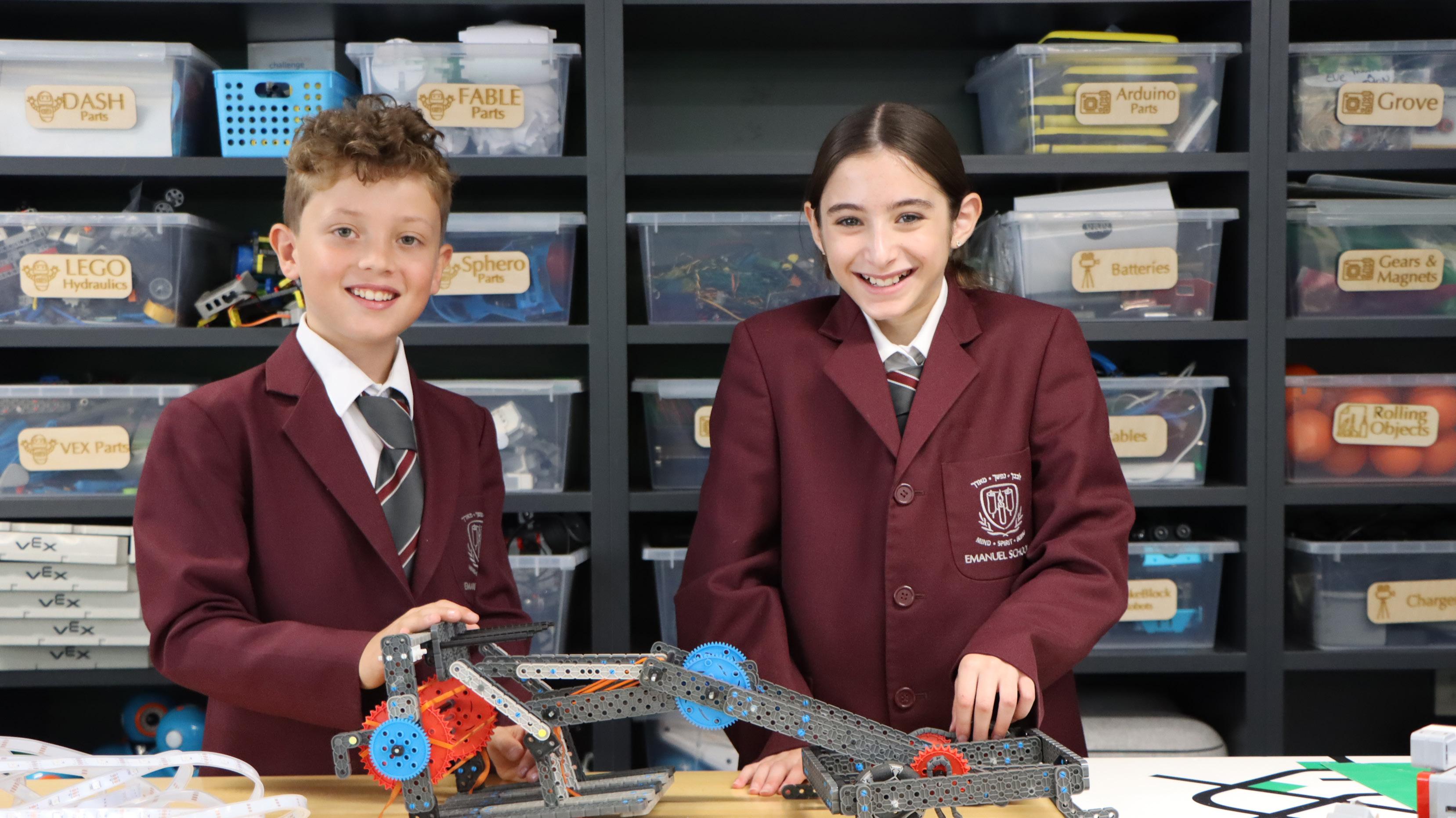
Within the curriculum, the Primary School Innovation Department collaborates with classroom teachers to develop programs and projects that connect transdisciplinary learning opportunities in the classroom. This includes new pedagogy, skills and processes, and building partnerships with local and global experts. Students also have access to the Imaginarium and its resources, including the Innovation team, throughout the day.
• New skills and processes: We support teachers and students with new pedagogy, skills and processes such as Design, Computational and Systems Thinking, Robotics & Visual Programming and Emerging Technologies.
• Partnerships: We have developed an extensive list of experts from a range of fields, who we connect with teachers to bring real-world experiences to the classroom. For example, Year 5 students connected with AI experts from Sydney University, while Year 4 students will connect with the SMART Hub (Sustainable Materials, Research & Technology) at UNSW.
• Imaginarium (MakerSpace): The K-6 Imaginarium seeks to foster the development of student agency, character building and skill development, and inspire our students to be changemakers who are confident, competent
and possess a strong maker ‘identity’. Students have access to this space throughout the day and a diverse range of extra-curricular opportunities are facilitated. This includes access to state-of-the-art technology such as laser cutters and 3D printers to use for projects.
• Digital Citizenship: We offer opportunities for students to develop into responsible digital citizens through their engagement with technology in the classroom. In Primary School classrooms, we deliver programs that encourage students to be to be respectful, responsible and safe online. This includes understanding online behaviour and its effects, developing critical thinking skills and digital awareness and how to protect your security, privacy and wellbeing.
Beyond the curriculum, the opportunities are limitless. The Innovation Department works with students to develop their curiosity in Science, emerging technology, film and IT, and making. Students engage in long-term investigations and projects based on their interests and questions they have about the world. Some of these projects have received commendations upon entering competitions such as Young Scientist Awards, Young ICT Explorers and the Tech Girls are Superheroes. Students can also participate in Robotics competitions, using the LEGO and VEX systems. These competitions provide students with the opportunity to develop engineering, communication, and problem-solving skills in an enjoyable and supportive environment.
WELLBEING PROGRAMS
The Primary School has a range of engaging Wellbeing Programs to assist students to learn about proactivity and decision making, relationship building, resilience, and anti-bullying practices. The aim is for these proactive and preventative measures to assist students to build positive relationships and make respectful and responsible choices in their lives. As a part of this, the Primary School teaches the URSTRONG Friendology Program as well as Digital Citizenship, Leadership, Learning Consent, Protective Behaviours and more.
This Friendology Program empowers our students with the skills, language, and confidence to be positive friends and build healthy relationships. It helps them establish and maintain positive connections, manage conflict with kindness, and strengthen their overall resilience.
At Emanuel, we recognise that relationships are the heart of wellbeing and learning. However, being a good friend takes effort. Developing strong relationship skills requires time, practice, and patience, but, like most worthwhile pursuits, the rewards are well worth it..
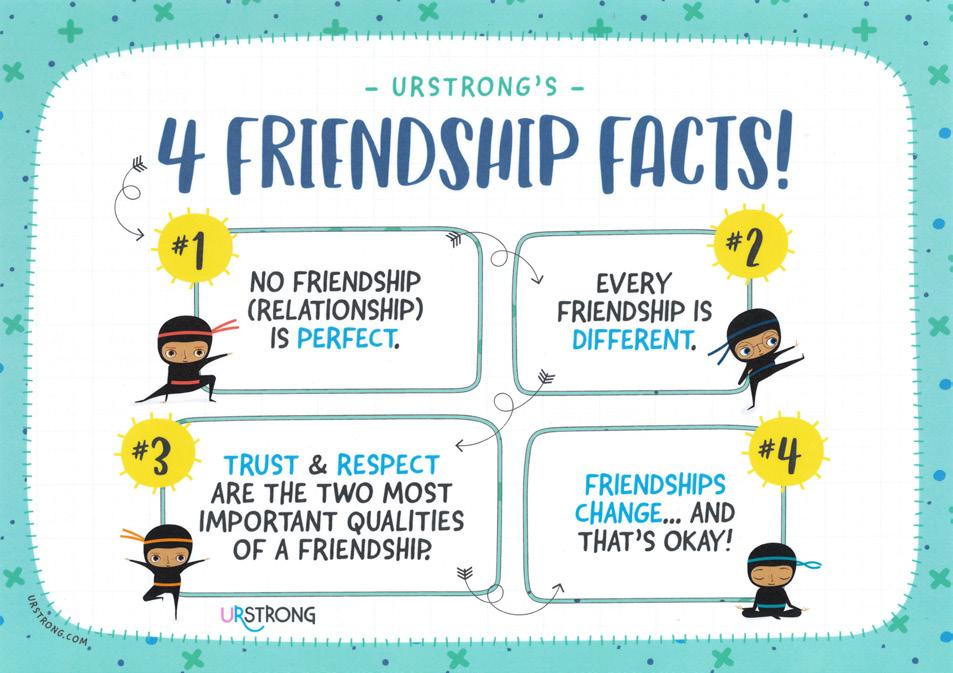
Students learn the 4 Friendship Facts which helps them understand what to expect in their friendships.
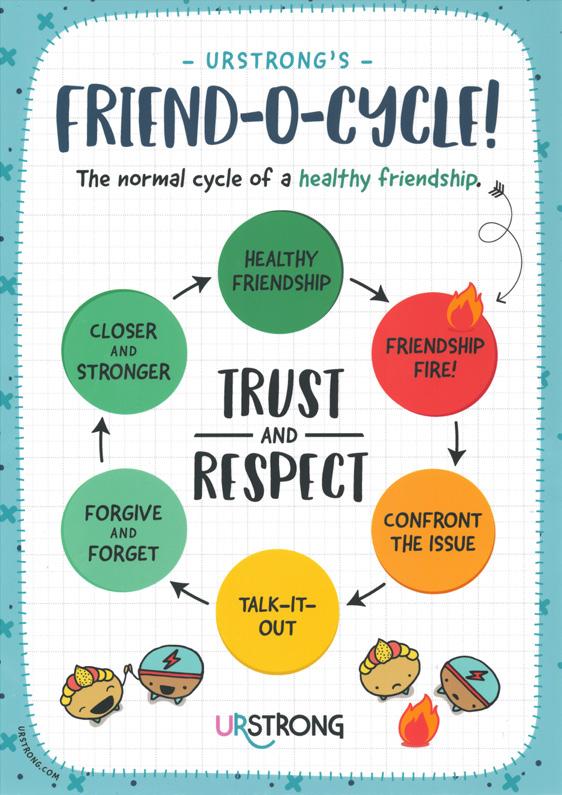
The Friend-oCycle helps kids understand how they can put out Friendship Fires and make their friendships closer and stronger.
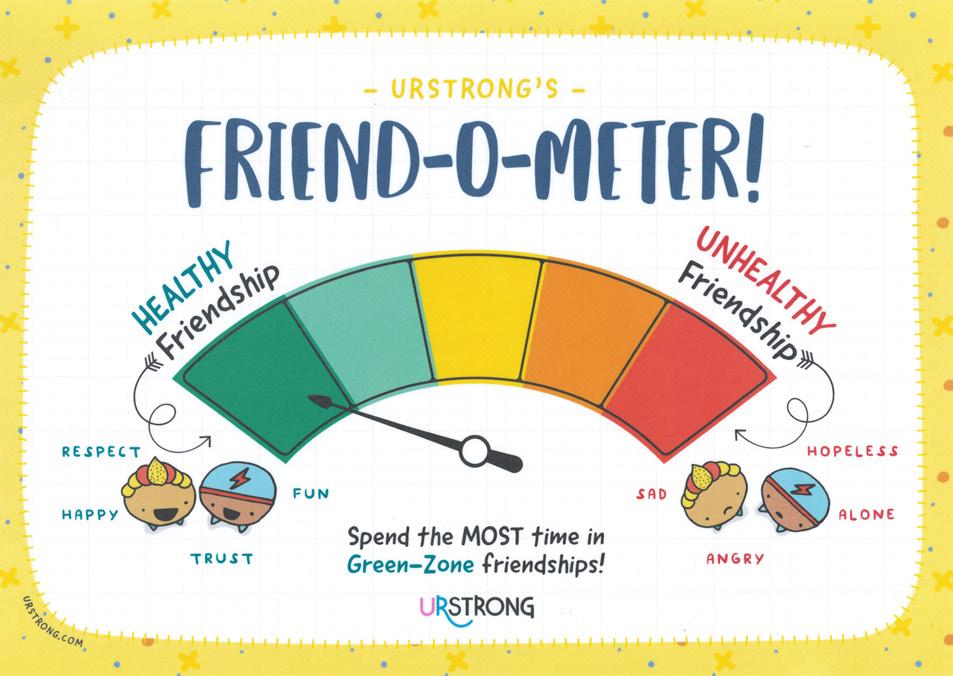
The Friend-o-Meter is a great tool to understand how kids feel about their friendships and what they can do to improve them.
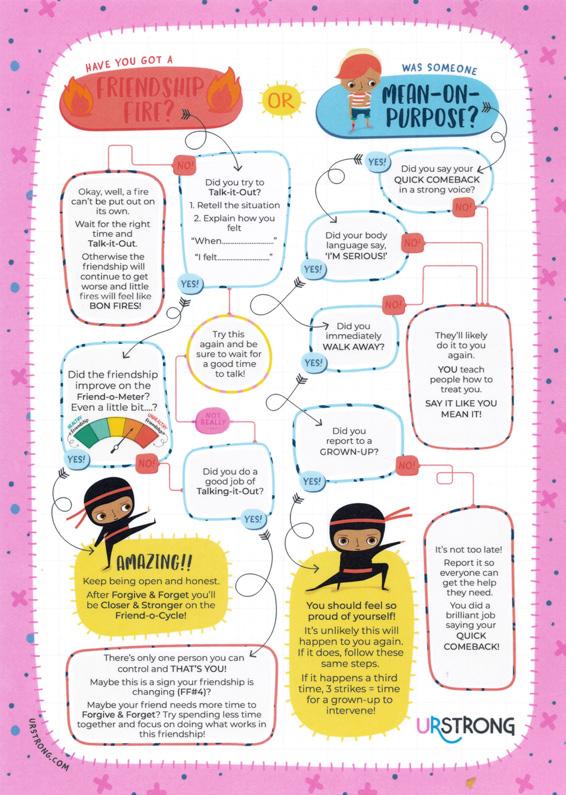
URSTRONG encourages students to stand up for themselves in a kind, respectful way. Friendship Fire vs Mean on Purpose is key!
We consistently use a collaborative approach to wellbeing and welfare to ensure appropriate support is in place. Any questions or concerns are to be addressed to the classroom teachers as the first point of contact.
The main staff members who deal with wellbeing concerns are the: Classroom teacher, Counsellor, Deputy Head of Primary (Wellbeing), Director of Specialist Learning Centre, Coordinator of Gifted and Talented and Head of Primary.
PERFORMANCE OPPORTUNITIES
We provide students with multiple opportunities to share and celebrate their learning.
These include:
• A variety of concerts throughout the year
• ‘Pathways events’ which celebrate milestones in Jewish learning over the years
• Events at the end of significant class programs
• Sporting events and competitions
• Celebrations of Jewish festivals/Chaggim
• A Years K-6 musical every second year
• An annual Innovation Festival
• Assembly performances.
CAMPS AND EXCURSIONS
During the year, students may go on a variety of excursions and camps. All excursions take place during a single day and usually relate directly to the curriculum that is being taught or milestones within the year. Excursions may include visits to local museums and sites, sports carnivals and competitions, leadership training and fun days at the end of a term/year.
From Year 3, the students are involved in overnight camps. These may change year by year but may include:
• Years 3-5: Sport and Recreation Camp
• Years 4-6: Music Camp (optional – combined with the High School)
• Year 6: Northern Territory Trip (optional)
• Year 6: Canberra Camp
All off-site excursions and camps require parental permission. Permission is granted via the TASS Parent Lounge. The cost of excursions and compulsory camps will be charged to your account. Optional experiences are charged separately.
MERIT PROGRAM – KAVOD SYSTEM
We enjoy celebrating students’s successes through our Kavod System. Students are honoured by receiving Praise Certificates for wonderful progress, achievements and successes. Students collect these Certificates in their Achievements Folder that is sent home when they begin at Emanuel.
Once a student has collected five Praise Certificates, these are brought to the Head of Primary’s Office to be traded for a Merit Certificate. Once three Merit Certificates have been collected, these are traded for a Distinction Certificate. Then three Distinctions become a Medal of Honour. After receiving a Medal of Honour, each subsequent Distinction Certificate equates to Primary Mensch Badges (Bronze, Silver and Gold).
These honours, described below, are presented at assemblies throughout the term. All Certificates to be traded are to be brought to the Head of Primary’s Office.
Below is a for a summary of the process:
Five Praise Certificates = One Merit Certificate
Three Merit Certificates = One Distinction Certificate
Three Distinction Certificates = One Medal of Honour
One additional Distinction Certificate = Bronze Primary Mensch badge
Two additional Distinction Certificates = Silver Primary Mensch badge
Three additional Distinction Certificates = Gold Primary Mensch badge
STUDENT MANAGEMENT
Students are required to uphold the School’s rights and responsibilities including being safe, responsible and showing respect to those around them.
The Primary School utilises the Teshuvah System. Teshuvah is often translated as repentance, but a more accurate translation is ‘returning’ including a concept that no-one is perfect and that when we make mistakes, they are opportunities to reflect, repair and make a change to move forward more positively. There are four steps in the Teshuvah System:
1. Reflecting upon/understanding the situation and the impact of behaviours/choices;
2. Apologising/expressing regret where necessary and repairing any harm;
3. Accepting and completing any consequences;
4. Refraining from repeating the same behaviours.
Whilst it can be a challenging time, we expect parents to uphold the School’s values and support the School when working through this process with students. Please see the Parent Code of Conduct on the TASS Parent Lounge for further information.
IT PROGRAM
The use of technology in classrooms forms part of learning at Emanuel School and is used in a balanced manner across the curriculum.
Primary students have 1:1 access to managed iPads (Years K-4) or laptops (Years 5-6) with usage overseen by teachers.
Students will be provided all hardware, software and expert ICT support they need for their learning. In the event that their device is not functional, a loan device will be provided.
EXTRA-CURRICULAR ACTIVITIES
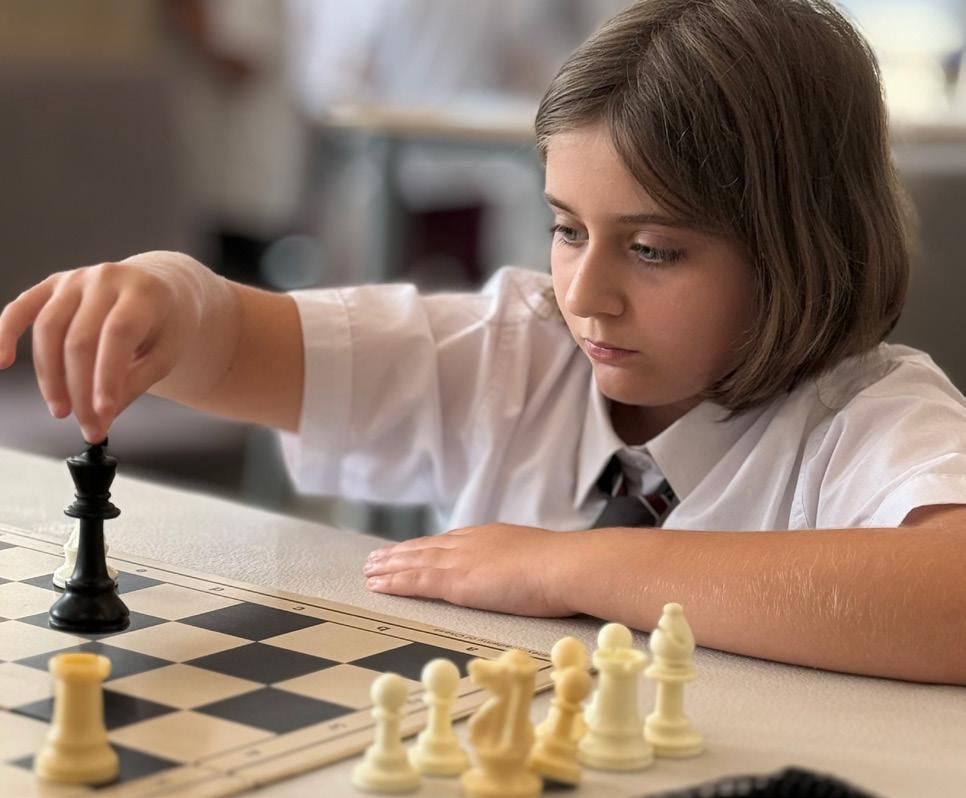
Each term, there is a range of optional beforeschool, lunchtime and after-school activities available on and off campus. Some activities are offered by the School as part of the Students’ Program and students can choose whether to participate. These include options such as debating, chess, choirs and bands.
There are also extra-curricular activities offered that are additional to the regular school offerings. These incur a cost and usually become a part of our after-school optional activities e.g. sports such as basketball, football, netball and tennis; drama; cooking and coding.
Activities offered depend on students’ interests and the availability of teachers/other adults to run them.
Information about various activities can be found on the TASS Parent Lounge and in the school newsletter, Ma Nishma.
HOMEWORK
Below please find the daily periods of homework that we recommend for students. Application of these guidelines may vary from time to time, depending on class programs, activities, and the needs and abilities of each student.
Should a student experience any difficulties completing homework within these guidelines, please contact the relevant class teacher.
Please note that as a Jewish School, we do not advocate completion of homework during Shabbat and Jewish festivals/Chaggim.
Years K-2 homework may consist of:
• Reading and discussion of texts, with and by parents for 10-15 minutes each day.
• Simple reinforcement tasks associated with classroom skills or activities and preparation for oral presentations.
Years 3 and 4 homework may consist of:
• Reading for at least 20 minutes each day, plus any additional set reading assigned by the teacher.
• Tasks to practise/consolidate foundational skills such as learning times tables to achieve automaticity and touch typing.
• Simple reinforcement tasks associated with classroom activities.
• Instrumental practice.
Years 5-6 homework may consist of:
• Reading for leisure for a minimum of 20 minutes each day, plus any additional set reading assigned by the teacher.
• Further development of research and time management skills, as an extension of in class projects.
• Instrumental practice.
COMMUNICATION
Emanuel School prides itself on the close communication that exists between parents and the School. Whenever an issue arises, always contact your child’s class teacher or the relevant specialist teacher first.
• If the matter relates to wellbeing issues and requires further discussion, please contact the Deputy Head of Primary – Wellbeing.
• If the matter pertains to organisational issues and requires further discussion, please contact the Deputy Head of Primary – Operations.
• If the matter pertains to academic issues, please contact the The Deputy Head of Primary –Teaching & Learning.
• If the issue remains unresolved, please contact the Head of Primary.
• If the issue is still unresolved, please contact the Principal.
STARTING KINDERGARTEN AT EMANUEL
STARTING AT EMANUEL
BEFORE BEGINNING AT EMANUEL
Individual appointments
In the days prior to the beginning of the school year, each Kindergarten child will come to school to meet with a teacher. This will be our first opportunity to work with your child to determine baseline knowledge and skills in the areas of Literacy and Numeracy.
This session enables us to build a rapport with your child, guide them through interactive tasks and collect information so we can plan our initial teaching and learning. The session should take approximately 30 minutes, with a break provided as needed. Parents will be able to stay in the waiting area until the session is complete.
Booking details for these sessions will be provided during the Kindergarten orientation sessions held the year prior.
FIRST DAY OF SCHOOL
Morning drop-off procedures
Day 1
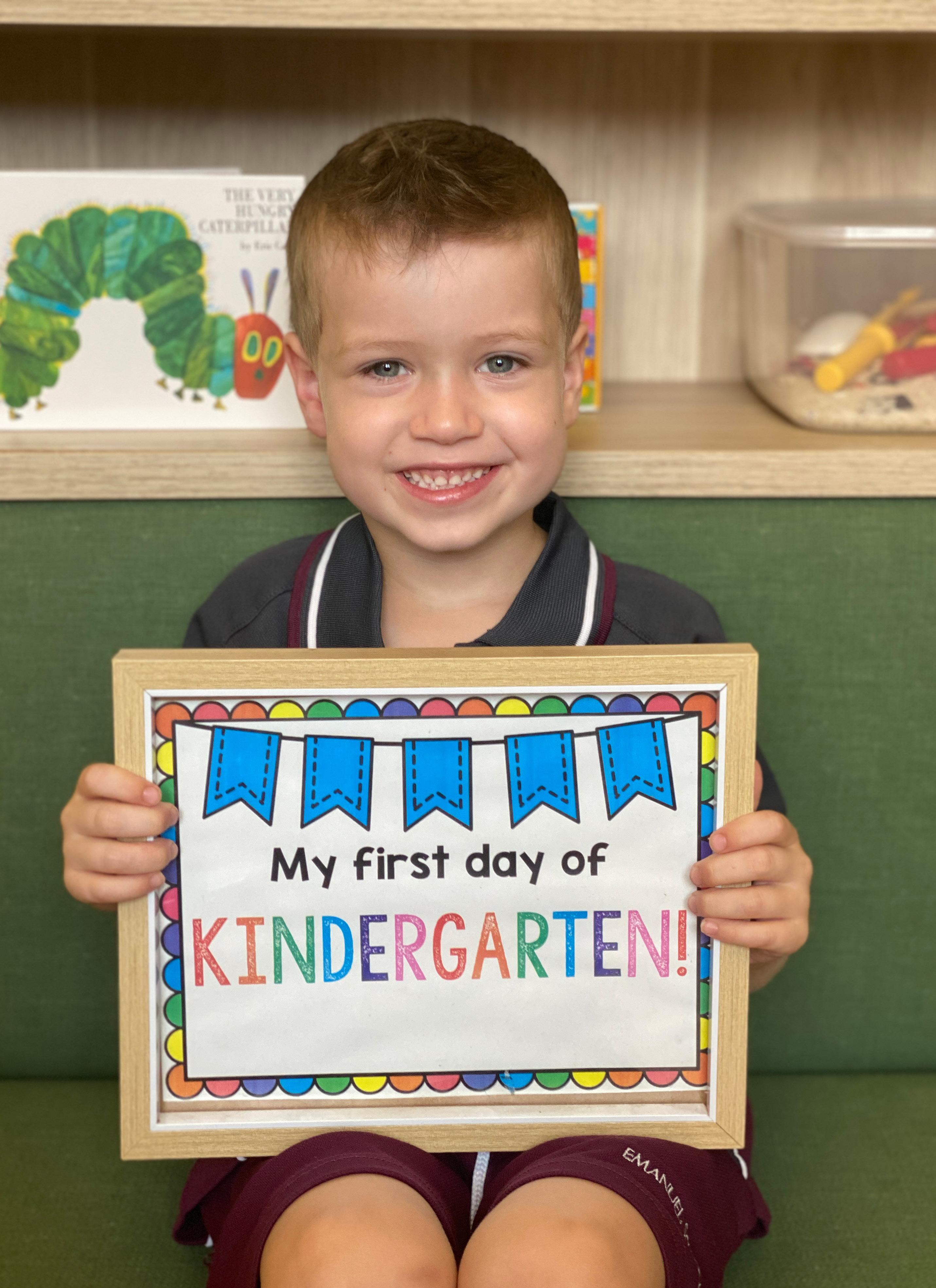
The first day of Kindergarten is Tuesday 3 February 2026, when students will be at school for half a day. Your child will be allocated a morning or afternoon time slot – this will be communicated to you directly.
In 2025 the arrangements were: 9.00 am – 11.30 am (Surnames M-Z) and 12.30 pm – 3.00 pm (Surnames A-L)
Please arrive within the allocated time so that we are able to focus on welcoming a smaller number of students at a time.
Please enter the campus with your child via the Waxman Gate (corner of Avoca and Stanley Streets). There will be students at the gate to welcome you.
Photograph by Sharon Arnott
After Day 1
Parents are able to bring their children into the School in the morning in order to settle them near the classroom. We encourage you to help your students to build independence. When students are feeling confident, we encourage parents to allow them to come into school independently, using one of these systems:
Walking with an adult Entering via Waxman Gate (corner of Stanley and Avoca Streets) or Avoca Gate (on Avoca Street).
Go With the Flow (GWTF)
Primary School students to be dropped off on Avoca Street and enter via the Avoca Street Gate.
Bus If being accompanied by an older sibling, students may arrive by bus.
Emanuel has a caring and nurturing environment. Kindergarten teachers are prepared for some tears and will provide lots of reassurance. The K-2 staff urges Kindergarten parents not to linger in the playground, as this can cause the students to become upset. After Day 1, it is generally best to leave as soon as or before the bell rings which becomes a cue that it’s time to go to class.
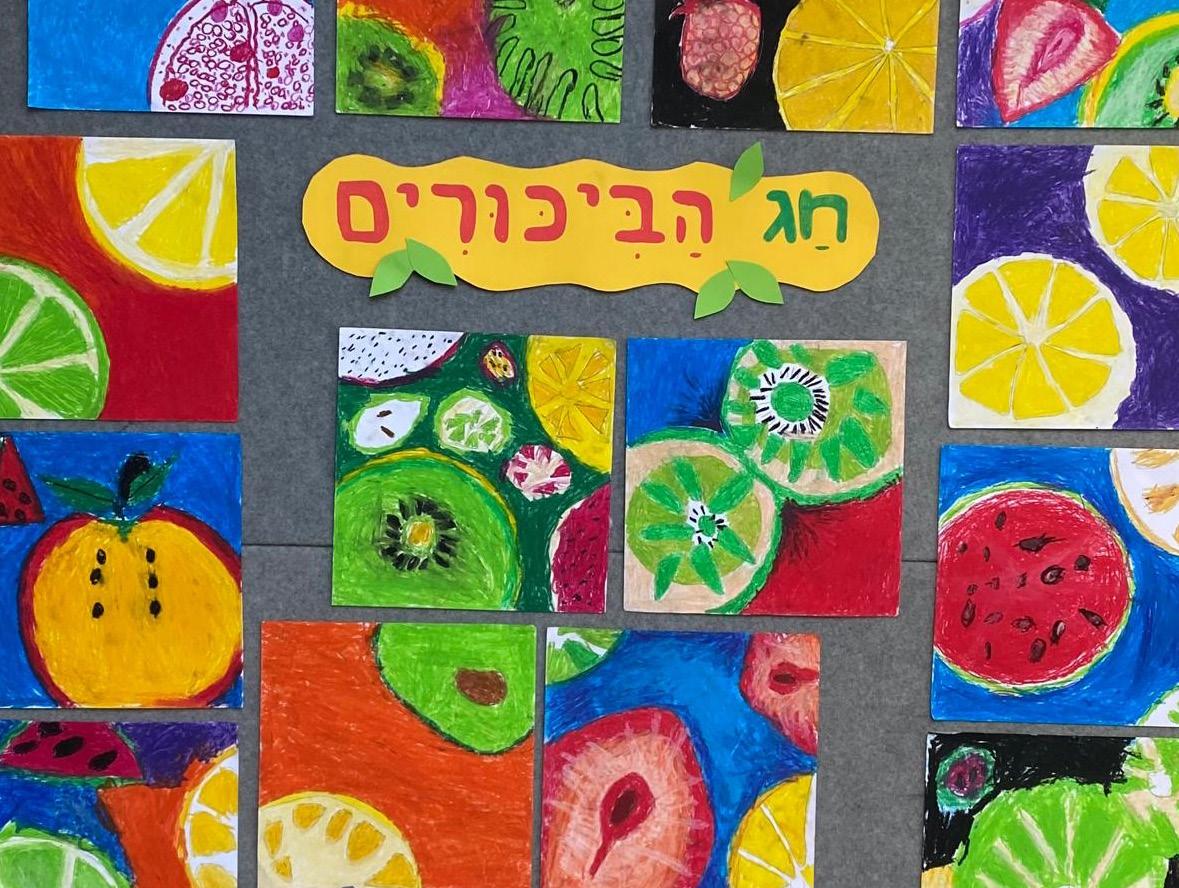
Year 2 artwork
THE START TO KINDERGARTEN
The first few weeks of Kindergarten are an important time of transition and settling. For this reason, we transition slowly into a more formal school structure. We do not finalise our two Kindergarten classes until a few weeks into the term. We spend this time trialling different groupings to ensure we create the best possible mix across the two classes. Consideration is given to the academic, behavioural and social needs of the students.
During these first weeks, we use many structured, fine motor and play-based activities and then a gradual movement from a ‘pre-school style’ approach towards the more formalised school day. Students will have Physical Education and Library prior to the official formation of classes. Parents will be advised of a day for each of these when classes are formed.
Sports uniform and library bags are not required until the formal classes are confirmed, however the students can wear sports uniform for a day in the week if they wish to do so.
In our school management system, students may initially be placed randomly for roll marking purposes only. Please disregard this as it does not reflect actual classes. You will be notified via email when the class lists are confirmed.
IT PROGRAM
Technology forms a part of the program and is used in a balanced manner across the curriculum.We are mandated to teach Digital technologies as part of the Science and Technology Syllabus. There are specialised lessons for Kindergarten where students learn about the device itself, the way to carry and care for the device and the rules for use in the classroom. The students learn to use the iPad to take photos, resize them, record their voice or video and they also learn basic coding using other equipment and materials.
These technological skills allow our students to document their thinking about a range of topics, to record their progress with reading or to capture images of their written work and upload it to Seesaw, a digital portfolio.
GENERAL INFORMATION
Photograph by Sharon Arnott
GENERAL INFORMATION
ACADEMIC PLATFORM
Emanuel School fosters a community of deep-thinking, lifelong learners. We seek to instil values of rigorous intellectual engagement in a knowledge rich curriculum and moral responsibility, enriched by Jewish knowledge and traditions. This framework outlines our values, methodologies, and the educational research that guides us. Our goal is to ensure a cohesive educational experience that not only imparts foundational knowledge but also equips our students with the skills necessary to apply and transfer this knowledge in diverse settings. By establishing a common language and shared goals, we strive to unify our staff, students and community under a shared vision of outstanding education.
What we Value in a Student
At the heart of Emanuel School’s educational philosophy is the belief that students should be active and engaged in their learning. We encourage curiosity and reflection, fostering a creative and innovative mindset that empowers students to become optimistic and critical thinkers, who are proactive problemsolvers. Moreover, we emphasise the importance of effective communication and collaboration skills, recognising their pivotal role in building strong relationships and driving success.
We value resilience and perseverance, demonstrating empathy and compassion towards others while remaining adaptable and open-minded in the face of challenges. Through nurturing these qualities across all facets of learning and personal growth, we aim to cultivate well-rounded individuals who are not only academically proficient but also socially aware, intellectually curious, and skilled at working collaboratively towards shared goals.
Our Teaching Pedagogy
Teaching and learning at Emanuel School is dynamic and responsive, supporting each student’s individual learning journey. Our pedagogical approach encourages deep understanding through a knowledge-rich curriculum. Students build on prior understanding and skills, connecting and applying their learning in increasingly complex contexts.
Our approach is characterised by inclusive and differentiated practices that address the specific needs and potential of each student. A comprehensive system for assessment, feedback, and reflection ensures students engage with meaningful insights into their learning progress and opportunities for continuous improvement. We focus on developing critical thinking and creativity, enhanced by digital tools that foster engagement and deepen understanding, ensuring that technology serves as a bridge to advanced inquiry-based learning. At the heart of our practice is direct instruction, gradually guiding our learners towards mastery.
Informed by Research and Best Practice
Our teaching strategies are deeply informed by the latest findings in cognitive science and the most effective, research-based educational practices. We integrate principles from established frameworks such as Cultures of Thinking, Teaching for Understanding, and Deep Learning, which guide us in creating a learning environment that emphasises understanding and skill transfer over rote memorisation and recall. Additionally, our educational approach is continuously updated to incorporate emerging technologies and insights from neuroscience, maintaining a balance that respects both tradition and innovation. Continuous professional development focuses on the latest educational research. We also foster a culture of collaborative professionalism where shared learning, mentorship, and reflective practice are prioritised.
ATTENDANCE, LATE ARRIVALS AND LEAVE REQUIREMENTS
Attendance
Students are expected to arrive punctually and attend school for the entire school day. It is a legal requirement that students who arrive late report to reception to ensure that their arrival is recorded. Please submit an absent, late or early departure form via the TASS Parent lounge. The School may contact you if this information is not submitted.
Late arrival at school
If your child will be arriving late to school, please log their late arrival on the TASS Parent Lounge or the Orbit app. Your email should include their name, year group and class, the date, your name and the reason for their lateness. If you are on campus, you may prefer to visit reception to advise of your child’s absence.
Early leave
Where possible, medical and other appointments should be made outside of school hours. If your child has to leave school to attend a medical appointment, please log this partial absence on the TASS Parent Lounge or the Orbit app.
Short leave (1-5 days)
We ask that you not disrupt your child’s learning by taking them out of school during term time. Students should only take holidays during term holidays and days when the School is closed. If this cannot be avoided, requests for permission to take leave of 1-5 days are to be made at least one week in advance of the leave to be taken. Please log the absence request on the TASS Parent Lounge – this should include your child’s name, year group, reason for the application and the date(s) of the absence.
Extended leave (over five days)
If this cannot be avoided, requests for permission to take leave of more than five days are to be made to the Principal at least two weeks in advance of the leave to be taken. Please log the absence request on the TASS Parent Lounge – this should include the child’s name, year group, reason for the reason for the application and the date(s) of the absence.
Bar and Bat Mitzvah
Emanuel School encourages the celebration of each student’s Bar or Bat Mitzvah. While Emanuel School supports the Bar and Bat Mitzvah process, we do not offer a Bar or Bat Mitzvah ceremony. As a pluralist school, we encourage families to find a synagogue that reflects their traditions and values.
Emanuel School maintains a list of Bar or Bat Mitzvah dates that can be found on the TASS Parent Lounge. Those who provide details will also receive a copy of the list. If you would like to include your child’s details on this list, please email, the Jewish Life Department.
LIBRARY
Students can borrow books from the Library during their library lesson, before school and at lunchtimes. Students are required to bring a library bag to school on their nominated library day in order to be able to borrow books. The bags limit damage to and loss of books. Please ensure your child’s library bag is clearly labelled with your child’s first and last name(s).
Library days are published in the term overview distributed each term.
FOOD POLICY
Food at school
Out of respect for the Jewish practice of Kashrut, students are requested not to bring any meat or products containing meat, such as gelatine, to school. In addition, only fish or fish products that originate from fish with scales and fins are permitted.
As some students are allergic to nuts and nutbased products, items containing nuts or nut derivatives (including Nutella) are not sold in the canteen. Students are not allowed to bring any nuts (or products containing nuts) to school.
If you wish to provide a birthday cake or treat for students in your child’s class to celebrate their special day, these must be purchased directly from the school canteen by calling 8383 7312 (three days’ notice is required) or you could supply items listed on the NSW Kashrut Authority website. Canteen
The school canteen offers a home-style menu providing freshly prepared meals and snacks. Emanuel School has engaged with Flexischools to provide an online ordering system. Flexischools is a fast, secure and convenient way to order and pay for food online. Flexischools operates as follows:
Parents set up a Flexischools account online at www.flexischools.com.au
Preload the account with funds
Log into the account to order and pay for recess and/or lunch online
Same day orders must be placed before 8.30 am
Students in Years K-6 will have their pre-ordered lunches delivered to their classroom. Years K-2 students can only access the canteen via this online system. Students in Years 3-6 are able to queue up at the canteen during the second half of lunch. This is not recommended as waiting time can be extensive.
The canteen uses only ingredients and products approved by the NSW Kashrut Authority. The canteen operates on all student school days apart from Jewish fast days and unless otherwise advised. The School will occasionally offer a ‘BBQ Day’, when separate BBQs are used outside of the canteen. At that time, the canteen may be closed. Students are requested not to bring dairy products to school on ‘BBQ Days’.
A full current menu and price list is available on Flexischools.
Nibble break and recess
In the morning session, students may have a short ‘nibble break’. This is to keep their energy levels up between the start of the school day and recess. Please ensure that the ‘nibble’ food is a piece of fresh fruit or vegetables. It can be easier for younger students if the ‘nibble break’ snack is placed in a separate bag.
FEES
A full schedule of fees can be found on the Emanuel School website
GIFTED AND TALENTED
The Gifted and Talented team is focused on supporting the needs of high potential and gifted learners across the Primary School. Led by the Head of Gifted &Talented K-6, the team is responsible for the monitoring of student progress as well as supporting teachers to address the needs of high potential and gifted learners. Our team implements evidence-based assessment strategies to track and identify high potential and gifted students.
Within the classroom, our teachers differentiate their teaching to meet the learning needs of gifted students. Simply put, teachers adjust the level of challenge and provide learning opportunities for students across a wide spectrum of ability. Our team develops a robust curriculum and ensures it is targeted to student needs.
Across some subject areas, students are grouped according to their ability in order to receive targeted instruction at their point of need. These groups are taught by the class and extension teachers and the composition of these groups is revised regularly. Within these groups, high performing students are able to work with like-minded peers to ensure they are experiencing further stretch and challenge across the curriculum. In Years 5 and 6, The Advanced Learning Program for Literacy and Mathematics is established, where students experience curriculum compacting, allowing for further extension in their learning.
In addition to classroom opportunities, all students across the Primary School are welcome to participate in a myriad of enrichment activities throughout the school day. Extension offerings outside the curriculum include chess and debating as well as a range of academic competitions including the Maths Olympiad, the National History Challenge, Future Problem Solving, the Ethics Olympiad, da Vinci Decathlon and ICAS competitions.
If you would like further information please email us
GO WITH THE FLOW (GWTF)
Traffic around the School is very heavy each morning and afternoon. There is a system in place to make sure dropping off and picking up is as safe and efficient as possible. All Primary School students may be dropped off and/or picked up using GWTF. Your child will benefit from being taught to be independent as soon as he/she is comfortable in the new environment.
The GWTF area (for both morning drop-off and afternoon pick-up) is located on Avoca Street, near the entry gate to the School. Signs and cones mark this area.
GWTF morning drop-off procedures
Years K-12 on Avoca Street
Available between 8.00 am – 8.20 am
All Years K-6 students are only to be dropped at the Avoca Street gate as there is more space there and it is away from the morning buses.
Please do not have items in the boot as we do not want anyone on the road in between cars.
Students need to leave the car via the curb/passenger side with ALL their items.
Drivers are asked to remain in their cars.
GWTF afternoon pick-up procedures
Avoca Street gate – Regular GWTF procedures
Available between 3.20 pm – 3.50 pm
Enter GWTF at the top of Avoca Street only (after the bus zone).
Please do not queue up into the bus zone or cut into GWTF elsewhere. If there is no space to enter at the top, please drive around the block.
Please display a car tag on your dashboard. Car tags show your child’s name written clearly for the staff to call out. This is distributed to families at the beginning of Term 1.
Drive to the allocated pick up zone (six cars in this zone at a time). Your child’s name will be called from here. This will be the only area for students to enter cars.
Please remain in your car at all times.
Students will only be allowed to enter your vehicle once it has come to a complete stop. They must enter via the passenger/curb side door and must take their belongings with them.
They are not to use the boot as we do not want anyone on the road in between cars.
Once your child/students are safely seated and all doors are closed, you can then re-enter traffic in a safe manner on Avoca Street.
After three minutes of waiting, you will be asked to move out of the pick up zone and around the block so that cars do not block the flow unnecessarily if the students are not ready. To do this, please drive along Monmouth Street then Stanley Street then Avoca Street.
Students who are not collected by 3.50 pm will go to reception.
Please don’t:
arrive before 3.30 pm if you are not collecting students in Years K-2. This will block the system and you will be asked to leave the area.
create a different pick up area in a surrounding street. This creates havoc with the traffic and affects the relationships we have with our neighbours.
call or ask for your child to exit the gate whilst you are in the queue. The teachers will do this when you reach the six car collection zone.
Other GWTF safety requirements
The safety of our students and community is very important to us. We ask that you please adhere to the following instructions to ensure everyone stays safe:
Follow all signage.
Do not stop or park at the pedestrian crossing or bus zones. Council officers regularly patrol the area in the morning and afternoon.
The queue should only be joined from the top. Please do not attempt to cut in midway down Avoca Street.
Please ensure you have installed any required booster seats to the correct side prior to arrival.
Please do not use your mobile phone while waiting in the GWTF line up as traffic can move very swiftly and an accident can occur.
Please do not use Chepstow Street as a thoroughfare and do not double park or park illegally in any of the streets surrounding the School.
If someone else drops or collects your child/ren, please ensure you pass on this information.
Please follow instructions by the staff on duty at all times.
HAT POLICY – NO HAT, NO PLAY!
For health reasons, students may not play in the main playground areas during recess or lunchtime without a hat. Students not wearing hats will be seated in a shady area. Years K-4 students are required to wear wide-brimmed school hats. Students in Years 5-6 may wear wide-brimmed hats or the Emanuel School cap. The No Hat, No Play rule applies for all four terms.
Hats are available from the Uniform Shop or by emailing a request to Primary. The cost of the hat will be added to your school account.
We strongly advise parents to apply sunscreen to their children before bringing them to school, especially in the summer months. Sunscreen is available at school.
ILLNESS OR ACCIDENT AT SCHOOL
Should a child become ill at school or has an accident, they will be sent to the Health Centre. If there appears to be cause to send them home, parents/carers will be notified. It is imperative that the School has current health information and contact details (home phone, mobile and work numbers) as well as those of an emergency contact, should parents be uncontactable. You can update this information on the TASS Parent Lounge.
IMMUNISATION
Proof of immunisation or a medical exemption certificate is required on enrolment and unless exempt, all students must continue being immunised while enrolled at Emanuel School. Should an outbreak of an illness preventable by immunisation occur, students not immunised will not be permitted to attend school until all safety precautions have been met.
JEWISH FESTIVALS/CHAGGIM
Emanuel School observes all the chaggim and is closed during the major Jewish holidays. Students are not assigned home-based work during this time. For many of the chaggim, special activities will occur at school either on, or near the actual day. At times, parents will be invited to attend, or to assist their child with preparations.
• School closes at 1.10 pm on the day of certain chaggim.
• School is closed entirely for the following chaggim when these fall on weekdays: Pesach, Shavu’ot, Yom Kippur, Rosh Hashanah, Sukkot, Shemini Atzeret and Simchat Torah.
LOST PROPERTY
It is highly advisable that all personal items brought to school be labelled with your child’s name. Lost and Found is located on the ‘Blue Ocean’ on Level 2 of the Kleinlehrer Family LINC Building. Labelled items are returned to students wherever possible.
MEDICATION DURING SCHOOL HOURS
If a child requires medication during school hours (one-off or ongoing), the nurse or a first aid officer will administer this to them. To add a medical condition please go the TASS Parent Lounge. Select student details, medical details, medical conditions and add new. Once you have entered this, please email the nurse confirming all details. Medication will not be administered to students without written authorisation. Students are asked not to keep medication in their bags to be selfadministered.
NOTICE OF WITHDRAWAL
Parents are required to provide the Principal with adequate notice in writing, before a student is withdrawn from the School. Adequate notice is defined as: eight (8) weeks’ term time, for all grades except for Year 6. Parents of students wishing to withdraw their child at the end of Year 6 are required to provide the Principal with two terms’ notice in writing. Insufficient notice will result in parents forfeiting $1,000, the portion of the Commitment fee that was retained on commencement. Please see the Commitment fee section of the Enrolment Policy, Guidelines and Conditions document available on the School website
ONLINE PERMISSIONS
Parents grant permission for school events and excursions through the TASS Parent lounge. Parents accept or decline permission under ‘Items to Action.’ Information relating to parent permissions will be communicated in Ma Nishma or directly emailed to parents.
PARENT MEET THE TEACHERS EVENING
At the commencement of each year, the School holds a parent Meet the Teachers evening. This is an invaluable opportunity to hear from the class teachers and some key staff in order to learn about the School’s procedures.
PARENT-TEACHER INTERVIEWS AND REPORTS
We value close collaboration with parents. There are many informal opportunities for parents to meet with their child’s teacher and we request that meeting time is set aside to discuss important matters. Parents should feel free to contact the relevant teacher if there are questions or concerns. Parent-Teacher interviews are held twice a year (Term 1 and 3) and these serve as an opportunity for parents to meet with teachers to discuss academic progress and matters related to the social and emotional areas. These meetings are ten minutes for classroom teachers and five minutes for specialist teachers. If it is anticipated that more time may be needed to discuss a particular issue, please make an alternative appointment with the teacher. Written reports are sent home at the end of Semesters 1 and 2 (Terms 2 and 4).
Photograph by Ofer Levy
TASS PARENT LOUNGE
Parents have access to the TASS Parent Lounge where they can update their details as well as access information regarding timetables, attendance and academic reports. Our TASS Parent Lounge has a number of functions including: the ability to grant permissions for school events and excursions, school policies, newsletters and calendars. Login details need to be kept secure and will be emailed to you separately upon your child’s commencement at Emanuel School. If you misplace your password it can be reset on the TASS Parent Lounge.
PARTIES
Invitations may be distributed at school only if the whole Year is being invited. To invite a smaller number of students, please refer to the class list and email/mail these. To ensure no child is excluded, please do not hold parties on Shabbat and chaggim (festivals) and consider kosher/ kosher-style food.
PUBLIC TRANSPORT (SCHOOL SPECIAL BUSES)
School buses include:
683e Watson’s Bay to/from Emanuel School
697e Dover Heights to/from Mount Sinai College
704e Moriah College Queens Park to Maroubra Beach (afternoon only)
Applications for Opal Cards are done online
Maps of routes for the School buses and information regarding Opal Cards are also available via the link.
If you have any queries regarding State Transit travel, please call the main reception.
SCHOLARSHIPS AND DISCOUNTS
Scholarships, financial assistance and other discounts that the School offers from time to time are only applied to tuition fees. Any levies and charges specifically identified and approved by the School Board do not attract a discount and are payable in full.
Sibling discounts listed below currently apply to families with two students or more but not where families are in receipt of any other reduction in tuition fees (except scholarships):
Second child Third child Fourth or further children
The School applies a firm credit policy. However, the School also has a policy allowing a discount if payment is made in advance of a full year’s fees. This discount is reviewed annually.
SUPPORT ON CAMPUS
External therapists
It is most common for students who require additional support from therapists (such as speech or occupational therapy) to see these professionals off campus and out of school hours. At times, it may be advisable for a student to see a private therapist on campus. In these cases, sessions are co-ordinated with the Specialist Learning Centre (SLC) to ensure that the visitors are approved to work on campus and appropriate rooming arrangements can be made. In order to meet Duty of Care requirements, therapists’ visits must be made through the SLC.
Sessions are at parents’/guardians’ expense and cannot be managed by the School’s Accounts Department. Advising external therapists of changes to routine, illness, etc is the parent’s/ guardian’s responsibility. During building projects, we are unable to accommodate external therapists on campus.
TEXTBOOKS AND STATIONERY
The School orders textbooks, exercise books and other selected stationery items for distribution to students at the appropriate time during the year.
Students in Years 3-6 will require additional stationery items that we ask parents to purchase from their preferred suppliers. Parents will be advised by email before the start of the school year which items their child will need.
UNIFORM GUIDELINES
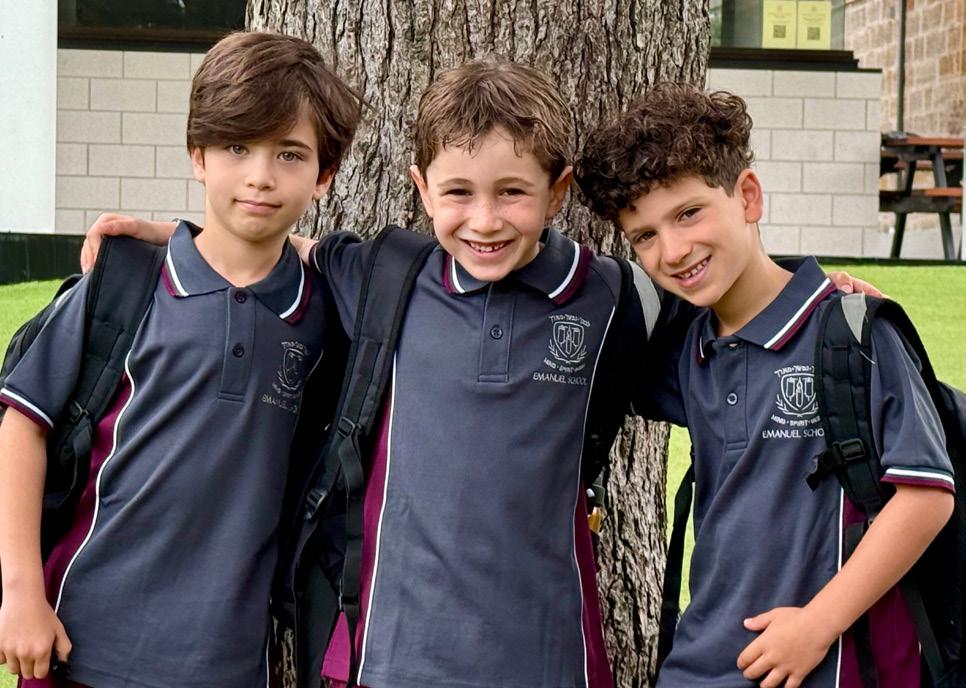
While students are in School Uniform, they are representatives of the School. It is important that Emanuel students reflect the values of our School through the pride they take in their presentation and appearance. Most uniform items are able to be worn all year round, though there are some differences between summer and winter uniform expectations.
The School Uniform comprises items listed in the table below.
The Formal Uniform is worn by Years 5-12 students on specific occasions, as directed, such as on formal occasions, to specified assemblies, excursions.
The Formal Uniform comprises the addition of these items to the School Uniform
• Emanuel blazer
• Emanuel tie
• Kippah (for boys and optional for others)
Primary School students must wear the school hat all year round when playing outside.
School Uniform
Years K-2
• Trackpants, track shorts or skort
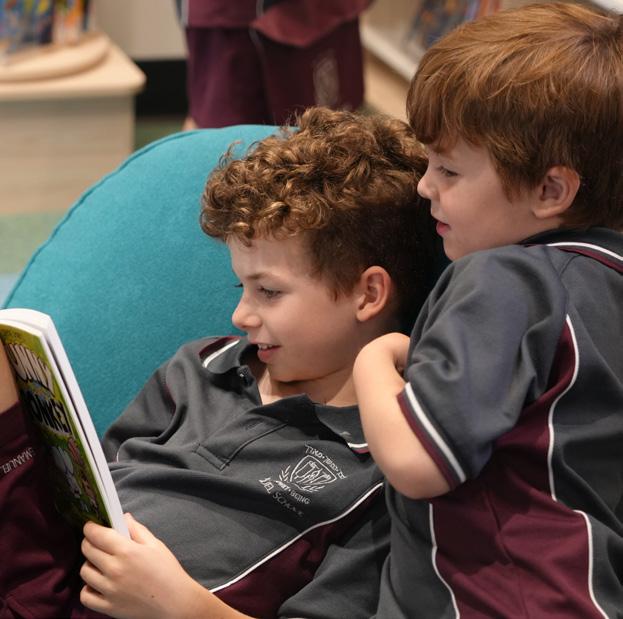
• Short or long sleeved grey and maroon polo
• Grey half-zip sport jumper
• White crew socks
• Black or white sneakers
• Kippah (mandatory for boys and optional for others)
• Emanuel brimmed hat
Years 3-12
Summer – Terms 1 and 4
• White short sleeved shirt
• Grey shorts, trousers or pleated skirt
• White crew socks with skirt
• Black crew socks with shorts
• Black crew socks with trousers
• Black leather or synthetic shoes
• Kippah (mandatory for boys and optional for others)
• Emanuel cap (mandatory for Years 5-6)
Winter – Terms 2 and 3
• White long sleeved shirt
• Grey shorts, trousers or pleated skirt
• White crew socks or black opaque tights
• Black crew socks with shorts
• Black crew socks with trousers
• Micropeach maroon jacket (Years 3-4 only)
• School blazer and tie (Years 5-12 only)
Sport Uniform
The Sport Uniform comprises of the following items:
• Maroon sport shorts or track pants
• White sport polo shirt, available in long sleeve for winter
• Charcoal grey polar fleece sport jumper
• Soft shell jacket
• White sport socks
• Joggers
• Emanuel brimmed hat (Years K-4)
• Emanuel sports cap (Years 5-12)
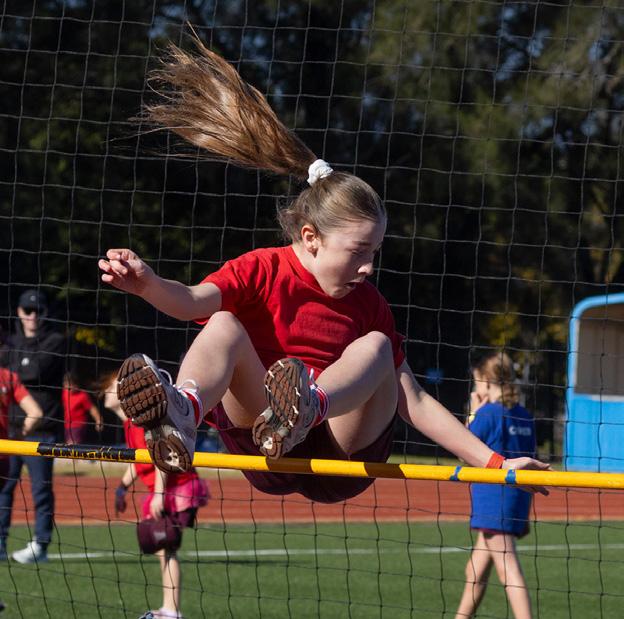
On PE days, Primary students can choose to wear either a House t-shirt or a white polo shirt. Years 4-6 wear a white polo shirt on Thursdays and for inter-school competitions. At K-6 Carnivals, students may wear a House t-shirt. All Representative Sport items are to be purchased from the Uniform Shop, as advised by the Sport department.
Optional Uniform Items
The following items are optional, and may be added to the School Uniform or Sport Uniform:
• Maroon jumper
• Emanuel Rain/Spray jacket
• Emanuel black, grey or maroon scarf, gloves and beanie
• Micropeach maroon zip-up jacket (K-4 only)
• Beanie – Emanuel School or black, grey or maroon
• Scarf – Emanuel School or black, grey or maroon
Uniform Days
Students wear school uniform every day except when students have PE or Sport. Students participating in an Emanuel extra-curricular sporting activity are also able to wear Sport Uniform for the day.
Non-Uniform Days
On non-uniform days, students are encouraged to express their personal style while adhering to the following guidelines:
• Clothing must not display offensive language, symbols, or images.
• Clothing should not promote discrimination, hatred, or harassment.
• Clothing must be modest and avoid exposed shoulders, bare midriffs or cleavage.
• Shorts, skirts, and dresses should be of an appropriate length, preferably no shorter than mid-thigh.
• Closed-toe shoes are required for safety. Students who do not follow the above guidelines may be asked to change into more suitable attire. By adhering to these guidelines, we aim to create a safe, respectful, and inclusive environment that allows students to express their individuality.
Purchasing the Emanuel School Uniform
The Midford Uniform shop is currently operating online only - we will be in touch when the physical shop re-opens.
The online uniform shop can be found here Passphrase for online ordering is ES1983.
Contact details: Email: emanuel@midford.com.au
Pre-loved
Uniform Sales
The P&F runs an Emanuel Shuk for pre-loved uniforms at the beginning of some school terms. These dates will be communicated in Ma Nishma. Please place pre-loved uniform in the old phone box on Waxman Drive.
General Uniform Guidelines
Kippot The kippah should be worn at all prayer times, at formal occasions (including Assembly) or when requested by the School.
Jewellery The only jewellery that may be worn is one necklace of religious significance or medical alert jewellery (which may be worn under clothing) and a maximum of three plain gold/silver studs or small sleepers (no larger than 12 mm diameter) in each ear.
Any further piercings in ears should contain a clear plastic stud. Tongue rings, nose rings, eyebrow rings, etc, are not allowed. Sporting activities may require a stricter standard.
Hair and Nails No obvious make-up or nail polish is to be worn.
Long hair (of a length that is touching the collar or longer) needs to be tied back, using hair ties/elastics that are maroon, black, white or grey.
Hair that has obviously been dyed is not allowed.
Haircuts need to be neat, well maintained and of an appropriate style. Fringes must be trimmed so that they do not hang across the eyes.
Footwear
General Expectations
Shoes are to be regulation black leather or synthetic lace-up school shoes. Suede shoes, boots, joggers, sandshoes and leisure shoes are not acceptable, even if black. K-2 students may wear sneakers every day.
All items of clothing must be labelled with the student’s name. Uniforms (including shoes) must be clean and tidy at all times.
An Emanuel School bag is a compulsory item for all students.
Tattooing is not considered appropriate for school.
Skirt hem lengths must fall to just above the knee.
At school carnivals, excursions and on non-uniform days a degree of modesty should prevail including consideration of swimming costumes, for example, no bikinis. Safety must also be considered. On these occasions, closed footwear must be worn.
All compulsory uniform items should be bought from the Emanuel Uniform Shop, operated by Midford, or purchased second hand on The Uniform Shuk.
Photograph by Ofer Levy
Photograph by Sharon Arnott
UPDATES AND NEWS
Newsletter: Ma Nishma (translation ‘What’s happening?’)
Ma Nishma is published weekly and is for parents and students. It is an essential way of keeping up to date with what is happening at school. It contains important messages from the Principal and staff members as well as sports results, a list and calendar of upcoming events, special achievements of students, P&F news and community notices. Ma Nishma is published each week on Friday and can be found in the TASS Parent lounge or OrbitAPP.
Social media platforms
Emanuel School website
Visit the Emanuel School website for detailed information about our School.
We have three Facebook groups you can join as part of the Emanuel community:
Emanuel School Community Updates and day-to-day happenings
Emanuel Shuk
The place to swap, sell, buy and advertise pre-loved and new items
The Uniform Shuk Buy, swap and sell pre-loved Emanuel School uniforms
Join our private Instagram page for news, happenings and highlights from around our School.
VOLUNTEER OPPORTUNITIES
Class Parents
Each class has one or two class parents who take on the role of co-ordinating with parents in the class and year group. This may include disseminating information from the P&F, organising social events for the parents and/or students and offering reminders of upcoming events.
Parent Security Group
A key feature of Emanuel School is its community spirit and the willingness of parents to be involved. Emanuel School, in co-ordination with the Jewish Board of Deputies’ Communal Security Group (CSG), has implemented a Parents’ Safety Awareness Program. Similar programs are in place at all other Jewish day schools.
The parents you see patrolling the periphery of the School every morning and afternoon play a significant role in ensuring the safety of all our students and of our School. The importance of this service cannot be understated and cannot be duplicated by paid security guards.
Now that you are joining the Emanuel School family, the Parent Safety Group (PSG) would appreciate it if you could volunteer your time up to twice a term from 7.30 am – 8.30 am or 2.45 pm – 3.45 pm.
Parents and Friends Association (P&F)
Our P&F exists to connect Emanuel families and friends and enable everyone to enjoy being part of our wonderful community.
We run events throughout the year ranging from interactive Mother’s and Father’s Day breakfasts, intimate Mitzvah Meal cooking groups, and our ‘Friday Chills’ gathering where kids enjoy icypoles and parents hang out and meet after school on campus.
The P&F is a committee-based structure. All parents and friends are warmly invited to join an organising committee or to contribute to ad-hoc volunteering opportunities. Information about all events and volunteering opportunities are promoted through the weekly newsletter Ma Nishma and on year-specific WhatsApp groups.
If you would like to get involved with the P&F please feel free to email them.
WELLBEING (COUNSELLING AND SUPPORT SERVICES)
The School employs three counsellors to support:
• Students from Pre-school to Year 12
• Parents
• Teachers (to assist with supporting students).
Their primary role is to:
• provide support to students with social, emotional or behavioural issues
• provide referrals for external support
• work collaboratively with internal and external support teams.
Referrals can be made via:
• Teachers
• Parents
• self-referral.
There is sometimes a waitlist and an assessment is carried out before engaging with the student to determine the needs and appropriateness of the referral. If it is in a non-school related issue, the counsellors can discuss suitable external referrals and support.
THE WOLANSKI FAMILY SPECIALIST LEARNING CENTRE
The Wolanski Family Specialist Learning Centre (SLC) Team, in collaboration with teachers and counsellors, assists in determining a range of programs for students needing additional assistance to maximise their potential. Priority is determined by the Director of the SLC and their team, based on the range of students’ needs throughout the School. The level of intervention that can be offered is based on multiple factors and programs are implemented in a number of different ways. In most cases, the SLC programs are planned collaboratively with teachers and are delivered during timetabled classes, either within classrooms or in small withdrawal groups. Parents are included in discussions about their children and, when appropriate, students themselves are included in meetings.
Some interventions might require additional assessments and/or intensive sessions, such as computer-mediated programs, that are offered before or after school. As these are additional to scheduled school undertakings, the School Board has agreed to sponsor part payment of some assessments and programs and parents are asked to make co-payments.
The SLC also offers an after-school program for students in Years 5-12 — The Cely Malki AfterSchool Program. It runs on Monday and Thursday afternoons from 3.30 pm – 5.30 pm. Students bring their own homework or Performances of Understanding (PoUs) and are provided with opportunities to receive additional teaching and tutoring within a structured environment, as a complement to school-based teaching and learning. Please email if you would like further information, or would like your child to take advantage of this program.
YEAR GROUP CONTACT LIST
Parents and carers are encouraged to share their contact details in the TASS Parent Lounge, via the Parent Directory tab. Please only use this information for school-related communication.
KEY CONTACTS
STAFF MEMBER ROLE
Linda Emms Principal lemms@emanuelschool.nsw.edu.au
Natanya Milner Head of Primary nmilner@emanuelschool.nsw.edu.au
Julian Abelson Head of Teaching & Learning K-12 jabelson@emanuelschool.nsw.edu.au
Stevie Levenston Deputy Head of Primary –Operations slevenston@emanuelschool.nsw.edu.au
Katie Brody
Annabelle Turrall
Deputy Head of Primary –Teaching & Learning kbrody@emanuelschool.nsw.edu.au
Deputy Head of Primary –Wellbeing aturrall@emanuelschool.nsw.edu.au
Sabrina Johnson Head of Gifted & Talented K-6 shards@emanuelschool.nsw.edu.au
Debbie Cohen Head of Specialist Learning Centre (Primary School) dcohen@emanuelschool.nsw.edu.au
Jewish Life
Rabba Adina Roth Director of Jewish Life aroth@emanuelschool.nsw.edu.au
Adam Carpenter Head of Jewish Life K-6 acarpenter@emanuelschool.nsw.edu.au
Administration
Primary office primaryoffice@emanuelschool.nsw.edu.au
Main reception 8383 7333
Open 7.30 am – 4.30 pm during term time
Uniform shop uniform@emanuelschool.nsw.edu.au
Updated August 2025