The
California Podiatric Physician WINTER | 2025-2026
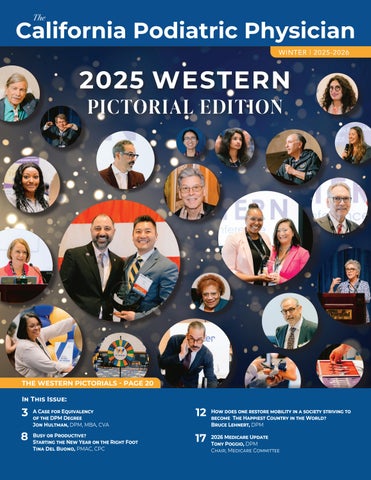
2025 WESTERN PICTORIAL EDITION
THE WESTERN PICTORIALS - PAGE 20 In This Issue: for Equivalency 3 AofCase the DPM Degree
does one restore mobility in a society striving to 12 How become The Happiest Country in the World?
or Productive? 8 Busy Starting the New Year on the Right Foot
Medicare Update 17 2026 Tony Poggio, DPM
Jon Hultman, DPM, MBA, CVA
Tina Del Buono, PMAC, CPC
Bruce Lehnert, DPM
Chair, Medicare Committee
A Complete MIS Instrumentation System for Guided Trajectory and Fixation MIS Trajectory Guide
Targeted precision for dialed-in K-wire placement
3.5 mm 4.0 mm
Beveled FT Screws
Increased cannulation allows for larger guidewires and reduced cortical skiving
Shifting Device
Use with the trajectory guide or alone to shift and maintain rotational correction
Ergonomically designed for simple, accurate placement of secondary K-wires or complete construct
co
un
m
es and Resourc ure Proced for ion Informat s at Patient
B
Learn more about the Arthrex Minimally Invasive Bunionectomy System
MIS Parallel Guide
i o n Pa i n.
© 2026 Arthrex, Inc. All rights reserved.AD1-000434-en-US_C
A CASE FOR EQUIVALENCY of the DPM Degree By Jon A. Hultman, DPM, MBA, CVA
O
n November 2, 2018, I attended APMA’s combined meeting of the Carrier Advisory Committee (Medicare) and the Private Insurance Advisory Committee (CAC/ PIAC) in Baltimore, Maryland. A number of industry speakers were featured covering the full spectrum of reimbursement issues. One of the speakers, Robert Kettler, MD, spoke on the topic: “Working with Carrier Medical Directors.” For attendees at the meeting, this was an important topic; however, in his opening remarks Dr. Kettler touched on a secondary issue that, to me, was most significant – the ever-increasing volume of medical knowledge. He stated that up until 1950, medical knowledge had doubled approximately every 50 years and related that this timespan was shortening significantly. As of 1980, the doubling of information was taking place every 7 years, and by 2010 this timespan had reached 3.5 years. Incredibly, today, medical knowledge is doubling every 73 days! A similar early prediction made by an emeritus professor at University of Iowa Health Care, Peter Densen, MD, was as follows: “What is typically being
learned in the first three years of medical school will amount to only 6% of all that is known in the medical field by the end of 2020. Knowledge is expanding faster than physicians’ ability to learn, assimilate, and apply it effectively.” Taken aback by the information put forward at this meeting, I began to wonder just how this might impact medicine in the future. I feel that what has resulted from this rapid accumulation of knowledge is an exponential growth in the number of medical specialties and subspecialties. To put this in context, picture a family in the 1950s. This family typically had a primary and, frequently, only doctor who was a general practitioner. She/he (most likely a he) treated a wide range of conditions affecting both children and adults. This doctor often provided what now are specialty services such as delivering babies, treating injuries, and performing, or assisting, on surgeries. A general practitioner was expected to know everything. The rapid growth of medical knowledge made this evermore challenging, necessitating more and more continued on page 5
▶
W I NTER • 2 0 2 5 - 2 6 | 3
Infectious Dermatitis? Confirm Before Treating. BakoDx’s Web Space PCR Assay Has You Covered Testing For: FUNGI Dermatophytes Candida spp
BACTERIA Corynebacterium minutissimum Pseudomonas aeruginosa Staphylococcus aureus* *If positive, reflex to mecA (methicillin resistance)
Diagnostic accuracy combined with rapid results and ease of use.
Scan To Learn More
specialization. While it is difficult to ascertain the current, exact number of specialties and subspecialties, the American Board of Medical Specialties (ABMS) now recognizes 24 specialties of medicine along with 136 subspecialties. As the sheer volume of medical information continues to double, I expect that many more of these subspecialties will emerge. This is even happening within our own specialty, which was once itself considered a subspecialty by many. This rapid growth in medical knowledge has resulted in tremendous repercussions for practitioners attempting to keep up with the “latest.” Obviously, it is not possible to stay current with “everything” or for medical students to be taught all that there is to know. Even specialists have adapted to this growth by honing their practices to specific areas within their own specialties. These sub-specialists, in turn, are forming their own groups which offer a broad range of services within these sub-specialties. Breaking specialties down even more has enabled groups to focus on keeping up with an ever expanding range of services. An effective tool has been developed to assist doctors in this struggle to “stay current.” There has been rapid innovation in the development of medical records. The tool of electronic medical records now offers practitioners an efficient way of addressing this ever growing amount of knowledge. It puts accessibility to essential information and decision support systems at their fingertips in real time, assisting them in their task of “staying current.”
Though this rapid growth in medical information does pose a challenge to all practicing physicians, for our specialty in particular, there is serendipity to be found within this challenging environment. Specifically, podiatry has the potential to offer insights to other specialty disciplines in the areas of education, training, and licensing. Because we have been a specialty group from our inception, the model used to educate and train podiatric physicians could well become a future model for other specialists and sub-specialists to emulate. Due to the rate of the introduction of new knowledge, simply adding more material and/or time to medical school curricula will not suffice as an effective coping strategy; this rapid growth phenomenon necessitates a fundamental change in the way doctors are being educated and trained. Here is where I feel that podiatric medicine has something to offer. We have developed a model that can serve as a prototype for other specialties. Over the past 100 years, podiatric educators have developed a pathway different from that followed by traditional medicine. The primary reason for this is that, unlike medical students, from podiatry’s inception, its students have selected their specialty at the “front end” of their educational process. This has called for a different sequencing of coursework as well as a difference in the content and sequencing of medical, surgical, and podiatric rotations throughout the students’ residency training. continued on page 7
▶
W I NTER • 2 0 2 5 - 2 6 | 5
The Premier Provider of Podiatric Diagnostics Services
Onychomycosis
Podiatric Pathology
Both PAS and PCR based identification of pathogens provide precise diagnosis, optimizing patient outcomes.
Onychomycosis
Histopathologic and histochemical examination of nail, skin, tissue, bone, and cytology.
Podiatric Pathology
Wound Care
Both PAS and PCR based Results within 24-48 hours. 3-5x more Histopathologic and histoWound Care ENFD Testing identification of chemical examination of nail, sensitive than culture. One of the Results pathogens within 24–48 hours. 3-5x more sensitive ENFD testing is a largest valuable diagnostic tool gene provide precise skin,than tissue, bone and cytology. organism & resistance culture. One of the largest organism & resistance for identifying the presence and severity of diagnosis, optimizing panels available, providing clinicians gene panels available, providing clinicians a small fiber neuropathy which helps doctors patient outcomes. a much broader spectrum of much broader spectrum of antibiotic choices. provide optimal treatment solutions. antibiotic choices.
For your premiere podiatric pathology service call your Bach Diagnostics account manager at 800-544-4181, or visit us on-line www.bachdx.com. 800-544-4181
continued from page 5
▶
“Innovative” training programs that are being established for medical students today are structured similarly to the traditional podiatric pathway – programs in which students are allowed to declare a specialty early in their training. The structures for these “new” training programs are relatively similar to that which was developed by the podiatric profession for its medical schools and residency programs several decades ago – a model which makes more sense for students who focus on a specific specialty or subspecialty early in their educational process. Indeed, much medical training is becoming more like that employed by podiatric medical schools. An example of the changing education of physicians is that some schools have shortened medical education to three years for those interested in primary care. The goal to be achieved by structuring these programs in this way is to fill the current need for more primary care physicians. The thinking is that because this will enable these students to begin their residencies and enter practice sooner, more will choose primary care as their specialty. More recently, some orthopedic programs have also begun testing programs that allow students wanting to become orthopedic surgeons to enter orthopedic training programs sooner in their coursework. Clearly,
when students choose their specialty at the “front end” of the educational process – as do podiatric physicians, new pathways can be created to best train and prepare those students for their specific specialty. The more specialized we become, the more these “new” pathways become relevant, and the more similar they become to the model already being utilized by podiatric medical schools. Whether it has been by design or has been market driven, since 1950, the education and training for DPMs, MDs, and DOs have all evolved. It is likely that much of this evolution leading to specialization and sub-specialization has had to do with this everincreasing volume of medical information. Currently, a gap that may have existed fifty years ago between the education, training, and practice of MDs and DOs and that of DPMs is narrowing each year – evolving to the point at which all now frequently intersect. For all intents and purposes, the end products of medical, osteopathic, and podiatric educational processes – MD, DO, and DPM degrees, are equivalent and indistinguishable. The only difference now is the license that they receive. If logic were to prevail, the three degrees would not only be equivalent – all would hold the same plenary license, and the specialties and subspecialties of all would be recognized by ABMS. W I NTER • 2 0 2 5 - 2 6 | 7
BUSY OR PRODUCTIVE?
Starting the New Year on the Right Foot By Tina Del Buono, PMAC
E
“Simple daily disciplines – little productive actions, repeated consistently over time – add up to the difference between failure and success” ~ Jeff Olson
very day in our podiatry practices, being busy is often worn like a badge of honor. Phones ringing, schedules packed, staff moving nonstop, it can feel like constant motion equals success. But as we start a new year, it’s worth asking a more important question: Are we truly productive, or are we simply busy? The difference matters more than ever in today’s private practices. Staffing shortages, rising patient expectations, complex insurance requirements, and constant interruptions have created an environment where people can work hard all day and still feel behind. Many leave exhausted, wondering why important tasks never seem to get finished. Being busy isn’t the problem. Being busy without meaningful progress towards practice goals and efficiencies is.
Technology: Helpful Tool or Constant Distraction? Over the past few decades technology has transformed our practices for the better. EMRs, online scheduling, patient portals, and digital communication help us work faster and more efficiently. But that same technology also opens the door to constant interruptions — emails, messages, alerts, pop-ups, and smartphones that quietly steal attention throughout the day. When everything we need to accomplish feels urgent, nothing truly gets prioritized. Productivity requires intention, not just activity. Prioritizing is key in keeping everyone moving forward toward daily goal tasks. Common Reasons Busy Doesn’t Equal Productive Over the years of working with podiatric practices including the one I worked in for over three decades, I’ve noticed a few consistent habits that cause people to stay busy without making progress:
8 | CPM A • C AL IFO RNI A P O DI AT R I C M E DI CA L A SSO CI ATI O N
care, efficiency, accuracy, and team success. Having daily, weekly and monthly task sheets and goals that are checked and measured will help everyone to track not only how they are doing but how the practice is doing overall. What Productive Practices Do Differently The most productive practices — and people — don’t necessarily work harder. They work more intentionally. Here’s how. Poor planning. Flying by the seat of your pants may feel necessary in a medical office, but without some form of daily plan, the day controls you. Productivity doesn’t require a complicated system — it requires clarity about what must get done versus what could get done. Simple daily staff tasks sheets and check-ins can make a huge difference in staying on track. Overburdening yourself. We all have the same 24 hours. Saying yes to everything often means doing many things halfway. Overcommitting leads to stress, mistakes, and burnout — not productivity. More patients does not equal more pay when work is not getting done there is a cost to it. Procrastination disguised as busyness. Complaining about a task, reorganizing around it, or putting it off while doing “easier” things still counts as avoidance. Busy hands don’t always mean focused effort. How Do You Know If You’re Doing Busy Work Instead of Productive Work? This is an important self-check. You may be stuck in busy work if: •
You feel exhausted at the end of the day but can’t clearly name what you accomplished
•
The same tasks roll over day after day
•
You’re constantly reacting instead of completing
•
Important work gets delayed while less important tasks get done
•
You avoid tasks that require focus or decision-making
1. Assess the Current Situation — Honestly Productivity starts with awareness. Ask yourself (better yet ask your team): •
Where is time being lost each day?
•
What tasks take longer than they should?
•
What interruptions are unavoidable — and which ones are not?
•
What tasks get delayed repeatedly?
A simple exercise: track one workday. Write down what you do in 15–30-minute blocks. Patterns appear quickly. Awareness alone often leads to improvement. Time tracking is an excellent teller of truth of how your time is really being spent. 2. Adjust What Needs to Change — Small Shifts Matter Once you identify the time-sucks, make small, realistic changes: •
Limit email and portal checks to set times
•
Put phones away during focused work
•
Create short task lists (3–5 priorities, not 20)
•
Batch similar tasks together
•
Clarify responsibilities so work isn’t duplicated
Productivity improves when boundaries are set — not rigid rules, but thoughtful ones.
Busy work often feels urgent but doesn’t move the practice forward. Productive work supports patient continued on page 11
▶
W I NTER • 2 0 2 5 - 2 6 | 9
SEE WHAT’S NEW on CPMA’s Career Center & Marketplace at CalPMA.org
For New Talent for Your Team? For a New Career? To Sell/Buy a Practice? To Sell/Buy Equipment? To Rent a Vacation Property, etc? Begin your search on CPMA’s New Career Center & Marketplace at CalPMA.org CPMA Members, don’t forget to request your member discount code.
10 | CPM A • C AL IFOR NI A P O DI AT R I C M E DI CA L ASSO CI ATI O N
3. Act on a Plan — Don’t Overthink It Productivity requires action. Waiting for the “perfect system” delays progress. Identify your most productive time of day and schedule your hardest or most important work during that window. Some people are sharp early; others peak later. There is no right or wrong — only what works. Then commit. Even 30 minutes of focused effort can move work forward more than hours of distracted activity. 4. Revisit and Adjust Regularly Medical practices are dynamic. Schedules change. Staffing changes. Patient volume changes. Productivity systems should evolve too. By having your task lists and goals written you can track them. Do not just accept, “I know what I am to do” have it written and then checked off for completion. What worked last quarter may need adjustment this quarter — and that’s normal. Flexibility is part of
sustainability. Ownership Is the Final Step It’s easy to blame systems, interruptions, or circumstances. But productivity improves when individuals and teams take ownership of how they use their time, attention, and energy. Being productive doesn’t mean doing more. It means doing what matters most, well. As we start the year on the right foot, it is worth remembering progress doesn’t come from motion alone. It comes from focus, discipline, and intention — one productive step at a time. If you haven’t read the book, The Slight Edge, by Jeff Olson, I highly recommend it. In his book Jeff argues massive success comes from simple, daily disciplines, that through the power of compounding leads to significant results.
W I NTE R • 2 0 2 5 - 2 6 | 11
HOW DOES ONE RESTORE MOBILITY IN A SOCIETY STRIVING TO BECOME
The Happiest Country in the World?
T
By Bruce Lehnert, DPM
his question framed the work of the International Extremity Project (www. extremityproject.com) lower extremity team during a recent humanitarian mission to Bhutan. For the first time in the nation’s history, a dedicated foot and ankle surgical team arrived to address complex lower extremity pathology, conditions that had long limited mobility, productivity, and dignity for countless individuals. With planning beginning in 2024 and completion of the mission in December 2025, our foot and ankle team joined fellow International Extremity Project volunteers, including the dental team, working collaboratively to assess, treat, and improve health outcomes for underserved populations. In Bhutan, where steep terrain and physical labor define daily life, the ability to walk without pain is not a luxury but a requirement for participation in family, community, and livelihood. As usual, the mission focused on restoring function, relieving pain, and preserving dignity within a healthcare system guided by a philosophy unlike any other. Bhutan has redefined progress through the concept of Gross National Happiness. Rather than measuring
success through economic output alone, the nation evaluates well-being through sustainable development, cultural preservation, environmental conservation, and good governance. Rooted in Buddhist values and community cohesion, healthcare is provided free of charge to all citizens, reflecting a national commitment to collective welfare. Despite this commitment, limited resources and geographic isolation have constrained access to advanced orthopedic subspecialty care, particularly for complex foot and ankle deformities that were often overlooked or left untreated. At the invitation of Her Majesty Gyalyum Kesang Choeden Wangchuck, the International Extremity Project was asked to assist not only in patient care, but in strengthening surgical capacity. The lower extremity team was led by Dr. Bruce Lehnert and included Dr. Meir Nyska, Dr. Ezequiel Palmanovich, and Dr. Melissa Lipari. Together, the team brought decades of experience in treating congenital, post traumatic, and neglected deformities. For many Bhutanese surgeons, these procedures had previously existed only in textbooks and journal articles. They had read about them but had never witnessed them performed.
IEP team from left to right: Logan Lehnert, Jannani Krishnan, DPM, Mai Phan, Devin Fleudujon, Meir Nyska, MD, Princess Kesang Choden T., Bruce Lehnert, DPM, Lexington Lehnert, Melissa Lipari, DPM, Richard Kao, DDS, PhD, Jennifer Lehnert, RN, Ezequial Palmanovich, MD
12 | CPM A • C AL IFOR NI A P O DI AT R I C M E DI CA L ASSO CI ATI O N
Comprehensive care extended beyond the operating room. Jenni Lehnert, RN, served as head nurse, coordinating perioperative care, patient education, sterilization protocols, and postoperative follow up. Her leadership ensured continuity, safety, and compassion throughout every stage of treatment. Nancy Chee, a certified hand therapist, expanded the scope of care through conservative and rehabilitative treatment, focusing on functional recovery, mobility training, and long-term support for patients who were not surgical candidates or who required ongoing therapy.
Bruce Lehnert, DPM rounding on a six-year girl with arthrogryposis and untreated bilateral clubfoot deformity. She underwent a bilateral talectomy due to the high recurrence of deformity due to the neglected deformity and high rate of recurrence with arthrogryposis.
Seeing these operations firsthand transformed abstract knowledge into practical possibility. Dr. Jannani Krishnan, a resident in foot and ankle surgery, played a vital role in patient evaluation, operative care, and postoperative management. Her presence reflected the project’s commitment to education and to preparing the next generation of humanitarian surgeons. Learning occurred in both directions, as visiting surgeons and local clinicians shared techniques, perspectives, and a common purpose. During the mission, the team operated on thirty patients with complex lower extremity conditions that had gone untreated for years, and in some cases decades. These were not merely surgical cases, but deeply human stories. Many patients had been unable to work, care for their families, or move through their communities without assistance. When pain and deformity were relieved, the impact extended beyond the individual. Entire families benefited when one member regained mobility, allowing others to return to work or school. In this way, each surgery represented a generational change, creating new possibilities for stability, prosperity, and happiness.
In parallel with the surgical work, the International Extremity Project dental team addressed significant unmet oral health needs. Periodontal disease, untreated caries, and chronic dental pain were common and often compounded the challenges faced by patients with mobility limitations. Led by world renowned periodontist Richard Kao, DDS, PhD, the dental team provided advanced periodontal care while also emphasizing prevention and long-term oral health education. Logan Lehnert, a pre dental student, played an active role in patient care and outreach, gaining early exposure to global health while contributing meaningfully to the mission’s clinical and educational efforts. By restoring oral health alongside physical mobility, the dental team reinforced the understanding that nutrition, pain control, and overall, well-being is inseparable from orthopedic outcomes, underscoring the importance of treating the whole patient rather than isolated conditions.
Core IEP team consisting of founder Dr. Bruce Lehnert and his Israeli cohorts, Dr. Palmanovich and Dr. Nyska. continued on page 15
▶
W I NTE R • 2 0 2 5 - 2 6 | 13
You OU’ve VE Come OME A Long ONG DoCtor OCTOR ! YouW ’veAYC, ome A Long
Stroke of the Legislative Pen Can IfSingle You Don’t Have a Seat at the Table, WAY, AWrite D oCtor ! Podiatry into - Or Out Of - the Law You’re On The Menu!
What you can do of in your practice, how you get reimbursed, A Single Stroke the Legislative Pen Can and the role podiatric medicine plays in and will play in California’s Write Podiatry into - Or Out Of - the Lawhealth care delivery system all depends on the decisions made by lawmakers.
What you can do in your practice, how you get reimbursed, and the role podiatric medicine - and willhow playCalifornia’s in - California’s healthphysicians care delivery Did youplays everinwonder podiatric obtained the right system all depends the decisions made byperform lawmakers. to treaton ankles along with feet, surgery and amputations, treat lower
wounds, administer medications? It did not just magically Did you everleg wonder howprescribe California’sand podiatric physicians obtained the right happen overnight. It has taken years of arduous work, hard-fought fights, to treat ankles along with feet, perform surgery and amputations, treat lower lots of sweat, and some tears. And, the key to these victories (and many more) were Team CPMA/CalPPAC and the ability and resources leg wounds, prescribe and administer medications? It did not just magically needed to gain and maintain access to legislators in order to tell our story. have an excellent to tell, and in doing so, we have happen overnight. It has takenWe years of arduous work,story hard-fought fights, lots of sweat, and some tears. And, theofkey these victories (and many more) ability were Team CPMA/CalPPAC andand thecare. ability and resources successfully removed many thetobarriers to podiatric physicians’ to provide treatment needed to gain and maintain access to legislators in order to tell our story. We have an excellent story to tell, and in doing so, we have CPMA’s political action committee, the California Podiatric Political Action Committee (CalPPAC), is a bipartisan organization run by - and successfully removed many of the barriers to podiatric physicians’ ability to provide treatment and care. for - podiatric physicians to give podiatry the ability to identify, help elect and support lawmakers who understand, value, and fight to
CPMA’s protect political the action committee, the California Podiatric Political Action Committee podiatric medical profession, its physicians, and their patients.(CalPPAC), is a bipartisan organization run by - and for - podiatric physicians to give podiatry the ability to identify, help elect and support lawmakers who understand, value, and fight to protectToday the podiatric medical its physicians, and their patients. more than everprofession, before, podiatric physicians must fight and advocate to keep the clinical care of their patients in their well-trained
hands. However, However, successful successful legislative legislative advocacy advocacy is is contingent contingent upon upon an an integrated integrated approach approach consisting consisting of of lobbying, lobbying, grassroots grassroots activity, activity, hands.
Today more than ever before, podiatric physicians must fight and advocate to keep the clinical care of their patients in their well-trained and political actionlegislative through CPMA andis the financialupon resources provided by CalPPAC for legislative advocacy. hands. However, successful advocacy contingent an integrated approach consisting of lobbying, grassroots activity, and political action through CPMA and the financial by CalPPAC for legislative advocacy. Making contributions to CalPPAC is a way resources to ensureprovided that podiatric medicine continues to have a seat at the decision-making table and
Making contributions to CalPPAC is a way to ensure that podiatric medicine continues to have a seat at the decision-making table and that podiatry’stovoice voice is heard heard when and where where it counts! counts! podiatry’s is when and it Makingthat contributions CalPPAC is a way to ensure that podiatric medicine continues to have a seat at the decision-making table and
that podiatry’s voice is heard when and behind where itevery counts! Team CPMA/CalPPAC has been pro-podiatric medicine bill that has become California law! And, this dynamic duo has STOPPED
Team CPMA/CalPPAC has been behind every pro-podiatric medicine bill that has become California law! And, this dynamic duo has STOPPED
many bills that would have hurt podiatric physicians, their patients and profession. Team CPMA/CalPPAC haswould been behind every pro-podiatric medicine billpatients that has and become California law! And, this dynamic duo has STOPPED many bills that have hurt podiatric physicians, their many bills that would have hurt podiatric physicians, their patients and profession. A Single Stroke of the Legislative Pen can write Podiatry profession. into - or out of - the Law. Please make your CalPPAC contribution TODAY!
Pleaseyour make your CalPPAC contribution Please make CalPPAC contribution TODAY! TODAY! Scan (securely) the QR Code below with your cellphone camera; Scan (securely) the QR Code below with your camera; cellphone camera; Scan (securely) the QR Code below with your cellphone or log onto calppac.square.site, or send your check - made or log onto calppac.square.site, or send your checkyour - made or log onto calppac.square.site, or send check - made to CalPPAC and mailGreenhaven to 7311 Greenhaven Drive, 208, payablepayable to CalPPAC and mail to 7311 Drive, Suite 208, Suite payable to CalPPAC and mail to 7311 Greenhaven Drive, Suite 208, Sacramento, CA 95831 Sacramento, CA 95831CA 95831 Sacramento,
your time, consideration and support, ThankThank you foryou yourfor time, consideration and support,
Thomas Elardo,Elardo, DPM DPM Thomas Chair, CalPPAC
Chair, CalPPAC
While the team routinely treats congenital, neurologic, and long neglected deformities such as those related to polio or cerebral palsy on medical missions, one patient’s story highlighted a different and equally important need. A fifty-three-year-old farmer presented with chronic ankle pain caused by anterior ankle impingement, a peroneal tendon tear, and longstanding ankle instability. His condition was not congenital, but the result of progressive injury that had quietly stolen his ability to work. The foot and ankle team performed an ankle arthroscopy, peroneal tendon repair, and ankle stabilization, procedures that closely mirror standard care in the Western world but are not available in Bhutan. For this patient, success was measured not only by surgical correction, but by his ability to return to farming, support his family, and reclaim a livelihood he had been unable to sustain for years. His recovery underscored that restoring mobility in Bhutan requires addressing both complex deformities and everyday foot and ankle conditions that, when left untreated, can be just as life altering. Education remained a cornerstone of the mission. The team delivered eight formal lectures in foot and ankle surgery, focusing on deformity correction, trauma management, postoperative care, and long-term functional outcomes. Local orthopedic surgeons were Dr. Burce Lehnert with His Excellency Mr. Tandin Wangchuk, trained in advanced techniques, and essential surgical Minister of Health of the Kingdom of Bhutan. equipment was donated to ensure that care could continue long after the team’s departure. Foot and ankle Perhaps most importantly, this mission marked pathology, once largely ignored due to lack of exposure a beginning rather than a conclusion. Plans are and resources, is now more likely to be recognized underway to bring Bhutanese surgeons on future and treated within Bhutan’s healthcare system. International Extremity Project missions abroad and to sponsor one physician for a combined one-year training fellowship in the United States and Israel. These opportunities will allow Bhutan’s clinicians to return home not only inspired but fully equipped to deliver advanced foot and ankle care independently.
Macrodactyly of the second toe treated with amputation and soft tissue reduction.
The work of the International Extremity Project in Bhutan reaffirmed a central truth. Meaningful impact is achieved not only through surgery, but through education, collaboration, and respect for local systems. Each restored limb represented renewed independence, dignity, and opportunity for prosperity. In a country guided by Gross National Happiness, restoring the ability to walk is inseparable from restoring quality of life itself.
W I NTE R • 2 0 2 5 - 2 6 | 15
National Full-Service Anatomic and Molecular Laboratory skin
aspirate
molecular nail
molecular wound
soft tissue
osteomyelitis
onychomycosis gout
tinea pedis
Advanced Anatomic & Molecular Diagnostics SERVICE
TIME
EXPERTISE
NATIONAL LICENSING & CREDENTIALING
White-glove, concierge service. Dedicated reps provide you and your staff 24/7 service. Pathology and molecular PhD consults upon request.
Rapid results you can trust:
Specialty nail, skin, wound, nerve fiber, and aspirate diagnostics read by specialty pathologists and molecular PhDs. Clear, concise, and comprehensive reports based on the latest peer-reviewed literature.
Reports, requisitions, and service designed by Podiatrists for Podiatrists. Our business centers around your practice and patients.
48 hours for routine nail dystrophy* 24 hours for wound diagnostics* 3 to 5 business days for skin * 3 to 5 business days for aspirate* *FROM RECEIPT
Anatomic and Molecular diagnostic expertise since 2016 Unparalleled Annual Specimen Growth Since 2016 3,100 customers nationwide 97+% customer-retention rate 500+ cases diagnosed per day 1,000+ slides read per day
16 | CPM A • C AL IFOR NI A P O DI AT R I C M E DI CA L ASSO CI ATI O N
InGen is a podiatric specialty laboratory with licenses in over 40 states. We believe a personalized approach to podiatric diagnostics enhances patient care. Our passion is providing our clients and their patients white-glove, concierge service.
By Tony Poggio, DPM Chair, Medicare Committee
2026 Medicare Updates
DEAR CPMA MEMBERS, Here are some coding updates for 2026 to be aware of. 1. Skin Substitutes: On again—off again There was a LCD that was published and set to take effect 1-1-26….and then at the last minute the policy was rescinded. So basically keep doing what you have been doing this past year with only a few changes. – There is still a limitation in which products you can use (see below) – Pricing for the products Code
Product
Company
Q4203
Derma-gide
Geistlich
Q4105
Integra or Omniograft dermal regeneration template
Integra LifeSciences
Q4110
Primatrix
Integra LifeSciences
A2019
Kerecis Omega3 marigen shield
Kerecis
Q4158
Kerecis Omega3
Kerecis
Q4186
Epifix
MIMEDX Group
Q4187
Epicord
MIMEDX Group
Q4128
FlexHD/ AllopathHD/ Allopatch pliable/ Matrix HD
MTF Biologics
Q4151
Amnioband or guardian
MTF Biologics
Q4101
Apligraft
Organogenesis
Q4106
Dermagraft
Organogenesis
Q4159
Affinity
Organogenesis
Code
Product
Company
Q4160
NuShield
Organogenesis
Q4102
Oasis wound matrix
Smith & Nephew
Q4133
Grafix prime
Smith & Nephew
Q4121
Theraskin
Soluable Systems
Q4107
Graftjacket
Stryker
Q4122
DermACELL
Stryker
As always DOCUMENT-DOCUMENT-DOCUMENT Make sure you document the status of the wound, size, quality of the granulation base, drainage,? infection, etc. Also document that patient comorbidities have/are being addressed (e.g. elevated A1C, vascular intervention, nutritional status, etc.), failure to meet the 50% threshold/30 days of treatment, and that the wound is showing progress with the current skin substitute treatment The other big change is pricing. CMS will reimburse the same amount for all products regardless of cost to you. You will bill for the amount of the product actually used. You do not have to bill the JZ or JW modifier to account for wastage. So if you apply 4 square centimeters of a product to a wound, but you purchased a10 square centimeters size/product, you can only bill the 4 square centimeters you applied and you have to eat the other 6 square centimeters… So compare the cost of the various options and select the smallest size necessary. So how do you determine the “size” the wound and product “administered to the therapeutic area”? Make sure you use this terminology. continued on page 18
▶
W I NTE R • 2 0 2 5 - 2 6 | 17
For example, a wound measures 1cm X 1cm X 1cm. The covered area is one CM across but the graft must cover all of the tissue so it is 1cm from the skin to the base-across the base and then 1cm up the other side This requires a 3 cm piece
New Code: M05.A Abnormal rheumatoid factor and anticitrullinated protein antibody with rheumatoid arthritis
Will update as more information becomes available.
Code Change M24.076 Loose body in unspecified toe joints Changes to: M24.076 Loose body in unspecified toe joint(s)
2. ICD-10 pertinent to podiatry per the APMA These became effective 10-1-2025 Prior to 10-1-25, B88.0 was a complete code (Other acariasis) Starting 10-1-25 B88.0- requires additional characters: New Codes: B88.01 Infestation by Demodex mites B88.09 Other acariasis New Inclusion Term: D48- Neoplasm of uncertain behavior of other and unspecified sites D48.1- Neoplasm of uncertain behavior of connective and other soft tissue D48.11 Desmoid tumor New Inclusion Term: Aggressive fibromatosis New E11- 4th Character (A) E11- Type 2 diabetes mellitus New Code: E11.A Type 2 diabetes mellitus without complications in remission Prior to 10-1-25, G35 was a complete code (Multiple sclerosis) Starting 10-1-25 G35- requires additional characters: New Codes: G35.A Relapsing-remitting multiple sclerosis G35.BPrimary progressive multiple sclerosis G35.B0 Primary progressive multiple sclerosis, unspecified G35.B1 Active primary progressive multiple sclerosis G35.B2 Non-active primary progressive multiple sclerosis G35.C- Secondary progressive multiple sclerosis G35.C0 Secondary progressive multiple sclerosis, unspecified G35.C1 Active secondary progressive multiple sclerosis G35.C2 Non-active secondary progressive multiple sclerosis G35.D Multiple sclerosis, unspecified New Inclusion Term: L97 Non-pressure chronic ulcer of lower limb, not elsewhere classified L97.1- Non-pressure chronic ulcer of thigh L97.2- Non-pressure chronic ulcer of calf New Inclusion Term: Non-pressure chronic ulcer of shin L97.3- Non-pressure chronic ulcer of ankle L97.4- Non-pressure chronic ulcer of heel and midfoot L97.5- Non-pressure chronic ulcer of other part of foot L97.8Non-pressure chronic ulcer of other part of lower leg L97.9Non-pressure chronic ulcer of unspecified part of lower leg New M05- 4th Character (A) M05- Rheumatoid arthritis with rheumatoid factor
Code Change M21.159 Varus deformity, not elsewhere classified, unspecified Changes to: M21.159 Varus deformity, not elsewhere classified, unspecified hip
New T36- Characters T36- Poisoning by, adverse effect of and underdosing of systemic antibiotics New Codes: T36.A- Poisoning by, adverse effect of and underdosing of fluoroquinolone antibiotics T36.AX- Poisoning by, adverse effect of and underdosing of fluoroquinolone antibiotics T36. AX1 Poisoning by fluoroquinolone antibiotics, accidental (unintentional) T36.AX2 Poisoning by fluoroquinolone antibiotics, intentional self-harm T36.AX3 Poisoning by fluoroquinolone antibiotics, assault T36.AX4 Poisoning by fluoroquinolone antibiotics, undetermined T36.AX5 Adverse effect of fluoroquinolone antibiotics T36.AX6 Underdosing of fluoroquinolone antibiotics New W45- 4th Character (3) W45- Foreign body or object entering through skin New Code: W45.3 Fishing hook entering through skin Prior to 10-1-25, Z59.86 was a complete code (Financial insecurity) Starting 10-1-25 Z59.86- requires additional characters: New Codes: Z59.861 Financial insecurity, difficulty paying for utilities Z59.868 Other specified financial insecurity Z59.869 Financial insecurity, unspecified. 3. Routine Foot Care (see recent CPMA article about this) There was a recent update to the routine foot care policy posted by CMS. After reading it the CPMA Medicare Committee asked for further clarification as it was confusing. The concern was that the new wording seemed to imply that “pain” as a secondary diagnosis would no longer be allowed. A new revision was recently posted after discussion with Noridian representatives. Essentially nothing has changed. Coverage is still allowed for the various neurologic and vascular conditions as before. Additional coverage still remains for anti-coagulation, immunocompromised patients etc. The change was primarily related to pain as coverage criteria. That is still covered. Group 5 codes are the allowed nail codes for coverage. Group 6 codes are the qualifying codes that are to be billed as the secondary codes to allow payment. Both a Group 5 and a Group 6 code need to be on the claim form for coverage.
18 | CPM A • C AL IFOR NI A P O DI AT R I C M E DI CA L ASSO CI ATI O N
4. AFO billing Please read the link below on billing criteria, definition of custom fitted devices, etc. if you dispense these products. There are no significant changes in the policy per se. CMS does audit these codes so make sure you have proper documentation in your chart. Article - Ankle-Foot/Knee-Ankle-Foot Orthoses - Policy Article (A52457) 5. CPT codes pertinent to Podiatry These are effective 1-1-2026. There is an APMA webinar on these for further information. CPT 27713 – This pertains primarily to procedures to lengthening of the tibia: Osteotomy(ies), tibia, including fibula when performed, unilateral, with insertion of an externally controlled intramedullary lengthening device, including imaging, alignment assessments, computations of adjustment schedules, and management of the intramedullary lengthening device Remote Physiologic Monitoring CPT Codes There are devices that can monitor foot temperature/ pressures etc. that send information to a provider. There must be at least two days of transmissions in a 30 day period. Keep in mind that you need to document the MEDICAL NECESSITY of this type of monitoring for your patient These codes include equipment set up/education, actual transmission of the material CPT 99445 - Remote monitoring of physiologic parameter(s) (eg, weight, blood pressure, pulse oximetry, respiratory flow rate); device(s) supply with daily recording(s) or programmed alert(s) transmission, 2-15 days in a 30-day period CPT 99454 - Remote monitoring of physiologic parameter(s) (eg, weight, blood pressure, pulse oximetry, respiratory flow rate); device(s) supply with daily recording(s) or programmed alert(s) transmission, 16-30 days in a 30-day period To devise/alter the treatment plan the follow codes are allowed. Document MEDICAL NECESSITY and the TIME of your encounter CPT 99470 - Remote physiologic monitoring treatment management services, clinical staff/physician/other qualified health care professional time in a calendar month requiring 1 real-time interactive communication with the patient/caregiver during the calendar month; first 10 minutes CPT 99457 - Remote physiologic monitoring treatment management services, clinical staff/physician/other qualified health care professional time in a calendar month requiring 1
real-time interactive communication with the patient/caregiver during the calendar month; first 20 minutes Real-time Fluorescence Wound Imaging This is a new code if this type of testing is being performed CPT 0598T Changing to: Real-time fluorescence wound imaging with clinical darkness, to identify location of bacterial wound pathogens and measure wound size, per session; first anatomic site (eg, lower extremity, right leg) Enzymatic Debridement of Burns CPT 0973T - Selective enzymatic debridement, partial thickness and/or full-thickness burn eschar, requiring anesthesia (ie, general anesthesia, moderate sedation), including patient monitoring, trunk, arms, legs (includes ankle); first 100 sq cm CPT 0975T - Selective enzymatic debridement, partial thickness and/or full-thickness burn eschar, requiring anesthesia (ie, general anesthesia, moderate sedation), including patient monitoring, scalp, neck, hands, feet, and/or multiple digits; first 100 sq cm Remote therapeutic monitoring These codes are for setup and transmission as for the remote physiologic monitoring CPT® 98985 - Remote therapeutic monitoring (eg, therapy adherence, therapy response, digital therapeutic intervention); device(s) supply for data access or data transmissions to support monitoring of musculoskeletal system, 2-15 days in a 30-day period CPT® 98977 - Remote therapeutic monitoring (eg, therapy adherence, therapy response, digital therapeutic intervention); device(s) supply for data access or data transmissions to support monitoring of musculoskeletal system, 16-30 days in a 30-day period These are for patient discussion CPT® 98979 - Remote therapeutic monitoring treatment management services, physician or other qualified health care professional time in a calendar month requiring at least 1 realtime interactive communication with the patient or caregiver during the calendar month; first 10 minutes CPT® 98980 - Remote therapeutic monitoring treatment management services, physician or other qualified health care professional time in a calendar month requiring at least 1 realtime interactive communication with the patient or caregiver during the calendar month; first 20 minutes Fraternally, CPMA Medicare committee
W I NTE R • 2 0 2 5 - 2 6 | 19
2025 WESTERN
Where Colleagues become Friends
20 | CPM A • C AL IFOR NI A P O DI AT R I C M E DI CA L ASSO CI ATI O N
2025 Western Where Colleagues become Friends
W I NTE R • 2 0 2 5 - 2 6 | 21
2025 Western Where Colleagues become Friends
22 | CPM A • C AL IFOR NI A P O DI AT R I C M E DI CA L ASSO CI ATI O N
2025 Western Where Colleagues become Friends
W I NTE R • 2 0 2 5 - 2 6 | 23
EXPLORING EXHIBITS
24 | CPM A • C AL IFO R NI A P O DI AT R I C M E DI CA L ASSO CI ATI O N
2025 Western Exploring Exhibits
W I NTE R • 2 0 2 5 - 2 6 | 25
2025 Western Exploring Exhibits
26 | CPM A • C AL IFOR NI A P O DI AT R I C M E DI CA L ASSO CI ATI O N
2025 Western Exploring Exhibits
W I NTE R • 2 0 2 5 - 2 6 | 27
2025 Western Exploring Exhibits
28 | CPM A • C AL IFOR NI A P O DI AT R I C M E DI CA L ASSO CI ATI O N
2025 Western Exploring Exhibits
W I NTE R • 2 0 2 5 - 2 6 | 29
2025 Western Exploring Exhibits
30 | CPM A • C AL IFOR NI A P O DI AT R I C M E DI CA L ASSO CI ATI O N
2025
Scientific General Sessions
W I NTE R • 2 0 2 5 - 2 6 | 31
2025 Western Scientific General Sessions
32 | CPM A • C AL IFO R NI A P O DI AT R I C M E DI CA L ASSO CI ATI O N
2025 Western Scientific General Sessions
W I NTE R • 2 0 2 5 - 2 6 | 33
2025 Western Scientific General Sessions
34 | CPM A • C AL IFO R NI A P O DI AT R I C M E DI CA L ASSO CI ATI O N
2025 Western Scientific General Sessions
W I NTE R • 2 0 2 5 - 2 6 | 35
ASSISTANTS' PROGRAM
36 | CPM A • C AL IFOR NI A P O DI AT R I C M E DI CA L ASSO CI ATI O N
2025
House of Delegates
W I NTE R • 2 0 2 5 - 2 6 | 37
2025 House of Delegates
38 | CPM A • C AL IFOR NI A P O DI AT R I C M E DI CA L ASSO CI ATI O N
2025 House of Delegates
W I NTE R • 2 0 2 5 - 2 6 | 39
2025 House of Delegates
40 | CPM A • C AL IFOR NI A P O DI AT R I C M E DI CA L ASSO CI ATI O N
2025 House of Delegates
W I NTE R • 2 0 2 5 - 2 6 | 41
2025 House of Delegates
42 | CPM A • C AL IFOR NI A P O DI AT R I C M E DI CA L ASSO CI ATI O N
2025
Posters & Awards
THANK YOU TO OUR POSTER SESSION AND RESUME REVIEW SPONSORS
W I NTE R • 2 0 2 5 - 2 6 | 43
2025
Raffles & Games
44 | CPM A • C AL IFO R NI A P O DI AT R I C M E DI CA L ASSO CI ATI O N
THANK YOU
To the 2025 Western Sponsors LEGACY SPONSOR
Left to Right: Brian Cesario, Dr. Arman Kirakosian, Dr. Devon Glazer, Dr. Michael Cornelison, Christina Crim INNOVATION LEVEL SPONSOR
Left to Right: Kobie Mouton, Joe Smithco, Rose Moore, Arman Kirakosian, DPM, Devon Glazer, DPM, Michael Cornelison, DPM, Paul Cory
W I NTE R • 2 0 2 5 - 2 6 | 45
2025 Western Sponsors INNOVATION LEVEL SPONSOR
Left to Right: Adam Cundiff, Claudia Swindle, Ben Margolis, Bob Wigginton, Dr. Arman Kirakosian, Dr. Devon Glazer, Dr. Michael Cornelison, David Branshaw, Jeff Bruening, DPM, Evan Barraza
INNOVATION LEVEL SPONSOR
Left to Right: : Trey Campbell, Dustin Campbell, Dr. Arman Kirakosian, Dr. Devon Glazer, Dr. Michael Cornelison, Bogden Grecea
46 | CPM A • C AL IFOR NI A P O DI AT R I C M E DI CA L ASSO CI ATI O N
2025 Western Sponsors INNOVATION LEVEL SPONSOR
Left to Right: Jason Burch, Josh Sarkin, Dr. Arman Kirakosian, Dr. Devon Glazer, Dr. Michael Cornelison, Seth Wilde INNOVATION LEVEL SPONSOR
Left to Right: Eneas Kane, Dr. Arman Kirakosian, Dr. Devon Glazer, Dr. Michael Cornelison, Matt Amrhein
W I NTE R • 2 0 2 5 - 2 6 | 47
2025 Western Sponsors INNOVATION LEVEL SPONSOR
Left to Right: Mindy Goodrich, Kelley Kiegner, Rob Gibson, Arman Kirakosian, DPM, Devon Glazer, DPM, Michael Cornelison, DPM, Matthew Havranek, Bryan Garza
FRONTIER SPONSOR
Left to Right: Arman Kirakosian, DPM, Devon Glazer, DPM, Michael Cornelison, DPM, Antoni Gambetta, Garvin Brooks Wilson
FANTASY SPONSOR
Left to Right: Dr. Arman Kirakosian, Dr. Michael Cornelison, Dr. Devon Glazer, John Kim
48 | CPM A • C AL IFOR NI A P O DI AT R I C M E DI CA L ASSO CI ATI O N
2025 Western Sponsors
ADDITIONAL SPONSORS PARTNER
Left to Right: Hannah Perry, Dr. Arman Kirakosian, Dr. Devon Glazer, Dr. Michael Cornelison, Brittany Welsh, Sydnee Leet
Left to Right: Dr. Arman Kirakosian, Dr. Devon Glazer, Brandon Cobb, Dr. Michael Cornelison
CONFERENCE SPONSOR
Left to Right: Keith McFatridge, Rick Swartz, Dr. Arman Kirakosian, Dr. Devon Glazer, Dr. Michael Cornelison, Dale Stark, Dean Kahn
W I NTE R • 2 0 2 5 - 2 6 | 49
THANK YOU
To our Vision Leadership Lunch Sponsor, Bach Diagnostics
50 | CPM A • C AL IFOR NI A P O DI AT R I C M E DI CA L ASSO CI ATI O N
2025 Sponsor Event
W I NTE R • 2 0 2 5 - 2 6 | 51
2025
The Western Sponsor and Corporate Member Reception
52 | CPM A • C AL IFOR NI A P O DI AT R I C M E DI CA L ASSO CI ATI O N
W I NTE R • 2 0 2 5 - 2 6 | 53
2025/2026 CPMA BOARD OF DIRECTORS PRESIDENT Arman A. Kirakosian, DPM San Bruno, CA 94066 PRESIDENT-ELECT Heather R. McGuire, DPM Ventura, CA 93003
GENERAL COUNSEL C. Keith Greer, Esq. San Diego, CA 92128
David A. Pougatsch, DPM Beverly Hills, CA 90210 Thomas E. Rambacher, DPM Mission Viejo, CA 92692
GOVERNMENTAL REPRESENTATIVES Ryan Spencer, MBA Sacramento, CA 95814
Douglas M. Taylor, DPM Walnut Creek, CA 94596
IMMEDIATE PAST PRESIDENT Phong H. Le, DPM Elk Grove, CA 95758
Renee Woo, DPM San Leandro, CA 94578
SECRETARY-TREASURER Ebonie E. Vincent, DPM Long Beach, CA 90813
PARLIAMENTARIAN Stephen C. Wan, DPM Rossmoor, CA 90720
DIRECTORS Yaseer Parupia, DPM Sacramento, CA 95825
EXECUTIVE DIRECTOR Michael J. Cornelison, DPM, FACFAS Sacramento, CA 95831
STUDENT REPRESENTATIVES Carolyn Truong CPM @ SMU Isaiah Claudio CPM @ WesternU
2025/2026 CPMA SOCIETY PRESIDENTS ALAMEDA/CONTRA COSTA Judianne Walker, DPM Danville, CA 94526 (925) 830-2929
LOS ANGELES COUNTY David A. Pougatsch, DPM Beverly Hills, CA 90210 (310) 919-4179
SACRAMENTO VALLEY Christopher Galli, DPM Rocklin, CA 95677 (916) 961-3434
CENTRAL COAST Frank Sturh, DPM Ventura, CA 93003 (805) 643-8572
MID-STATE James E. Teela, DPM Visalia, CA 93291 (816) 226-9981
SAN DIEGO Stephen Kriger, DPM Chula Vista, CA 91910 (619) 427-3481
CENTRAL VALLEY Chistina Ma, DPM Merced, CA 95341 (209) 960-6871
Cherrelle L. Nguyen, DPM Visalia, CA (559) 960-3426
SAN FRANCISCO/SAN MATEO Bill Metaxas, DPM Burlingame, CA 94010 (650) 342-2420
COACHELLA VALLEY Kenneth K. Phillips, Jr., DPM Palm Desert, CA 92260 (760) 773-3338 INLAND Jan Tepper, DPM Upland, CA 91786 (909) 920-0884
NORTHERN CALIFORNIA KAISER Christy King, DPM Oakland, CA 94611 (510) 813-3831 ORANGE COUNTY Kyle Hehe, DPM Aliso Viejo, CA 92656 (949) 272-0007 REDWOOD EMPIRE Rachel A. Hoyal, DPM Santa Rosa, CA 95404 (707) 546-2107
SANTA CLARA VALLEY Misha Tavaf, DPM Los Gatos, CA 95032 (408) 358-6234 SOUTHERN CALIFORNIA KAISER Suzette Lee, DPM Los Angeles, CA 90066 (323) 857-4034
The California Podiatric Physician is the official publication of the California Podiatric Medical Association. CPMA and the California Podiatric Physician assume no responsibility for the statements, opinions and/ or treatments appearing in the articles under an authors’ name. For editorial or business information and advertising, contact California Podiatric Medical Association, 7311 Greenhaven Drive, Suite 208 Sacramento, CA 95831; Telephone, (916) 448-0248; Facsimile; (916) 448-0258; E-mail; cpma@calpma.org.
WHEN SELECTING SERVICES & SUPPLIES FOR YOUR PRACTICE…
organogenesis.com
SUPPORT THE COMPANIES THAT SUPPORT YOU! CPMA gratefully acknowledges the generous support of the companies in our Corporate Member Family, and their commitment to excellence in the podiatric medical community. Please visit their websites to learn more about their products, services and efforts to promote quality foot health. W I NTE R • 2 0 2 5 - 2 6 | 55
PRESORT STANDARD US POSTAGE
PAID
California Podiatric Medical Association
CPS
7311 Greenhaven Drive, Suite 208 Sacramento, CA 95831
REGISTER NOW AND SAVE THE MOST THROUGH APRIL 1
THE
Visit TheWestern.org
JUNE 25-28
WESTERN
CAN'T BE FULL PAGE FOOT AND ANKLE CONFERENCE DUE TO MAILING PANEL Come for the top-notch education, stay for the networking at the Happiest Place on Earth! General Sessions offering 26 CECH for DPMs – get more for your money! On-Demand Fluoroscopy course adding 4 fluoroscopy/radiology CECH included for all DPMs
DISNEYLAND ® HOTEL &
CONVENTION CENTER ANAHEIM, CA
* Opportunity to earn 3 Pain Management CECH included
Engaging Exhibit Hall with a variety of vendors everything you need for your practice, from billing to surgery - including hands-on training in the Innovations Hub and Mobile Labs Risk Management program for your PICA discount 2-Day program for Medical Assistants covering front and back office – 1 day administrative, 1 day of clinical hands-on training! New and improved meeting app for an elevated user experience Amazing discounts on hotel reservations Discounts on theme park tickets for your family
Visit TheWestern.org for more information and to register.
GET 10% PREMIUM CREDIT toward a maximum of 15% Visit thewestern.org or contact PICA for details!