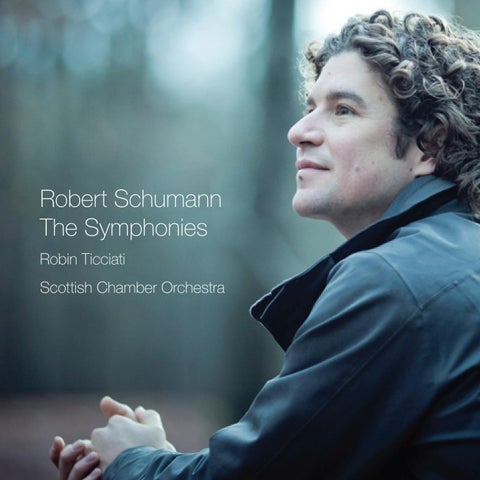
Robert Schumann The Symphonies Robin Ticciati Scottish Chamber Orchestra
Robert Schumann The Symphonies Robin Ticciati conductor · Scottish Chamber Orchestra Symphony No. 1 in B flat major, Op. 38 ‘Spring’ 1. I. Andante un poco maestoso – Allegro molto vivace ...... 11:37 2. II. Larghetto – .................. 6:28 3. III. Scherzo: Molto vivace .. 5:33 4. IV. Allegro animato e grazioso ....................... 8:58 Symphony No. 2 in C major, Op. 61 5. I. Sostenuto assai – Allegro ma non troppo ...... 12:11 6. II. Scherzo: Allegro vivace .. 7:21 7. III. Adagio espressivo ....... 10:13 8. IV. Allegro molto vivace .... 8:37
Symphony No. 3 in E flat major, Op. 97 ‘Rhenish’ 9. I. Lebhaft ......................... 9:37 10. II. Scherzo: Sehr mäßig .... 6:02 11. III. Nicht schnell ................ 5:39 12. IV. Feierlich ...................... 5:27 13. V. Lebhaft ........................ 6:06 Symphony No. 4 in D minor, Op. 120 (1851 version) 14. I. Ziemlich langsam – Lebhaft – ........................ 10:31 15. II. Romanze: Ziemlich langsam – .......... 4:06 16. III. Scherzo: Lebhaft – ...... 5:29 17. IV. Langsam – Lebhaft ..... 9:29 Total Running Time: 133 minutes
2
Recorded at Perth Concert Hall, Perth, UK, 25, 26 & 30 November and 1–3 December 2013 Produced and recorded by Philip Hobbs Associate engineer Robert Cammidge Post-production by Julia Thomas All photography by Marco Borggreve Design by gmtoucari.com
This recording was made possible with support from the SCO Sir Charles Mackerras Fund and Sir Siegmund Warburg's Voluntary Settlement. 3
A
round the age of 13, Robert Schumann (1810–1856) came across a score and parts in his father’s bookshop of an overture by the late eighteenth-century composer Vincenzo Righini. Eager to hear it, he assembled an orchestra of friends − two violins, two flutes, two horns and a clarinet – and made up for the missing instruments as he conducted from the piano. That was his introduction to orchestral music: he would not hear a real symphony orchestra until he was 17, a reflection of the musical life of his home town of Zwickau. Schumann had originally set out to be a piano virtuoso, but was forced to abandon such plans after damaging his right hand. With the encouragement of his piano teacher, Friedrich Wieck, he instead began to study composition. In 1832 he wrote three movements of a symphony (now known as the ‘Zwickau’). But he quickly moved on to writing for the piano (an early work was the Études symphoniques) and from 1840 he began to write songs. Only at 30 did he feel sufficiently sure of himself to return to the orchestra. In October 1840, settled in Leipzig and a month after marrying Wieck’s daughter Clara, he started to improvise symphonic forms at the piano. *** Schumann’s first symphony came with astonishing speed. He noted ‘beginning of a symphony in C minor’ on 21 January 1841, but the work was abandoned. Two days later, however, inspired by a poem by Adolf Böttger, he wrote ‘Spring symphony started’. On 24 January, the first movement of the new work was sketched and the ‘adagio and scherzo 4
made ready’; on 25 January ‘symphony fire – sleepless nights – on the last movement’ and on the fourth and final day, ‘Hurrah! symphony finished!’ Orchestration would occupy him till 20 February, but in four days and nights – ‘it mostly seems to have been written at night’ – he had effectively written the Symphony in B flat that would become his Op. 38. Clara wrote in their joint diary: ‘I am infinitely happy that Robert has at last arrived where, with his great imagination, he belongs’. It fell to Felix Mendelssohn to premiere the work, at a concert that March when Clara would be performing for the first time since her wedding. On 6 and 10 March, Schumann went through the symphony with Mendelssohn. The late beginner was deeply impressed by his friend’s understanding: ‘He always sees the right thing and fastens on to it’. There was, for example, a problem with the horn calls at the very opening of the symphony – valved horns were just coming in − and at a rehearsal Schumann had to rewrite the passage to obtain something more like the effect he wanted. After some furious copying of parts, the ‘Spring’ Symphony was given at the Leipzig Gewandhaus on 31 March 1841, just over nine weeks after Schumann had started it. The evening was a triumph, with congratulations coming from all sides. The work was performed again in Leipzig on 13 August, after still further revisions. Like his contemporaries, Schumann felt the shadow of Beethoven (who at this point had been dead only 14 years). It was important to him not to produce a sub-Beethovenian work, but to create music which – like his piano works – expressed a new sound world that was his own. Only weeks after the success in Leipzig, Clara heard ‘D minor sometimes sounding wildly in the distance’ as another symphony was begun (the 5
sketch was finished by 21 June). Schumann had told her in March that his next symphony would be called ‘Clara’ and that in it she would be portrayed ‘with flutes, oboes and harps’. This is the work that, in revised form, would become known as the Fourth Symphony. Plans were laid for its performance in Leipzig in December 1841, in a concert at which Franz Liszt also appeared. Conducted by Ferdinand David, the new work was not a success. It was more radical than the First Symphony and (according to Clara) ‘a great many misfortunes’ happened on the night; over 900 people turned up to applaud Liszt and Clara – but not the little-known Robert – and no publisher made an offer for the piece. To judge by later events, Schumann must have felt that it had not come over with the power he wanted. He put it aside. *** In September 1845, Schumann told Mendelssohn, in one of those characteristic images of music personified, as it went through mind, body and soul, that ‘for several days there’s been much drumming and trumpeting in me (trumpet in C); I don’t know what will come of it’. What came was another symphony, the final stimulus perhaps being Schubert’s Ninth Symphony (also in C), which Schumann had actually discovered in Vienna; the ‘Great C major’ was performed for the first time in Dresden, in December 1845. Three days after the premiere, Schumann noted ‘symphonic thoughts’: a first movement was almost finished. This C major symphony would become his Op. 61. Schumann always linked the Second Symphony with illness, declaring in 1849 that it was begun ‘when I was still half ill’. During 1844–45 he had 6
been troubled by dizziness, insomnia, hearing problems and incapacitating pains; they all led to depression, and he later explained that he had still been ‘suffering physically a great deal’ when sketching out Op. 61. He remembered: ‘the resistance of the spirit…through which I sought to contend with my bodily state. The first movement is full of this struggle and its character is very moody and rebellious.’ Although he would be hard at work on the last movement by Christmas Day 1845 and had almost finished it by 26 December – ‘musical happiness’, he rejoiced – it would take another ten months to complete the work; and even then it needed revision. The fact that the symphony took so long to finish is significant. Some time in the mid-1840s, Schumann’s attitude to composing changed. ‘I have written the majority, almost all, even the smallest of my pieces while inspired, many of them at unbelievable speed...Only from the year 1845 on, when I began to invent and work out everything in my head, did a completely different way of composing start to develop.’ The young Schumann had written music spontaneously. He was now a professional who did not necessarily write quickly but would work out everything ‘in his head’ (his workroom no longer had a piano in it). On the other hand, giving up his reliance on ‘inspiration’ left him without some of his old selfconfidence; and a wretched series of physical illnesses made things much worse. A plan emerged for Mendelssohn to premiere the new work in Leipzig, as he had the First Symphony: his endorsement had been a wonderful spur to that work’s reputation. The performance was scheduled for 5 November 1846, but extensive revisions were still required. The premiere 7
went well and yet made less impact than it might have done, the work appearing in the second half of a crowded programme. Schumann noted how he was still ‘always correcting the symphony’: the opportunity to revise after hearing was not to be missed, and he slightly shortened the first and second movements. The second performance, in Leipzig on 16 November, was rather more enthusiastically received. It is the most beautifully crafted work, less of a crowd-puller than its predecessor but wonderfully balanced and imaginative. *** In 1850 Schumann and his family moved to Düsseldorf, in the Rhineland, where Schumann had accepted the position of municipal music director; he needed a job that would support them all, and he also had a good friend in the musician Ferdinand Hiller in Cologne, not far away. Schumann had first seen Cologne Cathedral – unfinished since the Middle Ages − in September 1830, and probably recalled it in May 1840 when writing the song ‘Im Rhein, im heiligen Strome’ for the cycle Dichterliebe. At the start of November 1850, he and Clara went to Cologne and the idea of a new symphony ‘was first conceived, so the composer said, on seeing the cathedral’; the penultimate movement, with its steadily treading, minor-key processional passages, temporarily acquired the heading ‘An Accompaniment to a Solemn Ceremony’. Schumann conceded that the work ‘here and there reflects a bit of local colour’; in fact, he thought he had detected an ‘unmusical public’ around him in Cologne and saw the new work as being in a ‘folk-like, popular’ style. Conceived and completed within a month, the ‘Rhenish’ Symphony, in E flat Op. 97, would be 8
numbered his third. Premiered at a subscription concert on 6 February 1851, it was Schumann’s first major contribution to the musical life of the Rhineland. *** In December 1851, in homage to Norbert Burgmüller, a Düsseldorf composer who had died tragically young, Schumann scored the unfinished scherzo of Burgmüller’s Second Symphony. But this was also the tenth anniversary – Schumann always registered such things – of the unsuccessful premiere in 1841 of his own D minor Symphony, and perhaps both these things took him back to the discarded work. Taking into account the particular needs (and weaknesses) of his Düsseldorf orchestra, and what he recalled of how the piece had sounded in 1841, he now worked on what he called its ‘reinstrumentation’. The result was the Fourth Symphony, Op. 120. As well as making structural changes, he doubled the wind parts and added repeated notes for the strings, in order to ensure that some weight of sound, at least, materialized in performance. This paid off in Düsseldorf, though it would lead generations of critics to complain that Schumann did not know how to orchestrate. But nowhere else did he resort to such doubling of parts: neither in the Hermann und Dorothea overture, started just a week later, nor in the scoring of Burgmüller’s scherzo. He obviously wanted the symphony to have a special weight. It was premiered on 3 March 1853, another recompense to Düsseldorf for his growing weakness as a conductor. In fact, fatal illness was overtaking Schumann: early in 1854 he would develop hearing problems, suffer terrifying fantasies, make a suicide attempt and demand admission to an asylum. He died in March 1856. 9
*** Commentators have complained that the complexity of Schumann’s partwriting was due to the fact that he was, in effect, writing piano music for orchestra. But the subtleties of the part-writing are an element of Schumann’s very characteristic orchestral sound, as the leaner performances of the last 30 years have allowed us to hear. Characteristically, Schumann demanded that the musical world change to fit his new ideas; like all innovative composers, he did not modify his ideas to fit what his listeners expected. He certainly asked a great deal of the orchestra, but he was developing new sound worlds for each symphony, as is demonstrated by performances with an orchestra of the right size, ideally playing ‘Lebhaft’ (animatedly): Schumann assigns that favourite direction to two movements in the Third Symphony and three out of four in the Fourth. If the First Symphony blazes and sparkles with joy and the Second finds its way carefully through to the safe haven of its final movement, the Third moves with huge ease and assurance to a resonant and joyful conclusion. The Fourth had always been radical in the way each movement followed the next attacca, with barely a pause, and in the minute-and-a-half-long, shimmering and horn-call-filled transition to the finale. It now became magnificent, with minor-key climaxes similar to those Schumann would use in his Violin Concerto and late overtures; it acquired, at last, the heft he wanted. In its 1841 version it had been translucent, Mendelssohnian and just a little incoherent; in its 1851 version, it became the radical, soaring, disturbing and exhilarating symphony Schumann had always wanted to compose. © John Worthen, 2014 10
11
Robin Ticciati conductor Robin Ticciati is Principal Conductor of the Scottish Chamber Orchestra and Music Director of Glyndebourne Festival Opera. As guest conductor, he works with world-class orchestras on both sides of the Atlantic, including the Royal Concertgebouw Orchestra, London Symphony Orchestra, Swedish Radio Symphony Orchestra, Rotterdam Philharmonic, Tonhalle Zürich, Wiener Symphoniker, Staatskapelle Dresden, DSO Berlin, Filarmonica della Scala, Symphonieorchester des Bayerischen Rundfunks, Gewandhaus Orchester Leipzig, Cleveland Orchestra, Los Angeles Philharmonic and Philadelphia Orchestra. After four years as Principal Guest Conductor of the Bamberger Symphoniker, he continues to work with them in concerts and recordings. Ticciati balances orchestral engagements with extensive work in some of the world’s most prestigious opera houses and festivals, including the Salzburg Festival, Glyndebourne Festival Opera, Metropolitan Opera New York, Royal Opera House, La Scala Milan and Opernhaus Zürich. Following his conducting debut in Brussels, at the age of just 19, Ticciati’s career developed rapidly. He became the youngest conductor to appear not only at La Scala Milan but also (with Mozart’s Il sogno di Scipione) at the Salzburg Festival; that performance was later released on DVD by Deutsche Grammophon. He was then appointed Chief Conductor of the Gävle Symphony Orchestra and Music Director of Glyndebourne on Tour. 12
Ticciati’s discography includes two critically acclaimed Berlioz recordings with the Scottish Chamber Orchestra for Linn: Symphonie Fantastique and Les nuits d’été & La mort de Cléopâtre. Together, Ticciati and the SCO also recorded Wagner’s Siegfried Idyll as part of a special anniversary album to celebrate the SCO’s fortieth anniversary. In 2013 Linn released L’enfance du Christ with the Swedish Radio Symphony Orchestra & Choir. Ticciati’s discography also includes two discs of Brahms with the Bamberger Symphoniker for Tudor Records, one of which attracted Germany’s coveted ECHO Klassik Award. Born in London, Ticciati is a violinist, pianist and percussionist by training. He was a member of the National Youth Orchestra of Great Britain when he turned to conducting at 15, under the guidance of Sir Colin Davis and Sir Simon Rattle. He has recently been appointed the Sir Colin Davis Fellow of Conducting at the Royal Academy of Music.
13
Scottish Chamber Orchestra The Scottish Chamber Orchestra is a world-renowned orchestra made up of the finest Scottish and international musicians. The SCO aims to provide as many opportunities as possible for the people of Scotland to hear their music. As well as playing across the length and breadth of Scotland, they take their music around the world. Outside Scotland, they are proud to be ambassadors for Scottish cultural excellence and in recent years, the orchestra has toured throughout Europe, the Far East, India and the USA. The SCO has made a significant contribution to Scottish life, not just in cultural terms but in what it gives back to the community. Outside the concert hall, its players inspire people of all ages in schools, universities, hospitals, care homes, places of work and community centres through the work of SCO Connect, the orchestra’s creative learning team. The SCO’s long-standing relationship with its Conductor Laureate, the late Sir Charles Mackerras, resulted in many exceptional performances and recordings, including two multi-award-winning albums for Linn of Mozart’s late symphonies. The relationship with Linn has developed under the present Principal Conductor Robin Ticciati to take in not only Berlioz, but also Wagner’s Siegfried Idyll. Current SCO Associate Artists include conductor-keyboardist Richard Egarr, director-violinist Alexander Janiczek, and mezzo-soprano Karen Cargill. All perform regularly with the orchestra during the concert season, in the 14
recording studio, on tour and in festival appearances. The SCO has strong relationships with many eminent guest conductors, including its Principal Guest Conductor Emmanuel Krivine and Conductor Emeritus Joseph Swensen; regular soloist-directors include Christian Zacharias and Piotr Anderszewski. The orchestra enjoys close relationships with many leading composers and has commissioned more than 100 new works, among them by its Composer Laureate Sir Peter Maxwell Davies, James MacMillan, Judith Weir, Sally Beamish, Karin Rehnqvist, Lyell Cresswell, Mark-Anthony Turnage, Einojuhani Rautavaara, John McLeod, Rolf Martinsson, Toshio Hosokawa and its Associate Composer Martin Suckling. The Scottish Chamber Orchestra receives funding from the Scottish Government as one of Scotland’s five National Performing Arts Companies.
15
16
17
Scottish Chamber Orchestra 4 Royal Terrace, Edinburgh, EH7 5AB, UK T: +44 (0)131 557 6800 E: info@sco.org.uk www.sco.org.uk Principal Conductor Robin Ticciati Principal Guest Conductor Emmanuel Krivine Conductor Emeritus Joseph Swensen Chief Executive Roy McEwan OBE 18
1st Violin Lorenza Borrani Ruth Crouch Sijie Chen Aisling O’Dea Lorna McLaren Fiona Alexander Sarah Bevan-Baker Carole Howat Amira Bedrush-McDonald Ben Norris 2nd Violin Meesun Hong Rosenna East Alanna Tonetti-Tieppo Robert McFall Niamh Lyons Rachel Smith Stewart Webster Catherine James
Viola Jane Atkins Ian Anderson Brian Schiele Steve King Kathryn Jourdan Richard Nelson Cello David Watkin Su-a Lee Donald Gillan Eric de Wit Christian Elliott Double Bass Nikita Naumov Adrian Bornet Margarida Castro Flute Alison Mitchell Claire Wickes
Oboe Robin Williams Rosie Staniforth Mary Gilbert
Trombone Duncan Wilson Cillian O’Ceallachain Rob Collinson
Clarinet Maximiliano MartĂn William Stafford
Timpani Matthew Hardy
Bassoon Federico Aluffi (1 & 4) Peter Whelan (2 & 3) Alison Green Fraser Gordon
Percussion Kate Openshaw Tom Hunter
Horn Alec Frank-Gemmill Harry Johnstone Patrick Broderick Jamie Shield Trumpet Peter Franks Shaun Harrold
19
Robin Ticciati & Scottish Chamber Orchestra 40th Anniversary Edition
Ingrid Fliter, Jun Märkl & Scottish Chamber Orchestra Chopin: Piano Concertos
Robin Ticciati & Scottish Chamber Orchestra Berlioz: Les nuits d’été & La mort de Cléopâtre
CKD 450
ALSO AVAILABLE ON LINN
Robin Ticciati & Scottish Chamber Orchestra Berlioz: Symphonie Fantastique
Robin Ticciati & Swedish National Symphony Orchestra & Choir Berlioz: L’enfance du Christ
Sir Charles Mackerras Sir Charles Mackerras Artur Pizarro, & Scottish Chamber & Scottish Chamber Sir Charles Mackerras Orchestra Orchestra & Scottish Chamber Mozart: Symphonies 29, Mozart: Orchestra 31 (Paris), 32, 35 (Haffner) & 36 (Linz)
Symphonies 38–41
For even more great music visit linnrecords.com Glasgow Road, Waterfoot, Eaglesham, Glasgow, G76 0EQ T: +44 (0)141 303 5027 | E: info@linnrecords.co.uk
Beethoven: Piano Concertos 3, 4 & 5