MENU
—
TRACKLIST ENGLISH FRANÇAIS DEUTSCH
P. 4 P. 6 P. 15 P. 26
2
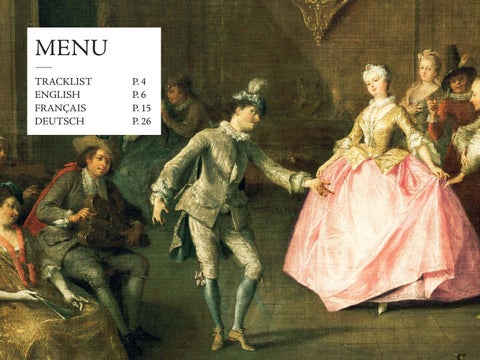
Recording Beaufays: église Saint-Jean l’Évangéliste, March 2016 Artistic direction, recording & editing: Jérôme Lejeune Coproduction with the Rencontres musicales de la Vallée d’Alzette. English translations: Peter Lockwood Deutsche Übersetzungen: Silvia Berutti-Ronelt Cover: school of Nicolas Lancret (1690-1743), Masquerade ball Nantes, Musée des Beaux-Arts Photo: © akg-images / De Agostini Picture
JOHANN BERNHARD BACH 16761749 OUVERTURES
L’ACHÉRON Marie Rouquié, Alice Julien-Laferrière & Jorlen Vega-Garcia (16-21): violins (1-7, 22-29) : viola Kathia Robert & Jorlen Vega-Garcia Élodie Peudepièce: double bass Thomas Kügler & Karel Valter: flutes & piccolo (Thomas Kügler, 15) Johanne Maitre & Elsa Frank: oboes & recorders Mélanie Flahaut: bassoon & flageolet Miguel Henry: archlute & guitar Philippe Grisvard: harpsichord François Joubert-Caillet: bass viol & direction
3
—
MENU EN FR DE 4
Ouverture G-Dur 1. Ouverture 2. Gavotte en Rondeau 3. Sarabande 4. BourĂŠe 5. Air 6. Menuet 7. Gigue Ouverture e-moll 8. Ouverture 9. Air 10. Les Plaisirs 11. Menuets I & II 12. Air 13. Rigaudon 14. Courante 15. Gavotte en Rondeau
3'11 1'42 1'54 1'14 5'39 0'51 1'35
4'20 2'51 1'53 2'42 2'45 2'17 1'41 1'23
Ouverture g-moll 16. Ouverture 17. Air 18. Rondeau 19. Loure 20. Fantaisie 21. Passepied
4'47 5'33 1'42 3'51 3'11 2'43
Ouverture D-Dur 22. Ouverture 23. Caprice 24. Marche 25. Passepieds I & II 26. Caprice 27. Air 28. La Joye 29. Caprice
3'20 3'01 1'21 2'25 2'40 2'45 0'56 2'38
5
MENU FR DE 6
THE OUVERTURES OF JOHANN BERNHARD BACH “No. 18, Joh. Bernhard Bach, the eldest son of no. 8, the above-mentioned Johann Egydius Bach, was born in Erfurt in 1676. He is still alive today and is a chamber musician and organist in Eisenach, the successor to no. 13, the above-mentioned Johann Christoph Bach. Johann Bernhard Bach’s only son is listed as no. 34.” This is Johann Sebastian Bach’s description of Johann Bernhard in the family genealogy that he drew up in 1735. Johann Bernhard Bach (1676-1749) was therefore the second cousin of Johann Sebastian Bach’s father. Johann Bernhard’s first position as organist was in the Kauffmannkirche in Erfurt, after which he was appointed to a similar position further North in the Katharinenkirche in Magdeburg in 1699. He remained only a short time there, as he succeeded a cousin from another branch of the family, Johann Christoph Bach, as organist of the Georgenkirche in Eisenach. This Johann Christoph was clearly one of the most important composers of the Bach dynasty; it was he whom Johann Sebastian Bach described as being a “profound composer”. Johann Christoph Bach had not only been an organist but also a musician of the local court; Johann Bernhard therefore also became court harpsichordist and was appointed Kapellmeister in 1712. This, however, is the sum of our knowledge of Johann Bernhard Bach. Did these two second cousins, Johann Bernhard and Johann Sebastian, know each other? A coincidence linked them in 1703, the year of Johann Christoph’s death. Johann Bernhard, as we have seen, succeeded Johann Christoph in Eisenach and Johann Sebastian was appointed to his first position as organist in Arnstadt. The two cities were, however, only some fifty kilometres apart.
7
Another important composer of the period, Georg Philipp Telemann, acted as a link between the two Bachs. Telemann had been given a thorough grounding in every musical style before being appointed as first violin and Kapellmeister to the duke of Eisenach in 1706. It was he whom Johann Bernhard succeeded as Kapellmeister in 1712. We know from various sources that Johann Sebastian Bach had maintained extremely cordial relations with Telemann, one proof of this being the fact that Telemann was godfather to Johann Sebastian’s second son, Carl Philipp Emanuel Bach. We can see that there must have been links between these musicians, although there is no hard evidence of any. There must surely have been moments when they met; how could Johann Sebastian not have met Johann Bernhard at the funeral of his uncle Johann Christoph? And Telemann must surely have met them both when he came to Weimar in 1714 for the birth of his godson? Very few of Johann Bernhard Bach’s compositions have survived: three chaconnes for harpsichord, several organ chorales and the four Ouvertures for orchestra recorded here. A very small body of work indeed, in comparison with the hundreds of works composed by Johann Sebastian and by Telemann at the Eisenach court. The Ouvertures also form an important link with the musical activities of Johann Sebastian in Leipzig: copies of three of these Ouvertures (those in D major, G major and G minor) were found among the effects of Carl Philipp Emanuel Bach after his death. They can be dated to the years 1729-1730 and were clearly used for performances by the Collegium Musicum. What is more, three Ouvertures (G minor, G major and E minor) are included in full score in a volume copied out by a certain S. Hering during the second half of the 18th century. Even more interesting is that we therefore possess separate instrumental parts for the Ouvertures in D major, G major and G minor; we have even been able to identify several of the copyists: Johann Sebastian Bach, Carl Philipp Emanuel Bach, Johann Ludwig Krebs and Johann Ludwig Dietel — a fine scenario for an historic reconstruction!
8
Copies of full scores of Johann Bernhard’s Ouvertures had therefore arrived in Leipzig; could Johann Bernhard have arrived with them with the idea of paying his cousin a visit? Johann Sebastian’s intentions were to perform these pieces during the next Sunday concert of the Collegium Musicum; the instrumental parts had to be copied out as quickly as possible, as was also usual for the Sunday cantata at the Thomaskirche. All who could help were welcome. Every player required his own part: two separate copyists wrote out the two copies needed for the violins. Johann Sebastian transcribed the parts intended for the continuo players, carefully adding the figured bass where necessary. All of the above was carried out with what must have been a certain sense of excitement, with the desire to get the parts onto the music stands as fast as possible and to hear it for the first time, to rehearse it and prepare the concert of which it was a part at the Café Zimmermann. These works would have been heard by an audience made up of enthusiasts and experts — Kenner und Liebhaber, to use the expression that Carl Philipp Emanuel would later use to describe the public for whom he intended his Sonatas and Rondos. Some of those present at Zimmermann’s would have smoked their pipes, others would be drinking a Franconian wine or a stein of beer. After the concerts, all would discuss the music that they had just heard; would they have compared them to similar works by Johann Sebastian which, as we know, were performed in the same circumstances? The first thought that we had when we came across these works was, of course, to compare them to Johann Sebastian’s own Ouvertures, also coincidentally four in number. When were Johann Berhnard’s works composed? Were they composed before the Ouvertures that Johann Sebastian composed for the Köthen court between 1717 and 1723? The third of the four Ouvertures, incidentally, was composed in 1716, at the very end of Johann Sebastian’s Weimar period. There are striking similarities between the
9
two composers’ works, although if we also take similar works by Telemann and Graupner into account (they exist in their dozens), we soon realise that these works of Johann Bernhard belong to a genre that was much in vogue at that time. These Ouvertures — such works were never termed suites in Germany — were a thoroughly German creation assembled from individual elements that were typical of French music. Apart from a few elements that can be found in the Symphonies pour les Soupers du Roi by Michel-Richard Delalande, there is no equivalent to these works in French music of that time. The title of the first movement, an Ouverture in the form that Lully had developed for his tragédies en musique, is now applied to the work as a whole. It is made up of two sections: the first, in a majestic tempo and in duple time, is characterised by the use of dotted rhythms. The second, in triple time, uses a rapid fugato style: this second section ends with a short return to the slow duple dotted rhythms of the first section. This first movement is followed by several shorter movements in various different genres. Whilst these may be dance movements, there is no question of any observance of the strict order of the Französiche Suiten (Allemande, Courante, Sarabande, Gigue) that Johann Sebastian and his contemporaries scrupulously observed when they wrote their Suites, primarily for harpsichord. Here, they are principally the dances that Johann Sebastian added to his suites under the name of Galanteries: the Minuet, Gavotte, Passepied, Bourrée, Canaries and Forlane. In accordance with a practice that had recently been adopted in French music at that time, certain dances are grouped in pairs and presented in alternation. The second piece is in a different key (the relative major or minor) and is sometimes for a different grouping of instruments. One such example is the trio, in which the viola does not play; the orchestration is reduced to two instruments and continuo and therefore allows the larger orchestral forces a moment of respite. These dances are also accompanied by movements whose titles — another influence of early 18th century French practice —
10
evoked a particular character or emotion: Les Plaisirs, Réjouissance, Joye, or more simply, Air. Movements entitled Fantaisie or Caprice appear only rarely in these works of Johann Bernhard. For him and his fellow composers, these types of works were clearly French in origin; the use of the French language in Germany at that time was an indication of a certain elegance, of the aristocracy and therefore of everything concerned with the pastimes of the court. The four Ouvertures of Johann Bernhard Bach were composed for string ensemble. With the exception of the Ouverture in D major, the instruments called for are characteristic of the period: violins I and II, viola and th bass. The instruments for the Ouverture in D major are marked according to 17 century French practice — dessus, haute-contre, taille and basse — and also use the old system of clefs, with a C clef (C on the lowest line of the staff ) for the haute-contre line, the equivalent of the modern violin II. It was a great temptation for the musicians of the Achéron ensemble to perform these works as if they were Johann Sebastian Bach’s own Ouvertures; we have been able to ascertain that these four works existed in several versions, the differences between them being primarily of instrumentation. The most striking example of this occurs in the third Ouverture, the first version of which was composed only for strings, without oboes or trumpets. Following the example set by Louis XIV and his court, the German courts also employed several categories of musicians, including wind players whose task was initially to provide martial music or music for the hunt. We know that a supplement was paid to the horn players of the Weimar court for work outside their normal functions when Johann Sebastian Bach called for them in his Jagdkantate; the introductory Sinfonia to this work was an early version of what was later to become the first Brandenburg Concerto. Several courts possessed military bands that were made up of oboes, tailles de hautbois or tenor oboes, and bassoons. These musicians were not always away at war and composers therefore made use of them in their entertainment music, sometimes
11
even writing works specifically for them. Certain members of the Bach dynasty were well known as Stadtmusiker or Militärmusiker: one of these was Johann Jacob Bach, the elder brother of Johann Sebastian, who entered the service of the King of Sweden as an oboist in 1706; it was for him that Johann Sebastian composed his Capriccio sopra la lontananza del suo fratello dilettissimo. We should also remember that these wind instruments, the oboes, bassoons and even transverse flutes were also considered as being part of the clear and growing importance of French music in Germany after 1685; it was from this date onwards that the French Huguenots took refuge in Germany as a result of the revocation of the Edict of Nantes by Louis XIV. The different instruments used in these Ouvertures imparted them with timbres that emphasised the character of certain pieces. The flutes in the Ouverture in E minor stress the nostalgic character of this key, making it much less martial in mood than the Ouvertures in D major and G major. Piccolos are also used to stress the popular character of the Rigaudon and the Gavotte. We should therefore not be surprised by the military aspect of certain movements, an aspect that is greatly reinforced by the sound of the oboes (March in D major). One of Johann Bernhard Bach’s four Ouvertures was composed with a concertante part for a solo instrument, here the violin. This is also the case with Johann Sebastian Bach’s second Ouverture: the first version in A minor that he composed in Köthen was intended for the violin; he later transposed it into B minor and assigned the solo line to the transverse flute during his time in Leipzig. Of all the different types of movements that these Ouvertures contain, we should also note the presence of titles that do not often appear in this type of work: three Caprices in the Ouverture in D, a Fantasia in the Ouverture in G minor and, in each work, an Air — a slow movement often of great expressive quality that can only remind us if the Air that Johann Sebastian included in his third Ouverture. The three Caprices in D major each have their own character: the first is slow and with a complex musical style, the second is in a
12
fast tempo and is based on two themes that are exchanged between the voices and varied, the third and last is like an Ouverture à la française — in a fast tempo and in duple time. There is one further riddle that remains to be solved: the period during which these works were composed. It is clear that they are in a more archaic style than those of Johann Sebastian Bach, and that they have neither the complex writing nor do they demand the same level of instrumental virtuosity that Johann Sebastian required from his players in Weimar, Köthen and Leipzig. It is also very difficult to state with any certainty that Johann Sebastian was inspired by Johann Bernhard, as has often been supposed; what does seem clear, however, is that Johann Sebastian did not discover the Ouverture form through Johann Bernhard’s compositions, as it was very much a product of its time. On the other hand, Johann Bernhard’s four Ouvertures are very much in the style of the first compositions of this type that surfaced in Germany at the beginning of the 18th century.
JÉRÔME LEJEUNE
A word from the performer
13
© Juliette Joubert-Pacquier
The images that we see before us as we listen to these Ouvertures are vivid country scenes — and for ordinary folk as well as aristocrats. Each movement describes a precise situation and a particular emotion: we hear dances, tender songs and martial melodies; we behold operatic scenes and we see not only historical characters but also allegorical and imaginary figures. Melancholy, joy, nostalgia, hope, humour, finesse, power, distress, the prime of life and wisdom all intertwine and blend. A true painter in
MENU FR DE 14
sound, Johann Bernhard Bach creates not only a frame and an argument for each piece but also a world complete with its inhabitants. Whilst the Ouverture in G minor and its obbligato violin display an Italian influence, Johann Bernhard Bach’s style is nonetheless clearly classically French, although animated by the spirit and taste that characterises the dances and Ouvertures of the regions above the Rhine. His music, however, could never have been composed by a French musician; Johann Bernhard Bach was inspired by French models and adapted them for his own use, creating a highly personal style in the process. The Achéron ensemble is expanded for this recording: this music deserves just as much care for accuracy and realism in musicality and in sound as does the ensemble’s core repertoire, in which the viola da gamba plays a more important role. We have attempted to give new life to Johann Bernhard Bach’s intentions and to express what inspired him in each of these miniatures with a highly varied and characteristic choice of instruments. The Achéron ensemble extends its grateful thanks to Thibaut Roussel for the loan of his guitar and to the co-producers of this recording, the Rencontres musicales de la Vallée d’Alzette.
FRANÇOIS JOUBERTCAILLET
MENU EN DE
« No 18, Joh. Bernhard Bach, fils aîné de Johann Egydius Bach no 8 sus-mentionné, est né à Erfurt Anno 1676. Il vit encore aujourd’hui et est musicien de chambre et organiste à Eisenach, successeur de Joh. Christoph Bach no 13 sus-mentionné. Son fils unique figure sous le no 34. » C’est ainsi que Johann Sebastian Bach évoque ce membre de la dynastie dans la généalogie qu’il rédige en 1735. Johann Bernhard Bach (1676-1749) est donc le fils d’un cousin du père de Johann Sebastian. C’est dans sa ville natale que Johann Bernhard occupe un premier poste d’organiste à la Kaufmannskirche avant d’obtenir, en 1699, un autre emploi similaire, plus au nord, à la Katharinenkirche de Magdebourg. Il ne reste que peu de temps à ce poste puisque, en 1703, il succède à un cousin d’une autre branche, Johann Christoph, au poste d’organiste de la Georgenkirche d’Eisenach. Ce Johann Christoph est sans aucun doute l’un des plus importants compositeurs de la dynastie, celui dont Johann Sebastian Bach dira qu’il est « un compositeur profond ». À ses fonctions d’organistes, Johann Christoph ajoute celles de musicien de cour. Johann Bernhard devient donc également claveciniste de la cour et en sera nommé maître de chapelle en 1712. C’est, hélas !, tout ce que nous connaissons de sa vie. Les deux cousins (au second degré) se sont-ils connus ? Une coïncidence les rapproche en 1703, date du décès de Johann Christoph. Johann Bernhard, on l’a vu, succède à ce dernier à Eisenach et Johann Sebastian obtient à Arnstadt son premier poste d’organiste. Les deux villes sont distantes d’une cinquantaine de kilomètres…
15
LES OUVERTURES DE JOHANN BERNHARD BACH
16
Un compositeur très important de l’époque fait aussi le lien entre les deux Bach ; il s’agit de Georg Philipp Telemann. En effet, bénéficiant déjà d’une très sérieuse formation dans tous les styles, Telemann a été nommé en 1706 premier violon et maître de chapelle du duc d’Eisenach. C’est à lui que Johann Bernhard succède en 1712 au poste de Kapellmeister. On sait d’autre part que Johann Sebastian Bach entretient des relations très amicales avec Telemann ; en témoigne notamment le fait que ce dernier est le parrain du second fils de Johann Sebastian, Carl Philipp Emanuel. Ainsi se tissent peu à peu les liens entre ces musiciens… Il nous manque tellement d’informations ! Mais comment ne pas imaginer des rencontres ? Johann Sebastian rencontrant Johann Bernhard aux funérailles de l’oncle Johann Christoph ? Telemann arrivant à Weimar en 1714 à l’occasion de la naissance de son filleul ? De Johann Bernhard, nous avons conservé bien peu de choses ; quelques pièces pour clavecin (trois chaconnes), quelques chorals d’orgue et surtout les quatre Ouvertures pour orchestre réunies dans cet enregistrement. C’est bien peu de choses à côté des centaines de compositions de son cousin et de Telemann, son collègue à la cour d’Eisenach. Ces œuvres ont aussi un lien très important avec l’activité musicale de Johann Sebastian Bach à Leipzig. En effet, c’est dans l’héritage de Carl Philipp Emanuel Bach que l’on trouve des copies de trois de ces Ouvertures (ré majeur, sol majeur et sol mineur). On les date des années 1729/1730, sans aucun doute destinées aux concerts du Collegium Musicum. De plus, trois Ouvertures (sol mineur, sol majeur et mi mineur) font partie d’un recueil copié en partition complète par un certain S. Hering dans la deuxième moitié du XVIIIe siècle. Ce qui est plus intéressant, c’est que nous disposons du matériel (parties séparées destinées aux instrumentistes) pour trois des Ouvertures (ré majeur, sol majeur, sol mineur), réalisées par plusieurs copistes, dont certains sont identifiés : Johann Sebastian Bach, Carl Philipp Emanuel Bach, Johann Ludwig Krebs, Johann Ludwig Dietel.
17
Voici un petit scénario d’une scène historique reconstituée… Des copies des partitions des Ouvertures de Johann Bernhard viennent d’arriver à Leipzig ; Johann Bernhard est-il venu rendre visite à son cousin ? L’idée est de jouer ces musiques lors du prochain concert dominical du Collegium Musicum. Comme pour la cantate qui a été jouée durant l’office du matin à Saint-Thomas, il s’agit de copier en toute hâte le matériel. Toutes les mains sont les bienvenues. De plus, il faut assez de partitions pour tous les instrumentistes. Des copistes différents s’attachent aux deux exemplaires nécessaires aux violons. Johann Sebastian complète les partitions destinées aux instrumentistes qui vont jouer la basse continue ; c’est lui qui assume avec soin l’ajout des chiffrages. Tout cela se passe sans doute dans une certaine excitation, avec l’envie de placer au plus vite ces partitions sur les pupitres et de faire résonner cette musique, de la répéter pour préparer le concert au Café Zimmermann. Là, elles seront écoutées par un public d’amateurs et de connaisseurs (« Kenner und Liebhaber », selon l’expression que Carl Philipp Emmanuel utilisera plus tard pour identifier les destinataires de ses Sonates et Rondos !). Certains des auditeurs fumeront la pipe, d’autres dégusteront un vin de Franconie ou une chope de bière et après le concert, ils discuteront de la musique qu’ils viennent d’entendre ; vont-ils la comparer aux œuvres équivalentes de Johann Sebastian qui, on le sait, ont été jouées dans les mêmes circonstances ? Car il est bien évident que la première idée qui nous vient à l’esprit à la découverte de ces compositions, c’est de les comparer à celles de Johann Sebastian qui, simple coïncidence, sont également au nombre de quatre. De quand datent-elles ? Sont-elles antérieures à celles que Johann Sebastian a écrites pour la cour de Köthen entre 1717 et 1723 (la troisième datant d’ailleurs de 1716, donc de la fin de la période de Weimar) ? Certes, les points de comparaison sont frappants ; mais il suffit d’observer les œuvres équivalentes dues à Telemann ou à Graupner (qui se comptent par dizaines) pour se rendre compte que les compositions de Johann Bernhard s’apparentent à un genre très courant à cette époque.
18
19
20
Ces « Ouvertures » (l’appellation de « Suite » n’est jamais utilisée pour qualifier ce genre de musique en Allemagne) sont une création typique de la musique allemande faite au départ d’éléments caractéristiques de la musique française. Mis à part quelques éléments rencontrés dans les Symphonies pour les Soupers du Roi de Michel-Richard Delalande, on n’en trouve pas d’équivalent dans la musique française. C’est le premier mouvement, une « ouverture » dans la structure telle qu’elle est développée dans les tragédies en musique de Lully, qui donne son titre à la composition. Elle comporte deux sections. La première, de tempo majestueux, en rythme binaire, est caractérisée par l’utilisation de rythmes pointés. La seconde, en rythme ternaire, fait usage d’une écriture fuguée et rapide ; cette second partie se conclut par un retour assez bref aux caractères de la première section (lent, binaire, rythmes pointés). Après cette pièce d’introduction viennent plusieurs pièces plus courtes qui appartiennent à différents genres. Si ce sont des danses, il ne s’agit nullement de l’ordonnance des « suites françaises » (allemande, courante, sarabande, gigue) que Bach et ses contemporains respectent scrupuleusement dès lors qu’ils écrivent (majoritairement pour le clavecin) des pièces qu’ils intitulent Suite. Ici, ce sont majoritairement les danses (que Johann Sebastian Bach ajoute par exemple à certaines suites sous l’appellation de « galanteries ») : menuet, gavotte, passepied, bourrée, canaries, forlane… Selon une pratique assez récente de la musique française (on constate cela dans les compositions du début du XVIIIe siècle), certaines de ces danses sont groupées par deux et proposées en alternance. La deuxième pièce est dans une tonalité différente (majeur ou mineur / ton relatif ) et propose parfois une écriture différente, à savoir celle du « trio » où la partie d’alto a disparu et où l’effectif se réduit à deux instruments et basse continue (offrant alors à l’orchestre un moment de pause). À côté de ces danses apparaissent aussi des mouvements dont le titre – c’est également une influence des pratiques françaises du début du XVIIIe siècle – est l’évocation d’un
21
caractère ou d’un sentiment : Les Plaisirs, Réjouissance, Joye… ou tout simplement Air. Dans les suites de Johann Bernhard apparaissent les mentions plus rares de Fantaisie ou de Caprice. Évidemment, comme, pour ces compositeurs, il s’agit de musique française, tous les titres sont indiqués en français, langue qui, en Allemagne, est aussi celle de l’expression d’une certaine élégance, de l’aristocratie et donc de tout ce qui a trait aux divertissements de cour. Les quatre Ouvertures de Johann Bernhard Bach sont écrites pour une formation de cordes. Mis à part l’Ouverture en ré majeur, la répartition des parties instrumentales est logique pour cette période : violons I et II, alto et basse ; dans le cas de l’Ouverture en ré majeur, les instruments sont nommés selon la e pratique française du XVII siècle : dessus, haute-contre, taille et basse, ceci en respectant l’ancien système de clés, donc une clé d’ut première ligne pour la partie de haute-contre (qui correspond au violon II). Pour les musiciens de L’Achéron, la tentation était grande de suivre la pratique de Johann Sebastian pour ses propres Ouvertures. En effet, on a pu constater que ses quatre compositions ont connu différentes versions, dont la différence principale est celle de l’instrumentation ; l’exemple le plus frappant est celui de la Troisième Suite, dont la version initiale est destinée aux cordes seules, sans hautbois ni trompettes. À l’instar de la cour du Roi-Soleil, celles des aristocrates allemands disposaient aussi de plusieurs types de musiciens, parmi lesquels les joueurs d’instrument à vent dont le rôle était d’abord confiné au domaine de la musique militaire ou à celui de la chasse. À cet égard, on sait par exemple que l’on paye un supplément aux cornistes de la cour de Weimar pour une prestation (en dehors de la chasse) lorsque Bach les sollicite pour la Cantate de la Chasse dont la Sinfonia d’introduction est la version initiale de ce qui deviendra le premier Concerto brandebourgeois. De même, on peut constater que plusieurs cours disposent d’une « musique militaire » constituée principalement de hautbois, tailles de hautbois et bassons. Ces musiciens
22
n’étant pas toujours en guerre, les compositeurs de la cour les intègrent aux divertissements, leur réservant parfois un répertoire spécifique. Certains membres de la dynastie des Bach s’illustrent d’ailleurs à ces fonctions de musicien de ville ou de musicien militaire : c’est le cas notamment de Johann Jacob Bach, frère aîné de Johann Sebastian, qui entre en 1706 comme hautboïste au service du roi de Suède. C’est à l’occasion de son départ que Johann Sebastian écrit le Capriccio sur le départ du frère bien-aimé. Il faut aussi rappeler que les instruments à vent, hautbois, bassons mais aussi flûtes traversières, font partie des éléments qui constituent l’influence importante de la musique française en Allemagne dès les années 1685, alors que, suite à la révocation de l’Édit de Nantes par Louis XIV, les Huguenots français trouvent refuge dans ce pays. Les instrumentations apportées à ces Ouvertures leur confèrent des couleurs qui soulignent le caractère de certaines pièces. Les flûtes de l’Ouverture en mi mineur accentuent le caractère nostalgique de la tonalité et ce, dès l’ouverture dont le caractère est bien moins martial que dans celle en ré majeur ou celle en sol majeur. Dans la même suite, les petites flûtes accentuent le caractère populaire du Rigaudon ou de la Gavotte. On ne sera pas surpris par l’aspect militaire de certains mouvements, que la sonorité des hautbois renforce de façon évidente (Marche en ré majeur). Comme chez Johann Sebastian, l’une des quatre Ouvertures de Johann Bernhard est écrite avec une partie concertante pour un instrument, en l’occurrence le violon. C’est aussi le cas de la deuxième Ouverture de Johann Sebastian : en effet, la version originale en la mineur écrite à Köthen a bien été pensée pour le violon ; elle a été transposée en si mineur pour la flûte traversière durant la période de Leipzig. Parmi tous les types de mouvements que contiennent ces Ouvertures, il convient de signaler la présence d’intitulés rares dans ce genre de composition : trois Caprices dans l’Ouverture en ré, une Fantaisie dans
23
celle en sol mineur et, dans chaque Ouverture, un Air, mouvement lent souvent d’une très belle qualité expressive qui ne peut que nous faire penser à celui que Johann Sebastian insère dans sa troisième Ouverture. En ce qui concerne les trois Caprices en ré majeur, ils sont de caractères différents, le premier étant une pièce lente d’une écriture assez compacte, le deuxième étant un mouvement rapide basé sur deux thèmes utilisés en imitation entre les voix et le troisième, mouvement de conclusion, étant comme une « ouverture à la française » avec, ici, un mouvement rapide en rythme binaire. Il resterait une énigme à élucider, celle de la date de composition de ces œuvres. Il est évident qu’elles appartiennent à un style plus archaïque que celles de son cousin. Elles ne bénéficient pas non plus de la même complexité d’écriture ni du niveau de virtuosité des instrumentistes dont Johann Sebastian a pu bénéficier dans ses différents postes à Weimar,
Köthen ou Leizpig. Quant à savoir si Johann Sebastian s’est inspiré des œuvres de son cousin, comme cela a été souvent supposé, il serait bien difficile de l’affirmer. Ce qui semble certain, c’est que Johann Sebastian n’a certainement pas eu besoin de la musique de son cousin pour découvrir cette forme qui s’était imposée de son temps. Par contre, ce qui apparaît comme évident, c’est que ces quatre Ouvertures de Johann Bernhard Bach appartiennent au style des premières compositions qui ont dû être écrites en Allemagne dès le début du XVIIIe siècle.
24
JÉRÔME LEJEUNE
FRANÇOIS JOUBERTCAILLET
MENU EN DE
Tableaux champêtres, populaires ou de cour, les images qui apparaissent à l’écoute de ces Ouvertures évoquent des scènes d’une variété colorée : chaque mouvement décrit une situation particulière, un sentiment précis ; on y entend des danses, des airs tendres ou des mélodies militaires ; on y voit des scènes d’opéra, des personnages historiques, allègoriques ou imaginaires ; la mélancolie, la joie, la nostalgie, l’espérance, l’humour, la finesse, la puissance, l’affliction, la fleur de l’âge ou la sagesse s’y confondent et s’entrelacent. Tel un peintre, Johann Bernhard Bach crée pour chaque pièce un cadre et un discours, un monde et ses acteurs. Si l’Ouverture en sol mineur et son violon concertant montrent une influence italienne, le modèle stylistique de Johann Bernhard Bach est pourtant clairement français, classique, inspiré de cet esprit et de ce goût typiques des danses et Ouvertures d’outre-Rhin. On ne pourrait pourtant pas imaginer cette musique écrite par un musicien français : Johann Bernhard Bach s’inspire de ce modèle et l’adapte à son style propre, créant ainsi une musique toute personnelle. L’Achéron s’ouvre à l’orchestre, désirant aborder cette musique avec le même souci de réalisme artistique et sonore que pour les répertoires où la viole de gambe tient une place plus importante. En adoptant des instrumentations variées, typées, nous avons tenté de repeindre ici les modèles qui furent peut-être ceux imaginés par Johann Bernhard Bach et de saisir les inspirations s’exprimant dans chacune de ces miniatures. L’Achéron remercie Thibaut Roussel pour le prêt de sa guitare et les Rencontres musicales de la Vallée d’Alzette, coproductrices de cet enregistrement.
25
Note de l’interprète
FR MENU EN 26
DIE OUVERTÜREN VON JOHANN BERNHARD BACH „No. 18. Joh. Bernhard Bach, ältester Sohn von Johann Egydio Bachen Sub No. 8 ist in Erffurth An. 1676 gebohren. Lebet noch anjetzo (nehmlich 1735) als CammerMusicus u Organist in Eisenach. Succedirte Joh. Christ. Bachen Sub No. 13. Deßen einziger Sohn folget Sub No. 34.“ Mit diesen Worten erwähnt Johann Sebastian Bach dieses Mitglied der Dynastie in der von ihm 1735 verfassten Genealogie. Johann Bernhard Bach (1676-1749) ist somit der Sohn eines Cousins von Johann Sebastians Vater. In seiner Geburtsstadt bekleidet Johann Bernhard den ersten Organistenposten an der Kaufmannskirche, bevor er 1699 weiter im Norden eine ähnliche Anstellung bekommt, u.zw. an der Katharinenkirche von Magdeburg. Dort bleibt er aber nur kurze Zeit, da er 1703 Johann Christoph, einem Cousin aus einem anderen Zweig der Familie, auf dessen Organistenposten an der Georgenkirche von Eisenach nachfolgt. Dieser Johann Christoph ist zweifellos einer der bedeutendsten Komponisten der Dynastie. Johann Sebastian Bach sagte von ihm, er sei ein „profonder Componist“. Neben seinen Funktionen als Organist war Johann Christoph auch Hofmusiker. So wird Johann Bernhard ebenfalls Cembalist am Hof und 1712 zum Kapellmeister ernannt. Leider ist das alles, was wir über seine Biographie wissen. Kannten sich die beiden Cousins (zweiten Grades)? Ein Zufall brachte sie 1703, im Todesjahr von Johann-Christoph, in nahe gelegene Städte. Johann Bernhard wurde, wie wir bereits erfuhren, Nachfolger des Verstorbenen in Eisenach, während Johann Sebastian in Arnstadt seine erste Organistenstelle antrat. Die beiden Städte liegen etwa fünfzig Kilometer voneinander entfernt ...
27
Ein sehr bedeutender Komponist dieser Zeit schuf ebenfalls eine Verbindung zwischen den beiden Bachs. Es handelt sich um Georg Philipp Telemann, der damals bereits über eine sehr seriöse Ausbildung in allen Stilen verfügte und 1706 zum ersten Geiger und Kapellmeister des Herzogs von Eisenach ernannt wurde. Ihm folgte Johann Bernhard 1712 auf dem Kapellmeisterposten nach. Man weiß aber auch, dass Johann Sebastian Bach sehr freundschaftliche Beziehungen zu Telemann unterhielt. Davon zeugt, dass Telemann der Taufpate von Johann Sebastians zweitem Sohn, Carl Philipp Emanuel war. So knüpften sich nach und nach Beziehungen zwischen diesen Musikern ... Doch fehlen uns so viele Informationen! Aber man kann doch nicht anders, als sich solche Begegnungen vorzustellen! Zum Beispiel, dass Johann Sebastian Johann Bernhard beim Begräbnis von Onkel Johann Christoph traf? Oder dass Telemann 1714 anlässlich der Geburt seines Patenkinds nach Weimar kam? Von Johann Bernhard ist recht wenig erhalten; einige Stücke für Cembalo (3 Chaconnes), einige Orgelchoräle und vor allem vier Ouvertüren für Orchester, die alle in dieser Aufnahme zu hören sind. Das ist nicht viel neben den Hunderten Kompositionen seines Cousins und Telemann, seines Kollegen vom Eisenacher Hof. Diese Werke bilden auch eine sehr wichtige Verbindung zur musikalischen Tätigkeit Johann Sebastian Bachs in Leipzig. Im Nachlass Carl Philipp Emanuel Bachs finden sich nämlich Kopien dreier dieser Ouvertüren (D-Dur, G-Dur und g-Moll). Sie werden auf die Jahre 1729/1730 datiert und waren zweifellos für die Konzerte des Collegium Musicum bestimmt. Außerdem gehören drei Ouvertüren (g-Moll, G-Dur und e-Moll) zu einer Sammlung, die als vollständige Partitur von einem gewissen S. Hering in der zweiten Hälfte des 18. Jh. kopiert wurde. Noch interessanter ist es, dass wir für drei der Ouvertüren (D-Dur, G-Dur, g-Moll) über Material verfügen (getrennte Stimmen für die Instrumentalisten), das von mehreren Kopisten stammt, von denen einige
28
identifiziert werden konnten: Johann Sebastian Bach, Carl Philipp Emanuel Bach, Johann Ludwig Krebs und Johann Ludwig Dietel. Hier ein kleines Szenario einer rekonstruierten historischen Szene ... Kopien der Partituren von Johann Bernhards Ouvertüren sind eben in Leipzig eingetroffen. Ist Johann Bernhard seinen Cousin besuchen gekommen? Diese Musik soll beim nächsten Sonntagskonzert des Collegium Musicum aufgeführt werden. Wie bei der Kantate, die beim Morgengottesdienst in der Thomaskirche gespielt wurde, muss nun das Notenmaterial in aller Eile kopiert werden. Jede Hilfe ist willkommen, denn man braucht ausreichend Noten für alle Musiker. Verschiedene Kopisten bemühen sich um die zwei für die Violinen notwendigen Exemplare. Johann Sebastian vervollständigt die Noten, die für die Basso-continuo-Spieler vorgesehen sind; er fügt die Bezifferung sorgfältig hinzu. All das geht sicher mit einer gewissen Aufregung Hand in Hand, mit dem Wunsch, die Noten so rasch wie möglich auf die Pulte zu legen und diese Musik zu Gehör zu bringen, sie zu proben und so das Konzert im Café Zimmermann vorzubereiten. Dort werden die Werke von «Kennern und Liebhabern» gehört, wie Carl Philipp Emmanuel Bach sich später ausdrücken sollte, um das Publikum zu beschreiben, für das diese Sonaten und Rondos bestimmt waren! Einige Zuhörer rauchten Pfeife, andere tranken Wein aus Franken oder einen Humpen Bier und nach dem Konzert diskutierten sie über die Musik, die sie eben gehört hatten. Verglichen sie sie mit den entsprechenden Werken Johann Sebastians, von denen bekannt ist, dass sie ebenfalls unter diesen Umständen gespielt wurden? Denn es ist klar, dass das erste, was uns bei der Entdeckung dieser Kompositionen einfällt, ein Vergleich mit den rein zufällig auch vier entsprechenden Werken Johann Sebastians ist. Wann wurden sie geschrieben? Vor denen, die Johann Sebastian zwischen 1717 und 1723 für den Hof von Köthen komponierte (das dritte stammt übrigens aus dem Jahre 1716, also vom Ende seiner Weimarer Zeit)?
29
Zwar finden sich frappierende Ähnlichkeiten, doch genügt es, entsprechende (zu Dutzenden vorhandene) Werke aus den Federn von Telemann oder Graupner heranzuziehen, um sich bewusst zu werden, dass die Kompositionen von Johann Bernhard einer Form nahe kommen, die in dieser Zeit eben sehr gängig war. Diese „Ouvertüren“ (die Bezeichnung „Suite“ wird in Deutschland nie zur Bezeichnung dieser Art von Musik verwendet) sind typische Schöpfungen der deutschen Musik, die ausgehend von charakteristischen Elementen der französischen Musik komponiert wurden. Abgesehen von einigen Elementen, die man in den Symphonies pour les Soupers du Roi von Michel-Richard Delalande antrifft, findet man nichts Entsprechendes in der französischen Musik. Der erste Satz, eine „Ouvertüre“ mit einer Struktur, wie sie in Lullys Tragédies en musique vorkommt, verleiht der Komposition ihren Titel. Sie besteht aus zwei Abschnitten. Der erste in majestätischem Tempo und binärem Rhythmus ist durch die Verwendung punktierter Rhythmen charakterisiert. Der zweite im ternären Rhythmus ist schnell und fugiert. Dieser zweite Teil endet mit einer recht kurzen Rückkehr zu den Merkmalen des ersten Abschnitts (langsam, binär, punktierte Rhythmen). Auf dieses Einleitungsstück folgen mehrere kürzere, die verschiedenen Formen angehören. Wenn es Tänze sind, so handelt es sich keineswegs um die Anordnung der französischen Suiten (Allemande, Courante, Sarabande, Gigue), die Bach und seine Zeitgenossen peinlich genau berücksichtigen, wenn sie (hauptsächlich für Cembalo) Stücke schreiben, die sie Suite nennen. Hier sind es vor allem Tänze (die Johann Sebastian Bach zum Beispiel zu einigen Suiten unter der Bezeichnung „Galanterien“ hinzufügt): Menuett, Gavotte, Passepied, Bourrée, Canaries, Forlane usw. Gemäß einer recht neuen Praxis der französischen Musik (die bei den Kompositionen des beginnenden 18. Jh. festzustellen ist), werden bestimmte Tänze paarweise und abwechselnd dargeboten. Das zweite Stück ist in einer anderen Tonart (Dur oder Moll / Paralleltonart) und schlägt manchmal
30
einen anderen Satz vor, d.h. den des „Trios“, wo keine Altstimme vorhanden ist und sich die Besetzung auf zwei Instrumente und Basso continuo beschränkt (was dem Orchester eine momentane Pause verschafft). Neben diesen Tänzen gibt es auch Sätze, deren Titel einen Charakter oder ein Gefühl ausdrücken – was ebenfalls auf den Einfluss der französischen Gepflogenheiten des beginnenden 18. Jh. zurückgeht: Les Plaisirs, Réjouissance, Joye ... oder ganz einfach Air. In Johann Bernhards Suiten scheinen seltenere Titel wie Fanaisie oder Caprice auf. Da es sich für diese Komponisten selbstverständlich um französische Musik handelt, sind alle Titel in französischer Sprache, die in Deutschland auch ein gewisser Ausdruck von Eleganz bzw. von Aristokratie ist und somit von allem, was mit den Vergnügungen des Hofes zu tun hat. Die vier Ouvertüren von Johann Bernhard Bach sind für Streicherbesetzung geschrieben. Abgesehen von der Ouvertüre in D-Dur, ist die Angabe der Instrumentalstimmen für diese Zeit logisch: Violine I und II, Viola und Bass; im Fall der Ouvertüre in D-Dur werden die Instrumente gemäß der französischen Gepflogenheit des 17.Jh. genannt: Dessus, Haute-contre, Taille und Basse, wobei das alte Schlüsselsystem verwendet wird, d.h. ein Sopranschlüssel für die Haute-contre-Stimme (die der Violine II entspricht). Für die Musiker von Achéron war die Versuchung groß, in gewisser Hinsicht den Gepflogenheiten von Johann Sebastian in Bezug auf seine eigenen Ouvertüren zu folgen. Man konnte nämlich feststellen, dass es von seinen vier Kompositionen verschiedene Fassungen gibt, deren Unterschied vor allem in der Besetzung liegt. Das frappierendste Beispiel ist das der dritten Suite, deren erste Fassung nur für Streicher ohne Oboe und Trompeten geschrieben ist. Wie am Hof des Sonnenkönigs verfügten auch die Höfe des deutschen Adels über mehrere Arten von Musikern, darunter über Spieler von Blasinstrumenten, deren Rolle sich zunächst auf die Militär- oder die Jagdmusik beschränkte. Zu diesem Thema weiß man
31
zum Beispiel, dass die Hornisten am Weimarer Hof für ihre (nicht die Jagd betreffenden) Leistungen eine Extrazahlung erhielten, als Bach sie für die Jagdkantate einsetzte, deren einleitende Sinfonia zur ersten Fassung des späteren ersten Brandenburgischen Konzerts wurde. Ebenso kann man beobachten, dass mehrere Höfe über eine „Militärmusik“ verfügten, die hauptsächlich aus Oboen, Tenoroboen und Fagotten bestand. Diese Musiker waren nicht immer im Krieg, so dass die Hofkomponisten sie bei den Vergnügungen einsetzten und manchmal ein besonderes Repertoire für sie schrieben. Manche Mitglieder der Bachdynastie zeichneten sich übrigens in diesen Funktionen als Stadt- oder Militärmusiker aus: Das ist u.a. der Fall von Johann Jacob Bach, einem älteren Bruder Johann Sebastians, der 1706 als Oboist in den Dienst des Königs von Schweden trat. Anlässlich seiner Abreise schrieb Johann Sebastian das Capriccio über die Abreise des sehr geliebten Bruders. Hier soll auch daran erinnert werden, dass diese Blasinstrumente, also Oboen, Fagotte aber auch Querflöten, außerdem zu den Elementen zählten, durch die die französische Musik ab den Jahren 1685 in Deutschland großen Einfluss gewann, als die französischen Hugenotten infolge der Aufhebung des Edikts von Nantes durch Ludwig XIV. in diesem Land Zuflucht fanden. Die an diesen Ouvertüren vorgenommenen Instrumentierungen verleihen ihnen Klangfarben, die den Charakter bestimmter Stücke hervorheben. Die Flöten der Ouvertüre in e-Moll unterstreichen den nostalgischen Charakter der Tonart, und das ab der Ouvertüre, die weit weniger martialisch ist als die in D-Dur oder die in G-Dur. In derselben Suite unterstreichen die kleinen Flöten den volkstümlichen Charakter des Rigaudon oder der Gavotte. Auch der von den Oboen offensichtlich verstärkte militärische Aspekt (Marsch in D-Dur) einiger Sätze kann nicht überraschen. Wie bei Johann Sebastian ist eine der vier Ouvertüren Johann Bernhards mit einer konzertanten
32
Stimme für ein Instrument geschrieben, im vorliegenden Fall für Violine. Das ist auch der Fall der zweiten Ouvertüre von Johann Sebastian: Die in Köthen geschriebene Originalfassung in a-Moll war nämlich für Violine konzipiert; sie wurde in h-Moll transponiert und in der Leipziger Zeit für Querflöte umgeschrieben. Unter allen Arten von Sätzen, die diese Ouvertüren enthalten, befinden sich auch für diese Art von Kompositionen seltene Titel: drei Capricen in der Ouvertüre in D, eine Fantasie in der in g-Moll und in jeder Ouvertüre ein Air in Form eines langsamen Satzes mit oft sehr schöner expressiver Qualität, die uns unweigerlich an jenes Air erinnert, das Johann Sebastian in seine dritte Ouvertüre einfügt. Was die drei Capricen in D-Dur betrifft, so haben sie unterschiedliche Charaktere. Die erste ist ein langsames Stück in einer recht kompakten Kompositionsweise, die zweite ein schneller Satz, der auf zwei als Imitation zwischen den Stimmen verwendeten Themen aufbaut, und die dritte, ein Schlusssatz, gleicht einer Ouvertüre à la française mit einem schnellen Satz in binärem Rhythmus. Ein Rätsel bleibt bis jetzt ungelöst, u.zw. das Kompositionsdatum dieser Werke. Offensichtlich gehören sie einem archaischeren Stil an als die Johann Sebastians. Auch kommt ihnen weder die gleiche komplexe Kompositionsweise zugute noch das gleiche Maß an Virtuosität der Musiker, das Johann Sebastian an seinen verschiedenen Arbeitsplätzen in Weimar, Köthen oder Leipzig nutzen konnte. Die Frage, ob sich Johann Sebastian von den Werken seines Cousins inspirieren ließ, wie oft angenommen wurde, ist schwer zu bejahen. Als sicher gilt, dass letzterer bestimmt die Musik seines Cousins nicht nötigt hatte, um diese Form zu entdecken, die sich in seiner Zeit bereits durchgesetzt hatte. Offensichtlich ist dagegen, dass die vier Ouvertüren von Johann Bernhard Bach den Stil der ersten Kompositionen dieser Art aufweisen, die in Deutschland wohl ab dem Beginn des 18. Jh. geschrieben wurden. JÉRÔME LEJEUNE
FRANÇOIS JOUBERTCAILLET
FR MENU EN
Ob volkstümlich oder höfisch, die ländlichen Bilder, die einem beim Hören dieser Ouvertüren in den Sinn kommen, lassen uns an verschiedene farbenfrohe Szenen denken: Jeder Satz beschreibt eine besondere Situation, ein bestimmtes Gefühl; man hört dabei Tänze, zärtliche Lieder oder Militärmusik; man sieht Opernszenen, historische, allegorische oder der Fantasie entsprungene Figuren; Melancholie, Freude, Nostalgie, Hoffnung, Humor, Feinfühligkeit, Macht, Betrübnis, die Blüte des Lebens oder die Weisheit vermischen und verflechten sich. Wie ein Maler fertigt Johann Bernhard Bach für jedes Stück einen Rahmen und einen Diskurs an, eine Welt und ihre Akteure. Auch wenn die Ouvertüre in g-Moll und ihre konzertante Violine auf einen italienischen Einfluss hinweisen, so ist das stilistische Modell dennoch eindeutig französisch, klassisch, von jenem Geist und typischen Geschmack für die Tänze und Ouvertures von der anderen Seite des Rheins inspiriert. Dennoch ist es dabei unvorstellbar, dass diese Musik von einem französischen Musiker geschrieben wurde: Johann Bernhard Bach inspiriert sich von diesem Modell, passt es aber seinem eigenen Stil an und schafft somit eine ganz persönliche Musik. L’Achéron erweitert sich zum Orchester im Wunsch, an diese Musik mit der gleichen Bemühung um künstlerischen und klanglichen Realismus heranzugehen wie bei den Repertoires, in denen die Gambe eine wesentlichere Rolle spielt. Mit unserer Wahl verschiedener, typischer Instrumentationen versuchten wir, jene Modelle nachzuempfinden, die Johann Bernhard Bach sich vielleicht vorstellte, und die Inspirationen zu erfassen, die in jeder dieser Miniaturen zum Ausdruck kommen. L’Achéron dankt Thibaut Roussel, uns seine Gitarre geliehen zu haben, sowie den Rencontre musicales de la Vallée d’Alzette, die Koproduzenten dieser Aufnahme sind.
33
Ammerkung des Interpreten
34
RIC 373