MENU TRACKLIST ENGLISH TEXT TEXTE FRANÇAIS DEUTSCHE TEXT
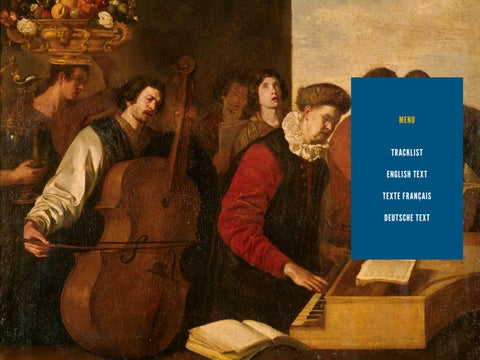
Recording Heverlee, Filosofisch Theologisch college van de societeit van Jezus V. Z. W., May 1991 Artistic direction, recording & editing: Jérôme Lejeune Pictures Aniello Falcone (1600-1656), Un concerto, Madrid, Museo del Prado, © akg images Translations English: Peter Lockwood Deutsch: Silvia Berutti-Ronelt
MOTETTI AD ALTO SOLO JAMES BOWMAN – countertenor RICERCAR CONSORT: FRANÇOIS FERNANDEZ – violin I / viola II GUYA MARTININI – violin II MIHOKO KIMURA – violin III / viola I RICHTE VAN DER MEER – cello PHILIPPE PIERLOT – bass viol I VITTORIO GHIELMI – bass viol II
ÉRIC MATHOT – double bass ALAIN PIRE – alto trombone JEAN-MARIE XHONNEUX – tenor trombone BERNARD JUNGHÄNEL – bassoon YVON REPÉRANT – organ (Ziani) ROBERT KOHNEN – organ
Antonio Vivaldi (1678-1641)
[9] Vesperae de la B. M. V.
Vestro principi divino RV 633 [1] Aria: Vestro principi divino 3’58 [2] Recitativo: O felix culpa 0’35 [3] Aria: Prata, virete 3’33 [4] Alleluia 1’28 violins I & II, viola I continuo (bass viol I, double bass, organ)
violin II, viola II continuo (cello, organ)
Marc’Antonio Ziani (1653-1715) [5] Alma Redemptoris Mater I
[11] Lasst uns all’ Mariam loben
8’54
alto & tenor trombones, bassoon continuo (cello, organ)
Georg Mathias Monn (1717-1750) [10] Maria Starke Sonnen
continuo (bass viol I, organ)
violins I, II & III unisoni continuo (bass viol I, organ)
continuo (cello, organ)
Benedetto Marcello (1686-1739) [7] Signor, dall’empia gente (Salmo decimoquinto)
13’40
cello continuo (bass viol I, organ) Frantisek Ignac Tuma (1704-1774) [8] Inno per il Festo di Sta Teresia
alto trombone, violins I & II
continuo (bass viol I, organ)
MENU
4’09
4’35
violin I
[6] Alma Redemptoris Mater II 7’43 bass viols I & II
9’00
4’55
MOTETTI AD ALTO SOLO There have always been many musical links between Venice and Vienna, given that Viennese musical life had been practically invaded by Italians, and by Venetians in particular, from the Renaissance onwards; even the principal posts of the Imperial Chapel were often filled by Italians. Marc’ Antonio Ziani was born in Venice in 1653 and was particularly active in opera, with over forty works to his credit between his Alessandro Magno (1679) and his last Viennese compositions. After having been maestro di cappella at the church of Santa Barbara in Mantua, he moved to Vienna in 1700. Emperor Leopold I, himself a composer, appointed him ViceKapellmeister and later Kapellmeister after Antonio Pancotti’s death in 1709. Ziani composed not only a large number of operas but also a great deal of sacred music — sixteen oratorios and a plethora of masses and motets. His two versions of Alma Redemptoris Mater undoubtedly belong to the works he wrote for Vienna; the concertante instrumental parts given to the winds (two trombones and bassoon) in the first version and to the strings (two viols) in the second clearly demonstrate a characteristic German musical practice inasmuch as other instruments are considered to be of as much interest as the violin. One of the aspects of this programme is the variety of the instrumental groups that accompany these cantatas. It seems that musicians of the period wished to highlight the dialogue between instruments and voices, with the sonata and cantata forms meeting on common ground on this point.This technique was also used in Benedetto Marcello’s famous Estro poetico Armonico (1724). The libretto is a free translation of the psalms of David by Girolamo Giustiani: composer and poet state in their preface that “the text was written to be set to music, and thus determined religious style in all its variations. It was necessary at all costs to avoid anything that would charm the listener’s ear with its artifice”. In the Psalm recorded here, Marcello calls for a concertante violoncello (he was a virtuoso cellist). Despite the reserves mentioned in the above preface, this music has great charm, and indeed leaves us with a rather tepid impression of religious devotion. The different parts of the text are expressed in many different ways, with both fast and slow arias, recitatives, and even a borrowing from Hebrew chant that is first played by the cello and then sung to the words Della vita il retto calle. We should also mention the many technical difficulties of the vocal writing, amongst which are frequent leaps between the singer’s bottom and top registers; Marcello was renowned for his knowledge of the voice and was also the teacher of the famous Faustina Bordoni. Antonio Vivaldi also had important links with Vienna, dedicating La Cetra to the Hapsburg Charles VI and Il Cimento dell’ armonia e dell’ invenzione to Count Morzin, who was later to be Haydn’s first supporter. Vivaldi died in poverty in Vienna for reasons that are still obscure. The motet Vestro principi divino is greatly influenced by the formal models of instrumental music, and defines a type of musical form that we will come across again and again in the Classic period and which Mozart would also use in writing his Exultate, jubilate — an aria (allegro), a recitative, a second aria (andante) and an Alleluia (allegro). Frantisek Ignac Antonin Tuma was born in Kostelec in Bohemia in 1704. Even though there were many Imperial contacts with Italy, it should also be noted that the Empire was still
MENU
very close to its Eastern lands, to Bohemia and to Prague, where Italian musicians also were active. Tuma was to make his career in Vienna; he became Vice-Kapellmeister to the Court in 1722 and was also named Compositor und Capellen-Meister to Count Ferdinand Kinsky, High Chancellor of Bohemia, who arranged for him to expand his musical knowledge with the most famous teacher in Vienna at that time, Johann Joseph Fux. Tuma’s work leads the listener into a more galant aesthetic; the use of the instruments in these two motets is again particularly original. Written in honour of St. Theresa, the motet Regis superni makes use of a concertante alto trombone; this is a typically Austrian tradition, for this instrument had been used in concertante parts in both instrumental and religious music since the end of the 17th century. There is therefore nothing exceptional in the fact that Mozart used it in this manner in his oratorio Die Schuldigkeit des ersten Gebotes or, at the end of his life, in the Requiem. This motet for Vespers is just as original in its instrumental accompaniment for a string trio comprising violin, viola and cello. The equal part-writing for the violin and the viola displays an evidently Classical means of expression. Classical is indeed the word that should best describe the works of Georg Mathias Monn (1717-1750). Despite an early death at the age of thirty-three, this Viennese musician was certainly the first herald of Viennese Classicism; it seems that he was the first to write a symphony in four movements with a Minuet and Trio, and this even before the death of Johann Sebastian Bach. This formal element is not, however, enough for us to grant him such a high place in music history, although his music turns its back on the baroque style: the two Marien Lieder here recorded clearly demonstrate the style of religious music that would become current in the second half of the 18th century. There is great melodic charm, which some might judge as not being particularly religious in character, but which goes so well with the light and the gilt typical of Southern German religious architecture — the same architecture that was to give rise to the works of Mozart, Haydn and Schubert. His artless and perhaps naive devotion to the Virgin (echoed also by Classical composers) here finds expression in a simple and moving musical language. Jérôme Lejeune
MOTETTI AD ALTO SOLO Les liens musicaux entre Venise et Vienne étaient nombreux. Depuis la Renaissance, la vie musicale viennoise était quasiment envahie par les artistes italiens et tout particulièrement par les Vénitiens. Très souvent, ce furent des Italiens qui occupèrent les principales fonctions de la chapelle impériale. Marc’Antonio Ziani, né à Venise en 1653, fut particulièrement actif dans le domaine de l’opéra : il nous a laissé une quarantaine d’ouvrages, depuis son Alessandro Magno (1679) jusqu’aux derniers qui furent représentés à Vienne. Après avoir été maître de chapelle de Santa Barbara à Mantoue, il s’installa à Vienne en 1700. L’empereur Léopold Ier, lui-même compositeur, le nomma vice-Kapellmeister ; en 1709, suite au décès d’Antonio Pancotti, Ziani devint Kapellmeister. Si l’œuvre lyrique de Ziani est importante, il convient d’insister sur son rôle dans le domaine de la musique religieuse : il a composé 16 oratorios ainsi que de nombreuses messes et motets. Les deux versions de l’Alma Redemptoris Mater font certainement partie des œuvres écrites à Vienne. Les parties instrumentales concertantes confiées aux instruments à vent de la première version (deux trombones et basson) et aux cordes de la seconde (deux violes de gambe) illustrent bien cette particularité de la musique instrumentale pratiquée dans les régions germaniques qui considéraient avec intérêt d’autres instruments que le violon ! L’un des atouts de ce programme est aussi la variété des formations instrumentales qui accompagnent ces compositions. Le dialogue des voix et des instruments est un trait important de la musique baroque ; sonate et cantate se rejoignent en quelque sorte ici. Cela est tout aussi remarquable dans le célèbre Estro poetico Armonico de Benedetto Marcello (1724). Il s’agit de la traduction libre des psaumes de David réalisée par un certain Girolamo Giustiani. Les deux auteurs précisent dans la préface que « le texte a été écrit pour être mis en musique, ce qui imposait un style varié et sacré. Il fallait éviter à tout prix qu’il ne charme artificiellement l’oreille de l’auditeur ». Dans le cas de ce psaume, Marcello a fait appel à un violoncelle concertant (instrument dont il était également virtuose). Il faut bien remarquer que, malgré les réserves de l’introduction, cette musique a justement beaucoup de charme et ne nous laisse qu’un faible sentiment de sacré. Les différentes parties du texte sont évoquées par des sentiments variés : airs lents ou rapides, récitatifs et même un emprunt à la mélodie d’une intonation hébraïque (d’abord jouée au violoncelle puis chantée « Delia vita… ») Il faut aussi remarquer les nombreuses difficultés techniques de l’écriture vocale et notamment les grands sauts du grave à l’aigu ; Marcello était réputé pour sa connaissance de l’art du chant et il fut d’ailleurs le professeur de chant de la célèbre cantatrice Faustina Bordoni ! Antonio Vivaldi eut aussi des liens importants avec Vienne. Il dédia La Cetra à Charles VI de Habsbourg et Il Cimento dell armonia e dell’ invenzione au comte Morzin (qui serait plus tard le premier protecteur de Haydn). Pour des raisons qui restent encore obscures,Vivaldi mourut à Vienne dans la misère. Le motet Vestro principi divino est très influencé par les modèles formels de la musique instrumentale. Il définit un type de construction que l’on retrouvera durant toute l’époque classique et dont Mozart se souviendra encore pour écrire son célèbre Exultate, jubilate : une aria (allegro), un récitatif, une deuxième aria (andante) et un Alléluia (allegro). Frantisek Ignac Antonin Tuma naquit à Kostelec, en Bohême, en 1704. Si les contacts avec
MENU
l’Italie étaient fréquents, l’Empire était tout aussi proche de ces régions orientales, de Bohême, de Prague (où, d’ailleurs, les Italiens étaient également actifs). C’est à Vienne que Tuma fit carrière.Vice-Kapellmeister de la cour en 1722, il fut également « Compositor und CapellenMeister » du comte Franz Ferdinand Kinsky, grand chancelier de Bohême. Ce dernier lui procura les moyens d’approfondir ses connaissances auprès du maître le plus réputé de Vienne, Johann Joseph Fux. L’œuvre de Tuma nous mène vers une esthétique plus galante. À nouveau, dans ces deux motets, la participation instrumentale est particulièrement originale. Regis superni, en l’honneur de sainte Thérèse, fait appel à une partie concertante de trombone alto. Ceci est une tradition typiquement autrichienne : en effet, depuis la fin du XVIIe siècle, les compositions de musique instrumentale et de musique religieuse offrent des parties concertantes à cet instrument. Il n’y a rien d’exceptionnel dans le fait que Mozart l’utilisera de la sorte dans certaines œuvres religieuses, comme son oratorio Die Schuldigkeit des ersten Gebotes ou, à la fin de sa vie, dans le Requiem. Le motet pour les Vêpres est tout aussi original au niveau de l’accompagnement instrumental, confié à un trio de cordes (violon, alto, violoncelle). Le dialogue exceptionnel à « parts égales » du violon et de l’alto est certainement le témoin d’un sentiment expressif « classique ». C’est d’ailleurs de « classicisme » qu’il faudrait parler à propos de Georg Mathias Monn (1717-1750). Mort prématurément à 33 ans, ce musicien viennois fut certainement le premier chantre du « classicisme viennois » ! C’est lui qui fut, semble-t-il, le premier à écrire une symphonie en quatre mouvements avec menuet et trio, et ce, avant la mort de Johann Sebastian Bach ! Mais cet élément formel ne suffit pas à lui accorder une place dans 1’histoire de la musique. En effet, sa musique tourne le dos au langage baroque. Les deux Marien Lieder proposés sur ce disque annoncent parfaitement le style de la musique sacrée qui sera pratiqué dans la deuxième moitié du XVIIIe siècle. On y retrouve ce charme mélodique, que certains estiment peu « sacré », mais qui cadre si bien avec la lumière et les dorures de l’architecture religieuse de l’Allemagne méridionale, cette architecture qui a accueilli les œuvres de Mozart, de Haydn ou de Schubert ! Cette dévotion simple et peut-être naïve à la Vierge Marie (tant célébrée par les classiques aussi) trouve ici un langage fait d’émotion et de simplicité. Jérôme Lejeune
MOTETTI AD ALTO SOLO Die musikalischen Verbindungen zwischen Venedig und Wien waren zahlreich. Seit der Renaissance wurde das Wiener Musikleben von italienischen und ganz besonders von venezianischen Künstlern geradezu überflutet. Sehr häufig übernahmen Italiener die leitenden Funktionen der kaiserlichen Musikkapelle. Der 1653 inVenedig geborene Marc’Antonio Ziani war besonders auf dem Gebiet der Oper aktiv. Er schrieb etwa vierzig Werke dieser Gattung, angefangen mit seinem Alessandro Magno (1679) bis zu seinen letzten in Wien aufgeführten Opern. Nachdem er in Mantua die Stelle des Kapellmeisters von Santa Barbara bekleidet hatte, ließ er sich im Jahre 1700 in Wien nieder. Kaiser Leopold I., der selbst Komponist war, ernannte ihn zum Vizekapellmeister. Nach dem Tod Antonio Pancottis wurde Ziani im Jahr 1709 Kapellmeister. Wenn auch Zianis Werk auf dem Gebiet der Oper bedeutend ist, so muss seine Rolle auf dem der geistlichen Musik ebenfalls genannt werden: 16 Oratorien sowie zahlreiche Messen und Motetten. Die beiden Fassungen von Alma Redemptoris Mater gehören sicher zu den für Wien geschriebenen Werken. Die konzertanten Instrumentalparts, die in der ersten Fassung die Blasinstrumente (zwei Posaunen und Fagott) und in der zweiten die Streicher (zwei Gamben) übernehmen, sind ein sprechendes Beispiel für die Besonderheit der in den deutschen Regionen gespielten Instrumentalmusik, die ihr Interesse auch auf andere Instrumente als die Violinen lenkte! Einer der Vorzüge dieses Programms ist demnach auch die Verschiedenartigkeit in den Zusammenstellungen der die Kantaten begleitenden Instrumente. Es scheint, dass diese Epoche den Dialog zwischen den Instrumenten und den Stimmen hervorheben wollte. In gewisser Hinsicht treffen hier Sonate und Kantate zusammen. Das ist zum Beispiel im berühmten Estro poetico Armonico von Benedetto Marcello (1724) bemerkenswert. Es handelt sich hier um eine freie Übersetzung der Psalmen Davids von einem gewissen Girolamo Guistiani. Die beiden Autoren erläutern im Vorwort, dass „der Text geschrieben wurde, um vertont zu werden, was einen abwechslungsreichen und sakralen Stil verlangte. Es sollte um jeden Preis vermieden werden, das Ohr des Zuhörers künstlich zu bezaubern.“ Im Fall dieses Psalms verwendete Marcello ein konzertantes Violoncello (auf diesem Instrument war er selbst ein Virtuose!). Es ist auch zu bemerken, dass gerade diese Musik trotz der zurückhaltenden Einleitung viel Charme besitzt und auf uns kaum einen sakralen Eindruck macht. Die verschiedenen Textteile werden durch unterschiedliche Gefühle hervorgehoben: langsame oder rasche Arien, Rezitative und sogar die Entlehnung einer Melodie hebräischer Tongebung (zunächst auf dem Cello gespielt, dann gesungen „Delia vita...“). Bemerkenswert sind auch die zahlreichen technischen Schwierigkeiten der vokalen Komposition darunter die großen Sprünge von tiefen zu hohen Tönen. Der für seine Kenntnis der Gesangskunst bekannte Marcello war übrigens Gesangslehrer der berühmten Sängerin Faustina Bordoni! Antonio Vivaldi hatte ebenfalls wichtige Verbindungen zu Wien. Er widmete Karl VI. von Habsburg La Cetra und dem Grafen Morzin (der später der erste Gönner Haydns werden sollte) Il Cimento dell armonia e dell’ invenzione. Aus heute noch unerklärlichen Gründen starb Vivaldi in Wien im Elend. Die Motette Vestro principi divino ist stark von formalen Modellen der Instrumentalmusik beeinflusst. Sie definiert einen Aufbautypus, den man in der
MENU
ganzen Klassik wiederfindet und auf den Mozart noch bei der Komposition seines berühmten Exultate, jubilate zurückkommt: eine Arie (Allegro), ein Rezitativ, eine zweite Arie (Andante) und ein Halleluja (Allegro). František Ignác Antonín Tuma wurde 1704 in Böhmen geboren. Hier muss bemerkt werden, dass zwar die Kontakte mit Italien häufig waren, das Kaiserreich jedoch ebenso enge Beziehungen zu seinen östlichen Regionen Böhmen und Prag (wo die Italiener übrigens genauso aktiv waren) unterhielt. Tuma machte in Wien Karriere. 1722 wurde er Vizekapellmeister am Hof und später auch „Compositor und Capellen-Meister“ des Großkanzlers von Böhmen, Graf Franz Ferdinand Kinsky. Dieser verschaffte ihm die Mittel, seine Kenntnisse bei einem der angesehensten Meister von Wien zu vertiefen: JohannJoseph Fux. Tumas Werk führt uns allerdings zu einer galanteren Ästhetik. In diesen zwei Motetten sind die eingesetzten Instrumente wieder besonders originell. In Regis superni, einem Werk zu Ehren der Heiligen Theresia, wird der konzertante Part von Altposaunen gespielt. Es handelt sich hier um eine typisch österreichische Tradition: Seit dem Ende des 17. Jahrhunderts vertrauten nämlich sowohl die Instrumentalmusik als auch die geistliche Musik die konzertanten Parts diesem Instrument an. Es ist also nicht außergewöhnlich, dass Mozart die Altposaune in einigen seiner religiösen Werke wie etwa in seinem Oratorium Die Schuldigkeit des ersten Gebotes oder an seinem Lebensende im Requiem so einsetzte. Die Vespermotette ist ebenso originell in Hinsicht auf die Instrumentalbegleitung, die einem Trio (Violine, Bratsche, Cello) anvertraut wird. Der außergewöhnliche Dialog zu „gleichen Teilen“ zwischen der Violine und der Bratsche ist gewiss Zeuge eines „klassisch“ expressiven Gefühls. Der mit dreiunddreißig Jahren früh verstorbene Wiener Musiker Georg Mathias Monn (1717-1750) war gewiss der erste Vertreter des „Wiener Klassizismus“! Anscheinend war er der erste Komponist, der eine viersätzige Symphonie mit Menuett und Trio schrieb, und das noch vor dem Tod Johann Sebastian Bachs! Doch ist es nicht allein dieses formale Element, das ihm diesen Platz in der Musikgeschichte einräumt: Tatsächlich wendet sich seine Musik von der barocken Ausdrucksweise ab. Die zwei auf dieser CD aufgenommenen Marienlieder künden bereits vollkommen den Stil der Kirchenmusik an, wie sie in der zweiten Hälfte des 17. Jahrhunderts verstanden wurde. Man findet in ihr den melodischen Charme, der von so manchem als wenig „geistlich“ bezeichnet wird, der jedoch so gut zum Licht und Gold der süddeutschen Sakralbauten passt, die den Anstoß zu den Werken Mozarts, Haydns oder Schuberts gaben! Diese einfache und vielleicht etwas naive Verehrung der Jungfrau Maria (die auch von den Klassikern sehr gefeiert wurde) findet hier einen gefühlvollen und schlichten Ausdruck. Jérôme Lejeune