MENU TRACKLIST ENGLISH TEXT TEXTE FRANÇAIS DEUTSCHE TEXT LYRICS
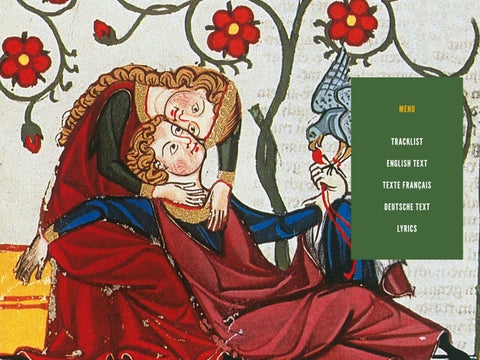
Recording Centeilles, église Notre-Dame, November 2000 Artistic direction, recording & editing: Jérôme Lejeune Pictures Konrad van Altstetten, returned from hawking, rests on his wife’s bosom, Codex Manesse, Heildeberg, Universitätsbibliothek (Cod. Pal. Germ. 848, fol. 249v), © akg-images
TROUBADOURS’ SONGS AND JONGLEURS’ DANCES
Translations English: Peter Lockwood Deutsch: Silvia Berutti-Ronelt
MILLENARIUM: CAROLE MATRAS – voice & harp CHRISTOPHE DESLIGNES – organetto THIERRY GOMAR – percussions
Anonymous [1] Dananza amorosa Thibaut de Champagne [2] Amour me fait commencer une chanson
4’18
3’07
Bernard de Ventadorn [3] Can vei la lauzeta mover
5’58
Anonymous [4] Comminciamento di goia
5’18
Bernard de Ventadorn [5] Ben m’an perdut
6’24
Gaucelm Faidit [6] Fortz chausa es
11’13
Beranguier de Palol [7] Tant m’abelis
3’00
Anonymous [8] La nova estampida real
4’22
Gaucelm Faidit [9] Jamais nuill tems [10] Lo rossinholet selvatge
5’55 8’05
Anonymous [11] Improvisation sur Quis dabit occuli mei
5’11
MENU
JOY: TROUBADOURS’ SONGS AND JONGLEURS’ DANCES
Our intention with this recording of the songs of Bernard de Ventadorn, Gaucelm Faidit and Beranguier de Palol and instrumental pieces by anonymous composers of the same period is to demonstrate our interest in the creative artistry of the troubadours and the jongleurs of the Middle Ages. Indeed, if we consider the poetry and the music of the troubadours as more a source of inspiration than an object of study, then the most interesting aspect of this recording for us as performing musicians is neither the revival of courtly love as it was then experienced, nor the performance of the songs as we may suppose that they were originally sung, but rather the sharing of what has impressed us during our discovery of the astonishing philosophy of life promoted by the totemic phrase ‘motz et sos’ (words and music). The origin of this philosophy has been the cause of much trouble and has provoked much angry discussion between musicologists, philologists and performers. Bernard de Ventadorn was, together with Guillaume of Aquitaine, the most famous of the troubadours. He was born into a poor family, the son of the man whose duty it was to stoke the fires for the bread ovens of the local castle. Bernard was lucky and was educated with the children of the family of Eble, the singer to the Viscount of Ventadour who was to be Bernard’s first patron.Ventadorn then became embroiled in a secret adulterous relationship with Marguerite de Turenne, his patron’s wife. Their adultery was eventually discovered and the Viscount dismissed Bernard and shut his wife Marguerite away. This occasion was probably the inspiration for Bernard’s song ‘Ben m’an perdut’ in which he regrets not being able to return to Ventadorn and seeks other patrons. He then presented himself to Eleanor of Aquitaine who was at that time living in Normandy. He remained in her service for some time and also had an affair with her; when Eleanor then married Henry Plantagenet, King of England, Bernard then joined the service of Raymond, Count of Toulouse, his final patron. After the Count’s death Bernard became a monk in the Cistercian Abbey in Dalon, where he later died. Bernard de Ventadorn’s most famous song is ‘Can vei la lauzeta mover’ one of the saddest in the troubadours’ entire repertory. In it, far from the delights of seduction and from courtly love, Bernard renounces both love and music. He rejects his work in desperation and chooses to live the life of a wanderer. Gaucelm Faidit’s fate was to be completely different from that of Bernard de Ventadorn; he had gambled all his possessions away and initially had to earn his living as a jongleur before finding a patron. A renowned troubadour, Gaucelm was nevertheless a very mediocre singer and also suffered from obesity. He had at one time teamed up with a beautiful and highly educated prostitute called Guillelma the Nun; they travelled together from castle to castle and she rapidly became as fat as he. Gaucelm was an indefatigable traveller and thereby earned his surname of the Exiled One (faidit in the langue d’oc); he frequented many courts in both Northern and Southern France, in Italy and in Hungary. At Poitiers, he resided at the court of Richard the Lionheart; on Richard’s death he wrote a very moving lament, the elegy for a great king Fortz chausa es tot lo maior dan. Gaucelm found his next patron in the person of the Marquis Boniface of Montferrat, who “gave him food and clothing and spoke of his great regard for the poet and for his songs”. Gaucelm took part in the Fourth Crusade and remained for an entire year in the Holy Land; he died shortly after his return to his native
MENU
Limousin. His body of work is of great interest, containing no less than seventy-five songs, of which fourteen have tunes notated with them. Very little is known about the life of Beranguier de Palol. Nine songs remain, of which eight were notated with tunes, by this Catalan troubadour who was born in the fief of the Count of Roussillon. A knight without income but nimble and skilful in all knightly pursuits, he sang of Na Maria de Peiralade and Bernard de Navata her husband. Beranguier’s songs are simple and direct in cut; they are inspired by the happiness of singing of the love that is owed to the ideal lady. We are concerned, however, not only with the beauty of the songs themselves but also with the philosophy of life and the vision of the world that is inherent in them.The renowned vidas or biographies of the troubadours tell us their names, characters and poetic values as well as their deeds; what nevertheless did the troubadours really bring to mediæval civilisation? René Nelli supplies the best answer of all to this question in the conclusion to his work on the troubadours and trouvères of France... Although none of the songs on this recording is sung complete, we have nevertheless printed the complete text of the respective poems as both a model and a reference in the booklet. Some listeners may of course disagree with the light cutting that we have carried out. Ten centuries now separate us from the troubadours; our social context differs greatly from theirs, the intended audience for these poems has long since disappeared and the very function of the songs has had to be redefined. We feel that to perform this music today demands new ideas, new sets and costumes, as it were.We have therefore planned this recording as if it were a theatrical performance. Our affinity with past ages should not prevent us from using modern means to portray a modern and personal vision of these mediæval lyrics of courtly love. The listener may perhaps be surprised to hear an estampie with an Italian title found in a London manuscript next to an arrangement of an estampie real, an improvisation on the melody of a Planctus in Latin next to a motet in manuscript from Montpellier in tablature. Our intention has been to recreate the panorama of instrumental sounds of the period as much as possible. The jongleurs of the Middle Ages passed around all types of music that had never been transcribed from all over Europe. An estampie such as Comminciamento di gioia could easily have come from the East via Northern Africa, Andalusia or Sicily before arriving in Germany or France and then going down to Milan between the 7th and 13th centuries before finally being notated in a Florentine manuscript at the end of the 14th century. After so many centuries of styles, schools and codifications of musical thought, the West now seems to be rediscovering the things that characterised its live music and that had disappeared with the arrival of modern times: oral tradition, cultural blending and cross-fertilisations. With this title of “Joy” we pay homage to the nonconformism and the unbelievable refinement of the troubadours and the jongleurs; they have passed on to us the spirit of a music that is open to the world and that perpetually renews itself at every moment. The instrumental pieces, except for the improvisation on Quis dabit oculi mei, were all preserved in different manuscripts; these are the result of a style of composition that was the transcription at one particular moment of pieces passed down through the jongleurs’ oral traditions. It is therefore extremely difficult to give them a specific provenance. The Dananza amorosa was found by miraculous chance in the binding of a volume of notarial
deeds that had been preserved in the National Library of Florence. Comminiamento di gioia comes from a famous Florentine manuscript of the 14th century that is currently in the British Library in London. The somewhat approximate writing style of this manuscript leads us to suppose that it did not make up a part of a more aristocratic repertoire, for it would then have been distributed on manuscripts prepared with great care and with much more elegant presentation. The interpretations of the Millenarium take these sources as their point of departure, their aim being to recover the spontaneity of the musicians of the Middle Ages; these earlier musicians clearly based their performances on improvisations on traditional sources. Given the transformations and additions made to the various fragments taken from two Estampie Real from the Manuscrit du Roi in the Bibliothèque nationale de Paris, we have preferred to give the piece the title of Nova estampida reale. The piece that ends this recording is an improvisation based on an anonymous Latin Planctus from the 12th century. The tramontane gales also made their presence felt in the church of Centeilles as we recorded this piece, bringing us to consider it as a most expressive partner in the recording. Christophe Deslignes
MENU
JOY : CHANSONS DE TROUBADOURS ET DANSES DE JONGLEURS Avec cet enregistrement de chansons de Bernard de Ventadorn, Gaucelm Faidit et Beranguier de Palol mêlées de pièces instrumentales de provenance indéterminée, nous avons voulu montrer quel intérêt nous portons à la sensibilité créatrice des troubadours et jongleurs de l’époque médiévale. En effet, considérant la poésie et la musique des troubadours plus encore comme une source d’inspiration que comme un objet d’étude, ce qui intéresse les interprètes que nous sommes, ce n’est pas de revivre l’amour courtois tel qu’il fut vécu ni de chanter des chansons telles qu’on suppose qu’elles furent chantées, mais plutôt de partager ce qui nous émerveille dans la découverte de l’étonnante philosophie de vie véhiculée par ce couple magique, « motz et sos » (texte et musique), dont l’origine a causé bien des soucis et provoqué tant de polémiques entre musicologues, philologues et interprètes. Bernard de Ventadorn est, après Guillaume d’Aquitaine, le plus célèbre des troubadours. Issu d’une famille pauvre, fils d’un serviteur qui a la charge de chauffer le four à pain du château, Bernard a la chance d’être éduqué au sein de la famille d’Eble le chanteur, vicomte de Ventadorn, son premier protecteur. Mais il a une relation amoureuse et secrète avec Marguerite de Turenne, épouse de son seigneur. Lorsque l’adultère est découvert, le vicomte chasse Bernard et enferme Marguerite. C’est probablement en cette occasion que le poète écrit la chanson Ben m’an perdut, où il déplore de ne pouvoir jamais plus retourner à Ventadorn et recherche d’autres protecteurs. Bernard se rend auprès d’Aliénor d’Aquitaine, qui réside alors en Normandie. Il reste quelque temps à son service, a une liaison avec elle, mais lorsqu’Aliénor épouse le roi d’Angleterre Henri Plantagenet, il se rend auprès de Raymond de Toulouse, son dernier protecteur. À la mort de ce dernier, Bernard se fait moine en l’abbaye cistercienne de Dalon. C’est là qu’il meurt. Can vei la lauzeta mover est la plus célèbre des chansons de Bernard de Ventadorn et c’est aussi l’une des plus tragiques du répertoire des troubadours. Loin des jeux de séduction de l’amour courtois, Bernard y renonce à l’amour et aux chansons, désespéré, il renie son œuvre et choisit de mener une vie d’errance. Gaucelm Faidit connaît une tout autre destinée que Bernard de Ventadorn, puisqu’après avoir perdu tous ses biens au jeu, il doit d’abord gagner sa vie comme jongleur avant de trouver un protecteur. Troubadour réputé, Gaucelm est cependant un piètre chanteur et souffre d’obésité. Il fait un temps équipe avec une prostituée très belle et très instruite du nom de Guillelma la nonne, qu’il emmène de château en château, mais elle devient vite aussi énorme que lui.Voyageur infatigable, ce qui lui vaudra le surnom d’« exilé » (faidit en occitan), Gaucelm fréquente de nombreuses cours en France d’oc et d’oïl, en Italie, en Hongrie. Il séjourne à Poitiers, à la cour de Richard Cœur de Lion, à la mort duquel il écrit une plainte très émouvante, éloge funèbre d’un grand roi, Fortz chausa es tot lo maior dan. Gaucelm trouve un bon protecteur en la personne du marquis Boniface de Montferrat, « qui lui donna des biens et des vêtements et témoigna de son estime pour le poète et ses chansons ». Il participe à la quatrième croisade, reste une année entière en Terre sainte et, de retour dans son Limousin natal, meurt peu de temps après. Son œuvre est importante, puisqu’elle comporte pas moins de soixante-quinze chansons, dont quatorze sont notées avec une mélodie. On sait peu de choses de la vie de Beranguier de Palol. Originaire du comté de Roussillon, ce troubadour catalan nous a légué neuf chansons, dont huit sont pourvues de
MENU
mélodie. Chevalier sans fortune mais adroit et habile dans l’usage des armes, il chante Na Maria de Peiralade et Bernard de Navata son époux. Les chansons de Berenguier, de facture simple et gaie, sont animées par le bonheur de chanter le service d’amour envers la dame idéale. Mais au-delà de la beauté des chansons, c’est bien de philosophie de vie et de vision du monde qu’il s’agit. On connaît donc par leurs biographies (les célèbres « vidas ») les noms, traits de caractère et valeur poétique des troubadours ainsi que leurs exploits, mais qu’ont-ils réellement apporté à la civilisation médiévale ? René Nelli a su mieux que quiconque répondre à cette question dans la conclusion de son ouvrage sur les troubadours et les trouvères... Bien qu’aucune des chansons présentes dans cet enregistrement ne soit chantée intégralement, nous avons voulu reproduire dans le livret, en tant que modèle et référence, le texte intégral de toutes les poésies choisies. Certains regretteront peut-être ces « coupes sombres ». Et pourtant ! Près de dix siècles nous séparent des troubadours. Le contexte social a bien changé, le public auquel était destinée cette poésie a disparu, la fonction même de ces chansons est à redéfinir. Or, nous pensons qu’une interprétation actuelle de cette musique nécessite une adaptation, une nouvelle « mise en scène », de nouveaux « décors », de nouveaux « costumes ». Nous avons conçu ce programme de façon théâtrale, comme un spectacle. Notre affinité avec l’état d’esprit d’une époque révolue ne nous empêche pas d’avoir recours à des moyens modernes pour finalement transmettre une vision personnelle et contemporaine de la lyrique courtoise médiévale. On s’étonnera peut-être d’entendre une estampie portant un titre italien provenant d’un manuscrit londonien aux côtés d’un arrangement d’estampie réale, d’une improvisation sur la mélodie d’un planctus en latin et d’un motet du manuscrit de Montpellier mis en tablature. Notre démarche a été de restituer le mieux possible le panorama sonore instrumental de l’époque. Les jongleurs du Moyen Âge ont fait circuler toutes sortes de musiques de tradition orale et d’origines différentes. Une estampie telle que Comminciamento di gioia a très bien pu, entre le VIIe et le XIIIe siècle, venir d’Orient, passer par l’Afrique du Nord, l’Andalousie ou la Sicile pour se retrouver en Allemagne ou en île de France et redescendre à Milan avant d’être fixée, après maintes transformations, dans un manuscrit florentin à la fin du XIVe siècle. Après tant de siècles de styles, d’écoles et de fixation de la pensée musicale, l’Occident semble redécouvrir aujourd’hui ce qui caractérisait sa musique vivante et qui avait disparu avec l’avènement des Temps modernes : tradition orale, fusion et métissages. Sous le vocable Joy, nous rendons hommage à l’anticonformisme et à l’incroyable raffinement des troubadours ainsi qu’aux jongleurs qui nous ont légué l’esprit d’une musique ouverte sur le monde, se renouvelant perpétuellement dans l’instant présent. En ce qui concerne les pièces instrumentales il s’agit, à l’exception de l’improvisation sur Quis dabit occuli mei, de pièces conservées dans des sources différentes qui, de toute évidence, sont le résultat d’une écriture qui « fige » à un moment l’existence de pièces transmises par la tradition orale des jongleurs. Il est donc très difficile de leur donner une date et une origine spécifiques. La Dananza amorosa a été miraculeusement retrouvée dans la reliure d’un volume d’actes notariés conservé à la Bibliothèque nationale de Florence. Comminiamento di gioia provient d’un célèbre manuscrit florentin du XIVe siècle, actuellement conservé à la British Library de Londres. La graphie assez approximative de ce manuscrit nous permet d’imaginer
qu’il ne fait pas partie d’une collection plus aristocratique diffusée par des manuscrits réalisés avec grand soin et luxe de présentation. Au départ de ces sources, l’interprétation de Millenarium tente de retrouver également la spontanéité des instrumentistes du Moyen Âge, dont l’activité était évidemment basée sur l’improvisation au départ de modèles transmis par la tradition. Ainsi, vu les transformations et ajouts apportés aux fragments empruntés à deux Estampie Real du Manuscrit du Roi (Bibliothèque nationale de Paris), nous avons préféré donner à cette pièce le titre de Nova estampida reale. Enfin, la pièce qui conclut ce disque est une improvisation basée sur un planctus latin anonyme du XIIe siècle. Lors de l’enregistrement de cette pièce, la « tramontane » nous avait rejoints en l’église de Centeilles. Nous l’avons donc considérée comme un partenaire expressif de cet enregistrement. Christophe Deslignes
MENU
JOY: LIEDER DER TROUBADOURS UND TÄNZE DER JONGLEURE Mit dieser Aufnahme, in der Lieder von Bernard de Ventadorn, Gaucelm Faidit und Beranguier de Palol mit Instrumentalstücken unbestimmter Herkunft abwechseln, wollten wir zeigen, wie groß unser Interesse an der schöpferischen Sensibilität der mittelalterlichen Troubadours und Jongleure ist. Für uns als Interpreten ist die Dichtung und die Musik der Troubadours mehr Inspirationsquelle als Studienobjekt, und es interessiert uns weniger, die höfische Liebe so wiederzuerleben wie sie war, noch die Lieder so zu singen, wie man annimmt, dass sie gesungen wurden, sondern wir möchten vielmehr mit unseren Zuhörern teilen, was uns bei der Entdeckung der erstaunlichen Lebensphilosophie des magischen Wortpaars „motz et sos“ (Text und Musik) so begeistert hat. Der Ursprung dieser „motz et sos“ hat Musikwissenschaftlern, Philologen und Interpreten große Kopfzerbrechen bereitet und zahlreiche Polemiken ausgelöst. Bernard de Ventdorn ist nach Guillaume d’Aquitaine der berühmteste der Troubadours. Er stammte aus einer armen Familie. Sein Vater war Diener und damit beauftragt, den Backofen für das Brot des Schlosses zu heizen. Bernard hatte das Glück, von der Familie Ebles des Sängers, Vicomte de Ventadour, der sein erster Gönner war, erzogen zu werden. Doch hatte er eine geheime Liebesbeziehung zu Marguerite de Turenne, der Frau seines Herrn. Als der Ehebruch entdeckt wurde, jagte der Vicomte Bernard fort und sperrte Marguerite ein. Zu dieser Gelegenheit schrieb der Dichter wahrscheinlich das Lied Ben m’an perdut, in dem er darüber klagt, niemals mehr nach Ventadorn zurückkehren zu können, und gleichzeitig andere Gönner sucht. Bernard begab sich daraufhin zu Aliénor d’Aquitaine, die damals in der Normandie residierte. Er blieb einige Zeit in ihrem Dienst, hatte ein Verhältnis mit ihr, doch als Aliénor den König von England, Henri Plantagenet heiratete, begab er sich zu Raymond de Toulouse, seinem letzten Gönner. Als der Graf von Toulouse starb, wurde Bernard Mönch in der Zisterzienserabtei von Dalon, wo er starb. Can vei la lauzeta mover ist das berühmteste Lied von Bernard de Vantadorn und gleichzeitig eines der tragischsten im Repertoire der Troubadours. Weit entfernt von den verführerischen Spielen der höfischen Liebe verzichtet Bernard darin auf Liebe und Lieder. Verzweifelt verleugnet er sein Werk und beschließt, ein Leben des Umherirrens zu führen. Gaucelm Faidit hatte ein ganz anderes Schicksal als Bernard de Ventadorn, denn nachdem er seinen ganzen Besitz beim Spielen verloren hatte, musste er sein Leben zunächst als Jongleur verdienen, bevor er einen Gönner fand. Obwohl Gaucelm als Troubadour einen bedeutenden Ruf genoss, war er ein schlechter Sänger und litt unter Fettleibigkeit. Er arbeitete eine Zeit lang gemeinsam mit einer sehr schönen, sehr gebildeten Prostituierten namens Guillelma die Nonne, die er mit sich von Schloss zu Schloss mitnahm, die aber bald ebenso dick wie er wurde. Gaucelm war ein unermüdlicher Reisender, was ihm den Namen „Emigrant“ („faidit“ in Okzitanisch) eintrug. Er war an zahlreichen südwest- und nordfranzösischen, italienischen und ungarischen Höfen tätig und hielt sich auch in Poitiers am Hofe von Richard Löwenherz auf, nach dessen Tod er eine sehr ergreifende Klage, ein Lob auf den großen toten König schrieb: Fortz chausa es tot lo maior dan. Gaucelm fand in der Person des Marquis Boniface de Montferrat einen guten Gönner, „der ihm Güter und Kleidungsstücke gab und dem Dichter und seinen Liedern seine Hochachtung ausdrückte.“ Er nahm am vierten Kreuzzug teil und blieb ein ganzes Jahr im Heiligen Land, starb aber bald nach seiner Rückkehr in sein Geburtsland Limousin. Sein Werk ist reichhaltig, denn es besteht aus nicht weniger als fünfundsiebzig Liedern, von denen vierzehn mit einer Melodie aufgezeichnet sind. Vom Leben Beranguier de Palol weiß man wenig. Dieser katalanische Troubadour stammte
MENU
aus der Grafschaft von Roussillon und hinterließ uns neun Lieder, von denen acht eine Melodie haben. Er war ein mittelloser Ritter, doch konnte er geschickt mit Waffen umgehen und sang das Lob von Na Maria de Peiralade und ihrem Gatten Bernard de Navata. Die Lieder von Beranguier sind einfach, fröhlich und erfüllt vom Glück, im Liebesdienst für eine ideale Dame zu singen. Doch jenseits der Schönheit dieser Lieder geht es hier um Lebensphilosophie und Weltanschauung. Man kennt durch ihre Biographien (die berühmten vidas) die Namen, Charakterzüge und dichterischen Werte der Troubadours und ihre Leistungen. Doch was haben sie tatsächlich für die mittelalterliche Kultur getan? René Nelli hat es besser als jeder andere verstanden, in der Zusammenfassung seines Werkes über die Troubadours und Minnesänger auf diese Frage zu antworten ... Obwohl keines der in dieser Aufnahme vertretenen Lieder ganz gesungen wird, wollten wir als Modell und Referenz, den gesamten Texte der gewählten Gedichte im Beiheft abdrucken. Einige unserer Zuhörer werden diese großen Striche vielleicht bedauern. Und dennoch! … Fast sechs Jahrhunderte trennen uns von den Troubadours. Der soziale Kontext hat sich geändert, das Publikum, an das sich diese Gedichte wandte, ist verschwunden, selbst die Funktion dieser Lieder muss neu definiert werden. Wir glauben also, dass eine aktuelle Interpretation dieser Musik eine Bearbeitung notwendig macht, eine neue „Inszenierung“, neue „Bühnenbilder“, neue „Kostüme“ erfordert.Wir haben dieses Programm wie eine Theateraufführung konzipiert. Unsere Hingezogenheit zur Geisteshaltung einer vergangenen Epoche hindert uns nicht, auf moderne Mittel zurückzugreifen, um eine persönlichere, zeitgenössischere Ansicht der mittelalterlichen Höflichkeit zu vermitteln. Man wird sich vielleicht auch wundern eine Estampie mit einem italienischen Titel aus einem Londoner Manuskript zu hören und daneben eine Estampie reale, eine Improvisation auf eine Melodie eines Planctus in lateinischer Sprache und eine Motette aus dem Manuskript von Montpellier, das in Tabulatur steht. Unsere Methode bestand darin, das instrumentale Klangpanorama der Epoche so gut wie möglich wiederzugeben. Die Jongleure des Mittelalters haben alle möglichen Arten von Musik der Oraltradition verschiedenen Ursprungs in Umlauf gebracht. Ein Estampie wie Comminicamento di gioia konnte zwischen dem VII. und dem XIII. Jahrhundert aus dem Orient kommen, Nordafrika, Andalusien oder Sizilien durchqueren und schließlich in Deutschland oder dem Herzen Frankreichs auftauchen, sich dann bis nach Mailand verbreiten, um nach zahlreichen Veränderungen in einem Florentiner Manuskript am Ende des XIV. Jahrhunderts aufgezeichnet zu werden. Nach all diesen Jahrhunderten verschiedener Stile, Schulen und Aufzeichnungsarten des musikalischen Denkens scheint der Okzident heute wiederzuentdecken, was seine lebendige Musik ausmachte und mit der Neuzeit verschwunden ist: Oraltradition,Verschmelzungen und Mischungen. Unter dem Begriff „Joy“ weisen wir dem Antikonformismus und dem unglaublichen Raffinement der Troubadours sowie der Jongleure die Ehre. Sie haben uns den Geist einer Musik vermacht, die gegenüber der ganzen Welt offen ist und sich im gegenwärtigen Augenblick ständig erneuert.
Christophe Deslignes
Can vei la lauzeta mover For the poet, the flight of the lark represents the joy of all those around him. His heart is nevertheless not full of joy, for she whom he loves seems to be indifferent towards him. His despair leads him to distant exile. “I refrain from singing and I renounce and draw away from all happiness and love”.
Dans cette déploration sur la mort de Richard Cœur de Lion, le poète compare ce Roi à quelques-uns des plus illustres souverains du passé : Alexandre, Charlemagne ou Arthus. L’envoi est une véritable prière dans laquelle le poète implore Dieu : « Pardonnez-lui car il en a besoin dans sa détresse ; et ne considérez pas ses péchés, mais qu’il vous souvienne comment il alla vous servir. »
L’envol de l’alouette représente, pour le poète, l’expression de la joie de tous ceux qui l’entourent. Mais son cœur n’est pas à la joie, car celle qu’il aime semble lui être indifférente. Son désespoir le conduit à l’exil lointain : « Je m’abstiens de chanter et j’y renonce et je me soustrais à la joie et à l’amour. »
In diesem Klagelied über den Tod von Richard Löwenherz vergleicht der Dichter den König mit einigen der berühmtesten Herrscher der Vergangenheit wie Alexander, Karl der Große oder Arthus. Die Zueignungsstrophe ist ein Gebet, mit dem der Dichter zu Gott fleht: „Vergib ihm, denn in seiner Not braucht er Deine Vergebung; und achte nicht auf seine Sünden, sondern denke daran, wie er Dir gedient hat.“
Der Flug der Lerche bedeutet für den Dichter einen Ausdruck der Freude für alle, die ihn umgeben. Doch sein Herz empfindet keinen Freude, denn derjenigen, die er liebt, scheint er gleichgültig zu sein. Seine Verzweiflung führt ihn in ein fernes Exil: „Ich singe nicht mehr und ich verzichte, ich entziehe mich der Freude und der Liebe“.
Ben m’an perdut Exile far from the beloved is one remedy for the pains of love. The poet evokes his distance from Ventadour with both nostalgia and bitterness, for his Lady does not love him. He compares himself to the fish that darts toward the bait without fear; his instinctive enthusiasm has cast him into the middle of a furnace. Nonetheless, he cannot forget the perfect qualities of his beloved. L’exil loin de celle qu’il aime est l’un des remèdes aux maux de l’amour. Le poète évoque avec nostalgie et amertume son éloignement de Ventadorn puisque sa Dame ne l’aime pas. Il se compare au poisson qui s’élance vers l’appât sans se douter de rien ; son élan trop instinctif l’a jeté au milieu d’une fournaise. Mais il ne peut oublier les perfections de sa bien-aimée. Das Exil fern von der, die er liebt, ist ein Heilmittel gegen das Liebesleiden. Der Dichter beschreibt voll Sehnsucht, doch mit Bitterkeit seine Entfernung von Ventadour, da ihn seine Dame nicht liebt. Er vergleicht sich mit einem Fisch der sich ahnungslos ködern lässt; sein allzu instinktiver Elan hat in mitten in eine Feuersbrunst geworfen. Doch er kann die Vollkommenheit seiner Liebsten nicht vergessen.
Fortz chausa es In this lament on the death of Richard the Lionheart, the poet compares the king to some of the most illustrious rulers of the past, including Alexander the Great, Charlemagne and Arthur. The final lines form a prayer in which the poet beseeches God to “forgive him, for he needs it in his distress; do not take his sins into account, but remember how he served you”.
MENU
Tant m’abelis There is much hope in this blossoming love. The poet celebrates the qualities of she whom he loves so much:“her earned merits, her humble air, her quiet conversation and her fair company”. Il y a beaucoup d’espoir dans cet amour naissant. Le poète célèbre les qualités de la belle tant aimée : « son mérite accompli, et son humble aspect, ses gentils propos et sa belle compagnie ». In dieser entstehenden Liebe ist viel Hoffnung. Der Dichter rühmt die Vorzüge seiner Liebsten: „ihre vollkommenen Verdienste, ihr bescheidenes Aussehen, ihre freundlichen Worte und ihre angenehme Gesellschaft.“
Jamais nuill tems The poet’s thoughts turn more optimistically towards his beloved. He is ready to forgive Love for having caused him these few moments of distress. The final lines are addressed to his Lady: “Valourous Lady, noteworthy and of good family, do not fear, for I too love you without falsity; whatever this may be, it must be what Love wishes”. Plus optimiste, la pensée du poète se tourne vers sa bien-aimée. Il est prêt à pardonner à l’amour quelques moments de détresse. C’est à elle que s’adresse l’envoi « Dame valeureuse, remarquable et de bonne lignée, n’ayez pas peur qu’ainsi moi je vous aime sans fausseté, car doit être ce qu’Amour veut qu’il soit ». Die Gedanken des Dichters wenden sich hier in optimistischerer Weise seiner Liebsten zu. Er ist bereit, Amor einige Augenblicke der Verzweiflung zu verzeihen. Die Zueignungsstrophe gilt seiner Liebsten: „Teure, bemerkenswerte Dame von edler Herkunft, fürchtet nicht meine Liebe ohne Falschheit, denn dies ist wohl, was Amor will.“
Lo rossinholet selvatge The song of the nightingale and his mate comforts the poet’s heart; he takes his consolation in song. Alas, his beloved (obviously much missed) has rejected him and commended his soul to God. This is clearly not enough to assuage his sorrow; despite the impossibility of such a relationship, the poet remains faithful to his beloved. He sends his song as a messenger “where joy has its dwelling, to my Lady who tortures me so much”. Le chant du rossignol et de sa compagne réconforte le cœur du poète qui se console en chantant. Hélas, sa bien-aimée (à regret, sans doute) l’a repoussé en le recommandant à Dieu. Mais évidemment, ceci ne suffit pas à apaiser sa douleur et malgré l’impossibilité de cette relation, le poète reste fidèle à celle qu’il aime. C’est sa chanson qu’il envoie comme messager « là où joie à sa demeure, à ma Dame qui me torture tant ». Der Gesang der Nachtigall und ihres Begleiters stärkt das Herz des Dichters, der sich mit seinem Gesang tröstet. Ach, seine Geliebte hat ihn (gewiss mit Bedauern) zurückgestoßen und Gott befohlen. Doch natürlich genügt das nicht, um seinen Schmerz zu lindern, und obwohl die Beziehung unmöglich ist, bleibt der Dichter seiner Liebsten treu. Er sendet sein Lied als Boten dorthin, „wo die Freude wohnt, an meine Dame, die mich so sehr quält.“
MENU