MENU TRACKLIST ENGLISH TEXT TEXTE FRANÇAIS DEUTSCHE TEXT
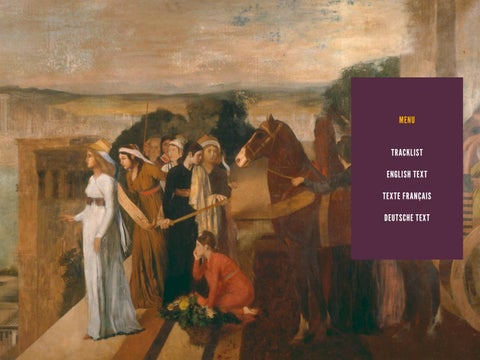
Recording Liège, Salle philharmonique, April 1993 Artistic direction, recording & editing: Jérôme Lejeune Pictures Cover: Edgard Degas, Sémiramis construisant Babylone (1860-1862), Paris, Musée d’Orsay, © akg-images / Pirozzi Translations English: Peter Lockwood Deutsch: Silvia Berutti-Ronelt
GIOACCHINO ROSSINI { 1792-1868}
OPERA OVERTURES IN TRANSCRIPTIONS FOR WIND BAND
RICERCAR ACADEMY: MARCEL PONSEELE – direction PATRICK BEUCKELS – flute JAN DE WINNE – piccolo MARCEL PONSEELE – oboe TAKA KITAZATO – oboe & cor anglais ERIC HOEPRICH – clarinet GUY VAN WAAS – clarinet TEUNIS VAN DER ZWART – horn
RAPHAËL VOSSELER – horn CLAUDE MAURY – horn & trumpet PIET DOMBRECHT – horn & trumpet MARC VALLON – bassoon JEAN-LOUIS FIAT – bassoon MICHEL MALDONADO – double bass
[1]
Il Barbiere di Siviglia
7’13
Piccolo, 2 oboes, 2 clarinets, 2 horns, 2 trumpets, 2 bassoons, double bass [2] Tancredi 6’21 Flute, oboe, 2 clarinets, 2 horns, 2 bassoons, double bass [3]
Corradino 10’11 Piccolo, 2 oboes, 2 clarinets, 2 horns, 2 trumpets, 2 bassoons, double bass
[4]
Le rendez-vous de chasse 4 horns
[5] Semiramide Piccolo, 2 oboes, 2 clarinets, 2 horns, 2 trumpets, 2 bassoons, double bass [6]
[7]
L’Italiana in Algeri Piccolo, oboe, 2 clarinets, 2 horns, 2 bassoons, double bass Guillaume Tell Piccolo, 2 oboes, 2 clarinets, 2 horns, 2 trumpets, 2 bassoons, double bass (cor anglais & flute in the Andantino)
MENU
4’39
12’34
6’45
10’46
OPERA OVERTURES IN TRANSCRIPTIONS FOR WIND BAND Rossini enjoyed an immense popularity with the public after settling in Paris and completing Guillaume Tell, his final opera. His great popular success was clearly due to his fame as an opera composer, but some measure of it was most certainly earned by the overtures to these operas, works which had rapidly become part of the normal symphonic repertoire. Even today the greatest conductors and orchestras cannot resist the pleasure of performing this music, for these pieces blend Rossini’s unique sense of humour with a certain taste for virtuosity for its own sake. Opera overtures by many composers were being performed in concerts by the end of the 18th century, although Rossini’s overtures were also transcribed for wind ensemble and therefore gained even greater opportunities for performance. The transcriptions recorded here are the work of two arrangers, William Legrand and Wenzl Sedlak. All that is known about William Legrand, who made the transcriptions of the overtures to L’Italiana in Algeri and Tancredi, is that he seems to have lived in Leipzig at the beginning of the 19th century. He employed the classical wind octet, but with one alteration — the two oboes are replaced by one oboe and one flute. Following period practice, we have also added a double bass to the ensemble to give it a more orchestral character. For the arrangement itself, we should note that Legrand retained all the original solos for flute, oboe, clarinet, French horn and bassoon in his transcription, with the melodies originally played by the strings being taken over by the flute, oboe or clarinet. Bearing in mind Legrand’s faithfulness to Rossini’s intentions, we have gone one step further and given the flute part in the L’Italiana overture to the piccolo, as Rossini himself had done in the original.The overture to Tancredi is given complete; Legrand, however, omitted several passages in the overture to L’Italiana, notably several bars at the end of the introduction and a modulatory passage in the Allegro. Wenzl Sedlak was born in Bohemia in 1776 and was a clarinettist in the wind band of Prince Aloysius of Liechtenstein; this was one of the most renowned ensembles of its type at the beginning of the 19th century.The ensemble was led by the oboist Joseph Triebensee, who had played in the orchestra that created Mozart’s Die Zauberflöte and who had himself made many transcriptions of extracts and arias from Mozart’s operas. This training was to provide Sedlak with an exceptional basis for his transcriptions of Rossini’s works: these are much more daring, with a much more orchestral conception that goes as far as including an independent double-bass part and parts for two trumpets ad libitum. The overtures to Semiramide and Guillaume Tell are works on the grandest of scales whose orchestral colours were to pose many problems for Sedlak. Many of the solutions that he found, however, do work extremely well: the drum rolls at the start of Guillaume Tell are replaced by a trill on the bassoon, creating an effect that is even more grippingly dramatic than the original. The cello solo that follows is carefully divided between the bassoon and the oboe, each instrument playing the part of the melody that lies within its range and beginning and ending their phrases in exact accord with the musical line; the colour of the cello quartet that then follows is well captured with an ensemble of clarinets and bassoons. Sedlak remains nonetheless relatively faithful to the original solos, although they are much less frequent
MENU
than in the works transcribed by Legrand. We have also made a few amendments to Sedlak’s arrangements, adding a few lines for piccolo in the tutti and restoring various solos to their original instruments as played in the orchestral versions. We have done the same in Guillaume Tell, restoring the original lines and orchestration of the Andantino for flute and cor anglais. We should here say a few words about the overture to Corradino. It is generally known that Rossini would often reuse his overtures, either in toto or in part, as occurs here. Rossini used the highly dramatic introduction with its astonishing counterpoint several times: in Ricciardo e Zoraide, in Edoardo e Cristina, and in Bianca e Faliero. Corradino is better known under its other title of Mathilde di Shabran; it too makes use of the same material, the overture consisting of the entire overture to Edoardo e Cristina except with a new second theme. As a complement to this programme we have included the Rendez-vous de Chasse, a work written during Rossini’s holidays at Rambouillet in 1828, shortly before he was to embark on Guillaume Tell. Written for four hunting horns and orchestra, the piece also exists in various transcriptions for hunting horns alone. The choice of instruments should not seem so strange if we remember the important parts written for the horn by Rossini in his various operas, such as Lindoro’s aria in L’Italiana and the overture to Semiramide. It seems that the horn was one of the instruments that Rossini had learnt to play as a child, along with the violin and the cello. We may well regard this piece as a surreptitious allusion on Rossini’s part to the more peaceful life that he was about to begin, during which he would be spoiled by his second wife Olympe Pelissier; the pleasures of the table were soon to figure highly alongside his other important affairs. A fine supper is, after all, the logical conclusion to a Rendez-vous de chasse! Jérôme Lejeune
OUVERTURES TRANSCRITES POUR INSTRUMENTS À VENT Au moment où Rossini se retire à Paris et arrête d’écrire des opéras, après Guillaume Tell, sa popularité est immense. Ce succès, il le doit certainement a ses opéras, mais aussi aux ouvertures dont l’exécution purement « symphonique » ne cessera de propager. De nos jours, les plus grands orchestres, les plus prestigieux chefs ne peuvent résister au plaisir de jouer ces pages dans lesquelles s’allient un sens du plaisir unique et un certain goût de la virtuosité de bon aloi. Ainsi que cela se pratiquait à la fin du XVIIIe siècle, ces ouvertures ont également bénéficié de transcriptions pour ensembles d’instruments à vent, ce qui augmentait en encore les possibilités d’exécution. Les transcriptions présentées ici proviennent du travail de deux arrangeurs. On sait très peu de choses de ce William Legrand qui vécut probablement à Leipzig au début du XIXe siècle. Il est l’auteur des transcriptions de L’Italiana in Algeri et de Tancredi. La formation retenue ici est celle de l’octuor classique, avec cependant une variante particulière puisque le couple de hautbois est remplacé par un hautbois et une flûte. Selon une pratique courante depuis la fin du XVIIIe siècle, nous avons ajouté à l’ensemble la contrebasse qui lui confère un caractère plus « orchestral ». En ce qui concerne le travail de transcription, il faut bien constater que William Legrand a quasiment respecté les versions originales en laissant à la flûte, au hautbois, à la clarinette, au cor et au basson les solos qui leur avaient été confiés par Rossini. Évidemment, les mélodies confiées au départ aux violons sont réparties entre flûte, hautbois et clarinette. Tenant compte de ce respect du choix des instruments solistes tel que le pratique Legrand, nous avons confié la partie de flûte de L’Italiana in Algeri au piccolo, respectant ainsi l’instrumentation originale de Rossini. Si l’ouverture de Tancredi ne comporte aucune coupure, celle de L’Italiana in Algeri est privée d’un passage à la fin de l’introduction et d’un autre passage modulant dans l’Allegro. Les autres transcriptions sont l’œuvre de Wenzl Sedlak. Né en Bohême en 1776, il fut clarinettiste de l’Harmonie du Prince Alois von Lichtenstein, l’un des ensembles les plus réputés de ce début de XIXe siècle. Cet ensemble était alors dirigé par le hautboïste Josef Triebensee ; celui-ci fit partie de l’orchestre qui créa sous la direction de Mozart La Flûte enchantée et réalisa de nombreuses transcriptions d’extraits et airs des opéras de Mozart. C’est dire si Sedlak faisait partie d’un ensemble où cette pratique héritait d’une tradition exceptionnelle. Les adaptations de Sedlak sont plus audacieuses et présentent d’ailleurs une construction plus orchestrale qui prévoit une véritable partie de contrebasse et également l’adjonction ad libitum de deux trompettes. Parmi les pièces transcrites par Sedlak se trouvent deux des plus importantes ouvertures, dont certaines caractéristiques orchestrales devaient poser des problèmes délicats pour la transcription : Semiramide et Guillaume Tell. Il faut bien reconnaître que les solutions proposées sont très habiles : le roulement de timbales du début de Semiramide est remplacé par un trille du basson (où l’effet est encore plus saisissant et dramatique). Le solo de violoncelle du début de Guillaume Tell est soigneusement réparti entre le basson et le hautbois, chacun recevant la partie de la mélodie qui convient à sa tessiture et « coupe » exactement là où la phrase musicale le permet. Quant au quatuor de violoncelles qui suit, il trouve une très belle couleur avec un ensemble de clarinettes et bassons. À part cela, Sedlak reste assez fidèle aux solos originaux, bien qu’ils soient moins fréquents que dans les ouvertures transcrites par Legrand. À nouveau, nous avons voulu apporter quelques corrections au travail de Sedlak en ajoutant l’une ou l’autre
MENU
intervention du piccolo dans les tutti et surtout en confiant à cet instrument les quelques solos prévus dans les versions originales pour orchestre. De même, dans Guillaume Tell, nous avons reconstitué les parties et l’instrumentation originale de l’Andantino, avec les solos de flûte et de cor anglais. Enfin, il convient d’apporter une petite information complémentaire sur l’ouverture Corradino. On sait que Rossini a souvent réutilisé ses ouvertures, ou différentes parties. C’est à nouveau le cas ici. L’introduction très dramatique, avec son étonnant contrepoint, fut utilisée plusieurs fois dans Ricciardo e Zoraide, dans Edoardo e Cristina ainsi que dans Bianca e Faliero. Coradino, mieux connu sous le titre de Mathilde di Shabran, reprend à nouveau ce matériel. Il s’agit ici textuellement de l’ouverture d’Edoardo e Cristina, à l’exception du second thème. En complément à ce programme figure également Le Rendez-vous de chasse, œuvre écrite en 1828 durant des vacances à Rambouillet, peu avant Guillaume Tell. Écrite pour quatre cors de chasse et orchestre, cette pièce a également connu des adaptations réservées strictement aux cors de chasse. Cette pièce ne nous étonne pas lorsque l’on sait l’importance accordée par Rossini au cor dans ses divers ouvrages (l’air de Lindoro dans L’Italiana, l’ouverture de Semiramide...) Il paraît même que le cor fut l’un des instruments qu’il apprit jouer dans son enfance, avec le violon ou le violoncelle... Ne doit-on pas y voir déjà un clin d’œil à cette vie plus paisible que le compositeur se réserverait dans les années suivantes, se laissant dorloter par sa seconde épouse, Olympe Pelissier, avec, parmi ses préoccupations importantes, celle du plaisir de la bonne table ? Or, un rendez-vous de chasse ne peut s’achever qu’avec ce plaisir… Jérôme Lejeune
OUVERTÜREN IN BEARBEITUNGEN FÜR BLÄSERENSEMBLE Als sich Rossini in Paris ins Privatleben zurückzieht und nach Wilhelm Tell aufhört, Opern zu komponieren, ist seine Popularität ungemein groß. Diesen Erfolg verdankt er zweifellos seinen Opern, aber auch den Ouvertüren, die durch den Konzertbetrieb immer bekannter wurden. Auch heute können die größten Orchester wie die berühmtesten Dirigenten nicht widerstehen, diese Kompositionen zu spielen, in denen ein einzigartiger Sinn für das Vergnügen und eine gewisse Vorliebe für eine beachtliche Virtuosität Hand in Hand gehen. Wie es gegen Ende des 18. Jahrhunderts für die Werke zahlreicher Komponisten üblich war, so wurden auch diese Ouvertüren für Blasinstrumente bearbeitet, was die Aufführungsmöglichkeiten für sie noch erhöhte. Die hier dargebotenen Transkriptionen stammen von zwei Bearbeitern. Über William Legrand, der wahrscheinlich zu Beginn des 19. Jahrhunderts in Leipzig lebte, weiß man sehr wenig. Er ist der Autor der Transkriptionen der Italienerin in Algier und des Tancredi. Die hier gewählte Besetzung ist ein klassisches Oktett, jedoch mit einer besonderen Variante, da die beiden Oboen durch eine Oboe und eine Flöte ersetzt wurden. Wie es seit dem Ende des 18. Jahrhunderts üblich war, haben wir zu diesem Ensemble einen Kontrabass hinzugefügt, der dem Ganzen einen „orchestraler“ klingenden Charakter verleiht. Was die Transkriptionsarbeit betrifft, so kann man feststellen, dass William Legrand praktisch alle Solos respektiert hat, die in den Originalfassungen der Flöte, der Oboe, der Klarinette, den Hörnern oder dem Fagott anvertraut sind. Die zu Beginn den Geigen zukommenden Melodien wurden natürlich auf die Flöten, Oboen oder Klarinetten aufgeteilt. Wir folgten Legrands Beschluss, die Wahl der Soloinstrumente zu respektieren, und vertrauten die Flötenstimme der Italienerin in Algier der Piccoloflöte an, so wie es Rossini selbst getan hatte. Während die Tancredi-Ouvertüre keine Striche aufweist, wurde hingegen die Italienerin um eine Stelle am Ende der Einleitung und eine modulierende Stelle im Allegro gekürzt. Die anderen Transkriptionen sind das Werk Wenzl Sedlaks. Der 1776 in Böhmen geborene Musiker war Klarinettist der Militärkapelle des Prinzen Alois von Lichtenstein. Dieses Ensemble war zu Beginn des 19. Jahrhunderts eines der berühmtesten und wurde zu dieser Zeit vom Oboisten Josef Triebensee geleitet; dieser gehörte zum Orchester, das unter der Leitung Mozarts die Zauberflöte uraufführte, und schrieb zahlreiche Transkriptionen von Ausschnitten und Arien aus Mozartopern. Das bedeutet, dass Sedlak Mitglied eines Ensembles war, in dem das Transkribieren auf außergewöhnlichen Grundlagen beruhte. Die Bearbeitungen Sedlaks sind gewagter und haben übrigens auch eine orchestralere Konstruktion mit einem echten Kontrabasspart sowie zwei ad libitum hinzugefügten Trompeten. Unter den von Sedlak transkribierten Stücken befinden sich zwei der bedeutendsten Ouvertüren, bei denen gewisse orchestrale Charakteristiken heikle Probleme für die Transkription aufwerfen mussten: Semiramis und Wilhelm Tell. Man muss jedoch anerkennen, dass die vorgeschlagenen Lösungen sehr gelungen sind: Der Paukenwirbel zu Beginn der Semiramis-Ouvertüre wird durch einen Triller des Fagotts ersetzt (der einen noch ergreifenderen dramatischeren Effekt erzielt). Das Cellosolo zu Beginn von Wilhelm Tell wird
MENU
sorgfältig zwischen dem Fagott und der Oboe aufgeteilt, wobei jedes Instrument den Teil der Melodie erhält, der seiner Tonlage am besten entspricht, und die Instrumente einander genau dort „ablösen“, wo es die musikalische Phrasierung erlaubt. Was das darauffolgende Celloquartett betrifft, so erhält es durch ein Klarinetten- und Fagottenensemble eine sehr schöne Klangfarbe. Abgesehen davon, bleibt Sedlak den Originalsolos ziemlich treu, obwohl sie weniger häufig sind als in den von Legrand transkribierten Ouvertüren. Auch hier wollten wir an der Arbeit Sedlaks einige Korrekturen vornehmen, indem wir an Tuttistellen manchmal die Piccoloflöte zu Wort kommen ließen und diesem Instrument vor allem jene Solos anvertrauten, die dafür in den Originalfassungen für Orchester vorgesehen sind. Außerdem haben wir in Wilhelm Tell die Teile und die Originalinstrumentierung des Andantinos mit Flöte und Englischhorn wiederhergestellt. Schließlich möchten wir Sie zusätzlich kurz über die Corradino-Ouvertüre informieren. Es ist bekannt, dass Rossini seine Ouvertüren oder verschiedene Stellen daraus häufig wiederverwendete. Das ist auch hier der Fall. Die sehr dramatische Einleitung mit ihrem erstaunlichen Kontrapunkt wurde mehrere Male benutzt, in Ricciardo e Zoraide, in Edoardo e Cristina sowie in Bianca e Faliero. Coradino, ein Werk, das unter dem Titel Mathilde di Shabran bekannter ist, nimmt erneut dieses Material auf. Es handelt sich hier abgesehen vom Seitenthema genau um die Ouvertüre von Edoardo e Cristina. Zur Ergänzung dieses Programms enthält die vorliegende CD auch das Rendezvous de chasse, ein 1828 während des Urlaubs in Rambouillet kurz vor Wilhelm Tell geschriebenes Werk. Von diesem für vier Jagdhörner und Orchester komponierten Stück gibt es auch Bearbeitungen, die nur den Jagdhörnern vorbehalten sind. Das sollte uns nicht in Erstaunen versetzten, da es bekannt ist, welch große Bedeutung Rossini dem Horn in seinen verschiedenen Werken (in der Arie des Lindoro in der Italienerin, in der SemiramisOuvertüre usw.) beimisst. Angeblich hat er sogar in seiner Kindheit neben dem Geigen- und dem Cellospiel auch gelernt, dieses Instrument zu spielen ... Konnte man darin nicht bereits eine Anspielung Rossinis auf das friedlichere Leben sehen, das er sich in den folgenden Jahren vorbehalten sollte, indem er sich von seiner zweiten Frau, Olympe Pelissier, verwöhnen ließ, wobei die Freuden einer guten Küche zu seinen Hauptbeschäftigungen zählten. Schließlich kann ein „rendez-vous de chasse“ nur mit diesen Freuden enden! Jérôme Lejeune