MENU TRACKLIST ENGLISH TEXT TEXTE FRANÇAIS DEUTSCHE TEXT
This recording was made with the support of the Fédération Wallonie-Bruxelles (Direction générale de la Culture, Service de la Musique). Recording Bolland, église Saint-Apollinaire, May 2005 Artistic direction, recording & editing: Jérôme Lejeune
LUIGI BOCCHERINI { 1743-1805}
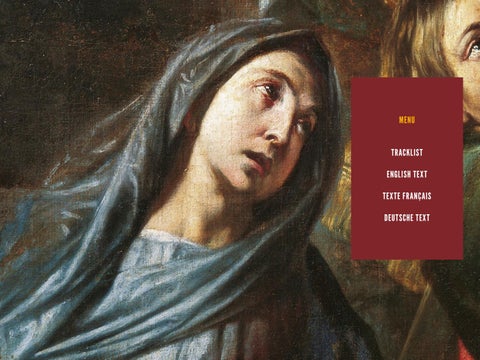
Pictures Cover: Cornelius Schut (1507-1655), La descente de Croix, Liège, Musée d’art religieux et d’art mosan.
STABAT MATER
Translations English: Peter Lockwood Deutsch: Silvia Berutti-Ronelt
SOPHIE KARTHÄUSER – soprano LES FOLIES FRANÇOISES: PATRICK COHËN-AKENINE – violin LEONOR DE RECONDO – violin MICHEL RENARD – viola FRANÇOIS POLY – cello HERVÉ DOUCHY – cello (Stabat Mater) WIELAND KUIJKEN - direction
Quatuor in G minor op. 24 no. 6, G. 194 [1] Allegro vivo assai 6’56 [2] Soave 5’03 [3] Minuetto 4’40
Stabat Mater dolorosa Iuxta crucem lacrimosa Dum pendebat Filius. Cujus anima gementem
Stabat Mater, G. 532 Contristatam et dolentem [4] [In loco introduzione]: Larghetto (Quintette op. 11 no. 4) 4’57 Pertransivit gladius [5] Stabat Mater dolorosa (Grave assai) 4’44 O quam tristis et afflicta [6] Cujus animam gementem (Allegro) 1’54 Fuit illa benedicta [7] Quae moerebat et dolebat (Allegro con moto) 2’28 Mater Unigeniti! [8] Quis est homo (Adagio assai / recitativo) 1’11 [9] Pro peccatis suae hentis (Allegretto) 3’37 Quae moerebat et dolebat [10] Eja mater, fons amoris (Larghetto non tanto) 5’51 Et tremebat, cum videbat [11] Tui nati vulnerati (Allegro vivo) 4’18 Nati poenas inclyti. [12] Virgo virginum praeclara (Andantino) 5’01 [13] Fac ut portem Christi mortem (Larghetto) 2’28 Quis est homo non fleret [14] Fac me plagis (Allegro comodo) 2’28 Christi Matrem si videret [15] Quando corpus morietur (Andante lento) 3’42 In tanto supplicio?
Quis non posset contristari Piam matrem contemplari Dolentem con Filio? Pro peccatis suae gentis Vidit Iesum in tormentis Et flagellis subditum. Vidit suum dulcem Natum Morientem, desolatum, Dum emisit spiritum.
MENU
LUIGI BOCCHERINI: STABAT MATER Fifty trios, one hundred quartets, some two hundred quintets with two cellos or two violas, with piano, with flute and oboe, with guitar, fifteen sextets and octets and thirty symphonies all combine to make up such a large body of instrumental music that it has put Boccherini’s sizeable collection of vocal works into the shade. The composer himself must have classed many of these works as occasional pieces, for he did not take the trouble to include many of them in the catalogue of works that he had kept with his own hand from 1760, even if it was only to help him draw up his contracts with his publishers. No vocal work by Boccherini was published during his lifetime, with the exception of the second version of the Stabat Mater that was entered in his personal catalogue as op. 61 in 1800; it bore the annotation “opera grande”, which, in the composer’s usage, signifies a piece worked out on a large scale. The first version that we present on this recording did not have the honour of appearing in the catalogue and therefore remained private. The reworking of the work for three voices (two sopranos and tenor), two violins, viola, cello and double bass allowed Boccherini to reveal a little of how the first version for soprano solo and string quintet with two cellos came to be composed. A note in Italian on the autograph manuscript of the second version in the Bibliothèque nationale de France in Paris states that ‘the author wrote this piece for solo voice at the request of the Infante don Luigi in 1781. In order to avoid monotony and overtiring the singer he then rearranged it for three voices without changing any of the musical text’. This last sentence is not exactly correct, even if the changes that he brought to the piece were minor. Another note engraved on the title page of the edition that Sieber, after Amiconi in Naples in 1801, published in Paris in 1802 or 1803, reads ‘Note: this Stabat Mater is easy to perform and demands neither a large orchestra nor a large concert hall. The composer simply desires pure artlessness and accuracy’. The idea of the piece being easy to perform comes straight from the publisher’s marketing strategy; the composer’s wish for accuracy mirrors his well-known demands for perfect performance of all the markings that Boccherini incorporated into a score: travellers and other musicians who met or worked with him such as the violinists Viotti and Jean-Baptiste Cartier all vouch for this. The spurning of a large orchestra and concert hall underlines the composer’s wish to retain the chamber music atmosphere of his music and not an operatic or concert ambiance; it was this desire for simplicity that had justified the composition of the first version and that Boccherini intended to preserve in the second. The writing in general of the Stabat Mater for solo voice displays a successful amalgamation of the solo voice into the musical texture of the quintet, transforming it more into a perfect sextet rather than a cantata or chamber opera for soloist with string orchestra accompaniment, both of which options would have guaranteed a certain monotony. It seems as if Boccherini had borrowed techniques for structuring movements and dramatic and lyrical writing from these two forms, manipulating them into his own system of composing chamber works; each instrument in turn is given passages of solo work, accompaniment, doubling and counterpoint in order to increase the richness of sound and expression of the ensemble, be it instrumental or vocal. The eleven numbers of Boccherini’s Stabat Mater make use of the complete text as
MENU
attributed to the Franciscan monk Jacopone da Todi (d.1306).The text depicts Mary’s sorrow at the foot of the Cross as she relives the agony of her son the Christ, as well as a meditation of the believer on the great suffering that Christ endured for the believer’s salvation and that the believer intends to share before gaining the glory of being one of the elect in Paradise alongside Mary. Boccherini has respected the three-line verse form in the work’s formal construction, allowing him to insert instrumental sequences between the soloist’s entries in the middle of a verse as well introductory and concluding ritornelli for each number; all of the above factors combine to create a real balance between the solo voice and the instruments. The composer has also linked verses together in several places: the no. 2 Cuius animam (allegro) is constructed on the repetition of the three lines of a verse and is immediately followed by the verse “O quam tristis” that is presented as a brief adagio passage without repetition. Nos. 3, 4 and 5 form a large-scale unit that is full of contrast: no. 4 Quis es homo (adagio assai) is a free and highly dramatic accompanied recitative that expresses the deep sorrow of Christ’s mother. It is framed by two Allegretto movements, no. 3 Quam moerebat and no. 5 Pro peccatis that both have more traditional structures with identical introductory and concluding ritornelli and with similar themes for the strings and the solo voice; this same technique is also used in other numbers. New contrast is introduced in no. 6 Eja mater (larghetto non tanto), with its borrowings from the concerto style as seen in the exposition of a theme on the solo cello that is then taken up by the soprano who also ventures upon a short cadenza. In no. 7 Tui nati vulnerati (allegro vivo) the three verses that express the desire of the faithful to share in Mary’s sufferings are structured into a real da capo aria; the central largo to the text of the middle verse precedes the return of an allegro assai that is musically identical to the first allegro but set to the words “Juxta crucem” of the third of the verses. No. 8 Virgo virginum (andantino) is a real opera aria accompanied by pizzicati on the first cello. It of course reflects a certain type of religious expression common at the end of the 18th century, but without ever exceeding the limits of great expressive restraint: there are few ornaments, no vocalises, a shortened cadenza and a long introductory and concluding ritornello for the strings to stress the ‘sobriety’ requested by the composer. Discreet vocalises are introduced in no. 9 Fac ut portem (larghetto) and are skilfully divided between the soloist (on the word “plagas”, wounds and sufferings) and the first violin. No. 10 Fac me plagis (allegro comodo) is undoubtedly the most contrapuntal number of the score, with entries in canon from the instruments and the solo voice that unite at the end to introduce the final movement. This no. 11 Quando corpus (andantino lento) is in two extended repeated sections that precede a short closing “Amen”; it returns to the key of F minor and the tragic expression of the very beginning of the Stabat Mater. Should we attribute the intense emotion that we feel when we listen to these two outer movements to the use of the minor key, seen as it was as an expression of torment? The theories current during the 17th century and the beginning of the 18th century on the possibilities of music imitating nature and the movements of the human soul as well as belief and the energy of the modes were beginning to be seriously questioned. Boccherini had never displayed any great attraction for imitative music, even if he sometimes took pleasure in musical portrayals of the twittering of a cage of birds, the sounds heard in the streets of Madrid at night or the sharply repetitive sound of a Jew’s harp. Up to what point did he accept the expressive potentialities of each key as laid down by Marc-Antoine Charpentier
or Jean-Philippe Rameau? We may simply say that when Boccherini used a minor key, it was in a slow movement that the supposed expressive characteristics of the key were displayed the clearest. Neither did he hesitate to place such a movement at the start of a piece, for its gravely tormented and feverishly melancholic character could not fail to impress and move the listener. * Such is the first movement (larghetto) of the 10th String quintet with two celli in F minor op. 11 no. 4 (1771); the musicians involved with this recording have chosen to use it as an introduction to the version of the Stabat Mater for solo voice (1781), as a counterpart to what Boccherini was to do twenty years later when he published the second version of his work. At that time he introduced the first movement of his Symphony in F major op. 35 no. 4 (1782) as an overture to the work, undoubtedly wishing to give a more theatrical aspect to this new version of the Stabat Mater by using the marked contrast between the major key of a movement in rapid tempo and lively in character and the minor key of the 1781 Grave assai that had become an adagio flebile which plunged the listener suddenly into the agonies of suffering expressed by the text. The first appearance of a theme that ascends by degrees from the bass register in this Larghetto, as if coming out of nowhere, emphasises the expressive power of the key of F minor. The second appearance of the same element leads to the statement of a lyrical theme that is extensively developed by the first violin. A solo given to the two solo cellists successively precedes the restatement of the themes, partially modified, of the first section. The melancholic lyricism of the themes given to the solo instruments and the expectatory character of the key of F minor prepare the listener for the weight proper to a Stabat Mater. * Composed in 1777, the Quartet op. 24 no. 6 is also in a minor key, a G minor that the composer seems to delight in exploring at the beginning of the initial Allegro vivo assai. Throughout the first movement the first violin carries the extremely supple thematic material, sometimes supported by an accompaniment and sometimes punctuated with accents, syncopations and off-beats, as if this perpetual melody had to shape itself or be confronted with the influences of the different emotions expressed in the music.The Adagio in B flat major sets out an initial thematic cell in the two violins; this theme will guarantee the violins’ supremacy throughout the movement and will regularly stress the flow of a musical argument that remains highly lyrical and also greatly contrasted in the choice of musical material that is attached to the thematic cell. Ornaments and short cadenza-like passages reinforce this impression of the wanderings of thoughts lost in dreams. A Minuetto in G minor with a trio in G major closes the quartet according to Italian tradition, adopting the usual binary structure for each section. Boccherini, as he does often in his minuets, amuses himself by introducing some small surprise; here it is the harmonies that waver around G minor before the surprise reappearance of the minuet theme. A small coda-like cadenza in the Trio precedes the reappearance of the minuet proper.
MENU
* The Quartet, Quintet and the Stabat Mater were all composed for the Infante don Luis, the younger brother of King Charles IV of Spain, who had engaged Boccherini as “musicien et compositeur de sa Chambre” in Aranjuez on 8 November 1770. The Larghetto in F minor from his op. 11 (1771) is from one of the first volumes of quintets with two cellos that were composed for the Infante. Boccherini then became part of the quartet formed by the Font family who were also in the Prince’s service. The Prince was still a bachelor at that time and followed the seasonal shiftings of the Court around the royal residences of Madrid, Aranjuez and La Granja, where all of Boccherini’s new compositions were undoubtedly performed. The Quartet op. 24 (1777) was probably one of the first pieces to be composed shortly after the Infante’s marriage on June 27 1776 and subsequent installation in the small town of Las Arenas de San Pedro; a small court was then constituted around the royal couple in semiexile, in which musical activities seem to have played an important role. It was there that the Stabat Mater was commissioned and performed in 1781, in the intimacy of a newly-furnished palace, and possibly on Good Friday, in commemoration of the Passion of Christ according to an ancestral tradition that dated back to the 14th century, or on the feast day of Our Lady of the Seven Sorrows, celebrated on 15 September from 1727 onwards. The many editions of the quartets and quintets engraved whilst Boccherini was still alive are clear proof of the great esteem in which he was held by music lovers and the “vrais connaisseurs de la musique”, as can be seen from various dedications. There is, however, no account of how the single performance of the first version of the Stabat Mater was received; Sieber, who published the second version, then opportunely reminded the public that he had also published the Stabat Mater by Pergolesi and Haydn as well as Haydn’s Sieben letzen Worte unseres Erlösers am Kreuze. Today’s listener cannot fail to hear how many connections there are between these works. Yves Gérard
LUIGI BOCCHERINI : STABAT MATER Une cinquantaine de trios, une centaine de quatuors, quelque deux cents quintettes avec deux violoncelles ou deux altos, avec piano, avec flûte ou hautbois, avec guitare, une quinzaine de sextuors et octuors et une trentaine de symphonies laissés par Boccherini constituent un ensemble de musique instrumentale d’une telle ampleur qu’il a relégué dans l’ombre le corpus non négligeable de ses œuvres de musique vocale. Le compositeur lui-même dut voir en ces pages des compositions de circonstance car il ne prit pas la peine de les inclure dans le catalogue autographe de ses compositions tenu fidèlement depuis 1760, ne fût-ce que pour l’aider à rédiger des contrats avec les éditeurs. De fait, aucune œuvre vocale de Boccherini ne fut publiée de son vivant, à l’exception de la seconde mouture du Stabat Mater incluse dans son catalogue personnel à l’année 1800 comme op. 61, avec la mention « opera grande », ce qui, dans la terminologie de l’auteur, signifie une œuvre largement développée. La première version présentée ici n’eut pas l’honneur d’être répertoriée et resta donc confidentielle. Le réaménagement de l’œuvre pour trois voix (deux sopranos et un ténor), deux violons, alto, violoncelle et contrebasse donna l’occasion à Boccherini de jeter quelque lueur sur les circonstances de la création de cette première version pour soprano solo et quintette à cordes avec deux violoncelles. Une note, en italien, sur le manuscrit autographe de la seconde version conservé à la Bibliothèque nationale de France à Paris précise que « l’auteur a écrit cette œuvre à la demande de l’infant don Luigi en 1781 pour une seule voix. Mais pour éviter toute monotonie et une trop grande fatigue pour la chanteuse, il l’a arrangée pour trois voix sans rien changer au texte ». Cette dernière remarque n’est pas tout à fait exacte, même si les changements sont mineurs. Une autre note gravée sur la page de titre de l’édition que Sieber, après Amiconi à Naples en 1801, fit paraître à Paris, probablement en 1802, ou peut-être en 1803, indique : « (Nota) : Ce Stabat Mater est d’une exécution facile et n’exige point un grand orchestre ni grand local. L’auteur désire la pure naïveté et l’exactitude. » L’exécution facile est tirée de l’argumentaire commercial de l’éditeur. L’exactitude, elle, reflète les exigences bien connues de parfaite exécution de toutes les indications mises sur une partition, imposées par Boccherini et que rapportent les voyageurs et les artistes qui rencontrèrent ou travaillèrent avec lui, tels les violonistes Viotti et Jean-Baptiste Cartier. Le refus d’un grand orchestre et d’un grand local souligne la volonté du compositeur de conserver l’esprit de musique de chambre, non d’opéra ou de concert, qui avait justifié la réalisation de la première version et qu’il entendait bien maintenir dans la seconde. De fait, l’écriture générale de ce Stabat Mater avec une seule voix montre l’insertion réussie de la voix soliste dans la texture musicale du quintette, le transformant plutôt en parfait sextuor qu’en cantate ou opéra de chambre pour soliste avec accompagnement de cordes, ce qui eût entraîné effectivement une vraie monotonie. Tout se passe comme si Boccherini avait emprunté à ces deux genres des procédés de structuration des mouvements, et d’écriture dramatique et lyrique, pour les plier à son système habituel de composition d’œuvres de musique de chambre où chaque instrument se voit confier tour à tour les rôles de soliste, d’accompagnateur, de doublure, de contrepoint pour nourrir la richesse sonore et expressive de l’ensemble, qu’il soit instrumental ou vocal. Les onze numéros du Stabat Mater de Boccherini regroupent l’intégralité du texte attribué au frère franciscain Jacopone da Todi, mort en 1306. Ce texte
MENU
dépeint successivement la douleur de Marie au pied de la Croix, revivant les affres de la mort du Christ son fils, et la méditation du croyant devant tant de souffrances endurées pour son propre salut et qu’il entend partager avant d’obtenir la gloire d’être un élu du Paradis auprès de Marie. Dans l’ensemble, Boccherini a respecté la structure du texte en petites strophes de trois vers, ce qui lui permet d’insérer des séquences instrumentales entre les interventions du soliste à l’intérieur d’une strophe, en plus des ritournelles d’introduction et de conclusion de chaque numéro, tout ceci contribuant à instaurer un équilibre entre les présences de la voix et des instruments. Dans quelques cas, le compositeur a regroupé les strophes. Ainsi, le no 2 (allegro), Cujus animam, construit sur la répétition des trois vers d’une strophe, se voit suivi immédiatement par la strophe « O quam tristis » présentée sous forme d’un bref récitatif adagio, sans répétition. Les nos 3, 4 et 5 forment un grand ensemble contrasté : le no 4 (adagio assai), Quis es homo, libre et très dramatique récitatif accompagné traduisant l’excès de douleur de la mère de Jésus, est encadré par deux allegretti, le no 3, Quam moerebat, et le no 5, Pro peccatis, aux structures plus traditionnelles, avec ritournelles identiques d’introduction et de conclusion et aux thèmes similaires pour les cordes et la voix, comme dans d’autres numéros d’ailleurs. Nouveau contraste avec le no 6 (larghetto non tanto), Eja mater, qui emprunte au genre du concerto avec l’exposé d’un thème au violoncelle solo, repris par la soprano qui peut hasarder une brève cadence de soliste. Dans le no 7 (allegro vivo), Tui nati vulnerati, les trois strophes exprimant le désir du fidèle de partager les souffrances de Marie forment la structure d’un véritable aria da capo, avec un larghetto central sur le texte de la seconde strophe, avant la reprise d’un allegro assai musicalement identique au premier allegro mais sur les paroles de la troisième strophe, « Juxta crucem ». Quant au n°8 (andantino), Virgo virginum, véritable air d’opéra accompagné par les pizzicati du premier violoncelle, il reflète, certes, un certain aspect de l’expression religieuse à la fin du XVIIIe siècle, mais sans dépasser jamais les limites d’une grande retenue expressive : peu d’ornements, pas de vocalises, cadence limitée, longue ritournelle des cordes au début et à la fin pour assurer la « sobriété » voulue par l’auteur. C’est dans le no 9 (larghetto), Fac ut portem, que sont introduites de discrètes vocalises habilement réparties entre la soliste et le premier violon sur le mot « plagas » (plaies et souffrances). Le no 10 (allegro comodo), Fac me plagis, est sans doute le numéro le plus contrapuntique de la partition avec les entrées en canon des instruments et de la voix, qui se réunissent à la fin pour introduire l’ultime mouvement. Ce no 11 (andantino lento), Quando corpus, en deux grands volets répétés, avant un bref « Amen » conclusif, retrouve la tonalité de fa mineur et l’expression tragique du Stabat Mater initial. Faudrait-il attribuer à cette tonalité mineure, perçue comme expression du tourment, l’émotion intense éprouvée à l’audition de ces deux mouvements extrêmes ? Les théories des XVIIe et début XVIIIe siècles sur les possibilités de la musique d’imiter la nature et les mouvements de l’âme de la nature humaine ainsi que la croyance en l’énergie des modes commençaient à être sérieusement remises en question. Boccherini n’a jamais manifesté une grande attirance pour la musique imitative, même s’il s’est plu quelquefois à traduire en musique les pépiements d’une volière d’oiseaux, les bruits nocturnes entendus dans les rues de Madrid ou les sons répétitifs et aigrelets d’une guimbarde... Et jusqu’à quel point acceptait-il encore les virtualités expressives de chaque tonalité telles qu’elles avaient été plus ou moins codifiées par Marc-Antoine Charpentier ou Jean-Philippe Rameau ? On peut simplement dire que, lorsque Boccherini adopte une tonalité mineure, c’est dans le mouvement lent que les « caractéristiques expressives » supposées de cette tonalité se
manifestent le plus nettement. Et il n’hésite donc pas à le placer souvent en tête de l’œuvre, avec un caractère grave, tourmenté, mélancolique, fiévreux qui ne peut manquer d’impressionner et d’émouvoir l’auditeur. * C’est le cas du Larghetto, premier mouvement du 10e Quintette avec deux violoncelles, en fa mineur, op. 11 no 4 de 1771, que les interprètes du présent enregistrement ont choisi de placer en exergue de la version du Stabat Mater pour voix seule de 1781, pendant de ce que Boccherini fera vingt ans plus tard en publiant la seconde version de l’œuvre. Il y introduira, en guise d’ouverture de l’ouvrage, le premier mouvement de la Symphonie en fa majeur op. 35 no 4 de 1782, voulant sans doute donner un aspect plus théâtral à cette nouvelle mouture du Stabat Mater en jouant sur l’opposition marquée entre la tonalité majeure d’un mouvement de tempo rapide et d’esprit vif et la tonalité mineure du Grave assai de 1781 devenu un Adagio flebile plongeant brusquement l’auditeur dans les affres de la souffrance exprimée par le texte. Dans ce Larghetto, la première apparition d’un élément thématique ascendant, aux degrés conjoints, dans le registre grave, comme venu du néant, affirme le pouvoir expressif de la tonalité de fa mineur. La seconde apparition de ce même élément conduit à l’exposition d’un thème lyrique longuement développé par le premier violon. L’insertion d’un solo, confié successivement à chacun des deux violoncelles, précède la réexposition des éléments, parfois modifiés, de la première partie. Le lyrisme mélancolique des thèmes confiés aux soli et la prégnance de la tonalité de fa mineur préparent l’auditeur à la gravité attendue du Stabat Mater. * Composé en 1777, le Quatuor op. 24 no 6 est, lui aussi, dans une tonalité mineure, celle de sol, que le compositeur semble se complaire à explorer au début de l’Allegro vivo assai initial. Tout au long de ce mouvement, le premier violon assure l’essentiel d’une thématique très souple, tantôt soutenue par un accompagnement régulier, tantôt ponctuée d’accents, de syncopes, de contretemps, comme si ce chant perpétuel devait se mouler ou se confronter aux mouvances de l’expression de sentiments variés. L’Adagio, en si bémol majeur, propose une cellule initiale, confiée aux deux violons, qui affirmera leur prédominance pendant tout le morceau et scandera régulièrement l’organisation d’un discours toujours lyrique et très contrasté dans le choix des matériaux accolés à cette cellule : ornements et petits traits de cadence viendront conforter cette impression de vagabondage d’une pensée rêveuse. Un Minuetto en sol mineur, avec son trio en sol majeur, clôt le quatuor, selon une tradition italienne, et adopte la structure habituelle en deux parties pour chacune des sections du mouvement. Mais Boccherini se plaît, comme souvent dans ses menuets, à introduire quelques surprises, comme ce flottement d’accords autour de sol mineur avant la surprise de la réapparition du thème du menuet. Et, dans le trio, l’insertion d’une petite coda-cadence précède la réintroduction du menuet. * Quatuor, Quintette et Stabat Mater furent composés pour l’infant don Luis, frère cadet du roi Charles IV d’Espagne, qui avait engagé Boccherini comme « musicien et compositeur de sa Chambre », le 8 novembre 1770, à Aranjuez. Le Larghetto en fa mineur de l’opus 11, composé en
MENU
1771, fait partie des tout premiers recueils de quintettes avec deux violoncelles écrits pour l’infant. Boccherini s’intégrait alors au quatuor formé par la famille Font, également au service du prince qui, encore célibataire, suivait les déplacements saisonniers de la cour dans les résidences royales de Madrid, d’Aranjuez ou de la Granja, où furent sans nul doute exécutés tous les nouveaux ouvrages de Boccherini. Le quatuor de l’opus 24 de 1777 fut, lui, très probablement l’une des premières œuvres écrites après le mariage de l’infant, le 27 juin 1776, et l’installation dans la petite ville de Las Arenas de San Pedro où, autour du couple princier en semi-exil, devait se reconstituer une petite cour, au profit de laquelle les activités musicales semblent avoir joué un rôle important. C’est là que fut donc commandé et exécuté le Stabat Mater en 1781, dans l’intimité d’un palais nouvellement aménagé, peut-être à la date du Vendredi saint, au moment de la commémoration de la Passion du Christ, selon la tradition ancestrale remontant au XIVe siècle, ou lors de la fête de Notre-Dame des Sept Douleurs célébrée le 15 septembre depuis 1727. Les nombreuses éditions des quatuors et quintettes gravés du vivant de leur auteur témoignent de la grande estime en laquelle les amateurs et « vrais connaisseurs de musique », comme le précisent certaines dédicaces, tenaient Boccherini. On ne sait rien de l’accueil que put recevoir ce qui semble avoir été l’unique exécution du Stabat Mater de Boccherini dans sa version avec voix solo. Mais Sieber, en publiant la seconde version, rappela opportunément qu’il éditait aussi le Stabat Mater de Pergolèse et celui de Haydn ainsi que Les sept dernières paroles de Jésus-Christ du même Haydn. C’est le rapprochement que ne peut manquer de faire l’auditeur d’aujourd’hui. Yves Gérard
LUIGI BOCCHERINI: STABAT MATER An die fünfzig Trios, etwa hundert Quartette, um die zweihundert Quintette mit zwei Celli oder zwei Bratschen, mit Klavier, mit Flöte oder Oboe, auch mit Gitarre, an die fünfzehn Sextette und Oktette sowie etwa dreißig Symphonien hat uns Boccherini hinterlassen. Diese Werke der Instrumentalmusik sind so zahlreich, dass sie seine nicht unerhebliche Vokalmusik in den Schatten stellen. Der Komponist selbst dürfte seine Vokalmusik für Gelegenheitswerke gehalten haben, da er sie nicht in seinen eigenhändig verfassten Werkkatalog aufnahm, obwohl er diesen seit 1760 getreu führte, sei es auch nur zum Zweck, ihn beim Verfassen der Verträge mit seinen Verlegern zu Hilfe zu ziehen. Tatsächlich wurde zu Boccherinis Lebzeiten keines seiner Vokalwerke veröffentlicht, mit Ausnahme der zweiten Fassung des Stabat Mater, das in seinem persönlichen Katalog im Jahre 1800 als op. 61 mit dem Vermerk „Opera grande“ verzeichnet ist, was in der Terminologie des Autors bedeutet, dass es sich um ein umfangreiches Werk handelt. Die hier dargebotene erste Fassung hatte nicht die Ehre, in das Verzeichnis aufgenommen zu werden, und blieb daher unbekannt. Die Neueinrichtung dieses Werkes für drei Stimmen (zwei Soprane und ein Tenor), zwei Geigen, Bratsche, Cello und Kontrabass bot Boccherini die Gelegenheit, ein wenig Licht auf die Umstände der Entstehung der ersten Version für Solosopran und Streichquintett mit zwei Celli zu werfen. Eine Notiz in italienischer Sprache auf der Handschrift der zweiten Fassung in der Nationalbibliothek von Paris weist darauf hin, dass „der Autor dieses Werk auf die Bitte des Infanten Don Luigi 1781 für eine einzige Stimme geschrieben hat. Doch um jegliche Monotonie und eine zu große Anstrengung für die Sängerin zu vermeiden, hat er es für drei Stimmen umgeschrieben, ohne dabei etwas am Text zu ändern.“ Letzteres ist nicht ganz richtig, auch wenn die Änderungen geringfügig sind. Eine andere Anmerkung befindet sich auf dem Titelblatt der Ausgabe, die Sieber nach der Veröffentlichung Amiconis 1801 in Neapel wahrscheinlich 1802 oder vielleicht 1803 in Paris herausgab: „(Anmerkung) Dieses Stabat Mater kann leicht aufgeführt werden und erfordert weder ein großes Orchester noch einen großen Raum. Der Autor wünscht pure Naivität und Genauigkeit.“ Die leichte Aufführbarkeit ist ein Verkaufsargument des Verlegers. Die Genauigkeit dagegen spiegelt die bekannte Forderung Boccherinis nach vollkommener Einhaltung aller Angaben der Partitur. Davon berichten die Reisenden und Künstler, die ihm begegnet sind oder mit ihm gearbeitet haben wie etwa die Geiger Viotti oder JeanBaptiste Cartier. Dass Boccherini ein großes Orchester und einen großen Raum ablehnt, steht für seinen Wunsch, dem Werk anstatt einen Opern- bzw. Konzertstil den Geist der Kammermusik zu verleihen, der der ersten Fassung zugrunde lag und den er in der zweiten Fassung bewahren wollte. Die Kompositionsweise dieses Stabat Mater für eine Stimme vollbringt die gelungene Eingliederung der Solistenstimme in das musikalische Gewebe des Quintetts, indem sie es eher in ein vollkommenes Sextett verwandelt als in eine Kantate oder Kammeroper für einen Solisten mit Streicherbegleitung, was bestimmt zu Monotonie geführt hätte. Man könnte meinen, Boccherini habe von den beiden Gattungen die Vorgangsweisen zur Strukturierung der Sätze sowie die dramatische und lyrische Kompositionsweise ausgeliehen, um sie seinem gewohnten Kompositionssystem für Kammermusik unterzüordenen, bei dem jedem
MENU
Instrument abwechselnd die Solisten-, Begleiter-, Verdopplungs- oder Kontrapunktrolle anvertraut wird, um den klanglichen und expressiven Reichtum des Ensembles zu erweitern, sei er instrumental oder vokal. Die elf Nummern des Stabat Mater von Boccherini enthalten den vollständigen Text, der dem 1306 verstorbenen Franziskanerpater Jacopone da Todi zugeschrieben wird. Dieser Texte beschreibt nacheinander den Schmerz Mariens unter dem Kreuz, die Schrecken des Todes Christi, ihres Sohns, und die Meditation des Gläubigen angesichts Christi Leiden für das Heil der Menschen, dass er mit anderen teilen möchte, bevor ihm der Ruhm zuteil wird, ein Auserwählter des Paradieses neben Maria zu sein. Im Großen und Ganzen hat Boccherini die Textstruktur aus kleinen Strophen von je drei Versen eingehalten, was ihm Gelegenheit bietet, abgesehen von den einführenden und abschließenden Ritornellen jeder Nummer zwischen den Gesangsstellen innerhalb einer Strophe Instrumentalpassagen einzuführen. All dies trägt zur Ausgewogenheit zwischen der Stimme und den Instrumenten bei. In einigen Fällen hat der Komponist mehrere Strophen gruppiert, z.B. in der Nr. 2, Allegro, Cujus animam, das auf der Wiederholung der drei Verse einer Strophe aufgebaut ist, worauf sofort die Strophe „O quam tristis“ in Form eines kurzen Adagio-Rezitativs ohne Wiederholung folgt. Die Nummern 3, 4 und 5 bilden eine große, kontrastierte Einheit: Die Nr. 4 (Adagio assai) Qui es homo ist ein freies sehr dramatisches Recitativo accompagnato, das den übergroßen Schmerz der Mutter Jesu ausdrückt und von zwei Allegretti umrahmt wird, der Nr. 3 Quam moerebat und der Nr. 5 Pro peccatis. Diese beiden Nummern haben traditionellere Strukturen mit identischen Ritornellen für Einleitung und Schluss sowie mit ähnlichen Themen für die Streicher und die Stimme, was übrigens auch bei anderen Nummern der Fall ist. Ein neuer Kontrast entsteht mit der Nr. 6 (Larghetto non tanto) Eja mater, das mit seinem Cello-Solothema bei der Gattung des Concerto eine Anleihe macht. Der Sopran übernimmt dieses Thema und darf daraufhin sogar eine kurze Solokadenz wagen. In der Nr. 7 (Allegro vivo) Tui nati vulnerati bilden die drei Strophen, in denen der Wunsch des Gläubigen Ausdruck findet, die Leiden Mariens zu teilen, die Struktur einer richtigen Dacapo-Arie mit einem zentralen Larghetto auf den Text der zweiten Strophe. Darauf folgt wieder ein Allegro assai, das mit dem ersten Allegro identisch ist, abgesehen davon, dass es die Worte der dritten Strophe, Juxta crucem verwendet.Was die Nr. 8 (Andantino) Virgo virginum, betrifft, so handelt es sich um eine richtige, von den Pizzicati des ersten Cellos begleitete Opernarie. Sie spiegelt zwar gewiss einen bestimmten Aspekt der religiösen Ausdrucksweise des ausgehenden 18. Jh.s wider, aber ohne je die Grenzen einer großen expressiven Zurückhaltung zu überschreiten: wenig Verzierungen, keine Vokalisen, eine begrenzte Kadenz, lange Ritornelle der Streicher zu Beginn und am Ende, um die vom Autor gewünschte „Schmucklosigkeit“ zu gewährleisten. In die Nr. 9 (Larghetto) Fac ut portem, sind diskrete Vokalisen auf das Wort „plagas“ (Wunden und Leiden) eingeführt, die geschickt zwischen der Solistin und der ersten Geige aufgeteilt sind. Die Nr. 10 (Allegro comodo) Fac me plagis ist mit Sicherheit die kontrapunktischste Nummer des Werkes, bei der die Instrumente und die Stimme kanonartig einsetzen und sich am Schluss für den letzten Satz vereinen. Diese Nr. 11 (Andantino lento) Quando corpus, besteht aus zwei großen, wiederholten Teilen vor einem kurzen abschließenden „Amen“. Sie kehrt nach f-Moll und damit zum tragischen Ambiente des beginnenden Stabat Mater zurück. Sollte man dieser als Ausdruck der Qual empfundenen Molltonart die intensive Emotion zuschreiben, die man beim Anhören des
ersten und letzten Satzes empfindet? Die Theorien des 17. und beginnenden 18. Jh.s über die Möglichkeiten der Musik, die Natur und die seelischen Regungen des menschlichen Wesens zu imitieren, sowie der Glaube an die Energie der Tonarten begannen damals ernsthaft in Frage gestellt zu werden. Boccherini hat die imitative Musik nie besonders gereizt, auch wenn es ihm manchmal Spaß gemacht hat,Vogelgezwitscher, nächtliche Geräusche in den Straßen von Madrid oder die monotonen, zirpenden Töne einer Maultrommel in seiner Musik nachzuahmen… Und in wie weit akzeptierte er noch das expressive Wirkungsvermögen jeder Tonart, wie es von Marc-Antoine Charpentier oder Jean-Philippe Rameau mehr oder weniger systematisch festgesetzt wurde? Man kann dazu nur sagen, dass die angenommenen „expressiven Merkmale“ einer Molltonart bei Boccherini am deutlichsten in langsamen Sätzen zum Ausdruck kommen. Daher zögert er nicht, oft mit dem langsamen Satz zu beginnen und ihm einen ernsten, gequälten, melancholischen oder fiebrigen Charakter zu verleihen, der den Zuhörer bestimmt beeindruckt und ergreift. * Das ist der Fall beim Larghetto, dem ersten Satz des 10. Quintetts mit zwei Celli in f-Moll op. 11 Nr.4 aus dem Jahre 1771. Die Interpreten der vorliegenden Aufnahme haben beschlossen, dieses Werk der Fassung des Stabat Mater für eine Stimme aus dem Jahre 1781 voranzustellen, als Pendant zu dem, was Boccherini zwanzig Jahre später tat, als er die zweite Fassung des Werkes veröffentlichte und ihm als Ouverture den ersten Satz der Symphonie in F-Dur op. 35 Nr. 4 aus dem Jahre 1782 voranstellte, wodurch er dieser neuenVersion zweifellos einen theatralischeren Aspekt verleihen wollte. Er spielte dabei mit dem markanten Gegensatz zwischen der Durtonart eines lebhaften Satzes in schnellem Tempo und der Molltonart des Grave assai aus dem Jahre 1781, die den Zuhörer als Adagio flebile unvermittelt mit den im Text ausgedrückten Qualen und Leiden konfrontiert. In diesem Larghetto bestätigt das erste Auftreten eines schrittweise, wie aus dem Nichts aufsteigenden thematischen Elements in tiefer Stimmlage die expressive Gewalt der Tonart f-Moll. Wenn dieses Element zum zweiten Mal zu hören ist, führt es zu einem von der Violine lang ausgearbeiteten lyrischen Thema. Auf den Einschub eines Solos, das den beiden Celli einem nach dem anderen anvertraut ist, folgt die Wiederaufnahme der manchmal abgewandelten Elemente des ersten Teils. Die melancholische Lyrik der Solo-Themen und die Prägnanz der Tonart f-Moll bereiten den Zuhörer auf den erwarteten Ernst des Stabat Mater vor. * Das 1777 komponierte Quartett op. 24 Nr. 6 steht ebenfalls in einer Molltonart und zwar in g-Moll, das der Komponist anscheinend mit Vergnügen zu Beginn des Eingangs-Allegro vivo assai auskostet. Diesen ganzen Satz hindurch übernimmt die Geige das Wesentliche einer sehr flexibles Thematik, wobei sie zeitweise von einer regelmäßigen Begleitung unterstützt, zeitweise von Akzenten, Synkopen, Betonungen des schlechten Taktteils markiert wird, als müsse sich der kontinuierliche Gesang den Einflüssen der variierenden Gefühlsäußerungen fügen oder sich mit ihnen konfrontieren. Das Adagio in B-Dur beginnt mit einem den zwei Geigen anvertrauten Motiv, das deren Vorherrschaft das ganze Stück hindurch bekräftigt und regelmäßig die Organisation eines immer lyrisch bleibenden Vortrags skandiert. Gleichzeitig
MENU
ist die Wahl der dem Motiv beigefügten Materialien sehr kontrastreich: Ornamente und kleine Läufe der Kadenz bestätigen den Eindruck eines träumerisch herumschweifenden Gedankens. Ein Minuetto in g-Moll mit seinem Trio in G-Dur beschließt das Quartett, folgt somit einer italienischen Tradition und übernimmt die übliche Struktur in zwei Teilen für jeden der Abschnitte des Satzes. Aber Boccherini gefällt es – wie oft in seinen Menuetten –für Überraschung zu sorgen, wie hier durch die Unschlüssigkeit der Akkorde rund um das g-Moll vor der unerwarteten Wiederkehr des Menuett-Themas. Außerdem fügt Boccherini im Trio vor der Wiederholung des Menuetts eine kleine Koda-Kadenz ein. * Quartett, Quintett und Stabat Mater sind für den Infanten Don Louis, den kleinen Bruder König Karls IV. von Spanien komponiert worden, der Boccherini am 8. November 1770 in Aranjuez als „Musiker und Komponisten seiner Kammer“ engagiert hatte. Das 1771 komponierte Larghetto in f-Moll des Opus 11 gehört zu den allerersten Quintettenbänden mit zwei Celli, die für den Infanten geschrieben wurden. Boccherini fügte sich dabei in das Quartett der Famille Font ein, die ebenfalls im Dienst des Prinzen stand. Der damals noch ledige Infant folgte den jahreszeitlichen Ortswechseln des Hofes in die königlichen Residenzen von Madrid, Aranjuez oder La Granja, wo sicher alle neuen Werke Boccherinis aufgeführt wurden. Das Quartett op. 24 aus dem Jahre 1777 ist seinerseits wahrscheinlich eines der ersten Werke, das kurz nach der Vermählung des Infanten, am 27. Juni 1776, und dessen Einrichtung in der kleinen Stadt Las Arenas de San Pedro geschrieben wurde. Rund um das im Halbexil lebende Prinzenpaar dürfte sich ein kleiner Hof gebildet haben, bei dem die musikalischen Aktivitäten eine bedeutende Rolle spielten. Hier wurde 1781 das Stabat Mater in Auftrag gegeben und in der intimen Atmosphäre eines neu eingerichteten Palasts möglicherweise am Karfreitag zum Gedenken an die Passion Christi aufgeführt, was der seit dem 14. Jh. bestehenden Tradition entspräche. Als Aufführungstag kommt aber auch das Fest der sieben Schmerzen Mariens in Frage, das seit 1727 am 15. September gefeiert wird. Die zahlreichen Ausgaben der Quartette und Quintette, die schon zu Lebzeiten des Komponisten veröffentlicht wurden, zeigen, wie sehr die Musikliebhaber und „wahren Kenner der Musik“ (wie einige Widmungen angeben) Boccherini schätzten. Man weiß dagegen nichts, wie die anscheinend einzige Aufführung von Boccherinis Stabat Mater in der Fassung für eine Solostimme aufgenommen wurde. Doch Sieber erinnert bei der Veröffentlichung der zweiten Fassung zweckmäßig daran, dass er auch das Stabat Mater von Pergolesi und das von Haydn sowie Die Sieben letzen Worte unseres Erlösers am Kreuze herausgab. Diese Assoziation vollzieht unweigerlich auch der Hörer von heute. Yves Gérard