MENU TRACKLIST ENGLISH TEXT TEXTE FRANÇAIS DEUTSCHE TEXT
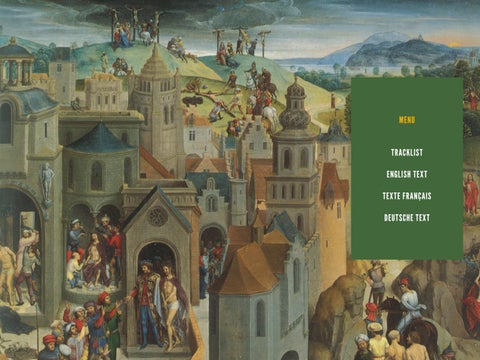
Recording Bolland, église Saint-Apollinaire, October 1997 & June 1998 Artistic direction, recording & editing: Jérôme Lejeune Pictures Cover: Hans Memling, Panorama de la Passion, Torino, Galleria Sabauda, © Alinari-Giraudon
JOHANNES OCKEGHEM { C. 1420-1497}
Translations Français: Chantal Gillet Deutsch: Silvia Berutti-Ronelt
MISSA MI-MI
CAPPELLA PRATENSIS: REBECCA STEWART – maestro di cappella RENÉE KARTODIRDJO ANNELIES COENE ANDRÉ CATS CHRISTOPHER KALE LUDY VRIJDAG
SJEF VAN LEUNEN BART DEMUYT HERMAN DE WINNÉ ROB BORST STRATTON BULL (GRADUALE)
MISSA VESPERTINA IN CENA DOMINI [1] Introitus: Nos autem 5’25 [2] Kyrie* 2’42 [3] Gloria* 7’38 [4] Graduale: Christus factus est 2’43 [5] [6] [7] [8] [9]
Credo* Offertorium: Protege, Domine Sanctus* Agnus Dei* Communio: Dominus Jesus
[10] Intemerata Dei mater
* Johannes Ockeghem: Missa Mi-mi
MENU
11’34 3’17 6’56 6’28 1’39 7’07
JOHANNES OCKEGHEM The music of Johannes Ockeghem, who was born in St. Ghislain c. 1420, symbolizes more than that of any of his contemporaries the pinnacle of evolution of certain medieval polyphonic structures. His oeuvre, while not being quantitatively great, is none the less the most accomplished in its creative thinking.This quality, which contributed already within his lifetime to his becoming the uncontested master of the first generation of Renaissance composers, has paradoxically been the point of departure for the largely erroneous idea, still often accepted, of a composer whose works are more austere and “strict” than expressive. After having been employed as singer at the Church of Our Lady at Antwerp, Ockeghem entered into the service of the Court of France, under Charles VII, Louis XI and Charles VIII. In addition to his function as Master of the King’s Chapel, he occupied the titular function of Treasurer of the Abbey of St. Martin at Tours. In this manner Ockeghem occupied himself both at the royal court and at Tours, where he died on February 6th 1497. Of the numerous composers at the begining of the 16th century who claimed to have been taught by Ockeghem, those mentioned by Josquin des Prez in his celebrated lament Nymphes des bois as co-disciples are Pierre de la Rue, Loyset Compère and Antoine Brumel. Jérôme Lejeune Ockeghem’s Crucifixion mass Ockeghem’s Missa Mi-mi (VatS 41: Missa Quarti toni) has long been the subject of controversy: its name, its so-called abstract character – seen in its “free” construction and use of material and in the seeming lack of a coherent textual/musical relationship – and its mysterious power to overwhelm. Recently two musicologists working independently (the American Don Giller and the Japanese Hirayo Miyazaki) have suggested that this mass is based on Ockeghem’s three-voice bergerette Presque trainsi, whose beginning five-note tenor motive is imitated almost exactly at the beginning of each mass movement. With the help of this information and of my own “modal” analysis of this mass, based on the strikingly medieval character of much of Ockeghem’s religious and musical thinking, I have concluded that the Missa Mi-mi is in essence a synthesis and transformation of the Gregorian mode IV (hypophrygian) and the introductory two-measure “motto” from the bergerette.The significance of its name, its very close ties with the bergerette and its brilliantly clear textually and symbolically derived treatment of the half tonal and tritonal MI-FA relationships, which epitomize the “dark modality” of the phrygian mode IV, have lead me to conclude that the Missa Mi-mi was intended by Ockeghem as a musical symbolization of Christ’s crucifixion – and his transformation from son of man to Son of God – the very cornerstone of the Christian belief. Unbeknownst to me the American musicologist Gayle Kirkwood has been working on the same theory but from an entirely different perspective. Basing herself on the theological/ musical writings of the 14th-century post-scholasticus Jean Gerson, with which Ockeghem was very familiar, Kirkwood has arrived at the conclusion that the all-important mass title
MENU
Mi-mi may refer symbolically to Christ on the cross. Given the internal perfection of the mass and the external significance of its function it also occured to me that Ockeghem might have conceived of this extraordinary mass as his own musical – and theological? – last testament avant la lettre. It is also more than tempting to see the existence of a shared tradition in Ockeghem’s choice of mode IV to represent Christ’s crucifixion and the famous 12th-century representation of the fourth tone on one of the capitals in the church of Cluny with its accompanying inscription: Succedit quartus simulans in carmine planctus (the fourth tone follows, its chants representing sorrow). The symbolism behind the depiction of a young man bowed down under the weight of a crossbeam from which hangs a set of tintinnabula (funerary bells) must still have been well understood at the time of Ockeghem, and especially within his own particular surroundings. Although the original purpose of the Missa Mi-mi may have been partially forgotten by the 16th century, the fact that its bassus motive was imitated by so many of the next generation of composers (Josquin, Obrecht, Compère, Pipelare, Isaac, Marbriano de Orto and – even later – Gombert) is ample proof of Ockeghem’s own unique position. For these composers he symbolized all that which was to be honoured and emulated in the thinking of the late medieval masters. It is the desire of the Cappella Pratensis that the grandeur of this thinking may be audibly recognizable, even at the great distance of 500 years. Although it is my contention that the Missa Mi-mi was written not for a specific liturgical feast but as the symbol – the cross – for the mass of the Christian church it was of course also necessary to find one feast in which this symbol figured most significantly. As the two 15thcentury graduals from Ockeghem’s church, the Saint-Martin de Tours, were destroyed in the fire of June 1940, any attempt to re-place his Missa Mi-mi in its original musical and liturgical context is futile. However, it was possible to locate an appropriate Gregorian proper from the related Rite of Paris. Although Ockeghem’s great and influential mass will never return – at least in its original context – to the altar of the St. Martin it is hoped that by surrounding it with a Gregorian proper that clearly mirrors the practice which served as his daily inspiration, the mass may shine forth once more in its full glory, a glory… “Que ainsy muny humain cueur languissant Et impuissant rendoit sain et puissant Resjouyssant et l’inconstant rassis.” (from the eulogy for Ockeghem written by Nicolle Le Vestu, Chant royal, 1523) The choice of a Proper Although the two 15th-century graduals from the St. Martin de Tours have been destroyed, it was possible to study the two 15th-century missals (Tours, Municipal Library, Mss. 194 and 195) most likely used in this church at the time of Ockeghem. As the names of the Propers to be sung during each mass were given, it was possible to choose that feast which would best represent both the sacrificial and sacramental function of Christ on the Cross, as symbolized in the Missa Mi-mi. With the additional help of the commentaries by Jean Gerson on the characteristics of each feast, the mass for Maundy Thursday was finally chosen.This decision was further aided by the following factors: the texts of the Propers clearly indicated that this mass
was also thought of as being a preparatory mass for Good Friday, during which no normal mass is celebrated; as the only exception to the prohibition of the singing of the Gloria during Lent, the mass for Maundy Thursday appeared to be the uniquely correct repository for Ockeghem’s own unique Gloria and, although all but one of the traditional Propers for Maundy Thursday have been changed after Vatican II, two of the four Propers sung at St. Martin on this day – the Introit Nos autem gloriari and the Gradual Christus factus est – are also traditionally sung during the closely related feasts of the Finding of the Holy Cross, on May 3rd, and the Exaltation of the Holy Cross, on September 14th, while a third Proper – the Offertory Protege Domine – is traditionally associated only with these two latter feasts. (Of general note, although the Tract has been reinstated by Vatican II, in accordance with the normal practice of the time this Proper was not sung during the mass of Maundy Thursday at the St. Martin.The Introit is sung with its doxology, as if the bishop had been present at the mass.) The music itself was “reconstructed” through the use of a 15th-century gradual now at the Walters Art Gallery in Baltimore, Maryland (Ms. 302). This gradual follows the closely related Rite of Paris. It must certainly not be coincidental that the Introit Nos autem gloriari, written in the very same “mi” mode IV as Ockeghem’s Missa Mi-mi, proclaims the words “let our glory be on the cross of our Lord Jesus Christ; in him we have salvation, life and resurrection...”The Gradual Christus factus est, which declares in its Verse that “God has highly exalted him, and bestowed on him the name which is above every name”, is written in mode V, the finalis (F “fa”) of which is used so often in the Missa Mi-mi to symbolize Christ’s transformation from son of man (mi) to Son of God (fa). The choice of a proper motet Ockeghem’s well-known five-part Intemerata Dei mater is a tour de force from both a musical and a dramatic point of view. In addition it displays so many similarities with his Missa Mi-mi that its choice in the present context was virtually a foregone conclusion: it uses the bassus head motive of the mass in its quinta vox; it is also written in the hypophrygian mode IV; it employs no cantus firmus and seems to be freely composed; not only is there a clearly audible acceleration of tempo between each of the three main sections of the motet, but especially significant final words of phrases, such as “puella”, “jubilando meremur” and the concluding “in arce locato. Amen”, appear to virtually spin to their cadences. Perhaps the most striking similarity between mass and motet is the seemingly perfect match between each word and its musical expression. In the motet this relationship is made even clearer through Ockeghem’s choice of a poem in the classical Latin hexameter structure. As a consequence of the poet’s freedom in his choice of word order this structure lends itself to the separate musical characterization of each important word. A clear example is that of the first five words of the motet: Intemerata / Dei / mater / generosa / puella. Each word conveys a world of significance, a significance which Ockeghem honours by giving to it its own unique setting. For this reason it was decided to place numbers before each significant word in the text and the translation to facilitate the understanding of this interesting technique. Rebecca Stewart
MENU
JOHANNES OCKEGHEM Johannes Ockeghem, né à Saint-Ghislain vers 1420, représente, plus que tout autre de ses contemporains, le symbole même de l’aboutissement de toute l’évolution des structures polyphoniques du Moyen Âge. Son œuvre, sans être quantitativement importante, n’en est pas moins la plus accomplie sur le plan de la pensée créatrice. Cette qualité, qui a contribué, de son vivant déjà, à en faire le maître incontesté des musiciens de la première génération de la Renaissance, a, paradoxalement, été le point de départ d’une idée, encore très vive à notre époque, d’un compositeur dont les œuvres sont plus le reflet de conceptions austères et rigoureuses que celui d’un sens expressif. Ockeghem, après avoir été chantre à l’église Notre-Dame d’Anvers, entre au service de la cour de France, sous Charles VII, Louis XI et Charles VIII. En plus de ses fonctions de maître de chapelle du Roi, il occupe les fonctions très honorifiques de trésorier de l’abbaye de Saint-Martin de Tours. Dès lors, sa vie se passe entre la cour et Tours, où il décède en 1497. De nombreux compositeurs du début du XVIe siècle se réclameront de son enseignement, entre autres ceux qui sont nommément cités dans la célèbre déploration Nymphes des bois où Josquin des Prés mentionne ses condisciples Pierre de la Rue, Loyset Compère et Antoine Brumel. Jérôme Lejeune La Messe de la Crucifixion de Johannes Ockeghem La Missa Mi-mi a été longtemps sujette à controverses quant à son nom, son caractère jugé abstrait – étant donné sa « liberté » de construction et d’usage de la matière –, l’apparente incohérence dans la relation texte/musique et son mystérieux pouvoir de séduction. Récemment, deux musicologues, l’Américain Don Giller et le Japonais Hirayo Miyazaki, travaillant indépendamment l’un de l’autre, ont suggéré que cette messe serait basée sur la bergerette à trois voix Presque trainsi d’Ockeghem. Le ténor de cette chanson commence par un motif de cinq notes, qui se retrouve presque à l’identique au début de chaque mouvement de la messe. Aidée par cette information et par ma propre analyse « modale » de cette messe, et partant du caractère manifestement médiéval de la pensée religieuse et musicale d’Ockeghem, je suis arrivée à la conclusion que la Messe Mi-mi est d’abord une synthèse et une transformation du quatrième mode grégorien (hypophrygien) et des deux premières mesures de la bergerette, qui font office de motto. De la signification du nom (Mi-mi), de son lien étroit avec la bergerette et de la manipulation claire et géniale, textuellement et symboliquement des relations en demi-ton et tritons mi-fa, qui expriment le caractère sombre du mode IV hypophrygien, et aussi de la signification du texte de la chanson Presque trainsi qui évoque la proximité de la mort (« Comme agonisant, un peu moins que mort »), j’ai déduit que la Messe Mi-mi a été conçue par Ockeghem comme le symbole de la crucifixion du Christ et de sa transformation de fils de l’homme en Fils de Dieu, pierre angulaire de la foi chrétienne. De son côté, Gayle Kirkwood, musicologue américaine, a développé la même théorie, mais en se plaçant dans une perspective toute différente. C’est en se basant sur les écrits théologiques et musicaux de Jean Gerson, un post-scolastique du XIVe siècle bien connu d’Ockeghem, qu’elle est arrivée elle aussi à la conclusion que le titre Mi-mi de cette messe peut être une référence symbolique au Christ en croix.
MENU
Si on considère de l’intérieur la perfection de la messe et la signification extérieure de sa fonction, il m’apparaît aussi qu’Ockeghem pourrait avoir conçu cette messe extraordinaire comme son dernier testament musical – et théologique ? –, avant la lettre. Le choix par Ockeghem du quatrième mode pour figurer la crucifixion du Christ d’une part, et d’autre part la fameuse représentation du quatrième ton sur un des chapiteaux de l’église de Cluny avec l’inscription « Succedit quartus simulans in carmine planctus » (suit le quatrième ton, dont le chant représente la tristesse) font penser à une tradition commune. La symbolique de la représentation d’un jeune homme accablé sous le fardeau d’une poutre d’où pendent des tintinnabules (cloches funéraires) a dû être bien comprise au temps d’Ockeghem, et spécialement dans son entourage proche. Bien que le but initial de la Messe Mi-mi puisse avoir été partiellement oublié au XVIe siècle, le fait que son motif de basse ait été imité par tant de compositeurs de la nouvelle génération (Josquin, Obrecht, Compère, Pipelare, Isaac, Marbriano de Orto et même Gombert) est une preuve évidente de la position unique d’Ockeghem. Pour ces compositeurs, il symbolisait tout ce qui était admiré et dont on s’inspirait dans la pensée des maîtres de la fin du Moyen Âge. Le souhait de la Cappella Pratensis est que la grandeur de cette pensée soit encore entendue et reconnue, même après 500 ans. Bien que je tienne à l’idée que la Messe Mi-mi a été écrite non pas pour une fête liturgique spécifique, mais comme le symbole – la croix – de toute messe de l’Église chrétienne, il était nécessaire de trouver une fête à laquelle rattacher ce symbole de façon plus significative. Comme les deux graduels du XVe siècle de l’église d’Ockeghem, Saint-Martin de Tours, ont été détruits lors de l’incendie de juin 1940, il est vain de chercher à restituer la Messe Mi-mi dans le contexte musical et liturgique de son époque. Cependant, on a pu localiser un propre grégorien extrait du rite de Paris qui lui est proche. Même si la messe grandiose d’Ockeghem ne sera jamais restituée – du moins dans son contexte d’origine – à l’autel de Saint-Martin, on peut espérer que, en l’encadrant avec un propre grégorien qui reflète clairement l’usage dans lequel Ockeghem puisait constamment son inspiration, la messe puisse résonner une fois de plus dans sa pleine gloire, une gloire… « Que ainsy muny humain cueur languissant Et impuissant rendoit sain et puissant Resjouyssant et l’inconstant rassis » (extrait de l’eulogie pour Ockeghem écrite par Nicolle Le Vestu, Chant royal, 1523). Le choix du propre Malgré la destruction des deux graduels du XVe siècle de Saint-Martin de Tours, nous avons pu étudier les deux missels du XVe siècle (Tours, Bibliothèque municipale, Mss 194 et 195) qui étaient sans doute utilisés dans cette église à l’époque d’Ockeghem. Comme les noms des propres à chanter pour chaque messe étaient indiqués, il était possible de choisir la fête qui pourrait le mieux représenter la fonction à la fois sacrificielle et sacramentale du Christ en croix, symbolisée par la Messe Mi-mi. En nous aidant des commentaires de Jean Gerson sur les caractéristiques de chaque fête, il a été possible de choisir en définitive la messe du Jeudi saint. Ce choix a été confirmé par les faits suivants : les textes des propres indiquent clairement que cette messe est destinée à être une préparation pour le Vendredi saint, où aucune messe n’est célébrée ; étant la seule exception à l’interdiction de chanter le Gloria pendant le Carême,
la messe du Jeudi saint apparaissait comme le seul cadre où situer correctement l’extraordinaire Gloria d’Ockeghem. Enfin, bien que tous les propres traditionnels du Jeudi saint, sauf un seul, aient été changés après Vatican II, deux des quatre propres chantés à Saint-Martin ce jour-là – l’introït Nos autem gloriari et le graduel Christus factus est – sont traditionnellement chantés également durant les fêtes qui lui sont en relation étroite : l’Invention de la Sainte-Croix, le 3 mai, et l’Exaltation de la Sainte-Croix, le 14 septembre, tandis qu’un troisième propre, l’offertoire Protege Domine, n’est traditionnellement associé qu’à ces deux dernières fêtes. (Notons que, bien que le Trait ait été réintroduit par Vatican II, ce propre n’était pas chanté à Saint-Martin durant la messe du Jeudi saint, pour respecter l’usage de l’époque. L’introït était chanté avec sa doxologie, comme si l’évêque avait été présent à la messe.) La musique elle-même a été « reconstruite » sur base d’un graduel du XVe siècle conservé à la Walters Art Gallery de Baltimore, Maryland (ms 302). Ce graduel suit le rite de Paris qui en est très proche. Ce n’est certainement pas une coïncidence si l’introït Nos autem gloriari, écrit dans ce même quatrième mode « mi » que la Messe Mi-mi d’Ockeghem, proclame « que notre gloire soit sur la croix de Notre Seigneur Jésus-Christ, en Lui nous trouvons le salut, la vie et la résurrection ». Le graduel Christus factus est, dont le verset déclare que « Dieu l’a exalté et lui a donné le nom qui est au-dessus de tous les noms », est écrit dans le cinquième mode, dont la finale (fa) se retrouve si souvent dans la Messe Mi-mi pour symboliser la transformation du Christ de fils de l’homme (mi) en Fils de Dieu (fa). Le choix d’un motet approprié Le fameux motet à cinq voix Intemerata Dei mater est un tour de force tant au point de vue musical que dramatique. De plus, il a tant de similitudes avec la Messe Mi-mi que son choix dans le présent contexte était une évidence : il utilise le motif de tête de la basse de la messe dans sa cinquième voix ; il est également écrit dans le quatrième mode (hypophrygien) ; il n’emploie pas de cantus firmus et il semble composé librement. Non seulement, il y a une progression du tempo clairement audible entre chacune des trois grandes sections du motet, mais les derniers mots de certaines phrases, avec une signification particulière, comme « puella », « jubilando meremur » et la conclusion « in arce locato. Amen », semblent être l’accélération de leurs cadences. La ressemblance la plus frappante entre la messe et le motet est la rencontre parfaite réalisée par Ockeghem entre chaque mot et son expression musicale. Dans le motet, cette relation est rendue plus évidente par le choix que fait Ockeghem d’un poème dans la structure classique latine en hexamètres dans lequel le poète a la liberté de choisir l’ordre des mots. En conséquence, cette structure permet de caractériser chaque mot important par une exécution musicale séparée. Les cinq premiers mots du motet en sont un exemple clair : Intemerata / Dei / mater / generosa / puella. Chaque mot véhicule un monde de significations, qu’Ockeghem honore en situant chaque mot dans son propre cadre musical. Ce caractère constitue l’essence même du motet. C’est pourquoi il a été décidé de placer les petits chiffres devant les paroles le plus signifiantes du texte et les paroles correspondantes de la traduction pour faciliter la compréhension de cette technique. Rebecca Stewart
MENU
À propos de l’intitulé « Mi-mi » Dans la tradition du XVe siècle, Ockeghem utilise pour chacune de ses messes un élément unificateur : thèmes ou structures polyphoniques provenant de chansons (L’homme armé, De plus en plus, Mi-mi) ou de thèmes de plain-chant (Ecce ancilla Domini) ; en tant que maître incontesté de la matière musicale, certaines de ces messes sont construites sur la base de réflexions sur l’art de la composition. C’est le cas des messes Cujusvis toni, Prolationum et Mi-mi. Si cette dernière est citée dans une source comme Missa quarti toni (Messe du quatrième ton), son intitulé « Mi-mi » s’explique par la présente en motif de tête à la basse des notes « mi-la » qui, dans le système de solmisation pratiqué à l’époque, peuvent se lire «mi-mi». Il faut savoir qu’au Moyen Âge, la lecture des notes se faisait seulement au moyen des notes de l’hexacorde (ut, ré, mi, fa, sol, la) tel qu’il avait été défini par Guido d’Arezzo. Le « si », qui pouvait être bécarre ou bémol, apparaissait comme une région instable et était remplacé dans la lecture par « mi » ou « fa » selon qu’il était bécarre ou bémol ; ainsi, la lecture des notes suivait ce déplacement des appellations de notes et cette quinte descendante « mi-la » peut se solfier « mi-mi ». Jérôme Lejeune
OCKEGHEMS KRUISIGINGSMIS Lange tijd heeft Ockeghems Missa Mi-mi (in het handschrift Vat S 41 aangeduid als de Missa Quarti toni: mis op de vierde toon) aanleiding gegeven tot controverses. Men raakte het niet eens over de betekenis van de naam, noch over het zogenaamde abstracte karakter van de mis. Zowel over de blijkbaar “vrije” wijze waarop de mis was opgebouwd als over het schijnbare gebrek aan samenhang tussen tekst en muziek liepen de meningen uiteen. Voor de mysterieuze overredingskracht van de mis bestond er evenmin een eenduidige verklaring. Recent kwamen twee musicologen (de Amerikaan Don Giller en de Japanse Mirayo Miyazaki) onafhankelijk van elkaar tot de bevinding dat de mis toch zou gebaseerd zijn op een bestaand chanson, namelijk op Ockeghems eigen driestemmige bergerette Presque trainsi. De eerste vijf noten van het tenormotief daaruit worden immers bijna letterlijk hernomen aan het begin van elk misdeel. Zelf onderwierp ik de Missa Mi-mi aan een “modale” analyse die uitging van het opvallend middeleeuwse karakter van Ockegems religieuze en muzikale opvattingen. In combinatie met het voorgaande kwam ik tot de vaststelling dat de Missa Mi-mi in de eerste plaats een synthese is èn een transformatie van de Gregoriaanse vierde kerktoonsoort (de zogenaamde hypo-frygische modus) en de eerste twee maten van de bergerette, die als “motto” fungeren. Daarmee wordt de heersende opvatting dat het hier een vrij-gecomponeerde mis betreft, weerlegd. Uit de betekenis van de naam (Mi-mi), de nauwe verwantschap met de bergerette en de vernuftig heldere tekstuele en symbolische behandeling van de halve toon- en tritonusrelaties mi-fa, die kenmerkend zijn voor het sombere karakter van de frygische modus, heb ik afgeleid dat de Missa Mi-mi door Ockeghem is opgevat als een muzikale symbolisering van Christus’ kruisiging – en van zijn transformatie van mensenzoon tot Zoon van God – de hoeksteen van het christelijk geloof. Pas recent ontdekte ik dat de Amerikaanse musicologe Gayle Kirkwood tot dezelfde conclusie is gekomen, zij het vanuit een heel ander perspectief. Zij ging uit van de theologischmuzikale geschriften van de 14de-eeuwse post-scholasticus Jean Gerson, met wiens ideeën Ockeghem zeer vertrouwd was, en ook zij kwam tot de conclusie dat de titel mogelijk symbolisch verwijst naar Christus aan het kruis. Verder lijkt het me op zijn minst aannemelijk dat Ockeghem deze buitengewone mis heeft opgevat als zijn eigen muzikaal – en theologisch – testament avant la lettre: het feit dat de mis zo volmaakt is opgebouwd en de uiterlijke betekenis van haar functie als symbool voor het christelijk geloof, wijzen in die richting. Het is ook verleidelijk om een gemeenschappelijke traditie te zien in Ockeghems keuze voor de vierde modus om Christus’ kruisiging weer te geven, en de 12de-eeuwse voorstelling op één van de kapitelen in de kerk in Cluny (p. 13), die de vierde toon voorstelt met de inscriptie “Succedit quartus simulans in carmine planctus” (daarop volgt de vierde toon; zijn lied verbeeldt het lijden). Het kapiteel beeldt een jonge man af die doorbuigt onder het gewicht van een kruisbalk waaraan tintinnabula (begrafenisklokken) hangen. De achterliggende symboliek moet in Ockeghems tijd nog goed zijn begrepen, vooral dan in de kringen waarin hij zich bewoog. Los van het feit dat de oorspronkelijke bedoeling van de Missa Mi-mi wellicht gedeeltelijk vergeten was in de 16de eeuw, kan men vaststellen dat het basmotief van de
MENU
mis door verschillende componisten uit de latere generatie werd overgenomen (Josquin, Obrecht, Compère, Pipelare, Isaac, Marbriano de Orto en – nog later – Gombert). Dat feit alleen al bewijst afdoende welk een belangrijke positie Ockeghem heeft bekleed. Voor deze componisten belichaamde Ockeghem al wat men in het denken van de laat-middeleeuwse meesters wilde eren en nastreven. De Cappella Pratensis hoopt de grootsheid van dit denken te verklanken en zelfs vijfhonderd jaar later voelbaar te maken. Hoewel ik van oordeel ben dat de Missa Mi-mi niet werd geschreven voor een specifiek liturgisch feest, maar als het symbool bij uitstek – het kruis – van dè mis van de christelijke kerk, was het noodzakelijk om een kerkelijk feest te vinden waarin die symboliek het sterkst aanwezig is. Aangezien de twee 15de-eeuwse graduales van de Sint-Martinuskerk van Tours in juni 1940 in de vlammen zijn opgegaan, is het niet mogelijk om de Missa Mi-mi in haar oorspronkelijke muzikale en liturgische context te laten klinken. Door de mis te combineren met een Gregoriaans proprium uit de aanverwante Parijse ritus – wat duidelijk de praktijk weerspiegelt waaruit Ockeghem dagelijks inspiratie putte – hopen we dat de Missa Mi-mi voor één keer opnieuw in haar volle glorie mag klinken, opdat deze glorie... “ainsi muny humain cueur languissant Et impuissant rendoit sain et puissant Resjouyssant et l’inconstant rassis” (uit de eulogie voor Ockeghem geschreven door Nicolle Le Vestu, Chant royal, 1523). De keuze van het proprium Hoewel de twee 15de-eeuwse graduales van de Sint-Martinuskerk van Tours vernietigd zijn, konden we wel twee missalen uit die periode bestuderen (Tours, Stedelijke Bibliotheek, Hss. 194 en 195), die hoogstwaarschijnlijk in de kerk gebruikt werden in Ockeghems tijd. Aangezien deze missalen voor elk feest aangeven welk proprium moest gezongen worden, konden we dat feest kiezen dat het best zowel de opofferende als de sacramentele functie van Christus aan het kruis zou weergeven, zoals die gesymboliseerd worden in de Missa Mi-mi. Na raadpleging van de commentaren van Jean Gerson over de karakteristieken van elk feest, opteerden we uiteindelijk voor de mis van Witte Donderdag. Deze keuze steunt ook op een aantal bijkomende factoren. De teksten van het proprium geven duidelijk aan dat deze mis ook opgevat werd als een voorbereiding op Goede Vrijdag, wanneer er geen normale mis wordt opgedragen. Aangezien tijdens de vasten alleen in de mis van Witte Donderdag het Gloria wordt gezongen, scheen deze mis de enig mogelijke context voor Ockegems eigen unieke Gloria. Tenslotte, hoewel op één na alle traditionele propria voor Witte Donderdag na Vaticanum II werden gewijzigd, worden twee van de vier traditionele propria die in de SintMartinuskerk in Tours gezongen werden op die dag – het Introitus Nos autem gloriari en het graduale Christus factus est – traditioneel ook gezongen tijdens de nauw verwante feesten van de Kruisvinding op 3 mei en van de Kruisverheffing op 14 september. Het derde proprium – het Offertorium Protege Domine – wordt traditioneel enkel geassocieerd met de laatste twee feesten. (Hoewel Vaticanum II de tractus opnieuw invoerde, werd dit proprium traditioneel niet gezongen tijdens de mis voor Witte Donderdag in de Sint-Martinuskerk. Het introitus wordt gezongen met zijn doxologie als was het een dienst in aanwezigheid van de bisschop.)
De muziek zelf werd “gereconstrueerd” op basis van een 15de-eeuws graduale dat nu bewaard wordt in de Walters Art Gallery in Baltimore, Maryland (Hs. 302). Dit graduale volgt de nauwverwante ritus van Parijs. Het is waarschijnlijk geen toeval dat de introitus Nos autem gloriari die geschreven werd in dezelfde mi-modus (vierde modus) als Ockeghems Missa Mimi, de woorden uitdrukt: “Laat onze glorie zijn in het kruis van Onze Heer Jesus Christus; in Hem is er redding, leven en verrijzenis.” Het graduale Christus factus est waarvan het vers verkondigt dat God hem hoog verheven heeft boven alle namen uit, is daarentegen in de vijfde modus geschreven, waarvan de finalis (F ”fa”) zo vaak gebruikt wordt in de Missa Mimi om Christus’ transformatie uit te drukken van mensenzoon (mi) tot Zoon van God (fa). De keuze van een geschikt motet Ockeghems welbekend vijfstemmig motet Intemerata Dei mater is een krachttoer zowel vanuit muzikaal als van dramatisch oogpunt. Bovendien is er zoveel gelijkenis met zijn Missa Mi-mi dat de keuze in deze context een bijna uitgemaakte zaak was. In het motet wordt het kopmotief van de bas uit de mis in de quinta vox gebruikt. Net zoals de mis is ook het motet geschreven in de vierde, hypo-frygische, modus en lijkt het vrij gecomponeerd. Het is niet gebaseerd op een cantus firmus. Verder is er niet enkel de duidelijk hoorbare tempo-versnelling tussen elk van de drie belangrijkste geledingen van het motet, maar bovendien worden woorden zoals “puella”, “jubilando meremur” en het afsluitende “in arce locato. Amen”, weergegeven in frasen die naar het einde toe versnellen. De meest in het oog springende gelijkenis tussen mis en motet is misschien wel het praktisch perfecte samengaan van elk woord en de muzikale expressie die Ockeghem eraan geeft. In het motet wordt die relatie nog duidelijker gemaakt via Ockeghems keuze voor een gedicht met de structuur van een klassiek-Latijnse hexameter. De dichterlijke vrijheid in de woordschikking leent zich tot de afzonderlijke karakterizering van elk belangrijk woord. Deze werkwijze komt duidelijk tot uiting in de eerste vijf woorden van het motet: Intemerata / Dei / mater / generosa / puella. Elk woord draagt een wereld van betekenis, die Ockeghem respecteert door elk woord op een zeer specifieke manier muzikaal uit te werken. Om het begrip van deze interessante techniek te vergemakkelijken, hebben wij besloten om elk belangrijk woord uit het gedicht en de overeenkomstige vertaling te laten voorafgaan door een cijfer. Rebecca Stewart Vertaling: Marijke Van Campenhout
The Cappella Pratensis and its approach to this music The Dutch vocal ensemble Cappella Pratensis – “Pratensis” being the Latin equivalent of “Des Pres” – was founded in 1987 and is specialized in the interpretation of the FrancoNetherlandish style of vocal polyphony which flourished during the 15th and early 16th centuries. The repertory is based primarily on French, Flemish and Dutch polyphonic choral works from the High Renaissance. Its artistic and musical leader (or “maestro di cappella” as the choirmaster was called in former times), is Dr. Rebecca Stewart, Director of the department of Early Vocal Ensemble Music at the Brabant Conservatory of Music in Tilburg, which actively supports the Cappella’s activities. One of the written sources for the «ideal sound» which is the goal of the Cappella is Adrianus Petit Coclico, who referred to himself as a pupil of Josquin des Pres. Writing in 1552, in his Compendium Musices (Nuremberg), he claimed that the Flemings, the Picards and the French were manifestly particularly gifted: “They sing smoothly, elegantly and with consummate art”.Above all, they showed a natural ability to achieve the “ideal sound” intended by the composer. The Cappella Pratensis has given itself the great challenge of endeavouring to come as close as possible to this ideal. In its performance of the Franco-Netherlandish vocal polyphonic music by Josquin des Pres, his contemporaries and immediate predecessors, the Cappella bases itself as much as possible on the following principles: 1. As the daily bread of the singers of this tradition, Gregorian chant – particularly that sung in the French manner – is considered to be the major source of inspiration of this polyphonic tradition. 2.The Latin is pronounced and shaped according to the conception of the specific composer, i.e. it is sung so that it corresponds – in the light of our present knowledge – with the linguistically generated sound ideal of the composer. 3. High, flexible voices are used; composers in the Franco-Netherlandish tradition wrote music for male singers who, on reaching manhood, were trained to retain their original high voices. The members of the Cappella Pratensis are trained to adapt their timbre and their phrasing accordingly and receive special technical training to increase their ranges and flexibility. 4. The number of singers for each part may vary, depending on the nature and function of the composition. 5. A choirbook, which is placed on a large, high music stand, is used; in such a choirbook each voice is notated separately in mensural notation. 6. The maestro di cappella carries out her specific functions while singing within the group. 7. The Cappella Pratensis strives to give concerts in venues where the acoustic requirements of its repertory can be met. Above and beyond these fundamental principles the first goal of the Cappella Pratensis is to honour the primary raison d’être of this music: to elevate the souls of those who listen to it. *
MENU
The Cappella Pratensis would like to thank: Drs. Joep van Buchem for all his preparatory work on the Missa Mi-mi; Dr. Jennifer Bloxam and Dr. Barbara Haggh for their considerable help in the finding of the appropriate gradual; Dr. William Mahrt for simplifying liturgical complexities; Ms. Michelle PrÊvost, curator of the Bibliothèque municipale in Tours, for the many hours which she devoted to the search for and the copying of important Mss.; Mr. Jaap van Benthem for his valuable suggestions concerning important aspects of the Missa Mi-mi; Ms. Kathy Maes for her translation of the motet text; and Mr. Joost van Leeuwen for his structural help with the motet text.
MENU