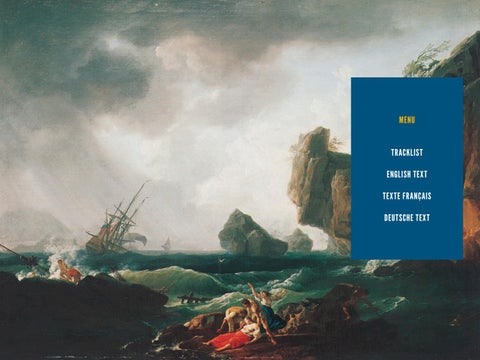
MENU TRACKLIST ENGLISH TEXT TEXTE FRANÇAIS DEUTSCHE TEXT
This recording was made with the support of the Fédération Wallonie-Bruxelles (Direction générale de la Culture, Service de la Musique). Recording Concerti Op. X: Seneffe, église de Bois des Nauwes, November 1997 Concerti da Camera: Bolland, église Saint-Apollinaire, May 2001 Artistic direction, recording & editing: Jérôme Lejeune Pictures Cover: Charles-Joseph Vernet (1714-1789), Le naufrage (1750), Troyes, Musée des Beaux-Arts, © akg-images Translations English: Peter Lockwood Deutsch: Silvia Berutti-Ronelt
ANTONIO VIVALDI { 1678 - 1741}
6 CONCERTI PER FLAUTO OP. X CONCERTI DA CAMERA
LA PASTORELLA: FRÉDÉRIC DE ROOS – recorders & direction
CD I Concerti per flauto Op. X
Concerto V in fa maggiore, RV 434 [16] Allegro ma non tanto 3’06 [17] Largo e cantabile 3’32 [18] Allegro 1’41
Concerto I La Tempesta di mare in fa maggiore, RV 433 Concerto VI in sol maggiore, RV 437 [1] Allegro 2’20 [19] Allegro 3’55 [2] Largo 1’58 [20] Largo 1’55 [3] Presto 1’56 [21] Allegro 2’34 Concerto II La Notte in sol minore, RV 439 [4] Largo 1’56 [5] Fantasmi (Presto) 0’50 [6] Largo 1’01 [7] Presto 1’00 [8] Largo Il Sonno 1’37 [9] Allegro 1’59 Concerto III Il Gardellino in re maggiore, RV 428 [10] Allegro 3’55 [11] Cantabile 3’27 [12] Allegro 2’50 Concerto IV in sol maggiore, RV 435 [13] Allegro 2’19 [14] Largo 2’24 [15] Allegro 2’17
MENU
LA PASTORELLA: Frédéric de Roos – recorders Dirk Vandaele – violin Marianne Herssens – violin Hans Devolder – viola Hervé Douchy – cello Éric Mathot – double bass Guy Penson – harpsichord & organ Philippe Malfeyt – archlute & guitar
CD II Concerti da Camera Concerto in fa maggiore, RV 99 [1] Allegro [2] Largo [3] Allegro Recorder, oboe, violin, bassoon, basso continuo
3’17 1’44 2’04
Concerto in sol minore, RV 106 [4] Allegro 2’35 [5] Largo 2’28 [6] Allegro 2’09 Recorder, violin, bassoon, basso continuo Concerto in re maggiore, RV 217 [7] Allegro 3’23 [8] Largo 2’02 [9] Allegro 3’39 Recorder, oboe, violin, bassoon, basso continuo Concerto in sol minore, RV 105 [10] Allegro 2’59 [11] Largo 1’56 [12] Allegro 2’59 Recorder, oboe, violin, bassoon, basso continuo
MENU
Concerto in do maggiore, RV 87 [13] Adagio-Allegro 3’14 [14] Largo 2’42 [15] Allegro assai 2’15 Recorder, oboe, 2 violins*, basso continuo Concerto in sol minore, RV 103 [16] Allegro ma cantabile [17] Largo [18] Allegro non molto Recorder, oboe, bassoon
4’06 2’36 1’50
Concerto in do maggiore, RV 88 [19] Allegro 2’48 [20] Largo 2’05 [21] Allegro molto 2’17 Recorder, oboe, violin, bassoon, basso continuo
LA PASTORELLA: Mira Glodeanu – violin Dirk Vandaele & Marianne Herssens – violins* Frédéric de Roos – recorder Ann Vanlancker – oboe Alain De Rijckere – bassoon Hervé Douchy – cello Guy Penson – harpsichord Philippe Malfeyt – archlute & guitar
ANTONIO VIVALDI, CONCERTI PER FLAUTO Music publishing houses in Amsterdam around 1729 had already profited greatly from Antonio Vivaldi’s growing fame in Northern Europe. The success that Étienne Roger’s publication of L’Estro Armonico in 1712 is at once proof of the time’s growing demand for publications of Italian works and for those of Vivaldi in particular.The composer had long been known as a virtuoso violinist, but it was now his concertos that were more and more appreciated, not to say plagiarised; this was the case not only in Italy, where many of his compositional innovations were taken up by Tartini, Locatelli and others, but also in Germany, where Bach and Telemann were inspired to make various arrangements and adaptations of his works. This is the context in which Vivaldi entrusted the printing of a volume of six concertos for flute and strings to the publisher Michel Le Cène, the tenth of Vivaldi’s works to be published. Whether it was a commission from the publisher, Le Cène desiring to take advantage of the popularity of the Venetian’s music together with the new fashion for the transverse flute, or simply that the composer himself had chosen him to publish these concertos that he held particularly dear is something that we shall never know. We can nevertheless state that only one of these pieces (op. X no. 4) seems to have been composed specially for this publication, the other five being arrangements of earlier works that were probably composed for the Ospedale della Piètà. The instrumental parts, often allocated to oboe, violin and bassoon, are here distributed between the violins and the bass, a viola part being also added and the construction of the concertos themselves even being at time modified in the interests of concision. Recorder or transverse flute? We have always known that the repertoire for recorder was partially made up of borrowings from other works, be they vocal works in the 15th and 16th centuries or instrumental works in later times.This question was of crucial importance in Northern Europe between 1700 and 1750, where the “common flute” was very much in fashion amongst amateurs, as can be seen from the number and variety of works published for it; it was at this time that these players had to face up to the growing fashion for the transverse flute. For this recording we have resolutely adopted the attitude that a recorder player of that time and place would have had; on that wonderful moment of the publication of six concertos for flute by Vivaldi, he would have played them on his preferred instrument, the recorder. So that this might be done we decided only to use instruments by Denner, Bressan and Stanesby, our preferred makers of the period, and by Lemaire and Von Huene, makers of today, employing an alto recorder in F and a flautino or sixth flute in D so as not to have to modify either the solo lines or the accompaniments. What our imagined predecessor undoubtedly would not have known – and neither would he have cared, is that the distinction between transverse flute and recorder is less clearly defined in Vivaldi’s works than in those of any other composer, being at times also problematic and even contradictory. Even though he makes a clear difference between them, using “flauto” for the recorder and “flauto traversier” for the transverse flute, his logic for using one rather than the other is much less clear. To take the opus X concertos as a particular example, La Tempesta di Mare (RV 98) and La Notte (RV 104) are both allotted to the “flauto traversier” and are yet written in F major and
MENU
G minor, keys that do not suit the instruments at all; the concerto no. 6 (RV 101) is attributed to the “flauto” or recorder but is written in G major, a highly infrequent choice of key in music written for the instrument. Il Gardellino (RV 90) in D major is clearly intended for the transverse flute, whilst it is traditionally the recorder that is used for the evocation of bird calls! It is also curious to note that in the concertos written for transverse flute Vivaldi avoids the lowest two notes of the instrument; these two notes are not available on the recorder in F. Finally, the slow movement of the concerto no. 5 was transposed up a tone for its publication by Le Cène, this clearly to avoid the key of F minor that was very awkward for the transverse flute; on the other hand, in the third movement of the Tempesta di Mare, the solo line has been rewritten in order to avoid the low E flat, a note perfectly playable on the transverse flute for which it was intended, but impossible on the recorder! Truly, a matter of which it is impossible to make any sense whatsoever! The first three concertos have colourful titles:The Storm at Sea, Night,The Goldfinch. In contrast to Vivaldi’s Seasons, which are provided with sonnets that allow the listener to follow closely the events of a life in the country, the flute concertos are not really programmatic works. We may nevertheless note the lines of narrative force that allowed Vivaldi to develop such contrasts in his Passions; lines that are clear-cut, brilliant and yet subtle, very close to operatic writing and that are characteristic of his best concertos. The Tempesta di Mare is allotted by us to the flautino that Vivaldi uses in three other concertos; in the first movement we hear the raging waves that endlessly stir up the sea, in the second we survey the damage to the ship during a temporary calm before being borne away by a whirlwind in the third, in which we can hear the cries of cormorants as they are tossed around by the storm. La Notte envelops us in a worryingly mysterious atmosphere; ghosts (Fantasmi) take up a devilishly fast bacchanal around us before we sink into a fretful sleep (Il Sonno).This slumber is soon interrupted by a nightmare that leaves us gasping as we awaken. The song of the goldfinch is more than hinted at; a cadenza that appears immediately after the first orchestral ritornello portrays the roulades and trills of the graceful songbird, at which he is rapidly joined by other birds who sing with him and merrily try to equal him.This is followed by a cantilena in which we find the two essential qualities of the Vivaldian genius for melody: beauty and simplicity. The concertos 4 and 5 are of more classic cut, although Vivaldi’s constant search for new effects is not missing. Let us simply think of the highly individual sonority of the muted strings that accompanies the flute in the 5th concerto; there is no title provided to suggest a line of interpretation, but from the beginning of the initial allegro we are clearly deep in the pastoral atmosphere that was so often associated with the recorder. After the quiet dialogue between flute and strings in the first movement Vivaldi begins one of his characteristically simple and touching melodies, accompanied by the two violins in unison playing the bass line and framed by two tutti passages. The third movement depicts the sounds of the bourdons, the bagpipes, the fiddlers and their improvisations at a village feast. The final concerto has a particularly original form; after a first movement in which the alternating solo passages and orchestral ritornelli occur in a much more traditional form than in the other opus X concertos,Vivaldi introduces a theme that will be used for both the second
and third movements. It is of a luminous simplicity and is played in a minor key for the largo and in the major for the allegro, being treated in variation form as if it were a witty chaconne. It is curious that one of the variations supplied by the composer in the original work (RV 101) was omitted when the work was published as part of opus X; we have allowed ourselves to reinsert it, adapting its orchestration to that of the other two movements. More than any possible programmatic intention, it is undoubtedly the variety of instrumental treatment, the skilful use of the instruments and the vivacity and the freshness of the melodic material that make the opus X concertos the flute equivalent of the Four Seasons; in any case it is a touchstone of flute repertoire and history. Antonio Vivaldi, Concerti da camera Amongst the approximately five hundred concertos by Vivaldi that have survived, the great majority (some three hundred and fifty) are designated for a solo instrument that dialogues with the strings. Some two hundred and thirty of these concertos are written for the violin, on which Vivaldi himself was an extremely skilled performer. Others were composed for bassoon, cello, oboe, flute, viola d’amore and even the mandolin. Thirty of the concertos are destined for two soloists, whilst another sixty are for strings alone with no soloist. This body of work is impressive not only for its quantity but also for its quality; twenty of these concertos are set apart by their use of a solo instrument alone without orchestral accompaniment, thus returning to a more archaic definition of the term concerto.The Italian verb concertare and the French verb concerter both mean to confer together and agree; the seven concertos that are recorded here are the result of a cooperation between instruments that are different but yet equal, rather than of an opposition between one or several soloists and a body of strings. It must be said that one of the aspects of Vivaldi’s genius is displayed in the infinite variety of the combinations of timbres and instruments that he creates from his initial material; the instrumental parts were undoubtedly played by the “putte” of the “Ospedale della Pietà”, young girls who had either been orphaned or had been abandoned, or even who were simply the youngest daughters of the poor families to whom Vivaldi devoted so much of his time between his European travels. The majority of Vivaldi’s concertos use the transverse flute and recorder, the oboe, the bassoon (more than thirty concertos) and of course the violin as solo instruments.Their balancing and deployment, however, is new in every case. It can be that the flute takes the principal role, possibly because it is naturally the instrument that takes the highest line because of its range; this is the case in the Concerto in F RV 99, in which it appropriates practically all of the solo passages, and in the Concerto in C RV 88. On the other hand, the violin is featured in solos of a virtuosity characteristic of the great solo concertos in the Concerto in D RV 217, using double-stopping, an extended range and flowing passage work, whilst the flute is restricted to a melodic role and a more pastoral style.The violin is also treated as a real ripieno instrument, to the point that its part could be played also by the oboe without any problems (Concerto in G RV 106), whilst the flute takes up rapid passages in triplets and arpeggios that are typical of Vivaldi’s writing for recorder but which were clearly inspired by violin technique.Vivaldi’s evident liking for the bassoon is revealed by the great importance that he sets by it; far from restricting it to a line that simply underpins the harmony and rhythm, it usually plays on equal musical terms with
MENU
the flute, sometimes even without and continuo being present (Concertos RV 105 and RV 106 in G). In every case, however, the flute is entrusted with the simple and charming cantilenas of the slow movements, accompanied in strikingly different ways by the other melody instruments and continuo. The Concerto in C RV 87 is a case apart by virtue of its instrumentation (two violins and oboe) and by the more egalitarian treatment of all the instruments. The four upper parts encouraged Vivaldi to multiply his instrumental combinations by blending the various instruments or by contrasting them as in the last movement to the point that they almost become real orchestral tuttis. The Concerto in G RV 103 looks like an exception in our choice of works. The manuscript states that it is for “flauto, aubois e fagotto”, with no mention of any continuo. This flouting of the rules and conventions is also confirmed by the instrumentation of several slow movements of other concertos and has led to our decision not to realise the continuo with a harmonic instrument; the concerto thus acquires a totally individual colour as a result. This principle has guided us throughout this recording; the various alternatives offered by Vivaldi himself for instrumentation (a flute, violin and bassoon or two violins and a cello are suggested for RV 106) and for the instrumental parts (both RV 105 and RV 106 have alternatives provided) have convinced us, as if there were any more need, that these works were not intended to be performed with figured bass.We have therefore varied the instrumental colours of the continuo, not hesitating to reinstate certain melodic and harmonic discrepancies and even experimenting with other blends of timbre; far from going against the spirit of Vivaldi’s works, we are convinced that we are actually coming closer to it by realising his composed text completely. Should we use the recorder or the transverse flute? We asked ourselves this same question on our recording of the Concerti Op. X, but since then it has become more difficult to answer. There is no real way of determining what flute Vivaldi could have had in mind when he composed these concertos. The only facts that can guide us are that we know that the transverse flute was introduced to Venice much later than the recorder, that certain keys suit one instrument more than the other (sharp keys for the transverse flute and flat keys for the recorder), and that a final attribution can be made according to the ranges of the instruments. Vivaldi, however, seems to have taken delight in covering his tracks; the Concerto in D RV 217 uses a typical key for the transverse flute but carefully avoids all notes below the low F, a clear reference to the range of the recorder. At the same time, he includes a great number of high F sharps, a note that was notoriously hard to keep in tune on recorders of the 18th century. The Concerto RV 88 contains several breaks in the melodic line of the flute part that are clearly intended not to go beyond the recorder’s limits, although it also has similar passages in the high register that are characteristic of the transverse flute. Rather than provide even more examples, we state our flutist’s conclusion: we have given our preference to the solutions that are the most logical for the instruments, as the girls of the Ospedale della Pietà must also certainly have done for public performances of these concerti da camera, perhaps even with the tacit or express approval of their music teacher! Frédéric de Roos
ANTONIO VIVALDI, CONCERTI PER FLAUTO Amsterdam, vers 1729 ; les maisons d’édition locales ont déjà largement profité de la renommée croissante d’Antonio Vivaldi dans les pays du Nord. Le succès que rencontre la publication par Étienne Roger de L’Estro Armonico, en 1712, atteste à la fois de la demande croissante pour les éditions d’œuvres italiennes en général, et pour celles de Vivaldi en particulier. On le connaît depuis longtemps comme violoniste virtuose, mais ses concertos sont de plus en plus appréciés, recopiés, voire plagiés. En Italie, où plusieurs de ses innovations compositionnelles sont reprises par Tartini, Locatelli et d’autres, mais aussi en Allemagne, où Bach et Telemann s’en inspirent à travers différents arrangements et adaptations. C’est dans ce contexte que Vivaldi confie à Michel Le Cène l’impression d’un recueil de six concertos pour flûte et cordes, dixième œuvre publiée. S’agit-il d’une commande de l’éditeur, désireux de conjuguer, par cette addition à son catalogue, l’attrait pour la musique du Vénitien et la nouvelle vogue pour la flûte traversière, ou le compositeur a-t-il lui-même sélectionné pour publication ces concertos qui lui tenaient particulièrement à cœur ? Nous ne le saurons sans doute jamais, mais toujours est-il qu’une seule de ces pièces semble avoir été composée pour l’occasion (op. X no 4). Les cinq autres sont des arrangements d’œuvres antérieures, vraisemblablement composées pour l’Ospedale della Pietà. Les parties instrumentales, souvent destinées au hautbois, au violon et au basson, sont distribuées entre les violons et la basse, une partie d’alto est ajoutée et la construction des concertos est parfois légèrement modifiée, le plus souvent dans le sens de la concision. Flûte à bec ou traversière ? On sait que depuis toujours, le répertoire de la flûte à bec est partiellement composé d’emprunts à d’autres, que le modèle soit vocal aux XVe et XVIe siècles ou instrumental plus tard. Cette question est cruciale dans les pays du nord entre 1700 et 1750, où la « common flute » est à la fois très en vogue parmi les amateurs, ce qu’atteste le nombre et la variété des publications qui lui sont destinées, et où les mêmes doivent faire face à la vogue grandissante de la flûte traversière. Nous avons pour cet enregistrement résolument adopté l’attitude qui aurait pu être celle d’un amateur de flûte à bec, dans nos régions, en 1730 : face à cette merveilleuse occasion, la publication de six concertos pour flûte de Vivaldi, nous choisissons de tout jouer avec notre instrument favori. Pour cela, nous utilisons tous les modèles que nous ont fabriqué nos facteurs préférés, au XVIIIe siècle les Denner, Bressan, Stanesby, ou aujourd’hui les Lemaire ou Von Huene : alto en fa, flautino ou sixth flute en ré, de façon à ne modifier ni les parties solistes ni les parties d’accompagnement. Ce qu’ignorait sans doute notre prédécesseur virtuel – il ne s’en serait d’ailleurs pas préoccupé –, c’est que chez Antonio Vivaldi plus encore que chez tous les autres compositeurs, la distinction entre les flûtes à bec et traversière est particulièrement floue, parfois même problématique ou contradictoire. S’il différencie clairement les deux appellations, « flauto » pour la flûte à bec et « flauto traversier » pour sa consœur, la logique de leur emploi respectif est beaucoup moins évidente. Examinons le cas particulier des modèles de l’op. X. La Tempesta di Mare et La Notte (RV 98 et 104), destinés à la flauto traversier, sont écrits respectivement en fa majeur et en sol mineur,
MENU
tonalités qui lui sont peu propices ; le modèle du concerto no 6 (RV 101), attribué au flauto, autrement dit à la flûte à bec, est en sol majeur, ce qui est peu courant dans le répertoire de cet instrument. Il Gardellino (RV 90), en ré majeur, est clairement destiné à la traversière, alors que c’est traditionnellement la flûte à bec qui est associée à l’évocation des oiseaux ! Il est d’ailleurs curieux de constater que dans les concertos qu’il écrit pour traversière, Vivaldi évite le plus souvent les deux notes les plus graves de l’instrument, qui ne sont pas disponibles sur le flauto en fa. Enfin, si à l’occasion de la publication par Le Cène, le mouvement lent du concerto no 5 est transposé un ton plus haut, manifestement pour éviter une tonalité de fa mineur très problématique à la traversière, par contre, dans le troisième mouvement de la Tempesta di Mare, le solo est réécrit pour éviter le mi grave, parfaitement jouable sur l’instrument dédicataire, mais impossible à la flûte à bec ! De quoi en perdre son latin ! Les trois premiers concertos portent des titres évocateurs : La Tempête en mer, La Nuit, Le Chardonneret. Contrairement aux « Saisons », où l’on dispose des sonnets qui permettent de suivre presque jour par jour les événements de la vie campagnarde, les concertos pour flûte ne sont pas réellement des œuvres à programme. On y perçoit néanmoins les lignes de force anecdotiques qui permettent à Vivaldi de développer des oppositions dans les passions, tranchées, brillantes et néanmoins subtiles, très proches d’une écriture d’opéra, qui caractérisent ses meilleurs concertos. Dans La Tempesta di Mare, que nous avons confié au flautino auquel Vivaldi fait appel dans trois autres concertos, on entend dans le premier mouvement les vagues rageuses, qui secouent la mer sans relâche, dans le second on évalue les dégâts au navire pendant une accalmie toute provisoire avant d’être repris par la bourrasque, où l’on peut percevoir les cris des cormorans portés par la tempête… La Notte nous enveloppe de son atmosphère inquiétante et mystérieuse, puis les fantômes (Fantasmi) se livrent autour de nous à une bacchanale endiablée, avant que nous ne sombrions dans un sommeil (Il Sonno) plein d’inquiétude... bientôt interrompu par un cauchemar qui nous laisse pantelant au réveil. Le chant du chardonneret est lui plus qu’évoqué ; une cadence, dès l’issue de la première ritournelle orchestrale, nous fait entendre les roulades et les trilles du gracieux chanteur, rapidement rejoint par d’autres oiseaux, qui dialoguent dans un joyeux esprit d’émulation… avant une cantilène qui exprime tout le génie Vivaldien de la mélodie : beauté et simplicité… Les concertos nos 4 et 5 sont de facture plus classique, quoi que la recherche n’y manque pas. Évoquons simplement la sonorité très particulière des cordes avec sourdines qui accompagnent la flûte dans le 5e concerto ; aucun titre n’est là pour nous suggérer des pistes d’interprétation, mais dès le début de l’Allegro initial, on se trouve à l’évidence plongé dans l’atmosphère pastorale si souvent associée à la flûte à bec. Après les dialogues paisibles entre la flûte et les cordes du premier mouvement,Vivaldi nous propose, encadrée par deux tutti, une de ces mélodies simples et touchantes dont il a le secret, accompagnée par les deux violons à l’unisson qui jouent le rôle de la basse. Quant au troisième mouvement, on ne peut s’empêcher d’y entendre les bourdons des cornemuses, les violoneux et les improvisations des fêtes de village. Un mot enfin de la dernière œuvre, qui est originale par sa forme : après un mouvement initial où les alternances entre les ritournelles du tutti et les interventions du soliste se déroulent de façon plus classique que dans les autres concertos de l’op. X,Vivaldi introduit un thème unique pour les deuxième et troisième mouvements, d’une lumineuse simplicité, mais en mineur pour le Largo et en majeur pour l’Allegro, traité sous forme de variations à la manière d’une chaconne
humoristique. Curieusement, une des variations prévues par le compositeur dans le modèle original (RV 101) a été omise lors de la publication de l’op. X ; nous nous sommes permis de la réintroduire en adaptant l’instrumentation sur le modèle des deux autres mouvements. Plus que les éventuelles intentions programmatiques, c’est sans doute la variété des traitements instrumentaux, l’habileté dans l’emploi des instruments et la vivacité et la fraîcheur des thèmes qui font de l’op. X le pendant flûtistique des Quatre Saisons, et en tout cas une pierre de touche du répertoire et de l’histoire de la flûte. Antonio Vivaldi, Concerti da camera Parmi les quelque 500 concertos conservés de la main de Vivaldi, l’énorme majorité (environ 350) est destinée à un instrument soliste qui dialogue avec des cordes ; dans la plupart des cas, c’est au violon, dont on sait qu’il était lui-même virtuose, qu’il attribue la partie principale (environ 230 concertos). D’autres sont écrits pour un autre instrument : basson, violoncelle, hautbois, flûte, voire même viole d’amour ou mandoline. Une trentaine de concertos emploient deux solistes côte à côte ; une soixantaine d’autres enfin sont dédiés aux cordes seules, sans soliste. Parmi ce corpus impressionnant tant par sa qualité que par la quantité, un petit groupe d’une vingtaine d’œuvres se distingue par le recours aux seuls solistes, sans orchestre, revenant en cela à une définition plus archaïque du terme « concerto » le verbe italien « concertare » a bien le même sens qu’en français, et les sept concertos que nous présentons ici résultent bien d’une concertation entre instruments différents mais égaux plutôt que d’une opposition entre un ou plusieurs solistes et un groupe de cordes. À vrai dire, un des aspects du génie vivaldien se révèle dans l’infinie variété des combinaisons sonores et instrumentales qu’il élabore à partir de son matériau de base, les instruments sans doute pratiqués par les « putte » de l’Ospedale della Pietà, ces jeunes filles soit orphelines, soit abandonnées, soit encore dernières de familles peu aisées auxquelles Vivaldi, entre ses pérégrinations européennes, consacra tant de temps. On retrouve en effet, dans l’instrumentation de la plupart de ces concertos, la flûte, à bec ou traversière, le hautbois, le basson auquel plus de trente concertos solistes font appel, et bien entendu le violon. Mais l’équilibre et le traitement instrumental sont chaque fois originaux. Parfois, c’est la flûte qui tient le rôle principal, peut-être parce qu’elle est naturellement au sommet de l’architecture sonore en raison de sa tessiture : c’est le cas dans le Concerto en fa RV 99, où elle s’approprie presque toutes les interventions solistes, ou encore dans le concerto en do RV 88. Parfois au contraire, et c’est très clairement le cas du Concerto en ré RV 217, c’est le violon qui est mis en valeur dans des solos d’une virtuosité caractéristique des grands concertos de soliste, avec des doubles cordes, l’emploi d’une tessiture étendue et des formulations volubiles, alors que la flûte se cantonne dans un rôle mélodique et un caractère plus pastoral. Ailleurs encore, le violon est traité comme un véritable instrument de ripieno, au point que sa partie serait parfaitement interchangeable avec un hautbois (Concerto en sol RV 106) pendant que la flûte se charge des traits rapides en triolets et des arpèges typiques de l’écriture de Vivaldi pour la flûte à bec, mais clairement inspirés de la technique du violon. Son goût marqué pour le basson se traduit par l’importance qu’il lui donne : loin de se cantonner dans un rôle de soutien harmonique et rythmique, il dialogue la plupart du temps d’égal à égal avec la flûte, parfois sans le soutien de la basse continue (Concertos en sol RV 105 et 106). Dans tous les cas, c’est à la flûte
MENU
que sont confiées les cantilènes simples mais charmantes des mouvements lents, accompagnées de diverses façons par les autres dessus et basses. Le Concerto en do RV 87 se distingue à la fois par son instrumentation (deux violons et hautbois) et par le traitement plus égalitaire de tous les instruments : les quatre parties de dessus ont incité Vivaldi à multiplier les combinaisons variées en dialogue, parfois opposées comme dans le dernier mouvement à de véritables tutti quasi orchestraux. Le Concerto en sol RV 103 fait figure d’exception dans notre choix d’œuvres. Le manuscrit le destine aux instruments suivants : « flauto, aubois e fagotto », sans mentionner de basse continue. Cette entorse aux règles et aux habitudes étant confirmée par l’instrumentation de plusieurs mouvements lents des autres concertos, nous avons effectivement choisi de ne pas faire réaliser le continuo par un instrument harmonique, ce qui donne à l’œuvre une couleur tout à fait particulière. C’est d’ailleurs le principe qui nous a guidés d’un bout à l’autre de ce programme : les quelques alternatives proposées par Vivaldi lui-même, tant en matière d’instrumentation (RV 106, où sont recommandés soit la flûte jointe à un violon et à un basson, soit deux violons associés à un violoncelle) que dans des parties instrumentales (RV 106 et 105), qui comportent tous deux des variantes), nous ont convaincus si besoin en était que ces œuvres n’étaient pas destinées à être figées. Nous avons donc varié les couleurs instrumentales du continuo, nous n’avons pas hésité à rétablir quelques incohérences mélodiques ou harmoniques, voire même à essayer d’autres mélanges de sonorités, persuadés que, loin de contredire l’esprit deVivaldi, nous nous en rapprochions en investissant pleinement son texte. Flûte à bec ou traversière ? Nous avions posé la même question et tenté d’y répondre à l’occasion des Concerti op. X ; elle se révèle encore plus complexe cette fois. Rien ne permet vraiment de déterminer quelle flûte Vivaldi pouvait avoir en tête lors de la composition des présents concertos. Seuls peuvent nous guider les éléments suivants : on sait que la flûte traversière est d’introduction plus tardive à Venise que sa consœur ; on sait que certaines tonalités avantagent plus l’une que l’autre (les dièses pour la traversière, les bémols pour la flûte à bec) ; on peut enfin déterminer une attribution sur la base d’une tessiture. Vivaldi s’ingénie toutefois à brouiller toutes les pistes : le Concerto RV 217, écrit en ré majeur, une tonalité typique de traversière, évite soigneusement les notes sous le fa grave, ce qui indique plutôt la flûte à bec. Il multiplie par contre les fa dièse aigus, notoirement impropres à la flûte à bec au XVIIIe siècle ! Le Concerto RV 88 contient plusieurs ruptures mélodiques dans la partie de flûte, manifestement destinées à ne pas outrepasser le grave de la flûte à bec ; il contient aussi des ruptures mélodiques dans l’aigu, plus caractéristiques d’une partie de traversière ! Sans multiplier les exemples, nous livrerons ici notre conclusion d’instrumentiste : nous avons chaque fois privilégié des solutions instrumentalement logiques, telles que les ont certainement pratiquées les demoiselles de la Pietà lors des exécutions publiques de ces Concerti da camera, peut-être même avec l’assentiment tacite ou exprimé de leur maître de musique. Frédéric de Roos
ANTONIO VIVALDI, CONCERTI PER FLAUTO Amsterdam um 1729; die Verlage haben bereits ausgiebig vom wachsenden Ruf Antonio Vivaldis in den Ländern des Nordens profitiert. Der Erfolg der Veröffentlichung des Estro Armonico durch Étienne Roger im Jahre 1712 bezeugt die steigende Nachfrage nach Ausgaben italienischer Werke im allgemeinen und nach denen Vivaldis im besonderen. Vivaldi ist seit langem als virtuoser Geiger bekannt, aber seine Concerti werden immer beliebter, und daher auch kopiert und plagiiert. In Italien werden mehrere seiner kompositorischen Neuerungen von Tartini, Locatelli und anderen übernommen, aber auch in Deutschland, wo sich Bach und Telemann in verschiedenen Arrangements und Bearbeitungen davon inspirieren lassen. In dieser Situation vertrautVivaldi den Druck eines Bandes von sechs Concerti für Flöten und Streicher, d.h. sein zehntes veröffentlichtes Werk, Michel Le Cène an. Handelt es sich hier um einen Auftrag des Verlegers, der durch diese Neuerscheinung in seinem Katalog hoffte, das Interesse für die Musik des Venezianers und die neue Querflöten-Mode miteinander zu verbinden, oder hat der Komponist selbst für die Veröffentlichung diese Concerti gewählt, da sie ihm besonders am Herzen lagen? Wir werden das zweifellos nie erfahren, doch scheint es jedenfalls, dass nur eines dieser Stücke extra dafür komponiert wurde (Op. X Nr. 4). Die fünf anderen sind Bearbeitungen früherer Werke, die wahrscheinlich für das Ospedale della Pietà geschrieben worden waren. Die Instrumentalparts, die oft für Oboe, Geige oder Fagott bestimmt sind, werden hier zwischen den Geigen und dem Bass aufgeteilt, ein Bratschenpart wird hinzugefügt und der Aufbau der Concerti leicht verändert und zwar meistens im Sinne einer Raffung. Blockflöte oder Querflöte? Es ist bekannt, dass die Blockflöten ihr Repertoire schon immer teilweise von anderen Instrumenten übernommen haben, und dass die Modelle im XV. und XVI. Jahrhundert aus der Vokalmusik und danach aus der Instrumentalmusik stammten. Diese Frage ist in den Ländern des Nordens zwischen 1700 und 1750 entscheidend, denn dort war einerseits die Common flute unter den Laienmusikern sehr beliebt, wovon die Zahl und die Verschiedenartigkeit der ihr gewidmeten Veröffentlichungen zeugen, aber andererseits kam dort die Querflöte immer mehr in Mode.Wir haben für diese Aufnahme mit Entschlossenheit die Haltung angenommen, die ein Blockflötenliebhaber unserer Regionen im Jahre 1730 hätte vertreten können: angesichts dieser wunderbaren Gelegenheit, d.h. der Veröffentlichung von sechs Flötenconcerti von Vivaldi, beschlossen wir, alle mit unserem Lieblingsinstrument zu spielen. Um weder die Solisten- noch die Begleitparts zu verändern, verwenden wir dazu alle Modelle, die uns unsere Lieblings-Flötenbauer, nämlich Denner, Bressan, Stanesby im XVIII. Jahrhundert sowie in unserer Zeit Lemaire oder Von Huene hergestellt haben: eine F-Altflöte, ein Flautino oder Sixth flute. Was unser virtueller Vorgänger sicher nicht wußte – und was ihn auch nicht besonders interessiert hätte – ist, dass die Unterscheidung zwischen Block- und Querflöte bei Antonio Vivaldi noch mehr als bei allen anderen Komponisten besonders undeutlich, ja manchmal sogar problematisch oder widersprüchlich ist. Zwar unterscheidet er deutlich die beiden Begriffe, „Flauto“ für die Blockflöte und „Flauto traversier“ für ihre Kollegin,
MENU
doch die Logik ihrer jeweiligen Verwendung läßt zu wünschen übrig. Untersuchen wir den besonderen Fall der Modelle von Op. X; La Tempesta di Mare und La Notte (RV 98 und 104), die für Flauto traversier bestimmt sind und in F-Dur bzw. g-Moll geschrieben sind. Beide Tonarten sind für dieses Instrument nicht besonders geeignet. Das Modell des Concerto Nr. 6 (RV 101), das dagegen für Flauto, d.h. für Blockflöte, geschrieben wurde, steht in G-Dur, was für das Repertoire dieses Instruments kaum geläufig ist. Il Gardellino (RV 90) in D-Dur wird deutlich der Querflöte zugesprochen, während der Tradition nach die Blockflöte an Vogelstimmen erinnert! Es ist im übrigens merkwürdig festzustellen, dass Vivaldi in den Concerti, die er für Querflöte schreibt, meistens die zwei tiefsten Töne des Instruments vermeidet, die es auf der Flauto-F-Flöte nicht gibt. Wenn er schließlich für die Veröffentlichung durch Le Cène den langsamen Satz des Concerto Nr. 5 einen Ton höher transponiert, so will er damit offensichtlich die Tonart f-Moll vermeiden, die für die Querflöte sehr problematisch ist. Dagegen schreibt er im dritten Satz von Tempesta di Mare den Solopart um, damit das tiefe E vermieden wird, das jedoch auf dem angegebenen Instrument ohne weiteres gespielt werden kann, während es auf der Blockflöte unmöglich ist! Wie soll man sich da auskennen? Die ersten drei Concerti haben sprechende Namen: Sturm auf dem Meer, Die Nacht und Der Stieglitz. Im Gegensatz zu den Vier Jahreszeiten, bei denen Sonette es erlauben, die Ereignisse des Landlebens fast Tag für Tag nachzuvollziehen, handelt es sich bei den Concerti für Flöte um keine richtige Programmmusik. Man kann jedoch anekdotische Leitlinien entdecken, die es Vivaldi erlauben, klare, brillante und dennoch subtile Gegensätze der Leidenschaften zu entwickeln und damit einem Opernstil nahe zu kommen, der oft seine besten Concerti auszeichnet. In La Tempesta di Mare, einem Werk, das wir dem Flautino (das Vivaldi in drei anderen Concerti einsetzt) anvertraut haben, hört man im ersten Satz die wütenden Wellen, durch die das Meer unaufhörlich aufgewühlt wird, im zweiten Satz betrachten wir, während der Sturm vorübergehend nachläßt, den Schaden, den das Schiff erlitten hat, bevor von neuem ein heftiger Wind aufkommt, und man die Schreie der vom Sturm getragenen Kormorane hört … La Notte hüllt uns in ihre beunruhigende, geheimnisvolle Stimmung, dann tanzen Gespenster (Fantasmi) ein wildes Bacchanale um uns, und schließlich fallen wir in einen unruhigen Schlaf (Il Sonno) … der bald von einem Alptraum unterbrochen wird und uns noch beim Erwachen vor Erregung keuchen lässt. Was den Gesang des Stieglitzes betrifft, so ist er nicht nur angedeutet. Gleich nach dem ersten Orchesterritornell hören wir in einer Kadenz die Rouladen und Triller des zierlichen Sängers, zu dem sich bald andere Vögel hinzugesellen und fröhlich um die Wette singen … darauf folgt eine Kantilene, in der Vivaldis Genie für die Schönheit und Einfachheit von Melodien ganz zum Ausdruck kommt. Die Concerti Nr. 4 und 5 sind in ihrer Kompositionsweise klassischer, obwohl es auch darin nicht an Originalität fehlt. Hier sei nur die besondere Klangfarbe der Streicher mit Dämpfern erwähnt, die die Flöte im 5. Concerto begleiten; hier gibt es keinen Titel, um uns Interpretationsmöglichkeiten zu suggerieren, doch schon vom Anfang des Allegros zu Beginn des Werkes befindet man sich offensichtlich in einer ländlich-idyllischen Atmosphäre, mit der die Blockflöte so oft in Zusammenhang gebracht wird. Nach friedlichen Zwiegesprächen zwischen der Flöte und den Streichern im ersten Satz, komponiert Vivaldi zwischen zwei Tutti eine der einfachen, ergreifenden Melodien, auf die er sich so gut versteht. Diese
Melodie wird von den zwei Geigen, die hier die Bassrolle übernehmen, unisono begleitet. Was den dritten Satz betrifft, so kann man nicht anders als darin die Bordune der Dudelsäcke, die Fiedler und die Improvisationen der Dorffeste zu hören. Schließlich ein Wort zum letzten Werk, das in seiner Form originell ist: nach einem einleitenden Satz, in dem die Tutti-Ritornelle und die solistischen Stellen in klassischerer Art abwechseln als in den anderen Concerti von op. X, schreibt Vivaldi für den zweiten und dritten Satz ein einziges Thema von leuchtender Einfachheit, das jedoch im Largo in Moll und im Allegro in Dur steht und in Art einer humoristischen Ciaconna in Variationen behandelt wird. Merkwürdigerweise wurde eine vom Komponisten im Originalmodell (RV 101) vorgesehene Variation bei der Veröffentlichung des op. X weggelassen; wir haben uns erlaubt, sie wieder einzuführen, wobei wir ihre Besetzung nach dem Modell der beiden anderen Sätze bearbeitet haben. Nicht so sehr die eventuellen Programm-Hintergründe als vielmehr die Verschiedenartigkeit der instrumentalen Behandlung, das Geschick beim Einsatz der Instrumente und die Lebhaftigkeit und Frische der Themen machen zweifellos aus diesem op. X ein Flöten-Gegenstück zu den Vier Jahreszeiten und jedenfalls einen Prüfstein im Repertoire und in der Geschichte der Flöte. Antonio Vivaldi, Concerti da camera Unter den etwa 500 erhaltenen Konzerten Vivaldis ist die überwiegende Mehrheit (etwa 350) einem Soloinstrument gewidmet, das mit Streichern im Dialog steht; in den meisten Fällen (etwa 230 Konzerte) vertraut Vivaldi den Hauptpart der Geige an, auf der er bekanntlich ein Virtuose war. Doch auch andere Instrumente kommen zum Zug: Fagott, Cello, Oboe, Flöte oder sogar Viola d’amore oder Mandoline. Etwa dreißig Konzerte sind für zwei Solisten geschrieben, etwa sechzig weitere sind ausschließlich den Streichern ohne Solisten gewidmet. Zu diesen Werken, die sowohl durch ihre Qualität als auch durch ihre Quantität beeindrucken, befindet sich eine kleine Gruppe von etwa zwanzig Werken, die sich von den anderen dadurch unterscheidet, dass sie nur Solisten ohne Orchester einsetzt und somit auf eine archaischere Definition des Begriffs Concerto zurückgreift: das italienische Verb concertare hat dieselbe Bedeutung wie im Französischen und die sieben Konzerte, die wir hier vorstellen, sind tatsächlich eher das Ergebnis einer „Konzertation“ zwischen verschiedenen, doch gleichwertigen Instrumenten als das einer Opposition zwischen einem oder mehreren Solisten und einer Streichergruppe. Einer der Aspekte von Vivaldis Genie offenbart sich nämlich in der unendlichen Vielfalt der klanglichen und instrumentalen Kombinationen, die er ausgehend von seinem Basismaterial ausarbeitet: d.h. von den Instrumenten, die von den „putte“ des Ospedale della Pietà gespielt wurden. Diese jungen Mädchen sind entweder Waisenkinder, wurden von ihren Eltern ausgesetzt oder sind die jüngsten Kinder ärmlicher Familien, und Vivaldi widmete ihnen zwischen seinen zahlreichen Reisen durch Europa, viel Zeit. Man findet unter den Instrumenten der meisten dieser Konzerte die Block- oder Querflöte, die Oboe, das Fagott, dem mehr als dreißig Solokonzerte gewidmet sind, und natürlich auch die Geige. Doch die Ausgewogenheit und die Behandlung der
MENU
jeweiligen Instrumente sind immer originell. Manchmal hat die Flöte den Hauptpart über, vielleicht weil sie sich auf natürliche Weise aufgrund ihrer Tonlage an der Spitze der Klangarchitektur befindet: das ist beim Concerto in F, RV 99, der Fall, in dem sie sich fast alle Solostellen aneignet, oder aber im Concerto in C, RV 88. Manchmal hingegen – und das ist im Concerto in D, RV 217, ganz deutlich der Fall – wird die Geige durch Soli hervorgehoben, die eine für die großen Solistenkonzerte charakteristische Virtuosität aufweisen mit Doppelgriffen, einem weitgestreckten Tonumfang und überschäumenden Formulierungen, werden sich die Flöte auf eine melodische Rolle mit eher pastoralem Charakter beschränkt. In anderen Werken hingegen wird die Geige als echtes RipienoInstrument behandelt, so dass man ihren Part sehr gut mit dem einer Oboe vertauschen könnte (Concerto in G, RV 106), während die Flöte rasche Triolen-Läufe und Arpeggios übernimmt, die für Vivaldis Kompositionsweise für die Blockflöte typisch, doch deutlich von der Geigentechnik inspiriert sind. Seine Vorliebe für das Fagott kommt durch die Bedeutung zum Ausdruck, die er ihm verleiht: Es beschränkt sich nicht etwa auf die Rolle einer harmonischen und rhythmischen Stütze, sonder steht ganz im Gegenteil meistens gleichberechtigt mit der Flöte im Dialog, manchmal auch ohne Unterstützung des Basso continuo (Concerti in G, RV 105 & 106). Die einfachen aber charmanten Kantilenen der langsamen Sätze sind jedenfalls der Flöte anvertraut, die dabei aufs Verschiedenartigste von den anderen Diskant- und Bassinstrumenten begleitet wird. Das Concerto in C, P. 81, unterscheidet sich von den anderen sowohl durch seine Besetzung (zwei Geigen und Oboe) als auch durch eine größere Gleichberechtigung aller Instrumente: Die vier Diskantparts haben Vivaldi dazu veranlasst, zahlreiche variierte Kombinationen in Dialogform zu komponieren, die wie im letzten Satz manchmal gegensätzlich sind und richtige, fast orchestrale Tutti ergeben. Das Concerto in G, RV 103, stellt in unserer Werkauswahl eine Ausnahme dar. Die Handschrift bestimmt es für folgende Instrumente: „flauto, aubois e fagotto“, ohne einen Basso continuo zu erwähnen. Da dieser Verstoß gegen die Regeln und Gewohnheiten durch die Instrumentierung mehrerer langsamer Sätze anderer Concerti bestätigt wird, haben wir beschlossen, den Continuo wirklich nicht von einem Harmonieinstrument spielen zu lassen, was dem Werk eine ganz besondere Klangfarbe verleiht. Dieses Prinzip hat uns übrigens das ganze Programm hindurch geleitet: Die wenigen von Vivaldi selbst vorgeschlagenen Alternativen sowohl in Hinblick auf die Besetzung (RV 106, wo entweder die Flöte gemeinsam mit einer Geige und einem Fagott vorgeschlagen werden oder zwei Geigen mit einem Cello) als auch auf die Instrumentalparts (RV 106 & 105, die beide Varianten aufweisen) haben uns, soweit das überhaupt noch nötig war davon überzeugt, dass diese Werke nicht dazu bestimmt sind als ein für allemal festgefahren zu gelten. Wir haben daher die Instrumentalfarben des Continuo variiert und nicht gezögert, einige melodische oder harmonische Inkohärenzen wieder herzustellen, ja sogar andere Tonmischungen zu versuchen, denn wir waren überzeugt, dadurch Vivaldis Geist nicht zu widersprechen, sondern ihm im Gegenteil durch diese tiefe Interpretation seiner Musik näher zu kommen. Block- oder Querflöte? Anlässlich, in der Aufnahme der Concerti Op. X, haben wir uns bereits dieselbe Frage
gestellt und versucht, darauf zu antworten; dieses Mal scheint sie jedoch noch komplexer. Nichts scheint klar festzusetzen, an welche Flöte Vivaldi bei der Komposition der vorliegenden Concerti wohl gedacht haben könnte. Nur folgende Elemente können uns leiten: Bekanntlich wurde die Querflöte später in Venedig eingeführt als ihre Schwester; bekanntlich sind bestimmte Tonarten für das eine oder andere Instrument vorteilhafter (Kreuztonarten für die Querflöte und b-Tonarten für die Blockflöte); schließlich kann man aufgrund der Tonlage zu einer Zuordnung kommen. Doch Vivaldi bemüht sich, alle Spuren zu verwischen: Das Concerto RV 217, das in D-Dur geschrieben ist, einer typischen „Querflötentonart“, vermeidet sorgfältig die Noten unterhalb des tiefen Fis, was eher auf die Blockflöte hinweist; hingegen verwendet er zahlreiche hohe Fis, die bekanntlich für die Blockflöte im XVIII. Jahrhundert ungeeignet sind! Das Concerto RV 88enthält mehrere melodische Brüche im Flötenpart, die offensichtlich dazu dienen, nicht über den tiefsten Ton der Blockflöte hinauszugehen; es enthält aber außerdem auch melodische Brüche in der hohen Lage, was eher für einen Querflötenpart spricht! Es gäbe noch zahlreiche Beispiele, doch möchten wir hier die Schlussfolgerungen angeben, zu denen wir als Instrumentalisten gekommen sind:Wir haben jedes Mal jene Lösungen bevorzugt, die vom Instrument her logisch sind, so wie es sicher die Fräuleins von der Pietà bei den öffentlichen Aufführungen dieser Concerti da camera gemacht haben, vielleicht sogar mit der stillschweigenden oder expliziten Zustimmung ihres Musiklehrers! Frédéric de Roos
MENU